EP0001979B1 - N-(2-Chlor-4-pyridyl)-N'-phenylharnstoffe, Verfahren zu deren Herstellung sowie diese enthaltende Pflanzenwachstumsregulatoren - Google Patents
N-(2-Chlor-4-pyridyl)-N'-phenylharnstoffe, Verfahren zu deren Herstellung sowie diese enthaltende Pflanzenwachstumsregulatoren Download PDFInfo
- Publication number
- EP0001979B1 EP0001979B1 EP78101093A EP78101093A EP0001979B1 EP 0001979 B1 EP0001979 B1 EP 0001979B1 EP 78101093 A EP78101093 A EP 78101093A EP 78101093 A EP78101093 A EP 78101093A EP 0001979 B1 EP0001979 B1 EP 0001979B1
- Authority
- EP
- European Patent Office
- Prior art keywords
- chloro
- pyridyl
- phenyl
- urea
- acid addition
- Prior art date
- Legal status (The legal status is an assumption and is not a legal conclusion. Google has not performed a legal analysis and makes no representation as to the accuracy of the status listed.)
- Expired
Links
- 239000005648 plant growth regulator Substances 0.000 title claims description 12
- 238000000034 method Methods 0.000 title claims description 4
- 238000002360 preparation method Methods 0.000 title description 3
- PAYRUJLWNCNPSJ-UHFFFAOYSA-N Aniline Chemical compound NC1=CC=CC=C1 PAYRUJLWNCNPSJ-UHFFFAOYSA-N 0.000 claims description 14
- -1 2 - chloro - 4 - pyridyl Chemical group 0.000 claims description 13
- GPXLRLUVLMHHIK-UHFFFAOYSA-N forchlorfenuron Chemical compound C1=NC(Cl)=CC(NC(=O)NC=2C=CC=CC=2)=C1 GPXLRLUVLMHHIK-UHFFFAOYSA-N 0.000 claims description 11
- 239000002253 acid Substances 0.000 claims description 8
- BLBDTBCGPHPIJK-UHFFFAOYSA-N 4-Amino-2-chloropyridine Chemical compound NC1=CC=NC(Cl)=C1 BLBDTBCGPHPIJK-UHFFFAOYSA-N 0.000 claims description 4
- 125000000217 alkyl group Chemical group 0.000 claims description 4
- 125000004435 hydrogen atom Chemical group [H]* 0.000 claims description 4
- DGTNSSLYPYDJGL-UHFFFAOYSA-N phenyl isocyanate Chemical compound O=C=NC1=CC=CC=C1 DGTNSSLYPYDJGL-UHFFFAOYSA-N 0.000 claims description 4
- AIWFRHVAQCSGSJ-UHFFFAOYSA-N 1-(3-chlorophenyl)-3-(2-chloropyridin-4-yl)urea Chemical compound ClC1=CC=CC(NC(=O)NC=2C=C(Cl)N=CC=2)=C1 AIWFRHVAQCSGSJ-UHFFFAOYSA-N 0.000 claims description 3
- CBYORPBSXNQQLX-UHFFFAOYSA-N 2-chloro-4-isocyanatopyridine Chemical compound ClC1=CC(N=C=O)=CC=N1 CBYORPBSXNQQLX-UHFFFAOYSA-N 0.000 claims description 3
- 125000005843 halogen group Chemical group 0.000 claims description 3
- 125000001997 phenyl group Chemical group [H]C1=C([H])C([H])=C(*)C([H])=C1[H] 0.000 claims description 3
- GXGAMPOLDHEMGI-UHFFFAOYSA-N 1-(2-chloropyridin-4-yl)-3-(3-methylphenyl)urea Chemical compound CC1=CC=CC(NC(=O)NC=2C=C(Cl)N=CC=2)=C1 GXGAMPOLDHEMGI-UHFFFAOYSA-N 0.000 claims description 2
- 125000003545 alkoxy group Chemical group 0.000 claims description 2
- 125000002887 hydroxy group Chemical group [H]O* 0.000 claims description 2
- 229910052717 sulfur Chemical group 0.000 claims description 2
- 125000004434 sulfur atom Chemical group 0.000 claims description 2
- 150000003839 salts Chemical class 0.000 claims 7
- 235000013877 carbamide Nutrition 0.000 claims 4
- 125000004430 oxygen atom Chemical group O* 0.000 claims 3
- 125000002496 methyl group Chemical group [H]C([H])([H])* 0.000 claims 1
- 241000196324 Embryophyta Species 0.000 description 25
- 206010020649 Hyperkeratosis Diseases 0.000 description 13
- 239000000243 solution Substances 0.000 description 13
- 150000001875 compounds Chemical class 0.000 description 12
- 244000061176 Nicotiana tabacum Species 0.000 description 11
- 235000002637 Nicotiana tabacum Nutrition 0.000 description 11
- 230000000694 effects Effects 0.000 description 10
- CSCPPACGZOOCGX-UHFFFAOYSA-N Acetone Chemical compound CC(C)=O CSCPPACGZOOCGX-UHFFFAOYSA-N 0.000 description 9
- NWBJYWHLCVSVIJ-UHFFFAOYSA-N N-benzyladenine Chemical compound N=1C=NC=2NC=NC=2C=1NCC1=CC=CC=C1 NWBJYWHLCVSVIJ-UHFFFAOYSA-N 0.000 description 8
- 241000219094 Vitaceae Species 0.000 description 7
- XLYOFNOQVPJJNP-UHFFFAOYSA-N water Substances O XLYOFNOQVPJJNP-UHFFFAOYSA-N 0.000 description 7
- UHOVQNZJYSORNB-UHFFFAOYSA-N Benzene Chemical compound C1=CC=CC=C1 UHOVQNZJYSORNB-UHFFFAOYSA-N 0.000 description 6
- HEDRZPFGACZZDS-UHFFFAOYSA-N Chloroform Chemical compound ClC(Cl)Cl HEDRZPFGACZZDS-UHFFFAOYSA-N 0.000 description 6
- 235000021021 grapes Nutrition 0.000 description 6
- 230000012010 growth Effects 0.000 description 6
- 239000002904 solvent Substances 0.000 description 6
- 229930191978 Gibberellin Natural products 0.000 description 5
- 230000004720 fertilization Effects 0.000 description 5
- IXORZMNAPKEEDV-UHFFFAOYSA-N gibberellic acid GA3 Natural products OC(=O)C1C2(C3)CC(=C)C3(O)CCC2C2(C=CC3O)C1C3(C)C(=O)O2 IXORZMNAPKEEDV-UHFFFAOYSA-N 0.000 description 5
- 239000003448 gibberellin Substances 0.000 description 5
- 239000000203 mixture Substances 0.000 description 5
- ODGDATUDAPLGBR-UHFFFAOYSA-N 1-(2-chloropyridin-4-yl)-3-(2-methylphenyl)urea Chemical compound CC1=CC=CC=C1NC(=O)NC1=CC=NC(Cl)=C1 ODGDATUDAPLGBR-UHFFFAOYSA-N 0.000 description 4
- 239000005972 6-Benzyladenine Substances 0.000 description 4
- 241000208296 Datura Species 0.000 description 4
- RTZKZFJDLAIYFH-UHFFFAOYSA-N Diethyl ether Chemical compound CCOCC RTZKZFJDLAIYFH-UHFFFAOYSA-N 0.000 description 4
- 230000015572 biosynthetic process Effects 0.000 description 4
- 230000032823 cell division Effects 0.000 description 4
- 229910052801 chlorine Inorganic materials 0.000 description 4
- 235000013399 edible fruits Nutrition 0.000 description 4
- 239000001963 growth medium Substances 0.000 description 4
- 239000002689 soil Substances 0.000 description 4
- ZWEHNKRNPOVVGH-UHFFFAOYSA-N 2-Butanone Chemical compound CCC(C)=O ZWEHNKRNPOVVGH-UHFFFAOYSA-N 0.000 description 3
- 241000219109 Citrullus Species 0.000 description 3
- 235000012828 Citrullus lanatus var citroides Nutrition 0.000 description 3
- YMWUJEATGCHHMB-UHFFFAOYSA-N Dichloromethane Chemical compound ClCCl YMWUJEATGCHHMB-UHFFFAOYSA-N 0.000 description 3
- ZMXDDKWLCZADIW-UHFFFAOYSA-N N,N-Dimethylformamide Chemical compound CN(C)C=O ZMXDDKWLCZADIW-UHFFFAOYSA-N 0.000 description 3
- XSQUKJJJFZCRTK-UHFFFAOYSA-N Urea Chemical compound NC(N)=O XSQUKJJJFZCRTK-UHFFFAOYSA-N 0.000 description 3
- 239000007864 aqueous solution Substances 0.000 description 3
- 239000003795 chemical substances by application Substances 0.000 description 3
- 239000000839 emulsion Substances 0.000 description 3
- 239000004009 herbicide Substances 0.000 description 3
- 239000000843 powder Substances 0.000 description 3
- 230000017260 vegetative to reproductive phase transition of meristem Effects 0.000 description 3
- LUBJCRLGQSPQNN-UHFFFAOYSA-N 1-Phenylurea Chemical compound NC(=O)NC1=CC=CC=C1 LUBJCRLGQSPQNN-UHFFFAOYSA-N 0.000 description 2
- NAKLGXQLSMLSOD-UHFFFAOYSA-N 1-phenyl-1-pyridin-4-ylurea Chemical compound C=1C=NC=CC=1N(C(=O)N)C1=CC=CC=C1 NAKLGXQLSMLSOD-UHFFFAOYSA-N 0.000 description 2
- JTDJGFZOLQKBHN-UHFFFAOYSA-N 2-chloropyridine-4-carbonyl azide Chemical compound ClC1=CC(C(=O)N=[N+]=[N-])=CC=N1 JTDJGFZOLQKBHN-UHFFFAOYSA-N 0.000 description 2
- 229930192334 Auxin Natural products 0.000 description 2
- IAZDPXIOMUYVGZ-UHFFFAOYSA-N Dimethylsulphoxide Chemical compound CS(C)=O IAZDPXIOMUYVGZ-UHFFFAOYSA-N 0.000 description 2
- 241000287828 Gallus gallus Species 0.000 description 2
- FAIXYKHYOGVFKA-UHFFFAOYSA-N Kinetin Natural products N=1C=NC=2N=CNC=2C=1N(C)C1=CC=CO1 FAIXYKHYOGVFKA-UHFFFAOYSA-N 0.000 description 2
- JUJWROOIHBZHMG-UHFFFAOYSA-N Pyridine Chemical compound C1=CC=NC=C1 JUJWROOIHBZHMG-UHFFFAOYSA-N 0.000 description 2
- 239000004480 active ingredient Substances 0.000 description 2
- 150000001448 anilines Chemical class 0.000 description 2
- 239000002363 auxin Substances 0.000 description 2
- 235000021028 berry Nutrition 0.000 description 2
- 239000004202 carbamide Substances 0.000 description 2
- 230000024245 cell differentiation Effects 0.000 description 2
- 239000007795 chemical reaction product Substances 0.000 description 2
- 239000000460 chlorine Substances 0.000 description 2
- 125000001309 chloro group Chemical group Cl* 0.000 description 2
- 238000010828 elution Methods 0.000 description 2
- 239000008187 granular material Substances 0.000 description 2
- 230000002363 herbicidal effect Effects 0.000 description 2
- SEOVTRFCIGRIMH-UHFFFAOYSA-N indole-3-acetic acid Chemical compound C1=CC=C2C(CC(=O)O)=CNC2=C1 SEOVTRFCIGRIMH-UHFFFAOYSA-N 0.000 description 2
- NONOKGVFTBWRLD-UHFFFAOYSA-N isocyanatosulfanylimino(oxo)methane Chemical compound O=C=NSN=C=O NONOKGVFTBWRLD-UHFFFAOYSA-N 0.000 description 2
- QANMHLXAZMSUEX-UHFFFAOYSA-N kinetin Chemical compound N=1C=NC=2N=CNC=2C=1NCC1=CC=CO1 QANMHLXAZMSUEX-UHFFFAOYSA-N 0.000 description 2
- 229960001669 kinetin Drugs 0.000 description 2
- 239000002609 medium Substances 0.000 description 2
- TWNQGVIAIRXVLR-UHFFFAOYSA-N oxo(oxoalumanyloxy)alumane Chemical compound O=[Al]O[Al]=O TWNQGVIAIRXVLR-UHFFFAOYSA-N 0.000 description 2
- 238000010992 reflux Methods 0.000 description 2
- 239000007921 spray Substances 0.000 description 2
- VZGDMQKNWNREIO-UHFFFAOYSA-N tetrachloromethane Chemical compound ClC(Cl)(Cl)Cl VZGDMQKNWNREIO-UHFFFAOYSA-N 0.000 description 2
- 150000003672 ureas Chemical class 0.000 description 2
- MOKWKLMCALCWRH-UHFFFAOYSA-N 1-(2-chloropyridin-4-yl)-1-phenylurea Chemical compound C=1C=NC(Cl)=CC=1N(C(=O)N)C1=CC=CC=C1 MOKWKLMCALCWRH-UHFFFAOYSA-N 0.000 description 1
- MTLPETFRNIYTSY-UHFFFAOYSA-N 1-(2-chloropyridin-4-yl)-3-(2-ethoxyphenyl)urea Chemical compound CCOC1=CC=CC=C1NC(=O)NC1=CC=NC(Cl)=C1 MTLPETFRNIYTSY-UHFFFAOYSA-N 0.000 description 1
- DSEJUTARDASRJX-UHFFFAOYSA-N 1-(2-chloropyridin-4-yl)-3-(2-fluorophenyl)urea Chemical compound FC1=CC=CC=C1NC(=O)NC1=CC=NC(Cl)=C1 DSEJUTARDASRJX-UHFFFAOYSA-N 0.000 description 1
- GCEAJQJNMBNNRF-UHFFFAOYSA-N 1-(2-chloropyridin-4-yl)-3-(4-methylphenyl)urea Chemical compound C1=CC(C)=CC=C1NC(=O)NC1=CC=NC(Cl)=C1 GCEAJQJNMBNNRF-UHFFFAOYSA-N 0.000 description 1
- JTFNIFJTBMIMOK-UHFFFAOYSA-N 1-(2-chloropyridin-4-yl)-3-(4-propylphenyl)urea Chemical compound C1=CC(CCC)=CC=C1NC(=O)NC1=CC=NC(Cl)=C1 JTFNIFJTBMIMOK-UHFFFAOYSA-N 0.000 description 1
- HLTWCYMRSAYZHP-UHFFFAOYSA-N 1-(2-chloropyridin-4-yl)-3-phenylthiourea Chemical compound C1=NC(Cl)=CC(NC(=S)NC=2C=CC=CC=2)=C1 HLTWCYMRSAYZHP-UHFFFAOYSA-N 0.000 description 1
- XXRDNMYAEUVSQT-UHFFFAOYSA-N 1-(3-bromophenyl)-3-(2-chloropyridin-4-yl)urea Chemical compound C1=NC(Cl)=CC(NC(=O)NC=2C=C(Br)C=CC=2)=C1 XXRDNMYAEUVSQT-UHFFFAOYSA-N 0.000 description 1
- REINIUYAEROXTC-UHFFFAOYSA-N 1-(4-chlorophenyl)-3-(2-chloropyridin-4-yl)urea Chemical compound C1=CC(Cl)=CC=C1NC(=O)NC1=CC=NC(Cl)=C1 REINIUYAEROXTC-UHFFFAOYSA-N 0.000 description 1
- FGFBEHFJSQBISW-UHFFFAOYSA-N 1h-cyclopenta[b]pyridine Chemical group C1=CNC2=CC=CC2=C1 FGFBEHFJSQBISW-UHFFFAOYSA-N 0.000 description 1
- FYELSNVLZVIGTI-UHFFFAOYSA-N 2-[4-[2-(2,3-dihydro-1H-inden-2-ylamino)pyrimidin-5-yl]-5-ethylpyrazol-1-yl]-1-(2,4,6,7-tetrahydrotriazolo[4,5-c]pyridin-5-yl)ethanone Chemical compound C1C(CC2=CC=CC=C12)NC1=NC=C(C=N1)C=1C=NN(C=1CC)CC(=O)N1CC2=C(CC1)NN=N2 FYELSNVLZVIGTI-UHFFFAOYSA-N 0.000 description 1
- 241000509537 Alisma canaliculatum Species 0.000 description 1
- 244000233890 Alisma plantago Species 0.000 description 1
- 235000017300 Alisma plantago Nutrition 0.000 description 1
- 241000208173 Apiaceae Species 0.000 description 1
- 240000002791 Brassica napus Species 0.000 description 1
- 235000004977 Brassica sinapistrum Nutrition 0.000 description 1
- 244000241257 Cucumis melo Species 0.000 description 1
- 235000015510 Cucumis melo subsp melo Nutrition 0.000 description 1
- 241000219104 Cucurbitaceae Species 0.000 description 1
- 244000108484 Cyperus difformis Species 0.000 description 1
- MYMOFIZGZYHOMD-UHFFFAOYSA-N Dioxygen Chemical compound O=O MYMOFIZGZYHOMD-UHFFFAOYSA-N 0.000 description 1
- 241000220485 Fabaceae Species 0.000 description 1
- 239000004606 Fillers/Extenders Substances 0.000 description 1
- 240000000178 Monochoria vaginalis Species 0.000 description 1
- FXHOOIRPVKKKFG-UHFFFAOYSA-N N,N-Dimethylacetamide Chemical compound CN(C)C(C)=O FXHOOIRPVKKKFG-UHFFFAOYSA-N 0.000 description 1
- CTQNGGLPUBDAKN-UHFFFAOYSA-N O-Xylene Chemical compound CC1=CC=CC=C1C CTQNGGLPUBDAKN-UHFFFAOYSA-N 0.000 description 1
- 244000088461 Panicum crus-galli Species 0.000 description 1
- 235000011999 Panicum crusgalli Nutrition 0.000 description 1
- 241000209504 Poaceae Species 0.000 description 1
- 244000085269 Scirpus juncoides Species 0.000 description 1
- 241000208292 Solanaceae Species 0.000 description 1
- 235000009754 Vitis X bourquina Nutrition 0.000 description 1
- 235000012333 Vitis X labruscana Nutrition 0.000 description 1
- 240000006365 Vitis vinifera Species 0.000 description 1
- 235000014787 Vitis vinifera Nutrition 0.000 description 1
- 230000032683 aging Effects 0.000 description 1
- 230000004071 biological effect Effects 0.000 description 1
- 239000007810 chemical reaction solvent Substances 0.000 description 1
- 239000004927 clay Substances 0.000 description 1
- 238000001816 cooling Methods 0.000 description 1
- 239000007799 cork Substances 0.000 description 1
- 238000012364 cultivation method Methods 0.000 description 1
- 238000012258 culturing Methods 0.000 description 1
- 238000001035 drying Methods 0.000 description 1
- 238000000921 elemental analysis Methods 0.000 description 1
- 238000001125 extrusion Methods 0.000 description 1
- 230000002349 favourable effect Effects 0.000 description 1
- 239000003337 fertilizer Substances 0.000 description 1
- 244000230030 foxtail bristlegrass Species 0.000 description 1
- 230000005094 fruit set Effects 0.000 description 1
- 238000010413 gardening Methods 0.000 description 1
- 239000011521 glass Substances 0.000 description 1
- 238000003306 harvesting Methods 0.000 description 1
- 230000002401 inhibitory effect Effects 0.000 description 1
- 239000003999 initiator Substances 0.000 description 1
- 230000009027 insemination Effects 0.000 description 1
- 238000011835 investigation Methods 0.000 description 1
- 239000007788 liquid Substances 0.000 description 1
- 238000004519 manufacturing process Methods 0.000 description 1
- 239000000463 material Substances 0.000 description 1
- 238000002844 melting Methods 0.000 description 1
- 230000008018 melting Effects 0.000 description 1
- 235000015097 nutrients Nutrition 0.000 description 1
- 229910052760 oxygen Inorganic materials 0.000 description 1
- 239000001301 oxygen Substances 0.000 description 1
- 230000000144 pharmacologic effect Effects 0.000 description 1
- 230000008635 plant growth Effects 0.000 description 1
- 239000003375 plant hormone Substances 0.000 description 1
- 230000002265 prevention Effects 0.000 description 1
- 230000001737 promoting effect Effects 0.000 description 1
- MQDVUDAZJMZQMF-UHFFFAOYSA-N pyridin-2-ylurea Chemical class NC(=O)NC1=CC=CC=N1 MQDVUDAZJMZQMF-UHFFFAOYSA-N 0.000 description 1
- UMJSCPRVCHMLSP-UHFFFAOYSA-N pyridine Natural products COC1=CC=CN=C1 UMJSCPRVCHMLSP-UHFFFAOYSA-N 0.000 description 1
- 125000004076 pyridyl group Chemical group 0.000 description 1
- 239000012429 reaction media Substances 0.000 description 1
- 230000035484 reaction time Effects 0.000 description 1
- 239000012088 reference solution Substances 0.000 description 1
- 238000005507 spraying Methods 0.000 description 1
- 239000000725 suspension Substances 0.000 description 1
- 150000003585 thioureas Chemical class 0.000 description 1
- 210000002700 urine Anatomy 0.000 description 1
- 235000013311 vegetables Nutrition 0.000 description 1
- 239000008096 xylene Substances 0.000 description 1
Classifications
-
- B—PERFORMING OPERATIONS; TRANSPORTING
- B63—SHIPS OR OTHER WATERBORNE VESSELS; RELATED EQUIPMENT
- B63B—SHIPS OR OTHER WATERBORNE VESSELS; EQUIPMENT FOR SHIPPING
- B63B25/00—Load-accommodating arrangements, e.g. stowing, trimming; Vessels characterised thereby
-
- C—CHEMISTRY; METALLURGY
- C07—ORGANIC CHEMISTRY
- C07D—HETEROCYCLIC COMPOUNDS
- C07D213/00—Heterocyclic compounds containing six-membered rings, not condensed with other rings, with one nitrogen atom as the only ring hetero atom and three or more double bonds between ring members or between ring members and non-ring members
- C07D213/02—Heterocyclic compounds containing six-membered rings, not condensed with other rings, with one nitrogen atom as the only ring hetero atom and three or more double bonds between ring members or between ring members and non-ring members having three double bonds between ring members or between ring members and non-ring members
- C07D213/04—Heterocyclic compounds containing six-membered rings, not condensed with other rings, with one nitrogen atom as the only ring hetero atom and three or more double bonds between ring members or between ring members and non-ring members having three double bonds between ring members or between ring members and non-ring members having no bond between the ring nitrogen atom and a non-ring member or having only hydrogen or carbon atoms directly attached to the ring nitrogen atom
- C07D213/60—Heterocyclic compounds containing six-membered rings, not condensed with other rings, with one nitrogen atom as the only ring hetero atom and three or more double bonds between ring members or between ring members and non-ring members having three double bonds between ring members or between ring members and non-ring members having no bond between the ring nitrogen atom and a non-ring member or having only hydrogen or carbon atoms directly attached to the ring nitrogen atom with hetero atoms or with carbon atoms having three bonds to hetero atoms with at the most one bond to halogen, e.g. ester or nitrile radicals, directly attached to ring carbon atoms
- C07D213/72—Nitrogen atoms
- C07D213/75—Amino or imino radicals, acylated by carboxylic or carbonic acids, or by sulfur or nitrogen analogues thereof, e.g. carbamates
-
- A—HUMAN NECESSITIES
- A01—AGRICULTURE; FORESTRY; ANIMAL HUSBANDRY; HUNTING; TRAPPING; FISHING
- A01N—PRESERVATION OF BODIES OF HUMANS OR ANIMALS OR PLANTS OR PARTS THEREOF; BIOCIDES, e.g. AS DISINFECTANTS, AS PESTICIDES OR AS HERBICIDES; PEST REPELLANTS OR ATTRACTANTS; PLANT GROWTH REGULATORS
- A01N47/00—Biocides, pest repellants or attractants, or plant growth regulators containing organic compounds containing a carbon atom not being member of a ring and having no bond to a carbon or hydrogen atom, e.g. derivatives of carbonic acid
- A01N47/08—Biocides, pest repellants or attractants, or plant growth regulators containing organic compounds containing a carbon atom not being member of a ring and having no bond to a carbon or hydrogen atom, e.g. derivatives of carbonic acid the carbon atom having one or more single bonds to nitrogen atoms
- A01N47/28—Ureas or thioureas containing the groups >N—CO—N< or >N—CS—N<
- A01N47/36—Ureas or thioureas containing the groups >N—CO—N< or >N—CS—N< containing the group >N—CO—N< directly attached to at least one heterocyclic ring; Thio analogues thereof
Definitions
- the invention relates to new N - (2 - chloro - 4 - pyridyl) - N '- phenylureas, a process for their preparation and plant growth regulators which contain these compounds as the active ingredient.
- 6-Benzyladenine, kinetin and the like are already known as plant growth regulators.
- GB-PS 1 122 662 states that some urea derivatives can be used to protect plant materials.
- Proc. Soc. (London) Vol. B-165 (page 245) 1966 described that unsubstituted N-phenyl-N'-pyridylureas have an effect to develop a bud while they have moderate activity as cell division initiators.
- N-pyridyl-N ', N' -dialkylureas are suitable as plant growth regulators.
- these compounds are actually only used as herbicides.
- plant growth regulators in the narrower sense i.e. to accelerate cell division and cell differentiation, they have very little effectiveness.
- DE-OS 14 45 675 specifies various pyridylurea derivatives which have pharmacological activity.
- Plant growth regulators in the sense of the description are agents which have plant biological effects, it being possible not only to promote or inhibit or regulate the growth of the plants with a small amount of the agent but also, if desired, to obtain flowers or fruits, to obtain fruits without seeds, the seed can be kept at the same stage for a long period of time or can continue to grow as desired (ie preventing death or growth).
- the active compounds according to the invention as plant growth regulators are N - (2-chloro-4-pyridyl) - N '- phenylureas of the general formula (I): wherein R 1 represents a hydrogen atom or a lower alkyl group, R z represents a phenyl group optionally substituted by a lower alkyl or alkoxy group, a hydroxy group or a halogen atom and X represents an oxygen or sulfur atom.
- reaction components are reacted in an approximately equimolar amount in an appropriate solvent, although the use of an excess of a reaction component is advantageous.
- reaction solvents are: benzene, touol, xylene, acetone, methyl ethyl ketone, dimethylformamide, dimethylacetamide, dimethyl sulfoxide, chloroform, dichloromethane, carbon tetrachloride, pyridine and triethylamide.
- An excess of aniline also acts as a solvent.
- the reaction is advantageously carried out at a temperature between -5 to 150 ° C .; however, the reflux temperature of the reaction medium is the most favorable.
- a reaction time of 0.5 to 5 hours is sufficient to achieve a good yield.
- the lowest reaction temperature has to be increased somewhat, specifically in the temperature range from 20 to 150 ° C., because the reaction activity of the reaction component is somewhat weaker than in the case of a corresponding urea derivative.
- Typical compounds are: N - (2 - chloro - 4 - pyridyl) - N '- phenylurea, N - (2 - chloro - 4 - pyridyJ) - N' - (2 - chlorophenyl) urea, N - (2 - Chloro - 4 - pyridyl) - N '- (3 - chlorophenyl) urea, N - (2 - chloro - 4 - pyridyl) - N' - (4 - chlorophenyl) urea, N - (2 - chloro - 4 - pyridyl ) - N'- (2 - methylphenyl) urea, N - (2 - chloro - 4 - pyridyl) - N' - (methylphenyl) urea, N - (2 - chloro - 4 - pyridyl) - N
- N - (2-chloro-4 - 'pyridyl) - N' - phenylureas according to the invention have a strong and broad activity as plant growth regulators, particularly in cell division, cell differentiation, cell enlargement, in fertilization or prevention of the fruit set, in which Keeping the flower, promoting growth, enlarging and delaying the aging process.
- the effects of the compounds according to the invention are, at a low concentration of one tenth, as strong as 6-benzyladenine and kinetin, which have hitherto been assumed to be the strongest active ingredients for plant growth regulators, and a hundred times stronger in comparison to 4-pyridylphenylurea, which is the same Has basic structure and has no chlorine atom at the 2-position of the pyrindine ring.
- the optimum concentration which the maximum callus yield in a callus multiplication test on the tobacco plant reaches is 0.01 ppm for 6-benzyladenine and 0.1 ppm for 4-pyridylphenylurea, while it is between 0.0005 for the compounds according to the invention and 0.001 ppm (0.0001 to 100 ppm).
- the optimal concentration of 6-benzyladenine is 10 ppm, while in the case of the compounds according to the invention with a concentration of 1 ppm or less, a considerably greater sprout formation is observed.
- N- (2-chloro-4-pyridyl) -N'-phenylureas according to the invention not only have an effect on the considerable weight increase of callus, but also on the pulp and leaf tissue and on growing plants.
- the plant growth regulators according to the invention can be applied to a large number of different plants, but preferably Leguminosae, Solanaceae, Umbelliferae, Gramineae, Cucurbitaceae, Vitaceae and e.g. to promote the fertilization of melons such as Watermelons are used to prevent the flowering of the grapes, to promote the growth of vegetables and to enlarge the tobacco leaves.
- the N- (2-chloro-4-pyridyl) -N'-phenylureas can be added to the soil as such, while for application to growing plants they can be applied to the leaf surface, the trunk or, if appropriate, to the soil in one usual application form such as can be sprayed as an aqueous solution or other liquid, suspension, emulsion, powder and the like.
- Other plant growth regulators e.g. Fertilizers, extenders and the like can be added to the active compounds according to the invention.
- the compound is used in the amount specified below: When spraying directly onto plants, it is customary: 100 to 1000 l / ha as a solution with a concentration of 0.0001 to 10,000 ppm, preferably from 0.01 to 10,000 ppm. When applied to the soil, an amount 5 to 100 times larger than the above must be used. Needless to say, the amount to be used fluctuates depending on the type of plant and the application line, for example Examples of the composition are given below.
- the mixture is diluted with water when used.
- the mixture thus obtained is mixed with 25 parts of water, granulated by an extrusion granulator and the granules obtained in this way are sieved after drying.
- the tobacco callus is kept at a temperature of approximately 26 ° C for 30 days in the Murashige-Skoog culture medium (Physiol Plant 15,473 (1962)), which contains 0.0001 to 0.1 ppm N - (2 - chloro - 4 - pyridyl) - Contains N '- phenylurea and 2 ppm indulacetic acid as auxin, cultivated.
- the final raw weight is summarized in Table 1.
- the tobacco callus is cultivated under the same conditions, with Murashige-Skoog culture medium, which, however, contains only one auxin.
- the comparison shows the raw weight of the callus using a nutrient medium which contains the optimal concentration of benzyladenine.
- the weights shown in the table are mean values of 6 samples.
- 1 to 6 rungs are formed from one marrow cut.
- Some tobacco calluses are inoculated in a Murashige-Skoog culture medium containing 0.01 to 10 ppm N - (2-chloro-4-pyridyl) - N '- (2-methyl) - urea and cultivated at room temperature for 30 days . The number of rungs formed in the callus cuts is counted. For comparison, benzyladenine is also examined.
- the culture medium which contains 0.0001 to 1 ppm N - (2 - chloro - 4 - pyridyl) - N '- phenylurea, is prepared.
- the cultivation is carried out as described in Example 5.
- the results are summarized in Table 5.
- the watermelons (variety: Yamato) grown outdoors are subjected to artificial insemination during the flowering period. Then certain concentrations of the various solutions given in Table 7 are applied to the fruit stalks or they are sprayed with them. The result of the increased fertilization (in%) is calculated 2 weeks after the treatment.
- the tobacco seeds (variety: bright yellow) are sown in an unglazed clay pot with a diameter of approx. 13 cm and grown in a glass house.
- the leaf surfaces of the plants which have 6 to 8 leaves, are sprayed uniformly (15 ml / pot) with certain concentrations of the compounds shown in Table 8 with a sprayer.
- One section of the planting is treated once, the other section is treated three times in succession, every 13th day.
- the flower clusters are treated with an aqueous solution of 100 ppm gibberellin and 200, 100 , 50 or 25 ppm N - (2 - chloro - 4 - pyridyl) - N '- (2 - methylphenyl) - urea or 200 or 100 ppm 6 - (n - benzyl) - aminopurine (BA) impregnated (April 14 ).
- Soil is poured into a pot with a diameter of 30 cm, which contains the roots of Alisma canaliculatum (frog spoon) and Scirpus juncoides (cornice) in equal parts: 50 seeds of Echinochloa Crus-galli (chicken fennich), Cyperus difformis, are placed in the pot and Monochoria vaginalis, 5 pot plants (Orysa sativa) are planted in the 2-leaf stage, then immersed in water so that the water is 3 cm above the edge of the pot. When the chicken fairy does not reach the first leaf stage, a certain amount of a herbicide prepared according to Recipe 1 is evenly distributed over the water. Weed control effects are examined 14 days later.
- Datura Sunguinea sp. (average height 8 cm) are placed outdoors. Solutions of the desired concentration are sprayed in an amount of 15 ml per plant onto the leaves and petioles of the plants when the average height of the plants is 20 cm. 3 weeks later, the plants are harvested and the height of the plants, the total weight of fresh leaves and stems and the new branches are measured. The table shows the mean of 5 plants.
Landscapes
- Chemical & Material Sciences (AREA)
- Life Sciences & Earth Sciences (AREA)
- Organic Chemistry (AREA)
- Engineering & Computer Science (AREA)
- General Health & Medical Sciences (AREA)
- Dentistry (AREA)
- Environmental Sciences (AREA)
- Agronomy & Crop Science (AREA)
- Pest Control & Pesticides (AREA)
- Plant Pathology (AREA)
- Health & Medical Sciences (AREA)
- Zoology (AREA)
- Wood Science & Technology (AREA)
- Combustion & Propulsion (AREA)
- Ocean & Marine Engineering (AREA)
- Mechanical Engineering (AREA)
- Pyridine Compounds (AREA)
- Agricultural Chemicals And Associated Chemicals (AREA)
Description
- Die Erfindung betrifft neue N - (2 - Chlor - 4 - pyridyl) - N' - phenylharnstoffe, ein Verfahren zu deren Herstellung sowie Pflanzenwachstumsregulatoren, die als Wirkstoff diese Verbindungen enthalten.
- Die Regulierung des Pflanzenwachstums mit Pflanzenhormonen ist von immer größerer Bedeutung im Bereich der Landwirtschaft und Gärtnerei. Als Pflanzenwachstumsregulatoren sind bereits 6-Benzyladenin, Kinetin und dgl. bekannt.
- In der GB-PS 1 122 662 ist angegeben, daß einige Harrstoffderivate zum Schutz von Pflanzenmaterialien verwendet werden können. Außerdem ist in Proc. Soc. (London) Bd. B-165 (Seite 245) 1966 beschrieben, daß unsubstituierte N - Phenyl - N' - pyridylharnstoffe eine Wirkung zur Entwicklung einer Knospe aufweisen, während sie mäßige Wirkung als Zellteilungsinitiatoren haben.
- Aus der DE-OS 15 67 214 und der GB-PS 1 119 515 ist bekannt, daß N - Pyridyl - N',N' - dialkylharnstoffe als Pflanzenwachstumsregulatoren geeignet sind. Diese Verbindungen werden jedoch tatsächlich nur als Herbizide angewandt. Als Pflanzenwachstumsregulatoren im engeren Sinne, d.h. zur Beschleunigung der Zellteilung und Zelldifferenzierung besitzen sie nur eine sehr geringe Wirksamkeit.
- In der DE-OS 14 45 675 sind verschiedene Pyridylharnstoffderivate angegeben, die pharmakologische Wirksamkeit besitzen.
- Pflanzenwachstumsregulatoren im Sinne der Beschreibung sind Mittel, die pflanzenbiologische Wirkungen aufweisen, wobei mit einer geringen Menge des Mittels nicht nur das Wachstum der Pflanzen gefördert oder gehemmt bzw. reguliert werden kann sondern auch, wenn gewünscht, Blumen oder Früchte erhalten, Früchte ohne Kerne erlangt, der Samen über längere Zeit im gleichen Stadium erhalten werden oder nach Wunsch weiterwachsen kann (d.h. Verhinderung des Absterbens bzw. Verhinderung des Wachstums).
- Die erfindungsgemäßen Wirkstoffe als Pflanzenwachstumsregulatoren sind N - (2 - Chlor - 4 - pyridyl) - N' - phenylharnstoffe der allgemeinen Formel (I):

- Die N - (2 - Chlor - 4 - pyridyl) - N' - phenylharnstoffe werden erfindungsgemäß leicht und mit guter Ausbeute dadurch hergestellt, daß man
- a) ein entsprechendes 2 - Chlor - 4 - amino - pyridin mit einem entsprechenden Phenylisocyanat oder -thioisocyanat umsetzt,
- b) eine entsprechendes 2 - Chlor - 4 - pyridylisocyanat oder -thioisocyanat mit Anilin oder einem entsprechenden Anilinderivat umsetzt oder
- c) ein entsprechendes 2 - Chlor - isonikotinoylazid mit Anilin oder einem entsprechenden Anilinderivat umsetzt.
- Zur Durchführung der Umsetzung werden die Reaktionskomponenten in einer ungefähr äquimolaren Menge in einem entsprechenden Lösungsmittel zur Reaktion gebracht, obwohl die Verwendung eines Überschusses an einer Reaktionskomponente vorteilhaft ist.
- Als Reaktionslösungsmittel kommen in Frage: Benzol, Touol, Xylol, Aceton, Methyläthylketon, Dimethylformamid, Dimethylacetamid, Dimethylsulfoxyd, Chloroform, Dichlormethan, Tetrachlorkohlenstoff, Pyridin und Triäthylamid.
- Ein Überschuß an Anilin wirkt gleichzeitig als Lösungsmittel. Die Umsetzung wird vorteilhaft bei einer Temperatur zwischen -5 bis 150°C durchgeführt; die Rückflußtemperatur des Reaktionsmediums ist jedoch die günstigste. Eine Reaktionsdauer von 0,5 bis 5 Stunden ist zur Erzielung einer guten Ausbeute ausreichend. Zur Herstellung des Thioharnstoffderivates muß die niedrigste Reaktionstemperatur etwas gesteigert werden und zwar im Temperaturbereich von 20 bis 150°C, weil die Reaktionsaktivität der Reaktionskomponente etwas schwächer als bei einem entsprechenden Harnstoffderivat ist.
- Als typische Verbindungen kommen in Frage: N - (2 - Chlor - 4 - pyridyl) - N' - phenylharnstoff, N - (2 - Chlor - 4 - pyridyJ) - N' - (2 - chlorphenyl)harnstoff, N - (2 - Chlor - 4 - pyridyl) - N' - (3 - chlorphenyl)harnstoff, N - (2 - Chlor - 4 - pyridyl) - N' - (4 - chlorphenyl)harnstoff, N - (2 - Chlor - 4 - pyridyl) - N' - (2 - methylphenyl)harnstoff, N - (2 - Chlor - 4 - pyridyl) - N' - (methylphenyl)harnstoff, N - (2 - Chlor - 4 - pyridyl) - N' - (4 - methylphenyl)harnstoff, N - (2 - Chlor - 4 - pyridyl) - N' - (2,5 dichlorphenyl) - harnstoff, N - (2 - Chlor - 4 - pyridyl) - N' - (2 - fluorphenyl)harnstoff, N - (2 - Chlor - 4 - pyridyl) - N' - (4 - n - propylphenyl)harnstoff, N - (2 - Chlor - 4 - pyridyl) - N' - (2 - äthoxyphenyl) - harnstoff, N - (2 - Chlor - 4 - pyridyl) - N' - phenylthioharnstoff.
- Die erfindungsgemäßen N - (2 - Chlor - 4 - 'pyridyl) - N' - phenylharnstoffe weisen eine starke und breite Aktivität als Pflanzenwachstumsregulatoren auf, besonders bei der Zellteilung, Zelldifferenzierung, Zellvergrößerung, bei der Befruchtung bzw. Verhütung des Fruchten satzes, bei der Haltung der Blume, Wachstumsförderung, Vergrößerung sowie Verzögerung des Alterungsprozesses.
- Es ergibt sich jedoch noch eine weitere Anwendungsmöglichkeit, indem diese Verbindungen mit höherer Konzentration angewendet werden und damit spezielle Pflanzensorten vernichten können.
- Die Wirkungen der erfindungsgemäßen Verbindungen sind bei einer niedrigen Konzentration von einem Zehntel ebenso stark wie 6-Benzyladenin und Kinetin, die bisher als die stärksten Wirkstoffe für Planzenwachstumsregulatoren angenommen wurden- und hundertfach stärker im Vergleich zu 4 - Pyridyl - phenyl - harnstoff, welcher eine gleiche Grundstruktur aufweist und kein Chloratom an der 2-Stellung des Pyrindinringes hat.
- Es ist überraschend, daß lediglich die Gegenwart eines Chloratoms oder eines Äquivalents an der 2-Stellung des Pyriddinringes diese Wirkungssteigerung mit sich bringt.
- Im einzelnen betragt die optimale Konzentration, die die maximale Kallusausbeute in einem Kallusvermehrungstest auf der Tabakpflanze erreicht 0,01 ppm bei 6-Benzyladenin und 0,1 ppm bei 4 - Pyridyl - phenyl - harnstoff, während sie bei den erfindungsgemäßen Verbindungen zwischen 0,0005 und 0,001 ppm (0,0001 bis 100 ppm) liegt.
- Hinsichtlich der Effekte für Zellteilung ist die optimale Konzentration von 6-Benzyladenin 10 ppm, während bei den erfindungsgemäßen Verbindungen mit einer Konzentration von 1 ppm oder darunter eine erheblich größere Sproßbildung beobachtet wird.
- Die erfindungsgemäßen N - (2 - Chlor - 4 - pyridyl) - N' - phenylharnstoffe wirken sich nicht nur zur erheblichen Gewichtsvermehrung von Kallus, sondern auch auf das Mark- und Blattgewebe sowie auf wachsende Pflanzen aus.
- Die erfindungsgemäßen Pflanzenwachstumsregulatoren können auf eine große Anzahl verschiedener Pflanzen, bevorzugt jedoch Leguminosae, Solanaceae, Umbelliferae, Gramineae, Cucurbitaceae, Vitaceae und z.B. zur Förderung der Befruchtung von Melonen wie z.B. Wassermelonen, zur verhütung des Blütenabfalls der Weinterauben, zur Förderung des Wachstums der Gemüse und zur Vergrößerung der Tabakblätter angewendet werden. Zur Anwendung auf das Pflanzengewebe können die N - (2 - Chlor - 4 - pyridyl) - N' - phenylharnstoffe als solche dem Boden zugegeben werden, während sie zur Anwendung für wachsende Pflanzen auf die Blattoberfläche, den Stamm oder gegebenenfalls auf den Boden in einer üblichen Anwendungsform wie z.B. als wässrige Lösung oder andere Flüssigkeit, Suspension, Emulsion, Pulver und dgl. gespritzt werden können. Weitere Pflanzenwachstumsregulatoren, z.B. Düngemittel, Streckmittel und dgl. können den erfindungsgemäßen Wirkstoffen zugesetzt werden.
- Die Verbindung wird in der nachstehend angegebenen Menge verwendet: Beim unmittelbaren Spritzen auf Pflanzen ist üblich: 100 bis 1000 I/ha als Lösung mit einer Konzentration von 0,0001 bis 10 000 ppm, bevorzugt von 0,01 bis 10 000 ppm. Bei einer Applikation in den Boden muß eine 5 bis 100 mal größere Menge als die oben genannte verwendet werden. Es muß wohl nicht häher erwähnt werden, daß die zu verwendende Menge schwankt, entsprechend der Pflanzenart und dem Applikationszeil, z.B.

-

-


-

-

-

-

-

- Die Erfindung wird durch die nachstehenden Herstellungsbeispiele näher erläutert.
- a) In 10 ml getrocknetem Aceton werden 257 mg (2 mmol) 2 - Chlor - 4 - aminopyridin gelöst, 238 mg (2 mmol) Phenylisocyanat zugesetzt und bei Raumtemperatur 8 Stunden lang gerührt. Das Lösungsmittel wird unter vermindertem Druck abdestilliert. Der Rückstand wird auf Aluminiumoxid chromatographiert, mit Chloroform entwickelt, die Eluierfranktion des Endproduktes gesammelt und dann das Lösungsmittel unter vermindertem Druck abdestilliert. Der entstehende Rückstand wird aus Aceton/Äther umkristallisiert, um 364 mg N - (2 - Chlor - 4 - pyridyl) - N' - phenyl - harnstoff zu erhalten:
- Ausbeute: 73,5% Schmelzpunkt 173 bis 174°C
- Elementaranalyse für C12 H10 CI N3 O

- b) Zu einer Lösung von 365 mg (2 mmol) 2-Chlorisonicotinoylazid in 10 ml getrocknetem Benzol werden 186 mg (2 mmol) Anilin zugesetzt und 3 Stunden lang unter Rückfluß erhitzt. Nach Abkühlen wird das Lösungsmittel unter vermindertem Druck abdestilliert. Der Rückstand wird auf Aluminiumoxid chromatographiert, mit Chloroform entwickelt, die Eluierfranktion des Endproduktes gesammelt und dann das Lösungsmittel unter vermindertem Druck abdestiliert. Der entstehende Rückstand wird aus Aceton/Äther umkristallisiert um 453 mg N - (2 - Chlor - 4 - pyridyl) - N' - phenylharnstoff zu erhalten. erhalten.
- Die nachstehenden Verbindungen werden wie oben beschrieben hergestellt.

- Der Tabakkallus wird bei einer Temperatur von ungefähr 26°C 30 Tage lang im Murashige-Skoog-Nährboden (Physiol Plant 15,473 (1962)), welcher 0,0001 bis 0,1 ppm N - (2 - Chlor - 4 - pyridyl) - N' - phenylharnstoff und 2 ppm Indulessigsäure als Auxin enthält, kultiviert, Das endgültige Rohgewicht wird in Tabelle 1 zusammengefaßt. Als Kontrolle wird ein Kultivieren des Tabakkallus unter gleichen Bedingungen, mit Murashige-Skoog-Nährboden, welcher jedoch nur ein Auxin enthält, durchgeführt. Ausserdem wird in der Tabelle zum Vergleich das Rohgewicht des Kallus unter Verwendung eines Nährbodens, welcher die optimale Konzentation von Benzyladenin enthält, gezeigt. Die in der Tabelle gezeigten Gewichte sind jeweils Mittelwerte von 6 Proben.

- Durch Kultivierung des Tabakkallus, unter Verwendung des obigen Harnstoffes, wie in Beispiel 2 beschrieben, entstehen die in Tabelle 2 gezeigten Ergebnisse.
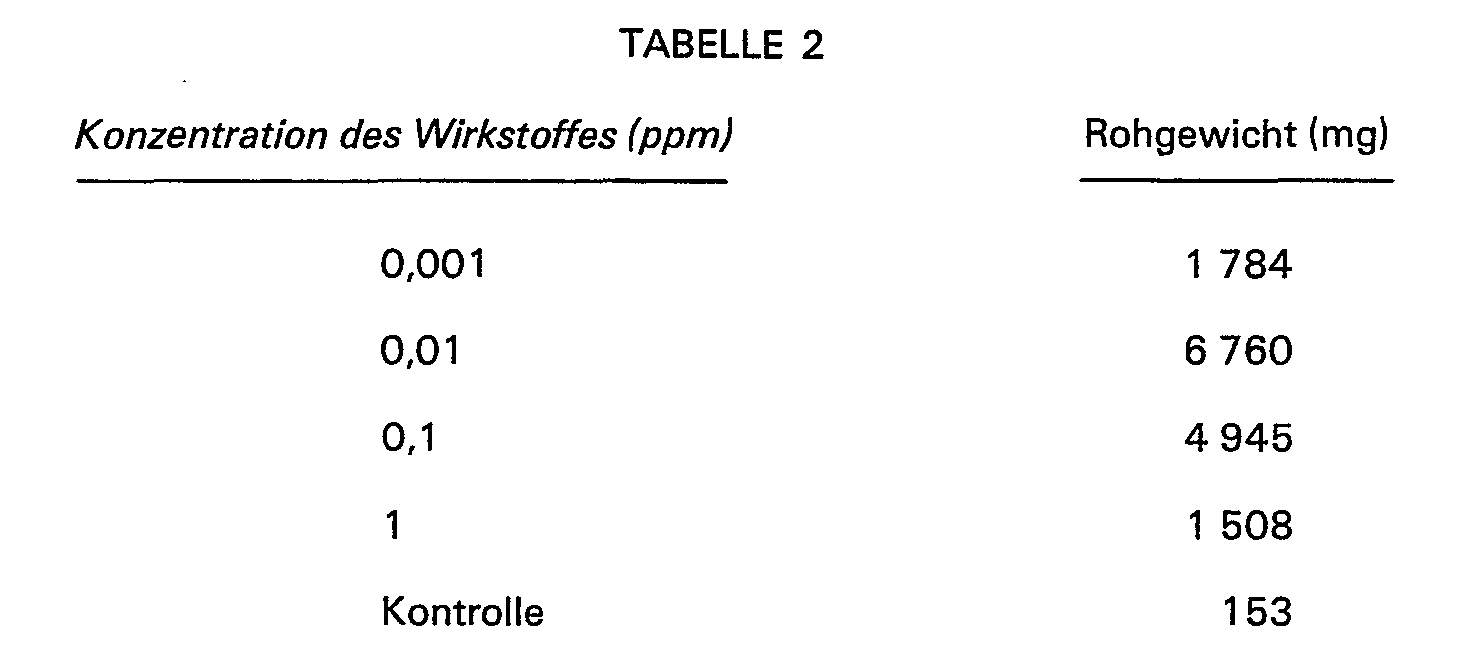
- Vergleichbare Ergebnisse entstehen, wenn N - (2 - Chlor - 4 - pyridyl) - N' - (3 - chlorphenyl) - harnstoff verwendet wird.
- Mehrere Schnitte des Tabakmarkes werden in einem Murashige-Skoog-Nährboden, welcher 0,01 bis 10 ppm N - (2 - Chlor - 4 - pyridyl) - N' - phenylharnstoff enthält, geimpft und bei einer Temperatur von ungefähr 26°C 30 Tage lang kultiviert. Danach werden die Markschnitte, aus denen Sprosse gebildet wurden, gezählt.
- Zum Vergleich wird Benzyladenin ebenfalls untersucht.
- Die Ergebnisse werden in Tabelle 3 zusammengefaßt.
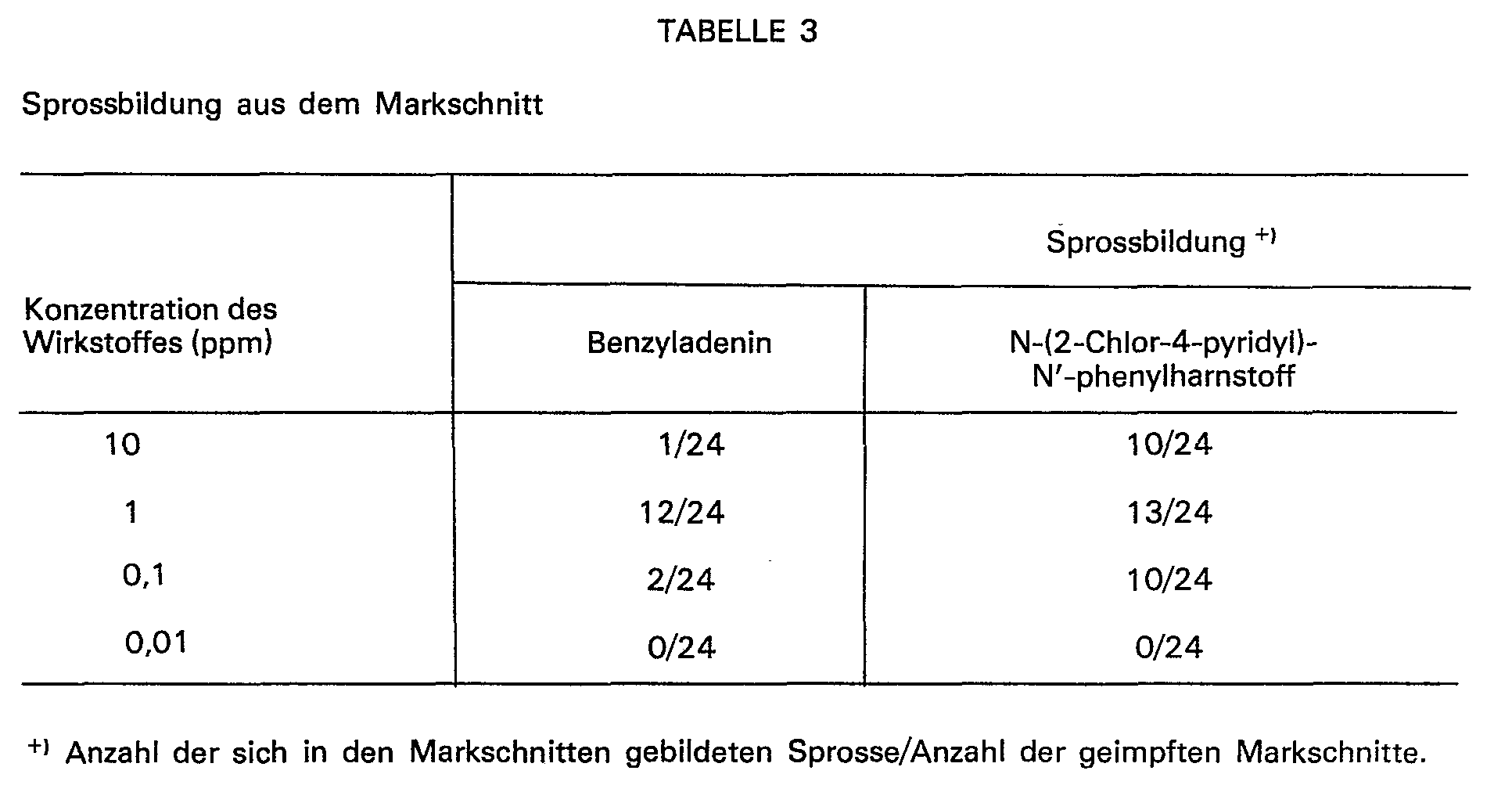
- Aus einem Markschnitt werden 1 bis 6 Sprosse gebildet.
- Einige Tabakkallus werden in einem Murashige-Skoog-Nährboden, welcher 0,01 bis 10 ppm N - (2 - Chlor - 4 - pyridyl) - N' - (2 - methyl) - harnstoff enthält, geimpft und bei Raumtemperatur 30 Tage lang kultiviert. Die Anzahl der sich in den Kallusschnitten gebildeten Sprosse wird gezählt. Zum Vergleich wird Benzyladenin ebenfalls untersucht.
- Die Ergebnisse werden in Tabelle 4 zusammengefaßt.

- Der Nährboden, welcher 0,0001 bis 1 ppm N - (2 - Chlor - 4 - pyridyl) - N' - phenyl - harnstoff enthält, wird hergestellt. Die Kultivierung wird wie in Beispiel 5 beschrieben vorgenommen. Die Ergebnisse werden in Tabelle 5 zusammengefaßt.

- Es wird eine wässrige Lösung von 10 ppm, 1 ppm und 0,1 ppm N - (2 - Chlor - 4 - pyridyl) - N' - phenylharnstoff hergestellt. In eine Schale werden jeweils 50 ml Lösung eingegossen und 10 Blattschnitte, die mit Hilfe eines Korkbohrers mit einem Durchmesser von 10 mm ausgeschnitten werden,
- 1) mit der Rückseite des Blattes auf die Lösung oder
- 2) mit der Oberseite des Blattes auf die Lösung gelegt.
- Die Lösung wird bei Raumtemperatur 8 Tage lang stehengelassen, dann werden der Durchmesser und das Gewicht jedes Blattschnittes bestimmt. Alle Werte sind Mittelwerte von 10 Blattschnittproben. Als Vergleichslösung wird reines Wasser verwendet und analog verfahren. Die Ergebnisse werden in Tabelle 6 zusammengefaßt.


- Die im Freien gezüchteten Wassermelonen (Sorte: Yamato) werden der künstlichen Befruchtung in der Blütezeit unterworfen. Dann werden auf die Fruchtstiele bestimmte Konzentrationen der in Tabelle 7 angegebenen, verschiedenen Lösungen aufgetragen bzw. sie werden damit besprüht. Das Ergebnis der vermehrten Befruchtung (in %) wird 2 Wochen nach der Behandlung errechnet.

- Die Tabaksamen (Sorte: bright yellow) werden in einer unglasierten Tontopf mit einem Durchmesser von ca. 13 cm gesät und in einem Glashaus gezüchtet. Die Blattoberflächen der Pflanzen, die 6 bis 8 Blätter aufweisen, werden (15 ml/Topf) mit bestimmten Konzentrationen der in Tabelle 8 angegebenen Verbindungen mit einem Sprühgerät gleichmäßig besprüht. Eine Sektion der Anpflanzung wird einmal behandelt, die andere Sektion wird dreimal hintereinander und zwar jeden 13. Tag, behandelt.
- Wenn die mittleren Blätter gelb werden (35 Tage nach der ersten Behandlung mit dem Mittel) werden die Pflanzengröße, das Rohgewicht des Stengels und der Blätter und die durchschnittliche Größe der unteren 5 Blätter gemessen und das Verhältnis zu den nicht behandelten Pflanzen errechnet. Die Untersuchungssektion wird in 3 Teile geteilt und die Ergebnisse im Durchschnitt gezeigt. Die Ergebnisse sind in Tabelle 8 zusammengefaßt.

- Die kernlosen, achtjährigen Pflanzen von Delaware-Weintrauben, die in einem nicht erwärmten Haus gezüchtet und mit Gebberellin behandelt wurden, werden auf Verhinderung des vorzeitigen Blütenabfalls der Weintrauben durch N - (2 - Chlor - 4 - pyridyl) - N' - (2 - methylphenyl) - harnstoff geprüft. Nachdem ein Spross an der Pflanze 8 bis 8,5 neue Blätter entwickelt hat, d.h. 3 bis 5 Tage bevor er zur ersten Gibberellinbehandlung geeignet ist, um ihn kernlos zu machen, werden die Blütenbüschel mit einer wässrigen Lösung von 100 ppm Gibberellin und 200, 100, 50 oder 25 ppm N - (2 - Chlor - 4 - pyridyl) - N' - (2 - methylphenyl) - harnstoff oder 200 bzw. 100 ppm 6 - (n - Benzyl) - aminopurin (BA) imprägniert (14. April). Am 4, Mai (10 Tage nach der vollen Blüte) wurden alle Blüten mit weiteren 100 ppm der Gibberellinlösung imprägniert und dann in der üblichen Zuchtmethode bis zur Erntezeit gezüchtet. Am 29. Juni wurden die Weintrauben geerntet und Gewicht, Länge, Dichtigkeit der Beeren, Anzahl der Beeren in einer Traube, sowie Durchmesser und Gewicht des Fruchtstieles untersucht. Die Ergebnisse werden mit den nur mit Gibberellin behandelten Trauben verglichen. Die Untersuchungssektion, bestehend aus jeweils 2 Sprossen, wird jeweils in 3 Teile geteilt. Die Durchschnittsergebnisse von 15 Weintrauben werden in Tabelle 9 zusammengefaßt.

- Die in Klammer gesetzten Werte zeigen jeweils das Verhältnis zum Ergebnis der nur mit Gibberellin behandelten Trauben.
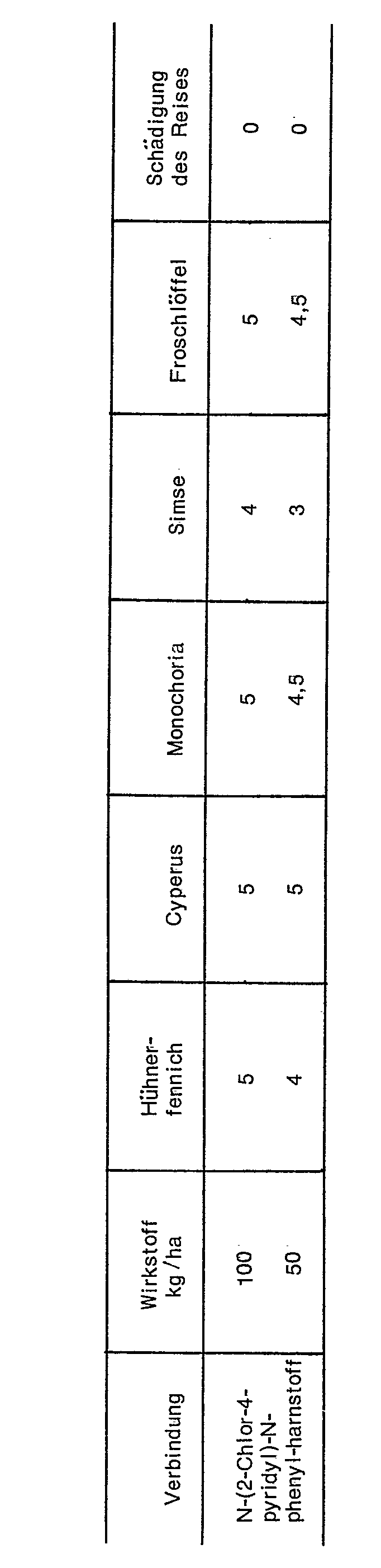
- In einen Topf mit einem Durchmesser von 30 cm wird Boden eingefüllt, der die Wurzeln von Alisma canaliculatum (Froschlöffel) und Scirpus juncoides (Simse) zu gleichen Teilen enthält: In den Topf werden 50 Samen von Echinochloa Crus-galli (Hühnerfennich), Cyperus difformis und Monochoria vaginalis gesät, dazu werden je Topf 5 Reispflanzen (Orysa sativa) im 2-Blätterstadium eingepflanzt, dann in Wasser getaucht, so daß das Wasser 3 cm über dem Rand des Topfes steht. Wenn der Hühnerfennich das erste Blattstadium erreicht, wird eine bestimmte Menge von einem gemäß Rezept 1 hergestellten Herbizid gleichmäßig auf das Wasser verteilt. 14 Tage später werden die Unkrautverhinderungseffekte untersucht.
- Die Ergebnisse werden gemäß der folgenden Liste gezeigt:

- Untersuchung der Zunahme von Blättern und neuen Zweigen bei Datura Sunguinea.
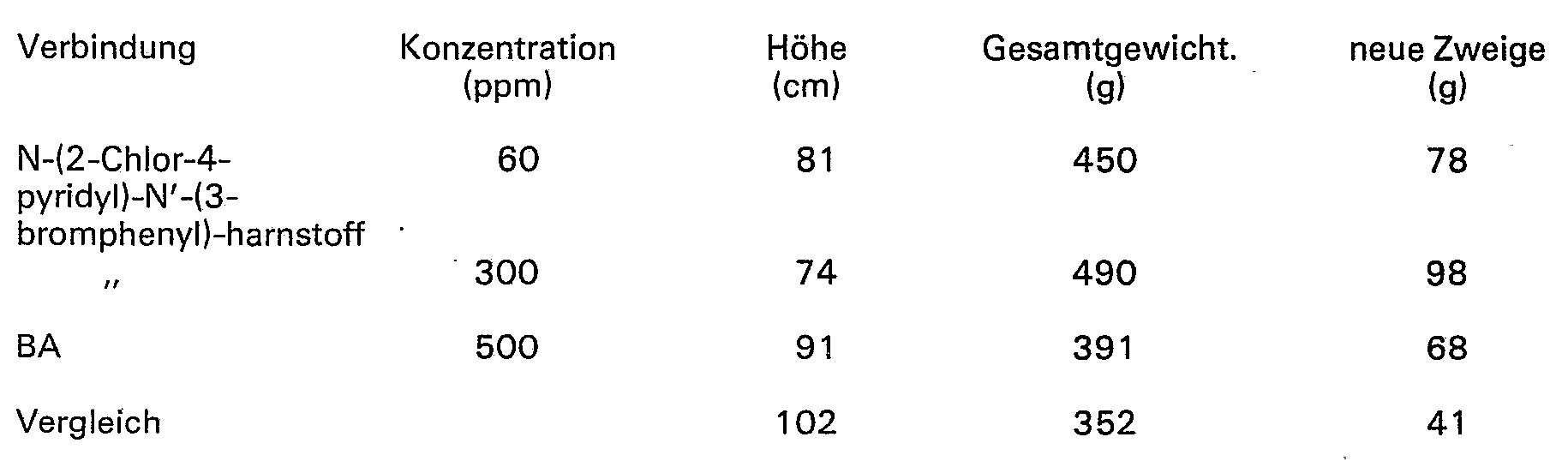
- Datura Sunguinea sp. (mittlere Höhe 8 cm) werden ins Freiland gesetzt. Lösungen der gewünschten Konzentration werden in einer Menge von 15 ml je Pflanze auf die Blätter und Blattstiele der Pflanzen aufgesprüht, wenn die mittlere Höhe der Pflanzen 20 cm beträgt. 3 Wochen später werden die Pflanzen geerntet und die Höhe der Pflanzen, das Gesamtgewicht von frischen Blättern und Stielen und die neuen Zweige gemessen. In der Tabelle ist jeweils der Mittelwert von 5 Pflanzen angegeben.

- Untersuchung der Zunahme von Blättern und neuen Zweigen bei Datura Sunguinea.
- Datura Sunguina sp. (mittlere Höhe 8 cm) werden ins Freiland gepflanzt und Untersuchungen unter Verwendung von N - (2 - Chlor - 4 - pyridyl) - N' - (3 - bromphenyl) - harnstoff werden wie in Beispiel 12 durchgeführt. Die Ergebnisse sind in der folgenden Tabelle angegeben.
Claims (9)

Applications Claiming Priority (3)
| Application Number | Priority Date | Filing Date | Title |
|---|---|---|---|
| JP121285/77 | 1977-10-08 | ||
| JP12128577A JPS5481275A (en) | 1977-10-08 | 1977-10-08 | Nn*22chlorr44pyridyl*ureas*manufacture and vegetable growth regulating agent |
| KR1019780003042A KR830000128B1 (ko) | 1977-10-08 | 1978-10-05 | N-(2-클로로-4-피리딜)요소의 제법 |
Publications (2)
| Publication Number | Publication Date |
|---|---|
| EP0001979A1 EP0001979A1 (de) | 1979-05-30 |
| EP0001979B1 true EP0001979B1 (de) | 1981-09-09 |
Family
ID=26458695
Family Applications (1)
| Application Number | Title | Priority Date | Filing Date |
|---|---|---|---|
| EP78101093A Expired EP0001979B1 (de) | 1977-10-08 | 1978-10-06 | N-(2-Chlor-4-pyridyl)-N'-phenylharnstoffe, Verfahren zu deren Herstellung sowie diese enthaltende Pflanzenwachstumsregulatoren |
Country Status (9)
| Country | Link |
|---|---|
| US (1) | US4193788A (de) |
| EP (1) | EP0001979B1 (de) |
| JP (1) | JPS5481275A (de) |
| KR (1) | KR830000128B1 (de) |
| AU (1) | AU522454B2 (de) |
| BR (1) | BR7806659A (de) |
| DE (1) | DE2843722C2 (de) |
| ES (2) | ES474029A1 (de) |
| IT (1) | IT1099798B (de) |
Cited By (1)
| Publication number | Priority date | Publication date | Assignee | Title |
|---|---|---|---|---|
| WO2014048588A1 (de) | 2012-09-26 | 2014-04-03 | Schaeffler Technologies AG & Co. KG | Nockenwellenversteller |
Families Citing this family (30)
| Publication number | Priority date | Publication date | Assignee | Title |
|---|---|---|---|---|
| JPS5562066A (en) * | 1978-11-03 | 1980-05-10 | Toshihiko Okamoto | N-(2-substituted-4-pyridyl)-urea and thio urea, their preparation and plant growth regulator |
| JPS55139306A (en) | 1979-04-19 | 1980-10-31 | Chugai Pharmaceut Co Ltd | Plant growth regulator |
| JPS55160768A (en) * | 1979-05-31 | 1980-12-13 | Toshihiko Okamoto | Plant growth regulating substance |
| US4293330A (en) * | 1979-10-09 | 1981-10-06 | E. I. Du Pont De Nemours And Company | Herbicidal N-(pyridinylaminocarbonyl)benzenesulfonamides |
| US4308054A (en) * | 1979-11-02 | 1981-12-29 | Yo Isogai | N-(2,6-Disubstituted-4-pyridyl)-N'-phenylureas |
| US4292069A (en) * | 1979-12-10 | 1981-09-29 | Gulf Oil Corporation | Arylthioureido pyridinecarbamino compounds and use as plant growth regulants |
| GB2068365B (en) * | 1980-02-05 | 1983-12-14 | Dow Chemical Co | Fungicidal pyridyl arylureas |
| US4472583A (en) * | 1980-02-05 | 1984-09-18 | The Dow Chemical Company | 4-Isothiocyanato-2,6-bis-(trifluoromethyl)pyridine |
| JPS6014001B2 (ja) * | 1980-08-06 | 1985-04-11 | 敏彦 岡本 | N−(2−クロル−4−ピリジル)尿素類を含有するサイトカイニン様活性剤 |
| US4435187A (en) | 1981-12-31 | 1984-03-06 | Shell Oil Company | Fuel and lubricant compositions for octane requirement reduction |
| BR8406461A (pt) * | 1983-03-29 | 1985-03-12 | Fmc Corp | Reguladores de planta n-fenil-n'(piridinil-n-oxido)ureia |
| IE57775B1 (en) * | 1983-08-22 | 1993-04-07 | Warner Lambert Co | N-(2,6-disubstituted aromatic)-n'-pyridinyl ureas,processes for their production and pharmaceutical compositions comprising the same |
| US4962116A (en) * | 1983-08-22 | 1990-10-09 | Warner-Lambert Company | N-(2,6-disubstituted aromatic)-N'-pyridinyl ureas |
| US4629731A (en) * | 1983-08-22 | 1986-12-16 | Warner-Lambert Company | Anticonvulsant N-(2,6-disubstituted aromatic)-n'-pyridinyl ureas |
| US4735650A (en) * | 1985-10-10 | 1988-04-05 | Fmc Corporation | Pyridazinylurea N-oxide plant regulators |
| US4728355A (en) * | 1985-10-10 | 1988-03-01 | Fmc Corporation | Pyridazinylurea plant regulators |
| US4808722A (en) * | 1985-10-31 | 1989-02-28 | Fmc Corporation | Pyridinylurea N-oxide compounds and agricultural uses |
| US4818271A (en) * | 1985-10-31 | 1989-04-04 | Fmc Corporation | Pyridinylurea compounds and agricultural uses |
| US5125959A (en) * | 1991-02-07 | 1992-06-30 | Tokuyama Soda Kabushiki Kaisha | Method of thinning lateral flowers of apples |
| ES2125183B1 (es) * | 1997-01-23 | 1999-10-01 | Terrarium Agro S L | Nuevo metodo para engorde de varias especies de frutos. |
| WO1999011621A2 (en) * | 1997-09-03 | 1999-03-11 | American Home Products Corporation | Thiourea for increasing hdl-cholesterol levels, which are useful as anti-atherosclerotic agents |
| ES2201909B1 (es) * | 2002-06-06 | 2005-02-16 | Universitat De Valencia Estudi General. | Utilizacion de n-(2-cloropiridin-4-il)-n'-fenilureas y n-(3-nitrofenil)-n'-fenilureas fluoradas como promotores del crecimiento del fruto en cultivos de actinidia deliciosa. |
| EP2052609A1 (de) | 2007-10-24 | 2009-04-29 | Bayer CropScience AG | Herbizid-Kombination |
| DE102008037621A1 (de) | 2008-08-14 | 2010-02-18 | Bayer Cropscience Ag | Herbizid-Kombination mit Dimethoxytriazinyl-substituierten Difluormethansulfonylaniliden |
| EP2654433B1 (de) | 2010-12-21 | 2017-08-30 | Bayer Cropscience LP | "sandpapier"-mutanten von bacillus und methoden ihrer verwendung zur förderung von pflanzenwachstum, pflanzengesundheit und zur kontrolle von krankheiten und schädlingen |
| MX2014002890A (es) | 2011-09-12 | 2015-01-19 | Bayer Cropscience Lp | Metodo para mejorar la salud y/o promover el crecimiento de una planta y/o mejorar la maduracion de frutos. |
| US10244759B2 (en) * | 2013-10-08 | 2019-04-02 | Kim-C1, Llc | Use of forchlorfenuron for promoting plant growth |
| KR102821737B1 (ko) * | 2015-10-07 | 2025-06-16 | 스톨러 엔터프라이지즈, 인크. | 디아실 또는 디아릴 우레아 및 적어도 하나의 금속 착물을 포함하는 상승작용 농업 제제를 사용한 식물에서의 에틸렌 관리 |
| WO2020126968A2 (en) * | 2018-12-20 | 2020-06-25 | Bayer Aktiengesellschaft | Urea derivatives |
| CZ309190B6 (cs) * | 2020-10-13 | 2022-04-27 | Ústav experimentální botaniky AV ČR, v. v. i. | Látky pro rostlinné biotechnologie na bázi 1-fenyl-3-yl-močoviny, přípravky je obsahující a jejich použití |
Family Cites Families (13)
| Publication number | Priority date | Publication date | Assignee | Title |
|---|---|---|---|---|
| DE1445675C3 (de) * | 1964-08-29 | 1974-02-28 | Deutsche Gold- Und Silber-Scheideanstalt Vormals Roessler, 6000 Frankfurt | Pyridylharnstoffe und Verfahren zu ihrer Herstellung |
| US3293257A (en) * | 1964-09-14 | 1966-12-20 | United States Borax Chem | Pyridyl urea compounds |
| GB1122662A (en) * | 1965-02-18 | 1968-08-07 | Fisons Pest Control Ltd | Preservation of plant materials |
| US3376309A (en) * | 1965-03-29 | 1968-04-02 | Mobil Oil Corp | Certain substituted pyridylamides and pyridylureas |
| US3335142A (en) * | 1965-07-07 | 1967-08-08 | American Cyanamid Co | Process for the preparation of n, n'-disubstituted ureas |
| US3426031A (en) * | 1967-01-19 | 1969-02-04 | Dow Chemical Co | 3,5,6 - trichloro - 4 - (3 - (alpha,alpha,alpha,alpha',alpha',alpha'-hexafluoro - 3,5 - xylyl)ureido) picolinic acid and the corresponding amide derivative |
| US3705170A (en) * | 1969-03-17 | 1972-12-05 | Dow Chemical Co | Polyhalo-(trifluoromethyl)pyridyloxy amides and hydrazides |
| US3682934A (en) * | 1969-04-18 | 1972-08-08 | Henry Martin | Certain 3-(2-lower-alkoxy-5-pyridyl)-ureas |
| US3687959A (en) * | 1970-05-28 | 1972-08-29 | Exxon Research Engineering Co | Alkaryl-alkoxy, aryl-amido derivatives of pyridine |
| US3992391A (en) * | 1972-08-16 | 1976-11-16 | Dainippon Pharmaceutical Co., Ltd. | 1,3-Disubstituted thiourea compounds and preparation thereof |
| GB1354830A (en) * | 1972-08-31 | 1974-06-05 | Dainippon Pharmaceutical Co | 1,3-disubstituted thiourea compounds their preparation and use |
| JPS5243669A (en) * | 1975-09-23 | 1977-04-05 | Toshihiko Okamoto | Crop increasing agent for plants |
| US4149872A (en) * | 1977-07-21 | 1979-04-17 | Shell Oil Company | N-pyridinyl urea and cyclopropanecarboxamide herbicides |
-
1977
- 1977-10-08 JP JP12128577A patent/JPS5481275A/ja active Pending
-
1978
- 1978-10-02 US US05/947,468 patent/US4193788A/en not_active Ceased
- 1978-10-04 AU AU40392/78A patent/AU522454B2/en not_active Expired
- 1978-10-05 KR KR1019780003042A patent/KR830000128B1/ko not_active Expired
- 1978-10-06 ES ES474029A patent/ES474029A1/es not_active Expired
- 1978-10-06 EP EP78101093A patent/EP0001979B1/de not_active Expired
- 1978-10-06 DE DE2843722A patent/DE2843722C2/de not_active Expired
- 1978-10-06 BR BR7806659A patent/BR7806659A/pt unknown
- 1978-10-06 IT IT28513/78A patent/IT1099798B/it active
-
1979
- 1979-05-16 ES ES480617A patent/ES480617A1/es not_active Expired
Cited By (1)
| Publication number | Priority date | Publication date | Assignee | Title |
|---|---|---|---|---|
| WO2014048588A1 (de) | 2012-09-26 | 2014-04-03 | Schaeffler Technologies AG & Co. KG | Nockenwellenversteller |
Also Published As
| Publication number | Publication date |
|---|---|
| DE2843722C2 (de) | 1986-10-23 |
| EP0001979A1 (de) | 1979-05-30 |
| BR7806659A (pt) | 1979-05-02 |
| KR830000128A (ko) | 1983-03-25 |
| KR830000128B1 (ko) | 1983-02-14 |
| AU522454B2 (en) | 1982-06-10 |
| US4193788A (en) | 1980-03-18 |
| IT1099798B (it) | 1985-09-28 |
| AU4039278A (en) | 1980-04-17 |
| JPS5481275A (en) | 1979-06-28 |
| ES474029A1 (es) | 1980-01-16 |
| IT7828513A0 (it) | 1978-10-06 |
| DE2843722A1 (de) | 1979-04-19 |
| ES480617A1 (es) | 1980-08-16 |
Similar Documents
| Publication | Publication Date | Title |
|---|---|---|
| DE2843722C2 (de) | N-(2-Chlor-4-pyridyl)-N'-phenyl-harnstoffe, Verfahren zu deren Herstellung sowie diese enthaltende Pflanzenwachstumsregulatoren | |
| EP0010770B1 (de) | In 2-Stellung substituierte 4-Pyridyl-harnstoffe bzw. -thioharnstoffe, Verfahren zu deren Herstellung sowie diese enthaltende Pflanzenwachstumsregulatoren | |
| DE69429336T2 (de) | Zusammensetzung von Pflanzenwachstums-Beschleuniger | |
| DE2716832A1 (de) | Verfahren zur pflanzenwachstumsregulierung, dafuer geeignete mittel sowie neue pyridin-n-oxide | |
| DE1745906C3 (de) | Pyrazolderivate und Mittel zur Förderung der Fruchtreife und des Fruchtansatzes sowie zur selektiven Unkrautbekämpfung | |
| DE2349745B2 (de) | Pflanzenwuchsregelnde Mittel | |
| DE2646406C2 (de) | Verwendung von Alkalisalzen zur Pflanzenwuchsregelung | |
| EP0009740B1 (de) | Beta-Triazolyloxime, diese enthaltende Mittel zur Beeinflussung des Pflanzenwachstums und ihre Anwendung | |
| EP0019762B1 (de) | Triazolylderivate, Verfahren zu ihrer Herstellung sowie diese enthaltende Mittel zur Beeinflussung des Pflanzenwachstums | |
| DE3144526C2 (de) | ||
| DE3874773T2 (de) | Pflanzenwachstumsregulator. | |
| WO1996008969A2 (de) | Verfahren zur steigerung des ernteertrags bei kulturpflanzen | |
| DD257255A5 (de) | Verfahren zur herstellung von neuen mono- oder di-(aryloxyethyl)succinaten | |
| DD241821A3 (de) | Mittel zur beeinflussung von wachstums-,entwicklungs- und stoffwechselprozessen in pflanzen | |
| DE2362333C3 (de) | Thionophosphorsäureesteramide, Verfahren zu deren Herstellung und Verwendung derselben | |
| EP0121196B1 (de) | Pflanzenwachstumsregulierende Mittel | |
| EP0069244A1 (de) | Verfahren zur Beeinflussung des Pflanzenwachstums | |
| DE2350907A1 (de) | Mittel zur beeinflussung des pflanzenwachstums | |
| DD145991A5 (de) | Landwirtschaftlich verwendbare zusammensetzung | |
| DE2149680C3 (de) | 2-Halogenäthyl-organooxy-sllane, deren Herstelung und Mittel zur Regulierung des Pflanzenwachstums CIBA-GEIGY AG, Basel (Schweiz) | |
| DD145992A5 (de) | Pflanzenwachstumsregulator | |
| DE2247267C3 (de) | 2,4,5- Trioxo-imidazolidin-3-carbonsäureamide, Verfahren zu ihrer Herstellung und sie enthaltende Mittel zur Regulierung des Pflanzenstoffwechsels | |
| DE2443421C3 (de) | l-Alkyl^-imino-S-phenyM-methyl-4- imidazoline, Verfahren zu ihrer Herstellung und sie enthaltende Mittel zur Regulierung des Pflanzenwuchses | |
| DE2812659C2 (de) | Hydrazinium-bis-(&beta;-chloräthyl-hydrogenphosphonate), Verfahren zu deren Herstellung und diese enthaltende Mittel zur Wachstumsregulierung bei Pflanzen | |
| AT280320B (de) | Pflanzenwuchsmittel |
Legal Events
| Date | Code | Title | Description |
|---|---|---|---|
| PUAI | Public reference made under article 153(3) epc to a published international application that has entered the european phase |
Free format text: ORIGINAL CODE: 0009012 |
|
| AK | Designated contracting states |
Designated state(s): CH FR GB |
|
| 17P | Request for examination filed | ||
| GRAA | (expected) grant |
Free format text: ORIGINAL CODE: 0009210 |
|
| AK | Designated contracting states |
Designated state(s): CH FR GB |
|
| PGFP | Annual fee paid to national office [announced via postgrant information from national office to epo] |
Ref country code: CH Payment date: 19970923 Year of fee payment: 20 Ref country code: FR Payment date: 19970923 Year of fee payment: 20 |
|
| PGFP | Annual fee paid to national office [announced via postgrant information from national office to epo] |
Ref country code: GB Payment date: 19970929 Year of fee payment: 20 |
|
| PG25 | Lapsed in a contracting state [announced via postgrant information from national office to epo] |
Ref country code: CH Free format text: LAPSE BECAUSE OF EXPIRATION OF PROTECTION Effective date: 19981005 Ref country code: GB Free format text: LAPSE BECAUSE OF EXPIRATION OF PROTECTION Effective date: 19981005 |
|
| REG | Reference to a national code |
Ref country code: GB Ref legal event code: PE20 Effective date: 19981005 |
|
| REG | Reference to a national code |
Ref country code: CH Ref legal event code: PL |
|
| PLBE | No opposition filed within time limit |
Free format text: ORIGINAL CODE: 0009261 |
|
| STAA | Information on the status of an ep patent application or granted ep patent |
Free format text: STATUS: NO OPPOSITION FILED WITHIN TIME LIMIT |