EP0024340B1 - Waschverfahren - Google Patents
Waschverfahren Download PDFInfo
- Publication number
- EP0024340B1 EP0024340B1 EP80104728A EP80104728A EP0024340B1 EP 0024340 B1 EP0024340 B1 EP 0024340B1 EP 80104728 A EP80104728 A EP 80104728A EP 80104728 A EP80104728 A EP 80104728A EP 0024340 B1 EP0024340 B1 EP 0024340B1
- Authority
- EP
- European Patent Office
- Prior art keywords
- weight
- component
- potassium
- washing
- sodium
- Prior art date
- Legal status (The legal status is an assumption and is not a legal conclusion. Google has not performed a legal analysis and makes no representation as to the accuracy of the status listed.)
- Expired
Links
- 238000005406 washing Methods 0.000 title claims abstract description 36
- KWYUFKZDYYNOTN-UHFFFAOYSA-M Potassium hydroxide Chemical compound [OH-].[K+] KWYUFKZDYYNOTN-UHFFFAOYSA-M 0.000 claims abstract description 29
- 239000000194 fatty acid Substances 0.000 claims abstract description 29
- 235000014113 dietary fatty acids Nutrition 0.000 claims abstract description 27
- 229930195729 fatty acid Natural products 0.000 claims abstract description 27
- 150000004665 fatty acids Chemical class 0.000 claims abstract description 27
- XLYOFNOQVPJJNP-UHFFFAOYSA-N water Substances O XLYOFNOQVPJJNP-UHFFFAOYSA-N 0.000 claims abstract description 20
- 239000000344 soap Substances 0.000 claims abstract description 17
- 239000011734 sodium Substances 0.000 claims abstract description 14
- 239000000243 solution Substances 0.000 claims abstract description 13
- 230000003287 optical effect Effects 0.000 claims abstract description 12
- 229910052708 sodium Inorganic materials 0.000 claims abstract description 12
- 229910052700 potassium Inorganic materials 0.000 claims abstract description 11
- GSEJCLTVZPLZKY-UHFFFAOYSA-N Triethanolamine Chemical compound OCCN(CCO)CCO GSEJCLTVZPLZKY-UHFFFAOYSA-N 0.000 claims abstract description 10
- WRIDQFICGBMAFQ-UHFFFAOYSA-N (E)-8-Octadecenoic acid Natural products CCCCCCCCCC=CCCCCCCC(O)=O WRIDQFICGBMAFQ-UHFFFAOYSA-N 0.000 claims abstract description 8
- LQJBNNIYVWPHFW-UHFFFAOYSA-N 20:1omega9c fatty acid Natural products CCCCCCCCCCC=CCCCCCCCC(O)=O LQJBNNIYVWPHFW-UHFFFAOYSA-N 0.000 claims abstract description 8
- QSBYPNXLFMSGKH-UHFFFAOYSA-N 9-Heptadecensaeure Natural products CCCCCCCC=CCCCCCCCC(O)=O QSBYPNXLFMSGKH-UHFFFAOYSA-N 0.000 claims abstract description 8
- DGAQECJNVWCQMB-PUAWFVPOSA-M Ilexoside XXIX Chemical compound C[C@@H]1CC[C@@]2(CC[C@@]3(C(=CC[C@H]4[C@]3(CC[C@@H]5[C@@]4(CC[C@@H](C5(C)C)OS(=O)(=O)[O-])C)C)[C@@H]2[C@]1(C)O)C)C(=O)O[C@H]6[C@@H]([C@H]([C@@H]([C@H](O6)CO)O)O)O.[Na+] DGAQECJNVWCQMB-PUAWFVPOSA-M 0.000 claims abstract description 8
- 239000005642 Oleic acid Substances 0.000 claims abstract description 8
- ZQPPMHVWECSIRJ-UHFFFAOYSA-N Oleic acid Natural products CCCCCCCCC=CCCCCCCCC(O)=O ZQPPMHVWECSIRJ-UHFFFAOYSA-N 0.000 claims abstract description 8
- 239000003795 chemical substances by application Substances 0.000 claims abstract description 8
- QXJSBBXBKPUZAA-UHFFFAOYSA-N isooleic acid Natural products CCCCCCCC=CCCCCCCCCC(O)=O QXJSBBXBKPUZAA-UHFFFAOYSA-N 0.000 claims abstract description 8
- ZQPPMHVWECSIRJ-KTKRTIGZSA-N oleic acid Chemical compound CCCCCCCC\C=C/CCCCCCCC(O)=O ZQPPMHVWECSIRJ-KTKRTIGZSA-N 0.000 claims abstract description 8
- ZLMJMSJWJFRBEC-UHFFFAOYSA-N Potassium Chemical compound [K] ZLMJMSJWJFRBEC-UHFFFAOYSA-N 0.000 claims abstract description 7
- 239000011591 potassium Substances 0.000 claims abstract description 7
- 239000006185 dispersion Substances 0.000 claims abstract description 6
- -1 oleic acid Chemical class 0.000 claims abstract description 5
- 239000000203 mixture Substances 0.000 claims description 21
- LYCAIKOWRPUZTN-UHFFFAOYSA-N ethylene glycol Natural products OCCO LYCAIKOWRPUZTN-UHFFFAOYSA-N 0.000 claims description 14
- 150000001298 alcohols Chemical class 0.000 claims description 11
- 125000004432 carbon atom Chemical group C* 0.000 claims description 11
- 238000000034 method Methods 0.000 claims description 11
- 239000002253 acid Substances 0.000 claims description 10
- 150000007513 acids Chemical class 0.000 claims description 9
- 239000003352 sequestering agent Substances 0.000 claims description 9
- KFZMGEQAYNKOFK-UHFFFAOYSA-N Isopropanol Chemical compound CC(C)O KFZMGEQAYNKOFK-UHFFFAOYSA-N 0.000 claims description 8
- 150000001875 compounds Chemical class 0.000 claims description 8
- HEMHJVSKTPXQMS-UHFFFAOYSA-M Sodium hydroxide Chemical compound [OH-].[Na+] HEMHJVSKTPXQMS-UHFFFAOYSA-M 0.000 claims description 7
- 230000015572 biosynthetic process Effects 0.000 claims description 7
- 235000019832 sodium triphosphate Nutrition 0.000 claims description 7
- LFQSCWFLJHTTHZ-UHFFFAOYSA-N Ethanol Chemical compound CCO LFQSCWFLJHTTHZ-UHFFFAOYSA-N 0.000 claims description 6
- 150000008044 alkali metal hydroxides Chemical class 0.000 claims description 4
- 239000000126 substance Substances 0.000 claims description 4
- DBVJJBKOTRCVKF-UHFFFAOYSA-N Etidronic acid Chemical compound OP(=O)(O)C(O)(C)P(O)(O)=O DBVJJBKOTRCVKF-UHFFFAOYSA-N 0.000 claims description 3
- 229910001854 alkali hydroxide Inorganic materials 0.000 claims description 3
- 239000007864 aqueous solution Substances 0.000 claims description 3
- 230000014759 maintenance of location Effects 0.000 claims description 3
- XAEFZNCEHLXOMS-UHFFFAOYSA-M potassium benzoate Chemical compound [K+].[O-]C(=O)C1=CC=CC=C1 XAEFZNCEHLXOMS-UHFFFAOYSA-M 0.000 claims description 3
- UNXRWKVEANCORM-UHFFFAOYSA-I triphosphate(5-) Chemical compound [O-]P([O-])(=O)OP([O-])(=O)OP([O-])([O-])=O UNXRWKVEANCORM-UHFFFAOYSA-I 0.000 claims description 3
- VIFBEEYZXDDZCT-UHFFFAOYSA-N 2-(2-phenylethenyl)benzenesulfonic acid Chemical class OS(=O)(=O)C1=CC=CC=C1C=CC1=CC=CC=C1 VIFBEEYZXDDZCT-UHFFFAOYSA-N 0.000 claims description 2
- 239000004111 Potassium silicate Substances 0.000 claims description 2
- 239000004115 Sodium Silicate Substances 0.000 claims description 2
- 239000000470 constituent Substances 0.000 claims description 2
- NNHHDJVEYQHLHG-UHFFFAOYSA-N potassium silicate Chemical compound [K+].[K+].[O-][Si]([O-])=O NNHHDJVEYQHLHG-UHFFFAOYSA-N 0.000 claims description 2
- 229910052913 potassium silicate Inorganic materials 0.000 claims description 2
- 235000019353 potassium silicate Nutrition 0.000 claims description 2
- 229910052911 sodium silicate Inorganic materials 0.000 claims description 2
- 229940093932 potassium hydroxide Drugs 0.000 claims 4
- 235000011118 potassium hydroxide Nutrition 0.000 claims 4
- 229940077388 benzenesulfonate Drugs 0.000 claims 2
- 239000013543 active substance Substances 0.000 claims 1
- 150000004996 alkyl benzenes Chemical class 0.000 claims 1
- BEGBSFPALGFMJI-UHFFFAOYSA-N ethene;sodium Chemical group [Na].C=C BEGBSFPALGFMJI-UHFFFAOYSA-N 0.000 claims 1
- NTHWMYGWWRZVTN-UHFFFAOYSA-N sodium silicate Chemical compound [Na+].[Na+].[O-][Si]([O-])=O NTHWMYGWWRZVTN-UHFFFAOYSA-N 0.000 claims 1
- 239000012670 alkaline solution Substances 0.000 abstract 2
- 239000012530 fluid Substances 0.000 abstract 1
- 125000006353 oxyethylene group Chemical group 0.000 abstract 1
- 150000003112 potassium compounds Chemical class 0.000 abstract 1
- 150000003138 primary alcohols Chemical class 0.000 abstract 1
- 150000004670 unsaturated fatty acids Chemical class 0.000 abstract 1
- 235000021122 unsaturated fatty acids Nutrition 0.000 abstract 1
- 239000003599 detergent Substances 0.000 description 14
- 239000007788 liquid Substances 0.000 description 8
- 150000003839 salts Chemical class 0.000 description 7
- 235000021313 oleic acid Nutrition 0.000 description 6
- RTZKZFJDLAIYFH-UHFFFAOYSA-N ether Substances CCOCC RTZKZFJDLAIYFH-UHFFFAOYSA-N 0.000 description 5
- 235000008504 concentrate Nutrition 0.000 description 4
- 239000012141 concentrate Substances 0.000 description 4
- 239000004435 Oxo alcohol Substances 0.000 description 3
- DNIAPMSPPWPWGF-UHFFFAOYSA-N Propylene glycol Chemical compound CC(O)CO DNIAPMSPPWPWGF-UHFFFAOYSA-N 0.000 description 3
- 239000000654 additive Substances 0.000 description 3
- 239000003513 alkali Substances 0.000 description 3
- 239000000839 emulsion Substances 0.000 description 3
- 235000021588 free fatty acids Nutrition 0.000 description 3
- 229910019142 PO4 Inorganic materials 0.000 description 2
- 235000021355 Stearic acid Nutrition 0.000 description 2
- 125000000217 alkyl group Chemical group 0.000 description 2
- 150000008280 chlorinated hydrocarbons Chemical class 0.000 description 2
- YRIUSKIDOIARQF-UHFFFAOYSA-N dodecyl benzenesulfonate Chemical compound CCCCCCCCCCCCOS(=O)(=O)C1=CC=CC=C1 YRIUSKIDOIARQF-UHFFFAOYSA-N 0.000 description 2
- 229940071161 dodecylbenzenesulfonate Drugs 0.000 description 2
- 239000003995 emulsifying agent Substances 0.000 description 2
- 239000006260 foam Substances 0.000 description 2
- 238000005187 foaming Methods 0.000 description 2
- IPCSVZSSVZVIGE-UHFFFAOYSA-N hexadecanoic acid Chemical compound CCCCCCCCCCCCCCCC(O)=O IPCSVZSSVZVIGE-UHFFFAOYSA-N 0.000 description 2
- 229930195733 hydrocarbon Natural products 0.000 description 2
- 150000002430 hydrocarbons Chemical class 0.000 description 2
- 230000003165 hydrotropic effect Effects 0.000 description 2
- 235000014666 liquid concentrate Nutrition 0.000 description 2
- 125000002496 methyl group Chemical group [H]C([H])([H])* 0.000 description 2
- 239000002736 nonionic surfactant Substances 0.000 description 2
- QIQXTHQIDYTFRH-UHFFFAOYSA-N octadecanoic acid Chemical compound CCCCCCCCCCCCCCCCCC(O)=O QIQXTHQIDYTFRH-UHFFFAOYSA-N 0.000 description 2
- OQCDKBAXFALNLD-UHFFFAOYSA-N octadecanoic acid Natural products CCCCCCCC(C)CCCCCCCCC(O)=O OQCDKBAXFALNLD-UHFFFAOYSA-N 0.000 description 2
- NBIIXXVUZAFLBC-UHFFFAOYSA-K phosphate Chemical compound [O-]P([O-])([O-])=O NBIIXXVUZAFLBC-UHFFFAOYSA-K 0.000 description 2
- 239000010452 phosphate Substances 0.000 description 2
- 238000002360 preparation method Methods 0.000 description 2
- 238000005204 segregation Methods 0.000 description 2
- 239000002904 solvent Substances 0.000 description 2
- 239000008117 stearic acid Substances 0.000 description 2
- 239000004094 surface-active agent Substances 0.000 description 2
- GPCTYPSWRBUGFH-UHFFFAOYSA-N (1-amino-1-phosphonoethyl)phosphonic acid Chemical compound OP(=O)(O)C(N)(C)P(O)(O)=O GPCTYPSWRBUGFH-UHFFFAOYSA-N 0.000 description 1
- OYHQOLUKZRVURQ-NTGFUMLPSA-N (9Z,12Z)-9,10,12,13-tetratritiooctadeca-9,12-dienoic acid Chemical compound C(CCCCCCC\C(=C(/C\C(=C(/CCCCC)\[3H])\[3H])\[3H])\[3H])(=O)O OYHQOLUKZRVURQ-NTGFUMLPSA-N 0.000 description 1
- DURPTKYDGMDSBL-UHFFFAOYSA-N 1-butoxybutane Chemical class CCCCOCCCC DURPTKYDGMDSBL-UHFFFAOYSA-N 0.000 description 1
- BVKZGUZCCUSVTD-UHFFFAOYSA-M Bicarbonate Chemical class OC([O-])=O BVKZGUZCCUSVTD-UHFFFAOYSA-M 0.000 description 1
- ZAMOUSCENKQFHK-UHFFFAOYSA-N Chlorine atom Chemical compound [Cl] ZAMOUSCENKQFHK-UHFFFAOYSA-N 0.000 description 1
- 235000021314 Palmitic acid Nutrition 0.000 description 1
- 229920000388 Polyphosphate Polymers 0.000 description 1
- 229920001213 Polysorbate 20 Polymers 0.000 description 1
- 239000005708 Sodium hypochlorite Substances 0.000 description 1
- 241000779819 Syncarpia glomulifera Species 0.000 description 1
- 239000012190 activator Substances 0.000 description 1
- 125000001931 aliphatic group Chemical group 0.000 description 1
- 125000002490 anilino group Chemical group [H]N(*)C1=C([H])C([H])=C([H])C([H])=C1[H] 0.000 description 1
- QVGXLLKOCUKJST-UHFFFAOYSA-N atomic oxygen Chemical compound [O] QVGXLLKOCUKJST-UHFFFAOYSA-N 0.000 description 1
- 239000003139 biocide Substances 0.000 description 1
- 238000004061 bleaching Methods 0.000 description 1
- 239000007844 bleaching agent Substances 0.000 description 1
- 150000004649 carbonic acid derivatives Chemical class 0.000 description 1
- 238000005341 cation exchange Methods 0.000 description 1
- 239000001913 cellulose Substances 0.000 description 1
- 229920002678 cellulose Polymers 0.000 description 1
- 229920003086 cellulose ether Polymers 0.000 description 1
- 239000000460 chlorine Substances 0.000 description 1
- 229910052801 chlorine Inorganic materials 0.000 description 1
- 238000004140 cleaning Methods 0.000 description 1
- 125000004093 cyano group Chemical group *C#N 0.000 description 1
- 239000000975 dye Substances 0.000 description 1
- 125000001495 ethyl group Chemical group [H]C([H])([H])C([H])([H])* 0.000 description 1
- 238000004880 explosion Methods 0.000 description 1
- 239000003205 fragrance Substances 0.000 description 1
- 230000008014 freezing Effects 0.000 description 1
- 238000007710 freezing Methods 0.000 description 1
- 238000010438 heat treatment Methods 0.000 description 1
- 125000004356 hydroxy functional group Chemical group O* 0.000 description 1
- 239000003112 inhibitor Substances 0.000 description 1
- 238000002386 leaching Methods 0.000 description 1
- 238000002844 melting Methods 0.000 description 1
- 125000000956 methoxy group Chemical group [H]C([H])([H])O* 0.000 description 1
- 125000001160 methoxycarbonyl group Chemical group [H]C([H])([H])OC(*)=O 0.000 description 1
- 238000002156 mixing Methods 0.000 description 1
- 125000004573 morpholin-4-yl group Chemical group N1(CCOCC1)* 0.000 description 1
- WQEPLUUGTLDZJY-UHFFFAOYSA-N n-Pentadecanoic acid Natural products CCCCCCCCCCCCCCC(O)=O WQEPLUUGTLDZJY-UHFFFAOYSA-N 0.000 description 1
- 230000007935 neutral effect Effects 0.000 description 1
- MGFYIUFZLHCRTH-UHFFFAOYSA-N nitrilotriacetic acid Chemical compound OC(=O)CN(CC(O)=O)CC(O)=O MGFYIUFZLHCRTH-UHFFFAOYSA-N 0.000 description 1
- 239000012875 nonionic emulsifier Substances 0.000 description 1
- 239000004006 olive oil Substances 0.000 description 1
- 235000008390 olive oil Nutrition 0.000 description 1
- 229910052760 oxygen Inorganic materials 0.000 description 1
- 239000001301 oxygen Substances 0.000 description 1
- 238000004806 packaging method and process Methods 0.000 description 1
- 235000011837 pasties Nutrition 0.000 description 1
- 239000001739 pinus spp. Substances 0.000 description 1
- 239000000256 polyoxyethylene sorbitan monolaurate Substances 0.000 description 1
- 235000010486 polyoxyethylene sorbitan monolaurate Nutrition 0.000 description 1
- 239000001818 polyoxyethylene sorbitan monostearate Substances 0.000 description 1
- 235000010989 polyoxyethylene sorbitan monostearate Nutrition 0.000 description 1
- 239000001205 polyphosphate Substances 0.000 description 1
- 235000011176 polyphosphates Nutrition 0.000 description 1
- 235000020777 polyunsaturated fatty acids Nutrition 0.000 description 1
- 229940096992 potassium oleate Drugs 0.000 description 1
- MLICVSDCCDDWMD-KVVVOXFISA-M potassium;(z)-octadec-9-enoate Chemical compound [K+].CCCCCCCC\C=C/CCCCCCCC([O-])=O MLICVSDCCDDWMD-KVVVOXFISA-M 0.000 description 1
- BDERNNFJNOPAEC-UHFFFAOYSA-N propan-1-ol Chemical compound CCCO BDERNNFJNOPAEC-UHFFFAOYSA-N 0.000 description 1
- 238000003303 reheating Methods 0.000 description 1
- 235000003441 saturated fatty acids Nutrition 0.000 description 1
- 150000004671 saturated fatty acids Chemical class 0.000 description 1
- 150000004760 silicates Chemical class 0.000 description 1
- SUKJFIGYRHOWBL-UHFFFAOYSA-N sodium hypochlorite Chemical compound [Na+].Cl[O-] SUKJFIGYRHOWBL-UHFFFAOYSA-N 0.000 description 1
- 159000000000 sodium salts Chemical class 0.000 description 1
- AKHNMLFCWUSKQB-UHFFFAOYSA-L sodium thiosulfate Chemical compound [Na+].[Na+].[O-]S([O-])(=O)=S AKHNMLFCWUSKQB-UHFFFAOYSA-L 0.000 description 1
- 235000019345 sodium thiosulphate Nutrition 0.000 description 1
- 239000003381 stabilizer Substances 0.000 description 1
- 239000003784 tall oil Substances 0.000 description 1
- 230000002110 toxicologic effect Effects 0.000 description 1
- 231100000027 toxicology Toxicity 0.000 description 1
- JSPLKZUTYZBBKA-UHFFFAOYSA-N trioxidane Chemical compound OOO JSPLKZUTYZBBKA-UHFFFAOYSA-N 0.000 description 1
- 229940036248 turpentine Drugs 0.000 description 1
- 239000002351 wastewater Substances 0.000 description 1
Classifications
-
- C—CHEMISTRY; METALLURGY
- C11—ANIMAL OR VEGETABLE OILS, FATS, FATTY SUBSTANCES OR WAXES; FATTY ACIDS THEREFROM; DETERGENTS; CANDLES
- C11D—DETERGENT COMPOSITIONS; USE OF SINGLE SUBSTANCES AS DETERGENTS; SOAP OR SOAP-MAKING; RESIN SOAPS; RECOVERY OF GLYCEROL
- C11D3/00—Other compounding ingredients of detergent compositions covered in group C11D1/00
- C11D3/16—Organic compounds
- C11D3/20—Organic compounds containing oxygen
- C11D3/2075—Carboxylic acids-salts thereof
- C11D3/2079—Monocarboxylic acids-salts thereof
-
- D—TEXTILES; PAPER
- D06—TREATMENT OF TEXTILES OR THE LIKE; LAUNDERING; FLEXIBLE MATERIALS NOT OTHERWISE PROVIDED FOR
- D06L—DRY-CLEANING, WASHING OR BLEACHING FIBRES, FILAMENTS, THREADS, YARNS, FABRICS, FEATHERS OR MADE-UP FIBROUS GOODS; BLEACHING LEATHER OR FURS
- D06L1/00—Dry-cleaning or washing fibres, filaments, threads, yarns, fabrics, feathers or made-up fibrous goods
- D06L1/12—Dry-cleaning or washing fibres, filaments, threads, yarns, fabrics, feathers or made-up fibrous goods using aqueous solvents
-
- D—TEXTILES; PAPER
- D06—TREATMENT OF TEXTILES OR THE LIKE; LAUNDERING; FLEXIBLE MATERIALS NOT OTHERWISE PROVIDED FOR
- D06L—DRY-CLEANING, WASHING OR BLEACHING FIBRES, FILAMENTS, THREADS, YARNS, FABRICS, FEATHERS OR MADE-UP FIBROUS GOODS; BLEACHING LEATHER OR FURS
- D06L1/00—Dry-cleaning or washing fibres, filaments, threads, yarns, fabrics, feathers or made-up fibrous goods
- D06L1/12—Dry-cleaning or washing fibres, filaments, threads, yarns, fabrics, feathers or made-up fibrous goods using aqueous solvents
- D06L1/16—Multi-step processes
-
- C—CHEMISTRY; METALLURGY
- C11—ANIMAL OR VEGETABLE OILS, FATS, FATTY SUBSTANCES OR WAXES; FATTY ACIDS THEREFROM; DETERGENTS; CANDLES
- C11D—DETERGENT COMPOSITIONS; USE OF SINGLE SUBSTANCES AS DETERGENTS; SOAP OR SOAP-MAKING; RESIN SOAPS; RECOVERY OF GLYCEROL
- C11D2111/00—Cleaning compositions characterised by the objects to be cleaned; Cleaning compositions characterised by non-standard cleaning or washing processes
- C11D2111/40—Specific cleaning or washing processes
- C11D2111/44—Multi-step processes
Definitions
- the present invention relates to a washing method using a liquid, cold-stable two-component detergent.
- two-component detergents are understood to mean preparations consisting of two separately produced and stored detergent constituents which are only combined in the wash bath immediately before or at the start of the washing process.
- both components are cold-stable liquid concentrates, one component containing free fatty acids, fatty acid soaps and other surfactants and the other component containing the alkali required for complete soap formation and further washing alkalis and skeletal salts.
- GB-PS-338 121 discloses a washing method using a two-component detergent.
- the first component consists of soap-forming fatty acids, such as palmitic acid, stearic acid or oleic acid, which can be present in a mixture with emulsifiers or solvents, such as sulfated olive oil, hydrocarbons, turpentine and chlorinated hydrocarbons.
- the second component contains the alkalis required for soap formation, such as alkali hydroxides, carbonates, bicarbonates and silicates, and is only combined with the 1st component in the wash liquor. Bleaching components can also be added. This process has a number of disadvantages, which play a role in particular in commercial laundries with a high degree of automation.
- the fatty acids mentioned are difficult to convey and dose automatically, while the use of solvents from the series of hydrocarbons or chlorinated hydrocarbons poses considerable problems, such as increased risk of fire and explosion or toxicological concerns.
- the reaction between the fatty acids which are not sufficiently finely dispersed in the washing liquid and the alkali is relatively slow, especially at washing temperatures below 65 ° C. The reaction is also inhibited or partially prevented by the laundry present, so that fatty acid deposits can form on the laundry.
- FR-PS-1 460 904 starts from aqueous fatty acid emulsions suitable for soap formation, which are combined with the washing alkalis in the wash liquor.
- the fatty acid which is preferably technical oleic acid or a low-melting fatty acid mixture (titer 45 ° C.)
- a nonionic emulsifier such as polyoxyethylene sorbitan monolaurate or monostearate, optionally with the addition of distilled tall oil .
- Substances with an alkaline reaction must not be added, as these will cause the emulsions to break.
- the cleaning power of the detergents is comparatively low, since the emulsifiers used do not make any notable contribution to the detergency. Furthermore, the stability, in particular the low-temperature stability, of the emulsion is poor, since segregation occurs below the freezing point, which cannot be easily reversed after heating.
- DE-A1-2 609 752 discloses a concentrated liquid detergent which contains fatty acid potassium soaps, in particular potassium oleate, nonionic surfactants, sodium alkylbenzenesulfonates with 10-14 carbon atoms in the alkyl chain, hydrotropic compounds from the group of low molecular weight alcohols and short-chain alkylbenzenesulfonates and optical Contains brighteners. Free fatty acids are not included in the agents, rather they are completely in the form of the potassium salt. Converted to fatty acid (oleic acid), its share is only 7 to 15.8%, while the share of nonionic surfactant is relatively high at 10 to 25%.
- fatty acid potassium soaps in particular potassium oleate, nonionic surfactants, sodium alkylbenzenesulfonates with 10-14 carbon atoms in the alkyl chain, hydrotropic compounds from the group of low molecular weight alcohols and short-chain alkylbenzenesulfonates and optical Contains brighteners. Free fatty acids
- liquid detergents can be used both as stand-alone detergents and as detergent-enhancing additives to detergent-containing washing liquors containing conventional builder salts.
- the builder salts are present as liquid concentrates with a defined composition and should additionally contain alkali metal hydroxides in sufficient quantities to completely convert introduced free fatty acids into soaps.
- liquid agents of the aforementioned type in particular in the form of highly concentrated, low-foaming preparations which are therefore suitable for washing machines.
- Highly concentrated agents make it possible to keep packaging, transport and storage costs low.
- they also have the advantage of being easy to convey and dose.
- the detergent dosage is specifically matched to the respective washing program, which prevents undesirable or wastewater-incorrect dosing.
- the phosphate content should also be as low as possible while the washing result remains good and the foam formation rate is low.
- the fatty acid listed under (a) consists of 60 to 100% by weight, preferably 65 to 95% by weight, of oleic acid.
- polyunsaturated fatty acids for example linoleic acid
- linoleic acid can also be present in the fatty acids in proportions of 0 to 25, preferably 1 to 15% by weight.
- the proportion of saturated fatty acids with 12 to 18 carbon atoms is 0 to 35, preferably 2 to 20% by weight, the proportion of stearic acid expediently not exceeding 5% by weight, in particular 3% by weight.
- Suitable fatty acid mixtures have, for example, the following composition (in% by weight):
- the content of component A in the fatty acids mentioned under (a) is preferably 20 to 30% by weight.
- the proportion of the potassium hydroxide mentioned under (b) and of the triethanolamine is in each case preferably 3 to 5% by weight, so that preferably more than 65% by weight of the fatty acid is present as a soap.
- the ethoxylated alcohols listed under (c) are derived from native or synthetic alcohols, in particular oxo alcohols having 8 to 14, preferably 9 to 12, carbon atoms.
- the oxo alcohols can be linearly branched or methyl-branched in the 2-position. Mixtures of native alcohols and alcohols obtained by oxo reaction are also suitable.
- the number of ethylene glycol ether groups is on average 5 to 10, preferably 6 to 8.
- the proportion of ethoxylated alcohols in the dispersions should be 4 to 10, preferably 5 to 8% by weight.
- the component (d) consists of linear sodium alkylbenzenesulfonate, in particular dodecylbenzenesulfonate, in proportions of 4 to 10, preferably 6 to 8,% by weight.
- optical brighteners listed under (e) are derived from compounds of the formulas
- Optical brighteners of the formula I are preferably used, in which R 1 and R 2 represent morpholino, diethanolamino or anilino residues.
- the optical brighteners are present in proportions of 0.05 to 1, preferably 0.1 to 0.7,% by weight.
- the component (f) consists of aliphatic C 1 -C 3 alcohols, for example ethanol, propanol and in particular isopropanol, and of the mixtures of the alcohols mentioned.
- the content of these alcohols in the compositions is preferably up to 12% by weight.
- Agents containing less than 8% of the alcohols mentioned can also contain hydrotropic ether alcohols derived from C 1 -C 4 monoalcohols and ethylene glycol or propylene glycol or diglycols.
- the monomethyl, monoethyl, monopropyl, monoisopropyl or monobutyl ethers of ethylene glycol are suitable.
- the water content of the detergent concentrate is 35 to 50% by weight, preferably up to 45% by weight.
- the concentrates have an unlimited shelf life within a temperature range between +40 and -10 ° C. Although they become pasty after storage for several weeks at a temperature of -10 ° C, they do not tend to segregate even under such extreme conditions, but instead form readily pourable, largely clear liquids after reheating.
- additives may also include biocides, fragrances, dyes, stabilizers, other sequestering agents, neutral salts and optical brighteners of other constitution, but the total amount of such additives should not exceed 5% by weight and is preferably less than 2% by weight , so that a negative influence on the cold stability is avoided.
- Component B which is combined with component A before or at the start of the washing process, is likewise in the form of a liquid, easily metered and, in particular, cold-resistant solution and preferably has the following composition:
- the mixing ratio of component A with component B according to the above composition is 2: 1 to 1: 5, preferably 1: 2 to 1: 4, the total amount of all detergent components, washing alkalis and sequestering agents in the washing liquor 2 to 8 g / l, is preferably 3 to 6 g / l at a liquor ratio of 1: 4 to 1: 8.
- the alkalinity of component B and its amount is such that the fatty acids are completely converted into the soaps and, in addition, an excess of alkali is present, so that the pH of the wash liquor is 10.5 to 13.5, preferably 11.2 is up to 13.2.
- other sequestering compounds may be present, or the ethylenediaminotetraacetate may be replaced by other sequestering agents, e.g. the Na or K salts of polycarboxylic acids, hydroxy or ether polycarboxylic acids, aminopolycarboxylic acids, hydroxyalkanephosphonic acids and aminopolyphosphonic acids can be replaced. Examples include nitrilotriacetic acid, diethylene triamino pentaacetic acid and 1-aminoethane-1,1-diphosphonic acid.
- further components can also be added, for example sodium aluminum silicates capable of cation exchange according to DE-AS-2 412 837, graying inhibitors such as cellulose ether and cellulose mixed ether, En zymes and bleaches containing active oxygen or active chlorine, optionally with the addition of bleach activators.
- sodium aluminum silicates capable of cation exchange according to DE-AS-2 412 837 graying inhibitors such as cellulose ether and cellulose mixed ether, En zymes and bleaches containing active oxygen or active chlorine, optionally with the addition of bleach activators.
- graying inhibitors such as cellulose ether and cellulose mixed ether
- En zymes and bleaches containing active oxygen or active chlorine optionally with the addition of bleach activators.
- the water used to prepare the wash liquor should be softened to a degree of hardness of less than 10 ° dH, preferably not more than 5 ° dH (5 mg Ca0 in 100 ml water).
- the washing process can be carried out in one or more stages, i.e. consist of a pre-wash and a main wash (clear wash). Concentration and washing temperature can be different for the wash cycles and can be 1 to 3 g / l at temperatures of 20 to 60 ° C in the prewash cycle and 2 to 6 g / l at 60 to 95 ° C in the final wash cycle.
- the detergents used for the process according to the invention are notable for their good storage and cold stability, in particular for their high washing power and low foam formation rate. Therefore, they also tend under critical conditions, e.g. When washing only lightly soiled laundry, such as bed linen, table linen and professional linen, once used, not to overexpand. Due to their low phosphate content and their high percentage of soap in the total surfactant, they are extremely environmentally friendly.
- the fatty acids (a) used in the recipes had the following composition (in percent by weight):
- Component c An oxo alcohol of chain length C 9 -C 11 with 7 ethylene glycol ether groups was used as the ethoxylated alcohol (component c).
- Component (d) consisted of linear Na dodecylbenzenesulfonate.
- the sodium salt of the compound of the formula I in which R 1 and R 2 were morpholino radicals was used as the optical brightener (component e).
- Component (g) consisted of isopropanol.
- the component “salts” means small amounts of Na 2 SO 4 and NaCI which were present as accompanying substances of the alkylbenzenesulfonate and the optical brightener.
- Table 2 The composition is shown in Table 2.
- the fatty acid was first mixed with potassium hydroxide in 30% aqueous solution and triethanolamine, the ethoxylate (c) and the alkylbenzenesulfonate (d), which was in the form of a 50% aqueous solution, and then the optical brightener dissolved in isopropanol was stirred in and finally added the water to the specified amount.
- the concentrates were in the form of yellowish, clear to slightly iridescent solutions which had a low viscosity at room temperature and which remained clear and homogeneous when stored for three weeks in a climatic cabinet at -10 and + 40 ° C. A multiple temperature change between +40 and ⁇ 10 ° C also did not lead to segregation.
- the concentrates were miscible with water in all proportions.
- alkaline component B (amounts given in percent by weight):
Landscapes
- Engineering & Computer Science (AREA)
- Chemical & Material Sciences (AREA)
- Textile Engineering (AREA)
- Health & Medical Sciences (AREA)
- Emergency Medicine (AREA)
- Life Sciences & Earth Sciences (AREA)
- Chemical Kinetics & Catalysis (AREA)
- Oil, Petroleum & Natural Gas (AREA)
- Wood Science & Technology (AREA)
- Organic Chemistry (AREA)
- Detergent Compositions (AREA)
- Iron Core Of Rotating Electric Machines (AREA)
Description
- Gegenstand der vorliegenden Erfindung ist ein Waschverfahren unter Verwendung eines flüssigen, kältestabilen Zwei-Komponenten-Waschmittels. Unter Zwei-Komponenten-Waschmitteln im Sinne der vorliegenden Erfindung versteht man aus zwei getrennt hergestellten und gelagerten Waschmittelbestandteilen bestehende Zubereitungen, die erst unmittelbar vor bzw. zu Beginn des Waschprozesses im Waschbad miteinander vereinigt werden. Im vorliegenden Fall liegen beide Komponenten als kältestabile Flüssigkonzentrate vor, wobei die eine Komponente freie Fettsäuren, fettsaure Seifen sowie weitere Tenside und die andere Komponente das zur vollständigen Seifenbildung benötigte Alkali sowie weitere Waschalkalien und Gerüstsalze enthält.
- Aus der GB-PS-338 121 ist ein Waschverfahren unter Verwendung eines Zwei-Komponenten-Waschmittels bekannt. Die 1. Komponente besteht aus seifenbildenden Fettsäuren, wie Palmitinsäure, Stearinsäure oder Ölsäure, die im Gemisch mit Emulgiermitteln bzw. Lösungsmitteln, wie sulfatiertem Olivenöl, Kohlenwasserstoffen, Terpentin und Chlorkohlenwasserstoffen, vorliegen können. Die 2. Komponente enthält die zur Seifenbildung benötigten Alkalien, wie Alkalihydroxide, -carbonate, -bicarbonate und -silikate, und wird mit der 1. Komponente erst in der Waschflotte vereinigt. Ausserdem können noch Bleichkomponenten zugesetzt werden. Dieses Verfahren weist eine Reihe von Nachteilen auf, die insbesondere in gewerblichen Wäschereien mit hohem Automationsgrad eine Rolle spielen. So lassen sich die genannten Fettsäuren nur schlecht automatisch fördern und dosieren, während die Mitverwendung von Lösungsmitteln aus der Reihe der Kohlenwasserstoffe bzw. der Chlorkohlenwasserstoffe erhebliche Probleme, wie erhöhte Brand- und Explosionsgefahr bzw. toxikologische Bedenken, aufwirft. Ausserdem verläuft die Umsetzung zwischen den in der Waschflüssigkeit nicht hinreichend fein dispergierten Fettsäuren und dem Alkali verhältnismässig langsam, insbesondere bei Waschtemperaturen unterhalb 65°C. Die Reaktion wird überdies durch die anwesende Wäsche gehemmt bzw. teilweise unterbunden, so dass es zur Bildung von Fettsäureablagerungen auf dem Waschgut kommen kann.
- Ein weiteres, aus der FR-PS-1 460 904 bekanntes Verfahren geht von wässrigen, zur Seifenbildung geeigneten Fettsäureemulsionen aus, die in der Waschlauge mit den Waschalkalien vereinigt werden. Die Fettsäure, bei der es sich vorzugsweise um technische Ölsäure bzw. um ein niedrigschmelzendes Fettsäuregemisch (Titer 45°C) handelt, wird mit einem nichtionischen Emulgator, wie Polyoxyethylensorbitan-monolaurat bzw. -monostearat, gegebenenfalls unter Zusatz von destilliertem Tallöl, in Wasser emulgiert. Alkalisch reagierende Stoffe dürfen nicht zugesetzt werden, da diese zu einem Brechen der Emulsionen führen. Es hat sich nun gezeigt, dass das Reinigungsvermögen der Mittel vergleichsweise gering ist, da die verwendeten Emulgatoren nicht nennenswert zur Waschkraft beitragen. Weiterhin ist die Beständigkeit, insbesondere die Kältestabilität der Emulsion mangelhaft, da es unterhalb des Gefrierpunktes zu Entmischungen kommt, die sich nach dem Erwärmen nicht mehr ohne weiteres rückgängig machen lassen.
- In der DE-A1-2 609 752 wird ein konzentriertes Flüssigwaschmittel offenbart, das fettsaure Kaliumseifen, insbesondere Kaliumoleat, nichtionische Tenside, Natriumalkylbenzolsulfonate mit 10-14 C-Atomen in der Alkylkette, hydrotrope Verbindungen aus der Gruppe der niedermolekularen Alkohole und kurzkettigen Alkylbenzolsulfonate sowie optische Aufheller enthält. Freie Fettsäuren sind in den Mitteln nicht enthalten, vielmehr liegen diese vollständig als Kaliumsalz vor. Auf Fettsäure (Ölsäure) umgerechnet, beträgt ihr Anteil nur 7 bis 15,8%, während der Anteil an nichtionischem Tensid mit 10 bis 25% relativ hoch ist. Höhere Anteile an Seifen lassen sich in derartige Mittel nicht oder nur unter Schwierigkeiten einbringen, da sie zu einem Gelieren der Lösung, verbunden mit einer schlechteren Giessbarkeit, führen würde. Die Flüssigwaschmittel können sowohl als Alleinwaschmittel als auch als waschkraftverstärkende Zusätze zu tensidhaltigen Waschlaugen mit einem Gehalt an üblichen Buildersalzen verwendet werden. Eine Lehre des Inhalts, dass die Buildersalze ihrerseits als Flüssigkonzentrate mit definierter Zusammensetzung vorliegen und zusätzlich Alkalihydroxide in ausreichender Menge enthalten sollen, um eingebrachte freie Fettsäuren vollständig in Seifen zu überführen, ist dieser Druckschrift nicht zu entnehmen.
- Trotz dieser Probleme besteht weiterhin Interesse an flüssigen Mitteln der vorgenannten Art, insbesondere in Form hochkonzentrierter, schwachschäumender und daher für Waschautomaten geeigneter Zubereitungen. Hochkonzentrierte Mittel gestatten es, die Kosten für Verpackung, Transport und Lagerung niedrig zu halten. Als Flüssigmittel besitzen sie ausserdem den Vorteil der leichten Förder- und Dosierbarkeit. Dies bietet nicht nur für gewerbliche Wäschereien, die mit entsprechenden Ansatz- und Vorratstanks ausgestattet sind, entscheidende Vorteile, sondern auch für die zur Zeit in Entwicklung begriffenen, mit Vorrats- und Dosiervorrichtungen ausgerüsteten Haushaltswaschmaschinen. Bei diesen neuartigen Geräten ist die Waschmitteldosierung auf das jeweilige Waschprogramm speziell abgestimmt, wodurch unerwünschte bzw. abwasserbelastende Fehldosierungen vermieden werden. Aus Gründen einer geringen Abwasserbelastung soll auch der Phosphatgehalt bei unverändert gutem Waschergebnis und geringer Schaumbildungsrate möglichst niedrig sein.
- Gegenstand der Erfindung, mit denen die geschilderten Nachteile vermieden bzw. die genannten Probleme gelöst werden, ist ein Waschverfahren unter Verwendung eines aus zwei Komponenten A und B bestehenden Waschmittels, wovon die Komponente A aus einer wässrigen Dispersion seifenbildender Fettsäuren mit 12 bis 18 Kohlenstoffatomen und deren Seifen und die Komponente B aus einer wässrigen Lösung alkalisch reagierender, zur vollständigen Seifenbildung mit den Fettsäuren der Komponente A befähigter Stoffe sowie sequestrierender Verbindungen besteht, dadurch gekennzeichnet, dass die Komponente A folgender Zusammensetzung:
- a) 15 bis 35 Gewichtsprozent einer Fettsäure mit 12 bis 18 Kohlenstoffatomen, die zu 60 bis 100 Gewichtsprozent aus Ölsäure besteht,
- b) 2 bis 6 Gewichtsprozent Kaliumhydroxid und 2 bis 6 Gewichtsprozent Triethanolamin, wobei deren Gesamtmenge so bemessen ist, dass mindestens 50 Gewichtsprozent der Fettsäuren als Kalium- bzw. Triethanolaminseife vorliegen,
- c) 4 bis 10 Gewichtsprozent eines ethoxylierten primären linearen bzw. in 2-Stellung methylverzweigten Alkohols mit 8 bis 14 Kohlenstoffatomen und durchschnittlich 5 bis 12 Ethylenglykolethergruppen,
- d) 4 bis 10 Gewichtsprozent eines Natriumalkylbenzolsulfonats mit linearen, 10 bis 14 Kohlenstoffatome aufweisenden Alkylketten,
- e) 0,05 bis 1 Gewichtsprozent mindestens eines optischen Aufhellers aus der Klasse der substituierten Stilbensulfonsäuren in Form des Na- oder K-Salzes,
- f) 5 bis 18 Gewichtsprozent mindestens eines Alkohols mit 1 bzw. 3 Kohlenstoffatomen,
- g) 35 bis 50 Gewichtsprozent Wasser,
- h) 2 bis 7 Gewichtsprozent Natriumtripolyphosphat und 2 bis 7 Gewichtsprozent Kaliumtripolyphosphat, wobei deren Gesamtmenge 5 bis 12 Gewichtsprozent beträgt,
- i) 0,5 bis 4 Gewichtsprozent 1-Hydroxyethan--1,1-diphosphonsäure in Form des Natrium- oder Kaliumsalzes,
- j) 10 bis 20 Gewichtsprozent Kaliumhydroxid und 0 bis 5 Gewichtsprozent Natriumhydroxid, so dass die Gesamtmenge an Alkalihydroxid 10 bis 20 Gewichtsprozent beträgt,
- k) 0,5 bis 3,5 Gewichtsprozent eines Natrium-und/oder Kaliumsilikats der Zusammensetzung Me20 : Si02 = 1:1 bis 1:3,5,
- I) 0 bis 2,5 Gewichtsprozent eines weiteren Sequestrierungsmittels aus der Klasse der Polyaminopolycarbonsäuren und Polyaminopolyphosphonsäuren,
- m) 50 bis 70 Gewichtsprozent Wasser,
- in einer Waschlösung unter Verwendung von Wasser mit einem Härtegrad von weniger als 10° dH vereinigt werden, so dass der Gesamtgehalt der Waschlösung an waschwirksamen Bestandteilen, Alkalien und sequestrierenden Mitteln 2 bis 8 g/I bei einem Flottenverhältnis von 1:4 bis 1:8 beträgt, worauf man in an sich bekannter Weise einen Waschprozess durchführt.
- Die unter (a) aufgeführte Fettsäure besteht zu 60 bis 100 Gew.-%, vorzugsweise 65 bis 95 Gew.-% aus Ölsäure. Ausser Ölsäure können auch mehrfach ungesättigte Fettsäuren, z.B. Linolsäure, in Anteilen von 0 bis 25, vorzugsweise von 1 bis 15 Gew.-% in den Fettsäuren enthalten sein. Der Anteil der gesättigten Fettsäuren mit 12 bis 18 Kohlenstoffatomen beträgt 0 bis 35, vorzugsweise 2 bis 20 Gew.-%, wobei zweckmässigerweise der Anteil der Stearinsäure 5 Gew.-%, insbesondere 3 Gew.-% nicht überschreiten soll. Geeignete Fettsäuregemische weisen beispielsweise die folgende Zusammensetzung auf (in Gew.-%):

- Der Gehalt der Komponente A an den unter (a) genannten Fettsäuren beträgt vorzugsweise 20 bis 30 Gew.-%.
- Der Anteil des unter (b) genannten Kaliumhydroxids und des Triethanolamins beträgt vorzugsweise jeweils 3 bis 5 Gew.-%, so dass vorzugsweise mehr als 65 Gew.-% der Fettsäure als Seife vorliegt.
- Die unter (c) aufgeführten ethoxylierten Alkohole leiten sich von nativen oder synthetischen Alkoholen, insbesondere Oxoalkoholen mit 8 bis 14, vorzugsweise 9 bis 12 Kohlenstoffatomen ab. Die Oxoalkohole können sowohl linear als auch in 2-Stellung methylverzweigt sein. Auch Gemische von nativen und durch Oxoreaktion erhaltenen Alkoholen sind geeignet. Die Zahl der Ethylenglykolethergruppen beträgt im Durchschnitt 5 bis 10, vorzugsweise 6 bis 8. Der Anteil der ethoxylierten Alkohole in den Dispersionen soll 4 bis 10, vorzugsweise 5 bis 8 Gew.-% betragen.
- Der Bestandteil (d) besteht aus linearem Natriumalkylbenzolsulfonat, insbesondere Dodecylbenzolsulfonat, in Anteilen von 4 bis 10, vorzugsweise 6 bis 8 Gew.-%.
- Die unter (e) aufgeführten optischen Aufheller leiten sich ab von Verbindungen der Formeln
-
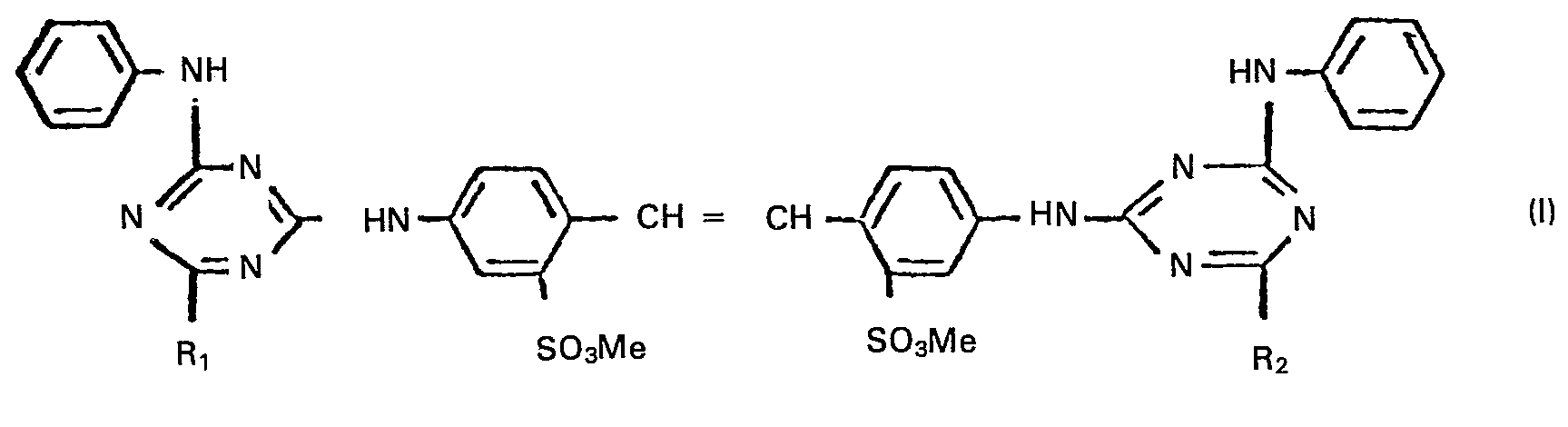

- worin die einzelnen Symbole die folgende Bedeutung haben:
- Me = Na, K
- R1, R2 = -NHCH3, -NCH3(CH2CH20H), -N(CH2CH20H)2

- R3, R4 = H, -CH3, -CI, OCH3, -COOCH3, -CN, -SO2NR5R6, -CONR5R6 mit R5 und R6 = H oder AIkylreste mit 1 bis 3 Kohlenstoffatomen.
- Bevorzugt werden optische Aufheller der Formel I verwendet, in der R, und R2 Morpholino-, Diethanolamino- oder Anilinoreste darstellen. Die optischen Aufheller liegen in Anteilen von 0,05 bis 1, vorzugsweise von 0,1 bis 0,7 Gew.-% vor.
- Der Bestandteil (f) besteht aus aliphatischen C1-C3-Alkoholen, z.B. Ethanol, Propanol und insbesondere Isopropanol sowie aus den Gemischen der genannten Alkohole. Bevorzugt beträgt der Gehalt der Mittel an diesen Alkoholen bis 12 Gew.-%. Mittel mit Anteilen von wenigerals 8% der genannten Alkohole können auch hydrotrop wirkende Etheralkohole enthalten, die sich von C1-C4-Monoalkoholen und Ethylenglykol oder Propylenglykol bzw. Diglykolen ableiten. Geeignet sind z.B. die Monomethyl-, Monoethyl-, Monopropyl-, Monoisopropyl- oder Monobutylether des Ethylenglykols.
- Der Wassergehalt des Waschmittelkonzentrats beträgt 35 bis 50 Gew.-%, vorzugsweise bis 45 Gew.-%. Die Konzentrate sind innerhalb eines Temperaturbereiches zwischen +40 und -10°C unbegrenzt lagerbeständig. Sie werden zwar nach mehrwöchiger Lagerung bei einer Temperatur von -10°C pastenartig, neigen jedoch selbst unter derartig extremen Bedingungen nicht zum Entmischen, sondern bilden nach dem Wiedererwärmen wieder gut giessbare, weitgehend klare Flüssigkeiten.
- An weiteren Zusatzstoffen können noch Biozide, Duftstoffe, Farbstoffe, Stabilisierungsmittel, sonstige Sequestrierungsmittel, Neutralsalze und optische Aufheller anderer Konstitution anwesend sein, jedoch soll der Anteil an derartigen Zusatzstoffen insgesamt 5 Gew.-% nicht überschreiten und vorzugsweise weniger als 2 Gew.-% betragen, damit ein negativer Einfluss auf die Kältestabilität vermieden wird.
- Die Komponente B, die vor oder zu Beginn des Waschprozesses mit der Komponente A vereinigt wird, liegt ebenfalls als flüssige, leicht dosierbare und insbesondere kältebeständige Lösung vor und weist vorzugsweise die folgende Zusammensetzung auf:


- Das Mischungsverhältnis der Komponente A mit der Komponente B gemäss vorstehender Zusammensetzung beträgt 2:1 bis 1:5, vorzugsweise 1:2 bis 1:4, wobei die Gesamtmenge aller waschwirksamen Bestandteile, Waschalkalien und Sequestrierungsmittel in der Waschflotte 2 bis 8 g/l, vorzugsweise 3 bis 6 g/I bei einem Flottenverhältnis von 1:4 bis 1:8 beträgt.
- Die Alkalität der Komponente B sowie ihre Menge ist so bemessen, dass die Fettsäuren vollständig in die Seifen überführt werden und darüber hinaus noch ein Alkaliüberschuss vorhanden ist, so dass der pH-Wert der Waschlauge 10,5 bis 13,5, vorzugsweise 11,2 bis 13,2 beträgt. Ausser den vorgenannten Alkalien, Polyphosphaten und Sequestrierungsmitteln können noch weitere sequestrierend wirkende Verbindungen anwesend sein bzw. das Ethylendiaminotetraacetat kann durch andere Sequestrierungsmittel, z.B. die Na- oder K-Salze von Polycarbonsäuren, Hydroxy- bzw. Etherpolycarbonsäuren, Aminopolycarbonsäuren, Hydroxyalkanphosphonsäuren und Aminopolyphosphonsäuren, ersetzt sein. Beispiele hierfür sind Nitrilotriessigsäure, Diethylentriaminopentaessigsäure und 1-Aminoethan-1,1-diphosphonsäure.
- Bei der Durchführung des erfindungsgemässen Waschverfahrens unter Verwendung der beiden Komponenten A und B können noch weitere Komponenten zugefügt werden, beispielsweise zum Kationenaustausch befähigte Natriumaluminiumsilikate gemäss DE-AS-2 412 837, Vergrauungsinhibitoren, wie Celluloseether und Cellulosemischether, Enzyme sowie Aktivsauerstoff bzw. Aktivchlor enthaltende Bleichmittel, gegebenenfalls unter Zusatz von Bleichaktivatoren. Soweit es die Stabilität der betreffenden Verbindungen zulässt, liegen sie ebenfalls vorzugsweise als Lösungen oder Dispersionen vor, wobei einer mangelnden Stabilität erforderlichenfalls durch Einkapseln der Wirkstoffe begegnet werden kann.
- Das zum Ansetzen der Waschlauge verwendete Wasser soll auf einen Härtegrad von weniger als 10° dH, vorzugsweise nicht mehr als 5° dH (5 mg Ca0 in 100 ml Wasser) enthärtet sein. Der Waschprozess kann einstufig oder mehrstufig durchgeführt werden, d.h. aus einem Vorwaschgang und einem Hauptwaschgang (Klarwaschgang) bestehen. Konzentration und Waschtemperatur können bei den Waschgängen unterschiedlich sein und 1 bis 3 g/1 bei Temperaturen von 20 bis 60°C im Vorwaschgang und 2 bis 6 g/I bei 60 bis 95°C im Klarwaschgang betragen.
- Die für das erfindungsgemässe Verfahren verwendeten Waschmittel zeichnen sich ausser durch ihre gute Lager- und Kältebeständigkeit insbesondere durch eine hohe Waschkraft und eine geringe Schaumbildungsrate aus. Sie neigen daher auch unter kritischen Bedingungen, z.B. beim Waschen nur gering verschmutzter Wäsche, wie einmal benutzter Bett-, Tisch- und Berufswäsche, nicht zum Überschäumen. Aufgrund ihres geringen Phosphatgehalts und ihres hohen Seifenanteils am Gesamt-Tensid sind sie als ausgesprochen umweltfreundlich anzusehen.
- Die in den Rezepturen verwendeten Fettsäuren (a) wiesen die folgende Zusammensetzung (in Gewichtsprozent) auf:

- Als ethoxylierter Alkohol (Komponente c) wurde ein Oxoalkohol der Kettenlänge C9-C11 mit 7 Ethylenglykolethergruppen verwendet. Die Komponente (d) bestand aus linearem Na-Dodecylbenzolsulfonat. Als optischer Aufheller (Komponente e) wurde das Natriumsalz der Verbindung gemäss Formel I verwendet, worin R, und R2 Morpholinoreste bedeuteten. Die Komponente (g) bestand aus Isopropanol. Unter dem Bestandteil «Salze» werden geringe Mengen an Na2SO4 und NaCI verstanden, die als Begleitstoffe des Alkylbenzolsulfonats und des optischen Aufhellers vorlagen. Die Zusammensetzung ist der Tabelle 2 zu entnehmen.

- Zwecks Herstellung der Mittel wurden zunächst die Fettsäure mit Kaliumhydroxid in 30%iger wässriger Lösung und Triethanolamin dem Ethoxylat (c) und dem Alkylbenzolsulfonat (d), das als 50%ige wässrige Lösung vorlag, miteinander vermischt, darauf der in Isopropanol gelöste optische Aufheller eingerührt und abschliessend das Wasser bis zur angegebenen Menge zugefügt.
- Die Konzentrate lagen als gelblich gefärbte, klare bis leicht irisierende, bei Raumtemperatur dünnflüssige Lösungen vor, die bei dreiwöchiger Lagerung im Klimaschrank bei -10 und +40°C klar und homogen blieben. Ein mehrfacher Temperaturwechsel zwischen +40 und ―10°C führte ebenfalls nicht zu Entmischungen. Die Konzentrate waren in jedem Verhältnis mit Wasser mischbar.
- Als alkalische Komponente B wurden folgende Lösungen verwendet (Mengenangaben in Gewichtsprozent):

- Die Lösungen erwiesen sich in einem Temperaturbereich von -10 bis +40°C als stabil.
- Zur Waschbehandlung wurden jeweils folgende Mengenanteile miteinander kombiniert:
- 5-10 g Komponente A pro kg Trockenwäsche 12-15 g Komponente B pro kg Trockenwäsche
- 3- 6 g Komponente A pro kg Trockenwäsche 12-15 g Komponente B pro kg Trockenwäsche Klarwäsche (90°C)
- 2- 5 g Komponente A pro kg Trockenwäsche 5- 8 g Komponente B pro kg Trockenwäsche
- Bei einem Flottenverhältnis (kg Trockenwäsche pro 1 Waschlauge) von 1:4 bis 1:6 unter Verwendung von enthärtetem Wasser (3,0° dH) wurden bei 90°C einwandfreie Waschergebnisse erzielt. Die Schaumentwicklung war minimal. Nach dem Waschen wurde fünfmal nachgespült, wobei im 2. Spülbad 0,22 g/1 Natriumhypochlorit und im letzten Spülbad 0,4 g/I Natriumthiosulfat (Antichlor) zur Anwendung kamen.
und die Komponente B folgender Zusammensetzung:
im Gewichtsverhältnis von A zu B von 2:1 bis 1:5
Claims (6)
und die Komponente B folgender Zusammensetzung:


Priority Applications (1)
| Application Number | Priority Date | Filing Date | Title |
|---|---|---|---|
| AT80104728T ATE4229T1 (de) | 1979-08-18 | 1980-08-11 | Waschverfahren. |
Applications Claiming Priority (2)
| Application Number | Priority Date | Filing Date | Title |
|---|---|---|---|
| DE2933579 | 1979-08-18 | ||
| DE19792933579 DE2933579A1 (de) | 1979-08-18 | 1979-08-18 | Waschverfahren |
Publications (2)
| Publication Number | Publication Date |
|---|---|
| EP0024340A1 EP0024340A1 (de) | 1981-03-04 |
| EP0024340B1 true EP0024340B1 (de) | 1983-07-20 |
Family
ID=6078816
Family Applications (1)
| Application Number | Title | Priority Date | Filing Date |
|---|---|---|---|
| EP80104728A Expired EP0024340B1 (de) | 1979-08-18 | 1980-08-11 | Waschverfahren |
Country Status (5)
| Country | Link |
|---|---|
| US (1) | US4288225A (de) |
| EP (1) | EP0024340B1 (de) |
| AT (1) | ATE4229T1 (de) |
| DE (2) | DE2933579A1 (de) |
| DK (1) | DK154842C (de) |
Families Citing this family (17)
| Publication number | Priority date | Publication date | Assignee | Title |
|---|---|---|---|---|
| US4430245A (en) | 1981-04-06 | 1984-02-07 | Internationale Octrooi Maatschappij "Octropa" B.V. | Soap composition |
| IT1147874B (it) * | 1982-04-30 | 1986-11-26 | Colgate Palmolive Co | Procedimento di lavaggio industriale e composizione |
| US4522738A (en) * | 1983-04-26 | 1985-06-11 | Magid David J | Toilet bowl cleaner |
| US4786433A (en) * | 1986-07-02 | 1988-11-22 | Ecolab Inc. | Method of preparing phosphorous-free stable detergent emulsion |
| US5091101A (en) * | 1990-02-28 | 1992-02-25 | Hildreth Eslie D | Detergent composition containing C5-C14 free fatty acids and one or more surfactant |
| US5122304A (en) * | 1991-01-31 | 1992-06-16 | Basf Corporation | Stable aqueous dispersions of fluorescent brightening agents of the coumarine type and method of preparing same |
| DE4418487C2 (de) * | 1994-05-27 | 1999-08-05 | Gunter Dipl Chem Dr Feile | Verfahren zur Herstellung einer Naßreinigungsmittelkombination nach dem Baukasten-System |
| DE19737486C1 (de) * | 1997-08-28 | 1999-01-21 | Betz Umweltdienste Gmbh Dr | Verfahren zum Reinigen von hydrophobe Bestandteile enthaltenden Materialien |
| JP2009502485A (ja) | 2005-07-28 | 2009-01-29 | ハイ ボルテイジ グラフィックス インコーポレイテッド | 多孔質フィルムを有するフロック加工された物品 |
| WO2008101115A1 (en) | 2007-02-14 | 2008-08-21 | High Voltage Graphics, Inc. | Sublimation dye printed textile |
| US20080276379A1 (en) * | 2007-05-10 | 2008-11-13 | Macdonald John Gavin | Methods for discharging colorants |
| US9657257B2 (en) * | 2007-05-10 | 2017-05-23 | Kimberly-Clark Worldwide, Inc. | Colorant neutralizer |
| WO2010023043A1 (en) * | 2008-08-25 | 2010-03-04 | Unilever Nv | Shaped solid cleaning composition |
| DE102009029194A1 (de) | 2009-09-04 | 2011-04-07 | Kimberly-Clark Worldwide, Inc., Neenah | Abtrennung gefärbter Stoffe aus wasserhaltigen Flüssigkeiten |
| US9220646B2 (en) | 2012-03-30 | 2015-12-29 | Kimberly-Clark Worldwide, Inc. | Absorbent articles with improved stain decolorization |
| WO2014059424A2 (en) | 2012-10-12 | 2014-04-17 | High Voltage Graphics, Inc. | Flexible heat sealable decorative articles and method for making the same |
| US9237975B2 (en) | 2013-09-27 | 2016-01-19 | Kimberly-Clark Worldwide, Inc. | Absorbent article with side barriers and decolorizing agents |
Family Cites Families (17)
| Publication number | Priority date | Publication date | Assignee | Title |
|---|---|---|---|---|
| GB597457A (en) * | 1945-08-20 | 1948-01-27 | Eric Berkeley Higgins | Improvements relating to the laundering of textile materials |
| GB333177A (en) * | 1929-05-03 | 1930-08-05 | Archibald Rayner | Improved method of washing |
| FR679571A (fr) * | 1929-08-08 | 1930-04-15 | Procédé de lavage | |
| CA767063A (en) | 1964-11-25 | 1967-09-12 | Pelizza Carlo | Composition for an anchored-foam biodegredable liquid detergent for universal household and industrial use |
| GB1103578A (en) * | 1965-12-22 | 1968-02-14 | Procter & Gamble Ltd | Soap compositions |
| US3723328A (en) * | 1965-10-21 | 1973-03-27 | C Pelizza | Liquid detergent composition |
| FR1460904A (fr) * | 1965-10-22 | 1966-03-04 | Procédé de lavage utilisant les émulsions d'acides gras comme composants dans la formation du détergent | |
| SE347013B (de) * | 1970-07-02 | 1972-07-24 | Mo Och Domsjoe Ab | |
| US3972823A (en) * | 1971-06-04 | 1976-08-03 | H. Kohnstamm & Company | Soap compositions for non-gelling soap solution |
| US3870647A (en) * | 1972-06-05 | 1975-03-11 | Seneca Chemicals Inc | Liquid cleaning agent |
| NL89736C (de) * | 1973-03-15 | |||
| DE2338411A1 (de) * | 1973-07-28 | 1975-02-13 | Henkel & Cie Gmbh | Waschverfahren fuer textilien zur entfernung fettiger verschmutzungen |
| GB1506427A (en) * | 1975-04-29 | 1978-04-05 | Unilever Ltd | Liquid detergent |
| DE2530727C3 (de) * | 1975-07-10 | 1978-08-31 | Van Baerle & Co Kg, 6084 Gernsheim | Waschmittel |
| DE2609752A1 (de) * | 1976-03-09 | 1977-09-22 | Henkel & Cie Gmbh | Fluessiges, kaeltestabiles waschmittelkonzentrat |
| GB1589971A (en) * | 1976-10-11 | 1981-05-20 | Unilever Ltd | Built liquid detergent |
| DE2847437C2 (de) * | 1978-11-02 | 1983-10-06 | Henkel Kgaa, 4000 Duesseldorf | Verfahren zur Herstellung von Waschlaugen |
-
1979
- 1979-08-18 DE DE19792933579 patent/DE2933579A1/de not_active Withdrawn
-
1980
- 1980-07-25 DK DK321680A patent/DK154842C/da not_active IP Right Cessation
- 1980-08-04 US US06/174,560 patent/US4288225A/en not_active Expired - Lifetime
- 1980-08-11 EP EP80104728A patent/EP0024340B1/de not_active Expired
- 1980-08-11 DE DE8080104728T patent/DE3064272D1/de not_active Expired
- 1980-08-11 AT AT80104728T patent/ATE4229T1/de not_active IP Right Cessation
Also Published As
| Publication number | Publication date |
|---|---|
| DK154842B (da) | 1988-12-27 |
| DE2933579A1 (de) | 1981-03-26 |
| DK321680A (da) | 1981-02-19 |
| DE3064272D1 (en) | 1983-08-25 |
| DK154842C (da) | 1989-05-16 |
| EP0024340A1 (de) | 1981-03-04 |
| US4288225A (en) | 1981-09-08 |
| ATE4229T1 (de) | 1983-08-15 |
Similar Documents
| Publication | Publication Date | Title |
|---|---|---|
| DE2304098C2 (de) | Flüssige Wasch- und Reinigungsmittelzusammensetzungen | |
| DE2658073C3 (de) | Flüssiges Wasch- und Reinigungsmittel | |
| DE2628759C2 (de) | ||
| EP0024340A1 (de) | Waschverfahren | |
| CH627780A5 (de) | Homogenes fluessiges wasch- und reinigungsmittel. | |
| EP0011166B1 (de) | Flüssiges, kältestabiles Waschmittelkonzentrat und seine Verwendung | |
| DE1929193C3 (de) | Weichmachendes Waschmittel | |
| DE2336291A1 (de) | Fluessiges wasch- und reinigungsmittel | |
| EP0011715B1 (de) | Flüssiges, kältestabiles Zwei-Komponenten-Waschmittel und Waschverfahren | |
| CH644395A5 (de) | Waessrig-fluessiges, builderhaltiges waschmittel. | |
| DE2000231A1 (de) | Textilwasch- und -weichmachungsmittel | |
| DE2628976A1 (de) | Klares, stabiles, einphasiges und fluessiges wasch- und reinigungsmittel | |
| EP0377807B1 (de) | Phosphatfreies,flüssiges Waschmittel mit hoher Alkalität | |
| DE2304060C3 (de) | Flüssige Wasch- und Reinigungsmittelzusammensetzungen | |
| DE2057259C3 (de) | Wasch- und Reinigungsmittel | |
| DE1135122B (de) | Schaumarme Waschmittel | |
| DE1617177A1 (de) | Fluessiges Waschmittel | |
| EP0353562A1 (de) | Phosphatarmes Buildersalzkombination | |
| DE2559225A1 (de) | Fluessiges wasch- und reinigungsmittel sowie seine anwendung | |
| CH635614A5 (en) | Liquid detergent and process for its preparation | |
| DE2121565C3 (de) | Wäßriges Waschmittelkonzentrat | |
| DE2438136C3 (de) | Reinigungsmittelmischung | |
| DE3905671C2 (de) | Zur Herstellung wäßriger Konzentrate geeignetes Waschmittelgranulat | |
| DE2539808A1 (de) | Reinigungsmittelzubereitungen | |
| EP0025147B1 (de) | Flüssiges, phosphatarmes und umweltfreundliches Waschmittel |
Legal Events
| Date | Code | Title | Description |
|---|---|---|---|
| PUAI | Public reference made under article 153(3) epc to a published international application that has entered the european phase |
Free format text: ORIGINAL CODE: 0009012 |
|
| AK | Designated contracting states |
Designated state(s): AT BE CH DE FR GB IT NL SE |
|
| 17P | Request for examination filed |
Effective date: 19810713 |
|
| ITF | It: translation for a ep patent filed | ||
| GRAA | (expected) grant |
Free format text: ORIGINAL CODE: 0009210 |
|
| AK | Designated contracting states |
Designated state(s): AT BE CH DE FR GB IT LI NL SE |
|
| REF | Corresponds to: |
Ref document number: 4229 Country of ref document: AT Date of ref document: 19830815 Kind code of ref document: T |
|
| REF | Corresponds to: |
Ref document number: 3064272 Country of ref document: DE Date of ref document: 19830825 |
|
| ET | Fr: translation filed | ||
| PLBE | No opposition filed within time limit |
Free format text: ORIGINAL CODE: 0009261 |
|
| STAA | Information on the status of an ep patent application or granted ep patent |
Free format text: STATUS: NO OPPOSITION FILED WITHIN TIME LIMIT |
|
| 26N | No opposition filed | ||
| ITTA | It: last paid annual fee | ||
| EAL | Se: european patent in force in sweden |
Ref document number: 80104728.3 |
|
| PGFP | Annual fee paid to national office [announced via postgrant information from national office to epo] |
Ref country code: GB Payment date: 19980803 Year of fee payment: 19 |
|
| PGFP | Annual fee paid to national office [announced via postgrant information from national office to epo] |
Ref country code: SE Payment date: 19980806 Year of fee payment: 19 |
|
| PGFP | Annual fee paid to national office [announced via postgrant information from national office to epo] |
Ref country code: AT Payment date: 19980813 Year of fee payment: 19 |
|
| PGFP | Annual fee paid to national office [announced via postgrant information from national office to epo] |
Ref country code: FR Payment date: 19980814 Year of fee payment: 19 |
|
| PGFP | Annual fee paid to national office [announced via postgrant information from national office to epo] |
Ref country code: DE Payment date: 19980817 Year of fee payment: 19 |
|
| PGFP | Annual fee paid to national office [announced via postgrant information from national office to epo] |
Ref country code: CH Payment date: 19980824 Year of fee payment: 19 |
|
| PG25 | Lapsed in a contracting state [announced via postgrant information from national office to epo] |
Ref country code: GB Free format text: LAPSE BECAUSE OF NON-PAYMENT OF DUE FEES Effective date: 19990811 Ref country code: AT Free format text: LAPSE BECAUSE OF NON-PAYMENT OF DUE FEES Effective date: 19990811 |
|
| PG25 | Lapsed in a contracting state [announced via postgrant information from national office to epo] |
Ref country code: SE Free format text: THE PATENT HAS BEEN ANNULLED BY A DECISION OF A NATIONAL AUTHORITY Effective date: 19990830 |
|
| PGFP | Annual fee paid to national office [announced via postgrant information from national office to epo] |
Ref country code: NL Payment date: 19990830 Year of fee payment: 20 |
|
| PG25 | Lapsed in a contracting state [announced via postgrant information from national office to epo] |
Ref country code: LI Free format text: LAPSE BECAUSE OF NON-PAYMENT OF DUE FEES Effective date: 19990831 Ref country code: CH Free format text: LAPSE BECAUSE OF NON-PAYMENT OF DUE FEES Effective date: 19990831 |
|
| PGFP | Annual fee paid to national office [announced via postgrant information from national office to epo] |
Ref country code: BE Payment date: 19991013 Year of fee payment: 20 |
|
| BE20 | Be: patent expired |
Free format text: 20000811 *HENKEL K.G.A.A. |
|
| GBPC | Gb: european patent ceased through non-payment of renewal fee |
Effective date: 19990811 |
|
| REG | Reference to a national code |
Ref country code: CH Ref legal event code: PL |
|
| PG25 | Lapsed in a contracting state [announced via postgrant information from national office to epo] |
Ref country code: FR Free format text: LAPSE BECAUSE OF NON-PAYMENT OF DUE FEES Effective date: 20000428 |
|
| EUG | Se: european patent has lapsed |
Ref document number: 80104728.3 |
|
| PG25 | Lapsed in a contracting state [announced via postgrant information from national office to epo] |
Ref country code: DE Free format text: LAPSE BECAUSE OF NON-PAYMENT OF DUE FEES Effective date: 20000601 |
|
| REG | Reference to a national code |
Ref country code: FR Ref legal event code: ST |
|
| PG25 | Lapsed in a contracting state [announced via postgrant information from national office to epo] |
Ref country code: NL Free format text: LAPSE BECAUSE OF EXPIRATION OF PROTECTION Effective date: 20000811 |
|
| NLV7 | Nl: ceased due to reaching the maximum lifetime of a patent |
Effective date: 20000811 |