EP0026317A1 - Optisch aktive 1,4-Dihydropyridine, Verfahren zu ihrer Herstellung und ihre Verwendung als Arzneimittel - Google Patents
Optisch aktive 1,4-Dihydropyridine, Verfahren zu ihrer Herstellung und ihre Verwendung als Arzneimittel Download PDFInfo
- Publication number
- EP0026317A1 EP0026317A1 EP80104900A EP80104900A EP0026317A1 EP 0026317 A1 EP0026317 A1 EP 0026317A1 EP 80104900 A EP80104900 A EP 80104900A EP 80104900 A EP80104900 A EP 80104900A EP 0026317 A1 EP0026317 A1 EP 0026317A1
- Authority
- EP
- European Patent Office
- Prior art keywords
- alkyl
- radical
- group
- carbon atoms
- dimethyl
- Prior art date
- Legal status (The legal status is an assumption and is not a legal conclusion. Google has not performed a legal analysis and makes no representation as to the accuracy of the status listed.)
- Granted
Links
- 238000000034 method Methods 0.000 title claims abstract description 37
- YNGDWRXWKFWCJY-UHFFFAOYSA-N 1,4-Dihydropyridine Chemical class C1C=CNC=C1 YNGDWRXWKFWCJY-UHFFFAOYSA-N 0.000 title claims abstract description 27
- 238000002360 preparation method Methods 0.000 title claims abstract description 12
- 239000003814 drug Substances 0.000 title claims abstract description 10
- -1 pyrryl Chemical group 0.000 claims description 141
- 125000000217 alkyl group Chemical group 0.000 claims description 67
- LFQSCWFLJHTTHZ-UHFFFAOYSA-N Ethanol Chemical compound CCO LFQSCWFLJHTTHZ-UHFFFAOYSA-N 0.000 claims description 59
- 125000004432 carbon atom Chemical group C* 0.000 claims description 56
- 150000001875 compounds Chemical class 0.000 claims description 46
- 125000001424 substituent group Chemical group 0.000 claims description 38
- 125000001997 phenyl group Chemical group [H]C1=C([H])C([H])=C(*)C([H])=C1[H] 0.000 claims description 34
- 125000002023 trifluoromethyl group Chemical group FC(F)(F)* 0.000 claims description 30
- 125000003545 alkoxy group Chemical group 0.000 claims description 29
- 125000004093 cyano group Chemical group *C#N 0.000 claims description 27
- 125000000449 nitro group Chemical group [O-][N+](*)=O 0.000 claims description 27
- IJGRMHOSHXDMSA-UHFFFAOYSA-N Atomic nitrogen Chemical compound N#N IJGRMHOSHXDMSA-UHFFFAOYSA-N 0.000 claims description 22
- 125000003277 amino group Chemical group 0.000 claims description 22
- 229910052760 oxygen Inorganic materials 0.000 claims description 22
- 239000001301 oxygen Substances 0.000 claims description 22
- 125000004663 dialkyl amino group Chemical group 0.000 claims description 21
- 150000005840 aryl radicals Chemical class 0.000 claims description 20
- CUNSUQKHHZVKMU-UHFFFAOYSA-N 1,4-dihydropyridine-2-carboxylic acid Chemical class OC(=O)C1=CCC=CN1 CUNSUQKHHZVKMU-UHFFFAOYSA-N 0.000 claims description 18
- 229910052736 halogen Inorganic materials 0.000 claims description 18
- 150000002367 halogens Chemical class 0.000 claims description 18
- UFHFLCQGNIYNRP-UHFFFAOYSA-N Hydrogen Chemical compound [H][H] UFHFLCQGNIYNRP-UHFFFAOYSA-N 0.000 claims description 16
- 125000001797 benzyl group Chemical group [H]C1=C([H])C([H])=C(C([H])=C1[H])C([H])([H])* 0.000 claims description 15
- 125000002924 primary amino group Chemical group [H]N([H])* 0.000 claims description 15
- 229910052757 nitrogen Inorganic materials 0.000 claims description 14
- 150000003254 radicals Chemical class 0.000 claims description 14
- 125000002887 hydroxy group Chemical group [H]O* 0.000 claims description 13
- NINIDFKCEFEMDL-UHFFFAOYSA-N Sulfur Chemical compound [S] NINIDFKCEFEMDL-UHFFFAOYSA-N 0.000 claims description 12
- 125000004183 alkoxy alkyl group Chemical group 0.000 claims description 12
- QVGXLLKOCUKJST-UHFFFAOYSA-N atomic oxygen Chemical compound [O] QVGXLLKOCUKJST-UHFFFAOYSA-N 0.000 claims description 12
- 125000005842 heteroatom Chemical group 0.000 claims description 12
- 229910052739 hydrogen Inorganic materials 0.000 claims description 12
- 239000001257 hydrogen Substances 0.000 claims description 12
- 125000004076 pyridyl group Chemical group 0.000 claims description 12
- 239000000126 substance Substances 0.000 claims description 12
- 229910052717 sulfur Inorganic materials 0.000 claims description 12
- 125000003118 aryl group Chemical group 0.000 claims description 11
- 125000000876 trifluoromethoxy group Chemical group FC(F)(F)O* 0.000 claims description 11
- WKBOTKDWSSQWDR-UHFFFAOYSA-N Bromine atom Chemical group [Br] WKBOTKDWSSQWDR-UHFFFAOYSA-N 0.000 claims description 10
- ZAMOUSCENKQFHK-UHFFFAOYSA-N Chlorine atom Chemical group [Cl] ZAMOUSCENKQFHK-UHFFFAOYSA-N 0.000 claims description 10
- MYMOFIZGZYHOMD-UHFFFAOYSA-N Dioxygen Chemical compound O=O MYMOFIZGZYHOMD-UHFFFAOYSA-N 0.000 claims description 10
- GDTBXPJZTBHREO-UHFFFAOYSA-N bromine Chemical group BrBr GDTBXPJZTBHREO-UHFFFAOYSA-N 0.000 claims description 10
- 229910052794 bromium Inorganic materials 0.000 claims description 10
- 239000000460 chlorine Chemical group 0.000 claims description 10
- 229910052801 chlorine Inorganic materials 0.000 claims description 10
- 229930195733 hydrocarbon Natural products 0.000 claims description 10
- 150000003839 salts Chemical class 0.000 claims description 10
- 125000000094 2-phenylethyl group Chemical group [H]C1=C([H])C([H])=C(C([H])=C1[H])C([H])([H])C([H])([H])* 0.000 claims description 9
- 239000004215 Carbon black (E152) Substances 0.000 claims description 9
- 125000003170 phenylsulfonyl group Chemical group C1(=CC=CC=C1)S(=O)(=O)* 0.000 claims description 9
- PXGOKWXKJXAPGV-UHFFFAOYSA-N Fluorine Chemical compound FF PXGOKWXKJXAPGV-UHFFFAOYSA-N 0.000 claims description 8
- 239000002253 acid Substances 0.000 claims description 8
- 125000003710 aryl alkyl group Chemical group 0.000 claims description 8
- 125000004122 cyclic group Chemical group 0.000 claims description 8
- 229910052731 fluorine Inorganic materials 0.000 claims description 8
- 239000011737 fluorine Substances 0.000 claims description 8
- 229920006395 saturated elastomer Polymers 0.000 claims description 8
- 239000011593 sulfur Substances 0.000 claims description 8
- SLRMQYXOBQWXCR-UHFFFAOYSA-N 2154-56-5 Chemical compound [CH2]C1=CC=CC=C1 SLRMQYXOBQWXCR-UHFFFAOYSA-N 0.000 claims description 6
- 125000003342 alkenyl group Chemical group 0.000 claims description 6
- 125000003785 benzimidazolyl group Chemical group N1=C(NC2=C1C=CC=C2)* 0.000 claims description 6
- 125000001153 fluoro group Chemical group F* 0.000 claims description 6
- 125000002541 furyl group Chemical group 0.000 claims description 6
- 125000002883 imidazolyl group Chemical group 0.000 claims description 6
- 125000001041 indolyl group Chemical group 0.000 claims description 6
- 125000000842 isoxazolyl group Chemical group 0.000 claims description 6
- 125000004433 nitrogen atom Chemical group N* 0.000 claims description 6
- 125000002971 oxazolyl group Chemical group 0.000 claims description 6
- 125000003373 pyrazinyl group Chemical group 0.000 claims description 6
- 125000003226 pyrazolyl group Chemical group 0.000 claims description 6
- 125000002098 pyridazinyl group Chemical group 0.000 claims description 6
- 125000000714 pyrimidinyl group Chemical group 0.000 claims description 6
- 125000001567 quinoxalinyl group Chemical group N1=C(C=NC2=CC=CC=C12)* 0.000 claims description 6
- 238000000926 separation method Methods 0.000 claims description 6
- 239000007858 starting material Substances 0.000 claims description 6
- 125000005420 sulfonamido group Chemical group S(=O)(=O)(N*)* 0.000 claims description 6
- 125000000335 thiazolyl group Chemical group 0.000 claims description 6
- 125000001544 thienyl group Chemical group 0.000 claims description 6
- 241001465754 Metazoa Species 0.000 claims description 5
- 150000001298 alcohols Chemical class 0.000 claims description 5
- 125000004925 dihydropyridyl group Chemical group N1(CC=CC=C1)* 0.000 claims description 5
- 150000002825 nitriles Chemical class 0.000 claims description 5
- CIUQDSCDWFSTQR-UHFFFAOYSA-N [C]1=CC=CC=C1 Chemical compound [C]1=CC=CC=C1 CIUQDSCDWFSTQR-UHFFFAOYSA-N 0.000 claims description 4
- 125000000304 alkynyl group Chemical group 0.000 claims description 4
- 125000005956 isoquinolyl group Chemical group 0.000 claims description 4
- 125000004430 oxygen atom Chemical group O* 0.000 claims description 4
- 125000002294 quinazolinyl group Chemical group N1=C(N=CC2=CC=CC=C12)* 0.000 claims description 4
- 125000005493 quinolyl group Chemical group 0.000 claims description 4
- 229930195734 saturated hydrocarbon Natural products 0.000 claims description 4
- 125000004434 sulfur atom Chemical group 0.000 claims description 4
- 238000003786 synthesis reaction Methods 0.000 claims description 4
- SMBZJSVIKJMSFP-UHFFFAOYSA-N trifluoromethyl hypofluorite Chemical compound FOC(F)(F)F SMBZJSVIKJMSFP-UHFFFAOYSA-N 0.000 claims description 4
- 229930195735 unsaturated hydrocarbon Natural products 0.000 claims description 4
- 125000003282 alkyl amino group Chemical group 0.000 claims description 3
- 125000004414 alkyl thio group Chemical group 0.000 claims description 3
- 125000000852 azido group Chemical group *N=[N+]=[N-] 0.000 claims description 3
- 230000015572 biosynthetic process Effects 0.000 claims description 3
- 125000000753 cycloalkyl group Chemical group 0.000 claims description 3
- 208000037265 diseases, disorders, signs and symptoms Diseases 0.000 claims description 3
- 150000002430 hydrocarbons Chemical class 0.000 claims description 3
- 125000001624 naphthyl group Chemical group 0.000 claims description 3
- 125000004036 acetal group Chemical group 0.000 claims description 2
- 125000002252 acyl group Chemical group 0.000 claims description 2
- 125000002947 alkylene group Chemical group 0.000 claims description 2
- 125000004185 ester group Chemical group 0.000 claims description 2
- 150000002431 hydrogen Chemical class 0.000 claims description 2
- 125000000547 substituted alkyl group Chemical group 0.000 claims description 2
- 238000011282 treatment Methods 0.000 claims description 2
- 201000010099 disease Diseases 0.000 claims 2
- 238000007796 conventional method Methods 0.000 claims 1
- 239000000546 pharmaceutical excipient Substances 0.000 claims 1
- 239000003795 chemical substances by application Substances 0.000 abstract description 7
- 235000019441 ethanol Nutrition 0.000 description 28
- OKKJLVBELUTLKV-UHFFFAOYSA-N Methanol Chemical compound OC OKKJLVBELUTLKV-UHFFFAOYSA-N 0.000 description 24
- YMWUJEATGCHHMB-UHFFFAOYSA-N Dichloromethane Chemical compound ClCCl YMWUJEATGCHHMB-UHFFFAOYSA-N 0.000 description 21
- 150000002148 esters Chemical group 0.000 description 16
- 239000000203 mixture Substances 0.000 description 11
- 239000002904 solvent Substances 0.000 description 11
- RTZKZFJDLAIYFH-UHFFFAOYSA-N Diethyl ether Chemical compound CCOCC RTZKZFJDLAIYFH-UHFFFAOYSA-N 0.000 description 10
- XLYOFNOQVPJJNP-UHFFFAOYSA-N water Substances O XLYOFNOQVPJJNP-UHFFFAOYSA-N 0.000 description 10
- 238000002844 melting Methods 0.000 description 8
- 230000008018 melting Effects 0.000 description 8
- 230000000144 pharmacologic effect Effects 0.000 description 8
- CSCPPACGZOOCGX-UHFFFAOYSA-N Acetone Chemical compound CC(C)=O CSCPPACGZOOCGX-UHFFFAOYSA-N 0.000 description 7
- DGAQECJNVWCQMB-PUAWFVPOSA-M Ilexoside XXIX Chemical compound C[C@@H]1CC[C@@]2(CC[C@@]3(C(=CC[C@H]4[C@]3(CC[C@@H]5[C@@]4(CC[C@@H](C5(C)C)OS(=O)(=O)[O-])C)C)[C@@H]2[C@]1(C)O)C)C(=O)O[C@H]6[C@@H]([C@H]([C@@H]([C@H](O6)CO)O)O)O.[Na+] DGAQECJNVWCQMB-PUAWFVPOSA-M 0.000 description 7
- 239000011734 sodium Substances 0.000 description 7
- 229910052708 sodium Inorganic materials 0.000 description 7
- 235000015424 sodium Nutrition 0.000 description 7
- WEVYAHXRMPXWCK-UHFFFAOYSA-N Acetonitrile Chemical compound CC#N WEVYAHXRMPXWCK-UHFFFAOYSA-N 0.000 description 6
- VEXZGXHMUGYJMC-UHFFFAOYSA-N Hydrochloric acid Chemical compound Cl VEXZGXHMUGYJMC-UHFFFAOYSA-N 0.000 description 6
- ZMXDDKWLCZADIW-UHFFFAOYSA-N N,N-Dimethylformamide Chemical compound CN(C)C=O ZMXDDKWLCZADIW-UHFFFAOYSA-N 0.000 description 6
- PMZURENOXWZQFD-UHFFFAOYSA-L Sodium Sulfate Chemical compound [Na+].[Na+].[O-]S([O-])(=O)=O PMZURENOXWZQFD-UHFFFAOYSA-L 0.000 description 6
- WYURNTSHIVDZCO-UHFFFAOYSA-N Tetrahydrofuran Chemical compound C1CCOC1 WYURNTSHIVDZCO-UHFFFAOYSA-N 0.000 description 6
- 239000002585 base Substances 0.000 description 6
- 238000009835 boiling Methods 0.000 description 6
- MPFLRYZEEAQMLQ-UHFFFAOYSA-N dinicotinic acid Chemical compound OC(=O)C1=CN=CC(C(O)=O)=C1 MPFLRYZEEAQMLQ-UHFFFAOYSA-N 0.000 description 6
- 238000001035 drying Methods 0.000 description 6
- 230000000694 effects Effects 0.000 description 6
- 239000000284 extract Substances 0.000 description 6
- 229910052938 sodium sulfate Inorganic materials 0.000 description 6
- 235000011152 sodium sulphate Nutrition 0.000 description 6
- RMZQSAMHIQBMLW-UHFFFAOYSA-N 2,6-dimethyl-4-(2-nitrophenyl)-1,4-dihydropyridine-3,5-dicarboxylic acid Chemical compound OC(=O)C1=C(C)NC(C)=C(C(O)=O)C1C1=CC=CC=C1[N+]([O-])=O RMZQSAMHIQBMLW-UHFFFAOYSA-N 0.000 description 5
- TZDPJNSHSWMCPN-UHFFFAOYSA-N 2,6-dimethyl-4-(3-nitrophenyl)-1,4-dihydropyridine-3,5-dicarboxylic acid Chemical compound OC(=O)C1=C(C)NC(C)=C(C(O)=O)C1C1=CC=CC([N+]([O-])=O)=C1 TZDPJNSHSWMCPN-UHFFFAOYSA-N 0.000 description 5
- XTHFKEDIFFGKHM-UHFFFAOYSA-N Dimethoxyethane Chemical compound COCCOC XTHFKEDIFFGKHM-UHFFFAOYSA-N 0.000 description 5
- HEMHJVSKTPXQMS-UHFFFAOYSA-M Sodium hydroxide Chemical compound [OH-].[Na+] HEMHJVSKTPXQMS-UHFFFAOYSA-M 0.000 description 5
- CODNYICXDISAEA-UHFFFAOYSA-N bromine monochloride Chemical compound BrCl CODNYICXDISAEA-UHFFFAOYSA-N 0.000 description 5
- 238000004128 high performance liquid chromatography Methods 0.000 description 5
- 239000003960 organic solvent Substances 0.000 description 5
- 229940126062 Compound A Drugs 0.000 description 4
- IAZDPXIOMUYVGZ-UHFFFAOYSA-N Dimethylsulphoxide Chemical compound CS(C)=O IAZDPXIOMUYVGZ-UHFFFAOYSA-N 0.000 description 4
- NLDMNSXOCDLTTB-UHFFFAOYSA-N Heterophylliin A Natural products O1C2COC(=O)C3=CC(O)=C(O)C(O)=C3C3=C(O)C(O)=C(O)C=C3C(=O)OC2C(OC(=O)C=2C=C(O)C(O)=C(O)C=2)C(O)C1OC(=O)C1=CC(O)=C(O)C(O)=C1 NLDMNSXOCDLTTB-UHFFFAOYSA-N 0.000 description 4
- KFZMGEQAYNKOFK-UHFFFAOYSA-N Isopropanol Chemical compound CC(C)O KFZMGEQAYNKOFK-UHFFFAOYSA-N 0.000 description 4
- JUJWROOIHBZHMG-UHFFFAOYSA-N Pyridine Chemical compound C1=CC=NC=C1 JUJWROOIHBZHMG-UHFFFAOYSA-N 0.000 description 4
- 239000004480 active ingredient Substances 0.000 description 4
- 238000006243 chemical reaction Methods 0.000 description 4
- 238000013375 chromatographic separation Methods 0.000 description 4
- HQKMJHAJHXVSDF-UHFFFAOYSA-L magnesium stearate Chemical compound [Mg+2].CCCCCCCCCCCCCCCCCC([O-])=O.CCCCCCCCCCCCCCCCCC([O-])=O HQKMJHAJHXVSDF-UHFFFAOYSA-L 0.000 description 4
- RYHBNJHYFVUHQT-UHFFFAOYSA-N 1,4-Dioxane Chemical compound C1COCCO1 RYHBNJHYFVUHQT-UHFFFAOYSA-N 0.000 description 3
- XNWFRZJHXBZDAG-UHFFFAOYSA-N 2-METHOXYETHANOL Chemical compound COCCO XNWFRZJHXBZDAG-UHFFFAOYSA-N 0.000 description 3
- YDHSGGOMIVKVJX-UHFFFAOYSA-N 3-O-methyl 5-O-propan-2-yl pyridine-3,5-dicarboxylate Chemical compound C(C)(C)OC(=O)C=1C=C(C=NC1)C(=O)OC YDHSGGOMIVKVJX-UHFFFAOYSA-N 0.000 description 3
- GHKOMFAUZDGVHG-UHFFFAOYSA-N 5-ethoxycarbonylpyridine-3-carboxylic acid Chemical compound CCOC(=O)C1=CN=CC(C(O)=O)=C1 GHKOMFAUZDGVHG-UHFFFAOYSA-N 0.000 description 3
- QTBSBXVTEAMEQO-UHFFFAOYSA-N Acetic acid Chemical compound CC(O)=O QTBSBXVTEAMEQO-UHFFFAOYSA-N 0.000 description 3
- UHOVQNZJYSORNB-UHFFFAOYSA-N Benzene Chemical compound C1=CC=CC=C1 UHOVQNZJYSORNB-UHFFFAOYSA-N 0.000 description 3
- XDTMQSROBMDMFD-UHFFFAOYSA-N Cyclohexane Chemical compound C1CCCCC1 XDTMQSROBMDMFD-UHFFFAOYSA-N 0.000 description 3
- XEKOWRVHYACXOJ-UHFFFAOYSA-N Ethyl acetate Chemical compound CCOC(C)=O XEKOWRVHYACXOJ-UHFFFAOYSA-N 0.000 description 3
- KWYUFKZDYYNOTN-UHFFFAOYSA-M Potassium hydroxide Chemical compound [OH-].[K+] KWYUFKZDYYNOTN-UHFFFAOYSA-M 0.000 description 3
- DNIAPMSPPWPWGF-UHFFFAOYSA-N Propylene glycol Chemical compound CC(O)CO DNIAPMSPPWPWGF-UHFFFAOYSA-N 0.000 description 3
- YXFVVABEGXRONW-UHFFFAOYSA-N Toluene Chemical compound CC1=CC=CC=C1 YXFVVABEGXRONW-UHFFFAOYSA-N 0.000 description 3
- HUMNYLRZRPPJDN-UHFFFAOYSA-N benzaldehyde Chemical compound O=CC1=CC=CC=C1 HUMNYLRZRPPJDN-UHFFFAOYSA-N 0.000 description 3
- 230000037396 body weight Effects 0.000 description 3
- 239000000969 carrier Substances 0.000 description 3
- 230000002490 cerebral effect Effects 0.000 description 3
- 239000007795 chemical reaction product Substances 0.000 description 3
- LOUPRKONTZGTKE-UHFFFAOYSA-N cinchonine Natural products C1C(C(C2)C=C)CCN2C1C(O)C1=CC=NC2=CC=C(OC)C=C21 LOUPRKONTZGTKE-UHFFFAOYSA-N 0.000 description 3
- 238000001816 cooling Methods 0.000 description 3
- 239000003995 emulsifying agent Substances 0.000 description 3
- 150000002170 ethers Chemical class 0.000 description 3
- 238000009472 formulation Methods 0.000 description 3
- 239000000543 intermediate Substances 0.000 description 3
- UIAGMCDKSXEBJQ-UHFFFAOYSA-N nimodipine Chemical compound COCCOC(=O)C1=C(C)NC(C)=C(C(=O)OC(C)C)C1C1=CC=CC([N+]([O-])=O)=C1 UIAGMCDKSXEBJQ-UHFFFAOYSA-N 0.000 description 3
- 239000007787 solid Substances 0.000 description 3
- 239000000454 talc Substances 0.000 description 3
- 235000012222 talc Nutrition 0.000 description 3
- 229910052623 talc Inorganic materials 0.000 description 3
- YLQBMQCUIZJEEH-UHFFFAOYSA-N tetrahydrofuran Natural products C=1C=COC=1 YLQBMQCUIZJEEH-UHFFFAOYSA-N 0.000 description 3
- 238000005809 transesterification reaction Methods 0.000 description 3
- KWGRBVOPPLSCSI-WPRPVWTQSA-N (-)-ephedrine Chemical compound CN[C@@H](C)[C@H](O)C1=CC=CC=C1 KWGRBVOPPLSCSI-WPRPVWTQSA-N 0.000 description 2
- SLOZGYLUXISHKM-UHFFFAOYSA-N 3-o-(2-phenoxyethyl) 5-o-propan-2-yl 2,6-dimethyl-4-(3-nitrophenyl)-1,4-dihydropyridine-3,5-dicarboxylate Chemical compound CC(C)OC(=O)C1=C(C)NC(C)=C(C(=O)OCCOC=2C=CC=CC=2)C1C1=CC=CC([N+]([O-])=O)=C1 SLOZGYLUXISHKM-UHFFFAOYSA-N 0.000 description 2
- WBFBMVQRZQYVHU-XADRRFQNSA-N 3-o-[(2r)-2-methoxy-2-phenylethyl] 5-o-propan-2-yl 2,6-dimethyl-4-(3-nitrophenyl)-1,4-dihydropyridine-3,5-dicarboxylate Chemical compound C([C@H](OC)C=1C=CC=CC=1)OC(=O)C1=C(C)NC(C)=C(C(=O)OC(C)C)C1C1=CC=CC([N+]([O-])=O)=C1 WBFBMVQRZQYVHU-XADRRFQNSA-N 0.000 description 2
- WBFBMVQRZQYVHU-UFUCKMQHSA-N 3-o-[(2s)-2-methoxy-2-phenylethyl] 5-o-propan-2-yl 2,6-dimethyl-4-(3-nitrophenyl)-1,4-dihydropyridine-3,5-dicarboxylate Chemical compound C([C@@H](OC)C=1C=CC=CC=1)OC(=O)C1=C(C)NC(C)=C(C(=O)OC(C)C)C1C1=CC=CC([N+]([O-])=O)=C1 WBFBMVQRZQYVHU-UFUCKMQHSA-N 0.000 description 2
- XBNFAKYRYKBSAO-UHFFFAOYSA-N 3-o-methyl 5-o-(2,2,2-trifluoroethyl) 4-(2-chlorophenyl)-2,6-dimethyl-1,4-dihydropyridine-3,5-dicarboxylate Chemical compound COC(=O)C1=C(C)NC(C)=C(C(=O)OCC(F)(F)F)C1C1=CC=CC=C1Cl XBNFAKYRYKBSAO-UHFFFAOYSA-N 0.000 description 2
- CFRDJHSYIDTCKH-UHFFFAOYSA-N 3-o-methyl 5-o-propan-2-yl 2,6-dimethyl-4-(3-nitrophenyl)-1,4-dihydropyridine-3,5-dicarboxylate Chemical compound COC(=O)C1=C(C)NC(C)=C(C(=O)OC(C)C)C1C1=CC=CC([N+]([O-])=O)=C1 CFRDJHSYIDTCKH-UHFFFAOYSA-N 0.000 description 2
- SBFWAGOTYLZDPR-UHFFFAOYSA-N 5-o-[2-(dimethylamino)ethyl] 3-o-methyl 2,6-dimethyl-4-(3-nitrophenyl)-1,4-dihydropyridine-3,5-dicarboxylate Chemical compound COC(=O)C1=C(C)NC(C)=C(C(=O)OCCN(C)C)C1C1=CC=CC([N+]([O-])=O)=C1 SBFWAGOTYLZDPR-UHFFFAOYSA-N 0.000 description 2
- BJZLZKZOTKFYIS-UHFFFAOYSA-N 5-o-propan-2-yl 3-o-(2-propoxyethyl) 2,6-dimethyl-4-(3-nitrophenyl)-1,4-dihydropyridine-3,5-dicarboxylate Chemical compound CCCOCCOC(=O)C1=C(C)NC(C)=C(C(=O)OC(C)C)C1C1=CC=CC([N+]([O-])=O)=C1 BJZLZKZOTKFYIS-UHFFFAOYSA-N 0.000 description 2
- ZFAUOFGEZWSATI-LFHRXCRSSA-N C(C)(C)[C@](COC(=O)C1=C(NC(=C(C1C1=CC(=CC=C1)[N+](=O)[O-])C(=O)O)C)C)(C1=CC=CC=C1)OC Chemical class C(C)(C)[C@](COC(=O)C1=C(NC(=C(C1C1=CC(=CC=C1)[N+](=O)[O-])C(=O)O)C)C)(C1=CC=CC=C1)OC ZFAUOFGEZWSATI-LFHRXCRSSA-N 0.000 description 2
- VTYYLEPIZMXCLO-UHFFFAOYSA-L Calcium carbonate Chemical compound [Ca+2].[O-]C([O-])=O VTYYLEPIZMXCLO-UHFFFAOYSA-L 0.000 description 2
- HEDRZPFGACZZDS-UHFFFAOYSA-N Chloroform Chemical compound ClC(Cl)Cl HEDRZPFGACZZDS-UHFFFAOYSA-N 0.000 description 2
- PEDCQBHIVMGVHV-UHFFFAOYSA-N Glycerine Chemical compound OCC(O)CO PEDCQBHIVMGVHV-UHFFFAOYSA-N 0.000 description 2
- NBIIXXVUZAFLBC-UHFFFAOYSA-N Phosphoric acid Chemical compound OP(O)(O)=O NBIIXXVUZAFLBC-UHFFFAOYSA-N 0.000 description 2
- 229920003171 Poly (ethylene oxide) Polymers 0.000 description 2
- LOUPRKONTZGTKE-WZBLMQSHSA-N Quinine Chemical compound C([C@H]([C@H](C1)C=C)C2)C[N@@]1[C@@H]2[C@H](O)C1=CC=NC2=CC=C(OC)C=C21 LOUPRKONTZGTKE-WZBLMQSHSA-N 0.000 description 2
- VYPSYNLAJGMNEJ-UHFFFAOYSA-N Silicium dioxide Chemical compound O=[Si]=O VYPSYNLAJGMNEJ-UHFFFAOYSA-N 0.000 description 2
- DBMJMQXJHONAFJ-UHFFFAOYSA-M Sodium laurylsulphate Chemical compound [Na+].CCCCCCCCCCCCOS([O-])(=O)=O DBMJMQXJHONAFJ-UHFFFAOYSA-M 0.000 description 2
- 229920002472 Starch Polymers 0.000 description 2
- QAOWNCQODCNURD-UHFFFAOYSA-N Sulfuric acid Chemical compound OS(O)(=O)=O QAOWNCQODCNURD-UHFFFAOYSA-N 0.000 description 2
- 150000007513 acids Chemical class 0.000 description 2
- 239000013543 active substance Substances 0.000 description 2
- 239000000654 additive Substances 0.000 description 2
- 239000003463 adsorbent Substances 0.000 description 2
- 125000006193 alkinyl group Chemical group 0.000 description 2
- 229940030600 antihypertensive agent Drugs 0.000 description 2
- 239000002220 antihypertensive agent Substances 0.000 description 2
- KMPWYEUPVWOPIM-KODHJQJWSA-N cinchonidine Chemical compound C1=CC=C2C([C@H]([C@H]3[N@]4CC[C@H]([C@H](C4)C=C)C3)O)=CC=NC2=C1 KMPWYEUPVWOPIM-KODHJQJWSA-N 0.000 description 2
- KMPWYEUPVWOPIM-UHFFFAOYSA-N cinchonidine Natural products C1=CC=C2C(C(C3N4CCC(C(C4)C=C)C3)O)=CC=NC2=C1 KMPWYEUPVWOPIM-UHFFFAOYSA-N 0.000 description 2
- 210000004351 coronary vessel Anatomy 0.000 description 2
- 239000002270 dispersing agent Substances 0.000 description 2
- 239000003480 eluent Substances 0.000 description 2
- GNOIPBMMFNIUFM-UHFFFAOYSA-N hexamethylphosphoric triamide Chemical compound CN(C)P(=O)(N(C)C)N(C)C GNOIPBMMFNIUFM-UHFFFAOYSA-N 0.000 description 2
- 230000007062 hydrolysis Effects 0.000 description 2
- 238000006460 hydrolysis reaction Methods 0.000 description 2
- 239000012442 inert solvent Substances 0.000 description 2
- 239000007788 liquid Substances 0.000 description 2
- 239000000314 lubricant Substances 0.000 description 2
- 235000019359 magnesium stearate Nutrition 0.000 description 2
- 238000004519 manufacturing process Methods 0.000 description 2
- BQJCRHHNABKAKU-KBQPJGBKSA-N morphine Chemical compound O([C@H]1[C@H](C=C[C@H]23)O)C4=C5[C@@]12CCN(C)[C@@H]3CC5=CC=C4O BQJCRHHNABKAKU-KBQPJGBKSA-N 0.000 description 2
- 231100000252 nontoxic Toxicity 0.000 description 2
- 230000003000 nontoxic effect Effects 0.000 description 2
- 230000002093 peripheral effect Effects 0.000 description 2
- 239000003208 petroleum Substances 0.000 description 2
- UMJSCPRVCHMLSP-UHFFFAOYSA-N pyridine Natural products COC1=CC=CN=C1 UMJSCPRVCHMLSP-UHFFFAOYSA-N 0.000 description 2
- LOUPRKONTZGTKE-LHHVKLHASA-N quinidine Chemical compound C([C@H]([C@H](C1)C=C)C2)C[N@@]1[C@H]2[C@@H](O)C1=CC=NC2=CC=C(OC)C=C21 LOUPRKONTZGTKE-LHHVKLHASA-N 0.000 description 2
- 238000001953 recrystallisation Methods 0.000 description 2
- 239000011435 rock Substances 0.000 description 2
- 210000002460 smooth muscle Anatomy 0.000 description 2
- 235000019333 sodium laurylsulphate Nutrition 0.000 description 2
- 239000008107 starch Substances 0.000 description 2
- 235000019698 starch Nutrition 0.000 description 2
- 239000003826 tablet Substances 0.000 description 2
- VZGDMQKNWNREIO-UHFFFAOYSA-N tetrachloromethane Chemical compound ClC(Cl)(Cl)Cl VZGDMQKNWNREIO-UHFFFAOYSA-N 0.000 description 2
- 238000002560 therapeutic procedure Methods 0.000 description 2
- 238000004809 thin layer chromatography Methods 0.000 description 2
- 125000000026 trimethylsilyl group Chemical group [H]C([H])([H])[Si]([*])(C([H])([H])[H])C([H])([H])[H] 0.000 description 2
- 230000002792 vascular Effects 0.000 description 2
- KWTSXDURSIMDCE-QMMMGPOBSA-N (S)-amphetamine Chemical compound C[C@H](N)CC1=CC=CC=C1 KWTSXDURSIMDCE-QMMMGPOBSA-N 0.000 description 1
- UKVYVZLTGQVOPX-IHWYPQMZSA-N (z)-3-aminobut-2-enoic acid Chemical class C\C(N)=C\C(O)=O UKVYVZLTGQVOPX-IHWYPQMZSA-N 0.000 description 1
- KHSYYLCXQKCYQX-UHFFFAOYSA-N 1-naphthalen-2-ylethanamine Chemical compound C1=CC=CC2=CC(C(N)C)=CC=C21 KHSYYLCXQKCYQX-UHFFFAOYSA-N 0.000 description 1
- RQEUFEKYXDPUSK-UHFFFAOYSA-N 1-phenylethylamine Chemical compound CC(N)C1=CC=CC=C1 RQEUFEKYXDPUSK-UHFFFAOYSA-N 0.000 description 1
- DNAMGAPTIMZOGC-UHFFFAOYSA-N 2,6-dimethyl-4-(3-nitrophenyl)-5-(2-propoxyethoxycarbonyl)-1,4-dihydropyridine-3-carboxylic acid Chemical compound CCCOCCOC(=O)C1=C(C)NC(C)=C(C(O)=O)C1C1=CC=CC([N+]([O-])=O)=C1 DNAMGAPTIMZOGC-UHFFFAOYSA-N 0.000 description 1
- QQEOWRHUXVDVJC-UHFFFAOYSA-N 2,6-dimethyl-4-(3-nitrophenyl)-5-propan-2-yloxycarbonyl-1,4-dihydropyridine-3-carboxylic acid Chemical compound CC(C)OC(=O)C1=C(C)NC(C)=C(C(O)=O)C1C1=CC=CC([N+]([O-])=O)=C1 QQEOWRHUXVDVJC-UHFFFAOYSA-N 0.000 description 1
- ZGDIGQLFOVNBBC-UHFFFAOYSA-N 2,6-dimethyl-4-[2-(trifluoromethyl)phenyl]-1,4-dihydropyridine-3,5-dicarboxylic acid Chemical compound OC(=O)C1=C(C)NC(C)=C(C(O)=O)C1C1=CC=CC=C1C(F)(F)F ZGDIGQLFOVNBBC-UHFFFAOYSA-N 0.000 description 1
- DQPHLBVFFWESCR-UHFFFAOYSA-N 2,6-dimethyl-5-(2-methylpropoxycarbonyl)-4-(2-nitrophenyl)-1,4-dihydropyridine-3-carboxylic acid Chemical compound CC(C)COC(=O)C1=C(C)NC(C)=C(C(O)=O)C1C1=CC=CC=C1[N+]([O-])=O DQPHLBVFFWESCR-UHFFFAOYSA-N 0.000 description 1
- NCBIQJFOJFBCQZ-UHFFFAOYSA-N 2-(3-nitrophenyl)pyridine-3,5-dicarboxylic acid Chemical compound OC(=O)C1=CC(C(=O)O)=CN=C1C1=CC=CC([N+]([O-])=O)=C1 NCBIQJFOJFBCQZ-UHFFFAOYSA-N 0.000 description 1
- FMUGUQSLIZRSLI-UHFFFAOYSA-N 2-cyanoethyl 1,4-dihydropyridine-3-carboxylate Chemical compound N#CCCOC(=O)C1=CNC=CC1 FMUGUQSLIZRSLI-UHFFFAOYSA-N 0.000 description 1
- 125000004200 2-methoxyethyl group Chemical group [H]C([H])([H])OC([H])([H])C([H])([H])* 0.000 description 1
- RNMNUZSBLPASRS-UHFFFAOYSA-N 3-O-ethyl 5-O-propan-2-yl pyridine-3,5-dicarboxylate Chemical compound C(C)OC(=O)C=1C=NC=C(C=1)C(=O)OC(C)C RNMNUZSBLPASRS-UHFFFAOYSA-N 0.000 description 1
- YDASUWPKRSYZKT-UHFFFAOYSA-N 3-O-methyl 5-O-propan-2-yl 2,6-dimethyl-4-[2-(trifluoromethyl)phenyl]-1,4-dihydropyridine-3,5-dicarboxylate Chemical compound COC(=O)C1=C(C)NC(C)=C(C(=O)OC(C)C)C1C1=CC=CC=C1C(F)(F)F YDASUWPKRSYZKT-UHFFFAOYSA-N 0.000 description 1
- ZETIVVHRRQLWFW-UHFFFAOYSA-N 3-nitrobenzaldehyde Chemical compound [O-][N+](=O)C1=CC=CC(C=O)=C1 ZETIVVHRRQLWFW-UHFFFAOYSA-N 0.000 description 1
- WBFBMVQRZQYVHU-UHFFFAOYSA-N 3-o-(2-methoxy-2-phenylethyl) 5-o-propan-2-yl 2,6-dimethyl-4-(3-nitrophenyl)-1,4-dihydropyridine-3,5-dicarboxylate Chemical compound C=1C=CC=CC=1C(OC)COC(=O)C1=C(C)NC(C)=C(C(=O)OC(C)C)C1C1=CC=CC([N+]([O-])=O)=C1 WBFBMVQRZQYVHU-UHFFFAOYSA-N 0.000 description 1
- XPUMRLFAHPERMQ-UHFFFAOYSA-N 3-o-[2-(dimethylamino)ethyl] 5-o-propan-2-yl 2,6-dimethyl-4-(3-nitrophenyl)-1,4-dihydropyridine-3,5-dicarboxylate Chemical compound CC(C)OC(=O)C1=C(C)NC(C)=C(C(=O)OCCN(C)C)C1C1=CC=CC([N+]([O-])=O)=C1 XPUMRLFAHPERMQ-UHFFFAOYSA-N 0.000 description 1
- RVQVHQSWWXQQCR-UHFFFAOYSA-N 3-o-benzyl 5-o-propan-2-yl 4-(2-cyanophenyl)-2,6-dimethyl-1,4-dihydropyridine-3,5-dicarboxylate Chemical compound CC(C)OC(=O)C1=C(C)NC(C)=C(C(=O)OCC=2C=CC=CC=2)C1C1=CC=CC=C1C#N RVQVHQSWWXQQCR-UHFFFAOYSA-N 0.000 description 1
- BMOUHLIJQVLFEL-UHFFFAOYSA-N 3-o-ethyl 5-o-(2,2,2-trifluoroethyl) 4-(2-chlorophenyl)-2,6-dimethyl-1,4-dihydropyridine-3,5-dicarboxylate Chemical compound CCOC(=O)C1=C(C)NC(C)=C(C(=O)OCC(F)(F)F)C1C1=CC=CC=C1Cl BMOUHLIJQVLFEL-UHFFFAOYSA-N 0.000 description 1
- YQWZFXHZBRTHGP-UHFFFAOYSA-N 3-o-ethyl 5-o-(2-methylpropyl) 2,6-dimethyl-4-(2-nitrophenyl)-1,4-dihydropyridine-3,5-dicarboxylate Chemical compound CCOC(=O)C1=C(C)NC(C)=C(C(=O)OCC(C)C)C1C1=CC=CC=C1[N+]([O-])=O YQWZFXHZBRTHGP-UHFFFAOYSA-N 0.000 description 1
- DSZWJKBNTMVXEO-UHFFFAOYSA-N 3-o-ethyl 5-o-propan-2-yl 2,6-dimethyl-4-(3-nitrophenyl)-1,4-dihydropyridine-3,5-dicarboxylate Chemical compound CCOC(=O)C1=C(C)NC(C)=C(C(=O)OC(C)C)C1C1=CC=CC([N+]([O-])=O)=C1 DSZWJKBNTMVXEO-UHFFFAOYSA-N 0.000 description 1
- KYYKDNCPSRYVSW-UHFFFAOYSA-N 3-o-ethyl 5-o-propan-2-yl 2,6-dimethyl-4-[2-(trifluoromethyl)phenyl]-1,4-dihydropyridine-3,5-dicarboxylate Chemical compound CCOC(=O)C1=C(C)NC(C)=C(C(=O)OC(C)C)C1C1=CC=CC=C1C(F)(F)F KYYKDNCPSRYVSW-UHFFFAOYSA-N 0.000 description 1
- SOOHPFREDUOEIA-UHFFFAOYSA-N 3-o-methyl 5-o-(2-phenoxyethyl) 2,6-dimethyl-4-(3-nitrophenyl)-1,4-dihydropyridine-3,5-dicarboxylate Chemical compound COC(=O)C1=C(C)NC(C)=C(C(=O)OCCOC=2C=CC=CC=2)C1C1=CC=CC([N+]([O-])=O)=C1 SOOHPFREDUOEIA-UHFFFAOYSA-N 0.000 description 1
- ITJUOAWJGNAQEG-UHFFFAOYSA-N 3-o-methyl 5-o-(3-phenoxypropyl) 2,6-dimethyl-4-(3-nitrophenyl)-1,4-dihydropyridine-3,5-dicarboxylate Chemical compound COC(=O)C1=C(C)NC(C)=C(C(=O)OCCCOC=2C=CC=CC=2)C1C1=CC=CC([N+]([O-])=O)=C1 ITJUOAWJGNAQEG-UHFFFAOYSA-N 0.000 description 1
- RSTVYACYSIEKFX-UHFFFAOYSA-N 3-o-methyl 5-o-propan-2-yl 2,6-dimethyl-4-(2-nitrophenyl)-1,4-dihydropyridine-3,5-dicarboxylate Chemical compound COC(=O)C1=C(C)NC(C)=C(C(=O)OC(C)C)C1C1=CC=CC=C1[N+]([O-])=O RSTVYACYSIEKFX-UHFFFAOYSA-N 0.000 description 1
- UXLPJZGKAQRVTA-UHFFFAOYSA-N 3-o-methyl 5-o-propyl 2,6-dimethyl-4-(3-nitrophenyl)-1,4-dihydropyridine-3,5-dicarboxylate Chemical compound CCCOC(=O)C1=C(C)NC(C)=C(C(=O)OC)C1C1=CC=CC([N+]([O-])=O)=C1 UXLPJZGKAQRVTA-UHFFFAOYSA-N 0.000 description 1
- UFBVEBSZOZXYBE-UHFFFAOYSA-N 4-(2-chlorophenyl)-2,6-dimethyl-1,4-dihydropyridine-3,5-dicarboxylic acid Chemical compound OC(=O)C1=C(C)NC(C)=C(C(O)=O)C1C1=CC=CC=C1Cl UFBVEBSZOZXYBE-UHFFFAOYSA-N 0.000 description 1
- RHWWLUHGSKHFHO-UHFFFAOYSA-N 4-(2-cyanophenyl)-2,6-dimethyl-5-phenylmethoxycarbonyl-1,4-dihydropyridine-3-carboxylic acid Chemical compound CC=1NC(C)=C(C(O)=O)C(C=2C(=CC=CC=2)C#N)C=1C(=O)OCC1=CC=CC=C1 RHWWLUHGSKHFHO-UHFFFAOYSA-N 0.000 description 1
- MTLIBDLYSVXMIM-UHFFFAOYSA-N 5-(2-methoxyethoxycarbonyl)-2,6-dimethyl-4-(3-nitrophenyl)-1,4-dihydropyridine-3-carboxylic acid Chemical compound COCCOC(=O)C1=C(C)NC(C)=C(C(O)=O)C1C1=CC=CC([N+]([O-])=O)=C1 MTLIBDLYSVXMIM-UHFFFAOYSA-N 0.000 description 1
- JIRAPIBWUGGCJW-UHFFFAOYSA-N 5-(benzenesulfonyl)-4-(2-chlorophenyl)-2,6-dimethyl-1,4-dihydropyridine-3-carboxylic acid Chemical compound CC=1NC(C)=C(C(O)=O)C(C=2C(=CC=CC=2)Cl)C=1S(=O)(=O)C1=CC=CC=C1 JIRAPIBWUGGCJW-UHFFFAOYSA-N 0.000 description 1
- XBADMAQQRVIREB-UHFFFAOYSA-N 5-[2-[benzyl(methyl)amino]ethoxycarbonyl]-2,6-dimethyl-4-(3-nitrophenyl)-1,4-dihydropyridine-3-carboxylic acid Chemical compound C=1C=CC=CC=1CN(C)CCOC(=O)C1=C(C)NC(C)=C(C(O)=O)C1C1=CC=CC([N+]([O-])=O)=C1 XBADMAQQRVIREB-UHFFFAOYSA-N 0.000 description 1
- CZIUQCNZBDHCHZ-UHFFFAOYSA-N 5-acetyl-2,6-dimethyl-4-(3-nitrophenyl)-1,4-dihydropyridine-3-carboxylic acid Chemical compound CC(=O)C1=C(C)NC(C)=C(C(O)=O)C1C1=CC=CC([N+]([O-])=O)=C1 CZIUQCNZBDHCHZ-UHFFFAOYSA-N 0.000 description 1
- MBLRVJXAXNEBIJ-UHFFFAOYSA-N 5-benzoyl-2-methyl-6-phenyl-4-[2-(trifluoromethyl)phenyl]-1,4-dihydropyridine-3-carboxylic acid Chemical compound C=1C=CC=CC=1C=1NC(C)=C(C(O)=O)C(C=2C(=CC=CC=2)C(F)(F)F)C=1C(=O)C1=CC=CC=C1 MBLRVJXAXNEBIJ-UHFFFAOYSA-N 0.000 description 1
- XRUBVPBDWPIFBV-UHFFFAOYSA-N 5-cyano-2,6-dimethyl-4-(3-nitrophenyl)-1,4-dihydropyridine-3-carboxylic acid Chemical compound OC(=O)C1=C(C)NC(C)=C(C#N)C1C1=CC=CC([N+]([O-])=O)=C1 XRUBVPBDWPIFBV-UHFFFAOYSA-N 0.000 description 1
- ZZFAWBDDZYBROH-UHFFFAOYSA-N 5-cyclopentyloxycarbonyl-2,6-dimethyl-4-(3-nitrophenyl)-1,4-dihydropyridine-3-carboxylic acid Chemical compound CC=1NC(C)=C(C(O)=O)C(C=2C=C(C=CC=2)[N+]([O-])=O)C=1C(=O)OC1CCCC1 ZZFAWBDDZYBROH-UHFFFAOYSA-N 0.000 description 1
- MPOOHAOWKYTUQT-UHFFFAOYSA-N 5-ethoxycarbonyl-2,6-dimethyl-4-(3-nitrophenyl)-1,4-dihydropyridine-3-carboxylic acid Chemical compound CCOC(=O)C1=C(C)NC(C)=C(C(O)=O)C1C1=CC=CC([N+]([O-])=O)=C1 MPOOHAOWKYTUQT-UHFFFAOYSA-N 0.000 description 1
- MGKIILPLEOSHBL-UHFFFAOYSA-N 5-ethoxycarbonyl-2,6-dimethyl-4-[2-(trifluoromethyl)phenyl]-1,4-dihydropyridine-3-carboxylic acid Chemical compound CCOC(=O)C1=C(C)NC(C)=C(C(O)=O)C1C1=CC=CC=C1C(F)(F)F MGKIILPLEOSHBL-UHFFFAOYSA-N 0.000 description 1
- RBMUAGDCCJDQLE-UHFFFAOYSA-N 5-methyl-2-propan-2-ylcyclohexan-1-amine Chemical compound CC(C)C1CCC(C)CC1N RBMUAGDCCJDQLE-UHFFFAOYSA-N 0.000 description 1
- RHSWRYKFYAHTPR-UHFFFAOYSA-N 5-o-(2-methoxyethyl) 3-o-methyl 2,6-dimethyl-4-(3-nitrophenyl)-1,4-dihydropyridine-3,5-dicarboxylate Chemical compound COCCOC(=O)C1=C(C)NC(C)=C(C(=O)OC)C1C1=CC=CC([N+]([O-])=O)=C1 RHSWRYKFYAHTPR-UHFFFAOYSA-N 0.000 description 1
- XBIMVOAFFBILAE-UHFFFAOYSA-N 5-o-benzyl 3-o-methyl 2,6-dimethyl-4-(2-nitrophenyl)-1,4-dihydropyridine-3,5-dicarboxylate Chemical compound COC(=O)C1=C(C)NC(C)=C(C(=O)OCC=2C=CC=CC=2)C1C1=CC=CC=C1[N+]([O-])=O XBIMVOAFFBILAE-UHFFFAOYSA-N 0.000 description 1
- JPSKXHXPIRBLLL-UHFFFAOYSA-N 5-o-cyclopentyl 3-o-(2,2,2-trifluoroethyl) 2,6-dimethyl-4-(3-nitrophenyl)-1,4-dihydropyridine-3,5-dicarboxylate Chemical compound CC=1NC(C)=C(C(=O)OCC(F)(F)F)C(C=2C=C(C=CC=2)[N+]([O-])=O)C=1C(=O)OC1CCCC1 JPSKXHXPIRBLLL-UHFFFAOYSA-N 0.000 description 1
- 206010001497 Agitation Diseases 0.000 description 1
- 240000002470 Amphicarpaea bracteata Species 0.000 description 1
- ZFAUOFGEZWSATI-WKDCXCOVSA-N C(C)(C)[C@@](COC(=O)C1=C(NC(=C(C1C1=CC(=CC=C1)[N+](=O)[O-])C(=O)O)C)C)(C1=CC=CC=C1)OC Chemical class C(C)(C)[C@@](COC(=O)C1=C(NC(=C(C1C1=CC(=CC=C1)[N+](=O)[O-])C(=O)O)C)C)(C1=CC=CC=C1)OC ZFAUOFGEZWSATI-WKDCXCOVSA-N 0.000 description 1
- PHDYAEOXVPHSHU-UHFFFAOYSA-N C=1C=CC=CC=1C(OC)COC(=O)C1=C(C)NC(C)=C(C(=O)OCC(C)C)C1C1=CC=CC=C1[N+]([O-])=O Chemical compound C=1C=CC=CC=1C(OC)COC(=O)C1=C(C)NC(C)=C(C(=O)OCC(C)C)C1C1=CC=CC=C1[N+]([O-])=O PHDYAEOXVPHSHU-UHFFFAOYSA-N 0.000 description 1
- GDOPTJXRTPNYNR-UHFFFAOYSA-N CC1CCCC1 Chemical compound CC1CCCC1 GDOPTJXRTPNYNR-UHFFFAOYSA-N 0.000 description 1
- ORMOAQPGTTZYDY-UHFFFAOYSA-N CCOC(=O)C1=C(C)NC(C)=C(C(=O)OC(C)C#N)C1C1=CC=CC([N+]([O-])=O)=C1 Chemical compound CCOC(=O)C1=C(C)NC(C)=C(C(=O)OC(C)C#N)C1C1=CC=CC([N+]([O-])=O)=C1 ORMOAQPGTTZYDY-UHFFFAOYSA-N 0.000 description 1
- HLSQGBNIONWIAQ-UHFFFAOYSA-N CCOC(=O)C1=C(C)NC(C=2C=CC=CC=2)=C(C(=O)C=2C=CC=CC=2)C1C1=CC=CC=C1C(F)(F)F Chemical compound CCOC(=O)C1=C(C)NC(C=2C=CC=CC=2)=C(C(=O)C=2C=CC=CC=2)C1C1=CC=CC=C1C(F)(F)F HLSQGBNIONWIAQ-UHFFFAOYSA-N 0.000 description 1
- 235000001258 Cinchona calisaya Nutrition 0.000 description 1
- 235000019739 Dicalciumphosphate Nutrition 0.000 description 1
- ZAFNJMIOTHYJRJ-UHFFFAOYSA-N Diisopropyl ether Chemical compound CC(C)OC(C)C ZAFNJMIOTHYJRJ-UHFFFAOYSA-N 0.000 description 1
- 206010013710 Drug interaction Diseases 0.000 description 1
- 239000004097 EU approved flavor enhancer Substances 0.000 description 1
- 108010010803 Gelatin Proteins 0.000 description 1
- WQZGKKKJIJFFOK-GASJEMHNSA-N Glucose Natural products OC[C@H]1OC(O)[C@H](O)[C@@H](O)[C@@H]1O WQZGKKKJIJFFOK-GASJEMHNSA-N 0.000 description 1
- CPELXLSAUQHCOX-UHFFFAOYSA-N Hydrogen bromide Chemical class Br CPELXLSAUQHCOX-UHFFFAOYSA-N 0.000 description 1
- 206010020772 Hypertension Diseases 0.000 description 1
- QMGVPVSNSZLJIA-UHFFFAOYSA-N Nux Vomica Natural products C1C2C3C4N(C=5C6=CC=CC=5)C(=O)CC3OCC=C2CN2C1C46CC2 QMGVPVSNSZLJIA-UHFFFAOYSA-N 0.000 description 1
- 239000002202 Polyethylene glycol Substances 0.000 description 1
- ZLMJMSJWJFRBEC-UHFFFAOYSA-N Potassium Chemical compound [K] ZLMJMSJWJFRBEC-UHFFFAOYSA-N 0.000 description 1
- 241001474728 Satyrodes eurydice Species 0.000 description 1
- 235000021355 Stearic acid Nutrition 0.000 description 1
- LSNNMFCWUKXFEE-UHFFFAOYSA-N Sulfurous acid Chemical compound OS(O)=O LSNNMFCWUKXFEE-UHFFFAOYSA-N 0.000 description 1
- JVVXZOOGOGPDRZ-SLFFLAALSA-N [(1R,4aS,10aR)-1,4a-dimethyl-7-propan-2-yl-2,3,4,9,10,10a-hexahydrophenanthren-1-yl]methanamine Chemical compound NC[C@]1(C)CCC[C@]2(C)C3=CC=C(C(C)C)C=C3CC[C@H]21 JVVXZOOGOGPDRZ-SLFFLAALSA-N 0.000 description 1
- SICIPFHQYPYHDL-CUZBXDDWSA-N [(2r)-2-methoxy-2-phenylethyl] (z)-3-aminobut-2-enoate Chemical compound C/C(N)=C/C(=O)OC[C@H](OC)C1=CC=CC=C1 SICIPFHQYPYHDL-CUZBXDDWSA-N 0.000 description 1
- AYWFNZGYLKUCLR-GFCCVEGCSA-N [(2s)-2-methoxy-2-phenylethyl] 3-oxobutanoate Chemical compound CC(=O)CC(=O)OC[C@@H](OC)C1=CC=CC=C1 AYWFNZGYLKUCLR-GFCCVEGCSA-N 0.000 description 1
- 230000001154 acute effect Effects 0.000 description 1
- 239000000443 aerosol Substances 0.000 description 1
- 125000003158 alcohol group Chemical group 0.000 description 1
- 230000001476 alcoholic effect Effects 0.000 description 1
- 238000006136 alcoholysis reaction Methods 0.000 description 1
- 239000003513 alkali Substances 0.000 description 1
- 229910001854 alkali hydroxide Inorganic materials 0.000 description 1
- 150000008044 alkali metal hydroxides Chemical class 0.000 description 1
- 238000005904 alkaline hydrolysis reaction Methods 0.000 description 1
- 150000008055 alkyl aryl sulfonates Chemical class 0.000 description 1
- 229940045714 alkyl sulfonate alkylating agent Drugs 0.000 description 1
- 150000008052 alkyl sulfonates Chemical class 0.000 description 1
- 229910000147 aluminium phosphate Inorganic materials 0.000 description 1
- 235000012211 aluminium silicate Nutrition 0.000 description 1
- 150000001412 amines Chemical class 0.000 description 1
- 150000003862 amino acid derivatives Chemical class 0.000 description 1
- 229940025084 amphetamine Drugs 0.000 description 1
- 125000000129 anionic group Chemical group 0.000 description 1
- 239000007900 aqueous suspension Substances 0.000 description 1
- 230000036772 blood pressure Effects 0.000 description 1
- 210000004204 blood vessel Anatomy 0.000 description 1
- RRKTZKIUPZVBMF-IBTVXLQLSA-N brucine Chemical compound O([C@@H]1[C@H]([C@H]2C3)[C@@H]4N(C(C1)=O)C=1C=C(C(=CC=11)OC)OC)CC=C2CN2[C@@H]3[C@]41CC2 RRKTZKIUPZVBMF-IBTVXLQLSA-N 0.000 description 1
- RRKTZKIUPZVBMF-UHFFFAOYSA-N brucine Natural products C1=2C=C(OC)C(OC)=CC=2N(C(C2)=O)C3C(C4C5)C2OCC=C4CN2C5C31CC2 RRKTZKIUPZVBMF-UHFFFAOYSA-N 0.000 description 1
- 229910000019 calcium carbonate Inorganic materials 0.000 description 1
- 239000001506 calcium phosphate Substances 0.000 description 1
- 239000002775 capsule Substances 0.000 description 1
- 229910052799 carbon Inorganic materials 0.000 description 1
- 150000001722 carbon compounds Chemical class 0.000 description 1
- 239000012876 carrier material Substances 0.000 description 1
- 239000001913 cellulose Substances 0.000 description 1
- 229920002678 cellulose Polymers 0.000 description 1
- 210000003169 central nervous system Anatomy 0.000 description 1
- 150000008280 chlorinated hydrocarbons Chemical class 0.000 description 1
- 239000000812 cholinergic antagonist Substances 0.000 description 1
- 230000001684 chronic effect Effects 0.000 description 1
- 239000003086 colorant Substances 0.000 description 1
- 239000013078 crystal Substances 0.000 description 1
- ZSTWPSHIEOJKJY-UHFFFAOYSA-N cyclopentyl 5-cyano-2,6-dimethyl-4-(2-nitrophenyl)-1,4-dihydropyridine-3-carboxylate Chemical compound CC=1NC(C)=C(C#N)C(C=2C(=CC=CC=2)[N+]([O-])=O)C=1C(=O)OC1CCCC1 ZSTWPSHIEOJKJY-UHFFFAOYSA-N 0.000 description 1
- KWGRBVOPPLSCSI-UHFFFAOYSA-N d-ephedrine Natural products CNC(C)C(O)C1=CC=CC=C1 KWGRBVOPPLSCSI-UHFFFAOYSA-N 0.000 description 1
- NEFBYIFKOOEVPA-UHFFFAOYSA-K dicalcium phosphate Chemical compound [Ca+2].[Ca+2].[O-]P([O-])([O-])=O NEFBYIFKOOEVPA-UHFFFAOYSA-K 0.000 description 1
- 229940038472 dicalcium phosphate Drugs 0.000 description 1
- 229910000390 dicalcium phosphate Inorganic materials 0.000 description 1
- 235000014113 dietary fatty acids Nutrition 0.000 description 1
- 239000003085 diluting agent Substances 0.000 description 1
- 208000035475 disorder Diseases 0.000 description 1
- 239000008298 dragée Substances 0.000 description 1
- 229940079593 drug Drugs 0.000 description 1
- 239000000839 emulsion Substances 0.000 description 1
- 229960002179 ephedrine Drugs 0.000 description 1
- 230000032050 esterification Effects 0.000 description 1
- 238000005886 esterification reaction Methods 0.000 description 1
- 238000002474 experimental method Methods 0.000 description 1
- 239000000194 fatty acid Substances 0.000 description 1
- 229930195729 fatty acid Natural products 0.000 description 1
- 235000013312 flour Nutrition 0.000 description 1
- 235000019264 food flavour enhancer Nutrition 0.000 description 1
- 210000001035 gastrointestinal tract Anatomy 0.000 description 1
- 229920000159 gelatin Polymers 0.000 description 1
- 239000008273 gelatin Substances 0.000 description 1
- 235000019322 gelatine Nutrition 0.000 description 1
- 235000011852 gelatine desserts Nutrition 0.000 description 1
- 239000008103 glucose Substances 0.000 description 1
- 150000004676 glycans Chemical class 0.000 description 1
- 235000011187 glycerol Nutrition 0.000 description 1
- 150000002334 glycols Chemical class 0.000 description 1
- 239000008187 granular material Substances 0.000 description 1
- 230000001631 hypertensive effect Effects 0.000 description 1
- 238000001990 intravenous administration Methods 0.000 description 1
- 150000002500 ions Chemical class 0.000 description 1
- 238000002955 isolation Methods 0.000 description 1
- 150000002576 ketones Chemical class 0.000 description 1
- 229910052747 lanthanoid Inorganic materials 0.000 description 1
- 150000002602 lanthanoids Chemical class 0.000 description 1
- 229920005610 lignin Polymers 0.000 description 1
- 230000005923 long-lasting effect Effects 0.000 description 1
- 230000004060 metabolic process Effects 0.000 description 1
- VKQFCGNPDRICFG-UHFFFAOYSA-N methyl 2-methylpropyl 2,6-dimethyl-4-(2-nitrophenyl)-1,4-dihydropyridine-3,5-dicarboxylate Chemical compound COC(=O)C1=C(C)NC(C)=C(C(=O)OCC(C)C)C1C1=CC=CC=C1[N+]([O-])=O VKQFCGNPDRICFG-UHFFFAOYSA-N 0.000 description 1
- 229920000609 methyl cellulose Polymers 0.000 description 1
- 239000001923 methylcellulose Substances 0.000 description 1
- 235000010981 methylcellulose Nutrition 0.000 description 1
- 235000013336 milk Nutrition 0.000 description 1
- 239000008267 milk Substances 0.000 description 1
- 210000004080 milk Anatomy 0.000 description 1
- 229960005181 morphine Drugs 0.000 description 1
- 208000031225 myocardial ischemia Diseases 0.000 description 1
- 125000006501 nitrophenyl group Chemical group 0.000 description 1
- QIQXTHQIDYTFRH-UHFFFAOYSA-N octadecanoic acid Chemical compound CCCCCCCCCCCCCCCCCC(O)=O QIQXTHQIDYTFRH-UHFFFAOYSA-N 0.000 description 1
- OQCDKBAXFALNLD-UHFFFAOYSA-N octadecanoic acid Natural products CCCCCCCC(C)CCCCCCCCC(O)=O OQCDKBAXFALNLD-UHFFFAOYSA-N 0.000 description 1
- 230000003287 optical effect Effects 0.000 description 1
- 150000007524 organic acids Chemical class 0.000 description 1
- 235000005985 organic acids Nutrition 0.000 description 1
- QNGNSVIICDLXHT-UHFFFAOYSA-N para-ethylbenzaldehyde Natural products CCC1=CC=C(C=O)C=C1 QNGNSVIICDLXHT-UHFFFAOYSA-N 0.000 description 1
- 239000000825 pharmaceutical preparation Substances 0.000 description 1
- 150000007925 phenylethylamine derivatives Chemical class 0.000 description 1
- 230000000704 physical effect Effects 0.000 description 1
- 239000006187 pill Substances 0.000 description 1
- 229920001223 polyethylene glycol Polymers 0.000 description 1
- 229920001282 polysaccharide Polymers 0.000 description 1
- 239000005017 polysaccharide Substances 0.000 description 1
- 239000001267 polyvinylpyrrolidone Substances 0.000 description 1
- 235000013855 polyvinylpyrrolidone Nutrition 0.000 description 1
- 229920000036 polyvinylpyrrolidone Polymers 0.000 description 1
- 239000011591 potassium Substances 0.000 description 1
- 229910052700 potassium Inorganic materials 0.000 description 1
- 229920001592 potato starch Polymers 0.000 description 1
- 239000000843 powder Substances 0.000 description 1
- 239000000047 product Substances 0.000 description 1
- BDERNNFJNOPAEC-UHFFFAOYSA-N propan-1-ol Chemical compound CCCO BDERNNFJNOPAEC-UHFFFAOYSA-N 0.000 description 1
- FEZJVFWLGJJEDE-UHFFFAOYSA-N propan-2-yl 5-acetyl-2,6-dimethyl-4-(3-nitrophenyl)-1,4-dihydropyridine-3-carboxylate Chemical compound CC(C)OC(=O)C1=C(C)NC(C)=C(C(C)=O)C1C1=CC=CC([N+]([O-])=O)=C1 FEZJVFWLGJJEDE-UHFFFAOYSA-N 0.000 description 1
- 238000011321 prophylaxis Methods 0.000 description 1
- RDPCMEHXRNZXNZ-UHFFFAOYSA-N propyl 5-(benzenesulfonyl)-4-(2-chlorophenyl)-2,6-dimethyl-1,4-dihydropyridine-3-carboxylate Chemical compound CCCOC(=O)C1=C(C)NC(C)=C(S(=O)(=O)C=2C=CC=CC=2)C1C1=CC=CC=C1Cl RDPCMEHXRNZXNZ-UHFFFAOYSA-N 0.000 description 1
- 229960001404 quinidine Drugs 0.000 description 1
- 229960000948 quinine Drugs 0.000 description 1
- 239000012429 reaction media Substances 0.000 description 1
- 210000002345 respiratory system Anatomy 0.000 description 1
- 239000008159 sesame oil Substances 0.000 description 1
- 235000011803 sesame oil Nutrition 0.000 description 1
- 150000004760 silicates Chemical class 0.000 description 1
- 239000000377 silicon dioxide Substances 0.000 description 1
- 239000001509 sodium citrate Substances 0.000 description 1
- NLJMYIDDQXHKNR-UHFFFAOYSA-K sodium citrate Chemical compound O.O.[Na+].[Na+].[Na+].[O-]C(=O)CC(O)(CC([O-])=O)C([O-])=O NLJMYIDDQXHKNR-UHFFFAOYSA-K 0.000 description 1
- 235000011121 sodium hydroxide Nutrition 0.000 description 1
- 239000000243 solution Substances 0.000 description 1
- 238000004611 spectroscopical analysis Methods 0.000 description 1
- 238000001228 spectrum Methods 0.000 description 1
- 239000008117 stearic acid Substances 0.000 description 1
- 230000000638 stimulation Effects 0.000 description 1
- 210000002784 stomach Anatomy 0.000 description 1
- 239000000725 suspension Substances 0.000 description 1
- 239000006188 syrup Substances 0.000 description 1
- 235000020357 syrup Nutrition 0.000 description 1
- 229940124597 therapeutic agent Drugs 0.000 description 1
- 238000011287 therapeutic dose Methods 0.000 description 1
- 229940124549 vasodilator Drugs 0.000 description 1
- 239000003071 vasodilator agent Substances 0.000 description 1
- 230000003235 vasospasmolytic effect Effects 0.000 description 1
- 235000015112 vegetable and seed oil Nutrition 0.000 description 1
- 239000008158 vegetable oil Substances 0.000 description 1
Classifications
-
- C—CHEMISTRY; METALLURGY
- C07—ORGANIC CHEMISTRY
- C07D—HETEROCYCLIC COMPOUNDS
- C07D211/00—Heterocyclic compounds containing hydrogenated pyridine rings, not condensed with other rings
- C07D211/04—Heterocyclic compounds containing hydrogenated pyridine rings, not condensed with other rings with only hydrogen or carbon atoms directly attached to the ring nitrogen atom
- C07D211/80—Heterocyclic compounds containing hydrogenated pyridine rings, not condensed with other rings with only hydrogen or carbon atoms directly attached to the ring nitrogen atom having two double bonds between ring members or between ring members and non-ring members
- C07D211/84—Heterocyclic compounds containing hydrogenated pyridine rings, not condensed with other rings with only hydrogen or carbon atoms directly attached to the ring nitrogen atom having two double bonds between ring members or between ring members and non-ring members with hetero atoms or with carbon atoms having three bonds to hetero atoms, with at the most one bond to halogen directly attached to ring carbon atoms
- C07D211/90—Carbon atoms having three bonds to hetero atoms with at the most one bond to halogen
-
- A—HUMAN NECESSITIES
- A61—MEDICAL OR VETERINARY SCIENCE; HYGIENE
- A61P—SPECIFIC THERAPEUTIC ACTIVITY OF CHEMICAL COMPOUNDS OR MEDICINAL PREPARATIONS
- A61P25/00—Drugs for disorders of the nervous system
- A61P25/02—Drugs for disorders of the nervous system for peripheral neuropathies
-
- A—HUMAN NECESSITIES
- A61—MEDICAL OR VETERINARY SCIENCE; HYGIENE
- A61P—SPECIFIC THERAPEUTIC ACTIVITY OF CHEMICAL COMPOUNDS OR MEDICINAL PREPARATIONS
- A61P9/00—Drugs for disorders of the cardiovascular system
-
- A—HUMAN NECESSITIES
- A61—MEDICAL OR VETERINARY SCIENCE; HYGIENE
- A61P—SPECIFIC THERAPEUTIC ACTIVITY OF CHEMICAL COMPOUNDS OR MEDICINAL PREPARATIONS
- A61P9/00—Drugs for disorders of the cardiovascular system
- A61P9/06—Antiarrhythmics
-
- A—HUMAN NECESSITIES
- A61—MEDICAL OR VETERINARY SCIENCE; HYGIENE
- A61P—SPECIFIC THERAPEUTIC ACTIVITY OF CHEMICAL COMPOUNDS OR MEDICINAL PREPARATIONS
- A61P9/00—Drugs for disorders of the cardiovascular system
- A61P9/08—Vasodilators for multiple indications
-
- A—HUMAN NECESSITIES
- A61—MEDICAL OR VETERINARY SCIENCE; HYGIENE
- A61P—SPECIFIC THERAPEUTIC ACTIVITY OF CHEMICAL COMPOUNDS OR MEDICINAL PREPARATIONS
- A61P9/00—Drugs for disorders of the cardiovascular system
- A61P9/10—Drugs for disorders of the cardiovascular system for treating ischaemic or atherosclerotic diseases, e.g. antianginal drugs, coronary vasodilators, drugs for myocardial infarction, retinopathy, cerebrovascula insufficiency, renal arteriosclerosis
-
- A—HUMAN NECESSITIES
- A61—MEDICAL OR VETERINARY SCIENCE; HYGIENE
- A61P—SPECIFIC THERAPEUTIC ACTIVITY OF CHEMICAL COMPOUNDS OR MEDICINAL PREPARATIONS
- A61P9/00—Drugs for disorders of the cardiovascular system
- A61P9/12—Antihypertensives
Definitions
- the present invention relates to new optically active 1,4-dihydropyridines, several processes for their preparation and their use as medicaments, in particular as agents which influence the circulation.
- 1,4-dihydropyridine derivatives have interesting pharmacological properties and can be used in particular as agents which influence the circulation (cf. F. Bossert, W. Vater, Naturwissenschaften 58, 578 (1971) and DT-OS 2 117 571). All previously known pharmacologically active 1,4-dihydropyridine derivatives are either achiral compounds or racemic forms of chiral compounds.
- the optically active 1,4-dihydropyridines of the general formula (Ia) and (Ib) according to the invention have valuable pharmacological properties. Due to their circulatory effects, they can be used as antihypertensive agents, as peripheral and cerebral vasodilators and as coronary therapeutic agents. It was found that in the dihydropyridines according to the invention the pharmacological action depends on the configuration and that one of the antipodes always shows a significantly better action than the corresponding racemate. Völ It was also unexpected that the pharmacological effect is not influenced by the different configurations in the chiral ester residue, but only by the configuration of the carbon atom in the 4-position of the dihydropyridine ring.
- the optically inactive racemic form of a dihydropyridine derivative of the general formula (II) is interacted with a chiral substance, the diastereomeric relationships leading to the separation into the two optically active antipodes of the formula (Ia).
- the racemic forms of the 1,4-dihydropyridines of the formula (II) used as starting materials for this process are known or can be prepared by known methods (cf. DT-OS 2 117 571 and DT-OS 2 508 181).
- the chiral substances which can be used for this process variant A are preferably the optically active adsorbents usually used in chromatographic separation processes. These include in particular various types of acylated cellulose derivatives, polymeric, optically active phenylethylamine derivatives and polymeric amino acid derivatives. Depending on the type of racemic compound of the general formula (II) to be separated, it is of course also possible to use other optically active adsorbents, such as, for example, optically active polysaccharides and also those optically active compounds which are firmly anchored on the surface of an inactive carrier substance (cf. EL Etiel, Stereochemistry of Carbon Compounds, Verlag Chemie (1966) and AD Schwanghart, W. Backmann and G. Blaschke, Chem. Ber. 110, 778 (1977), for further literature see there).
- optically active adsorbents usually used in chromatographic separation processes. These include in particular various types of acylated cellulose derivatives, polymeric, optically
- inert organic solvents or mixtures thereof can be used as eluents in these preferred chromatographic separation processes.
- hydrocarbons such as Cyclohexane, petroleum ether, benzene or toluene; chlorinated hydrocarbons such as Carbon tetrachloride, chloroform or methylene chloride; Ethers such as Dioxane, tetrahydrofuran or diisopropyl ether; Alcohols such as Ethanol or isopropanol; or ketones and esters such as e.g. Acetone or ethyl acetate.
- optically inactive racemic form of 1,4-dihydropyridinecarboxylic acids of the general formula (III) is reacted with an optically active base and the resulting diastereomes ren salts into the optically active 1,4-dihydropyridinecarboxylic acids of the formula (IV) separated and then esterified to compounds of the formula (I).
- racemic 1,4-dihydropyridinecarboxylic acids of the general formula (III) used as starting substances are known (cf. AE Sautin et.al, Khim. Geterotsiklich Soedin, 272 (1978)) or can be obtained in a simple manner by alkaline hydrolysis of the corresponding 1,4 Dihydropyridine-3-carboxylic acid (2-cyanoethyl) ester can be obtained (cf. DT-OS 2 847 237).
- optically active bases used to form the diastereomeric salts are known (cf. S.H. Wilen et.al., Tetrahedron 33, 2725 (1977)).
- Examples include:
- racemic 1,4-dihydropyridinecarboxylic acids of the formula (III) are reacted with one of the optically active bases mentioned above, diastereomeric salts are formed. These differ in their physical properties and can therefore be separated from one another using known methods. Recrystallization from a suitable inert solvent, thin-layer or column chromatographic separations or high-pressure liquid chromatographic separations are preferably mentioned as separation processes.
- the configuratively uniform diastereomeric salts separated using these methods are obtained by adding inorganic or lower organic acids, e.g. Hydrochloric or hydrobromic acids, dilute sulfuric or phosphoric acid or acetic acid or converted into optically active 1,4-dihydropyridinecarboxylic acids of the formula (IV) with the aid of ion exchangers.
- inorganic or lower organic acids e.g. Hydrochloric or hydrobromic acids, dilute sulfuric or phosphoric acid or acetic acid or converted into optically active 1,4-dihydropyridinecarboxylic acids of the formula (IV) with the aid of ion exchangers.
- optically active acids of the formula (IV) obtained in this way are preferably converted to the corresponding optically active esters of the formula (I) by esterification by known methods, for example via the corresponding carboxylic acid azolides or with the aid of the dicyclohexylcarbondiimide method (cf. HA Staab and W. Rohr, Newer Methods in Preparative Organic Chemistry, Vol. V, pp. 53 ff (1967) and B. Neires and W. Steglich, Angew. Chem. 90, 556 (1978)).
- a dihydropyridine ester of the formula (VI) which has an optically active alcohol component (-OR) is first synthesized after a customary 1,4-dihydropyridine synthesis. Because of the two possible, opposite configurations, 2 diastereomers are formed on the C 4 atom of the 1,4-dihydropyridine ring. These are separated by customary methods and then, if appropriate, the optically active alcohol component is replaced by an achiral, optically inactive alcohol component (-OR4), so that compounds of the formula (Ia) are formed. If necessary, the optically active alcohol component becomes -O 8 replaced by a corresponding chiral, optically active alcohol component -OR, so that compounds of the formula (Ib) are formed.
- both right-handed and left-handed alcohol residues can be used as alcohol components -OR of the formula (VI), so that in the following the specification of the configuration in the rest -O 8 need not be discussed in more detail.
- the diastereomeric 1,4-dihydropyridine derivatives of the formula (VI) used as starting materials in process variant C are known (cf. DT-OS 2 117 571) or can be prepared by known methods Reaction of corresponding ylidenes with ⁇ -aminocrotonic acid esters, the ester residue of which carries an optically active alcohol component.
- the compounds of formula (VI) formed according to variant C differ as diastereomers in their physical and chemical properties and can therefore be separated from one another using known methods.
- the following separation methods are preferably mentioned: recrystallization from inert solvents, thin-layer chromatography, column chromatography or high-pressure liquid chromatography.
- the separate, configuratively uniform 1,4-dihydropyridine derivatives of the formula (VII) are furthermore suitable as intermediates for the simple preparation of compounds of the formulas (Ia) and (Ib) and, in the event that R is R4, are already valuable pharmacological active ingredients.
- the transesterification of the compounds (VII) which may be required is preferably carried out via alkaline alkanolysis, optionally in the presence of an inert additional solvent using R 4 -O ⁇ or R -0 as the alcoholic agent, where R 4 and 4 has the meaning given above.
- inert organic solvents or mixtures thereof can be used as solvents for this transesterification.
- solvents preferably include ethers such as dioxane, tetrahydrofuran, glycol monomethyl ether, glycol dimethyl ether or dimethylformamide, dimethyl sulfoxide, acetonitrile, pyridine or hexamethylphosphoric triamide.
- reaction temperatures can be varied within a wide range. Generally one works between 20 and 150 ° C, preferably at about 50 to 100 ° C.
- the reaction can be carried out at normal pressure, but also at elevated pressure. Generally one works under normal pressure.
- Alkali alcoholates such as sodium or potassium alcoholates, are preferably used as alcoholysis agents. These are carried out when the Al Koholysis used in molar amounts or in slight excess.
- process variant C Another possibility for the last step of process variant C is to hydrolyze the configuratively uniform 1,4-dihydropyridine derivatives of the formula (VII) into the configuratively uniform, optically active 1,4-dihydropyridinecarboxylic acids of the formula (IV) and these Acids are then esterified (as described under process variant B) to give the compounds of the formulas (Ia) and (Ib) according to the invention.
- Inorganic hydrolysis agents are preferred for this hydrolysis. These include in particular alkali hydroxides such as sodium hydroxide or potassium hydroxide. Depending on the nature of the organic starting compound, the bases can be used in molar amounts or in a 2 to 3-fold excess.
- reaction medium A large excess of water has proven to be advantageous as the reaction medium.
- an inert, water-miscible organic solvent preferably include alcohols such as methanol, ethanol or propanol, ethers such as dioxane, tetrahydrofuran or 1,2-dimethoxyethane, or pyridine, dimethylformamide, dimethyl sulfoxide or hexamethylphosphoric triamide.
- the smooth muscle tone of the vessels is greatly reduced under the action of the connections.
- This vasospasmolytic effect can take place in the entire vascular system, or can be more or less isolated in circumscribed vascular areas, e.g. the central nervous system, especially in the cerebral area.
- the compounds lower the blood pressure of normotonic and hypertensive animals and can thus be used as antihypertensive agents.
- the compounds have a strong muscular-spasmolytic effect, this can be seen in the smooth muscles of the stomach, intestinal tract, urogenital tract and the respiratory system.
- the compounds according to the invention are particularly suitable for the prophylaxis and therapy of acute and chronic ischemic heart disease in the broadest sense, for the therapy of high pressure and for the treatment of cerebral and peripheral circulatory disorders.
- the new active compounds can be converted into the customary formulations in a known manner, such as Tablets, capsules, dragees, pills, granules, aerosols, syrups, emulsions, suspensions and solutions, using inert, non-toxic pharmaceutically suitable carriers or solvents.
- the therapeutically active compound should in each case be present in a concentration of about 0.5 to 90 percent by weight of the total mixture, ie in amounts which are sufficient to achieve the dosage range indicated.
- the formulations are prepared, for example, by stretching the active ingredients with solvents and / or carriers, optionally using emulsifiers and / or dispersants, e.g. if water is used as the diluent, organic solvents can optionally be used as auxiliary solvents.
- auxiliary substances are:
- Non-toxic organic solvents such as paraffins (e.g. petroleum fractions), vegetable oils (e.g. peanut / sesame oil), alcohols (e.g. ethyl alcohol, glycerin), glycols (e.g. propylene glycol, polyethylene glycol), solid carriers such as natural rock powder (e.g. kaolins) , Clays, talc, chalk), synthetic rock flours (e.g. highly disperse silica, silicates), sugar (e.g. raw, milk and glucose), emulsifying agents, such as non-ionic and anionic emulsifiers (e.g.
- paraffins e.g. petroleum fractions
- vegetable oils e.g. peanut / sesame oil
- alcohols e.g. ethyl alcohol, glycerin
- glycols e.g. propylene glycol, polyethylene glycol
- solid carriers such as natural rock powder (e.g. kaolins) , Clay
- polyoxyethylene fatty acid esters polyoxyethylene fatty alcohol ethers, alkyl sulfonates and aryl sulfonates
- dispersants e.g. lignin, sulfite lye, methyl cellulose, starch and polyvinylpyrrolidone
- lubricants e.g. magnesium stearate, talc, stearic acid and sodium lauryl sulfate.
- tablets can of course also contain additives such as sodium citrate, calcium carbonate and dicalcium phosphate together with various additives such as starch, preferably potato starch, gelatin and the like, in addition to the carrier substances mentioned.
- Lubricants such as magnesium stearate, sodium lauryl sulfate and talc can also be used for tableting.
- the active ingredients can be mixed with various flavor enhancers or colorants.
- solutions of the active ingredients can be used using suitable liquid carrier materials.
Landscapes
- Health & Medical Sciences (AREA)
- Chemical & Material Sciences (AREA)
- Organic Chemistry (AREA)
- Engineering & Computer Science (AREA)
- Bioinformatics & Cheminformatics (AREA)
- Life Sciences & Earth Sciences (AREA)
- Public Health (AREA)
- General Chemical & Material Sciences (AREA)
- Medicinal Chemistry (AREA)
- Nuclear Medicine, Radiotherapy & Molecular Imaging (AREA)
- Chemical Kinetics & Catalysis (AREA)
- Pharmacology & Pharmacy (AREA)
- Veterinary Medicine (AREA)
- Animal Behavior & Ethology (AREA)
- General Health & Medical Sciences (AREA)
- Heart & Thoracic Surgery (AREA)
- Cardiology (AREA)
- Urology & Nephrology (AREA)
- Vascular Medicine (AREA)
- Biomedical Technology (AREA)
- Neurology (AREA)
- Neurosurgery (AREA)
- Pharmaceuticals Containing Other Organic And Inorganic Compounds (AREA)
- Hydrogenated Pyridines (AREA)
- Plural Heterocyclic Compounds (AREA)
Abstract
Description
- Die vorliegende Erfindung betrifft neue optisch aktive 1,4-Dihydropyridine, mehrere Verfahren zu ihrer Herstellung sowie ihre Verwendung als Arzneimittel, insbesondere als kreislaufbeeinflussende Mittel.
- Es ist bereits bekannt geworden, daß bestimmte 1,4-Dihydropyridin-Derivate interessante pharmakologische Eigenschaften aufweisen und insbesondere als kreislaufbeeinflussende Mittel verwendet werden können (vgl. F. Bossert, W. Vater, Naturwissenschaften 58, 578 (1971) und DT-OS 2 117 571). Bei allen bisher bekannten pharmakologisch wirksamen 1,4-Dihydropyridin-Derivaten handelt es sich entweder um achirale Verbindungen oder um Racemformen chiraler Verbindungen.
- Es ist weiterhin bekannt, daß die Trennung von Racemformen chiraler, verschiedenartig substituierter 1,4-Dihydropyridin-Derivate bereits versucht wurde, aber die Herstellung und Isolierung von reinen Antipoden bisher noch nicht gelungen ist (J.A. Berson und E. Brown, J. Amer. chem. Soc. 77, 450 (1955)). Die optisch aktiven Antipoden von chiralen 1,4-Dihydropyridinderivaten sind somit ebenso wie die im folgenden beschriebenen Herstellungsverfahren neu und stellen eine Bereicherung der Technik dar.
- Gegenstand der vorliegenden Erfindung sind die Antipoden von chiralen 1,4-Dihydropyridincarbonsäureestern mit unterschiedlichen, achiralen Substituenten der allgemeinen Formel (Ia)

- R für Aryl, Thienyl, Furyl, Pyrryl, Pyrazolyl, Imidazolyl, Oxazolyl, Isoxazolyl, Thiazolyl, Pyridyl, Pyridazinyl, Pyrimidyl, Pyrazinyl, Chinolyl, Isochinolyl, Indolyl, Benzimidazolyl, Chinazolyl oder Chinoxalyl steht, wobei der Arylrest sowie die genannten Heterocyclen gegebenenfalls 1, 2 oder 3 gleiche oder verschiedene Substituenten aus der Gruppe Phenyl, Alkyl, Alkenyl, Alkinyl, Alkoxy, Alkylen, Dioxialkylen, Halogen, Trifluormethyl, Trifluormethoxy, Alkylamino, Nitro, Cyano, Azido, Carbonamido, Sulfonamido oder SOm-Alkyl (m = 0 oder 2) enhalten,
- R 1 und R 3 gleich oder verschieden sind und jeweils für Wasserstoff oder einen achiralen geradkettigen oder verzweigten Alkylrest, einen Arylrest oder einen Aralkylrest stehen,
- R 2 für Wasserstoff oder einen achiralen, geradkettigen oder verzweigten, gegebenenfalls durch ein Sauerstoffatom unterbrochenen Alkylrest, einen Arylrest oder einen Aralkylrest steht,
-
- X a) für einen Nitrilrest steht
oder - b) für die Gruppe -COR5 steht, wobei R einen achiralen, gegebenenfalls substituierten Alkyl-, Aryl- oder Aralkylrest bedeutet,
oder - c) für die Gruppe -COOR6, wobei R6 für einen achiralen, geradkettigen, verzweigten oder cyclischen, gesättigten oder ungesättigten Kohlenwasserstoff steht, der durch Sauerstoff, Schwefel oder die -S02-Gruppe in der Kette unterbrochen sein kann, und der gegebenenfalls substituiert ist durch Halogen, Pyridiyl, Phenyl, Phenoxy, Phenylthio oder Phenylsulfonyl, wobei die Phenylgruppen ihrerseits substituiert sein können durch Halogen, Cyano, Dialkylamino, Alkoxy, Alkyl, Trifluormethyl oder Nitro, oder wobei der Kohlenwasserstoffrest substituiert sein kann durch eine Aminogruppe, wobei diese Aminogruppe durch zwei gleiche oder_verschiedene Substituenten aus der Gruppe Alkyl, Alkoxyalkyl, Aryl oder Aralkyl substituiert ist, oder wobei die Aminogruppe in der Weise substituiert ist, daß 2 Substituenten gemeinsam mit dem Stickstoffatom einen 5- bis 7- gliedrigen Ring bilden, der als weiteres Heteroatom Sauerstoff oder Schwefel oder eine N-Alkyl-Gruppierung enthalten kann,
oder - d) für die Gruppe SO2-R7 steht, wobei R7 einen achiralen geradkettigen verzweigten oder cyclischen gesättigten oder ungesättigten aliphatischen Kohlenwasserstoffrest bedeutet, der gegebenenfalls durch ein Sauerstoff in der Kette unterbrochen ist und der gegebenenfalls substituiert ist durch Phenyl, Phenoxy, Phenylthio, Phenylsulfonyl, Pyridyl oder Amino, wobei die genannten Arylreste ihrerseits gegebenenfalls substituiert sind durch Halogen, Cyano, Dialkylamino, Alkoxy, Alkyl, Trifluormethyl oder Nitro und wobei die Aminogruppe gegebenenfalls substituiert ist durch zwei gleiche oder verschiedene substituenten aus der Gruppe Alkyl, Alkoxyalkyl, Aryl oder Aralkyl, oder wobei 2 dieser Substituenten gegebenenfalls mit dem Stickstoffatom einen 5- bis 7-gliedrigen Ring bilden, der als weiteres Heteroatom Sauerstoff, Schwefel oder die N-Alkyl-Gruppierung enthalten kann,
oder
wobei R einen Arylrest bedeutet, der gegebenenfalls 1, 2 oder 3 gleiche oder verschiedene Substituenten der Gruppe Alkyl, Alkoxy, Halogen, Cyano, Trifluormethyl, Trifluormethoxy, Dialkylamino oder Nitro enthält, und - X a) für einen Nitrilrest steht
- R 4 die Bedeutung von R6 besitzt, wobei die beiden Substituenten in 3- und 5-Position immer voneinander verschieden sind,
- Gegenstand der vorliegenden Erfindung sind weiterhin 1,4-Dihydropyridincarbonsäureester der allgemeinen Formel (Ib)

- R, R 1, R 2, R 3 und X die in Formel (Ia) angegebene Bedeutung haben, und
- R für einen chiralen einheitlichen konfigurierten Kohlenwasserstoffrest steht, der gegebenenfalls 1, 2, oder 3 gleiche oder verschiedene elektronenziehende Reste aus der Gruppe Nitril, COO-Alkyl, COO-Aryl, COO-Aralkyl, Amino und Hydroxy enthält, wobei die Amino- und Hydroxygruppen gegebenenfalls alkyliert, aralkyliert, acyliert, acetalisiert oder silyliert sind.
- Diese erfindungsgemäßen Verbindungen der Formel (Ib) besitzen einerseits die gleichen vorteilhaften pharmakologischen Eigenschaften wie die Verbindungen der allgemeinen Formel (Ia) und sind darüber hinaus wertvolle Zwischenprodukte über welche die Verbindungen der Formel (Ia) in einfacher Weise durch Umesterung des chiralen Substituenten R4 erhalten werden können (vgl. Verfahrensvariante c).
- Es wurde gefunden, daß man die optisch aktiven 1,4-Dihydropyridincarbonsäureester der allgemeinen Formeln (Ia) und (Ib) erhält, wenn man
- A) die entsprechenden Racemate der allgemeinen Formel (II)

die Substituenten R, R1, R2, R3, R4 und X die oben angegebene Bedeutung haben und
mit einem chiralen Stoff in Wechselwirkung treten läßt, wobei die diastereomeren Beziehungen zwischen den beiden Antipoden des Dihydropyridins mit dem chiralen Stoff zu einer Trennung der Antipoden führt, die in an sich bekannter Weise durchgeführt wird,
oder - B) die optisch inaktiven Racemformen der 1,4-Dihydropyridincarbonsäuren der Formel (III)

mit einer optisch aktiven Base zu den entsprechenden diastereomeren Salzen umsetzt, diese nach bekannten Methoden in die optisch aktiven 1,4-Dihydropyridincarbonsäuren der allgemeinen Formel (IV)
- R, R1, R 2, R und X die oben angegebene Bedeutung haben,
überführt und anschließend mit Alkoholderivaten der allgemeinen Formel (V)
- R4 die oben angegebene Bedeutung hat,
in an sich bekannter Weise zu den erfindungsgemäßen Verbindungen der Formel (Ia) verestert,
oder - R, R1, R 2, R und X die oben angegebene Bedeutung haben,
- C) 1,4-Dihydropyridine mit einer optisch aktiven *8 Alkoholkomponente im Esterrest -R der allgemeinen Formel (VI)

- R, R 1, R 2, R 3 und X die oben angegebene Bedeutung haben,
und - 8 die Bedeutung von
 4 besitzt oder für einen Zuckerrest steht der gegebenenfalls peralkyliert, acetyliert oder acetalisiert ist,
nach für die Synthese von 1,4-Dihydropyridin üblichen Verfahren unter Verwendung von entsprechenden optisch aktiven Ausgangsmaterialien herstellt und die hierbei, wegen der beiden möglichen verschiedenen Konfigurationen am C4-Atom des Dihydropyridinringes, anfallenden Diastereomeren nach üblichen Methoden trennt, wobei die so erhaltenen 1,4-Dihydropyridine mit der chiralen Estergruppe der allgemeinen Formel (VII)
- R, R , R , R3, R und X die oben angegebene Bedeutung haben,
nach üblichen Methoden umgeestert werden, indem der chirale Esterrest R durch einen achiralen Esterrest R4 ausgetauscht wird, wobei Verbindungen der allgemeinen Formel (Ia) erhalten werden oder durch einen anderen chiralen Esterrest4 ausgetauscht werden, wobei Verbindungen der allgemeinen Formel (Ib) erhalten werden.
- R, R 1, R 2, R 3 und X die oben angegebene Bedeutung haben,
- Die erfindungsgemäßen optisch aktiven 1,4-Dihydropyridine der allgemeinen Formel (Ia) und (Ib) besitzen wertvolle pharmakologische Eigenschaften. Aufgrund ihrer kreislaufbeeinflussenden Wirkung können sie als antihypertensive Mittel, als periphere und cerebrale Vasodilatatoren sowie als Coronartherapeutika Verwendung finden. Es wurde gefunden, daß bei den erfindungsgemäßen Dihydropyridinen die pharmakologische Wirkung von der Konfiguration abhängt und daß einer der Antipoden immer eine deutlich bessere Wirkung als das entsprechende Racemat zeigt. Völlig unerwartet war darüber hinaus, daß die pharmakologische Wirkung nicht durch die unterschiedlichen Konfigurationen im chiralen Esterrest beeinflußt wird, sondern einzig durch die Konfiguration des Kohlenstoffatoms in 4-Position des Dihydropyridinringes. Durch diesen unerwarteten Befund wird der Fachmann in die Lage versetzt,die bereits bekannten wertvollen Eigenschaften von Dihydropyridinen spezifischer einzusetzen, neue galenische zubereitungen mit geringerm Wirkstoffgehalt herzustellen und unerwünschte pharmakologische Nebenwirkungen zu reduzieren. Die erfindungsgemäßen neuen optisch aktiven 1,4-Dihydropyridine stellen somit eine Bereicherung der Pharmazie dar.
- Die vorliegende Erfindung betrifft insbesondere optisch aktive 1,4-Dihydropyridincarbonsäureester der allgemeinen Formel (Ia) in welcher
- R für Phenyl, Naphthyl, Thienyl, Furyl, Pyrryl, Pyrazolyl, Imidazolyl, Oxazolyl, Isoxazolyl, Thiazolyl, Pyridyl, Pyridazinyl, Pyrimidyl, Pyrazinyl, Chinolyl, Isochinolyl, Indolyl, Benzimidazolyl, Chinazolyl oder Chinoxalyl steht, wobei diese Ringe ein oder zwei gleiche oder verschiedene Substituenten aus der Gruppe Alkyl, Cycloalkyl, Alkenyl, Alkinyl und Alkoxy mit jeweils bis zu 7 Kohlenstoffatomen, Trimethylen, Tetramethylen, Pentamethylen, Dioxymethylen, Halogen, Trifluormethyl, Trifluormethoxy, Nitro, Cyano, Acido, Mono- und Dialkylamino mit jeweils 1 bis 4 Kohlenstoffatomen im Alkylrest, Carbonamido, Sulfonamido oder den Rest SOm-Alkyl, worin m O oder 2 und bedeutet und Alkyl 1 bis 4 Kohlenstoffatome enthält, substituiert ist,
- R 1 und R3 jeweils gleich oder verschieden sind und für Wasserstoff oder einen achiralen geradkettigen oder verzweigten Alkylrest mit 1 bis 4 Kohlenstoffatomen, einen Phenylrest oder Benzylrest stehen,
- R 2 für Wasserstoff oder oder einen achiralen geradkettigen oder verzweigten Alkylrest mit 1 bis 8 Kohlenstoffatomen, der gegebenenfalls durch ein Sauerstoff in der Alkylkette unterbrochen ist, oder für einen Phenyl- oder Benzylrest steht,
-
- X a) für einen Nitrilrest steht
oder - b) für die Gruppe -COR5 steht, in welcher R einen achiralen geradkettigen oder verzweigten Alkylrest mit 1 bis 4 Kohlenstoffatomen, Phenyl oder Benzyl bedeutet,
oder - c) für die Gruppe -COOR6 steht, wobei R 6 für einen achiralen geradkettigen, verzweigten oder cyclischen, gesättigten oder ungesättigten Kohlenwasserstoffrest mit bis zu 8 Kohlenstoffatomen steht der gegebenenfalls in der Alkylkette einmal durch Sauerstoff, Schwefel oder die -S02-Gruppe unterbrochen ist und der ebenfalls substituiert ist durch Fluor, Chlor, Brom, Trifluormethyl oder durch Phenyl, Phenoxy, Phenylthio oder Phenylsulfonyl, wobei die Phenylreste ihrerseits gegebenenfalls ein- oder zweifach substituiert sind durch Fluor, Chlor, Brom, Cyano, Nitro, Trifluormethyl, Alkyl, Alkoxy oder Dialkylamino mit jeweils 1 bis 4 Kohlenstoffatomen in den Alkyl- und Alkoxyresten, oder der Kohlenwasserstoff gegebenenfalls substituiert ist durch α-, ß- oder γ-Pyridyl oder durch eine Aminogruppe, wobei diese Aminogruppe gegebenenfalls zwei gleiche oder verschiedene Substituenten aus der Gruppe Alkyl mit 1 bis 4 Kohlenstoffatomen, Alkoxyalkyl mit bis zu 6 Kohlenstoffatomen, Phenyl, Benzyl oder Phenethyl trägt oder wobei der Stickstoff dieser Aminogruppe mit den Substituenten einen 5- bis 7-gliedrigen Ring bildet, der als weiteres Heteroatom ein Sauerstoff- oder Schwefelatom oder eine N-Alkylgruppe mit 1 bis 4 Kohlenstoffatomen im Alkylrest enthalten kann,
oder - d) für die Gruppe -SO2-R7 steht, wobei R für einen achiralen geradkettigen, verzweigten, cyclischen, gesättigten oder ungesättigten aliphatischen Kohlenwasserstoffrest mit bis zu 6 Kohlenstoffatomen steht, der gegebenenfalls durch ein Sauerstoffatom in der Kette unterbrochen ist und der gegebenenfalls substituiert ist durch Phenyl, Phenoxy, Phenylthio oder Phenylsulfonyl, wobei die genannten Phenylreste ihrerseits ebenfalls ein- oder zweifach substituiert sind durch Fluor, Chlor, Brom, Cyano, Nitro, Trifluormethyl, Alkyl, Alkoxy oder Dialkylamino mit jeweils 1 bis 4 Kohlenstoffatomen in den Alkyl- oder Alkoxyresten, oder
der Kohlenwasserstoffrest substituiert ist durch α-, ß- oder γ-Pyridyl oder durch eine Aminogruppe, wobei diese Aminogruppe zwei gleiche oder verschiedene Substituenten aus der Gruppe Alkyl, Alkoxyalkyl, mit jeweils bis zu 4 Kohlenstoffatomen, Phenyl, Benzyl oder Phenethyl trägt oder wobei die Substituenten dieser Aminogruppe mit dem Stickstoffatom einen 5- bis 7-gliedrigen Ring bilden der als weiteres Heteroatom ein Sauerstoff- oder Schwefelatom oder die N-Alkylgruppierung enthalten kann, wobei die Alkylgruppe 1 bis 3 Kohlenstoffatome enthält, oder
wobei R7 für einen Phenylrest steht, der gegebenenfalls substituiert ist durch 1, 2 oder 3 gleiche oder verschiedene Substituenten aus der Gruppe Nitro, Cyano, Trifluormethyl, Trifluormethoxy, Fluor, Chlor, Brom, Alkyl, Alkoxy und Dialkylamino, wobei die genannten Alkyl- und Alkoxyreste jeweils 1 bis 4 Kohlenstoffatome enthalten, - X a) für einen Nitrilrest steht
- R 4 die Bedeutung von R6 besitzt, wobei die beiden Substituenten in 3- und 5-Position immer voneinander verschieden sind,
- Von besonderem Interesse sind Verbindungen der allgemeinen Formel (Ib) in welcher
- R, R , R , R und X die oben angegebene Bedeutung haben und
- 4 einen chiralen, einheitlich konfigurierten aliphatischen Kohlenwasserstoffrest mit bis zu 8 Kohlenstoffatomen darstellt, der gegebenenfalls 1, 2 oder 3 gleiche oder verschiedene elektronenziehende Reste enthält aus der Gruppe Nitril, COO-Alkyl mit 1 bis 4 Kohlenstoffatomen, COO-Phenyl, COO-Benzyl und -Phenethyl, Amino und Hydroxy, wobei diese Amino- und Hydroxygruppen gegebenenfalls alkyliert, aralkyliert, acyliert, acetalisiert oder silyliert sind, wodurch Alkyl-, Acyl- und Acetalgruppen jeweils bis zu 6 Kohlenstoffatome enthalten und die Aralkylgruppe Benzyl oder Phenethyl bedeutet.

- Besonders hervorgehoben seien Verbindungen der allgemeinen Formel (Ia) in welcher
- R für Phenyl steht, welches ein oder zweifach substituiert ist durch Nitro, Cyano, Trifluormethyl, Trifluormethoxy, Fluor, Chlor, Brom, Acido, Alkoxy oder Alkylmercapto mit jeweils 1 bis 2 Kohlenstoffatomen,
oder für Pyridyl steht, - R und R 3 gleich oder verschieden sind und jeweils für Wasserstoff oder Alkyl mit 1 bis 2 Kohlenstoffatomen stehen,
- R 2 für Wasserstoff, Alkyl mit 1 bis 4 Kohlenstoffatomen oder Benzyl steht,
- X für einen Nitrilrest steht oder für die Gruppe -COOR6 steht, wobei R6 einen achirialen Alkylrest mit 1 bis 6 Kohlenstoffatomen bedeutet, der gegebenenfalls substituiert ist durch eine Alkoxygruppe mit 1 bis 4 Kohlenstoffatomen, durch Fluor oder durch eine Aminogruppe die ihrerseits einmal durch Alkyl mit 1 bis 4 Kohlenstoffatomen substituiert ist und als dritten Substituenten eine identische oder unterschiedliche Alkylgruppe mit 1 bis 4 Kohlenstoffatomen oder einen Benzylrest trägt und
- R 4 für einen achiralen Rest steht der die Bedeutung von R6 besitzt, wobei die beiden Substituenten in 3- und 5-Position immer voneinander verschieden sind.
- Besonders hervorgehoben seien weiterhin 1,4-Dihydropyridincarbonsäureester der allgemeinen (Ib) in welcher
- R, R 1, R 2, R und X die in Formel (Ia) angegebene Bedeutung haben und
- R für einen chiralen einheitlichen konfigurierten Kohlenwasserstoffrest steht, der gegebenenfalls durch ein oder zwei gleiche oder verschiedene elektronenziehende Reste aus der Gruppe Nitril, COO-Alkyl mit 1 bis 2 Kohlenstoffatomen, COO-Benzyl, Amino und Hydroxy, wobei die Amine- und Hydroxygruppen gegebenenfalls alkyliert sind durch Alkylreste mit 1 bis 2 Kohlenstoffatomen, benzyliert sind, acyliert sind durch Acylreste mit 1 bis 4 Kohlenstoffatomen, acetalysiert sind durch Aceton oder Benzaldehyd oder silyliert sind durch Trimethylsilyl oder Triphenylsilyl.
- Gemäß der Verfahrensvariante A wird die optisch inaktive Racemform eines Dihydropyridin-Derivates der allgemeinen Formel (II) mit einem chiralen Stoff in Wechselwirkung gesetzt, wobei die diastereomeren Beziehungen zur Trennung in die beiden optisch aktiven Antipoden der Formel (la) führt. Die als Ausgangsstoffe für dieses Verfahren verwendeten Racemformen der 1,4-Dihydropyridine der Formel (II) sind bekannt oder können nach bekannten Methoden hergestellt werden (vgl. DT-OS 2 117 571 und DT-OS 2 508 181).
- Als Beispiele seien genannt:
- 5-Cyano-1.4-dihydro-2.6-dimethyl-4-(2'-nitrophenyl)-pyridin-3-carbonsäurecyclopentylester
- 5-Acetyl-1.4-dihydro-2.6-dimethyl-4-(3'-nitrophenyl)-pyridin-3-carbonsäureisopropylester
- 5-Benzoyl-1.4-dihydro-2-methyl-6-phenyl-4-(2'-trifluormethylphenyl)-pyridin-3-carbonsäureethylester
- 5-Phenylsulfonyl-1.4-dihydro-2.6-dimethyl-4-(2'-chlorphenyl)-pyridin-3-carbonsäurepropylester
- 1.4-Dihydro-2.6-dimethyl-4-(3'-nitrophenyl)-pyridin-3.5-dicarbonsäure-ethyl-methylester
- 1.4-Dihydro-2.6-dimethyl-4-(2'-nitrophenyl)-pyridin-3.5-dicarbonsäure-isopropyl-methylester
- 1.4-Dihydro-2.6-dimethyl-4-(2'-methoxyphenyl)-pyridin-3.5-dicarbonsäure-allyl-isopropyl-ester
- 1.4-Dihydro-2.6-dimethyl-4-(2'-cyanophenyl)-pyridin-3.5-dicarbonsäure-benzyl-isopropylester
- 1.4-Dihydro-2.6-dimethyl-4-(2'-nitrophenyl)-pyridin-3.5-dicarbonsäure-isobutyl-methylester
- 1.4-Dihydro-2,6-dimethyl-4-(3'-nitrophenyl)-pyridin-3.5-dicarbonsäure-isopropyl-(2-methoxy-ethyl)-ester
- 1.4-Dihydro-2.6-dimethyl-4-(3'-nitrophenyl)-pyridin-3.5-dicarbonsäure-isopropyl-(2-propoxyethyl)-ester
- 1.4-Dihydro-2.6-dimethyl-4-(3'-nitrophenyl)-pyridin-3.5-dicarbonsäure-isopropyl-(2-phenoxyethyl)-ester
- 1.4-Dihydro-2.6-dimethyl-4-(2'-chlorphenyl)-pyridin-3.5-dicarbonsäure-methyl-(2.2.2-trifluor-ethyl)-ester
- 1.4-Dihydro-2.6-dimethyl-4-(3'-nitrophenyl)-pyridin-3.5-dicarbonsäure-cyclopentyl-(2.2.2-trifluorethyl)-ester
- 1.4-Dihydro-2.6-dimethyl-4-(3'-nitrophenyl)-pyridin-3.5-dicarbonsäure-methyl-(2-dimethylaminoethyl)-ester
- 1.4-Dihydro-2.6-dimethyl-4-(3'nitrophenyl)-pyridin-3.5-dicarbonsäure-methyl-(2-(N-benzyl-N-methyl)-aminoethyl)-ester
- 1.4-Dihydro-2.6-dimethyl-4-(pyridyl-3)-pyridin-3.5-dicarbonsäure-isopropyl-methylester
- 1.4-Dihydro-2.6-dimethyl-4-(pyridyl-2)-pyridin-3.5-dicarbonsäure-cyclopentyl-(2-methoxyethyl)-ester
- 1.4-Dihydro-2.6-dimethyl-4-(2-methylthio-pyridyl-3)-pyridin-3.5-dicarbonsäure-ethylmethylester
- 1.4-Dihydro-2.6-dimethyl-4-(chinolyl-4)-pyridin-3.5-dicarbonsäure-isopropyl-methylester
- Als für diese Verfahrensvariante A verwendbare chirale Stoffe seien vorzugsweise die bei chromatographischen Trennverfahren üblicherweise verwendeten optisch aktiven Adsorbentien genannt. Hierzu gehören insbesondere verschiedenartig acylierte Cellulosederivate, polymere, optisch aktive Phenylethylaminderivate und polymere Aminosäurederivate. Je nach Art der zu trennenden racemischen Verbindung der allgemeinen Formel (II) können selbstverständlich auch andere optisch aktive Adsorbentien verwendet werden, wie z.B. optisch aktive Polysaccharide und auch solche optisch aktive Verbindungen, die auf der Oberfläche einer inaktiven Trägersubstanz fest verankert sind (vgl.: E.L. Etiel, Stereochemie der Kohlenstoffverbindungen, Verlag Chemie (1966) und A.D. Schwanghart, W. Backmann und G. Blaschke, Chem. Ber. 110, 778 (1977), weitere Literatur siehe dort).
- Als Eluierungsmittel bei diesen bevorzugten chromatographischen Trennverfahren kommen alle inerten organischen Lösungsmittel oder Gemische derselben in Frage. Hierzu gehören vorzugsweise Kohlenwasserstoffe wie z.B. Cyclohexan, Petrolether, Benzol oder Toluol; chlorierte Kohlenwasserstoffe wie z.B. Tetrachlorkohlenstoff, Chloroform oder Methylenchlorid; Ether wie z.B. Dioxan, Tetrahydrofuran oder Diisopropylether; Alkohole wie z.B. Ethanol oder Isopropanol; oder Ketone und Ester wie z.B. Aceton oder Essigsäureethylester.
- Gemäß Verfahrensvariante B wird die optisch inaktive Racemform von 1,4-Dihydropyridincarbonsäuren der allgemeinen Formel (III) mit einer optisch aktiven Base umgesetzt und die dabei entstehenden diastereomeren Salze in die optisch aktiven 1,4-Dihydropyridincarbonsäuren der Formel (IV) aufgetrennt und anschließend zu Verbindungen der Formel (I) verestert.
- Die als Ausgangssubstanzen verwendeten racemischen 1,4-Dihydropyridincarbonsäuren der allgemeinen Formel (III) sind bekannt (vgl. A.E. Sautin et.al, Khim. Geterotsiklich Soedin, 272 (1978)) oder können in einfacher Weise durch alkalische Hydrolyse der entsprechenden 1,4-Dihydropyridin-3-carbonsäure-(2-cyanoethyl)-ester erhalten werden (vgl. DT-OS 2 847 237).
- Als Beispiele seien genannt:
- 5-Cyano-1.4-dihydro-2.6-dimethyl-4-(3'-nitrophenyl)-pyridin-3-carbonsäure
- 5-Acetyl-1.4-dihydro-2.6-dimethyl-4-(3'-nitrophenyl)-pyridin-3-carbonsäure
- 5-Benzoyl-1.4-dihydro-2-methyl-6-phenyl-4-(2'-trifluormethylphenyl)-pyridin-3-carbonsäure
- 5-Phenylsulfonyl-1.4-dihydro-2.6-dimethyl-4-(2'- chlorphenyl)-pyridin-3-carbonsäure
- 1.4-Dihydro-2.6-dimethyl-4-(3'-nitrophenyl)-pyridin-3.5-dicarbonsäuremonomethylester
- 1.4-Dihydro-2.6-dimethyl-4-(2'-nitrophenyl)-pyridin-3.5-dicarbonsäuremonomethylester
- 1.4-Dihydro-2.6-dimethyl-4-(3'-nitrophenyl)-pyridin-3.5-dicarbonsäuremonoethylester
- 1.4-Dihydro-2.6-dimethyl-4-(3'-nitrophenyl)-pyridin-3.5-dicarbonsäuremonoisopropylester
- 1.4-Dihydro-2.6-dimethyl-4-(2'-nitrophenyl)-pyridin-3.5-dicarbonsäuremonoisobutylester
- 1.4-Dihydro-2.6-dimethyl-4-(3'-nitrophenyl)-pyridin-3.5-dicarbonsäuremonocyclopentylester
- 1.4-Dihydro-2.6-dimethyl-4-(2'-trifluormethylphenyl)-pyridin-3.5-dicarbonsäuremonoalkylester
- 1.4-Dihydro-2.6-dimethyl-4-(2'-cyanophenyl)-pyridin-3.5-dicarbonsäuremonobenzylester
- 1.4-Dihydro-2.6-dimethyl-4-(3'-nitrophenyl)-pyridin-3.5-dicarbonsäuremono-(2-methoxyethyl)-ester
- 1.4-Dihydro-2.6-dimethyl-4-(3'-nitrophenyl)-pyridin-3.5-dicarbonsäuremono-(2-propoxyethyl)-ester
- 1.4-Dihydro-2.6-dimethyl-4-(2'-chlorphenyl)-pyridin-3.5-dicarbonsäuremonomethylester
- 4-Dihydro-2,6-dimethyl-4-(2'-chlorphenyl)-pyridin-3.5-dicarbonsäuremono-(2.2.2-trifluorethyl)-ester
- 1.4-Dihydro-2.6-dimethyl-4-(3'-nitrophenyl)-pyridin-3.5-dicarbonsäuremono-(2-(N-benzyl-N-methylamino)-ethyl)-ester
- 1.4-Dihydro-2.6-dimethyl-4-(2'-trifluormethyl-phenyl)-pyridin-3.5-dicarbonsäuremonoethylester
- 1.4-Dihydro-2.6-dimethyl-4-(pyridyl-2)-pyridin-3.5-dicarbonsäuremonoethylester
- 1.4-Dihydro-2.6-dimethyl-4-(pyridyl-3)-pyridin-3.5-dicarbonsäuremonoethylester
- 1.4-Dihydro-2.6-dimethyl-4-(2-methylthio-pyridyl-3)-pyridin-3.5-dicarbonsäuremonoethylester
- Die zur Bildung der diastereomeren Salze verwendeten optisch aktiven Basen sind bekannt (vgl. S.H. Wilen et.al., Tetrahedron 33, 2725 (1977)).
- Als Beispiele seien genannt:
- Cinchonin, Cinchonidin, Chinin, Chinidin, Brucin, Strychnin, Morphin, Ephedrin, α-Phenylethylamin, α-(2-Naphthyl)-ethylamin, Menthylamin, Amphetamin, Dehydroabietylamin.
- Bei der Umsetzung der racemischen 1,4-Dihydropyridincarbonsäuren der Formel (III) mit einer der oben genannten optisch aktiven Basen entstehen diastereomere Salze. Diese unterscheiden sich in ihren physikalischen Eigenschaften und können daher mit Hilfe bekannter Methoden voneinander getrennt werden. Als Trennverfahren seien vorzugsweise Umkristallisation aus einem geeigneten inerten Lösungsmittel, dünnschicht- oder säulenchromatographische Trennungen oder hochdruckflüssigkeitschromatographische Trennungen genannt.
- Die mit Hilfe dieser Methoden getrennten, konfigurativ einheitlichen diastereomeren Salze werden durch Zugabe anorganischer oder niederer organischer Säuren, wie z.B. Chlorwasserstoff- oder Bromwasserstoffsäuren, verdünnte Schwefel- oder Phosphorsäure oder Essigsäure oder mit Hilfe von Ionenaustauschern in optisch aktiven 1,4-Dihydropyridincarbonsäuren der Formel (IV) überführt.
- Die so erhaltenen optisch aktiven Säuren der Formel (IV) werden vorzugsweise zu den entsprechen optisch aktiven Estern der Formel (I) umgesetzt, indem man nach bekannten Methoden, beispielsweise über die entsprechenden Carbonsäureazolide oder mit Hilfe der Dicyclohexylcarbondiimid-Methode, verestert (vgl. H.A. Staab und W. Rohr, Neuere Methoden der präparativen organischen Chemie, Bd. V, S. 53 ff (1967) bzw. B.Neires und W. Steglich, Angew. Chem. 90, 556 (1978)).
- Gemäß Variante C wird zunächst nach einer üblichen 1,4-Dihydropyridin-Synthese ein Dihydropyridinester der Formel (VI) synthetisiert, der eine optisch aktive Alkoholkomponente (-OR ) besitzt. Dabei bilden sich aufgrund der beiden möglichen, entgegengesetzten Konfigurationen am C4-Atom des 1,4-Dihydropyridinringes 2 Diastereomere. Diese werden nach üblichen Methoden getrennt und anschließend gegebenenfalls die optisch aktive Alkoholkomponente durch eine achirale, optisch inaktive Alkoholkomponente (-OR4) ersetzt, so daß Verbindungen der Formel (Ia) entstehen. Gegebenenfalls wird die optisch aktive Alkoholkomponente -O8 durch eine entsprechend chi- rale, optisch aktive Alkoholkomponente -OR ersetzt, so daß Verbindungen der Formel (Ib) entstehen.

- Bei der Verfahrensvariante C) lassen sich als Alko- holkomponenten -OR der Formel (VI) sowohl rechtsdrehende als auch linksdrehende Alkoholreste verwenden, so daß im folgenden auf die Spezifizierung der Konfiguration im Rest -O8 nicht näher eingegangen werden braucht.

- Die als Ausgangsstoffe bei der Verfahrensvariante C verwendeten diastereomeren 1,4-Dihydropyridinderivate der Formel (VI) sind bekannt (vgl. DT-OS 2 117 571) oder können nach bekannten Methoden durch Umsetzung entsprechender Ylidene mit ß-Aminocrotonsäureestern, deren Esterrest eine optisch aktive Alkoholkomponente trägt, hergestellt werden.
- Als Beispiele seien genannt:
- 5-Cyano-1.4-dihydro-2.6-dimethyl-4-(3'-nitrophenyl)-pyridin-3-carbonsäure-(α-cyanoethyl)-ester
- 5-Acetyl-1.4-dihydro-2.6-dimethyl-4-(3'-nitrophenyl)-pyridin-3-carbonsäure-(α-cyanoethyl)-ester
- 5-Benzoyl-1.4-dihydro-2-methyl-6-phenyl-4-(2'-trifluormethyl)-pyridin-3-carobnsäure-( k -cyanoethyl)-ester
- 5-Phenylsulfonyl-1.4-dihydro-2.6-dimethyl-4-(2'- chlorphenyl)-pyridin-3-carbonsäure-(α-methoxycarbonylethyl)-ester
- 1.4-Dihydro-2.6-dimethyl-4-(3'-nitrophenyl)-pyridin-3.5-dicarbonsäure-methyl-(α-cyanoethyl)-ester
- 1.4-Dihydro-2.6-dimethyl-4-(3'-nitrophenyl)-pyridin-3.5-dicarbonsäure-methyl-(α-methoxycarbonylethyl)-ester
- 1,4-Dihydro-2.6-dimethyl-4-(3'-nitrophenyl)-pyridin-3.5-dicarbonsäure-methyl-(α-methoxxcarbonylbenzyl)-ester
- 1.4-Dihydro-2.6-dimethyl-4-(3'-nitrophenyl)-pyridin-3.5-dicarbonsäure-methyl-(B-methoxy-ß-phenyl-ethyl)-ester
- 1.4-Dihydro-2.6-dimethyl-4-(3'-nitrophenyl)-pyridin-3.5-dicarbonsäure-ethyl-( α-cyanoethyl)-ester
- 1.4-Dihydro-2.6-dimethyl-4-(3'-nitrophenyl)-pyridin-3.5-dicarbonsäure-ethyl-(α-methoxycarbonylbenzyl)-ester
- 1.4-Dihydro-2.6-dimethyl-4-(2'-nitrophenyl)-pyridin-3.5-dicarbonsäure-ethyl-(ß-methoxy-ß-phenyl-ethyl)-ester
- 1.4-Dihydro-2.6-dimethyl-4-(3'-nitrophenyl)-pyridin-3.5-dicarbonsäure-methyl-(2.2-dimethyl-1.3-dioxolanyl-4-methyl)-ester
- 1.4-Dihydro-2.6-dimethyl-4-(3'-nitrophenyl)-pyridin-3.5-dicarbonsäure-ethyl-(2.2-dimethyl-1.3-dioxolanyl-4-methyl)-ester
- 1.4-Dihydro-2.6-dimethyl-4-(3'-nitrophenyl)-pyridin-3.5-dicarbonsäure-isopropyl-(α-cyanoethyl)-ester
- 1.4-Dihydro-2.6-dimethyl-4-(3'-nitrophenyl)-pyridin-3.5-dicarbonsäure-isopropyl-(α-cyanobenzyl)-ester
- 1.4-Dihydro-2.6-dimethyl-4-(3'-nitrophenyl)-pyridin-3.5-dicarbonsäure-isopropyl-(α-methoxycarbonylethyl)-ester
- 1.4-Dihydro-2.6-dimethyl-4-(3'-nitrophenyl)-pyridin-3.5-dicarbonsäure-isopropyl-(α-methoxycarbonyl- benzyl)-ester
- 1.4-Dihydro-2.6-dimethyl-4-(3'-nitrophenyl)-pyridin-3.5-dicarbonsäure-isopropyl-(ß-methoxy-ß-phenylethyl)-ester
- 1.4-Dihydro-2.6-dimethyl-4-(3'-nitrophenyl)-pyridin-3.5-dicarbonsäure-isopropyl-(2.2-dimethyl-1.3-dioxo- lanyl-4-methyl)-ester
- 2-[1.4-Dihydro-5-(2-propyloxycarbonyl)-2.6-dimethyl-4-(3'-nitrophenyl)-3-pyridylcarbonyloxy7-ethyl-ß-D-glucopyranosid
- 2-L1.4-Dihydro-5-methoxycarbonyl-2.6-dimethyl-4-(21- chlorphenyl)-3-pyridylcarbonyloxy]-ethyl-β-D-glucopy- ranoxid
- 1.4-Dihydro-2.6-dimethyl-4-(2'-chlorphenyl)-pyridin-3.5-dicarbonsäure-methyl-(α-cyanoethyl)-ester
- 1.4-Dihydro-2.6-dimethyl-4-(2'-nitrophenyl)-pyridin-3.5-dicarbonsäure-isobutyl-(ß-methoxy-ß-phenyl-ethyl)-ester
- 1.4-Dihydro-2.6-dimethyl-4-(2'-chlorphenyl)-pyridin-3.5-dicarbonsäure-methyl-(α-methoxycarbonylethyl)-ester
- 1.4-Dihydro-2.6-dimethyl-4-(2'-chlorphenyl)-pyridin-3.5-dicarbonsäure-methyl-(ß-methoxy-ß-phenyl-ethyl)-ester
- 1.4-Dihydro-2.6-dimethyl-4-(pyridyl-2)-pyridin-3.5-dicarbonsäure-methyl-(ß-methoxy-ß-phenyl-ethyl)-ester
- 1.4-Dihydro-2.6-dimethyl-4-(pyridyl-3)-pyridin-3.5-dicarbonsäure-ethyl-(β-methoxy-β-phenyl-ethyl)-ester
- Die gemäß Variante C entstehenden Verbindungen der Formel (VI) unterscheiden sich als Diastereomere in ihren physikalischen und chemischen Eigenschaften und können daher mit Hilfe bekannter Methoden voneinander getrennt werden. Als Trennmethoden seien vorzugsweise genannt: Umkristallisation aus inerten Lösungsmitteln, Dünnschichtchromatographie, Säulenchromatographie oder Hochdruckflüssigkeitschromatographie.
- Die getrennten, konfigurativ einheitlichen 1,4-Dihydropyridin-Derivate der Formel (VII) sind darüber hinaus als Zwischenprodukte zur einfachen Herstellung von Verbindungen der Formel (Ia) und (Ib) geeignet und stellen für den Fall, daß R die Bedeu- tung von R4 besitzt, bereits wertvolle pharmakologische Wirkstoffe dar. Die eventuell erforderliche Umesterung der Verbindungen (VII) erfolgt vorzugsweise über alkalische Alkanolyse, gegebenenfalls in Gegenwart eines inerten zusätzlichen Lösungsmittels unter Verwendung von R4-Oθ oder von R -0 als alko- holischen Agens, wobei R4 und4 die oben angegebene Bedeutung besitzt.

- Als Lösungsmittel für diese Umesterung kommen alle inerten organischen Lösungsmittel oder Gemische derselben in Frage. Hierzu gehören vorzugsweise Ether wie Dioxan, Tetrahydrofuran, Glykolmonomethylether, Glykoldimethylether oder Dimethylformamid, Dimethylsulfoxid, Acetonitril, Pyridin oder Hexamethylphosphorsäuretriamid.
- Die Reaktionstemperaturen können in einem größeren Bereich variiert werden. Im allgemeinen arbeitet man zwischen 20 und 150°C, vorzugsweise bei ca. 50 bis 100°C.
- Die Umsetzung kann bei Normaldruck, aber auch bei erhöhtem Druck durchgeführt werden. Im allgemeinen arbeitet man unter Normaldruck.
- Als Alkoholyseagentien kommen vorzugsweise Alkalialkoholate, wie Natrium- oder Kaliumalkoholate in Betracht. Diese werden bei der Durchführung der Alkoholyse jeweils in molaren Mengen oder in geringem Überschuß eingesetzt.
- Eine weitere Möglichkeit für den letzten Schritt der Verfahrensvariante C besteht darin, die konfigurativ einheitlichen 1,4-Dihydropyridin-Derivate der Formel (VII) zunächst in die konfigurativ einheitlichen, optisch aktiven 1,4-Dihydropyridincarbonsäuren der Formel (IV) zu hydrolysieren und diese Säuren anschließend (wie unter Verfahrensvariante B beschrieben) zu den erfindungsgemäßen Verbindungen der Formel (Ia) und (Ib) verestert.
- Für diese Hydrolyse kommen als Hydrolyseagentien vorzugsweise anorganische Basen in Betracht. Hierzu gehören insbesondere Alkalihydroxide wie Natriumhydroxid oder Kaliumhydroxid. Die Basen können je nach Art der organischen Ausgangsverbindung in molaren Mengen oder in 2- bis 3-fachen Überschuß eingesetzt werden.
- Als Reaktionsmedium hat sich ein großer Überschuß an Wasser als vorteilhaft erwiesen. Zur homogenen Reaktionsführung ist es in der Regel zweckmäßig, ein inertes, mit Wasser mischbares organisches Lösungsmittel zuzugeben. Hierzu gehören vorzugsweise Alkohole wie Methanol, Ethanol oder Propanol, Ether wie Dioxan, Tetrahydrofuran oder 1,2-Dimethoxyethan, oder Pyridin, Dimethylformamid, Dimethylsulfoxid oder Hexamethylphosphorsäuretriamid.
- Außer den unten angeführten Herstellungsbeispielen seien folgende, optisch aktive erfindungsgemäßen Verbindungen genannt:
- 1.4-Dihydro-2.6-dimethyl-4.l(3'-nitrophenyl)-pyridin-3.5-dicarbonsäure-methyl-ethylester
- 1.4-Dihydro-2.6-dimethyl-4-(3'-nitrophenyl)-pyridin-3.5-dicarbonsäure-methyl-propylester
- 1.4-Dihydro-2.6-dimethyl-4-(3'-nitrophenyl)-pyridin-3.5-dicarbonsäure-methyl-cyclopentylester
- 1.4-Dihydro-2.6-dimethyl-4-(3'-nitrophenyl)-pyridin-3.5-dicarbonsäure-methyl-(2-methoxy-ethyl)-ester
- 1.4-Dihydro-2.6-dimethyl-4-(3'-nitrophenyl)-pyridin-3.5-dicarbonsäure-methyl-benzylester
- 1.4-Dihydro-2.6-dimethyl-4-(3'-nitrophenyl)-pyridin-3.5-dicarbonsäure-methyl-(2-phenoxyethyl)-ester
- 1.4-Dihydro-2.6-dimethyl-4-(3'-nitrophenyl)-pyridin-3.5-dicarbonsäure-methyl-(2-dimethylaminoethyl)-ester
- 1.4-Dihydro-2.6-dimethyl-4-(3'-nitrophenyl)-pyridin-3.5-dicarbonsäure-methyl-(2-N-benzyl-N-methylaminoethyl)-ester
- 1.4-Dihydro-2.6-dimethyl-4-(2'-nitrophenyl)-pyridin-3.5-dicarbonsäure-methyl-ethylester
- 1.4-Dihydro-2.6-dimethyl-4-(2'-nitrophenyl)-pyridin-3.5-dicarbonsäure-methyl-isopropylester
- 1.4-Dihydro-2.6-dimethyl-4-(2'-nitrophenyl)-pyridin-3.5-dicarbonsäure-methyl-cyclopentylester
- 1.4-Dihydro-2.6-dimethyl-4-(2'-nitrophenyl)-pyridin-3.5-dicarbonsäure-methyl-isobutylester
- 1.4-Dihydro-2.6-dimethyl-4-(2'-nitrophenyl)-pyridin-3.5-dicarbonsäure-methyl-benzylester
- 1.4-Dihydro-2.6-dimethyl-4-(3'-nitrophenyl)-pyridin-3.5-dicarbonsäure-methyl-(3-phenoxypropyl)-ester
- 1.4-Dihydro-2.6-dimethyl-4-(2'-nitrophenyl)-pyridin-3.5-dicarbonsäure-ethyl-isobutylester
- 1.4-Dihydro-2.6-dimethyl-4-(2'-chlorphenyl)-pyridin-3.5-dicarbonsäure-methyl-(2.2.2-trifluorethyl)-ester
- 1.4-Dihydro-2.6-dimethyl-4-(2'-chlorphenyl)-pyridin-3.5-dicarbonsäure-ethyl-(2.2.2-trifluorethyl)-ester
- 1.4-Dihydro-2.6-dimethyl-4-(3'-nitrophenyl)-pyridin-3.5-dicarbonsäure-isopropyl-(2-propoxyethyl)-ester
- 1.4-Dihydro-2.6-dimethyl-4-(3'-nitrophenyl)-pyridin-3.5-dicarbonsäure-isopropyl-(2-phenoxyethyl)-ester
- 1.4-Dihydro-2.6-dimethyl-4-(3'-nitrophenyl)-pyridin-3.5-dicarbonsäure-isopropyl-(2-N-benzyl-N-methylaminoethyl)-ester
- 1.4-Dihydro-2.6-dimethyl-4-(3'-nitrophenyl)-pyridin-3.5-dicarbonsäure-isopropyl-(2-dimethylaminoethyl)-ester
- 1.4-Dihydro-2.6-dimethyl-4-(2'-trifluormethylphenyl)-pyridin-3.5-dicarbonsäure-isopropyl-methylester
- 1.4-Dihydro-2.6-dimethyl-4-(2'-trifluormethylphenyl)-pyridin-3.5-dicarbonsäure-ethyl-isopropylester
- 1.4-Dihydro-2.6-dimethyl-4-(pyridyl-3)-pyridin-3.5-dicarbonsäure-ethyl-methylester
- 1.4-Dihydro-2.6-dimethyl-4-(pyridyl-3)-pyridin-3.5-dicarbonsäure-isopropyl-methylester
- 1.4-Dihydro-2.6-dimethyl-4-(pyridyl-2)-pyridin-3.5-dicarbonsäure-isopropyl-methylester
- 1.4-Dihydro-2.6-dimethyl-4-(2-chlorpyridyl-3)-pyridin-3.5-dicarbonsäure-ethyl-methylester
- 1.4-Dihydro-2.6-dimethyl-4-(2-chlorpyridyl-3)-pyridin-3.5-dicarbonsäure-ethyl-isopropylester
- 1.4-Dihydro-2.6-dimethyl-4-(2-methylthiopyridyl-3)-pyridin-3.5-dicarbonsäure-ethyl-methylester
- 1.4-Dihydro-2.6-dimethyl-4-(2-methylthiophenyl-3)-pyridin-3.5-dicarbonsäure-isopropyl-methylester
- Die erfindungsgemäßen Verbindungen der Formeln (Ia) und (Ib) sind als Arzneimittel, insbesondere als gefäß- und kreislaufbeeinflussende Wirkstoffe verwendbar. Sie haben ein breites und vielseitiges pharmakologisches Wirkungsspektrum. Im einzelnen konnten im Tierexperiment folgende Hauptwirkungen nachgewiesen werden:
- 1. Die Verbindungen bewirken bei parenteraler, oraler und perlingualer Zugabe eine deutliche und lang anhaltende Erweiterung der Coronargefäße. Diese Wirkung auf die Coronargefäße wird durch einen gleichzeitigen nitritähnlichen herzentlastenden Effekt verstärkt.
- Sie beeinflussen bzw. verändern den Herzstoffwechsel im Sinne der Energieersparnis.
- 2. Die Erregbarkeit des Reizbildungs- und Erregungsleitungssystem innerhalb des Herzens wird herabgesetzt, so daß eine in therapeutischen Dosen nachweisbare Antiflimmerwirkung resultiert.
- 3. Der Tonus der glatten Muskulatur der Gefäße wird unter der Wirkung der Verbindungen stark vermindert. Diese gefäßspasmolytische Wirkung kann im gesamten Gefäßsystem stattfinden, oder sich mehr oder weniger isoliert in umschriebenen Gefäßgebieten, wie z.B. dem Zentralnervensystem, insbesondere im cerebralen Bereich manifestieren.
- 4. Die Verbindungen senken den Blutdruck von normotonen und hypertonen Tieren und können somit als antihypertensive Mittel verwendet werden.
- 5. Die Verbindungen haben stark muskulär-spasmolytische Wirkung, dies an der glatten Muskulatur des Magens, Darmtraktes, des Urogenitaltraktes und des Respirationssystems deutlich werden.
- Die erfindungsgemäßen Verbindungen eignen sich aufgrund dieser Eigenschaften besonders zur Prophylaxe und Therapie der akuten und chronischen ischämischen Herzkrankheit im weitesten Sinne, zur Therapie des Hochdrucks sowie zur Behandlung von cerebralen und peripheren Durchblutungsstörungen.
- Die neuen Wirkstoffe können in bekannter Weise in die üblichen Formulierungen übergeführt werden, wie Tabletten, Kapseln, Dragees, Pillen, Granulate, Aerosole, Sirupe, Emulsionen, Suspensionen und Lösungen, unter Verwendung inerter, nichttoxischer pharmazeutisch geeigneter Trägerstoffe oder Lösungsmittel. Hierbei soll die therapeutisch wirksame Verbindung jeweils in einer Konzentration von etwa 0,5 bis 90 Gewichtsprozent der Gesamtmischung vorhanden sein, d.h. in Mengen, die ausreichend sind, um den angegebenen Dosierungsspielraum zu erreichen.
- Die Formulierungen werden beispielsweise hergestellt durch Verstrecken der Wirkstoffe mit Lösungsmitteln und/oder Trägerstoffen, gegebenenfalls unter Verwendung von Emulgiermitteln und/oder Dispergiermitteln, wobei z.B. im Falle der Benutzung von Wasser als Verdünnungsmittel gegebenenfalls organische Lösungsmittel als Hilfslösungsmittel verwendet werden können.
- Als Hilfsstoffe seien beispielsweise aufgeführt:
- Wasser, nichttoxische organische Lösungsmittel, wie Paraffine (z.B. Erdölfraktionen), pflanzliche Öle (z.B. Erdnuß-/Sesamöl), Alkohole (z.B. Ethylalkohol, Glycerin), Glykole (z.B. Propylenglykol, Polyethylenglykol), feste Trägerstoffe, wie z.B. natürliche Gesteinsmehle, (z.B. Kaoline, Tonerden, Talkum, Kreide), synthetische Gesteinsmehle (z.B. hochdisperse Kieselsäure, Silikate), Zucker (z.B. Roh-, Milch- und Traubenzucker), Emugliermittel, wie nichtionogene und anionische Emulgatoren (z.B. Polyoxyethylen-Fettsäure-Ester, Polyoxyethylen-Fett-alkohol-Ether, Alkylsulfonate und Arylsulfonate), Dispergiermittel (z.B. Lignin, Sulfitablaugen, Methylcellulose, Stärke und Polyvinylpyrrolidon) und Gleitmittel (z.B. Magnesiumstearat, Talkum, Stearinsäure und Natriumlaurylsulfat).
- Die Applikation erfolgt in üblicher Weise, vorzugsweise oral oder parenteral, insbesondere perlingual oder intravenös. Im Falle der oralen Anwendung können Tabletten selbstverständlich außer den genannten Trägerstoffen auch Zusätze wie Natriumcitrat, Calciumcarbonat und Dicalciumphosphat zusammen mit verschiedenen Zuschlagstoffen, wie Stärke, vorzugsweise Kartoffelstärke, Gelatine und dergleichen enthalten. Weiterhin können Gleitmittel, wie Magnesiumstearat, Natriumlaurylsulfat und Talkum zum Tablettieren mitverwendet werden. Im Falle wäßriger Suspensionen und/oder Elixieren, die für orale Anwendungen gedacht sind, können die Wirkstoffe außer dem den obengenannten Hilfsstoffen mit verschiedenen Geschmacksaufbesserern oder Farbstoffen versetzt werden.
- Für den Fall der parenteralen Anwendung können Lösungen der Wirkstoffe unter Verwendung geeigneter flüssiger Trägermaterialien eingesetzt werden.
- Im allgemeinen hat es sich als vorteilhaft-erwiesen, bei intravenöser Applikation Mengen von etwa 0,001 bis 10 mg/kg, vorzugsweise etwa 0,05 bis 1 mg/kg Körpergewicht pro Tag zur Erzielung wirksamer Ergebnisse zu verabreichen, und bei oraler Applikation beträgt die Dosierung etwa 0,05 bis 20 mg/kg, vorzugsweise 0,1 bis 5 mg/kg Körpergewicht pro Tag.
- Trotzdem kann es gegebenenfalls erforderlich sein, von den genannten Mengen abzuweichen, und zwar in Abhängigkeit vom Körpergewicht des Versuchstieres, bzw. der Art des Applikationsgeweges, aber auch aufgrund der Tierart und deren individuellem Verhalten gegenüber dem Medikament bzw. der Art von dessen Formulierung und dem Zeitpunkt bzw. Intervall zu welchem die Verabreichung erfolgt. So kann es in einigen Fällen ausreichend sein, mit weniger als der vorgenannten Mindestmenge auszukommen, während in anderen Fällen die genannte obere Grenze überschritten werden muß. Im Falle der Applikation größerer Mengen kann es empfehlenswert sein, diese in mehrere Einzelgaben über den Tag zu verteilen. Für die Apllikation in der Humanmedizin ist der gleiche Dosierungsspielraum vorgesehen. Sinngemäß gelten hierbei auch die obigen Ausführungen.
- Die optische Reinheit der gemäß den folgenden Herstellungsbeispielen erhaltenen Verbindungen der Formel (Ia) und (Ib) ebenso wie der jeweiligen Ausgangs- und Zwischenprodukte wurde protonenresonanzspektroskopisch durch Zugabe von (chiralen) Lanthaniden-Shiftagentien überprüft und sichergestellt.
- Herstellungsbeispiele (gemäß Verfahrensvariante C)
- A) Darstellung von (+)-1,4-Dihydro-2.6-dimethyl-4-(3'-nitrophenyl)-pyridin-3.5-dicarbonsäure-isopropyl-(2-(S)-methoxy-2-phenylethyl)-ester (Verbindung A)

- Eine Lösung von 14,5 g (96 mMol) 3-Nitrobenzaldehyd, 13,7 g (96 mMol) ß-Aminocrotonsäureisopropylester und 22.8 g (96 mMol) Acetessigsäure-(2-(S)-methoxy-2-phenylethyl)-ester in 150 ml Isopropanol wurde 12 Stunden unter Stickstoff zum Sieden erhitzt.
- Anschließend wurde das Lösungsmittel im Vakuum abdestilliert und der ölige Rückstand mit wenig Ether verrieben, wobei sich das Reaktionsprodukt teilweise verfestigte. Die ausgefallenen Kristalle wurden abgesaugt und aus Ethanol umkristallisiert.
- Schmelzpunkt: Fp = 173°C, Ausbeute: 19 g (40 %)
- Diese kristalline Fraktion in konfigurativ einheitlich, die spezifische Drehung beträgt:

- B) Darstellung von (-)-1.4-Dihydro-2.6-dimethyl-4-(3'-nitrophenyl)-pyridin-3.5-dicarbonsäure- isopropyl-(2-(R)-methoxy-2-phenylethyl)-ester (Verbindung b)

- Eine Lösung von 27,7 g (0,1 Mol) 3'-Nitrobenzylidenacetessigsäureisopropylester und 23.5 g (0,1 Mol) ß-Aminocrotonsäure-(2-(R)-methoxy-2-phenylethyl)-ester in 160 ml Methanol wurde 12 Stunden unter Stickstoff zum Sieden erhitzt. Anschließend wurde das Lösungsmittel im Vakuum abdestilliert und der ölige Rückstand mit wenig Ether verrieben. Das Reaktionsprodukt verfestigte sich dabei, es wurde abgesaugt und aus Ethanol umkristallisiert.
- * w/v = weight per Volume
- Schmelzpunkt: Fp = 173°C, Ausbeute: 11,8 g (24 %)
- Das Produkt ist konfigurativ einheitlich, die spezifische Drehung beträgt:

- (+)-1.4-Dihydro-2.6-dimethyl-4-(3'-nitrophenyl)-pyridin-3.5-dicarbonsäure-isopropyl-methylester

- Verwendung von Acetonitril/Wasser = 45/55 als Eluierungsmittel gereinigt.
- Schmelzpunkt: Fp = 136°C
- Spezifische Drehung:

- (-)-1.4-Dihydro-2.6-dimethyl-4-(3'-nitrophenyl)-pyridin-3.5-dicarbonsäure-isopropyl-methylester

- Schmelzpunkt: Fp = 136°C
- Spezifische Drehung:

- (+)-1.4-Dihydro-2.6-dimethyl-4-(3'-nitrophenyl)-pyridin-3.5-dicarbonsäure-ethyl-isopropylester
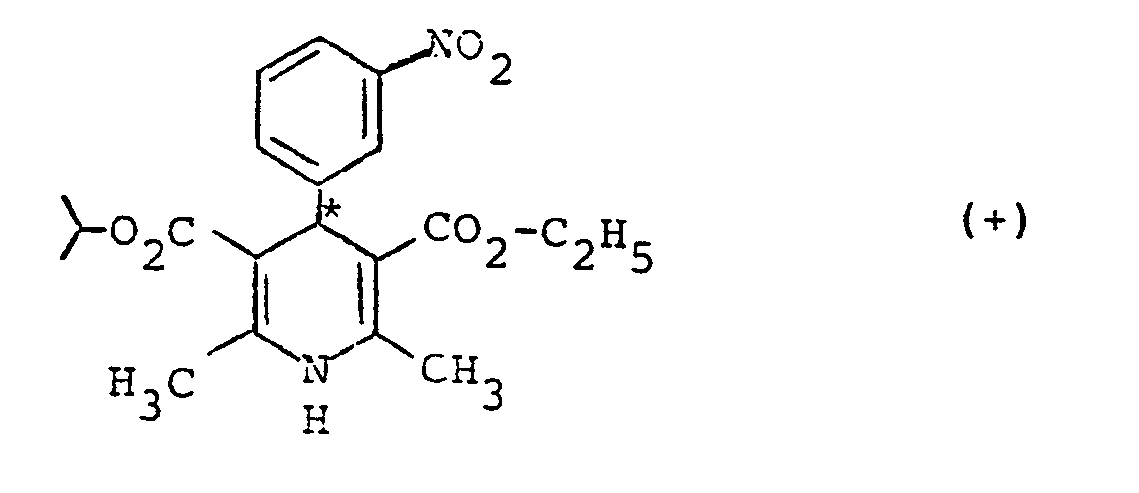
- Schmelzpunkt: Fp = 140°C
- Spezifische Drehung:

- (-)-1.4-Dihydro-2.6-dimethyl-4-(3'-nitrophenyl)-pyridin-3.5-dicarbonsäure-ethyl-isobutylester

- Schmelzpunkt: Fp = 140°
- Spezifische Drehung:

- (+)-1.4-Dihydro-2.6-dimethyl-4-(3'-nitrophenyl)-pyridin-3.5-dicarbonsäure-isopropyl-(2-methoxyethyl)-ester

- Schmelzpunkt: Fp = 134°C
- Spezifische Drehung:

- (-)-1.4-Dihydro-2.6-dimethyl-4-(3'-nitrophenyl)-pyridin-3.5-dicarbonsäure-isopropyl-(2-methoxyethyl)-ester

- Schmelzpunkt: Fp = 134°C
- Spezifische Drehung:

sowie ihre pharmazeutisch unbedenklichen Säureadditionssalze.
sowie ihre pharmazeutisch unbedenklichen Säureadditionssalze.
Claims (13)

oder
oder
oder
oder
wobei R7 einen Arylrest bedeutet, der gegebenenfalls 1, 2 oder 3 gleiche oder verschiedene Substituenten der Gruppe Alkyl, Alkoxy, Halogen, Cyano, Trifluormethyl, Trifluormethoxy, Dialkylamino oder Nitro enthält, und
sowie ihre pharmazeutisch unbedenklichen Säureaddiionssalze.
oder
oder
oder
der Kohlenwasserstoffrest substituiert ist durch α-, ß- oder γ-Pyridyl oder durch eine Aminogruppe, wobei diese Aminogruppe zwei gleiche oder verschiedene Substituenten aus der Gruppe Alkyl, Alkoxyalkyl, mit jeweils bis zu 4 Kohlenstoffatomen, Phenyl, Benzyl oder Phenethyl trägt oder wobei die Substituenten dieser Aminogruppe mit dem Stickstoffatom einen 5- bis 7-gliedrigen Ring bilden der als weiteres Heteroatom ein Sauerstoff- oder Schwefelatom oder die N-Alkylgruppierung enthalten kann, wobei die Alkylgruppe 1 bis 3 Kohlenstoffatome enthält, oder wobei R für einen Phenylrest steht, der gegebenenfalls substituiert ist durch 1, 2 oder 3 gleiche oder verschiedene Substituenten aus der Gruppe Nitro, Cyano, Trifluormethyl, Trifluormethoxy, Fluor, Chlor, Brom, Alkyl, Alkoxy und Dialkylamino, wobei die genannten Alkyl- und Alkoxyreste jeweils 1 bis 4 Kohlenstoffatome enthalten,
sowie ihre pharmazeutisch unbedenklichen Säureadditionssalze.
oder für Pyridyl steht,
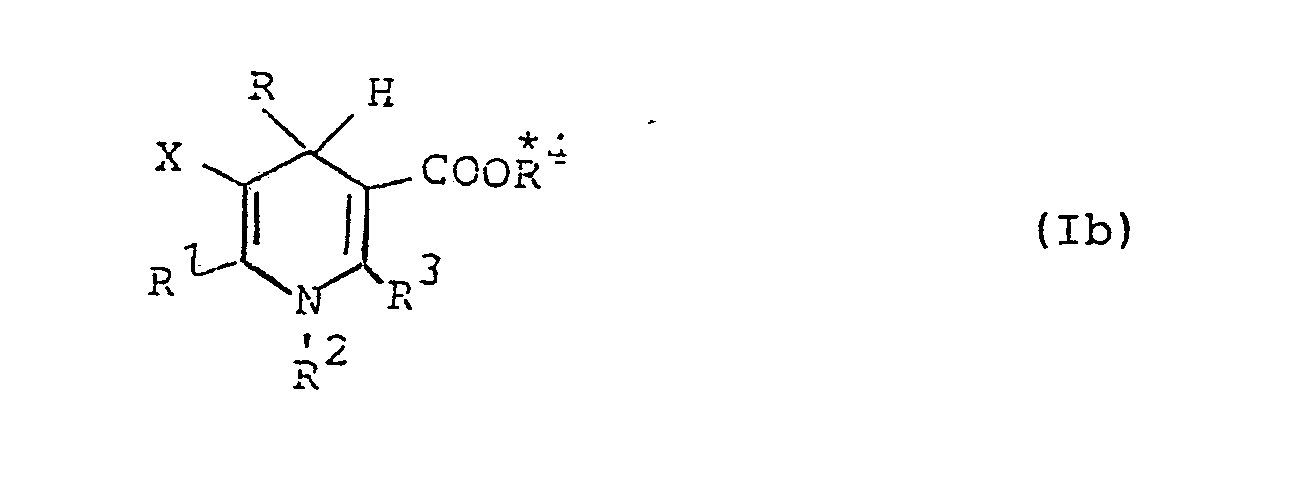
R einen chiralen, einheitlichen konfigurierten aliphatischen Kohlenwasserstoffrest mit bis zu 8 Kohlenstoffatomen darstellt, der gegebenenfalls 1, 2 oder 3 gleiche oder verschiedene elektronenziehende Reste enthält aus der Gruppe Nitril, COO-Alkyl mit 1 bis 4 Kohlenstoffatomen, COO-Phenyl, COO-Benzyl und -Phenethyl, Amino und Hydroxy, wobei diese Amino- und Hydroxygruppen gegebenenfalls alkyliert, aralkyliert, acyliert, acetalisiert oder silyliert sind, wodurch Alkyl-, Acyl- und Acetalgruppen jeweils bis zu 6 Kohlenstoffatome enthalten und die Aralkylgruppe Benzyl oder Phenethyl bedeutet.
R 4 für einen achiralen Rest steht der die Bedeutung von R 6 besitztc wobei die beiden Substituenten in 3- und 5-Position immer voneinander verschieden sind.

die Substituenten R, R1, R2, R 3, R und X die oben angegebene Bedeutung haben und
mit einem chiralen Stoff in Wechselwirkung treten läßt, wobei die diastereomeren Beziehungen zwischen den beiden Antipoden des Dihydropyridins mit dem chiralen Stoff zu einer Trennung der Antipoden führt, die in an sich bekannter Weise durchgeführt wird, oder

mit einer optisch aktiven Base zu den entsprechenden diastereomeren Salzen umsetzt, diese nach bekannten Methoden in die optisch aktiven 1,4-Dihydropyridincarbonsäuren der allgemeinen Formel (IV)

überführt und anschließend mit Alkoholderivaten der allgemeinen Formel (V)

in an sich bekannter Weise zu den erfindungsgemäßen Verbindungen der Formel (Ia) verestert,
oder

und


nach für die Synthese von 1,4-Dihydropyridin üblichen Verfahren unter Verwendung von entsprechenden optisch aktiven Ausgangsmaterialien herstellt und die hierbei, wegen der beiden möglichen verschiedenen Konfigurationen am C4-Atom des Dihydropyridinringes, anfallenden Diastereomeren nach üblichen Methoden trennt, wobei die so erhaltenen 1,4-Dihydropyridine mit der chiralen Estergruppe der allgemeinen Formel (VII)

nach üblichen Methoden umgeestert werden, indem der chirale Esterrest R durch einen achiralen Esterrest R 4 ausgetauscht wird, wobei Verbindungen der allgemeinen Formel (Ia) erhalten werden oder durch einen anderen chiralen Esterrest

Priority Applications (1)
| Application Number | Priority Date | Filing Date | Title |
|---|---|---|---|
| AT80104900T ATE16101T1 (de) | 1979-09-01 | 1980-08-16 | Optisch aktive 1,4-dihydropyridine, verfahren zu ihrer herstellung und ihre verwendung als arzneimittel. |
Applications Claiming Priority (2)
| Application Number | Priority Date | Filing Date | Title |
|---|---|---|---|
| DE2935451A DE2935451A1 (de) | 1979-09-01 | 1979-09-01 | Optisch aktive 1,4-dihydropyridine, verfahren zu ihrer herstellung und ihre verwendung als arneimittel |
| DE2935451 | 1979-09-01 |
Publications (2)
| Publication Number | Publication Date |
|---|---|
| EP0026317A1 true EP0026317A1 (de) | 1981-04-08 |
| EP0026317B1 EP0026317B1 (de) | 1985-10-16 |
Family
ID=6079874
Family Applications (1)
| Application Number | Title | Priority Date | Filing Date |
|---|---|---|---|
| EP80104900A Expired EP0026317B1 (de) | 1979-09-01 | 1980-08-16 | Optisch aktive 1,4-Dihydropyridine, Verfahren zu ihrer Herstellung und ihre Verwendung als Arzneimittel |
Country Status (25)
| Country | Link |
|---|---|
| US (3) | US4510310A (de) |
| EP (1) | EP0026317B1 (de) |
| JP (2) | JPS5636455A (de) |
| AR (1) | AR228576A1 (de) |
| AT (1) | ATE16101T1 (de) |
| AU (1) | AU545023B2 (de) |
| CA (1) | CA1142937A (de) |
| CS (1) | CS228506B2 (de) |
| DD (1) | DD154014A5 (de) |
| DE (2) | DE2935451A1 (de) |
| DK (2) | DK160549C (de) |
| EG (1) | EG15011A (de) |
| ES (1) | ES8104228A1 (de) |
| FI (1) | FI78686C (de) |
| GR (1) | GR70080B (de) |
| HU (1) | HU184821B (de) |
| IE (1) | IE50504B1 (de) |
| IL (1) | IL60937A (de) |
| NO (1) | NO159928C (de) |
| NZ (1) | NZ194805A (de) |
| PH (3) | PH19749A (de) |
| PL (1) | PL128310B1 (de) |
| PT (1) | PT71724B (de) |
| SU (1) | SU932988A3 (de) |
| ZA (1) | ZA805372B (de) |
Cited By (17)
| Publication number | Priority date | Publication date | Assignee | Title |
|---|---|---|---|---|
| EP0071819A1 (de) * | 1981-07-30 | 1983-02-16 | Bayer Ag | Dihydropyridine mit positiv inotroper Wirkung, neue Verbindungen, ihre Verwendung in Arzneimitteln und Verfahren zu ihrer Herstellung |
| EP0173126A1 (de) * | 1984-08-07 | 1986-03-05 | Otsuka Pharmaceutical Co., Ltd. | Dihydropyridinderivate |
| EP0240828A1 (de) * | 1986-03-27 | 1987-10-14 | Byk Gulden Lomberg Chemische Fabrik GmbH | Optisch aktive 1,4-Dihydropyridinverbindung |
| EP0172509A3 (de) * | 1984-08-24 | 1988-01-07 | CASSELLA Aktiengesellschaft | Verfahren zur Herstellung optisch aktiver, substituierter 1,4-Dihydropyridine und ihre Verwendung als Arzneimittel |
| WO1988007524A1 (fr) * | 1987-03-27 | 1988-10-06 | Byk Gulden Lomberg Chemische Fabrik Gmbh | Nouveaux produits intermediaires et procede |
| EP0257616A3 (en) * | 1986-08-27 | 1989-01-11 | The Green Cross Corporation | Dihydropyridine derivates and pharmaceutical composition thereof |
| EP0096299B1 (de) * | 1982-06-03 | 1989-02-01 | Pierrel S.p.A. | Hydroxyimino- und Alkoxyiminoderivate von 1,4-Dihydropyridinen, Verfahren zu ihrer Herstellung und diese enthaltende pharmazeutische Zusammensetzungen |
| US4886819A (en) * | 1986-08-27 | 1989-12-12 | The Green Cross Corporation | Dihydropyridine derivatives and pharmaceutical composition thereof |
| EP0273349A3 (de) * | 1986-12-22 | 1990-02-14 | Laboratoires Syntex S.A. | Optische Spaltung von 1,4-Dihydropyridinderivaten |
| EP0186028B1 (de) * | 1984-12-22 | 1990-08-01 | Bayer Ag | Optisch aktive Nitrodihydropyridine, Verfahren zur Herstellung und ihre Verwendung in Arzneimitteln |
| EP0347678A3 (de) * | 1988-06-24 | 1990-12-05 | Bayer Ag | 1,4-Dihydropyridin-threonin-Derivate und Verfahren zu ihrer Herstellung |
| EP0411549A1 (de) * | 1989-08-02 | 1991-02-06 | Kaken Pharmaceutical Co., Ltd. | 1,4-Dihydropyridin-Derivate, Verfahren zur ihrer Herstellung und diese enthaltende pharmazeutische Zusammensetzungen |
| US5034395A (en) * | 1983-12-02 | 1991-07-23 | Otsuka Pharmaceutical Co., Ltd. | Novel dihydropyridine derivatives |
| EP0515940A1 (de) * | 1991-05-30 | 1992-12-02 | Bayer Ag | Neue 2-Amino-5-cyano-1,4-dihydropyridine, Verfahren zu ihrer Herstellung und ihre Verwendung in Arzneimitteln |
| EP0566142A1 (de) * | 1992-04-16 | 1993-10-20 | LEK, tovarna farmacevtskih in kemicnih izdelkov, d.d. | Inklusion-Komplexe von optisch aktiven und racemischen 1,4-Dihydropyridinederivate mit Zyklodextrin |
| EP0595166A1 (de) * | 1992-10-30 | 1994-05-04 | Bayer Ag | 4-Heterocyclyl substituierte Dihydropyridine |
| US6001857A (en) * | 1992-10-30 | 1999-12-14 | Bayer Aktiengesellschaft | Heterocyclyl substituted dihydropyridines |
Families Citing this family (31)
| Publication number | Priority date | Publication date | Assignee | Title |
|---|---|---|---|---|
| DE2935451A1 (de) * | 1979-09-01 | 1981-03-19 | Bayer Ag, 5090 Leverkusen | Optisch aktive 1,4-dihydropyridine, verfahren zu ihrer herstellung und ihre verwendung als arneimittel |
| JPS57200364A (en) * | 1981-06-04 | 1982-12-08 | Yoshitomi Pharmaceut Ind Ltd | 1,4-dihydropyridine-3,5-dicarboxylic ester derivative and its salt |
| JPS57200386A (en) * | 1981-06-04 | 1982-12-08 | Yoshitomi Pharmaceut Ind Ltd | Novel 1,4-dihydropyridine-3,5-dicarboxylic ester derivative and its salts |
| GB2111978B (en) * | 1981-10-19 | 1985-05-01 | Maruko Pharmaceutical Co | 1 4-dihydropyridine compounds |
| JPS59225162A (ja) * | 1983-06-03 | 1984-12-18 | Kyowa Hakko Kogyo Co Ltd | 1,4−ジヒドロピリジン誘導体 |
| JPS5970667A (ja) * | 1982-10-15 | 1984-04-21 | Kyowa Hakko Kogyo Co Ltd | 1,4−ジヒドロピリジン誘導体 |
| DE3248548A1 (de) * | 1982-12-29 | 1984-07-05 | Heinrich Mack Nachf., 7918 Illertissen | Acylderivate von 1,4:3,6-dianhydro-hexiten, verfahren zu ihrer herstellung und ihre verwendung als arzneimittel |
| DE4342196A1 (de) * | 1993-12-10 | 1995-06-14 | Bayer Ag | Neue 4-Phenyl-substituierte 1,4-Dihydropyridine |
| IE57810B1 (en) * | 1984-03-27 | 1993-04-21 | Delagrange Lab | 1,4-dihydropyridine derivatives,their preparation and their use |
| US5364872A (en) * | 1984-04-16 | 1994-11-15 | Yamanouchi Pharmaceutical Co., Ltd. | Dihydropyridine-3,5-dicarboxylic acid ester derivatives |
| JPS60246313A (ja) * | 1984-05-22 | 1985-12-06 | Yamanouchi Pharmaceut Co Ltd | 塩酸ニカルジピンの注射剤およびその製法 |
| USRE34618E (en) * | 1984-05-22 | 1994-05-24 | Yamanouchi Pharmaceutical Co., Ltd. | Injection of nicardinpine hydrochloride and process for the production thereof |
| DE3423105A1 (de) * | 1984-06-22 | 1986-01-02 | Bayer Ag, 5090 Leverkusen | Verfahren zur herstellung optisch aktiver 1,4-dihydropyridine |
| US4975440A (en) * | 1984-09-28 | 1990-12-04 | Byk Gulden Lomberg Chemische Fabrik Gmbh | Optically-active 1,4-dihydropyridine |
| JPS61161263A (ja) * | 1985-01-09 | 1986-07-21 | Teijin Ltd | 1,4−ジヒドロピリジンモノエステルモノカルボン酸の製造法 |
| US4771057A (en) * | 1986-02-03 | 1988-09-13 | University Of Alberta | Reduced pyridyl derivatives with cardiovascular regulating properties |
| JPH0755955B2 (ja) * | 1986-09-10 | 1995-06-14 | 日産化学工業株式会社 | 光学活性なジヒドロピリジン−5−ホスホン酸エステル |
| HU196755B (en) * | 1986-09-16 | 1989-01-30 | Gyogyszerkutato Intezet | Process for production of new substituated amilid derivatives and medical compositions containing them |
| US4994461A (en) * | 1987-03-27 | 1991-02-19 | Byk Gulden Lomberg Chemische Fabrik Gmbh | 1,4-dihydropyridine enantiomers |
| US4889866A (en) * | 1987-06-11 | 1989-12-26 | Syntex (U.S.A.) Inc. | Arylsulfonyl dihydropyridine derivatives |
| JPS6429359A (en) * | 1987-07-24 | 1989-01-31 | Teijin Ltd | 1,4-dihydropyridine derivative and production thereof |
| DE4011106A1 (de) * | 1990-04-06 | 1991-10-10 | Bayer Ag | Neue heterocyclisch substituierte dihydropyridine, verfahren zu ihrer herstellung und ihre verwendung in arzneimitteln |
| US5834496A (en) * | 1991-12-02 | 1998-11-10 | Sepracor, Inc. | Methods for treating hypertension using optically pure S(-) felodipine |
| DE59304885D1 (de) * | 1992-10-30 | 1997-02-06 | Bayer Ag | 4-Heterocyclophenyl substituierte Dihydropyridine |
| EE03192B1 (et) * | 1993-12-10 | 1999-06-15 | Bayer Aktiengesellschaft | Isopropüül-(2-metoksüetüül)-4-(2-kloro-3-tsüanofenüül)-1,4-dihüdro-2,6-dimetüülpüri diin-3,5-dikarboksülaat, selle enantiomeerid ja vaheühend, meetodid nimetatud ühendite valmistamiseks ja kasutamine |
| DE4342193A1 (de) * | 1993-12-10 | 1995-06-14 | Bayer Ag | Arylsubstituierte Alkoxycarbonyl-1,4-dihydropyridin-5-carbonsäureester |
| EP0657432B1 (de) | 1993-12-10 | 2003-03-12 | Bayer Ag | Phenyl-substituierte 1,4-Dihydropyridine mit cerebraler Aktivität |
| US5478848A (en) * | 1994-01-26 | 1995-12-26 | Bayer Corporation | Inhibition of arthritis by L-type calcium channel antagonists nimodipine, nisoldipine and nifedipine |
| DE19532320A1 (de) * | 1995-09-01 | 1997-03-06 | Bayer Ag | Verfahren zur Herstellung von optisch aktiven ortho-substituierten 4-Aryl-Dihydropyridinen |
| JPH11106375A (ja) * | 1997-08-18 | 1999-04-20 | Pfizer Pharmaceut Inc | ブラジキニンアンタゴニストとしての光学的に活性な1,4−ジヒドロピリジン化合物 |
| US20100247646A1 (en) * | 2009-03-26 | 2010-09-30 | Ranbaxy Laboratories Limited | Extended release tablets of nisoldipine |
Citations (4)
| Publication number | Priority date | Publication date | Assignee | Title |
|---|---|---|---|---|
| DE2117571A1 (de) * | 1971-04-10 | 1972-10-19 | Unsymmetrische 1,4-Dihydropyridincarbonsäureester, Verfahren zu ihrer Herstellung sowie ihre Verwendung als Arzneimittel I. Arfm: Farbenfabriken Bayer AG, 5090 Leverkusen | |
| DE2629892A1 (de) * | 1975-07-02 | 1977-01-27 | Fujisawa Pharmaceutical Co | 1,4-dihydropyridinderivate, verfahren zu ihrer herstellung und sie enthaltende arzneimittel |
| DE2756226A1 (de) * | 1976-12-17 | 1978-06-29 | Fujisawa Pharmaceutical Co | 1,4-dihydropyridin-verbindungen, verfahren zu ihrer herstellung und sie enthaltende pharmazeutische mittel |
| EP0007293A1 (de) * | 1978-06-30 | 1980-01-23 | Aktiebolaget Hässle | Hypotensiv wirksamer 2,6-Dimethyl-4-(2,3-dichlorophenyl)-1,4-dihydropyridin-3,5-dicarbonsäure-3-methylester-5-ethylester, Verfahren zu seiner Herstellung und diesen enthaltende pharmazeutische Zusammensetzungen |
Family Cites Families (3)
| Publication number | Priority date | Publication date | Assignee | Title |
|---|---|---|---|---|
| US3985758A (en) * | 1973-02-20 | 1976-10-12 | Yamanouchi Pharmaceutical Co., Ltd. | 1,4-Dihydropyridine derivatives |
| DE2508181A1 (de) * | 1975-02-26 | 1976-09-09 | Bayer Ag | 1,4-dihydropyridincarbonsaeurearal- kylester, verfahren zu ihrer herstellung sowie ihre verwendung als arzneimittel |
| DE2935451A1 (de) * | 1979-09-01 | 1981-03-19 | Bayer Ag, 5090 Leverkusen | Optisch aktive 1,4-dihydropyridine, verfahren zu ihrer herstellung und ihre verwendung als arneimittel |
-
1979
- 1979-09-01 DE DE2935451A patent/DE2935451A1/de not_active Withdrawn
-
1980
- 1980-08-15 NO NO802446A patent/NO159928C/no unknown
- 1980-08-16 DE DE8080104900T patent/DE3071186D1/de not_active Expired
- 1980-08-16 EP EP80104900A patent/EP0026317B1/de not_active Expired
- 1980-08-16 AT AT80104900T patent/ATE16101T1/de not_active IP Right Cessation
- 1980-08-22 PT PT71724A patent/PT71724B/pt not_active IP Right Cessation
- 1980-08-27 SU SU802969272A patent/SU932988A3/ru active
- 1980-08-28 FI FI802717A patent/FI78686C/fi not_active IP Right Cessation
- 1980-08-28 DD DD80223572A patent/DD154014A5/de unknown
- 1980-08-29 IL IL60937A patent/IL60937A/xx not_active IP Right Cessation
- 1980-08-29 CS CS805915A patent/CS228506B2/cs unknown
- 1980-08-29 JP JP11856180A patent/JPS5636455A/ja active Pending
- 1980-08-29 ES ES494614A patent/ES8104228A1/es not_active Expired
- 1980-08-29 IE IE1820/80A patent/IE50504B1/en not_active IP Right Cessation
- 1980-08-29 CA CA000359359A patent/CA1142937A/en not_active Expired
- 1980-08-29 ZA ZA00805372A patent/ZA805372B/xx unknown
- 1980-08-29 HU HU802135A patent/HU184821B/hu not_active IP Right Cessation
- 1980-08-29 DK DK368480A patent/DK160549C/da not_active IP Right Cessation
- 1980-08-29 GR GR62770A patent/GR70080B/el unknown
- 1980-08-29 NZ NZ194805A patent/NZ194805A/en unknown
- 1980-08-29 AR AR282348A patent/AR228576A1/es active
- 1980-08-30 EG EG80533A patent/EG15011A/xx active
- 1980-08-30 PL PL1980226503A patent/PL128310B1/pl unknown
- 1980-09-01 PH PH24522A patent/PH19749A/en unknown
- 1980-09-03 AU AU61982/80A patent/AU545023B2/en not_active Ceased
-
1982
- 1982-05-11 PH PH27282A patent/PH19006A/en unknown
- 1982-05-11 PH PH27281A patent/PH17914A/en unknown
- 1982-09-30 US US06/429,732 patent/US4510310A/en not_active Expired - Lifetime
-
1987
- 1987-02-09 US US07/012,515 patent/US4849433A/en not_active Expired - Fee Related
-
1989
- 1989-03-30 US US07/331,312 patent/US4988717A/en not_active Expired - Fee Related
-
1990
- 1990-10-05 DK DK241390A patent/DK164158C/da not_active IP Right Cessation
-
1991
- 1991-02-20 JP JP3047607A patent/JPH07600B2/ja not_active Expired - Lifetime
Patent Citations (4)
| Publication number | Priority date | Publication date | Assignee | Title |
|---|---|---|---|---|
| DE2117571A1 (de) * | 1971-04-10 | 1972-10-19 | Unsymmetrische 1,4-Dihydropyridincarbonsäureester, Verfahren zu ihrer Herstellung sowie ihre Verwendung als Arzneimittel I. Arfm: Farbenfabriken Bayer AG, 5090 Leverkusen | |
| DE2629892A1 (de) * | 1975-07-02 | 1977-01-27 | Fujisawa Pharmaceutical Co | 1,4-dihydropyridinderivate, verfahren zu ihrer herstellung und sie enthaltende arzneimittel |
| DE2756226A1 (de) * | 1976-12-17 | 1978-06-29 | Fujisawa Pharmaceutical Co | 1,4-dihydropyridin-verbindungen, verfahren zu ihrer herstellung und sie enthaltende pharmazeutische mittel |
| EP0007293A1 (de) * | 1978-06-30 | 1980-01-23 | Aktiebolaget Hässle | Hypotensiv wirksamer 2,6-Dimethyl-4-(2,3-dichlorophenyl)-1,4-dihydropyridin-3,5-dicarbonsäure-3-methylester-5-ethylester, Verfahren zu seiner Herstellung und diesen enthaltende pharmazeutische Zusammensetzungen |
Cited By (23)
| Publication number | Priority date | Publication date | Assignee | Title |
|---|---|---|---|---|
| FR2511247A1 (fr) * | 1981-07-30 | 1983-02-18 | Bayer Ag | Dihydropyridines ayant une action positivement inotrope, leur utilisation comme medicaments et un procede pour leur preparation |
| EP0071819A1 (de) * | 1981-07-30 | 1983-02-16 | Bayer Ag | Dihydropyridine mit positiv inotroper Wirkung, neue Verbindungen, ihre Verwendung in Arzneimitteln und Verfahren zu ihrer Herstellung |
| EP0096299B1 (de) * | 1982-06-03 | 1989-02-01 | Pierrel S.p.A. | Hydroxyimino- und Alkoxyiminoderivate von 1,4-Dihydropyridinen, Verfahren zu ihrer Herstellung und diese enthaltende pharmazeutische Zusammensetzungen |
| US5034395A (en) * | 1983-12-02 | 1991-07-23 | Otsuka Pharmaceutical Co., Ltd. | Novel dihydropyridine derivatives |
| EP0173126A1 (de) * | 1984-08-07 | 1986-03-05 | Otsuka Pharmaceutical Co., Ltd. | Dihydropyridinderivate |
| EP0172509A3 (de) * | 1984-08-24 | 1988-01-07 | CASSELLA Aktiengesellschaft | Verfahren zur Herstellung optisch aktiver, substituierter 1,4-Dihydropyridine und ihre Verwendung als Arzneimittel |
| EP0186028B1 (de) * | 1984-12-22 | 1990-08-01 | Bayer Ag | Optisch aktive Nitrodihydropyridine, Verfahren zur Herstellung und ihre Verwendung in Arzneimitteln |
| EP0240828A1 (de) * | 1986-03-27 | 1987-10-14 | Byk Gulden Lomberg Chemische Fabrik GmbH | Optisch aktive 1,4-Dihydropyridinverbindung |
| EP0257616A3 (en) * | 1986-08-27 | 1989-01-11 | The Green Cross Corporation | Dihydropyridine derivates and pharmaceutical composition thereof |
| US4886819A (en) * | 1986-08-27 | 1989-12-12 | The Green Cross Corporation | Dihydropyridine derivatives and pharmaceutical composition thereof |
| EP0273349A3 (de) * | 1986-12-22 | 1990-02-14 | Laboratoires Syntex S.A. | Optische Spaltung von 1,4-Dihydropyridinderivaten |
| WO1988007524A1 (fr) * | 1987-03-27 | 1988-10-06 | Byk Gulden Lomberg Chemische Fabrik Gmbh | Nouveaux produits intermediaires et procede |
| EP0287828A1 (de) * | 1987-03-27 | 1988-10-26 | Byk Gulden Lomberg Chemische Fabrik GmbH | Neue Zwischenprodukte und Verfahren |
| EP0347678A3 (de) * | 1988-06-24 | 1990-12-05 | Bayer Ag | 1,4-Dihydropyridin-threonin-Derivate und Verfahren zu ihrer Herstellung |
| EP0411549A1 (de) * | 1989-08-02 | 1991-02-06 | Kaken Pharmaceutical Co., Ltd. | 1,4-Dihydropyridin-Derivate, Verfahren zur ihrer Herstellung und diese enthaltende pharmazeutische Zusammensetzungen |
| US5158963A (en) * | 1989-08-02 | 1992-10-27 | Kaken Pharmaceutical Co., Ltd. | 1-4-dihydropyridine derivative, process for preparing the same and pharmaceutical composition containing the same |
| EP0515940A1 (de) * | 1991-05-30 | 1992-12-02 | Bayer Ag | Neue 2-Amino-5-cyano-1,4-dihydropyridine, Verfahren zu ihrer Herstellung und ihre Verwendung in Arzneimitteln |
| US5225558A (en) * | 1991-05-30 | 1993-07-06 | Bayer Aktiengesellschaft | 2-amino-5-cyano-1,4-dihydropyridines, and their use in medicaments |
| US5380851A (en) * | 1991-05-30 | 1995-01-10 | Bayer Aktiengesellschaft | 2-amino-5-cyano-1,4-dihydropyridines, processes for their preparation |
| EP0566142A1 (de) * | 1992-04-16 | 1993-10-20 | LEK, tovarna farmacevtskih in kemicnih izdelkov, d.d. | Inklusion-Komplexe von optisch aktiven und racemischen 1,4-Dihydropyridinederivate mit Zyklodextrin |
| EP0595166A1 (de) * | 1992-10-30 | 1994-05-04 | Bayer Ag | 4-Heterocyclyl substituierte Dihydropyridine |
| US5502064A (en) * | 1992-10-30 | 1996-03-26 | Bayer Aktiengesellschaft | 4-heterocyclyl-substituted dihydropyridines |
| US6001857A (en) * | 1992-10-30 | 1999-12-14 | Bayer Aktiengesellschaft | Heterocyclyl substituted dihydropyridines |
Also Published As
Similar Documents
| Publication | Publication Date | Title |
|---|---|---|
| DE2935451A1 (de) | Optisch aktive 1,4-dihydropyridine, verfahren zu ihrer herstellung und ihre verwendung als arneimittel | |
| EP0002208B1 (de) | Nitrosubstituierte 1,4-Dihydropyridine, diese enthaltende Arzneimittel sowie deren Herstellung | |
| EP0012180B1 (de) | Neue 1,4-Dihydropyridinverbindungen, Verfahren zu ihrer Herstellung, die genannten Verbindungen enthaltende Arzneimittel und Verfahren zur Herstellung dieser Arzneimittel | |
| EP0088274B1 (de) | Neue 1,4-Dihydropyridine, Verfahren zu ihrer Herstellung und ihrer Verwendung in Arzneimitteln | |
| EP0088276B1 (de) | Neue Verbindungen, Verfahren zu ihrer Herstellung sowie ihre Verwendung als Arzneimittel | |
| EP0011706B1 (de) | Verfahren zur Herstellung von teilweise neuen 1,4-Dihydropyridin-3-carbonsäure-Derivaten (I), neue 1,4-Dihydropyridin-3-carbonsäure-Derivate (II) und die Verwendung der Derivate (I) und (II) zur Herstellung von 1,4-Dihydropyridin-3,5-dicarbonsäurediestern | |
| EP0009206B1 (de) | Fluorhaltige 1,4-Dihydropyridine, diese enthaltende Arzneimittel sowie Verfahren zu ihrer Herstellung | |
| EP0088940B1 (de) | Pyridincarbonsäureester, Verfahren zu ihrer Herstellung sowie ihre Verwendung als Arzneimittel | |
| EP0088938A1 (de) | Verwendung von Pyridinverbindungen zur Herstellung von Arzneimitteln mit antihypoxischer und Ischämie-protektiver Wirkung | |
| EP0001769A1 (de) | 1,4-Dihydropyridincarbonsäureester mit schwefelhaltigen Estergruppen, ihre Herstellung und ihre Verwendung als Arzneimittel | |
| EP0039863B1 (de) | 1,4-Dihydropyridine mit unterschiedlichen Substituenten in 2- und 6-Position, Verfahren zu ihrer Herstellung und ihre Verwendung in Arzneimitteln | |
| DE2658804A1 (de) | Kreislaufbeeinflussende mittel | |
| EP0010130A1 (de) | Sila-substituierte 1,4-Dihydropyridinderivate, Verfahren zu ihrer Herstellung, Arzneimittel und Verfahren zu deren Herstellung | |
| EP0110259A1 (de) | 1,4-Dihydropyridinderivate, Verfahren zu ihrer Herstellung sowie ihre Verwendung in Arzneimitteln | |
| DE3412947A1 (de) | Tetrahydothienopyridine, verfahren zu ihrer herstellung sowie ihre verwendung als arzneimittel | |
| EP0158956B1 (de) | 4-(Nitrophenyl)-tetrahydropyridine, Verfahren zu ihrer Herstellung und ihre Verwendung als Arzneimittel | |
| DE2639498A1 (de) | Neue schwefelhaltige amino-dihydropyridine, verfahren zu ihrer herstellung sowie ihre verwendung als arzneimittel | |
| DE2847237A1 (de) | Verfahren zur herstellung von 1,4-dihydropyridincarbonsaeuren sowie ihre verwendung als arzneimittel | |
| EP0001108A1 (de) | Neue 1,4-Dihydropyridazine, Verfahren zu ihrer Herstellung sowie ihre Verwendung in Arzneimitteln | |
| EP0042093A2 (de) | 4-Aralkyl-1,4-dihydropyridine, Verfahren zu deren Herstellung, ihre Verwendung in Arzneimitteln sowie deren Herstellung | |
| DE2616991A1 (de) | Heterocyclisch-substituierte schwefelhaltige dihydropyridine, mehrere verfahren zu ihrer herstellung sowie ihre verwendung als arzneimittel | |
| EP0225574B1 (de) | Neue, fluorhaltige 1,4-Dihydropyridine, Verfahren zu ihrer Herstellung sowie ihre Verwendung als Arzneimittel | |
| EP0167068B1 (de) | 1,4-Dihydro-2,6-dimethyl-4-(3-nitrophenyl)-pyridin-3,5-dicarbonsäure-isopropyl-[2-(3-trifluormethylphenoxy)-ethyl]-ester, mehrere Verfahren zu seiner Herstellung sowie seine Verwendung in Arzneimitteln | |
| EP0001439A1 (de) | 1-N-substituierte 1.4-Dihydropyridazine, Verfahren zu ihrer Herstellung sowie ihre Verwendung für Arzneimittel | |
| EP0042566A1 (de) | 4,4-Disubstituierte 1,4-Dihydropyridine, Verfahren zu ihrer Herstellung sowie ihre Verwendung in Arzneimitteln |
Legal Events
| Date | Code | Title | Description |
|---|---|---|---|
| PUAI | Public reference made under article 153(3) epc to a published international application that has entered the european phase |
Free format text: ORIGINAL CODE: 0009012 |
|
| 17P | Request for examination filed |
Effective date: 19800816 |
|
| AK | Designated contracting states |
Designated state(s): AT BE CH DE FR GB IT LU NL SE |
|
| ITCL | It: translation for ep claims filed |
Representative=s name: ING. C. GREGORJ S.P.A. |
|
| ITF | It: translation for a ep patent filed | ||
| GRAA | (expected) grant |
Free format text: ORIGINAL CODE: 0009210 |
|
| AK | Designated contracting states |
Designated state(s): AT BE CH DE FR GB IT LI LU NL SE |
|
| REF | Corresponds to: |
Ref document number: 16101 Country of ref document: AT Date of ref document: 19851115 Kind code of ref document: T |
|
| ITF | It: translation for a ep patent filed | ||
| ET | Fr: translation filed | ||
| REF | Corresponds to: |
Ref document number: 3071186 Country of ref document: DE Date of ref document: 19851121 |
|
| PLBE | No opposition filed within time limit |
Free format text: ORIGINAL CODE: 0009261 |
|
| STAA | Information on the status of an ep patent application or granted ep patent |
Free format text: STATUS: NO OPPOSITION FILED WITHIN TIME LIMIT |
|
| 26N | No opposition filed | ||
| ITTA | It: last paid annual fee | ||
| EPTA | Lu: last paid annual fee | ||
| EAL | Se: european patent in force in sweden |
Ref document number: 80104900.8 |
|
| PGFP | Annual fee paid to national office [announced via postgrant information from national office to epo] |
Ref country code: DE Payment date: 19970710 Year of fee payment: 18 |
|
| PGFP | Annual fee paid to national office [announced via postgrant information from national office to epo] |
Ref country code: SE Payment date: 19970715 Year of fee payment: 18 |
|
| PGFP | Annual fee paid to national office [announced via postgrant information from national office to epo] |
Ref country code: FR Payment date: 19970730 Year of fee payment: 18 |
|
| PGFP | Annual fee paid to national office [announced via postgrant information from national office to epo] |
Ref country code: GB Payment date: 19970807 Year of fee payment: 18 |
|
| PGFP | Annual fee paid to national office [announced via postgrant information from national office to epo] |
Ref country code: CH Payment date: 19970808 Year of fee payment: 18 |
|
| PGFP | Annual fee paid to national office [announced via postgrant information from national office to epo] |
Ref country code: AT Payment date: 19970819 Year of fee payment: 18 |
|
| PGFP | Annual fee paid to national office [announced via postgrant information from national office to epo] |
Ref country code: BE Payment date: 19970827 Year of fee payment: 18 |
|
| PGFP | Annual fee paid to national office [announced via postgrant information from national office to epo] |
Ref country code: NL Payment date: 19970831 Year of fee payment: 18 |
|
| PGFP | Annual fee paid to national office [announced via postgrant information from national office to epo] |
Ref country code: LU Payment date: 19970924 Year of fee payment: 18 |
|
| PG25 | Lapsed in a contracting state [announced via postgrant information from national office to epo] |
Ref country code: LU Free format text: LAPSE BECAUSE OF NON-PAYMENT OF DUE FEES Effective date: 19980816 Ref country code: GB Free format text: LAPSE BECAUSE OF NON-PAYMENT OF DUE FEES Effective date: 19980816 Ref country code: AT Free format text: LAPSE BECAUSE OF NON-PAYMENT OF DUE FEES Effective date: 19980816 |
|
| PG25 | Lapsed in a contracting state [announced via postgrant information from national office to epo] |
Ref country code: SE Free format text: LAPSE BECAUSE OF NON-PAYMENT OF DUE FEES Effective date: 19980817 |
|
| PG25 | Lapsed in a contracting state [announced via postgrant information from national office to epo] |
Ref country code: LI Free format text: LAPSE BECAUSE OF NON-PAYMENT OF DUE FEES Effective date: 19980831 Ref country code: CH Free format text: LAPSE BECAUSE OF NON-PAYMENT OF DUE FEES Effective date: 19980831 Ref country code: BE Free format text: LAPSE BECAUSE OF NON-PAYMENT OF DUE FEES Effective date: 19980831 |
|
| BERE | Be: lapsed |
Owner name: BAYER A.G. Effective date: 19980831 |
|
| PG25 | Lapsed in a contracting state [announced via postgrant information from national office to epo] |
Ref country code: NL Free format text: LAPSE BECAUSE OF NON-PAYMENT OF DUE FEES Effective date: 19990301 |
|
| GBPC | Gb: european patent ceased through non-payment of renewal fee |
Effective date: 19980816 |
|
| REG | Reference to a national code |
Ref country code: CH Ref legal event code: PL |
|
| PG25 | Lapsed in a contracting state [announced via postgrant information from national office to epo] |
Ref country code: FR Free format text: LAPSE BECAUSE OF NON-PAYMENT OF DUE FEES Effective date: 19990430 |
|
| EUG | Se: european patent has lapsed |
Ref document number: 80104900.8 |
|
| NLV4 | Nl: lapsed or anulled due to non-payment of the annual fee |
Effective date: 19990301 |
|
| REG | Reference to a national code |
Ref country code: FR Ref legal event code: ST |
|
| PG25 | Lapsed in a contracting state [announced via postgrant information from national office to epo] |
Ref country code: DE Free format text: LAPSE BECAUSE OF NON-PAYMENT OF DUE FEES Effective date: 19990701 |