EP0031305A2 - Acrylathaltige Zusammensetzungen und deren Polymerisation - Google Patents
Acrylathaltige Zusammensetzungen und deren Polymerisation Download PDFInfo
- Publication number
- EP0031305A2 EP0031305A2 EP80810397A EP80810397A EP0031305A2 EP 0031305 A2 EP0031305 A2 EP 0031305A2 EP 80810397 A EP80810397 A EP 80810397A EP 80810397 A EP80810397 A EP 80810397A EP 0031305 A2 EP0031305 A2 EP 0031305A2
- Authority
- EP
- European Patent Office
- Prior art keywords
- group
- allyl
- groups
- formula
- methacryloyloxy
- Prior art date
- Legal status (The legal status is an assumption and is not a legal conclusion. Google has not performed a legal analysis and makes no representation as to the accuracy of the status listed.)
- Granted
Links
- 0 CC1(C=CC(*=C)=CC=C1)N Chemical compound CC1(C=CC(*=C)=CC=C1)N 0.000 description 5
- VCJPCEVERINRSG-UHFFFAOYSA-N CC1CC(C)C(C)CC1 Chemical compound CC1CC(C)C(C)CC1 VCJPCEVERINRSG-UHFFFAOYSA-N 0.000 description 1
Classifications
-
- C—CHEMISTRY; METALLURGY
- C08—ORGANIC MACROMOLECULAR COMPOUNDS; THEIR PREPARATION OR CHEMICAL WORKING-UP; COMPOSITIONS BASED THEREON
- C08F—MACROMOLECULAR COMPOUNDS OBTAINED BY REACTIONS ONLY INVOLVING CARBON-TO-CARBON UNSATURATED BONDS
- C08F20/00—Homopolymers and copolymers of compounds having one or more unsaturated aliphatic radicals, each having only one carbon-to-carbon double bond, and only one being terminated by only one carboxyl radical or a salt, anhydride, ester, amide, imide or nitrile thereof
- C08F20/02—Monocarboxylic acids having less than ten carbon atoms, Derivatives thereof
- C08F20/10—Esters
- C08F20/40—Esters of unsaturated alcohols, e.g. allyl (meth)acrylate
-
- C—CHEMISTRY; METALLURGY
- C08—ORGANIC MACROMOLECULAR COMPOUNDS; THEIR PREPARATION OR CHEMICAL WORKING-UP; COMPOSITIONS BASED THEREON
- C08F—MACROMOLECULAR COMPOUNDS OBTAINED BY REACTIONS ONLY INVOLVING CARBON-TO-CARBON UNSATURATED BONDS
- C08F216/00—Copolymers of compounds having one or more unsaturated aliphatic radicals, each having only one carbon-to-carbon double bond, and at least one being terminated by an alcohol, ether, aldehydo, ketonic, acetal or ketal radical
-
- C—CHEMISTRY; METALLURGY
- C09—DYES; PAINTS; POLISHES; NATURAL RESINS; ADHESIVES; COMPOSITIONS NOT OTHERWISE PROVIDED FOR; APPLICATIONS OF MATERIALS NOT OTHERWISE PROVIDED FOR
- C09D—COATING COMPOSITIONS, e.g. PAINTS, VARNISHES OR LACQUERS; FILLING PASTES; CHEMICAL PAINT OR INK REMOVERS; INKS; CORRECTING FLUIDS; WOODSTAINS; PASTES OR SOLIDS FOR COLOURING OR PRINTING; USE OF MATERIALS THEREFOR
- C09D4/00—Coating compositions, e.g. paints, varnishes or lacquers, based on organic non-macromolecular compounds having at least one polymerisable carbon-to-carbon unsaturated bond ; Coating compositions, based on monomers of macromolecular compounds of groups C09D183/00 - C09D183/16
-
- Y—GENERAL TAGGING OF NEW TECHNOLOGICAL DEVELOPMENTS; GENERAL TAGGING OF CROSS-SECTIONAL TECHNOLOGIES SPANNING OVER SEVERAL SECTIONS OF THE IPC; TECHNICAL SUBJECTS COVERED BY FORMER USPC CROSS-REFERENCE ART COLLECTIONS [XRACs] AND DIGESTS
- Y10—TECHNICAL SUBJECTS COVERED BY FORMER USPC
- Y10S—TECHNICAL SUBJECTS COVERED BY FORMER USPC CROSS-REFERENCE ART COLLECTIONS [XRACs] AND DIGESTS
- Y10S525/00—Synthetic resins or natural rubbers -- part of the class 520 series
- Y10S525/922—Polyepoxide polymer having been reacted to yield terminal ethylenic unsaturation
Definitions
- the present invention relates to compositions which contain a polymercaptan with at least two mercaptan groups (-SH) and a compound with at least three ethylenically unsaturated double bonds. Furthermore, it relates to the polymerization of such compositions by means of actinic radiation and / or heat-activatable radical catalysts and the use of the polymerized products as surface coatings, in printing plates and printed circuits, as adhesives and in reinforced composites.
- -SH mercaptan with at least two mercaptan groups
- compositions are brought to polymerization by reacting the mercaptan groups with the allyl, methallyl or 1-propenyl groups under the influence of actinic radiation or radical catalysts.
- component i) contains at least one phenolic hydroxyl group instead of at least one epoxy group, e.g. 2,2-bis (3-allyl-4-hydroxyphenyl) propane and bis (3- (1-propenyl) -4-hydroxyphenyl) methane, component iii) accordingly being a heat-activable crosslinking agent for phenol / aldehyde is novolak resins.
- the polymerized products containing more than one phenolic hydroxyl group per average molecule would also subsequently be crosslinkable by heating on the spot.
- acrylate or methacrylate ester groups can be brought to polymerization very quickly by exposure to radiation or under the action of free radical catalysts in the presence of certain mercaptans, products with valuable properties being formed.
- the acrylate or methacrylate esters used also contain allyl, methallyl and / or 1-propenyl groups.
- the utility of this invention does not depend on whether such an assumption is true, it is believed that the allyl-type double bonds preferentially react with the mercaptan groups, thereby facilitating the polymer-forming processes via the double bonds in the acrylic or methacrylic groups. Whatever the reaction mechanism, it has been found that the compositions polymerize rapidly, forming surface coatings and adhesive bonds, which are characterized by good resistance to harmful environmental influences such as hot humid conditions.
- This invention further relates to a process for polymerizing such compositions, which consists in exposing them to actinic radiation or the action of a radical catalyst, and the polymerized products obtained by such a process.
- compositions for use in coating and imaging processes.
- the compositions comprise a polyunsaturated urethane with acrylic or methacrylic end groups, a vinyl monomer, which is preferably an ester of acrylic or methacrylic acid, a polymercaptan with at least two -SH groups per molecule and a photoinitiator.
- a diisocyanate with a hydroxyl-substituted acrylate or methacrylate is left in such an amount respond that a stoichiometric equivalent of free isocyanate groups remaining in the reaction product, and then the isocyanate groups with the stoichiometric Ae q uiva- lent hydroxyl groups in a polyhydric alcohol, preferably a polyethylene glycol or polypropylene glycol, is allowed to react.
- component a) preferably does not contain any ethylenic double bonds other than those in acryloyloxy, methacryloyloxy, allyl, methallyl and 1-propenyl groups.
- Component a) preferably has a molecular weight of at most 5000.
- the or each acryloyloxy or methacryloyloxy group (s) is or are preferred directly or via the (terminal) ether oxygen atom of a group of the formula or wherein R represents a hydrogen atom or a methyl group and a is an integer from 1 to 6 bound to a carbon atom of an aromatic nucleus.
- Component a) preferably contains at least two and at most six groups selected from acryloyloxy and methacryloyloxy groups per molecule and at least two and at most fifteen groups selected from allyl, methallyl and 1-propenyl groups.
- Compounds (a) in which the sum of the groups selected from acryloyloxy and methacryloyioxy groups per molecule is equal to the sum of the groups selected from allyl, methallyl and 1-propenyl groups in this molecule are also preferred as component (a).
- the aromatic core (s) in component a) is or are preferably a benzene core or naphthalene core.
- Further preferred components a) are polyhydric phenols in which at least two phenolic hydroxyl groups are esterified with acryloyl or methacryloyi groups either directly or via the (terminal) ether oxygen atom of a group of the formula I or II and in which at least two phenolic hydroxyl groups are directly esterified with under allyl , Methallyl and 1-propenyl groups are etherified selected groups.
- component a) are polyhydric phenols in which at least two phenolic hydroxyl groups are esterified either directly or via the (terminal) ether atom of a group of the above-mentioned formula I or II with groups selected from acryloyl and methacryloyl groups, and the polyhydric phenol is direct on carbon atoms in or in the benzene or naphthalene nucleus (s) with at least two groups selected from allyl, methallyl and 1-propenyl groups, in particular those compounds where these groups are ortho to the acryloyl or Methacryloyl groups are.
- component a contains two acryloyloxy or methacryloyloxy groups and only one allyl, methallyl or 1-propenyl group per molecule.
- the latter group can be attached to an oxycarbonyl group, which in turn is attached directly to a carbon atom belonging to an aromatic nucleus, as in those of the formula or wherein the R 6 each represent a group of formula I or II.
- component a) are products which contain six or more, for example twelve, allyl, methallyl or 1-propenyl groups per molecule and which are obtainable by processes in which a pre-extension takes place.
- a diglycidyl ether of a dihydric phenol substituted in the aromatic nucleus by one or more allyl, methallyl or 1-propenyl groups with a dihydric phenol, a dihydric alcohol, a dicarboxylic acid or a hydantoin with two free ones Prelong NH groups in or into the hydantoine ring (s).
- the pre-extended product is then left on the secondary hydroxyl groups thus formed with glycidyl acrylate or glycidyl methacrylate or react with acryloyl chloride or methacryloyl chloride.
- Further pre-extended products containing six or more allyl, methallyl or 1-propenyl groups can be obtained by pre-extending diglycidyl ethers of dihydric phenols, diglycidyl ethers of dihydric alcohols or di- (N-glycidyl) hydantoins such as 1,3-diglycidylhydantoin and 3,3'- Diglycidyl-1,1'-methylene-bis- (hydantoin) with a dihydric phenol substituted in the aromatic nucleus by one or more allyl, methallyl or 1-propenyl groups and subsequent reaction on the secondary so produced Hydroxyl groups with glycidyl acrylate, glycidyl methacrylate, acryloyl chloride or methacryloyl chloride available.
- Benzophenone derivatives of the formula also come as component a) into consideration, wherein one of R 7 and R 8 and one of R 9 and R 10 have the same meaning and each represent an allyl or methallyl group and the remaining symbols R 7 and R 8 b between R 9 and R 10 each represent the rest of an alcohol after removal of the hydrogen atom of an alcoholic hydroxyl group, this radical containing an acryloyloxy or methacryloyloxy group, in particular an acryloyloxyalkyleneoxy, methacryloyloxyalkyleneoxy, acryloyioxyhydroxyalkyleneoxy or methacryloyloxyhydroxyalkyleneoxy group.
- R 7 and R 8 or R 9 and R 10 each preferably represent a group of the formula wherein R has the meanings given under the formulas XVI and XVII under the formula I and R 6 .
- photopolymerizable substances can be prepared which contain a residue of certain olefirically unsaturated monocarboxylic acids, in particular acryloyloxy, methacryloyloxy, sorboyloxy, cinnamoyloxy or 3- (2-furyl) acryloyloxy groups and which are generally used together with a photoinitiator as stated above will.
- olefirically unsaturated monocarboxylic acids in particular acryloyloxy, methacryloyloxy, sorboyloxy, cinnamoyloxy or 3- (2-furyl) acryloyloxy groups
- olefinically unsaturated compounds for example those containing allyl groups, undergo an addition reaction with polymercaptans on the ethylene double bonds which can be triggered by actinic radiation (see, for example, British Pat. Nos. 1 215 591, 1 251 232 and 1 445 814 as well as British Patent Application Laid-Open Nos. 2,012,780A and 2,012,781A). It is usually necessary to use a photoinitiator in the case of such mixtures of polymercaptans and olefinically unsaturated compounds.
- At least one phenolic hydroxyl group can be reacted with glycidyl acrylate or glycidyl methacrylate before or after the conversion of at least two of the phenolic hydroxyl groups by means of allyl chloride or methallyl chloride into allyl or methallyl groups.
- diallyl or dimethallyl pherol or the tetraallyl or tetramethallyl bisphenol can be reacted accordingly with one or two moles of glycidyl acrylate or glycidyl methacrylate.
- allyl and methallyl ethers of monohydric and polyhydric phenols and their Claisen rearrangement is described in British Patent Application Laid-Open Nos. 2,012,780 A and 2,012,781 A, including the preparation of 2,6-diallylphenols, 2,6-dimethallylphenols , 2,2 ', 6,6'-tetraallylbisphenols and 2,2', 6,6'-tetramethallylbisphenols as well as the conversion of the allylphenols into their glycidyl ethers.
- the isomerization of aryl allyl ethers into aryl l-propenyl ether is also described in these applications.
- Compounds of the formula XVI and XVII can be prepared by reacting trimellitic anhydride with allyl or methallyl alcohol and, if necessary, isomerizing the allyl group, which is the mixed isomers of the formula and results.
- the compounds of the formula XXI or XXII can then be reacted in a manner known per se with glycidyl acrylate or glycidyl methacrylate, giving the products of the formula XVI or XVII, in which R 6 represents a group of the formula I.
- the same products can also be obtained by converting the dicarboxylic acids of the formulas XXI or XXII into their diglycidyl esters and opening the epoxy groups in a manner known per se using acrylic acid or methacrylic acid.
- the products are believed to contain the three possible isomers, namely the 3,3'-dicarboxy-4,4'-bis (allyloxycarbonyl) -, 4,4'-dicarboxy-3,3'-bis- (allyloxycarbonyl) - or 3,4'-dicarboxy-3 ', 4-bis (allyloxycarbonyl) derivatives of benzophenone and, if methallyl alcohol is used, their methallyl homologue.
- the applicability of this invention does not depend on whether this assumption is correct.
- a large number of polymercaptans are suitable for use as component b) in the compositions according to the invention.
- the mercaptans are preferably free of any allyl, methallyl, 1-propenyl, acryloyl or methacryloyl groups and preferably have a molecular weight of at most 3000.
- the polymercaptans used usually contain at most six mercaptan groups directly bound to aliphatic carbon atoms per molecule.
- One group includes esters of monomeric captoalkylene carboxylic acids with polyhydric alcohols and esters of aliphatic monovalent monomeric captoalcohols with polycarboxylic acids.
- esters correspond to the formula in which R 11 is an aliphatic or araliphatic hydrocarbon radical with 2 to 60 carbon atoms, optionally interrupted in the chain by at most one ether oxygen atom, and R 12 is an aliphatic hydrocarbon radical with 1 to 4 carbon atoms, optionally interrupted in the chain by at most one carbonyloxy group, b is a whole Number from 2 to 6, c zero or such a positive integer of at most 3 that (b + c) are at most 6 (whereby symbols wiw c (d) are to be considered algebraically), as well as d and e each zero or 1 are different.
- Still further preferred esters are polymercaptans of the formula XXIII, which are also of the formula wherein b is the designated under the formula XXIII importance h at and R 13 is an aliphatic hydrocarbon radical having 2 to 10 carbon atoms and R 14 - (CH 2) -, - (CH 2) 2 or -CH (CH 3) - mean correspond .
- R 15 preferably denotes a saturated aliphatic unbranched hydrocarbon chain with 2 to 20 carbon atoms, optionally substituted by one or more methyl groups and one or more mercaptan groups and optionally interrupted by one or more ether oxygen atoms and one or more carbonyloxy groups.
- R 15 preferably denotes (i) a saturated aliphatic hydrocarbon group, optionally having a mercaptan group, with 2 to 10 carbon atoms, (ii) a cycloaliphatic-aliphatic hydrocarbon group, optionally having one or more ethylenically unsaturated double bonds, with 5 to 34 carbon atoms, or (iii) a mononuclear one Arylene hydrocarbon group of 6 to 12 carbon atoms.
- R 16 is preferably a saturated aliphatic hydrocarbon group, optionally having a carboxyl group, having 1 to 3 carbon atoms and, if d is 1, a saturated aliphatic hydrocarbon group, optionally substituted by a hydroxyl group or a chlorine atom, having 2 to 4 carbon atoms.
- R 17 preferably denotes (iv) an aliphatic or cycloaliphatic-aliphatic hydrocarbon group with 2 to 51 carbon atoms, optionally bearing at least one aliphatic mercaptan group, or (v) a mononuclear or dinuclear arylene hydrocarbon group with 6 to 15 carbon atoms or (vi) one interrupted by at least one ether oxygen atom and a chain of 4 to 20 carbon atoms optionally substituted by at least one aliphatic mercaptan group or (vii) a chain of 6 to 50 carbon atoms interrupted by at least one carbonyloxy group and optionally by at least one ether oxygen atom and optionally substituted by at least one aliphatic mercaptan group.
- a third class includes esters and ethers of the general formula wherein R 18 represents the residue of a polyhydric alcohol after removal of (j + k) alcoholic hydroxyl groups, in particular an aliphatic hydrocarbon radical with 2 to 10 carbon atoms, R 19 each represents an alkylene group with a chain of at least 2 and at most 6 carbon atoms between the successive oxygen atoms designated mean, R 20 represents an aliphatic radical containing at least one mercaptan group with 1 to 6 carbon atoms and g is a positive integer, preferably one such that the average molecular weight of the polymercaptan does not exceed 2000, h zero or 1, j zero or such a positive integer that (j + k) is 6 or less and k is an integer from 2 to 6.
- the groups R 19 in individual poly (oxyalkylene) chains may be the same or different and may be substituted by, for example, phenyl or chloromethyl groups. These are preferably -C 2 H 4 - or -C 3 H 6 groups.
- a fourth class of polymercaptans suitable as component b) comprises sulfides with mercaptan end groups, of the general formula wherein R 21 each represents an alkylene hydrocarbon group having 2 to 4 carbon atoms, R 22 represents a hydrogen atom or a methyl or ethyl group, n is an integer with an average value of at least 1 and preferably one such that the average molecular weight of the sulfide is at most 1000, and p either zero, where a and r are both also zero, or 1, where a is then zero or 1 and r are 1.
- Preferred sulfides of the formula XXIX are those in which R 22 is hydrogen and p and q are each 1, where n assumes a value such that the molecular weight of the sulfide is 500 to 800.
- a fifth class of polymercaptans suitable as component b) comprises polybutadienes with mercaptan end groups, of the formula wherein the R each have the meaning indicated under the formula II, R 23 is -CN, -COOH, -CONH 2 , -COOR 24 , -C 6 H 5 or -OCOR 24 , where R 24 is an alkyl group with one to eight Carbon atoms means as well as t an integer of at least one, u zero or a positive integer and s an integer greater than one preferably such that the molecular weight of the polymercaptan does not exceed 1000 on average.
- the polymercaptans of the formula XXX preferably also correspond to the formula where v is either zero, where w is 1, or 1, where w is an integer from 2 to 5, and s has the meaning given the formula XXX.
- a sixth class of polymercaptans for use as component b) comprises oxyalkylene compounds with mercaptan end groups, of the general formula where the R and a each have the meaning indicated under the formula II.
- a seventh class includes poly (thioglycolates) and poly (mercaptopropionate) of tris (2-hydroxyethyl) isocyanurate and tris (2-hydroxypropyl) isocyanurate, ie compounds of the formula wherein the R each have the meaning given by the formula I and the R 14 have the meaning given the formula XXIV and R 25 represents a group -OCR 14 SH or a hydrogen atom.
- Particularly preferred polymercaptans are the poly (thioglycolates) and poly (2- or 3-mercaptopropionates) aliphatic polyhydric alcohols having 2 to 6 carbon atoms.
- actinic radiation of 200-600 nm wavelength is preferably used.
- actinic radiation source among other things, cole arcs, mercury vapor arcs, fluorescent lamps with phosphors that emit ultraviolet light, argon and xenon glow lamps, tungsten lamps and photographic flood lamps are suitable.
- mercury vapor arcs, especially sunlamps, fluorescent sunlamps and metal halide lamps, are the most suitable.
- the time required to expose the photopolymerizable composition depends on various factors, including, for example, the compounds used in each case, the type of light source and their distance from the irradiated composition. The person skilled in the art of photopolymerization technology can easily determine suitable times.
- compositions (other than those containing a compound of formula XIX) contain an added photoinitiator, ie a catalyst which, upon irradiation, changes to an excited state which leads to the formation of free radicals which then initiate the polymerization of the composition.
- an added photoinitiator ie a catalyst which, upon irradiation, changes to an excited state which leads to the formation of free radicals which then initiate the polymerization of the composition.
- Suitable photoinitiators are, for example, organic peroxides and hydroperoxides, ⁇ -halogen-substituted acetophenones such as trichloromethyl-4'-tert-butylphenyl ketone, a-hydroxy-a-alkyl-substituted acetophenones such as 2-hydroxy-2-methyl-l-phenylpropanone-1, benzoin and its alkyl ethers (e.g.
- n-butyl ether a-methylbenzoin
- benzophenones such as benzophenone itself and 4,4'-bis (dimethylamino) benzophenone
- 0-alkoxycarbonyl derivatives of an oxime of benzil or 1-phenylpropane-1,2-dione such as benzil- (O-atoxycarbonyl) -a-monoxime and 1-phenylpropane- 1,2-dione-2- (0-ethoxycarbonyl) oxime
- benzil acetals e.g. its dimethyl acetal
- substituted thioxanthones e.g.
- 2-chlorothioxanthones, anthraquinones and photoredox systems which are a mixture of a phencthiazine dye (e.g. methylene blue) or a quinoxaline (e.g. a metal salt containing 2- (m- or p-methoxyphenyl) -quinoxaline-6'- or 7'-sulfonic acid) with an electron donor such as benzenesulfinic acid or another sulfinic acid or its salt such as the sodium salt, or an arsine, a phosphine or thiourea.
- a phencthiazine dye e.g. methylene blue
- a quinoxaline e.g. a metal salt containing 2- (m- or p-methoxyphenyl) -quinoxaline-6'- or 7'-sulfonic acid
- an electron donor such as benzenesulfinic acid or another sulfinic acid or its salt such
- Suitable photoinitiators can easily be found by routine experimentation. In general, 0.05 to 10 wt .-%, and preferably 0.5 to 5 wt .-%, photoinitiator, based on the combined weight of components a) and b).
- radical catalyst is intended to refer to substances herein, and actinic radiation is not included.
- Free radical catalysts suitable for polymerizing the compositions according to the invention. are activated by heat, i.e. they have a fairly rapid polymerization effect only at temperatures above normal room temperature and they include 2,2'-azobis (2-methylpropionitrile) and organic or inorganic peroxides, e.g.
- Peracids and their salts and esters such as peracetic acid, perbenzoic acid, perphthalic acid, diisopropyl peroxydicarbonate, ammonium or an alkali perborate, ammonium or an alkali persulfate, acyl peroxides such as benzoyiperoxide and further e.g. Cumylpercxyd, Cumolhydroperoxyd, Wasserstcffperoxyd, Cycl ohexanenpercx_, Tä and Aethylmechylketonperoxyd.
- a tertiary amine e.g. Dimethylaniline or a cobalt desiccant e.g. Cobalt naphthenate can also be used as an accelerator with the peroxides.
- the amount of radical catalyst, optionally including an accelerator therefor, is usually 0.05 to 5% by weight, and preferably 0.1 to 1% by weight, calculated on the total weight of the components a) and b).
- the usual methods for the polymerization initiated by radical catalysts can be used.
- compositions according to the invention can be used as surface coatings. They can be applied, preferably as a liquid, to a substrate such as steel, aluminum, copper, chromium, cadmium, zinc, tin, glass, ceramics, paper or wood and photopolymerized or polymerized using the radical catalyst. If the photopolymerization is carried out by irradiating part of the coating as through a mask, the unexposed areas can be washed with a solvent to remove the unpolymerized portions, while the photopolymerized, insoluble areas remain in place. Thus, one can use the ER findungsgem g SEN compositions for the production of printing plates and printed circuits. Methods for making printing plates and printed circuits from photopolymerizable compositions are well known (see, for example, British Patent No. 1,495,746).
- This invention accordingly relates to articles which have a coating on their surface which consists of a polymerized product produced by a process according to the invention.
- compositions according to the invention can also be used as adhesives. If radiation is used to initiate the polymerization, a layer of the composition can be introduced between two surfaces of objects, at least one of which is transparent to actinic radiation, for example made of glass or poly (methyl methacrylate). Other suitable bodies to be glued include metals such as iron, zinc, copper, chromium, nickel, aluminum, cadmium, zinc and tin, ceramics, wood, rubber and plastics such as acrylic resins. The structure is then passed through at least one surface that is transparent to such radiation actinic radiation. When using radical catalysts to initiate the polymerization, a layer of the compositions containing such a catalyst can be introduced between and in contact with the two surfaces to be bonded and the structure heated.
- the present invention accordingly relates to articles with surfaces which are bonded by means of a polymerized product produced by a process according to the invention.
- compositions can also be used in the production of fiber-reinforced composites, including plate molding compounds. They can be applied in liquid form directly to reinforcing fibers (including spun threads, continuous threads and whiskers) that are in the form of woven or non-woven fabrics, high-chain cuts or staple silk, in particular fibers made of glass, boron, stainless steel, tungsten, aluminum oxide, silicon carbide, asbestos , Potassium titanate whiskers, an aromatic polyamide such as poly- (m-phenyleniscphthalamid), Pcly- (p-phenyleneterephthalamid) or poly- (p-benzamide), polyethylene or carbon.
- the impregnated fibers are then irradiated or the radical catalyst is activated.
- compositions according to the invention can also be used for the production of putties and leveling compounds, and as dip coating compositions, in which an article to be coated is dipped in the liquid composition according to the invention and demolded again and then irradiated, so that the adhering coating polymerizes.
- the composition can also be solidified and hardened by activating a radical catalyst.
- compositions according to the invention in two stages: such a composition containing a heat-activatable free-radical catalyst and, if necessary, also a photoinitiator Exposure to an actinic radiation dose that is not sufficient for complete polymerization, partially polymerized and then heated, so that the radical catalyst is activated and curing is completed.
- This invention therefore furthermore relates to a composition which comprises a component a) and a component b) as mentioned above, if necessary a photoinitiator and a heat-activatable free-radical catalyst, and a process for curing such a composition which consists in passing it through Exposure partially polymerized with actinic radiation and then heated to activate the heat-activatable radical catalyst.
- a film of a liquid composition can be irradiated to such an extent that the composition is solidified and an adhesive film is formed, but not so far that the polymerization comes to an end.
- the adhesive film can then be placed between two substrates and heated to activate the radical catalyst contained in the composition and to complete the curing.
- the adhesive film can be placed on a layer of reinforcing fibers and flow around the fibers by applying pressure, and the impregnated structure can be shaped into the desired shape or layered with other such layers and then the impregnated structure or structures can be heated to activate the radical catalyst.
- Reinforcing fibers can also be impregnated directly with such a composition in liquid form, the fibers are then irradiated to solidify the composition, the article is then shaped into any desired shape or layered with another such article, and then heat becomes Action taken to activate the radical catalyst and complete the curing.
- Another application is to dip-coat an article in such a liquid composition, then irradiate it to polymerize the adhering coating, and then heat the article to activate the radical catalyst contained therein to complete the curing.
- Another application is to form a hollow shaped body by a winding process in which an endless cable made of reinforcing fiber is impregnated with such a composition and wound onto a mandrel while exposing the winding to actinic radiation, and the winding is removed and then heated around the Activate radical catalyst to complete curing. Before being heated, such a wrap has greater flexibility than one that is hardened in place and is therefore easier to remove from the mandrel.
- Yet another application relates to the manufacture of sheet molding compounds, in which reinforcing fibers are coated with such a liquid composition, then formed into layers and irradiated directly and, if necessary, through supporting films to partially polymerize the composition, and finally the composition is heated to after it hardening the molding into any desired shape.
- compositions according to the invention can be sold in two-component packs, one containing component a) and the other containing component b). Furthermore, the compositions can be stored as a mixture under protection from actinic radiation and free radicals until they are required for use.
- the bending strengths are the average of three results and were determined according to British Standard No. 2782, method 304B. Berlappungs- the U e Shear strengths also represent the average of three results and were determined in accordance with the British Ministry of Aviation Aircraft Specification DTD 5577, November 1965.
- the 2,2-bis (3-allyl-4-hydroxyphenyl) propane used as an intermediate was prepared as described in British Patent Application Laid-Open No. 2,012,780A.
- Bis- (3-allyl-4-hydroxyphenyl) methane or 3,3'-diallyl-4,4 t- dihydroxydiphenyl can be prepared in the same way from bis- (4-hydroxyphenyl) methane or 4,4'- Dihydroxydiphenyl can be produced.
- 2,2-bis (3,5-diallyl-4-hydroxyphenyl) propane was prepared by converting 2,2-bis (3-allyl-4-hydroxyphenyl) propane into its diallyl ether and this into a Claisen Rearrangement as described in British Patent Application Laid-Open No. 2 012 780 A. Its allyl double bond content was 10.3 val / kg.
- a similar rearrangement of 1,3-diallyloxybenzene provided a mixture of the two isomeric, substituted resorcinols 1,3-diallyl-2,4-dihydroxybenzene and 1,5-diallyl-2,4-dihydroxybenzene.
- the mixture had an allyl double bond content of 10.53 val / kg.
- 2,2-bis (3-allyl-4- (glycidyloxy) phenyl) propane is heated with an epoxide content of 4.7 eq / kg (82 g) in the presence of tetramethylammonium chloride (0.35 g) and 2. 6-Di-tert-butyl-p-cresol (0.23 g) at 100 °.
- methacrylic acid 34 g, i.e. 2 molar proportions
- the remaining product largely corresponds to formula XXXIV and is a liquid with a viscosity of 108 Pa-s.
- a mixture (85 g) of 1,3-diallyl-2,4-dihydroxybenzene and 1,5-diallyl-2,4-dihydroxybenzene is heated with 127 g glycidyl methacrylate, 0.8 g 2,6-di-tert.- butyl-p-cresol and 0.4 g of tetramethylammonium chloride in the course of 1 hour at 100 ° and the whole is stirred for a further 5 hours at this temperature, which is a mixture of compounds of the formula results.
- 1,3-diglycidyl-5,5-dimethylhydantoin (100 g) is heated by heating with 94.75 g of 2,2-bis (3-allyl-4-hydroxyphenyl) propane in 195 g containing 0.6 g of tetramethylammonium chloride for 6 hours Cyclohexanone pre-extended at 120 0 . After the 6 hours, the epoxy content of the mixture has dropped to 1.0 val / kg.
- the intermediate corresponds essentially to the formula XLII, in which X and Y each represent a glycidyl group and x represents a positive integer.
- Resin A is essentially a mixture of the formula XLII, wherein a part of the groups X and Y denote 3- (methacryloylcxy) -2-hydroxypropyl groups and the remaining X and Y glycidyl groups.
- Benzophenone-3,4,3 ', 4'-tetracarboxylic acid dianhydride 400 g; recrystallized from acetic anhydride
- 1200 g of allyl alcohol 1200 g
- the excess allyl alcohol is removed by vacuum distillation, 540 g of benzophenone-3,4, 3'4'-tetracarboxylic acid-X, X'-diallyl esters remain.
- This diallyl ester (450 g) is dissolved in 1200 g of epichlorohydrin, heated to 95 0, treated with a solution of 2.05 g Tetramethylammoniumchlcrid in 2.05 ml of water and the whole is stirred for 3 hours at 95 °.
- the mixture is cooled to 55 ° to 60 ° and a further amount of tetramethylammonium chloride (1.71 g), dissolved in 1.71 ml of water, is added.
- the mixture is in a partial vacuum brought to reflux at 55 ° to 57 °.
- aqueous sodium hydroxide solution (180 g) is added dropwise over the course of 21 ⁇ 2 hours and stirring is continued for 11 ⁇ 2 hours.
- the mixture is cooled, the vacuum is released, then water (340 ml) is added, the mixture is separated and the organic layer is washed first with a 5% aqueous sodium dihydrogen orthophosphate solution (223 ml) and then with 223 ml of water.
- diallylester diglycidyl esters 200 g are heated to 120 ° in the presence of 0.6 g of tetramethylammonium chloride and 0.4 g of 2,6-di-tert-butyl-p-cresol and added dropwise with methacrylic acid in the course of 35 minutes ( 52.6 g) was added. The mixture is stirred for a further 35 minutes and then the mixture is allowed to cool.
- the desired product ie one of the formula XXI, in which one of R 7 and R 8 and one of R 9 and R 10 each represents an allyl group and the two remaining symbols R 7 to R 10 each represent a group of the formula XX, where R represents a methyl group and R 6 represents a group of the formula I
- R represents a methyl group
- R 6 represents a group of the formula I
- the polymercaptans used are commercially available materials with the following thiol contents:
- pentaerythritol tetrathioglycolate ie 1 mercaptan group equivalent per Allyl group
- benzil dimethyl acetal 3 parts of benzil dimethyl acetal.
- a 10 ⁇ m thick film of this composition is drawn onto tinplate and exposed at 8 cm distance to the radiation from a medium-pressure quartz silver arc lamp (80 W per cm). After exposure for 2 seconds, a tough film is obtained which withstands a standard test for solvent resistance, ie rubbing 20 times with a cotton ball soaked in acetone has no effect.
- Example 1 Another portion of the composition prepared in Example 1 is applied as a 10 ⁇ m deep layer to a 1 mm thick glass plate. Another glass plate is placed over the first and the structure is exposed at 8 cm intervals for 5 seconds with the radiation from the same lamp as used in Example 1. The glass plates are firmly connected, even after 2 hours of immersion in boiling water.
- a 10 ⁇ m thick layer of this composition is applied to tinplate and irradiated as in Example 1. After 2 seconds of irradiation, an adhesive-free, solvent-resistant film is obtained.
- a composition is prepared as in Example 3, but substituting 3,6 parts of trimethylolpropane trithioglycolate (i.e. 1 mercaptan group equivalent per allyl group) for the 3,6-dioxa-1,8-dimercapto-octane and irradiating the layer for 4 seconds. A glossy, solvent-resistant film is obtained.
- compositions prepared in Examples 1, 3 and 4 are applied to strips of aluminum foil degreased with trichlorethylene and pickled in chromic acid solution (Alclad 3L73 aluminum alloy: "Alclad” is a registered trademark).
- Thin glass plates are primed with a 5% solution of 3- (glycidyloxy) propyltrimethoxysilane in a mixture of denatured spirit and water in a volume ratio of 9: 1 and placed over the compositions, and the structures are then exposed to the radiation for 5 seconds Medium pressure mercury lamp (80 W per cm) exposed. In any case, the glass plates are firmly connected to the aluminum strip.
- a mixture of 2,2-bis (3-allyl-4- (methacryloyloxy) phenyl) propane (100 parts), pentaerythritol tetrathioglycolate (51 parts, ie 1 mercaptan group equivalent per allyl group) and 4.5 parts of benzil dimethyl acetal are added as a film of ... ⁇ m thickness on tinplate. After irradiation for 15 seconds as in Example 1, a tough, solvent-resistant film is obtained.
- Overlap connections (1.27 cm) are made by heating the assembly to 90 ° for 5 minutes and then pressing for 1 hour at 120 ° under a pressure of 0.34 MN / m 2 .
- the overlap shear strength of the connections at room temperature is 8.2 M N / m 2 .
- Example 7 The procedure of Example 7 is repeated using a mixture of 100 parts of 2,2-bis (3-allyl-4- (3- (methacryloyloxy) -2-hydroxypropoxy) phenyl) propane (prepared according to Procedure II), 42 parts of trimethylolpropane trithioglykolat (ie 1 Mercaptan phenomenonäquivalent p ro allyl group) and 4.5 parts of 2,2'-azobis (2-methylpropionitrile).
- the overlap shear strength of the connections at room temperature is 19.4 MN / m 2 .
- Glass cloth in plain weave is made with 26 parts of 2,2 parts of bis (3-allyl-4- (3- (methacryloyloxy) -2-hydroxypropoxy) phenyl) propane (made according to procedure II), 10 parts of pentaerythritol impregnated tetrathioglycolate (ie 1 mercaptan group equivalent per allyl group), one part of benzophenone and 1 part of 2,2'-azobis (2-methylpropionitrile) existing composition.
- the impregnated cloth is exposed on both sides for 1 second at a distance of 8 cm with the radiation from a medium pressure mercury arc lamp (80 W per cm).
- a six-layer body is produced by pressing 16 cm square pieces of the prepreg at 120 ° under a pressure of 2.1 MN / m 2 for 1 hour.
- the laminated body containing 57% glass has a flexural strength of 354 MN / m 2 at room temperature.
- a liquid from 100 parts of 2,2-bis (3-allyl-4- (3- (methacryloyloxy) -2-hydroxypropoxy) phenyl) propane (prepared according to procedure II), 42 parts of trimethylolpropane trithioglycolate ( ie 1 mercaptan group equivalent per allyl group), 4.5 parts of benzil dimethyl acetal and 4.5 parts of 2,2'-azobis (2-methylpropionitrile) existing composition at room temperature as a coating on a polyamide backing film.
- 1 second of radiation at a distance of 1 cm under a medium pressure mercury arc lamp (80 W per cm) leads to the formation of an adhesive-free film.
- a heat curable, from 2,2-bis (3,5-diallyl-4- (3- (methacryloyloxy) -2-hydroxypropoxy) phenyl) propane (50 parts), pentaerythritol tetrathioglycolate (43 parts, ie 1 mercaptan group equivalent per allyl group) and 2,2'-azobis- (2-methylpropionitrile) (2.8 parts) existing composition is used to produce overlap compounds as described in Example 7.
- the overlap shear strength of the connections at room temperature is 24.7 MN / m 2 .
- Example 13 2.8 parts of benzil dimethyl acetal are added to a composition prepared as described in Example 13 and overlap compounds are prepared as described in Example 11.
- the overlap shear strength of the connections at room temperature is 17.9 MN / m 2 .
- a composition consisting of 20 parts of resin A, 3.3 parts of pentaerythritol tetrathioglycolate and 0.39 part of benzil dimethyl acetal is applied to a copper-clad laminate and the solvent is allowed to evaporate, leaving a 10 ⁇ m thick film.
- This film is irradiated for 10 minutes under a 22 cm negative using a 500 W medium pressure mercury arc lamp. After the irradiation, the image is developed in a mixture of 10 parts by volume of acetone and 90 parts by volume of xylene, and the unexposed areas are washed out, with a good relief image remaining on the copper.
- the uncoated copper spots are then etched with an aqueous iron III chloride solution (41% FeCl 3 ) at 35 °, the coated spots remaining untouched.
- Benzophenone-3,4,3 ', 4'-tetracaronic acid X, X'-diallyl ester Y, Y'-bis (3-methacryloyloxy) -2-hydroxypropyl ester (32.5 parts) are mixed with 11. 5 parts of pentaerythritol tetrathioglycolate (ie 1 mercaptan group equivalent per allyl group).
- pentaerythritol tetrathioglycolate ie 1 mercaptan group equivalent per allyl group.
- a 10 ⁇ m thick film of this composition is drawn onto tinplate and exposed at 8 cm distance to the radiation from a medium-pressure mercury arc lamp (80 W per cm). After 4 seconds of exposure, a tough film is obtained which withstands a standard test for solvent resistance, i.e. rubbing twenty times with a cotton ball soaked in acetone has no effect.
- Example 19 The procedure of Example 19 is repeated using 100 parts of the diallyl dimethacryloyl compounds and 35 parts of trimethylolpropane trithioglycolate (ie 1 mercaptan group equivalent per allyl group). After only two seconds of exposure, an adhesive-free, solvent-resistant film is produced.
- Example 19 The procedure of Example 19 is repeated using 100 parts of the diallyl-dimethacryloyl compounds and 26 parts of 1,8-dimercapto-3,6-dioxa-octane (i.e. one mercaptan group equivalent per allyl group). After five seconds of exposure, an adhesive-free, solvent-resistant film is obtained.
- Example 19 Another portion of the composition prepared in Example 19 is applied as a 10 ⁇ m deep layer to a 1 mm thick glass plate. Another glass plate is placed over the first and the structure is exposed for 5 seconds at a distance of 8 cm to the radiation from the same lamp as used in Example 1. The glass plates are firmly connected.
- compositions prepared in Examples 19 and 20 are applied to strips of aluminum foil degreased in trichlorethylene and pickled in chromic acid solution (Alclad 3L73 aluminum alloy: "Alclad” is a registered trademark).
- Thin glass plates are primed with a 5% solution of 3- (glycidyloxy) propyltrimethoxysilane in a mixture of denatured alcohol and water in a volume ratio of 9: 1 and placed over the compositions, and the structures are then 5 seconds with the radiation of a medium pressure mercury lamp ( 80 W per cm) exposed. In any case, the glass plates are firmly connected to the aluminum strip.
Landscapes
- Chemical & Material Sciences (AREA)
- Organic Chemistry (AREA)
- Life Sciences & Earth Sciences (AREA)
- Engineering & Computer Science (AREA)
- Materials Engineering (AREA)
- Wood Science & Technology (AREA)
- Health & Medical Sciences (AREA)
- Chemical Kinetics & Catalysis (AREA)
- Medicinal Chemistry (AREA)
- Polymers & Plastics (AREA)
- Addition Polymer Or Copolymer, Post-Treatments, Or Chemical Modifications (AREA)
- Polymers With Sulfur, Phosphorus Or Metals In The Main Chain (AREA)
Abstract
- a) eine Verbindung, die sowohl
- i) mindestens eine Acryloyloxy- oder Methacryloyloxygruppe als auch
- ii) mindestens eine Allyl-, Methallyl- oder 1-Propenylgruppe enthält, die direkt an ein zu einem aromatischen Kern gehöriges Kohlenstoffatom gebunden sind oder an ein Sauerstoffatom oder eine Oxycarbonylgruppe, die inhrerseits direkt an ein solches Kohlenstoffatom gebunden sind, wobei die Summe dieser Gruppen i) und ii) mindestens drei beträgt, und
- b) eine Verbindung, die mindestens zwei direkt an aliphatische Kohlenstoffatome gebundene Mercaptangruppen in einem solchen Verhältnis enthält, dass mindestens 0.8 einer solchen Mercaptangruppe auf eine Allyl-, Methallyl- oder 1-Propenylgruppe in a), jedoch weniger als 1,0 einer solchen Mercaptangruppe auf eine Acryloyl-, Methacryloyl-, Allyl-Methallyl- oder 1-Propenylgruppe in a) kommt.
Description
- Vorliegende Erfindung betrifft Zusammensetzungen, die ein Polymercaptan mit mindestens zwei Mercaptangruppen (-SH) und eine Verbindung mit mindestens drei äthylenisch ungesättigten Doppelbindungen enthalten. Weiterhin betrifft sie die Polymerisation solcher Zusammensetzungen mittels aktinischer Strahlung und/oder hitzeaktivierbarer Radikalkatalysatoren sowie die Verwendung der polymerisierten Produkte als Oberflächenbeschichtungen, in Druckplatten und gedruckten Schaltungen, als Klebstoffe und in verstärkten Verbundstoffen.
- In der offengelegten britischen Patentanmeldung Nr. 2 012 780 A sind Zusammensetzungen beschrieben, welche
- i) eine Verbindung, die im selben Molekül sowohl mindestens eine 1,2-Epoxidgruppe als auch mindestens zwei unter Allyl-, Methallyl- und 1-Propenylgruppen ausgewählte Gruppen enthält, z.B. 2,2-Bis-(3-allyl-4-(glycidyloxy)-phenyl)-propan und Bis-(3-(1-propenyl)-4-(glycidyloxy)-phenyl)-methan, und
- ii) eine Verbindung, die pro Molekül mindestens zwei an aliphatische Kohlenstoffiatome gebundene Mercaptangruppen enthält, z.B. Pentaerythrit-tetrathioglykolat, umfassen.
- Die Zusammensetzungen werden dadurch zur Polymerisation gebracht, dass sich die Mercaptangruppen unter dem Einfluss von aktinischer Strahlung oder Radikalkatalysatoren mit den Allyl-, Methallyl- oder 1-Propenylgruppen umsetzen.
- Derartige Verbindungen, welche weiterhin iii) ein heisshärtendes Vernetzungsmittel für Polyepoxide enthalten, sind ebenfalls beschrieben; die mehr als eine Epoxidgruppe pro Durchschnittsmolekül enthaltenden polymerisierten Produkte wären somit anschliessend an Ort und Stelle vernetzbar.
- Aus der offengelegten britischen Patentanmeldung Nr. 2 012 871 A sind ähnliche Zusammensetzungen bekannt, bei denen die Komponente i) statt mindestens einer Epoxidgruppe mindestens eine phenolische Hydroxylgruppe enthält, z.B. 2,2-Bis-(3-allyl-4-hydroxyphenyl)-propan und Bis-(3-(1-propenyl)-4-hydroxyphenyl)-methan, wobei die Komponente iii) dementsprechend ein hitzeaktivierbares Vernetzungsmittel für Phenol/Aldehyd-novolakharze ist. Die pro Durchschnittsmolekül mehr als eine phenolische Hydroxylgruppe enthaltenden, polymerisierten Produkte wären ebenfalls anschliessend durch Erhitzen an Ort und Stelle vernetzbar.
- Es wurde nun gefunden, dass gewisse, Acrylat-oder Methacrylatestergruppen enthaltende Verbindungen durch Belichtung mit Strahlung oder unter der Einwirkung von Radikalkatalysatoren in Gegenwart bestimmter Mercaptane sehr rasch zur Polymerisation gebracht werden können, wobei sich Produkte mit wertvollen Eigenschaften bilden. Die eingesetzten Acrylat- oder Methacrylatester enthalten fernerhin Allyl-, Methallyl- und/oder 1-Propenylgruppen. Obwohl die Brauchbarkeit dieser Erfindung nicht davon abhängt, ob eine solche Annahme zutrifft, wird angenommen, dass die Doppelbindungen vom Allyltyp bevorzugt mit den Mercaptangruppen reagieren und damit die über die Doppelbindungen in den Acryl- oder Methacrylgruppen verlaufenden, polymerbildenden Vorgänge erleichtern. Was auch der Reaktionsmechanismus sein mag, wurde gefunden, dass die Zusammensetzungen schnell polymerisieren, wobei sich Oberflächenbeschichtungen und Klebverbindungen bilden, die durch gute Beständigkeit gegen schädliche Umwelteinflüsse wie heisse feuchte Bedingungen ausgezeichnet sind.
- Ein Gegenstand dieser Erfindung sind dementsprechend polymerisierbare Zusammensetzungen, gekennzeichnet durch
- a) eine Verbindung, die im Molekül sowohl
- i) mindestens eine unter Acryloyloxy- und Methacryloyloxygruppen ausgewählte Gruppe als auch
- ii) mindestens eine unter Allyl-, Methallyl- und 1-Propenylgruppen ausgewählte Gruppe enthält, die jeweils direkt an ein zu einem aromatischen Kern gehöriges Kohlenstoffatom gebunden sind oder an ein Sauerstoffatom oder eine Oxycarbonylgruppe (-OOC-), die ihrerseits direkt an ein solches Kohlenstoffatom gebunden sind, wobei die Summe dieser Gruppen i) und ii) mindestens drei beträgt, und
- b) eine Verbindung, die pro Molekül mindestens zwei direkt an aliphatische Kohlenstoffatome gebundene Mercaptangruppen in einem solchen Verhältnis enthält, dass mindestens 0,8 einer solchen Mercaptangruppe auf eine unter Allyl-, Methallyl- und 1-Propenylgruppen ausgewählte Gruppe in
- a), jedoch weniger als 1,0 einer solchen Mercaptangruppe auf eine unter Acryloyl-, Methacryloyl-, Allyl-, Methallyl-und 1-Propenylgruppen ausgewählte Gruppe in a) kommt.
- Weitere Gegenstände dieser Erfindung sind ein Verfahren zur Polymerisation solcher Zusammensetzungen, welches darin besteht, dass man sie aktinischer Strahlung oder der Wirkung eines Radikalkatalysators aussetzt, sowie die durch ein solches Verfahren erhaltenen polymerisierten Produkte.
- Die U.S. Patentschrift Nr. 4 120 721 beschreibt strahlungshärtbare Zusammensetzungen zur Verwendung in Beschichtungs- und Bebilderungsverfahren. Die Zusammensetzungen umfassen ein mehrfach ungesättigtes Urethan mit Acryl- oder Methacrylendgruppen, ein Vinylmonomer, welches vorzugsweise ein Ester der Acryl- oder Methacrylsäure ist, ein Polymercaptan mit mindestens zwei -SH-Gruppen pro Molekül und einen Photoinitiator. Um das Polyurethan mit Acryl- oder Methacrylendgruppen zu erhalten, lässt man ein Diisocyanat mit einem hydroxyl-substituierten Acrylat oder Methacrylat in einer solchen Menge reagieren, dass ein stöchiometrisches Aequivalent freier Isocyanatgruppen im Reaktionsprodukt verbleibt, und dann diese Isocyanatgruppen mit dem stöchiometrischen Aequiva- lent Hydroxylgruppen in einem mehrwertigen Alkohol, vorzugsweise einem Polyäthylenglykol oder Polypropylenglykol, reagieren lässt. Neben den ungefähr fünfzig als geeignet angeführten Hydroxyalkylacrylaten und -methacrylaten sind 2-Hydroxy-3-(allyloxy)-propylacrylat, 2-Hydroxy-3- cinnamylpropylacrylat, 2-Hydroxy-3-(crotonyloxy)-propylacrylat sowie die entsprechenden Methacrylate erwähnt. Die speziell beschriebenen Polymeren wurden aus einem Hydroxyalkylacrylat oder Hydroxyalkylmethacrylat hergestellt und enthielten keine Doppelbindungen vom Allyltyp. Dadurch wird in keiner Weise nahegelegt, dass die Verwendung von Urethanen, die sich von Hydroxyalkylacrylaten mit zusätzlichen äthylenischen Doppelbindungen ableiten, mit Acryl- oder Methacrylendgruppen irgendeinen Vorteil erbringen würde.
- In den erfindungsgemässen Zusammensetzungen enthält die Komponente a) vorzugsweise keine äthylenischen Doppelbindungen ausser denen in Acryloyloxy-, Methacryloyloxy-, Allyl-, Methallyl- und 1-Propenylgruppen. Vorzugsweise besitzt die Komponente a) ein Molekulargewicht von höchstens 5000. Bevorzugt ist bzw. sind die bzw. jede Acryloyloxy-oder Methacryloyloxygruppe(n) direkt oder über das (endständige) Aethersauerstoffatom einer Gruppe der Formel


- Vorzugsweise enthält die Komponente a) pro Molekül mindestens zwei und höchstens sechs unter Acryloyloxy-und Methacryloyloxygruppen ausgewählte Gruppen und mindestens zwei und höchstens fünfzehn unter Allyl-, Methallyl-und 1-Propenylgruppen ausgewählte Gruppen.
- Als Komponente (a) werden weiterhin noch solche Verbindungen bevorzugt, in denen die Summe der unter Acryloyloxy- und Methacryloyioxygruppen ausgewählten Gruppen pro Molekül der Summe der unter Allyl-, Methallyl-und 1-Propenylgruppen ausgewählten Gruppen in diesem Molekülgleich ist.
- Der bzw. die aromatische(n) Kern(e) in der Komponente a) ist bzw. sind vorzugsweise ein Benzolkern oder Naphthalinkern.
- Weitere bevorzugte Komponenten a) sind mehrwertige Phenole, in denen mindestens zwei phenolische Hydroxylgruppen entweder direkt oder über das (endständige) Aethersauerstoffatom einer Gruppe der Formel I oder II mit Acryloyl- oder Methacryloyigruppen verestert sind und in denen mindestens zwei phenolische Hydroxylgruppen direkt mit unter Allyl-, Methallyl- und 1-Propenylgruppen ausgewählten Gruppen veräthert sind.
- Besonders bevorzugt als Komponente a) werden mehrwertige Phenole, in denen mindestens zwei phenolische Hydroxylgruppen entweder direkt oder über das (endständige) AeThersauerstoffatom einer Gruppe der oben erwähnten Formel I oder II mit unter Acryloyl- und Methacryloylgruppen ausgewählten Gruppen verestert sind und wobei das mehrwertige Phenol direkt an Kohlenstoffatomen im bzw. in den Benzol- oder Naphthalinkern(en) mit mindestens zwei unter Allyl-, Methallyl- und 1-Propenylgruppen ausgewählten Gruppen substituiert ist, insbesondere solche Verbindungen, wo sich diese Gruppen in ortho-Stellung zu den genannten Acryloyl- oder Methacryloylgruppen befinden.
- Beispiele für als Komponente a) geeignete Verbindungen sind solche der folgenden Formeln:
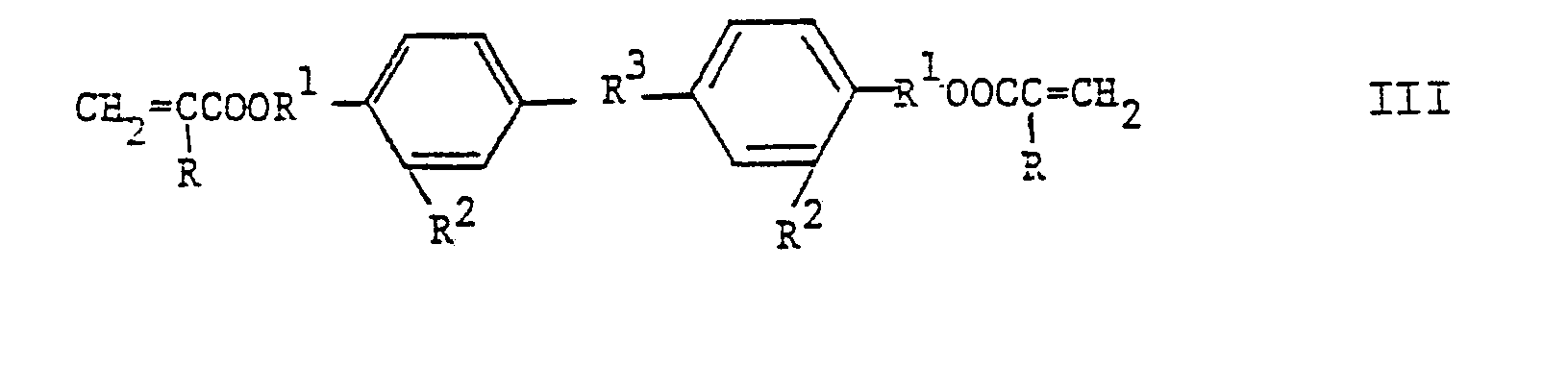


- Spezielle Beispiele für als Komponente a) geeignete Verbindungen sind:
- 2)2-Bis-(3-allyl-4-(methacryloyloxy)-phenyl)-propan, Bis-(3-allyl-4-(methacryloyloxy)-phenyl)-methan, 2,2-Bis-(3-methallyl-4-(methacryloyloxy)-phenyl)-propan, Bis-(3-methallyl-4-(methacryloyloxy)-phenyl)-methan, 2,2-Bis-(3-(1-propenyl)-4-(methacryloyloxy)-phenyl)-propan, Bis-(3-(1-propenyl)-4-(methacryloyloxy)-phenyl)-methan und deren Acryloylanaloge;
- 2, 2-Bis-(3-allyl-4-(3-(me thacryloyloxy)-2-hydroxy- propoxy)-phenyl)-propan, Bis-(3-allyl-4-(3-(methacryloyloxy)-2-hydroxypropoxy)-phenyl)-methan, 2,2-Bis-(3-methallyl-4-(3-(methacryloyloxy)-2-hydroxypropoxy)-phenyl)-propan, Bis-(3-methallyl-4-(3-(methacryloyloxy)-2-hydroxypropoxy)-phenyl)-methan, 2,2-Bis-(3-(1-propenyl)-4-(3-(methacryloyloxy)-2-hydroxypropoxy)-phenyl)-propan, Bis-(3-(1-propenyl)-4-(3-(methacryloyloxy)-2-hydroxypropoxy)-phenyl)-methan und deren Acryloylanaloge;
- 2,2-Bis-(3-allyl-4-(2-(methacryloyloxy)-athoxy)-phenyl)-propan, Bis-(3-allyl-4-(2-(methacryloyloxy)-athoxy)-phenyl)-methan, 2,2-Bis-(3-methallyl-4-(2-(methacryloyloxy)-äthoxy)-phenyl)-propan, Bis-(3-methallyl-4-(2-(methacrylcyloxy)-athoxy)-phenyl)-methan! 2,2-Bis-(3-(1-propenyl)-4-(2-(methacryloyloxy)-athoxy)-phenyl)-propan, Bis-(3-(1-propenyl)-L-(2-(methacryloyloxy)-äthoxy)-phenyl)-methan und deren Acryloylanaloge;
- 2,2-Bis-(3-allyl-4-(2-(methacryloyloxy)-2-methyl- athoxy)-phenyl)-propan, Bis-(3-allyl-4-(2-(methacryloyloxy)-2-methyläthoxy)-phenyl)-methan, 2,2-Bis-(3-methallyl-4-(2-(methacryloyloxy)-2-methylathoxy)-phenyl)-propan, Bis-(3-methallyl-4-(2-(methacryloyloxy)-2-methylathoxy)-phenyl)-methan, 2,2-Bis-(3-(1-propenyl)-4-(2-(methacryloyloxy)-2-methylathoxy)-phenyl)-propan, Bis-(3-(1-propenyl)-4-(2-(methacryloyloxy)-2-methylathoxy)-phenyl)-methan und deren Acryloylanaloge;
- 2,6-Diallylphenylacrylat, 2,6-Diallylphenylmethacrylat, 2,6-Dimethallylphenylacrylat, 2,6-Dimethallylphenylmethacrylat, 2,6-Di-(1-propenyl)-phenylacrylat und 2,6-Di-(l-propenyl)-phenylmethacrylat;
- 1,3-Diallyl-2-(2-hydroxy-3-(methacryloyloxy)-propoxy)-benzol, l,3-Dimethallyl-2-(2-hydroxy-3-(methacryloyloxy)-propoxy)-benzol, 1,3-Di-(1-propenyl)-2-(2-hydroxy-3-(methacryloyloxy)-propoxy)-benzol und deren Acryloylanaloge;
- 1,3-Diallyl-2-(2-(methacryloyloxy)-äthoxy)-benzol, 1,3-Dimethallyl-2-(2-(methacryloyloxy)-athoxy)-benzol, 1)3-Di-(1-Propenyl)-2-(2-(methacryloyloxy)-athoxy)-benzol und deren Acryloylanaloge;
- 1,3-Diallyl-2-(2-(methacryloyloxy)-2-methylathoxy)-benzol, 1,3-Dimethallyl-2-(2-(methacryloyloxy)-2-methyl- äthoxy)-benzol, 1,3-Di-(1-propenyl)-2-(2-(methacryloyloxy)-2-methyläthoxy)-benzol und deren Acryloylanaloge;
- 2,2-Bis-(3,5-diallyl-4-(methacryloyloxy)-phenyl)-propan, Bis-(3,5-diallyl-4-(methacryloyloxy)-phenyl)-methan, 2,2-Bis-(3,5-dimethallyl-4-(methacryloyloxy)-phenyl)-propan, Bis-(3,5-dimethallyl-4-(methacryloyloxy)-phenyl)-methan, 2,2-Bis-(3,5-di-(1-propenyl)-4-(methacryl- cyloxy)-phenyl)-propan) Bis-(3,5-di-(1-propenyl)-4-(methacryloyloxy)-phenyl)-methan und deren Acryloylanaloge;
- 2,2-Bis-(3,5-diallyl-4-(3-(methacryloyloxy)-2- hyäroxy-propoxy)-phenyl)-propan, Bis-(3,5-diallyl-4-(3-(methacryloyloxy)-2-hydroxypropoxy)-phenyl)-inethan, 2,2-Bis-(3,5-dimethallyl-4-(3-(nethacryloyloxy)-2-hydroxy- propoxy)-phenyl)-propanl Bis-(3,5-dimethallyl-4-(3-(methacryloyloxy)-2-hydroxypropoxy)-phenyl)-methan, 2,2-Bis-(3,5-di-(1-propenyl)-4-(3-(methacryloyloxy)-2-hydroxypropoxy)-phenyl)-propan und Bis-(3,5-di-(1-propenyl)-4-(3-(methacryloyloxy)-2-hydroxypropoxy)-phenyl)-methan und deren Acryloylanaloge.
- Weitere als Komponente a) in Betracht kommende Verbindungen enthalten zwei Acryloyloxy- oder Methacryloyloxygruppen und nur eine Allyl-, Methallyl- oder 1-Propenylgruppe pro Molekül. Die letztere Gruppe kann an eine Oxycarbonylgruppe gebunden sein, welche ihrerseits direkt an ein zu einem aromatischen Kern gehöriges Kohlenstoffatom gebunden ist, wie in solchen der Formel


- Spezielle Beispiele für Verbindungen der Formel XVI oder XVII sind:
- 1-(Allyloxycarbonyl)-2,4-bis-(3-(methacryloyloxy)-2-hydroxypropoxycarbonyl)-benzol, 1-(Allyloxycarbonyl)-2,5-bis-(3-(methacryloyloxy)-2-hydroxypropoxycarbonyl)-benzol, 1-(Allyloxycarbonyl)-2,4-bis-(methacryloyloxycar- bonyl)-benzol, 1-(Allyloxycarbonyl)-2,5-bis-(methacryl- oylcxycarbonyl)-benzol, 1-(Methallyloxycarbonyl)-2,4-bis-(3-(methacryloyloxy)-2-hydroxypropoxycarbonyl)-benzol, 1-(Methallyloxycarbonyl)-2,5-bis-(3-(methacryloyloxy)-2-hydroxypropoxycarbonyl)-benzol, l-(Methallyloxycarbonyl)-2,4-bis-(methacryloyloxycarbonyl)-benzol, l-(Methallyl- oxycarbonyl)-2,5-bis-(methacryloyloxycarbonyl)-benzol, 1-(1-Propenyloxycarbonyl)-2,4-bis-(5-(methacryloyloxy)-2-hydroxypropoxycarbonyl)-benzol, 1-(1-Propenyloxycarbonyl)-2,5-bis-(3-(methacryloyloxy)-2-hydroxypropoxycarbonyl)-benzol, 1-(1-Propenyloxycarbonyl)-2,4-bis-(methacryloyl- oxycarbonyl)-benzol, 1-(1-Propenyloxycarbonyl)-2,5-bis-(methacryloyloxycarbonyl)-benzol und die entsprechenden Acryloyloxyverbindungen.
- Weitere Verbindungen, die zwei Acryloyloxy- oder Methacryloyloxygruppen und nur eine Allyl-, Methallyl-oder 1-Propenylgruppe pro Molekül enthalten, sind solche der Formel


- Ferner kommen als Komponente a) Produkte in Frage, welche sechs oder mehr, z.B. zwölf, Allyl-, Methallyl-oder 1-Propenylgruppen pro Molekül enthalten und welche durch Verfahren erhältlich sind, bei denen eine Vorverlängerung stattfindet. Zum Beispiel kann man einen Diglycidyläther eines im bzw. in den aromatischen Kern(en) durch eine oder mehrere Allyl-, Methallyl- oder 1-Propenylgruppen substituierten zweiwertigen Phenols mit einem zweiwertigen Phenol, einem zweiwertigen Alkohol, einer Dicarbonsäure oder einem Hydantoin mit zwei freien -NH-Gruppen im bzw. in den Hydantoinring(en) vorverlängern. Das vorverlängerte Produkt lasst man dann an den so gebildeten sekundären Hydroxylgruppen mit Glycidylacrylat oder Glycidylmethacrylat bzw. mit Acryloylchlorid oder Methacryloylchlorid reagieren.
- Weitere vorverlängerte, sechs oder mehr Allyl-, Methallyl- oder 1-Propenylgruppen enthaltende Produkte sind durch Vorverlängerung von Diglycidyläthern zweiwertiger Phenole, Diglycidyläthern zweiwertiger Alkohole oder Di-(N-glycidyl)-hydantoinen wie 1,3-Diglycidylhydantoin und 3,3'-Diglycidyl-1,1'-methylen-bis-(hydantoin) mit einem im bzw. in den aromatischen Kern(en) durch eine oder mehrere Allyl-, Methallyl- oder 1-Propenylgruppen substituierten zweiwertigen Phenol und nachfolgende Umsetzung an den so erzeugten sekundären Hydroxylgruppen mit Glycidylacrylat, Glycidylmethacrylat, Acryloylchlorid oder Methacryloylchlorid erhältlich.
- Als Komponente a) kommen auch Benzophenonderivate der Formel

- Vorzugsweise stehen die verbleibenden Symbole R7 und R8 bzw. R9 und R10 jeweils für eine Gruppe der Formel

- Die meisten vorbekannten Substanzen, die bei Belichtung mit aktinischer Strahlung polymerisieren, werden mit einem Photoinitiator wie Benzoin und dessen Alkylathem eingesetzt, um die zur Polymerisation erforderliche Belichtungszeit zu verkürzen. Manchmal ist jedoch die Anwendung eines Initiators unzweckmässig, denn er kann die elektrischen Eigenschaften des Polymeren verändern oder sich beim Erhitzen verflüchtigen, wodurch er zur Verwendung in mehrschichtigen gedruckten Schaltungen ungeeignet wird; bei deren Herstellung muss man daher das Polymer nach dem Ablauf des Metallätzverfahrens entfernen, was den Preis der Schichtkörper erhöht und die Metalloberflache beschädigen kann.
- Wohlbekannterweise kann man photopolymerisierbare Substanzen herstellen, die einen Rest gewisser olefirisch ungesättigter Monocarbonsäuren, insbesondere Acryloyloxy-, Methacryloyloxy-, Sorboyloxy-, Cinnamoyloxy- oder 3-(2-Furyl)-acryloyloxygruppen enthalten und die im allgemeinen zusammen mit einem wie oben angegebenen Photoinitiator eingesetzt werden. Aus der britischen Patentschrift Nr. 1 464 287 ist bekannt, dass man den Zusatz eines Photoinitiators durch Einbau von Chalkongruppen oder chalkonartigen Gruppen in das Molekül einer Verbindung mit einem Rest einer olefinisch ungesättigten Monocarbonsäure vermeiden kann.
- In jüngster Zeit wurden photopolymerisierbare photosensibilisierende Verbindungen beschrieben (offengelegte britische Patentanmeldung 2 015 518A), die durch Anlagerung eines Alkylenoxyds an die phenolische(n) Hydroxylgruppe bzw. -gruppen eines hydroxylsubstituierten Benzophenons und nachfolgende Veresterung mit einer ungesättigten Carbonsäure wie Acrylsäure oder Umsetzung mit Glycidylacrylat hergestellt werden. Weitere solche Verbindungen wurden (siehe DE-OS 2 800 356) durch Umsetzung einer mehr als eine 1,2-Epoxidgruppe enthaltenden Verbindung mit einem stöchiometrischen Unterschuss von Ammoniak und/oder einem aliphatischen oder cycloaliphatischen primären und/oder sekundären Amin, dann mit einem carboxylsubstituierten Benzophenon und zuletzt mit Acrylsäure oder Methacrylsäure hergestellt.
- Ebenfalls ist bekannt, dass olefinisch ungesättigte Verbindungen, beispielsweise solche, die Allylgruppen enthalten, an den Aethylendoppelbindungen eine Anlagerungsreaktion mit Polymercaptanen eingehen, die sich durch aktinische Strahlung auslösen lässt (siehe z.B. britische Patentschriften Nr. 1 215 591, 1 251 232 und 1 445 814 sowie offengelegte britische Patentanmeldungen Nr. 2 012 780A und 2 012 781A). Ueblicherweise ist es erforderlich, bei solchen Gemischen aus Polymercaptanen und olefinisch ungesättigten Verbindungen einen Photoinitiator einzusetzen.
- Es wurde nun gefunden, dass die Anwendung eines zusätzlichen Photoinitiators durch den Einsatz von Verbindungen der Formel XIX als Komponente a) entfällt.
- Spezielle Beispiele für Verbindungen der Formel XIX sind Benzophenon-3,4,3',4'-tetracarbonsäure-X,X'- diallylester-Y,Y'-bis-(3-methacryloyloxy)-2-hydroxypropyl)-ester. (Der Gebrauch der Bezeichnungen X, X', Y und Y' wird weiter unten erklärt.)
- Es ist anzunehmen, dass die als Komponente a) in den erfindungsgemässen Zusammensetzungen verwendeten Verbindungen neu sind.
- Verbindungen der Formeln III bis XI, worin die R1 je eine Sauerstoff-Kohlenstoffbindung und die R 2 je Allyl oder Methallyl bedeuten, lassen sich dadurch erhalten, dass man die entsprechenden zweiwertigen Phenole in ihre Diallyl- bzw. Dimethallyläther überführt, anschliessend eine Claisen-Umlagerung zum Diallylphenol bzw. Dimethallylphenol durchführt und dann die freigesetzten phenolischen Hydroxylgruppen direkt mit Acryloyl- oder Methacryloylchlorid verestert.
- Verbindungen der Formeln III bis XI, worin die R 1 je eine Gruppe der Formel I und die R2 je Allyl oder Methallyl bedeuten, lassen sich dadurch erhalten, dass man die obenerwähnten Diallylphenole bzw. Dimethallylphenole in ihre Glycidyläther überführt und deren Epoxidgruppen durch Umsetzung mit Acryl- oder Methacrylsäure öffnet. Ferner sind sie auch durch eine entsprechende Umsetzung der obenerwähnten Diallylphenole bzw. Dimethallylphenole mit Glycidylacrylat oder Glycidylmethacrylat erhältlich.
- Verbindungen der Formel III bis XI, worin die R1 je eine Gruppe der Formel II und die R2 je Allyl oder Methallyl bedeuten, lassen sich dadurch erhalten, dass man die obengenannten Diallylphenole bzw. Dimethallylphenole mit 1 bis 6 Mol Aethylenoxyd oder Propylenoxyd pro phenolische Hydroxylgruppe veräthert und anschliessend mit Acryloylchlorid oder Methacryloylchlorid verestert.
- Verbindungen der Formel XII, worin die R1 je eine Sauerstoff-Kohlenstoffbindung und die R2 je Allyl oder Methallyl bedeuten, lassen sich dadurch erhalten, dass man einen entsprechenden Phenol/Formaldehydnovolak in seinen Tri- oder höheren Allyl- bzw. Methallyläther überführt, diesen zur Bildung des allyl- oder methallylsubstituierten Novolaks einer Ulaisen-Umlagerung unterwirft und dann die freigesetzten phenolischen Hydroxylgruppen mit Acryloylchlorid oder Methacryloyichlorid verestert.
- Verbindungen der Formel XII, worin die R1 je eine Gruppe der Formel I und die R je Allyl oder Methallyl bedeuten, lassen sich dadurch erhalten, dass man die obenerwähnten allyl- bzw. methallylsubstituierten Novolake in ihre Glycidyläther überführt und deren Epoxidgruppen durch Umsetzung mit Acryl- oder Methacrylsäure öffnet. Ferner sind sie auch durch Umsetzung der obenerwähnten allyl- oder methallylsubstituierten Novolake mit Glycidylacrylat oder Glycidylmethacrylat erhältlich.
- Verbindungen der Formel XII, worin die R1 je eine Gruppe der Formel II und die R2 je Allyl oder Methallyl bedeuten, lassen sich dadurch erhalten, dass man die obenerwähnten allyl- oder methallylsubstituierten Novolake mit 1 bis 6 Mol Aethylenoxyd oder Propylenoxyd pro phenolische Hydroxylgruppe veräthert und anschliessend mit Acryloylchlorid oder Methacryloylchlorid verestert.
- Verbindungen der Formel XIII, worin die Rl in der bzw. den Gruppe(n) CH2=C(R)COOR1- je eine Sauerstoff-Kohlenstoffbindung und mindestens zwei Gruppen R5 je Allyloxy oder Methallyloxy bedeuten, lassen sich dadurch erhalten, dass man in beliebiger Reihenfolge die phenolischen Hydroxylgruppen in einem Phenol/Formaldehydnovolak mit Allyl- bzw. Methallylgruppen teilweise veräthert und die phenolischen Hydroxylgruppen darin mit Acryloylchlorid oder Methacryloylchlorid teilweise verestert.
- Verbindungen der Formel XIII, worin die R1 in der bzw. den Gruppe(n) CH2=C(R)COORl- je eine Gruppe der Formel I und mindestens zwei Gruppen R5 je Allyloxy oder Methallyloxy bedeuten, lassen sich dadurch erhalten, dass man in beliebiger Reihenfolge phenclische Hydroxylgruppen in einem Phenol/Formaldehydnovolak in Glycidylgruppen überführt und diese mit Acryl- oder Methacrylsäure umsetzt sowie mindestens zwei phenolische Hydroxylgruppen mit Allylchlorid oder Methallylchlorid veräthert. Ferner kann man auch mindestens eine phenolische Hydroxylgruppe vor oder nach der Ueberführung von mindestens zwei der phenolischen Hydroxylgruppen mittels Allylchlcrid bzw. Methallylchlorid in Allyl- bzw. Methallylgruppen mit Glycidylacrylat oder Glycidylmethacrylat zur Reaktion bringen.
- Verbindungen der Formel XIII, worin die R1 in der bzw. den Gruppe(n) CH2=C(R)COOR1- je eine Gruppe der Formel II und mindestens zwei Gruppen R5 je Allyloxy oder Methallyloxy bedeuten, lassen sich dadurch erhalten, dass man mindestens zwei phenolische Hydroxylgruppen mit Allylchlorid oder Methallylchlorid veräthert, eine oder mehrere verbleibende phenolische Hydroxylgruppen mit Aethylenoxyd oder Propylenoxyd umsetzt und mit Acryloylchlorid oder Methacryloylchlorid verestert.
- Verbindungen der Formel XVI sind auf analoge Weise wie die der Formel XIII erhältlich.
- Verbindungen der Formel XIV und XV, worin R1 bzw. beide Rl eine Sauerstoff-Kohlenstoffbindung und die R2 je Allyl oder Methallyl bedeuten, lassen sich dadurch erhalten, dass man die phenolische Hydroxylgruppe in Phenol selbst oder die beiden phenolischen Hydroxylgruppen im entsprechenden zweiwertigen Phenol mit einer Allyl- oder Methallylgruppe bzw. -gruppen veräthert, dann eine Claisen-Umlagerung durchführt, die so freigesetzte(n) phenolische(n) Hydroxylgruppe bzw. -gruppen erneut mit einer Allyl- oder Methallylgruppe bzw. -gruppen veräthert, eine weitere Claisen-Umlagerung durchführt, welche das Diallyl- oder Dimethallylphenol bzw. das Tetraallyl- oder Tetramethallylbisphenol liefert, und die phenolische(n) Hydroxylgruppe oder -gruppen mit Acryloyl- oder Methacryloylchlorid verestert.
- Verbindungen der Formeln XIV und XV, worin R1 bzw. beide R1 eine Gruppe der Formel I und die R2 je Allyl oder Methallyl bedeuten, lassen sich dadurch erhalten, dass man die phenolische Hydroxylgruppe im Diallyl-oder Dimethallylphenol bzw. beide phenolische Hydroxylgruppen im Tetraallyl- oder Tetramethallylbisphenol in eine Glycidyläthergruppe bzw. -gruppen überführt und anschliessend mit Acryl- oder Methacrylsäure umsetzt. Ferner kann man auch das Diallyl- oder Dimethallylpherol bzw. das Tetraallyl- oder Tetramethallylbisphenol entsprechend mit einem bzw. zwei Mol Glycidylacrylat oder Glycidylmethacrylat zur Reaktion bringen.
- Verbindungen der Formel XIV und XV, worin R1 bzw. beide R1 eine Gruppe der Formel II und die R2 je Allyl oder Methallyl bedeuten, lassen sich dadurch erhalten, dass man die phenolische(n) Hydroxylgruppe bzw. -gruppen im obenerwähnten Diallyl- oder Dimethallylphenol bzw. Tetraallyl- oder Tetramethallylbisphenol mit 1 bis 6 Mol Aethylenoxyd oder Propylenoxyd pro phenolische Hydroxylgruppe veräthert und anschliessend mit Acryloylchlorid oder Methacryloylchlorid verestert.
- Verbindungen der Formeln III bis XV, worin die R2 je eine 1-Propenylgruppe bedeuten, können dadurch hergestellt werden, dass man deren Allylanaloge durch Erhitzen mit Alkali isomerisiert.
- Die Bildung von Allyl- und Methallyläthern einwertiger und mehrwertiger Phenole und deren Claisen-Umlagerung ist in den offengelegten britischen Patentanmeldungen Nr. 2 012 780 A und 2 012 781 A beschrieben, einschliesslich der Herstellung von 2,6-Diallylphenolen, 2,6-Dimethallylphenolen, 2,2',6,6'-Tetraallylbisphenolen und 2,2',6,6'-Tetramethallylbisphenolen sowie der Ueberführung der Allylphenole in ihre Glycidyläther. Die Isomerisierung von Arylallyläthern in Aryl-l-propenyl- äther ist ebenfalls in diesen Anmeldungen beschrieben.
- Methoden zur Umsetzung von Phenolen mit Aethylenoxyd oder Propylenoxyd zu den entsprechenden Phenoxyalkanolen sind wohlbekannt, wie auch die Veresterung von Phenolen oder Phenoxyalkanolen mit Acryloylchlorid oder Methacryloylchlorid, die Umsetzung der Glycidyläther von Phenolen mit Acryl- oder Methacrylsäure und die Reaktion von Phenolen mit Glycidylacrylat oder Glycidylmethacrylat.
- Verbindungen der Formel XVI und XVII kann man dadurch herstellen, dass man Trimellithsäureanhydrid mit Allyl- oder Methallylalkohol umsetzt und nötigenfalls die Allylgruppe isomerisiert, was die gemischten Isomeren der Formel


- Die Verbindungen der Formel XXI oder XXII kann man dann auf an sich bekannte Weise mit Glycidylacrylat oder Glycidylmethacrylat zur Reaktion bringen, was die Produkte der Formel XVI oder XVII, worin R6 eine Gruppe der Formel I darstellt, liefert. Ferner kann man dieselben Produkte auch dadurch erhalten, dass man die Dicarbonsäuren der Formel XXI oder XXII in ihre Diglycidylester überführt und die Epoxidgruppen in an sich bekannter Weise mit Acrylsäure oder Methacrylsäure öffnet.
- Auch kann man die Verbindungen der Formel XXI oder XXII mit 1 bis 6 Molanteilen Aethylenoxyd oder Propylenoxyd behandeln und dann die entstandenen Addukte mit Acrylsäure oder Methacrylsäure zu den Produkten der Formel XVI oder XVII, worin R6 eine Gruppe der Formel II darstellt, verestern.
- Verbindungen der Formel XIX lassen sich leicht aus handelsüblichem Benzophenon-3,4,3',4'-tetracarbonsäuredianhydrid herstellen. Beim Erhitzen dieses Dianhydrids mit Allylalkohol oder Methallylalkohol bilden sich somit die Verbindungen der Formel XIX, worin eins von R7 und R8 und eins von R9 und R10 je eine Allyl- oder Methallylgruppe und die verbleibenden Symbole je ein Wasserstoffatom bedeuten, d.h. Benzophenon-3,4,3',4'-tetracarbonsäure-X,XI-diallylester und die entsprechenden X,X'-Dimethallylester. (Eine direkte Veresterung zum 3,4,3',4'-Tetraallyl- oder Tetramethallylester ist im allgemeinen nicht durchführbar.)
- Es ist anzunehmen, dass die Produkte die drei möglichen Isomeren enthalten, nämlich die 3,3'-Dicarboxy-4,4'-bis-(allyloxycarbonyl)-, 4,4'-Dicarboxy-3,3'-bis-(allyloxycarbonyl)- bzw. 3,4'-Dicarboxy-3',4-bis-(allyloxycarbonyl)-derivate des Benzophenons sowie bei Verwendung von Methallylalkohol deren Methallylhomologe. Die Anwendbarkeit dieser Erfindung hangt jedoch nicht davon ab, ob diese Annahme zutrifft.
- Umsetzung dieser Diester-dicarbonsauren mit Epichlorhydrin und nachfolgende Dehydrochlorierung ergibt auf die für die Herstellung von Glycidylestern aus Carbonsäuren bekannte Weise Benzophenon-3,4,3',4'-tetracarbonsäure-X,X'-diallylester-Y,Y'-diglycidylester bzw. die entsprechenden Methallylverbindungen.
- Umsetzung der Benzophenor-3,3',4,4'-tetracarbonsäure-X,X'-diallylester-Y,Y'-diglycidylester mit Acrylsäure oder Methacrylsäure führt zu den X,X'-Diallyl-Y,Y'- bis-(3-(acryloyloxy)-2-hydroxypropyl)-tetraestern oder den entsprechenden X,X'-Diallyl-Y,Y'-bis-(3-(methacryloyloxy)-2-hydroxypropyl)-tetraestern, d.h. Verbindungen der Formel XIX, worin eins von R7 und R8 und eins von R9 und R10 je eine Allylgruppe und die verbleibenden Symbole R7 und R8 bzw. R9 und R10 jeweils eine Gruppe der Formel XX darstellen. Methoden zur Umsetzung von Glycidylestergruppen mit Acrylsäure und Methacrylsäure sind wohlbekannt. Die obenerwähnten X,X'-Diallyl-Y,Y'-bis-(3-(acryloyloxy)-2-hydroxypropyl)-tetraester oder X,X'-Diallyl-Y,Y'-bis-(3-(methacryloyloxy)-2-hydroxypropyl)-tetraester sind auch durch Umsetzung von Benzophenon-3,4,3',4'-tetracarbonsäure-X,X'-diallylestern mit 2 Molanteilen Glycidylacrylat oder Glycidylmethacrylat erhältlich. Die Methallylhomologen können auf ähnliche Weise hergestellt werden.
- Verbindungen der Formel XIX, worin eins von R7 und R8 und eins von R9 und R10 je eine Allylgruppe und die verbleibenden Symbole je eine Gruppe der Formel XX darstellen, wobei R6 eine Gruppe der Formel II bedeutet, lassen sich dadurch erhalten, dass man Benzophenon-3,3',4,4'-tetracarbonsäure-X,X'-diallylester mit 2 bis 6 Molanteilen Aethylenoxyd oder Propylenoxyd umsetzt und anschliessend mit 2 Molanteilen Acryloylchlorid, Methacryloylchlorid, Acrylsäure oder Methacrylsäure verestert.
- Eine grosse Zahl Polymercaptane eignet sich zur Verwendung als Komponente b) in den erfindungsgemässen Zusammensetzungen. Die Mercaptane sind vorzugsweise frei von irgendwelchen Allyl-, Methallyl-, 1-Propenyl-, Acryloyl- oder Methacryloylgruppen und besitzen vorzugsweise ein Molekulargewicht von höchstens 3000. Die eingesetzten Polymercaptane enthalten üblicherweise höchstens sechs direkt an aliphatische Kohlenstoffatome gebundene Mercaptangruppen pro Molekül.
- Eine Gruppe umfasst Ester von Monomercaptoalkylencarbonsäuren mit mehrwertigen Alkoholen sowie Ester von aliphatischen einwertigen Monomercaptoalkoholen mit Polycarbonsäuren.
- Weitere bevorzugte derartige Ester entsprechen der Formel

- Noch weitere bevorzugte Ester sind Polymercaptane der Formel XXIII, die ebenfalls der Formel

- Eine zweite Klasse umfasst mercaptanhaltige Ester, einschliesslich Estern von Monomercaptodicarbonsäuren der Formel

- Ist d null, so bedeutet R15 vorzugsweise eine gesättigte aliphatische unverzweigte, gegebenenfalls durch eine oder mehrere Methylgruppen und eine oder mehrere Mercaptangruppen substituierte und gegebenenfalls durch ein oder mehrere Aethersauerstoffatome und eine oder mehrere Carbonyloxygruppen unterbrochene Kohlenwasserstoffkette mit 2 bis 20 Kohlenstoffatomen. Ist d 1, so bedeutet R15 vorzugsweise (i) eine gesättigte aliphatische, gegebenenfalls eine Mercaptangruppe tragende Kohlenwasserstoffgruppe mit 2 bis 10 Kohlenstoffatomen, (ii) eine cycloaliphatisch-aliphatische, gegebenenfalls eine oder mehrere äthylenisch ungesättigte Doppelbindungen aufweisende Kohlenwasserstoffgruppe mit 5 bis 34 Kohlenstoffatomen oder (iii) eine einkernige Arylenkohlenwasserstoffgruppe mit 6 bis 12 Kohlenstoffatomen.
- Wenn d null ist, bedeutet R16 vorzugsweise eine gesättigte aliphatische, gegebenenfalls eine Carboxylgruppe tragende Kohlenwasserstoffgruppe mit 1 bis 3 Kohlenstoffatomen sowie, wenn d 1 ist, eine gesättigte aliphatische, gegebenenfalls durch eine Hydroxylgruppe oder ein Chloratom substituierte Kohlenwasserstoffgruppe mit 2 bis 4 Kohlenstoffatomen.
- R 17 bedeutet vorzugsweise (iv) eine aliphatische oder cycloaliphatisch-aliphatische, gegebenenfalls mindestens eine aliphatische Mercaptangruppe tragende Kohlenwasserstoffgruppe mit 2 bis 51 Kohlenstoffatomen oder (v) eine einkernige oder zweikernige Arylenkohlenwasserstoffgruppe mit 6 bis 15 Kohlenstoffatomen oder (vi) eine durch mindestens ein Aethersauerstoffatom unterbrochene und gegebenenfalls durch mindestens eine aliphatische Mercaptangruppe substituierte Kette von 4 bis 20 Kohlenstoffatomen oder (vii) eine durch mindestens eine Carbonyloxygruppe und gegebenenfalls durch mindestens ein Aethersauerstoffatom unterbrochene und gegebenenfalls durch mindestens eine aliphatische Mercaptangruppe substituierte Kette von 6 bis 50 Kohlenstoffatomen.
- Eine dritte Klasse umfasst Ester und Aether der allgemeinen Formel

- Die Gruppen R19 in einzelnen Poly-(oxyalkylen)-ketten können gleich oder verschieden und gegebenenfalls durch z.B. Phenyl- oder Chlormethylgruppen substituiert sein. Vorzugsweise sind dies -C2H4- oder -C3H6-Gruppen.
- Unter den Verbindungen der Formel XXVI werden die Ester der Formel


- Eine vierte Klasse von als Komponente b) geeigneten Polymercaptanen umfasst Sulfide mit Mercaptanendgruppen, der allgemeinen Formel

- Bevorzugt werden solche Sulfide der Formel XXIX, worin R22 Wasserstoff bedeutet sowie p und q je 1 sind, wobei n einen solchen Wert annimmt, dass das Molekulargewicht des Sulfids 500 bis 800 beträgt.
- Eine fünfte Klasse als Komponente b) geeigneter Polymercaptane umfasst Polybutadiene mit Mercaptanendgruppen, der Formel

- Vorzugsweise entsprechen die Polymercaptane der Formel XXX ferner der Formel

- Eine sechste Klasse von Polymercaptanen zur Verwendung als Komponente b) umfasst Oxyalkylenverbindungen mit Mercaptanendgruppen, der allgemeinen Formel

- Eine siebente Klasse umfasst Poly-(thioglykolate) und Poly-(mercaptopropionate) des Tris-(2-hydroxyäthyl)-isocyanurats und Tris-(2-hydroxypropyl)-isocyanurats, d.h. Verbindungen der Formel

- Besonders bevorzugte Polymercaptane sind die Poly-(thioglykolate) und Poly-(2- oder 3-mercaptopropionate) aliphatischer mehrwertiger Alkohole mit 2 bis 6 Kohlenstoffatomen.
- Bei der Photopolymerisation der erfindungsgemassen Zusammensetzungen verwendet man vorzugsweise aktinische Strahlung von 200-600 nm Wellenlänge. Als aktinische Strahlungsquelle edgnen sich unter anderem Kolelichtbogen Quecksilberdampflichtbogen, Fluoreszenzlampen mit ultraviolettes Licht ausstrahlenden Leuchtstoffen, Argon- und Xenonglimmlampen, Wolframlampen und photographische Flutlampen. Darunter sind Quecksilberdampflichtbogen, insbesondere Höhensonnen, fluoreszierende Höhensonnen und Metallhalogenidlampen am besten geeignet. Die zur Belichtung der photopolymerisierbaren Zusammensetzung erforderliche Zeit hängt dabei von verschiedenen Faktoren ab, unter anderem beispielsweise den jeweils verwendeten Verbindungen, der Art der Lichtquelle und deren Abstand von der bestrahlten Zusammensetzung. Der mit der Photopolymerisationstechnik vertraute Fachmann kann ohne weiteres geeignete Zeiten festlegen.
- Zur Photopolymerisation enthalten die Zusammensetzungen (ausser denen, die eine Verbindung der Formel XIX enthalten) einen zugesetzten Photoinitiator, d.h. einen Katalysator, der bei Bestrahlung in einen angeregten Zustand übergeht, der zur Bildung freier Radikale führt, die dann die Polymerisation der Zusammensetzung einleiten. Als Photoinitiatoren eignen sich beispielsweise organische Peroxyde und Hydroperoxyde, α-halogensubstituierte Acetophenone wie Trichlormethyl-4'-tert.-butylphenylketon, a-hydroxy-a-alkylsubstituierte Acetophenone wie 2-Hydroxy-2-methyl-l-phenylpropanon-l, Benzoin und seine Alkyläther (z.B. der n-Butyläther), a-Methylbenzoin, Benzophenone wie Benzophenon selbst und 4,4'-Bis-(dimethylamino)-benzophenon, 0-Alkoxycarbonylderivate eines Oxims von Benzil oder 1-Phenylpropan-1,2-dion, wie Benzil-(O-athoxycarbonyl)-a-monoxim und 1-Phenylpropan-1,2-dion-2-(0-äthoxycarbonyl)-oxim, Benzilacetale, z.B. dessen Dimethylacetal, substituierte Thioxanthone, z.B. 2-Chlorthioxanthcn, Anthrachinone und Photoredoxsysteme, die ein Gemisch eines Phencthiazinfarbstoffs (z.B. Methylenblau) oder eines Chinoxalins (z.B. ein Metallsalz der 2-(m- oder p-Methoxyphenyl)-chinoxalin-6'- oder 7'-sulfonsäure) mit einem Elektronendonator wie Benzolsulfinsäure oder einer anderen Sulfinsäure oder deren Salz wie das Natriumsalz enthalten, oder ein Arsin, ein Phosphin oder Thioharnstoff.
- Geeignete Photoinitiatoren lassen sich ohne weiteres durch routinemassige Versuche finden. Im allgemeinen arbeitet man 0,05 bis 10 Gew.-%, und vorzugsweise 0,5 bis 5 Gew.-%, Photoinitiator ein, bezogen auf das kombinierte Gewicht der Komponenten a) und b).
- Der Begriff "Radikalkatalysator" soll sich hierin auf Substanzen beziehen, und aktinische Strahlung ist dabei nicht einbegriffen. Zur Polymerisation der erfindungsgemässen Zusammensetzungen geeignete Radikalkatalysatoren. werden durch Hitze aktiviert, d.h. sie besitzen eine ziemlich schnelle Pclymerisationswirkung nur bei Temperaturen oberhalb normaler Raumtemperatur, und sie umfassen 2,2'-Azobis-(2-methylpropionitril) und organische oder anorganische Peroxyde, z.B. Persäuren und deren Salze und Ester, wie Peressigsäure, Perbenzoesäure, Perphthalsäure, Diisopropylperoxydicarbonat, Ammonium- oder ein Alkaliperborat, Ammonium- oder ein Alkalipersulfat, Acylperoxyde wie Benzoyiperoxyd und ferner z.B. Cumylpercxyd, Cumolhydroperoxyd, Wasserstcffperoxyd, Cycl ohexanenpercx_,Tä und Aethylmechylketonperoxyd. Ein tertiäres Amin z.B. Dimethylanilin oder ein Kobaltsikkativ z.B. Kobaltnaphthenat können als Beschleuniger mit den Peroxyden mitverwendet werden.
- Die Menge Radikalkatalysator, gegebenenfalls einschliesslich eines Beschleunigers dafür, beträgt üblicherweise 0,05 bis 5 Gew.-%, und vorzugsweise 0,1 bis 1 Gew.-%, berechnet auf das Gesamtgewicht der Komponenten a) und b). Es können die üblichen Methoden für die durch Radikalkatalysatoren eingeleitete Polymerisation angewandt werden.
- Wie schon erwähnt sind die erfindungsgemässen Zusammensetzungen als Oberflächenbeschichtungen verwendbar. Sie können, vorzugsweise als Flüssigkeit, auf ein Substrat wie Stahl, Aluminium, Kupfer, Chrom, Cadmium, Zink, Zinn, Glas, Keramik, Papier oder Holz aufgebracht und photopolymerisiert oder mittels des Radikalkatalysators zum Polymerisieren gebracht werden. Erfolgt die Photopolymerisation durch Bestrahlung eines Teils der Beschichtung wie durch eine Maske, so kann man die unbelichteten Bereiche mit einem Lösungsmittel zur Entfernung der nichtpolymerisierten Anteile waschen, während die photopolymerisierten, unlöslichen Bereiche an Ort und Stelle verbleiben. Somit kann man die er- findungsgemgssen Zusammensetzungen zur Herstellung von Druckplatten und gedruckten Schaltungen verwenden. Methoden zur Herstellung von Druckplatten und gedruckten Schaltungen aus photopolymerisierbaren Zusammensetzungen sind wohlbekannt (siehe z.B. britische Patentschrift. Nr. 1 495 746).
- Gegenstand dieser Erfindung sind dementsprechend Artikel, die auf ihrer Oberfläche eine Beschichtung tragen, welche aus einem nach einem erfindungsgemässen Verfahren hergestellten polymerisierten Produkt besteht.
- Die erfindungsgemässen Zusammensetzungen sind weiterhin als Klebstoffe verwendbar. Bei Verwendung von Strahlung, um die Polymerisation einzuleiten, kann man eine Schicht der Zusammensetzung zwischen zwei Oberflächen von Gegenständen einbringen, von denen mindestens einer für aktinische Strahlung durchlässig ist, z.B. aus Glas oder Poly-(methylmethacrylat). Als weitere zu klebende Körper eignen sich unter anderem Metalle wie Eisen, Zink, Kupfer, Chrom, Nickel, Aluminium, Cadmium, Zink und Zinn, Keramik, Holz, Kautschuk und Kunststoffe wie Acrylharze. Der Aufbau wird dann durch mindestens eine für solche Strahlung durchlässige Oberfläche hindurch mit aktinischer Strahlung beaufschlagt. Bei Verwendung von Radikalkatalysatoren zum Einleiten der Polymerisation kann man eine Schicht der einen solchen Katalysator enthaltenden Zusammensetzungen zwischen und in Berührung mit den beiden zu verklebenden Oberflächen einbringen und den Aufbau erhitzen.
- Gegenstand dieser Erfindung sind dementsprechend Artikel mit Oberflächen, die mittels eines nach einem erfindungsgemässen Verfahren hergestellten polymerisierten Produkts verklebt sind.
- Die Zusammensetzungen sind auch bei der Herstellung von faserverstärkten Verbundstoffen einschliesslich Plattenpressmassen verwendbar. Dabei kann man sie in flüssiger Form direkt auf Verstärkungsfasern (einschliesslich Spinnfäden, Endlosfäden und Whiskers) auftragen, die in Form von Gewebe oder Faservlies, kettenstarken Schnitten oder Stapelseide vorliegen, insbesondere Fasern aus Glas, Bor, Edelstahl, Wolfram, Aluminiumoxyd, Siliciumcarbid, Asbest, Kaliumtitanatwhiskers, einem aromatischen Polyamid wie Poly-(m-phenyleniscphthalamid), Pcly-(p-phenylen- terephthalamid) oder Poly-(p-benzamid), Polyäthylen oder Kohlenstoff. Die imprägnierten Fasern werden dann bestrahlt, oder der Radikalkatalysator wird aktiviert.
- Ferner kann man die erfindungsgemässen Zusammensetzungen auch zur Herstellung von Putten und Spachtelmassen, verwenden, sowie als Tauchbeschichtungszusammensetzungen, wobei ein zu beschichtender Artikel in die erfindungsgemässe flüssige Zusammensetzung getaucht und wieder entnormen und dann bestrahlt wird, so dass die anhaftende Beschichtung polymerisiert. Ferner kann man die Zusammensetzung auch durch Aktivierung eines Radikalkatalysators zur Verfestigung und Härtung bringen.
- Es wurde weiterhin gefunden, dass es möglich ist, die erfindungsgemässen Zusammensetzungen in zwei Stufen zu härten: eine solche, einen hitzeaktivierbaren Radikalkatalysator und, wenn nötig, ebenfalls einen Photoinitiator enthaltende Zusammensetzung kann durch Belichtung mit einer aktinischen Strahlungsdosis, die zur völligen Polymerisation nicht ausreicht, teilweise polymerisiert und danach erhitzt werden, so dass der Radikalkatalysator aktiviert und die Härtung vervollständigt wird.
- Gegenstand dieser Erfindung sind deshalb weiterhin eine Zusammensetzung, die eine Komponente a) und eine Komponente b) wie oben erwähnt, wenn nötig einen Photoinitiator und einen hitzeaktivierbaren Radikalkatalysator enthält, sowie ein Verfahren zur Härtung einer solchen Zusammensetzung, welches darin besteht, dass man diese durch Belichtung mit aktinischer Strahlung teilweise polymerisiert und dann zur Aktivierung des hitzeaktivierbaren Radikalkatalysators erhitzt.
- So kann man einen Film einer flüssigen Zusammensetzung so weit bestrahlen, dass die Zusammensetzung zur Verfestigung und Bildung einer Klebfolie gebracht wird, aber nicht so weit, dass die Polymerisation zu Ende geht. Die Klebfolie kann dann zwischen zwei Substrate eingebracht und erhitzt werden, um den in der Zusammensetzung enthaltenen Radikalkatalysator zu aktivieren und die Härtung zuendezuführen. Ferner kann man die Klebfolie auf eine Lage Verstärkungsfasern auflegen und durch Anwendung von Druck um die Fasern herumfliessen lassen und das imprägnierte Gebilde zur gewünschten Gestalt formen oder mit weiteren solchen Lagen aufeinanderschichten und dann das bzw. die imprägnierten Gebilde zur Aktivierung des Radikalkatalysators erhitzen.
- Verstärkungsfasern können ferner direkt mit einer solchen Zusammensetzung in flüssiger Form imprägniert werden, die Fasern werden dann bestrahlt, um die Zusammensetzung zur Verfestigung zu bringen, der Artikel wird dann zu irgendeiner gewünschten Gestalt geformt oder mit einem weiteren solchen Artikel übereinandergeschichtet, und anschliessend wird Hitze zur Einwirkung gebracht, um den Radikalkatalysator zu aktivieren und die Härtung zu vervollständigen.
- Eine weitere Anwendung besteht darin, dass man einen Artikel in einer solchen flüssigen Zusammensetzung tauchbeschichtet, ihn dann bestrahlt, um die anhaftende Beschichtung polymerisieren zu lassen, und dann den Artikel erhitzt, um den darin enthaltenen Radikalkatalysator zu aktivieren und so die Härtung zu vervollständigen.
- Eine weitere Anwendung besteht darin, dass man einen hohlen Fcrmkörper nach einem Wickelverfahren bildet, bei dem ein Endloskabel aus Verstärkungsfaser mit einer solchen Zusammensetzung imprägniert und unter Belichtung des Wickels mit aktinischer Strahlung auf einen Dorn aufgewickelt und der Wickel abgenommen und dann erhitzt wird, um den Radikalkatalysator zur Vervollständigung der Härtung zu aktivieren. Ein solcher Wickel besitzt vor dem Erhitzen eine grössere Biegsamkeit als ein an Ort und Stelle gehärteter und lässt sich deshalb leichter vom Dorn abnehmen.
- Noch eine weitere Anwendung betrifft die Herstellung von Plattenpressmassen, wobei Verstärkungsfasern mit einer solchen flüssigen Zusammensetzung beschichtet, dann zu Lagen geformt und direkt sowie, wenn nötig, durch Stützfolien hindurch zum teilweisen Polymerisieren der Zusammensetzung bestrahlt werden und schliesslich die Zusammensetzung erhitzt wird, um sie nach dem Formen zu irgendeiner gewünschten Gestalt zu härten.
- Erfindungsgemässe Zusammensetzungen können in Zweikomponentenpackungen vertrieben werden, wobei die eine die Komponente a) und die andere die Komponente b) enthält. Im übrigen kann man die Zusammensetzungen unter Schutz vor aktinischer Strahlung und freien Radikalauellen als Gemisch lagern, bis sie zum Gebrauch benötigt werden.
- Die nachfolgenden Beispiele erläutern die Erfindung. Dabei sind Teile Gewichtsteile und die Temperaturen in Grad Celsius.
- Die Biegefestigkeiten stellen den Durchschnitt aus drei Ergebnissen dar und wurden nach British Standard Nr. 2782, Methode 304B bestimmt. Die Ueberlappungs- scherfestigkeiten stellen ebenfalls den Durchschnitt aus drei Ergebnissen dar und wurden gemäss British Ministry of Aviation Aircraft Specification DTD 5577, November 1965, bestimmt.
- Das als Zwischenprodukt verwendete 2,2-Bis-(3-allyl-4-hydroxyphenyl)-propan wurde wie in der offengelegten britischen Patentanmeldung Nr. 2 012 780 A beschrieben hergestellt.
- Bis-(3-allyl-4-hydroxyphenyl)-methan bzw. 3,3'-Diallyl-4,4t-dihydroxydiphenyl können auf die gleiche Weise aus Bis-(4-hydroxyphenyl)-methan bzw. 4,4'-Dihydroxydiphenyl hergestellt werden.
- Die Herstellung von 2,2-Bis-(3-(1-propenyl)-4-hydroxyphenyl)-propan ist ebenfalls in der offengelegten britischen Patentanmeldung Nr. 2 012 780 A beschrieben.
- 2,2-Bis-(3,5-diallyl-4-hydroxyphenyl)-propan wurde dadurch hergestellt, dass man 2,2-Bis-(3-allyl-4-hydroxyphenyl)-propan in seinen Diallyläther überführt und diesen einer Claisen-Umlagerung unterwirft, wie in der offengelegten britischen Patentanmeldung Nr. 2 012 780 A beschrieben. Dessen Allyldoppelbindungsgehalt betrug 10,3 val/kg.
- Eine ähnliche Umlagerung von 1,3-Diallyloxybenzol lieferte ein Gemisch aus den zwei isomeren, substituierten Resorcinen 1,3-Diallyl-2,4-dihydroxybenzol und 1,5-Diallyl-2,4-dihydroxybenzol. Das Gemisch wies einen Allyldoppelbindungsgehalt von 10,53 val/kg auf.
- Man erhitzt ein Gemisch aus 103 g 2,2-Bis-(3-allyl-4-hydroxyphenyl)-propan und 95 g Glycidylmethacrylat (d.h. 2 Molanteile) mit einem Gehalt von 0,8 g 2,6-Di-tert.-butyl-p-kresol und 0,4 g Tetramethylammoniumchlorid im Verlauf von 1 Stunde auf 110° und erhitzt weitere 3i Stunden auf Temperatur, wonach der Epoxidgehalt des Gemischs vernachlässigbar ist. Das Produkt entspricht weitgehend der Formel
-

- Man erhitzt 2,2-Bis-(3-allyl-4-(glycidyloxy)-phenyl)-propan mit einem Epoxidgehalt von 4,7 val/kg (82 g) in Gegenwart von Tetramethylammoniumchlorid (0,35 g) und 2,6-Di-tert.-butyl-p-kresol (0,23 g) auf 100°. Dann tropft man im Verlauf von 1 Stunde Methacrylsäure (34 g, d.h. 2 Molanteile) dazu und rührt weitere 3½ Stunden bei 100°, wonach der Epoxidgehalt des Gemischs vernaclässigbar ist. Das verbleibende Produkt entspricht weitgehend der Formel XXXIV und stellt eine Flüssigkeit mit einer Viskosität von 108 Pa-s dar.
- Man tropft 40,3 g Methacryloylchlorid im Verlauf von 1 Stunde unter Rühren zu einem Gemisch aus 68,5 g 2,2-Bis-(3-allyl-4-hydroxyphenyl)-propan-dinatriumsalz, 250 ml Toluol und 0,12 g 2,6-Di-tert-butyl-p-kresol, wobei man die Temperatur des Gemischs während der Zugabe unter 45° hält. Nach weiteren 2½ Studen Rühren wird abfiltriert und das Filtrat durch Anlegen eines Vakuums (Wasserstrahlpumpe) und danach eines Hochvakuums vom Lösungsmittel befreit. Das gewünschte Produkt der Formel

- Man erhitzt ein Gemisch aus umkristallisiertem Trimellithsäureanhydrid (57,6 g) und Allylalkohol (175 g) 4½ Stunden unter Rückfluss und destilliert dann den überschüssigen Allylalkohol bei vermindertem Druck ab, wobei 74,5 g von Monoallylestern der Benzol-1,2,4-tricarbonsäure als weisser Feststoff zurückbleiben.
- Das so erhaltene Gemisch (50 g) aus Allyl-2,4-di- carboxybenzoat und Allyl-2,5-dicarboxybenzoat wird in Gegenwart von 0,17 g Trimethylammoniumchlorid und 0,2 g 2,6-Di-tert.-butyl-p-kresol 12 Stunden bei 60° mit 57 g Glycidylmethacrylat (2 Mol) erhitzt, was ein Gemisch der Verbindungen der Formel


- Man erhitzt ein Gemisch aus 2,2-Bis-(3,5-diallyl-4-hydroxyphenyl)-propan (194 g), Glycidylmethacrylat (154 g), Tetramethylammoniumchlorid (0,7 g) und 2,6-Di-tert.-butyl-p-kresol (2,8 g) im Verlauf von 1 Stunde aui 95° und rührt weitere 3,5 Stunden bei dieser Temperatur, was die Verbindung der Formel

- Man erhitzt ein Gemisch aus 2,2-Bis-(3-(1-propenyl)-4-(glycidyloxy)-phenyl)-propan (49,2 g), Tetramethylammoniumchlorid (0,1 g) und Hydrochinon (0,15 g) auf 800 und tropft dann im Verlauf von 1,5 Stunden Methacrylsäure (20,4 g) dazu. Das Gemisch wird 8 Stunden bei 80° weitergerührt, was die Verbindung der Formel
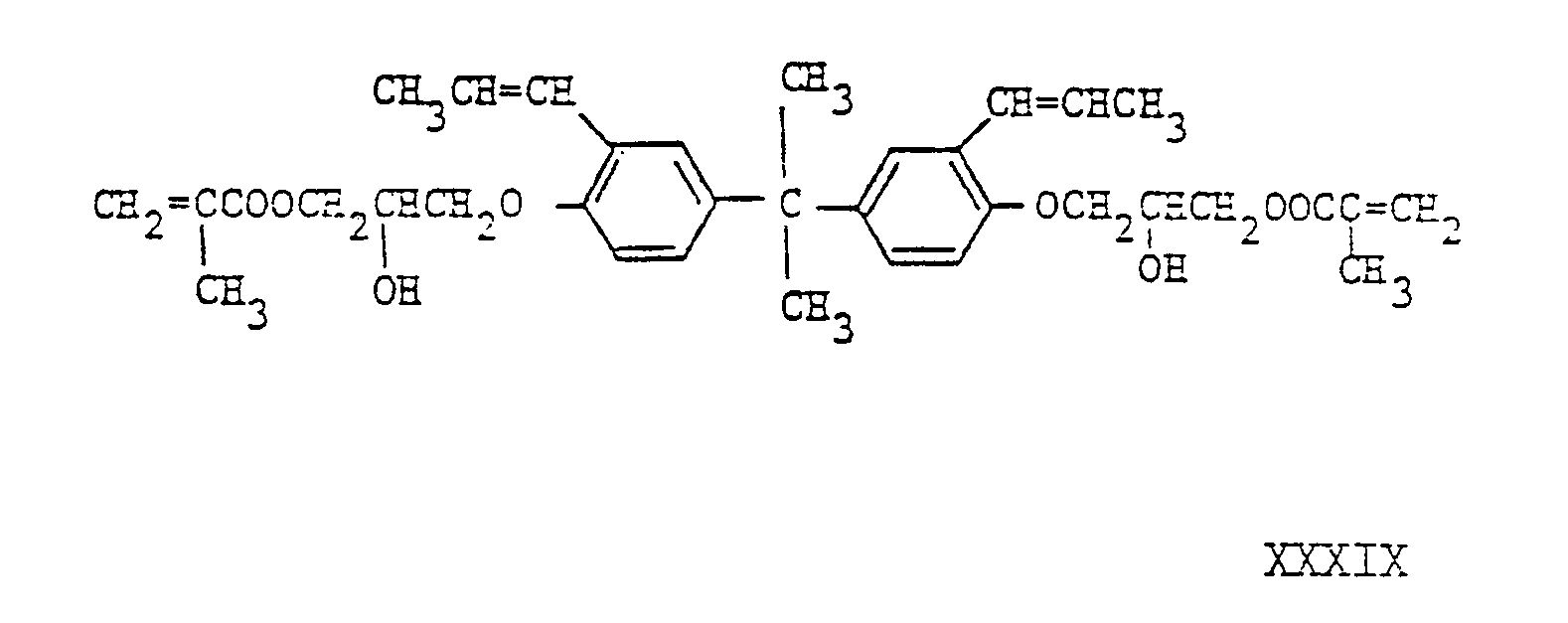
- Man erhitzt ein Gemisch (85 g) aus 1,3-Diallyl-2,4-dihydroxybenzol und 1,5-Diallyl-2,4-dihydroxybenzol mit 127 g Glycidylmethacrylat, 0,8 g 2,6-Di-tert.-butyl-p-kresol und 0,4 g Tetramethylammoniumchlorid im Verlauf von 1 Stunde auf 100° und rührt das Ganze noch weitere 5 Stunden bei dieser Temperatur, was ein Gemisch von Verbindungen der Formel


- 1,3-Diglycidyl-5,5-dimethylhydantoin (100 g) wird durch 6 Stunden Erhitzen mit 94,75 g 2,2-Bis-(3-allyl-4-hydroxyphenyl)-propan in 195 g 0,6g Tetramethylammoniumchlorid enthaltendem Cyclohexanon bei 1200 vorverlängert. Nach Ablauf der 6 Stunden ist der Epoxidgehalt des Gemischs auf 1,0 val/kg gefallen. Das Zwischenprodukt entspricht im wesentlichen der Formel XLII, worin X und Y je eine Glycidylgruppe und x eine positive ganze Zahl darstellen. Nach Abkühlen des Gemischs auf 80° versetzt man mit 0,4 g 2,6-Di-tert.-butyl-p-kresol und danach tropfenweise im Verlauf von 20 Minuten mit 17,2 g Methacrylsäure. Dann erhitzt man 6 Stunden bei 100° und unterbricht die Reaktion auf dieser Stufe, wenn der Epoxidgehalt des Harzes auf 0,29 val/kg gefallen ist. Das Produkt "Harz A" ist im wesentlichen ein Gemisch der Formel XLII,

- Man erhitzt Benzophenon-3,4,3',4'-tetracarbonsäuredianhydrid (400 g; aus Essigsäureanhydrid umkristallisiert) und 1200 g Allylalkohol 1 Stunde zum Rückfluss und entfernt dann den überschüssigen Allylalkohol durch Vakuumdestillation, wobei 540 g von Benzophenon-3,4,3'4'-tetracarbonsäure-X,X'-diallylestern zurückbleiben.
- Man löst diese Diallylester (450 g) in 1200 g Epichlorhydrin, erhitzt auf 950, versetzt mit einer Lösung von 2,05 g Tetramethylammoniumchlcrid in 2,05 ml Wasser und rührt das Ganze 3 Stunden bei 95°. Das Gemisch wird auf 55° bis 60° abgekühlt und eine weitere Menge Tetramethylammoniumchlorid (1,71 g), in 1,71 ml Wasser gelöst, dazugegeben. In einer Apparatur zur laufenden Entfernung von Wasser wird das Gemisch in einem Teilvakuum bei 55° bis 57° zum Rückfluss gebracht. Unter Rühren versetzt man im Verlauf von 2½ Stunden tropfenweise mit 50%iger wässriger Natronlauge (180 g) und rührt noch 1½ Stunden weiter. Man kühlt ab, hebt das Vakuum auf, gibt dann Wasser (340 ml) dazu, scheidet das Gemisch und wäscht die organische Schicht zuerst mit einer 5%igen wässrigen Natriumdihydrogenorthophosphatlösung (223 ml) und dann mit 223 ml Wasser. Ueberschüssiges Epichlorhydrin wird bei vermindertem Druck abdestilliert, wobei 450 g Benzophenon-3,4,3',4'-tetracarbonsäure-X,X'-diallylester-Y,Y'-diglycidylester als viskoses Oel mit einem Epoxidgehalt von 3,1 val/kg zurückbleiben.
- Die Diallylester-diglycidylester (200 g) werden in Gegenwart von 0,6 g Tetramethylammoniumchlorid und 0,4 g 2,6-Di-tert.-butyl-p-kresol auf 120° erhitzt und im Verlauf von 35 Minuten tropfenweise mit Methacrylsäure (52,6 g) versetzt. Man rührt noch 35 Minuten weiter und lässt das Gemisch dann abkühlen. Das gewünschte Produkt (d.h. ein solches der Formel XXI, worin eins von R7 und R8 und eins von R9 und R10 je eine Allylgruppe und die beiden verbleibenden Symbole R7 bis R10 jeweils eine Gruppe der Formel XX bedeuten, wobei R für eine Methylgruppe und R6 für eine Gruppe der Formel I stehen) ist ein hellgelbes, viskoses Oel.
- Die eingesetzten Polymercaptane sind handelsübliche Materialien mit den folgenden Thiolgehalten:

- Man vermischt gemäss Arbeitsweise I hergestelltes 2,2-Bis-(3-allyl-4-(3-(methacryloyloxy)-2-hydroxypropoxy)-phenyl)-propan (78 Teile) mit 30 Teilen Pentaerythrit-tetrathioglykolat (d.h. 1 Mercaptangruppenäquivalent pro Allylgruppe) und 3 Teilen Benzildimethylacetal. Ein 10 µm dicker Film dieser Zusammensetzung wird auf Weissblech aufgezogen und in 8 cm Abstand mit der Strahlung einer Mitteldruchquechsilberbogenlampe (80 W pro cm) belichtet. Nach 2 Sekunden Belichtung erhält man einen zähen Film, der einem Normtest auf Lösungsmittelbeständigkeit widersteht, d.h. zwanzigmaliges Reiben mit einem mit Aceton getränkten Wattebausch hat keinen Einfluss.
- Mit gemäss Arbeitsweise II hergestelltem 2,2-Bis-(3-allyl-4-(3-(methacryloyloxy)-2-hydroxypropoxy)-phenyl)-propan erhält man die gleichen Ergebnisse.
- Ein weiterer Anteil der in Beispiel 1 hergestellten Zusammensetzung wird als 10 µm tiefe Schicht auf eine 1 mm dicke Glasplatte aufgebracht. Man legt eine weitere Glasplatte über die erste und belichtet den Aufbau in 8 cm Abstand 5 Sekunden mit der Strahlung derselben Lampe wie in Beispiel 1 verwendet. Die Glasplatten sind fest miteinander verbunden, sogar nach 2 Stunden Eintauchen in siedendes Wasser.
- Man vermischt gemäss Arbeitsweise II hergestelltes 2,2-Bis-(3-allyl-4-(3-(methacryloyloxy)-2-hydroxyprepoxy)-phenyl)-propan (17 Teile) mit 5,4 Teilen 3,6-Dioxa-1,8-dimercapto-octan (d.h. 1 Mercaptangruppenäquivalent pro Allylgruppe) und 0,75 Teil Benzildimethylacetal. Eine 10 um dicke Schicht dieser Zusammensetzung wird auf Weissblech aufgezogen und wie in Beispiel 1 bestrahlt. Nach 2 Sekunden Bestrahlung erhält man einen klebefreien, lösungsmittelbeständigen Film.
- Man stellt eine Zusammensetzung wie in Beispiel 3 her, jedoch unter Ersatz des 3,6-Dioxa-l,8-dimercapto- octans durch 7 Teile Trimethylolpropan-trithioglykolat (d.h. 1 Mercaptangruppenäquivalent pro Allylgruppe), und bestrahlt die Schicht 4 Sekunden lang. Man erhält einen glänzenden, lösungsmittelbeständigen Film.
- Man bringt Anteile der in Beispielen 1, 3 und 4 hergestellten Zusammensetzungen auf mit Trichloräthylen entfettete und in Chromsäurelösung gebeizte Streifen Aluminiumfolie auf (Aluminiumlegierung Alclad 3L73: "Alclad" ist ein eingetragenes Warenzeichen). Dünne Glasplatten werden mit einer 5%igen Lösung von 3-(Glyci- dyloxy)-propyltrimethoxysilan in einem Gemisch aus denaturiertem Spiritus und Wasser im Volumenverhältnis 9:1 grundiert und über die Zusammensetzungen gelegt, und die Aufbauten werden dann 5 Sekunden mit der Strahlung einer Mitteldruckquecksilberlampe (80 W pro cm) belichtet. In jedem Fall werden die Glasplatten dabei fest mit dem Aluminiumstreifen verbunden.
- Man bringt ein Gemisch von 2,2-Bis-(3-allyl-4-(methacryloyloxy)-phenyl)-propan (100 Teile), Pentaerythrit-tetrathioglykolat (51 Teile, d.h. 1 Mercaptangruppenäquivalent pro Allylgruppe) und 4,5 Teile Benzildimethylacetal als Film von ...µm Dicke auf Weissblech auf. Nach 15 Sekunden Bestrahlen wie in Beispiel 1 erhält man einen zähen, lösungsmittelbeständigen Film.
- Man bringt ein aus 85 Teilen 2,2-Bis-(3-allyl-4-(3-(methacryloyloxy)-2-hydroxypropoxy)-phenyl)-propan (gemäss Arbeitsweise II hergestellt), 32,7 Teilen Pentaerythrit-tetrathioglykolat (d.h. 1 Mercaptangruppenäqui- valent pro Allylgruppe) und 3,5 Teilen 2,2'-Azobis-(2-me- thylpropionitril) bestehendes Gemisch bei Raumtemperatur als Ueberzug auf eine Polyamidträgerfolie auf. Der Film wird zwischen zwei mit Trichloräthylen entfettete und in Chromsäurelösung gebeizte Platten aus Aluminiumlegierung "Alclad 3L73" eingelegt. Ueberlappungsverbindungen (1,27 cm) werden dadurch hergestellt, dass man den Aufbau 5 Minuten auf 90° erhitzt und dann 1 Stunde bei 120° unter einem Druck von 0,34 MN/m2 verpresst. Die Ueberlappungsscherfestigkeit der Verbindungen bei Raumtemperatur beträgt 8,2 MN/m2.
- Man wiederholt die Arbeitsweise des Beispiels 7 unter Verwendung eines Gemischs aus 100 Teilen 2,2-Bis-(3-allyl-4-(3-(methacryloyloxy)-2-hydroxypropoxy)-phenyl)-propan (gemäss Arbeitsweise II hergestellt), 42 Teilen Trimethylolpropan-trithioglykolat (d.h. 1 Mercaptangruppenäquivalent pro Allylgruppe) und 4,5 Teilen 2,2'-Azobis-(2-methylpropionitril). Die Ueberlappungsscherfestigkeit der Verbindungen bei Raumtemperatur beträgt 19,4 MN/m2.
- Eine aus 100 Teilen eines wie oben beschrieben hergestellten Gemischs von 1-Allyloxycarboryl-2,4-bis-(3-(methacryloyloxy)-2-hydroxypropoxycarbonyl)-benzol und 1-Allyloxycarbonyl-2,5-bis-(3-(methacryloyloxy)-2-hydroxypropoxy- carbonyl)-benzol, 21 Teilen Pentaerythrit-tetrathioglykolat (d.h. 1 Mercaptangruppenäquivalent pro Allylgruppe) und 3,5 Teilen Benzildimethylacetal bestehende Zusammensetzung wird in Form eines 10 µm dicken Films bestrahlt, wie in Beispiel 1 beschrieben.
- Nach 5 Sekunden Bestrahlung entsteht ein lösungsmittelbeständiger Film.
- Glastuch (in Leinwandbindung) wird mit einer aus 26 Teilen 2,2-Bis-(3-allyl-4-(3-(methacryloyloxy)-2-hydroxypropoxy)-phenyl)-propan (gemäss Arbeitsweise II hergestellt), 10 Teilen Pentaerythrit-tetrathioglykolat (d.h. l Mercaptangruppenäquivalent pro Allylgruppe), einem Teil Benzophenon und 1 Teil 2,2'-Azobis-(2-methylpropioni- tril) bestehenden Zusammensetzung imprägniert. Man belichtet das imprägnierte Tuch auf beiden Seiten 1 Sekunde in 8 cm Abstand mit der Strahlung einer Mitteldruckquecksilberbogenlampe (80 W pro cm). Durch 1 Stunde Verpressen von 16 cm-quadratischen Stücken des Prepregs bei 120° unter einem Druck von 2,1 MN/m2 wird ein Sechsfachschichtkörper hergestellt. Der 57% Glas enthaltende Schichtkörper besitzt eine Biegefestigkeit von 354 MN/m2 bei Raumtemperatur.
- Man bringt eine flüssige, aus 100 Teilen 2,2-Bis-(3-allyl-4-(3-(methacryloyloxy)-2-hydroxypropoxy)-phenyl)-propan (gemäss Arbeitsweise II hergestellt), 42 Teilen Trimethylolpropan-trithioglykolat (d.h. 1 Mercaptangruppenäquivalent pro Allylgruppe), 4,5 Teilen Benzildimethylacetal und 4,5 Teilen 2,2'-Azobis-(2-methylpropionitril) bestehende Zusammensetzung bei Raumtemperatur als.Ueberzug auf eine Polyamidträgerfolie auf. 1 Sekunde Bestrahlung in 1 cm Abstand unter einer Mitteldruckquecksilberbogenlampe (80 W pro cm) führt zur Bildung einer klebefreien Folie. Diese wird zugeschnitten und zwischen zwei in Trichloräthylen entfettete und in Chromsäurelösung gebeizte Platten aus Aluminiumlegierung eingelegt. Ueberlappungsverbindungen (1,27 cm) werden dadurch hergestellt, dass man den Aufbau 1 Stunde bei 120° unter einem Druck von 0,34 MN/m2 verpresst. Die Ueberlappungsscherfestigkeit der Verbindungen bei Raumtemperatur beträgt 6,7 MN/m2.
- Man bringt ein Gemisch aus 2,2-Bis-(3,5-diallyl-4-(3-(methacryloyloxy)-2-hydroxypropoxy)-phenyl)-propan (10 Teile), Pentaerythrit-tetrathioglykolat (8,6 Teile, d.h. 1 Mercaptangruppenäquivalent pro Allylgruppe) und Benzildimethylacetal (0,5 Teil) als 10 µm dicken Film auf Weissblech auf und belichtet mit Strahlung wie in Beispiel 1. Nach 5 Sekunden Bestrahlung erhält man einen klebefreien, lösungsmittelbeständigen Film.
- Eine heisshärtbare, aus 2,2-Bis-(3,5-diallyl-4-(3-(methacryloyloxy)-2-hydroxypropoxy)-phenyl)-propan (50 Teile), Pentaerythrit-tetrathioglykolat (43 Teile, d.h. 1 Mercaptangruppenäquivalent pro Allylgruppe) und 2,2'-Azobis-(2-methylpropionitril) (2,8 Teile) bestehende Zusammensetzung wird zur Herstellung von Ueberlappungsverbindungen wie in Beispiel 7 beschrieben verwendet. Die Ueberlappungsscherfestigkeit der Verbindungen bei Raumtemperatur beträgt 24,7 MN/m 2.
- Zu einer wie in Beispiel 13 beschrieben hergestellten Zusammensetzung gibt man 2,8 Teile Benzildimethylacetal und stellt wie in Beispiel 11 beschrieben Ueberlappungsverbindungen her. Die Ueberlappungsscherfestigkeit der Verbindungen bei Raumtemperatur beträgt 17,9 MN/m2.
- Eine aus 26 Teilen 2,2-Bis-(3-(1-propenyl)-4-(3-(methacryloyloxy)-2-hydroxypropoxy)-phenyl)-propan, 10 Teilen Pentaerythrit-tetrathioglykolat (d.h. 1 Mercaptangruppenäquivalent pro Propenylgruppe) und 1 Teil Benzildimethylacetal bestehende Zusammensetzung wird wie in Beispiel 1 beschrieben als 10 µm dicker Film auf Weissblech bestrahlt, wobei man nach 5 Sekunden Bestrahlung einen lösungsmittelbeständigen, klebefreien Film erhält.
- Eine aus 52 Teilen 2,2-Bis-(3-(1-propenyl)-4-(3-(methacryloyloxy)-2-hydroxypropoxy)-phenyl)-propan, 20 Teilen Pentaerythrit-tetrathioglykolat (d.h. 1 Mercaptangruppenäquivalent pro Propenylgruppe) und 2,2 Teilen 2,2'-Azobis-(2-methylpropionitril) bestehende Zusammensetzung wird dazu verwendet, wie in Beispiel 7 Ueberlappungsverbindungen herzustellen. Die Ueberlappungsscherfestigkeit der Verbindungen beträgt 11,5 MN/m2.
- Eine aus 10 Teilen gemischtem 1,3-Diallyl-2,4-bis-(3-(methacryloyloxy)-2-hydroxy-propoxy)-benzol und 1,5-Diallyl-2,4-bis-(3-(methacryloyloxy)-2-hydroxypropoxy)-benzol, 6,8 Teilen Pentaerythrit-tetrathioglykolat (d.h. 1 Mercaptangruppenäquivalent pro Allylgruppe) und 0,6 Teil Benzildimethylacetal bestehende Zusammensetzung wird auf Weissblech aufgebracht und wie in Beispiel 1 beschrieben bestrahlt. Nach 5 Sekunden Bestrahlung erhalt man einen lösungsmittelbeständigen Ueberzug.
- Der Versuch wird wiederholt, unter Verwendung von 6,65 Teilen (d.h. 1 Mercaptangruppenäquivalent pro Allylgruppe ) Aethylenglykoldithioglykolat anstelle des Pentaerythrit-tetrathioglykolats. Man erhält ähnliche Ergebnisse.
- Man bringt eine aus 20 Teilen Harz A, 3,3 Teilen Pentaerythrit-tetrathioglykolat und 0,39 Teil Benzildimethylacetal bestehende Zusammensetzung als Ueberzug auf einen kupferkaschierten Schichtkörper auf und lässt das Lösungsmittel verdunsten, wobei ein 10 µm dicker Film zurückbleibt. Dieser Film wird 10 Minuten unter einem Negativ in 22 cm Abstand unter Verwendung einer 500 W-Mitteldruckquecksilberbogenlampe bestrahlt. Nach der Bestrahlung wird die Abbildung in einem Gemisch aus 10 Volumenteilen Aceton und 90 Volumenteilen Xylol entwickelt, und die unbelichteten Stellen werden ausgewaschen, wobei eine gute Reliefabbildung auf dem Kupfer verbleibt. Die unbeschichteten Kupferstellen werden dann mit einer wässrigen Eisen-III-chloridlösung (41% FeCl3) bei 35° geätzt, wobei die beschichteten Stellen unberührt bleiben.
- Man vermischt Benzophenon-3,4,3',4'-tetracaroon- säure-X,X'-diallylester-Y,Y'-bis-(3-methacryloyloxy)-2-hydroxypropylester (32,5 Teile) mit 11,5 Teilen Pentaerythrit-tetrathioglykolat (d.h. 1 Mercaptangruppenäquivalent pro Allylgruppe). Ein 10 µm dicker Film dieser Zusammensetzung wird auf Weissblech aufgezogen und in 8 cm Abstand mit der Strahlung einer Mitteldruckquecksilberbogenlampe (80 W pro cm) belichtet. Nach 4 Sekunden Belichtung erhält man einen zähen Film, der einem Normtest auf Lösungsmittelbeständigkeit widersteht, d.h. zwanzigmaliges Reiben mit einem in Aceton getränkten Wattebausch hat keinen Einfluss.
- Man wiederholt die Arbeitsweise des Beispiels 19, unter Verwendung von 100 Teilen der Diallyl-dimethacryloylverbindungen und 35 Teilen Trimethylolpropan-trithioglykolat (d.h. 1 Mercaptangruppenäquivalent pro Allylgruppe). Nach nur zwei Sekunden Bestrahlung wird ein klebefreier, lösungsmittelbeständiger Film erzeugt.
- Man wiederholt die Arbeitsweise des Beispiels 19, unter Verwendung von 100 Teilen der Diallyl-dimethacryloylverbindungen und 26 Teilen 1,8-Dimercapto-3,6-dioxa-octan (d.h. ein Mercaptangruppenäquivalent pro Allylgruppe). Nach fünf Sekunden Belichtung erhalt man einen klebefreien, lösungsmittelbeständigen Film.
- Ein weiterer Anteil der in Beispiel 19 hergestellten Zusammensetzung wird als 10 µm tiefe Schicht auf eine 1 mm dicke Glasplatte aufgebracht. Man legt eine weitere Glasplatte über die erste und belichtet den Aufbau 5 Sekunden in 8 cm Abstand mit der Strahlung der gleichen Lampe wie in Beispiel 1 verwendet. Die Glasplatten sind fest miteinander verbunden.
- Man bringt Anteile der in Beispielen 19 und 20 hergestellten Zusammensetzungen auf in Trichloräthylen entfettete und in Chromsäurelösung gebeizte Streifen aus Aluminiumfolie auf (Aluminiumlegierung Alclad 3L73: "Alclad" ist ein eingetragenes Warenzeichen). Dünne Glasplatten werden mit einer 5%igen Lösung von 3-(Glycidyloxy)-propyltrimethoxysilan in einem Gemisch aus denaturiertem Spiritus und Wasser im Volumenverhältnis 9:1 grundiert und über die Zusammensetzungen gelegt, und die Aufbauten werden dann 5 Sekunden mit der Strahlung einer Mitteldruckquecksilberlampe (80 W pro cm) belichtet. In jedem Fall werden die Glasplatten fest mit dem Aluminiumstreifen verbunden.
Claims (21)


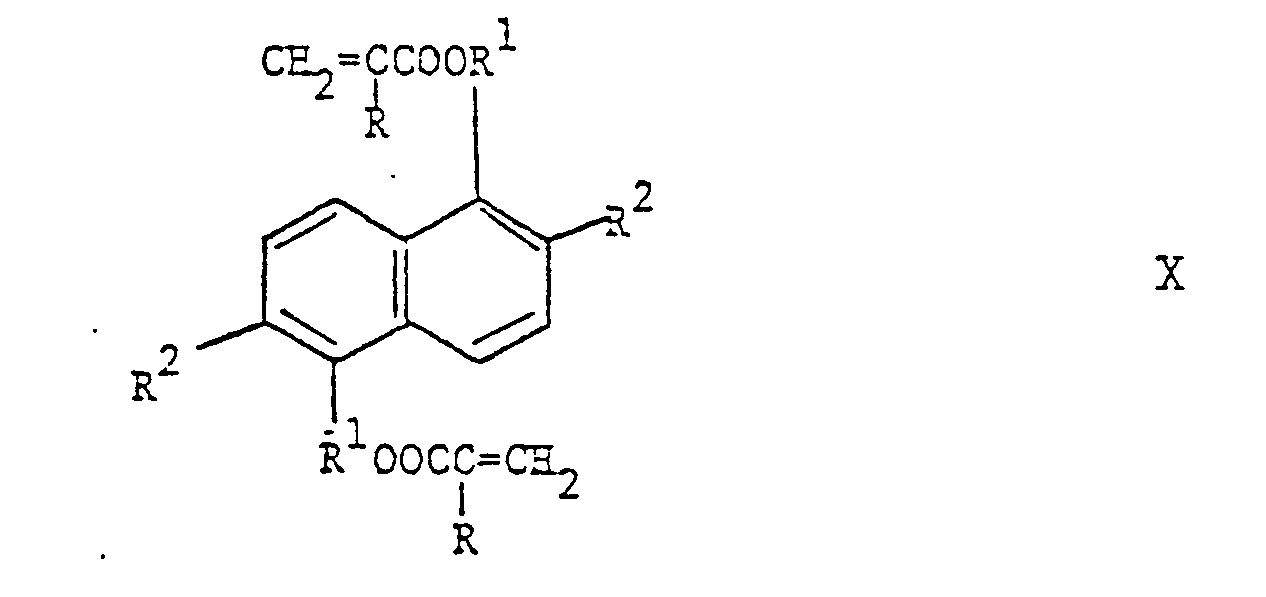


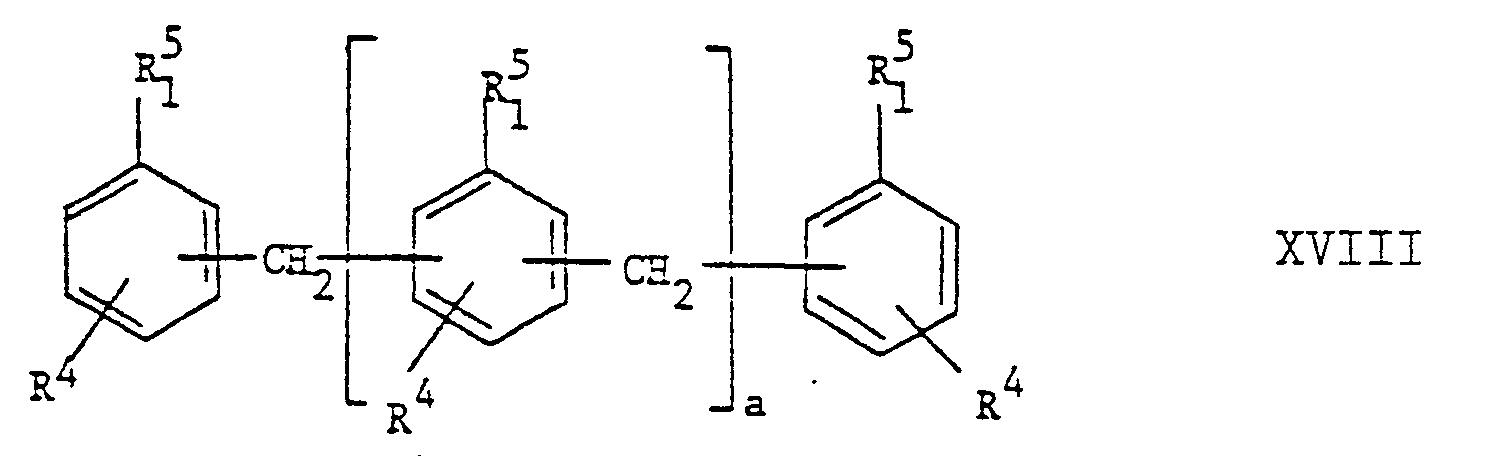


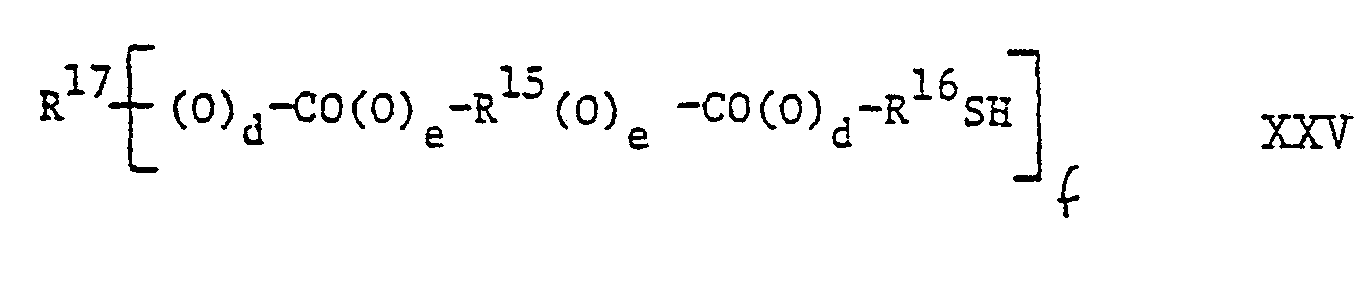


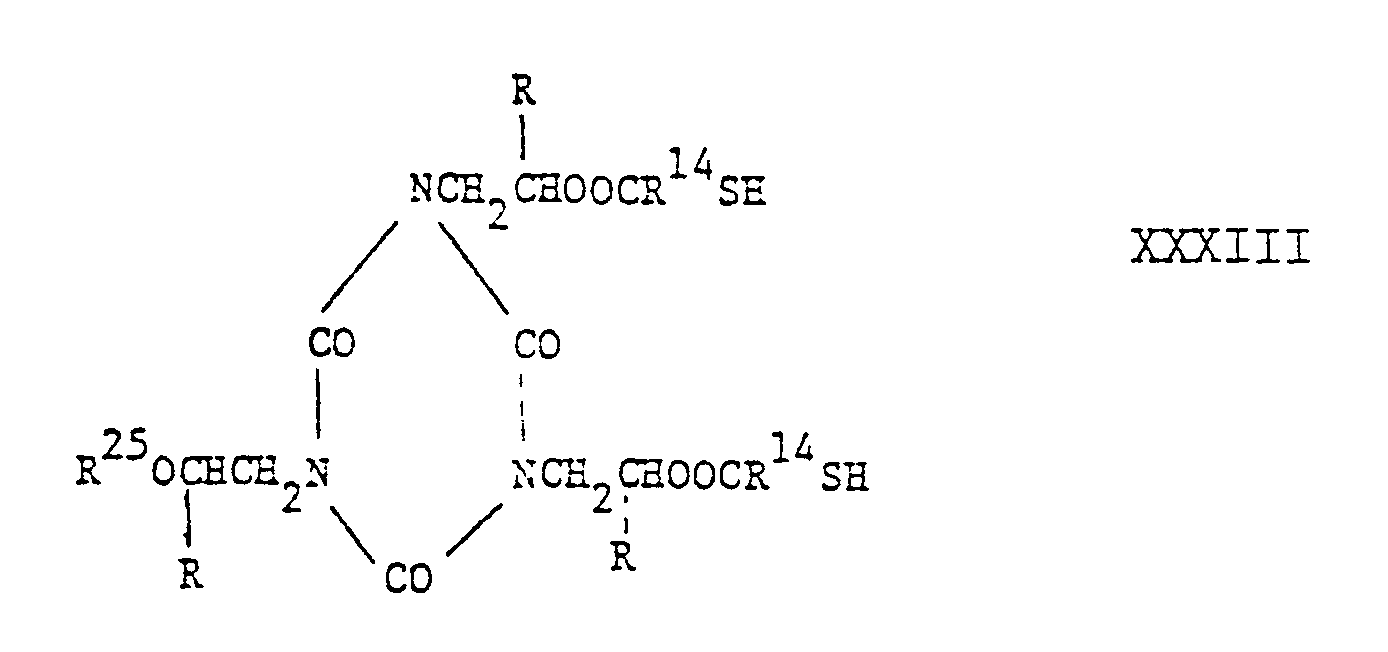
Applications Claiming Priority (4)
| Application Number | Priority Date | Filing Date | Title |
|---|---|---|---|
| GB7944319 | 1979-12-22 | ||
| GB7944319 | 1979-12-22 | ||
| GB8013262 | 1980-04-22 | ||
| GB8013262 | 1980-04-22 |
Publications (3)
| Publication Number | Publication Date |
|---|---|
| EP0031305A2 true EP0031305A2 (de) | 1981-07-01 |
| EP0031305A3 EP0031305A3 (en) | 1981-07-22 |
| EP0031305B1 EP0031305B1 (de) | 1985-10-02 |
Family
ID=26273974
Family Applications (1)
| Application Number | Title | Priority Date | Filing Date |
|---|---|---|---|
| EP80810397A Expired EP0031305B1 (de) | 1979-12-22 | 1980-12-17 | Acrylathaltige Zusammensetzungen und deren Polymerisation |
Country Status (5)
| Country | Link |
|---|---|
| US (1) | US4439291A (de) |
| EP (1) | EP0031305B1 (de) |
| CA (1) | CA1190699A (de) |
| DE (1) | DE3071155D1 (de) |
| ES (1) | ES8200707A1 (de) |
Cited By (5)
| Publication number | Priority date | Publication date | Assignee | Title |
|---|---|---|---|---|
| EP0075538A3 (en) * | 1981-09-19 | 1984-05-23 | Ciba-Geigy Ag | Polymerisable composition containing carboxylic groups |
| EP0069069B1 (de) * | 1981-06-19 | 1988-03-02 | Ciba-Geigy Ag | Polymerisierbare Zusammensetzungen und die daraus durch Polymerisation erhaltenen Produkte |
| EP0448224A1 (de) * | 1990-03-23 | 1991-09-25 | Imperial Chemical Industries Plc | Polymere |
| EP0449413A1 (de) * | 1990-03-23 | 1991-10-02 | Imperial Chemical Industries Plc | Polymere |
| EP0594911A1 (de) * | 1990-10-02 | 1994-05-04 | Cook Composites And Polymers | IMC-Beschichtungen für thixotropen hergestellten Verbundwerkstoffen |
Families Citing this family (33)
| Publication number | Priority date | Publication date | Assignee | Title |
|---|---|---|---|---|
| JPS59123620A (ja) * | 1982-12-29 | 1984-07-17 | Nitto Electric Ind Co Ltd | 金属表面塗覆法 |
| GB8429165D0 (en) * | 1983-12-06 | 1984-12-27 | Ici Plc | Dry film resists |
| JPS60163907A (ja) * | 1984-02-03 | 1985-08-26 | Sanyo Kokusaku Pulp Co Ltd | 活性エネルギ−線硬化性樹脂組成物 |
| US4734477A (en) * | 1985-07-16 | 1988-03-29 | Mitsubishi Petrochemical Co., Ltd. | Method for cast molding plastic substrate |
| IT1190382B (it) * | 1985-07-26 | 1988-02-16 | Montedison Spa | Diesteri acrilici per bisfenolo alchil etere,relativi polimeri e compositi per uso dentale |
| EP0226123A3 (de) * | 1985-12-03 | 1988-08-10 | Matsushita Electric Industrial Co., Ltd. | Verfahren zum Herstellen eines Gegenstandes aus organischem Glas |
| JPH0654390B2 (ja) * | 1986-07-18 | 1994-07-20 | 東京応化工業株式会社 | 高耐熱性ポジ型ホトレジスト組成物 |
| US5091440A (en) * | 1989-12-08 | 1992-02-25 | Wacker Silicones Corporation | Acrylate- or methacrylate-functional organopolysiloxanes |
| US4999334A (en) * | 1990-03-01 | 1991-03-12 | The Standard Register Co. | Protective coating for thermal images |
| US5004842A (en) * | 1990-06-25 | 1991-04-02 | Loctite Corporation | Aromatic vinyl ether compounds and compositions, and method of making the same |
| JP3102696B2 (ja) * | 1990-09-10 | 2000-10-23 | 日本エーアールシー株式会社 | 被覆組成物および該組成物を用いる被覆樹脂成形品 |
| US5250359A (en) * | 1990-09-10 | 1993-10-05 | Nippon Arc Co., Ltd. | Coating composition and resin molded article coated thereby |
| NL194278C (nl) * | 1991-10-04 | 2001-11-05 | Toa Gosei Chem Ind | Hardbare samenstelling en werkwijze ter vervaardiging van een schaduwmasker onder toepassing daarvan. |
| US5728633A (en) * | 1992-01-23 | 1998-03-17 | Jacobs; Richard L. | Interpenetrating network compositions and structures |
| US5679719A (en) * | 1993-03-24 | 1997-10-21 | Loctite Corporation | Method of preparing fiber/resin composites |
| US5565499A (en) * | 1993-03-24 | 1996-10-15 | Loctite Corporation | Filament-winding compositions for fiber/resin composites |
| US5539012A (en) * | 1993-08-18 | 1996-07-23 | Loctite Corporation | Fiber/resin composites and method of preparation |
| EP1327642A4 (de) * | 2000-09-20 | 2006-07-19 | Taiyo Ink Mfg Co Ltd | Carboxyliertes photosensitives harz, dieses enthaltende, mit alkali entwickelbare, lichthärtbare/hitzehärtbare zusammensetzung und daraus erhältlicher gehärteter artikel |
| KR100801820B1 (ko) * | 2002-11-19 | 2008-02-11 | 삼성전자주식회사 | 표면수식된 탄소나노튜브를 이용한 패턴 형성방법 |
| KR100947702B1 (ko) * | 2003-02-26 | 2010-03-16 | 삼성전자주식회사 | 경화성 작용기로 표면수식된 탄소나노튜브를 이용한패턴박막 형성방법 및 고분자 복합체의 제조방법 |
| US8349951B2 (en) * | 2005-05-31 | 2013-01-08 | Prc Desoto International, Inc. | Polythioether polymers and curable compositions containing them |
| US7745010B2 (en) * | 2005-08-26 | 2010-06-29 | Prc Desoto International, Inc. | Coating compositions exhibiting corrosion resistance properties, related coated substrates, and methods |
| US8231970B2 (en) * | 2005-08-26 | 2012-07-31 | Ppg Industries Ohio, Inc | Coating compositions exhibiting corrosion resistance properties and related coated substrates |
| KR101066132B1 (ko) * | 2006-09-20 | 2011-09-20 | 디아이씨 가부시끼가이샤 | 직쇄상 (메타)아크릴로일기 함유 화합물, 성형 (메타)아크릴로일기 함유 화합물, 및 그들의 제조 방법 |
| KR20080033780A (ko) * | 2006-10-13 | 2008-04-17 | 삼성전자주식회사 | 다성분계 탄소나노튜브-고분자 복합체, 이를 형성하기 위한조성물 및 그 제조방법 |
| KR20090042341A (ko) | 2007-10-26 | 2009-04-30 | 주식회사 엘지화학 | 알칼리 가용성 수지, 및 이를 포함하는 네가티브형 감광성수지 조성물 |
| KR101585269B1 (ko) * | 2010-02-10 | 2016-01-14 | (주)엘지하우시스 | 하드코팅 형성용 수지 조성물 |
| KR101552740B1 (ko) * | 2010-02-10 | 2015-09-14 | (주)엘지하우시스 | 하드코팅 형성 방법 |
| US10723690B2 (en) * | 2015-07-23 | 2020-07-28 | Mitsubishi Gas Chemical Company, Inc. | (Meth)acryloyl compound and method for producing same |
| CN109312052B (zh) | 2016-07-28 | 2020-12-22 | 昭和电工株式会社 | 环氧(甲基)丙烯酸酯化合物及含有该环氧(甲基)丙烯酸酯化合物的固化性组合物 |
| CN109305896B (zh) * | 2017-07-26 | 2022-07-19 | 郑州大学 | 一种低极性树脂及其制备方法和应用 |
| EP3941965A1 (de) * | 2019-03-18 | 2022-01-26 | Solvay Specialty Polymers USA, LLC. | Funktionalisierte poly(arylethersulfonen)-copolymere |
| JP7720848B2 (ja) * | 2019-12-19 | 2025-08-08 | ソルベイ スペシャルティ ポリマーズ ユーエスエー, エルエルシー | 反応性末端を含む側鎖官能化ポリ(アリールエーテルスルホン)コポリマー |
Family Cites Families (11)
| Publication number | Priority date | Publication date | Assignee | Title |
|---|---|---|---|---|
| US3162676A (en) * | 1962-06-18 | 1964-12-22 | Nat Starch Chem Corp | Ethylenically unsaturated derivatives of 2, 4-dihydroxybenzophenone |
| GB1215591A (en) * | 1966-07-26 | 1970-12-09 | Grace W R & Co | Polyene/polythiol compositions |
| US4008341A (en) * | 1968-10-11 | 1977-02-15 | W. R. Grace & Co. | Curable liquid polymer compositions |
| US4082891A (en) * | 1976-05-04 | 1978-04-04 | General Electric Company | Polycarbonate coated with photocurable polythiol and different polyenes |
| US4120721A (en) * | 1977-06-02 | 1978-10-17 | W. R. Grace & Co. | Radiation curable compositions for coating and imaging processes and method of use |
| GB2012780B (en) * | 1978-01-20 | 1982-03-17 | Ciba Geigy Ag | Epoxide containing compositions and their polymerisation |
| US4272586A (en) * | 1978-02-23 | 1981-06-09 | Denki Kagaku Kogyo Kabushiki Kaisha | Laminated glass product |
| DE2818678A1 (de) * | 1978-04-27 | 1979-10-31 | Agfa Gevaert Ag | Photographische silberhalogenidemulsionen |
| US4245031A (en) * | 1979-09-18 | 1981-01-13 | E. I. Du Pont De Nemours And Company | Photopolymerizable compositions based on salt-forming polymers and polyhydroxy polyethers |
| US4310650A (en) * | 1980-03-03 | 1982-01-12 | California Institute Of Technology | Ultraviolet absorbing copolymers |
| US4310687A (en) * | 1980-07-10 | 1982-01-12 | Gaf Corporation | Copolymerizable ultraviolet light absorber monomers which are acrylate esters of 2-hydroxy, alkoxy, methylol benzophenones |
-
1980
- 1980-12-17 EP EP80810397A patent/EP0031305B1/de not_active Expired
- 1980-12-17 DE DE8080810397T patent/DE3071155D1/de not_active Expired
- 1980-12-19 CA CA000367167A patent/CA1190699A/en not_active Expired
- 1980-12-20 ES ES498029A patent/ES8200707A1/es not_active Expired
-
1982
- 1982-07-22 US US06/400,784 patent/US4439291A/en not_active Expired - Fee Related
Cited By (6)
| Publication number | Priority date | Publication date | Assignee | Title |
|---|---|---|---|---|
| EP0069069B1 (de) * | 1981-06-19 | 1988-03-02 | Ciba-Geigy Ag | Polymerisierbare Zusammensetzungen und die daraus durch Polymerisation erhaltenen Produkte |
| EP0075538A3 (en) * | 1981-09-19 | 1984-05-23 | Ciba-Geigy Ag | Polymerisable composition containing carboxylic groups |
| US4463169A (en) * | 1981-09-19 | 1984-07-31 | Ciba-Geigy Corporation | Three component, carboxyl-containing compositions comprising dimercaptan |
| EP0448224A1 (de) * | 1990-03-23 | 1991-09-25 | Imperial Chemical Industries Plc | Polymere |
| EP0449413A1 (de) * | 1990-03-23 | 1991-10-02 | Imperial Chemical Industries Plc | Polymere |
| EP0594911A1 (de) * | 1990-10-02 | 1994-05-04 | Cook Composites And Polymers | IMC-Beschichtungen für thixotropen hergestellten Verbundwerkstoffen |
Also Published As
| Publication number | Publication date |
|---|---|
| ES498029A0 (es) | 1981-11-16 |
| DE3071155D1 (en) | 1985-11-07 |
| ES8200707A1 (es) | 1981-11-16 |
| US4439291A (en) | 1984-03-27 |
| EP0031305A3 (en) | 1981-07-22 |
| CA1190699A (en) | 1985-07-16 |
| EP0031305B1 (de) | 1985-10-02 |
Similar Documents
| Publication | Publication Date | Title |
|---|---|---|
| EP0031305B1 (de) | Acrylathaltige Zusammensetzungen und deren Polymerisation | |
| DE2901685A1 (de) | Epoxidhaltige massen und deren polymerisation | |
| DE2706549C2 (de) | Verfahren zur Herstellung von Prepregs | |
| EP0069069B1 (de) | Polymerisierbare Zusammensetzungen und die daraus durch Polymerisation erhaltenen Produkte | |
| EP0151372B1 (de) | Verfahren zur Bilderzeugung | |
| EP0094914B1 (de) | Photopolymerisation mittels organometallischer Salze | |
| DE2803881C2 (de) | Verfahren zum Verkleben zweier aus Metallen, Glas, Keramik, oder Holz bestehender Oberflächen | |
| DE2706638C2 (de) | Verfahren zur Herstellung von Prepregs | |
| EP0062611B1 (de) | Photopolymerisationsverfahren | |
| EP0063304B1 (de) | Durch Strahlung polymerisierbares Gemisch und daraus hergestelltes photopolymerisierbares Kopiermaterial | |
| CH626643A5 (de) | ||
| EP0071571B1 (de) | Photopolymerisationsverfahren | |
| DE2847796B2 (de) | Strahlungshärtbare Harzmasse | |
| DE2823344A1 (de) | Verstaerkte verbundstoffe | |
| EP0304782B1 (de) | Neue 6-Acyl-(6H)-dibenz[c,e] [1,2]oxaphosphorin-6-oxyde, ihre Herstellung und Verwendung als Photoinitiatoren | |
| DE2901686A1 (de) | Mischungen auf basis von alkenylsubstituierten phenolen und polymercaptanen | |
| EP0102921A2 (de) | Verfahren zur Erzeugung von Abbildungen aus flüssigen Massen | |
| EP0075538B1 (de) | Polymerisierbare, Carboxylgruppen enthaltende Zusammensetzung | |
| DE2533125C2 (de) | Hochreaktive Lackbindemittel | |
| DE2507008A1 (de) | Polymerisierbare ester | |
| DE2706575C2 (de) | Verfahren zur Herstellung von Prepregs | |
| EP0145653A2 (de) | Photopolymerisierbare Zusammensetzungen | |
| EP0126029A2 (de) | Verfahren zur Bilderzeugung | |
| JPH025775B2 (de) | ||
| DE3314258C2 (de) | Lichtempfindliches Gemisch |
Legal Events
| Date | Code | Title | Description |
|---|---|---|---|
| PUAI | Public reference made under article 153(3) epc to a published international application that has entered the european phase |
Free format text: ORIGINAL CODE: 0009012 |
|
| PUAL | Search report despatched |
Free format text: ORIGINAL CODE: 0009013 |
|
| 17P | Request for examination filed |
Effective date: 19801219 |
|
| AK | Designated contracting states |
Designated state(s): BE DE FR GB IT NL SE |
|
| AK | Designated contracting states |
Designated state(s): BE DE FR GB IT NL SE |
|
| ITF | It: translation for a ep patent filed | ||
| GRAA | (expected) grant |
Free format text: ORIGINAL CODE: 0009210 |
|
| AK | Designated contracting states |
Designated state(s): BE DE FR GB IT NL SE |
|
| REF | Corresponds to: |
Ref document number: 3071155 Country of ref document: DE Date of ref document: 19851107 |
|
| ET | Fr: translation filed | ||
| PLBE | No opposition filed within time limit |
Free format text: ORIGINAL CODE: 0009261 |
|
| STAA | Information on the status of an ep patent application or granted ep patent |
Free format text: STATUS: NO OPPOSITION FILED WITHIN TIME LIMIT |
|
| 26N | No opposition filed | ||
| PG25 | Lapsed in a contracting state [announced via postgrant information from national office to epo] |
Ref country code: BE Effective date: 19861231 |
|
| BERE | Be: lapsed |
Owner name: CIBA-GEIGY A.G. Effective date: 19861231 |
|
| PGFP | Annual fee paid to national office [announced via postgrant information from national office to epo] |
Ref country code: FR Payment date: 19891025 Year of fee payment: 10 |
|
| PGFP | Annual fee paid to national office [announced via postgrant information from national office to epo] |
Ref country code: DE Payment date: 19891114 Year of fee payment: 10 |
|
| PGFP | Annual fee paid to national office [announced via postgrant information from national office to epo] |
Ref country code: GB Payment date: 19891130 Year of fee payment: 10 |
|
| PG25 | Lapsed in a contracting state [announced via postgrant information from national office to epo] |
Ref country code: SE Effective date: 19891218 |
|
| PGFP | Annual fee paid to national office [announced via postgrant information from national office to epo] |
Ref country code: NL Payment date: 19891231 Year of fee payment: 10 |
|
| PG25 | Lapsed in a contracting state [announced via postgrant information from national office to epo] |
Ref country code: GB Effective date: 19901217 |
|
| PG25 | Lapsed in a contracting state [announced via postgrant information from national office to epo] |
Ref country code: NL Effective date: 19910701 |
|
| GBPC | Gb: european patent ceased through non-payment of renewal fee | ||
| NLV4 | Nl: lapsed or anulled due to non-payment of the annual fee | ||
| PG25 | Lapsed in a contracting state [announced via postgrant information from national office to epo] |
Ref country code: FR Effective date: 19910830 |
|
| PG25 | Lapsed in a contracting state [announced via postgrant information from national office to epo] |
Ref country code: DE Effective date: 19910903 |
|
| REG | Reference to a national code |
Ref country code: FR Ref legal event code: ST |
|
| EUG | Se: european patent has lapsed |
Ref document number: 80810397.2 Effective date: 19900829 |