EP0035719B1 - Verfahren zur Herstellung modifizierter anorganischer Polymere, deren Verwendung in Verfahren zur Herstellung von Polynukleotiden sowie eine Reagenz zur Verwendung in diesen Verfahren - Google Patents
Verfahren zur Herstellung modifizierter anorganischer Polymere, deren Verwendung in Verfahren zur Herstellung von Polynukleotiden sowie eine Reagenz zur Verwendung in diesen Verfahren Download PDFInfo
- Publication number
- EP0035719B1 EP0035719B1 EP81101445A EP81101445A EP0035719B1 EP 0035719 B1 EP0035719 B1 EP 0035719B1 EP 81101445 A EP81101445 A EP 81101445A EP 81101445 A EP81101445 A EP 81101445A EP 0035719 B1 EP0035719 B1 EP 0035719B1
- Authority
- EP
- European Patent Office
- Prior art keywords
- nucleoside
- process according
- formula
- group
- silica gel
- Prior art date
- Legal status (The legal status is an assumption and is not a legal conclusion. Google has not performed a legal analysis and makes no representation as to the accuracy of the status listed.)
- Expired
Links
- 0 COCC(C(C1*)OC)OC1S Chemical compound COCC(C(C1*)OC)OC1S 0.000 description 3
- DZNTUOAEEPRPDK-UHFFFAOYSA-N BC(C1)OC(COC)C1OC Chemical compound BC(C1)OC(COC)C1OC DZNTUOAEEPRPDK-UHFFFAOYSA-N 0.000 description 1
- KSXJSAHJHPUOOB-UHFFFAOYSA-N BC(C1C)OC(COC)C1OC Chemical compound BC(C1C)OC(COC)C1OC KSXJSAHJHPUOOB-UHFFFAOYSA-N 0.000 description 1
Images

Classifications
-
- C—CHEMISTRY; METALLURGY
- C07—ORGANIC CHEMISTRY
- C07H—SUGARS; DERIVATIVES THEREOF; NUCLEOSIDES; NUCLEOTIDES; NUCLEIC ACIDS
- C07H21/00—Compounds containing two or more mononucleotide units having separate phosphate or polyphosphate groups linked by saccharide radicals of nucleoside groups, e.g. nucleic acids
-
- B—PERFORMING OPERATIONS; TRANSPORTING
- B01—PHYSICAL OR CHEMICAL PROCESSES OR APPARATUS IN GENERAL
- B01J—CHEMICAL OR PHYSICAL PROCESSES, e.g. CATALYSIS OR COLLOID CHEMISTRY; THEIR RELEVANT APPARATUS
- B01J19/00—Chemical, physical or physico-chemical processes in general; Their relevant apparatus
- B01J19/0046—Sequential or parallel reactions, e.g. for the synthesis of polypeptides or polynucleotides; Apparatus and devices for combinatorial chemistry or for making molecular arrays
-
- C—CHEMISTRY; METALLURGY
- C07—ORGANIC CHEMISTRY
- C07H—SUGARS; DERIVATIVES THEREOF; NUCLEOSIDES; NUCLEOTIDES; NUCLEIC ACIDS
- C07H19/00—Compounds containing a hetero ring sharing one ring hetero atom with a saccharide radical; Nucleosides; Mononucleotides; Anhydro-derivatives thereof
- C07H19/02—Compounds containing a hetero ring sharing one ring hetero atom with a saccharide radical; Nucleosides; Mononucleotides; Anhydro-derivatives thereof sharing nitrogen
- C07H19/04—Heterocyclic radicals containing only nitrogen atoms as ring hetero atom
-
- C—CHEMISTRY; METALLURGY
- C07—ORGANIC CHEMISTRY
- C07H—SUGARS; DERIVATIVES THEREOF; NUCLEOSIDES; NUCLEOTIDES; NUCLEIC ACIDS
- C07H23/00—Compounds containing boron, silicon or a metal, e.g. chelates or vitamin B12
-
- B—PERFORMING OPERATIONS; TRANSPORTING
- B01—PHYSICAL OR CHEMICAL PROCESSES OR APPARATUS IN GENERAL
- B01J—CHEMICAL OR PHYSICAL PROCESSES, e.g. CATALYSIS OR COLLOID CHEMISTRY; THEIR RELEVANT APPARATUS
- B01J2219/00—Chemical, physical or physico-chemical processes in general; Their relevant apparatus
- B01J2219/00274—Sequential or parallel reactions; Apparatus and devices for combinatorial chemistry or for making arrays; Chemical library technology
- B01J2219/00277—Apparatus
- B01J2219/00279—Features relating to reactor vessels
- B01J2219/00281—Individual reactor vessels
- B01J2219/00286—Reactor vessels with top and bottom openings
-
- B—PERFORMING OPERATIONS; TRANSPORTING
- B01—PHYSICAL OR CHEMICAL PROCESSES OR APPARATUS IN GENERAL
- B01J—CHEMICAL OR PHYSICAL PROCESSES, e.g. CATALYSIS OR COLLOID CHEMISTRY; THEIR RELEVANT APPARATUS
- B01J2219/00—Chemical, physical or physico-chemical processes in general; Their relevant apparatus
- B01J2219/00274—Sequential or parallel reactions; Apparatus and devices for combinatorial chemistry or for making arrays; Chemical library technology
- B01J2219/00277—Apparatus
- B01J2219/00351—Means for dispensing and evacuation of reagents
- B01J2219/00389—Feeding through valves
-
- B—PERFORMING OPERATIONS; TRANSPORTING
- B01—PHYSICAL OR CHEMICAL PROCESSES OR APPARATUS IN GENERAL
- B01J—CHEMICAL OR PHYSICAL PROCESSES, e.g. CATALYSIS OR COLLOID CHEMISTRY; THEIR RELEVANT APPARATUS
- B01J2219/00—Chemical, physical or physico-chemical processes in general; Their relevant apparatus
- B01J2219/00274—Sequential or parallel reactions; Apparatus and devices for combinatorial chemistry or for making arrays; Chemical library technology
- B01J2219/00277—Apparatus
- B01J2219/00497—Features relating to the solid phase supports
- B01J2219/005—Beads
-
- B—PERFORMING OPERATIONS; TRANSPORTING
- B01—PHYSICAL OR CHEMICAL PROCESSES OR APPARATUS IN GENERAL
- B01J—CHEMICAL OR PHYSICAL PROCESSES, e.g. CATALYSIS OR COLLOID CHEMISTRY; THEIR RELEVANT APPARATUS
- B01J2219/00—Chemical, physical or physico-chemical processes in general; Their relevant apparatus
- B01J2219/00274—Sequential or parallel reactions; Apparatus and devices for combinatorial chemistry or for making arrays; Chemical library technology
- B01J2219/00583—Features relative to the processes being carried out
- B01J2219/0059—Sequential processes
-
- B—PERFORMING OPERATIONS; TRANSPORTING
- B01—PHYSICAL OR CHEMICAL PROCESSES OR APPARATUS IN GENERAL
- B01J—CHEMICAL OR PHYSICAL PROCESSES, e.g. CATALYSIS OR COLLOID CHEMISTRY; THEIR RELEVANT APPARATUS
- B01J2219/00—Chemical, physical or physico-chemical processes in general; Their relevant apparatus
- B01J2219/00274—Sequential or parallel reactions; Apparatus and devices for combinatorial chemistry or for making arrays; Chemical library technology
- B01J2219/00583—Features relative to the processes being carried out
- B01J2219/00596—Solid-phase processes
-
- B—PERFORMING OPERATIONS; TRANSPORTING
- B01—PHYSICAL OR CHEMICAL PROCESSES OR APPARATUS IN GENERAL
- B01J—CHEMICAL OR PHYSICAL PROCESSES, e.g. CATALYSIS OR COLLOID CHEMISTRY; THEIR RELEVANT APPARATUS
- B01J2219/00—Chemical, physical or physico-chemical processes in general; Their relevant apparatus
- B01J2219/00274—Sequential or parallel reactions; Apparatus and devices for combinatorial chemistry or for making arrays; Chemical library technology
- B01J2219/0068—Means for controlling the apparatus of the process
-
- B—PERFORMING OPERATIONS; TRANSPORTING
- B01—PHYSICAL OR CHEMICAL PROCESSES OR APPARATUS IN GENERAL
- B01J—CHEMICAL OR PHYSICAL PROCESSES, e.g. CATALYSIS OR COLLOID CHEMISTRY; THEIR RELEVANT APPARATUS
- B01J2219/00—Chemical, physical or physico-chemical processes in general; Their relevant apparatus
- B01J2219/00274—Sequential or parallel reactions; Apparatus and devices for combinatorial chemistry or for making arrays; Chemical library technology
- B01J2219/0068—Means for controlling the apparatus of the process
- B01J2219/00686—Automatic
-
- B—PERFORMING OPERATIONS; TRANSPORTING
- B01—PHYSICAL OR CHEMICAL PROCESSES OR APPARATUS IN GENERAL
- B01J—CHEMICAL OR PHYSICAL PROCESSES, e.g. CATALYSIS OR COLLOID CHEMISTRY; THEIR RELEVANT APPARATUS
- B01J2219/00—Chemical, physical or physico-chemical processes in general; Their relevant apparatus
- B01J2219/00274—Sequential or parallel reactions; Apparatus and devices for combinatorial chemistry or for making arrays; Chemical library technology
- B01J2219/00718—Type of compounds synthesised
- B01J2219/0072—Organic compounds
- B01J2219/00722—Nucleotides
-
- C—CHEMISTRY; METALLURGY
- C40—COMBINATORIAL TECHNOLOGY
- C40B—COMBINATORIAL CHEMISTRY; LIBRARIES, e.g. CHEMICAL LIBRARIES
- C40B40/00—Libraries per se, e.g. arrays, mixtures
- C40B40/04—Libraries containing only organic compounds
- C40B40/06—Libraries containing nucleotides or polynucleotides, or derivatives thereof
-
- C—CHEMISTRY; METALLURGY
- C40—COMBINATORIAL TECHNOLOGY
- C40B—COMBINATORIAL CHEMISTRY; LIBRARIES, e.g. CHEMICAL LIBRARIES
- C40B60/00—Apparatus specially adapted for use in combinatorial chemistry or with libraries
- C40B60/14—Apparatus specially adapted for use in combinatorial chemistry or with libraries for creating libraries
-
- Y—GENERAL TAGGING OF NEW TECHNOLOGICAL DEVELOPMENTS; GENERAL TAGGING OF CROSS-SECTIONAL TECHNOLOGIES SPANNING OVER SEVERAL SECTIONS OF THE IPC; TECHNICAL SUBJECTS COVERED BY FORMER USPC CROSS-REFERENCE ART COLLECTIONS [XRACs] AND DIGESTS
- Y02—TECHNOLOGIES OR APPLICATIONS FOR MITIGATION OR ADAPTATION AGAINST CLIMATE CHANGE
- Y02P—CLIMATE CHANGE MITIGATION TECHNOLOGIES IN THE PRODUCTION OR PROCESSING OF GOODS
- Y02P20/00—Technologies relating to chemical industry
- Y02P20/50—Improvements relating to the production of bulk chemicals
- Y02P20/582—Recycling of unreacted starting or intermediate materials
Definitions
- the present invention relates to a process of making modified inorganic polymers, and to a process of producing polynucleotides utilizing said modified inorganic polymers as a support structure and to nucleoside phosphite compounds useful as reagents in these processes.
- Modified inorganic polymers are known in the prior art, primarily for use as absorption materials, for example, in liquid chromatography.
- the attachment of nucleosidephosphates to silica gel using a trityl linking group is described in the prior art (H. Koster, Tetrahedron Letters, 1527-1530,1972) butthe method is apparently applicable only to pyrimidine nucleosides.
- the cleavage of the nucleoside from the silica support can only be accomplished with acid to which the purine nucleosides are sensitive.
- Organic phosphoramidites are a known class of compounds, and their reactions with alcohols to form phosphite triesters has been reported by a number of Russian works in Zhurnal Obschei Khimii, for example in Vol. 39 (1969), pages 854-856, vol. 43 (1973), pages 55-59, Vol. 43 (1973), page 498, Vol. 45 (1975), pages 2338-2339 and Vol. 46 (1976), pages 2204-2207. English translations of these papers have been published by Plenum Publishing Corporation of New York, USA. However, prior to the present invention the use of this alcoholysis reaction in producing polynucleotides has not been known, and indeed was contraindicated by the work reported by Gough et al in Nucleic Acids Research Vol. 7, No. 7, (1979), at pages 1955-1964.
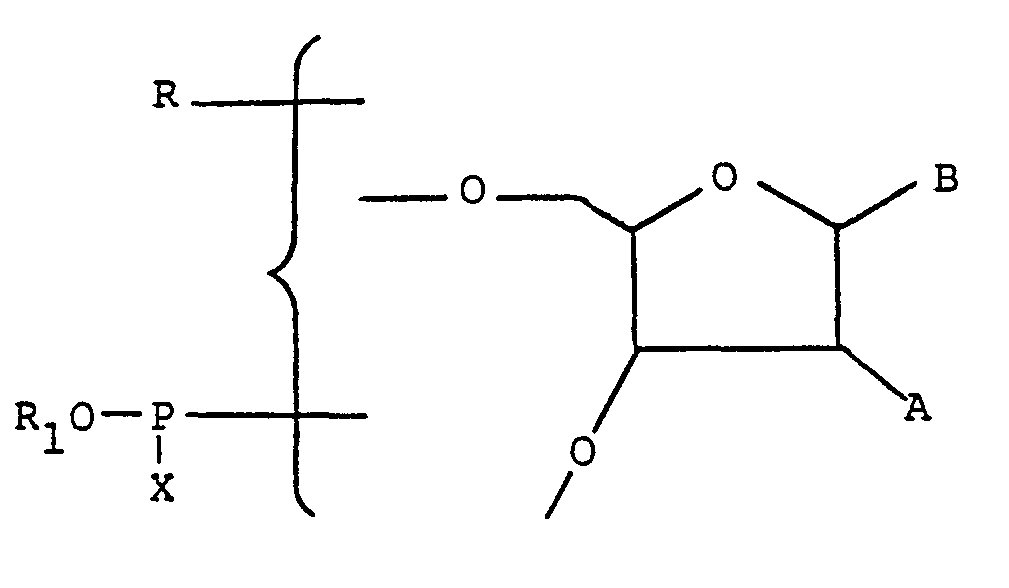
- the present invention provides a process for preparing a modified inorganic polymer represented by the formula: wherein is an inorganic polymer linked to the 3'- or 5'-0 of the nucleoside through a hydrolyzable covalent bond; R is H or a blocking group; R is a hydrocarbyl radical containing up to 10 carbon atoms; each B is a nucleoside or deoxynucleoside base; and each A is H or OR; which process comprises condensing a compound of the formula: with a compound of the formula (I): wherein A, B, , R and R, are as previously defined, and X is a secondary amino group attached through the amino nitrogen.
- the invention further provides a process for the production of an oligonucleotide or polynucleotide, which comprises the steps of:
- the present invention provides a compound of formula (I): wherein B, R, A, R, and X are as defined above.
- compounds of formula (I) are useful reagents in the preparation both of modified inorganic polymers and of oligonucleotides or polynucleotides by the process of this invention.
- the modified inorganic polymer supports with which the invention in certain aspects is concerned comprise the inorganic polymer to which is chemically bound a nucleoside.
- the chemical bonding of the nucleoside moiety to the polymer is by means of reactive groups on the polymer which react with reactive groups of the nucleoside molecule. Representative combinations of such groups are amino with carboxy to form amide linkages between the nucleoside and the support, or hydroxy with carboxy to form ester linkages between the respective moieties.
- each of the reactants must of course contain the necessary reactive groups.
- the polymer support can be provided with terminal carboxy functionality which will react with hydroxy and/or amino groups of the nucleoside.
- the nucleoside can be provided with carboxy functionality by acylation of the hydroxyl and/or amino groups using a dicarboxylic acid and the carboxy-functional nucleoside reacted with hydroxy or amino groups of the polymer support.
- Hydroxy and amino functionality where not present on the inorganic support can be introduced by known methods. For example, with silica supports, amino functionality can be introduced by reaction with aminoalkylsilyl halides.
- nucleoside moiety of the present modified inorganic polymers can include more than one nucleoside and may include a number of nucleosides condensed as oligonucleotides with the oligonucleotide being attached to the inorganic polymer support through the single chemical linkage, e.g. ester linkage.
- the thus modified inorganic polymer supports are useful in the stepwise addition of nucleosides or oligonucleotides to the original nucleoside moiety of the support by a series of process steps as described hereinafter. Subsequently, the polynucleotides so produced are released from the polymer support and recovered from the polymer by a series of process steps including alkali hydrolysis of the chemical bond between the polynucleotide and the support.
- the present invention is particularly useful in the chemical synthesis of any deoxyribonucleic acids (DNA) and ribonucleic acids (RNA) which contain any deoxynucleotides, nucleotide, polynucleotide, and polydeoxynucleotide.
- DNA deoxyribonucleic acids
- RNA ribonucleic acids
- inorganic polymers can be employed in the present invention and these include, for example, silica, porous glass, aluminosilicates, borosilicates, metal oxides such as alumina and nickel oxide, and various clays.
- the polymer should be substantially insoluble in the reaction solvents employed and relatively chemically inert to the reagents employed during processing, except of course for the .chemical reactivity required to form the hereinbefore-described chemical bond with the initial nucleoside through which the eventual polynucleoside is attached to the support.
- the process for preparing oligonucleotides or polynucleotides of the present invention is accomplished by treatment of the nucleotide or nucleoside-modified inorganic polymer support by a series of sequential steps whereby each series results in the addition of nucleotide to the modified support until the desired sequence of nucleotides is obtained.
- the series of sequential steps is as follows:
- Each nucleoside is added sequentially to the polymer support by repetition of steps a, b, c and d until the final oligonucleotide is obtained, after which the oligonucleotide may then be removed from the support by hydrolysis reaction which can also remove blocking groups from the oligonucleotide molecule.
- hydrolysis reaction which can also remove blocking groups from the oligonucleotide molecule.
- the removal of blocking groups and hydrolytic cleavage of the oligonucleotide from the support can be accomplished stepwise, which is preferred, or in a single hydrolysis reaction.
- the nucleoside-modified support is prepared by covalently coupling a nucleoside to the inorganic polymer using a suitable coupling agent through the 3'- or the 5'-OH of the starting nucleoside. This is accomplished with the starting nucleoside being blocked in either the 3'- orthe 5'-OH, and the nucleoside is coupled through the unblocked hydroxy group to the polymer support by the coupling agent. After condensation, residual reactive groups, e.g. carboxy groups, which did not react can be blocked by suitable means, e.g. conversion of carboxy groups to carboxyamide by reaction with simple amines.
- the blocked 3'- or 5'-hydroxy group is converted to free hydroxy by removal of the blocking group and the free hydroxy group is available for condensation with a selected nucleoside containing a phosphite linking groups as in step (a) hereinbefore described.
- a variety of coupling agents or groups on the polymer support can be used to covalently link the initial nucleoside or oligonucleoside to the polymer support.
- Representative groups include amino, especially primary amino, hydroxy, thiol, sulfonic acid, phosphorous and phosphoric acid, particularly in the form of acid halides, especially chloro and bromo and carboxy, among others.
- These reactive groups are conveniently attached to the polymer support commonly through a hydrocarbyl radical such as an alkylene or phenylene divalent radical, one valence position being occupied by the chain bonding and the remaining attached to the reactive groups.
- Such hydrocarbyl groups may contain up to about 10 carbon atoms, preferably up to about 6 carbon atoms.
- Alkylene radicals are usually preferred containing 2-4 carbon atoms in the principal chain.
- the nature of the reactive group which bonds the nucleoside to the polymer support is not critical provided that it is readily hydrolyzable to permit separation of the oligonucleotide product from the polymer support at the conclusion of the preparative process.
- the aforesaid coupling groups can be present on the nucleoside for reaction with reactive groups, e.g. hydroxy or amino, on the support polymer. Normally it is preferred to have the coupling groups on the polymer support.
- the process of this invention is particularly advantageous in that it provides a rapid synthetic route to oligonucleotides and oligodeoxynucleotides which is characterized by high yields and high purity.
- Each mononucleotide addition requires maximally 2-3 hours with yields of 95% and greater being obtained for each addition. Further, these same yields are obtained as the oligonucleotide grows in size.
- silica gel as the polymer support.
- a particularly preferred silica gel is macroporous silica which is used in high performance liquid chromatography (hplc).
- hplc high performance liquid chromatography
- the invention will be described using deoxynucleotides but it should be understood that ribonucleotides can be substituted therefor to obtain similar results.
- nucleoside As employed herein, the terms nucleoside, nucleotide and oligonucleotide are intended to include the deoxy counterparts which differ only in the absence of a hydroxy group in the 2' position. Thus, these terms include structures wherein the 2' position substituent is H or OH (as shown hereinafter by substituent A in formulae I, II and III).
- the silica gel support is linked to the nucleoside through a linkage which is readily hydrolyzable, preferably with a weak base such as ammonium hydroxide.
- the most preferred linkage is an ester linkage which readily hydrolyzes in a weak base such as ammonium hydroxide. This linkage can be accomplished by first linking carboxy functionality to the support or by preforming the ester linkage on the nucleoside by esterification followed by condensation of the esterified nucleoside through the esterifying acid moiety to the support.
- the nucleoside is linked to the silica gel through the 3'-OH group rather than the 5'-OH leaving the 5'-OH available for linkage through phosphite to the added nucleoside.
- linkage of the added nucleoside occurs at the 3'-OH group and the 5'-OH remains available for linkage to a further added nucleoside.
- the initial nucleoside is linked through the 3'-OH to the silica gel by the coupling reaction previously defined herein.
- This is accomplished by blocking the 5'-OH e.g. by use of trityl groups, such as the dimethoxytrityl group, which are preferred since they are readily removed after the initial 3'-OH coupling reaction occurs.
- the initial nucleoside includes amino groups, e.g. guanosine, adenosine, cytidine, deoxyguanosine, deoxyadenosine and deoxycytidine
- amino groups e.g. guanosine, adenosine, cytidine, deoxyguanosine, deoxyadenosine and deoxycytidine
- block these groups using known acylating techniques, e.g. with acetic aacid, benzoic acid, isobutyric acid and like acids and such blocking group can be removed when convenient, usually after the final oligonucleotide is obtained.
- aminoalkyl groups are incorporated on the silica gel by reaction of aminoalkyl-trialkoxysilane which is conveniently accomplished by refluxing in a solvent, e.g. toluene, for several hours.
- Suitable reagents include aminopropyltriethoxysilane, 4-aminobutyltrimethoxysilane, 4-aminobutyltriethoxysilane, 2-aminoethyltriethoxysilane and others.
- the dicarboxylic acid employed in forming the ester linkage of deoxynucleoside to the silica gel can be any of a variety such as succinic, glutaric, adipic, phthalic, maleic and similar such dicarboxylic acids of the aliphatic or aromatic type containing preferably up to about 10 carbon atoms. Esterification with the dicarboxylic acid is best accomplished by using the acid anhydride to assure monoesterification.
- the product produced i.e. the nucleoside-modified silica gel
- B is the nucleoside or deoxynucleoside base
- A is H or OR
- R is H or a blocking group, e.g.
- the deoxynucleoside-modified silica gel is condensed with a selected nucleoside through formation of a triester phosphite linkage between the 5'-OH of the deoxynucleoside of the silica gel and the 3'-OH of the selected deoxynucleoside.
- the phosphite linkage can be produced by first incorporating the phosphite group onto the 5'-OH of the nucleoside on the silica gel followed by condensation with the added nucleoside through the 3'-OH.
- the phosphite group is incorporated into the added nucleoside at the 3'-OH (the 5'-OH being blocked as by tritylating) and the resulting nucleoside phosphite then reacted with the 5'-OH of the nucleoside on the silica gel.
- the deoxynucleoside-modified silica gel can also be condensed with a selected nucleoside through formation of a triester phosphite linkage between the 3'-OH of the deoxynucleoside of the silica gel and the 5'-OH of the selected deoxynucleoside.
- the phosphite linkage can be produced by first incorporating the phosphite group onto the 3'-OH of the nucleoside on the silica gel followed by condensation with the added nucleoside through the 5'-OH.
- the phosphite group is incorporated into the added nucleoside at the 5'-OH (the 3'-OH being blocked as by tritylating using art from procedures) and the resulting nucleoside phosphite then reacted with the 3'-OH of the nucleoside on the silica gel.
- the general reaction can be represented by the following The preferred reaction is represented as follows: wherein A, B and @ are as previously defined, R is a blocking group as previously defined, R, is a hydrocarbyl radical containing up to 10 carbon atoms, preferably lower alkyl and X is a secondary amino group attached through the amino nitrogen.
- the secondary amino group represented by substituent X is preferably one which is formed by removal of the hydrogen atom from a ring nitrogen of a nitrogen heterocyclic compound which contains unsaturated bonds in the ring structure.
- nitrogen-containing heterocyclics include tetrazole, substituted imidazoles such as nitroimidazole, indole pyrazole, imidazole, benzimidazole, isoindole, pyrrole, triazole, dioxazole and similar heterocyclics, as well as analogs and homologs thereof.
- the removal of the blocking group R permits reaction with a further nucleoside i.e. a compound of formula I above and repeat reaction gives rise to the polynucleotide of determined sequence of nucleotides attached to the silica gel through the covalently-bonded linking group, e.g. ester linking group.
- a further nucleoside i.e. a compound of formula I above and repeat reaction gives rise to the polynucleotide of determined sequence of nucleotides attached to the silica gel through the covalently-bonded linking group, e.g. ester linking group.
- the phosphite linking group is introduced into the nucleoside moiety of the silica gel at the 5'-OH position or the 3'-OH position of the added nucleoside by reaction with a hydrocarbyl (as previously defined herein) phosphorodichloridite, e.g. methyl phosphorodichloridite, preferably in the presence of a base, such as an organic amine.
- a hydrocarbyl as previously defined herein
- phosphorodichloridite e.g. methyl phosphorodichloridite
- the reaction of the deoxynucleoside-modified polymer with the nucleus phosphite compound of formula I is effected in the presence of a base, such as an organic amine, preferably tertiary organic amines, e.g. pyridine, lutidines and similar amines.
- a base such as an organic amine, preferably tertiary organic amines, e.g. pyridine, lutidines and similar amines.
- a small but significant amount (about 1-5%) of the nucleoside or oligonucleotide attached to the silica gel does not react with the added nucleoside.
- These unreactive moieties preferably are capped or blocked in order to prevent the formation of several deoxyoligonucleotides with heterogeneous sequences. This capping or blocking step can be accomplished by reaction with a very reactive phosphite to form a 5'-phosphite ester group, a relatively nonhydrophobic triester.
- diethoxytriazolylphosphine can be used to form the diethyl phosphite-5'-deoxynucleoside triester.
- Corresponding di-lower alkoxy nitrogen-containing heterocyclylphosphines can be used in lieu of the triazolyl phosphine, e.g. tetrazolyl, imidazolyl and 4-nitroimidazolyl phosphine, to produce the corresponding di-lower alkyl triester.
- nitrogen-heterocycl phosphines are prepared from the corresponding phosphinyl chloride, of course, the phosphinyl chloride can be used to phosphinylate the nucleoside but the nitrogen heterocyclyl phosphines are preferred since their use leads to higher yield.
- More traditional blocking or capping groups can be employed such as acid anhydrides like acetic anhydride and arylisocyanates like phenyl isocyanate but these react more slowly with the unblocked 5'-hydroxy group.
- acid anhydrides e.g. acetic anhydride
- arylisocyanates like phenyl isocyanate
- acetylation with acid anhydrides e.g. acetic anhydride
- tertiary amines especially di-loweralkylaminopyridines like dimethylaminopyridine
- acylation occurs rapidly and this procedure is preferred for blocking especially the 5'-hydroxy group.
- the dialkylphosphite capping group can also be used.
- the resulting triester is relatively nonhydrophobic and a preferred purification involves reverse phase high performance liquid chromatography which assures separation of the nonhydrophobic by-product from the product containing the hydrophobic 5'-0-dimethoxytrityl group.
- trialkoxysilyl chloride is preferred, although blocking can also be accomplished by acylation with hydrocarbylmonocarboxylic acids, preferably containing up to 10 carbon atoms, such as acetic, benzoic, butyric, isobutyric and naphthoic acids.
- the oxidation is normally carried out using iodine as oxidizing agent using standard procedures.
- the oxidation can also be accomplished by reaction with peroxides like tertiary butyl peroxide and benzoyl peroxide as well as hydroperoxides.
- peroxides like tertiary butyl peroxide and benzoyl peroxide as well as hydroperoxides.
- the use of hydrogen peroxide can lead to the formation of side products and is not preferred.
- Oxidation should be effected before further condensation of nucleoside is attempted to obtain best yields. Attempts to defer oxidation until after all condensation reactions are completed have resulted in reduced yield of oligonucleotides due to formation of side products.
- blocking groups are accomplished by art recognized procedures using mild bases such as ammonium hydroxide whether at room temperature or at elevated temperature.
- stepwise removal of blocking groups it is preferred to first remove the alkyl group, e.g. methyl, from the phosphotriesters using triethylammonium thiophenoxide in solvent, e.g. dioxane or tetrahydrofuran. Thereafter, the product is treated with ammonium hydroxide at room temperature (20°C.) to hydrolyze the ester linkage joining the oligonucleotide to the support. Then N-acyl blocking groups, e.g. acetyl, benzoyl, and isobutyrl, are removed by warming at 50°C. for about 12 hours.
- alkyl group e.g. methyl
- trityl blocking groups are conveniently effected employing Lewis acids, particularly zinc bromide, although other Lewis acids have also been effective, e.g. AICI 3 , BF 3 and TiCl 4 .
- Lewis acids particularly zinc bromide
- other Lewis acids have also been effective, e.g. AICI 3 , BF 3 and TiCl 4 .
- nitromethane is used as solvent for this reaction although other solvents such as tetrahydrofuran can be used, as well as mixed solvents such as nitromethane and a lower alkanol, such as methanol.
- protic acids such as toluene-sulfonic acid can be used to remove the blocking group.
- purine nucleoside-containing products however, some depurination can occur when protic acids are employed and therefore the use of Lewis acids is preferred for removal of the blocking group from purine containing products.
- oligonucleotides containing up to 10-30 nucleoside units can be produced.
- the oligonucleotides can be converted by T 4 -ligase and T-4 kinase to form a DNA sequence of choice by known enzymological reactions.
- the products as obtained after hydrolysis can be purified by standard procedures after separation from the inorganic polymer support.
- the final purification is preferably by reverse phase hplc of the 5'-0-dimethoxytrityloligonucleotide as previously mentioned herein, followed by removal of the dimethoxytrityl group, e.g. using a lower alkanoic acid such as acetic acid.
- the accompanying drawing is a schematic flow diagram of an apparatus which can be used to prepare oligonucleotides and polynucleotides by the process of the present invention.
- the column 10 is packed appropriately with solid silica gel matrix 12, derivatized as described herein.
- Valve 14 is appropriately programmed under control of valve controller 15 to select among the four active reagents contained in reservoirs 16, 18, 20, and 22, and the wash solvents contained in reservoirs 24 and 26. Valve 14 will permit the independent selection from any reservoir in any order without the need to sequence through intervening reservoirs. Thus, for example, the reagent from reservoir 16 may be selected, and immediately thereafter the wash solvent from reservoir 24. These reagents are required for chain elongation in accordance with the teaching of the method of this invention and are maintained at room temperature for use therein.
- Valve 28 is appropriately programmed under control of controller 15' to select among the five nucleoside-active phosphite triester contained in reservoirs 30, 32, 34, 36 and 38, and the wash solvent in reservoir 40. Once again, valve 28 permits independent selection (to prevent cross contamination) as described above. In addition, the reservoirs 30-38 are designed to maintain the adducts at -78°C. and the valve 28 to allow for the passage therethrough at this temperature.
- Valve 42 is under the control of programmed controller 15" for the selection of cleavage reagents contained in reservoirs 44 and 46 and a wash solvent in reservoir 48. These reagents and solvent are necessary to cleave the oligonucleotide from the support matrix 12 in column 10 and are maintained at room temperature.
- valve 50 operates in conjunction with pump 56 to selectively convey solvents, reagents or adducts from the valve 14, 28 and 42 towards the valve 52.
- this valve 52 under suitable control of a valve controller (not illustrated) selects between flow through the column 10 and uv detector 58 or recycling through column 10.
- Valve 54 is controlled to direct the flow from uv detector either to waste or collection.
- the uv detector 58 is utilized in the control of the system, through suitable feedback control means (not illustrated).
- Table I The programmed operation of the system is illustrated schematically in Table I below. This program illustrates the protocol for the addition of one nucleoside and then cleavage of the chain from support 12. It will be apparent that the system may be expanded and/or modified to accommodate the addition of more than one nucleotide, and that the entire system will preferably operate under control of a suitably programmed microprocessor computer.
- the apparatus has particular applicability for automated operation, details of which are within the preview of one skilled in the art.
- silica gel which is used as starting material in the production of the modified silica gels of the present invention is not critical.
- Silica gel particles in the range of from about 5 11m to about 1000 11m are useful, with particles in the range of about 10 11m to about 50 ⁇ m being preferred.
- pore size is not critical. Pore sizes in the range of about 50 A to about 2000 A are preferred.
- the modified silica gels of the present invention (1) allow relatively rapid diffusion of activated nucleotides, and other reagents into the support; (2) avoid swelling; and (3) resist adsorption of reagents. Additionally, the modified silica gels of the present invention are (1) insoluble in most solvents; (2) in use as support matrices, allow solvents and unwanted reaction products to be easily washed from the matrix, while maintaining the desired reaction products in place and capable of continuous processing; and (3) allow the supported material to react relatively rapidly and in high yield, for example, in cylindrical condensation.
- the modified silica gel employed to react with the initial nucleoside of the oligonucleotide chain to form the initial reactive material is prepared by art-recognized procedures.
- the production of a variety of functional groups on the surface of the silica gel suitable for reaction with the hydroxy (3'- or 5'-) of the initial nucleoside can be effected using known methods, e.g. methods described in U.S. Patents 3,519,538; 3,419,517; 3,652,761; and 3,669,841.
- the preferred method for the present invention is to introduce amino functionality on the silica by reaction with an aminoalkyl silane derivative, e.g. by reaction of a trialkoxy 3-aminopropylsilane such as triethoxy 3-amino-propylsilane with the silica support to form the covalent linkage: and the amino group is reacted with one carboxy group of a dicarboxylic acid therefor giving rise to carboxy functionality on the silica gel where condensation of amino and carboxy occur.
- the silica gel can next be treated to block unreacted silanol groups with suitable blocking agents, e.g. trialkylhalosilanes such as trimethylchlorosilane or the bromo analog.
- the resulting carboxy-derivatized silica can then be reacted with the hydroxy group (3'- or 5'-) of the first added nucleoside.
- the dicarboxylic acid can be reacted with the selected nucleoside to form a monoester at the 3'-O or 5'-O and the resulting ester containing a free carboxy group in the esterifying radical can be condensed with the amino-derivatized silica to form the same covalent linkage between nucleoside and silica support.
- Any unreacted amino groups of the amino-derivatized silica gel are preferably blocked by acylation with monocarboxylic acids such as acetic, benzoic or isobutyric acids normally employing the acid anhydrides under acylating conditions.
- the structure of the covalent linkage between the first nucleoside and the silica support is not critical as long as a substantially stable but hydrolysable covalent linkage is formed to bind the nucleoside during the sequential nucleoside addition cycles.
- the covalent linkage therefore should be stable to the sequential reaction conditions but should be reasonably readily hydrolyzable to permit recovery of the formed oligonucleotide after completion of nucleoside addition.
- ester and amide linkages are particularly effective with the desired degree of stability and, at the same time, being readily hydrolyzable after nucleoside addition is completed using weak or strong bases.
- nucleotides and polynucleotides are according to the IUPAC-IUB Commission of Biochemical Nomenclature Recommendations [(1970) Biochemistry 9, 4022].
- Polymer supports functionalized with carboxylic acid groups are prepared from silica gel.
- a separation group silica gel supplied by Vydak as TP silica, having 20 um particle size, 300 A pore size is used as the starting material.
- the silica gel was placed in a desicator over a saturated LiCI solution for 24 hours.
- the initial step in the process is silylation by refluxing 3-aminopropyltriethoxysilane (2.3 g, 0.01 M) with the silica gel (2.6 g) in dry toluene.
- silylation is substantially complete, in this case after about twelve hours of refluxing, the reaction mixture is cooled and the toluene solution removed.
- the thus silylated silica gel is then washed serially with toluene, ethanol and then with ether and air dried.
- Succinic anhydride (2.5 g, 0.025 M) in water is next reacted with the silane modified silica gel to provide carboxylic acid functionality to the terminal portion of the covalently bonded silane side chains.
- the pH is maintained between 4 and 6 by addition of a base, such as 2 N sodium hydroxide.
- a base such as 2 N sodium hydroxide.
- the modified silica gel is then treated with trimethylsilylchloride [(CH 3 ) 3 SiCl, 1.09 g, 0.01 M] in anhydrous pyridine by refluxing for about 12 hours.
- the resulting modified silica gel is then washed with 5% trichloroacetic acid in water, then with water, and then with ethanol and ether. After drying in vacuum, the yield of carboxylic acid functionality on the modified silica gel is about 250 pmole/g.
- the composition is first treated with dicyclohexylcarbodiirnide and p-nitrophenol and then piperidine in pyridine for a second time. After removal of the dimethoxytrityl group using 0.1 N p-toluenesulfonic acid in acetonitrile, the yield of thymidine attached to the support is found by spectrophotometry to be about 40 pmole/g.
- silica gel (Vydac A, 25 gms) was placed in a desicator over a saturated LiCI solution for 24 hr. The silica gel was transferred to a 500 ml round bottom flask, toluene (250 ml) and aminopropyltriethoxysilane (13 ml) were added, the flask was tightly sealed, and the suspension was gently shaken for 12 h at room temperature. The flask containing the suspended silica gel was next refluxed for 18 h. Before starting the reflux, add one boiling chip to the solution. Following the reflux step, the silica gel suspension was transferred to a centrifuge bottle and the silica gel pelleted by a low speed spin.
- the supernatant was decanted and the silica gel was washed with toluene (3 X, 80 ml ea), methanol (3 X, 80 ml ea) and methanol:H 2 0, 1:1 (2 X, 80 ml ea).
- the silica gel was next suspended in 80 ml 50% aqueous methanol and shaken overnight at room temperature. Once again the silica gel suspension was isolated by transfer to a centrifuge bottle followed by a low speed spin.
- the silica gel was next washed with methanl (2 X, 80 ml ea) and ethyl ether (3 X, 80 ml ea). Finally, the silica gel was air dried for 6 h and then dried in vacuo.
- the silica gel was placed in a round bottom flask. A solution of dry pyridine (50 ml) and trimethylsilyl chloride was added and the suspension shaken at room temperature overnight. The silica was isolated by low speed centrifugation. The silica was then washed with methanol (5 X, 80 ml) and ethyl ether (3 X, 80 .ml). The silica gel was air dried for 6 h and then dried in vacuo.
- pyridine is added to the methylene chloride solution in order to minimize detritylation while drying over sodium sulfate.
- the methylene chloride solution is concentrated to 10 ml and the succinylated nucleoside isolated by precipitation into hexane:ether (1:1, v/v; 250 ml). The precipitate is collected by centrifugation and dried in vacuo.
- Silica gel prepared as outlined in A of this example (5 g if 50 p mole nucleoside/g desired; 2.5 g if 100u mole nucleoside/g desired) was suspended in dry DMF. The p-nitrophenylsuccinylated nucleoside derivative (supernatant prepared herein) was added to the silica gel and the resulting suspension was shaken for two hours. An aliquot of silica gel (approx. 1 mg) was then removed for analysis.
- the bulk of the silica gel was washed with DMF (3 X, 10 ml ea), dioxane (3 X, 10 ml ea), methanol (5 X, 10 ml ea), and ethyl ether (3 X, 10 ml ea). Unreacted n-propylamino silyl groups were then blocked with a solution of acetic anhydride (0.7 ml) and dry pyridine (5 ml). The silica gel was isolated by centrifugation, decanting and repeated washing with methanol (4 X, 10 ml ea) and ethyl ether (2 S, 10 ml ea).
- the assay for completeness of the capping or blocking of n-propylamino groups is as follows.
- succinylated n-propylamino groups With some preparations, a contaminant of succinylated n-propylamino groups will result from the presence of succinic acid.
- This succinic acid may be present because all the succinic anhydride was not consumed during the succinylation or alternatively was not removed as succinic acid during the aqueous extraction with citric acid.
- succinylated n-propylamino groups are present, they can be blocked in the following manner.
- the protected silica gel containing succinylated nucleoside either 5 g or 2.5 g
- Morpholine (0.2 ml) was then added and the suspension shaken for 10 minutes.
- Silica gel was isolated after centrifugation, decantation of the supernatant, and washing the silica gel with methanol (4 X, 10 ml ea), THF (3 X, 10 ml ea) and ethyl ether (3 X, 10 ml ea). After air drying, the silica gel was dried in vacuo.
- a quantitative assay for the trityl cation and therefore the loading of nucleoside on the silica gel is as follows:
- the loading should be approximately 40 11 mole/g. If 2.5 gm silica gel was used, the loading will be approximately 100 p mole/g.
- the amino groups such as those on cytosine, adenine and guanine are protected. Protection of these groups is not a necessary part of this process but does enhance nucleoside solubilities in the appropriate solvents.
- Benzoyl, trityl (as previously defined herein) or isobutyryl groups provide suitable protecting groups, although other protecting groups can be used without altering this process.
- Protected nucleosides produced with good yields include 5'-O-dimethoxy-trityl-deoxythymidine [DMTrd(T)], 5'-O-dimethoxytrityl-N-benzoyldeoxycytidine (DMTrd(bzC)], 5'-O-dimethoxytrityl-N-benzoyl- deoxyadenosine (DMTrd(bzA)], and 5'-O-dimethoxytrityl-N-isobutyryldeoxyguanosine (DMTrd(ibG)] as protected nucleosides.
- a typical synthesis as illustrated with deoxyadenosine is as follows.
- This example illustrates the use of purine deoxynucleotides.
- DMTrd(bzA) (.66 g, 1 mmole) in dry THF (3 ml) is added dropwise under an argon atmosphere to a stirred solution of the THF (3 ml) contianing methyldichlorophosphite (.113 ml, 1.2 mmole) and 2, 4, 6 trimethylpyridine (.633 ml, 4.8 mmole) at -78°C. After 10 minutes at -78°C, the reaction solution is filtered through a sintered glass funnel and solvent is removed by concentration in vacuo.
- Excess methyl phospho- dichloridite is removed by dissolving the resulting gum in toluene: THF (2 ml, 2:1) and re-evaporating in vacuo to a gum. This procedure is repeated several times to insure removal of the dichloridite.
- the nucleoside phosphomonochloridite is converted to the tetrazolide.
- the gum resulting from the final re- evaporation is dissolved in THF (2 ml).
- a solution of tetrazole (.063 g, 0.9 mmole) in THF (2 ml) is then added dropwise with stirring at -78°C to the nucleoside phosphomonochloridite.
- this solution contains the activated nucleoside methylphosphomonotetrazolide. If not used immediately, this tetrazolide can be placed in long term storage after precipitation by dropwise addition into dry pentane, followed by collection, drying in vacuo, and storing in sealed tubes under argon or other inert gas at -20°C. All operations are performed under inert gas to avoid oxidation. At no time is the active agent exposed to air.
- the foregoing procedure is applicable for the preparation of activated thmidine, deoxycytidine, and deoxydenosine nucleotides.
- the procedure is the same except for the stoichiometry.
- the molar ratio of DMTrd(ibG): methyldichlorophosphite; 2, 4, 6 trimethylpyridine and tetrazole is 1:0.9:3.8:0.7.
- the removal of the dimethoxytrityl group from the nucleotide is accomplished by exposing the modified silica gel support to 0.1 M ZnBr 2 is nitromethane for 15 to 30 minutes. The support is then washed initially with butanol: 2, 6 lutidine: THF (4:1:5 by volume) and finally with THF. The solvent ratio is not important since this step is used to remove potential zinc esters of nucleosides. This step could be eliminated but lower yields may result.
- Other Lewis acids could be substituted for ZnBr 2 , such as BF 3 , AICI 3 and TiC1 4 . However ZnBr 2 is preferred. Protic acids can also be used.
- the next step in the process is condensation of the protected and activated nucleotide to the nucleoside or oligonucleotide covalently bound to the support. This is accomplished by using 10-15 equivalents of the activated monotetrazolide and a reaction time of about one hour.
- the solvent is anhydrous THF. This process may also be used for the addition of the activated monochloridites, triazolides and nitroimidazolides. However, best results were obtained with the tetrazolide.
- the next step in the process is the blocking of unreated 5'-hydroxyl groups.
- This step can be eliminated or other reagents that react with 5'-hydroxyl groups and are compatible with the overall chemistry can be substituted therefore.
- the final purification of the desirable oligonucleotide is rendered much easier. This is because the complexity of the total synthetic material bound to the support is reduced considerably.
- the final step in each cycle is oxidized of the phosphite to the phosphate.
- a composition of 0.1 M1 2 in water/2,6 lutidine/THF (1:1:3) is preferred, although other ratios can be used.
- other oxidizing agents such as N-chlorosuccinimide or aryl or alkyl peroxides could also be used.
- T-butyl peroxide is presently preferred as oxidizing agent.
- the deoxyoligonucleotide is freed from protecting groups, isolated and characterized.
- the methyl group is removed from phosphotriesters using triethylammonium thiophenoxide in dioxane.
- the step is followed by treatment with concentrated NH 4 0H which removes amino protecting groups and frees the oligonucleotides from the support.
- the major product from each synthesis as determined by high performance liquid chromatography, is found to be the desired oligonucleotide.
- the compounds of formula I herein are new compounds which are particularly useful in forming the requisite phosphorus linkage, being more reactive and consequently more efficient than the corresponding prior art compounds of formula I wherein X is halogen. These compounds are readily prepared from the compounds in which X is halogen (as described, for example, in Example 3) or can be formed by reaction of a halo-(2' amino)-alkoxy-phosphine with the selected nucleotide.
- Example 3 illustrates the preparation of a tetrazolide and use thereof in forming the necessary phosphorus linkage.
- a variety of such compounds are prepared using tetrazole, nitroimidazole and triazole as well as various nucleosides to obtain the corresponding nucleoside phosphonomonamine.
- such compounds include as nucleoside base thymine, cytosine, adenosine and guanine and such compounds are further protected with blocking groups as required, e.g. benzoyl groups on the amino groups of cytosine and adenine as well as isobutyryl on the amino group of guanine.
- 5'-O-Dimethoxytritylthymidine, 5'-O-dimethoxytrityl-N-benzoyldeoxycytidine, 5'-O-dimethoxytrityl-N-isobutyryl deoxyguanosine and 5'-0-dimethoxytrityl-N-benzoyldeoxyadenosine were converted to activated nucleoside by introduction of the requisite tetrazolide group using the following procedure.
- a white precipitate of collidine hydrochloride formed during the addition.
- the mixture was stirred an additional 10 min at -78° and then transferred using positive argon pressure and a cannula to a centrifuge tube filled with argon.
- the supernatant recovered after centrifugation contained the tetrazolylphosphite product which can be used directly for synthesis of deoxyoligonucleotides.
- the tetrazolylphosphite can be stored as a precipitate and reconstituted as needed.
- phosphites i.e. activated nucleotides
- the apparatus consists of a Milton Roy Minipump, three way Altex slide valves, a recycle valve (a modified Altex valve) and an injector loop (a three way Altex valve). All connections were with teflon tubing and were designed to minimize the tubing volume in the recycle loop.
- the column was an 11 mm Ace glass column that had been shortened to approximately 1 ml capacity.
- Cellulose filters were used to support the silica bed. The filtered were acetylated with a solution of acetic anhydride and pyridine (1:1 based on volume) for 4 h at 50° before use.
- the total volume contained within the recycle loop of this apparatus was approximately 2.5 ml.
- the tetrahydrofuran reservoir was protected from air with a nitrogen bubbler and the ZnBr 2 solution was protected from moisture with the Drierite tube.
- the condensation step was next completed using activated nucleotide that had been reconstituted using dry tetrahydrofuran.
- the reconstituted solution was stored in a dry ice/acetone bath over argon but condensation reactions were carried out at room temperature.
- activated nucleotide stored in this way was stable for several days.
- Approximately 10 equivalents of activated nucleotide (100 p mole for 0.25 g of 4) in 0.5 to 0.8 ml of tetrahydrofuran was injected into the apparatus and the machine switched to the recycle mode.
- the activated nucleotide was circulated through the silica gel for 1 h at a pump speed of 2 ml/min.
- the next step involves capping unreacted 5'-O-fiydroxyls by adding diethoxytriazoylphosphine (1 ml of a 0.3 M solution in tetrahydrofuran directly to the solution of activated nucleotide and continuing the recycle mode for 5 min at a pump speed of 2 ml/min. Residual activated nucleotide and the capping reagent were then flushed from the apparatus using dry tetrahydrofuran (2 min at 5 ml/min). This step was followed by oxidation of phosphites using a solution of tetrahydrofuran:2,6- lutidine:water (2:1:1) containing 0.2 M 1 2 .
- deoxyoligonucleotides Isolation of Deoxyoligonucleotides.
- the completely deprotected deoxyoligonucleotides were isolated by the following procedure. An aliquot (10 mg) of the silica gel containing the deoxyoligonucleotide triester in protected form was first treated with thiophenol:triethylamine:dioxane (1:1:2, v/v). After 45 min of gentle shaking, the silica gel was recovered by centrifugation and washed with methanol (4 times) and ethyl ether. After air drying, the deoxyoligonucleotide was removed from the support by a three hour treatment with concentrated ammonium hydroxide at 20° followed by centrifugation.
- Base protecting groups were removed by warming the supernatant at 50° for 12 h in a sealed tube.
- the 5'-O-dimethoxy- trityldeoxyoligonucleotide was isolated by concentrating the hydrolysate in vacuo, dissolving the residue in 0.1 M triethylammonium acetate (pH 7.0) and chromatographing this material on a C 18 reverse phase hplc column (Waters Associates).
- the eluting buffer was 0.1 M triethylammonium acetate containing 26% acetonitrile.
- the peak containing 5'-0-dimethoxytrityldeoxyoligonucleotide was concentrated in vacuo and the residue was treated at 20° for 15 min with acetic acid-water (4:1, v/v) to remove the 5'-O-dimethoxytrityl group.
- the completely deprotected deoxyoligonucleotide was isolated by concentration of the acetic acid solution in vacuo, dissolving the residue in 25 mM triethylammonium bicarbonate (pH 7), the extraction of dimethoxytritanol with water saturated ether.
- silica was divided into two approximately equal portions. One portion was elongated to the deoxydecanucleotide in standard fashion. The overall yield was 64% based on the amount of dimethoxy- trityl group bound to the support and 30% ' was the yield isolated from a reverse phase hplc column.
- the procedures described in the foregoing examples can also be used for synthesizing mixed nucleoside and deoxynucleoside oligonucleotides by the simple expediency of inserting the desired nucleoside moiety at the desired point in the sequence.
- the present process in addition to being useful for production of oligomucleotides of natural sequence of the individual nucleosides, can be used to produce synthetic oligonucleotides hitherto unknown in natural occurrence which can be useful in research and synthesis of polynucleotides, and eventually genes for use in biological systems.
- a particularly preferred embodiment of the present invention is the detritylation of the 5'-0 trityl nucleosides, deoxynucleotides, oligonucleotides, oligodeoxynucleotides, polynucleotides and polydeoxy- nucleotides using a Lewis acid, particularly zinc bromide, although other Lewis acids can also be employed, e.g. titanium tetrachloride.
- Lewis acids is superior to the use of protic acids for removal of the trityl group from the 5"-0- position since reaction is extremely fast and is not accompanied by depurination.
- the process is also specific for 5'-O-trityl and thus provides a very practical procedure to permit production of 3'-0-trity) blocked nucleosides by reaction with the 3'-0- and 5'-0 ditritylated compound.
- the procedure merely requires contacting the reactants preferably in a reaction solvent and detritylation occurs within short reaction times.
- the Lewis acid is normally suspended in the reaction solvent and the solvent is usually water-free to prevent reaction with the Lewis acid to form protic acids.
- nitromethane is the preferred solvent although a variety of other solvents can be used, e.g. dioxane and tetrahydrofuran and mixtures of such solvents with each other and other solvents such as acetone, methylene chloride, and the like.
- the detritylation procedure is not restricted to polymer support synthesis but is also useful for strictly solution synthesis procedures where the use of trityl groups is included in the reaction sequence.
Landscapes
- Chemical & Material Sciences (AREA)
- Organic Chemistry (AREA)
- Biochemistry (AREA)
- Health & Medical Sciences (AREA)
- Molecular Biology (AREA)
- Life Sciences & Earth Sciences (AREA)
- Engineering & Computer Science (AREA)
- Biotechnology (AREA)
- General Health & Medical Sciences (AREA)
- Genetics & Genomics (AREA)
- Chemical Kinetics & Catalysis (AREA)
- Saccharide Compounds (AREA)
- Addition Polymer Or Copolymer, Post-Treatments, Or Chemical Modifications (AREA)
- Polymers With Sulfur, Phosphorus Or Metals In The Main Chain (AREA)
Claims (34)




Priority Applications (2)
| Application Number | Priority Date | Filing Date | Title |
|---|---|---|---|
| DE8181101445T DE3177103D1 (en) | 1980-02-29 | 1981-02-27 | Process for producing modified inorganic polymers, their use in producing polynucleotides, and a reagent useful in these processes |
| AT81101445T ATE46519T1 (de) | 1980-02-29 | 1981-02-27 | Verfahren zur herstellung modifizierter anorganischer polymere, deren verwendung in verfahren zur herstellung von polynukleotiden sowie eine reagenz zur verwendung in diesen verfahren. |
Applications Claiming Priority (2)
| Application Number | Priority Date | Filing Date | Title |
|---|---|---|---|
| US12602580A | 1980-02-29 | 1980-02-29 | |
| US126025 | 1980-02-29 |
Related Child Applications (3)
| Application Number | Title | Priority Date | Filing Date |
|---|---|---|---|
| EP85200673.3 Division-Into | 1981-02-27 | ||
| EP83104852A Division EP0097805A3 (de) | 1980-02-29 | 1981-02-27 | Nukleoside Phosphit-Derivate |
| EP83104852.5 Division-Into | 1981-02-27 |
Publications (3)
| Publication Number | Publication Date |
|---|---|
| EP0035719A2 EP0035719A2 (de) | 1981-09-16 |
| EP0035719A3 EP0035719A3 (en) | 1981-11-18 |
| EP0035719B1 true EP0035719B1 (de) | 1989-09-20 |
Family
ID=22422602
Family Applications (4)
| Application Number | Title | Priority Date | Filing Date |
|---|---|---|---|
| EP81101445A Expired EP0035719B1 (de) | 1980-02-29 | 1981-02-27 | Verfahren zur Herstellung modifizierter anorganischer Polymere, deren Verwendung in Verfahren zur Herstellung von Polynukleotiden sowie eine Reagenz zur Verwendung in diesen Verfahren |
| EP83104852A Withdrawn EP0097805A3 (de) | 1980-02-29 | 1981-02-27 | Nukleoside Phosphit-Derivate |
| EP81101444A Expired EP0035255B1 (de) | 1980-02-29 | 1981-02-27 | Verfahren zum Entfernen von Trityl-Schutzgruppen aus 5'-O-trityl-Nukleosiden und Oligonukleotiden |
| EP85200673A Expired - Lifetime EP0173356B1 (de) | 1980-02-29 | 1981-02-27 | Verfahren zur Herstellung von modifizierten anorganischen Polymeren |
Family Applications After (3)
| Application Number | Title | Priority Date | Filing Date |
|---|---|---|---|
| EP83104852A Withdrawn EP0097805A3 (de) | 1980-02-29 | 1981-02-27 | Nukleoside Phosphit-Derivate |
| EP81101444A Expired EP0035255B1 (de) | 1980-02-29 | 1981-02-27 | Verfahren zum Entfernen von Trityl-Schutzgruppen aus 5'-O-trityl-Nukleosiden und Oligonukleotiden |
| EP85200673A Expired - Lifetime EP0173356B1 (de) | 1980-02-29 | 1981-02-27 | Verfahren zur Herstellung von modifizierten anorganischen Polymeren |
Country Status (7)
| Country | Link |
|---|---|
| EP (4) | EP0035719B1 (de) |
| JP (4) | JPS56133299A (de) |
| AT (2) | ATE7702T1 (de) |
| AU (2) | AU550148B2 (de) |
| CA (2) | CA1159052A (de) |
| DE (2) | DE3177215D1 (de) |
| MX (1) | MX158743A (de) |
Cited By (1)
| Publication number | Priority date | Publication date | Assignee | Title |
|---|---|---|---|---|
| US6825339B2 (en) | 1993-12-16 | 2004-11-30 | Proligo, Llc | Apparatus for preparing polynucleotides on a solid support |
Families Citing this family (29)
| Publication number | Priority date | Publication date | Assignee | Title |
|---|---|---|---|---|
| WO1982003079A1 (en) * | 1981-03-10 | 1982-09-16 | Inc Bioresearch | Rapid solid phase synthesis of oligonucleotides using phosphorus oxychloride activation |
| US4415732A (en) * | 1981-03-27 | 1983-11-15 | University Patents, Inc. | Phosphoramidite compounds and processes |
| JPS58148896A (ja) * | 1982-02-26 | 1983-09-05 | Shimadzu Corp | Dna等微量自動合成装置 |
| DE3208565A1 (de) * | 1982-03-10 | 1983-11-10 | Köster, Hubert, Prof. Dr., 2000 Hamburg | Verfahren zur abspaltung von tritylschutzgruppen |
| EP0090789A1 (de) * | 1982-03-26 | 1983-10-05 | Monsanto Company | Chemische DNA-Synthese |
| US4474948A (en) * | 1982-04-08 | 1984-10-02 | Biosearch | Benzazolides and their employment in phosphite ester oligonucleotide synthesis processes |
| IL69196A0 (en) * | 1982-08-20 | 1983-11-30 | Genex Corp | Solid phase synthesis of oligonucleotides |
| JPS60500535A (ja) * | 1982-12-29 | 1985-04-18 | サザン イリノイ ユニバ−シテイ フアウンデイシヨン | ポリヌクレオチドの製造方法 |
| FR2544720B1 (fr) * | 1983-04-19 | 1987-11-27 | California Inst Of Techn | Installation perfectionnee et procede pour la synthese de composes chimiques, en particulier d'oligonucleotides |
| DE3329892A1 (de) | 1983-08-18 | 1985-03-07 | Köster, Hubert, Prof. Dr., 2000 Hamburg | Verfahren zur herstellung von oligonucleotiden |
| US5539097A (en) * | 1983-09-02 | 1996-07-23 | Molecular Biosystems, Inc. | Oligonucleotide polymeric support system |
| JPS61152695A (ja) * | 1984-12-26 | 1986-07-11 | Nippon Shinyaku Co Ltd | 長鎖dnaの合成法 |
| US4818681A (en) * | 1985-02-22 | 1989-04-04 | Molecular Diagnostics, Inc. | Fast and specific immobilization of nucleic acids to solid supports |
| EP0229053A1 (de) * | 1985-06-14 | 1987-07-22 | University Patents, Inc. | Herstellungsverfahren für deoxyoligonukleotide |
| FR2596761B1 (fr) * | 1986-04-08 | 1988-05-20 | Commissariat Energie Atomique | Derives de nucleosides et leur utilisation pour la synthese d'oligonucleotides |
| US5071974A (en) * | 1986-10-31 | 1991-12-10 | Amoco Corporation | Compositions and methods for the synthesis of oligonucleotides having 5'-phosphorylated termini |
| DE3801987A1 (de) * | 1988-01-23 | 1989-07-27 | Boehringer Mannheim Gmbh | Traeger zur chemischen oder/und enzymatischen umsetzung von nukleinsaeuren oder nukleinsaeurefragmenten an festphasen |
| SE9003743D0 (sv) * | 1990-11-26 | 1990-11-26 | Pharmacia Ab | Method and means for oligonucleotide synthesis |
| CA2114355A1 (en) * | 1993-01-29 | 1994-07-30 | Hidehiko Furukawa | Modified oligodeoxyribonucleotides, their preparation and their therapeutic use |
| US5503816A (en) * | 1993-09-27 | 1996-04-02 | Becton Dickinson And Company | Silicate compounds for DNA purification |
| US5874554A (en) * | 1996-12-13 | 1999-02-23 | Incyte Pharmaceuticals, Inc. | Methods and solvent vehicles for reagent delivery in oligonucleotide synthesis using automated pulse jetting devices |
| DE69825722T2 (de) * | 1998-02-04 | 2005-08-25 | Corning Inc. | Substrat zum Drucken einer Matrize |
| US6399765B1 (en) * | 1999-03-17 | 2002-06-04 | Isis Pharmaceuticals, Inc. | Methods for removing dimethoxytrityl groups from oligonucleotides |
| ES2250221T3 (es) * | 1999-11-10 | 2006-04-16 | Merckle Gmbh | Procedimiento y dispositivo par ala preparacion de oligomeros y conjuntos de oligomeros asi como el uso del dispositivo. |
| ATE289610T1 (de) * | 2000-09-07 | 2005-03-15 | Avecia Biotechnology Inc | Synthone zur herstellung von oligonukleotiden |
| US7838912B2 (en) | 2004-09-30 | 2010-11-23 | Waseda University | Semiconductor sensing field effect transistor, semiconductor sensing device, semiconductor sensor chip and semiconductor sensing device |
| US7396676B2 (en) | 2005-05-31 | 2008-07-08 | Agilent Technologies, Inc. | Evanescent wave sensor with attached ligand |
| WO2007074399A2 (en) * | 2005-06-06 | 2007-07-05 | Medichem, S.A. | Process for the preparation of tetrazolyl compounds |
| WO2022022480A1 (zh) * | 2020-07-27 | 2022-02-03 | 南京金斯瑞生物科技有限公司 | 一种半导体芯片的表面连接体及其制备方法和应用 |
Citations (3)
| Publication number | Priority date | Publication date | Assignee | Title |
|---|---|---|---|---|
| DE1113937B (de) * | 1959-11-13 | 1961-09-21 | Shell Int Research | Verfahren zur Herstellung von heterocyclischen Amiden der Phosphorsaeure |
| EP0040099A1 (de) * | 1980-05-14 | 1981-11-18 | ens BIO LOGICALS INC. | Polynukleotid-Synthese |
| EP0061746A1 (de) * | 1981-03-27 | 1982-10-06 | University Patents, Inc. | Phosphoramiditderivate und ihre Verwendung für die Produktion von Oligonukleotiden |
Family Cites Families (2)
| Publication number | Priority date | Publication date | Assignee | Title |
|---|---|---|---|---|
| US3557077A (en) * | 1967-09-18 | 1971-01-19 | Kay Brunfeldt | Reactions system |
| US3531258A (en) * | 1967-11-16 | 1970-09-29 | Us Health Education & Welfare | Apparatus for the automated synthesis of peptides |
-
1981
- 1981-02-27 AU AU67943/81A patent/AU550148B2/en not_active Expired
- 1981-02-27 CA CA000371992A patent/CA1159052A/en not_active Expired
- 1981-02-27 DE DE8585200673T patent/DE3177215D1/de not_active Expired - Lifetime
- 1981-02-27 MX MX186167A patent/MX158743A/es unknown
- 1981-02-27 EP EP81101445A patent/EP0035719B1/de not_active Expired
- 1981-02-27 DE DE8181101444T patent/DE3163811D1/de not_active Expired
- 1981-02-27 AU AU67942/81A patent/AU542967B2/en not_active Expired
- 1981-02-27 EP EP83104852A patent/EP0097805A3/de not_active Withdrawn
- 1981-02-27 EP EP81101444A patent/EP0035255B1/de not_active Expired
- 1981-02-27 CA CA000371946A patent/CA1168229A/en not_active Expired
- 1981-02-27 AT AT81101444T patent/ATE7702T1/de not_active IP Right Cessation
- 1981-02-27 AT AT85200673T patent/ATE56723T1/de not_active IP Right Cessation
- 1981-02-27 EP EP85200673A patent/EP0173356B1/de not_active Expired - Lifetime
- 1981-02-28 JP JP2927281A patent/JPS56133299A/ja active Pending
- 1981-02-28 JP JP2927381A patent/JPS56138199A/ja active Granted
-
1988
- 1988-01-21 JP JP63009782A patent/JPS63225395A/ja active Granted
-
1989
- 1989-11-29 JP JP1310496A patent/JPH0327395A/ja active Pending
Patent Citations (3)
| Publication number | Priority date | Publication date | Assignee | Title |
|---|---|---|---|---|
| DE1113937B (de) * | 1959-11-13 | 1961-09-21 | Shell Int Research | Verfahren zur Herstellung von heterocyclischen Amiden der Phosphorsaeure |
| EP0040099A1 (de) * | 1980-05-14 | 1981-11-18 | ens BIO LOGICALS INC. | Polynukleotid-Synthese |
| EP0061746A1 (de) * | 1981-03-27 | 1982-10-06 | University Patents, Inc. | Phosphoramiditderivate und ihre Verwendung für die Produktion von Oligonukleotiden |
Non-Patent Citations (2)
| Title |
|---|
| Nucleic Acid Research, 7 (1979), 1955-64, Tetrahedron Letters 21 (1980) 2265-8 * |
| TETRAHEDRON LETTERS, no. 16, 1972, pages 1531-1534, Permagon Press, GB. H. KOSTER et al.: "Polymer support oligonucleotide synthesis. VIII). Use of Sephadex LH 20" * |
Cited By (1)
| Publication number | Priority date | Publication date | Assignee | Title |
|---|---|---|---|---|
| US6825339B2 (en) | 1993-12-16 | 2004-11-30 | Proligo, Llc | Apparatus for preparing polynucleotides on a solid support |
Also Published As
| Publication number | Publication date |
|---|---|
| JPH0259158B2 (de) | 1990-12-11 |
| EP0173356A2 (de) | 1986-03-05 |
| JPS56133299A (en) | 1981-10-19 |
| CA1159052A (en) | 1983-12-20 |
| CA1168229A (en) | 1984-05-29 |
| JPS63225395A (ja) | 1988-09-20 |
| JPS6330316B2 (de) | 1988-06-17 |
| JPH0327395A (ja) | 1991-02-05 |
| AU6794381A (en) | 1981-09-03 |
| MX158743A (es) | 1989-03-10 |
| DE3177215D1 (de) | 1990-10-25 |
| EP0035719A2 (de) | 1981-09-16 |
| EP0035719A3 (en) | 1981-11-18 |
| AU542967B2 (en) | 1985-03-28 |
| EP0097805A2 (de) | 1984-01-11 |
| EP0173356B1 (de) | 1990-09-19 |
| AU6794281A (en) | 1981-09-03 |
| AU550148B2 (en) | 1986-03-06 |
| ATE7702T1 (de) | 1984-06-15 |
| DE3163811D1 (en) | 1984-07-05 |
| EP0035255B1 (de) | 1984-05-30 |
| ATE56723T1 (de) | 1990-10-15 |
| JPS56138199A (en) | 1981-10-28 |
| EP0173356A3 (en) | 1987-01-14 |
| EP0097805A3 (de) | 1984-02-22 |
| EP0035255A1 (de) | 1981-09-09 |
Similar Documents
| Publication | Publication Date | Title |
|---|---|---|
| US4458066A (en) | Process for preparing polynucleotides | |
| US5153319A (en) | Process for preparing polynucleotides | |
| US5132418A (en) | Process for preparing polynucleotides | |
| US4500707A (en) | Nucleosides useful in the preparation of polynucleotides | |
| EP0035719A2 (de) | Verfahren zur Herstellung modifizierter anorganischer Polymere, deren Verwendung in Verfahren zur Herstellung von Polynukleotiden sowie eine Reagenz zur Verwendung in diesen Verfahren | |
| EP0794001B1 (de) | Automatisches System zur Herstellung von Polynukleotiden | |
| US5262530A (en) | Automated system for polynucleotide synthesis and purification | |
| CA2017369C (en) | Modified phosphoramidite process for the production or modified nucleic acids | |
| US4659774A (en) | Support for solid-phase oligonucleotide synthesis | |
| EP0061746B1 (de) | Phosphoramiditderivate und ihre Verwendung für die Produktion von Oligonukleotiden | |
| EP0101985B1 (de) | Oligonucleotid-Derivate und ein Verfahren zu ihrer Herstellung | |
| AU737213B2 (en) | Method for solution phase synthesis of oligonucleotides and peptides | |
| US6262251B1 (en) | Method for solution phase synthesis of oligonucleotides | |
| EP0514513B1 (de) | Verfahren und mittel zur synthese von oligonukleotiden | |
| EP0090789A1 (de) | Chemische DNA-Synthese | |
| JPS59205395A (ja) | 化学化合物の改良された合成装置 | |
| EP0398391B1 (de) | 0,0'-Dicyanoethyl-phosphoramidite, Verfahren zu deren Herstellung und ihre Verwendung in Phosphorylierungsreaktionen | |
| CA1203968A (en) | Supports for use in synthesis of polynucleotides and apparatus for use in making such supports | |
| Khudyakov et al. | Artificial DNA: Methods and applications | |
| CA1200771A (en) | Supports for use in synthesis of polynucleotides and process for making and using the same | |
| US6153742A (en) | General process for the preparation of cyclic oligonucleotides | |
| Caruthers | DNA synthesis for nonchemists: the phosphoramidite method on silica supports | |
| Caruthers | Modern methods of nucleic acid synthesis on polymeric supports | |
| US20020103365A1 (en) | Process for the synthesis of nucleic acids on a solid support and compounds which are useful in particular as solid supports in the said process |
Legal Events
| Date | Code | Title | Description |
|---|---|---|---|
| PUAI | Public reference made under article 153(3) epc to a published international application that has entered the european phase |
Free format text: ORIGINAL CODE: 0009012 |
|
| PUAL | Search report despatched |
Free format text: ORIGINAL CODE: 0009013 |
|
| AK | Designated contracting states |
Designated state(s): AT BE CH DE FR GB IT LI NL |
|
| AK | Designated contracting states |
Designated state(s): AT BE CH DE FR GB IT LI NL |
|
| 17P | Request for examination filed |
Effective date: 19820304 |
|
| ITF | It: translation for a ep patent filed | ||
| GRAA | (expected) grant |
Free format text: ORIGINAL CODE: 0009210 |
|
| AK | Designated contracting states |
Kind code of ref document: B1 Designated state(s): AT BE CH DE FR GB IT LI NL |
|
| REF | Corresponds to: |
Ref document number: 46519 Country of ref document: AT Date of ref document: 19891015 Kind code of ref document: T |
|
| REF | Corresponds to: |
Ref document number: 3177103 Country of ref document: DE Date of ref document: 19891026 |
|
| ET | Fr: translation filed | ||
| PLBE | No opposition filed within time limit |
Free format text: ORIGINAL CODE: 0009261 |
|
| STAA | Information on the status of an ep patent application or granted ep patent |
Free format text: STATUS: NO OPPOSITION FILED WITHIN TIME LIMIT |
|
| 26N | No opposition filed | ||
| ITTA | It: last paid annual fee | ||
| REG | Reference to a national code |
Ref country code: CH Ref legal event code: PFA Free format text: UNIVERSITY PATENTS, INC. TRANSFER- COMPETITIVE TECHNOLOGIES, INC. Ref country code: CH Ref legal event code: NV Representative=s name: TROESCH SCHEIDEGGER WERNER AG |
|
| NLT1 | Nl: modifications of names registered in virtue of documents presented to the patent office pursuant to art. 16 a, paragraph 1 |
Owner name: COMPETITIVE TECHNOLOGIES, INC. |
|
| REG | Reference to a national code |
Ref country code: FR Ref legal event code: CD |
|
| PGFP | Annual fee paid to national office [announced via postgrant information from national office to epo] |
Ref country code: DE Payment date: 19991231 Year of fee payment: 20 |
|
| PGFP | Annual fee paid to national office [announced via postgrant information from national office to epo] |
Ref country code: FR Payment date: 20000210 Year of fee payment: 20 |
|
| PGFP | Annual fee paid to national office [announced via postgrant information from national office to epo] |
Ref country code: AT Payment date: 20000211 Year of fee payment: 20 |
|
| PGFP | Annual fee paid to national office [announced via postgrant information from national office to epo] |
Ref country code: GB Payment date: 20000223 Year of fee payment: 20 |
|
| PGFP | Annual fee paid to national office [announced via postgrant information from national office to epo] |
Ref country code: NL Payment date: 20000228 Year of fee payment: 20 Ref country code: CH Payment date: 20000228 Year of fee payment: 20 |
|
| PGFP | Annual fee paid to national office [announced via postgrant information from national office to epo] |
Ref country code: BE Payment date: 20000412 Year of fee payment: 20 |
|
| BE20 | Be: patent expired |
Free format text: 20010227 *COMPETITIVE TECHNOLOGIES INC. |
|
| PG25 | Lapsed in a contracting state [announced via postgrant information from national office to epo] |
Ref country code: LI Free format text: LAPSE BECAUSE OF EXPIRATION OF PROTECTION Effective date: 20010226 Ref country code: GB Free format text: LAPSE BECAUSE OF EXPIRATION OF PROTECTION Effective date: 20010226 Ref country code: CH Free format text: LAPSE BECAUSE OF EXPIRATION OF PROTECTION Effective date: 20010226 |
|
| PG25 | Lapsed in a contracting state [announced via postgrant information from national office to epo] |
Ref country code: NL Free format text: LAPSE BECAUSE OF EXPIRATION OF PROTECTION Effective date: 20010227 Ref country code: AT Free format text: LAPSE BECAUSE OF EXPIRATION OF PROTECTION Effective date: 20010227 |
|
| REG | Reference to a national code |
Ref country code: GB Ref legal event code: PE20 Effective date: 20010226 |
|
| REG | Reference to a national code |
Ref country code: CH Ref legal event code: PL |
|
| NLV7 | Nl: ceased due to reaching the maximum lifetime of a patent |
Effective date: 20010227 |