EP0043270A1 - Système de déverrouillage utilisant des cartes - Google Patents
Système de déverrouillage utilisant des cartes Download PDFInfo
- Publication number
- EP0043270A1 EP0043270A1 EP81302936A EP81302936A EP0043270A1 EP 0043270 A1 EP0043270 A1 EP 0043270A1 EP 81302936 A EP81302936 A EP 81302936A EP 81302936 A EP81302936 A EP 81302936A EP 0043270 A1 EP0043270 A1 EP 0043270A1
- Authority
- EP
- European Patent Office
- Prior art keywords
- card
- memory
- secret number
- unlocking
- secret
- Prior art date
- Legal status (The legal status is an assumption and is not a legal conclusion. Google has not performed a legal analysis and makes no representation as to the accuracy of the status listed.)
- Granted
Links
- 230000004044 response Effects 0.000 claims description 4
- 230000003203 everyday effect Effects 0.000 claims description 2
- 238000000034 method Methods 0.000 description 27
- 230000008569 process Effects 0.000 description 22
- 230000008859 change Effects 0.000 description 5
- 230000004069 differentiation Effects 0.000 description 5
- 230000006870 function Effects 0.000 description 5
- 238000004891 communication Methods 0.000 description 4
- 229910052739 hydrogen Inorganic materials 0.000 description 4
- 238000004140 cleaning Methods 0.000 description 3
- 238000010276 construction Methods 0.000 description 3
- 230000000994 depressogenic effect Effects 0.000 description 3
- 238000010586 diagram Methods 0.000 description 3
- 238000012423 maintenance Methods 0.000 description 2
- 238000002360 preparation method Methods 0.000 description 2
- 208000033748 Device issues Diseases 0.000 description 1
- 230000002354 daily effect Effects 0.000 description 1
- 230000000694 effects Effects 0.000 description 1
- 230000008570 general process Effects 0.000 description 1
- 238000007689 inspection Methods 0.000 description 1
- 238000009434 installation Methods 0.000 description 1
Images




Classifications
-
- G—PHYSICS
- G07—CHECKING-DEVICES
- G07C—TIME OR ATTENDANCE REGISTERS; REGISTERING OR INDICATING THE WORKING OF MACHINES; GENERATING RANDOM NUMBERS; VOTING OR LOTTERY APPARATUS; ARRANGEMENTS, SYSTEMS OR APPARATUS FOR CHECKING NOT PROVIDED FOR ELSEWHERE
- G07C9/00—Individual registration on entry or exit
- G07C9/00174—Electronically operated locks; Circuits therefor; Nonmechanical keys therefor, e.g. passive or active electrical keys or other data carriers without mechanical keys
- G07C9/00571—Electronically operated locks; Circuits therefor; Nonmechanical keys therefor, e.g. passive or active electrical keys or other data carriers without mechanical keys operated by interacting with a central unit
-
- G—PHYSICS
- G07—CHECKING-DEVICES
- G07C—TIME OR ATTENDANCE REGISTERS; REGISTERING OR INDICATING THE WORKING OF MACHINES; GENERATING RANDOM NUMBERS; VOTING OR LOTTERY APPARATUS; ARRANGEMENTS, SYSTEMS OR APPARATUS FOR CHECKING NOT PROVIDED FOR ELSEWHERE
- G07C9/00—Individual registration on entry or exit
- G07C9/00174—Electronically operated locks; Circuits therefor; Nonmechanical keys therefor, e.g. passive or active electrical keys or other data carriers without mechanical keys
- G07C9/00896—Electronically operated locks; Circuits therefor; Nonmechanical keys therefor, e.g. passive or active electrical keys or other data carriers without mechanical keys specially adapted for particular uses
- G07C9/00904—Electronically operated locks; Circuits therefor; Nonmechanical keys therefor, e.g. passive or active electrical keys or other data carriers without mechanical keys specially adapted for particular uses for hotels, motels, office buildings or the like
-
- G—PHYSICS
- G07—CHECKING-DEVICES
- G07C—TIME OR ATTENDANCE REGISTERS; REGISTERING OR INDICATING THE WORKING OF MACHINES; GENERATING RANDOM NUMBERS; VOTING OR LOTTERY APPARATUS; ARRANGEMENTS, SYSTEMS OR APPARATUS FOR CHECKING NOT PROVIDED FOR ELSEWHERE
- G07C9/00—Individual registration on entry or exit
- G07C9/20—Individual registration on entry or exit involving the use of a pass
- G07C9/215—Individual registration on entry or exit involving the use of a pass the system having a variable access-code, e.g. varied as a function of time
-
- G—PHYSICS
- G07—CHECKING-DEVICES
- G07C—TIME OR ATTENDANCE REGISTERS; REGISTERING OR INDICATING THE WORKING OF MACHINES; GENERATING RANDOM NUMBERS; VOTING OR LOTTERY APPARATUS; ARRANGEMENTS, SYSTEMS OR APPARATUS FOR CHECKING NOT PROVIDED FOR ELSEWHERE
- G07C9/00—Individual registration on entry or exit
- G07C9/20—Individual registration on entry or exit involving the use of a pass
- G07C9/27—Individual registration on entry or exit involving the use of a pass with central registration
Definitions
- the present invention relates to an unlocking system for use with cards, and more particularly to such an unlocking system useful for buildings, such as hotels, having large numbers of rooms which must be locked and which are unlocked frequently.by different persons.
- Hotels have large numbers of rooms which must be locked. Each of such rooms is usually provided on the door with a mechanical lock, such as a tumbler lock, which is opened and closed with a key.
- a mechanical lock such as a tumbler lock
- the hotel clerk must hand the key to a guest when he checks in and must receive the key when he checks out.
- the maintenance of keys is very cumbersome. Further when a key is lost, there arises the necessity of replacing the lock itself to assure security. This requires time and cost.
- an automatic unlocking system which opens a lock in response to an electric signal and which comprises as mounted on a door a card reader, a memory for storing a secret number and a processing unit.
- a card having a secret number magnetically recorded thereon is used for this system.
- the secret number read from the card by the card reader is compared with a secret number stored in the memory, and when a match is found between the two numbers, the lock is opened. Every time a different guest is assigned the same room, a card having a new secret number recorded thereon is handed to the guest.
- the secret number is changed by a central control unit for concentrically controlling a large number of rooms.
- Another unlocking system which does' not require the installation of communication cables ⁇ between the central control unit and the unlocking units at rooms.
- a newly issued card bears a new secret number in addition to the old secret number.
- An unlocking unit installed on the door compares the new secret number on the card with a secret number stored in a memory to check whether or not the two numbers are identical. If the numbers are not identical, the unit subsequently checks whether the old secret number on the card matches the secret number in the memory. If they are found to match, the lock is opened, and the new secret number on the card is stored in the memory.
- random numbers are used as the two secret numbers on the card, the card is simple and easy to counterfeit because the card bears only two numbers. The system therefore involves a security problem.
- the secret number is changed when the room is assigned to a different person, so that if the room is not used subsequently for some other gzest, the secret number stored in the memory remains the same as the number on the card for the previous guest.
- the same room frequently remains vacant for several days. In such a case, it becomes possible for the previous guest to use the room without paying the charge until the next guest registers for that room.
- An object of the present invention is to provide an unlocking system for use with cards which can be installed inexpensively without the necessity of providing communication cables between a central control unit and unlocking units at rooms. Since the secret number used for this system is changed every time the user of a particular room changes, there is no need to take special security measures even when the card is lost or discarded.
- the unit further compares the secret number on the card with the secret number in the memory and gives an unlocking instruction when a match is found between the two secret numbers, with the effective period in the memory exceeding a predetermined period, e.g. 0.
- the processing unit checks whether or not the two secret numbers are in a predetermined relation established with use of the sub- number selected by the specifying code in the memory from among the plurality of subnumbers on the card, and gives an unlocking instruction and stores in the memory for renewal the secret number, the effective period and the specifying code on the card.
- the system can be installed at a low cost without the necessity of providing communication cables between the central control unit and unlocking units at the rooms.
- the card bears a plurality of subnumbers, which are selected by the specifying code in the memory. Therefore, the above- mentioned predetermined relation is very unintelligible. Further since the card bears a subnumber and specifying code which do not participate in processing the current secret number, this is very useful for assuring security.
- the lock can be opened with the card only during the effective period but can not be opened after the lapse of the effective period unless a new card is issued.
- the present unlocking system is applied to hotels, the system eliminatesthe likelihood that if a particular room remainsunoccupied after the lapse of the period of stay scheduled for the room, the previous guest will use the room without paying the charge.
- the card to be used for the unlocking system is issued by a card issuing device, which comprises a numerical value generator for generating a plurality of subnumbers and a specifying code for selecting at least one of the plurality of subnumbers, an input unit for entering an effective period, a memory for storing a previous secret number and a previous specifying code, a processing unit for preparing a current secret number in a predetermined relation to the previous secret number with use of the previous secret number in the memory and the subnumber selected by the previous specifying code in the memory from among a plurality of current subnumbers obtained from the numerical value generator, a memory control unit for storing in the memory the current secret number and a current specify- ing code obtained from the numerical value generator, and an encoder for recording on a card the current secret number prepared,the plurality of current subnumbers and the current specifying code obtained from the numerical value generator, and the effective period entered.
- a card issuing device which comprises a numerical value generator for generating a plurality of sub
- the present invention which is useful for room doors of hotels, is of course applicable to doors of various other buildings such as apartments, doors of motor vehicles, doors of lockers, etc.
- the invention will be described below as embodied for use with hotels having large numbersof rooms with doors which are lockable.
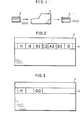
- Figs. 1 to 4 show a general process starting with issuing of a card and ending at unlocking of a door with use of the card.
- a card issuing device 1 is installed on the front desk of a hotel. When cards 2, 4 are inserted into the issuing device 1, the desired card data are magnetically recorded on a magnetic stripe 3 of each card by the procedure to be described later.
- the card 2 is issued, for example, when a guest checks in and handed to him for access to the room assigned. The door of that room only can be unlocked only within a scheduled period of stay with use of the card 2.
- the other card 4 is used by a hotel maid. The main uses this card to unlock the door of the room once a day for cleaning.
- the guest card 2 has recorded thereon a hotel code H, room number N, secret number G, two subnumbers A, B, specifying code C for selecting one of the subnumbers, and the number of days of stay D. Although these numbers N, G, A, B and D are recorded on the card, of course as encoded, the term "number” is used for a better understanding..
- An affix "2" is attached to the numbers or codes G, A, B and C in Fig. 2 to indicate the number of times the card has been issued for the same unlocking unit. When issued, the card 2 is handed to the person assigned to the room concerned.
- An unlocking unit is attached to the door 5 of each room and includes a card reader 6, which is attached to the outer side of the door 5.
- a fixed knob 7 is also attached to the outer side of the door 5.
- the room number N is shown on an upper portion of the door.
- the card reader 6 is of the manual scanning type. When the guest inserts the proper card 2 into the card reader 6 for scanning, the lock on the door 5 is opened as will be described later.
- a card reader of the automatic scanning type is of course usable.
- the maid card 4 has recorded thereon the hotel code E and a maid secret number G0. The maid similarly inserts this card 4 into the card reader 6 for unlocking.
- the hotel code, room number, secret numbers, subnumbers, specifying code and the number of days of stay will be referred to only by the corresponding characters H, N, G, G0, A, B, C and D, respectively, when apparent.
- Fig. 5 shows the appearance of a lock attached to the door of each hotel room.
- the lock has an automatic locking function.
- a trigger bolt 9 functions to fix a latch 8 for automatic locking.
- the unlocking solenoid 69 (Fig. 9) to be described later is energized, and a pilot lamp 13 goes on. If a push button 11 on the knob 7 is depressed, the latch is released to unlock.
- the lock is provided with auxiliary means for mechanical unlocking with use of a key. When the key is inerted into a keyhole 12 and then turned, the lock is opened.
- the door 5 is provided on its inner side with an inner handle (not shown). The lock can be unlocked as desired by the handle. Locks having such automatic unlocking function is well known.
- Fig. 6 shows the interior construction of the card issuing device 1.
- the card issuing device 1 comprises a keyboard 15, ah input buffer-register 16 therefor, random number generator 17, display 24, encoder 25, timepiece 26, control circuit 27 therefor, arithmetic and logical unit (ALU) 20, arithmetic registers (Ral, Ra2) 21, 22, flag (Fl) 23 for showing the result of operation, a group of registers 30 for storing various items of data, RAM 40 for storing data and address specifying register (AD) 39 for the RAM 40.
- the keyboard 15 includes keys for the numbers 0-9, and keys "DATE" and "CLASS" for the date and class of rooms.
- the random number generator 17 comprises an oscillator 18 and a counter 18 for counting up the output pulses of the oscillator 18.
- the area 41 has stored therein the head address of the area for storing the information about the first class rooms, i.e. the address of the location 44 in the present case.
- the areas 42, 43 have stored therein the head addresses of the areas for storing. the information about the second and third class rooms, i.e. the addresses of the locations 50, 52, respectively.
- Fig. 6 does.not show the program memory.
- An affix "1" is attached-to previous card data G, A, B and C to represent the same, and current data items are represented by G2, A2, B2, C2.
- Current G2 is prepared by the card issuing device 1 from previous Gl and Cl, and current A2 or B2.
- Cl, A2, B2 are random numbers which are read out from the random number generator 17.
- the subnumbers A, B may be of any number of figures, but numbers of three or four figures are preferable.
- Previous Cl is a code read out when previous Gl was prepared. When current G2 is prepared, C2 is read out for the subsequent secret number. Either "1" or "0" is used as the specifying code C.
- the subnumber A or B is selected according to the value. With the present embodiment, the subnumber A is selected when the code C is 1, and the subnumber B when the code C is 0.
- Equation (1) is used for the present embodiment.
- a card for a room with a room number N is issued. It is assumed that the locations 54, 55, 56 of the storing area for N in RAM 40 have stored therein N, previous Gl and Cl. Further 0 is stored in the location for stay days when the room is unoccupied. The room with N is vacant, and 0 is stored in the location 57. The locations of the areas 41-61 are addressed with consecutive numbers.
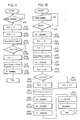
- Fig. 7 shows the steps of a card issuing operation by the device 1.
- the registers Ral, Ra2, AD and flag Fl will be represented merely by Ral, Ra2, AD and F1 when apparent.
- the input is loaded into the buffer-register 16 (step 101).
- the key "CLASS" is depressed in the keyboard 15 (step 102)
- the class indicating value of step 101 is transferred to the register Ral (step 103).
- a reference address is loaded into the register Ra2 (step 104).
- the reference address is meant by the address of the location (not shown) immediately preceding the location 41. If the address of the location 41 is 41, the address 40 is loaded into Ra2.
- the data of Ral, Ra2 is then added, and the address register AD is loaded with the result (step 105). Since 1 is added to the reference address, the location 41 is addressed by this operation when a first class room is specified, and the location 42 or 43 is addressed in the case of second or third class.
- the head address of the area for the class stored in the location (one of 41-43) specified by the address in AD is read and transferred to AD and Ra2 (steps 106, 107). If a third class room is specified, address of the loca- ⁇ ion 52 is read from the location 43. By the location 52 being specified by this address, the room number 30 stored in the location 52 is read and loaded into ⁇ he register 32 (step 108).
- N ext 1 is loaded into Ral (step 109), the data in Ra1, Ra2 is added, and Ra2 is loaded with the result (step 110). Subsequently the data in Ra2 is transferred to AD, and the location (not shown) next ⁇ o the location 52 is addressed (step 111). Since the location next to the location 52 has stored therein previous Gl of the room with number 30, Gl is read out and transferred to the register.33 (step 112).
- Ra2 has stored the address of the location next to the location 52. With the resulting sum, further next location is addressed wherein C1 is stored (steps 113, 114). Cl is read out by this address and transferred to the register 34 (step 115).
- Ra2 Ra2 are added (step 116).
- the location is addressed in which the number of days of stay is stored (step 117).
- D is read out and transferred to the register 37 (step 118).
- the D is loaded also into Ral (step 119).
- Ra2 is cleared of the data, i.e. 0 (step 120).
- F1 1, the number of'days of stay, D, is 0, and the room is unoccupied. Step 131 therefore follows. When F1 is 0, the room is occupied. Step 123 follows to search for other room (step 122).
- Step 130 If F1 is 0 (step 126), all the rooms have not been checked, so that Ral is loaded with 1 (step 127), and Ral and Ra2 are added, whereby the address of the location in which the room number to be checked next is stored. The result of the addtion is loaded into Ra2 (step 128) and transferred to AD to address the next location (step 129).
- Step 108 thereafter follows again to read,the room number N, secret number Gl and specifying code Cl in the same manner as above. The data is transferred to the registers 32, 33, 34, and the number of days of stay is read to check as to whether or not it is 0.
- Previous Cl in the register 34 is transferred to Ral (step 137), the register Ra2 is loaded with 0 (step 138), and Ra2 is subtracted from Ral in ALU 20, whereby whether previous Cl is 1 or 0 is checked. If Cl is 1, the subtraction result is 1. F1 is then reset a ⁇ 0. Conversely if Cl is O, the subtraction result is 0. At this time, Fl is set at 1 (step 139).
- step 140 The state of F1 is checked (step 140).. If it is 0, the subnumber A2 is transferred from the register 35 to the register Ra2 (step 141). When F1 is 1, the subnumber B2 is transferred from the register 36 to the register Ra2 (step 142). Previous Gl is transferred from the register 33 to the register Ral (step 143). Ral, Ra2 are added, and the result is transferred to the register 33 as current G2 (step 144). It will be understood that by steps 140-144, current G2 is calculated from Equation (1) with use of A2 or B2 selected by previous Cl, and previous Gl.
- step 145 Since the count on the counter 19 of the generator 17 ends with a figure 1 or 0, this is loaded into the register 34 as current C2 (step 145). Utilizing the address used for reading the number of days of stay in step 118, D of register 37 is stored in the location (in this case, 57) for the stay day number for N in the RAM 40, whereby the number of days of stay in RAM 40 is renewed (step 146).
- AD i.e. the address of the location 57 is transferred to Ral (step 147), 1 is loaded into the register Ra2 (step 148), Ra2 is subtracted from Ral, the result is transferred to AD (s ⁇ ep 149), whereby the location 56 is addressed.
- Current C2 in the register 34 is stored in the location 56 (step 150).
- the data in AD is transferred to the register Ral (step 151), Ra2 is subtracted from Ral, the result is transferred to AD, the location 55 is addressed (step 152), and current G2 in the register 33 is stored in the location 55 (step 153).
- the contents Gl, Cl of the locations 55, 56 are changed to G2, C2 respectively.
- the hotel code H is transferred from the area 60 of the RAM 40 to the register 31 (step 154). Finally all the items of data H, N, G2, C2, A2, B2 and D in the group of registers 30 are sent to the encoder 25 and encoded in the card 2 (step 155).
- N, Gl and Cl are read from RAM 40 and loaded into the registers 32, 33 and 34 in the above process (steps 108, 112, 115) for each room, the rooms may first be checked as to D only, and after a room in which D is 0 is found, N, Gl and Cl relating to the room may be read out.
- a day or date change signal is produced from the timepiece 26 (step 160), whereupon the total number of rooms, M, included in the program is stored in the area 61 of the RAM 40 (step 161).
- the address of the location i.e. location 47 in the present case
- the stay day number D is read from the location and transferred to RA1 (step 163).
- RA2 is cleared (0) in step 164, and Ra2 is subtracted from Ral. If the result is 0, Fl is set at 1. Otherwise, Fl is reset at 0 (step 165).
- step 170 follows since the readout D is 0.
- step 167 In which Ra2 is first loaded with 1, Ra2 is subtracted from Ral (step 168), and the result (D - 1) is stored in the original location 47 (step 169).
- the number of rooms, M is transferred from the area 61 to Ral (step 170), Ra2 is loaded with 1 (step 171), Ra2 is subtracted from Ral, and the result is loaded into Ral and also stored in area 61 (step 172). In this way, 1 is subtracted from the room number M every time the subtraction is conducted for one stay day number. Accordingly the number M is indicative of the number of areas for stay day numbers for which the subtraction process has not been carried out.
- Ra2 is cleared to 0 (step 173), Ra2 is subtracted from Ral and Fl is set to 1 if the result is 0. Otherwise F1 is reset to 0 (step 174).
- step 175 The state of F1 is then checked (step 175). If it is 1, the process for the areas for all the stay day numbers has been completed, hence- termination.
- Fl data is transferred from AD to Ral to effect the process for the location of the next stay day number (step 176).
- Ra2 is loaded with 4 (step 177), Ral and Ra2 are added and the result is loaded into AD (step 178).
- Step 163 thereafter follows to read the day number at the next location to conduct similar subtraction successively.
- the room number N in the location 92 of RAM 90 is transferred to Rbl in step 186.
- N in the register 82 is transferred to Rb2 (step 187).
- Rb2 is subtracted from Rbl. If the result is 0, F2 is set at 1 (step 188).
- F2 which is 1 (step 189) inaicates that the number N is an authorized one.
- Step 190 follows for checking the secret number G. If F2 is 0, the process is terminated without unlocking.
- step 203 Cl is transferred from the location 94 in RAM 90 to Rbl.
- Rb2 is then loaded with 0 (step 204).
- Rb2 is subtracted from Rbl. If the result is 0, F2 is set to 1, or if it is 1, F2 is reset to 0 (step 205).
- Step 226 When F2 is 1, D in the location 95 of RAM 90 is transferred to Rbl (step 222), 0 is loaded into Rb2 (step 223) and Rb2 is subtracted from Rbl to check whether or not D is 0 (step 224). If the subtraction result is 0, F2 is set to 1. If otherwise, F2 is reset to 0, in which case D is not 0. Step 226 therefore follows. Rb2 is loaded with 1, 1 is subtracted from D in Rbl and the result is loaded into Rbl (step 227). The data (D-1) in Rbl is stored in the location 95 of RAM 90 for the renewal of stay day number (step 228). The hotel maid unlocks the room once a day for cleaning. Accordingly the number of remaining days of stay stored in RAM 90 is reduced by 1 upon lapse of every day when the maid unlocks the room.
- the daily renewal (subtraction of 1) of the stay day number stored in the area 95 of RAM 90 can be effected also in response to a day or date change signal from the timepiece 65.
- Fig. 11 shows this process for illustrative purposes.
- a day change signal is produced from the timepiece once a day (step 231)
- 1 is subtracted from D only when D is not 0, by the same steps as steps 222 to 228.
- the result is stored in the location 95 for the renewal of D (steps 232-238).
- the magnetic stripe on the card may have recorded thereon an identification code for identifying the type of the card.
- a code representing the guest and another code representing the maid are stored in the RAM 90.
- the identification code read from the card is compared with that stored in RAM 90 so that the card is further processed in accordance with the result.
- While the length of stay of the guest is expressed in days with one day used as the unit time, one hour may be used as the unit time for measuring time, such that the data relating to the length of stay and stored in the memory can be reduced upon lapse of a predetermined number of unit hours, e.g. every 6 or 12 hours.
- three or more subnumbers may be prepared so that one or a plurality of subnumbers will be selected by the specifying code C.
- the code C is not one of two values, i.e. 0 or 1, but is selected from three or more values.
- either one of the subnumbers A2 and B2 is selected with use of previous Cl, when current G2 is prepared by the card issuing device 1 and also when the unlocking unit 10 checks whether or not previous Gl and current G2 are in the relation of Equation (1).
- the current specifying code C2 is of course usable for this purpose.
- Fig. 12 shows a more simplified card issuing process, in which the stay day number is not considered at all. Accordingly the day number D is neither recorded on the card, nor is it stored in the data area of RAM 40 for each room. The registor 37 is unnecessary. The rooms are not divided into classes. Fig. 12 does not show the process for addressing the locations in RAM 40.
- Fig. 13 shows the unlocking process of the unlocking unit 10 executed with use of a card prepared by the process of Fig. 12.
- the card bears no stay day number, while no maid card is used, so that RAM 90 of the unit 10 need not include the locations for D and GO.
- the register 87 is not necessary, either.
- the process of Fig 13 is substantially the same as the process shown in Fig. 10, exclusive of checking of the stay day number (steps 194-197), checking of the maid card (steps 218-221) and renewal of the stay day number with use of the maid card (steps 222-228).
- Each of the steps of Fig. 13 is given the corresponding step number shown in Fig. 10.
- a card having a function equivalent to that of the master key In place of a master key for unlocking all or some of the rooms of a hotel, it is possible to prepare a card having a function equivalent to that of the master key. Such a card will be termed a "master card,” to which the unlocking unit 10 is applicable.
- a code identifying the master card, secret number, specifying code and subnumbers are recorded on a magnetic stripe on the master card.
- a code for identifying the master card, secret number and previous specifying code are stored in specified locations of RAM 90.
- the data on the master card is read by the card reader 6, which first checks whether or not the two card identifying codes are identical. When they are found to match, the secret number on the card and that in RAM 90 are checked for a match. The lock is opened when the two numbers are found identical.
- a master card is issued bearing a secret number and subnumber which satisfy the relation of Equation (1), for example, with use of previous secret number and specifying code.
- steps similar to steps 279-292 203-316 are executed to check whether or not the previous and current secret numbers are in a predetermined relation, subject to the condition that the master card identi- f ying codes are identical.
- the secret number and specifying code in RAM 90 are renewed. After the secret number has been renewed, the locks concerned are openable only with the new master card and can not be opened with the previous master card.
- Such a master card will be used suitably by maid supervisors and managers.
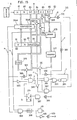
- the secret number G stored in the second memory 376 is transferred to an area 93 of the first memory 90.
- the G's of the register 83 and area 93 are compared in a comparator 354B. When they are found identical, a match signal b is generated.
- the two match signals a and b are sent to an AND circuit 359, which in turn produces an output to actuate a monostable multivibrator 358.
- the multivibrator 358 produces an output for a predetermined period of time (corresponding to the time setting T for the timer 67) to energize the solenoid 69 and open the lock for the predetermined period of time.
- the output from the multivibrator 358 falls upon lapse of the time, the output from a NOT circuit 399 rises. This is detected'by a differentiation circuit 400, giving a reset signal R.
- the register group 80 is reset by the reset signal R and is cleared of the data, and at the same time, the flip-flop 379 is reset.
- the number A2 is sent to an adder 378.
- the specifying code Cl is 0, the signal d is not given, with the result that the NOT circuit 382 generates an output which causes the AND circuit 382 to produce an output.
- This output is detected by a differentiation 'circuit 393, which produces an output signal g, thereby opening a gate 395.
- the subnumber B2 is sent to the adder 378.
- the secret number Gl stored in the area 93 of the first memory 90 is added to the subnumber A2 or B2 selected by the specifying code Cl in the adder 378, and the result is stored in a memory circuit 377. Since the output of the AND circuit 381 or 382 is given via an OR circuit 383 to a timer 384, the timer 384 produces, upon lapse of a predetermined period of time t, an output f, which is detected by a differentiation circuit 390. The circuit 390 produces an output, which opens a gate 391. The addition result given by the adder 378 is transferred from the circuit 377 to the area 93 of the first memory 90.
- the comparator 354B When the secret number G2 in the register 83 matches the addition result stored in the area 93 of the first memory 90, the comparator 354B produces a match signal b. Since the flip-flop 379 has been set by the signal c, the signal b causes an AND circuit 387 to produce an output, which is detected by a differentia- ⁇ ion circuit 398 to give a signal E. The signal E opens gates 396 and 397. G2 in the register 83 is stored in the second memory 376, and C2 in the register 84 is stored in the area 94 of the memory 90.
- the match signal b causes the multivibrator 358 to produce a signal which holds the lock open for the predetermined period of time, upon the lapse of which a reset signal R is given in the manner already described.
- the card issuing device can of course be composed of logical circuits in combination, similarly.
- G2 in the register 83 is sent to and stored in the second memory 376 with use of the signal E in the above embodiment
- the stored data (circuit 377) given by the adder 378, or the data stored in the area 93 of the first memory 90 may be sent to and stored in the second memory 376.
Landscapes
- Physics & Mathematics (AREA)
- General Physics & Mathematics (AREA)
- Lock And Its Accessories (AREA)
Applications Claiming Priority (4)
| Application Number | Priority Date | Filing Date | Title |
|---|---|---|---|
| JP88411/80 | 1980-06-27 | ||
| JP8841080A JPS5921423B2 (ja) | 1980-06-27 | 1980-06-27 | カ−ドを用いた解錠設備 |
| JP88410/80 | 1980-06-27 | ||
| JP8841180A JPS5921424B2 (ja) | 1980-06-27 | 1980-06-27 | カ−ドを用いた解錠方法 |
Publications (2)
| Publication Number | Publication Date |
|---|---|
| EP0043270A1 true EP0043270A1 (fr) | 1982-01-06 |
| EP0043270B1 EP0043270B1 (fr) | 1984-03-21 |
Family
ID=26429795
Family Applications (1)
| Application Number | Title | Priority Date | Filing Date |
|---|---|---|---|
| EP81302936A Expired EP0043270B1 (fr) | 1980-06-27 | 1981-06-29 | Système de déverrouillage utilisant des cartes |
Country Status (6)
| Country | Link |
|---|---|
| US (1) | US4385231A (fr) |
| EP (1) | EP0043270B1 (fr) |
| DE (1) | DE3162791D1 (fr) |
| GB (2) | GB2078848B (fr) |
| HK (2) | HK94785A (fr) |
| SG (1) | SG63485G (fr) |
Cited By (29)
| Publication number | Priority date | Publication date | Assignee | Title |
|---|---|---|---|---|
| FR2532677A1 (fr) * | 1982-09-02 | 1984-03-09 | Elkem As | Serrure electronique dont le code peut etre modifie |
| FR2533340A1 (fr) * | 1982-09-17 | 1984-03-23 | Chauvat & Sofranq Reunis | Serrure electronique a commande par carte a piste magnetique |
| EP0122244A3 (en) * | 1983-04-08 | 1985-03-27 | Wso Cpu-System Ab | A lock system |
| DE3503177A1 (de) * | 1984-02-07 | 1985-08-08 | Talleres de Escoriaza, S.A., Irun, Guipúzcoa | Programmierbares elektronisches schloss |
| FR2568040A1 (fr) * | 1984-07-18 | 1986-01-24 | Lewiner Jacques | Installation de commande et de controle des differentes serrures codees d'un ensemble |
| WO1987000233A1 (fr) * | 1985-07-09 | 1987-01-15 | Lowe & Fletcher Limited | Procede de fonctionnement d'un dispositif de securite |
| EP0193537A4 (fr) * | 1984-08-17 | 1987-02-12 | Computerized Security Systems | Systeme de verrouillage commande par micro-ordinateur. |
| FR2597538A1 (fr) * | 1986-04-22 | 1987-10-23 | Soum Rene | Ensemble cle-serrure de securite a telecommande dans lequel la cle n'a qu'une fonction d'emission et la serrure de reception |
| EP0162171A3 (fr) * | 1984-05-17 | 1988-02-10 | Leonard Joseph Genest | Procédé de chargement de code pour serrure électronique |
| EP0152678A3 (fr) * | 1984-02-13 | 1988-03-16 | James W. Raymond | Serrure électronique pour hôtels et similaires |
| GB2251266A (en) * | 1990-12-03 | 1992-07-01 | Trioving As | Coded lock/key system with override |
| EP0618550A1 (fr) * | 1993-03-31 | 1994-10-05 | N.V. Nederlandsche Apparatenfabriek NEDAP | Système de contrôle d'accès ayant des autorisations décentralisées |
| FR2705117A1 (fr) * | 1992-11-04 | 1994-11-18 | Tesa | Serrure électronique programmable. |
| DE19527597A1 (de) * | 1995-07-28 | 1997-01-30 | Good Night Inn Motel Managemen | System und Verfahren zur zeitlich begrenzten Energiefreischaltung wenigstens eines elektrischen oder elektronischen Gerätes |
| US6809628B1 (en) | 1999-03-29 | 2004-10-26 | Aaron Bensimon | Personal or personalizable device for the conditional use of electric or electronic appliances, method of use |
| US6980655B2 (en) | 2000-01-21 | 2005-12-27 | The Chamberlain Group, Inc. | Rolling code security system |
| US7412056B2 (en) | 1995-05-17 | 2008-08-12 | The Chamberlain Group, Inc. | Rolling code security system |
| US9704313B2 (en) | 2008-09-30 | 2017-07-11 | Honeywell International Inc. | Systems and methods for interacting with access control devices |
| US9894261B2 (en) | 2011-06-24 | 2018-02-13 | Honeywell International Inc. | Systems and methods for presenting digital video management system information via a user-customizable hierarchical tree interface |
| US10038872B2 (en) | 2011-08-05 | 2018-07-31 | Honeywell International Inc. | Systems and methods for managing video data |
| US10362273B2 (en) | 2011-08-05 | 2019-07-23 | Honeywell International Inc. | Systems and methods for managing video data |
| US10523903B2 (en) | 2013-10-30 | 2019-12-31 | Honeywell International Inc. | Computer implemented systems frameworks and methods configured for enabling review of incident data |
| US10652743B2 (en) | 2017-12-21 | 2020-05-12 | The Chamberlain Group, Inc. | Security system for a moveable barrier operator |
| US10862924B2 (en) | 2005-06-30 | 2020-12-08 | The Chamberlain Group, Inc. | Method and apparatus to facilitate message transmission and reception using different transmission characteristics |
| US10944559B2 (en) | 2005-01-27 | 2021-03-09 | The Chamberlain Group, Inc. | Transmission of data including conversion of ternary data to binary data |
| US10997810B2 (en) | 2019-05-16 | 2021-05-04 | The Chamberlain Group, Inc. | In-vehicle transmitter training |
| US11074773B1 (en) | 2018-06-27 | 2021-07-27 | The Chamberlain Group, Inc. | Network-based control of movable barrier operators for autonomous vehicles |
| US11423717B2 (en) | 2018-08-01 | 2022-08-23 | The Chamberlain Group Llc | Movable barrier operator and transmitter pairing over a network |
| US12149618B2 (en) | 2005-01-27 | 2024-11-19 | The Chamberlain Group Llc | Method and apparatus to facilitate transmission of an encrypted rolling code |
Families Citing this family (40)
| Publication number | Priority date | Publication date | Assignee | Title |
|---|---|---|---|---|
| GB2139689A (en) * | 1983-05-13 | 1984-11-14 | Philips Electronic Associated | Electronic lock |
| EP0180948B1 (fr) * | 1984-11-05 | 1991-12-18 | Omron Tateisi Electronics Co. | Méthode et système de sortie de cartes |
| GB2178211B (en) * | 1985-07-22 | 1989-08-09 | City Wheels Ltd | Control system |
| US4837822A (en) * | 1986-04-08 | 1989-06-06 | Schlage Lock Company | Cryptographic based electronic lock system and method of operation |
| US5160833A (en) * | 1986-11-13 | 1992-11-03 | Kyodo Printing Co., Ltd. | Magnetic recording medium having authenticating poles at its edge |
| FR2608809B1 (fr) * | 1986-12-19 | 1991-04-19 | Flonic Sa | Systeme de fourniture de prestations a revalidation |
| US4837422A (en) * | 1987-09-08 | 1989-06-06 | Juergen Dethloff | Multi-user card system |
| US4870400A (en) * | 1988-01-26 | 1989-09-26 | Yale Security Inc. | Electronic door lock key re-sequencing function |
| US5046157A (en) * | 1988-02-03 | 1991-09-03 | Smith Stephen W | Time control device for appliances |
| US6175312B1 (en) | 1990-05-29 | 2001-01-16 | Microchip Technology Incorporated | Encoder and decoder microchips and remote control devices for secure unidirectional communication |
| US5198643A (en) * | 1991-02-26 | 1993-03-30 | Computerized Security Systems, Inc. | Adaptable electronic key and lock system |
| DE4430360C1 (de) * | 1994-08-26 | 1995-10-05 | Siemens Ag | Diebstahlschutzsystem für ein Kraftfahrzeug |
| CA2193846C (fr) | 1995-05-17 | 2004-02-17 | Bradford L. Farris | Systeme de securite a code de brassage |
| US5724423A (en) * | 1995-09-18 | 1998-03-03 | Telefonaktiebolaget Lm Ericsson | Method and apparatus for user authentication |
| US8015597B2 (en) * | 1995-10-02 | 2011-09-06 | Corestreet, Ltd. | Disseminating additional data used for controlling access |
| GB2319644B (en) * | 1996-11-23 | 2000-01-12 | Central Research Lab Ltd | A record carrier |
| US6570487B1 (en) * | 1997-01-24 | 2003-05-27 | Axcess Inc. | Distributed tag reader system and method |
| CA2240881C (fr) * | 1998-06-17 | 2007-12-04 | Axs Technologies Inc. | Systeme automatise de controle de l'acces partage a l'information |
| US7005985B1 (en) * | 1999-07-20 | 2006-02-28 | Axcess, Inc. | Radio frequency identification system and method |
| US7286158B1 (en) | 1999-12-22 | 2007-10-23 | Axcess International Inc. | Method and system for providing integrated remote monitoring services |
| WO2004079641A1 (fr) * | 2003-03-07 | 2004-09-16 | Secure Card International, Inc. | Procede de stockage de donnees de capacite, differents systemes mettant ce procede en oeuvre, et differents articles |
| US7841120B2 (en) | 2004-03-22 | 2010-11-30 | Wilcox Industries Corp. | Hand grip apparatus for firearm |
| WO2006021047A1 (fr) * | 2004-08-27 | 2006-03-02 | Honeywell Limited | Systeme et procede de commande d'acces |
| WO2007035863A2 (fr) | 2005-09-21 | 2007-03-29 | Intermec Ip Corp. | Procede et support a protocole de communication stochastique pour etiquettes d'identification radiofrequence (rfid) reposant sur la formation de coalition, par exemple communication d'etiquette a etiquette |
| EP1938504B1 (fr) | 2005-10-21 | 2020-04-29 | Honeywell Limited | Systeme et procede d'autorisation |
| WO2007103254A2 (fr) * | 2006-03-02 | 2007-09-13 | Axcess International Inc. | Système et procédé pour déterminer le lieu, l'orientation et la vitesse d'étiquettes d'identification à transmission radiofréquence (rfid) |
| WO2007109241A2 (fr) * | 2006-03-20 | 2007-09-27 | Axcess International Inc. | Systèmes et procédés de suivi d'étiquettes multiples |
| US8120461B2 (en) * | 2006-04-03 | 2012-02-21 | Intermec Ip Corp. | Automatic data collection device, method and article |
| US7800503B2 (en) * | 2006-05-11 | 2010-09-21 | Axcess International Inc. | Radio frequency identification (RFID) tag antenna design |
| US8002173B2 (en) * | 2006-07-11 | 2011-08-23 | Intermec Ip Corp. | Automatic data collection device, method and article |
| US7546955B2 (en) * | 2007-03-16 | 2009-06-16 | Intermec Ip Corp. | Systems, devices, and methods for reading machine-readable characters and human-readable characters |
| US8598982B2 (en) | 2007-05-28 | 2013-12-03 | Honeywell International Inc. | Systems and methods for commissioning access control devices |
| CN101765835B (zh) | 2007-05-28 | 2013-05-08 | 霍尼韦尔国际公司 | 用于配置访问控制装置的系统和方法 |
| US8638194B2 (en) * | 2008-07-25 | 2014-01-28 | Axcess International, Inc. | Multiple radio frequency identification (RFID) tag wireless wide area network (WWAN) protocol |
| US8878931B2 (en) | 2009-03-04 | 2014-11-04 | Honeywell International Inc. | Systems and methods for managing video data |
| WO2010106474A1 (fr) | 2009-03-19 | 2010-09-23 | Honeywell International Inc. | Systèmes et procédés de gestion de dispositifs de contrôle d'accès |
| US9280365B2 (en) | 2009-12-17 | 2016-03-08 | Honeywell International Inc. | Systems and methods for managing configuration data at disconnected remote devices |
| US8707414B2 (en) | 2010-01-07 | 2014-04-22 | Honeywell International Inc. | Systems and methods for location aware access control management |
| US8787725B2 (en) | 2010-11-11 | 2014-07-22 | Honeywell International Inc. | Systems and methods for managing video data |
| US9344684B2 (en) | 2011-08-05 | 2016-05-17 | Honeywell International Inc. | Systems and methods configured to enable content sharing between client terminals of a digital video management system |
Citations (8)
| Publication number | Priority date | Publication date | Assignee | Title |
|---|---|---|---|---|
| GB1329966A (fr) * | 1969-09-09 | 1973-09-12 | ||
| US3761683A (en) * | 1971-11-08 | 1973-09-25 | S Rogers | Security system |
| US3838395A (en) * | 1972-12-04 | 1974-09-24 | Commplex Inc | Electronic variable combination lock and monitoring system |
| US3860911A (en) * | 1973-11-01 | 1975-01-14 | Pitney Bowes Inc | Electronic combination lock and lock system |
| US3926021A (en) * | 1974-01-02 | 1975-12-16 | Monitron Ind | Electronic combination lock and system |
| GB1456138A (en) * | 1974-04-16 | 1976-11-17 | Sabsay D M | Security devices and methods of operation thereof |
| US4094462A (en) * | 1976-08-02 | 1978-06-13 | Ncr Corporation | Method and means for providing and testing secure identification data |
| US4207555A (en) * | 1978-03-03 | 1980-06-10 | The Eastern Company | Lock system |
Family Cites Families (3)
| Publication number | Priority date | Publication date | Assignee | Title |
|---|---|---|---|---|
| US3821704A (en) * | 1972-03-13 | 1974-06-28 | D Sabsay | Self re keying security device with coded key |
| US3800284A (en) * | 1973-01-12 | 1974-03-26 | Pitney Bowes Inc | Electronic combination lock and lock system |
| JPS5538464B2 (fr) | 1973-04-16 | 1980-10-04 |
-
1981
- 1981-06-26 US US06/277,692 patent/US4385231A/en not_active Expired - Lifetime
- 1981-06-29 GB GB8119935A patent/GB2078848B/en not_active Expired
- 1981-06-29 EP EP81302936A patent/EP0043270B1/fr not_active Expired
- 1981-06-29 DE DE8181302936T patent/DE3162791D1/de not_active Expired
-
1984
- 1984-03-09 GB GB08406240A patent/GB2141850B/en not_active Expired
-
1985
- 1985-08-31 SG SG634/85A patent/SG63485G/en unknown
- 1985-11-21 HK HK947/85A patent/HK94785A/xx not_active IP Right Cessation
-
1986
- 1986-03-27 HK HK227/86A patent/HK22786A/xx not_active IP Right Cessation
Patent Citations (8)
| Publication number | Priority date | Publication date | Assignee | Title |
|---|---|---|---|---|
| GB1329966A (fr) * | 1969-09-09 | 1973-09-12 | ||
| US3761683A (en) * | 1971-11-08 | 1973-09-25 | S Rogers | Security system |
| US3838395A (en) * | 1972-12-04 | 1974-09-24 | Commplex Inc | Electronic variable combination lock and monitoring system |
| US3860911A (en) * | 1973-11-01 | 1975-01-14 | Pitney Bowes Inc | Electronic combination lock and lock system |
| US3926021A (en) * | 1974-01-02 | 1975-12-16 | Monitron Ind | Electronic combination lock and system |
| GB1456138A (en) * | 1974-04-16 | 1976-11-17 | Sabsay D M | Security devices and methods of operation thereof |
| US4094462A (en) * | 1976-08-02 | 1978-06-13 | Ncr Corporation | Method and means for providing and testing secure identification data |
| US4207555A (en) * | 1978-03-03 | 1980-06-10 | The Eastern Company | Lock system |
Cited By (50)
| Publication number | Priority date | Publication date | Assignee | Title |
|---|---|---|---|---|
| FR2532677A1 (fr) * | 1982-09-02 | 1984-03-09 | Elkem As | Serrure electronique dont le code peut etre modifie |
| FR2533340A1 (fr) * | 1982-09-17 | 1984-03-23 | Chauvat & Sofranq Reunis | Serrure electronique a commande par carte a piste magnetique |
| EP0122244A3 (en) * | 1983-04-08 | 1985-03-27 | Wso Cpu-System Ab | A lock system |
| DE3503177A1 (de) * | 1984-02-07 | 1985-08-08 | Talleres de Escoriaza, S.A., Irun, Guipúzcoa | Programmierbares elektronisches schloss |
| GB2154649A (en) * | 1984-02-07 | 1985-09-11 | Talleres Escoriaza Sa | Programmable electronic lock |
| EP0152678A3 (fr) * | 1984-02-13 | 1988-03-16 | James W. Raymond | Serrure électronique pour hôtels et similaires |
| EP0162171A3 (fr) * | 1984-05-17 | 1988-02-10 | Leonard Joseph Genest | Procédé de chargement de code pour serrure électronique |
| EP0171323A1 (fr) * | 1984-07-18 | 1986-02-12 | Jacques Lewiner | Installation de commande et de contrôle des différentes serrures codées d'un ensemble |
| FR2568040A1 (fr) * | 1984-07-18 | 1986-01-24 | Lewiner Jacques | Installation de commande et de controle des differentes serrures codees d'un ensemble |
| EP0193537A4 (fr) * | 1984-08-17 | 1987-02-12 | Computerized Security Systems | Systeme de verrouillage commande par micro-ordinateur. |
| GB2187501A (en) * | 1985-07-09 | 1987-09-09 | Lowe & Fletcher Ltd | Method of operating a security device |
| WO1987000233A1 (fr) * | 1985-07-09 | 1987-01-15 | Lowe & Fletcher Limited | Procede de fonctionnement d'un dispositif de securite |
| US4791280A (en) * | 1985-07-09 | 1988-12-13 | Lowe And Fletcher Limited | Method of operating a security device, security device and data carriers for use in the method |
| FR2597538A1 (fr) * | 1986-04-22 | 1987-10-23 | Soum Rene | Ensemble cle-serrure de securite a telecommande dans lequel la cle n'a qu'une fonction d'emission et la serrure de reception |
| EP0244332A1 (fr) * | 1986-04-22 | 1987-11-04 | René Soum | Système de très haute sécurité de télécommande sans fil permettant l'ouverture ou la fermeture inviolable de relais actionnant des systèmes tels que serrures |
| GB2251266A (en) * | 1990-12-03 | 1992-07-01 | Trioving As | Coded lock/key system with override |
| GB2251266B (en) * | 1990-12-03 | 1994-10-19 | Trioving As | Time controlled lock system |
| FR2705117A1 (fr) * | 1992-11-04 | 1994-11-18 | Tesa | Serrure électronique programmable. |
| EP0618550A1 (fr) * | 1993-03-31 | 1994-10-05 | N.V. Nederlandsche Apparatenfabriek NEDAP | Système de contrôle d'accès ayant des autorisations décentralisées |
| NL9300566A (nl) * | 1993-03-31 | 1994-10-17 | Nedap Nv | Toegangsverleningssysteem met decentrale autorisaties. |
| US7492898B2 (en) | 1995-05-17 | 2009-02-17 | The Chamberlain Group, Inc. | Rolling code security system |
| US7412056B2 (en) | 1995-05-17 | 2008-08-12 | The Chamberlain Group, Inc. | Rolling code security system |
| DE19527597A1 (de) * | 1995-07-28 | 1997-01-30 | Good Night Inn Motel Managemen | System und Verfahren zur zeitlich begrenzten Energiefreischaltung wenigstens eines elektrischen oder elektronischen Gerätes |
| DE19527597C2 (de) * | 1995-07-28 | 1999-01-21 | Good Night Inn Motel Managemen | System und Verfahren zur zeitlich begrenzten Energiefreischaltung wenigstens eines elektrischen oder elektronischen Gerätes |
| US6809628B1 (en) | 1999-03-29 | 2004-10-26 | Aaron Bensimon | Personal or personalizable device for the conditional use of electric or electronic appliances, method of use |
| US6980655B2 (en) | 2000-01-21 | 2005-12-27 | The Chamberlain Group, Inc. | Rolling code security system |
| US12556387B2 (en) | 2005-01-27 | 2026-02-17 | The Chamberlain Group Llc | Method and apparatus to facilitate transmission of an encrypted rolling code |
| US11799648B2 (en) | 2005-01-27 | 2023-10-24 | The Chamberlain Group Llc | Method and apparatus to facilitate transmission of an encrypted rolling code |
| US12149618B2 (en) | 2005-01-27 | 2024-11-19 | The Chamberlain Group Llc | Method and apparatus to facilitate transmission of an encrypted rolling code |
| US10944559B2 (en) | 2005-01-27 | 2021-03-09 | The Chamberlain Group, Inc. | Transmission of data including conversion of ternary data to binary data |
| US10862924B2 (en) | 2005-06-30 | 2020-12-08 | The Chamberlain Group, Inc. | Method and apparatus to facilitate message transmission and reception using different transmission characteristics |
| US9704313B2 (en) | 2008-09-30 | 2017-07-11 | Honeywell International Inc. | Systems and methods for interacting with access control devices |
| US9894261B2 (en) | 2011-06-24 | 2018-02-13 | Honeywell International Inc. | Systems and methods for presenting digital video management system information via a user-customizable hierarchical tree interface |
| US10863143B2 (en) | 2011-08-05 | 2020-12-08 | Honeywell International Inc. | Systems and methods for managing video data |
| US10362273B2 (en) | 2011-08-05 | 2019-07-23 | Honeywell International Inc. | Systems and methods for managing video data |
| US10038872B2 (en) | 2011-08-05 | 2018-07-31 | Honeywell International Inc. | Systems and methods for managing video data |
| US10523903B2 (en) | 2013-10-30 | 2019-12-31 | Honeywell International Inc. | Computer implemented systems frameworks and methods configured for enabling review of incident data |
| US11523088B2 (en) | 2013-10-30 | 2022-12-06 | Honeywell Interntional Inc. | Computer implemented systems frameworks and methods configured for enabling review of incident data |
| US11778464B2 (en) | 2017-12-21 | 2023-10-03 | The Chamberlain Group Llc | Security system for a moveable barrier operator |
| US11122430B2 (en) | 2017-12-21 | 2021-09-14 | The Chamberlain Group, Inc. | Security system for a moveable barrier operator |
| US12108248B2 (en) | 2017-12-21 | 2024-10-01 | The Chamberlain Group Llc | Security system for a moveable barrier operator |
| US10652743B2 (en) | 2017-12-21 | 2020-05-12 | The Chamberlain Group, Inc. | Security system for a moveable barrier operator |
| US11763616B1 (en) | 2018-06-27 | 2023-09-19 | The Chamberlain Group Llc | Network-based control of movable barrier operators for autonomous vehicles |
| US11074773B1 (en) | 2018-06-27 | 2021-07-27 | The Chamberlain Group, Inc. | Network-based control of movable barrier operators for autonomous vehicles |
| US12056971B1 (en) | 2018-06-27 | 2024-08-06 | The Chamberlain Group Llc. | Network-based control of movable barrier operators for autonomous vehicles |
| US11423717B2 (en) | 2018-08-01 | 2022-08-23 | The Chamberlain Group Llc | Movable barrier operator and transmitter pairing over a network |
| US11869289B2 (en) | 2018-08-01 | 2024-01-09 | The Chamberlain Group Llc | Movable barrier operator and transmitter pairing over a network |
| US12354422B2 (en) | 2018-08-01 | 2025-07-08 | The Chamberlain Group Llc | Movable barrier operator and transmitter pairing over a network |
| US11462067B2 (en) | 2019-05-16 | 2022-10-04 | The Chamberlain Group Llc | In-vehicle transmitter training |
| US10997810B2 (en) | 2019-05-16 | 2021-05-04 | The Chamberlain Group, Inc. | In-vehicle transmitter training |
Also Published As
| Publication number | Publication date |
|---|---|
| SG63485G (en) | 1986-05-02 |
| GB2078848A (en) | 1982-01-13 |
| DE3162791D1 (en) | 1984-04-26 |
| US4385231A (en) | 1983-05-24 |
| GB2141850A (en) | 1985-01-03 |
| EP0043270B1 (fr) | 1984-03-21 |
| GB8406240D0 (en) | 1984-04-11 |
| GB2078848B (en) | 1984-12-19 |
| HK94785A (en) | 1985-11-29 |
| HK22786A (en) | 1986-04-04 |
| GB2141850B (en) | 1985-07-24 |
Similar Documents
| Publication | Publication Date | Title |
|---|---|---|
| US4385231A (en) | Unlocking system for use with cards | |
| CA1217546A (fr) | Serrure | |
| US3866173A (en) | Access control system for restricted area | |
| US4912310A (en) | Method of and system for issuing cards | |
| US4677435A (en) | Surface texture reading access checking system | |
| US4163215A (en) | Safety lock system for controlling access to an area in response to predetermined data inputs | |
| US5670940A (en) | Electronic lock system with occupancy block | |
| EP0536286A4 (fr) | ||
| KR930005700B1 (ko) | 마이크로컴퓨터 제어 쇄정 시스템 | |
| US4868914A (en) | Method for clearing unlocking key codes in an electronic locking device | |
| KR100585428B1 (ko) | 도어 록의 언로킹 방법 및 시스템 | |
| US4851828A (en) | Electronic locking devices | |
| EP0442349A1 (fr) | Système de minibars | |
| JPS5921423B2 (ja) | カ−ドを用いた解錠設備 | |
| JPS6046233B2 (ja) | 鍵及び錠前の管理装置 | |
| EP0417474A1 (fr) | Dispositif d'entrée de données dans un système de fermeture actionné par des cartes | |
| JPH0666058A (ja) | ホテル客室のロックシステム | |
| JPH0654061B2 (ja) | カ−ド処理システム | |
| JPS5851592B2 (ja) | カ−ドを用いた貸しロツカ−の施錠解除方法 | |
| JP3392157B2 (ja) | セキュリティー鍵保管装置 | |
| JPS6030377Y2 (ja) | 貸金庫の制御装置 | |
| JPS5921424B2 (ja) | カ−ドを用いた解錠方法 | |
| EP0246903B1 (fr) | Procédé permettant d'annuler des codes de déverrouillage dans un dispositif électronique de verrouillage | |
| JPS5921422B2 (ja) | カ−ドを用いた解錠装置 | |
| JPH06108715A (ja) | 扉用カード式自動錠装置 |
Legal Events
| Date | Code | Title | Description |
|---|---|---|---|
| PUAI | Public reference made under article 153(3) epc to a published international application that has entered the european phase |
Free format text: ORIGINAL CODE: 0009012 |
|
| AK | Designated contracting states |
Designated state(s): CH DE FR IT SE |
|
| 17P | Request for examination filed |
Effective date: 19811127 |
|
| ITF | It: translation for a ep patent filed | ||
| GRAA | (expected) grant |
Free format text: ORIGINAL CODE: 0009210 |
|
| AK | Designated contracting states |
Designated state(s): CH DE FR IT LI SE |
|
| REF | Corresponds to: |
Ref document number: 3162791 Country of ref document: DE Date of ref document: 19840426 |
|
| ET | Fr: translation filed | ||
| PLBE | No opposition filed within time limit |
Free format text: ORIGINAL CODE: 0009261 |
|
| STAA | Information on the status of an ep patent application or granted ep patent |
Free format text: STATUS: NO OPPOSITION FILED WITHIN TIME LIMIT |
|
| 26N | No opposition filed | ||
| ITTA | It: last paid annual fee | ||
| EAL | Se: european patent in force in sweden |
Ref document number: 81302936.0 |
|
| REG | Reference to a national code |
Ref country code: FR Ref legal event code: D6 |
|
| PGFP | Annual fee paid to national office [announced via postgrant information from national office to epo] |
Ref country code: CH Payment date: 19970925 Year of fee payment: 17 |
|
| PGFP | Annual fee paid to national office [announced via postgrant information from national office to epo] |
Ref country code: SE Payment date: 19980612 Year of fee payment: 18 |
|
| PG25 | Lapsed in a contracting state [announced via postgrant information from national office to epo] |
Ref country code: LI Free format text: LAPSE BECAUSE OF NON-PAYMENT OF DUE FEES Effective date: 19980630 Ref country code: CH Free format text: LAPSE BECAUSE OF NON-PAYMENT OF DUE FEES Effective date: 19980630 |
|
| REG | Reference to a national code |
Ref country code: CH Ref legal event code: PL |
|
| PG25 | Lapsed in a contracting state [announced via postgrant information from national office to epo] |
Ref country code: SE Free format text: THE PATENT HAS BEEN ANNULLED BY A DECISION OF A NATIONAL AUTHORITY Effective date: 19990629 |
|
| EUG | Se: european patent has lapsed |
Ref document number: 81302936.0 |
|
| PGFP | Annual fee paid to national office [announced via postgrant information from national office to epo] |
Ref country code: DE Payment date: 20000629 Year of fee payment: 20 |
|
| PGFP | Annual fee paid to national office [announced via postgrant information from national office to epo] |
Ref country code: FR Payment date: 20000630 Year of fee payment: 20 |