EP0044573B1 - 7-Phénylquinolizine - Google Patents
7-Phénylquinolizine Download PDFInfo
- Publication number
- EP0044573B1 EP0044573B1 EP81106675A EP81106675A EP0044573B1 EP 0044573 B1 EP0044573 B1 EP 0044573B1 EP 81106675 A EP81106675 A EP 81106675A EP 81106675 A EP81106675 A EP 81106675A EP 0044573 B1 EP0044573 B1 EP 0044573B1
- Authority
- EP
- European Patent Office
- Prior art keywords
- rac
- octahydro
- und
- hydrogen
- general formula
- Prior art date
- Legal status (The legal status is an assumption and is not a legal conclusion. Google has not performed a legal analysis and makes no representation as to the accuracy of the status listed.)
- Expired
Links
- 0 C[C@]1(CC=C(CNO)OCC1)C1C[C@](*)(C2)C(C3)(CCC4)C34C2(*)CCC1 Chemical compound C[C@]1(CC=C(CNO)OCC1)C1C[C@](*)(C2)C(C3)(CCC4)C34C2(*)CCC1 0.000 description 9
Classifications
-
- C—CHEMISTRY; METALLURGY
- C07—ORGANIC CHEMISTRY
- C07D—HETEROCYCLIC COMPOUNDS
- C07D211/00—Heterocyclic compounds containing hydrogenated pyridine rings, not condensed with other rings
- C07D211/04—Heterocyclic compounds containing hydrogenated pyridine rings, not condensed with other rings with only hydrogen or carbon atoms directly attached to the ring nitrogen atom
- C07D211/68—Heterocyclic compounds containing hydrogenated pyridine rings, not condensed with other rings with only hydrogen or carbon atoms directly attached to the ring nitrogen atom having one double bond between ring members or between a ring member and a non-ring member
- C07D211/72—Heterocyclic compounds containing hydrogenated pyridine rings, not condensed with other rings with only hydrogen or carbon atoms directly attached to the ring nitrogen atom having one double bond between ring members or between a ring member and a non-ring member with hetero atoms or with carbon atoms having three bonds to hetero atoms, with at the most one bond to halogen, directly attached to ring carbon atoms
- C07D211/74—Oxygen atoms
- C07D211/76—Oxygen atoms attached in position 2 or 6
-
- C—CHEMISTRY; METALLURGY
- C07—ORGANIC CHEMISTRY
- C07D—HETEROCYCLIC COMPOUNDS
- C07D455/00—Heterocyclic compounds containing quinolizine ring systems, e.g. emetine alkaloids, protoberberine; Alkylenedioxy derivatives of dibenzo [a, g] quinolizines, e.g. berberine
- C07D455/02—Heterocyclic compounds containing quinolizine ring systems, e.g. emetine alkaloids, protoberberine; Alkylenedioxy derivatives of dibenzo [a, g] quinolizines, e.g. berberine containing not further condensed quinolizine ring systems
Definitions
- the hydrogen atoms in positions 7 and 9a are transposed to one another, in the formulas the 9a hydrogen atom is arbitrarily given in the ⁇ -position and the 7-hydrogen atom accordingly in the ⁇ -position .
- the quinolizidines of the formula 1 and the corresponding intermediates and starting materials are not restricted to this absolute configuration, but also include the corresponding enantiomeric forms, that is to say compounds with hydrogen in 9a ⁇ and 7 ⁇ , and the racemates of these two enantiomeric forms. The same applies to the configuration in the 2-position of the quinolizidine.
- lower-alkyl or lower-alkoxy groups are understood to mean those groups which contain 1-6, in particular 1-4, atoms, the groups having 3 or more C atoms being straight-chain or branched.
- the acyloxy group mentioned as a possible R 1 substituent can be derived from organic, saturated, optionally substituted carboxylic acids, in particular lower, optionally halogen-substituted alkane carboxylic acids, such as acetic acid or trifluoroacetic acid.
- Suitable acid addition salts of the phenylquinolizidines of the formula 1 are the pharmacologically acceptable salts with the organic and inorganic acids customarily used for salt formation.
- examples of such acids are: mineral acids such as sulfuric acid, nitric acid, phosphoric acid, hydrohalic acids (e.g. hydrochloric acid, hydrobromic acid); organic acids such as tartaric acid, citric acid, aliphatic or aromatic sulfonic acids, maleic acid, mandelic acid etc.
- the salt formation can take place in a manner known per se.
- Preferred compounds of formula 11-1 are those in which R 2 is branched lower alkyl, X is fluorine or chlorine and Y is hydrogen, fluorine or chlorine, where X and Y are in the ortho and / or para position, mainly because of their neuroleptic effect.
- Particularly preferred compounds of formula 11-1 are those in which R 2 is tert. Butyl, X o-chlorine and Y p-chlorine or R 2 tert. Butyl, X p-trifluoromethyl and Y mean hydrogen.
- organometallic compounds which provide the radical R 2 such as the corresponding Grignard compounds R 2 Mg-halogen, R 2- lithium compounds or R z- lithium, can be used -Copper connections are used.
- Obtained diastereomer mixtures as well as racemates obtained can be separated or split by methods known per se.
- aqueous sulfuric acid for example, can be used as the hydrating agent.
- a compound VII which can be removed as a group Z z.
- B. contains Cl, Br, mesyloxy or tosyloxy, with a compound VIII, preferably in the form of an alkali metal salt.
- the ⁇ 1 double bond of a compound IX can be catalytically hydrogenated, with conventional hydrogenation catalysts such as Pt0 2 or Pd / C (eg 10%) being able to be used as catalysts.
- a phenylenediamine X with a cyclizing agent XI such as.
- a cyclizing agent XI such as.
- oxygen 5 of the imidazole ring of an oxo compound 111-6 with P 2 S 5 can be exchanged for sulfur in accordance with variant 5a or, according to variant 5b, a phenylenediamine X in a manner known per se react with thiophosgene, thiocarbonyldiimidazole or CS 2 .
- the subsequent, optional N-alkylation on R 4 takes place as indicated below for process variant 6.
- Process variants 4 and 5b are particularly suitable for the preparation of compounds III-4 and 111-5, in which R 5 is different from R 6 .
- N-alkylated compounds III-7 in the imidazole ring according to process variant 6 a customary N-alkylating agent, such as a lower alkyl halide, e.g. B. methyl iodide use.
- a customary N-alkylating agent such as a lower alkyl halide, e.g. B. methyl iodide use.
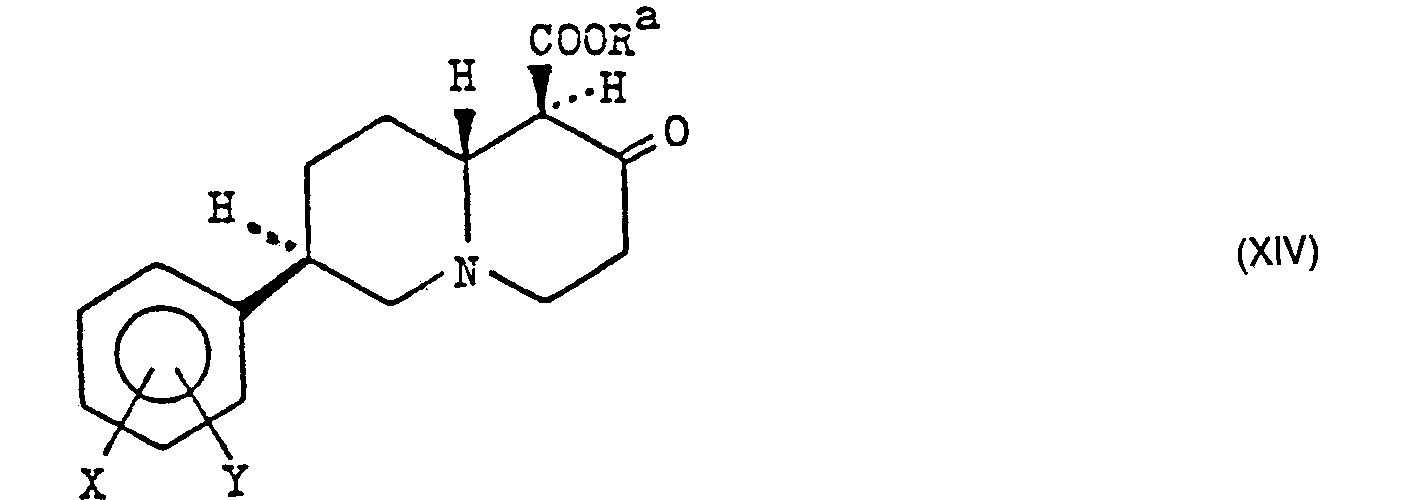
- the ß-keto-esters XIV can in turn from the corresponding unsaturated ß-keto-esters of the general formula XIII wherein X, Y and R a are the same as above, are obtained in a manner known per se by hydrogenation (cf., for example, Example 1c).
- esters XIII can be obtained from corresponding 5-phenyl-2-piperidones optionally substituted in the phenyl by methods known per se (cf., for example, Example 1d).
- benzimidazolines III-8 mentioned as starting material in process variant 6 can be obtained from the corresponding unsaturated compounds of the general formula XV (with the relative configuration given in this formula in positions 7 and 9a) wherein X, Y, R 3 , R 5 and R 6 mean the same as above, are obtained by hydrogenation.
- N-alkylation of XV as in process variant 6 gives N-alkylated starting compounds IX.
- the compounds XV can in turn be obtained from the ⁇ -keto esters XIV already mentioned by the process described in Example 7b or in analogy thereto.
- the compounds VI and VII can be obtained by the process described in Examples 13 and 14 or in analogy thereto.
- the phenyl-quinolizidines of the formula are distinguished by valuable pharmacological properties. They are neuroleptic, central depressant, tranquillizing, antiemetic and / or analgesic and can therefore be used as antipsychotics or antiemetics or analgesics in the fight against psychoses and neuroses or nausea or pain.
- the neuroleptic properties of the compounds were determined using the tests described below:
- a group of 10 rats was used per dose, who had been trained to escape by jumping up onto a vertical, insulated rod in the test cage, from the electric shock triggered immediately after an acoustic signal (conditioned stimulus) via floor grille (unconditional stimulus).
- the inhibition of the conditioned reaction in 50% of the animals during an observation period of 6 hours is determined by the parameter ED 50 BCR, the inhibition of the unconditional reaction by the parameter ED 10 BUR.
- Calf striatum was used as the receptor in the in vitro experiments (Lit.: Creese et al., Life Sci. 17, 993 (1975) and analogously to the methods described by Fields et al., Brain Research 136, 578 (1977) with [ 3 H] spiroperidol
- the IC 50 was determined in triplicate from 4 different concentrations using a computer program, which indicates the concentration of the test substance at which a 50% detachment of the specific binding of [ 3 H] spiroperidol to the receptor occurs.
- mice 8 male mice (20-22 g) per dose were used to carry out the experiments. 60 minutes after oral administration of the test substance, 10 ml / kg of the test solution was injected intraperitoneally into the animals. Following a latency period of 5 minutes, the number of animals in which no more than 1 characteristic writhing symptom (convulsive stretching movement of the body) occurred during 5 minutes was recorded. The ED 50 indicates the dose at which 50% of the animals show no more than 1 writhing.
- mice (20-22 g) were used per dose. The animals were placed on a heated metal plate at 60 ⁇ 0.5 ° C. 60 minutes after oral administration of the test substance. Untreated mice started within max. Licking her paws for 10 seconds. The ED 50 is defined as the dose at which 50% of the animals only start licking their paws after a latency period of more than 10 seconds.
- The. Compounds of the formula in the form of the racemate or the enantiomers, and in the form of the free bases such as acid addition salts can be used as medicines, for. B. in the form of pharmaceutical preparations.
- the pharmaceutical preparations can be administered orally, e.g. B. in the form of tablets, coated tablets, coated tablets, hard and soft gelatin capsules, solutions, emulsions or suspensions.
- the administration can also be rectal, e.g. B. in the form of suppositories, locally or percutaneously, e.g. B. in the form of ointments, creams, jellies, solutions, or parenterally, for. B. in the form of injection solutions.
- the compounds according to the invention can be administered with pharmaceutically inert, inorganic or organic excipients.
- excipients one can e.g. B. for tablets, coated tablets and hard gelatin capsules lactose, corn starch or derivatives thereof, talc, stearic acid or its salts, etc. use.
- soft gelatin capsules are suitable as excipients such.
- solutions and syrups are suitable as excipients such.
- polyols As water, polyols, sucrose, invert sugar, glucose and the like. For injection solutions are suitable as excipients such. As water, alcohols, polyols, glycerin, vegetable oils, etc. For suppositories, local or percutaneous forms of use are suitable as excipients such. B. natural or hardened oils, waxes, fats, semi-liquid or liquid polyols and the like.
- the pharmaceutical preparations can also contain preservatives, solubilizers, stabilizers, wetting agents, emulsifiers, sweeteners, colorants, flavoring agents, salts for changing the osmotic pressure, buffers, coating agents or antioxidants. They can also contain other therapeutically valuable substances.
- the dosage can be in the range of 0.5-100 mg.
- amounts of active compound of about 0.05 mg / kg to about 10 mg / kg per day and in the case of parenteral administration those of about 0.01 mg / kg to 1 mg / kg per day.
- the precipitated gelatin is brought into solution with 1.2 l of hot methanol and then evaporated to a volume of 500 ml, whereupon the (+) phosphate crystallizes out at 0 ° C.: 8.7 g (72.5%), Mp 288-290 ° C.
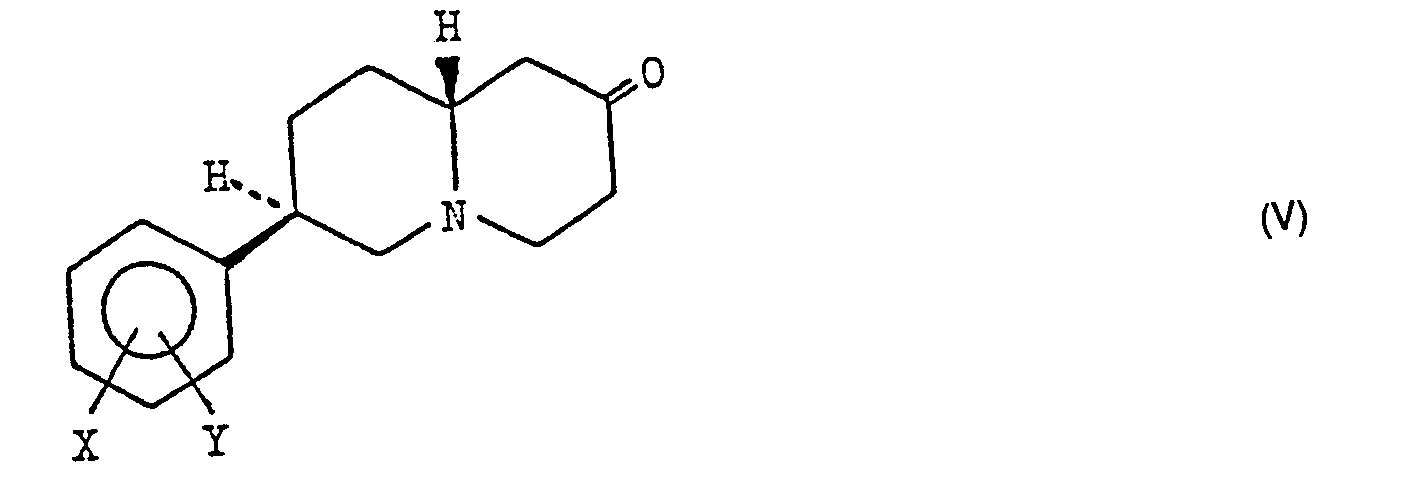
- the Grignard reagent is first prepared by refluxing for 2 hours. 2.64 g of rac- (9assH) -7ß- (p-chlorophenyl) octahydro-2H-quinolizin-2-one (obtained in accordance with Example 1b) in 25 ml of abs are then added to the suspension which has cooled to 0 ° C. Drop in ether and stir for a further hour at room temperature under argon.
- the base (rac- (9assH) -2a-tert.butyl-7ß- (o-chlorophenyl) octahydro-2H-quinolizin-2-yl acetate) with sodium bicarbonate solution can be released from the p-toluenesulfonate: 15.8 g. (70%).
- HCl salt mp 241-242 ° C.
- the eluate provides 5.4 g (83.5%) of the product base (rac- (9assH) -2a-tert.butyl-7ß- (o-chlorophenyl) octahydro-2H-quinolizin-2-yl-trifluoroacetate).
- HCl salt mp 172-173 ° C.
- the HCl salt is crystallized from methanol ether: 6.7 g (90%) rac-1 - ((9assH) -7 ⁇ - (o-chlorophenyl) octahydro-2H-quinolizin-2a-yl) -5.6 -dimethyl-2-benzimidazolinone hydrochloride, m.p .: 310 ° C.
- the base can be chromatographed on silica gel with methylene chloride-methanol. Mp base: 268-272 ° C.
- 0.068 g of sodium hydride (50% in mineral oil) suspended in 10 ml of 1,2-dimethoxyethane are mixed with 0.160 g of benzimidazolinone and then with 0.500 g of a (1: 1) mixture of rac- (9assH) -7ß- (o-chlorophenyl) ) octahydro-2H-quinolizine-2a-yl-p-toluenesulfonate and rac- (9assH) -7ß- (o-chlorophenyl) octahydro-2H-quinolizine-2ß-yl-p-toluenesulfonate in 10 ml of 1,2-dimethoxyethane and then 45 Heated to reflux for hours.
Landscapes
- Chemical & Material Sciences (AREA)
- Organic Chemistry (AREA)
- Pharmaceuticals Containing Other Organic And Inorganic Compounds (AREA)
- Nitrogen Condensed Heterocyclic Rings (AREA)
- Organic Low-Molecular-Weight Compounds And Preparation Thereof (AREA)
Claims (12)




Priority Applications (1)
| Application Number | Priority Date | Filing Date | Title |
|---|---|---|---|
| DE7979103907T DE2962580D1 (en) | 1978-10-13 | 1979-10-11 | 7-phenyl-quinolizidine derivatives (i), their preparation, pharmaceutical compositions containing them and (i) for use in treating diseases |
Applications Claiming Priority (4)
| Application Number | Priority Date | Filing Date | Title |
|---|---|---|---|
| CH1065478 | 1978-10-13 | ||
| CH10654/78 | 1978-10-13 | ||
| CH7156/79 | 1979-08-03 | ||
| CH715679 | 1979-08-03 |
Related Parent Applications (1)
| Application Number | Title | Priority Date | Filing Date |
|---|---|---|---|
| EP79103907.6 Division | 1979-10-11 |
Publications (2)
| Publication Number | Publication Date |
|---|---|
| EP0044573A1 EP0044573A1 (fr) | 1982-01-27 |
| EP0044573B1 true EP0044573B1 (fr) | 1984-02-29 |
Family
ID=25700857
Family Applications (2)
| Application Number | Title | Priority Date | Filing Date |
|---|---|---|---|
| EP81106675A Expired EP0044573B1 (fr) | 1978-10-13 | 1979-10-11 | 7-Phénylquinolizine |
| EP79103907A Expired EP0012170B1 (fr) | 1978-10-13 | 1979-10-11 | Phényl-7 quinolizidines (I), leur préparation, médicaments les contenant et (I) pour l'utilisation dans le traitement de maladies |
Family Applications After (1)
| Application Number | Title | Priority Date | Filing Date |
|---|---|---|---|
| EP79103907A Expired EP0012170B1 (fr) | 1978-10-13 | 1979-10-11 | Phényl-7 quinolizidines (I), leur préparation, médicaments les contenant et (I) pour l'utilisation dans le traitement de maladies |
Country Status (22)
| Country | Link |
|---|---|
| US (6) | US4236010A (fr) |
| EP (2) | EP0044573B1 (fr) |
| AR (3) | AR230637A1 (fr) |
| AT (1) | ATE877T1 (fr) |
| AU (1) | AU533075B2 (fr) |
| BR (1) | BR7906543A (fr) |
| CA (1) | CA1140927A (fr) |
| CS (2) | CS613879A2 (fr) |
| CU (1) | CU35149A (fr) |
| DE (2) | DE2962580D1 (fr) |
| DK (1) | DK433779A (fr) |
| ES (7) | ES484930A0 (fr) |
| FI (2) | FI66611C (fr) |
| GR (1) | GR73144B (fr) |
| HU (1) | HU180249B (fr) |
| IE (1) | IE49082B1 (fr) |
| IL (1) | IL58415A (fr) |
| MC (1) | MC1289A1 (fr) |
| NO (1) | NO152787C (fr) |
| NZ (1) | NZ191763A (fr) |
| PH (1) | PH16131A (fr) |
| PT (1) | PT70309A (fr) |
Families Citing this family (11)
| Publication number | Priority date | Publication date | Assignee | Title |
|---|---|---|---|---|
| NZ191763A (en) * | 1978-10-13 | 1984-05-31 | Hoffmann La Roche | 7-beta-phenyl-quinolidines, intermediates and pharmaceutical compositions |
| DK116181A (da) * | 1980-04-11 | 1981-10-12 | Hoffmann La Roche | Fremgangsmaade til fremstilling af quinolizidinderivater |
| US4889848A (en) * | 1984-11-06 | 1989-12-26 | Hoffmann-La Roche Inc. | Tricyclic pyridine derivatives |
| ZW17385A1 (en) * | 1984-11-06 | 1986-02-19 | Hoffmann La Roche | Tricyclic pyridine derivatives |
| CA1317945C (fr) * | 1985-12-13 | 1993-05-18 | Ulf Fischer | Derives de pyridazopyridone tricyclique |
| DE3614005A1 (de) * | 1986-04-25 | 1987-10-29 | Westfael Elekt Werke | Verfahren zur rauchgasentschwefelung |
| EP0294599A3 (fr) * | 1987-06-12 | 1990-05-09 | F. Hoffmann-La Roche Ag | Dérivés tricycliques de la pyridone |
| US6992090B2 (en) * | 2003-06-16 | 2006-01-31 | Adolor Corporation | Substituted piperidine compounds and methods of their use |
| US7538110B2 (en) | 2005-10-27 | 2009-05-26 | Adolor Corporation | Opioid antagonists |
| US20100311782A1 (en) * | 2009-06-08 | 2010-12-09 | Adolor Corporation | Substituted piperidinylpropanoic acid compounds and methods of their use |
| US8143273B2 (en) * | 2010-06-22 | 2012-03-27 | Hoffman-La Roche Inc. | Quinolizidine and indolizidine derivatives |
Family Cites Families (7)
| Publication number | Priority date | Publication date | Assignee | Title |
|---|---|---|---|---|
| CA668487A (en) * | 1963-08-13 | H. Tilford Charles | Hexahydro quinolizines | |
| US3031454A (en) * | 1962-04-24 | Hexahydro quinolizeses | ||
| GB1096589A (en) * | 1964-03-31 | 1967-12-29 | Chugai Pharmaceutical Co Ltd | Novel quinolizidine derivatives or salts thereof and process for preparing the same |
| DE1470084A1 (de) * | 1964-08-19 | 1969-05-29 | Merck Ag E | Verfahren zur Herstellung von substituierten Piperidin-derivaten |
| US3394141A (en) * | 1965-11-12 | 1968-07-23 | Fabio Sparatore | Z-benzyaminobenzimidazoles |
| US3852452A (en) * | 1970-02-10 | 1974-12-03 | Ayerst Mckenna & Harrison | Benzocycloheptaisoquinoline derivatives as cns depressants |
| NZ191763A (en) * | 1978-10-13 | 1984-05-31 | Hoffmann La Roche | 7-beta-phenyl-quinolidines, intermediates and pharmaceutical compositions |
-
1979
- 1979-10-05 NZ NZ191763A patent/NZ191763A/en unknown
- 1979-10-05 MC MC791408A patent/MC1289A1/fr unknown
- 1979-10-08 AU AU51545/79A patent/AU533075B2/en not_active Ceased
- 1979-10-08 IL IL58415A patent/IL58415A/xx unknown
- 1979-10-09 CA CA000337172A patent/CA1140927A/fr not_active Expired
- 1979-10-09 CS CS796861A patent/CS613879A2/cs unknown
- 1979-10-10 PH PH23149A patent/PH16131A/en unknown
- 1979-10-10 HU HU79HO2187A patent/HU180249B/hu unknown
- 1979-10-11 CU CU7935149A patent/CU35149A/es unknown
- 1979-10-11 EP EP81106675A patent/EP0044573B1/fr not_active Expired
- 1979-10-11 DE DE7979103907T patent/DE2962580D1/de not_active Expired
- 1979-10-11 AT AT79103907T patent/ATE877T1/de not_active IP Right Cessation
- 1979-10-11 DE DE8181106675T patent/DE2966740D1/de not_active Expired
- 1979-10-11 ES ES484930A patent/ES484930A0/es active Granted
- 1979-10-11 GR GR60236A patent/GR73144B/el unknown
- 1979-10-11 EP EP79103907A patent/EP0012170B1/fr not_active Expired
- 1979-10-12 IE IE1943/79A patent/IE49082B1/en unknown
- 1979-10-12 FI FI793182A patent/FI66611C/fi not_active IP Right Cessation
- 1979-10-12 DK DK433779A patent/DK433779A/da not_active Application Discontinuation
- 1979-10-12 NO NO793300A patent/NO152787C/no unknown
- 1979-10-12 PT PT70309A patent/PT70309A/pt unknown
- 1979-10-12 BR BR7906543A patent/BR7906543A/pt unknown
- 1979-10-15 US US06/085,096 patent/US4236010A/en not_active Expired - Lifetime
-
1980
- 1980-05-12 US US06/148,646 patent/US4272627A/en not_active Expired - Lifetime
- 1980-07-08 ES ES493202A patent/ES8105993A1/es not_active Expired
- 1980-07-08 ES ES493195A patent/ES8105991A1/es not_active Expired
- 1980-07-08 ES ES493204A patent/ES8105994A1/es not_active Expired
- 1980-07-08 ES ES493199A patent/ES8106304A1/es not_active Expired
- 1980-07-08 ES ES493198A patent/ES8105997A1/es not_active Expired
- 1980-07-08 ES ES493196A patent/ES8105992A1/es not_active Expired
- 1980-12-18 US US06/217,888 patent/US4316030A/en not_active Expired - Fee Related
- 1980-12-18 US US06/217,887 patent/US4329467A/en not_active Expired - Fee Related
- 1980-12-18 US US06/217,863 patent/US4306067A/en not_active Expired - Fee Related
- 1980-12-18 US US06/217,864 patent/US4338444A/en not_active Expired - Fee Related
-
1981
- 1981-02-20 AR AR284384A patent/AR230637A1/es active
- 1981-02-20 AR AR284379A patent/AR230636A1/es active
- 1981-02-20 AR AR284380A patent/AR230446A1/es active
-
1984
- 1984-04-05 FI FI841359A patent/FI70017C/fi not_active IP Right Cessation
- 1984-08-13 CS CS846138A patent/CS241050B2/cs unknown
Also Published As
Similar Documents
| Publication | Publication Date | Title |
|---|---|---|
| DE2614406C2 (fr) | ||
| DE3212682C2 (fr) | ||
| EP0136658B1 (fr) | -1-Benzyl-aminoalkyl-pyrrolidinones et leurs sels d'addition, procédé de préparation et médicaments les contenant | |
| DE9290063U1 (de) | Chinuclidin-Derivate | |
| CH648553A5 (de) | Neue 3,4-dihydro-5h-2,3-benzodiazepin-derivate und verfahren zur herstellung derselben. | |
| CH625787A5 (fr) | ||
| EP0012170B1 (fr) | Phényl-7 quinolizidines (I), leur préparation, médicaments les contenant et (I) pour l'utilisation dans le traitement de maladies | |
| EP0140070A1 (fr) | Dérivés du pyridoindole, procédé pour leur préparation et leur application | |
| DE2604748A1 (de) | Aminoderivate von imidazo(4,5-b) pyridinen | |
| CH639368A5 (de) | Verfahren zur herstellung von 1-methyl-2-benzylpyrrolidinen. | |
| DE9101348U1 (de) | Trizyklisch-zyklische Amine als neue Cholinesterease-Inhibitoren | |
| DE2822465C2 (de) | 2-substituierte trans-5-Phenyl-2,3,4,4a,5,9b-hexahydro-1H-pyrido[4,3-b]indolderivate und diese enthaltende Arzneimittel | |
| EP0072960B1 (fr) | Composés 1,5-diphénylpyrazolin-3-one, ainsi qu'un procédé et produits intermédiaires pour leur fabrication et médicaments contenant ces composés | |
| DE3038593C2 (fr) | ||
| EP0064685A1 (fr) | Dibenzo(de,g)quinolines, leurs procédés de préparation et les médicaments les contenant | |
| EP0037990B1 (fr) | Phénylquinolizidines, compositions pharmaceutiques correspondantes, préparation d'ingrédients actifs et produits de départ correspondants | |
| DE3226921A1 (de) | Neue bicyclische verbindungen und verfahren zu ihrer herstellung | |
| DD141156A5 (de) | Verfahren zur herstellung von 4a-aryl-octahydro-1h-2-pyrindinen | |
| DE69923448T2 (de) | 2-aminopyridine mit kondensierten ringsubstituenten als stickstoff-oxid-synthase inhibitoren | |
| EP0233483A2 (fr) | Pyrrolo[1,2-a][4,1]benzoxazépines, procédé pour leur préparation, compositions pharmaceutiques contenant ces composés et application therapeutique | |
| DE2748466A1 (de) | 4a-aryloctahydro-1h-2-pyrindine | |
| DE1445606A1 (de) | Benzoazacycloalkene | |
| DE3115993A1 (de) | Neue indol-derivate, verfahren zu ihrer herstellung und pharmazeutische praeparate, die diese verbindungen enthalten | |
| DE1949793A1 (de) | Neue Indanderivate und deren Herstellung | |
| DD148720A5 (de) | Verfahren zur herstellung von 4-amino-2-piperidinochinazolin-derivaten |
Legal Events
| Date | Code | Title | Description |
|---|---|---|---|
| PUAI | Public reference made under article 153(3) epc to a published international application that has entered the european phase |
Free format text: ORIGINAL CODE: 0009012 |
|
| 17P | Request for examination filed |
Effective date: 19810827 |
|
| AC | Divisional application: reference to earlier application |
Ref document number: 12170 Country of ref document: EP |
|
| AK | Designated contracting states |
Designated state(s): BE CH DE FR GB IT LU NL SE |
|
| ITF | It: translation for a ep patent filed | ||
| GRAA | (expected) grant |
Free format text: ORIGINAL CODE: 0009210 |
|
| AC | Divisional application: reference to earlier application |
Ref document number: 12170 Country of ref document: EP |
|
| AK | Designated contracting states |
Designated state(s): BE CH DE FR GB IT LU NL SE |
|
| REF | Corresponds to: |
Ref document number: 2966740 Country of ref document: DE Date of ref document: 19840405 |
|
| ET | Fr: translation filed | ||
| PGFP | Annual fee paid to national office [announced via postgrant information from national office to epo] |
Ref country code: FR Payment date: 19840704 Year of fee payment: 6 |
|
| PGFP | Annual fee paid to national office [announced via postgrant information from national office to epo] |
Ref country code: DE Payment date: 19840709 Year of fee payment: 6 |
|
| PGFP | Annual fee paid to national office [announced via postgrant information from national office to epo] |
Ref country code: CH Payment date: 19841010 Year of fee payment: 6 |
|
| PG25 | Lapsed in a contracting state [announced via postgrant information from national office to epo] |
Ref country code: LU Free format text: LAPSE BECAUSE OF NON-PAYMENT OF DUE FEES Effective date: 19841031 |
|
| PGFP | Annual fee paid to national office [announced via postgrant information from national office to epo] |
Ref country code: SE Payment date: 19841231 Year of fee payment: 6 Ref country code: BE Payment date: 19841231 Year of fee payment: 6 |
|
| PLBE | No opposition filed within time limit |
Free format text: ORIGINAL CODE: 0009261 |
|
| STAA | Information on the status of an ep patent application or granted ep patent |
Free format text: STATUS: NO OPPOSITION FILED WITHIN TIME LIMIT |
|
| 26N | No opposition filed | ||
| PGFP | Annual fee paid to national office [announced via postgrant information from national office to epo] |
Ref country code: NL Payment date: 19861031 Year of fee payment: 8 |
|
| PG25 | Lapsed in a contracting state [announced via postgrant information from national office to epo] |
Ref country code: SE Effective date: 19871012 |
|
| PG25 | Lapsed in a contracting state [announced via postgrant information from national office to epo] |
Ref country code: CH Effective date: 19871031 Ref country code: BE Effective date: 19871031 |
|
| BERE | Be: lapsed |
Owner name: F. HOFFMANN-LA ROCHE & CO. A.G. Effective date: 19871031 |
|
| PG25 | Lapsed in a contracting state [announced via postgrant information from national office to epo] |
Ref country code: NL Effective date: 19880501 |
|
| NLV4 | Nl: lapsed or anulled due to non-payment of the annual fee | ||
| GBPC | Gb: european patent ceased through non-payment of renewal fee | ||
| PG25 | Lapsed in a contracting state [announced via postgrant information from national office to epo] |
Ref country code: FR Free format text: LAPSE BECAUSE OF NON-PAYMENT OF DUE FEES Effective date: 19880630 |
|
| REG | Reference to a national code |
Ref country code: CH Ref legal event code: PL |
|
| PG25 | Lapsed in a contracting state [announced via postgrant information from national office to epo] |
Ref country code: DE Effective date: 19880801 |
|
| REG | Reference to a national code |
Ref country code: FR Ref legal event code: ST |
|
| PG25 | Lapsed in a contracting state [announced via postgrant information from national office to epo] |
Ref country code: GB Effective date: 19881118 |
|
| EUG | Se: european patent has lapsed |
Ref document number: 81106675.2 Effective date: 19880707 |