EP0052073A1 - Lichtstabilisierung von sauerkatalysierten Einbrennlacken - Google Patents
Lichtstabilisierung von sauerkatalysierten Einbrennlacken Download PDFInfo
- Publication number
- EP0052073A1 EP0052073A1 EP81810441A EP81810441A EP0052073A1 EP 0052073 A1 EP0052073 A1 EP 0052073A1 EP 81810441 A EP81810441 A EP 81810441A EP 81810441 A EP81810441 A EP 81810441A EP 0052073 A1 EP0052073 A1 EP 0052073A1
- Authority
- EP
- European Patent Office
- Prior art keywords
- formula
- group
- acid
- alkyl
- use according
- Prior art date
- Legal status (The legal status is an assumption and is not a legal conclusion. Google has not performed a legal analysis and makes no representation as to the accuracy of the status listed.)
- Granted
Links
Classifications
-
- C—CHEMISTRY; METALLURGY
- C08—ORGANIC MACROMOLECULAR COMPOUNDS; THEIR PREPARATION OR CHEMICAL WORKING-UP; COMPOSITIONS BASED THEREON
- C08K—Use of inorganic or non-macromolecular organic substances as compounding ingredients
- C08K5/00—Use of organic ingredients
- C08K5/16—Nitrogen-containing compounds
- C08K5/34—Heterocyclic compounds having nitrogen in the ring
- C08K5/3442—Heterocyclic compounds having nitrogen in the ring having two nitrogen atoms in the ring
- C08K5/3445—Five-membered rings
-
- C—CHEMISTRY; METALLURGY
- C08—ORGANIC MACROMOLECULAR COMPOUNDS; THEIR PREPARATION OR CHEMICAL WORKING-UP; COMPOSITIONS BASED THEREON
- C08K—Use of inorganic or non-macromolecular organic substances as compounding ingredients
- C08K5/00—Use of organic ingredients
- C08K5/16—Nitrogen-containing compounds
- C08K5/34—Heterocyclic compounds having nitrogen in the ring
- C08K5/3412—Heterocyclic compounds having nitrogen in the ring having one nitrogen atom in the ring
- C08K5/3432—Six-membered rings
- C08K5/3435—Piperidines
-
- C—CHEMISTRY; METALLURGY
- C08—ORGANIC MACROMOLECULAR COMPOUNDS; THEIR PREPARATION OR CHEMICAL WORKING-UP; COMPOSITIONS BASED THEREON
- C08K—Use of inorganic or non-macromolecular organic substances as compounding ingredients
- C08K5/00—Use of organic ingredients
- C08K5/16—Nitrogen-containing compounds
- C08K5/34—Heterocyclic compounds having nitrogen in the ring
- C08K5/3467—Heterocyclic compounds having nitrogen in the ring having more than two nitrogen atoms in the ring
- C08K5/3477—Six-membered rings
- C08K5/3492—Triazines
- C08K5/34926—Triazines also containing heterocyclic groups other than triazine groups
-
- C—CHEMISTRY; METALLURGY
- C09—DYES; PAINTS; POLISHES; NATURAL RESINS; ADHESIVES; COMPOSITIONS NOT OTHERWISE PROVIDED FOR; APPLICATIONS OF MATERIALS NOT OTHERWISE PROVIDED FOR
- C09D—COATING COMPOSITIONS, e.g. PAINTS, VARNISHES OR LACQUERS; FILLING PASTES; CHEMICAL PAINT OR INK REMOVERS; INKS; CORRECTING FLUIDS; WOODSTAINS; PASTES OR SOLIDS FOR COLOURING OR PRINTING; USE OF MATERIALS THEREFOR
- C09D7/00—Features of coating compositions, not provided for in group C09D5/00; Processes for incorporating ingredients in coating compositions
- C09D7/40—Additives
- C09D7/48—Stabilisers against degradation by oxygen, light or heat
Definitions
- the present invention is concerned with the stabilization of acid-catalyzed stoving enamels based on hot-crosslinkable acrylic, polyester or alkyd resins against the action of light and moisture by the addition of N-substituted polyalkylpiperidine derivatives and with the acid-catalyzed stoving enamels stabilized in this way.
- EP-A 6213 it was proposed to solve these problems by using only those polyalkylpiperidine light stabilizers whose piperidine nitrogen is substituted, in particular those light stabilizers which contain a group of the formula I.
- R is hydrogen or methyl and R 1 is C 1 -C 18 alkyl, C 1 -C 6 H y DROX y- alkyl, C 3 -C 8 alkenyl, C 3 -C 8 alkynyl, optionally in the alkyl moiety by hydroxy-substituted C 7 - C 12 aralkyl, C 1 -C 8 alkanoyl or C 3 -C 5 alkenoyl.
- the invention therefore relates to the use of compounds which contain a group of the formula I
- R is hydrogen or methyl and R 1 is C 1 -C 8 alkanoyl, C 3 -C S alkenoyl, sorboyl, cinnamoyl, C 2 -C 5 alkoxycarbonyl or a group (R 2 ) (R 3 ) represents NCO-, where R 2 is C 1 -C 12 alkyl, cyclohexyl, phenyl or phenyl substituted by halogen, C 1 -C 4 alkyl or C 1 -C 4 alkoxy and R 3 is hydrogen, C 1 -C 12 represents alkyl, cyclohexyl or benzyl, as a light stabilizer for acid-catalyzed stoving lacquers based on hot-crosslinkable acrylic, polyester or alkyd resins.
- R is preferably hydrogen.
- the compounds of formula I are derivatives of 2,2,6,6-tetramethylpiperidine.
- the light stabilizers which can be used according to the invention can be piperidine derivatives of various classes of compounds, for example hydroxyl compounds and their esters, ethers and carbamates, amines, amides, ureas, ketals, spiroketals, spirohydantoins, aminotriazines, nitriles, carboxylic acids and carboxylic acid derivatives and many others, as are known in particular from the patent literature.
- R and R 1 have reasonable for Formula I g plain meaning
- n 1 or 2 and R 9 is a group of the formula means in which R and R 1 have the meaning given for the formula I, Y is -0- or -NR 12 -, AC 2 -C 6 alkylene and p are the numbers 0 or 1,
- polyalkylpiperidine light stabilizers of this class are the compounds of the following formulas: e) Polymeric compounds whose recurring structural units contain a group of the formula I, in particular polyesters, polyethers, polyamides, polyamines, polyurethanes, polyureas, polyaminotriazines, poly (meth) acrylates, poly (meth) acrylamides and their copolymers which contain such radicals.
- polyalkylpiperidine light stabilizers of this class are the compounds of the following formulas, where q and r are numbers from 2 to about 200.
- Polyalkylpiperidine light stabilizers which form chemical bonds with the binder of the lacquer can also be used. This is the case if the polyalkylpiperidine derivative has a reactive group suitable for this, such as, for example, a glycidyl, hydroxyl or a methylol group.
- the piperidine light stabilizer has a polymerizable group, such as acroyl or methacroyl groups as R 1 or in another position in the molecule
- the light stabilizer can copolymerize with the binder of the lacquer, provided that the binder also has polymerizable groups. This is the case, for example, with acrylic resins or acrylic-modified alkyd resins.
- the acrylic resin lacquers which can be stabilized against light according to the invention are the customary acrylic stoving lacquers, as described, for example, in H. Kittel's textbook on lacquers and coatings, volume 1, part 2, on pages 735 and 742 (Berlin, 1972) and in H Wagner, HF Sarx, Lackschulharze (1971), are described on pages 229-238.
- polyester lacquers which can be stabilized according to the invention against the action of light are the usual stoving lacquers, as described for example in H. Wagner, H.F. Sarx, Lackkunstharze (1971), are described on pages 86-99.
- alkyd resin lacquers which can be stabilized according to the invention against the action of light are the usual stoving lacquers which are used in particular for the coating of automobiles (so-called automotive topcoats), for example lacquers based on alkyd melamine resins and alkyd acrylic melamine resins ( see H. Wagner, HF Sarx, Lackkunstharze (1971), pages 99-127).
- the stoving lacquers which can be stabilized according to the invention can also contain mixtures of acrylic, polyester and alkyd resins with one another or with other lacquer resins.
- the acrylic, polyester and alkyd resins can be self-crosslinking in the heat or they are used in a mixture with crosslinking agents, for which melamine resins are particularly suitable.
- the acid-catalyzed stoving enamels stabilized according to the invention are suitable both for metallic effect and for uni-enamels, especially in the case of touch-up painting.
- the lacquers stabilized according to the invention are preferably applied as usual by two processes, either after the one-coat or after the two-coat process. In the latter case, the pigment-containing layer is applied first and then an opaque clear lacquer layer.
- the polyalkylpiperidine derivative to be used for the stabilization according to the invention can be incorporated either only in the unpigmented topcoat or both in the unpigmented topcoat and in the master lacquer containing pigment.
- the amount of the polyalkylpiperidine derivative added is 0.01 to 5% by weight, based on the solvent-free binder, preferably 0.5 to 1% by weight.
- the lacquers can be dissolved or dispersed in conventional organic solvents or in water or can be solvent-free.
- the coating resins according to the invention are particularly suitable for high-solids industrial coatings, so-called “high-solids”, as they are becoming increasingly important especially in the automotive industry and in the repair of automobiles, in particular for applications at a low curing temperature.
- UV absorbers can be advantageous in order to achieve maximum light resistance.
- UV absorbers of the 2-hydroxybenzophenone, 2- (2-hydroxyphenyl) benzotriazole or oxalanilide type can have a synergistic effect.
- Examples include 2- (2-hydroxy-3,5-di-t-amylphenyl) benzotriazole, 2- [2-hydroxy-3,5-di ( ⁇ -dimethylbenzyl) phenyl] benzotriazole, 2- (2-hydroxy-5-t-octyl-phenyl) -benztriazole, 2- (2-hydroxy-3,5-di-t-octyl-pheny1) -benztriazole, 2,4-dihydroxybenzophenone, 2-hydroxy-4- octyloxy-benzophenone, 2-hydroxy-4-dodecyloxy-benzophenone, 2-ethyl-2'-ethoxy-4'-t-butyl-oxalanilide or 2-ethyl-2'-ethoxy-oxalanilide. If other conventional light stabilizers are also used in two-coat lacquers, these can only be incorporated in the unpigmented topcoat or both in the unpigmented topcoat and in the master lacquer containing pigment
- the total of all light stabilizers is 0.2 to 5% by weight, preferably 0.5 to 2% by weight, based on the coating resin.
- antioxidants for example those of the sterically hindered phenol derivative type, phosphorus compounds such as phosphites, phosphines or phosphonites, plasticizers, flow control agents, hardening accelerators, thickeners,. Dispersant or adhesion promoter.
- N-acylated polyalkylpiperidine derivatives in acid-catalyzed stoving lacquers.
- Parts mean parts by weight, percentages mean percentages by weight.
- Example 1 Investigation of the curing delay when adding light stabilizers to an acid-catalyzed hot-crosslinkable acrylic resin lacquer
- the clear coat was applied in a dry film thickness of 30 microns by spraying. After an exhaust time of 15 minutes, the samples were baked at 110 ° C for 30 minutes. After 30 minutes of storage in an air-conditioned room (23 ° C / 50% rel. RH), the König pendulum hardness was measured in accordance with DIN 53 157.
- the pre-coating lacquer was sprayed on to a layer thickness of approx. 15 ⁇ and flashed off for approx. 10 minutes.
- the clear lacquer was then sprayed on to a layer thickness of approximately 30 ⁇ . After an exhaust time of 15 minutes, the samples were baked at 120 ° C for 30 minutes.
- a light stabilizer according to the invention 1% (based on the coating resin) of a light stabilizer according to the invention, a commercially available UV absorber and a mixture of these two light stabilizers were added to the top coat.
- the samples were subjected to Florida weathering (5 ° south, black box) and the surface gloss of the samples was measured at intervals of 3 months according to method ASTM D 523.
- the surface gloss of the samples is measured at intervals of 200 hours according to the ASTM D 523 method.
Landscapes
- Chemical & Material Sciences (AREA)
- Organic Chemistry (AREA)
- Health & Medical Sciences (AREA)
- Chemical Kinetics & Catalysis (AREA)
- Medicinal Chemistry (AREA)
- Polymers & Plastics (AREA)
- Life Sciences & Earth Sciences (AREA)
- Engineering & Computer Science (AREA)
- Materials Engineering (AREA)
- Wood Science & Technology (AREA)
- Hydrogenated Pyridines (AREA)
- Compositions Of Macromolecular Compounds (AREA)
- Paints Or Removers (AREA)
Abstract
Description
- Die vorliegende Erfindung befasst sich mit dem Stabilisieren von sauerkatalysierten Einbrennlacken auf der Basis heissvernetzbarer Acryl-, Polyester- oder Alkydharze gegen die Einwirkung von Licht und Feuchtigkeit durch den Zusatz von N-substituierten Polyalkylpiperidinderivaten sowie mit den so stabilisierten sauerkatalysierten Einbrennlacken.
- Von Fall zu Fall, insbesondere aber bei Ausbesserungslackierungen und festkörperreichen Lacken für den Industrielacksektor, werden Einbrennlacksysteme auf der Basis heissvernetzbarer Acryl-, Polyester- oder Alkydharze mit einem zusätzlichen Säurekatalysator versehen. Werden dabei Lichtschutzmittel vom Typ der Polyalkylpiperidinderivate mitverwendet, so werden häufig Ausfällerscheinungen durch Salzbildung zwischen Lichtschutzmittel und Säurekatalysator, Härtungsverzögerungen, Pigmentflocculationen sowie eine reduzierte Lichtschutzwirkung beobachtet.
- In der EP-A 6213 wurde vorgeschlagen, diese Probleme dadurch zu lösen, dass man nur solche Polyalkylpiperidin-Lichtschutzmittel verwendet, deren Piperidin-Stickstoff substituiert ist, insbesondere solche Lichtschutzmittel, die eine Gruppe der Formel I enthalten

- Tatsächlich verhalten sich solche N-substituierten Piperidinderivate in sauerkatalysierten Lacken wesentlich günstiger hinsichtlich der beobachteten Störungen als ihre N-unsubstituierten Analogen, also die Verbindungen der Formel I, worin R1 Wasserstoff ist.
- Es hat sich gezeigt, dass viele der in der EP-A 6213 beschriebenen N-substituierten Lichtschutzmittel in gewissen Fällen den Anforderungen der Praxis der Lacktechnologie nicht genügen. Bei sehr niedrigen Katalysator-Konzentrationen sowie bei niedrigen Einbrenntemperaturen können erhebliche Verzögerungen der Härtung eintreten. Die gehärteten Lacke können beim Lagern in feuchter Atmosphäre opak werden, was der Fachmann als "Weissaniaufen" bezeichnet. Die gehärteten Lacke können ausserdem ungenügende Lösungsmittelbeständigkeit und Kratzfestigkeit besitzen. Es wurde jedoch gefunden, dass bestimmte ausgewählte Verbindungen der Formel I diese Nachteile nicht zeigen und sich damit in bevorzugter Weise als Lichtschutzmittel für sauerkatalysierte Einbrennlacke eignen. Es handelt sich hierbei um solche Verbindungen der Formel I, deren Gruppe R1 eine Acylgruppe ist. Diese kann z.B. eine Alkanoyl-, Alkenoyl-, Aralkenoyl-, Alkoxycarbonyl- oder Carbamoylgruppe sein.
- Gegenstand der Erfindung ist daher die Verwendung von Verbindungen, die eine Gruppe der Formel I enthalten,
-
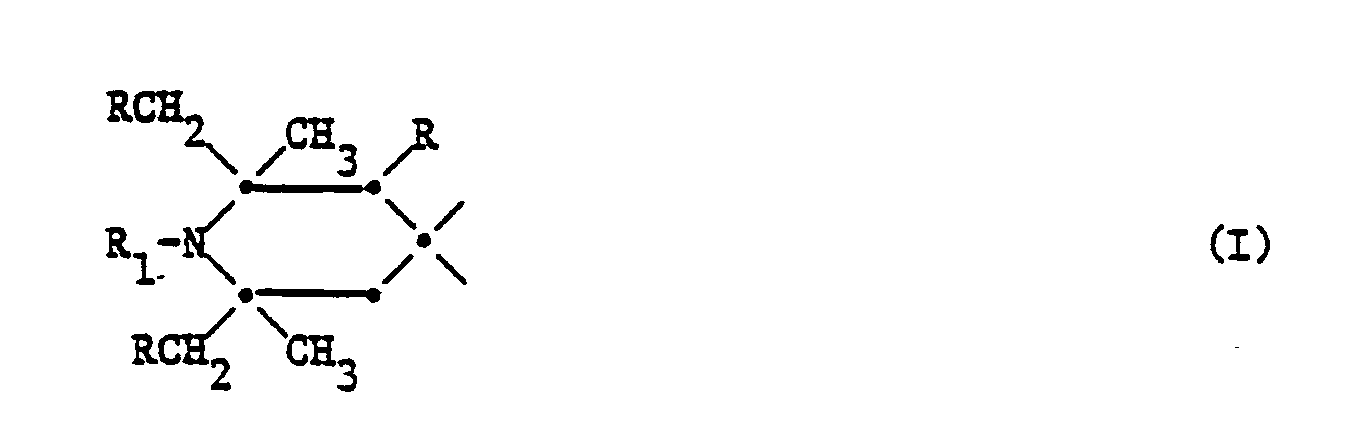
- Beispiele für R1 der obigen Formel I sind Alkanoylgruppen wie die Formyl-, Acetyl-, Propionyl-, Butyryl-, Valerianyl-, Capronyl- oder Capryloylgruppe; Alkenoylgruppen wie die Acryloyl-, Methacryloyl-oder Crotonoylgruppe; die Sorboylgruppe (CH3CH=CHCH=CHCO-); die Cinnamoylgruppe (Phenyl-CH=CH-CO-); eine Alkoxycarbonylgruppe wie die Methoxy-, Aethoxy- oder Butoxycarbonylgruppe; eine N-monosubstituierte Carbamoylgruppe wie die Methylamino-, Butylamino-, Octylamino-, Dodecylamino-, Cyclohexylamino-, Phenylamino-, Tolylamino- oder Chlorphenylaminocarbonylgruppe; oder eine N-disubstituierte Carbamoylgruppe, wie z.B. die Dimethylamino-, Di-isopropylamino-, Diäthylamino-, Dibutylamino-, Dihexylamino-, Dioctylamino-, Methyl-octylamino-, Methylcyclohexylamino-, Dieyclohexylamino-, Methyl-benzylamino-, Aethylphenylamino- oder Methyl-chlorphenylamino-carbonylgruppe. Bevorzugt ist R1 eine C2-C4 Alkanoyl- oder C3-C5 Alkenoylgruppe, insbesondere eine Acetyl-, Acryloyl- oder Methacryloylgruppe.
- R ist bevorzugt Wasserstoff. In diesem Fall stellen die Verbindungen der Formel I Derivate des 2,2,6,6-Tetramethylpiperidins dar.
- Je nach der Art und Weise, in der die Piperidingruppe I über seinen freien Valenzen in 4-Stellung substituiert ist bzw. an den Rest des Stabilisatormoleküls gebunden ist, kann es sich bei den erfindungsgemäss verwendbaren Lichtschutzmitteln um Piperidinderivate von verschiedenen Verbindungsklassen handeln, beispielsweise um Hydroxylverbindungen und deren Ester, Aether und Carbamate, Amine, Amide, Harnstoffe, Ketale, Spiroketale, Spirohydantoine, Aminotriazine, Nitrile, Carbonsäuren und Carbonsäurederivate und viele andere, wie sie insbesondere aus der Patentliteratur bekannt sind.
- Zu den erfindungsgemäss zu verwendenden Lichtschutzmitteln gehören insbesondere folgende Verbindungsklassen:
- a) Lichtschutzmittel der Formel II,

- Beispiele für Lichtschutzmittel dieser Klasse sind folgende Verbindungen:
- l-Acetyl-4-stearoyloxy-2,2,6,6-tetramethylpiperidin
- 1-Propionyl-4-benzoyloxy-2,2,6,6-tetramethylpiperidin
- 1-Acryloyl-4-benzyloxy-2,2,6,6-tetramethylpiperidin
- 1-Methacryloyl-4-cyanäthyloxy-2,2,6,6-tetramethylpiperidin
- l-Cinnamoyl-4-cinnamoyloxy-2,2,6,6-tetramethylpiperidin
- l-Butyroyl-4-butoxy-2,2,6,6-tetramethylpiperidin
- 1-Acetyl-4-trämethylsiloxy-2,2,6,6-tetramethylpiperidin
- Di-(1-acetyl-2,2,6,6-tetramethylpiperidin-4-yl)-adipat
- Di-(1-acetyl-2,2,6,6-tetramethylpiperidin-4-yl)-phthalat
- Di-(1-acetyl-2,2,6,6-tetramethylpiperidin-4-yl)-dibenzylmalonat
- Di-(1-acryloyl-2,2,6,6-tetramethylpiperidin-4-yl)-sebacat
- Di-(1-acryloyl-2,2,6,6-tetramethylpiperidin-4-yl)-trimethyladipat
- Di-(1-methacryloyl-2,2,6,6-tetramethylpiperidin-4-yl)-maleinat
- Di-(1-acetyl-2,2,6,6-tetramethylpiperidin-4-yl)-butyl-(4-hydroxy-3,5-di-t-butylbenzyl)-malonat
- Di-(1-phenylcarbamoyl-2,2,6,6-tetramethylpiperidin-4-yl)-succinat
- Di-(1-methylcarbamoyl-2,2,6,6-tetramethylpiperidin-4-yl)-N,N'-hexamethylen-dicarbamat
- Tris-(1-acetyl-2,2,6,6-tetramethylpiperidin-4-yl)-trimesinat
- Tris-(1-acetyl-2,2,6,6-tatramethylpiperidin-4-yl)-nitrilotriacetat
- Tris-(1-acryloyl-2,2,6,6-tetramethylpiperidin-4-yl)-triearballylat
- Tris-(1-acetyl-2,2,6,6-tetramethylpiperidin-4-yl)-phosphat
- Tetrakis-(1-acetyl-2,2,6,6-tetramethylpiperidin-4-yl)-pyromellithat
-

- Beispiele für Polyalkylpiperidin-Lichtschutzmittel dieser Klasse sind folgende Verbindungen:
- N,N'-Bis-(1-acetyl-2,2,6,6-tetramethylpiperidin-4-yl)-hexamethylen-1,6-diacetamid
- 1-Acetyl-4-(N-cyclohexylacetamido)-2,2,6,6-tetramethylpiperidin
- N,N'-Bis-(1-acetyl-2,2,6,6-tetramethylpiperidin-4-yl)-N,N'-diacetyl- p-xylylendiamin
- Die Verbindung der Formel

-

- Beispiele für Polyalkylpiperidin-Lichtschutzmittel dieser Klasse sind folgende Verbindungen:
- 3-Dodecyl-1,3,8-triaza-7,7,9,9-tetramethyl-8-acetyl-spiro[4.5]decan-2,4-dion
- 3-Benzyl-1,3,8-triaza-7,7,9,9-tetramethyl-8-acetyl-spiro[4.5]decan-2,4-dion
- 3-n-Octyl-1,3,8-triaz-7,7,9,9-tetramethyl-8-acryloyl-spiro[4.5]decan-2,4-dion
- 3-Allyl-1,3,8-triaza-1,7,7,9,9-pentamethyl-8-propionyl-spiro[4.5]decan-2,4-dion
- oder die Verbindungen der folgenden Formeln:
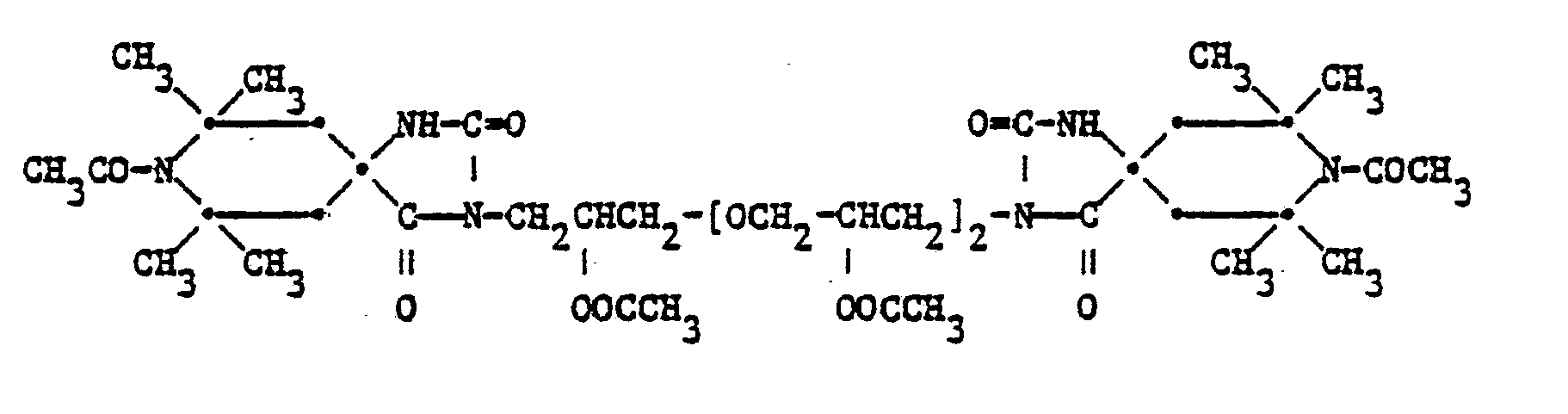


-
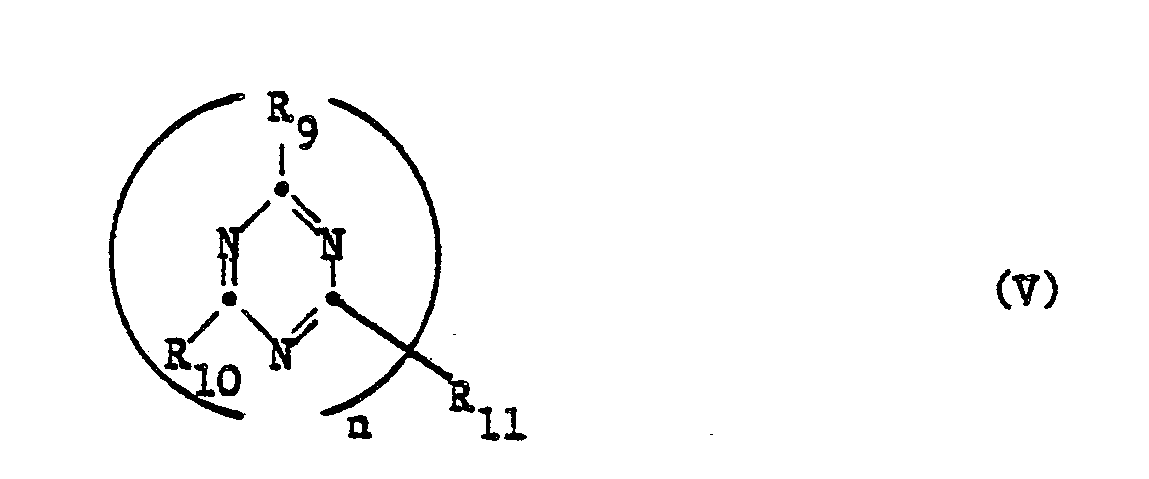


- Beispiele für Polyalkylpiperidin-Lichtschutzmittel dieser Klasse sind die Verbindungen der folgenden Formeln:


- Beispiele für Polyalkylpiperidin-Lichtschutzmittel dieser Klasse sind die Verbindungen der folgenden Formeln, wobei q und r Zahlen von 2 bis etwa 200 bedeuten.


- Es können auch Polyalkylpiperidin-Lichtschutzmittel verwendet werden, die mit dem Bindemittel des Lackes chemische Bindungen eingehen. Dies ist der Fall, wenn das Polyalkylpiperidinderivat eine hierfür geeignete reaktive Gruppe besitzt, wie beispielsweise eine Glycidyl-, Hydroxyl-oder eine Methylolgruppe.
- Besitzt das Piperidin-Lichtschutzmittel eine polymerisationsfähige Gruppe, wie z.B. Acroyl- oder Methacroylgruppen als R1 oder in einer anderen Stellung im Molekül, so kann das Lichtschutzmittel mit dem Bindemittel des Lackes copolymerisieren, sofern auch das Bindemittel polymerisationsfähige Gruppen hat. Dies ist beispielsweise der Fall bei Acrylharzen oder acrylmodifizierten Alkydharzen.
- In diesen Fällen besteht der Vorteil, dass die Lichtschutzmittel nicht durch Extraktion oder Migration entfernbar sind, so dass ihre Wirkung sehr lange anhält.
- Die Acrylharzlacke, die erfindungsgemäss gegen Licht stabilisiert werden können, sind die üblichen Acrylharzeinbrennlacke, wie sie beispielsweise in H. Kittel's Lehrbuch der Lacke und Beschichtungen, Band 1, Teil 2, auf den Seiten 735 und 742 (Berlin, 1972) bzw. in H. Wagner, H.F. Sarx, Lackkunstharze (1971), auf den Seiten 229-238 beschrieben sind.
- Die Polyesterlacke, die erfindungsgemäss gegen die Einwirkung von Licht stabilisiert werden können, sind die üblichen Einbrennlacke, wie sie beispielsweise in H. Wagner, H.F. Sarx, Lackkunstharze (1971), auf den Seiten 86-99 beschrieben sind.
- Die Alkydharzlacke, die erfindungsgemäss gegen die Einwirkung von Licht stabilisiert werden können, sind die üblichen Einbrennlacke, die insbesondere zur Lackierung von Automobilen (sogenannte Automobil-Decklacke) verwendet werden, beispielsweise Lacke auf der Basis von Alkyd-Melaminharzen und Alkyd-Acryl-Melaminharzen (siehe H. Wagner, H.F. Sarx, Lackkunstharze (1971), Seiten 99-127).
- Die erfindungsgemäss stabilisierbaren Einbrennlacke können auch Gemische von Acryl-, Polyester- und Alkydharzen untereinander oder mit anderen Lackharzen enthalten. Dabei können die Acryl-, Polyester-und Alkydharze in der Hitze selbstvernetzend sein oder man verwendet sie im Gemisch mit Vernetzern, wofür insbesondere Melaminharze geeignet sind.
- Die erfindungsgemäss stabilisierten sauerkatalysierten Einbrennlacke eignen sich sowohl für Metalleffekt- wie auch für Uni-Lackierungen, insbesondere im Falle von Ausbesserungslackierungen. Das Auftragen der erfindungsgemäss stabilisierten Lacke geschieht bevorzugt wie üblich nach zwei Verfahren, entweder nach dem Einschicht- oder nach dem Zweischichtverfabren. Im letzteren Falle wird zuerst die Pigment enthaltende Schicht aufgetragen und dann darüber eine deckende Klarlackschicht. Bei der Verwendung in Zweischichtlackierungen kann das für die erfindungsgemässe Stabilisierung zu verwendende Polyalkylpiperidinderivat entweder nur im unpigmentierten Decklack oder sowohl im unpigmentierten Decklack wie auch im Pigment enthaltenden Vorlegelack eingearbeitet werden.
- Die Menge des zugesetztan Polyalkylpiperidinderivates beträgt dabei 0,01 bis 5 Gew.-%, bezogen auf das lösungsmittelfreie Bindemittel, vorzugsweise 0,5 bis 1 Gew.-%. Die Lacke können in üblichen organischen Lösungsmitteln oder in Wasser gelöst oder dispergiert sein oder lösungsmittelfrei sein.
- Die erfindungsgemässen Lackharze eignen sich vor allem für festkörperreiche Industrielacke, sogenannte "high-solids", wie sie vor allem in der Automobilindustrie und bei der Reparatur von Automobilen zunehmend an Bedeutung gewinnen, insbesondere für Anwendungen bei niedriger Härtungstemperatur.
- Für die Erzielung maximaler Lichtbeständigkeit kann die Mitverwendung von anderen üblichen Lichtschutzmitteln, wie z.B. von UV-Absorbern oder von organischen Nickelverbindungen, von Vorteil sein. Von besonderer Bedeutung ist die Mitverwendung von UV-Absorbern vom Typ der 2-Hydroxybenzophenone, 2-(2-Hydroxyphenyl)-benztriazole oder der Oxalanilide , die eine synergistische Wirkung aufweisen können. Beispiele hierfür sind 2-(2-Hydroxy-3,5-di-t-amyl-phenyl)-benztriazol, 2-[2-Hydroxy-3,5-di(α-dimethylbenzyl)-phenyl]-benztriazol, 2-(2-Hydroxy-5-t-octyl-phenyl)-benztriazol, 2-(2-Hydroxy-3,5-di-t-octyl-pheny1)-benztriazol, 2,4-Dihydroxybenzophenon, 2-Hydroxy-4-octyloxy-benzophenon, 2-Hydroxy-4-dodecyloxy-benzophenon, 2-Aethyl-2'-äthoxy-4'-t-butyl-oxalanilid oder 2-Aethyl-2'-äthoxy-oxalanilid. Bei der Mitverwendung von anderen üblichen Lichtschutzmitteln in Zweischichtlackierungen können diese nur im unpigmentierten Decklack oder sowohl im unpigmentierten Decklack wie auch im Pigment enthaltenden Vorlegelack eingearbeitet werden.
- Im Falle solcher Kombinationen beträgt die Summe aller Lichtschutzmittel 0,2 bis 5 Gew.-X, vorzugsweise 0,5 bis 2 Gew.-%, bezogen auf das Lackharz.
- Weitere Zusatzstoffe, die im Lack enthalten sein können, sind Antioxydantien, beispielsweise solche vom Typ sterisch gehinderter Phenolderivate, Phosphorverbindungen, wie Phosphite, Phosphine oder Phosphonite, Weichmacher, Verlaufshilfsmittel, Härtungsbeschleuniger, Verdicker,. Dispergiermittel oder Haftverbesserer.
- Die folgenden Beispiele beschreiben die erfindungsgemässe Verwendung von N-acylierten Polyalkylpiperidinderivaten in sauerkatalysierten Einbrennlacken. Teile bedeuten darin Gewichtsteile, Prozente bedeuten Gewichtsprozente.
- Aluminiumbleche von 0,5 mm Dicke, die mit einem weisspigmentierten Grundlack auf Basis Polyesterharz beschichtet waren, wurden mit einem festkörperreichen Klarlack der folgenden Zusammensetzung beschichtet:
- 53,7 Teile Acrylharz (Paraloid 0L 42, Rohm & Haas Co., USA)
- 19,3 Teile Melaminharz (Cymel 301, Amer. Cyanamide Co.)
- 10,5 Teile n-Butanol
- 10,5 Teile Butylacetat
- 3,0 Teile Verlaufshilfsmittel (Byketol Spezial, Byk-Mallinckrodt)
- 3,0 Teile Celluloseacetobutyrat (CAB 551, Eastman Chem. Co.)
- 0,12 Teile p-Toluolsulfonsäure
- Dieser Lack hat einen Gehalt an 62,16 % Festkörper. Hinzu kommen die in Tabelle 1 angegebenen Mengen an Lichtschutzmittel. Es wurden die Lichtschutzmittel der folgenden Formel verwendet:

- LS I R1 = H
- LS II R1 = -CH3
- LS III R1 = -CH2CH=CH2
- LS IV R1 = -CO-CH3 (erfindungsgemäss)
- Der Klarlack wurde in einer Trockenfilmstärke von 30 µm durch Spritzen aufgebracht. Nach einer Abluftzeit von 15 Minuten wurden die Proben 30 Minuten bei 110°C eingebrannt. Nach 30 Minuten Lagerung in einem klimatisierten Raum (23°C/50% rel. LF) wurde die Pendelhärte nach König gemäss DIN 53 157 gemessen.

- Man ersieht aus diesen Werten, dass das Lichtschutzmittel mit R1 = H die Härtung sehr stark verzögert. Wenn R1 Methyl oder Allyl ist, ist die Verzögerung nicht mehr so stark. Wenn R1 Acetyl ist, tritt praktisch keine Verzögerung ein.
-
- 27 Teile Polyesterharz (L 1850 Dynamit Nobel AG)
- 3 Teile Melaminharz (Maprenal RT, Farbwerke Hoechst AG)
- 2 Teile Celluloseacetobutyrat (CAB 531, Eastman Chem. Corp.)
- 8 Teile Aluminiumbronze (ALCOA 726, Aluminium Corp. od America)
- 10 Teile Toluol
- 7 Teile Xylol
- 3 Teile Butanol
- 25 Teile Butylacetat
- 15 Teile aromatisches Lösungsmittelgemisch (Solvesso 150, ESSO AG)
- b) Unpigmentierter Decklack
- 56 Teile Acrylharz (Paraloid OL 42, Rohm & Haas Corp.)
- 20 Teile-Melaminharz (Cymel 301, American Cyanamid Corp.)
- 0,1 Teile p-Toluolsulfonsäure
- 2 Teile Celluloseacetobutyrat (CAB 551, Eastman Chem. Corp.)
- 3 Teile Verlaufshilfsmittel
- 11 Teile Butanol
- 8 Teile Butylacetat
- Aluminiumbleche von der Grösse 57 x 79 mm und der Dicke 0,5 mm, die mit einem Grundlack auf Basis von Polyester/Epoxidharz beschichtet waren, wurden erst mit dem Vorlegelack und anschliessend mit dem Decklack beschichtet. Der Vorlegelack wurde zu einer Schichtdicke von ca. 15 µ aufgespritzt und ca. 10 Minuten abgelüftet. Anschliessend wurde der Klarlack zu einer Schichtdicke von ca. 30 µ aufgesprüht. Nach einer Abluftzeit von 15 Minuten wurden die Proben 30 Minuten bei 120°C eingebrannt.
- Vor dem Auftragen wurden dem Decklack jeweils 1% (bezogen auf das Lackharz) eines Lichtschutzmittels gemäss Erfindung, eines handelsüblichen UV-Absorbers und eines Gemisches dieser beiden Lichtschutzmittel zugegeben.
- Die Proben wurden einer Florida-Bewitterung (5° Süd, Blackbox) unterworfen und in Abständen von 3 Monaten der Oberflächeaglanz der Proben nach Methode ASTM D 523 gemessen.

- Man ersieht daraus, dass die Stabilisator-Wirkung des erfindungsgemässen Piperidinderivates LS IV wesentlich stärker ist als die eines handelsüblichen UV-Absorbers. Ein Gemisch der beiden Stabilisatoren erweist sich jedoch noch als wirkungsvoller als LS IV allein, was eine synergistische Wirkung des Gemisches bedeutet.
- Wie in Beispiel. 2 beschrieben werden Aluminiumbleche mit
- a) einem Aluminium-pigmentierten Vorlegelack und b) mit einem unpigmentierten Decklack lackiert. Die Rezepturen beider Lacke entsprechen der in Beispiel 2 aufgeführten Zusammensetzung mit der Ausnahme, dass im Decklack 0,3 Teile Toluolsulfosäure (entsprechend 0,5 % bezogen auf Festkörper des Decklackes) verwendet werden. Die bei 120°C eingebrannten Proben werden in einem UVCON-Bewitterungsgerät (Atlas Corp.) bei einem Zyklus von 4 Stunden UV-Belichtung bei 60°C und 4 Stunden Wasserdampf-Kondensation bei 50°C bewittert.
- Der Oberflächenglanz der Proben wird in Abständen von 200 Stunden nach der Methode ASTM D 523 gemessen.
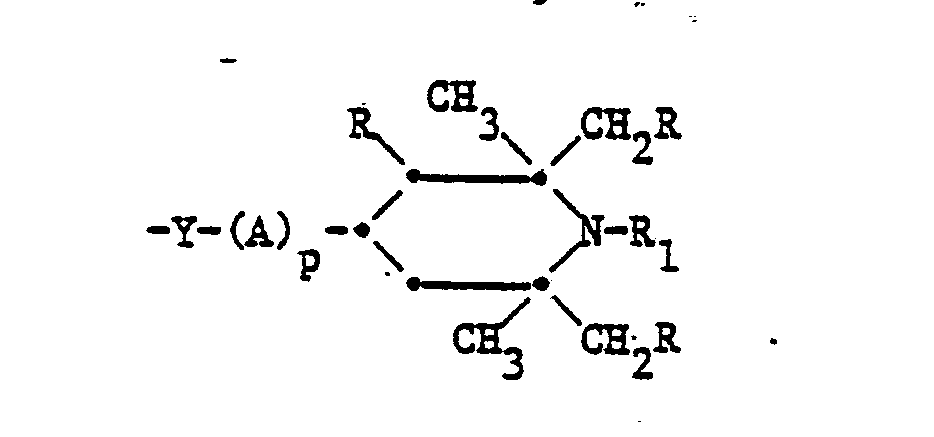
- Als Lichtschutzmittel gemäss der vorliegenden Erfindung wurde 3-Dodecyl-1,3,8-triaza-7,7,9,9-tetramethyl-8-acetyl-spiro[4.5]decan-2,4-dion (= LS V) verwendet,


Claims (17)




Priority Applications (1)
| Application Number | Priority Date | Filing Date | Title |
|---|---|---|---|
| AT81810441T ATE29037T1 (de) | 1980-11-10 | 1981-11-04 | Lichtstabilisierung von sauerkatalysierten einbrennlacken. |
Applications Claiming Priority (4)
| Application Number | Priority Date | Filing Date | Title |
|---|---|---|---|
| CH832680 | 1980-11-10 | ||
| CH8326/80 | 1980-11-10 | ||
| CH427181 | 1981-06-29 | ||
| CH4271/81 | 1981-06-29 |
Publications (2)
| Publication Number | Publication Date |
|---|---|
| EP0052073A1 true EP0052073A1 (de) | 1982-05-19 |
| EP0052073B1 EP0052073B1 (de) | 1987-08-19 |
Family
ID=25695099
Family Applications (1)
| Application Number | Title | Priority Date | Filing Date |
|---|---|---|---|
| EP81810441A Expired EP0052073B1 (de) | 1980-11-10 | 1981-11-04 | Lichtstabilisierung von sauerkatalysierten Einbrennlacken |
Country Status (4)
| Country | Link |
|---|---|
| EP (1) | EP0052073B1 (de) |
| BR (1) | BR8107241A (de) |
| CA (1) | CA1196444A (de) |
| DE (1) | DE3176368D1 (de) |
Cited By (6)
| Publication number | Priority date | Publication date | Assignee | Title |
|---|---|---|---|---|
| EP0073386A1 (de) * | 1981-08-20 | 1983-03-09 | ADEKA ARGUS CHEMICAL CO., Ltd. | Synthetische 2,2,6,6-Tetramethylpiperidyl-Äther enthaltende Harze |
| EP0094343A1 (de) * | 1982-04-27 | 1983-11-16 | Ciba-Geigy Ag | Isocyanatgruppenhaltige Polyalkylpiperidinderivate |
| EP0157734A1 (de) * | 1984-03-12 | 1985-10-09 | Ciba-Geigy Ag | Substituierte Piperazinone als Lichtschutzmittel |
| FR2586678A1 (fr) * | 1985-08-27 | 1987-03-06 | Ciba Geigy Ag | Amines acylees a empechement sterique qui peuvent etre coupees photolytiquement, et leur application a la stabilisation de polymeres |
| GB2230014A (en) * | 1989-04-04 | 1990-10-10 | Sandoz Ltd | Light stabilized lacquer |
| EP0517658A1 (de) * | 1991-06-04 | 1992-12-09 | Ciba-Geigy Ag | Stabilisierung von polymeren organischen Materialien unter Verwendung synergistischer Mischungen, die sterisch gehinderte cyclische Amine und Derivate von 3-Pyrazolidinon oder 1,2,4-Triazolidin-3,5-dion enthalten |
Families Citing this family (6)
| Publication number | Priority date | Publication date | Assignee | Title |
|---|---|---|---|---|
| IT1200103B (it) * | 1984-08-14 | 1989-01-05 | Sandoz Ag | Composti tetraalchilpiridinici n-sostituiti agenti come stabilizzanti agli effetti della luce per materiali polimerici |
| US5124378A (en) * | 1987-09-21 | 1992-06-23 | Ciba-Geigy Corporation | Stabilization of ambient cured coatings |
| US5112890A (en) * | 1987-09-21 | 1992-05-12 | Ciba-Geigy Corporation | Stabilization of acid catalyzed thermoset resins |
| US5359069A (en) * | 1989-03-21 | 1994-10-25 | Ciba-Geigy Corporation | Non-migrating 1-hydrocarbyloxy hindered amine derivatives as polymer stabilizers |
| US5145893A (en) * | 1989-03-21 | 1992-09-08 | Ciba-Geigy Corporation | Non-migrating 1-hydrocarbyloxy hindered amine derivatives as polymer stabilizers |
| US5015682A (en) * | 1989-03-21 | 1991-05-14 | Ciba-Geigy Corporation | Oligomeric N-hydrocarbyloxy hindered amine light stabilizers |
Citations (3)
| Publication number | Priority date | Publication date | Assignee | Title |
|---|---|---|---|---|
| EP0002753A2 (de) * | 1977-12-30 | 1979-07-11 | Ciba-Geigy Ag | Stabilisierung von Metalleffekteinbrennlacken gegen die Einwirkung von Licht, Feuchtigkeit und Sauerstoff durch den Zusatz von Polyalkylpiperidinderivaten |
| EP0006213A1 (de) * | 1978-06-21 | 1980-01-09 | Ciba-Geigy Ag | Lichtstabilisierung von sauerkatalysierten Einbrennlacken |
| EP0016723A1 (de) * | 1979-02-15 | 1980-10-01 | Ciba-Geigy Ag | Lichtstabilisierung von Zweischicht-Unilackierungen |
-
1981
- 1981-11-04 EP EP81810441A patent/EP0052073B1/de not_active Expired
- 1981-11-04 DE DE8181810441T patent/DE3176368D1/de not_active Expired
- 1981-11-06 CA CA000389590A patent/CA1196444A/en not_active Expired
- 1981-11-09 BR BR8107241A patent/BR8107241A/pt unknown
Patent Citations (3)
| Publication number | Priority date | Publication date | Assignee | Title |
|---|---|---|---|---|
| EP0002753A2 (de) * | 1977-12-30 | 1979-07-11 | Ciba-Geigy Ag | Stabilisierung von Metalleffekteinbrennlacken gegen die Einwirkung von Licht, Feuchtigkeit und Sauerstoff durch den Zusatz von Polyalkylpiperidinderivaten |
| EP0006213A1 (de) * | 1978-06-21 | 1980-01-09 | Ciba-Geigy Ag | Lichtstabilisierung von sauerkatalysierten Einbrennlacken |
| EP0016723A1 (de) * | 1979-02-15 | 1980-10-01 | Ciba-Geigy Ag | Lichtstabilisierung von Zweischicht-Unilackierungen |
Cited By (10)
| Publication number | Priority date | Publication date | Assignee | Title |
|---|---|---|---|---|
| EP0073386A1 (de) * | 1981-08-20 | 1983-03-09 | ADEKA ARGUS CHEMICAL CO., Ltd. | Synthetische 2,2,6,6-Tetramethylpiperidyl-Äther enthaltende Harze |
| EP0094343A1 (de) * | 1982-04-27 | 1983-11-16 | Ciba-Geigy Ag | Isocyanatgruppenhaltige Polyalkylpiperidinderivate |
| EP0157734A1 (de) * | 1984-03-12 | 1985-10-09 | Ciba-Geigy Ag | Substituierte Piperazinone als Lichtschutzmittel |
| FR2586678A1 (fr) * | 1985-08-27 | 1987-03-06 | Ciba Geigy Ag | Amines acylees a empechement sterique qui peuvent etre coupees photolytiquement, et leur application a la stabilisation de polymeres |
| GB2180235A (en) * | 1985-08-27 | 1987-03-25 | Ciba Geigy Ag | Photolytically cleavable, n-acylated sterically hindered amines |
| GB2180235B (en) * | 1985-08-27 | 1989-08-09 | Ciba Geigy Ag | Photolytically cleavable, n-acylated sterically hindered amines |
| GB2230014A (en) * | 1989-04-04 | 1990-10-10 | Sandoz Ltd | Light stabilized lacquer |
| GB2230014B (en) * | 1989-04-04 | 1992-05-20 | Sandoz Ltd | Use of hals compounds in lacquers |
| EP0517658A1 (de) * | 1991-06-04 | 1992-12-09 | Ciba-Geigy Ag | Stabilisierung von polymeren organischen Materialien unter Verwendung synergistischer Mischungen, die sterisch gehinderte cyclische Amine und Derivate von 3-Pyrazolidinon oder 1,2,4-Triazolidin-3,5-dion enthalten |
| US5457143A (en) * | 1991-06-04 | 1995-10-10 | Ciba-Geigy Corporation | Stabilization of polymeric organic materials by using synergistic mixtures comprising sterically hindered cyclic amines and derivatives of 3-pyrazolidinone or 1,2,4-triazolidine-3,5-dione |
Also Published As
| Publication number | Publication date |
|---|---|
| BR8107241A (pt) | 1982-07-27 |
| EP0052073B1 (de) | 1987-08-19 |
| CA1196444A (en) | 1985-11-05 |
| DE3176368D1 (en) | 1987-09-24 |
Similar Documents
| Publication | Publication Date | Title |
|---|---|---|
| EP0006213B1 (de) | Lichtstabilisierung von sauerkatalysierten Einbrennlacken | |
| EP0892833B1 (de) | Stabilisierung von lacken | |
| DE3851931T2 (de) | Stabilisierung einer Beschichtung mit sterisch gehinderten N-hydroxysubstituierten Aminen. | |
| DD141429A5 (de) | Lichtstabilisierung von metalleffektlacken | |
| US4619956A (en) | Stabilization of high solids coatings with synergistic combinations | |
| EP0016723B2 (de) | Lichtstabilisierung von Zweischicht-Unilackierungen | |
| EP0453396B1 (de) | Lackzusammensetzungen | |
| EP0309400B1 (de) | N-Acyloxy-substituierte sterisch gehinderte Aminstabilisatoren | |
| DE69812787T2 (de) | Nass in Nass-Grundierung mit UV-Schutz und niedriger Filmbildungstemperatur | |
| DE3408948C2 (de) | 4-Amino-polyalkylpiperidinverbindungen | |
| CH676713A5 (de) | ||
| EP0052073B1 (de) | Lichtstabilisierung von sauerkatalysierten Einbrennlacken | |
| DE69724998T2 (de) | Agentien zur verbesserung der dauerhaftigkeit, verfahren dafür, und selbige enthaltende überzugszusammensetzung | |
| EP0055216A1 (de) | Verfahren zur Härtung von Einbrennlacken | |
| EP0522474A2 (de) | Vergilbungsbeständig überlackierbare Plastisolzusammensetzung, Verfahren zu ihrer Herstellung und ihre Verwendung | |
| EP0002753B1 (de) | Stabilisierung von Metalleffekteinbrennlacken gegen die Einwirkung von Licht, Feuchtigkeit und Sauerstoff durch den Zusatz von Polyalkylpiperidinderivaten | |
| DE3710099A1 (de) | Kunststoff-stabilisatoren auf basis von oxalsaeureaniliden | |
| CH677665A5 (de) | ||
| DE3739523A1 (de) | Substituierte oxalsaeuredianilide und ihre verwendung als lichtstabilisatoren | |
| DE3240457A1 (de) | Ultraviolett-absorbierende, mit einer aliphatischen hydroxylgruppe substituierte stabilisatoren | |
| EP0323803A1 (de) | Stabilisierung von Lacken mit N-formylierten gehinderten Aminen | |
| DE3737398A1 (de) | Heterocyclisch oder aromatisch substituierte oxalsaeurediamide und ihre verwendung als uv-stabilisatoren | |
| DE3523679A1 (de) | Neue polymethylpiperidinverbindungen | |
| DE19622710A1 (de) | Organische Verbindungen | |
| CH659821A5 (de) | Verwendung von alkylsubstituierten 2,4-dihydroxybenzophenonen zum stabilisieren von einbrennlacken gegen den abbau durch licht. |
Legal Events
| Date | Code | Title | Description |
|---|---|---|---|
| PUAI | Public reference made under article 153(3) epc to a published international application that has entered the european phase |
Free format text: ORIGINAL CODE: 0009012 |
|
| AK | Designated contracting states |
Designated state(s): AT BE CH DE FR GB IT NL SE |
|
| 17P | Request for examination filed |
Effective date: 19811106 |
|
| GRAA | (expected) grant |
Free format text: ORIGINAL CODE: 0009210 |
|
| AK | Designated contracting states |
Kind code of ref document: B1 Designated state(s): AT BE CH DE FR GB IT LI NL SE |
|
| REF | Corresponds to: |
Ref document number: 29037 Country of ref document: AT Date of ref document: 19870915 Kind code of ref document: T |
|
| REF | Corresponds to: |
Ref document number: 3176368 Country of ref document: DE Date of ref document: 19870924 |
|
| ITF | It: translation for a ep patent filed | ||
| ET | Fr: translation filed | ||
| PLBE | No opposition filed within time limit |
Free format text: ORIGINAL CODE: 0009261 |
|
| STAA | Information on the status of an ep patent application or granted ep patent |
Free format text: STATUS: NO OPPOSITION FILED WITHIN TIME LIMIT |
|
| 26N | No opposition filed | ||
| ITTA | It: last paid annual fee | ||
| EAL | Se: european patent in force in sweden |
Ref document number: 81810441.6 |
|
| REG | Reference to a national code |
Ref country code: CH Ref legal event code: PUE Owner name: CIBA-GEIGY AG TRANSFER- CIBA SC HOLDING AG |
|
| BECN | Be: change of holder's name |
Effective date: 19961129 |
|
| NLS | Nl: assignments of ep-patents |
Owner name: CIBA SC HOLDING AG |
|
| REG | Reference to a national code |
Ref country code: GB Ref legal event code: 732E |
|
| REG | Reference to a national code |
Ref country code: CH Ref legal event code: PFA Free format text: CIBA SC HOLDING AG TRANSFER- CIBA SPECIALTY CHEMICALS HOLDING INC. |
|
| NLT1 | Nl: modifications of names registered in virtue of documents presented to the patent office pursuant to art. 16 a, paragraph 1 |
Owner name: CIBA SPECIALTY CHEMICALS HOLDING INC. |
|
| REG | Reference to a national code |
Ref country code: FR Ref legal event code: TP |
|
| PGFP | Annual fee paid to national office [announced via postgrant information from national office to epo] |
Ref country code: SE Payment date: 19981006 Year of fee payment: 18 |
|
| PGFP | Annual fee paid to national office [announced via postgrant information from national office to epo] |
Ref country code: CH Payment date: 19981014 Year of fee payment: 18 |
|
| PGFP | Annual fee paid to national office [announced via postgrant information from national office to epo] |
Ref country code: AT Payment date: 19981130 Year of fee payment: 18 |
|
| PGFP | Annual fee paid to national office [announced via postgrant information from national office to epo] |
Ref country code: BE Payment date: 19990119 Year of fee payment: 18 |
|
| PG25 | Lapsed in a contracting state [announced via postgrant information from national office to epo] |
Ref country code: AT Free format text: LAPSE BECAUSE OF NON-PAYMENT OF DUE FEES Effective date: 19991104 |
|
| PG25 | Lapsed in a contracting state [announced via postgrant information from national office to epo] |
Ref country code: SE Free format text: LAPSE BECAUSE OF NON-PAYMENT OF DUE FEES Effective date: 19991105 |
|
| PG25 | Lapsed in a contracting state [announced via postgrant information from national office to epo] |
Ref country code: LI Free format text: LAPSE BECAUSE OF NON-PAYMENT OF DUE FEES Effective date: 19991130 Ref country code: CH Free format text: LAPSE BECAUSE OF NON-PAYMENT OF DUE FEES Effective date: 19991130 Ref country code: BE Free format text: LAPSE BECAUSE OF NON-PAYMENT OF DUE FEES Effective date: 19991130 |
|
| BERE | Be: lapsed |
Owner name: CIBA SPECIALTY CHEMICALS HOLDING INC. Effective date: 19991130 |
|
| REG | Reference to a national code |
Ref country code: CH Ref legal event code: PL |
|
| EUG | Se: european patent has lapsed |
Ref document number: 81810441.6 |
|
| PGFP | Annual fee paid to national office [announced via postgrant information from national office to epo] |
Ref country code: FR Payment date: 20001002 Year of fee payment: 20 |
|
| PGFP | Annual fee paid to national office [announced via postgrant information from national office to epo] |
Ref country code: NL Payment date: 20001006 Year of fee payment: 20 |
|
| PGFP | Annual fee paid to national office [announced via postgrant information from national office to epo] |
Ref country code: GB Payment date: 20001012 Year of fee payment: 20 |
|
| PGFP | Annual fee paid to national office [announced via postgrant information from national office to epo] |
Ref country code: DE Payment date: 20001013 Year of fee payment: 20 |
|
| PG25 | Lapsed in a contracting state [announced via postgrant information from national office to epo] |
Ref country code: GB Free format text: LAPSE BECAUSE OF EXPIRATION OF PROTECTION Effective date: 20011103 |
|
| PG25 | Lapsed in a contracting state [announced via postgrant information from national office to epo] |
Ref country code: NL Free format text: LAPSE BECAUSE OF EXPIRATION OF PROTECTION Effective date: 20011104 |
|
| REG | Reference to a national code |
Ref country code: GB Ref legal event code: PE20 Effective date: 20011103 |
|
| NLV7 | Nl: ceased due to reaching the maximum lifetime of a patent |
Effective date: 20011104 |