EP0052985B1 - Reaktive Monoazo-Scharlachfarbstoffe - Google Patents
Reaktive Monoazo-Scharlachfarbstoffe Download PDFInfo
- Publication number
- EP0052985B1 EP0052985B1 EP81305381A EP81305381A EP0052985B1 EP 0052985 B1 EP0052985 B1 EP 0052985B1 EP 81305381 A EP81305381 A EP 81305381A EP 81305381 A EP81305381 A EP 81305381A EP 0052985 B1 EP0052985 B1 EP 0052985B1
- Authority
- EP
- European Patent Office
- Prior art keywords
- formula
- compound
- group
- sulfonic acid
- acid
- Prior art date
- Legal status (The legal status is an assumption and is not a legal conclusion. Google has not performed a legal analysis and makes no representation as to the accuracy of the status listed.)
- Expired
Links
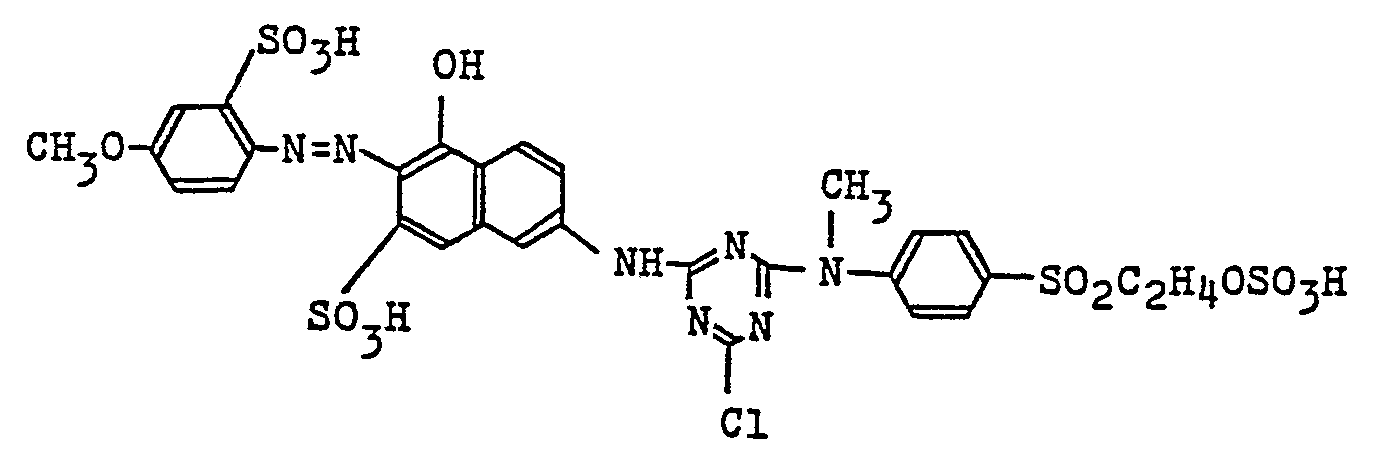
- 0 **N(*)c1nc(Cl)nc(N(*I)c(cc2)c(*)c(cc3S(O)(=O)=O)c2c(O)c3N=N*)n1 Chemical compound **N(*)c1nc(Cl)nc(N(*I)c(cc2)c(*)c(cc3S(O)(=O)=O)c2c(O)c3N=N*)n1 0.000 description 10
- MEMBJMDZWKVOTB-UHFFFAOYSA-N CCc1c(C)cc(C)cc1 Chemical compound CCc1c(C)cc(C)cc1 MEMBJMDZWKVOTB-UHFFFAOYSA-N 0.000 description 1
- SPCGVOJZFDZOGP-UHFFFAOYSA-N Cc(c(OC)c1)cc(C)c1OC Chemical compound Cc(c(OC)c1)cc(C)c1OC SPCGVOJZFDZOGP-UHFFFAOYSA-N 0.000 description 1
- LTPSRQRIPCVMKQ-UHFFFAOYSA-N Cc(cc1)cc(S(O)(=O)=O)c1N Chemical compound Cc(cc1)cc(S(O)(=O)=O)c1N LTPSRQRIPCVMKQ-UHFFFAOYSA-N 0.000 description 1
Classifications
-
- C—CHEMISTRY; METALLURGY
- C09—DYES; PAINTS; POLISHES; NATURAL RESINS; ADHESIVES; COMPOSITIONS NOT OTHERWISE PROVIDED FOR; APPLICATIONS OF MATERIALS NOT OTHERWISE PROVIDED FOR
- C09B—ORGANIC DYES OR CLOSELY-RELATED COMPOUNDS FOR PRODUCING DYES, e.g. PIGMENTS; MORDANTS; LAKES
- C09B62/00—Reactive dyes, i.e. dyes which form covalent bonds with the substrates or which polymerise with themselves
- C09B62/02—Reactive dyes, i.e. dyes which form covalent bonds with the substrates or which polymerise with themselves with the reactive group directly attached to a heterocyclic ring
- C09B62/04—Reactive dyes, i.e. dyes which form covalent bonds with the substrates or which polymerise with themselves with the reactive group directly attached to a heterocyclic ring to a triazine ring
- C09B62/08—Azo dyes
- C09B62/085—Monoazo dyes
-
- C—CHEMISTRY; METALLURGY
- C09—DYES; PAINTS; POLISHES; NATURAL RESINS; ADHESIVES; COMPOSITIONS NOT OTHERWISE PROVIDED FOR; APPLICATIONS OF MATERIALS NOT OTHERWISE PROVIDED FOR
- C09B—ORGANIC DYES OR CLOSELY-RELATED COMPOUNDS FOR PRODUCING DYES, e.g. PIGMENTS; MORDANTS; LAKES
- C09B62/00—Reactive dyes, i.e. dyes which form covalent bonds with the substrates or which polymerise with themselves
- C09B62/44—Reactive dyes, i.e. dyes which form covalent bonds with the substrates or which polymerise with themselves with the reactive group not directly attached to a heterocyclic ring
- C09B62/4401—Reactive dyes, i.e. dyes which form covalent bonds with the substrates or which polymerise with themselves with the reactive group not directly attached to a heterocyclic ring with two or more reactive groups at least one of them being directly attached to a heterocyclic system and at least one of them being directly attached to a non-heterocyclic system
- C09B62/4403—Reactive dyes, i.e. dyes which form covalent bonds with the substrates or which polymerise with themselves with the reactive group not directly attached to a heterocyclic ring with two or more reactive groups at least one of them being directly attached to a heterocyclic system and at least one of them being directly attached to a non-heterocyclic system the heterocyclic system being a triazine ring
- C09B62/4411—Azo dyes
- C09B62/4413—Non-metallized monoazo dyes
-
- D—TEXTILES; PAPER
- D06—TREATMENT OF TEXTILES OR THE LIKE; LAUNDERING; FLEXIBLE MATERIALS NOT OTHERWISE PROVIDED FOR
- D06P—DYEING OR PRINTING TEXTILES; DYEING LEATHER, FURS OR SOLID MACROMOLECULAR SUBSTANCES IN ANY FORM
- D06P3/00—Special processes of dyeing or printing textiles, or dyeing leather, furs, or solid macromolecular substances in any form, classified according to the material treated
- D06P3/58—Material containing hydroxyl groups
- D06P3/60—Natural or regenerated cellulose
- D06P3/66—Natural or regenerated cellulose using reactive dyes
Definitions
- the present invention relates to novel reactive monoazo dyes, their production and dyeing of cellulose fiber materials with them.
- Dyes having a monochlorotriazinyl group are also known. Generally, however, these reactive dyes require high temperatures for dyeing and lack exhaustion dyeing ability. Accordingly, they are only used for printing. Besides, the products dyed with the dyes of this kind are low in acid stability. Thus, the dyes of this kind are not always satisfactory in practical use. For example, the following dyes are disclosed in U.S. Patent No. 3,223,470: However, these dyes are not satisfactory in solubility, build-up property, washing-off property or the like.
- Dyestuffs having two reactive groups are also known.
- CH-A-410,237 generally describes the combination of sulphatoethyl sulphonyl and monotriazinyl groups through an amine group which may be substituted.
- all the specific compounds disclosed employ an unsubstituted amine group and in any event the chromophores disclosed do not coincide with those to which the present invention relates.
- the properties of the dyestuff depend on the combination of reactive group (or groups) and chromophore, and the properties of such a combination cannot be predicted from the properties of the groups considered separately.
- the present invention provides a compound represented by a free acid of the formula (I), wherein D is a phenyl group substituted with 1 to 3 substituents selected from methyl, ethyl, methoxy, ethoxy, halogen, acetylamino, propionylamino, benzoylamino, succinylamino, maleinylamino, nitro, sulfonic acid and carboxyl groups, or a naphthyl group substituted with 1 to 3 sulfonic acid groups;
- R is a hydrogen atom, or a methyl or ethyl group;
- R 2 is an alkyl group having 1 to 4 carbon atoms which is unsubstituted or substituted with a hydroxy, cyano, alkoxy, halogen, carboxy, alkoxycarbonyl or sulfonic acid group
- Z is a hydrogen atom or a sulfonic acid group;
- A is a phenylene
- R 2 is as defined above, preferably methyl, ethyl, n-propyl or 2-hydroxy ethyl groups.
- R 2 , A, X and Z are as defined above, and n is 0 or 1, more specifically, those having the following formula, wherein R 2 is as defined above, preferably methyl, ethyl, n-propyl or 2-hydroxy ethyl groups.
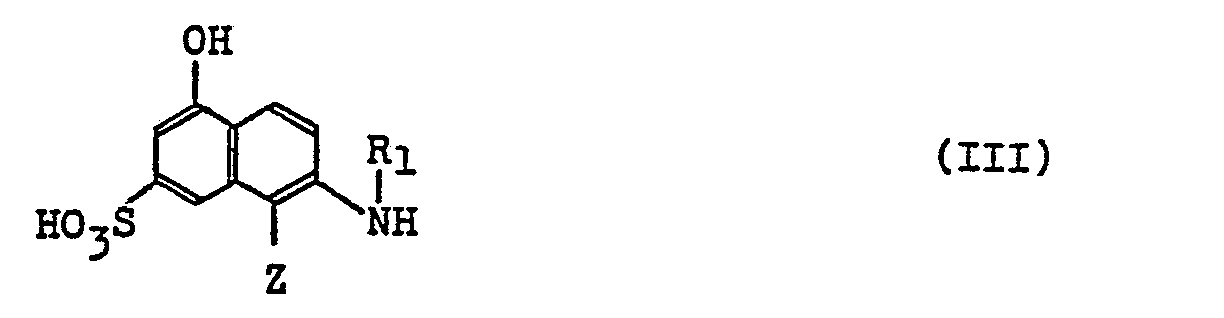
- the present invention also provides a method for producing the compound represented by the formula (I), which comprises (1) subjecting cyanuric chloride to first-step condensation with a monoazo compound of the formula (IV), wherein D, R, and Z are as defined above, and then to second-step condensation with a compound of the formula (V), wherein R 2 , A and X are as defined above, or
- a substitute, R 2 , in the compound of the formula (V), includes, for example, methyl, ethyl, n-propyl, n-butyl, iso-propyl, iso-butyl, sec-butyl, tert-butyl, hydroxymethyl, 2-hydroxyethyl, 2-hydroxypropyl, 3-hydroxypropyl, 2-hydroxybutyl, 4-hydroxybutyl, 1-methyl-2-hydroxypropyl, cyanomethyl, cyanoethyl, methoxymethyl, 2-methoxyethyl, 3-methoxypropyl, ethoxymethyl, 2-ethoxyethyl, chloromethyl, 2-chloroethyl, 3-chloropropyl, 4-chlorobutyl, carboxymethyl, 2-carboxyethyl, 2-methoxycarbonylethyl, 2-ethoxycarbonylmethyl, sulfomethyl and 2-sulfoethyl groups.
- the residue represented by A in the formula (v) includes, for example.
- the aromatic amine of the formula (II) is diazotized at -10° to 40°C in an aqueous medium and coupled with the compound of the formula (III) while adjusting the pH to 5 to 12, preferably 6 to 10 at a temperature of-10° to 50°C, preferaby 0° to 20°C, thereby to obtain the monoazo compound of the formula (IV).
- the compound (IV) may also be obtained by carrying out coupling in the same manner as above using the N-acylated product of the compound (III), and then hydrolyzing the resulting compound at 50° to 100°C in the presence of an acid or alkali to split the acyl group.
- the compound (IV) is subjected to first-step condensation with cyanuric chloride in an aqueous medium while adjusting the pH to 2 to 10, preferably 3 to 7 at a temperature of -10° to 50°C, preferably 0° to 30°C, thereby to obtain a dichlorotriazinyl compound, and this compound is then subjected to second-step condensation with the compound of the formula (V) while adjusting the pH to 2 to 9, preferably 4 to 6 at a temperature of 0° to 70°C, preferably 30° to 50°C, thereby to obtain the compound of the formula (I).
- the present compound of the formula (I) can be used for dyeing cellulose fiber materials in an orange to scarlet color of deep hue by a conventional dyeing method such as exhaustion dyeing, printing and continuous dyeing including a cold-pad-batch method.
- cellulose fiber materials which can be dyed in accordance with the present invention, are natural or regenerated cellulosic fibers such as cotton, flax, viscose rayon, viscose stable and the like,
- Exhaustion dyeing can be carried out at relatively low temperatures using a dyeing bath containing sodium sulfate or sodium chloride and an acid-binding agent such as sodium carbonate, sodium tertiary phosphate or sodium hydroxide.
- Printing can be carried out by using a print paste containing an acid-binding agent (e.g. sodium hydrogen carbonate, sodium carbonate, sodium tertiary phosphate, sodium hydroxide), urea and a thickening agent such as preferably sodium alginate, and the printing is followed by intermediate drying and steaming or dry heating at 100° to 200°C.
- the dyeing of the present invention may be carried out by a continuous process such as a cold-pad-batch. process.
- the dyes of the formula (I) of the present invention have good build-up property and produce dyed products superior in chlorine fastness (3-4 grade, ISO standard) and perspiration-light fastness. Particularly, considering that fading of dyed products due to trace amounts of active chlorine in city water frequently becomes a problem on washing at home, the dyes of the present invention superior in chlorine fastness are of high value. Also, as to perspiration-light fastness which has recently become serious with an increase in the demand for sportswear, the grade of that fastness of the present dyes is as high as 3 to 4 grade, which means that the value of the dyes is also high in this respect.
- the products dyed with the conventional reactive dyes are affected by acid gases in air to lower fastnesses with the lapse of time. But, in accordance with the present invention, such a drawback can be overcome. That is, the acid stability of dyed products obtained with the dyes of the present invention, as tested as described below, is as good as 4-5 to 5 grade: Dyed cloth is dipped in 1% acetic acid for 30 minutes and treated at 37 ⁇ 2°C for 6 hours under pressure of 125 g/cm 2 on a perspirometer. The dyes of the present invention are also of high value in this respect.
- the present dyes have the following great advantages:
- the alkali stability is good enough to show high percent exhaustion and high percent fixation in exhaustion dyeing as well as high percent fixation in printing, and therefore dyed products of deep hue can be obtained.
- the present dyes are superior in washing-off property.
- the dyes of the present invention are little affected by change in dyeing temperature, alkali agent, amount of inorganic salt and liquor ratio, so that they have a unique performance that dyeing can be carried out with very high reproducibility.
- Cyanuric chloride (9.2 parts) is dispersed at 0° to 5°C in a solution of a nonionic surfactant (0.1 part) in water (100 parts), and a solution of J acid (11.3 parts) in water (100 parts) produced at a pH of 7 to 8 is added dropwise at 0° to 5°C over 1 hour. After completion of the addition, the mixture is adjusted to pH of 3 with 20% aqueous sodium carbonate solution, and then stirred for 2 hours.
- a nonionic surfactant 0.1 part
- J acid (11.3 parts) in water (100 parts) produced at a pH of 7 to 8
- reaction solution is then cooled again to 0° to 5°C, and sodium hydrogen carbonate (12.6 parts) is added.
- a liquor prepared in advance by diazotizing 2-amino-5-methoxybenzenesulfonic acid (9.6 parts) in a usual manner is added to the above reaction solution at 0° to 5°C over 1 hour, and stirring is continued at the same temperature for 2 hours.
- the pH of the reaction solution is adjusted to 5 to 6 with hydrochloric acid, and then sodium chloride (40 parts) is added to deposit crystals which are then collected on a suction-filter, washed and dried at 60°C to obtain a dye of the formula (1),
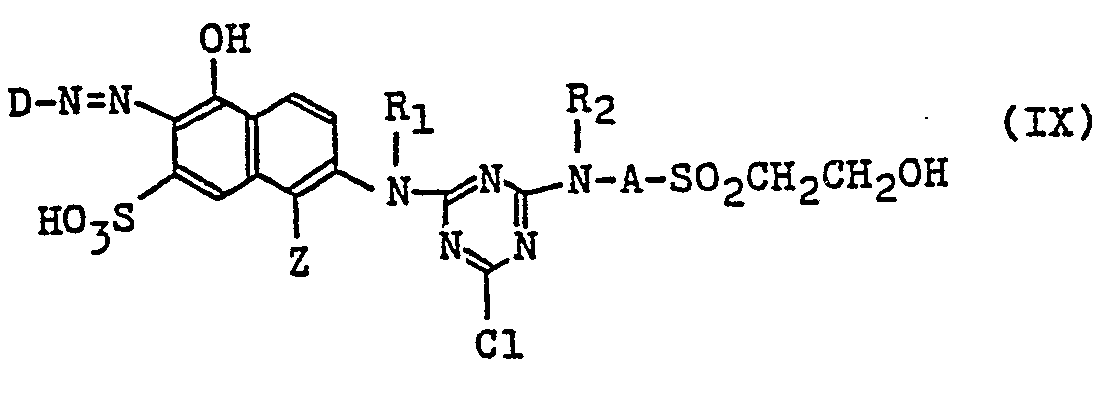
- the dye (1) may also be synthesized by the following method: The same procedure as above is repeated, except that 1-N-ethylaminobenzene-3- ⁇ -hydroxyethylsulfone (11.4 parts) is used in place of the sulfuric ester of 1-N-ethylaminobenzene-3-,6-hydroxyethylsulfone.
- the resulting compound is added to 100% sulfuric acid (500 parts) at 5° to 20°C over 2 hours, and the mixture is stirred at the same temperature for 3 hours.
- the reaction solution is then gradually discharged into ice (1200 parts), and deposited crystals are collected by filtration.
- the crystals are then dispersed in water (400 parts) and dissolved by adjusting the pH to 5 to 6 with sodium carbonate.
- Sodium chloride 60 parts is added to re-deposit crystals which are then suction-filtered, washed and dried at 60°C.
- the dye (1) (0.3 part) is dissolved in water (200 parts), and after adding sodium sulfate (20 parts) and then cotton (10 parts), the temperature is raised to 50°C. 30 Minutes thereafter, sodium carbonate (4 parts) is added, and dyeing is continued at the same temperature for 1 hour. After completion of the dyeing, the dyed cotton is washed with water and soaped to obtain a scarlet dyed product superior in chlorine fastness.
- Cyanuric chloride (9.2 parts) is dispersed at 0° to 5°C in a solution of a nonionic surfactant (0.1 part) in water (100 parts), and a solution containing 7-amino-4-hydroxy-3-(2-sulfo-4-ethoxyphenyl- azo)naphthalene-2-sulfonic acid, as synthesized from J acid (12 parts) and the diazonium salt of 2-amino-5-ethoxybenzenesulfonic acid (10.8 parts), is added dropwise over 1 hour while maintaining the pH at 4 to 5 with 20% aqueous sodium carbonate solution. The mixture is then stirred at 0° to 10°C for 2 hours.
- the dye (7) (0.3 part) is dissolved in water (150 parts), and after adding sodium sulfate (30 parts) and then cotton (10 parts), the temperature is raised to 60°C. 20 Minutes thereafter, sodium carbonate (4 parts) is added, and dyeing is carried out at the same temperature for 1 hour. After completion of the dyeing, the dyed cotton is washed with water and soaped to obtain a dyed product of deep scarlet color superior in chlorine fastness.
- dyes producing dyed products of deep orange to scarlet color superior in chlorine fastness are obtained using the following compounds.
- Cyanuric chloride (9.2 parts) is dispersed at 0°C to 5°C in a solution of a nonionic surfactant (0.1 part) in water (100 parts), and a solution of J acid (11.3 parts) in water (200 parts) produced at a pH of 7 to 8 is added dropwise at 0° to 5°C over 1 hour. After completion of the addition, the mixture is adjusted to a pH of 3 with 20% aqueous sodium carbonate solution, followed by stirring for 2 hours. Sodium hydrogen carbonate (14 parts) is then added.
- a liquor prepared by diazotizing 2-amino-5-methoxybenzenesulfonic acid (9.6 parts) in a usual manner is added at 0° to 5°C over 1 hour, and the mixture is stirred at the same temperature for 4 hours.
- the sulfuric ester of 1-N-hydroxyethylaminobenzene-3-,B-hydroxyethylsulfone (16 parts) is added.
- the temperature is then raised to 40°C while adjusting the pH to 5 to 6 with 20% aqueous sodium carbonate solution, and the mixture is stirred at the same temperature for 6 hours.
- Sodium chloride (40 parts) is added to deposit crystals which are then collected on a suction-filter, washed and dried at 60°C to obtain a dye of the formula (16),
- the dye (16) (0.3 part) is dissolved in water (300 parts), and after adding sodium sulfate (30 parts) and then cotton (10 parts), the temperature is raised to 60°C. 20 Minutes thereafter, sodium carbonate (5 parts) is added, and dyeing is carried out at the same temperature for 1 hour. After completion of the dyeing, the dyed cotton is washed with water and soaped to obtain a dyed product of deep scarlet color superior in chlorine fastness.
- Cyanuric chloride (9.2 parts) is dispersed at 0° to 5°C in a solution of a nonionic surfactant (0.1 part) in water (100 parts), and a solution obtained by dissolving the sulfuric ester of 1-N-hydroxy- methylaminobenzene-3-,B-hydroxyethylsulfone (14 parts) in water (100 parts) at a pH of 4 to 5, is added dropwise at 0°C to 5°C over 1 hour. After completion of the addition, the mixture is adjusted to a pH of 3 with 20% aqueous sodium carbonate solution, followed by stirring for 2 hours.
- the dye (28) (0.3 part) is dissolved in water (200 parts), and after adding sodium sulfate (30 parts) and then cotton (10 parts), the temperature is raised to 50°C. 30 Minutes thereafter, sodium tertiary phosphate (4 parts) is added, and dyeing is carried out at the same temperature for 1 hour. After completion of the dyeing, the dyed cotton is washed with water and soaped to obtain a dyed product of deep scarlet color superior in chlorine fastness.
- Cyanuric chloride (9.2 parts) is dispersed at 0° to 5°C in a solution of a nonionic surfactant (0.1 part) in water (100 parts), and a solution of J acid (11.3 parts) in water (100 parts) produced at a pH of 7 to 8 is added dropwise at 0° to 5°C over 1 hour. After completion of the addition, the mixture is adjusted to a pH of 3 with 20% aqueous sodium carbonate solution, followed by stirring for 2 hours.
- a nonionic surfactant 0.1 part
- J acid (11.3 parts) in water (100 parts) produced at a pH of 7 to 8
- reaction solution is then cooled again to 0° to 5°C, and sodium hydrogen carbonate (12.6 parts) is added.
- a liquor prepared by diazotizing 2-aminonaphthalene-1,5-disulfonic acid (15 parts) in a usual manner is added to the above reaction solution at 0° to 5°C over 1 hour, and the mixture is stirred at the same temperature for 2 hours.
- the pH of the reaction solution is adjusted to 5 to 6 with hydrochloric acid, and sodium chloride (40 parts) is added to deposit crystals which are then collected ona suction-filter, washed and dried at 60°C to obtain a dye of the formula (33),
- the dye (33) may also be synthesized by the following method: The same procedure as above is repeated, except that 1-N-ethylaminobenzene-3-,B-hydroxyethylsulfone (11.4 parts) is used in place of the sulfuric ester of 1-N-ethylaminobenzene-3-/i-hydroxyethylsulfone.
- the resulting compound is added to 100% sulfuric acid (500 parts) at 5° to 20°C over 2 hours, followed by stirring at the same temperature for 3 hours.
- the reaction solution is then gradually discharged into ice (1200 parts), and deposited crystals are collected by filtration.
- the crystals are then dispersed in water (400 parts) and dissolved by adjusting the pH to 5 to 6 with sodium carbonate.
- Sodium chloride 60 parts is added to re-deposit crystals, which are then collected on a suction-filter, washed and dried at 60°C.
- the dye (33) (0.3 part) is dissolved in water (200 parts), and after adding sodium sulfate (20 parts) and then cotton (10 parts), the temperature is raised to 50°C. 30 Minutes thereafter, sodium carbonate (4 parts) is added, and dyeing is carried out at the same temperature for 1 hour. After completion of the dyeing, the dyed cotton is washed with water and soaped to obtain an orange dyed product superior in chlorine fastness.
- dyes producing dyed products of deep orange to scarlet color superior in chlorine fastness are obtained using the following compounds.
- Cyanuric chloride (9.2 parts) is dispersed at 0° to 5°C in a solution of a nonionic surfactant (0.1 part) in water (100 parts), and a solution containing 2-amino-5-hydroxynaphthalene-6-(1-sulfo-2-naphthylazo)-1,7-disulfonic acid, as synthesized from the diazonium salt of 2-aminonaphthalene-1-sulfonic acid (11 parts) and 2-amino-5-hydroxynaphthalene-1,7-disulfonic acid (16 parts), is added dropwise to the above dispersion over 1 hour while maintainining the pH at 4 to 5 with 20% aqueous sodium carbonate solution.
- the dye (39) (0.3 part) is dissolved in water (150 parts), and after adding sodium sulfate (30 parts) and then cotton (10 parts), the temperature of the bath is raised to 60°C. 20 Minutes thereafter, sodium carbonate (4 parts) is added, and dyeing is carried out at the same temperature for 1 hour. After completion of the dyeing, the dyed cotton is washed with water and soaped to obtain a dyed product of deep orange color superior in chlorine fastness.
- dyes producing dyed products of deep orange to scarlet color superior in chlorine fastness are obtained using the following compounds.
- Cyanuric chloride (9.2 parts) is dispersed at 0° to 5°C in a solution of a nonionic surfactant (0.1 part) in water (100 parts), and a solution of 2-amino-5-hydroxynaphthalene-1,7-disulfonic acid (16 parts) in water (200 parts) produced at a pH of 7 to 8 is added dropwise to the above dispersion at 0° to 5°C over 1 hour. After completion of the addition, the mixture is adjusted to a pH of 3 with 20% aqueous sodium carbonate solution, followed by stirring for 2 hours. Sodium hydrogen carbonate (14 parts) is then added.
- a liquor prepared by diazotizing 2-aminonaphthalene-1-sulfonic acid (11 parts) in a usual manner is added to the mixture at 0° to 5°C over 1 hour, and the mixture is followed by stirring at the same temperature for 2 hours.
- the sulfuric ester of 1-N-hydroxyethylaminobenzene-3-,I3-hydroxyethylsulfone (16 parts) is added.
- the temperature is then raised to 40°C while adjusting the pH to 5 to 6 with 20% aqueous sodium carbonate solution, and the mixture is followed by stirring at the same temperature for 6 hours.
- Sodium chloride (40 parts) is added to deposit crystals, which were then collected on a suction-filter, washed and dried at 60°C to obtain a dye of the formula (44),
- the dye (44) (0.3 part) is dissolved in water (300 parts), and after adding sodium sulfate (30 parts) and then cotton (10 parts), the temperature of the bath is raised to 60°C. 20 Minutes thereafter, sodium carbonate (5 parts) is added, and dyeing is carried out at the same temperature for 1 hour. After completion of the dyeing, the dyed cotton is washed with water and soaped to obtain a dyed product of deep orange color superior in chlorine fastness.
- dyes producing dyed products of deep orange to scarlet color superior in chlorine fastness are obtained using the following compounds.
- Cyanuric chloride (9.2 parts) is dispersed at 0° to 5°C in a solution of a nonionic surfactant (0.1 part) in water (100 parts), and a solution obtained by dissolving the sulfuric ester of 1-N-hydroxyethyl- aminobenzene-3-,B-hydroxyethylsulfone (14 parts) in water (100 parts) at a pH of 4 to 5, is added dropwise to the above dispersion at 0° to 5°C over 1 hour. After completion of the addition, the mixture is adjusted to a pH of 3 with 20% aqueous sodium carbonate solution, followed by stirring for 2 hours.
- the dye (51) (0.3 part) is dissolved in water (200 parts), and after adding sodium sulfate (30 parts) and then cotton (10 parts), the temperature is raised to 50°C. 30 Minutes thereafter, sodium tertiary phosphate (4 parts) is added, and dyeing is carried out at the same temperature for 1 hour. After completion of the dyeing, the dyed cotton is washed with water and soaped to obtain a dyed product of deep orange color superior in chlorine fastness.
- dyes producing dyed products of deep orange to scarlet color superior in chlorine fastness are obtained using the following compounds.
- composition of print paste is composition of print paste
- the print paste of the above composition is printed on mercerized cotton broad, and after intermediate drying, the cotton broad is steamed at 100°C for 5 minutes, hot rinsed, soaped, hot rinsed and dried.
- a scarlet printed product superior in chlorine fastness is obtained.
- Composition print paste :
- the print paste of the above composition is printed on mercerized cotton broad, and after intermediate drying, the cotton broad is steamed at 120°C for 5 minutes, hot rinsed, soaped, hot rinsed and dried.
- a scarlet printed product superior in chlorine fastness is obtained.
- composition of print paste is composition of print paste
- the print paste of the above composition is printed on mercerized cotton broad, and after intermediate drying, the cotton broad is steamed at 100°3C for 5 minutes, hot rinsed, soaped, hot rinsed and dried.
- an orange printed product superior in chlorine fastness is obtained.
- composition of print paste is composition of print paste
- the print paste of the above composition is printed on mercerized cotton broad, and after intermediate drying, the cotton baord is steam at-120°C for 5 minutes, hot rinsed, soaped, hot rinsed and dried.
- an orange printed product superior in chlorine fastness is obtained.
Landscapes
- Chemical & Material Sciences (AREA)
- Organic Chemistry (AREA)
- Engineering & Computer Science (AREA)
- Textile Engineering (AREA)
- Coloring (AREA)
Claims (19)




dadurch gekennzeichnet, daß man




Applications Claiming Priority (8)
| Application Number | Priority Date | Filing Date | Title |
|---|---|---|---|
| JP55167084A JPS6036515B2 (ja) | 1980-11-26 | 1980-11-26 | セルロ−ズ系繊維の染色法 |
| JP167084/80 | 1980-11-26 | ||
| JP25755/81 | 1981-02-23 | ||
| JP56025755A JPS57139580A (en) | 1981-02-23 | 1981-02-23 | Dyeing of cellulosic fiber |
| JP6872881A JPS6047392B2 (ja) | 1981-05-06 | 1981-05-06 | セルロ−ズ系繊維の染色法 |
| JP56068727A JPS57183478A (en) | 1981-05-06 | 1981-05-06 | Dyeing of cellulosic fiber |
| JP68727/81 | 1981-05-06 | ||
| JP68728/81 | 1981-05-06 |
Publications (2)
| Publication Number | Publication Date |
|---|---|
| EP0052985A1 EP0052985A1 (de) | 1982-06-02 |
| EP0052985B1 true EP0052985B1 (de) | 1984-09-05 |
Family
ID=27458375
Family Applications (1)
| Application Number | Title | Priority Date | Filing Date |
|---|---|---|---|
| EP81305381A Expired EP0052985B1 (de) | 1980-11-26 | 1981-11-12 | Reaktive Monoazo-Scharlachfarbstoffe |
Country Status (3)
| Country | Link |
|---|---|
| EP (1) | EP0052985B1 (de) |
| KR (1) | KR880002597B1 (de) |
| DE (1) | DE3165870D1 (de) |
Cited By (1)
| Publication number | Priority date | Publication date | Assignee | Title |
|---|---|---|---|---|
| CN102040859A (zh) * | 2010-08-30 | 2011-05-04 | 天津德凯化工股份有限公司 | 一种染料及其制备方法 |
Families Citing this family (12)
| Publication number | Priority date | Publication date | Assignee | Title |
|---|---|---|---|---|
| JPS59116482A (ja) * | 1982-12-23 | 1984-07-05 | 住友化学工業株式会社 | 混用繊維材料の染色法 |
| JPS59122549A (ja) * | 1982-12-28 | 1984-07-16 | Sumitomo Chem Co Ltd | 新規なモノアゾ化合物 |
| GB9025018D0 (en) * | 1990-11-16 | 1991-01-02 | Ici Plc | Reactive dyes |
| GB9111427D0 (en) * | 1991-05-28 | 1991-07-17 | Ici Plc | Reactive dyes |
| JP3198635B2 (ja) * | 1992-06-26 | 2001-08-13 | 住友化学工業株式会社 | 反応染料混合物及びそれを用いる染色又は捺染方法 |
| DE4417719A1 (de) * | 1994-05-20 | 1995-11-23 | Hoechst Ag | Reaktivfarbstoffe mit hydrolysestabilen Reaktivgruppen |
| GB2347935B (en) * | 1999-03-17 | 2001-05-23 | Sumitomo Chemical Co | Monoazo compounds or mixtures thereof and process for dyeing or printing using them |
| GB0128110D0 (en) * | 2001-11-23 | 2002-01-16 | Clariant Int Ltd | Organic compounds |
| KR20050100055A (ko) * | 2004-04-13 | 2005-10-18 | 오영산업주식회사 | 반응성 황색 염료 조성물 |
| MY165913A (en) * | 2005-07-08 | 2018-05-18 | Ciba Specialty Chemicals Holding Inc | Reactive dyes, a process for their preparation and their use |
| CN102433021A (zh) * | 2011-08-23 | 2012-05-02 | 湖北华丽染料工业有限公司 | 一种橙色活性染料及其制备方法及其用途 |
| WO2016166207A1 (de) | 2015-04-15 | 2016-10-20 | Bezema Ag | Azofarbstoffe, verfahren zu ihrer herstellung und ihre verwendung |
Family Cites Families (5)
| Publication number | Priority date | Publication date | Assignee | Title |
|---|---|---|---|---|
| GB901434A (en) * | 1959-03-04 | 1962-07-18 | Ici Ltd | Azo dyestuffs |
| DE1265698C2 (de) * | 1961-05-06 | 1968-11-07 | Hoechst Ag | Verfahren zur Erzeugung von nassechten Faerbungen und Drucken |
| GB1093656A (en) * | 1965-03-23 | 1967-12-06 | Ici Ltd | New water-soluble reactive metal-complex azo dyestuffs, their preparation and use |
| CH627206A5 (de) * | 1978-07-06 | 1981-12-31 | Ciba Geigy Ag | |
| DE2842640A1 (de) * | 1978-09-29 | 1980-04-10 | Bayer Ag | Reaktivfarbstoffe |
-
1981
- 1981-11-12 DE DE8181305381T patent/DE3165870D1/de not_active Expired
- 1981-11-12 EP EP81305381A patent/EP0052985B1/de not_active Expired
- 1981-11-25 KR KR1019810004558A patent/KR880002597B1/ko not_active Expired
Cited By (2)
| Publication number | Priority date | Publication date | Assignee | Title |
|---|---|---|---|---|
| CN102040859A (zh) * | 2010-08-30 | 2011-05-04 | 天津德凯化工股份有限公司 | 一种染料及其制备方法 |
| CN102040859B (zh) * | 2010-08-30 | 2013-11-13 | 天津德凯化工股份有限公司 | 一种染料及其制备方法 |
Also Published As
| Publication number | Publication date |
|---|---|
| EP0052985A1 (de) | 1982-06-02 |
| KR880002597B1 (ko) | 1988-12-03 |
| KR830007765A (ko) | 1983-11-07 |
| DE3165870D1 (en) | 1984-10-11 |
Similar Documents
| Publication | Publication Date | Title |
|---|---|---|
| EP0021105B1 (de) | Reaktivfarbstoffe, Verfahren zu ihrer Herstellung und ihre Verwendung zum Färben von Cellulosefasern | |
| US4649193A (en) | Water-soluble dyestuffs containing fibre-reactive groups of the vinylsulfone series and the fluoro-s-triazinyl-amino series | |
| EP0022575B1 (de) | Reaktive Monoazo-Farbstoffe, Verfahren zu ihrer Herstellung und ihre Verwendung zum Färben von Cellulosefasern und Cellulosetextilien | |
| EP0167219B1 (de) | Faserreaktive Verbindung mit beiden Gruppen der Pyridintriazinyl- und der Vinylsulfonreihe | |
| US4740592A (en) | Water-soluble azo compounds containing fiber-reactive groups and having a sulfo-naphthal coupling component with a triazinylamino substituent suitable as dyestuffs | |
| EP0052985A1 (de) | Reaktive Monoazo-Scharlachfarbstoffe | |
| KR920002681B1 (ko) | 모노아조 화합물의 제조방법 | |
| US4937326A (en) | Reactive scarlet dyes having both monochlorotriazinyl and vinylsulfone type reactive groups linked via N-alkylated amino | |
| US4663440A (en) | Bisazo brown reactive dye | |
| EP0172283B1 (de) | Monoazopyridon-Verbindung | |
| US4841031A (en) | Reactive dye having both monochlorotriazinyl and vinylsulfone type reactive groups | |
| JP2510496B2 (ja) | 反応染料 | |
| EP0262520B1 (de) | Mit Fasern reaktive Monoazoverbindung der bifuktionellen Vinylsulfonreihe | |
| JPH0218350B2 (de) | ||
| EP0184071B1 (de) | Monoazoverbindungen, Verfahren zu ihrer Herstellung und Färbverfahren unter deren Verwendung | |
| JPH02269161A (ja) | 水溶性染料、その製法及び用途 | |
| EP0182366A1 (de) | Faserreaktive Pyridonmonoazoverbindungen | |
| JPH0218351B2 (de) | ||
| US4725674A (en) | Water soluble monoazo and disazo compounds containing (diphenylamino)-amino-chlorotriazinylamino group substituted by a nitro group and a fibre-reaction group of the vinylsulfone series, suitable as dyestuffs | |
| US4703111A (en) | Water-soluble compounds containing one or two (nitrophenylamino)-phenylamino-chlorotriazinylamino groups, the nitrophenylamino being additionally substituted by a fiber-reactive group of the vinylsulfonyl series, suitable as dyestuffs | |
| EP0080352B1 (de) | Reaktivfarbstoff | |
| US4902786A (en) | Phenylazonaphthol or naphthylazonaphthol compounds containing a fibre-reactive aminophenylamino-substituted halogen-s-triazinylamino group and a fibre-reactive group of the vinylsulfone series, suitable as dyestuffs | |
| JPS594653A (ja) | 新規なモノアゾ化合物 | |
| US5770709A (en) | Fiber reactive azo dyes containing a 2-quinolone diazo component radical | |
| JPH0255770A (ja) | トリアジン化合物 |
Legal Events
| Date | Code | Title | Description |
|---|---|---|---|
| PUAI | Public reference made under article 153(3) epc to a published international application that has entered the european phase |
Free format text: ORIGINAL CODE: 0009012 |
|
| 17P | Request for examination filed |
Effective date: 19811201 |
|
| AK | Designated contracting states |
Designated state(s): BE CH DE FR GB IT NL |
|
| ITF | It: translation for a ep patent filed | ||
| GRAA | (expected) grant |
Free format text: ORIGINAL CODE: 0009210 |
|
| AK | Designated contracting states |
Designated state(s): BE CH DE FR GB IT LI NL |
|
| REF | Corresponds to: |
Ref document number: 3165870 Country of ref document: DE Date of ref document: 19841011 |
|
| ET | Fr: translation filed | ||
| PLBE | No opposition filed within time limit |
Free format text: ORIGINAL CODE: 0009261 |
|
| STAA | Information on the status of an ep patent application or granted ep patent |
Free format text: STATUS: NO OPPOSITION FILED WITHIN TIME LIMIT |
|
| 26N | No opposition filed | ||
| ITTA | It: last paid annual fee | ||
| PGFP | Annual fee paid to national office [announced via postgrant information from national office to epo] |
Ref country code: BE Payment date: 19961021 Year of fee payment: 16 |
|
| PGFP | Annual fee paid to national office [announced via postgrant information from national office to epo] |
Ref country code: NL Payment date: 19961024 Year of fee payment: 16 |
|
| PG25 | Lapsed in a contracting state [announced via postgrant information from national office to epo] |
Ref country code: BE Free format text: LAPSE BECAUSE OF NON-PAYMENT OF DUE FEES Effective date: 19971130 |
|
| BERE | Be: lapsed |
Owner name: SUMITOMO CHEMICAL CY LTD Effective date: 19971130 |
|
| PG25 | Lapsed in a contracting state [announced via postgrant information from national office to epo] |
Ref country code: NL Free format text: LAPSE BECAUSE OF NON-PAYMENT OF DUE FEES Effective date: 19980601 |
|
| NLV4 | Nl: lapsed or anulled due to non-payment of the annual fee |
Effective date: 19980601 |
|
| PGFP | Annual fee paid to national office [announced via postgrant information from national office to epo] |
Ref country code: FR Payment date: 20001009 Year of fee payment: 20 |
|
| PGFP | Annual fee paid to national office [announced via postgrant information from national office to epo] |
Ref country code: CH Payment date: 20001016 Year of fee payment: 20 |
|
| PGFP | Annual fee paid to national office [announced via postgrant information from national office to epo] |
Ref country code: GB Payment date: 20001017 Year of fee payment: 20 |
|
| PGFP | Annual fee paid to national office [announced via postgrant information from national office to epo] |
Ref country code: DE Payment date: 20001020 Year of fee payment: 20 |
|
| PG25 | Lapsed in a contracting state [announced via postgrant information from national office to epo] |
Ref country code: LI Free format text: LAPSE BECAUSE OF EXPIRATION OF PROTECTION Effective date: 20011111 Ref country code: GB Free format text: LAPSE BECAUSE OF EXPIRATION OF PROTECTION Effective date: 20011111 Ref country code: CH Free format text: LAPSE BECAUSE OF EXPIRATION OF PROTECTION Effective date: 20011111 |
|
| REG | Reference to a national code |
Ref country code: GB Ref legal event code: PE20 Effective date: 20011111 |
|
| REG | Reference to a national code |
Ref country code: CH Ref legal event code: PL |