EP0167219B1 - Faserreaktive Verbindung mit beiden Gruppen der Pyridintriazinyl- und der Vinylsulfonreihe - Google Patents
Faserreaktive Verbindung mit beiden Gruppen der Pyridintriazinyl- und der Vinylsulfonreihe Download PDFInfo
- Publication number
- EP0167219B1 EP0167219B1 EP85300842A EP85300842A EP0167219B1 EP 0167219 B1 EP0167219 B1 EP 0167219B1 EP 85300842 A EP85300842 A EP 85300842A EP 85300842 A EP85300842 A EP 85300842A EP 0167219 B1 EP0167219 B1 EP 0167219B1
- Authority
- EP
- European Patent Office
- Prior art keywords
- group
- compound
- amino
- hydroxy
- substituted
- Prior art date
- Legal status (The legal status is an assumption and is not a legal conclusion. Google has not performed a legal analysis and makes no representation as to the accuracy of the status listed.)
- Expired
Links
- 0 CC=C[C@@](C*)N/C1=N/C(/C)=N/C(*)=C2C*1C2 Chemical compound CC=C[C@@](C*)N/C1=N/C(/C)=N/C(*)=C2C*1C2 0.000 description 8
- SXUNOZOAUPSFAC-HUUUCTMMSA-N CC(C[C@H](C1)C2C(N)=CC1=[S](O)(=O)=O)=C(C)C2O Chemical compound CC(C[C@H](C1)C2C(N)=CC1=[S](O)(=O)=O)=C(C)C2O SXUNOZOAUPSFAC-HUUUCTMMSA-N 0.000 description 1
- UDMFKVMAQZMBEO-UBSSZQJTSA-N CC/C=C\C=C/C(CN=N)=C Chemical compound CC/C=C\C=C/C(CN=N)=C UDMFKVMAQZMBEO-UBSSZQJTSA-N 0.000 description 1
Classifications
-
- C—CHEMISTRY; METALLURGY
- C09—DYES; PAINTS; POLISHES; NATURAL RESINS; ADHESIVES; COMPOSITIONS NOT OTHERWISE PROVIDED FOR; APPLICATIONS OF MATERIALS NOT OTHERWISE PROVIDED FOR
- C09B—ORGANIC DYES OR CLOSELY-RELATED COMPOUNDS FOR PRODUCING DYES, e.g. PIGMENTS; MORDANTS; LAKES
- C09B62/00—Reactive dyes, i.e. dyes which form covalent bonds with the substrates or which polymerise with themselves
- C09B62/44—Reactive dyes, i.e. dyes which form covalent bonds with the substrates or which polymerise with themselves with the reactive group not directly attached to a heterocyclic ring
- C09B62/503—Reactive dyes, i.e. dyes which form covalent bonds with the substrates or which polymerise with themselves with the reactive group not directly attached to a heterocyclic ring the reactive group being an esterified or non-esterified hydroxyalkyl sulfonyl or mercaptoalkyl sulfonyl group, a quaternised or non-quaternised aminoalkyl sulfonyl group, a heterylmercapto alkyl sulfonyl group, a vinyl sulfonyl or a substituted vinyl sulfonyl group, or a thiophene-dioxide group
-
- C—CHEMISTRY; METALLURGY
- C09—DYES; PAINTS; POLISHES; NATURAL RESINS; ADHESIVES; COMPOSITIONS NOT OTHERWISE PROVIDED FOR; APPLICATIONS OF MATERIALS NOT OTHERWISE PROVIDED FOR
- C09B—ORGANIC DYES OR CLOSELY-RELATED COMPOUNDS FOR PRODUCING DYES, e.g. PIGMENTS; MORDANTS; LAKES
- C09B62/00—Reactive dyes, i.e. dyes which form covalent bonds with the substrates or which polymerise with themselves
- C09B62/44—Reactive dyes, i.e. dyes which form covalent bonds with the substrates or which polymerise with themselves with the reactive group not directly attached to a heterocyclic ring
- C09B62/4401—Reactive dyes, i.e. dyes which form covalent bonds with the substrates or which polymerise with themselves with the reactive group not directly attached to a heterocyclic ring with two or more reactive groups at least one of them being directly attached to a heterocyclic system and at least one of them being directly attached to a non-heterocyclic system
- C09B62/4403—Reactive dyes, i.e. dyes which form covalent bonds with the substrates or which polymerise with themselves with the reactive group not directly attached to a heterocyclic ring with two or more reactive groups at least one of them being directly attached to a heterocyclic system and at least one of them being directly attached to a non-heterocyclic system the heterocyclic system being a triazine ring
-
- C—CHEMISTRY; METALLURGY
- C09—DYES; PAINTS; POLISHES; NATURAL RESINS; ADHESIVES; COMPOSITIONS NOT OTHERWISE PROVIDED FOR; APPLICATIONS OF MATERIALS NOT OTHERWISE PROVIDED FOR
- C09B—ORGANIC DYES OR CLOSELY-RELATED COMPOUNDS FOR PRODUCING DYES, e.g. PIGMENTS; MORDANTS; LAKES
- C09B62/00—Reactive dyes, i.e. dyes which form covalent bonds with the substrates or which polymerise with themselves
- C09B62/02—Reactive dyes, i.e. dyes which form covalent bonds with the substrates or which polymerise with themselves with the reactive group directly attached to a heterocyclic ring
- C09B62/04—Reactive dyes, i.e. dyes which form covalent bonds with the substrates or which polymerise with themselves with the reactive group directly attached to a heterocyclic ring to a triazine ring
-
- D—TEXTILES; PAPER
- D06—TREATMENT OF TEXTILES OR THE LIKE; LAUNDERING; FLEXIBLE MATERIALS NOT OTHERWISE PROVIDED FOR
- D06P—DYEING OR PRINTING TEXTILES; DYEING LEATHER, FURS OR SOLID MACROMOLECULAR SUBSTANCES IN ANY FORM
- D06P1/00—General processes of dyeing or printing textiles, or general processes of dyeing leather, furs, or solid macromolecular substances in any form, classified according to the dyes, pigments, or auxiliary substances employed
- D06P1/38—General processes of dyeing or printing textiles, or general processes of dyeing leather, furs, or solid macromolecular substances in any form, classified according to the dyes, pigments, or auxiliary substances employed using reactive dyes
-
- D—TEXTILES; PAPER
- D06—TREATMENT OF TEXTILES OR THE LIKE; LAUNDERING; FLEXIBLE MATERIALS NOT OTHERWISE PROVIDED FOR
- D06P—DYEING OR PRINTING TEXTILES; DYEING LEATHER, FURS OR SOLID MACROMOLECULAR SUBSTANCES IN ANY FORM
- D06P3/00—Special processes of dyeing or printing textiles, or dyeing leather, furs, or solid macromolecular substances in any form, classified according to the material treated
- D06P3/02—Material containing basic nitrogen
- D06P3/04—Material containing basic nitrogen containing amide groups
- D06P3/10—Material containing basic nitrogen containing amide groups using reactive dyes
Definitions
- the present invention relates to a novel compound having fiber-reactive groups, a method for producing the same, and a method for dyeing fiber materials by using the same.
- the present invention relates to a novel compound having both pyridiniotriazinyl group and vinylsulfone type group as a fiber-reactive group in one molecule, a method for producing the same, and a method for dyeing hydroxyl group- or amido group-containing fiber materials by using the same as a fiber-reactive dye.
- Reactive dyes having a monochlorotriazinyl group, or a sulfatoethylsulfonyl group and the like which are a so-called vinylsulfone type group as a fiber-reactive group are known. Recently, reactive dyes having these two groups in one molecule have been developed to improve the dye performances of reactive dyes having any one of the two groups. However, reactive dyes of this kind are still insufficient in dye performances such as fixing efficiency, dyeing velocity, build-up property, level-dyeing property, solubility, fastness, reproducibility of dyed products and the like.
- United States Patent No. 3,223,470 discloses a dye of the following formula, which is insufficient in the fixing efficiency as well as solubility and build-up property.
- Published Unexamined Japanese Patent Application No. 90,859/1981 discloses a dye of the following formula, which is also insufficient in fastness, level-dyeing property and reproducibility of dyed products.
- FR-A-2319689 discloses mono-reactive pyridino-triazinyl groups in contrast to which the present invention is concerned with bisreactive dyestuffs containing, in addition to the pyridinotriazinyl group, a reactive vinyl sulphone type group.
- the present inventors have undertaken extensive studies to find a high performance reactive dye which can meet with the above requirements, and as a result, found that a compound having both pyridiniotriazinyl group and vinylsulfone type group in one molecule can exhibit dye performances enough to meet with the above requirements.
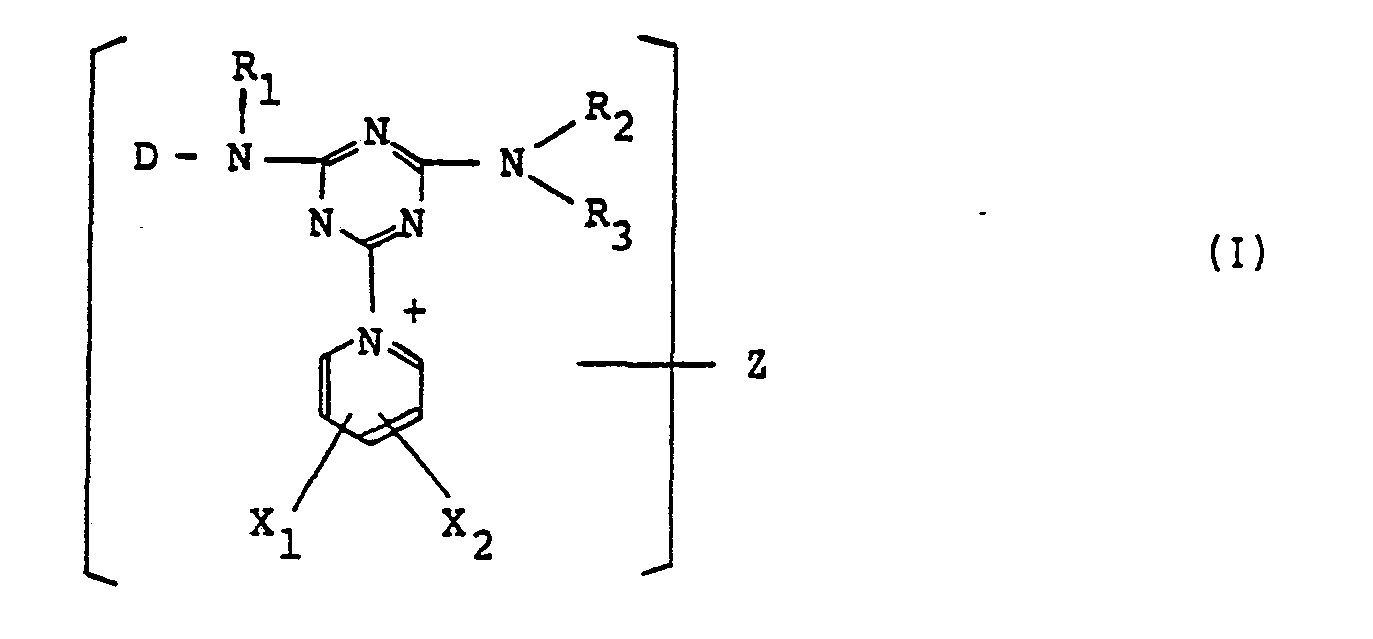
- the present invention provides a compound having the following formula (I),
- D is an organic dye moiety
- R, and R 2 are independently hydrogen or a substituted or unsubstituted lower alkyl group
- R 3 is hydrogen or a substituted or unsubstituted lower alkyl, phenyl or naphthyl group
- X 1 and X 2 are independently hydrogen, halogen or a lower alkyl, cyano, carbamoyl, vinyl, ( ⁇ -hydroxyethyl, ( ⁇ -sulfoethyl, ⁇ -sulfatoethyl, carboxyl, carboxylic acid ester or sulfonic acid group
- the present invention also provides a method for dyeing hydroxyl group- or amido group-containing fiber materials, which comprises using the compound of the formula (I).
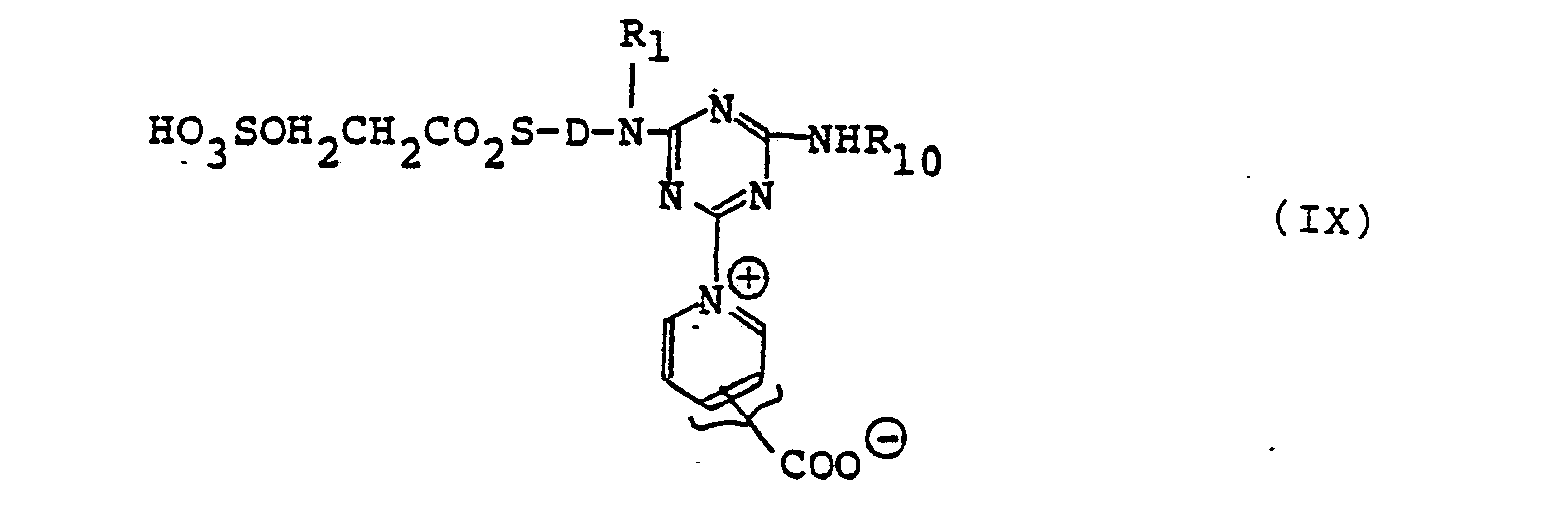
- X 3 is a carbamoyl, ( ⁇ -hydroxyethyl, ⁇ -sulphoethyl, ⁇ -sulphatoethyl, carboxyl or sulphonic acid group and Z is as defined above
- A is in which R 4 and R 5 are independently hydrogen, chlorine, bromine or a methyl, methoxy, ethyl, ethoxy, carboxyl or sulfonic acid group, and m is 0 or 1, and the following formula (VI), wherein D, X 3 and Z are as defined above, R 1 and R 6 are independently hydrogen or a substituted or unsubstituted lower alkyl group and R 7 is hydrogen or a substituted or unsubstituted alkyl, phenyl or naphthyl group.
- the present compounds described above are preferably in the form of an alkali metal or alkaline earth metal salt, more specifically sodium or potassium salt.
- the organic dye moiety represented by D in the formula (I) includes monoazo, polyazo, metal complex azo, anthraquinone, phthalocyanine, formazan, dioxazine and nitrostilbene dye moieties.
- the lower alkyl group represented by R, and R 2 in the formula (I) includes methyl, ethyl, propyl and butyl groups and the like.
- the substituent thereof includes hydroxyl, carboxy, sulfo, carbamoyl, cyano and methoxycarbonyl groups and the like.
- Preferred R 1 and R 2 include methyl, ethyl, carbamoylethyl, hydroxyethyl and n- or iso-propyl groups.
- R 3 may be substituted or unsubstituted with the above-defined Z.
- Preferred Z-substituted R 3 is represented by -A-Z, in which A and Z are as defined above.
- Preferred A includes a phenyl group unsubstituted or substituted with one or two members selected from chlorine and bromine atoms and methyl, ethyl, methoxy, ethoxy and sulfonic acid groups, and a naphthylene groups unsubstituted or substituted with one sulfonic acid group. Examples thereof are as follows. (in the above formulae, the asterisked linkage is bonded to the group,
- Examples of the group, in the formula (VI) are amino, methylamino, ethylamino, propylamino, isopropylamino, butylamino, hexyl- amino, ⁇ -methoxyethylamino, y-methoxypropylamino, ⁇ -ethoxyethylamino, N,N-dimethylamino, N,N-diethylamino, N-methyl-N-phenylamino, N-ethyl-N-phenylamino, ⁇ -chloroethylamino, ⁇ -cyanoethyl- amino, y-cyanopropylamino, ⁇ -carboxyethylamino, sulfomethylamino, ⁇ -sulfoethylamino, ⁇ -hydroxy- ethylamino, N,N-di- ⁇ -hydroxyethylamino, y-hydroxypropylamin
- the group Y capable of being split by the action of an alkali includes a halogen atom such as chlorine and bromine atoms, an ester group of an organic carboxylic or sulfonic acid such as a lower alkanoyloxy group including acetyloxy group, a benzoyloxy group, a benzenesulfonyloxy group, substituted or unsubstituted pyridinio group and a group represented by a free acid of the formula, -OP0 3 H 2 , -SS0 3 H or -OS0 3 H. Of these groups, -OS0 3 H is particularly preferred.
- W is a direct linkage or an aliphatic, alicyclic or aromatic bridging group.
- monoaza compounds particularly preferred are those having a direct linkage as W, and a mono-, di- or tri-sulfophenyl or naphthyl group as D 2 in which the sulfo group is preferably located at an ortho-position to the azo group, the phenyl group being unsubstituted or substituted with a halogen atom such as chlorine, an alkyl group such as methyl, an acylamino group such as acetylamino or an alkoxy group such as methoxy.
- a halogen atom such as chlorine
- an alkyl group such as methyl
- an acylamino group such as acetylamino or an alkoxy group such as methoxy.
- the compound of the formula (II), wherein D had the above-defined Z as a substituent may be used for the production of the compound (I). Examples thereof are as follows:
- the compounds of the formula (IV) usable for the production of the compound (I) are preferably those which have no or few odor.
- Examples thereof are ⁇ - or y-nicotinic amide, ⁇ - or y-(2-hydroxyethyl)pyridine, ⁇ - or y-(2-sulfoethyl)pyridine, ⁇ - or y-(2-sulfatoethyl)pyridine, nicotinic acid, isonicotinic acid, cin- chomeronic acid, dinicotinic acid, isocinchomeronic acid, (3- or y-sulfopyridine and the like.
- All the starting compounds described above may be used in the form of a free acid or a salt, preferably in the form of an alkali metal or alkaline earth metal salt.
- the compound of the formula (I) can be produced by (1) subjecting the 1,3,5- trihalogeno-s-triazine to first-step condensation with the compound of the formula (II), followed by a second step condensation with the compound of the formula (III), and then a third-step condensation with the compound of the formula (IV), or (2) subjecting the 1,3,5-trihalogeno-s-triazine to first-step condensation with the compound of the formula (III), followed by a second-step condensation with the compound of the formula (II), and then a third-step condensation with the compound of the formula (IV), or (3) subjecting the 1,3,5-trihalogeno-s-triazine to first-step condensation with a precursor compound capable of forming the compound (II), followed by a second-step condensation with the compound of the formula (III), and then a third-step condensation with the compound of the formula (IV) after condensing the second condensation product with a remaining precursor compound capable of forming the compound of the formula (II).
- condensation may be chosen from those described above, it is preferred to use a compound having a lower reactivity to the 1,3,5-trihalogeno-s-triazine on earlier stage.
- the reaction conditions may be determined depending on the stability of the starting compound and intermediate compound to be produced, the reaction may be carried ' out at a relatively low pH ranging from 2 to 6, preferably from 2 to 5, and at a relatively low temperature ranging from -5° to 20°C, preferably from 0° to 10°C. ,
- the reaction conditions may be determined depending on the stability of the starting compound and the intermediate.
- the reaction may be carried out at a relatively high pH ranging from 4 to 8, preferably from 4 to 6, and at a relatively high temperature ranging from 10° to 50°C, preferably from 20° to 40°C.
- the third-step condensation may be carried out at a pH ranging from 3 to 9, preferably from 4 to 6, and at a relatively high temperature ranging from 50° to 110°C, preferably from 60° to 90°C.
- the compound (I) produced in accordance with the present invention may be in a liquid form obtained by removing inorganic salts or adding a dyeing improver, if necessary, after completion of the reaction, or may be formed into a powdery product by subjecting the above liquid or the reaction mixture as such to evaporation i.e. spray-drying and the like, or into either liquid or powdery product through salting out of the desired compound in a conventional manner using an electrolyte.
- the present compound may be used as a reactive dye for dyeing hydroxyl group-, or amido group-containing materials.
- the hydroxyl group-containing materials include natural or synthetic hydroxyl group-containing fiber materials such as cellulose fiber materials, cellulose-containing fiber materials, regenerated products thereof and polyvinyl alcohol.
- cellulose fiber materials are cotton and other vegetable fibers such as linen, hemp, jute and ramie fibers.
- regenerated cellulose fibers are viscose staple and filament viscose.
- cellulose-containing fiber materials are mixed fiber materials such as cellulose/polyester, cellulose/wool, cellulose/acryl and the like.
- the amide group-containing materials include synthetic or natural polyamide and polyurethane.
- Examples of the materials, particularly in the fibrous forms, are wool and other animal furs, silk, leather, polyamide-6,6, polyamide-6, polyamide-11 and polyamide-4.
- the dyeing may be carried out in a manner suitable for the reactive groups appended to the fiber-reactive dye.
- the exhaustion dyeing may be carried out at a relatively low temperature using a dye bath containing sodium hydroxide or other acid-binding agents, and sodium sulfate or sodium chloride.
- the printing may be carried out by preparing a dye paste containing a paste or emulsified paste such as sodium alginate and starch ether, alkalis or alkali-liberating agents such as sodium carbonate, sodium bicarbonate, sodium hydroxide, trisodium phosphate, sodium trichloroacetate and the corresponding potassium or alkaline earth metal salts, and if desired, a conventional printing assistant such as urea, and a dispersing agent, applying the dye paste on the fiber, drying and then heat-treating the printed fiber using steam.
- a paste or emulsified paste such as sodium alginate and starch ether
- alkalis or alkali-liberating agents such as sodium carbonate, sodium bicarbonate, sodium hydroxide, trisodium phosphate, sodium trichloro
- the cold-pad-batch-up method may be carried out by applying a padding solution to the fiber at ambient temperature, the padding solution comprising an acid-binding agent such as sodium hydroxide alone or a mixture of sodium hydroxide and sodium silicate, sodium carbonate or trisodium phosphate, and if necessary, a dissolving assistant such as urea, and a penetrant, batching up the fiber with a roll, allowing to stand for 3 hours or more, or overnight, and then rinsing and drying to obtain a dyed product.
- an acid-binding agent such as sodium hydroxide alone or a mixture of sodium hydroxide and sodium silicate, sodium carbonate or trisodium phosphate
- a dissolving assistant such as urea
- penetrant a dissolving assistant
- the present compound is also useful for dyeing or printing the aforesaid cellulose fiber materials or cellulose-containing fiber materials in the absence or presence of the acid binding agent in a small amount enough to show a buffering effect, keeping a dye bath to a pH ranging from 4 to 10.
- the exhaustion dyeing may be carried out in the absence or presence of the acid binding agent in a small amount as described above at a temperature of 60° to 150°C, if desired in the presence of a neutral salt such as sodium sulfate and sodium chloride optionally together with any one of dissolving assistants, penetrants and level dyeing agents.
- a neutral salt such as sodium sulfate and sodium chloride
- This dyeing method is advantageous particularly for dyeing the cellulose-containing fiber materials such as mixed fiber materials of cellulose/polyester, because the dyeing can be carried out in a one bath without decomposition of a disperse dye to be used for dyeing the polyester fibers.
- polyester fibers may be first dyed by a high temperature dyeing method or a carrier dyeing method with a disperse dye, and then the cellulose fibers may be dyed with the present compound in the same bath, or vice versa.
- the cellulose fibers and the polyester fibers may be dyed at the same time with the present compound and disperse dye present in the same bath.
- the dyeing of mixed fiber materials of cellulose/wool may be carried out using both the present compound and an acid dye, whereby the mixed fibers can be dyed in the same color without damage of wool.
- the dyeing of mixed fiber materials of cellulose/acryl may be carried out using both the present compound and a cationic dye.
- a padding or printing may be carried out.
- the fiber materials can be treated with a padding liquor or printing paste containing no acid binding agent, and then heat-treated at a temperature of 150°C or higher, if desired after dyring at a temperature of 80° to 100°C.
- the heat-treatment may be carried out preferably at 160° to 250°C, more preferably at 180° to 230°C, and includes, for example, a baking at about 200°C for several minutes and a steaming at 180°C for 5 to 10 minutes.
- This dyeing method is advantageous particularly for dyeing or printing the cellulose/polyester mixed fiber materials.
- the present compound can be characterized by excellent dye performances in the dyeing or printing of fiber materials, particularly cellulose or cellulose-containing fiber materials.
- the compound can give a dyed product excellent in light fastness, perspiration-light fastness, wet fastness such as washing resistance, peroxide-washing resistance, perspiration resistance and acid-hydrolysis resistance, alkali fastness, abrasion fastness and iron fastness.
- the compound can also exhibit excellent build-up, level-dyeing and washing-off properties, favorable solubility and high exhaustion and fixation percentages.
- the compound can hardly be affected by changes in a dyeing temperature and a dyeing bath ratio, so that a dyed product with a constant quality can be given with superior reproducibility.
- 1-Amino-4-(4',8'-disulfonaphtho-2'-ylazo)naphthalene-7-sulfonic acid (10.7 parts) was diazotized and then coupled with 1-aminonaphthalene-8-sulfonic acid to obtain an amino dye compound.
- Cyanuric chloride (3.7 parts) was added to a neutral solution containing the above-obtained compound and water (300 parts), and the mixture was stirred at a temperature between 0° and 20°C to complete the condensation, while controlling the pH within a range between 4 and 7.
- 2-Aminonaphthalene-3,6,8-trisulfonic acid (7.7 parts) was diazotized and then coupled with 3- ureidoaniline (3.0 parts) in an aqueous solution of hydrochloric acid to obtain an amino dye compound.
- Cyanuric chloride (3.7 parts) was added to a neutral solution containing the above-obtained compound and water (200 parts), and the mixture was stirred at a temperature between 0° and 20°C to complete the condensation, while controlling the pH within a range between 4 and 7.
- the amino dye compound represented by the aforesaid formula (II) shown in a 2nd column of Table 1 is subjected to condensation with cyanuric chloride in an equimolar amount, followed by a condensation with the amine compound of the aforesaid formula (III) shown in a 4th column, and then with the tertiary amine of the aforesaid formula (IV) in a third column, thereby obtaining a compound characterized by a color on cellulose shown in a 5th column.
- the tertiary amine is abbreviated as follows, which are also the same in Tables 2 to 5.
- the amino dye compound shown in a 2nd column of Table 2 is subjected to condensation with a product obtained by the first condensation between the amine shown in a 4th column and cyanuric chloride, followed by a condensation with the tertiary amine shown in a 3rd column, thereby obtaining a compound characterised by a color on cellulose shown in a 5th column.
- the mixture was stirred at a temperature between 0° and 20°C to complete the condensation, while controlling the pH within a range between 1 and 5.
- the resulting reaction mixture was mixed with 2-aminonaphthalene-1,5-disulfonic acid (6.1 parts) diazotized in a conventional manner to complete the coupling reaction.
- nicotinic acid 4.9 parts was added to the above reaction mixture, and the mixture was adjusted to a pH within a range between 4 and 7, heated to 90°C, and stirred for about 5 hours at that temperature, thereby obtaining a red compound represented by a free acid of the following formula.
- cyanuric chloride was subjected to reaction with the coupling component shown in a 2nd column of Table 3, followed by a reaction with the amino shown in a 4th column or a coupling reaction with the diazo component shown in a 5th column in a suitable order, and then by a condensation with the tertiary amine shown in a 3rd column, thereby obtaining a corresponding compound.
- a neutral aqueous solution containing 1,3-diaminobenzene-4-sulfonic acid (18.8 parts) and water (200 parts) was added to ice water (50 parts) containing cyanuric chloride (18.5 parts), and the mixture was stirred for 2 hours at a temperature between 0° and 5°C, while controlling the pH within a range between 2 and 3.
- Aniline-3- ⁇ -sulfatoethylsulfone (28.1 parts) was added to the above reaction mixture, and the mixture was stirred for 4 hours at 30°C, while controlling the pH within a range between 5 and 6.
- nicotinic acid (24.6 parts) was added to that reaction mixture, and the mixture was adjusted to pH 5, heated to 80°C, and stirred for 2 hours at that temperature, while controlling the pH within a range between 4 and 5.
- sodium chloride was added to precipitate crystals, which was than collected on a filter and air-dried at 50°C, thereby obtaining a red compound represented by a free acid of the following formula
- diaminobenzene sulfonic acid shown in a third column of Table 5 is used in place of 1,3-diaminobenzene-4-sulfonic acid used above to react with the amine (III), followed by diazotization and coupling with the coupling component in a 4th column, and then by condensation with any one of the aforesaid tertiary amines a to I, thereby obtaining a corresponding compound.
- Example 1 The compound obtained in Example 1 (0.1, 0.3 and 0.6 part) was respectively dissolved in water (200 parts) and sodium sulfate (10 parts) and cotton (10 parts) were added thereto. The bath was heated to 60°C, and then sodium carbonate (4 parts) was added thereto. At this temperature, the dyeing was continued for 1 hour. The cotton was rinsed with water, soaped, again rinsed with water, and dried to obtain a dyed product of a brown color having excellent various fastness properties with a good build-up property.
- the compound was found to have a favorable solubility, good level dyeing property and superior reproducibility of the dyeing.
- the dyeing was carried out at a temperature of 35°C and 80°C, respectively, in place of the above 60°C-dyeing, whereby the similar dyed products were obtained, respectively.
- Example 2 The compound obtained in Example 1 (4.5 parts), urea (10.0 parts), a 10% aqueous solution of sodium alginate thickening agent (50.0 parts), sodium m-nitro-benzenesulfonate (1.0 part) and sodium hydrogen carbonate (1.0 part) were mixed with water to make the total weight 100 parts.
- Cotton was printed with the thus obtained printing paste, then dried, and steamed for 5 minutes at 102°C. The printed product was rinsed with cool water and then hot water, and dried. The thus printed product of a brown color exhibited an excellent washing fastness.
- a similar printed product was obtained by a steaming conducted for 6 minutes at 175°C in place of the above steaming conducted for 5 minutes at 102°C.
- Example 2 A mixture of the compound obtained in Example 1 (2.0 parts) and sodium m-nitrobenzenesulfonate (0.5 part) was dissolved in water (100 parts). Cotton fabric was dipped in the above solution, squeezed up to 75% in the weight increase, and dried. The fabric was then dipped in a 20°C solution containing 5 g/I sodium hydroxide and 300 g/I sodium chloride, and squeezed up to 75% in the weight increase. The resulting fabric was steamed for 30 seconds at 200°C, then rinsed with water, soaped for 15 minutes in a boiling solution containing 30% of a nonionic detergent, again rinsed with water, and dried, thereby obtaining a dyed product of a brown color.
- Example 1 The compound obtained in Example 1 (0.1, 0.3 and 0.6 part) was respectively dissolved in water (200 parts), and sodium sulfate (12 parts) and cotton (10 parts) were added thereto. The bath was heated to 80°C, and dyeing was continued for 1 hour at this temperature. The cotton was rinsed with water, soaped, again rinsed with water, and then dried to obtain a dyed product of a brown color having excellent various fastness properties with good build-up property.
- the compound was found to have a favorable solubility, good level dyeing property and superior reproducibility of the dyeing.
- Example 2 The compound obtained in Example 1 (5 parts), urea (20 parts), and a 10% aqueous solution of sodium alginate thickening agent (50 parts) were mixed with water to make the total weight 100 parts. Cotton was printed with the thus obtained printing paste, dried and then steamed at 180°C for 10 minutes. The printed product was rinsed with cool water and then hot water, and dried. The thus printed product of a brown color exhibited a good washing fastness.
- Example 2 A mixture of the compound in Example 1 (2.0 parts) and sodium n-nitrobenzenesulfonate (0.5 parts) was dissolved in water (100 parts). Cotton fabric was dipped in the above solution, squeezed up to 75% in the weight increase, and then dried. The fabric was steamed at 200°C for 2 minutes, rinsed, soaped for 15 minutes in a boiling solution containing 30% of a nonionic detergent, again rinsed and dried to obtain a dyed product of a brown color.
- the dyeing was carried out using a buffer to keep the pH within a range between 4 and 10, whereby a desired result was obtained.
Landscapes
- Chemical & Material Sciences (AREA)
- Organic Chemistry (AREA)
- Engineering & Computer Science (AREA)
- Textile Engineering (AREA)
- Coloring (AREA)
Claims (10)




Applications Claiming Priority (2)
| Application Number | Priority Date | Filing Date | Title |
|---|---|---|---|
| JP31133/84 | 1984-02-20 | ||
| JP59031133A JPH07116375B2 (ja) | 1984-02-20 | 1984-02-20 | トリアジン化合物およびそれを用いる繊維材料の染色または捺染法 |
Publications (2)
| Publication Number | Publication Date |
|---|---|
| EP0167219A1 EP0167219A1 (de) | 1986-01-08 |
| EP0167219B1 true EP0167219B1 (de) | 1988-09-28 |
Family
ID=12322926
Family Applications (1)
| Application Number | Title | Priority Date | Filing Date |
|---|---|---|---|
| EP85300842A Expired EP0167219B1 (de) | 1984-02-20 | 1985-02-08 | Faserreaktive Verbindung mit beiden Gruppen der Pyridintriazinyl- und der Vinylsulfonreihe |
Country Status (7)
| Country | Link |
|---|---|
| US (1) | US4626589A (de) |
| EP (1) | EP0167219B1 (de) |
| JP (1) | JPH07116375B2 (de) |
| KR (1) | KR940006572B1 (de) |
| DE (1) | DE3565279D1 (de) |
| ES (1) | ES8606450A1 (de) |
| PT (1) | PT79983B (de) |
Families Citing this family (26)
| Publication number | Priority date | Publication date | Assignee | Title |
|---|---|---|---|---|
| JPS6112987A (ja) * | 1984-06-28 | 1986-01-21 | 日本化薬株式会社 | セルロ−ス又はセルロ−ス含有繊維材料の染色法 |
| EP0171218B1 (de) * | 1984-08-06 | 1993-10-13 | Genencor, Inc. | Enzymatische Hydrolyse von körniger Stärke direkt bis zu Glukose |
| JPS6155275A (ja) * | 1984-08-20 | 1986-03-19 | 日本化薬株式会社 | 天然皮革の堅牢染色法 |
| DE3512630A1 (de) * | 1985-04-06 | 1986-10-23 | Hoechst Ag, 6230 Frankfurt | Verfahren zum faerben oder bedrucken von cellulosefasern oder cellulosemischfasern |
| DE3514969A1 (de) * | 1985-04-25 | 1986-10-30 | Hoechst Ag, 6230 Frankfurt | Verfahren zum reaktiven faerben und bedrucken von hydroxygruppen enthaltenden fasermaterialien |
| JPS62190258A (ja) * | 1986-02-17 | 1987-08-20 | Sumitomo Chem Co Ltd | ジオキサジン化合物およびそれを用いる染色または捺染法 |
| DE3629574A1 (de) * | 1986-08-30 | 1988-03-03 | Hoechst Ag | Wasserloesliche disazoverbindungen, verfahren zu ihrer herstellung und ihre verwendung als farbstoffe |
| US4841032A (en) * | 1986-09-19 | 1989-06-20 | Sumitomo Chemical Company, Limited | Fiber reactive monoazo compounds having two vinylsulfone type fiber reactive groups in the molecule |
| US4904766A (en) * | 1986-10-17 | 1990-02-27 | Sumitomo Chemical Company, Limited | Monoazo compound having two vinylsulfone type fiber reactive groups through triazinyl bridging group |
| US4873321A (en) * | 1986-10-17 | 1989-10-10 | Sumitomo Chemical Company, Limited | Monazo compounds having a triozinyl bridging group and two vinylsulfone type fiber reactive groups |
| DE3636398A1 (de) * | 1986-10-25 | 1988-05-05 | Hoechst Ag | Wasserloesliche disazoverbindungen, verfahren zu ihrer herstellung und ihre verwendung als farbstoffe |
| US4841033A (en) * | 1986-10-29 | 1989-06-20 | Sumitomo Chemical Company, Limited | Reactive red monoazo dye compound having two vinylsulfone type fiber reactive groups |
| DE3637337A1 (de) * | 1986-11-03 | 1988-05-11 | Hoechst Ag | Wasserloesliche azoverbindungen, verfahren zu ihrer herstellung und ihre verwendung als farbstoffe |
| JPH0778176B2 (ja) * | 1986-11-07 | 1995-08-23 | 住友化学工業株式会社 | モノアゾ化合物及びそれを用いる染色又は捺染法 |
| US5037965A (en) * | 1987-12-01 | 1991-08-06 | Sumitomo Chemical Company, Limited | Monoazo red dye compound having vinylsulfone type fiber reactive groups |
| DE3800690A1 (de) * | 1988-01-13 | 1989-07-27 | Hoechst Ag | Wasserloesliche 2-naphthol-azoverbindungen, verfahren zu ihrer herstellung und ihre verwendung als farbstoffe |
| JP2674154B2 (ja) * | 1988-01-20 | 1997-11-12 | 住友化学工業株式会社 | モノアゾ化合物およびそれを用いて繊維材料を染色又は捺染する方法 |
| US5104978A (en) * | 1988-12-09 | 1992-04-14 | Sumitomo Chemical Company, Limited | Monoazo red reactive dye compound having a vinylsulfone type fiber reactive group and a substituted triazinyl group |
| JP2775919B2 (ja) * | 1988-12-10 | 1998-07-16 | 住友化学工業株式会社 | モノアゾ化合物及びそれを用いて繊維材料を染色又は捺染する方法 |
| US5116956A (en) * | 1989-06-01 | 1992-05-26 | Sumitomo Chemical Co., Ltd. | Polyazo dye compounds having vinylsulfone type and pyridinium type fiber reactive groups |
| EP0501252B1 (de) * | 1991-02-27 | 1996-04-10 | Bayer Ag | Bifunktionelle Reaktivfarbstoffe |
| GB9402618D0 (en) * | 1994-02-10 | 1994-04-06 | Zeneca Ltd | Organic chemicals |
| GB2315493B (en) * | 1996-07-24 | 2001-01-03 | Lexmark Int Inc | Ink jet ink dyes |
| GB2347935B (en) * | 1999-03-17 | 2001-05-23 | Sumitomo Chemical Co | Monoazo compounds or mixtures thereof and process for dyeing or printing using them |
| DE10035805A1 (de) * | 2000-07-22 | 2002-02-07 | Dystar Textilfarben Gmbh & Co | Wasserlösliche faserreaktive Farbstoffe, Verfahren zu ihrer Herstellung und ihre Verwendung |
| CN1301990C (zh) * | 2004-03-12 | 2007-02-28 | 美国永光公司 | 环保型反应性染料及染料组成物 |
Family Cites Families (7)
| Publication number | Priority date | Publication date | Assignee | Title |
|---|---|---|---|---|
| DE1265698C2 (de) * | 1961-05-06 | 1968-11-07 | Hoechst Ag | Verfahren zur Erzeugung von nassechten Faerbungen und Drucken |
| IT1075013B (it) * | 1975-07-31 | 1985-04-22 | Ici Ltd | Coloranti reattivi aventi un gruppo triazinilico che porta un sostituente quaternario particolarmente per materiali tessili di cellulosa |
| DE2614550C3 (de) * | 1976-04-03 | 1981-06-25 | Cassella Ag, 6000 Frankfurt | Neue Reaktivfarbstoffe, ihre Herstellung und Verwendung zum Färben und Bedrucken von Cellulose sowie natürlichen und synthetischen Polyamidsubstraten |
| US4341699A (en) * | 1979-07-13 | 1982-07-27 | Sumitomo Chemical Company, Limited | Reactive red dye having both monochlorotriazinyl- and vinylsulfone-type reactive groups |
| DE3114088A1 (de) * | 1981-04-08 | 1982-10-28 | Bayer Ag, 5090 Leverkusen | Wasserloesliche triazinverbindungen, ihre herstellung und ihre verwendung |
| EP0074928A3 (de) * | 1981-09-16 | 1983-04-20 | Ciba-Geigy Ag | Reaktivfarbstoffe, deren Herstellung und Verwendung |
| JPS58186682A (ja) * | 1982-04-27 | 1983-10-31 | 日本化薬株式会社 | セルロ−ス又はセルロ−ス含有繊維材料の染色法 |
-
1984
- 1984-02-20 JP JP59031133A patent/JPH07116375B2/ja not_active Expired - Fee Related
-
1985
- 1985-02-07 US US06/699,182 patent/US4626589A/en not_active Expired - Lifetime
- 1985-02-08 EP EP85300842A patent/EP0167219B1/de not_active Expired
- 1985-02-08 DE DE8585300842T patent/DE3565279D1/de not_active Expired
- 1985-02-18 PT PT79983A patent/PT79983B/pt not_active IP Right Cessation
- 1985-02-18 ES ES540494A patent/ES8606450A1/es not_active Expired
- 1985-02-19 KR KR1019850001027A patent/KR940006572B1/ko not_active Expired - Fee Related
Also Published As
| Publication number | Publication date |
|---|---|
| ES540494A0 (es) | 1986-04-16 |
| PT79983A (en) | 1985-03-01 |
| ES8606450A1 (es) | 1986-04-16 |
| DE3565279D1 (en) | 1988-11-03 |
| EP0167219A1 (de) | 1986-01-08 |
| KR850006209A (ko) | 1985-10-02 |
| KR940006572B1 (ko) | 1994-07-22 |
| US4626589A (en) | 1986-12-02 |
| JPH07116375B2 (ja) | 1995-12-13 |
| PT79983B (en) | 1986-11-10 |
| JPS60173060A (ja) | 1985-09-06 |
Similar Documents
| Publication | Publication Date | Title |
|---|---|---|
| US4626589A (en) | Organic dye compound having both pyridiniotriazinyl and vinylsulfone type fiber-reactive groups | |
| US4649193A (en) | Water-soluble dyestuffs containing fibre-reactive groups of the vinylsulfone series and the fluoro-s-triazinyl-amino series | |
| US4996304A (en) | Reactive disazo dyes containing fluoro-chloropyrimidyl groups and vinyl sulfonyl group | |
| JPH0611869B2 (ja) | 反応染料とその製造方法及び使用 | |
| EP0052985B1 (de) | Reaktive Monoazo-Scharlachfarbstoffe | |
| KR920002681B1 (ko) | 모노아조 화합물의 제조방법 | |
| US6670457B2 (en) | Reactive dyes, their preparation and use | |
| US5750662A (en) | Disazo dyes containing haloacryloylamino or dihalopropionylamino and substituted triazinyl reactive groups | |
| US5037965A (en) | Monoazo red dye compound having vinylsulfone type fiber reactive groups | |
| US4701523A (en) | Water-soluble disazo compounds containing one or two (nitro-phenylamino)-phenylamino-chlorotriazinylamino groups, the nitro-phenylamino being additionally substituted by a fiber-reactive group of the vinylsulfone series, suitable as dyestuffs | |
| KR960000176B1 (ko) | 폴리아조 화합물, 그 제조방법 및 이를 사용한 섬유의 염색 또는 날염 방법 | |
| JP2510496B2 (ja) | 反応染料 | |
| US5081296A (en) | Bis(β-hydroxyethylthio)-C1 -C4 -alkylamines | |
| US4968781A (en) | Fiber-reactive dyes comprising a halopyrimidine for which a vinylsulfonyl or the like moiety is attached via a bridge member | |
| EP0239847B1 (de) | Monoazoverbindung mit einer faserreaktiven Gruppe des Vinylsulfon-Typs, getragen von einem substituierten Triazinbrückenglied | |
| EP0262520B1 (de) | Mit Fasern reaktive Monoazoverbindung der bifuktionellen Vinylsulfonreihe | |
| US4725674A (en) | Water soluble monoazo and disazo compounds containing (diphenylamino)-amino-chlorotriazinylamino group substituted by a nitro group and a fibre-reaction group of the vinylsulfone series, suitable as dyestuffs | |
| JPH09165525A (ja) | 繊維反応性染料及びその製造方法 | |
| EP0184071B1 (de) | Monoazoverbindungen, Verfahren zu ihrer Herstellung und Färbverfahren unter deren Verwendung | |
| EP0400648B1 (de) | Polyazofarbstoffe mit mehreren faserreaktiven Vinylsulfongruppen in einem Molekül | |
| US4703111A (en) | Water-soluble compounds containing one or two (nitrophenylamino)-phenylamino-chlorotriazinylamino groups, the nitrophenylamino being additionally substituted by a fiber-reactive group of the vinylsulfonyl series, suitable as dyestuffs | |
| US4731441A (en) | Water-soluble azo compounds containing, as fiber-reactive groups, a (nitrophenylamino-phenylamino)-chloro-triazinylamino group and groups of the vinylsulfone series, suitable as dyestuffs | |
| JPH0135955B2 (de) | ||
| JP2658240B2 (ja) | トリアジン化合物 | |
| EP0400647B1 (de) | Polyazofarbstoffe mit Fasern der reaktiven Vinylsulfon- und Pyridiniumgruppe |
Legal Events
| Date | Code | Title | Description |
|---|---|---|---|
| PUAI | Public reference made under article 153(3) epc to a published international application that has entered the european phase |
Free format text: ORIGINAL CODE: 0009012 |
|
| AK | Designated contracting states |
Designated state(s): BE CH DE FR GB IT LI NL SE |
|
| 17P | Request for examination filed |
Effective date: 19860625 |
|
| 17Q | First examination report despatched |
Effective date: 19870430 |
|
| GRAA | (expected) grant |
Free format text: ORIGINAL CODE: 0009210 |
|
| AK | Designated contracting states |
Kind code of ref document: B1 Designated state(s): BE CH DE FR GB IT LI NL SE |
|
| ITF | It: translation for a ep patent filed | ||
| REF | Corresponds to: |
Ref document number: 3565279 Country of ref document: DE Date of ref document: 19881103 |
|
| ET | Fr: translation filed | ||
| RAP4 | Party data changed (patent owner data changed or rights of a patent transferred) |
Owner name: SUMITOMO CHEMICAL COMPANY, LIMITED |
|
| PLBE | No opposition filed within time limit |
Free format text: ORIGINAL CODE: 0009261 |
|
| STAA | Information on the status of an ep patent application or granted ep patent |
Free format text: STATUS: NO OPPOSITION FILED WITHIN TIME LIMIT |
|
| 26N | No opposition filed | ||
| ITTA | It: last paid annual fee | ||
| EAL | Se: european patent in force in sweden |
Ref document number: 85300842.3 |
|
| PGFP | Annual fee paid to national office [announced via postgrant information from national office to epo] |
Ref country code: BE Payment date: 19960116 Year of fee payment: 12 |
|
| PGFP | Annual fee paid to national office [announced via postgrant information from national office to epo] |
Ref country code: SE Payment date: 19960117 Year of fee payment: 12 |
|
| PGFP | Annual fee paid to national office [announced via postgrant information from national office to epo] |
Ref country code: NL Payment date: 19960123 Year of fee payment: 12 |
|
| PGFP | Annual fee paid to national office [announced via postgrant information from national office to epo] |
Ref country code: FR Payment date: 19960201 Year of fee payment: 12 |
|
| PG25 | Lapsed in a contracting state [announced via postgrant information from national office to epo] |
Ref country code: SE Effective date: 19970209 |
|
| PG25 | Lapsed in a contracting state [announced via postgrant information from national office to epo] |
Ref country code: BE Effective date: 19970228 |
|
| BERE | Be: lapsed |
Owner name: SUMITOMO CHEMICAL CY LTD Effective date: 19970228 |
|
| PG25 | Lapsed in a contracting state [announced via postgrant information from national office to epo] |
Ref country code: NL Effective date: 19970901 |
|
| PG25 | Lapsed in a contracting state [announced via postgrant information from national office to epo] |
Ref country code: FR Effective date: 19971030 |
|
| EUG | Se: european patent has lapsed |
Ref document number: 85300842.3 |
|
| NLV4 | Nl: lapsed or anulled due to non-payment of the annual fee |
Effective date: 19970901 |
|
| REG | Reference to a national code |
Ref country code: FR Ref legal event code: ST |
|
| PGFP | Annual fee paid to national office [announced via postgrant information from national office to epo] |
Ref country code: CH Payment date: 20000119 Year of fee payment: 16 |
|
| PGFP | Annual fee paid to national office [announced via postgrant information from national office to epo] |
Ref country code: GB Payment date: 20000120 Year of fee payment: 16 |
|
| PGFP | Annual fee paid to national office [announced via postgrant information from national office to epo] |
Ref country code: DE Payment date: 20000127 Year of fee payment: 16 |
|
| PG25 | Lapsed in a contracting state [announced via postgrant information from national office to epo] |
Ref country code: GB Free format text: LAPSE BECAUSE OF NON-PAYMENT OF DUE FEES Effective date: 20010208 |
|
| PG25 | Lapsed in a contracting state [announced via postgrant information from national office to epo] |
Ref country code: LI Free format text: LAPSE BECAUSE OF NON-PAYMENT OF DUE FEES Effective date: 20010228 Ref country code: CH Free format text: LAPSE BECAUSE OF NON-PAYMENT OF DUE FEES Effective date: 20010228 |
|
| GBPC | Gb: european patent ceased through non-payment of renewal fee |
Effective date: 20010208 |
|
| REG | Reference to a national code |
Ref country code: CH Ref legal event code: PL |
|
| PG25 | Lapsed in a contracting state [announced via postgrant information from national office to epo] |
Ref country code: DE Free format text: LAPSE BECAUSE OF NON-PAYMENT OF DUE FEES Effective date: 20011201 |