EP0063869B1 - Vorrichtung zum Schlitzen eines hohlen Gegenstandes - Google Patents
Vorrichtung zum Schlitzen eines hohlen Gegenstandes Download PDFInfo
- Publication number
- EP0063869B1 EP0063869B1 EP82301606A EP82301606A EP0063869B1 EP 0063869 B1 EP0063869 B1 EP 0063869B1 EP 82301606 A EP82301606 A EP 82301606A EP 82301606 A EP82301606 A EP 82301606A EP 0063869 B1 EP0063869 B1 EP 0063869B1
- Authority
- EP
- European Patent Office
- Prior art keywords
- blades
- slit
- product
- planes
- another
- Prior art date
- Legal status (The legal status is an assumption and is not a legal conclusion. Google has not performed a legal analysis and makes no representation as to the accuracy of the status listed.)
- Expired
Links
- 239000000463 material Substances 0.000 claims abstract description 23
- 238000010008 shearing Methods 0.000 abstract description 4
- 238000000034 method Methods 0.000 abstract description 2
- 229910000760 Hardened steel Inorganic materials 0.000 description 4
- 229910001209 Low-carbon steel Inorganic materials 0.000 description 4
- 239000003365 glass fiber Substances 0.000 description 3
- 239000002184 metal Substances 0.000 description 3
- 239000011230 binding agent Substances 0.000 description 2
- 229910000831 Steel Inorganic materials 0.000 description 1
- 230000015572 biosynthetic process Effects 0.000 description 1
- 230000001419 dependent effect Effects 0.000 description 1
- 239000000835 fiber Substances 0.000 description 1
- 238000009413 insulation Methods 0.000 description 1
- 239000005340 laminated glass Substances 0.000 description 1
- 238000003475 lamination Methods 0.000 description 1
- 239000010959 steel Substances 0.000 description 1
Images


Classifications
-
- B—PERFORMING OPERATIONS; TRANSPORTING
- B26—HAND CUTTING TOOLS; CUTTING; SEVERING
- B26D—CUTTING; DETAILS COMMON TO MACHINES FOR PERFORATING, PUNCHING, CUTTING-OUT, STAMPING-OUT OR SEVERING
- B26D1/00—Cutting through work characterised by the nature or movement of the cutting member or particular materials not otherwise provided for; Apparatus or machines therefor; Cutting members therefor
- B26D1/01—Cutting through work characterised by the nature or movement of the cutting member or particular materials not otherwise provided for; Apparatus or machines therefor; Cutting members therefor involving a cutting member which does not travel with the work
- B26D1/02—Cutting through work characterised by the nature or movement of the cutting member or particular materials not otherwise provided for; Apparatus or machines therefor; Cutting members therefor involving a cutting member which does not travel with the work having a stationary cutting member
- B26D1/03—Cutting through work characterised by the nature or movement of the cutting member or particular materials not otherwise provided for; Apparatus or machines therefor; Cutting members therefor involving a cutting member which does not travel with the work having a stationary cutting member with a plurality of cutting members
-
- B—PERFORMING OPERATIONS; TRANSPORTING
- B26—HAND CUTTING TOOLS; CUTTING; SEVERING
- B26D—CUTTING; DETAILS COMMON TO MACHINES FOR PERFORATING, PUNCHING, CUTTING-OUT, STAMPING-OUT OR SEVERING
- B26D3/00—Cutting work characterised by the nature of the cut made; Apparatus therefor
-
- B—PERFORMING OPERATIONS; TRANSPORTING
- B26—HAND CUTTING TOOLS; CUTTING; SEVERING
- B26D—CUTTING; DETAILS COMMON TO MACHINES FOR PERFORATING, PUNCHING, CUTTING-OUT, STAMPING-OUT OR SEVERING
- B26D3/00—Cutting work characterised by the nature of the cut made; Apparatus therefor
- B26D3/001—Cutting tubes longitudinally
-
- B—PERFORMING OPERATIONS; TRANSPORTING
- B26—HAND CUTTING TOOLS; CUTTING; SEVERING
- B26D—CUTTING; DETAILS COMMON TO MACHINES FOR PERFORATING, PUNCHING, CUTTING-OUT, STAMPING-OUT OR SEVERING
- B26D3/00—Cutting work characterised by the nature of the cut made; Apparatus therefor
- B26D3/28—Splitting layers from work; Mutually separating layers by cutting
Definitions
- the present invention relates to an apparatus for splitting a hollow product and more particularly for producing a longitudinal slit of stepped profile through the wall of the product.
- the product may for example be a hollow tubular sheath manufactured from glass fibres bound together with a binder. Such sheaths can be used for insulating pipes or conduits.
- a method of producing a longitudinal slit through the wall of a hollow cylindrical sheath is described in French Patent Specification No. 2 271 006.
- an apparatus is employed whose cutter assembly comprises two blades disposed in two substantially parallel planes spaced a small distance apart. Each of the two blades partially cuts through a portion of the wall of the sheath from the inside and outside respectively so as to create two spaced, substantially parallel, longitudinal slits in the wall.
- the spacing between the two slits is sufficiently small to make it possible to fracture the thickness of the material separating them.
- the blade which partially cuts through a portion of the inside wall is carried on a fixed cylindrical rod which passes through the centre of the hollow sheath.
- the rod is itself supported by a vertical supporting member fixed on a frame located external of the sheath.
- the vertical supporting member is aligned with the longitudinal slits formed in the sheath so that as the sheath is moved axially against and past the vertical supporting member the edge of that member, which is tapered, cuts through or fractures the material separating the slits.
- the resulting product is a sheath having a slit along its entire length, the slit being a straight line slit passing through the whole wall thickness of the sheath.
- an apparatus for providing a longitudinal slit through the wall of a hollow tubular product comprising a cutter assembly with two blades each of which lies in one of a pair of spaced apart planes, the blades being arranged to make longitudinal cuts partially through the wall from the inside and the outside of the product with the inner ends of the partial cuts adjacent to one another and means to provide relative longitudinal movement between the assembly and the product characterised in that the two blades are connected together by a connecting bridge part so that the two blades act together to make the partial cuts and that means e.g.
- a thickened portion forming a part of each cutting blade is provided for exerting a stress in the material of the tubular product in the region of the partial cuts and acting substantially at right angles to the planes of the partial cuts to fracture the material between the inner ends of the partial cuts to define a single longitudinal slit of stepped or Z-shaped profile through the wall and further characterised by the provision of means e.g. a tapered follower section on each blade for passing through the stepped slit to exert pressure to open up the slit to allow the connecting bridge part to pass through the slit.
- the connecting part connects together the follower sections of the two blades and holds them spaced apart in a fixed relationship to one another.
- the connecting part is flat and disposed in a plane substantially orthogonal to the planes in which the blades lie.
- the pair of spaced planes in which each longitudinal slit lies can be either parallel or non- parallel to one another. It is convenient, however, to arrange the spaced planes to be substantially parallel to one another so that the resulting stepped slit has a Z profile.
- the two longitudinal slits formed, and hence the cutting sections of the blades are level or overlap one another slightly.
- the degree of overlap is dependent on the material of the product to be fractured but for a laminated glass fibre product the overlap conveniently lies in the range 0 mm to 10 mm. Preferably the overlap lies within the range 0 mm to 5 mm.
- Each blade may have its cutting and follower section made as separate sections or the whole blade may be made as one integral part. It is convenient, however, to make the cutting and follower sections as separate parts of different material, for example the cutting section can be made from a hardened steel whilst the follower section can be made of mild steel. The connecting part between the follower sections can then also be made of mild steel enabling the two follower sections and connecting part to be fabricated as one integral part.
- a further blade is provided for producing a straight longitudinal slit partially through another portion of the inside wall of the product, substantially opposite the stepped slit, the uncut material in line with that slit serving as a hinge enabling the product to be opened and closed without the sections coming apart.
- the apparatus can be used for splitting tubular hollow products having any cross section, for example circular, square, oblong or polygonal cross sections.
- Sheaths for pipe insulation are usually cylindrical and so have a circular cross section.
- the stress which fractures the thickness of material between the inner ends of the longitudinal slits is a hoop stress, whilst the shearing forces which open up the stepped profile slit act in radial directions.
- the apparatus in figure 1 comprises a V-shaped channel 2 made from sheet metal, a section along the base of the channel 2 being cut away so as to define a longitudinal slot 4.
- the top of the channel 2 is bent so as to form two flat longitudinal edges 5 and each edge 5 is supported on top of a number of blocks 6 disposed at spaced intervals along one of the flat edges of a respective support 8 having a U cross section.
- the supports 8 are connected together at each end by a respective metal cross member 10 and are supported on a pair of spaced metal blocks 12 and 13.
- a pusher arm 14 is mounted for reciprocatory movement along the slot 4 and the top of arm 14 is cut away so as to provide clearance to enable it to pass by a cutter assembly 16.
- the drive mechanism for pusher arm 14 is enclosed in block 12.
- the cutter assembly 16 depends from a flange plate 18 which is secured to a fabricated steel block 20.
- the block 20 is attached to one end portion of a ram 22 the other end portion of which is slidably mounted within a hollow cylindrical housing 24.
- Vertical adjustment of the cutter assembly 16 is made by adjusting the position of ram 22 relative to housing 24 by means of a drive mechanism in block 13.
- the cutter assembly has three fin shaped blades 28, 30 and 32.
- the blade 28 is held in a blade carrier 26 attached along the bottom edge of the flange plate 18, the blade 28 being secured to the carrier 26 by a number of bolts 27.
- the blade 30 is connected to the blade 28 by a horizontal connecting part 29 which serves to hold the blade 30 in a fixed offset position relative to the blade 28.
- the blade 30 has one of its edges secured to a cylindrical bullet shaped rod 44, the diametrically opposite part of the rod 44 carrying the blade 32.
- the blades 28 and 30 have two sections, a cutting section made of hardened steel and a follower section made of mild steel.
- the cutting sections are indicated by numerals 34 and 36 respectively and can be considered as those portions of the blades to the left of the lines S in figure 2.
- the follower sections are indicated by numerals 38, 40 respectively and are those portions of the blades to the right of the lines S in figure 2.
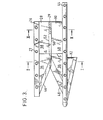
- the blades 28 and 30 are fixed relative to one another so that at least a portion of their cutting sections overlap one another, best illustrated in figures 3 and 4. The extent of the overlap is very important and is adjusted in dependence on the type of product which is to be split and the spacing between the blades 28 and 30.
- the overlap lies preferably within the range 0 to 5 mm.
- Each of the cutting sections 34 and 36 have a cutting edge 46 and 48 respectively and the portion of the cutting section leading to the cutting edge is tapered, as best shown in figure 4.
- the taper is one side only, alternatively the taper could be from both sides.
- the remainder of the cutting section is made fairly thick, for example 3 mm, for a purpose to be described later.
- the follower sections 38, 40 have a substantially uniform thickness throughout but are provided with flared or tapered edges 50 and 52 (see figure 3).
- the edge 50 of the follower section 38 spreads downwardly and the edge 52 spreads upwardly giving an increasing degree of overlap between the follower sections.
- a hollow product for example a hollow cylindrical product having a laminar glass fibre structure
- the pusher arm 14 is moved at a uniform speed and pushes the hollow product in an axial direction, that is in the direction of arrow A in figure 1.
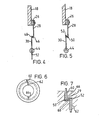
- the cutting edges of the three blades 28, 30 and 32 cut through the wall of the product as it is advanced and produce three partial cuts in the wall of the product as shown in figure 6.
- the cutting edge 46 of blade 28 cuts partially through the outside wall of the product to produce slit 60
- the cutting edge 48 of blade 30 cuts partially through the inside wall of the product to produce slit 62
- the cutting edge of blade 32 partially cuts through the inside wall of the product to produce slit 64.
- the partially slit product continues its axial movement and the thickened portion of the cutting sections 34, 36 then pass through the slits 60, 62 which have their inner ends adjacent to one another.
- the thickened portions of the cutting sections 34, 36 widen the slits 60, 62 and in so doing exert forces in the material in the region of the adjacent inner ends of the slits 60, 62 in a direction away from the planes of slits 60, 62 and sufficient to fracture the thickness of the material between the inner ends of the slits 60, 62 to produce an intermediate step between those ends.
- the slits 60, 62 overlap only slightly so the fracture takes place along one of the laminations of the material between the inner ends of the slits 60, 62 and the resulting fracture is straight and smooth.
- the resulting slit now has a Z profile, and the surfaces 66, 68 of the material overlap at the stepped portion of the slit.
- the product continues along its axial path past the follower sections 38 and 40 towards the region of the connecting part 29. If the surfaces 66, 68 of the material at the intermediate step of the slit are to remain undamaged and smooth it is necessary to prevent the connecting part 29 from coming into contact with those surfaces. It is for this reason that the flared edges 50, 52 are provided and as best seen in figure 7 they exert radial shearing forces on the overlapping surfaces 66, 68 to open up the slit so as to allow the connecting part 29 to pass between the overlapping surfaces 66, 68 without causing them damage.
- the resulting product has a longitudinal Z-profile slit through the whole of its wall and a longitudinal slit 64 partially through its wall.
- the unfractured material below the slit 64 acts like a hinge and enables the product to be opened and closed around a cylindrical pipe or conduit, the straight and smooth overlapping surfaces 66, 68 coming into intimate contact and providing an effective air seal.
- each blade can be integrated with one another or can be manufactured from separate parts.
- each of the blades 28, 30 can be manufactured from a respective single sheet of hardened steel, the line S merely being representative of that portion of the blade where the Z profile slit has been completely formed.
- the cutting sections 34, 36 can be made as separate hardened steel parts to that of the follower sections 38, 40 which are made of mild steel.
- the end of the cutting section 34 closely abuts against the end of the follower section 38, that is along line S, whilst the end of the cutting secton 36 closely abuts against the follower section 40, also being along line S.
Landscapes
- Life Sciences & Earth Sciences (AREA)
- Forests & Forestry (AREA)
- Engineering & Computer Science (AREA)
- Mechanical Engineering (AREA)
- Perforating, Stamping-Out Or Severing By Means Other Than Cutting (AREA)
- Processing Of Stones Or Stones Resemblance Materials (AREA)
- Scissors And Nippers (AREA)
- Load-Engaging Elements For Cranes (AREA)
- Superconductors And Manufacturing Methods Therefor (AREA)
- Electrical Discharge Machining, Electrochemical Machining, And Combined Machining (AREA)
- Silver Salt Photography Or Processing Solution Therefor (AREA)
- Chair Legs, Seat Parts, And Backrests (AREA)
- Non-Silver Salt Photosensitive Materials And Non-Silver Salt Photography (AREA)
- Control And Other Processes For Unpacking Of Materials (AREA)
- Adornments (AREA)
- Fertilizing (AREA)
Claims (8)
Priority Applications (1)
| Application Number | Priority Date | Filing Date | Title |
|---|---|---|---|
| AT82301606T ATE19605T1 (de) | 1981-04-09 | 1982-03-26 | Vorrichtung zum schlitzen eines hohlen gegenstandes. |
Applications Claiming Priority (2)
| Application Number | Priority Date | Filing Date | Title |
|---|---|---|---|
| GB8111158 | 1981-04-09 | ||
| GB8111158 | 1981-04-09 |
Publications (3)
| Publication Number | Publication Date |
|---|---|
| EP0063869A2 EP0063869A2 (de) | 1982-11-03 |
| EP0063869A3 EP0063869A3 (en) | 1983-08-17 |
| EP0063869B1 true EP0063869B1 (de) | 1986-05-07 |
Family
ID=10521042
Family Applications (1)
| Application Number | Title | Priority Date | Filing Date |
|---|---|---|---|
| EP82301606A Expired EP0063869B1 (de) | 1981-04-09 | 1982-03-26 | Vorrichtung zum Schlitzen eines hohlen Gegenstandes |
Country Status (5)
| Country | Link |
|---|---|
| EP (1) | EP0063869B1 (de) |
| AT (1) | ATE19605T1 (de) |
| DE (1) | DE3270958D1 (de) |
| DK (1) | DK160182A (de) |
| NO (1) | NO154625C (de) |
Families Citing this family (4)
| Publication number | Priority date | Publication date | Assignee | Title |
|---|---|---|---|---|
| FR2567791B1 (fr) * | 1984-07-20 | 1987-07-10 | Saint Gobain Isover | Decoupe longitudinale d'un produit tubulaire fibreux |
| US4997424A (en) * | 1989-04-05 | 1991-03-05 | Medamicus, Inc. | Catheter introducer and introducer slitter |
| JP2594494B2 (ja) * | 1992-08-27 | 1997-03-26 | パラマウント硝子工業株式会社 | 無機繊維製中空筒体の長手方向切割りの形成方法と切割り装置 |
| FR3042842B1 (fr) | 2015-10-22 | 2018-05-04 | Technip France | Procede d'assemblage d'une conduite rigide et conduite associee |
Family Cites Families (4)
| Publication number | Priority date | Publication date | Assignee | Title |
|---|---|---|---|---|
| CH345206A (de) * | 1956-05-29 | 1960-03-15 | Ricefield Louis | Selbsttätig sich einstellendes Lager |
| DE1815380A1 (de) * | 1968-12-18 | 1970-07-23 | Licentia Gmbh | Spaltkerbeinrichtung fuer Blechbaender |
| FR2271006A1 (en) * | 1974-05-17 | 1975-12-12 | Saint Gobain | Finned torpedo for slitting tubular profiles - for making wrap round insulation sleeve without generating dust |
| SE385847B (sv) * | 1974-08-15 | 1976-07-26 | Ziristor Ab | Sett att forse en laminatbana med fast kantremsa |
-
1982
- 1982-03-26 AT AT82301606T patent/ATE19605T1/de not_active IP Right Cessation
- 1982-03-26 EP EP82301606A patent/EP0063869B1/de not_active Expired
- 1982-03-26 DE DE8282301606T patent/DE3270958D1/de not_active Expired
- 1982-04-05 NO NO821131A patent/NO154625C/no unknown
- 1982-04-07 DK DK160182A patent/DK160182A/da not_active IP Right Cessation
Also Published As
| Publication number | Publication date |
|---|---|
| DK160182A (da) | 1982-10-10 |
| EP0063869A2 (de) | 1982-11-03 |
| ATE19605T1 (de) | 1986-05-15 |
| NO154625B (no) | 1986-08-11 |
| NO821131L (no) | 1982-10-11 |
| DE3270958D1 (en) | 1986-06-12 |
| EP0063869A3 (en) | 1983-08-17 |
| NO154625C (no) | 1986-11-19 |
Similar Documents
| Publication | Publication Date | Title |
|---|---|---|
| US4947549A (en) | Fiber access tool | |
| EP0063869B1 (de) | Vorrichtung zum Schlitzen eines hohlen Gegenstandes | |
| CA2018543A1 (en) | Apparatus and method for making v-groove insulation | |
| US5407116A (en) | Method and apparatus for cutting flat tubes | |
| FR2459381B1 (fr) | Ensemble a longeron pour structure a pales effilees, et son procede de realisation | |
| US4337680A (en) | Die jaw members for tube cutoff apparatus | |
| JPH05203246A (ja) | ダクト板から環状ダクトを切断加工する装置、方法及びそれによって製造された環状のエアダクト | |
| DK0663255T3 (da) | Fremgangsmåde og apparat til opdeling af rørmateriale | |
| FR2554805B1 (fr) | Procede pour tremper une feuille de verre par refroidissement brusque, et feuille de verre obtenue | |
| JPH046654B2 (de) | ||
| KR920010769B1 (ko) | 원통형 섬유질 제조물의 길이방향 절단 방법 및 장치 | |
| KR900015863A (ko) | 비 결정질 강판의 적층체 전단-절단 장치 | |
| EP0790108A1 (de) | Vorrichtung zum Verkürzen von durchsichtigen multilateralen Plattenelementen | |
| EP0329353A3 (de) | Verfahren zur Herstellung von flexiblen Leitern für Infrarotenergie | |
| GB2204341A (en) | Profiled insulation material | |
| US4210050A (en) | Cutting device with rotating cutters | |
| US3739963A (en) | Method of and an apparatus for controlling edge flare in thermal cutting | |
| EP0714342A4 (de) | Verfahren zum schneiden eines rohres | |
| CN85105487A (zh) | 管状纤维制品的纵向切割方法及所用的装置 | |
| JPH04250915A (ja) | 切断対象物の切断方法、及び該切断方法に用いる切断装置 | |
| SU940963A1 (ru) | Устройство дл поперечно-клиновой прокатки | |
| KR900015758A (ko) | 플렛 케이블(Flat Cable)의 제조방법 및 장치 | |
| Virsik et al. | Method for Cutting Elongated Tube Stock | |
| SU1733234A1 (ru) | Устройство дл обрезки кромок листового материала | |
| JPH03275886A (ja) | 複層ガラス用スペーサーの製造方法 |
Legal Events
| Date | Code | Title | Description |
|---|---|---|---|
| PUAI | Public reference made under article 153(3) epc to a published international application that has entered the european phase |
Free format text: ORIGINAL CODE: 0009012 |
|
| AK | Designated contracting states |
Designated state(s): AT BE CH DE FR GB IT LI LU NL SE |
|
| PUAL | Search report despatched |
Free format text: ORIGINAL CODE: 0009013 |
|
| RHK1 | Main classification (correction) |
Ipc: B26F 3/00 |
|
| AK | Designated contracting states |
Designated state(s): AT BE CH DE FR GB IT LI LU NL SE |
|
| 17P | Request for examination filed |
Effective date: 19831203 |
|
| RAP1 | Party data changed (applicant data changed or rights of an application transferred) |
Owner name: FIBREGLASS LIMITED |
|
| GRAA | (expected) grant |
Free format text: ORIGINAL CODE: 0009210 |
|
| AK | Designated contracting states |
Kind code of ref document: B1 Designated state(s): AT BE CH DE FR GB IT LI LU NL SE |
|
| PG25 | Lapsed in a contracting state [announced via postgrant information from national office to epo] |
Ref country code: NL Effective date: 19860507 Ref country code: LI Effective date: 19860507 Ref country code: IT Free format text: LAPSE BECAUSE OF FAILURE TO SUBMIT A TRANSLATION OF THE DESCRIPTION OR TO PAY THE FEE WITHIN THE PRESCRIBED TIME-LIMIT;WARNING: LAPSES OF ITALIAN PATENTS WITH EFFECTIVE DATE BEFORE 2007 MAY HAVE OCCURRED AT ANY TIME BEFORE 2007. THE CORRECT EFFECTIVE DATE MAY BE DIFFERENT FROM THE ONE RECORDED. Effective date: 19860507 Ref country code: FR Free format text: THE PATENT HAS BEEN ANNULLED BY A DECISION OF A NATIONAL AUTHORITY Effective date: 19860507 Ref country code: CH Effective date: 19860507 Ref country code: BE Effective date: 19860507 Ref country code: AT Effective date: 19860507 |
|
| REF | Corresponds to: |
Ref document number: 19605 Country of ref document: AT Date of ref document: 19860515 Kind code of ref document: T |
|
| PG25 | Lapsed in a contracting state [announced via postgrant information from national office to epo] |
Ref country code: SE Effective date: 19860531 |
|
| REF | Corresponds to: |
Ref document number: 3270958 Country of ref document: DE Date of ref document: 19860612 |
|
| REG | Reference to a national code |
Ref country code: CH Ref legal event code: PL |
|
| EN | Fr: translation not filed | ||
| NLV1 | Nl: lapsed or annulled due to failure to fulfill the requirements of art. 29p and 29m of the patents act | ||
| PLBE | No opposition filed within time limit |
Free format text: ORIGINAL CODE: 0009261 |
|
| STAA | Information on the status of an ep patent application or granted ep patent |
Free format text: STATUS: NO OPPOSITION FILED WITHIN TIME LIMIT |
|
| PG25 | Lapsed in a contracting state [announced via postgrant information from national office to epo] |
Ref country code: LU Free format text: LAPSE BECAUSE OF NON-PAYMENT OF DUE FEES Effective date: 19870331 |
|
| 26N | No opposition filed | ||
| PG25 | Lapsed in a contracting state [announced via postgrant information from national office to epo] |
Ref country code: DE Effective date: 19871201 |
|
| PGFP | Annual fee paid to national office [announced via postgrant information from national office to epo] |
Ref country code: GB Payment date: 19900228 Year of fee payment: 9 |
|
| PG25 | Lapsed in a contracting state [announced via postgrant information from national office to epo] |
Ref country code: GB Effective date: 19910326 |
|
| GBPC | Gb: european patent ceased through non-payment of renewal fee |