EP0068875B1 - Fluoreszierende Chelate und daraus hergestellte spezifisch bindende markierte Reagenzien - Google Patents
Fluoreszierende Chelate und daraus hergestellte spezifisch bindende markierte Reagenzien Download PDFInfo
- Publication number
- EP0068875B1 EP0068875B1 EP82303380A EP82303380A EP0068875B1 EP 0068875 B1 EP0068875 B1 EP 0068875B1 EP 82303380 A EP82303380 A EP 82303380A EP 82303380 A EP82303380 A EP 82303380A EP 0068875 B1 EP0068875 B1 EP 0068875B1
- Authority
- EP
- European Patent Office
- Prior art keywords
- heteroatom
- chelate
- lanthanide metal
- chelating agent
- group
- Prior art date
- Legal status (The legal status is an assumption and is not a legal conclusion. Google has not performed a legal analysis and makes no representation as to the accuracy of the status listed.)
- Expired
Links
- 239000003153 chemical reaction reagent Substances 0.000 title claims description 17
- 230000009870 specific binding Effects 0.000 title claims description 14
- 239000013522 chelant Substances 0.000 claims description 36
- 229910052751 metal Inorganic materials 0.000 claims description 34
- 239000002184 metal Substances 0.000 claims description 34
- 125000005842 heteroatom Chemical group 0.000 claims description 33
- 229910052747 lanthanoid Inorganic materials 0.000 claims description 32
- 150000002602 lanthanoids Chemical class 0.000 claims description 28
- 239000002738 chelating agent Substances 0.000 claims description 26
- 239000000427 antigen Substances 0.000 claims description 25
- 102000036639 antigens Human genes 0.000 claims description 25
- 108091007433 antigens Proteins 0.000 claims description 25
- -1 hapten Proteins 0.000 claims description 20
- 230000027455 binding Effects 0.000 claims description 16
- RTZKZFJDLAIYFH-UHFFFAOYSA-N Diethyl ether Chemical compound CCOCC RTZKZFJDLAIYFH-UHFFFAOYSA-N 0.000 claims description 15
- 229910052693 Europium Inorganic materials 0.000 claims description 15
- OGPBJKLSAFTDLK-UHFFFAOYSA-N europium atom Chemical compound [Eu] OGPBJKLSAFTDLK-UHFFFAOYSA-N 0.000 claims description 15
- 125000003118 aryl group Chemical group 0.000 claims description 14
- 125000002915 carbonyl group Chemical group [*:2]C([*:1])=O 0.000 claims description 12
- 239000011149 active material Substances 0.000 claims description 9
- ISWSIDIOOBJBQZ-UHFFFAOYSA-N phenol group Chemical group C1(=CC=CC=C1)O ISWSIDIOOBJBQZ-UHFFFAOYSA-N 0.000 claims description 9
- 125000004432 carbon atom Chemical group C* 0.000 claims description 7
- 125000004429 atom Chemical group 0.000 claims description 6
- ZYGHJZDHTFUPRJ-UHFFFAOYSA-N coumarin Chemical compound C1=CC=C2OC(=O)C=CC2=C1 ZYGHJZDHTFUPRJ-UHFFFAOYSA-N 0.000 claims description 6
- 150000002148 esters Chemical class 0.000 claims description 6
- 102000004190 Enzymes Human genes 0.000 claims description 5
- 108090000790 Enzymes Proteins 0.000 claims description 5
- RWCCWEUUXYIKHB-UHFFFAOYSA-N benzophenone Chemical group C=1C=CC=CC=1C(=O)C1=CC=CC=C1 RWCCWEUUXYIKHB-UHFFFAOYSA-N 0.000 claims description 5
- 229940088597 hormone Drugs 0.000 claims description 5
- 239000005556 hormone Substances 0.000 claims description 5
- 239000001257 hydrogen Substances 0.000 claims description 5
- 229910052739 hydrogen Inorganic materials 0.000 claims description 5
- NBZBKCUXIYYUSX-UHFFFAOYSA-N iminodiacetic acid Chemical group OC(=O)CNCC(O)=O NBZBKCUXIYYUSX-UHFFFAOYSA-N 0.000 claims description 5
- 125000001997 phenyl group Chemical group [H]C1=C([H])C([H])=C(*)C([H])=C1[H] 0.000 claims description 5
- 229910052771 Terbium Inorganic materials 0.000 claims description 4
- 125000002947 alkylene group Chemical group 0.000 claims description 4
- 239000012965 benzophenone Substances 0.000 claims description 4
- 150000001768 cations Chemical group 0.000 claims description 4
- 125000000623 heterocyclic group Chemical group 0.000 claims description 4
- GZCRRIHWUXGPOV-UHFFFAOYSA-N terbium atom Chemical compound [Tb] GZCRRIHWUXGPOV-UHFFFAOYSA-N 0.000 claims description 4
- 125000002723 alicyclic group Chemical group 0.000 claims description 3
- 125000004450 alkenylene group Chemical group 0.000 claims description 3
- 150000001408 amides Chemical class 0.000 claims description 3
- 229960000956 coumarin Drugs 0.000 claims description 3
- 235000001671 coumarin Nutrition 0.000 claims description 3
- 150000004775 coumarins Chemical class 0.000 claims description 3
- 125000004435 hydrogen atom Chemical group [H]* 0.000 claims description 3
- OKTJSMMVPCPJKN-UHFFFAOYSA-N Carbon Chemical compound [C] OKTJSMMVPCPJKN-UHFFFAOYSA-N 0.000 claims description 2
- 125000000732 arylene group Chemical group 0.000 claims description 2
- 229910052799 carbon Inorganic materials 0.000 claims description 2
- 239000002207 metabolite Substances 0.000 claims description 2
- 239000000758 substrate Substances 0.000 claims description 2
- 229940124530 sulfonamide Drugs 0.000 claims description 2
- 150000003456 sulfonamides Chemical class 0.000 claims description 2
- 108090001090 Lectins Proteins 0.000 claims 1
- 102000004856 Lectins Human genes 0.000 claims 1
- 108091008039 hormone receptors Proteins 0.000 claims 1
- 239000002523 lectin Substances 0.000 claims 1
- 150000002989 phenols Chemical class 0.000 claims 1
- 125000004309 pyranyl group Chemical group O1C(C=CC=C1)* 0.000 claims 1
- 239000011782 vitamin Substances 0.000 claims 1
- 229940088594 vitamin Drugs 0.000 claims 1
- 229930003231 vitamin Natural products 0.000 claims 1
- 235000013343 vitamin Nutrition 0.000 claims 1
- 150000003722 vitamin derivatives Chemical class 0.000 claims 1
- 239000000243 solution Substances 0.000 description 30
- LFQSCWFLJHTTHZ-UHFFFAOYSA-N Ethanol Chemical compound CCO LFQSCWFLJHTTHZ-UHFFFAOYSA-N 0.000 description 26
- 239000000203 mixture Substances 0.000 description 23
- 239000003446 ligand Substances 0.000 description 19
- XLYOFNOQVPJJNP-UHFFFAOYSA-N water Substances O XLYOFNOQVPJJNP-UHFFFAOYSA-N 0.000 description 19
- 150000001875 compounds Chemical class 0.000 description 16
- 238000000034 method Methods 0.000 description 16
- WYURNTSHIVDZCO-UHFFFAOYSA-N Tetrahydrofuran Chemical compound C1CCOC1 WYURNTSHIVDZCO-UHFFFAOYSA-N 0.000 description 15
- 239000000872 buffer Substances 0.000 description 15
- BTBUEUYNUDRHOZ-UHFFFAOYSA-N Borate Chemical compound [O-]B([O-])[O-] BTBUEUYNUDRHOZ-UHFFFAOYSA-N 0.000 description 13
- 239000000047 product Substances 0.000 description 13
- QTBSBXVTEAMEQO-UHFFFAOYSA-N Acetic acid Chemical compound CC(O)=O QTBSBXVTEAMEQO-UHFFFAOYSA-N 0.000 description 12
- HEMHJVSKTPXQMS-UHFFFAOYSA-M Sodium hydroxide Chemical compound [OH-].[Na+] HEMHJVSKTPXQMS-UHFFFAOYSA-M 0.000 description 12
- 238000002360 preparation method Methods 0.000 description 12
- WSFSSNUMVMOOMR-UHFFFAOYSA-N Formaldehyde Chemical compound O=C WSFSSNUMVMOOMR-UHFFFAOYSA-N 0.000 description 11
- 239000003921 oil Substances 0.000 description 11
- 239000007787 solid Substances 0.000 description 11
- YMWUJEATGCHHMB-UHFFFAOYSA-N Dichloromethane Chemical compound ClCCl YMWUJEATGCHHMB-UHFFFAOYSA-N 0.000 description 10
- OKKJLVBELUTLKV-UHFFFAOYSA-N Methanol Chemical compound OC OKKJLVBELUTLKV-UHFFFAOYSA-N 0.000 description 10
- 239000010410 layer Substances 0.000 description 10
- 239000002904 solvent Substances 0.000 description 10
- WFDIJRYMOXRFFG-UHFFFAOYSA-N Acetic anhydride Chemical compound CC(=O)OC(C)=O WFDIJRYMOXRFFG-UHFFFAOYSA-N 0.000 description 9
- ZMANZCXQSJIPKH-UHFFFAOYSA-N Triethylamine Chemical compound CCN(CC)CC ZMANZCXQSJIPKH-UHFFFAOYSA-N 0.000 description 9
- 238000006243 chemical reaction Methods 0.000 description 9
- 235000019441 ethanol Nutrition 0.000 description 9
- 239000000463 material Substances 0.000 description 9
- IJGRMHOSHXDMSA-UHFFFAOYSA-N Atomic nitrogen Chemical compound N#N IJGRMHOSHXDMSA-UHFFFAOYSA-N 0.000 description 8
- 238000005481 NMR spectroscopy Methods 0.000 description 8
- 239000000843 powder Substances 0.000 description 8
- 241000894007 species Species 0.000 description 8
- 238000004809 thin layer chromatography Methods 0.000 description 8
- XEKOWRVHYACXOJ-UHFFFAOYSA-N Ethyl acetate Chemical compound CCOC(C)=O XEKOWRVHYACXOJ-UHFFFAOYSA-N 0.000 description 7
- ZMXDDKWLCZADIW-UHFFFAOYSA-N N,N-Dimethylformamide Chemical compound CN(C)C=O ZMXDDKWLCZADIW-UHFFFAOYSA-N 0.000 description 7
- VYPSYNLAJGMNEJ-UHFFFAOYSA-N Silicium dioxide Chemical compound O=[Si]=O VYPSYNLAJGMNEJ-UHFFFAOYSA-N 0.000 description 7
- 238000000159 protein binding assay Methods 0.000 description 7
- 229910052761 rare earth metal Inorganic materials 0.000 description 7
- 150000002910 rare earth metals Chemical class 0.000 description 7
- 150000003839 salts Chemical class 0.000 description 7
- YLQBMQCUIZJEEH-UHFFFAOYSA-N tetrahydrofuran Natural products C=1C=COC=1 YLQBMQCUIZJEEH-UHFFFAOYSA-N 0.000 description 7
- QPFMBZIOSGYJDE-UHFFFAOYSA-N 1,1,2,2-tetrachloroethane Chemical compound ClC(Cl)C(Cl)Cl QPFMBZIOSGYJDE-UHFFFAOYSA-N 0.000 description 6
- XUIIKFGFIJCVMT-GFCCVEGCSA-N D-thyroxine Chemical compound IC1=CC(C[C@@H](N)C(O)=O)=CC(I)=C1OC1=CC(I)=C(O)C(I)=C1 XUIIKFGFIJCVMT-GFCCVEGCSA-N 0.000 description 6
- VEXZGXHMUGYJMC-UHFFFAOYSA-N Hydrochloric acid Chemical compound Cl VEXZGXHMUGYJMC-UHFFFAOYSA-N 0.000 description 6
- 125000000217 alkyl group Chemical group 0.000 description 6
- 125000001495 ethyl group Chemical group [H]C([H])([H])C([H])([H])* 0.000 description 6
- 230000005284 excitation Effects 0.000 description 6
- 238000001914 filtration Methods 0.000 description 6
- 229940034208 thyroxine Drugs 0.000 description 6
- XUIIKFGFIJCVMT-UHFFFAOYSA-N thyroxine-binding globulin Natural products IC1=CC(CC([NH3+])C([O-])=O)=CC(I)=C1OC1=CC(I)=C(O)C(I)=C1 XUIIKFGFIJCVMT-UHFFFAOYSA-N 0.000 description 6
- 0 C*1***(C)**1 Chemical compound C*1***(C)**1 0.000 description 5
- 229910016644 EuCl3 Inorganic materials 0.000 description 5
- 238000003556 assay Methods 0.000 description 5
- 239000008139 complexing agent Substances 0.000 description 5
- NNMXSTWQJRPBJZ-UHFFFAOYSA-K europium(iii) chloride Chemical compound Cl[Eu](Cl)Cl NNMXSTWQJRPBJZ-UHFFFAOYSA-K 0.000 description 5
- 239000000706 filtrate Substances 0.000 description 5
- GFISHBQNVWAVFU-UHFFFAOYSA-K terbium(iii) chloride Chemical compound Cl[Tb](Cl)Cl GFISHBQNVWAVFU-UHFFFAOYSA-K 0.000 description 5
- XLZYKTYMLBOINK-UHFFFAOYSA-N 3-(4-hydroxybenzoyl)benzoic acid Chemical compound OC(=O)C1=CC=CC(C(=O)C=2C=CC(O)=CC=2)=C1 XLZYKTYMLBOINK-UHFFFAOYSA-N 0.000 description 4
- UIIMBOGNXHQVGW-UHFFFAOYSA-M Sodium bicarbonate Chemical compound [Na+].OC([O-])=O UIIMBOGNXHQVGW-UHFFFAOYSA-M 0.000 description 4
- 239000002253 acid Substances 0.000 description 4
- 239000007864 aqueous solution Substances 0.000 description 4
- 239000006260 foam Substances 0.000 description 4
- 238000003018 immunoassay Methods 0.000 description 4
- 238000004949 mass spectrometry Methods 0.000 description 4
- 125000002496 methyl group Chemical group [H]C([H])([H])* 0.000 description 4
- 238000002156 mixing Methods 0.000 description 4
- LQNUZADURLCDLV-UHFFFAOYSA-N nitrobenzene Chemical compound [O-][N+](=O)C1=CC=CC=C1 LQNUZADURLCDLV-UHFFFAOYSA-N 0.000 description 4
- 229910052757 nitrogen Inorganic materials 0.000 description 4
- 125000001436 propyl group Chemical group [H]C([*])([H])C([H])([H])C([H])([H])[H] 0.000 description 4
- 238000006862 quantum yield reaction Methods 0.000 description 4
- 230000035945 sensitivity Effects 0.000 description 4
- 239000000741 silica gel Substances 0.000 description 4
- 229910002027 silica gel Inorganic materials 0.000 description 4
- 239000011734 sodium Substances 0.000 description 4
- HJVIKMVMYQMYAC-UHFFFAOYSA-N tert-butyl 2-[[5-(4-aminobenzoyl)-3-[[bis[2-[(2-methylpropan-2-yl)oxy]-2-oxoethyl]amino]methyl]-2-methoxyphenyl]methyl-[2-[(2-methylpropan-2-yl)oxy]-2-oxoethyl]amino]acetate Chemical compound C1=C(CN(CC(=O)OC(C)(C)C)CC(=O)OC(C)(C)C)C(OC)=C(CN(CC(=O)OC(C)(C)C)CC(=O)OC(C)(C)C)C=C1C(=O)C1=CC=C(N)C=C1 HJVIKMVMYQMYAC-UHFFFAOYSA-N 0.000 description 4
- PRXNFCOJKASGOL-UHFFFAOYSA-N (4-hydroxy-3,5-dimethylphenyl)-(4-nitrophenyl)methanone Chemical compound CC1=C(O)C(C)=CC(C(=O)C=2C=CC(=CC=2)[N+]([O-])=O)=C1 PRXNFCOJKASGOL-UHFFFAOYSA-N 0.000 description 3
- CBVVXJREHIJLGN-UHFFFAOYSA-N (4-methoxy-3,5-dimethylphenyl)-(4-nitrophenyl)methanone Chemical compound C1=C(C)C(OC)=C(C)C=C1C(=O)C1=CC=C([N+]([O-])=O)C=C1 CBVVXJREHIJLGN-UHFFFAOYSA-N 0.000 description 3
- AZUULBWQTBYWSB-UHFFFAOYSA-N 2-[[3-[[bis(carboxymethyl)amino]methyl]-5-[4-[[2-[4-(4-hydroxy-3,5-diiodophenoxy)-3,5-diiodophenyl]-3-methoxy-3-oxopropyl]carbamothioylamino]benzoyl]-2-methoxyphenyl]methyl-(carboxymethyl)amino]acetic acid Chemical compound C=1C(I)=C(OC=2C=C(I)C(O)=C(I)C=2)C(I)=CC=1C(C(=O)OC)CNC(=S)NC(C=C1)=CC=C1C(=O)C1=CC(CN(CC(O)=O)CC(O)=O)=C(OC)C(CN(CC(O)=O)CC(O)=O)=C1 AZUULBWQTBYWSB-UHFFFAOYSA-N 0.000 description 3
- CSCPPACGZOOCGX-UHFFFAOYSA-N Acetone Chemical compound CC(C)=O CSCPPACGZOOCGX-UHFFFAOYSA-N 0.000 description 3
- UHOVQNZJYSORNB-UHFFFAOYSA-N Benzene Chemical compound C1=CC=CC=C1 UHOVQNZJYSORNB-UHFFFAOYSA-N 0.000 description 3
- 239000005909 Kieselgur Substances 0.000 description 3
- SJRJJKPEHAURKC-UHFFFAOYSA-N N-Methylmorpholine Chemical compound CN1CCOCC1 SJRJJKPEHAURKC-UHFFFAOYSA-N 0.000 description 3
- YXFVVABEGXRONW-UHFFFAOYSA-N Toluene Chemical compound CC1=CC=CC=C1 YXFVVABEGXRONW-UHFFFAOYSA-N 0.000 description 3
- JVVJELWHSIWHJZ-UHFFFAOYSA-N [3,5-bis(bromomethyl)-4-methoxyphenyl]-(4-nitrophenyl)methanone Chemical compound C1=C(CBr)C(OC)=C(CBr)C=C1C(=O)C1=CC=C([N+]([O-])=O)C=C1 JVVJELWHSIWHJZ-UHFFFAOYSA-N 0.000 description 3
- 125000003545 alkoxy group Chemical group 0.000 description 3
- 125000004202 aminomethyl group Chemical group [H]N([H])C([H])([H])* 0.000 description 3
- 239000012491 analyte Substances 0.000 description 3
- 125000003435 aroyl group Chemical group 0.000 description 3
- 239000011324 bead Substances 0.000 description 3
- 125000000484 butyl group Chemical group [H]C([*])([H])C([H])([H])C([H])([H])C([H])([H])[H] 0.000 description 3
- 230000009260 cross reactivity Effects 0.000 description 3
- 238000003795 desorption Methods 0.000 description 3
- 239000007850 fluorescent dye Substances 0.000 description 3
- 238000005227 gel permeation chromatography Methods 0.000 description 3
- 229910052736 halogen Inorganic materials 0.000 description 3
- 150000002367 halogens Chemical class 0.000 description 3
- 239000012535 impurity Substances 0.000 description 3
- 238000005259 measurement Methods 0.000 description 3
- 239000012044 organic layer Substances 0.000 description 3
- 229910000030 sodium bicarbonate Inorganic materials 0.000 description 3
- 239000000126 substance Substances 0.000 description 3
- WDSHPRKBBHWUAL-UHFFFAOYSA-N tert-butyl 2-[[3-[[bis[2-[(2-methylpropan-2-yl)oxy]-2-oxoethyl]amino]methyl]-2-methoxy-5-(4-nitrobenzoyl)phenyl]methyl-[2-[(2-methylpropan-2-yl)oxy]-2-oxoethyl]amino]acetate Chemical compound C1=C(CN(CC(=O)OC(C)(C)C)CC(=O)OC(C)(C)C)C(OC)=C(CN(CC(=O)OC(C)(C)C)CC(=O)OC(C)(C)C)C=C1C(=O)C1=CC=C([N+]([O-])=O)C=C1 WDSHPRKBBHWUAL-UHFFFAOYSA-N 0.000 description 3
- 238000012546 transfer Methods 0.000 description 3
- NXXYKOUNUYWIHA-UHFFFAOYSA-N 2,6-Dimethylphenol Chemical compound CC1=CC=CC(C)=C1O NXXYKOUNUYWIHA-UHFFFAOYSA-N 0.000 description 2
- FVOKMHXVXYUNGZ-UHFFFAOYSA-N 2-[[3-[[bis(carboxymethyl)amino]methyl]-2-hydroxy-5-[3-[2-[4-(4-hydroxy-3,5-diiodophenoxy)-3,5-diiodophenyl]-3-methoxy-3-oxopropyl]benzoyl]phenyl]methyl-(carboxymethyl)amino]acetic acid Chemical compound C=1C(I)=C(OC=2C=C(I)C(O)=C(I)C=2)C(I)=CC=1C(C(=O)OC)CC(C=1)=CC=CC=1C(=O)C1=CC(CN(CC(O)=O)CC(O)=O)=C(O)C(CN(CC(O)=O)CC(O)=O)=C1 FVOKMHXVXYUNGZ-UHFFFAOYSA-N 0.000 description 2
- NUSSENGDKDMHHZ-UHFFFAOYSA-N 3-[4-acetyloxy-3,5-bis(acetyloxymethyl)benzoyl]benzoic acid Chemical compound CC(=O)OCC1=C(OC(C)=O)C(COC(=O)C)=CC(C(=O)C=2C=C(C=CC=2)C(O)=O)=C1 NUSSENGDKDMHHZ-UHFFFAOYSA-N 0.000 description 2
- FUDHYKPGEKSPJF-UHFFFAOYSA-N 3-[4-acetyloxy-3,5-bis(bromomethyl)benzoyl]benzoic acid Chemical compound C1=C(CBr)C(OC(=O)C)=C(CBr)C=C1C(=O)C1=CC=CC(C(O)=O)=C1 FUDHYKPGEKSPJF-UHFFFAOYSA-N 0.000 description 2
- YTFTWKFEJGLSCZ-UHFFFAOYSA-N 3-[4-acetyloxy-3,5-bis[[bis[2-[(2-methylpropan-2-yl)oxy]-2-oxoethyl]amino]methyl]benzoyl]benzoic acid Chemical compound C1=C(CN(CC(=O)OC(C)(C)C)CC(=O)OC(C)(C)C)C(OC(=O)C)=C(CN(CC(=O)OC(C)(C)C)CC(=O)OC(C)(C)C)C=C1C(=O)C1=CC=CC(C(O)=O)=C1 YTFTWKFEJGLSCZ-UHFFFAOYSA-N 0.000 description 2
- RXLXFUDWPJYRTP-UHFFFAOYSA-N 3-[4-hydroxy-3,5-bis(morpholin-4-ylmethyl)benzoyl]benzoic acid Chemical compound OC(=O)C1=CC=CC(C(=O)C=2C=C(CN3CCOCC3)C(O)=C(CN3CCOCC3)C=2)=C1 RXLXFUDWPJYRTP-UHFFFAOYSA-N 0.000 description 2
- VVBLNCFGVYUYGU-UHFFFAOYSA-N 4,4'-Bis(dimethylamino)benzophenone Chemical compound C1=CC(N(C)C)=CC=C1C(=O)C1=CC=C(N(C)C)C=C1 VVBLNCFGVYUYGU-UHFFFAOYSA-N 0.000 description 2
- NPFYZDNDJHZQKY-UHFFFAOYSA-N 4-Hydroxybenzophenone Chemical compound C1=CC(O)=CC=C1C(=O)C1=CC=CC=C1 NPFYZDNDJHZQKY-UHFFFAOYSA-N 0.000 description 2
- UJOBWOGCFQCDNV-UHFFFAOYSA-N 9H-carbazole Chemical compound C1=CC=C2C3=CC=CC=C3NC2=C1 UJOBWOGCFQCDNV-UHFFFAOYSA-N 0.000 description 2
- KWOLFJPFCHCOCG-UHFFFAOYSA-N Acetophenone Chemical compound CC(=O)C1=CC=CC=C1 KWOLFJPFCHCOCG-UHFFFAOYSA-N 0.000 description 2
- QGZKDVFQNNGYKY-UHFFFAOYSA-O Ammonium Chemical compound [NH4+] QGZKDVFQNNGYKY-UHFFFAOYSA-O 0.000 description 2
- XKRFYHLGVUSROY-UHFFFAOYSA-N Argon Chemical compound [Ar] XKRFYHLGVUSROY-UHFFFAOYSA-N 0.000 description 2
- 229910052684 Cerium Inorganic materials 0.000 description 2
- RWSOTUBLDIXVET-UHFFFAOYSA-N Dihydrogen sulfide Chemical compound S RWSOTUBLDIXVET-UHFFFAOYSA-N 0.000 description 2
- GKQLYSROISKDLL-UHFFFAOYSA-N EEDQ Chemical compound C1=CC=C2N(C(=O)OCC)C(OCC)C=CC2=C1 GKQLYSROISKDLL-UHFFFAOYSA-N 0.000 description 2
- UFHFLCQGNIYNRP-UHFFFAOYSA-N Hydrogen Chemical compound [H][H] UFHFLCQGNIYNRP-UHFFFAOYSA-N 0.000 description 2
- VNYJDSJLCWDYJK-UHFFFAOYSA-N Methyl 2-[(2-methoxy-2-oxoethyl)amino]acetate Chemical compound COC(=O)CNCC(=O)OC VNYJDSJLCWDYJK-UHFFFAOYSA-N 0.000 description 2
- YNAVUWVOSKDBBP-UHFFFAOYSA-N Morpholine Chemical compound C1COCCN1 YNAVUWVOSKDBBP-UHFFFAOYSA-N 0.000 description 2
- PCLIMKBDDGJMGD-UHFFFAOYSA-N N-bromosuccinimide Chemical compound BrN1C(=O)CCC1=O PCLIMKBDDGJMGD-UHFFFAOYSA-N 0.000 description 2
- UFWIBTONFRDIAS-UHFFFAOYSA-N Naphthalene Chemical compound C1=CC=CC2=CC=CC=C21 UFWIBTONFRDIAS-UHFFFAOYSA-N 0.000 description 2
- NQRYJNQNLNOLGT-UHFFFAOYSA-N Piperidine Chemical compound C1CCNCC1 NQRYJNQNLNOLGT-UHFFFAOYSA-N 0.000 description 2
- PJANXHGTPQOBST-VAWYXSNFSA-N Stilbene Natural products C=1C=CC=CC=1/C=C/C1=CC=CC=C1 PJANXHGTPQOBST-VAWYXSNFSA-N 0.000 description 2
- DTQVDTLACAAQTR-UHFFFAOYSA-N Trifluoroacetic acid Chemical compound OC(=O)C(F)(F)F DTQVDTLACAAQTR-UHFFFAOYSA-N 0.000 description 2
- XSQUKJJJFZCRTK-UHFFFAOYSA-N Urea Chemical compound NC(N)=O XSQUKJJJFZCRTK-UHFFFAOYSA-N 0.000 description 2
- 150000001299 aldehydes Chemical class 0.000 description 2
- RDOXTESZEPMUJZ-UHFFFAOYSA-N anisole Chemical compound COC1=CC=CC=C1 RDOXTESZEPMUJZ-UHFFFAOYSA-N 0.000 description 2
- HUMNYLRZRPPJDN-UHFFFAOYSA-N benzaldehyde Chemical compound O=CC1=CC=CC=C1 HUMNYLRZRPPJDN-UHFFFAOYSA-N 0.000 description 2
- 125000003236 benzoyl group Chemical group [H]C1=C([H])C([H])=C(C([H])=C1[H])C(*)=O 0.000 description 2
- 230000008033 biological extinction Effects 0.000 description 2
- 239000013060 biological fluid Substances 0.000 description 2
- 230000015572 biosynthetic process Effects 0.000 description 2
- 150000001720 carbohydrates Chemical class 0.000 description 2
- 235000014633 carbohydrates Nutrition 0.000 description 2
- GWXLDORMOJMVQZ-UHFFFAOYSA-N cerium Chemical compound [Ce] GWXLDORMOJMVQZ-UHFFFAOYSA-N 0.000 description 2
- OMZSGWSJDCOLKM-UHFFFAOYSA-N copper(II) sulfide Chemical compound [S-2].[Cu+2] OMZSGWSJDCOLKM-UHFFFAOYSA-N 0.000 description 2
- NWFNSTOSIVLCJA-UHFFFAOYSA-L copper;diacetate;hydrate Chemical compound O.[Cu+2].CC([O-])=O.CC([O-])=O NWFNSTOSIVLCJA-UHFFFAOYSA-L 0.000 description 2
- 238000001035 drying Methods 0.000 description 2
- 238000000921 elemental analysis Methods 0.000 description 2
- 238000000605 extraction Methods 0.000 description 2
- 230000002349 favourable effect Effects 0.000 description 2
- 238000000434 field desorption mass spectrometry Methods 0.000 description 2
- 239000008098 formaldehyde solution Substances 0.000 description 2
- 239000007789 gas Substances 0.000 description 2
- 229910000037 hydrogen sulfide Inorganic materials 0.000 description 2
- 125000002887 hydroxy group Chemical group [H]O* 0.000 description 2
- 125000001841 imino group Chemical group [H]N=* 0.000 description 2
- ZXEKIIBDNHEJCQ-UHFFFAOYSA-N isobutanol Chemical compound CC(C)CO ZXEKIIBDNHEJCQ-UHFFFAOYSA-N 0.000 description 2
- 238000002372 labelling Methods 0.000 description 2
- 239000007788 liquid Substances 0.000 description 2
- 238000001819 mass spectrum Methods 0.000 description 2
- 229910021645 metal ion Inorganic materials 0.000 description 2
- 150000004702 methyl esters Chemical class 0.000 description 2
- IWDCLRJOBJJRNH-UHFFFAOYSA-N p-cresol Chemical compound CC1=CC=C(O)C=C1 IWDCLRJOBJJRNH-UHFFFAOYSA-N 0.000 description 2
- TZMFJUDUGYTVRY-UHFFFAOYSA-N pentane-2,3-dione Chemical compound CCC(=O)C(C)=O TZMFJUDUGYTVRY-UHFFFAOYSA-N 0.000 description 2
- YNPNZTXNASCQKK-UHFFFAOYSA-N phenanthrene Chemical compound C1=CC=C2C3=CC=CC=C3C=CC2=C1 YNPNZTXNASCQKK-UHFFFAOYSA-N 0.000 description 2
- OJUGVDODNPJEEC-UHFFFAOYSA-N phenylglyoxal Chemical compound O=CC(=O)C1=CC=CC=C1 OJUGVDODNPJEEC-UHFFFAOYSA-N 0.000 description 2
- BWHMMNNQKKPAPP-UHFFFAOYSA-L potassium carbonate Chemical compound [K+].[K+].[O-]C([O-])=O BWHMMNNQKKPAPP-UHFFFAOYSA-L 0.000 description 2
- 229910000027 potassium carbonate Inorganic materials 0.000 description 2
- BBEAQIROQSPTKN-UHFFFAOYSA-N pyrene Chemical compound C1=CC=C2C=CC3=CC=CC4=CC=C1C2=C43 BBEAQIROQSPTKN-UHFFFAOYSA-N 0.000 description 2
- 238000003127 radioimmunoassay Methods 0.000 description 2
- 239000011541 reaction mixture Substances 0.000 description 2
- 238000001953 recrystallisation Methods 0.000 description 2
- 229920006395 saturated elastomer Polymers 0.000 description 2
- 210000002966 serum Anatomy 0.000 description 2
- 229910052709 silver Inorganic materials 0.000 description 2
- 239000004332 silver Substances 0.000 description 2
- 235000017557 sodium bicarbonate Nutrition 0.000 description 2
- 238000001228 spectrum Methods 0.000 description 2
- 235000021286 stilbenes Nutrition 0.000 description 2
- 238000003756 stirring Methods 0.000 description 2
- 125000001424 substituent group Chemical group 0.000 description 2
- 238000000967 suction filtration Methods 0.000 description 2
- 230000002123 temporal effect Effects 0.000 description 2
- 238000012360 testing method Methods 0.000 description 2
- 150000003549 thiazolines Chemical class 0.000 description 2
- UMGDCJDMYOKAJW-UHFFFAOYSA-N thiourea Chemical compound NC(N)=S UMGDCJDMYOKAJW-UHFFFAOYSA-N 0.000 description 2
- 238000002211 ultraviolet spectrum Methods 0.000 description 2
- 238000009736 wetting Methods 0.000 description 2
- JNELGWHKGNBSMD-UHFFFAOYSA-N xanthone Chemical compound C1=CC=C2C(=O)C3=CC=CC=C3OC2=C1 JNELGWHKGNBSMD-UHFFFAOYSA-N 0.000 description 2
- OJLABXSUFRIXFL-UHFFFAOYSA-N (2-benzoylphenyl)-phenylmethanone Chemical compound C=1C=CC=C(C(=O)C=2C=CC=CC=2)C=1C(=O)C1=CC=CC=C1 OJLABXSUFRIXFL-UHFFFAOYSA-N 0.000 description 1
- OWPYLIMYJOHBHC-UHFFFAOYSA-N (2e)-1-(furan-2-yl)-2-(1-methyl-2h-benzo[e][1,3]benzothiazol-3-ylidene)ethanone Chemical compound C12=CC=C3C=CC=CC3=C2N(C)CS1=CC(=O)C1=CC=CO1 OWPYLIMYJOHBHC-UHFFFAOYSA-N 0.000 description 1
- JMCRDEBJJPRTPV-OWOJBTEDSA-N (e)-ethene-1,2-diol Chemical group O\C=C\O JMCRDEBJJPRTPV-OWOJBTEDSA-N 0.000 description 1
- CFBBKHROQRFCNZ-UHFFFAOYSA-N 1,2,2,2-tetraphenylethanone Chemical compound C=1C=CC=CC=1C(C=1C=CC=CC=1)(C=1C=CC=CC=1)C(=O)C1=CC=CC=C1 CFBBKHROQRFCNZ-UHFFFAOYSA-N 0.000 description 1
- YFKBXYGUSOXJGS-UHFFFAOYSA-N 1,3-Diphenyl-2-propanone Chemical compound C=1C=CC=CC=1CC(=O)CC1=CC=CC=C1 YFKBXYGUSOXJGS-UHFFFAOYSA-N 0.000 description 1
- HSOAIPRTHLEQFI-UHFFFAOYSA-N 1-(3,5-diacetylphenyl)ethanone Chemical compound CC(=O)C1=CC(C(C)=O)=CC(C(C)=O)=C1 HSOAIPRTHLEQFI-UHFFFAOYSA-N 0.000 description 1
- SKBBQSLSGRSQAJ-UHFFFAOYSA-N 1-(4-acetylphenyl)ethanone Chemical compound CC(=O)C1=CC=C(C(C)=O)C=C1 SKBBQSLSGRSQAJ-UHFFFAOYSA-N 0.000 description 1
- SQAINHDHICKHLX-UHFFFAOYSA-N 1-naphthaldehyde Chemical compound C1=CC=C2C(C=O)=CC=CC2=C1 SQAINHDHICKHLX-UHFFFAOYSA-N 0.000 description 1
- QQLIGMASAVJVON-UHFFFAOYSA-N 1-naphthalen-1-ylethanone Chemical compound C1=CC=C2C(C(=O)C)=CC=CC2=C1 QQLIGMASAVJVON-UHFFFAOYSA-N 0.000 description 1
- JQWTUHXQKFVNRR-UHFFFAOYSA-N 2-(1-methylbenzo[e][1,3]benzothiazol-2-ylidene)-1,3-dithiophen-2-ylpropane-1,3-dione Chemical compound S1C2=CC=C3C=CC=CC3=C2N(C)C1=C(C(=O)C=1SC=CC=1)C(=O)C1=CC=CS1 JQWTUHXQKFVNRR-UHFFFAOYSA-N 0.000 description 1
- JLRFFZDTXCCEFM-UHFFFAOYSA-N 2-(1-methylbenzo[e][1,3]benzothiazol-2-ylidene)-1-phenylethanone Chemical compound S1C2=CC=C3C=CC=CC3=C2N(C)C1=CC(=O)C1=CC=CC=C1 JLRFFZDTXCCEFM-UHFFFAOYSA-N 0.000 description 1
- 229920000536 2-Acrylamido-2-methylpropane sulfonic acid Polymers 0.000 description 1
- MFYSUUPKMDJYPF-UHFFFAOYSA-N 2-[(4-methyl-2-nitrophenyl)diazenyl]-3-oxo-n-phenylbutanamide Chemical compound C=1C=CC=CC=1NC(=O)C(C(=O)C)N=NC1=CC=C(C)C=C1[N+]([O-])=O MFYSUUPKMDJYPF-UHFFFAOYSA-N 0.000 description 1
- UVININLYSAHIFI-UHFFFAOYSA-N 2-[[2-[(2-methylpropan-2-yl)oxy]-2-oxoethyl]amino]acetic acid Chemical compound CC(C)(C)OC(=O)CNCC(O)=O UVININLYSAHIFI-UHFFFAOYSA-N 0.000 description 1
- OHQPBRGLFSUSFH-UHFFFAOYSA-N 2-[[3-[[bis(carboxymethyl)amino]methyl]-2-hydroxy-5-methylphenyl]methyl-(carboxymethyl)amino]acetic acid Chemical compound CC1=CC(CN(CC(O)=O)CC(O)=O)=C(O)C(CN(CC(O)=O)CC(O)=O)=C1 OHQPBRGLFSUSFH-UHFFFAOYSA-N 0.000 description 1
- VVAFWPQNDLIGTM-UHFFFAOYSA-N 2-[[3-[[bis(carboxymethyl)amino]methyl]-5-[3-[3-ethoxy-2-[4-(4-hydroxy-3,5-diiodophenoxy)-3,5-diiodophenyl]-3-oxopropyl]benzoyl]-2-hydroxyphenyl]methyl-(carboxymethyl)amino]acetic acid Chemical compound C=1C(I)=C(OC=2C=C(I)C(O)=C(I)C=2)C(I)=CC=1C(C(=O)OCC)CC(C=1)=CC=CC=1C(=O)C1=CC(CN(CC(O)=O)CC(O)=O)=C(O)C(CN(CC(O)=O)CC(O)=O)=C1 VVAFWPQNDLIGTM-UHFFFAOYSA-N 0.000 description 1
- OYJPWXKYZOFUGK-UHFFFAOYSA-N 2-[[8-[[bis(carboxymethyl)amino]methyl]-7-hydroxy-3-(4-nitrobenzoyl)-2-oxochromen-6-yl]methyl-(carboxymethyl)amino]acetic acid Chemical compound O=C1OC=2C(CN(CC(O)=O)CC(O)=O)=C(O)C(CN(CC(O)=O)CC(=O)O)=CC=2C=C1C(=O)C1=CC=C([N+]([O-])=O)C=C1 OYJPWXKYZOFUGK-UHFFFAOYSA-N 0.000 description 1
- XSAYZAUNJMRRIR-UHFFFAOYSA-N 2-acetylnaphthalene Chemical compound C1=CC=CC2=CC(C(=O)C)=CC=C21 XSAYZAUNJMRRIR-UHFFFAOYSA-N 0.000 description 1
- BSMGLVDZZMBWQB-UHFFFAOYSA-N 2-methyl-1-phenylpropan-1-one Chemical compound CC(C)C(=O)C1=CC=CC=C1 BSMGLVDZZMBWQB-UHFFFAOYSA-N 0.000 description 1
- PJKVFARRVXDXAD-UHFFFAOYSA-N 2-naphthaldehyde Chemical compound C1=CC=CC2=CC(C=O)=CC=C21 PJKVFARRVXDXAD-UHFFFAOYSA-N 0.000 description 1
- MGADZUXDNSDTHW-UHFFFAOYSA-N 2H-pyran Chemical compound C1OC=CC=C1 MGADZUXDNSDTHW-UHFFFAOYSA-N 0.000 description 1
- BMYNFMYTOJXKLE-UHFFFAOYSA-N 3-azaniumyl-2-hydroxypropanoate Chemical compound NCC(O)C(O)=O BMYNFMYTOJXKLE-UHFFFAOYSA-N 0.000 description 1
- UWQPLMCCTUJLSP-UHFFFAOYSA-N 3-benzoyl-7-hydroxychromen-2-one Chemical compound O=C1OC2=CC(O)=CC=C2C=C1C(=O)C1=CC=CC=C1 UWQPLMCCTUJLSP-UHFFFAOYSA-N 0.000 description 1
- NAETXYOXMDYNLE-UHFFFAOYSA-N 3-sulfamoylbenzoic acid Chemical compound NS(=O)(=O)C1=CC=CC(C(O)=O)=C1 NAETXYOXMDYNLE-UHFFFAOYSA-N 0.000 description 1
- OKISUZLXOYGIFP-UHFFFAOYSA-N 4,4'-dichlorobenzophenone Chemical compound C1=CC(Cl)=CC=C1C(=O)C1=CC=C(Cl)C=C1 OKISUZLXOYGIFP-UHFFFAOYSA-N 0.000 description 1
- YSZWJJANSNFQMM-UHFFFAOYSA-N 4-benzoylbenzonitrile Chemical compound C=1C=C(C#N)C=CC=1C(=O)C1=CC=CC=C1 YSZWJJANSNFQMM-UHFFFAOYSA-N 0.000 description 1
- MAGFQRLKWCCTQJ-UHFFFAOYSA-N 4-ethenylbenzenesulfonic acid Chemical group OS(=O)(=O)C1=CC=C(C=C)C=C1 MAGFQRLKWCCTQJ-UHFFFAOYSA-N 0.000 description 1
- SKDHHIUENRGTHK-UHFFFAOYSA-N 4-nitrobenzoyl chloride Chemical compound [O-][N+](=O)C1=CC=C(C(Cl)=O)C=C1 SKDHHIUENRGTHK-UHFFFAOYSA-N 0.000 description 1
- CDSULTPOCMWJCM-UHFFFAOYSA-N 4h-chromene-2,3-dione Chemical class C1=CC=C2OC(=O)C(=O)CC2=C1 CDSULTPOCMWJCM-UHFFFAOYSA-N 0.000 description 1
- AYVKPQKPKHOZSC-UHFFFAOYSA-N 9h-fluoren-9-yl(phenyl)methanone Chemical compound C12=CC=CC=C2C2=CC=CC=C2C1C(=O)C1=CC=CC=C1 AYVKPQKPKHOZSC-UHFFFAOYSA-N 0.000 description 1
- OMPJBNCRMGITSC-UHFFFAOYSA-N Benzoylperoxide Chemical compound C=1C=CC=CC=1C(=O)OOC(=O)C1=CC=CC=C1 OMPJBNCRMGITSC-UHFFFAOYSA-N 0.000 description 1
- WKBOTKDWSSQWDR-UHFFFAOYSA-N Bromine atom Chemical compound [Br] WKBOTKDWSSQWDR-UHFFFAOYSA-N 0.000 description 1
- UJEZLEGLGURWEP-UHFFFAOYSA-N CC1=CC=[I]C=C1 Chemical compound CC1=CC=[I]C=C1 UJEZLEGLGURWEP-UHFFFAOYSA-N 0.000 description 1
- 229920002134 Carboxymethyl cellulose Polymers 0.000 description 1
- ZAMOUSCENKQFHK-UHFFFAOYSA-N Chlorine atom Chemical compound [Cl] ZAMOUSCENKQFHK-UHFFFAOYSA-N 0.000 description 1
- QSJXEFYPDANLFS-UHFFFAOYSA-N Diacetyl Chemical group CC(=O)C(C)=O QSJXEFYPDANLFS-UHFFFAOYSA-N 0.000 description 1
- DGAQECJNVWCQMB-PUAWFVPOSA-M Ilexoside XXIX Chemical compound C[C@@H]1CC[C@@]2(CC[C@@]3(C(=CC[C@H]4[C@]3(CC[C@@H]5[C@@]4(CC[C@@H](C5(C)C)OS(=O)(=O)[O-])C)C)[C@@H]2[C@]1(C)O)C)C(=O)O[C@H]6[C@@H]([C@H]([C@@H]([C@H](O6)CO)O)O)O.[Na+] DGAQECJNVWCQMB-PUAWFVPOSA-M 0.000 description 1
- WHXSMMKQMYFTQS-UHFFFAOYSA-N Lithium Chemical compound [Li] WHXSMMKQMYFTQS-UHFFFAOYSA-N 0.000 description 1
- 238000006683 Mannich reaction Methods 0.000 description 1
- 239000007832 Na2SO4 Substances 0.000 description 1
- 241000283973 Oryctolagus cuniculus Species 0.000 description 1
- 108010058846 Ovalbumin Proteins 0.000 description 1
- 229910019142 PO4 Inorganic materials 0.000 description 1
- KDLHZDBZIXYQEI-UHFFFAOYSA-N Palladium on carbon Substances [Pd] KDLHZDBZIXYQEI-UHFFFAOYSA-N 0.000 description 1
- 229930040373 Paraformaldehyde Natural products 0.000 description 1
- 108010089814 Plant Lectins Proteins 0.000 description 1
- ZLMJMSJWJFRBEC-UHFFFAOYSA-N Potassium Chemical compound [K] ZLMJMSJWJFRBEC-UHFFFAOYSA-N 0.000 description 1
- BUGBHKTXTAQXES-UHFFFAOYSA-N Selenium Chemical compound [Se] BUGBHKTXTAQXES-UHFFFAOYSA-N 0.000 description 1
- PMZURENOXWZQFD-UHFFFAOYSA-L Sodium Sulfate Chemical compound [Na+].[Na+].[O-]S([O-])(=O)=O PMZURENOXWZQFD-UHFFFAOYSA-L 0.000 description 1
- NINIDFKCEFEMDL-UHFFFAOYSA-N Sulfur Chemical compound [S] NINIDFKCEFEMDL-UHFFFAOYSA-N 0.000 description 1
- 150000001217 Terbium Chemical class 0.000 description 1
- GAMYVSCDDLXAQW-AOIWZFSPSA-N Thermopsosid Natural products O(C)c1c(O)ccc(C=2Oc3c(c(O)cc(O[C@H]4[C@H](O)[C@@H](O)[C@H](O)[C@H](CO)O4)c3)C(=O)C=2)c1 GAMYVSCDDLXAQW-AOIWZFSPSA-N 0.000 description 1
- ZMZDMBWJUHKJPS-UHFFFAOYSA-M Thiocyanate anion Chemical compound [S-]C#N ZMZDMBWJUHKJPS-UHFFFAOYSA-M 0.000 description 1
- SLGBZMMZGDRARJ-UHFFFAOYSA-N Triphenylene Natural products C1=CC=C2C3=CC=CC=C3C3=CC=CC=C3C2=C1 SLGBZMMZGDRARJ-UHFFFAOYSA-N 0.000 description 1
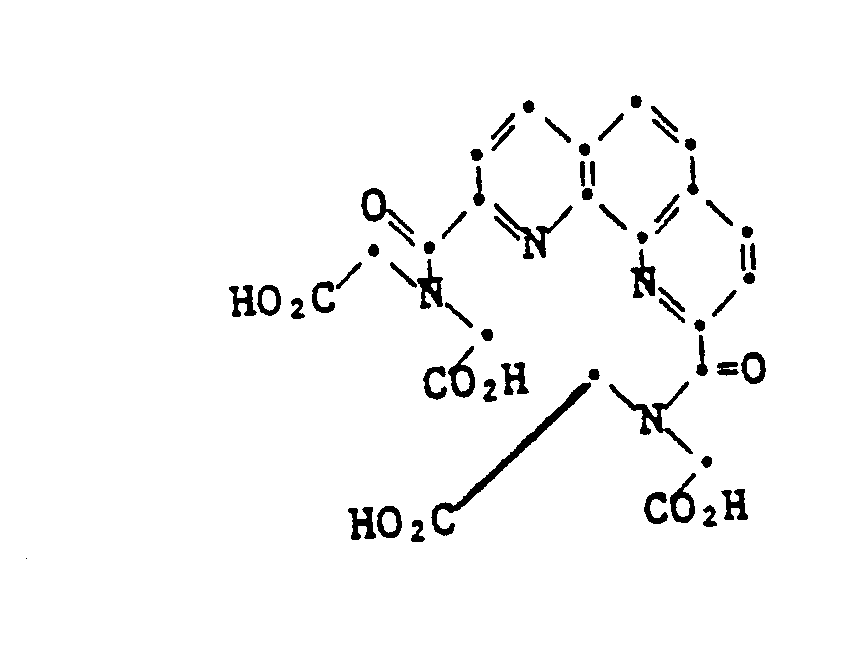
- DGEZNRSVGBDHLK-UHFFFAOYSA-N [1,10]phenanthroline Chemical compound C1=CN=C2C3=NC=CC=C3C=CC2=C1 DGEZNRSVGBDHLK-UHFFFAOYSA-N 0.000 description 1
- 238000010521 absorption reaction Methods 0.000 description 1
- 239000008351 acetate buffer Substances 0.000 description 1
- YDPHAWREMXVRAC-UHFFFAOYSA-N acetic acid;2-aminoacetic acid Chemical compound CC([O-])=O.[NH3+]CC(O)=O YDPHAWREMXVRAC-UHFFFAOYSA-N 0.000 description 1
- ZUQAPLKKNAQJAU-UHFFFAOYSA-N acetylenediol Chemical group OC#CO ZUQAPLKKNAQJAU-UHFFFAOYSA-N 0.000 description 1
- 150000007513 acids Chemical class 0.000 description 1
- 125000003172 aldehyde group Chemical group 0.000 description 1
- 229910052783 alkali metal Inorganic materials 0.000 description 1
- 229910001413 alkali metal ion Chemical group 0.000 description 1
- 150000001340 alkali metals Chemical class 0.000 description 1
- 125000003368 amide group Chemical group 0.000 description 1
- 150000001412 amines Chemical class 0.000 description 1
- PYKYMHQGRFAEBM-UHFFFAOYSA-N anthraquinone Natural products CCC(=O)c1c(O)c2C(=O)C3C(C=CC=C3O)C(=O)c2cc1CC(=O)OC PYKYMHQGRFAEBM-UHFFFAOYSA-N 0.000 description 1
- 150000004056 anthraquinones Chemical class 0.000 description 1
- 229910052786 argon Inorganic materials 0.000 description 1
- QVGXLLKOCUKJST-UHFFFAOYSA-N atomic oxygen Chemical compound [O] QVGXLLKOCUKJST-UHFFFAOYSA-N 0.000 description 1
- 125000002648 azanetriyl group Chemical group *N(*)* 0.000 description 1
- WURBFLDFSFBTLW-UHFFFAOYSA-N benzil Chemical compound C=1C=CC=CC=1C(=O)C(=O)C1=CC=CC=C1 WURBFLDFSFBTLW-UHFFFAOYSA-N 0.000 description 1
- 235000019400 benzoyl peroxide Nutrition 0.000 description 1
- YOUGRGFIHBUKRS-UHFFFAOYSA-N benzyl(trimethyl)azanium Chemical compound C[N+](C)(C)CC1=CC=CC=C1 YOUGRGFIHBUKRS-UHFFFAOYSA-N 0.000 description 1
- 210000004369 blood Anatomy 0.000 description 1
- 239000008280 blood Substances 0.000 description 1
- KGBXLFKZBHKPEV-UHFFFAOYSA-N boric acid Chemical compound OB(O)O KGBXLFKZBHKPEV-UHFFFAOYSA-N 0.000 description 1
- GDTBXPJZTBHREO-UHFFFAOYSA-N bromine Substances BrBr GDTBXPJZTBHREO-UHFFFAOYSA-N 0.000 description 1
- 229910052794 bromium Inorganic materials 0.000 description 1
- 125000005997 bromomethyl group Chemical group 0.000 description 1
- 239000007853 buffer solution Substances 0.000 description 1
- 229910052792 caesium Inorganic materials 0.000 description 1
- TVFDJXOCXUVLDH-UHFFFAOYSA-N caesium atom Chemical compound [Cs] TVFDJXOCXUVLDH-UHFFFAOYSA-N 0.000 description 1
- 239000004202 carbamide Substances 0.000 description 1
- 235000013877 carbamide Nutrition 0.000 description 1
- 239000001768 carboxy methyl cellulose Substances 0.000 description 1
- 235000010948 carboxy methyl cellulose Nutrition 0.000 description 1
- 239000008112 carboxymethyl-cellulose Substances 0.000 description 1
- 238000010531 catalytic reduction reaction Methods 0.000 description 1
- 230000009920 chelation Effects 0.000 description 1
- 125000003636 chemical group Chemical group 0.000 description 1
- 239000007795 chemical reaction product Substances 0.000 description 1
- 150000003841 chloride salts Chemical class 0.000 description 1
- 239000000460 chlorine Substances 0.000 description 1
- 229910052801 chlorine Inorganic materials 0.000 description 1
- 230000009137 competitive binding Effects 0.000 description 1
- 230000000536 complexating effect Effects 0.000 description 1
- 229940125904 compound 1 Drugs 0.000 description 1
- 229940125782 compound 2 Drugs 0.000 description 1
- 229940126214 compound 3 Drugs 0.000 description 1
- 238000003271 compound fluorescence assay Methods 0.000 description 1
- 230000021615 conjugation Effects 0.000 description 1
- 125000000332 coumarinyl group Chemical group O1C(=O)C(=CC2=CC=CC=C12)* 0.000 description 1
- 239000013078 crystal Substances 0.000 description 1
- 125000002704 decyl group Chemical group [H]C([H])([H])C([H])([H])C([H])([H])C([H])([H])C([H])([H])C([H])([H])C([H])([H])C([H])([H])C([H])([H])C([H])([H])* 0.000 description 1
- 150000004985 diamines Chemical class 0.000 description 1
- 125000004989 dicarbonyl group Chemical group 0.000 description 1
- 230000003467 diminishing effect Effects 0.000 description 1
- 238000006073 displacement reaction Methods 0.000 description 1
- 229940079593 drug Drugs 0.000 description 1
- 239000003814 drug Substances 0.000 description 1
- 238000000295 emission spectrum Methods 0.000 description 1
- 239000000839 emulsion Substances 0.000 description 1
- LJDNMOCAQVXVKY-UHFFFAOYSA-N ethyl 2-[(2-ethoxy-2-oxoethyl)amino]acetate Chemical compound CCOC(=O)CNCC(=O)OCC LJDNMOCAQVXVKY-UHFFFAOYSA-N 0.000 description 1
- FQFBKXYAUOCFKI-UHFFFAOYSA-N ethyl 2-[[3-[[bis(2-ethoxy-2-oxoethyl)amino]methyl]-5-formyl-2,4-dihydroxyphenyl]methyl-(2-ethoxy-2-oxoethyl)amino]acetate Chemical compound CCOC(=O)CN(CC(=O)OCC)CC1=CC(C=O)=C(O)C(CN(CC(=O)OCC)CC(=O)OCC)=C1O FQFBKXYAUOCFKI-UHFFFAOYSA-N 0.000 description 1
- NGRXSVFCLHVGKU-UHFFFAOYSA-N ethyl 3-(4-nitrophenyl)-3-oxopropanoate Chemical compound CCOC(=O)CC(=O)C1=CC=C([N+]([O-])=O)C=C1 NGRXSVFCLHVGKU-UHFFFAOYSA-N 0.000 description 1
- QKLCQKPAECHXCQ-UHFFFAOYSA-N ethyl phenylglyoxylate Chemical compound CCOC(=O)C(=O)C1=CC=CC=C1 QKLCQKPAECHXCQ-UHFFFAOYSA-N 0.000 description 1
- 238000011156 evaluation Methods 0.000 description 1
- 238000000695 excitation spectrum Methods 0.000 description 1
- 239000000284 extract Substances 0.000 description 1
- 229930003944 flavone Natural products 0.000 description 1
- 150000002212 flavone derivatives Chemical class 0.000 description 1
- 235000011949 flavones Nutrition 0.000 description 1
- GVEPBJHOBDJJJI-UHFFFAOYSA-N fluoranthrene Natural products C1=CC(C2=CC=CC=C22)=C3C2=CC=CC3=C1 GVEPBJHOBDJJJI-UHFFFAOYSA-N 0.000 description 1
- YLQWCDOCJODRMT-UHFFFAOYSA-N fluoren-9-one Chemical compound C1=CC=C2C(=O)C3=CC=CC=C3C2=C1 YLQWCDOCJODRMT-UHFFFAOYSA-N 0.000 description 1
- RMBPEFMHABBEKP-UHFFFAOYSA-N fluorene Chemical compound C1=CC=C2C3=C[CH]C=CC3=CC2=C1 RMBPEFMHABBEKP-UHFFFAOYSA-N 0.000 description 1
- 238000001506 fluorescence spectroscopy Methods 0.000 description 1
- 238000001215 fluorescent labelling Methods 0.000 description 1
- 125000002485 formyl group Chemical group [H]C(*)=O 0.000 description 1
- 239000000499 gel Substances 0.000 description 1
- 239000011521 glass Substances 0.000 description 1
- 125000003187 heptyl group Chemical group [H]C([*])([H])C([H])([H])C([H])([H])C([H])([H])C([H])([H])C([H])([H])C([H])([H])[H] 0.000 description 1
- 125000004051 hexyl group Chemical group [H]C([H])([H])C([H])([H])C([H])([H])C([H])([H])C([H])([H])C([H])([H])* 0.000 description 1
- 239000008214 highly purified water Substances 0.000 description 1
- ZMZDMBWJUHKJPS-UHFFFAOYSA-N hydrogen thiocyanate Natural products SC#N ZMZDMBWJUHKJPS-UHFFFAOYSA-N 0.000 description 1
- 230000003301 hydrolyzing effect Effects 0.000 description 1
- 210000000987 immune system Anatomy 0.000 description 1
- 239000003999 initiator Substances 0.000 description 1
- 239000002198 insoluble material Substances 0.000 description 1
- 150000002500 ions Chemical class 0.000 description 1
- 229940035429 isobutyl alcohol Drugs 0.000 description 1
- 239000012948 isocyanate Substances 0.000 description 1
- 150000002513 isocyanates Chemical class 0.000 description 1
- 150000002576 ketones Chemical class 0.000 description 1
- 125000005647 linker group Chemical group 0.000 description 1
- 229910052744 lithium Inorganic materials 0.000 description 1
- 150000002739 metals Chemical class 0.000 description 1
- 125000000956 methoxy group Chemical group [H]C([H])([H])O* 0.000 description 1
- UZKWTJUDCOPSNM-UHFFFAOYSA-N methoxybenzene Substances CCCCOC=C UZKWTJUDCOPSNM-UHFFFAOYSA-N 0.000 description 1
- MLBBKTFJGPTWFM-ZOWNYOTGSA-N methyl (2s)-2-amino-3-[4-(4-hydroxy-3,5-diiodophenoxy)-3,5-diiodophenyl]propanoate;hydrochloride Chemical compound Cl.IC1=CC(C[C@H](N)C(=O)OC)=CC(I)=C1OC1=CC(I)=C(O)C(I)=C1 MLBBKTFJGPTWFM-ZOWNYOTGSA-N 0.000 description 1
- UTGGIQHJOAPIPD-UHFFFAOYSA-N methyl 3-carbonochloridoylbenzoate Chemical compound COC(=O)C1=CC=CC(C(Cl)=O)=C1 UTGGIQHJOAPIPD-UHFFFAOYSA-N 0.000 description 1
- 125000001570 methylene group Chemical group [H]C([H])([*:1])[*:2] 0.000 description 1
- 239000011325 microbead Substances 0.000 description 1
- 125000004108 n-butyl group Chemical group [H]C([H])([H])C([H])([H])C([H])([H])C([H])([H])* 0.000 description 1
- SJNXJRVDSTZUFB-UHFFFAOYSA-N naphthalen-2-yl(phenyl)methanone Chemical compound C=1C=C2C=CC=CC2=CC=1C(=O)C1=CC=CC=C1 SJNXJRVDSTZUFB-UHFFFAOYSA-N 0.000 description 1
- 125000001624 naphthyl group Chemical group 0.000 description 1
- 125000002560 nitrile group Chemical group 0.000 description 1
- 125000001400 nonyl group Chemical group [H]C([*])([H])C([H])([H])C([H])([H])C([H])([H])C([H])([H])C([H])([H])C([H])([H])C([H])([H])C([H])([H])[H] 0.000 description 1
- 238000000655 nuclear magnetic resonance spectrum Methods 0.000 description 1
- 230000000269 nucleophilic effect Effects 0.000 description 1
- NIHNNTQXNPWCJQ-UHFFFAOYSA-N o-biphenylenemethane Natural products C1=CC=C2CC3=CC=CC=C3C2=C1 NIHNNTQXNPWCJQ-UHFFFAOYSA-N 0.000 description 1
- 125000002347 octyl group Chemical group [H]C([*])([H])C([H])([H])C([H])([H])C([H])([H])C([H])([H])C([H])([H])C([H])([H])C([H])([H])[H] 0.000 description 1
- 239000010502 orange oil Substances 0.000 description 1
- 150000002894 organic compounds Chemical class 0.000 description 1
- 229940092253 ovalbumin Drugs 0.000 description 1
- 239000001301 oxygen Substances 0.000 description 1
- 229910052760 oxygen Inorganic materials 0.000 description 1
- 230000020477 pH reduction Effects 0.000 description 1
- QNGNSVIICDLXHT-UHFFFAOYSA-N para-ethylbenzaldehyde Natural products CCC1=CC=C(C=O)C=C1 QNGNSVIICDLXHT-UHFFFAOYSA-N 0.000 description 1
- 229920002866 paraformaldehyde Polymers 0.000 description 1
- 125000001147 pentyl group Chemical group C(CCCC)* 0.000 description 1
- 239000012466 permeate Substances 0.000 description 1
- 239000003208 petroleum Substances 0.000 description 1
- 239000002831 pharmacologic agent Substances 0.000 description 1
- NBIIXXVUZAFLBC-UHFFFAOYSA-K phosphate Chemical compound [O-]P([O-])([O-])=O NBIIXXVUZAFLBC-UHFFFAOYSA-K 0.000 description 1
- 239000010452 phosphate Substances 0.000 description 1
- 239000008363 phosphate buffer Substances 0.000 description 1
- 238000001782 photodegradation Methods 0.000 description 1
- 239000003726 plant lectin Substances 0.000 description 1
- 229920006289 polycarbonate film Polymers 0.000 description 1
- 229910052700 potassium Inorganic materials 0.000 description 1
- 239000011591 potassium Substances 0.000 description 1
- 239000002244 precipitate Substances 0.000 description 1
- 125000002924 primary amino group Chemical group [H]N([H])* 0.000 description 1
- KRIOVPPHQSLHCZ-UHFFFAOYSA-N propiophenone Chemical compound CCC(=O)C1=CC=CC=C1 KRIOVPPHQSLHCZ-UHFFFAOYSA-N 0.000 description 1
- 125000002572 propoxy group Chemical group [*]OC([H])([H])C(C([H])([H])[H])([H])[H] 0.000 description 1
- 238000000746 purification Methods 0.000 description 1
- 239000008213 purified water Substances 0.000 description 1
- 150000003254 radicals Chemical class 0.000 description 1
- 238000006722 reduction reaction Methods 0.000 description 1
- 238000010992 reflux Methods 0.000 description 1
- 229910052701 rubidium Inorganic materials 0.000 description 1
- IGLNJRXAVVLDKE-UHFFFAOYSA-N rubidium atom Chemical compound [Rb] IGLNJRXAVVLDKE-UHFFFAOYSA-N 0.000 description 1
- 238000007127 saponification reaction Methods 0.000 description 1
- 229910052706 scandium Inorganic materials 0.000 description 1
- SIXSYDAISGFNSX-UHFFFAOYSA-N scandium atom Chemical compound [Sc] SIXSYDAISGFNSX-UHFFFAOYSA-N 0.000 description 1
- 229910052711 selenium Inorganic materials 0.000 description 1
- 239000011669 selenium Substances 0.000 description 1
- 229910052708 sodium Inorganic materials 0.000 description 1
- 229910052938 sodium sulfate Inorganic materials 0.000 description 1
- AKHNMLFCWUSKQB-UHFFFAOYSA-L sodium thiosulfate Chemical compound [Na+].[Na+].[O-]S([O-])(=O)=S AKHNMLFCWUSKQB-UHFFFAOYSA-L 0.000 description 1
- 235000019345 sodium thiosulphate Nutrition 0.000 description 1
- 238000001179 sorption measurement Methods 0.000 description 1
- 230000003595 spectral effect Effects 0.000 description 1
- 239000007858 starting material Substances 0.000 description 1
- 238000001256 steam distillation Methods 0.000 description 1
- PJANXHGTPQOBST-UHFFFAOYSA-N stilbene Chemical compound C=1C=CC=CC=1C=CC1=CC=CC=C1 PJANXHGTPQOBST-UHFFFAOYSA-N 0.000 description 1
- 239000011550 stock solution Substances 0.000 description 1
- 125000000547 substituted alkyl group Chemical group 0.000 description 1
- 238000006467 substitution reaction Methods 0.000 description 1
- 239000011593 sulfur Substances 0.000 description 1
- 229910052717 sulfur Inorganic materials 0.000 description 1
- 150000003502 terbium compounds Chemical class 0.000 description 1
- LZPBKINTWROMEA-UHFFFAOYSA-N tetracene-5,12-dione Chemical compound C1=CC=C2C=C3C(=O)C4=CC=CC=C4C(=O)C3=CC2=C1 LZPBKINTWROMEA-UHFFFAOYSA-N 0.000 description 1
- CBXCPBUEXACCNR-UHFFFAOYSA-N tetraethylammonium Chemical compound CC[N+](CC)(CC)CC CBXCPBUEXACCNR-UHFFFAOYSA-N 0.000 description 1
- QEMXHQIAXOOASZ-UHFFFAOYSA-N tetramethylammonium Chemical compound C[N+](C)(C)C QEMXHQIAXOOASZ-UHFFFAOYSA-N 0.000 description 1
- CBDKQYKMCICBOF-UHFFFAOYSA-N thiazoline Chemical compound C1CN=CS1 CBDKQYKMCICBOF-UHFFFAOYSA-N 0.000 description 1
- 125000002813 thiocarbonyl group Chemical group *C(*)=S 0.000 description 1
- 125000003396 thiol group Chemical group [H]S* 0.000 description 1
- ZWZVWGITAAIFPS-UHFFFAOYSA-N thiophosgene Chemical compound ClC(Cl)=S ZWZVWGITAAIFPS-UHFFFAOYSA-N 0.000 description 1
- YRHRIQCWCFGUEQ-UHFFFAOYSA-N thioxanthen-9-one Chemical compound C1=CC=C2C(=O)C3=CC=CC=C3SC2=C1 YRHRIQCWCFGUEQ-UHFFFAOYSA-N 0.000 description 1
- NRTLTGGGUQIRRT-UHFFFAOYSA-N triethylazanium;bromide Chemical compound [Br-].CC[NH+](CC)CC NRTLTGGGUQIRRT-UHFFFAOYSA-N 0.000 description 1
- ODHXBMXNKOYIBV-UHFFFAOYSA-N triphenylamine Chemical compound C1=CC=CC=C1N(C=1C=CC=CC=1)C1=CC=CC=C1 ODHXBMXNKOYIBV-UHFFFAOYSA-N 0.000 description 1
- 125000005580 triphenylene group Chemical group 0.000 description 1
- 238000001665 trituration Methods 0.000 description 1
- VHBFFQKBGNRLFZ-UHFFFAOYSA-N vitamin p Natural products O1C2=CC=CC=C2C(=O)C=C1C1=CC=CC=C1 VHBFFQKBGNRLFZ-UHFFFAOYSA-N 0.000 description 1
Classifications
-
- C—CHEMISTRY; METALLURGY
- C07—ORGANIC CHEMISTRY
- C07D—HETEROCYCLIC COMPOUNDS
- C07D295/00—Heterocyclic compounds containing polymethylene-imine rings with at least five ring members, 3-azabicyclo [3.2.2] nonane, piperazine, morpholine or thiomorpholine rings, having only hydrogen atoms directly attached to the ring carbon atoms
- C07D295/04—Heterocyclic compounds containing polymethylene-imine rings with at least five ring members, 3-azabicyclo [3.2.2] nonane, piperazine, morpholine or thiomorpholine rings, having only hydrogen atoms directly attached to the ring carbon atoms with substituted hydrocarbon radicals attached to ring nitrogen atoms
- C07D295/14—Heterocyclic compounds containing polymethylene-imine rings with at least five ring members, 3-azabicyclo [3.2.2] nonane, piperazine, morpholine or thiomorpholine rings, having only hydrogen atoms directly attached to the ring carbon atoms with substituted hydrocarbon radicals attached to ring nitrogen atoms substituted by carbon atoms having three bonds to hetero atoms with at the most one bond to halogen, e.g. ester or nitrile radicals
- C07D295/155—Heterocyclic compounds containing polymethylene-imine rings with at least five ring members, 3-azabicyclo [3.2.2] nonane, piperazine, morpholine or thiomorpholine rings, having only hydrogen atoms directly attached to the ring carbon atoms with substituted hydrocarbon radicals attached to ring nitrogen atoms substituted by carbon atoms having three bonds to hetero atoms with at the most one bond to halogen, e.g. ester or nitrile radicals with the ring nitrogen atoms and the carbon atoms with three bonds to hetero atoms separated by carbocyclic rings or by carbon chains interrupted by carbocyclic rings
-
- C—CHEMISTRY; METALLURGY
- C07—ORGANIC CHEMISTRY
- C07C—ACYCLIC OR CARBOCYCLIC COMPOUNDS
- C07C205/00—Compounds containing nitro groups bound to a carbon skeleton
- C07C205/45—Compounds containing nitro groups bound to a carbon skeleton the carbon skeleton being further substituted by at least one doubly—bound oxygen atom, not being part of a —CHO group
-
- C—CHEMISTRY; METALLURGY
- C07—ORGANIC CHEMISTRY
- C07C—ACYCLIC OR CARBOCYCLIC COMPOUNDS
- C07C335/00—Thioureas, i.e. compounds containing any of the groups, the nitrogen atoms not being part of nitro or nitroso groups
- C07C335/04—Derivatives of thiourea
- C07C335/16—Derivatives of thiourea having nitrogen atoms of thiourea groups bound to carbon atoms of six-membered aromatic rings of a carbon skeleton
- C07C335/20—Derivatives of thiourea having nitrogen atoms of thiourea groups bound to carbon atoms of six-membered aromatic rings of a carbon skeleton being further substituted by nitrogen atoms, not being part of nitro or nitroso groups
-
- C—CHEMISTRY; METALLURGY
- C07—ORGANIC CHEMISTRY
- C07C—ACYCLIC OR CARBOCYCLIC COMPOUNDS
- C07C51/00—Preparation of carboxylic acids or their salts, halides or anhydrides
- C07C51/347—Preparation of carboxylic acids or their salts, halides or anhydrides by reactions not involving formation of carboxyl groups
- C07C51/353—Preparation of carboxylic acids or their salts, halides or anhydrides by reactions not involving formation of carboxyl groups by isomerisation; by change of size of the carbon skeleton
-
- C—CHEMISTRY; METALLURGY
- C07—ORGANIC CHEMISTRY
- C07C—ACYCLIC OR CARBOCYCLIC COMPOUNDS
- C07C65/00—Compounds having carboxyl groups bound to carbon atoms of six—membered aromatic rings and containing any of the groups OH, O—metal, —CHO, keto, ether, groups, groups, or groups
- C07C65/32—Compounds having carboxyl groups bound to carbon atoms of six—membered aromatic rings and containing any of the groups OH, O—metal, —CHO, keto, ether, groups, groups, or groups containing keto groups
- C07C65/40—Compounds having carboxyl groups bound to carbon atoms of six—membered aromatic rings and containing any of the groups OH, O—metal, —CHO, keto, ether, groups, groups, or groups containing keto groups containing singly bound oxygen-containing groups
-
- C—CHEMISTRY; METALLURGY
- C07—ORGANIC CHEMISTRY
- C07D—HETEROCYCLIC COMPOUNDS
- C07D311/00—Heterocyclic compounds containing six-membered rings having one oxygen atom as the only hetero atom, condensed with other rings
- C07D311/02—Heterocyclic compounds containing six-membered rings having one oxygen atom as the only hetero atom, condensed with other rings ortho- or peri-condensed with carbocyclic rings or ring systems
- C07D311/04—Benzo[b]pyrans, not hydrogenated in the carbocyclic ring
- C07D311/06—Benzo[b]pyrans, not hydrogenated in the carbocyclic ring with oxygen or sulfur atoms directly attached in position 2
- C07D311/08—Benzo[b]pyrans, not hydrogenated in the carbocyclic ring with oxygen or sulfur atoms directly attached in position 2 not hydrogenated in the hetero ring
- C07D311/16—Benzo[b]pyrans, not hydrogenated in the carbocyclic ring with oxygen or sulfur atoms directly attached in position 2 not hydrogenated in the hetero ring substituted in position 7
-
- C—CHEMISTRY; METALLURGY
- C07—ORGANIC CHEMISTRY
- C07D—HETEROCYCLIC COMPOUNDS
- C07D471/00—Heterocyclic compounds containing nitrogen atoms as the only ring hetero atoms in the condensed system, at least one ring being a six-membered ring with one nitrogen atom, not provided for by groups C07D451/00 - C07D463/00
- C07D471/02—Heterocyclic compounds containing nitrogen atoms as the only ring hetero atoms in the condensed system, at least one ring being a six-membered ring with one nitrogen atom, not provided for by groups C07D451/00 - C07D463/00 in which the condensed system contains two hetero rings
- C07D471/04—Ortho-condensed systems
-
- G—PHYSICS
- G01—MEASURING; TESTING
- G01N—INVESTIGATING OR ANALYSING MATERIALS BY DETERMINING THEIR CHEMICAL OR PHYSICAL PROPERTIES
- G01N33/00—Investigating or analysing materials by specific methods not covered by groups G01N1/00 - G01N31/00
- G01N33/48—Biological material, e.g. blood, urine; Haemocytometers
- G01N33/50—Chemical analysis of biological material, e.g. blood, urine; Testing involving biospecific ligand binding methods; Immunological testing
- G01N33/53—Immunoassay; Biospecific binding assay; Materials therefor
- G01N33/531—Production of immunochemical test materials
- G01N33/532—Production of labelled immunochemicals
- G01N33/533—Production of labelled immunochemicals with fluorescent label
Definitions
- the present invention relates to fluorescent chelates and, more particularly, to fluorescent chelates useful for the preparation of specific binding reagents including fluorescent labeled physiologically active materials.
- sensitivity is of prime importance owing to the generally low analyte levels that are measured.
- a sample containing a fluorescent species to be analyzed is irradiated with light of known spectral distribution within the excitation spectrum of the target fluorescent species.
- the intensity of the resulting characteristic emission spectrum of the fluorescent target molecules is determined and is related to the number of target molecules.
- Time resolution offers an independent means of isolating the specific fluorescent signal of interest from nonspecific background fluorescence. Time resolution is possible if the label has much longer-lived fluorescence than the background, and if the system is illuminated by an intermittent light source such that the long-lived label is measureable during the dark period subsequent to the decay of the short-lived background. Such techniques are described in greater detail in German Offenlegungsschrift 2,628,158.
- the fluorescent immunoreagents described in German OLS 2,628,158 comprise at least one member of the immune system, i.e., an antibody or an antigen, "conjugated" with a rare-earth chelate. Such “conjugation” can be achieved in one of two ways:
- the problem with immunoreagents of the type described in German OLS 2,628,158 is that the fluorescent labeling species, namely, the rare-earth chelates, are quenched, i.e., their fluorescence is extinguished, when contacted with water.
- This problem hereinafter referred to as an "aqueous stability" problem, is particularly serious because a principal use for fluorescent labeled immunoreagents is in the assay of aqueous biological liquids, such as blood and serum. If aqueous stability could be conferred on these materials, they would be useful as fluorescent labels for these biological liquids, thus allowing increased fluorescence immunoassay sensitivity by the use of time resolution of signal from background.
- GB-A-2,060,623 describes species-linked diamine triacetic acids which are effective chelating ligands capable of forming metal ion complexes with a variety of metals e.g. lanthanide metals. When used in fluoroassay techniques, the complexes are used in combination with a large excess of a flooder in order to produce the desired fluorescence.
- Rare-earth chelates previously used for fluorometric measurements have had undesirable properties, such as a low quantum yield for emission, undesirable sensitizer extinction coefficients which result in insufficient fluorescence using small quantities of detectable species, low ⁇ max which renders the determination subject to interference from other components in the sample that are usually in the low Amax range, poor water solubility (most biological fluids are aqueus), and poor stability of the chelate at low concentrations.
- the present invention is directed to fluorescent chelates of a lanthanide metal and a chelating agent, the chelating agent including a moiety that is a triplet sensitizer having a triplet energy greater than that of the lanthanide metal and at least two heteroatom-containing groups and a third heteroatom-containing group or heteroatom that is in or appended to said moiety, each of said heteroatom-containing groups appended to different carbon atoms of the triplet sensitizer moiety, the heteroatom-containing groups being located in the chelating agent such that they and said third heteroatom or heteroatom-containing group form a chelate structure with the lanthanide metal.
- the chelates are water-soluble, stable at low concentrations at a pH in the range of 8 to 10, highly sensitive, and have favorable molar extinction coefficients (10,000-40,000), and favorable ⁇ max e.g., greater than 300 nm and, preferably, greater than 330 nm, which permits use of a white light source. These chelates have binding constants greater than 10 10 M -1. Accordingly, the present invention provides a class of highly efficient, aqueous-stabilized fluorescent chelates for labeling physiologically active materials, such as antigens and hormones. The present invention also provides a new class of specific binding reagents, such as antigens, enzymes, and hormones, bearing these highly useful fluorescent labels.
- the fluorescent chelates of the present invention exhibit satisfactory aqueous stability, that is, they exhibit a binding constant greater than 10" M -1 (i.e. the log 10 of the binding constant is greater than 10).
- This binding constant refers to the binding of the chelating agent to the lanthanide metal.
- the reagents are formed by adsorbing or covalently binding the fluorescent labeled antigens, haptens, antibodies, plant lectins, carbohydrates, hormones, enzymes and other such species-specific materials.
- any lanthanide metal is useful in the chelates described herein.
- Examples of lanthanide metals useful herein are europium and terbium and are described by Sinha, S. P., Complexes of Rare Earths, Pergamon Press, 1966.
- the sensitizer moiety of the chelating agent is any triplet sensitizer having the requisite triplet energy.
- triplet sensitizers useful herein include ketones, such as benzophenone, propiophenone, Michler's ketone, acetophenone, 1,3,5-triacetylbenzene, isobutyrophenone, 1,3-diphenyl-2-propanone, triphenylmethyl phenyl ketone, 1,2-dibenzoylbenzene, 4,4'-dichlorobenzophenone, 1,4-diacetylbenzene, 9-benzoylfluorene, p-cyanobenzophenone, ⁇ -naphthyl phenyl ketone, 2-acetonaphthone, a-naphthyl phenyl ketone and 1-acetonaphthone, including ⁇ , ⁇ -diketones such as biacetyl, benzil and 2,
- the triplet energy When the lanthanide metal is europium, the triplet energy must be at least 47 Kcal, and if the lanthanide metal is terbium, the triplet energy of the nucleus must be at least 53 Kcal.
- the chelating agent also has at least two heteroatom-containing groups that are located on the chelating agent such that they are capable of forming coordinate bonds with lanthanide metals.
- Groups capable of forming coordinate bonds with lanthanide metals include nitrilodiacetate, carboxy, hydroxy, alkoxy, amino, amido, carbonyl, and mercapto groups. These groups are appended to the nucleus so as to allow chelation of the groups with the lanthanide metal.
- Preferred chelating agents have the structure: wherein:
- R 3 and R 4 be either individually adjacent to R 2 , or three or less atoms removed from R 2 .
- the lanthanide metal is chelated with a phenol having iminodiacetate groups substituted in each position ortho to the phenolic hydroxy group.
- the phenol is unsubstituted or substituted with a variety of groups, such as alkoxy, alkyl, halogen, or carbonyl, and is optionally fused to another aromatic group or to an alicyclic or heterocyclic group.
- groups such as alkoxy, alkyl, halogen, or carbonyl, and is optionally fused to another aromatic group or to an alicyclic or heterocyclic group.
- a preferred embodiment of the invention involves the formation of a chelate of a lanthanide metal with a salt or acid having the following structure: wherein:
- the organic compound that complexes with the lanthanide metal has the following structure: wherein:
- the preferred aroyl R 5 substituent is optionally further substituted with aryl or alkyl groups, or with ester, amide, carbamide, thiocarbamide, isocyanate, thiocyanate, halogen, or nitrile groups.
- Certain other coumarin compounds in which R 5 is appended to the coumarin ring by other than an electronegative (i.e., an electron-withdrawing) group are known to fluoresce intensely but are not as useful in the practice of this invention, as this fluorescence prevents the transfer of energy of excitation to the europium or terbium complex with subsequent fluorescence in the visible portion of the spectrum.
- the organic salt or acid used to form the rare-earth chelate must absorb in the region of 300-500 nm and must then transfer its excitation energy to the lanthanide metal, which then fluoresces in the visible portion of the spectrum.
- Other examples of useful complexing compounds include: and
- the complex contains any ratio of lanthanide metal to chelating agent.
- the mole ratio of lanthanide metal to chelating agent is from 1:1 to 2:1, most preferably, 1:1.
- the chelating agents are prepared by performing a Mannich reaction between known compounds of the structure and iminodiacetic acid or esters thereof, and formaldehyde; or by a nucleophilic displacement reaction between compounds of the structure that have active methylene groups, such as bromomethyl or methylenetosylate groups, and iminodiacetic esters, and in a subsequent step, hydrolyzing the esters.
- Useful complexes include and
- the lanthanide metal and the chelating agent are easily complexed by merely mixing an aqueous solution of the chelating agent with a lanthanide metal salt in an aqueous solution of pH 7.5-10.
- the lanthanide metal salt is any water-soluble salt of the metal, such as chloride salts, such as TbCl 3 ⁇ 6H 2 O or EuCl 3 ⁇ 6H 2 O.
- the present complexes maintain electrical neutrality by virtue of the presence of another cation in the buffer solution.
- the chelate is generally prepared in aqueous solution at a pH of from 8 to 11, preferably, 8 to 9.
- the chelate optionally is mixed with buffers such as phosphate and borate, to produce the optimum pH.
- the chelate is useful to label a variety of physiologically active materials by binding them to the complex by adsorption or by covalent bonding.
- physiologically active materials that are labeled in this fashion are enzymes and their substrates, antigens, i.e., any substance that is capable, under appropriate conditions, of reacting specifically in some detectable manner with an antibody, carbohydrate, metabolites, drugs, other pharmacological agents and their receptors and other binding substances.
- Specific binding assay reagents are described in U.S. Patents 3,557,555,3,853,987,4,108,972 and 4,205,058.
- a compound having structural similarity to the analyte being determined is bonded to a detectable label.
- the analyte being determined is herein referred to as the ligand and the labeled compound as the ligand analog.
- Compounds that specifically recognize the ligands and ligand analogs and bind to them are referred to as receptors.
- the ligand is placed in competition with the ligand analog for binding to the receptor. Unknown concentrations of the ligand are inferred from the measured signal of the labeled, ligand analog. The reaction proceeds as follows:
- This system consists of antigen labeled with a fluorescent label, unlabeled native antigen (in test sample) and specific antibody whereby there is competition between the unlabeled antigen and the labeled antigen for binding to the antibody.
- a preferred fluorescently labeled specific binding reagent comprises a complex of a lanthanide metal and a chelating agent having the structure: wherein:
- the fluorescent-labeled, physiologically active species is useful in fluorescent specific binding assays, particularly those that utilize temporal resolution of the specific detecting signal to distinguish from background as described in German OLS 2,628,158.
- this time-resolved mode i.e., temporal resolution
- the sample is excited in an intermittent fashion and information is accepted only during the dark cycle when the long-lived fluorescent label is still emitting strongly, but when other sources of fluorescence have decayed.
- Discontinuous excitation is achieved in a variety of ways, including pulsed laser, mechanical chopping of a continuous excitation beam, and moving the sample in and out of the excitation beam.
- discontinuous excitation has the advantage of allowing the use of high radiant power without the absorption of a large amount of energy by the sample, thus diminishing the probability of sample photodegradation.
- Especially preferred fluorescently labeled specific binding reagents include those of the following structures: and
- the specific binding assay is carried out in a dry analytical element, such as is described in U.S. Patent 4,258,001.
- the element contains a support and a spreadingl reagent layer comprised of polymeric beads, and, optionally, a registration layer.
- the spreading layer is separate from the reagent layer.
- the spreading, reagent, and registration layers optionally comprise the polymeric bead structure.
- the polymeric beads of the reagent layer have receptors such as antibodies adsorbed to their surfaces.
- the chelate label is placed above, below, or in the reagent layer in a manner that prevents the specific reaction from occurring prior to sample wetting, or it is spotted onto the element concurrently with or subsequent to the sample. It is only necessary that the labeled ligand analog permeate the element upon wetting subsequently to compete with the unknown amount of ligand in the sample in the formation of the ligand-receptor complex.
- the assay is performed by fluorimetrically determining the amount of free labeled ligand analog present or the amount of bound labeled ligand analog-receptor complex.
- a complex was formed by mixing equimolar amounts of TbCl 3 ⁇ 6H 2 O in an aqueous solution containing a borate buffer, which results in a pH of 9, with a compound having the structure: which was prepared by the method described by G. Schwarzenbach et al, Helv. Chim. Acta, 35,1785 (1952).
- a 37% aqueous formaldehyde solution (35.6 g, 0.44 mol) was added dropwise to a solution of p-cresol (21.6 g, 0.20 mol) and imino-diacetic acid (56.0 g, 0.42 mol) in 90 ml of H 2 0 and 88 ml of concentrated aqueous NaOH at 10-20°C.
- the log 10 values of the binding constants of this ligand toward Eu +3 and Tb +3 in water were 16.70 ⁇ 0.12 M- 1 and 16.78 ⁇ .11 M- 1 , respectively.
- the resulting thick oil was dissolved in a minimum of CH 2 CI 2 and applied to a dry column of silica gel.
- the column was eluted with 1:4 ethyl acetate:CH 2 CI 2 .
- the first yellow band of monoadduct was discarded.
- the second yellow band was collected. Removal of the solvent under reduced pressure gave 1.6 g of the desired product as a yellow oil that could not be induced to crystallize.
- the emission intensity from the above europium chelate solution was examined as a function of concentration on a Farrand Spectrofluorimeter.
- the data displayed a decrease in emission as a function of concentration from 10 -5 to 10 -10 M in europium chelate.
- Example 4 To the above Example 4 crude aldehyde (.05 mole) was added 11.85 g (.05 mole) of ethyl 4-nitro- benzoylacetate, followed by 100 ml of ethanol. A solution of 30 mg of acetic acid and 42 mg of piperidine in 1 ml of ethanol was added, and the mixture was stirred and refluxed for 16 hours. After this time, the reaction product was concentrated on a rotary evaporator. The resulting oil was dissolved in a minimum of CH 2 CI 2 and applied to a silica gel dry column. The column was eluted with 150:850 ethyl acetate:CH 2 CI 2 .
- the first running colorless impurity and a second running dark-yellow impurity were discarded.
- the slower-moving light-yellow product band was collected and the solvent was removed under reduced pressure.
- the resulting oil was analyzed by NMR and mass spectroscopy and used directly. Yield, 14.3 g.
- a stock solution containing a 10- 4 M concentration of a europium chelate described in Example 3 above was diluted with borate buffer (pH 8.5) to concentrations shown in Table I. Ten-microliter aliquots of each concentration were spotted onto analytical elements prepared in the following manner:
- the elements were then evaluated, using a fluorimeter having a Wrattan 18A filter, at Excitation aoo-400 nm and Emmission 620 nm, at a pH of 8 and a pH of 9.18.
- Example 6 A terbium compound prepared as described in Example 3 was tested in the manner of Example 6. The results are shown in Table II with the fluorescence measured at 550 nm and given in microamperes (pA).
- Nitrotetraester 4 (3.0 g, 3.9 mmol) was reduced in 50 ml CH 3 OH with 100 mg 10% Pd/C in a Parr shaker with an initial hydrogen pressure of 50 psi for 2.5 hours. TLC indicated quantitative reduction. The mixture was filtered through diatomaceous earth and evaporated to leave a yellow oil that was purified by gel permeation chromatography by the method used for compound 4. The yellow glass thus obtained had the correct NMR, IR, and field desorption mass spectroscopic behavior.
- Tetraester amine 5 (1.7 g, 2.3 mmol) together with triethylamine (1.28 ml, 9.2 mmol) was dissolved in 40 ml of dry tetrahydrofuran (THF), followed by the dropwise addition of thiophosgene (0.175 ml, 2.3 mmol) in 10 ml of dry THF. The reaction was allowed to proceed for 2 hours, after which the solvent was removed to yield a yellow-orange oil.
- THF dry tetrahydrofuran
- Tetraester 6 (0.5 g, 0.3 mmol) was dissolved in 15 ml CF 3 CO 3 H and stirred for 16 hours at room temperature with a drying tube attached to the reaction flask. The solvent was removed in vacuo to leave an orange foam. Trituration of the foam with CH 2 CI 2 produced a yellow-orange powder in quantitative yield.
- the field desorption mass spectrum shows a parent ion at m/e (mass/charge ratio) 1350 and the IR is consistent with the product.
- Cross reactivity is a reflection of how well an antibody recognizes the labeled antigen as compared with unlabeled antigen.
- the cross reactivity of the europium chelate of the antigen as determined by known techniques was 75% vs. radiolabeled thyroxine and thyroxine antibody.
- This compound was prepared by the method described in U.S. Patent 3,531,435 (Chem. Abstracts 74, 4283V (1971)).
- a solution containing 26.3 g of anisole (0.24 mole) and 46 g of 3-carbomethoxybenzoyl chloride (0.23 mole) in 10 ml of tetrachloroethane was added dropwise over 1 hour to a stirred solution of 65 g AICI 3 (0.49 mole) in 100 ml tetrachloroethane at 0°C.
- the mixture was allowed to come to room temperature and was stirred for 14 hours.
- the europium chelate of 22 had a cross reactivity of 80% vs. radiolabeled thyroxine and thyroxine antibody.
- the complexes of Examples 10-16 were fluorescent and those of Controls A, B and C were not fluorescent. Complexes of Controls A, B and C were further tested in glycine acetate buffer, phosphate buffer and sodium bicarbonate buffer and were not fluorescent with either EuCl 3 .6H 2 0 or TbCl 3 ⁇ 6H 2 O.
Landscapes
- Chemical & Material Sciences (AREA)
- Organic Chemistry (AREA)
- Health & Medical Sciences (AREA)
- Immunology (AREA)
- Engineering & Computer Science (AREA)
- Life Sciences & Earth Sciences (AREA)
- Hematology (AREA)
- Urology & Nephrology (AREA)
- Molecular Biology (AREA)
- Biomedical Technology (AREA)
- Microbiology (AREA)
- Physics & Mathematics (AREA)
- Biotechnology (AREA)
- Oil, Petroleum & Natural Gas (AREA)
- Chemical Kinetics & Catalysis (AREA)
- Food Science & Technology (AREA)
- Medicinal Chemistry (AREA)
- Cell Biology (AREA)
- Analytical Chemistry (AREA)
- Biochemistry (AREA)
- General Health & Medical Sciences (AREA)
- General Physics & Mathematics (AREA)
- Pathology (AREA)
- Investigating Or Analysing Materials By The Use Of Chemical Reactions (AREA)
- Luminescent Compositions (AREA)
Claims (14)




Applications Claiming Priority (2)
| Application Number | Priority Date | Filing Date | Title |
|---|---|---|---|
| US27939881A | 1981-07-01 | 1981-07-01 | |
| US279398 | 1981-07-01 |
Publications (3)
| Publication Number | Publication Date |
|---|---|
| EP0068875A2 EP0068875A2 (de) | 1983-01-05 |
| EP0068875A3 EP0068875A3 (en) | 1983-05-04 |
| EP0068875B1 true EP0068875B1 (de) | 1987-12-23 |
Family
ID=23068781
Family Applications (1)
| Application Number | Title | Priority Date | Filing Date |
|---|---|---|---|
| EP82303380A Expired EP0068875B1 (de) | 1981-07-01 | 1982-06-28 | Fluoreszierende Chelate und daraus hergestellte spezifisch bindende markierte Reagenzien |
Country Status (4)
| Country | Link |
|---|---|
| EP (1) | EP0068875B1 (de) |
| JP (1) | JPH0614042B2 (de) |
| CA (1) | CA1205028A (de) |
| DE (1) | DE3277869D1 (de) |
Families Citing this family (38)
| Publication number | Priority date | Publication date | Assignee | Title |
|---|---|---|---|---|
| US4837169A (en) * | 1981-07-01 | 1989-06-06 | Eastman Kodak Company | Polypyridine Fluorescent labels for immunoassay |
| CA1223831A (en) | 1982-06-23 | 1987-07-07 | Dean Engelhardt | Modified nucleotides, methods of preparing and utilizing and compositions containing the same |
| IT1212882B (it) * | 1983-07-29 | 1989-11-30 | Della Valle Francesco | Derivati basici della cumarina |
| USRE43096E1 (en) | 1984-01-16 | 2012-01-10 | California Institute Of Technology | Tagged extendable primers and extension products |
| CA1258611A (en) * | 1984-01-16 | 1989-08-22 | Lloyd M. Smith | Method of dna sequencing |
| US5821058A (en) | 1984-01-16 | 1998-10-13 | California Institute Of Technology | Automated DNA sequencing technique |
| US4672028A (en) * | 1984-05-23 | 1987-06-09 | Icn Micromedic Systems, Inc. | Compositions and method for simultaneous multiple array of analytes using radioisotope chelate labels |
| GB8420521D0 (en) * | 1984-08-13 | 1984-09-19 | Hsc Res Dev Corp | Fluorescent label |
| US5220012A (en) * | 1984-09-26 | 1993-06-15 | Compagnie Oris Industrie Sa | Macropolycyclic rare earth complexes and application as fluorescent tracers |
| FR2570703B1 (fr) * | 1984-09-26 | 1988-07-08 | Commissariat Energie Atomique | Complexes macropolycycliques de terres rares et application a titre de marqueurs fluorescents |
| US5238808A (en) * | 1984-10-31 | 1993-08-24 | Igen, Inc. | Luminescent metal chelate labels and means for detection |
| US4735907A (en) * | 1985-03-18 | 1988-04-05 | Eastman Kodak Company | Stabilized fluorescent rare earth labels and labeled physiologically reactive species |
| US4761481A (en) * | 1985-03-18 | 1988-08-02 | Baxter Travenol Laboratories, Inc. | Substituted pyridine derivatives |
| US5830769A (en) * | 1985-03-18 | 1998-11-03 | Wieder; Irwin | Homogeneous fluorassay methods employing fluorescent background rejection and water-soluble rare earth metal chelates |
| SE8502573D0 (sv) * | 1985-05-23 | 1985-05-23 | Jouko Kanakre | Fluorescent lanthanide chelates useful as labels of physiologically active materials |
| JP2509574B2 (ja) * | 1985-08-15 | 1996-06-19 | アモコ・コーポレーション | 標識付けした核酸 |
| US5155216A (en) * | 1985-08-15 | 1992-10-13 | Amoco Corporation | Nucleic acids labeled with a chemiluminescent acridine ester |
| JP2802921B2 (ja) * | 1986-06-17 | 1998-09-24 | マイクロスキャン、インコーポレイテッド | 蛍光バックグラウンド消去および水溶性希土類金属キレートフルオロフォルを使用する均質蛍光アッセイ |
| US4925804A (en) * | 1986-06-17 | 1990-05-15 | Baxter International Inc. | Interligand metal transfer assay |
| US5032677A (en) * | 1987-11-06 | 1991-07-16 | Baxter International Inc. | Fluorescent poly(arylpyridine) rare earth chelates |
| US5162508A (en) * | 1987-12-18 | 1992-11-10 | Compagnie Oris Industrie | Rare earth cryptates, processes for their preparation, synthesis intermediates and application as fluorescent tracers |
| SE8800613D0 (sv) * | 1988-02-23 | 1988-02-23 | Wallac Oy | A novel spectrofluorometric method and compounds that are of value for the method |
| SE461117B (sv) * | 1988-03-21 | 1990-01-08 | Jouko J Kankare | Foerfarande foer bestaemning av koncentrationen av en luminiscerande lantanid foerening |
| US4962045A (en) * | 1988-05-02 | 1990-10-09 | The Perkin-Elmer Corporation | Time-resolved fluorimetric detection of lanthanide labeled nucleotides |
| SE8801702D0 (sv) * | 1988-05-05 | 1988-05-05 | Pharmacia Ab | Sett vid bestemning av enzymatisk aktivitet |
| SE8802575D0 (sv) * | 1988-07-08 | 1988-07-08 | Wallac Oy | Terpyridine derivatives |
| US5202423A (en) * | 1988-07-08 | 1993-04-13 | Wallac Oy | Terpyridine derivatives |
| US5342604A (en) * | 1988-10-31 | 1994-08-30 | The Dow Chemical Company | Complexes possessing ortho ligating functionality |
| US5696239A (en) * | 1988-10-31 | 1997-12-09 | The Dow Chemical Company | Conjugates possessing ortho ligating functionality and complexes thereof |
| NZ231180A (en) * | 1988-10-31 | 1994-11-25 | Dow Chemical Co | Bifunctional chelants;complexes,conjugates and pharmaceutical compositions thereof |
| AU632332B2 (en) * | 1989-06-20 | 1992-12-24 | Sanden Corporation | Scroll type fluid displacement apparatus |
| GB8927503D0 (en) * | 1989-12-04 | 1990-02-07 | Kronem Systems Inc | Enzyme-amplified lanthanide chelate luminescence |
| ATE122032T1 (de) * | 1989-12-07 | 1995-05-15 | Wako Pure Chem Ind Ltd | Phenolderivat und seine verwendung in der kolorimetrischen analyse von metallionen. |
| JP5223162B2 (ja) * | 2006-02-28 | 2013-06-26 | 公立大学法人名古屋市立大学 | ペプチド又は蛋白質標識用の蛍光色素、及び該蛍光色素を利用した標識方法 |
| EP3127899B1 (de) | 2014-03-31 | 2019-05-08 | Nagasaki University | Schnelles verfahren zur messung der zytotoxizität in einem nicht-ri-system |
| CN107915701B (zh) * | 2016-10-10 | 2020-09-29 | 沈阳药科大学 | 一种PPARα/γ双重激动剂及其应用 |
| CN111116581B (zh) * | 2019-12-10 | 2021-06-08 | 清华大学 | 2,9-二酰胺-1,10-邻菲罗啉类化合物、及其合成方法和应用 |
| PL249125B1 (pl) * | 2022-10-10 | 2026-03-02 | Politechnika Slaska Im Wincent | Sposób otrzymywania pochodnych 1,3,4-oksadiazolu |
Family Cites Families (8)
| Publication number | Priority date | Publication date | Assignee | Title |
|---|---|---|---|---|
| CH393356A (de) * | 1958-08-08 | 1965-06-15 | Ciba Geigy | Verfahren zur Herstellung neuer Eisen-Komplexsalze |
| DE1187132B (de) * | 1963-08-24 | 1965-02-11 | Agfa Ag | Photographisches Material |
| US3398099A (en) * | 1964-12-28 | 1968-08-20 | American Optical Corp | Fluorescent europium chelates |
| US3484380A (en) * | 1965-12-15 | 1969-12-16 | American Optical Corp | Fluorescent europium chelates with tetradentate ligands |
| US4058732A (en) * | 1975-06-30 | 1977-11-15 | Analytical Radiation Corporation | Method and apparatus for improved analytical fluorescent spectroscopy |
| IT1065925B (it) * | 1976-09-03 | 1985-03-04 | Pirelli | Apparato per riunire tra di loro dei filamenti sottili |
| CA1111762A (en) * | 1977-12-28 | 1981-11-03 | David S. Frank | Fluorescent rare earth chelate in polymeric latex particles |
| US4352751A (en) * | 1979-09-10 | 1982-10-05 | Analytical Radiation Corporation | Species-linked diamine triacetic acids and their chelates |
-
1982
- 1982-06-11 CA CA000405050A patent/CA1205028A/en not_active Expired
- 1982-06-28 DE DE8282303380T patent/DE3277869D1/de not_active Expired
- 1982-06-28 EP EP82303380A patent/EP0068875B1/de not_active Expired
- 1982-07-01 JP JP57112653A patent/JPH0614042B2/ja not_active Expired - Lifetime
Non-Patent Citations (1)
| Title |
|---|
| Nicholas J. Turro, Modern Molecular Photochemistry, pages 351-353, The Benjamin/Cummings Publishing Co., Inc.(1978) * |
Also Published As
| Publication number | Publication date |
|---|---|
| JPH0614042B2 (ja) | 1994-02-23 |
| CA1205028A (en) | 1986-05-27 |
| JPS588783A (ja) | 1983-01-18 |
| DE3277869D1 (en) | 1988-02-04 |
| EP0068875A3 (en) | 1983-05-04 |
| EP0068875A2 (de) | 1983-01-05 |
Similar Documents
| Publication | Publication Date | Title |
|---|---|---|
| US4637988A (en) | Fluorescent labels for immunoassay | |
| US4670572A (en) | Phenolic fluorescent labels | |
| US4801722A (en) | Coumarin chelates | |
| US4794191A (en) | Fluorescent chelates | |
| EP0068875A2 (de) | Fluoreszierende Chelate und daraus hergestellte spezifisch bindende markierte Reagenzien | |
| US4837169A (en) | Polypyridine Fluorescent labels for immunoassay | |
| US4859777A (en) | Terpyridine chelating agents | |
| EP0082636B1 (de) | Lumineszierende Markierungssubstanzen und -verfahren | |
| JP2623452B2 (ja) | 蛍光アッセイ方法 | |
| US7704752B2 (en) | Signalling compounds for use in methods of detecting hydrogen peroxide | |
| EP0285179B1 (de) | Diagnostischer Fluoreszenztest, Testbestandteile und Konjugate | |
| US4352751A (en) | Species-linked diamine triacetic acids and their chelates | |
| EP0139675B1 (de) | Verbindung | |
| Lee et al. | Coumestrol, NBD-norhexestrol, and dansyl-norhexestrol, fluorescent probes of estrogen-binding proteins | |
| EP0203047A1 (de) | Fluoreszierende Lanthanidchelate | |
| US5457186A (en) | Luminescent lanthanide chelates with decreased non-radiative energy loss | |
| JPH0819106B2 (ja) | 化学ルミノゲン標識としてのアクリジニウム化合物 | |
| US4886744A (en) | Fluorescent conjugates and biological diagnostic assay system | |
| DK158534B (da) | Homogen kompetitiv bindings-immunoanalysemetode til bestemmelse af en iodothyronin i en proeve af uekstraheret serum eller plasma med et tbp-blokerende middel samt reagensmiddel til anvendelse ved metoden | |
| CA2478110A1 (en) | Novel fluorescent label compounds | |
| US5378634A (en) | Labelling color for detecting methamphetamine | |
| EP1767947A1 (de) | Immunoassay-Verfahren und Kit für Leukomalachitgrün und Malachitgrün | |
| US20040029290A1 (en) | Fluorescent dye complexes | |
| JPS61502681A (ja) | 化学発光性ラベル付有機試薬及び有機化合物の分析におけるそれらの利用法 | |
| JP3325370B2 (ja) | 化学発光性化合物およびこれを用いるアッセイ法 |
Legal Events
| Date | Code | Title | Description |
|---|---|---|---|
| PUAI | Public reference made under article 153(3) epc to a published international application that has entered the european phase |
Free format text: ORIGINAL CODE: 0009012 |
|
| AK | Designated contracting states |
Designated state(s): DE FR GB |
|
| PUAL | Search report despatched |
Free format text: ORIGINAL CODE: 0009013 |
|
| AK | Designated contracting states |
Designated state(s): DE FR GB |
|
| 17P | Request for examination filed |
Effective date: 19831008 |
|
| GRAA | (expected) grant |
Free format text: ORIGINAL CODE: 0009210 |
|
| AK | Designated contracting states |
Kind code of ref document: B1 Designated state(s): DE FR GB |
|
| REF | Corresponds to: |
Ref document number: 3277869 Country of ref document: DE Date of ref document: 19880204 |
|
| ET | Fr: translation filed | ||
| PLBE | No opposition filed within time limit |
Free format text: ORIGINAL CODE: 0009261 |
|
| STAA | Information on the status of an ep patent application or granted ep patent |
Free format text: STATUS: NO OPPOSITION FILED WITHIN TIME LIMIT |
|
| 26N | No opposition filed | ||
| REG | Reference to a national code |
Ref country code: GB Ref legal event code: 732E |
|
| PGFP | Annual fee paid to national office [announced via postgrant information from national office to epo] |
Ref country code: FR Payment date: 20010611 Year of fee payment: 20 |
|
| PGFP | Annual fee paid to national office [announced via postgrant information from national office to epo] |
Ref country code: DE Payment date: 20010618 Year of fee payment: 20 |
|
| PGFP | Annual fee paid to national office [announced via postgrant information from national office to epo] |
Ref country code: GB Payment date: 20010627 Year of fee payment: 20 |
|
| REG | Reference to a national code |
Ref country code: GB Ref legal event code: IF02 |
|
| PG25 | Lapsed in a contracting state [announced via postgrant information from national office to epo] |
Ref country code: GB Free format text: LAPSE BECAUSE OF EXPIRATION OF PROTECTION Effective date: 20020627 |
|
| REG | Reference to a national code |
Ref country code: GB Ref legal event code: PE20 Effective date: 20020627 |