EP0075292B2 - Procédé de fabrication de tôle d'acier laminée à froid - Google Patents
Procédé de fabrication de tôle d'acier laminée à froid Download PDFInfo
- Publication number
- EP0075292B2 EP0075292B2 EP82108598A EP82108598A EP0075292B2 EP 0075292 B2 EP0075292 B2 EP 0075292B2 EP 82108598 A EP82108598 A EP 82108598A EP 82108598 A EP82108598 A EP 82108598A EP 0075292 B2 EP0075292 B2 EP 0075292B2
- Authority
- EP
- European Patent Office
- Prior art keywords
- weight
- steel
- temperature
- cold
- steel sheet
- Prior art date
- Legal status (The legal status is an assumption and is not a legal conclusion. Google has not performed a legal analysis and makes no representation as to the accuracy of the status listed.)
- Expired - Lifetime
Links
Images

Classifications
-
- C—CHEMISTRY; METALLURGY
- C22—METALLURGY; FERROUS OR NON-FERROUS ALLOYS; TREATMENT OF ALLOYS OR NON-FERROUS METALS
- C22C—ALLOYS
- C22C38/00—Ferrous alloys, e.g. steel alloys
-
- C—CHEMISTRY; METALLURGY
- C21—METALLURGY OF IRON
- C21D—MODIFYING THE PHYSICAL STRUCTURE OF FERROUS METALS; GENERAL DEVICES FOR HEAT TREATMENT OF FERROUS OR NON-FERROUS METALS OR ALLOYS; MAKING METAL MALLEABLE, e.g. BY DECARBURISATION OR TEMPERING
- C21D8/00—Modifying the physical properties of ferrous metals or ferrous alloys by deformation combined with, or followed by, heat treatment
- C21D8/02—Modifying the physical properties of ferrous metals or ferrous alloys by deformation combined with, or followed by, heat treatment during manufacturing of plates or strips
- C21D8/04—Modifying the physical properties of ferrous metals or ferrous alloys by deformation combined with, or followed by, heat treatment during manufacturing of plates or strips to produce plates or strips for drawing, e.g. for deep-drawing
- C21D8/0421—Modifying the physical properties of ferrous metals or ferrous alloys by deformation combined with, or followed by, heat treatment during manufacturing of plates or strips to produce plates or strips for drawing, e.g. for deep-drawing characterised by the working steps
- C21D8/0426—Hot rolling
-
- C—CHEMISTRY; METALLURGY
- C21—METALLURGY OF IRON
- C21D—MODIFYING THE PHYSICAL STRUCTURE OF FERROUS METALS; GENERAL DEVICES FOR HEAT TREATMENT OF FERROUS OR NON-FERROUS METALS OR ALLOYS; MAKING METAL MALLEABLE, e.g. BY DECARBURISATION OR TEMPERING
- C21D8/00—Modifying the physical properties of ferrous metals or ferrous alloys by deformation combined with, or followed by, heat treatment
- C21D8/02—Modifying the physical properties of ferrous metals or ferrous alloys by deformation combined with, or followed by, heat treatment during manufacturing of plates or strips
- C21D8/04—Modifying the physical properties of ferrous metals or ferrous alloys by deformation combined with, or followed by, heat treatment during manufacturing of plates or strips to produce plates or strips for drawing, e.g. for deep-drawing
- C21D8/0421—Modifying the physical properties of ferrous metals or ferrous alloys by deformation combined with, or followed by, heat treatment during manufacturing of plates or strips to produce plates or strips for drawing, e.g. for deep-drawing characterised by the working steps
- C21D8/0436—Cold rolling
-
- C—CHEMISTRY; METALLURGY
- C21—METALLURGY OF IRON
- C21D—MODIFYING THE PHYSICAL STRUCTURE OF FERROUS METALS; GENERAL DEVICES FOR HEAT TREATMENT OF FERROUS OR NON-FERROUS METALS OR ALLOYS; MAKING METAL MALLEABLE, e.g. BY DECARBURISATION OR TEMPERING
- C21D8/00—Modifying the physical properties of ferrous metals or ferrous alloys by deformation combined with, or followed by, heat treatment
- C21D8/02—Modifying the physical properties of ferrous metals or ferrous alloys by deformation combined with, or followed by, heat treatment during manufacturing of plates or strips
- C21D8/04—Modifying the physical properties of ferrous metals or ferrous alloys by deformation combined with, or followed by, heat treatment during manufacturing of plates or strips to produce plates or strips for drawing, e.g. for deep-drawing
- C21D8/0447—Modifying the physical properties of ferrous metals or ferrous alloys by deformation combined with, or followed by, heat treatment during manufacturing of plates or strips to produce plates or strips for drawing, e.g. for deep-drawing characterised by the heat treatment
- C21D8/0473—Final recrystallisation annealing
Definitions
- the present invention relates to a cold rolled steel sheet having excellent cold rolling efficiency together with excellent press formability by means of continuous annealing, and to a method for producing the same.
- the former relates to an improvement in the deep drawability of the steel sheet by a method which comprises coiling the hot rolled steel strip at a high temperature in order to coarsen the carbide of the hot rolled steel strip, and the P and N contents of the steel are on a level with common AI-killed steel.
- the latter is directed to an improvement in the deep drawability of the steel sheet by a method which comprises extremely lowering the Mn content and S content as well as the P content in addition to the high coiling temperature, but the N content is on a level with common AI-killed steel.
- the subject matter of the invention therefore is a method for producing a cold rolled steel sheet having an excellent press formability which comprises the steps of providing an aluminum killed steel containing not more than 0.07% C by weight, more than 0.10% to not more than 0.40% Mn by weight, 0.010-0.050% AI by weight, nitrogen and phosphorus, and optionally not more than 0.02% Si by weight, not more than 0.10% Cr by weight, not more than 0.10% Ti by weight, not more than 0.10% Nb by weight and not more than 0.0030% B by weight, the remainder being Fe and unavoidable impurities, hot rolling said steel at a temperature of not less than 850°C, cold rolling said hot rolled steel at a reduction of not less than 50%, and finally subjecting said cold rolled steel to a recrystallization continuous annealing treatment at a temperature between the recrystallization temperature and the A3 point for a period of not longer than five minutes, characterized in that the said steel contains not more than 0.0025% N by weight, and not more
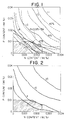
- Figure 1 is a graphic view showing the relation between the P and N content of a low carbon AI-killed steel and the r value, and the elongation of the steel sheet;
- the inventors of the present invention conducted extensive and detailed research on press formability of low carbon AI-killed steel produced by the continuous annealing process. As a result, the inventors have found that N and P have an extremely great influence on the deep drawability and stretchability. The inventors have proceeded with the research so far that they have achieved the present invention in which the Mn content is on the usual level (more than 0.10%), yet the high temperature coiling is no longer required.
- the preferred range of C is not more than 0.05%.
- Fig. 1 shows the relation between the contents of P and N and the r value, and elongation in connection with a steel containing 0.02-0.040% C, 0.10-0.25% Mn, and 0.02-0.04% Al; and Fig. 2 indicates the relation between the content of P and N and the cold rolling efficiency.
- the relationships are shown by contour lines of the average values obtained from a large number of experiments.
- the r value (solid line) favorably correlated with deep drawability and elongation (broken line) is much improved if P is not more than 0.010% and N is not more than 0.0025% and the formula P+5N--0.0175% is satisfied. Particularly, it is seen that a considerably marked effect is exhibited in the region where P is not more than 0.007% and N not more than 0.0020%. Furthermore, if N is not more than 0.0015%, the highest deep drawability is exhibited.
- the r value and the elongation are high despite a relatively low coiling temperature, such as 575-650°C.
- Fig. 2 shows the relation between P and N content and rupture property during cold rolling.
- Strip fracture was evaluated by the following test: A notch was made at the edge of each hot rolled sheet (total: 20 sheets) 4.0 mm thick, then it was cold rolled by a cold rolling mill in the laboratory scale at a reduction of 85% to a sheet 0.6 mm thick; and the total number of the thus cold rolled sheet was investigated as to whether sheet fracture occurred or not.
- Fig. 2 shows the number of fracture sheets.
- the steel fracture in the cold rolling strip scarcely occurs in the region where P is not more than 0.010% and N is not more than 0.0025% and P+5N ⁇ 0.0175%.
- the energy consumption required for cold rolling is less than that of the prior art.
- a higher reduction than that of the prior art is preferred, hence this excellent cold rolling efficiency should be evaluated as of great significance in industry.
- this is conspicuous where P+5N ⁇ 0.0175% and P is not more than 0.007% and N not more than 0.0020%.
- Mn in an amount of at least 0.10% is required in order to inhibit hot shortness due to S in the hot rolling process and to satisfy the commonly accepted requirement Mn/S ⁇ 10. On the other hand, however, if Mn exceeds 0.40%, Mn hardens the steel and lowers press formability. If more eminent deep drawability is required, not more than 0.30% Mn is preferred.
- AI of at least 0.010% is required in order to kill the steel and to fix N in the steel as AIN. On the other hand, if AI exceeds 0.05%, the steel sheet will be hardened. The cost will also be higher.
- the preferred range is 0.010-0.040% Al.
- S In orderto inhibitthe hot shortness, S should be specified to satisfy Mn/S ⁇ 1 as is usual, and S is preferred to be not more than 0.015% from the viewpoint of cold workability.
- B may be added to the AI-killed steel, whereby much better workability and cold rolling efficiency can be achieved without any loss of the merit of the present invention.
- a cold rolled steel sheet favored with a combination of highest stretchability, deep drawability and embrittlement after deep-drawing (referred to as secondary workability hereinafter), all of the highest degree can be produced by adding additional requirements, not more than 0.005% C and P--4C specified between P and C.
- the upper limit of C has been specified as 0.005% in order to obtain stretchability and deep drawability of the highest degree.
- the mere reduction of the carbon content tends to bring about the secondary working crack after press forming.
- the carbon content is reduced to not more than 0.005%, it is known that the secondary working crack will occur, although the degree of the press working is not great.
- P is most effective to specify P as not more than 0.010% while maintaining the relation P--4C so as to reduce P as well as C.
- the decrease of P together with the decrease of C contributes to the improvement of deep drawability as well as stretchability.
- Fig. 3 shows an embodiment of the relation between the contents of P and N and the secondary workability in connection with a steel containing 0.003-0.004% C, 0.20-0.25% Mn, and 0.01-0.04% Al; and Fig. 4 shows the relation between the content of P and N and the rvalue, elongation.
- the relationships are shown by contour lines based on average values obtained from a large number of experiments.
- Fig. 3 the examination of secondary workability shown in Fig. 3 is conducted as follows: steel sheets are drawn to cups with various drawing ratios, each of which is subjected to expansion with a conical punch at a temperature of 0°C, and at this time an investigation is made as to whether brittle rupture occurred on the thus formed cups or not.
- the secondary workability is evaluated with the greatest drawing ratio where no brittle rupture occurs.
- the numeral of Fig. 3 shows the greatest drawing ratio where the secondary working crack will not occur, and it means that the greater the numeral the better the secondary workability.
- the solid line refers to the elongation
- the broken line refers to the r value
- the numerals refer to the elongation and the r value, respectively.
- Ti, Nb and B can be added in a suitable amount.
- Ti, Nb or B combine with N and C, and the present invention aims at lower C and N, so that the characteristics of the invention can be enhanced by the addition of these elements.
- one or more of Ti ⁇ 0.10%, Nb ⁇ 0.10%, and BZ0.0030% can be added. When the content of each element exceeds its upper limit, its effect is saturated and the sheet cost is also raised.
- the steel sheet containing the above chemical composition is produced in the following way.
- the molten steel is produced by the conventional steel making method and in the manufacture of extremely low carbon steel the molten steel is subjected to vacuum degassing treatment and then made into slabs by the conventional method.
- the finishing temperature of hot rolling should be a higher temperature than 850°C. If it is less than 850°C, the deep drawability will be lowered.
- the temperature for heating the steel slab is not essential in the present invention. Accordingly, it is preferred to heat at a temperature not more than 1200°C from the viewpoint of energy saving policy and obtaining better press formability as described hereinafter.
- hot slabs obtained by the continuous casting or break-down mill may be directly hot rolled, or hot- charged into slab heating furnace.
- Preferable hot rolling conditions are as follows.
- the finishing entry temperature of the finishing tandem stands is preferred to be not higher than 1000°C, so that the reduction in lower temperature range can become large. For instance, the total reduction of the final two-pass is preferred to be 40% or more.
- the finishing temperature is preferred to be higher than the Ar 3 point (referred to as A3 hereinafter), and thereafter strip is forcedly cooled as soon as possible after rolling at a cooling rate more than 30°C per second. With the above processing conditions, the characteristics of the present invention will be exceedingly exhibited. This advantageous effect is particularly great in the extremely low carbon steel.
- the slab heating temperature may be preferred to be not higher than 1100°C in order to make the finish entry temperature not higher than 1000°C.
- the coiling temperature of this invention a high coiling temperature is not required, which is characteristically different from the prior art.
- the coiling temperature of a low carbon AI-killed steel is preferred to be higher than 575°C in this invention in order to ensure more than 1.4 of the r value required for a deep drawing quality.
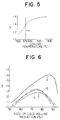
- Fig. 5 shows the relation between the coiling temperature and the r value in connection with a steel containing 0.03% C, or 0.20% Mn, 0.007 P, 0.0015% N, and 0.030% Al.
- the annealing condition is 700°C x 1 minute+400 ° Cx3 minutes (continuous annealing process).
- the higher coiling temperature such as 700°C is not required as the prior art, and a steel sheet of good deep drawability can be obtained even when coiled at a temperature lower than 630°C.
- the coiling temperature may be higher than 630°C.
- the present invention has a distinct advantage in that even at high coiling temperature (for instance, 750°C), the quality variation in the longitudinal direction and width direction of the coil is extremely small as compared with the prior art.
- the characteristics of the invention are not affected by the coiling temperature at all. Therefore, the coiling temperature is preferred to be 550-650°C from the viewpoint of pickling or descaling efficiency.
- the hot rolled coil is subsequently subjected to descaling and cold rolling.
- Cold rolling is carried out at a reduction of at least 50% as in the conventional method.
- the cold workability of the steel of this invention is much improved with a higher reduction of the cold rolling than the common steel of prior art.
- the results thereof are shown in Fig. 6.
- the annealing condition is 750 0 xl minute+400 ° Cx3 minutes.
- the steel A of this invention has a high r value, and it is seen that the cold reduction where the r value reaches the peak is about 87%.
- the cold reduction becomes more than 70%, more than 1.4 of an r value is obtained. Therefore the cold reduction is preferred to be more than 70% and not more than 90% in order to obtain a high r value. Most preferable range is 75-90%.
- comparative steels B, C and D have low rvalues, and the cold reduction where the r value reaches its peak is about 75%.
- This high cold rolled reduction and thereby high r value is one of the features of the present invention. Moreover, the steel of the invention has excellent cold rolling efficiency, so that there is no problem even if the cold reduction is increased to 70-90%.
- the recrystallization annealing is carried out at a temperature between recrystallization temperature and the A3 point by the continuous annealing method and the strip is subsequently cooled, and if necessary subjected to an overageing.
- the method of this invention can be applied to any continuous annealing method. Under typical annealing conditions, the steel is subjected to recrystallization at a soaking temperature of 650-850°C for a period of not more than 5 minutes, then cooled, and subjected to overageing at a temperature of 200-450°C for period of not more than 10 minutes. To improve the deep drawability much further, the soaking temperature is preferred to be higher than 700°C.
- the typical annealing conditions to be applied to the extremely low carbon AI-killed steel are as follows: the steel is subjected to recrystallization at a soaking temperature of 700-800°C for a period of not more than three minutes and is then cooled. In this case, the overageing treatment is not required, but it may be conducted at a temperature of 200-450°C for a period of less than 5 minutes.
- the steel strip thus annealed is subjected to temper rolling, if necessary, and now it is ready for further processing into a product.
- the steel manufactured in accordance with the method of the present invention can be subjected to any surface treatment with no loss of the features of the invention, it can be applied to any surface treatment, such as the manufacture of tinplate, galvanized sheets, turn sheets, etc.
- the steels shown in Table 2 were produced in a converter; the molten steel was cast in a continuous casting mold to obtain a slab; the slab was reheated to a temperature of 1050-1200°C; the hot slab was hot rolled into a strip 4.0 mm thick under the hot rolling conditions listed in Table 2; the hot rolled strip was descaled and the descaled hot rolled strip was cold rolled to a strip 0.8 mm thick which was subjected to recrystallization annealing at 700°C for one minute by continuous annealing; then it was cooled and subjected to an overageing treatment at 400°C for 3 minutes; and was finally subjected to temper rolling at a reduction of 1.3% to obtain a finished product.
- Table 2 also shows the mechanical properties and the cold rolling efficiency of the cold rolling process in connection with the steel sheet produced by the above method.
- the cold rolling efficiency is shown by an energy consumption ratio of the average value as compared with the prior art (common low carbon AI-killed steel) for the cold rolling.
- the steel sheet fracture property was evaluated by the total number of fractures occurring in the examination test wherein a notch was made at the edge of every hot rolled sheet (total: 20 sheets), then it was cold rolled with the reduction of 85% by a laboratory cold rolling mill to a sheet 0.6 mm thick.
- the tensile test piece is No. 5 as specified by JIS, and the mechanical property was indicated by the average value of the whole length of the coil, and the difference of rvalue between rM (the center of the longitudinal direction of the coil) and rB (the tail end of the longitudinal direction of the coil) are also shown.
- every steel listed within the scope of the present invention has a low yield point, a high elongation, a high r value, good press formability, and excellent cold rolling efficiency despite the coiling temperature of less than 630°C.
- Coils Ncs. E and F are the same except for the finishing hot rolling conditions. It is seen that the r value of the coil No. F wherein the finishing hot rolling entry temperature is lower than that of the coil No. E is higher.
- the comparative steel coil No. N whose coiling temperature was 750°C has a fairly good rvalue and elongation, but the difference in rvalue of (rM-rB) is very large, so that the quality fluctuation in the longitudinal direction of the coil is considerable and therefore product yield is low.
- the steels listed in Table 3 were produced in a converter; The molten steel was subjected to vacuum degassing to lower the carbon content to a predetermined level; and then was cast in a continuous casting mold to obtain a slab: The slab was reheated to a temperature of 1050-1200°C and hot rolled under the conditions indicated in Table 3: The hot rolled strip was cold rolled to 0.8 mm thickness and then was annealed and subjected to temper rolling at 1.5% reduction.
- the tensile test piece was No. 5 specified by JIS; and the secondary workability is shown by the largest drawing ratio where no brittle rupture occurs in drawn cups with various drawing ratios under the conical expansion test at 0°C.
- Each of the extremely low carbon steel sheets produced within the scope of the claims of the present invention has not only an eminent elongation strongly correlated with the stretchability, but also an excellent r value strongly correlated with the deep drawability, and further, a distinguished secondary workability, hence it can be said that the steel sheet of the present invention has press formability of the highest degree.
Landscapes
- Chemical & Material Sciences (AREA)
- Engineering & Computer Science (AREA)
- Materials Engineering (AREA)
- Mechanical Engineering (AREA)
- Metallurgy (AREA)
- Organic Chemistry (AREA)
- Physics & Mathematics (AREA)
- Thermal Sciences (AREA)
- Crystallography & Structural Chemistry (AREA)
- Heat Treatment Of Sheet Steel (AREA)
Claims (5)
Applications Claiming Priority (4)
| Application Number | Priority Date | Filing Date | Title |
|---|---|---|---|
| JP146349/81 | 1981-09-18 | ||
| JP14634981A JPS5848634A (ja) | 1981-09-18 | 1981-09-18 | 深絞り性のすぐれた冷延鋼板の製造法 |
| JP146348/81 | 1981-09-18 | ||
| JP14634881A JPS5848633A (ja) | 1981-09-18 | 1981-09-18 | プレス成形性の優れた冷延鋼板の製造法 |
Publications (3)
| Publication Number | Publication Date |
|---|---|
| EP0075292A1 EP0075292A1 (fr) | 1983-03-30 |
| EP0075292B1 EP0075292B1 (fr) | 1986-06-11 |
| EP0075292B2 true EP0075292B2 (fr) | 1993-11-24 |
Family
ID=26477225
Family Applications (1)
| Application Number | Title | Priority Date | Filing Date |
|---|---|---|---|
| EP82108598A Expired - Lifetime EP0075292B2 (fr) | 1981-09-18 | 1982-09-17 | Procédé de fabrication de tôle d'acier laminée à froid |
Country Status (3)
| Country | Link |
|---|---|
| US (2) | US4627881A (fr) |
| EP (1) | EP0075292B2 (fr) |
| DE (1) | DE3271669D1 (fr) |
Families Citing this family (9)
| Publication number | Priority date | Publication date | Assignee | Title |
|---|---|---|---|---|
| DE3271669D1 (en) * | 1981-09-18 | 1986-07-17 | Nippon Steel Corp | Method for producing a cold rolled steel sheet |
| JPS6383230A (ja) * | 1986-09-27 | 1988-04-13 | Nkk Corp | 焼付硬化性およびプレス成形性の優れた高強度冷延鋼板の製造方法 |
| US5053194A (en) * | 1988-12-19 | 1991-10-01 | Kawasaki Steel Corporation | Formable thin steel sheets |
| US5123971A (en) * | 1989-10-02 | 1992-06-23 | Armco Steel Company, L.P. | Cold reduced non-aging deep drawing steel and method for producing |
| DE69132028T2 (de) * | 1991-04-23 | 2000-09-28 | Ak Steel Corp., Middletown | Kaltverformtes und nichtalterndes Tiefziehblech aus Stahl und Herstellungsverfahren |
| FR2678641B1 (fr) * | 1991-07-04 | 1998-11-20 | Lorraine Laminage | Acier a emboutissabilite amelioree et procede de fabrication de toles destinees a l'emboutissage. |
| DE19834361A1 (de) * | 1998-07-30 | 2000-02-03 | Schaeffler Waelzlager Ohg | Bauteil, insbesondere Wälzlager- und Motorenbauteil |
| US6732779B2 (en) * | 2001-09-05 | 2004-05-11 | The Goodyear Tire & Rubber Company | Method and apparatus for building a multi-layered finite length structure |
| CN104745786B (zh) * | 2015-04-14 | 2017-03-29 | 武汉钢铁(集团)公司 | 一种免球化退火的用csp线生产薄规格工具钢的方法 |
Family Cites Families (20)
| Publication number | Priority date | Publication date | Assignee | Title |
|---|---|---|---|---|
| JPS541644B1 (fr) * | 1968-07-29 | 1979-01-27 | ||
| BE750518A (fr) * | 1969-05-20 | 1970-10-16 | Broken Hill Pty Co Ltd | Perfectionnements aux aciers doux a faible teneur en carbone |
| US3959029A (en) * | 1970-11-21 | 1976-05-25 | Nippon Kokan Kabushiki Kaisha | Process of making cold reduced Al-stabilized steel having high drawability |
| JPS5413403B1 (fr) * | 1971-03-27 | 1979-05-30 | ||
| US3988174A (en) * | 1972-04-03 | 1976-10-26 | Nippon Steel Corporation | Hot rolled steel sheet having excellent workability and method thereof |
| JPS5226313A (en) * | 1975-08-25 | 1977-02-26 | Nippon Kokan Kk <Nkk> | Manufacturing process of cold roled steel sheets of low yielding point by continuous annealing |
| JPS582249B2 (ja) * | 1977-05-07 | 1983-01-14 | 新日本製鐵株式会社 | プレス成形用冷延鋼板の連続焼鈍方法 |
| IT1203183B (it) * | 1977-05-24 | 1989-02-15 | Centre Rech Metallurgique | Procedimento per la ricottura continua di lamiere in particolare lamiere per la fabbricazione di latta |
| JPS5458633A (en) * | 1977-10-20 | 1979-05-11 | Kawasaki Steel Co | Production of molten zinc plated steel for deep drawing |
| JPS54135616A (en) * | 1978-04-12 | 1979-10-22 | Nippon Steel Corp | Manufacture of cold rolled steel plate with superior formability |
| JPS6044376B2 (ja) * | 1978-10-21 | 1985-10-03 | 新日本製鐵株式会社 | 非時効性で、かつ深絞り加工性の優れた連続熱処理による冷延鋼板の製造方法 |
| JPS5849622B2 (ja) * | 1979-01-10 | 1983-11-05 | 新日本製鐵株式会社 | 連続焼鈍による超深絞り用冷延鋼板の製造法 |
| JPS5597431A (en) * | 1979-01-20 | 1980-07-24 | Nippon Steel Corp | Preparation of hot rolling steel plate with good processability |
| JPS55141555A (en) * | 1979-04-18 | 1980-11-05 | Kawasaki Steel Corp | Production of high tension galvanized steel sheet for press machining |
| JPS5910414B2 (ja) * | 1979-05-01 | 1984-03-08 | 川崎製鉄株式会社 | 深絞り性のすぐれた冷延鋼板の製造方法 |
| JPS5638449A (en) * | 1979-09-04 | 1981-04-13 | Nippon Steel Corp | Hot rolled steel plate obtained by continuous cast slab |
| EP0041354B2 (fr) * | 1980-05-31 | 1993-11-03 | Kawasaki Steel Corporation | Procédé de fabrication de tôles d'acier laminées à froid ayant une bonne formabilité |
| US4410372A (en) * | 1981-06-10 | 1983-10-18 | Nippon Steel Corporation | Process for producing deep-drawing, non-ageing, cold rolled steel strips having excellent paint bake-hardenability by continuous annealing |
| DE3271669D1 (en) * | 1981-09-18 | 1986-07-17 | Nippon Steel Corp | Method for producing a cold rolled steel sheet |
| JPS59126725A (ja) * | 1982-11-24 | 1984-07-21 | Nippon Steel Corp | 深絞り性のすぐれた溶融メツキ鋼板の製造法 |
-
1982
- 1982-09-17 DE DE8282108598T patent/DE3271669D1/de not_active Expired
- 1982-09-17 EP EP82108598A patent/EP0075292B2/fr not_active Expired - Lifetime
-
1985
- 1985-09-16 US US06/776,097 patent/US4627881A/en not_active Expired - Lifetime
-
1986
- 1986-08-07 US US06/894,255 patent/US4678522A/en not_active Expired - Lifetime
Also Published As
| Publication number | Publication date |
|---|---|
| EP0075292B1 (fr) | 1986-06-11 |
| EP0075292A1 (fr) | 1983-03-30 |
| US4627881A (en) | 1986-12-09 |
| US4678522A (en) | 1987-07-07 |
| DE3271669D1 (en) | 1986-07-17 |
Similar Documents
| Publication | Publication Date | Title |
|---|---|---|
| EP0152665B1 (fr) | Tôles en acier laminées à froid présentant une structure dual-phase et une grande aptitude à l'emboutissage profond et procédé de fabrication | |
| US5624504A (en) | Duplex structure stainless steel having high strength and elongation and a process for producing the steel | |
| US3988173A (en) | Cold rolled steel sheet having excellent workability and method thereof | |
| US4857117A (en) | Method of manufacturing a cold-rolled steel sheet having a good deep drawability | |
| EP0085720A1 (fr) | Procede de fabrication de plaques d'acier laminees a froid a emboutissage profond presentant des proprietes de vieillissement retarde et une faible anisotropie | |
| EP0171197B1 (fr) | Procédé de fabrication comprenant un recuit continu de tôles noires et douces pour un traitement superficiel | |
| EP0075292B2 (fr) | Procédé de fabrication de tôle d'acier laminée à froid | |
| EP0319590A1 (fr) | FEUILLE D'ACIER LAMINE A CHAUD DE GRANDE RESISTANCE, PRESENTANT UNE VALEUR r ELEVEE ET PROCEDE DE PRODUCTION | |
| JP2781297B2 (ja) | 耐2次加工脆性に優れ面内異方性の少ない冷延薄鋼板の製造方法 | |
| JPH08253818A (ja) | 面内異方性が小さく強度−伸びバランスに優れるフェライト系ステンレス鋼帯の製造方法 | |
| JPS5842752A (ja) | プレス成形性の優れた冷延鋼板 | |
| JPH0140895B2 (fr) | ||
| JP3043901B2 (ja) | 深絞り性に優れた高強度冷延鋼板及び亜鉛めっき鋼板の製造方法 | |
| JP3735142B2 (ja) | 成形性に優れた熱延鋼板の製造方法 | |
| JP3911075B2 (ja) | 焼付硬化性に優れる超深絞り用鋼板の製造方法 | |
| US5460665A (en) | Method of manufacturing a low-alloy ultra-low-carbon cold anisotropy rolled steel sheet exhibiting an excellent resistance to fabrication embrittlement and small internal anisotropy | |
| JPH08143969A (ja) | 加工性に優れた冷延鋼板の製造方法 | |
| JPH0774412B2 (ja) | 加工性および耐置き割れ性に優れた高強度薄鋼板およびその製造方法 | |
| JPH0583609B2 (fr) | ||
| JP3366661B2 (ja) | 深絞り性に優れた高張力冷延鋼板の製造方法 | |
| JP3043902B2 (ja) | 深絞り性に優れた高強度冷延鋼板及び溶融亜鉛めっき鋼板の製造方法 | |
| JPS6314817A (ja) | 曲げ特性の優れた高強度薄鋼板の製造方法 | |
| JP3150188B2 (ja) | 深絞り成形性に優れた高強度冷延鋼板の製造方法 | |
| JPH05230541A (ja) | 深絞り性に優れた高強度冷延鋼板及び亜鉛めっき鋼板の製造方法 | |
| JPH06207223A (ja) | 深絞り性及び延性に優れる高強度冷延鋼板の製造方法及び溶融亜鉛めっき鋼板の製造方法 |
Legal Events
| Date | Code | Title | Description |
|---|---|---|---|
| PUAI | Public reference made under article 153(3) epc to a published international application that has entered the european phase |
Free format text: ORIGINAL CODE: 0009012 |
|
| AK | Designated contracting states |
Designated state(s): BE DE FR GB IT |
|
| 17P | Request for examination filed |
Effective date: 19830428 |
|
| ITF | It: translation for a ep patent filed | ||
| GRAA | (expected) grant |
Free format text: ORIGINAL CODE: 0009210 |
|
| AK | Designated contracting states |
Kind code of ref document: B1 Designated state(s): BE DE FR GB IT |
|
| REF | Corresponds to: |
Ref document number: 3271669 Country of ref document: DE Date of ref document: 19860717 |
|
| ET | Fr: translation filed | ||
| PLBI | Opposition filed |
Free format text: ORIGINAL CODE: 0009260 |
|
| 26 | Opposition filed |
Opponent name: THYSSEN STAHL AG Effective date: 19870310 |
|
| ITTA | It: last paid annual fee | ||
| PUAH | Patent maintained in amended form |
Free format text: ORIGINAL CODE: 0009272 |
|
| STAA | Information on the status of an ep patent application or granted ep patent |
Free format text: STATUS: PATENT MAINTAINED AS AMENDED |
|
| 27A | Patent maintained in amended form |
Effective date: 19931124 |
|
| AK | Designated contracting states |
Kind code of ref document: B2 Designated state(s): BE DE FR GB IT |
|
| ET3 | Fr: translation filed ** decision concerning opposition | ||
| ITF | It: translation for a ep patent filed | ||
| PGFP | Annual fee paid to national office [announced via postgrant information from national office to epo] |
Ref country code: FR Payment date: 19960910 Year of fee payment: 15 |
|
| PG25 | Lapsed in a contracting state [announced via postgrant information from national office to epo] |
Ref country code: FR Free format text: THE PATENT HAS BEEN ANNULLED BY A DECISION OF A NATIONAL AUTHORITY Effective date: 19970930 |
|
| REG | Reference to a national code |
Ref country code: FR Ref legal event code: ST |
|
| PGFP | Annual fee paid to national office [announced via postgrant information from national office to epo] |
Ref country code: GB Payment date: 20010919 Year of fee payment: 20 |
|
| PGFP | Annual fee paid to national office [announced via postgrant information from national office to epo] |
Ref country code: DE Payment date: 20011001 Year of fee payment: 20 |
|
| PGFP | Annual fee paid to national office [announced via postgrant information from national office to epo] |
Ref country code: BE Payment date: 20011116 Year of fee payment: 20 |
|
| REG | Reference to a national code |
Ref country code: GB Ref legal event code: IF02 |
|
| PG25 | Lapsed in a contracting state [announced via postgrant information from national office to epo] |
Ref country code: GB Free format text: LAPSE BECAUSE OF EXPIRATION OF PROTECTION Effective date: 20020916 |
|
| BE20 | Be: patent expired |
Owner name: *NIPPON STEEL CORP. Effective date: 20020917 |
|
| REG | Reference to a national code |
Ref country code: GB Ref legal event code: PE20 Effective date: 20020916 |
|
| APAH | Appeal reference modified |
Free format text: ORIGINAL CODE: EPIDOSCREFNO |