EP0076436A2 - Für zu räuchernde Lebensmittel, insbesondere für zu räuchernde Wurstwaren geeignete Schlauchhülle, Verfahren zu ihrer Herstellung und ihre Verwendung - Google Patents
Für zu räuchernde Lebensmittel, insbesondere für zu räuchernde Wurstwaren geeignete Schlauchhülle, Verfahren zu ihrer Herstellung und ihre Verwendung Download PDFInfo
- Publication number
- EP0076436A2 EP0076436A2 EP82108819A EP82108819A EP0076436A2 EP 0076436 A2 EP0076436 A2 EP 0076436A2 EP 82108819 A EP82108819 A EP 82108819A EP 82108819 A EP82108819 A EP 82108819A EP 0076436 A2 EP0076436 A2 EP 0076436A2
- Authority
- EP
- European Patent Office
- Prior art keywords
- web
- tubular casing
- adhesive
- smoke
- cellulose
- Prior art date
- Legal status (The legal status is an assumption and is not a legal conclusion. Google has not performed a legal analysis and makes no representation as to the accuracy of the status listed.)
- Granted
Links
- 235000013580 sausages Nutrition 0.000 title claims abstract description 67
- 238000000034 method Methods 0.000 title claims abstract description 25
- 238000004519 manufacturing process Methods 0.000 title claims description 21
- 230000008569 process Effects 0.000 title description 14
- 239000000853 adhesive Substances 0.000 claims abstract description 73
- 230000001070 adhesive effect Effects 0.000 claims abstract description 73
- 229920002678 cellulose Polymers 0.000 claims abstract description 62
- 239000001913 cellulose Substances 0.000 claims abstract description 60
- 239000010410 layer Substances 0.000 claims abstract description 39
- 229920005989 resin Polymers 0.000 claims abstract description 38
- 239000011347 resin Substances 0.000 claims abstract description 38
- 229920000768 polyamine Polymers 0.000 claims abstract description 21
- 239000004952 Polyamide Substances 0.000 claims abstract description 15
- 239000012790 adhesive layer Substances 0.000 claims abstract description 15
- 125000002091 cationic group Chemical group 0.000 claims abstract description 15
- 229920002647 polyamide Polymers 0.000 claims abstract description 15
- BRLQWZUYTZBJKN-UHFFFAOYSA-N Epichlorohydrin Chemical compound ClCC1CO1 BRLQWZUYTZBJKN-UHFFFAOYSA-N 0.000 claims abstract description 12
- 125000001931 aliphatic group Chemical group 0.000 claims abstract description 9
- 239000007859 condensation product Substances 0.000 claims abstract description 8
- 230000001588 bifunctional effect Effects 0.000 claims abstract description 6
- 150000003944 halohydrins Chemical class 0.000 claims abstract description 6
- 238000004806 packaging method and process Methods 0.000 claims abstract description 4
- 239000000243 solution Substances 0.000 claims description 45
- 239000000779 smoke Substances 0.000 claims description 17
- 239000011248 coating agent Substances 0.000 claims description 13
- 238000000576 coating method Methods 0.000 claims description 13
- 239000006185 dispersion Substances 0.000 claims description 11
- 235000013305 food Nutrition 0.000 claims description 9
- 230000035699 permeability Effects 0.000 claims description 8
- 239000000126 substance Substances 0.000 claims description 6
- 210000001503 joint Anatomy 0.000 claims description 4
- 239000011148 porous material Substances 0.000 claims description 3
- 239000012670 alkaline solution Substances 0.000 claims description 2
- 230000002093 peripheral effect Effects 0.000 claims 1
- 238000006073 displacement reaction Methods 0.000 abstract 1
- 235000010980 cellulose Nutrition 0.000 description 53
- 238000004873 anchoring Methods 0.000 description 42
- 239000000463 material Substances 0.000 description 38
- XLYOFNOQVPJJNP-UHFFFAOYSA-N water Substances O XLYOFNOQVPJJNP-UHFFFAOYSA-N 0.000 description 35
- 239000003795 chemical substances by application Substances 0.000 description 33
- PEDCQBHIVMGVHV-UHFFFAOYSA-N Glycerine Chemical compound OCC(O)CO PEDCQBHIVMGVHV-UHFFFAOYSA-N 0.000 description 28
- 229920000297 Rayon Polymers 0.000 description 21
- 238000001035 drying Methods 0.000 description 21
- 239000000835 fiber Substances 0.000 description 19
- 239000000499 gel Substances 0.000 description 14
- 239000004627 regenerated cellulose Substances 0.000 description 14
- 239000007864 aqueous solution Substances 0.000 description 13
- 238000011049 filling Methods 0.000 description 13
- 238000003860 storage Methods 0.000 description 13
- 229920001187 thermosetting polymer Polymers 0.000 description 11
- 238000004026 adhesive bonding Methods 0.000 description 10
- 235000011187 glycerol Nutrition 0.000 description 10
- 239000007789 gas Substances 0.000 description 8
- 239000000203 mixture Substances 0.000 description 8
- 239000004014 plasticizer Substances 0.000 description 8
- 230000008929 regeneration Effects 0.000 description 8
- 238000011069 regeneration method Methods 0.000 description 8
- 230000015572 biosynthetic process Effects 0.000 description 7
- 238000005345 coagulation Methods 0.000 description 7
- 230000015271 coagulation Effects 0.000 description 7
- 239000002904 solvent Substances 0.000 description 7
- 238000012360 testing method Methods 0.000 description 7
- 235000013372 meat Nutrition 0.000 description 6
- 238000007639 printing Methods 0.000 description 6
- 239000004793 Polystyrene Substances 0.000 description 5
- 230000008901 benefit Effects 0.000 description 5
- 239000000975 dye Substances 0.000 description 5
- 239000007788 liquid Substances 0.000 description 5
- -1 polypropylene Polymers 0.000 description 5
- 230000008961 swelling Effects 0.000 description 5
- RPNUMPOLZDHAAY-UHFFFAOYSA-N Diethylenetriamine Chemical compound NCCNCCN RPNUMPOLZDHAAY-UHFFFAOYSA-N 0.000 description 4
- 239000002253 acid Substances 0.000 description 4
- 239000002318 adhesion promoter Substances 0.000 description 4
- 229920003086 cellulose ether Polymers 0.000 description 4
- 239000007795 chemical reaction product Substances 0.000 description 4
- 239000002612 dispersion medium Substances 0.000 description 4
- 238000010438 heat treatment Methods 0.000 description 4
- 239000002480 mineral oil Substances 0.000 description 4
- 239000004745 nonwoven fabric Substances 0.000 description 4
- 238000012545 processing Methods 0.000 description 4
- 230000002787 reinforcement Effects 0.000 description 4
- DNIAPMSPPWPWGF-UHFFFAOYSA-N Propylene glycol Chemical compound CC(O)CO DNIAPMSPPWPWGF-UHFFFAOYSA-N 0.000 description 3
- 238000010521 absorption reaction Methods 0.000 description 3
- 230000002378 acidificating effect Effects 0.000 description 3
- 235000014113 dietary fatty acids Nutrition 0.000 description 3
- 239000002270 dispersing agent Substances 0.000 description 3
- 239000000194 fatty acid Substances 0.000 description 3
- 229930195729 fatty acid Natural products 0.000 description 3
- 239000012528 membrane Substances 0.000 description 3
- 238000007493 shaping process Methods 0.000 description 3
- 230000000391 smoking effect Effects 0.000 description 3
- 238000009987 spinning Methods 0.000 description 3
- QGZKDVFQNNGYKY-UHFFFAOYSA-N Ammonia Chemical compound N QGZKDVFQNNGYKY-UHFFFAOYSA-N 0.000 description 2
- NLXLAEXVIDQMFP-UHFFFAOYSA-N Ammonium chloride Substances [NH4+].[Cl-] NLXLAEXVIDQMFP-UHFFFAOYSA-N 0.000 description 2
- VHUUQVKOLVNVRT-UHFFFAOYSA-N Ammonium hydroxide Chemical compound [NH4+].[OH-] VHUUQVKOLVNVRT-UHFFFAOYSA-N 0.000 description 2
- 244000025254 Cannabis sativa Species 0.000 description 2
- 235000012766 Cannabis sativa ssp. sativa var. sativa Nutrition 0.000 description 2
- 235000012765 Cannabis sativa ssp. sativa var. spontanea Nutrition 0.000 description 2
- 229920000877 Melamine resin Polymers 0.000 description 2
- 239000000020 Nitrocellulose Substances 0.000 description 2
- 239000004743 Polypropylene Substances 0.000 description 2
- 229920002472 Starch Polymers 0.000 description 2
- QAOWNCQODCNURD-UHFFFAOYSA-N Sulfuric acid Chemical compound OS(O)(=O)=O QAOWNCQODCNURD-UHFFFAOYSA-N 0.000 description 2
- 229920001807 Urea-formaldehyde Polymers 0.000 description 2
- XLOMVQKBTHCTTD-UHFFFAOYSA-N Zinc monoxide Chemical compound [Zn]=O XLOMVQKBTHCTTD-UHFFFAOYSA-N 0.000 description 2
- FJWGYAHXMCUOOM-QHOUIDNNSA-N [(2s,3r,4s,5r,6r)-2-[(2r,3r,4s,5r,6s)-4,5-dinitrooxy-2-(nitrooxymethyl)-6-[(2r,3r,4s,5r,6s)-4,5,6-trinitrooxy-2-(nitrooxymethyl)oxan-3-yl]oxyoxan-3-yl]oxy-3,5-dinitrooxy-6-(nitrooxymethyl)oxan-4-yl] nitrate Chemical compound O([C@@H]1O[C@@H]([C@H]([C@H](O[N+]([O-])=O)[C@H]1O[N+]([O-])=O)O[C@H]1[C@@H]([C@@H](O[N+]([O-])=O)[C@H](O[N+]([O-])=O)[C@@H](CO[N+]([O-])=O)O1)O[N+]([O-])=O)CO[N+](=O)[O-])[C@@H]1[C@@H](CO[N+]([O-])=O)O[C@@H](O[N+]([O-])=O)[C@H](O[N+]([O-])=O)[C@H]1O[N+]([O-])=O FJWGYAHXMCUOOM-QHOUIDNNSA-N 0.000 description 2
- 230000009471 action Effects 0.000 description 2
- 239000000654 additive Substances 0.000 description 2
- WNLRTRBMVRJNCN-UHFFFAOYSA-N adipic acid Chemical compound OC(=O)CCCCC(O)=O WNLRTRBMVRJNCN-UHFFFAOYSA-N 0.000 description 2
- 239000003513 alkali Substances 0.000 description 2
- 235000011114 ammonium hydroxide Nutrition 0.000 description 2
- 239000002585 base Substances 0.000 description 2
- 235000009120 camo Nutrition 0.000 description 2
- 235000005607 chanvre indien Nutrition 0.000 description 2
- 238000006243 chemical reaction Methods 0.000 description 2
- 239000008199 coating composition Substances 0.000 description 2
- 150000001875 compounds Chemical class 0.000 description 2
- 230000001143 conditioned effect Effects 0.000 description 2
- 238000001816 cooling Methods 0.000 description 2
- 238000005520 cutting process Methods 0.000 description 2
- 238000006477 desulfuration reaction Methods 0.000 description 2
- 230000023556 desulfurization Effects 0.000 description 2
- DOIRQSBPFJWKBE-UHFFFAOYSA-N dibutyl phthalate Chemical compound CCCCOC(=O)C1=CC=CC=C1C(=O)OCCCC DOIRQSBPFJWKBE-UHFFFAOYSA-N 0.000 description 2
- 239000006260 foam Substances 0.000 description 2
- 239000011888 foil Substances 0.000 description 2
- 239000003292 glue Substances 0.000 description 2
- 238000007646 gravure printing Methods 0.000 description 2
- 239000011487 hemp Substances 0.000 description 2
- JVTAAEKCZFNVCJ-UHFFFAOYSA-N lactic acid Chemical compound CC(O)C(O)=O JVTAAEKCZFNVCJ-UHFFFAOYSA-N 0.000 description 2
- 235000015252 lyoner Nutrition 0.000 description 2
- 235000010446 mineral oil Nutrition 0.000 description 2
- 238000000465 moulding Methods 0.000 description 2
- 229920001220 nitrocellulos Polymers 0.000 description 2
- 239000000049 pigment Substances 0.000 description 2
- 229920001281 polyalkylene Polymers 0.000 description 2
- 229920000728 polyester Polymers 0.000 description 2
- ODGAOXROABLFNM-UHFFFAOYSA-N polynoxylin Chemical compound O=C.NC(N)=O ODGAOXROABLFNM-UHFFFAOYSA-N 0.000 description 2
- 229920005862 polyol Polymers 0.000 description 2
- 150000003077 polyols Chemical class 0.000 description 2
- 229920001155 polypropylene Polymers 0.000 description 2
- 229920002223 polystyrene Polymers 0.000 description 2
- 239000000843 powder Substances 0.000 description 2
- 238000001556 precipitation Methods 0.000 description 2
- 108090000623 proteins and genes Proteins 0.000 description 2
- 102000004169 proteins and genes Human genes 0.000 description 2
- 150000003839 salts Chemical class 0.000 description 2
- 239000008107 starch Substances 0.000 description 2
- 235000019698 starch Nutrition 0.000 description 2
- 239000004753 textile Substances 0.000 description 2
- 238000005406 washing Methods 0.000 description 2
- 238000004804 winding Methods 0.000 description 2
- WSWCOQWTEOXDQX-MQQKCMAXSA-M (E,E)-sorbate Chemical compound C\C=C\C=C\C([O-])=O WSWCOQWTEOXDQX-MQQKCMAXSA-M 0.000 description 1
- LDVVTQMJQSCDMK-UHFFFAOYSA-N 1,3-dihydroxypropan-2-yl formate Chemical compound OCC(CO)OC=O LDVVTQMJQSCDMK-UHFFFAOYSA-N 0.000 description 1
- VILCJCGEZXAXTO-UHFFFAOYSA-N 2,2,2-tetramine Chemical compound NCCNCCNCCN VILCJCGEZXAXTO-UHFFFAOYSA-N 0.000 description 1
- LBLYYCQCTBFVLH-UHFFFAOYSA-N 2-Methylbenzenesulfonic acid Chemical compound CC1=CC=CC=C1S(O)(=O)=O LBLYYCQCTBFVLH-UHFFFAOYSA-N 0.000 description 1
- 239000005995 Aluminium silicate Substances 0.000 description 1
- 229920000298 Cellophane Polymers 0.000 description 1
- PYGXAGIECVVIOZ-UHFFFAOYSA-N Dibutyl decanedioate Chemical compound CCCCOC(=O)CCCCCCCCC(=O)OCCCC PYGXAGIECVVIOZ-UHFFFAOYSA-N 0.000 description 1
- PIICEJLVQHRZGT-UHFFFAOYSA-N Ethylenediamine Chemical compound NCCN PIICEJLVQHRZGT-UHFFFAOYSA-N 0.000 description 1
- 108010010803 Gelatin Proteins 0.000 description 1
- DGAQECJNVWCQMB-PUAWFVPOSA-M Ilexoside XXIX Chemical compound C[C@@H]1CC[C@@]2(CC[C@@]3(C(=CC[C@H]4[C@]3(CC[C@@H]5[C@@]4(CC[C@@H](C5(C)C)OS(=O)(=O)[O-])C)C)[C@@H]2[C@]1(C)O)C)C(=O)O[C@H]6[C@@H]([C@H]([C@@H]([C@H](O6)CO)O)O)O.[Na+] DGAQECJNVWCQMB-PUAWFVPOSA-M 0.000 description 1
- 240000006240 Linum usitatissimum Species 0.000 description 1
- 235000004431 Linum usitatissimum Nutrition 0.000 description 1
- 241001465754 Metazoa Species 0.000 description 1
- 229920000168 Microcrystalline cellulose Polymers 0.000 description 1
- 229920000881 Modified starch Polymers 0.000 description 1
- 239000004368 Modified starch Substances 0.000 description 1
- 240000007594 Oryza sativa Species 0.000 description 1
- 235000007164 Oryza sativa Nutrition 0.000 description 1
- 108010058846 Ovalbumin Proteins 0.000 description 1
- CBENFWSGALASAD-UHFFFAOYSA-N Ozone Chemical compound [O-][O+]=O CBENFWSGALASAD-UHFFFAOYSA-N 0.000 description 1
- 239000004372 Polyvinyl alcohol Substances 0.000 description 1
- OFOBLEOULBTSOW-UHFFFAOYSA-N Propanedioic acid Natural products OC(=O)CC(O)=O OFOBLEOULBTSOW-UHFFFAOYSA-N 0.000 description 1
- 241001237745 Salamis Species 0.000 description 1
- PMZURENOXWZQFD-UHFFFAOYSA-L Sodium Sulfate Chemical compound [Na+].[Na+].[O-]S([O-])(=O)=O PMZURENOXWZQFD-UHFFFAOYSA-L 0.000 description 1
- YSMRWXYRXBRSND-UHFFFAOYSA-N TOTP Chemical compound CC1=CC=CC=C1OP(=O)(OC=1C(=CC=CC=1)C)OC1=CC=CC=C1C YSMRWXYRXBRSND-UHFFFAOYSA-N 0.000 description 1
- 150000007513 acids Chemical class 0.000 description 1
- 230000000996 additive effect Effects 0.000 description 1
- 235000011037 adipic acid Nutrition 0.000 description 1
- 239000001361 adipic acid Substances 0.000 description 1
- 230000001476 alcoholic effect Effects 0.000 description 1
- 150000001298 alcohols Chemical class 0.000 description 1
- 150000001338 aliphatic hydrocarbons Chemical class 0.000 description 1
- 229920000180 alkyd Polymers 0.000 description 1
- 125000002947 alkylene group Chemical group 0.000 description 1
- 125000005263 alkylenediamine group Chemical group 0.000 description 1
- XAGFODPZIPBFFR-UHFFFAOYSA-N aluminium Chemical compound [Al] XAGFODPZIPBFFR-UHFFFAOYSA-N 0.000 description 1
- 229910052782 aluminium Inorganic materials 0.000 description 1
- 235000012211 aluminium silicate Nutrition 0.000 description 1
- 229910021529 ammonia Inorganic materials 0.000 description 1
- BFNBIHQBYMNNAN-UHFFFAOYSA-N ammonium sulfate Chemical compound N.N.OS(O)(=O)=O BFNBIHQBYMNNAN-UHFFFAOYSA-N 0.000 description 1
- 229910052921 ammonium sulfate Inorganic materials 0.000 description 1
- 235000011130 ammonium sulphate Nutrition 0.000 description 1
- SOIFLUNRINLCBN-UHFFFAOYSA-N ammonium thiocyanate Chemical compound [NH4+].[S-]C#N SOIFLUNRINLCBN-UHFFFAOYSA-N 0.000 description 1
- 239000010775 animal oil Substances 0.000 description 1
- 239000003125 aqueous solvent Substances 0.000 description 1
- 150000004945 aromatic hydrocarbons Chemical class 0.000 description 1
- 235000013405 beer Nutrition 0.000 description 1
- 230000033228 biological regulation Effects 0.000 description 1
- 238000004061 bleaching Methods 0.000 description 1
- 125000004432 carbon atom Chemical group C* 0.000 description 1
- 125000003178 carboxy group Chemical group [H]OC(*)=O 0.000 description 1
- 150000001735 carboxylic acids Chemical class 0.000 description 1
- 239000004203 carnauba wax Substances 0.000 description 1
- 235000013869 carnauba wax Nutrition 0.000 description 1
- 239000003054 catalyst Substances 0.000 description 1
- 229920002301 cellulose acetate Polymers 0.000 description 1
- 230000008859 change Effects 0.000 description 1
- 235000013351 cheese Nutrition 0.000 description 1
- 239000013043 chemical agent Substances 0.000 description 1
- XENVCRGQTABGKY-ZHACJKMWSA-N chlorohydrin Chemical compound CC#CC#CC#CC#C\C=C\C(Cl)CO XENVCRGQTABGKY-ZHACJKMWSA-N 0.000 description 1
- 239000011247 coating layer Substances 0.000 description 1
- 238000004040 coloring Methods 0.000 description 1
- 239000002131 composite material Substances 0.000 description 1
- 230000003750 conditioning effect Effects 0.000 description 1
- 239000000470 constituent Substances 0.000 description 1
- 238000010411 cooking Methods 0.000 description 1
- 229920001577 copolymer Polymers 0.000 description 1
- 230000006196 deacetylation Effects 0.000 description 1
- 238000003381 deacetylation reaction Methods 0.000 description 1
- 238000013461 design Methods 0.000 description 1
- 230000006866 deterioration Effects 0.000 description 1
- 238000011161 development Methods 0.000 description 1
- 230000018109 developmental process Effects 0.000 description 1
- 238000000502 dialysis Methods 0.000 description 1
- 238000004043 dyeing Methods 0.000 description 1
- 230000000694 effects Effects 0.000 description 1
- 238000005516 engineering process Methods 0.000 description 1
- 150000002148 esters Chemical class 0.000 description 1
- ZOOODBUHSVUZEM-UHFFFAOYSA-N ethoxymethanedithioic acid Chemical compound CCOC(S)=S ZOOODBUHSVUZEM-UHFFFAOYSA-N 0.000 description 1
- 239000003000 extruded plastic Substances 0.000 description 1
- 238000001125 extrusion Methods 0.000 description 1
- 150000004665 fatty acids Chemical class 0.000 description 1
- 239000000945 filler Substances 0.000 description 1
- IVJISJACKSSFGE-UHFFFAOYSA-N formaldehyde;1,3,5-triazine-2,4,6-triamine Chemical compound O=C.NC1=NC(N)=NC(N)=N1 IVJISJACKSSFGE-UHFFFAOYSA-N 0.000 description 1
- 239000000446 fuel Substances 0.000 description 1
- 239000008273 gelatin Substances 0.000 description 1
- 229920000159 gelatin Polymers 0.000 description 1
- 235000019322 gelatine Nutrition 0.000 description 1
- 235000011852 gelatine desserts Nutrition 0.000 description 1
- 239000011521 glass Substances 0.000 description 1
- 108010050792 glutenin Proteins 0.000 description 1
- 238000002615 hemofiltration Methods 0.000 description 1
- 230000007062 hydrolysis Effects 0.000 description 1
- 238000006460 hydrolysis reaction Methods 0.000 description 1
- 238000011835 investigation Methods 0.000 description 1
- NLYAJNPCOHFWQQ-UHFFFAOYSA-N kaolin Chemical compound O.O.O=[Al]O[Si](=O)O[Si](=O)O[Al]=O NLYAJNPCOHFWQQ-UHFFFAOYSA-N 0.000 description 1
- GKQPCPXONLDCMU-CCEZHUSRSA-N lacidipine Chemical compound CCOC(=O)C1=C(C)NC(C)=C(C(=O)OCC)C1C1=CC=CC=C1\C=C\C(=O)OC(C)(C)C GKQPCPXONLDCMU-CCEZHUSRSA-N 0.000 description 1
- 239000004310 lactic acid Substances 0.000 description 1
- 235000014655 lactic acid Nutrition 0.000 description 1
- 230000014759 maintenance of location Effects 0.000 description 1
- VZCYOOQTPOCHFL-UPHRSURJSA-N maleic acid Chemical compound OC(=O)\C=C/C(O)=O VZCYOOQTPOCHFL-UPHRSURJSA-N 0.000 description 1
- 239000011976 maleic acid Substances 0.000 description 1
- 235000013622 meat product Nutrition 0.000 description 1
- 235000019690 meat sausages Nutrition 0.000 description 1
- 239000002609 medium Substances 0.000 description 1
- 238000002844 melting Methods 0.000 description 1
- 230000008018 melting Effects 0.000 description 1
- 244000005700 microbiome Species 0.000 description 1
- 235000019813 microcrystalline cellulose Nutrition 0.000 description 1
- 239000008108 microcrystalline cellulose Substances 0.000 description 1
- 229940016286 microcrystalline cellulose Drugs 0.000 description 1
- 235000019426 modified starch Nutrition 0.000 description 1
- 239000012170 montan wax Substances 0.000 description 1
- 235000015253 mortadella Nutrition 0.000 description 1
- KMBPCQSCMCEPMU-UHFFFAOYSA-N n'-(3-aminopropyl)-n'-methylpropane-1,3-diamine Chemical compound NCCCN(C)CCCN KMBPCQSCMCEPMU-UHFFFAOYSA-N 0.000 description 1
- 239000003921 oil Substances 0.000 description 1
- 235000019198 oils Nutrition 0.000 description 1
- 239000012860 organic pigment Substances 0.000 description 1
- 239000003960 organic solvent Substances 0.000 description 1
- 239000012188 paraffin wax Substances 0.000 description 1
- 229920001568 phenolic resin Polymers 0.000 description 1
- 150000002989 phenols Chemical class 0.000 description 1
- 230000000704 physical effect Effects 0.000 description 1
- 229920003023 plastic Polymers 0.000 description 1
- 239000004033 plastic Substances 0.000 description 1
- 239000002985 plastic film Substances 0.000 description 1
- 229920006255 plastic film Polymers 0.000 description 1
- 229920002239 polyacrylonitrile Polymers 0.000 description 1
- 229920006122 polyamide resin Polymers 0.000 description 1
- 229920001748 polybutylene Polymers 0.000 description 1
- 239000004848 polyfunctional curative Substances 0.000 description 1
- 229920001296 polysiloxane Polymers 0.000 description 1
- 229920002635 polyurethane Polymers 0.000 description 1
- 239000004814 polyurethane Substances 0.000 description 1
- 229920005749 polyurethane resin Polymers 0.000 description 1
- 229920002451 polyvinyl alcohol Polymers 0.000 description 1
- 229920000915 polyvinyl chloride Polymers 0.000 description 1
- 239000004800 polyvinyl chloride Substances 0.000 description 1
- 238000002360 preparation method Methods 0.000 description 1
- 230000002265 prevention Effects 0.000 description 1
- 150000003141 primary amines Chemical group 0.000 description 1
- 239000000047 product Substances 0.000 description 1
- 239000010453 quartz Substances 0.000 description 1
- 230000005855 radiation Effects 0.000 description 1
- 239000012783 reinforcing fiber Substances 0.000 description 1
- 239000005871 repellent Substances 0.000 description 1
- 238000001223 reverse osmosis Methods 0.000 description 1
- 235000009566 rice Nutrition 0.000 description 1
- 230000005070 ripening Effects 0.000 description 1
- 238000010022 rotary screen printing Methods 0.000 description 1
- 235000015175 salami Nutrition 0.000 description 1
- 239000004576 sand Substances 0.000 description 1
- 229920006395 saturated elastomer Polymers 0.000 description 1
- VYPSYNLAJGMNEJ-UHFFFAOYSA-N silicon dioxide Inorganic materials O=[Si]=O VYPSYNLAJGMNEJ-UHFFFAOYSA-N 0.000 description 1
- 229920002545 silicone oil Polymers 0.000 description 1
- 238000002791 soaking Methods 0.000 description 1
- 239000011734 sodium Substances 0.000 description 1
- 229910052708 sodium Inorganic materials 0.000 description 1
- 229910052938 sodium sulfate Inorganic materials 0.000 description 1
- 235000011152 sodium sulphate Nutrition 0.000 description 1
- 229940075554 sorbate Drugs 0.000 description 1
- 239000007921 spray Substances 0.000 description 1
- 238000005507 spraying Methods 0.000 description 1
- 238000003892 spreading Methods 0.000 description 1
- 230000007480 spreading Effects 0.000 description 1
- 239000000758 substrate Substances 0.000 description 1
- 229920002994 synthetic fiber Polymers 0.000 description 1
- 239000012209 synthetic fiber Substances 0.000 description 1
- 238000009864 tensile test Methods 0.000 description 1
- FAGUFWYHJQFNRV-UHFFFAOYSA-N tetraethylenepentamine Chemical compound NCCNCCNCCNCCN FAGUFWYHJQFNRV-UHFFFAOYSA-N 0.000 description 1
- 230000008719 thickening Effects 0.000 description 1
- 239000002562 thickening agent Substances 0.000 description 1
- VZCYOOQTPOCHFL-UHFFFAOYSA-N trans-butenedioic acid Natural products OC(=O)C=CC(O)=O VZCYOOQTPOCHFL-UHFFFAOYSA-N 0.000 description 1
- 229960001124 trientine Drugs 0.000 description 1
- UFTFJSFQGQCHQW-UHFFFAOYSA-N triformin Chemical compound O=COCC(OC=O)COC=O UFTFJSFQGQCHQW-UHFFFAOYSA-N 0.000 description 1
- 238000000108 ultra-filtration Methods 0.000 description 1
- 235000015112 vegetable and seed oil Nutrition 0.000 description 1
- 239000008158 vegetable oil Substances 0.000 description 1
- 230000003313 weakening effect Effects 0.000 description 1
- 239000000080 wetting agent Substances 0.000 description 1
- 239000002759 woven fabric Substances 0.000 description 1
- 230000037303 wrinkles Effects 0.000 description 1
- 239000012991 xanthate Substances 0.000 description 1
- 239000011787 zinc oxide Substances 0.000 description 1
- 239000001039 zinc pigment Substances 0.000 description 1
Images



Classifications
-
- A—HUMAN NECESSITIES
- A22—BUTCHERING; MEAT TREATMENT; PROCESSING POULTRY OR FISH
- A22C—PROCESSING MEAT, POULTRY, OR FISH
- A22C13/00—Sausage casings
- A22C13/0013—Chemical composition of synthetic sausage casings
-
- A—HUMAN NECESSITIES
- A22—BUTCHERING; MEAT TREATMENT; PROCESSING POULTRY OR FISH
- A22C—PROCESSING MEAT, POULTRY, OR FISH
- A22C13/00—Sausage casings
- A22C2013/0066—Sausage casings casings according to the presence or absence of seams
- A22C2013/0069—Sausage casings casings according to the presence or absence of seams seamed casings, casings with at least one longitudinal seam
-
- A—HUMAN NECESSITIES
- A22—BUTCHERING; MEAT TREATMENT; PROCESSING POULTRY OR FISH
- A22C—PROCESSING MEAT, POULTRY, OR FISH
- A22C13/00—Sausage casings
- A22C2013/0089—Sausage casings smokable casings, e.g. permeable to liquid smoke or phenol
-
- A—HUMAN NECESSITIES
- A22—BUTCHERING; MEAT TREATMENT; PROCESSING POULTRY OR FISH
- A22C—PROCESSING MEAT, POULTRY, OR FISH
- A22C13/00—Sausage casings
- A22C2013/0096—Sausage casings cellulosic
-
- Y—GENERAL TAGGING OF NEW TECHNOLOGICAL DEVELOPMENTS; GENERAL TAGGING OF CROSS-SECTIONAL TECHNOLOGIES SPANNING OVER SEVERAL SECTIONS OF THE IPC; TECHNICAL SUBJECTS COVERED BY FORMER USPC CROSS-REFERENCE ART COLLECTIONS [XRACs] AND DIGESTS
- Y10—TECHNICAL SUBJECTS COVERED BY FORMER USPC
- Y10T—TECHNICAL SUBJECTS COVERED BY FORMER US CLASSIFICATION
- Y10T428/00—Stock material or miscellaneous articles
- Y10T428/13—Hollow or container type article [e.g., tube, vase, etc.]
- Y10T428/1324—Flexible food casing [e.g., sausage type, etc.]
Definitions
- the invention relates to a tubular casing of the type mentioned in the preamble of claim 1, to a method for its production and its use.
- Tubular casings of this type are produced by longitudinally axially folding a web into a tube and gluing the overlapping, axially extending edge zones.
- an edge zone of the sheet made of regenerated cellulose is provided with an acidic, aqueous solution of a partially polymerized, thermosetting resin and the other edge zone of the sheet is then pressed together with the resin layer while forming the tube.
- the overlapping edge zones are then connected to one another at about 180 to 220 ° C. under the action of pressure, the resin being heat-cured.
- Resins are, for example, urea-formaldehyde and melamine-formaldehyde resins.
- this tubular casing can also be used as a sausage casing for the production of skinless sausages, the tubular casing being peeled off the sausage after the cooking process.
- tubular sleeves for foodstuffs in particular artificial sausage casings, are now predominantly made of seamless material, although some disadvantages must also be accepted with these seamless tubular casings; in particular, this process is very expensive.
- Seamless hoses made from fiber-reinforced regenerated cellulose are usually produced according to the following essential process steps.
- a web of a nonwoven fabric is formed into a tube, the edge zones of the web overlapping and being glued with viscose.
- the viscose is coagulated, regenerated to cellulose hydrate gel and dried.
- Seamless tubes made of non-fiber-reinforced regenerated cellulose are produced by extrusion of viscose through an annular nozzle into the coagulation bath and converted into regenerated cellulose analogously.
- the tube is supported during the coagulation and regeneration by the resulting gas mixture and during drying by an enclosed air volume and, if necessary, stretched in the longitudinal and transverse directions to improve the mechanical properties.
- weakening zones so-called spinning edges, which extend longitudinally axially in the edge region occur on the edges of the flattened tube during regeneration.
- the stretching processes customary for seamless hoses also have disadvantages. Both the internal pressure of the process gases developing in the tube and the internal pressure during drying cannot be controlled precisely enough, so that the diameter and the wall thickness of the seamless tubes, even when used a complicated and complex process technology that cannot be kept constant within narrow limits. Furthermore, it is disadvantageous that when stretching hoses with a spreading gas the ratio of the stretching forces effective in the tangential and radial directions is fixed, so that the seamless hose also for this reason with regard to its mechanical properties, in particular with regard to the shrinking properties and the strength in the longitudinal direction - and transverse direction is fixed.
- tubular casing made of regenerated cellulose, which does not have all the disadvantages of the known tubular casings mentioned.
- the tubular casing must have optimal mechanical properties, in particular shrinkage and strength values.
- their bond seam must have relatively high mechanical and thermal loads, e.g. B. strain and exposure to hot water, withstand and not affect the taste and appearance of the food. It should also be possible to gather caterpillars with conventional gathering devices.
- a particularly important task is to create a casing which is sufficiently permeable to gas and smoke in the area of the bond, and at the same time has great tear resistance.
- a casing is for food that is to be smoked, e.g. B. for special cooked sausages or sausages, the casing of which, if necessary must also be peelable, or for other foods, e.g. B. provided for certain types of cheese.
- An additional object of the present invention is to propose a tubular casing made of optionally fiber-reinforced regenerated cellulose, which can be produced from a web in a simpler manner, in particular at normal room temperatures and short residence times until the adhesive dries.
- This casing surprisingly shows the advantage that it retains its straight, curvature-free shape when exposed to heat and water, as is the case, for example, when scalding and then cooling sausage casings.
- This is particularly surprising and unpredictable, because it can be expected in itself that the shell when exposed to heat and water, due to the different wall thicknesses in the seam area on the one hand and in the rest of the area on the other hand and the different values for strength to be expected from this Water absorption and retention, curved or unevenly expanding or shrinking, and even prone to burst.
- a sheet or sheet-shaped rectangular sheet blank that is bent about its longitudinal axis or a correspondingly curved, for example endless cellulose film sheet is optionally provided with an anchoring agent for the adhesive on its surface by overlapping and gluing the longitudinally axially extending edge regions with an adhesive-containing solution or dispersion into a tubular casing with a longitudinally extending connecting seam.
- an anchoring agent for the adhesive on its surface by overlapping and gluing the longitudinally axially extending edge regions with an adhesive-containing solution or dispersion into a tubular casing with a longitudinally extending connecting seam.
- the following is instead of "sheet or web-shaped blanks" and "endless webs” only spoken of webs.
- the layer containing adhesive in the overlap area is applied in the form of a solution or dispersion to the anchoring layer which may be present.
- edge zones it is also possible to connect the edge zones to one another in such a way that the edges are brought flush, ie with the edges at least substantially abutting each other, and then with a tape, film or film strip, hereinafter referred to as a film strip, both of which Border zones covered, connected.
- the film strip is then located on the outside or inside of the tubular casing, or film strips running parallel to one another are used, one of which is then located on the inside and one on the outside of the tubular casing.
- One or more film strips can also be used if the edge zones overlap.
- the adhesive layer is applied in the form of a solution or dispersion immediately before the production of the connecting seam on the edge zones of the web, and / or optionally on the surfaces of the film strip, for. B. with a nozzle or an application roller.
- the film strip expediently has a width of 5 to 15% of the tube circumference and is preferably made of the same material as the tube cover, ie of smoke-permeable, optionally fiber-reinforced cellulose, the strength values of which in the longitudinal and transverse directions are in the same range as in the tube material lying.
- a perforated, needled or perforated film strip made from paper or from stretch-oriented plastic film such as polyester, vinylidene chloride copolymer, polyvinyl chloride or polypropylene film or a film composite two or more foils, e.g. B.
- a smoke-permeable nonwoven e.g. B. an adhesive, mechanically or thermally bonded nonwoven fabric made of tangled or orderly deposited spun fibers, filaments or multiple filament yarns made of synthetic or native material, or a smoke-permeable foam sheet with open-cell or closed-cell foam structure, for. B. made of polyurethane or polystyrene.
- Smoke-permeable microporous films are also suitable, which also includes membranes with a pore diameter, as they have, for example, membranes used in reverse osmosis, ultrafiltration, dialysis or hemofiltration or as battery or fuel cell diaphragms.
- compact film strips made of smoke-permeable material in particular the above-mentioned film strip made of cellulose, optionally with fiber reinforcement, are used, in which case an additional smoke-permeable structure of the film strip, e.g. B. in the form of pores or perforations, is not required.
- the film strip of optionally fiber-reinforced cellulose with the mechanical properties specified for the tube material can also be used as a tear tape for the tube filled with filling material, in particular for sausage casings which are to be removed from the contents without great effort.
- a tear tape for the tube filled with filling material, in particular for sausage casings which are to be removed from the contents without great effort.
- the film strip and the casing part glued to it forms a kind of grip tab.
- this grip tab is tightened, the sausage casing tears to the right and left of the film strip in the axial direction.
- the web is formed into a tube, for example, either over a sufficiently long distance so that there are no distortions and wrinkles, or by deflection using a shoulder-like molding tool.
- the tube is formed, the two side edges of the web adjoin one another or overlap essentially without a gap.
- the hose is placed over the surface of a support arranged inside the hose body moves.
- the optionally used film strip is preferably inserted between the surface of the support body and the abutting edges of the web with the adhesive layer pointing towards the inner surface of the tube in such a way that the butt seam formed by the edges of the web forms approximately the center line of the film strip, the film strip covering both edge zones essentially the same width.
- the gluing can be carried out by contact with a roller, with additional pressure being able to be exerted on the gluing point; if necessary, a slight amount of heat can also be applied, the gluing point being kept below 40 ° C. if possible.
- the application of pressure and the application of heat are usually avoided, since they can lead to an undesirable change, in particular embrittlement and drying out of the web material.
- Excess adhesive solution can be removed from the seam area, for example by means of a roller with a sponge-like surface or with scrapers.
- the water absorption capacity (swelling value) of the web material is sufficient to absorb excess aqueous solvent or dispersion medium. Web movement and gluing can take place cyclically or continuously.
- the combination of adhesive and sheet material according to the invention and optionally anchoring means leads to rapid drying of the adhesive layer, preferably already at room temperature.
- Room temperature is understood to mean temperatures between approximately 15 and 30 ° C.
- This Effect has the further advantage that the tubular sleeves formed can already be wound up after 1 to 3 seconds after the seam has been formed, without the seam slipping. After a storage period of about 1 to 3 days at a temperature of up to 40 ° C., preferably at room temperature, the adhesive has fully hardened and the seam can then be exposed to greater loads, such as those that occur during sausage production.
- Cellulose webs are used as the base material for the production of the tubular casing. H. made of cellophane, regenerated cellulose or cellulose hydrate, which are optionally reinforced with a fiber insert, as is customary for packaging food, in particular as a sausage casing material.
- cellulose webs produced by the viscose process (US Pat. No. 3,884,270) by denitration of cellulose nitrate or hydrolysis of other cellulose esters, e.g.
- B. Deacetylation of cellulose acetate with aqueous or alcoholic alkali solution US Pat. No. 3,546,209) can be used.
- cellulose webs produced by the viscose process (US Pat. No. 3,884,270) by denitration of cellulose nitrate or hydrolysis of other cellulose esters, e.g.
- B. Deacetylation of cellulose acetate with aqueous or alcoholic alkali solution (US Pat. No. 3,546,209) can be used
- the fiber reinforcement is in particular web-shaped, for example a paper web, and usually consists of fibers such as those used in the production of paper or rice paper, or of native fibers such as hemp or Flax fibers, or synthetic fibers such as polyamide, polyester or polyacrylonitrile fibers.
- Fiber reinforcement is e.g. B. a textile structure such as a nonwoven fabric.
- the fiber web is preferably treated on both sides with a viscose solution, in particular immersed in a viscose solution or coated with a viscose solution, and then converted into regenerated cellulose. It is also possible to incorporate reinforcing fibers into the viscose.
- the viscose containing fibers is then pressed through a nozzle into the coagulation bath to form a gel sheet. If non-fiber-reinforced regenerated cellulose is used as the web material, the viscose is pressed directly through a nozzle into the coagulation bath.
- the viscose solution is known to be an alkaline solution of sodium cellulose xanthate. After ripening, the viscose is applied to the fiber web and / or spun directly, i.e. H. coagulates.
- the spinning bath contains, for example, sulfuric acid, also sodium sulfate and / or ammonium sulfate.
- the optionally fiber-reinforced sheet-like product consisting of viscose gel is regenerated in an acidic medium to cellulose hydrate gel, washed with water to remove acid and salts, desulfurized, optionally by a bleaching bath and finally by a plasticizer bath with z.
- the web of cellulose hydrate gel is optionally treated with a solution or dispersion containing the anchoring agent before drying and the drying is carried out at temperatures between 65 to 140, in particular 80 to 110 ° C.
- the web obtained from regenerated cellulose is adjusted to a water content of about 4 to 15, in particular 7 to 10,% by weight by conditioning.
- the Cellulosehydratbahnen show after drying a plasticizer content of about 7 to 25 wt .-% and a thickness of about 20 to 50, preferably 25 to 30 / um in accordance with a basis weight of 30 to 75 gjm 2, the thickness of the fiber-reinforced Cellulosehydratbahnen is about 50 to 200 / um, corresponding to a basis weight of 50 to 250 g / m 2 .
- the cellulose web shows high values for the tensile strength and elongation at break, as will be indicated below.
- the fiber web is held on the edges, in particular while the viscose is being regenerated, and then until the final drying process, but possibly also during the coating with viscose, so that the web does not shrink.
- the fiber web is held in place, for example, with needle rollers, needle bands or needle chains, which are designed in one or more rows. These grip the fibrous web at the two edges so that the width of the web is constant throughout the process is held.
- the number of punctures in the edge zones should be kept as low as possible so that the strength of the web is reduced as little as possible.
- gripper chains or a cord-shaped guide made of acid and alkali-resistant material, e.g. B. made of appropriate plastic, can be used to hold the edges of the fibrous web.
- the cord-shaped guide the fiber web is held on both edges with a cord, the edge being placed around this cord and fastened by gluing or melting under the action of heat or with an adhesive.
- This cord runs z. B. in a guide rail.
- So-called wide tension rollers can also be used to keep the web wide.
- the web from the cellulose hydrate gel is prevented from shrinking, for example during the drying process, and is additionally stretched in the transverse direction preferably by about 5 to 15, in particular 7 to 12%, based on the original width of the fiber web. If a slight shrinkage of the web in the transverse direction has occurred during the regeneration, the extent of the transverse stretching during the drying is increased accordingly. Before this stretching, a predrying is carried out, where appropriate, in which the main amount of water is removed until the cellulose hydrate gel web has a water content of approximately 80 to 150% by weight.
- the strength values of the web in the longitudinal and transverse directions achieved as a result of the shrinkage-preventing measures and the transverse stretching during the drying process are particularly advantageous for the production of the fiber-reinforced tubular casing with a longitudinal seam and for the film strip made of the same material for connecting the edge zones of the web.
- Cellulose webs without fiber reinforcement with high tear strength and elongation at break are obtained by longitudinal and / or transverse stretching before and / or during the drying stage. Methods of this type are known.
- Tear strength is the resistance of the test specimen to the tensile stress at the moment of tearing. It is measured as tensile strength (N), based on the cross-section (mm2).
- the elongation at break is the percentage elongation of the sample body compared to the initial length when loaded at the moment of tearing and is given in percent.
- the specimen in the conditioned state has a length of 100 mm, a width of 15 mm and a thickness of 100 to 110 ⁇ m .
- the test specimen made of non-fiber-reinforced cellulose has a length of 100 mm, a width of 15 mm and a thickness of approx. 25 to 30 ⁇ m.
- the tensile strength in the longitudinal direction is 15 to 30, in particular 20 to 25 N / mm 2 and the elongation at break is 40 to 60, in particular 50 to 55%.
- the tensile strength in the transverse direction is preferably the same but greater in relation to the tensile strength in the longitudinal direction and shows values from 15 to 30, in particular from 20 to 30 N / mm 2 .
- the elongation at break in the transverse direction is in the range from 100 to 160, in particular 145 to 155%.
- the tensile strength in the longitudinal direction is 70 to 140, in particular 110 to 120 N / mm 2 and the elongation at break at 10 to 28, in particular 16 to 22%.
- the tensile strength in the transverse direction shows values from 70 to 90, in particular 75 to 85 N / mm 2.
- the elongation at break of the dried test specimen in the transverse direction is 50 to 80, in particular 60 to 65%.
- the tensile strength in the longitudinal direction is 15 to 30, in particular 20 to 30 N / mm 2 and the elongation at break is 30 to 50, in particular 30 up to 40%.
- the tensile strength in the transverse direction is preferably the same but greater in relation to the tensile strength in the longitudinal direction and shows values between 15 to 35, in particular from 25 to 35 N / mm 2.
- the elongation at break in the transverse direction lies in the same value range as in the longitudinal direction, ie 30 to 50 especially 30 to 40%.
- the tensile strength in the longitudinal direction is 50 to 70, in particular 55 to 65 N / mm 2 and the elongation at break at 10 to 22, in particular 12 to 15%.
- the tensile strength in the transverse direction is the same, but preferably greater in relation to the tensile strength in the longitudinal direction and shows values between 50 to 75, in particular 65 to 75 N / mm 2.
- the elongation at break of the dried test specimen is 8 to 19%, in particular 8 to 12%.
- the values measured in the transverse direction are of particular importance for the use of the cellulose material as the base material for artificial sausage casings, since the forces emanating from the filling material extend in the transverse direction.
- Adhesion promoter in relation to adhesives is known to mean substances or mixtures of substances which are applied to one or both adhesive surfaces before the adhesive is applied in order to improve the adhesion between the adhesive and the adhesive surfaces.
- the adhesion promoter if used, is intended to wet-anchor the adhesive layer on the web and / or film strips, in particular if these consist of fiber-reinforced material.
- an adhesion promoter is preferably not used.
- the adhesion promoter is referred to below as an adhesion-promoting resin or anchoring agent.
- the anchoring agent is located between the adhesive layer and the web surface or between the adhesive layer and the surface of the film strip and is preferably a water-insoluble thermoset, cationic resin.
- Polyurethane resins, nitrocellulose and other compounds known as water-insoluble anchoring agents can also be used.
- the anchoring agent should in principle only be present in the area of the surfaces of the endless web to be glued, it is expedient for technical reasons to cover the surface of the web with one or two different adhesion-promoting resin layers over the entire surface, for certain applications or overlapping bonds Mistake.
- the web can be on the inside later the surface forming the tubular casing have a conventional means of improving the peelability of the tubular casing.
- Such tubular casings are used for the production of skinless sausages.
- the tubular casing is removed from the sausage by hand or with a peeling machine after the sausage has formed its own skin.
- These agents include, for example, water-soluble proteins, such as gelatin, egg albumin and glutenin, in particular cellulose derivatives, such as cellulose ethers and cellulose esters, silicone and mineral oils and fatty acid glycerides.
- a suitable interior coating includes, for example, a cellulose ether, a cationic, thermosetting resin and mineral oils (US Pat. No.
- the aqueous coating composition is sprayed through the hollow mandrel onto the inner surface of the tubular casing during the gathering process.
- the coating mixture is to be applied to the web before the hose is formed, the edge to be glued must be areas of the web remain free of this coating.
- the coating solution is applied with a correspondingly wide application device, for example with a roller, leaving the edge zones free or over the entire surface, the edge zones then being freed of the coating solution, for example with a doctor blade.
- the web of coagulated but not yet dried cellulose hydrate gel is preferably coated with a solution or dispersion which contains up to 10, in particular about 0.1 to 0.5% by weight of an anchoring agent, in particular a dispersible, thermosetting cationic resin .
- an anchoring agent in particular a dispersible, thermosetting cationic resin .
- the preferred concentration is 1 to 5% by weight.
- the process conditions are advantageously chosen so that the layer thickness of the anchoring agent formed after drying with a fiber-reinforced cellulose web has a basis weight of about 0.3 to 1.5 g / m 2 and with non-fiber-reinforced cellulose web a lower basis weight of about 0.01 to 0 , 1 g / m 2 , which is sufficient for these webs.
- the application of the anchoring agent is carried out before, simultaneously with or after the treatment of the cellulose hydrate gel sheet with a conventional plasticizer, e.g. B. a polyol such as glycerin.
- a conventional plasticizer e.g. B. a polyol such as glycerin.
- the anchoring agent can also be applied only after the cellulose web has dried, but this shows the disadvantage that an additional drying step is required to remove the solvent or dispersant and, if appropriate, to harden the cationic resin.
- Low aliphatic or aromatic hydrocarbons, low alcohols or esters or mixtures of these solvents can be used as suitable solvents for the anchoring agent, in particular for the thermosetting resin, and also for the adhesive.
- an aqueous solution or dispersion is advantageously used.
- an additional water-repellent resin such as paraffin, montan wax, carnauba wax and / or suitable thickening agents such as cellulose ether or starch are applied to the web together with the anchoring agent.
- the coating from the anchoring agent contains, for example, an optionally transparent, organic dye which gives the tubular casing a corresponding color.
- the membrane can be applied after the anchoring agent has been applied and after drying and before gluing are printed with lettering or decorative patterns, whereby in addition to the printing method customary in the production of seamless sausage casings, there are further printing options, since in the present case it is not the hose that is printed but the flat web before the hose is formed can.
- the layer on the tubular casing in the area of the connecting seam optionally contains pigments, a plasticizer for the anchoring agent and / or a hardening agent for the anchoring agent.
- the anchoring agent and the plasticizer are taken up in a suitable liquid solvent or dispersant, which can advantageously be evaporated at a temperature at which at least a pre-curing of the resin can occur at the same time.
- thermosetting cationic resin preferred as anchoring agent are: urea-formaldehyde, melamine-formaldehyde and phenol-formaldehyde resins.
- the preferred plasticizers for these thermosetting resins are soft, non-curing resins of the alkyd type or else dibutyl phthalate, tricresyl phosphate or dibutyl sebacate.
- ammonium thiocyanate, toluenesulfonic acid, maleic acid or lactic acid can be used as the hardener for the thermosetting resin.
- These compounds behave like catalysts when curing the thermosetting resins.
- the curing takes place in an alkaline aqueous solution.
- thermosetting resins are described in U.S. Patent 3,378,379.
- condensation products of polyamide polyamine or aliphatic polyamines or of polyamides with bifunctional halohydrins or their derivatives such as. B. epichlorohydrin, as are also known from US Pat. Nos. 2,573,956 and 2,926,154 and GB Patents 865,727 and 908,205.
- a particularly suitable resin is, for example, the reaction product of aliphatic 2,6-polyamide, diethylene triamine and epichlorohydrin.
- the anchoring agent forms a sufficiently smoke-permeable layer from the heat-hardened cationic resin. This property is of particular importance since the tubular casing for food to be smoked, e.g. B. as an artificial sausage skin for smoking scalded sausages is provided. If the smoke permeability is too low, the typical reddish-brown color of the smoked sausage meat would not occur.
- the layer of the anchoring means consists of a material which is not sufficiently permeable to smoke, this layer must be provided with a structure which is permeable to smoke.
- the anchoring means is, for example, not applied to the entire surface of the web or the film strip, but rather with interruptions or recesses.
- the anchoring means can also be applied in strips, in a spiral or dot pattern, z. B. with a profiled roller that gives this layer a structure.
- the applicator roller can also have a textile structure or a brush surface. It is also possible to press the anchoring means onto the moving web with a plurality of nozzles which move back and forth across the web, a wavy striped pattern of this layer being produced.
- a dispersion or solution containing the anchoring agent in a regular dot or line screen structure, in rotary screen printing or gravure printing, at a speed of up to about 100 m / min. can be carried out.
- Suitable passages can also be chemically, e.g. B. by partially detaching the anchoring means before forming the adhesive seam.
- An extractable powdery substance for example starch, polystyrene, sugar or a salt, can also be incorporated into the layer of the anchoring agent, which is dissolved out after the application of the anchoring agent and after the dispersion or solvent has been removed.
- a smoke-permeable additive to the anchoring agent, e.g. B. a porous substance or organic pigments with high smoke or gas permeability. Even with the addition of gases or gas-forming agents in the form of small bubbles, which may be expanded in the heat, the gas and smoke permeability can be improved. B. is sprayed on.
- the described embodiments of the tubular casing with good smoke permeability of the layer of anchoring means are sufficiently stable and can be subjected to mechanical and thermal loads.
- the proposed according to the invention adhesive is a cationic resin microns initially in water-soluble form in a solution or dispersion, suitably in a wet film thickness in the range of about 2 to 20, particularly 3 to 10 / um, to be joined together edge zones of the cellulosic web is applied immediately before or during tube formation. If a film strip is used to connect the edge zones of the cellulose web, the solution or dispersion is applied the film strip and / or applied to the edge zones of the cellulose web. The adhesive is applied to the film strips on both sides when the film strip is arranged in the overlap between the edge zones of the cellulose web.
- an organic solvent or dispersion medium or a mixture is used for the adhesive; the adhesive is preferably applied in 5 to 20% by weight, in particular 10 to 15% by weight, aqueous solution.
- aqueous solution for the sake of simplicity, only the expression "adhesive solution” is used in the following.
- the adhesive solution may contain a dye such as e.g. a pigment dye (® Novofil, manufacturer Hoechst) and optionally a polyol such as glycerol and / or a dispersant for the dye.
- a dye such as e.g. a pigment dye (® Novofil, manufacturer Hoechst) and optionally a polyol such as glycerol and / or a dispersant for the dye.
- a dye such as e.g. a pigment dye (® Novofil, manufacturer Hoechst) and optionally a polyol such as glycerol and / or a dispersant for the dye.
- the color-coded seam zone is used, for example, to identify the caliber of the tubular casing during further processing.
- the resins are hardened in the alkaline range, e.g. B. by adding concentrated ammonia solution, and at room temperature.
- the preparation of the cationic resins suitable as an adhesive is described in US Pat. No. 3,378,379.
- the adhesives are condensation products of aliphatic polyamines or of polyamides, in particular of polyamide polyamine with bifunctional halohydrins or their Derivatives such as epichlorohydrin, as described, for example, in US Pat. Nos. 2,926,154 and 2,573,956 or in GB Patents 865,727 and 908,205.
- a particularly suitable resin is the reaction product of aliphatic 2,6-polyamide, diethylene triamine and epichlorohydrin.
- Suitable polyamines are simple alkylene diamines or polyalkylene polyamines such as, for example, diethylene triamine, triethylene tetramine, tetraethylene pentamine and the corresponding polypropylene polyamines, and polybutylene polyamines such as dibutylene triamine.
- the polyamines are reacted with more than one mole of epichlorohydrin per mole of polyamine. Generally from 1.5 to 4.0 moles of epichlorohydrin, usually 2 to 3 moles, are used. The reaction takes place in aqueous solution at a moderately elevated temperature (about 50 ° C.) until the desired degree of viscosity is reached.
- Reaction products of epichlorohydrin with dipropylenetriamine or with bis (3-aminopropyl) methylamine are preferably used, with 2.8 to 3.8 mol of epichlorohydrin being reacted with 1 mol of polyamine.
- the polyamide polyamines are condensation products of a saturated, aliphatic, dibasic acid which has 3 to 8 carbon atoms in the molecule with one of the above-mentioned polyamines, which has at least one secondary and two primary amine groups, such as, for example, the above-mentioned polyalkylene polyamines. Mixtures of these dibasic acids can also be used.
- the total width of the application of the adhesive solution depends on the desired strength values and the circumference of the tubular casing as well as on the wet layer thickness of the applied adhesive solution. Usually the total width of the adhesive application will be between about 1 to 15 mm, in particular 2 to 3 mm, and is only a few percent of the later circumference of the tubular casing. When using a film strip for the overlapping connection of a butt joint formed from the edge zones, a correspondingly twice as wide application of the adhesive solution is required.
- the surface of the cellulose web to be provided with the adhesive solution is in the dried or in the moistened state and may already have the above-described layer of an anchoring agent.
- the seam is by overlapping the edge zones of the cellulose web or by overlapping the film strip with the edge zones of the cellulose web produced.
- the solvent or dispersion medium can be removed by careful heating with hot air or infrared radiators; however, heating is expediently not used, since it can lead to embrittlement of the cellulose material.
- the solvent or dispersion medium is preferably removed and the resin is also cured during the subsequent storage at room temperature over a period of about 1 to 3 days. As a result of the hardening of the resin forming the adhesive during storage, the overlapping edge zones of the cellulose web connect to one another or the film strip connects to the edge zones.
- a layer thickness for the adhesive corresponding to a basis weight in the range from 0.2 to 10 g / m is generally sufficient.
- the usual thickness of the adhesive layer corresponds to a weight per unit area of approximately 0.3 to 3 g / m 2 with a total width of the adhesive layer of approximately 1 to 15 mm.
- the tubular casing After storage, the tubular casing has a moisture content of 4 to 15, in particular 7 to 10% by weight.
- the adhesive layer and / or the anchoring agent layer can also contain further additives, e.g. Means to protect this layer or the tubular casing against the attack by microorganisms, wetting agents, plasticizers such as glycerin, fillers such as kaolin, glass balls, chalk, quartz powder, microdolomite, heavy spar, fine-grained sand, zinc oxide and pigments as well as organic and inorganic dyes e.g. in powder or flake form.
- further additives e.g. Means to protect this layer or the tubular casing against the attack by microorganisms, wetting agents, plasticizers such as glycerin, fillers such as kaolin, glass balls, chalk, quartz powder, microdolomite, heavy spar, fine-grained sand, zinc oxide and pigments as well as organic and inorganic dyes e.g. in powder or flake form.
- the tubular casing has the advantage that the adhesive, if appropriate in combination with one of the abovementioned anchoring means, forms a sufficiently strong seam when bonding webs with the formation of tubular casings.
- the adhesive if appropriate in combination with one of the abovementioned anchoring means, forms a sufficiently strong seam when bonding webs with the formation of tubular casings.
- the tear strength of glue points is equal to or even higher than the values for the tear strength of the cellulose material in the transverse direction.
- the hose cover according to the invention can also be gathered.
- tubular casing is gathered, for example, using the method known from US Pat. Nos. 3,988,804 and 4,185,358 or the device described therein.
- the shirred tubular casing exhibits a spiral twist and consequently a twisting of the relatively thick seam zone around the longitudinal axis of the casing. This is done, for example, with gathering devices known per se, such as e.g. in U.S. Patents 2,819,488, 3,619,854, 3,594,857 and 3,766,603. The number of turns per 10 m hose length is then between 0.5 and 10.
- the gathered hoses are made with a sausage meat from B rühwursttyp filled (about 20 m / min), mechanically twisted, tied or clipped, smoked, steamed, and at 70 to 85 ° C cooled with water. Sausages are obtained with a uniform shape and a peelable casing which is close to the sausage mass.
- Boiled sausage type sausages include, for example, hunting sausage, beer ham, meat sausage, yellow sausage, mortadella and Lyoner.
- the web or the tubular casing is sterilized, e.g. Heat or ozone treatment, high-frequency radiation, or treatment with chemical agents such as propylene glycol (GB-PS 1,584,435) or sorbate solution (US-PS 3,617,312) applies.
- Heat or ozone treatment high-frequency radiation
- chemical agents such as propylene glycol (GB-PS 1,584,435) or sorbate solution (US-PS 3,617,312) applies.
- tubular casings of the invention can be produced at a higher speed than before: in the production of webs instead of seamless tubes made from regenerated cellulose by the viscose process, the spinning process can be carried out more quickly, as can the coating of the webs and printing.
- the shell also shows a uniform, coagulated and regenerated layer of cellulose.
- the blank or the web can be printed with all-round printing or as front and back printing.
- the sausage casing and adhesive seam show great strength against expansion stress and volume stability when filling with sausage mass, handling and processing.
- the pressure that occurs during filling and the swelling and shrinkage forces that occur during brewing and cooling surprisingly do not damage the seam, even though the layer of the anchoring agent may have a porous structure.
- the sausage casing can also be stored at low temperatures and is easy to cut open, whereby the film strip can serve as a tear tape.
- the particular advantage is that the tubular casing is permeable to smoke, even in the seam area, despite the adhesive layer.
- the tubular casings filled with scalded sausage meat show a uniform, typically reddish-brown smoke color after smoking.
- Viscose is pressed through a gap into an acidic coagulation bath.
- the cellulose hydrate gel web is then passed through a plasticizer bath consisting of a 9% by weight aqueous glycerol solution. There is no separate transverse stretching of the web during manufacture.
- the The web obtained from regenerated cellulose has a weight per unit area of 40 g / m 2 , a water content of approx. 8% by weight and a glycerol content of approx. 20% by weight.
- the water content may be adjusted by rewetting.
- the water vapor permeability of the cellulose web obtained is approximately 700 g / m 2.
- 24 h DIN 53 122, determined gravimetrically
- the source value after 24 h at room temperature is approximately 140%.
- the swelling value is the amount of water, in percent by weight, based on the cellulose web that can be taken up by the web material.
- the swelling value is determined according to a regulation which is described in "Dyeing and Textile-Technical Investigations” (page 400), H. Agster, Springer-Verlag, Berlin 1956.
- the web material also shows a tensile strength of 75 to 85 N / mm 2 in the transverse direction.
- the cellulose web is cut into 60 mm wide tapes.
- Each band-shaped blank is coated along one of its two edges with a 12% by weight aqueous solution (pH 7.5, adjusted with concentrated ammonia solution) of a water-soluble cationic resin in the form of a strip in the longitudinal direction of the band.
- the resin is a reaction product of ethylene diamine, adipic acid, diethylene triamine and epichlorohydrin and is commercially available as a 12 and 20% strength by weight aqueous solution under the name Resamin HW 601 (manufacturer Cassella).
- the solution is transferred from a storage tub to the running film belt by means of a rotating, approx. 2 mm wide application roller and takes it there with one Wet layer thickness of 10 to 12 / to a width of 2 to 3 mm.
- the band coated near the edge is shaped with the aid of externally and internally engaging shaping aids to form a tube with a diameter of 17 mm in such a way that the edge coated with the solution and the uncoated edge overlap by approximately 5 mm.
- the respective areas close to the edges form a longitudinally overlapping adhesive seam, resulting in an adhesive layer corresponding to a basis weight of 1 to 2 g / m 2 .
- the tube formed is laid flat and rolled up about 1 to 2 seconds after the overlap seam has been formed.
- the glue joint After approx. 3 days of storage at room temperature, the glue joint has a resistance to hot water of several hours if specimens cut 15 mm wide and 50 mm long are transversely to the seam, immersed in 80 ° C hot water and loaded with 500 g at the lower end.
- Tubular casings conditioned in a standard climate show a tensile strength in the transverse direction of 50 N / mm 2 and a burst pressure of more than 1 bar; Hoses placed in water (20 ° C) for 30 min have a burst pressure of 0.35 to 0.45 bar. These values are sufficient for small-caliber sausage casings.
- tubular casings thus produced are gathered with the device known from US Pat. No. 4,185,358 and used as casings for sausage material.
- the Tubular casings with typical sausage fillings, e.g. B. Viennese or Frankfurt style, stuffed, portioned and smoked and scalded under known conditions.
- Boiled sausages are obtained which have a uniform, typical red-brown smoked color; the adhesive seam has withstood the forces that occur during processing.
- tubular casing can be removed from the sausage; Caseless sausages remain in well-developed skin.
- Example 1 is repeated, but a 12% by weight aqueous solution (pH 9) of a cationic polyamide resin from Hercules with the designation ®Kymene 557 H is used as the adhesive for the adhesive seam.
- the solution is passed through from a pressurized storage vessel conveyed a thin hose to a coating nozzle, the opening of which had a diameter of approximately 0.4 mm and which was positioned in the area of the molding head in such a way that the adhesive solution was released directly into the overlap area of the cellulose tape placed on the hose.
- a suitable pressure an approximately 1 to 3 mm wide trace of the adhesive solution in the overlap area can be continuously produced, with which the edge areas of the tape are connected in an overlapping manner.
- the tube obtained is immediately laid flat and rolled up.
- a sheet of long-fiber hemp paper with a flat width of 235 mm and a weight per unit area of 21 g / m 2 is coated on both sides with viscose.
- the gap width is, for example, 0.8 mm, the web speed is 5 m / min.
- a liquid suitable for precipitation and regeneration is then applied to the viscose-coated web.
- the web width is kept constant by holding elements acting on the two web edges, so that the shrinkage which usually occurs during regeneration is prevented in the transverse direction.
- the fiber-reinforced web of cellulose hydrate gel then passes through washing and desulfurization baths.
- the cellulose hydrate gel sheet now has a width of 210 mm.
- the fiber reinforced web of cellulose hydrate gel is drawn through a trough which contains a 3% by weight aqueous solution of the cationic resin used in Example 1. The web then passes through a bath with 15% by weight aqueous glycerol solution.
- the web is predried, in which the water content of the web is reduced to 80 to 150% by weight.
- the web edges are then gripped by holding elements, the web being stretched to a width of 252 to 262 mm in the transverse direction.
- the web is dried while still being held at this width, preferably at about 80 to 110 ° C.
- the residual moisture of the wound web is about 14% by weight, it shows a tensile strength in the longitudinal direction of 52 N / mm 2 , in the transverse direction 58 N / mm 2 and an elongation at break of about 17.5% in both directions.
- Its weight per unit area is approximately 100 g / m 2
- its glycerol content is approximately 21%.
- Layers of the hardened, water-insoluble resin, each with a basis weight of approximately 0.5 to 1 g / m 2, are present on both surfaces.
- the water vapor permeability is 650 g / m 2 ⁇ 24 h .
- the sheet of fiber-reinforced regenerated cellulose is cut into 170 mm wide strips.
- Such a tape is passed through a forming device, whereby a tube with a diameter of 50 mm is created and the two edges of the tape overlap by 13 mm.
- this overlap protrudes the tip of a fine nozzle through which, by means of pressure, a 12% aqueous solution of the resin mentioned in Example 1, which with conc. Ammonia was adjusted to a pH of 7.5, is injected.
- Layer of the adhesive solution with a wet layer thickness of approx. 10 / um connects the areas of the tape near the edges.
- the hose which is formed continuously and provided with a longitudinally extending adhesive seam, is immediately laid flat and rolled up without the overlapping edge zones slipping.
- the adhesive seam After 2 days of storage in a standard climate, the adhesive seam has a hot water resistance of more than one hour if test strips cut 50 mm across and 15 mm wide are hooked vertically into 80 ° C hot water and loaded with a weight of 2000 g. After soaking in a water bath for 30 minutes, the hose shows a burst pressure of 1.2 bar.
- Air-conditioned specimens cut across the seam show a tensile strength of 57 to 58 N / mm2 in the transverse direction in the tensile test, which means that they also achieve the original material strength in the area of the seam.
- the hoses obtained are e.g. B. with the gathering device known from US-PS 4,185,358.
- Sections of the hoses produced in the examples are filled with a conventional sausage filling device with a sausage meat for scalded sausages (e.g. Lyoner or Jagdwurst) at a filling pressure of 0.3 bar and closed by tying or clipping. Then the sausages obtained are smoked as usual, e.g. B. 10 to 60 minutes in damp smoke at 70 to 80 ° C, and for more Brewed in water from 80 to 82 ° C for 50 minutes, then cooled and stored in the cold room. In the case of salami fillings, the sausages are smoked and dried.
- a sausage meat for scalded sausages e.g. Lyoner or Jagdwurst
- the sausages obtained are smoked as usual, e.g. B. 10 to 60 minutes in damp smoke at 70 to 80 ° C, and for more Brewed in water from 80 to 82 ° C for 50 minutes, then cooled and stored in the cold room.
- salami fillings the sausages are smoked and
- the sausage casings can be removed easily.
- the sausages also show a uniform smoke color in the seam area.
- the adhesive seam is stable against the mechanical and thermal loads during processing and storage.
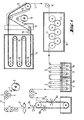
- the web 1 is unwound from a roll 2 and, after passing through drawing rollers 3 and Ualzen 4 controlling the web edges, is coated with viscose on both sides with a flat web caster 5.
- the liquid intended for precipitation and regeneration is sprayed onto the viscose-impregnated web 1 from nozzles 6a, 6b and 6c.
- the web width is kept constant during the regeneration by the needle chains 7 acting on both web edges, so that the shrinkage of the web in the transverse direction is prevented.
- the fiber-reinforced web made of cellulose hydrate gel runs through the tub 8a, which is only shown schematically and which is intended to represent several washing, desulfurization and softening baths.
- the web is coated with an aqueous solution of an anchoring agent.
- the web is predried in the drying section 10, in which the web runs over drying rollers 11.
- the web edges are then gripped by needle clip chains 12 and the web is guided through a tenter frame 13 and then through several floors of a drying field 14.
- tension Frame 13 the web is stretched in the transverse direction and dried while maintaining this web width.
- the dried web is wound up on the roller 15 or processed further with the formation of a hose. With 16 further rollers are usually used to deflect the web and / or the chain chains.
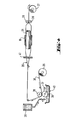
- the cellulose web 17 is guided through a ring segment 18 and formed into a tube, the two edges in the guide sleeve 19 approaching a butt joint 20.
- the ring segment 18 and the guide sleeve 19 serve to externally support the hose formation, while the cylindrical support element 21 present in the interior of the hose supports the hose from the inside.
- a film strip 22, consisting of the same material as the web, is unwound from the roll 23 and guided into the interior of the tube via an eyelet-shaped holder 24, the butt seam 20 being located approximately in the middle of the film strip 22.
- the aqueous solution of the adhesive is e.g. continuously applied to the film strip 22 with a doctor blade, nozzle or application roller, not shown.
- a layer of the aqueous adhesive solution is optionally also on the surface of the web forming the inside of the tube.
- the hose 25 is pulled off by the pair of rollers 26 and wound up with the roller 27.
- filling material can also be formed, for.
- sausage meat are in the tube that emerges from a filling pipe of a filling device to the extent that the tube is moved.
- the filling pipe preferably opens coaxially into the interior of the hose.
- the support element 21 is also possible to design the support element 21 as a filling tube.
- the hose is formed in one step with the production of the sausages. This process variant only works with such sausage types, e.g. Mettwurst that are not scalded immediately after filling.
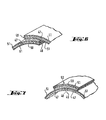
- the cellulose web 17 is pulled off the roll 28 and guided via guide rolls 29 and 30 to a shaping shoulder 31, where the tube is formed.
- the two edges of the web 17 are brought together to form a butt joint 20.
- the cylindrical support element 32 is located inside the hose 25 and has an outer diameter that corresponds to the inner diameter of the hose 25 formed.
- a film strip 22 made of the web material is unwound from the roll 23 and guided into the interior of the tube 25 via an eyelet-shaped guide element 24, the butt seam 20 being located in the middle of the film strip 22.
- the film strip 22 is coated with an aqueous adhesive solution. It has a width of 10 mm, for example, so that the edge zones of the web are each covered by about 5 mm.
- baffles 34 which lay the hose flat, and a pair of transport rollers 26 and is then wound up on the roll 27.
- guide rollers or other devices can be used, such as z. B. for gradual, wrinkle-free laying of extruded plastic hoses are common.
- a web 35 made of cellulose is fed from the supply roll 28 into an applicator which consists of an applicator roller 36, a doctor blade 37 and a counter roller 38.
- the application roller 36 produces a strip-shaped application of the adhesive solution on an edge zone of the web 35.
- the adhesive solution is conveyed from the storage container 39 into the tub 40.
- the web 35 is formed by means of a template 41, support tube 21 and contact sleeve 19 into a tube with an overlapped longitudinal seam, laid flat with the pair of take-off rollers 26 and transported to the winding device 27.
- FIG. 5 shows an alternative for the process sequence of tube forming and gluing of the overlapping edge areas.
- the web 42 drawn off from a winding roll 28 passes through a shaping template 41, shown in section in FIG. 5a, and an overlap help 44. Then, with the nozzle body 45, the adhesive solution 43 is fed into the overlap area.
- 53 designates a pump for conveying the adhesive solution 43
- 54 designates a storage container for the adhesive solution.
- the now tubular web 42 is glued, passing through the schematically illustrated support tube 21 with the contact sleeve 19.
- the tube formed is wound up on a roll, not shown, for storage.
- edges 48 and 49 of the web 47 are glued to one another in an overlapping manner, the adhesive layer 50 being located between the overlapping regions. 51 their anchoring layers on the surface of the web are designated.
- edges 48 and 49 of the web 47 abut one another and are connected to a film strip 52 covering both edges via an adhesive layer 50 and an anchoring layer 51.
Landscapes
- Engineering & Computer Science (AREA)
- Life Sciences & Earth Sciences (AREA)
- Wood Science & Technology (AREA)
- Zoology (AREA)
- Food Science & Technology (AREA)
- Processing Of Meat And Fish (AREA)
- Wrappers (AREA)
- Spinning Or Twisting Of Yarns (AREA)
- Soy Sauces And Products Related Thereto (AREA)
- Buckles (AREA)
- Laminated Bodies (AREA)
- Containers And Plastic Fillers For Packaging (AREA)
- Meat, Egg Or Seafood Products (AREA)
- Food Preservation Except Freezing, Refrigeration, And Drying (AREA)
Abstract
Description
- Für zu räuchernde Lebensmittel, insbesondere für zu räuchernde Wurstwaren geeignete Schlauchhülle, Verfahren zu ihrer Herstellung und ihre Verwendung
- Die Erfindung bezieht sich auf eine Schlauchhülle von der im Oberbegriff des Anspruchs 1 genannten Art, auf ein Verfahren zu ihrer Herstellung und ihre Verwendung.
- Schlauchhüllen dieser Art werden durch längsaxiales Falten einer Bahn zu einem Schlauch und Verkleben der sich überlappenden, längsaxial sich erstreckenden Randzonen hergestellt.
- Nach der US-PS 2,607,696 wird eine Randzone der Bahn aus regenerierter Cellulose mit einer sauren, wäßrigen Lösung eines teilweise polymerisierten, hitzehärtbaren Harzes versehen und anschließend die andere Randzone der Bahn unter Schlauchformung mit der Harzschicht zusammengepreßt. Danach werden die sich überlappenden Randzonen bei etwa 180 bis 220°C unter Einwirkung von Druck, wobei das Harz hitzegehärtet wird, miteinander verbunden. Als Harze werden beispielsweise Harnstoff-Formaldehyd- und Melamin-Formaldehyd-Harze genannt. Diese Schlauchhülle kann nach Angabe dieser Druckschrift auch als Wursthülle zur Herstellung hautloser Würstchen verwendet werden, wobei die Schlauchhülle nach dem Kochvorgang von der Wurst abgeschält wird.
- Dieses bekannte, etwa 30 Jahre alte Verfahren wird kaum mehr ausgeübt. Insbesondere ist die erhaltene überlappungsnaht nicht ausreichend fest. Wegen der relativ geringen Reißfestigkeit der Naht besteht z. B. die erhöhte Gefahr, daß daraus hergestellte Würste aufplatzen. Ferner kann die bekannte Schlauchhülle nur relativ umständlich hergestellt werden. Insbesondere führen die hohen Temperaturen während der Verklebung zu einem unerwünschten Wasserverlust sowie einer bleibenden Verschlechterung der physikalischen Eigenschaften des Bahnmaterials, so daß die erhaltene Schlauchhülle z. B. für das anschließende Raffen zur Herstellung von Raupen nicht geeignet ist. Andererseits ist aber nach dieser Druckschrift das Erhitzen auf Temperaturen von über 180°C nach dem Klebstoffantrag erforderlich, um überhaupt eine Verbindung zwischen den sich überlappenden Randzonen der Bahn zu erreichen. Ferner ist dieser Veröffentlichung kein Hinweis zu entnehmen, daß der Nahtbereich ausreichend gas- und rauchdurchlässig ist, so daß diese Schlauchhüllen auch für zu räuchernde Lebensmittel verwendet werden können.
- Wegen dieser Nachteile werden Schlauchüllen für Lebens- ' mittel, insbesondere künstliche Wursthüllen, inzwischen überwiegend aus nahtlosem Material hergestellt, obwohl bei diesen nahtlosen Schlauchhüllen auch einige Nachteile akzeptiert werden müssen; insbesondere ist dieses Verfahren sehr kostenintensiv.
- Nahtlose Schläuche aus faserverstärkter regenerierter Cellulose werden üblicherweise nach folgenden wesentlichen Verfahrensschritten hergestellt. Eine Bahn aus einem Faservliesstoff wird zu einem Schlauch geformt, wobei sich die Randzonen der Bahn überlappen und mit Viskose verklebt werden. Nach ein- oder beidseitiger Beschichtung des Schlauchs aus Faservliesstoff mit Viskose aus Ringschlitzdüsen wird die Viskose koaguliert, zu Cellulosehydrat-Gel regeneriert und getrocknet. Nahtlose Schläuche aus nicht-faserverstärkter regenerierter Cellulose werden durch Extrusion von Viskose durch eine ringförmige Düse in das Koagulationsbad hergestellt und analog in regenerierte Cellulose überführt. Der Schlauch wird während der Koagulation und Regenerierung durch das entstehende Gasgemisch und während des Trocknens durch ein eingebrachtes eingeschlossenes Luftvolumen abgestützt und gegebenenfalls zur Verbesserung der mechanischen Eigenschaften in Längs- und Querrichtung gestreckt.
- Nachteiligerweise treten beispielsweise an den Kanten des flachgelegten Schlauchs während der Regenerierung längsaxial im Kantenbereich sich erstreckende Schwächungszonen, sogenannte Spinnkanten, auf.
- Ferner zeigen auch die bei den nahtlosen Schläuchen üblichen Streckverfahren Nachteile. Sowohl der Innendruck der im Schlauch sich entwickelnden Prozeßgase als auch der Innendruck beim Trocknen kann nicht präzise genug gesteuert werden, so daß der Durchmesser und die Wandstärke der nahtlosen Schläuche, selbst unter Anwendung einer komplizierten und aufwendigen Verfahrenstechnik, innerhalb enger Grenzen nicht konstant gehalten werden kann. Ferner ist es von Nachteil, daß beim Strecken von Schläuchen mit einem Spreizgas das Verhältnis der in tangentialer und radialer Richtung wirksamen Streckkräfte festgelegt ist, so daß der nahtlose Schlauch auch aus diesem Grund bezüglich seiner mechanischen Eigenschaften, insbesondere bezüglich der Schrumpfeigenschaften und der Festigkeit in Längs- und Querrichtung, festgelegt ist.
- Ausgehend von dem aufgezeigten Stand der Technik ist es deshalb Aufgabe der Erfindung, eine gegebenenfalls faserverstärkte Schlauchhülle aus regenerierter Cellulose vorzuschlagen, die alle die genannten Nachteile der bekannten Schlauchhüllen nicht aufweist. Die Schlauchhülle muß optimale mechanische Eigenschaften, insbesondere Schrumpf- und Festigkeitswerte, besitzen. Insbesondere ihre Verklebungsnaht muß relativ hohen mechanischen und thermischen Belastungen, z. B. Dehnungsbelastungen und der Einwirkung von heißem Wasser, standhalten und den Geschmack und das Aussehen des Lebensmittels nicht beeinträchtigen. Sie soll auch mit üblichen Raffvorrichtungen zu Raupen gerafft werden können.
- Eine besonders wesentliche Aufgabe besteht darin, eine Hülle zu schaffen, die im Verklebungsbereich ausreichend gas- und rauchdurchlässig ist, bei gleichzeitig großer Reißfestigkeit. Eine solche Hülle ist für Nahrungsmittel, die geräuchert werden sollen, z. B. für spezielle Brühwürste oder Dauerwurstwaren, deren Hülle gegebenenfalls auch abschälbar sein muß, oder für andere Lebensmittel, z. B. für bestimmte Käsearten vorgesehen.
- Eine zusätzliche Aufgabe der vorliegenden Erfindung besteht darin, eine Schlauchhülle aus gegebenenfalls faserverstärkter regenerierter Cellulose vorzuschlagen, die auf einfachere Weise aus einer Bahn hergestellt werden kann, insbesondere bei normalen Raumtemperaturen und kurzen Verweilzeiten bis zum Trocknen des Klebstoffs.
- Eine Aufgabe der Erfindung besteht auch darin, eine gerade, im wesentlichen krümmungsfreie und faltenfreie Schlauchhülle mit einer Naht zu schaffen, die auch unter Einwirkung von Wasser und beim Schrumpfen ihre krümmungsfreie und faltenfreie Form auch im Nahtbereich beibehält, trotz der relativ großen Hüllendicke in diesem Bereich. Schließlich ist es auch Aufgabe der Erfindung, eine öffnungshilfe vorzusehen, die ein leichteres und hygienisches Entfernen der Hülle vom Inhalt gestattet, ohne daß Schwachstellen an der Schlauchhülle vorgesehen werden müssen.
- Diese Aufgabe wird überraschenderweise gelöst mit der im Anspruch 1 genannten Schlauchhülle. Die Ansprüche 2 bis 8 geben weitere Ausführungsformen der Schlauchhülle an. Die Aufgabe wird ferner gelöst durch ein Verfahren zur Herstellung der Schlauchhülle mit den im Anspruch 9 genannten Merkmalen. Die Ansprüche 10 bis 12 beschreiben weitere Ausbildungen des Verfahrens. Gegenstand der Erfindung ist außerdem die in den Ansprüchen 13 bis 15 angegebene Verwendung.
- Diese Hülle zeigt überraschenderweise den Vorteil, daß sie bei der Einwirkung von Wärme und Wasser, wie dies beispielsweise beim Brühen und anschließendem Abkühlen von Wursthüllen geschieht, ihre gerade, krümmungsfreie Form beibehält. Dies ist besonders überraschend und nicht vorhersehbar, denn es ist ansich zu erwarten, daß die Hülle bei Einwirkung von Wärme und Wasser, aufgrund der verschiedenen Wandstärken im Nahtbereich einerseits und im übrigen Bereich andererseits und der daraus zu erwartenden unterschiedlichen Werte für die Festigkeit, für das Wasseraufnahme- und Wasserrückhaltevermögen, sich krümmt oder ungleichmäßig ausdehnt oder schrumpft und sogar zum Platzen neigt.
- Die Bildung einer Schlauchhülle mit einer Naht oder mehreren längsaxial sich erstreckenden Nähten durch Verklebung der Randbereiche der längsaxial sich erstreckenden Randzonen ist an sich bekannt, wozu auf die eingangs zitierte US-Patentschrift verwiesen wird.
- Entsprechend der vorliegenden Erfindung wird ein um seine Längsachse gebogener, blatt- oder bahnförmiger rechteckiger Folienzuschnitt oder eine entsprechend gebogene z.B. endlose Folienbahn aus Cellulose gegebenenfalls mit einem Verankerungsmittel für den Klebstoff auf ihrer Oberfläche durch Überlappung und Verklebung der längsaxial sich erstreckenden Randbereiche mit einer Klebstoff enthaltenden Lösung oder Dispersion in eine Schlauchhülle mit einer längsaxial sich erstreckenden Verbindungsnaht übergeführt. Der Einfachheit halber wird im folgenden anstelle von "blatt- oder bahnförmigen Zuschnitten" und "endlosen Bahnen" nur von Bahnen gesprochen. Die Klebstoff enthaltende Schicht im überlappungsbereich wird in Form einer Lösung oder Dispersion auf die gegebenenfalls vorhandene Verankerungsschicht aufgebracht. Es ist auch möglich, die Randzonen in der Weise miteinander zu verbinden, daß die Ränder bündig, d. h. mit den Kanten zumindest im wesentlichen aneinanderstoßend einander genähert werden und dann mit einem Band, Film- bzw. Folienstreifen, im folgenden als Folienstreifen bezeichnet, der beide Randzonen überdeckt, miteinander verbunden werden. Der Folienstreifen befindet sich dann auf der Außenseite oder Innenseite der Schlauchhülle, oder es werden parallel zueinander verlaufende Folienstreifen verwendet, von denen sich dann einer auf der Innenseite und einer auf der Außenseite der Schlauchhülle befindet. Ein oder mehrere Folienstreifen können auch verwendet werden, wenn die Randzonen sich überlappen. Die Klebstoffschicht wird in Form einer Lösung oder Dispersion unmittelbar vor der Herstellung der Verbindungsnaht auf die Randzonen der Bahn, und/oder gegebenenfalls auf die Oberflächen des Folienstreifens aufgebracht, z. B. mit einer Düse oder einer Antragswalze.
- Der Folienstreifen hat zweckmäßigerweise eine Breite von 5 bis 15 % des Schlauchumfangs und besteht vorzugsweise aus dem gleichen Material wie die Schlauchhülle, d. h. aus rauchdurchlässiger, gegebenenfalls faserverstärkter Cellulose, wobei dessen Festigkeitswerte in Längs- und Querrichtung im gleichen Bereich wie beim Schlauchmaterial liegen. Sofern jedoch auf die krümmungsfreie Form der Schlauchhülle kein besonderer Wert gelegt wird, ist es auch möglich, einen perforierten, genadelten oder gelochten Folienstreifen aus Papier oder aus streckorientierter Kunststoffolie wie Polyester-, Vinylidenchlorid-Copolymerisat, Polyvinylchlorid- oder Polypropylen-Folie oder einen Folienverbund aus zwei oder mehr Folien, z. B. mit einer Aluminiumfolie, oder einen rauchdurchlässigen Vliesstoff, z. B. einen adhäsiv, mechanisch oder thermisch verfestigten Faservliesstoff aus wirr oder geordnet abgelegten Spinnfasern, Filamenten oder multiplen Filamentgarnen aus synthetischem oder nativem Material, oder eine rauchdurchlässige Schaumfolie mit offenporiger oder geschlossenporiger Schaumstruktur, z. B. aus Polyurethan oder Polystyrol, zu verwenden.
- Auch rauchdurchlässige mikroporöse Folien sind geeignet, worunter auch Membranen mit einem Porendurchmesser zu verstehen sind, wie sie beispielsweise Membranen besitzen, die bei der Reversosmose, Ultrafiltration, Dialyse oder Hämofiltration oder als Batterien- oder Brennstoffzellen-Diaphragmen eingesetzt werden.
- Ebenso sind Bänder aus engmaschigem Gewebe, Netzwerk oder Gitter, die z. B. aus Fäden in Kette und Schuß gewebt sind, als rauchdurchlässige Folienstreifen zur Verbindung der Randzonen geeignet. Es ist somit wesentlich, daß der Folienstreifen aufgrund seiner Struktur oder chemischen Zusammensetzung fähig ist, den Räucherrauch durch die Verbindungsnaht der Schlauchhülle durchtreten zu lassen. Vorzugsweise werden jedoch kompakte Folienstreifen aus rauchdurchlässigem Material, insbesondere der oben genannte Folienstreifen aus Cellulose, gegebenenfalls mit Faserverstärkung, verwendet, wobei dann eine zusätzliche rauchdurchlässige Struktur des Folienstreifens, z. B. in Form von Poren oder Lochungen, nicht erforderlich ist.
- Überraschenderweise läßt sich der Folienstreifen aus gegebenenfalls faserverstärkter Cellulose mit den für das Schlauchmaterial angegebenen mechanischen Eigenschaften auch als Aufreißband für den mit Füllgut gefüllten Schlauch, insbesondere für Wursthüllen, die vom Inhalt ohne großen Aufwand abgezogen werden sollen, verwenden. Hierzu werden z. B. nach dem Anschneiden der Wurst rechts und links unmittelbar neben dem Folienstreifen kleine Einschnitte in die Wursthülle vorgenommen, so daß der Folienstreifen und der mit ihm verklebte Hüllenteil eine Art Grifflasche bildet. Beim Anziehen dieser Grifflasche reißt die Wursthülle rechts und links neben dem Folienstreifen in längsaxialer Richtung ein.
- Die Formung der Bahn zu einem Schlauch erfolgt beispielsweise entweder auf einer genügend langen Wegstrecke, so daß keine Verzerrungen und Faltenbildung erfolgen, oder durch Umlenkung über ein schulterartiges Formwerkzeug. Wenn der Schlauch geformt ist, grenzen die beiden Seitenkanten der Bahn im wesentlichen abstandslos aneinander oder überlappen sich. Mittels am Schlauchumfang angreifender Transportelemente wird der Schlauch über die Oberfläche eines im Schlauchinneren angeordneten Stützkörpers bewegt. Der gegebenenfalls verwendete Folienstreifen wird vor dem Nahtschluß vorzugsweise mit seiner in Richtung zur inneren Oberfläche des Schlauches weisenden Klebstoffschicht so zwischen die Oberfläche des Stützkörpers und den aneinanderstoßenden Rändern der Bahn eingeführt, daß die durch die Ränder der Bahn gebildete Stoßnaht etwa die Mittellinie des Folienstreifens bildet, wobei der Folienstreifen beide Randzonen im wesentlichen gleich breit überdeckt. Die Verklebung kann durch Kontakt mit einer Walze erfolgen, wobei auf die Verklebungsstelle zusätzlich Druck ausgeübt werden kann, gegebenenfalls kann man auch geringfügig Wärme einwirken lassen, wobei die Verklebungsstelle möglichst unter 40°C gehalten wird. Von einer Druckanwendung und Wärmezufuhr wird jedoch gewöhnlich abgesehen, da sie zu einer unerwünschten Veränderung, insbesondere Versprödung und Austrocknung des Bahnmaterials führen kann. Überschüssige Klebstofflösung kann aus dem Nahtbereich beispielsweise durch eine Walze mit schwammartiger Oberfläche oder mit Abstreifern entfernt werden. Gewöhnlich ist allerdings das Wasseraufnahmevermögen (Quellwert) des Bahnmaterials ausreichend, um überschüssiges wäßriges Lösungs- oder Dispersionsmittel aufzunehmen. Bahnbewegung und Verklebung können taktweise oder kontinuierlich erfolgen. Es ist besonders überraschend und nicht vorhersehbar, daß die erfindungsgemäße Kombination aus Klebstoff und Bahnmaterial sowie gegebenenfalls Verankerungsmittel zu einer schnellen Trocknung der Klebstoffschicht vorzugsweise bereits bei Raumtemperatur führt. Unter Raumtemperatur sind Temperaturen zwischen etwa 15 und 30°C zu verstehen. Dieser Effekt hat den weiteren Vorteil, daß die gebildeten Schlauchhüllen bereits nach 1 bis 3 Sekunden nach der Nahtbildung bereits aufgewickelt werden können, ohne daß die Naht verrutscht. Nach einer Lagerzeit von etwa 1 bis 3 Tagen bei einer Temperatur bis zu 40°C, vorzugsweise bei Raumtemperatur ist der Klebstoff vollständig ausgehärtet, und die Naht kann dann größeren Belastungen, wie sie z.B. bei der Wurstherstellung auftreten, ausgesetzt werden.
- Als Basismaterial für die Herstellung der Schlauchhülle dienen Bahnen aus Cellulose, d. h. aus Zellglas, regenerierter Cellulose oder Cellulosehydrat, die gegebenenfalls mit einer Fasereinlage verstärkt sind, wie sie zur Verpackung von Lebensmitteln, insbesondere als Wursthüllenmaterial, üblich sind. So können Cellulosebahnen, die nach dem Viskoseverfahren (US-PS 3,884,270), durch Denitrierung von Cellulosenitrat oder Hydrolyse anderer Celluloseester, z. B. Deacetylierung von Celluloseacetat mit wäßriger oder alkoholischer Alkalilösung (US-PS 3,546,209) hergestellt wurden, eingesetzt werden. Im folgenden wird der Einfachheit halber nur von Cellulosebahnen gesprochen. Die Herstellung von Cellulosebahnen ist bekannt und soll im folgenden nur beispielhaft beschrieben werden.
- Die Faserverstärkung ist insbesondere bahnförmig, z.B. eine Papierbahn, und besteht gewöhnlich aus Fasern wie sie bei der Herstellung von Papier oder Reispapier verwendet werden, oder aus nativen Fasern wie Hanf- oder Flachsfasern, oder synthetischen Fasern wie Polyamid-, Polyester- oder Polyacrylnitril-Fasern. Faserverstärkung ist z. B. ein textiles Gebilde wie ein Faservliesstoff.
- Die Faserbahn wird vorzugsweise beidseitig mit einer Viskoselösung behandelt, insbesondere in eine Viskoselösung getaucht oder mit einer Viskoselösung beschichtet, und anschließend in regenerierte Cellulose übergeführt. Es ist auch möglich, in die Viskose Verstärkungsfasern einzuarbeiten. Die Fasern enthaltende Viskose wird dann durch eine Düse in das Koagulationsbad ausgepreßt unter Bildung einer Gelbahn. Wird nicht-faserverstärkte regenerierte Cellulose als Bahnmaterial eingesetzt, wird die Viskose direkt durch eine Düse in das Koagulationsbad ausgepreßt.
- Die Viskoselösung ist bekanntlich eine alkalische Lösung von Natrium-Cellulosexanthogenat. Nach der Reifung wird die Viskose auf die Faserbahn aufgebracht und/oder direkt versponnen, d. h. koaguliert. Das Spinnbad enthält beispielsweise Schwefelsäure, ferner Natriumsulfat und/oder Ammoniumsulfat.
- Nach der Koagulation wird das aus Viskose-Gel bestehende gegebenenfalls faserverstärkte bahnförmige Produkt in saurem Medium zu Cellulosehydrat-Gel regeneriert, zur Entfernung von Säure und Salzen mit Wasser gewaschen, entschwefelt, gegebenenfalls durch ein Bleichbad und schließlich durch ein Weichmacherbad mit z. B. wäßriger 5 bis 20%iger Glycerinlösung geführt.
- Im vorliegenden Fall wird die Bahn aus Cellulosehydrat-Gel vor dem Trocknen gegebenenfalls mit einer das Verankerungsmittel enthaltenden Lösung oder Dispersion behandelt und die Trocknung bei Temperaturen zwischen 65 bis 140, insbesondere 80 bis 110°C durchgeführt. Die erhaltene Bahn aus regenerierter Cellulose wird durch Konditionierung auf einen Wassergehalt von etwa 4 bis 15, insbesondere 7 bis 10, Gew.-% eingestellt. Die Cellulosehydratbahnen zeigen nach der Trocknung einen Weichmachergehalt von etwa 7 bis 25 Gew.-% und eine Dicke von etwa 20 bis 50, vorzugsweise 25 bis 30 /um entsprechend einem Flächengewicht von 30 bis 75 gjm2, die Dicke der faserverstärkten Cellulosehydratbahnen liegt bei etwa 50 bis 200 /um, entsprechend einem Flächengewicht von 50 bis 250 g/m2.
- In besonders bevorzugter Ausführungsform zeigt die Cellulosebahn hohe Werte für die Reißfestigkeit und Reißdehnung, wie im folgenden noch angegeben wird. Zur Herstellung einer faserverstärkten Cellulosebahn mit diesen Werten wird beispielsweise die Faserbahn, insbesondere während die Viskose regeneriert wird und anschließend bis zum abschließenden Trockenprozeß, gegebenenfalls aber auch bereits während der Beschichtung mit Viskose, an den Rändern festgehalten, so daß ein Schrumpfen der Bahn verhindert wird. Das Festhalten der Faserbahn geschieht beispielsweise mit Nadelwalzen, Nadelbändern oder Nadelketten, die ein- oder mehrreihig ausgebildet sind. Diese ergreifen die Faserbahn an den beiden Rändern, so daß die Breite der Bahn während des gesamten Prozesses konstant gehalten wird. Die Zahl der Einstiche in den Randzonen ist möglichst gering zu halten, damit die Festigkeit der Bahn möglichst wenig verringert wird. Andererseits muß eine ausreichende Anzahl der Einstiche vorhanden sein, um eine ausreichende Schrumpfverhinderung zu gewährleisten. Auch Greifkluppenketten oder eine schnurförmige Führung aus säure- und alkalibeständigem Material, z. B. aus entsprechendem Kunststoff, können zum Festhalten der Ränder der Faserbahn eingesetzt werden. Bei der schnurförmigen Führung wird die Faserbahn an beiden Rändern mit jeweils einer Schnur festgehalten, wobei der Rand um diese Schnur gelegt und durch Kleben oder Schmelzen unter Hitzeeinwirkung oder mit einem Klebstoff befestigt ist. Diese Schnur läuft z. B. in einer Führungsschiene. Auch können sogenannte Breitzugwalzen zur Breithaltung der Bahn angewendet werden.
- Zur Herstellung einer faserverstärkten Cellulosebahn mit hoher Reißfestigkeit wird die Bahn aus dem Cellulosehydrat-Gel beispielsweise während des Trockenprozesses am Schrumpfen gehindert und dabei zusätzlich in Querrichtung vorzugsweise um etwa 5 bis 15, insbesondere 7 bis 12 % gestreckt, bezogen auf die ursprüngliche Breite der Faserbahn. Sofern während der Regenerierung ein geringer Schrumpf der Bahn in Querrichtung eingetreten ist, wird das Ausmaß der Querstreckung während des Trocknens entsprechend erhöht. Vor diesem Strecken wird gegebenenfalls eine Vortrocknung durchgeführt, bei der die Hauptmenge an Wasser entfernt wird, bis die Bahn aus Cellulosehydrat-Gel einen Wassergehalt von etwa 80 bis 150 Gew.-% aufweist.
- In dieser bevorzugten Ausführungsform erfolgt keine weitergehende Streckung quer zur Bahnrichtung, ebenso unterbleibt eine eigene Längsstreckungsstufe. Der während des Prozesses, insbesondere beim Koagulieren, Regenerieren und Trocknen, auftretende Schrumpf der Bahn in Längsrichtung wird aufgehoben vor allem durch die auf die Bahn in Längsrichtung ausgeübte Zugkraft, die benötigt wird, um die Bahn durch die einzelnen Behandlungsstufen durchzuziehen.
- Die infolge der schrumpfverhindernden Maßnahmen und der Querverstreckung während des Trockenprozesses erreichten Festigkeitswerte der Bahn in Längs- und Querrichtung sind besonders vorteilhaft für die Herstellung der faserverstärkten Schlauchhülle mit einer Längsnaht und für den aus dem gleichen Material bestehenden Folienstreifen zur Verbindung der Randzonen der Bahn.
- Cellulosebahnen ohne Faserverstärkung mit hoher Reißfestigkeit und Reißdehnung erhält man durch Längs-und/oder Querstreckung vor und/oder während der Trockenstufe. Verfahren dieser Art sind bekannt.
- Die Messung der Reißfestigkeit und der Reißdehnung erfolgt mit einer elektronischen Reißmaschine nach DIN 53 455. Unter Reißfestigkeit ist die Widerstandsfähigkeit des Probekörpers gegenüber der Zugbeanspruchung im Augenblick des Reißens zu verstehen. Sie wird gemessen als Reißkraft (N), bezogen auf den Querschnitt (mm2). Die Reißdehnung ist die prozentuale Verlängerung des Probekörpers gegenüber der Ausgangslänge bei Belastung im Augenblick des Reißens und wird in Prozent angegeben.
- Im Falle der faserverstärkten Cellulosebahn hat der Probekörper im konditionierten Zustand eine Länge von 100 mm, Breite von 15 mm und Dicke von 100 bis 110 jum. Der Probekörper aus nicht faserverstärkter Cellulose hat eine Länge von 100 mm, Breite von 15 mm und eine Dicke von ca. 25 bis 30 µm.
- Für einen nassen, d.h. in Wasser von ca. 20°C 30 Minuten lang gewässerten Probekörper aus dem nicht faserverstärkten Bahnmaterial liegt die Reißfestigkeit in Längsrichtung bei 15 bis 30, insbesondere 20 bis 25 N/mm 2 und die Reißdehnung bei 40 bis 60, insbesondere 50 bis 55 %. Die Reißfestigkeit in Querrichtung ist gleich vorzugsweise aber größer im Verhältnis zur Reißfestigkeit in Längsrichtung und zeigt Werte 15 bis 30, insbesondere von 20 bis 30 N/mm2. Die Reißdehnung in Querrichtung liegt im Wertebereich von 100 bis 160, insbesondere 145 bis 155 %.
- Bei einem getrockneten Probekörper aus dem nicht faserverstärktem Bahnmaterial, der eine Restfeuchte von 8 bis 10 Gew.-% Wasser und 15 bis 21 Gew.-% Glycerin enthält, liegt die Reißfestigkeit in Längsrichtung bei 70 bis 140, insbesondere 110 bis 120 N/mm2 und die Reißdehnung bei 10 bis 28, insbesondere 16 bis 22 %. Die Reißfestigkeit in Querrichtung zeigt Werte von 70 bis 90, insbesondere 75 bis 85 N/mm2. Die Reißdehnung des getrockneten Probekörpers in Querrichtung liegt bei 50 bis 80, insbesondere 60 bis 65 %.
- Für einen nassen, d.h. in Wasser von ca. 20°C 30 Minuten lang gewässerten Probekörper aus dem faserverstärkten Bahnmaterial liegt die Reißfestigkeit in Längsrichtung bei 15 bis 30, insbesondere 20 bis 30 N/mm2 und die Reißdehnung bei 30 bis 50, insbesondere 30 bis 40 %. Die Reißfestigkeit in Querrichtung ist gleich vorzugsweise aber größer im Verhältnis zur Reißfestigkeit in Längsrichtung und zeigt Werte zwischen 15 bis 35, insbesondere von 25 bis 35 N/mm2. Die Reißdehnung in Querrichtung liegt im gleichen Wertebereich wie in Längsrichtung, d.h. 30 bis 50, insbesondere 30 bis 40 %.
- Bei einem getrockneten Probekörper aus dem faserverstärkten Bahnmaterial, der eine Restfeuchte von 8 bis 10 Gew.-% Wasser und 20 bis 21 Gew.-% Glycerin enthält, liegt die Reißfestigkeit in Längsrichtung bei 50 bis 70, insbesondere 55 bis 65 N/mm2 und die Reißdehnung bei 10 bis 22, insbesondere 12 bis 15 %. Die Reißfestigkeit in Querrichtung ist gleich groß, vorzugsweise aber größer im Verhältnis zur Reißfestigkeit in Längsrichtung und zeigt Werte zwischen 50 bis 75, insbesondere 65 bis 75 N/mm2. Die Reißdehnung des getrockneten Probekörpers liegt bei 8 bis 19, insbesondere 8 bis 12 %.
- Für die Verwendung des Cellulosematerials als Basismaterial für künstliche Wursthüllen sind die in Querrichtung gemessenen Werte von besonderer Bedeutung, da die vom Füllgut ausgehenden Kräfte sich in Querrichtung erstrecken.
- Unter Haftvermittler in bezug auf Klebstoffe sind bekanntlich Stoffe oder Stoffgemische zu verstehen, die vor dem Klebstoffauftrag auf eine oder beide Klebflächen aufgebracht werden, um die Haftung zwischen Klebstoff und Klebflächen zu verbessern. Im vorliegenden Fall soll der gegebenenfalls verwendete Haftvermittler die Klebstoffschicht auf der Bahn und/oder Folienstreifen, insbesondere wenn diese aus faserverstärktem Material bestehen, naßfest verankern. Bei nicht faserverstärktem Material für die Bahn und Folienstreifen wird vorzugsweise kein Haftvermittler eingesetzt. Der Haftvermittler wird im folgenden als haftvermittelndes Harz oder Verankerungsmittel bezeichnet. Das Verankerungsmittel befindet sich zwischen der Klebstoffschicht und der Bahnoberfläche bzw. zwischen der Klebstoffschicht und der Oberfläche des Folienstreifens und ist vorzugsweise ein wasserunlösliches hitzegehärtetes, kationisches Harz. Polyurethanharze, Nitrocellulose und andere als wasserunlösliche Verankerungsmittel bekannte Verbindungen können ebenfalls eingesetzt werden.
- Obwohl das Verankerungsmittel im Prinzip nur im Bereich der zu verklebenden Flächen der endlosen Bahn vorhanden sein müßte, ist es aus technischen Gründen zweckmäßig, eine Oberfläche, für bestimmte Anwendungen oder überlappende Klebungen auch beide Oberflächen, der Bahn vollflächig mit einer oder zwei verschiedenen haftvermittelnden Harzschichten zu versehen.
- Zusätzlich kann die Bahn auf der die spätere Innenseite der Schlauchhülle bildenden Oberfläche ein übliches Mittel zur Verbesserung der Schälbarkeit der Schlauchhülle aufweisen. Solche Schlauchhüllen werden zur Herstellung von hautlosen Würstchen verwendet. Die Schlauchhülle wird von der Wurst von Hand oder mit einer Abschälmaschine abgelöst, nachdem sich eine Eigenhaut des Würstchens gebildet hat. Zu diesen Mitteln zählen z.B. wasserlösliche Proteine, wie Gelatin, Eialbumin und Glutenin, insbesondere Cellulosederivate, wie Celluloseether und Celluloseester, Silikon- und Mineralöle und Fettsäureglyceride. Eine geeignete Innenbeschichtung umfaßt beispielsweise einen Celluloseether, ein kationisches, hitzehärtbares Harz und Mineralöle (US-PS 4,207,353), ein natürliches Öl, ein Triglyceridgemisch, eine chemisch modifizierte Stärke, einen teilverseiften Polyvinylalkohol und mikrokristalline Cellulose (US-PS 4,248,900), ein emulgiertes Mineralöl und acetyliertes Fettsäuremonoglycerid (GB-PS 1,381,231), Celluloseether, ein tierisches oder planzliches öl, Mineralöl, Siliconöl und ein wasserlösliches Addukt eines Alkylenoxids mit einem Fettsäureteilester (US-PS 3,898,348). Diese die leichte Ablösbarkeit der Hülle fördernde Beschichtungszusammensetzung wird durch übliches Einfüllen einer Beschichtungsflüssigkeit in die Schlauchhülle oder durch Aufsprühen in die Schlauchhülle aufgebracht. Im letzten Fall wird z.B. die wäßrige Überzugszusammensetzung beim Raffprozess durch den hohlen Dorn auf die innere Oberfläche der Schlauchhülle aufgesprüht. Sofern die überzugsmischung auf die Bahn noch vor der Schlauchbildung aufgebracht werden soll, müssen die zu verklebenden Randbereiche der Bahn frei von diesem Überzug bleiben. Hierzu erfolgt der Auftrag der Überzugslösung mit einer entsprechend breiten Auftragsvorrichtung, z.B. mit einer Walze unter Freilassung der Randzonen oder vollflächig, wobei dann die Randzonen, beispielsweise mit einem Rakel, von der Überzugslösung befreit werden.
- Vorzugsweise wird die Bahn aus koaguliertem, aber noch nicht getrockneten Cellulosehydrat-Gel mit einer Lösung oder Dispersion überzogen, die bis zu 10, insbesondere etwa 0,1 bis 0,5 Gew.-% eines Verankerungsmittels, insbesondere eines dispergierbaren, wärmehärtbaren kationischen Harzes enthält. Bei faserverstärkten Bahnen liegt die bevorzugte Konzentration bei 1 bis 5 Gew.-%. Während der üblichen Trocknung der Cellulosebahn bei Temperaturen von 65 bis 140°C, insbesondere 80 bis 110°C, bei der der Feuchtigkeitsgehalt der Cellulosebahn auf Werte von 4 bis 15, insbesondere 7 bis 10 Gew.-% herabgesetzt wird, wird das kationische Harz zumindest teilpolymerisiert und geht dabei in seine wasserunlösliche hitzegehärtete Form über. Das Harz ist nach der Wärmehärtung dauerhaft mit der Oberfläche der Bahn verbunden. Die Verfahrensbedingungen werden vorteilhafterweise so gewählt, daß die gebildete Schichtdicke des Verankerungsmittels nach dem Trocknen bei faserverstärkter Cellulosebahn einem Flächengewicht von etwa 0,3 bis 1,5 g/m2 und bei nicht-faserverstärkter Cellulosebahn einem niedrigeren Flächengewicht von etwa 0,01 bis 0,1 g/m 2 entspricht, das für diese Bahnen ausreichend ist.
- Der Auftrag des Verankerungsmittels wird vor, gleichzeitig mit oder nach der Behandlung der Bahn aus Cellulosehydrat-Gel mit einem üblichen Weichmacher, z. B. einem Polyol wie Glycerin, vorgenommen. Man kann das Verankerungsmittel zwar auch erst nach dem Trocknen der Cellulosebahn aufbringen, was jedoch den Nachteil zeigt, daß eine zusätzliche Trockenstufe zur Entfernung des Lösungs- bzw. Dispergiermittels und gegebenenfalls zur Härtung des kationischen Harzes erforderlich ist.
- Als geeignete Lösungsmittel für das Verankerungsmittel, insbesondere für das hitzehärtbare Harz, und auch für den Klebstoff, können niedrige aliphatische oder aromatische Kohlenwasserstoffe, niedrige Alkohole oder Ester oder Mischungen dieser Lösungsmittel eingesetzt werden. Vorteilhaft wird jedoch eine wäßrige Lösung oder Dispersion verwendet.
- Falls für bestimmte Anwendungen gewünscht, wird zusammen mit dem Verankerungsmittel ein zusätzliches wasserabstoßendes Harz wie Paraffin, Montanwachs, Carnaubawachs und/oder geeignete Verdickungsmittel, wie Celluloseether oder Stärke, auf die Bahn aufgetragen.
- Der Überzug aus dem Verankerungsmittel enthält beispielsweise einen gegebenenfalls transparenten, organischen Farbstoff, der der Schlauchhülle eine entsprechende Farbe verleiht.
- Die Bahn kann nach dem Aufbringen des Verankerungsmittels und nach dem Trocknen sowie vor dem Verkleben mit Beschriftungen oder dekorativen Mustern bedruckt werden, wobei neben dem bei der Herstellung von nahtlosen Wursthüllen üblichen Druckverfahren noch weitere Druckmöglichkeiten sich anbieten, da im vorliegenden Fall nicht der Schlauch, sondern die flache Bahn vor der Schlauchformung bedruckt werden kann.
- Neben dem Verankerungsmittel enthält die Schicht auf der Schlauchhülle im Bereich der Verbindungsnaht gegebenenfalls Pigmente, einen Weichmacher für das Verankerungsmittel und/oder ein Härtungsmittel für das Verankerungsmittel. Das Verankerungsmittel und der Weichmacher werden in einem geeigneten flüssigen Lösungs- bzw. Dispergiermittel-aufgenommen, das vorteilhafterweise bei einer Temperatur verdampft werden kann, bei der gleichzeitig zumindest eine Vorhärtung des Harzes eintreten kann.
- Als Beispiele für das als Verankerungsmittel bevorzugte hitzehärtbare kationische Harz sind zu nennen: Harnstoff-Formaldehyd-, Melamin-Formaldehyd- und Phenol-FormaldehydHarze. Als bevorzugter Weichmacher für diese hitzehärtbaren Harze dienen weiche, nicht-härtbare Harze vom Alkyd-Typ oder auch Dibutylphthalat, Trikresylphosphate oder Dibutylsebacat.
- Als Härter für das hitzehärtbare Harz kann beispielsweise Ammoniumthiocyanat, Toluolsulfonsäure, Maleinsäure oder Milchsäure eingesetzt werden. Diese Verbindungen verhalten sich wie Katalysatoren bei der Härtung der hitzehärtbaren Harze. In bevorzugter Ausführung erfolgt die Härtung in alkalischer wäßriger Lösung.
- Besonders bevorzugte hitzehärtbare Harze sind in der US-PS 3,378,379 beschrieben. Es sind Kondensationsprodukte von Polyamidpolyamin oder aliphatischen Polyaminen oder von Polyamiden mit bifunktionellen Halohydrinen oder deren Derivaten wie z. B. Epichlorhydrin, wie sie auch aus den US-PSen 2,573,956 und 2,926,154 und GB-PSen 865,727 und 908,205 bekannt sind. Ein besonders geeignetes Harz ist beispielsweise das Reaktionsprodukt aus aliphatischem 2,6-Polyamid, Diethylentriamin und Epichlorhydrin.
- Es ist bekannt, daß die Räucherfärbung durch Reaktion von Phenolen und Carboxylverbindungen mit Proteinen zustande kommt, wobei ihre Intensität und Haltbarkeit besonders vom Wassergehalt der Hülle, vom pH-Wert des Substrats sowie von Dauer und Höhe der Erhitzung abhängen. Die Hauptbestandteil im Rauch darstellenden flüchtigen Carbonsäuren, die für die Färbung besonders maßgeblich sind, müssen deshalb die Schlauchhülle und ihre Überzugsschichten passieren können.
- Wie bereits oben beschrieben, hat sich überraschenderweise gezeigt, daß das Verankerungsmittel aus dem hitzegehärteten kationischen Harz eine ausreichend rauchdurchlässige Schicht bildet. Diese Eigenschaft ist von besonderer Bedeutung, da die Schlauchhülle für zu räuchernde Lebensmittel, z. B. als künstliche Wursthaut für zu räuchernde Brühwürste, vorgesehen ist. Bei zu geringer Rauchdurchlässigkeit würde sich der typische rötlich-braune Farbton des geräucherten Wurstbräts nicht einstellen.
- Sofern jedoch die Schicht aus dem Verankerungsmittel aus einem nicht ausreichend rauchdurchlässigen Material besteht, so muß diese Schicht mit einer rauchdurchlässigen Struktur versehen werden.
- Hierzu wird das Verankerungsmittel beispielsweise nicht vollflächig auf die Bahn bzw. den Folienstreifen aufgebracht, sondern mit Unterbrechungen oder Ausnehmungen. Das Verankerungsmittel kann auch in Streifen, spiralförmig oder punktförmig gerastert aufgetragen werden, z. B. mit einer profilierten Walze, die dieser Schicht eine Struktur verleiht. Die Auftragswalze kann auch eine Textilstruktur oder eine Bürstenoberfläche aufweisen. Es ist auch möglich das Verankerungsmittel mit mehreren Düsen, die sich quer zur Bahn hin- und herbewegen, auf die bewegte Bahn auszupressen, wobei ein wellenförmiges Streifenmuster dieser Schicht erzeugt wird.
- Besonders vorteilhaft ist der Antrag einer das Verankerungsmittel enthaltenden Dispersion oder Lösung in einer regelmäßigen Punkt- oder Linienrasterstruktur, im Rotationssiebdruck oder Tiefdruck, der mit einer Geschwindigkeit bis zu etwa 100 m/Min. durchgeführt werden kann. Geeignete Durchlässe lassen sich auch auf chemischem Wege, z. B. durch partielles Ablösen des Verankerungsmittels vor dem Bilden der Klebenaht, erzeugen.
- Es kann ferner eine extrahierbare pulverförmige Substanz, beispielsweise Stärke, Polystyrol, Zucker oder ein Salz in die Schicht des Verankerungsmittels eingearbeitet werden, welche nach dem Auftragen des Verankerungsmittels und nach dem Entfernen des Dispersions- oder Lösungsmittels herausgelöst wird. Es ist auch möglich, dem Verankerungsmittel einen rauchdurchlässigen Zusatzstoff beizumischen, z. B. eine poröse Substanz oder organische Pigmente mit hoher Rauch- bzw. Gasdurchlässigkeit. Auch mit dem Zusatz von Gasen oder in der Hitze gasbildender Mittel in Form kleiner Blasen, die gegebenenfalls in der Hitze ausgedehnt werden, läßt sich die Gas- und Rauchdurchlässigkeit verbessern, wobei diese Schicht z. B. aufgesprüht wird.
- Wie sich überraschenderweise gezeigt hat, sind die beschriebenen Ausführungsformen der Schlauchhülle mit guter Rauchdurchlässigkeit der Schicht aus Verankerungsmittel ausreichend stabil und mechanisch und thermisch belastbar.
- Der nach der Erfindung vorgesehene Klebstoff ist ein kationisches Harz, das zunächst in wasserlöslicher Form in einer Lösung oder Dispersion, zweckmäßigerweise in einer Naßschichtdicke im Bereich von etwa 2 bis 20 µm, insbesondere 3 bis 10 /um, auf die miteinander zu verbindenden Randzonen der Cellulosebahn unmittelbar vor oder während der Schlauchformung aufgebracht wird. Wird ein Folienstreifen zur Verbindung der Randzonen der Cellulosebahn verwendet, so wird die Lösung oder Dispersion auf den Folienstreifen und/oder auf die Randzonen der Cellulosebahn aufgebracht. Der Klebstoffauftrag auf den Folienstreifen erfolgt beidseitig, wenn der Folienstreifen in der überlappung zwischen den Randzonen der Cellulosebahn angeordnet wird.
- Es wird ein organisches Lösungs- bzw. Dispersionsmittel oder ein Gemisch für den Klebstoff verwendet, vorzugsweise wird der Klebstoff in 5 bis 20 gew.-%iger, insbesondere 10 bis 15 gew.-%iger wäßriger Lösung aufgebracht. Der Einfachheit halber wird im folgenden nur der Ausdruck "Klebstofflösung" gebraucht.
- Die Klebstofflösung kann einen Farbstoff enthalten, wie z.B. einen Pigmentfarbstoff ( ® Novofil, Herst. Hoechst) sowie gegebenenfalls ein Polyol wie Glycerin und/oder ein Dispergiermittel für den Farbstoff. Die farblich gekennzeichnete Nahtzone dient beispielsweise zur Identifizierung des Kalibers der Schlauchhülle bei der Weiterverarbeitung.
- In bevorzugter Ausführung erfolgt die Härtung der Harze im alkalischen Bereich, z. B. durch Zusatz von konzentrierter Ammoniaklösung, und bei Raumtemperatur.
- Die Herstellung der als Klebstoff geeigneten kationischen Harze ist in der US-PS 3,378,379 beschrieben. Die Klebstoffe sind Kondensationsprodukte von aliphatischen Polyaminen oder von Polyamiden, insbesondere von Polyamidpolyamin mit bifunktionellen Halohydrinen oder deren Derivaten wie z.B. Epichlorhydrin, wie sie beispielsweise auch in den US-PSen 2,926,154 und 2,573,956 oder in den GB-PSen 865,727 und 908,205 beschrieben sind. Ein besonders geeignetes Harz ist das Reaktionsprodukt aus aliphatischem 2,6-Polyamid, Diethylentriamin und Epichlorhydrin.
- Als Polyamine kommen einfache Alkylendiamine in Betracht oder Polyalkylenpolyamine wie beispielsweise Diethylentriamin, Triethylentetramin, Tetraethylenpentamin und die entsprechenden Polypropylenpolyamine, und Polybutylenpolyamine wie Dibutylentriamin. Die Polyamine werden zur Herstellung der entsprechenden Chlorhydrinharze mit mehr als einem Mol Epichlorhydrin je Mol Polyamin umgesetzt. Im allgemeinen werden von 1,5 bis 4,0 Mol Epichlorhydrin, meist 2 bis 3 Mol angewendet. Die Umsetzung erfolgt in wäßriger Lösung, bei mäßig erhöhter Temperatur (etwa 50°C), bis der gewünschte Viskositätsgrad erreicht ist. Vorzugsweise verwendet man Umsetzungsprodukte von Epichlorhydrin mit Dipropylentriamin oder mit Bis(3-Aminopro- pyl)methylamin, wobei man 2,8 bis 3,8 Mol Epichlorhydrin mit 1 Mol Polyamin umsetzt.
- Die Polyamid-Polyamine sind Kondensationsprodukte einer gesättigten, aliphatischen, zweibasischen Säure, die 3 bis 8 Kohlenstoffatome im Molekül aufweist mit einem der oben genannten Polyamine, das mindestens eine sekundäre und zwei primäre Amingruppen aufweist, wie beispielsweise die oben genannten Polyalkylenpolyamine. Es können auch Gemische dieser zweibasischen Säuren verwendet werden.
- Die Gesamtbreite des Auftrags der Klebstofflösung hängt ab von den gewünschten Festigkeitswerten und dem Schlauchhüllenumfang sowie von der Naßschichtdicke der aufgebrachten Klebstofflösung. Gewöhnlich wird die Gesamtbreite des Klebstoffauftrags zwischen etwa 1 bis 15, insbesondere 2 bis 3 mm liegen und beträgt nur wenige Prozent des späteren Schlauchhüllenumfangs. Bei Verwendung eines Folienstreifens zur überlappenden Verbindung einer aus den Randzonen gebildeten Stoßiiaht ist ein entsprechend doppelt so breiter Auftrag der Klebstofflösung erforderlich.
- Es ist selbstverständlich, daß im Gegensatz zu der gegebenenfalls durchgeführten Beschichtung der Bahn mit dem Verankerungsmittel der Auftrag der Klebstofflösung nicht über die gesamte Fläche der Bahn erfolgen kann, sondern nur im gewünschten Verklebungsbereich, d.h. entlang der beiden längsaxial sich erstreckenden Ränder und/oder auf der Oberfläche des Folienstreifens.
- Die mit der Klebstofflösung zu versehende Oberfläche der Cellulosebahn befindet sich beim Auftrag der Klebstofflösung im getrockneten oder im wieder angefeuchteten Zustand und weist gegebenenfalls bereits die oben beschriebene Schicht eines Verankerungsmittels auf.
- Nach dem Auftrag der Klebstofflösung, z. B. mit Walzen oder Sprühdüsen, wird die Verbindungsnaht durch Überlappen der Randzonen der Cellulosebahn bzw. durch Überlappen des Folienstreifens mit den Randzonen der Cellulosebahn hergestellt. Das Lösungs- bzw. Dispersionsmittel kann durch vorsichtiges Erwärmen mit Heißluft oder Infrarotstrahlern entfernt werden; das Erwärmen wird jedoch zweckmäßigerweise nicht angewendet, da es zu einer Versprödung des Cellulosematerials führen kann. Vorzugsweise erfolgt die Entfernung des Lösungs- bzw. Dispersionsmittels und auch die Härtung des Harzes während der anschließenden Lagerung bei Raumtemperatur über einen Zeitraum von etwa 1 bis 3 Tagen. Durch die während der Lagerung erfolgende Härtung des den Klebstoff bildenden Harzes verbinden sich die überlappenden Randzonen der Cellulosebahn miteinander bzw. der Folienstreifen mit den Randzonen. Eine Schichtdicke für den Klebstoff entsprechend einem Flächengewicht im Bereich von 0,2 bis 10 g/m ist im allgemeinen ausreichend. Die übliche Dicke der Klebstoffschicht entspricht einem Flächengewicht von etwa 0,3 bis 3 g/m2 bei einer Gesamtbreite der Klebstoffschicht von etwa 1 bis 15 mm. Nach der Lagerung hat die Schlauchhülle einen Feuchtigkeitsgehalt von 4 bis 15, insbesondere 7 bis 10 Gew.-%.
- Es ist an sich überraschend, daß während des Überlappens der Randzonen miteinander oder mit dem Folienstreifen kein Druck oder Hitze auf die Nahtstelle ausgeübt werden muß. Die Kombination aus Klebstoff und Bahnmaterial sowie gegebenenfalls Verankerungsmaterial ermöglicht eine äußerst schnelle Haftung im Klebebereich, so daß der gebildete Schlauch bereits nach 1 bis 3 sec nach der Überlappung aufgewickelt werden kann.
- Die Klebstoffschicht und/oder die Verankerungsmittelschicht können noch weitere Zusätze enthalten, z.B. Mittel, um diese Schicht oder die Schlauchhülle vor dem Befall durch Mikroorganismen zu schützen, Netzmittel, Weichmacher wie Glycerin, Füllstoffe wie Kaolin, Glaskugeln, Kreide, Quarzmehl, Mikrodolomit, Schwerspat, feinkörnigen Sand, Zinkoxid und Pigmente sowie organische und anorganische Farbstoffe z.B. in Pulver- oder Schuppenform.
- Ferner zeigt die Schlauchhülle den Vorteil, daß der Klebstoff gegebenenfalls in Kombination mit einem der obengenannten Verankerungsmittel beim Verkleben von Bahnen unter Ausbildung von Schlauchhüllen eine ausreichend feste Naht bildet. Besonders bei der Herstellung von Würsten, bei der die Naht beim Brühen der Wurst längere Zeit heißem Wasser ausgesetzt ist, sowie beim Raffen, Füllen, Abdrehen, Abbinden, Klippen und dergleichen, wenn die Naht hoher mechanischer Belastung und Spannungen standhalten muß und Dimensionsänderungen eintreten, hat sich gezeigt, daß diese Kombination aus Cellulosebahn, und Klebstoff sowie gegebenenfalls Verankerungsmittel besonders vorteilhaft ist.
- Wie sich zeigte, liegt die Reißfestigkeit von Klebestellen bei gleichen Werten oder sogar über den Werten für die Reißfestigkeit des Cellulosematerials in Querrichtung.
- Zur Verpackung von Fleischwaren in Form von Wurstmasse werden bekanntlich geraffte, nahtlose Schlauchhüllen verwendet, die beim Einpressen der Wurstmasse fortlaufend entfältelt werden. Diese gerafften Hüllen, in der Fachsprache auch als Raupen oder Hohlstäbe bezeichnet, werden bisher aus langen, nahtlosen Schläuchen hergestellt, die man in Richtung ihrer Längsachse fördert und gegen eine Gegenkraft rafft, wobei die Länge der gerafften Hülle gewöhnlich nur noch 1 bis 3 % der Ursprungslänge beträgt.
- Auch die erfindungsgemäße Schlauchhülle kann gerafft werden.
- Dies ist besonders überraschend, da wegen der Verdickung im Bereich der Klebenaht, insbesondere wenn ein beide Ränder überdeckender Folienstreifen verwendet wird, eigentlich Schwierigkeiten beim Raffen zu erwarten sind. Die Schlauchhülle wird beispielsweise mit dem aus den US-PSen 3,988,804 und 4,185,358 bekannten Verfahren bzw. der dort beschriebenen Vorrichtung gerafft.
- In bevorzugter Ausführungsform zeigt die geraffte Schlauchhülle eine spiralförmige Verdrehung und folglich eine Verdrillung der relativ dicken Nahtzone um die Längsachse der Hülle. Dies geschieht beispielsweise mit an sich bekannten Raffvorrichtungen, wie sie z.B. in den US-PSen 2,819,488, 3,619,854, 3,594,857 und 3,766,603 beschrieben sind. Die Anzahl der Windungen pro 10 m Schlauchlänge liegt dann zwischen 0,5 und 10.
- Die gerafften Schläuche werden mit einem Wurstbrät vom Brühwursttyp gefüllt (ca. 20 m/min), mechanisch abgedreht, gebunden oder geklippt, geräuchert, bei 70 bis 85°C gebrüht und mit Wasser abgekühlt. Man erhält Würste mit gleichmäßiger Form und schälbarer, an der Wurstmasse eng anliegender Hülle. Würste vom Brühwursttyp sind beispielsweise Jagdwurst, Bierschinken, Fleischwurst, Gelbwurst, Mortadella und Lyoner.
- Sofern die Schlauchhülle für empfindliche Nahrungsmittel vorgesehen ist oder mit einem hohen Wassergehalt gelagert werden soll, so wird die Bahn oder die Schlauchhülle sterilisiert, wobei man z.B. Hitze- oder Ozonbehandlung, Hochfrequenzbestrahlung, oder Behandlung mit chemischen Mitteln wie Propylenglykol (GB-PS 1,584,435) oder Sorbatlösung (US-PS 3,617,312) anwendet.
- Neben bereits genannten Vorteilen ist noch darauf hinzuweisen, daß die Schlauchhüllen der Erfindung sich mit höherer Geschwindigkeit als bisher produzieren lassen: Bei der Herstellung von Bahnen anstelle von nahtlosen Schläuchen aus regenerierter Cellulose nach dem Viskoseverfahren kann der Spinnprozeß rascher durchgeführt werden, ebenso das Beschichten der Bahnen und das Bedrucken. Die Hülle zeigt ferner eine gleichmäßige einheitliche koagulierte und regenerierte Schicht aus Cellulose.
- Neben Flexodruck ist auch hochwertiger Tiefdruck möglich. Ferner läßt sich der Zuschnitt bzw. die Bahn mit einem Rundumdruck oder als Vorder- und Rückseitendruck bedrukken.
- Bei der Verwendung als Wursthülle tritt keine Geschmacksbeeinflussung der Wurstmasse ein. Die Wursthülle und Klebenaht zeigen große Festigkeit gegenüber Dehnungsbelastung und Volumenbeständigkeit beim Füllen mit Wurstmasse, Hantieren und Verarbeiten. Durch den beim Füllen auftretenden Druck und durch die beim Brühen und Abkühlen auftretenden Quell- und Schrumpfkräfte tritt überraschenderweise keine Schädigung der Naht ein, obwohl die Schicht aus dem Verankerungsmittel gegebenenfalls poröse Struktur aufweist. Die Wursthülle ist auch bei tiefen Temperaturen lagerfähig und läßt sich gut aufschneiden, wobei der Folienstreifen als Aufreißband dienen kann. Der besondere Vorteil liegt darin, daß die Schlauchhülle rauchdurchlässig ist, trotz der Klebstoffschicht sogar im Nahtbereich. Die beispielsweise mit Brühwurstbrät gefüllten Schlauchhüllen zeigen nach dem Räuchern eine gleichmäßige, typisch rötlich-braune Räucherfarbe.
- Die Erfindung wird anhand der folgenden Beispiele näher erläutert.
- Viskose wird durch einen Spalt in ein saures Koagulationsbad gepreßt. Danach wird die Bahn aus Cellulosehydrat-Gel durch ein Weichmacherbad geführt, das aus einer 9 gew.-%igen wäßrigen Glycerinlösung besteht. Eine gesonderte Querverstreckung der Bahn während der Herstellung wird nicht vorgenommen.
- Nach dem Trocknen bei 90 bis maximal 110°C zeigt die erhaltene Bahn aus regenerierter Cellulose ein Flächengewicht von 40 g/m2, einen Wassergehalt von ca. 8 Gew.-% und einen Glyceringehalt von ca. 20 Gew.-%. Der Wassergehalt wird gegebenenfalls durch Wiederbefeuchten eingestellt. Die Wasserdampfdurchlässigkeit der erhaltenen Cellulosebahn beträgt ca. 700 g/m2. 24 h (DIN 53 122, gravimetrisch ermittelt), der_Quellwert nach 24 h bei Raumtemperatur etwa 140 %. Der Quellwert ist die Menge an Wasser, in Gewichtsprozent bezogen auf die Cellulosebahn, die vom Bahnmaterial aufgenommen werden kann. Der Quellwert wird nach einer Vorschrift ermittelt, die in "Färberei und textiltechnische Untersuchungen", (Seite 400), H. Agster, Springer-Verlag, Berlin 1956, beschrieben ist. Das Bahnmaterial zeigt ferner eine Reißfestigkeit von 75 bis 85 N/mm2 in Querrichtung.
- Die Cellulosebahn wird in 60 mm breite Bänder geschnitten. Jeder bandförmige Zuschnitt wird entlang eines seiner beiden Ränder mit einer 12 gew.-%igen wäßrigen Lösung (pH 7,5, eingestellt mit konz. Ammoniaklösung) eines wasserlöslichen kationischen Harzes streifenförmig in Bandlängsrichtung beschichtet. Das Harz ist ein Reaktionsprodukt aus Ethylendiamin, Adipinsäure, Diethylentriamin und Epichlorhydrin und ist als 12 und 20 gew.-%ige wäßrige Lösung unter dem Namen Resamin HW 601 (Hersteller Cassella) im Handel.
- Hierzu wird die Lösung mittels einer rotierenden, ca. 2 mm breiten Antragswalze aus einer Vorratswanne auf das laufende Folienband übertragen und nimmt dort bei einer Naßschichtdicke von 10 bis 12 /um eine Breite von 2 bis 3 mm ein. Das in Randnähe beschichtete Band wird mit Hilfe äußerlich und innerlich angreifender Formhilfen derart zu einem Schlauch mit einem Durchmesser von 17 mm geformt, daß die mit der Lösung beschichtete Kante und die unbeschichtete Kante sich um ca. 5 mm überlappen. Die jeweiligen kantennahen Bereiche bilden eine in Längsrichtung verlaufende, überlappte Klebenaht, wobei eine Klebstoffschicht entsprechend einem Flächengewicht von 1 bis 2 g/m2 resultiert. Der gebildete Schlauch wird ca. 1 bis 2 sec nach Bildung der Überlappungsnaht flachgelegt und aufgerollt.
- Nach ca. 3-tägiger Lagerung bei Raumtemperatur besitzt die Klebestelle eine Heißwasserbeständigkeit von mehreren Stunden, wenn quer zur Naht geschnittene Prüflinge von 15 mm Breite und 50 mm Einspannlänge in 80°C heißes Wasser hängend eingetaucht und am unteren Ende mit 500 g belastet werden.
- Im Normklima (23°C, 50 % rel. Feuchte) konditionierte Schlauchhüllen zeigen eine Reißfestigkeit in Querrichtung von 50 N/mm2 und einen Platzdruck von mehr als 1 bar; für 30 min in Wasser (20°C) eingelegte Schläuche weisen einen Platzdruck von 0,35 bis 0,45 bar auf. Diese Werte sind für kleinkalibrige Wursthüllen ausreichend.
- Die so hergestellten Schlauchhüllen werden mit der aus der US-PS 4,185,358 bekannten Vorrichtung gerafft und als Hüllen für Wurstgut verwendet. Hierzu werden die Schlauchhüllen mit typischen Wurstfüllungen, z. B. nach Wiener oder Frankfurter Art, gestopft, portioniert und unter bekannten Bedingungen geräuchert und gebrüht. Man erhält Brühwürstchen, die eine gleichmäßige typische rotbraune Räucherfarbe aufweisen; die Klebenaht hat den bei der Verarbeitung auftretenden Kräften standgehalten.
- Bei Bedarf kann die Schlauchhülle vom Wurstgut abgezogen werden; es verbleiben hüllenlose Würstchen in gut ausgebildeter Eigenhaut.
- Man wiederholt Beispiel 1, verwendet aber als Klebstoff für die Klebenaht eine 12 gew.-%ige wäßrige Lösung (pH 9) eines kationischen Polyamidharzes der Fa. Hercules mit der Bezeichnung ® Kymene 557 H. Die Lösung wird aus einem unter Druck stehenden Vorratsgefäß durch einen dünnen Schlauch zu einer Beschichtungsdüse gefördert, deren öffnung einen Durchmesser von ca. 0,4 mm besitzt und die im Bereich des Formkopfes so positioniert ist, daß die Klebstofflösung unmittelbar in den Überlappungsbereich des zum Schlauch gelegten Cellulosebandes entlassen wird. Durch Wahl eines geeigneten Druckes läßt sich eine ca. 1 bis 3 mm breite Spur der Klebstofflösung im Überlappungsbereich kontinuierlich erzeugen, mit der die Kantenbereiche des Bandes überlappend verbunden werden. Der erhaltene Schlauch wird sofort flachgelegt und aufgerollt.
- Nach 2 bis 3 Tagen Lagerung bei Raumtemperatur hat sich eine Heißwasserbeständigkeit von mehreren Stunden entwickelt, wenn quer zur Naht geschnittene Prüflinge von 15 mm Breite und 50 mm Einspannlänge in 80°C heißes Wasser hängend eingetaucht und am unteren Ende mit 600 g belastet werden. Die so hergestellten Schlauchhüllen eignen sich vorzüglich als rauchdurchlässige und reißfeste künstliche Wursthäute, insbesondere für Wurstbrät der im Beispiel 1 genannten Art.
- Eine Bahn aus langfaserigem Hanfpapier mit einer Flachbreite von 235 mm und einem Flächengewicht von 21 g/m2 wird beidseitig mit Viskose beschichtet. Die Spaltbreite beträgt beispielsweise 0,8 mm, die Bahngeschwindigkeit 5 m/min.
- Auf die mit Viskose versehene Bahn wird danach eine zur Fällung und Regenerierung geeignete Flüssigkeit aufgebracht. Die Bahnbreite wird durch an den beiden Bahnkanten angreifende Halteelemente konstant gehalten, so daß die gewöhnlich beim Regenerieren auftretende Schrumpfung in Querrichtung verhindert wird. Die faserverstärkte Bahn aus Cellulosehydrat-Gel durchläuft anschließend Wasch-und Entschwefelungsbäder. Die Bahn aus Cellulosehydrat-Gel hat nun eine Breite von 210 mm.
- Die faserverstärkte Bahn aus Cellulosehydrat-Gel wird durch eine Wanne gezogen, die eine 3 gew.-%ige wäßrige Lösung des in Beispiel 1 verwendeten kationischen Harzes enthält. Danach passiert die Bahn ein Bad mit 15 gew.-%iger wäßriger Glycerinlösung.
- Es folgt eine Vortrocknung der Bahn, bei der der Wassergehalt der Bahn auf 80 bis 150 Gew.-% erniedrigt wird. Danach werden die Bahnkanten von Halteelementen erfaßt, wobei die Bahn auf eine Breite von 252 bis 262 mm in Querrichtung verdehnt wird. Die Bahn wird - während sie weiterhin auf diese Breite gehalten wird - getrocknet, vorzugsweise bei etwa 80 bis 110°C. Die Restfeuchte der aufgewickelten Bahn beträgt etwa 14 Gew.-%, sie zeigt eine Reißfestigkeit in Längsrichtung von 52 N/mm2, in Querrichtung 58 N/mm2 und eine Reißdehnung von etwa 17,5 % in beiden Richtungen. Ihr Flächengewicht ist etwa 100 g/m2, ihr Glyceringehalt etwa 21 %. Auf beiden Oberflächen sind Schichten aus dem gehärteten, wasserunlöslichen Harz mit jeweils einem Flächengewicht von etwa 0,5 bis 1 g/m2 vorhanden. Die Wasserdampfdurchlässigkeit beträgt 650 g/m 2·24 h.
- Die maximale Aufnahme von flüssigem Wasser bei Raumtemperatur nach 24 h (Quellwert) beträgt 140 %.
- Die Bahn aus faserverstärkter Regeneratcellulose wird in 170 mm breite Bänder geschnitten. Ein solches Band wird durch eine Formvorrichtung geführt, wobei ein Schlauch mit einem Durchmesser von 50 mm entsteht und die beiden Ränder des Bandes sich um 13 mm überlappen. In diese Überlappung ragt die Spitze einer feinen Düse, durch die mittels Druck eine 12 %ige wäßrige Lösung des in Beispiel 1 genannten Harzes, die mit konz. Ammoniak auf einen pH-Wert von 7,5 eingestellt wurde, gespritzt wird. Die nun im Überlappungsbereich vorhandene ca. 10 mm breite Schicht der Klebstofflösung mit einer Naßschichtdicke von ca. 10 /um verbindet die randnahen Bereiche des Bandes miteinander. Der kontinuierlich gebildete und mit einer in Längsrichtung verlaufenden Klebenaht versehene Schlauch wird sofort flachgelegt und aufgerollt, ohne daß die sich überlappenden Randzonen verrutschen.
- Nach 2-tägiger Lagerung im Normklima besitzt die Klebenaht eine Heißwasserfestigkeit von mehr als einer Stunde, wenn quer zur Naht geschnittene Probestreifen von 50 mm Einspannlänge und 15 mm Breite in 80°C heißes Wasser senkrecht eingehängt und mit einem Gewicht von 2000 g belastet werden. Nach 30 minütiger Wässerung im Wasserbad zeigt der Schlauch eine Platzdruck von 1,2 bar.
- Quer zur Naht geschnittene, klimatisierte Proben zeigen im Zugversuch eine Reißfestigkeit von 57 bis 58 N/mm2 in Querrichtung, erreichen also auch im Bereich der Naht die ursprüngliche Materialfestigkeit.
- Die erhaltenen Schläuche werden z. B. mit der aus der US-PS 4,185,358 bekannten Raffvorrichtung gerafft.
- Abschnitte der in den Beispielen hergestellten Schläuche werden mit einer üblichen Wurstabfüllvorrichtung mit einem Wurstbrät für Brühwürste (z. B. Lyoner oder Jagdwurst) bei einem Fülldruck von 0,3 bar gefüllt und durch Abbinden oder Klippen verschlossen. Danach werden die erhaltenen Würste wie üblich geräuchert, z. B. 10 bis 60 Minuten im Feuchtrauch bei 70 bis 80°C, und für weitere 50 Minuten in Wasser von 80 bis 82°C gebrüht, danach gekühlt und im Kühlraum gelagert. Im Falle von Salamifüllungen werden die Würste geräuchert und getrocknet.
- Nach dem Anschneiden können die Wursthüllen mühelos abgezogen werden. Ferner zeigen die Würste auch im Nahtbereich eine gleichmäßige Räucherfärbung. Die Klebenaht ist stabil gegenüber den mechanischen und thermischen Belastungen während der Verarbeitung und Lagerung.
- Die Erfindung wird ferner durch die Fig. 1 bis 7 näher erläutert.
-
- Fig. 1 zeigt in das Beispiel 3 beschriebene Verfahren zur Herstellung der faserverstärkten Bahn aus regenerierter Cellulose mit besonders hoher Reißfestigkeit.
- Fig. 2 zeigt eine Möglichkeit zur Herstellung eines Schlauches aus einer Bahn unter Verwendung eines Stützelementes, einer Führungshülse und eines Folienstreifens.
- Fig. 3 zeigt eine weitere Alternative zur Herstellung eines Schlauches aus einer Bahn unter Verwendung einer Formschulter und eines Folienstreifens.
- Fig. 4 zeigt eine weitere Ausbildung der Schlauchherstellung unter Bildung einer Überlappungsnaht mit einer Formschablone.
- Fig. 5 zeigt eine Möglichkeit der Schlauchbildung mit Antrag der Klebstofflösung durch eine Düse in die Überlappungsnaht.
- Fig. 6 zeigt die Verbindungsnaht des Schlauchs mit sich überlappenden Randzonen des Bahnmaterials.
- Fig. 7 zeigt die Verbindungsnaht des Schlauchs mit einem Folienstreifen.
- In Fig. 1 wird die Bahn 1 von einer Rolle 2 abgewickelt und nach dem Durchlaufen von Zugwalzen 3 und die Bahnkanten steuernden Ualzen 4 mit einem Flachbahngießer 5 beidseitig mit Viskose beschichtet. Aus Düsen 6a, 6b und 6c wird die zur Fällung und Regenerierung vorgesehene Flüssigkeit auf die mit Viskose imprägnierte Bahn 1 aufgesprüht. Die Bahnbreite wird während des Regenerierens durch die an beiden Bahnkanten angreifenden Nadelketten 7 konstant gehalten, so daß die Schrumpfung der Bahn in Querrichtung verhindert wird. Die faserverstärkte Bahn aus Cellulosehydrat-Gel durchläuft über Walzen die nur schematisch gezeigte Wanne 8a, die mehrere Wasch-, Entschwefelungs- und Weichmachungsbäder darstellen soll. In der Wanne 8b erfolgt die Beschichtung der Bahn mit einer wäßrigen Lösung eines Verankerungsmittels. Eine Vortrocknung der Bahn erfolgt im Trockenteil 10, in dem die Bahn über Trocknungswalzen 11 läuft. Danach werden die Bahnkanten von Nadelkluppenketten 12 erfaßt und die Bahn durch einen Spannrahmen 13 und anschließend durch mehrere Etagen eines Trockenfeldes 14 geführt. Im Spannrahmen 13 wird die Bahn in Querrichtung verdehnt und unter Aufrechterhalten dieser Bahnbreite getrocknet. Die getrocknete Bahn wird auf der Walze 15 aufgewickelt oder kontinuierlich unter Schlauchbildung weiterverarbeitet. Mit 16 sind weitere meist zur Umlenkung der Bahn und/oder der Kluppenketten dienende Walzen bezeichnet.
- In der Fig. 2 wird die Bahn 17 aus Cellulose durch ein Ringsegment 18 geführt und zu einem Schlauch geformt, wobei sich die beiden Ränder in der Führungshülse 19 zu einer Stoßnaht 20 nähern. Das Ringsegment 18 und die Führungshülse 19 dienen zur äußeren Unterstützung der Schlauchbildung, während das im Schlauchinneren vorhandene zylindrische Stützelement 21 den Schlauch von Innen abstützt. Ein Folienstreifen 22, bestehend aus den gleichen Material wie die Bahn, wird von der Rolle 23 abgewickelt und über eine ösenförmige Halterung 24 in das Innere des Schlauches geführt, wobei sich die Stoßnaht 20 etwa in der Mitte des Folienstreifens 22 befindet. Auf der Oberfläche des Folienstreifens befindet sich zur Verbindung der beiden Ränder der Bahn eine wäßrige Lösung des Klebstoffs. Die wäßrige Lösung des Klebstoffs wird z.B. mit einer nicht dargestellten Streichrakel, Düse oder Antragswalze kontinuierlich auf den Folienstreifen 22 aufgebracht.
- Eine Schicht der wäßrigen Klebstofflösung befindet sich gegebenenfalls auch auf der die Innenseite des Schlauches bildenden Bahnoberfläche. Der Schlauch 25 wird durch das Walzenpaar 26 abgezogen und mit der Rolle 27 aufgewickelt.
- Anstelle des Stützelements 21 im Inneren des gebildeten Schlauches kann sich auch Füllgut z. B. Wurstbrät in dem Schlauch befinden, das aus einem Füllrohr einer Füllvorrichtung in dem Maße austritt wie der Schlauch fortbewegt wird. Vorzugsweise mündet das Füllrohr koaxial in das Schlauchinnere ein. Ferner ist es auch möglich, das Stützelement 21 als Füllrohr auszubilden. In diesen Fällen erfolgt die Schlauchbildung in einem Arbeitsgang mit der Herstellung der Würste. Diese Verfahrensvariante funktioniert nur bei solchen Wurstsorten, z.B. Mettwurst, die nicht unmittelbar nach der Füllung gebrüht werden.
- In einer in Fig. 3 gezeigten Alternative wird die Bahn 17 aus Cellulose von der Rolle 28 abgezogen und über Leitrollen 29 und 30 zu einer Formschulter 31 geführt, wo die Schlauchformung stattfindet. Die beiden Ränder der Bahn 17 werden unter Bildung einer Stoßnaht 20 einander genähert. Das zylindrische Stützelement 32 befindet sich im Inneren des Schlauches 25 und zeigt einen Außendurchmesser, der dem Innendurchmesser des gebildeten Schlauches 25 entspricht.
- Ein Folienstreifen 22 aus dem Bahnmaterial wird von der Rolle 23 abgewickelt und über ein ösenförmiges Führungselement 24 in das Innere des Schlauches 25 geführt, wobei sich die Stoßnaht 20 in der Mitte des Folienstreifens 22 befindet. Der Folienstreifen 22 ist mit einer wäßrigen Klebstofflösung beschichtet. Er hat beispielsweise eine Breite von 10 mm, so daß die Randzonen der Bahn jeweils um etwa 5 mm überdeckt werden.
- An der äußeren Oberfläche des Schlauches 25 schieben Transportbänder 33 den Schlauch 25 in vertikaler Richtung nach unten. Der Schlauch 25 passiert Leitbleche 34, die den Schlauch flachlegen, sowie ein Transportwalzenpaar 26 und wird dann auf der Rolle 27 aufgewickelt. Anstelle der Leitbleche 34 können auch Leitwalzen oder andere Einrichtungen verwendet werden, wie sie z. B. zum allmählichen, faltenfreien Flachlegen von extrudierten Kunststoffschläuchen üblich sind.
- In der Fig. 4 wird der Auftrag der wäßrigen Klebstofflösung auf die Bahn gezeigt.
- Von der Vorratsrolle 28 wird eine Bahn 35 aus Cellulose in ein Auftragswerk geführt, das aus einer Auftragswalze 36, einem Rakel 37 und einer Gegenwalze 38 besteht. Die Auftragswalze 36 erzeugt einen streifenförmigen Auftrag der Klebstofflösung an einer Randzone der Bahn 35. Die Klebstofflösung wird vom Vorratsbehälter 39 in die Wanne 40 gefördert. Die Bahn 35 wird mittels Formschablone 41, Stützrohr 21 und Anlegehülse 19 zu einem Schlauch mit überlappter Längsnaht geformt, mit dem Abzugsrollenpaar 26 flachgelegt und zu der Aufwickelvorrichtung 27 transportiert.
- Aus der Fig. 5 ist eine Alternative für den Verfahrensablauf der Schlauchformung und Verklebung der sich überlappenden Randbereiche ersichtlich. Die von einer Wickelrolle 28 abgezogene Bahn 42 durchläuft eine Formschablone 41, im Schnitt in Fig. 5a gezeigt, und eine Überlappungshilfe 44. Danach wird mit dem Düsenkörper 45 die Klebstofflösung 43 in den Überlappungsbereich zugeführt. Mit 53 ist eine Pumpe zur Förderung der Klebstofflösung 43, mit 54 ein Vorratsbehälter für die Klebstofflösung bezeichnet. Die jetzt schlauchförmige Bahn 42 wird verklebt, wobei sie das schematisch dargestellte Stützrohr 21 mit Anlegehülse 19 durchläuft. Der gebildete Schlauch wird auf einer nicht gezeigten Rolle zur Lagerung aufgewickelt.
- In Fig. 6 sind die Ränder 48 und 49 der Bahn 47 überlappend miteinander verklebt, wobei die Klebstoffschicht 50 sich zwischen den überlappenden Bereichen befindet. Mit 51 sind ihre Verankerungsschichten auf der Bahnoberfläche -bezeichnet.
- In Fig. 7 stoßen die Ränder 48 und 49 der Bahn 47 aneinander und sind mit einem beide Ränder überdeckenden Folienstreifen 52 über eine Klebstoffschicht 50 und eine Verankerungsschicht 51 verbunden.
Claims (15)
Priority Applications (1)
| Application Number | Priority Date | Filing Date | Title |
|---|---|---|---|
| AT82108819T ATE19341T1 (de) | 1981-10-03 | 1982-09-24 | Fuer zu raeuchernde lebensmittel, insbesondere fuer zu raeuchernde wurstwaren geeignete schlauchhuelle, verfahren zu ihrer herstellung und ihre verwendung. |
Applications Claiming Priority (2)
| Application Number | Priority Date | Filing Date | Title |
|---|---|---|---|
| DE19813139481 DE3139481A1 (de) | 1981-10-03 | 1981-10-03 | Fuer zu raeuchernde lebensmittel, insbesondere fuer zu raeuchernde wurstwaren geeignete schlauchhuelle, verfahren zu ihrer herstellung und ihre verwendung |
| DE3139481 | 1981-10-03 |
Publications (3)
| Publication Number | Publication Date |
|---|---|
| EP0076436A2 true EP0076436A2 (de) | 1983-04-13 |
| EP0076436A3 EP0076436A3 (en) | 1983-09-21 |
| EP0076436B1 EP0076436B1 (de) | 1986-04-23 |
Family
ID=6143386
Family Applications (1)
| Application Number | Title | Priority Date | Filing Date |
|---|---|---|---|
| EP82108819A Expired EP0076436B1 (de) | 1981-10-03 | 1982-09-24 | Für zu räuchernde Lebensmittel, insbesondere für zu räuchernde Wurstwaren geeignete Schlauchhülle, Verfahren zu ihrer Herstellung und ihre Verwendung |
Country Status (10)
| Country | Link |
|---|---|
| US (1) | US4399839A (de) |
| EP (1) | EP0076436B1 (de) |
| JP (1) | JPS5871836A (de) |
| AT (1) | ATE19341T1 (de) |
| BR (1) | BR8205785A (de) |
| CA (1) | CA1172507A (de) |
| DE (2) | DE3139481A1 (de) |
| DK (1) | DK436382A (de) |
| ES (1) | ES516169A0 (de) |
| FI (1) | FI70118C (de) |
Families Citing this family (32)
| Publication number | Priority date | Publication date | Assignee | Title |
|---|---|---|---|---|
| DE3208283A1 (de) * | 1982-03-08 | 1983-09-15 | Hoechst Ag, 6230 Frankfurt | Schlauchfoermige lebensmittelhuelle mit ueberzug auf ihrer innenseite, verfahren zu ihrer herstellung und ihre verwendung als wursthaut |
| EP0109611B1 (de) * | 1982-11-18 | 1988-06-22 | Hoechst Aktiengesellschaft | Schlauchförmige Nahrungsmittelhülle, insbesondere Wursthülle, mit verbesserter Abschälbarkeit |
| DE3318906A1 (de) * | 1983-05-25 | 1984-11-29 | Hoechst Ag, 6230 Frankfurt | Rauchdurchlaessiger, verstaerkungsfreier film auf basis von regenerierter cellulose zur herstellung von wursthuellen |
| DE3328050A1 (de) * | 1983-08-03 | 1985-02-14 | Hoechst Ag, 6230 Frankfurt | Rauchdurchlaessige folie aus faserverstaerkter regenerierter cellulose zur herstellung von schlauchhuellen, insbesondere wursthuellen |
| US4610742A (en) * | 1984-11-15 | 1986-09-09 | Teepak, Inc. | Methods and materials for splicing tubular food casings |
| JPH0629990Y2 (ja) * | 1985-03-06 | 1994-08-17 | 日本特許管理株式会社 | ソ−セ−ジ用ケ−シング |
| DE3631669A1 (de) * | 1986-09-18 | 1988-03-24 | Hoechst Ag | Verstaerkungsfreie folie aus cellulose |
| US4808421A (en) * | 1987-02-24 | 1989-02-28 | Packaging Concepts, Inc. | Formed polymer film package for microwave cooking |
| ES2076205T3 (es) * | 1988-04-08 | 1995-11-01 | Kureha Chemical Ind Co Ltd | Composicion de resina y productos moldeados de la misma. |
| US5084310A (en) * | 1988-04-08 | 1992-01-28 | Kureha Kagaku Kogyo Kabushiki Kaisha | Smoked food-package and smoking process |
| DE8804813U1 (de) * | 1988-04-13 | 1988-06-09 | Hoechst Ag, 65929 Frankfurt | Schlauchhülle, insbesondere künstliche Wursthülle, mit längsaxialem Klebeband |
| US4965910A (en) * | 1988-04-28 | 1990-10-30 | Townsend Engineering Company | Encased product and method and apparatus for encasing same |
| JPH0269131A (ja) * | 1988-09-02 | 1990-03-08 | Nippon Tokkyo Kanri Kk | プレスハム製造用ケーンシング |
| DE69005171T2 (de) * | 1989-04-04 | 1994-07-07 | Kureha Chemical Ind Co Ltd | Geräucherte Lebensmittelverpackung und Räucherverfahren. |
| DE4001131C2 (de) * | 1990-01-17 | 1999-04-08 | Hoechst Ag | Mehrschichtige künstliche Wursthülle auf Polyamidbasis |
| US5658414A (en) | 1995-03-03 | 1997-08-19 | Kraft Foods, Inc. | Organometallic solvent seaming of cellulosic materials |
| US5690777A (en) * | 1995-03-03 | 1997-11-25 | Kraft Foods, Inc. | Seamed cellulosic materials using organometallic solvents |
| JP2002219777A (ja) * | 2001-01-26 | 2002-08-06 | Nihon Tokkyo Kanri Co Ltd | 易開封性筒状密封包装体 |
| FR2841223B1 (fr) * | 2002-06-19 | 2004-10-15 | Sleever Int | Enveloppe d'emballage d'objets(s) en materiau thermoretractable a face interne ou externe essentiellement lisse |
| US20040062834A1 (en) * | 2002-09-26 | 2004-04-01 | Casematic, S.A. De C.V. | Polyamide-based sausage casing |
| DE10350650A1 (de) * | 2003-10-29 | 2005-05-25 | Kalle Gmbh & Co. Kg | Fettdichter Textildarm |
| DE10360610A1 (de) * | 2003-12-19 | 2005-07-14 | Kalle Gmbh & Co. Kg | Proteinhaltige, schlauchförmige Nahrungsmittelhülle mit Innenverstärkung |
| DE102005043149A1 (de) * | 2005-09-10 | 2007-03-15 | Kalle Gmbh | Verpackungsfolie auf Basis von regenerierter Cellulose mit Mikrofasern und/oder mikrokristalliner Cellulose |
| US20070131750A1 (en) * | 2005-12-13 | 2007-06-14 | Drummond Michael T | Unsupported lap-sealable liner for composite container |
| WO2007101259A2 (en) * | 2006-02-28 | 2007-09-07 | Vici Metronics, Inc. | Dual-layer chemically-inert tubing and machine |
| ATE496759T1 (de) * | 2006-04-06 | 2011-02-15 | Aisapack Holding Sa | Schlauchförmiger verpackungskörper aus thermoplastmaterial mit eingebettetem streifen |
| DE102006030692A1 (de) * | 2006-06-30 | 2008-01-03 | World-Pac International Ag | Verfahren zur Verpackung und Reifung von Fleischprodukten |
| US20110287148A1 (en) * | 2010-05-24 | 2011-11-24 | Viscofan USA, Inc. | High cling food casing |
| EP2674368A1 (de) | 2012-06-15 | 2013-12-18 | Aisapack Holding SA | Stoßgeschweißter rohrförmiger Verpackungskörper |
| CA2906344C (en) * | 2013-03-15 | 2021-07-27 | Gp Cellulose Gmbh | High-permeability cellulose fibers |
| WO2017055556A1 (en) * | 2015-09-30 | 2017-04-06 | Poly-Clip System Gmbh & Co. Kg | Sealable casing material |
| EP4058376A4 (de) * | 2019-11-12 | 2023-12-13 | John Lample | Lagersysteme für körperhygieneprodukte |
Family Cites Families (41)
| Publication number | Priority date | Publication date | Assignee | Title |
|---|---|---|---|---|
| US2000835A (en) * | 1929-10-24 | 1935-05-07 | Syivania Ind Corp | Artificial sausage casing |
| US2148884A (en) * | 1935-06-05 | 1939-02-28 | Ind Patents Corp | Method for forming synthetic sausage casings |
| US2210436A (en) * | 1936-10-20 | 1940-08-06 | Weingand Richard | Process for making turing and the product so produced |
| US2226442A (en) * | 1938-02-02 | 1940-12-24 | Jr Herbert Rumsey | Apparatus and method for dispensing meat products |
| US2607696A (en) * | 1948-01-28 | 1952-08-19 | American Viscose Corp | Process of forming a food package |
| US2653432A (en) * | 1949-05-19 | 1953-09-29 | American Viscose Corp | Sausage stuffing machine |
| US2773773A (en) * | 1949-05-19 | 1956-12-11 | American Viscose Corp | Sealing process |
| US2608488A (en) * | 1949-06-08 | 1952-08-26 | Jr Herbert Rumsey | Tubular casing |
| US2573956A (en) * | 1949-06-28 | 1951-11-06 | American Cyanamid Co | Process for treating nonfibrous cellulosic film and resulting product |
| US2685770A (en) * | 1950-01-21 | 1954-08-10 | American Viscose Corp | Apparatus for making stuffed products |
| US2757495A (en) * | 1950-09-06 | 1956-08-07 | American Viscose Corp | Process for the production of stuffed products |
| US2685769A (en) * | 1950-11-30 | 1954-08-10 | American Viscose Corp | Apparatus for making stuffed products |
| US2686725A (en) * | 1952-02-27 | 1954-08-17 | American Viscose Corp | Casing for stuffed products |
| US2857283A (en) * | 1952-09-08 | 1958-10-21 | Tee Pak Inc | Window dyed casing |
| LU33675A1 (de) * | 1954-07-07 | |||
| US2926154A (en) * | 1957-09-05 | 1960-02-23 | Hercules Powder Co Ltd | Cationic thermosetting polyamide-epichlorohydrin resins and process of making same |
| NL110447C (de) | 1957-09-05 | |||
| NL246230A (de) * | 1958-12-09 | |||
| GB908205A (en) | 1960-03-31 | 1962-10-17 | American Cyanamid Co | Regenerated cellulose film and process for producing same |
| US3378379A (en) * | 1963-05-21 | 1968-04-16 | Union Carbide Corp | Food casing and method of producing same |
| GB1009587A (en) * | 1963-05-21 | 1965-11-10 | Union Carbide Corp | Casings |
| FR1385394A (fr) | 1963-08-19 | 1965-01-15 | Procédé de fabrication de pellicules de cellulose régénérée, utilisées, par exemple, dans les appareils du typë rein artificiel | |
| US3766603A (en) * | 1964-12-15 | 1973-10-23 | Union Carbide Corp | Shirred tubing, method and apparatus for making same |
| DE1288943B (de) * | 1966-10-01 | 1969-02-06 | Kalle Ag | Verfahren zum Raffen von kuenstlichen Wursthuellen |
| FR96372E (de) * | 1967-12-27 | 1972-06-16 | ||
| US3617312A (en) * | 1968-07-18 | 1971-11-02 | Tee Pak Inc | Antimycotic overcoating treatment of cellulose sausage casing |
| US3546209A (en) * | 1968-10-10 | 1970-12-08 | Dow Chemical Co | Process for the fabrication of a cellulose hollow fiber separatory cell |
| US3884270A (en) * | 1969-01-06 | 1975-05-20 | Union Carbide Corp | Method for producing flexible regenerated cellulosic tubing and the tubing obtained therefrom |
| US3898348A (en) * | 1971-06-10 | 1975-08-05 | Union Carbide Corp | Food casing and method of preparing same |
| BE789054A (fr) * | 1971-09-23 | 1973-03-20 | Kalle Ag | Procede et dispositif pour froncer des tubes d'emballage et notamment des boyaux pour la fabrication de saucisses |
| US4185358A (en) * | 1971-09-23 | 1980-01-29 | Hoechst Aktiengesellschaft | Apparatus for shirring casings |
| DE2162204B2 (de) * | 1971-12-15 | 1980-08-28 | Hoechst Ag, 6000 Frankfurt | Mit thermoplastischem Kunstharz beschichtete Wursthülle aus regenerierter Cellulose für kochfeste Wurstwaren |
| US3818947A (en) | 1972-01-26 | 1974-06-25 | Tee Pak Inc | Easily peelable sausage casing |
| DE2512994C3 (de) * | 1975-03-24 | 1979-03-01 | Hoechst Ag, 6000 Frankfurt | Folienschlauch, insbesondere Verpackungshülle, sowie Verfahren zu seiner Herstellung und seine Verwendung |
| US4192904A (en) * | 1975-03-24 | 1980-03-11 | Hoechst Aktiengesellschaft | Tubular packaging material |
| CA1096230A (en) | 1976-05-13 | 1981-02-24 | David E. Ellis | Tubular cellulosic food casing |
| US4207353A (en) * | 1977-11-03 | 1980-06-10 | Union Carbide Corporation | Food casing and method of preparing same |
| DE2827862A1 (de) * | 1978-06-24 | 1980-01-03 | Hoechst Ag | Schlauchfoermige huelle mit ueberzug auf ihrer innenseite sowie verfahren zu ihrer herstellung |
| DE2832926A1 (de) * | 1978-07-27 | 1980-02-07 | Hoechst Ag | Cellulosehydratschlauch mit alterungsbestaendiger sperrschicht aus synthetischem copolymerisat auf der aussenseite sowie verfahren zu seiner herstellung |
| DE3030036A1 (de) * | 1980-08-08 | 1982-05-06 | Hoechst Ag, 6000 Frankfurt | Schlauchfoermige verpackungshuelle aus cellulosehydrat mit wasserdampfungurchlaesigem filmueberzug aus synthetischem polymerisat auf der aussen- und haftvermittelnder, fuer wasser durchlaessiger schicht aus synthetischem, waermegehaertetem chemischem kondensationsprodukt auf der innenseite |
| DE3030035A1 (de) * | 1980-08-08 | 1982-03-11 | Hoechst Ag, 6000 Frankfurt | Schlauchfoermige verpackungshuelle aus cellulosehydrat mit niedrigem quellwert, bei der die schlauchwand waermegehaertetes wasserunloesliches synthetisches chemisches kondensationsprodukt umfasst, als kuenstliche wursthaut fuer dauerwurst |
-
1981
- 1981-10-03 DE DE19813139481 patent/DE3139481A1/de not_active Withdrawn
-
1982
- 1982-09-21 US US06/420,949 patent/US4399839A/en not_active Expired - Fee Related
- 1982-09-24 EP EP82108819A patent/EP0076436B1/de not_active Expired
- 1982-09-24 AT AT82108819T patent/ATE19341T1/de not_active IP Right Cessation
- 1982-09-24 DE DE8282108819T patent/DE3270778D1/de not_active Expired
- 1982-09-24 CA CA000412156A patent/CA1172507A/en not_active Expired
- 1982-09-30 FI FI823347A patent/FI70118C/fi not_active IP Right Cessation
- 1982-10-01 BR BR8205785A patent/BR8205785A/pt unknown
- 1982-10-01 DK DK436382A patent/DK436382A/da not_active Application Discontinuation
- 1982-10-01 ES ES516169A patent/ES516169A0/es active Granted
- 1982-10-04 JP JP57173387A patent/JPS5871836A/ja active Pending
Also Published As
| Publication number | Publication date |
|---|---|
| EP0076436B1 (de) | 1986-04-23 |
| FI823347L (fi) | 1983-04-04 |
| US4399839A (en) | 1983-08-23 |
| EP0076436A3 (en) | 1983-09-21 |
| ES8400328A1 (es) | 1983-11-01 |
| FI823347A0 (fi) | 1982-09-30 |
| DE3139481A1 (de) | 1983-05-05 |
| CA1172507A (en) | 1984-08-14 |
| ES516169A0 (es) | 1983-11-01 |
| JPS5871836A (ja) | 1983-04-28 |
| DK436382A (da) | 1983-04-04 |
| FI70118B (fi) | 1986-02-28 |
| BR8205785A (pt) | 1983-09-06 |
| FI70118C (fi) | 1986-09-15 |
| DE3270778D1 (en) | 1986-05-28 |
| ATE19341T1 (de) | 1986-05-15 |
Similar Documents
| Publication | Publication Date | Title |
|---|---|---|
| EP0076436B1 (de) | Für zu räuchernde Lebensmittel, insbesondere für zu räuchernde Wurstwaren geeignete Schlauchhülle, Verfahren zu ihrer Herstellung und ihre Verwendung | |
| EP0058240B1 (de) | Für Lebensmittel, insbesondere Wurstwaren, geeignete rauchdurchlässige Schlauchhülle mit einer Klebenaht und Verfahren zu ihrer Herstellung | |
| EP0050702B1 (de) | Für Lebensmittel, insbesondere Wurstwaren geeignete Schlauchhülle mit einer Klebenaht, Verfahren zu ihrer Herstellung und ihre Verwendung zur Herstellung gekrümmter oder ringförmiger Würste | |
| EP0101892B1 (de) | Leichtschälbare Wursthülle mit einer Klebenaht, Verfahren zu ihrer Herstellung und ihre Verwendung | |
| EP0054162B1 (de) | Schlauchhülle, insbesondere Wursthülle, mit wasserdampfundurchlässiger Schicht, Verfahren zu ihrer Herstellung und ihre Verwendung | |
| EP0037543B1 (de) | Für Lebensmittel, insbesondere Wurstwaren geeignete Schlauchhülle mit einer Klebenaht und Verfahren zu ihrer Herstellung | |
| EP0088308B1 (de) | Schlauchförmige Lebensmittelhülle mit Überzug auf ihrer Innenseite, Verfahren zu ihrer Herstellung und ihre Verwendung als Wursthaut | |
| EP0060926B1 (de) | Für Lebensmittel, insbesondere Wurstwaren, geeignete faserverstärkte Schlauchhülle und Verfahren zu ihrer Herstellung | |
| EP1872662B1 (de) | Schlauchförmige Nahrungsmittelhülle mit rauchdurchlässiger Klebenaht | |
| EP1703798B1 (de) | Proteinhaltige, schlauchförmige nahrungsmittelhülle mit innenverstärkung | |
| EP0139112A1 (de) | Rauchdurchlässige Folie aus faserverstärkter regenerierter Cellulose zur Herstellung von Schlauchhüllen, insbesondere Wursthüllen | |
| DE3343635A1 (de) | Folie aus faserverstaerkter regenerierter cellulose mit gasundurchlaessiger schicht zur herstellung von schlauchhuellen | |
| EP0093326B1 (de) | Geraffte Wursthülle und Verfahren zu ihrer Herstellung | |
| DE1786517A1 (de) | Verpackungshuellen fuer Nahrungsmittel | |
| EP1872661B1 (de) | Schlauchförmige nahrungsmittelhülle mit geklebter, dauerelastischer längsnaht | |
| EP0129705A1 (de) | Rauchdurchlässiger, verstärkungsfreier Film auf Basis von regenerierter Cellulose zur Herstellung von Wursthüllen | |
| DE2803043A1 (de) | Nahrungsmittelhuelle aus zellulose | |
| DE1952464C3 (de) | Verwendung von faserverstärkten Polyvinylalkoholharzfolien zum Abpacken von Lebensmitteln |
Legal Events
| Date | Code | Title | Description |
|---|---|---|---|
| PUAI | Public reference made under article 153(3) epc to a published international application that has entered the european phase |
Free format text: ORIGINAL CODE: 0009012 |
|
| AK | Designated contracting states |
Designated state(s): AT BE CH DE FR GB IT LI LU NL SE |
|
| PUAL | Search report despatched |
Free format text: ORIGINAL CODE: 0009013 |
|
| AK | Designated contracting states |
Designated state(s): AT BE CH DE FR GB IT LI LU NL SE |
|
| 17P | Request for examination filed |
Effective date: 19840209 |
|
| ITF | It: translation for a ep patent filed | ||
| GRAA | (expected) grant |
Free format text: ORIGINAL CODE: 0009210 |
|
| AK | Designated contracting states |
Kind code of ref document: B1 Designated state(s): AT BE CH DE FR GB IT LI LU NL SE |
|
| REF | Corresponds to: |
Ref document number: 19341 Country of ref document: AT Date of ref document: 19860515 Kind code of ref document: T |
|
| REF | Corresponds to: |
Ref document number: 3270778 Country of ref document: DE Date of ref document: 19860528 |
|
| ET | Fr: translation filed | ||
| PGFP | Annual fee paid to national office [announced via postgrant information from national office to epo] |
Ref country code: AT Payment date: 19860825 Year of fee payment: 5 |
|
| PG25 | Lapsed in a contracting state [announced via postgrant information from national office to epo] |
Ref country code: LU Free format text: LAPSE BECAUSE OF NON-PAYMENT OF DUE FEES Effective date: 19860930 |
|
| PGFP | Annual fee paid to national office [announced via postgrant information from national office to epo] |
Ref country code: NL Payment date: 19860930 Year of fee payment: 5 |
|
| PLBE | No opposition filed within time limit |
Free format text: ORIGINAL CODE: 0009261 |
|
| STAA | Information on the status of an ep patent application or granted ep patent |
Free format text: STATUS: NO OPPOSITION FILED WITHIN TIME LIMIT |
|
| 26N | No opposition filed | ||
| PG25 | Lapsed in a contracting state [announced via postgrant information from national office to epo] |
Ref country code: AT Effective date: 19870924 |
|
| PG25 | Lapsed in a contracting state [announced via postgrant information from national office to epo] |
Ref country code: SE Effective date: 19870925 |
|
| PG25 | Lapsed in a contracting state [announced via postgrant information from national office to epo] |
Ref country code: LI Effective date: 19870930 Ref country code: CH Effective date: 19870930 Ref country code: BE Effective date: 19870930 |
|
| BERE | Be: lapsed |
Owner name: HOECHST A.G. Effective date: 19870930 |
|
| PG25 | Lapsed in a contracting state [announced via postgrant information from national office to epo] |
Ref country code: NL Effective date: 19880401 |
|
| NLV4 | Nl: lapsed or anulled due to non-payment of the annual fee | ||
| PG25 | Lapsed in a contracting state [announced via postgrant information from national office to epo] |
Ref country code: FR Free format text: LAPSE BECAUSE OF NON-PAYMENT OF DUE FEES Effective date: 19880531 |
|
| REG | Reference to a national code |
Ref country code: CH Ref legal event code: PL |
|
| PG25 | Lapsed in a contracting state [announced via postgrant information from national office to epo] |
Ref country code: DE Effective date: 19880601 |
|
| GBPC | Gb: european patent ceased through non-payment of renewal fee | ||
| REG | Reference to a national code |
Ref country code: FR Ref legal event code: ST |
|
| PG25 | Lapsed in a contracting state [announced via postgrant information from national office to epo] |
Ref country code: GB Free format text: LAPSE BECAUSE OF NON-PAYMENT OF DUE FEES Effective date: 19881121 |
|
| EUG | Se: european patent has lapsed |
Ref document number: 82108819.2 Effective date: 19880907 |