EP0077987B1 - Schwingungsdämpfer mit Aussteifungsschicht - Google Patents
Schwingungsdämpfer mit Aussteifungsschicht Download PDFInfo
- Publication number
- EP0077987B1 EP0077987B1 EP82109558A EP82109558A EP0077987B1 EP 0077987 B1 EP0077987 B1 EP 0077987B1 EP 82109558 A EP82109558 A EP 82109558A EP 82109558 A EP82109558 A EP 82109558A EP 0077987 B1 EP0077987 B1 EP 0077987B1
- Authority
- EP
- European Patent Office
- Prior art keywords
- layer
- resin
- vibration damper
- damper according
- damper
- Prior art date
- Legal status (The legal status is an assumption and is not a legal conclusion. Google has not performed a legal analysis and makes no representation as to the accuracy of the status listed.)
- Expired
Links
- 229920005989 resin Polymers 0.000 claims description 33
- 239000011347 resin Substances 0.000 claims description 33
- 239000000463 material Substances 0.000 claims description 28
- 239000003190 viscoelastic substance Substances 0.000 claims description 21
- VTYYLEPIZMXCLO-UHFFFAOYSA-L Calcium carbonate Chemical compound [Ca+2].[O-]C([O-])=O VTYYLEPIZMXCLO-UHFFFAOYSA-L 0.000 claims description 18
- 239000010426 asphalt Substances 0.000 claims description 18
- 239000011256 inorganic filler Substances 0.000 claims description 18
- 229910003475 inorganic filler Inorganic materials 0.000 claims description 18
- 229920001187 thermosetting polymer Polymers 0.000 claims description 18
- 239000003822 epoxy resin Substances 0.000 claims description 15
- 229920000647 polyepoxide Polymers 0.000 claims description 15
- 239000002390 adhesive tape Substances 0.000 claims description 13
- 239000011342 resin composition Substances 0.000 claims description 13
- 239000000454 talc Substances 0.000 claims description 13
- 229910052623 talc Inorganic materials 0.000 claims description 13
- 229920001971 elastomer Polymers 0.000 claims description 12
- 239000005060 rubber Substances 0.000 claims description 12
- 229910000019 calcium carbonate Inorganic materials 0.000 claims description 9
- -1 acrylic ester Chemical class 0.000 claims description 8
- 239000003795 chemical substances by application Substances 0.000 claims description 7
- 229920005992 thermoplastic resin Polymers 0.000 claims description 7
- 239000010425 asbestos Substances 0.000 claims description 6
- 229910052895 riebeckite Inorganic materials 0.000 claims description 6
- SMZOUWXMTYCWNB-UHFFFAOYSA-N 2-(2-methoxy-5-methylphenyl)ethanamine Chemical compound COC1=CC=C(C)C=C1CCN SMZOUWXMTYCWNB-UHFFFAOYSA-N 0.000 claims description 4
- NIXOWILDQLNWCW-UHFFFAOYSA-N 2-Propenoic acid Natural products OC(=O)C=C NIXOWILDQLNWCW-UHFFFAOYSA-N 0.000 claims description 4
- 125000005907 alkyl ester group Chemical group 0.000 claims description 4
- 239000000945 filler Substances 0.000 claims description 4
- 239000010445 mica Substances 0.000 claims description 4
- 229910052618 mica group Inorganic materials 0.000 claims description 4
- 229920001577 copolymer Polymers 0.000 claims description 3
- 239000003365 glass fiber Substances 0.000 claims description 3
- 239000002985 plastic film Substances 0.000 claims description 3
- 229920006255 plastic film Polymers 0.000 claims description 3
- CERQOIWHTDAKMF-UHFFFAOYSA-N Methacrylic acid Chemical compound CC(=C)C(O)=O CERQOIWHTDAKMF-UHFFFAOYSA-N 0.000 claims description 2
- 239000005062 Polybutadiene Substances 0.000 claims description 2
- 229920000180 alkyd Polymers 0.000 claims description 2
- 125000000746 allylic group Chemical group 0.000 claims description 2
- 229920003180 amino resin Polymers 0.000 claims description 2
- 229920002857 polybutadiene Polymers 0.000 claims description 2
- 229920006337 unsaturated polyester resin Polymers 0.000 claims description 2
- 239000010410 layer Substances 0.000 description 120
- 229910000831 Steel Inorganic materials 0.000 description 34
- 239000010959 steel Substances 0.000 description 34
- 238000013016 damping Methods 0.000 description 18
- 238000000034 method Methods 0.000 description 16
- 239000000203 mixture Substances 0.000 description 15
- 239000000853 adhesive Substances 0.000 description 9
- 230000001070 adhesive effect Effects 0.000 description 9
- 238000002474 experimental method Methods 0.000 description 9
- 238000010438 heat treatment Methods 0.000 description 9
- 239000002131 composite material Substances 0.000 description 8
- 238000001723 curing Methods 0.000 description 8
- 230000000694 effects Effects 0.000 description 8
- 229910052751 metal Inorganic materials 0.000 description 8
- 239000002184 metal Substances 0.000 description 8
- 239000002904 solvent Substances 0.000 description 8
- 239000002356 single layer Substances 0.000 description 6
- 238000012360 testing method Methods 0.000 description 6
- 238000003825 pressing Methods 0.000 description 5
- 230000000994 depressogenic effect Effects 0.000 description 4
- KUBDPQJOLOUJRM-UHFFFAOYSA-N 2-(chloromethyl)oxirane;4-[2-(4-hydroxyphenyl)propan-2-yl]phenol Chemical compound ClCC1CO1.C=1C=C(O)C=CC=1C(C)(C)C1=CC=C(O)C=C1 KUBDPQJOLOUJRM-UHFFFAOYSA-N 0.000 description 3
- 239000012790 adhesive layer Substances 0.000 description 3
- 239000011248 coating agent Substances 0.000 description 3
- 238000000576 coating method Methods 0.000 description 3
- 238000004898 kneading Methods 0.000 description 3
- 239000003973 paint Substances 0.000 description 3
- 230000002269 spontaneous effect Effects 0.000 description 3
- 229920001169 thermoplastic Polymers 0.000 description 3
- 239000004416 thermosoftening plastic Substances 0.000 description 3
- QUSNBJAOOMFDIB-UHFFFAOYSA-N Ethylamine Chemical compound CCN QUSNBJAOOMFDIB-UHFFFAOYSA-N 0.000 description 2
- 244000043261 Hevea brasiliensis Species 0.000 description 2
- XTXRWKRVRITETP-UHFFFAOYSA-N Vinyl acetate Chemical compound CC(=O)OC=C XTXRWKRVRITETP-UHFFFAOYSA-N 0.000 description 2
- 239000000654 additive Substances 0.000 description 2
- 229910052782 aluminium Inorganic materials 0.000 description 2
- XAGFODPZIPBFFR-UHFFFAOYSA-N aluminium Chemical compound [Al] XAGFODPZIPBFFR-UHFFFAOYSA-N 0.000 description 2
- WTEOIRVLGSZEPR-UHFFFAOYSA-N boron trifluoride Chemical compound FB(F)F WTEOIRVLGSZEPR-UHFFFAOYSA-N 0.000 description 2
- 230000001680 brushing effect Effects 0.000 description 2
- 238000010276 construction Methods 0.000 description 2
- 230000002708 enhancing effect Effects 0.000 description 2
- 238000013007 heat curing Methods 0.000 description 2
- 238000005259 measurement Methods 0.000 description 2
- 229920003052 natural elastomer Polymers 0.000 description 2
- 229920001194 natural rubber Polymers 0.000 description 2
- 239000003960 organic solvent Substances 0.000 description 2
- 230000035515 penetration Effects 0.000 description 2
- 229920001296 polysiloxane Polymers 0.000 description 2
- 239000011369 resultant mixture Substances 0.000 description 2
- 238000005507 spraying Methods 0.000 description 2
- 229920003051 synthetic elastomer Polymers 0.000 description 2
- 229920003002 synthetic resin Polymers 0.000 description 2
- 239000000057 synthetic resin Substances 0.000 description 2
- 239000005061 synthetic rubber Substances 0.000 description 2
- 239000004925 Acrylic resin Substances 0.000 description 1
- 229920000178 Acrylic resin Polymers 0.000 description 1
- 229910015900 BF3 Inorganic materials 0.000 description 1
- VGGSQFUCUMXWEO-UHFFFAOYSA-N Ethene Chemical compound C=C VGGSQFUCUMXWEO-UHFFFAOYSA-N 0.000 description 1
- 239000005977 Ethylene Substances 0.000 description 1
- 239000004831 Hot glue Substances 0.000 description 1
- 239000004952 Polyamide Substances 0.000 description 1
- 230000000996 additive effect Effects 0.000 description 1
- 238000005452 bending Methods 0.000 description 1
- 229920005549 butyl rubber Polymers 0.000 description 1
- 238000003490 calendering Methods 0.000 description 1
- 238000006243 chemical reaction Methods 0.000 description 1
- 150000001875 compounds Chemical class 0.000 description 1
- 238000001816 cooling Methods 0.000 description 1
- 230000002349 favourable effect Effects 0.000 description 1
- 239000011152 fibreglass Substances 0.000 description 1
- 239000010419 fine particle Substances 0.000 description 1
- 229910052500 inorganic mineral Inorganic materials 0.000 description 1
- 238000010030 laminating Methods 0.000 description 1
- 239000004850 liquid epoxy resins (LERs) Substances 0.000 description 1
- 239000000696 magnetic material Substances 0.000 description 1
- 238000004519 manufacturing process Methods 0.000 description 1
- 238000002844 melting Methods 0.000 description 1
- 230000008018 melting Effects 0.000 description 1
- 150000002739 metals Chemical class 0.000 description 1
- 239000002557 mineral fiber Substances 0.000 description 1
- 238000012986 modification Methods 0.000 description 1
- 230000004048 modification Effects 0.000 description 1
- 239000003208 petroleum Substances 0.000 description 1
- 239000004033 plastic Substances 0.000 description 1
- 229920003023 plastic Polymers 0.000 description 1
- 229920002037 poly(vinyl butyral) polymer Polymers 0.000 description 1
- 229920002647 polyamide Polymers 0.000 description 1
- 229920000728 polyester Polymers 0.000 description 1
- 229920006267 polyester film Polymers 0.000 description 1
- 229920000642 polymer Polymers 0.000 description 1
- 229920000098 polyolefin Polymers 0.000 description 1
- 229920002635 polyurethane Polymers 0.000 description 1
- 239000004814 polyurethane Substances 0.000 description 1
- 238000002360 preparation method Methods 0.000 description 1
- 238000009774 resonance method Methods 0.000 description 1
- 239000011387 rubberized asphalt concrete Substances 0.000 description 1
- 238000007493 shaping process Methods 0.000 description 1
- 125000006850 spacer group Chemical group 0.000 description 1
- 229920003048 styrene butadiene rubber Polymers 0.000 description 1
- 125000002348 vinylic group Chemical group 0.000 description 1
- XLYOFNOQVPJJNP-UHFFFAOYSA-N water Substances O XLYOFNOQVPJJNP-UHFFFAOYSA-N 0.000 description 1
- 229910000859 α-Fe Inorganic materials 0.000 description 1
Images

Classifications
-
- B—PERFORMING OPERATIONS; TRANSPORTING
- B60—VEHICLES IN GENERAL
- B60R—VEHICLES, VEHICLE FITTINGS, OR VEHICLE PARTS, NOT OTHERWISE PROVIDED FOR
- B60R13/00—Elements for body-finishing, identifying, or decorating; Arrangements or adaptations for advertising purposes
- B60R13/08—Insulating elements, e.g. for sound insulation
-
- B—PERFORMING OPERATIONS; TRANSPORTING
- B32—LAYERED PRODUCTS
- B32B—LAYERED PRODUCTS, i.e. PRODUCTS BUILT-UP OF STRATA OF FLAT OR NON-FLAT, e.g. CELLULAR OR HONEYCOMB, FORM
- B32B25/00—Layered products comprising a layer of natural or synthetic rubber
- B32B25/04—Layered products comprising a layer of natural or synthetic rubber comprising rubber as the main or only constituent of a layer, which is next to another layer of the same or of a different material
- B32B25/08—Layered products comprising a layer of natural or synthetic rubber comprising rubber as the main or only constituent of a layer, which is next to another layer of the same or of a different material of synthetic resin
-
- B—PERFORMING OPERATIONS; TRANSPORTING
- B32—LAYERED PRODUCTS
- B32B—LAYERED PRODUCTS, i.e. PRODUCTS BUILT-UP OF STRATA OF FLAT OR NON-FLAT, e.g. CELLULAR OR HONEYCOMB, FORM
- B32B27/00—Layered products comprising a layer of synthetic resin
- B32B27/18—Layered products comprising a layer of synthetic resin characterised by the use of special additives
-
- B—PERFORMING OPERATIONS; TRANSPORTING
- B32—LAYERED PRODUCTS
- B32B—LAYERED PRODUCTS, i.e. PRODUCTS BUILT-UP OF STRATA OF FLAT OR NON-FLAT, e.g. CELLULAR OR HONEYCOMB, FORM
- B32B27/00—Layered products comprising a layer of synthetic resin
- B32B27/18—Layered products comprising a layer of synthetic resin characterised by the use of special additives
- B32B27/26—Layered products comprising a layer of synthetic resin characterised by the use of special additives using curing agents
-
- B—PERFORMING OPERATIONS; TRANSPORTING
- B32—LAYERED PRODUCTS
- B32B—LAYERED PRODUCTS, i.e. PRODUCTS BUILT-UP OF STRATA OF FLAT OR NON-FLAT, e.g. CELLULAR OR HONEYCOMB, FORM
- B32B27/00—Layered products comprising a layer of synthetic resin
- B32B27/38—Layered products comprising a layer of synthetic resin comprising epoxy resins
-
- B—PERFORMING OPERATIONS; TRANSPORTING
- B32—LAYERED PRODUCTS
- B32B—LAYERED PRODUCTS, i.e. PRODUCTS BUILT-UP OF STRATA OF FLAT OR NON-FLAT, e.g. CELLULAR OR HONEYCOMB, FORM
- B32B7/00—Layered products characterised by the relation between layers; Layered products characterised by the relative orientation of features between layers, or by the relative values of a measurable parameter between layers, i.e. products comprising layers having different physical, chemical or physicochemical properties; Layered products characterised by the interconnection of layers
- B32B7/02—Physical, chemical or physicochemical properties
- B32B7/022—Mechanical properties
-
- B—PERFORMING OPERATIONS; TRANSPORTING
- B32—LAYERED PRODUCTS
- B32B—LAYERED PRODUCTS, i.e. PRODUCTS BUILT-UP OF STRATA OF FLAT OR NON-FLAT, e.g. CELLULAR OR HONEYCOMB, FORM
- B32B7/00—Layered products characterised by the relation between layers; Layered products characterised by the relative orientation of features between layers, or by the relative values of a measurable parameter between layers, i.e. products comprising layers having different physical, chemical or physicochemical properties; Layered products characterised by the interconnection of layers
- B32B7/04—Interconnection of layers
- B32B7/12—Interconnection of layers using interposed adhesives or interposed materials with bonding properties
-
- F—MECHANICAL ENGINEERING; LIGHTING; HEATING; WEAPONS; BLASTING
- F16—ENGINEERING ELEMENTS AND UNITS; GENERAL MEASURES FOR PRODUCING AND MAINTAINING EFFECTIVE FUNCTIONING OF MACHINES OR INSTALLATIONS; THERMAL INSULATION IN GENERAL
- F16F—SPRINGS; SHOCK-ABSORBERS; MEANS FOR DAMPING VIBRATION
- F16F9/00—Springs, vibration-dampers, shock-absorbers, or similarly-constructed movement-dampers using a fluid or the equivalent as damping medium
- F16F9/30—Springs, vibration-dampers, shock-absorbers, or similarly-constructed movement-dampers using a fluid or the equivalent as damping medium with solid or semi-solid material, e.g. pasty masses, as damping medium
- F16F9/306—Springs, vibration-dampers, shock-absorbers, or similarly-constructed movement-dampers using a fluid or the equivalent as damping medium with solid or semi-solid material, e.g. pasty masses, as damping medium of the constrained layer type, i.e. comprising one or more constrained viscoelastic layers
-
- G—PHYSICS
- G10—MUSICAL INSTRUMENTS; ACOUSTICS
- G10K—SOUND-PRODUCING DEVICES; METHODS OR DEVICES FOR PROTECTING AGAINST, OR FOR DAMPING, NOISE OR OTHER ACOUSTIC WAVES IN GENERAL; ACOUSTICS NOT OTHERWISE PROVIDED FOR
- G10K11/00—Methods or devices for transmitting, conducting or directing sound in general; Methods or devices for protecting against, or for damping, noise or other acoustic waves in general
- G10K11/16—Methods or devices for protecting against, or for damping, noise or other acoustic waves in general
- G10K11/162—Selection of materials
- G10K11/168—Plural layers of different materials, e.g. sandwiches
-
- B—PERFORMING OPERATIONS; TRANSPORTING
- B32—LAYERED PRODUCTS
- B32B—LAYERED PRODUCTS, i.e. PRODUCTS BUILT-UP OF STRATA OF FLAT OR NON-FLAT, e.g. CELLULAR OR HONEYCOMB, FORM
- B32B2307/00—Properties of the layers or laminate
- B32B2307/10—Properties of the layers or laminate having particular acoustical properties
-
- B—PERFORMING OPERATIONS; TRANSPORTING
- B32—LAYERED PRODUCTS
- B32B—LAYERED PRODUCTS, i.e. PRODUCTS BUILT-UP OF STRATA OF FLAT OR NON-FLAT, e.g. CELLULAR OR HONEYCOMB, FORM
- B32B2605/00—Vehicles
- B32B2605/08—Cars
-
- B—PERFORMING OPERATIONS; TRANSPORTING
- B32—LAYERED PRODUCTS
- B32B—LAYERED PRODUCTS, i.e. PRODUCTS BUILT-UP OF STRATA OF FLAT OR NON-FLAT, e.g. CELLULAR OR HONEYCOMB, FORM
- B32B2607/00—Walls, panels
-
- B—PERFORMING OPERATIONS; TRANSPORTING
- B60—VEHICLES IN GENERAL
- B60R—VEHICLES, VEHICLE FITTINGS, OR VEHICLE PARTS, NOT OTHERWISE PROVIDED FOR
- B60R13/00—Elements for body-finishing, identifying, or decorating; Arrangements or adaptations for advertising purposes
- B60R13/08—Insulating elements, e.g. for sound insulation
- B60R13/0815—Acoustic or thermal insulation of passenger compartments
- B60R13/083—Acoustic or thermal insulation of passenger compartments for fire walls or floors
Definitions
- This invention relates to a vibration damper for application to various panels, such as the panels of automobile bodies, to damp vibrations of the panels usually for the purpose of reducing the noise attributed to the vibrations, the damper utilizing a viscoelastic damping material and being in the form of a laminate having a constraining layer adjacent the viscoelastic layer.
- a well known method of damping vibration of a panel having a large surface area relative to the thickness is to apply a viscoelastic damping material in sheet form to the panel.
- a viscoelastic damping material applied to the panel a large amount of the mechanical or kinetic energy put into the material under vibration is converted into heat energy through molecular friction, and then dissipated.
- the damping performance is rated by loss factor that indicates the degree of conversion of the mechanical energy put into the material into heat energy.
- a familiar method of bonding a viscoelastic sheet to a metal panel is to use an adhesive prepared independently of the viscoelastic sheet.
- an adhesive prepared independently of the viscoelastic sheet For application to steel panels, it has been proposed to add a powdered magnetic material such as ferrite to the viscoelastic material before its shaping into sheet form.
- dampier sheets formed of a heat-meltable viscoelastic composition For application to the panels of automobile bodies which are subject to heating during the production process to cure the paint coating films formed by using paints of thermosetting type, it has been put into industrial practice to use dampier sheets formed of a heat-meltable viscoelastic composition to achieve spontaneous adhesion of the damper sheets to the panels to be damped during heat curing of the paint coating films.
- Single-layer dampers consist of a sheet entirely formed of a viscoelastic material. However, single-layer dampers are relatively low in the damping effect which requires the use of a relatively thick damper sheet when a sufficiently high damping effect is required.
- a conventional damper of the so-called constrained three-layered type is already shown in GB-A-2041291.
- This document discloses a vibration damper for application to a panel which comprises an adhesive layer which may be of hot melt adhesive, a constraining layer in the form of a composition consisting of uncured thermosetting resin and an inorganic filler in the form of a mineral or glass fiber matt and a viscoelastic layer sandwiched between the adhesive layer and the constraining layer.
- a constrained two-layer damper can be made higher in vibration-damping performance and lighter in weight by suitably selecting the viscoelastic and constraining materials and by appropriately determining the thicknesses of the respective layers.
- an adhesive or tacky viscoelastic material offers inconvenience to handling of the damper of this type and raises a more serious problem at the stage of applying the damper to an intricately shaped panel such as a floor panel of an automobile body. That is, a very troublesome procedure is required for accurate locating of this damper on such a panel and for close and uniform contacting of the damper over the entire area thereof with the panel surface.
- the existence of the hard constraining layer offers difficulty in accomplishing precise deformation of the damper in conformamce with the intricate shape of the panel surface.
- the viscoelastic layer is formed by applying a selected viscoelastic material to the surface of either the bonding layer or the constraining layer.
- a selected viscoelastic material usually it is necessary to mix an organic solvent with a viscoelastic material to lower the viscosity to a level suitable for application by brushing or spraying, for example.
- the use of the solvent will possibly cause difficulties in uniform application of the viscoelastic material to the surface of the bonding layer or the constraining layer by reason of local deformation of the surface of the bonding or constraining layer caused by the action of the solvent on the bonding or constraining material.
- a vibration damper of the type indicated in the precharacterising clause of claim 1 is improved in that the viscoelastic layer comprises a double-faced adhesive type which consists of a plastic film, said viscoelastic material being coated to both sides of said film.
- a vibration damper according to the invention is in the form of a three-layered laminate, which comprises a meltable bonding layer to be brought into contact with a panel to be damped, a viscoelastic layer and a constraining layer laminated such that the viscoelastic layer is intimately sandwiched between the bonding layer and the constraining layer.
- the constraining layer of this damper is formed of a resin composition comprising an uncured thermosetting resin and an inorganic filler.
- meltable material of the bonding layer in this damper are thermoplastic synthetic resins and asphalt.
- the bonding layer may contain certain fillers.
- Preferred examples of the viscoelastic material are acrylic resins and unvulcanized rubbers including natural rubber and synthetic rubbers.
- Various thermosetting resins are useful for the constraining layer, and epoxy resin is named as a particularly preferable example.
- Preferred examples of the inorganic filler to be added to the thermosetting resin are talc, calcium carbonate, mica, asbestos and fiber glass.
- a vibration damper according to the invention is relatively light in weight per unit area, and at room temperature both the bonding layer and the constraining layer are not so tacky. Bonding of this damper to a metal panel to be damped is accomplished by first placing the damper on the panel with the meltable bonding layer of the damper in contact with the panel surface and then heating the damper on the panel so as to cause melting of the bonding layer and curing of the thermosetting resin as the principal material of the constraining layer. During an initial stage of the heating, not only the bonding layer but also the constraining layer softens in advance of the progress of curing of the thermosetting resin.
- the damper as a whole becomes plastic and undergoes spontaneous deformation by the action of its own dead load, so that the bonding layer on the downside is pressed against the panel surface.
- the initial placing of the damper on the panel can be done without the need of taking care to bring the damper entirely into close contact with the shaped surface of the panel because the aforementioned spontaneous deformation of the damper proceeds in exact compliance with the shape of the panel surface to result in intimate contact of the entire area of the damper with the panel surface.
- the constraining layer Upon completion of the heat curing of the thermosetting resin, the constraining layer becomes rigid in the deformed state and serves the function of constraining the underlying viscoelastic layer. In the state adhering to the panel, the bonding layer serves as a spacer between the panel surface and the viscoelastic layer.
- the damper according to the invention is convenient for handling and can accurately be bonded to various metal panels by easy operations and, hence, at low labor cost.
- this damper is sufficiently high in vibration damping performance.
- a damper of the invention having a total thickness of about 2-3 mm it is possible to render the loss factor of a composite structure of a steel panel and the damper bonded thereto above 0.3.
- the relatively light weight of this damper enables to reduce the gross weight of the composite structure.
- the advantages of the damper according to the invention are fully exhibited particularly when the damper is applied to metal panels of automobile bodies for the purpose of lowering the noise- levels by damping structural vibrations.
- Fig. 1 shows a fundamental construction of a damper 10 according to the invention.
- the damper 10 takes the form of a three-layered laminate consisting of a meltable bonding layer 12, a viscoelastic layer 14 and a constraining layer 16. Both the bonding layer 12 and the constraining layer 16 are in intimate contact with the interposed viscoelastic layer 14.
- the meltable material of the bonding layer 12 needs to be high in adhering property in a heated and melted state because, as mentioned hereinbefore, the bonding layer 12 is expected to strongly adhere to a panel surface solely by the action of the dead load of the damper 10 without applying any extra pressure to the damper 10. Therefore, it is suitable to use either a thermoplastic synthetic resin or asphalt, or a mixture of such a resin and asphalt, as the meltable material of the bonding layer 12.
- a thermoplastic synthetic resin or asphalt or a mixture of such a resin and asphalt
- suitable thermoplastic resins polyamide, polyester, polyurethane, poly(vinyl butyral), modified polyolefin and copolymer of vinyl acetate and ethylene can be named as suitable thermoplastic resins. These resins are all available in sheet form.
- the meltable bonding layer 12 may optionally contain an inorganic filler such as talc, asbestos and/or calcium carbonate. However, it is suitable that the amount of the inorganic filler does not exceed 70% of the total weight of the meltable bonding layer 12.
- asphalt it is optional to add a minor amount of rubber, which may be a reclaimed rubber, to asphalt.
- the viscoelastic layer 14 is formed of a viscoelastic and adhesive material. This layer 14 serves the function of damping or attenuating mechanical vibrations and, besides, serves as an adhesive layer to bond the constraining layer 16 to the meltable bonding layer 12.
- vibration of the panel produces shear strains in the viscoelastic layer 14 of the damper 10 so that the viscoelastic layer 14 can convert the kinetic energy of the vibration into heat energy and consequentially dissipate the energy, and the viscoelastic layer 14 keeps the constraining layer 16 united to the bonding layer 12 during such process of dissipating the energy put into the damper 10.
- a viscoelastic material having a high adhesion property is desirable to use as the material of this viscoelastic layer 14.
- a preferred example is an acrylic ester resin adhesive which is a copolymer of a C47--Clo alkyl ester of acrylic acid with a lower alkyl ester of either acrylic acid or methacrylic acid and, optionally, a suitable vinylic compuond such as vinyl acetate.
- an unvulcanized rubber base adhesive as the viscoleastic material.
- Either natural rubber or synthetic rubber such as butyl rubber or styrene-butadiene rubber can be used as the principal component of the rubber base adhesive.
- it is optional to use certain additive(s) such as reclaimed rubber prepared through vulcanization-reversing process, petroleum resin and/or inorganic filler.
- the viscoelastic layer 14 is formed by applying a selected viscoelastic material to the surface of either the meltable bonding layer 12 or the constraining layer 16.
- a selected viscoelastic material usually it is necessary to mix an organic solvent with the viscoelastic material to lower the viscosity to a level suitable for application by brushing or spraying for example.
- the use of the solvent will possibly offer difficulty in uniform application of the viscoelastic material to the surface of the bonding layer 12 or the constraining layer 16 by reason of local deformation of the surface of the bonding or constraining layer caused by the action of the solvent on the bonding or constraining material.
- the viscoelastic layer 14 can be provided by using a double-faced adhesive tape produced by coating both sides of a thin plastic film with a viscoelastic adhesive.
- a solvent will be used also in producing such an adhesive tape, but of course the solvent is evaporated before the sandwiching of the adhesive tape between the meltable bonding layer 12 and the constraining layer 16.
- the constraining layer 16 is formed fundamentally of a mixture of an uncured thermosetting resin and inorganic filler which may be a mixture of two or more kinds of'filler materials, and usually contains a curing agent for the thermosetting resin. As described hereinbefore, curing of the thermosetting resin to render the constraining layer 16 rigid is accomplished by heating after placing of the damper 10 on a panel to be damped. The presence of the constraining layer 16 in the damper 10 applied to a panel to be damped has the effect of forcing the viscoelastic layer 14 to undergo shear deformation upon vibration of the panel and therefore enhancing the vibration damping effect of the viscoelastic layer 14.
- the fundamental effect of the constraining layer 16 can be obtained even by using a metal sheet such as aluminum sheet as the constraining layer, but the employment of a metal constraining layer makes it difficult to bring the damper into close contact with an intricately shaped panel surface. For this reason, metals are excluded from the constraining materials in the present invention.
- thermosetting resins useful for the constraining. layer 16 are alkyd resin, allylic resin, amino resin, epoxy resin, unsaturated polyester resin and polybutadiene resin, and in most cases the use of an epoxy resin is preferred.
- talc asbestos, glass fiber, mica and calcium carbonate are named as preferred examples.
- the proportion of the inorganic filler to the thermosetting resin is determined with consideration of formability of the resin composition besides the mechanical properties of the finished constraining layer 16. For example, the results of the following experiments illustrate suitable amounts of the inorganic filler in the resin composition.
- talc was employed as the inorganic filler, and the amount of talc to be added to 10.0 parts by weight of an epoxy resin (Epikote 828) was varied over the range from 100 to 350 parts by weight. In each proportion the resin and talc were blended and kneaded for about 20 min, and the resultant resin composition was tested for its formability into a sheet by either calendering or pressing. The result of this experiment is presented in Table 1.
- thermosetting resin for the constraining layer 16 a preferable range of the amount of the inorganic filler to be added to 100 parts by weight of the resin is from 200 to 350 parts by weight, and that the most preferable range is from 250 to 325 parts by weight.
- a meltable composition was prepared by the following process. First, 60 parts by weight of straight asphalt which exhibited a penetration value of 64 at 25°C, 40 parts by weight of blown asphalt which exhibited a penetration value of 37 at 25°C, and 5 parts by weight of a reclaimed rubber obtained from rubber tires were blended and kneaded for 10 min in a "Banbury" mixer kept heated at 100°C. Then 120 parts by weight of powdered calcium carbonate and 10.parts by weight of finely divided asbestos were added to the asphalt-rubber mixture, and the kneading was continued for additional 10 min. The thus prepared composition was shaped into a 1 mm thick sheet by means of calender rolls.
- a resin composition for use as a constraining material was prepared by the following process. First, 100 parts by weight of a liquid epoxy resin (Epikote 828) was kept heated at about 80°C in a hot water bath, and 5 parts by weight of a complex compound of boron trifluoride with monoethylamine employed as curing agent was dissolved in the epoxy resin. Then, 100 parts by weight of the epoxy resin containing the curing agent and 200 parts by weight of talc were blended and kneaded for 20 min. By using calender rolls, the thus prepared resin composition was shaped into a 0.9 mm thick sheet in the state sandwiched between two sheets of releasing paper treated with silicone.
- a liquid epoxy resin Epikote 828
- a complex compound of boron trifluoride with monoethylamine employed as curing agent was dissolved in the epoxy resin.
- 100 parts by weight of the epoxy resin containing the curing agent and 200 parts by weight of talc were blended and kneaded for 20
- a vibration damper according to the invention in the form of a three-layered laminate as shown in Fig. 1 was produced by placing the sheet 12 of the meltable composition, the double-faced adhesive tape used as the viscoelastic layer 14 and the sheet 16 of the constraining material, preceded by removal of the releasing paper, on top of one another such that the meltable bonding layer 12 and the constraining layer 16 were respectively brought into intimate contact with the double-faced adhesive tape employed as the viscoelastic layer 14 over the entire area of the laminate 10.
- the weight of this laminate damper 10 was 3610 g per 1 m 2 .
- This damper 10 was placed on a steel sheet having a thickness of 1 mm with the meltable bonding layer 12 in contact with the steel sheet, and the resultant provisional assembly was heated in an electric furnace at 140°C for 60 min. After cooling, it was confirmed that the laminate damper 10 had intimately and firmly adhered to the steel sheet over the entire area of the damper 10 and that the epoxy resin of the constraining layer 16 had cured completely.
- Test pieces each in the shape of 10 mmx260 mm strip were cut out of the steel sheet with the damper 10 adhered thereto, and these test pieces were subjected to measurement of the composite loss factor of the combination of the steel sheet and the damper 10 by the cantilever beam resonance method.
- the composite loss factor was measured to be 0.30. This loss factor value can be taken as demonstrating sufficiently high damping performance of vibration dampers according to the invention.
- a steel sheet 20 having a thickness of 0.6 mm was bent into the illustrated shape.
- the three-layered damper 10 produced in Example 1 was placed on the shaped steel sheet 20 held horizontal, as shown in Fig. 3, with the meltable bonding layer 12 in contact with the steel sheet 20.
- the damper 10 was observed to be slightly drooping but not to be in contact with the horizontal central area 22 orthe slant areas 21 of the steel sheet 20.
- the steel sheet 20 with the damper 10 placed thereon was heated in an electric furnace at 140°C for 60 min.
- the damper 10 deformed in compliance with the bent shape of the steel sheet 20 as shown in Fig. 4, and it was confirmed that the meltable bonding layer 12 of the damper 10 was in intimate contact with the steel sheet 20 even in the slant areas 21 and the horizontal central area 22.
- a resin composition for use as a constraining material was prepared by adding 250 parts by weight of talc and 10 parts by weight of fine particles of mica to 100 parts by weight of the mixture of the epoxy resin and the curing agent employed in Example 1 and kneading the resultant mixture for 20 min. By using calender rolls, the thus prepared resin composition was shaped into a 0.9 mm thick sheet in the state sandwiched between two sheets of releasing paper treated with silicone.
- a three-layered damper 10 was produced by intimately laminating the sheet 16 of the constraining material prepared in this example, the double-faced adhesive tape 14 used in Example 1 and the 1.0 mm thick sheet 12 of the meltable bonding material prepared in Example 1.
- the weight of this damper 10 was 3600 g per 1 m 2 .
- the damper 10 was bonded to a 1 mm thick steel sheet by the method described in Example 1, and the loss factor of the damped system was measured by the aforementioned method. In this case the loss factor was 0.38.
- the damper 10 was subjected to the thermal deformation test described hereinbefore with reference to Figs. 2-4.
- the heating treatment resulted in intimate adhesion of the meltable bonding layer 12 to the shaped steel sheet 20 over the entire area.
- meltable bonding material use was made of a commercially available asphalt base composition in the form of sheet which was 1.8 mm thick and weighed 2650 g per 1 m 2. Pressing of this asphalt base sheet at room temperature gave a 1.1 mm thick sheet (2000 g/m 2 ) of the same material, and pressing of the same asphalt sheet headed to 40°C gave a 1.0 mm thick sheet (1590 g/m 2 ) and a 0.6 mm thick sheet (1100 g/m 2 ). In the examples, these four differently thick sheets of the same asphalt base composition were used alternately.
- the viscoelastic material use was made of the double-faced adhesive tape (acrylic ester resin, 0.15 mm thick) described in Example 1. In each example, this adhesive tape was used either in a single layer (0.15 mm thick) or in double layers (0.30 mm thick).
- a resin composition was prepared by adding 300 parts by weight of talc to 100 parts by weight of the mixture of the epoxy resin and the curing agent described in Example 1 and kneading the resultant mixture for 20 min. By pressing, this resin composition was shaped into three differently thick sheets, which were 0.6 mm thick (1500 g/m 2 ), 1.0 mm thick (2040 g/m 2 ) and 1.1 mm (2500 g/m 2 ) thick, respectively. In each example a selection was made from these three differently thick sheets of the same composition.
- Table 3 shows the variations in the thicknesses of the three layers in the dampers produced in Examples 3-18. These dampers were produced generally in the same manner as in Example 1.
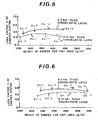
- Example 3 Each of the dampers produced in Examples 3-18 was bonded to a 1 mm thick steel sheet by the method described in Example 1, and the loss factor of the resultant composite structure was measured by the same method as in Example 1. The measurement was carried out at 25°C. Table 3 contains the loss factor values measured in this manner, and the graphs of Figs. 5 and 6 show the same loss factor values as a function of the weight of the damper per unit area, taking the thickness of the viscoelastic layer as a parameter.
- the loss factor of the composite structure of the steel sheet and the damper can be rendered above 0.3 as has been desired by employing the 0.3 mm thick viscoelastic layer 14 and, at the same time, by determining the thickness of the meltable bonding layer 12 such that the total weight of the three-layered damper becomes greater than about 3000 g/m 2 , whereas it is difficult to render the loss factor above 0.3 even by employing the 1.8 mm thick meltable bonding layer 12 (2650 g/m 2 ) when the thickness of the viscoelastic layer 14 is 0.15 mm.
- the thickness of the constraining layer 16 is 1.0 mm or 1.1 mm
- a desirable amount of damping represented by the loss factor values above 0.3 can be attained even by reducing the thickness of the meltable bonding layer 12 to 0.6 mm (1100 g/m 2 ), although the thickness of the meltable bonding layer 16 needs to be sufficient to render the total weight of the three-layered damper greater than about 3500 g/m 2 when the thickness of the viscoelastic layer 14 is 0.15 mm.
- This damper sheet was placed on a 1 mm thick steel sheet held horizontal and heated in an electric furnace at 140°C for 30 min.
- the heating treatment resulted in uniform adhesion of the damper sheet to the steel sheet.
- the less factor of the steel sheet and the damper was measured to be 0.28 by the same method as in Example 1.
- This damper was subjected to the thermal deformation test described hereinbefore with reference to Figs. 2-4.
- the duration of the heating at 140°C was shortened to 30 min. After the heating it was confirmed that the damper sheet had deformed in compliance with the bent shape of the steel sheet 20 and was in intimate contact with the steel sheet 20 even in the slant areas 21 and the horizontal central area 22.
- this damper sheet was fairly good in its damping performance, ability of following the shapes of panels to be damped and ease of its application to such panels.
- a considerably heavy weight per unit area is a serious disadvantage of this damper sheet.
- Tested as another reference was a conventional damper in the form of a two-layered laminate consisting of a 0.5 mm thick aluminum plate used as constraining layer and a 0.13 mm thick layer of an acrylic ester base adhesive used as viscoelastic material.
- This damper was placed on a 1 mm thick steel sheet with the viscoelastic layer on the downside, and intimate contact of the viscoelastic layer with the steel sheet over the entire area of the damper was achieved by applying pressure to the damper by using a hand roller.
- the composite loss factor of the steel sheet and the damper was measured to be 0.21 by the same method as in Example 1.
- this damper was evaluated as practically inapplicable to panels having intricately shaped surfaces although this damper sheet was very light in weight and fairly good in damping performance.
Landscapes
- Engineering & Computer Science (AREA)
- Mechanical Engineering (AREA)
- General Engineering & Computer Science (AREA)
- Physics & Mathematics (AREA)
- Acoustics & Sound (AREA)
- Multimedia (AREA)
- Vibration Prevention Devices (AREA)
- Laminated Bodies (AREA)
Claims (15)
Applications Claiming Priority (2)
| Application Number | Priority Date | Filing Date | Title |
|---|---|---|---|
| JP56169428A JPS5871155A (ja) | 1981-10-24 | 1981-10-24 | パネル制振材 |
| JP169428/81 | 1981-10-24 |
Publications (2)
| Publication Number | Publication Date |
|---|---|
| EP0077987A1 EP0077987A1 (de) | 1983-05-04 |
| EP0077987B1 true EP0077987B1 (de) | 1986-08-27 |
Family
ID=15886405
Family Applications (1)
| Application Number | Title | Priority Date | Filing Date |
|---|---|---|---|
| EP82109558A Expired EP0077987B1 (de) | 1981-10-24 | 1982-10-15 | Schwingungsdämpfer mit Aussteifungsschicht |
Country Status (3)
| Country | Link |
|---|---|
| EP (1) | EP0077987B1 (de) |
| JP (1) | JPS5871155A (de) |
| DE (1) | DE3272919D1 (de) |
Cited By (4)
| Publication number | Priority date | Publication date | Assignee | Title |
|---|---|---|---|---|
| US6153709A (en) * | 1998-01-26 | 2000-11-28 | Essex Specialty Products, Inc. | Chip resistant, vibration damping coatings for vehicles |
| US6277903B1 (en) | 1997-09-26 | 2001-08-21 | The Dow Chemical Company | Sound damping coating of flexible and rigid epoxy resins |
| US7288290B2 (en) | 2004-05-26 | 2007-10-30 | Ppg Industries Ohio, Inc. | Process for applying multi-component composite coatings to substrates to provide sound damping and print-through resistance |
| CN106088460A (zh) * | 2016-06-21 | 2016-11-09 | 惠安华晨贸易有限公司 | 一种防震活动板材 |
Families Citing this family (20)
| Publication number | Priority date | Publication date | Assignee | Title |
|---|---|---|---|---|
| JPS6027534A (ja) * | 1983-07-27 | 1985-02-12 | 日本特殊塗料株式会社 | 制振処理方法 |
| DE3408411A1 (de) * | 1984-03-08 | 1985-09-19 | Rütgerswerke AG, 6000 Frankfurt | Selbstklebendes entdroehnungselement |
| JPS61141544A (ja) * | 1984-12-13 | 1986-06-28 | 日東電工株式会社 | 金属板等の制振方法 |
| JPS61141543A (ja) * | 1984-12-13 | 1986-06-28 | 日東電工株式会社 | 制振・遮音材及び制振・遮音方法 |
| JPS61168340U (de) * | 1985-04-08 | 1986-10-18 | ||
| DE3621318A1 (de) * | 1986-06-26 | 1988-01-07 | Krupp Gmbh | Daempfungsschicht |
| US5143790A (en) * | 1989-08-09 | 1992-09-01 | Westinghouse Electric Corp. | Integrally-damped steel composite laminated structure and method of attaching same |
| FR2698059B1 (fr) * | 1992-11-17 | 1995-01-27 | Olin | Garniture composite pour carrosseries, carcasses et structures diverses. |
| JPH07138061A (ja) * | 1993-11-10 | 1995-05-30 | Shinko:Kk | レジンコンクリート製品およびその製造方法 |
| KR970702786A (ko) * | 1995-03-13 | 1997-06-10 | 고사이 아끼오 | 흡음부품(sound absorbing component) |
| DE19956335A1 (de) * | 1999-11-23 | 2001-05-31 | Sca Schucker Gmbh & Co | Verfahren und Anlage zur Herstellung von mit einer Dämmstoffschicht versehenen Karosseriebauteilen |
| SE0103002D0 (sv) * | 2001-09-10 | 2001-09-10 | Trelleborg Ab | Vibration damping material |
| JP4972689B2 (ja) * | 2006-08-03 | 2012-07-11 | ヘンケル・アクチェンゲゼルシャフト・ウント・コムパニー・コマンディットゲゼルシャフト・アウフ・アクチェン | 振動移動の減少 |
| EP1955899A1 (de) * | 2007-02-12 | 2008-08-13 | Rieter Technologies AG | Dämpfer mit eingeschlossener Schicht für Fahrzeuge |
| US20140224577A1 (en) * | 2011-08-23 | 2014-08-14 | Avery Dennison Corporation | Pressure Sensitive Adhesive Laminate for High Performance Noise and Vibration Damping Applications |
| FR2983148B1 (fr) * | 2011-11-29 | 2014-01-10 | Centre Detude Et De Rech Pour Lautomobile Cera | Composant de protection acoustique pour vehicule automobile |
| FR3033733B1 (fr) * | 2015-03-19 | 2017-04-28 | Cera Aps | Element thermoforme de protection acoustique pour vehicule automobile |
| FR3033734B1 (fr) * | 2015-03-19 | 2019-12-20 | Treves Products, Services & Innovation | Element thermoforme de garnissage et de protection acoustique pour vehicule automobile |
| US11242756B2 (en) | 2020-05-04 | 2022-02-08 | General Electric Company | Damping coating with a constraint layer |
| US11143036B1 (en) | 2020-08-20 | 2021-10-12 | General Electric Company | Turbine blade with friction and impact vibration damping elements |
Family Cites Families (5)
| Publication number | Priority date | Publication date | Assignee | Title |
|---|---|---|---|---|
| BE671878A (de) * | 1964-11-13 | 1966-03-01 | ||
| GB1149376A (en) * | 1965-05-29 | 1969-04-23 | Bostik Ltd | Improvements in or relating to sound-deadening materials |
| GB1263598A (en) * | 1969-12-10 | 1972-02-09 | Lo Sound Developments Ltd | Sound deadening materials |
| GB1481355A (en) * | 1974-03-27 | 1977-07-27 | Dunlop Ltd | Laminated noise reduction systems |
| DE2904688C2 (de) * | 1979-02-08 | 1985-12-05 | Chemie-Werk Weinsheim Gmbh, 6520 Worms | Verfahren zum Aufbringen eines mehrschichtigen Belags auf ein Karosserieblech |
-
1981
- 1981-10-24 JP JP56169428A patent/JPS5871155A/ja active Pending
-
1982
- 1982-10-15 EP EP82109558A patent/EP0077987B1/de not_active Expired
- 1982-10-15 DE DE8282109558T patent/DE3272919D1/de not_active Expired
Cited By (4)
| Publication number | Priority date | Publication date | Assignee | Title |
|---|---|---|---|---|
| US6277903B1 (en) | 1997-09-26 | 2001-08-21 | The Dow Chemical Company | Sound damping coating of flexible and rigid epoxy resins |
| US6153709A (en) * | 1998-01-26 | 2000-11-28 | Essex Specialty Products, Inc. | Chip resistant, vibration damping coatings for vehicles |
| US7288290B2 (en) | 2004-05-26 | 2007-10-30 | Ppg Industries Ohio, Inc. | Process for applying multi-component composite coatings to substrates to provide sound damping and print-through resistance |
| CN106088460A (zh) * | 2016-06-21 | 2016-11-09 | 惠安华晨贸易有限公司 | 一种防震活动板材 |
Also Published As
| Publication number | Publication date |
|---|---|
| EP0077987A1 (de) | 1983-05-04 |
| DE3272919D1 (en) | 1986-10-02 |
| JPS5871155A (ja) | 1983-04-27 |
Similar Documents
| Publication | Publication Date | Title |
|---|---|---|
| EP0077987A1 (de) | Schwingungsdämpfer mit Aussteifungsschicht | |
| EP0053361B1 (de) | Klebefolie zum Verstärken von Metallplatten und Verfahren zum Verstärken von Metallplatten | |
| JPS58132068A (ja) | 補強用の接着性シ−ト | |
| US20050019590A1 (en) | Vibration damping material and vibration damper | |
| US6428905B1 (en) | Double sheet metal consisting of two covering metal sheets and an intermediate layer | |
| GB2041291A (en) | Multilayer antidrumming and stiffening sheet | |
| FR2430311A1 (fr) | Procede de fabrication d'une plaque composite resistant a la chaleur | |
| GB2092063A (en) | Coated board for concrete form and method of making the same | |
| JP3067513B2 (ja) | フェノール樹脂積層体、及びこの積層体を用いたフェノール樹脂成形品の製造方法 | |
| JPS6211670B2 (de) | ||
| JPS6213795Y2 (de) | ||
| JPS59204537A (ja) | 金属板補強用の接着性シ−ト | |
| JPS6270038A (ja) | シ−ト状複層拘束型制振材 | |
| JPS62214949A (ja) | 拘束型制振材 | |
| JP2706513B2 (ja) | 制振シート | |
| JPS59204541A (ja) | 補強用の接着性シ−ト | |
| JPS6097842A (ja) | 金属板の制振防音方法 | |
| JPS58118876A (ja) | 金属板補強用の接着性シ−ト | |
| JPS624656A (ja) | 車輌の制振床構造およびその形成方法 | |
| JPS5912496A (ja) | パネル制振材 | |
| JPS59212249A (ja) | 金属板の制振防音方法 | |
| JPS63161328A (ja) | 床暖房パネル | |
| JPH02197468A (ja) | 車輌用拘束材 | |
| JPS59209852A (ja) | 金属板補強用の接着性シ−ト | |
| JPS6149839A (ja) | 薄手鋼板用補強材 |
Legal Events
| Date | Code | Title | Description |
|---|---|---|---|
| PUAI | Public reference made under article 153(3) epc to a published international application that has entered the european phase |
Free format text: ORIGINAL CODE: 0009012 |
|
| 17P | Request for examination filed |
Effective date: 19821015 |
|
| AK | Designated contracting states |
Designated state(s): DE FR GB |
|
| RAP1 | Party data changed (applicant data changed or rights of an application transferred) |
Owner name: NISSAN MOTOR CO., LTD. |
|
| GRAA | (expected) grant |
Free format text: ORIGINAL CODE: 0009210 |
|
| AK | Designated contracting states |
Kind code of ref document: B1 Designated state(s): DE FR GB |
|
| REF | Corresponds to: |
Ref document number: 3272919 Country of ref document: DE Date of ref document: 19861002 |
|
| ET | Fr: translation filed | ||
| PLBE | No opposition filed within time limit |
Free format text: ORIGINAL CODE: 0009261 |
|
| STAA | Information on the status of an ep patent application or granted ep patent |
Free format text: STATUS: NO OPPOSITION FILED WITHIN TIME LIMIT |
|
| 26N | No opposition filed | ||
| PGFP | Annual fee paid to national office [announced via postgrant information from national office to epo] |
Ref country code: FR Payment date: 19911007 Year of fee payment: 10 |
|
| PG25 | Lapsed in a contracting state [announced via postgrant information from national office to epo] |
Ref country code: FR Effective date: 19930630 |
|
| REG | Reference to a national code |
Ref country code: FR Ref legal event code: ST |
|
| PGFP | Annual fee paid to national office [announced via postgrant information from national office to epo] |
Ref country code: GB Payment date: 19931005 Year of fee payment: 12 |
|
| PGFP | Annual fee paid to national office [announced via postgrant information from national office to epo] |
Ref country code: DE Payment date: 19931011 Year of fee payment: 12 |
|
| PG25 | Lapsed in a contracting state [announced via postgrant information from national office to epo] |
Ref country code: GB Effective date: 19941015 |
|
| GBPC | Gb: european patent ceased through non-payment of renewal fee |
Effective date: 19941015 |
|
| PG25 | Lapsed in a contracting state [announced via postgrant information from national office to epo] |
Ref country code: DE Effective date: 19950701 |