EP0084164B1 - Neue Derivate bicyclischer Aminosäuren, Verfahren zu ihrer Herstellung, diese enthaltende Mittel und deren Verwendung sowie neue bicyclische Aminosäuren als Zwischenstufen und Verfahren zu deren Herstellung - Google Patents
Neue Derivate bicyclischer Aminosäuren, Verfahren zu ihrer Herstellung, diese enthaltende Mittel und deren Verwendung sowie neue bicyclische Aminosäuren als Zwischenstufen und Verfahren zu deren Herstellung Download PDFInfo
- Publication number
- EP0084164B1 EP0084164B1 EP82112007A EP82112007A EP0084164B1 EP 0084164 B1 EP0084164 B1 EP 0084164B1 EP 82112007 A EP82112007 A EP 82112007A EP 82112007 A EP82112007 A EP 82112007A EP 0084164 B1 EP0084164 B1 EP 0084164B1
- Authority
- EP
- European Patent Office
- Prior art keywords
- formula
- compound
- denotes
- atoms
- hydrogen
- Prior art date
- Legal status (The legal status is an assumption and is not a legal conclusion. Google has not performed a legal analysis and makes no representation as to the accuracy of the status listed.)
- Expired
Links
- 238000000034 method Methods 0.000 title claims abstract description 55
- 238000002360 preparation method Methods 0.000 title claims abstract description 17
- 230000008569 process Effects 0.000 title claims abstract description 10
- -1 of bicyclic amino acids Chemical class 0.000 title description 13
- 239000003795 chemical substances by application Substances 0.000 title description 5
- 239000000543 intermediate Substances 0.000 title description 4
- 238000004519 manufacturing process Methods 0.000 title 1
- 150000001875 compounds Chemical class 0.000 claims abstract description 188
- 229910052739 hydrogen Inorganic materials 0.000 claims abstract description 44
- 239000001257 hydrogen Substances 0.000 claims abstract description 44
- 125000004432 carbon atom Chemical group C* 0.000 claims abstract description 43
- UFHFLCQGNIYNRP-UHFFFAOYSA-N Hydrogen Chemical compound [H][H] UFHFLCQGNIYNRP-UHFFFAOYSA-N 0.000 claims abstract description 31
- 150000003839 salts Chemical class 0.000 claims abstract description 26
- 125000004435 hydrogen atom Chemical group [H]* 0.000 claims abstract description 25
- 239000002253 acid Substances 0.000 claims abstract description 21
- 229910052760 oxygen Inorganic materials 0.000 claims abstract description 16
- 239000001301 oxygen Substances 0.000 claims abstract description 15
- QVGXLLKOCUKJST-UHFFFAOYSA-N atomic oxygen Chemical compound [O] QVGXLLKOCUKJST-UHFFFAOYSA-N 0.000 claims abstract description 14
- 150000002431 hydrogen Chemical class 0.000 claims abstract description 13
- 229910052740 iodine Inorganic materials 0.000 claims abstract description 11
- 125000003178 carboxy group Chemical group [H]OC(*)=O 0.000 claims abstract description 10
- 125000001797 benzyl group Chemical group [H]C1=C([H])C([H])=C(C([H])=C1[H])C([H])([H])* 0.000 claims abstract description 9
- 125000002496 methyl group Chemical group [H]C([H])([H])* 0.000 claims abstract description 9
- 125000004178 (C1-C4) alkyl group Chemical group 0.000 claims abstract description 7
- 125000001997 phenyl group Chemical group [H]C1=C([H])C([H])=C(*)C([H])=C1[H] 0.000 claims abstract description 6
- 239000003638 chemical reducing agent Substances 0.000 claims abstract description 5
- 239000012279 sodium borohydride Substances 0.000 claims abstract description 5
- 229910000033 sodium borohydride Inorganic materials 0.000 claims abstract description 5
- 238000007327 hydrogenolysis reaction Methods 0.000 claims abstract description 3
- 229910052721 tungsten Inorganic materials 0.000 claims abstract description 3
- 125000002887 hydroxy group Chemical group [H]O* 0.000 claims abstract 5
- 239000000203 mixture Substances 0.000 claims description 32
- 238000006243 chemical reaction Methods 0.000 claims description 18
- 239000003054 catalyst Substances 0.000 claims description 12
- 239000002904 solvent Substances 0.000 claims description 12
- 150000007513 acids Chemical class 0.000 claims description 10
- 125000003710 aryl alkyl group Chemical group 0.000 claims description 9
- 125000000217 alkyl group Chemical group 0.000 claims description 8
- 150000002148 esters Chemical class 0.000 claims description 7
- 238000009903 catalytic hydrogenation reaction Methods 0.000 claims description 6
- BDAGIHXWWSANSR-UHFFFAOYSA-N methanoic acid Natural products OC=O BDAGIHXWWSANSR-UHFFFAOYSA-N 0.000 claims description 6
- 230000009467 reduction Effects 0.000 claims description 6
- 125000006702 (C1-C18) alkyl group Chemical group 0.000 claims description 5
- 230000001476 alcoholic effect Effects 0.000 claims description 4
- 125000001495 ethyl group Chemical group [H]C([H])([H])C([H])([H])* 0.000 claims description 4
- 230000002140 halogenating effect Effects 0.000 claims description 4
- OSWFIVFLDKOXQC-UHFFFAOYSA-N 4-(3-methoxyphenyl)aniline Chemical compound COC1=CC=CC(C=2C=CC(N)=CC=2)=C1 OSWFIVFLDKOXQC-UHFFFAOYSA-N 0.000 claims description 3
- 239000004280 Sodium formate Substances 0.000 claims description 3
- 230000009471 action Effects 0.000 claims description 3
- 239000002934 diuretic Substances 0.000 claims description 3
- 235000019253 formic acid Nutrition 0.000 claims description 3
- HLBBKKJFGFRGMU-UHFFFAOYSA-M sodium formate Chemical compound [Na+].[O-]C=O HLBBKKJFGFRGMU-UHFFFAOYSA-M 0.000 claims description 3
- 235000019254 sodium formate Nutrition 0.000 claims description 3
- LEIMLDGFXIOXMT-UHFFFAOYSA-N trimethylsilyl cyanide Chemical compound C[Si](C)(C)C#N LEIMLDGFXIOXMT-UHFFFAOYSA-N 0.000 claims description 3
- DNIAPMSPPWPWGF-GSVOUGTGSA-N (R)-(-)-Propylene glycol Chemical compound C[C@@H](O)CO DNIAPMSPPWPWGF-GSVOUGTGSA-N 0.000 claims description 2
- 238000006237 Beckmann rearrangement reaction Methods 0.000 claims description 2
- 206010020772 Hypertension Diseases 0.000 claims description 2
- 239000002841 Lewis acid Substances 0.000 claims description 2
- 125000002252 acyl group Chemical group 0.000 claims description 2
- 125000001931 aliphatic group Chemical group 0.000 claims description 2
- 125000005843 halogen group Chemical group 0.000 claims description 2
- 150000007517 lewis acids Chemical class 0.000 claims description 2
- 239000003586 protic polar solvent Substances 0.000 claims description 2
- 229910052723 transition metal Inorganic materials 0.000 claims description 2
- 150000003624 transition metals Chemical class 0.000 claims description 2
- 230000001882 diuretic effect Effects 0.000 claims 2
- 239000003814 drug Substances 0.000 claims 2
- 239000000010 aprotic solvent Substances 0.000 claims 1
- 230000003301 hydrolyzing effect Effects 0.000 claims 1
- 230000001590 oxidative effect Effects 0.000 claims 1
- 239000008194 pharmaceutical composition Substances 0.000 claims 1
- XEKOWRVHYACXOJ-UHFFFAOYSA-N Ethyl acetate Chemical compound CCOC(C)=O XEKOWRVHYACXOJ-UHFFFAOYSA-N 0.000 description 65
- 238000005160 1H NMR spectroscopy Methods 0.000 description 44
- LFQSCWFLJHTTHZ-UHFFFAOYSA-N Ethanol Chemical compound CCO LFQSCWFLJHTTHZ-UHFFFAOYSA-N 0.000 description 33
- VEXZGXHMUGYJMC-UHFFFAOYSA-N Hydrochloric acid Chemical compound Cl VEXZGXHMUGYJMC-UHFFFAOYSA-N 0.000 description 28
- 239000000243 solution Substances 0.000 description 27
- YMWUJEATGCHHMB-UHFFFAOYSA-N Dichloromethane Chemical compound ClCCl YMWUJEATGCHHMB-UHFFFAOYSA-N 0.000 description 24
- 235000019439 ethyl acetate Nutrition 0.000 description 22
- OKKJLVBELUTLKV-UHFFFAOYSA-N Methanol Chemical compound OC OKKJLVBELUTLKV-UHFFFAOYSA-N 0.000 description 21
- QTBSBXVTEAMEQO-UHFFFAOYSA-N Acetic acid Chemical compound CC(O)=O QTBSBXVTEAMEQO-UHFFFAOYSA-N 0.000 description 20
- DTQVDTLACAAQTR-UHFFFAOYSA-N Trifluoroacetic acid Chemical compound OC(=O)C(F)(F)F DTQVDTLACAAQTR-UHFFFAOYSA-N 0.000 description 20
- WRHZVMBBRYBTKZ-UHFFFAOYSA-N pyrrole-2-carboxylic acid Chemical compound OC(=O)C1=CC=CN1 WRHZVMBBRYBTKZ-UHFFFAOYSA-N 0.000 description 20
- 239000000047 product Substances 0.000 description 17
- XLYOFNOQVPJJNP-UHFFFAOYSA-N water Substances O XLYOFNOQVPJJNP-UHFFFAOYSA-N 0.000 description 16
- 238000005481 NMR spectroscopy Methods 0.000 description 14
- HEMHJVSKTPXQMS-UHFFFAOYSA-M sodium hydroxide Inorganic materials [OH-].[Na+] HEMHJVSKTPXQMS-UHFFFAOYSA-M 0.000 description 13
- ZMANZCXQSJIPKH-UHFFFAOYSA-N Triethylamine Chemical compound CCN(CC)CC ZMANZCXQSJIPKH-UHFFFAOYSA-N 0.000 description 12
- VYPSYNLAJGMNEJ-UHFFFAOYSA-N Silicium dioxide Chemical compound O=[Si]=O VYPSYNLAJGMNEJ-UHFFFAOYSA-N 0.000 description 11
- 239000000741 silica gel Substances 0.000 description 11
- 229910002027 silica gel Inorganic materials 0.000 description 11
- ZMXDDKWLCZADIW-UHFFFAOYSA-N N,N-Dimethylformamide Chemical compound CN(C)C=O ZMXDDKWLCZADIW-UHFFFAOYSA-N 0.000 description 10
- KWYUFKZDYYNOTN-UHFFFAOYSA-M potassium hydroxide Inorganic materials [OH-].[K+] KWYUFKZDYYNOTN-UHFFFAOYSA-M 0.000 description 10
- DOYOPBSXEIZLRE-UHFFFAOYSA-N pyrrole-3-carboxylic acid Natural products OC(=O)C=1C=CNC=1 DOYOPBSXEIZLRE-UHFFFAOYSA-N 0.000 description 10
- 0 CCC(C(O)=O)N(C)*** Chemical compound CCC(C(O)=O)N(C)*** 0.000 description 9
- KDLHZDBZIXYQEI-UHFFFAOYSA-N Palladium Chemical compound [Pd] KDLHZDBZIXYQEI-UHFFFAOYSA-N 0.000 description 9
- YXFVVABEGXRONW-UHFFFAOYSA-N Toluene Chemical compound CC1=CC=CC=C1 YXFVVABEGXRONW-UHFFFAOYSA-N 0.000 description 9
- 229960000583 acetic acid Drugs 0.000 description 9
- 239000002585 base Substances 0.000 description 9
- 239000012074 organic phase Substances 0.000 description 9
- 150000003254 radicals Chemical class 0.000 description 9
- RTZKZFJDLAIYFH-UHFFFAOYSA-N Diethyl ether Chemical compound CCOCC RTZKZFJDLAIYFH-UHFFFAOYSA-N 0.000 description 8
- ZAFNJMIOTHYJRJ-UHFFFAOYSA-N Diisopropyl ether Chemical compound CC(C)OC(C)C ZAFNJMIOTHYJRJ-UHFFFAOYSA-N 0.000 description 8
- 239000000706 filtrate Substances 0.000 description 7
- 239000012362 glacial acetic acid Substances 0.000 description 7
- WVDDGKGOMKODPV-UHFFFAOYSA-N Benzyl alcohol Chemical compound OCC1=CC=CC=C1 WVDDGKGOMKODPV-UHFFFAOYSA-N 0.000 description 6
- HEDRZPFGACZZDS-UHFFFAOYSA-N Chloroform Chemical compound ClC(Cl)Cl HEDRZPFGACZZDS-UHFFFAOYSA-N 0.000 description 6
- CPELXLSAUQHCOX-UHFFFAOYSA-N Hydrogen bromide Chemical compound Br CPELXLSAUQHCOX-UHFFFAOYSA-N 0.000 description 6
- KFZMGEQAYNKOFK-UHFFFAOYSA-N Isopropanol Chemical compound CC(C)O KFZMGEQAYNKOFK-UHFFFAOYSA-N 0.000 description 6
- PMZURENOXWZQFD-UHFFFAOYSA-L Sodium Sulfate Chemical compound [Na+].[Na+].[O-]S([O-])(=O)=O PMZURENOXWZQFD-UHFFFAOYSA-L 0.000 description 6
- FAPWRFPIFSIZLT-UHFFFAOYSA-M Sodium chloride Chemical compound [Na+].[Cl-] FAPWRFPIFSIZLT-UHFFFAOYSA-M 0.000 description 6
- QAOWNCQODCNURD-UHFFFAOYSA-N Sulfuric acid Chemical compound OS(O)(=O)=O QAOWNCQODCNURD-UHFFFAOYSA-N 0.000 description 6
- 230000015572 biosynthetic process Effects 0.000 description 6
- JHIVVAPYMSGYDF-UHFFFAOYSA-N cyclohexanone Chemical compound O=C1CCCCC1 JHIVVAPYMSGYDF-UHFFFAOYSA-N 0.000 description 6
- 150000002081 enamines Chemical class 0.000 description 6
- 229910052938 sodium sulfate Inorganic materials 0.000 description 6
- 235000011152 sodium sulphate Nutrition 0.000 description 6
- 125000000999 tert-butyl group Chemical group [H]C([H])([H])C(*)(C([H])([H])[H])C([H])([H])[H] 0.000 description 6
- XDTMQSROBMDMFD-UHFFFAOYSA-N Cyclohexane Chemical compound C1CCCCC1 XDTMQSROBMDMFD-UHFFFAOYSA-N 0.000 description 5
- 238000003776 cleavage reaction Methods 0.000 description 5
- 238000001704 evaporation Methods 0.000 description 5
- IXCSERBJSXMMFS-UHFFFAOYSA-N hydrogen chloride Substances Cl.Cl IXCSERBJSXMMFS-UHFFFAOYSA-N 0.000 description 5
- 229910000041 hydrogen chloride Inorganic materials 0.000 description 5
- 238000000425 proton nuclear magnetic resonance spectrum Methods 0.000 description 5
- 239000011541 reaction mixture Substances 0.000 description 5
- 230000002829 reductive effect Effects 0.000 description 5
- 230000007017 scission Effects 0.000 description 5
- UUUHXMGGBIUAPW-UHFFFAOYSA-N 1-[1-[2-[[5-amino-2-[[1-[5-(diaminomethylideneamino)-2-[[1-[3-(1h-indol-3-yl)-2-[(5-oxopyrrolidine-2-carbonyl)amino]propanoyl]pyrrolidine-2-carbonyl]amino]pentanoyl]pyrrolidine-2-carbonyl]amino]-5-oxopentanoyl]amino]-3-methylpentanoyl]pyrrolidine-2-carbon Chemical compound C1CCC(C(=O)N2C(CCC2)C(O)=O)N1C(=O)C(C(C)CC)NC(=O)C(CCC(N)=O)NC(=O)C1CCCN1C(=O)C(CCCN=C(N)N)NC(=O)C1CCCN1C(=O)C(CC=1C2=CC=CC=C2NC=1)NC(=O)C1CCC(=O)N1 UUUHXMGGBIUAPW-UHFFFAOYSA-N 0.000 description 4
- WKBOTKDWSSQWDR-UHFFFAOYSA-N Bromine atom Chemical compound [Br] WKBOTKDWSSQWDR-UHFFFAOYSA-N 0.000 description 4
- QRGDYWYWOIZOFU-UHFFFAOYSA-N Cl.C(C)(C)(C)OC(=O)C=1NC=CC1 Chemical compound Cl.C(C)(C)(C)OC(=O)C=1NC=CC1 QRGDYWYWOIZOFU-UHFFFAOYSA-N 0.000 description 4
- QIGBRXMKCJKVMJ-UHFFFAOYSA-N Hydroquinone Chemical compound OC1=CC=C(O)C=C1 QIGBRXMKCJKVMJ-UHFFFAOYSA-N 0.000 description 4
- PXHVJJICTQNCMI-UHFFFAOYSA-N Nickel Chemical compound [Ni] PXHVJJICTQNCMI-UHFFFAOYSA-N 0.000 description 4
- 102000004270 Peptidyl-Dipeptidase A Human genes 0.000 description 4
- 108090000882 Peptidyl-Dipeptidase A Proteins 0.000 description 4
- JUJWROOIHBZHMG-UHFFFAOYSA-N Pyridine Chemical compound C1=CC=NC=C1 JUJWROOIHBZHMG-UHFFFAOYSA-N 0.000 description 4
- WYURNTSHIVDZCO-UHFFFAOYSA-N Tetrahydrofuran Chemical compound C1CCOC1 WYURNTSHIVDZCO-UHFFFAOYSA-N 0.000 description 4
- 239000008346 aqueous phase Substances 0.000 description 4
- GDTBXPJZTBHREO-UHFFFAOYSA-N bromine Substances BrBr GDTBXPJZTBHREO-UHFFFAOYSA-N 0.000 description 4
- 229910052794 bromium Inorganic materials 0.000 description 4
- 230000008020 evaporation Effects 0.000 description 4
- 239000003960 organic solvent Substances 0.000 description 4
- 229910052763 palladium Inorganic materials 0.000 description 4
- 239000000843 powder Substances 0.000 description 4
- 238000001953 recrystallisation Methods 0.000 description 4
- 238000010992 reflux Methods 0.000 description 4
- 239000007858 starting material Substances 0.000 description 4
- 238000003786 synthesis reaction Methods 0.000 description 4
- RYHBNJHYFVUHQT-UHFFFAOYSA-N 1,4-Dioxane Chemical compound C1COCCO1 RYHBNJHYFVUHQT-UHFFFAOYSA-N 0.000 description 3
- ASOKPJOREAFHNY-UHFFFAOYSA-N 1-Hydroxybenzotriazole Chemical compound C1=CC=C2N(O)N=NC2=C1 ASOKPJOREAFHNY-UHFFFAOYSA-N 0.000 description 3
- WFDIJRYMOXRFFG-UHFFFAOYSA-N Acetic anhydride Chemical compound CC(=O)OC(C)=O WFDIJRYMOXRFFG-UHFFFAOYSA-N 0.000 description 3
- CSCPPACGZOOCGX-UHFFFAOYSA-N Acetone Chemical compound CC(C)=O CSCPPACGZOOCGX-UHFFFAOYSA-N 0.000 description 3
- QOSSAOTZNIDXMA-UHFFFAOYSA-N Dicylcohexylcarbodiimide Chemical compound C1CCCCC1N=C=NC1CCCCC1 QOSSAOTZNIDXMA-UHFFFAOYSA-N 0.000 description 3
- IAZDPXIOMUYVGZ-UHFFFAOYSA-N Dimethylsulphoxide Chemical compound CS(C)=O IAZDPXIOMUYVGZ-UHFFFAOYSA-N 0.000 description 3
- PEDCQBHIVMGVHV-UHFFFAOYSA-N Glycerine Chemical compound OCC(O)CO PEDCQBHIVMGVHV-UHFFFAOYSA-N 0.000 description 3
- RWRDLPDLKQPQOW-UHFFFAOYSA-N Pyrrolidine Chemical compound C1CCNC1 RWRDLPDLKQPQOW-UHFFFAOYSA-N 0.000 description 3
- 150000001298 alcohols Chemical class 0.000 description 3
- 150000001412 amines Chemical class 0.000 description 3
- 238000009835 boiling Methods 0.000 description 3
- 239000000969 carrier Substances 0.000 description 3
- 238000004587 chromatography analysis Methods 0.000 description 3
- 239000013078 crystal Substances 0.000 description 3
- IIEWJVIFRVWJOD-UHFFFAOYSA-N ethyl cyclohexane Natural products CCC1CCCCC1 IIEWJVIFRVWJOD-UHFFFAOYSA-N 0.000 description 3
- 238000001914 filtration Methods 0.000 description 3
- 229910052736 halogen Inorganic materials 0.000 description 3
- 229910000042 hydrogen bromide Inorganic materials 0.000 description 3
- 125000004356 hydroxy functional group Chemical group O* 0.000 description 3
- 239000003112 inhibitor Substances 0.000 description 3
- 239000003921 oil Substances 0.000 description 3
- 235000019198 oils Nutrition 0.000 description 3
- 239000012071 phase Substances 0.000 description 3
- BASFCYQUMIYNBI-UHFFFAOYSA-N platinum Chemical compound [Pt] BASFCYQUMIYNBI-UHFFFAOYSA-N 0.000 description 3
- 108090000765 processed proteins & peptides Proteins 0.000 description 3
- 125000006239 protecting group Chemical group 0.000 description 3
- 229920006395 saturated elastomer Polymers 0.000 description 3
- 239000011780 sodium chloride Substances 0.000 description 3
- 239000000725 suspension Substances 0.000 description 3
- QTPHCCMZFUGSJL-DTWKUNHWSA-N (4as,9ar)-1,3,4,4a,5,6,7,8,9,9a-decahydrocyclohepta[b]pyridin-2-one Chemical compound C1CCCC[C@H]2NC(=O)CC[C@@H]21 QTPHCCMZFUGSJL-DTWKUNHWSA-N 0.000 description 2
- HVCNXQOWACZAFN-UHFFFAOYSA-N 4-ethylmorpholine Chemical compound CCN1CCOCC1 HVCNXQOWACZAFN-UHFFFAOYSA-N 0.000 description 2
- HBAQYPYDRFILMT-UHFFFAOYSA-N 8-[3-(1-cyclopropylpyrazol-4-yl)-1H-pyrazolo[4,3-d]pyrimidin-5-yl]-3-methyl-3,8-diazabicyclo[3.2.1]octan-2-one Chemical class C1(CC1)N1N=CC(=C1)C1=NNC2=C1N=C(N=C2)N1C2C(N(CC1CC2)C)=O HBAQYPYDRFILMT-UHFFFAOYSA-N 0.000 description 2
- KWOLFJPFCHCOCG-UHFFFAOYSA-N Acetophenone Chemical compound CC(=O)C1=CC=CC=C1 KWOLFJPFCHCOCG-UHFFFAOYSA-N 0.000 description 2
- NLHHRLWOUZZQLW-UHFFFAOYSA-N Acrylonitrile Chemical compound C=CC#N NLHHRLWOUZZQLW-UHFFFAOYSA-N 0.000 description 2
- QGZKDVFQNNGYKY-UHFFFAOYSA-N Ammonia Chemical compound N QGZKDVFQNNGYKY-UHFFFAOYSA-N 0.000 description 2
- 101800000734 Angiotensin-1 Proteins 0.000 description 2
- 102400000344 Angiotensin-1 Human genes 0.000 description 2
- KZMGYPLQYOPHEL-UHFFFAOYSA-N Boron trifluoride etherate Chemical compound FB(F)F.CCOCC KZMGYPLQYOPHEL-UHFFFAOYSA-N 0.000 description 2
- OKTJSMMVPCPJKN-UHFFFAOYSA-N Carbon Chemical compound [C] OKTJSMMVPCPJKN-UHFFFAOYSA-N 0.000 description 2
- ZAMOUSCENKQFHK-UHFFFAOYSA-N Chlorine atom Chemical compound [Cl] ZAMOUSCENKQFHK-UHFFFAOYSA-N 0.000 description 2
- 238000006720 Favorskii reaction Methods 0.000 description 2
- VZCYOOQTPOCHFL-OWOJBTEDSA-N Fumaric acid Chemical compound OC(=O)\C=C\C(O)=O VZCYOOQTPOCHFL-OWOJBTEDSA-N 0.000 description 2
- WQZGKKKJIJFFOK-GASJEMHNSA-N Glucose Natural products OC[C@H]1OC(O)[C@H](O)[C@@H](O)[C@@H]1O WQZGKKKJIJFFOK-GASJEMHNSA-N 0.000 description 2
- SIKJAQJRHWYJAI-UHFFFAOYSA-N Indole Chemical compound C1=CC=C2NC=CC2=C1 SIKJAQJRHWYJAI-UHFFFAOYSA-N 0.000 description 2
- GUBGYTABKSRVRQ-QKKXKWKRSA-N Lactose Chemical compound OC[C@H]1O[C@@H](O[C@H]2[C@H](O)[C@@H](O)C(O)O[C@@H]2CO)[C@H](O)[C@@H](O)[C@H]1O GUBGYTABKSRVRQ-QKKXKWKRSA-N 0.000 description 2
- 238000005684 Liebig rearrangement reaction Methods 0.000 description 2
- 238000006683 Mannich reaction Methods 0.000 description 2
- YNAVUWVOSKDBBP-UHFFFAOYSA-N Morpholine Chemical compound C1COCCN1 YNAVUWVOSKDBBP-UHFFFAOYSA-N 0.000 description 2
- LRHPLDYGYMQRHN-UHFFFAOYSA-N N-Butanol Chemical compound CCCCO LRHPLDYGYMQRHN-UHFFFAOYSA-N 0.000 description 2
- NQRYJNQNLNOLGT-UHFFFAOYSA-N Piperidine Chemical compound C1CCNCC1 NQRYJNQNLNOLGT-UHFFFAOYSA-N 0.000 description 2
- 239000007868 Raney catalyst Substances 0.000 description 2
- 229910000564 Raney nickel Inorganic materials 0.000 description 2
- 241000700159 Rattus Species 0.000 description 2
- 239000002262 Schiff base Substances 0.000 description 2
- 150000004753 Schiff bases Chemical class 0.000 description 2
- UIIMBOGNXHQVGW-UHFFFAOYSA-M Sodium bicarbonate Chemical compound [Na+].OC([O-])=O UIIMBOGNXHQVGW-UHFFFAOYSA-M 0.000 description 2
- WQDUMFSSJAZKTM-UHFFFAOYSA-N Sodium methoxide Chemical compound [Na+].[O-]C WQDUMFSSJAZKTM-UHFFFAOYSA-N 0.000 description 2
- DKGAVHZHDRPRBM-UHFFFAOYSA-N Tert-Butanol Chemical compound CC(C)(C)O DKGAVHZHDRPRBM-UHFFFAOYSA-N 0.000 description 2
- XSQUKJJJFZCRTK-UHFFFAOYSA-N Urea Chemical compound NC(N)=O XSQUKJJJFZCRTK-UHFFFAOYSA-N 0.000 description 2
- 230000002378 acidificating effect Effects 0.000 description 2
- 150000001252 acrylic acid derivatives Chemical class 0.000 description 2
- 230000029936 alkylation Effects 0.000 description 2
- 238000005804 alkylation reaction Methods 0.000 description 2
- 150000001413 amino acids Chemical class 0.000 description 2
- 229940111131 antiinflammatory and antirheumatic product propionic acid derivative Drugs 0.000 description 2
- 239000007864 aqueous solution Substances 0.000 description 2
- 235000019445 benzyl alcohol Nutrition 0.000 description 2
- WQZGKKKJIJFFOK-VFUOTHLCSA-N beta-D-glucose Chemical compound OC[C@H]1O[C@@H](O)[C@H](O)[C@@H](O)[C@@H]1O WQZGKKKJIJFFOK-VFUOTHLCSA-N 0.000 description 2
- 244000309464 bull Species 0.000 description 2
- 239000000460 chlorine Substances 0.000 description 2
- 229910052801 chlorine Inorganic materials 0.000 description 2
- 238000004440 column chromatography Methods 0.000 description 2
- 238000001816 cooling Methods 0.000 description 2
- CGZZMOTZOONQIA-UHFFFAOYSA-N cycloheptanone Chemical compound O=C1CCCCCC1 CGZZMOTZOONQIA-UHFFFAOYSA-N 0.000 description 2
- PAFZNILMFXTMIY-UHFFFAOYSA-N cyclohexylamine Chemical compound NC1CCCCC1 PAFZNILMFXTMIY-UHFFFAOYSA-N 0.000 description 2
- BGTOWKSIORTVQH-UHFFFAOYSA-N cyclopentanone Chemical compound O=C1CCCC1 BGTOWKSIORTVQH-UHFFFAOYSA-N 0.000 description 2
- 238000004821 distillation Methods 0.000 description 2
- 239000008103 glucose Substances 0.000 description 2
- 235000001727 glucose Nutrition 0.000 description 2
- 150000002367 halogens Chemical class 0.000 description 2
- 238000005984 hydrogenation reaction Methods 0.000 description 2
- 230000007062 hydrolysis Effects 0.000 description 2
- 238000006460 hydrolysis reaction Methods 0.000 description 2
- 238000001990 intravenous administration Methods 0.000 description 2
- IGKDMFMKAAPDDN-YFKPBYRVSA-N methyl (2r)-2-acetamido-3-chloropropanoate Chemical compound COC(=O)[C@H](CCl)NC(C)=O IGKDMFMKAAPDDN-YFKPBYRVSA-N 0.000 description 2
- VLKZOEOYAKHREP-UHFFFAOYSA-N n-Hexane Chemical compound CCCCCC VLKZOEOYAKHREP-UHFFFAOYSA-N 0.000 description 2
- 230000003287 optical effect Effects 0.000 description 2
- BWHMMNNQKKPAPP-UHFFFAOYSA-L potassium carbonate Chemical compound [K+].[K+].[O-]C([O-])=O BWHMMNNQKKPAPP-UHFFFAOYSA-L 0.000 description 2
- TYJJADVDDVDEDZ-UHFFFAOYSA-M potassium hydrogencarbonate Chemical compound [K+].OC([O-])=O TYJJADVDDVDEDZ-UHFFFAOYSA-M 0.000 description 2
- UMJSCPRVCHMLSP-UHFFFAOYSA-N pyridine Natural products COC1=CC=CN=C1 UMJSCPRVCHMLSP-UHFFFAOYSA-N 0.000 description 2
- 230000035484 reaction time Effects 0.000 description 2
- 230000000717 retained effect Effects 0.000 description 2
- 238000000926 separation method Methods 0.000 description 2
- URGAHOPLAPQHLN-UHFFFAOYSA-N sodium aluminosilicate Chemical compound [Na+].[Al+3].[O-][Si]([O-])=O.[O-][Si]([O-])=O URGAHOPLAPQHLN-UHFFFAOYSA-N 0.000 description 2
- BEOOHQFXGBMRKU-UHFFFAOYSA-N sodium cyanoborohydride Chemical compound [Na+].[B-]C#N BEOOHQFXGBMRKU-UHFFFAOYSA-N 0.000 description 2
- 238000003756 stirring Methods 0.000 description 2
- 238000007920 subcutaneous administration Methods 0.000 description 2
- 125000005931 tert-butyloxycarbonyl group Chemical group [H]C([H])([H])C(OC(*)=O)(C([H])([H])[H])C([H])([H])[H] 0.000 description 2
- FYSNRJHAOHDILO-UHFFFAOYSA-N thionyl chloride Chemical compound ClS(Cl)=O FYSNRJHAOHDILO-UHFFFAOYSA-N 0.000 description 2
- VZCYOOQTPOCHFL-UHFFFAOYSA-N trans-butenedioic acid Natural products OC(=O)C=CC(O)=O VZCYOOQTPOCHFL-UHFFFAOYSA-N 0.000 description 2
- LWIHDJKSTIGBAC-UHFFFAOYSA-K tripotassium phosphate Chemical compound [K+].[K+].[K+].[O-]P([O-])([O-])=O LWIHDJKSTIGBAC-UHFFFAOYSA-K 0.000 description 2
- QVHJQCGUWFKTSE-YFKPBYRVSA-N (2s)-2-[(2-methylpropan-2-yl)oxycarbonylamino]propanoic acid Chemical compound OC(=O)[C@H](C)NC(=O)OC(C)(C)C QVHJQCGUWFKTSE-YFKPBYRVSA-N 0.000 description 1
- XQIMTBSKAYPMOL-VIFPVBQESA-N (2s)-2-amino-3-(4-methylphenyl)sulfonyloxypropanoic acid Chemical class CC1=CC=C(S(=O)(=O)OC[C@H](N)C(O)=O)C=C1 XQIMTBSKAYPMOL-VIFPVBQESA-N 0.000 description 1
- ICSQYGDMSMVESO-NKWVEPMBSA-N (4as,8ar)-3,3-dichloro-1,4,4a,5,6,7,8,8a-octahydroquinolin-2-one Chemical compound C1CCC[C@H]2NC(=O)C(Cl)(Cl)C[C@@H]21 ICSQYGDMSMVESO-NKWVEPMBSA-N 0.000 description 1
- OBSYXAXPUGVQSN-JGVFFNPUSA-N (4as,8ar)-3,4,4a,5,6,7,8,8a-octahydro-1h-quinolin-2-one Chemical compound C1CCC[C@H]2NC(=O)CC[C@@H]21 OBSYXAXPUGVQSN-JGVFFNPUSA-N 0.000 description 1
- GXTPZOZFOKMZRA-JGVFFNPUSA-N (4as,9ar)-3,3-dichloro-4,4a,5,6,7,8,9,9a-octahydro-1h-cyclohepta[b]pyridin-2-one Chemical compound C1CCCC[C@H]2NC(=O)C(Cl)(Cl)C[C@@H]21 GXTPZOZFOKMZRA-JGVFFNPUSA-N 0.000 description 1
- 125000006273 (C1-C3) alkyl group Chemical group 0.000 description 1
- XKAXPKWJANUNFR-UHFFFAOYSA-N 1,3,4,4a,5,6,7,8-octahydrocyclohepta[b]pyridin-2-one Chemical compound C1CCCC=C2NC(=O)CCC21 XKAXPKWJANUNFR-UHFFFAOYSA-N 0.000 description 1
- ADFXKUOMJKEIND-UHFFFAOYSA-N 1,3-dicyclohexylurea Chemical compound C1CCCCC1NC(=O)NC1CCCCC1 ADFXKUOMJKEIND-UHFFFAOYSA-N 0.000 description 1
- UETVMGUBKRBHAV-UHFFFAOYSA-N 1-(cyclohepten-1-yl)pyrrolidine Chemical compound C1CCCN1C1=CCCCCC1 UETVMGUBKRBHAV-UHFFFAOYSA-N 0.000 description 1
- KTZNVZJECQAMBV-UHFFFAOYSA-N 1-(cyclohexen-1-yl)pyrrolidine Chemical compound C1CCCN1C1=CCCCC1 KTZNVZJECQAMBV-UHFFFAOYSA-N 0.000 description 1
- KOFSFYBXUYHNJL-UHFFFAOYSA-N 1-(cyclopenten-1-yl)pyrrolidine Chemical compound C1CCCN1C1=CCCC1 KOFSFYBXUYHNJL-UHFFFAOYSA-N 0.000 description 1
- WUIVCLLDKQXMPX-IUCAKERBSA-N 1-[(3as,6as)-3,3a,4,5,6,6a-hexahydro-2h-cyclopenta[b]pyrrol-1-yl]ethanone Chemical compound C1CC[C@@H]2N(C(=O)C)CC[C@@H]21 WUIVCLLDKQXMPX-IUCAKERBSA-N 0.000 description 1
- PDELQDSYLBLPQO-UHFFFAOYSA-N 2,3,3a,4,5,6,7,7a-octahydro-1h-indole Chemical compound C1CCCC2NCCC21 PDELQDSYLBLPQO-UHFFFAOYSA-N 0.000 description 1
- WJZIPMQUKSTHLV-UHFFFAOYSA-N 2-ethyldecanoic acid Chemical compound CCCCCCCCC(CC)C(O)=O WJZIPMQUKSTHLV-UHFFFAOYSA-N 0.000 description 1
- IIVWHGMLFGNMOW-UHFFFAOYSA-N 2-methylpropane Chemical compound C[C](C)C IIVWHGMLFGNMOW-UHFFFAOYSA-N 0.000 description 1
- ZTGQZSKPSJUEBU-UHFFFAOYSA-N 3-bromopropan-1-amine Chemical compound NCCCBr ZTGQZSKPSJUEBU-UHFFFAOYSA-N 0.000 description 1
- 239000005541 ACE inhibitor Substances 0.000 description 1
- USFZMSVCRYTOJT-UHFFFAOYSA-N Ammonium acetate Chemical compound N.CC(O)=O USFZMSVCRYTOJT-UHFFFAOYSA-N 0.000 description 1
- 239000005695 Ammonium acetate Substances 0.000 description 1
- 241000143518 Bicyclus Species 0.000 description 1
- 239000004215 Carbon black (E152) Substances 0.000 description 1
- VYZAMTAEIAYCRO-UHFFFAOYSA-N Chromium Chemical compound [Cr] VYZAMTAEIAYCRO-UHFFFAOYSA-N 0.000 description 1
- 229920002261 Corn starch Polymers 0.000 description 1
- FBPFZTCFMRRESA-KVTDHHQDSA-N D-Mannitol Chemical compound OC[C@@H](O)[C@@H](O)[C@H](O)[C@H](O)CO FBPFZTCFMRRESA-KVTDHHQDSA-N 0.000 description 1
- MYMOFIZGZYHOMD-UHFFFAOYSA-N Dioxygen Chemical compound O=O MYMOFIZGZYHOMD-UHFFFAOYSA-N 0.000 description 1
- 244000165918 Eucalyptus papuana Species 0.000 description 1
- 229920000084 Gum arabic Polymers 0.000 description 1
- 101000939500 Homo sapiens UBX domain-containing protein 11 Proteins 0.000 description 1
- DGAQECJNVWCQMB-PUAWFVPOSA-M Ilexoside XXIX Chemical compound C[C@@H]1CC[C@@]2(CC[C@@]3(C(=CC[C@H]4[C@]3(CC[C@@H]5[C@@]4(CC[C@@H](C5(C)C)OS(=O)(=O)[O-])C)C)[C@@H]2[C@]1(C)O)C)C(=O)O[C@H]6[C@@H]([C@H]([C@@H]([C@H](O6)CO)O)O)O.[Na+] DGAQECJNVWCQMB-PUAWFVPOSA-M 0.000 description 1
- VQTUBCCKSQIDNK-UHFFFAOYSA-N Isobutene Chemical group CC(C)=C VQTUBCCKSQIDNK-UHFFFAOYSA-N 0.000 description 1
- 229930195725 Mannitol Natural products 0.000 description 1
- 241001465754 Metazoa Species 0.000 description 1
- 238000006845 Michael addition reaction Methods 0.000 description 1
- 238000006957 Michael reaction Methods 0.000 description 1
- FXHOOIRPVKKKFG-UHFFFAOYSA-N N,N-Dimethylacetamide Chemical compound CN(C)C(C)=O FXHOOIRPVKKKFG-UHFFFAOYSA-N 0.000 description 1
- DAYHIOWULIYLFZ-UHFFFAOYSA-N OC(C(C1)NC2=C1CCCC2)=O Chemical compound OC(C(C1)NC2=C1CCCC2)=O DAYHIOWULIYLFZ-UHFFFAOYSA-N 0.000 description 1
- ZLMJMSJWJFRBEC-UHFFFAOYSA-N Potassium Chemical compound [K] ZLMJMSJWJFRBEC-UHFFFAOYSA-N 0.000 description 1
- OFOBLEOULBTSOW-UHFFFAOYSA-N Propanedioic acid Natural products OC(=O)CC(O)=O OFOBLEOULBTSOW-UHFFFAOYSA-N 0.000 description 1
- VMHLLURERBWHNL-UHFFFAOYSA-M Sodium acetate Chemical compound [Na+].CC([O-])=O VMHLLURERBWHNL-UHFFFAOYSA-M 0.000 description 1
- UIIMBOGNXHQVGW-DEQYMQKBSA-M Sodium bicarbonate-14C Chemical compound [Na+].O[14C]([O-])=O UIIMBOGNXHQVGW-DEQYMQKBSA-M 0.000 description 1
- 229920002472 Starch Polymers 0.000 description 1
- 235000019486 Sunflower oil Nutrition 0.000 description 1
- 102100029645 UBX domain-containing protein 11 Human genes 0.000 description 1
- 238000002679 ablation Methods 0.000 description 1
- 239000000205 acacia gum Substances 0.000 description 1
- 235000010489 acacia gum Nutrition 0.000 description 1
- WETWJCDKMRHUPV-UHFFFAOYSA-N acetyl chloride Chemical compound CC(Cl)=O WETWJCDKMRHUPV-UHFFFAOYSA-N 0.000 description 1
- 239000012346 acetyl chloride Substances 0.000 description 1
- 125000002777 acetyl group Chemical group [H]C([H])([H])C(*)=O 0.000 description 1
- 238000005903 acid hydrolysis reaction Methods 0.000 description 1
- 238000010306 acid treatment Methods 0.000 description 1
- 125000005396 acrylic acid ester group Chemical group 0.000 description 1
- 125000004442 acylamino group Chemical group 0.000 description 1
- 239000000654 additive Substances 0.000 description 1
- 239000003513 alkali Substances 0.000 description 1
- 229910052783 alkali metal Inorganic materials 0.000 description 1
- 229910000288 alkali metal carbonate Inorganic materials 0.000 description 1
- 150000008041 alkali metal carbonates Chemical class 0.000 description 1
- 150000001340 alkali metals Chemical class 0.000 description 1
- 229910001860 alkaline earth metal hydroxide Inorganic materials 0.000 description 1
- 238000010640 amide synthesis reaction Methods 0.000 description 1
- 125000003277 amino group Chemical group 0.000 description 1
- 229910021529 ammonia Inorganic materials 0.000 description 1
- 235000019257 ammonium acetate Nutrition 0.000 description 1
- 229940043376 ammonium acetate Drugs 0.000 description 1
- 229940044094 angiotensin-converting-enzyme inhibitor Drugs 0.000 description 1
- 239000010775 animal oil Substances 0.000 description 1
- 230000003276 anti-hypertensive effect Effects 0.000 description 1
- 125000003435 aroyl group Chemical group 0.000 description 1
- 125000003118 aryl group Chemical group 0.000 description 1
- RQPZNWPYLFFXCP-UHFFFAOYSA-L barium dihydroxide Chemical compound [OH-].[OH-].[Ba+2] RQPZNWPYLFFXCP-UHFFFAOYSA-L 0.000 description 1
- 229910001863 barium hydroxide Inorganic materials 0.000 description 1
- ZUDYPQRUOYEARG-UHFFFAOYSA-L barium(2+);dihydroxide;octahydrate Chemical compound O.O.O.O.O.O.O.O.[OH-].[OH-].[Ba+2] ZUDYPQRUOYEARG-UHFFFAOYSA-L 0.000 description 1
- 238000013142 basic testing Methods 0.000 description 1
- 125000003236 benzoyl group Chemical group [H]C1=C([H])C([H])=C(C([H])=C1[H])C(*)=O 0.000 description 1
- XTKILPAAGBOZHY-UHFFFAOYSA-N benzyl 1h-pyrrole-2-carboxylate Chemical compound C=1C=CNC=1C(=O)OCC1=CC=CC=C1 XTKILPAAGBOZHY-UHFFFAOYSA-N 0.000 description 1
- 125000001584 benzyloxycarbonyl group Chemical group C(=O)(OCC1=CC=CC=C1)* 0.000 description 1
- 229910000085 borane Inorganic materials 0.000 description 1
- 125000000484 butyl group Chemical group [H]C([*])([H])C([H])([H])C([H])([H])C([H])([H])[H] 0.000 description 1
- 239000006227 byproduct Substances 0.000 description 1
- 239000002775 capsule Substances 0.000 description 1
- 239000004202 carbamide Substances 0.000 description 1
- 125000001589 carboacyl group Chemical group 0.000 description 1
- 150000001732 carboxylic acid derivatives Chemical class 0.000 description 1
- 150000001733 carboxylic acid esters Chemical class 0.000 description 1
- 150000001735 carboxylic acids Chemical class 0.000 description 1
- 239000003610 charcoal Substances 0.000 description 1
- 239000007795 chemical reaction product Substances 0.000 description 1
- 229910052804 chromium Inorganic materials 0.000 description 1
- 239000011651 chromium Substances 0.000 description 1
- 239000003245 coal Substances 0.000 description 1
- 239000003026 cod liver oil Substances 0.000 description 1
- 235000012716 cod liver oil Nutrition 0.000 description 1
- 238000006482 condensation reaction Methods 0.000 description 1
- 238000007796 conventional method Methods 0.000 description 1
- 239000008120 corn starch Substances 0.000 description 1
- 238000002425 crystallisation Methods 0.000 description 1
- 230000008025 crystallization Effects 0.000 description 1
- WACQKHWOTAEEFS-UHFFFAOYSA-N cyclohexane;ethyl acetate Chemical compound CCOC(C)=O.C1CCCCC1 WACQKHWOTAEEFS-UHFFFAOYSA-N 0.000 description 1
- 238000007257 deesterification reaction Methods 0.000 description 1
- 125000004663 dialkyl amino group Chemical group 0.000 description 1
- 125000004177 diethyl group Chemical group [H]C([H])([H])C([H])([H])* 0.000 description 1
- 229940030606 diuretics Drugs 0.000 description 1
- 239000002552 dosage form Substances 0.000 description 1
- 239000008298 dragée Substances 0.000 description 1
- 229940079593 drug Drugs 0.000 description 1
- 238000001035 drying Methods 0.000 description 1
- 230000000694 effects Effects 0.000 description 1
- 230000008030 elimination Effects 0.000 description 1
- 238000003379 elimination reaction Methods 0.000 description 1
- 239000003480 eluent Substances 0.000 description 1
- 239000003995 emulsifying agent Substances 0.000 description 1
- 239000000839 emulsion Substances 0.000 description 1
- 230000032050 esterification Effects 0.000 description 1
- 238000005886 esterification reaction Methods 0.000 description 1
- STPXIOGYOLJXMZ-UHFFFAOYSA-N ethyl 2-oxo-4-phenylbutanoate Chemical compound CCOC(=O)C(=O)CCC1=CC=CC=C1 STPXIOGYOLJXMZ-UHFFFAOYSA-N 0.000 description 1
- ACXLBHHUHSJENU-UHFFFAOYSA-N ethyl 4-oxo-4-phenylbut-2-enoate Chemical compound CCOC(=O)C=CC(=O)C1=CC=CC=C1 ACXLBHHUHSJENU-UHFFFAOYSA-N 0.000 description 1
- DBPFRRFGLYGEJI-UHFFFAOYSA-N ethyl glyoxylate Chemical compound CCOC(=O)C=O DBPFRRFGLYGEJI-UHFFFAOYSA-N 0.000 description 1
- 239000000284 extract Substances 0.000 description 1
- 239000006260 foam Substances 0.000 description 1
- 125000002485 formyl group Chemical group [H]C(*)=O 0.000 description 1
- 238000001640 fractional crystallisation Methods 0.000 description 1
- 239000001530 fumaric acid Substances 0.000 description 1
- 239000008187 granular material Substances 0.000 description 1
- 229940093915 gynecological organic acid Drugs 0.000 description 1
- 150000004820 halides Chemical group 0.000 description 1
- 150000008282 halocarbons Chemical class 0.000 description 1
- 230000026030 halogenation Effects 0.000 description 1
- 238000005658 halogenation reaction Methods 0.000 description 1
- 238000010438 heat treatment Methods 0.000 description 1
- 229930195733 hydrocarbon Natural products 0.000 description 1
- 150000002430 hydrocarbons Chemical class 0.000 description 1
- 230000001077 hypotensive effect Effects 0.000 description 1
- 239000012535 impurity Substances 0.000 description 1
- PZOUSPYUWWUPPK-UHFFFAOYSA-N indole Natural products CC1=CC=CC2=C1C=CN2 PZOUSPYUWWUPPK-UHFFFAOYSA-N 0.000 description 1
- RKJUIXBNRJVNHR-UHFFFAOYSA-N indolenine Natural products C1=CC=C2CC=NC2=C1 RKJUIXBNRJVNHR-UHFFFAOYSA-N 0.000 description 1
- 239000003701 inert diluent Substances 0.000 description 1
- 230000002401 inhibitory effect Effects 0.000 description 1
- 230000005764 inhibitory process Effects 0.000 description 1
- 229910052500 inorganic mineral Inorganic materials 0.000 description 1
- 150000002500 ions Chemical class 0.000 description 1
- 150000002576 ketones Chemical class 0.000 description 1
- 230000005923 long-lasting effect Effects 0.000 description 1
- ZLNQQNXFFQJAID-UHFFFAOYSA-L magnesium carbonate Chemical compound [Mg+2].[O-]C([O-])=O ZLNQQNXFFQJAID-UHFFFAOYSA-L 0.000 description 1
- 239000001095 magnesium carbonate Substances 0.000 description 1
- 229910000021 magnesium carbonate Inorganic materials 0.000 description 1
- 235000014380 magnesium carbonate Nutrition 0.000 description 1
- VZCYOOQTPOCHFL-UPHRSURJSA-N maleic acid Chemical compound OC(=O)\C=C/C(O)=O VZCYOOQTPOCHFL-UPHRSURJSA-N 0.000 description 1
- 239000011976 maleic acid Substances 0.000 description 1
- 239000000594 mannitol Substances 0.000 description 1
- 235000010355 mannitol Nutrition 0.000 description 1
- 239000000155 melt Substances 0.000 description 1
- 229910052751 metal Inorganic materials 0.000 description 1
- 239000002184 metal Substances 0.000 description 1
- UKVIEHSSVKSQBA-UHFFFAOYSA-N methane;palladium Chemical compound C.[Pd] UKVIEHSSVKSQBA-UHFFFAOYSA-N 0.000 description 1
- POPBCSXDEXRDSX-DFWYDOINSA-N methyl (2r)-2-amino-3-chloropropanoate;hydrochloride Chemical compound Cl.COC(=O)[C@@H](N)CCl POPBCSXDEXRDSX-DFWYDOINSA-N 0.000 description 1
- MTDPSIBZAHFHQT-AXDSSHIGSA-N methyl (2s)-2-acetamido-3-(2-oxocyclohexyl)propanoate Chemical compound COC(=O)[C@@H](NC(C)=O)CC1CCCCC1=O MTDPSIBZAHFHQT-AXDSSHIGSA-N 0.000 description 1
- 235000010755 mineral Nutrition 0.000 description 1
- 239000011707 mineral Substances 0.000 description 1
- 150000007522 mineralic acids Chemical class 0.000 description 1
- 239000002808 molecular sieve Substances 0.000 description 1
- 229910052759 nickel Inorganic materials 0.000 description 1
- 125000002560 nitrile group Chemical group 0.000 description 1
- 229910052757 nitrogen Inorganic materials 0.000 description 1
- 125000004433 nitrogen atom Chemical group N* 0.000 description 1
- 150000007524 organic acids Chemical class 0.000 description 1
- 235000005985 organic acids Nutrition 0.000 description 1
- 150000007530 organic bases Chemical group 0.000 description 1
- MUMZUERVLWJKNR-UHFFFAOYSA-N oxoplatinum Chemical compound [Pt]=O MUMZUERVLWJKNR-UHFFFAOYSA-N 0.000 description 1
- 239000003208 petroleum Substances 0.000 description 1
- 239000000825 pharmaceutical preparation Substances 0.000 description 1
- 230000000144 pharmacologic effect Effects 0.000 description 1
- LEVJVKGPFAQPOI-UHFFFAOYSA-N phenylmethanone Chemical compound O=[C]C1=CC=CC=C1 LEVJVKGPFAQPOI-UHFFFAOYSA-N 0.000 description 1
- UYWQUFXKFGHYNT-UHFFFAOYSA-N phenylmethyl ester of formic acid Natural products O=COCC1=CC=CC=C1 UYWQUFXKFGHYNT-UHFFFAOYSA-N 0.000 description 1
- UHZYTMXLRWXGPK-UHFFFAOYSA-N phosphorus pentachloride Chemical compound ClP(Cl)(Cl)(Cl)Cl UHZYTMXLRWXGPK-UHFFFAOYSA-N 0.000 description 1
- 239000002504 physiological saline solution Substances 0.000 description 1
- 229910052697 platinum Inorganic materials 0.000 description 1
- 229910003446 platinum oxide Inorganic materials 0.000 description 1
- 238000006116 polymerization reaction Methods 0.000 description 1
- 239000011591 potassium Substances 0.000 description 1
- 229960003975 potassium Drugs 0.000 description 1
- 229910000028 potassium bicarbonate Inorganic materials 0.000 description 1
- 235000015497 potassium bicarbonate Nutrition 0.000 description 1
- 239000011736 potassium bicarbonate Substances 0.000 description 1
- CHKVPAROMQMJNQ-UHFFFAOYSA-M potassium bisulfate Chemical compound [K+].OS([O-])(=O)=O CHKVPAROMQMJNQ-UHFFFAOYSA-M 0.000 description 1
- 229910000343 potassium bisulfate Inorganic materials 0.000 description 1
- 229910000027 potassium carbonate Inorganic materials 0.000 description 1
- 235000011181 potassium carbonates Nutrition 0.000 description 1
- 229940086066 potassium hydrogencarbonate Drugs 0.000 description 1
- 229910000160 potassium phosphate Inorganic materials 0.000 description 1
- 235000011009 potassium phosphates Nutrition 0.000 description 1
- LPNYRYFBWFDTMA-UHFFFAOYSA-N potassium tert-butoxide Chemical compound [K+].CC(C)(C)[O-] LPNYRYFBWFDTMA-UHFFFAOYSA-N 0.000 description 1
- 230000003389 potentiating effect Effects 0.000 description 1
- 239000010970 precious metal Substances 0.000 description 1
- 239000002244 precipitate Substances 0.000 description 1
- ULWHHBHJGPPBCO-UHFFFAOYSA-N propane-1,1-diol Chemical compound CCC(O)O ULWHHBHJGPPBCO-UHFFFAOYSA-N 0.000 description 1
- 150000005599 propionic acid derivatives Chemical class 0.000 description 1
- 125000001501 propionyl group Chemical group O=C([*])C([H])([H])C([H])([H])[H] 0.000 description 1
- 238000000746 purification Methods 0.000 description 1
- UBQKCCHYAOITMY-UHFFFAOYSA-N pyridin-2-ol Chemical compound OC1=CC=CC=N1 UBQKCCHYAOITMY-UHFFFAOYSA-N 0.000 description 1
- 238000007363 ring formation reaction Methods 0.000 description 1
- 150000003335 secondary amines Chemical class 0.000 description 1
- 239000011734 sodium Substances 0.000 description 1
- 239000001632 sodium acetate Substances 0.000 description 1
- 235000017281 sodium acetate Nutrition 0.000 description 1
- 229910000030 sodium bicarbonate Inorganic materials 0.000 description 1
- 235000017557 sodium bicarbonate Nutrition 0.000 description 1
- 239000007787 solid Substances 0.000 description 1
- 239000003381 stabilizer Substances 0.000 description 1
- 235000019698 starch Nutrition 0.000 description 1
- 239000008107 starch Substances 0.000 description 1
- 239000000126 substance Substances 0.000 description 1
- 238000000967 suction filtration Methods 0.000 description 1
- 235000000346 sugar Nutrition 0.000 description 1
- 229910052717 sulfur Inorganic materials 0.000 description 1
- YBBRCQOCSYXUOC-UHFFFAOYSA-N sulfuryl dichloride Chemical compound ClS(Cl)(=O)=O YBBRCQOCSYXUOC-UHFFFAOYSA-N 0.000 description 1
- 239000002600 sunflower oil Substances 0.000 description 1
- 230000002588 toxic effect Effects 0.000 description 1
- 231100000563 toxic property Toxicity 0.000 description 1
- 230000001960 triggered effect Effects 0.000 description 1
- UORVGPXVDQYIDP-UHFFFAOYSA-N trihydridoboron Substances B UORVGPXVDQYIDP-UHFFFAOYSA-N 0.000 description 1
- 230000000304 vasodilatating effect Effects 0.000 description 1
- 239000008158 vegetable oil Substances 0.000 description 1
- 235000013311 vegetables Nutrition 0.000 description 1
Classifications
-
- C—CHEMISTRY; METALLURGY
- C07—ORGANIC CHEMISTRY
- C07D—HETEROCYCLIC COMPOUNDS
- C07D209/00—Heterocyclic compounds containing five-membered rings, condensed with other rings, with one nitrogen atom as the only ring hetero atom
- C07D209/02—Heterocyclic compounds containing five-membered rings, condensed with other rings, with one nitrogen atom as the only ring hetero atom condensed with one carbocyclic ring
- C07D209/04—Indoles; Hydrogenated indoles
- C07D209/30—Indoles; Hydrogenated indoles with hetero atoms or with carbon atoms having three bonds to hetero atoms with at the most one bond to halogen, directly attached to carbon atoms of the hetero ring
- C07D209/32—Oxygen atoms
-
- C—CHEMISTRY; METALLURGY
- C07—ORGANIC CHEMISTRY
- C07D—HETEROCYCLIC COMPOUNDS
- C07D215/00—Heterocyclic compounds containing quinoline or hydrogenated quinoline ring systems
- C07D215/02—Heterocyclic compounds containing quinoline or hydrogenated quinoline ring systems having no bond between the ring nitrogen atom and a non-ring member or having only hydrogen atoms or carbon atoms directly attached to the ring nitrogen atom
- C07D215/16—Heterocyclic compounds containing quinoline or hydrogenated quinoline ring systems having no bond between the ring nitrogen atom and a non-ring member or having only hydrogen atoms or carbon atoms directly attached to the ring nitrogen atom with hetero atoms or with carbon atoms having three bonds to hetero atoms with at the most one bond to halogen, e.g. ester or nitrile radicals, directly attached to ring carbon atoms
- C07D215/20—Oxygen atoms
- C07D215/22—Oxygen atoms attached in position 2 or 4
- C07D215/227—Oxygen atoms attached in position 2 or 4 only one oxygen atom which is attached in position 2
-
- A—HUMAN NECESSITIES
- A61—MEDICAL OR VETERINARY SCIENCE; HYGIENE
- A61P—SPECIFIC THERAPEUTIC ACTIVITY OF CHEMICAL COMPOUNDS OR MEDICINAL PREPARATIONS
- A61P7/00—Drugs for disorders of the blood or the extracellular fluid
- A61P7/10—Antioedematous agents; Diuretics
-
- A—HUMAN NECESSITIES
- A61—MEDICAL OR VETERINARY SCIENCE; HYGIENE
- A61P—SPECIFIC THERAPEUTIC ACTIVITY OF CHEMICAL COMPOUNDS OR MEDICINAL PREPARATIONS
- A61P9/00—Drugs for disorders of the cardiovascular system
- A61P9/08—Vasodilators for multiple indications
-
- A—HUMAN NECESSITIES
- A61—MEDICAL OR VETERINARY SCIENCE; HYGIENE
- A61P—SPECIFIC THERAPEUTIC ACTIVITY OF CHEMICAL COMPOUNDS OR MEDICINAL PREPARATIONS
- A61P9/00—Drugs for disorders of the cardiovascular system
- A61P9/12—Antihypertensives
-
- C—CHEMISTRY; METALLURGY
- C07—ORGANIC CHEMISTRY
- C07D—HETEROCYCLIC COMPOUNDS
- C07D209/00—Heterocyclic compounds containing five-membered rings, condensed with other rings, with one nitrogen atom as the only ring hetero atom
- C07D209/02—Heterocyclic compounds containing five-membered rings, condensed with other rings, with one nitrogen atom as the only ring hetero atom condensed with one carbocyclic ring
- C07D209/04—Indoles; Hydrogenated indoles
- C07D209/08—Indoles; Hydrogenated indoles with only hydrogen atoms or radicals containing only hydrogen and carbon atoms, directly attached to carbon atoms of the hetero ring
-
- C—CHEMISTRY; METALLURGY
- C07—ORGANIC CHEMISTRY
- C07D—HETEROCYCLIC COMPOUNDS
- C07D209/00—Heterocyclic compounds containing five-membered rings, condensed with other rings, with one nitrogen atom as the only ring hetero atom
- C07D209/02—Heterocyclic compounds containing five-membered rings, condensed with other rings, with one nitrogen atom as the only ring hetero atom condensed with one carbocyclic ring
- C07D209/04—Indoles; Hydrogenated indoles
- C07D209/30—Indoles; Hydrogenated indoles with hetero atoms or with carbon atoms having three bonds to hetero atoms with at the most one bond to halogen, directly attached to carbon atoms of the hetero ring
- C07D209/32—Oxygen atoms
- C07D209/34—Oxygen atoms in position 2
-
- C—CHEMISTRY; METALLURGY
- C07—ORGANIC CHEMISTRY
- C07D—HETEROCYCLIC COMPOUNDS
- C07D209/00—Heterocyclic compounds containing five-membered rings, condensed with other rings, with one nitrogen atom as the only ring hetero atom
- C07D209/02—Heterocyclic compounds containing five-membered rings, condensed with other rings, with one nitrogen atom as the only ring hetero atom condensed with one carbocyclic ring
- C07D209/04—Indoles; Hydrogenated indoles
- C07D209/30—Indoles; Hydrogenated indoles with hetero atoms or with carbon atoms having three bonds to hetero atoms with at the most one bond to halogen, directly attached to carbon atoms of the hetero ring
- C07D209/42—Carbon atoms having three bonds to hetero atoms with at the most one bond to halogen, e.g. ester or nitrile radicals
-
- C—CHEMISTRY; METALLURGY
- C07—ORGANIC CHEMISTRY
- C07D—HETEROCYCLIC COMPOUNDS
- C07D209/00—Heterocyclic compounds containing five-membered rings, condensed with other rings, with one nitrogen atom as the only ring hetero atom
- C07D209/02—Heterocyclic compounds containing five-membered rings, condensed with other rings, with one nitrogen atom as the only ring hetero atom condensed with one carbocyclic ring
- C07D209/52—Heterocyclic compounds containing five-membered rings, condensed with other rings, with one nitrogen atom as the only ring hetero atom condensed with one carbocyclic ring condensed with a ring other than six-membered
-
- C—CHEMISTRY; METALLURGY
- C07—ORGANIC CHEMISTRY
- C07K—PEPTIDES
- C07K5/00—Peptides containing up to four amino acids in a fully defined sequence; Derivatives thereof
- C07K5/02—Peptides containing up to four amino acids in a fully defined sequence; Derivatives thereof containing at least one abnormal peptide link
- C07K5/022—Peptides containing up to four amino acids in a fully defined sequence; Derivatives thereof containing at least one abnormal peptide link containing the structure -X-C(=O)-(C)n-N-C-C(=O)-Y-; X and Y being heteroatoms; n being 1 or 2
- C07K5/0222—Peptides containing up to four amino acids in a fully defined sequence; Derivatives thereof containing at least one abnormal peptide link containing the structure -X-C(=O)-(C)n-N-C-C(=O)-Y-; X and Y being heteroatoms; n being 1 or 2 with the first amino acid being heterocyclic, e.g. Pro, Trp
-
- A—HUMAN NECESSITIES
- A61—MEDICAL OR VETERINARY SCIENCE; HYGIENE
- A61K—PREPARATIONS FOR MEDICAL, DENTAL OR TOILETRY PURPOSES
- A61K38/00—Medicinal preparations containing peptides
Definitions
- EP-A-0 037 231 discloses substituted acyl derivatives of cis, endo-octahydro-1H-indof-2-carboxylic acid and their use as inhibitors of angiotensin converting enzyme (ACE).
- ACE angiotensin converting enzyme
- Particularly suitable salts are alkali and alkaline earth salts, salts with physiologically compatible amines and salts with inorganic or organic acids such as HCl, HBr, H 2 SO 4 , maleic acid, fumaric acid.
- Alkyl can be straight-chain or branched.
- the invention further relates to a process for the preparation of the compounds of formula I.
- the reduction of the Schiff bases can be carried out catalytically, electrolytically or with reducing agents such as sodium borohydride or sodium cyanoborohydride.
- the compounds of the formula I obtained by the above procedure are optionally converted into their physiologically tolerable salts.
- these compounds serve as starting materials in the synthesis of compounds of the formula I and can be prepared according to the invention by the following procedures.
- a synthetic variant is based on a compound of the formula IX, in which the H atoms on the C atoms 3a and (6 + n) a are trans-configured to one another and in which n denotes the number 0, 1 or 2.
- the compound of general formula X obtained is trimethylsilyl cyanide according to Tetrahedron Letters 1981, p. 141 in an aprotic organic solvent such as, for example, in a hydrocarbon, halogenated hydrocarbon, in ether or in THF at temperatures in the range from -60 ° C. to + 20 ° C.
- Suitable halogenating agents are inorganic acid halides such as PCI 5 , SO 2 CI 2 , POCI 3 , SOCI 2 , PBr 3 or halogens such as bromine. It is advantageous to use PCI 5 or POCI 3 in combination with S0 2 CI 2 .
- An intermediate halide forms first, which reacts further with the halogenating agents mentioned and subsequent hydrolysis under basic conditions, preferably with aqueous alkali metal carbonate, to give a compound of the formula XIV.
- the compounds of the formula XIV are subsequently converted into a compound of the formula XV in a polar protic solvent, for example an alcohol, preferably ethanol, or a carboxylic acid, for example acetic acid, with the addition of an acid acceptor, for example sodium acetate or triethylamine, where n and Hal have the meanings given above, catalytically reduced.
- a polar protic solvent for example an alcohol, preferably ethanol, or a carboxylic acid, for example acetic acid
- an acid acceptor for example sodium acetate or triethylamine, where n and Hal have the meanings given above, catalytically reduced.
- Raney nickel or palladium or platinum on animal charcoal, for example are suitable as catalysts.
- N-acylated ⁇ -halo-a-amino-propionic acid esters of the formula XVIII (free amino compound see Helv. Chim. Acta 40, 1541 (1957)), in which X 2 for halogen, preferably chlorine or bromine, Y 1 for alkanoyl with 1 to 5 carbon atoms, aroyl with 7 to 9 carbon atoms or other acid groups which can be split off and are customary in peptide chemistry, and R 4 'is alkyl with 1 to 5 carbon atoms or aralkyl with 7 to 9 carbon atoms . or with acrylic acid esters of the formula XIX (Chem. Ber.
- NEN compounds of formula XVIII can be used for alkylation of enamines. nen. Enamines of cyclohexanone and cycloheptanone are preferably used. Diethyl is an example of an amine component. amine, pyrrolidine, piperidine or morpholine in Fra. ge. But other secondary amines are also ge. is suitable. Pyrrolidinocycloalkylenes are preferred.
- B tert-butyloxycarbonyl are particularly suitable groups Y 1 of ⁇ -bromine or chloro-a-amino.
- the (C 1 -C 3 ) alkyl or the benzyl part is preferably used.
- the acrylic acid derivatives of the formula XIX which arise as intermediates under the basic test conditions from the ⁇ -halogeno- ⁇ -aminopropionic acid esters are also used as starting compounds. suitable. You will e.g. prepared by treating the halogenamino propionic acid derivatives or the analog O-tosyl serine derivatives with bases. Preferably tertiary organic bases such as. B. triethylamine used. It is advantageous to add small amounts of polymerization inhibitors such as e.g. Hydroquinone to work in organic solvents.
- the acrylic acid derivatives of the formula XIX can be used instead of the halogen propionic acid derivatives under identical reaction conditions.
- Suitable solvents for the enamine synthesis are non-alkylatable organic solvents, such as dimethylacetamide, DMSO, THF or toluene. Dimethylformamide is particularly suitable.
- the hydrolysis of the N-acyl group necessary for the cyclization is generally effected together with a cleavage of the ester function by strong aqueous mineral acids such as sulfuric acid or preferably hydrochloric acid.
- strong aqueous mineral acids such as sulfuric acid or preferably hydrochloric acid.
- dioxane / HCl or anhydrous trifluoroacetic acid it is possible, for example, using dioxane / HCl or anhydrous trifluoroacetic acid to obtain the ester function, to isolate the esters of the dehydrocarboxylic acids XXIa or XXIb.
- These can be converted into the trans-configured 2-azabicyclocarboxylic acid esters of the formula III 'by hydrogenation in the presence of metal catalysts or reaction with borane-amine complexes or complex borohydrides.
- Precious metal or nickel catalysts are suitable for catalytic hydrogenation.
- the isome that occurs in catalytic hydrogenation ren ratio depends on the reaction conditions and the type of catalyst used. It is possible to reduce the reduction time by increasing the hydrogen pressure, but the temperature should be kept low.
- Suitable solvents for the catalytic hydrogenation are, for example, ethanol, methanol, acetic ether, dioxane, glacial acetic acid or mixtures of these solvents.
- Sodium borohydride in alcohols in particular in methanol, ethanol or isopropanol, is preferred as the reducing agent.
- Amine-borane complexes in glacial acetic acid can also be used.
- the pure trans compounds of the formula III can be isolated, for example, by chromatographic processes or crystallization processes.
- the pure trans compound of the formula III ' is advantageously separated off from the diastereomer mixture of the amine-borane complex or boranate reduction by fractional crystallization.
- the compounds of formula II can be prepared by various methods.
- the compounds of formula XXIII are obtained as mixtures of diastereomers.
- Preferred diastereomers of the formula XXIII are those in which the chiral C atoms marked with an asterisk each have an S configuration. These can be separated off by recrystallization or by chromatography, for example on silica gel. When the residue W is subsequently split off, the configurations of the chiral C atoms are retained.
- the compounds of the above formula IV used as starting materials for the preparation of the compounds of the formula 1 are obtained from the compounds of the above formula III by reaction with an N-protected 2-aminocarboxylic acid of the formula XXIV wherein V is a protective group and R 1 has the meaning given above, obtained by known procedures.
- Protective group V which is split off again after the reaction has ended are, for example, the groups benzyloxycarbonyl or tert-butoxycarbonyl.
- reaction of a compound of the formula II with a compound of the formula III to produce a compound of the formula I is carried out in accordance with a condensation reaction known in peptide chemistry, dicyclohexylcarbodiimide and 1-hydroxybenzotriazole being added as the condensing agent.
- a condensation reaction known in peptide chemistry, dicyclohexylcarbodiimide and 1-hydroxybenzotriazole being added as the condensing agent.
- palladium is preferably used as the catalyst, while in the acidic cleavage of the radical W, preference is given to using trifluoroacetic acid or hydrogen chloride as acids.
- the compounds of the formula III 'obtained according to the procedures described above are obtained as racemic mixtures and can be used as such in the further syntheses described above. However, they can also be used as pure enantiomers after separation of the racemates using customary methods, for example by salt formation with optically active bases or acids, in the optical antipodes.
- the compounds of the formula 1 are obtained as racemates, they can also be cleaved into their enantiomers by customary methods, for example by salt formation with optically active bases or acids.
- the compounds of the formula according to the invention are present as internal salts.
- amphoteric compounds they can form salts with acids or bases. These salts are prepared in the usual way by reaction with one equivalent of acid or base.
- the compounds of formula 1 and their salts have long-lasting, intensive hypotensive effects. They are potent inhibitors of the angiotensin converting enzyme (ACE inhibitor). They can be used to combat high blood pressure of various origins. They can also be combined with other antihypertensive, vasodilating or diuretically active compounds. Typical representatives of these active classes are e.g. in Erhardt-Ruschig, Arzneistoff, 2nd edition, Weinheim, 1972. The application can be intravenous, subcutaneous or oral.
- ACE inhibitor angiotensin converting enzyme
- the dosage for oral administration is 1-100 mg, preferably 1-40 mg per single dose in a normal weight adult patient. It can also be increased in severe cases, since no toxic properties have been observed to date. A lowering of the dose is also possible and is particularly advisable if diuretics are administered at the same time.
- the compounds according to the invention can be administered orally or parenterally in a corresponding pharmaceutical preparation.
- the active compounds are mixed with the usual additives such as carriers, stabilizers or inert diluents and brought into suitable dosage forms by conventional methods, such as tablets, dragées, push-fit capsules, aqueous, alcoholic or oily suspensions or aqueous, alcoholic or oily solutions .
- inert carriers e.g. Gum arabic, magnesium carbonate, potassium phosphate, milk sugar, glucose or starch, in particular corn starch.
- the preparation can take place both as dry or moist granules.
- Vegetable and animal oils, such as sunflower oil or cod liver oil are suitable as oily carriers or solvents.
- the active compounds or their physiologically tolerable salts are brought into solution, suspensions or emulsions, if desired with the usual substances such as solubilizers, emulsifiers or other auxiliaries.
- solvents for the new active compounds and the corresponding physiologically tolerable salts are in question: water, physiological saline solutions or alcohols, e.g. As ethanol, propanediol or glycerol, in addition also sugar solutions such as glucose or mannitol solutions, or a mixture of the various solvents mentioned.
- n, X, Y, Z, R, and R 2 refer to the compounds of the formula I.
- 1.4 g of DL-2 ⁇ , 2 ⁇ , 3a ⁇ , 7a ⁇ -octahydroindoi-2-carboxylic acid are added to a solution of 1.4 ml of thionyl chloride in 14 ml of benzyl alcohol prepared at -5 to 0 ° C. at -10 ° to 0 ° C. .
- the mixture is stirred at 0 ° C. for 1 hour and left to stand at 20 to 25 ° C. overnight.
- the benzyl alcohol is distilled off in a high vacuum at 50 ° C. and the residue is digested with diisopropyl ether. 2.5 g of colorless crystals of mp 154 ° C. are obtained.
- the reaction mixture is diluted with 20 ml of ethyl acetate and the separated dicyclohexylurea is filtered off. After concentration in vacuo, the residue is taken up in ether, washed twice with saturated aqueous sodium bicarbonate, dried over sodium sulfate and evaporated. Chromatography on silica gel with ethyl acetate-cyclohexane as the eluent gives 2 pale yellow oils in a ratio of 1: 1, each of which contains an isomer of the desired compound.
- the hydrochloride of the above compound is obtained as a colorless amorphous powder.
- This compound is obtained from the product mixture from Example 11, which is further reacted according to the procedure of Example 2. Before the hydrogenation according to Example 2c, the isomers are separated by column chromatography on silica gel.
- the hydrochloride is obtained as a colorless, amorphous powder.
- the hydrochloride is obtained as a colorless, amorphous powder.
- the hydrochloride is obtained as a colorless, amorphous powder.
- the solution is concentrated in a high vacuum, the residue obtained is taken up in 600 ml of water and concentrated. Hydrochloric acid adjusted to a pH of 2.0.
- the aqueous solution is extracted using ethyl acetate, the organic phase is dried over sodium sulfate and concentrated. The product is obtained as a yellow oil.
- the catalyst is filtered off and the filtrate is evaporated to dryness.
- the residue is dissolved in 500 ml of hot ethanol and cooled to -20 ° C.
- the 2ß, Sass, 7ass isomers of the title compound precipitate out.
- the product is obtained from the solution by concentration and addition of isopropanol in the form of colorless crystals of mp 280 ° C.
- This compound is prepared starting from pyrrolidino-cyclohepten analogously to the procedures b) to d) from Example 8.
- This compound is prepared starting from pyrrolidino-cyclopentene analogously to procedures b) to d) of Example 8.
- a mixture of 25 g of the product obtained under a) and 70 g of sodium formate in 120 ml of formic acid is refluxed for 18 hours.
- the reaction solution is made alkaline with 20% aqueous sodium hydroxide and extracted with ethyl acetate.
- the organic phase is dried over sodium sulfate and evaporated.
- the residue is recrystallized from cyclohexane, the product of mp 152 ° C. being obtained.
- a solution of 36.4 g of sulfuryl chloride in 40 ml of chloroform is added dropwise at 20 to 30 ° C. over 30 minutes to a solution of 19.4 g of the compound obtained under b) and 24.3 g of phosphorus pentachloride in 300 ml of anhydrous chloroform.
- the mixture is heated to boiling for 6 hours and left overnight at 20 to 25 ° C.
- the mixture is neutralized with ice-cold saturated aqueous potassium carbonate, the mixture is extracted with methylene chloride, the organic phase is dried over sodium sulfate and concentrated. After recrystallization of the residue from ethanol with the addition of activated carbon, 25 g of the product of mp 195 to 198 ° C. are obtained.
- a mixture of 1 mole of cyclopentanone, one Mol acrylonitrile, 0.05 mol ammonium acetate and 3 ml 30% ammonia are heated in a pressure vessel at 220 ° C for 3 hours.
- the mixture is filtered through silica gel with ethyl acetate / cyclohexane (1: 1) and the residue obtained after evaporation of the filtrate is recrystallized from cyclohexane.
- the product melts at 118 to 120 ° C.
- This compound is prepared analogously to the procedure described in Example 11 under a) starting from cycloheptanone.
- the mixture is poured into ice-cold 50% aqueous sodium hydroxide and extracted with methylene chloride. The combined organic phases are washed with water, dried with sodium sulfate and concentrated. The residue is taken up in ether and adjusted to a pH of 2.0 to 3.0 using ethereal hydrogen chloride. The mixture is evaporated to dryness and the product is triturated with diisopropyl ether. After suction filtration, 7.3 g of the title compound are obtained.
- This compound was prepared using Z-alanine analogously to the procedure described in Example 20c) and separated from its isomers as described there.
- This compound is prepared analogously to the procedure described in Example 26 b) starting from N- (S-alanyl) -2S, 3aR, 7aS-octahydroindole-2-carboxylic acid tert-butyl ester.
- the tert-butyl group is split off with trifluoroacetic acid.
- This compound is prepared analogously to the procedure described in Example 27 b) starting from N- (S-alanyl) -2S, 3aR, 7aS-octahydroindole-2-carboxylic acid tert-butyl ester.
- the tert-butyl group is split off with trifluoroacetic acid.
- This compound is prepared analogously to the procedure described in Example 27b) starting from N- (S-alanyl) -2S, 3aS, 7aR-octahydroindole-2-carboxylic acid tert-butyl ester.
- the tert-butyl group is split off with trifluoroacetic acid.
- This compound is prepared analogously to the procedure described in Example 27b) starting from N- (S-alanyl) -2S, 3aR, 6aS-octahydrocyclopentta [b] pyrrof-2-carboxylic acid tert-butyl ester; the tert-butyl group is split off with trifluoroacetic acid.
- This compound is prepared analogously to the procedure described in Example 1, followed by cleavage of the tert-butyl group with trifluoroacetic acid.
- This compound is prepared analogously to the reaction method described in Example 1, followed by the elimination of the tertiary butyl group with trifluoroacetic acid.
- This compound is prepared analogously to the procedure described in Example 1, followed by cleavage of the tert-butyl group with trifluoroacetic acid.
- This compound is prepared analogously to the procedure described in Example 33 b).
- the residue is taken up in 250 ml of pyridine, mixed with 93 ml of acetic anhydride, after which the mixture is allowed to react at 20 to 25 ° C for 12 hours. After distilling off the pyridine, the residue is mixed with water and concentrated. aq. Sodium hydroxide made alkaline. The aqueous phase is extracted with methylene chloride, the organic phase obtained is washed with 2N hydrochloric acid and then with water. After drying and concentrating the solution, the residue is distilled. Yield: 85 g; Kp: 91 to 95 ° C / 0.2 mm Hg
- aqueous solution of the product is adjusted to a pH of 6.0 using a weakly basic ion exchanger. After filtration, the solution is evaporated and the residue is filtered through silica gel with a mixture of methylene chloride, methanol, glacial acetic acid and water in a ratio of 20: 10: 0.5: 0.5. The eluate is concentrated and the residue is triturated with diisopropyl ether. Yield: 7.6 g
Landscapes
- Chemical & Material Sciences (AREA)
- Organic Chemistry (AREA)
- Health & Medical Sciences (AREA)
- General Health & Medical Sciences (AREA)
- Life Sciences & Earth Sciences (AREA)
- Medicinal Chemistry (AREA)
- General Chemical & Material Sciences (AREA)
- Public Health (AREA)
- Chemical Kinetics & Catalysis (AREA)
- Nuclear Medicine, Radiotherapy & Molecular Imaging (AREA)
- Veterinary Medicine (AREA)
- Pharmacology & Pharmacy (AREA)
- Bioinformatics & Cheminformatics (AREA)
- Animal Behavior & Ethology (AREA)
- Engineering & Computer Science (AREA)
- Molecular Biology (AREA)
- Heart & Thoracic Surgery (AREA)
- Proteomics, Peptides & Aminoacids (AREA)
- Cardiology (AREA)
- Biochemistry (AREA)
- Biophysics (AREA)
- Genetics & Genomics (AREA)
- Hematology (AREA)
- Diabetes (AREA)
- Pharmaceuticals Containing Other Organic And Inorganic Compounds (AREA)
- Organic Low-Molecular-Weight Compounds And Preparation Thereof (AREA)
- Peptides Or Proteins (AREA)
- Indole Compounds (AREA)
- Medicines That Contain Protein Lipid Enzymes And Other Medicines (AREA)
Description
- Aus der EP-A-0 037 231 sind substituierte Acylderivate von cis, endo-Octahydro-1H-indof-2-carbonsäure und ihre Verwendung als Hemmer des Angiotensin-Converting-Enzyms (ACE) bekannt.
- Es wurde nun gefunden, dass bestimmte Derivate transkonfigurierter bicyclischer Aminosäuren eine starke ACE-hemmende Wirkung aufweisen.
- Die vorliegende Erfindung betrifft daher neue Derivate bicyclischer Aminosäuren der Formel I,

- n = 0, 1 oder 2,
- r1 = Methyl,
- R2= Wasserstoff, (C1-C4)-Alkyl oder Benzyl,
- Y = Wasserstoff oder Hydroxy,
- Z = Wasserstoff oder
- Y und Z = zusammen Sauerstoff und
- X = Phenyl bedeuten,
- Als Salze kommen insbesondere infrage Alkali-und Erdalkalisalze, Salze mit physiologisch verträglichen Aminen und Salze mit anorganischen oder organischen Säuren wie z.B. HCI, HBr, H2SO4, Maleinsäure, Fumarsäure.
- Alkyl kann geradkettig oder verzweigt sein.
- Im hier vorliegenden Fall der trans-Konfiguration der H-Atome an C-3a und C-(6+n)a kommen zwei mögliche Konfigurationen des Bicyclus in Betracht, und zwar die 2β, 3aα, (6+n)aβ-Konfiguration (Formelrest Ib) sowie die 2ß, 3aß, (6+ n)aa-Konfiguration (Formelrest lc).
- (Zur Definition von a und β s.a. Fieser, Steroide, S. 2, 1961).


- Bevorzugt sind solche Verbindungen der Formel I, in der R2= Wasserstoff oder Ethyl bedeuten.
- Von den Verbindungen der Formel I sind N-(1S-Carboxy-3-phenyl-propyl)-S-alanyl-2S,3aR,
- 7aS-octahydroindol-2-carbonsäure und N-(1S-Carboxy-3-phenyl-propyl)-S-alanyl-2S,3aS,
- 7aR-octahydroindol-2-carbonsäure insbesondere aber
- N-(1S-Carbethoxy-3-phenyl-propyl)-S-alanyl-2S, 3aR,7aS-octahydroindol-2-carbonsäure, und
- N-(1S-Carbethoxy-3-phenyl-propyl)-S-alanyl-2S, 3aS,7aR-octahydroindol-2-carbonsäure
- Die Erfindung betrifft ferner ein Verfahren zur Herstellung der Verbindungen der Formel I.
- Eine Verfahrensvariante ist dadurch gekennzeichnet, dass man eine Verbindung der Formel II,


- n = 0, 1 oder 2 und
- W = einen hydrogenolytisch oder sauer abspaltbaren Rest, insbesondere einen Benzyl- oder einen tert.-Butyl-Rest bedeuten,
- Weitere Syntheseverfahren zur Herstellung der Verbindungen der Formel 1, in der Y und Z zusammen Sauerstoff bedeuten, bestehen darin, dass man eine Verbindung der Formel IV,


- Ferner können Verbindungen der Formel I mit Y, Z jeweils = Wasserstoff auch in der Weise hergestellt werden, dass man eine Verbindung der obengenannten Formel IV gemäss der in J. Amer. Chem. Soc. 93 2897 (1971) beschriebenen Verfahrensweise mit einer Verbindung der Formel VIII

- Verbindungen der Formel I mit Y = Hydroxy und Z = Wasserstoff können beispielsweise auch durch Reduktion einer gemäss obigen Verfahrensweisen erhaltenen Verbindung I mit Y und Z = zusammen Sauerstoff erhalten werden. Diese Reduktion kann katalytisch mit Wasserstoff oder mit einem anderen Reduktionsmittel wie beispielsweise Natriumborhydrid erfolgen.
- Die nach oben genannter Verfahrensweise erhaltenen Verbindungen der Formel I werden gegebenenfalls in ihre physiologisch verträglichen Salze überführt.
- Die Erfindung betrifft weiterhin Verbindungen der Formel IIl'

- n = 0, 1 oder 2
- W' = Wasserstoff, (C1-C18)-Alkyl oder (C7-C10)-Aralkyl bedeuten.
- Diese Verbindungen dienen gemäss der Erfindung als Ausgangsstoffe bei der Synthese von Verbindungen der Formel I und können erfindungsgemäss nach folgenden Verfahrensweisen hergestellt werden.
- Bei einer Synthesevariante geht man von einer Verbindung der Formel IX aus,

- Verbindungen der Formel IX mit n = 0 sind aus Booth etal., J. Chem. Soc. 1959 S. 1050, solche mit n = 1 aus King et al., J. Chem. Soc. 1953, S. 250, 253 und solche mit n = 2 aus Ayerst et al., J. Chem. Soc. 1960, S. 3445 bekannt.
- Diese Verbindungen der Formel IX werden in bekannter Weise acyliert, wobei ein aliphatischer oder aromatischer Acyl-Rest, vorzugsweise ein Acetyt- oder Benzoyl-Rest an das Stickstoffatom gebunden wird, und die erhaltenen N-acylierten Verbindungen in einem aliphatischen Alkohol, bevorzugt einem Alkanol mit 1 bis 4 C-Atomen, insbesondere Methanol, in Gegenwart eines Leitsalzes vorzugsweise bei Temperaturen im Bereich von 0° bis +40°C unter Bildung einer Verbindung der Formel X, worin n = 0, 1, 2 und

- Die erhaltene Verbindung der allgemeinen Formel X wird mit Trimethylsilylcyanid nach Tetrahedron Letters 1981, S. 141 in einem aprotischen organischen Lösemittel wie beispielsweise in einem Kohlenwasserstoff, Halogenkohlenwasserstoff, in Äther oder in THF bei Temperaturen im Bereich von -60°C bis +20°C, vorzugsweise -40°C bis ±0°C in Gegenwart einer Lewis-Säure wie beispielsweise ZnCl2, SnCl2, SnCl4, TiCl4, BF3-Ätherat, vorzugsweise BF3-Ätherat, umgesetzt und die erhaltene Verbindung der Formel XI,

- Verbindungen der allgemeinen Formel lll' können auch hergestellt werden, indem man eine Verbindung der Formel XII


- Die Verbindungen der Formel XIV werden nachfolgend in einem polaren protischen Lösungsmittel wie beispielsweise einem Alkohol, vorzugsweise Ethanol, oder einer Carbonsäure wie beispielsweise Essigsäure unter Zusatz eines Säureacceptors wie beispielsweise Natriumacetat oder Triethylamin zu einer Verbindung der Formel XV,

- Verbindungen der Formel XV können auch direkt durch Halogenierung der Verbindungen der Formel XIII beim Einsatz geringerer Mengen der obengenannten Halogenierungsmittel hergestellt werden.
- Verbindungen der Formel XV werden gemäss der bekannten Favorskii-Reaktion in Gegenwart einer Base zu einer Verbindung der Formel III' mit W' = Wasserstoff umgesetzt und diese gegebenenfalls verestert. Die obengenannte Favorskii-Reaktion wird in einem alkoholischen Lösungsmittel wie Methanol, Ethanol oder tert.-Butanol oder in Wasser oder in Gemischen derselben bei Temperaturen im Bereich von 20° bis 140°C, vorzugsweise zwischen 60° und 100°C durchgeführt. Als Basen werden zweckmässig Alkali- oder Erdalkalihydroxide wie Natrium-, Kalium- oder Bariumhydroxid oder Alkalialkoholate wie beispielsweise Natriummethylat oder Kalium-tert.-butanolat eingesetzt.
- Verbindungen der Formel III', in der die H-Atome an den C-Atomen 3a und 6+n)a trans-Konfiguration aufweisen können auch aus einer Verbindung der Formel XVI

- Trans-konfigurierte 2-Azabiocycloalkan-3-carbonsäuren der Formel III', in der n die oben genannte Bedeutung hat und W' für Wasserstoff steht, sowie ihre Alkyl- und Aralkylester können hergestellt werden indem man Enamine der Formel XVII, in welcher n vorstehende Bedeutung hat und X1 für Dialkylamino mit 2 bis 10 C-Atomen oder für einen Rest der Formel XVlla worin m und o eine ganze Zahl von 1 bis 3, (m+o) ≥ 3 und A CH2, NH, O oder S bedeutet, steht (Organikum, 6. Auflage, S. 370, 1967),


- In J. Amer. Chem. Soc. 81 (1956) 2596 wird die Reaktion von 3-Brompropylamin mit einem En amin des Cyclohexanons beschrieben.
- Es wird weiter ausgeführt, dass für den Ablau der Alkylierung eine freie NH2-Gruppe notwendig sei. Es ist daher überaus überraschend, dass auct Halogenpropionsäure-Derivate mit acyliertei Aminogruppe, wie sie die vorstehend beschriebe. nen Verbindungen der Formel XVIII darstellen, zui Alkylierung von Enaminen eingesetzt werden kön. nen. Dabei werden vorzugsweise Enamine des Cyclohexanons, Cycloheptanons eingesetzt. AIs Aminkomponente kommt beispielsweise Diethyl. amin, Pyrrolidin, Piperidin oder Morpholin in Fra. ge. Aber auch andere sekundäre Amine sind ge. eignet. Bevorzugt sind Pyrrolidinocycloalkylene.
- Formyl, Acetyl, Propionyl oder Benzoyl odei andere sauer abspaltbare Schutzgruppen wie z. B tert.-Butyloxycarbonyl sind besonders geeignete Gruppen Y1 der ß-Brom bzw. Chlor-a-amino. carbonsäureester der Formel XVIII. Vorzugsweise setzt man die (C1-C3)-Alkyl- oder die Benzylestei ein.
- Die unter den basischen Versuchsbedingunger aus den β-Halogen-α-aminopropionsäureesterr intermediär entstehenden Acrylsäurederivate der Formel XIX sind ebenfalls als Ausgangsverbin. dung geeignet. Sie werden z.B. durch Behandeln der Halogenaminopropionsäurederivate oder der analogen O-Tosyl-Serin-Derivate mit Basen hergestellt. Vorzugsweise werden tertiäre organische Basen wie z. B. Triäthylamin verwendet. Es ist von Vorteil, unter Zusatz geringer Mengen vor Polymerisationsinhibitoren wie z.B. Hydrochinon in organischen Lösemitteln zu arbeiten. Die Acrylsäurederivate der Formel XIX können anstelle der Halogenpropionsäurederivate unter identischen Reaktionsbedingungen eingesetzt werden.
- Als Lösemittel für die Enaminsynthese eignen sich nicht alkylierbare organische Lösemittel, wie beispielsweise Dimethylacetamid, DMSO, THF oder Toluol. Besonders geeignet ist Dimethylformamid.
- Es empfiehlt sich, die Enamine der Formel XVII im Überschuss einzusetzen und so N-Acyl-acrylester als Verunreinigung im Endprodukt zu vermeiden.
- Die zur Cyclisierung notwendige Hydrolyse der N-Acylgruppe wird im allgemeinen gemeinsam mit einer Spaltung der Esterfunktion durch starke wässrige Mineralsäuren wie Schwefelsäure oder bevorzugt Salzsäure bewirkt. Im Falle der N-tert.-Butyloxycarbonyl-Derivate der Formel XVII ist es bei Verwendung von Dioxan/HCI oder wasserfreier Trifluoressigsäure beispielsweise möglich, die Esterfunktion zu erhalten, die Ester der Dehydrocarbonsäuren XXIa oder XXIb zu isolieren. Diese lassen sich durch Hydrierung in Gegenwart von Metallkatalysatoren oder Umsetzung mit Boran-Amin-Komplexen oder komplexen Borhydriden in die trans-konfigurierten 2-Azabicyclocarbonsäureester der Formel III' überführen.
- Für die katalytische Hydrierung sind Edelmetall- oder Nickelkatalysatoren geeignet. Das bei der katalytischen Hydrierung auftretende lsomerenverhältnis ist von den Reaktionsbedingungen und der Art des verwendeten Katalysators abhängig. Eine Verkürzung der Reduktionszeit durch höheren Wasserstoffdruck ist möglich, jedoch sollte die Temperatur niedrig gehalten werden. Als Lösemittel für die katalytische Hydrierung eignen sich beispielsweise Ethanol, Methanol, Essigether, Dioxan, Eisessig oder Gemische dieser Lösemittel.
- Verbindungen der oben genannten Formel III', in welcher n für eine ganze Zahl von 0 bis 3 und W' für Wasserstoff steht, sind auch durch Reduktion von Verbindungen der Formeln XXXla oder b, in welchen n vorstehende Bedeutung hat, mit Boran-Amin-Komplexen oder komplexen Borhydriden in niederen Alkoholen zugänglich.
- Als Reduktionsmittel ist Natriumborhydrid in Alkoholen, insbesondere in Methanol, Ethanol oder Isopropanol, bevorzugt. Ebenso verwendbar sind Amin-Boran-Komplexe in Eisessig.
- Die Isolierung der reinen trans-Verbindungen der Formel III kann beispielsweise durch chromatographische Verfahren oder Kristallisationsverfahren erfolgen.
- Die reine trans-Verbindung der Formel III' wird vorteilhafterweise durch fraktionierte Kristallisation aus dem Diastereomerengemisch der Amin-Boran-Komplex- oder Boranat-Reduktion abgetrennt.
- Die Verbindungen der Formeln III' können gegebenenfalls nach Methoden, wie sie z.B. in Houben-Weyl, Bd. VIII (1952) beschrieben sind, in die (C1-C18)-Alkyl- oder (C7-C10)-Aralkylester überführt werden.
- Die als Ausgangsstoffe zur Herstellung der Verbindungen der Formel I verwendeten Verbindungen der Formel II mit Y, Z = Wasserstoff, R, = Methyl und R2 = Methyl oder Äthyl und X = Phenyl sind bekannt (EP-A-0 037 231).
- Die Verbindungen der Formel II lassen sich nach verschiedenen Verfahrensweisen herstellen. Eine Synthesevariante geht von einem Keton der obengenannten Formel VII aus, das nach bekannten Verfahrensweisen in einer Mannich-Reaktion mit einer Verbindung der obengenannten Formel VI zusammen mit Aminosäureestern der Formel XXII,


- Verbindungen der Formel XXIII sind auch durch Michael-Addition einer Verbindung der obengenannten Formel V mit einer Verbindung der obengenannten Formel XXII nach bekannten Verfahrensweisen zugänglich. Bevorzugt eignet sich dieses Verfahren zur Herstellung von solchen Verbindungen der Formel XXIII, in denen R1 = Methyl, R2= Äthyl und X= Aryl bedeuten.
- Die Verbindungen der Formel XXIII fallen als Diastereomerengemische an. Bevorzugte Diastereomeren der Formel XXIII sind solche, in denen die mit einem Stern markierten chiralen C-Atome jeweils S-Konfiguration aufweisen. Diese können durch Umkristallisieren oder durch Chromatographie, beispielsweise an Kieselgel, abgetrennt werden. Bei der nachfolgenden Abspaltung des Restes W bleiben die Konfigurationen der chiralen C-Atome erhalten.
- Die als Ausgangsstoffe zur Herstellung der Verbindungen der Formel 1 verwendeten Verbindungen der obengenannten Formel IV werden aus den Verbindungen der obengenannten Formel III durch Umsetzen mit einer N-geschützten 2-Amino- carbonsäure'der Formel XXIV

- Die Umsetzung einer Verbindung der Formel II mit einer Verbindung der Formel III zur Herstellung einer Verbindung der Formel I erfolgt gemäss einer in der Peptidchemie bekannten Kondensationsreaktion, wobei als Kondensationsmittel beispielsweise Dicyclohexylcarbodiimid und 1-Hydroxybenzotriazol zugesetzt werden. Bei der nachfolgenden hydrogenolytischen Abspaltung des Restes W wird als Katalysator bevorzugt Palladium verwendet, während bei der sauren Abspaltung des Restes W als Säuren bevorzugt Trifluoressigsäure oder Chlorwasserstoff eingesetzt werden.
- In den oben beschriebenen Reaktionen zur Herstellung der Verbindungen der Formeln III', IV und I bleiben jeweils die Konfigurationen der Zwischenprodukte an den Brückenkopf C-Atomen 3a und (6+n)a erhalten. Im Falle der trans-Konfiguration der H-Atome an den C-Atomen 3a und 6+n)a werden die betreffenden Verbindungen teils als reine Diastereomere, teils als Gemische von Diastereomeren erhalten, die wie oben angegeben, die 2β, 3aα, (6+n)aβ bzw. die 2β, 3aβ, (6+n)aa-Konfiguration aufweisen. Diese Isomeren können leicht durch Umkristallisation oder Chromatographie getrennt werden.
- Die gemäss oben beschriebenen Verfahrensweisen erhaltenen Verbindungen der Formel III' fallen als racemische Gemische an und können als solche in die weiteren oben beschriebenen Synthesen eingesetzt werden. Sie können aber auch nach Auftrennung der Racemate mit üblichen Methoden beispielsweise über Salzbildung mit optisch aktiven Basen oder Säuren in die optischen Antipoden als reine Enantiomere eingesetzt werden.
- Fallen die Verbindungen der Formel 1 als Racemate an, können auch diese nach den üblichen Methoden wie beispielsweise über Salzbildung mit optisch aktiven Basen oder Säuren in ihre Enantiomeren gespalten werden.
- Die erfindungsgemässen Verbindungen der Formel liegen als innere Salze vor. Als amphotere Verbindungen können sie Salze mit Säuren oder Basen bilden. Diese Salze werden in üblicher Weise durch Umsetzen mit einem Äquivalent Säure bzw. Base hergestellt.
- Die Verbindungen der Formel 1 und deren Salze besitzen lang andauernde, intensive blutdrucksenkende Wirkung. Sie sind starke Hemmer des Angiotensin-Converting-Enzyms (ACE-Hemmer). Sie können zur Bekämpfung des Bluthochdrucks verschiedener Genese eingesetzt werden. Auch ihre Kombination mit anderen blutdrucksenkenden, gefässerweiternden oder diuretisch wirksamen Verbindungen ist möglich. Typische Vertreter dieser Wirkklassen sind z.B. in Erhardt-Ruschig, Arzneimittel, 2. Auflage, Weinheim, 1972, beschrieben. Die Anwendung kann intravenös, subcutan oder peroral erfolgen.
- Die Dosierung bei oraler Gabe liegt bei 1-100 mg, vorzugsweise bei 1-40 mg je Einzeldosis bei einem normalgewichtigen erwachsenen Patienten. Sie kann in schweren Fällen auch erhöht werden, da toxische Eigenschaften bisher nicht beobachtet wurden. Auch eine Herabsetzung der Dosis ist möglich und vor allem dann angebracht, wenn gleichzeitig Diuretika verabreicht werden.
- Die erfindungsgemässen Verbindungen können oral oder parenteral in entsprechender pharmazeutischer Zubereitung verabreicht werden. Für eine orale Anwendungsform werden die aktiven Verbindungen mit den dafür üblichen Zusatzstoffen wie Trägerstoffen, Stabilisatoren oder inerten Verdünnungsmitteln vermischt und durch übliche Methoden in geeignete Darreichungsformen gebracht, wie Tabletten, Dragees, Steckkapseln, wässrige, alkoholische oder ölige Suspensionen oder wässrige, alkoholische oder ölige Lösungen. Als inerte Träger können z.B. Gummi arabicum, Magnesiumkarbonat, Kaliumphosphat, Milchzukker, Glucose oder Stärke, insbesondere Maisstärke verwendet werden. Dabei kann die Zubereitung sowohl als Trocken- oder Feuchtgranulat erfolgen. Als ölige Trägerstoffe oder Lösungsmittel kommen beispielsweise pflanzliche und tierische Öle in Betracht, wie Sonnenblumenöl oder Lebertran.
- Zur subkutanen oder intravenösen Applikation werden die aktiven Verbindungen oder deren physiologisch verträgliche Salze, gewünschtenfalls mit den dafür üblichen Substanzen wie Lösungsvermittler, Emulgatoren oder weitere Hilfsstoffe in Lösung, Suspensionen oder Emulsionen gebracht. Als Lösungsmittel für die neuen aktiven Verbindungen und die entsprechenden physiologisch verträglichen Salze kommen z.B. in Frage: Wasser, physiologische Kochsalzlösungen oder Alkohole, z. B. Äthanol, Propandiol oder Glycerin, daneben auch Zuckerlösungen wie Glukose- oder Mannitlösungen, oder auch eine Mischung aus den verschiedenen genannten Lösungsmitteln.
- Die ausserordentlich starke Wirksamkeit der Verbindungen gemäss Formel 1 wird durch die pharmakologischen Daten der nachfolgenden Tabelle belegt:
- Intraduodenale Gabe an der narkotisierten Ratte, 50% Hemmung der durch 310 ng Angiotensin 1 ausgelösten Presserreaktion 30 min. nach Applikation in der Dosis ..... = ED50:

- Die Symbole n, X, Y, Z, R, und R2 beziehen sich auf die Verbindungen der Formel I.
- Die nachfolgenden Beispiele dienen zur Erläuterung der Erfindung, ohne diese auf die stellvertretend genannten Verbindungen zu beschränken:
- Beispiel 1 (Referenzbeispiel) N-(1-S-Carbethoxy-3-oxo-3-phenyl-propyl)-S-alanyl-2β,3aβ,8aβ-decahydrocyclohepta[b]-pyrrol-2-carbonsäure-benzylester
- 10 mMol Acetophenon, 10 mMol Glyoxylsäure- äthylester und 10 mMol S-Alanyl-2S,3aR,8aR- decahydrocyclohepta-[bjpyrrol-2-carbonsäure- benzylester werden in 30 ml Eisessig 36 Stunden auf 45°C erhitzt. Nach Einengen im Vakuum wird mit wässrigem Natriumbicarbonat alkalisch gestellt und mit Essigester extrahiert. Die Essigesterphase wird eingeengt und an Kieselgel chromatographiert.
- Zu einer bei -5 bis 0°C hergestellten Lösung von 1,4 ml Thionylchlorid in 14 ml Benzylalkohol werden bei -10° bis 0°C 1,4 g DL-2β,2β,3aβ,7aα-Octahydroindoi-2-carbonsäure gegeben. Man rührt 1 Stunde bei 0°C und lässt über Nacht bei 20 bis 25°C stehen. Der Benzylalkohol wird im Hochvakuum bei 50°C abdestilliert und der Rückstand mit Diisopropyläther digeriert. Man erhält 2,5g farblose Kristalle vom Fp. 154 °C.
- Zu einer Suspension von 2,16g N-(1-S-Carb- ethoxy-3-phenyl-propyl)-S-alanin in 8,6 ml wasserfreiem Dimethylformamid werden 1,06 g 1-Hydroxy-benzotriazol, 2,2 g DL-2β,3aβ,7aα-Octahydroindol-2-carbonsäure- benzylester-Hydrochlorid sowie 1,08 ml N-Äthylmorpholin und bei 0°C 1,7 g Dicyclohexylcarbodiimid gegeben. Nach 3,5 stündigem Rühren bei 20 bis 25°C wird das Reaktionsgemisch mit 20 ml Essigester verdünnt und der abgeschiedene Dicyclohexylharnstoff abfiltriert. Nach Einengen im Vakuum wird der Rückstand in Ether aufgenommen, zweimal mit gesättigtem wässrigem Natriumbicarbonat gewaschen, über Natriumsulfat getrocknet und eingedampft. Nach Chromatographie an Kieselgel mit EssigesterCyclohexan als Laufmittel erhält man 2 blassgelbe Öle im Verhältnis 1:1, die jeweils ein isomeres der gewünschten Verbindung enthalten.
- 1H-NMR-Daten des Isomeren mit 2R,3aR,7aS-Konfiguration:
- 7,35 (s, 5H); 7,2 (s, 5H); 5,18 (s, 2H); 4,55 (d, 1H); 4,1 (q, 2H); 3,4-2,3 (m, 6H); 2,4-1,3 (m, 12H); 1,3 (t, 3H); 1,1 (d, 3H).
- 1H-NMR-Daten des Isomeren mit 2S,3aS,7aR-Konfiguration:
- 7,35 (s, 5H); 7,2 (s, 5H); 5,16 (s, 2H); 4,9-4,2 (m, 1H); 4,2 (q, 2H); 3,9-2,4 (m, 6H); 2,4-1,4 (m, 12H); 1,25 (d+t, 6H).
- 1,7 g des unter b) erhaltenen isomeren mit 2S, 3aS,7aR-Konfiguration werden in 60 ml wasserfreiem Ethanol unter Zusatz von 200 mg Palladium-Kohle (10%) bei 20 bis 25°C unter Normaldruck während 2 Stunden hydriert. Der Katalysator wird abfiltriert und das Filtrat eingeengt. Man erhält 1,2 der Titelverbindung als farblosen Schaum.
- 1H-NMR-Daten:
- 7,2 (s, 5H); 4,4 (m, 4H); 4,2 (q, 2H); 3,6-1,3 (m, 18H); 1,28 (d+t, 6H).
- Das Hydrochlorid der obengenannten Verbindung wird als farbloses amorphes Pulver erhalten.
- Die in diesen Beispielen genannten Verbindungen werden analog den in Beispiel 2 beschriebenen Verfahrensweisen hergestellt.
- Diese Verbindung erhält man aus dem Produktgemisch von Beispiel 11, das man nach der Verfahrenweise von Beispiel 2 weiter umsetzt. Vor der Hydrierung gemäss Beispiel 2c werden die Isomeren durch Säulenchromatographie an Kieselgel getrennt.
- 1H-NMR-Daten:
- 7,2 (s, 5H); 4,0-4,6 (m, 4H); 4,15 (q, 2H); 3,8-1,2 (m, 18H); 1,3 (t, 3H); 1,2 (d, 3H).
- Das Hydrochlorid wird als farbloses, amorphes Pulver erhalten.
- 1H-NMR-Daten:
- 7,25 (s, 5H); 4,35 (m, 4H); 4,2 (q, 2H); 3,9-1,4 (m, 16H); 1,35 (t, 3H); 1,15 (d, 3H).
- Das Hydrochlorid wird als farbloses, amorphes Pulver erhalten.
- 'H-NMR-Daten:
- 7,3 (s, 5H); 4,3 (m, 4H); 4,2 (q, 2H); 3,8-1,3 (m, 16H); 1,3 (t+d, 6H).
- Das Hydrochlorid wird als farbloses, amorphes Pulver erhalten.
- 1H-NMR-Daten:
- 7,15 (s, 5H); 4,4 (m, 4H); 4,2 (q, 2H); 3,8-1,3 (m, 20H); 1,3 (t+d, 6H).
- 1H-NMR-Daten:
- 7,2 (s, 5H); 4,4 (m, 4H); 4,25 (q, 2H); 3,8-1,2 (m, 20H); 1,3 (t, 3H); 1,15 (d, 3H).
- 181 g 3-Chlor-alanin-methylester-Hydrochlorid werden mit 163,9 g Acetylchlorid in 1,5 wasserfreiem Toluol ca. 5 Stunden unter Rückfluss erhitzt, bis eine klare Lösung entstanden ist. Man engt zur Trockene ein und kristallisiert den Rückstand aus Essigester/Petroläther. Es werden 170 g Produkt vom Fp. 104°C erhalten
- Man löst 160 g 3-Chlor-N-acetyl-alanin-methylester und 171,9 g 1-Pyrrolidino-cyclohexen in 1,2 I absolutem DMF und lässt das Gemisch 3 Tage bei 20 bis 25 °C stehen.
- Die Lösung wird im Hochvakuum eingeengt, der erhaltene Rückstand in 600 ml Wasser aufgenommen und mit konz. Salzsäure auf einen pH-Wert von 2,0 gestellt. Man extrahiert die wässrige Lösung mittels Essigester, trocknet die organische Phase über Natriumsulfat und engt ein. Das Produkt wird als gelbes Öl erhalten.
- 220 g der unter b) erhaltenen Verbindung wird mit 1 I 2n Salzsäure 2 Stunden am Rückfluss zum Sieden erhitzt. Man extrahiert das Reaktionsgemisch mit Essigester und engt die wässrige Phase ein. Restmengen an Wasser werden durch dreimaliges Eindampfen im Vakuum unter Zusatz von Toluol entfernt. Es werden 210 g des Produktes als gelbes Öl erhalten, das beim Stehenlassen kristallisiert.
- 128 g 3,3a,4,5,6,7-2H-Hexahydroindol-2-carbonsäure-Hydrochlorid werden in 700 ml Eisessig unter Zusatz von 4 g Platin/Kohle (10%) unter Normaldruck bei Raumtemperatur hydriert.
- Man filtriert den Katalysator ab und engt das Filtrat zur Trockene ein. Der Rückstand wird in 500 ml heissem Ethanol gelöst und auf -20°C gekühlt. Hierbei fällt das 2ß,Saß,7aß-Isomere der Titelverbindung aus. Aus der Lösung erhält man das Produkt durch Einengen und Versetzen mit Isopropanol in Form farbloser Kristalle vom Fp. 280 °C.
- Diese Verbindung wird ausgehend von Pyrrolidino-cyclohepten analog den Verfahrensweisen b) bis d) von Beispiel 8 hergestellt.
- Diese Verbindung wird ausgehend von Pyrrolidino-cyclopenten analog den Verfahrensweisen b) bis d) von Beispiel 8 hergestellt.
- 392 g Cyclohexanon und 212 g Acrylnitril werden zusammen mit 20 g Cyclohexylamin und 4 g Eisessig sowie 0,4 g Hydrochinon 4 Stunden bis zu einer Endtemperatur von 200°C unter Rückfluss erhitzt. Das nach Destillation bei 100 bis 150°C/ 0,5 mm Hg erhaltene Destillat wird 2 Tage mit 10 ml 50%iger Essigsäure auf 200°C erhitzt. Das Reaktionsgemisch wird nach Abkühlen aus Methanol/Wasser umkristallisiert. Zusammen mit dem oben erhaltenen Destillationsrückstand der aus n-Hexan umkristallisiert wird, werden 460 g des Produktes vom Fp. 143 bis 144°C erhalten.
- Ein Gemisch aus 25 g des unter a) erhaltenen Produktes und 70 g Natriumformiat in 120 ml Ameisensäure wird 18 Stunden am Rückfluss zum Sieden erhitzt. Die Reaktionslösung wird mit 20%igem wässrigem Natriumhydroxid alkalisch gestellt und mit Essigester extrahiert. Die organische Phase wird über Natriumsulfat getrocknet und eingedampft. Der Rückstand wird aus Cyclohexan umkristallisiert, wobei das Produkt vom Fp. 152°C erhalten wird.
- Zu einer Lösung von 19,4 g der unter b) erhaltenen Verbindung und 24,3 g Phosphorpentachlorid in 300 ml wasserfreiem Chloroform wird eine Lösung von 36,4 g Sulfurylchlorid in 40 ml Chloroform bei 20 bis 30°C während 30 Minuten zugetropft. Das Gemisch wird 6 Stunden zum Sieden erhitzt und über Nacht bei 20 bis 25°C stehen gelassen.
- Man neutralisiert mit eiskaltem gesättigtem wässrigem Kaliumcarbonat, extrahiert das Gemisch mit Methylenchlorid, trocknet die organische Phase über Natriumsulfat und engt diese ein. Nach Umkristallisation des Rückstandes aus Ethanol unter Zusatz von Aktivkohle werden 25 g des Produktes von Fp. 195 bis 198°C erhalten.
- 15,6 g der unter c) erhaltenen Verbindung werden in 1 I Ethanol und 9,7 ml Triäthylamin unter Zusatz von Raney-Nickel bei 20 bis 25°C unter Normaldruck bis zur Aufnahme von 1 Mol-Äquivalent Wasserstoff hydriert.
- Nach Abfiltrieren des Katalysators wird das Filtrat zur Trockene eingeengt und der Rückstand in Essigester aufgenommen. Die organische Phase wird zweimal mit Wasser gewaschen, über Natriumsulfat getrocknet und eingeengt. Der Rückstand wird mit Diisopropyläther verrieben, abgesaugt und getrocknet. Man erhält das Produkt in Form blassgelber Kristalle von Fp. 115-120°C.
- 3,75 g der unter d) erhaltenen Verbindung werden zu einer siedenden Lösung von 6,63 g Bariumhydroxid-Octahydrat in 120 ml Wasser gegeben. Nach 4stündigem Erhitzen unter Rückfluss werden 0,9 ml konz. Schwefelsäure zugesetzt, eine zusätzliche Stunde unter Rückfluss erhitzt, die Reaktionslösung abfiltriert und das Filtrat mittels 1n Natriumhydroxid auf einen pH-Wert von 6,5 gestellt. Nach Eindampfen der Lösung wird der Rückstand in Ethanol erhitzt, erneut abfiltriert und das Filtrat auf ein kleines Volumen eingeengt. Beim Abkühlen wird ein kristallines 1:1-Gemisch der Titelverbindung mit der Verbindung des Bsp. 48 vom Fp. 275-276 °C erhalten.
- Ein Gemisch aus 1 Mol Cyclopentanon, einem Mol Acrylnitril, 0,05 Mol Ammoniumacetat und 3 ml 30%igem Ammoniak wird in einem Druckgefäss 3 Stunden auf 220°C erhitzt. Man filtriert das Gemisch über Kieselgel mit Essigester/Cyclohexan (1:1) und kristallisiert den nach Eindampfen des Filtrats erhaltenen Rückstand aus Cyclohexan um. Das Produkt schmilzt bei 118 bis 120°C.
- 1H-NMR-Daten:
- 9,4 (s-breit, 1H); 3,2-2,0 (m, 12H).
- Diese Verbindung wird analog der in Beispiel 11 unter b) beschriebenen Verfahrensweise hergestellt.
- 1H-NMR-Daten:
- 7,8 (s-breit, 1H); 2,9 (s-breit, 1H); 2,6-2,2 (m, 2H); 2,1-1,0 (m, 8H).
- Diese Verbindung wird analog der in Beispiel 11 unter c) beschriebenen Verfahrensweise hergestellt.
- 1H-NMR-Daten:
- 7,9 (s-breit, 1H); 3,8 (s-breit, 1H); 3,2-2,0 (m, 2H); 2,1-1,0 (m, 6H).
- Diese Verbindung wird analog der in Beispiel 11 unter d) beschriebenen Verfahrensweise hergestellt.
- 'H-NMR-Daten:
- 7,8 (s-breit, 1 H); 4,6-4,3 (m, 1H); 3,3-3,0 (m, 1 H); 2,1 (d, J = 6 Hz, 2H); 1,8-1,1 (m, 6H).
- Diese Verbindung wird analog der in Beispiel 11 unter e) beschriebenen Verfahrensweise hergestellt.
- 'H-NMR-Daten:
- 4,7-4,4 (m, 1H); 3,0-0,9 (m, 10H).
- Diese Verbindung wird analog der in Beispiel 11 unter a) beschriebenen Verfahrensweise ausgehend von Cycloheptanon hergestellt.
- 'H-NMR-Daten:
- 9,4 (s-breit, 1H); 3,2-2,0 (m, 14H).
- 'H-NMR-Daten:
- 7,9 (s-breit, 1H); 2,9 (s-breit, 1H); 2,6-2,2 (m, 2H); 2,1-1,0 (m, 12H).
- Diese Verbindung wird analog der in Beispiel 11 unter c) beschriebenen Verfahrensweise hergestellt.
- 1H-NMR-Daten:
- 7,9 (s-breit, 1H); 3,8 (s-breit, 1H); 3,2-2,0 (m, 2H); 2,1-1,0 (m, 10H).
- Diese Verbindung wurde analog der in Beispiel 11 unter d) beschriebenen Verfahrensweise hergestellt.
- 'H-NMR-Daten:
- 7,8 (s-breit, 1H); 4,6-4,3 (m, 1H); 3,3-3,0 (m, 1H); 2,1 (d, J = 6Hz, 2H); 1,8-1,1 (m, 10H).
- Diese Verbindung wurde analog der in Beispiel 11 unter e) beschriebenen Verfahrensweise hergestellt.
- 1H-NMR-Daten:
- 4,7-4,4 (m, 1H); 3,2-1,1 (m, 1H).
- Diese Verbindung wurde aus 2β,3aα,7aβ-Octa- hydroindoi-2-carbonsäure analog der in Beispiel 14b) beschriebenen Verfahrensweise hergestellt. 1H-NMR-Daten:
- 4,7-4,4 (m, 1H); 3,2-1,1 (m, 12H); 1,2 (s, 9H).
- Die Verbindungen der folgenden Beispiele 15 bis 19 wurden analog der in Beispiel 14 beschriebenen Verfahrensweise hergestellt.
- Zu einer auf -10°C gekühlten Lösung von 10 g 2ß,3aß,7aß-Octahydroindol-2-carbonsäure in 100 ml Dioxan werden 10 ml konz. Schwefelsäure und 50 g Isobutylen gegeben. Das Reaktionsgemisch wird im Autoklaven langsam auf 20 bis 25°C erwärmt und 20 Stunden bei dieser Temperatur gerührt.
- Man gibt das Gemisch in eiskaltes 50%iges wässriges Natriumhydroxid und extrahiert mit Methylenchlorid. Die vereinigten organischen Phasen werden mit Wasser gewaschen, mit Natriumsulfat getrocknet und eingeengt. Der Rückstand wird in Ether aufgenommen und mittels etherischem Chlorwasserstoff auf einen pH-Wert von 2,0 bis 3,0 gestellt. Man engt zur Trockene ein und verreibt das Produkt mit Diisopropylether. Nach Absaugen werden 7,3 g der Titelverbindung erhalten.
- 1H-NMR-Daten:
- 1,0-2,5 (m, 11H); 1,3 (s, 9H); 3,4-3,9 (m, 1H); 4,0-4,5 (m, 1H).
- 'H-NMR-Daten:
- 4,7-4,3 (m, 1H); 3,4-1,1 (m, 12H); 1,2 (s, 9H).
- 2ß,3aa,6aß-Octahydrocyclopenta[b]pyrrol-2-carbonsäure-tertbutylester-Hydrochlorid
- 1H-NMR-Daten:
- 4,8-4,4 (m, 1H); 3,4-1,2 (m, 10H); 1,2 (s, 9H).
- 2β,3aβ,6aα-Octahydrocyclopenta[b]pyrrol-2-carbonsäure-tert.butylester-Hydrochlorid
- 1H-NMR-Daten:
- 4,8-4,4 (m, 1H); 3,5-1,2 (m, 10H); 1,2 (s, 9H).
- 2ß,3aa,8aß-Decahydrocyclohepta[b]pyrrol-2-carbonsäure-tert.butylester-Hydrochlorid
- 1H-NMR-Daten:
- 4,7-4,4 (m, 1H); 3,3-1,0 (m, 14H); 1,2 (s, 9H).
- 2ß,3aß,8aa-Decahydrocyclohepta[b]pyrrol-2-carbonsäure-tert.butylester-Hydrochlorid
- 1H-NMR-Daten:
- 4,7-4,3 (m, 1H); 3,2-0,8 (m, 14H); 1,2 (s, 9H).
- Diese Verbindung wurde mittels Z-Alanin analog der in Beispiel 20c) beschriebenen Verfahrensweise hergestellt und wie dort beschrieben von seinen Isomeren getrennt.
- 1H-NMR-Daten:
- 7,4 (s, 5H); 5,3-4,8 (m, 1H); 4,2-3,7 (m, 2H); 3,1-1,4 (m, 11H); 1,3 (d, J = 7 Hz, 3H); 1,2 (s, 9H).
- 'H-NMR-Daten:
- 5,2-4,8 (m 1H); 4,2-3,7 (m, 2H); 3,1-1,4 (m, 11H); 1,3 (d, J = 7 Hz, 3H); 1,2 (s, 9H).
- Die Verbindungen der nachfolgenden Beispiele 21 bis 25 werden analog den unter a) und b) in Beispiel 20 beschriebenen Verfahrensweisen hergestellt.
- Zu einer Lösung von 19 g Boc-Ala-OH in 100 ml DMF werden 13 ml N-Ethylmorpholin, 13,5 g 1-Hydroxy-benzotriazol und 29,6 g 2ß,3aß,7aß-octahy- droindol-2-carbonsäure-benzylester-Hydrochlorid gegeben. Das Gemisch wird im Eisbad gekühlt und mit 21 g Dicyclohexylcarbodiimid versetzt. Man rührt 15 Stunden bei 20 bis 25°C. Der ausgefallene Harnstoff wird abgesaugt, das Filtrat im Vakuum eingeengt und in Essigester aufgenommen. Die organische Phase wird je 3 mal mit wässrigem Kaliumhydrogensulfat, Kaliumhydrogencarbonat und Natriumchlorid extrahiert, getrocknet und eingedampft. Der Rückstand wird an Kieselgel mit Essigester/Cyclohexan (1:3) chromatographiert. Die erste Fraktion enthält das gewünschte Produkt. Ausbeute: 21 g
- 1H-NMR-Daten:
- 1,3 (d, 3H); 1,45 (s, 9H); 1,1-2,4 (m, 12H); 3,2-3,9 (m, 2H); 5,3 (s, 2H); 7,4 (s, 5H).
- 'H-NMR-Daten:
- 5,2-4,7 (m, 1H); 4,4-3,8 (m, 2H); 3,1-1,4 (m, 11H); 1,25 (d, J = 7 Hz, 3H); 1,2 (s, 9H).
- 'H-NMR-Daten:
- 5,3-4,7 (m, 1H); 4,4-3,8 (m, 2H); 3,1-1,4 (m, 9H); 1,3 (d, J=7 Hz, 3H); 1,2 (s, 9H).
- 1H-NMR-Daten:
- 5,3-4,7 (m, 1H); 4,4-3,8 (m, 2H); 3,1-1,4 (m, 9H); 1,3 (d, J=7 Hz, 3H); 1,2 (s, 9H).
- 1H-NMR-Spektrum:
- 5,1-4,6 (m, 1H); 4,5-3,7 (m, 2H); 3,1-1,4 (m, 13H); 1,3 (d, J = 7 Hz, 3H); 1,2 (s, 9H).
- 1H-NMR-Daten:
- 5,1-4,6 (m, 1H); 4,5-3,7 (m, 2H); 3,1-1,4 (m, 13H); 1,3 (d, J=7 Hz, 3H); 1,2 (s, 9H).
- Diese Verbindung wird analog der in Beispiel 26 b) beschriebenen Verfahrensweise ausgehend von N-(S-Alanyl)-2S,3aR,7aS-octahydroindol-2-carbonsäure-tert.butylester hergestellt. Die Abspaltung der tert.Butylgruppe erfolgt mit Trifluoressigsäure.
- 10 mMol S-Alanyl-2S,3aR,7aR-octahydroindol-2-carbonsäure-benzylester werden in 30 ml wasserfreiem Ethanol gelöst. Man stellt die Lösung mittels ethanolischem Kaliumhydroxid auf einen pH-Wert von 7,0 und gibt 1 g pulverisiertes Molekularsieb (4A) und anschliessend 10 mMol 2-Keto-4-phenyl-buttersäure-äthylester hinzu. Es wird eine Lösung von 1 g Natriumcyanborhydrid in 10 ml wasserfreiem Ethanol langsam zugetropft. Nach einer Reaktionszeit von 20 Stunden bei 20 bis 25°C wird die Reaktionslösung filtriert und das Lösungsmittel abdestilliert. Der Rückstand wird in Essigester/Wasser aufgenommen. Nach Eindampfen der Essigesterphase wird der Rückstand an Kieselgel mit Essigester/Cyclohexan (1:4) chromatographiert.
- Diese Verbindung wird analog der in Beispiel 27 b) beschriebenen Verfahrensweise ausgehend von N-(S-Alanyl)-2S,3aR,7aS-octahydroindol-2-carbonsäure-tert.butylester hergestellt. Die Abspaltung der tert.Butylgruppe erfolgt mit Trifluoressigsäure.
- 1H-NMR-Daten:
- 1,2 (d+t, 6H); 1,3-3,6 (m, 16H); 4,2 (q, 2H); 4,1-4,6 (m, 4H); 7,3-8,1 (m, 5H).
- 10 mMol S-Alanyl-2S,3aR,6aR-octahydrocyclo- penta[b]pyrrol-2-carbonsäure-benzylester werden zusammen mit 10 mMol 3-Benzoyl-acrylsäureethylester und 10 mMol Triäthylamin in 100 ml wasserfreiem Äthanol gelöst und das Gemisch 24 Stunden bei 20 bis 25°C gerührt. Man neutralisiert mit 1n Salzsäure, dampft zur Trockene ein und nimmt den Rückstand mit Essigester/Wasser auf.
- Die Essigesterphase wird getrocknet, eingedampft und an Kieselgel chromatographiert.
- Diese Verbindung wird analog der in Beispiel 27 b) beschriebenen Verfahrensweise ausgehend von N-(S-Alanyl)-2S,3aS,7aR-octahydroindol-2-carbonsäure-tert.butylester hergestellt. Die Abspaltung der tert.Butyl-Gruppe erfolgt mit Trifluoressigsäure.
- 1H-NMR-Daten:
- 1,2 (d+t, 6H); 1,3-3,6 (m, 16H); 4,2 (q, 2H); 4,1-4,6 (m, 4H); 7,3-8,1 (m, 5H).
- Diese Verbindung wird analog der in Beispiel 27 b) beschriebenen Verfahrensweise ausgehend von N-(S-Alanyl)-2S,3aR,6aS-octahydrocyclopen- ta[b]pyrrof-2-carbonsäure-tertbutylester hergestellt; die Abspaltung der tert.Butyl-Gruppe erfolgt mit Trifluoressigsäure.
- 'H-NMR-Daten:
- 1,1 (d, 3H); 1,35 (t, 3H); 1,0-3,7 (m, 14H); 4,2 (q, 2H); 4,0-4,7 (m, 4H); 7,3-8,0 (m, 5H).
- Diese Verbindung wird analog der in Beispiel 1 beschriebenen Verfahrensweise, gefolgt von einer Abspaltung der tert.Butylgruppe mit Trifluoressigsäure, hergestellt.
- 1H-NMR-Daten:
- 1,1 (d, 3H); 1,35 (t, 3H); 1,0-3,8 (m, 14H); 4,2 (q, 2H); 4,0-4,7 (m, 4H); 7,2-8,1 (m, 5H).
- Diese Verbindung wird analog der in Beispiel 1 beschriebenen Reaktionsweise, gefolgt von der Abspaltung der tertiär-Butylgruppe mit Trifluoressigsäure, hergestellt.
- 1H-NMR-Daten:
- 1,2 (d, 3H); 1,4 (t, 3H); 1,2-3,8 (m, 18H); 4,1 (q, 2H); 4,0-4,6 (m, 4H); 7,2-8,2 (m, 5H).
- Diese Verbindung wird analog der in Beispiel 1 beschriebenen Verfahrensweise, gefolgt von der Abspaltung der tert.Butylgruppe mit Trifluoressigsäure, hergestellt.
- 'H-NMR-Daten:
- 1,2 (d+t, 6H); 1,2-3,8 (m, 18H); 4,2 (q, 2H); 4,0-4,6 (m, 4H); 7,1-8,1 (m, 5H).
- Diese Verbindung wird analog der in Beispiel 33b) beschriebenen Verfahrensweise hergestellt. 'H-NMR-Daten:
- 1,2 (d, 3H); 1,3 (t, 3H); 1,3-3,8 (m, 16H); 4,2 (q, 2H); 4,0-4,6 (m, 4H); 4,7 (d, 1H); 7,1-7,4 (m, 5H).
- 1 g N-(1-S-Carbethoxy-3-phenyl-3-oxo-propyl)-S-alanyl-2ß,3aß,7aß-octahydroindol-2-carbonsäure werden in 50 ml wasserfreiem Ethanol gelöst und mit 50 mg Palladium/Kohle bei 20 bis 25°C unter Normaldruck mit 1 Mol Äquivalent Wasserstoff hydriert. Nach Abfiltrieren des Katalysators wird die Lösung eingedampft, der Rückstand mit Diisopropyläther verrieben und abgesaugt. Ausbeute: 0,7 g.
- 1H-NMR-Daten:
- 1,2 (d, 3H); 1,3 (t, 3H); 1,3-3,8 (m, 16H); 4,2 (q, 2H); 4,1-4,6 (m, 4H); 4,7 (d, 1H); 7,1-7,4 (m, 5H).
- Diese Verbindung wird analog der in Beispiel 33 b) beschriebenen Verfahrensweise hergestellt.
- 1H-NMR-Daten:
- 1,2 (d+t, 3H); 1,1-3,9 (m, 14H); 4,2 (q, 2H); 4,0-4,7 (m, 4H); 4,8 (d, 1H); 7,1-7,4 (m, 5H).
- Die in diesen Beispielen genannten Verbindungen werden analog der in nachstehendem Beispiel beschriebenen Verfahrensweise hergestellt.
- Eine Lösung von 1 g N-(1-S-Carbethoxy-3-phenyl-propyl)-S-alanyl-2S,3aR,7aR-octahydroin- dol-2-carbonsäure-Hydrochlorid in 10 ml Wasser wird mit zwei Äquivalenten Kaliumhydroxid und einem 10%igen Überschuss 4n-Kaliumhydroxid versetzt. Nach 8stündigem Rühren bei 20 bis 25 °C wird die Reaktionslösung mit 2n-Salzsäure auf einen pH-Wert von 4,0 gestellt und im Vakuum eingeengt. Der Rückstand wird in Essigester aufgenommen; von abgeschiedenem Salz wird abfiltriert. Die Essigesterlösung wird eingeengt, der Rückstand mit Diisopropylether verrieben und abgesaugt. Ausbeute: 0,6 g
- 1H-NMR-Daten:
- 1,2 (d, 3H); 1,2-3,8 (m, 18H); 4,0-4,6 (m, 4H); 7,2 (s, 5H).
- N-(lS-Carboxy-3-phenyl-propyl)-S-alanyl-2S,3aR,7aS-octahydroindol-2-carbonsäure 1H-NMR-Daten:
- 1,2 (d, 3H); 1,2-3,8 (m, 18H); 4,0-4,6 (m, 4H); 7,2 (s, 5H).
- 1H-NMR-Spektrum:
- 1,2 (d, 3H); 1,2-3,8 (m, 18H); 4,0-4,6 (m, 4H); 7,2 (s, 5H).
- 1H-NMR-Daten:
- 1,2 (d, 3H); 1,1-3,7 (m, 16H); 4,0-4,6 (m, 4H); 7,2 (s, 5H).
- 1H-NMR-Spektrum:
- 1,2 (d, 3H); 1,1-3,8 (m, 16H); 4,0-4,6 (m, 4H); 7,2 (s, 5H).
- 1H-NMR-Daten:
- 1,2 (d, 3H); 0,9-3,6 (m, 20H); 4,0-4,6 (m, 4H); 7,2 (s, 5H).
- 1H-NMR-Daten:
- 1,2 (d, 3H); 0,8-3,6 (m, 20H); 4,0-4,6 (m, 4H); 7,2 (s,5H).
- 1H-NMR-Daten:
- 1,2 (d, 3H); 0,9-3,6 (m, 16H); 3,9-4,7 (m, 4H); 7,1-8,2 (m, 5H).
- 1H-NMR-Daten:
- 1,2 (d, 3H); 0,9-3,6 (m, 16H); 3,9-4.7 (m, 4H); 7,2-8,1 (m, 5H).
- 'H-NMR-Daten:
- 1,2 (d, 3H); 1,1-3,7 (m, 14H); 3,9-4,6 (m, 4H); 7,2-8,1 (m, 5H).
- 1H-NMR-Daten:
- 1,2 (d, 3H); 1,1-3,7 (m, 14H); 3,9-4,6 (m, 4H); 7,2-8,1 (m, 5H).
- 1H-NMR-Daten:
- 1,2 (d, 3H); 1,1-3,7 (m, 18H); 3,9-4,6 (m, 4H); 7,3-8,2 (m, 5H).
- 1H-NMR-Daten:
- 1,2 (d, 3H); 1,1-3,7 (m, 18H); 3,9-4,6 (m, 4H); 7,3-8,2 (m, 5H).
- 1H-NMR-Spektrum:
- 1,2 (d, 3H); 1,1-3,7 (m, 16H); 3,8-4,6 (m, 4H); 4,7 (m, 1H); 7,1-7,4 (m, 5H).
- 1H-NMR-Daten:
- 1,2 (d, 3H); 1,1-3,7 (m, 14H); 3,9-4,5 (m, 4H); 4,7 (d, 1H); 7,1-7,4 (m, 5H).
- 290 g des nach Beispiel 50 erhaltenen Acylamino-Derivates werden wie in Beispiel 51 angegeben mit 2n Salzsäure erhitzt. Man engt im Vakuum ein, nimmt in 1 I Isopropanol auf und reduziert mit etwa 35 g NaBH4, das portionsweise in 30 Minuten zugesetzt wird. Die Reaktionstemperatur sollte 40-50°C betragen. Man lässt ca. 4 Stunden reagieren, engt im Vakuum ein, stellt mit verdünnter Salzsäure auf pH 6,5, sättigt mit festem Natriumchlorid und extrahiert die Aminosäuren mehrfach mit n-Butanol. Der nach Einengen der organischen Phase hinterbleibende Rückstand wird aus Chloroform/Diisopropyläther wie im Beispiel 51 beschrieben, fraktioniert kristallisiert.
- Ausbeuten: 40-60 g 2ß,3aa,7aa-Produkt
- 20 g Mischfraktion
- 100-130 g trans-Produkt.
- In gleicher Weise lassen sich 2ß,3aß,7aa-2-Azabicyclo-(5.3.0)-decan-3-carbonsäure und 2ß,3aß,7au-2-Azabicyclo-(6.3.0)undecan-3-carbonsäure herstellen.
- Zu einer Lösung von 77 g Indol in 700 ml Eisessig werden 3,5 g Platinoxid gegeben. Man hydriert zunächst 16 Stunden bei 20 bis 25°C unter 100 Atmosphären und anschliessend bei 20 bis 25°C unter Normaldruck, bis die Wasserstoffaufnahme beendet ist. Der Katalysator wird abgesaugt und das Lösungsmittel im Vakuum abdestilliert. Der Rückstand wird in Wasser aufgenommen und mit gesättigter Kaliumcarbonatlösung alkalisch gestellt. Nach Sättigung mit Natriumchlorid wird die wässrige Phase vier mal mit Methylenchlorid extrahiert und die organische Phase getrocknet und eingedampft.
- Der Rückstand wird in 250 ml Pyridin aufgenommen, mit 93 ml Acetanhydrid versetzt, wonach man das Gemisch 12 Stunden bei 20 bis 25°C reagieren lässt. Nach Abdestillieren des Pyridin wird der Rückstand mit Wasser versetzt und mit konz. wässr. Natriumhydroxid alkalisch gestellt. Man extrahiert die wässrige Phase mit Methylenchlorid, wäscht die erhaltene organische Phase mit 2n-Salzsäure und anschliessend mit Wasser. Nach Trocknen und Einengen der Lösung wird der Rückstand destilliert. Ausbeute: 85 g; Kp: 91 bis 95°C/0.2 mm Hg
- 54g N-Acetyl-3aβ,7aβ-octahydroindol werden in Methanol unter Zusatz von Tetramethylammoniumtetrafluoroborat gemäss den Angaben in Liebigs Ann. Chem. 1978, Seite 1719 anodisch oxidiert. Das Lösungsmittel wird abdestilliert und der Rückstand über 500 g Kieselgel mittels Essigester filtriert. Aus der Essigester-Lösung werden nach dem Eindampfen 53,6 g des obengenannten Produktes erhalten. R,-Wert (Dünnschichtchrom.): 0.33 (Kieselgel, Essigester).
- Zu einer Lösung von 49,8 g N-Acetyl-2-methoxy-3aß,7aß-octahydroindol in 250 ml Methylenchlorid werden bei -40°C 25g g Trimethylsilylcyanid in 50 ml Methylenchlorid zugetropft. Anschliessend werden 35,9 g Bortrifluoridätherat so zugetropft, dass die Temperatur des Reaktionsgemisches -20°C nicht übersteigt. Nach 2 Stunden Reaktionszeit bei -20°C erhöht man die Temperatur langsam auf 0°C, rührt über Nacht bei 0°C und anschliessend noch eine Stunde bei 20 bis 25°C. Man gibt Wasser hinzu und rührt 10 Min. Die wässrige Phase wird dreimal mit Methylenchlorid extrahiert. Die vereinigten organischen Extrakte werden getrocknet, eingeengt und der Rückstand mit Diisopropyläther verrieben. Ausbeute: 47 g; Fp.: 128° bis 130°C.
- 10 g N-Acetyl-2ß,3aß,7aß-octahydroindol-2-car- bonsäurenitril werden in 30 ml konz. Bromwasserstoff zwei Stunden zum Sieden erhitzt. Nach Abdestillieren des Bromwasserstoffs wird der Rückstand mit wenig Aceton verrührt und abgesaugt.
- Eine wässrige Lösung des Produktes wird mit einem schwach basischen Ionenaustauscher auf einen pH-Wert von 6,0 gestellt. Nach Filtration wird die Lösung eingedampft und der Rückstand über Kieselgel mit einem Gemisch von Methylenchlorid, Methanol, Eisessig und Wasser im Verhältnis 20:10:0,5:0,5 filtriert. Das Eluat wird eingeengt und der Rückstand mit Diisopropyläther verrieben. Ausbeute: 7,6 g
- 1H-NMR-Spektrum*:
- 1,0-2,5 (m, 11H); 3,4-3,9 (m, 1H); 4,0-4,5 (m, 1H); 7,5-8,3 (s-breit, mit D20 austauschbar)
- Verfährt man analog den unter Beispiel 50 beschriebenen Verfahrensweisen, so erhält man die unter Beispiel 51 im folgenden genannten Verbindungen:
- 1H-NMR-Daten:
- 1,0-2,3 (m, 9H); 2,0 (d, 3H); 3,3 bis 4,2 (m, 3H).
- * Die 1H-NMR-Daten wurden hier wie in den übrigen Beispielen in CDCI3 ermittelt und sind in ppm angegeben.
- 1H-NMR-Daten:
- 0,9-2,6 (m, 9H); 2,1 (s, 3H); 3,3 (s, 3H); 3,8-4,3 (m, 1H); 4,7-5,5 (m, 1H).
- 1H-NMR-Daten:
- 1,0-3,0 (m, 9H); 2,1 (d, 3H); 3,5-4,1 (m, 1H); 4,4-4,7 (m, 1H).
- 1H-NMR-Daten:
- 1,0-2,3 (m, 9H); 3,5-3,9 (m, 1H); 4,0-4,6 (m, 1H); 7,7-8,4 (s-breit, mit D20 austauschbar).
sowie deren physiologisch unbedenklichen Salze.
hervorzuheben.
nach bekannten Amidbildungsmethoden der Peptidchemie umsetzt und anschliessend durch katalytische Hydrierung oder Säure-Behandlung den Rest W und gegebenenfalls durch zusätzliche Säure- oder Basenbehandlung auch den Rest R2 abspaltet, wobei jeweils die freien Carbonsäuren erhalten werden.
Claims (14)

sowie deren physiologisch unbedenklichen Salze.
sowie deren physiologisch unbedenklichen Salze.


und die nach (a)-(d) erhaltenen Verbindungen gegebenenfalls in ihre physiologisch verträglichen Salze überführt.
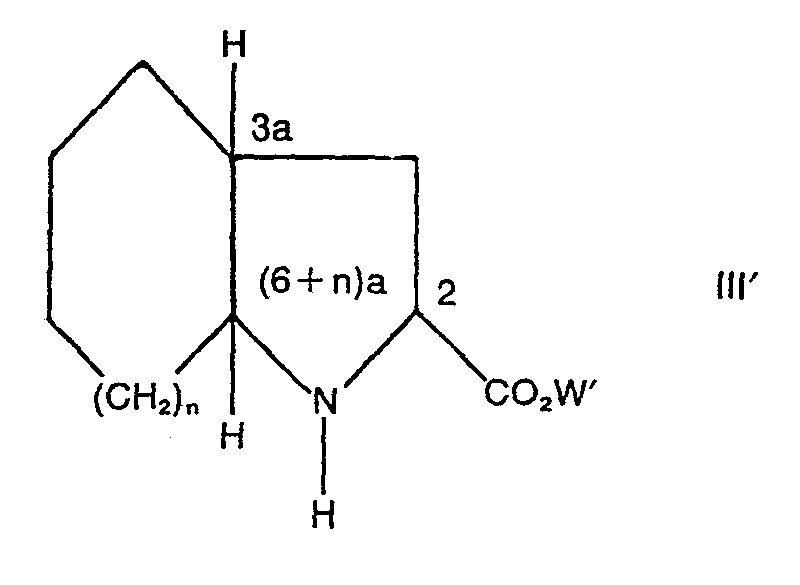


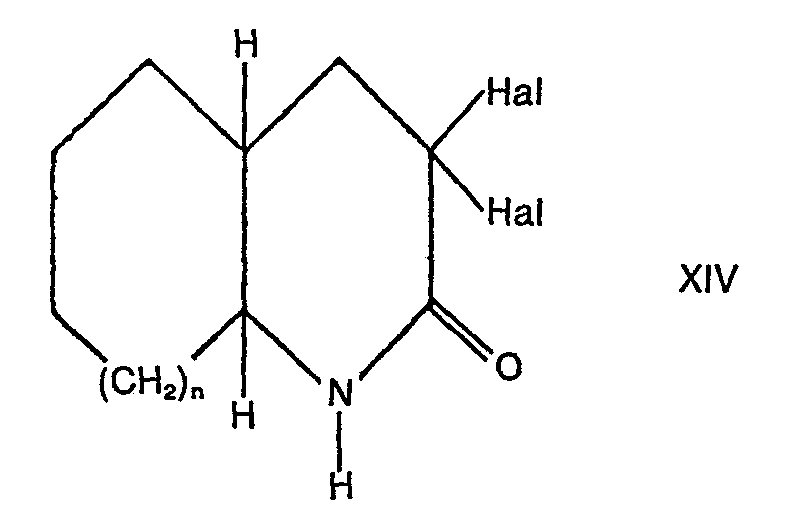


Priority Applications (3)
| Application Number | Priority Date | Filing Date | Title |
|---|---|---|---|
| EP85103730A EP0170775B2 (de) | 1981-12-29 | 1982-12-24 | Derivate bicyclischer Aminosäuren, Verfahren zu ihrer Herstellung, diese enthaltende Mittel und deren Verwendung sowie neue bicyclische Aminosäuren als Zwischenstufen und Verfahren zu deren Herstellung |
| AT82112007T ATE25244T1 (de) | 1981-12-29 | 1982-12-24 | Neue derivate bicyclischer aminosaeuren, verfahren zu ihrer herstellung, diese enthaltende mittel und deren verwendung sowie neue bicyclische aminosaeuren als zwischenstufen und verfahren zu deren herstellung. |
| DE8585103730T DE3280014D1 (en) | 1981-12-29 | 1982-12-24 | Derivatives of bicyclic amino acids, processes for their preparation, agents containing them and their use as well as bicyclic amino acids as intermediates and process for their preparation |
Applications Claiming Priority (4)
| Application Number | Priority Date | Filing Date | Title |
|---|---|---|---|
| DE19813151690 DE3151690A1 (de) | 1981-12-29 | 1981-12-29 | "neue derivate bicyclischer aminosaeuren, verfahren zu ihrer herstellung, diese enthaltende mittel und deren verwendung sowie neue bicyclische aminosaeuren als zwischenstufen und verfahren zu deren herstellung" |
| DE3151690 | 1981-12-29 | ||
| DE3210701 | 1982-03-24 | ||
| DE19823210701 DE3210701A1 (de) | 1982-03-24 | 1982-03-24 | 2-azabicycloalkan-3-carbonsaeuren und verfahren zu ihrer herstellung |
Related Child Applications (1)
| Application Number | Title | Priority Date | Filing Date |
|---|---|---|---|
| EP85103730.9 Division-Into | 1982-12-24 |
Publications (3)
| Publication Number | Publication Date |
|---|---|
| EP0084164A2 EP0084164A2 (de) | 1983-07-27 |
| EP0084164A3 EP0084164A3 (en) | 1983-10-12 |
| EP0084164B1 true EP0084164B1 (de) | 1987-01-28 |
Family
ID=25798350
Family Applications (1)
| Application Number | Title | Priority Date | Filing Date |
|---|---|---|---|
| EP82112007A Expired EP0084164B1 (de) | 1981-12-29 | 1982-12-24 | Neue Derivate bicyclischer Aminosäuren, Verfahren zu ihrer Herstellung, diese enthaltende Mittel und deren Verwendung sowie neue bicyclische Aminosäuren als Zwischenstufen und Verfahren zu deren Herstellung |
Country Status (27)
| Country | Link |
|---|---|
| US (3) | US5008400A (de) |
| EP (1) | EP0084164B1 (de) |
| JP (3) | JPS58118569A (de) |
| KR (1) | KR890003424B1 (de) |
| AR (1) | AR247571A1 (de) |
| AU (1) | AU559140B2 (de) |
| BG (1) | BG60936B2 (de) |
| CA (1) | CA1341296C (de) |
| CS (1) | CS409591A3 (de) |
| DE (2) | DE3280014D1 (de) |
| DK (2) | DK170444B1 (de) |
| DZ (1) | DZ490A1 (de) |
| ES (2) | ES518574A0 (de) |
| FI (1) | FI80017C (de) |
| GR (1) | GR78413B (de) |
| HK (1) | HK74989A (de) |
| HU (1) | HU194167B (de) |
| IE (1) | IE55867B1 (de) |
| IL (1) | IL67572A (de) |
| LU (1) | LU88263I2 (de) |
| MA (1) | MA19672A1 (de) |
| NL (1) | NL930048I2 (de) |
| NO (1) | NO156786C (de) |
| NZ (1) | NZ202903A (de) |
| PH (2) | PH18918A (de) |
| PT (1) | PT76052B (de) |
| SG (1) | SG1389G (de) |
Families Citing this family (70)
| Publication number | Priority date | Publication date | Assignee | Title |
|---|---|---|---|---|
| EP0050800B2 (de) * | 1980-10-23 | 1995-06-07 | Schering Corporation | Carboxyalkyl-Dipeptide, Verfahren zu ihrer Herstellung und diese enthaltende Arzneimittel |
| NZ202903A (en) * | 1981-12-29 | 1988-01-08 | Hoechst Ag | 1-- pe pyrrol-2-yl-carboxylic acid derivatives and pharmaceutical compositions |
| DE3246503A1 (de) * | 1982-12-16 | 1984-06-20 | Hoechst Ag, 6230 Frankfurt | Derivate der cis, endo-2-azabicyclo-(5.3.0)-decan-3-carbonsaeure, verfahren zu ihrer herstellung, diese enthaltende mittel und deren verwendung |
| FI841052A7 (fi) * | 1983-03-16 | 1984-09-17 | Usv Pharma Corp | Foereningar foer behandling av blodtryckssjukdomar. |
| DE3324263A1 (de) * | 1983-07-06 | 1985-01-17 | Hoechst Ag, 6230 Frankfurt | Derivate der 2-azabicyclo(3.1.0)hexan-3-carbonsaeure, verfahren zu ihrer herstellung, diese enthaltende mittel und deren verwendung sowie 2-azabicyclo(3.1.0)hexan-derivate als zwischenprodukte und verfahren zu deren herstellung |
| DE3410732A1 (de) * | 1984-03-23 | 1985-09-26 | Hoechst Ag, 6230 Frankfurt | Methode zur behandlung des glaukoms |
| DE3413710A1 (de) * | 1984-04-12 | 1985-10-24 | Hoechst Ag, 6230 Frankfurt | Verfahren zur behandlung der herzinsuffizienz |
| US5684016A (en) * | 1984-04-12 | 1997-11-04 | Hoechst Aktiengesellschaft | Method of treating cardiac insufficiency |
| WO1986000896A1 (en) * | 1984-07-30 | 1986-02-13 | Schering Corporation | NOVEL PROCESS FOR THE PREPARATION OF CIS, ENDOOCTAHYDROCYCLOPENTA ADb BDPYRROLE-2-CARBOXYLATE |
| GB8422165D0 (en) * | 1984-09-01 | 1984-10-03 | Wellcome Found | Compounds |
| US5231084A (en) * | 1986-03-27 | 1993-07-27 | Hoechst Aktiengesellschaft | Compounds having a cognition adjuvant action, agents containing them, and the use thereof for the treatment and prophylaxis of cognitive dysfuncitons |
| FR2605630B1 (fr) * | 1986-10-22 | 1989-06-30 | Roussel Uclaf | Procede de preparation de derives de l'octahydroindole et intermediaires de preparation |
| DE3641451A1 (de) * | 1986-12-04 | 1988-06-16 | Hoechst Ag | Derivate bicyclischer aminocarbonsaeuren, verfahren und zwischenprodukte zu deren herstellung sowie deren verwendung |
| DE3722007A1 (de) * | 1987-07-03 | 1989-01-12 | Hoechst Ag | Verfahren zur herstellung bicyclischer aminocarbonsaeuren, zwischenprodukte dieses verfahrens und deren verwendung |
| TW197945B (de) * | 1990-11-27 | 1993-01-11 | Hoechst Ag | |
| DE4109134A1 (de) * | 1991-03-20 | 1992-09-24 | Knoll Ag | Erzeugnisse, enthaltend verapamil und trandolapril |
| LT3872B (en) | 1993-12-06 | 1996-04-25 | Hoechst Ag | Novel peptides and pharmaceutical compositions containing them |
| US5602167A (en) * | 1995-05-17 | 1997-02-11 | Ortho Pharmaceutical Corporation | 4-arylcyclohepta[c] pyrrole analgesics |
| FR2746394B1 (fr) | 1996-03-20 | 1998-05-29 | Roussel Uclaf | Nouveaux composes tricycliques, leur procede de preparation, et les intermediaires de ce procede, leur application a titre de medicaments et les compositions pharmaceutiques les renfermant |
| ES2171768T3 (es) | 1996-03-20 | 2002-09-16 | Hoechst Ag | Inhibidores de la resorcion osea y antagonistas de receptores de vitronectina. |
| DE19653647A1 (de) | 1996-12-20 | 1998-06-25 | Hoechst Ag | Vitronectin - Rezeptorantagonisten, deren Herstellung sowie deren Verwendung |
| DE19703430A1 (de) * | 1997-01-30 | 1998-08-06 | Bayerische Motoren Werke Ag | Knieschutzsystem für den Beifahrer in Personenkraftwagen |
| DE19741235A1 (de) | 1997-09-18 | 1999-03-25 | Hoechst Marion Roussel De Gmbh | Neue Imidazolidinderivate, ihre Herstellung, ihre Verwendung und sie enthaltende pharmazeutische Präparate |
| DE19741873A1 (de) * | 1997-09-23 | 1999-03-25 | Hoechst Marion Roussel De Gmbh | Neue 5-Ring-Heterocyclen, ihre Herstellung, ihre Verwendung und sie enthaltende pharmazeutische Präparate |
| DE19751251A1 (de) | 1997-11-19 | 1999-05-20 | Hoechst Marion Roussel De Gmbh | Substituierte Imidazolidinderivate, ihre Herstellung, ihre Verwendung und sie enthaltende pharmezeutische Präparate |
| DE19821483A1 (de) | 1998-05-14 | 1999-11-18 | Hoechst Marion Roussel De Gmbh | Imidazolidinderivate, ihre Herstellung, ihre Verwendung und sie enthaltende pharmazeutische Präparate |
| DE19900205A1 (de) * | 1999-01-07 | 2000-07-13 | Basf Ag | Verfahren zur Herstellung von (2S,4R,9S)-Octahydro-1H-indol-2-carbonsäure und Zwischenprodukte dafür |
| CA2363658C (en) * | 2001-11-21 | 2005-12-13 | Brantford Chemicals Inc. | Improved process for the preparation of ramipril |
| CA2477391A1 (en) * | 2002-03-01 | 2003-09-12 | Denis Schrier | Method of treating osteoarthritis |
| EP1545519B1 (de) | 2002-08-19 | 2011-03-23 | Pfizer Inc. | Kombinationstherapie gegen hyperproliferative erkrankungen |
| US6812355B2 (en) | 2002-10-22 | 2004-11-02 | Sekhsaria Chemicals Limited | Process for the manufacture of citalopram hydrobromide from 5-bromophthalide |
| CL2004000366A1 (es) * | 2003-02-26 | 2005-01-07 | Pharmacia Corp Sa Organizada B | USO DE UNA COMBINACION DE UN COMPUESTO DERIVADO DE PIRAZOL INHIBIDOR DE QUINASA p38, Y UN INHIBIDOR DE ACE PARA TRATAR DISFUNCION RENAL, ENFERMEDAD CARDIOVASCULAR Y VASCULAR, RETINOPATIA, NEUROPATIA, EDEMA, DISFUNCION ENDOTELIAL O INSULINOPATIA. |
| US20040220252A1 (en) * | 2003-02-27 | 2004-11-04 | Parthasaradhi Reddy Bandi | Novel crystalline forms of trandolapril |
| SI1403275T1 (sl) * | 2003-02-28 | 2006-02-28 | Servier Lab | Nov postopek sinteze perindoprila in njegovih farmacevtsko sprejemljivih soli |
| DE60301774T2 (de) * | 2003-02-28 | 2006-07-20 | Les Laboratoires Servier | Verfahren zur Synthese von (2S,3aS,7aS)-1-((S)-Alanyl)-octahydro-1H-indol-2-carbonsäurederivaten und Verwendung in der Synthese von Perindopril |
| ATE307801T1 (de) * | 2003-02-28 | 2005-11-15 | Servier Lab | Verfahren zur synthese des (2s,3as,7as)- perhydroindol-2-carbonsäures und seiner estern, verwendung in der synthese von perindopril |
| EP1323729B1 (de) * | 2003-03-12 | 2004-11-03 | Les Laboratoires Servier | Verfahren zur Synthese von (2S,3aS,7aS)-Perhydroindol-2-carbonsäure und seiner Estern, und Verwendung in der Synthese von Perindopril |
| EP1319668B1 (de) * | 2003-03-12 | 2004-10-27 | Les Laboratoires Servier | Verfahren zur Synthese von (2S,3aS,7aS)-1-((S)-Alanyl)-octahydro-1H-indol-2-carbonsäurederivaten und Verwendung in der Synthese von Perindopril |
| DK1321471T3 (da) * | 2003-03-12 | 2005-08-29 | Servier Lab | Ny syntesefremgangsmåde til perindopril og farmaceutisk acceptable salte heraf |
| CL2004000544A1 (es) * | 2003-03-18 | 2005-01-28 | Pharmacia Corp Sa Organizada B | Uso de una combinacion farmaceutica, de un antagonista del receptor de aldosterona y un inhibidor de endopeptidasa neutral, util para el tratamiento y prevencion de una condicion patologica relacionada con hipertension, disfuncion renal, insulinopati |
| US20050032784A1 (en) * | 2003-04-01 | 2005-02-10 | University Of Florida Research Foundation, Inc. | Combination drug therapy for treating hypertension |
| DE60300166T2 (de) * | 2003-04-15 | 2005-12-01 | Les Laboratoires Servier | Verfahren zur Synthese von (2S, 3aS, 7aS)-Perhydroindol-2-carbonsäure und seinen Estern, und Verwendung in der Synthese von Perindopril |
| CA2522195A1 (en) * | 2003-04-15 | 2004-10-28 | Warner-Lambert Company Llc | [b]-fused bicyclic proline derivatives and their use for treating arthritic conditions |
| PT1354875E (pt) * | 2003-05-19 | 2005-03-31 | Servier Lab | Novo processo de sintese do acido (2s, 3as, 7as)-per-hidroindole-2-carboxilico e dos seus esteres e aplicacao a sintese do perindopril |
| EP1354876B1 (de) * | 2003-06-13 | 2005-04-27 | Les Laboratoires Servier | Verfahren zur Synthese von (2S,3aS,7aS)-Perhydroindol-2-carbonsäure und seiner Estern, und Verwendung in der Synthese von Perindopril |
| US20050037063A1 (en) * | 2003-07-21 | 2005-02-17 | Bolton Anthony E. | Combined therapies |
| EP1687271A1 (de) * | 2003-11-25 | 2006-08-09 | Texcontor Etablissement | Verfahren zur herstellung von (2s, 3ar, 7as)-octahydro-1h-indol-2-carbonsäure als schlüsselzwischenprodukt bei der herstellung von trandolapril durch umsetzung eines cyclohexylaziridins mit einem malonsäuredialkylester |
| US20070135513A1 (en) * | 2003-11-28 | 2007-06-14 | Mirko Pogutter | Method for producing {n-[1-(s)-carbalkoxy-3-phenylpropyl]-s-alanyl-2s, 3ar, 7as-octahydroindole-2-carboxylic acid} compounds |
| GB2413128A (en) * | 2004-04-13 | 2005-10-19 | Neopharma Ltd | Process for the preparation of perindopril |
| WO2006014916A2 (en) * | 2004-07-26 | 2006-02-09 | Dr. Reddy's Laboratories Ltd. | Preparation of trandolapril |
| US20060079698A1 (en) * | 2004-10-07 | 2006-04-13 | Glenmark Pharmaceuticals Limited | Process for the preparation of intermediates of trandolapril and use thereof for the preparation of trandolapril |
| US20080171885A1 (en) * | 2005-02-14 | 2008-07-17 | Lupin Limited | Process for Preparation of Highly Pure Trandolapril |
| DE602005004897D1 (de) * | 2005-05-06 | 2008-04-03 | Sochinaz Sa | Verfahren zur Herstellung von i(2S, 3aR, 7aS)-octahydroindole-2-Carbonsäure und Umwandlung zum Trandolapril |
| WO2007003947A2 (en) * | 2005-07-05 | 2007-01-11 | Cipla Limited | Process for the synthesis of the ace inhibitor trandolapril |
| WO2007026372A2 (en) * | 2005-09-01 | 2007-03-08 | Wockhardt Limited | Novel crystalline polymorph of trandolapril and a process for preparation thereof |
| WO2007026371A2 (en) * | 2005-09-01 | 2007-03-08 | Wockhardt Limited | Process for preparing trandolapril and intermediates thereof |
| US7741317B2 (en) | 2005-10-21 | 2010-06-22 | Bristol-Myers Squibb Company | LXR modulators |
| US7888376B2 (en) | 2005-11-23 | 2011-02-15 | Bristol-Myers Squibb Company | Heterocyclic CETP inhibitors |
| US7943655B2 (en) | 2006-04-05 | 2011-05-17 | Universitat Zurich | Polymorphic and pseudopolymorphic forms of trandolaprilat, pharmaceutical compositions and methods for production and use |
| JP5498168B2 (ja) | 2006-12-01 | 2014-05-21 | ブリストル−マイヤーズ スクイブ カンパニー | アテローム性動脈硬化および循環器疾患の治療のためのcetp阻害剤としてのn−((3−ベンジル)−2,2−(ビス−フェニル)−プロパン−1−アミン誘導体 |
| CN101302218B (zh) * | 2007-05-08 | 2011-02-23 | 上海医药工业研究院 | 群多普利双酮的制备方法 |
| CN101302185B (zh) * | 2007-05-08 | 2010-09-01 | 上海医药工业研究院 | 群多普利拉的制备方法 |
| CA2768239A1 (en) * | 2009-07-16 | 2011-01-20 | Abbott Laboratories | Processes for the synthesis of (2s, 3ar, 7as)-octahydro-1h-indole carboxylic acid as an intermediate for trandolapril |
| CN104045593B (zh) * | 2013-03-12 | 2016-11-02 | 上海交通大学 | 一种群多普利中间体的制备方法 |
| SG11201507496UA (en) | 2013-04-17 | 2015-11-27 | Pfizer | N-piperidin-3-ylbenzamide derivatives for treating cardiovascular diseases |
| CN103288710A (zh) * | 2013-05-20 | 2013-09-11 | 大连海荣科技开发有限公司 | 群多普利中间体(2S,3aR,7aS)-八氢-1H-吲哚-2-羧酸的制备方法 |
| CN104086623B (zh) * | 2014-07-02 | 2017-05-24 | 牡丹江友搏药业有限责任公司 | 一种新的具有降压和细胞保护作用的化合物 |
| WO2016055901A1 (en) | 2014-10-08 | 2016-04-14 | Pfizer Inc. | Substituted amide compounds |
| US11248001B2 (en) | 2019-01-18 | 2022-02-15 | Astrazeneca Ab | PCSK9 inhibitors and methods of use thereof |
| CN114456194B (zh) * | 2021-12-14 | 2023-07-07 | 浙江九洲药业股份有限公司 | 甲苯磺酸艾多沙班的中间体及其制备方法 |
Family Cites Families (36)
| Publication number | Priority date | Publication date | Assignee | Title |
|---|---|---|---|---|
| FR31741E (fr) * | 1926-03-29 | 1927-06-10 | Essuie-glace | |
| JPS5572169A (en) * | 1978-11-27 | 1980-05-30 | Tanabe Seiyaku Co Ltd | Isoquinoline derivative and its preparation |
| IL58849A (en) * | 1978-12-11 | 1983-03-31 | Merck & Co Inc | Carboxyalkyl dipeptides and derivatives thereof,their preparation and pharmaceutical compositions containing them |
| US4294832A (en) * | 1979-04-28 | 1981-10-13 | Tanabe Seiyaku Co., Ltd. | Tetrahydroisoquinoline compounds and a pharmaceutical composition thereof |
| US4508729A (en) * | 1979-12-07 | 1985-04-02 | Adir | Substituted iminodiacids, their preparation and pharmaceutical compositions containing them |
| FR2503155A2 (fr) * | 1980-10-02 | 1982-10-08 | Science Union & Cie | Nouveaux imino diacides substitues, leurs procedes de preparation et leur emploi comme inhibiteur d'enzyme |
| US4616029A (en) * | 1979-12-07 | 1986-10-07 | Adir | Perhydromdole-2-carboxylic acids as antihypertensives |
| FR2487829A2 (fr) * | 1979-12-07 | 1982-02-05 | Science Union & Cie | Nouveaux imino acides substitues, leurs procedes de preparation et leur emploi comme inhibiteur d'enzyme |
| US4350704A (en) * | 1980-10-06 | 1982-09-21 | Warner-Lambert Company | Substituted acyl derivatives of octahydro-1H-indole-2-carboxylic acids |
| IE52663B1 (en) * | 1980-04-02 | 1988-01-20 | Warner Lambert Co | Substituted acyl derivatives of octahydro-1h-indole-2-carboxylic acids |
| ZA811493B (en) * | 1980-04-02 | 1982-03-31 | Warner Lambert Co | Substituted acyl derivatives of octahydro-1h-indole-2-carboxylic acids |
| US4344449A (en) * | 1980-05-16 | 1982-08-17 | The United States Of America As Represented By The United States Department Of Energy | Fast-acting valve and uses thereof |
| DE3177130D1 (de) * | 1980-08-30 | 1990-01-11 | Hoechst Ag | Aminosaeurederivate, verfahren zu ihrer herstellung, diese enthaltende mittel und deren verwendung. |
| IL63813A0 (en) * | 1980-09-17 | 1981-12-31 | Univ Miami | Carboxyalkyl peptides and thioethers and ethers of peptides,antihypertensive compositions and methods for their use |
| US4344949A (en) * | 1980-10-03 | 1982-08-17 | Warner-Lambert Company | Substituted acyl derivatives of 1,2,3,4-tetrahydroisoquinoline-3-carboxylic acids |
| EP0050800B2 (de) * | 1980-10-23 | 1995-06-07 | Schering Corporation | Carboxyalkyl-Dipeptide, Verfahren zu ihrer Herstellung und diese enthaltende Arzneimittel |
| ZA817261B (en) * | 1980-10-23 | 1982-09-29 | Schering Corp | Carboxyalkyl dipeptides,processes for their production and pharmaceutical compositions containing them |
| GB2086390B (en) * | 1980-11-03 | 1984-06-06 | Ciba Geigy Ag | 1-carboxy-azaalkanoylindoline-2-carboxylic acids process for their manufacture pharmaceutical preparations containing these compounds and their therapeutic application |
| US4820729A (en) * | 1981-03-30 | 1989-04-11 | Rorer Pharmaceutical Corporation | N-substituted-amido-amino acids |
| DE3226768A1 (de) * | 1981-11-05 | 1983-05-26 | Hoechst Ag, 6230 Frankfurt | Derivate der cis, endo-2-azabicyclo-(3.3.0)-octan-3-carbonsaeure, verfahren zu ihrer herstellung, diese enthaltende mittel und deren verwendung |
| NZ202903A (en) * | 1981-12-29 | 1988-01-08 | Hoechst Ag | 1-- pe pyrrol-2-yl-carboxylic acid derivatives and pharmaceutical compositions |
| DE3210496A1 (de) * | 1982-03-23 | 1983-10-06 | Hoechst Ag | Neue derivate bicyclischer aminsaeuren, verfahren zu ihrer herstellung, diese enthaltende mittel und deren verwendung sowie neue bicyclische aminosaeuren als zwischenstufen und verfahren zu deren herstellung |
| DE3211397A1 (de) * | 1982-03-27 | 1983-11-10 | Hoechst Ag, 6230 Frankfurt | Spiro (4.(3+n))-2-aza-3-carbonsaeure-derivate, verfahren zu ihrer herstellung, diese enthaltende mittel und ihre verwendung |
| DE3211676A1 (de) * | 1982-03-30 | 1983-10-06 | Hoechst Ag | Neue derivate von cycloalka (c) pyrrol-carbonsaeuren, verfahren zu ihrer herstellung, diese enthaltende mittel und deren verwendung sowie neue cycloalka (c) pyrrol-carbonsaeuren als zwischenstufen und verfahren zu deren herstellung |
| US4490386A (en) * | 1982-09-23 | 1984-12-25 | Warner-Lambert Company | Phosphate salts of 1-[2-[(1-alkoxycarbonyl-3-aralkyl)-amino]-1-oxoalkyl]octahydro-1H-indole-2-carboxylic acids, preparation of, and medical compositions thereof |
| DE3242151A1 (de) * | 1982-11-13 | 1984-05-17 | Hoechst Ag, 6230 Frankfurt | Neue derivate tricyclischer aminosaeuren, verfahren zu ihrer herstellung, diese enthaltende mittel und deren verwendung, sowie neue bicyclische aminosaeuren als zwischenstufen und verfahren zu deren herstellung |
| DE3246503A1 (de) * | 1982-12-16 | 1984-06-20 | Hoechst Ag, 6230 Frankfurt | Derivate der cis, endo-2-azabicyclo-(5.3.0)-decan-3-carbonsaeure, verfahren zu ihrer herstellung, diese enthaltende mittel und deren verwendung |
| US4468396A (en) * | 1982-12-20 | 1984-08-28 | Schering Corporation | Antihypertensive benzothiadiazines |
| DE3300316A1 (de) * | 1983-01-07 | 1984-07-12 | Hoechst Ag, 6230 Frankfurt | Disubstituierte prolinderivate, verfahren zu ihrer herstellung und ihre verwendung |
| DE3300774A1 (de) * | 1983-01-12 | 1984-07-12 | Hoechst Ag, 6230 Frankfurt | Neue spirocyclische aminosaeuren, verfahren zu ihrer herstellung, diese enthaltende mittel und deren verwendung sowie neue spirocyclische aminosaeuren als zwischenprodukte und verfahren zu deren herstellung |
| DE3303112A1 (de) * | 1983-01-31 | 1984-08-09 | Hoechst Ag, 6230 Frankfurt | Verfahren zur racemattrennung optisch aktiver bicyclischer imino-(alpha)-carbonsaeuren |
| DE3315464A1 (de) * | 1983-04-28 | 1984-10-31 | Hoechst Ag, 6230 Frankfurt | Verfahren zur herstellung von n-alkylierten dipeptiden und deren estern |
| DE3322530A1 (de) * | 1983-06-23 | 1985-01-10 | Hoechst Ag, 6230 Frankfurt | Verfahren zur herstellung von mono-, bi- und tricyclischen aminosaeuren |
| DE3324263A1 (de) * | 1983-07-06 | 1985-01-17 | Hoechst Ag, 6230 Frankfurt | Derivate der 2-azabicyclo(3.1.0)hexan-3-carbonsaeure, verfahren zu ihrer herstellung, diese enthaltende mittel und deren verwendung sowie 2-azabicyclo(3.1.0)hexan-derivate als zwischenprodukte und verfahren zu deren herstellung |
| US4559340A (en) * | 1983-11-25 | 1985-12-17 | Schering Corporation | Antihypertensive agents |
| DE3345355A1 (de) * | 1983-12-15 | 1985-06-27 | Hoechst Ag, 6230 Frankfurt | Verfahren zur racematspaltung bicyclischer imino-(alpha)-carbonsaeureester |
-
1982
- 1982-12-23 NZ NZ202903A patent/NZ202903A/en unknown
- 1982-12-23 CA CA000418453A patent/CA1341296C/en not_active Expired - Lifetime
- 1982-12-23 IE IE3065/82A patent/IE55867B1/en active Protection Beyond IP Right Term
- 1982-12-23 GR GR70162A patent/GR78413B/el unknown
- 1982-12-24 LU LU88263C patent/LU88263I2/xx unknown
- 1982-12-24 DE DE8585103730T patent/DE3280014D1/de not_active Expired
- 1982-12-24 EP EP82112007A patent/EP0084164B1/de not_active Expired
- 1982-12-24 DE DE8282112007T patent/DE3275293D1/de not_active Expired
- 1982-12-24 AU AU91931/82A patent/AU559140B2/en not_active Expired
- 1982-12-27 ES ES518574A patent/ES518574A0/es active Granted
- 1982-12-27 KR KR8205823A patent/KR890003424B1/ko not_active Expired
- 1982-12-27 JP JP57227179A patent/JPS58118569A/ja active Granted
- 1982-12-27 IL IL67572A patent/IL67572A/xx not_active IP Right Cessation
- 1982-12-27 PH PH28321A patent/PH18918A/en unknown
- 1982-12-27 FI FI824474A patent/FI80017C/fi not_active IP Right Cessation
- 1982-12-27 MA MA19890A patent/MA19672A1/fr unknown
- 1982-12-28 DK DK576782A patent/DK170444B1/da not_active IP Right Cessation
- 1982-12-28 NO NO824394A patent/NO156786C/no not_active IP Right Cessation
- 1982-12-28 HU HU844653A patent/HU194167B/hu unknown
- 1982-12-29 PT PT76052A patent/PT76052B/de unknown
- 1982-12-29 DZ DZ826743A patent/DZ490A1/fr active
-
1983
- 1983-04-22 ES ES521740A patent/ES521740A0/es active Granted
-
1984
- 1984-06-06 PH PH30781A patent/PH19771A/en unknown
- 1984-11-21 US US06/673,605 patent/US5008400A/en not_active Expired - Lifetime
-
1985
- 1985-02-18 AR AR85299524A patent/AR247571A1/es active
-
1989
- 1989-01-07 SG SG13/89A patent/SG1389G/en unknown
- 1989-01-18 JP JP1007871A patent/JPH064586B2/ja not_active Expired - Lifetime
- 1989-01-18 JP JP1007870A patent/JPH01301695A/ja active Pending
- 1989-04-28 US US07/346,339 patent/US4933361A/en not_active Expired - Lifetime
- 1989-09-14 HK HK749/89A patent/HK74989A/xx not_active IP Right Cessation
-
1990
- 1990-01-23 US US07/468,567 patent/US5101039A/en not_active Expired - Lifetime
-
1991
- 1991-12-27 CS CS914095A patent/CS409591A3/cs unknown
-
1992
- 1992-09-28 DK DK119992A patent/DK171232B1/da not_active IP Right Cessation
-
1993
- 1993-06-03 NL NL930048C patent/NL930048I2/nl unknown
-
1994
- 1994-02-24 BG BG098551A patent/BG60936B2/bg unknown
Also Published As
Similar Documents
| Publication | Publication Date | Title |
|---|---|---|
| EP0084164A2 (de) | Neue Derivate bicyclischer Aminosäuren, Verfahren zu ihrer Herstellung, diese enthaltende Mittel und deren Verwendung sowie neue bicyclische Aminosäuren als Zwischenstufen und Verfahren zu deren Herstellung | |
| EP0090362A2 (de) | Neue Derivate von Cycloalka(c)pyrrol-carbonsäuren, Verfahren zu ihrer Herstellung, diese enthaltende Mittel und deren Verwendung sowie neue Cycloalka(c)pyrrol-carbonsäuren als Zwischenstufen und Verfahren zu deren Herstellung | |
| EP0089637B1 (de) | Neue Derivate bicyclischer Aminosäuren, Verfahren zu ihrer Herstellung, diese enthaltende Mittel und deren Verwendung sowie neue bicyclische Aminosäuren als Zwischenstufen und Verfahren zu deren Herstellung | |
| EP0150263B1 (de) | Derivate der cis, endo-2-Azabicyclo-[3.3.0]-octan-3-carbonsäure, Verfahren zu ihrer Herstellung, diese enthaltende Mittel und deren Verwendung | |
| EP0109020B1 (de) | Neue Derivate tricyclischer Aminosäuren, Verfahren zu ihrer Herstellung, diese enthaltende Mittel und deren Verwendung, sowie neue bicyclische Aminosäuren als Zwischenstufen und Verfahren zu deren Herstellung | |
| EP0111873B1 (de) | Derivate der cis, endo-2-Azabicyclo-(5.3.0)-decan-3-carbonsäure, Verfahren zu ihrer Herstellung, diese enthaltende Mittel und deren Verwendung | |
| EP0050850B1 (de) | 1-Carboxyalkanoylindolin-2-carbonsäuren und deren Derivate, Verfahren zu ihrer Herstellung, und pharmazeutische Präparate, die diese Verbindungen enthalten | |
| DE3631824A1 (de) | Cycloalkano(1.2-b)indol-sulfonamide | |
| EP0116276B1 (de) | Neue spirocyclische Aminosäurederivate, Verfahren zu ihrer Herstellung, diese enthaltende Mittel und deren Verwendung sowie neue spirocyclische Aminosäuren als Zwischenprodukte und Verfahren zu deren Herstellung | |
| EP0105102A1 (de) | Neue Derivate der 2-Aza-bicyclo(2.2.2)octan-3-carbonsäure, Verfahren zu ihrer Herstellung, diese enthaltende Mittel und deren Verwendung sowie 2-Aza-bicyclo(2.2.2)octan-3-carbonsäure als Zwischenstufe und Verfahren zu deren Herstellung | |
| EP0051301A1 (de) | 1-Carboxy-azaalkanoylindolin-2-carbonsäuren, Verfahren zu ihrer Herstellung, pharmazeutische Präparate enthaltend diese Verbindungen, sowie ihre therapeutische Verwendung | |
| DE3300316A1 (de) | Disubstituierte prolinderivate, verfahren zu ihrer herstellung und ihre verwendung | |
| EP0115345A1 (de) | Verfahren zur Racemattrennung optisch aktiver bicyclischer Imino-alpha-carbonsäureester und Verwendung der so erhältlichen Verbindungen zur Synthese von Carboxyalkyldipeptiden | |
| DE2431963C2 (de) | Verfahren zur Herstellung heterocyclischer Verbindungen | |
| EP0170775B1 (de) | Derivate bicyclischer Aminosäuren, Verfahren zu ihrer Herstellung, diese enthaltende Mittel und deren Verwendung sowie neue bicyclische Aminosäuren als Zwischenstufen und Verfahren zu deren Herstellung | |
| EP0113880A2 (de) | Neue 2-Azabicyclo(2.2.1)heptan-Derivate, Verfahren zu ihrer Herstellung, diese enthaltende Mittel und deren Verwendung sowie 2-Azabicyclo(2.2.1)heptan-Derivate als Zwischenprodukte und Verfahren zu deren Herstellung | |
| DE3151690A1 (de) | "neue derivate bicyclischer aminosaeuren, verfahren zu ihrer herstellung, diese enthaltende mittel und deren verwendung sowie neue bicyclische aminosaeuren als zwischenstufen und verfahren zu deren herstellung" | |
| EP0279350B1 (de) | Annelierte Azepinon- und Azocinon-Derivate, Verfahren zu ihrer Herstellung, diese enthaltende Mittel und ihre Verwendung, sowie Zwischenprodukte bei ihrer Herstellung | |
| EP0239667B1 (de) | 5- oder 6-substituierte-beta-carbolin-3-carbonsäureester | |
| EP0025501A1 (de) | Neue N-Aminoalkylindol-Derivate und ihre Salze; Verfahren zu deren Herstellung und diese Verbindungen enthaltende Arzneimittel | |
| DD210266A5 (de) | Verfahren zur herstellung von 3-(ureidocyclohexylamino)-propan-1,2-diolderivaten | |
| EP0154886A2 (de) | Carboxyalkyldipeptidderivate, Verfahren zu deren Herstellung, diese enthaltende Mittel und deren Verwendung | |
| DE3426720A1 (de) | Benzthiazepinon- und benzthiazocinon-derivate, verfahren zu ihrer herstellung, diese enthaltende mittel und ihre verwendung, sowie zwischenprodukte bei ihrer herstellung | |
| WO1999051577A1 (de) | (s)-2-(biphenyl-4-sulfonylamino)-3-(1h-indolyl)-propionsäurederivate als matrix-metalloproteinasehemmer | |
| DE2710807A1 (de) | Omega-benzylamino-alkylcarboxamide, verfahren zu ihrer herstellung und sie enthaltende arzneimittel |
Legal Events
| Date | Code | Title | Description |
|---|---|---|---|
| PUAI | Public reference made under article 153(3) epc to a published international application that has entered the european phase |
Free format text: ORIGINAL CODE: 0009012 |
|
| AK | Designated contracting states |
Designated state(s): AT BE CH DE FR GB IT LI LU NL SE |
|
| PUAL | Search report despatched |
Free format text: ORIGINAL CODE: 0009013 |
|
| AK | Designated contracting states |
Designated state(s): AT BE CH DE FR GB IT LI LU NL SE |
|
| 17P | Request for examination filed |
Effective date: 19840223 |
|
| GRAA | (expected) grant |
Free format text: ORIGINAL CODE: 0009210 |
|
| AK | Designated contracting states |
Kind code of ref document: B1 Designated state(s): AT BE CH DE FR GB IT LI LU NL SE |
|
| REF | Corresponds to: |
Ref document number: 25244 Country of ref document: AT Date of ref document: 19870215 Kind code of ref document: T |
|
| ITF | It: translation for a ep patent filed | ||
| REF | Corresponds to: |
Ref document number: 3275293 Country of ref document: DE Date of ref document: 19870305 |
|
| ET | Fr: translation filed | ||
| PLBE | No opposition filed within time limit |
Free format text: ORIGINAL CODE: 0009261 |
|
| STAA | Information on the status of an ep patent application or granted ep patent |
Free format text: STATUS: NO OPPOSITION FILED WITHIN TIME LIMIT |
|
| 26N | No opposition filed | ||
| ITTA | It: last paid annual fee | ||
| REG | Reference to a national code |
Ref country code: FR Ref legal event code: CC Free format text: FRCC 92C0308, 920526 |
|
| REG | Reference to a national code |
Ref country code: FR Ref legal event code: CB Free format text: FRCB 92C0308, 821224 |
|
| REG | Reference to a national code |
Ref country code: FR Ref legal event code: CL |
|
| REG | Reference to a national code |
Ref country code: NL Ref legal event code: AC1 Free format text: NLAC1 930048, 930603 |
|
| REG | Reference to a national code |
Ref country code: GB Ref legal event code: CTFF Free format text: GBCTFFSPC/GB93/146, 930701 |
|
| REG | Reference to a national code |
Ref country code: NL Ref legal event code: KC1 Free format text: NLKC1 930048, 20021224, EXPIRES:20070218 |
|
| EPTA | Lu: last paid annual fee | ||
| REG | Reference to a national code |
Ref country code: GB Ref legal event code: CTFG Free format text: GBCTFGSPC/GB93/146 940311, EXPIRES:20070218 |
|
| EAL | Se: european patent in force in sweden |
Ref document number: 82112007.8 |
|
| MEDD | It: supplementary protection certificate for pharmaceutical products: granted |
Free format text: CCP 490, 19950307; HOECHST AKTIENGESELLSCHAFT |
|
| REG | Reference to a national code |
Ref country code: CH Ref legal event code: SPCF Free format text: CHSPCFIKS 52771/940826, 960223 |
|
| REG | Reference to a national code |
Ref country code: CH Ref legal event code: SPCG Free format text: IKS 52771/19940826, 19960223, EXPIRES:20071223 |
|
| REG | Reference to a national code |
Ref country code: SE Ref legal event code: SPCF Free format text: 9890012, 970411 |
|
| REG | Reference to a national code |
Ref country code: CH Ref legal event code: PUE Owner name: HOECHST AKTIENGESELLSCHAFT TRANSFER- AVENTIS PHARM |
|
| REG | Reference to a national code |
Ref country code: CH Ref legal event code: SPCM Free format text: HOECHST AKTIENGESELLSCHAFT 65926 FRANKFURT AM MAIN (DE)TRANSFER-AVENTIS PHARMA DEUTSCHLAND GMBH 65926 FRANKFURT AM MAIN(DE) |
|
| PGFP | Annual fee paid to national office [announced via postgrant information from national office to epo] |
Ref country code: DE Payment date: 20011005 Year of fee payment: 20 |
|
| PGFP | Annual fee paid to national office [announced via postgrant information from national office to epo] |
Ref country code: NL Payment date: 20011011 Year of fee payment: 20 Ref country code: FR Payment date: 20011011 Year of fee payment: 20 |
|
| PGFP | Annual fee paid to national office [announced via postgrant information from national office to epo] |
Ref country code: SE Payment date: 20011012 Year of fee payment: 20 Ref country code: GB Payment date: 20011012 Year of fee payment: 20 |
|
| PGFP | Annual fee paid to national office [announced via postgrant information from national office to epo] |
Ref country code: CH Payment date: 20011015 Year of fee payment: 20 |
|
| PGFP | Annual fee paid to national office [announced via postgrant information from national office to epo] |
Ref country code: LU Payment date: 20011023 Year of fee payment: 20 |
|
| PGFP | Annual fee paid to national office [announced via postgrant information from national office to epo] |
Ref country code: AT Payment date: 20011024 Year of fee payment: 20 |
|
| PGFP | Annual fee paid to national office [announced via postgrant information from national office to epo] |
Ref country code: BE Payment date: 20011220 Year of fee payment: 20 |
|
| REG | Reference to a national code |
Ref country code: GB Ref legal event code: IF02 |
|
| NLS | Nl: assignments of ep-patents |
Owner name: AVENTIS PHARMA DEUTSCHLAND GMBH |
|
| REG | Reference to a national code |
Ref country code: FR Ref legal event code: TP |
|
| PG25 | Lapsed in a contracting state [announced via postgrant information from national office to epo] |
Ref country code: LI Free format text: LAPSE BECAUSE OF EXPIRATION OF PROTECTION Effective date: 20021223 Ref country code: GB Free format text: LAPSE BECAUSE OF EXPIRATION OF PROTECTION Effective date: 20021223 Ref country code: CH Free format text: LAPSE BECAUSE OF EXPIRATION OF PROTECTION Effective date: 20021223 |
|
| PG25 | Lapsed in a contracting state [announced via postgrant information from national office to epo] |
Ref country code: NL Free format text: LAPSE BECAUSE OF EXPIRATION OF PROTECTION Effective date: 20021224 Ref country code: LU Free format text: LAPSE BECAUSE OF EXPIRATION OF PROTECTION Effective date: 20021224 Ref country code: AT Free format text: LAPSE BECAUSE OF EXPIRATION OF PROTECTION Effective date: 20021224 |
|
| BE20 | Be: patent expired |
Owner name: *AVENTIS PHARMA DEUTSCHLAND G.M.B.H. Effective date: 20021224 |
|
| REG | Reference to a national code |
Ref country code: GB Ref legal event code: PE20 Effective date: 20021223 Ref country code: GB Ref legal event code: CTFE Spc suppl protection certif: SPC/GB93/146 Filing date: 20021224 Expiry date: 20070218 |
|
| REG | Reference to a national code |
Ref country code: CH Ref legal event code: PL |
|
| EUG | Se: european patent has lapsed | ||
| NLV7 | Nl: ceased due to reaching the maximum lifetime of a patent |
Effective date: 20021224 |
|
| REG | Reference to a national code |
Ref country code: GB Ref legal event code: SPCE Free format text: SPC/GB93/146:, EXPIRES: 20070218 Spc suppl protection certif: SPC/GB93/146 Expiry date: 20070218 |
|
| REG | Reference to a national code |
Ref country code: CH Ref legal event code: SPCL Spc suppl protection certif: C00084164/01 |
|
| REG | Reference to a national code |
Ref country code: FR Ref legal event code: RN Spc suppl protection certif: 92C0308 |
|
| REG | Reference to a national code |
Ref country code: FR Ref legal event code: FC Spc suppl protection certif: 92C0308 |