EP0084892B2 - Herstellung von optisch aktivem cis-1,3-Dibenzyl-hexahydro-1H-furo(3,4-d)imidazol-2,4-dion und dessen Zwischenprodukte - Google Patents
Herstellung von optisch aktivem cis-1,3-Dibenzyl-hexahydro-1H-furo(3,4-d)imidazol-2,4-dion und dessen Zwischenprodukte Download PDFInfo
- Publication number
- EP0084892B2 EP0084892B2 EP83100767A EP83100767A EP0084892B2 EP 0084892 B2 EP0084892 B2 EP 0084892B2 EP 83100767 A EP83100767 A EP 83100767A EP 83100767 A EP83100767 A EP 83100767A EP 0084892 B2 EP0084892 B2 EP 0084892B2
- Authority
- EP
- European Patent Office
- Prior art keywords
- cis
- optically active
- dibenzyl
- process according
- oxoimidazolidine
- Prior art date
- Legal status (The legal status is an assumption and is not a legal conclusion. Google has not performed a legal analysis and makes no representation as to the accuracy of the status listed.)
- Expired - Lifetime
Links
- 0 C*(C(*)(C1*C1)C(*)(*1N)O)C1=O Chemical compound C*(C(*)(C1*C1)C(*)(*1N)O)C1=O 0.000 description 2
Classifications
-
- C—CHEMISTRY; METALLURGY
- C07—ORGANIC CHEMISTRY
- C07D—HETEROCYCLIC COMPOUNDS
- C07D491/00—Heterocyclic compounds containing in the condensed ring system both one or more rings having oxygen atoms as the only ring hetero atoms and one or more rings having nitrogen atoms as the only ring hetero atoms, not provided for by groups C07D451/00 - C07D459/00, C07D463/00, C07D477/00 or C07D489/00
- C07D491/02—Heterocyclic compounds containing in the condensed ring system both one or more rings having oxygen atoms as the only ring hetero atoms and one or more rings having nitrogen atoms as the only ring hetero atoms, not provided for by groups C07D451/00 - C07D459/00, C07D463/00, C07D477/00 or C07D489/00 in which the condensed system contains two hetero rings
- C07D491/04—Ortho-condensed systems
-
- C—CHEMISTRY; METALLURGY
- C07—ORGANIC CHEMISTRY
- C07D—HETEROCYCLIC COMPOUNDS
- C07D233/00—Heterocyclic compounds containing 1,3-diazole or hydrogenated 1,3-diazole rings, not condensed with other rings
- C07D233/04—Heterocyclic compounds containing 1,3-diazole or hydrogenated 1,3-diazole rings, not condensed with other rings having one double bond between ring members or between a ring member and a non-ring member
- C07D233/28—Heterocyclic compounds containing 1,3-diazole or hydrogenated 1,3-diazole rings, not condensed with other rings having one double bond between ring members or between a ring member and a non-ring member with hetero atoms or with carbon atoms having three bonds to hetero atoms with at the most one bond to halogen, e.g. ester or nitrile radicals, directly attached to ring carbon atoms
- C07D233/30—Oxygen or sulfur atoms
- C07D233/32—One oxygen atom
-
- C—CHEMISTRY; METALLURGY
- C12—BIOCHEMISTRY; BEER; SPIRITS; WINE; VINEGAR; MICROBIOLOGY; ENZYMOLOGY; MUTATION OR GENETIC ENGINEERING
- C12N—MICROORGANISMS OR ENZYMES; COMPOSITIONS THEREOF; PROPAGATING, PRESERVING, OR MAINTAINING MICROORGANISMS; MUTATION OR GENETIC ENGINEERING; CULTURE MEDIA
- C12N9/00—Enzymes; Proenzymes; Compositions thereof; Processes for preparing, activating, inhibiting, separating or purifying enzymes
- C12N9/14—Hydrolases (3)
- C12N9/16—Hydrolases (3) acting on ester bonds (3.1)
- C12N9/18—Carboxylic ester hydrolases (3.1.1)
-
- C—CHEMISTRY; METALLURGY
- C12—BIOCHEMISTRY; BEER; SPIRITS; WINE; VINEGAR; MICROBIOLOGY; ENZYMOLOGY; MUTATION OR GENETIC ENGINEERING
- C12P—FERMENTATION OR ENZYME-USING PROCESSES TO SYNTHESISE A DESIRED CHEMICAL COMPOUND OR COMPOSITION OR TO SEPARATE OPTICAL ISOMERS FROM A RACEMIC MIXTURE
- C12P17/00—Preparation of heterocyclic carbon compounds with only O, N, S, Se or Te as ring hetero atoms
- C12P17/10—Nitrogen as only ring hetero atom
Definitions
- This invention relates to preparation of optically active cis-1,3-dibenzyl-hexahydro-1 H-furo[3,4-d]imid-azole-2,4-drone and its intermediates.
- Examples of the said "C 1 -C 6 alkyl” group are methyl, ethyl, n-propyl, n-butyl, t-butyl, n-pentyl or n-hexyl.
- optically active lactone (I) For preparation of the optically active lactone (I), there are known the process as disclosed in U.S. patent 3,700,659 (Process (A)) and the process as disclosed in U.S. patent 3,876,656 (Process (B)).
- process (A) ( ⁇ )-cis-1,3-dibenzyl-5-(3'-cholesteryloxycarbonyl)-2-oxoimidazolidine-4-carboxylic acid is subjected to optical resolution in the form of triethylamine salt and the resulting optically active cholesteryl half-ester is reduced with lithium borohydride to obtain the optically active lactone (I).
- ( ⁇ )-cis-1,3-dibenzyl-5-cyclohexyloxycarbonyl-2-oxoimidazolidine-4-carboxylic acid is subjected to optical resolution in the form of its ephedrine salt and the resultant optically active cyclohexyl half-ester is reduced with lithium borohydride to give the optically active lactone (I).
- these procedures are disadvantageous because they require an expensive substance such as ephedrine or cholesterol and give the objective optically active lactone (I) only in a low total yield.
- optically active lactone (I) only one of the optical isomers of the cholesteryl half-ester or the cyclohexyl half-ester obtained in the optical resolution can participate in the reduction with lithium borohydride to give the optically active lactone (I), while the other optical isomer is returned to a certain initial step for use as the starting material (cf. column 4, lines 1 to 6).
- the two optical isomers resulting from the optical resolution cannot be simultaneously subjected to reduction for production of the optically active lactone (I).
- the process (B) comprises subjecting the cis-1,3-dibenzyl-hexahydropyrrolo[3,4-d]imidazole-2,4,6-trione derivative, obtained by dehydration between bis-1,3-dibenzyl-2-oxoimidazolidine-4,5-dicarboxylic acid and an optically active organic primary amine, to asymmetric reduction with sodium borohydride and hydrolyzing the resulting product to give the optically active lactone (I).
- This process is also disadvantageous in that it requires the use of an expensive amine and affords an insufficient asymmetric yield only.
- optically active lactone (I) can be produced in an excellent yield from a cis-imidazolidine-dicarboxylic acid diester of the formula: wherein R is as defined above and Bzl means a benzyl group (hereinafter referred to as "diester") through the optically active half-ester (III).
- an industrially advantageous process for preparing the optically active lactone (I) which comprises converting the diester (II) into the optically active half-ester (III) and converting the latter into the optically active lactone (I).
- the conversion of the diester (II) into the optically active half-ester (III) can be accomplished by treatment of the diester (II) with an enzymatic material having a capability of hydrolyzing the ester bond in the diester (II).
- an enzymatic material having a hydrolytic property there are known numerous and various ones. Quite surprisingly, however, only certain specific enzymatic materials are effective in cleaving the ester bond in the diester (II) and can be used in the above conversion.
- hydrolytic enzymes such as trypsin originating from bovine pancreas, ⁇ -chymotrypsin originating from bovine pancreas, lypase originating from Candida clindracea and lypase originating from pig pancreas as well as microorganisms having hydrolytic ability such as Gliocladium roseum, Helminthosporium sp. and Zygorhynchus moelleri can not achieve said cleavage, while esterase originating from pig liver and esterase originating from any microorganism belonging to the genus Chromobacterium, such as Chromobacterium chocolatum, can accomplish said cleavage.
- hydrolytic enzymes such as trypsin originating from bovine pancreas, ⁇ -chymotrypsin originating from bovine pancreas, lypase originating from Candida clindracea and lypase originating from pig pancreas as well as microorganisms having hydrolytic ability such as Gl
- the enzymatic material usable in this invention is any one chosen from esterase originating from pig liver and esterase originating from any microorganism belonging to the genus Chromobacterium.
- esterase is not necessarily required to be isolated or pure.
- an esterase-producing strain of a microorganism belonging to the genus Chromobacterium may be used as such instead of the esterase separated from such strain or its culturing product.
- the hydrolysis of the diester (II) with said enzymatic material proceeds almost quantitatively to give the optically active half-ester (III). In addition, it can proceed stereospecifically so that the produced optically active half-ester (III) takes the 4S,5R-configuration. Still, the use of said specific enzymatic material for successful hydrolysis of the diester (II) to the optically active half-ester (III) has never been known and falls within the scope of this invention.
- the hydrolysis may be carried out, for instance, by suspending or dissolving the diester (II) in an aqueous medium having a pH of 2 to 10, preferably of 5 to 9, adding pig liver esterase thereto and stirring the resultant medium at a temperature of 0 to 60°C, preferably of 10 to 40°C, for a period of 1 hour to several days.
- the pig liver esterase is known [Biochem. Biophys. Res. Comm., 23, 23 (1966)1 and commercially available. The amount of the enzyme to be used depends upon the degree of purification. When commercially available pig liver esterase (Sigma Chem.
- Co. 160 units/mg protein; one unit will hydrolyze 1.0 mole of ethyl butyrate to butyric acid and ethanol per minute
- its amount may be from 0.001 to 0.1 part by weight to one part by weight of the diester (II).
- concentration of the diester (II) as the substrate may be usually from 0.1 to 10% by weight.
- the enzymatic material is an esterase-producing Chromobacterium microorganism
- its strain is first cultured in a conventional aqueous nutrient medium.
- the diester (II) may be added to the medium, whereby the hydrolysis proceeds with the cultivation.
- the temperature usually a temperature of 25 to 37°C is preferred for the cultivation.
- the cultivation period may be from half a day to 7 days, and the concentration of the diester (II) as the substrate can be made from 0.1 to 10% by weight.
- the cultivated medium may be subjected to appropriate separation treatment such as centrifugation so as to use the collected bacterial cells for the hydrolysis.
- appropriate separation treatment such as centrifugation
- the bacterial cells may be subjected to ultrasonic treatment or lysozyme treatment to liberate the enzyme substance, which is collected by an appropriate separation procedure such as centrifugation, fractionation with ammonium sulfate or dialysis and then used for the hydrolysis.
- the diester (II) may be suspended or dissolved in an aqueous medium having a pH of 5 to 9, the bacterial cells or the enzymatic substance is added thereto in an amount of 0.001 to 0.1 parts by weight to one part by weight of the diester (II), and the resultant suspension or solution is stirred at a temperature of 10 to 40°C, usually for a period of 1 hour to several days.
- the aqueous medium as hereinabove mentioned may contain a mineral acid (e.g. sulfuric acid, hydrochloric acid, phosphoric acid), an organic acid (e.g. acetic acid, citric acid), an inorganic base (e.g. sodium hydroxide, potassium hydroxide, sodium carbonate), an organic base (e.g. triethylamine, pyridine), a salt (e.g. sodium acetate, sodium chloride) or the like.
- a mineral acid e.g. sulfuric acid, hydrochloric acid, phosphoric acid
- an organic acid e.g. acetic acid, citric acid
- an inorganic base e.g. sodium hydroxide, potassium hydroxide, sodium carbonate
- an organic base e.g. triethylamine, pyridine
- a salt e.g. sodium acetate, sodium chloride
- the aqueous medium there may be used a buffer containing potassium dihydrogen phosphate/sodium hydroxide, potassium dihydrogen phosphate/ sodium dihydrogen phosphate, potassium hydrogen phthalate/hydrochloric acid, glycine/sodium chloride/ sodium hydroxide or the like.
- the aqueous medium may further contain any organic solvent such as an alcohol (e.g. methanol, ethanol, n-propanol, isopropanol, n-butanol, t-butanol), an ether (e.g. diethyl ether, tetrahydrofuran, dioxane), an aromatic hydrocarbon (e.g.
- benzene, toluene a ketone (e.g. acetone, methylethylketone, diethylketone), an amine (e.g. triethylamine, pyridine) or a polar solvent (e.g. dimethylformamide, dimethylsulfoxide) as well as a surfactant such as sorbitan monopalmitate or sorbitan monolaurate.
- a ketone e.g. acetone, methylethylketone, diethylketone
- an amine e.g. triethylamine, pyridine
- a polar solvent e.g. dimethylformamide, dimethylsulfoxide
- surfactant such as sorbitan monopalmitate or sorbitan monolaurate.
- the optically active half-ester (III) may be prepared by a different route. Namely, cis-1,3-dibenzyl-hexahydro-1H-furo[3,4-d(imidazole-2,4,6-trione and a lower alkanol are reacted to give the half-ester (III) in a racemic form. Then, the racemic half-ester (III) is subjected to optical resolution using optically active ephedrine or optically active 2-amino-1,1-diphenylpropanol to give the corresponding optically active half-ester (III) in the 4S,5R- or 4R,5S-configuration.
- one mole of the racemic half-ester (III) is usually treated with 0.7 to 1.1 mole of an optically active amine such as optically active ephedrine or optically active 2-amino-1,1-diphenylpropanol in an inert solvent such as an alcoholic solvent (e.g. ethanol, isopropanol) or acetonitrile to make the diastereomer salt, which is separated into the (4S,5R)-half-ester/optically active amine salt and the (4R,5S)-half-ester/optically active amine salt by utilizing the difference in solubility.
- an optically active amine such as optically active ephedrine or optically active 2-amino-1,1-diphenylpropanol
- an inert solvent such as an alcoholic solvent (e.g. ethanol, isopropanol) or acetonitrile
- an alcoholic solvent e.g. ethanol, isopropanol
- the conversion of the optically active half-ester (III) into the optically active lactone (I) can be achieved by selective reduction of either one of the carboxyl group and the alkoxycarbonyl group in the former, followed by cyclization. Depending upon whether the reduction proceeds at the carboxyl group or at the alkoxycarbonyl group, there is obtained the optically active lactone (I) having a different configuration.
- the produced lactone (I) takes the 3aS,6aR-configuration.
- a reducing agent such as sodium borohydride, lithium borohydride, calcium borohydride, diisobutyl aluminum hydride (DIBAL-H) or diethyl aluminum sodiohydride (OMH-1).
- DIBAL-H diisobutyl aluminum hydride
- OMH-1 diethyl aluminum sodiohydride
- the reduction is normally carried out in an inert solvent such as an ether (e.g. diethyl ether, tetrahydrofuran, dioxane, ethylene glycol dimethyl ether) or an aromatic or aliphatic hydrocarbon (e.g. toluene, hexane).
- the reducing agent is a boron-containing reagent
- an alcohol e.g. ethanol, isopropanol
- water may also be used as the medium.
- the reaction is effected at room temperature, although a wide range of temperature from cooling to refluxing may be adopted.
- the reducing agent is an aluminum-containing reagent, the reaction temperature from -70 to -20°C is preferred.
- boron-containing reagent preferred is a boron-containing reagent.
- Sodium borohydride is particularly favorable, because it is available at a low cost, can be handled with high safety and may be used under mild conditions to attain a good yield.
- sodium borohydride is generally considered not to reduce an ester group such as alkoxycarbonyl [Fieser et al.: "Reagents fro Organic Synthesis", John Wiley & Sons, Inc., New York, 1969, pages 1050 to 1051] and yet can achieve the selective reduction of the alkoxycarbonyl group in the optically active half-ester (III).
- a certain mixed solvent system i.e. a mixture of an alcoholic solvent (e.g. ethanol, isopropanol) and an aprotic solvent (e.g. tetrahydrofuran, toluene, benzene, dichloromethane, chloroform, 1,2-dichloroethane, dioxane)
- an alcoholic solvent e.g. ethanol, isopropanol
- an aprotic solvent e.g. tetrahydrofuran, toluene, benzene, dichloromethane, chloroform, 1,2-dichloroethane, dioxane
- the volume proportion of the alcoholic solvent and the aprotic solvent preferably is 0.5-10:1.
- the amount of sodium borohydride preferably is from 0.8 to 5 mol, particularly from 1 to 2 mol, to 1 mol of the optically active half-ester (III).
- the reaction temperature is usually from -10 to 50°C, preferably from 0 to 30°C.
- the carboxyl group may be once converted into a reactive form such as an active ester, a mixed acid anhydride or an acid halide by reacting the former with an appropriate reagent such as N-hydroxysuccinimide, p-nitrophenol, isobutyl chloroformate, ethyl chloroformate or thionyl chloride, followed by reaction with a reducing agent such as sodium borohydride.
- a reducing agent such as diborane.
- the reducing agent when it is diborane, it may be employed in an amount of 0.5 to 3 mol, preferably of 0.5 to 1 mol, to one mol of the optically active half-ester (III).
- the reduction is normally carried out in an inert solvent such as a halogenated alkane (e.g. dichloromethane, 1,2-dichloroethane), an ether (e.g. tetrahydrofuran, dioxane) or an aromatic hydrocarbon (e.g. benzene, toluene) at a temperature of 0 to 40°C.
- Diborane may be any commercially available one or prepared from sodium borohydride or lithium borohydride and a Lewis acid (e.g.
- the reduction is preferably carried out by reacting sodium borohydride with a Lewis acid (e.g. boron trifluoride) in an inert solvent (e.g. tetrahydrofuran, dioxane) at a temperature of -10 to 40°C and adding the optically active half-ester (III) to the resultant diborane solution, or by adding a Lewis acid (e.g. boron trifluoride) to a solution comprising sodium borohydride and the optically active half-ester (III).
- a Lewis acid e.g. boron trifluoride
- sodium borohydride may be used in an amount of 0.75 to 4.5 mol, especially of 0.75 to 1.5 mol, to one mol of the optically active half-ester (III), and the Lewis acid may be employed in an amount of 1 to 10 mol, particularly of 1 to 4 mol, to one mol of the said half-ester (III).
- reaction mixture is made neutral or acidic, followed by extraction with an appropriate solvent such as dichloromethane, 1,2-dichloroethane, toluene or ethyl acetate.
- an appropriate solvent such as dichloromethane, 1,2-dichloroethane, toluene or ethyl acetate.
- the cyclization proceeds spontaneously to give the optically active lactone (I).
- optically active lactone (I) is known to be useful as the starting material in the production of medicines.
- the optically active lactone (I) having the 3aS,6aR-configuration is an important intermediate in the synthesis of naturally occurring biotin [British patents 1,320,798 and 1,320,799].
- the optically active lactone (I) having the 3aR,6aS-configuration is an important intermediate in the synthesis of trimethaphan having a blood pressure lowering activity [J. Pharmacol. Exp. Therap., 97, 48 (1949)).
- the diester (II) and the racemic half-ester (III) used as the starting materials may be prepared according to the following scheme 2: wherein R is as defined above.
- the diester (II) may be produced by reacting the compound (A) with a lower alkanol in the presence of an acid catalyst (e.g. sulfuric acid, hydrochloric acid, p-toluenesulfonic acid, boron trifluoride).
- an acid catalyst e.g. sulfuric acid, hydrochloric acid, p-toluenesulfonic acid, boron trifluoride.
- the racemic half-ester (III) may be produced by treating the compound (A) with thionyl chloride or acetic anhydride to give the acid anhydride (B), followed by reaction with a lower alkanol.
- Example 2 The half-ester (240 mg) obtained in Example 2 was reduced and cyclized in a manner similar to that in Reference Example 1 to give (3aS,6aR)-1,3-dibenzylhexahydro-IH-furo-(3,4-d(imidazole-2,4-dione (163 mg).
- 3aS,6aR 3-dibenzylhexahydro-IH-furo-(3,4-d(imidazole-2,4-dione (163 mg).
- a solution of glucose (1.0 g), yeast extract (manufactured by Kyokuto Pharmaceutical Co., 0.5 g), peptone (manufactured by Mikuni Chemical, 1.0 g) and dipotassium hydrogen phosphate (0.5 g) in distilled water (100 ml) was adjusted to pH 7.0 with diluted hydrochloric acid.
- the obtained liquid medium was sterilized by steam at 120°C for 20 minutes, inoculated with Chromobacterium sangum IFO-3758 and cultured with shaking at 26°C for 48 hours.
- dimethyl cis-1,3-dibenzyl-2-oxoimidazolidine-4,5-dicarboxylate 400 mg was added to the medium, which was further shaken at 26°C for 72 hours.
- ethyl acetate 100 ml
- the medium was acidified with diluted hydrochloric acid and filtered through a layer of celite. The aqueous and organic layers in the filtrate were separated. The organic layer was washed with water, dried over anhydrous magnesium sulfate and concentrated under reduced pressure. The residue was dissolved in 5% aqueous sodium hydrogen carbonate (20 ml).
- Example 4 The half-ester (240 mg) obtained in Example 4 was reduced and cyclized in a manner similar to that in Reference Example 1 to give (3aS,6aR)-1,3-dibenzylhexahydro-1H-furo(3,4-d(imidazalidine-2,4-dione (183 mg).
- 3aS,6aR 3-dibenzylhexahydro-1H-furo(3,4-d(imidazalidine-2,4-dione (183 mg).
- a solution of glucose (3.0 g), yeast extract (manufactured by Kyokuto Pharmaceutical Co., 1.5 g), peptone (manufactured by Mikuni Chemical, 3.0 g) and dipotassium hydrogen phosphate (1.5 g) in distilled water (300 ml) was adjusted to pH 7.0 with diluted hydrochloric acid.
- the obtained liquid medium was sterilized by steam at 120°C for 20 minutes, inoculated with Chromobacterium sangum lFO-3758 and cultured with shaking at 26°C for 72 hours. The medium was centrifuged at 5000 rpm for 25 minutes under cooling.
- the fungus bodies were washed thrice with 0.85% aqueous sodium chloride (100 ml) and collected by centrifugation. To the fungus bodies were added 0.1 M phosphate buffer (pH 7.0, 50 ml) and dimethyl cis-1,3-dibenzyl-2-oxo-imidazolidine-4,5-dicarboxylate (1.50g).
- Example 6 The half-ester (248 mg) obtained in Example 6 was reduced and cyclized in a manner similar to that in Reference Example 1 to give (3aS,6aR)-1,3-dibenzylhexahydro-1H-furo[3,4-d]imidazole-2,4-dione (159 mg).
- Example 7 The half-ester (145 mg) obtained in Example 7 was reduced and cyclized in a manner similar to that in Reference Example 1 to give (3aS,6aR)-1,3-dibenzylhexahydro-1H-furo[3,4-d]imidazole-2,4-dione (100 mg).
- the obtained mixture was allowed to warm up to room temperature and to react at the same temperature for 18 hours under stirring. Then, 1 N hydrochloric acid was added dropwise to the reaction mixture. The solvent was removed from the mixture at 50-55°C under reduced pressure. The residue was shaken with chloroform (50 ml) and water (50 ml). The chloroform layer was washed successively with 5% aqueous sodium hydrogen carbonate and water, dried over anhydrous magnesium sulfate and concentrated under reduced pressure.
Landscapes
- Chemical & Material Sciences (AREA)
- Organic Chemistry (AREA)
- Life Sciences & Earth Sciences (AREA)
- Zoology (AREA)
- Engineering & Computer Science (AREA)
- Wood Science & Technology (AREA)
- Health & Medical Sciences (AREA)
- Genetics & Genomics (AREA)
- Bioinformatics & Cheminformatics (AREA)
- Microbiology (AREA)
- Biotechnology (AREA)
- Biochemistry (AREA)
- General Engineering & Computer Science (AREA)
- General Health & Medical Sciences (AREA)
- Biomedical Technology (AREA)
- Molecular Biology (AREA)
- Medicinal Chemistry (AREA)
- Chemical Kinetics & Catalysis (AREA)
- General Chemical & Material Sciences (AREA)
- Preparation Of Compounds By Using Micro-Organisms (AREA)
- Organic Low-Molecular-Weight Compounds And Preparation Thereof (AREA)
Claims (14)
- Verfahren zur Herstellung eines optisch aktiven cis-Imidazolidindicarbonsäureaonoesters der allgemeinen Formel III

dadurch gekennzeichnet,
daß man einen cis-Imidazolidindicarbonsäurediester der allgemeinen Formel II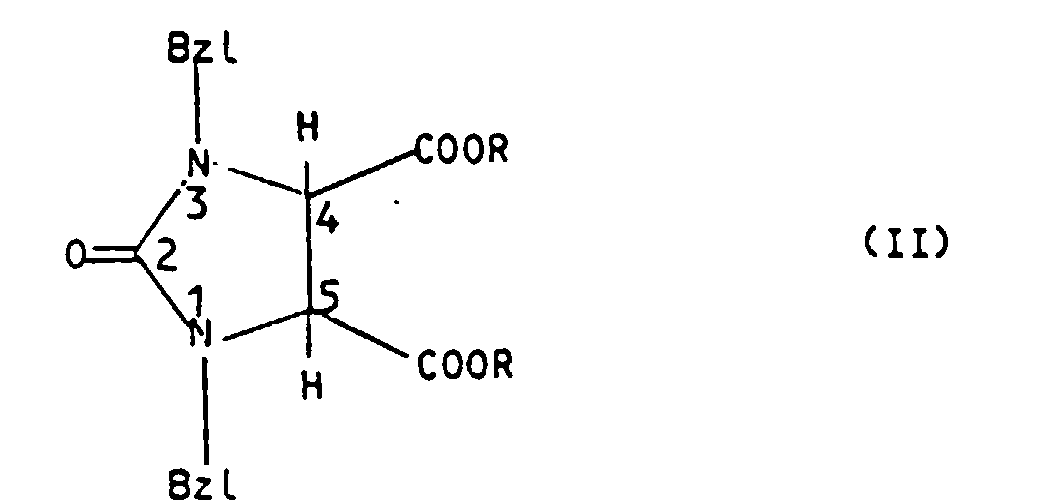
- Verfahren nach Anspruch 1, dadurch gekennzeichnet, daß das enzymatische Material eine Esterase aus Schweineleber ist.
- Verfahren nach Anspruch 1, dadurch gekennzeichnet, daß das enzymatische Material eine Esterase aus einem Mikroorganismus der Gattung Chromobacterium ist.
- Verfahren nach Anspruch 3, dadurch gekennzeichnet, daß der Mikroorganismus Chromobacterium chocolatum ist.
- Verfahren nach Anspruch 1, dadurch gekennzeichnet, daß das enzymatische Material ein Mikroorganismus der Gattung Chromobacterium ist.
- Verfahren nach Anspruch 5, dadurch gekennzeichnet, daß der Mikroorganismus Chromobacterium chocolatum ist.
- Verfahren nach Anspruch 1, dadurch gekennzeichnet, daß die Hydrolyse in einem wäßrigen Medium mit einem pH-Wert von 5 bis 9 bei einer Temperatur von 10 bis 40°C durchgeführt wird.
- Verfahren zur Herstellung eines optisch aktiven cis-1,3-Dibenzylhexahydro-1H-furo[3,4-d]imidazol-2,4-dion der folgenden Formel I


- Verfahren nach Anspruch 8, dadurch gekennzeichnet, daß das Volumenverhältnis des alkoholischen Lösungsmittels und des aprotischen Lösungsmittels 0,5 bis 10:1 beträgt und die Menge an Natriumborhydrid 0,8 bis 5 Mol pro 1 Mol des optisch aktiven Halbesters (III) beträgt.
- Verfahren nach Anspruch 8, dadurch gekennzeichnet, daß der Ausgangs-Monoester die 4S,5R-Konfiguration hat und das erhaltene Lacton die 3aS,6aR-Konfiguration aufweist.
- Verfahren nach Anspruch 8, dadurch gekennzeichnet, daß der Ausgangs-Monoester die 4R,5S-Konfiguration hat und das erhaltene Lacton die 3aR,6aS-Konfiguration aufweist.
- Verfahren nach Anspruch 8, dadurch gekennzeichnet, daß der Ausgangs-Monoester durch Hydrolyse eines cis-Imidazolidin-dicarbonsäurediesters der allgemeinen Formel II

- Cis-Imidazolidindicarbonsäuremonoester der folgenden Formel III

- Monoester nach Anspruch 13, dadurch gekennzeichnet, daß die 4- und 5-Stellungen die 4S,5R-Konfiguration haben.
Applications Claiming Priority (8)
| Application Number | Priority Date | Filing Date | Title |
|---|---|---|---|
| JP1213282A JPS58128376A (ja) | 1982-01-27 | 1982-01-27 | 光学活性なシス−テトラヒドロイミダゾリジンジカルボン酸誘導体及びその製造方法 |
| JP12132/82 | 1982-01-27 | ||
| JP71834/82 | 1982-04-28 | ||
| JP7183482A JPS58190395A (ja) | 1982-04-28 | 1982-04-28 | 光学活性なシス−イミダゾリジンジカルボン酸誘導体の製造法 |
| JP57071837A JPS58128386A (ja) | 1982-04-28 | 1982-04-28 | 光学活性なラクトンの製造方法 |
| JP71837/82 | 1982-04-28 | ||
| JP73938/82 | 1982-04-30 | ||
| JP7393882A JPS58192886A (ja) | 1982-04-30 | 1982-04-30 | 光学活性なラクトンの製造方法 |
Publications (4)
| Publication Number | Publication Date |
|---|---|
| EP0084892A2 EP0084892A2 (de) | 1983-08-03 |
| EP0084892A3 EP0084892A3 (en) | 1985-05-15 |
| EP0084892B1 EP0084892B1 (de) | 1987-12-23 |
| EP0084892B2 true EP0084892B2 (de) | 1996-10-23 |
Family
ID=27455737
Family Applications (1)
| Application Number | Title | Priority Date | Filing Date |
|---|---|---|---|
| EP83100767A Expired - Lifetime EP0084892B2 (de) | 1982-01-27 | 1983-01-27 | Herstellung von optisch aktivem cis-1,3-Dibenzyl-hexahydro-1H-furo(3,4-d)imidazol-2,4-dion und dessen Zwischenprodukte |
Country Status (3)
| Country | Link |
|---|---|
| US (2) | US4496739A (de) |
| EP (1) | EP0084892B2 (de) |
| DE (1) | DE3375025D1 (de) |
Families Citing this family (9)
| Publication number | Priority date | Publication date | Assignee | Title |
|---|---|---|---|---|
| US4496739A (en) * | 1982-01-27 | 1985-01-29 | Sumitomo Chemical Company, Limited | Intermediates to optically active cis-1,3-dibenzyl-hexahydro-1H-furo[3,4-d]imidazole-2,4-dione |
| EP0161580B1 (de) * | 1984-05-18 | 1990-11-07 | F. Hoffmann-La Roche Ag | Verfahren zur Herstellung eines Lactons |
| EP0173185B1 (de) * | 1984-08-25 | 1990-01-31 | MERCK PATENT GmbH | Verfahren zur Herstellung von (3a5,6aR)-und/oder(3aR,6a5)-1,3-Dibenzyl-hexahydro-1H-furo(3,4-d)imidazol-2,4-dion |
| US5026446A (en) * | 1989-06-05 | 1991-06-25 | Minnesota Mining And Manufacturing Company | Method of manufacturing a disposable diaper having an abraded target strip |
| AU6679494A (en) * | 1993-04-20 | 1994-11-08 | Lonza Ltd. | Asymmetric hydrogenation of furoimidazole derivatives |
| US5262544A (en) * | 1993-05-10 | 1993-11-16 | The United States Of America As Represented By The Secretary Of The Navy | 5,7-dinitro-5,7-diaza-1,3-dioxabicyclo(3:3:0)octan-2-one |
| CH694730A5 (de) | 2000-02-09 | 2005-06-30 | Sumitomo Chemical Co | Verfahren zum Herstellen optisch aktiver Hemiester. |
| TW200505925A (en) | 2003-05-16 | 2005-02-16 | Wyeth Corp | Process for synthesizing β-lactamase inhibitor intermediates |
| CN108164466A (zh) * | 2017-12-12 | 2018-06-15 | 浙江工业大学 | 一种顺式1,3-二苄基咪唑-2-酮-4,5-二羧酸的制备方法 |
Family Cites Families (5)
| Publication number | Priority date | Publication date | Assignee | Title |
|---|---|---|---|---|
| US3700659A (en) * | 1970-11-17 | 1972-10-24 | Hoffmann La Roche | (+)-cis - 1,3-dibenzyl-hexahydro-1h-furo-(3,4-d)imidazole - 2,4 - dione,processes and intermediates |
| FR2262662B1 (de) * | 1974-03-01 | 1978-08-11 | Anvar | |
| JPS603387B2 (ja) * | 1980-07-10 | 1985-01-28 | 住友化学工業株式会社 | 新規光学活性イミダゾリジン−2−オン誘導体およびその製法 |
| JPS57198098A (en) * | 1981-05-29 | 1982-12-04 | Sagami Chem Res Center | Preparation of optically active monoester monocarboxylic acid |
| US4496739A (en) * | 1982-01-27 | 1985-01-29 | Sumitomo Chemical Company, Limited | Intermediates to optically active cis-1,3-dibenzyl-hexahydro-1H-furo[3,4-d]imidazole-2,4-dione |
-
1983
- 1983-01-25 US US06/460,797 patent/US4496739A/en not_active Expired - Lifetime
- 1983-01-27 DE DE8383100767T patent/DE3375025D1/de not_active Expired
- 1983-01-27 EP EP83100767A patent/EP0084892B2/de not_active Expired - Lifetime
-
1984
- 1984-02-13 US US06/579,602 patent/US4544635A/en not_active Expired - Lifetime
Also Published As
| Publication number | Publication date |
|---|---|
| EP0084892A3 (en) | 1985-05-15 |
| EP0084892A2 (de) | 1983-08-03 |
| US4544635A (en) | 1985-10-01 |
| EP0084892B1 (de) | 1987-12-23 |
| DE3375025D1 (en) | 1988-02-04 |
| US4496739A (en) | 1985-01-29 |
Similar Documents
| Publication | Publication Date | Title |
|---|---|---|
| EP1054996B1 (de) | Verfahren zur enzymatischen auflösung von laktamen | |
| EP0084892B1 (de) | Herstellung von optisch aktivem cis-1,3-Dibenzyl-hexahydro-1H-furo(3,4-d)imidazol-2,4-dion und dessen Zwischenprodukte | |
| AU717771B2 (en) | The bioresolution of n-acylazetidine-2-carboxylic acids | |
| EP0172614B1 (de) | Verfahren zur Herstellung optisch aktiver Carbonsäureamiden | |
| JPS63284184A (ja) | 光学活性化合物およびその製造方法 | |
| CZ191698A3 (cs) | Způsob přípravy meziproduktů pro syntézu činidel účinných proti houbám | |
| AU670088B2 (en) | Enzymatic process to separate racemic mixtures of delta valerolactones | |
| US5455174A (en) | Process for the stereoselective esterification of ascorbic or erythorbic acids with long-chained enol esters | |
| EP0765857B1 (de) | Verfahren zur herstellung von optisch aktiven alpha-substituierten carbonsäurederivaten | |
| EP0528607B1 (de) | Verfahren zur Herstellung von optisch-aktiven 3-Phenylglycidsäure-Estern | |
| US5102793A (en) | Stereospecific keto reduction of bicyclooctandione-carboxylic acid esters by microorganisms | |
| JP3732535B2 (ja) | 光学活性α−メチルアルカンジカルボン酸−ω−モノエステル及びその対掌体ジエステルを製造する方法 | |
| US5084387A (en) | Microbiological hydrolysis for the preparation of (exo,exo)-7-oxabicyclo(2.2.1) heptane-2,3, monoacyl ester dimethanol | |
| JPH0578310B2 (de) | ||
| US5476791A (en) | Process for producing optically active carboxylic acid amide | |
| JPH0573396B2 (de) | ||
| EP0435293B1 (de) | Verfahren zur Herstellung von optisch-aktiven Hydroxyestern | |
| US5248601A (en) | Process for preparing L(-)-carnitine chloride | |
| US5654440A (en) | Method for production of optically active (+)-4,4,4-trifluoro-3-(indole-3-)butyric acid | |
| CA2199880A1 (en) | Process for preparing optically active trans-3- phenylglycidamide compounds | |
| EP0375394B1 (de) | Verfahren zur Herstellung von Leukotrien-Antagonisten | |
| JPH0366312B2 (de) | ||
| JPH01225499A (ja) | 光学活性2−ヒドロキシ−4−フェニル酪酸エステルの製造法 | |
| JPH059064B2 (de) | ||
| JPH06228053A (ja) | 2−メチレングルタール酸1−モノエステルとその製造法 |
Legal Events
| Date | Code | Title | Description |
|---|---|---|---|
| PUAI | Public reference made under article 153(3) epc to a published international application that has entered the european phase |
Free format text: ORIGINAL CODE: 0009012 |
|
| AK | Designated contracting states |
Designated state(s): CH DE FR IT LI |
|
| PUAL | Search report despatched |
Free format text: ORIGINAL CODE: 0009013 |
|
| AK | Designated contracting states |
Designated state(s): CH DE FR IT LI |
|
| 17P | Request for examination filed |
Effective date: 19851030 |
|
| 17Q | First examination report despatched |
Effective date: 19860603 |
|
| GRAA | (expected) grant |
Free format text: ORIGINAL CODE: 0009210 |
|
| AK | Designated contracting states |
Kind code of ref document: B1 Designated state(s): CH DE FR IT LI |
|
| ITF | It: translation for a ep patent filed | ||
| ET | Fr: translation filed | ||
| REF | Corresponds to: |
Ref document number: 3375025 Country of ref document: DE Date of ref document: 19880204 |
|
| PLBI | Opposition filed |
Free format text: ORIGINAL CODE: 0009260 |
|
| 26 | Opposition filed |
Opponent name: MERCK PATENT GMBH Effective date: 19880914 |
|
| RAP4 | Party data changed (patent owner data changed or rights of a patent transferred) |
Owner name: SUMITOMO CHEMICAL COMPANY, LIMITED |
|
| ITTA | It: last paid annual fee | ||
| PLAW | Interlocutory decision in opposition |
Free format text: ORIGINAL CODE: EPIDOS IDOP |
|
| PUAH | Patent maintained in amended form |
Free format text: ORIGINAL CODE: 0009272 |
|
| STAA | Information on the status of an ep patent application or granted ep patent |
Free format text: STATUS: PATENT MAINTAINED AS AMENDED |
|
| 27A | Patent maintained in amended form |
Effective date: 19961023 |
|
| AK | Designated contracting states |
Kind code of ref document: B2 Designated state(s): CH DE FR IT LI |
|
| REG | Reference to a national code |
Ref country code: CH Ref legal event code: AEN Free format text: MAINTIEN DU BREVET DONT L'ETENDUE A ETE MODIFIEE |
|
| ITF | It: translation for a ep patent filed | ||
| APAC | Appeal dossier modified |
Free format text: ORIGINAL CODE: EPIDOS NOAPO |
|
| APAC | Appeal dossier modified |
Free format text: ORIGINAL CODE: EPIDOS NOAPO |
|
| ET3 | Fr: translation filed ** decision concerning opposition | ||
| PGFP | Annual fee paid to national office [announced via postgrant information from national office to epo] |
Ref country code: DE Payment date: 20010122 Year of fee payment: 19 |
|
| PGFP | Annual fee paid to national office [announced via postgrant information from national office to epo] |
Ref country code: FR Payment date: 20010125 Year of fee payment: 19 |
|
| PGFP | Annual fee paid to national office [announced via postgrant information from national office to epo] |
Ref country code: CH Payment date: 20010219 Year of fee payment: 19 |
|
| PG25 | Lapsed in a contracting state [announced via postgrant information from national office to epo] |
Ref country code: LI Free format text: LAPSE BECAUSE OF NON-PAYMENT OF DUE FEES Effective date: 20020131 Ref country code: CH Free format text: LAPSE BECAUSE OF NON-PAYMENT OF DUE FEES Effective date: 20020131 |
|
| PG25 | Lapsed in a contracting state [announced via postgrant information from national office to epo] |
Ref country code: DE Free format text: LAPSE BECAUSE OF NON-PAYMENT OF DUE FEES Effective date: 20020801 |
|
| REG | Reference to a national code |
Ref country code: CH Ref legal event code: PL |
|
| PG25 | Lapsed in a contracting state [announced via postgrant information from national office to epo] |
Ref country code: FR Free format text: LAPSE BECAUSE OF NON-PAYMENT OF DUE FEES Effective date: 20020930 |
|
| REG | Reference to a national code |
Ref country code: FR Ref legal event code: ST |
|
| APAH | Appeal reference modified |
Free format text: ORIGINAL CODE: EPIDOSCREFNO |