EP0085346A2 - Verfahren zur Herstellung von partiell beschichtetem Durchschreibepapier - Google Patents
Verfahren zur Herstellung von partiell beschichtetem Durchschreibepapier Download PDFInfo
- Publication number
- EP0085346A2 EP0085346A2 EP83100383A EP83100383A EP0085346A2 EP 0085346 A2 EP0085346 A2 EP 0085346A2 EP 83100383 A EP83100383 A EP 83100383A EP 83100383 A EP83100383 A EP 83100383A EP 0085346 A2 EP0085346 A2 EP 0085346A2
- Authority
- EP
- European Patent Office
- Prior art keywords
- paper
- microcapsules
- coating
- heat treatment
- paper carrier
- Prior art date
- Legal status (The legal status is an assumption and is not a legal conclusion. Google has not performed a legal analysis and makes no representation as to the accuracy of the status listed.)
- Granted
Links
- 238000000034 method Methods 0.000 title claims description 33
- 238000004519 manufacturing process Methods 0.000 title claims description 12
- 239000003094 microcapsule Substances 0.000 claims abstract description 44
- 238000000576 coating method Methods 0.000 claims abstract description 27
- 239000011248 coating agent Substances 0.000 claims abstract description 21
- 238000010438 heat treatment Methods 0.000 claims abstract description 13
- 238000004924 electrostatic deposition Methods 0.000 claims abstract description 4
- 239000003960 organic solvent Substances 0.000 claims abstract description 4
- 239000000203 mixture Substances 0.000 claims description 12
- 239000001993 wax Substances 0.000 claims description 9
- 239000004203 carnauba wax Substances 0.000 claims description 6
- 235000013869 carnauba wax Nutrition 0.000 claims description 6
- 239000004831 Hot glue Substances 0.000 claims description 4
- 229920001200 poly(ethylene-vinyl acetate) Polymers 0.000 claims description 4
- 229920001169 thermoplastic Polymers 0.000 claims description 4
- 239000004416 thermosoftening plastic Substances 0.000 claims description 4
- 239000005038 ethylene vinyl acetate Substances 0.000 claims description 2
- 239000002775 capsule Substances 0.000 description 38
- 239000000463 material Substances 0.000 description 19
- 239000000843 powder Substances 0.000 description 14
- -1 polyethylene Polymers 0.000 description 11
- 239000002904 solvent Substances 0.000 description 9
- 238000006243 chemical reaction Methods 0.000 description 8
- 239000006185 dispersion Substances 0.000 description 7
- 239000012948 isocyanate Substances 0.000 description 7
- 239000005056 polyisocyanate Substances 0.000 description 7
- 229920001228 polyisocyanate Polymers 0.000 description 7
- 238000001556 precipitation Methods 0.000 description 7
- 239000000975 dye Substances 0.000 description 6
- RRAMGCGOFNQTLD-UHFFFAOYSA-N hexamethylene diisocyanate Chemical compound O=C=NCCCCCCN=C=O RRAMGCGOFNQTLD-UHFFFAOYSA-N 0.000 description 6
- 238000000151 deposition Methods 0.000 description 5
- 150000002500 ions Chemical class 0.000 description 5
- 150000002513 isocyanates Chemical class 0.000 description 5
- 238000002360 preparation method Methods 0.000 description 5
- 239000007921 spray Substances 0.000 description 5
- OAKJQQAXSVQMHS-UHFFFAOYSA-N Hydrazine Chemical compound NN OAKJQQAXSVQMHS-UHFFFAOYSA-N 0.000 description 4
- 239000008199 coating composition Substances 0.000 description 4
- 239000000084 colloidal system Substances 0.000 description 4
- 150000001875 compounds Chemical class 0.000 description 4
- 239000004020 conductor Substances 0.000 description 4
- 230000008021 deposition Effects 0.000 description 4
- 150000004985 diamines Chemical class 0.000 description 4
- 230000005684 electric field Effects 0.000 description 4
- 229920000642 polymer Polymers 0.000 description 4
- 239000000047 product Substances 0.000 description 4
- 239000000243 solution Substances 0.000 description 4
- 108010010803 Gelatin Proteins 0.000 description 3
- PEDCQBHIVMGVHV-UHFFFAOYSA-N Glycerine Chemical compound OCC(O)CO PEDCQBHIVMGVHV-UHFFFAOYSA-N 0.000 description 3
- 239000005057 Hexamethylene diisocyanate Substances 0.000 description 3
- 239000004698 Polyethylene Substances 0.000 description 3
- 239000002800 charge carrier Substances 0.000 description 3
- 239000011162 core material Substances 0.000 description 3
- 239000000839 emulsion Substances 0.000 description 3
- 229920000159 gelatin Polymers 0.000 description 3
- 239000008273 gelatin Substances 0.000 description 3
- 235000019322 gelatine Nutrition 0.000 description 3
- 235000011852 gelatine desserts Nutrition 0.000 description 3
- NAQMVNRVTILPCV-UHFFFAOYSA-N hexane-1,6-diamine Chemical compound NCCCCCCN NAQMVNRVTILPCV-UHFFFAOYSA-N 0.000 description 3
- IQPQWNKOIGAROB-UHFFFAOYSA-N isocyanate group Chemical group [N-]=C=O IQPQWNKOIGAROB-UHFFFAOYSA-N 0.000 description 3
- 229910052757 nitrogen Inorganic materials 0.000 description 3
- 239000002245 particle Substances 0.000 description 3
- 229920000768 polyamine Polymers 0.000 description 3
- 239000002243 precursor Substances 0.000 description 3
- 230000001681 protective effect Effects 0.000 description 3
- 239000011257 shell material Substances 0.000 description 3
- 239000000758 substrate Substances 0.000 description 3
- DVKJHBMWWAPEIU-UHFFFAOYSA-N toluene 2,4-diisocyanate Chemical compound CC1=CC=C(N=C=O)C=C1N=C=O DVKJHBMWWAPEIU-UHFFFAOYSA-N 0.000 description 3
- LIZLYZVAYZQVPG-UHFFFAOYSA-N (3-bromo-2-fluorophenyl)methanol Chemical compound OCC1=CC=CC(Br)=C1F LIZLYZVAYZQVPG-UHFFFAOYSA-N 0.000 description 2
- UOCLXMDMGBRAIB-UHFFFAOYSA-N 1,1,1-trichloroethane Chemical compound CC(Cl)(Cl)Cl UOCLXMDMGBRAIB-UHFFFAOYSA-N 0.000 description 2
- BANXPJUEBPWEOT-UHFFFAOYSA-N 2-methyl-Pentadecane Chemical compound CCCCCCCCCCCCCC(C)C BANXPJUEBPWEOT-UHFFFAOYSA-N 0.000 description 2
- IPAJDLMMTVZVPP-UHFFFAOYSA-N Crystal violet lactone Chemical compound C1=CC(N(C)C)=CC=C1C1(C=2C=CC(=CC=2)N(C)C)C2=CC=C(N(C)C)C=C2C(=O)O1 IPAJDLMMTVZVPP-UHFFFAOYSA-N 0.000 description 2
- RPNUMPOLZDHAAY-UHFFFAOYSA-N Diethylenetriamine Chemical compound NCCNCCN RPNUMPOLZDHAAY-UHFFFAOYSA-N 0.000 description 2
- ZJCCRDAZUWHFQH-UHFFFAOYSA-N Trimethylolpropane Chemical compound CCC(CO)(CO)CO ZJCCRDAZUWHFQH-UHFFFAOYSA-N 0.000 description 2
- XLOMVQKBTHCTTD-UHFFFAOYSA-N Zinc monoxide Chemical compound [Zn]=O XLOMVQKBTHCTTD-UHFFFAOYSA-N 0.000 description 2
- ZKURGBYDCVNWKH-UHFFFAOYSA-N [3,7-bis(dimethylamino)phenothiazin-10-yl]-phenylmethanone Chemical compound C12=CC=C(N(C)C)C=C2SC2=CC(N(C)C)=CC=C2N1C(=O)C1=CC=CC=C1 ZKURGBYDCVNWKH-UHFFFAOYSA-N 0.000 description 2
- WNLRTRBMVRJNCN-UHFFFAOYSA-N adipic acid Chemical compound OC(=O)CCCCC(O)=O WNLRTRBMVRJNCN-UHFFFAOYSA-N 0.000 description 2
- 125000001931 aliphatic group Chemical group 0.000 description 2
- 239000008346 aqueous phase Substances 0.000 description 2
- 239000002585 base Substances 0.000 description 2
- 239000011230 binding agent Substances 0.000 description 2
- 125000006267 biphenyl group Chemical group 0.000 description 2
- OTBHHUPVCYLGQO-UHFFFAOYSA-N bis(3-aminopropyl)amine Chemical compound NCCCNCCCN OTBHHUPVCYLGQO-UHFFFAOYSA-N 0.000 description 2
- OHJMTUPIZMNBFR-UHFFFAOYSA-N biuret Chemical group NC(=O)NC(N)=O OHJMTUPIZMNBFR-UHFFFAOYSA-N 0.000 description 2
- RGTXVXDNHPWPHH-UHFFFAOYSA-N butane-1,3-diamine Chemical compound CC(N)CCN RGTXVXDNHPWPHH-UHFFFAOYSA-N 0.000 description 2
- YCIMNLLNPGFGHC-UHFFFAOYSA-N catechol Chemical compound OC1=CC=CC=C1O YCIMNLLNPGFGHC-UHFFFAOYSA-N 0.000 description 2
- 238000005354 coacervation Methods 0.000 description 2
- VKIRRGRTJUUZHS-UHFFFAOYSA-N cyclohexane-1,4-diamine Chemical compound NC1CCC(N)CC1 VKIRRGRTJUUZHS-UHFFFAOYSA-N 0.000 description 2
- 125000005442 diisocyanate group Chemical group 0.000 description 2
- 238000009826 distribution Methods 0.000 description 2
- 238000001035 drying Methods 0.000 description 2
- 239000003995 emulsifying agent Substances 0.000 description 2
- 238000005516 engineering process Methods 0.000 description 2
- TZMQHOJDDMFGQX-UHFFFAOYSA-N hexane-1,1,1-triol Chemical compound CCCCCC(O)(O)O TZMQHOJDDMFGQX-UHFFFAOYSA-N 0.000 description 2
- 239000012212 insulator Substances 0.000 description 2
- 150000003951 lactams Chemical class 0.000 description 2
- 239000000155 melt Substances 0.000 description 2
- KMBPCQSCMCEPMU-UHFFFAOYSA-N n'-(3-aminopropyl)-n'-methylpropane-1,3-diamine Chemical compound NCCCN(C)CCCN KMBPCQSCMCEPMU-UHFFFAOYSA-N 0.000 description 2
- ODZZIKZQNODXFS-UHFFFAOYSA-N n,n'-dimethyl-n'-[2-(methylamino)ethyl]ethane-1,2-diamine Chemical compound CNCCN(C)CCNC ODZZIKZQNODXFS-UHFFFAOYSA-N 0.000 description 2
- 239000012074 organic phase Substances 0.000 description 2
- HXSACZWWBYWLIS-UHFFFAOYSA-N oxadiazine-4,5,6-trione Chemical compound O=C1ON=NC(=O)C1=O HXSACZWWBYWLIS-UHFFFAOYSA-N 0.000 description 2
- 239000012188 paraffin wax Substances 0.000 description 2
- 229920001568 phenolic resin Polymers 0.000 description 2
- 229920000573 polyethylene Polymers 0.000 description 2
- KIDHWZJUCRJVML-UHFFFAOYSA-N putrescine Chemical compound NCCCCN KIDHWZJUCRJVML-UHFFFAOYSA-N 0.000 description 2
- CXMXRPHRNRROMY-UHFFFAOYSA-N sebacic acid Chemical compound OC(=O)CCCCCCCCC(O)=O CXMXRPHRNRROMY-UHFFFAOYSA-N 0.000 description 2
- 238000001694 spray drying Methods 0.000 description 2
- XLYOFNOQVPJJNP-UHFFFAOYSA-N water Substances O XLYOFNOQVPJJNP-UHFFFAOYSA-N 0.000 description 2
- WOGVOIWHWZWYOZ-UHFFFAOYSA-N 1,1-diisocyanatoethane Chemical compound O=C=NC(C)N=C=O WOGVOIWHWZWYOZ-UHFFFAOYSA-N 0.000 description 1
- RTTZISZSHSCFRH-UHFFFAOYSA-N 1,3-bis(isocyanatomethyl)benzene Chemical compound O=C=NCC1=CC=CC(CN=C=O)=C1 RTTZISZSHSCFRH-UHFFFAOYSA-N 0.000 description 1
- PCHXZXKMYCGVFA-UHFFFAOYSA-N 1,3-diazetidine-2,4-dione Chemical compound O=C1NC(=O)N1 PCHXZXKMYCGVFA-UHFFFAOYSA-N 0.000 description 1
- IKYNWXNXXHWHLL-UHFFFAOYSA-N 1,3-diisocyanatopropane Chemical compound O=C=NCCCN=C=O IKYNWXNXXHWHLL-UHFFFAOYSA-N 0.000 description 1
- VILCJCGEZXAXTO-UHFFFAOYSA-N 2,2,2-tetramine Chemical compound NCCNCCNCCN VILCJCGEZXAXTO-UHFFFAOYSA-N 0.000 description 1
- 229940043268 2,2,4,4,6,8,8-heptamethylnonane Drugs 0.000 description 1
- GBHCABUWWQUMAJ-UHFFFAOYSA-N 2-hydrazinoethanol Chemical compound NNCCO GBHCABUWWQUMAJ-UHFFFAOYSA-N 0.000 description 1
- ABJAMKKUHBSXDS-UHFFFAOYSA-N 3,3-bis(6-amino-1,4-dimethylcyclohexa-2,4-dien-1-yl)-2-benzofuran-1-one Chemical compound C1=CC(C)=CC(N)C1(C)C1(C2(C)C(C=C(C)C=C2)N)C2=CC=CC=C2C(=O)O1 ABJAMKKUHBSXDS-UHFFFAOYSA-N 0.000 description 1
- QUINKWASVQHVID-UHFFFAOYSA-N 3,3-bis[4-(dimethylamino)phenyl]-2-benzofuran-1-one Chemical compound C1=CC(N(C)C)=CC=C1C1(C=2C=CC(=CC=2)N(C)C)C2=CC=CC=C2C(=O)O1 QUINKWASVQHVID-UHFFFAOYSA-N 0.000 description 1
- WUPHOULIZUERAE-UHFFFAOYSA-N 3-(oxolan-2-yl)propanoic acid Chemical compound OC(=O)CCC1CCCO1 WUPHOULIZUERAE-UHFFFAOYSA-N 0.000 description 1
- KFMASHHCLJTUDI-UHFFFAOYSA-N 4-[2-[2,2-bis[4-(dimethylamino)phenyl]-1-phenylethoxy]-1-[4-(dimethylamino)phenyl]-2-phenylethyl]-n,n-dimethylaniline Chemical compound C1=CC(N(C)C)=CC=C1C(C=1C=CC(=CC=1)N(C)C)C(C=1C=CC=CC=1)OC(C=1C=CC=CC=1)C(C=1C=CC(=CC=1)N(C)C)C1=CC=C(N(C)C)C=C1 KFMASHHCLJTUDI-UHFFFAOYSA-N 0.000 description 1
- CVKQGYLUHQGQJF-UHFFFAOYSA-N 4-amino-5h-1,3-oxazol-2-one Chemical compound N=C1COC(=O)N1 CVKQGYLUHQGQJF-UHFFFAOYSA-N 0.000 description 1
- QSNSCYSYFYORTR-UHFFFAOYSA-N 4-chloroaniline Chemical compound NC1=CC=C(Cl)C=C1 QSNSCYSYFYORTR-UHFFFAOYSA-N 0.000 description 1
- TYMLOMAKGOJONV-UHFFFAOYSA-N 4-nitroaniline Chemical compound NC1=CC=C([N+]([O-])=O)C=C1 TYMLOMAKGOJONV-UHFFFAOYSA-N 0.000 description 1
- 244000215068 Acacia senegal Species 0.000 description 1
- 239000005995 Aluminium silicate Substances 0.000 description 1
- LICBDGNNWXCPTO-UHFFFAOYSA-N C(C)(=O)OC=C=C=C Chemical compound C(C)(=O)OC=C=C=C LICBDGNNWXCPTO-UHFFFAOYSA-N 0.000 description 1
- 208000032963 Capsule physical issue Diseases 0.000 description 1
- OKTJSMMVPCPJKN-UHFFFAOYSA-N Carbon Chemical compound [C] OKTJSMMVPCPJKN-UHFFFAOYSA-N 0.000 description 1
- 229920002134 Carboxymethyl cellulose Polymers 0.000 description 1
- VYZAMTAEIAYCRO-UHFFFAOYSA-N Chromium Chemical compound [Cr] VYZAMTAEIAYCRO-UHFFFAOYSA-N 0.000 description 1
- BWLUMTFWVZZZND-UHFFFAOYSA-N Dibenzylamine Chemical compound C=1C=CC=CC=1CNCC1=CC=CC=C1 BWLUMTFWVZZZND-UHFFFAOYSA-N 0.000 description 1
- VGGSQFUCUMXWEO-UHFFFAOYSA-N Ethene Chemical compound C=C VGGSQFUCUMXWEO-UHFFFAOYSA-N 0.000 description 1
- 239000005977 Ethylene Substances 0.000 description 1
- IAYPIBMASNFSPL-UHFFFAOYSA-N Ethylene oxide Chemical compound C1CO1 IAYPIBMASNFSPL-UHFFFAOYSA-N 0.000 description 1
- PIICEJLVQHRZGT-UHFFFAOYSA-N Ethylenediamine Chemical compound NCCN PIICEJLVQHRZGT-UHFFFAOYSA-N 0.000 description 1
- 229920000084 Gum arabic Polymers 0.000 description 1
- 239000005058 Isophorone diisocyanate Substances 0.000 description 1
- 229920003359 Levasint® Polymers 0.000 description 1
- KXWJXCQYFLHQNO-UHFFFAOYSA-N N=1N=NC(C(C1)=O)=N Chemical compound N=1N=NC(C(C1)=O)=N KXWJXCQYFLHQNO-UHFFFAOYSA-N 0.000 description 1
- OLMQHTINPAUABM-UHFFFAOYSA-N NN.NCCNCCNCCN Chemical compound NN.NCCNCCNCCN OLMQHTINPAUABM-UHFFFAOYSA-N 0.000 description 1
- IGFHQQFPSIBGKE-UHFFFAOYSA-N Nonylphenol Natural products CCCCCCCCCC1=CC=C(O)C=C1 IGFHQQFPSIBGKE-UHFFFAOYSA-N 0.000 description 1
- 235000019483 Peanut oil Nutrition 0.000 description 1
- ISWSIDIOOBJBQZ-UHFFFAOYSA-N Phenol Chemical compound OC1=CC=CC=C1 ISWSIDIOOBJBQZ-UHFFFAOYSA-N 0.000 description 1
- OAICVXFJPJFONN-UHFFFAOYSA-N Phosphorus Chemical compound [P] OAICVXFJPJFONN-UHFFFAOYSA-N 0.000 description 1
- 239000004952 Polyamide Substances 0.000 description 1
- 239000004372 Polyvinyl alcohol Substances 0.000 description 1
- BUGBHKTXTAQXES-UHFFFAOYSA-N Selenium Chemical compound [Se] BUGBHKTXTAQXES-UHFFFAOYSA-N 0.000 description 1
- 229910000831 Steel Inorganic materials 0.000 description 1
- KDYFGRWQOYBRFD-UHFFFAOYSA-N Succinic acid Natural products OC(=O)CCC(O)=O KDYFGRWQOYBRFD-UHFFFAOYSA-N 0.000 description 1
- 229920001807 Urea-formaldehyde Polymers 0.000 description 1
- 239000002250 absorbent Substances 0.000 description 1
- 230000002745 absorbent Effects 0.000 description 1
- 239000000205 acacia gum Substances 0.000 description 1
- 235000010489 acacia gum Nutrition 0.000 description 1
- 230000002378 acidificating effect Effects 0.000 description 1
- 239000001361 adipic acid Substances 0.000 description 1
- 235000011037 adipic acid Nutrition 0.000 description 1
- 150000001298 alcohols Chemical class 0.000 description 1
- 150000001447 alkali salts Chemical class 0.000 description 1
- 235000012211 aluminium silicate Nutrition 0.000 description 1
- LHIJANUOQQMGNT-UHFFFAOYSA-N aminoethylethanolamine Chemical compound NCCNCCO LHIJANUOQQMGNT-UHFFFAOYSA-N 0.000 description 1
- 239000007864 aqueous solution Substances 0.000 description 1
- 125000003710 aryl alkyl group Chemical class 0.000 description 1
- 150000008378 aryl ethers Chemical class 0.000 description 1
- 229960000892 attapulgite Drugs 0.000 description 1
- 239000000440 bentonite Substances 0.000 description 1
- 229910000278 bentonite Inorganic materials 0.000 description 1
- SVPXDRXYRYOSEX-UHFFFAOYSA-N bentoquatam Chemical compound O.O=[Si]=O.O=[Al]O[Al]=O SVPXDRXYRYOSEX-UHFFFAOYSA-N 0.000 description 1
- 150000001555 benzenes Chemical class 0.000 description 1
- 125000005605 benzo group Chemical group 0.000 description 1
- 238000004061 bleaching Methods 0.000 description 1
- KDYFGRWQOYBRFD-NUQCWPJISA-N butanedioic acid Chemical compound O[14C](=O)CC[14C](O)=O KDYFGRWQOYBRFD-NUQCWPJISA-N 0.000 description 1
- 229910052980 cadmium sulfide Inorganic materials 0.000 description 1
- VPKDCDLSJZCGKE-UHFFFAOYSA-N carbodiimide group Chemical group N=C=N VPKDCDLSJZCGKE-UHFFFAOYSA-N 0.000 description 1
- 150000001718 carbodiimides Chemical class 0.000 description 1
- 229910052799 carbon Inorganic materials 0.000 description 1
- 239000001768 carboxy methyl cellulose Substances 0.000 description 1
- 235000010948 carboxy methyl cellulose Nutrition 0.000 description 1
- 150000001735 carboxylic acids Chemical class 0.000 description 1
- 239000008112 carboxymethyl-cellulose Substances 0.000 description 1
- 239000003054 catalyst Substances 0.000 description 1
- 238000003889 chemical engineering Methods 0.000 description 1
- 239000007795 chemical reaction product Substances 0.000 description 1
- 239000003795 chemical substances by application Substances 0.000 description 1
- MVPPADPHJFYWMZ-UHFFFAOYSA-N chlorobenzene Chemical compound ClC1=CC=CC=C1 MVPPADPHJFYWMZ-UHFFFAOYSA-N 0.000 description 1
- 229910052804 chromium Inorganic materials 0.000 description 1
- 239000011651 chromium Substances 0.000 description 1
- 238000004140 cleaning Methods 0.000 description 1
- 239000003086 colorant Substances 0.000 description 1
- 229920001577 copolymer Polymers 0.000 description 1
- 235000012343 cottonseed oil Nutrition 0.000 description 1
- 239000002385 cottonseed oil Substances 0.000 description 1
- QDMRCCGQLCIMLG-UHFFFAOYSA-N cyclobutane-1,2-dione Chemical compound O=C1CCC1=O QDMRCCGQLCIMLG-UHFFFAOYSA-N 0.000 description 1
- GUJOJGAPFQRJSV-UHFFFAOYSA-N dialuminum;dioxosilane;oxygen(2-);hydrate Chemical compound O.[O-2].[O-2].[O-2].[Al+3].[Al+3].O=[Si]=O.O=[Si]=O.O=[Si]=O.O=[Si]=O GUJOJGAPFQRJSV-UHFFFAOYSA-N 0.000 description 1
- RAABOESOVLLHRU-UHFFFAOYSA-N diazene Chemical compound N=N RAABOESOVLLHRU-UHFFFAOYSA-N 0.000 description 1
- 229910000071 diazene Inorganic materials 0.000 description 1
- KORSJDCBLAPZEQ-UHFFFAOYSA-N dicyclohexylmethane-4,4'-diisocyanate Chemical compound C1CC(N=C=O)CCC1CC1CCC(N=C=O)CC1 KORSJDCBLAPZEQ-UHFFFAOYSA-N 0.000 description 1
- 235000014113 dietary fatty acids Nutrition 0.000 description 1
- 239000003085 diluting agent Substances 0.000 description 1
- CZZYITDELCSZES-UHFFFAOYSA-N diphenylmethane Chemical class C=1C=CC=CC=1CC1=CC=CC=C1 CZZYITDELCSZES-UHFFFAOYSA-N 0.000 description 1
- 239000000428 dust Substances 0.000 description 1
- 230000000694 effects Effects 0.000 description 1
- 230000001804 emulsifying effect Effects 0.000 description 1
- 150000002148 esters Chemical class 0.000 description 1
- AZHSSKPUVBVXLK-UHFFFAOYSA-N ethane-1,1-diol Chemical class CC(O)O AZHSSKPUVBVXLK-UHFFFAOYSA-N 0.000 description 1
- 238000002474 experimental method Methods 0.000 description 1
- 239000000194 fatty acid Substances 0.000 description 1
- 229930195729 fatty acid Natural products 0.000 description 1
- 230000002349 favourable effect Effects 0.000 description 1
- 239000012943 hotmelt Substances 0.000 description 1
- 229910000040 hydrogen fluoride Inorganic materials 0.000 description 1
- 238000002347 injection Methods 0.000 description 1
- 239000007924 injection Substances 0.000 description 1
- KUVMKLCGXIYSNH-UHFFFAOYSA-N isopentadecane Natural products CCCCCCCCCCCCC(C)C KUVMKLCGXIYSNH-UHFFFAOYSA-N 0.000 description 1
- NIMLQBUJDJZYEJ-UHFFFAOYSA-N isophorone diisocyanate Chemical compound CC1(C)CC(N=C=O)CC(C)(CN=C=O)C1 NIMLQBUJDJZYEJ-UHFFFAOYSA-N 0.000 description 1
- NLYAJNPCOHFWQQ-UHFFFAOYSA-N kaolin Chemical compound O.O.O=[Al]O[Si](=O)O[Si](=O)O[Al]=O NLYAJNPCOHFWQQ-UHFFFAOYSA-N 0.000 description 1
- 239000003350 kerosene Substances 0.000 description 1
- QDLAGTHXVHQKRE-UHFFFAOYSA-N lichenxanthone Natural products COC1=CC(O)=C2C(=O)C3=C(C)C=C(OC)C=C3OC2=C1 QDLAGTHXVHQKRE-UHFFFAOYSA-N 0.000 description 1
- 229940107698 malachite green Drugs 0.000 description 1
- 238000002844 melting Methods 0.000 description 1
- 230000008018 melting Effects 0.000 description 1
- 229910052751 metal Inorganic materials 0.000 description 1
- 239000002184 metal Substances 0.000 description 1
- 238000002156 mixing Methods 0.000 description 1
- 229910052901 montmorillonite Inorganic materials 0.000 description 1
- RIWRFSMVIUAEBX-UHFFFAOYSA-N n-methyl-1-phenylmethanamine Chemical compound CNCC1=CC=CC=C1 RIWRFSMVIUAEBX-UHFFFAOYSA-N 0.000 description 1
- 150000002790 naphthalenes Chemical class 0.000 description 1
- SNQQPOLDUKLAAF-UHFFFAOYSA-N nonylphenol Chemical compound CCCCCCCCCC1=CC=CC=C1O SNQQPOLDUKLAAF-UHFFFAOYSA-N 0.000 description 1
- 229910052625 palygorskite Inorganic materials 0.000 description 1
- 235000019809 paraffin wax Nutrition 0.000 description 1
- 239000000312 peanut oil Substances 0.000 description 1
- 230000035699 permeability Effects 0.000 description 1
- 235000019271 petrolatum Nutrition 0.000 description 1
- 239000005011 phenolic resin Substances 0.000 description 1
- 150000003014 phosphoric acid esters Chemical class 0.000 description 1
- 229910052698 phosphorus Inorganic materials 0.000 description 1
- 239000011574 phosphorus Substances 0.000 description 1
- XNGIFLGASWRNHJ-UHFFFAOYSA-N phthalic acid Chemical class OC(=O)C1=CC=CC=C1C(O)=O XNGIFLGASWRNHJ-UHFFFAOYSA-N 0.000 description 1
- 239000000049 pigment Substances 0.000 description 1
- 229920000058 polyacrylate Polymers 0.000 description 1
- 229920002647 polyamide Polymers 0.000 description 1
- 229920000447 polyanionic polymer Polymers 0.000 description 1
- 238000006068 polycondensation reaction Methods 0.000 description 1
- ODGAOXROABLFNM-UHFFFAOYSA-N polynoxylin Chemical compound O=C.NC(N)=O ODGAOXROABLFNM-UHFFFAOYSA-N 0.000 description 1
- 229920002451 polyvinyl alcohol Polymers 0.000 description 1
- 235000019422 polyvinyl alcohol Nutrition 0.000 description 1
- 238000007639 printing Methods 0.000 description 1
- 229960000380 propiolactone Drugs 0.000 description 1
- 230000005855 radiation Effects 0.000 description 1
- 150000003839 salts Chemical class 0.000 description 1
- 229910052711 selenium Inorganic materials 0.000 description 1
- 239000011669 selenium Substances 0.000 description 1
- 238000000926 separation method Methods 0.000 description 1
- 229920002545 silicone oil Polymers 0.000 description 1
- 239000007787 solid Substances 0.000 description 1
- 150000003413 spiro compounds Chemical class 0.000 description 1
- 238000005507 spraying Methods 0.000 description 1
- 239000010959 steel Substances 0.000 description 1
- 239000000126 substance Substances 0.000 description 1
- 125000001273 sulfonato group Chemical class [O-]S(*)(=O)=O 0.000 description 1
- 150000001911 terphenyls Chemical class 0.000 description 1
- 150000004897 thiazines Chemical class 0.000 description 1
- 150000004961 triphenylmethanes Chemical class 0.000 description 1
- 239000002023 wood Substances 0.000 description 1
- 150000003732 xanthenes Chemical class 0.000 description 1
- 239000011787 zinc oxide Substances 0.000 description 1
- XOOUIPVCVHRTMJ-UHFFFAOYSA-L zinc stearate Chemical class [Zn+2].CCCCCCCCCCCCCCCCCC([O-])=O.CCCCCCCCCCCCCCCCCC([O-])=O XOOUIPVCVHRTMJ-UHFFFAOYSA-L 0.000 description 1
Images

Classifications
-
- B—PERFORMING OPERATIONS; TRANSPORTING
- B41—PRINTING; LINING MACHINES; TYPEWRITERS; STAMPS
- B41M—PRINTING, DUPLICATING, MARKING, OR COPYING PROCESSES; COLOUR PRINTING
- B41M5/00—Duplicating or marking methods; Sheet materials for use therein
- B41M5/124—Duplicating or marking methods; Sheet materials for use therein using pressure to make a masked colour visible, e.g. to make a coloured support visible, to create an opaque or transparent pattern, or to form colour by uniting colour-forming components
- B41M5/1246—Application of the layer, e.g. by printing
Definitions
- the invention relates to a partially coated carbonless paper and a method for its production, in which microcapsules provided with a meltable coating are deposited electrostatically on a paper carrier and then fixed.
- Reaction carbon papers preferably consist of two or more sheets of paper laid loosely on top of one another, the upper one on the back containing a donor layer and the lower one on the front containing a receiver layer.
- a donor layer and a receiver layer are in contact with each other.
- the donor layer contains microcapsules, the core of which is a solution of a color former in an organic solvent, and the receiver layer contains a material that develops the dye former into a dye.
- the receiving layer usually contains binders and pigments, for example active absorbents such as kaolin, attapulgite, montmorillonite, bentonite, acidic bleaching earth or Phenolic resins.
- active absorbents such as kaolin, attapulgite, montmorillonite, bentonite, acidic bleaching earth or Phenolic resins.
- acid-activatable dyes can be used on the donor layer and acid-reacting components in the receiver layer.
- reaction copy papers A further development of these reaction copy papers are the "one-component" reaction copy papers.
- one side of a single sheet of paper carries the dye precursor, generally in the form of microcapsules, and at the same time the color developer. If pressure is now applied, e.g. by means of a typewriter or other writing tool, the capsule containing the dye precursor is torn open and the dye precursor reacts with the color developer surrounding it (see US Pat. No. 2,730,456).
- the coating of the paper substrate for the production of the carbon-free copying systems is generally carried out over the entire area with an aqueous coating composition, such as e.g. in DE-OS 1 934 457 and 1 955 542.
- the wax-like coating changes the character of the paper, since relatively large amounts of the waxes have to be applied in order to obtain satisfactory copies with a microcapsule content of at most 40% by weight.
- This invention is based on the finding that dry microcapsules provided with fusible coatings can be deposited electrostatically in any form onto a paper carrier and fixed there by heat treatment, so that a partially coated carbonless carbonless paper is obtained.
- the invention therefore relates to a partially coated, carbon-free carbonless paper which is produced by electrostatic deposition of microcapsules provided with a meltable coating on a paper carrier and subsequent heat treatment, and a method for the production thereof.
- the microcapsules are provided with a coating which melts through brief heat treatment and thus fixes the microcapsule on the paper carrier.
- Heat treatment is understood to mean the action of heat which, on the one hand, must not be so high that the microcapsule is damaged, and, on the other hand, should not be so deep that there is no melting.
- a suitable temperature is e.g. from 50 to 150, preferably from 60 to 120 ° C.
- the thermal energy deployed at these temperatures corresponds to that which is used in conventional dry copiers when baking the toner powder.
- the duration of exposure also depends on this thermal energy in such a way that the higher the energy, the shorter the treatment time. It can be quickly determined by a person skilled in the art by simple experiments and depends on the meltability of the coating, its binding capacity and the setting time of the coating. A treatment of approx. 5-30 seconds may be mentioned as an example.
- thermoelectric radiators Conventional heating elements, IR radiators or microwave devices can be used as heat sources.
- Suitable materials for encapsulating the capsules are, for example, wax compositions, thermoplastics or hot-melt adhesives, all with softening temperatures of 60-120 ° C., preferably from 70 to 90 ° C.
- Paraffin waxes Paraffin waxes, ester waxes, polyethylene waxes, stearates and carnauba waxes may be mentioned as examples of wax compositions.
- thermoplastics are, for example, polymers and copolymers of ethylene, vinylidene, vinyl acetate, in particular partially saponified ethylene-vinyl acetate copolymers.
- Polyamides for example, can be used as hot-melt adhesives.
- Preferred wrapping materials are: carnauba waxes and partially saponified ethylene-vinyl acetate copolymers.
- microcapsules can advantageously be coated with the materials mentioned in such a way that they are stirred into the aqueous capsule dispersions in the form of an aqueous, finely divided dispersion or emulsion and this mixture is then converted, for example by spray drying, into agglomerate-free powders.
- the spray drying of microcapsules belongs to the known state of the art. Other known drying techniques can also be used to manufacture the capsule powder.
- the coating compositions can also be dissolved in a suitable solvent, the dry capsules stirred in and the solvent then removed.
- the amount of wrapping material is about 5-50% by weight, preferably 10-30% by weight, based on the microcapsule.
- microcapsules coated in this way are then applied to the paper support in any form using electrostatic processes and subjected to a heat treatment.
- Usual wood-containing or wood-free paper qualities with basis weights of 40-200 g per m 2 can be used as paper supports.
- paper supports which are usually not suitable for the production of carbon-free carbonless papers can also be used in the process according to the invention.
- the electrical field between two electrodes generates an ion current, which in turn electrically charges the coated microcapsules introduced into the electrical field.
- the microcapsules charged in this way beat on the paper carrier if it lies on one of the electrodes.
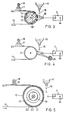
- FIGS. 1 to 5 Examples for carrying out the precipitation process for dry capsule material are shown in FIGS. 1 to 5.
- Both the field and the ion current are generated by a voltage between the electrodes 1 and 2, which is maintained by a DC voltage source 7.
- the capsules are pressed by the force K onto the surface of the paper 5 which covers the counterelectrode. At the same time, an electrical current constantly flows through the paper layer onto the electrode 2.
- a prerequisite for the functioning of the method according to the invention is sufficient permeability of the paper for the electric current.
- this condition is met when the resistivity of the paper is less than 10 14 ohms. m is forthcoming to 4 gt 10 -10 14 Ohm. m, particularly preferably 10 to 10 13 Oh m. m. Under the conditions described, a uniformly dense layer of the capsule material is deposited on the paper sheet.
- the precipitation electrode 2 explains the possibility of specifically depositing the capsules on certain surface parts of the paper carrier. If one conducts the precipitation electrode in such a way that it consists of insulating parts 8 and conductive parts 9 on the surface, the ion current emanating from the corona is distributed in the spray field 6 in such a way that the charge carriers and thus the capsules are located only over the conductive electrode parts separate in a concentrated manner.
- the paper 5 is not less than a specific resistivity. If the resistance of the paper is too low, capsules are also deposited in the intermediate areas. In the favorable resistance range, the precipitation layer forms in such a way that the structure of the conductor parts is reproduced in a sharply defined manner. This resistance range is explained in more detail above.
- Fig. 3 shows a more practical variant of the method, according to which the capsule material is deposited on a continuously moving, ribbon-shaped paper carrier.
- the material is fed through a funnel-like container 10, which is advantageously shaken to support the material outlet.
- a vibrating screen can also be used at this point.
- a band-shaped paper web 11 is continuously drawn over the rotatably mounted drum 12, as indicated in the drawing by arrows.
- the drum 12 is spanned with a support which consists of an insulating layer 13 and a conductor layer 14 which, however, is not continuous, but is in the pattern provided for the capsule separation.
- a support which consists of an insulating layer 13 and a conductor layer 14 which, however, is not continuous, but is in the pattern provided for the capsule separation.
- the conductive parts of the support are electrically connected to one another and to the carrier roller.
- the tip electrode 1 is replaced here by the wire electrode 15, which is stretched parallel to the surface line of the drum.
- the spray wire receives charge of a few kV, for example 10 kV, from the voltage source 7.
- the polarity is insignificant, but in this case the positive potential is preferable, since it achieves a more uniformly distributed discharge zone over the wire length.
- the tape passes through a baking station 17, in which the substance is heated and melted by heat rays.
- a photoconductor layer on the outer surface of the drum can also be used for the precipitation control instead of the metal coating.
- the photoconductor layer is an insulator in the dark and a conductor when exposed to light. Limited deposition zones are produced by zonal radiation with an exposure device 20 through the paper.
- This design has the advantage that the coating distribution can be changed very easily and quickly.
- Suitable photoconductors are e.g. Zinc oxide, cadmium sulfide and selenium.
- FIG. 5 shows a variant in which the exposure of the photoconductor 21 takes place from the inside of the drum.
- the photoconductor is applied to a conductive, transparent, grounded base 22.
- the can consist of a vapor-deposited film is applied by a transparent hollow cylinder 23 which is illuminated from the inside by means of a lamp 24.
- the partially transparent template 25 allows partial exposure of the photoconductor, which acts as a conductor in the exposed zones and as an insulator in the unexposed zones.
- microcapsules to be used to carry out the process according to the invention and processes for their production are known.
- the long-known microcapsules can be used, which can be produced by coacervation or complex coacervation from gelatin and gum arabic, as well as gelatin and other inorganic and organic polyanions.
- Various such methods include in M. Gutcho, Capsule Technology and Microencapsulation, Noyes Data Corporation 1972.
- microcapsules are used in the method according to the invention, the walls of which consist of polymers, polycondensation and polyaddition products.
- Microcapsules with walls made of special polyacrylates such as e.g. described in DE-OS 2 237 545 and DE-OS 2 119 933.
- phenol or urea-formaldehyde condensates can be used as wall material, optionally also in combination with the capsule wall polymers mentioned above.
- Microcapsules are preferably used in the process according to the invention, the shells of which consist of polyadducts of polyisocyanates and polyamines.
- Isocyanates to be used for the production of such microcapsules are diisocyanates such as xylylene-1,4-diisocyanate, xylylene-1,3-diisocyanate, trimethylene diisocyanate, hexamethylene diisocyanate, propylene-1,2-diisocyanate, butylene-1,2-diisocyanate, Ethylidene diisocyanate, cyclohexyl-1,2-diisocyanate, cyclohexyl-1,4-diisocyanate, polyisocyanate prepolymers, e.g.
- modified aliphatic isocyanates are those based on hexamethylene-1,6-diisocyanate, m-xylylene diisocyanate, 4,4'-diisocyanatodicyclohexylmethane or isophorone diisocyanate, which have at least two functional isocyanate groups per molecule.
- Suitable compounds are polyisocyanates based on derivatives of hexamethylene-1,6-diisocyanate with a biuret structure, the preparation of which is evident from DE-AS 1 101 394 and 1 543 178, and from DE-OS 1 568 017 and 1 931 055.
- the polyisocyanates that can be used can additionally be modified before use for microencapsulation by reaction with di- and trifunctional alcohols such as ethanediols, glycerol or trimethylolpropane or carboxylic acids such as succinic acid, adipic acid, sebacic acid in proportions of 0.01 to 0.5 mol per isocyanate equivalent .
- di- and trifunctional alcohols such as ethanediols, glycerol or trimethylolpropane
- carboxylic acids such as succinic acid, adipic acid, sebacic acid in proportions of 0.01 to 0.5 mol per isocyanate equivalent .
- carbodiimide, uretdione, uretonimine, uretidinedione diimine, 4-imino-oxazolidinone (2), ⁇ -alkylene propiolactone or cyclobutanedione (1,3) groups can also be present as reactive groups.
- polyisocyanato-polyuretonimines such as those formed by carbodiimidization of hexamethylene-1,6-diisocyanate containing biuret groups with organic phosphorus catalysts, can be used by further reaction of primarily formed carbodiimide groups with isocyanate groups to form uretonimine groups.
- isocyanates can be used in a mixture with one another and other aliphatic and aromatic isocyanates.
- the resulting modified polyisocyanate can contain considerable proportions of oxadiazinetrione, triisocyanurate or sym. Triazinedioneimine as a structural element. Such products are also suitable as shell formers.
- color former examples include triphenylmethane compounds, diphenylmethane compounds, xanthene compounds, thiazine compounds, spiropyran compounds or the like.
- Examples of a diphenylmethane compound are 4,4'-bis-dimethylaminobenzhydrylbenzylether, N-halophenylleucolamine, N- ⁇ -naphthyleucolamine, N-2,4,5-trichlorophenylleucolamine, N-2,4-dichlorophenylleucolamine or the like.
- Examples of a xanthene compound are rhodamine- ⁇ -anilinolactam, rhodamine- ⁇ - (p-nitroaniline) lactam, rhodamine- ⁇ - (p-chloroaniline) lactam, 7-dimethylamine-2-methoxifluorane, 7-diethylamine-3-methoxifluorane , 7-diethylamine-3-methyl-fluoran, 7-diethylamine-3-chlorofluorane, 7-diethylamine-3-chloro-2-methylfluorane, 7-diethylamine-2,4-dimethylfluorane, 7-diethylamine-2,3-dimethylfluorane , 7-diethylamine- (3-acetyl-methylamine) -fluorane, 7-diethylamine-3- (dibenzylamine) -fluoroane, 7-diethylamine-3- (methyl
- Examples of a thiazine compound are N-benzoylleucomethylene blue, o-chlorobenzoylleucomethylene blue, p-nitrol-benzoylleucomethylene blue or the like.
- spiro compound examples include 3-methyl-2,2'-spirobis (benzo (f) chromium) or the like.
- Solvents that dissolve these color formers are e.g. chlorinated diphenyl, chlorinated paraffin, cottonseed oil, peanut oil, silicone oil, phthalate esters, phosphate esters, sulfonate esters, monochlorobenzene, furthermore partially hydrogenated terphenyls, alkylated naphthalenes, alkylated diphenyls, aryl ethers, aryl alkyl ethers, higher alkylated benzene and others which can be used alone or in combination.
- Diluents are often added to the solvents, e.g. Kerosene, n-paraffins, isoparaffins.
- the colorants and the isocyanate are first dissolved in the solvents mentioned and this organic phase is emulsified in the continuous aqueous phase, which may contain protective colloid and, if appropriate, emulsifiers.
- An aqueous polyamine solution is added to the emulsion in a stoichiometric amount to the polyisocyanate in the organic phase.
- Protective colloids and emulsifying aids are added to the aqueous phase to emulsify and stabilize the emulsion formed.
- Examples of such products acting as protective colloids are carboxymethyl cellulose, gelatin and polyvinyl alcohol.
- emulsifiers are ethoxylated 3-benzylhydroxibiphenyl, reaction products of nonylphenol with different amounts of ethylene oxide and sorbitan fatty acid ester.
- the microcapsules can be produced continuously or batchwise. Dispersing devices which generate a shear gradient are generally used. Examples include blade, basket, high-speed stirrers, colloid mills, homogenizers, ultrasonic dispersers, nozzles, steel nozzles, and Supraton machines.
- the strength of the turbulence during mixing is primarily decisive for the diameter of the microcapsules obtained. Capsules from 1 to 2000 ⁇ m in size can be produced. Capsules with diameters of 2 to 20 gm are preferred.
- the capsules do not agglomerate and have a narrow particle size distribution.
- the weight ratio of core material to shell material is 50 to 90 to 50 to 10.
- microcapsules were produced according to the example of DE-OS 2 738 509.
- a 35% aqueous microcapsule dispersion was then produced, the capsule walls of which consisted of a polyaddition product of the oxadiazinetrione of hexamethylene diisocyanate and a diamine.
- the mean capsule diameter was 6.5 ⁇ m.
- This mixture was then spray dried (180 ° C. air temperature inlet, 80 ° C. air temperature outlet). An agglomerate-free powder was obtained. The average particle size was 7.0 ⁇ m in diameter. The powder mixture obtained was applied to a paper support.
- microcapsule dispersion a was spray-dried as under b. 100 parts by weight of the capsule powder obtained were intimately mixed with 20 parts by weight of a finely powdered, partially saponified ethylene-vinyl acetate copolymer (Levasint, Bayer AG).
- the powder mixture obtained was used for deposition on a paper support.
- microcapsule dispersion a was spray-dried as under b. 40 parts by weight of carnauba wax were then dissolved in 250 parts of trichloroethane while heating to 40 ° C., and 160 parts by weight of the dry capsules were mixed into this solution. The trichloroethane was then stripped off in vacuo.
- a free-flowing capsule powder coated with carnauba wax was obtained.
- the powder mixture obtained was used for deposition on a paper support.
- a capsule material is used which is covered with carnauba wax (example d).
- the average size of the capsules is 8 ⁇ m.
- This material is whirled up in an air stream and in an arrangement according to FIG. 2 in the discharge blown space between a tip electrode and a plate-shaped counter electrode.
- the surface of the counter electrode is divided into insulating fields 8 and conductive fields 9, the conductive fields being connected to one another and to a voltage source 7.
- This electrode is covered with a sheet of paper to hold the capsule layer.
- the paper has a resistivity of 10 8 Ohm.m.
- the distance between the tip and the plate is 10 cm.
- the top is positive.
- a thin, uniform capsule layer forms on the areas of the paper that lie above the conductive parts of the counterelectrode in a fraction of a second.
- the paper coated in this way is removed from the base and placed in a heating device, where it is heated to 150 ° C. for 10 seconds.
- the wax shell of the capsules melts onto the paper surface and thus fixes the capsule layer.
- a functional carbonless reaction paper is obtained.
- Capsule materials according to Examples a-c) were used in the same way. Functional carbonless copy papers were also obtained.
Landscapes
- Color Printing (AREA)
- Manufacturing Of Micro-Capsules (AREA)
- Paper (AREA)
- Cultivation Of Plants (AREA)
- Confectionery (AREA)
- Game Rules And Presentations Of Slot Machines (AREA)
Abstract
Description
- Die Erfindung betrifft ein partiell beschichtetes Durchschreibepapier sowie ein Verfahren zu seiner Herstellung, bei dem mit einem schmelzbaren Überzug versehene Mikrokapseln elektrostatisch auf einem Papierträger abgeschieden und anschließend fixiert werden.
- Reaktionsdurchschreibepapiere bestehen vorzugsweise aus zwei oder mehreren, lose aufeinandergelegten Papierblättern, wobei das jeweils obere auf der Rückseite eine Geberschicht und das jeweils untere auf der Vorderseite eine Nehmerschicht enthält. Es ist also jeweils eine Geberschicht und eine Nehmerschicht miteinander in Kontakt. Die Geberschicht enthält Mikrokapseln, deren Kernmaterial eine Lösung eines Farbbildners in einem organischen Lösungsmittel ist, und die Nehmerschicht enthält ein Material, das den Farbstoffbildner zum Farbstoff entwickelt. Beim Beschreiben werden die Kapseln unter dem hohen Druck des Schreibgerätes zerstört, und das auslaufende Kernmaterial trifft auf die Nehmerschicht, so daß eine Durchschrift entsteht.
- Die Nehmerschicht enthält in der Regel Bindemittel und Pigmente, z.B. aktive Absorbentien, wie Kaolin, Attapulgit, Montmorillonit, Bentonit, saure Bleicherde oder Phenolharze. Man kann z.B. auf der Geberschicht säureaktivierbare Farbstoffe und in der Nehmerschicht sauer reagierende Komponenten einsetzen.
- Eine Fortentwicklung dieser Reaktionsdurchschreibepapiere sind die "Einkomponenten"-Reaktionsdurchschreibepapiere. In diesen trägt eine Seite eines einzelnen Papierblattes den Farbstoffvorläufer, im allgemeinen in Form von Mikrokapseln und gleichzeitig den Farbentwickler. Wenn nun Druck ausgeübt wird, z.B. durch eine Schreibmaschine oder ein anderes Schreibwerkzeug, wird die den Farbstoffvorläufer enthaltende Kapsel aufgerissen und der Farbstoffvorläufer reagiert mit dem ihn umgebenden Farbentwickler (vergl. US-PS 2 730 456).
- Die Beschichtung des Papiersubstrates zur Herstellung der kohlefreien Durchschreibesysteme geschieht nach dem längst bekannten Stand der Technik im allgemeinen vollflächig mit einer wäßrigen Beschichtungskomposition, wie z.B. in den DE-OS 1 934 457 und 1 955 542 beschrieben.
- Bei den beschriebenen Verfahren besteht der Nachteil, daß nach dem Auftragen der Beschichtungsmasse das Wasser verdampft werden muß, was einen beträchtlichen Aufwand an Energie erfordert. Die Notwendigkeit zu trocknen erfordert weiterhin die Verwendung einer komplexen und kostspieligen Apparatur, um kontinuierlich ein Substrat zu trocknen, das mit einer wäßrigen Beschichtungsverbindung beschichtet worden ist. Ein anderes, aber damit zusammenhängendes Problem betrifft die Beseitigung des verschmutzten Wassers, das von der Herstellung und von der Reinigung der wäßrigen Beschichtungskomposition herrührt.
- Verwendet man bei der Herstellung der Beschichtungen flüchtige organische Lösungsmittel, so muß ebenfalls das überschüssige Lösungsmittel verdampft werden, um die Beschichtung zu trocknen. Auf diese Weise entstehen Lösungsmitteldämpfe, die besondere Gefahren darstellen.
- Es wurde daher in der DE-OS 1 928 001 vorgeschlagen, trockene Mikrokapseln elektrostatisch auf eine nasse Papierbahn abzuscheiden. Diese Verfahrensweise vermeidet einen Teil der Trocknung, es lassen sich aber nur vollflächige Beschichtungen mit der vorgeschlagenen Methode durchführen. Zur Fixierung der Kapseln wird ferner ein in wässriger Lösung wirkendes Bindemittel benötigt.
- Vollflächige Beschichtungen sind unrationell, weil in den meisten Fällen nur Teile des Durchschreibesystems ausgenutzt werden.
- Es sind daher zahlreiche Verfahren bekannt geworden, Beschichtungskompositionen partiell auf ein Papiersubstrat aufzubringen. So können nach dem Stand der Technik wäßrige oder lösungsmittelhaltige Beschichtungen mittels Tiefdruck oder Flexodruck partiell auf einen Papierträger aufgebracht werden (siehe z.B. DE-OS 2 541 001, US-PS 3 016 308 und 3 914 511). Auch bei diesen Verfahren besteht der Nachteil, die Beschichtungen nachträglich trocknen zu müssen. Aus diesen Gründen wurde beispielsweise in den US-PS 3 016 308, 3 079 351 und 3 684 549, sowie in den DE-OS 2 719 914 und 2 719 935 vorgeschlagen, die Mikrokapseln in Wachse aufzunehmen und mit derartigen Heißschmelzsystemen Beschichtungen des Papierträgers vorzunehmen.
- Diese vorgeschlagenen Maßnahmen vermeiden zwar das Entfernen der Lösungsmittel, die wachsartige Beschichtung verändert aber den Papiercharakter, da relativ große Mengen der Wachse aufgebracht werden müssen, um bei einem Mikrokapselgehalt von maximal 40 Gew. % noch befriedigende Durchschriften zu erhalten.
- Dieser Erfindung liegt die Erkenntnis zugrunde, daß trockene, mit schmelzbaren Überzügen versehene Mikrokapseln elektrostatisch in beliebiger Form auf einen Papierträger abgeschieden und durch Wärmebehandlung dort fixiert werden können, so daß ein partiell beschichtetes kohlefreies Durchschreibepapier erhalten wird.
- Die Erfindung betrifft daher ein partiell beschichtetes, kohlefreies Durchschreibepapier, welches hergestellt wird durch elektrostatische Abscheidung von mit schmelzbarem Überzug versehenen Mikrokapseln auf einem Papierträger und anschließender Wärmebehandlung sowie ein Verfahren zu dessen Herstellung.
- Erfindungsgemäß sind die Mikrokapseln mit einem Überzug versehen, der durch kurzzeitige Wärmebehandlung aufschmilzt und somit die Mikrokapsel auf dem Papierträger fixiert.
- Unter Wärmebehandlung wird die Einwirkung von Wärme verstanden, die einerseits nicht so hoch liegen darf, daß die Mikrokapsel geschädigt wird, andererseits wiederum nicht so tief sein sollte, daß kein Aufschmelzen stattfindet. Eine geeignete Temperatur ist z.B. von 50 bis 150, bevorzugt von 60 bis 120°C.
- Die bei diesen Temperaturen entfaltete Wärmeenergie entspricht derjenigen, die in üblichen Trockenkopiergeräten beim Einbrennen der Tonerpulver angewendet wird. Von dieser Wärmeenergie hängt auch die Einwirkungsdauer in der Weise ab, daß je höher die Energie desto kürzer die Behandlungszeit ist. Sie kann von einem Fachmann durch einfache Versuche schnell ermittelt werden und hängt von der Aufschmelzbarkeit des Überzuges, dessen Bindevermögen und der Erstarrzeit des Überzuges ab. Beispielhaft sei eine Behandlung von ca. 5-30 sec. genannt.
- Als Wärmequellen können beispielsweise übliche Heizstäbe, IR Strahler oder Mikrowellengeräte Verwendung finden.
- Geeignete Materialien zum Umhüllen der Kapseln sind beispielsweise Wachsmassen, Thermoplaste oder Heißschmelzkleber, alle mit Erweichungstemperaturen von 60-120°C bevorzugt von 70 bis 90°C.
- Als Wachsmassen seien Paraffinwachse, Esterwachse, Polyethylenwachse, Stearate, Carnaubawachse beispielhaft genannt.
- Als Thermoplaste eignen sich beispielsweise Polymerisate und Copolymerisate von Ethylen, Vinyliden, Vinylacetaten, insbesondere teilverseifte Ethylen-Vinylacetat-Copolymere.
- Als Heißschmelzkleber sind beispielsweise Polyamide einsetzbar.
- Bevorzugte Umhüllungsmaterialen sind: Carnaubawachse und teilverseifte Ethylen-Vinylacetat-Copolymere.
- Vorteilhafterweise können die Mikrokapseln mit den genannten Materialien in der Weise umhüllt werden, daß man sie in Form einer wässrigen, feinteiligen Dispersion oder Emulsion in die wäßrigen Kapseldispersionen einrührt und dieses Gemisch anschließend beispielsweise durch Sprühtrocknung in agglomeratfreie Pulver überführt.
- Die Sprühtrocknung von Mikrokapseln gehört zum bekannten Stand der Technik. Andere bekannte Trocknungstechniken können ebenfalls zur Herstellung der Kapselpulver eingesetzt werden.
- Zur Umhüllung können die Überzugsmassen auch in einem geeigneten Lösungsmittel gelöst, die trockenen Kapseln eingerührt und anschließend das Lösungsmittel abgezogen werden.
- Liegen genügend feinteilige Pulver des Umhüllungsmaterials vor, genügt ggf. eine Mischung mit den Mikrokapselpulvern. Die Menge an Umhüllungsmaterial beträgt etwa 5-50 % Gew., bevorzugt 10-30 % Gew. bezogen auf die Mikrokapsel.
- Die so umhüllten Mikrokapseln werden anschließend mit elektrostatischen Verfahren auf den Papierträger in beliebiger Form aufgebracht und einer Wärmebehandlung unterworfen.
- Als Papierträger können übliche holzhaltige oder holzfreie Papierqualitäten mit Flächengewichten von 40-200 g pro m2 eingesetzt werden.
- Bedingt durch das wasserfreie Herstellungsverfahren können nach dem erfindungsgemäßen Verfahren auch solche Papierträger Verwendung finden, die üblicherweise zur Herstellung von Kohlefreien Durchschreibepapieren nicht geeignet sind.
- Mit Hilfe der elektrostatischen Abscheidungsmethode der umhüllten Mikrokapseln auf dem Papierträger ist es möglich nach Belieben partiell auf diejenigen Teile des Papierträgers die Mikrokapseln aufzubringen, die eine durchschreibende Funktion erfüllen sollen.
- Das elektrische Feld zwischen zwei Elektroden erzeugt einen Ionenstrom, der wiederum die in das elektrische Feld eingeführten umhüllten Mikrokapseln elektrisch auflädt. Die so aufgeladenen Mikrokapseln schlagen sich auf dem Papierträger nieder, wenn dieser auf einer der Elektroden liegt.
- Der Vorgang der elektrischen Abscheidung fester Teilchen aus einem Luftstrom ist aus vielen Veröffentlichungen bekannt. (z.B. Simm: Untersuchungen über das Rücksprühen bei der elektrischen Staubabscheidung, Chemie-Ingenieur-Technik 31. Jahrgang 1959 Nr. 1) und gehört zum Stand der Technik.
- Beispiele zur Ausführung des Niederschlagsverfahrens für trockenes Kapselmaterial sind in Fig. 1 bis Fig. 5 dargestellt.
- Fig. 1 erläutert das Prinzip der Abscheidung der Kapseln im stationären elektrischen Feld, das durch eine KoronaEntladung an der Spitzenelektrode 1 und den dabei entstehenden Ionenstrom zwischen der Elektrode 1 und einer Niederschlagselektrode 2 entsteht. Durch die Einblasdüse 3 wird ein Luftstrom, in dem das Kapselmaterial 4 verteilt ist, in die Sprühzone zwischen den Elektroden 1 und 2 gelenkt. Die Niederschlagselektrode ist mit einem Papierblatt 5 bedeckt, auf dem das Kapselmaterial abgeschieden werden soll. Beim Eintritt der Kapseln in das Sprühfeld 6 werden diese von der dort vorhandenen Ladungsträgern, in diesem Falle sind es negative Ionen, elektrisch aufgeladen und als Ladungsträger der Kraftwirkung des elektrischen Feldes nach der bekannten Gleichung K = q . E ausgesetzt. In der Gleichung bedeuten K die Kraft, q die Ladung und E die Feldstärke in Richtung der Niederschlagselektrode. Sowohl das Feld als auch der Ionenstrom werden durch eine Spannung zwischen den Elektroden 1 und 2 erzeugt, die von einer Gleichspannungsquelle 7 aufrechterhalten wird. Durch die Kraft K werden die Kapseln auf die Oberfläche des Papiers 5 gedrückt, das die Gegenelektrode bedeckt. Gleichzeitig fließt ständig ein elektrischer Strom durch die Papierschicht hindurch auf die Elektrode 2.
- Voraussetzung für das Funktionieren des erfindungsgemäßen Verfahrens ist eine hinreichende Durchlässigkeit des Papiers für den elektrischen Strom. Im allgemeinen ist diese Bedingung gegeben, wenn der spezifische Widerstand des Papiers kleiner als 1014 Ohm . m ist, bevor- zugt 10 4 -10 14 Ohm . m, besonders bevorzugt 10 bis 10 13 Ohm . m. Unter den beschriebenen Bedingungen scheidet sich auf dem Papierblatt eine gleichmäßg dichte Schicht des Kapselmaterials ab.
- Fig. 2 erläutert die Möglichkeit, die Kapseln gezielt auf bestimmten Flächenteilen des Papierträgers abzuscheiden. Führt man nämlich die Niederschlagselektrode so aus, daß sie an der Oberfläche aus isolierenden Teilen 8 und leitfähigen Teilen 9 besteht, so verteilt sich der von der Korona ausgehende Ionenstrom im Sprühfeld 6 derart, daß die Ladungsträger und damit die Kapseln sich nur über den leitfähigen Elektrodenteilen konzentriert abscheiden.
- Voraussetzung ist, daß das aufgelegte Papier 5 einen bestimmten spezifischen Widerstand nicht unterschreitet. Bei zu kleinem Widerstand des Papiers werden auch in den Zwischenbereichen noch Kapseln abgeschieden. Im günstigen Widerstandsbereich bildet sich die Niederschlagsschicht so aus, daß die Struktur der Leiterteile scharf abgegrenzt wiedergegeben wird. Dieser Widerstandsbereich ist oben näher erläutert.
- Fig. 3 zeigt eine mehr praxisbezogene Variante des Verfahrens, wonach das Kapselmaterial auf einem kontinuierlich bewegten, bandförmigen Papierträger niedergeschlagen wird. Die Zuführung des Materials erfolgt durch einen trichterartigen Behälter 10, der zur Unterstützung des Materialaustritts vorteilhafterweise gerüttelt wird. An dieser Stelle kann ebenso ein Rüttelsieb verwendet werden. Eine bandförmige Papierbahn 11 wird kontinuierlich über die drehbar gelagerte Trommel 12 gezogen, wie in der Zeichnung durch Pfeile angedeutet ist. Die Trommel 12 ist mit einer Auflage umspannt, die aus einer isolierenden Schicht 13 und einer Leiterschicht 14 besteht, die jedoch nicht zusammenhängend, sondern in dem für die Kapselabscheidung vorgesehenen Muster vorliegt. Für die Herstellung derartiger Leitschichtmuster gibt es käufliches Material und bekannte Verfahren (s. gedruckte Schaltungen, kupferkaschierte Leiterplatten). Die leitfähigen Teile der Auflage sind elektrisch untereinander und mit der Trägerwalze verbunden.
- Zum Unterschied zu den Darstellungen in Fig. 1 und 2 wird hier die Spitzenelektrode 1 durch die Drahtelektrode 15 ersetzt, die parallel zur Mantellinie der Trommel gespannt ist. Zur Erzeugung der Korona-Entladung erhält der Sprühdraht aus der Spannungsquelle 7 Spannung von einigen kV, z.B. 10 kV. Die Polarität ist im Prinzip unwesentlich, jedoch ist in diesem Falle das positive Potential vorzuziehen, da damit eine über die Drahtlänge gleichmäßiger verteilte Entlandungszone erreicht wird.
- Zur Fixierung des abgeschiedenen Kapselmaterials durchläuft das Band eine Einbrennstation 17, in der die Substanz durch Wärmestrahlen erhitzt und angeschmolzen wird.
- Nach Fig. 4 läßt sich an Stelle der Metallauflage auch eine Photoleiterschicht auf der Mantelfläche der Trommel für die Niederschlagssteuerung verwenden. Die Photoleiterschicht ist im Dunkeln ein Isolator, bei Belichtung ein Leiter. Durch zonenmäßge Bestrahlung mit einer Belichtungsvorrichtung 20 durch das Papier hindurch erzeugt man begrenzte Abscheidezonen.
- Diese Ausführung hat den Vorteil, daß die Beschichtungsverteilung sehr einfach und schnell verändert werden kann.
- Geeignete Photoleiter sind z.B. Zinkoxid, Cadmiumsulfid und Selen.
- Fig. 5 zeigt eine Variante-, bei der die Belichtung des Photoleiters 21 vom Inneren der Trommel aus erfolgt. Der Photoleiter ist auf einer leitenden, transparenten, geerdeten Unterlage 22 aufgebracht. Diese Unterlage, die aus einem aufgedampften Film bestehen kann, wird von einem transparenten Hohlzylinder 23 aufgetragen, der von innen mittels einer Lampe 24 beleuchtet wird. Die teilweise transparente Vorlage 25 gestattet die teilflächige Belichtung des Photoleiters, der in den belichteten Zonen als Leiter und in den unbelichteten Zonen als Isolator wirkt.
- Die zur Durchführung des erfindungsgemäßen Verfahrens einzusetzenden Mikrokapseln und Verfahren zu deren Herstellung sind in großer Zahl bekannt. So können die seit langem bekannten Mikrokapseln verwendet werden, die durch Koazervierung oder Komplexkoazervierung aus Gelatine und Gummi arabicum, sowie Gelatine und anderen anorganischen und organischen Polyanionen hergestellt werden können. Verschiedene derartige Verfahren sind u.a. in M. Gutcho, Capsule Technology and Microencapsulation, Noyes Data Corporation 1972, bekannt geworden.
- Insbesondere werden beim erfindungsgemäßen Verfahren Mikrokapseln verwendet, deren Wände aus Polymeren, Polykondensations- und Polyadditionsprodukten bestehen.
- Die nachfolgende Übersicht ist G. Baxter, Microencapsulation, Processes and Applications, herausgegeben von J.E. Vandegaer, entnommen und zeigt eine Zusammenstellung der nach dem Stand der Technik bekannt gewordenen Kapselwandpolymeren.

- Es können für das erfindungsgemäße Verfahren auch Mikrokapseln mit Wänden aus speziellen Polyacrylaten, wie z.B. in DE-OS 2 237 545 und DE-OS 2 119 933 beschrieben verwendet werden.
- Ferner können Phenol- oder Harnstoff-Formaldehydkondensate als Wandmaterial eingesetzt werden, gegebenenfalls auch in Kombination mit den vorgenannten Kapselwandpolymeren.
- Bevorzugt werden beim erfindungsgemäßen Verfahren Mikrokapseln verwendet, deren Hüllen aus Polyadditionsprodukten aus Poly-Isocyanaten und Polyaminen bestehen.
- Zur Herstellung derartiger Mikrokapseln einzusetzende Isocyanate sind Diisocyanate, wie Xylylen-1,4-diisocyanat, Xylylen-1,3-diisocyanat, Trimethylen-diisocyanat, Hexamethylen-diisocyanat, Propylen-1,2-diisocyanat, Butylen-1,2-diisocyanat, Ethyliden-diisocyanat, Cyclohexyl-1,2-diisocyanat, Cyclohexyl-1,4-diisocyanat, Polyisocyanatvorpolymerisate, z.B. Anlagerungsprodukt von Hexamethylendiisocyanat und Hexantriol, Anlagerungsprodukt von 2,4-Toluylen-dilsocyanat mit Brenzkatechin, Anlagerungsprodukt von Toluylendiisocyanat mit Hexantriol, Anlagerungsprodukt von Toluylendiisocyanat mit Trimethylolpropan oder geeignete Polyisocyanate, die den vorstehend angegebenen Verbindungen analog sind.
- Weitere modifizierte aliphatische Isocyanate sind solche auf Basis von Hexamethylen-1,6-diisocyanat, m-Xylylendiisocyanat, 4,4'-Diisocyanato-dicyclohexyl-methan bzw. Isophorondiisocyanat, die pro Molekül mindestens zwei funktionelle Isocyanatgruppen besitzen.
- Weitere geeignete Verbindungen sind Polyisocyanate auf Grundlage von Derivaten des Hexamethylen-1,6-diisocyanate mit Biuretstruktur, deren Herstellung aus den DE-AS 1 101 394 und 1 543 178, sowie aus den DE-OS 1 568 017 und 1 931 055 hervorgeht.
- Die verwendbaren Polyisocyanate können vor dem Einsatz zur Mikroverkapselung zusätzlich modifiziert werden durch Umsetzung mit di- und trifunktionellen Alkoholen wie Ethandiole, Glycerin oder Trimethylolpropan bzw. Carbonsäuren wie Bernsteinsäure, Adipinsäure, Sebacinsäure in Anteilen von 0,01 bis 0,5 Mol pro Isocyanat- Äquivalent.
- Anstelle der Isocyanatgruppen können als reaktive Gruppen auch Carbodiimid-, Uretdion-, Uretonimin-, Uretidindiondiimin-, 4-Imino-oxazolidinon-(2)-, ß-Alkylenpropiolacton- bzw. Cyclobutandion-(1,3)-gruppen vorhanden sein.
- So sind beispielsweise einsetzbar Polyisocyanato-polyuretonimine, wie sie durch Carbodiimidisierung von Biuret-gruppen enthaltendem Hexamethylen-1,6-diisocyanat mit Phosphor-organischen Katalysatoren entstehen, durch weitere Umsetzung primär gebildeter Carbodiimidgruppen mit Isocyanat-gruppen zu Uretonimingruppen. Weiterhin können diese Isocyanate in Mischung miteinander und anderen aliphatischen und aromatischen Isocyanaten verwendet werden.
- Je nach Reaktionsbedingungen kann das resultierende modifizierte Polyisocyanat erhebliche Anteile an Oxadiazintrion, Triisocyanurat bzw. sym. Triazindionimin als Strukturelement enthalten. Auch solche Produkte eignen sich als Hüllenbildner.
- Besonders geeignet sind Diisocyanate der Formel I

- Zur Umsetzung mit den genarnten Isocyanaten geeignete Diamine sind aliphatische primäre oder sekundäre Di-und Polyamine, wie z.B.:
- Ethylendiamin-(1,2), Bis(3-aminopropyl)-amin, Hydrazin, Hydrazin-ethanol-(2), Bis-(2-methylaminoethyl)-methylamin, 1,4-Diaminocyclohexan, 3-Amino-1-methyl-amino- propan, N-Hydroxi-ethylethylendiamin, N-Methyl-bis-(3-aminopropyl)-amin, 1,4-Diamino-n-butan, 1,6-Diamino-n-hexan, Ethylen-(1,2)-diamin-N-Ethyl-sulfonsäure (als Alkalisalz), N-Amino-ethylethylendiamin-(1,2) (Diethylentriamin) Bis-(N,N'-aminoethyl)-ethylendiamin-(1,2) (Triethylentetramin), Hydrazin und seine Salze werden im vorliegenden Zusammenhang ebenfalls als Diamine angesprochen.
- Beispiele für den Farbbildner sind Triphenylmethanverbindungen, Diphenylmethanverbindunge, Xanthenverbindungen Thiazinverbindungen, Spiropyranverbindungen oder dergleichen.
- Beispiele für die vorstehend aufgeführten Gruppen sind die folgenden:
- Beispiele für eine Triphenylmethanverbindung sind 3,3-Bis-(p-dimethylaminophenyl)-6-dimethylaminophthalid Kristallviolettlacton, nachstehend als C.V.L. bezeichnet) und 3,3-Bis-(p-dimethylaminophenyl)-phthalid (Malachitgrünlacton).
- Beispiele für eine Diphenylmethanverbindung sind 4,4'- bis-dimethylaminobenzhydrylbenzylether, N-Halogenphenylleucolamin, N-ß-Naphthyleucolamin, N-2,4,5-Tri- chlorphenylleucolamin, N-2,4-Dichlorphenylleucolamin oder dergleichen.
- Beispiele für eine Xanthenverbindung sind Rhodamin-ßanilinolactam, Rhodamin-ß-(p-nitroanilin)-lactam, Rhodamin-ß-(p-chloranilin)-lactam, 7-Dimethyl-amin-2-methoxifluoran, 7-Diethylamin-3-methoxifluoran, 7-Diethylamin-3-methyl-fluoran, 7-Diethylamin-3-chlorfluoran, 7-Diethylamin-3-chlor-2-methylfluoran, 7-Diethylamin-2,4-dimethylfluoran, 7-Diethylamin-2,3-dimethylfluoran, 7-Diethylamin-(3-acetyl-methylamin)-fluoran, 7-Diethyl-amin-3-(dibenzylamin)-fluoran, 7-Diethylamin-3-(methylbenzylamin)-fluoran, 7-Diethylamin-3-(chlorethylmethylamino)-fluoran, 7-Diethylamin-3-(dichlorethyl-amin)-fluoran, 7-Diethylamin-3-(diethylamin)-fluoran oder dergl.
- Beispiele für eine Thiazinverbindung sind N-Benzoylleucomethylenblau, o-Chlorbenzoylleucomethylenblau, p-Nitrol-benzoylleucomethylenblau oder dergl.
- Beispiele für eine Spiroverbindung sind 3-Methyl-2,2'- spirobis-(benzo(f)-chromen) oder dergl.
- Lösungsmittel, die diese Farbbildner lösen, sind z.B. chloriertes Diphenyl, chloriertes Paraffin, Baumwollsamenöl, Erdnußöl, Silikonöl, Phthalatester, Phosphatester, Sulfonatester, Monochlorbenzol, ferner teilhydrierte Terphenyle, alkylierte Naphthaline, alkylierte Diphenyle, Arylether, Arylalkylether, höher alkyliertes Benzol und andere, die allein oder kombiniert eingesetzt werden können.
- Häufig werden den Lösungsmitteln Verdünnungsmittel zugesetzt, wie z.B. Kerosin, n-Paraffine, Isoparaffine.
- Zur Herstellung der Mikrokapseln nach dem Polyadditionsverfahren werden zunächst die Farbgeber und das Isocyanat in den genannten Lösungsmitteln gelöst und diese organische Phase in der kontinuierlichen wäßrigen Phase, die Schutzkolloid und gegebenenfalls Emulgatoren enthalten kann, emulgiert. Zur Emulsion gibt man eine wäßrige Polyaminlösung in stöchiometrischer Menge zum Polyisocyanat in der organischen Phase.
- Zur Emulgierung und Stabilisierung der gebildeten Emulsion werden der wäßrigen Phase Schutzkolloide und Emulgierhilfsmittel zugesetzt. Beispiele für solche, als Schutzkolloide wirkende Produkte sind Carboximethylcellulose, Gelatine und Polyvinylalkohol.
- Beispiele für Emulgatoren sind oxethyliertes 3-Benzylhydroxibiphenyl, Umsetzungsprodukte von Nonylphenol mit unterschiedlichen Mengen Ethylenoxid und Sorbitanfettsäureester.
- Die Mikrokapseln können kontinuierlich oder diskontinuierlich hergestellt werden. Man verwendet im allgemeinen Dispergiergeräte, die ein Schergefälle erzeugen. Beispiele hierfür sind Blatt-, Korb-, Schnellrührer, Kolloidmühlen, Homogenisatoren, Ultraschalldispergatoren, Düsen, Stahldüsen, Supratonmaschinen. Die Stärke der Turbulenz beim Vermischen ist in erster Linie bestimmend für den Durchmesser der erhaltenen Mikrokapseln. Kapseln in der Größe von 1 bis 2000 µm können hergestellt werden. Bevorzugt sind Kapseln mit Durchmessern von 2 bis 20 gm. Die Kapseln agglomerieren nicht und haben eine enge Teilchengrößenverteilung. Das Gewichtsverhältnis von Kernmaterial zu Hüllenmaterial ist 50 bis 90 zu 50 bis 10.
- Die Erfindung wird durch folgende Beispiele näher erläutert:
- Beispiel a) (Herstellung der Mikrokapseln)
- Die Herstellung der Mikrokapseln geschah gemäß Beispiel der DE-OS 2 738 509.
- Es wurde hiernach eine 35 %-ige wäßrige Mikrokapseldispersion hergestellt, deren Kapselwände aus einem Polyadditionsprodukt aus dem Oxadiazintrion von Hexamethylendiisocyanat und einem Diamin bestanden. Der Kapselinhalt war eine Lösung von 2,7 Gew. % Kristallviolettlacton und 0,9 Gew. % N-Benzoylleukomethylenblau in einem Gemisch aus Di-Isopropyl-Diphenyl und Isohexadecan. (80:20-Gewichtsverhältnis). Der mittlere Kapseldurchmesser betrug 6,5 µm.
- In 100 Gew.-Tle. der obigen wäßrigen Mikrokapseldispersion wurden unter Rühren 32 Gew.-Tle. einer 40 %- igen wäßrigen nichtionischen Polyethylendispersion eingerührt (Hordamer PE 03, Fa. Hoechst).
- Anschließend erfolgte die Sprühtrocknung dieses Gemisches (180°C Lufttemperatur Eingang, 80 °C Lufttemperatur Ausgang). Es wurde ein agglomeratfreies Pulver erhalten. Die mittlere Teilchengröße hatte einen Durchmesser von 7,0 µm. Das erhaltene Pulvergemisch wurde auf einen Papierträger aufgetragen.
- Die Mikrokapseldispersion a wurde wie unter b sprühgetrocknet. 100 Gew. Tle. des erhaltenen Kapselpulvers wurden mit 20 Gew. Tln. eines feinpulverigen, teilverseiften Ethylen-Vinylacetat-Copolymeren (Levasint, Fa. Bayer AG) innig vermischt.
- Das erhaltene Pulvergemisch wurde zur Abscheidung auf einem Papierträger verwendet.
- Die Mikrokapseldispersion a wurde wie unter b sprühgetrocknet. Anschließend wurden in 250 Tln. Trichlorethan 40 Gew. Tle. Carnaubawachs unter Erwärmen auf 40°C gelöst und in diese Lösung 160 Gew. Tle. der Trockenkapseln eingemischt. Anschließend wurde im Vakuum das Trichlorethan abgezogen.
- Es wurde ein mit Carnaubawachs überzogenes, freifließendes Kapselpulver erhalten. Das erhaltene Pulvergemisch wurde zur Abscheidung auf einem Papierträger verwendet.
- Für die Papierbeschichtung wird ein Kapselmaterial verwendet, das mit Carnaubawachs überzogen ist (Beispiel d). Die mittlere Größe der Kapseln liegt bei 8 µm. Dieses Material wird in einem Luftstrom aufgewirbelt und in einer Anordnung nach Fig. 2 in den Entladungsraum zwischen einer Spitzenelektrode und einer plattenförmigen Gegenelektrode eingeblasen. Die Oberfläche der Gegenelektrode ist in isolierende Felder 8 und leitfähige Felder 9 aufgeteilt, wobei die leitfähigen Felder untereinander und mit einer Spannungsquelle 7 verbunden sind. Diese Elektrode ist mit einem Papierblatt bedeckt, das die Kapselschicht aufnehmen soll. Das Papier hat einen spezifischen Widerstand von 108 Ohm.m. Der Abstand zwischen Spitze und Platte beträgt 10 cm. Zwischen den Elektroden, die mit der Spannungsquelle 7 verbunden sind, liegt eine Spannung von 30 kV. Die Spitze ist positiv. Schaltet man zuerst die Spannung ein und führt man danach die Kapseln in den Entladungsraum, so bildet sich in Bruchteilen einer Sekunde eine dünne, gleichmäßge Kapselschicht auf den Stellen des Papiers aus, die über den leitfähigen Teilen der Gegenelektrode liegen. Nach diesem Vorgang wird das so beschichtete Papier von der Unterlage abgenommen und in eine Heizvorrichtung gebracht, wo es für die Zeit von 10 sec. auf 150°C aufgeheizt wird. Die Wachshülle der Kapseln schmilzt dabei an die Papieroberfläche an und fixiert so die Kapselschicht. Man erhält ein funktionsfähiges Reaktionsdurchschreibepapier.
- In gleicher Weise wurden Kapselmaterialien gemäß Beispielen a-c) eingesetzt. Es wurden ebenfalls funktionsfähige Reaktionsdurchschreibepapiere erhalten.
Claims (10)
Priority Applications (1)
| Application Number | Priority Date | Filing Date | Title |
|---|---|---|---|
| AT83100383T ATE18521T1 (de) | 1982-01-30 | 1983-01-18 | Verfahren zur herstellung von partiell beschichtetem durchschreibepapier. |
Applications Claiming Priority (2)
| Application Number | Priority Date | Filing Date | Title |
|---|---|---|---|
| DE3203059 | 1982-01-30 | ||
| DE19823203059 DE3203059A1 (de) | 1982-01-30 | 1982-01-30 | Partiell beschichtetes durchschreibepapier |
Publications (3)
| Publication Number | Publication Date |
|---|---|
| EP0085346A2 true EP0085346A2 (de) | 1983-08-10 |
| EP0085346A3 EP0085346A3 (en) | 1984-01-11 |
| EP0085346B1 EP0085346B1 (de) | 1986-03-12 |
Family
ID=6154330
Family Applications (1)
| Application Number | Title | Priority Date | Filing Date |
|---|---|---|---|
| EP83100383A Expired EP0085346B1 (de) | 1982-01-30 | 1983-01-18 | Verfahren zur Herstellung von partiell beschichtetem Durchschreibepapier |
Country Status (5)
| Country | Link |
|---|---|
| EP (1) | EP0085346B1 (de) |
| JP (1) | JPS58136484A (de) |
| AT (1) | ATE18521T1 (de) |
| DE (2) | DE3203059A1 (de) |
| FI (1) | FI77605C (de) |
Cited By (1)
| Publication number | Priority date | Publication date | Assignee | Title |
|---|---|---|---|---|
| EP0545574A1 (de) * | 1991-12-05 | 1993-06-09 | Moore Business Forms, Inc. | Geschäftsvordrucke mit CF,CB oder selbstdurchschreibenden Blättern und Blockierstreifen, welche die Durchschreibefunktion aufheben |
Families Citing this family (2)
| Publication number | Priority date | Publication date | Assignee | Title |
|---|---|---|---|---|
| JPS6092889A (ja) * | 1983-10-27 | 1985-05-24 | Kureha Chem Ind Co Ltd | 部分感圧複写紙及びその製造方法 |
| JPS60149489A (ja) * | 1984-01-17 | 1985-08-06 | Kureha Chem Ind Co Ltd | 部分感圧紙 |
Family Cites Families (5)
| Publication number | Priority date | Publication date | Assignee | Title |
|---|---|---|---|---|
| NO126385B (de) * | 1968-06-18 | 1973-01-29 | Ransburg Electro Coating Corp | |
| US3694243A (en) * | 1969-12-22 | 1972-09-26 | Ncr Co | Coating of particles and process for manufacturing said coating |
| US4171981A (en) * | 1977-04-29 | 1979-10-23 | The Mead Corporation | Process for the production of hot melt coating compositions containing microcapsules |
| US4162165A (en) * | 1977-06-16 | 1979-07-24 | The Mead Corporation | Process for the production of microcapsular coating compositions containing pigment particles and compositions produced thereby |
| US4201404A (en) * | 1978-05-17 | 1980-05-06 | Minnesota Mining And Manufacturing Company | Pressure-sensitive marking materials |
-
1982
- 1982-01-30 DE DE19823203059 patent/DE3203059A1/de not_active Withdrawn
-
1983
- 1983-01-18 EP EP83100383A patent/EP0085346B1/de not_active Expired
- 1983-01-18 DE DE8383100383T patent/DE3362482D1/de not_active Expired
- 1983-01-18 AT AT83100383T patent/ATE18521T1/de not_active IP Right Cessation
- 1983-01-26 JP JP58010004A patent/JPS58136484A/ja active Granted
- 1983-01-27 FI FI830295A patent/FI77605C/fi not_active IP Right Cessation
Cited By (2)
| Publication number | Priority date | Publication date | Assignee | Title |
|---|---|---|---|---|
| EP0545574A1 (de) * | 1991-12-05 | 1993-06-09 | Moore Business Forms, Inc. | Geschäftsvordrucke mit CF,CB oder selbstdurchschreibenden Blättern und Blockierstreifen, welche die Durchschreibefunktion aufheben |
| US5639708A (en) * | 1991-12-05 | 1997-06-17 | Moore Business Forms, Inc. | Providing a UV curable protection strip on a business form |
Also Published As
| Publication number | Publication date |
|---|---|
| EP0085346B1 (de) | 1986-03-12 |
| FI77605B (fi) | 1988-12-30 |
| EP0085346A3 (en) | 1984-01-11 |
| FI830295L (fi) | 1983-07-31 |
| DE3362482D1 (en) | 1986-04-17 |
| JPH043314B2 (de) | 1992-01-22 |
| JPS58136484A (ja) | 1983-08-13 |
| DE3203059A1 (de) | 1983-08-04 |
| ATE18521T1 (de) | 1986-03-15 |
| FI830295A0 (fi) | 1983-01-27 |
| FI77605C (fi) | 1989-04-10 |
Similar Documents
| Publication | Publication Date | Title |
|---|---|---|
| DE3650591T2 (de) | Materialschicht für thermisches Übertragungsdruck | |
| DE1446720A1 (de) | Verfahren zum herstellen von ueberzuegen durch elektro-niederschlag | |
| EP0040770A1 (de) | Konzentrierte Mikrokapselsuspension, ein Verfahren zu ihrer Herstellung und ihre Verwendung für Reaktionsdurchschreibepapier | |
| DE3346601A1 (de) | Loesungsmittelgemisch fuer mikrokapseln | |
| DE2818976C2 (de) | ||
| DE69721667T2 (de) | Antistatische Beschichtung, wärmeempfindliche Übertragungsschicht mit antistatischen Eigenschaften und antistatisches Mittel | |
| EP0037477B1 (de) | Durchschreibesysteme und Verfahren zu deren Herstellung, sowie geeignete Offsetdruck- bzw. Buchdruckfarben | |
| DE2163658C3 (de) | 3-<2-Alkoxy-4-amino-phenyl)-3-(3-indolyl)-phthalide sowie druckempfindliche Kopierpapiere, die diese enthalten | |
| EP0000903B1 (de) | Reaktionsdurchschreibepapiere und deren Herstellung | |
| DE1497223B2 (de) | Elektrophotographisches Aufzeichnungsmaterial und Verfahren zu dessen Herstellung | |
| EP0023613B1 (de) | Reaktionsdurchschreibepapier | |
| DE69102074T2 (de) | Thermographische elemente. | |
| EP0085346B1 (de) | Verfahren zur Herstellung von partiell beschichtetem Durchschreibepapier | |
| DE3243870A1 (de) | Druckempfindliches aufzeichnungsmaterial | |
| DD148324A5 (de) | Blattfoermiges aufzeichnungsmaterial und verfahren zu seiner herstellung | |
| DE2502142A1 (de) | Druckempfindliches aufzeichnungsmaterial | |
| DE2803998C2 (de) | ||
| DE2513531C2 (de) | Verfahren zur Herstellung eines elektrophotographischen Aufzeichnungsmaterials | |
| DE2101156C3 (de) | ||
| EP0064204B1 (de) | Herstellung von Reaktionsdurchschreibepapieren mittels Flexodruck | |
| DE2515143A1 (de) | Einbrenntechnik zur herstellung von mit tetrafluoraethylen beschichteten walzen | |
| DE3335174A1 (de) | Verfahren zur herstellung von heissschmelzbaren und kalthaertbaren, mikrokapseln einschliessenden druckfarben | |
| DE2108292A1 (de) | Farbband oder Farbtuch | |
| DE3011709A1 (de) | Offsetverdruckbare bindermassen zur herstellung von kohlefreien durchschreibepapieren | |
| DE69009971T2 (de) | Drucktinte mit hohem Fettkörpergehalt, verwendbar für die Herstellung von kohlenstofffreiem chemischem Kopierpapier. |
Legal Events
| Date | Code | Title | Description |
|---|---|---|---|
| PUAI | Public reference made under article 153(3) epc to a published international application that has entered the european phase |
Free format text: ORIGINAL CODE: 0009012 |
|
| 17P | Request for examination filed |
Effective date: 19830118 |
|
| AK | Designated contracting states |
Designated state(s): AT BE DE FR GB IT |
|
| PUAL | Search report despatched |
Free format text: ORIGINAL CODE: 0009013 |
|
| AK | Designated contracting states |
Designated state(s): AT BE DE FR GB IT |
|
| GRAA | (expected) grant |
Free format text: ORIGINAL CODE: 0009210 |
|
| AK | Designated contracting states |
Kind code of ref document: B1 Designated state(s): AT BE DE FR GB IT |
|
| REF | Corresponds to: |
Ref document number: 18521 Country of ref document: AT Date of ref document: 19860315 Kind code of ref document: T |
|
| ET | Fr: translation filed | ||
| ITF | It: translation for a ep patent filed | ||
| REF | Corresponds to: |
Ref document number: 3362482 Country of ref document: DE Date of ref document: 19860417 |
|
| PLBE | No opposition filed within time limit |
Free format text: ORIGINAL CODE: 0009261 |
|
| STAA | Information on the status of an ep patent application or granted ep patent |
Free format text: STATUS: NO OPPOSITION FILED WITHIN TIME LIMIT |
|
| 26N | No opposition filed | ||
| PGFP | Annual fee paid to national office [announced via postgrant information from national office to epo] |
Ref country code: DE Payment date: 19911218 Year of fee payment: 10 |
|
| PGFP | Annual fee paid to national office [announced via postgrant information from national office to epo] |
Ref country code: AT Payment date: 19911223 Year of fee payment: 10 |
|
| PGFP | Annual fee paid to national office [announced via postgrant information from national office to epo] |
Ref country code: FR Payment date: 19911230 Year of fee payment: 10 |
|
| PGFP | Annual fee paid to national office [announced via postgrant information from national office to epo] |
Ref country code: GB Payment date: 19920107 Year of fee payment: 10 |
|
| PGFP | Annual fee paid to national office [announced via postgrant information from national office to epo] |
Ref country code: BE Payment date: 19920129 Year of fee payment: 10 |
|
| ITTA | It: last paid annual fee | ||
| PG25 | Lapsed in a contracting state [announced via postgrant information from national office to epo] |
Ref country code: GB Effective date: 19930118 Ref country code: AT Effective date: 19930118 |
|
| PG25 | Lapsed in a contracting state [announced via postgrant information from national office to epo] |
Ref country code: BE Effective date: 19930131 |
|
| BERE | Be: lapsed |
Owner name: BAYER A.G. Effective date: 19930131 |
|
| GBPC | Gb: european patent ceased through non-payment of renewal fee |
Effective date: 19930118 |
|
| PG25 | Lapsed in a contracting state [announced via postgrant information from national office to epo] |
Ref country code: FR Effective date: 19930930 |
|
| PG25 | Lapsed in a contracting state [announced via postgrant information from national office to epo] |
Ref country code: DE Effective date: 19931001 |
|
| REG | Reference to a national code |
Ref country code: FR Ref legal event code: ST |