EP0085882A2 - Antimykotische Tampons mit hoher Wirkstoff-Freisetzung - Google Patents
Antimykotische Tampons mit hoher Wirkstoff-Freisetzung Download PDFInfo
- Publication number
- EP0085882A2 EP0085882A2 EP83100613A EP83100613A EP0085882A2 EP 0085882 A2 EP0085882 A2 EP 0085882A2 EP 83100613 A EP83100613 A EP 83100613A EP 83100613 A EP83100613 A EP 83100613A EP 0085882 A2 EP0085882 A2 EP 0085882A2
- Authority
- EP
- European Patent Office
- Prior art keywords
- tampons
- antifungal
- contain
- active ingredient
- body temperature
- Prior art date
- Legal status (The legal status is an assumption and is not a legal conclusion. Google has not performed a legal analysis and makes no representation as to the accuracy of the status listed.)
- Granted
Links
Classifications
-
- A—HUMAN NECESSITIES
- A61—MEDICAL OR VETERINARY SCIENCE; HYGIENE
- A61L—METHODS OR APPARATUS FOR STERILISING MATERIALS OR OBJECTS IN GENERAL; DISINFECTION, STERILISATION OR DEODORISATION OF AIR; CHEMICAL ASPECTS OF BANDAGES, DRESSINGS, ABSORBENT PADS OR SURGICAL ARTICLES; MATERIALS FOR BANDAGES, DRESSINGS, ABSORBENT PADS OR SURGICAL ARTICLES
- A61L15/00—Chemical aspects of, or use of materials for, bandages, dressings or absorbent pads
- A61L15/16—Bandages, dressings or absorbent pads for physiological fluids such as urine or blood, e.g. sanitary towels, tampons
- A61L15/42—Use of materials characterised by their function or physical properties
- A61L15/46—Deodorants or malodour counteractants, e.g. to inhibit the formation of ammonia or bacteria
-
- A—HUMAN NECESSITIES
- A61—MEDICAL OR VETERINARY SCIENCE; HYGIENE
- A61K—PREPARATIONS FOR MEDICAL, DENTAL OR TOILETRY PURPOSES
- A61K9/00—Medicinal preparations characterised by special physical form
- A61K9/0012—Galenical forms characterised by the site of application
- A61K9/0034—Urogenital system, e.g. vagina, uterus, cervix, penis, scrotum, urethra, bladder; Personal lubricants
- A61K9/0036—Devices retained in the vagina or cervix for a prolonged period, e.g. intravaginal rings, medicated tampons, medicated diaphragms
-
- A—HUMAN NECESSITIES
- A61—MEDICAL OR VETERINARY SCIENCE; HYGIENE
- A61L—METHODS OR APPARATUS FOR STERILISING MATERIALS OR OBJECTS IN GENERAL; DISINFECTION, STERILISATION OR DEODORISATION OF AIR; CHEMICAL ASPECTS OF BANDAGES, DRESSINGS, ABSORBENT PADS OR SURGICAL ARTICLES; MATERIALS FOR BANDAGES, DRESSINGS, ABSORBENT PADS OR SURGICAL ARTICLES
- A61L15/00—Chemical aspects of, or use of materials for, bandages, dressings or absorbent pads
- A61L15/16—Bandages, dressings or absorbent pads for physiological fluids such as urine or blood, e.g. sanitary towels, tampons
- A61L15/20—Bandages, dressings or absorbent pads for physiological fluids such as urine or blood, e.g. sanitary towels, tampons containing organic materials
-
- A—HUMAN NECESSITIES
- A61—MEDICAL OR VETERINARY SCIENCE; HYGIENE
- A61L—METHODS OR APPARATUS FOR STERILISING MATERIALS OR OBJECTS IN GENERAL; DISINFECTION, STERILISATION OR DEODORISATION OF AIR; CHEMICAL ASPECTS OF BANDAGES, DRESSINGS, ABSORBENT PADS OR SURGICAL ARTICLES; MATERIALS FOR BANDAGES, DRESSINGS, ABSORBENT PADS OR SURGICAL ARTICLES
- A61L2300/00—Biologically active materials used in bandages, wound dressings, absorbent pads or medical devices
- A61L2300/20—Biologically active materials used in bandages, wound dressings, absorbent pads or medical devices containing or releasing organic materials
- A61L2300/202—Biologically active materials used in bandages, wound dressings, absorbent pads or medical devices containing or releasing organic materials with halogen atoms, e.g. triclosan, povidone-iodine
-
- A—HUMAN NECESSITIES
- A61—MEDICAL OR VETERINARY SCIENCE; HYGIENE
- A61L—METHODS OR APPARATUS FOR STERILISING MATERIALS OR OBJECTS IN GENERAL; DISINFECTION, STERILISATION OR DEODORISATION OF AIR; CHEMICAL ASPECTS OF BANDAGES, DRESSINGS, ABSORBENT PADS OR SURGICAL ARTICLES; MATERIALS FOR BANDAGES, DRESSINGS, ABSORBENT PADS OR SURGICAL ARTICLES
- A61L2300/00—Biologically active materials used in bandages, wound dressings, absorbent pads or medical devices
- A61L2300/40—Biologically active materials used in bandages, wound dressings, absorbent pads or medical devices characterised by a specific therapeutic activity or mode of action
- A61L2300/404—Biocides, antimicrobial agents, antiseptic agents
- A61L2300/408—Virucides, spermicides
-
- Y—GENERAL TAGGING OF NEW TECHNOLOGICAL DEVELOPMENTS; GENERAL TAGGING OF CROSS-SECTIONAL TECHNOLOGIES SPANNING OVER SEVERAL SECTIONS OF THE IPC; TECHNICAL SUBJECTS COVERED BY FORMER USPC CROSS-REFERENCE ART COLLECTIONS [XRACs] AND DIGESTS
- Y10—TECHNICAL SUBJECTS COVERED BY FORMER USPC
- Y10S—TECHNICAL SUBJECTS COVERED BY FORMER USPC CROSS-REFERENCE ART COLLECTIONS [XRACs] AND DIGESTS
- Y10S604/00—Surgery
- Y10S604/904—Tampons
Definitions
- the present invention relates to novel formulations of the known antifungal azole derivatives which have a higher release of the active ingredients and thereby enable short-term therapy.
- Active ingredients that can be formulated in this way are all antifungal derivatives, in particular Imidazole and triazole derivatives. They are present in the tampons according to the invention in amounts of 50-300 mg, preferably 100-200 mg.
- the following compounds are useful as a solid, melting at body temperature S p riding medium such as myristyl lactate, cetyl lactate, myristyl myristate, and similar compounds.
- Spreading agents are understood to be oily liquids which are particularly well distributed on the skin [R. Keymer, Pharm. Ind. 32, 577-581 (1970)].
- Fatty acid esters such as ethyl stearate, di-n-butyl adipate, lauric acid hexyl ester, dipropylene glycol pelargonate, esters of a branched fatty acid of medium chain length with saturated fatty alcohols C 16 -C 18 , isopropyl myristate, isopropyl palmitate, caprylic / capric acid esters of saturated fatty alcohols C 12 chain length 18 , isopropyl stearate, oleic acid oleyl ester, oleic acid decyl ester, ethyl oleate, waxy fatty acid esters such as artificial duckling gland fat, dibutyl phthalate, adipic acid diisopropyl ester, the latter related ester mixtures and others
- Triglycerides such as caprylic / capric acid triglyceride, triglyceride mixtures with vegetable fatty acids of chain length C 8 -C 12 or other specially selected natural fatty acids, partial glyceride mixtures of saturated or unsaturated fatty acids, which may also contain hydroxyl groups, monoglycerides of C 8 / C 10 fatty acids, etc.
- Fatty alcohols such as isotridecyl alcohol, cetylstearyl alcohol, oleyl alcohol.
- Fatty acids such as oleic acid.
- Particularly suitable spreading oils are the following: isopropyl myristate, isopropyl palmitate, caprylic / capric acid esters of saturated fatty alcohols of chain length C 12 -C 18 , waxy fatty acid esters such as artificial Duckling gland fat, silicone oils, isopropyl myristate / isopropyl stearate / isopropyl palmitate mixture.
- Glycerin paraffin viscous
- paraffin viscous paraffin viscous
- ethylene carbonate and polyethylene glycols with average molecular weights are suitable as solid solvents which only melt at body temperature.
- the tampons according to the invention are produced as follows:
- the melted base composition which had been cooled to 40 ° C. and consisted of active ingredients and formulation auxiliaries, was in portions of 2.0 g in 3 cm high glasses with a diameter of 1.5 cm weighed.
- the pre-cooled tampons were pressed into the mass so that they were enclosed by the solidifying mass at the level of the glass rim.
- the jars with the tampons were wrapped in aluminum foil to protect them from moisture and placed in the refrigerator for complete solidification. Then the coated tampons could be easily removed from the glasses.
- the melted base mass which had been cooled to 40 ° C. and consisted of active ingredient and formulation auxiliaries, was injected from the tip into a protective film with a preheated 2 ml injection syringe, the filling of which had previously been calibrated to 2.0 g by injecting into tared tampons wrapped in pre-heated tampons.
- the impregnated tampons were placed tip-down in preheated vessels and slowly cooled.
- the impregnation composition must meet the following requirements: sufficient consistency up to 32 ° C, homogeneity, sufficient dissolving power for the active substance, sufficient releasing power, suitable melting behavior and good in vitro effectiveness.
- the agar surfaces of the dishes were then inoculated homogeneously with germ suspensions from C.albicans or T. glabrata.
- the germ density was 10 cells 2 per cm.
- test dishes prepared in this way were incubated in the incubation room at 37 ° C. for 48 hours.
Landscapes
- Health & Medical Sciences (AREA)
- General Health & Medical Sciences (AREA)
- Veterinary Medicine (AREA)
- Chemical & Material Sciences (AREA)
- Public Health (AREA)
- Epidemiology (AREA)
- Life Sciences & Earth Sciences (AREA)
- Animal Behavior & Ethology (AREA)
- Materials Engineering (AREA)
- Engineering & Computer Science (AREA)
- Hematology (AREA)
- Reproductive Health (AREA)
- Gynecology & Obstetrics (AREA)
- Urology & Nephrology (AREA)
- Medicinal Chemistry (AREA)
- Pharmacology & Pharmacy (AREA)
- Medicinal Preparation (AREA)
- Pharmaceuticals Containing Other Organic And Inorganic Compounds (AREA)
Abstract
Description
- Die vorliegende Erfindung betrifft neuartige Formulierungen der bekannten antimykotischen Azolderivate, die eine höhere Freisetzung der Wirkstoffe aufweisen und dadurch eine Kurzzeittherapie ermöglichen.
- Es wurde gefunden, daß solche Tamponformulierungen antimykotischer Azolderivate, die den Wirkstoff in imprägnierter und erst bei Körpertemperatur schmelzender bzw. gelöster Form enthalten, wie z.B. in Suppositoriengrundlagen sowie deren Kombinationen mit Emulgatoren und/oder Spreitmitteln und/oder Lösungsvermittler, den Wirkstoff in höherem Maße freisetzen und dadurch eine Verkürzung der Therapiedauer auf 1 Tag ermöglichen. Dieser Effekt der höheren Wirkstoff-Freisetzung kann bis zu einer Zehnerpotenz erreichen.
- Wirkstoffe, die in dieser Weise formuliert werden können, sind alle antimykotisch wirksamen Derivate, insbesondere Imidazol- und Triazolderivate. Sie sind in den erfindungsgemäßen Tampons in Mengen von 50-300 mg, vorzugsweise von 100-200 mg vorhanden.
- Beispielsweise seien die Verbindungen der nachstehenden Formeln genannt:


- Das Trägermaterial für die Imprägnierung muß folgenden Anforderungen entsprechen:
- Ausreichende Konsistenz bei Raumtemperatur, Homogenität, ausreichendes Lösungsvermögen für den Wirkstoff, ausreichendes Freisetzungsvermögen, geeignetes Schmelzverhalten und gleichmäßige in-vitro-Wirksamkeit.
- Folgende Kombinationsmöglichkeiten sind für die Imprägnierung geeignet:

- Feste, bei Körpertemperatur schmelzende Spreitmittel. Feste, bei Körpertemperatur schmelzende Spreitmittel mit Spreitölen.
- Feste, bei Körpertemperatur schmelzende Spreitmittel mit Spreitölen und` Lösungsvermittler.
- Feste, bei Körpertemperatur schmelzende Lösungsmittel, z.B. Ethylencarbonat.
- Feste, bei Körpertemperatur schmelzende Lösungsmittel mit zusätzlichen Lösungsvermittlern.
- Für die erfindungsgemäßen Mittel eignen sich folgende Suppositoriengrundlagen als Trägermaterial:
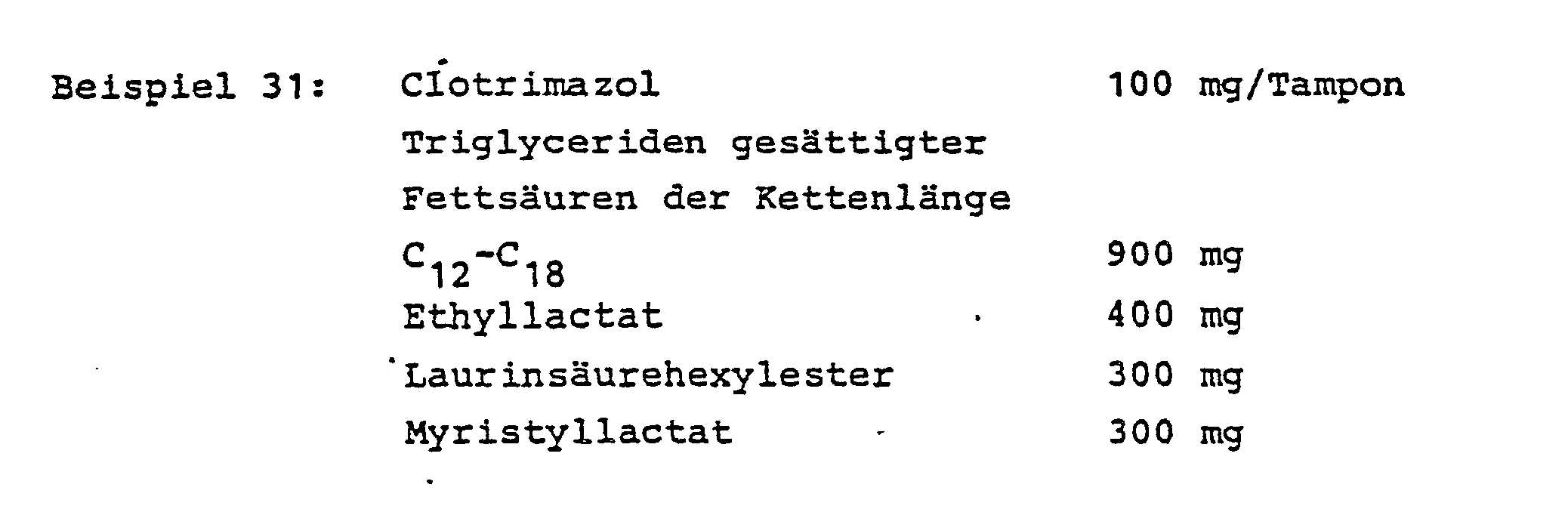
- Triglycerid-Mischungen natürlicher, gesättigter Fettsäuren der Kettenlänge C10-C18,Triglyceride von Mischungen natürlicher, gesättigter, pflanzlicher Fettsäuren der Kettenlänge C10-C18,Glycerinester von Mischungen pflanzlicher, gesättigter Fettsäuren, wobei die Laurinsäure überwiegt. Suppositoriengrundlagen mit sehr niedriger Hydroxylzahl. Hydroxylgruppenfreie Grundlagen. Die oben erwähnten Grundlagen mit Emulgator, z.B. nichtionogene Emulgatoren wie gesättigter C16-C18-Fettalkohol mit 25 Mol Ethylenoxid veräthert etc.
- Gemische von Mono-, Di- und Triglyceriden gesättigter, natürlicher Fettsäuren der Kettenlänge C12-C18, mit oder ohne Emulgatoren.
- Gemische aus Mono-, Di- und Triglyceriden, Fettalkoholen, Wachsestern etc.
- Für die erfindungsgemäßen Mittel eignen sich folgende Verbindungen als feste, bei Körpertemperatur schmelzende Spreitmittel z.B. Myristyllactat, Cetyllactat, Myristylmyristat und ähnliche Verbindungen.
- Unter Spreitmittel werden ölige Flüssigkeiten verstanden, die sich auf der Haut besonders gut verteilen [R. Keymer, Pharm. Ind. 32, 577-581 (1970)].
- Für die erfindungsgemäßen Mittel eignen sich als Spreitmittel bzw. -öle insbesondere folgende Verbindungen:
- Silikonöle verschiedener Viskosität.
- Fettsäureester, wie Ethylstearat, Di-n-butyl-adipat, Laurinsäurehexylester, Dipropylen-glykolpelargonät, Ester einer verzweigten Fettsäure mittlerer Kettenlänge mit gesättigten Fettalkoholen C16-C18, Isopropylmyristat, Isopropylpalmitat, Capryl/Caprinsäureester von gesättigten Fettalkoholen der Kettenlänge C12-C18, Isopropylstearat, ölsäureoleylester, ölsäuredecylester, Ethyloleat, wachsartige Fettsäureester wie künstliches Entenbürzeldrüsenfett, Dibutylphthalat, Adipinsäurediisopropylester, letzterem verwandte Estergemische u.a.
- Triglyceride, wie Capryl/Caprinsäuretriglycerid, Triglyceridgemische mit Pflanzenfettsäuren der Kettenlänge C8-C12 oder anderen speziell ausgewählten natürlichen Fettsäuren, Partialglyceridgemische gesättigter oder ungesättigter evtl. auch hydroxylgruppenhaltige Fettsäuren, Monoglyceride der C8/C10-Fettsäuren u.a.
- Fettalkohole, wie Isotridecylalkohol, Cetylstearyl-Alkohol, Oleylalkohol.
- Fettsäuren, wie z.B. ölsäure.
- Besonders gut geeignete spreitende öle sind die folgenden: Isopropylmyristat, Isopropylpalmitat, Capryl/Caprinsäureester von gesättigten Fettalkoholen der Kettenlänge C12-C18, wachsartige Fettsäureester wie künstliches Entenbürzeldrüsenfett, Silikonöle, Isopropylmyristat/Isopropylstearat/Isopropylpalmitat-Gemisch.
- Glycerin, Paraffin dickflüssig, Paraffin dünnflüssig.
- Für die erfindungsgemäßen Mittel eignen sich folgende Mittel als Emulgatoren:
- Kolloiddisperses Gemisch aus Cetyl-Stearylalkohol und Natrium-Cetyl-Stearylsülfat, Polyethylenstearat, Cetyl-stearylalkohol mit ca. 12 Mol Ethylenoxid, Cetylstearylalkohol mit ca. 30 Mol Ethylenoxid, Fettalkohol C16-C18 mit 25 Mol Ethylenoxid verethert, Sorbitan.und Glycerinfettsäureester, ethoxyliertes Rizinusöl, Cetyl-stearylalkohol mit nicht ionogenem Emulgator-Zusatz.
- Folgende weitere Hilfs- und/oder Formulierungs-Grundhilfsstoffe können bei der Herstellung der erfindungsgemäßen Mittel verwendet werden:
- Tenside (beinhaltet Emulgatoren und Netzmittel), z.B.
- 1. anionaktive, wie Na-Laurylsulfat, Fettalkoholethersulfate, Mono/Dialkylpolyglykoletherorthophosphorsäureester-Monoethanolaminsalz;
- 2. kationaktive, wie Cetyltrimethylammoniumchlorid;
- 3. ampholytische, wie Di-Na-N-laury2-B-ininodipropio- nat oder Lecithin;
- 4. nicht ionogene, z.B. polyoxyethyliertes Rizinusöl, polyoxyethyliertes Sorbitan-Monooleat, Sorbitan-Monostearat, Cetylalkohol. Glycerinmonostearat, Polyoxyethylenstearat, Alkylphenolpolyglykolether und ähnliche.Verbindungen.
- Für die erfindungsgemäßen Mittel eignen sich Ethylencarbonat und Polyethylenglykole mit mittleren Molgewichten als feste, erst bei Körpertemperatur schmelzende Lösungsmittel.
- Als Lösungsvermittler können folgende Verbindungen eingesetzt werden:
- 2-Octyldodecanol, Benzylalkohol, Ethyllactat, Propylenglykol, Di- und tripropylenglykol u.a.
- Als Tampon können alle handelsüblichen speziell behandelten, gepressten Baumwoll-Qualitäten verwendet werden.
- Die erfindungsgemäßen Tampons werden folgendermaßen hergestellt:
- Die geschmolzene und auf 40°C abgekühlte, aus Wirkstoff'und Formulierungshilfsstoffen bestehende Grundmasse wurde in Portionen zu 2,0 g in 3 cm hohe Gläser mit einem Durchmesser von 1,5 cm eingewogen. Die vorgekühlten Tampons wurden in die Masse gedrückt, so daß sie in Höhe des Glasrandes von der erstarrenden Masse umschlossen wurden.
- Die Gläser mit den Tampons wurden zum Schutz vor Feuchtigkeit in Alufolie gewickelt und zur vollständigen Erstarrung in den Kühlschrank gelegt. Anschließend ließen sich die beschichteten Tampons gut aus den Gläsern lösen.
- Die geschmolzene, auf 40°C abgekühlte, aus Wirkstoff und Formulierungshilfsstoffen bestehende Grundmasse wurde mit einer vorgewärmten 2 ml-Injektionsspritze, deren Füllung zuvor durch Einspritzen in tarierte Tampons auf 2,0 g geeicht worden war, von der Spitze her in die noch mit Schutzfolie umwickelten vorgewärmten Tampons gespritzt.
- Um ein zu schnelles Erstarren der Grundmasse zu verhindern, das eine gleichmäßige Imprägnierung erschweren würde, wurden die imprägnierten Tampons mit der Spitze nach unten in vorgewärmte Gefäße gestellt und so langsam abgekühlt.
- Das gemäß b) beschriebene Verfahren ermöglicht großtechnisch eine schnelle, unkomplizierte und genauere Herstellung. Die nach diesem Verfahren imprägnierten Tampons zeigen gegenüber gemäß a) beschichteten Tampons eine gleichmäßigere in-vitro-Wirkstoff-Freisetzung und weisen dadurch auch eine bessere therapeutische Wirksamkeit auf.
- Die Imprägnierungsmasse muß folgenden Anforderungen entsprechen: Ausreichende Konsistenz bis 32°C, Homogenität, ausreichendes Lösungsvermögen für den Wirkstoff, ausreichendes Freisetzungsvermögen, geeignetes Schmelzverhalten und gute In-vitro-Wirksamkeit.
-




- Die wirksamkeitstestung der erfindungsgemäßen Tampons erfolgte durch Empfindlichkeitsmessung im Agardiffusionstest bei Candida albicans und Torulopsis glabrata nach folgender Methode:
- Je 2 der verschiedenen, mit jeweils 100 oder 200 mg der zu prüfenden Wirkstoffe imprägnierten Vaginaltampons wurden zur Messung der Wirkstoff-Freisetzung in .10 cm hohe Bechergläser eingesetzt, die 5 cm hoch mit Kimmig-Nähragar gefüllt waren. Vor Einsetzen der Tampons wurden in die Mitte der Agarschalen mittels steriler Korkbohrer Löcher von Durchmesser der Tampons gebohrt.
- Anschließend wurden die Agar-Oberflächen der Schalen mit Keimsuspensionen von C.albicans bzw. T. glabrata homogen beimpft. Die Keimdichte betrug 10 Zellen 2 pro cm .
- Die so vorbereiteten Testschalen wurden im Brutraum bei 37°C für 48 Std. bebrütet.
- Um ein Zeitmaß für die Wirkstoff-Freisetzung aus den Vaginaltampons zu erhalten, wurde von den jeweils 2 eingesetzten Tampons je einer nach 3 Std. der andere nach 6 Std. aus dem Kulturschalen herausgezogen.
- Nach Ende der Bebrütungszeit wurden die Hemmzonen, die sich aufgrund der Wirkstoff-Freisetzung aus den Tampons um die Testlöcher gebildet hatten, ausgemessen.
- In der folgenden Tabelle sind die Hemmzonengrößen der einzelnen Tampon-Formulierungen zusammgestellt.


Claims (8)


Applications Claiming Priority (2)
| Application Number | Priority Date | Filing Date | Title |
|---|---|---|---|
| DE3204124 | 1982-02-06 | ||
| DE19823204124 DE3204124A1 (de) | 1982-02-06 | 1982-02-06 | Antimykotische tampons mit hoher wirkstoff-freisetzung |
Publications (3)
| Publication Number | Publication Date |
|---|---|
| EP0085882A2 true EP0085882A2 (de) | 1983-08-17 |
| EP0085882A3 EP0085882A3 (en) | 1983-11-16 |
| EP0085882B1 EP0085882B1 (de) | 1986-04-23 |
Family
ID=6154988
Family Applications (1)
| Application Number | Title | Priority Date | Filing Date |
|---|---|---|---|
| EP83100613A Expired EP0085882B1 (de) | 1982-02-06 | 1983-01-25 | Antimykotische Tampons mit hoher Wirkstoff-Freisetzung |
Country Status (6)
| Country | Link |
|---|---|
| US (1) | US4582717A (de) |
| EP (1) | EP0085882B1 (de) |
| JP (1) | JPS58138453A (de) |
| AR (1) | AR231923A1 (de) |
| DE (2) | DE3204124A1 (de) |
| ES (1) | ES519558A0 (de) |
Cited By (1)
| Publication number | Priority date | Publication date | Assignee | Title |
|---|---|---|---|---|
| EP2367682A4 (de) * | 2008-11-21 | 2013-04-24 | Mcneil Ppc Inc | Beschichtungszusammensetzungen und beschichtete substrate für fertigungsartikel, die in kontakt mit flächen des menschlichen körpers verwendet werden |
Families Citing this family (39)
| Publication number | Priority date | Publication date | Assignee | Title |
|---|---|---|---|---|
| CA1340241C (en) * | 1988-06-08 | 1998-12-15 | Fountain Pharmaceuticals, Inc. | Method for marking solvent dilution microcarriers |
| NO178843C (no) * | 1988-07-11 | 1996-06-19 | Sspl Sa Safe Sex Prod Licens | Fremgangsmåte for fremstilling av et farmasöytisk preparat for å forhindre seksuelt overförbare sykdommer |
| US5374261A (en) * | 1990-07-24 | 1994-12-20 | Yoon; Inbae | Multifunctional devices for use in endoscopic surgical procedures and methods-therefor |
| US5641503A (en) * | 1989-04-27 | 1997-06-24 | Mcneil-Ppc, Inc. | Additives to tampons |
| NZ264247A (en) * | 1990-10-30 | 1996-07-26 | Mcneil Ppc Inc | Absorbent product containing mono- or diesters of a polyhydric alcohol and a c8-18 fatty acid having at least one free hydroxyl group in sufficient amount to inhibit the production of enterotoxins a, b and c by staph. aureus |
| NZ250714A (en) * | 1990-10-30 | 1996-05-28 | Mcneil Ppc Inc | Liquid composition comprising esters of higher fatty acids for use as a vaginal douche and to prevent toxic shock toxin production |
| US5807364A (en) * | 1992-08-17 | 1998-09-15 | Weyerhaeuser Company | Binder treated fibrous webs and products |
| JPH08507715A (ja) * | 1993-03-18 | 1996-08-20 | シーダーズ サイナイ メディカル センター | 生体人工部材のための薬剤導入性および放出性重合性コーティング |
| US5468236A (en) * | 1993-06-09 | 1995-11-21 | Kimberly-Clark Corporation | Disposable absorbent product incorporating chemically reactive substance |
| US7341737B2 (en) * | 1997-06-11 | 2008-03-11 | Kimberly-Clark Worldwide, Inc. | Medicated tampon |
| US7344732B2 (en) * | 2002-01-10 | 2008-03-18 | Kimberly-Clark Worldwide, Inc. | Medicated tampon |
| US6096332A (en) * | 1998-06-30 | 2000-08-01 | Mcneil-Ppc, Inc. | Adding pharmaceutically active compounds to substrates |
| CZ292079B6 (cs) * | 1998-12-21 | 2003-07-16 | Ivf Hartmann Ag | Tampon chránící proti infekci |
| FR2788987B1 (fr) * | 1999-02-03 | 2001-05-04 | Bernard Chaffringeon | Dispositif a usage unique de transfert d'un liquide actif dans une cavite intracorporelle |
| FR2803208A1 (fr) * | 1999-12-29 | 2001-07-06 | Jean Bastien Pasquini | Tampon periodique antiseptique et son procede de preparation |
| US6570055B2 (en) | 2000-12-21 | 2003-05-27 | Mcneil-Ppc, Inc | Apertured polymeric film web with surfactant mixture additive |
| US6743965B2 (en) | 2000-12-21 | 2004-06-01 | Mcneil-Ppc, Inc. | Apertured polymeric film web with diol/surfactant additive |
| US8093446B2 (en) * | 2001-04-11 | 2012-01-10 | Playtex Products, Inc. | Fibrous absorbent articles having malodor counteractant |
| US7026354B2 (en) * | 2001-10-02 | 2006-04-11 | Kimberly-Clark Worldwide, Inc. | Aromatic compositions for the inhibition of exoprotein production from gram positive bacteria |
| US7022333B2 (en) * | 2001-10-02 | 2006-04-04 | Kimberly-Clark Worldwide, Inc. | Inhibition of exoprotein production in non-absorbent articles uisng aromatic compositions |
| CA2461291A1 (en) * | 2001-10-02 | 2003-04-17 | Kimberly-Clark Worldwide, Inc. | Inhibition of exoprotein production using aromatic compositions |
| US20030153864A1 (en) * | 2001-10-16 | 2003-08-14 | Bernard Chaffringeon | Disposable device and method for transferring an active liquid into a body cavity |
| GB0130666D0 (en) * | 2001-12-21 | 2002-02-06 | Accantla Holdings Ltd | Absorbent tampons |
| RU2237476C1 (ru) * | 2003-02-13 | 2004-10-10 | Открытое акционерное общество "Химико-фармацевтический комбинат "Акрихин" | Противогрибковая фармацевтическая композиция |
| US20060067991A1 (en) * | 2004-09-30 | 2006-03-30 | Kimberly-Clark Worldwide, Inc. | Non-absorbent articles for inhibiting the production of exoproteins |
| US20060067990A1 (en) * | 2004-09-30 | 2006-03-30 | Kimberly-Clark Worldwide, Inc. | Absorbent articles for inhibiting the production of exoproteins |
| US7527614B2 (en) * | 2005-03-25 | 2009-05-05 | Kimberly-Clark Worldwide, Inc. | Protective tube for a medicated tampon |
| US7919453B2 (en) * | 2005-03-25 | 2011-04-05 | Kimberly-Clark Worldwide, Inc. | Dosage cap assembly for an applicator |
| US7744556B2 (en) * | 2005-03-25 | 2010-06-29 | Kimberly-Clark Worldwide, Inc. | Delivery tube assembly for an applicator |
| US7993667B2 (en) | 2005-03-25 | 2011-08-09 | Kimberly-Clark Worldwide, Inc. | Methods of manufacturing a medicated tampon assembly |
| US9295289B2 (en) * | 2005-04-01 | 2016-03-29 | Leslie Jane James | Waist-fastening, hip-encompassing apparel with at least one concealed storage compartment |
| US7708726B2 (en) * | 2005-04-28 | 2010-05-04 | Kimberly-Clark Worldwide, Inc. | Dosage form cap for an applicator |
| US20070141118A1 (en) * | 2005-12-15 | 2007-06-21 | Damico Joyce A | Layered dosage form for a medicated tampon assembly |
| US8137327B2 (en) * | 2006-06-16 | 2012-03-20 | Family Health International | Vaginal drug delivery system and method |
| CA2670520A1 (en) * | 2006-11-24 | 2008-05-29 | Bernard Chaffringeon | Catamenial and sanitary tampons |
| ITMI20070084A1 (it) * | 2007-01-22 | 2008-07-23 | Carlo Ghisalberti | Dispositivi antisettici vaginali a base lipidica |
| US12011423B2 (en) | 2007-11-06 | 2024-06-18 | Foraviset Ltd. | S-alkylisothiouronium derivatives for treating uterine hypercontractility disorders |
| PL2358319T3 (pl) * | 2008-11-21 | 2015-01-30 | Mcneil Ppc Inc | Umiejscowienie estrów kwasu tłuszczowego na tamponach i skuteczność hamowania toksyn |
| JP5409067B2 (ja) * | 2009-03-23 | 2014-02-05 | ユニ・チャーム株式会社 | タンポン |
Family Cites Families (13)
| Publication number | Priority date | Publication date | Assignee | Title |
|---|---|---|---|---|
| US3393678A (en) * | 1966-01-03 | 1968-07-23 | Purex Corp Ltd | Tampons and the like |
| US3481335A (en) * | 1967-09-13 | 1969-12-02 | Beutlich Inc | Vaginal tampon |
| LU57907A1 (de) * | 1969-02-04 | 1970-08-04 | ||
| US3756238A (en) * | 1971-03-24 | 1973-09-04 | Kimberly Clark Co | Self-lubricating compound for use in hygienic and medical applications, and coated tampons and suppositories made therefrom |
| US3724465A (en) * | 1971-07-22 | 1973-04-03 | Kimberly Clark Co | Tampon coated with insertion aid and method for coating |
| FR2245344B1 (de) * | 1973-06-26 | 1977-08-19 | Fabre Sa Pierre | |
| US3995636A (en) * | 1974-01-24 | 1976-12-07 | Murray Jerome L | Constrained catamenial device employing adhesive coating |
| CH645022A5 (de) * | 1978-12-22 | 1984-09-14 | Luecker P W | Kontrazeptivum zur lokalen applikation. |
| US4247552A (en) * | 1979-01-11 | 1981-01-27 | Syntex (U.S.A.) Inc. | Contraceptive compositions and methods employing 1-substituted imidazole derivatives |
| DE3070778D1 (en) * | 1979-08-11 | 1985-07-25 | Bayer Ag | Antimycotic agents with enhanced release of the active ingredients |
| US4420474A (en) * | 1979-10-15 | 1983-12-13 | E. R. Squibb & Sons, Inc. | Synergistic antifungal compositions |
| US4340055A (en) * | 1980-10-01 | 1982-07-20 | Sneider Vincent R | Impregnated tampon and method of fabricating same |
| DE3106635A1 (de) * | 1981-02-23 | 1982-09-09 | Bayer Ag | Antimykotisches mittel mit hoher wirkstoff-freisetzung in form von stiften |
-
1982
- 1982-02-06 DE DE19823204124 patent/DE3204124A1/de not_active Withdrawn
-
1983
- 1983-01-21 AR AR291916A patent/AR231923A1/es active
- 1983-01-25 EP EP83100613A patent/EP0085882B1/de not_active Expired
- 1983-01-25 DE DE8383100613T patent/DE3363118D1/de not_active Expired
- 1983-02-02 JP JP58014693A patent/JPS58138453A/ja active Pending
- 1983-02-04 ES ES519558A patent/ES519558A0/es active Granted
-
1984
- 1984-07-27 US US06/634,941 patent/US4582717A/en not_active Expired - Fee Related
Cited By (1)
| Publication number | Priority date | Publication date | Assignee | Title |
|---|---|---|---|---|
| EP2367682A4 (de) * | 2008-11-21 | 2013-04-24 | Mcneil Ppc Inc | Beschichtungszusammensetzungen und beschichtete substrate für fertigungsartikel, die in kontakt mit flächen des menschlichen körpers verwendet werden |
Also Published As
| Publication number | Publication date |
|---|---|
| EP0085882A3 (en) | 1983-11-16 |
| DE3363118D1 (en) | 1986-05-28 |
| AR231923A1 (es) | 1985-04-30 |
| ES8406203A1 (es) | 1984-07-01 |
| US4582717A (en) | 1986-04-15 |
| DE3204124A1 (de) | 1983-08-18 |
| EP0085882B1 (de) | 1986-04-23 |
| ES519558A0 (es) | 1984-07-01 |
| JPS58138453A (ja) | 1983-08-17 |
Similar Documents
| Publication | Publication Date | Title |
|---|---|---|
| EP0085882B1 (de) | Antimykotische Tampons mit hoher Wirkstoff-Freisetzung | |
| DE69427589T2 (de) | Neue zusammensetzung | |
| DE2614841C2 (de) | ||
| EP0137978B1 (de) | Zubereitung von Nitroestern für die Koronartherapie | |
| EP0058887B1 (de) | Antimykotische Mittel mit hoher Wirkstoff-Freisetzung in Form von Stiften | |
| CH683237A5 (de) | Eine topische, Allylamin-enthaltende, Nagellack Formulierung. | |
| EP0045424A1 (de) | Gegen Zecken wirksame Pour-on-Formulierungen | |
| DE3239183C2 (de) | ||
| CH643456A5 (de) | Pharmazeutische zubereitung. | |
| EP0055396A1 (de) | Antimykotische Mittel mit hoher Wirkstoff-Freisetzung in Form von elastischen Flüssig-Pflastern | |
| DE2063896A1 (de) | Salbengrundlagen auf der Basis von Triglyceriden gesättigter mittelkettiger Fettsäuren und Verfahren zu deren Herstellung | |
| WO2025093279A1 (de) | Kosmetisches mittel enthaltend adenosin | |
| WO2025093276A1 (de) | Kosmetisches mittel enthaltend adenosin | |
| DE2138586C2 (de) | Injektionspräparat mit Vitamin A-Wirksamkeit | |
| US3049473A (en) | Udder-dispersible antibiotic mastitis creams | |
| DE102009038512A1 (de) | Arzneimittelformulierung zur Behandlung von Nagelerkrankungen | |
| DE2654709B2 (de) | Verfahren zum Stabilisieren von Baldrianextraktpräparaten | |
| EP0113009A2 (de) | Antimykotische Mittel mit hoher Wirkstoff-Freisetzung in Form von Gelsystemen | |
| CH641351A5 (de) | Rektal verabreichbares pharmazeutisches mittel. | |
| DE3243544A1 (de) | Antimykotische mittel fuer einmalige gynaekologische behandlung | |
| DE3814910A1 (de) | Verfahren zur herstellung lipoider gele der ethylcellulose und deren pharmazeutische, kosmetische und technische verwendung | |
| DE3712758C2 (de) | Stabile Anti-Akne-Zusammensetzung auf der Basis von Erythromycin | |
| EP0128459A2 (de) | Antimykotische Mittel für einmalige gynäkologische Behandlung | |
| AT400302B (de) | Pharmazeutische salbe mit einem gehalt an piroxicam und verfahren zur herstellung derselben | |
| DE102023210795A1 (de) | Kosmetisches Mittel enthaltend Adenosin |
Legal Events
| Date | Code | Title | Description |
|---|---|---|---|
| PUAI | Public reference made under article 153(3) epc to a published international application that has entered the european phase |
Free format text: ORIGINAL CODE: 0009012 |
|
| 17P | Request for examination filed |
Effective date: 19830125 |
|
| AK | Designated contracting states |
Designated state(s): DE FR GB IT |
|
| PUAL | Search report despatched |
Free format text: ORIGINAL CODE: 0009013 |
|
| AK | Designated contracting states |
Designated state(s): DE FR GB IT |
|
| GRAA | (expected) grant |
Free format text: ORIGINAL CODE: 0009210 |
|
| AK | Designated contracting states |
Kind code of ref document: B1 Designated state(s): DE FR GB IT |
|
| ITF | It: translation for a ep patent filed | ||
| ET | Fr: translation filed | ||
| REF | Corresponds to: |
Ref document number: 3363118 Country of ref document: DE Date of ref document: 19860528 |
|
| PLBE | No opposition filed within time limit |
Free format text: ORIGINAL CODE: 0009261 |
|
| STAA | Information on the status of an ep patent application or granted ep patent |
Free format text: STATUS: NO OPPOSITION FILED WITHIN TIME LIMIT |
|
| 26N | No opposition filed | ||
| PGFP | Annual fee paid to national office [announced via postgrant information from national office to epo] |
Ref country code: DE Payment date: 19891222 Year of fee payment: 8 Ref country code: FR Payment date: 19891222 Year of fee payment: 8 |
|
| ITTA | It: last paid annual fee | ||
| PGFP | Annual fee paid to national office [announced via postgrant information from national office to epo] |
Ref country code: GB Payment date: 19900131 Year of fee payment: 8 |
|
| PG25 | Lapsed in a contracting state [announced via postgrant information from national office to epo] |
Ref country code: GB Effective date: 19910125 |
|
| GBPC | Gb: european patent ceased through non-payment of renewal fee | ||
| PG25 | Lapsed in a contracting state [announced via postgrant information from national office to epo] |
Ref country code: FR Effective date: 19910930 |
|
| PG25 | Lapsed in a contracting state [announced via postgrant information from national office to epo] |
Ref country code: DE Effective date: 19911001 |
|
| REG | Reference to a national code |
Ref country code: FR Ref legal event code: ST |