EP0087192B1 - Compositions pharmaceutiques contenant de l'acide 3-hydroxybutanoique ou un sel dérivé de cet acide et composés dérivés de l'acide 3-hydroxybutanoique utilisables comme médicament - Google Patents
Compositions pharmaceutiques contenant de l'acide 3-hydroxybutanoique ou un sel dérivé de cet acide et composés dérivés de l'acide 3-hydroxybutanoique utilisables comme médicament Download PDFInfo
- Publication number
- EP0087192B1 EP0087192B1 EP83200228A EP83200228A EP0087192B1 EP 0087192 B1 EP0087192 B1 EP 0087192B1 EP 83200228 A EP83200228 A EP 83200228A EP 83200228 A EP83200228 A EP 83200228A EP 0087192 B1 EP0087192 B1 EP 0087192B1
- Authority
- EP
- European Patent Office
- Prior art keywords
- hydroxybutanoic acid
- amino acid
- acid
- salts
- hydroxybutanoic
- Prior art date
- Legal status (The legal status is an assumption and is not a legal conclusion. Google has not performed a legal analysis and makes no representation as to the accuracy of the status listed.)
- Expired
Links
- WHBMMWSBFZVSSR-UHFFFAOYSA-N 3-hydroxybutyric acid Chemical compound CC(O)CC(O)=O WHBMMWSBFZVSSR-UHFFFAOYSA-N 0.000 title claims abstract description 93
- 150000003839 salts Chemical class 0.000 title claims abstract description 35
- 150000001875 compounds Chemical class 0.000 title claims description 11
- 239000008194 pharmaceutical composition Substances 0.000 title abstract description 8
- 239000003814 drug Substances 0.000 title description 4
- 150000001413 amino acids Chemical class 0.000 claims abstract description 20
- 125000001477 organic nitrogen group Chemical group 0.000 claims abstract 2
- 235000001014 amino acid Nutrition 0.000 claims description 19
- 229940024606 amino acid Drugs 0.000 claims description 19
- 210000004165 myocardium Anatomy 0.000 claims description 15
- 238000000034 method Methods 0.000 claims description 12
- 230000008569 process Effects 0.000 claims description 8
- 238000011282 treatment Methods 0.000 claims description 8
- ODKSFYDXXFIFQN-BYPYZUCNSA-N L-arginine Chemical compound OC(=O)[C@@H](N)CCCN=C(N)N ODKSFYDXXFIFQN-BYPYZUCNSA-N 0.000 claims description 7
- XLYOFNOQVPJJNP-UHFFFAOYSA-N water Substances O XLYOFNOQVPJJNP-UHFFFAOYSA-N 0.000 claims description 7
- 239000002253 acid Substances 0.000 claims description 6
- 238000002360 preparation method Methods 0.000 claims description 5
- HNDVDQJCIGZPNO-YFKPBYRVSA-N L-histidine Chemical compound OC(=O)[C@@H](N)CC1=CN=CN1 HNDVDQJCIGZPNO-YFKPBYRVSA-N 0.000 claims description 4
- 239000002904 solvent Substances 0.000 claims description 4
- 229930064664 L-arginine Natural products 0.000 claims description 3
- 235000014852 L-arginine Nutrition 0.000 claims description 3
- 230000004060 metabolic process Effects 0.000 claims description 3
- QJGQUHMNIGDVPM-UHFFFAOYSA-N nitrogen group Chemical group [N] QJGQUHMNIGDVPM-UHFFFAOYSA-N 0.000 claims description 3
- 229960002885 histidine Drugs 0.000 claims description 2
- 230000000737 periodic effect Effects 0.000 claims description 2
- 230000002265 prevention Effects 0.000 claims description 2
- KDXKERNSBIXSRK-YFKPBYRVSA-N L-lysine Chemical compound NCCCC[C@H](N)C(O)=O KDXKERNSBIXSRK-YFKPBYRVSA-N 0.000 claims 2
- 239000000825 pharmaceutical preparation Substances 0.000 claims 2
- 229940127557 pharmaceutical product Drugs 0.000 claims 2
- 235000019766 L-Lysine Nutrition 0.000 claims 1
- 239000004472 Lysine Substances 0.000 claims 1
- 125000003178 carboxy group Chemical group [H]OC(*)=O 0.000 claims 1
- 150000001457 metallic cations Chemical class 0.000 claims 1
- 239000000203 mixture Substances 0.000 abstract description 26
- 159000000000 sodium salts Chemical class 0.000 abstract description 9
- 230000000302 ischemic effect Effects 0.000 abstract description 4
- 208000031229 Cardiomyopathies Diseases 0.000 abstract description 3
- 150000001412 amines Chemical class 0.000 abstract description 3
- 239000004475 Arginine Substances 0.000 abstract description 2
- ODKSFYDXXFIFQN-UHFFFAOYSA-N arginine Natural products OC(=O)C(N)CCCNC(N)=N ODKSFYDXXFIFQN-UHFFFAOYSA-N 0.000 abstract description 2
- 238000009109 curative therapy Methods 0.000 abstract description 2
- 230000000069 prophylactic effect Effects 0.000 abstract description 2
- 238000011321 prophylaxis Methods 0.000 abstract description 2
- 238000012360 testing method Methods 0.000 description 28
- 230000000638 stimulation Effects 0.000 description 11
- 230000001800 adrenalinergic effect Effects 0.000 description 9
- 239000007788 liquid Substances 0.000 description 9
- 238000001990 intravenous administration Methods 0.000 description 7
- 230000036284 oxygen consumption Effects 0.000 description 7
- 241000282472 Canis lupus familiaris Species 0.000 description 6
- 150000001483 arginine derivatives Chemical class 0.000 description 6
- 238000001802 infusion Methods 0.000 description 6
- 239000000243 solution Substances 0.000 description 5
- 238000009472 formulation Methods 0.000 description 4
- 239000007787 solid Substances 0.000 description 4
- SFLSHLFXELFNJZ-QMMMGPOBSA-N (-)-norepinephrine Chemical compound NC[C@H](O)C1=CC=C(O)C(O)=C1 SFLSHLFXELFNJZ-QMMMGPOBSA-N 0.000 description 3
- 239000000654 additive Substances 0.000 description 3
- 239000007864 aqueous solution Substances 0.000 description 3
- QVGXLLKOCUKJST-UHFFFAOYSA-N atomic oxygen Chemical compound [O] QVGXLLKOCUKJST-UHFFFAOYSA-N 0.000 description 3
- 235000021588 free fatty acids Nutrition 0.000 description 3
- 238000010255 intramuscular injection Methods 0.000 description 3
- 239000007927 intramuscular injection Substances 0.000 description 3
- 230000002503 metabolic effect Effects 0.000 description 3
- -1 nitrogenous organic base Chemical class 0.000 description 3
- 229960002748 norepinephrine Drugs 0.000 description 3
- SFLSHLFXELFNJZ-UHFFFAOYSA-N norepinephrine Natural products NCC(O)C1=CC=C(O)C(O)=C1 SFLSHLFXELFNJZ-UHFFFAOYSA-N 0.000 description 3
- 239000001301 oxygen Substances 0.000 description 3
- 229910052760 oxygen Inorganic materials 0.000 description 3
- 239000000725 suspension Substances 0.000 description 3
- 238000003786 synthesis reaction Methods 0.000 description 3
- WQZGKKKJIJFFOK-GASJEMHNSA-N Glucose Natural products OC[C@H]1OC(O)[C@H](O)[C@@H](O)[C@@H]1O WQZGKKKJIJFFOK-GASJEMHNSA-N 0.000 description 2
- PEDCQBHIVMGVHV-UHFFFAOYSA-N Glycerine Chemical compound OCC(O)CO PEDCQBHIVMGVHV-UHFFFAOYSA-N 0.000 description 2
- 125000002059 L-arginyl group Chemical class O=C([*])[C@](N([H])[H])([H])C([H])([H])C([H])([H])C([H])([H])N([H])C(=N[H])N([H])[H] 0.000 description 2
- FAPWRFPIFSIZLT-UHFFFAOYSA-M Sodium chloride Chemical compound [Na+].[Cl-] FAPWRFPIFSIZLT-UHFFFAOYSA-M 0.000 description 2
- HCHKCACWOHOZIP-UHFFFAOYSA-N Zinc Chemical compound [Zn] HCHKCACWOHOZIP-UHFFFAOYSA-N 0.000 description 2
- 239000004480 active ingredient Substances 0.000 description 2
- 239000002671 adjuvant Substances 0.000 description 2
- 238000013459 approach Methods 0.000 description 2
- 210000004369 blood Anatomy 0.000 description 2
- 239000008280 blood Substances 0.000 description 2
- 230000037396 body weight Effects 0.000 description 2
- 239000002775 capsule Substances 0.000 description 2
- 239000003795 chemical substances by application Substances 0.000 description 2
- 208000037265 diseases, disorders, signs and symptoms Diseases 0.000 description 2
- 239000000839 emulsion Substances 0.000 description 2
- 239000008187 granular material Substances 0.000 description 2
- 238000002347 injection Methods 0.000 description 2
- 239000007924 injection Substances 0.000 description 2
- 208000028867 ischemia Diseases 0.000 description 2
- 208000030159 metabolic disease Diseases 0.000 description 2
- BQJCRHHNABKAKU-KBQPJGBKSA-N morphine Chemical compound O([C@H]1[C@H](C=C[C@H]23)O)C4=C5[C@@]12CCN(C)[C@@H]3CC5=CC=C4O BQJCRHHNABKAKU-KBQPJGBKSA-N 0.000 description 2
- 230000002107 myocardial effect Effects 0.000 description 2
- 239000011541 reaction mixture Substances 0.000 description 2
- 230000008023 solidification Effects 0.000 description 2
- 238000007711 solidification Methods 0.000 description 2
- 238000003756 stirring Methods 0.000 description 2
- 239000003826 tablet Substances 0.000 description 2
- 230000008719 thickening Effects 0.000 description 2
- 229910052725 zinc Inorganic materials 0.000 description 2
- 239000011701 zinc Substances 0.000 description 2
- PHIQHXFUZVPYII-ZCFIWIBFSA-N (R)-carnitine Chemical compound C[N+](C)(C)C[C@H](O)CC([O-])=O PHIQHXFUZVPYII-ZCFIWIBFSA-N 0.000 description 1
- 208000010444 Acidosis Diseases 0.000 description 1
- 208000002874 Acne Vulgaris Diseases 0.000 description 1
- 206010002091 Anaesthesia Diseases 0.000 description 1
- 206010002383 Angina Pectoris Diseases 0.000 description 1
- CIWBSHSKHKDKBQ-JLAZNSOCSA-N Ascorbic acid Natural products OC[C@H](O)[C@H]1OC(=O)C(O)=C1O CIWBSHSKHKDKBQ-JLAZNSOCSA-N 0.000 description 1
- 102100026189 Beta-galactosidase Human genes 0.000 description 1
- 239000002028 Biomass Substances 0.000 description 1
- OYPRJOBELJOOCE-UHFFFAOYSA-N Calcium Chemical compound [Ca] OYPRJOBELJOOCE-UHFFFAOYSA-N 0.000 description 1
- 229940127291 Calcium channel antagonist Drugs 0.000 description 1
- 208000032843 Hemorrhage Diseases 0.000 description 1
- VEXZGXHMUGYJMC-UHFFFAOYSA-N Hydrochloric acid Chemical compound Cl VEXZGXHMUGYJMC-UHFFFAOYSA-N 0.000 description 1
- DGAQECJNVWCQMB-PUAWFVPOSA-M Ilexoside XXIX Chemical compound C[C@@H]1CC[C@@]2(CC[C@@]3(C(=CC[C@H]4[C@]3(CC[C@@H]5[C@@]4(CC[C@@H](C5(C)C)OS(=O)(=O)[O-])C)C)[C@@H]2[C@]1(C)O)C)C(=O)O[C@H]6[C@@H]([C@H]([C@@H]([C@H](O6)CO)O)O)O.[Na+] DGAQECJNVWCQMB-PUAWFVPOSA-M 0.000 description 1
- 206010048858 Ischaemic cardiomyopathy Diseases 0.000 description 1
- 108010059881 Lactase Proteins 0.000 description 1
- 241000124008 Mammalia Species 0.000 description 1
- 235000006679 Mentha X verticillata Nutrition 0.000 description 1
- 235000002899 Mentha suaveolens Nutrition 0.000 description 1
- 235000001636 Mentha x rotundifolia Nutrition 0.000 description 1
- 206010027417 Metabolic acidosis Diseases 0.000 description 1
- 241001465754 Metazoa Species 0.000 description 1
- 229910019142 PO4 Inorganic materials 0.000 description 1
- 239000002033 PVDF binder Substances 0.000 description 1
- QGMRQYFBGABWDR-UHFFFAOYSA-M Pentobarbital sodium Chemical compound [Na+].CCCC(C)C1(CC)C(=O)NC(=O)[N-]C1=O QGMRQYFBGABWDR-UHFFFAOYSA-M 0.000 description 1
- DWAQJAXMDSEUJJ-UHFFFAOYSA-M Sodium bisulfite Chemical compound [Na+].OS([O-])=O DWAQJAXMDSEUJJ-UHFFFAOYSA-M 0.000 description 1
- 229920002472 Starch Polymers 0.000 description 1
- 241000287181 Sturnus vulgaris Species 0.000 description 1
- 150000001242 acetic acid derivatives Chemical class 0.000 description 1
- 150000007513 acids Chemical class 0.000 description 1
- 206010000496 acne Diseases 0.000 description 1
- 230000009471 action Effects 0.000 description 1
- 230000001476 alcoholic effect Effects 0.000 description 1
- 125000001931 aliphatic group Chemical group 0.000 description 1
- 150000003863 ammonium salts Chemical class 0.000 description 1
- 230000037005 anaesthesia Effects 0.000 description 1
- 230000003288 anthiarrhythmic effect Effects 0.000 description 1
- 239000003242 anti bacterial agent Substances 0.000 description 1
- 239000003416 antiarrhythmic agent Substances 0.000 description 1
- 239000003146 anticoagulant agent Substances 0.000 description 1
- 229940127219 anticoagulant drug Drugs 0.000 description 1
- 239000003963 antioxidant agent Substances 0.000 description 1
- 235000006708 antioxidants Nutrition 0.000 description 1
- 235000009697 arginine Nutrition 0.000 description 1
- 125000003118 aryl group Chemical class 0.000 description 1
- 235000010323 ascorbic acid Nutrition 0.000 description 1
- 229960005070 ascorbic acid Drugs 0.000 description 1
- 239000011668 ascorbic acid Substances 0.000 description 1
- 230000003385 bacteriostatic effect Effects 0.000 description 1
- 230000008901 benefit Effects 0.000 description 1
- 239000002876 beta blocker Substances 0.000 description 1
- 229940097320 beta blocking agent Drugs 0.000 description 1
- WQZGKKKJIJFFOK-VFUOTHLCSA-N beta-D-glucose Chemical compound OC[C@H]1O[C@@H](O)[C@H](O)[C@@H](O)[C@@H]1O WQZGKKKJIJFFOK-VFUOTHLCSA-N 0.000 description 1
- 108010005774 beta-Galactosidase Proteins 0.000 description 1
- 239000011230 binding agent Substances 0.000 description 1
- 230000015572 biosynthetic process Effects 0.000 description 1
- 230000017531 blood circulation Effects 0.000 description 1
- 230000036772 blood pressure Effects 0.000 description 1
- 239000006172 buffering agent Substances 0.000 description 1
- 229910052791 calcium Inorganic materials 0.000 description 1
- 239000011575 calcium Substances 0.000 description 1
- 235000019577 caloric intake Nutrition 0.000 description 1
- 210000004903 cardiac system Anatomy 0.000 description 1
- 230000003177 cardiotonic effect Effects 0.000 description 1
- 229960004203 carnitine Drugs 0.000 description 1
- 239000000969 carrier Substances 0.000 description 1
- 239000001913 cellulose Chemical class 0.000 description 1
- 229920002678 cellulose Chemical class 0.000 description 1
- 239000002738 chelating agent Substances 0.000 description 1
- 238000006243 chemical reaction Methods 0.000 description 1
- 230000004087 circulation Effects 0.000 description 1
- 230000005796 circulatory shock Effects 0.000 description 1
- 150000001860 citric acid derivatives Chemical class 0.000 description 1
- 230000007423 decrease Effects 0.000 description 1
- 230000007812 deficiency Effects 0.000 description 1
- 239000008121 dextrose Substances 0.000 description 1
- 239000003085 diluting agent Substances 0.000 description 1
- 201000010099 disease Diseases 0.000 description 1
- 208000035475 disorder Diseases 0.000 description 1
- 239000002270 dispersing agent Substances 0.000 description 1
- 239000012153 distilled water Substances 0.000 description 1
- 239000012154 double-distilled water Substances 0.000 description 1
- 239000008298 dragée Substances 0.000 description 1
- 239000003937 drug carrier Substances 0.000 description 1
- 230000000694 effects Effects 0.000 description 1
- 239000003995 emulsifying agent Substances 0.000 description 1
- 206010015037 epilepsy Diseases 0.000 description 1
- 230000008020 evaporation Effects 0.000 description 1
- 238000001704 evaporation Methods 0.000 description 1
- 239000000945 filler Substances 0.000 description 1
- 239000000796 flavoring agent Substances 0.000 description 1
- 235000013355 food flavoring agent Nutrition 0.000 description 1
- 235000003599 food sweetener Nutrition 0.000 description 1
- 230000006870 function Effects 0.000 description 1
- 239000011521 glass Substances 0.000 description 1
- 239000008103 glucose Substances 0.000 description 1
- 235000011187 glycerol Nutrition 0.000 description 1
- 238000005469 granulation Methods 0.000 description 1
- 230000003179 granulation Effects 0.000 description 1
- IXCSERBJSXMMFS-UHFFFAOYSA-N hydrogen chloride Substances Cl.Cl IXCSERBJSXMMFS-UHFFFAOYSA-N 0.000 description 1
- 229910000041 hydrogen chloride Inorganic materials 0.000 description 1
- 208000014674 injury Diseases 0.000 description 1
- 150000007529 inorganic bases Chemical class 0.000 description 1
- 150000002576 ketones Chemical class 0.000 description 1
- TYQCGQRIZGCHNB-JLAZNSOCSA-N l-ascorbic acid Chemical compound OC[C@H](O)[C@H]1OC(O)=C(O)C1=O TYQCGQRIZGCHNB-JLAZNSOCSA-N 0.000 description 1
- 229940116108 lactase Drugs 0.000 description 1
- 239000000314 lubricant Substances 0.000 description 1
- 238000005259 measurement Methods 0.000 description 1
- 230000008018 melting Effects 0.000 description 1
- 238000002844 melting Methods 0.000 description 1
- 229910052751 metal Inorganic materials 0.000 description 1
- 239000002184 metal Substances 0.000 description 1
- 150000002739 metals Chemical class 0.000 description 1
- 238000002156 mixing Methods 0.000 description 1
- 229960005181 morphine Drugs 0.000 description 1
- 208000010125 myocardial infarction Diseases 0.000 description 1
- 229920005615 natural polymer Polymers 0.000 description 1
- 229940105631 nembutal Drugs 0.000 description 1
- 231100000252 nontoxic Toxicity 0.000 description 1
- 230000003000 nontoxic effect Effects 0.000 description 1
- 239000000346 nonvolatile oil Substances 0.000 description 1
- 235000016709 nutrition Nutrition 0.000 description 1
- 230000035764 nutrition Effects 0.000 description 1
- QIQXTHQIDYTFRH-UHFFFAOYSA-N octadecanoic acid Chemical class CCCCCCCCCCCCCCCCCC(O)=O QIQXTHQIDYTFRH-UHFFFAOYSA-N 0.000 description 1
- 239000003921 oil Substances 0.000 description 1
- 150000007530 organic bases Chemical class 0.000 description 1
- 239000003960 organic solvent Substances 0.000 description 1
- 230000010412 perfusion Effects 0.000 description 1
- 239000008024 pharmaceutical diluent Substances 0.000 description 1
- WVDDGKGOMKODPV-ZQBYOMGUSA-N phenyl(114C)methanol Chemical compound O[14CH2]C1=CC=CC=C1 WVDDGKGOMKODPV-ZQBYOMGUSA-N 0.000 description 1
- 235000021317 phosphate Nutrition 0.000 description 1
- 150000003013 phosphoric acid derivatives Chemical class 0.000 description 1
- 230000037081 physical activity Effects 0.000 description 1
- 230000035790 physiological processes and functions Effects 0.000 description 1
- 239000006187 pill Substances 0.000 description 1
- 239000004033 plastic Substances 0.000 description 1
- 229920003023 plastic Polymers 0.000 description 1
- 229920001223 polyethylene glycol Polymers 0.000 description 1
- 229920001451 polypropylene glycol Polymers 0.000 description 1
- 229920002981 polyvinylidene fluoride Polymers 0.000 description 1
- 239000000843 powder Substances 0.000 description 1
- 238000011084 recovery Methods 0.000 description 1
- 238000001953 recrystallisation Methods 0.000 description 1
- 230000009467 reduction Effects 0.000 description 1
- 230000029058 respiratory gaseous exchange Effects 0.000 description 1
- CVHZOJJKTDOEJC-UHFFFAOYSA-N saccharin Chemical compound C1=CC=C2C(=O)NS(=O)(=O)C2=C1 CVHZOJJKTDOEJC-UHFFFAOYSA-N 0.000 description 1
- 229940081974 saccharin Drugs 0.000 description 1
- 235000019204 saccharin Nutrition 0.000 description 1
- 239000000901 saccharin and its Na,K and Ca salt Substances 0.000 description 1
- 210000002966 serum Anatomy 0.000 description 1
- 229910052708 sodium Inorganic materials 0.000 description 1
- 239000011734 sodium Substances 0.000 description 1
- 239000011780 sodium chloride Substances 0.000 description 1
- 235000010267 sodium hydrogen sulphite Nutrition 0.000 description 1
- 230000000087 stabilizing effect Effects 0.000 description 1
- 239000008107 starch Substances 0.000 description 1
- 235000019698 starch Nutrition 0.000 description 1
- 238000010254 subcutaneous injection Methods 0.000 description 1
- 239000007929 subcutaneous injection Substances 0.000 description 1
- 239000000126 substance Substances 0.000 description 1
- WPLOVIFNBMNBPD-ATHMIXSHSA-N subtilin Chemical compound CC1SCC(NC2=O)C(=O)NC(CC(N)=O)C(=O)NC(C(=O)NC(CCCCN)C(=O)NC(C(C)CC)C(=O)NC(=C)C(=O)NC(CCCCN)C(O)=O)CSC(C)C2NC(=O)C(CC(C)C)NC(=O)C1NC(=O)C(CCC(N)=O)NC(=O)C(CC(C)C)NC(=O)C(NC(=O)C1NC(=O)C(=C/C)/NC(=O)C(CCC(N)=O)NC(=O)C(CC(C)C)NC(=O)C(C)NC(=O)CNC(=O)C(NC(=O)C(NC(=O)C2NC(=O)CNC(=O)C3CCCN3C(=O)C(NC(=O)C3NC(=O)C(CC(C)C)NC(=O)C(=C)NC(=O)C(CCC(O)=O)NC(=O)C(NC(=O)C(CCCCN)NC(=O)C(N)CC=4C5=CC=CC=C5NC=4)CSC3)C(C)SC2)C(C)C)C(C)SC1)CC1=CC=CC=C1 WPLOVIFNBMNBPD-ATHMIXSHSA-N 0.000 description 1
- 239000000829 suppository Substances 0.000 description 1
- 239000003765 sweetening agent Substances 0.000 description 1
- 239000006188 syrup Substances 0.000 description 1
- 235000020357 syrup Nutrition 0.000 description 1
- 239000000454 talc Substances 0.000 description 1
- 229910052623 talc Inorganic materials 0.000 description 1
- 230000008733 trauma Effects 0.000 description 1
- 230000001960 triggered effect Effects 0.000 description 1
- 210000002700 urine Anatomy 0.000 description 1
- 235000013311 vegetables Nutrition 0.000 description 1
- 230000002861 ventricular Effects 0.000 description 1
Classifications
-
- A—HUMAN NECESSITIES
- A61—MEDICAL OR VETERINARY SCIENCE; HYGIENE
- A61K—PREPARATIONS FOR MEDICAL, DENTAL OR TOILETRY PURPOSES
- A61K31/00—Medicinal preparations containing organic active ingredients
- A61K31/185—Acids; Anhydrides, halides or salts thereof, e.g. sulfur acids, imidic, hydrazonic or hydroximic acids
- A61K31/19—Carboxylic acids, e.g. valproic acid
-
- A—HUMAN NECESSITIES
- A61—MEDICAL OR VETERINARY SCIENCE; HYGIENE
- A61K—PREPARATIONS FOR MEDICAL, DENTAL OR TOILETRY PURPOSES
- A61K31/00—Medicinal preparations containing organic active ingredients
- A61K31/185—Acids; Anhydrides, halides or salts thereof, e.g. sulfur acids, imidic, hydrazonic or hydroximic acids
- A61K31/205—Amine addition salts of organic acids; Inner quaternary ammonium salts, e.g. betaine, carnitine
-
- A—HUMAN NECESSITIES
- A61—MEDICAL OR VETERINARY SCIENCE; HYGIENE
- A61P—SPECIFIC THERAPEUTIC ACTIVITY OF CHEMICAL COMPOUNDS OR MEDICINAL PREPARATIONS
- A61P9/00—Drugs for disorders of the cardiovascular system
-
- A—HUMAN NECESSITIES
- A61—MEDICAL OR VETERINARY SCIENCE; HYGIENE
- A61P—SPECIFIC THERAPEUTIC ACTIVITY OF CHEMICAL COMPOUNDS OR MEDICINAL PREPARATIONS
- A61P9/00—Drugs for disorders of the cardiovascular system
- A61P9/10—Drugs for disorders of the cardiovascular system for treating ischaemic or atherosclerotic diseases, e.g. antianginal drugs, coronary vasodilators, drugs for myocardial infarction, retinopathy, cerebrovascula insufficiency, renal arteriosclerosis
-
- C—CHEMISTRY; METALLURGY
- C07—ORGANIC CHEMISTRY
- C07C—ACYCLIC OR CARBOCYCLIC COMPOUNDS
- C07C59/00—Compounds having carboxyl groups bound to acyclic carbon atoms and containing any of the groups OH, O—metal, —CHO, keto, ether, groups, groups, or groups
- C07C59/01—Saturated compounds having only one carboxyl group and containing hydroxy or O-metal groups
Definitions
- the present invention relates to pharmaceutical compositions for the metabolic protection of the myocardium in the event of conditions such as cardiomyopathies of ischemic or non-ischemic origin.
- document FR-A-2369343 discloses that 3-hydroxybutanoic acid and the sodium salt of this acid have a physiological function of nutrition by parenteral route and can be used to partially or entirely replace fatty compounds for concerns calorie intake for intermediate metabolism.
- compositions according to the invention contain a salt derived from 3-hydroxybutanoic acid.
- the compounds according to the invention are salts derived from 3-hydroxybutanoic acid and from a nitrogenous organic base such as an amino acid.
- the salts present in the compositions according to the invention can be derived from any inorganic or organic base.
- ammonium salts or metallic salts can be derived from metals of groups la, Ila and Ilb of the periodic table of elements such as zinc, calcium and, more particularly, sodium. They can be salts derived from 3-hydroxybutanoic acid and from any organic nitrogenous base such as salts derived from amino acids.
- the compounds according to the invention can be salts derived from 3-hydroxybutanoic acid and from an amino acid.
- Good results can be obtained with the salts derived from amino acids d natural origin of isomeric form L comprising at least two nitrogen functions per carboxylic function and, more particularly, with the salts derived from L-lysine, L-histidine and L-arginine.
- the best results have been obtained with salts derived from L-arginine.
- the compounds described above are preferred for the pharmaceutical compositions according to the invention.
- the 3-hydroxybutanoic acid present in the compositions according to the invention and from which the salts present in the compositions according to the invention as well as the compounds according to the invention can be of various isomeric forms such as the L (+) forms and racemic. Preferably, however, this acid has the isomeric form D (-).
- the 3-hydroxybutanoic acid can be obtained by any known method of synthesis such as direct chemical or biochemical syntheses.
- D (-) 3-hydroxybutanoic acid can be advantageously obtained by depolymerization of natural polymers extracted from biomass according to the process described in European patent application EP-A-0 043 620 (SOLVAY & Cie).
- the salts of 3-hydroxybutanoic acid can be prepared by any suitable organic synthesis.
- the preferred method consists in reacting 3-hydroxybutanoic acid with the amino acid of natural origin in a suitable solvent such as water and at a temperature between 20 ° C and 80 ° C and preferably between 30 and 50 ° C; to do this, use is generally made of media containing 3-hydroxybutanoic acid and the amino acid of natural origin in equimolar amounts or slightly in excess of the stoichiometry of 3-hydroxybutanoic acid under vigorous stirring and at a pressure close to the atmospheric pressure.
- the concentrations of the media used are between 0.5 and 8 molar of 3-hydroxybutanoic acid and of amino acid; preferably this concentration is between 1 and 6 molars.
- the end of the reaction is characterized by thickening or solidification of the reaction mixture.
- the recovery of the salts can then be carried out by the usual methods such as evaporation of the solvent with obtaining the salts in solid form; these can possibly then undergo one or more recrystallizations.
- the compounds and compositions according to the invention can be used as medicaments and in particular for the treatment and prevention in human medicine and in veterinary medicine of metabolic disorders of the myocardium.
- they are preferably formulated to serve as a pharmaceutical means for internal treatment.
- these compounds and compositions can also be used to treat or prevent other conditions such as diseases resulting from deficiencies in the metabolism of ketone bodies or epilepsy; in this case it is preferred to work with compounds or compositions based on salts derived from 3-hydroxybutanoic acid and zinc and more particularly with the salts derived from the aforementioned amino acids.
- compositions according to the invention may consist only of salts derived from 3-hydroxybutanoic acids but usually contain formulation additives making it possible to administer them conveniently, for example in the form of powders, tablets, capsules, dragees, pills. granules, suppositories, capsules, ampoules, syrups, emulsions, solutions or suspensions.
- additives can be non-toxic carriers or solvents usually used in pharmacy such as water, organic solvents of paraffinic type, and aliphatic vegetable and alcoholic oils, inorganic salts and usual fillers, emulsifiers of the type of polyoxyalkylenes or aromatic or aliphatic sulfonates, cellulose derivatives, starch, dispersing agents, lubricating agents such as stearic acid salts or talc, binders and usual sweetening or flavoring agents.
- non-toxic carriers or solvents usually used in pharmacy such as water, organic solvents of paraffinic type, and aliphatic vegetable and alcoholic oils, inorganic salts and usual fillers, emulsifiers of the type of polyoxyalkylenes or aromatic or aliphatic sulfonates, cellulose derivatives, starch, dispersing agents, lubricating agents such as stearic acid salts or talc, binders and usual sweetening or flavoring agents.
- compositions according to the invention generally contain between 1% and 99% by weight of one or more 3-hydroxybutanoic acids or salts derived from these acids. They can be administered to treat or prevent metabolic disorders of the myocardium of all mammals but in particular of human patients in the form of one or more "dosage units or" administration doses in a pharmaceutically effective amount.
- dosage unit or administration dose means a unit dose which can be administered to a patient and can be easily handled and packaged, remaining in the form of a physically stable unit dose, containing the active ingredient either alone , either mixed with solid or liquid pharmaceutical diluents or carriers.
- compositions according to the invention can be formulated in particular to be administered orally, rectally, by intramuscular injection or by intravenous infusion.
- compositions When intended to be administered orally in solid form, the compositions may contain up to 5 g of 3-hydroxybutanoic acid per dose of administration. Usually the doses contain between 0.1 g and 3 g, and preferably between 0.5 g and 2 g, 3-hydroxybutanoic acid or an equivalent amount of salt.
- compositions according to the invention in liquid form and intended for oral administration can be solutions, emulsions or suspensions, syrupy or not. They usually contain an amount of 3-hydroxybutanoic acid or a salt derived therefrom which is generally between 1 g and 750 g, and preferably between 10 and 500 g, per liter of liquid.
- compositions according to the invention can be formulated, in a sterile manner, in concentrated form or ready for use, so as to usually contain at least 0.05% by weight, and preferably between 0.1% and 30% by weight, of 3-hydroxybutanoic acid, the maximum concentration being fixed by isotonicity with the blood serum.
- the preferred concentrations of liquids ready for injection are between 1 g and 20 g per liter of liquid.
- the preferred concentrations of liquids ready for injection are between 1 and 45 g per liter of liquid.
- hypotonicity can be achieved by incorporating agents known for this purpose such as sodium chloride or dextrose. They may also contain sterile diluents such as water, non-volatile oils, polyethylene glycols, glycerin and polypropylene glycols, antibacterial agents such as benzyl alcohol, antioxidants such as ascorbic acid and sodium bisulfite , chelating agents and buffering agents such as acetates, citrates or phosphates, physiologically compatible.
- agents known for this purpose such as sodium chloride or dextrose. They may also contain sterile diluents such as water, non-volatile oils, polyethylene glycols, glycerin and polypropylene glycols, antibacterial agents such as benzyl alcohol, antioxidants such as ascorbic acid and sodium bisulfite , chelating agents and buffering agents such as acetates, citrates or phosphates, physiologically compatible.
- formulations intended to be administered by intramuscular injection can be packaged in all the usual ways and are presented in particular in ampoules or syringes to be discarded after use, in glass or plastic.
- compositions according to the invention intended to be administered by intravenous infusion can also be formulated according to the techniques and with the additives usually used in this field.
- concentrations of this type of formulations in 3-hydroxybutanoic acid or in salt derived from it are generally greater than 0.001% by weight.
- the concentration usually used varies between 0.05 g and 20 g, and preferably between 0.1 and 15 g, per liter of liquid.
- the concentrations usually vary between 0.05 and 45 g, and preferably between 0.1 and 35 g, per liter of liquid.
- compositions according to the invention may contain other active ingredients with regard to disorders of the cardiac system or of the blood circulation.
- these there may be mentioned, by way of example, the cardiotonic heterosides, the glucosocorticoids, the beta-blockers, the calcium antagonists, the agents making it possible to lower the blood pressure, the antiarrhythmics and the anticoagulants as far as 'there is compatibility.
- compositions according to the invention can be used for the metabolic protection of the myocardium, in prophylactic or curative treatments in particular on the occasion of intense physical activities, such as sporting activities or professional acts, requiring an additional consumption of oxygen to the heart deemed normal, in non-ischemic cardiomyopathies, in ischemic cardiomyopathies such as angina or heart attack myocardium, in ischemia of the myocardium resulting from a collapse of the coronary perfusion pressure as observed in the circulatory shock states by hemorrhage and generally, in any situation of adrenergic discharge as observed in the states of stress or severe trauma.
- compositions according to the invention proves to be particularly original. Indeed. until now, it was usual to compensate for the insufficiencies of oxygen supply to the myocardium due to its ischemia by reducing the effort to produce. However, tests on dogs carried out with the compositions according to the invention have shown that the indices of mechanical performance of the heart, such as the ratio between the average aortic pressure and the oxygen consumption of the myocardium, are improved.
- the doses to be administered daily can vary within wide limits but are generally calculated so as to represent between 0.001 and 1 g of 3-hydroxybutanoic acid or of a salt derived from it per kg of weight; the preferred daily dose is between 0.005 and 0.5 g / kg.
- the six dogs of test 1 maintained under the above-mentioned anesthesia conditions are subjected to adrenergic stimulation by intravenous infusion of norepinephrine at the doses and for the durations mentioned in Table II below.
- Test 2 is repeated on the same dogs except that the animals receive an intravenous infusion of the sodium salt of D (-) - 3-hydroxybutanoic acid at the rate of 80 micromoles per kg of body weight per minute.
- Example 2 The tests described in Example 2 are repeated, but working with 10 dogs with an average body weight of approximately 29 kg and with stimulation carried out using an average norepinephrine infusion of 500 ng / kg-min. in the left ventricular cavity for 20 min and an intravenous administration of 80 micromoles / kg-min of L-arginine salt of D (-) - 3-hydroxybutanoic acid of Example 1.
- the average of the 10 values measured at during the trial (trial 9) and during comparison trials carried out in the absence of stimulation and treatment (trial 7) and performing the stimulation but not the treatment (trial 8) are mentioned in Table V ci -after.
- the preparation is carried out by mixing the sodium salt of D (-) - 3-hydroxybutanoic acid with part of the adjuvants and granulation in the presence of a starched aqueous solution. After the granules have dried, the rest of the adjuvants are added and the mixture is compressed into tablets.
- the arginine salt of D (-) - 3-hydroxybutanoic acid is mixed with the spirit of mint and saccharin and the whole is dissolved in water and introduced into 500 cm 3 flasks.
- the sodium salt is dissolved in double-distilled water and this solution is introduced sterile into the ampoules.
- the arginine salt is dissolved in distilled water and the solution is introduced in a sterile manner into 1000 cm 3 solute bags.
Landscapes
- Health & Medical Sciences (AREA)
- Chemical & Material Sciences (AREA)
- Organic Chemistry (AREA)
- Medicinal Chemistry (AREA)
- Veterinary Medicine (AREA)
- Public Health (AREA)
- Animal Behavior & Ethology (AREA)
- General Health & Medical Sciences (AREA)
- Pharmacology & Pharmacy (AREA)
- Life Sciences & Earth Sciences (AREA)
- Epidemiology (AREA)
- Bioinformatics & Cheminformatics (AREA)
- Engineering & Computer Science (AREA)
- Heart & Thoracic Surgery (AREA)
- Nuclear Medicine, Radiotherapy & Molecular Imaging (AREA)
- General Chemical & Material Sciences (AREA)
- Chemical Kinetics & Catalysis (AREA)
- Cardiology (AREA)
- Urology & Nephrology (AREA)
- Vascular Medicine (AREA)
- Acyclic And Carbocyclic Compounds In Medicinal Compositions (AREA)
- Organic Low-Molecular-Weight Compounds And Preparation Thereof (AREA)
- Medicines That Contain Protein Lipid Enzymes And Other Medicines (AREA)
- Pharmaceuticals Containing Other Organic And Inorganic Compounds (AREA)
- Medicinal Preparation (AREA)
Description
- La présente invention concerne des compositions pharmaceutiques pour la protection métabolique du myocarde en cas d'affections telles que les cardiomyopathies d'origine ischémique ou non- ischémique.
- Il est connu par le document US-A-2101 097 que l'acide 3-hydroxybutanoïque peut être administré oralement et que l'isomère lévogyre engendre une activité bactériostatique sur les urines excrétées.
- Il est également connu par le document US-A-3 920 835 que l'acide 3-hydroxybutanoïque peut être utilisé dans des usages externes pour des traitements de la peau tels que l'acné.
- De son côté le document FR-A-2369343 divulgue que l'acide 3-hydroxybutanoïque et le sel de sodium de cet acide ont une fonction physiologique de nutrition par voie parentérale et peuvent être utilisés pour remplacer partiellement ou entièrement les composés gras pour ce qui concerne l'apport en calories pour le métabolisme intermédiaire.
- Enfin, il est encore connu par le document US-A-3 830 931 que la carnitine ou acide P-hydroxγ--γ-triméthylaminobutanoïque ou son sel avec le chlorure d'hydrogène correspondant permettent de traiter certaines affections du muscle cardiaque.
- On a maintenant trouvé de nouvelles compositions et de nouveaux composés permettant la protection métabolique de myocarde.
- Les compositions selon l'invention contiennent un sel dérivé de l'acide 3-hydroxybutanoïque.
- Les composés selon l'invention sont des sels dérivés de l'acide 3-hydroxybutanoïque et d'une base organique azotée telle qu'un acide aminé.
- Les sels présents dans les compositions selon l'invention peuvent être dérivés de n'importe quelle base inorganique ou organique.
- Ce peuvent être notamment des sels d'ammonium ou des sels métalliques ; dans ce cas, ils peuvent être dérivés de métaux des groupes la, Ila et Ilb du tableau périodique des éléments tels que le zinc, le calcium et, plus particulièrement, le sodium. Ce peuvent être des sels dérivés de l'acide 3-hydroxybutanoïque et de n'importe quelle base organique azotée telle que les sels dérivés d'acides aminés.
- Les composés selon l'invention peuvent être des sels dérivés de l'acide 3-hydroxybutanoïque et d'un acide aminé. Parmi ceux-ci, les sels dérivés d'acides aminés d'origine naturelle et plus encore les sels dérivés d'acides aminés d'origine naturelle de forme isomérique L. De bons résultats peuvent être obtenus avec les sels dérivés d'acides aminés d'origine naturelle de forme isomérique L comprenant au moins deux fonctions azotées par fonction carboxylique et, plus particulièrement, avec les sels dérivés de la L-lysine, de L-histidine et de L-arginine. Les meilleurs résultats ont été obtenus avec les sels dérivés de L-arginine. Les composés décrits ci-avant sont préférés pour les compositions pharmaceutiques selon l'invention.
- L'acide 3-hydroxybutanoïque présent dans les compositions selon l'invention et dont sont dérivés les sels présents dans les compositions selon l'invention ainsi que les composés selon l'invention peuvent être de diverses formes isomériques telles que les formes L(+) et racémiques. De préférence, cependant, cet acide présente la forme isomérique D(-). L'acide 3-hydroxybutanoïque peut êre obtenu par n'importe quelle méthode connue de synthèse telle que les synthèses chimiques ou biochimiques directes. L'acide D(-) 3-hydroxybutanoïque peut être obtenu avantageusement par dépolymérisation de polymères naturels extraits de biomasses selon le procédé décrit dans la demande de brevet européen EP-A-0 043 620 (SOLVAY & Cie).
- Les sels de l'acide 3-hydroxybutanoïque peuvent être préparés par toute synthèse organique appropriée. En ce qui concerne les sels dérivés de l'acide 3-hydroxybutanoïque de forme isomérique D(-) ou L(+) et d'une amine et plus particulièrement d'acides aminés d'origine naturelle, le procédé préféré consiste à faire réagir l'acide 3-hydroxybutanoïque avec l'acide aminé d'origine naturelle dans un solvant approprié tel que l'eau et à une température comprise entre 20 °C et 80 °C et de préférence comprise entre 30 et 50 °C ; pour ce faire on met généralement en oeuvre des milieux contenant l'acide 3-hydroxybutanoïque et l'acide aminé d'origine naturelle en quantités équimolaires ou légèrement excédentaires à la stœchiométrie en acide 3-hydroxybutanoïque sous forte agitation et à une pression voisine de la pression atmosphérique. Les concentrations des milieux mis en oeuvre sont comprises entre 0,5 et 8 molaires en acide 3-hydroxybutanoïque et en acide aminé ; de préférence cette concentration est située entre 1 et 6 molaires. La fin de la réaction est caractérisée par un épaississement ou une prise en masse du mélange réactionnel. La récupération des sels peut ensuite être réalisée par les méthodes habituelles telles que l'évaporation du solvant avec obtention des sels sous forme solide ; ceux-ci peuvent éventuellement subir ensuite une ou plusieurs recristallisations.
- Les composés et compositions selon l'invention peuvent être utilisés comme médicaments et notamment pour le traitement et la prévention en médecine humaine et en médecine vétérinaire d'affections métaboliques du myocarde. Dans ce cas, ils sont de préférence formulés pour servir comme moyen pharmaceutique destiné à un traitement interne. Par ailleurs ces composés et compositions peuvent également être utilisés pour traiter ou prévenir d'autres affections telles que les maladies résultant de déficiences dans le métabolisme des corps cétoniques ou l'épilepsie ; dans ce cas on préfère travailler avec des composés ou compositions à base de sels dérivés d'acide 3-hydroxybutanoïque et de zinc et tout particulièrement avec les sels dérivés des acides aminés précités.
- Les compositions selon l'invention peuvent être constituées uniquement de sels dérivés d'acides 3-hydroxybutanoïque mais contiennent habituellement des additifs de formulation permettant de les administrer commodément, par exemple sous forme de poudres, de tablettes, capsules, dragées, pilules. granulés, suppositoires, gélules, ampoules, sirops, émulsions, solutions ou suspensions. Ces additifs peuvent être des supports ou des solvants non toxiques habituellement utilisés en pharmacie tels que l'eau, les solvants organiques de type paraffinique, et les huiles végétales et alcooliques aliphatiques, des sels minéraux et des charges habituels, des agents émulsionnants du type des polyoxyalkylènes ou des sulfonates aromatiques ou aliphatiques, des dérivés de la cellulose, de l'amidon, des agents dispersants, des agents lubrifiants comme les sels d'acide stéarique ou le talc, des liants et des agents édulcorants ou aromatisants habituels.
- Les compositions pharmaceutiques selon l'invention contiennent en général entre 1 % et 99 % en poids de un ou plusieurs acides 3-hydroxybutanoïques ou sels dérivés de ces acides. Elles peuvent être administrées pour traiter ou prévenir les troubles métaboliques du myocarde de tous les mammifères mais en particulier des patients humains sous forme d'une ou de plusieurs « unités de dosage ou « doses d'administration en quantité pharmaceutiquement efficace.
- Par « unité de dosage ou « dose d'administration on entend une dose unitaire qui peut être administrée à un patient et peut être facilement manipulée et conditionnée, en restant sous forme d'une dose unitaire physiquement stable, contenant l'ingrédient actif soit seul, soit en mélange avec des diluants ou supports pharmaceutiques solides ou liquides.
- Les compositions selon l'invention peuvent être formulées notamment pour être administrées par voie orale, par voie rectale, par injection intramusculaire ou en perfusion intraveineuse.
- Lorsqu'elles sont destinées à être administrées par voie orale sous forme solide, les compositions peuvent contenir jusqu'à 5 g d'acide 3-hydroxybutanoïque par dose d'administration. Habituellement, les doses contiennent entre 0,1 g et 3 g, et de préférence entre 0,5 g et 2 g, d'acide 3-hydroxybutanoïque ou d'une quantité équivalente de sel.
- Les compositions selon l'invention se présentant sous forme liquide et destinées à être administrées par voie orale peuvent être des solutions, des émulsions ou des suspensions, sirupeuses ou non. Elles contiennent habituellement une quantité d'acide 3-hydroxybutanoïque ou de sel dérivé de celui-ci qui est généralement comprise entre 1 g et 750 g, et de préférence entre 10 et 500 g, par litre de liquide.
- Lorsqu'elles sont destinées à être administrées par injection intramusculaire, les compositions selon l'invention peuvent être formulées, de façon stérile, sous forme concentrée ou prête à l'emploi, de manière à contenir habituellement au moins 0,05 % en poids, et de préférence entre 0,1 % et 30 % en poids, d'acide 3-hydroxybutanoïque, la concentration maximale étant fixée par l'isotonicité avec le sérum sanguin. Dans le cas du sel de sodium de l'acide D(-)-3-hydroxybutanoïque, les concentrations préférées des liquides prêts pour l'injection se situent entre 1 g et 20 g par litre de liquide. Lorsqu'il s'agit du sel d'arginine de l'acide D(-)-3-hydroxybutanoïque, les concentrations préférées des liquides prêts pour l'injection sont situées entre 1 et 45 g par litre de liquide. En cas d'utilisation de formulations hypotoniques, l'isotonicité peut être réalisée par incorporation d'agents connus à cet effet tels que le chlorure de sodium ou le dextrose. Elles peuvent également contenir des diluants stériles tels que l'eau, les huiles non volatiles, les polyéthylèneglycols, la glycérine et les polypropylèneglycols, des agents antibactériens tels que l'alcool benzylique, des antioxydants tels que l'acide ascorbique et le bisulfite de sodium, des agents chélatants et des agents tampons tels que des acétates, des citrates ou des phosphates, physiologiquement compatibles.
- Les formulations destinées à être administrées par injection intramusculaire peuvent être conditionnées de toutes les façons habituelles et se présenter notamment en ampoules ou seringues à jeter après usage, en verre ou en plastique.
- Les compositions selon l'invention destinées à être administrées par perfusion intraveineuse peuvent également être formulées selon les techniques et avec les additifs habituellement utilisés dans ce domaine. Les concentrations de ce type de formulations en acide 3-hydroxybutanoïque ou en sel dérivé de celui-ci sont en général supérieures à 0,001 % en poids. Dans le cas du sel de sodium de l'acide D(-)-3-hydroxybutanoïque, la concentration utilisée habituellement varie entre 0,05 g et 20 g, et de préférence entre 0,1 et 15 g, par litre de liquide. Dans le cas du sel dérivé d'arginine de l'acide D(-)-3-hydroxybutanoïque, ces concentrations varient habituellement entre 0,05 et 45 g, et de préférence entre 0,1 et 35 g, par litre de liquide.
- Les compositions pharmaceutiques selon l'invention peuvent contenir d'autres principes actifs vis-à-vis d'affections du système cardiaque ou de la circulation sanguine. Parmi ceux-ci, on peut citer à titre d'exemples, les hétérosides cardiotoniques, les glucosocorticoïdes, les bêta-bloquants, les antagonistes calciques, les agents permettant d'abaisser la tension artérielle, les anti-arythmiques et les anticoagulants pour autant qu'il y ait compatibilité.
- Les compositions pharmaceutiques selon l'invention sont utilisables pour la protection métabolique du myocarde, dans des traitements prophylactiques ou curatifs notamment à l'occasion d'activités physiques intenses, tels que des activités sportives ou des actes professionnels, imposant un surcroît de consommation d'oxygène au coeur réputé normal, dans les cardiomyopathies d'origine non ischémique, dans les cardiomyopathies d'origine ischémique telles que l'angine de poitrine ou l'infarctus du myocarde, dans l'ischémie du myocarde résultant d'un effondrement de la pression de perfusion coronaire tel qu'observé dans les états de choc circulatoire par hémorragie et d'une façon générale, dans toute situation de décharge adrénergique telle qu'observée dans les états de stress ou de traumatismes sévères.
- Le mode d'action des compositions selon l'invention se révèle particulièrement original. En effet. jusqu'à présent, il était habituel de pallier les insuffisances d'apport d'oxygène au myocarde dues à son ischémie en réduisant l'effort à produire. Or, les essais sur chiens effectués avec les compositions selon l'invention ont montré que les indices de rendement mécanique du cœur, tels que le rapport entre la pression aortique moyenne et la consommation en oxygène du myocarde, sont améliorés. Les doses à administrer journalièrement peuvent varier dans de larges limites mais sont en général calculées de façon à représenter entre 0,001 et 1 g d'acide 3-hydroxybutanoïque ou de sel dérivé de celui-ci par kg de poids ; la dose journalière préférée se situe entre 0,005 et 0,5 g/kg.
- L'invention est illustrée par les exemples suivants.
- Dans un réacteur cylindrique, muni d'une double enveloppe permettant de refroidir ou chauffer le réacteur, de 30 cm de haut et 11 cm de diamètre et muni d'un agitateur à 4 pales recouvertes de fluorure de polyvinylidène, on introduit 1 kg d'une solution aqueuse contenant 593 g (5,7 moles) d'acide D(-)-3-hydroxybutanoïque. Le tout est agité violemment et on introduit 960 g de L(+)-arginine en 5 minutes. Lorsque la température du mélange réactionnel atteint 45° on refroidit le mélange par circulation d'eau à 20 °C dans la double enveloppe tout en maintenant le mélange sous agitation. On observe un épaississement progressif de la suspension avec finalement prise en masse du mélange. 15 minutes après la fin de l'introduction de la L(+)-arginine. Le solide est alors récupéré et séché en étuve à vide à 50 °C jusqu'à poids constant. On récupère finalement un sel de L(+)-arginine de l'acide D(-)-3-hydroxybutanoïque dont le point de fusion est compris entre 100 et 105 °C et le pouvoir rotatoire, mesuré sur une solution aqueuse d'une concentration de 4,60 g/100 ml, à 27 °C : [α]D 27 OC = 2,32°.
- Cet essai est effectué à titre comparatif sur six chiens, repertoriés A, B, C, D, E et F, dont le sexe et le poids sont mentionnés au Tableau 1 ci-après, anesthésiés par injection sous-cutanée de

- 2 mg/kg de morphine et administration de 30 mg/kg de nembutal, et maintenus sous respiration artificielle au moyen d'une pompe de Starling. On mesure la pression aortique. la consommation en oxygène du myocarde, la pression partielle en oxygène du sang veineux coronaire, le débit coronaire, le pH aortique ainsi que la consommation par le myocarde de lactase, de glucose, des acides gras libres et du 3-hydroxybutanoate. Les valeurs moyennes observées sont mentionnées au Tableau III ci-après.
- Cet essai est également effectué à titre comparatif.
- Les six chiens de l'essai 1 maintenus dans les conditions d'anesthésie précitées sont soumis à une stimulation adrénergique par infusion intraveineuse de noradrénaline aux doses et pendant les durées mentionnées au Tableau Il ci-après.

- Les mêmes paramètres qu'à l'essai 1 sont mesurés et les valeurs moyennes de ces mesures sont mentionnées au Tableau III ci-après.
- Cet essai est effectué en mettant en œuvre une composition selon l'invention.
- On répète l'essai 2 sur les mêmes chiens sauf que les animaux reçoivent une infusion intraveineuse du sel de sodium d'acide D(-)-3-hydroxybutanoïque à raison de 80 micromoles par kg de poids corporel et par minute.
- Les valeurs moyennes des paramètres mesurés sont mentionnées au Tableau III ci-après.

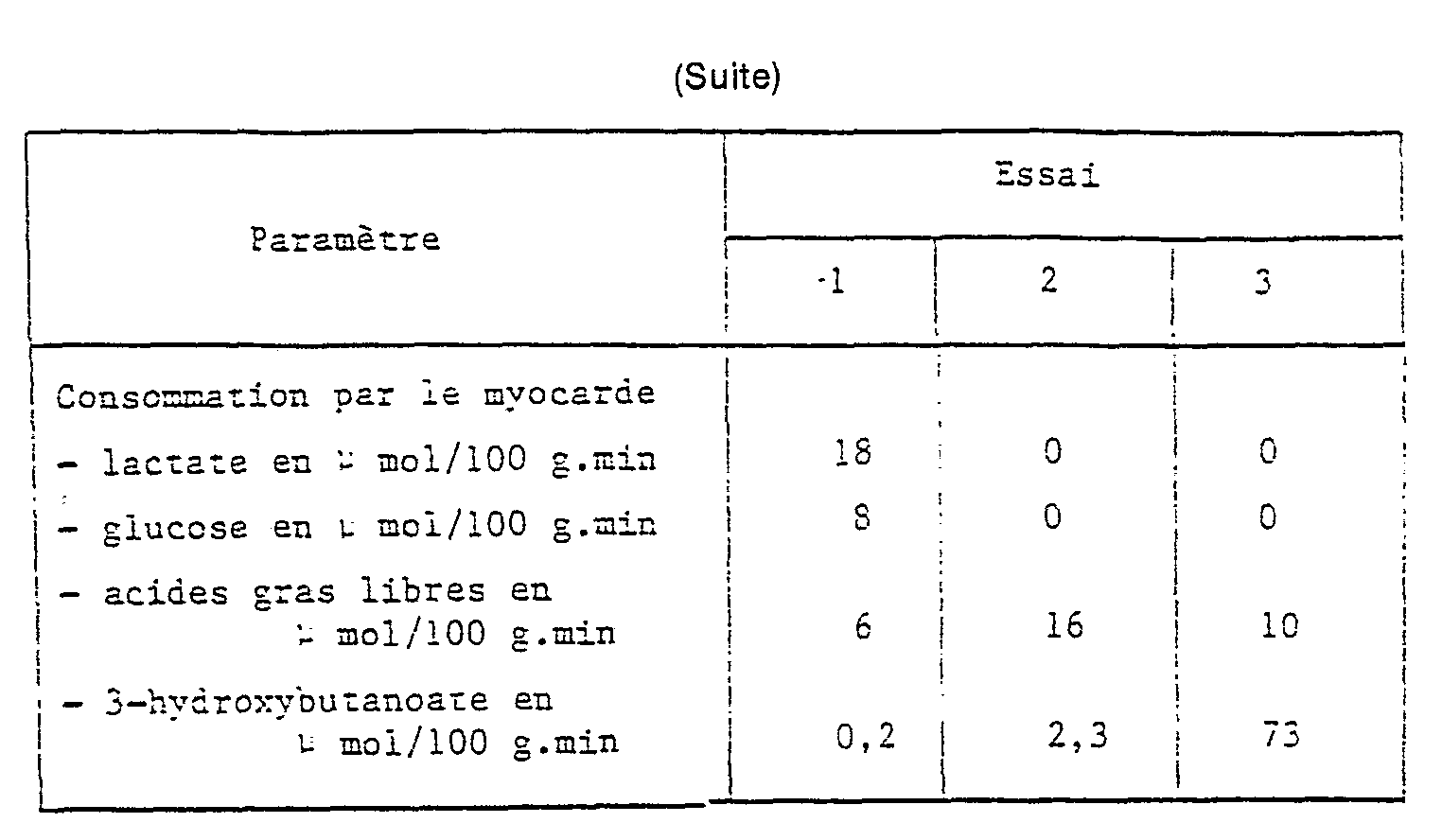
- La comparaison des résultats du Tableau III montre que l'administration du sel de sodium de l'acide D(-)-3-hydroxybutanoïque entraîne la réduction de la consommation propre en oxygène du myocarde soumis à une décharge adrénergique (comparaison des essais 2 et 3) et l'augmentation du rapport de la pression aortique à la consommation en oxygène qui devient plus élevé (comparaison des essais 2 et 3) et se rapproche des valeurs mesurées au repos (comparaison des essais 1 et 3).
- Les résultats montrent également que l'assimilation des acides gras libres baisse au profit du 3-hydroxybutanoate (comparaison des essais 2 et 3) et se rapproche des valeurs observées avec le myocarde non stimulé (comparaison des essais 1 et 3).
- Enfin, l'acidose métabolique déclenchée par la décharge adrénergique est corrigée (comparaison des essais 1, 2 et 3).
- Sur un chien mâle de 28 kg, on répète les essais décrits ci-avant mais avec une stimulation effectuée à l'aide d'une infusion intraveineuse de noradrénaline de 200 ng/kg-min pendant 25 min et une administration intraveineuse de 40 micromoles/kg.min de sel de L-arginine de l'acide D(-)-3-hydroxybutanoïque de l'exemple 1. Les paramètres mesurés au cours de l'essai (essai 6) et au cours d'essais de comparaison réalisés en l'absence de stimulation et de traitement (essai 4) et en effectuant la stimulation mais pas le traitement (essai 5) sont mentionnés au Tableau IV ci-après.


- La comparaison des résultats du Tableau IV montre que l'administration du sel d'arginine de l'acide D(-)-3-hydroxybutanoïque (essai 6) permet de réduire la consommation propre en oxygène du myocarde soumis à des stimulations adrénergiques en dessous des valeurs mesurées avec et sans stimulation adrénergique (comparaison des essais 4 et 5) ainsi que d'augmenter le rapport entre la pression aortique et la consommation en oxygène.
- Les résultats montrent également que l'assimilation des acides gras libres est régularisée et que le pH sanguin est maintenu à des valeurs normales (essais 4, 5 et 6).
- En outre, la comparaison des valeurs des Tableaux III et IV (essais 3 et 6) montre que les sels dérivés de l'arginine ont comme avantage sur les sels de sodium de stabiliser la pression aortique à des valeurs identiques à celles mesurées en l'absence de stimulation adrénergique (essais 1 et 4).
- On répète les essais décrits à l'exemple 2 mais en travaillant avec 10 chiens d'un poids corporel moyen d'environ 29 kg et avec une stimulation effectuée à l'aide d'une infusion de noradrénaline moyenne de 500 ng/kg-min dans la cavité ventriculaire gauche pendant 20 min et une administration intraveineuse de 80 micromoles/kg-min de sel de L-arginine de l'acide D(-)-3-hydroxybutanoïque de l'exemple 1. La moyenne des 10 valeurs mesurées au cours de l'essai (essai 9) et au cours d'essais de comparaison réalisés en l'absence de stimulation et de traitement (essai 7) et en effectuant la stimulation mais pas le traitement (essai 8) sont mentionnés au Tableau V ci-après.


- La comparaison des résultats du Tableau V montre que l'administration du sel d'arginine de l'acide D()-3-hydroxybutanoïque (essai 9) permet de réduire la consommation propre en oxygène du myocarde soumis à des stimulations adrénergiques par rapport aux valeurs mesurées sous stimulation adrénergique mais sans administration de l'acide D(-)-3-hydroxybutanoïque (comparaison avec l'essai 8).
-

- La préparation se fait en mélangeant le sel de sodium de l'acide D(-)-3-hydroxybutanoïque avec une partie des adjuvants et granulation en présence d'une solution aqueuse amidonnée. Après séchage des granules le reste des adjuvants est ajouté et le mélange est comprimé en tablettes.
-

- Le sel d'arginine de l'acide D(-)-3-hydroxybutanoïque est mélangé avec l'esprit de menthe et la saccharine et le tout est dissous dans l'eau et introduit dans des flacons de 500 cm3.

- Le sel de sodium est dissous dans l'eau bidistillée et cette solution est introduite de façon stérile dans les ampoules.

- Le sel d'arginine est dissous dans l'eau distillée et la solution est introduite de façon stérile dans des poches à soluté de 1 000 cm3.
Claims (17)
Priority Applications (1)
| Application Number | Priority Date | Filing Date | Title |
|---|---|---|---|
| AT83200228T ATE24478T1 (de) | 1982-02-23 | 1983-02-15 | 3-hydroxybuttersaeure oder derer salze enthaltende pharmazeutische zusammensetzungen und als arzneimittel verwendbare, von 3hydroxybutters|ure abgeleitete verbindungen. |
Applications Claiming Priority (2)
| Application Number | Priority Date | Filing Date | Title |
|---|---|---|---|
| FR8203100A FR2521857B1 (fr) | 1982-02-23 | 1982-02-23 | Compositions pharmaceutiques contenant de l'acide 3-hydroxybutanoique ou un sel derive de cet acide et sels derives de l'acide 3-hydroxybutanoique et d'une base organique azotee |
| FR8203100 | 1982-02-23 |
Publications (2)
| Publication Number | Publication Date |
|---|---|
| EP0087192A1 EP0087192A1 (fr) | 1983-08-31 |
| EP0087192B1 true EP0087192B1 (fr) | 1986-12-30 |
Family
ID=9271331
Family Applications (1)
| Application Number | Title | Priority Date | Filing Date |
|---|---|---|---|
| EP83200228A Expired EP0087192B1 (fr) | 1982-02-23 | 1983-02-15 | Compositions pharmaceutiques contenant de l'acide 3-hydroxybutanoique ou un sel dérivé de cet acide et composés dérivés de l'acide 3-hydroxybutanoique utilisables comme médicament |
Country Status (21)
| Country | Link |
|---|---|
| US (2) | US4579955A (fr) |
| EP (1) | EP0087192B1 (fr) |
| JP (1) | JPS58201746A (fr) |
| KR (1) | KR910000143B1 (fr) |
| AT (1) | ATE24478T1 (fr) |
| AU (2) | AU560757B2 (fr) |
| CA (1) | CA1203242A (fr) |
| DE (1) | DE3368601D1 (fr) |
| DK (1) | DK163235C (fr) |
| ES (2) | ES8500240A1 (fr) |
| FI (1) | FI79523C (fr) |
| FR (1) | FR2521857B1 (fr) |
| GR (1) | GR77934B (fr) |
| IE (1) | IE54561B1 (fr) |
| IL (1) | IL67965A0 (fr) |
| MX (1) | MX156855A (fr) |
| NO (1) | NO161909C (fr) |
| NZ (1) | NZ203279A (fr) |
| PH (1) | PH21561A (fr) |
| PT (1) | PT76267A (fr) |
| ZA (1) | ZA831019B (fr) |
Families Citing this family (49)
| Publication number | Priority date | Publication date | Assignee | Title |
|---|---|---|---|---|
| FR2521857B1 (fr) * | 1982-02-23 | 1985-10-31 | Solvay | Compositions pharmaceutiques contenant de l'acide 3-hydroxybutanoique ou un sel derive de cet acide et sels derives de l'acide 3-hydroxybutanoique et d'une base organique azotee |
| US6020007A (en) * | 1984-06-22 | 2000-02-01 | Btg International Limited | Fluid therapy with l-lactate and/or pyruvate anions |
| USRE38604E1 (en) | 1984-06-22 | 2004-09-28 | Btg International Limited | Fluid therapy with L-lactate and/or pyruvate anions |
| US4777288A (en) * | 1987-06-11 | 1988-10-11 | Pfizer Inc. | Process for preparing a 4,4-diphenylbutanoic acid derivative |
| BE1001209A3 (fr) * | 1987-11-19 | 1989-08-22 | Solvay | Compositions pharmaceutiques contenant un derive de l'acide 3-hydroxybutanoique choisi parmi les oligomeres de cet acide et les esters de cet acide ou de ces oligomeres avec du 1,3-butanediol. |
| US5292774A (en) * | 1988-07-26 | 1994-03-08 | Kanegafuchi Kagaku Kogyo Kabushiki Kaisha | Substitution fluid preparation comprising 3-hydroxy-butyric acid (β-hydroxybutric acid) and its salts |
| DE4113984C2 (de) * | 1991-04-29 | 2002-05-08 | Koehler Chemie Dr Franz | Salze der 4-Hydroxy-Buttersäure |
| ES2051222B1 (es) * | 1992-03-12 | 1995-02-16 | Sanmiguel Gabriel Serrano | Procedimiento de neutralizacion de acido alfa-hidroxietanoico. |
| JP4598203B2 (ja) | 1995-12-01 | 2010-12-15 | ビーティージー・インターナショナル・リミテッド | 脳機能改善剤 |
| US20090253781A1 (en) * | 2002-05-24 | 2009-10-08 | Btg International Limited | Therapeutic compositions |
| DK1017379T3 (en) * | 1997-03-17 | 2015-02-16 | Btg Int Ltd | Therapeutic compositions comprising ketone compounds and precursors thereof |
| US6323237B1 (en) | 1997-03-17 | 2001-11-27 | Btg International Limited | Therapeutic compositions |
| US6316038B1 (en) | 1997-03-17 | 2001-11-13 | Btg International Limited | Therapeutic compositions |
| US6613356B1 (en) | 2000-10-10 | 2003-09-02 | Victor Vlahakos | Weight loss medication and method |
| GB0420856D0 (en) * | 2004-09-20 | 2004-10-20 | Ketocytonyx Inc | Cns modulators |
| EP1778213B1 (fr) * | 2004-07-16 | 2017-04-05 | BTG International Limited | Procédé pour la préparation de composés oligomères |
| WO2006020179A2 (fr) * | 2004-07-20 | 2006-02-23 | Ketocytonyx Inc. | Composes cetoniques oligomeres |
| EP1778212A4 (fr) * | 2004-07-23 | 2010-12-08 | Btg Int Ltd | Saccharides cetogenes |
| DK1796658T3 (en) * | 2004-09-21 | 2016-06-27 | Btg Int Ltd | dopaminergic mimetics |
| WO2006098767A2 (fr) * | 2004-09-21 | 2006-09-21 | Ketocytonyx Inc. | Traitement du trouble d'hyperactivite avec deficit de l'attention (thada) |
| RU2302239C1 (ru) * | 2006-07-14 | 2007-07-10 | Михаил Владимирович Покровский | Способ фармакологической коррекции ишемии конечности |
| JPWO2008053982A1 (ja) | 2006-10-30 | 2010-02-25 | 株式会社オフテクス | アレルギー治療用組成物 |
| JP6883384B2 (ja) | 2012-11-05 | 2021-06-09 | ザ ユナイテッド ステイツ オブ アメリカ, アズ リプレゼンテッド バイ ザ セクレタリー, デパートメント オブ ヘルス アンド ヒューマン サービシーズ | 電離放射線による傷害から組織を防護するためのケトン体 |
| KR20180088809A (ko) | 2015-11-19 | 2018-08-07 | 가부시키가이샤 오츠카 세이야쿠 코죠 | 3-히드록시이소발레르산의 1가 양이온염의 결정 및 그 결정의 제조 방법 |
| US11103470B2 (en) | 2017-11-22 | 2021-08-31 | Axcess Global Sciences, Llc | Non-racemic beta-hydroxybutyrate compounds and compositions enriched with the R-enantiomer and methods of use |
| US11241403B2 (en) | 2016-03-11 | 2022-02-08 | Axcess Global Sciences, Llc | Beta-hydroxybutyrate mixed salt compositions and methods of use |
| US12109182B2 (en) | 2016-04-19 | 2024-10-08 | Axcess Global Sciences, Llc | Administration of R-beta-hydroxybutyrate and related compounds in humans |
| US11806324B2 (en) | 2018-04-18 | 2023-11-07 | Axcess Global Sciences, Llc | Beta-hydroxybutyric acid compositions and methods for oral delivery of ketone bodies |
| US12521378B2 (en) | 2016-04-19 | 2026-01-13 | Axcess Global Sciences, Llc | Administration of R-beta-hydroxybutyrate salt blend and related compounds in humans |
| US11944598B2 (en) | 2017-12-19 | 2024-04-02 | Axcess Global Sciences, Llc | Compositions containing s-beta-hydroxybutyrate or non-racemic mixtures enriched with the s-enatiomer |
| US10925843B2 (en) | 2018-04-18 | 2021-02-23 | Axcess Global Sciences, Llc | Compositions and methods for keto stacking with beta-hydroxybutyrate and acetoacetate |
| US12599579B2 (en) | 2016-04-19 | 2026-04-14 | Axcess Global Sciences, Llc | Compositions and compounds containing ketone bodies and/or ketone body precursors and one or more amino acids |
| US12329734B2 (en) | 2017-12-19 | 2025-06-17 | Axcess Global Sciences, Llc | Use of S-beta-hydroxybutyrate compounds for induction and maintenance of flow |
| US12622889B2 (en) | 2016-04-19 | 2026-05-12 | Axcess Global Sciences, Llc | S-β-hydroxybutyrate esters for improving metabolic function |
| US12533346B2 (en) | 2016-04-19 | 2026-01-27 | Axcess Global Sciences, Llc | Administration of berberine metabolites |
| US20230346721A1 (en) | 2018-04-18 | 2023-11-02 | Axcess Global Sciences, Llc | Beta-hydroxybutyric acid compositions and methods for delivery of ketone bodies |
| US11202769B2 (en) | 2017-11-22 | 2021-12-21 | Axcess Global Sciences, Llc | Ketone body esters of s-beta-hydroxybutyrate and/or s-1,3-butanediol for modifying metabolic function |
| US12496283B2 (en) | 2016-04-19 | 2025-12-16 | Axcess Global Sciences, Llc | Administration of R-beta-hydroxybutyrate and related compounds in humans |
| JP6710098B2 (ja) * | 2016-05-10 | 2020-06-17 | 大阪瓦斯株式会社 | 栄養剤組成物及び栄養補助食品 |
| EP3476825A4 (fr) | 2016-06-24 | 2020-02-26 | Kyowa Hakko Bio Co., Ltd. | Cristal de sel d'acide aminé d'acide beta-hydroxy beta-méthylbutyrique et son procédé de production |
| US12090129B2 (en) | 2017-11-22 | 2024-09-17 | Axcess Global Sciences, Llc | Non-racemic beta-hydroxybutyrate compounds and compositions enriched with the R-enantiomer and methods of use |
| US12472200B2 (en) | 2019-05-15 | 2025-11-18 | Axcess Global Sciences, Llc | Autobiotic compositions and method for promoting healthy gut microbiome |
| US11950616B2 (en) | 2019-06-21 | 2024-04-09 | Axcess Global Sciences, Llc | Non-vasoconstricting energy-promoting compositions containing ketone bodies |
| US12167993B2 (en) | 2019-06-21 | 2024-12-17 | Axcess Global Sciences, Llc | Non-vasoconstricting energy-promoting compositions containing ketone bodies |
| US11969430B1 (en) | 2023-03-10 | 2024-04-30 | Axcess Global Sciences, Llc | Compositions containing paraxanthine and beta-hydroxybutyrate or precursor for increasing neurological and physiological performance |
| CN112341331B (zh) * | 2019-08-07 | 2023-04-07 | 辽宁科硕营养科技股份有限公司 | 一种3-羟基丁酸盐及其制备方法与应用 |
| US12186297B2 (en) | 2020-08-26 | 2025-01-07 | Axcess Global Sciences, Llc | Compositions and methods for increasing lean-to-fat mass ratio |
| EP4680222A1 (fr) * | 2023-03-14 | 2026-01-21 | The Board of Trustees of the Leland Stanford Junior University | Acides n-bêta-hydroxybutyryl-aminés et compositions et méthodes associées |
| WO2025056246A1 (fr) * | 2023-09-11 | 2025-03-20 | Societe Des Produits Nestle S.A. | Polymorphes et compositions les comprenant |
Family Cites Families (8)
| Publication number | Priority date | Publication date | Assignee | Title |
|---|---|---|---|---|
| US2101097A (en) * | 1934-07-26 | 1937-12-07 | Wm S Merrell Co | Products for rendering the urine bacteriostatic |
| US2799684A (en) * | 1954-06-18 | 1957-07-16 | Food Chemical And Res Lab Inc | Crystalline compounds of tryptophane and methods of manufacturing them |
| NL279760A (fr) * | 1961-06-17 | |||
| US3830931A (en) * | 1972-11-06 | 1974-08-20 | Felice S De | Carnitine and its use in the treatment of arrhythmia and impaired cardiac function |
| US3879537A (en) * | 1973-09-04 | 1975-04-22 | Scott Eugene J Van | Treatment of ichthyosiform dermatoses |
| DE2733202A1 (de) * | 1976-08-04 | 1978-02-09 | Agroferm Ag | Verfahren zur herstellung der d(-)-3-hydroxybuttersaeure |
| US4412943A (en) * | 1981-02-23 | 1983-11-01 | Kao Soap Co., Ltd. | Liquid detergent composition |
| FR2521857B1 (fr) * | 1982-02-23 | 1985-10-31 | Solvay | Compositions pharmaceutiques contenant de l'acide 3-hydroxybutanoique ou un sel derive de cet acide et sels derives de l'acide 3-hydroxybutanoique et d'une base organique azotee |
-
1982
- 1982-02-23 FR FR8203100A patent/FR2521857B1/fr not_active Expired
-
1983
- 1983-02-15 DE DE8383200228T patent/DE3368601D1/de not_active Expired
- 1983-02-15 ZA ZA831019A patent/ZA831019B/xx unknown
- 1983-02-15 EP EP83200228A patent/EP0087192B1/fr not_active Expired
- 1983-02-15 AT AT83200228T patent/ATE24478T1/de active
- 1983-02-15 NZ NZ203279A patent/NZ203279A/en unknown
- 1983-02-17 AU AU11624/83A patent/AU560757B2/en not_active Ceased
- 1983-02-21 PH PH28545A patent/PH21561A/en unknown
- 1983-02-21 IL IL67965A patent/IL67965A0/xx not_active IP Right Cessation
- 1983-02-21 GR GR70556A patent/GR77934B/el unknown
- 1983-02-21 PT PT76267A patent/PT76267A/fr not_active IP Right Cessation
- 1983-02-22 IE IE366/83A patent/IE54561B1/en not_active IP Right Cessation
- 1983-02-22 NO NO830618A patent/NO161909C/no unknown
- 1983-02-22 US US06/468,385 patent/US4579955A/en not_active Expired - Fee Related
- 1983-02-22 MX MX196357A patent/MX156855A/es unknown
- 1983-02-22 ES ES519991A patent/ES8500240A1/es not_active Expired
- 1983-02-23 CA CA000422215A patent/CA1203242A/fr not_active Expired
- 1983-02-23 FI FI830603A patent/FI79523C/fi not_active IP Right Cessation
- 1983-02-23 KR KR1019830000728A patent/KR910000143B1/ko not_active Expired
- 1983-02-23 JP JP58029197A patent/JPS58201746A/ja active Pending
- 1983-02-23 DK DK081583A patent/DK163235C/da not_active IP Right Cessation
-
1984
- 1984-05-28 ES ES532880A patent/ES8506283A1/es not_active Expired
-
1985
- 1985-10-23 US US06/790,391 patent/US4771074A/en not_active Expired - Fee Related
-
1987
- 1987-02-23 AU AU69161/87A patent/AU602329B2/en not_active Ceased
Also Published As
Similar Documents
| Publication | Publication Date | Title |
|---|---|---|
| CA1203242A (fr) | Procede de preparation de sels derives de l'acide 3- hydroxybutanoique et d'une base organique aminee, et les sels ainsi obtenus | |
| EP0068999B1 (fr) | Dérivés d'aryl-1 aminométhyl-2 cyclopropanes carboxamides (Z), leur préparation et leur application en tant que médicaments utiles dans le traitement des troubles du système nerveux central | |
| CH647757A5 (fr) | Derives de l'acide 3-aminopropanesulfonique ayant une activite membranaire renforcee. | |
| EP0110781B1 (fr) | (Amino-2 éthyl)-6 benzoxazolinones substituées, leur préparation et une composition pharmaceutique les contenant | |
| FR2584405A1 (fr) | Sels de furosemide, composition pharmaceutique les contenant et leur procede de preparation | |
| EP0068998B1 (fr) | Aryl-1 aminométhyl-2 cyclopropanes carboxylates (Z), leur préparation et leur application en tant que médicaments utiles dans le traitement d'algies diverses | |
| FR2684101A1 (fr) | Nouveaux derives de benzoate d'ethanolamine, leur procede de preparation et les compositions pharmaceutiques les renfermant. | |
| EP0426562B1 (fr) | Dérivés de 1-(4-aminophényl)-2-pipéridinopropanone, procédé de préparation et utilisation en thérapeutique | |
| FR2620450A1 (fr) | Nouveaux sels de composes organogermaniques et medicaments les contenant | |
| FR2492821A1 (fr) | Derives de la pyrimidine, leur procede de preparation et les compositions pharmaceutiques les contenant | |
| EP0161249A1 (fr) | Enamides acyles et compositions pharmaceutiques les contenant | |
| CH624922A5 (en) | Process for the preparation of new methylamine derivatives | |
| EP0406088B1 (fr) | (Alfa-tertiobutyl aminométhyl-3,4-dichlorobenzyl) thioacétamide, son procédé de préparation et ses applications | |
| FR2526793A1 (fr) | Nouveaux a-(n-pyrrolyl)-acides et leurs sels et esters, utiles comme medicaments et procede de la preparation de tels composes | |
| CH652924A5 (fr) | Produits pharmaceutique ameliorant le metabolisme des lipides. | |
| CH675725A5 (fr) | ||
| EP1007522B1 (fr) | 2- 4-[4-(4,5-dichloro-2-methylimidazol-1-yl)butyl]piperazin-1-yl -5-fluoropyrimidine, sa preparation et son utilisation therapeutique | |
| FR2572934A1 (fr) | Compositions pharmaceutiques hydrosolubles a base de sels de l'acide (-)cis-1,2-epoxypropylphosphonique avec des amino-acides | |
| EP0425362A2 (fr) | Sels de furosémide, procédé de préparation, application comme médicaments et compositions pharmaceutiques les renfermant | |
| EP0039294B1 (fr) | Bis (phénoxyacétates substitués) de N-alkyl-dialcanolamines, procédé d'obtention, et compositions pharmaceutiques les contenant | |
| FR2571255A1 (fr) | Compositions pharmaceutiques hydrosolubles a base de sels de l'acide (-)cis-1,2-epoxypropylphosphonique avec des amino-acides | |
| BE557985A (fr) | ||
| BE620521A (fr) | ||
| FR2723944A1 (fr) | Nouveaux sels de trimetazidine et leur utilisation en therapeutique | |
| OA10070A (fr) | Complexes organometalliques d'iridium ayant une action antiparasitaire |
Legal Events
| Date | Code | Title | Description |
|---|---|---|---|
| PUAI | Public reference made under article 153(3) epc to a published international application that has entered the european phase |
Free format text: ORIGINAL CODE: 0009012 |
|
| AK | Designated contracting states |
Designated state(s): AT BE CH DE FR GB IT LI LU NL SE |
|
| 17P | Request for examination filed |
Effective date: 19840217 |
|
| GRAA | (expected) grant |
Free format text: ORIGINAL CODE: 0009210 |
|
| ITF | It: translation for a ep patent filed | ||
| AK | Designated contracting states |
Kind code of ref document: B1 Designated state(s): AT BE CH DE FR GB IT LI LU NL SE |
|
| REF | Corresponds to: |
Ref document number: 24478 Country of ref document: AT Date of ref document: 19870115 Kind code of ref document: T |
|
| REF | Corresponds to: |
Ref document number: 3368601 Country of ref document: DE Date of ref document: 19870205 |
|
| PLBE | No opposition filed within time limit |
Free format text: ORIGINAL CODE: 0009261 |
|
| STAA | Information on the status of an ep patent application or granted ep patent |
Free format text: STATUS: NO OPPOSITION FILED WITHIN TIME LIMIT |
|
| 26N | No opposition filed | ||
| ITTA | It: last paid annual fee | ||
| REG | Reference to a national code |
Ref country code: FR Ref legal event code: CD |
|
| ITPR | It: changes in ownership of a european patent |
Owner name: CAMBIO RAGIONE SOCIALE;SOLVAY |
|
| PGFP | Annual fee paid to national office [announced via postgrant information from national office to epo] |
Ref country code: BE Payment date: 19940124 Year of fee payment: 12 |
|
| PGFP | Annual fee paid to national office [announced via postgrant information from national office to epo] |
Ref country code: FR Payment date: 19940126 Year of fee payment: 12 |
|
| PGFP | Annual fee paid to national office [announced via postgrant information from national office to epo] |
Ref country code: CH Payment date: 19940127 Year of fee payment: 12 |
|
| PGFP | Annual fee paid to national office [announced via postgrant information from national office to epo] |
Ref country code: SE Payment date: 19940131 Year of fee payment: 12 Ref country code: LU Payment date: 19940131 Year of fee payment: 12 |
|
| PGFP | Annual fee paid to national office [announced via postgrant information from national office to epo] |
Ref country code: GB Payment date: 19940207 Year of fee payment: 12 |
|
| PGFP | Annual fee paid to national office [announced via postgrant information from national office to epo] |
Ref country code: AT Payment date: 19940210 Year of fee payment: 12 |
|
| PGFP | Annual fee paid to national office [announced via postgrant information from national office to epo] |
Ref country code: NL Payment date: 19940228 Year of fee payment: 12 Ref country code: DE Payment date: 19940228 Year of fee payment: 12 |
|
| EPTA | Lu: last paid annual fee | ||
| REG | Reference to a national code |
Ref country code: CH Ref legal event code: PFA Free format text: SOLVAY (SOCIETE ANONYME) |
|
| NLT1 | Nl: modifications of names registered in virtue of documents presented to the patent office pursuant to art. 16 a, paragraph 1 |
Owner name: SOLVAY (SOCIETE ANONYME) TE BRUSSEL, BELGIE. |
|
| EAL | Se: european patent in force in sweden |
Ref document number: 83200228.1 |
|
| PG25 | Lapsed in a contracting state [announced via postgrant information from national office to epo] |
Ref country code: LU Free format text: LAPSE BECAUSE OF NON-PAYMENT OF DUE FEES Effective date: 19950215 Ref country code: GB Effective date: 19950215 Ref country code: AT Effective date: 19950215 |
|
| PG25 | Lapsed in a contracting state [announced via postgrant information from national office to epo] |
Ref country code: SE Effective date: 19950216 |
|
| PG25 | Lapsed in a contracting state [announced via postgrant information from national office to epo] |
Ref country code: LI Effective date: 19950228 Ref country code: CH Effective date: 19950228 Ref country code: BE Effective date: 19950228 |
|
| BERE | Be: lapsed |
Owner name: SOLVAY Effective date: 19950228 |
|
| PG25 | Lapsed in a contracting state [announced via postgrant information from national office to epo] |
Ref country code: NL Effective date: 19950901 |
|
| GBPC | Gb: european patent ceased through non-payment of renewal fee |
Effective date: 19950215 |
|
| PG25 | Lapsed in a contracting state [announced via postgrant information from national office to epo] |
Ref country code: FR Effective date: 19951031 |
|
| NLV4 | Nl: lapsed or anulled due to non-payment of the annual fee |
Effective date: 19950901 |
|
| EUG | Se: european patent has lapsed |
Ref document number: 83200228.1 |
|
| PG25 | Lapsed in a contracting state [announced via postgrant information from national office to epo] |
Ref country code: DE Effective date: 19951201 |
|
| REG | Reference to a national code |
Ref country code: FR Ref legal event code: ST |