EP0090749B1 - Verfahren zum Abkühlen mit niedriger Deformation von metallurgischen Gegenständen - Google Patents
Verfahren zum Abkühlen mit niedriger Deformation von metallurgischen Gegenständen Download PDFInfo
- Publication number
- EP0090749B1 EP0090749B1 EP83420053A EP83420053A EP0090749B1 EP 0090749 B1 EP0090749 B1 EP 0090749B1 EP 83420053 A EP83420053 A EP 83420053A EP 83420053 A EP83420053 A EP 83420053A EP 0090749 B1 EP0090749 B1 EP 0090749B1
- Authority
- EP
- European Patent Office
- Prior art keywords
- product
- cooling
- less
- nozzles
- equal
- Prior art date
- Legal status (The legal status is an assumption and is not a legal conclusion. Google has not performed a legal analysis and makes no representation as to the accuracy of the status listed.)
- Expired
Links
- 238000001816 cooling Methods 0.000 title claims abstract description 37
- 238000000034 method Methods 0.000 title claims abstract description 22
- 230000008569 process Effects 0.000 title description 4
- 239000002826 coolant Substances 0.000 claims abstract description 5
- 239000004020 conductor Substances 0.000 claims abstract description 3
- 238000005507 spraying Methods 0.000 claims description 21
- 238000007654 immersion Methods 0.000 claims description 12
- 229910000838 Al alloy Inorganic materials 0.000 claims description 7
- 239000012530 fluid Substances 0.000 claims description 5
- 239000000203 mixture Substances 0.000 claims description 3
- RYGMFSIKBFXOCR-UHFFFAOYSA-N Copper Chemical compound [Cu] RYGMFSIKBFXOCR-UHFFFAOYSA-N 0.000 claims description 2
- 229910000881 Cu alloy Inorganic materials 0.000 claims description 2
- 229910000640 Fe alloy Inorganic materials 0.000 claims description 2
- 229910052802 copper Inorganic materials 0.000 claims description 2
- 239000010949 copper Substances 0.000 claims description 2
- 239000000725 suspension Substances 0.000 claims 1
- XLYOFNOQVPJJNP-UHFFFAOYSA-N water Substances O XLYOFNOQVPJJNP-UHFFFAOYSA-N 0.000 description 27
- 238000010791 quenching Methods 0.000 description 24
- 230000000171 quenching effect Effects 0.000 description 24
- 229910001868 water Inorganic materials 0.000 description 21
- 239000011248 coating agent Substances 0.000 description 14
- 238000000576 coating method Methods 0.000 description 14
- 238000005260 corrosion Methods 0.000 description 6
- 229910045601 alloy Inorganic materials 0.000 description 5
- 239000000956 alloy Substances 0.000 description 5
- 230000007797 corrosion Effects 0.000 description 5
- 239000007921 spray Substances 0.000 description 5
- 239000004115 Sodium Silicate Substances 0.000 description 4
- NTHWMYGWWRZVTN-UHFFFAOYSA-N sodium silicate Chemical compound [Na+].[Na+].[O-][Si]([O-])=O NTHWMYGWWRZVTN-UHFFFAOYSA-N 0.000 description 4
- 229910052911 sodium silicate Inorganic materials 0.000 description 4
- 239000000243 solution Substances 0.000 description 4
- 238000005496 tempering Methods 0.000 description 4
- 229910000746 Structural steel Inorganic materials 0.000 description 3
- 229910052751 metal Inorganic materials 0.000 description 3
- 239000002184 metal Substances 0.000 description 3
- FAPWRFPIFSIZLT-UHFFFAOYSA-M Sodium chloride Chemical compound [Na+].[Cl-] FAPWRFPIFSIZLT-UHFFFAOYSA-M 0.000 description 2
- 229910000831 Steel Inorganic materials 0.000 description 2
- TZCXTZWJZNENPQ-UHFFFAOYSA-L barium sulfate Chemical compound [Ba+2].[O-]S([O-])(=O)=O TZCXTZWJZNENPQ-UHFFFAOYSA-L 0.000 description 2
- 230000006835 compression Effects 0.000 description 2
- 238000007906 compression Methods 0.000 description 2
- 238000009434 installation Methods 0.000 description 2
- 239000007787 solid Substances 0.000 description 2
- 238000007711 solidification Methods 0.000 description 2
- 230000008023 solidification Effects 0.000 description 2
- 230000003068 static effect Effects 0.000 description 2
- 239000010959 steel Substances 0.000 description 2
- GWEVSGVZZGPLCZ-UHFFFAOYSA-N Titan oxide Chemical compound O=[Ti]=O GWEVSGVZZGPLCZ-UHFFFAOYSA-N 0.000 description 1
- 240000008042 Zea mays Species 0.000 description 1
- 239000000654 additive Substances 0.000 description 1
- 230000001464 adherent effect Effects 0.000 description 1
- 239000002518 antifoaming agent Substances 0.000 description 1
- 238000007664 blowing Methods 0.000 description 1
- 230000009172 bursting Effects 0.000 description 1
- 238000005266 casting Methods 0.000 description 1
- 239000012809 cooling fluid Substances 0.000 description 1
- 235000019628 coolness Nutrition 0.000 description 1
- 230000006735 deficit Effects 0.000 description 1
- 239000012153 distilled water Substances 0.000 description 1
- 230000000694 effects Effects 0.000 description 1
- 230000008030 elimination Effects 0.000 description 1
- 238000003379 elimination reaction Methods 0.000 description 1
- 238000010438 heat treatment Methods 0.000 description 1
- 238000002347 injection Methods 0.000 description 1
- 239000007924 injection Substances 0.000 description 1
- 229910001234 light alloy Inorganic materials 0.000 description 1
- 238000003754 machining Methods 0.000 description 1
- 238000004519 manufacturing process Methods 0.000 description 1
- 230000035800 maturation Effects 0.000 description 1
- 238000005554 pickling Methods 0.000 description 1
- 238000007747 plating Methods 0.000 description 1
- 230000009467 reduction Effects 0.000 description 1
- 238000005096 rolling process Methods 0.000 description 1
- 230000035945 sensitivity Effects 0.000 description 1
- 238000007493 shaping process Methods 0.000 description 1
- 238000010583 slow cooling Methods 0.000 description 1
- 239000011734 sodium Substances 0.000 description 1
- 239000011780 sodium chloride Substances 0.000 description 1
- 238000009987 spinning Methods 0.000 description 1
- 239000000126 substance Substances 0.000 description 1
- 239000002352 surface water Substances 0.000 description 1
- 238000009864 tensile test Methods 0.000 description 1
- OGIDPMRJRNCKJF-UHFFFAOYSA-N titanium oxide Inorganic materials [Ti]=O OGIDPMRJRNCKJF-UHFFFAOYSA-N 0.000 description 1
- 230000009466 transformation Effects 0.000 description 1
Images
Classifications
-
- C—CHEMISTRY; METALLURGY
- C21—METALLURGY OF IRON
- C21D—MODIFYING THE PHYSICAL STRUCTURE OF FERROUS METALS; GENERAL DEVICES FOR HEAT TREATMENT OF FERROUS OR NON-FERROUS METALS OR ALLOYS; MAKING METAL MALLEABLE, e.g. BY DECARBURISATION OR TEMPERING
- C21D1/00—General methods or devices for heat treatment, e.g. annealing, hardening, quenching or tempering
- C21D1/68—Temporary coatings or embedding materials applied before or during heat treatment
-
- C—CHEMISTRY; METALLURGY
- C21—METALLURGY OF IRON
- C21D—MODIFYING THE PHYSICAL STRUCTURE OF FERROUS METALS; GENERAL DEVICES FOR HEAT TREATMENT OF FERROUS OR NON-FERROUS METALS OR ALLOYS; MAKING METAL MALLEABLE, e.g. BY DECARBURISATION OR TEMPERING
- C21D1/00—General methods or devices for heat treatment, e.g. annealing, hardening, quenching or tempering
- C21D1/62—Quenching devices
-
- C—CHEMISTRY; METALLURGY
- C21—METALLURGY OF IRON
- C21D—MODIFYING THE PHYSICAL STRUCTURE OF FERROUS METALS; GENERAL DEVICES FOR HEAT TREATMENT OF FERROUS OR NON-FERROUS METALS OR ALLOYS; MAKING METAL MALLEABLE, e.g. BY DECARBURISATION OR TEMPERING
- C21D1/00—General methods or devices for heat treatment, e.g. annealing, hardening, quenching or tempering
- C21D1/62—Quenching devices
- C21D1/667—Quenching devices for spray quenching
Definitions
- This invention relates to an economical method of cooling metallurgical products which minimizes deformations thereof, while preserving their properties of use.
- the cooling of metallurgical products is involved in a large number of operations such as casting and solidification, after hot transformation on various tools (rolling mills, spinning presses, etc.) or even in the case of metallurgical quenching .
- Pneumatic spraying has the disadvantage of being expensive because of the price of the nozzles (ten times higher than that of the mechanical nozzles) and the high cost of investment and operation of the air compressors. In addition, this system is dangerous because of the risk of bursting of the compressed air lines and is excessively noisy.
- the method according to the invention which eliminates or at least minimizes distortions, aims to cool the metallurgical product of substantially constant thickness with a cooling speed as large as possible and a different cooling mode between approximately two halves adjacent to its outer surface, each of them extending in the long direction or the main plane of the product.
- the coolant generally used consists essentially of water, possibly supplemented with certain additives (anti-corrosion, anti-foaming agent, etc.).
- the coating can be carried out at any stage of the production range, prior to cooling provided that the latter remains adherent and retains its effectiveness during the range (for example, the product can be coated before heating in solution. which precedes quenching).
- the watering be done through the lower part of the products, the long direction thereof being substantially horizontal.
- the process applies mainly, but not exclusively, to long metal products (wires, bars, tubes, profiles) or flat (strips, sheets, flat) of relatively small transverse dimensions and of substantially constant thicknesses.
- the thickness of the flat products is preferably less than or equal to 15 mm (which corresponds substantially to a diameter of 30 mm for a solid round bar).
- the thickness is preferably less than or equal to 35 mm (or to a diameter of approximately 70 mm).
- the thickness is preferably less than or equal to 8 mm (or to a diameter of about 15 mm).
- the method is particularly applicable to the quenching of high strength AI alloys for which the characteristics of use (mechanical and / or corrosion resistance) are practically not modified compared to conventional quenching with, however, very small deformations.
- the surface water deficits remain below 2000 I / min. / M 2 and, preferably, 8001 / min. / M2; the nozzles are placed at a distance of less than 15 cm from the product surface, and the injection pressure is less than 1.5 MPa (15 bars) and preferably 1 MPa (10 bars).
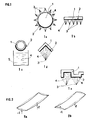
- FIG. 2 represents the characteristics of deformation after cooling: deflection (f) and tile (t) of a rectangular flat product, initially planar.
- Three sheets of 400x400x10 mm in aluminum alloys (7075) were quenched by vertical immersion in cold (20 ° C) or hot (60 ° C) water after dissolving for 4 h at 470 ° C in an oven with ventilated air.
- the sheets A and B, uncoated, were soaked in water tanks at temperatures respectively equal to 20 ° C and 60 ° C.
- the sheet (C) was quenched by immersion in water at 60 ° C after pickling the surfaces and coating a single large surface by means of a continuous insulating layer of low thermal effusivity, essentially consisting of a mixture of sodium silicate in solution in water, barium sulphate and titanium oxide.
- Table 1 below gives the quenching rates measured between 400 and 250 ° C at 1.5 mm under each surface by means of thermocouples placed in the center of the large faces of the sheets as well as the macroscopic deformations measured after quenching (maximum arrow the along the horizontal axis - maximum tile along the vertical axis of the sheets), and the mechanical longitudinal tensile characteristics at mid-thickness in the center of the sheets, measured after tempering in the T6 state (24 h at 120 ° VS).
- the sheet (C) quenched according to the invention by asymmetric cooling is provided with both ca mechanical tensile properties equivalent to those of sheets most rapidly symmetrically hardened in cold water (current practice) and hardening deformation significantly lower than other sheets including sheet (B) symmetrically hardened with speeds of yet relatively slow cooling.
- Spraying was provided over the entire lower horizontal surface of the sheets by adjacent jets with solid cone jets, with an angle of about 60 °, delivering a surface flow of 1451 / min./m 2 under a pressure of 3 bars (0, 3 MPa).
- Table II below gives the deformations of the sheets after quenching, the surface electrical conductivity of the sheets five days after quenching (which is all the lower in the quenched-ripened state as the quenching is faster), the speed of average cooling of the sheets in the critical quenching range (400-250 ° C) and the mechanical characteristics on tensile test pieces treated by tempering - T76 (6 h at 107 ° C + 16 h at 160 ° C) after stripping of the coating and controlled traction of the sheets before tempering.
- the quenched sheets according to the invention have significantly lower residual deformations than those obtained by symmetrical quenching, while retaining substantially equal mechanical properties and although the surface flow rates used here are relatively low.
- the quenching installation included a 700 mm long quenching window, made up of spraying booms situated on either side of a carriage intended to support and translate the sheets with a modular passage speed, so as to simulate the horizontal quenching at the parade in passage oven outlet.
- the spray nozzles consisted of sprayers in full cone jets, angle 60 °, supplied with a flow of water at 15 ° C pressurized to 6.5 bars.
- a sheet was quenched by symmetrical spraying on the two uncoated faces, according to usual practice.
- the other sheets were quenched by horizontal unilateral spraying on the underside with the same surface flow with coating of the surface to be sprayed with an insulating coating based on sodium silicate.
- Table III gives the test conditions, the average cooling rates measured between 400 and 250 ° C. by thermocouples in the center of the sheets, the deformations of the sheets after quenching (longitudinal deflection - transverse tile) as well as the sensitivity to intergranular corrosion of the hardened sheets and stripped of the coating evaluated according to the immersion test in solution of sodium chloride and distilled water according to standard AIR 9048.
- the asymmetrical quenching of the coated sheet metal according to the invention improves both the quenching rates (approximately x2) and the resistance to intergranular corrosion of the alloy as well as the flatness of the sheets while increasing the productivity of the installation (x 3) and by reducing the necessary water consumption (: 2 approximately) compared to the symmetrical quenching of bare sheets.
- the nozzles gave jets with a full cone, angle 60 °, with a surface flow of 5801 / min./m 2 under a water pressure of 6 bars (0.6 M Pa).
- Table IV gives the test conditions as well as the cooling rates and the average longitudinal deformations (arrows) after quenching.
- the results show that the angle iron quenched by unilateral spraying on the coated surface according to the invention has a better compromise between cooling speed and straightness than the angle angles cooled by conventional symmetrical cooling by spraying in the stream or by immersion.
- the coating and the unilateral quenching significantly increase the productivity (x 3) with acceptable quenching deformations.
Landscapes
- Chemical & Material Sciences (AREA)
- Engineering & Computer Science (AREA)
- Physics & Mathematics (AREA)
- Thermal Sciences (AREA)
- Crystallography & Structural Chemistry (AREA)
- Mechanical Engineering (AREA)
- Materials Engineering (AREA)
- Metallurgy (AREA)
- Organic Chemistry (AREA)
- Heat Treatments In General, Especially Conveying And Cooling (AREA)
- Control Of Heat Treatment Processes (AREA)
- Heat Treatment Of Articles (AREA)
Claims (11)
Priority Applications (1)
| Application Number | Priority Date | Filing Date | Title |
|---|---|---|---|
| AT83420053T ATE21268T1 (de) | 1982-03-25 | 1983-03-24 | Verfahren zum abkuehlen mit niedriger deformation von metallurgischen gegenstaenden. |
Applications Claiming Priority (2)
| Application Number | Priority Date | Filing Date | Title |
|---|---|---|---|
| FR8205682 | 1982-03-25 | ||
| FR8205682A FR2524001B1 (fr) | 1982-03-25 | 1982-03-25 | Procede de refroidissement minimisant les deformation s des produits metallurgiques |
Publications (2)
| Publication Number | Publication Date |
|---|---|
| EP0090749A1 EP0090749A1 (de) | 1983-10-05 |
| EP0090749B1 true EP0090749B1 (de) | 1986-08-06 |
Family
ID=9272663
Family Applications (1)
| Application Number | Title | Priority Date | Filing Date |
|---|---|---|---|
| EP83420053A Expired EP0090749B1 (de) | 1982-03-25 | 1983-03-24 | Verfahren zum Abkühlen mit niedriger Deformation von metallurgischen Gegenständen |
Country Status (5)
| Country | Link |
|---|---|
| EP (1) | EP0090749B1 (de) |
| AT (1) | ATE21268T1 (de) |
| DE (1) | DE3365078D1 (de) |
| ES (1) | ES520920A0 (de) |
| FR (1) | FR2524001B1 (de) |
Families Citing this family (8)
| Publication number | Priority date | Publication date | Assignee | Title |
|---|---|---|---|---|
| DD242428B1 (de) * | 1985-08-19 | 1988-06-29 | Ve Kom Forsttechnik Waren Stam | Verfahren und einrichtung zum haerten von stahlblechen |
| AT391882B (de) * | 1987-08-31 | 1990-12-10 | Boehler Gmbh | Verfahren zur waermebehandlung von alpha/beta-ti- legierungen und verwendung einer sprueheinrichtung zur durchfuehrung des verfahrens |
| FR2680522A1 (fr) * | 1991-08-21 | 1993-02-26 | Snecma | Procede de traitement thermique de pieces en superalliages avec mise en place d'une barriere thermique avant trempe. |
| FR2848480B1 (fr) | 2002-12-17 | 2005-01-21 | Pechiney Rhenalu | Procede de fabrication d'elements structuraux par usinage de toles epaisses |
| CN100415902C (zh) * | 2006-08-03 | 2008-09-03 | 上海交通大学 | 采用碳分配提高钢件表面硬度的方法 |
| CN104998906A (zh) * | 2015-06-17 | 2015-10-28 | 铜陵市大明玛钢有限责任公司 | 锻钢冷轧辊的表面清洗方法 |
| RU2735698C1 (ru) * | 2019-10-10 | 2020-11-06 | Виктор Леонидович Князьков | Способ электродугового упрочнения стальных изделий |
| CN116179813B (zh) * | 2023-03-15 | 2026-04-10 | 桑尼泰克(宁国)铝制品有限公司 | 一种铝合金在线淬火设备 |
Family Cites Families (8)
| Publication number | Priority date | Publication date | Assignee | Title |
|---|---|---|---|---|
| FR706652A (fr) * | 1929-12-18 | 1931-06-27 | Fried Krupp Ag Friedrich Alfre | Procédé et appareil pour le traitement thermique de profilés après le laminage |
| FR698201A (fr) * | 1930-06-30 | 1931-01-28 | Berliner Hartepulver Ges M B H | Couche protectrice pour enrober des points déterminés de métaux à tremper |
| DE955042C (de) * | 1953-08-02 | 1956-12-27 | Friedrichshuette Ag | Verfahren und Vorrichtung zum Abkuehlen von warmgewalztem, flachem Walzgut |
| BE648850A (de) * | 1963-06-04 | |||
| FR1430702A (fr) * | 1964-04-22 | 1966-03-04 | United Eng Foundry Co | Procédé et appareil pour le refroidissement de produits |
| JPS4927923B1 (de) * | 1968-03-19 | 1974-07-22 | ||
| JPS5318162B2 (de) * | 1973-06-08 | 1978-06-13 | ||
| DE2447019C3 (de) * | 1974-10-02 | 1978-11-16 | Stahlwerke Roechling - Burbach Gmbh, 6620 Voelklingen | Verfahren zum Abkühlen von gewalzten Profilen |
-
1982
- 1982-03-25 FR FR8205682A patent/FR2524001B1/fr not_active Expired
-
1983
- 1983-03-24 DE DE8383420053T patent/DE3365078D1/de not_active Expired
- 1983-03-24 AT AT83420053T patent/ATE21268T1/de not_active IP Right Cessation
- 1983-03-24 EP EP83420053A patent/EP0090749B1/de not_active Expired
- 1983-03-24 ES ES520920A patent/ES520920A0/es active Granted
Non-Patent Citations (2)
| Title |
|---|
| Int. J. Multiphase Flow, vol. 2 (1975), p. 183-190 * |
| Mem. Scient. Rev. Métallurgie LXVIII, no. 6 (1971) p. 391-400 * |
Also Published As
| Publication number | Publication date |
|---|---|
| EP0090749A1 (de) | 1983-10-05 |
| FR2524001A1 (fr) | 1983-09-30 |
| DE3365078D1 (en) | 1986-09-11 |
| ES8402356A1 (es) | 1984-01-16 |
| FR2524001B1 (fr) | 1987-02-20 |
| ES520920A0 (es) | 1984-01-16 |
| ATE21268T1 (de) | 1986-08-15 |
Similar Documents
| Publication | Publication Date | Title |
|---|---|---|
| CH629410A5 (fr) | Procede de fabrication d'une bande composite par placage. | |
| EP0090749A1 (de) | Verfahren zum Abkühlen mit niedriger Deformation von metallurgischen Gegenständen | |
| KR100481571B1 (ko) | 강편의수냉방법및수냉용수조 | |
| EP2302102B1 (de) | Beizverfahren für stahlplatten | |
| EP0796685A1 (de) | Verfahren und Vorrichtung zum Stranggiessen von rostfreiem austenitischem Stahl zwischen zwei beweglichen Wänden oder auf einem beweglichen Wand mit Grüben | |
| EP0502986B1 (de) | Fortlaufende schienenproduktion | |
| KR20130026468A (ko) | 레이저를 이용한 슬래브용 연속주조용 주형의 보수방법 및 그 재생품 | |
| CN102094111A (zh) | 一种棒材热剪剪刃激光淬火制造工艺 | |
| CN106350761A (zh) | 一种基于同步碾压的激光熔覆层制备方法 | |
| EP0108436A1 (de) | Verfahren zum Herstellen von Schienen und so hergestellte Schienen | |
| CN107186184A (zh) | 一种马氏体不锈钢双辊薄带铸轧生产工艺 | |
| CN118668045B (zh) | 一种高铬铸铁增强碳钢耐磨复合材料及其制备方法 | |
| FR2511038A1 (fr) | Procede de fabrication de produits semi-finis siderurgiques en aciers durs mettant en oeuvre une operation de coulee continue | |
| RU2092257C1 (ru) | Способ поточного изготовления катанки из пружинных сталей и ее последующей обработки | |
| JP2003275852A (ja) | 鋼の連続鋳造方法および装置 | |
| CN116000255B (zh) | 一种有效提高铝合金生产铸轧辊利用率的方法 | |
| FR2479720A1 (fr) | Procede et dispositif de coulee continue du type courbe | |
| CN115464333B (zh) | 一种ta18钛自行车架无缝焊管及生产工艺 | |
| JP4109365B2 (ja) | 金属ストリップの冷却方法 | |
| JPH11320060A (ja) | ビレットの鋳片軽圧下連続鋳造方法及びその設備 | |
| KR102713962B1 (ko) | 3축롤을 이용한 알루미늄 튜브 제조방법 | |
| CN112893467A (zh) | 一种控制宽厚钢板边部折叠的方法 | |
| CN104259781A (zh) | 货运火车车厢用铝合金板材的制造方法 | |
| JPH07290136A (ja) | H形鋼の冷却方法および装置 | |
| JPH09136145A (ja) | 薄帯鋳片連続鋳造用冷却ドラム周面の窪み加工方法 |
Legal Events
| Date | Code | Title | Description |
|---|---|---|---|
| PUAI | Public reference made under article 153(3) epc to a published international application that has entered the european phase |
Free format text: ORIGINAL CODE: 0009012 |
|
| AK | Designated contracting states |
Kind code of ref document: A1 Designated state(s): AT BE CH DE FR GB IT LI NL SE Designated state(s): AT BE CH DE FR GB IT LI NL SE |
|
| 17P | Request for examination filed |
Effective date: 19840120 |
|
| RAP1 | Party data changed (applicant data changed or rights of an application transferred) |
Owner name: CEGEDUR SOCIETE DE TRANSFORMATION DE L'ALUMINIUM P |
|
| GRAA | (expected) grant |
Free format text: ORIGINAL CODE: 0009210 |
|
| AK | Designated contracting states |
Kind code of ref document: B1 Designated state(s): AT BE CH DE FR GB IT LI NL SE |
|
| REF | Corresponds to: |
Ref document number: 21268 Country of ref document: AT Date of ref document: 19860815 Kind code of ref document: T |
|
| REF | Corresponds to: |
Ref document number: 3365078 Country of ref document: DE Date of ref document: 19860911 |
|
| ITF | It: translation for a ep patent filed | ||
| PLBE | No opposition filed within time limit |
Free format text: ORIGINAL CODE: 0009261 |
|
| STAA | Information on the status of an ep patent application or granted ep patent |
Free format text: STATUS: NO OPPOSITION FILED WITHIN TIME LIMIT |
|
| 26N | No opposition filed | ||
| GBPC | Gb: european patent ceased through non-payment of renewal fee | ||
| GBPC | Gb: european patent ceased through non-payment of renewal fee |
Free format text: 5204,PAGE 3645 |
|
| PGFP | Annual fee paid to national office [announced via postgrant information from national office to epo] |
Ref country code: NL Payment date: 19910331 Year of fee payment: 9 |
|
| PGFP | Annual fee paid to national office [announced via postgrant information from national office to epo] |
Ref country code: DE Payment date: 19920215 Year of fee payment: 10 |
|
| PGFP | Annual fee paid to national office [announced via postgrant information from national office to epo] |
Ref country code: GB Payment date: 19920217 Year of fee payment: 10 Ref country code: CH Payment date: 19920217 Year of fee payment: 10 |
|
| PGFP | Annual fee paid to national office [announced via postgrant information from national office to epo] |
Ref country code: SE Payment date: 19920218 Year of fee payment: 10 Ref country code: AT Payment date: 19920218 Year of fee payment: 10 |
|
| PGFP | Annual fee paid to national office [announced via postgrant information from national office to epo] |
Ref country code: BE Payment date: 19920320 Year of fee payment: 10 |
|
| ITTA | It: last paid annual fee | ||
| PG25 | Lapsed in a contracting state [announced via postgrant information from national office to epo] |
Ref country code: NL Effective date: 19921001 |
|
| NLV4 | Nl: lapsed or anulled due to non-payment of the annual fee | ||
| PG25 | Lapsed in a contracting state [announced via postgrant information from national office to epo] |
Ref country code: GB Effective date: 19930324 Ref country code: AT Effective date: 19930324 |
|
| PG25 | Lapsed in a contracting state [announced via postgrant information from national office to epo] |
Ref country code: SE Effective date: 19930325 |
|
| PG25 | Lapsed in a contracting state [announced via postgrant information from national office to epo] |
Ref country code: LI Effective date: 19930331 Ref country code: CH Effective date: 19930331 Ref country code: BE Effective date: 19930331 |
|
| BERE | Be: lapsed |
Owner name: CEGEDUR SOCIETE DE TRANSFORMATION DE L'ALUMINIUM P Effective date: 19930331 |
|
| GBPC | Gb: european patent ceased through non-payment of renewal fee |
Effective date: 19930324 |
|
| REG | Reference to a national code |
Ref country code: CH Ref legal event code: PL |
|
| PG25 | Lapsed in a contracting state [announced via postgrant information from national office to epo] |
Ref country code: DE Effective date: 19931201 |
|
| EUG | Se: european patent has lapsed |
Ref document number: 83420053.7 Effective date: 19931008 |
|
| PGFP | Annual fee paid to national office [announced via postgrant information from national office to epo] |
Ref country code: FR Payment date: 19960321 Year of fee payment: 14 |
|
| PG25 | Lapsed in a contracting state [announced via postgrant information from national office to epo] |
Ref country code: FR Free format text: LAPSE BECAUSE OF NON-PAYMENT OF DUE FEES Effective date: 19971128 |
|
| REG | Reference to a national code |
Ref country code: FR Ref legal event code: ST |