EP0096572B1 - Matériel photosensible pour transferts à sec - Google Patents
Matériel photosensible pour transferts à sec Download PDFInfo
- Publication number
- EP0096572B1 EP0096572B1 EP83303258A EP83303258A EP0096572B1 EP 0096572 B1 EP0096572 B1 EP 0096572B1 EP 83303258 A EP83303258 A EP 83303258A EP 83303258 A EP83303258 A EP 83303258A EP 0096572 B1 EP0096572 B1 EP 0096572B1
- Authority
- EP
- European Patent Office
- Prior art keywords
- layer
- photosensitive
- image
- carrier sheet
- carrier
- Prior art date
- Legal status (The legal status is an assumption and is not a legal conclusion. Google has not performed a legal analysis and makes no representation as to the accuracy of the status listed.)
- Expired
Links
- 239000000463 material Substances 0.000 title claims abstract description 102
- 238000012546 transfer Methods 0.000 title claims abstract description 38
- 239000010410 layer Substances 0.000 claims abstract description 125
- 239000012790 adhesive layer Substances 0.000 claims abstract description 40
- 230000005855 radiation Effects 0.000 claims description 34
- 239000000853 adhesive Substances 0.000 claims description 22
- 230000001070 adhesive effect Effects 0.000 claims description 22
- 239000011248 coating agent Substances 0.000 claims description 20
- 238000000576 coating method Methods 0.000 claims description 20
- 239000000203 mixture Substances 0.000 claims description 17
- -1 polytetrafluoroethylene Polymers 0.000 claims description 17
- 239000004820 Pressure-sensitive adhesive Substances 0.000 claims description 12
- 238000004519 manufacturing process Methods 0.000 claims description 12
- 238000000034 method Methods 0.000 claims description 11
- 230000009471 action Effects 0.000 claims description 2
- 229920001343 polytetrafluoroethylene Polymers 0.000 claims description 2
- 239000004810 polytetrafluoroethylene Substances 0.000 claims description 2
- 239000011229 interlayer Substances 0.000 abstract description 14
- 229920000642 polymer Polymers 0.000 abstract 1
- 239000008199 coating composition Substances 0.000 description 16
- 229920000139 polyethylene terephthalate Polymers 0.000 description 8
- 239000005020 polyethylene terephthalate Substances 0.000 description 8
- 239000000758 substrate Substances 0.000 description 8
- 239000010408 film Substances 0.000 description 7
- 239000004698 Polyethylene Substances 0.000 description 6
- 239000000049 pigment Substances 0.000 description 6
- 229920000573 polyethylene Polymers 0.000 description 6
- 239000000126 substance Substances 0.000 description 6
- 239000011230 binding agent Substances 0.000 description 5
- 238000003384 imaging method Methods 0.000 description 5
- 239000004615 ingredient Substances 0.000 description 5
- 238000010276 construction Methods 0.000 description 4
- 238000004132 cross linking Methods 0.000 description 4
- 238000001035 drying Methods 0.000 description 4
- 239000000975 dye Substances 0.000 description 4
- 238000010618 wire wrap Methods 0.000 description 4
- 238000013459 approach Methods 0.000 description 3
- 239000002131 composite material Substances 0.000 description 3
- 230000000694 effects Effects 0.000 description 3
- 239000000178 monomer Substances 0.000 description 3
- 239000000123 paper Substances 0.000 description 3
- 238000007639 printing Methods 0.000 description 3
- 150000003254 radicals Chemical class 0.000 description 3
- 230000000717 retained effect Effects 0.000 description 3
- 238000003756 stirring Methods 0.000 description 3
- VVBLNCFGVYUYGU-UHFFFAOYSA-N 4,4'-Bis(dimethylamino)benzophenone Chemical compound C1=CC(N(C)C)=CC=C1C(=O)C1=CC=C(N(C)C)C=C1 VVBLNCFGVYUYGU-UHFFFAOYSA-N 0.000 description 2
- KWOLFJPFCHCOCG-UHFFFAOYSA-N Acetophenone Chemical compound CC(=O)C1=CC=CC=C1 KWOLFJPFCHCOCG-UHFFFAOYSA-N 0.000 description 2
- 239000004594 Masterbatch (MB) Substances 0.000 description 2
- WURBFLDFSFBTLW-UHFFFAOYSA-N benzil Chemical compound C=1C=CC=CC=1C(=O)C(=O)C1=CC=CC=C1 WURBFLDFSFBTLW-UHFFFAOYSA-N 0.000 description 2
- 238000011161 development Methods 0.000 description 2
- 230000018109 developmental process Effects 0.000 description 2
- 239000012954 diazonium Substances 0.000 description 2
- IJGRMHOSHXDMSA-UHFFFAOYSA-O diazynium Chemical compound [NH+]#N IJGRMHOSHXDMSA-UHFFFAOYSA-O 0.000 description 2
- QSHDDOUJBYECFT-UHFFFAOYSA-N mercury Chemical compound [Hg] QSHDDOUJBYECFT-UHFFFAOYSA-N 0.000 description 2
- 229910001507 metal halide Inorganic materials 0.000 description 2
- 239000004014 plasticizer Substances 0.000 description 2
- 229920001296 polysiloxane Polymers 0.000 description 2
- 238000012360 testing method Methods 0.000 description 2
- YNSNJGRCQCDRDM-UHFFFAOYSA-N 1-chlorothioxanthen-9-one Chemical class S1C2=CC=CC=C2C(=O)C2=C1C=CC=C2Cl YNSNJGRCQCDRDM-UHFFFAOYSA-N 0.000 description 1
- NIXOWILDQLNWCW-UHFFFAOYSA-M Acrylate Chemical compound [O-]C(=O)C=C NIXOWILDQLNWCW-UHFFFAOYSA-M 0.000 description 1
- 239000004952 Polyamide Substances 0.000 description 1
- 239000004793 Polystyrene Substances 0.000 description 1
- 244000028419 Styrax benzoin Species 0.000 description 1
- 235000000126 Styrax benzoin Nutrition 0.000 description 1
- 235000008411 Sumatra benzointree Nutrition 0.000 description 1
- 150000008062 acetophenones Chemical class 0.000 description 1
- 239000012190 activator Substances 0.000 description 1
- 230000001464 adherent effect Effects 0.000 description 1
- 230000003679 aging effect Effects 0.000 description 1
- 150000001412 amines Chemical class 0.000 description 1
- 150000004056 anthraquinones Chemical class 0.000 description 1
- 229960002130 benzoin Drugs 0.000 description 1
- 230000015572 biosynthetic process Effects 0.000 description 1
- 239000006229 carbon black Substances 0.000 description 1
- 239000000969 carrier Substances 0.000 description 1
- 229920002301 cellulose acetate Polymers 0.000 description 1
- 230000008859 change Effects 0.000 description 1
- 150000001875 compounds Chemical class 0.000 description 1
- 238000000354 decomposition reaction Methods 0.000 description 1
- ISAOCJYIOMOJEB-UHFFFAOYSA-N desyl alcohol Natural products C=1C=CC=CC=1C(O)C(=O)C1=CC=CC=C1 ISAOCJYIOMOJEB-UHFFFAOYSA-N 0.000 description 1
- 239000006185 dispersion Substances 0.000 description 1
- 229920002457 flexible plastic Polymers 0.000 description 1
- 239000011888 foil Substances 0.000 description 1
- 238000009472 formulation Methods 0.000 description 1
- 239000012634 fragment Substances 0.000 description 1
- 235000019382 gum benzoic Nutrition 0.000 description 1
- 239000012456 homogeneous solution Substances 0.000 description 1
- 239000003999 initiator Substances 0.000 description 1
- 239000000976 ink Substances 0.000 description 1
- 239000002655 kraft paper Substances 0.000 description 1
- 239000007788 liquid Substances 0.000 description 1
- 230000007246 mechanism Effects 0.000 description 1
- 230000003287 optical effect Effects 0.000 description 1
- 239000011368 organic material Substances 0.000 description 1
- 230000000704 physical effect Effects 0.000 description 1
- 229920003023 plastic Polymers 0.000 description 1
- 239000004033 plastic Substances 0.000 description 1
- 229920002647 polyamide Polymers 0.000 description 1
- 229920002223 polystyrene Polymers 0.000 description 1
- 238000002360 preparation method Methods 0.000 description 1
- 230000008569 process Effects 0.000 description 1
- 230000009467 reduction Effects 0.000 description 1
- 238000009877 rendering Methods 0.000 description 1
- 238000007650 screen-printing Methods 0.000 description 1
- 238000004381 surface treatment Methods 0.000 description 1
- 239000010409 thin film Substances 0.000 description 1
Images

Classifications
-
- G—PHYSICS
- G03—PHOTOGRAPHY; CINEMATOGRAPHY; ANALOGOUS TECHNIQUES USING WAVES OTHER THAN OPTICAL WAVES; ELECTROGRAPHY; HOLOGRAPHY
- G03F—PHOTOMECHANICAL PRODUCTION OF TEXTURED OR PATTERNED SURFACES, e.g. FOR PRINTING, FOR PROCESSING OF SEMICONDUCTOR DEVICES; MATERIALS THEREFOR; ORIGINALS THEREFOR; APPARATUS SPECIALLY ADAPTED THEREFOR
- G03F7/00—Photomechanical, e.g. photolithographic, production of textured or patterned surfaces, e.g. printing surfaces; Materials therefor, e.g. comprising photoresists; Apparatus specially adapted therefor
- G03F7/26—Processing photosensitive materials; Apparatus therefor
- G03F7/34—Imagewise removal by selective transfer, e.g. peeling away
Definitions
- This invention relates to photosensitive materials for use in making dry transfer materials easily and quickly.
- Dry transfer materials have been made for many years by standard printing techniques, usually silk screen printing.
- the inherent disadvantages of that technique (basically its inflexibility and poor economy unless the runs of materials were substantial) have led to the development of a variety of systems for making dry transfer materials photographically.
- GB-A-1079661, 1291960, 1364627, 1441982 and 1546753 are examples of approaches to this problem.
- the materials generally comprise two carrier sheets having photosensitive material sandwiched therebetween which carrier sheets, after imagewise exposure, are peeled apart to give the desired image adhering to a carrier sheet.
- a practical problem of such materials for the production of dry transfer materials is the conflicting requirements placed on the transferable image material which constitutes the indicium or other sign in the final transfer material.
- in order that such an indicium may be transferred from the final transfer material using the normal dry transfer technique of rubbing over the back of a carrier sheet in the area of the indicium using a stylus e.g. a ball-point pen it is necessary that the indicia adhere not too strongly to the carrier sheet.
- it in order to enable the manufacture of that indicium, it must adhere to the carrier sheet which constitutes the carrier of the final transfer material more strongly than it does to the other of the original carrier sheet pair forming usually the outer layers of the photosensitive material which is imagewise exposed.
- US-A-3353955 discloses image reproduction using a three-layer material comprising two flexible films separated by a very thin film of a photopolymerisable composition.
- the cohesion of that composition in both exposed and unexposed states, is greater than its adhesion to either of the flexible films, but in its unexposed state, it adheres to one film more strongly than to the other and in its exposed state it adheres to the other more strongly than to the one.
- a material may be developed after imagewise exposure by simply peeling apart the two substrates, exposed portions of the interlayer adhering to one and unexposed portions adhering to the other.
- the photopolymerizable interlayer must be coloured, but the introduction of a dye or pigment into that layer renders it more difficult to effect photopolymerisation in exposed areas thereof. Also, if there is too little dye or pigment, the images formed are of low opacity. Increasing the dye or pigment concentration to offset this leads to a decrease in the speed of the photosensitive layer and to unacceptably long exposure times. In addition, since the layer must shear at the boundaries between exposed and unexposed areas, it must not be too strong i.e. not too cohesive. The delicate balance of adhesive and cohesive properties required for workable material is sometimes difficult to obtain. On top of this, if the layer is too thick, it does not shear very cleanly and edge definition in the images produced is unsatisfactory.
- U.S.-A-3,615,435 discloses a further approach in which a photohardenable image reproduction element consists of a support, a layer of clear photohardenable material on the support and a layer of coloured photohardenable material on top of the clear photohardenable material.
- a receptor sheet covers the layer of coloured photohardenable material and after imagewise exposure, peeling support and receptor aparts gives rise to positive and negative images.
- Pigmented photopolymer layers are difficult to cure fully without long irradiation but if long irradiation times are used in exposure, the image definition of such materials becomes unacceptable.
- GB-A-1,532,307 discloses a sandwich and peel apart technique for the production of dry transfers in which between the two sheets which may be peeled apart there are two layers, the first of a photopolymerizable material and the second of a frangible non-photopolymerizable image-forming layer. Prior to exposure, peeling the sheets apart results in cohesive failure of the photopolymerisable material layer with the whole of the image-forming layer remaining upon the carrier sheet to which it is closest. On exposure to actinic radiation, however, the photopolymerisable layer changes to constitute a hardened portion which, on peeling apart the carrier sheets, pulls away the underlying portion of the image-forming layer.
- GB-A-2,029,039A describes photosensitive materials which can be used in a negative working system for the production of dry transfers.
- images are reproduced using photosensitive material comprising, in order, a first carrier sheet, a photosensitive layer, a non-photosensitive image-forming layer and a second carrier sheet, wherein on imagewise exposure of the material and peeling apart of the sheets the non-photosensitive image-forming layer is caused to shear imagewise, and wherein, on peeling apart the sheets prior to exposure, the photosensitive layer and non-sensitive image-forming layer are both retained wholly on the second carrier sheet, and after exposure the photosensitive layer and at least part of the non-photosensitive image-forming layer are retained on the first carrier sheet.
- This photosensitive material is imagewise exposed and then developed by peeling apart of the carrier sheets.
- the photosensitive materials of GB-A-2,029,039A are suitable for the production of dry transfers if the shearable image-forming layer contains permanently relatively non-tacky adhesive sufficient to adhere the image formed on to a desired substrate.
- the photosensitive layer may be so formulated that after exposure it, together with the sheared portion of image-forming layer overlying it, constitute a releasable indicium.
- Further adhesive may be incorporated into the photosensitive material between the image-forming layer and the second carrier sheet.
- the adhesive layer must be such that on peeling apart of the carrier sheets at least part is retained on those areas of image-forming layer which are pulled away with the first carrier giving a negative transferable image.
- the adhesive may be applied in a separate step to the exposed and peeled apart material prior to use as a dry transfer.
- GB-A-1,604,525 and 2,020,836A describe imaging methods which employ gas-generating substances.
- GB-A-1,604,525 describes the use in the preparation of both positive and negative images of a multi-layered sheet construction comprising, in order, a first substrate, an energy sensitive layer capable of gas generation, and separate imaging and adhesive layers or a single imaging and adhesive layer, and a second substrate.
- This sheet construction is imagewise exposed causing loosening of the energy sensitive gas-generating layer from the first substrate in the exposed areas and then peeled apart to give the desired images.
- the specification is particularly concerned with the production of images for use in lithographic printing.
- GB-A-2,020,836A similarly uses a gas-generating substance.
- This specification relates to the production of dry processable lithographic printing plates using a multi-layered sheet construction capable of reproducing both positive and negative images which comprises a first support, a first photosensitive layer comprising a light sensitive gas-generating diazonium substance, an image-forming layer,.a second photosensitive layer comprising a non-gas-generating light sensitive diazonium layer, and a hydrophilic bottom support.
- This sheet construction is imagewise exposed causing in the exposed areas gas generation in the first photosensitive layer and thus lowering the adhesion of the image-forming layer to the first support and the material of the second photosensitive layer to insolubilise. Peeling apart of the two supports results in the formation of a positive image on the first support and a negative image usable as a lithographic plate on the bottom support.
- U.S.-.A-4,291,114 describes the production of dry transfers using a composite material comprising a transmissive cover sheet having an oleophilic surface and a base sheet having an oleophobic surface having therebetween a single photopolymerisable image-forming layer containing a cationically polymerisable organic material and an initiator therefor.
- a composite material comprising a transmissive cover sheet having an oleophilic surface and a base sheet having an oleophobic surface having therebetween a single photopolymerisable image-forming layer containing a cationically polymerisable organic material and an initiator therefor.
- the photopolymerisable layer material adheres to the cover sheet while in the exposed areas the photopolymerised layer material adheres to the base sheet.
- the final transfer is then obtained by rendering the non-exposed areas transferable from the cover sheet by exposing them to actinic radiation to give a positive transferable image.
- GB-A-1,336,065 describes the production of dry transfer sheets using multi-layer photosensitive materials which may be constructed as a pair of separable support films separated by one or more of interlayers.
- the interlayer(s) comprise pigment, binder, an adhesive (in the interlayer furthest from a first of the support films if there is more than one interlayer) and a light sensitive substance capable of generating gas on exposure to light (in the interlayer nearest the first support if there is more than one interlayer).
- This multi-layered material is imagewise exposed and the adhesion to the first support is lowered due to the effect of gas generated by the decomposition of the light sensitive substance.
- Peeling apart of the supports results in the unexposed material remaining adherent to the first support while the exposed material, loosened by the gas generation, is removed on the other support film to leave a positive image on the first support.
- the positive image is rendered transferable by a second exposure step whereby the gas generation caused lowers the image adhesion to its support.
- This reduction in adhesion enables easy transfer to the images particularly if they contain or are coated with adhesive.
- the bubbles of gas which are generated to permit release of the image from its support tend to collapse after a relatively short time, e.g. from a few hours to a few days, and image transfer is thereby lost.
- transfer is accompanied by the application of substantial pressure, such as that derived from a stylus, then again the bubbles collapse and, paradoxically the image transfer becomes more difficult the greater the pressure used.
- a photosensitive material for use in the making of dry transfer materials comprising in order a first transparent or translucent, flexible carrier sheet, a photosensitive layer which is photocrosslinkable or photopolymerisable, a shearable image-forming layer, an adhesive layer and, adjacent the adhesive layer, a second flexible carrier sheet, characterised in that
- the materials according to the present invention may be used in two basic ways depending upon whether the adhesive layer is photosensitive being capable of becoming a permanently tacky pressure-sensitive adhesive layer on exposure to actinic radiation or whether it is not photosensitive i.e. it is itself a permanently tacky pressure-sensitive adhesive.
- imagewise exposure to actinic radiation through the second carrier sheet causes the adjacent photosensitive adhesive layer in the exposed areas to harden and bond and/or have increased cohesion relative to the adhesive in the unexposed areas.
- the individual layers of the material are so formulated that in unexposed areas the photosensitive adhesive layer fails co- or adhesively when the two carrier sheets are peeled apart while in exposed areas the photosensitive adhesive layer has become so much stronger that it holds both the image-forming layer and, if desired, the photosensitive coating to the second carrier.
- the first carrier retains image.
- transfer may occur solely by the bonding power of the permanently tacky adhesive remote from the carrier overwhelming the bond of the photosensitive layer to the carrier, or use may be made of the so-called stretch-release technique disclosed in British Patent Specification 959,670.
- stretch-release technique disclosed in British Patent Specification 959,670.
- the bulk physical properties of the finally exposed layer are such that on local manipulation of the carrier sheet e.g. using a stylus, the stretching of the carrier sheet which occurs provokes release of the image from the carrier sheet.
- the photosensitive material of the invention is imagewise exposed to actinic radiation through the first carrier sheet e.g. contact exposure through a positive adjacent the first carrier sheet adjacent the photosensitive coating.
- the adhesive layer is so formulated that in the case of the unexposed material, the adhesive bond between adhesive and second carrier sheet is insufficient to draw the image-forming layer away from the first carrier sheet.
- the photosensitive layer becomes sufficiently easier removed from the adjacent carrier sheet that it may be so removed by the pulling power of the adhesive layer together with the areas of image-forming layer between the photosensitive layer and the adhesive layer.
- the first carrier sheet (adjacent the photographic positive) bears a plurality of image areas each of which consists of an unexposed photosensitive layer, an image-forming layer and an adhesive layer most remote from the first carrier sheet.
- the remaining areas of photosensitive layer become photopolymerised or photocrosslinked and are caused to become sufficiently easily removable from the carrier sheet that the material will then function easily as a dry transfer.
- the photosensitive layer is thus initially of high adhesion for the substrate adjacent it and relatively low rigidity or of internal cohesion. After exposure, the rigidity of the layer is increased, its adhesion is lowered and its cohesion raised. The initially high adhesion and/or low cohesion substantially improves the image definition obtainable.
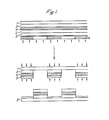
- the photosensitive material comprises two transparent or translucent flexible carrier sheets 1 and 2, between which are successively a layer 3 of a photosensitive composition, which is photocrosslinkable or photopolymerisable and which becomes more easily .
- a photosensitive composition which is photocrosslinkable or photopolymerisable and which becomes more easily .
- This material is imagewise exposed to actinic radiation using a photographic positive 6 in contact with carrier 2.
- the imagewise exposed material is then peeled apart to give a negative image on carrier 2 and a positive image on carrier 1.
- the positive image is then exposed to actinic radiation from both sides to give the final dry transfer material.
- adjacent carrier 1 is a photosensitive layer 3 and next an image-forming layer 4 both as in Figure 1.
- a third layer denoted 7 which is a layer of a slightly tacky permanent tack pressure-sensitive adhesive before the carrier 2. This material is imagewise exposed to actinic radiation using the photographic positive 6 in contact with carrier 1.
- the imagewise exposed material is then peeled apart to give a positive image on carrier 1 and a negative image on carrier 2.
- the positive image is then exposed to active radiation through carrier 1 to give the final dry transfer material.
- a wide variety of materials may be used to form the layers between the flexible carrier sheets. Some of the Specifications referred to above, especially GB-A-2,029,039A, give examples of suitable film-forming materials for use in making interlayers of this type.
- the photosensitive coating is capable of crosslinking and/or polymerising under the influence of actinic radiation.
- an ethylenically unsaturated system is used.
- the photosensitive coating is preferably composed of a cross-linking unsaturated monomer together with a photoinitiator and preferably also a crosslinkable oligomer and a polymeric binder.
- the photoinitiator used may be selected from a variety of chemical compounds which on exposure to actinic radiation yield free radicals or fragments that can be reduced to free radicals.
- Materials which have been found to be of particular value include chlorothioxanthones, benzoin ethers, benzil and benzil derivatives, acetophenone and acetophenone derivatives and anthraquinones.
- activators may be included in the layer to improve. the efficiency of free radical production, for example various amine derivatives and Michler's Ketone.
- a wide variety of appropriate materials and mixtures is described in the literature, notably US-A-3,353,955, and other United States Patent Specifications referred to therein.
- the cross-linking unsaturated monomer is preferably an unsaturated polyfunctional acrylate.
- the crosslinkable oligomer may be any of those widely known from the field of ultra-violet irradiation curing inks.
- the photosensitive coating also comprises a polymeric binder material, optionally together with a plasticiser.
- a polymeric binder material optionally together with a plasticiser.
- plasticiser By varying the type and proportions of such polymeric binder and plasticiser in conjunction with varying photoinitiator/unsaturated monomer/crosslinkable oligomer systems, a wide range of adhesions between the photosensitive coating and the carrier may be achieved.
- the plasticising effect of the photo-active components in the photosensitive coating is substantially reduced, facilitating its release from the substrate.
- This increase in releasability arising from an increased cross-linking or polymerisation and an increase in the rigidity of the layer, facilitates transfer of the desired images by the stretch release mechanism described in GB-A-959,670.
- the behaviour of the photosensitive coating depends not only on the intrinsic properties of that coating but also on the properties of the flexible carrier sheet to which it is adjacent.
- the behaviour depends on the surface properties of the carrier, and can be modified substantially if the carrier has a surface treatment or carries a subbing or like layer. Simple tests can be carried out to determine suitable formulations of the photosensitive layer for use with a given carrier.
- the image-forming layer is preferably one which interacts at most very little with the layers on either side of it.
- it consists simply of a polymeric binder having a pigment and/or dyestuff dispersed or dissolved therein.
- this layer is preferably non-photosensitive for best resolution of the image.
- the layer of photosensitive adhesive when used may be made by incorporating into a basic photo-hardenable composition a polymeric permanently tacky pressure-sensitive adhesive component.
- the flexible carrier sheets may be made from a wide variety of materials known for use as carrier sheets, most usually treated papers and plastics foils.
- Preferred carrier sheets are flexible plastics films of polyethylene terephthalate, polyethylene, polystyrene or cellulose acetate.
- the adhesive layer of the photosensitive material is a permanently tacky layer of adhesive material particular care needs to be taken to ensure good removal of the photosensitive layer material (and the image-forming layer material) in the exposed areas from the adjacent first carrier sheet under the pulling power of the adhesive layer when the imagewise exposed material is peeled apart.
- the first carrier is provided, on its side adjacent the photosensitive layer, with a release layer e.g. of polytetrafluoroethylene.
- a photosensitive material was made by coating Coating Composition 2 using a wire wound bar of wire 0.25 mm diameter onto silicone release paper (30/111 ex Jointine Products Limited). After drying this first layer, Coating Composition 1 was coated thereover using a wire wound bar of wire diameter 0.36 mm and the second coating dried. After drying, a 0.1 mm thick polyethylene sheet was applied to the second coat and the silicone release paper then stripped away.
- Coating Composition 3 was coated at a coating rate of approximately 10 g/m 2 on 0.075 mm thick polyethylene terephthalate sheet (Melinex 542 ex I.C.I.) and after drying the coating it was laminated on to the now exposed coating of coating composition 2 to form a two-carrier sheet/three interlayer photosensitive material according to the invention.
- this material was imagewise exposed through an image-bearing transparency in contact with the polyethylene terephthalate carrier for 15 seconds.
- the exposure source was a 2 kW mercury metal halide lamp 1 m away from the transparency.
- the polyethylene and polyethylene terephthalate sheets were peeled apart and the images on the polyethylene sheet were then further cured by exposing to radiation from the 2 kW lamp first for 10 seconds from the side carrying the images and then for 60 seconds through the polyethylene carrier sheet. This latter exposure hardened the layer formed from Coating Composition 1 sufficiently that the so-exposed material could be used in the normal way as a dry transfer sheet.
- Coating compositions were made up as follows:
- Coating composition A (adhesive composition)
- a masterbatch adhesive was prepared by dispersing the following components until homogeneous using a high shear stirrer:
- Coating composition A was used to prepare Coating composition A by stirring until homogeneous the following components: Coating composition B, (image-forming layer composition)
- Coating composition C (photosensitive composition)
- Coating composition D (release layer composition)
- a photosensitive material was made as follows:
- Coating composition D was coated on to a second carrier of 0.075 mm thick polyethylene terephthalate sheet (Melinex 542) using a Meyer bar with a 0.20 mm wire wrapping at a web speed of 3 metres per minute and then dried at 40 ⁇ 50°C.
- the coated surfaces of the two carriers were laminated together using an oil or electrically heated nip roller with a roller surface temperature of 65-70°C.
- the photosensitive material thus obtained was imagewise exposed to an interposed positive master through the polyethylene terephthalate carrier to a UV rich light source (e.g. to the 2 kW mercury metal halide lamp used in Example 1 at 1 m for 10 seconds). After exposure the photosensitive material was laid flat with the polyethylene terephthalate carrier uppermost. This carrier is peeled back smoothly from one edge (to approximate 180° peel). In the exposed areas the photosensitive layer does not adhere to the release coating of the carrier while in the unexposed areas the photosensitive layer remains attached to the release coating and the image-forming layer and adhesive layers remain attached to the unhardened photosensitive layer in the exposed layer.
- the image-bearing polyethylene terephthalate carrier is re-exposed to the UV light source for 20 seconds to harden the unexposed photosensitive layer. The hardened images so-formed are transferable using conventional rub down techniques.
Landscapes
- Physics & Mathematics (AREA)
- General Physics & Mathematics (AREA)
- Photosensitive Polymer And Photoresist Processing (AREA)
- Materials For Photolithography (AREA)
- Non-Silver Salt Photosensitive Materials And Non-Silver Salt Photography (AREA)
- Color Printing (AREA)
Claims (6)
Priority Applications (1)
| Application Number | Priority Date | Filing Date | Title |
|---|---|---|---|
| AT83303258T ATE24244T1 (de) | 1982-06-07 | 1983-06-06 | Photoempfindliches material fuer trockentransfer. |
Applications Claiming Priority (2)
| Application Number | Priority Date | Filing Date | Title |
|---|---|---|---|
| GB8216503 | 1982-06-07 | ||
| GB8216503 | 1982-06-07 |
Publications (3)
| Publication Number | Publication Date |
|---|---|
| EP0096572A2 EP0096572A2 (fr) | 1983-12-21 |
| EP0096572A3 EP0096572A3 (en) | 1984-03-07 |
| EP0096572B1 true EP0096572B1 (fr) | 1986-12-10 |
Family
ID=10530873
Family Applications (1)
| Application Number | Title | Priority Date | Filing Date |
|---|---|---|---|
| EP83303258A Expired EP0096572B1 (fr) | 1982-06-07 | 1983-06-06 | Matériel photosensible pour transferts à sec |
Country Status (6)
| Country | Link |
|---|---|
| US (1) | US4458003A (fr) |
| EP (1) | EP0096572B1 (fr) |
| JP (1) | JPS5946639A (fr) |
| AT (1) | ATE24244T1 (fr) |
| CA (1) | CA1195166A (fr) |
| DE (1) | DE3368332D1 (fr) |
Families Citing this family (26)
| Publication number | Priority date | Publication date | Assignee | Title |
|---|---|---|---|---|
| US4640727A (en) * | 1985-01-28 | 1987-02-03 | Minnesota Mining And Manufacturing Company | Graphic design article |
| JPH0719052B2 (ja) * | 1985-02-19 | 1995-03-06 | 富士写真フイルム株式会社 | 画像形成法 |
| JPS6227730A (ja) * | 1985-07-27 | 1987-02-05 | Konishiroku Photo Ind Co Ltd | 着色画像形成材料及び画像形成方法 |
| JPH0711695B2 (ja) | 1985-09-25 | 1995-02-08 | 富士写真フイルム株式会社 | 撮影用ハロゲン化銀カラー感光材料の処理方法 |
| DE3789368T3 (de) * | 1986-12-02 | 2000-03-23 | Canon K.K., Tokio/Tokyo | Aufzeichnungsverfahren und -Medium. |
| JPH07111580B2 (ja) * | 1986-12-02 | 1995-11-29 | キヤノン株式会社 | 転写記録媒体 |
| JP2610847B2 (ja) * | 1986-12-11 | 1997-05-14 | 東洋インキ製造 株式会社 | 画像形成材料 |
| JPS63147162A (ja) * | 1986-12-11 | 1988-06-20 | Toyo Ink Mfg Co Ltd | プル−フイングシ−トによる画像形成方法 |
| JP2532226B2 (ja) * | 1987-01-28 | 1996-09-11 | 日本写真印刷株式会社 | 転写成型品の製造方法 |
| JPH01172957A (ja) * | 1987-12-28 | 1989-07-07 | Toyo Ink Mfg Co Ltd | 画像形成装置 |
| US5049476A (en) * | 1988-07-18 | 1991-09-17 | Hoechst Celanese Corporation | Photopolymerizable, positive working, peel developable, single sheet color proofing system |
| US5236806A (en) * | 1988-07-18 | 1993-08-17 | Hoechst Celanese Corporation | Photopolymerizable, positive working, peel developable, single sheet color proofing system |
| US4895787A (en) * | 1988-07-18 | 1990-01-23 | Hoechst Celanese Corporation | Photopolymerizable positive working, peel developable, single sheet color proofing system |
| JP2769839B2 (ja) * | 1989-03-09 | 1998-06-25 | 大日本印刷株式会社 | 転写シート |
| JPH0345954A (ja) * | 1989-07-13 | 1991-02-27 | Toyo Ink Mfg Co Ltd | 画像形成方法 |
| JPH03184049A (ja) * | 1989-12-14 | 1991-08-12 | Toyo Ink Mfg Co Ltd | 平版印刷版およびその製造方法 |
| US5294515A (en) * | 1991-05-17 | 1994-03-15 | Hoechst Celanese Corporation | Photopolymerizable, negative working, peel developable, single sheet color proofing system |
| GB9113427D0 (en) * | 1991-06-21 | 1991-08-07 | Erba Carlo Spa | Penem derivatives |
| EP0530674A1 (fr) * | 1991-08-30 | 1993-03-10 | Canon Kabushiki Kaisha | Matériau de base en plaque, procédé de fabrication d'une plaque d'impression de ce matériau à base et procédé d'impression et appareil utilisant cette plaque |
| JP2777949B2 (ja) | 1992-04-03 | 1998-07-23 | 富士写真フイルム株式会社 | ハロゲン化銀カラー写真感光材料 |
| US5856064A (en) * | 1996-09-10 | 1999-01-05 | Minnesota Mining And Manufacturing Company | Dry peel-apart imaging or proofing system |
| US6013409A (en) * | 1996-09-10 | 2000-01-11 | 3M Innovative Properties Company | Dry peel-apart imaging process |
| US20090004419A1 (en) * | 2007-06-29 | 2009-01-01 | Cok Ronald S | Multi-layer masking film |
| US8981093B2 (en) | 2012-06-06 | 2015-03-17 | Basf Se | Process for preparing piperazine |
| US10349525B2 (en) | 2013-10-30 | 2019-07-09 | Nederlandse Organisatie Voor Toegepast-Natuurwetenschappelijk Onderzoek Tno | Substrate comprising an electrical circuit pattern, method and system for providing same |
| TWI636896B (zh) * | 2013-10-30 | 2018-10-01 | 荷蘭Tno自然科學組織公司 | 用以在基材上形成圖案化結構之方法與系統 |
Family Cites Families (9)
| Publication number | Priority date | Publication date | Assignee | Title |
|---|---|---|---|---|
| US3615435A (en) * | 1968-02-14 | 1971-10-26 | Du Pont | Photohardenable image reproduction element with integral pigmented layer and process for use |
| US3770438A (en) * | 1971-12-09 | 1973-11-06 | J Celeste | Photopolymerizable transfer elements |
| JPS6032173B2 (ja) * | 1974-12-28 | 1985-07-26 | 富士写真フイルム株式会社 | 画像形成法 |
| US4347300A (en) * | 1977-06-02 | 1982-08-31 | Polychrome Corporation | Imaging peel apart element employing two photohardenable layers |
| GB2020837A (en) * | 1978-05-11 | 1979-11-21 | Polychrome Corp | Multi-layered Image Forming Construction Having a Release Layer |
| GB2021276A (en) * | 1978-05-11 | 1979-11-28 | Polychrome Corp | Photographic element capable of producing positive and negative images |
| GB2029039B (en) * | 1978-08-24 | 1982-10-27 | Letraset International Ltd | Photosensitive materials |
| BE878405A (fr) * | 1978-08-24 | 1979-12-17 | Letraset Internat Ltd | Materiels photosensibles |
| GB2053497B (en) * | 1979-07-09 | 1983-09-01 | Letraset International Ltd | Photosensitive materials for making signs and labels |
-
1983
- 1983-06-01 US US06/499,806 patent/US4458003A/en not_active Expired - Fee Related
- 1983-06-06 CA CA000429729A patent/CA1195166A/fr not_active Expired
- 1983-06-06 EP EP83303258A patent/EP0096572B1/fr not_active Expired
- 1983-06-06 DE DE8383303258T patent/DE3368332D1/de not_active Expired
- 1983-06-06 AT AT83303258T patent/ATE24244T1/de not_active IP Right Cessation
- 1983-06-07 JP JP58101595A patent/JPS5946639A/ja active Pending
Also Published As
| Publication number | Publication date |
|---|---|
| CA1195166A (fr) | 1985-10-15 |
| EP0096572A3 (en) | 1984-03-07 |
| EP0096572A2 (fr) | 1983-12-21 |
| US4458003A (en) | 1984-07-03 |
| ATE24244T1 (de) | 1986-12-15 |
| DE3368332D1 (en) | 1987-01-22 |
| JPS5946639A (ja) | 1984-03-16 |
Similar Documents
| Publication | Publication Date | Title |
|---|---|---|
| US4458003A (en) | Photosensitive materials for use in making dry transfers | |
| US4376159A (en) | Method of preparing matte finish color-proofing surprints | |
| US3615435A (en) | Photohardenable image reproduction element with integral pigmented layer and process for use | |
| US3649268A (en) | Process for forming images by photohardening and applying a colorant | |
| US4174216A (en) | Process for image reproduction using multilayer photosensitive tonable element | |
| JPS6314144A (ja) | 着色画像の製法及び感光性素材 | |
| JPS5933890B2 (ja) | 乾式像複製積層物 | |
| US4304839A (en) | Positive working multilayer photosensitive tonable element | |
| JPS6020735B2 (ja) | 剥離現像可能な感光材料を用いる画像形成方法 | |
| US4288525A (en) | Photosensitive materials | |
| JPH0764283A (ja) | 光重合性、陽画処理、剥離現像、単シート色校正方法 | |
| JPH0473942B2 (fr) | ||
| JPS62267738A (ja) | ポジ型カラ−プル−フフイルムおよびその製法 | |
| JPH0683043A (ja) | 調整可能な接着性の支持体を有する感光性エレメント | |
| JPS5914736B2 (ja) | 多色テストプリントの製法 | |
| JPH0549979B2 (fr) | ||
| JP3028512B2 (ja) | 張り合わせ接着層を備えた剥離現像、単シート色校正システム | |
| US4310615A (en) | Image transfer element having release layer | |
| CA1089279A (fr) | Element photsensible multicouche et procede de reproduction | |
| US4262079A (en) | Image transfer element | |
| JP4065350B2 (ja) | カラープルーフ製造用低酸素感受性光重合性混合物 | |
| US3736138A (en) | Process for transferring images from a surface to a temporary surface and to a final surface | |
| EP0553638A1 (fr) | Procédé de transfert utilisant des toners durcissable par les rayons ultraviolet sans adhésivité prolongée | |
| JP3886528B2 (ja) | 高解像度な原版の単色または多色プルーフおよびそれらの作製方法 | |
| EP0165031A2 (fr) | Feuille présensibilisée pour épreuve en couleurs |
Legal Events
| Date | Code | Title | Description |
|---|---|---|---|
| PUAI | Public reference made under article 153(3) epc to a published international application that has entered the european phase |
Free format text: ORIGINAL CODE: 0009012 |
|
| AK | Designated contracting states |
Designated state(s): AT BE CH DE FR GB IT LI LU NL SE |
|
| PUAL | Search report despatched |
Free format text: ORIGINAL CODE: 0009013 |
|
| AK | Designated contracting states |
Designated state(s): AT BE CH DE FR GB IT LI LU NL SE |
|
| 17P | Request for examination filed |
Effective date: 19840522 |
|
| RAP1 | Party data changed (applicant data changed or rights of an application transferred) |
Owner name: ESSELTE LETRASET LIMITED |
|
| GRAA | (expected) grant |
Free format text: ORIGINAL CODE: 0009210 |
|
| AK | Designated contracting states |
Kind code of ref document: B1 Designated state(s): AT BE CH DE FR GB IT LI LU NL SE |
|
| PG25 | Lapsed in a contracting state [announced via postgrant information from national office to epo] |
Ref country code: IT Free format text: LAPSE BECAUSE OF FAILURE TO SUBMIT A TRANSLATION OF THE DESCRIPTION OR TO PAY THE FEE WITHIN THE PRESCRIBED TIME-LIMIT;WARNING: LAPSES OF ITALIAN PATENTS WITH EFFECTIVE DATE BEFORE 2007 MAY HAVE OCCURRED AT ANY TIME BEFORE 2007. THE CORRECT EFFECTIVE DATE MAY BE DIFFERENT FROM THE ONE RECORDED. Effective date: 19861210 Ref country code: AT Effective date: 19861210 |
|
| REF | Corresponds to: |
Ref document number: 24244 Country of ref document: AT Date of ref document: 19861215 Kind code of ref document: T |
|
| PG25 | Lapsed in a contracting state [announced via postgrant information from national office to epo] |
Ref country code: SE Effective date: 19861231 |
|
| REF | Corresponds to: |
Ref document number: 3368332 Country of ref document: DE Date of ref document: 19870122 |
|
| PG25 | Lapsed in a contracting state [announced via postgrant information from national office to epo] |
Ref country code: LU Free format text: LAPSE BECAUSE OF NON-PAYMENT OF DUE FEES Effective date: 19870630 |
|
| PLBE | No opposition filed within time limit |
Free format text: ORIGINAL CODE: 0009261 |
|
| STAA | Information on the status of an ep patent application or granted ep patent |
Free format text: STATUS: NO OPPOSITION FILED WITHIN TIME LIMIT |
|
| 26N | No opposition filed | ||
| PGFP | Annual fee paid to national office [announced via postgrant information from national office to epo] |
Ref country code: NL Payment date: 19890630 Year of fee payment: 7 |
|
| PGFP | Annual fee paid to national office [announced via postgrant information from national office to epo] |
Ref country code: BE Payment date: 19890714 Year of fee payment: 7 |
|
| PGFP | Annual fee paid to national office [announced via postgrant information from national office to epo] |
Ref country code: CH Payment date: 19890830 Year of fee payment: 7 |
|
| PGFP | Annual fee paid to national office [announced via postgrant information from national office to epo] |
Ref country code: FR Payment date: 19900419 Year of fee payment: 8 |
|
| PG25 | Lapsed in a contracting state [announced via postgrant information from national office to epo] |
Ref country code: LI Effective date: 19900630 Ref country code: CH Effective date: 19900630 Ref country code: BE Effective date: 19900630 |
|
| PGFP | Annual fee paid to national office [announced via postgrant information from national office to epo] |
Ref country code: DE Payment date: 19900830 Year of fee payment: 8 |
|
| BERE | Be: lapsed |
Owner name: ESSELTE LETRASET LTD Effective date: 19900630 |
|
| PG25 | Lapsed in a contracting state [announced via postgrant information from national office to epo] |
Ref country code: NL Effective date: 19910101 |
|
| NLV4 | Nl: lapsed or anulled due to non-payment of the annual fee | ||
| REG | Reference to a national code |
Ref country code: CH Ref legal event code: PL |
|
| PGFP | Annual fee paid to national office [announced via postgrant information from national office to epo] |
Ref country code: GB Payment date: 19910603 Year of fee payment: 9 |
|
| PG25 | Lapsed in a contracting state [announced via postgrant information from national office to epo] |
Ref country code: FR Effective date: 19920228 |
|
| PG25 | Lapsed in a contracting state [announced via postgrant information from national office to epo] |
Ref country code: DE Effective date: 19920401 |
|
| PG25 | Lapsed in a contracting state [announced via postgrant information from national office to epo] |
Ref country code: GB Effective date: 19920606 |
|
| GBPC | Gb: european patent ceased through non-payment of renewal fee |
Effective date: 19920606 |