EP0099760A2 - Circuit pour reconstituer des signaux affectés par du bruit parasite - Google Patents
Circuit pour reconstituer des signaux affectés par du bruit parasite Download PDFInfo
- Publication number
- EP0099760A2 EP0099760A2 EP83304243A EP83304243A EP0099760A2 EP 0099760 A2 EP0099760 A2 EP 0099760A2 EP 83304243 A EP83304243 A EP 83304243A EP 83304243 A EP83304243 A EP 83304243A EP 0099760 A2 EP0099760 A2 EP 0099760A2
- Authority
- EP
- European Patent Office
- Prior art keywords
- signal
- circuit
- pulse
- output
- analog signal
- Prior art date
- Legal status (The legal status is an assumption and is not a legal conclusion. Google has not performed a legal analysis and makes no representation as to the accuracy of the status listed.)
- Granted
Links
- 238000005070 sampling Methods 0.000 claims abstract description 36
- 230000004044 response Effects 0.000 claims abstract description 11
- 239000003990 capacitor Substances 0.000 claims description 10
- 230000003111 delayed effect Effects 0.000 claims description 2
- 230000008878 coupling Effects 0.000 claims 3
- 238000010168 coupling process Methods 0.000 claims 3
- 238000005859 coupling reaction Methods 0.000 claims 3
- 238000010586 diagram Methods 0.000 description 11
- 230000005236 sound signal Effects 0.000 description 10
- 208000019300 CLIPPERS Diseases 0.000 description 4
- 208000021930 chronic lymphocytic inflammation with pontine perivascular enhancement responsive to steroids Diseases 0.000 description 4
- 238000000034 method Methods 0.000 description 4
- 230000002457 bidirectional effect Effects 0.000 description 2
- 230000005540 biological transmission Effects 0.000 description 2
- 230000000717 retained effect Effects 0.000 description 2
- 230000003321 amplification Effects 0.000 description 1
- 230000008859 change Effects 0.000 description 1
- 230000007423 decrease Effects 0.000 description 1
- 230000004069 differentiation Effects 0.000 description 1
- 230000010354 integration Effects 0.000 description 1
- 230000004048 modification Effects 0.000 description 1
- 238000012986 modification Methods 0.000 description 1
- 238000003199 nucleic acid amplification method Methods 0.000 description 1
- 230000009467 reduction Effects 0.000 description 1
- 230000001960 triggered effect Effects 0.000 description 1
Images




Classifications
-
- H—ELECTRICITY
- H03—ELECTRONIC CIRCUITRY
- H03G—CONTROL OF AMPLIFICATION
- H03G3/00—Gain control in amplifiers or frequency changers
- H03G3/20—Automatic control
- H03G3/30—Automatic control in amplifiers having semiconductor devices
- H03G3/34—Muting amplifier when no signal is present
- H03G3/345—Muting during a short period of time when noise pulses are detected, i.e. blanking
Definitions
- the present invention relates generally to noise reduction, and in particular to a circuit for reconstructing the portion of an analog signal which is affected by an impulse noise.
- One method currently available for suppressing impulse noise involves reducing the transmission gain or shutting off the transmission path as long as the noise is present in the desired signal.
- Another method involves detecting the amplitude of the desired signal in response to the leading edge of an impulse noise and retaining the detected amplitude in the presence of the impulse noise. While these methods are effective in suppressing impulse noise, the original waveform of the noise-affected part is not compensated, resulting in unnatural sound.
- modern digital audio systems utilize linear interpolation technique to predict the original waveform of the noise-affected part by linear interpolation. This type of systems requires complicated, expensive circuitry, not suitable for moderate cost equipments.
- the primary object of the invention is to provide a circuit that compensates for the noise-affected portion of an analog signal to reconstruct the original waveform in a simple, inexpensive manner.
- the circuit of the invention comprises a timing circuit for generating a sampling pulse in response to an impulse noise introduced in the desired signal, a holding circuit for passing the analog signal in the absense of the sampling pulse and holding the analog signal in the presence of the sampling pulse to derive therefrom a modified analog signal, and a differentiator for generating a signal representative of the time-varying rate of the analog signal.
- a sampling circuit is provided for sampling the rate representative signal in response to the occurrence of the sampling pulse and holding the sampled signal for the duration of the sampling pulse to derive therefrom a rectangular pulse, so that the amplitude and polarity of the rectangular pulse represent the gradient and polarity of the noise-affected portion of the signal.
- the rectangular pulse is integrated linearly at a rate variable as as a function of the amplitude of the rectangular pulse to generate a ramp voltage.
- An adder combines the ramp voltage with the modified signal to generate a reconstructed signal.
- FIG. 1 there is shown a circuit for eliminating impulse noise according to an embodiment of the invention.
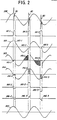
- An analog audio signal shown at 100 in Fig. 2 is applied.through input terminal 1 to a noise-triggered timing circuit 12 which includes a noise detector 3 and a waveshaper 4.
- the noise detector 3 detects peaks that are stronger than the highest peak in the desired signal being received and generates an output which is shaped into a rectangular pulse by the waveshaper 4.
- the timing circuit 12 thus generates sampling pulses shown at 101-1, 101-2, 101-3 in Fig. 2 in response to peaks Nl, N2, N3 that occur sporadically in the form of a short burst at various points of the audio signal.
- the noise peak Nl is assumed to occur at a positive peak of the audio signal where its time-varying rate is minimum.
- the peak N2 is assumed to occur at a zero-crosspoint of the audio waveform where its time-varying rate is maximum and peak N3 is assumed to occur at a point intermediate a negative peak and a zero-crossing point where the time-varying rate is between the maximum and minimum values.
- a delay circuit 2 is connected to the input terminal 1 to compensate for the delay time introduced by the timing circuit 12 so that the sampling pulse is exactly time-coincident with the impulse noise.
- the delayed, noise-affected audio signal is applied to a first sample-and-hold circuit 5.
- This circuit operates in a passing mode in which the input analog signal is directly applied to its output in the absence of the sampling pulse and switches.to a hold mode in which it retains the amplitude of the signal-in the presence of the sampling pulse to generate a modified analog signal as shown at 102 in Fig. 2 having humps 102-1, 102-3 and a dent 102-2.
- the waveform 102 is applied to a differentiator 6 to generate an output whose waveform is shown at 103 in Fig. 2.
- the sampled portions of the audio signal result in derivatives 103-1, 103-2, 103-3 of different amplitudes and polarities depending on the location of the impulse noise in the audio waveform. Since the noise impulse Nl occurs . at a positive peak of the desired signal where the time-varying rate is minimum, the derivative 103-1 has a least amplitude of negative polarity.
- the derivative 103-2 has a maximum amplitude of positive polarity, while the derivative 103-3 has an intermediate amplitude of negative polarity.
- the output of the differentiator 6 is coupled to a second sample-and-hold circuit 7. Similar to sample-and-hold circuit 5, this circuit also operates in a passing mode in which the input analog signal is directly applied to its output in the absence of the sampling pulse and switches to a sample-and-hold mode in which it retains the amplitude of the signal in the presence of the sampling pulse to generate a modified signal as shown at 104.
- the modified signal 104 has retained values 104-1, 104-2 and 104-3 which represent the amplitudes of the derivatives 103-1, 103-2 and 103-3,"respectively.
- variable rate integrator 9 having an integration rate which is a function of the amplitude of an input signal applied - thereto.
- the negative least amplitude pulse 104-1 is thus integrated with a minimum rate producing a negative ramp voltage 106-1 of minimum amplitude.
- the positive maximum amplitude pulse 104-2 is integrated with a maximum rate into a positive ramp voltage 106-2 having maximum height
- the negative intermediate amplitude pulse 105-3 is integrated with an intermediate rate into a negative ramp voltage 106-3 of intermediate amplitude.
- An adder 10 is provided to combine the sampled waveform 102 with the offset ramp voltages 106 to generate a noise-suppressed output waveform 107 for application to an output terminal 11.
- Fig. 3 is an illustration of an example of the variable rate integrator 9.
- the integrator includes a pair of transistors 61 and 62 of opposite conductivity types, the collector of transistor 61 being coupled by a resistor 63 to a positive voltage source +Vcc and the emitter thereof being coupled by a resistor 65 to a negative voltage source -Vcc.
- the transistor 62 has its emitter coupled by a resistor 64 to the positive voltage source and its collector coupled by a resistor 66 to the negative voltage source.
- the bases of transistors 61 and 62 coupled together at a circuit node X which is coupled to the output of an operational amplifier 60 which amplifies the output of sampling gate 8.
- The.collectors of transistors 61 and 62 are coupled respectively to the bases of transistors 67 and 68 of opposite conductivity types having their collectors coupled together to a second circuit node Y which is coupled to an operational amplifier 72.
- the emitters transistors 67 and 68 are respectively connected by integrating resistors 69 and 70 to the positive and negative voltage sources.
- the transistors 67, 68 and resistors 69, 70 constitute a bidirectional constant current source in which the circuit node Y is at a zero voltage when the potential at circuit node X remains zero. Thus, a positive potential at the node X will cause a current to flow through transistor 67 to the circuit node Y, producing a corresponding positive potential at node Y that charges-a capacitor 73.
- a negative potential at the node X will in turn cause a current to be drained from node Y through transistor 70, producing a corresponding negative potential at node Y that discharges the capacitor 73. Therefore, the capacitor 73 is charged or discharged by a current which is exclusively proportional to the voltage at node X.
- the capacitor 73 is connected in shunt by a normally closed switch 74 which opens in response to the sampling pulse 101.
- the negative-going pulse 105-1 drives the transistor 62 into conduction to cause a current to be drained from the node Y.
- the switch 74 is open to allow capacitor 73 to be discharged linearly at a rate proportional to the amplitude of pulse 105-1 to develop the negative ramp voltage 106-1.
- the positive-going pulse 105-2 conducts the transistor 61, generating a current that charges the capacitor 73 linearly at a rate proportional to the amplitude of pulse 105-2 to develop the ramp voltage 106-2.
- the ramp voltages are applied to the adder 10.
- the noise suppressor of the invention recostructs the portion of the signal which has been destroyed by an impulse noise and thus eliminates the feeling of unnaturalness which has been encounted with prior art systems.
- the differentiated signal components 103-1 to 103-3 bear the information that validly represents the time-varying rate of the audio signal.
- F ig. 4 if the desired signal increases in frequency, the duration of a sampling pulse that occurs in response to an impulse noise N4 becomes long relative to the period of the desired signal, causing a large dent 102-4 to occur in. the sampled signal.
- the differentiation at 6 will result in a gated pulse 105-4 as indicated by broken lines having a large amplitude and a long duration. This in turn results in a ramp voltage 106-4 having an excessive pulse height which would produce a hump 107-1 in the output waveform 107.
- a noise suppressor of Fig. 5 includes a level clipper 13 connected to the output of the sampling gate 8. As shown in Fig. 4, the gated pulse 105 is clipped at a level 14 prior to the application to the variable rate integrator 9 if the frequency of the audio signal increases above a predetermined frequency value.
- the clipping level 14 is so determined that an offset ramp voltage 106-5 has equal height to that of the dent 102-4, offsetting the noise-affected part with a slope 107-2 which is continuous with the audio signal.
- Fig. 6 is an illustration of a preferred form of the pulse height clipper.
- a frequency-to- voltage converter 15 is connected to the input terminal 1 to generate a voltage which is inversely proportional to the frequency of the audio signal.
- This frequency related voltage is applied to a variable level clipper 16 which is used instead of the fixed level clipper 13.
- the clipping level 14 thus drops by an amount proportional to the input frequency, so that the amplitude of the offset ramp voltage 106 decreases as a function of the frequency.
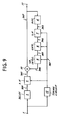
- Fig. 1 could be modified in various ways. Modified embodiments are shown in Figs. 7 and 9 in which parts corresponding to those in Fig. 1 are marked with the same numerals as used in Fig. 1.
- Fig. 7 differs from the Fig. 1 embodiment in that the input of the differentiator 6 is connected to the output of the delay circuit 2 instead of being connected to the output of the sample-and-hold circuit 5.
- the differentiator 6 produces derivative components 203-1, 203-2, 203-3 having amplitudes proportional to the time-varying rate of an input audio signal 200 and having polarities representing the direction of change in signal level.
- the other waveforms designated by numerals having the same tenth and units of the-numerals used in Fig. 2 are substantially identical to the corresponding waveforms.
- Fig. 9 differs from the Fig. 1 embodiment in that the differentiator 6 takes its input from the output of adder 10, rather than from the output of sample-and-hold 5.
- waveforms 300, 301, 302 correspond respectively to waveforms 100, 101, 102 of Fig. 2.
- the waveform 303 derived therefrom is a combination of a waveform similar to waveform 103, Fig. 2 and a waveform similar to waveform 105, Fig. 2.
- the derivative components 303-1, 303-2, 303-3 correspond to waveforms 103-1, 103-2, 103-3 of Fig. 2, respectively, and waveforms 304 to 307 derived respectively from the sample-hold 7, gate 8, integrator 9 and adder 10 correspond to waveforms 104 to 107, respectively.
- variable rate integrator 9 An alternative embodiment of the variable rate integrator 9 is illustrated in Fig. ll.
- the input signal from the sampling gate 8 is amplified by a unity gain inverter 80 and applied to a wiper tap of a potentiometer 81 connected in series with resistors 82 and 83 between positive and negative voltage sources.
- the junctions between resistors 81 and 82 and 81 and 83 are respectively coupled to the bases of transistors 84 and 85 of opposite conductivity'types which are connected in series with resistors 86 and 87 to the voltage sources to form a bidirectional constant current source.
- a circuit node Z between the collectors of transistors 84 and 85 are coupled to the base of a transistor 88 which is in series wsith a load resistor 89 between the voltage sources.
- the potentiometer 81 is adjusted so that when the input voltage is zero the potential at node Z is also zero.
Landscapes
- Analogue/Digital Conversion (AREA)
Applications Claiming Priority (8)
| Application Number | Priority Date | Filing Date | Title |
|---|---|---|---|
| JP127205/82 | 1982-07-21 | ||
| JP12720482A JPS5917732A (ja) | 1982-07-21 | 1982-07-21 | パルス性雑音の低減装置 |
| JP127204/82 | 1982-07-21 | ||
| JP12720582A JPS5917733A (ja) | 1982-07-21 | 1982-07-21 | パルス性雑音の低減装置 |
| JP133297/82 | 1982-07-30 | ||
| JP133296/82 | 1982-07-30 | ||
| JP13329782A JPS5923929A (ja) | 1982-07-30 | 1982-07-30 | パルス性雑音の低減装置 |
| JP13329682A JPS5923928A (ja) | 1982-07-30 | 1982-07-30 | パルス性雑音の低減装置 |
Publications (3)
| Publication Number | Publication Date |
|---|---|
| EP0099760A2 true EP0099760A2 (fr) | 1984-02-01 |
| EP0099760A3 EP0099760A3 (en) | 1984-06-06 |
| EP0099760B1 EP0099760B1 (fr) | 1988-06-29 |
Family
ID=27471280
Family Applications (1)
| Application Number | Title | Priority Date | Filing Date |
|---|---|---|---|
| EP83304243A Expired EP0099760B1 (fr) | 1982-07-21 | 1983-07-21 | Circuit pour reconstituer des signaux affectés par du bruit parasite |
Country Status (3)
| Country | Link |
|---|---|
| US (1) | US4626788A (fr) |
| EP (1) | EP0099760B1 (fr) |
| DE (1) | DE3377254D1 (fr) |
Cited By (6)
| Publication number | Priority date | Publication date | Assignee | Title |
|---|---|---|---|---|
| FR2542530A1 (fr) * | 1983-03-09 | 1984-09-14 | Victor Company Of Japan | Circuit de reduction de bruit utilisant une technique d'interpolation lineaire et presentant une caracteristique de desaccentuation |
| FR2542529A1 (fr) * | 1983-03-07 | 1984-09-14 | Victor Company Of Japan | Circuit de reduction des bruits d'impulsions par interpolation lineaire avec insensibilite aux bruits blancs |
| EP0136482A3 (en) * | 1983-08-08 | 1986-04-09 | Victor Company Of Japan, Limited | Noise reduction by linear interpolation using a dual function amplifier circuit |
| EP0159042A3 (en) * | 1984-04-20 | 1988-06-08 | Matsushita Electric Industrial Co., Ltd. | An apparatus for reducing noise in audio signals |
| EP0475188A1 (fr) * | 1990-09-11 | 1992-03-18 | Stefan Brinkhaus | Méthode et appareil pour réduire le bruit à la réception FM ou PM |
| EP0522578A3 (en) * | 1991-07-12 | 1993-06-16 | Pioneer Electronic Corporation | Noise removing circuit |
Families Citing this family (7)
| Publication number | Priority date | Publication date | Assignee | Title |
|---|---|---|---|---|
| DE3533467C2 (de) * | 1985-09-19 | 1999-01-21 | Tandberg Data | Verfahren und Anordnung zum störsicheren Erkennen von in Datensignalen enthaltenen Daten |
| AU4519589A (en) * | 1988-10-14 | 1990-05-01 | Engineering Measurements Company | Signal processing method and apparatus for flowmeters |
| US8352400B2 (en) | 1991-12-23 | 2013-01-08 | Hoffberg Steven M | Adaptive pattern recognition based controller apparatus and method and human-factored interface therefore |
| US10361802B1 (en) | 1999-02-01 | 2019-07-23 | Blanding Hovenweep, Llc | Adaptive pattern recognition based control system and method |
| US7966078B2 (en) | 1999-02-01 | 2011-06-21 | Steven Hoffberg | Network media appliance system and method |
| GB0214729D0 (en) * | 2002-06-26 | 2002-08-07 | Koninkl Philips Electronics Nv | Digital receiver arrangement and related method |
| WO2006098323A1 (fr) * | 2005-03-17 | 2006-09-21 | Pioneer Corporation | Dispositif d'annulation de bruit |
Family Cites Families (9)
| Publication number | Priority date | Publication date | Assignee | Title |
|---|---|---|---|---|
| US3689845A (en) * | 1969-11-01 | 1972-09-05 | Philips Corp | Circuit arrangement for suppressing interferences in a receiver of electrical signals |
| US4076969A (en) * | 1975-04-07 | 1978-02-28 | Singer & Singer | Impulse noise reduction system |
| US4156202A (en) * | 1976-06-28 | 1979-05-22 | Victor Company Of Japan, Ltd. | Impulsive noise reducing system |
| JPS5386108A (en) * | 1977-01-07 | 1978-07-29 | Nec Corp | Impulse noise limiting circuit |
| US4143333A (en) * | 1977-05-16 | 1979-03-06 | David P. Misunas | Impulse noise removing apparatus |
| US4220926A (en) * | 1977-08-26 | 1980-09-02 | Plessey Handel Und Investments Ag. | Noise detector employing plural delay circuits |
| US4192003A (en) * | 1978-04-13 | 1980-03-04 | International Business Machines Corporation | Signal recovery method and apparatus |
| US4311963A (en) * | 1978-07-18 | 1982-01-19 | Matsushita Electric Industrial Co., Ltd. | Noise pulse suppressing system |
| CA1144081A (fr) * | 1979-04-27 | 1983-04-05 | Sadao Kondo | Dispositif de suppression des bruits |
-
1983
- 1983-07-21 DE DE8383304243T patent/DE3377254D1/de not_active Expired
- 1983-07-21 US US06/516,242 patent/US4626788A/en not_active Expired - Fee Related
- 1983-07-21 EP EP83304243A patent/EP0099760B1/fr not_active Expired
Cited By (8)
| Publication number | Priority date | Publication date | Assignee | Title |
|---|---|---|---|---|
| FR2542529A1 (fr) * | 1983-03-07 | 1984-09-14 | Victor Company Of Japan | Circuit de reduction des bruits d'impulsions par interpolation lineaire avec insensibilite aux bruits blancs |
| FR2542530A1 (fr) * | 1983-03-09 | 1984-09-14 | Victor Company Of Japan | Circuit de reduction de bruit utilisant une technique d'interpolation lineaire et presentant une caracteristique de desaccentuation |
| EP0136482A3 (en) * | 1983-08-08 | 1986-04-09 | Victor Company Of Japan, Limited | Noise reduction by linear interpolation using a dual function amplifier circuit |
| EP0159042A3 (en) * | 1984-04-20 | 1988-06-08 | Matsushita Electric Industrial Co., Ltd. | An apparatus for reducing noise in audio signals |
| EP0475188A1 (fr) * | 1990-09-11 | 1992-03-18 | Stefan Brinkhaus | Méthode et appareil pour réduire le bruit à la réception FM ou PM |
| US5303414A (en) * | 1990-09-11 | 1994-04-12 | Stefan Brinkhaus | Method and device for minimizing interference, in particular in connection with FM reception |
| EP0522578A3 (en) * | 1991-07-12 | 1993-06-16 | Pioneer Electronic Corporation | Noise removing circuit |
| US5311087A (en) * | 1991-07-12 | 1994-05-10 | Pioneer Electronic Corporation | Noise removing circuit |
Also Published As
| Publication number | Publication date |
|---|---|
| US4626788A (en) | 1986-12-02 |
| DE3377254D1 (en) | 1988-08-04 |
| EP0099760A3 (en) | 1984-06-06 |
| EP0099760B1 (fr) | 1988-06-29 |
Similar Documents
| Publication | Publication Date | Title |
|---|---|---|
| US4333158A (en) | Automatic gain control circuit for an adaptive filter | |
| EP0099760B1 (fr) | Circuit pour reconstituer des signaux affectés par du bruit parasite | |
| US6556685B1 (en) | Companding noise reduction system with simultaneous encode and decode | |
| US4724396A (en) | Digital audio amplifier | |
| US4254303A (en) | Automatic volume adjusting apparatus | |
| EP0172737B1 (fr) | Amplificateur numérique audio | |
| EP0103385B1 (fr) | Montage pour reconstituer des signaux affectés par du bruit parasite | |
| US4322811A (en) | Clamping circuit for an adaptive filter | |
| EP0048057A1 (fr) | Circuit pour moduler le signal de sortie d'un transducteur par exemple d'un transducteur électro-optique | |
| US4531095A (en) | Impulse noise reduction by linear interpolation having immunity to white noise | |
| US4833346A (en) | Switched threshold comparator for a fiber-optic receiver | |
| JPH0532948B2 (fr) | ||
| CA1126861A (fr) | Separateur de synchronisation avec dispositif de calage anticipateur | |
| US4532475A (en) | Impulse noise reduction by linear interpolation having a deemphasis characteristic | |
| JPS62154928A (ja) | 光受信回路 | |
| US4568980A (en) | Video clamping correction circuit | |
| JPS63204908A (ja) | 増幅装置 | |
| JP3811030B2 (ja) | デジタルアンプ | |
| JPS6223224A (ja) | デイジタル中継器用直流再生回路 | |
| JP3301889B2 (ja) | バースト光受信回路 | |
| JPH11331096A (ja) | 光信号受信器及び光信号受信方法 | |
| KR100492984B1 (ko) | 영상 신호의 고주파 증강 제어장치 | |
| JPH0419880Y2 (fr) | ||
| JP2814501B2 (ja) | 自動利得制御増幅器 | |
| SU1706009A1 (ru) | Автоматический регул тор уровн звукового сигнала |
Legal Events
| Date | Code | Title | Description |
|---|---|---|---|
| PUAI | Public reference made under article 153(3) epc to a published international application that has entered the european phase |
Free format text: ORIGINAL CODE: 0009012 |
|
| AK | Designated contracting states |
Designated state(s): DE FR GB |
|
| PUAL | Search report despatched |
Free format text: ORIGINAL CODE: 0009013 |
|
| AK | Designated contracting states |
Designated state(s): DE FR GB |
|
| 17P | Request for examination filed |
Effective date: 19841016 |
|
| GRAA | (expected) grant |
Free format text: ORIGINAL CODE: 0009210 |
|
| AK | Designated contracting states |
Kind code of ref document: B1 Designated state(s): DE FR GB |
|
| REF | Corresponds to: |
Ref document number: 3377254 Country of ref document: DE Date of ref document: 19880804 |
|
| ET | Fr: translation filed | ||
| PLBE | No opposition filed within time limit |
Free format text: ORIGINAL CODE: 0009261 |
|
| STAA | Information on the status of an ep patent application or granted ep patent |
Free format text: STATUS: NO OPPOSITION FILED WITHIN TIME LIMIT |
|
| 26N | No opposition filed | ||
| PGFP | Annual fee paid to national office [announced via postgrant information from national office to epo] |
Ref country code: GB Payment date: 19910709 Year of fee payment: 9 |
|
| PGFP | Annual fee paid to national office [announced via postgrant information from national office to epo] |
Ref country code: FR Payment date: 19910721 Year of fee payment: 9 |
|
| PGFP | Annual fee paid to national office [announced via postgrant information from national office to epo] |
Ref country code: DE Payment date: 19910830 Year of fee payment: 9 |
|
| PG25 | Lapsed in a contracting state [announced via postgrant information from national office to epo] |
Ref country code: GB Effective date: 19920721 |
|
| GBPC | Gb: european patent ceased through non-payment of renewal fee |
Effective date: 19920721 |
|
| PG25 | Lapsed in a contracting state [announced via postgrant information from national office to epo] |
Ref country code: FR Effective date: 19930331 |
|
| PG25 | Lapsed in a contracting state [announced via postgrant information from national office to epo] |
Ref country code: DE Effective date: 19930401 |
|
| REG | Reference to a national code |
Ref country code: FR Ref legal event code: ST |