EP0104949B1 - Verfahren und Gegenstand zum Versiegeln eines Substrates unter Benutzung einer rückstellbaren Muffe - Google Patents
Verfahren und Gegenstand zum Versiegeln eines Substrates unter Benutzung einer rückstellbaren Muffe Download PDFInfo
- Publication number
- EP0104949B1 EP0104949B1 EP83305820A EP83305820A EP0104949B1 EP 0104949 B1 EP0104949 B1 EP 0104949B1 EP 83305820 A EP83305820 A EP 83305820A EP 83305820 A EP83305820 A EP 83305820A EP 0104949 B1 EP0104949 B1 EP 0104949B1
- Authority
- EP
- European Patent Office
- Prior art keywords
- sleeve
- water
- substrate
- sealing material
- article
- Prior art date
- Legal status (The legal status is an assumption and is not a legal conclusion. Google has not performed a legal analysis and makes no representation as to the accuracy of the status listed.)
- Expired
Links
- 239000000758 substrate Substances 0.000 title claims description 52
- 238000000034 method Methods 0.000 title claims description 25
- 238000007789 sealing Methods 0.000 title 1
- XLYOFNOQVPJJNP-UHFFFAOYSA-N water Substances O XLYOFNOQVPJJNP-UHFFFAOYSA-N 0.000 claims description 53
- 230000000452 restraining effect Effects 0.000 claims description 38
- 239000003566 sealing material Substances 0.000 claims description 33
- 239000000853 adhesive Substances 0.000 claims description 32
- 230000001070 adhesive effect Effects 0.000 claims description 32
- 229920001971 elastomer Polymers 0.000 claims description 30
- 239000000806 elastomer Substances 0.000 claims description 26
- 230000000750 progressive effect Effects 0.000 claims description 21
- 229920003169 water-soluble polymer Polymers 0.000 claims description 13
- 229920001084 poly(chloroprene) Polymers 0.000 claims description 10
- 239000004372 Polyvinyl alcohol Substances 0.000 claims description 5
- 229920002451 polyvinyl alcohol Polymers 0.000 claims description 5
- 238000003825 pressing Methods 0.000 claims description 4
- 229920003048 styrene butadiene rubber Polymers 0.000 claims description 4
- 229920003171 Poly (ethylene oxide) Polymers 0.000 claims description 3
- 229920002367 Polyisobutene Polymers 0.000 claims description 3
- 238000007654 immersion Methods 0.000 claims description 3
- 239000013521 mastic Substances 0.000 claims description 3
- 239000001267 polyvinylpyrrolidone Substances 0.000 claims description 3
- 235000013855 polyvinylpyrrolidone Nutrition 0.000 claims description 3
- 238000013008 moisture curing Methods 0.000 claims description 2
- 229920000036 polyvinylpyrrolidone Polymers 0.000 claims description 2
- 238000005507 spraying Methods 0.000 claims description 2
- 239000004593 Epoxy Substances 0.000 claims 1
- JOYRKODLDBILNP-UHFFFAOYSA-N Ethyl urethane Chemical compound CCOC(N)=O JOYRKODLDBILNP-UHFFFAOYSA-N 0.000 claims 1
- 230000035699 permeability Effects 0.000 claims 1
- 239000000203 mixture Substances 0.000 description 23
- 238000000576 coating method Methods 0.000 description 14
- 239000011248 coating agent Substances 0.000 description 13
- 238000005260 corrosion Methods 0.000 description 9
- 230000007797 corrosion Effects 0.000 description 9
- 238000011084 recovery Methods 0.000 description 7
- 239000000126 substance Substances 0.000 description 7
- 238000012360 testing method Methods 0.000 description 7
- 239000000463 material Substances 0.000 description 6
- -1 polyethylene Polymers 0.000 description 6
- 238000009472 formulation Methods 0.000 description 5
- 239000010410 layer Substances 0.000 description 5
- 239000002904 solvent Substances 0.000 description 5
- 239000008199 coating composition Substances 0.000 description 4
- 238000001723 curing Methods 0.000 description 4
- 229920000642 polymer Polymers 0.000 description 4
- 239000005060 rubber Substances 0.000 description 4
- 239000012790 adhesive layer Substances 0.000 description 3
- 239000002184 metal Substances 0.000 description 3
- 229920002943 EPDM rubber Polymers 0.000 description 2
- BRLQWZUYTZBJKN-UHFFFAOYSA-N Epichlorohydrin Chemical compound ClCC1CO1 BRLQWZUYTZBJKN-UHFFFAOYSA-N 0.000 description 2
- 239000004698 Polyethylene Substances 0.000 description 2
- QAOWNCQODCNURD-UHFFFAOYSA-N Sulfuric acid Chemical compound OS(O)(=O)=O QAOWNCQODCNURD-UHFFFAOYSA-N 0.000 description 2
- 230000001464 adherent effect Effects 0.000 description 2
- 238000013329 compounding Methods 0.000 description 2
- 239000003822 epoxy resin Substances 0.000 description 2
- 238000009434 installation Methods 0.000 description 2
- 229920000647 polyepoxide Polymers 0.000 description 2
- 229920000573 polyethylene Polymers 0.000 description 2
- 239000013047 polymeric layer Substances 0.000 description 2
- 239000005077 polysulfide Substances 0.000 description 2
- 229920001021 polysulfide Polymers 0.000 description 2
- 150000008117 polysulfides Polymers 0.000 description 2
- 239000011253 protective coating Substances 0.000 description 2
- 238000011282 treatment Methods 0.000 description 2
- 230000001960 triggered effect Effects 0.000 description 2
- 239000000080 wetting agent Substances 0.000 description 2
- SMZOUWXMTYCWNB-UHFFFAOYSA-N 2-(2-methoxy-5-methylphenyl)ethanamine Chemical compound COC1=CC=C(C)C=C1CCN SMZOUWXMTYCWNB-UHFFFAOYSA-N 0.000 description 1
- NIXOWILDQLNWCW-UHFFFAOYSA-N 2-Propenoic acid Natural products OC(=O)C=C NIXOWILDQLNWCW-UHFFFAOYSA-N 0.000 description 1
- 229920001560 Cyanamer® Polymers 0.000 description 1
- FBPFZTCFMRRESA-KVTDHHQDSA-N D-Mannitol Chemical compound OC[C@@H](O)[C@@H](O)[C@H](O)[C@H](O)CO FBPFZTCFMRRESA-KVTDHHQDSA-N 0.000 description 1
- VGGSQFUCUMXWEO-UHFFFAOYSA-N Ethene Chemical compound C=C VGGSQFUCUMXWEO-UHFFFAOYSA-N 0.000 description 1
- 239000001856 Ethyl cellulose Substances 0.000 description 1
- ZZSNKZQZMQGXPY-UHFFFAOYSA-N Ethyl cellulose Chemical compound CCOCC1OC(OC)C(OCC)C(OCC)C1OC1C(O)C(O)C(OC)C(CO)O1 ZZSNKZQZMQGXPY-UHFFFAOYSA-N 0.000 description 1
- 239000005977 Ethylene Substances 0.000 description 1
- RYECOJGRJDOGPP-UHFFFAOYSA-N Ethylurea Chemical compound CCNC(N)=O RYECOJGRJDOGPP-UHFFFAOYSA-N 0.000 description 1
- 244000043261 Hevea brasiliensis Species 0.000 description 1
- 229920011453 Hytrel® 4056 Polymers 0.000 description 1
- 229930195725 Mannitol Natural products 0.000 description 1
- CERQOIWHTDAKMF-UHFFFAOYSA-N Methacrylic acid Chemical compound CC(=C)C(O)=O CERQOIWHTDAKMF-UHFFFAOYSA-N 0.000 description 1
- GRYLNZFGIOXLOG-UHFFFAOYSA-N Nitric acid Chemical compound O[N+]([O-])=O GRYLNZFGIOXLOG-UHFFFAOYSA-N 0.000 description 1
- 239000005062 Polybutadiene Substances 0.000 description 1
- 229920002125 Sokalan® Polymers 0.000 description 1
- 229920013623 Solprene Polymers 0.000 description 1
- 229910000831 Steel Inorganic materials 0.000 description 1
- 239000002174 Styrene-butadiene Substances 0.000 description 1
- 238000005299 abrasion Methods 0.000 description 1
- 239000002253 acid Substances 0.000 description 1
- 239000000654 additive Substances 0.000 description 1
- 229920013820 alkyl cellulose Polymers 0.000 description 1
- 150000001412 amines Chemical class 0.000 description 1
- 239000003963 antioxidant agent Substances 0.000 description 1
- 230000009286 beneficial effect Effects 0.000 description 1
- MTAZNLWOLGHBHU-UHFFFAOYSA-N butadiene-styrene rubber Chemical compound C=CC=C.C=CC1=CC=CC=C1 MTAZNLWOLGHBHU-UHFFFAOYSA-N 0.000 description 1
- 229920005549 butyl rubber Polymers 0.000 description 1
- YACLQRRMGMJLJV-UHFFFAOYSA-N chloroprene Chemical group ClC(=C)C=C YACLQRRMGMJLJV-UHFFFAOYSA-N 0.000 description 1
- 238000007906 compression Methods 0.000 description 1
- 230000006835 compression Effects 0.000 description 1
- 229920001577 copolymer Polymers 0.000 description 1
- 238000005536 corrosion prevention Methods 0.000 description 1
- 235000014113 dietary fatty acids Nutrition 0.000 description 1
- 239000002019 doping agent Substances 0.000 description 1
- 230000000694 effects Effects 0.000 description 1
- 229920001198 elastomeric copolymer Polymers 0.000 description 1
- 229920001249 ethyl cellulose Polymers 0.000 description 1
- 235000019325 ethyl cellulose Nutrition 0.000 description 1
- 229920006242 ethylene acrylic acid copolymer Polymers 0.000 description 1
- 238000011156 evaluation Methods 0.000 description 1
- 238000001125 extrusion Methods 0.000 description 1
- 239000000194 fatty acid Substances 0.000 description 1
- 229930195729 fatty acid Natural products 0.000 description 1
- 150000004665 fatty acids Chemical class 0.000 description 1
- 239000000417 fungicide Substances 0.000 description 1
- 150000004676 glycans Chemical class 0.000 description 1
- LNEPOXFFQSENCJ-UHFFFAOYSA-N haloperidol Chemical compound C1CC(O)(C=2C=CC(Cl)=CC=2)CCN1CCCC(=O)C1=CC=C(F)C=C1 LNEPOXFFQSENCJ-UHFFFAOYSA-N 0.000 description 1
- 229920002681 hypalon Polymers 0.000 description 1
- 239000003999 initiator Substances 0.000 description 1
- 239000012212 insulator Substances 0.000 description 1
- 238000010030 laminating Methods 0.000 description 1
- 239000000594 mannitol Substances 0.000 description 1
- 235000010355 mannitol Nutrition 0.000 description 1
- 238000010128 melt processing Methods 0.000 description 1
- 229920000609 methyl cellulose Polymers 0.000 description 1
- YLGXILFCIXHCMC-JHGZEJCSSA-N methyl cellulose Chemical group COC1C(OC)C(OC)C(COC)O[C@H]1O[C@H]1C(OC)C(OC)C(OC)OC1COC YLGXILFCIXHCMC-JHGZEJCSSA-N 0.000 description 1
- 239000001923 methylcellulose Substances 0.000 description 1
- 235000010981 methylcellulose Nutrition 0.000 description 1
- 229960002900 methylcellulose Drugs 0.000 description 1
- 238000002156 mixing Methods 0.000 description 1
- 229920003052 natural elastomer Polymers 0.000 description 1
- 229920005615 natural polymer Polymers 0.000 description 1
- 229920001194 natural rubber Polymers 0.000 description 1
- 229910017604 nitric acid Inorganic materials 0.000 description 1
- 239000000575 pesticide Substances 0.000 description 1
- 238000009832 plasma treatment Methods 0.000 description 1
- 229920003023 plastic Polymers 0.000 description 1
- 239000004033 plastic Substances 0.000 description 1
- 229920001200 poly(ethylene-vinyl acetate) Polymers 0.000 description 1
- 229920002401 polyacrylamide Polymers 0.000 description 1
- 229920002857 polybutadiene Polymers 0.000 description 1
- 229920000728 polyester Polymers 0.000 description 1
- 229920001223 polyethylene glycol Polymers 0.000 description 1
- 239000004848 polyfunctional curative Substances 0.000 description 1
- 229920001282 polysaccharide Polymers 0.000 description 1
- 239000005017 polysaccharide Substances 0.000 description 1
- 229920002635 polyurethane Polymers 0.000 description 1
- 239000004814 polyurethane Substances 0.000 description 1
- 229920000915 polyvinyl chloride Polymers 0.000 description 1
- 239000004800 polyvinyl chloride Substances 0.000 description 1
- 230000001681 protective effect Effects 0.000 description 1
- 229920005989 resin Polymers 0.000 description 1
- 239000011347 resin Substances 0.000 description 1
- 239000003381 stabilizer Substances 0.000 description 1
- 239000010959 steel Substances 0.000 description 1
- 239000011115 styrene butadiene Substances 0.000 description 1
- 235000000346 sugar Nutrition 0.000 description 1
- 150000008163 sugars Chemical class 0.000 description 1
- 238000004381 surface treatment Methods 0.000 description 1
- 229920001059 synthetic polymer Polymers 0.000 description 1
- 238000009864 tensile test Methods 0.000 description 1
- 238000010998 test method Methods 0.000 description 1
- 238000005406 washing Methods 0.000 description 1
- 239000002023 wood Substances 0.000 description 1
Images

Classifications
-
- B—PERFORMING OPERATIONS; TRANSPORTING
- B29—WORKING OF PLASTICS; WORKING OF SUBSTANCES IN A PLASTIC STATE IN GENERAL
- B29C—SHAPING OR JOINING OF PLASTICS; SHAPING OF MATERIAL IN A PLASTIC STATE, NOT OTHERWISE PROVIDED FOR; AFTER-TREATMENT OF THE SHAPED PRODUCTS, e.g. REPAIRING
- B29C61/00—Shaping by liberation of internal stresses; Making preforms having internal stresses; Apparatus therefor
- B29C61/06—Making preforms having internal stresses, e.g. plastic memory
- B29C61/0608—Making preforms having internal stresses, e.g. plastic memory characterised by the configuration or structure of the preforms
- B29C61/065—Preforms held in a stressed condition by means of a removable support; Supports therefor
-
- B—PERFORMING OPERATIONS; TRANSPORTING
- B32—LAYERED PRODUCTS
- B32B—LAYERED PRODUCTS, i.e. PRODUCTS BUILT-UP OF STRATA OF FLAT OR NON-FLAT, e.g. CELLULAR OR HONEYCOMB, FORM
- B32B7/00—Layered products characterised by the relation between layers; Layered products characterised by the relative orientation of features between layers, or by the relative values of a measurable parameter between layers, i.e. products comprising layers having different physical, chemical or physicochemical properties; Layered products characterised by the interconnection of layers
- B32B7/04—Interconnection of layers
- B32B7/12—Interconnection of layers using interposed adhesives or interposed materials with bonding properties
-
- B—PERFORMING OPERATIONS; TRANSPORTING
- B29—WORKING OF PLASTICS; WORKING OF SUBSTANCES IN A PLASTIC STATE IN GENERAL
- B29C—SHAPING OR JOINING OF PLASTICS; SHAPING OF MATERIAL IN A PLASTIC STATE, NOT OTHERWISE PROVIDED FOR; AFTER-TREATMENT OF THE SHAPED PRODUCTS, e.g. REPAIRING
- B29C63/00—Lining or sheathing, i.e. applying preformed layers or sheathings of plastics; Apparatus therefor
- B29C63/38—Lining or sheathing, i.e. applying preformed layers or sheathings of plastics; Apparatus therefor by liberation of internal stresses
- B29C63/42—Lining or sheathing, i.e. applying preformed layers or sheathings of plastics; Apparatus therefor by liberation of internal stresses using tubular layers or sheathings
-
- B—PERFORMING OPERATIONS; TRANSPORTING
- B32—LAYERED PRODUCTS
- B32B—LAYERED PRODUCTS, i.e. PRODUCTS BUILT-UP OF STRATA OF FLAT OR NON-FLAT, e.g. CELLULAR OR HONEYCOMB, FORM
- B32B3/00—Layered products comprising a layer with external or internal discontinuities or unevennesses, or a layer of non-planar shape; Layered products comprising a layer having particular features of form
- B32B3/26—Layered products comprising a layer with external or internal discontinuities or unevennesses, or a layer of non-planar shape; Layered products comprising a layer having particular features of form characterised by a particular shape of the outline of the cross-section of a continuous layer; characterised by a layer with cavities or internal voids ; characterised by an apertured layer
-
- B—PERFORMING OPERATIONS; TRANSPORTING
- B32—LAYERED PRODUCTS
- B32B—LAYERED PRODUCTS, i.e. PRODUCTS BUILT-UP OF STRATA OF FLAT OR NON-FLAT, e.g. CELLULAR OR HONEYCOMB, FORM
- B32B7/00—Layered products characterised by the relation between layers; Layered products characterised by the relative orientation of features between layers, or by the relative values of a measurable parameter between layers, i.e. products comprising layers having different physical, chemical or physicochemical properties; Layered products characterised by the interconnection of layers
- B32B7/04—Interconnection of layers
-
- F—MECHANICAL ENGINEERING; LIGHTING; HEATING; WEAPONS; BLASTING
- F16—ENGINEERING ELEMENTS AND UNITS; GENERAL MEASURES FOR PRODUCING AND MAINTAINING EFFECTIVE FUNCTIONING OF MACHINES OR INSTALLATIONS; THERMAL INSULATION IN GENERAL
- F16L—PIPES; JOINTS OR FITTINGS FOR PIPES; SUPPORTS FOR PIPES, CABLES OR PROTECTIVE TUBING; MEANS FOR THERMAL INSULATION IN GENERAL
- F16L58/00—Protection of pipes or pipe fittings against corrosion or incrustation
- F16L58/02—Protection of pipes or pipe fittings against corrosion or incrustation by means of internal or external coatings
- F16L58/04—Coatings characterised by the materials used
- F16L58/10—Coatings characterised by the materials used by rubber or plastics
Definitions
- This invention relates to a method and article for delivering a sealing material to a substrate in such a manner that the material is delivered in a progressive fashion to the substrate.
- a curable coating composition to a substrate submerged in water or in the splash zone is discussed in U.S. Patents Nos. 3,160,518 to Jorda, 3,639,344 to Kinneman and 4,022,946 to Cummings.
- the coating composition can be applied by various techniques such as by means of a trowel or the like. However, it is difficult to apply the coating to the wetted surface of the substrate such that it will adhere to the surface forming a pine-hole free coating and without trapping water between the coating and the substrate.
- US-A-4135553 on which the invention is based describes a recoverable sleeve suitable for use as a protective insulator for a splice between electrical cables.
- the recoverable sleeve typically an elastomer is held in the recoverable position by an external restraint bonded to the sleeve.
- the bond may be weakened or destroyed by the application of a solvent to the bond-line.
- This invention provides an improved method of providing such a coating.
- a sealing material is applied to or forced against the surface of the substrate in a progressive, and preferably continuous manner, thereby displacing water from the surface of the substrate resulting in little, if any, water trapped between the coating and the substrate.
- the progressive manner of application of the sealing material exerts pressure against the substrate during and after the coating step resulting in superior adhesion of the coating to the substrate.
- This invention provides a method of delivering a sealing material to a substrate wetted with water, which comprises:
- the invention also provides an article capable of delivering a sealing material to a substrate wetted with water, which comprises:
- the invention is particularly applicable to corrosion protection of substances which are continuously or intermittently wet with water, and cannot be removed to a dry place for installation of the sleeve. This is because the sleeve of the invention can displace water already present.
- the water applied to the sleeve in the method of the invention will generally be indiscriminate or bulk application such as by immersion or wave spraying and the like.
- the invention is applicable to corrosion protection of marine structures such as supports and pipes etc in the splash zones of oil rigs.
- the corrosion protection composition can be a curing or non-curing coating composition. It is preferred to use a curing composition applied in its curable, i.e. non-cured state.
- the curable composition may be a two-part resin system comprising a prepolymer and a curing initiator. Typical compositions that may be used are epoxy resins with an amine hardener, for example compositions disclosed in above mentioned U.S. Patent Nos. 3,160,518, 3,639,344 and 4,022,946, the disclosures of which are incorporated herein by reference. Curable systems that may be used are thus known in the art. Several compositions of this type are commercially available.
- a one-part sealing material may be used, for example, a moisture-curing polysulfide based mastic formulation.
- a moisture-curing polysulfide based mastic formulation may be modified with appropriate wetting agents which wet in the presence of water, and allow an adherent film to cure when contacted with moisture.
- a typical formulation of this type comprises about 80% of a polysulfide mastic and about 20% of a fatty acid modified wetting agent.
- the sealing material preferably has a viscosity at 20°C of about 1000 to about 1000000 Pa - s (about 100 to about 100000 poise) and preferably is applied in an amount to provide a coating of from about 1.25x 10- 4 to about 1.25x10- 2 m (5 to 500 mils) in thickness on the substrate.
- the sealing material is interposed between the sleeve and the substrate, and is preferably applied to an inner surface of the sleeve, as discussed in more detail below, or applied directly onto the substrate by any technique after which the sleeve is recovered in a progressive manner over the resulting coating before it is permitted to cure significantly.
- the resulting coating adheres strongly to the substrate.
- the corrosion protection sealing material is applied to or forced against the surface in a progressive fashion, under pressure of the sleeve. This can result in superior corrosion prevention of the substrate as:
- the corrosion protection sealing material is applied in accordance with this invention by means of a progressive recovery, preferably a progressive shrinkage, of a sleeve held in its recoverable configuration by a restraining member.
- a progressive recovery preferably a progressive shrinkage
- the restraining member will in general be bonded to an external surface of the sleeve.
- the sleeve is preferably an elastomer such as a stretchable rubber which can accommodate expansion of from about 20% up to about 500% or higher, and which does not lose its ability to recover when stored for a suitable length of time, such as one year.
- Preferred elastomers are neoprene and ethylene- propylenediene terpolymer elastomers.
- the elastomer may be formulated, or treated after formulation, to ensure good adhesion to the preferably external, restraining member or to the adhesive composition used to adhere the stretched or otherwise deformed sleeve to the restraining member.
- chloroprene units in neoprene and/or treatment with sulfuric acid or nitric acid for from 15 seconds to 30 minutes can result in improved properties.
- surface treatment such as, flame treatment, plasma treatment, abrasion, solvent washing, and the like can enhance the properties of the sleeve.
- the external restraining member holds the stretched sleeve in its stretched configuration until release of the sleeve is triggered.
- the sleeve recovers in a progressive and preferably controlled manner so as to force the adhesive against the substrate in a progressive manner.
- the release may be, for example, from one end of the sleeve to the other or from the center region of the sleeve to each end.
- Various techniques may be used to achieve the progressive release of the sleeve. Water may be applied from one end of the restraining member to the other in a progressive fashion.
- the restraining member may be provided with varying sized perforations or apertures so that water is conducted to the interface between the sleeve and the restraining member in the desired pattern.
- the restraining member may be water soluble to provide the desired progressive recovery.
- the thickness of the restraining member may vary along the length of the sleeve so that uniform application of solvent, or immersion in the solvent, results in the desired progressive recovery.
- the restraining member may be peeled from the sleeve after initial water induced release, particularly by peeling in circumferential strips starting at one end and continuing strip by strip along the sleeve.
- the external restraining member may be bonded directly to the sleeve, or an intermediate adhesive layer can be used to provide adequate adhesion between the restraining member and the sleeve.
- the restraining member should have sufficient strength and sufficient adhesive strength (using an intermediate adhesive layer if necessary) to hold the sleeve in its recoverable configuration for a useful shelf life, typically from one month to at least a year.
- the restraining member should have sufficient strength and sufficient adhesive strength to hold out an elastomer under 100% strain for the desired period of time, where the elastomer has a modulus (at 100% strain) of about 0.68-68 bar (10-1000 psi), preferably of about 6.8-20.4 bar (100-300 psi).
- Materials that may be used for the restraining member include polyethylene, polyvinyl chloride, polyethylene oxide, polyvinyl alcohol, ethylene-vinyl acetate copolymers, wood, carboard, metal sheet, metal mesh, and paper.
- the restraining member used is water sensitive and adheres directly to the sleeve.
- the restraining member is generally not water sensitive and is used together with a water sensitive adhesive layer.
- Water sensitive, preferably water soluble, polymers are generally used as the base material for this adhesive. Water need not necessarily dissolve the bond between the sleeve and the restraining member; all that is necessary is that water must cause the bond to fail under conditions prevailing in the field. Since many such water-sensitive polymers are brittle at room temperature or otherwise difficult to process thermo-plastically, they can be modified, for example, by the addition of an elastomer.
- the water-soluble polymer should be one which has sufficient adhesive strength to bond the expanded elastomer sleeve to the restraining member. Preferably, this adhesive strength is from about 0.54 to about 3.6 daN per cm width (3 to 20 pounds per inch width). If the adhesive is to be used as the restraining member itself, the water-soluble polymer also should possess sufficient structural integrity to not only bond to the sleeve but also to retain it in its expanded (or stretched) configuration.
- Typical water-soluble polymers which can be used include natural and synthetic polymers, for example, water-soluble acrylamide polymers, acrylic acid polymers, methacrylic acid polymers, polethylene oxide, polysaccharides, alkyl celluloses such as methyl- or ethylcellulose, polyethylene glycols, polyvinyl alcohol, polyvinylpyrrolidone, cyanamers, modified polyethylenes and the like, as well as blends thereof. Particularly preferred are polyethylene oxide, polyvinyl-pyrrolidone and polyvinyl alcohol.
- the adhesive preferably has an ultimate room temperature elongation of from about 3 to 500%, preferably from about 10 to 100% and most preferably from about 15 to 150%.
- the adhesive is sufficiently flexible that it possesses a Secant Modulus at 2% strain, measured by ASTM D638, of greater than 6.8x10⁴ bar (100,000 psi), more preferably 9.5x10" to 1.7x10⁵ bar (140000 to 250000 psi) and most preferably 1.3x10 5 to 1.5x10 5 bar (190000 to 220000 psi).
- the adhesive desirably comprises from about 70 to about 95%, preferably from about 75 to about 82%, of a water-soluble polymer and corresponding from about 30 to about 5%, and preferably from about 18 to about 25% of an elastomer.
- the elastomer is preferably employed in an uncured state.
- Elastomers which can be used include natural rubber, ethylene-propylene copolymer rubbers, ethylene-propylene-diene terpolymers, polychloroprenes, styrene-butadiene copolymer rubber, butyl rubber, polyisobutylene, polybutadiene, epichlorohydrin polymers, elastomeric copolymers of ethylene and acrylic acid, polyurethane, and the like, as well as blends thereof.
- Preferred elastomers include polychloroprene, styrenebutadiene copolymer rubbers, and polyisobutylene. The particular elastomer used in a given formulation depends to a certain extent on the water-soluble polymer used.
- additives can be incorporated into the adhesive, for example, dopants, conventional stabilizers, antioxidants, pesticides, such as fungicides and the like, tackifiers, acid scavengers, and the like.
- the adhesive may be prepared by blending the water-soluble polymer and elastomer in conventional compounding and melt processing equipment, such as a two-roll mill, intensive internal mixer, Banbury mixer, single- or twin-screw compounding extruder and the like.
- these adhesives are particularly suitable for use in bonding an expanded elastomeric sleeve to a separate restraining member.
- the adhesive itself functions as the restraining member, as disclosed in U.S..Patent No. 4,135,553 to Evans et al.
- compositions comprising a water-soluble polymer and an elastomer were prepared and tested.
- polyvinyl alcohol was used as the water-soluble polymer in an amount of 80 parts by weight.
- Twenty (20) parts of an elastomer were blended with the water-soluble polymer.
- the compositions were compounded on a two-roll mill at 205°C (400°F).
- the elastomers used in compositions A to M were:
- the viscosity of the composition during processing was determined using Melt Index test according to ASTM D1238, Condition G.
- a 15.24 cm (6 inch) by 1.27 cm (0.5 inch) by 0.127 cm (0.050 inch) sample was cut from a compression molded plaque (at 205°C) of the composition.
- the sample was manually bent around a 0.635 cm (0.250 inch) mandrel at room temperature and visually inspected for cracks. If any cracks were noted the sample failed the test. If none was visible, the sample passed the test.
- the modulus of each sample under a strain of 2% was measured using the tension test as outlined in ASTM D638.
- Neoprene sheets were prepared by laminating 0.508 cm (0.020 inch) of adhesive between two sheets of Neoprene at a temperature of 200°C (390°F) and a pressure of less than 0.68 bar (10 psi). A sample 2.5 cm (1 inch) wide was cut from the laminate. Each end of the sample was clamped in the jaws of a tensile testing machine and pulled apart at a rate of 5 cm (2 inches) per minute. The force required to separate the Neoprene sheets from the adhesive composition was measured. [This test is a variation of ASTM D1000 Method A.]. Neoprene sheets were used in place of steel plates and the angle of peel was 90° instead of 180°.
- the restraining member used to hold the elastomeric sleeve in a recoverable configuration may be a mechanical structure. It will be appreciated that this external restraining member performs the same function as that described above.
- the sleeve may be supplied in tubular or in wrap-around form.
- means will be provided to retain the sleeve in a wrap-around configuration around the substrate.
- a preferred fastening means is disclosed in GB 2108330.
- Figure 1 shows the material of an article suitable for use in the invention.
- the article has three layers: the top layer, 1, is a restraining member, in this case a semi-rigid hold-out member, the middle layer, 2, is an expanded elastomer and the lower layer, 3, is a cold applied corrosion protection sealing material.
- the top layer, 1, has been provided with perforations, 4.
- the perforations, 4, allow permeation of water to produce a controlled progressive recovery of the expanded elastomeric sleeve, 2.
- the sleeve, 2 can be made to recover gradually and gently from one end to the other, displacing water from the surface of the substrate as it does so (not shown).
- a wrap-around sleeve could be used, secured in the wrapped configuration by means such as those disclosed in G.B. Patent Publication 2108330.
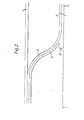
- a metal substrate, 5, is in the process of being coated with sealing material, 3.
- Elastomeric sleeve, 2, has been released at one end from restraining member 1. Where sleeve, 2, has been released it has forced sealing material, 3, into contact with substrate, 5.
- the progressive recovery of sleeve, 2, forces material, 3, in the form of a ridge, 6, against substrate, 5.
Landscapes
- Engineering & Computer Science (AREA)
- General Engineering & Computer Science (AREA)
- Manufacturing & Machinery (AREA)
- Mechanical Engineering (AREA)
- Adhesive Tapes (AREA)
Claims (17)
Priority Applications (1)
| Application Number | Priority Date | Filing Date | Title |
|---|---|---|---|
| AT83305820T ATE39741T1 (de) | 1982-09-29 | 1983-09-28 | Verfahren und gegenstand zum versiegeln eines substrates unter benutzung einer rueckstellbaren muffe. |
Applications Claiming Priority (4)
| Application Number | Priority Date | Filing Date | Title |
|---|---|---|---|
| US42720982A | 1982-09-29 | 1982-09-29 | |
| US42635682A | 1982-09-29 | 1982-09-29 | |
| US426356 | 1982-09-29 | ||
| US427209 | 1982-09-29 |
Publications (3)
| Publication Number | Publication Date |
|---|---|
| EP0104949A2 EP0104949A2 (de) | 1984-04-04 |
| EP0104949A3 EP0104949A3 (en) | 1985-10-09 |
| EP0104949B1 true EP0104949B1 (de) | 1989-01-04 |
Family
ID=27027027
Family Applications (1)
| Application Number | Title | Priority Date | Filing Date |
|---|---|---|---|
| EP83305820A Expired EP0104949B1 (de) | 1982-09-29 | 1983-09-28 | Verfahren und Gegenstand zum Versiegeln eines Substrates unter Benutzung einer rückstellbaren Muffe |
Country Status (3)
| Country | Link |
|---|---|
| EP (1) | EP0104949B1 (de) |
| DE (1) | DE3378840D1 (de) |
| GB (1) | GB2127519B (de) |
Family Cites Families (4)
| Publication number | Priority date | Publication date | Assignee | Title |
|---|---|---|---|---|
| GB717079A (en) * | 1951-10-09 | 1954-10-20 | Mclaurin Jones Company | Decalcomania paper |
| US4135553A (en) * | 1975-06-16 | 1979-01-23 | Raychem Corporation | Recoverable sleeve |
| GB1566552A (en) * | 1976-09-28 | 1980-05-08 | Highgate D J | Swellable polymers |
| DE2712077B2 (de) * | 1977-03-17 | 1980-10-02 | Aeg-Telefunken Kabelwerke Ag, Rheydt, 4050 Moenchengladbach | Verfahren zur Herstellung von Kabelgarnituren |
-
1983
- 1983-09-28 DE DE8383305820T patent/DE3378840D1/de not_active Expired
- 1983-09-28 EP EP83305820A patent/EP0104949B1/de not_active Expired
- 1983-09-28 GB GB08325896A patent/GB2127519B/en not_active Expired
Also Published As
| Publication number | Publication date |
|---|---|
| EP0104949A3 (en) | 1985-10-09 |
| GB8325896D0 (en) | 1983-11-02 |
| DE3378840D1 (en) | 1989-02-09 |
| GB2127519B (en) | 1986-12-31 |
| EP0104949A2 (de) | 1984-04-04 |
| GB2127519A (en) | 1984-04-11 |
Similar Documents
| Publication | Publication Date | Title |
|---|---|---|
| US4497926A (en) | Elastomer based adhesive compositions | |
| US6841212B2 (en) | Heat-recoverable composition and article | |
| US3415287A (en) | Protective covering and article | |
| US7264870B2 (en) | Adhesive tape | |
| US4585682A (en) | Roofing membranes | |
| JPS5836031B2 (ja) | ライナ−オユウシナイ デンキゼツエンヨウテ−プ | |
| GB1581558A (en) | Method for joining heat-recoverable sheet material | |
| EP0765451A1 (de) | Übereinanderliegende umhüllungen mit erhöhter stabilität | |
| KR20110010068A (ko) | 점착 테이프 | |
| EP0100170B1 (de) | Wärmeschrumpffähige Umhüllung und Methode zum Anbringen derselben | |
| JPH08504226A (ja) | 熱回復性組成物および物品 | |
| US4713133A (en) | Methods of adhering a self-fusing tape to a substrate | |
| US4536445A (en) | Elastomer based adhesive compositions | |
| CA1195793A (en) | Elastomer based adhesive compositions | |
| US4925715A (en) | Linerless roll of self fusing tape | |
| EP0104949A2 (de) | Verfahren und Gegenstand zum Versiegeln eines Substrates unter Benutzung einer rückstellbaren Muffe | |
| EP0680581B1 (de) | Wärmerückstellbarer gegenstand | |
| JPH05505151A (ja) | 高分子製保護物品及び該物品を採用した電気用、光学用又は流体導管用装置 | |
| EP0174206A2 (de) | Coextrudierte, rückstellbare Gegenstände | |
| JP3317663B2 (ja) | 表面保護粘着シート | |
| EP0631859A2 (de) | Kunststoffband und seine Verwendung zum Umwickeln eines Gegenstandes | |
| JPS5983617A (ja) | シ−リング方法および物品 | |
| KR100297587B1 (ko) | 가스배관 용접부 방식처리용 열수축 시트 또는 테입에 사용되는 고무계 점착제 조성물 | |
| GB2205575A (en) | Insulating adhesive tapes suitable for use with pipes placed in the soil | |
| EP4442756A1 (de) | Zusammensetzung zum schutz eines formkörpers vor korrosion |
Legal Events
| Date | Code | Title | Description |
|---|---|---|---|
| PUAI | Public reference made under article 153(3) epc to a published international application that has entered the european phase |
Free format text: ORIGINAL CODE: 0009012 |
|
| 17P | Request for examination filed |
Effective date: 19831026 |
|
| AK | Designated contracting states |
Designated state(s): AT BE CH DE FR IT LI NL SE |
|
| PUAL | Search report despatched |
Free format text: ORIGINAL CODE: 0009013 |
|
| AK | Designated contracting states |
Designated state(s): AT BE CH DE FR IT LI NL SE |
|
| 17Q | First examination report despatched |
Effective date: 19870415 |
|
| RAP1 | Party data changed (applicant data changed or rights of an application transferred) |
Owner name: RAYCHEM CORPORATION (A DELAWARE CORPORATION) |
|
| GRAA | (expected) grant |
Free format text: ORIGINAL CODE: 0009210 |
|
| AK | Designated contracting states |
Kind code of ref document: B1 Designated state(s): AT BE CH DE FR IT LI NL SE |
|
| PG25 | Lapsed in a contracting state [announced via postgrant information from national office to epo] |
Ref country code: SE Effective date: 19890104 Ref country code: NL Effective date: 19890104 Ref country code: LI Effective date: 19890104 Ref country code: IT Free format text: LAPSE BECAUSE OF FAILURE TO SUBMIT A TRANSLATION OF THE DESCRIPTION OR TO PAY THE FEE WITHIN THE PRESCRIBED TIME-LIMIT;WARNING: LAPSES OF ITALIAN PATENTS WITH EFFECTIVE DATE BEFORE 2007 MAY HAVE OCCURRED AT ANY TIME BEFORE 2007. THE CORRECT EFFECTIVE DATE MAY BE DIFFERENT FROM THE ONE RECORDED. Effective date: 19890104 Ref country code: CH Effective date: 19890104 Ref country code: BE Effective date: 19890104 Ref country code: AT Effective date: 19890104 |
|
| REF | Corresponds to: |
Ref document number: 39741 Country of ref document: AT Date of ref document: 19890115 Kind code of ref document: T |
|
| REF | Corresponds to: |
Ref document number: 3378840 Country of ref document: DE Date of ref document: 19890209 |
|
| REG | Reference to a national code |
Ref country code: CH Ref legal event code: PL |
|
| ET | Fr: translation filed | ||
| NLV1 | Nl: lapsed or annulled due to failure to fulfill the requirements of art. 29p and 29m of the patents act | ||
| PLBE | No opposition filed within time limit |
Free format text: ORIGINAL CODE: 0009261 |
|
| STAA | Information on the status of an ep patent application or granted ep patent |
Free format text: STATUS: NO OPPOSITION FILED WITHIN TIME LIMIT |
|
| 26N | No opposition filed | ||
| PGFP | Annual fee paid to national office [announced via postgrant information from national office to epo] |
Ref country code: FR Payment date: 19900919 Year of fee payment: 8 |
|
| PGFP | Annual fee paid to national office [announced via postgrant information from national office to epo] |
Ref country code: DE Payment date: 19901031 Year of fee payment: 8 |
|
| PG25 | Lapsed in a contracting state [announced via postgrant information from national office to epo] |
Ref country code: FR Effective date: 19920529 |
|
| PG25 | Lapsed in a contracting state [announced via postgrant information from national office to epo] |
Ref country code: DE Effective date: 19920602 |
|
| REG | Reference to a national code |
Ref country code: FR Ref legal event code: ST |