EP0108295A1 - Orale Dosierungsform - Google Patents
Orale Dosierungsform Download PDFInfo
- Publication number
- EP0108295A1 EP0108295A1 EP83110343A EP83110343A EP0108295A1 EP 0108295 A1 EP0108295 A1 EP 0108295A1 EP 83110343 A EP83110343 A EP 83110343A EP 83110343 A EP83110343 A EP 83110343A EP 0108295 A1 EP0108295 A1 EP 0108295A1
- Authority
- EP
- European Patent Office
- Prior art keywords
- mixture
- fatty acid
- potentiator
- mono
- lactam antibiotic
- Prior art date
- Legal status (The legal status is an assumption and is not a legal conclusion. Google has not performed a legal analysis and makes no representation as to the accuracy of the status listed.)
- Withdrawn
Links
Classifications
-
- A—HUMAN NECESSITIES
- A61—MEDICAL OR VETERINARY SCIENCE; HYGIENE
- A61K—PREPARATIONS FOR MEDICAL, DENTAL OR TOILETRY PURPOSES
- A61K31/00—Medicinal preparations containing organic active ingredients
- A61K31/33—Heterocyclic compounds
- A61K31/335—Heterocyclic compounds having oxygen as the only ring hetero atom, e.g. fungichromin
- A61K31/35—Heterocyclic compounds having oxygen as the only ring hetero atom, e.g. fungichromin having six-membered rings with one oxygen as the only ring hetero atom
-
- A—HUMAN NECESSITIES
- A61—MEDICAL OR VETERINARY SCIENCE; HYGIENE
- A61K—PREPARATIONS FOR MEDICAL, DENTAL OR TOILETRY PURPOSES
- A61K47/00—Medicinal preparations characterised by the non-active ingredients used, e.g. carriers or inert additives; Targeting or modifying agents chemically bound to the active ingredient
- A61K47/06—Organic compounds, e.g. natural or synthetic hydrocarbons, polyolefins, mineral oil, petrolatum or ozokerite
- A61K47/08—Organic compounds, e.g. natural or synthetic hydrocarbons, polyolefins, mineral oil, petrolatum or ozokerite containing oxygen, e.g. ethers, acetals, ketones, quinones, aldehydes, peroxides
- A61K47/14—Esters of carboxylic acids, e.g. fatty acid monoglycerides, medium-chain triglycerides, parabens or PEG fatty acid esters
-
- A—HUMAN NECESSITIES
- A61—MEDICAL OR VETERINARY SCIENCE; HYGIENE
- A61K—PREPARATIONS FOR MEDICAL, DENTAL OR TOILETRY PURPOSES
- A61K31/00—Medicinal preparations containing organic active ingredients
- A61K31/33—Heterocyclic compounds
- A61K31/395—Heterocyclic compounds having nitrogen as a ring hetero atom, e.g. guanethidine or rifamycins
- A61K31/40—Heterocyclic compounds having nitrogen as a ring hetero atom, e.g. guanethidine or rifamycins having five-membered rings with one nitrogen as the only ring hetero atom, e.g. sulpiride, succinimide, tolmetin, buflomedil
-
- A—HUMAN NECESSITIES
- A61—MEDICAL OR VETERINARY SCIENCE; HYGIENE
- A61K—PREPARATIONS FOR MEDICAL, DENTAL OR TOILETRY PURPOSES
- A61K31/00—Medicinal preparations containing organic active ingredients
- A61K31/33—Heterocyclic compounds
- A61K31/395—Heterocyclic compounds having nitrogen as a ring hetero atom, e.g. guanethidine or rifamycins
- A61K31/41—Heterocyclic compounds having nitrogen as a ring hetero atom, e.g. guanethidine or rifamycins having five-membered rings with two or more ring hetero atoms, at least one of which being nitrogen, e.g. tetrazole
- A61K31/425—Thiazoles
- A61K31/429—Thiazoles condensed with heterocyclic ring systems
- A61K31/43—Compounds containing 4-thia-1-azabicyclo [3.2.0] heptane ring systems, i.e. compounds containing a ring system of the formula, e.g. penicillins, penems
-
- A—HUMAN NECESSITIES
- A61—MEDICAL OR VETERINARY SCIENCE; HYGIENE
- A61K—PREPARATIONS FOR MEDICAL, DENTAL OR TOILETRY PURPOSES
- A61K31/00—Medicinal preparations containing organic active ingredients
- A61K31/33—Heterocyclic compounds
- A61K31/395—Heterocyclic compounds having nitrogen as a ring hetero atom, e.g. guanethidine or rifamycins
- A61K31/54—Heterocyclic compounds having nitrogen as a ring hetero atom, e.g. guanethidine or rifamycins having six-membered rings with at least one nitrogen and one sulfur as the ring hetero atoms, e.g. sulthiame
- A61K31/542—Heterocyclic compounds having nitrogen as a ring hetero atom, e.g. guanethidine or rifamycins having six-membered rings with at least one nitrogen and one sulfur as the ring hetero atoms, e.g. sulthiame ortho- or peri-condensed with heterocyclic ring systems
- A61K31/545—Compounds containing 5-thia-1-azabicyclo [4.2.0] octane ring systems, i.e. compounds containing a ring system of the formula:, e.g. cephalosporins, cefaclor, or cephalexine
-
- A—HUMAN NECESSITIES
- A61—MEDICAL OR VETERINARY SCIENCE; HYGIENE
- A61K—PREPARATIONS FOR MEDICAL, DENTAL OR TOILETRY PURPOSES
- A61K9/00—Medicinal preparations characterised by special physical form
- A61K9/48—Preparations in capsules, e.g. of gelatin, of chocolate
- A61K9/4891—Coated capsules; Multilayered drug free capsule shells
Definitions
- the present invention relates to an absorbable pharmaceutical preparation, wherein essentially orally inactive ⁇ -lactam antibiotics (including their pharmaceutically acceptable salts and their esters, ethers, and hydrates or hydrates of the salts) are converted into enterally or orally active products.
- the preparation contains a combination of the chosen ß-lactam antibiotic with a certain potentiator.
- the invention relates in particular to an absorbable preparation for enteral administration, characterized in that it contains a therapeutically effective amount of an essentially orally inactive ⁇ -lactam antibiotic in an absorption-increasing amount of a potentiator which consists of an aliphatic C 2 -C 18 fatty acid, a mono-, di- or triglyceride of a C 2 -C 12 fatty acid, a partial ester or full ester of propylene glycol, polyethylene glycol or a carbohydrate with a C 2 -C 12 fatty acid, a pharmaceutically acceptable ester or ether thereof or a mixture of the potentiators mentioned; if desired in conjunction with a pharmaceutically acceptable carrier.
- the preparation is preferably in "enteric coated " form, in which case it is orally active and can be used for oral administration.
- enteric coated form means that the preparation is provided with an enteric coating, either the dosage form itself, e.g. the capsule or tablet, or the two components, i.e. the ⁇ -lactam antibiotic or the potentiator, as will be explained in more detail below.
- the invention also relates to a method for converting substantially orally inactive ⁇ -lactam antibiotics into enterally active products, characterized in that the aforementioned antibiotic is combined with an absorption-increasing amount of a potentiator, which consists of an aliphatic C 2 -C 18 fatty acid , a mono-, di- or triglyceride of a C 2 -C 12 fatty acid, a partial or total ester of propylene glycol, polyethylene glycol or a carbohydrate with a C 2 -C 12 fatty acid, a pharmaceutically acceptable ester or ether thereof or one Mixture of the potentiators mentioned; and, if desired, the combination product is combined with a pharmaceutically acceptable carrier.
- a potentiator which consists of an aliphatic C 2 -C 18 fatty acid , a mono-, di- or triglyceride of a C 2 -C 12 fatty acid, a partial or total ester of propylene glyco
- the combination product is preferably converted to "enteric coated” form, the product obtained being orally active and can be used for oral administration.
- Preferred potentiators are saturated C 6 -C 12 fatty acids, unsaturated C 16 -C 18 fatty acids, mono-, di- or triglycerides of C S -C 12 fatty acids or mixtures thereof, edible oils with the potentiators mentioned and mixtures thereof; the preferred potentiators are mono- and diglyceride mixtures of C 8 / C 10 saturated fatty acids with a predominant proportion of monoglyceride.
- the glyceride mixture content is preferably in the range between approximately 33 and approximately 98% by weight of the preparation, preferably approximately 89% by weight of the preparation.
- Belgian Patent No. 567,598 discloses an oral (suspension) or parenteral method for administration by combining an antibiotic, e.g. a penicillin, with a fatty acid glyceride mixture, preferably a triglyceride mixture. According to the invention, however, it was found that unexpectedly high antibiotic blood levels can be achieved by using an "enteric" system in connection with the antibiotic / potentiator combination. This finding is essential because it has also been found that therapeutically unacceptable low antibiotic blood levels are obtained when the ⁇ -lactam antibiotic / potentiator combination is administered as a solution / suspension, as shown below.
- ⁇ -lactam antibiotics means compounds with a ⁇ -lactam ring as the central structural element, ie the structural element which can be substituted in different ring positions and / or condensed with other ring systems which may themselves be substituted or unsubstituted.
- Some examples of known ⁇ -lactam antibiotics are penicillins, cephalosporins, for example ceftriaxone, monocyclic ⁇ -lactams, for example azthreonam; Thienamycin and its derivatives and the clavulanic acid derivatives, including the pharmaceutically acceptable salts of the compounds mentioned.
- the potentiator is, for example, a C 2 -C 18 straight-chain or branched-chain or saturated or unsaturated fatty acid.
- fatty acids are butyric acid, caproic acid, caprylic acid, capric acid, lauric acid, myristic acid, palmitic acid, stearic acid, lauroleic acid (A9-dodecylenic acid), palmitoleic acid, oleic acid, ricinoleic acid, linoleic acid, linolenic acid, etc.
- Preferred potentiators are C 2 -C 12 straight-chain fatty acids , saturated or unsaturated mono-, di- or triglycerides or mixtures thereof, partial esters or full esters of propylene glycol, polyethylene glycol and carbohydrates with C 2 -C 12 fatty acids and pharmaceutically acceptable esters or ethers of these mono- or diglycerides.
- fatty acids represents a group of saturated or unsaturated, monobasic aliphatic carboxylic acids which form esters with glycerol or other alcohols, resulting in fats, oils, waxes and other lipids.
- glycolides refers to esters of glycerin, including fats and oils, in which up to three molecules of fatty acid with one molecule of glycerin are bound. Although the majority of the same fatty acid is used, mixed fatty acid glycerides can be used. When using such glycerides of mixed fatty acids, optically active compounds can occur which also form part of the present invention.
- esters and ethers of the mono- and diglycerides mentioned or the partial esters mentioned can also be used as potentiators.
- Such esters and ethers can be represented by the formulas wherein R and R 'C 2 -C 12 fatty acid residues can have the same or different meanings and R "O represents an ester or ether group.
- Suitable esterification agents are, for example, those which are formed from pharmaceutically acceptable weak acids /, such as tartaric acid and its diacetyl derivatives, acetic acid, ascorbic acid and citric acid or phosphoric acids with a monophosphate group which can form a monophosphate ester.
- pharmaceutically acceptable weak acids / such as tartaric acid and its diacetyl derivatives, acetic acid, ascorbic acid and citric acid or phosphoric acids with a monophosphate group which can form a monophosphate ester.
- Suitable ethers can be formed by reacting the mono- or dihydroxy function or the mono- or diglyceride with a reactive lower alkyl, alkenyl, alkynyl, aryl or substituted aryl compound, the corresponding pharmaceutically acceptable ether being formed. This implementation takes place in a manner known per se.
- Rats weighing 250 g are given 20 mg / kg of the ⁇ -lactam antibiotic intravenously, orally and enterally.
- the antibiotics are placed in distilled water or in one of the potentiators described above, for example CAPMUL 8210 or CAPMUL MCM90 (trademark of Stokely-Van Camp Inc., Columbus, Ohio), ie mixtures of mono- and diglycerides with C. 8 / C 10 saturated fatty acids with 70 or 90% monoglyceride, and administered to 0.025 to 1.0 ml.
- Intravenous administrations of 0.5 ml were carried out as controls.
- the antibiotic was used as a vehicle in distilled water or in one of the potentiators described above.
- the plasma levels of the preparations prepared in the above manner after the various modes of administration were initially measured by cardiac puncture of the rats using a heparinized syringe. Subsequently, three rats were either killed and bled, or blood samples were taken from the tail at different intervals; the blood samples were pooled and centrifuged immediately. Blood monkeys were taken individually from the vein and femoral artery using a heparinized syringe. The blood samples containing antibiotics were examined using microbiological "large plate” analysis according to Lees and Tootill, Analyst 80, pages 95, 110 and 531 (1955). In the case of ceftriaxone, the sample was deproteinized by adding acetonitrile before analysis. E. coli 1346 was used as the microorganism for determining the plasma levels of ceftriaxone.
- the first table shows the blood levels of ceftriaxone (acid form) in the rat and also the significantly higher blood levels when enteral administration of the antibiotic in CAPMUL 8210 compared to enteral administration of the antibiotic in water.
- the second table shows in the rat the blood levels after administration of the sodium salt of ceftriaxone intravenously in water and again the considerably higher blood levels after enteral administration of the antibiotic in CAPMUL 8210 compared to enteral administration in water. Blood levels were also obtained after oral administration of the sodium salt of ceftriaxone in suspension with CAPMUL 8210, although unacceptably low. This corresponds to the information in Belgian patent No. 567,598 mentioned above.
- the third table in the rat shows the results of enteral absorption of the sodium salt of ceftriaxone in suspension with other glyceride potentiators, including CAPMUL MCM90 (similar composition to CAPMUL 8210, but with about 90% monoglycerides compared to the 70% in CAPMUL 8210) .
- the fourth table shows the blood levels of the sodium salt of ceftriaxone in a second species, the squirrel monkey.
- the blood levels are specified for the N a-triumsalz of ceftriaxone after intravenous administration in water, after enteral administration, in CAPMUL 8210 or water, and after oral administration in suspension with CAPMUL 8210 and also in "enteric coated” hard gelatine capsules mg 20 Sodium salt of ceftriaxone in suspension with 100 ⁇ g CAPMUL 8210. Similar to the rat, after enteral administration of the sodium salt of ceftriaxone in CAPMUL 8210, significant blood levels were reached in the monkey, but not when the antibiotic was administered in water.
- Dosage forms in the range from about 25 to about 2000 mg, preferably 50 to about 500 mg, of ⁇ -lactam antibiotic with the potentiator / carrier are used for use in human medicine.
- An in vitro model for determining transport characteristics and thereby identifying usable carriers for the systemic delivery of the ⁇ -lactam antibiotics consists of a cell for measuring the permeability of a synthetic membrane in different carriers and at different concentrations of the antibiotic.
- the model used is described in Behl et al., Journal of Investigative Dermatology 75, pages 346-352, 1980 and Durrheim et al., Journal of Pharmaceutical Sciences 69, No. 7, pages 781-786, 1980.
- As a synthetic membrane uses a siloxane liquid membrane.
- the cell consists of a container with two compartments and the membrane in between.
- the receiving compartment contains a pH 7.4 buffer (Clarks-Subs buffer) and the donor compartment contains the selected potentiator / carrier, ie CAPMUL 8210 or diacetin, etc., with a C 1 -C 8 alkanol as lipophilicity-increasing agent.
- Radio-labeled ß-lactam antibiotic is used in the Donor compartment presented. At zero time, samples are taken from the recipient compartment at certain time intervals. The measured amount of antibiotics in the recipient compartment is shown as a function of time in a diagram. The curve is linear and is used to calculate the permeability coefficient (P value) according to Fick's first law of diffusion.
- a buffer / buffer control is used for comparison purposes.
- the effectiveness of the carrier is a function of the P-value, ie a P-value greater than that of the buffer / buffer control indicates an increase in absorption.
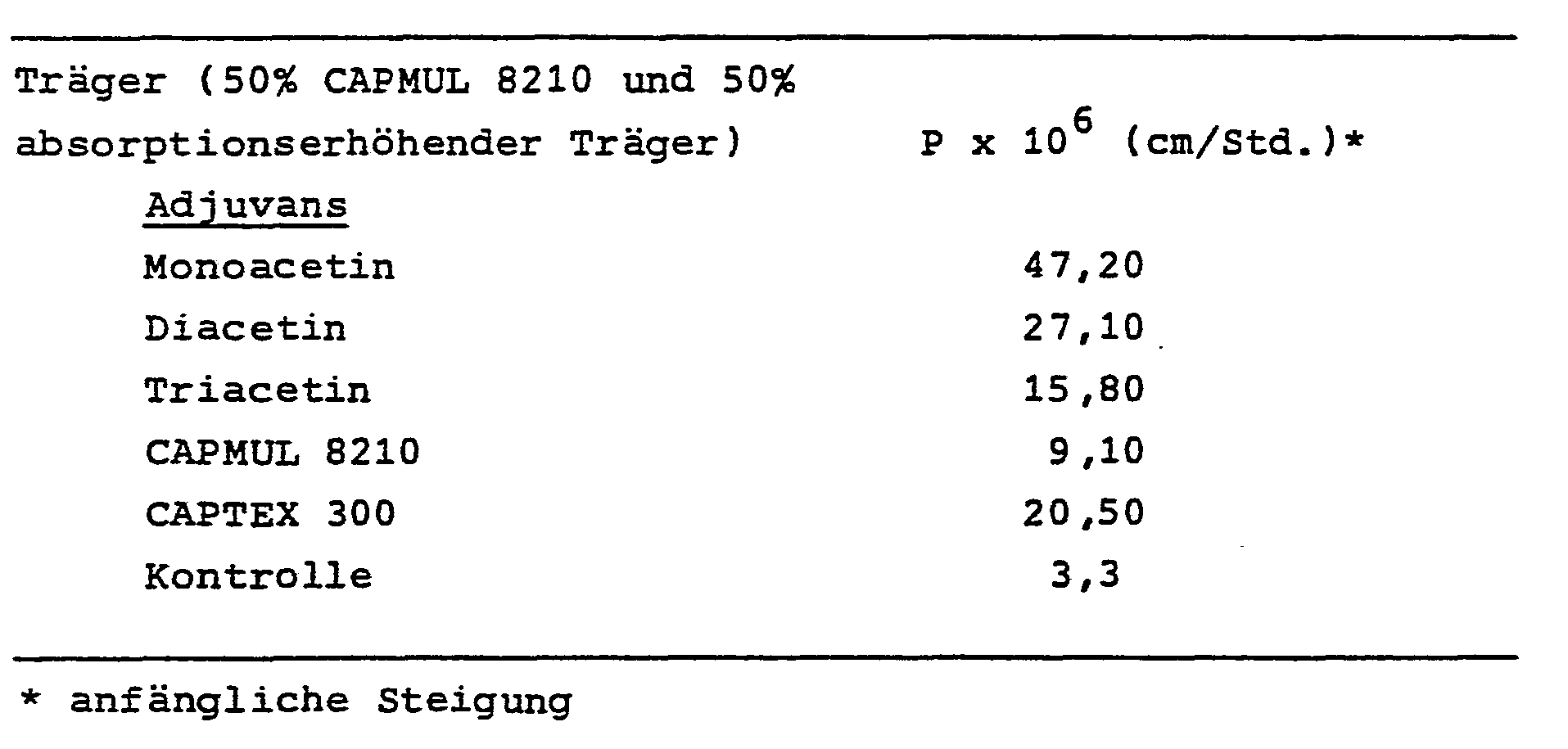
- the permeability coefficients of various potentiators / carriers as a 50% mixture with CAPMUL 8210 are as follows:
- the ß-lactam antibiotic / potentiator mixture is administered orally using a fixed "enteric coated” dosage form in order to protect the ß-lactam antibiotic from gastric acid.
- the carriers used for this are primarily in liquid form, but can be in solid form.
- the mixtures can be filled into hard or soft capsules or the liquid carrier can be adsorbed on a solid carrier, for example on starch, in order to maintain a flow capable powder and then filled into the capsules mentioned or compressed into tablets with a suitable "enteric coating".
- Other dosage forms may include "enteric coated” or non-"enteric coated” systems, i.e. Capsules or tablets in which the ß-lactam antibiotic and the potentiator themselves are “enteric coated”.
- the "enteric coating” of the individual ⁇ -lactam antibiotic and / or potentiator can be achieved by using microencapsulated forms of the ⁇ -lactam and / or potentiator in order to obtain a flowable powder for filling in hard or soft capsules or for compression as tablets be accomplished.
- a possible embodiment is an "enteric coated” microcapsule or bead-form of the ⁇ -lactam antibiotic either alone or as a suspension in a liquid potentiator, which mixture can then be encapsulated in an "enteric coated” or non-"enteric coated” capsule .
- the preparations mentioned are encased in "enteric coating” materials so that the ß-lactam antibiotic is protected from the gastric juice and the optimal delivery of the ß-lactam / potentiator combination in the intestine is ensured.
- the "enteric coating” material is not affected by the gastric juice, but is dissolved in the intestinal juice, whereby the active ingredient is released.
- the effectiveness of such "enteric coated” products can be determined using known USP methods.
- enteric coating materials can be used with or without plasticizers, such as acetylated glycerides, diethyl phthalate, etc., using methods known to those skilled in the art.
- the “enteric coating” is applied to about 1-10%, preferably 2-8% of the capsule or tablet weight.
- ⁇ -lactam antibiotic / potentiator ratios between about 1:32 to about 1: 0.5, preferably 1:16 to 1: 3, in particular about 1: 8, are used. As noted above, significant rat antibiotic levels are achieved with an antibiotic / potentiator ratio up to about 1: 100.
- the preparations according to the invention can also contain auxiliaries known per se in order to achieve a desired consistency.
- the preparations according to the invention can be solid or liquid formulations for oral administration.
- they can be in the form of ordinary capsules or "enteric coated” capsules, microcapsules or beadlets, or tablets, such as “enteric coated” tablets or tablets with an "enteric coated” microencapsulated mixture of potentiator and ⁇ -lactam antibiotic, or the two components can each be "enteric coated” by themselves.
- These forms of preparation can additionally contain conventional pharmaceutical carriers and additives, in particular viscosity-improving and / or structure-forming or matrix-forming additives in order to maintain a suitable viscosity and physical structure.
- Suitable additives are, for example, thickeners, such as, for example, highly disperse silica (for example the commercial products "37 Aerosil”), bentonites, colloidal clay, carboxymethyl celluloses, modified montmorillonites, for example alkylammonium salts of montmorillonites (for example the commercial products "Bentone”), in which the alkyl group 16- Contain 18 carbon atoms, organic thickening and structure-forming agents, such as saturated higher fatty acids and alcohols with, for example, 12-20 carbon atoms, such as stearic or palmitic acid, stearyl or cetyl alcohol, waxes such as beeswax, synthetic esters of higher fatty acids and higher fatty alcohols, walnut fat, monoglycerides of saturated or unsaturated higher fatty acids, e.g.
- thickeners such as, for example, highly disperse silica (for example the commercial products "37 Aerosil”), bentonites, colloidal clay, carboxymethyl cellulose
- Monoglycerides of stearic acid, palmitic acid or oleic acid, partial glycerides of polyhydroxy fatty acids eg the commercial products "Softigen 701"
- gel-forming agents such as aluminum stearate
- dispersants such as anionic, nonionic and cationic foam generators
- emulsifiers such as lecithin, and similar salts .
- the preparations can also contain pharmaceutical adjuvants, for example binding agents or lubricants for tableting, stabilizers, for example EDTA, antioxidants, for example ascorbic acid, flavoring agents, preservatives, for example methyl or propyl paraben, and buffers, for example phosphates.
- Dyes that can be used are, for example, the acceptable "food, drug or cosmetic" dyes.
- titanium dioxide can be used as an opacifier.
Landscapes
- Health & Medical Sciences (AREA)
- Chemical & Material Sciences (AREA)
- Animal Behavior & Ethology (AREA)
- General Health & Medical Sciences (AREA)
- Medicinal Chemistry (AREA)
- Pharmacology & Pharmacy (AREA)
- Epidemiology (AREA)
- Life Sciences & Earth Sciences (AREA)
- Veterinary Medicine (AREA)
- Public Health (AREA)
- Engineering & Computer Science (AREA)
- Bioinformatics & Cheminformatics (AREA)
- Chemical Kinetics & Catalysis (AREA)
- General Chemical & Material Sciences (AREA)
- Oil, Petroleum & Natural Gas (AREA)
- Pharmaceuticals Containing Other Organic And Inorganic Compounds (AREA)
- Medicinal Preparation (AREA)
- Nitrogen Condensed Heterocyclic Rings (AREA)
Abstract
Description
- Die vorliegende Erfindung betrifft ein absorbierbares pharmazeutisches Präparat, wobei im wesentlichen oral inaktive ß-Lactam-Antibiotika (einschliesslich ihre pharmazeutisch verträgliche Salze und ihre Ester, Aether, und Hydrate bzw. Hydrate der Salze) in enteral oder oral wirksame Produkte übergeführt werden. Das Präparat enthält eine Kombination des gewählten ß-Lactam-Antibiotikums mit einem bestimmten Potentiator. Die Erfindung betrifft insbesondere ein absorbierbares Präparat für enterale Verabreichung, dadurch gekennzeichnet, dass es eine therapeutisch wirksame Menge eines im wesentlichen oral inaktiven ß-Lactam-Antibiotikums in einer absorptionserhöhenden Menge eines Potentiators enthält, der aus einer aliphatischen C2-C18-Fettsäure, einem Mono-, Di- oder Triglycerid einer C2-C12-Fettsäure, einem partiellen Ester oder Vollester von Propylenglykol, Polyäthylenglykol oder einem Kohlenhydrat mit einer C2-C12-Fettsäure, einem pharmazeutisch verträglichen Ester bzw. Aether davon oder einem Gemisch der erwähnten Potentiatoren besteht; erwünschtenfalls in Verbindung mit einem pharmazeutisch verträglichen Träger. Das Präparat liegt vorzugsweise in "enteric coated" Form vor, in welchem Falle es oral wirksam ist und für die orale Verabreichung verwendet werden kann.
- Die Definition "enteric coated" Form bedeutet, dass das Präparat mit einem magensaftresistenten Ueberzug versehen ist, entweder die Dosierungsform selbst, z.B. die Kapsel oder Tablette, oder auch die beiden Komponenten, d.h. das ß-Lactam-Antibiotikum bzw. der Potentiator, wie nachstehend näher erläutert wird.
- Die Erfindung betrifft ebenfalls ein Verfahren zur Ueberführung von im wesentlichen oral inaktiven ß-Lactam-Antibiotika in enteral wirksame Produkte, dadurch gekennzeichnet, dass man das erwähnte Antibiotikum mit einer absorptionserhöhenden Menge eines Potentiators kombiniert, der aus einer aliphatischen C2-C18-Fettsäure, einem Mono-, Di- oder Triglycerid einer C2-C12-Fettsäure, einem partiellen oder totalen Ester von Propylenglykol, Polyäthylenglykol oder einem Kohlenhydrat mit einer C2-C12-Fettsäure, einem pharmazeutisch verträglichen Ester bzw. Aether davon oder einem Gemisch der erwähnten Potentiatoren besteht; und erwünschtenfalls das Kombinationsprodukt mit einem pharmazeutisch verträglichen Träger vereinigt.
- Wie gesagt, wird das Kombinationsprodukt vorzugsweise in "enteric coated" Form umgewandelt, wobei das erhaltene Produkt oral wirksam ist und für die orale Verabreichung verwendet werden kann.
- Bevorzugte Potentiatoren sind gesättigte C6-C12-Fettsäuren, ungesättigte C16-C18-Fettsäuren, Mono-, Di- oder Triglyceride von CS-C12-Fettsäuren oder Mischungen davon, Speiseöle mit den erwähnten Potentiatoren sowie Mischungen davon; die bevorzugten Potentiatoren sind Mono- und Diglycerid-Mischungen von C8/C10 gesättigten Fettsäuren mit einem vorwiegenden Anteil an Monoglycerid. Der Glyceridgemisch-Anteil liegt vorzugsweise im Bereich zwischen etwa 33 und etwa 98 Gew.-% des Präparates, vorzugsweise bei etwa 89 Gew.-% des Präparates. eine Methode zur oralen Verabreichung durch Kombination eines oral wirksamen Arzneimittels, z.B. eines Antibiotikums,mit einem Monoglycerid oder einem Triglycerid einer C6-C12-Fettsäure, welche eine erhöhte orale Absorption bewirkt. Es war im Lichte dieses Standes der Technik unerwartet, dass die Kombination eines oral wirksamen ß-Lactam-Antibiotikums mit einem Potentiator, z.B. CAPMUL 8210 (einem Mono- und Diglycerid-Gemisch einer C8/C10 gesättigten Fettsäure) keine Wirkungssteigerung (d.h. keine verbesserte gastrointestinale Absorption) bewirkte, wogegen die Kombination eines oral inaktiven ß-Lactam-Antibiotikums mit CAPMUL 8210 oder CAPMUL MCM90 in "enteric coated" Dosierungsform nach oraler Verabreichung therapeutisch signifikante Antibiotika-Blutspiegel zeigte. Weitere Versuche mit Kombinationen anderer ß-Lactam-Antibiotika und Mischungen von Mono-, Di- und Triglyceriden, ihren pharmazeutisch verträglichen Salzen, Estern und Aethern und den Fettsäuren bestätigten diesen Effekt, wie nachstehend gezeigt wird.
- Die belgische Patentschrift Nr. 567,598 offenbart eine orale (als Suspension) oder parenterale Methode zur Verabreichung durch Kombination eines Antibiotikums, z.B. eines Penicillins, mit einem Fettsäureglyceridgemisch, vorzugsweise einem Triglyceridgemisch. Erfindungsgemäss wurde jedoch gefunden, dass unerwartet hohe Antibiotika-blutspiegel erreicht werden können durch Verwendung eines "enteric" Systems in Verbindung mit der Antibiotikum/ Potentiator-Kombination. Dieser Befund ist wesentlich, denn es wurde ebenfalls gefunden, dass therapeutisch unannehmbare, niedrige Antibiotika-Blutspiegel erhalten werden, wenn man die ß-Lactam-Antibiotikum/Potentiator-Kombination als Lösung/Suspension verabreicht, wie nachstehend gezeigt wird.
- Der Ausdruck "ß-Lactam-Antibiotika" bedeutet Verbindungen mit einem ß-Lactamring als zentrales Strukturelement, d.h. dem Strukturelement

- Der Potentiator ist z.B. eine C2-C18 geradkettige oder verzweigtkettige bzw. gesättigte oder ungesättigte Fettsäure. Beispiele solcher Fettsäuren sind Buttersäure, Capronsäure, Caprylsäure, Caprinsäure, Laurinsäure, Myristinsäure, Palmitinsäure, Stearinsäure, Lauroleinsäure (A9-Dodecylensäure), Palmitoleinsäure, Oelsäure, Ricinolsäure, Linolsäure, Linolensäure, etc. Bevorzugte Potentiatoren sind C2-C12 geradkettige oder verzweigtkettige, gesättigte oder ungesättigte Mono-, Di- oder Triglyceride oder Mischungen davon, partielle Ester oder Vollester von Propylenglykol, Polyäthylenglykol und Kohlenhydraten mit C2-C12-Fettsäuren sowie pharmazeutisch verträgliche Ester oder Aether dieser Mono- oder Diglyceride.
- Der Ausdruck "Fettsäuren" stellt eine Gruppe gesättigter oder ungesättigter, monobasischer aliphatischer Carbonsäuren dar, welche mit Glycerin oder anderen Alkoholen Ester bilden, wobei Fette, Oele, Wachse und andere Lipide entstehen.
- Der Ausdruck "Glyceride" bezieht sich auf Ester von Glycerin, einschliesslich Fette und Oele, worin bis auf drei Moleküle Fettsäure mit einem Molekül Glycerin gebunden sind. Obwohl mehrheitlich die gleiche Fettsäure verwendet wird, können Glyceride von gemischten Fettsäuren verwendet werden. Bei Verwendung von solchen Glyceriden gemischter Fettsäuren können optisch aktive,Verbindungen auftreten, welche ebenfalls einen Teil der vorliegenden Erfindung darstellen.
- Als Potentiatoren kommen ebenfalls die Ester und Aether der erwähnten Mono- und Diglyceride bzw. der erwähnten partiellen Ester in Frage. Solche Ester und Aether können durch die Formeln

- Geeignete Veresterungsagenzien sind beispielsweise solche, die aus pharmazeutisch verträglichen schwachen gebildet werden Säuren/, wie Weinsäure und ihre Diacetylderivate, Essigsäure, Ascorbinsäure und Zitronensäure oder Phosphorsäuren mit einer Monophosphatgruppe, die einen Monophosphatester bilden kann.
- Geeignete Aether können gebildet werden durch Umsetzung der Mono- oder Dihydroxyfunktion bzw. des Mono-oder Diglycerids mit einer reaktionsfähigen niederen Alkyl-, Alkenyl-, Alkinyl-, Aryl- oder substituierten Arylverbindung, wobei der entsprechende, pharmazeutisch verträgliche Äther entsteht. Diese Umsetzung erfolgt in an sich bekannter Weise.
- Zwei Versuchsmethoden zur Ermittlung verwendbarer Potentiatoren, d.h. ein vivo und ein in vitro Versuch, werden nachstehend beschrieben.
- 250 g schwere Ratten werden 20 mg/kg des ß-Lactam-Antibiotikums intravenös, oral und enteral verabreicht. Für die orale Verabreichung werden die Antibiotika in destilliertem Wasser vorgelegt bzw. in einem der oben beschriebenen Potentiatoren, z.B. CAPMUL 8210 oder CAPMUL MCM90 (Warenzeichen von Stokely-Van Camp Inc., Columbus, Ohio), d.h. Mischungen von Mono- und Diglyceriden mit C8/C10 gesättigten Fettsäuren mit 70 bzw. 90% Monoglycerid, und zu 0,025 bis 1,0 ml verabreicht. Als Kontrollen wurden intravenöse Verabreichungen zu 0,5 ml durchgeführt. Für die enterale Verabreichung wurde das Antibiotikum in destilliertem Wasser bzw. in einem der oben beschriebenen Potentiatoren als Vehikel eingesetzt. Diese Mischungen wurden zu 0,025 bis 1,0 ml in das Duodenum unmittelbar unterhalb des Pylorus verabreicht. Suspensionen mit 20 mg Ceftriaxon in 100 ul CAPMUL 8210 oder CAPMUL MCM90 in "enteric coated" Hartgelatinekapseln wurden ebenfalls Totenkopfäffchen von 0,5-1 kg oral verabreicht. Dieser Tierspezies wurde ebenfalls in 1,0 ml Wasser intravenös und enteral sowie auch, in CAPMUL 8210 oder CAPMUL MCM90 dispergiert, enteral und oral verabreicht.
- Die Plasmaspiegel der in obiger Weise hergestellten Präparate nach den verschiedenen Arten der Verabreichung wurden anfänglich durch Kardialpunktur der Ratten mit Hilfe einer heparinisierten Spritze gemessen. Anschliessend wurden drei Ratten entweder getötet und ausgeblutet, oder es wurden in verschiedenen Zeitabständen am Schwanz Blutproben entnommen; die Blutproben wurden vereinigt und sofort zentrifugiert. Den Totenkopfäffchen wurden einzeln aus Vena bzw. Arteria femoralis mit Hilfe einer heparinisierten Spritze Blutproben entnommen. Die Antibiotika enthaltenden Blutproben wurden anhand mikrobiologischer "Grossplatten"-Analyse gemäss Lees und Tootill, Analyst 80, Seiten 95, 110 und 531 (1955) untersucht. Im Falle von Ceftriaxon wurde die Probe vor der Analyse durch Zusatz von Acetonitril entproteinisiert. Als Mikroorganismus zur Feststellung der Plasmaspiegel an Ceftriaxon wurde E. coli 1346 verwendet.
- Die Ergebnisse der Blutspiegel an Ceftriaxon (ug/ml aus 250 g Ratten) in verschiedenen Zeitabständen nach einer Dosis von 20 mg des Antibiotikums (in Wasser bzw. in Potentiator) pro kg Körpergewicht werden in den nachstehenden Tabellen festgehalten.
- Die erste Tabelle zeigt an der Ratte die Blutspiegel an Ceftriaxon (Säureform) und ebenfalls die signifikant grösseren Blutspiegel bei enteraler Verabreichung des Antibiotikums in CAPMUL 8210 im Vergleich zur enteralen Verabreichung des Antibiotikums in Wasser. Die zweite Tabelle zeigt an der Ratte die Blutspiegel nach Verabreichung des Natriumsalzes von Ceftriaxon intravenös in Wasser und wiederum die erheblich grösseren Blutspiegel nach enteraler Verabreichung des Antibiotikums in CAPMUL 8210 im Vergleich zur enteralen Verabreichung in Wasser. Auch nach oraler Verabreichung des Natriumsalzes von Ceftriaxon in Suspension mit CAPMUL 8210 wurden Blutspiegel, obwohl unannehmbar niedrig, erhalten. Dies entspricht den Angaben der oben erwähnten belgischen Patentschrift Nr. 567,598. Die dritte Tabelle zeigt an der Ratte die Ergebnisse der enteralen Absorption des Natriumsalzes von Ceftriaxon in Suspension mit anderen Glycerid-Potentiatoren, einschliesslich CAPMUL MCM90 (ähnliche Zusammensetzung wie CAPMUL 8210, jedoch mit etwa 90% Monoglyceriden im Vergleich zu den 70% in CAPMUL 8210).
- Die vierte Tabelle zeigt die Blutspiegel des Natriumsalzes von Ceftriaxon in einer zweiten Spezies, dem Totenkopfäffchen. Die Blutspiegel sind angegeben für das Na-triumsalz von Ceftriaxon nach intravenöser Verabreichung in Wasser, nach enteraler Verabreichung in CAPMUL 8210 oder Wasser, sowie nach oraler Verabreichung in Suspension mit CAPMUL 8210 und auch in "enteric coated" Hartgelatinekapseln mit 20 mg Natriumsalz von Ceftriaxon in Suspension mit 100 ug CAPMUL 8210. Aehnlich wie an der Ratte wurden nach enteraler Verabreichung des Natriumsalzes von Ceftriaxon in CAPMUL 8210 am Affen bedeutende Blutspiegel erreicht, jedoch nicht wenn die Verabreichung des Antibiotikums in Wasser erfolgte. Nach oraler Verabreichung des Antibiotikums in Suspension mit CAPMUL 8210 wurden nur niedrige Blutspiegel erreicht. Nach Verabreichung des Natriumsalzes von Ceftriaxon und CAPMUL 8210 in "enteric coated" Kapseln an drei Affen wurden gute Blutspiegel bei allen Affen beobachtet.


- Die gleiche in vivo Versuchsführung und mikrobiologische in vitro Analyse wurde verwendet für die Untersuchung weiterer ß-Lactam-Antibiotika in Kombination mit dem Potentiator CAPMUL 8210. Die Antibiotika und die Testorganismen sind nachstehend aufgeführt:
- Cefotaxim - E. coli 136
- Cephalexin -.M. lutea ATCC 9341
- Cefazolin - B. subtilis ATCC 6633
- Cefamandol - M. lutea ATCC 9341
- Cephradin - M. lutea ATCC 9341
- Penicillin G - M. lutea ATCC 9341
- Piperacillin - M. lutea ATCC 9341
- Thienamycin - S. aureus ATCC 25923
- Cefoxitin - E. coli 1346
- Moxalactam - E. coli ATCC 10536
- Cephalothin - B. subtilis ATCC 6633 Amoxicillin - M. lutea ATCC 9341
- Mezlocillin - M. lutea ATCC 9341
- Cefoperazon - K. pneumoniae A
- Azthreonam - E. coli Leo - HA2M4
- Amdinocillin - E. coli Leo - HA2
- Die Ergebnisse als Blutspiegelwerte nach Verabreichung, an 250 g Ratten, von 20 mg des Antibiotikums (in Salzlösung oder Wasser oder mit dem Potentiator CAPMUL 8210) pro kg Körpergewicht sind in den anschliessenden Tabellen 5-20 festgehalten:


- Wie oben erläutert erfolgte keine Erhöhung der Plasmaspiegel bei Verwendung des Potentiators mit Cephalexin und Cephradin, zwei an sich oral wirksamen Cephalosporinen, oder mit Amoxicillin, einem oral wirksamen Penicillin. Verstärkung der intestinalen (enteralen) Absorption erfolgte bei Verwendung von CAPMUL 8210 oder CAPMUL MCM90 mit den anderen, an sich oral inaktiven ß-Lactam-Antibiotika. Aehnlich wie für Ceftriaxon zeigten diese ß-Lactam-Antibiotika erhöhte enterale Absorption mit CAPMUL 8210 oder ähnlichen Trägern. Diese Kombinationen können, durch ein "enteric coating" geschützt, auch oral verabreicht werden.
- Für die Verwendung in der Humanmedizin werden Dosierungsformen im Bereich von etwa 25 bis etwa 2000 mg, vorzugsweise 50 bis etwa 500 mg an ß-Lactam-Antibiotikum mit dem Potentiator/Träger verwendet.
- Ein in vitro-Modell zur Ermittlung von Transportcharakteristika und dadurch Identifikation von verwendbaren Trägern für die systemische Abgabe der ß-Lactam-Antibiotika besteht aus einer Zelle zur Messung der Durchlässigkeit einer synthetischen Membran in verschiedenen Trägern und bei verschiedenen Konzentrationen des Antibiotikums. Das verwendete Modell wird beschrieben in Behl et al., Journal of Investigative Dermatology 75, Seiten 346-352, 1980 und Durrheim et al., Journal of Pharmaceutical Sciences 69, Nr. 7, Seiten 781-786, 1980. Als synthetische Membran wird eine Siloxan-Flüssigmembran verwendet. Die Zelle besteht aus einem Behälter mit zwei Abteilen und der Membran dazwischen. Das Empfängerabteil ("receiving compartment") enthält ein pH 7,4 Buffer (Clarks-Subs buffer) und das Spenderabteil ("donor compartment") enthält den ausgewählten Potentiator/Träger, d.h. CAPMUL 8210 oder Diacetin, etc., mit einem C1-C8-Alkanol als die Lipophilie erhöhendes Agens. Radio-markiertes ß-Lactam-Antibiotikum wird im Donorabteil vorgelegt. Bei Zeit Null werden in bestimmten Zeitabständen Proben aus dem Empfängerabteil genommen. Die gemessene Antibiotikamenge im Empfängerabteil wird als Funktion der Zeit in einem Diagramm aufgeführt. Die Kurve ist linear und dient zur Berechnung des Durchlässigkeitskoeffizientes (P-Wert) gemäss Ficks erstem Diffusionsgesetz. Eine Puffer/Puffer-Kontrolle wird zu Vergleichszwecken eingesetzt. Die Effektivität des Trägers ist eine Funktion des P-Wertes, d.h. ein P-Wert grösser als derjenige der Puffer/Puffer-Kontrolle zeigt Absorptionserhöhung an.
- Die Durchlässigkeitskoeffizienten verschiedener Potentiatoren/Träger als 50% Gemisch mit CAPMUL 8210 sind wie folgt:
- Wie oben erwähnt erfolgt die orale Verabreichung des ß-Lactam-Antibiotikum/Potentiator-Gemisches mit Hilfe einer festen "enteric coated"-Dosierungsform, um das ß-Lactam-Antibiotikum vor der Magensäure zu schützen. Die dafür verwendeten Träger sind vornehmlich in flüssiger Form, können jedoch in fester Form vorliegen. Die Gemische können in Hart- oder Weichkapseln gefüllt oder der flüssige Träger kann an einem festen Träger adsorbiert werden, beispielsweise an Stärke zwecks Erhalts eines fliessfähigen Pulvers und anschliessend in die erwähnten Kapseln abgefüllt oder zu Tabletten mit geeignetem "enteric coating" komprimiert werden.
- Andere Dosierungsformen können "enteric coated" bzw. nicht-"enteric coated" Systeme beinhalten, d.h. Kapseln oder Tabletten, worin das ß-Lactam-Antibiotikum und der Potentiator selbst "enteric coated" sind. Das "enteric coating" des einzelnen ß-Lactam-Antibiotikums und/oder Potentiators kann durch Verwendung von mikro-gekapselten Formen des ß-Lactams und/oder Potentiators zwecks Erhalts eines fliessfähigen Pulvers für die Abfüllung in Hart-oder Weichkapseln oder zur Komprimierung als Tabletten bewerkstelligt werden. Eine mögliche Ausführungsform ist eine "enteric coated" Mikrokapsel oder Beadlet-form des ß-Lactam-Antibiotikums entweder allein oder als Suspension in einem flüssigen Potentiator, welches Gemisch anschliessend in eine "enteric coated" oder nicht-"enteric coated" Kapsel eingekapselt werden kann.
- Die erwähnten Präparate sind in "enteric coating" Materialien eingehüllt, damit das ß-Lactam-Antibiotikum vor dem Magensaft geschützt ist und die optimale Abgabe der ß-Lactam/Potentiator-Kombination im Darm gewährleistet wird. Das "enteric coating" Material wird durch den Magensaft nicht beeinflusst, wird jedoch im Darmsaft aufgelöst, wobei der aktive Wirkstoff freigesetzt wird. Die Wirksamkeit solcher "enteric coated" Produkte kann anhand bekannter USP-Methoden ermittelt werden.
- Als "enteric-coating" Materialien kommen z.B. in Frage:
- - Celluloseacetatphthalat
- - Hydroxypropylmethylcellulosephthalat
- - Polyvinylacetatphthalat
- - Shellac
- - Methacrylsäure und Methacrylsäureester
- - Zein
- - Andere dem Fachmann bekannten Materialien.
- Diese "enteric coating" Materialien können mit oder ohne Weichmacher,wie acetylierte Glyceride, Diäthylphthalat usw., eingesetzt werden, unter Verwendung von dem Fachmann bekannten Methoden.
-


- Das "enteric coating" wird zu etwa 1-10%, vorzugsweise 2-8% des Kapsel- bzw. Tablettengewichts appliziert.
- In den Zubereitungsformen werden ß-Lactam-Antibiotikum/ Potentiator-Verhältnisse zwischen etwa 1:32 bis etwa 1:0,5, vorzugsweise 1:16 bis 1:3, insbesondere etwa 1:8, verwendet. Wie oben erwähnt werden bedeutende Antibiotikaspiegel an der Ratte bei einem Antibiotikum/Potentiator-Verhältnis bis etwa 1:100 erreicht.
- Die erfindungsgemässen Präparate können ebenfalls an sich bekannte Hilfsstoffe zwecks Erreichung einer gewünschten Konsistenz enthalten.
- Die erfindungsgemässen Präparate können feste oder flüssige Formulierungen für die orale Verabreichung darstellen. Beispielsweise können sie in der Form gewöhnlicher Kapseln oder "enteric coated" Kapseln, Mikrokapseln oder Beadlets sein oder Tabletten, wie z.B. "enteric coated" Tabletten oder Tabletten mit einem "enteric coated" mikro-eingekapselten Gemisch von Potentiator und ß-Lactam-Antibiotikum, oder die beiden Komponenten können je für sich "enteric coated" sein. Diese Zubereitungsformen können zusätzlich herkömmliche pharmazeutische Träger und Zusätze enthalten, insbesondere die Viskosität verbessernde und/oder Struktur-oder Matrix-bildende Zusätze zwecks Erhalts geeigneter Viskosität und physikalischer Struktur. Geeignete Zusätze sind z.B. Verdickungsmittel, wie z.B. hochdisperse Kieselsäure (z.B. die kommerziellen Produkte "37 Aerosil"), Bentonite, kolloidaler Ton, Carboxymethylcellulosen, modifizierte Montmorillonite, z.B. Alkylammoniumsalze von Montmorilloniten (z.B. die kommerziellen Produkte "Bentone"), worin die Alkylgruppe 16-18 Kohlenstoffatome enthalten, organische Verdickungs- und Struktur-bildende Agenzien, wie gesättigte höhere Fettsäuren und Alkohole mit z.B. 12-20 Kohlenstoffatomen, wie z.B. Stearin- oder Palmitinsäure, Stearyl- oder Cetylalkohol, Wachse,wie Bienenwachs, synthetische Ester von höheren Fettsäuren und höheren Fettalkoholen, Walratfett, Monoglyceride von gesättigten oder ungesättigten höheren Fettsäuren, z.B. Monoglyceride von Stearinsäure, Palmitinsäure oder Oelsäure, partielle Glyceride von Polyhydroxyfettsäuren (z.B. die kommerziellen Produkte "Softigen 701"), gel-bildende Agenzien, wie z.B. Aluminiumstearat, Dispersionsmittel, wie anionische, nichtionische und kationische Schaumerzeuger, Emulgiermittel, wie Lecithin, und ähnliche Salze. Die Präparate können ferner pharmazeutische Adjuvantien enthalten, z.B. Bindungsmittel oder Gleitmittel für die Tablettierung, Stabilisierungsmittel, z.B. EDTA, Antioxidantien, z.B. Ascorbinsäure, Geschmacksmittel, Konservierungsmittel, z.B. Methyl- oder Propylparaben, und Puffer, z.B. Phosphate. Verwendbare Farbstoffe sind z.B. die akzeptierbaren "Food, Drug or Cosmetic" Farbstoffe. Als Trübungsmittel kann man z.B. Titandioxid verwenden.
Claims (34)
Applications Claiming Priority (2)
| Application Number | Priority Date | Filing Date | Title |
|---|---|---|---|
| US434452 | 1982-10-15 | ||
| US06/434,452 US4525339A (en) | 1982-10-15 | 1982-10-15 | Enteric coated oral dosage form |
Publications (1)
| Publication Number | Publication Date |
|---|---|
| EP0108295A1 true EP0108295A1 (de) | 1984-05-16 |
Family
ID=23724297
Family Applications (1)
| Application Number | Title | Priority Date | Filing Date |
|---|---|---|---|
| EP83110343A Withdrawn EP0108295A1 (de) | 1982-10-15 | 1983-10-17 | Orale Dosierungsform |
Country Status (14)
| Country | Link |
|---|---|
| US (1) | US4525339A (de) |
| EP (1) | EP0108295A1 (de) |
| JP (1) | JPS59104312A (de) |
| KR (1) | KR840006437A (de) |
| AU (1) | AU2019283A (de) |
| DK (1) | DK473183A (de) |
| FI (1) | FI833728L (de) |
| GR (1) | GR82301B (de) |
| IL (1) | IL69960A0 (de) |
| MC (1) | MC1550A1 (de) |
| NO (1) | NO833757L (de) |
| PT (1) | PT77503A (de) |
| ZA (1) | ZA837307B (de) |
| ZW (1) | ZW22183A1 (de) |
Cited By (13)
| Publication number | Priority date | Publication date | Assignee | Title |
|---|---|---|---|---|
| EP0152896A3 (de) * | 1984-02-22 | 1986-01-22 | F. Hoffmann-La Roche Ag | Suppositorien enthaltend Ceftriaxon |
| EP0225189A3 (en) * | 1985-11-29 | 1987-12-16 | R.P. Scherer Corporation | Targeted enteral delivery system |
| EP0287036A3 (en) * | 1987-04-13 | 1988-11-30 | Ono Pharmaceutical Co., Ltd. | New pharmaceutical compositions comprising esters or amides as active ingredients |
| EP0418674A1 (de) * | 1989-09-11 | 1991-03-27 | F. Hoffmann-La Roche Ag | Pharmazeutische Präparate zur verbesserten Resorption anti-bakterieller Verbindungen |
| AT393955B (de) * | 1990-03-30 | 1992-01-10 | Martin Dr Leixnering | Einrichtung zur nachbehandlung frischer beugesehnenverletzungen |
| EP0370481B1 (de) * | 1988-11-22 | 1993-09-22 | F. Hoffmann-La Roche Ag | Pharmazeutische Präparate zur verbesserten Resorption antibakterieller Verbindungen |
| EP0548558A3 (en) * | 1991-12-20 | 1993-10-13 | American Cyanamid Company | Compositions containing surfactants as potentiating agents for the treatment of mammalian diseases |
| US5817338A (en) * | 1994-07-08 | 1998-10-06 | Astra Aktiebolag | Multiple unit tableted dosage form of omeprazole |
| US6132771A (en) * | 1996-01-08 | 2000-10-17 | Astrazeneca Ab | Oral pharmaceutical dosage forms comprising a proton pump inhibitor and a prokinetic agent |
| US6132770A (en) * | 1996-01-08 | 2000-10-17 | Astrazeneca Ab | Multiple unit effervescent dosage forms comprising proton pump inhibitor |
| US6136344A (en) * | 1995-02-06 | 2000-10-24 | Astra Aktiebolag | Oral pharmaceutical dosage form |
| US6183776B1 (en) | 1996-01-08 | 2001-02-06 | Astra Aktiebolag | Oral pharmaceutical dosage forms comprising a proton pump inhibitor and an antacid agent or alginate |
| US6365184B1 (en) | 1996-01-08 | 2002-04-02 | Astrazeneca Ab | Oral pharmaceutical dosage forms comprising a proton pump inhibitor and a NSAID |
Families Citing this family (51)
| Publication number | Priority date | Publication date | Assignee | Title |
|---|---|---|---|---|
| JPS60146825A (ja) * | 1984-01-10 | 1985-08-02 | Asahi Chem Ind Co Ltd | 経口医薬製剤 |
| US4760059A (en) * | 1985-08-05 | 1988-07-26 | Hoffmann-La Roche Inc. | Rectal dosage form |
| SE457326B (sv) * | 1986-02-14 | 1988-12-19 | Lejus Medical Ab | Foerfarande foer framstaellning av en snabbt soenderfallande kaerna innehaallande bl a mikrokristallin cellulosa |
| JP2514950B2 (ja) * | 1986-03-10 | 1996-07-10 | エフ・ホフマン―ラ ロシユ アーゲー | 化学修飾蛋白質,その製造法および中間体 |
| US6024983A (en) * | 1986-10-24 | 2000-02-15 | Southern Research Institute | Composition for delivering bioactive agents for immune response and its preparation |
| US5075109A (en) * | 1986-10-24 | 1991-12-24 | Southern Research Institute | Method of potentiating an immune response |
| DE3887179T2 (de) * | 1987-03-02 | 1994-06-16 | Brocades Pharma Bv | Pharmazeutische Zusammensetzung, pharmazeutisches Granulat und Verfahren zu ihrer Herstellung. |
| IE59934B1 (en) * | 1987-06-19 | 1994-05-04 | Elan Corp Plc | Liquid suspension for oral administration |
| DE3729299A1 (de) * | 1987-09-02 | 1989-03-23 | Beiersdorf Ag | Transdermales therapeutisches system |
| US5009894A (en) * | 1988-03-07 | 1991-04-23 | Baker Cummins Pharmaceuticals, Inc. | Arrangement for and method of administering a pharmaceutical preparation |
| US5260271A (en) * | 1988-06-22 | 1993-11-09 | Applied Microbiology, Inc. | Nisin compositions for use as enhanced broad range bactericides |
| US4925674A (en) * | 1988-08-25 | 1990-05-15 | Himedics, Inc. | Amoxicillin microencapsulated granules |
| US5190748A (en) * | 1988-11-22 | 1993-03-02 | Hoffmann-La Roche Inc. | Absorption enhancement of antibiotics |
| US6482516B1 (en) * | 1993-07-20 | 2002-11-19 | Banner Pharmacaps, Inc. | Enrobed tablet |
| US5160742A (en) * | 1991-12-31 | 1992-11-03 | Abbott Laboratories | System for delivering an active substance for sustained release |
| US5382435A (en) * | 1993-03-24 | 1995-01-17 | Southwest Research Institute | Microparticulate pharmaceutical delivery system |
| US5318781A (en) * | 1993-04-06 | 1994-06-07 | Hoffmann-La Roche Inc. | Absorption enhancement of antibiotics |
| US5559110A (en) * | 1994-03-09 | 1996-09-24 | The Dupont Merck Pharmaceutical Company | Pharmaceutical formulations of cyclic urea type compounds |
| US5482718A (en) * | 1994-03-23 | 1996-01-09 | Hoffmann-La Roche Inc. | Colon-targeted delivery system |
| US5447729A (en) * | 1994-04-07 | 1995-09-05 | Pharmavene, Inc. | Multilamellar drug delivery systems |
| GB9407386D0 (en) | 1994-04-14 | 1994-06-08 | Smithkline Beecham Plc | Pharmaceutical formulation |
| US7658938B2 (en) | 1999-02-22 | 2010-02-09 | Merrion Reasearch III Limited | Solid oral dosage form containing an enhancer |
| US8119159B2 (en) * | 1999-02-22 | 2012-02-21 | Merrion Research Iii Limited | Solid oral dosage form containing an enhancer |
| DE60038097T2 (de) * | 1999-02-22 | 2009-02-12 | Merrion Research I Ltd. | Feste orale dosierungsform enthaltend einen resorptionsverstärker |
| US20070148228A1 (en) * | 1999-02-22 | 2007-06-28 | Merrion Research I Limited | Solid oral dosage form containing an enhancer |
| PL218223B1 (pl) | 2000-06-21 | 2014-10-31 | Cubist Pharmaceuticals | Kompozycja farmaceutyczna do doustnego dostarczania cefalosporyny |
| US6248360B1 (en) | 2000-06-21 | 2001-06-19 | International Health Management Associates, Inc. | Complexes to improve oral absorption of poorly absorbable antibiotics |
| US7527807B2 (en) * | 2000-06-21 | 2009-05-05 | Cubist Pharmaceuticals, Inc. | Compositions and methods for increasing the oral absorption of antimicrobials |
| JP4812225B2 (ja) * | 2000-07-11 | 2011-11-09 | 塩野義製薬株式会社 | 生理活性ペプチド含有腸溶性製剤 |
| EP1392272B1 (de) * | 2001-05-11 | 2014-08-06 | Merrion Research III Limited | Permeationsverbesserer |
| CA2446622C (en) * | 2001-05-11 | 2012-08-14 | Elan Corporation, Plc | Isostearic acid salts as permeation enhancers |
| KR100540035B1 (ko) * | 2002-02-01 | 2005-12-29 | 주식회사 태평양 | 다단계 경구 약물 방출 제어 시스템 |
| AU2003263024A1 (en) * | 2002-04-23 | 2003-11-10 | Christopher Mcconville | Process of forming and modifying particles and compositions produced thereby |
| TWI355276B (en) * | 2003-01-14 | 2012-01-01 | Akira Tsuji | Gastrointestinal absorption enhancer mediated by p |
| US20050152969A1 (en) * | 2004-01-08 | 2005-07-14 | Chiprich Timothy B. | Colored liquid-filled soft capsules and method of manufacture thereof |
| EP2974718A1 (de) * | 2005-04-29 | 2016-01-20 | Cubist Pharmaceuticals, Inc. | Therapeutische zusammensetzungen |
| BRPI0710503A2 (pt) * | 2006-04-07 | 2011-08-16 | Merrion Res Iii Ltd | uso de uma composição farmacêutica, composição farmacêutica, e, forma de dosagem oral |
| JP2009539862A (ja) * | 2006-06-09 | 2009-11-19 | メリオン リサーチ Iii リミテッド | 強化剤を含む固体経口投与剤形 |
| US20080260820A1 (en) * | 2007-04-19 | 2008-10-23 | Gilles Borrelly | Oral dosage formulations of protease-resistant polypeptides |
| CA2699172C (en) | 2007-09-03 | 2016-05-17 | Nanotherapeutics, Inc | Compositions and methods for delivery of poorly soluble drugs |
| CA2702935A1 (en) * | 2007-10-19 | 2009-04-23 | Purdue Research Foundation | Solid formulations of crystalline compounds |
| RU2517135C2 (ru) * | 2008-05-07 | 2014-05-27 | Меррион Рисерч Iii Лимитед | Композиции пептидов и способы их получения |
| CA2751854A1 (en) * | 2009-02-25 | 2010-09-02 | Merrion Research Iii Limited | Composition and drug delivery of bisphosphonates |
| US20110142889A1 (en) * | 2009-12-16 | 2011-06-16 | Nod Pharmaceuticals, Inc. | Compositions and methods for oral drug delivery |
| AU2010339907A1 (en) | 2009-12-16 | 2012-07-05 | Nod Pharmaceuticals, Inc. | Compositions and methods for oral drug delivery |
| US20110182985A1 (en) * | 2010-01-28 | 2011-07-28 | Coughlan David C | Solid Pharmaceutical Composition with Enhancers and Methods of Preparing thereof |
| US9089484B2 (en) * | 2010-03-26 | 2015-07-28 | Merrion Research Iii Limited | Pharmaceutical compositions of selective factor Xa inhibitors for oral administration |
| KR20140026354A (ko) | 2011-01-07 | 2014-03-05 | 메리온 리서치 Ⅲ 리미티드 | 경구 투여용 철의 제약 조성물 |
| WO2013052010A1 (en) * | 2011-10-03 | 2013-04-11 | Agency For Science, Technology And Research | Antibiotic composition and its uses |
| JP7211704B2 (ja) | 2015-01-29 | 2023-01-24 | ノヴォ ノルディスク アー/エス | Glp-1アゴニスト及び腸溶コーティングを含む錠剤 |
| WO2019036770A1 (en) * | 2017-08-24 | 2019-02-28 | University Of South Australia | ANTIMICROBIAL COMPOSITIONS AND METHODS OF USE |
Citations (7)
| Publication number | Priority date | Publication date | Assignee | Title |
|---|---|---|---|---|
| BE567598A (de) * | ||||
| FR2206943A1 (de) * | 1972-11-18 | 1974-06-14 | Sumitomo Chemical Co | |
| FR2320749A1 (fr) * | 1975-08-14 | 1977-03-11 | Beecham Group Ltd | Composition veterinaire |
| FR2350836A1 (fr) * | 1976-05-13 | 1977-12-09 | Shionogi & Co | Preparation de cefalexine a longue duree d'action pour le traitement efficace d'infections bacteriennes sensibles a la cefalexine |
| US4079131A (en) * | 1975-01-02 | 1978-03-14 | American Home Products Corporation | Permanent suspension pharmaceutical dosage forms |
| GB2015339A (en) * | 1978-03-07 | 1979-09-12 | Sandoz Ltd | Compositions comprising mono-cyclic peptides |
| US4273763A (en) * | 1978-01-23 | 1981-06-16 | Efamol Limited | Pharmaceutical and dietary compositions |
Family Cites Families (31)
| Publication number | Priority date | Publication date | Assignee | Title |
|---|---|---|---|---|
| US2476351A (en) * | 1945-06-07 | 1949-07-19 | Parke Davis & Co | Injectable penicillin compositions |
| US2487336A (en) * | 1946-02-25 | 1949-11-08 | William E Hinds | Penicillin product |
| US2443778A (en) * | 1947-04-21 | 1948-06-22 | Monroe J Romansky | Preparations for penicillin therapy |
| US2566200A (en) * | 1947-06-07 | 1951-08-28 | Commercial Solvents Corp | Oral therapeutic tablets |
| US2507193A (en) * | 1949-05-17 | 1950-05-09 | Bristol Lab Inc | Penicillin product |
| US2805977A (en) * | 1955-01-04 | 1957-09-10 | Smith Kline French Lab | Sustained release pharmaceutical preparation |
| US2902407A (en) * | 1955-06-14 | 1959-09-01 | Commercial Solvents Corp | Wax-coated penicillin product |
| US2864744A (en) * | 1955-09-02 | 1958-12-16 | American Home Prod | Penicillin in solid dosage unit form |
| US3016330A (en) * | 1955-11-10 | 1962-01-09 | Novo Terapeutisk Labor As | Therapeutical antibiotic composition |
| US2951014A (en) * | 1957-01-03 | 1960-08-30 | Upjohn Co | Process for a stable oil suspension |
| US3402240A (en) * | 1957-06-25 | 1968-09-17 | Pfizer & Co C | Medicinal tablet and process of making same |
| NL297631A (de) * | 1963-06-03 | |||
| US3849569A (en) * | 1965-12-02 | 1974-11-19 | Glaxo Lab Ltd | Composition containing procaine penicillin |
| GB1226555A (de) * | 1967-08-08 | 1971-03-31 | ||
| US3626056A (en) * | 1967-11-02 | 1971-12-07 | Bristol Myers Co | Oral antibiotic product |
| US3549746A (en) * | 1967-11-02 | 1970-12-22 | Bristol Myers Co | Antibiotic composition |
| US3538215A (en) * | 1969-06-13 | 1970-11-03 | Allied Chem | Stabilized antibiotic in liquid ruminant feed supplement |
| GB1312918A (en) * | 1969-07-08 | 1973-04-11 | Beecham Group Ltd | Veterinary treatment |
| US3696189A (en) * | 1970-05-18 | 1972-10-03 | Frank M Snyder | Stabilized antibiotic and method |
| US3655864A (en) * | 1970-09-21 | 1972-04-11 | Smith Kline French Lab | Glyceryl tristerate and higher fatty acid mixture for improving digestive absorption |
| GB1413186A (en) * | 1973-06-27 | 1975-11-12 | Toyo Jozo Kk | Process for encapsulation of medicaments |
| US4145429A (en) * | 1974-09-21 | 1979-03-20 | Beecham Group Limited | Oral veterinary preparations |
| JPS5231981A (en) * | 1975-08-18 | 1977-03-10 | Takeda Chem Ind Ltd | Microcapsule preparation method |
| JPS5283924A (en) * | 1976-01-01 | 1977-07-13 | Sumitomo Chem Co Ltd | Preparation of pharmaceuticals for rectal infusion containing penicill ins and cephalosporins |
| JPS6055486B2 (ja) * | 1976-02-28 | 1985-12-05 | 富山化学工業株式会社 | β−ラクタム環を有する化合物の直腸投与用組成物 |
| DE2654844A1 (de) * | 1976-12-03 | 1978-06-08 | Kali Chemie Pharma Gmbh | Verfahren zur herstellung fester loesungen von arzneistoffen zur oralen und rektalen applikation |
| US4250166A (en) * | 1977-05-27 | 1981-02-10 | Shionogi & Co., Ltd. | Long acting preparation of cefalexin for effective treatments of bacterial infection sensitive to cefalexin |
| IL58462A0 (en) * | 1978-10-27 | 1980-01-31 | Beecham Group Ltd | Intramammary compositions comprising a penicillin |
| GB2051574B (en) * | 1979-05-10 | 1984-01-18 | Kyoto Pharma Ind | Adjuvant for promoting absorption of pharmacologically active substances through the rectum |
| JPS56104812A (en) * | 1980-01-23 | 1981-08-20 | Sankyo Co Ltd | Production of cephalosporin compound preparation for rectal infusion |
| JPS5799519A (en) * | 1980-12-12 | 1982-06-21 | Toyo Jozo Co Ltd | Stable suppository and its preparation |
-
1982
- 1982-10-15 US US06/434,452 patent/US4525339A/en not_active Expired - Fee Related
-
1983
- 1983-09-29 ZA ZA837307A patent/ZA837307B/xx unknown
- 1983-10-13 GR GR72682A patent/GR82301B/el unknown
- 1983-10-13 FI FI833728A patent/FI833728L/fi not_active Application Discontinuation
- 1983-10-13 IL IL69960A patent/IL69960A0/xx unknown
- 1983-10-13 ZW ZW221/83A patent/ZW22183A1/xx unknown
- 1983-10-13 DK DK473183A patent/DK473183A/da not_active Application Discontinuation
- 1983-10-14 JP JP58191101A patent/JPS59104312A/ja active Pending
- 1983-10-14 AU AU20192/83A patent/AU2019283A/en not_active Abandoned
- 1983-10-14 MC MC831659A patent/MC1550A1/fr unknown
- 1983-10-14 KR KR1019830004866A patent/KR840006437A/ko not_active Withdrawn
- 1983-10-14 NO NO833757A patent/NO833757L/no unknown
- 1983-10-14 PT PT77503A patent/PT77503A/pt unknown
- 1983-10-17 EP EP83110343A patent/EP0108295A1/de not_active Withdrawn
Patent Citations (8)
| Publication number | Priority date | Publication date | Assignee | Title |
|---|---|---|---|---|
| BE567598A (de) * | ||||
| FR2206943A1 (de) * | 1972-11-18 | 1974-06-14 | Sumitomo Chemical Co | |
| US4079131A (en) * | 1975-01-02 | 1978-03-14 | American Home Products Corporation | Permanent suspension pharmaceutical dosage forms |
| US4079138A (en) * | 1975-01-02 | 1978-03-14 | American Home Products Corporation | Permanent suspension pharmaceutical dosage forms |
| FR2320749A1 (fr) * | 1975-08-14 | 1977-03-11 | Beecham Group Ltd | Composition veterinaire |
| FR2350836A1 (fr) * | 1976-05-13 | 1977-12-09 | Shionogi & Co | Preparation de cefalexine a longue duree d'action pour le traitement efficace d'infections bacteriennes sensibles a la cefalexine |
| US4273763A (en) * | 1978-01-23 | 1981-06-16 | Efamol Limited | Pharmaceutical and dietary compositions |
| GB2015339A (en) * | 1978-03-07 | 1979-09-12 | Sandoz Ltd | Compositions comprising mono-cyclic peptides |
Non-Patent Citations (3)
| Title |
|---|
| CHEMICAL ABSTRACTS, Band 73, Nr. 2, 13. Juli 1970, Seite 253, Nr. 7218t, Columbus, Ohio, US & ZA - A - 68 05 560 (BRISTOL-MYERS CO.) 29-08-1969 * |
| CHEMICAL ABSTRACTS, Band 86, Nr. 12, 21. März 1977, Seite 396, Nr. 78631b, Columbus, Ohio, US * |
| CHEMICAL ABSTRACTS, Band 97, Nr. 18, November 1982, Seiten 890, Nr. 150678u, Columbus, Ohio, US * |
Cited By (18)
| Publication number | Priority date | Publication date | Assignee | Title |
|---|---|---|---|---|
| EP0152896A3 (de) * | 1984-02-22 | 1986-01-22 | F. Hoffmann-La Roche Ag | Suppositorien enthaltend Ceftriaxon |
| AU572610B2 (en) * | 1984-02-22 | 1988-05-12 | F. Hoffmann-La Roche Ag | Suppositories comprising ceftriazone or its derivatives |
| EP0225189A3 (en) * | 1985-11-29 | 1987-12-16 | R.P. Scherer Corporation | Targeted enteral delivery system |
| US4910021A (en) * | 1985-11-29 | 1990-03-20 | R. P. Scherer Corporation | Targeted enternal delivery system |
| EP0287036A3 (en) * | 1987-04-13 | 1988-11-30 | Ono Pharmaceutical Co., Ltd. | New pharmaceutical compositions comprising esters or amides as active ingredients |
| EP0370481B1 (de) * | 1988-11-22 | 1993-09-22 | F. Hoffmann-La Roche Ag | Pharmazeutische Präparate zur verbesserten Resorption antibakterieller Verbindungen |
| EP0418674A1 (de) * | 1989-09-11 | 1991-03-27 | F. Hoffmann-La Roche Ag | Pharmazeutische Präparate zur verbesserten Resorption anti-bakterieller Verbindungen |
| AT393955B (de) * | 1990-03-30 | 1992-01-10 | Martin Dr Leixnering | Einrichtung zur nachbehandlung frischer beugesehnenverletzungen |
| EP0548558A3 (en) * | 1991-12-20 | 1993-10-13 | American Cyanamid Company | Compositions containing surfactants as potentiating agents for the treatment of mammalian diseases |
| US5817338A (en) * | 1994-07-08 | 1998-10-06 | Astra Aktiebolag | Multiple unit tableted dosage form of omeprazole |
| US6136344A (en) * | 1995-02-06 | 2000-10-24 | Astra Aktiebolag | Oral pharmaceutical dosage form |
| US6132771A (en) * | 1996-01-08 | 2000-10-17 | Astrazeneca Ab | Oral pharmaceutical dosage forms comprising a proton pump inhibitor and a prokinetic agent |
| US6132770A (en) * | 1996-01-08 | 2000-10-17 | Astrazeneca Ab | Multiple unit effervescent dosage forms comprising proton pump inhibitor |
| US6183776B1 (en) | 1996-01-08 | 2001-02-06 | Astra Aktiebolag | Oral pharmaceutical dosage forms comprising a proton pump inhibitor and an antacid agent or alginate |
| US6365184B1 (en) | 1996-01-08 | 2002-04-02 | Astrazeneca Ab | Oral pharmaceutical dosage forms comprising a proton pump inhibitor and a NSAID |
| US6613354B2 (en) | 1996-01-08 | 2003-09-02 | Astrazeneca Ab | Oral pharmaceutical dosage forms comprising a proton pump inhibitor and a NSAID |
| US7488497B2 (en) | 1996-01-08 | 2009-02-10 | Astrazeneca Ab | Oral pharmaceutical dosage forms comprising a proton pump inhibitor and a NSAID |
| US8114435B2 (en) | 1996-01-08 | 2012-02-14 | Astrazeneca Ab | Oral pharmaceutical dosage forms comprising a proton pump inhibitor and a NSAID |
Also Published As
| Publication number | Publication date |
|---|---|
| FI833728A0 (fi) | 1983-10-13 |
| DK473183A (da) | 1984-04-16 |
| IL69960A0 (en) | 1984-01-31 |
| MC1550A1 (fr) | 1984-08-31 |
| AU2019283A (en) | 1984-04-19 |
| FI833728A7 (fi) | 1984-04-16 |
| JPS59104312A (ja) | 1984-06-16 |
| GR82301B (de) | 1984-12-13 |
| DK473183D0 (da) | 1983-10-13 |
| FI833728L (fi) | 1984-04-16 |
| KR840006437A (ko) | 1984-11-30 |
| ZA837307B (en) | 1984-06-27 |
| NO833757L (no) | 1984-04-16 |
| ZW22183A1 (en) | 1985-04-17 |
| US4525339A (en) | 1985-06-25 |
| PT77503A (en) | 1983-11-01 |
Similar Documents
| Publication | Publication Date | Title |
|---|---|---|
| EP0108295A1 (de) | Orale Dosierungsform | |
| DE3017829C2 (de) | ||
| DE3610531C2 (de) | Arzneimittel mit einem Gehalt an N-(4-Hydroxyphenyl)-retinamid mit erhöhter Bioverfügbarkeit | |
| DD216163A5 (de) | Verfahren zur herstellung eines oral verabfolgbaren cefaclor-praeparates mit verzoegerter wirkstoffabgabe | |
| DE69328618T2 (de) | Medikamente auf der Basis von Docosahexaensäure, als Plättchenaggregationshemmer und gegen cerebralen Mangel an Fettsäuren, und Verfahren zur Herstellung. | |
| US3993775A (en) | Immuno-suppressive agents | |
| DE3016976A1 (de) | Liposom mit einem gehalt an einer aktiven substanz und verfahren zu dessen herstellung | |
| DE2635476C2 (de) | Tierarzneimittel | |
| DE69421366T2 (de) | Staurosporinderivate und Polyalkylenglykol-Glyceride enthaltende Arzneimittel | |
| EP0370481A2 (de) | Pharmazeutische Präparate zur verbesserten Resorption antibakterieller Verbindungen | |
| DE69427981T2 (de) | Verkapselter arzneistoff | |
| DE2745695A1 (de) | Pharmazeutische kombination, verfahren zu ihrer herstellung und ihre verwendung | |
| DE69414810T2 (de) | Rapamycin-Zubereitungen zur oralen Verabreichung | |
| DE19537012A1 (de) | Cyclosporin(e) enhaltende pharmazeutische Zubereitung zur oralen Applikation und Verfahren zu ihrer Herstellung | |
| DE69026115T2 (de) | Zäpfchen für dauerverabreichung | |
| DE68909135T2 (de) | Insulinzubereitung. | |
| CH658787A5 (de) | Pharmazeutische praeparate mit gleichbleibenden elutionseigenschaften. | |
| EP0685232B1 (de) | Cefixim-Zubereitung | |
| EP0263493A2 (de) | Pharmazeutische Präparate zur verbesserten gastrointestinalen Resorption | |
| DE2530862C2 (de) | Verwendung von Uridin-5'-diphosphat zur Verhütung und Behandlung von Alkoholismus | |
| EP0651995B1 (de) | Cyclosporin(e) enthaltende o/w Emulsion zur oralen Verabreichung | |
| EP0116358B1 (de) | Komplexe von Prostaglandinen | |
| CH627761A5 (en) | Process for the preparation of 17 beta esters of testosterone and 5 alpha-dihydrotestosterone | |
| DE2929840C2 (de) | ||
| AT393222B (de) | Verwendung eines oestradiolderivates zur herstellung eines pharmazeutischen praeparates zur unterdrueckung der immunreaktion |
Legal Events
| Date | Code | Title | Description |
|---|---|---|---|
| PUAI | Public reference made under article 153(3) epc to a published international application that has entered the european phase |
Free format text: ORIGINAL CODE: 0009012 |
|
| 17P | Request for examination filed |
Effective date: 19831017 |
|
| AK | Designated contracting states |
Designated state(s): AT BE CH DE FR GB IT LI LU NL SE |
|
| STAA | Information on the status of an ep patent application or granted ep patent |
Free format text: STATUS: THE APPLICATION IS DEEMED TO BE WITHDRAWN |
|
| 18D | Application deemed to be withdrawn |
Effective date: 19860304 |
|
| RIN1 | Information on inventor provided before grant (corrected) |
Inventor name: SHAH, NAVNIT Inventor name: BEHL, CHARANJIT Inventor name: UNOWSKY, JOEL Inventor name: TOSSOUNIAN, JACQUES Inventor name: BESKID, GEORGE |