EP0109617B1 - Strahlungsempfindliche organische Polymermaterialien vom Positivtyp - Google Patents
Strahlungsempfindliche organische Polymermaterialien vom Positivtyp Download PDFInfo
- Publication number
- EP0109617B1 EP0109617B1 EP83111232A EP83111232A EP0109617B1 EP 0109617 B1 EP0109617 B1 EP 0109617B1 EP 83111232 A EP83111232 A EP 83111232A EP 83111232 A EP83111232 A EP 83111232A EP 0109617 B1 EP0109617 B1 EP 0109617B1
- Authority
- EP
- European Patent Office
- Prior art keywords
- polymer materials
- positive type
- radiation
- organic polymer
- resist
- Prior art date
- Legal status (The legal status is an assumption and is not a legal conclusion. Google has not performed a legal analysis and makes no representation as to the accuracy of the status listed.)
- Expired
Links
- 230000005855 radiation Effects 0.000 title claims description 14
- 239000002861 polymer material Substances 0.000 title claims description 13
- 229920000620 organic polymer Polymers 0.000 title claims description 10
- -1 aliphatic aldehyde Chemical class 0.000 claims description 13
- 229920001577 copolymer Polymers 0.000 claims description 10
- 229910052710 silicon Inorganic materials 0.000 claims description 9
- 125000003710 aryl alkyl group Chemical group 0.000 claims description 8
- 229920001519 homopolymer Polymers 0.000 claims description 8
- DLZRCTHPQQALDW-UHFFFAOYSA-N 3-trimethylsilylpropanal Chemical compound C[Si](C)(C)CCC=O DLZRCTHPQQALDW-UHFFFAOYSA-N 0.000 claims description 7
- IKHGUXGNUITLKF-UHFFFAOYSA-N Acetaldehyde Chemical compound CC=O IKHGUXGNUITLKF-UHFFFAOYSA-N 0.000 claims description 6
- ZTQSAGDEMFDKMZ-UHFFFAOYSA-N Butyraldehyde Chemical compound CCCC=O ZTQSAGDEMFDKMZ-UHFFFAOYSA-N 0.000 claims description 6
- NBBJYMSMWIIQGU-UHFFFAOYSA-N Propionic aldehyde Chemical compound CCC=O NBBJYMSMWIIQGU-UHFFFAOYSA-N 0.000 claims description 4
- JARKCYVAAOWBJS-UHFFFAOYSA-N hexanal Chemical compound CCCCCC=O JARKCYVAAOWBJS-UHFFFAOYSA-N 0.000 claims description 4
- HGBOYTHUEUWSSQ-UHFFFAOYSA-N pentanal Chemical compound CCCCC=O HGBOYTHUEUWSSQ-UHFFFAOYSA-N 0.000 claims description 4
- YQIQWLAYSIEAAI-UHFFFAOYSA-N 3-triethylsilylbutanal Chemical compound CC[Si](CC)(CC)C(C)CC=O YQIQWLAYSIEAAI-UHFFFAOYSA-N 0.000 claims description 2
- RPEYZWJSTOSYGE-UHFFFAOYSA-N 3-triethylsilylpropanal Chemical compound CC[Si](CC)(CC)CCC=O RPEYZWJSTOSYGE-UHFFFAOYSA-N 0.000 claims description 2
- ZIKXZJFWJBJPBT-UHFFFAOYSA-N 3-trimethylsilylbutanal Chemical compound C[Si](C)(C)C(C)CC=O ZIKXZJFWJBJPBT-UHFFFAOYSA-N 0.000 claims description 2
- 125000001424 substituent group Chemical group 0.000 claims description 2
- 125000000217 alkyl group Chemical group 0.000 claims 2
- YGCZTXZTJXYWCO-UHFFFAOYSA-N 3-phenylpropanal Chemical compound O=CCCC1=CC=CC=C1 YGCZTXZTJXYWCO-UHFFFAOYSA-N 0.000 claims 1
- YXFVVABEGXRONW-UHFFFAOYSA-N Toluene Chemical compound CC1=CC=CC=C1 YXFVVABEGXRONW-UHFFFAOYSA-N 0.000 description 21
- 239000000463 material Substances 0.000 description 13
- OKKJLVBELUTLKV-UHFFFAOYSA-N Methanol Chemical compound OC OKKJLVBELUTLKV-UHFFFAOYSA-N 0.000 description 9
- 238000010894 electron beam technology Methods 0.000 description 9
- 238000006116 polymerization reaction Methods 0.000 description 9
- 230000035945 sensitivity Effects 0.000 description 9
- XUIMIQQOPSSXEZ-UHFFFAOYSA-N Silicon Chemical group [Si] XUIMIQQOPSSXEZ-UHFFFAOYSA-N 0.000 description 7
- 239000003054 catalyst Substances 0.000 description 7
- 238000006243 chemical reaction Methods 0.000 description 7
- 239000000203 mixture Substances 0.000 description 7
- 229920000642 polymer Polymers 0.000 description 7
- IJGRMHOSHXDMSA-UHFFFAOYSA-N Atomic nitrogen Chemical compound N#N IJGRMHOSHXDMSA-UHFFFAOYSA-N 0.000 description 6
- 239000000178 monomer Substances 0.000 description 6
- 239000003960 organic solvent Substances 0.000 description 6
- 239000010703 silicon Substances 0.000 description 6
- 235000012431 wafers Nutrition 0.000 description 6
- RTZKZFJDLAIYFH-UHFFFAOYSA-N Diethyl ether Chemical compound CCOCC RTZKZFJDLAIYFH-UHFFFAOYSA-N 0.000 description 5
- HEDRZPFGACZZDS-UHFFFAOYSA-N Chloroform Chemical compound ClC(Cl)Cl HEDRZPFGACZZDS-UHFFFAOYSA-N 0.000 description 4
- 150000001299 aldehydes Chemical class 0.000 description 4
- 229910001873 dinitrogen Inorganic materials 0.000 description 4
- 229920006254 polymer film Polymers 0.000 description 4
- 125000001931 aliphatic group Chemical group 0.000 description 3
- 230000000694 effects Effects 0.000 description 3
- 238000010884 ion-beam technique Methods 0.000 description 3
- 239000002904 solvent Substances 0.000 description 3
- HGINCPLSRVDWNT-UHFFFAOYSA-N Acrolein Chemical compound C=CC=O HGINCPLSRVDWNT-UHFFFAOYSA-N 0.000 description 2
- WHXSMMKQMYFTQS-UHFFFAOYSA-N Lithium Chemical compound [Li] WHXSMMKQMYFTQS-UHFFFAOYSA-N 0.000 description 2
- CTQNGGLPUBDAKN-UHFFFAOYSA-N O-Xylene Chemical compound CC1=CC=CC=C1C CTQNGGLPUBDAKN-UHFFFAOYSA-N 0.000 description 2
- WYURNTSHIVDZCO-UHFFFAOYSA-N Tetrahydrofuran Chemical compound C1CCOC1 WYURNTSHIVDZCO-UHFFFAOYSA-N 0.000 description 2
- 230000001133 acceleration Effects 0.000 description 2
- 238000010539 anionic addition polymerization reaction Methods 0.000 description 2
- 230000015572 biosynthetic process Effects 0.000 description 2
- 238000009835 boiling Methods 0.000 description 2
- IJOOHPMOJXWVHK-UHFFFAOYSA-N chlorotrimethylsilane Chemical compound C[Si](C)(C)Cl IJOOHPMOJXWVHK-UHFFFAOYSA-N 0.000 description 2
- 239000011248 coating agent Substances 0.000 description 2
- 238000000576 coating method Methods 0.000 description 2
- 238000001816 cooling Methods 0.000 description 2
- DMBHHRLKUKUOEG-UHFFFAOYSA-N diphenylamine Chemical compound C=1C=CC=CC=1NC1=CC=CC=C1 DMBHHRLKUKUOEG-UHFFFAOYSA-N 0.000 description 2
- 238000005516 engineering process Methods 0.000 description 2
- 238000001914 filtration Methods 0.000 description 2
- 229910052744 lithium Inorganic materials 0.000 description 2
- KWGKDLIKAYFUFQ-UHFFFAOYSA-M lithium chloride Chemical compound [Li+].[Cl-] KWGKDLIKAYFUFQ-UHFFFAOYSA-M 0.000 description 2
- 230000015654 memory Effects 0.000 description 2
- 238000000034 method Methods 0.000 description 2
- VWZKQFBGPFRBCX-UHFFFAOYSA-N n-diethylalumanyl-n-phenylaniline Chemical compound CC[Al+]CC.C=1C=CC=CC=1[N-]C1=CC=CC=C1 VWZKQFBGPFRBCX-UHFFFAOYSA-N 0.000 description 2
- 229920003229 poly(methyl methacrylate) Polymers 0.000 description 2
- 239000004926 polymethyl methacrylate Substances 0.000 description 2
- 239000004065 semiconductor Substances 0.000 description 2
- 238000003786 synthesis reaction Methods 0.000 description 2
- 230000004304 visual acuity Effects 0.000 description 2
- 239000008096 xylene Substances 0.000 description 2
- JQHKVGUYJMGPJP-UHFFFAOYSA-N C1(=CC=CC=C1)N(C1=CC=CC=C1)[Mg]CC Chemical compound C1(=CC=CC=C1)N(C1=CC=CC=C1)[Mg]CC JQHKVGUYJMGPJP-UHFFFAOYSA-N 0.000 description 1
- ODFIIUXPUGZVDD-UHFFFAOYSA-N C1(=CC=CC=C1)N(C1=CC=CC=C1)[Zn]CC Chemical compound C1(=CC=CC=C1)N(C1=CC=CC=C1)[Zn]CC ODFIIUXPUGZVDD-UHFFFAOYSA-N 0.000 description 1
- 239000004215 Carbon black (E152) Substances 0.000 description 1
- 241000357437 Mola Species 0.000 description 1
- 229910003849 O-Si Inorganic materials 0.000 description 1
- 229910003872 O—Si Inorganic materials 0.000 description 1
- BQCADISMDOOEFD-UHFFFAOYSA-N Silver Chemical compound [Ag] BQCADISMDOOEFD-UHFFFAOYSA-N 0.000 description 1
- CSCPPACGZOOCGX-UHFFFAOYSA-N acetone Substances CC(C)=O CSCPPACGZOOCGX-UHFFFAOYSA-N 0.000 description 1
- 238000004458 analytical method Methods 0.000 description 1
- 238000010504 bond cleavage reaction Methods 0.000 description 1
- RBHJBMIOOPYDBQ-UHFFFAOYSA-N carbon dioxide;propan-2-one Chemical compound O=C=O.CC(C)=O RBHJBMIOOPYDBQ-UHFFFAOYSA-N 0.000 description 1
- 230000000052 comparative effect Effects 0.000 description 1
- 150000001875 compounds Chemical class 0.000 description 1
- 238000007334 copolymerization reaction Methods 0.000 description 1
- 238000004132 cross linking Methods 0.000 description 1
- 229960004132 diethyl ether Drugs 0.000 description 1
- PIVOOWOICUCRGM-UHFFFAOYSA-N diphenylazanide;ethylaluminum(2+) Chemical compound CC[Al+2].C=1C=CC=CC=1[N-]C1=CC=CC=C1.C=1C=CC=CC=1[N-]C1=CC=CC=C1 PIVOOWOICUCRGM-UHFFFAOYSA-N 0.000 description 1
- 238000007598 dipping method Methods 0.000 description 1
- 238000004821 distillation Methods 0.000 description 1
- 238000000921 elemental analysis Methods 0.000 description 1
- 125000001495 ethyl group Chemical group [H]C([H])([H])C([H])([H])* 0.000 description 1
- 238000001704 evaporation Methods 0.000 description 1
- 230000008020 evaporation Effects 0.000 description 1
- 239000007789 gas Substances 0.000 description 1
- 229930195733 hydrocarbon Natural products 0.000 description 1
- 150000002430 hydrocarbons Chemical class 0.000 description 1
- 230000007062 hydrolysis Effects 0.000 description 1
- 238000006460 hydrolysis reaction Methods 0.000 description 1
- 239000005457 ice water Substances 0.000 description 1
- 239000011261 inert gas Substances 0.000 description 1
- 230000010354 integration Effects 0.000 description 1
- MKOMMIOXOPGSTO-UHFFFAOYSA-N n-dimethylalumanyl-n-phenylaniline Chemical compound C=1C=CC=CC=1N([Al](C)C)C1=CC=CC=C1 MKOMMIOXOPGSTO-UHFFFAOYSA-N 0.000 description 1
- 229910052757 nitrogen Inorganic materials 0.000 description 1
- 238000002360 preparation method Methods 0.000 description 1
- FZJCXIDLUFPGPP-UHFFFAOYSA-N propan-2-ol;toluene Chemical compound CC(C)O.CC1=CC=CC=C1 FZJCXIDLUFPGPP-UHFFFAOYSA-N 0.000 description 1
- 239000011541 reaction mixture Substances 0.000 description 1
- 230000007017 scission Effects 0.000 description 1
- 239000004332 silver Substances 0.000 description 1
- 229910052709 silver Inorganic materials 0.000 description 1
- 239000007787 solid Substances 0.000 description 1
- 239000011877 solvent mixture Substances 0.000 description 1
- 238000004528 spin coating Methods 0.000 description 1
- 238000003756 stirring Methods 0.000 description 1
- YLQBMQCUIZJEEH-UHFFFAOYSA-N tetrahydrofuran Natural products C=1C=COC=1 YLQBMQCUIZJEEH-UHFFFAOYSA-N 0.000 description 1
- 238000002076 thermal analysis method Methods 0.000 description 1
Classifications
-
- G—PHYSICS
- G03—PHOTOGRAPHY; CINEMATOGRAPHY; ANALOGOUS TECHNIQUES USING WAVES OTHER THAN OPTICAL WAVES; ELECTROGRAPHY; HOLOGRAPHY
- G03C—PHOTOSENSITIVE MATERIALS FOR PHOTOGRAPHIC PURPOSES; PHOTOGRAPHIC PROCESSES, e.g. CINE, X-RAY, COLOUR, STEREO-PHOTOGRAPHIC PROCESSES; AUXILIARY PROCESSES IN PHOTOGRAPHY
- G03C1/00—Photosensitive materials
- G03C1/72—Photosensitive compositions not covered by the groups G03C1/005 - G03C1/705
-
- C—CHEMISTRY; METALLURGY
- C08—ORGANIC MACROMOLECULAR COMPOUNDS; THEIR PREPARATION OR CHEMICAL WORKING-UP; COMPOSITIONS BASED THEREON
- C08G—MACROMOLECULAR COMPOUNDS OBTAINED OTHERWISE THAN BY REACTIONS ONLY INVOLVING UNSATURATED CARBON-TO-CARBON BONDS
- C08G2/00—Addition polymers of aldehydes or cyclic oligomers thereof or of ketones; Addition copolymers thereof with less than 50 molar percent of other substances
- C08G2/14—Polymerisation of single aldehydes not provided for in groups C08G2/08 - C08G2/12
-
- C—CHEMISTRY; METALLURGY
- C08—ORGANIC MACROMOLECULAR COMPOUNDS; THEIR PREPARATION OR CHEMICAL WORKING-UP; COMPOSITIONS BASED THEREON
- C08G—MACROMOLECULAR COMPOUNDS OBTAINED OTHERWISE THAN BY REACTIONS ONLY INVOLVING UNSATURATED CARBON-TO-CARBON BONDS
- C08G2/00—Addition polymers of aldehydes or cyclic oligomers thereof or of ketones; Addition copolymers thereof with less than 50 molar percent of other substances
- C08G2/18—Copolymerisation of aldehydes or ketones
- C08G2/20—Copolymerisation of aldehydes or ketones with other aldehydes or ketones
-
- G—PHYSICS
- G03—PHOTOGRAPHY; CINEMATOGRAPHY; ANALOGOUS TECHNIQUES USING WAVES OTHER THAN OPTICAL WAVES; ELECTROGRAPHY; HOLOGRAPHY
- G03F—PHOTOMECHANICAL PRODUCTION OF TEXTURED OR PATTERNED SURFACES, e.g. FOR PRINTING, FOR PROCESSING OF SEMICONDUCTOR DEVICES; MATERIALS THEREFOR; ORIGINALS THEREFOR; APPARATUS SPECIALLY ADAPTED THEREFOR
- G03F7/00—Photomechanical, e.g. photolithographic, production of textured or patterned surfaces, e.g. printing surfaces; Materials therefor, e.g. comprising photoresists; Apparatus specially adapted therefor
- G03F7/004—Photosensitive materials
- G03F7/075—Silicon-containing compounds
- G03F7/0757—Macromolecular compounds containing Si-O, Si-C or Si-N bonds
- G03F7/0758—Macromolecular compounds containing Si-O, Si-C or Si-N bonds with silicon- containing groups in the side chains
Definitions
- This invention relates to positive type radiation-sensitive organic polymer materials suitable for forming a fine pattern, and particularly for producing semiconductor devices, magnetic bubble memories, integrated circuits, etc.
- Radiation-sensitive organic polymer materials for such applications can be classified into positive type and negative type materials:
- Positive type, radiation-sensitive organic polymer materials have a higher resolving power than the negative type materials and thus are suitable for forming finer patterns.
- their sensitivity is only 1/10 to 1/100 of that of the negative type materials, which necessitates longer exposure times (M. J. Bowden et al., Solid State Technology, Vol. 22, No. 5 (1979) pages 72-82).
- the conventional positive type and negative type radiation-sensitive organic polymer materials must be developed in a wet process.
- the object on the present invention is to provide positive type radiation-sensitive organic polymer materials having a high sensitivity to high energy level radiation such as electron beams, X-rays, ion beams, etc. and a high resolving power and being capable of forming a finer pattern and requiring no special development which can be used as such and in corresponding resists.
- Homopolymers of aliphatic aldehyds have a high crystallinity and are sparingly soluble in organic solvents. Thus, homopolymers of aliphatic aldehyds are not suited as resist materials. Therefore, it has been tried to improve the solubility of aldehyde polymers in organic solvents to'obtain polymers applicable as resist materials.
- Aldehyde copolymers obtained by anionic polymerization of a mixture containing at least two kinds of aliphatic aldehydes have an improved solubility, as compared with the corresponding homopolymers, but the solubility is-not always satisfactory for the application as a resist material.
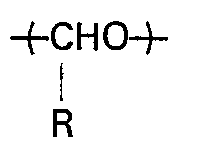
- the positive type radiation-sensitive organic polymers according to the invention are characterized by a homopolymer of an aliphatic aldehyde represented by the general formula I or
- Aliphatic aldehydes represented by the unit in the general formula II include, for example, ethanal, propanal, n-butanal, n-pentanal, n-hexanal, and 0-phenylpropanal.
- the polymers represented by the general formula II contain at least 10 mole-% of aliphatic aldehyde units and less than 10 mole-% of aliphatic aldehyds units where 100 mole-% of monomer units is excluded.
- the polymers represented by the general formulae I and II can be obtained by anionic polymerization.
- a catalyst can be used for the polymerization.
- Such catalysts are, for example, dimethylaluminum diphenyl amide, diethylaluminum diphenyl amide, ethylaluminum-bis (diphenyl amide), ethylzinc diphenyl amide and ethylmagnesium diphenyl amide.
- the catalyst is used in an amount of 0.1 to 5 mole-%, based on the monomers, and in a solution in a hydrocarbon solvent such as toluene, etc. or in an ether such as diethylether, etc.
- the polymerization is carried out at 0 to 100°C, preferably at 50 to 80°C, in an inert gas atmosphere such as nitrogen gas.
- the present positive type radiation-sensitive organic polymer materials are dissolved in an organic solvent such as toluene, xylene, chloroform, etc. to make a resist.
- the resist can be applied by spin coating or dipping.
- the resulting coating film is then heated to an appropriate temperature to remove the solvent by evaporation.
- the coating film is irradiated in a desired pattern.
- the irradiated areas are disintegrated in a chain reaction manner and scattered off, whereby a pattern can be obtained without any special developing step.
- the present polymer materials have increased absorptivity to radiation such as electron beams, X-rays, ion beams, etc. and. increased solubility in organic solvents and can also be developed with a toluene-isopropanol solvent mixture according to the wet process.
- the _present polymer materials can also be used as photosensitive materials.
- the polymerizations were conducted in a polymerization tube with a three-way cock. Predetermined amounts of aldehyde monomers and a solvent (toluene) were introduced into a cylindrical polymerization vessel having a net capacity of about 100 ml in a nitrogen gas stream through the three-way cock by a syringe.
- the reaction vessel containing the monomer solution was cooled to 0°C in an ice-water bath, and a predetermined amount of the catalyst solution prepared in Preparatory Example 1 was slowly added while vigorously shaking the vessel.
- the reaction vessel was cooled to -78°C in a dry ice-acetone bath and left standing for a predetermined time to effect polymerization.
- the polymerization mixture was treated with ammoniacal methanol to decompose the catalyst, poured into methanol and left standing for one day, then separated by filtration, washed several times with methanol, and dried in vacuum.
- the monomer solution was added to the catalyst solution to effect polymerization.
- composition of the copolymers was determined by elemental analysis or by analysis of the composition of a gas generated by thermal analysis.
- the polymer of (3-trimethylsifylpropanal obtained in Preparatory Example 3 was dissolved in chloroform to prepare a 0.2 wt.-% resist solution.
- the resist solution was then applied onto.a silicon wafer and prebaked at 80°C for 20 minutes to form a polymer film having a thickness of 0.3 ⁇ m.
- the silicon wafer was placed in an electron beam irradiator and subjected to irradiation with locally different irradiation dosages by electron beams of an acceleration voltage of 20 kV in vacuum. As a result, the irradiated areas were thinned without applying any developing treatment.
- the thickness of the residual polymer film was measured at irradiated areas with different irradiation dosages by means of a Taly step film thickness gauge.
- the residual film thickness (normalized) was plotted versus the irradiation dosage (coulomb/cm 2 ) to obtain an irradiation characteristic curve showing an electron beam-sensitive characteristic.
- the minimum irradiation dosage at which the residual film ratio is zero was obtained from the curve. It was found to be 8 ⁇ 10 -7 coulomb/cm 2 .
- the present resist was a positive type resist having a very high sensitivity. As compared with the electron beam sensitivity of polymethyl methacrylate as a typical positive type resist which is 1 10 -4 coulomb/cm 2 , the present positive type resist had a higher sensitivity by at least two decades.
- the copolymer of ( ⁇ -trimethylsilylpropanal with butylaldehyde prepared in Preparatory Example 4 was dissolved in toluene to prepare a 1 wt.-% resist solution.
- the resist solution was then applied onto a silicon wafer and prebaked at 80°C for 20 minutes to obtain a polymer film having a thickness of 2 pm.
- the silicon wafer was placed in a soft X-rays generator and irradiated with soft X-rays having a wavelength of 0.42 nm (4.2 A) generated by a rotating, water-cooled silver target at 10 kW in vacuum.
- the relationship between the residual film thickness (normalized) and the irradiation dosage (mJ/cm 2 ) was determined.
- the minimum irradiation dosage at which the film thickness was zero was found to be 10 mJ/cm 2 .
- the present resist was a positive type resist having a very high sensitivity.
- Aldehyde copolymers prepared in a manner similar to that of Preparatory Example 4 and 5 were each dissolved separately in xylene to prepare approximately 1 wt.-% resist solutions.
- the resist solutions were each applied to silicon wafers and prebaked at 80°C for 20 minutes to obtain polymer films having a thickness of about 2 ⁇ m.
- the silicon wafers were then irradiated with an electron beam of an acceleration voltage of 20 kV or soft X-rays (AIKa, MoLa or AgLa) of 10 kW to determine the electron beam or soft X-rays sensitivity.
- Table 2 It was found that all of the present resists had a high radiation sensitivity and were positive type resists. Comparative Example
- a homopolymer of acetaldehyde and a homopolymer of butylaldehyde were tested in the same manner as in Example 1 to evaluate their applicability as resist materials. It was found that these resist materials are not soluble in the ordinary organic solvents. Accordingly, these materials are not practically applicable.
Landscapes
- Chemical & Material Sciences (AREA)
- Physics & Mathematics (AREA)
- General Physics & Mathematics (AREA)
- Health & Medical Sciences (AREA)
- Chemical Kinetics & Catalysis (AREA)
- Medicinal Chemistry (AREA)
- Polymers & Plastics (AREA)
- Organic Chemistry (AREA)
- Engineering & Computer Science (AREA)
- Materials Engineering (AREA)
- Spectroscopy & Molecular Physics (AREA)
- Materials For Photolithography (AREA)
Claims (4)



Applications Claiming Priority (2)
| Application Number | Priority Date | Filing Date | Title |
|---|---|---|---|
| JP198958/82 | 1982-11-15 | ||
| JP57198958A JPS5988737A (ja) | 1982-11-15 | 1982-11-15 | 放射線感応性有機高分子材料 |
Publications (3)
| Publication Number | Publication Date |
|---|---|
| EP0109617A1 EP0109617A1 (de) | 1984-05-30 |
| EP0109617B1 true EP0109617B1 (de) | 1986-04-02 |
| EP0109617B2 EP0109617B2 (de) | 1991-09-25 |
Family
ID=16399761
Family Applications (1)
| Application Number | Title | Priority Date | Filing Date |
|---|---|---|---|
| EP83111232A Expired EP0109617B2 (de) | 1982-11-15 | 1983-11-10 | Strahlungsempfindliche organische Polymermaterialien vom Positivtyp |
Country Status (4)
| Country | Link |
|---|---|
| US (1) | US4504646A (de) |
| EP (1) | EP0109617B2 (de) |
| JP (1) | JPS5988737A (de) |
| DE (1) | DE3362815D1 (de) |
Families Citing this family (4)
| Publication number | Priority date | Publication date | Assignee | Title |
|---|---|---|---|---|
| US4734481A (en) * | 1986-01-16 | 1988-03-29 | Ciba-Geigy Corporation | Novel organometallic polymers |
| KR930000293B1 (ko) * | 1987-10-26 | 1993-01-15 | 마쯔시다덴기산교 가부시기가이샤 | 미세패턴형성방법 |
| JP2793251B2 (ja) * | 1989-05-09 | 1998-09-03 | 株式会社東芝 | パターン形成方法 |
| US7759046B2 (en) * | 2006-12-20 | 2010-07-20 | Az Electronic Materials Usa Corp. | Antireflective coating compositions |
Family Cites Families (5)
| Publication number | Priority date | Publication date | Assignee | Title |
|---|---|---|---|---|
| US2588083A (en) * | 1950-06-01 | 1952-03-04 | Gen Electric | Organosilicon aldehydes and methods of preparing the same |
| US2989559A (en) * | 1958-06-27 | 1961-06-20 | Union Carbide Corp | Carbonyl-containing organopolysiloxanes |
| DE2217744A1 (de) * | 1972-04-13 | 1973-10-18 | Agfa Gevaert Ag | Lichtempfindliche polymere |
| US4086092A (en) * | 1977-04-18 | 1978-04-25 | Polychrome Corporation | Process for making photosensitive lithographic printing plates involving sequentially coating with potassium zirconium fluoride and sodium silicate |
| US4424392A (en) * | 1982-03-24 | 1984-01-03 | Union Carbide Corporation | Aldehyde containing hydrolyzable silanes |
-
1982
- 1982-11-15 JP JP57198958A patent/JPS5988737A/ja active Granted
-
1983
- 1983-11-09 US US06/550,200 patent/US4504646A/en not_active Expired - Fee Related
- 1983-11-10 DE DE8383111232T patent/DE3362815D1/de not_active Expired
- 1983-11-10 EP EP83111232A patent/EP0109617B2/de not_active Expired
Also Published As
| Publication number | Publication date |
|---|---|
| JPS5988737A (ja) | 1984-05-22 |
| US4504646A (en) | 1985-03-12 |
| JPH0422259B2 (de) | 1992-04-16 |
| DE3362815D1 (en) | 1986-05-07 |
| EP0109617B2 (de) | 1991-09-25 |
| EP0109617A1 (de) | 1984-05-30 |
Similar Documents
| Publication | Publication Date | Title |
|---|---|---|
| US4657843A (en) | Use of polysilsesquioxane without hydroxyl group for forming mask | |
| EP2045275B1 (de) | Polycyclische Resistzusammensetzungen mit verbesserter Ätzbeständigkeit | |
| EP0096596A1 (de) | Herstellung von mikroelektronischen Bauelementen | |
| US4513077A (en) | Electron beam or X-ray reactive image-formable resinous composition | |
| US4433044A (en) | Dry developable positive photoresists | |
| EP0005551A2 (de) | Gegenstand bestehend aus einem Substrat und einer darauf angeordneten Schicht aus elektronenstrahlempfindlichem Material und Verfahren zu dessen Herstellung | |
| JPH0344290B2 (de) | ||
| GB1582735A (en) | Positive resist mask formation | |
| EP0502128A1 (de) | Anionisch polymerisierbare monomere, daraus hergestellte polymere und die verwendung der polymere in photowiderständen. | |
| EP0109617B1 (de) | Strahlungsempfindliche organische Polymermaterialien vom Positivtyp | |
| JP2666852B2 (ja) | ポジ型感放射線混合物、ポジ型感放射線記録材料及びその製法 | |
| CA1271878A (en) | Organometallic polymers | |
| US4517276A (en) | Metal-containing organic photoresists | |
| US5068169A (en) | Process for production of semiconductor device | |
| US4315067A (en) | Method for making electron sensitive negative resist | |
| EP0524246B1 (de) | Resistmaterial und verfahren zur herstellung | |
| HK1003127B (en) | Resist material and process for use | |
| EP0096895A2 (de) | Hochmolekulares, positiv arbeitendes strahlungsempfindliches, organisches Polymermaterial und Verfahren zur Herstellung von Mikrostrukturen damit | |
| JPH087443B2 (ja) | 高解像度ポジ型放射線感応性レジスト | |
| JPH0629323B2 (ja) | 二酸化硫黄とビニル化合物から成る多元共重合体 | |
| JPS58219736A (ja) | パターン形成方法 | |
| JPH0380301B2 (de) | ||
| JPS58219547A (ja) | ポジ形放射線感応性有機高分子材料 | |
| JPH0158496B2 (de) | ||
| Nate et al. | Highly sensitive self‐developing soft X‐ray resists of silicon‐containing aldehyde copolymers and sensitive novolac‐based composite resists containing aldehyde copolymer |
Legal Events
| Date | Code | Title | Description |
|---|---|---|---|
| PUAI | Public reference made under article 153(3) epc to a published international application that has entered the european phase |
Free format text: ORIGINAL CODE: 0009012 |
|
| AK | Designated contracting states |
Designated state(s): DE GB |
|
| 17P | Request for examination filed |
Effective date: 19840601 |
|
| GRAA | (expected) grant |
Free format text: ORIGINAL CODE: 0009210 |
|
| AK | Designated contracting states |
Kind code of ref document: B1 Designated state(s): DE GB |
|
| REF | Corresponds to: |
Ref document number: 3362815 Country of ref document: DE Date of ref document: 19860507 |
|
| PLBI | Opposition filed |
Free format text: ORIGINAL CODE: 0009260 |
|
| 26 | Opposition filed |
Opponent name: HOECHST AKTIENGESELLSCHAFT,FRANKFURT(MAIN) Effective date: 19861224 |
|
| PGFP | Annual fee paid to national office [announced via postgrant information from national office to epo] |
Ref country code: GB Payment date: 19900925 Year of fee payment: 8 |
|
| PGFP | Annual fee paid to national office [announced via postgrant information from national office to epo] |
Ref country code: DE Payment date: 19901228 Year of fee payment: 8 |
|
| PUAH | Patent maintained in amended form |
Free format text: ORIGINAL CODE: 0009272 |
|
| STAA | Information on the status of an ep patent application or granted ep patent |
Free format text: STATUS: PATENT MAINTAINED AS AMENDED |
|
| 27A | Patent maintained in amended form |
Effective date: 19910925 |
|
| AK | Designated contracting states |
Kind code of ref document: B2 Designated state(s): DE GB |
|
| PG25 | Lapsed in a contracting state [announced via postgrant information from national office to epo] |
Ref country code: GB Effective date: 19911110 |
|
| GBPC | Gb: european patent ceased through non-payment of renewal fee | ||
| PG25 | Lapsed in a contracting state [announced via postgrant information from national office to epo] |
Ref country code: DE Effective date: 19920801 |