EP0110832B1 - Xanthone und Thioxanthone - Google Patents
Xanthone und Thioxanthone Download PDFInfo
- Publication number
- EP0110832B1 EP0110832B1 EP83810541A EP83810541A EP0110832B1 EP 0110832 B1 EP0110832 B1 EP 0110832B1 EP 83810541 A EP83810541 A EP 83810541A EP 83810541 A EP83810541 A EP 83810541A EP 0110832 B1 EP0110832 B1 EP 0110832B1
- Authority
- EP
- European Patent Office
- Prior art keywords
- formula
- compound
- alkyl
- hydrogen
- another
- Prior art date
- Legal status (The legal status is an assumption and is not a legal conclusion. Google has not performed a legal analysis and makes no representation as to the accuracy of the status listed.)
- Expired
Links
- YRHRIQCWCFGUEQ-UHFFFAOYSA-N thioxanthen-9-one Chemical class C1=CC=C2C(=O)C3=CC=CC=C3SC2=C1 YRHRIQCWCFGUEQ-UHFFFAOYSA-N 0.000 title description 2
- JNELGWHKGNBSMD-UHFFFAOYSA-N xanthone Chemical class C1=CC=C2C(=O)C3=CC=CC=C3OC2=C1 JNELGWHKGNBSMD-UHFFFAOYSA-N 0.000 title 1
- 150000001875 compounds Chemical class 0.000 claims description 91
- -1 -(CH2)n-Q Chemical group 0.000 claims description 73
- 239000000203 mixture Substances 0.000 claims description 57
- 229910052739 hydrogen Inorganic materials 0.000 claims description 35
- 239000001257 hydrogen Substances 0.000 claims description 35
- 150000002431 hydrogen Chemical class 0.000 claims description 30
- 229920000642 polymer Polymers 0.000 claims description 27
- 125000000217 alkyl group Chemical group 0.000 claims description 22
- 125000001997 phenyl group Chemical group [H]C1=C([H])C([H])=C(*)C([H])=C1[H] 0.000 claims description 18
- 125000004432 carbon atom Chemical group C* 0.000 claims description 17
- 150000003839 salts Chemical class 0.000 claims description 14
- 239000000460 chlorine Substances 0.000 claims description 13
- 150000008064 anhydrides Chemical class 0.000 claims description 12
- ZAMOUSCENKQFHK-UHFFFAOYSA-N Chlorine atom Chemical compound [Cl] ZAMOUSCENKQFHK-UHFFFAOYSA-N 0.000 claims description 11
- 239000002585 base Substances 0.000 claims description 11
- 125000001797 benzyl group Chemical group [H]C1=C([H])C([H])=C(C([H])=C1[H])C([H])([H])* 0.000 claims description 11
- 229910052801 chlorine Inorganic materials 0.000 claims description 11
- 238000000034 method Methods 0.000 claims description 10
- UFHFLCQGNIYNRP-UHFFFAOYSA-N Hydrogen Chemical compound [H][H] UFHFLCQGNIYNRP-UHFFFAOYSA-N 0.000 claims description 9
- 125000005081 alkoxyalkoxyalkyl group Chemical group 0.000 claims description 9
- 238000002360 preparation method Methods 0.000 claims description 9
- 150000002367 halogens Chemical class 0.000 claims description 8
- 150000003254 radicals Chemical class 0.000 claims description 8
- 125000003837 (C1-C20) alkyl group Chemical group 0.000 claims description 7
- WKBOTKDWSSQWDR-UHFFFAOYSA-N Bromine atom Chemical compound [Br] WKBOTKDWSSQWDR-UHFFFAOYSA-N 0.000 claims description 7
- 125000003545 alkoxy group Chemical group 0.000 claims description 7
- GDTBXPJZTBHREO-UHFFFAOYSA-N bromine Substances BrBr GDTBXPJZTBHREO-UHFFFAOYSA-N 0.000 claims description 7
- 229910052794 bromium Inorganic materials 0.000 claims description 7
- 125000005843 halogen group Chemical group 0.000 claims description 7
- 125000001494 2-propynyl group Chemical group [H]C#CC([H])([H])* 0.000 claims description 6
- 229910052736 halogen Inorganic materials 0.000 claims description 6
- 125000003944 tolyl group Chemical group 0.000 claims description 6
- 125000005037 alkyl phenyl group Chemical group 0.000 claims description 5
- 125000000325 methylidene group Chemical group [H]C([H])=* 0.000 claims description 5
- NGNBDVOYPDDBFK-UHFFFAOYSA-N 2-[2,4-di(pentan-2-yl)phenoxy]acetyl chloride Chemical compound CCCC(C)C1=CC=C(OCC(Cl)=O)C(C(C)CCC)=C1 NGNBDVOYPDDBFK-UHFFFAOYSA-N 0.000 claims description 4
- 125000003903 2-propenyl group Chemical group [H]C([*])([H])C([H])=C([H])[H] 0.000 claims description 4
- 125000000882 C2-C6 alkenyl group Chemical group 0.000 claims description 4
- 229910052783 alkali metal Inorganic materials 0.000 claims description 4
- 125000005036 alkoxyphenyl group Chemical group 0.000 claims description 4
- 125000002768 hydroxyalkyl group Chemical group 0.000 claims description 4
- 125000000449 nitro group Chemical group [O-][N+](*)=O 0.000 claims description 4
- 125000004178 (C1-C4) alkyl group Chemical group 0.000 claims description 3
- 125000000094 2-phenylethyl group Chemical group [H]C1=C([H])C([H])=C(C([H])=C1[H])C([H])([H])C([H])([H])* 0.000 claims description 3
- PXGOKWXKJXAPGV-UHFFFAOYSA-N Fluorine Chemical compound FF PXGOKWXKJXAPGV-UHFFFAOYSA-N 0.000 claims description 3
- 125000000113 cyclohexyl group Chemical group [H]C1([H])C([H])([H])C([H])([H])C([H])(*)C([H])([H])C1([H])[H] 0.000 claims description 3
- 239000011737 fluorine Substances 0.000 claims description 3
- 229910052731 fluorine Inorganic materials 0.000 claims description 3
- 230000007062 hydrolysis Effects 0.000 claims description 3
- 238000006460 hydrolysis reaction Methods 0.000 claims description 3
- 125000006501 nitrophenyl group Chemical group 0.000 claims description 3
- 125000000027 (C1-C10) alkoxy group Chemical group 0.000 claims description 2
- OFOBLEOULBTSOW-UHFFFAOYSA-N Malonic acid Chemical compound OC(=O)CC(O)=O OFOBLEOULBTSOW-UHFFFAOYSA-N 0.000 claims description 2
- 150000001991 dicarboxylic acids Chemical class 0.000 claims description 2
- 125000000008 (C1-C10) alkyl group Chemical group 0.000 claims 6
- 231100000489 sensitizer Toxicity 0.000 claims 2
- 125000006526 (C1-C2) alkyl group Chemical group 0.000 claims 1
- FKNQFGJONOIPTF-UHFFFAOYSA-N Sodium cation Chemical compound [Na+] FKNQFGJONOIPTF-UHFFFAOYSA-N 0.000 claims 1
- RMRFFCXPLWYOOY-UHFFFAOYSA-N allyl radical Chemical compound [CH2]C=C RMRFFCXPLWYOOY-UHFFFAOYSA-N 0.000 claims 1
- YXFVVABEGXRONW-UHFFFAOYSA-N Toluene Chemical compound CC1=CC=CC=C1 YXFVVABEGXRONW-UHFFFAOYSA-N 0.000 description 97
- WYURNTSHIVDZCO-UHFFFAOYSA-N Tetrahydrofuran Chemical compound C1CCOC1 WYURNTSHIVDZCO-UHFFFAOYSA-N 0.000 description 76
- YMWUJEATGCHHMB-UHFFFAOYSA-N Dichloromethane Chemical compound ClCCl YMWUJEATGCHHMB-UHFFFAOYSA-N 0.000 description 42
- 239000000243 solution Substances 0.000 description 40
- YLQBMQCUIZJEEH-UHFFFAOYSA-N tetrahydrofuran Natural products C=1C=COC=1 YLQBMQCUIZJEEH-UHFFFAOYSA-N 0.000 description 38
- 238000004458 analytical method Methods 0.000 description 27
- XLYOFNOQVPJJNP-UHFFFAOYSA-N water Substances O XLYOFNOQVPJJNP-UHFFFAOYSA-N 0.000 description 27
- ZMXDDKWLCZADIW-UHFFFAOYSA-N N,N-Dimethylformamide Chemical compound CN(C)C=O ZMXDDKWLCZADIW-UHFFFAOYSA-N 0.000 description 26
- VEXZGXHMUGYJMC-UHFFFAOYSA-N Hydrochloric acid Chemical compound Cl VEXZGXHMUGYJMC-UHFFFAOYSA-N 0.000 description 24
- HEMHJVSKTPXQMS-UHFFFAOYSA-M Sodium hydroxide Chemical compound [OH-].[Na+] HEMHJVSKTPXQMS-UHFFFAOYSA-M 0.000 description 18
- OFBQJSOFQDEBGM-UHFFFAOYSA-N Pentane Chemical compound CCCCC OFBQJSOFQDEBGM-UHFFFAOYSA-N 0.000 description 16
- 238000001953 recrystallisation Methods 0.000 description 16
- RTZKZFJDLAIYFH-UHFFFAOYSA-N Diethyl ether Chemical compound CCOCC RTZKZFJDLAIYFH-UHFFFAOYSA-N 0.000 description 14
- 239000000284 extract Substances 0.000 description 14
- PMZURENOXWZQFD-UHFFFAOYSA-L Sodium Sulfate Chemical compound [Na+].[Na+].[O-]S([O-])(=O)=O PMZURENOXWZQFD-UHFFFAOYSA-L 0.000 description 13
- WFDIJRYMOXRFFG-UHFFFAOYSA-N Acetic anhydride Chemical compound CC(=O)OC(C)=O WFDIJRYMOXRFFG-UHFFFAOYSA-N 0.000 description 12
- VSCWAEJMTAWNJL-UHFFFAOYSA-K aluminium trichloride Chemical compound Cl[Al](Cl)Cl VSCWAEJMTAWNJL-UHFFFAOYSA-K 0.000 description 12
- 238000010992 reflux Methods 0.000 description 12
- 229910052938 sodium sulfate Inorganic materials 0.000 description 12
- 235000011152 sodium sulphate Nutrition 0.000 description 12
- MVPPADPHJFYWMZ-UHFFFAOYSA-N chlorobenzene Chemical compound ClC1=CC=CC=C1 MVPPADPHJFYWMZ-UHFFFAOYSA-N 0.000 description 11
- 239000002253 acid Substances 0.000 description 10
- 238000006243 chemical reaction Methods 0.000 description 10
- 239000012074 organic phase Substances 0.000 description 10
- BWHMMNNQKKPAPP-UHFFFAOYSA-L potassium carbonate Chemical compound [K+].[K+].[O-]C([O-])=O BWHMMNNQKKPAPP-UHFFFAOYSA-L 0.000 description 10
- LFQSCWFLJHTTHZ-UHFFFAOYSA-N Ethanol Chemical compound CCO LFQSCWFLJHTTHZ-UHFFFAOYSA-N 0.000 description 9
- 229920000137 polyphosphoric acid Polymers 0.000 description 9
- RYHBNJHYFVUHQT-UHFFFAOYSA-N 1,4-Dioxane Chemical compound C1COCCO1 RYHBNJHYFVUHQT-UHFFFAOYSA-N 0.000 description 8
- FAPWRFPIFSIZLT-UHFFFAOYSA-M Sodium chloride Chemical class [Na+].[Cl-] FAPWRFPIFSIZLT-UHFFFAOYSA-M 0.000 description 8
- 229910052751 metal Inorganic materials 0.000 description 8
- 239000002184 metal Substances 0.000 description 8
- CTSLXHKWHWQRSH-UHFFFAOYSA-N oxalyl chloride Chemical compound ClC(=O)C(Cl)=O CTSLXHKWHWQRSH-UHFFFAOYSA-N 0.000 description 8
- 239000000047 product Substances 0.000 description 8
- 239000011734 sodium Substances 0.000 description 8
- 239000002244 precipitate Substances 0.000 description 7
- FYSNRJHAOHDILO-UHFFFAOYSA-N thionyl chloride Chemical compound ClS(Cl)=O FYSNRJHAOHDILO-UHFFFAOYSA-N 0.000 description 7
- XDTMQSROBMDMFD-UHFFFAOYSA-N Cyclohexane Chemical compound C1CCCCC1 XDTMQSROBMDMFD-UHFFFAOYSA-N 0.000 description 6
- CTQNGGLPUBDAKN-UHFFFAOYSA-N O-Xylene Chemical compound CC1=CC=CC=C1C CTQNGGLPUBDAKN-UHFFFAOYSA-N 0.000 description 6
- QAOWNCQODCNURD-UHFFFAOYSA-N Sulfuric acid Chemical compound OS(O)(=O)=O QAOWNCQODCNURD-UHFFFAOYSA-N 0.000 description 6
- 238000001704 evaporation Methods 0.000 description 6
- 230000008020 evaporation Effects 0.000 description 6
- 239000011521 glass Substances 0.000 description 6
- 150000003949 imides Chemical class 0.000 description 6
- 125000002496 methyl group Chemical group [H]C([H])([H])* 0.000 description 6
- RMVRSNDYEFQCLF-UHFFFAOYSA-N thiophenol Chemical compound SC1=CC=CC=C1 RMVRSNDYEFQCLF-UHFFFAOYSA-N 0.000 description 6
- 229940103494 thiosalicylic acid Drugs 0.000 description 6
- 239000008096 xylene Substances 0.000 description 6
- RYGMFSIKBFXOCR-UHFFFAOYSA-N Copper Chemical compound [Cu] RYGMFSIKBFXOCR-UHFFFAOYSA-N 0.000 description 5
- IAZDPXIOMUYVGZ-UHFFFAOYSA-N Dimethylsulphoxide Chemical compound CS(C)=O IAZDPXIOMUYVGZ-UHFFFAOYSA-N 0.000 description 5
- YNAVUWVOSKDBBP-UHFFFAOYSA-N Morpholine Chemical compound C1COCCN1 YNAVUWVOSKDBBP-UHFFFAOYSA-N 0.000 description 5
- 238000000576 coating method Methods 0.000 description 5
- 238000001816 cooling Methods 0.000 description 5
- 238000001035 drying Methods 0.000 description 5
- 125000001495 ethyl group Chemical group [H]C([H])([H])C([H])([H])* 0.000 description 5
- 239000000049 pigment Substances 0.000 description 5
- 229910000027 potassium carbonate Inorganic materials 0.000 description 5
- 150000007964 xanthones Chemical class 0.000 description 5
- ROSDSFDQCJNGOL-UHFFFAOYSA-N Dimethylamine Chemical compound CNC ROSDSFDQCJNGOL-UHFFFAOYSA-N 0.000 description 4
- 229920001577 copolymer Polymers 0.000 description 4
- 229910052802 copper Inorganic materials 0.000 description 4
- 239000010949 copper Substances 0.000 description 4
- 229960004132 diethyl ether Drugs 0.000 description 4
- 238000000454 electroless metal deposition Methods 0.000 description 4
- 239000004922 lacquer Substances 0.000 description 4
- 238000004519 manufacturing process Methods 0.000 description 4
- 238000007363 ring formation reaction Methods 0.000 description 4
- ZMIQZMJLQSEOJX-UHFFFAOYSA-N 2-(1,3-dioxoisoindol-4-yl)sulfanylbenzoic acid Chemical compound OC(=O)C1=CC=CC=C1SC1=CC=CC2=C1C(=O)NC2=O ZMIQZMJLQSEOJX-UHFFFAOYSA-N 0.000 description 3
- RHHXWGBTNBVPKO-UHFFFAOYSA-N 2-(benzylcarbamoyl)-5-chlorobenzoic acid Chemical compound OC(=O)C1=CC(Cl)=CC=C1C(O)=NCC1=CC=CC=C1 RHHXWGBTNBVPKO-UHFFFAOYSA-N 0.000 description 3
- HADOACQCXOYBCV-UHFFFAOYSA-N 2-(butylcarbamoyl)-6-(2-carboxyphenyl)sulfanyl-4-nitrobenzoic acid Chemical compound CCCCN=C(O)C1=CC([N+]([O-])=O)=CC(SC=2C(=CC=CC=2)C(O)=O)=C1C(O)=O HADOACQCXOYBCV-UHFFFAOYSA-N 0.000 description 3
- 125000000954 2-hydroxyethyl group Chemical group [H]C([*])([H])C([H])([H])O[H] 0.000 description 3
- 0 CCN*(*)=*(*)C(O)=O Chemical compound CCN*(*)=*(*)C(O)=O 0.000 description 3
- QGJOPFRUJISHPQ-UHFFFAOYSA-N Carbon disulfide Chemical compound S=C=S QGJOPFRUJISHPQ-UHFFFAOYSA-N 0.000 description 3
- WSFSSNUMVMOOMR-UHFFFAOYSA-N Formaldehyde Chemical compound O=C WSFSSNUMVMOOMR-UHFFFAOYSA-N 0.000 description 3
- 239000002841 Lewis acid Substances 0.000 description 3
- PPBRXRYQALVLMV-UHFFFAOYSA-N Styrene Chemical compound C=CC1=CC=CC=C1 PPBRXRYQALVLMV-UHFFFAOYSA-N 0.000 description 3
- ZMANZCXQSJIPKH-UHFFFAOYSA-N Triethylamine Chemical compound CCN(CC)CC ZMANZCXQSJIPKH-UHFFFAOYSA-N 0.000 description 3
- 150000007513 acids Chemical class 0.000 description 3
- 125000003277 amino group Chemical group 0.000 description 3
- 239000011230 binding agent Substances 0.000 description 3
- 239000003054 catalyst Substances 0.000 description 3
- 239000003795 chemical substances by application Substances 0.000 description 3
- 239000000975 dye Substances 0.000 description 3
- 238000010438 heat treatment Methods 0.000 description 3
- 150000007517 lewis acids Chemical class 0.000 description 3
- QSHDDOUJBYECFT-UHFFFAOYSA-N mercury Chemical compound [Hg] QSHDDOUJBYECFT-UHFFFAOYSA-N 0.000 description 3
- 229910052753 mercury Inorganic materials 0.000 description 3
- 229910052757 nitrogen Inorganic materials 0.000 description 3
- 125000000286 phenylethyl group Chemical group [H]C1=C([H])C([H])=C(C([H])=C1[H])C([H])([H])C([H])([H])* 0.000 description 3
- 229920002120 photoresistant polymer Polymers 0.000 description 3
- 239000003504 photosensitizing agent Substances 0.000 description 3
- 229920006395 saturated elastomer Polymers 0.000 description 3
- 230000035945 sensitivity Effects 0.000 description 3
- 238000003756 stirring Methods 0.000 description 3
- 239000000725 suspension Substances 0.000 description 3
- QPFMBZIOSGYJDE-UHFFFAOYSA-N 1,1,2,2-tetrachloroethane Chemical compound ClC(Cl)C(Cl)Cl QPFMBZIOSGYJDE-UHFFFAOYSA-N 0.000 description 2
- CFXQEHVMCRXUSD-UHFFFAOYSA-N 1,2,3-Trichloropropane Chemical compound ClCC(Cl)CCl CFXQEHVMCRXUSD-UHFFFAOYSA-N 0.000 description 2
- RFFLAFLAYFXFSW-UHFFFAOYSA-N 1,2-dichlorobenzene Chemical compound ClC1=CC=CC=C1Cl RFFLAFLAYFXFSW-UHFFFAOYSA-N 0.000 description 2
- AFBZWKDYXKANBD-UHFFFAOYSA-N 2-(2-carboxyphenyl)sulfanyl-6-(methylcarbamoyl)benzoic acid Chemical compound CN=C(O)C1=CC=CC(SC=2C(=CC=CC=2)C(O)=O)=C1C(O)=O AFBZWKDYXKANBD-UHFFFAOYSA-N 0.000 description 2
- MKIQAPDAAFYHHX-UHFFFAOYSA-N 2-(butylcarbamoyl)-6-(2-carboxyphenyl)sulfanyl-4-decylsulfanylbenzoic acid Chemical compound CCCCN=C(O)C1=CC(SCCCCCCCCCC)=CC(SC=2C(=CC=CC=2)C(O)=O)=C1C(O)=O MKIQAPDAAFYHHX-UHFFFAOYSA-N 0.000 description 2
- NIJVYAAMBVSEAU-UHFFFAOYSA-N 2-(methylcarbamoyl)-6-nitrobenzoic acid Chemical compound CN=C(O)C1=CC=CC([N+]([O-])=O)=C1C(O)=O NIJVYAAMBVSEAU-UHFFFAOYSA-N 0.000 description 2
- SVONRAPFKPVNKG-UHFFFAOYSA-N 2-ethoxyethyl acetate Chemical compound CCOCCOC(C)=O SVONRAPFKPVNKG-UHFFFAOYSA-N 0.000 description 2
- ONESVHKCSZEJJA-UHFFFAOYSA-N 2-methoxy-3,3-dimethyl-2-(4-methylsulfanylphenyl)oxirane Chemical compound C=1C=C(SC)C=CC=1C1(OC)OC1(C)C ONESVHKCSZEJJA-UHFFFAOYSA-N 0.000 description 2
- QTBSBXVTEAMEQO-UHFFFAOYSA-N Acetic acid Chemical compound CC(O)=O QTBSBXVTEAMEQO-UHFFFAOYSA-N 0.000 description 2
- NLHHRLWOUZZQLW-UHFFFAOYSA-N Acrylonitrile Chemical compound C=CC#N NLHHRLWOUZZQLW-UHFFFAOYSA-N 0.000 description 2
- QGZKDVFQNNGYKY-UHFFFAOYSA-N Ammonia Chemical compound N QGZKDVFQNNGYKY-UHFFFAOYSA-N 0.000 description 2
- IJGRMHOSHXDMSA-UHFFFAOYSA-N Atomic nitrogen Chemical compound N#N IJGRMHOSHXDMSA-UHFFFAOYSA-N 0.000 description 2
- KAKZBPTYRLMSJV-UHFFFAOYSA-N Butadiene Chemical compound C=CC=C KAKZBPTYRLMSJV-UHFFFAOYSA-N 0.000 description 2
- PEDCQBHIVMGVHV-UHFFFAOYSA-N Glycerine Chemical compound OCC(O)CO PEDCQBHIVMGVHV-UHFFFAOYSA-N 0.000 description 2
- 229920000877 Melamine resin Polymers 0.000 description 2
- CERQOIWHTDAKMF-UHFFFAOYSA-N Methacrylic acid Chemical compound CC(=C)C(O)=O CERQOIWHTDAKMF-UHFFFAOYSA-N 0.000 description 2
- FXHOOIRPVKKKFG-UHFFFAOYSA-N N,N-Dimethylacetamide Chemical compound CN(C)C(C)=O FXHOOIRPVKKKFG-UHFFFAOYSA-N 0.000 description 2
- LRHPLDYGYMQRHN-UHFFFAOYSA-N N-Butanol Chemical compound CCCCO LRHPLDYGYMQRHN-UHFFFAOYSA-N 0.000 description 2
- PXHVJJICTQNCMI-UHFFFAOYSA-N Nickel Chemical compound [Ni] PXHVJJICTQNCMI-UHFFFAOYSA-N 0.000 description 2
- 206010034972 Photosensitivity reaction Diseases 0.000 description 2
- 239000004642 Polyimide Substances 0.000 description 2
- JUJWROOIHBZHMG-UHFFFAOYSA-N Pyridine Chemical compound C1=CC=NC=C1 JUJWROOIHBZHMG-UHFFFAOYSA-N 0.000 description 2
- GWEVSGVZZGPLCZ-UHFFFAOYSA-N Titan oxide Chemical compound O=[Ti]=O GWEVSGVZZGPLCZ-UHFFFAOYSA-N 0.000 description 2
- 150000001298 alcohols Chemical class 0.000 description 2
- XXROGKLTLUQVRX-UHFFFAOYSA-N allyl alcohol Chemical compound OCC=C XXROGKLTLUQVRX-UHFFFAOYSA-N 0.000 description 2
- 150000001412 amines Chemical class 0.000 description 2
- 150000001413 amino acids Chemical class 0.000 description 2
- 125000004429 atom Chemical group 0.000 description 2
- 239000011324 bead Substances 0.000 description 2
- WGQKYBSKWIADBV-UHFFFAOYSA-N benzylamine Chemical compound NCC1=CC=CC=C1 WGQKYBSKWIADBV-UHFFFAOYSA-N 0.000 description 2
- 230000015572 biosynthetic process Effects 0.000 description 2
- 238000009835 boiling Methods 0.000 description 2
- WTEOIRVLGSZEPR-UHFFFAOYSA-N boron trifluoride Chemical compound FB(F)F WTEOIRVLGSZEPR-UHFFFAOYSA-N 0.000 description 2
- 150000001735 carboxylic acids Chemical class 0.000 description 2
- 229920002301 cellulose acetate Polymers 0.000 description 2
- OPQARKPSCNTWTJ-UHFFFAOYSA-L copper(ii) acetate Chemical compound [Cu+2].CC([O-])=O.CC([O-])=O OPQARKPSCNTWTJ-UHFFFAOYSA-L 0.000 description 2
- GYZLOYUZLJXAJU-UHFFFAOYSA-N diglycidyl ether Chemical class C1OC1COCC1CO1 GYZLOYUZLJXAJU-UHFFFAOYSA-N 0.000 description 2
- IVJISJACKSSFGE-UHFFFAOYSA-N formaldehyde;1,3,5-triazine-2,4,6-triamine Chemical compound O=C.NC1=NC(N)=NC(N)=N1 IVJISJACKSSFGE-UHFFFAOYSA-N 0.000 description 2
- 150000007529 inorganic bases Chemical class 0.000 description 2
- 125000001449 isopropyl group Chemical group [H]C([H])([H])C([H])(*)C([H])([H])[H] 0.000 description 2
- 239000007788 liquid Substances 0.000 description 2
- 239000000463 material Substances 0.000 description 2
- 238000001465 metallisation Methods 0.000 description 2
- 150000002739 metals Chemical class 0.000 description 2
- VHRYZQNGTZXDNX-UHFFFAOYSA-N methacryloyl chloride Chemical compound CC(=C)C(Cl)=O VHRYZQNGTZXDNX-UHFFFAOYSA-N 0.000 description 2
- 125000000956 methoxy group Chemical group [H]C([H])([H])O* 0.000 description 2
- 239000000178 monomer Substances 0.000 description 2
- 125000004123 n-propyl group Chemical group [H]C([H])([H])C([H])([H])C([H])([H])* 0.000 description 2
- LQNUZADURLCDLV-UHFFFAOYSA-N nitrobenzene Chemical compound [O-][N+](=O)C1=CC=CC=C1 LQNUZADURLCDLV-UHFFFAOYSA-N 0.000 description 2
- 238000007645 offset printing Methods 0.000 description 2
- 150000007530 organic bases Chemical class 0.000 description 2
- 239000011368 organic material Substances 0.000 description 2
- 239000003960 organic solvent Substances 0.000 description 2
- 230000000737 periodic effect Effects 0.000 description 2
- 125000003884 phenylalkyl group Chemical group 0.000 description 2
- XHXFXVLFKHQFAL-UHFFFAOYSA-N phosphoryl trichloride Chemical compound ClP(Cl)(Cl)=O XHXFXVLFKHQFAL-UHFFFAOYSA-N 0.000 description 2
- 230000036211 photosensitivity Effects 0.000 description 2
- 229920001721 polyimide Polymers 0.000 description 2
- 238000006116 polymerization reaction Methods 0.000 description 2
- 229910052700 potassium Inorganic materials 0.000 description 2
- NROKBHXJSPEDAR-UHFFFAOYSA-M potassium fluoride Chemical compound [F-].[K+] NROKBHXJSPEDAR-UHFFFAOYSA-M 0.000 description 2
- 238000007639 printing Methods 0.000 description 2
- 238000000425 proton nuclear magnetic resonance spectrum Methods 0.000 description 2
- 229920005989 resin Polymers 0.000 description 2
- 239000011347 resin Substances 0.000 description 2
- YGSDEFSMJLZEOE-UHFFFAOYSA-N salicylic acid Chemical compound OC(=O)C1=CC=CC=C1O YGSDEFSMJLZEOE-UHFFFAOYSA-N 0.000 description 2
- 238000000926 separation method Methods 0.000 description 2
- 229910052708 sodium Inorganic materials 0.000 description 2
- 239000007787 solid Substances 0.000 description 2
- 239000002904 solvent Substances 0.000 description 2
- 239000000758 substrate Substances 0.000 description 2
- 125000000391 vinyl group Chemical group [H]C([*])=C([H])[H] 0.000 description 2
- 229920001959 vinylidene polymer Polymers 0.000 description 2
- 125000000229 (C1-C4)alkoxy group Chemical group 0.000 description 1
- 125000004209 (C1-C8) alkyl group Chemical group 0.000 description 1
- UOCLXMDMGBRAIB-UHFFFAOYSA-N 1,1,1-trichloroethane Chemical compound CC(Cl)(Cl)Cl UOCLXMDMGBRAIB-UHFFFAOYSA-N 0.000 description 1
- WSLDOOZREJYCGB-UHFFFAOYSA-N 1,2-Dichloroethane Chemical compound ClCCCl WSLDOOZREJYCGB-UHFFFAOYSA-N 0.000 description 1
- KEQGZUUPPQEDPF-UHFFFAOYSA-N 1,3-dichloro-5,5-dimethylimidazolidine-2,4-dione Chemical compound CC1(C)N(Cl)C(=O)N(Cl)C1=O KEQGZUUPPQEDPF-UHFFFAOYSA-N 0.000 description 1
- ZFPGARUNNKGOBB-UHFFFAOYSA-N 1-Ethyl-2-pyrrolidinone Chemical compound CCN1CCCC1=O ZFPGARUNNKGOBB-UHFFFAOYSA-N 0.000 description 1
- VMKOFRJSULQZRM-UHFFFAOYSA-N 1-bromooctane Chemical compound CCCCCCCCBr VMKOFRJSULQZRM-UHFFFAOYSA-N 0.000 description 1
- BNLRKUSVMCIOGU-UHFFFAOYSA-N 1-hydroxyxanthen-9-one Chemical class O1C2=CC=CC=C2C(=O)C2=C1C=CC=C2O BNLRKUSVMCIOGU-UHFFFAOYSA-N 0.000 description 1
- GBQBAFZUTXWINQ-UHFFFAOYSA-N 1-oxo-7-phenyl-3-sulfanylidene-2-benzofuran-5-carboxylic acid Chemical compound C=1C(C(=O)O)=CC=2C(=S)OC(=O)C=2C=1C1=CC=CC=C1 GBQBAFZUTXWINQ-UHFFFAOYSA-N 0.000 description 1
- SBASXUCJHJRPEV-UHFFFAOYSA-N 2-(2-methoxyethoxy)ethanol Chemical compound COCCOCCO SBASXUCJHJRPEV-UHFFFAOYSA-N 0.000 description 1
- ITHKNKSCUYPBKO-UHFFFAOYSA-N 2-(benzylcarbamoyl)-5-(2-carboxyphenyl)sulfanylbenzoic acid Chemical compound OC(=O)C1=CC=CC=C1SC(C=C1C(O)=O)=CC=C1C(O)=NCC1=CC=CC=C1 ITHKNKSCUYPBKO-UHFFFAOYSA-N 0.000 description 1
- CIIBQFSVNOQOSI-UHFFFAOYSA-N 2-(butylcarbamoyl)-4,6-dinitrobenzoic acid Chemical compound CCCCN=C(O)C1=CC([N+]([O-])=O)=CC([N+]([O-])=O)=C1C(O)=O CIIBQFSVNOQOSI-UHFFFAOYSA-N 0.000 description 1
- HZFOJDJUDSUXSX-UHFFFAOYSA-N 2-(butylcarbamoyl)benzoic acid Chemical compound CCCCNC(=O)C1=CC=CC=C1C(O)=O HZFOJDJUDSUXSX-UHFFFAOYSA-N 0.000 description 1
- JIBQYHUXIRNZLT-UHFFFAOYSA-N 2-(methylcarbamoyl)-6-nitroterephthalic acid Chemical compound CN=C(O)C1=CC(C(O)=O)=CC([N+]([O-])=O)=C1C(O)=O JIBQYHUXIRNZLT-UHFFFAOYSA-N 0.000 description 1
- ONIKNECPXCLUHT-UHFFFAOYSA-N 2-chlorobenzoyl chloride Chemical compound ClC(=O)C1=CC=CC=C1Cl ONIKNECPXCLUHT-UHFFFAOYSA-N 0.000 description 1
- 125000001731 2-cyanoethyl group Chemical group [H]C([H])(*)C([H])([H])C#N 0.000 description 1
- LTHNHFOGQMKPOV-UHFFFAOYSA-N 2-ethylhexan-1-amine Chemical compound CCCCC(CC)CN LTHNHFOGQMKPOV-UHFFFAOYSA-N 0.000 description 1
- QOXOZONBQWIKDA-UHFFFAOYSA-N 3-hydroxypropyl Chemical group [CH2]CCO QOXOZONBQWIKDA-UHFFFAOYSA-N 0.000 description 1
- GNSFRPWPOGYVLO-UHFFFAOYSA-N 3-hydroxypropyl 2-methylprop-2-enoate Chemical compound CC(=C)C(=O)OCCCO GNSFRPWPOGYVLO-UHFFFAOYSA-N 0.000 description 1
- BAHKEWKARNFOIA-UHFFFAOYSA-N 4,5-dichloro-2-(methylcarbamoyl)benzoic acid Chemical compound CN=C(O)C1=CC(Cl)=C(Cl)C=C1C(O)=O BAHKEWKARNFOIA-UHFFFAOYSA-N 0.000 description 1
- MBLUZCHZWUAMLT-UHFFFAOYSA-N 4-(methylcarbamoyl)-3-phenyl-5-sulfanylcarbonylbenzoic acid Chemical compound CN=C(O)C1=C(C(O)=S)C=C(C(O)=O)C=C1C1=CC=CC=C1 MBLUZCHZWUAMLT-UHFFFAOYSA-N 0.000 description 1
- ZRFKCXDTOFBCLY-UHFFFAOYSA-N 4-amino-2-(butylcarbamoyl)-6-(2-carboxyphenyl)sulfanylbenzoic acid Chemical compound CCCCN=C(O)C1=CC(N)=CC(SC=2C(=CC=CC=2)C(O)=O)=C1C(O)=O ZRFKCXDTOFBCLY-UHFFFAOYSA-N 0.000 description 1
- BTTRMCQEPDPCPA-UHFFFAOYSA-N 4-chlorophthalic anhydride Chemical compound ClC1=CC=C2C(=O)OC(=O)C2=C1 BTTRMCQEPDPCPA-UHFFFAOYSA-N 0.000 description 1
- SXIFAEWFOJETOA-UHFFFAOYSA-N 4-hydroxy-butyl Chemical group [CH2]CCCO SXIFAEWFOJETOA-UHFFFAOYSA-N 0.000 description 1
- BONIIQYTWOPUQI-UHFFFAOYSA-N 4-nitroisoindole-1,3-dione Chemical compound [O-][N+](=O)C1=CC=CC2=C1C(=O)NC2=O BONIIQYTWOPUQI-UHFFFAOYSA-N 0.000 description 1
- GEHIJOCZQPPOOQ-UHFFFAOYSA-N 5-(2-carboxyphenyl)sulfanyl-4-chloro-2-(methylcarbamoyl)benzoic acid Chemical compound C1=C(C(O)=O)C(C(O)=NC)=CC(Cl)=C1SC1=CC=CC=C1C(O)=O GEHIJOCZQPPOOQ-UHFFFAOYSA-N 0.000 description 1
- RZVAJINKPMORJF-UHFFFAOYSA-N Acetaminophen Chemical compound CC(=O)NC1=CC=C(O)C=C1 RZVAJINKPMORJF-UHFFFAOYSA-N 0.000 description 1
- 229910015900 BF3 Inorganic materials 0.000 description 1
- NLZUEZXRPGMBCV-UHFFFAOYSA-N Butylhydroxytoluene Chemical compound CC1=CC(C(C)(C)C)=C(O)C(C(C)(C)C)=C1 NLZUEZXRPGMBCV-UHFFFAOYSA-N 0.000 description 1
- BVKZGUZCCUSVTD-UHFFFAOYSA-L Carbonate Chemical compound [O-]C([O-])=O BVKZGUZCCUSVTD-UHFFFAOYSA-L 0.000 description 1
- RWSOTUBLDIXVET-UHFFFAOYSA-N Dihydrogen sulfide Chemical class S RWSOTUBLDIXVET-UHFFFAOYSA-N 0.000 description 1
- ZAFNJMIOTHYJRJ-UHFFFAOYSA-N Diisopropyl ether Chemical compound CC(C)OC(C)C ZAFNJMIOTHYJRJ-UHFFFAOYSA-N 0.000 description 1
- XTHFKEDIFFGKHM-UHFFFAOYSA-N Dimethoxyethane Chemical compound COCCOC XTHFKEDIFFGKHM-UHFFFAOYSA-N 0.000 description 1
- QXNVGIXVLWOKEQ-UHFFFAOYSA-N Disodium Chemical class [Na][Na] QXNVGIXVLWOKEQ-UHFFFAOYSA-N 0.000 description 1
- 206010013786 Dry skin Diseases 0.000 description 1
- KCXVZYZYPLLWCC-UHFFFAOYSA-N EDTA Chemical compound OC(=O)CN(CC(O)=O)CCN(CC(O)=O)CC(O)=O KCXVZYZYPLLWCC-UHFFFAOYSA-N 0.000 description 1
- 239000004593 Epoxy Substances 0.000 description 1
- JIGUQPWFLRLWPJ-UHFFFAOYSA-N Ethyl acrylate Chemical compound CCOC(=O)C=C JIGUQPWFLRLWPJ-UHFFFAOYSA-N 0.000 description 1
- 108010010803 Gelatin Proteins 0.000 description 1
- DGAQECJNVWCQMB-PUAWFVPOSA-M Ilexoside XXIX Chemical compound C[C@@H]1CC[C@@]2(CC[C@@]3(C(=CC[C@H]4[C@]3(CC[C@@H]5[C@@]4(CC[C@@H](C5(C)C)OS(=O)(=O)[O-])C)C)[C@@H]2[C@]1(C)O)C)C(=O)O[C@H]6[C@@H]([C@H]([C@@H]([C@H](O6)CO)O)O)O.[Na+] DGAQECJNVWCQMB-PUAWFVPOSA-M 0.000 description 1
- VVQNEPGJFQJSBK-UHFFFAOYSA-N Methyl methacrylate Chemical compound COC(=O)C(C)=C VVQNEPGJFQJSBK-UHFFFAOYSA-N 0.000 description 1
- SECXISVLQFMRJM-UHFFFAOYSA-N N-Methylpyrrolidone Chemical compound CN1CCCC1=O SECXISVLQFMRJM-UHFFFAOYSA-N 0.000 description 1
- IBFZDLMINJNZTJ-UHFFFAOYSA-N O.[Na].[Na].[Na].[Na] Chemical compound O.[Na].[Na].[Na].[Na] IBFZDLMINJNZTJ-UHFFFAOYSA-N 0.000 description 1
- YGYAWVDWMABLBF-UHFFFAOYSA-N Phosgene Chemical compound ClC(Cl)=O YGYAWVDWMABLBF-UHFFFAOYSA-N 0.000 description 1
- 239000004952 Polyamide Substances 0.000 description 1
- 239000004721 Polyphenylene oxide Substances 0.000 description 1
- 239000004372 Polyvinyl alcohol Substances 0.000 description 1
- 229920001328 Polyvinylidene chloride Polymers 0.000 description 1
- ZLMJMSJWJFRBEC-UHFFFAOYSA-N Potassium Chemical compound [K] ZLMJMSJWJFRBEC-UHFFFAOYSA-N 0.000 description 1
- NRCMAYZCPIVABH-UHFFFAOYSA-N Quinacridone Chemical compound N1C2=CC=CC=C2C(=O)C2=C1C=C1C(=O)C3=CC=CC=C3NC1=C2 NRCMAYZCPIVABH-UHFFFAOYSA-N 0.000 description 1
- VYPSYNLAJGMNEJ-UHFFFAOYSA-N Silicium dioxide Chemical compound O=[Si]=O VYPSYNLAJGMNEJ-UHFFFAOYSA-N 0.000 description 1
- BQCADISMDOOEFD-UHFFFAOYSA-N Silver Chemical compound [Ag] BQCADISMDOOEFD-UHFFFAOYSA-N 0.000 description 1
- NINIDFKCEFEMDL-UHFFFAOYSA-N Sulfur Chemical compound [S] NINIDFKCEFEMDL-UHFFFAOYSA-N 0.000 description 1
- ATJFFYVFTNAWJD-UHFFFAOYSA-N Tin Chemical compound [Sn] ATJFFYVFTNAWJD-UHFFFAOYSA-N 0.000 description 1
- 229920001807 Urea-formaldehyde Polymers 0.000 description 1
- BZHJMEDXRYGGRV-UHFFFAOYSA-N Vinyl chloride Chemical compound ClC=C BZHJMEDXRYGGRV-UHFFFAOYSA-N 0.000 description 1
- 229920002433 Vinyl chloride-vinyl acetate copolymer Polymers 0.000 description 1
- 229960000583 acetic acid Drugs 0.000 description 1
- 150000001242 acetic acid derivatives Chemical class 0.000 description 1
- PQLVXDKIJBQVDF-UHFFFAOYSA-N acetic acid;hydrate Chemical compound O.CC(O)=O PQLVXDKIJBQVDF-UHFFFAOYSA-N 0.000 description 1
- HFBMWMNUJJDEQZ-UHFFFAOYSA-N acryloyl chloride Chemical compound ClC(=O)C=C HFBMWMNUJJDEQZ-UHFFFAOYSA-N 0.000 description 1
- 125000001931 aliphatic group Chemical group 0.000 description 1
- 150000001338 aliphatic hydrocarbons Chemical class 0.000 description 1
- 229910000288 alkali metal carbonate Inorganic materials 0.000 description 1
- 150000008041 alkali metal carbonates Chemical class 0.000 description 1
- 150000001340 alkali metals Chemical class 0.000 description 1
- 125000003342 alkenyl group Chemical group 0.000 description 1
- 229920000180 alkyd Polymers 0.000 description 1
- 125000003282 alkyl amino group Chemical group 0.000 description 1
- 125000004414 alkyl thio group Chemical group 0.000 description 1
- 125000002947 alkylene group Chemical group 0.000 description 1
- 229910052782 aluminium Inorganic materials 0.000 description 1
- XAGFODPZIPBFFR-UHFFFAOYSA-N aluminium Chemical compound [Al] XAGFODPZIPBFFR-UHFFFAOYSA-N 0.000 description 1
- 150000001408 amides Chemical class 0.000 description 1
- 229910021529 ammonia Inorganic materials 0.000 description 1
- 239000001000 anthraquinone dye Substances 0.000 description 1
- 239000006286 aqueous extract Substances 0.000 description 1
- 238000000149 argon plasma sintering Methods 0.000 description 1
- 150000004945 aromatic hydrocarbons Chemical class 0.000 description 1
- 238000010533 azeotropic distillation Methods 0.000 description 1
- 239000000987 azo dye Substances 0.000 description 1
- VBQDSLGFSUGBBE-UHFFFAOYSA-N benzyl(triethyl)azanium Chemical class CC[N+](CC)(CC)CC1=CC=CC=C1 VBQDSLGFSUGBBE-UHFFFAOYSA-N 0.000 description 1
- YOUGRGFIHBUKRS-UHFFFAOYSA-N benzyl(trimethyl)azanium Chemical group C[N+](C)(C)CC1=CC=CC=C1 YOUGRGFIHBUKRS-UHFFFAOYSA-N 0.000 description 1
- 229920001400 block copolymer Polymers 0.000 description 1
- 239000012267 brine Substances 0.000 description 1
- 235000010354 butylated hydroxytoluene Nutrition 0.000 description 1
- 239000006229 carbon black Substances 0.000 description 1
- 150000003857 carboxamides Chemical class 0.000 description 1
- 229920002678 cellulose Polymers 0.000 description 1
- 239000001913 cellulose Substances 0.000 description 1
- 229920001727 cellulose butyrate Polymers 0.000 description 1
- 229920003086 cellulose ether Polymers 0.000 description 1
- 229920006218 cellulose propionate Polymers 0.000 description 1
- 239000000919 ceramic Substances 0.000 description 1
- 238000012512 characterization method Methods 0.000 description 1
- 239000012320 chlorinating reagent Substances 0.000 description 1
- 150000001805 chlorine compounds Chemical class 0.000 description 1
- 125000001309 chloro group Chemical group Cl* 0.000 description 1
- XTHPWXDJESJLNJ-UHFFFAOYSA-N chlorosulfonic acid Substances OS(Cl)(=O)=O XTHPWXDJESJLNJ-UHFFFAOYSA-N 0.000 description 1
- 239000011248 coating agent Substances 0.000 description 1
- 229910017052 cobalt Inorganic materials 0.000 description 1
- 239000010941 cobalt Substances 0.000 description 1
- GUTLYIVDDKVIGB-UHFFFAOYSA-N cobalt atom Chemical compound [Co] GUTLYIVDDKVIGB-UHFFFAOYSA-N 0.000 description 1
- 150000001879 copper Chemical class 0.000 description 1
- 229910000365 copper sulfate Inorganic materials 0.000 description 1
- ARUVKPQLZAKDPS-UHFFFAOYSA-L copper(II) sulfate Chemical compound [Cu+2].[O-][S+2]([O-])([O-])[O-] ARUVKPQLZAKDPS-UHFFFAOYSA-L 0.000 description 1
- 238000004132 cross linking Methods 0.000 description 1
- 239000012043 crude product Substances 0.000 description 1
- 150000003950 cyclic amides Chemical class 0.000 description 1
- 150000004292 cyclic ethers Chemical class 0.000 description 1
- VTXVGVNLYGSIAR-UHFFFAOYSA-N decane-1-thiol Chemical compound CCCCCCCCCCS VTXVGVNLYGSIAR-UHFFFAOYSA-N 0.000 description 1
- 238000000354 decomposition reaction Methods 0.000 description 1
- 230000018044 dehydration Effects 0.000 description 1
- 238000006297 dehydration reaction Methods 0.000 description 1
- 238000000151 deposition Methods 0.000 description 1
- 230000008021 deposition Effects 0.000 description 1
- 150000004985 diamines Chemical class 0.000 description 1
- 125000000664 diazo group Chemical group [N-]=[N+]=[*] 0.000 description 1
- 150000001990 dicarboxylic acid derivatives Chemical class 0.000 description 1
- 150000004816 dichlorobenzenes Chemical class 0.000 description 1
- CCAFPWNGIUBUSD-UHFFFAOYSA-N diethyl sulfoxide Chemical compound CCS(=O)CC CCAFPWNGIUBUSD-UHFFFAOYSA-N 0.000 description 1
- MTHSVFCYNBDYFN-UHFFFAOYSA-N diethylene glycol Chemical compound OCCOCCO MTHSVFCYNBDYFN-UHFFFAOYSA-N 0.000 description 1
- 125000000118 dimethyl group Chemical group [H]C([H])([H])* 0.000 description 1
- GQIOMLJVVCGPES-UHFFFAOYSA-L disodium;2-carboxyphenolate Chemical compound [Na+].[Na+].OC(=O)C1=CC=CC=C1[O-].OC(=O)C1=CC=CC=C1[O-] GQIOMLJVVCGPES-UHFFFAOYSA-L 0.000 description 1
- 239000003822 epoxy resin Substances 0.000 description 1
- 150000002148 esters Chemical class 0.000 description 1
- 238000005530 etching Methods 0.000 description 1
- 125000000524 functional group Chemical group 0.000 description 1
- 239000008273 gelatin Substances 0.000 description 1
- 229920000159 gelatin Polymers 0.000 description 1
- 235000019322 gelatine Nutrition 0.000 description 1
- 235000011852 gelatine desserts Nutrition 0.000 description 1
- 239000012362 glacial acetic acid Substances 0.000 description 1
- 235000011187 glycerol Nutrition 0.000 description 1
- 238000007646 gravure printing Methods 0.000 description 1
- 150000004820 halides Chemical class 0.000 description 1
- LNEPOXFFQSENCJ-UHFFFAOYSA-N haloperidol Chemical compound C1CC(O)(C=2C=CC(Cl)=CC=2)CCN1CCCC(=O)C1=CC=C(F)C=C1 LNEPOXFFQSENCJ-UHFFFAOYSA-N 0.000 description 1
- 125000005059 halophenyl group Chemical group 0.000 description 1
- 125000002887 hydroxy group Chemical group [H]O* 0.000 description 1
- 239000005457 ice water Substances 0.000 description 1
- 238000003384 imaging method Methods 0.000 description 1
- 238000011065 in-situ storage Methods 0.000 description 1
- 239000011261 inert gas Substances 0.000 description 1
- 239000003999 initiator Substances 0.000 description 1
- 239000000976 ink Substances 0.000 description 1
- 229910052740 iodine Inorganic materials 0.000 description 1
- 239000011159 matrix material Substances 0.000 description 1
- 238000005259 measurement Methods 0.000 description 1
- JDSHMPZPIAZGSV-UHFFFAOYSA-N melamine Chemical compound NC1=NC(N)=NC(N)=N1 JDSHMPZPIAZGSV-UHFFFAOYSA-N 0.000 description 1
- 238000002844 melting Methods 0.000 description 1
- 230000008018 melting Effects 0.000 description 1
- 239000000434 metal complex dye Substances 0.000 description 1
- 229910001507 metal halide Inorganic materials 0.000 description 1
- 150000005309 metal halides Chemical class 0.000 description 1
- 229910021645 metal ion Inorganic materials 0.000 description 1
- 229910044991 metal oxide Inorganic materials 0.000 description 1
- 150000004706 metal oxides Chemical class 0.000 description 1
- 125000005394 methallyl group Chemical group 0.000 description 1
- OJURWUUOVGOHJZ-UHFFFAOYSA-N methyl 2-[(2-acetyloxyphenyl)methyl-[2-[(2-acetyloxyphenyl)methyl-(2-methoxy-2-oxoethyl)amino]ethyl]amino]acetate Chemical compound C=1C=CC=C(OC(C)=O)C=1CN(CC(=O)OC)CCN(CC(=O)OC)CC1=CC=CC=C1OC(C)=O OJURWUUOVGOHJZ-UHFFFAOYSA-N 0.000 description 1
- 229920000609 methyl cellulose Polymers 0.000 description 1
- 239000001923 methylcellulose Substances 0.000 description 1
- 235000010981 methylcellulose Nutrition 0.000 description 1
- 125000000896 monocarboxylic acid group Chemical group 0.000 description 1
- 125000004573 morpholin-4-yl group Chemical group N1(CCOCC1)* 0.000 description 1
- 239000012452 mother liquor Substances 0.000 description 1
- DZIRZHBFUPWNFK-UHFFFAOYSA-N n-alkylphthalic monoamide Chemical compound CNC(=O)C1=CC=CC=C1C(O)=O DZIRZHBFUPWNFK-UHFFFAOYSA-N 0.000 description 1
- 125000004108 n-butyl group Chemical group [H]C([H])([H])C([H])([H])C([H])([H])C([H])([H])* 0.000 description 1
- 125000006610 n-decyloxy group Chemical group 0.000 description 1
- 125000003136 n-heptyl group Chemical group [H]C([H])([H])C([H])([H])C([H])([H])C([H])([H])C([H])([H])C([H])([H])C([H])([H])* 0.000 description 1
- 125000001280 n-hexyl group Chemical group C(CCCCC)* 0.000 description 1
- 125000000740 n-pentyl group Chemical group [H]C([H])([H])C([H])([H])C([H])([H])C([H])([H])C([H])([H])* 0.000 description 1
- 229920005615 natural polymer Polymers 0.000 description 1
- 229910052759 nickel Inorganic materials 0.000 description 1
- 239000012299 nitrogen atmosphere Substances 0.000 description 1
- LYGJENNIWJXYER-UHFFFAOYSA-N nitromethane Chemical compound C[N+]([O-])=O LYGJENNIWJXYER-UHFFFAOYSA-N 0.000 description 1
- 230000003287 optical effect Effects 0.000 description 1
- 230000003647 oxidation Effects 0.000 description 1
- 238000007254 oxidation reaction Methods 0.000 description 1
- TWNQGVIAIRXVLR-UHFFFAOYSA-N oxo(oxoalumanyloxy)alumane Chemical compound O=[Al]O[Al]=O TWNQGVIAIRXVLR-UHFFFAOYSA-N 0.000 description 1
- 239000003973 paint Substances 0.000 description 1
- FJKROLUGYXJWQN-UHFFFAOYSA-N papa-hydroxy-benzoic acid Natural products OC(=O)C1=CC=C(O)C=C1 FJKROLUGYXJWQN-UHFFFAOYSA-N 0.000 description 1
- 239000000123 paper Substances 0.000 description 1
- 239000002245 particle Substances 0.000 description 1
- 125000003538 pentan-3-yl group Chemical group [H]C([H])([H])C([H])([H])C([H])(*)C([H])([H])C([H])([H])[H] 0.000 description 1
- PNJWIWWMYCMZRO-UHFFFAOYSA-N pent‐4‐en‐2‐one Natural products CC(=O)CC=C PNJWIWWMYCMZRO-UHFFFAOYSA-N 0.000 description 1
- 125000002080 perylenyl group Chemical group C1(=CC=C2C=CC=C3C4=CC=CC5=CC=CC(C1=C23)=C45)* 0.000 description 1
- CSHWQDPOILHKBI-UHFFFAOYSA-N peryrene Natural products C1=CC(C2=CC=CC=3C2=C2C=CC=3)=C3C2=CC=CC3=C1 CSHWQDPOILHKBI-UHFFFAOYSA-N 0.000 description 1
- 239000012071 phase Substances 0.000 description 1
- 229920001568 phenolic resin Polymers 0.000 description 1
- 125000003356 phenylsulfanyl group Chemical group [*]SC1=C([H])C([H])=C([H])C([H])=C1[H] 0.000 description 1
- 230000002165 photosensitisation Effects 0.000 description 1
- 150000003021 phthalic acid derivatives Chemical class 0.000 description 1
- XKJCHHZQLQNZHY-UHFFFAOYSA-N phthalimide Chemical compound C1=CC=C2C(=O)NC(=O)C2=C1 XKJCHHZQLQNZHY-UHFFFAOYSA-N 0.000 description 1
- IEQIEDJGQAUEQZ-UHFFFAOYSA-N phthalocyanine Chemical compound N1C(N=C2C3=CC=CC=C3C(N=C3C4=CC=CC=C4C(=N4)N3)=N2)=C(C=CC=C2)C2=C1N=C1C2=CC=CC=C2C4=N1 IEQIEDJGQAUEQZ-UHFFFAOYSA-N 0.000 description 1
- 238000007747 plating Methods 0.000 description 1
- 229920000233 poly(alkylene oxides) Polymers 0.000 description 1
- 229920002492 poly(sulfone) Polymers 0.000 description 1
- 229920002401 polyacrylamide Polymers 0.000 description 1
- 229920000058 polyacrylate Polymers 0.000 description 1
- 229920002239 polyacrylonitrile Polymers 0.000 description 1
- 229920002647 polyamide Polymers 0.000 description 1
- 238000006068 polycondensation reaction Methods 0.000 description 1
- 229920000647 polyepoxide Polymers 0.000 description 1
- 229920000728 polyester Polymers 0.000 description 1
- 229920006267 polyester film Polymers 0.000 description 1
- 239000004848 polyfunctional curative Substances 0.000 description 1
- 229920000193 polymethacrylate Polymers 0.000 description 1
- ODGAOXROABLFNM-UHFFFAOYSA-N polynoxylin Chemical compound O=C.NC(N)=O ODGAOXROABLFNM-UHFFFAOYSA-N 0.000 description 1
- 229920006324 polyoxymethylene Polymers 0.000 description 1
- 229920006380 polyphenylene oxide Polymers 0.000 description 1
- 229920002689 polyvinyl acetate Polymers 0.000 description 1
- 239000011118 polyvinyl acetate Substances 0.000 description 1
- 229920002451 polyvinyl alcohol Polymers 0.000 description 1
- 229920000915 polyvinyl chloride Polymers 0.000 description 1
- 239000004800 polyvinyl chloride Substances 0.000 description 1
- 239000005033 polyvinylidene chloride Substances 0.000 description 1
- 239000011591 potassium Substances 0.000 description 1
- 239000011698 potassium fluoride Substances 0.000 description 1
- 235000003270 potassium fluoride Nutrition 0.000 description 1
- LJCNRYVRMXRIQR-OLXYHTOASA-L potassium sodium L-tartrate Chemical compound [Na+].[K+].[O-]C(=O)[C@H](O)[C@@H](O)C([O-])=O LJCNRYVRMXRIQR-OLXYHTOASA-L 0.000 description 1
- ZLMJMSJWJFRBEC-OUBTZVSYSA-N potassium-40 Chemical compound [40K] ZLMJMSJWJFRBEC-OUBTZVSYSA-N 0.000 description 1
- 239000000843 powder Substances 0.000 description 1
- 238000001556 precipitation Methods 0.000 description 1
- 150000003141 primary amines Chemical class 0.000 description 1
- 239000005297 pyrex Substances 0.000 description 1
- UMJSCPRVCHMLSP-UHFFFAOYSA-N pyridine Natural products COC1=CC=CN=C1 UMJSCPRVCHMLSP-UHFFFAOYSA-N 0.000 description 1
- 150000003242 quaternary ammonium salts Chemical class 0.000 description 1
- 230000005855 radiation Effects 0.000 description 1
- 239000011541 reaction mixture Substances 0.000 description 1
- 238000006722 reduction reaction Methods 0.000 description 1
- 229960004889 salicylic acid Drugs 0.000 description 1
- 238000007650 screen-printing Methods 0.000 description 1
- 125000002914 sec-butyl group Chemical group [H]C([H])([H])C([H])([H])C([H])(*)C([H])([H])[H] 0.000 description 1
- 150000003335 secondary amines Chemical class 0.000 description 1
- 239000000741 silica gel Substances 0.000 description 1
- 229910002027 silica gel Inorganic materials 0.000 description 1
- 229910052709 silver Inorganic materials 0.000 description 1
- 239000004332 silver Substances 0.000 description 1
- 239000011775 sodium fluoride Substances 0.000 description 1
- 235000013024 sodium fluoride Nutrition 0.000 description 1
- PUZPDOWCWNUUKD-UHFFFAOYSA-M sodium fluoride Inorganic materials [F-].[Na+] PUZPDOWCWNUUKD-UHFFFAOYSA-M 0.000 description 1
- 239000001476 sodium potassium tartrate Substances 0.000 description 1
- 235000011006 sodium potassium tartrate Nutrition 0.000 description 1
- HPALAKNZSZLMCH-UHFFFAOYSA-M sodium;chloride;hydrate Chemical compound O.[Na+].[Cl-] HPALAKNZSZLMCH-UHFFFAOYSA-M 0.000 description 1
- 238000001179 sorption measurement Methods 0.000 description 1
- 238000004528 spin coating Methods 0.000 description 1
- 229920000638 styrene acrylonitrile Polymers 0.000 description 1
- 229920003048 styrene butadiene rubber Polymers 0.000 description 1
- 150000003462 sulfoxides Chemical class 0.000 description 1
- 229910052717 sulfur Inorganic materials 0.000 description 1
- 239000011593 sulfur Substances 0.000 description 1
- 229920001059 synthetic polymer Polymers 0.000 description 1
- LMBFAGIMSUYTBN-MPZNNTNKSA-N teixobactin Chemical compound C([C@H](C(=O)N[C@@H]([C@@H](C)CC)C(=O)N[C@@H](CO)C(=O)N[C@H](CCC(N)=O)C(=O)N[C@H]([C@@H](C)CC)C(=O)N[C@@H]([C@@H](C)CC)C(=O)N[C@@H](CO)C(=O)N[C@H]1C(N[C@@H](C)C(=O)N[C@@H](C[C@@H]2NC(=N)NC2)C(=O)N[C@H](C(=O)O[C@H]1C)[C@@H](C)CC)=O)NC)C1=CC=CC=C1 LMBFAGIMSUYTBN-MPZNNTNKSA-N 0.000 description 1
- 125000000999 tert-butyl group Chemical group [H]C([H])([H])C(*)(C([H])([H])[H])C([H])([H])[H] 0.000 description 1
- CBXCPBUEXACCNR-UHFFFAOYSA-N tetraethylammonium Chemical group CC[N+](CC)(CC)CC CBXCPBUEXACCNR-UHFFFAOYSA-N 0.000 description 1
- 125000003698 tetramethyl group Chemical group [H]C([H])([H])* 0.000 description 1
- JOUDBUYBGJYFFP-FOCLMDBBSA-N thioindigo Chemical compound S\1C2=CC=CC=C2C(=O)C/1=C1/C(=O)C2=CC=CC=C2S1 JOUDBUYBGJYFFP-FOCLMDBBSA-N 0.000 description 1
- NBOMNTLFRHMDEZ-UHFFFAOYSA-N thiosalicylic acid Chemical compound OC(=O)C1=CC=CC=C1S NBOMNTLFRHMDEZ-UHFFFAOYSA-N 0.000 description 1
- 229910052718 tin Inorganic materials 0.000 description 1
- 239000011135 tin Substances 0.000 description 1
- 239000004408 titanium dioxide Substances 0.000 description 1
- 150000003628 tricarboxylic acids Chemical class 0.000 description 1
- 150000004961 triphenylmethanes Chemical class 0.000 description 1
- 238000011144 upstream manufacturing Methods 0.000 description 1
- 238000001291 vacuum drying Methods 0.000 description 1
- 229920002554 vinyl polymer Polymers 0.000 description 1
- 229910052724 xenon Inorganic materials 0.000 description 1
- FHNFHKCVQCLJFQ-UHFFFAOYSA-N xenon atom Chemical compound [Xe] FHNFHKCVQCLJFQ-UHFFFAOYSA-N 0.000 description 1
- 150000003738 xylenes Chemical class 0.000 description 1
Classifications
-
- C—CHEMISTRY; METALLURGY
- C07—ORGANIC CHEMISTRY
- C07D—HETEROCYCLIC COMPOUNDS
- C07D491/00—Heterocyclic compounds containing in the condensed ring system both one or more rings having oxygen atoms as the only ring hetero atoms and one or more rings having nitrogen atoms as the only ring hetero atoms, not provided for by groups C07D451/00 - C07D459/00, C07D463/00, C07D477/00 or C07D489/00
- C07D491/02—Heterocyclic compounds containing in the condensed ring system both one or more rings having oxygen atoms as the only ring hetero atoms and one or more rings having nitrogen atoms as the only ring hetero atoms, not provided for by groups C07D451/00 - C07D459/00, C07D463/00, C07D477/00 or C07D489/00 in which the condensed system contains two hetero rings
- C07D491/04—Ortho-condensed systems
-
- C—CHEMISTRY; METALLURGY
- C07—ORGANIC CHEMISTRY
- C07D—HETEROCYCLIC COMPOUNDS
- C07D209/00—Heterocyclic compounds containing five-membered rings, condensed with other rings, with one nitrogen atom as the only ring hetero atom
- C07D209/02—Heterocyclic compounds containing five-membered rings, condensed with other rings, with one nitrogen atom as the only ring hetero atom condensed with one carbocyclic ring
- C07D209/04—Indoles; Hydrogenated indoles
- C07D209/08—Indoles; Hydrogenated indoles with only hydrogen atoms or radicals containing only hydrogen and carbon atoms, directly attached to carbon atoms of the hetero ring
-
- C—CHEMISTRY; METALLURGY
- C07—ORGANIC CHEMISTRY
- C07D—HETEROCYCLIC COMPOUNDS
- C07D311/00—Heterocyclic compounds containing six-membered rings having one oxygen atom as the only hetero atom, condensed with other rings
- C07D311/02—Heterocyclic compounds containing six-membered rings having one oxygen atom as the only hetero atom, condensed with other rings ortho- or peri-condensed with carbocyclic rings or ring systems
- C07D311/78—Ring systems having three or more relevant rings
- C07D311/80—Dibenzopyrans; Hydrogenated dibenzopyrans
- C07D311/82—Xanthenes
- C07D311/84—Xanthenes with hetero atoms or with carbon atoms having three bonds to hetero atoms with at the most one bond to halogen, e.g. ester or nitrile radicals, directly attached in position 9
- C07D311/86—Oxygen atoms, e.g. xanthones
-
- C—CHEMISTRY; METALLURGY
- C07—ORGANIC CHEMISTRY
- C07D—HETEROCYCLIC COMPOUNDS
- C07D335/00—Heterocyclic compounds containing six-membered rings having one sulfur atom as the only ring hetero atom
- C07D335/04—Heterocyclic compounds containing six-membered rings having one sulfur atom as the only ring hetero atom condensed with carbocyclic rings or ring systems
- C07D335/10—Dibenzothiopyrans; Hydrogenated dibenzothiopyrans
- C07D335/12—Thioxanthenes
- C07D335/14—Thioxanthenes with hetero atoms or with carbon atoms having three bonds to hetero atoms with at the most one bond to halogen, e.g. ester or nitrile radicals, directly attached in position 9
- C07D335/16—Oxygen atoms, e.g. thioxanthones
-
- C—CHEMISTRY; METALLURGY
- C07—ORGANIC CHEMISTRY
- C07D—HETEROCYCLIC COMPOUNDS
- C07D495/00—Heterocyclic compounds containing in the condensed system at least one hetero ring having sulfur atoms as the only ring hetero atoms
- C07D495/02—Heterocyclic compounds containing in the condensed system at least one hetero ring having sulfur atoms as the only ring hetero atoms in which the condensed system contains two hetero rings
- C07D495/04—Ortho-condensed systems
-
- G—PHYSICS
- G03—PHOTOGRAPHY; CINEMATOGRAPHY; ANALOGOUS TECHNIQUES USING WAVES OTHER THAN OPTICAL WAVES; ELECTROGRAPHY; HOLOGRAPHY
- G03C—PHOTOSENSITIVE MATERIALS FOR PHOTOGRAPHIC PURPOSES; PHOTOGRAPHIC PROCESSES, e.g. CINE, X-RAY, COLOUR, STEREO-PHOTOGRAPHIC PROCESSES; AUXILIARY PROCESSES IN PHOTOGRAPHY
- G03C5/00—Photographic processes or agents therefor; Regeneration of such processing agents
- G03C5/58—Processes for obtaining metallic images by vapour deposition or physical development
-
- G—PHYSICS
- G03—PHOTOGRAPHY; CINEMATOGRAPHY; ANALOGOUS TECHNIQUES USING WAVES OTHER THAN OPTICAL WAVES; ELECTROGRAPHY; HOLOGRAPHY
- G03F—PHOTOMECHANICAL PRODUCTION OF TEXTURED OR PATTERNED SURFACES, e.g. FOR PRINTING, FOR PROCESSING OF SEMICONDUCTOR DEVICES; MATERIALS THEREFOR; ORIGINALS THEREFOR; APPARATUS SPECIALLY ADAPTED THEREFOR
- G03F7/00—Photomechanical, e.g. photolithographic, production of textured or patterned surfaces, e.g. printing surfaces; Materials therefor, e.g. comprising photoresists; Apparatus specially adapted therefor
- G03F7/004—Photosensitive materials
- G03F7/027—Non-macromolecular photopolymerisable compounds having carbon-to-carbon double bonds, e.g. ethylenic compounds
- G03F7/028—Non-macromolecular photopolymerisable compounds having carbon-to-carbon double bonds, e.g. ethylenic compounds with photosensitivity-increasing substances, e.g. photoinitiators
- G03F7/031—Organic compounds not covered by group G03F7/029
-
- Y—GENERAL TAGGING OF NEW TECHNOLOGICAL DEVELOPMENTS; GENERAL TAGGING OF CROSS-SECTIONAL TECHNOLOGIES SPANNING OVER SEVERAL SECTIONS OF THE IPC; TECHNICAL SUBJECTS COVERED BY FORMER USPC CROSS-REFERENCE ART COLLECTIONS [XRACs] AND DIGESTS
- Y10—TECHNICAL SUBJECTS COVERED BY FORMER USPC
- Y10S—TECHNICAL SUBJECTS COVERED BY FORMER USPC CROSS-REFERENCE ART COLLECTIONS [XRACs] AND DIGESTS
- Y10S522/00—Synthetic resins or natural rubbers -- part of the class 520 series
- Y10S522/904—Monomer or polymer contains initiating group
Definitions
- FR-A-2 482 098 discloses 3- (2-carboxy-phenylthio) phthalimide as photosensitizers.
- Thioxanthone carboxylic acid derivatives and their use as sensitizers for light-crosslinkable polymers or as photoinitiators are known from EP-A-33 720.
- EP-A-62 615 discloses tetrasubstituted phthalic acid derivatives with similar substitutes. Chem. Abs. 77 (1972), 5281s oftenbart hydroxyxanthones, without specifying a possible use.
- JP-7 131 731 (Sho 46 - 31 731) relates to polymer compositions, which also include xanthones and thioxanthones, about whose photosensitizing effect no information is given.
- the measure of the main claim of the present invention relates to compounds known from Sho 46 - 31 731.
- the present invention relates to new xanthones and thioxanthones and to processes for their preparation; the new xanthones and thioxanthones can be used as photosensitizers and in a mixture with polymers containing H donor groups for electroless metal deposition.
- X, Y, R, R 'and R represent alkyl groups with 1 - 20 C atoms, they can be straight-chain or branched groups, such as, for example, methyl, ethyl, n-propyl, isopropyl, n -Butyl, sec-butyl, tert-butyl, n-pentyl, 2- or 3-pentyl, n-hexyl, 2-ethylhexyl, n-heptyl, 2- or 3-heptyl, n-octyl, 1,1 , 3,3-tetramethylbutyl, n-nonyl, n-decyl, 2-decyl, n-dodecyl, n-tetradecyl, n-hexadecyl, n-octadecyl, tridec-7-yl, heptadec-9-yl, 2.6 ,
- Alkyl groups X, Y, R, R 'or R preferably have 1-10 C atoms.
- Alkoxy groups R can also be straight-chain or branched, such as the methoxy. Ethoxy, n-propoxy, isopropoxy, n-butyloxy, sec-butyloxy, n-pentyloxy, n-hexyloxy, 2-ethylhexyloxy, n-octyloxy and n-decyloxy groups.
- Straight-chain alkoxy groups R having 1 to 4 carbon atoms are preferred.
- X, Y or Z are halogen atoms or if such radicals are substituted by halogen atoms, these are, for. B. fluorine and especially bromine or chlorine atoms.
- Z in the meaning of C 1-4 alkyl is, for example, methyl, ethyl, n-propyl, isopropyl or n-butyl, especially ethyl and especially methyl.
- Suitable alkylphenyl groups R or R 'and alkoxyphenyl groups R are, in particular, groups with 1 to 2 carbon atoms in the alkyl or alkoxy, such as methylphenyl, ethylphenyl, methoxy and ethoxyphenyl.
- R represents phenylethyl, it is primarily the 2-phenylethyl group. If RC 2 - 6 alkenyl means, z. B. the vinyl, allyl, methallyl, buten-1-yl and hexen-1-yl group into consideration.
- R "in the meaning of an alkoxyalkoxyalkyl or hydroxyalkyl group is, for example, methoxymethoxymethyl, methoxy-2-methoxyethyl, 2- (2-methoxyethoxy) ethyl, 2- (2-ethoxyethoxy) ethyl, 2- (3-propoxyethoxy) ethyl or 2- (4-butoxyethyl) ethyl, 2-hydroxyethyl, 2- or 3-hydroxypropyl, 4-hydroxybutyl, 3-hydroxybutyl, 5-hydroxypentyl, 2-hydroxyhexyl and 8-hydroxyoctyl.
- Alkoxyalkoxyalkyl groups R " preferably 5-10 carbon atoms; the 2- (2-methoxyethoxy) ethyl and 2- (2-ethoxyethoxy) ethyl groups are particularly preferred.
- the alkali metal cations M in particular are the potassium and sodium cations.
- A is preferably -S-;
- X and Y preferably independently of one another represent hydrogen, chlorine, bromine, C 1-4 -alkyl or -N0 2.
- X and Y are particularly preferably each hydrogen.
- Z are hydrogen, C 1-4 alkyl, chlorine, bromine, C 1-10 alkoxy, C 1-10 alkylthio, Phe nylthio, -N0 2 , -NH 2 or -OH.
- Preferred compounds of the formula I are those in which X and Y are hydrogen and A is -S- and halogen atoms Z or halogen substituents in Z are fluorine, chlorine or bromine, especially chlorine or bromine.
- Preferred compounds are those in which X and Y are hydrogen, A -S- and Z are hydrogen, chlorine, -N0 2 , -NH 2 , -OH, -OR 'or -SR', E and E 'are bonded to one another and independently of one another represent a group -COOR "or together -CO-O-CO- or -CO-N (R) -CO, R has the meaning given under formula I, R 'is C 1-10 alkyl, benzyl, phenyl or tolyl, the radicals R "independently of one another denote hydrogen, M + , C 1-10 -alkyl or alkoxyalkoxyalkyl having 5-10 carbon atoms.
- reaction of the compounds of the formulas II or IIa or IIb with the compounds of the formulas III or IIIa or their salts is advantageously carried out in the presence of an inert organic solvent, such as, for. B. N, N-dialkylamides of aliphatic monocarboxylic acids with 1 to 3 carbon atoms in the acid part, for. B. N, N-dimethylformamide and N, N-dimethylacetamide; Dialkyl sulfoxides, e.g. B. dimethyl sulfoxide and diethyl sulfoxide; aliphatic or cyclic ethers, e.g. B.
- an inert organic solvent such as, for. B. N, N-dialkylamides of aliphatic monocarboxylic acids with 1 to 3 carbon atoms in the acid part, for. B. N, N-dimethylformamide and N, N-dimethylacetamide; Dialkyl sulfoxides, e.g. B
- Preferred solvents are N, N-dimethylformamide and tetrahydrofuran.
- Suitable salts of compounds of the formula III are both salts with organic and inorganic bases.
- Alkali metal and quaternary ammonium salts such as the Na, K, tetramethyl, tetraethyl, benzyltrimethyl and benzyltriethylammonium salts are preferred.
- the salts mentioned can be used as such or can be formed in situ in a manner known per se.
- the compounds of the formula III are preferably used in the form of their disodium salts. If the compounds of formula III are used as free acids, the reaction is carried out in the presence of an organic or inorganic base, such as triethylamine, sodium or potassium fluoride or carbonate.
- the cyclization of the compounds of the formulas IV, IVa and IVb is preferably carried out in the presence of a protonic acid or a Lewis acid.
- suitable protonic acids are polyphosphoric acid, optionally in a mixture with phosphorus oxychloride, chlorosulfonic acid and sulfuric acid.
- Suitable Lewis acids are e.g. As aluminum trichloride or boron trifluoride. Cyclization in the presence of polyphosphoric acid or aluminum trichloride is preferred. If the cyclization is carried out in the presence of a Lewis acid, such as aluminum trichloride, it is advantageous to work in the presence of an inert organic solvent.
- chlorinated aliphatic or aromatic hydrocarbons such as dichloromethane, 1,2-dichloroethane, 1,2,3-trichloropropane, 1,1,2,2-tetrachloroethane, chlorobenzene and dichlorobenzenes; Nitromethane, nitrobenzene and carbon disulfide.
- a protonic acid is used as the cyclizing agent, it is expedient to work in an excess of acid, especially excess polyphosphoric acid.
- E / E '- -COOH or together -CO-O-CO- by hydrolysis in the presence of suitable bases, such as KOH or NaOH and subsequent cyclization in the presence of customary dehydrating agents, such as acetic anhydride, or by heating, if appropriate in a suitable solvent, such as xylenes;
- E / E ' -CN: by reacting the corresponding carboxylic acids with ammonia in the presence of dehydration -Catalysts or by treating the corresponding acid amides with water-releasing agents, such
- compounds of the formula Ic can be hydrolyzed to the carboxamides or carboxylic acids in a manner known per se.
- groups X, Y and Z can also be converted into groups X, Y or Z different therefrom by methods known per se. So z. B. nitro groups X, Y or Z can be converted into groups -SR 'by reaction with mercaptans or salts thereof, or nitro groups Z can be reduced to amino groups or converted into OH groups by reaction with alkali metal carbonates or acetates.
- chlorinating agents such as thionyl chloride, phosgene or preferably oxalyl chloride, can be used.
- the compounds of formula I find z.
- B. Use as photosensitizers for light-crosslinkable polymers of the most varied of types. They are distinguished by high photosensitivity and good compatibility with the polymers. Thanks to the unexpected bathochromic shift in their adsorption, the thioxanthone anhydrides and imides of formula I are particularly suitable for applications in which long-wave UV light (up to approx. 450 nm) is irradiated.
- Preferred compounds of the formula V are those in which p is the number 1.
- the compounds of formula V can be prepared in analogy to the methods known from EP-A-3 002 by introducing the amino group X 1 into corresponding sulfur-containing phenylalkyl ketones.
- the proportion of photoinitiator in the photocurable compositions is advantageously 0.1-20% by weight, preferably 1-6% by weight.
- Suitable photopolymerizable binders are described, for example, in the aforementioned DE-A-3 117 568.
- the pigments optionally to be used can be inorganic or organic, such as titanium dioxide, carbon black or metal powder, mono- or disazo pigments, phthalocyanine pigments or pigments from the perylene, thioindigo, quinacridone or triphenylmethane series.
- dyes come e.g. B. azo dyes, azomethine dyes, anthraquinone dyes or metal complex dyes.
- Optionally colored photocurable compositions of the type described above can be used for various purposes, especially for printing inks, in particular for offset printing, screen printing or gravure printing, and also as paints or photoresists.
- Another important area of application of the compounds of the formula I is their use as photoredox catalysts in various oxidation / reduction reactions or in light-sensitive coating materials.
- they are particularly suitable for image formation by exposure to light on various organic or inorganic substrates, in particular for producing electrically conductive coatings or patterns, especially printed circuits, by means of electroless metal deposition.
- Suitable substrates for imaging are e.g. B. glass, metals and metal oxides such as aluminum, aluminum oxide and copper, ceramics, paper and high molecular weight organic materials.
- Natural and synthetic polymers come into consideration as high molecular weight organic materials, e.g. B. cellulose materials such as cellulose acetates, cellulose propionates, cellulose butyrates and cellulose ethers such as methyl cellulose; polymers derived from ⁇ , ⁇ -unsaturated acids, such as polyacrylates and polymethacrylates, polyacrylamides and polyacrylonitrile; Styrene polymers and copolymers thereof, e.g. B.
- Vinyl and vinylidene polymers and copolymers thereof such as polyvinyl chloride, polyvinylidene chloride, vinyl chloride / vinylidene chloride copolymers, vinyl chloride-vinyl acetate copolymers; polymers and derivatives thereof derived from unsaturated alcohols and amines, such as polyvinyl alcohol, polyvinyl acetate and polyallyl melamine; cross-linked epoxy resins; Polyacetals; Polyalkylene oxides and polyphenylene oxides; Polyamides, polyimides, polyamide-polyimide block copolymers, polysulfones and polyesters; Alkyd resins, e.g.
- Polymerization, polycondensation or polyaddition products come as polymers with H donor groups with free OH, NH or alkylamino groups, especially -N (CH 3 ) 2 groups, into consideration, such as polymerization products from (meth) acrylic acid hydroxyalkyl esters or hydroxyalkylamides with other olefinically unsaturated monomers, such as (meth) acrylic acid, (meth) acrylic acid esters and (meth) acrylonitrile; furthermore partially saponified cellulose acetates or gelatin, and addition products of diphenols, dicarboxylic acids or diamines and diglycidyl ethers, especially optionally pre-extended diglycidyl ethers of bispehnol A.
- mixtures of compounds of the formula I and polymers with H donor groups and, if appropriate, metal salts of groups Ib and VIII of the periodic system, in particular copper salts are exposed.
- the proportion of compound of the formula I is expediently from 0.1 to 20% by weight, based on the mixture of polymer and compound of the formula I.
- the compounds of the formula 1 are reduced to radicals which in turn are other compounds, such as can reduce the metal salts mentioned.
- Electrode conductive metallic coatings or patterns can then be produced on the radicals or zero-valent non-conductive metal nuclei (non-conductive visible image points) produced in the usual way by electroless deposition of metals such as copper, nickel, cobalt, silver, tin etc. will. If desired, these metallic coatings or patterns can be reinforced by electrolytic metal deposition using conventional metal deposition baths. It was not previously known that xanthones and thioxanthones can photochemically reduce metal ions of the type mentioned. Compounds of formula I with suitable functional groups, e.g. B.
- Any suitable light sources per se can be used for the exposure in the above-mentioned applications, e.g. B. xenon lamps, metal halide lamps and especially high and medium pressure mercury lamps.
- the 4-chlorophthalic acid-N-benzylimide is prepared by heating 4-chlorophthalic anhydride (13 g; 71.2 mmol) with 7.63 g (71.2 mmol) benzylamine in xylene under reflux with water separation. After evaporation and recrystallization from toluene / cyclohexane, 18.01 g (93% of theory) of 4-chlorophthalic acid-N-benzylimide are obtained; Mp 117-119 ° C.
- a polymer with the following structure and composition is produced: 465.5 g (1.963 mol) of dimethylmaleinimidyl- ⁇ - (methacryloyloxy) ethyl ester [prepared according to German Offenlegungsschrift 2,626,769] are combined with 49.15 g (0.49 mol) of ethyl acrylate under nitrogen in 960 ml of 1-acetoxy-2 - dissolved ethoxyethane.
- a solution of 3.86 g of azoisobutyronitrile in 25 ml of 1-acetoxy-2-ethoxyethane is run in at 80 ° C. under a nitrogen atmosphere and the mixture is then polymerized for 6 hours.
- the still hot solution is stabilized with 2.57 g of 2,6-di-tert-butyl-p-cresol.
- the average molecular weight of the polymer thus obtained (determined by scattered light measurement in CHCI 3 ) and its intrinsic viscosity
- Srei means relative sensitivity. It is a factor that indicates by how much longer or shorter than 1 min.
- the exposure has to be carried out in order to image level 7 (optical density of the step wedge - 1). The following relationship applies: where X is the level actually shown after 1 min exposure.
- the determination of S rel is based on the method described by WS De Forest ("Photoresist", McGraw Hili Book Company, New York, 1975, pages 113 ff.) For determining the photosensitivity.
- Example of use II Generation of metallic images.
- the polymer prepared according to a) is dissolved in N, N-dimethylformamide and 5% by weight of the thioxanthone compound shown in the following table 111 and the equimolar amount of copper (II) acetate are added.
- the solids content of the solution is 30% by weight.
- the solution is then spread on a polyester film using a roller coater as a 50 ⁇ m thick wet film and exposed through a mask (21-Step Sensitivity Guide from Stouffer) on a vacuum heating table at 90 ° C.
- a 5 kW high-pressure mercury lamp (Fa. Staub AG, Neu-Isenburg, FRG) serves as the light source.
- the copper nuclei image thus obtained is placed in an electroless metal plating bath of the composition:
- Application example III photocurable composition.
- a white lacquer is produced according to the following recipe:
- the above components are ground together with 125 g of glass beads (diameter 4 cm) in a 250 ml glass bottle for at least 24 hours to a particle size of ⁇ ⁇ m.
- a part by weight of the white lacquer base paste obtained in this way 2% by weight of the photohardener specified below and 0.25% by weight of the sensitizers (co-initiators) listed below are dissolved.
- the mixture is then ground again with glass beads for 16 hours.
- the white lacquers produced in this way are applied to glass plates using a 30 ⁇ m doctor blade.
- the samples are exposed with a PPG radiation device with a lamp at 80 W / cm, and the curing rate which can be achieved while maintaining the smudge resistance is determined.
Landscapes
- Chemical & Material Sciences (AREA)
- Organic Chemistry (AREA)
- Physics & Mathematics (AREA)
- General Physics & Mathematics (AREA)
- Spectroscopy & Molecular Physics (AREA)
- Indole Compounds (AREA)
- Nitrogen Condensed Heterocyclic Rings (AREA)
- Heterocyclic Carbon Compounds Containing A Hetero Ring Having Oxygen Or Sulfur (AREA)
- Polymerisation Methods In General (AREA)
- Pyrane Compounds (AREA)
- Organic Low-Molecular-Weight Compounds And Preparation Thereof (AREA)
Description
- FR-A-2 482 098 offenbart 3-(2-Carboxy-phenylthio)phthalsäureimide als Photosensibilisatoren. Thioxanthoncarbonsäurederivate und deren Verwendung als Sensibilisatoren für lichtvernetzbare Polymere oder als Photoinitiatoren sind aus EP-A-33 720 bekannt. EP-A-62 615 offenbart tetrasubstituierte Phthalsäurederivate mit ähnlichen Ersatzmöglichkeiten. Chem. Abs. 77 (1972), 5281s oftenbart Hydroxyxanthone, ohne dass eine Verwendungsmöglichkeit angegeben wird. Die JP-7 131 731 (Sho 46 - 31 731) betrifft Polymerzusammensetzungen, welche auch Xanthone und Thioxanthone umfassen, über deren photosensibilisierende Wirkung keine Angaben gemacht werden. Die Massgabe des Hauptanspruchs der vorliegenden Erfindung bezieht sich auf Verbindungen, die aus Sho 46 - 31 731 bekannt sind.
- Die vorliegende Erfindung betrifft neue Xanthone und Thioxanthone sowie Verfahren zu deren Herstellung; die neuen Xanthone und Thioxanthone können als Photosensibilisatoren und im Gemisch mit Polymeren, die H-Donorgruppen enthalten, zur stromlosen Metallabscheidung verwendet werden.
- Gegenstand vorliegender Erfindung sind Xanthone und Thioxanthone der Formel I

- A -0- oder -S-,
- X und Y unabhängig voneinander Wasserstoff, C1-20-Alkyl, Halogen, -OR', -SR' oder -N02'
- Z Wasserstoff, Ci-14-Alkyl, Halogen, -OR', -SR', -N02, -NH2' -OH oder -NHCOCH3'
- E und E' unabhängig voneinander -COOR", -CON(R")2 oder -CN oder zusammen -CO-O-CO- oder -CO-N(R)-CO-,
- R Wasserstoff, Cl.2o-Alkyl, Phenyl, Alkylphenyl mit 1 - 4 C-Atomen im Alkyl, Phenyläthyl, Benzyl, Cyclohexyl, -(CH2)n-Q, C2-6-Alkenyl, Propargyl, -N(CH3)2, -OH oder C1-10-Alkoxy,
- R' C1-20-Alkyl, Phenyl, Halogenphenyl, Nitrophenyl, Alkyl- oder Alkoxyphenyl mit je 1 - 4 C-Atomen im Alkyl oder AIkoxy, Benzyl oder Phenyläthyl,
- R" die unabhängig voneinander Wasserstoff, M+, C1-20-Alkyl, Alkoxyalkoxyalkyl mit 3 - 10 Atomen oder Hydroxyalkyl mit 2 - 8 Atomen,
- n die Zahl 1, 2 oder 3,
- Q -OH, -N(C1.3-Alkyl)2, -SO3 -M+, -OCOCH=CH2 oder -OCOC(CH3=CH2 und
- M+ ein Alkalimetallkation darstellen,
wobei, wenn A -0- darstellt, E und E' zusammen -CO-O-CO- oder -CO-N(R)-CO- bedeuten. - Stellen X, Y, R, R' und R" Alkylgruppen mit 1 - 20 C-Atomen dar, so kann es sich dabei um geradkettige oder verzweigte Gruppen handeln, wie z. B. Methyl, Äthyl, n-Propyl, Isopropyl, n-Butyl, sek.-Butyl, tert.-Butyl, n-Pentyl, 2- oder 3-Pentyl, n-Hexyl, 2-Ähylhexyl, n-Heptyl, 2- oder 3-Heptyl, n-Octyl, 1,1,3,3-Tetramethylbutyl, n-Nonyl, n-Decyl, 2-Decyl, n-Dodecyl, n-Tetradecyl, n-Hexadecyl, n-Octadecyl, Tridec-7-yl, Heptadec-9-yl, 2,6,10-Trimethyldodecyl und 2,6,10,14-Tetramethylhexadecyl. Bevorzugt weisen Alkylgruppen X, Y, R, R' oder R" 1 - 10 C-Atome auf. Alkoxygruppen R können ebenfalls geradkettig oder verzweigt sein, wie die Methoxy-. Äthoxy-, n-Propoxy-, Isopropoxy-, n-Butyloxy-, sek-Butyloxy-, n-Pentyloxy-, n-Hexyloxy-, 2-Äthylhexyloxy-, n-Octyloxy- und n-Decyloxygruppe. Bevorzugt sind geradkettige Alkoxygruppen R mit 1 - 4 C-Atomen.
- Bedeuten X, Y oder Z Halogenatome oder sind solche Reste durch Halogenatome substituiert, so handelt es sich dabei z. B. um Fluor- und insbesondere um Brom- oder Chloratome.
- Z in der Bedeutung von C1-4-Alkyl ist beispielsweise Methyl, Äthyl, n-Propyl, Isopropyl oder n-Butyl, besonders Äthyl und vor allem Methyl.
- Als Alkylphenylgruppen R oder R' und Alkoxyphenylgruppen R kommen vor allem derartige Gruppen mit 1 - 2 C-Atomen im Alkyl oder Alkoxy in Betracht, wie Methylphenyl, Äthylphenyl, Methoxy- und Äthoxyphenyl.
- Stellt R Phenyläthyl dar, so handelt es sich vor allem um die 2-Phenyläthylgruppe. Bedeutet R C2-6-Alkenyl, so kommen z. B. die Vinyl-, Allyl-, Methallyl-, Buten-1-yl- und Hexen-1-ylgruppe in Betracht.
- R" in der Bedeutung einer Alkoxyalkoxyalkyl- oder Hydroxyalkylgruppe ist z. B. Methoxymethoxymethyl, Methoxy-2-methoxyäthyl,2-(2-Methoxyäthoxy)-äthyl, 2-(2-Äthoxyäthoxy)-äthyl, 2-(3-Propoxyäthoxy)-äthyl oder 2-(4-Bu- toxyäthoxy)-äthyl; 2-Hydroxyäthyl, 2- oder 3-Hydroxypropyl, 4-Hydroxybutyl, 3-Hydroxybutyl, 5-Hydroxypentyl, 2-Hydroxyhexyl und 8-Hydroxyoctyl. Alkoxyalkoxyalkylgruppen R" weisen bevorzugt 5-10 C-Atome auf; besonders bevorzugt sind die 2-(2-Methoxyäthoxy)-äthyl- und 2-(2-Athoxyäthoxy)-äthylgruppen.
- Als Alkalimetallkationen M kommen insbesondere das Kalium- und Natriumkation in Betracht.
- A ist vorzugsweise -S-; X und Y stellen bevorzugt unabhängig voneinander Wasserstoff, Chlor, Brom, C1-4-Alkyl oder -N02 dar. Besonders bevorzugt sind X und Y je Wasserstoff.
- Bevorzugte Bedeutungen von Z sind Wasserstoff, C1-4-Alkyl, Chlor, Brom, C1-10-Alkoxy, C1-10-Alkylthio, Phenylthio, -N02, -NH2 oder -OH.
- R stellt bevorzugt Wasserstoff, C1-10-Alkyl, Phenyl, Tolyl, Benzyl, -(CH2)n -Q mit n - 2 oder 3 und 0 = -OH, -SO- 3Na+, -N(CH3)2, -N(C2Hs)2, -OCOCH=CH2 oder -OCOC(CH3)=CH2; C2-6-Alkenyl, besonders Allyl, Propargyl oder -N(CHs)2 dar.
- Bevorzugt sind Verbindungen der Formel I, worin X und Y Wasserstoff und A -S- darstellen und Halogenatome Z oder Halogensubstituenten in Z Fluor, Chlor oder Brom, besonders Chlor oder Brom, sind.
- E und E' sind vorzugsweise in Nachbarstellung zueinander oder in 1, 3-Stellung gebunden. Bevorzugt sind derartige Verbindungen, worin X und Y Wasserstoff, A -S- und Z Wasserstoff, Chlor, -N02, -NH2, -OH, -OR' oder -SR' darstellen, E und E' in Nachbarstellung zueinander gebunden sind und unabhängig voneinander eine Gruppe -COOR" oder zusammen -CO-O-CO- oder -CO-N(R)-CO bedeuten, R die unter Formel I angegebene Bedeutung hat, R' C1-10-Alkyl, Benzyl, Phenyl oder Tolyl, die Reste R" unabhängig voneinander Wasserstoff, M+, C1-10-Alkyl oder Alkoxyalkoxyalkyl mit 5 - 10 C-Atomen bedeuten.
- Besonders bevorzugt sind Verbindungen der Formel la

- Die Verbindungen der Formel I können z. B. dadurch hergestellt werden, dass man,
- a) wenn E und E' in Nachbarstellung zueinander gebunden sind, eine Verbindung der Formel II


- b) zur Herstellung von Verbindungen der Formel I, worin E und E' unabhängig voneinander -COOR", -CON(R")2 oder -CN darstellen, eine Verbindung der Formel Ila



- c) oder eine Verbindung der Formel IIb


- Zur Herstellung von Verbindungen der Formel 1, worin E und E' in 1,3- oder 3,4-Stellung gebunden sind, verwendet man vorzugsweise Verbindungen der Formel II bzw. Ilb mit O' = -N02 Für die Herstellung von Verbindungen der Formel I, worin E und E' in 1,2- oder 2,3- Stellung gebunden sind, setzt man bevorzugt Verbindungen der Formel II mit O' = Chlor ein.
- Die Umsetzung der Verbindungen der Formeln II oder IIa bzw. IIb mit den Verbindungen der Formeln III oder IIIa bzw. deren Salzen wird mit Vorteil in Gegenwart eines inerten organischen Lösungsmittels vorgenommen, wie z. B. N,N-Dialkylamiden von aliphatischen Monocarbonsäuren mit 1 - 3 C-Atomen im Säureteil, z. B. N,N-Dimethylformamid und N,N-Dimethylacetamid; Dialkylsulfoxiden, z. B. Dimethylsulfoxid und Diäthylsulfoxid; aliphatischen oder cyclischen Äthern, z. B. Diäthyläther, Di-isopropyläther, Dimethoxyäthan, Tetrahydrofuran und Dioxan; cyclischen Amiden, wie N-Methylpyrrolidon oder N-Äthylpyrrolidon. Bevorzugte Lösungsmittel sind N,N-Dimethylformamid und Tetrahydrofuran.
- Als Salze von Verbindungen der Formel III kommen sowohl Salze mit organischen als auch anorganischen Basen in Betracht. Bevorzugt sind Alkalimetall- und quaternäre Ammoniumsalze, wie die Na-, K-, Tetramethyl-, Tetraäthyl-, Benzyltrimethyl- und Benzyltriäthylammoniumsalze. Die genannten Salze können als solche eingesetzt oder auf an sich bekannte Weise in situ gebildet werden. Bevorzugt setzt man die Verbindungen der Formel III in Form ihrer Dinatriumsalze ein. Werden die Verbindungen der Formel III als freie Säuren eingesetzt, so wird die Umsetzung in Gegenwart einer organischen oder anorganischen Base, wie Triäthylamin, Natrium- oder Kaliumfluorid oder -carbonat vorgenommen.
- Die Cyclisierung der Verbindungen der Formeln IV, IVa und IVb wird vorzugsweise in Gegenwart einer Protonensäure oder einer Lewis-Säure vorgenommen. Beispiele geeigneter Protonensäuren sind Polyphosphorsäure, gegebenenfalls im Gemisch mit Phosphoroxychlorid, Chlorsulfonsäure und Schwefelsäure. Geeignete Lewis-Säuren sind z. B. Aluminiumtrichlorid oder Bortrifluorid. Bevorzugt ist die Cyclisierung in Gegenwart von Polyphosphorsäure oder Aluminiumtrichlorid. Wird die Cyclisierung in Gegenwart einer Lewis-Säure, wie Aluminiumtrichlorid, durchgeführt, so arbeitet man zweckmässig in Gegenwart eines inerten organischen Lösungsmittels. Als solche kommen vor allem chlorierte aliphatische oder aromatische Kohlenwasserstoffe, wie Dichlormethan, 1,2-Dichloräthan, 1,2,3-Trichlorpropan, 1,1,2,2-Tetrachloräthan, Chlorbenzol und Dichlorbenzole; Nitromethan, Nitrobenzol und Schwefelkohlenstoff in Betracht. Wird als Cyclisierungsmittel eine Protonensäure verwendet, so arbeitet man zweckmässig in einem Überschuss an Säure, vor allem überschüssiger Polyphosphorsäure.
- Die Überführung der Verbindungen der Formeln Ib in Verbindungen der Formel I mit anderer Bedeutung von R oder in Verbindungen der Formeln I oder Id, worin E und E' unabhängig voneinander -COOR", -CON(R")2, -CN oder zusammen -CO-O-CO- darstellen, kann auf an sich bekannte Weise vorgenommen werden, z. B. wie folgt: E/E' - -COOH oder zusammen -CO-O-CO-: durch Hydrolyse in Gegenwart geeigneter Basen, wie KOH oder NaOH und anschliessende Cyclisierung in Gegenwart üblicher Dehydratisierungsmittel, wie Acetanhydrid, oder durch Erhitzen, gegebenenfalls in einem geeigneten Lösungsmittel, wie Xylolen; E/E' = -CON(R")2: durch Umsetzung mit geeigneten primären oder sekundären Aminen; E/E' - -COOR" mit R"≠ Wasserstoff: durch Umsetzung mit geeigneten Alkoholen; Verbindungen der Formel mit anderer Bedeutung von R: durch Umsetzung der Anhydride mit Aminen NH2-R oder durch Umsetzung von Verbindungen der Formel I/Ib, worin R Wasserstoff ist, mit entsprechenden Halogeniden; E/E' = -CN: durch Umsetzung der entsprechenden Carbonsäuren mit Ammoniak in Gegenwart von Dehydratisierungs-Katalysatoren oder durch Behandlung der entsprechenden Säureamide mit wasserabspaltenden Mitteln, wie P2Os; 0 - -OCOCH=CH2 oder -OCOC(CH3).CH2: durch Umsetzung der entsprechenden w-Hydroxyalkylimide mit Acrylsäurechlorid oder Methacrylsäurechlorid.
- Verbindungen der Formel Ic können gewünschtenfalls auf an sich bekannte Weise zu den Carbonsäureamiden oder Carbonsäuren hydrolysiert werden.
- In Verbindungen der Formeln I, Ib, Ic, Id oder IV können Gruppen X, Y und Z auch nach an sich bekannten Methoden in davon verschiedene Gruppen X, Y oder Z übergeführt werden. So können z. B. Nitrogruppen X, Y oder Z durch Umsetzung mit Mercaptanen oder Salzen davon in Gruppen -SR' umgewandelt werden, oder Nitrogruppen Z können zu Aminogruppen reduziert oder durch Umsetzung mit Alkalimetallcarbonaten oder -acetaten in OH-Gruppen übergeführt werden. Für die allfällige Umwandlung der Verbindungen der Formel IV in die Säurechloride können an sich bekannte Chlorierungsmittel, wie Thionylchlorid, Phosgen oder bevorzugt Oxalylchlorid eingesetzt werden.
- Für die Verbindungen der Formeln IV und IVa gilt in bezug auf bevorzugte Bedeutungen von A, X, Y, Z und R das oben Angegebene. Die Ausgangsprodukte der Formeln II IIa und III sind bekannt oder können nach an sich bekannten Methoden hergestellt werden. Von den Verbindungen der Formel IVc

- Die Verbindungen der Formel I finden z. B. Anwendung als Photosensibilisatoren für lichtvernetzbare Polymere der verschiedensten Art. Sie zeichnen sich durch eine hohe Lichtempfindlichkeit und eine gute Verträglichkeit mit den Polymeren aus. Besonders die Thioxanthonanhydride und -imide der Formel I eignen sich dank der unerwarteten bathochromen Verschiebung ihrer Adsorption für Anwendungen, bei denen mit langwelligem UV-Licht (bis ca. 450 nm) bestrahlt wird.
- Unter der Einwirkung von Licht vernetzbare Polymere werden z. B. zur Herstellung von Druckplatten für das Offsetdruckverfahren, zur Herstellung von Photo-Offset-Lacken, für die unkonventionelle Photographie, z. B. zur Herstellung von photographischen Bildern mittels Photopolymerisation oder Photovernetzung, verwendet. Solche Polymere finden insbesondere Anwendung als sogenannte Photoresists zur Herstellung von gedruckten Schaftungen nach an sich bekannten Methoden. Dabei wird die mit der lichtempfindlichen Schicht versehene Seite der Leiterplatte durch ein das Leiterbild aufweisendes Dianegativ belichtet und dann entwickelt, worauf man die unbelichteten Stellen der Schicht durch Entwicklungsflüssigkeit herausholt. Solche Anwendungen, einschliesslich der besonders geeigneten, lichtempfindlichen Polymeren, sind z. B. in der DE-A-3 117 568 beschrieben.
- Die Verbindungen der Formel I, besonders die Thioxanthonanhydride und -imide, können auch als Sensibilisatoren für photohärtbare, gegebenenfalls gefärbte Massen eingesetzt werden. Derartige Massen enthalten vorzugsweise ein photopolymerisierbares Bindemittel, besonders ein olefinisch ungesättigtes Bindemittel, gegebenenfalls ein Pigment oder einen Farbstoff und einen Photoinitiator, z. B. einen solchen der Formel V


- R1 und R2 unabhängig voneinander C1-C4-Alkyl, Phenyl oder C7-Cg-Phenylalkyl sind oder R1 und R2 zusammen C2-CS-Alkylen sind und
- X1 eine Aminogruppe -N(R4)(R5) ist, worin
- R4 C1-C8-Alkyl, durch OH, C1-C4-Alkoxy oder CN substituiertes C2-C4-Alkyl oder Cs-Cs-Alkenyl ist und
- R eine der für R4 gegebenen Bedeutungen hat oder zusammen mit R4 C4-Cs-Alkylen bedeutet, das durch -O-, -S-oder -N(R6)- unterbrochen sein kann, wobei R6 C1-C4-Alkyl, 2-Cyanoäthyl, 2-Hydroxyäthyl oder 2-Hydroxypropyl ist.
- Bevorzugt sind Verbindungen der Formel V, worin p die Zahl 1 ist R S- in 4-Stellung gebundenes Methylthio oder 2-Hydroxyäthylthio, R1 und R2 je Methyl oder Äthyl und X1 die Morpholinogruppe bedeuten. Die Verbindungen der Formel V können in Analogie zu den aus EP-A-3 002 bekannten Methoden durch Einführung der Aminogruppe X1 in entsprechende schwefelhaltige Phenylalkylketone hergestellt werden. Der Anteil an Photoinitiator in den photohärtbaren Massen beträgt zweckmässig 0,1 - 20 Gew.-%, bevorzugt 1 - 6 Gew.-%.
- Geeignete photopolymerisierbare Bindemittel (photopolymerisierbare Verbindungen) sind beispielsweise in der schon erwähnten DE-A-3 117 568 beschrieben. Die gegebenenfalls mitzuverwendenden Pigmente können anorganisch oder organisch sein, wie Titandioxid, Russ oder Metallpulver, Mono- oder Disazopigmente, Phthalocyaninpigmente oder Pigmente der Perylen-, Thioindigo-, Chinacridon- oder Triphenylmethanreihe. Als Farbstoffe kommen z. B. Azofarbstoffe, Azomethinfarbstoffe, Anthrachinonfarbstoffe oder Metallkomplexfarbstoffe in Betracht.
- Gegebenenfalls gefärbte photohärtbare Massen der oben beschriebenen Art können für verschiedene Zwecke eingesetzt werden, vor allem für Druckfarben, insbesondere für den Offsetdruck, den Siebdruck oder den den Tiefdruck, ferner als Anstrichsmittel oder Photoresists.
- Ein weiteres wichtiges Anwendungsgebiet der Verbindungen der Formel I ist deren Einsatz als Photoredoxkatalysatoren bei verschiedenen Oxidations-/Reduktionsreaktionen oder in lichtempfindlichen Beschichtungsmaterialien. Besonders eignen sie sich aber zusammen mit Polymeren mit H-Donorgruppen zur Bilderzeugung durch Lichteinwirkung auf verschiedenen organischen oder anorganischen Substraten, vor allem zur Erzeugung von elektrisch leitenden Überzügen oder Mustern, besonders gedruckten Schaltungen, mittels stromloser Metallabscheidung.
- Geeignete Substrate für die Bilderzeugung sind z. B. Glas, Metalle und Metalloxide, wie Aluminium, Aluminiumoxid und Kupfer, Keramik, Papier und hochmolekulare organische Materialien. Als hochmolekulare organische Materialien kommen natürliche und synthetische Polymere in Betracht, z. B. Cellulosematerialien, wie Celluloseacetate, Cellulosepropionate, Cellulosebutyrate und Celluloseäther, wie Methylcellulose; von α, β-ungesättigten Säuren abgeleitete Polymere, wie Polyacrylate und Polymethacrylate, Polyacrylamide und Polyacrylnitril; Styrolpolymere und Copolymere davon, z. B. Styrol/Butadiencopolymere und Acrylnitril/Butadien/Styrolcopolymere; Vinyl- und Vinylidenpolymere und Copolymere davon, wie Polyvinylchlorid, Polyvinylidenchlorid, Vinylchlorid/Vinylidenchloridcopolymere, VinylchloridNinylacetatcopolymere; von ungesättigten Alkoholen und Aminen abgeleitete Polymere und Derivate davon, wie Polyvinylalkohol, Polyvinylacetat und Polyallylmelamin; vernetzte Epoxidharze; Polyacetale; Polyalkylenoxide und Polyphenylenoxide; Polyamide, Polyimide, Polyamid-Polyimid-Blockcopolymere, Polysulfone und Polyester; Alkydharze, z. B. Glycerin/Phthalsäureharze und deren Mischungen mit Melamin/Formaldehydharzen; Melamin-Formaldehyd-, Harnstoff-Formaldehyd-, Phenol-Formaldehydharze.
- Als Polymere mit H-Donorgruppen kommen Polymerisations-, Polykondensations- oder Polyadditionsprodukte mit freien OH-, NH- oder Alkylaminogruppen, besonders -N(CH3)2-Gruppen, in Betracht, wie Polymerisationsprodukte aus (Meth)acrylsäurehydroxyalkylestern oder -hydroxyalkylamiden mit anderen olefinisch ungesättigten Monomeren, wie (Meth)acrylsäure, (Meth)acrylsäureestern und (Meth)acrylsäurenitril; ferner teilweise verseifte Celluloseacetate oder Gelatine, und Additionsprodukte von Diphenolen, Dicarbonsäuren oder Diaminen und Diglycidyläthern, besonders gegebenenfalls vorverlängerten Diglycidyläthern von Bispehnol A.
- Zur Erzeugung von elektrisch leitenden Überzügen oder Mustern mittels stromloser Metallabscheidung werden Gemische aus Verbindungen der Formel I und Polymeren mit H-Donorgruppen und gegebenenfalls Metallsalzen der Gruppen Ib und VIII des Periodischen Systems, besonders Kupfersalzen, belichtet. Dabei beträgt der Anteil an Verbindung der Formel I zweckmässig 0,1 bis 20 Gew.-%, bezogen auf das Gemisch aus Polymer und Verbindung der Formel I. Unter Lichteinwirkung werden die Verbindungen der Formel 1 zu Radikalen reduziert, die ihrerseits andere Verbindungen, wie die genannten Metallsalze reduzieren können. Auf den dabei erzeugten Radikalen bzw. nullwertigen nicht-leitenden Metallkeimen (nicht-leitenden sichtbaren Bildstellen) können dann in üblicher Weise durch stromlose Abscheidung von Metallen, wie Kupfer, Nickel, Kobalt, Silber, Zinn usw., elektrisch leitende metallische Überzüge oder Muster hergestellt werden. Diese metallischen Überzüge oder Muster können gewünschtenfalls durch elektrolytische Metallabscheidung mit konventionellen Metallabscheidungsbädern verstärkt werden. Bisher war nicht bekannt, dass Xanthone und Thioxanthone photochemisch Metallionen der genannten Art reduzieren können. Verbindungen der Formel I mit geeigneten funktionellen Gruppen, z. B. Anhydridgruppen oder Gruppen -(-CH2)n-OCOCH=CH2 und -(CH2)n-OCOC(CH3)-CH2, können auch chemisch in Polymere eingebaut bzw. mit anderen äthylenisch ungesättigten Monomeren polymerisiert werden. Weisen derartige Polymere H-Donorgruppen auf, zweckmässig in etwa 20 % der wiederkehrenden Strukturelemente, so können sie ebenfalls wie oben beschrieben für die Bilderzeugung mittels stromloser Metallabscheidung (mit oder ohne Zusatz von Metallsalzen der Gruppen Ib und VIII des Periodischen Systems) eingesetzt werden.
- Für die Belichtung können bei den oben erwähnten Anwendungen an sich beliebige geeignete Lichtquellen eingesetzt werden, z. B. Xenonlampen, Metallhalogenidlampen und besonders Quecksilberhoch- und -mitteldrucklampen.
-
- a) 40,0 g 3-Nitrophthalimid und 49,5 g Thiosalicylsäure-Dinatriumsalz [hergestellt durch Lösen von Thiosalicylsäure in 2 Äquivalenten 1 N Natriumhydroxidlösung und Eindampfen, am Schluss zweimal mit Xylol] werden in 200 ml N,N-Dimethylformamid (DMF) während 8 Std. bei 80°C gerührt. Das Gemisch wird am Rotationsverdampfer bei 70°C eingedampft und der Rückstand wird mit 2 N Salzsäure unter Rühren zerrieben. Der Niederschlag wird abfiltriert, mit Wasser gewaschen und getrocknet. Nach dem Umkristallisieren aus Dioxan erhält man 50,2 g (81 % d.Th.) 3-(2-Carboxyphe- nyfthio)-phthalimid; Smp. 289 - 290°C.
- Analyse für C15H9NO4S (Molgewicht 299,30):

- b) 20,0 g (66,8 mMol) 3-(2-Carboxyphenylthio)-phthalimid werden in 130 g Polyphosphorsäure suspendiert und während 90 Min. bei 150°C gerührt. Das Reaktionsgemisch wird abgekühlt, vorsichtig mit 500 ml Wasser verrührt, und der Niederschlag wird abfiltriert und mehrmals mit Wasser gewaschen. Nach dem Trocknen im Vakuumtrockenschrank bei 150°C wird aus Xylol umkristallisiert. Man erhält 12,4 g (66 % d.Th.) Thioxanthon-3,4-dicarbonsäureimid; Smp. 348 - 350°C.
- Analyse für C15-H7NO3S (Molgewicht 281,29):

-
- a) 15 g (72,7 mMol) 3-Nitrophthalsäure-N-methylimid und 18,1 g (91 mMol) Thiosalicylsäure-Dinatriumsalz werden in 750 ml Tetrahydrofuran (THF) einen Tag am Rückfluss gerührt. Nach dem Abkühlen wird mit 2N Salzsäure und Toluol versetzt. Die organischen Extrakte werden getrocknet und eingedampft. Nach dem Umkristallisieren aus Dioxan erhält man 15,54 g (68 % d.Th.) 3-(2-Carboxyphenyfthio)-phthalsäure-N-methylimid; Smp. 270 - 272°C.
- Analyse für C16H11NO4S (Molgewicht 313,33):

- b) 15,5 g (49,5 mMol) 3-(2-Carboxyphenylthio)-phthalsäure-N-methylimid werden durch Kochen mit 400 ml THF und 150 ml Oxalylchlorid in das Säurechlorid übergeführt. Nach 5 h am Rückfluss wird das Gemisch mit 150 ml Chlorbenzol versetzt und auf ein Totalvolumen von 150 ml eingedampft. Zur abgekühlten Suspension werden 13,2 g (98,9 mMol) wasserfreies Aluminiumchlorid gegeben. Das Gemisch wird 18 h bei 25°C gerührt und dann eingedampft. Der Rückstand wird in 2N Salzsäure aufgenommen und mit THF/Toluol extrahiert. Die Extrakte werden mit gesättigter NaH-C03-Lösung gewaschen, über Natriumsulfat getrocknet und eingedampft. Nach dem Umkristallisieren aus Dioxan erhält man 5 g (34 % d.Th.) Thioxanthon-3,4-dicarbonsäure-N-methylimid; Smp. 287 - 288°C.
- Analyse für C16H9NO3S (Molgewicht 295,31):

- 4,80 g (17,1 mMol) Thioxanthon-3,4-dicarbonsäureimid werden in 511 ml 0,1 N NaOH-Lösung während 90 Minuten am Rückfluss gehalten. Das entstandene Gemisch aus Amidsäure- und Dicarbonsäure-Natriumsalzen wird mit konz. Salzsäure angesäuert und 18 h am Rückfluss gehalten. Die rohe Thioxanthon-3,4-dicarbonsäure wird abfiltriert, mit Wasser gewaschen und in Xylol mit 11 ml Acetanhydrid durch Kochen am Rückfluss ins Anhydrid übergeführt, das nach teilweisem Eindampfen der Lösung ausfällt. Man erhält 4,32 g (90 % d.Th.) Thioxanthon-3,4-dicarbonsäureanhydrid; Smp. 330 - 301°C.
- Analyse für C15-H6O4S (Molgewicht 282,27):

- 2 g (7,1 mMol) Thioxanthon-3,4-dicarbonsäureanhydrid, 0,92 g (7,1 mMol) 2-Äthyl-1-hexylamin und 20 ml Xylol werden 30 Min. unter Wasserabscheidung am Rückfluss gehalten. Beim Abkühlen fallen 2,35 g (85 % d.Th.) Thioxanthon-3,4-dicarbonsäure-N-(2-äthyl-n-hexyl)imid aus; Smp. 189 - 190°C.
- Analyse für C23H23NO3S (Molgewicht 393,50):

- Auf analoge Weise werden die in der folgenden Tabelle I angegebenen Thioxanthon-3,4-dicarbonsäureimide hergestellt. Abweichende Reaktionsbedingungen sind ebenfalls in der Tabelle angegeben.


- 30,0 g (106 mMol) Thioxanthon-3,4-dicarbonsäureanhydrid und 265,7 ml 2N NaOH-Lösung werden am Rückfluss bis zur klaren Lösung erhitzt. Nach 45 Min. wird auf 25°C abgekühlt, das Produkt wird abfiltriert, mit Äthanol gewaschen, getrocknet und aus Äthanoi/Wasser umkristallisiert. Man erhält das Thioxanthon-3,4-dicarbonsäure-dinatriumsalz (Hemihydrat) in quantitativer Ausbeute; Smp. > 350°C.
- Analyse für C15H6Na2SO5 · 1/2 H20 (Molgewicht 353,25):

- 4,0 g (14,2 mMol) Thioxanthon-3,4-dicarbonsäureimid, 4,12 g (21,3 mMol) 1-Octylbromid, 5,89 g (42,7 mMol) Kaliumcarbonat und 40 ml DMF werden 1 Tag bei 80°C gerührt. Das Gemisch wird eingedampft, der Rückstand wird in 2N Salzsäure aufgenommen und mit Methylenchlorid extrahiert. Die organischen Phasen werden mit gesättigter NaHCO3-und gesättigter NaCI-Lösung gewaschen, getrocknet und eingedampft. Nach dem Umkristallisieren aus Cyclohexan erhält man 5,28 g (95 % d.Th.) Thioxanthon-3,4-dicarbonsäure-N-n-octylimid; Smp. 188 - 190°C.
- Analyse für C23H23NO3S (Molgewicht 393,50):

-
- a) 1,47 g (5 mMol) 3,5-Dinitrophthalsäure-N-n-butylimid, 1,24 g (6 mMol) Thiosalicylsäure-dinatriumsalz und 15 ml THF werden 5 h am Rückfluss gerührt. Dann werden 15 ml THF, 10 ml 2N Salzsäure und 30 ml Toluol zugegeben, das Gemisch wird geschüttelt und die organische Phase wird abgetrennt, mit gesättigter NaCI-Lösung gewaschen, getrocknet und eingedampft. Nach dem Umkristallisieren aus THF/Toluol werden 1,80 g (90 % d.Th.) 5-Nitro-3-(2-carboxyphe- nylthio)-phthalsäure-N-n-butylimid erhalten; Smp. 192 - 196°C.
- Analyse für C19H16N2O6S (Molgewicht 400,41):

- b) 20,0 g (50 mMol) 5-Nitro-3-(2-carboxyphenylthio)-phthalsäure-N-n-butylimid werden mit 80 g Polyphosphorsäure 3 h bei 180°C gerührt. Das Gemisch wird abgekühlt und vorsichtig mit 300 ml Wasser versetzt. Der Niederschlag wird abfiltriert, mit Wasser gewaschen und im Vakuum bei 150°C getrocknet. Aus Toluol umkristallisiert werden 12,3 g (64 % d.Th.) 1-Nitrothioxanthon-3,4-dicarbonsäure-N-n-butylimid erhalten; Smp. 264 - 266°C.
- Analyse für C19H14N2O5S (Molgewicht 382,39):

-
- a) 5,0 g (12 mMol) 5-Nitro-3-(2-carboxyphenylthio)-phthalsäure-N-n-butylimid werden mit 1 g Pd/C (5 Gew.-% Pd) in 100 ml DMF 8 h hydriert. Der Katalysator wird abfiltriert und die Mutterlauge wird eingedampft. Der Rückstand wird in Wasser/THF/Toluol aufgenommen und das Gemisch auf pH 6 gestellt. Die organischen Extrakte werden über Natriumsulfat getrocknet und eingedampft. Aus Methylenchlorid umkristallisiert erhält man 2,34 g (53 % d.Th.) rohe Aminosäure. Zur Charakterisierung wird 1 g (2,7 mMol) der rohen Aminosäure mit 5 ml Acetanhydrid während 30 Min. bei 100°C gehalten, worauf man das Gemisch im Vakuum bei 80°C eindampft. Der Rückstand wird in Salzsäure/THF/Toluol aufgenommen, die organischen Phasen werden mit gesättigter NaCI-Lösung gewaschen, über Natriumsulfat getrocknet und eingedampft. Nach dem Umkristallisieren aus Methylenchlorid/n-Pentan erhält man 800 mg (72 % d.Th.) 5-Acetyl- amino-3-(2-carboxyphenyithio)-phthalsäure-N-n-butylimid; Smp. 231 - 233°C.
- Analyse für C21H20N2O5S (Molgewicht 412,46):

- b) 500 mg (1,35 mMol) rohes 5-Amino-3-(2-carboxyphenylthio)-phthalsäure-N-n-butylimid und 5 ml Thionylchlorid werden 1 h am Rückfluss gehalten. Dann werden 10 ml Chlorbenzol zugegeben und das Gemisch wird auf 10 ml Totalvolumen eingedampft. Nach dem Abkühlen fügt man 718 mg (5,39 mMol) wasserfreies Aluminiumchlorid hinzu und rührt 2 h bei 25°C. Das Gemisch wird eingedampft, mit THF/Toluol versetzt und mit Wasser/gesättigter NaHCOs-Lösung auf pH 6 gestellt. Die organischen Extrakte werden mit gesättigter NaCI-Lösung gewaschen, getrocknet und eingedampft. Nach dem Umkristallisieren aus THF erhält man 60 mg (13 % d.Th.) 1-Aminothioxanthon-3.4-dicarbonsäure-N-n-butylimid; Smp. 272 - 274°C.
- Analyse für C19H16N2O3S (Molgewicht 352,41):

-
- a) 20,0 g (49,9 mMol) 5-Nitro-3-(2-carboxyphenylthio)-phthalsäure-N-n-butylimid, 9,08 g (54,9 mMol) n-Decanthiol, 27,6 g (199,6 mMol) Kaliumcarbonat und 500 ml DMF werden 2 h bei 25°C gerührt. Das Gemisch wird im Vakuum eingedampft und der Rückstand wird in Methylenchlorid/verdünnter Salzsäure aufgenommen. Die organischen Phasen werden mit gesättigter NaCI-Lösung gewaschen, über Natriumsulfat getrocknet und eingedampft. Nach dem Umkristallisieren aus Cyclohexan erhält man 27,56 g (93 % d.Th.) 5-n-Decylthio-3-(2-carboxyphenylthio)-phthalsäure-N-n-butylimid; Smp. 113 - 115°C.
- Analyse für C29H35NO4S2 (Molgewicht 525,72):

- b) 11,01 g (21,7 mMol) 5-n-Decylthio-3-(2-carboxyphenylthio)-phthalsäure-N-n-butylimid werden durch einstündiges Kochen mit 55 ml Oxalylchlorid in das entsprechende Säurechlorid übergeführt. Dann werden 120 ml Chlorbenzol zugegeben, und das Gemisch wird auf total 120 ml eingedampft. Nach dem Abkühlen werden 8,68 g (65,1 mMol) wasserfreies Aluminiumchlorid zugegeben. Nach 30 Min. Rühren bei 25°C wird das Gemisch eingedampft, in 2N Safzsäure/THF/Toluol aufgenommen, die organischen Phasen werden mit NaHCO3- und gesättigter NaCI-Lösung gewaschen, getrocknet und eingedampft. Nach dem Umkristallisieren aus Cyclohexan erhält man 10,34 g (95 % d.Th.) 1-n-Decyfthiothioxan- thon-3,4-dicarbonsäure-N-n-butylimid; Smp. 143 - 145°C.
- Analyse für C29H35N03S2 (Molgewicht 509,72):

-
- a) 12,81 g (32 mMol) 5-Nitro-3-(2-carboxyphenyfthio)-phthalsäure-N-n-butylimid, 3,88 g (35,2 mMol) Thiophenol, 13,27 g (96 mMol) Kaliumcarbonat und 120 ml DMF werden analog Beispiel 19a) umgesetzt und aufgearbeitet. Nach dem Umkristallisieren aus Toluol/Cyclohexan erhält man 13,52 g (91 % d.Th.) 5-Phenylthio-3-(2-carboxyphenylthio)-phthalsäure-N-n-butylimid; Smp. 154 - 156°C.
- Analyse für C2sH21N04S2 (Molgewicht 463,57):

- b) 12,51 g (27 mMol) 5-Phenyfthio-3-(2-carboxyphenylthio)-phthalsäure-N-n-butylimid werden analog Beispiel 19b) umgesetzt. Nach dem Umkristallisieren aus Toluol erhält man 11,1 g (92 % d.Th.) 1-Phenylthiothioxanthon-3,4-dicarbonsäure-N-n-butylimid; Smp. 265 - 268°C.
- Analyse für C25H19NO3S2 (Molgewicht 445,55):

- 3,0 g (10,2 mMol) Thioxanthon-3,4-dicarbonsäure-N-methylimid werden in einem Druckgefäss vorgelegt und bei -10°C werden 30 ml Dimethylamin dazukondensiert. Das Gemisch wird unter Druck 10 Tage bei 25°C gehalten. Das Dimethylamin wird verdampft. Nach dem Umkristallisieren des Rückstandes aus THF erhält man 2,71 g (78 % d.Th.) 3-N,N-Di- methylcarbamoyl-4-N-methylcarbamoyl-thioxanthon; Zersetzungspunkt zum Edukt ab 185°C.
- Analyse für C18H16N2O3S (Molgewicht 340,40):

- 1,0 g (3,5 mMol) Thioxanthon-3,4-dicarbonsäureanhydrid wird mit 20 ml absolutem Äthanol 3 h am Rückfluss gehalten. Das Gemisch wird bei maximal 60°C im Vakuum eingedampft. Der Rückstand wird mit verdünnter Salzsäure und Methylenchlorid versetzt. Die organischen Phasen werden getrocknet und eingeengt. Das 100 MHz-1H-NMR-Spektrum zeigt ein Gemisch der beiden Thioxanthon-3,4-dicarbonsäure-monoäthylester im Verhältnis von ca. 2 : 1 (3- : 4-Ester). Durch Umkristallisation aus Methylenchlorid/n-Pentan wird der 3-Ester praktisch rein erhalten; Ausbeute 790 mg (68 % d.Th.); Smp. 315 - 319°C.
- Analyse für C17H12O5S (Molgewicht 328,34):

- 2,9 g (10,3 mMol) Thioxanthon-3,4-dicarbonsäureanhydrid, 58 ml n-Butanol, 15 ml Toluol und 0,87 ml konz. Schwefelsäure werden 20 h am Wasserabscheider gekocht. Das Gemisch wird teilweise eingedampft, und der Rückstand wird in Wasser/Methylenchlorid aufgenommen. Die organischen Extrakte werden mit Sole gewaschen, über Natriumsulfat getrocknet und eingedampft. Der Rückstand wird im Hochvakuum bei 150°C getrocknet, wobei 3,92 g (92 % d.Th.) Thioxanthon-3,4-dicarbonsäure-di-n-butylester vom Smp. 49 - 51 °C erhalten werden.
- Analyse für C23H2405S (Molgewicht 412,50):

- 1 g (3,5 mMol) Thioxanthon-3,4-dicarbonsäureanhydrid, 5 ml Diäthylenglykolmonomethyläther und 5 Tropfen konz. Schwefelsäure werden wie in Beispiel 23 beschrieben umgesetzt und das Produkt isoliert. Man erhält 863 mg (48 % d.Th.) Thioxanthon-3,4-dicarbonsäure-bis-[2-(2-methoxyäthoxy)äthyl]ester (flüssig, kristallisiert nach einigen Wochen teilweise).
- Analyse für C25H2809S (Molgewicht 504,55):
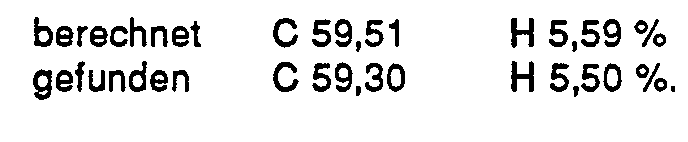
- 2,30 g (10 mMol) 4,5-Dichlorphthalsäure-N-methylimid, 2,69 g (13 mMol) Thiosalicylsäure-Dinatriumsalz und 12 ml DMF werden 18 h bei 80°C gerührt. Das Gemisch wird in verdünnter Salzsäure/THF/Toluol aufgenommen. Die organischen Phasen werden abgetrennt und mit NaHCO3-Lösung extrahiert. Die basischen wässrigen Extrakte werden angesäuert und mit THF/Toluol extrahiert. Die Extrakte werden getrocknet und eingedampft. Der Rückstand wird aus THF/Toluol fraktioniert kristallisiert. So werden 1,1 g (32 % d.Th.) rohes 4-(2-Carboxyphenylthio)-5-chlorphthalsäure-N-methylimid erhalten. Dieses wird in 12 g Polyphosphorsäure während 10 Min. auf 200°C erhitzt. Das Gemisch wird abgekühlt, in Wasser aufgenommen und mit THF/Toluol extrahiert. Die Extrakte werden mit NaHCO3- und gesättigter NaCI-Lösung gewaschen, über Natriumsulfat getrocknet und eingedampft. Nach dem Umkristallisieren aus THF/Toluol erhält man 580 mg (55 % d.Th.) 4-Chlorthioxanthon-1,2-dicarbonsäure-N-methylimid; Smp. 258 - 266°C.
- Analyse für C16H8ClNO3S (Molgewicht 329,76):

- 1,65 g (8 mMol) 3-Nitrophthalsäure-N-methylimid, 1,60 g (8,7 mMol) Salicylsäure-Dinatriumsalz und 10 ml N,N-Dimethylacetamid werden 30 Min. bei 120°C gerührt. Nach dem Abkühlen wird das Gemisch in verdünnter Salzsäure/THF/Toluol aufgenommen, die organischen Extrakte werden mit NaHC03-Lösung extrahiert, die wässrigen basischen Extrakte werden angesäuert und mit THF/Toluol extrahiert. Die Extrakte werden über Natriumsulfat getrocknet und eingedampft, wobei überschüssige Salicylsäure absublimiert. Der Rückstand (1,57 g, max. 5,2 mMol) wird in 14 g Polyphosphorsäure während 90 Min. auf 150°C erhitzt. Das Gemisch wird abgekühlt, in Wasser/THF/Toluol aufgenommen, auf pH 10 gestellt und extrahiert. Die organischen Phasen werden mit NaHCOs-Lösung und gesättigter NaCI-Lösung gewaschen, über Natriumsulfat getrocknet und eingedampft. Aus THF umkristallisiert werden 340 mg (23 % d.Th.) Xanthon-3,4-dicarbonsäure-N-methylimid erhalten; Smp. 280 - 283°C.
- Analyse für C16HgN04 (Molgewicht 279,25):

- 3,0 g (7,8 mMol) 1-Nitrothioxanthon-3,4-dicarbonsäure-N-n-butylimid und 2,2 g (15,9 mMol) Kaliumcarbonat werden in 35 ml DMF während 1 h bei 50°C gerührt. Das Gemisch wird eingedampft und der Rückstand wird in verdünnter HCI-Lösung aufgenommen und mit THF und Toluol extrahiert. Nach dem Trocknen über Natriumsulfat werden die Extrakte eingedampft. Die Umkristallisation aus THF ergibt 2,04 g (74 % d.Th.) 1-Hydroxythioxanthon-3,4-dicarbonsäure-N-n-butylimid; Smp. 191 - 193°C.
- Analyse für C19H15NO4S (Molgewicht 353,39):

- 13,01 g (40 mMol) Thioxanthon-3,4-dicarbonsäure-N-(2-hydroxyäthyl)-imid werden zu einer Lösung von 15,75 g (150,7 mMol) frisch destilliertem Methacrylsäurechlorid in 130 ml absolutem Dioxan zugegeben. Das Gemisch wird mit 2 ml Pyridin versetzt und während 4 h am Rückfluss gehalten. Dann wird das Gemisch bei 50°C im Vakuum eingedampft, der Rückstand wird in Methylenchlorid/Wasser aufgenommen und die organischen Phasen werden getrocknet und eingedampft. Aus Methylenchlorid/n-Pentan werden 11,84 g(71 % d.Th.) Thioxanthon-3,4-dicarbonsäure-N-(2-methacry- loyloxyäthyl)-imid erhalten; Smp. 201 - 206°C.
- Analyse für C21H15NO5S (Molgewicht 393,41):
-

- 1 g (3,7 mMol) 4-Chlorphthalsäure-N-benzylimid, 1,46 g Thiosalicylsäure-Dinatriumsalz und 10 ml DMF werden 4 h am Rückfluss erhitzt. Nach dem Eindampfen wird der Rückstand in NaHCOs-Lösung aufgenommen, diese mit THF/Toluol extrahiert, die Extrakte werden verworfen, dann wird die Wasserphase angesäuert und das Zwischenprodukt wird mit THF/ Toluol extrahiert. Durch Eindampfen erhält man das rohe 4-(2-Carboxyphenylthio)-phthalsäure-N-benzylimid. Dieses wird mit 14,8 g Polyphosphorsäure während 30 Min. bei 200°C gerührt. Das Gemisch wird abgekühlt, mit Wasser verrührt, auf pH 8 gestellt und der Niederschlag abfiltriert und getrocknet. Das Rohprodukt wird mit Methylenchlorid über Kieselgel chromatographiert. Dabei werden die beiden entstandenen Produkte getrennt:
- Thioxanthon 2,3-dicarbonsäure-N-benzylimld, 120 mg (9 % d.Th.), Smp. 289 - 294°C.
- Analyse für C22-H13-NO3S (Molgewicht 371,41):

- Thioxanthon-1,2-dicarbonsäure-N-benzylimid; 40 mg (3 % d.Th.); Smp. 210 - 213°C;
- gefunden C 70,78 H 4,17, N 3,66 %.
- (Zuordnung mittels 1H-NMR-Spektrum).
- Das 4-Chlorphthalsäure-N-benzylimid wird durch Erhitzen von 4-Chlorphthalsäureanhydrid (13 g; 71,2 mMol) mit 7,63 g (71,2 mMol) Benzylamin in Xylol am Rückfluss unter Wasserabscheidung hergestellt. Nach dem Eindampfen und Umkristallisieren aus Toluol/Cyclohexan erhält man 18,01 g (93 % d.Th.) 4-Chlorphthalsäure-N-benzylimid; Smp. 117 - 119°C.
- Analyse für C15H10ClNO2 (Molgewicht 271,70):

- 5 g (17,71 mMol) Thioxanthon-3,4-dicarbonsäureanhydrid und 50 ml absolutes Äthanol werden 5 Stunden am Rückfluss gehalten. Das Gemisch wird im Vakuum zur Trockene eingedampft und der Rückstand (Gemisch der beiden Halbester) mit 65 ml Thionylchlorid während 30 Minuten am Rückfluss gehalten. Das Gemisch wird wieder eingedampft und der Rückstand mit 60 ml absolutem Äthanol während 4 Stunden am Rückfluss gehalten. Das Gemisch wird eingeengt, der Rückstand wird in THF/Toluol 1 : 1 gelöst, die Lösung wird mit NaHCOs-Lösung zweimal gewaschen, die organischen Phasen über Natriumsulfat getrocknet und eingedampft. Aus CH2Cl2/Pentan umkristallisiert, werden 3,4 g (54 %) Thioxanthon-3,4-di-carbonsäurediätyhlestererhalten, Smp. 100 - 101°C.
- Analog wie der Diäthylester wird der Thioxanthon-3,4-dicarbonsäuredimethylester hergestellt, Ausbeute 52 %, Smp. 150 - 55°C.
- 5 g (15,24 mMol) Thioxanthon-3,4-dicarbonsäure-dimethylester werden in 50 ml absolutem Allylalkohol gelöst. Am Rückfluss werden 0,4 g (7,4 mMol) NaOCH3 zugegeben und das Gemisch 1 Tag am Rückfluss gehalten. Die Suspension wird in THF/Toluol 1 : 1 aufgenommen und mit NaHCOs-Lösung dreimal gewaschen. Nach dem Trocknen über Natriumsulfat wird die Lösung eingedampft und der Rückstand aus Methylenchlorid/Pentan umkristallisiert. Ausbeute an Thioxanthon-3,4-dicarbonsäurediallylester3,0 g (52 %), Smp. 45 - 8°C.
- 10,0 g (40 mMol) 5-Carboxy-3-nitrophthalsäure-N-methylimid (hergestellt nach: M.A. Ribi, C.C. Wei und E.H. White, Tetr. 28, 481 (1972), 100 ml DMSO, 4,85 g (44 mMol) Thiophenol und 17,69 g (128 mMol) wasserfreies Kaliumcarbonat werden während 5 Stunden bei 25° gerührt. Das Gemisch wird auf 300 ml H20 ausgetragen und angesäuert. Der Niederschlag wird abfiltriert, mit H20 gewaschen und in Methylenchlorid aufgenommen. Nach dem Trocknen über Natriumsulfat wird eingedampft und aus Methylenchlorid/Pentan umkristallisiert, Ausbeute 8,0 g (64 %), 5-Carboxy-3-phe- nylthiophthalsäure-N-methylimid, Smp. 287 - 92°C.
- 0,50 g (1,6 mMol) des obigen Imids wird mit 3,25 ml (6,5 mMol) 2N NaOH-Lösung während 80 Minuten am Rückfluss gehalten. Das Gemisch wird mit konzentrierter HCI-Lösung stark angesäuert und während 18 Stunden am Rückfluss gehalten. Das Gemisch wird auf Wasser ausgetragen und mit THF/Toluol extrahiert. Die Extrakte werden über Na2S04 getrocknet und eingedampft. Der Rückstand (rohe Tricarbonsäure) wird mit 8 ml o-Dichlorbenzol und 0,5 ml Acetanhydrid unter azeotroper Entfernung des Wassers und Eisessigs während 5 Stunden erhitzt. Durch Eindampfen und Zugabe von etwas Pentan werden 0,31 g (65 %) 5-Carboxy-3-phenylthiophthal- säureanhydrid erhalten, Smp. 237 - 47°C.
- 0,13 g (0,43 mMol) des obigen Anhydrids wird in 1,3 g Polyphosphorsäure während 2 Stunden auf 220°C erhitzt. Das Gemisch wird abgekühlt, mit Wasser verdünnt und mit THF/Toluol extrahiert. Die Extrakte werden über Na2S04 getrocknet und eingedampft. Aus THF/Toluol/Pentan umkristallisiert, werden 0,10 g (77 %) Thioxanthon-1,3-dicarbonsäure erhalten, Smp. 325 - 30°C.
- Analyse für C15H8O5S (Molgewicht 300,28)

- Es wird ein Polymeres mit folgender Struktur und Zusammensetzung hergestellt:


- Zu 10 g der oben beschriebenen Polymerlösung in 1-Acetoxy-2-äthoxy-äthan, verdünnt mit N,N-Dimethylformamid werden die in der folgenden Tabelle II angegebenen Mengen Sensibilisator zugegeben, wobei sich die Menge (Konzentration) auf den Feststoffgehalt bezieht. Die Polymerlösungen mit dem gelösten Sensibilisator werden durch Aufschleudern (500 Umdrehungen/Min. während 1 Min.) so auf kupferkaschierte Epoxidplatten aufgetragen, dass nach dem Trocknen (15 Minuten bei 80°C) eine 1 - 3 µ dicke Polymerschicht auf dem Kupfer gebildet wird. Die beschichteten Platten werden durch eine Negativ-Vorlage (Stufenkeil: Stouffer 21-Step-Sensitivity-Guide) mit einer 400 Watt Quecksilberhochdrucklampe im Abstand von 55 cm zum Vakuumtisch belichtet. Vakuumtisch mit vorgeschaltetem Pyrex-Glasfilter von 8 mm Dicke; Belichtungszeiten siehe Tabelle II.
- Nach der Belichtung wird das Bild in einem 1,1,1-Trichloräthanbad während 2 Min. entwickelt, wobei die unvernetzten Anteile herausgelöst werden. Das resultierende Reliefbild des abgebildeten Stufenkeils wird durch Ätzen der blanken Kupferteile mit einer 50 %-gen FeCl3-Lösung sichtbar gemacht. In der folgenden Tabelle II bedeutet Srei die relative Empfindlichkeit. Sie ist ein Faktor, der angibt, um wieviel länger oder kürzer als 1 Min. belichtet werden muss, um noch die Stufe 7 (optische Dichte des Stufenkeils - 1) abzubilden. Es gilt folgende Beziehung:


- 125,9 g Methacrylsäurehydroxypropylester (Gemisch aus 2- und 3-Hydroxypropylester) und 58,3 g Methacrylsäuremethylester werden in 416 ml Dioxan gelöst und unter Rühren und Inertgas auf 70°C erhitzt und dann mit 0,92 g Azoisobutyronitril versetzt. Nach 12 h bei 70°C wird mit 500 ml Dioxan verdünnt. Dann wird das Polymer durch Fällen in 6 Liter Eiswasser isoliert. Ausbeute 169,3 g (91,5 % d.Th.). Tg: 90°C; [η] - 0,65 dl/g in N,N-Dimethyfformamid bei 25°C; durchschnittliches Molekulargewicht 120 000 (bestimmt durch Lichtstreuung).
- Das gemäss a) hergestellte Polymer wird in N,N-Dimethylformamid gelöst und mit jeweils 5 Gew.-% der in der folgenden Tabelle 111 angegebenen Thioxanthonverbindung sowie der äquimolaren Menge Kupfer(II)acetat versetzt. Der Feststoffgehalt der Lösung beträgt 30 Gew.-%. Die Lösung wird dann mit einem Rollercoater als 50 µm starker Nassfilm auf eine Polyesterfolie aufgestrichen und durch eine Maske (21-Step Sensitivity Guide der Fa. Stouffer) auf einem Vakuum-Heiztisch bei 90°C belichtet. Als Lichtquelle dient eine 5 kW Quecksilberhochdrucklampe (Fa. Staub AG, Neu-Isenburg, BRD). Das so erhaltene Bild aus Kupferkeimen wird in einem stromlosen Metallabscheidungsbad der Zusammensetzung:
- Kupfersulfat 12 g/l, Formaldehyd 8 g/l, NaOH 15 g/l, Natriumkaliumtartrat 14 g/l, Äthylendiamintetraessigsäure 20 g/l, Octylphenolpolyäthylenglykoläther 1 g/l (n - 1; Tryton X 100® der Fa. Röhm & Haas) bei 49°C zu einem metallischen, elektrisch leitenden Bild verstärkt. Die Resultate sind in der Tabelle III angegeben.

- Anwendungsbeispiel III: photohärtbare Masse.
- Es wird ein Weisslack nach folgender Rezeptur hergestellt:

- Die obigen Komponenten werden zusammen mit 125 g Glasperlen (Durchmesser 4 cm) in einer 250 ml Glasflasche während mindestens 24 Stunden auf eine Korngrösse ≤ µm gemahlen. In einem Gewichtsteil der so erhaltenen Weisslack-Stammpaste werden 2 Gew.-% des unten angegebenen Photohärters und jeweils 0,25 Gew.-% der unten angeführten Sensibilisatoren (Co-Initiatoren) gelöst. Anschliessend wird das Gemisch nochmals während 16 Std. mit Glasperlen gemahlen.
- Die so hergestellten Weisslacke werden mit einem 30 µm Rakel auf Glasplatten aufgetragen. Die Proben werden mit einem PPG-Bestrahlungsgerät mit einer Lampe zu 80 W/cm belichtet, und es wird die unter Erhaltung der Wischfestigkeit erzielbare Härtungsgeschwindigkeit ermittelt.

- Das als Photohärter verwendete 2-Methyl-1-[4-methylthio(phenyl)]-2-morpholino-propanon-1 kann wie folgt hergestellt werden:
- 151,4 g (0,675 Mol) 3,3-Dimethyl-2-methoxy-2-[4-(methylthio)phenyl]oxiran (Smp. 62 - 64°C) werden in 235,2 g (2,70 Mol) Morpholin gelöst und auf Rückfluss erwärmt.
- Nach 15 Stunden wird abgekühlt und das Morpholin abdestilliert. Der Rückstand (Smp. 67 - 71°C) wird in Diäthyläther aufgenommen und mit verdünnter Salzsäure extrahiert. Die Salzsäurelösung wird alkalisch gestellt und mit Diäthyläther extrahiert. Die Ätherlösung wird mit Na2S04 getrocknet und eingeengt. Der Rückstand kann aus Äthanol umkristallisiert werden. Smp. 75 - 76°C.
Claims (12)


Applications Claiming Priority (2)
| Application Number | Priority Date | Filing Date | Title |
|---|---|---|---|
| CH687282 | 1982-11-25 | ||
| CH6872/82 | 1982-11-25 |
Publications (2)
| Publication Number | Publication Date |
|---|---|
| EP0110832A1 EP0110832A1 (de) | 1984-06-13 |
| EP0110832B1 true EP0110832B1 (de) | 1989-12-27 |
Family
ID=4316370
Family Applications (1)
| Application Number | Title | Priority Date | Filing Date |
|---|---|---|---|
| EP83810541A Expired EP0110832B1 (de) | 1982-11-25 | 1983-11-21 | Xanthone und Thioxanthone |
Country Status (5)
| Country | Link |
|---|---|
| US (2) | US4585876A (de) |
| EP (1) | EP0110832B1 (de) |
| JP (1) | JPH0764839B2 (de) |
| CA (1) | CA1206477A (de) |
| DE (1) | DE3381013D1 (de) |
Families Citing this family (21)
| Publication number | Priority date | Publication date | Assignee | Title |
|---|---|---|---|---|
| US4585876A (en) * | 1982-11-25 | 1986-04-29 | Ciba-Geigy Corporation | Novel xanthones and thioxanthones |
| US4691059A (en) * | 1985-08-30 | 1987-09-01 | Minnesota Mining And Manufacturing Company | Copolymerizable UV stabilizers |
| US4851454A (en) * | 1986-07-17 | 1989-07-25 | The Dow Chemical Company | Photolytically crosslinkable thermally stable composition |
| EP0430881A3 (en) * | 1989-11-29 | 1991-10-23 | Ciba-Geigy Ag | Photochromic compounds, process for their preparation and their use |
| US5149830A (en) * | 1990-02-23 | 1992-09-22 | Steadfast, Inc. | Substituted xanthene compounds |
| EP0494048A1 (de) * | 1991-01-03 | 1992-07-08 | Ciba-Geigy Ag | Photochrome Benzothioxanthonoxide, Verfahren zu deren Herstellung und deren Verwendung |
| US5225525A (en) * | 1991-01-03 | 1993-07-06 | Ciba-Geigy Corporation | Photochromic benzothioxanthone oxides, process for their preparation and the use thereof |
| JPH0641305A (ja) * | 1991-10-25 | 1994-02-15 | Internatl Business Mach Corp <Ibm> | フッ素化された反応体からのポリアミド酸およびポリイミド |
| US5391464A (en) * | 1993-12-28 | 1995-02-21 | International Business Machines Corporation | Thioxanthone sensitizer for radiation sensitive polyimides |
| US5977077A (en) * | 1995-08-28 | 1999-11-02 | Interlab Corporation | Xanthone analogs for the treatment of infectious diseases |
| AU4515701A (en) | 1999-12-02 | 2001-06-18 | Interlab, Inc. | Xanthone analogs for treating infectious diseases and complexation of heme and porphyrins |
| US7705065B2 (en) * | 2007-08-28 | 2010-04-27 | Xerox Corporation | Photoinitiator functionalized with alkoxy groups |
| US8129447B2 (en) | 2007-09-28 | 2012-03-06 | Fujifilm Corporation | Ink composition and inkjet recording method using the same |
| JP5344892B2 (ja) * | 2008-11-27 | 2013-11-20 | 富士フイルム株式会社 | インクジェット用インク組成物、及びインクジェット記録方法 |
| CN101906095B (zh) * | 2010-07-06 | 2013-08-14 | 天津久日化学股份有限公司 | 噻吨酮-4-羧酸酯及制备方法和光引发剂组合物与应用 |
| WO2013036502A1 (en) | 2011-09-07 | 2013-03-14 | Microchem Corp. | Epoxy formulations and processes for fabrication of relief patterns on low surface energy substrates |
| US9962430B2 (en) | 2012-02-15 | 2018-05-08 | Chirhoclin, Inc. | Methods for treating pain associated with chronic pancreatitis |
| US11406718B2 (en) | 2012-05-29 | 2022-08-09 | Chirhoclin, Inc. | Methods of detecting pancreobiliary ductal leaks |
| CN105503901B (zh) * | 2015-12-25 | 2018-10-19 | 广州纽楷美新材料科技有限公司 | 一种硫杂蒽酮二甲酰胺类化合物及其制备方法和应用 |
| CN110799598B (zh) | 2017-06-30 | 2022-03-29 | 科腾聚合物有限责任公司 | 浅色松香酯组合物及其制备方法 |
| US11744878B2 (en) | 2020-08-19 | 2023-09-05 | Chirhoclin, Inc. | Methods for treatment of COVID-19 syndrome |
Citations (4)
| Publication number | Priority date | Publication date | Assignee | Title |
|---|---|---|---|---|
| EP0033720A1 (de) * | 1980-02-05 | 1981-08-12 | Ciba-Geigy Ag | Thioxanthoncarbonsäureester, -thioester und -amide, deren Verwendung als Sensibilisatoren oder Photoinitiatoren und Polymere |
| FR2482098A1 (fr) * | 1980-05-06 | 1981-11-13 | Ciba Geigy Ag | Phtalimides, acides phtaliques et anhydrides phtaliques disubstitues en 3, 5, procede pour les preparer et leur application |
| EP0062615A1 (de) * | 1981-04-08 | 1982-10-13 | Ciba-Geigy Ag | Tetrasubstituierte Phthalsäurederivate, Verfahren zu deren Herstellung und Verwendung |
| JPH07131731A (ja) * | 1993-10-29 | 1995-05-19 | Sony Corp | テレビジョン受像機 |
Family Cites Families (20)
| Publication number | Priority date | Publication date | Assignee | Title |
|---|---|---|---|---|
| US2701801A (en) * | 1953-10-09 | 1955-02-08 | Du Pont | Nu-substituted diamino anthraquinone dicarboximide dyes |
| GB956014A (en) * | 1961-06-12 | 1964-04-22 | Ici Ltd | Anthraquinone-bis-thiachromone pigments |
| US3524863A (en) * | 1966-10-24 | 1970-08-18 | American Cyanamid Co | 9 - oxo - 2 - cyano - 2,3(1h) - xanthenedicarboximide compounds and process of preparation |
| US3444212A (en) * | 1966-10-24 | 1969-05-13 | American Cyanamid Co | 3-aroyl-2-alkylchromone compounds |
| US3544303A (en) * | 1968-04-03 | 1970-12-01 | Stanford Research Inst | Aromatic carboximides as herbicides |
| DE2120708A1 (en) * | 1971-04-27 | 1972-11-09 | Esso Research and Engineering Co., Linden, NJ. (V.St.A.) | Herbicidal s-aryl arylamides |
| BE786169A (fr) * | 1971-07-14 | 1973-01-12 | Syntex Corp | Acides xanthone-carboxyliques et leurs derives |
| US3818042A (en) * | 1972-01-12 | 1974-06-18 | Syntex Inc | Xanthone carboxylic acids and derivatives |
| JPS4834865A (de) * | 1971-09-08 | 1973-05-22 | ||
| US4250182A (en) * | 1972-02-24 | 1981-02-10 | Burroughs Wellcome Co. | Pharmaceutical composition containing acridone compounds and method of using same |
| US3922284A (en) * | 1973-03-30 | 1975-11-25 | Gen Electric | N-Substituted aromatic thioetherophthalimides |
| US4011246A (en) * | 1976-04-14 | 1977-03-08 | General Electric Company | 2-[4-(3,4-Dicarboxyphenoxy)phenyl]-2-(4-hydroxyphenyl)propane and the anhydrides thereof |
| CH634841A5 (en) * | 1978-06-13 | 1983-02-28 | Sandoz Ag | Process for the preparation of optionally substituted thioxanthones. |
| US4257953A (en) * | 1979-05-09 | 1981-03-24 | General Electric Company | Method for making bisphenoxide salts and bisimides derived therefrom |
| US4254144A (en) * | 1980-01-25 | 1981-03-03 | The Dow Chemical Company | Substituted benzonitriles having antiviral activity |
| CH643552A5 (de) * | 1980-05-06 | 1984-06-15 | Ciba Geigy Ag | Thioxanthoncarbonsaeuren und thioxanthoncarbonsaeurederivate. |
| JPS57163377A (en) * | 1981-03-16 | 1982-10-07 | Nippon Kayaku Co Ltd | Dialkylthioxanthone compound, its preparation, and curing of photopolymerizable resin composition using it |
| GB2108487B (en) * | 1981-11-03 | 1985-07-31 | Sericol Group Ltd | Water soluble thioxanthone photoinitiators |
| US4585876A (en) * | 1982-11-25 | 1986-04-29 | Ciba-Geigy Corporation | Novel xanthones and thioxanthones |
| DE3471486D1 (de) * | 1983-08-15 | 1988-06-30 | Ciba Geigy Ag | Photocurable compositions |
-
1983
- 1983-11-14 US US06/551,768 patent/US4585876A/en not_active Expired - Lifetime
- 1983-11-21 EP EP83810541A patent/EP0110832B1/de not_active Expired
- 1983-11-21 DE DE8383810541T patent/DE3381013D1/de not_active Expired - Lifetime
- 1983-11-23 CA CA000441728A patent/CA1206477A/en not_active Expired
- 1983-11-25 JP JP58220848A patent/JPH0764839B2/ja not_active Expired - Lifetime
-
1985
- 1985-12-23 US US06/812,554 patent/US4681950A/en not_active Expired - Fee Related
Patent Citations (4)
| Publication number | Priority date | Publication date | Assignee | Title |
|---|---|---|---|---|
| EP0033720A1 (de) * | 1980-02-05 | 1981-08-12 | Ciba-Geigy Ag | Thioxanthoncarbonsäureester, -thioester und -amide, deren Verwendung als Sensibilisatoren oder Photoinitiatoren und Polymere |
| FR2482098A1 (fr) * | 1980-05-06 | 1981-11-13 | Ciba Geigy Ag | Phtalimides, acides phtaliques et anhydrides phtaliques disubstitues en 3, 5, procede pour les preparer et leur application |
| EP0062615A1 (de) * | 1981-04-08 | 1982-10-13 | Ciba-Geigy Ag | Tetrasubstituierte Phthalsäurederivate, Verfahren zu deren Herstellung und Verwendung |
| JPH07131731A (ja) * | 1993-10-29 | 1995-05-19 | Sony Corp | テレビジョン受像機 |
Also Published As
| Publication number | Publication date |
|---|---|
| DE3381013D1 (en) | 1990-02-01 |
| CA1206477A (en) | 1986-06-24 |
| JPH0764839B2 (ja) | 1995-07-12 |
| US4681950A (en) | 1987-07-21 |
| JPS59108777A (ja) | 1984-06-23 |
| US4585876A (en) | 1986-04-29 |
| EP0110832A1 (de) | 1984-06-13 |
Similar Documents
| Publication | Publication Date | Title |
|---|---|---|
| EP0110832A1 (de) | Xanthone und Thioxanthone | |
| DE3018891C2 (de) | ||
| EP0199672B1 (de) | Oximsulfonate mit reaktiven Gruppen | |
| DE2851471C2 (de) | 2-Trihalogenmethyl-5-vinyl-1,3,4-oxadiazol-Verbindungen | |
| US4954416A (en) | Tethered sulfonium salt photoinitiators for free radical polymerization | |
| EP0033720A1 (de) | Thioxanthoncarbonsäureester, -thioester und -amide, deren Verwendung als Sensibilisatoren oder Photoinitiatoren und Polymere | |
| DE3117568C2 (de) | ||
| DE1795737A1 (de) | Chromogene verbindungen und ihre verwendung in druckempfindlichem aufzeichnungsmaterial | |
| DE112013005388T5 (de) | Aromatische Imid-Verbindung und Verfahren zur Herstellung derselben | |
| DE112020002200T5 (de) | Photoinitiatorzusammensetzung, die Acylcarbazolderivat und Carbazoyloximester enthält, und Verwendung derselben in einer lichthärtenden Zusammensetzung | |
| EP0080975A1 (de) | Lichtempfindliche Polymere | |
| EP0033721A1 (de) | Lichtvernetzbare Polymere mit seitenständigen Thioxanthon- und Imidylgruppierungen und Verfahren zu deren Herstellung | |
| CH628343A5 (en) | Process for preparing thioxanthones | |
| EP0110833B1 (de) | Verwendung von lichtempfindlichen Stoffgemischen für die stromlose Metallabscheidung | |
| CN110590533A (zh) | 含芴结构的水性光引发剂及其制备方法和应用 | |
| EP0003757B1 (de) | Tricyclische Imidylderivate und Verfahren zu ihrer Herstellung | |
| CH647506A5 (de) | 3,5-dinitrophthalsaeureimide. | |
| EP0062615A1 (de) | Tetrasubstituierte Phthalsäurederivate, Verfahren zu deren Herstellung und Verwendung | |
| CH632748A5 (de) | Verfahren zur herstellung von uracilderivaten. | |
| EP0002182B1 (de) | Bis-Azidophthalsäurederivate und Verfahren zu ihrer Herstellung | |
| EP0014673B1 (de) | Durch Licht vernetzbare Polymere mit seitenständigen, sich vom Indenon ableitenden Gruppen, Herstellung und Verwendung derselben | |
| DE3506436A1 (de) | Neue sulfonhaltige styrolderivate, verfahren zu deren herstellung und deren verwendung | |
| EP0106797A1 (de) | Diaryljodosylsalze und Verfahren zu deren Herstellung | |
| EP0015231B1 (de) | Indenoncarbonsäuren und Ester derselben sowie Verfahren zu ihrer Herstellung | |
| CH635583A5 (de) | Verfahren zur herstellung von gegebenenfalls substituierten thioxanthonen. |
Legal Events
| Date | Code | Title | Description |
|---|---|---|---|
| PUAI | Public reference made under article 153(3) epc to a published international application that has entered the european phase |
Free format text: ORIGINAL CODE: 0009012 |
|
| 17P | Request for examination filed |
Effective date: 19831124 |
|
| AK | Designated contracting states |
Designated state(s): CH DE FR GB LI NL |
|
| GRAA | (expected) grant |
Free format text: ORIGINAL CODE: 0009210 |
|
| AK | Designated contracting states |
Kind code of ref document: B1 Designated state(s): CH DE FR GB LI NL |
|
| REF | Corresponds to: |
Ref document number: 3381013 Country of ref document: DE Date of ref document: 19900201 |
|
| ET | Fr: translation filed | ||
| GBT | Gb: translation of ep patent filed (gb section 77(6)(a)/1977) | ||
| PLBE | No opposition filed within time limit |
Free format text: ORIGINAL CODE: 0009261 |
|
| STAA | Information on the status of an ep patent application or granted ep patent |
Free format text: STATUS: NO OPPOSITION FILED WITHIN TIME LIMIT |
|
| 26N | No opposition filed | ||
| PGFP | Annual fee paid to national office [announced via postgrant information from national office to epo] |
Ref country code: CH Payment date: 19921214 Year of fee payment: 10 |
|
| PG25 | Lapsed in a contracting state [announced via postgrant information from national office to epo] |
Ref country code: LI Effective date: 19931130 Ref country code: CH Effective date: 19931130 |
|
| REG | Reference to a national code |
Ref country code: CH Ref legal event code: PL |
|
| NLS | Nl: assignments of ep-patents |
Owner name: CIBA SC HOLDING AG |
|
| REG | Reference to a national code |
Ref country code: GB Ref legal event code: 732E |
|
| NLT1 | Nl: modifications of names registered in virtue of documents presented to the patent office pursuant to art. 16 a, paragraph 1 |
Owner name: CIBA SPECIALTY CHEMICALS HOLDING INC. |
|
| REG | Reference to a national code |
Ref country code: FR Ref legal event code: TP |
|
| PGFP | Annual fee paid to national office [announced via postgrant information from national office to epo] |
Ref country code: FR Payment date: 19980928 Year of fee payment: 16 |
|
| PGFP | Annual fee paid to national office [announced via postgrant information from national office to epo] |
Ref country code: NL Payment date: 19980930 Year of fee payment: 16 |
|
| PGFP | Annual fee paid to national office [announced via postgrant information from national office to epo] |
Ref country code: DE Payment date: 19981006 Year of fee payment: 16 |
|
| PGFP | Annual fee paid to national office [announced via postgrant information from national office to epo] |
Ref country code: GB Payment date: 19981013 Year of fee payment: 16 |
|
| PG25 | Lapsed in a contracting state [announced via postgrant information from national office to epo] |
Ref country code: GB Free format text: LAPSE BECAUSE OF NON-PAYMENT OF DUE FEES Effective date: 19991121 |
|
| PG25 | Lapsed in a contracting state [announced via postgrant information from national office to epo] |
Ref country code: NL Free format text: LAPSE BECAUSE OF NON-PAYMENT OF DUE FEES Effective date: 20000601 |
|
| GBPC | Gb: european patent ceased through non-payment of renewal fee |
Effective date: 19991121 |
|
| PG25 | Lapsed in a contracting state [announced via postgrant information from national office to epo] |
Ref country code: FR Free format text: LAPSE BECAUSE OF NON-PAYMENT OF DUE FEES Effective date: 20000731 |
|
| NLV4 | Nl: lapsed or anulled due to non-payment of the annual fee |
Effective date: 20000601 |
|
| PG25 | Lapsed in a contracting state [announced via postgrant information from national office to epo] |
Ref country code: DE Free format text: LAPSE BECAUSE OF NON-PAYMENT OF DUE FEES Effective date: 20000901 |
|
| REG | Reference to a national code |
Ref country code: FR Ref legal event code: ST |