EP0111714A2 - Dynamische Umkehrosmose-/Ultrafiltrationsmembranen mit guten Durchflusseigenschaften - Google Patents
Dynamische Umkehrosmose-/Ultrafiltrationsmembranen mit guten Durchflusseigenschaften Download PDFInfo
- Publication number
- EP0111714A2 EP0111714A2 EP83111037A EP83111037A EP0111714A2 EP 0111714 A2 EP0111714 A2 EP 0111714A2 EP 83111037 A EP83111037 A EP 83111037A EP 83111037 A EP83111037 A EP 83111037A EP 0111714 A2 EP0111714 A2 EP 0111714A2
- Authority
- EP
- European Patent Office
- Prior art keywords
- groups
- membrane
- polymers
- membranes
- polymer
- Prior art date
- Legal status (The legal status is an assumption and is not a legal conclusion. Google has not performed a legal analysis and makes no representation as to the accuracy of the status listed.)
- Granted
Links
Classifications
-
- B—PERFORMING OPERATIONS; TRANSPORTING
- B01—PHYSICAL OR CHEMICAL PROCESSES OR APPARATUS IN GENERAL
- B01D—SEPARATION
- B01D69/00—Semi-permeable membranes for separation processes or apparatus characterised by their form, structure or properties; Manufacturing processes specially adapted therefor
- B01D69/12—Composite membranes; Ultra-thin membranes
- B01D69/125—In situ manufacturing by polymerisation, polycondensation, cross-linking or chemical reaction
-
- B—PERFORMING OPERATIONS; TRANSPORTING
- B01—PHYSICAL OR CHEMICAL PROCESSES OR APPARATUS IN GENERAL
- B01D—SEPARATION
- B01D69/00—Semi-permeable membranes for separation processes or apparatus characterised by their form, structure or properties; Manufacturing processes specially adapted therefor
- B01D69/14—Dynamic membranes
-
- B—PERFORMING OPERATIONS; TRANSPORTING
- B01—PHYSICAL OR CHEMICAL PROCESSES OR APPARATUS IN GENERAL
- B01D—SEPARATION
- B01D71/00—Semi-permeable membranes for separation processes or apparatus characterised by the material; Manufacturing processes specially adapted therefor
- B01D71/06—Organic material
- B01D71/58—Other polymers having nitrogen in the main chain, with or without oxygen or carbon only
- B01D71/60—Polyamines
Definitions
- the present invention makes use of the phenomenon of concentration polarization under pressure to deposit a thin film of a hydrophilic polymer on a membrane support made of a modified polymer, this thin film being chemically bonded to the support on the one hand and cross-linked itself on the other hand.
- the membrane according to the invention is composed of a thin, crosslinked hydrophilic film which is bonded via chemical bonds to a thicker, possibly crosslinked membrane which has pores with larger openings.
- the thin hydrophilic layer improves the retention properties of the membrane and increases the separation capacity when separating e.g. monovalent low molecular weight salts of multivalent salts or higher molecular weight compounds.
- the cross-linking of the individual components of the membrane and their cross-linking give the membrane the stability indicated, in particular against solvents and mechanical pressure, and also prevent individual layers from being separated from the membrane.
- Concentration polarization is a well-known phenomenon that occurs in ultrafiltration (UF) and reverse osmosis (UO) as well as in electrochemistry. This phenomenon describes the accumulation (concentration) of dissolved molecules retained by the membrane on the concentrate side of a membrane during an osmosis / filtration process.
- a suitable example is the formation of so-called dynamic membranes, in which a thin separating layer is formed on a carrier material by separating the polymer as a thin film from a dilute polymer solution.
- dynamic membranes in which a thin separating layer is formed on a carrier material by separating the polymer as a thin film from a dilute polymer solution.
- polyamines were deposited on collodion with the aid of pressure filtration, a 3.6% solution of polyvinylamine hydrochloride, which is also buffered 1 molar in sodium chloride and at a pH of 8.7, by an activated collodion membrane filtered and so the polymer was adsorbed onto the carrier material (E. Hoffer, 0. Kedem, Ind. Eng. Chem. Process Des. Develop., Vol. 11, No. 2, 1972). According to this example, the penetration of the polyvinylamine into the pores of the carrier material was not prevented; furthermore, the polyvinylamine layer was also not crosslinked (To improve the stability (retention properties) of the membrane, however, such crosslinking is appropriate).
- the pressure is used to form a film which consists of dilute solution of the. is deposited on a carrier material, as well as chemically bound and cross-linked to this material, in order to produce membranes with good flux and high retention.
- the chemical reaction of a polymer membrane containing reactive groups with a hydrophilic polymer also belongs, e.g. known from European patent applications 25973, - 26319, 47953 and 61424.
- the starting material for membranes so modified are cellulosic polymers, such as e.g. Cellulose acetates, (co) polymers based on acrylonitrile, polyvinyl alcohols or polysulfones.
- the polymer is generally applied to the membranes in such a way that they are immersed in the polymer solution, although it is naturally only possible to exercise inadequate control over the thickness of the (deposited) film formed or the penetration of the polymer into the pores of the membrane.
- the penetration of the polymers e.g. of polyethyleneimine PEI
- the membranes according to the invention contain only very thin surface films; these are also chemically bound to the membrane support.
- the present invention therefore relates to a dynamic membrane which is located as a thin polymer layer on a porous, polymeric support and is characterized in that the support material and the membrane are connected to one another via chemical bonds and the membrane is crosslinked with polyfunctional low molecular weight compounds.
- the present invention further relates to processes for producing the dynamic membrane or the composite membrane from dynamic membrane and porous support material (support membrane), and also the use of these membranes in ultrafiltration / reverse osmosis processes, e.g. when cleaning and concentrating liquids, for example when separating (inorganic) salts from organic compounds or when cleaning waste water.
- the method according to the invention can be used to modify ultrafiltration membranes or microporous membranes (carrier membranes) with average pore sizes of about 10 to 5000 ⁇ , preferably 20 to 200 ⁇ , so that membranes with good Retention and excellent flow.
- the pore size of the membranes according to the invention (modified according to the invention) can be given, for example, about 1 to 200 A, in particular 5 to 50 ⁇ .
- the membranes according to the invention are dynamic (dynamically produced) (composite) membranes, made from optionally chemically modified polymeric and porous carrier materials, to which a thin, fine-pored membrane layer is applied, which is chemically bonded to the carrier.
- The. Formation of the membrane film can also be carried out with dilute aqueous solutions which contain the polymer and the polyfunctional low molecular weight, preferably nonionic compounds.
- the (controlled) deposition of the membrane film is carried out from dilute polymer / polyelectrolyte solutions under pressure, whereby the thickness of the film, its uniformity and the (possible) penetration into the carrier material are monitored.
- Parameters responsible for these variables are e.g. the concentration of the polymer solution, the pressure applied, the time and the size neutralization of polymer particles / pore size of the support material and the resulting retention of the polymer (rejection of the hydrophilic polymer by the porous support material).
- membranes can be produced which have an excellent flux in the range of the molecular exclusion limits (separation limits) from 100 to 5000, preferably from 300 to 2000.
- the membranes for the dye of the formula (108) a retention of up to 99% with a flux of 500 to 1400 1 / m 2 ⁇ d at 20 bar can be achieved, while with the membranes according to the invention flux values of 2000- 3500 1 / m 2 ⁇ d and the same conditions are possible.
- the polymers for example PEI
- relatively concentrated solutions for example 10% strength
- self-diffusion gives membranes with insufficient retention.
- the diluted polymer solutions are used under pressure (at least 2 bar, preferably 10 to 100 bar, and in particular 10 to 20 bar)
- pressure at least 2 bar, preferably 10 to 100 bar, and in particular 10 to 20 bar
- a layer builds up on the surface of the support, the thickness of which, for example, depends on the time of Pressure, the pressure itself, the concentration of the polymer solution and the pore size of the carrier (retention of the polymer).
- the thickness of the dynamically produced membrane film on the porous support material can range from the thickness of a monomolecular layer (approximately 5 to 10 A) to approximately 5000 A, preferably to approximately 1000 ⁇ .
- the amount of polymer to be used depends on the pore size of the support material, the distribution of the pores and the molecular weight of the polymer. If, for example, a polyacrylonitrile UF membrane with a 50% retention for the dye of the formula (108) is chemically modified with hydroxylamine and cyanuric chloride (introduction of reactive groups into the membrane), treatment is carried out This membrane with a diluted PEI solution does not significantly deteriorate the flow properties (flux) (reduction about 10 to 20%). As shown in Table 1, the flux changes of membranes treated with PEI solutions containing less than 1% polymer are small.
- the polyacrylonitrile membranes were reacted for 5 minutes at 60 ° C. with hydroxylamine and then for 5 minutes at 0 ° C. and a pH of 9.0 with cyanuric chloride.
- Test conditions 6% aqueous solutions of the dye of the formula (108), 25 bar, 50 ° C; Use of 10 cm long tubular membranes.
- Support membranes which can be used according to the invention include those made from cellulosic materials, such as cellulose or cellulose derivatives, for example cellulose acetates, polyvinyl alcohols, (aromatic) polysulfones, polystyrenes or polyepoxides or polyacrylonitriles, and also from corresponding co-, ter-, tetra-, Block or graft polymers into consideration.
- Reactive groups are introduced into these polymers by chemical modification and further the polymers are optionally pre-crosslinked, for example with ionic polyfunctional low molecular weight compounds.
- the modification of these carrier membranes before the actual concentration polarization with dilute polymer solutions can be carried out with polyfunctional compounds (as they are called below) and a polymer which is chemically linked to the carrier via the polyfunctional compounds; this type of modification is e.g. for cellulosic membranes, polyvinyl alcohol membranes, or membranes made of other hydroxyl-containing polymers, e.g. Bis-phenol-epichlorohydrin resins are suitable.
- Membranes made from aromatic polysulfones, polyepoxides or polystyrenes can be modified analogously if there are reactive groups (substituents) in the base polymers (base membranes). If they are not available, they can be e.g. by haloalkylation (chloromethylation) or coupling with an azo compound (introduction of e.g. an aminoarylazo group), optionally combined with further chemical reaction (modification) steps, into the base membrane. Other types of chemical modification known to those skilled in the art are also possible.
- membranes made from polyacrylonitrile or copolymers based on acrylonitrile are used to produce membranes, these can be modified, for example, by reaction with hydroxylamine, a polyfunctional compound and a polymer, and the membrane thus obtained can then be further modified according to the invention by ' concentration polarization.
- Suitable carrier membranes are e.g. made of polyacrylonitrile or copolymers based on acrylonitrile, these generally containing at least 5%, preferably at least 20% and particularly preferably at least 50% (by weight) of acrylonitrile units.
- suitable polymers are those made from alkyl (C 1 -C 6 ) acrylonitriles, for example methacrylonitrile or hexylacrylonitrile, arylacrylonitriles, for example phenylacrylonitrile, haloacrylonitriles, where halogen is fluorine, chlorine or bromine, for example a-fluoroacrylonitrile or a-chloroacrylonitrile , and thioacrylonitriles.
- alkyl (C 1 -C 6 ) acrylonitriles for example methacrylonitrile or hexylacrylonitrile
- arylacrylonitriles for example phenylacrylonitrile
- haloacrylonitriles where halogen is fluorine, chlorine or bromine, for example a-fluoroacrylonitrile or a-chloroacrylonitrile
- thioacrylonitriles are examples of alkyl (C 1 -C 6 )
- Suitable comonomers that can be copolymerized with acrylonitrile are monomers. with e.g. hydrophobic, hydrophilic, polar or ionic groups, especially e.g. Vinyl esters with 2 to 18 carbon atoms in the acid part, especially vinyl acetate, vinyl ethers with 3 to 12 carbon atoms, vinyl pyridine, vinyl chloride, styrene, butadiene, acrylic or methacrylic acid or (meth) acrylates, e.g. those with 1 to 4 carbon atoms in the ester part.
- Maleic anhydride, 2-aminoethyl methacrylate and allyl compounds such as e.g.
- Terpolymers are also suitable, e.g. made of acrylonitrile, styrene and butadiene (ABS polymers), acrylonitrile / vinylaceta / methacrylate or acrylonitrile, / methyl methacrylate / sodium allyl sulfonate or tetrapolymers based on acrylonitrile.
- the membranes can also consist of mixtures of the (co) polymers mentioned.
- membranes which can be modified according to the invention are those in which at least some of the nitrile groups of the Acrylonitrile units have been hydrolyzed to carboxyl groups or reduced to amino groups.
- Membranes in which the comonomers used for the preparation (in addition to acrylonitrile) are chemically modified are also suitable.
- the membranes according to the invention should contain at least 5% acrylonitrile so that the chemical modification can be carried out at all.
- the starting membranes required for the modification according to the invention are commercial products or they can easily be produced by a person skilled in the art. Corresponding casting solutions and manufacturing processes are known from the technical literature, in particular also from the patent literature (cf. for example GB-PS 1 327.990 and GB-PS 2 016 301).
- porous base (support) membrane made of polyacrylonitrile or copolymers of acrylonitrile and ethylenically unsaturated comonomers
- aqueous solution of hydroxylamine (2 to 15%), which has a pH of 2 to 11, preferably 6 to 7 (eg adjusted with sodium carbonate) has been treated at temperatures of about 55 to 75 ° C for 3 to 60 minutes.
- the degree of formation of amidoxime groups from nitrile groups can range from 0.5 to 30%, preferably from 5 to 10%, e.g. Polymer material is used that contains 80% or more acrylonitrile units.
- the polyfunctional compounds can be used on the one hand before the concentration polarization for further modification of the support membrane and on the other hand also with the polymer during the concentration polymerization. In both cases they serve to bind the polymer to the amidoxime functions and / or other polymers with which the carrier membrane has been pretreated.
- Suitable polyfunctional compounds are monomeric compounds with crosslinking properties which can form a chemical bond both with the (modified) support membrane and with the polymer. These compounds containing at least two functional groups have their reactivity due to the addition of multiple bonds, epoxide groups, aziridine groups, aldehyde groups, imidate groups, isocyanate or isothiocyanate groups, furthermore hydroxyl groups, anhydride groups, acyl halide groups and N-methylol groups, or as a tertiary amine or preferably as a anion, in particular as a halide removable substituents, these groupings and substituents can also occur in combination and are optionally further substituted.
- the groups which can be removed are the compounds quaternary ammonium groups which are tert.
- Amines are split off, such as the trimethylammonium or pyridinium group, or also have the sulfonium group.
- they preferably contain substituents with a radical that can be split off as an anion wise with reactive halogen atoms.
- Such residues which can be split off as an anion owe their reactivity, for example, to the influence of electrophilic groups, such as the —CO or —SO 2 group in saturated, aliphatic residues. They owe their reactivity, for example, to the influence of a quaternary nitrogen atom, such as in the group -N ⁇ -CH 2 CH 2 Cl, or in aromatic radicals to the influence of electrophilic groups in the o- and p-positions, for example nitro; Hydrocarbon sulfonyl or hydrocarboncarbonyl groups, or the bond to a ring carbon atom which is adjacent to a tertiary ring nitrogen atom, such as in halotriazine or halopyrimidine residues.
- Cyclic carbonic acid imide halides and, above all, halogen di-or triazine compounds containing at least two reactive substituents and isocyanates and isothiocyanates have proven to be particularly advantageous.
- Tetrachloropyrimidine and especially cyanuric chloride are particularly advantageous.
- Hydrophilic polymers which are used in dilute solutions during the concentration polarization or, if appropriate, before this section in order to modify the carrier (base) membrane are, for example, those polymers which contain aliphatic or aromatic amino groups, which may be primary, secondary or tertiary ; furthermore, these polymers can also have hydroxyl or thio groups.
- polymers are polyethyleneimine (MW 150 to 1,000,000), partially alkylated (for example with methyl iodide) or modified in some other way, polyvinyl alcohol, optionally partially esterified (MW 2000-200,000), cellulose derivatives, such as.
- Ethyl cellulose carboxymethyl cellulose, hydroxymethyl cellulose, hydroxyethyl cellulose, also polyvinyl aniline (MW 200 to 2,000,000), polybenzylamine, polyvinylamine (MG 1000 to 2,000,000), polyvinyl mercaptan, polyvinylimidazoline, amino-modified polyepihalohydrins (US Pat. No. 1,558,807inders and polydiseases) Polymers containing piperidine rings (GB-PS 2 027 614), condensation products of dicyandiamide, formaldehyde and amine or ammonium salts (ammonium chloride) (US Pat. No.
- aminopolysulfones aminopolyarylene oxides (aminomethylated polyphenylene oxide) and polymers with hydrophilic amino groups (EP 8945)
- Examples of these are the copolymers of styrene sulfonate (sodium salt) / vinyl aniline, 2-aminoethyl methacrylate / acrylic acid, vinyl aniline / dinylbenzyltrimethylammonium chloride or vinylamine / vinyl sulfonate.
- Preferred components are polyvinyl alcohols, cellulose derivatives, polyvinylamines or polyvinylanilines and in particular the polyaliphatic (acylic or cyclic) polyalkyleneimines (polyethyleneimines) and also the copolymers mentioned above by way of example.
- the molecular weights of the polyethyleneimines (PEI) can range from 150 to 2,000,000 as indicated. Their molecular weight is preferably 1000 to 200,000 and in particular 50,000 to 200,000.
- Water is the preferred solvent for the hydrophilic polymers, but can be used by lower alcohols or ketones, optionally in a mixture with water.
- the polymer concentration in these solvents is, for example, in the range from 0.01 to 5% by weight, with preferred ranges being 0.01 to 2X or 0.01 to 1%. are to be mentioned. This information relates to the concentration polarization step. Polymer concentrations of about 2 to 10 parts by weight are suitable for the coating of the carrier membrane, if necessary, in front of it (e.g. to reduce the separation limits) with the same polymers.
- the temperature range depends on the reactivity of the reactants; it is between about -20 and + 80 ° C, preferably between 0 and 25 ° C.
- the pH can range from 7 to 12 and preferably from 8 to 10.
- support membranes with reactive groups are those mentioned above, in particular amino-substituted, chloromethylated or aminomethylated polysulfones, cellulose acetates and bisphenol-epoxy additives.
- the polymer solutions can optionally contain the polyfunctional compounds; this is e.g. depending on the reactivity of the membranes.
- the polymer solutions for the treatment of membranes (A) and (B) contain polyfunctional compounds, e.g. Cyanuric chloride, in a concentration of about 0.5 to 2.0 mmol / 1, preferably of about 0.1 to 0.9 mmol / 1.
- the polyfunctional compounds serve to bind the polymer to the (modified) support membrane and also (by crosslinking) to increase the molecular weight of the polymer.
- the membrane (C) contains sufficient reactive groups so that it is not necessary to use polyfunctional compounds simultaneously with the formation of the thin membrane film, although it may also be advisable in this case to use a polyfunctional compound, e.g. to increase the molecular weight of the polymer.
- the membrane film is crosslinked with e.g. preferably anionic crosslinkers, especially anionic reactive dyes.
- the pressure to be used during the concentration polarization can vary within a wide range and is generally in the range from 2 to 100 bar. Membranes with very good properties (retention, flux) are obtained if you work in the pressure range above 10 bar, while below 10 bar the membranes generally do not have sufficient retention capacity.
- the pressure is of course also dependent on the polymer concentration and the reaction time. For example, a pressure of more than 10 bar is advantageously used at PEI concentrations of less than 1% and reaction times of less than 30 minutes, and the reaction time can be shortened at higher pressures.
- the preferred pressure ranges can be specified as 10 to 100 or 10 to 30 bar. Lower pressures can be used when the polymer concentration is higher and longer reaction times are provided.
- the reaction time can range from 10 seconds to 4 hours, with the range of 10 to 60 minutes being preferred.
- the thin membrane film deposited on the porous support membrane is then crosslinked and / or loaded with polyfunctional nonionic (already mentioned) or preferably ionic compounds.
- the membrane film becomes, for example, with. -SO ⁇ 3 , -COO ⁇ and / or -HR ⁇ 3 ) -load residues.
- the membrane film consists of a monomolecular layer, crosslinking is generally not necessary; rather, the focus is on loading with ionic groups.
- Preferred is the use of ionic, optionally in combination with nonionic polyfunctional compounds, which generally lead to membranes with good flow and good retention.
- the polyfunctional compounds e.g. are hydrophilic or partially water-soluble, use only for crosslinking.
- the polyfunctional compounds are of low molecular weight.
- the crosslinking and (loading) step with compounds containing ionic groups can preferably be carried out in an aqueous medium and therefore differs from the usual crosslinking in composite membranes (UF / RO membranes). Water soluble polyfunctional compounds give the best results.
- Preferred polyfunctional compounds are ionic triazinyl or pyrimidyl derivatives, such as, for example, reactive azo dyes with these residues as reactive groups and with sulfo (S O ⁇ ), carbaxyl (C00 ⁇ -) and / or ammonium groups. Colorless compounds with the same reactive groupings are also suitable.
- Crosslinking can take place by forming chemical bonds, electrostatic interactions between ionic groups or by complexing polymeric functions with metal ions. All three networking options can exist side by side. Crosslinking with the formation of chemical bonds is preferred.
- One or more components e.g. a reactive dye and a metal salt (copper sulfate) can be used for crosslinking.
- Hydrophilic polyfunctional (nonionic and colorless) compounds are e.g. Diepoxides, aziridines, anyhdrides and preferably cyclic carbonic acid imide halides (cyanuric chloride, tetrachiorpgrimidine), dihalides of dicarboxylic acids or dialdehydes.
- the acid halides. are applied from aprotic solvents, while the other polyfunctional compounds can be applied from an aqueous medium while maintaining certain pH and temperature ranges.
- the reactive dyes can belong to different classes and are e.g. Anthraquinone, formazan or azo dyes. Azo dyes are preferred. If appropriate, they can also be present as metal complexes.
- reactive groups for example in the dyes: carboxylic acid halide groups, sulfonic acid halide groups, residues of ⁇ , ⁇ -unsaturated carboxylic acids or amides, for example acrylic, methacrylic, ⁇ -chloroacrylic or ⁇ -bromoacrylic acid, acrylamide residues, residues preferably lower Haloalkylcarboxylic acids, for example chloroacetic acid, a, ß-dichloropropionic acid or a, ß-dibromopropionic acid; Residues of fluorocyclobutane carboxylic acids, for example tri- or tetrafluorocyclobutane carboxylic acid; Residues with vinyl acyl groups, for example vinyl sulfone groups or carboxyvinyl groups; Residues containing ethylsulfonyK-SO 2 CH 2 CH 2 OSO 2 OH) -SO 2 CH 2
- polyfunctional compounds for crosslinking the membrane film deposited on the support material are reactive azo dyes which contain sulfonic acid groups (-S0 3 H) or carboxyl groups (-COOH), which may also be in salt form, for example in the form of an alkali metal salt (sodium salt) , and which contain as reactive groups monochlorotriazine, dichlorotriazine, 2,4-dichloropyrimidine, vinylsulfonyl, ⁇ -sulfatoethylsulfonyl, ⁇ -chloroethylsulfonyl or ⁇ -sulfatoethylaminosulfonyl radicals.
- reactive azo dyes which contain sulfonic acid groups (-S0 3 H) or carboxyl groups (-COOH), which may also be in salt form, for example in the form of an alkali metal salt (sodium salt) , and which contain as reactive groups monochlorotriazine, dichlorotri
- ionic groups in the membrane-modifying compounds there are e.g. Sulfonic acid, sulfato or carboxyl groups are also ammonium groups from primary, secondary or tertiary amines, quaternary ammonium groups and also phosphonium or sulfonium groups. Sulfonic acid groups as ionic groups are preferred.
- the membranes in which the polymer is crosslinked / loaded with an azo dye containing sulfonic acid groups are particularly valuable and versatile.
- the azo dye can also be complex metal, e.g. Copper.
- the charged groups into the membrane by reacting reagents, such as alkyl or benzyl halides, with an amino function of the polymer chain.
- reagents such as alkyl or benzyl halides
- the Polyethylenimiminrest be modified with methyl iodide or dimethyl sulfate.
- it can also be modified directly with chlorosulfonic acid.
- the crosslinking / loading with the polyfunctional compounds serves e.g.
- the introduction of positive or negative charges (ionic groupings) into the membrane surface and / or the pores can take place in one or two stages.
- One-stage means that the charge-bearing compound and so-called fixing agents (e.g. alkali) are used in a bath.
- fixing agents e.g. alkali
- the two-stage process you first have the adsorption step of the charge-carrying compound and then the fixing step in a separate reaction solution (chemical reaction between e.g. the reactive dye and the (modified) membrane).
- a separate reaction solution chemical reaction between e.g. the reactive dye and the (modified) membrane.
- the concentration of a reactive dye in aqueous solution can be about 0.5 to 3%; the adsorption is e.g. carried out at temperatures of 20 to 35 ° C for 2 to 60 minutes; the pB value can be 4 to 8.
- the fixation can then be carried out in an aqueous solution adjusted to a pB value of 9 to 12, the reaction time being approximately 30 minutes.
- the pE value is set with any organic (sodium carbonate) or organic base.
- the membranes can have different shapes depending on the intended use, e.g. plate-shaped, leaf-shaped, tubular, in the form of a pocket, a sack, a cone or as hollow fibers.
- the membranes can of course be protected (reinforced) by nonwoven supports, supports made of textile fabrics or paper, wire mesh or perforated plates (modules).
- the pore size can be varied by different temperatures and can also be adapted to the respective intended use. For example, by annealing the membranes before or after their chemical modification (50 to 150 ° C) change the pore size and thus the flow and the retention capacity of the membranes.
- the membranes according to the invention show a good retention capacity in the range of the specified temperatures combined with an excellent flow (flux).
- the dynamic membrane (the thin membrane film) can be formed under pressure on flat membranes, tubular membranes or hollow fibers.
- the cells for performing the procedure are the same as those used for the membrane test described below.
- a circular fluff membrane with an area of 13 cm 2 is used , which is located on a sintered disc made of stainless steel and is inserted into a cylindrical cell made of stainless steel.
- 150 ml of a dilute polymer solution eg 0.1 X PEI
- a pressure of 10 bar is applied with nitrogen. Under this pressure, the solution flows through the membrane and a polyethyleneimine (PEI) layer is deposited and formed on the flat membrane.
- PEI polyethyleneimine
- tubular membranes e.g. 60 cm long, with an outer diameter of 1.4 cm
- D is appropriately expressed in m 3 .m -2 .d -1 (m 3 / m 2 .d), d . h . Number of cubic meters per square meter of membrane area and day or in lm -2 h -1 , (1 / m 2 .h), ie liters per square meter of membrane area and hour.
- tubular membranes 60 cm long and with an outer diameter of 1.4 cm. These tubular membranes are placed in a perforated stainless steel tube.
- the whole thing is placed in a tube made of polycarbonate.
- the outflow of the membrane is between this outer polycarbonate tube and the steel tube.
- the liquid is added as a turbulent flowing stream of the solution under pressure (30 bar).
- the flow rate is kept at around 10-15 liters per minute.
- the retention capacity and the flow rate are calculated in the same way as for the flat membranes.
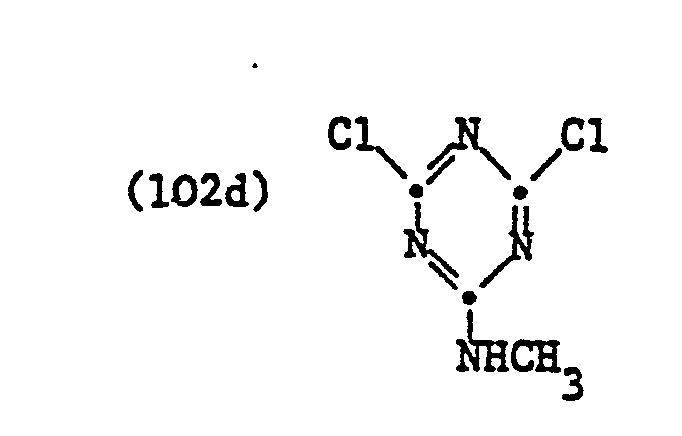
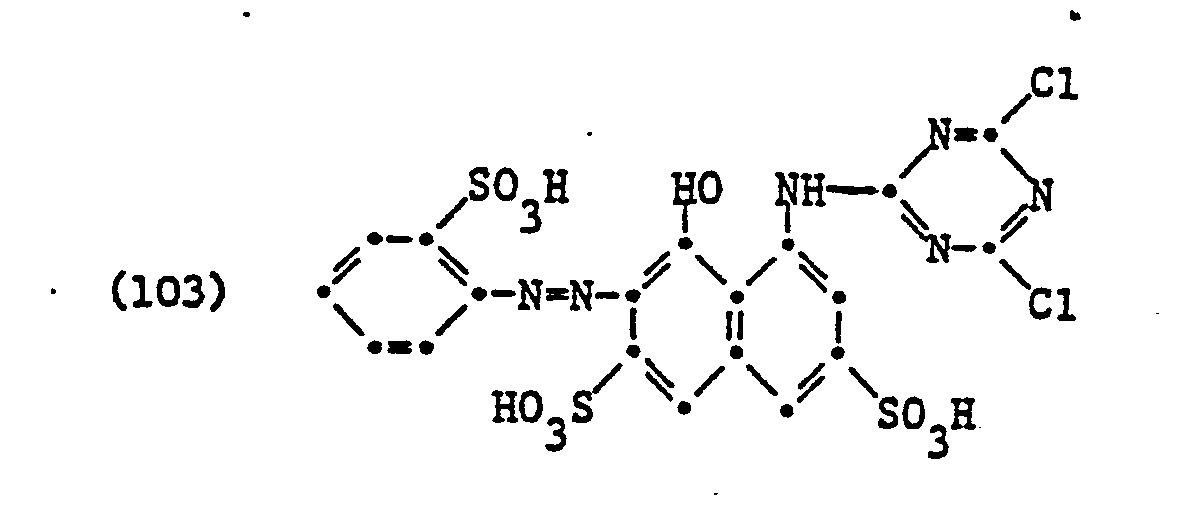
- the dyes and colorless compounds of the formulas (101) to (107) are used as polyfunctional compounds for crosslinking and for introducing ionic groups.
- the dyes of the formulas (108) to (110) are used in test solutions.
- Example 1 is repeated with the difference that the PEI solution is 0.02% strength and contains 0.3 mM / l cyanuric chloride and the process is carried out at room temperature.
- Example 1 is repeated with the difference that the PEI solution is 0.01% strength and contains 0.3 mM / 1 cyanuric chloride and the process is carried out at 40.degree.
- Test conditions flat membranes, 20 bar, room temperature; Dye of the formula (108), solutions and a dye content of 15,000 ppm and 2% NaCl.
- a 1% PEI solution containing an additional 0.3 mM / 1 cyanuric chloride is used. It works at a pressure of 10 bar and the. Modification canceled when 20 ml, 30 ml or 40 ml permeate are pressed through the membrane (use of 3 different starting membranes).
- Example 1 is repeated with 60 cm long tubular membranes, with different modification times being observed. The results obtained are given in Table IV.
- the membrane has a retention capacity of 99.2% for the dye of the formula (108) at a flow rate of 2842 1 / m ⁇ d.
- Test conditions 1.5% solution of the dye of the formula (108), 20 bar, room temperature.
- the membrane has a retention capacity of 98 Z for the dye of the formula (108) at a flow rate of 1800 1 / m 2 .d. Test conditions as given in Example 6.
- Flow and retention compared to the test dye of formula (108) before and after the modification are as follows: Flow: 2360 1 / m 2 .d -1800 1 / m 2 .d retention: 91% - 98.6% -
Landscapes
- Chemical & Material Sciences (AREA)
- Chemical Kinetics & Catalysis (AREA)
- Separation Using Semi-Permeable Membranes (AREA)
- Coating Of Shaped Articles Made Of Macromolecular Substances (AREA)
Abstract
Description
- Die vorliegende Erfindung macht Gebrauch von dem Phänomen der Konzentrationspolarisation unter Druck, um einen dünnen Film eines hydrophilen Polymers auf einem Membranträger aus einem modifizierten Polymer aufzutragen, wobei dieser dünne Film einerseits chemisch mit dem Träger verbunden und andererseits selbst vernetzt ist.
- Gemäss diesem Verfahren werden stabile Membranen erhalten, die gute Rückhalteeigenschaften zeigen und deren Durchflussvermögen (Flux) 2-3 mal grösser ist, als bei Membranen mit vergleichbaren Rückhalt.
- Die erfindungsgemässe Membran setzt sich zusammen aus einem dünnen, vernetzten hydrophilen Film, der über chemische Bindungen an eine dickere gegebenenfalls vernetzte Membran gebunden ist, die Poren mit grösseren Oeffnungen aufweist. Die dünne hydrophile Schicht verbessert die Rückhalteeigenschaften der Membran und erhöht die Trennkapazität bei der Trennung von z.B. einwertigen niedermolekularen Salzen von mehrwertigen Salzen oder höhermolekularen Verbindungen.
- Die Vernetzung der einzelnen Bestandteile der Membran sowie auch ihre Vernetzung untereinander verleiht der Membran die angegebene Stabilität, insbesondere gegen Lösungsmittel und mechanischen Druck und verhindert auss.erdem ein Abtrennen einzelner Schichten innerhalb der Membran.
- Die Konzentrationspolarisation ist ein bekanntes Phänomen, das bei der Ultrafiltration (UF) und Umkehrosmose (UO) sowie in der Elektrochemie auftritt. Dieses Phanomen beschreibt die Ansammlung (Konzentrierung) von gelösten, von der Membran zurückgehaltenen Molekülen auf der Konzentratseite einer Membran bei einem Osmose-/Filtrationsvorgang.
- In den allermeisten Fällen ist diese Konzentrationspolarisation unerwünscht, da sie die Effizienz der Trennung (Flux/Rückhalt) beeinträchtigt. (W.F. Blatt et al. in Membrane Science and Technology, Herausgeber: J.E. Flinn, Seiten 47-97, Plenum Press, 1970).
- In einigen Fällen ist es jedoch möglich dieses Phänomen zur Herstellung von Membranen zu verwenden, die einzigartige Eigenschaften aufweisen. Als geeignetes Beispiel sei die Bildung von sogenannten dynamischen Membranen genannt, wobei eine dünne Trennschicht auf einem Trägermaterial ausgebildet wird, indem man aus einer verdünnten Polymerlösung das Polymer als dünnen Film abscheidet. (D.G. Thomas, Reverse osmosis and synthetic membranes, Herausgeber: S. Sourirajan Seiten 295-312, NRCC Publications, (1977)). Als Beispiel für ein sol- . ches Verfahren ist die Beschichtung eines porösen Kunststoffträgers mit Polyacrylsäure beschrieben (Johnson, Minturn und Wadia in J. of Electro-analytical Chem. 37, 267, 1972).
- In einem anderen Beispiel wurden Polyamine mit Hilfe der Druckfiltration auf Kollodium abgeschieden, wobei eine 3,6 %ige Lösung von Polyvinylamin-Hydrochlorid, die ausserdem 1 molar an Kochsalz und auf einen pH-Wert von 8,7 abgepuffert ist, durch eine aktivierte Kollodiummebran filtriert und so das Polymer an das Trägermaterial adsorbiert wurde (E. Hoffer, 0. Kedem, Ind. Eng. Chem. Process Des. Develop., Vol. 11, No. 2, 1972). Gemäss diesem Beispiel wurde das Eindringen des Polyvinylamins in die Poren des Trägermaterials nicht verhindert; ferner wurde die Polyvinylaminschicht auch nicht vernetzt (zu Verbesserung der Stabilität (der Rückhalteeigenschaften) der Membran ist eine solche Vernetzung jedoch angebracht).
- Im Gegensatz zu diesen literaturbekannten Massnahmen, Polymere unter Druck auf Trägermaterialien abzuscheiden, um so die Eigenschaften von Membranen und/oder Trägermaterialien zu verändern, wird in der vorliegenden Erfindung der Druck dazu benutzt, die Bildung eines Films, der aus verdünnter.Lösung der. auf einem Trägermaterial abgeschieden wird, sowie an dieses Material chemisch gebunden und vernetzt wird, zu kontrollieren, um Membranen mit gutem Flux und hohen Rückhalt herzustellen.
- Membranen aus modifizierten Polymeren, zu deren Herstellung u.a. auch die chemische Reaktion einer Reaktivgruppen enthaltenden Polymermembran mit einem hydrophilen Polymer gehört, sind z.B. aus den europäischen Patentanmeldungen 25973,- 26319, 47953 und 61424 bekannt. Das Ausgangsmaterial für Membranen, die so modifiziert sind, sind cellulosische.Polymere, wie z.B. Celluloseacetate, (Co)polymere auf Basis von Acrylnitril, Polyvinylalkohole oder Polysulfone.
- Das Polymer wird auf die Membranen in der Regel so aufgebracht, dass man diese in die Polymerlösung eintaucht, wobei naturgemäss nur eine unzureichende Kontrolle bezüglich der Dicke des gebildeten (abgeschiedenen) Films oder der Penetration des Polymers in die Poren der Membran ausgeübt werden kann.
- Um einen besonders hohen Rückhalt (z.B. 99% für den Farbstoff der Formel (108)) zu erreichen ist eine relativ hochkonzentrierte Polymerlösung (5 bis 20%) notwendig. Obwohl dieser hohe Rückhalt erreicht werden kann, sind diese Membranen nicht optimal, da die notwendige dicke Polymerschicht (notwendig um den guten Rückhalt zu erreichen) und insbesondere auch die Penetration des Polymers in die.Poren der Membran, nur einen relativ geringen Durchfluss (Flux) gestatten.
- Es wurde nun gefunden, dass man mit Hilfe der Konzentrationspolarisation unter Druck die Penetration der Polymeren (z.B. von Polyäthyleniminen-PEI) in die Poren einer Membran kontrollieren und insbesondere so vermindern kann, dass die Membranen neben einem guten Rückhalt auch einen hervorragenden Druckfluss aufweisen. Die erfindungsgemässen Membranen enthalten aufgrund dieser Massnahmen nur sehr dünne Oberflächenfilme; diese sind ausserdem chemisch an den Membranträger gebunden.
- Gegenstand der vorliegenden Erfindung ist daher eine dynamische Membran, die sich als dünne Polymerschicht auf einem porösen, polymeren Träger befindet, und dadurch gekennzeichnet ist, dass das Trägermaterial und die Membran über chemische Bindungen miteinander verbunden sind und die Membran mit polyfunktionellen niedermolekularen Verbindungen vernetzt ist.
- Weitere Gegenstände der vorliegenden Erfindung sind Verfahren zur Herstellung der dynamischen Membran bzw. der Kompositmembran aus dynamischer Membran und porösen Trägermaterial (Trägermembran), sowie auch die Verwendung dieser Membranen in ültrafiltrations/Umkehrosmose-verfahren, z.B. bei der Reinigung und Konzentrierung von Flüssigkeiten, etwa bei der Trennung von (anorganischen) Salzen von organischen Verbindungen oder bei der Reinigung von Abwässern.
- Diese und andere Gegenstände der vorliegenden Erfindung werden nachfolgend näher erläutert.
- Das erfindungsgemässe Verfahren kann dazu verwendet werden, Ultrafiltrationsmembranen oder mikroporöse Membranen (Trägermembranen) mit durchschnittlichen Porengrössen von etwa 10 bis 5000 Ä, vorzugsweise 20 bis 200 Å so zu modifizieren, dass man Membranen mit gutem Rückhaltevermögen und ausgezeichnetem Durchfluss erhält. Die Porengrösse der erfindungsgemässen (erfindungsgemäss modifizierten) Membranen kann beispielsweise mit etwa 1 bis 200 A, insbesondere 5 bis 50 Å angegeben werden.
- Bei den erfindungsgemässen Membranen handelt es sich um dynamische (dynamisch hergestellte)(Komposit) Membranen, aus gegebenenfalls chemisch modifizierten polymeren und porösen Trägermaterialien, auf die eine dünne feinporige Membranschicht aufgebracht ist, die chemisch mit den Träger verbunden ist.
- Die erfindungsgemässen dynamischen Membranen sind erhältlich
- (a) durch Beschichtung eines porösen, polymeren Trägermaterials, mit einem Polymer aus einer verdünnten wässrigen Polymerlösung und unter Druck, wobei das Trägermaterial und das Polymer reaktive Gruppen enthalten, die untereinander reagieren können, und
- (b) Vernetzung des schichtförmig auf dem Trägermaterial vorliegenden Polymers mit polyfunktionellen niedermolekularen Verbindungen.
- Das Herstellungsverfahren für die Herstellung der erfindungsgemässen Membranen ist dadurch gekennzeichnet, dass man
- (a) auf dem Trägermaterialien Polymere aus verdünnten wässrigen Lösungen unter Druck abscheidet, wobei die Trägermaterialien und die Polymeren reaktive Gruppen enthalten, die untereinander reagieren können, und
- (b).die schichtförmig auf dem Trägermaterial abgeschiedenen Polymeren mit polyfunktionellen niedermolekularen Verbindungen vernetzt.
- Die. Bildung des Membranfilms kann auch mit verdünnten wässrigen Lösungen durchgeführt werden, die das Polymer und die polyfunktionellen niedermolekularen, vorzugsweise nicht-ionische Verbindungen enthalten.
- Durch das erfindungsgemässe Verfahren zur Herstellung der Membranen wird
- - die Abscheidung eines dünnen (Membran) Films aus einem Polyelektrolyten oder aus einem hydrophilen, reaktiven Polymer erreicht, ohne dass diese (in störender Menge) in die Poren des Trägermaterials eindringen '(minimale Penetration);
- - die Herstellung gleichmässiger Membranfilme in geringerer Dicke erreicht, als bisher möglich;
- - eine gute und gleichmässige Vernetzung des Polyelektrolyten/des hydrophilen Polymers und damit eine verbesserte chemische /mechanische Stabilität erreicht.
- Die (kontrollierte) Abscheidung des Membranfilms erfolgt aus verdünnten Polymer/Polyelektrolytlösungen unter Druck, wodurch die Dicke des Films, seine Gleichmässigkeit und die (mögliche) Penetration in das Trägermaterial überwacht werden. Parameter, die für diese Variablen verantwortlich sind, sind z.B. die Konzentration der Polymerlösung, der angewandte Druck, die Zeit und die Grössenralation Polymerpartikel/ Porengrösse des Trägermaterials und der sich daraus ergebende Rückhält des Polymers (Abweisung des hydrophilen Polymers durch das poröse Trägermaterial).
- Einige. Bedingungen, die für die Herstellung der erfindungsgemässen Membranen von Bedeutung sein können, sind die folgenden:
- 1. Die Porengrösse der Trägermembran wird vorzugsweise so gewählt, dass die Membran das Polymer, das zur Beschichtung (Filmbildung) (z.B. PEI) verwendet wird, zu etwa 98% zurückhält.
- 2. Das Molgewicht des Polymers soll gross genug sein, um nicht in die Poren des Trägers eindringen zu können (folgt aus (1.))
- 3. Die Polymerlösung soll nur eine geringe Konzentration (z.B. vorzugsweise weniger als 17) aufweisen. Die Polymerkonzentration in der Polymerlösung kann im Bereich von etwa 0,01 bis 5 Gew.-Z liegen; Polymere mit relativ niedrigen Molekulargewicht werden im allgemeinen in höheren Konzentrationen innerhalb des angegebenen Bereichs (also nahe 5 Z) eingesetzt: Kettenpolymere werden in Mengen, die sich mehr im unteren Konzentrationsbereich, und kugelförmige Polymere in Mengen, die sich mehr im oberen Konzentrationsbereich befinden, eingesetzt.
- 4. Das Vernetzungsmittel kann teilweise oder vorzugsweise ganz zusammen mit dem Polymer (in der Polymerlösung) eingesetzt werden, wobei ein nachträglicher getrennter Vernetzungsschritt gegebenenfalls nicht nötig ist. Für die Anwendung des Vernetzungsmittels zusammen mit dem Polymer werden vorzugsweise nicht-ionische polyfunktionelle Verbindungen eingesetzt. Der Vernetzungsschritt (b) kann zusätzlich zu dieser sogenannten Vorvernetzung erfolgen (mit vorzugsweise ionischen polyfunktionellen Verbindungen) oder auch unterbleiben.
- Gemäss diesem Verfahren können Membranen hergestellt werden, die einen ausgezeichneten Flux im Bereich der molekularen Ausschlussgrenzen (Trenngrenzen) von 100 bis 5000, vurzugsweise von 300 bis 2000 aufweisen. Beispielsweise sei erwähnt, dass mit bekannten Membranen für den Farbstoff der Formel (108) ein Rückhalt bis 99 % bei einem Flux von 500 bis 1400 1/m2·d bei 20 bar erreicht werden kann, während mit den erfindungsgemässen Membranen FluxWerte von 2000-3500 1/m2·d und den gleichen Bedingungen möglich sind.
- In den bekannten Verfahren zur Herstellung von modifizierten Membranen werden die Polymeren (z.B. PEI) aus relativ konzentrierten Lösungen (z.B. 10%ig) durch Selbstdiffusion auf die porösen Träger aufgebracht. Die Membranen zeigen hohen Rückhalt, jedoch relativ geringen Flux (800-1000 1/m2·d). Verwendet man verdünnte Polymerlösungen (weniger als 1%ig), so erhält man durch Selbstdiffusion Membranen mit nur ungenügendem Rückhalt. Erfolgt die Anwendung der verdünnten Polymerlösungen jedoch unter Druck (mindestens 2 bar, vorzugsweise 10 bis 100 bar, und insbesondere 10 bis 20 bar), so baut sich wegen der Konzentrationspolarisation auf der Oberfläche des Trägers eine Schicht auf, deren Dicke z.B. von der Zeit der Druckeinwirkung, dem Druck selbst, der Konzentration der Polymerlösung und der Porengrösse des Trägers (Zurückhaltung des Polymers) abhängt. Für diese Variablen gibt es jeweils ein Optimum, jenseits dessen ein Fluxabfall auftreten kann. Die Dicke des dynamisch hergestellten Membranfilms auf dem porösen Trägermaterial kann von der Dicke einer monomolekularen Schicht (ungefähr 5 bis 10 A) bis zu etwa 5000 A, vorzugsweise bis etwa 1000 Å reichen.
- Die Rahmenbedingungen für die Polymerkonzentrationen können z.B. wie folgt festgestellt werden:
- (i) obere Grenze: die höchste Konzentration, bei der keine Fluxabfall eintritt, wenn man eine nicht-modifizierte Membran in die Polymerlösung an angegebenen Konzentration eintaucht,
- (ii) untere Grenze: die niedrigste Konzentration, mit der man unter Druck noch einen Anstieg des Rückhalts auf etwa 98% erreicht.
- Die einzusetzende Menge des Polymers (z.B. PEI) hängt von der Porengrösse des Trägermaterials, der Verteilung der Poren und dem Molekulargewicht des Polymers äb. Wenn z.B. eine Polyacrylnitril-UF-Membran mit einem Rüchhalt von 50 % für den Farbstoff der Formel (108) -mit Hydroxylamin und Cyanurchlorid chemisch modifiziert wird (Einfuhrung reaktiver Gruppen in die Membran), so wird durch Behandeln dieser Membran mit einer verdünnten PEI-Lösung eine deutliche Verschlechterung der Durchflusseigenschaften (Flux) (Reduktion etwa 10 bis 20 %) nicht eintreten. Wie in Tabelle 1 gezeigt wird, sind die Fluxänderungen von Membranen, die mit PEI-Lösungen behandelt werden, die weniger als 1 % Polymer enthalten, nur gering.

- Vor der Behandlung mit den PEI-Lösungen, wurden die Polyacrylnitrilmembranen 5 Minuten bei 60° C mit Hydroxylamin und danach 5 Minuten bei 0°C und einem pH-Wert von 9,0 mit Cyanurchlorid umgesetzt. Testbedingungen: 6%ige wässrige Lösungen des Farbstoffs der Formel (108), 25 bar, 50°C; Verwendung von 10 cm langen röhrenförmigen Membranen.
- Als Trägermembranen, die erfindungsgemäss verwendet werden können, kommen u.a. solche aus cellulosischen Materialien, wie Cellulose oder Cellulosederivaten, z.B. Celluloseacetaten, Polyvinylalkoholen, (aromatischen) Polysulfonen, Polystyrolen oder Polyepoxyden oder Polyacrylnitrilen, sowie auch aus entsprechenden Co-, Ter-, Tetra-, Block- oder Pfropfpolymeren in Betracht. In diese Polymeren werden durch chemische Modifikation reaktive Gruppen eingeführt und ferner sind die Polymeren gegebenenfalls vorvernetzt, z.B. mit ionischen polyfunktionellen niedermolekularen Verbindungen.
- Die Modifikation dieser Trägermembranen vor der eigentlichen Konzentrationspolarisation mit verdünnten Polymerlösungen kann mit polyfunktionellen Verbindungen (wie sie nachfolgend genannt werden) und einem Polymer erfolgen, das über die polyfunktionellen Verbindungen chemisch mit dem Träger verbunden ist; diese Art der Modifkation ist z.B. für cellulosische Membranen, Polyvinylalkoholmembranen, oder Membranen aus anderen Hydroxylgruppen enthaltenden Polymeren, z.B. Bis-phenol-epichlorhydrinharzen geeignet.
- Membranen aus aromatischen Polysulfonen, Polyepoxyden oder Polystyrolen können analog modifiziert werden, wenn sich reaktionsfähige Gruppen (Substituenten) in den Basispolymeren (Basismembranen) befinden. Sind sie nicht vorhanden, so können sie in üblicher Weise z.B. durch Haloalkylierung (Chlormethylierung) oder Kupplung mit einer Azoverbindung (Einführung von z.B. einer Aminoarylazogruppe), gegebenenfalls kombiniert mit weiteren chemischen Reaktions-(Modifikations-)schritten, in die Basismembran eingeführt werden. Weitere, dem Fachmann bekannte Arten der chemischen Modifikation..sind ebenfalls möglich.
- Werden Membranen aus Polyacrylnitril oder Copolymeren auf Basis von Acrylnitril zur Herstellung von Membranen verwendet, so kann man diese z.B. durch Umsetzung mit Hydroxylamin, einem polyfunktionellen Verbindung und einem Polymer modifizieren und die so erhaltene Membran dann durch'Konzentrationspolarisation eriindungsgemäss weiter modifizieren.
- Nachfolgend wird die vorliegende Erfindung näher erläutert, wobei man als Träger(Basis)-Membran eine Polyacrylnitrilmembran verwendet. Eine Beschränkung der Erfindung auf diesen Typ von Membranen bedeutet das jedoch nicht.
- Geeignete Trägermembranen bestehen also z.B. aus Polyacrylnitril oder Copolymeren auf Basis von Acrylnitril, wobei diese in der Regel mindestens 5%, vorzugsweise mindestens 20% und besonders bevorzugt mindestens 50% (bezogen auf das Gewicht) Acrylnitrileinheiten enthalten.
- Weitere geeignete Polymere (neben Polyacrylnitril) sind solche aus Alkyl(C1-C6)-Acrylnitrilen, z.B. Methacrylnitril oder Hexylacrylnitril, Arylacrylnitrilen, z.B. Phenylacrylnitril, Halogenacrylnitrile, worin Halogen Fluor, Chlor oder Brom ist, z.B. a-Fluoracrylnitril oder a-Chloracrylnitril, und Thioacrylnitrilen.
- Geeignete Comonomere, die mit Acrylnitril copolymerisiert werden können, sind Monomere. mit z.B. hydrophoben, hydrophilen, polaren oder ionische Gruppen, insbesondere z.B. Vinylester mit 2 bis 18 Kohlenstoffatomen im Säureteil, insbesondere Vinylacetat, Vinyläther mit 3 bis 12 Kohlenstoffatomen, Vinylpyridin, Vinylchlorid, Styrol, Butadien, Acryl- oder Methacrylsäure oder (Meth)acrylate, z.B. solche mit 1 bis 4 Kohleästoffatomen im Esterteil. Ferner Maleinsäureanhydrid, 2-Aminoäthylmethacrylat und Allylverbindungen, wie z.B. Allylalkohol, Allyl- oder Methallylsulfonsäure und ihre Salze (Alkalimetallsalze), Allyl- oder Methallylhalogenide, Allylamine oder Allyl-p-Toluolsulfonate. Ebenenfalls geeignet sind Terpolymere, z.B. aus Acrylnitril, Styrol und Butadien (ABS-Polymere), Acrylaitril/Vinylaceta/Methacrylat oder Acrylnitril,/Methylmethacrylat/Natriumallyl-sulfonat oder Tetrapolymere auf Acrylnitrilbasis.
- Die Membranen können auch aus Gemischen der genannten (Co)polymeren bestehen.
- Weitere Membranen, die erfindungsgemäss modifiziert werden können, sind solche, in denen mindestens einige der Nitrilgruppen der Acrylnitrileinheiten zu Carboxylgruppen hydrolysiert oder zu Aminogruppen reduziert worden sind. Ferner sind auch solche Membranen geeignet, in denen die zur Herstellung verwendeten Comonomeren (neben Acrylnitril) chemisch modifiziert sind. Die erfindungsgemässen Membranen sollten mindestens 5% Acrylnitril enthalten, so dass die chemische Modifikation überhaupt ausgeführt werden kann. Die zur erfindungsgemässen Modifikation benötigten Ausgangsmembranen sind kommerzielle Produkte oder sie können vom Fachmann leicht selber hergestellt werden. Ξntsprechende GiessLösungen und Herstellungsverfahren sind aus der technischen Literatur, insbesondere auch aus der Patentliteratur (vgl. z.B. GB-PS 1 327.990 und GB-PS 2 016 301) bekannt.
- Die poröse Basis-(Träger)-membran (aus Polyacrylnitril oder Copolymeren aus Acrylnitril und äthylenisch-ungesättigten Comonomeren) wird mit einer wässrigen Lösung von Hydroxylamin (2 bis 15%ig), die einen pH-Wert von 2 bis 11, vorzugsweise 6 bis 7 (z.B. eingestellt mit Natriumcarbonat) hat, bei Temperaturen von etwa 55 bis 75°C während 3 bis 60 Minuten behandelt.
- Der Grad der Bildung von Amidoximgruppen aus Nitrilgruppen kann im Bereich von 0,5 bis 30%, vorzugsweise im Bereich von 5 bis 10% liegen, wenn z.B. Polymermaterial verwendet wird, das 80% und mehr Acrylnitrileinheiten enthält.
- Die polyfunktionellen Verbindungen können einerseits vor der Konzentrationspolarisation zur weiteren Modifikation der Trägermembran und andererseits auch mit dem Polymer während der Konzentrationspolymerisation eingesetzt werden. In beiden Fällen dienen sie dazu, das Polymer an die Amidoximfunktionen und/oder andere Polymere zu binden, mit denen die Trägermembran vorbehandelt wurde.
- Ein typischer Reaktionsablauf für eine Umsetzung einer polyfunktionellen Verbindung, z.B. Cyanurchlorid, vor der Konzentrationspolarisation ergibt sich wie folgt:
- Die mit Hydroxylamin umgesetzte Polyacrylnitrilmembran wird aus der Reaktionslösung entfernt und in eine wässrige Lösung (Suspension) der (multifunktionellen) organischen Verbindung gebracht, die z.B. 0,5 bis 5 Teile Cyanurchlorid pro einem Teil Membran enthalten kann. Die Reaktionstemperatur soll unter 4°C, z.B. bei 0°C gehalten werden, um eine Hydrolyse des Cyanurchlorid zu vermeiden, der pH-Wert-Bereich ist etwa zwischen 8 und 11 und die Reaktionszeit kann 1 Minute bis 5 Stunden, vorzugsweise 5 bis 30 Minuten betragen.
- Als polyfunktionelle Verbindungen geeignet sind monomere Verbindungen mit vernetzenden Eigenschaften, die sowohl mit der (modifizierten) Trägermembran als auch mit dem Polymer eine chemische Bindung eingehen können. Ihre Reaktivität verdanken diese mindestens zwei funktionelle Gruppen aufweisenden Verbindungen additionsfähigen Mehrfachbindungen, Epoxidgruppen, Aziridingruppen, Aldehydgruppen, Imidatgruppen, Isocyanat- oder Isothiocyanatgruppen, ferner Hydroxylgruppen, Anhydridgruppen, Acylhalogenidgruppen sowie N-Methylolgruppen, oder als tertiäres Amin oder vorzugsweise einem als Anion, insbesondere als Halogenid abspaltbaren Substituenten, wobei diese Gruppierungen und Substituenten auch in Kombination vorkommen können und gegebenenfalls weiter substituiert sind. Als addierende Mehrfachbindungen enthalten sie beispielsweise die Gruppierungen


- Als besonders vorteilhaft haben sich cyclische Kohlensäureimidhalogenide und vor allem mindestens zwei reaktive Substituenten enthaltende Halogendi-oder-triazinverbindungen sowie Isocyanate und Isothiocyanate erwiesen. Tetrachlorpyrimidin und vor allem Cyanurchlorid sind dabei besonders vorteilhaft.
- Bei den cyclischen Kohlensäureimidhalogeniden handelt es sich vorteilhafterweise um
- (A) s-Triazinverbindungen mit mindestens zwei an Kohlenstoffatomen gebundenen gleichen oder verschiedenen Halogenatomen, wie z.B. Cyanurchlorid, Cyanurfluorid, Cyanurbromid sowie um primäre Kondensationsprodukte aus Cyanurfluorid, Cyanurchlorid oder Cyanurbromid und z.B. Wasser, Ammoniak, Aminen, Alkanolen, Alkylmercaptanen, Phenolen oder Thiophenolen;
- (B) Pyrimidine mit mindestens zwei reaktionsfähigen gleichen oder verschiedenen Halogenatomen, wie 2,4,6-Trichlor-, 2,4,6-Trifluor- oder 2,4,6-Tribrompyridin, die in 5-Stellung beispielsweise durch eine Alkyl-, Alkenyl-, Phenyl-, Carboxyl, Cyan-, Nicro-, Chlormethyl-, Chlorvinyl-, Carbalkoxy-, Carboxymethyl-, Alkylsulfonyl-, Carbonsäureamid- oder Sulfolsäureamidgruppe, vorzugsweise jedoch durch Halogen, wie z.B. Chlor, Brom oder Fluor weitersubstituiert sein können. Besonders geeignete Halogenpyrimidine sind 2,4,6-Tri-chlor-und 2,4,5,6-Tecrachlorpyrimidin;
- (C) Halogenpyrimidincarbonsäurehalogezide, wie z.B. Dichlorpyrimidin-5- oder -6-carbonsäurechlorid;
- (D) 2,3-Dihalogen-chinoxalin, -chinazolin- oder -phthalazin-carbonsäure- oder -sulfonsäurehalogenide, wie 2,3-Dichlorchino- xalin-6-carbonsäurechlorid bzw. -6-sulfonsäurechlorid, 2,6-Dichlorchinazolin-6- oder -7-carbonsäurechlorid, 1,4-Dichlorphthalazin-6-carbonsäurechlorid oder -bromid;
- (E) 2-Halogen-benzo-thiazol- bzw. -oxazolcarbonsäure- oder -sulfonsäurehalogenide, wie 2-Chlorbenzothiazol- bzw. -oxazol-5-oder -6-carbonsäurechlorid bzw. -5- oder -6-sulfonsäurechlorid;
- (F) Halogen-6-pyridazonyl-1-alkanoylhalogenide oder -1-benzoyl- halogenide, wie z.B. 4,5-Dichlor-6-pyridazonyl-1-propionyl- chlorid bzw. -1-benzoylchlorid.
Weitere mindestens zwei reaktive Substituenten aufweisende Verbindungen, sind beispielsweise - (G) Anhydride oder Halogenide aliphatischer, α,β-ungesättigter Mono- oder Dicarbonsäuren mit vorzugsweise 3 bis 5 Kohlenstoffatomen, wie Maleinsäureanhydrid, Acrylsäurechlorid, . Methacrylsäurechlorid und Propionsäurechlorid;
- (H) Anhydride oder Halogenide von beweglichen Halogenatomen enthaltenden, aliphatischen Mono- oder Dicarbonsäuren mit vorzugsweise 3 bis 10 Kohlenstoffatomen oder aromatischen Carbonsäuren, wie z.B. Chloracecylchlorid, β-Chlorpropionsäurechlorid, α,β-Dibrompropionsäurechlorid, α-Chlor- oder β-Chloracrylsäurechlorid, Chlornaleinsäureanhydrid, β-Chlorcrotonsäurechlorid bzw. Fluor-nitro- oder Chlor-nitrobenzoesäurehalogenide oder -sulfonsäurehalogenide, in welchen das Fluor- bzw. das Chloratom in o- und/oder p-Stellung zu der Nitrogruppe steht;
- (I) Carbonsäure-N-methylolanide oder reaktionsfähige, funktionelle Derivate dieser Methylolverbindungen. Als Carbonsäure- N-mechylolamide kommen vor allem N-Methylolehloracetamid, N-Methylol-bromacetamid, N-Methylol-α,β-dichlor- oder dibrompropionamid, N-Methylol-acrylamid, N-methylol-α-chlor- oder -α-bromacrylamid in 3etracht. Als reaktionsfähige Derivate der Carbonsäure-N-methylolamide kommen beispielsweise die ent-, sprechenden N-Chlormethyl- oder N-Brommethylamide in Frage;
- (J) gegebenenfalls verätherte N-Methylolharnstoffe oder N-Methylolmelamine, wie z.B. N,N-Dimethylolharnstoff, N,N-Dimethylol- harnstoff-dimethyläther, N,N'-Dimethyloläthylen- oder propylenharnstoff, 4,5-Dihydroxy-N,N'-di-methyloläthylenharnstoff oder -dimethyläther bzw. Di- bis Hexamethylolmelamine, Trimethylolmelamin-dimethyläther, Pentamethylolmelamin-di- bis -trimethyl- äther, Hexamethylolmelamin-penta- oder -hexamethyläther;
- (K) Kondensationsprodukte von mindestens eine phenolische Hydroxylgruppe aufweisenden Diarylalkanen mit Halogenhydrinen, z.B. das Diepoxid aus 2,2-Bis(4'-hydroxyphenyl)-propan und Epichlorhydrin, sowie auch Glycerin-triglycidäther und ferner entsprechende Di-aziridine;
- (L) Di-aldehyde, wie z.B. Glutar- oder Adipinaldehyd;
- (M) Diisocyanate oder Diisothiocyanate, wie z.B. Alkylen(C2-C4) Diisiocyanate, insbesondere Aethylendiisocyanat, Phenylen-oder alkyl(C2-C4)- substituierte Phenylendiisocyanate, wie z.B. Phenylen-1,4-Diisocyanat oder Toluol-2,4-diisocyanat, ferner Phenylendiisothiocyanate, wie z.B. Phenylen-1,4-diiso- thiocyanat;
- (N) Weitere reaktive Verbindungen, wie Trisacryloly-hexahydros-triazin, Epoxide oder Aziridine.
- Hydrophile Polymere, die in verdünnten Lösungen während der Konzentrationspolarisation oder gegebenenfalls vor diesem Schnitt eingesetzt werden, um die Träger (Basis)-Membran zu modifizieren, sind z.B. solche Polymere, die aliphatische oder aromatische Aminogruppen enthalten, wobei diese primär, sekundär oder tertiär sein können; ferner können diese Polymeren auch Hydroxy- oder Thiogruppen aufweisen. Beispiele solcher Polymerer sind Polyäthylenimin (M.G. 150 bis 1'000 000), teilweise alkyliert (z.B. mit Methyljodid) oder andersweitig modifiziert, Polyvinalalkohol- gegebenenfalls teilweise verestert, (M. G. 2000- 200 000), Cellulosederivate, wie. Aethylcellulose, Carboxymethylcellulose, Hydroxymethylcellulose, Hydroxyäthylcellulose, ferner Polyvinylanilin (M.G. 200 bis 2'000 000), Polybenzylamin, Polyvinylamin (M.G. 1000 bis 2'000 000), Polyvinylmerkaptan, Polyvinylimidazolin, aminomodifizierte Polyepihalogenhydrine (US-PS 1 558 807), Polydiallylaminderivate und Piperidinringe enthaltende Polymere (GB-PS 2 027 614), Kondensationsprodukte aus Dicyandiamid, Formaldehyd und Amin-oder Ammoniumsalzen (Ammoniumchlorid) (US-PS 3 290 310), Aminopolysulfone, Aminopolyarylenoxide (aminomethyliertes Polyphenylenoxid) und Polymere mit hydrophilen Aminogruppen (EP 8945), Polymere aus 2-Hydroxyäthyl- oder 2-Aminoäthylmethacrylat, Polyamido-polyaminepichlorhydrin-Umsetzungsprodukte, Co-, Block- oder Pfropfpolymerisate aus diesen Monomeren und/oder Polymeren sowie weiteren, insbesondere ionische Gruppen (-SO3⊖, -COO⊖, -NR4) enthaltenden Monomeren und/oder Polymeren.
- Beispiele hierfür sind die Copolymeren aus Styrolsulfonat (Natriumsalz)/Vinylanilin, 2-Aminoäthylmethacrylat/Acrylsäure, Vinylanilin/ Dinylbenzyltrimethylammoniumchiorid oder Vinylamin/Vinylsulfonat.
- Bevorzugte Komponenten sind Polyvinylalkohole, Cellulosederivate, Polyvinylamine oder Polyvinylaniline und insbesondere die polyaliphatischen (acylischen oder cyclischen) Polyalkylenimine (Polyäthylenimine) sowie auch die zuvor beispielshaft genannten Copolymeren.
- Die Molgewichte der Polyäthylenimine (PEI) können wie angegeben im Bereich von 150 bis 2'000 000 liegen. Vorzugsweise beträgt ihr Molekulargewicht 1000 bis 200 000 und insbesondere 50 000 bis 200-000.
- Wasser ist das bevorzugte Lösungsmittel für die hydrophilen Polymeren, jedoch können durch niedere Alkohole oder Ketone, gegebenenfalls im Gemisch mit Wasser eingesetzt werden. Die Polymerkonzentration in diesen Lösungsmitteln liegt zum Beispiel im Bereich von 0,01 bis 5 Gew.-%, wobei als bevorzugte Bereiche 0,01 bis 2X bzw. 0,01 bis 1%. zu nennen sind. Diese Angaben beziehen sich auf den Konzentrationspolarisationsschritt. Für die gegebenenfalls davor liegende Beschichtung der Trägermembran (um z.B. die Trenngrenzen zu verkleinern) mit den gleichen Polymeren sind Polymerkonzentrationen von etwa 2 bis 10 Gew.-Z geeignet.
- Der Temperaturbereich hängt von der Reaktivität der Reaktanten ab; er liegt zwischen etwa -20 und +80°C, vorzugsweise zwischen 0 und 25°C.
- Der pH-Wert kann im Bereich von 7 bis 12 und vorzugsweise im Bereich von 8 bis 10 liegen.
- Geeignete Membranen auf Basis von modifizierten Polyacrylnitrilen, auf die unter Druck ein dünner Membranfilm aufgebracht werden kann, sind z.B.
- (A) Polyacrylnitrilmembranen die mit Hydroxylamin, Cyanurchlorid und PEL umgesetzt sind und anschliessend ausgiebig gewaschen worden sind.
- (B) Polyacrylnitrilmembranen, die mit Hydroxylamin umgesetzt worden sind.
- (C) Polyacrylnitrilmembranen, die mit Hydroxylamin und Cyanurchlorid umgesetzt worden sind.
- Andere Trägermembranen mit reaktiven Gruppen sind die weiter obengenannten, wobei insbesondere aminosubstituierte,chlormethylierte oder aminomethylierte Polysulfone, ferner Celluloseacetate und Bis- phenol-Epoxid-Addulte zu erwähnen sind.
- Die Polymerlösungen können gegebenenfalls die polyfunktionellen Verbindungen enthalten; dies ist z.B. von der Reaktivität der Membranen abhängig. So können z.B. die Polymerlösungen für die Behandlung der Membranen (A) und (B) polyfunktionelle Verbindungen enthalten, z.B. Cyanurchlorid, und zwar in einer Konzentration von etwa 0,5 bis 2,0 mMol/1, vorzugsweise von etwa 0,1 bis 0,9 mMol/1.
- Die polyfunktionellen Verbindungen dienen dazu das Polymer an die (modifizierte) Trägermembran zu binden und auch (durch Vernetzung) das Molekulargewicht des Polymers zu erhöhen.
- Die Membran (C) enthält andererseits ausreichend reaktive Gruppen, so dass eine Verwendung von polyfunktionellen Verbindungen gleichzeitig mit der Bildung des dünnen Membranfilms nicht nötig ist, wobei es jedoch auch in diesem Fall empfehlenswert sein kann, eine polyfunktionelle Verbindung, z.B. zur Vergrösserung des Molekulargewichts des Polymers, mitzuverwenden.
- Anschliessend an die Polymerabscheidung durch Konzentrationspolymerisation erfolgt eine Vernetzung des Membranfilms mit z.B. vorzugsweise anionischen Vernetzern, insbesondere anionischen Reaktivfarbstoffen.
- Der während der Konzentrationspolarisation anzuwendende Druck kann in einem weiten Bereich schwanken und liegt in der Regel im Bereich von 2 bis 100 bar. Membranen mit sehr guten Eigenschaften (Rückhalt, Flux) werden erhalten, wenn man im Druckbereich über 10 bar arbeitet, während unter 10 bar die Membranen in der Regel ein nicht ausreichendes Rückhaltevermögen aufweisen. Der Druck ist natürlich auch von der Polymerkonzentration und der Reaktionszeit abhängig. So wendet man bei PEI-Konzentrationen von weniger als 1Z und Reaktionszeiten von weniger als 30 Minuten, vorteilhaft einen Druck von mehr als 10 bar an, wobei bei höheren Drücken die Reaktionszeit verkürzt werden kann. Die bevorzugten Druckbereiche können mit 10 bis 100 bzw. 10 bis 30 bar angegeben werden. Geringere Drücke können dann angewendet werden, wenn die Polymerkonzentration höher ist und längere Reaktionszeiten vorgesehen sind.
- Die Reaktionszeit kann im Bereich von 10 Sekunden bis zu 4 Stunden liegen, wobei der Bereich von 10 bis 60 Minuten bevorzugt ist.
- Der dünne, auf der porösen Trägermembran abgeschiedene Membranfilm wird anschliessend mit polyfunktionellen nicht-ionischen (bereits genannt) oder vorzugsweise ionischen Verbindungen vernetzt und/oder beladen.
- Handelt es sich bei den polyfunktionellen Verbindungen um ionische Verbindungen, so wird der Membranfilm z.B. mit. -SO⊖ 3, -COO⊖ und/oder -HR⊖ 3)-Resten beladen.
- Besteht der Membranfilm aus einer monomolekularen Schicht, so ist eine Vernetzung im allgemein nicht nötig, vielmehr steht die Beladung mit ionischen Gruppen im Vordergrund.
- Bevorzugt ist die Verwendung von ionischen, gegebenenfalls in Kombination mit nichtionischen polyfunktionellen Verbindungen, die in der Regel zu Membranen mit gutem Durchfluss und gutem Rückhaltevermögen führen.
- Andererseits kann man die polyfunktionellen Verbindungen, wenn sie z.B. hydrophil oder teilsweise wasserlöslich sind, auch nur zur Vernetzung einsetzen. In der Regel sind die polyfunktionellen Verbindungen niedermolekular.
- Der Vernetzungs- und (Beladungs)-schritt- mit ionischen Gruppen enthaltenden Verbindungen kann vorzugsweise in wässrigem Medium ausgeführt werden und unterscheidet sich daher von den üblichen Vernetzungen bei Kompositmembranen (UF/RO-Membranen). Wasserlösliche polyfunktionelle Verbindungen führen zu den besten Ergebnissen.
- Bevorzugte polyfunktionelle Verbindungen sind ionische Triazinyl- oder Pyrimidylderivate, wie z.B. reaktive Azofarbstoffe mit diesen Resten als Reaktivgruppierung sowie mit Sulfo-(SO ⊖), Carbaxyl-(C00⊖-) und/oder Ammoniumgruppen. Farblose Verbindungen mit den gleichen Reaktivgruppierungen sind ebenfalls geeignet.
- Die Vernetzung kann durch Bildung von chemischen Bindungen, elektrostatischen Wechselwirkungen zwischen ionischen Gruppen oder durch Komplexierung polymerer Funktionen mit Metallionen erfolgen. Alle drei Möglichkeiten der Vernetzung können nebeneinander vorliegen. Bevorzugt ist die Vernetzung unter Bildung chemischer Bindungen. Eine oder auch mehrere Komponenten, z.B. ein Reaktivfarbstoff und ein Metallsalz (Kupfersulfat) können zur Vernetzung eingesetzt werden.
- Hydrophile polyfunktionelle (nichtionische und farblose) Verbindungen, sind z.B. Diepoxide, Aziridine, Anyhdride und vorzugsweise cyclische Kohlensäureimidhalogenide (Cyanurchlorid, Tetrachiorpgrimidin)-, Dihalogenide von Dicarbonsäuren oder Dialdehyde. Die Säurehalogenide. werden aus aprotischen Lösungsmitteln appliziert, während die übrigen polyfunktionellen Verbindungen aus wässrigen Medium unter Einhaltung bestimmter pH-Wert- und Temperaturbereiche appliziert werden können.
- Die reaktiven Farbstoffe können verschiedenen Klassen angehören und sind z.B. Anthrachinon-, Formazan- oder Azofarbstoffe. Azofarbstoffe sind bevorzugt. Sie können gegebenenfalls auch als Metallkomplexe vorliegen.
- Als Reaktivgruppen (z.B. in den Farbstoffen) seien die folgenden genannt: Carbonsäurehalogenidgruppen, Sulfonsäurehalogenidgruppen, Reste von a,ß-ungesättigten Carbonsäuren oder Amiden, z.B. der Acryl-, Methacryl-, a-Chloracryl- oder a-Bromacrylsäure, Acrylamidreste, Reste vorzugsweise niedriger Halogenalkylcarbonsäuren, z.B. der Chloressigsäure, a,ß-Dichlorpropionsäure oder a,ß-Dibrompropionsäure; Reste von Fluorcyclobutancarbonsäuren, z.B. der Tri- oder Tetrafluorcyclobutancarbonsäure; Reste mit Vinylacylgruppen, z.B. Vinylsulfongruppen oder Carboxyvinylgruppen; Reste, die AethylsulfonyK-SO2CH2CH2OSO2OH) -SO2CH2CH2Cl) oder Aethylaminosulfonylgruppen (-SO2NHCH2CH2OSO2OH) enthalten und halogenierte heterocyclische Reste, wie z.B. Reste von Dihalogenchinoxalinen, Dihalogenpyridazonen, Dihalogenphthalazinen, Halogenbenzthiazolen oder vorzugsweise halogenierte Pyrimidinen oder 1,3,5-Triazinen, wie z.B. von Monohalogentriazinen, Dihalogentriazinen, 2,4-Dihalogenpyrimidinen oder 2,5,6-Trihalogenpyrimidinen. Geeignete Halogenatome in den vorgenannten Reste sind Fluor-, Brom-und insbesondere Chloratome.
- Beispielhaft seien die folgenden reaktiven Gruppen, aufgezählt: Monochlortriazinyl, Dichlortriazinyl, 2,4-Dichlorpyrimidyl, 2,3-Di- chlorchinoaxalin-6-carbonyl, 4,5-Dichlorpyridazonpropionyl, 1,4-Di- chlorphthalazin-6-carbonyl, Chlorbenzthiazol, das mit einem Farbstoffmolekül über -CONH-, -SO2NH-, -NH-Ar-N-N- (Ar = Phenylen oder Naphthylen), verbunden ist, 5-Chlor-4-methyl-2-methylsulfonyl-pyrimidyl, Vinylsulfonyl, ß-Sulfatoäthylsulfonyl, 4-Sulfatoäthylaminosulfonyl, ß-Chloräthylsulfonyl oder β-Sulfatopropionamido.
- Besonders bevorzugt als polyfunktionelle Verbindungen für die Vernetzung des auf dem Trägermaterial abgeschiedenen Membranfilms sind reaktive Azofarbstoffe, die Sulfonsäuregruppen (-S03H) oder Carboxylgruppen (-COOH) enthalten, wobei diese auch in Salzform, z.B. in Form eines Alkalimetallsalzes (Natriumsalz) vorliegen können, und die als Reaktivgruppierungen Monochlortriazin-, Dichlortriazin-, 2,4-Dichlorpyrimidin-, Vinylsulfonyl-, β-Sulfatoäthylsulfonyl-, β-Chloräthylsulfonyl- oder β-Sulfatoäthylaminosulfonylreste enthalten.
- Als ionische Gruppen in dem die Membran modifizierenden Verbindungen (oder den Membranen selbst) kommen z.B. Sulfonsäure-, Sulfato- oder Carboxylgruppen ferner Ammoniumgruppen aus primären, sekundären, oder tertiären Aminen, quaternäre Ammoniumgruppen und auch Phosphonium-oder Sulfoniumgruppen in Betracht. Sulfonsäuregruppen als ioniscne Gruppen.sind bevorzugt.
- Besonders wertvoll und vielseitig sind die Membranen, in denen das Polymer mit einem sulfonsäuregruppenhaltigen Azofarbstoff vernetzt/ beladen ist. Der Azofarbstoff kann auch komplexgebundenes Metall, z.B. Kupfer, enthalten.
- Ferner ist es auch möglich, die geladenen Gruppen durch Umsatz von Reagenzien, wie Alkyl- oder Benzylhalogeniden, mit einer Aminofunktion der Polymerkette in die Membran einzuführen. Auf diese Weise kann z.B. der Polyäthyleniminrest mit Methyljodid oder Dimethylsulfat modifiziert werden. Andererseits kann auch direkt mit Chlorsulfonsäure modifiziert werden.
- Die Vernetzung/Beladung mit den polyfunktionellen Verbindungen dient z.B. der Einführung von positiven oder negativen Ladungen (ionischen Gruppierungen) in die Membranoberfläche und/oder die Poren kann ein-oder zweistufig erfolgen.
- Einstufig bedeutet, dass die die Ladungen tragende Verbindung und sogenannte Fixiermittel (z.B. Alkali) in einem Bad angewendet werden.
- Im zweistufigen Verfahren hat man zunächst den Adsorptionsschritt der die Ladung tragenden Verbindung und dann in einer separaten Reaktionslösung den Fixierschritt (chemische Reaktion zwischen der z.B. dem Reaktivfarbstoff und der (modifzierten) Membran). Das zweistufige Verfahren ist bevorzugt, da einerseits die Konzentration der reaktiven Komponente in der Adsorptionslösung niedriger gehalten werden und eine solche Lösung gegebenenfalls mehrfach verwendet werden kann und andererseits die Gesamtreaktionszeit kürzer ist als im einstufigen Verfahren.
- Im zweistufigen Verfahren kann die Konzentration eines Reaktivfarbstoffs in wässriger Lösung etwa 0,5 bis 3 % betragen; die Adsorption wird z.B. bei Temperaturen von 20 bis 35° C während 2 bis 60 Minuten durchgeführt; der pB-Wert kann 4 bis 8 betragen. Die Fixierung kann dann in einer wässrigen, auf einen pB-Wert von 9 bis 12 eingestellten Lösung durchgeführt werden, wobei die Reaktionszeit etwa 30 Minuten betragen kann. Die Einstellung des pE-Wertes erfolgt mit beliebigen organischen (Natriumcarbonat) oder organischen Basen.
- Die Membranen können, je nach Verwendungszweck verschiedene Formen aufweisen, z.B. plattenförmig, blattförmig, röhrenförmig, in Form einer Tasche, eines Sacks, eines Konus oder als Hohlfasern vorliegen. Bei starker Druckbelastung können die Membranen natürlich durch Nonwoven-Träger, Träger aus textilen Geweben oder Papier, Drahtsiebe oder Lochplatten (Module) geschützt (verstärkt) werden. Innerhalb des weiter oben angegebenen Bereiches kann die Porengrösse durch verschiedene Temperaturen variiert und ebenfalls dem jeweiligen Verwendungszweck angepasst werden. So kann z.B. durch Tempern der Membranen vor oder nach ihrer chemischen Modifikation (50 bis 150°C) die Porengrösse und damit der Durchfluss und das Rückhaltevermögen der Membranen verändern.
- Die erfindungsgemässen Membranen zeigen ein gutes Rückhaltevermögen im Bereich der angegebenen Temperaturen verbunden mit einem ausgezeichneten Durchfluss (Flux).
- Zu erwähnen ist auch die gute Stabilität gegen Lösungsmittel, Temperatur (z.B. bis 700C),Druck (z.B. im Bereich von 2 bis 100 bar, vorzugsweise im Bereich von 2 bis 50 bzw. 2 bis 30 bar) sowie gegen pH-Wert-Einflüsse (Bereich etwa 2 bis 12).
- Insbesondere für die folgenden Anwendungen sind die erfindungsgemässen Membranen vorteilhaft, wobei es sich im Prinzip stets um Trennungen einwertiger Ionen niedrigen Ionengewichts von mehrwertigen Ionen mit niedrigem oder höherem Ionengewicht und einwertigen Ionen mit höherem Ionengewicht, um Trennungen ionogener von nichtionogenen Substanzen oder von ionogenen Verbindungen unterschiedlichen Molekulargewichts oder entgegengesetzter Ladung handelt. Die Trennung erfolgt nach üblichen Methoden, z.B. indem man die zu trennende Flüssigkeit/Lösung auf einer Seite der Membran vorlegt und unter Anwendung eines hydraulischen Drucks, der grösser ist als der osmotische Druck der Lösungen, die Lösung filtriert.
- 1. Die Trennung von organischen und auch metallorganischen ionogenen Substanzen von Nebenprodukten aus einer Reaktionsmischung und anderen Substanzen, welche darin enthalten sind, z.B. von Salzen, wie Natriumchlorid, Natriumsulfat oder Natriumacetat oder Säuren.
- 2. Die Trennung von Schwermetallkomplexen von solchen Salzen, welche keine Komplexe bilden (Behandlung von Abwässern).
- 3. Die Reinigung von Abwässern, welche bei der Produktion und Anwendung von Farbstoffen und optischen Aufhellern anfallen.
- 4. Die Trennung von ionogenen Molekülen von Wasser, d.h. die Konzentrierung von wässerigen Lösungen, welche Metallkomplexe, Tenside, Farbstoffe oder Proteine enthalten, wobei bessere Ergebnisse bezüglich des Wirkungsgrades (Durchfluss pro Zeiteinheit) und des Trenneffektes im Vergleich zu bekannten Membranen erzielt werden.
- 5. Die Trennung von geladenen und ungeladenen Verbindungen.
- Die Ausbildung der dynamischen Membran (des dünnen Membranfilms) kann unter Druck auf Flachmembranen,röhrenförmigen Membranen oder Hohlfasern erfolgen. Die Zellen zur Durchführung des Verfahrens sind die gleichen wie diejenigen, die weiter unten beschrieben für den Membrantest eingesetzt werden. So verwendet man z.B. eine kreisförmige Flaehmembran von 13 cm2 Fläche, die sich auf einer Sinterscheibe aus rostfreiem Stahl befindet und in eine zylinderische Zelle aus rostfreiem Stahl eingesetzt ist. 150 ml einer verdünnten Polymerlösung (z.B. 0,1 X PEI) werden auf die Membran in den Stahlzylinder gegeben und es wird mit Stickstoff ein Druck von 10 bar angelegt. Unter diesem Druck kommt es zu einem Durchfluss der Lösung durch die Membran und zur Abscheidung und Bildung einer Polyäthylenimin(PEI)-Schicht auf der Flachmembran.
- Neben dieser Modifikation einer Flachmembran kann man auch röhrenförmige Membranen (z.B. 60 cm lang, mit einem äusseren Durchmesser von 1,4 cm) modifizieren, wobei man die Membran in eine perforierte Röhre aus rostfreien Stahl einsetzt und unter Druck (von innen nach aussen) eine verdünnte Lösung des Polymers über die Membranfläche verteilt. Weitere Einzelheiten über die röhrenförmige Anordnung ergeben sich aus dem folgenden Abschnitt, in dem die Prüfung der Membranen beschrieben wird.
- Der Trenneffekt (das Rückhaltevermögen) der Membranen kann wie folgt gemessen werden: eine kreisförmige Membran von 13 cm2 Fläche wird, auf einer Sinterscheibe aus rostfreiem Stahl ruhend, in eine zylindrische Zelle aus rostfreiem Stahl eingesetzt. 150 ml der (zu prüfenden) Lösung, die die zu prüfende Substanz in der Konzentration cl (g Substanz in g Lösung) enthält, wird auf die Membran im Stahlzylinder gegeben und mit Stickstoff einem Druck von 14 bar ausgesetzt. Die Lösung wird magnetisch gerührt. Die auf der Austrittsseite der Membran anfallende Flüssigkeit wird auf ihren Gehalt (Konzentration) c2 an zu prüfender Substanz untersucht, indem ab Start des Experimentes 3 Muster von je 5 ml gezogen werden. Im allgemeinen ist die Durchflussmenge durch die Membran und die Zusammensetzung der 3 Muster konstant. Hieraus lässt sich das Rückhaltevermögen als

- D wird zweckmässig ausgedrückt in m3.m -2 .d -1 (m 3 /m 2 .d), d.h. Anzahl Kubikmeter je Quadratmeter Membranfläche und Tag oder in lm-2h-1, (1/m2.h), d.h. Liter pro Quadratmeter Membranfläche und Stunde.
- Zusätzlich zu den Messungen an Flachmembranen werden auch Messungen mit röhrenförmigen Membranen von 60 cm Länge und einem äusseren Durchmesser von 1,4 cm durchgeführt. Diese röhrenförmigen Membranen werden dazu in ein perforiertes Rohr aus rostfreiem Stahl gebracht.
- Das Ganze wird in ein Rohr aus Polycarbonat gebracht. Der Ausfluss der Membran befindet sich zwischen dieser äusseren Polycarbonatröhre und dem Stahlrohr. Die Flüssigkeitszugabe erfolgt als turbulent fliessender Strom der Lösung unter'Druck (30 bar). Die Fliessgeschwindigkeit wird kostant bei etwa 10-15 Litern pro Minute gehalten. Die Berechnung des Rückhaltevermögens und des Durchflusses erfolgt auf die gleiche Weise wie für die Flachmembranen.
- In den folgenden Beispielen werden die Farbstoffe und farblose Verbindungen der Formeln (101) bis (107) als polyfunktionelle Verbindungen zur Vernetzung und zur Einführung ionischer Gruppen verwendet. Die Farbstoffe der Formeln (108) bis (110) werden in Testlösungen verwendet.
- Teile und Prozente in den nachfolgenden Beispielen beziehen sich -sofern nicht anders angegeben - auf das Gewicht.




- Vor der Konzentrationspolarisation wird eine Polyacrylnitrilmembran wie folgt chemisch modifiziert:
- (1) Behandlung der Membran während 5 Minuten bei 60°C in einer wässrigen Lösung, die 10% Hydroxylamin-Hydrochlorid (NH2OH·HCl) und 7,5% Natriumcarbonat (Na2CO3) enthält.
- (2) 15 Minuten Waschen bei Ramtemperatur.
- (3) Reaktion der Membran während 10 Minuten bei 0 bis 4°C in einer 2%igen wässrigen Suspension von Cyanurchlorid (hergestellt durch Auflösen von 2 g Cyanurchlorid in 20 ml Aceton und Hinzufügen von 80 ml Wasser).
- (4) Waschen in Eiswasser während 15 Minuten.
- (5) Behandlung der Membran in einer 10%igen wässrigen Polyäthyleniminlösung (PEI) (M.G. 30 000) während 10 Minuten bei einem pH-Wert von 8,5; anschliessend Waschen der so modifizierten Membran während 10 Minuten mit Leitungswasser.
- (6) Auswaschen des überflüssigen Polyäthylenimins in einer Druckzelle, wobei 100 ml Wasser bei 20 bar durch die Membran gedrückt werden.
- Durch eine Membran gemäss Beispiel (A) werden bei 5°C in einer Druckzelle 20 ml einer wässrigen Lösung, die 0.1% PEI (M.G. 30 000) und 0,3 mM/1 Cyanurchlorid enthält, bei einem Druck von 20 bar gepresst. Anschliessend wird die Membran in einer wässrigen Lösung, die 1% des Farbstoffs der Formel (101) und 10% Kochsalz während 15 Minuten und dann in einer 5%igen Natriumcarbonatlösung während 20 Minuten behandelt.
- Die so erhaltene Membran wird dann in einer Druckzelle getestet. Die Ergebnisse sind in Tabelle II angegeben.
- Ebenfalls gute Ergebnisse erhält man bei Verwendung der Verbindungen der Formeln (102) bis (107) als Vernetzungskomponenten.
- Man wiederholt Beispiel 1 mit dem Unterschied, dass die PEI-Lösung 0,02%ig ist und 0,3 mM/l Cyanurchlorid enthält und bei Raumtemperatur gearbeitet wird.
- Die Ergebnisse sind in Tabelle II angegeben..
- Man wiederholt Beispiel 1 mit dem Unterschied, dass dass die PEI-Lösung 0,01%ig ist und 0,3 mM/1 Cyanurchlorid enthält und bei 40°C gearbeitet wird.
- Die Ergebnisse sind Tabelle II angegeben.
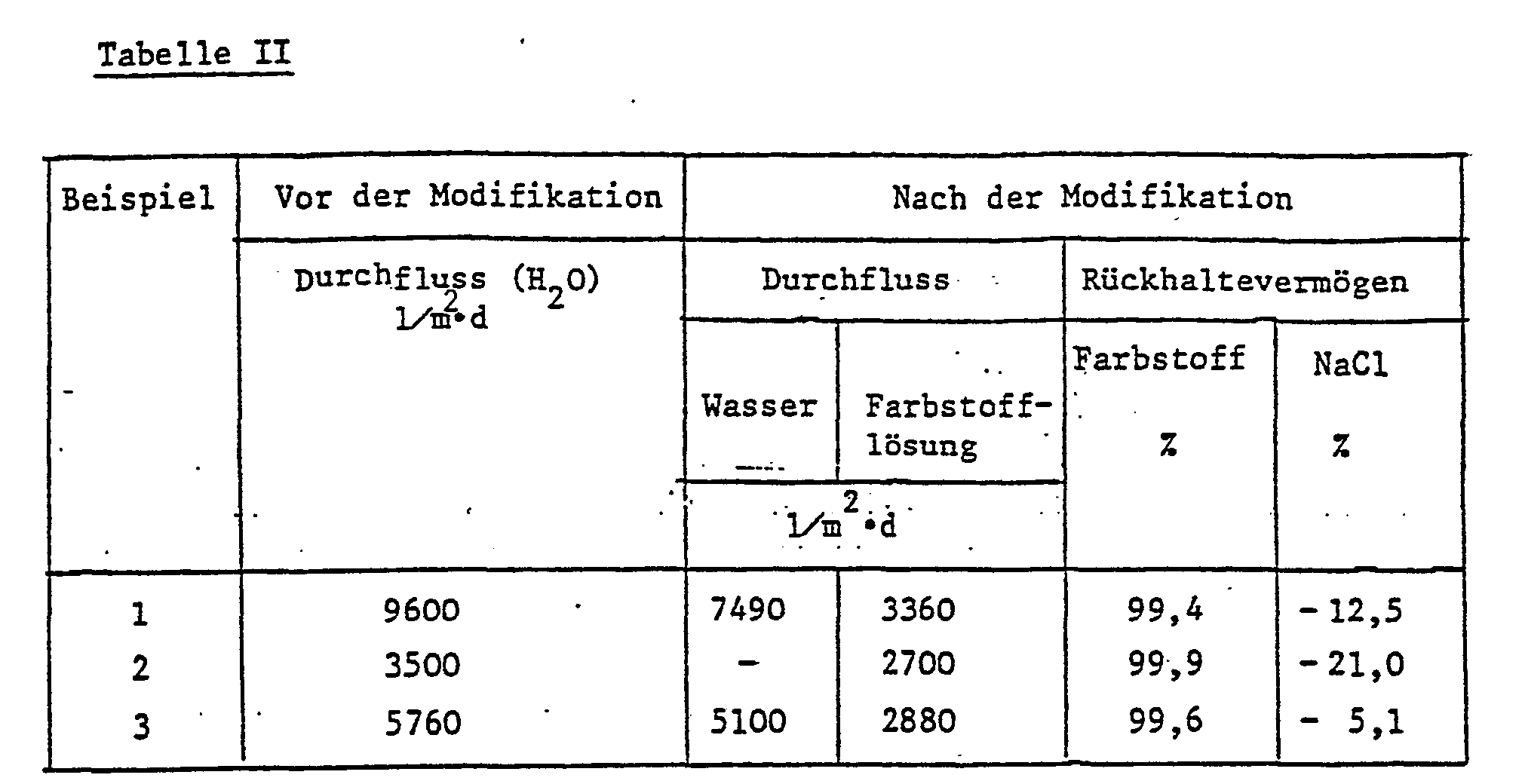
- Testbedingungen: Flachmembranen, 20 bar, Raumtemperatur; Farbstoff der Formel (108), Lösungen und einem Farbstoffgehalt von 15 000 ppm und 2% NaCl.
- Eine Membran gemäss Beispiel (A), die nur gemäss Stufe (1) modifiziert ist, wird in einer Druckzelle gemäss Beispiel 1 modifiziert. Es wird eine 1%ige PEI-Lösung, die zusätzlich 0,3 mM/1 Cyanurchlorid enthält verwendet. Es wird bei einem Druck von 10 bar gearbeitet und die . Modifikation abgebrochen wenn 20 ml, 30 ml bzw. 40 ml Permeat durch die Membran durchgepresst sind (Verwendung von 3 verschiedenen Ausgangsmembranen).
- Die Ergebnisse sind in Tabelle III angegeben.

- Testbedingungen wie in Tabelle II angegeben.
- Beispiel 1 wird mit 60 cm langen röhrenförmigen Membranen wiederholt, wobei verschiedene Modifikationszeiten eingehalten werden. Die erhaltenen Ergebnisse sind in Tabelle IV angegeben.

- Testbedingungen wie in Tabelle III angegeben; die Farbstofflösung enthält jedoch 6% Farbstoff.
- Eine Ultrafiltrationsmembran aus einem chlormethylierten Polysulfon (Molekulargewicht: 36'000), dessen widerkehrende Einheiten der Formel

- Nach dieser Modifikation weist die Membran bei einem Durchfluss von 2842 1/m·d ein Rückhaltevermögen von 99,2 % für den Farbstoff der Formel (108) auf. Testbedingungen: 1,5 %ige Lösung des Farbstoffs der Formel (108), 20 bar, Raumtemperatur.
- Eine Ultrafiltrationsmembran aus Cellulosediacetat und einem Rückhaltevermögen gegenüber dem Farbstoff der Formel (108) (1,5 Zige Lösung, 20 bar) von 78 % wird in einer 2 %igen wässrigen Suspension von Cyanurchlorid bei einem pH-Wert von 10 während 30 Minuten behandelt, dann 30 Minuten mit Leitungswasser gewaschen und schliesslich nach dem Verfahren gemäss Beispiel 6 chemisch modifiziert.
- Nach dieser Modifikation weist die Membran bei einem Durchfluss von 1800 1/m2.d ein Rückhaltevermögen von 98 Z für den Farbstoff der Formel (108) auf. Testbedingungen wie in Beispiel 6 angegeben.
- Eine Ultrafiltrationsmembran aus einem Polymer auf Epoxidbasis mit wiederkehrenden Einheiten der Formel

- Durchfluss und Rückhaltevermögen gegenüber dem Testfarbstoff der Formel (108) vor und nach der Modifikation ergeben sich wie folgt: Durchfluss: 2360 1/m2.d -1800 1/m2.d Rückhaltevermögen: 91 % - 98,6 % -
- Testbedingungen wie in Beispiel 7 angegeben.
Claims (28)
Applications Claiming Priority (2)
| Application Number | Priority Date | Filing Date | Title |
|---|---|---|---|
| CH6828/82A CH660852A5 (de) | 1982-11-23 | 1982-11-23 | Dynamische membranen, die sich als duenne polymerschichten auf poroesen, polymeren traegermaterialien befinden. |
| CH6828/82 | 1982-11-23 |
Publications (3)
| Publication Number | Publication Date |
|---|---|
| EP0111714A2 true EP0111714A2 (de) | 1984-06-27 |
| EP0111714A3 EP0111714A3 (en) | 1987-01-07 |
| EP0111714B1 EP0111714B1 (de) | 1989-03-01 |
Family
ID=4315660
Family Applications (1)
| Application Number | Title | Priority Date | Filing Date |
|---|---|---|---|
| EP83111037A Expired EP0111714B1 (de) | 1982-11-23 | 1983-11-04 | Dynamische Umkehrosmose-/Ultrafiltrationsmembranen mit guten Durchflusseigenschaften |
Country Status (6)
| Country | Link |
|---|---|
| US (2) | US4659474A (de) |
| EP (1) | EP0111714B1 (de) |
| JP (1) | JPS59150502A (de) |
| CH (1) | CH660852A5 (de) |
| DE (1) | DE3379258D1 (de) |
| IL (1) | IL70192A (de) |
Cited By (13)
| Publication number | Priority date | Publication date | Assignee | Title |
|---|---|---|---|---|
| EP0155534A3 (en) * | 1984-03-20 | 1986-12-03 | Akzo Gmbh | Cellulose dialysis membrane with improved biocompatibility |
| WO1988002653A1 (en) * | 1986-10-20 | 1988-04-21 | Brunswick Corporation | Ultrafiltration thin film membranes |
| EP0242761A3 (en) * | 1986-04-21 | 1988-08-10 | Aligena Ag | Composite membranes useful in the separation of low molecular weight organic compounds from aqueous solutions containing inorganic salts |
| EP0436720A4 (de) * | 1987-12-02 | 1990-01-29 | Japan Represented By Ministry | Hydrolysierte membran und verfahren zur herstellung. |
| EP0280945A3 (en) * | 1987-03-05 | 1990-02-07 | Akzo N.V. | Process for making a two-layer membrane |
| EP0394193A3 (de) * | 1989-04-14 | 1991-01-09 | Membrane Products Kiryat Weizmann Ltd. | Beschichtete Membranen |
| WO1991003317A1 (de) * | 1989-09-06 | 1991-03-21 | Sartorius Ag | Mikroporöses adsorbens |
| US5069945A (en) * | 1986-10-20 | 1991-12-03 | Memtec America Corporation | Ultrapous thin-film membranes |
| EP0490863A1 (de) * | 1990-12-13 | 1992-06-17 | Monsanto Company | Oberflächenmodifizierte Trägermembran und Verfahren zur Herstellung |
| EP0520652A1 (de) * | 1991-06-25 | 1992-12-30 | Texaco Development Corporation | Membrantrennverfahren |
| EP0609446A4 (de) * | 1992-04-23 | 1995-02-15 | Japan Represented By Ministry | Aus polyionkomplex hergestellte membran. |
| EP0538315B1 (de) * | 1990-07-10 | 1995-12-20 | Sartorius Ag | Poröse, nichtpartikuläre und konvektiv permeable matrix |
| WO2014170326A1 (de) * | 2013-04-15 | 2014-10-23 | Deutsches Textilforschungszentrum Nord West Ggmbh | Verwendung von gebundenen polyelektrolyten zur adsorption von metallkationen |
Families Citing this family (53)
| Publication number | Priority date | Publication date | Assignee | Title |
|---|---|---|---|---|
| CH660852A5 (de) * | 1982-11-23 | 1987-05-29 | Aligena Ag | Dynamische membranen, die sich als duenne polymerschichten auf poroesen, polymeren traegermaterialien befinden. |
| DK169616B1 (da) * | 1986-08-27 | 1994-12-27 | Dow Danmark | Permeabel, porøs, polymerbehandlet plastmembran med hydrofil karakter, fremgangsmåder til fremstilling heraf samt anvendelse heraf |
| US4828705A (en) * | 1986-10-31 | 1989-05-09 | Kingston Technologies, Inc. | Pressure-dependent anisotropic-transport membrane system |
| US4964989A (en) * | 1986-12-23 | 1990-10-23 | Pall Corporation | Membranes with low protein adsorbability |
| JPH084715B2 (ja) * | 1987-07-20 | 1996-01-24 | 味の素株式会社 | 電解質の分離方法および対イオンを有する電解質のイオン交換方法 |
| JPH01107812A (ja) * | 1987-10-19 | 1989-04-25 | Fuji Photo Film Co Ltd | 多孔質膜の親水化方法 |
| US5019723A (en) * | 1987-12-07 | 1991-05-28 | Controlled Release Technologies, Inc. | Self-regulated therapeutic agent delivery system and method |
| US4889632A (en) * | 1987-12-10 | 1989-12-26 | Ceskoslovenska Akademie Ved | Macroporous polymeric membranes for the separation of polymers and a method of their application |
| US4863496A (en) * | 1988-04-13 | 1989-09-05 | E. I. Du Pont De Nemours And Co. | Reactive posttreatment for gas separation membranes |
| US5091216A (en) * | 1988-04-13 | 1992-02-25 | E. I. Du Pont De Nemours And Company | Reactive post treatment for gas separation membranes |
| JPH0312224A (ja) * | 1989-06-08 | 1991-01-21 | Japan Gore Tex Inc | 選択透過膜 |
| US5053133A (en) * | 1990-02-09 | 1991-10-01 | Elias Klein | Affinity separation with activated polyamide microporous membranes |
| WO1993016386A1 (en) * | 1992-02-10 | 1993-08-19 | Actimed Laboratories, Inc. | Method for immobilizing dye on substrates |
| US5387329A (en) * | 1993-04-09 | 1995-02-07 | Ciba Corning Diagnostics Corp. | Extended use planar sensors |
| JPH07238181A (ja) * | 1994-01-21 | 1995-09-12 | Minnesota Mining & Mfg Co <3M> | 親水化多孔性物品 |
| DE69634829T2 (de) * | 1995-04-13 | 2006-03-23 | Travenol Laboratories (Israel) Ltd. | Verfahren und vorrichtung zur leukozytenfiltration |
| US5753008A (en) * | 1995-07-12 | 1998-05-19 | Bend Research, Inc. | Solvent resistant hollow fiber vapor permeation membranes and modules |
| US6132804A (en) * | 1997-06-06 | 2000-10-17 | Koch Membrane Systems, Inc. | High performance composite membrane |
| US6536605B2 (en) | 1997-06-06 | 2003-03-25 | Koch Membrane Systems, Inc. | High performance composite membrane |
| IL121046A (en) * | 1997-06-10 | 2001-07-24 | Weizmann Kiryat Membrane Prod | Semipermeable encapsulated membranes with improved acid and base stability and process for their manufacture and their use |
| US6083497A (en) * | 1997-11-05 | 2000-07-04 | Geltex Pharmaceuticals, Inc. | Method for treating hypercholesterolemia with unsubstituted polydiallylamine polymers |
| DE19811998C1 (de) * | 1998-03-19 | 1999-09-02 | Geesthacht Gkss Forschung | Lösemittelstabile PAN-Membran |
| US6337018B1 (en) * | 2000-04-17 | 2002-01-08 | The Dow Chemical Company | Composite membrane and method for making the same |
| US6596112B1 (en) | 2000-10-20 | 2003-07-22 | Pall Corporation | Laminates of asymmetric membranes |
| US20030038081A1 (en) * | 2001-08-14 | 2003-02-27 | I-Fan Wang | High strength asymmetric cellulosic membrane |
| DE10217440A1 (de) * | 2002-04-18 | 2003-11-06 | Basf Ag | Verwendung hydrophob modifizierter Copolymere auf Basis von N-Vinylmonomeren zur Herstellung von Membranen |
| DE10228148B4 (de) * | 2002-06-24 | 2006-08-24 | Saehan Industries Inc. | Selektive Membran mit hoher Fouling-Beständigkeit |
| US20040206694A1 (en) * | 2003-04-16 | 2004-10-21 | John Charkoudian | Epoxide-crosslinked, charged cellulosic membrane |
| EP2821135A1 (de) * | 2004-02-05 | 2015-01-07 | EMD Millipore Corporation | Poröses Adsorptions- oder Chromatographiemedium |
| EP1711250A1 (de) | 2004-02-05 | 2006-10-18 | Millipore Corporation | Verfahren zur bildung von beschichteten strukturen |
| JP4791044B2 (ja) * | 2005-01-11 | 2011-10-12 | 日東電工株式会社 | 電池用セパレータのための反応性ポリマー担持多孔質フィルムとそれを用いた電池の製造方法 |
| KR100660182B1 (ko) * | 2005-03-25 | 2006-12-21 | 한국화학연구원 | 아믹산 또는 이미드 측쇄기로 가교된 방향족 폴리에테르계수지 |
| US20090117367A1 (en) * | 2007-09-28 | 2009-05-07 | General Electric Company | Article and associated method |
| US20090205116A1 (en) * | 2005-09-30 | 2009-08-20 | General Electric Company | Article, laminate and associated methods |
| US20100077529A1 (en) * | 2005-09-30 | 2010-04-01 | General Electric Company | Article, laminate and associated methods |
| US7381331B2 (en) * | 2005-09-30 | 2008-06-03 | General Electric Company | Hydrophilic membrane and associated method |
| US7631768B2 (en) * | 2005-11-04 | 2009-12-15 | General Electric Company | Membrane and associated method |
| US7291696B2 (en) * | 2005-11-04 | 2007-11-06 | General Electric Company | Composition and associated method |
| JP2007246817A (ja) * | 2006-03-17 | 2007-09-27 | Fujifilm Corp | 防汚性部材及び防曇性部材 |
| WO2007135689A2 (en) * | 2006-05-24 | 2007-11-29 | Ben Gurion University Of The Negev R&D Authority | Membranes, coatings and films and methods for their preparation |
| US7910012B2 (en) * | 2007-07-16 | 2011-03-22 | General Electric Company | Composition, membrane, and associated method |
| US9433922B2 (en) | 2007-08-14 | 2016-09-06 | Emd Millipore Corporation | Media for membrane ion exchange chromatography based on polymeric primary amines, sorption device containing that media, and chromatography scheme and purification method using the same |
| US20090130738A1 (en) * | 2007-11-19 | 2009-05-21 | Mikhail Kozlov | Media for membrane ion exchange chromatography |
| IT1392342B1 (it) * | 2008-09-18 | 2012-02-28 | Marchesini | Sistema di stagnatura di un tessuto ricoprente una cavita', mediante micro-valvole formate da fibre prodotte nella reazione chimica di un polimero che viene a contatto con un fluido che poi espande con accumulo all'interno ad elevato effetto barriera. |
| CN102099099B (zh) * | 2008-09-26 | 2014-11-26 | 日东电工株式会社 | 复合半透膜及其制造方法 |
| JP5925409B2 (ja) | 2008-10-23 | 2016-05-25 | 日東電工株式会社 | 熱硬化性樹脂多孔シートの製造方法、熱硬化性樹脂多孔シート、及びそれを用いた複合半透膜 |
| SG10201405860RA (en) | 2009-01-13 | 2014-11-27 | Ams Technologies Int 2012 Ltd | Solvent and acid stable membranes, methods of manufacture thereof and methods of use thereof inter alia for separating metal ions from liquid process streams |
| EP2398578A1 (de) | 2009-02-19 | 2011-12-28 | Ben-Gurion University Of The Negev Research And Development Authority | Chemisch beständige membranen, überzüge und filme und herstellungsverfahren dafür |
| FR2943558B1 (fr) * | 2009-03-30 | 2011-04-08 | Centre Nat Rech Scient | Membrane polymere dynamique autosupportee,procede de preparation et utilisations. |
| US9457318B2 (en) | 2010-12-12 | 2016-10-04 | Ben-Gurion University Of The Negev Research And Development Authority | Anion exchange membranes, methods of preparation and uses |
| CN104492276B (zh) * | 2014-12-12 | 2017-05-03 | 北京天恒盛通科技发展有限公司 | 一类用于强酸、强碱、高盐环境下的油水分离膜的制备方法 |
| CN111318186A (zh) * | 2018-12-14 | 2020-06-23 | 天津天元新材料科技有限公司 | 一种提高复合反渗透膜耐污染性的方法 |
| CN115957631B (zh) * | 2022-12-06 | 2025-12-30 | 浙江浙能技术研究院有限公司 | 一种火力发电厂废弃苦咸水反渗透膜的再生方法 |
Family Cites Families (15)
| Publication number | Priority date | Publication date | Assignee | Title |
|---|---|---|---|---|
| US3373056A (en) * | 1964-08-28 | 1968-03-12 | Aerojet General Co | Modifying cellulose ester osmotic membranes |
| US3462362A (en) * | 1966-07-26 | 1969-08-19 | Paul Kollsman | Method of reverse osmosis |
| US3503789A (en) * | 1967-05-05 | 1970-03-31 | Atomic Energy Commission | Method of making a dynamic solute-rejecting membrane |
| US4163714A (en) * | 1975-11-07 | 1979-08-07 | Gregor Harry P | Separating substances with pressure-driven affinity sorption membranes |
| US4230463A (en) * | 1977-09-13 | 1980-10-28 | Monsanto Company | Multicomponent membranes for gas separations |
| US4265745A (en) * | 1977-05-25 | 1981-05-05 | Teijin Limited | Permselective membrane |
| US4214020A (en) * | 1977-11-17 | 1980-07-22 | Monsanto Company | Processes for coating bundles of hollow fiber membranes |
| EP0026399B1 (de) * | 1979-09-19 | 1984-03-14 | Aligena Ag | Poröse, semipermeable, mit ionisierbaren Gruppen modifizierte Celluloseacetatmembranen, Verfahren zu ihrer Herstellung und ihre Verwendung |
| EP0025973B1 (de) * | 1979-09-19 | 1985-01-23 | Aligena Ag | Poröse, semipermeable, durch Amidoximgruppen modifizierte Membran auf der Basis von Polyacrylnitrilen, Verfahren zu ihrer Herstellung und ihre Verwendung |
| DE2950623A1 (de) * | 1979-12-15 | 1981-06-19 | Toray Industries, Inc., Tokyo | Semipermeable zusammengesetzte membran und verfahren zu deren herstellung |
| JPS5695304A (en) * | 1979-12-28 | 1981-08-01 | Teijin Ltd | Perm selective composite membrane and its production |
| EP0056175B1 (de) * | 1981-01-13 | 1985-05-02 | Teijin Limited | Ionendurchlässige Composite-Membran und ihre Anwendung für die selektive Trennung |
| JPS5850522B2 (ja) * | 1981-03-31 | 1983-11-11 | 日東電工株式会社 | 複合半透膜及びその製造方法 |
| US4473475A (en) * | 1981-05-29 | 1984-09-25 | Amf Inc. | Charge modified microporous membrane, process for charge modifying said membrane, and process for filtration of fluids |
| CH660852A5 (de) * | 1982-11-23 | 1987-05-29 | Aligena Ag | Dynamische membranen, die sich als duenne polymerschichten auf poroesen, polymeren traegermaterialien befinden. |
-
1982
- 1982-11-23 CH CH6828/82A patent/CH660852A5/de not_active IP Right Cessation
-
1983
- 1983-11-04 EP EP83111037A patent/EP0111714B1/de not_active Expired
- 1983-11-04 DE DE8383111037T patent/DE3379258D1/de not_active Expired
- 1983-11-10 IL IL70192A patent/IL70192A/xx unknown
- 1983-11-22 US US06/554,214 patent/US4659474A/en not_active Expired - Fee Related
- 1983-11-22 JP JP58220481A patent/JPS59150502A/ja active Granted
-
1986
- 1986-07-11 US US06/868,747 patent/US4889636A/en not_active Expired - Fee Related
Cited By (17)
| Publication number | Priority date | Publication date | Assignee | Title |
|---|---|---|---|---|
| US4741927A (en) * | 1984-03-20 | 1988-05-03 | Akzo Nv | Production of cellulose dialysis membrane with improved biocompatibility |
| US4772393A (en) * | 1984-03-20 | 1988-09-20 | Akzo Nv | Cellulose dialysis membrane with improved biocompatibility |
| EP0155534A3 (en) * | 1984-03-20 | 1986-12-03 | Akzo Gmbh | Cellulose dialysis membrane with improved biocompatibility |
| EP0242761A3 (en) * | 1986-04-21 | 1988-08-10 | Aligena Ag | Composite membranes useful in the separation of low molecular weight organic compounds from aqueous solutions containing inorganic salts |
| US5069945A (en) * | 1986-10-20 | 1991-12-03 | Memtec America Corporation | Ultrapous thin-film membranes |
| WO1988002653A1 (en) * | 1986-10-20 | 1988-04-21 | Brunswick Corporation | Ultrafiltration thin film membranes |
| AU600627B2 (en) * | 1986-10-20 | 1990-08-16 | Memtec North America Corporation | Ultrafiltration thin film membranes |
| EP0280945A3 (en) * | 1987-03-05 | 1990-02-07 | Akzo N.V. | Process for making a two-layer membrane |
| EP0436720A4 (de) * | 1987-12-02 | 1990-01-29 | Japan Represented By Ministry | Hydrolysierte membran und verfahren zur herstellung. |
| EP0394193A3 (de) * | 1989-04-14 | 1991-01-09 | Membrane Products Kiryat Weizmann Ltd. | Beschichtete Membranen |
| US5028337A (en) * | 1989-04-14 | 1991-07-02 | Aligena Ag | Coated membranes |
| WO1991003317A1 (de) * | 1989-09-06 | 1991-03-21 | Sartorius Ag | Mikroporöses adsorbens |
| EP0538315B1 (de) * | 1990-07-10 | 1995-12-20 | Sartorius Ag | Poröse, nichtpartikuläre und konvektiv permeable matrix |
| EP0490863A1 (de) * | 1990-12-13 | 1992-06-17 | Monsanto Company | Oberflächenmodifizierte Trägermembran und Verfahren zur Herstellung |
| EP0520652A1 (de) * | 1991-06-25 | 1992-12-30 | Texaco Development Corporation | Membrantrennverfahren |
| EP0609446A4 (de) * | 1992-04-23 | 1995-02-15 | Japan Represented By Ministry | Aus polyionkomplex hergestellte membran. |
| WO2014170326A1 (de) * | 2013-04-15 | 2014-10-23 | Deutsches Textilforschungszentrum Nord West Ggmbh | Verwendung von gebundenen polyelektrolyten zur adsorption von metallkationen |
Also Published As
| Publication number | Publication date |
|---|---|
| EP0111714B1 (de) | 1989-03-01 |
| IL70192A0 (en) | 1984-02-29 |
| DE3379258D1 (en) | 1989-04-06 |
| CH660852A5 (de) | 1987-05-29 |
| EP0111714A3 (en) | 1987-01-07 |
| JPS59150502A (ja) | 1984-08-28 |
| IL70192A (en) | 1987-09-16 |
| US4889636A (en) | 1989-12-26 |
| JPH0451212B2 (de) | 1992-08-18 |
| US4659474A (en) | 1987-04-21 |
Similar Documents
| Publication | Publication Date | Title |
|---|---|---|
| EP0111714B1 (de) | Dynamische Umkehrosmose-/Ultrafiltrationsmembranen mit guten Durchflusseigenschaften | |
| EP0025973B1 (de) | Poröse, semipermeable, durch Amidoximgruppen modifizierte Membran auf der Basis von Polyacrylnitrilen, Verfahren zu ihrer Herstellung und ihre Verwendung | |
| EP0082355B1 (de) | Semipermeable Membranen aus modifizierten Polystyrolen, Verfahren zu ihrer Herstellung und ihre Verwendung | |
| EP0114286B1 (de) | Semipermeable eingekapselte Membranen, Verfahren zu ihrer Herstellung und ihre Verwendung | |
| EP0061424B1 (de) | Modifizierte Polysulfone enthaltende semipermeable Membranen, Verfahren zu ihrer Herstellung und ihre Verwendung | |
| EP0047953B1 (de) | Modifizierten Polyvinylalkohol enthaltende, semipermeable Kompositmembranen, Verfahren zu ihrer Herstellung und ihre Verwendung | |
| EP0061610B1 (de) | Semipermeable Membranen aus chemisch modifizierten, vernetzten Polymeren auf Acrylnitrilbasis, Verfahren zu ihrer Herstellung und ihre Verwendung | |
| EP0026399A1 (de) | Poröse, semipermeable, mit ionisierbaren Gruppen modifizierte Celluloseacetatmembranen, Verfahren zu ihrer Herstellung und ihre Verwendung | |
| DE3013171C2 (de) | Zusammengesetzte semipermeable Membrane | |
| DE2642407C3 (de) | Zusammengesetzte halbdurchlässige Membran | |
| EP2274081B1 (de) | Cellulosehydrat-membran, verfahren zu ihrer herstellung und verwendung davon | |
| EP0082433B2 (de) | Makroporöse asymmetrische hydrophile Membran aus synthetischem Polymerisat | |
| DE3876387T2 (de) | Membranen aus polyamid zur umkehrosmose. | |
| DE4207171C2 (de) | Verfahren zur Oberflächenmodifizierung von Formkörpern, damit hergestellte gepfropfte Formkörper und deren Verwendung für die adsorptive Stofftrennung | |
| DE3784410T2 (de) | Permeable, poroese polymermembran mit hydrophilen eigenschaften, verfahren zu ihrer herstellung und ihre anwendung. | |
| DE2457355C3 (de) | Semipermeable Membranen | |
| DE2822784A1 (de) | Permselektive membran | |
| DE102008018734B4 (de) | Hydrophobe Cellulose-Membran, Verfahren zu ihrer Herstellung und ihre Verwendung in der hydrophoben Interaktionschromatographie | |
| EP0421916A2 (de) | Verbundmembranen und Verfahren unter ihrer Verwendung | |
| US4412922A (en) | Positive-charged ultrafiltration membrane for the separation of cathodic/electrodeposition-paint compositions | |
| DE102015214896A1 (de) | Membranen und Verfahren zur ihrer Herstellung | |
| DE3687577T2 (de) | Nachvernetzte polymerisat-gele. | |
| DE69014967T2 (de) | Lösungsmittelbeständige Membranen. | |
| DE60016913T2 (de) | Verwendung einer chelat-bildenden porösen hohlfasermembran und verfahren zur rückgewinnung von germaniumoxid | |
| DE10326354A1 (de) | Trennaktives Kompositmaterial für die Stofftrennung, Kompositmembran, Verwendung und Verfahren zu ihrer Herstellung |
Legal Events
| Date | Code | Title | Description |
|---|---|---|---|
| PUAI | Public reference made under article 153(3) epc to a published international application that has entered the european phase |
Free format text: ORIGINAL CODE: 0009012 |
|
| 17P | Request for examination filed |
Effective date: 19831104 |
|
| AK | Designated contracting states |
Designated state(s): BE CH DE FR GB IT LI NL |
|
| PUAL | Search report despatched |
Free format text: ORIGINAL CODE: 0009013 |
|
| AK | Designated contracting states |
Kind code of ref document: A3 Designated state(s): BE CH DE FR GB IT LI NL |
|
| 17Q | First examination report despatched |
Effective date: 19871221 |
|
| GRAA | (expected) grant |
Free format text: ORIGINAL CODE: 0009210 |
|
| AK | Designated contracting states |
Kind code of ref document: B1 Designated state(s): BE CH DE FR GB IT LI NL |
|
| GBT | Gb: translation of ep patent filed (gb section 77(6)(a)/1977) | ||
| REF | Corresponds to: |
Ref document number: 3379258 Country of ref document: DE Date of ref document: 19890406 |
|
| ITF | It: translation for a ep patent filed | ||
| ET | Fr: translation filed | ||
| PG25 | Lapsed in a contracting state [announced via postgrant information from national office to epo] |
Ref country code: LI Effective date: 19891130 Ref country code: CH Effective date: 19891130 |
|
| PLBE | No opposition filed within time limit |
Free format text: ORIGINAL CODE: 0009261 |
|
| STAA | Information on the status of an ep patent application or granted ep patent |
Free format text: STATUS: NO OPPOSITION FILED WITHIN TIME LIMIT |
|
| 26N | No opposition filed | ||
| REG | Reference to a national code |
Ref country code: CH Ref legal event code: PL |
|
| ITTA | It: last paid annual fee | ||
| PGFP | Annual fee paid to national office [announced via postgrant information from national office to epo] |
Ref country code: DE Payment date: 19921022 Year of fee payment: 10 |
|
| PGFP | Annual fee paid to national office [announced via postgrant information from national office to epo] |
Ref country code: GB Payment date: 19921026 Year of fee payment: 10 Ref country code: FR Payment date: 19921026 Year of fee payment: 10 |
|
| PGFP | Annual fee paid to national office [announced via postgrant information from national office to epo] |
Ref country code: BE Payment date: 19921106 Year of fee payment: 10 |
|
| PGFP | Annual fee paid to national office [announced via postgrant information from national office to epo] |
Ref country code: NL Payment date: 19921130 Year of fee payment: 10 |
|
| PG25 | Lapsed in a contracting state [announced via postgrant information from national office to epo] |
Ref country code: GB Effective date: 19931104 |
|
| PG25 | Lapsed in a contracting state [announced via postgrant information from national office to epo] |
Ref country code: BE Effective date: 19931130 |
|
| BERE | Be: lapsed |
Owner name: ALIGENA A.G. Effective date: 19931130 |
|
| PG25 | Lapsed in a contracting state [announced via postgrant information from national office to epo] |
Ref country code: NL Effective date: 19940601 |
|
| GBPC | Gb: european patent ceased through non-payment of renewal fee |
Effective date: 19931104 |
|
| NLV4 | Nl: lapsed or anulled due to non-payment of the annual fee | ||
| PG25 | Lapsed in a contracting state [announced via postgrant information from national office to epo] |
Ref country code: FR Effective date: 19940729 |
|
| PG25 | Lapsed in a contracting state [announced via postgrant information from national office to epo] |
Ref country code: DE Effective date: 19940802 |
|
| REG | Reference to a national code |
Ref country code: FR Ref legal event code: ST |