EP0117098A2 - Verfahren zur Herstellung zusammengesetzter Gegenstände aus thermotropischen, flüssig-kristallinischen Polymeren und so hergestellte Gegenstände - Google Patents
Verfahren zur Herstellung zusammengesetzter Gegenstände aus thermotropischen, flüssig-kristallinischen Polymeren und so hergestellte Gegenstände Download PDFInfo
- Publication number
- EP0117098A2 EP0117098A2 EP84300755A EP84300755A EP0117098A2 EP 0117098 A2 EP0117098 A2 EP 0117098A2 EP 84300755 A EP84300755 A EP 84300755A EP 84300755 A EP84300755 A EP 84300755A EP 0117098 A2 EP0117098 A2 EP 0117098A2
- Authority
- EP
- European Patent Office
- Prior art keywords
- moiety
- mole percent
- polymer
- fibres
- iii
- Prior art date
- Legal status (The legal status is an assumption and is not a legal conclusion. Google has not performed a legal analysis and makes no representation as to the accuracy of the status listed.)
- Withdrawn
Links
Images

Classifications
-
- C—CHEMISTRY; METALLURGY
- C08—ORGANIC MACROMOLECULAR COMPOUNDS; THEIR PREPARATION OR CHEMICAL WORKING-UP; COMPOSITIONS BASED THEREON
- C08J—WORKING-UP; GENERAL PROCESSES OF COMPOUNDING; AFTER-TREATMENT NOT COVERED BY SUBCLASSES C08B, C08C, C08F, C08G or C08H
- C08J5/00—Manufacture of articles or shaped materials containing macromolecular substances
- C08J5/04—Reinforcing macromolecular compounds with loose or coherent fibrous material
-
- B—PERFORMING OPERATIONS; TRANSPORTING
- B29—WORKING OF PLASTICS; WORKING OF SUBSTANCES IN A PLASTIC STATE IN GENERAL
- B29C—SHAPING OR JOINING OF PLASTICS; SHAPING OF MATERIAL IN A PLASTIC STATE, NOT OTHERWISE PROVIDED FOR; AFTER-TREATMENT OF THE SHAPED PRODUCTS, e.g. REPAIRING
- B29C70/00—Shaping composites, i.e. plastics material comprising reinforcements, fillers or preformed parts, e.g. inserts
- B29C70/04—Shaping composites, i.e. plastics material comprising reinforcements, fillers or preformed parts, e.g. inserts comprising reinforcements only, e.g. self-reinforcing plastics
- B29C70/28—Shaping operations therefor
- B29C70/40—Shaping or impregnating by compression not applied
- B29C70/50—Shaping or impregnating by compression not applied for producing articles of indefinite length, e.g. prepregs, sheet moulding compounds [SMC] or cross moulding compounds [XMC]
- B29C70/52—Pultrusion, i.e. forming and compressing by continuously pulling through a die
- B29C70/523—Pultrusion, i.e. forming and compressing by continuously pulling through a die and impregnating the reinforcement in the die
-
- C—CHEMISTRY; METALLURGY
- C08—ORGANIC MACROMOLECULAR COMPOUNDS; THEIR PREPARATION OR CHEMICAL WORKING-UP; COMPOSITIONS BASED THEREON
- C08G—MACROMOLECULAR COMPOUNDS OBTAINED OTHERWISE THAN BY REACTIONS ONLY INVOLVING UNSATURATED CARBON-TO-CARBON BONDS
- C08G63/00—Macromolecular compounds obtained by reactions forming a carboxylic ester link in the main chain of the macromolecule
- C08G63/02—Polyesters derived from hydroxycarboxylic acids or from polycarboxylic acids and polyhydroxy compounds
- C08G63/60—Polyesters derived from hydroxycarboxylic acids or from polycarboxylic acids and polyhydroxy compounds derived from the reaction of a mixture of hydroxy carboxylic acids, polycarboxylic acids and polyhydroxy compounds
- C08G63/605—Polyesters derived from hydroxycarboxylic acids or from polycarboxylic acids and polyhydroxy compounds derived from the reaction of a mixture of hydroxy carboxylic acids, polycarboxylic acids and polyhydroxy compounds the hydroxy and carboxylic groups being bound to aromatic rings
-
- C—CHEMISTRY; METALLURGY
- C08—ORGANIC MACROMOLECULAR COMPOUNDS; THEIR PREPARATION OR CHEMICAL WORKING-UP; COMPOSITIONS BASED THEREON
- C08G—MACROMOLECULAR COMPOUNDS OBTAINED OTHERWISE THAN BY REACTIONS ONLY INVOLVING UNSATURATED CARBON-TO-CARBON BONDS
- C08G69/00—Macromolecular compounds obtained by reactions forming a carboxylic amide link in the main chain of the macromolecule
- C08G69/44—Polyester-amides
-
- B—PERFORMING OPERATIONS; TRANSPORTING
- B29—WORKING OF PLASTICS; WORKING OF SUBSTANCES IN A PLASTIC STATE IN GENERAL
- B29K—INDEXING SCHEME ASSOCIATED WITH SUBCLASSES B29B, B29C OR B29D, RELATING TO MOULDING MATERIALS OR TO MATERIALS FOR MOULDS, REINFORCEMENTS, FILLERS OR PREFORMED PARTS, e.g. INSERTS
- B29K2067/00—Use of polyesters or derivatives thereof, as moulding material
-
- B—PERFORMING OPERATIONS; TRANSPORTING
- B29—WORKING OF PLASTICS; WORKING OF SUBSTANCES IN A PLASTIC STATE IN GENERAL
- B29K—INDEXING SCHEME ASSOCIATED WITH SUBCLASSES B29B, B29C OR B29D, RELATING TO MOULDING MATERIALS OR TO MATERIALS FOR MOULDS, REINFORCEMENTS, FILLERS OR PREFORMED PARTS, e.g. INSERTS
- B29K2105/00—Condition, form or state of moulded material or of the material to be shaped
- B29K2105/0079—Liquid crystals
-
- C—CHEMISTRY; METALLURGY
- C08—ORGANIC MACROMOLECULAR COMPOUNDS; THEIR PREPARATION OR CHEMICAL WORKING-UP; COMPOSITIONS BASED THEREON
- C08J—WORKING-UP; GENERAL PROCESSES OF COMPOUNDING; AFTER-TREATMENT NOT COVERED BY SUBCLASSES C08B, C08C, C08F, C08G or C08H
- C08J2300/00—Characterised by the use of unspecified polymers
- C08J2300/12—Polymers characterised by physical features, e.g. anisotropy, viscosity or electrical conductivity
Definitions
- the present invention is directed to an improved method for the production of composite articles by pultrusion.
- articles produced by pultrusion satisfy the following basic requirements during processing: (1) that the reinforcing fibres be uniformly distributed throughout the polymer matrix material; (2) that the bundles of the reinforcing fibres which are employed should be well impregnated with the matrix polymer and (3) that the fibres should be sufficiently bonded to the matrix polymer.
- the present invention provides a considerable advance in this art.
- a method for the production of a composite reinforced article by pultrusion whereby said article is formed by causing at least one continuous length bundle of reinforcing fibres to advance into a crosshead extruder die, forcing a molten thermoplastic matrix polymer into said die under pressure to impregnate said at least one fibre bundle, and ontinuously extruding and pulling said at least one impregnated bundle through at least one exit orifice of saiddie to shape said at least one impregnated fibre bundle into said composite reinforced article, characterised in that said polymer comprises a thermotropic liquid crystalline polymer which possesses rheological properties such that a dynamic viscosity-frequency curve based on such characteristics has a negative slope of less than 0.35 when measured at a frequency of 1 sec -1 .
- the present invention provides a method for the production of a composite article by pultrusion whereby a thermotropic liquid crystalline matrix polymer is sufficiently bonded to the reinforcing fibres.
- the present invention provides a composite article produced by pultrusion which comprises a thermotropic liquid crystallline matrix polymer and exhibits desirable mechanical properties, and chemical and thermal stability.
- thermotropic liquid crystalline polymers are particularly suitable for use in the production of a composite article by pultrusion wherein the article comprises a fibre-reinforced matrix of the polymer.
- Thermotropic liquid crystal polymers are polymers which are liquid crystalline (i.e., anisotropic) in the melt phase. These polymers have been described by various terms, including “liquid crystalline”, “liquid crystal”, “mesophase” and . “anisotropic”. Briefly, the polymers of this class are thought to involve a parallel ordering of the molecular chains. The state wherein the molecules are so ordered is often referred to either as the liquid crystal state or the nematic phase of the liquid crystalline material. These polymers are prepared from monomers which are generally long, flat and fairly rigid along the long axis of the molecule and commonly have chain-extending linkages that are either coaxial or parallel.
- Such polymers readily form liquid crystals . (i.e., exhibit anisotropic properties) in the melt phase. Such properties may be confirmed by conventional polarised light techniques whereby crossed polarisers are utilised. More specifically, the anisotropic melt phase may be confirmed by the use of a Leitz polarising microscope at a magnification of 40X with the sample on a Leitz hot stage and under nitrogen atmosphere. T'he polymer is optically anisotropic; i.e., it transmits light when examined between crossed polarisers. Polarised light is transmitted when the sample is optically anisotropic even in the static state.
- Thermotropic liquid crystal polymers include but are not limited to wholly and non-wholly aromatic polyesters, aromatic-aliphatic polyesters, aromatic polyazomethines, aromatic polyester-carbonates and aromatic and non-wholly aromatic polyester-amides.
- aromatic polyesters and polyester-amides are considered to be "wholly" aromatic in the sense that each moiety present in the polyester contributes at least one aromatic ring to the polymer backbone and which enables the polymer to exhibit anisotropic properties in the melt phase.
- moieties may be derived from aromatic diols, aromatic amines, aromatic diacids and aromatic hydroxy acids.
- Moieties which may be present in the thermotropic liquid crystal polymers employed in the present invention include but are not limited to the following:
- thermotropic liquid crystal polymers which are employed comprise not less than about 10 mole percent of recurring units which include a naphthalene moiety.
- naphthalene moieties include 6-oxy-2-naphthoyl, 2,6-dioxynaphthalene and 2,6-dicarboxynaphthalene.
- aromatic-aliphatic polyesters are copolymers of polyethylene terephthalate and hydroxybenzoic acid as disclosed in Polyester X7G-A Self Reinforced Themoplastic, by W.J.Jackson, Jr. H.F. Kuhfuss and T.F.Gray, Jr., 30th Anniversary Techhical Conference, 1975 Reinforced Plastics/Composites Institute, The Society of the Plastics Industry, Inc., Section 17-D, Pages 1-4.
- a further disclosure of such copolymers can be found in "Liquid Crystal Polymers: I. Preparation and Properties of p-Hydroxybenzoic Acid Copolymers," Journal of Polymer Science, Polymer Chemistry Edition, Vol. 14, pp.
- Aromatic polyazomethines and processes of preparing the same are disclosed in U.S. Patents Nos: 3,493,522; 3,493,524; 3,503,739; 3,516,970; 3,516,971; 3,526,611; 4,048,148 and 4,122,070.
- polymers include poly(nitrilo-2-methyl-1,4-phenylenenitriloethylidyne-1,4-phenyleneethylidyne); poly(nitrilo-2-methyl-1,4-phenylene- nitrilomethylidyne-1,4-phenylene-methylidyne) and poly(nitr- ilo-2-chloro-1,4-phenylenenitrilomethylidyne-1,4-phenylene- methylidyne).
- Aromatic polyester-carbonates are disclosed in U.S. Patents Nos: 4,107,143 and 4,284,757 and U.S. Patent Appliction Serial No: 319,024, filed November 6 1981.
- Examples of such polymers include those consisting essentially of p-oxybenzoyl units, p-dioxyphenyl units, dioxycarbonyl units and terephthoyl units.
- Aromatic polyester-amides and processes of preparing the same are disclosed in U.S. Patent No: 4,182,842. Further disclosure of such copolymers can be found.in "Liquid Crystal Polymers: 'III . Preparation of Properties of Poly(Ester-Amides) from p - Aminobenzoic Acid and Poly(Ethylene Terephthalate)", Journal of Applied Polymer-Science, Vol. 25, pp. 1685-1694 (1980), by W.J. Jackson, Jr., and H.F.Kuhfuss.
- the liquid crystal polymers which are preferred for use in the present invention are the thermotropic wholly aromatic polyesters.
- Recent publications disclosing such polyesters include (a) Belgian Patents Nos: 828,935 and 828,936, (b) Dutch Patent No: 7505551, (c) West German Patents Nos: 2,520,819; 2,520,820 and 2,722,120. (d) Japanese'Patents Nos: 43-223, 2132-116, 3017-692 and 3021-293, (e) U.S.
- Wholly aromatic polyesters and polyester-amides are also disclosed in our U.S. Patents Nos: 4,067,852; 4, 0 83,829; 4,130,545; 4,161,470; 4,184,996; 4,219,461; 4,230,817; 4,238,598; 4,238,599; 4,244,433; 4,256,624; 4,279,803; 4,299,756; 4,330,457; 4,337,191; 4,339,375; 4,341,688; 4,351,917; 4,351,918-and 4,355,132.
- the wholly aromatic polyesters and polyester-amides disclosed therein typically are capable of forming an anisotropic melt phase at a temperature below 400°C., and preferably below 350°C.
- thermotropic liquid crystal polymers including wholly aromatic polyester and polyester-amides which are suitable for use in the present invention may be formed by a variety of ester-forming techniques whereby organic monomer compounds possessing functional groups which, upon condensation, for the requisite recurring moieties are reacted.
- the fucntional groups of the organic monomer compounds may be carboxylic acid groups, hydroxyl groups, ester groups, acyloxy groups, acid halides, amine groups, etc.
- the organic monomer compounds may be reacted in the absence of a heat exchange fluid via a melt acidolysis procedure. They, accordingly may be heated initially to form a melt solution of the reactants with the reaction continuing as said polymer particles are suspended therein.
- a vacuum may be applied to facilitate removal of volatiles formed during the final stage of the condensation (e.g., acetic acid or water).
- the organic monomer reactants from which the wholly aromatic polyesters are derived may be initially provided in a modified form whereby the usual hydroxy groups of such monomers are esterified (i.e., they are provided as lower acyl esters).
- the lower acyl groups preferably have from two to four carbon atoms.
- the acetate esters of organic monomer reactants are provided.
- an amine group may be provided as lower acyl amide.
- Representative catalysts which optionally may be employed in either the melt adidolysis procedure or in the slurry procedure of U.S. Patent No: 4,083,829 include dialkyl tin oxide (e.g., dibutyl tin oxide), diaryl tin oxide, titanium-'dioxide, antimony trioxide, alkoxy titanium silicates, titanium alkoxides, alkali and alkaline earth metal salts of carboxylic acids (e.g., zinc acetate), the gaseous acid catalysts such as Lewis acids (e.g., BF 3 ). hydrogen halides(e.g. HCl), etc.
- the quantity of catalyst utilised typically is 0.001 to 1 percent by weight based upon the total monomer weight, and most commonly 0.01 to 0.2 percent by weight.
- the wholly aromatic polyesters and polyester-amides suitable for use in the present invention tend to be substantially insoluble in common polyester solvents and accordingly are not susceptible to solution processing.
- the wholly aromatic polyesters which are preferred for use in the present invention commonly exhibit a weight average molecular weight of 2,000 to 200,000 and preferably 10,000 to 50,000 and most preferably 20,000 to 25,000.
- the wholly aromatic polyester-amides which are preferred for use in the present invention commonly exhibit a molecular weight of 5,000 to 50,000 and preferably 10,000 to 3 0 ,000; e.g. : 15,000 to 17,000.
- Such molecular weight may be determined by gel permeation chromatography and other standard techniques not involving the solutioning of the polymer; e.g., by end group determination via infrared :spectroscopy on compression moulded films. Alternatively, light scattering techniques in pentafluorophenol solution may be employed to determine the molecular weight.
- the wholly aromatic polyesters and polyester-amides additionally commonly exhibit an inherent viscosity (i.e., I.V.) of at least 2.0 dl./g., e.g., 2.0 to 10.0dl./g., when dissolved in a concentration of 0.1 percent by weight in pentafluorophenol at 60°C.
- I.V. inherent viscosity
- the aromatic rings which are included in the polymer backbones of the polymer components may include substitution of at least some of the hydrogen atoms present upon an aromatic ring.
- substituents include alkyl groups of up to four carbon atoms; alkoxy groups having up to four carbon atoms; halogens and additional aromatic'rings, such as phenyl and substituted phenyl.
- Preferred halogens include fluoride, chlorine and bromine. Although bromine atoms tend to be released from organic compounds at high temperatures, bromine is more stable on aromatic rings than on aliphatic chains, and therefore is suitable for inclusion as a possible substituent on the aromatic rings.
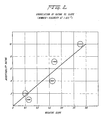
- thermotropic liquid crystalline polymers which are suitable for use in the present invention possess rheological characteristics such that the negative slope of a dynamic viscosity-frequency curve based on such characteristics for the specific polymer is less than 0.35 (and preferably less than 0.15) at a frequency of 1 sec. It should be noted that the actual values of the slopes of the viscosity-frequency curves depicted in Figure 1 are less than zero due to the orientation of the curves. In order to obtain a positive value, the slope is denoted as a negative slope.
- the dynamic viscosity-frequency curve is determined by use of a mechanical oscillatory spectrometer by standard procedures. Once the data points for the viscosity-frequency relationship have been determined, the curve may be plotted. The slope may then be determined by drawing a tangent to the curve at a frequency of one reciprocal second (1 sec 1 ) and measuring the slope of the tangent.
- the theory, design and use of such an instrument is fully described in the literature (see, for example, J.M. Dealy, "Rheometrics for Molten Plastics", van Nostrand Reinhold, New York, 1982; R.W.Whorlow, "Rheological Techniques", Wiley, New York, 1 980 and K. Walters, "Rheometry”, Wiley, New York 1975).
- a specific advantage of the method of the present invention resides in the fact that a composite article can be produced by pultrusion which exhibits satisfactory properties even with a polymer which possesses a high viscosity.
- a surprising and unexpected advantage of the invention is the fact that a satisfactory composite article can be produced irrespective of the viscosity of the polymer if the polymer otherwise satisfies the dynamic viscosity-frequency requirements. It is, however, preferable for the viscosity of the polymer to be as low as possible since, given the same viscosity-frequency characteristics, a polymer having the lower viscosity will generally produce a composite article having a higher rating (i.e., the polymer is more uniformly distributed) than a polymer of higher viscosity.
- the polymer viscosity (I.V.) is preferably in the range of 2.5 to 4.5 dl./g.
- Figure 1 depicts the viscosity-frequency curves for the five thermotropic liquid crystalline polymers identified in Table 1 below with the viscosity of each being measured by small amplitude oscillatory rheometry on the Rheometrics Mechanical Spectrometer at a temperature approximately 20°C. above the melting temperature of the polymers. Specifically, the viscosity of polymers A and C was measured at 300°C., the viscosity of polymer B was measured at 230°C. and the viscosity of polymers D and E was measured at 310°C.
- the polyester disclosed in U.S. Patent No: 4,219,461 is a melt processable wholly aromatic polyester which is capable of forming an anisotropic melt phase at a temperature below 320°C.
- the polyester consists essentially of the recurring moieties I, II, III and IV wherein:
- Moieties III and IV are preferably symmetrical in the sense that the divalent bonds which join these moieties to other moieties in the main polymer chain are symmetrically disposed on one or more aromatic rings (e.g. are para to each other or diagnonally disposed when present on a naphthalene ring). This definition can also be expressed thus: there is an axis of symmetry at right angles to the plane of the molecule.
- non-symmetrical moieties such as those derived from resorcinol and isophthalic acid,may also be used.
- Preferred moieties III and IV are set forth in above-noted U.S. Patent No: 4,219,461.
- the preferred dioxy aryl moiety III is: and the preferred dicarboxyl aryl moiety IV is:
- polyester disclosed in U.S. Patent No: 4,256,624 is a melt processable wholly aromatic: polyester which is capable of forming an anisotropic melt phase at a temperature below 400°C:
- the polyester consists essentially of the recurring moieties I, II and III wherein:
- the polyester comprises 10 to 90 mole percent of moiety I, 5 to 45 mole percent of moiety II and 5 to 45 mole percent of moiety III.
- the polyester preferably comprises 20 to 80 mole percent of moiety I, 10 to 40 mole percent of moiety II and 10 to 40 mole percent of moiety III.
- the polyester more preferably comprises 60 to 80 mole percent of moiety I, 10 to 20 mole percent of moiety II and 10 to 20 mole percent of moiety III.
- the hydrogen atoms present upon the rings optionally may be replaced by substituents selected from alkyl groups of 1 to 4'carbon atoms , alkoxy groups of 1 to 4 carbon atoms, halogen, phenyl, substituted phenyl and mixtures thereof.
- Moieties II and III of the polyester described immediately above are preferably symmetrical in the sense that the divalent bonds which join these moieties to other moieties in the main polymer chain are symmetrically disposed on one or mre aromatic rings (e.g., are para to each other or diagonally disposed when present on a naphthalene ring).
- This definition can also be expressed thus: there is an axis of symmetry at right angles to the plane of the molecule.
- non-symmetrical moieties such as those derived from resorcinol and isophthalic acid, may also be used.
- Preferred moieties II and III are set forth in above-noted U.S..Patent No: 4,256,624.
- the preferred dioxy aryl moiety II is: and the preferred dicarboxy aryl moiety III is:
- U.S. Patent No: 4,330,457 discloses a melt processable polyester-amide which is capable of forming an anisotropic melt phase at a temperature below 400°C.
- the polyester-amide consists essentially of the recurring moieties I, II, III and optionally IV wherein:
- Preferred moieties II, III and IV are set forth in above-noted U.S. Patent No: 4,330,457.
- the preferred dicarboxy aryl moiety II is: the preferred moiety III is: and the preferred dioxy aryl moiety IV is:
- the articles of the present invention may be produced by convention pultrusion processes.
- the type of pultrusion moulding apparatus used in conjunction with the method of the present invention is not critical to practice of the invention and may be any conventional pultrusion apparatus.
- Pultrusion processes are well-known in the art. Some are described in U.S. Patents Nos: 3,793,108; 3,960,629 and 3,993,726, the articles being produced basically by extrusion of the matrix polymer as the reinforcing fibre passes throughthe die.
- the composite article is formed by causing at least one continuous length bundle or yarn of reinforcing fibres to advance into a crosshead extruder die, forcing a molten thermoplastic matrix polymer into the die under pressure to impregnate the at least one fibre bundle or yarn and continuously extruding and pulling the at least one impregnated bundle or yarn through at least one exit orifice of the die to shape the at least one impregnated fibre bundle or yarn into the desired composite reinforced article.
- Articles produced by the method of the present invention generally include 1 to 65 (preferably 50 to 60) percent by volume of a reinforcing agent.
- Representative fibres which may serve as reinforcing agents include but are not limited to glass fibres, graphitic carbon fibres, amorphous carbon fibres, synthetic polymeric fibres, aluminium fibres, titanium fibres, steel fibres, tungsten fibres and ceramic fibres.
- Such reinforcing fibres are generally present in the form of long, substantially straight, parallel strands and normally present as fibre bundles for enhanced reinforcing ability.
- Carbon fibres are the preferred reinforcing fibre for use in the present invention.
- the fibre bundles are desirably spread into a single continuous bundle for optimum reinforcement.
- filler materials may also be employed in amounts ranging from 1 to 50 percent by weight.
- Exemplary filler materials include calcium silicate, silica, clays, talc, mica, polytetrafluoroethylene, graphite, alumina trihydrate, sodium aluminium carbonate and barium ferrite.
- the polymer or moulding compound is brought to the melt temperature of the polymer (e.g., 270 to 300°C.) and is then extruded into a die cavity.
- the die cavity is commonly maintained at a temperature of approximately 310°C.
- the polymer in its melt phase is injected into the die cavity at a pressure which is generally 5 to 50 psi (34.48 - 344.75 kPa) while the reinforcing fibre is caused to pass through the extrusion zone at a speed which generally ranges from several inches/minute (several cm/minute) to 20 feet/minute (6.1m/minute).
- the composite article produced according to the method of the present invention may take many forms depending upon the type of extrusion die employed and the manner by which the reinforcing fibres are passed through the zone.
- One typical composite article will be in the form of a tape which is substantially planar in dimension.
- the tape subsequent to formation can be employed in the production of other articles whereby the tape is laminated upon other tapes similarly produced by means of temperature and pressure.
- a reinforced laminate can thus be obtained which exhibits desirable mechanical properties.
- a reinforced tape was produced by pultrusion with a crosshead extrusion die with the matrix polymer comprising a thermotropic liquid crystalline polymer prepared from 40 mole percent of 6-acetoxy-2-naphthoic acid, 40 mole percent of p-acetoxybenzoic acid, 10 mole percent of hydroquinone diacetate and 10 mole percent of terephthalic acid (I.V. of 4 . 3 ) and reinforcing carbon fibres marketed by Celanese Corporation under the designation Celion 6000 (Trade Mark).
- the value of the negative slope of the dynamic viscosity-frequency curve for the matrix resin was determined to be 0.10 at 1 sec -1 (see Figure 1, Polymer A).
- the crosshead die was approximately 6 inches (15.2 cm) wide and 9 inches (22.9 cm) long, having entrance and exit slits approximately 3 inches (7.1 cm) wide.
- the maximum thickness of the interior-of the die was approximately 0.5 inch (1.27 cm).
- the carbon fibre was in the form of a yarn of carbonaceous filamentary material derived from an acrylonitrile copolymer consisting of approximately 98 mole percent of acrylonitrile units and 2 mole percent of methylacrylate units.
- the carbonaceous material consisted of about 6000 substantially parallel filaments, containing about 93 percent carbon by weight. Approximately 30 carbon fibre yarns were caused to pass through the die along a horizontal plane.
- Representative average filament properties for the carbon fibre include a denier of 0.6, a tensile strength of approximately 470,000 psi (3240650 kPa), a Young's modulus of approximately 34 million psi (234 million kPa) and an elongation of approximately 1.4 percent.
- a die temperature of 250°C and extrusion pressure of 5 psi (34.48 kPa) together with a fibre speed of 5 feet/minute (1.52 m/minute) were employed.
- the tape thus produced had a width of approximately 3 inches (7.1 cm) and was approximately 0.012 inch (0.0305 cm) in thickness.
- the tape was examined under a microscope and determined to consist of reinforcing fibres uniformly dispersed within the matrix resin and well impregnated with the resin.
- the resin desirably dispersed the individual fibres within the yarns across the width of the tape such that uniform fibrous reinforcement was obtained.
- the tape was accorded a rating of 2 as being indicative of being nearly toally acceptable.
- Example 1 The procedure of Example 1 was repeated under similar conditions with the die temperature and pressure being adjusted to the melting temperature of the polymer employed with the thermotropic liquid crystalline matrix polymer being comprised of 73 mole percent of p-oxybenzoyl moieties and 27 mole percent of 6-oxy-2-naphthoyl moieties (I.V. of 5.2).
- the value of the negative slope of the dynamic viscosity-frequency curve for the matrix resin was determined to be 0.55 at 1 sec -1 (see Figure 1, Polymer E).
- the tape produced by the pultrusion process was examined and determined to be unsatisfactory in that the fibres were not sufficiently uniformly dispersed within the matrix resin and the matrix resin did not uniformly impregnate the fibres, resulting in the formation of non-uniform alternating bands of resin and carbon fibres.
- the tape was thus accorded a rating of 10 as being indicative of total unsuitability.
- Example 1 The procedure of Example 1 was repeated under similar conditions with the die temperature and pressure being adjusted to the melting temperature of the polymer employed with the thermotropic liquid crystalline matrix polymer being prepared from 60 mole percent of 6-hydroxy-2-naphthoic acid, 20 mole percent of terephthalic acid and 20 mole percent of hydroquinone diacetate (I.V. of 4.2).
- the value of the negative slope of the dynamic viscosity-frequency curve for the matrix resin was defermined to be 0,13 at 1 sec -1 (see Figure 1, Polymer B).
- the tape produced was determined to be totally acceptable and accorded a rating of 1.
- Example 2 The procedure of Example 2 was repeated under similar conditions with a matrix polymer of identical composition with the exception that the polymer exhibited an I.V. of 4. 8 and the value of the negative slope of the dynamic viscosity-frequency curve for the matrix resin was determined to be 0.32 at 1 sec 1 (see Figure 1, Polymer C).
- the tape produced was accorded a rating of 4.
- Example 1 The procedure of Example 1 was repeated under similar conditions with the die temperature and pressure being adjusted to the melting temperature of the polymer employed with the thermotropic liquid crystalline matrix polymer being prepared from 60 mole percent of 6-hydroxy-2-naphthoic acid, 20 mole percent of terephthalic acid and 20 mole percent of p-acetoxyacetanilide (I.V. of 3.9).
- the value of the negative slope of the dynamic viscosity-frequency curve for the matrix resin was determined to be 0.34 at 1 sec -1 (see Figure 1, Polymer D).
- the tape produced was determined to be acceptable althouth less so than the tapes of Examples 1 and 2 and accorded a rating of 7.
Landscapes
- Chemical & Material Sciences (AREA)
- Health & Medical Sciences (AREA)
- Chemical Kinetics & Catalysis (AREA)
- Medicinal Chemistry (AREA)
- Polymers & Plastics (AREA)
- Organic Chemistry (AREA)
- Engineering & Computer Science (AREA)
- Materials Engineering (AREA)
- Manufacturing & Machinery (AREA)
- Composite Materials (AREA)
- Mechanical Engineering (AREA)
- Moulding By Coating Moulds (AREA)
- Polyesters Or Polycarbonates (AREA)
- Compositions Of Macromolecular Compounds (AREA)
- Shaping By String And By Release Of Stress In Plastics And The Like (AREA)
- Reinforced Plastic Materials (AREA)
- Extrusion Moulding Of Plastics Or The Like (AREA)
Applications Claiming Priority (2)
| Application Number | Priority Date | Filing Date | Title |
|---|---|---|---|
| US464303 | 1983-02-07 | ||
| US06/464,303 US4540737A (en) | 1983-02-07 | 1983-02-07 | Method for the formation of composite articles comprised of thermotropic liquid crystalline polymers and articles produced thereby |
Publications (2)
| Publication Number | Publication Date |
|---|---|
| EP0117098A2 true EP0117098A2 (de) | 1984-08-29 |
| EP0117098A3 EP0117098A3 (de) | 1987-08-05 |
Family
ID=23843373
Family Applications (1)
| Application Number | Title | Priority Date | Filing Date |
|---|---|---|---|
| EP84300755A Withdrawn EP0117098A3 (de) | 1983-02-07 | 1984-02-07 | Verfahren zur Herstellung zusammengesetzter Gegenstände aus thermotropischen, flüssig-kristallinischen Polymeren und so hergestellte Gegenstände |
Country Status (3)
| Country | Link |
|---|---|
| US (1) | US4540737A (de) |
| EP (1) | EP0117098A3 (de) |
| JP (1) | JPS59176020A (de) |
Cited By (8)
| Publication number | Priority date | Publication date | Assignee | Title |
|---|---|---|---|---|
| EP0206600A3 (en) * | 1985-06-12 | 1988-03-30 | Polyplastics Co. Ltd. | Resin composition for gear |
| EP0289802A3 (de) * | 1987-05-06 | 1989-03-08 | E.I. Du Pont De Nemours And Company | Optisch anisotrope schmelzenbildende aromatische Copolyester auf der Basis von t-Butyl-4-hydroxy-benzoesäure |
| EP0322787A3 (de) * | 1987-12-28 | 1990-10-31 | Polaroid Corporation | In der Schmelze verarbeitbare Polyesteramide mit paraverknüpften, substituierten Phenylenradikalen |
| US5002712A (en) * | 1988-10-19 | 1991-03-26 | Bayer Aktiengesellschaft | Manufacturing composite materials |
| EP0579047A1 (de) * | 1992-07-15 | 1994-01-19 | Hoechst Aktiengesellschaft | Faserverstärkte Halbzeuge aus mittel- bis hochviskosen Thermoplasten und Verfahren zu ihrer Herstellung |
| EP0611640A1 (de) * | 1993-02-19 | 1994-08-24 | Hoechst Aktiengesellschaft | Granulat aus faserverstärktem Thermoplast |
| WO2007147595A1 (de) * | 2006-06-22 | 2007-12-27 | Hochschule Wismar University Of Technology, Business And Design | Tankvorrichtung und verfahren zum speichern und/oder transportieren einer substanz bei einer kryotemperatur |
| US11001013B2 (en) | 2016-01-22 | 2021-05-11 | Allotropica Technologies Inc. | Pre-preg and composite products comprising fibers and a liquid crystal thermoset precursor |
Families Citing this family (38)
| Publication number | Priority date | Publication date | Assignee | Title |
|---|---|---|---|---|
| US4640861A (en) * | 1984-06-07 | 1987-02-03 | E. I. Du Pont De Nemours And Company | Fiber reinforced thermoplastic material |
| DE3542778A1 (de) * | 1985-12-04 | 1987-06-11 | Basf Ag | Vollaromatische mesomorphe polyetherester, deren herstellung und verwendung |
| JPH0739533B2 (ja) * | 1986-12-10 | 1995-05-01 | ポリプラスチックス株式会社 | 液晶性ポリエステル樹脂組成物 |
| JPH0725996B2 (ja) * | 1986-12-26 | 1995-03-22 | ポリプラスチックス株式会社 | ポリエステル樹脂組成物 |
| US4871817A (en) * | 1986-12-31 | 1989-10-03 | General Electric Company | Polyetherimide-liquid crystal polymer blends |
| US4832894A (en) * | 1987-01-05 | 1989-05-23 | E. I. Du Pont De Nemours And Company | Pultrusion of filaments of anisotropic melt-forming polymers |
| US5312687A (en) * | 1987-03-12 | 1994-05-17 | Owens-Corning Fiberglas Technology Inc. | Size composition for impregnating filament strands with a liquid crystal polymer and the strands produced thereby |
| JPS6461087A (en) * | 1987-09-01 | 1989-03-08 | Sumitomo Chemical Co | Resin composition for printed wiring board |
| GB8801225D0 (en) * | 1988-01-20 | 1988-02-17 | Ici Plc | Aromatic polymers |
| JPH0753426B2 (ja) * | 1988-12-28 | 1995-06-07 | 日立化成工業株式会社 | エンボス模様を有する繊維強化プラスチックの連続成形法 |
| JPH02276819A (ja) * | 1988-12-29 | 1990-11-13 | Kawasaki Steel Corp | 芳香族ポリエステルおよび芳香族ポリエステルアミドならびにそれらを用いた繊維、樹脂組成物 |
| US5647172A (en) * | 1989-12-22 | 1997-07-15 | Rokicki; Stanley | Pultruded fiberglass framing sections |
| US5150812A (en) * | 1990-07-05 | 1992-09-29 | Hoechst Celanese Corporation | Pressurized and/or cryogenic gas containers and conduits made with a gas impermeable polymer |
| US5324563A (en) * | 1990-08-08 | 1994-06-28 | Bell Helicopter Textron Inc. | Unidirectional carbon fiber reinforced pultruded composite material having improved compressive strength |
| JPH06510714A (ja) * | 1991-09-13 | 1994-12-01 | ベル ヘリコプター テクストロン,インコーポレイテッド | 定方向性グラファイト引抜成形ロッドおよびその製造法 |
| US5227456A (en) * | 1992-03-20 | 1993-07-13 | Hoechst Celanese Corp. | Wholly aromatic liquid crystalline polymers containing sulfonated ionic monomer units and laminates thereof |
| USH1261H (en) | 1992-05-15 | 1993-12-07 | Gibson Baylor D | On-line consolidation of filament wound thermoplastic parts |
| US5306461A (en) * | 1992-10-28 | 1994-04-26 | Hoechst Celanese Corporation | Extrusion blow molding of filled liquid crystal polymers |
| US5336464A (en) * | 1992-11-20 | 1994-08-09 | Hoechst Celanese Corporation | Extrusion blow molding of thermotropic liquid crystalline polymers |
| US6162538A (en) * | 1992-11-24 | 2000-12-19 | Clemson University Research Foundation | Filled cut-resistant fibers |
| US5851668A (en) * | 1992-11-24 | 1998-12-22 | Hoechst Celanese Corp | Cut-resistant fiber containing a hard filler |
| US5462618A (en) * | 1993-03-23 | 1995-10-31 | Bell Helicopter Textron Inc. | Continuous process of making unidirectional graphite fiber reinforced pultruded rods having minimal fiber waviness |
| US5443783A (en) * | 1993-03-23 | 1995-08-22 | Hoechst Celanese Corp. | Process for blow molding articles from liquid crystal polymers |
| FI932549A7 (fi) * | 1993-06-04 | 1994-12-05 | Toermaelae Pertti | Luja yhtenäinen muoviperusteinen yhdistelmämateriaali ja menetelmät sen valmistamiseksi |
| USH1502H (en) * | 1993-08-17 | 1995-11-07 | Fiberweb North America, Inc. | Meltblown fibers and webs produced from liquid crystal polymers |
| US5607531A (en) * | 1995-06-05 | 1997-03-04 | Polyplus, Inc. | Filament coating process |
| US5776582A (en) * | 1996-08-05 | 1998-07-07 | Polyplus, Inc. | Load-bearing structures with interlockable edges |
| JPH10226855A (ja) * | 1996-12-11 | 1998-08-25 | Nippon Piston Ring Co Ltd | 耐摩耗焼結合金製内燃機関用バルブシート |
| US6036711A (en) * | 1998-02-18 | 2000-03-14 | United States Surgical Corporation | Reusable cannula |
| JP4717366B2 (ja) * | 2004-03-26 | 2011-07-06 | ポリプラスチックス株式会社 | 平面状コネクター |
| WO2006138539A1 (en) * | 2005-06-14 | 2006-12-28 | Centerline Supply, Ltd. | A pultruded fiberglass sign panel system |
| JP5695309B2 (ja) * | 2009-10-14 | 2015-04-01 | 株式会社クラレ | 繊維補強全芳香族ポリエステル樹脂成形体 |
| JP2012116906A (ja) * | 2010-11-30 | 2012-06-21 | Sumitomo Chemical Co Ltd | 樹脂含浸シート及び導電層付き樹脂含浸シート |
| GB2509753A (en) * | 2013-01-14 | 2014-07-16 | Bae Systems Plc | Ferrite Fibre Composites |
| CN109476854B (zh) * | 2016-07-27 | 2022-01-18 | 住友化学株式会社 | 预浸料、预浸料层叠体及预浸料的制造方法 |
| JP7312548B2 (ja) * | 2017-12-19 | 2023-07-21 | 上野製薬株式会社 | 熱可塑性樹脂プリプレグおよび複合材料 |
| US11917753B2 (en) * | 2019-09-23 | 2024-02-27 | Ticona Llc | Circuit board for use at 5G frequencies |
| JP2021178882A (ja) * | 2020-05-11 | 2021-11-18 | 丸八株式会社 | 繊維強化複合材及びその製造方法 |
Family Cites Families (12)
| Publication number | Priority date | Publication date | Assignee | Title |
|---|---|---|---|---|
| US3608033A (en) * | 1969-06-17 | 1971-09-21 | Liquid Nitrogen Processing | Process for production of molding compositions containing high weight percentage of glass |
| NL7001315A (de) * | 1970-01-29 | 1971-08-02 | Bekaert Sa Nv | |
| US4182382A (en) * | 1975-02-03 | 1980-01-08 | Colorguard Corporation | Thermoplastic resin-coated metallic substrate and the method of producing the same through use of a polyamide adhesive layer |
| US4196464A (en) * | 1978-02-23 | 1980-04-01 | Eaton Corporation | Semi-conductive layer-containing reinforced pressure hose and method of making same |
| US4394417A (en) * | 1978-08-07 | 1983-07-19 | Phelps Dodge Industries, Inc. | Magnet wire |
| JPS5657821A (en) * | 1979-10-18 | 1981-05-20 | Sumitomo Chem Co Ltd | Preparation of aromatic polyester |
| US4418122A (en) * | 1980-05-07 | 1983-11-29 | Isovolta Osterreichische Isolierstoffwerke Aktiengesellschaft | Electrical conductor with polyester insulating layer and method therefor |
| US4267289A (en) * | 1980-07-03 | 1981-05-12 | Celanese Corporation | Blend of wholly aromatic polyesters |
| US4325903A (en) * | 1980-07-15 | 1982-04-20 | Celanese Corporation | Processing of melt processible liquid crystal polymer by control of thermal history |
| US4330587A (en) * | 1981-02-23 | 1982-05-18 | Monsanto Company | Metal-thermoplastic-metal laminates |
| US4355133A (en) * | 1981-07-27 | 1982-10-19 | Celanese Corporation | Polyester of 6-hydroxy-2-naphthoic acid, 4-hydroxy benzoic acid, 1,4-cyclohexanedicarboxylic acid, and aromatic diol capable of readily undergoing melt processing to form articles possessing high impact properties |
| US4410683A (en) * | 1981-12-09 | 1983-10-18 | E. I. Du Pont De Nemours And Company | Aromatic, melt-processible (co)polyesters |
-
1983
- 1983-02-07 US US06/464,303 patent/US4540737A/en not_active Expired - Lifetime
-
1984
- 1984-02-07 EP EP84300755A patent/EP0117098A3/de not_active Withdrawn
- 1984-02-07 JP JP59020661A patent/JPS59176020A/ja active Granted
Cited By (10)
| Publication number | Priority date | Publication date | Assignee | Title |
|---|---|---|---|---|
| EP0206600A3 (en) * | 1985-06-12 | 1988-03-30 | Polyplastics Co. Ltd. | Resin composition for gear |
| EP0289802A3 (de) * | 1987-05-06 | 1989-03-08 | E.I. Du Pont De Nemours And Company | Optisch anisotrope schmelzenbildende aromatische Copolyester auf der Basis von t-Butyl-4-hydroxy-benzoesäure |
| EP0322787A3 (de) * | 1987-12-28 | 1990-10-31 | Polaroid Corporation | In der Schmelze verarbeitbare Polyesteramide mit paraverknüpften, substituierten Phenylenradikalen |
| US5002712A (en) * | 1988-10-19 | 1991-03-26 | Bayer Aktiengesellschaft | Manufacturing composite materials |
| EP0579047A1 (de) * | 1992-07-15 | 1994-01-19 | Hoechst Aktiengesellschaft | Faserverstärkte Halbzeuge aus mittel- bis hochviskosen Thermoplasten und Verfahren zu ihrer Herstellung |
| US6517654B1 (en) | 1992-07-15 | 2003-02-11 | Horst Heckel | Process for the production of fiber-reinforced semi-finished articles made of thermoplastics of medium to high viscosity |
| EP0611640A1 (de) * | 1993-02-19 | 1994-08-24 | Hoechst Aktiengesellschaft | Granulat aus faserverstärktem Thermoplast |
| US5700556A (en) * | 1993-02-19 | 1997-12-23 | Hoechst Aktiengesellschaft | Granules of fiber-reinforced thermoplastic |
| WO2007147595A1 (de) * | 2006-06-22 | 2007-12-27 | Hochschule Wismar University Of Technology, Business And Design | Tankvorrichtung und verfahren zum speichern und/oder transportieren einer substanz bei einer kryotemperatur |
| US11001013B2 (en) | 2016-01-22 | 2021-05-11 | Allotropica Technologies Inc. | Pre-preg and composite products comprising fibers and a liquid crystal thermoset precursor |
Also Published As
| Publication number | Publication date |
|---|---|
| US4540737A (en) | 1985-09-10 |
| JPS59176020A (ja) | 1984-10-05 |
| JPH0372099B2 (de) | 1991-11-15 |
| EP0117098A3 (de) | 1987-08-05 |
Similar Documents
| Publication | Publication Date | Title |
|---|---|---|
| US4540737A (en) | Method for the formation of composite articles comprised of thermotropic liquid crystalline polymers and articles produced thereby | |
| US4581399A (en) | Method for the melt processing of thermotropic liquid crystal polymers | |
| EP0063880B1 (de) | Von 6-hydroxy-2-naphthoesäure abgeleitetes Poly(esteramid) | |
| US4256624A (en) | Polyester of 6-hydroxy-2-naphthoic acid, aromatic diol, and aromatic diacid capable of undergoing melt processing | |
| US4522974A (en) | Melt processable polyester capable of forming an anisotropic melt comprising a relatively low concentration of 6-oxy-2-naphthoyl moiety-4-benzoyl moiety, 1,4-dioxyphenylene moiety, isophthaloyl moiety and terephthaloyl moiety | |
| US4375530A (en) | Polyester of 2,6-naphthalene dicarboxylic acid, 2,6-dihydroxy naphthalene, terephthalic acid, and hydroquinone capable of forming an anisotropic melt | |
| US4279803A (en) | Polyester of phenyl-4-hydroxybenzoic acid and 4-hydroxybenzoic acid and/or 6-hydroxy-2-naphthoic acid capable of forming an anisotropic melt | |
| US4468364A (en) | Process for extruding thermotropic liquid crystalline polymers | |
| US5015722A (en) | Melt-processable polyester capable of forming an anisotropic melt which exhibits a highly attractive balance between its molding and heat deflection temperatures | |
| US4384016A (en) | Mutiaxially oriented high performance laminates comprised of uniaxially oriented sheets of thermotropic liquid crystal polymers | |
| US4299756A (en) | Polyester of phenyl-4-hydroxybenzoic acid, aromatic diol, and aromatic diacid capable of forming an anisotropic melt | |
| US4473682A (en) | Melt processable polyester capable of forming an anisotropic melt comprising a relatively low concentration of 6-oxy-2-naphthoyl moiety, 4-oxybenzoyl moiety, 4,4'-dioxybiphenyl moiety, and terephthaloyl moiety | |
| EP0067032B1 (de) | Eine anisotrope Schmelzphase bildendes, aus p-Hydroxybenzolsäure, 2,6-Dihydroxynaphthalin, einer carbocyclischen Dicarbonsäure, einem eine Amid-Verbindung zu bilden fähigen aromatischen Monomer und wahlweise einem zusätzlichen aromatischen Diol hergestelltes Poly(ester-amid) | |
| US4318842A (en) | Polyester of 6-hydroxy-2-naphthoic acid, aromatic diol, and 1,4-cyclohexanedicarboxylic acid capable of undergoing melt processing | |
| US4479999A (en) | Fabric comprised of fusible and infusible fibers, the former comprising a polymer which is capable of forming an anisotropic melt phase | |
| US4355132A (en) | Anisotropic melt phase forming poly(ester-amide) derived from p-hydroxybenzoic acid, 2,6-naphthalenedicarboxylic acid, aromatic monomer capable of forming an amide linkage, and, optionally, hydroquinone and additional carbocyclic dicarboxylic acid | |
| JPH0320337A (ja) | 全芳香族ポリエステルフィルム | |
| US4238599A (en) | Polyester of para-hydroxy benzoic acid, 1,2-bis(para-carboxy phenoxy)ethane, terephthalic acid and substituted hydroquinone capable of forming an anisotropic melt which readily undergoes melt processing | |
| US4238598A (en) | Polyester of para-hydroxy benzoic acid, 1,2-bis(para-carboxy phenoxy)ethane, terephthalic acid and hydroquinone capable of forming an anisotropic melt which readily undergoes melt processing | |
| US4265802A (en) | Polyester of para-hydroxy benzoic acid, 1,4-bis(para-carboxyphenoxy) benzene, aromatic diol and aromatic diacid capable of undergoing melt processing | |
| US4431770A (en) | Wholly aromatic polyester comprising 4-oxy-4'-carboxybiphenyl moiety which is capable of forming an anisotropic melt phase | |
| CA1211608A (en) | Method for the formation of composite articles comprised of thermotropic liquid crystalline polymers and articles produced thereby | |
| EP0066359A1 (de) | Poly(ester-amid) abgeleitet von Dihydroxyanthrachinon, Hydroxybenzoesäure, Dicarbonsäure und einem eine Amidbindung bildenden aromatischen Monomer | |
| US4473681A (en) | Polyester urea capable of forming an anisotropic melt phase | |
| EP0167682A1 (de) | Hochleistungsfähige Papiere aus Fibrillen von thermotropischen Flüssigkristall-Polymeren |
Legal Events
| Date | Code | Title | Description |
|---|---|---|---|
| PUAI | Public reference made under article 153(3) epc to a published international application that has entered the european phase |
Free format text: ORIGINAL CODE: 0009012 |
|
| AK | Designated contracting states |
Designated state(s): DE FR GB |
|
| PUAL | Search report despatched |
Free format text: ORIGINAL CODE: 0009013 |
|
| AK | Designated contracting states |
Kind code of ref document: A3 Designated state(s): DE FR GB |
|
| STAA | Information on the status of an ep patent application or granted ep patent |
Free format text: STATUS: THE APPLICATION IS DEEMED TO BE WITHDRAWN |
|
| 18D | Application deemed to be withdrawn |
Effective date: 19880208 |
|
| RIN1 | Information on inventor provided before grant (corrected) |
Inventor name: WISSBRUN, KURT F. Inventor name: ORWOLL, RICHARD D. |