EP0117541A2 - Vorrichtung zur Plasmabearbeitung von Kunstharz-Materialien - Google Patents
Vorrichtung zur Plasmabearbeitung von Kunstharz-Materialien Download PDFInfo
- Publication number
- EP0117541A2 EP0117541A2 EP84101935A EP84101935A EP0117541A2 EP 0117541 A2 EP0117541 A2 EP 0117541A2 EP 84101935 A EP84101935 A EP 84101935A EP 84101935 A EP84101935 A EP 84101935A EP 0117541 A2 EP0117541 A2 EP 0117541A2
- Authority
- EP
- European Patent Office
- Prior art keywords
- plasma
- reaction chamber
- works
- irradiating
- wall
- Prior art date
- Legal status (The legal status is an assumption and is not a legal conclusion. Google has not performed a legal analysis and makes no representation as to the accuracy of the status listed.)
- Granted
Links
Images








Classifications
-
- H—ELECTRICITY
- H01—ELECTRIC ELEMENTS
- H01J—ELECTRIC DISCHARGE TUBES OR DISCHARGE LAMPS
- H01J37/00—Discharge tubes with provision for introducing objects or material to be exposed to the discharge, e.g. for the purpose of examination or processing thereof
- H01J37/32—Gas-filled discharge tubes
- H01J37/32009—Arrangements for generation of plasma specially adapted for examination or treatment of objects, e.g. plasma sources
- H01J37/32357—Generation remote from the workpiece, e.g. down-stream
-
- B—PERFORMING OPERATIONS; TRANSPORTING
- B01—PHYSICAL OR CHEMICAL PROCESSES OR APPARATUS IN GENERAL
- B01J—CHEMICAL OR PHYSICAL PROCESSES, e.g. CATALYSIS OR COLLOID CHEMISTRY; THEIR RELEVANT APPARATUS
- B01J3/00—Processes of utilising sub-atmospheric or super-atmospheric pressure to effect chemical or physical change of matter; Apparatus therefor
- B01J3/006—Processes utilising sub-atmospheric pressure; Apparatus therefor
-
- B—PERFORMING OPERATIONS; TRANSPORTING
- B05—SPRAYING OR ATOMISING IN GENERAL; APPLYING FLUENT MATERIALS TO SURFACES, IN GENERAL
- B05D—PROCESSES FOR APPLYING FLUENT MATERIALS TO SURFACES, IN GENERAL
- B05D3/00—Pretreatment of surfaces to which liquids or other fluent materials are to be applied; After-treatment of applied coatings, e.g. intermediate treating of an applied coating preparatory to subsequent applications of liquids or other fluent materials
- B05D3/14—Pretreatment of surfaces to which liquids or other fluent materials are to be applied; After-treatment of applied coatings, e.g. intermediate treating of an applied coating preparatory to subsequent applications of liquids or other fluent materials by electrical means
- B05D3/141—Plasma treatment
- B05D3/142—Pretreatment
- B05D3/144—Pretreatment of polymeric substrates
-
- B—PERFORMING OPERATIONS; TRANSPORTING
- B29—WORKING OF PLASTICS; WORKING OF SUBSTANCES IN A PLASTIC STATE IN GENERAL
- B29C—SHAPING OR JOINING OF PLASTICS; SHAPING OF MATERIAL IN A PLASTIC STATE, NOT OTHERWISE PROVIDED FOR; AFTER-TREATMENT OF THE SHAPED PRODUCTS, e.g. REPAIRING
- B29C59/00—Surface shaping of articles, e.g. embossing; Apparatus therefor
- B29C59/14—Surface shaping of articles, e.g. embossing; Apparatus therefor by plasma treatment
Definitions
- This invention relates to an apparatus and method for the plasma treatment of the surfaces of work made of resin material, such as those made of polypropylene resin (PP) or polyethylene resin (PE), for reforming the surfaces thereof. And this invention is particularly effectively applicable to the surface pretreatment in painting comparatively large and complicated resin parts.
- resin material such as those made of polypropylene resin (PP) or polyethylene resin (PE)
- the reaction chamber is rapidly evacuated in a short period of time and the number of parts which can be subjected to plasma treatment in one batch cycle is increased.
- the conventional apparatus for plasma treatment has a problem that the parts are plasma-treated differently among the parts as well as within each part depending on the disposition of the parts in the reaction chamber, since automotive parts are large and complicated in configuration.
- This invention is to provide a method and apparatus for plasma treatment, which method and apparatus are capable of solving the above-mentioned problems and of uniformly plasma-treating numerous comparatively large parts of complicated configuration at the same time.
- an apparatus for plasma treatment capable of plasma-treating works of resin material by irradiating the surfaces of the works with a microwave discharge plasma within a vacuum reaction chamber, comprising a plasma introducing port formed in the wall of the reaction chamber, a plasma irradiating pipe connected to the plasma introducing port for injecting the plasma into the reaction chamber to irradiate the surfaces of the works, a discharge port formed in the wall of the reaction chamber to reduce the internal pressure of the reaction chamber, and a plasma diffuser including a rotatable vane for diffusing the flow of plasma to distribute uniform density of plasma in the reaction chamber.
- an apparatus for plasma treatment capable of plasma-treating works of resin material by irradiating the surfaces of the works with a microwave discharge plasma within a vacuum reaction chamber, comprising a plasma introducing port formed in the wall of the reaction chamber, a plasma-irradiating pipe connected to the plasma introducing port for injecting the plasma into the reaction chamber to irradiate the surfaces of the works, a discharge port formed in the wall of the reaction chamber to reduce the internal pressure of the reaction chamber, and a plurality of deflecting plates projecting from the inner wall of the reaction chamber toward the interior thereof so as to diffuse the flow of plasma in the reaction chamber.
- a method for applying surface plasma-treating to resin material placed in a reaction chamber by irradiating on works to be treated with a microwave discharge plasma comprising rotating a plurality of said works in relation to each other about one or more common axis, as well as rotating said individual works independently from each other about their own axes.
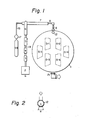
- FIG. 1 is a schematic illustration of a microwave discharge plasma treatment apparatus of a comparable example. Resin parts used for motor vehicles were subjected to surface treatment in this plasma treatment apparatus. The degree of surface was not uniform, among the parts as well as among the positions within each part, due to the large size and the complicated configuration of those parts.
- FIG. 1 there are shown a reaction chamber 1, a microwave oscillator 2, an isolator 3 (Toshiba Corp.), a power monitor 4 (Toshiba Corp.), a three-stab tuner 5 (Toshiba Corp.), a plasma generating furnace 6, a plasma generating pipe 7, a quartz pipe 8, a plasma introducing port 9, a plasma-irradiating pipe 12, a discharge port 15 for evacuating the reaction chamber, a gas supply conduit 16, a flow meter 17, a gas bomb 18, a waveguide 19 and sample works Sl to S6.
- Plasma injection angle a of the glass pipe 12
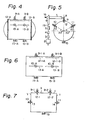
- FIGS. 4 and 5 illustrates a first embodiment of a plasma treatment apparatus according to the present invention.
- the reaction chamber 1 is of a circular cylinder.
- a cylindrical reaction chamber 1 of 1000 mm or more in diameter
- a microwave oscillator 2 an isolator 3 (Toshiba Corp.)
- a power monitor 4 Toshiba Corp.
- a three-stab tuner 5 Toshiba Corp.
- a plasma generating furnace 6 a plasma generating tube 7, a quartz tube 8
- the microwave generated by the oscillator 2 is guided through the isolator 3, the power monitor 4 and the three-stab tuner 5 to the plasma generating furnace 6 by the waveguide 19.
- a gas to be converted into a plasma is supplied through the conduit 16 to the plasma generating pipe 7.
- the plasma generated in the plasma generating pipe 7 and the plasma generating tube 7 is sent to the plasma introducing ports 9-A, 9-B, 10-A, 10-B, 11-A and 11-B.
- the three pairs of the plasma introducing ports 9, 10, and 11 are arranged on the three generatrices of the reaction chamber 1 which are separate from each other by an angular interval of 60° respectively.
- the plasma sent to the plasma introducing ports is injected into the reaction chamber 1 by the plasma-irradiating pipes 12-A, 12-B, 13-A, 13-B, 14-A and 14-B connected to the plasma introducing ports 9-A, 9-B, 10-A, 10-B, 11-A and 11-B respectively.
- the details of plasma injection nozzles formed in the plasma-irradiating pipes are illustrated in FIGS. 8 to 10. Since the reaction chamber 1 needs to be evacuated to a degree of vacuum of approximately 1.0 to 0.05 Torr for plasma treatment, the reaction chamber 1 is evacuated continuously by a vacuum pump, not shown, connected through pipes, not shown, to the exhaust ports 15.
- FIGS. 6 and 7 show a second embodiment of a plasma treatment apparatus according to the present invention.
- the reaction chamber 1 is formed in the form of a rectangular prism having sides each of 1000 mm or more in length. Same or corresponding parts are indicated by same or corresponding reference numerals through the first and the second embodiments.
- the size of the reaction chamber 1 in the form of a rectangular prism is, for example, that X indicated in FIG. 7 is 2500 mm which is the width of a wall provided with plasma introducing ports 9-1 and 9-2, Y also indicated in FIG. 7 is 1800 mm which is the width of walls provided with plasma introducing ports 10 and 11.
- a plurality of the plasma introducing ports 9-1 and 9-2 are arranged on the wall indicated by X as illustrated in FIG. 7, at an interval of 1000 mm or less, for example, 900 mm.
- the other constitution and the functions of this second embodiment are the same as the first embodiment.
- FIGS. 8 to 10 show plasma-irradiating pipes 12-, 13- and 14-A and B (first embodiment) or 12-1-, 12-2-A and B, 13-, 14-A and B (second embodiment) connected to the plasma introducing ports 9-, 10-, 11-A and B (first embodiment) or 9-1-, 9-2-A and B, 10-, 11-A and B (second embodiment) respectively.
- the plasma-irradiating pipe 20 is formed of glass or quartz.
- the plasma-irradiating pipe 20 is joined at a base 21 thereof to the plasma introducing port (9, 10 or 11).
- a manifold 22 extends from the base 21 and a cylindrical spraying head 23 extends from the manifold 22.
- the spraying head 23 is formed so as to extend perpendicularly to and symmetrically with respect to the center axis X 1 of the corresponding plasma introducing port. The opposite ends of the spraying head 23 are closed.
- a plurality of plasma injection nozzles 24 of, for example, 6 mm in diameter are provided in the lower side of the spraying head 23 at fixed intervals along the longitudinal direction.
- the plasma injection nozzles 24 are staggered with respect to the center axis X 2 of the spraying head 23 as viewed in FIG. 9, so that the adjacent plasma injection nozzles are disposed on opposite sides of a plane defined by the center axes X l and X 2 as viewed in FIG. 10 and at an angular interval of 60° (at angular position of 30° on each side of the plane defined by the center axes X l and X 2 ).
- FIG. 11 show measured results obtained by the experimental plasma treatment of works (PP resin works) by using the apparatus of the first embodiment (FIGS. 4 and 5) employing the plasma-irradiating pipes of FIGS. 8 to 10.
- the plasma-irradiating pipes were disposed so that the longitudinal axes of the plasma-irradiating pipes extend along the longitudinal axis of the cylindrical reaction chamber 1 as illustrated in FIG. 4.
- the size of the reaction chamber, the conditions of treatment and the contact angle measuring method are the same as those of the preparatory experiments.
- Other conditions of experiments were the same as the preparatory experiments mentioned before.
- the present invention is capable of establishing uniform distribution of plasma density within the reaction chamber, and capable of plasma-treating many comparatively large works of complicated configuration, simultaneously and uniformly, regardless of the location of the works, and also capable of eliminating irregular plasma treatment within each work attributable to the configuration.
- FIGS. 12 to 14 show a second embodiment of a plasma-irradiating pipe according to the present invention.
- the plasma-irradiating pipe is joined coaxially at a base 21 to the plasma introducing port 9, 10 or 11 (FIGS. 4 and 5).
- a manifold 22 extends from the base 21 and a cylindrical spraying head ("plasma-irradiating pipe" in a narrow sense) 23 extends from the manifold 22.
- the plasma introducing ports 9, 10 and 11 are formed in the wall of the reaction chamber 1 as illustrated in FIGS. 4 and 5.
- the center axis X l of each plasma introducing port extends perpendicularly to the wall of the reaction chamber 1 (FIG. 4) and intersects the longitudinal center axis of the reaction chamber 1 (FIG. 5).
- the spraying head 23 is disposed in parallel to the longitudinal axis of the reaction chamber 1, with its center axis X 2 extending perpendicularly to the center axis X 1 of the corresponding plasma introducing port.
- the spraying head 23 extends for equal lengths on both sides with respect to the center axis X l of the corresponding plasma introducing port. That is, the cylindrical spraying head 23 extends adjacently to and in parallel to the wall of the reaction chamber.
- a plurality of plasma injecting nozzles 30 to 33 are formed in the cylindrical spraying head 23.
- the diameter of the plasma injection nozzle is, for example, 6 mm.
- the plasma injection nozzles 31-A, 31-B, ... are formed in the bottom of the cylindrical spraying head 23 as viewed in FIG. 14 (in the portion of the cylindrical spraying head 23 extending farthest from the adjacent wall of the reaction chamber 1) along the longitudinal direction of the cylindrical spraying head 23 at a fixed interval (approximately 20 mm).
- Plasma injection nozzles 33-A and 33-B are formed in the opposite ends of the cylindrical spraying head 23 on the center axis X 2 .
- the plasma injection nozzles 33-A and 33-B are declined as viewed in FIG. 12 at an angle between 15 to 80°, preferably 30 to 60°, for example, 45°, with respect to the center axis X 2 , namely, toward the interior of the reaction chamber 1.
- FIGS. 15 to 18 show the measured results of experiments performed to confirm the effect of the above-mentioned embodiments. The experiments were performed in the same manner as the experiments as described hereinbefore.
- FIG. 15 shows experimental results of plasma treatment, in which the plasma-irradiating pipe (No. 1) having the plasma spraying head with no plasma injection nozzle in the end walls was employed for comparison.
- FIG. 16 shows the experimental results of plasma treatment, in which the above-mentioned embodiment of the plasma-irradiating pipe (No. 2) having the plasma spraying head provided with the plasma injection nozzles (33-A, 33-B) in the end walls thereof.
- the work was placed 1000 mm away from and in parallel to the glass or nozzle pipe.
- the abscissa represents the distance (mm) from the end of the glass or nozzle pipe to measuring points, while the ordinate represents measured contact angle.
- the provision of plasma injection nozzles in the end walls of the plasma spraying head uniformizes the distribution of plasma density within the reaction chamber.
- FIG. 17 shows experimental rusults of plasma treatment, in which the plasma-irradiating pipe (No. 3) having the plasma injection nozzles 31 formed in the plasma spraying head within a plane including the center axes X 1 and X 2 (FIG. 14) was employed for comparison.
- FIG. 18 shows experimental results of plasma treatment, in which the above-mentioned plasma-irradiating pipe (No. 4) embodying the present invention, having the plasma injection nozzles 31 formed in a plane including the center axes X 1 and X 2 (FIG. 14) and plasma injection nozzles 30 and 32 formed in the same plasma spraying head outside the plane including the plasma injection nozzles 31.
- the surface of a work was placed 1000 mm apart from the plasma-irradiating pipe, and contact angle was measured at measuring points on a line extending perpendicularly to the longitudinal direction of the plasma-irradiating pipe.
- the abscissa represents the distance (mm) from the point of center 1000 mm apart from the plasma spraying head to the measuring point, while the ordinate represents measured contact angle.
- the provision of the plasma injection nozzles 30, 31, and 32 in an arrangement as illustrated in FIG. 14 uniformizes the distribution of plasma density within the reaction chamber.
- FIGS. 19 and 20 show a plasma treatment apparatus also embodying this invention, which comprises plasma diffusers 114 and 115 having vanes disposed on the inner wall of the reaction chamber 1 for improving the effects of diffusion of the plasma flow in the reaction chamber 1.
- the plasma introducing port 9 is provided in the left hand area of the cylindrical wall of the reaction chamber 1, while the discharge port 15 is provided on the center line 117 at the right end of the reaction chamber 1.
- the plasma diffuser 114 and 115 are provided at the same positions as the plasma introducing port 9 with regard to the longitudinal direction of the chamber l, but separated by about 60° therefrom.
- the plasma radiating pipe 12 extends perpendicularly to the center axis of the plasma introducing port 9 and in the longitudinal direction of the reaction chamber 1.
- FIG. 21 shows plasma diffusers 114 and 115 in detail.
- a vane 126 and a drive motor 120 therefor are mounted by a mounting member 121.
- a leading line 125 of the drive motor 120 is sealed by a connector 124 and a plate member 122 mounted on the outer wall of the chamber 1, the inside of which is maintained in the vacuum.
- the plate member 122 is sealed by an O-ring seal 123 with respect to the outer wall of the chamber 1.
- the motor 120 may also be provided on the outer wall of the chamber 1.
- the uniform distribution of the plasma density is established within the reaction chamber 1 by the fact that the plasma introduced into and radiated in the reaction chamber 1 is diffused in the longitudinal direction in the chamber by the plasma diffusers 114 and 115, then a flow of plasma toward the discharge port 15 is formed.
- the plasma diffuser may also be constituted as shown in FIG. 22. Namely, a plasma diffusing vane 126 which is provided in the vicinity of plasma introducing ports 9 is rotated by virtue of the flow of plasma radiated from the plasma radiating pipe 12, in place of being rotated by a drive motor.
- the plasma diffusing vane 126 can also be provided in the vicinity of the discharge port 15, although not shown in the drawings, so as to rotate the plasma diffusing vane by virtue of the flow of discharge.
- the positions, sizes, members and etc. of the plasma introducing port 9, discharge port, and plasma diffuser, and the revolutional speed of the plasma diffusing vane can be advantageously selected in view of the numbers, shapes, sizes and ets. of the works to be treated. Any combinations of these factors can be employed by a person skilled in the art without departing the spirit and seope of this invention.
- a plasma introducing port 9 is provided at the center on the cylindrical wall of the reaction chamber 1 (FIG. 26), a discharge port 15 is provided at the opposite position on the cylindrical wall, and plasma diffusers 114 and 115 are provided at the left and right ends, respectively, on the longitudinal center line of the reaction chamber 1.
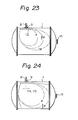
- FIGS. 23 through 26 the effects of plasma treatment of the works at the various positions in th reaction chamber 1 are illustrated by lines indicating the distribution of contact angle (6).
- the conditions of treatment were as follows:
- FIG. 23 shows the results of experiment using a plasma treatment apparatus as shown in FIGS. 19 and 20, but not actuating the plasma diffusing vanes.
- FIG. 24 shows the results of experiment using the same apparatus and actuating the plasma diffusing vanes at 20 to 60 RPM. As is evident from the comparative examination, it is understood that more wide and uniform distribution of the plasma density can be obtained and uniform plasma treatment over the entire surfaces of the works was attained regardless of the location and the configuration of the works in the case of FIG. 24 as compared to the case of FIG. 23.
- FIGS. 27 and 28 show a further embodiment of plasma treatment apparatus according to this invention, in which, deflecting plates 101 made of stainless steel, such as SUS, are arranged in the horizontal direction (in the direction perpendicular to the virtical direction of the works) and attached to the inner wall of the reaction chamber 1.
- the deflecting plates lOla, c and e are arranged in the left hand side, and deflecting plates 101b, d and f are arranged in the right hand side.
- the lengths of the deflecting plates 101a to 101f toward the works are larger in the downstream side of plasma than in the upstream side thereof.
- the most downstream side deflecting plates 101e and 101f have substantially the same length as the deflecting plate 101c and 101d, for avoiding the inside space of the reaction chamber 1 from reducing too much in view of the reaction chamber 1 being cylindrical shape.
- the deflecting plates lOla-1, lOla-2, ... in the same horizontal level have the same length and regularly spaced. These deflecting plates are arranged alternately with respect to the circumferential direction of the reaction chamber 1.
- FIGS. 29 and 30 show another embodiment of plasma treatment apparatus having deflecting plates.
- the reaction chamber 1 is in the shape of a rectangular vertical column, in which a plurality of works A to D are arranged along the vertical direction.
- a plasma radiating pipe 12 is provided at the central position of an upper wall of the rectangular chamber 1, while a discharge port 15 is provided at the central position of a bottom wall of the chamber 1.
- a plurality of deflecting plates 102 made of stainless steel are arranged perpendicularly to the vertical direction of the rectangular chamber 1.
- the horizontal lengths of the deflecting plates toward the works are larger in the downstream side than in the upstream side.
- These deflecting plates are regularly spaced with respect to the horizontal direction along the inside wall, in the same as the previous embodiment shown in FIGS. 27 and 28, and arranged alternately with respect to the vertical direction.
- deflecting plates 103 may be inclined toward the downstream of the flow of plasma as an embodiment shown in FIG. 31. Otherwise, the deflecting plates can be constructed so that the angle thereof be changeable according to the sizes, shapes, numbers, and etc. of the works.
- the deflecting plates can be made of any material, such as stainless steel, for example SUS as mentioned above, which may not cause the deactivation of the plasma and may not be affected by itself, when plasma gas is exposed thereon.
- a part of radiated plasma after having been collided to the works, flows along the inside wall of the reaction chamber 1.
- the flow of plasma is, then, deflected toward the works A to D by the deflecting plates, as shown by arrows in FIGS. 27, and spread to the various portions within the reaction chamber 1 so that the works are uniformly treated by plasma, which is then discharged through the discharge port 15 to the outside of the chamber 1.
- the uniform distribution of the plasma density is established within the reaction chamber 1 by the deflecting plates and even in the plasma treatment of comparatively large works of complicated configuration, uniform plasma treatment over the entire surfaces of the works is attained regardless of the location and configuration of the works.
- these effects can be attained by these deflecting plates of simple construction, it is not necessary to increase the numbers of plasma radiating pipes, and the accompanying oscillators, wave- transmitting pipes, plasma generating pipes and etc.
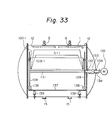
- FIGS. 32 and 33 An embodiment of plasma treatment apparatus shown in FIGS. 32 and 33 is so constructed as to treat four works S-1 to S-4 at the same time.
- the works S-1 to S-4 are supported on mounting members 108-1 to 108-4, respectively, which are connected to vertical disk plates 109 of a carriage through free rotatable shaft 107-1 to 107-4, respectively.
- the mounting members 108-1 to 108-4 are freely rotatable about the respective shafts 107-1 to 107-4.
- the vertical disk plates 109 are rigidly secured to a rotatable shaft 103 which passes through the centers of the disks 109.
- An extension 132 of the rotatable shaft 131 is connected by a connector 133 to a shaft 134 of a motor 135.
- the motor shaft 134 is seated by a vacuum seal 136 provided in the wall of the reaction chamber 1.
- the rotatable shaft 131 is driven by the motor 135, and consequently the vertical disks 109 are rotated so that the shafts 107-1 to 107-4 for supporting the mounting members 108-1 to 108-4 are simultaneously moved along a circular trace T 1 .
- the orientations of the mounting members 108-1 to 108-4 as well as the works S-1 to S-4 are automatically adjusted through their turning around the free rotatable shafts 107-1 to 107-4, respectively.
- reference numeral 137 denotes rails for the carriage, and 138 denotes wheels of the carriage traveling on the rails 137.
- the rails 137 is lowered by air cylinders 139 to a position in which the rails 137 do not prevent the rotation of the vertical disk plates 109.
- the reaction chamber 1 is then closed by a door member and a series of plasma treatment operations is carried out in the reaction chamber 1.
- rotatable shaft 131 is provided in the embodiment shown in FIGS. 32 and 33, two or more such rotatable shafts and the corresponding number of motors 135 can also be provided.
- the motor 135 can be disposed in the inside of the reaction chamber 1.
- FIGS. 32 and 33 Using a plasma treatment apparatus as shown in FIGS. 32 and 33, some samples fo vehicle's parts were treated under the same conditions as the above-mentioned comparable example as shown in FIG. 1.
- the rotatable shaft 131 was rotated at 10 to 20 RPM. As the results, uniform distribution of the effects of the plasma treatment was obtained over the all sample works and over the entire surfaces of each work.
- the combination of freely rotating the works about themselves and moving the all works along a circular trace makes it possible that uniform density of plasma be radiated on the entire surfaces of the works.
- more uniform distribution of the plasma density can be obtained by the fact that the plasma in the reaction chamber 1 is advantageously stirred up by the rotational movement of the mounting members 108-1 to 108-4.
- FIGS. 34 and 35 show a plasma treatment apparatus also embodying this invention, which comprises a plurality of long tubular shower pipes provided along the length thereof with numerous small holes, and at least one straight pipe disposed with its free end opening toward a section to which the plasma can barely flow and the other end connected to the plasma transporting conduit.
- a reaction chamber 1 is provided with six plasma-irradiating pipes 12a, 12b, 12c, 12d, 12e and 12f and three sets of straight pipes 40a, 40b and 40c each including three straight pipes.
- the pipes 12a and 12b are disposed in the upper part of the reaction chamber 1 in parallel to each other and opposite to the upper surface of works Sl and S2 respectively.
- the pipes 12c and 12d are disposed in the left-hand part of the reaction chamber in parallel to each other and opposite to the side surfaces of the work Sl and a work S3 respectively.
- the pipes 12e and 12f are disposed in the similar state in the right-hand part of the reaction chamber 1.
- the straight pipes 40a are tubular members each having a straight portion of a fixed length from the opening end thereof.
- the straight pipes 40a are interposed with their openings directed toward the center axis of the reaction chamber between the shower pipes 12a and 12b.
- Three straight pipes 40a are arranged at equal intervals along the longitudinal direction of the shower pipe 12a.
- straight pipes 40b and 40c are also disposed in the same relative position with respect to the corresponding shower pipes 12c, 12d, 12e and 12f as the relative position between the straight pipes 40a and the shower pipes 12a and 12b.
- the other end opposite the opening end of each straight pipe is connected through a plasma transporting conduit 8 to a plasma generating pipe.
- FIG. 36 shows a further embodiment of this invention, in which plasma-irradiating pipes 12 are fixed to the inner wall of a reaction chamber 1, while a plasma-irradiating pipe 41 is connected to a TeflonGY tube 42 so as to be located at an optional position within the reaction chamber 1.
- the pipe 41 is disposed in the central part of the cylindrical reaction chamber 1 along the axial direction of the reaction chamber 1.
- the plasma-irradiating pipe 41 can also be disposed at an optional position or inclination depending on the number, configuration and the arrangement of the works to be treated.
- the pipe 41 as well as the pipes 12 is made of a quartz glass pipe and is provided with many small holes serving as plasma injection nozzles 48 formed in the circumference of the wall thereof at an equal angular interval of, for example, 90° in order to radiate the plasma in all directions.
- a plasma transporting conduit 43 for supplying the plasma to the plasma-irradiating pipe 41 is branching off at a fluororesin connector 44.
- the plasma transporting conduit 43 may branch off at any other fluororesin connector and a separate plasma generating system exclusively for the pipe 41 may be provided.
- a single pipe 41 is provided in the central part of the reaction chamber.
- flexible tubes 42a and 42a which are the same as the flexible tube 42 may be branched from a fluororesin connector 45 and connected to shower pipes 46a and 46b by means of fluororesin connectors 47a and 47b respectively, each shower pipe having plasma injection nozzles only in one side of the wall thereof facing the works in order to irradiate the longitudinal end portions of those works S with the plasma.
- a fluororesin connector 45 and connected to shower pipes 46a and 46b by means of fluororesin connectors 47a and 47b respectively, each shower pipe having plasma injection nozzles only in one side of the wall thereof facing the works in order to irradiate the longitudinal end portions of those works S with the plasma.
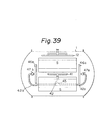
- the plasma is branched at a fluororesin connector 44 and is supplied through a plasma transporting conduit 43, a fluororesin connector 45 and the flexible tube 42 to the plasma-irradiating pipe 41.
- the plasma is branched further at the fluororesin connector 45 and supplied through the flexible tubes 42a and 42b and fluororesin connectors 47a and 47b to the pipes 46a and 46b respectively.
- the uniform distribution of the plasma density was established within the reaction chamber 1 and even in the plasma treatment of comparatively large works of complicated configuration, uniform plasma treatment over the entire surfaces of the works was attained regardless of the location and the configuration of the works.
- the adhesion of the paint film to the plasma-treated surfaces was satisfactory with every part of the surfaces after painting process.
- FIGS. 40 and 41 show further embodiment of this invention, in which a substantially cylindrical electrode 72 is disposed adjacently to the inner wall of a reaction chamber.
- the electrode 72 is connected to a radio-frequency power source 70.
- the electrode 72 is formed of a porous plate to allow the plasma to flow into the inside of the reaction chamber 1.
- Three gas inlet ports 73-1, 73-2 and 73-3 are provided in the wall of the reaction chamber 1 for supplying a gas to be converted into plasma by radio wave discharge.
- three gas inlet ports 74-1, 74-2 and 74-3 and three gas inlet ports 75-1, 75-2 and 75-3 are also provided respectively.
- Microwave discharge plasma introducing ports 76-1, 76-2 and 76-3, and 77-1, 77-2 and 77-3 are formed between the gas inlet ports 73-1, 73-2 and 73-3, and 74-1, 74-2 and 74-3, and between the gas inlet ports 74-1, 74-2, and 74-3, and 75-1, 75-2 and 75-3, respectively.
- Radio-frequency energy is generated between the electrode 72 disposed in the reaction chamber 1 and connected to the radio-frequency power source 70 and the grounded reaction chamber 1. While the gas, for example, oxygen gas, is introduced into the reaction chamber through the gas inlet ports 73-1, to -3, 74-1 to -3 and 75-1 to -3, and converted into radio wave discharge plasma by the radio-frequency enerby.
- the radio wave discharge plasma thus generated functions to plasma-treat the surfaces of works placed adjacently to the electrode 72 disposed in the reaction chamber, namely the general surfaces of the works.
- This plasma functions to plasma-treat the portions of the surfaces which are plasma-treated insufficiently by the radio wave discharge plasma, namely, the portions which are situated far from the electrode 72 disposed in the reaction chamber 1 or the portions which are screened by the works from the radio wave discharge plasma.
- the plasma treatment of works by means of this embodiment employing both the radio wave and microwave discharge plasmas reduced variation in the effect of plasma treatment between the works and within the individual works. In the experimental plasma treatment using this embodiment, the works were first subjected to radio wave discharge plasma treatment, and then to microwave discharge plasma treatment. However, the same effect would be attainable even if the plasma treatment processes were reversed or both the radio wave and microwave discharge plasma treatment were carried out simultaneously.
Landscapes
- Physics & Mathematics (AREA)
- Engineering & Computer Science (AREA)
- Plasma & Fusion (AREA)
- Chemical & Material Sciences (AREA)
- Analytical Chemistry (AREA)
- Organic Chemistry (AREA)
- Chemical Kinetics & Catalysis (AREA)
- Plasma Technology (AREA)
- Treatments Of Macromolecular Shaped Articles (AREA)
Applications Claiming Priority (6)
| Application Number | Priority Date | Filing Date | Title |
|---|---|---|---|
| JP58029371A JPS59155441A (ja) | 1983-02-25 | 1983-02-25 | プラズマ処理方法および装置 |
| JP29371/83 | 1983-02-25 | ||
| JP29372/83 | 1983-02-25 | ||
| JP58029372A JPS59155442A (ja) | 1983-02-25 | 1983-02-25 | プラズマ処理装置 |
| JP38204/83 | 1983-03-10 | ||
| JP3820483A JPS59164340A (ja) | 1983-03-10 | 1983-03-10 | プラズマ処理装置 |
Related Child Applications (2)
| Application Number | Title | Priority Date | Filing Date |
|---|---|---|---|
| EP89105490.0 Division-Into | 1984-02-23 | ||
| EP19890105490 Division EP0326191A3 (de) | 1983-02-25 | 1984-02-23 | Vorrichtung und Verfahren zur Plasmabearbeitung von Kunstharzmaterialien |
Publications (3)
| Publication Number | Publication Date |
|---|---|
| EP0117541A2 true EP0117541A2 (de) | 1984-09-05 |
| EP0117541A3 EP0117541A3 (en) | 1987-04-15 |
| EP0117541B1 EP0117541B1 (de) | 1990-05-02 |
Family
ID=27286538
Family Applications (1)
| Application Number | Title | Priority Date | Filing Date |
|---|---|---|---|
| EP84101935A Expired EP0117541B1 (de) | 1983-02-25 | 1984-02-23 | Vorrichtung zur Plasmabearbeitung von Kunstharz-Materialien |
Country Status (4)
| Country | Link |
|---|---|
| US (3) | US4595570A (de) |
| EP (1) | EP0117541B1 (de) |
| AU (2) | AU548915B2 (de) |
| DE (1) | DE3482155D1 (de) |
Cited By (1)
| Publication number | Priority date | Publication date | Assignee | Title |
|---|---|---|---|---|
| WO1998058731A3 (en) * | 1997-06-20 | 1999-05-27 | Flowgenix Corp | Apparatus for exposing substrates to gas-phase radicals |
Families Citing this family (10)
| Publication number | Priority date | Publication date | Assignee | Title |
|---|---|---|---|---|
| GB8333665D0 (en) * | 1983-12-16 | 1984-01-25 | Lilly Industries Ltd | Organic compounds |
| JPS61225819A (ja) * | 1985-03-29 | 1986-10-07 | Fuji Electric Co Ltd | レ−ザcvd装置 |
| US5007983A (en) * | 1988-01-29 | 1991-04-16 | The United States Of America As Represented By The Administrator Of National Aeronautics And Space Administration | Etching method for photoresists or polymers |
| DE4437050A1 (de) * | 1994-10-17 | 1996-04-18 | Leybold Ag | Vorrichtung zum Behandeln von Oberflächen von Hohlkörpern, insbesondere von Innenflächen von Kraftstofftanks |
| AU3145197A (en) | 1996-06-28 | 1998-01-21 | Lam Research Corporation | Apparatus and method for high density plasma chemical vapor deposition |
| US6013155A (en) * | 1996-06-28 | 2000-01-11 | Lam Research Corporation | Gas injection system for plasma processing |
| US6184158B1 (en) | 1996-12-23 | 2001-02-06 | Lam Research Corporation | Inductively coupled plasma CVD |
| US6042687A (en) * | 1997-06-30 | 2000-03-28 | Lam Research Corporation | Method and apparatus for improving etch and deposition uniformity in plasma semiconductor processing |
| CH697092A5 (de) * | 1998-12-24 | 2008-04-30 | Sulzer Metco Ag | Anordnung für eine Plasmaspritzanlage. |
| EP2937890B1 (de) * | 2014-04-22 | 2020-06-03 | Europlasma nv | Plasma-beschichtungsvorrichtung mit einem plasma-verteiler und verfahren zur vermeidung der entfärbung eines substrates |
Family Cites Families (13)
| Publication number | Priority date | Publication date | Assignee | Title |
|---|---|---|---|---|
| JPS5211175A (en) * | 1975-07-18 | 1977-01-27 | Toshiba Corp | Activated gas reacting apparatus |
| JPS5378170A (en) * | 1976-12-22 | 1978-07-11 | Toshiba Corp | Continuous processor for gas plasma etching |
| JPS5329076A (en) * | 1976-08-31 | 1978-03-17 | Toshiba Corp | Plasma treating apparatus of semiconductor substrates |
| JPS53121469A (en) * | 1977-03-31 | 1978-10-23 | Toshiba Corp | Gas etching unit |
| JPS5565436A (en) * | 1978-11-10 | 1980-05-16 | Mitsubishi Electric Corp | Plasma treatment device |
| JPS6029295B2 (ja) * | 1979-08-16 | 1985-07-10 | 舜平 山崎 | 非単結晶被膜形成法 |
| JPS56147832A (en) * | 1980-04-16 | 1981-11-17 | Toshiba Corp | Surface treating device |
| JPS5712032A (en) * | 1980-06-26 | 1982-01-21 | Sekisui Chem Co Ltd | Apparatus for treatment with activated gas |
| JPS5740586A (en) * | 1980-08-22 | 1982-03-06 | Toshiba Corp | Treatment of fluorescent substance and its device |
| US4434188A (en) * | 1981-12-17 | 1984-02-28 | National Institute For Researches In Inorganic Materials | Method for synthesizing diamond |
| US4501766A (en) * | 1982-02-03 | 1985-02-26 | Tokyo Shibaura Denki Kabushiki Kaisha | Film depositing apparatus and a film depositing method |
| JPS58170536A (ja) * | 1982-03-31 | 1983-10-07 | Fujitsu Ltd | プラズマ処理方法及びその装置 |
| JPS58208326A (ja) * | 1982-05-31 | 1983-12-05 | Hashimoto Forming Co Ltd | プラズマ処理方法 |
-
1984
- 1984-02-16 AU AU24672/84A patent/AU548915B2/en not_active Ceased
- 1984-02-23 EP EP84101935A patent/EP0117541B1/de not_active Expired
- 1984-02-23 DE DE8484101935T patent/DE3482155D1/de not_active Expired - Lifetime
-
1985
- 1985-09-05 US US06/772,208 patent/US4595570A/en not_active Expired - Fee Related
- 1985-11-05 AU AU49368/85A patent/AU578499B2/en not_active Ceased
-
1986
- 1986-01-08 US US06/817,115 patent/US4874453A/en not_active Expired - Fee Related
-
1989
- 1989-02-08 US US07/307,509 patent/US4919745A/en not_active Expired - Fee Related
Cited By (1)
| Publication number | Priority date | Publication date | Assignee | Title |
|---|---|---|---|---|
| WO1998058731A3 (en) * | 1997-06-20 | 1999-05-27 | Flowgenix Corp | Apparatus for exposing substrates to gas-phase radicals |
Also Published As
| Publication number | Publication date |
|---|---|
| EP0117541B1 (de) | 1990-05-02 |
| AU4936885A (en) | 1986-04-24 |
| EP0117541A3 (en) | 1987-04-15 |
| US4595570A (en) | 1986-06-17 |
| US4874453A (en) | 1989-10-17 |
| AU578499B2 (en) | 1988-10-27 |
| US4919745A (en) | 1990-04-24 |
| AU2467284A (en) | 1984-10-04 |
| AU548915B2 (en) | 1986-01-09 |
| DE3482155D1 (de) | 1990-06-07 |
Similar Documents
| Publication | Publication Date | Title |
|---|---|---|
| EP0120307B1 (de) | Vorrichtung und Verfahren zur Plasmabehandlung von Kunstharz | |
| US4874453A (en) | Apparatus and method for plasma treatment of resin material | |
| US7926446B2 (en) | Multi-place coating apparatus and process for plasma coating | |
| KR100275831B1 (ko) | 진공처리시스템 및 그의 진공처리시스템에 있어서의 진공용기 내면 퇴적막의 제거방법 | |
| WO2019243631A1 (en) | Improved method and apparatus for atmospheric pressure plasma jet coating deposition on a substrate | |
| JP2011513593A (ja) | プラズマシステム | |
| EP0326191A2 (de) | Vorrichtung und Verfahren zur Plasmabearbeitung von Kunstharzmaterialien | |
| US4690097A (en) | Apparatus and method for plasma treatment of resin material | |
| EP0152511B1 (de) | Vorrichtung und Verfahren zur Plasmabehandlung von Kunstharz | |
| US4786522A (en) | Method for plasma treatment of resin material | |
| US20070089986A1 (en) | Sputtering target and method/apparatus for cooling the target | |
| WO2007050304A1 (en) | Sputtering target and means for cooling the target | |
| JPS59155440A (ja) | プラズマ処理装置 | |
| JPS629302Y2 (de) | ||
| CN222729891U (zh) | 镀膜炉体和镀膜设备 | |
| JPS59189130A (ja) | プラズマ処理方法 | |
| JPS5986630A (ja) | プラズマ処理を施す方法および装置 | |
| KR100253263B1 (ko) | 프라즈마 cvd 장비의 프로세스 챔버구조 | |
| JPH0315531Y2 (de) | ||
| JPS5920332A (ja) | プラズマ処理を施す方法および装置 | |
| JPH0348193Y2 (de) | ||
| JPH0615629B2 (ja) | プラズマ処理方法 | |
| JPH0570956A (ja) | 有磁場マイクロ波吸収プラズマ処理装置 | |
| JPH0348194Y2 (de) | ||
| JPS61120835A (ja) | マイクロ波プラズマ処理装置 |
Legal Events
| Date | Code | Title | Description |
|---|---|---|---|
| PUAI | Public reference made under article 153(3) epc to a published international application that has entered the european phase |
Free format text: ORIGINAL CODE: 0009012 |
|
| 17P | Request for examination filed |
Effective date: 19840223 |
|
| AK | Designated contracting states |
Designated state(s): DE FR GB |
|
| PUAL | Search report despatched |
Free format text: ORIGINAL CODE: 0009013 |
|
| AK | Designated contracting states |
Kind code of ref document: A3 Designated state(s): DE FR GB |
|
| 17Q | First examination report despatched |
Effective date: 19880927 |
|
| GRAA | (expected) grant |
Free format text: ORIGINAL CODE: 0009210 |
|
| AK | Designated contracting states |
Kind code of ref document: B1 Designated state(s): DE FR GB |
|
| XX | Miscellaneous (additional remarks) |
Free format text: TEILANMELDUNG 89105490.0 EINGEREICHT AM 23/02/84. |
|
| REF | Corresponds to: |
Ref document number: 3482155 Country of ref document: DE Date of ref document: 19900607 |
|
| ET | Fr: translation filed | ||
| PLBE | No opposition filed within time limit |
Free format text: ORIGINAL CODE: 0009261 |
|
| STAA | Information on the status of an ep patent application or granted ep patent |
Free format text: STATUS: NO OPPOSITION FILED WITHIN TIME LIMIT |
|
| 26N | No opposition filed | ||
| REG | Reference to a national code |
Ref country code: GB Ref legal event code: 746 |
|
| PGFP | Annual fee paid to national office [announced via postgrant information from national office to epo] |
Ref country code: FR Payment date: 19930209 Year of fee payment: 10 |
|
| PGFP | Annual fee paid to national office [announced via postgrant information from national office to epo] |
Ref country code: GB Payment date: 19930215 Year of fee payment: 10 |
|
| PGFP | Annual fee paid to national office [announced via postgrant information from national office to epo] |
Ref country code: DE Payment date: 19930308 Year of fee payment: 10 |
|
| REG | Reference to a national code |
Ref country code: FR Ref legal event code: DL |
|
| PG25 | Lapsed in a contracting state [announced via postgrant information from national office to epo] |
Ref country code: GB Effective date: 19940223 |
|
| GBPC | Gb: european patent ceased through non-payment of renewal fee |
Effective date: 19940223 |
|
| PG25 | Lapsed in a contracting state [announced via postgrant information from national office to epo] |
Ref country code: FR Effective date: 19941031 |
|
| PG25 | Lapsed in a contracting state [announced via postgrant information from national office to epo] |
Ref country code: DE Effective date: 19941101 |
|
| REG | Reference to a national code |
Ref country code: FR Ref legal event code: ST |