EP0120176A2 - Corps polaire - Google Patents
Corps polaire Download PDFInfo
- Publication number
- EP0120176A2 EP0120176A2 EP83810579A EP83810579A EP0120176A2 EP 0120176 A2 EP0120176 A2 EP 0120176A2 EP 83810579 A EP83810579 A EP 83810579A EP 83810579 A EP83810579 A EP 83810579A EP 0120176 A2 EP0120176 A2 EP 0120176A2
- Authority
- EP
- European Patent Office
- Prior art keywords
- body according
- carrier element
- pole body
- face
- insulating
- Prior art date
- Legal status (The legal status is an assumption and is not a legal conclusion. Google has not performed a legal analysis and makes no representation as to the accuracy of the status listed.)
- Granted
Links
Images

Classifications
-
- F—MECHANICAL ENGINEERING; LIGHTING; HEATING; WEAPONS; BLASTING
- F42—AMMUNITION; BLASTING
- F42B—EXPLOSIVE CHARGES, e.g. FOR BLASTING, FIREWORKS, AMMUNITION
- F42B3/00—Blasting cartridges, i.e. case and explosive
- F42B3/10—Initiators therefor
- F42B3/12—Bridge initiators
- F42B3/124—Bridge initiators characterised by the configuration or material of the bridge
Definitions
- the invention relates to an electrical pole body for concentrically constructed gas-tight thin-layer ignition capsules, consisting of a cylindrical carrier element made of metal, on one end of which a conductive layer made of metal is applied, which forms a sector-shaped ignition bridge between an approximately sector-shaped recess, which is approximately the same distance from the center as from the periphery is removed, and a method for producing such a pole body.
- squibs electrical detonators
- squibs electrical detonators
- squibs electrical detonators
- squibs electrical detonators
- squibs electrical detonators
- squibs electrical detonators
- squibs electrical detonators
- squibs electrical detonators
- squibs electrical detonators
- wire igniters electrical detonators
- thin-film igniters of the type described at the outset have a very wide sensitivity range, but also much tighter tolerances.
- the ignition resistance can vary between 0.5 ohms and 500 ohms with a spread of S 10%. Similar variations apply to the ignition current and the ignition voltage.
- Layer material, layer thickness, bridge width and bridge length can be defined independently as variable parameters for the manufacture of the primers.
- an electrical pole body which consists of two electrodes.
- a bolt is pressed through the insulating layer as a fastening and at the same time as a negative pole.
- a central, circular recess is drilled through the oxide layer in the metal core.
- a metal layer made of colloidal silver is applied, which is connected to the aluminum oxide layer by firing. This metal layer is now in direct contact with the explosive charge.
- the pole body is pressed into a housing.
- Pole bodies are also known which consist largely of glass in volume as an insulating body and are melted into a housing.
- DE-A-28 40 738 describes an insulating cylinder made of glass, which is held together by a metal ring and on one end face of which a metallic conductive layer with an insulating recess is applied.
- the object of the invention is to provide a compact, safe-to-handle pole body for detonators, which manages with minimal ignition energy, and to provide a simple method for its production, which ensures a minimal reject rate in series production.
- the pole body according to the invention consists of a metal carrier element which is easy to manufacture and easy to process.
- this compact carrier element is in turn surrounded by an insulating element.
- the carrier element has a conical elevation in the center on its end face. This elevation is easy to produce without special devices and easily establishes a conductive connection with the opposite end face.
- the carrier element is provided on its cylindrical side with a groove extending over the entire length of the cylinder.
- This groove has the advantage that when the carrier element is pressed into the press fit, the air un prevented from escaping.
- a semicircular groove has proven to be the preferred shape.
- grooves with rectangular, triangular or segment-shaped cross sections can also be provided. These segment-shaped grooves are particularly advantageous in the case of pole bodies which are surrounded by a relatively thick insulating jacket.
- One or more segment-shaped grooves can be provided.
- the carrier element from inexpensive aluminum.
- an aluminum alloy can also be used advantageously for certain areas of application of the pole body.
- the carrier element consists of pure molybdenum.
- molybdenum has the advantage of chemical resistance.
- the insulating element consists of a metal oxide impregnated with plastic, preferably of aluminum oxide.
- Advantages of the impregnated oxide layer are high dielectric strength, insensitivity to vibrations, high mechanical resistance, especially with press seats. Press seats result in better properties in the finished squib, as well as twist and shock stability in bullets. Such properties are very important for projectiles, since the reliability of ignition is greatly reduced in the event of instability.
- the insulating element according to claims 7 to 9 preferably consists of a metal oxide layer impregnated with a plastic.
- the thickness of the insulating layer can vary in a range from 50 to 100 microns. Layer thicknesses of 80 microns have proven particularly advantageous.
- a well insulating plastic layer will match the paints and known polymeric plastics, such as halogenated polymers such as fluoroethylene propylene, perfluoroalkoxyethylene, polychlorotrifluoroethylene, ethylene chlorotrifluoroethylene, ethylene tetrafluoroethylene, polyvinyl fluoride, polyvinylidene fluoride and polytetrafluoroethylene (PTFE).
- halogenated polymers such as fluoroethylene propylene, perfluoroalkoxyethylene, polychlorotrifluoroethylene, ethylene chlorotrifluoroethylene, ethylene tetrafluoroethylene, polyvinyl fluoride, polyvinylidene fluoride and polytetrafluoroethylene (PTFE).
- PTFE has proven to be particularly advantageous for impregnation.
- the carrier element is surrounded by a relatively thick jacket of an insulating element.
- the insulating layer can exceed the diameter of the metal carrier element several times.
- An insulating element made of aluminum oxide with at least 96% aluminum oxide has proven to be a simple and easy-to-produce insulator, which is also inexpensive to manufacture.
- the aluminum oxide body advantageously has a central bore. A carrier element is passed through this bore.
- the carrier element is covered according to claim 12 with a molybdenum oxide layer which is in direct contact with the insulating element.
- This has the advantage that molybdenum oxide can be mechanically combined with the aluminum oxide so easily to form a stable connection that no adhesives are required.
- the conductor and insulator for example with gold solder, can largely be dispensed with.
- the carrier element projects beyond the free end face.
- the carrier element is flush with the insulating element. That has the The advantage that very thin layers can be applied, which are in direct conductive contact with the carrier element.
- the thin layers can consist of an adhesive layer made of a chromium-nickel alloy (20% Cr; 80% Ni) of 5 to 20 ⁇ m, preferably 15 ⁇ m, and an actual pure conductive layer, for example made of gold of 20 to 200 ⁇ m, preferably 100 microns, or other alloys, such as pure nickel, chromium, aluminum, palladium and alloys, in particular made of Al and Pd.
- a chromium-nickel alloy 20% Cr; 80% Ni
- an actual pure conductive layer for example made of gold of 20 to 200 ⁇ m, preferably 100 microns, or other alloys, such as pure nickel, chromium, aluminum, palladium and alloys, in particular made of Al and Pd.
- a pole body according to claim 15 is described using an example.
- individual, cylindrical parts are cut from an aluminum rod with a circular cross section of 1.5 to 8 mm, in particular 5 mm and the desired length of 1 to 10 mm, in particular 4 mm, in such a way that a conical elevation of 0.5 up to 2 mm, in particular 1 mm diameter remains in the middle.
- a groove is previously cut out of the aluminum rod.
- the carrier element obtained in this way is completely covered with an insulating layer in a first process step. This can be done by oxidation, for example anodic oxidation.
- This metal oxide layer is then impregnated in a second process step with a well-insulating plastic, such as polytetrafluoroethylene or another halogenated plastic.
- a well-insulating plastic such as polytetrafluoroethylene or another halogenated plastic.
- the impregnation can be done by dipping in liquid plastic, but also by spraying.
- the flat cut surfaces of the pole body are polished and polished the insulation until the bare metal exposes a circular surface, so that the entire surface becomes electrically conductive.
- This has the advantage that the contact can be made on the end face at any cross section. As a result, the tolerances in the execution of the opposite side can be kept larger.
- the insulating layer is ground down to such an extent that a conductor in the form of a metal truncated cone is also created here. This truncated cone is then only surrounded on its sides by the impregnated insulating layer.
- a metal layer is applied to the end face provided with the truncated cone and to the cylindrical outer wall of the carrier element.
- the metal layer is advantageously evaporated, in particular in a vacuum. However, it can also be produced by, for example, gluing or melting a metal foil or by the sputtering process.
- a recess is burned onto a circle, which is approximately equidistant from the periphery and the center of the pole body, advantageously with a laser beam.
- the metal must be completely removed from the insulation at the bottom of the recess.
- the metal surface that remains between the ends of the recess serves as an ignition bridge.
- the pole body produced in this way is pressed into a housing with a press fit under pressure of 50 to 200 N per mm 2 , preferably 100 N per mm 2 .
- the conductive coating is applied mechanically to the cylinder jacket and by vapor deposition of a metal on the end face.
- the covering also serves as a retaining ring which is regarded as required in known polar bodies.
- the pole bodies are used in a particularly advantageous manner, in accordance with claim 17, in thin-layer squibs with press fits.
- the pole bodies must be pressed into a housing under high pressure.
- the rejection rate is very low in the manufacture of the pole bodies described.
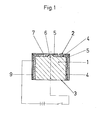
- a carrier element 1 consists of a carrier element 1 in the form of a compact cylinder made of a conductive metal, in particular aluminum.
- the carrier element 1 forms an upper end face 2 and a lower end face 3 on its cut surfaces.
- An insulating element 4 is applied as a layer to the cylindrical part of the carrier element and the end face 2.
- a conductive layer 5 consists of one or more individual metal layers.
- a truncated cone 6 engages in the central circular opening of the front insulating element 4.
- a cut-out 7 is made in the front-side conductive layer 5.
- the recess 7 reaches the insulating element 4 and advantageously lies on a circular line which is the same distance from the center of the carrier element 1 as from its periphery.
- the recess 7 is about 20 to 100 microns, in particular 50 microns wide over its entire length.
- a groove 9 runs over the entire length of the cylindrical support element 1.
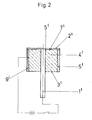
- FIG. 2 shows a modification of the pole body according to FIG. 1.
- the metallic carrier element 1 ' preferably consists of pure molybdenum. It is surrounded by a compact insulating material, such as aluminum oxide (96%).
- the insulating element 4 ' consists, for example, of a cylinder with a central opening, in which the carrier element 1' is form-fitting and flush with its end face 2 'and protrudes beyond the insulating element 4' on its end face 3 '.
- a groove 9 ' also extends over the entire length of the carrier element 1'. It can be provided in the form of a segment-like groove 9 'at one or more, preferably at opposite points.
- a multilayer conductive layer 5 ' is adhered to the cylindrical jacket of the insulating element 4' and to the end face 2 '.
- a recess 7 ' is provided in the flat conductive layer 5' of the end face 2 '.
- Fig. 3 gives a top view of the front-side conductive layer 1 and 2 again.
- a recess 7 that completely exposes the insulating element 4 can be seen, which forms an ignition bridge, referred to here as a contact bridge 8, between the center and the outer segment of the conductive layer 5.
- the current surge occurs after the ignition circuit has been closed via the ignition bridge, which melts and thus triggers the ignition of an explosive.
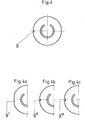
- FIG. 4 shows the differently designed grooves for ventilation when installed in a press fit. 4, a semicircular groove 9 is shown. This shape is preferred in pole bodies of FIG. 1, since it is already incorporated into the aluminum rod. A groove 9 'according to FIG. 4a is particularly well suited for pole bodies according to FIG. 2. It is advantageous to make a second groove on the opposite side of the cylinder.
- the method according to the invention it is possible to adapt the thin-film agents for the desired ignition circuits so optimally to the needs of the explosive or ignition circuit that, with a reliability of 99.9%, they are as insensitive as possible to external influences.
- the electrical pole bodies according to the invention are used to produce miniaturized squibs that save space and weight and are used in the ammunition and explosives industry because of their increased operational reliability, reliability of ignition and simple manufacture. But use at extremely high accelerations has also proven itself.
Landscapes
- Engineering & Computer Science (AREA)
- General Engineering & Computer Science (AREA)
- Feeding, Discharge, Calcimining, Fusing, And Gas-Generation Devices (AREA)
- Air Bags (AREA)
Priority Applications (1)
| Application Number | Priority Date | Filing Date | Title |
|---|---|---|---|
| AT83810579T ATE30957T1 (de) | 1983-02-22 | 1983-12-09 | Elektrischer polkoerper. |
Applications Claiming Priority (4)
| Application Number | Priority Date | Filing Date | Title |
|---|---|---|---|
| CH972/83 | 1983-02-22 | ||
| CH973/83 | 1983-02-22 | ||
| CH97383 | 1983-02-22 | ||
| CH97283 | 1983-02-22 |
Publications (3)
| Publication Number | Publication Date |
|---|---|
| EP0120176A2 true EP0120176A2 (fr) | 1984-10-03 |
| EP0120176A3 EP0120176A3 (en) | 1985-05-08 |
| EP0120176B1 EP0120176B1 (fr) | 1987-11-19 |
Family
ID=25686263
Family Applications (1)
| Application Number | Title | Priority Date | Filing Date |
|---|---|---|---|
| EP19830810579 Expired EP0120176B1 (fr) | 1983-02-22 | 1983-12-09 | Corps polaire |
Country Status (2)
| Country | Link |
|---|---|
| EP (1) | EP0120176B1 (fr) |
| DE (1) | DE3374597D1 (fr) |
Cited By (2)
| Publication number | Priority date | Publication date | Assignee | Title |
|---|---|---|---|---|
| US6553911B1 (en) * | 1997-04-30 | 2003-04-29 | Erico International Corporation | Exothermic reactions and methods |
| US6835910B2 (en) | 2002-01-25 | 2004-12-28 | Erico International Corporation | Welding apparatus and method |
Families Citing this family (1)
| Publication number | Priority date | Publication date | Assignee | Title |
|---|---|---|---|---|
| DE4222223C1 (de) * | 1992-07-07 | 1994-03-17 | Dynamit Nobel Ag | Elektrische Anzünd-/Zündmittel |
Family Cites Families (12)
| Publication number | Priority date | Publication date | Assignee | Title |
|---|---|---|---|---|
| US2921520A (en) * | 1953-06-18 | 1960-01-19 | Donald M Stonestrom | Detonator plug |
| US2918871A (en) * | 1953-08-04 | 1959-12-29 | Beckman Instruments Inc | Electrical detonator |
| BE540685A (fr) * | 1954-08-23 | |||
| CH348084A (fr) * | 1959-01-27 | 1960-07-31 | Vogel & Cie P | Amorce électrique pour la mise à feu d'une charge d'explosif |
| DE1179847B (de) * | 1962-12-12 | 1964-10-15 | Wasagchemie Ag | Elektrisches Zuendelement |
| US3223599A (en) * | 1963-04-15 | 1965-12-14 | Beckman Instruments Inc | Holding plate for electroplating a detonator plug |
| US3291046A (en) * | 1963-09-10 | 1966-12-13 | Du Pont | Electrically actuated explosive device |
| FR1491498A (fr) * | 1966-06-30 | 1967-08-11 | Le Ministre Des Armees Delegat | Corps polaires pour amorces électriques à fente ou à couche |
| DE1646382A1 (de) * | 1967-09-05 | 1971-07-15 | Wasagchemie Ag | Elektrischer Zuender mit einem zylindrischen Isolierkoerper |
| DE2020016C3 (de) * | 1970-04-24 | 1974-12-12 | Dynamit Nobel Ag, 5210 Troisdorf | Metallschichtzündmittel |
| SE431681B (sv) * | 1977-04-19 | 1984-02-20 | Bofors Ab | Eltenddon |
| FR2433167A1 (fr) * | 1978-08-11 | 1980-03-07 | Stephanois Rech Mec | Arme a commande electrique, procede de fonctionnement et munitions utilisees |
-
1983
- 1983-12-09 EP EP19830810579 patent/EP0120176B1/fr not_active Expired
- 1983-12-09 DE DE8383810579T patent/DE3374597D1/de not_active Expired
Cited By (3)
| Publication number | Priority date | Publication date | Assignee | Title |
|---|---|---|---|---|
| US6553911B1 (en) * | 1997-04-30 | 2003-04-29 | Erico International Corporation | Exothermic reactions and methods |
| US6703578B2 (en) | 1997-04-30 | 2004-03-09 | Erico International Corporation | Exothermic reactions and methods |
| US6835910B2 (en) | 2002-01-25 | 2004-12-28 | Erico International Corporation | Welding apparatus and method |
Also Published As
| Publication number | Publication date |
|---|---|
| DE3374597D1 (en) | 1987-12-23 |
| EP0120176A3 (en) | 1985-05-08 |
| EP0120176B1 (fr) | 1987-11-19 |
Similar Documents
| Publication | Publication Date | Title |
|---|---|---|
| DE2020016C3 (de) | Metallschichtzündmittel | |
| DE2843577C2 (fr) | ||
| DE19641249C2 (de) | Kondensator | |
| DE69924347T2 (de) | Festelektrolytkondensator | |
| CH630459A5 (de) | Elektrischer zuender. | |
| DE3119924C2 (fr) | ||
| DE2641866A1 (de) | Luftdicht verschlossenes elektrisches einzelteil | |
| DE2413571A1 (de) | Waermebetaetigte kurzschlussvorrichtung | |
| DE2245308B2 (de) | Elektrisches Brückenzfindmittel | |
| EP0164313B1 (fr) | Corps polaire pour un allumeur électrique, son procédé de fabrication et son application | |
| DE2408882A1 (de) | Gehaeuse fuer ein elektronisches bauteil | |
| DE3416735A1 (de) | Elektrisches zuendelement | |
| EP0120176A2 (fr) | Corps polaire | |
| DE2354697C2 (de) | Gasgefüllter Überspannungsableiter | |
| DD153720A5 (de) | Gluehkerze fuer verbrennungsmotoren | |
| DE69611591T2 (de) | Blitzschutzableiter | |
| EP0119458A2 (fr) | Allumeur électrique | |
| DE4029681C2 (fr) | ||
| EP1186080A2 (fr) | Connexion conductible electriquement entre une electrode terminale et un fil de connexion | |
| DE2256089A1 (de) | Wickelkondensator mit hohlstift | |
| WO2004017442A2 (fr) | Section electrodes-limiteur et procede de mise en contact de plusieurs electrodes | |
| DE3105089A1 (de) | "sauerstoff-sensor" | |
| DE3543653C2 (fr) | ||
| EP3433220B1 (fr) | Procédé de réalisation d'une liaison métal-céramique étanche aux gaz | |
| DE951555C (de) | Elektrischer Zuender und Verfahren zur Herstellung desselben |
Legal Events
| Date | Code | Title | Description |
|---|---|---|---|
| PUAI | Public reference made under article 153(3) epc to a published international application that has entered the european phase |
Free format text: ORIGINAL CODE: 0009012 |
|
| AK | Designated contracting states |
Designated state(s): AT BE CH DE FR GB IT LI LU NL SE |
|
| PUAL | Search report despatched |
Free format text: ORIGINAL CODE: 0009013 |
|
| RIN1 | Information on inventor provided before grant (corrected) |
Inventor name: DECK, WALTER Inventor name: WITTWER, ALFRED Inventor name: RYFFEL, KASPAR, DR. |
|
| AK | Designated contracting states |
Designated state(s): AT BE CH DE FR GB IT LI LU NL SE |
|
| 16A | New documents despatched to applicant after publication of the search report | ||
| 17P | Request for examination filed |
Effective date: 19850426 |
|
| 17Q | First examination report despatched |
Effective date: 19860527 |
|
| ITF | It: translation for a ep patent filed | ||
| GRAA | (expected) grant |
Free format text: ORIGINAL CODE: 0009210 |
|
| AK | Designated contracting states |
Kind code of ref document: B1 Designated state(s): AT BE CH DE FR GB IT LI LU NL SE |
|
| REF | Corresponds to: |
Ref document number: 30957 Country of ref document: AT Date of ref document: 19871215 Kind code of ref document: T |
|
| REF | Corresponds to: |
Ref document number: 3374597 Country of ref document: DE Date of ref document: 19871223 |
|
| PG25 | Lapsed in a contracting state [announced via postgrant information from national office to epo] |
Ref country code: LU Free format text: LAPSE BECAUSE OF NON-PAYMENT OF DUE FEES Effective date: 19871231 |
|
| ET | Fr: translation filed | ||
| GBT | Gb: translation of ep patent filed (gb section 77(6)(a)/1977) | ||
| PLBI | Opposition filed |
Free format text: ORIGINAL CODE: 0009260 |
|
| 26 | Opposition filed |
Opponent name: DYNAMIT NOBEL AG Effective date: 19880816 |
|
| NLR1 | Nl: opposition has been filed with the epo |
Opponent name: DYNAMIT NOBEL AG |
|
| PGFP | Annual fee paid to national office [announced via postgrant information from national office to epo] |
Ref country code: DE Payment date: 19881222 Year of fee payment: 6 |
|
| PG25 | Lapsed in a contracting state [announced via postgrant information from national office to epo] |
Ref country code: GB Effective date: 19891209 Ref country code: AT Effective date: 19891209 |
|
| PG25 | Lapsed in a contracting state [announced via postgrant information from national office to epo] |
Ref country code: SE Effective date: 19891210 |
|
| PG25 | Lapsed in a contracting state [announced via postgrant information from national office to epo] |
Ref country code: BE Effective date: 19891231 |
|
| PGFP | Annual fee paid to national office [announced via postgrant information from national office to epo] |
Ref country code: CH Payment date: 19900313 Year of fee payment: 7 |
|
| BERE | Be: lapsed |
Owner name: EMS-INVENTA A.G. Effective date: 19891231 |
|
| PG25 | Lapsed in a contracting state [announced via postgrant information from national office to epo] |
Ref country code: NL Effective date: 19900701 |
|
| GBPC | Gb: european patent ceased through non-payment of renewal fee | ||
| NLV4 | Nl: lapsed or anulled due to non-payment of the annual fee | ||
| REG | Reference to a national code |
Ref country code: FR Ref legal event code: ST |
|
| RDAG | Patent revoked |
Free format text: ORIGINAL CODE: 0009271 |
|
| STAA | Information on the status of an ep patent application or granted ep patent |
Free format text: STATUS: PATENT REVOKED |
|
| 27W | Patent revoked |
Effective date: 19900811 |
|
| GBPR | Gb: patent revoked under art. 102 of the ep convention designating the uk as contracting state | ||
| REG | Reference to a national code |
Ref country code: CH Ref legal event code: PL |
|
| EUG | Se: european patent has lapsed |
Ref document number: 83810579.9 Effective date: 19900709 |