EP0125104A2 - Moules utilisés pour le soufflage d'articles de verre - Google Patents
Moules utilisés pour le soufflage d'articles de verre Download PDFInfo
- Publication number
- EP0125104A2 EP0125104A2 EP84302966A EP84302966A EP0125104A2 EP 0125104 A2 EP0125104 A2 EP 0125104A2 EP 84302966 A EP84302966 A EP 84302966A EP 84302966 A EP84302966 A EP 84302966A EP 0125104 A2 EP0125104 A2 EP 0125104A2
- Authority
- EP
- European Patent Office
- Prior art keywords
- mold
- small
- glass
- blowing
- small depressions
- Prior art date
- Legal status (The legal status is an assumption and is not a legal conclusion. Google has not performed a legal analysis and makes no representation as to the accuracy of the status listed.)
- Granted
Links
Images


Classifications
-
- C—CHEMISTRY; METALLURGY
- C03—GLASS; MINERAL OR SLAG WOOL
- C03B—MANUFACTURE, SHAPING, OR SUPPLEMENTARY PROCESSES
- C03B9/00—Blowing glass; Production of hollow glass articles
- C03B9/30—Details of blowing glass; Use of materials for the moulds
- C03B9/34—Glass-blowing moulds not otherwise provided for
- C03B9/347—Construction of the blank or blow mould
Definitions
- This invention relates to molds in which glass articles are blown rotationally or non-rotationally.
- a mold used in such a method is usually referred to as a paste mold as disclosed in U.S. patent No. 3,350,189 and British patent No. 1,084,816, and is provided on its inner molding surface with a lining consisting a paste layer.
- the paste layer is porous and can absorb water so that a steam cushion is formed between the glass and the mold d u e to a high temperature of the glass parison. Thereby, the glass is prevented from directly contacting and sticking to the mold during the blowing operation so that the molded article can be readily released from the mold and has a smooth and glossy surface.
- a known typical paste layer is formed by coating a paste on the inner surface of a mold of, such as a cast iron, sticking cork powder onto the paste and baking them to form a carbonized cork layer on the inner surface of the mold.
- the carbonized cork layer is porous and can absorb and retain water.
- the paste layer such as a carbonized cork layer is abraded and burned in use, its water absorbability or chargeability degrades so that the steam cushion is formed insufficiently after prolonged use to develop scars and grains on the surface of molded glass article. For this reason, the deteriorated carbonized cork layer should be removed prior to the development of such surface defects and a fresh carbonized cork layer should be reformed.
- Such a paste mold has thus disadvantages that it is low in working ratio and high in maintenance cost.
- Such a paste mold has a problem that fine carbonized cork pieces may be sticked firmly on the surface of molded glass product.
- blow molds are proposed in Japanese Patent Publication No. 10438/'62 and Japanese Utility Model Publication No. 9726/'65, wherein the mold is made of a sintered alloy and is provided with no paste layer.
- the sintered alloy mold having no paste layer can retain water in the pores. Accordingly, steam cushion can be formed between the glass surface and the inner surface of mold during the blowing operation.
- the mold since the alloy is exposed to the inner surface of the mold, the mold is subjected to neither abrasion nor damage during blowing operation so that the working.life is drastically extended as compared with the paste mold. The working ratio and the maintenance cost are also improved.
- the sintered alloy mold those pores are formed in a network form by connection of gaps between the sintered alloy grains so that the outer and inner surfaces of the mold are connected through such pores.
- the steam formed during the blowing operation leaks through the pores to the exterior of the mold so that sufficient steam cushion cannot be formed between the molded glass surface and the inner surface of the mold.
- the pores are very fine, they are apt to be plugged by hardness .components and other fine contaminants in water. This means reduction of the amount of leaking steam, but the water amount absorbed and retained in the pores of the mold is also reduced so that sufficient steam cushion cannot be formed.
- the mold cannot be reused so that the working life of the mold is shortened. Therefore, the sintered alloy mold is uneconomical in view of the fact that the sintered alloy is expensive.
- the sintered alloy is brittle, the sintered alloy mold is easily broken.
- a metallic mold used for blowing glass articles comprises a great number of small depressions for retaining water therein and being mechanically formed in an inner molding surface of the mold.
- the small depressions are distributed over the entirety of the inner molding surface.
- the inner surface of the mold is the metal surface, neither abrasion nor burning substantially occurs in use so that the mold is remarkably improved in the working life and the working ratio as compared with the known paste mold.
- the small depressions are formed by mechanical technique such as, for example, drilling, any plugging in the depressions can be readily removed so that the mold of the present invention can be reused by simple treatment.
- small depressions used in the present specification means open-topped small cavities such as small holes, small grooves, small channels and the like.
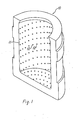
- a mold 10 only a half member of which is shown therein, is made of a cast iron or other suitable metal.
- the inner surface 11 of mold 10 is drilled with a great number of small holes 12 over the entire surface by means of a perforator, such as a drill, etc. Each small hole 12 extends towards the outer surface of the mold and terminates at a position in the wall of mold 10 so that it is not a through hole.
- the inner surface 11 of mold 10 is not covered with any paste layer and is exposed to the molding cavity of the mold.
- Each hole 12 has, for example, a diameter ranging from 0.5 to 5 mm and a depth from 2 to 15 mm.
- the number of the small holes 12 ranges from 2 to 20 per 5 cm 2 of the inner surface 11.
- each hole 12 is preferably inclined downwardly towards a bottom thereof, as shown in Fig. 2.
- the small holes 12 are not arranged on a same level but preferably on various levels in order to form a uniform steam cushion.
- the small holes are arranged on an imaginary helical line extending along the inner surface 11 from an upper portion to a lower portion in the rotating direction of parison during the blowing operation.
- Blowing operation using mold 10 is carried out in a similar manner to that using a conventional paste mold. Namely, two half members of mold 10 are secured to a molding machine and water is flashed onto the inner surface 11 of mold 10, thereby retaining water in the small holes 12. Then, a high temperature glass parison is charged into mold 10 and blown with air while rotating it to expand the parison to the inner surface 11 of mold to shape a glass article. At that time, the water retained in small holes 12 is evaporated due to the heat of the high temperature parison to form steam cushion between inner surface 11 of mold 10 and the glass surface, thereby preventing the direct contact of glass with the inner surface 11 of mold 10. As a result, glass articles having smooth and glossy surface can be produced.
- the mold 10 is made of metal and has no paste layer, the inner molding surface 11 and other portions are substantially subjected to neither abrasion nor burning during the blowing operation so that the working ratio is remarkably improved. Moreover, even if the small holes 12 are plugged, the plugged foreign materials can be readily removed from the holes 12 because the holes are mechanically drilled. Therefore, the mold can be reused conveniently.
- small round holes 12 are formed in the inner surface of the mold as the small depressions.
- the.small depressions may have any other cross-section, and may be discontinuous elongated grooves 12' as shown in Fig. 3.
- the mold is made of a casted metal, but it may be made of a sintered alloy which is porous.
- a great number of small depressions are formed in the inner surface of the sintered metal mold according to the present invention and water is retained in the depressions. Therefore, even if pores of the sintered alloy are plugged, the mold can be used as it is.
- This invention has been described in connection with a mold for rotationally blowing glass articles, but the present invention can be also applied to a mold for stationarily blowing asymmetric glass articles having no surface pattern so as to obtain such glass articles having smooth and glossy surface.
Landscapes
- Engineering & Computer Science (AREA)
- Chemical & Material Sciences (AREA)
- Manufacturing & Machinery (AREA)
- Materials Engineering (AREA)
- Organic Chemistry (AREA)
- Moulds For Moulding Plastics Or The Like (AREA)
- Re-Forming, After-Treatment, Cutting And Transporting Of Glass Products (AREA)
Applications Claiming Priority (2)
| Application Number | Priority Date | Filing Date | Title |
|---|---|---|---|
| JP77547/83 | 1983-05-04 | ||
| JP58077547A JPS59203731A (ja) | 1983-05-04 | 1983-05-04 | ガラス吹成用金型 |
Publications (3)
| Publication Number | Publication Date |
|---|---|
| EP0125104A2 true EP0125104A2 (fr) | 1984-11-14 |
| EP0125104A3 EP0125104A3 (en) | 1985-06-26 |
| EP0125104B1 EP0125104B1 (fr) | 1989-02-22 |
Family
ID=13637033
Family Applications (1)
| Application Number | Title | Priority Date | Filing Date |
|---|---|---|---|
| EP84302966A Expired EP0125104B1 (fr) | 1983-05-04 | 1984-05-02 | Moules utilisés pour le soufflage d'articles de verre |
Country Status (7)
| Country | Link |
|---|---|
| US (1) | US4566895A (fr) |
| EP (1) | EP0125104B1 (fr) |
| JP (1) | JPS59203731A (fr) |
| CS (1) | CS244816B2 (fr) |
| DD (1) | DD224025A5 (fr) |
| DE (1) | DE3476793D1 (fr) |
| MX (1) | MX162793A (fr) |
Families Citing this family (2)
| Publication number | Priority date | Publication date | Assignee | Title |
|---|---|---|---|---|
| US7887315B2 (en) * | 2007-01-31 | 2011-02-15 | Amcor Limited | Blow mold design |
| US8454343B2 (en) * | 2007-01-31 | 2013-06-04 | Amcor Limited | Blow mold design |
Family Cites Families (8)
| Publication number | Priority date | Publication date | Assignee | Title |
|---|---|---|---|---|
| US1817046A (en) * | 1929-03-28 | 1931-08-04 | William G Twyman | Mold for glass cylinders |
| FR688907A (fr) * | 1929-04-16 | 1930-08-30 | Quartz & Silice | Perfectionnement aux moules pour la fabrication de pièces en verre de sicile ou en toute autre matière vitreuse peu fusible |
| US3254981A (en) * | 1957-09-16 | 1966-06-07 | Owens Illinois Inc | Porous metal mold for molding glass articles |
| BE653085A (fr) * | 1963-09-20 | 1964-12-31 | ||
| GB1305446A (fr) * | 1970-07-02 | 1973-01-31 | ||
| SU443001A1 (ru) * | 1971-04-07 | 1974-09-15 | Иванищевский Стекольный Завод | Форма дл изготовлени изделий |
| GB1537837A (en) * | 1975-05-28 | 1979-01-04 | Emhart Ind | Glassware forming machines |
| DE2911730A1 (de) * | 1979-03-24 | 1980-09-25 | Veba Glas Ag | Vorrichtung zur herstellung von hohlglasartikeln mit gekuehlten formen |
-
1983
- 1983-05-04 JP JP58077547A patent/JPS59203731A/ja active Granted
-
1984
- 1984-05-02 DE DE8484302966T patent/DE3476793D1/de not_active Expired
- 1984-05-02 EP EP84302966A patent/EP0125104B1/fr not_active Expired
- 1984-05-04 CS CS843312A patent/CS244816B2/cs unknown
- 1984-05-04 DD DD84262711A patent/DD224025A5/de not_active IP Right Cessation
- 1984-05-04 MX MX201236A patent/MX162793A/es unknown
-
1985
- 1985-06-17 US US06/745,381 patent/US4566895A/en not_active Expired - Fee Related
Also Published As
| Publication number | Publication date |
|---|---|
| JPS59203731A (ja) | 1984-11-17 |
| US4566895A (en) | 1986-01-28 |
| EP0125104A3 (en) | 1985-06-26 |
| DE3476793D1 (en) | 1989-03-30 |
| DD224025A5 (de) | 1985-06-26 |
| MX162793A (es) | 1991-06-26 |
| CS244816B2 (en) | 1986-08-14 |
| EP0125104B1 (fr) | 1989-02-22 |
| JPS6365612B2 (fr) | 1988-12-16 |
Similar Documents
| Publication | Publication Date | Title |
|---|---|---|
| US4436497A (en) | Mold and vent plug therefor | |
| US3254512A (en) | Candles and method of making same | |
| US3822857A (en) | Synthetic resin plug for vent hole of mould | |
| CA2142636A1 (fr) | Implants presentant des surfaces macrotexturees sans faconnage ulterieur apres la coulee, et methode de fabrication | |
| NZ333012A (en) | Open-cell expanded ceramic with a high level of strength, and process for the production thereof | |
| EP0125104A2 (fr) | Moules utilisés pour le soufflage d'articles de verre | |
| US4713104A (en) | Quartz glass crucibles | |
| US20060043645A1 (en) | Vented mold and method | |
| US2201131A (en) | Method for casting jewelry and the like | |
| US4963178A (en) | Apparatus for making quartz glass crucibles | |
| US5298213A (en) | Method of making a ceramic burner head | |
| DE3867178D1 (de) | Gusskoerpermodell und verfahren zum herstellen eines hohlen gusskoerpers. | |
| JPS63183744A (ja) | 多孔性鋳造品の製造方法 | |
| JPH07108346A (ja) | 発泡模型成形用金型 | |
| JPS608047A (ja) | 予備発泡粒子型内成型体の製造方法 | |
| EP0535854A1 (fr) | Moules | |
| CN86104203A (zh) | 无粘结砂制作铸件型芯的方法 | |
| CN116621434B (zh) | 一种具有异形模底的玻璃杯成型模具 | |
| JPS63256541A (ja) | ガラス成形用型およびそれを用いたガラス製品の成形方法 | |
| JP3659437B2 (ja) | ガラス成形用下金型 | |
| US3997640A (en) | Method of forming a silicon nitride article | |
| JPH0271770A (ja) | ゴルフクラブのアイアンヘツドの製造法 | |
| US850957A (en) | Production of phonographic sound-records. | |
| GB2106094A (en) | Moulding of glassware | |
| US2084794A (en) | Glass mold |
Legal Events
| Date | Code | Title | Description |
|---|---|---|---|
| PUAI | Public reference made under article 153(3) epc to a published international application that has entered the european phase |
Free format text: ORIGINAL CODE: 0009012 |
|
| AK | Designated contracting states |
Designated state(s): DE FR GB IT NL |
|
| PUAL | Search report despatched |
Free format text: ORIGINAL CODE: 0009013 |
|
| AK | Designated contracting states |
Designated state(s): DE FR GB IT NL |
|
| 17P | Request for examination filed |
Effective date: 19851223 |
|
| 17Q | First examination report despatched |
Effective date: 19861020 |
|
| ITF | It: translation for a ep patent filed | ||
| GRAA | (expected) grant |
Free format text: ORIGINAL CODE: 0009210 |
|
| AK | Designated contracting states |
Kind code of ref document: B1 Designated state(s): DE FR GB IT NL |
|
| REF | Corresponds to: |
Ref document number: 3476793 Country of ref document: DE Date of ref document: 19890330 |
|
| ET | Fr: translation filed | ||
| PLBE | No opposition filed within time limit |
Free format text: ORIGINAL CODE: 0009261 |
|
| STAA | Information on the status of an ep patent application or granted ep patent |
Free format text: STATUS: NO OPPOSITION FILED WITHIN TIME LIMIT |
|
| 26N | No opposition filed | ||
| PGFP | Annual fee paid to national office [announced via postgrant information from national office to epo] |
Ref country code: GB Payment date: 19910426 Year of fee payment: 8 |
|
| ITTA | It: last paid annual fee | ||
| PGFP | Annual fee paid to national office [announced via postgrant information from national office to epo] |
Ref country code: FR Payment date: 19910531 Year of fee payment: 8 |
|
| PG25 | Lapsed in a contracting state [announced via postgrant information from national office to epo] |
Ref country code: GB Effective date: 19920502 |
|
| PGFP | Annual fee paid to national office [announced via postgrant information from national office to epo] |
Ref country code: NL Payment date: 19920531 Year of fee payment: 9 |
|
| GBPC | Gb: european patent ceased through non-payment of renewal fee |
Effective date: 19920502 |
|
| PG25 | Lapsed in a contracting state [announced via postgrant information from national office to epo] |
Ref country code: FR Effective date: 19930129 |
|
| REG | Reference to a national code |
Ref country code: FR Ref legal event code: ST |
|
| PG25 | Lapsed in a contracting state [announced via postgrant information from national office to epo] |
Ref country code: NL Effective date: 19931201 |
|
| NLV4 | Nl: lapsed or anulled due to non-payment of the annual fee | ||
| PGFP | Annual fee paid to national office [announced via postgrant information from national office to epo] |
Ref country code: DE Payment date: 19950727 Year of fee payment: 12 |
|
| PG25 | Lapsed in a contracting state [announced via postgrant information from national office to epo] |
Ref country code: DE Effective date: 19970201 |