EP0125542A1 - Verfahren zur Herstellung von Hydrochloriden - Google Patents
Verfahren zur Herstellung von Hydrochloriden Download PDFInfo
- Publication number
- EP0125542A1 EP0125542A1 EP84104707A EP84104707A EP0125542A1 EP 0125542 A1 EP0125542 A1 EP 0125542A1 EP 84104707 A EP84104707 A EP 84104707A EP 84104707 A EP84104707 A EP 84104707A EP 0125542 A1 EP0125542 A1 EP 0125542A1
- Authority
- EP
- European Patent Office
- Prior art keywords
- alcohol
- compound
- hydrochloride
- hydrochlorides
- alcohols
- Prior art date
- Legal status (The legal status is an assumption and is not a legal conclusion. Google has not performed a legal analysis and makes no representation as to the accuracy of the status listed.)
- Granted
Links
- 150000003840 hydrochlorides Chemical class 0.000 title claims abstract description 22
- 238000004519 manufacturing process Methods 0.000 title claims description 8
- VEXZGXHMUGYJMC-UHFFFAOYSA-N Hydrochloric acid Chemical compound Cl VEXZGXHMUGYJMC-UHFFFAOYSA-N 0.000 claims abstract description 48
- LFQSCWFLJHTTHZ-UHFFFAOYSA-N Ethanol Chemical compound CCO LFQSCWFLJHTTHZ-UHFFFAOYSA-N 0.000 claims abstract description 25
- 150000001875 compounds Chemical class 0.000 claims abstract description 21
- -1 sulphonyl compound Chemical class 0.000 claims abstract description 21
- 239000000203 mixture Substances 0.000 claims abstract description 19
- 239000002904 solvent Substances 0.000 claims abstract description 19
- 238000000034 method Methods 0.000 claims abstract description 17
- 125000003118 aryl group Chemical group 0.000 claims abstract description 9
- 150000003839 salts Chemical class 0.000 claims abstract description 7
- 150000001298 alcohols Chemical class 0.000 claims abstract description 6
- 125000004178 (C1-C4) alkyl group Chemical group 0.000 claims abstract description 4
- 125000002887 hydroxy group Chemical group [H]O* 0.000 claims abstract description 4
- 238000002360 preparation method Methods 0.000 claims abstract description 4
- XLYOFNOQVPJJNP-UHFFFAOYSA-N water Substances O XLYOFNOQVPJJNP-UHFFFAOYSA-N 0.000 claims description 12
- YYROPELSRYBVMQ-UHFFFAOYSA-N 4-toluenesulfonyl chloride Chemical compound CC1=CC=C(S(Cl)(=O)=O)C=C1 YYROPELSRYBVMQ-UHFFFAOYSA-N 0.000 claims description 8
- 230000015572 biosynthetic process Effects 0.000 claims description 7
- KEQGZUUPPQEDPF-UHFFFAOYSA-N 1,3-dichloro-5,5-dimethylimidazolidine-2,4-dione Chemical compound CC1(C)N(Cl)C(=O)N(Cl)C1=O KEQGZUUPPQEDPF-UHFFFAOYSA-N 0.000 claims description 5
- XTHPWXDJESJLNJ-UHFFFAOYSA-N chlorosulfonic acid Substances OS(Cl)(=O)=O XTHPWXDJESJLNJ-UHFFFAOYSA-N 0.000 claims description 5
- 239000007858 starting material Substances 0.000 claims description 5
- OAKJQQAXSVQMHS-UHFFFAOYSA-N Hydrazine Chemical compound NN OAKJQQAXSVQMHS-UHFFFAOYSA-N 0.000 claims description 4
- 239000012359 Methanesulfonyl chloride Substances 0.000 claims description 4
- 239000003242 anti bacterial agent Substances 0.000 claims description 4
- 229940088710 antibiotic agent Drugs 0.000 claims description 4
- QARBMVPHQWIHKH-UHFFFAOYSA-N methanesulfonyl chloride Chemical compound CS(Cl)(=O)=O QARBMVPHQWIHKH-UHFFFAOYSA-N 0.000 claims description 4
- 239000004098 Tetracycline Substances 0.000 claims description 3
- 125000000217 alkyl group Chemical group 0.000 claims description 3
- 125000004432 carbon atom Chemical group C* 0.000 claims description 3
- 235000019364 tetracycline Nutrition 0.000 claims description 3
- 150000003522 tetracyclines Chemical class 0.000 claims description 3
- 102000001189 Cyclic Peptides Human genes 0.000 claims description 2
- 108010069514 Cyclic Peptides Proteins 0.000 claims description 2
- AVXURJPOCDRRFD-UHFFFAOYSA-N Hydroxylamine Chemical class ON AVXURJPOCDRRFD-UHFFFAOYSA-N 0.000 claims description 2
- 150000001412 amines Chemical class 0.000 claims description 2
- 150000001413 amino acids Chemical class 0.000 claims description 2
- 150000002148 esters Chemical class 0.000 claims description 2
- 150000002170 ethers Chemical class 0.000 claims description 2
- 150000002576 ketones Chemical class 0.000 claims description 2
- 239000003120 macrolide antibiotic agent Substances 0.000 claims description 2
- QJGQUHMNIGDVPM-UHFFFAOYSA-N nitrogen group Chemical group [N] QJGQUHMNIGDVPM-UHFFFAOYSA-N 0.000 claims description 2
- 229940040944 tetracyclines Drugs 0.000 claims description 2
- 229940045799 anthracyclines and related substance Drugs 0.000 claims 1
- 239000003782 beta lactam antibiotic agent Substances 0.000 claims 1
- 125000004122 cyclic group Chemical group 0.000 claims 1
- 150000002337 glycosamines Chemical class 0.000 claims 1
- 150000002391 heterocyclic compounds Chemical class 0.000 claims 1
- 229940041033 macrolides Drugs 0.000 claims 1
- 150000005846 sugar alcohols Polymers 0.000 claims 1
- 239000002132 β-lactam antibiotic Substances 0.000 claims 1
- 229940124586 β-lactam antibiotics Drugs 0.000 claims 1
- 125000004433 nitrogen atom Chemical group N* 0.000 abstract description 10
- 229910052757 nitrogen Inorganic materials 0.000 abstract description 8
- IXCSERBJSXMMFS-UHFFFAOYSA-N hydrogen chloride Substances Cl.Cl IXCSERBJSXMMFS-UHFFFAOYSA-N 0.000 abstract description 4
- 229910000041 hydrogen chloride Inorganic materials 0.000 abstract description 4
- 239000007795 chemical reaction product Substances 0.000 abstract description 3
- 150000004072 triols Chemical class 0.000 abstract description 2
- QCQCHGYLTSGIGX-GHXANHINSA-N 4-[[(3ar,5ar,5br,7ar,9s,11ar,11br,13as)-5a,5b,8,8,11a-pentamethyl-3a-[(5-methylpyridine-3-carbonyl)amino]-2-oxo-1-propan-2-yl-4,5,6,7,7a,9,10,11,11b,12,13,13a-dodecahydro-3h-cyclopenta[a]chrysen-9-yl]oxy]-2,2-dimethyl-4-oxobutanoic acid Chemical compound N([C@@]12CC[C@@]3(C)[C@]4(C)CC[C@H]5C(C)(C)[C@@H](OC(=O)CC(C)(C)C(O)=O)CC[C@]5(C)[C@H]4CC[C@@H]3C1=C(C(C2)=O)C(C)C)C(=O)C1=CN=CC(C)=C1 QCQCHGYLTSGIGX-GHXANHINSA-N 0.000 abstract 2
- 239000011877 solvent mixture Substances 0.000 abstract 2
- OKKJLVBELUTLKV-UHFFFAOYSA-N Methanol Chemical compound OC OKKJLVBELUTLKV-UHFFFAOYSA-N 0.000 description 30
- RTZKZFJDLAIYFH-UHFFFAOYSA-N Diethyl ether Chemical compound CCOCC RTZKZFJDLAIYFH-UHFFFAOYSA-N 0.000 description 11
- 239000000047 product Substances 0.000 description 9
- 239000013078 crystal Substances 0.000 description 7
- 238000003756 stirring Methods 0.000 description 7
- 229960004368 oxytetracycline hydrochloride Drugs 0.000 description 6
- MWKJTNBSKNUMFN-UHFFFAOYSA-N trifluoromethyltrimethylsilane Chemical compound C[Si](C)(C)C(F)(F)F MWKJTNBSKNUMFN-UHFFFAOYSA-N 0.000 description 6
- IWVCMVBTMGNXQD-PXOLEDIWSA-N oxytetracycline Chemical compound C1=CC=C2[C@](O)(C)[C@H]3[C@H](O)[C@H]4[C@H](N(C)C)C(O)=C(C(N)=O)C(=O)[C@@]4(O)C(O)=C3C(=O)C2=C1O IWVCMVBTMGNXQD-PXOLEDIWSA-N 0.000 description 5
- 239000000126 substance Substances 0.000 description 5
- OKTJSMMVPCPJKN-UHFFFAOYSA-N Carbon Chemical compound [C] OKTJSMMVPCPJKN-UHFFFAOYSA-N 0.000 description 4
- 239000004100 Oxytetracycline Substances 0.000 description 4
- 238000006243 chemical reaction Methods 0.000 description 4
- VYFYYTLLBUKUHU-UHFFFAOYSA-N dopamine Chemical compound NCCC1=CC=C(O)C(O)=C1 VYFYYTLLBUKUHU-UHFFFAOYSA-N 0.000 description 4
- 239000002609 medium Substances 0.000 description 4
- 239000003960 organic solvent Substances 0.000 description 4
- 229960000625 oxytetracycline Drugs 0.000 description 4
- 235000019366 oxytetracycline Nutrition 0.000 description 4
- IWVCMVBTMGNXQD-UHFFFAOYSA-N terramycin dehydrate Natural products C1=CC=C2C(O)(C)C3C(O)C4C(N(C)C)C(O)=C(C(N)=O)C(=O)C4(O)C(O)=C3C(=O)C2=C1O IWVCMVBTMGNXQD-UHFFFAOYSA-N 0.000 description 4
- UXVMQQNJUSDDNG-UHFFFAOYSA-L Calcium chloride Chemical compound [Cl-].[Cl-].[Ca+2] UXVMQQNJUSDDNG-UHFFFAOYSA-L 0.000 description 3
- LYCAIKOWRPUZTN-UHFFFAOYSA-N Ethylene glycol Chemical compound OCCO LYCAIKOWRPUZTN-UHFFFAOYSA-N 0.000 description 3
- KFZMGEQAYNKOFK-UHFFFAOYSA-N Isopropanol Chemical compound CC(C)O KFZMGEQAYNKOFK-UHFFFAOYSA-N 0.000 description 3
- 238000002425 crystallisation Methods 0.000 description 3
- 230000008025 crystallization Effects 0.000 description 3
- 125000005842 heteroatom Chemical group 0.000 description 3
- RAXXELZNTBOGNW-UHFFFAOYSA-N imidazole Natural products C1=CNC=N1 RAXXELZNTBOGNW-UHFFFAOYSA-N 0.000 description 3
- BDERNNFJNOPAEC-UHFFFAOYSA-N propan-1-ol Chemical compound CCCO BDERNNFJNOPAEC-UHFFFAOYSA-N 0.000 description 3
- ULGZDMOVFRHVEP-RWJQBGPGSA-N Erythromycin Chemical compound O([C@@H]1[C@@H](C)C(=O)O[C@@H]([C@@]([C@H](O)[C@@H](C)C(=O)[C@H](C)C[C@@](C)(O)[C@H](O[C@H]2[C@@H]([C@H](C[C@@H](C)O2)N(C)C)O)[C@H]1C)(C)O)CC)[C@H]1C[C@@](C)(OC)[C@@H](O)[C@H](C)O1 ULGZDMOVFRHVEP-RWJQBGPGSA-N 0.000 description 2
- ZRALSGWEFCBTJO-UHFFFAOYSA-N Guanidine Chemical compound NC(N)=N ZRALSGWEFCBTJO-UHFFFAOYSA-N 0.000 description 2
- AFVFQIVMOAPDHO-UHFFFAOYSA-N Methanesulfonic acid Chemical compound CS(O)(=O)=O AFVFQIVMOAPDHO-UHFFFAOYSA-N 0.000 description 2
- KYQCOXFCLRTKLS-UHFFFAOYSA-N Pyrazine Chemical compound C1=CN=CC=N1 KYQCOXFCLRTKLS-UHFFFAOYSA-N 0.000 description 2
- JUJWROOIHBZHMG-UHFFFAOYSA-N Pyridine Chemical compound C1=CC=NC=C1 JUJWROOIHBZHMG-UHFFFAOYSA-N 0.000 description 2
- KAESVJOAVNADME-UHFFFAOYSA-N Pyrrole Chemical compound C=1C=CNC=1 KAESVJOAVNADME-UHFFFAOYSA-N 0.000 description 2
- FAPWRFPIFSIZLT-UHFFFAOYSA-M Sodium chloride Chemical compound [Na+].[Cl-] FAPWRFPIFSIZLT-UHFFFAOYSA-M 0.000 description 2
- QAOWNCQODCNURD-UHFFFAOYSA-N Sulfuric acid Chemical compound OS(O)(=O)=O QAOWNCQODCNURD-UHFFFAOYSA-N 0.000 description 2
- 239000002253 acid Substances 0.000 description 2
- 230000002378 acidificating effect Effects 0.000 description 2
- DZBUGLKDJFMEHC-UHFFFAOYSA-N acridine Chemical compound C1=CC=CC2=CC3=CC=CC=C3N=C21 DZBUGLKDJFMEHC-UHFFFAOYSA-N 0.000 description 2
- 239000008186 active pharmaceutical agent Substances 0.000 description 2
- 239000012736 aqueous medium Substances 0.000 description 2
- OKIIEJOIXGHUKX-UHFFFAOYSA-L cadmium iodide Chemical compound [Cd+2].[I-].[I-] OKIIEJOIXGHUKX-UHFFFAOYSA-L 0.000 description 2
- 239000003153 chemical reaction reagent Substances 0.000 description 2
- 238000001816 cooling Methods 0.000 description 2
- 238000001035 drying Methods 0.000 description 2
- 239000000975 dye Substances 0.000 description 2
- 239000000706 filtrate Substances 0.000 description 2
- KWIUHFFTVRNATP-UHFFFAOYSA-N glycine betaine Chemical compound C[N+](C)(C)CC([O-])=O KWIUHFFTVRNATP-UHFFFAOYSA-N 0.000 description 2
- 239000000155 melt Substances 0.000 description 2
- BQJCRHHNABKAKU-KBQPJGBKSA-N morphine Chemical compound O([C@H]1[C@H](C=C[C@H]23)O)C4=C5[C@@]12CCN(C)[C@@H]3CC5=CC=C4O BQJCRHHNABKAKU-KBQPJGBKSA-N 0.000 description 2
- 238000001556 precipitation Methods 0.000 description 2
- 229920006395 saturated elastomer Polymers 0.000 description 2
- 238000005507 spraying Methods 0.000 description 2
- UCSJYZPVAKXKNQ-HZYVHMACSA-N streptomycin Chemical compound CN[C@H]1[C@H](O)[C@@H](O)[C@H](CO)O[C@H]1O[C@@H]1[C@](C=O)(O)[C@H](C)O[C@H]1O[C@@H]1[C@@H](NC(N)=N)[C@H](O)[C@@H](NC(N)=N)[C@H](O)[C@H]1O UCSJYZPVAKXKNQ-HZYVHMACSA-N 0.000 description 2
- 229960000707 tobramycin Drugs 0.000 description 2
- NLVFBUXFDBBNBW-PBSUHMDJSA-S tobramycin(5+) Chemical compound [NH3+][C@@H]1C[C@H](O)[C@@H](C[NH3+])O[C@@H]1O[C@H]1[C@H](O)[C@@H](O[C@@H]2[C@@H]([C@@H]([NH3+])[C@H](O)[C@@H](CO)O2)O)[C@H]([NH3+])C[C@@H]1[NH3+] NLVFBUXFDBBNBW-PBSUHMDJSA-S 0.000 description 2
- CVDADWBWFLWJNQ-TWDWGCDDSA-N (2s,3r,4s,5s,6r)-4-amino-2-[(1s,2s,3r,4s,6r)-4,6-diamino-3-[(2r,3r,5s,6r)-3-amino-6-(aminomethyl)-5-hydroxyoxan-2-yl]oxy-2-hydroxycyclohexyl]oxy-6-(hydroxymethyl)oxane-3,5-diol;hydrochloride Chemical compound Cl.N[C@@H]1C[C@H](O)[C@@H](CN)O[C@@H]1O[C@H]1[C@H](O)[C@@H](O[C@@H]2[C@@H]([C@@H](N)[C@H](O)[C@@H](CO)O2)O)[C@H](N)C[C@@H]1N CVDADWBWFLWJNQ-TWDWGCDDSA-N 0.000 description 1
- KDLRVYVGXIQJDK-FJTAYHGISA-N (2s,4r)-n-[2-chloro-1-[(2r,3s,4s,5r,6r)-3,4,5-trihydroxy-6-methylsulfanyloxan-2-yl]propyl]-1-methyl-4-propylpyrrolidine-2-carboxamide Chemical compound CN1C[C@H](CCC)C[C@H]1C(=O)NC(C(C)Cl)[C@@H]1[C@@H](O)[C@H](O)[C@@H](O)[C@@H](SC)O1 KDLRVYVGXIQJDK-FJTAYHGISA-N 0.000 description 1
- JYEUMXHLPRZUAT-UHFFFAOYSA-N 1,2,3-triazine Chemical compound C1=CN=NN=C1 JYEUMXHLPRZUAT-UHFFFAOYSA-N 0.000 description 1
- LRANPJDWHYRCER-UHFFFAOYSA-N 1,2-diazepine Chemical compound N1C=CC=CC=N1 LRANPJDWHYRCER-UHFFFAOYSA-N 0.000 description 1
- HWGJWYNMDPTGTD-UHFFFAOYSA-N 1h-azonine Chemical compound C=1C=CC=CNC=CC=1 HWGJWYNMDPTGTD-UHFFFAOYSA-N 0.000 description 1
- QMEQBOSUJUOXMX-UHFFFAOYSA-N 2h-oxadiazine Chemical compound N1OC=CC=N1 QMEQBOSUJUOXMX-UHFFFAOYSA-N 0.000 description 1
- 229920000856 Amylose Polymers 0.000 description 1
- CHJJGSNFBQVOTG-UHFFFAOYSA-N N-methyl-guanidine Natural products CNC(N)=N CHJJGSNFBQVOTG-UHFFFAOYSA-N 0.000 description 1
- 229930193140 Neomycin Natural products 0.000 description 1
- 239000004104 Oleandomycin Substances 0.000 description 1
- RZPAKFUAFGMUPI-UHFFFAOYSA-N Oleandomycin Natural products O1C(C)C(O)C(OC)CC1OC1C(C)C(=O)OC(C)C(C)C(O)C(C)C(=O)C2(OC2)CC(C)C(OC2C(C(CC(C)O2)N(C)C)O)C1C RZPAKFUAFGMUPI-UHFFFAOYSA-N 0.000 description 1
- ZCQWOFVYLHDMMC-UHFFFAOYSA-N Oxazole Chemical compound C1=COC=N1 ZCQWOFVYLHDMMC-UHFFFAOYSA-N 0.000 description 1
- PCNDJXKNXGMECE-UHFFFAOYSA-N Phenazine Natural products C1=CC=CC2=NC3=CC=CC=C3N=C21 PCNDJXKNXGMECE-UHFFFAOYSA-N 0.000 description 1
- WTKZEGDFNFYCGP-UHFFFAOYSA-N Pyrazole Chemical compound C=1C=NNC=1 WTKZEGDFNFYCGP-UHFFFAOYSA-N 0.000 description 1
- CZPWVGJYEJSRLH-UHFFFAOYSA-N Pyrimidine Chemical compound C1=CN=CN=C1 CZPWVGJYEJSRLH-UHFFFAOYSA-N 0.000 description 1
- VYPSYNLAJGMNEJ-UHFFFAOYSA-N Silicium dioxide Chemical compound O=[Si]=O VYPSYNLAJGMNEJ-UHFFFAOYSA-N 0.000 description 1
- 239000005708 Sodium hypochlorite Substances 0.000 description 1
- 229920002472 Starch Polymers 0.000 description 1
- NINIDFKCEFEMDL-UHFFFAOYSA-N Sulfur Chemical compound [S] NINIDFKCEFEMDL-UHFFFAOYSA-N 0.000 description 1
- DPOPAJRDYZGTIR-UHFFFAOYSA-N Tetrazine Chemical compound C1=CN=NN=N1 DPOPAJRDYZGTIR-UHFFFAOYSA-N 0.000 description 1
- JZFICWYCTCCINF-UHFFFAOYSA-N Thiadiazin Chemical compound S=C1SC(C)NC(C)N1CCN1C(=S)SC(C)NC1C JZFICWYCTCCINF-UHFFFAOYSA-N 0.000 description 1
- FZWLAAWBMGSTSO-UHFFFAOYSA-N Thiazole Chemical compound C1=CSC=N1 FZWLAAWBMGSTSO-UHFFFAOYSA-N 0.000 description 1
- XSQUKJJJFZCRTK-UHFFFAOYSA-N Urea Chemical compound NC(N)=O XSQUKJJJFZCRTK-UHFFFAOYSA-N 0.000 description 1
- 125000001931 aliphatic group Chemical group 0.000 description 1
- 229930013930 alkaloid Natural products 0.000 description 1
- 125000003277 amino group Chemical group 0.000 description 1
- 150000004982 aromatic amines Chemical class 0.000 description 1
- 125000003710 aryl alkyl group Chemical group 0.000 description 1
- XYOVOXDWRFGKEX-UHFFFAOYSA-N azepine Chemical compound N1C=CC=CC=C1 XYOVOXDWRFGKEX-UHFFFAOYSA-N 0.000 description 1
- 125000003460 beta-lactamyl group Chemical group 0.000 description 1
- 229960003237 betaine Drugs 0.000 description 1
- 229960003403 betaine hydrochloride Drugs 0.000 description 1
- 229940075417 cadmium iodide Drugs 0.000 description 1
- 239000000378 calcium silicate Substances 0.000 description 1
- 229910052918 calcium silicate Inorganic materials 0.000 description 1
- VANYVCHXDYVKSI-MXWBXKMOSA-L calcium;(6ar,10s,10ar,11s,11ar,12s)-8-carbamoyl-10-(dimethylamino)-4,6a,7,11,12-pentahydroxy-12-methyl-6,9-dioxo-10,10a,11,11a-tetrahydrotetracen-5-olate Chemical compound [Ca+2].C1=CC=C2[C@](O)(C)[C@H]3[C@H](O)[C@H]4[C@H](N(C)C)C(=O)C(C(N)=O)=C(O)[C@@]4(O)C(=O)C3=C([O-])C2=C1O.C1=CC=C2[C@](O)(C)[C@H]3[C@H](O)[C@H]4[C@H](N(C)C)C(=O)C(C(N)=O)=C(O)[C@@]4(O)C(=O)C3=C([O-])C2=C1O VANYVCHXDYVKSI-MXWBXKMOSA-L 0.000 description 1
- 239000004202 carbamide Substances 0.000 description 1
- 150000003857 carboxamides Chemical class 0.000 description 1
- HOPSCVCBEOCPJZ-UHFFFAOYSA-N carboxymethyl(trimethyl)azanium;chloride Chemical compound [Cl-].C[N+](C)(C)CC(O)=O HOPSCVCBEOCPJZ-UHFFFAOYSA-N 0.000 description 1
- ZAIPMKNFIOOWCQ-UEKVPHQBSA-N cephalexin Chemical compound C1([C@@H](N)C(=O)N[C@H]2[C@@H]3N(C2=O)C(=C(CS3)C)C(O)=O)=CC=CC=C1 ZAIPMKNFIOOWCQ-UEKVPHQBSA-N 0.000 description 1
- 229940106164 cephalexin Drugs 0.000 description 1
- CYDMQBQPVICBEU-UHFFFAOYSA-N chlorotetracycline Natural products C1=CC(Cl)=C2C(O)(C)C3CC4C(N(C)C)C(O)=C(C(N)=O)C(=O)C4(O)C(O)=C3C(=O)C2=C1O CYDMQBQPVICBEU-UHFFFAOYSA-N 0.000 description 1
- CYDMQBQPVICBEU-XRNKAMNCSA-N chlortetracycline Chemical compound C1=CC(Cl)=C2[C@](O)(C)[C@H]3C[C@H]4[C@H](N(C)C)C(O)=C(C(N)=O)C(=O)[C@@]4(O)C(O)=C3C(=O)C2=C1O CYDMQBQPVICBEU-XRNKAMNCSA-N 0.000 description 1
- 150000001923 cyclic compounds Chemical class 0.000 description 1
- 125000000753 cycloalkyl group Chemical group 0.000 description 1
- HPXRVTGHNJAIIH-UHFFFAOYSA-N cyclohexanol Chemical compound OC1CCCCC1 HPXRVTGHNJAIIH-UHFFFAOYSA-N 0.000 description 1
- 238000000354 decomposition reaction Methods 0.000 description 1
- SWSQBOPZIKWTGO-UHFFFAOYSA-N dimethylaminoamidine Natural products CN(C)C(N)=N SWSQBOPZIKWTGO-UHFFFAOYSA-N 0.000 description 1
- 229960003638 dopamine Drugs 0.000 description 1
- 239000003814 drug Substances 0.000 description 1
- 229960003276 erythromycin Drugs 0.000 description 1
- 239000012065 filter cake Substances 0.000 description 1
- 238000001914 filtration Methods 0.000 description 1
- 239000011521 glass Substances 0.000 description 1
- FUKUFMFMCZIRNT-UHFFFAOYSA-N hydron;methanol;chloride Chemical compound Cl.OC FUKUFMFMCZIRNT-UHFFFAOYSA-N 0.000 description 1
- 239000012535 impurity Substances 0.000 description 1
- 238000002955 isolation Methods 0.000 description 1
- ZLTPDFXIESTBQG-UHFFFAOYSA-N isothiazole Chemical compound C=1C=NSC=1 ZLTPDFXIESTBQG-UHFFFAOYSA-N 0.000 description 1
- CTAPFRYPJLPFDF-UHFFFAOYSA-N isoxazole Chemical compound C=1C=NOC=1 CTAPFRYPJLPFDF-UHFFFAOYSA-N 0.000 description 1
- 239000007788 liquid Substances 0.000 description 1
- 238000002844 melting Methods 0.000 description 1
- 230000008018 melting Effects 0.000 description 1
- 229940098779 methanesulfonic acid Drugs 0.000 description 1
- 229960005181 morphine Drugs 0.000 description 1
- 229960005195 morphine hydrochloride Drugs 0.000 description 1
- XELXKCKNPPSFNN-BJWPBXOKSA-N morphine hydrochloride trihydrate Chemical compound O.O.O.Cl.O([C@H]1[C@H](C=C[C@H]23)O)C4=C5[C@@]12CCN(C)[C@@H]3CC5=CC=C4O XELXKCKNPPSFNN-BJWPBXOKSA-N 0.000 description 1
- 229960004927 neomycin Drugs 0.000 description 1
- 239000012299 nitrogen atmosphere Substances 0.000 description 1
- RZPAKFUAFGMUPI-KGIGTXTPSA-N oleandomycin Chemical compound O1[C@@H](C)[C@H](O)[C@@H](OC)C[C@@H]1O[C@@H]1[C@@H](C)C(=O)O[C@H](C)[C@H](C)[C@H](O)[C@@H](C)C(=O)[C@]2(OC2)C[C@H](C)[C@H](O[C@H]2[C@@H]([C@H](C[C@@H](C)O2)N(C)C)O)[C@H]1C RZPAKFUAFGMUPI-KGIGTXTPSA-N 0.000 description 1
- 235000019367 oleandomycin Nutrition 0.000 description 1
- 229960002351 oleandomycin Drugs 0.000 description 1
- 150000002894 organic compounds Chemical class 0.000 description 1
- RYDICHIKLKVOEJ-UHFFFAOYSA-N oxadiazepine Chemical compound O1C=CC=CN=N1 RYDICHIKLKVOEJ-UHFFFAOYSA-N 0.000 description 1
- WCPAKWJPBJAGKN-UHFFFAOYSA-N oxadiazole Chemical compound C1=CON=N1 WCPAKWJPBJAGKN-UHFFFAOYSA-N 0.000 description 1
- SFJGCXYXEFWEBK-UHFFFAOYSA-N oxazepine Chemical compound O1C=CC=CC=N1 SFJGCXYXEFWEBK-UHFFFAOYSA-N 0.000 description 1
- 229960004548 oxytetracycline calcium Drugs 0.000 description 1
- 229960003924 oxytetracycline dihydrate Drugs 0.000 description 1
- JOXIMZWYDAKGHI-UHFFFAOYSA-N p-toluenesulfonic acid Substances CC1=CC=C(S(O)(=O)=O)C=C1 JOXIMZWYDAKGHI-UHFFFAOYSA-N 0.000 description 1
- 125000005440 p-toluyl group Chemical group [H]C1=C([H])C(=C([H])C([H])=C1C(*)=O)C([H])([H])[H] 0.000 description 1
- WVDDGKGOMKODPV-ZQBYOMGUSA-N phenyl(114C)methanol Chemical compound O[14CH2]C1=CC=CC=C1 WVDDGKGOMKODPV-ZQBYOMGUSA-N 0.000 description 1
- HKOOXMFOFWEVGF-UHFFFAOYSA-N phenylhydrazine Chemical compound NNC1=CC=CC=C1 HKOOXMFOFWEVGF-UHFFFAOYSA-N 0.000 description 1
- 229940067157 phenylhydrazine Drugs 0.000 description 1
- JOVOSQBPPZZESK-UHFFFAOYSA-N phenylhydrazine hydrochloride Chemical compound Cl.NNC1=CC=CC=C1 JOVOSQBPPZZESK-UHFFFAOYSA-N 0.000 description 1
- ZEMIJUDPLILVNQ-ZXFNITATSA-N pivampicillin Chemical compound C1([C@@H](N)C(=O)N[C@H]2[C@@H]3N(C2=O)[C@H](C(S3)(C)C)C(=O)OCOC(=O)C(C)(C)C)=CC=CC=C1 ZEMIJUDPLILVNQ-ZXFNITATSA-N 0.000 description 1
- 229960003342 pivampicillin Drugs 0.000 description 1
- 229920003023 plastic Polymers 0.000 description 1
- 239000004033 plastic Substances 0.000 description 1
- 239000002244 precipitate Substances 0.000 description 1
- PBMFSQRYOILNGV-UHFFFAOYSA-N pyridazine Chemical compound C1=CC=NN=C1 PBMFSQRYOILNGV-UHFFFAOYSA-N 0.000 description 1
- UMJSCPRVCHMLSP-UHFFFAOYSA-N pyridine Natural products COC1=CC=CN=C1 UMJSCPRVCHMLSP-UHFFFAOYSA-N 0.000 description 1
- 239000013074 reference sample Substances 0.000 description 1
- 150000003349 semicarbazides Chemical class 0.000 description 1
- 239000011780 sodium chloride Substances 0.000 description 1
- SUKJFIGYRHOWBL-UHFFFAOYSA-N sodium hypochlorite Chemical compound [Na+].Cl[O-] SUKJFIGYRHOWBL-UHFFFAOYSA-N 0.000 description 1
- 239000007787 solid Substances 0.000 description 1
- 235000019698 starch Nutrition 0.000 description 1
- 239000008107 starch Substances 0.000 description 1
- 150000003431 steroids Chemical class 0.000 description 1
- 229960005322 streptomycin Drugs 0.000 description 1
- 239000011593 sulfur Substances 0.000 description 1
- 229910052717 sulfur Inorganic materials 0.000 description 1
- 239000000725 suspension Substances 0.000 description 1
- 229960002180 tetracycline Drugs 0.000 description 1
- 229930101283 tetracycline Natural products 0.000 description 1
- 150000003536 tetrazoles Chemical class 0.000 description 1
- BXVYJQULAWJPSR-UHFFFAOYSA-N thiadiazepine Chemical compound S1C=CC=CN=N1 BXVYJQULAWJPSR-UHFFFAOYSA-N 0.000 description 1
- VLLMWSRANPNYQX-UHFFFAOYSA-N thiadiazole Chemical compound C1=CSN=N1.C1=CSN=N1 VLLMWSRANPNYQX-UHFFFAOYSA-N 0.000 description 1
- 238000004809 thin layer chromatography Methods 0.000 description 1
- AYNNSCRYTDRFCP-UHFFFAOYSA-N triazene Chemical compound NN=N AYNNSCRYTDRFCP-UHFFFAOYSA-N 0.000 description 1
- 150000003852 triazoles Chemical class 0.000 description 1
- 238000005406 washing Methods 0.000 description 1
Classifications
-
- C—CHEMISTRY; METALLURGY
- C07—ORGANIC CHEMISTRY
- C07D—HETEROCYCLIC COMPOUNDS
- C07D495/00—Heterocyclic compounds containing in the condensed system at least one hetero ring having sulfur atoms as the only ring hetero atoms
- C07D495/02—Heterocyclic compounds containing in the condensed system at least one hetero ring having sulfur atoms as the only ring hetero atoms in which the condensed system contains two hetero rings
- C07D495/04—Ortho-condensed systems
-
- C—CHEMISTRY; METALLURGY
- C07—ORGANIC CHEMISTRY
- C07C—ACYCLIC OR CARBOCYCLIC COMPOUNDS
- C07C303/00—Preparation of esters or amides of sulfuric acids; Preparation of sulfonic acids or of their esters, halides, anhydrides or amides
- C07C303/02—Preparation of esters or amides of sulfuric acids; Preparation of sulfonic acids or of their esters, halides, anhydrides or amides of sulfonic acids or halides thereof
- C07C303/04—Preparation of esters or amides of sulfuric acids; Preparation of sulfonic acids or of their esters, halides, anhydrides or amides of sulfonic acids or halides thereof by substitution of hydrogen atoms by sulfo or halosulfonyl groups
- C07C303/08—Preparation of esters or amides of sulfuric acids; Preparation of sulfonic acids or of their esters, halides, anhydrides or amides of sulfonic acids or halides thereof by substitution of hydrogen atoms by sulfo or halosulfonyl groups by reaction with halogenosulfonic acids
-
- C—CHEMISTRY; METALLURGY
- C07—ORGANIC CHEMISTRY
- C07C—ACYCLIC OR CARBOCYCLIC COMPOUNDS
- C07C213/00—Preparation of compounds containing amino and hydroxy, amino and etherified hydroxy or amino and esterified hydroxy groups bound to the same carbon skeleton
- C07C213/08—Preparation of compounds containing amino and hydroxy, amino and etherified hydroxy or amino and esterified hydroxy groups bound to the same carbon skeleton by reactions not involving the formation of amino groups, hydroxy groups or etherified or esterified hydroxy groups
-
- C—CHEMISTRY; METALLURGY
- C07—ORGANIC CHEMISTRY
- C07C—ACYCLIC OR CARBOCYCLIC COMPOUNDS
- C07C227/00—Preparation of compounds containing amino and carboxyl groups bound to the same carbon skeleton
- C07C227/38—Separation; Purification; Stabilisation; Use of additives
- C07C227/44—Stabilisation; Use of additives
-
- C—CHEMISTRY; METALLURGY
- C07—ORGANIC CHEMISTRY
- C07C—ACYCLIC OR CARBOCYCLIC COMPOUNDS
- C07C231/00—Preparation of carboxylic acid amides
- C07C231/22—Separation; Purification; Stabilisation; Use of additives
-
- C—CHEMISTRY; METALLURGY
- C07—ORGANIC CHEMISTRY
- C07C—ACYCLIC OR CARBOCYCLIC COMPOUNDS
- C07C241/00—Preparation of compounds containing chains of nitrogen atoms singly-bound to each other, e.g. hydrazines, triazanes
- C07C241/02—Preparation of hydrazines
-
- C—CHEMISTRY; METALLURGY
- C07—ORGANIC CHEMISTRY
- C07C—ACYCLIC OR CARBOCYCLIC COMPOUNDS
- C07C277/00—Preparation of guanidine or its derivatives, i.e. compounds containing the group, the singly-bound nitrogen atoms not being part of nitro or nitroso groups
- C07C277/06—Purification or separation of guanidine
-
- C—CHEMISTRY; METALLURGY
- C07—ORGANIC CHEMISTRY
- C07D—HETEROCYCLIC COMPOUNDS
- C07D207/00—Heterocyclic compounds containing five-membered rings not condensed with other rings, with one nitrogen atom as the only ring hetero atom
- C07D207/02—Heterocyclic compounds containing five-membered rings not condensed with other rings, with one nitrogen atom as the only ring hetero atom with only hydrogen or carbon atoms directly attached to the ring nitrogen atom
- C07D207/18—Heterocyclic compounds containing five-membered rings not condensed with other rings, with one nitrogen atom as the only ring hetero atom with only hydrogen or carbon atoms directly attached to the ring nitrogen atom having one double bond between ring members or between a ring member and a non-ring member
- C07D207/22—Heterocyclic compounds containing five-membered rings not condensed with other rings, with one nitrogen atom as the only ring hetero atom with only hydrogen or carbon atoms directly attached to the ring nitrogen atom having one double bond between ring members or between a ring member and a non-ring member with hetero atoms or with carbon atoms having three bonds to hetero atoms with at the most one bond to halogen, e.g. ester or nitrile radicals, directly attached to ring carbon atoms
-
- C—CHEMISTRY; METALLURGY
- C07—ORGANIC CHEMISTRY
- C07D—HETEROCYCLIC COMPOUNDS
- C07D211/00—Heterocyclic compounds containing hydrogenated pyridine rings, not condensed with other rings
- C07D211/04—Heterocyclic compounds containing hydrogenated pyridine rings, not condensed with other rings with only hydrogen or carbon atoms directly attached to the ring nitrogen atom
- C07D211/68—Heterocyclic compounds containing hydrogenated pyridine rings, not condensed with other rings with only hydrogen or carbon atoms directly attached to the ring nitrogen atom having one double bond between ring members or between a ring member and a non-ring member
- C07D211/70—Heterocyclic compounds containing hydrogenated pyridine rings, not condensed with other rings with only hydrogen or carbon atoms directly attached to the ring nitrogen atom having one double bond between ring members or between a ring member and a non-ring member with only hydrogen atoms, hydrocarbon or substituted hydrocarbon radicals, directly attached to ring carbon atoms
-
- C—CHEMISTRY; METALLURGY
- C07—ORGANIC CHEMISTRY
- C07D—HETEROCYCLIC COMPOUNDS
- C07D211/00—Heterocyclic compounds containing hydrogenated pyridine rings, not condensed with other rings
- C07D211/04—Heterocyclic compounds containing hydrogenated pyridine rings, not condensed with other rings with only hydrogen or carbon atoms directly attached to the ring nitrogen atom
- C07D211/80—Heterocyclic compounds containing hydrogenated pyridine rings, not condensed with other rings with only hydrogen or carbon atoms directly attached to the ring nitrogen atom having two double bonds between ring members or between ring members and non-ring members
- C07D211/84—Heterocyclic compounds containing hydrogenated pyridine rings, not condensed with other rings with only hydrogen or carbon atoms directly attached to the ring nitrogen atom having two double bonds between ring members or between ring members and non-ring members with hetero atoms or with carbon atoms having three bonds to hetero atoms, with at the most one bond to halogen directly attached to ring carbon atoms
- C07D211/86—Oxygen atoms
- C07D211/88—Oxygen atoms attached in positions 2 and 6, e.g. glutarimide
-
- C—CHEMISTRY; METALLURGY
- C07—ORGANIC CHEMISTRY
- C07D—HETEROCYCLIC COMPOUNDS
- C07D223/00—Heterocyclic compounds containing seven-membered rings having one nitrogen atom as the only ring hetero atom
- C07D223/14—Heterocyclic compounds containing seven-membered rings having one nitrogen atom as the only ring hetero atom condensed with carbocyclic rings or ring systems
- C07D223/18—Dibenzazepines; Hydrogenated dibenzazepines
- C07D223/22—Dibenz [b, f] azepines; Hydrogenated dibenz [b, f] azepines
- C07D223/24—Dibenz [b, f] azepines; Hydrogenated dibenz [b, f] azepines with hydrocarbon radicals, substituted by nitrogen atoms, attached to the ring nitrogen atom
- C07D223/26—Dibenz [b, f] azepines; Hydrogenated dibenz [b, f] azepines with hydrocarbon radicals, substituted by nitrogen atoms, attached to the ring nitrogen atom having a double bond between positions 10 and 11
-
- C—CHEMISTRY; METALLURGY
- C07—ORGANIC CHEMISTRY
- C07D—HETEROCYCLIC COMPOUNDS
- C07D489/00—Heterocyclic compounds containing 4aH-8, 9 c- Iminoethano-phenanthro [4, 5-b, c, d] furan ring systems, e.g. derivatives of [4, 5-epoxy]-morphinan of the formula:
- C07D489/02—Heterocyclic compounds containing 4aH-8, 9 c- Iminoethano-phenanthro [4, 5-b, c, d] furan ring systems, e.g. derivatives of [4, 5-epoxy]-morphinan of the formula: with oxygen atoms attached in positions 3 and 6, e.g. morphine, morphinone
- C07D489/04—Salts; Organic complexes
-
- C—CHEMISTRY; METALLURGY
- C07—ORGANIC CHEMISTRY
- C07D—HETEROCYCLIC COMPOUNDS
- C07D499/00—Heterocyclic compounds containing 4-thia-1-azabicyclo [3.2.0] heptane ring systems, i.e. compounds containing a ring system of the formula:, e.g. penicillins, penems; Such ring systems being further condensed, e.g. 2,3-condensed with an oxygen-, nitrogen- or sulfur-containing hetero ring
-
- C—CHEMISTRY; METALLURGY
- C07—ORGANIC CHEMISTRY
- C07H—SUGARS; DERIVATIVES THEREOF; NUCLEOSIDES; NUCLEOTIDES; NUCLEIC ACIDS
- C07H15/00—Compounds containing hydrocarbon or substituted hydrocarbon radicals directly attached to hetero atoms of saccharide radicals
- C07H15/02—Acyclic radicals, not substituted by cyclic structures
- C07H15/14—Acyclic radicals, not substituted by cyclic structures attached to a sulfur, selenium or tellurium atom of a saccharide radical
- C07H15/16—Lincomycin; Derivatives thereof
-
- C—CHEMISTRY; METALLURGY
- C07—ORGANIC CHEMISTRY
- C07H—SUGARS; DERIVATIVES THEREOF; NUCLEOSIDES; NUCLEOTIDES; NUCLEIC ACIDS
- C07H15/00—Compounds containing hydrocarbon or substituted hydrocarbon radicals directly attached to hetero atoms of saccharide radicals
- C07H15/20—Carbocyclic rings
- C07H15/22—Cyclohexane rings, substituted by nitrogen atoms
-
- C—CHEMISTRY; METALLURGY
- C07—ORGANIC CHEMISTRY
- C07H—SUGARS; DERIVATIVES THEREOF; NUCLEOSIDES; NUCLEOTIDES; NUCLEIC ACIDS
- C07H15/00—Compounds containing hydrocarbon or substituted hydrocarbon radicals directly attached to hetero atoms of saccharide radicals
- C07H15/20—Carbocyclic rings
- C07H15/22—Cyclohexane rings, substituted by nitrogen atoms
- C07H15/222—Cyclohexane rings substituted by at least two nitrogen atoms
- C07H15/226—Cyclohexane rings substituted by at least two nitrogen atoms with at least two saccharide radicals directly attached to the cyclohexane rings
- C07H15/234—Cyclohexane rings substituted by at least two nitrogen atoms with at least two saccharide radicals directly attached to the cyclohexane rings attached to non-adjacent ring carbon atoms of the cyclohexane rings, e.g. kanamycins, tobramycin, nebramycin, gentamicin A2
-
- C—CHEMISTRY; METALLURGY
- C07—ORGANIC CHEMISTRY
- C07H—SUGARS; DERIVATIVES THEREOF; NUCLEOSIDES; NUCLEOTIDES; NUCLEIC ACIDS
- C07H15/00—Compounds containing hydrocarbon or substituted hydrocarbon radicals directly attached to hetero atoms of saccharide radicals
- C07H15/20—Carbocyclic rings
- C07H15/22—Cyclohexane rings, substituted by nitrogen atoms
- C07H15/238—Cyclohexane rings substituted by two guanidine radicals, e.g. streptomycins
-
- C—CHEMISTRY; METALLURGY
- C07—ORGANIC CHEMISTRY
- C07H—SUGARS; DERIVATIVES THEREOF; NUCLEOSIDES; NUCLEOTIDES; NUCLEIC ACIDS
- C07H15/00—Compounds containing hydrocarbon or substituted hydrocarbon radicals directly attached to hetero atoms of saccharide radicals
- C07H15/20—Carbocyclic rings
- C07H15/24—Condensed ring systems having three or more rings
- C07H15/252—Naphthacene radicals, e.g. daunomycins, adriamycins
-
- C—CHEMISTRY; METALLURGY
- C07—ORGANIC CHEMISTRY
- C07H—SUGARS; DERIVATIVES THEREOF; NUCLEOSIDES; NUCLEOTIDES; NUCLEIC ACIDS
- C07H17/00—Compounds containing heterocyclic radicals directly attached to hetero atoms of saccharide radicals
- C07H17/04—Heterocyclic radicals containing only oxygen as ring hetero atoms
- C07H17/08—Hetero rings containing eight or more ring members, e.g. erythromycins
-
- C—CHEMISTRY; METALLURGY
- C07—ORGANIC CHEMISTRY
- C07J—STEROIDS
- C07J41/00—Normal steroids containing one or more nitrogen atoms not belonging to a hetero ring
- C07J41/0033—Normal steroids containing one or more nitrogen atoms not belonging to a hetero ring not covered by C07J41/0005
- C07J41/005—Normal steroids containing one or more nitrogen atoms not belonging to a hetero ring not covered by C07J41/0005 the 17-beta position being substituted by an uninterrupted chain of only two carbon atoms, e.g. pregnane derivatives
Definitions
- the invention relates to a new process for the production of hydrochlorides, i.e. the acid addition salts formed with hydrochloric acid, in particular those compounds which contain a protonatable nitrogen atom.
- hydrochlorides of compounds containing a protonatable nitrogen atom are polar, readily water-soluble substances which are used in many areas of practical life, for example in medicine, in the production of plastics, in crop protection, in dyes, as analytical reagents, etc., are widely used.
- For the spread of the hydrochloride is charact It is realistic that about 10% of all active pharmaceutical ingredients listed in the Merck Index (Ninth Ed., Ed. by M. Windholz, Merck, Rahway, USA 1976), ie about 900 compounds, are used in the form of their hydrochlorides as active pharmaceutical ingredients.
- the starting materials for the production of hydrochlorides are generally substances which contain a protonatable nitrogen atom and are basic or amphoteric, but substances with an acidic nitrogen atom, for example urea, can also form hydrochlorides.
- the hydrochlorides of these compounds are generally prepared in water or an aqueous organic solvent, usually an alcohol, by adding hydrochloric acid. This is described in British Patent Nos. 718 020 and 718 032 for the hydrochloride of oxytetracycline.
- a further possibility for the formation of the hydrochloride is to dissolve or suspend the starting compound in an organic solvent, for example an alcohol, and to introduce hydrochloric acid gas into the solution or suspension. It is also possible to carry out the salt formation in an organic solvent in which hydrochloric acid gas has previously been dissolved. In this way, for example, the aforementioned oxytetracycline hydrochloride is produced in accordance with Belgian patent specification 638 881 and Hungarian patent specification No.
- the solubility ratios of the starting and / or target compound are influenced by means of a methanolic calcium chloride solution (J.Am.Chem.Soc. 73, 4212/1951 /; US Pat. Nos. 2,658,078 and 2,915,555).
- hydrochlorides can also be obtained by reacting the starting compound with another hydrochloride, but these processes have not been used in practice and only play a minor role because of all the salts, the hydrochlorides are the most soluble and their isolation by simple precipitation or crystallization is not feasible.
- hydrochlorides can also occur in non-protois solvents or without solvents; in this case the proton dissociating from the HC1 molecule is bound by the lone pair of electrons of the nitrogen atom of the anhydrobase (The Chemietry of the Amino Group, Ed. by S. Patai, Interscience, London .1968).
- hydrochlorides which crystallize with water of crystallization.
- the oxytetracycline hydrochloride for example, crystallizes with 3 molecules of water of crystallization if there is sufficient water (Hungarian patent specification No. 143 911).
- These hydrochlorides are much more soluble in organic solvents under anhydrous conditions than in the presence of water. This property can be used for the pure production of the hydrochloride. According to the Belgian patent specification Mr.
- the starting substance of the cxytetracycline hydrochloride (an oxytetracycline complex) is treated with hydrochloric acid methanol under anhydrous conditions, the solid impurities contained in the hydrochloride solution are filtered off, and then the pure oxytetracycline hydrochloride is added by adding concentrated aqueous hydrochloric acid failed.
- salt formation is carried out in an aqueous medium, it must be evaporated or concentrated in any case.
- decomposition reactions can occur, the products of which contaminate the hydrochloride. Lyophilizing the solutions requires expensive equipment and is also energy intensive.
- good yields can be achieved by introducing dry hydrochloric acid gas into anhydrous solutions or by using solvents containing HCl (for example ethanolic hydrochloric acid), the production and handling of dry hydrochloric acid gas cannot be regarded as a solution that is acceptable to industry.
- the reaction with another hydrochloride is generally executed in aqueous medium and therefore has the disadvantages already mentioned above.
- the aim of the invention is to develop a new process for the preparation of hydrochlorides, with which, above all, the hydrochlorides of compounds containing a protonatable nitrogen atom can be prepared in high yield and in a very pure, simple and economical manner than by the known processes.
- the invention is based on the knowledge that compounds of the general formula in which Q represents hydroxyl group, alkyl group with 1-4 carbon atoms, aryl group or aryl group substituted by C 1-4 alkyl group, hydrogen chloride is released by the addition of an alcohol and this reaction is suitable in a suitably chosen solvent medium for the formation of hydrochlorides.
- the invention accordingly relates to a process for the preparation of hydrochlorides. It is characteristic of the process according to the invention that the compound suitable for forming a hydrochloride, expediently in the form of its protonatable nitrogen-containing derivative or salt, in a solvent medium in the presence of an alcohol with a sulfonyl compound of the general formula wherein Q stands for hydroxyl group, alkyl group with 1-4 carbonocene, for aryl group or aryl group substituted by C 1-4 alkyl group, reacted and the hydrochloride isolated in a conventional manner.
- the hydrochloride can be precipitated in any case, while the monoester formed remains in solution.
- the alkchol component used is, for example, aliphatic alcohols such as methanol, ethanol or propanol, aliphatic diols or triols, for example ethylene glycol, cycloaliphatic alcohols, for example cyclohexanol, or aromatic alcohols such as benzyl alcohol, or mixtures of the alcohols listed.
- amines for example, the following: amines, for example aliphatic, aromatic amines, cycloalkyl, aralkyl, heterocycloalkylamines, heteroaromatic amines, diazoaain (triazene) and their derivatives; Hydroxylamine and its derivatives; Hydrazine and its derivatives; Carboxylic acid imidate, carboxamide, carbazides, semicarbazides, guanidine, amino acids, aminozokers and their derivatives; one or more hetero - atom-containing, aromatic or totally overall partially or sucit i g te rings of 5 members, for example, pyrrole, oxazole, isoxazole, thiazole, isothiazole, imidazole, pyrazole, oxadiazole, thiadiazole, triazole, tetrazole and their Derivatives; aromatic or partially or fully saturated, one or more nitrogen
- the process according to the invention is carried out in a solvent medium.
- An excess of the alcohol used can serve as solvent.
- Suitable solvent media are also further alcohols, esters, ketones or ethers and the mixtures of these solvents which may also contain water.
- the hydrochloride to be produced should be at least 0.1% by weight soluble in the solvent medium used.
- the compound Q-SO 2 -Cl is dissolved in the alcohol serving as the reaction component.
- the concentration of this solution is generally 0.1-10 mol / liter, preferably 0.5-2 mol / liter.
- the hydrochlorides can be obtained in good purity in a highly pure form in a simple manner which is also easy to carry out industrially.
- 150 ml of methanol and 50 g of oxytetracycline-calcium silicate complex (containing 25 g of cxytetracycline) are stirred at room temperature for 30 minutes.
- the solution of 15 g of anhydrous calcium chloride in 100 ml of methanol is added to the mixture within 30 minutes.
- the mixture is stirred for an additional half an hour.
- the pH of the mixture is adjusted to 3.5 by slowly adding a methanolic chlorosulfonic acid solution with a concentration of 1.5 mol / liter, for which about 34 ml are required (control with pH meter and glass electrode).
- the needle-shaped crystals are suspended in a mixture of 25 ml of cold mathanol and 2.5 ml of 37% hydrochloric acid, after decanting they were washed twice with 10 ml of the same mixture, then suspended in 25 ml of cold methanol and then twice with each Washed 10 ml of cold methanol.
- the product is air dried at 50 ° C. 23.4 g of oxytetracycline hydrochloride are obtained in the form of yellow, needle-shaped crystals which contain 90% oxytetracycline and 7% water. Based on the complex used, this corresponds to a yield of 78%.
- the product is suspended in 20 ml of dilute methanolic hydrochloric acid, filtered and washed again with 10 ml of dilute methanolic hydrochloric acid. After filtering, it is washed once with 20 ml, then with 10 ml of cold methanol. Finally, the product is air dried at 50 ° C. 16.76 g of yellow, crystalline oxytetracycline hydrochloride (yield: 82%) which contains 91% of substance and 8% of water are obtained.
Landscapes
- Chemical & Material Sciences (AREA)
- Organic Chemistry (AREA)
- General Health & Medical Sciences (AREA)
- Health & Medical Sciences (AREA)
- Life Sciences & Earth Sciences (AREA)
- Biochemistry (AREA)
- Biotechnology (AREA)
- Engineering & Computer Science (AREA)
- Genetics & Genomics (AREA)
- Molecular Biology (AREA)
- Chemical Kinetics & Catalysis (AREA)
- Crystallography & Structural Chemistry (AREA)
- Analytical Chemistry (AREA)
- Organic Low-Molecular-Weight Compounds And Preparation Thereof (AREA)
- Steroid Compounds (AREA)
- Other In-Based Heterocyclic Compounds (AREA)
- Pyrrole Compounds (AREA)
- Nitrogen And Oxygen Or Sulfur-Condensed Heterocyclic Ring Systems (AREA)
- Pharmaceuticals Containing Other Organic And Inorganic Compounds (AREA)
Abstract
Description
- Die Erfindung betrifft ein neues Verfahren zur Herstellung von Hydrochloriden, d.h. den mit Salzsäure gebildeten Säureadditionssalzen insbesondere solcher Verbindungen, die ein protonierbares Stickstoffatom enthalten.
- Die Hydrochloride von Verbindungen, die ein protonierbares Stickstoffaton enthalten, sind polare, gut wasserlösliche Substanzen, die auf vielen Gebieten des praktischen Lebens, zum Beispiel in der Heilkunde, bei der Herstellung von Kunststoffen, im Pflanzenschutz, in Farbstoffen, als analytische Reagentien usw., weitverbreitet angewendet werden. Für die Verbreitung der Hydrochloride ist charakteristisch, daß etwa 10 % aller im Merck-Index (Ninth Ed., Ed. by M. Windholz, Merck, Rahway, USA 1976) aufgeführten Arzneimittelwirkstoffe, d.h. etwa 900 Verbindungen, in Form ihrer Hydrochloride als Heilmittelwirkstoffe verwendet werden.
- Die Ausgangsstoffe zur Herstellung von Hydrochloriden sind im allgemeinen Stoffe, die ein protonierbares Stickstoffatom enthalten und basisch oder amphoter sind, jedoch können auch Stoffe mit einem Stickstoffaton sauren Charakters, zum Beispiel Harnstoff, Hydrochloride bilden.
- Die Hydrochloride dieser Verbindungen werden im allgemeinen in Wasser oder einem wäßrigen organischen Lösungsmittel, meistens einem Alkohol, durch Zugabe von Salzsäure hergestellt. Dies ist in den britischen Patentschriften Nr. 718 020 und 718 032 für das Hydrochlorid des Oxytetracyclins beschrieben. Eine weitere Möglichkeit zur Bildung des Hydrochlorids ist es, die Ausgangsverbindung in einem organischen Lösungsmittel, zum Beispiel einem Alkohol, zu lösen oder zu suspendieren und in die Lösung beziehungsweise Suspension Salzsäuregas einzuleiten. Möglich ist es ferner, die Salzbildung in einem organischen Lösungsmittel vorzunehmen, in dem vorher Salzsauregas gelöst wurde. Auf diese Weise wird zum Beispiel gemäß der belgischen Patentschrift 638 881 und der ungarischen Patentschrift Nr. 143 911 das erwähnte Oxytetracyclin-hydrochlorid hergestellt; dabei werden die Löslichkeitsverhaltnisse der Ausgangs- und/oder der Zielverbindung cittels methanolischer Calciumchloridlösung beeinflußt (J.Am.Chem.Soc. 73, 4212 /1951/; US-Patentschriften Nr. 2 658 078 und 2 915 555). Prinzipiell lassen sich Hydrochloride auch durch Umsetzen der Ausgangsverbindung mit einem anderen Hydrochlorid erhalten, jedoch haben diese Verfahren in die Praxis keinen Eingang gefunden und spielen nur eine untergeordnete Rolle, weil von allen Salzen die Hydrochloride die löslichsten sind und ihre Isolierung durch einfaches Ausfällen oder Kristallisieren daher nicht realisierbar ist.
- Die Bildung von Hydrochloriden kann auch in nichtprotisohen Lösungsmitteln oder ohne Lösungsmittel eintreten; in diesem Falle wird das vom HC1-Molekül abdissoziierende Proton von dem einsamen Eelektronenpaar des Stickstoffatoms der Anhydrobase gebunden (The Chemietry of the Amino Group, Ed. by S. Patai, Interscience, London .1968).
- Es sind zahlreiche Hydrochloride bekannt, die mit Kristallwasser kristallisieren. Das Oxytetracyclin-hydrochlorid kristallisiert zum Beispiel - wenn genügend Wasser vorhanden ist - mit 3 Molekülen Kristallwasser (ungarische Patentschrift Nr. 143 911). Diese Hydrochloride sind in organischen Lösungsmitteln unter wasserfreien Bedingungen wesentlich besser löslich als in Gegenwart von Wasser. Diese Eigenschaft kann zur Reinherstellung der Hydrochloride genutzt werden. Gemäß der belgischen Patentschrift Mr. 638 881 wird die Ausgangssubstanz des Cxytetracyclinhydrochlorids (ein Oxytetracyclin-Komplex) unter wasserfreien Bedingungen mit salzsaurem Methanol behandelt, die in der Hydrochloridlösung enthaltenen festen Verunreinigungen werden abfiltriert, und dann wird das reine Oxytetracyclin-hydrochlorid durch Zusatz konzentrierter wäßriger Salzsäure ausgefällt.
- Wird die Salzbildung in wäßrigem Medium vorgenommen, so muß auf jeden Fall eingedampft oder aufkonzentriert werden. Dabei kann es im Falle empfindlicher organischer Verbindungen zu Zersetzungsreaktionen kommen, deren Produkte das Hydrochlorid verunreinigen. Das Lyophilisieren der Lösungen erfordert teure Vorrichtungen und ist außerdem energieaufwendig. Durch Einleiten von trockenem Salzsäuregas in wasserfreie Lösungen beziehungsweise durch Einsatz HCl-haltiger Lösungsmittel (zum Beispiel äthanolischer Salzsäure) können zwar gute Ausbeuten erzielt werden, jedoch kann die Herstellung und Handhabung trockenen Salzsauregases nicht als eine für die Industrie annehmbare Lösung betrachtet werden. Die Umsetzung mit einem anderen Hydrochlorid wird im allgemeinen in wäßrigem Medium ausgeführt und hat daher die oben bereits erwähnten Nachteile.
- Ziel der Erfindung ist die Ausarbeitung eines neuen Verfahrens zur Herstellung von Hydrochloriden, mit dem vor allem die Hydrochloride von ein protonierbares Stickstoffatom enthaltenden Verbindungen in hoher Ausbeute und sehr rein, einfacher und wirtschaftlicher hergestellt werden können als nach den bekannten Verfahren.
- Die Erfindung beruht auf der Erkenntnis, daß aus Verbindungen der allgemeinen Formel

durch Zusatz eines Alkohols Chlorwasserstoff freigesetzt wird und diese Reaktion in einem geeignet gewählten Lösungsmittelmedium zur Bildung von Hydrochloriden geeignet ist. - Gegenstand der Erfindung ist demnach ein Verfahren zur Herstellung von Hydrochloriden. Für das erfindungsgemäfe Verfahren ist kennzeichnend, daß man die zur Bildung eines Hydrochlorids geeignete Verbindung, zweckmafig in Form ihres protonierbaren Stickstoff enthaltenden Derivates oder Salzes, in einem Lösungsmittelmedium in Gegenwart eines Alkohols mit einer Sulfonylverbindung der allgemeinen Formel

umsetzt und das Hydrochlorid in an sich bekannter Weise isoliert. - Aus der Sulfonylverbindung Q-SO2-Cl und dem Alkohol bilden sich intermediär Chlorwasserstoff und ein Schwefelmonoester. Der im Überschuß eingesetzte Alkohol hält beide Reaktionsprodukte in Lösung. Verwendet man als Sulfonylverbindung Chlorsulfonsäure (Q = OH) und als Alkohol ein Alkanol, so bildet sich ein Schwefelsäure-monoalkylester. Diese noch ein saures Proton enthaltende Verbindung ist als Säure eine Größenordnung schwächer als Salzsäure. Die bei der Verwendung von Methansulfonylchlorid (Q = CH3) oder p-Toluolsulfonylchlorid (Q = p-Toluyl) und einem Alkanol entstehenden Methansulfonsäure- beziehungsweise p-Toluolsulfonsäure-alkylester haben keinen Säurecharakter. Durch entsprechende Auswahl des Alkohols und der Sulfonylverbindung sowie des Lösungsmittels kann in jedem Falle erreicht werden, daß das Hydrochlorid ausfällt, während der gebildete Monoester in Lösung bleibt.
- Als Verbindungen der Formel Q-SO2-Cl werden bevorzugt die oben bereits genannten verwendet.
- Als Alkcholkomponente verwendet man zum Beispiel ali- phatische Alkohole wie Methanol, Athanol oder Propanol, aliphatische Diole oder Triole, zum Beispiel Athylenglycol, cycloaliphatische Alkchole, zum Beispiel Cyclohexanol, oder aromatische Alkohole wie Benzylalkohol, oder Gemische der aufgeführten Alkohole.
- Als zur Bildung von Hydrochloriden geeignete Verbindungen seien beispielsweise die folgenden genannt: Amine, zum Beispiel aliphatische, aromatische Amine, Cycloalkyl-, Aralkyl-, Heterocycloalkylamine, heteroaromatische Amine, Diazoaain (Triazen) und ihre Derivate; Hydroxylamin und seine Derivate; Hydrazin und seine Derivate; Carbonsäureimidat, Carbonsäureamidin, Carbazide, Semicarbazide, Guanidin, Aminosäuren, Aminozuoker und ihre Derivate; ein oder mehrere Hetero- atome enthaltende, aromatische oder, teilweise oder völlig ge- sättigte Ringe mit 5 Gliedern, zum Beispiel Pyrrol, Oxazol, Isoxazol, Thiazol, Isothiazol, Imidazol, Pyrazol, Oxadiazol, Thiadiazol, Triazol, Tetrazol und ihre Derivate; aromatische oder teilweise oder vollständig gesättigte, ein oder mehrere Stickstoffatome und gegebenenfalls nach andere Heteroatome enthaltende Ringe mit b Gliedern, zum Beispiel Pyridin, Pyridazin, Pyrimidin, Pyrazin, Oxadiazin, Thiadiazin, Triazin, Tetrazin und ihre Derivate; ein oder mehrere Stickstoffatome und gegebenenfalls noch weitere Heteroatome enthaltende, gesättigte oder ungesättigte cyclische Verbindungen mit 6-10 gliedern, zum Beispiel Azepin, Oxazepin, Thiatepin, Diazepin, Oxadiazepin, Thiadiazepin, Azocin, Azonin, Azecin, Acridin und ihre Derivate; Alkaloide, Steroide, basische oder amphotere Farbstoffe und ihre Derivate; basische oder amphotere Antibiotica (zum Beispiel Klindamycin, Streptomycin, Neomycin, Tobramycin), einen β-Lactamring enthaltende Antibiotica (Pivampicillin, Cephalexin), Tetracycline (Oxytetracyclin und seine Komplexe, Chlortetracyclin, Tetracyclin, Doxicyclin), Anthramycine (Daunomycin, Adriamycin, Aklavinon), Cyclopeptide (Enduracidin) Macrolide (Erythromycin, Mistatin, Oleandomycin) und ihre Derivate.
- Das erfindungsgemäfe Verfahren wird in einem Lösungsmittelmedium durchgeführt. Als Lösungsmittel kann ein Überschuß des eingesetzten Alkohols dienen. Geeignete Lösungsmittelmedien sind auch weitere Alkohole, Ester, Ketone oder Ather sowie die gegebenenfalls auch Wasser enthaltenden Gemische dieser Lösungsmittel.
- Das herzustellende Hydrochlorid soll in den verwendeten Lösungsmittelmedium zu wenigstens 0,1 Gew.-% löslich sein. Die Verbindung Q-SO2-Cl wird in dem als Reaktionskomponente dienenden Alkohol gelöst. Die Konzentration dieser Lösung beträgt im allgemeinen 0,1-10 Mol/Liter, vorzugsweise 0,5-2 Mol/Liter.
- Mit dem erfindungsgemäfen Verfahren können die Hydrcchloride mit guter Ausbeute in hochreiner Form auf einfache, auch industriell leicht durchführbare Weise gewonnen werden.
- Das erfindungsgemäfe Verfahren wird an Hand der folgenden Beispiele näher erläutert, ist jedoch nicht auf diese Beispiele beschränkt.
- 150 ml Methanol und 50 g Oxytetracyclin-Calciumsilikat-Komplex (enthaltend 25 g Cxytetracyclin) werden bei Raumtemperatur 30 Minuten lang gerührt. Zu dem Gemisch wird innerhalb von 30 Minuten die Lösung von 15 g wasserfreiem Calciumchlorid in 100 ml Methanol gegeben. Das Gemisch wird eine weitere halbe Stunde lang gerührt. Dann wird der pH-Wert des Gemisches durch langsame Zugabe einer methanolischen Chlorsulfonsäurelösung der Konzentration 1,5 Mol/Liter auf 3,5 eingestellt, Wozu etwa 34 ml erforderlich sind (Kontrolle mit pH-Meßgerät und Glaselektrode). Nach Zugabe von 1 g Aktivkohle wird das Gemisch 30 Minuten lang gerührt, dann filtriert und der Filterkuchen mit der Lösung von 3,75 g wasserfreiem Calciumchlcrid in 50 ml Methanol gewaschen. Die Waschflüssigkeit wird mit dem Filtrat vereinigt. Unter Rühren und Kühlen werden zu der Lösung innerhalb von 15 Minuten 17 ml 37 %ige Salzsäure gegeben, wodurch sich ein pH-Wert von 0,4 einstellt. Inzwischen gibt man bei pH 1,5 0,2 g reines Gxytetracyclin-hydrochlorid als Impfkristalle zu. Sofort beginnt die Kristallausscheidung. Das Gemisch wird noch 30 Minuten lang gerührt und dann filtriert. Die nadelförmigen Kristalle werden in einem Gemisch aus 25 m1 kaltem Mathanol und 2,5 ml 37 %iger Salzsäure suspendiert, nach dem Dekantieren noch zweieal mit je 10 ml des gleichen Gemisches gewaschen, dann in 25 ml kaltem Methanol suspendiert und anschließend noch 2x mit je 10 ml kaltem Methanol gewaschen. Das Produkt wird bei 50 °C an der Luft getrocknet. Man erhtlt 23,4 g Oxytetracyclin-hydrochlorid in Form gelber, nadelförmiger Kristalle, die 90 % Oxytetracyclin und 7 % Wasser enthalten. Das entspricht, auf den eingesetzten Komplex bezogen, einer Ausbeute von 78 %.
- Zu der Lösung von 20 g trockenem, in Nadelkristallform vorliegendem Oxytetracyclin-hydrochlorid (93 %ig) in 37 ml 0,1 M Salzsäure und 56 ml Methanol wird unter Rühren 1 g Aktivkohle gegeben. Die Lösung wird einige Minuten lang gerührt und dann filtriert. Zu dem Filtrat werden unter Rühren und Kühlen bei 5-10 °C 108 ml methanolische Chlorsulfonsäurelösung der Konzentration 1,63 Wol/Liter gegeben. Das kristallisierende Gemisch wird bei der angegebenen Temperatur noch 30 Minuten lang gerührt und dann filtriert. Das Produkt wird in 20 ml verdünnter methar lischer Salzsäure suspendiert, filtriert und mit 10 ml verdünnter methanolischer Salzsäure erneut gewaschen. Nach dem Filtrieren wird einmal mit 20 ml, danach mit 10 ml kaltem Methanol gewaschen. Schließlich wird das Produkt bei 50 °C an der Luft getrocknet. Man erhält 16,76 g gelbes, kristallines Oxytetracyclin-hydrochlorid (Ausbeute: 82 %), das 91 % Substanz und 8 % Wasser enthält.
- 20 g rohes Oxytetracyclin-dihydrat (85 %ig) werden auf die im Beispiel 2 beschriebene Weise behandelt. Man erhält 15,13 g gelbes, kristallines Cxytetracycli-hydrochlorid (Ausbeute : 81 %), das 91 % Cxytetracyclin-hydrochlorid und 8 % Wasser enthält.
- Die mit 8 ml Wasser bereitete Lösung von 10 g Betain (Carboxymethl-trimethyl-ammoniumohiord) wird filtriert und dann bei Raumtemperatur mit 60 ml äthanolischer Chlorsulfonsäurelösung der Konzentration von 1,5 Mol/Liter versetzt. Die kristallisierende Lösung wird auf 0 °C gekühlt und bei dieser Temperatur eine Stunde lang gerührt. Das Produkt wird abfiltriert, mit n-Propanol gewaschen und dann getrocknet. Man erhält 11,2 g (86 %) Betain-hydrochlorid in Form weißer Kristalle, die bei 231-232 °C schmelzen.
- Zu der mit 50 ml Diäthyläther bereiteten Lösung von 9,8 ml (10,8 g) Phenylhydrazin werden unter Rühren 27 ml einer äthanolischen Methansulfonylchloridlösurg der Konzentration von 4 Mol/Liter gegeben. Das kristallisierende Gemisch wird bei Raumtemperatur eine halbe Stunde lang gerührt. Das kristalline Produkt wird filtriert, mit Diäthyläther gewaschen und dann getrocknet. 13,6 g (94 %) Phenylhydraziniumchlorid werden erhalten. Das Produkt schmilzt bei 245-246 °C.
- Die Lösung von 9,7 g Tobramycin in 40 ml 80 %igem Methanol wird filtriert und dann unter Rühren bei Raumtemperatur mit 40 ml einer methanolischen Methansulfonylchloridlösung der Konzentration 0,5 Mol/Liter versetzt. Ein weißer Niederschlag fällt aus. Das Gemisch wird 15 Minuten lang gerührt. Dann wird das Produkt abfiltriert, mit Methanol gewaschen und im Vakuum bei 60 °C getrocknet.
- 13,1 g Tobramycin-hydrochlorid (98 %) werden erhalten. Rf = 0,34 und stimmt mit dem Rf-Wert einer Referenzprobe überein (Dünnschichtchromatcgraphie an Fertigplatten 20x20 cm, Merck Kieselgel 60 F254; Laufmittel: mit 30 %igem Athanol bereitete NaCl-Lösung der Konzentration 2,5 M, Entwickler: 0,5 %ige wäßrige Natriuchypochloritlösung, Trocknen, Besprühen mit Athanol, Trocknen, Besprühen mit einer 1,1 % Cadmiumjodid und 1,5 % Stärke (Amylose) enthaltenden Lösung).
- Zu 15,3 g Dopamin (3,4-Dihydroxyphenäthylamin) werden unter Stickatoffatmosphäre 50 ml Diäthyläther gegeben und dann unter Rühren 55 ml methanolische p-Toluolsulfonylchloridlösung der Konzentration 2 Mol/Liter dosiert. Das Gemisch wird bei Raumtemperatur eine Stunde lang gerührt. Die ausgeschiedenen Kristalle werden abfiltriert, mit Ather gewaschen und dann getrocknet. Man erhält 17,3 g (91 %) Dopanin-hydrochlorid, das bei 240-241 °C schmilzt.
- Zu einem Gemisch von 15,2 g Morphin und.30 ml 80 %igem Athanol werden unter Rühren 30 ml einer äthanolischen p-Toluolsulfonylohloridlösung der Konzentration von 2 Mol/Liter gegeben. Das Gemisch wird bei Raumtemperatur 2 Stunden lang, dann bei 5 °C noch 30 Minuten lang gerührt. Das kristalline Produkt wird abfiltriert, mit 2-Propanol gewaschen und dann getrocknet. Man erhält 18,2 g (97 %) Morphinhydrochlorid, das bei 198-200 °C schnilzt.

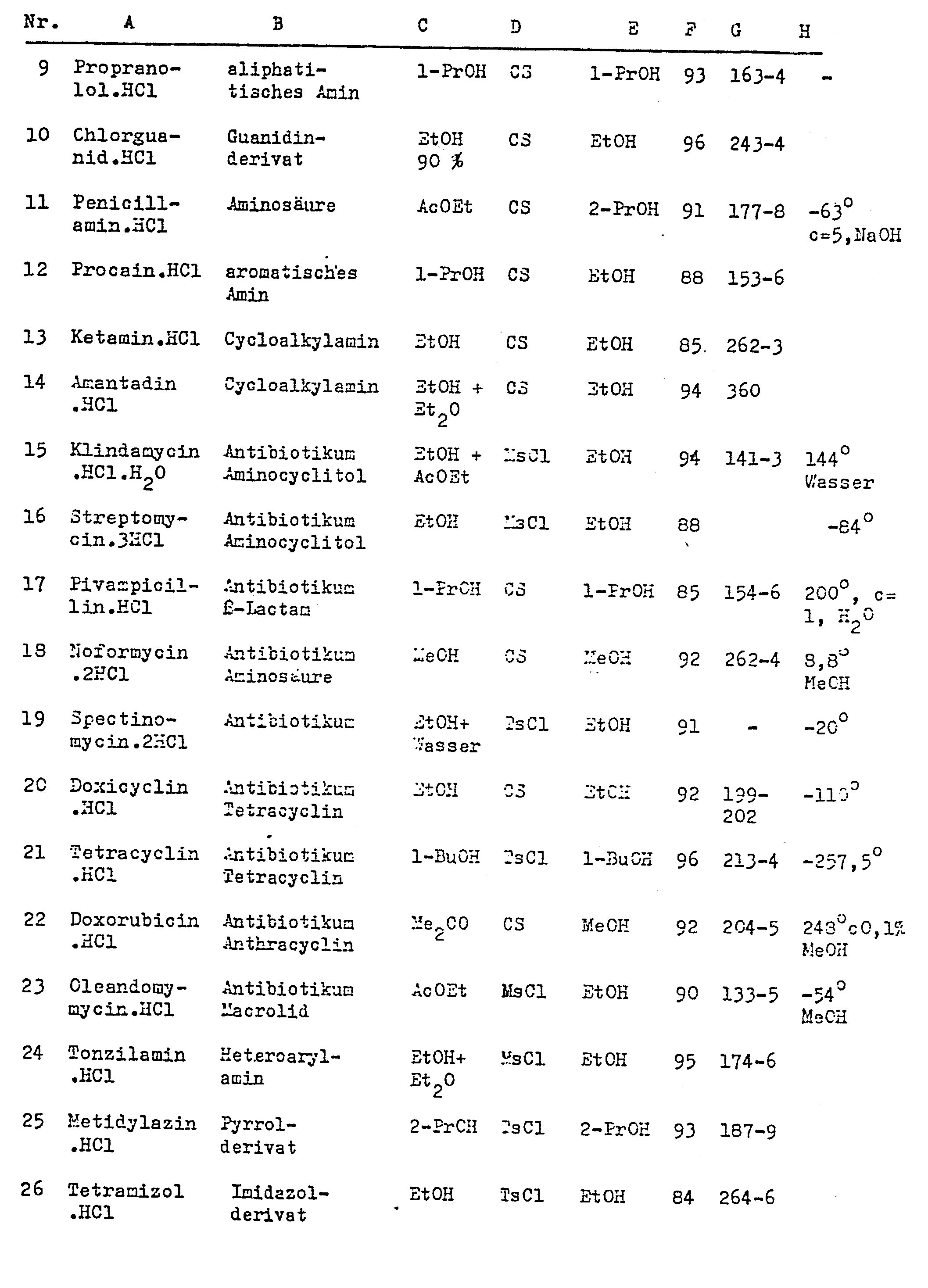
- Auf die in den Beispielen 4-8 beschriebene Weiae werden die in der folgenden Tabelle aufgeführten Verbindungen hergestellt. Die eingesetzten Reagenzien, Lösungsmittel, Reaktionsbedingungen, Ausbeuten und Schmelzpunkte sind ebenfalls in der Tabelle angegeben, wobei die folgenden Abkürzungen und Symbole verwendet wurden:


Claims (8)

umsetzt und das Hydrochlorid in an sich bekannter Weise isoliert.
Priority Applications (1)
| Application Number | Priority Date | Filing Date | Title |
|---|---|---|---|
| AT84104707T ATE32704T1 (de) | 1983-05-02 | 1984-04-26 | Verfahren zur herstellung von hydrochloriden. |
Applications Claiming Priority (2)
| Application Number | Priority Date | Filing Date | Title |
|---|---|---|---|
| HU149783 | 1983-05-02 | ||
| HU831497A HU190896B (en) | 1983-05-02 | 1983-05-02 | New process for preparing hydrochloride |
Publications (2)
| Publication Number | Publication Date |
|---|---|
| EP0125542A1 true EP0125542A1 (de) | 1984-11-21 |
| EP0125542B1 EP0125542B1 (de) | 1988-03-02 |
Family
ID=10954734
Family Applications (1)
| Application Number | Title | Priority Date | Filing Date |
|---|---|---|---|
| EP84104707A Expired EP0125542B1 (de) | 1983-05-02 | 1984-04-26 | Verfahren zur Herstellung von Hydrochloriden |
Country Status (11)
| Country | Link |
|---|---|
| EP (1) | EP0125542B1 (de) |
| JP (1) | JPS606623A (de) |
| KR (1) | KR870002001B1 (de) |
| AT (1) | ATE32704T1 (de) |
| AU (1) | AU564839B2 (de) |
| CA (1) | CA1208626A (de) |
| DE (1) | DE3469513D1 (de) |
| DK (1) | DK216384A (de) |
| FI (1) | FI86844C (de) |
| HU (1) | HU190896B (de) |
| NZ (1) | NZ208009A (de) |
Cited By (2)
| Publication number | Priority date | Publication date | Assignee | Title |
|---|---|---|---|---|
| CN109942445A (zh) * | 2019-02-26 | 2019-06-28 | 山东瑞弘生物科技有限公司 | 甜菜碱盐酸盐合成方法 |
| CN114920664A (zh) * | 2022-05-18 | 2022-08-19 | 郑州福源动物药业有限公司 | 一种引湿性小的球状微晶盐酸土霉素、制剂及其制备方法与应用 |
Citations (3)
| Publication number | Priority date | Publication date | Assignee | Title |
|---|---|---|---|---|
| DD32304A (de) * | ||||
| US3745188A (en) * | 1971-04-19 | 1973-07-10 | Lilly Co Eli | Preparation of nitrobenzyl alcohol mesylates and tosylates |
| GB1374390A (en) * | 1972-05-03 | 1974-11-20 | Shell Int Research | Sulphonic acid esters and their use as nematicides |
-
1983
- 1983-05-02 HU HU831497A patent/HU190896B/hu not_active IP Right Cessation
-
1984
- 1984-04-17 FI FI841544A patent/FI86844C/fi not_active IP Right Cessation
- 1984-04-26 AT AT84104707T patent/ATE32704T1/de not_active IP Right Cessation
- 1984-04-26 DE DE8484104707T patent/DE3469513D1/de not_active Expired
- 1984-04-26 EP EP84104707A patent/EP0125542B1/de not_active Expired
- 1984-04-26 CA CA000452850A patent/CA1208626A/en not_active Expired
- 1984-04-27 JP JP59084192A patent/JPS606623A/ja active Granted
- 1984-05-01 KR KR1019840002339A patent/KR870002001B1/ko not_active Expired
- 1984-05-01 NZ NZ208009A patent/NZ208009A/en unknown
- 1984-05-01 DK DK216384A patent/DK216384A/da not_active Application Discontinuation
- 1984-05-02 AU AU27611/84A patent/AU564839B2/en not_active Ceased
Patent Citations (3)
| Publication number | Priority date | Publication date | Assignee | Title |
|---|---|---|---|---|
| DD32304A (de) * | ||||
| US3745188A (en) * | 1971-04-19 | 1973-07-10 | Lilly Co Eli | Preparation of nitrobenzyl alcohol mesylates and tosylates |
| GB1374390A (en) * | 1972-05-03 | 1974-11-20 | Shell Int Research | Sulphonic acid esters and their use as nematicides |
Cited By (2)
| Publication number | Priority date | Publication date | Assignee | Title |
|---|---|---|---|---|
| CN109942445A (zh) * | 2019-02-26 | 2019-06-28 | 山东瑞弘生物科技有限公司 | 甜菜碱盐酸盐合成方法 |
| CN114920664A (zh) * | 2022-05-18 | 2022-08-19 | 郑州福源动物药业有限公司 | 一种引湿性小的球状微晶盐酸土霉素、制剂及其制备方法与应用 |
Also Published As
| Publication number | Publication date |
|---|---|
| FI841544A0 (fi) | 1984-04-17 |
| FI86844B (fi) | 1992-07-15 |
| HUT34145A (en) | 1985-02-28 |
| JPS606623A (ja) | 1985-01-14 |
| FI86844C (fi) | 1992-10-26 |
| HU190896B (en) | 1986-12-28 |
| KR840009296A (ko) | 1984-12-26 |
| JPH0517893B2 (de) | 1993-03-10 |
| ATE32704T1 (de) | 1988-03-15 |
| DK216384A (da) | 1984-11-03 |
| CA1208626A (en) | 1986-07-29 |
| DK216384D0 (da) | 1984-05-01 |
| FI841544L (fi) | 1984-11-03 |
| EP0125542B1 (de) | 1988-03-02 |
| AU2761184A (en) | 1984-11-08 |
| DE3469513D1 (en) | 1988-04-07 |
| KR870002001B1 (ko) | 1987-11-30 |
| NZ208009A (en) | 1987-07-31 |
| AU564839B2 (en) | 1987-08-27 |
Similar Documents
| Publication | Publication Date | Title |
|---|---|---|
| DD271705A5 (de) | Verfahren zum herstellen von azithromycin-dihydrat | |
| DE2154032A1 (de) | Verfahren zur Demethylierung von 3 Amino Makroliden | |
| DE2614669C2 (de) | Gamma-kristalline wasserfreie Form von 7-(D-alpha-Formyloxy-alpha-phenylacetamido)-3-(1-methyl-1H-tetrazol-5- ylthiomethyl)-3-cephem-4-natriumcarboxylat und Verfahren zu ihrer Herstellung | |
| DE1925230C3 (de) | Verfahren zur Herstellung des Antibiotikums Streptozotocin | |
| DE3020695C2 (de) | ||
| EP0125542B1 (de) | Verfahren zur Herstellung von Hydrochloriden | |
| DE69600144T2 (de) | Verfahren zur Reinigung und Krystallisierung von Iopamidol | |
| CH660483A5 (de) | Verfahren zur herstellung von cimetidin und seiner n-benzylderivate. | |
| DE69627533T2 (de) | Herstellung von einem kristallinen amoxicillinsalz | |
| CH492737A (de) | Verfahren zur Herstellung von Cephalosporin-CA-Antibiotica | |
| DE60014330T2 (de) | Verfahren zur herstellung von 1,4,7,10-tetraazacyclododecan | |
| DE60204721T2 (de) | Herstellung von kristallinen polymorphen von fosinopril natrium | |
| DE2418435A1 (de) | Nitroimidazolyl-triazolo-pyridazine und verfahren zu ihrer herstellung | |
| DE2444527A1 (de) | Verfahren zur herstellung von rifamycin s | |
| DE3712818C2 (de) | ||
| DE3102984A1 (de) | Verfahren zur herstellung von cysteamin-s-substituierten verbindungen und deren derivaten | |
| DE955592C (de) | Verfahren zur Herstellung von in Wasser schwer loeslichen kristallisierbaren Mischsalzen des Dihydrostreptomycins | |
| DE953432C (de) | Verfahren zur Reinigung von chlortetracyclinhaltigen Stoffen | |
| DE1176147B (de) | Verfahren zur Herstellung von 7-Aminocephalosporansaeure | |
| CH649993A5 (de) | Verfahren zur herstellung von uracilen. | |
| AT254202B (de) | Verfahren zur Herstellung von 7-Nitro-3H-1, 4-benzodiazepin-2(1H)-on-Verbindungen | |
| AT221501B (de) | Verfahren zur Herstellung der neuen 4-Chlor-3-sulfamyl-benzoesäure und deren Alkalisalze | |
| DEP0030192DA (de) | Verfahren zur Herstellung von Alkalimetallsalzen und Erdalkalimetallsalzen des Penicillins G. | |
| CH337987A (de) | Verfahren zur Herstellung von Penicillinsalzen | |
| CH433377A (de) | Verfahren zur Herstellung neuer 5-Sulfamyl-2-amino-benzoesäure-hydrazide |
Legal Events
| Date | Code | Title | Description |
|---|---|---|---|
| PUAI | Public reference made under article 153(3) epc to a published international application that has entered the european phase |
Free format text: ORIGINAL CODE: 0009012 |
|
| AK | Designated contracting states |
Designated state(s): AT BE CH DE FR GB IT LI NL SE |
|
| ITCL | It: translation for ep claims filed |
Representative=s name: MODIANO & ASSOCIATI S.R.L. |
|
| EL | Fr: translation of claims filed | ||
| 17P | Request for examination filed |
Effective date: 19841115 |
|
| TCNL | Nl: translation of patent claims filed | ||
| GRAA | (expected) grant |
Free format text: ORIGINAL CODE: 0009210 |
|
| AK | Designated contracting states |
Kind code of ref document: B1 Designated state(s): AT BE CH DE FR GB IT LI NL SE |
|
| REF | Corresponds to: |
Ref document number: 32704 Country of ref document: AT Date of ref document: 19880315 Kind code of ref document: T |
|
| REF | Corresponds to: |
Ref document number: 3469513 Country of ref document: DE Date of ref document: 19880407 |
|
| GBT | Gb: translation of ep patent filed (gb section 77(6)(a)/1977) | ||
| ET | Fr: translation filed | ||
| ITF | It: translation for a ep patent filed | ||
| PLBE | No opposition filed within time limit |
Free format text: ORIGINAL CODE: 0009261 |
|
| STAA | Information on the status of an ep patent application or granted ep patent |
Free format text: STATUS: NO OPPOSITION FILED WITHIN TIME LIMIT |
|
| 26N | No opposition filed | ||
| ITTA | It: last paid annual fee | ||
| PGFP | Annual fee paid to national office [announced via postgrant information from national office to epo] |
Ref country code: SE Payment date: 19930416 Year of fee payment: 10 |
|
| PGFP | Annual fee paid to national office [announced via postgrant information from national office to epo] |
Ref country code: AT Payment date: 19930419 Year of fee payment: 10 |
|
| PGFP | Annual fee paid to national office [announced via postgrant information from national office to epo] |
Ref country code: GB Payment date: 19930422 Year of fee payment: 10 |
|
| PGFP | Annual fee paid to national office [announced via postgrant information from national office to epo] |
Ref country code: FR Payment date: 19930423 Year of fee payment: 10 |
|
| PGFP | Annual fee paid to national office [announced via postgrant information from national office to epo] |
Ref country code: BE Payment date: 19930426 Year of fee payment: 10 |
|
| PGFP | Annual fee paid to national office [announced via postgrant information from national office to epo] |
Ref country code: CH Payment date: 19930428 Year of fee payment: 10 |
|
| PGFP | Annual fee paid to national office [announced via postgrant information from national office to epo] |
Ref country code: NL Payment date: 19930430 Year of fee payment: 10 |
|
| PGFP | Annual fee paid to national office [announced via postgrant information from national office to epo] |
Ref country code: DE Payment date: 19930517 Year of fee payment: 10 |
|
| PG25 | Lapsed in a contracting state [announced via postgrant information from national office to epo] |
Ref country code: GB Effective date: 19940426 Ref country code: AT Effective date: 19940426 |
|
| PG25 | Lapsed in a contracting state [announced via postgrant information from national office to epo] |
Ref country code: SE Effective date: 19940427 |
|
| PG25 | Lapsed in a contracting state [announced via postgrant information from national office to epo] |
Ref country code: LI Effective date: 19940430 Ref country code: CH Effective date: 19940430 Ref country code: BE Effective date: 19940430 |
|
| BERE | Be: lapsed |
Owner name: BIOGAL GYOGYSZERGYAR Effective date: 19940430 |
|
| PG25 | Lapsed in a contracting state [announced via postgrant information from national office to epo] |
Ref country code: NL Effective date: 19941101 |
|
| NLV4 | Nl: lapsed or anulled due to non-payment of the annual fee | ||
| GBPC | Gb: european patent ceased through non-payment of renewal fee |
Effective date: 19940426 |
|
| PG25 | Lapsed in a contracting state [announced via postgrant information from national office to epo] |
Ref country code: FR Effective date: 19941229 |
|
| REG | Reference to a national code |
Ref country code: CH Ref legal event code: PL |
|
| PG25 | Lapsed in a contracting state [announced via postgrant information from national office to epo] |
Ref country code: DE Effective date: 19950103 |
|
| EUG | Se: european patent has lapsed |
Ref document number: 84104707.9 Effective date: 19941110 |
|
| REG | Reference to a national code |
Ref country code: FR Ref legal event code: ST |