EP0129892A2 - Procédé de fabrication de pâtes longues et dispositif pour la mise en oeuvre de ce procédé - Google Patents
Procédé de fabrication de pâtes longues et dispositif pour la mise en oeuvre de ce procédé Download PDFInfo
- Publication number
- EP0129892A2 EP0129892A2 EP84107222A EP84107222A EP0129892A2 EP 0129892 A2 EP0129892 A2 EP 0129892A2 EP 84107222 A EP84107222 A EP 84107222A EP 84107222 A EP84107222 A EP 84107222A EP 0129892 A2 EP0129892 A2 EP 0129892A2
- Authority
- EP
- European Patent Office
- Prior art keywords
- zone
- drying
- long goods
- air
- temperature
- Prior art date
- Legal status (The legal status is an assumption and is not a legal conclusion. Google has not performed a legal analysis and makes no representation as to the accuracy of the status listed.)
- Granted
Links
Images



Classifications
-
- F—MECHANICAL ENGINEERING; LIGHTING; HEATING; WEAPONS; BLASTING
- F26—DRYING
- F26B—DRYING SOLID MATERIALS OR OBJECTS BY REMOVING LIQUID THEREFROM
- F26B15/00—Machines or apparatus for drying objects with progressive movement; Machines or apparatus with progressive movement for drying batches of material in compact form
- F26B15/10—Machines or apparatus for drying objects with progressive movement; Machines or apparatus with progressive movement for drying batches of material in compact form with movement in a path composed of one or more straight lines, e.g. compound, the movement being in alternate horizontal and vertical directions
- F26B15/12—Machines or apparatus for drying objects with progressive movement; Machines or apparatus with progressive movement for drying batches of material in compact form with movement in a path composed of one or more straight lines, e.g. compound, the movement being in alternate horizontal and vertical directions the lines being all horizontal or slightly inclined
- F26B15/122—Machines or apparatus for drying objects with progressive movement; Machines or apparatus with progressive movement for drying batches of material in compact form with movement in a path composed of one or more straight lines, e.g. compound, the movement being in alternate horizontal and vertical directions the lines being all horizontal or slightly inclined the objects or batches of material being carried by transversely moving rollers or rods which may rotate
- F26B15/126—Machines or apparatus for drying objects with progressive movement; Machines or apparatus with progressive movement for drying batches of material in compact form with movement in a path composed of one or more straight lines, e.g. compound, the movement being in alternate horizontal and vertical directions the lines being all horizontal or slightly inclined the objects or batches of material being carried by transversely moving rollers or rods which may rotate the material being "pasta" products, e.g. spaghetti
-
- A—HUMAN NECESSITIES
- A23—FOODS OR FOODSTUFFS; TREATMENT THEREOF, NOT COVERED BY OTHER CLASSES
- A23L—FOODS, FOODSTUFFS OR NON-ALCOHOLIC BEVERAGES, NOT OTHERWISE PROVIDED FOR; PREPARATION OR TREATMENT THEREOF
- A23L7/00—Cereal-derived products; Malt products; Preparation or treatment thereof
- A23L7/10—Cereal-derived products
- A23L7/109—Types of pasta, e.g. macaroni or noodles
-
- F—MECHANICAL ENGINEERING; LIGHTING; HEATING; WEAPONS; BLASTING
- F26—DRYING
- F26B—DRYING SOLID MATERIALS OR OBJECTS BY REMOVING LIQUID THEREFROM
- F26B2210/00—Drying processes and machines for solid objects characterised by the specific requirements of the drying goods
- F26B2210/06—Long pasta, e.g. spaghetti
Definitions
- the invention relates to a method for producing long goods with a moisture content of less than about 14% by weight, in particular from about 11 to 13% by weight, the long goods leaving a press head in the form of soft, moist-plastic dough strands hanging up to Final drying is carried out through differently heated climatic zones and the long goods are cooled and / or dimensionally stabilized in another climatic zone after the drying process has been completed.
- Pasta in particular long pasta or long goods, are today, alongside raw cereals or bread, the most widespread basic foodstuffs, which are also used to a large extent in particular for stockpiling. They are ready-to-cook, dry cereal products that are made from semolina, steam or flour dough without application a fermentation or baking process by molding and gentle drying.
- a distinction is made between egg pasta and egg-free pasta as well as semolina and flour pasta, according to their outer shape pasta (ribbon, cut and vermicelli), spaetzle, macaroni (tubular pasta) and spaghetti.
- the main raw materials of the pasta are durum wheat semolina or steam, which should have a constant grain distribution, high protein content, high content of yellow pigments (xanthophyll or its ester) and good pigment stability with little tendency to gray-brown discoloration.
- the cereal raw materials - semolina or haze usually in a mixture with each other, or flour in the case of an unfavorable supply situation - with the addition of about 26 to 32% water, possibly salt, egg for diet pasta, glue and other protein preparations are used to prepare dough and the like further shaped by pressing or rolling and cutting and finally dried.
- the amount of water, water temperature, mixing or kneading time and the drying process depend on the type of raw material mixture, the manufacturing principle and the special features of the machine park.
- the freshly formed pasta contains on average about 31% moisture, the dried and packaged goods only about 11 to 13%.
- the pressing mentioned above can basically be carried out according to two procedures: a) according to the older batch process with the production of homogeneous, plastic dough in a pre-kneader and pan mill (Gramola) and shaping in hydraulic presses or b) according to the modern continuous process with so-called screw presses, in which no homogeneous part is kneaded in the first section, but rather only a dough crumb mass is formed in troughs with mixing paddle units, which are then transported by screw conveyors Forward slowly and feed to the press head. It is only the shear forces in the extrusion screw and the high pressures of about 100 to 150 bar that prevail in the press chamber and while the dough is passing through the die itself that causes the dough to be homogeneously kneaded or "glued".
- the homogenized, kneaded, moist plastic dough is made.
- the die is pressed out in the form of a steady stream of ready-formed dough strands which are highly compacted in structure.
- a blower dries the emerging dough strands superficially to take away the stickiness.
- Rotating knives with which the preformed strands are cut to the desired length can be arranged directly below the die.
- the strands obtained in this way must then be dried to produce durable goods, the drying proceeding from the outside inwards. It is important that the surface does not harden excessively in front of the core in order to avoid cracks and cracks in the finished pasta.
- the freshly formed pasta already has the aforementioned water content of about 31%. By the superficial drying after leaving the press head is less than 1% water is ver - lost.
- the control of the drying process is in principle still based today on the experience that was originally gained in the Mediterranean region when drying outdoors under the natural cyclical changes in air movement, temperature and humidity.
- the drying time in this drying process from shaping to reaching the final moisture content of the pasta was 3 to 5 days. This applied to both short and long pasta.
- the drying temperature is 50 ° C is not exceeded and the drying time was. At least 18 to 24 hours.
- the general procedure is as follows: the long goods emerging from the press first pass through a kind of meandering a pre-dryer. In this phase, the water content drops quite steeply to 20 to 24% within 1 to 3 hours, ie in the critical area of the transition of the pasta from the plastic to the solid state. At this limit, a sweating period of several hours is switched on, during which the treated material travels through drying zones without dehumidification. The residual water can be distributed evenly from the core over the entire cross-section of the individual fittings.
- the subsequent final drying is slower and gentler than the pre-drying up to a moisture content of around 11 to 13.
- the warm, dry long goods can then still run on the bars in storage silos, where they remain for several hours, possibly overnight, in order to maintain their moisture balance about 55 to 65% relative humidity at room temperature or a little above relieve residual stress.
- the finished product "stabilized” in this way, ie less prone to pressure, is then fed to the packaging machines.
- the object of the invention was to improve the method described in the introduction in such a way that it can be carried out largely trouble-free in a simple and economical manner and in particular quickly while maintaining the qualitative requirements to be placed on the process product.
- the invention is also intended to propose a device which is particularly suitable for carrying out this method.
- this object is achieved in that the long goods leaving the press head in a first climate zone as quickly as possible, but in more than 10 minutes and under the action of a heating medium with a relative humidity of about 60 to 80% to a temperature of more than about 80 ° C heated and then in a second climatic zone under the action of a drying medium at a temperature above about 80 ° C and a relative humidity of about 65 to 85% to a humidity of less than about 14 wt .-% or to avoid undesirable reactions above about 80 ° C is first dried to a moisture content of less than about 18% by weight and then at a lower temperature to a final moisture content of less than about 14% by weight.
- the device according to the invention is characterized in that the long goods dryer is designed as a one-tier dryer which has a rapid heating zone and an intensive drying zone.
- a long goods product with a moisture content of less than approximately 14% by weight, in particular approximately 11 to 13% by weight is sought.
- the final moisture content is subject to legal regulations in different countries. In Switzerland and the Federal Republic of Germany, a value of around 12.5% by weight is required. From a purely technical point of view (including quality requirements), the value should always be below 14% by weight. Avoid falling below the value of 11% by weight of moisture in general, since sharper drying out would be equivalent to weight loss compared to the legal values. The value of about 12.5% by weight can be considered optimal.
- the starting material of the method according to the invention are the partially plasticized or moist-plastic soft dough strands leaving a press head.
- plastic is used in the context of the invention, this is understood to mean a physical state which, among other things, is a function of temperature and humidity. Plasticity is basically the property of solid materials to show permanent deformations when exposed to external forces.
- the moist plastic dough strands usually leave the press head at a temperature of around 40 to 50 ° C. Higher temperatures should be avoided as they cause undesirable changes in the material to be dried which impair the quality of the finished product.
- the dough strands are treated after exiting the press head by air flow on the surface with loss of moisture of about 1 to 2% by weight.
- the ventilating air can preferably be brought to about 40 to 60 ° C. in order to prevent the otherwise occurring cooling down to roughly 30 ° C. Such a cooling would have to be compensated again in the subsequent rapid heating zone, which is contrary to the objective of the invention.
- the treatment with ventilating air after the press head generally takes about 6 to 10 minutes and leads to a drying of the surface. This measure prevents the "drop formation" that occurs in individual cases.
- the dough strands leaving the press head optionally surface-treated in the manner described above with ventilating air, are mechanically placed over a rod hanging device, then cut directly when the desired leg length is reached (with the formation of a U-shape).
- the strands of dough are cut in such a way that an adaptation to the dimensions of the subsequent units is carried out in the heating and drying device.
- An imperative requirement of the method according to the invention is that the dough strands leaving the press head and cut to the desired length on the bar hanging device are subjected to rapid heating to a temperature of more than about 80.degree.
- the length of time within which the rapid heating takes place is of course dependent on the desired end temperature and on the temperature conditions during the heating. However, it should be at least about 15 minutes.
- the range from 15 to 60 min is preferred, the range from 15 to 30 min being particularly preferred can preferably apply.
- Air of a relative humidity of about 60 to 85% is selected as the heating medium, the range from 65 to 75% being preferred.
- temperature jumps are therefore preferably provided in this first climate zone.
- the optimal number of temperature jumps depends on the target minimum temperature. Four or more temperature jumps can already be regarded as advantageous. For example, if a minimum temperature of approximately 95 ° C is desired, then in any case, it is advantageous to choose four or more temperature jumps.
- the processes of moistening due to condensation and drying take place.
- the procedure is particularly advantageous when the wet temperature (dew point) of a subsequent climatic region of higher temperature is below the dry temperature of the preceding climatic region. In other words, this means that the temperature of the air which is introduced into the subsequent climatic region must not be raised above the psychometric temperature difference ⁇ T. If this condition is met, then the otherwise undesirable condensation of water vapor, which occurs to a considerable extent on the wall of the container of the first climatic zone, is excluded.
- the method according to the invention is optimized in the first climatic zone for rapid heating, the sum of the individual ⁇ T values (psychometric temperature difference of the individual differently tempered climatic regions) would be equal to or slightly greater than the total temperature increase from, for example, approximately 40 to 50 ° C. to at least approximately 80 ° C.
- the advantageous effective rapid heating described above using temperature jumps in the first climate zone is by no means the only possibility for this. Rather, the rapid heating can take place in a variety of ways, as the person skilled in the art can readily recognize.
- the surrounding heating medium in the form of e.g. Air of the moisture content mentioned is regulated in such a way that a gradual (continuous) temperature profile exists, but is at a sufficient distance from the temperature profile of the material to be heated in order to achieve the desired rapid heating. This means that there is a sufficient temperature difference between the product and the surrounding heating medium at every point of the heating section.
- the relative atmospheric humidity in the heating climate is set to approximately 60 to 85%. In this case, it could be heated with hot steam. At the end of the heating process, there is still a largely soft, moist and possibly partially plasticized material.
- the air flow in the different climate zones is directed in sections perpendicular to the long goods and part of the air in the sense of a turbo system through channels inside and outside the drying room for controlling the climate of the respective climatic zones is introduced and removed.
- the long goods leaving the first climate zone at a temperature of more than about 80 ° C. are then subjected to exceptionally rapid drying at this elevated temperature and also in the plastic state.
- the main drying always takes place in the second climatic zone, in which the drying medium has a relative humidity of 65 to 85%, preferably 70 to 80%.
- the originally moist or soft-plastic material is subjected to further plastification, a thermoplastic product being produced in the final stand. If you cool this thermoplastic product to room temperature, it shows strength. In general, it is advisable to maintain the product temperature set in the first climate zone in the second climate zone. Reference may be made to the lima zone in connection with the description of the first K mentioned temperatures or temperature ranges.
- the treatment duration is selected depending on the treatment temperature in the second climate zone.
- This duration of treatment should regularly be 30 minutes or more, the range from 30 to 120 minutes generally being advantageous.
- the range from 30 to 60 min is very preferred.
- temperature-unstable additives are added to the dough, such as egg additives, milk protein etc., or raw fibers
- maintaining the final quality means drying at a lower temperature.
- the long goods are preferably dried intensively to a product moisture of about 18% in less than 1 h and then dried to the final moisture of less than 14% for 1 to 4 h, preferably 2 to 3 h and at a temperature of about 75 ° C. In such cases, it is advisable to first reduce the moisture content in the drying temperature range to approximately 18%.
- thermoplastic product is treated in a subsequent third climatic zone at such a low temperature that the undesired browning reactions and other reactions are largely excluded, but a relatively quick procedure is still guaranteed while maintaining a high quality product.
- the moisture content is adjusted to less than about 14% by weight, preferably about 12.5% by weight. It has been shown that this last drying measure is advantageously carried out at a temperature below about 75 ° C.
- the statements made above for the drying medium of the second climate zone apply here, in particular with regard to the relative atmospheric humidity. Since the undesired browning reactions take place more strongly with decreasing moisture content and at high temperatures, it can be advantageous to provide one or more temperature jumps in the third climate zone.
- the additional final drying in the third drying zone mentioned generally takes about 2 hours at 75 ° C. and about 4 hours at about 65 ° C. The long goods are then cooled as far as possible while avoiding further drying out in order to maintain the desired moisture content.
- the long goods that have already dried out can be cooled in a cooler, for example, with subsequent cooling Carried stabilization in storage silos in moisture equilibrium with about 55 to 6 5% relative humidity at room temperature or slightly above, a stabilized product obtained without residual stresses.
- Carried stabilization in storage silos in moisture equilibrium with about 55 to 6 5% relative humidity at room temperature or slightly above, a stabilized product obtained without residual stresses.
- the only decisive factor here is that no significant amounts of moisture can escape from the finished product due to the fusion processes and the surrounding atmosphere, and that the desired moisture content is maintained.
- the cooled product can then be cut to the desired length in the usual way.
- the process according to the invention can be carried out with particular advantage using the single-stage dryer which is divided into a rapid heating zone and an intensive drying zone.
- the air and climate control can be carried out in a targeted manner with the single-level dryer, especially if the air circulation is selected transversely to the direction of movement of the long goods.
- the climate can be fine-tuned and regulated as the drying process progresses with regard to all parameters, such as air speed, air humidity and air temperature. This also makes it possible for the first time to achieve a concept with complete automation, ie automatic control according to the conditions required by the product.
- the combination of the one-day construction with the so-called turbo air duct is particularly advantageous.
- automatic product monitoring can also be for example by measuring the product moisture and / or color. both in the area of the rapid heating zone and the intensive drying zone. It is preferred that the rapid heating zone and the intensive drying zone are equipped with a circulating air system such that the air is guided vertically from top to bottom or from bottom to top through the goods.
- the air is controlled with the above-mentioned turbo system by means of an air compressor or fan, preferably by a central computer, and is blown in this way into the individual climatic zones of the rapid heating zone and intensive drying zone.
- the rapid heating zone and the intensive drying zone are preferably equipped with longitudinal channels for fresh air and exhaust air.
- this allows the respective climate to be regulated in each stage of the rapid heating zone and intensive drying zone in such a way that the corresponding climatic conditions can be optimally regulated.
- no negative pressure or positive pressure can occur, especially in the drying zone or the individual sections.
- the device according to the invention with devices for controlling the climatic conditions in the individual air circulation zones and quiet zones is achieved by a targeted fine distribution of the supply air and the controlled removal of the exhaust air from the individual air conditioning tranches through the corresponding longitudinal channels.
- the device In order to regulate the supply air or exhaust air flow, the device has connecting channels to the longitudinal channels with controllable throttles for section-by-section climate control in the sense of the turbo system already mentioned.
- the device having a rapid heating zone and an intensive drying zone is supplied with circulating air for fresh and exhaust air and has throttle and control flaps and a heating device for fresh and / or exhaust air to prevent the formation of condensate. It is also beneficial if the fresh air-exhaust air system can be short-circuited for air conditioning, climate control and climate extension. Furthermore, it is expedient in the sense of the invention that the device is preferably equipped with a steam humidification controlled by the central computer in order to control and regulate the individual climatic conditions or climatas of the rapid heating and the intensive drying zone.
- adjustable slides are arranged in the longitudinal channels of the rapid heating zone and the intensive drying zone in each ventilated element.
- a turbo system superimposed on the circulating air is used to ensure optimal control of the drying zones for the exhaust and fresh air.
- this system in the device according to the invention, it is expedient for energy reasons and in view of the condensation problems already mentioned that the longitudinal channels of the turbo system for exhaust and fresh air are arranged in the drying chamber of the single-level dryer.
- air mixing units, heating elements, compression and suction units of the turbo system are installed in the exhaust air and fresh air channels within the drying chamber of the single-level dryer. Energy losses are thus reduced to a minimum.
- the air mixing units, heating elements, compression and suction units of the turbo system are arranged in channels outside the drying chamber. It goes without saying that these elements are appropriately insulated to prevent or prevent heat loss.
- This rapid heating zone preferably has one or more zones of different temperatures.
- an automatic rod removal device which leads the goods out of the single-day dryer is expediently arranged in the rapid heating or intensive drying zone such that at least one automatic rod removal device is arranged in the region of the rapid heating zone and in the intensive drying zone .
- This automatic removal of a rod from the single-level dryer enables exact and controlled monitoring of the product.
- the rod removal device preferably has an automatic rod return to the corresponding zone.
- the automatic rod removal device has product measuring and monitoring devices for product quality for controlling or regulating the drying parameters (climate).
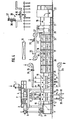
- FIG. 4 position 28, which is explained in more detail below, and the positions 35/36/37 at the top right are the schematic representation of the removal.
- a finger hook 35 removes a hanging bar from the single-level dryer.
- the long goods 37 are checked in the idle state with the measuring device 36 for the desired product parameters (temperature, humidity, color, strength, L protein and ash, etc.). If the rod is returned, it remains on the finger hook 35.
- the checks are carried out and a sample is taken for the laboratories, which can also be carried out automatically. After the control, the staff is moved back to its position in the process leads, if necessary checked again in a further drying section.
- the advantages associated with the invention can be seen, in particular, in the fact that it is possible for the first time to obtain high-quality long goods, similar to that in the bread oven, at least in the main part of the drying, in a one-day, elongated drying tunnel, without providing the rest zones described above .
- the procedure is about four to eight times shorter than in the prior art processes. Since all the bars of the bar hanging device are moved in the same forward direction, fewer breakdowns occur. This is also due to the fact that a large part of the handover and redirection is basically eliminated. This enables continuous process management, since the climate in the individual climatic zones can be better controlled and controlled locally.
- an energy gain is achieved if the heated, air-conditioned bar hanging device is arranged as the first section immediately in front of the first climatic zone or the rapid heating zone.
- the climate in the individual climate zones described can be optimally adjusted by mixing, heating or humidifying to the required extent, with air as a carrier of heat and moisture. maximum usable. Overall, the entire drying process can thus be carried out very economically, with a large number of easy-to-use measures allowing optimal adaptation and utilization of the respective circumstances.
- a process product is obtained that meets the highest quality requirements. It shows beautiful color, excellent or bite K ochfesttechnik and less mucus production in cooking.
- the process according to the invention is to be explained technologically below with regard to these advantageous properties of the process product. Various new knowledge should also be addressed here.
- the present invention has brought a number of new valuable insights.
- the entire physical tests mouthfeel, B schreib- strength, taste, color, etc.
- the maintenance of traditional quality remains for all traditional foods centrally.
- Raw grain starch is difficult to digest for humans.
- Bread is therefore baked, pasta is cooked.
- the protein is denatured during baking and cooking. It can therefore be left to the economic management in which industrial process stage a complete or partial denaturation takes place.
- the adhesive protein is still "alive", so that the reactivity inherent in such a protein can be fully used to build up a very fine-meshed, spatial network or protein scaffold the dough parts do not have any mechanical-thermal deformation forces - the dough strands are hung on the bars immediately after the pressing process and remain on the bars until they have dried sufficiently - the protein scaffold not only remains intact, but, as tests have shown, it is even more intensively trained for example, when drying is substantially complete between about 80 and 100 ° C for less than about 2 hours.
- the last phase of stabilization in which at most 1 to 2% of the moisture is still removed, does not result in any disadvantages, since temperatures below about 65 ° C., sometimes ambient air, are used.
- the adhesive proteins begin to coagulate at temperatures above around 50 to 60 ° C.
- the press-warm long goods (about 45 ° C.) are preferably heated to over 80 ° C. for 15 to 30 minutes and 65 to 75% relative humidity directly after the pressing process, and then to a moisture content of about 85 to 95 ° C., for example 14% dried.
- the protein scaffold is solidified.
- the cooking properties are improved. These pasta don't boil easily.
- the starch is only minimally extracted during the cooking process. The bite resistance remains good.
- the adhesive framework which is well prepared in the press, provides sufficient strength so that the dough threads on the bars do not tear due to their own weight.
- the pores remain free up to the surface of the dough, so that in the higher temperature range (e.g. 80-100 ° C) the loosening of the hydrogen bonds, combined with the softening of the starch structure, can be used for rapid drying out, without very large vapor pressure difference values between the product and the drying air being required during the main drying.
- the best values were achieved at a relative humidity of around 70 to 80%.
- the invention has in particular brought about a clear clarification of the bio-chemical process in the production of pasta.
- acid fermentation which was difficult to control, had to be accepted and resulted in "sour" pasta.
- the further additional enzymatic oxidation reactions in the direction of enzymatic browning and color decomposition are completely undesirable.
- This climate is also an ideal breeding ground for bacteria, including pathogens such as salmonella and staphylococci.
- the drying process was maintained for too long at temperatures above 70 ° C, the Maillard reaction proceeded, similar to roasting or roasting and bread baking, which led to a brown color.
- the soft, moist-plastic pasta is brought very quickly to a temperature of more than about 80 ° C. without substantial drying in order to be dried there within a short period of time, there are no cracks, tensions or warps on the long goods .
- the individual dough strands of the long goods thus remain absolutely straight. A crooked product would otherwise be more sensitive to breakage. In addition, there would be a greater risk of the individual dough strands sticking together in the event of irregularities.
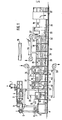
- the raw material in the form of semolina, water and eggs is introduced into a mixing trough 2 via a metering device 1.
- the pasta is fed from the mixing trough 2 into a long goods press 3 with a press drive 4.
- the long goods long goods such as spaghetti are brought into the desired shape and cm cut by a cutting unit 6 to the required length, such as "30 to 50.
- the not yet finished long goods or pasta strands leave form 5 at a temperature of about 40 to 50 ° C. So that neither sticking nor cooling of the long goods occurs at this point, it is introduced through an inlet channel 7 directly into a conditioned hanging device 8.
- the inlet channel 7 and the hanging device 8 there is a fan 9 through which heated air is blown onto the goods.
- the long goods get from the hanging device 8 into an entry element 11, in which also heated air is blown to the goods by means of a fan 10. From here, the long goods are fed into a rapid heating zone 12, 13, 14, 15, 16 and then fed to the main dryer 17, which has a number of ventilated elements.
- the product can be used in fewer or more temperature jumps from initially e.g. Bring 40 ° C to 90 ° C to 120 ° C.
- the main feature of the device according to the invention has a long, continuous, one-day drying tunnel.
- the long goods are suspended in the longitudinal direction on rods.
- the air is blown through the drying tunnel from top to bottom or from bottom to top.
- Each climate zone has a temperature and humidity probe 18 and is regulated by a central, microcomputer-controlled climate control 19 in order to maintain the desired conditions in the drying stage.
- it is necessary to regulate the desired temperature in each dryer section by means of heat exchanger 29 and the desired air humidity by means of steam or fresh air.
- a lock 20 At the end of the main drying process there is a lock 20, followed by a cooler or shape stabilizer 21. The end of the entire drying line is formed by a cutting machine 22. The product is then fed to the packaging machines.
- a so-called turbo system is used with particular advantage for the fresh and exhaust air, as shown in FIGS. 1 and 2.
- channels 23 and 24 are provided in the rapid heating zone.
- the turbo system is supplemented with an air system in order to regularly distribute the conditioned fresh air over the entire length of the dryer.
- the channels 23 'and 24' are arranged inside the dryer and connected to one another on the outside. Some of the air-conditioned dryer air circulates in these channels and is processed using fresh air and steam.
- This conditioned air can be distributed evenly over the entire length of the dryer, even if it is very long, by means of a slide 26. It is also possible to dry this air by condensation instead of fresh supply air. This could result in heat recovery and a corresponding reduction in energy consumption. For hygienic reasons, it is important that the place where the condensation occurs is outside the dryer.
- nozzles 27 are provided for the injection of water vapor.
- automatic product removal 28 is provided between the rapid heating zone and the main drying zone.
- a further separately regulated final drying zone can be provided after the main drying zone.
- This drying zone could consist of a one-tier dryer or a 3-tier dryer. in any case, a sensor should be provided at the end of drying.
- FIG. 4 shows a device shown in FIG. 2 with modifying supplementary devices.
- a special design of the removal device shows the position 28, top right with the positions 35/36/37 in a schematic representation of the removal. Position 28 has already been discussed in detail.
- the devices 31 and 33 supply the system with fresh air for conditioning the climate while being heated by the element 34.
- the exhaust air is drawn off by means of devices 30 and 32. This regular system makes it possible to rule out the formation of negative pressure or excess pressure in the system.
- process zone 1 representing the raw material preparation (controlled raw material mixture) from semolina, water and other additives and their metering.
- Dough preparation in process zone 2 mainly involves mixing, pressing and shaping. The freshly pressed product is automatically hung on bars and introduced into process zone 3, which is the rapid heating zone.
- Process zone 4 comprises the actual intensive drying. In process zone 5, the essentially fully dried long goods are stabilized, ensiled and automatically filled into household packaging or other packaging.
- a controller 40 1 -40 n is systematically shown for each process zone.
- each individual zone may have a number of individual controllers which are combined in an auxiliary computer, possibly also coupled to the system control and locking 5U, where they can be connected at least for the flow of information.
- the main computer 47 is in direct connection with a setpoint memory 46 for storing individual data or programs and for removing them.
- Measuring devices 42 1 -42 n (or, as in FIG. 4, position 36, product measuring and monitoring devices (M) for product temperature, humidity, color and product strength as well as protein and ash and the like) are also connected to the main computer 47.
- a setpoint generator 41 1 -41 n can also be used in conjunction with the measuring devices (M) for a complete or partial manual operation.
- the operational management can be carried out as follows: when commissioning for the first time, all system elements are put into operation according to the locking system. As a result, the individual control loops (for controlling the air volume, humidity and temperature, etc.) are optimized by hand.
- the corresponding data are input to the main computer 47 or the setpoint memory 46 for defining the setpoint schemes (e.g. punch cards).
- Production is started by controlling the corresponding product feed or dosing elements.
- the control loops connected with the product parameters are roughly set according to the empirical values.
- the corresponding values can in turn be transferred to the setpoint memory 46 or the main computer 47.
- the entire start-up production is controlled with the corresponding start-up program to be coordinated.
- the dough master After completing the start-up phase, which can last, for example, 1 to 4 hours, the dough master begins to control the entire manufacturing process. He then optimizes the product, air and climate parameters in the processes that appear interesting to him or in the required processes cut. For this purpose, he interrupts the corresponding control line of the main computer 47, for example to the process zone 3, by interrupting the switch contact 45 3 .
- the controller 3 continues with the setpoint given before the control line was interrupted.
- the dough master now gives an improved target value by corresponding input to controller 3 or to one of the controllers in process zone 3.
- the best target values found are in turn entered into the main computer or the target value memory for the purpose of correction.
- the changeover switch 45 3 can then be closed again and the corresponding group of controllers can be guided with the newly determined target values.
- Optimizing interventions by the dough master can be carried out at any time by pressing the T 1 -T n or 45 1 -45 n switches.
- the associated schemes of the input parameters - such as output (kg / hl type and mixture of the raw material (durum, hard and / or soft wheat), water addition and various additives (egg, salt, etc.) - as well as the parameters of product quality (moisture, color, strength, etc.) can be assigned.
- the setpoints determined last time as optimal for the new production can be used as a basis or accessed.
- the dough master can thus manage the long goods line at a substantially safer level, the computer means, the controllers and the measuring devices being valuable aids. He can control the process by hand at any point at any point by eliminating the electronic automatic means at special locations or leave the system to run automatically for longer periods of time. In special situations or emergencies, the dough master can manage the entire system in semi-automatic mode without the process zones being linked using computer means. It is essential that he can rely on the system control and locking.
- the individual curves in FIG. 3 can be interpreted as follows: in the old system, the long goods are dried on average for about 14 and more hours at 50 ° C. and in the prior art practiced for 10 hours at an average temperature of 65 to 75 ° C. A drying time of 1 to 3 1/2 hours at an average temperature of 95 ° C. can be achieved with the process according to the invention. Particularly striking is the dabie very strong decrease in product moisture in the inventive process as opposed to the classic - specific systems for expression.
Landscapes
- Engineering & Computer Science (AREA)
- Mechanical Engineering (AREA)
- General Engineering & Computer Science (AREA)
- Health & Medical Sciences (AREA)
- Nutrition Science (AREA)
- Life Sciences & Earth Sciences (AREA)
- Chemical & Material Sciences (AREA)
- Food Science & Technology (AREA)
- Polymers & Plastics (AREA)
- Noodles (AREA)
- Drying Of Solid Materials (AREA)
Priority Applications (1)
| Application Number | Priority Date | Filing Date | Title |
|---|---|---|---|
| AT84107222T ATE25567T1 (de) | 1983-06-24 | 1984-06-23 | Verfahren zur herstellung von langen teigwaren und vorrichtung zur durchfuehrung eines solchen verfahrens. |
Applications Claiming Priority (3)
| Application Number | Priority Date | Filing Date | Title |
|---|---|---|---|
| CH345983 | 1983-06-24 | ||
| CH3459/83 | 1983-06-24 | ||
| DE3400300 | 1984-01-05 |
Publications (3)
| Publication Number | Publication Date |
|---|---|
| EP0129892A2 true EP0129892A2 (fr) | 1985-01-02 |
| EP0129892A3 EP0129892A3 (en) | 1985-07-24 |
| EP0129892B1 EP0129892B1 (fr) | 1987-03-04 |
Family
ID=4256397
Family Applications (1)
| Application Number | Title | Priority Date | Filing Date |
|---|---|---|---|
| EP84107222A Expired EP0129892B1 (fr) | 1983-06-24 | 1984-06-23 | Procédé de fabrication de pâtes longues et dispositif pour la mise en oeuvre de ce procédé |
Country Status (5)
| Country | Link |
|---|---|
| US (3) | US4775542A (fr) |
| EP (1) | EP0129892B1 (fr) |
| DE (2) | DE3400300C2 (fr) |
| UA (1) | UA13477A (fr) |
| WO (1) | WO1985000090A1 (fr) |
Cited By (8)
| Publication number | Priority date | Publication date | Assignee | Title |
|---|---|---|---|---|
| EP0580214A3 (en) * | 1992-07-21 | 1994-05-25 | Braibanti M G Spa | Process for drying alimentary pasta |
| WO2000066963A1 (fr) * | 1999-04-28 | 2000-11-09 | Bühler AG | Procede et dispositif permettant d'optimiser la gestion et la surveillance des processus dans une installation de fabrication de pates alimentaires |
| WO2009150192A2 (fr) | 2008-06-10 | 2009-12-17 | Bühler AG | Procédé de séchage de pâtes alimentaires |
| CN102613260A (zh) * | 2012-04-06 | 2012-08-01 | 中国包装和食品机械总公司 | 一种挂面中温干燥工艺及温湿调节系统 |
| CN103719182A (zh) * | 2013-12-03 | 2014-04-16 | 中南林业科技大学 | 一种鲜湿面生产用冷风定条设备 |
| WO2014177574A1 (fr) * | 2013-04-30 | 2014-11-06 | Bühler AG | Dispositif et procédé pour sécher des produits à sécher, en particulier de produits alimentaires |
| CN112066694A (zh) * | 2020-09-23 | 2020-12-11 | 湖北美玉面业股份有限公司 | 一种热干面加工索道式烘干系统 |
| EP3614854B1 (fr) | 2017-04-26 | 2021-06-02 | Bühler AG | Système de production de chocolat industriel, adaptatif, à auto-optimisation, et procédé correspondant |
Families Citing this family (46)
| Publication number | Priority date | Publication date | Assignee | Title |
|---|---|---|---|---|
| US5309827A (en) * | 1983-06-24 | 1994-05-10 | Buehler Ag | Apparatus for producing long pasta products including an improved drier |
| JPS62501190A (ja) * | 1984-12-24 | 1987-05-14 | ビューラー アーゲー | 典型的めん類の製造方法、その方法で入手可能なめん類製品、ならびにその方法を実施する装置 |
| HU194723B (en) * | 1985-07-18 | 1988-03-28 | Malom Es Suetoipari Kutatoin | Method for artificial drying pastes |
| CH677309A5 (fr) * | 1987-11-27 | 1991-05-15 | Buehler Ag | |
| IT1225917B (it) * | 1987-12-18 | 1990-12-07 | Barilla Flli G & R | Procedimento per la produzione di pasta alimentare secca. |
| KR910004305B1 (ko) * | 1988-06-09 | 1991-06-25 | 삼성전자 주식회사 | 자동 제빵기의 온도 검출 회로 및 제어방법 |
| MX171785B (es) | 1988-11-18 | 1993-11-15 | Buehler Ag Geb | Dispositivo amasador-mezclador y procedimiento para la preparacion de pastas |
| JPH072099B2 (ja) * | 1988-12-27 | 1995-01-18 | 東洋水産株式会社 | 袋詰め即席麺、その製造方法及びその製造装置 |
| GB2234660A (en) * | 1989-07-06 | 1991-02-13 | House Food Industrial Co | Method for preparing pasta-containing retort food and preparation of pasta |
| IT1249512B (it) * | 1991-03-21 | 1995-02-23 | Pavan Mapimpianti Spa | Processo per essiccare e stabilizzare in continuo paste alimentari e simili ed apparecchiatura per effettuare il processo |
| US5405634A (en) * | 1991-04-03 | 1995-04-11 | Buehler Ag | Process for stabilizing the shape of pasta |
| DE4124928C2 (de) * | 1991-04-03 | 1993-12-02 | Buehler Ag | Verfahren und Vorrichtung zum Formstabilisieren von Teigwaren |
| US5456931A (en) * | 1991-04-03 | 1995-10-10 | Buhler Ag | Process and apparatus for the production of elongated pasta products, such as lasagna |
| DE59206311D1 (de) * | 1991-07-31 | 1996-06-20 | Buehler Ag | Verfahren und vorrichtung zum pressen und trocknen von langen teigwaren |
| US5364651A (en) * | 1991-08-21 | 1994-11-15 | Buehler Ag | Process and apparatus for pressing and drying pasta |
| IT1252404B (it) * | 1991-11-14 | 1995-06-12 | Barilla Flli G & R | Trasportatore di lasagne e simili formati di pasta alimentare attraverso un essicatoio |
| US5471911A (en) * | 1992-03-09 | 1995-12-05 | Hoshizaki Denki Kabushiki Kaisha | Cooking apparatus such as fryer or the like for frying food |
| CN1072893C (zh) * | 1992-03-27 | 2001-10-17 | 布勒公司 | 挤压和烘干面食产品的方法和装置 |
| US5517905A (en) * | 1992-12-03 | 1996-05-21 | Buehler Ag | Process and device for stabilizing the shape of pasta |
| US5442994A (en) * | 1993-03-01 | 1995-08-22 | M. Raubvogel Co., Inc. | Quick thawing dehumidification proof box |
| US5660103A (en) * | 1993-05-05 | 1997-08-26 | Henny Penny Corporation | Humidity generating system |
| JP2637894B2 (ja) * | 1993-05-17 | 1997-08-06 | 株式会社ユタカ・トレンズ | 穀物粉の製造プラント |
| US5384136A (en) * | 1993-09-17 | 1995-01-24 | Kellogg Company | Psyllium-enriched dough products and method for making the same |
| LT3591B (en) | 1993-12-14 | 1995-12-27 | Buehler Ag | Process and device for stabilizing the shape of paste |
| US6067898A (en) * | 1999-06-22 | 2000-05-30 | Lin; Chun-Yuan | Rice vending machine |
| DE19931181B4 (de) * | 1999-07-07 | 2004-12-09 | Bühler AG | Verfahren und Vorrichtung zur Optimierung der Prozessführung sowie Prozessüberwachung in einer Anlage zur Schokoladeherstellung |
| US6560514B1 (en) | 1999-09-23 | 2003-05-06 | Kic Thermal Profiling | Method and apparatus for optimizing control of a part temperature in conveyorized thermal processor |
| US6453219B1 (en) | 1999-09-23 | 2002-09-17 | Kic Thermal Profiling | Method and apparatus for controlling temperature response of a part in a conveyorized thermal processor |
| US6283379B1 (en) | 2000-02-14 | 2001-09-04 | Kic Thermal Profiling | Method for correlating processor and part temperatures using an air temperature sensor for a conveyorized thermal processor |
| DE10215181A1 (de) | 2002-04-05 | 2003-10-23 | Buehler Ag | Dichtungsanordnung |
| US7481007B2 (en) | 2002-04-05 | 2009-01-27 | Buhler Ag | Sealing arrangement |
| DE10222548A1 (de) | 2002-05-17 | 2003-11-27 | Buehler Ag | Teigwarentrockner |
| NZ541426A (en) * | 2005-07-25 | 2008-06-30 | Flo Dry Engineering Ltd | Method and apparatus for drying |
| AT9203U1 (de) * | 2006-04-06 | 2007-06-15 | Econ Maschb Und Steuerungstech | Trocknungseinrichtung |
| DE102007037605A1 (de) | 2007-08-07 | 2009-02-12 | Mars Incorporated | Verfahren und Vorrichtung zum Trocknen eines Materials |
| JP4782811B2 (ja) * | 2008-06-09 | 2011-09-28 | 株式会社新井機械製作所 | 菓子類の製造方法並びにその製造装置 |
| DE102009014020A1 (de) | 2009-03-23 | 2010-09-30 | Bühler AG | Verfahren und Vorrichtung zum Trocknen von Gütern |
| IT1393942B1 (it) * | 2009-04-10 | 2012-05-17 | Fava S P A | Metodo di essiccazione rapido ad alto rendimento per pasta secca a "nucleo stabilizzato" |
| US8904666B1 (en) | 2011-01-04 | 2014-12-09 | Buhler Aeroglide Corporation | Dryer having hygienic panels |
| EP2687105B1 (fr) * | 2011-03-15 | 2016-06-22 | Nisshin Foods Inc. | Procédé de fabrication de nouilles séchées |
| JP2015525571A (ja) | 2012-08-08 | 2015-09-07 | ヌフン アンカラ マカルナシ サン. ヴェ ティック. アー.シェー. | 詰め物入りのパスタの製造に使用され得る製造方法 |
| CN103416447B (zh) * | 2013-08-09 | 2015-05-13 | 晋中市喜蓉食业有限公司 | 太谷饼自动成型机组 |
| CN103416443B (zh) * | 2013-08-09 | 2015-07-01 | 晋中市喜蓉食业有限公司 | 太谷饼全自动生产线 |
| CN103892424A (zh) * | 2014-03-30 | 2014-07-02 | 朱学成 | 粉丝自动疏散保味保形保色多层干燥箱 |
| IT202200003926A1 (it) * | 2022-03-02 | 2023-09-02 | Fava S P A | Dispositivo di essiccazione per pasta e metodo di essiccazione che utilizza tale dispositivo di essicazione. |
| DE102022120887B4 (de) | 2022-05-03 | 2025-01-02 | Reinhard Brunner | Kanal-Trocknungsvorrichtung |
Family Cites Families (28)
| Publication number | Priority date | Publication date | Assignee | Title |
|---|---|---|---|---|
| US3172765A (en) * | 1965-03-09 | Process for the treatment of shaped food paste | ||
| CA56708A (fr) * | 1897-06-24 | 1897-07-19 | Augustus Eichhorn | Radiateur |
| US2365890A (en) * | 1942-10-05 | 1944-12-26 | Douglas M Mcbean | Method of food dehydration |
| US2621615A (en) * | 1949-08-27 | 1952-12-16 | Frank S Lombardi | Method of and apparatus for manufacturing coiled edible pastes |
| CH303652A (de) * | 1950-01-07 | 1954-12-15 | Gmbh Padix | Verfahren zur Überführung von feuchten, stärkehaltigen, plastischen Massen, wie Teigwaren, in einen getrockneten, haltbaren Zustand und Einrichtung zur Durchführung des Verfahrens. |
| DE826400C (de) * | 1950-01-08 | 1952-01-03 | Rudolf Schmid Dr Ing | Verfahren zur UEberfuehrung von feuchten, staerkehaltigen, insbesondere mit Wasser angeteigten plastischen Massen, vorzugsweise von Teigwaren aller Art, in einen getrockneten, haltbaren Zustand |
| DE1009909B (de) * | 1953-08-17 | 1957-06-06 | Pietro Barilla | Verfahren zur Herstellung von Teigwaren |
| US2704723A (en) * | 1953-09-16 | 1955-03-22 | Kellog Co | Production of precooked alimentary paste products |
| CH351901A (fr) * | 1956-09-27 | 1961-01-31 | Buehler Ag Geb | Procédé pour sécher des pâtes alimentaires et appareil pour sa mise en oeuvre |
| DE1753560B1 (de) * | 1960-07-02 | 1970-07-02 | Mario Carloni | Verfahren zur Behandlung von Teigwaren |
| GB1042953A (en) * | 1962-06-09 | 1966-09-21 | Mario Fioravanti | Improvements in or relating to the preservation of italian pasti or pasta |
| CH469237A (de) * | 1967-01-13 | 1969-02-28 | Ineta Establishment | Verfahren und Einrichtung zum Trocknen von Gütern |
| US3537862A (en) * | 1967-02-01 | 1970-11-03 | Nestle Sa | Process for preparing an alimentary paste product |
| FR1546693A (fr) * | 1967-10-09 | 1968-11-22 | Four de déshydratation ou de séchage de produits d'origine végétale, à commandes, réglages et contrôles automatiques | |
| US3663232A (en) * | 1968-01-02 | 1972-05-16 | Milk Research Inc | Macaroni product containing nonfat milk solids |
| US3908029A (en) * | 1972-06-29 | 1975-09-23 | Microdry Corp | Method for drying pasta products with microwave heating |
| US4410030A (en) * | 1972-10-04 | 1983-10-18 | Skala Stephen F | Pressure cooker with regulated vapor pressure |
| SU511063A1 (ru) * | 1974-01-08 | 1976-04-25 | Воронежский технологический институт | Устройство дл сушки макарон в кассетах |
| US3961569A (en) * | 1974-08-15 | 1976-06-08 | The United States Of America As Represented By The Secretary Of The Army | Apparatus for continuous microwave sterilization of food in pouches |
| US4136608A (en) * | 1976-02-17 | 1979-01-30 | Gladd Industries, Inc. | System for processing meat |
| IT1086432B (it) * | 1976-10-18 | 1985-05-28 | Tomadini Gino | Metodo e relativo impianto di essicazione ad elementi componibili per l'essicazione di paste alimentari tagliate e lunghe ad alte temperature |
| JPS5486642A (en) * | 1977-12-23 | 1979-07-10 | Toyo Suisan Kaisha | Continuous production of foamed alpha noodle |
| US4291472A (en) * | 1978-09-08 | 1981-09-29 | Brogdex Company | Drying apparatus for aqueous coated articles and method |
| CH634205A5 (fr) * | 1980-01-24 | 1983-01-31 | Baumgartner Papiers Sa | Dispositif de prelevement automatique d'un echantillon de filtre ou de cigarette. |
| CA1131985A (fr) * | 1980-10-23 | 1982-09-21 | Sanpei Murakami | Nouilles seches instantanees sans friture et methode de fabrication de ces nouilles |
| DE3111281C2 (de) * | 1981-03-23 | 1986-11-27 | Brown, Boveri & Cie Ag, 6800 Mannheim | Verfahren zum Betrieb einer Einkanal-Klimaanlage für Reisezugabteilwagen |
| JPS58190699A (ja) * | 1982-04-28 | 1983-11-07 | Hisaka Works Ltd | 熱交換器における自動温度制御方式 |
| US4610886A (en) * | 1984-06-07 | 1986-09-09 | Knud Simonsen Industries Limited | Multi-conveyor processing system |
-
1984
- 1984-01-05 DE DE3400300A patent/DE3400300C2/de not_active Expired
- 1984-06-23 EP EP84107222A patent/EP0129892B1/fr not_active Expired
- 1984-06-23 DE DE8484107222T patent/DE3462424D1/de not_active Expired
- 1984-06-23 UA UA4614319A patent/UA13477A/uk unknown
- 1984-06-23 WO PCT/EP1984/000188 patent/WO1985000090A1/fr not_active Ceased
-
1987
- 1987-11-12 US US07/122,543 patent/US4775542A/en not_active Expired - Lifetime
-
1988
- 1988-04-25 US US07/196,937 patent/US5026567A/en not_active Expired - Lifetime
-
1989
- 1989-11-14 US US07/436,938 patent/US5101717A/en not_active Expired - Fee Related
Cited By (10)
| Publication number | Priority date | Publication date | Assignee | Title |
|---|---|---|---|---|
| EP0580214A3 (en) * | 1992-07-21 | 1994-05-25 | Braibanti M G Spa | Process for drying alimentary pasta |
| WO2000066963A1 (fr) * | 1999-04-28 | 2000-11-09 | Bühler AG | Procede et dispositif permettant d'optimiser la gestion et la surveillance des processus dans une installation de fabrication de pates alimentaires |
| WO2009150192A2 (fr) | 2008-06-10 | 2009-12-17 | Bühler AG | Procédé de séchage de pâtes alimentaires |
| DE102008002334A1 (de) * | 2008-06-10 | 2009-12-17 | Bühler AG | Verfahren zum Herstellen von Teigwaren |
| WO2009150192A3 (fr) * | 2008-06-10 | 2010-10-07 | Bühler AG | Procédé de séchage de pâtes alimentaires |
| CN102613260A (zh) * | 2012-04-06 | 2012-08-01 | 中国包装和食品机械总公司 | 一种挂面中温干燥工艺及温湿调节系统 |
| WO2014177574A1 (fr) * | 2013-04-30 | 2014-11-06 | Bühler AG | Dispositif et procédé pour sécher des produits à sécher, en particulier de produits alimentaires |
| CN103719182A (zh) * | 2013-12-03 | 2014-04-16 | 中南林业科技大学 | 一种鲜湿面生产用冷风定条设备 |
| EP3614854B1 (fr) | 2017-04-26 | 2021-06-02 | Bühler AG | Système de production de chocolat industriel, adaptatif, à auto-optimisation, et procédé correspondant |
| CN112066694A (zh) * | 2020-09-23 | 2020-12-11 | 湖北美玉面业股份有限公司 | 一种热干面加工索道式烘干系统 |
Also Published As
| Publication number | Publication date |
|---|---|
| US5101717A (en) | 1992-04-07 |
| EP0129892B1 (fr) | 1987-03-04 |
| DE3400300A1 (de) | 1985-01-10 |
| WO1985000090A1 (fr) | 1985-01-17 |
| DE3462424D1 (en) | 1987-04-09 |
| UA13477A (uk) | 1997-04-25 |
| EP0129892A3 (en) | 1985-07-24 |
| US4775542A (en) | 1988-10-04 |
| US5026567A (en) | 1991-06-25 |
| DE3400300C2 (de) | 1986-01-23 |
Similar Documents
| Publication | Publication Date | Title |
|---|---|---|
| EP0129892B1 (fr) | Procédé de fabrication de pâtes longues et dispositif pour la mise en oeuvre de ce procédé | |
| DE3546066C2 (fr) | ||
| EP0551464B1 (fr) | Procede et dispositif de compression et de sechage de pates alimentaires allongees | |
| EP2876395B1 (fr) | Dispositif et procédé de séchage de matières à sécher | |
| WO1989004610A1 (fr) | Procede et installation pour la fabrication de pate et notamment de pates alimentaires | |
| DE68902802T2 (de) | Verfahren zur herstellung von parboil-reis. | |
| WO2010108806A1 (fr) | Procédé et dispositif pour le séchage de produits | |
| DE3241218A1 (de) | Verfahren zur herstellung von getrockneten nudeln | |
| DE68910371T2 (de) | Verfahren zum kontinuierlichen Herstellen von sterilen gekochten oder teilweise gekochten Teigwaren. | |
| DE69400363T2 (de) | Verfahren zur Herstellung von Kühl-essfertigem Pizzas | |
| DE68924974T2 (de) | Verfahren zum trocknen von holz. | |
| DE69211051T2 (de) | Trockner für Teigwaren | |
| EP0540699B1 (fr) | Procede et dispositif de consolidation de pates alimentaires moulees | |
| AT389984B (de) | Anlage und verfahren zur trocknung bzw. reifung von nahrungsmitteln | |
| DE102016119795B3 (de) | Verfahren zum Konditionieren eines Lebensmittels | |
| DE19748850C2 (de) | Verfahren und Aufbereitungsstraße zur Herstellung gegärter und gefrosteter Teiglinge | |
| CH615269A5 (en) | Method and device for treating bulk material, in particular for expelling water from and drying farinaceous products | |
| JPH0624475B2 (ja) | 長いパスタ製品の製造方法及び当該方法を実施する装置 | |
| DE2634874A1 (de) | Verfahren zum behandeln stranggepresster koerner, granulaten und feinkoerniger produkte aus vegetabilischen und tierischen rohstoffen, z.b. futterwuerfeln, und vorrichtung zur ausuebung des verfahrens | |
| EP4595762A1 (fr) | Procédé et dispositif pour la maturation de saucisse crue et/ou de quinisse brute | |
| DE3412107A1 (de) | Verfahren und vorrichtung zur optimierung der reifung und trocknung von wurst, schinken o. ae. lebensmitteln | |
| DE3617905C2 (fr) | ||
| WO2019185308A1 (fr) | Procédé et dispositif de traitement hydrothermique, notamment de produits alimentaires | |
| WO1988009623A1 (fr) | Procede et installation de traitement de saucisses echaudees | |
| DE1753560B1 (de) | Verfahren zur Behandlung von Teigwaren |
Legal Events
| Date | Code | Title | Description |
|---|---|---|---|
| PUAI | Public reference made under article 153(3) epc to a published international application that has entered the european phase |
Free format text: ORIGINAL CODE: 0009012 |
|
| AK | Designated contracting states |
Designated state(s): AT BE CH DE FR IT LI |
|
| PUAL | Search report despatched |
Free format text: ORIGINAL CODE: 0009013 |
|
| AK | Designated contracting states |
Designated state(s): AT BE CH DE FR IT LI |
|
| 17P | Request for examination filed |
Effective date: 19850614 |
|
| 17Q | First examination report despatched |
Effective date: 19860417 |
|
| GRAA | (expected) grant |
Free format text: ORIGINAL CODE: 0009210 |
|
| AK | Designated contracting states |
Kind code of ref document: B1 Designated state(s): AT BE CH DE FR IT LI |
|
| REF | Corresponds to: |
Ref document number: 25567 Country of ref document: AT Date of ref document: 19870315 Kind code of ref document: T |
|
| ITF | It: translation for a ep patent filed | ||
| REF | Corresponds to: |
Ref document number: 3462424 Country of ref document: DE Date of ref document: 19870409 |
|
| ET | Fr: translation filed | ||
| PLBE | No opposition filed within time limit |
Free format text: ORIGINAL CODE: 0009261 |
|
| STAA | Information on the status of an ep patent application or granted ep patent |
Free format text: STATUS: NO OPPOSITION FILED WITHIN TIME LIMIT |
|
| 26N | No opposition filed | ||
| REG | Reference to a national code |
Ref country code: CH Ref legal event code: PFA Free format text: BUEHLER AG |
|
| REG | Reference to a national code |
Ref country code: FR Ref legal event code: CD |
|
| ITTA | It: last paid annual fee | ||
| REG | Reference to a national code |
Ref country code: FR Ref legal event code: CL |
|
| PGFP | Annual fee paid to national office [announced via postgrant information from national office to epo] |
Ref country code: AT Payment date: 19980527 Year of fee payment: 15 |
|
| PGFP | Annual fee paid to national office [announced via postgrant information from national office to epo] |
Ref country code: BE Payment date: 19980615 Year of fee payment: 15 |
|
| PG25 | Lapsed in a contracting state [announced via postgrant information from national office to epo] |
Ref country code: AT Free format text: LAPSE BECAUSE OF NON-PAYMENT OF DUE FEES Effective date: 19990623 |
|
| PG25 | Lapsed in a contracting state [announced via postgrant information from national office to epo] |
Ref country code: BE Free format text: LAPSE BECAUSE OF NON-PAYMENT OF DUE FEES Effective date: 19990630 |
|
| BERE | Be: lapsed |
Owner name: BUHLER A.G. Effective date: 19990630 |
|
| PGFP | Annual fee paid to national office [announced via postgrant information from national office to epo] |
Ref country code: CH Payment date: 20030508 Year of fee payment: 20 |
|
| PGFP | Annual fee paid to national office [announced via postgrant information from national office to epo] |
Ref country code: DE Payment date: 20030603 Year of fee payment: 20 |
|
| PGFP | Annual fee paid to national office [announced via postgrant information from national office to epo] |
Ref country code: FR Payment date: 20030611 Year of fee payment: 20 |
|
| PG25 | Lapsed in a contracting state [announced via postgrant information from national office to epo] |
Ref country code: LI Free format text: LAPSE BECAUSE OF EXPIRATION OF PROTECTION Effective date: 20040622 Ref country code: CH Free format text: LAPSE BECAUSE OF EXPIRATION OF PROTECTION Effective date: 20040622 |
|
| REG | Reference to a national code |
Ref country code: CH Ref legal event code: PL |