EP0133034B1 - Procédé de production d'acides aryloxypropioniques optiquement actifs et dérivés de ceux-ci, utilisés comme herbicides - Google Patents
Procédé de production d'acides aryloxypropioniques optiquement actifs et dérivés de ceux-ci, utilisés comme herbicides Download PDFInfo
- Publication number
- EP0133034B1 EP0133034B1 EP84305114A EP84305114A EP0133034B1 EP 0133034 B1 EP0133034 B1 EP 0133034B1 EP 84305114 A EP84305114 A EP 84305114A EP 84305114 A EP84305114 A EP 84305114A EP 0133034 B1 EP0133034 B1 EP 0133034B1
- Authority
- EP
- European Patent Office
- Prior art keywords
- process according
- enantiomer
- ncib
- microorganism
- hydrogen
- Prior art date
- Legal status (The legal status is an assumption and is not a legal conclusion. Google has not performed a legal analysis and makes no representation as to the accuracy of the status listed.)
- Expired - Lifetime
Links
- 0 Cc(cc(*)cc1)c1Oc(cc1)ccc1O*(*)* Chemical compound Cc(cc(*)cc1)c1Oc(cc1)ccc1O*(*)* 0.000 description 3
- CXGBJVIJQVWUSN-UHFFFAOYSA-N CN(C)[O](C)OC Chemical compound CN(C)[O](C)OC CXGBJVIJQVWUSN-UHFFFAOYSA-N 0.000 description 1
Classifications
-
- C—CHEMISTRY; METALLURGY
- C07—ORGANIC CHEMISTRY
- C07D—HETEROCYCLIC COMPOUNDS
- C07D213/00—Heterocyclic compounds containing six-membered rings, not condensed with other rings, with one nitrogen atom as the only ring hetero atom and three or more double bonds between ring members or between ring members and non-ring members
- C07D213/02—Heterocyclic compounds containing six-membered rings, not condensed with other rings, with one nitrogen atom as the only ring hetero atom and three or more double bonds between ring members or between ring members and non-ring members having three double bonds between ring members or between ring members and non-ring members
- C07D213/04—Heterocyclic compounds containing six-membered rings, not condensed with other rings, with one nitrogen atom as the only ring hetero atom and three or more double bonds between ring members or between ring members and non-ring members having three double bonds between ring members or between ring members and non-ring members having no bond between the ring nitrogen atom and a non-ring member or having only hydrogen or carbon atoms directly attached to the ring nitrogen atom
- C07D213/60—Heterocyclic compounds containing six-membered rings, not condensed with other rings, with one nitrogen atom as the only ring hetero atom and three or more double bonds between ring members or between ring members and non-ring members having three double bonds between ring members or between ring members and non-ring members having no bond between the ring nitrogen atom and a non-ring member or having only hydrogen or carbon atoms directly attached to the ring nitrogen atom with hetero atoms or with carbon atoms having three bonds to hetero atoms with at the most one bond to halogen, e.g. ester or nitrile radicals, directly attached to ring carbon atoms
- C07D213/62—Oxygen or sulfur atoms
- C07D213/63—One oxygen atom
- C07D213/64—One oxygen atom attached in position 2 or 6
- C07D213/643—2-Phenoxypyridines; Derivatives thereof
-
- C—CHEMISTRY; METALLURGY
- C07—ORGANIC CHEMISTRY
- C07D—HETEROCYCLIC COMPOUNDS
- C07D241/00—Heterocyclic compounds containing 1,4-diazine or hydrogenated 1,4-diazine rings
- C07D241/36—Heterocyclic compounds containing 1,4-diazine or hydrogenated 1,4-diazine rings condensed with carbocyclic rings or ring systems
- C07D241/38—Heterocyclic compounds containing 1,4-diazine or hydrogenated 1,4-diazine rings condensed with carbocyclic rings or ring systems with only hydrogen or carbon atoms directly attached to the ring nitrogen atoms
- C07D241/40—Benzopyrazines
- C07D241/44—Benzopyrazines with hetero atoms or with carbon atoms having three bonds to hetero atoms with at the most one bond to halogen, e.g. ester or nitrile radicals, directly attached to carbon atoms of the hetero ring
-
- C—CHEMISTRY; METALLURGY
- C07—ORGANIC CHEMISTRY
- C07D—HETEROCYCLIC COMPOUNDS
- C07D277/00—Heterocyclic compounds containing 1,3-thiazole or hydrogenated 1,3-thiazole rings
- C07D277/60—Heterocyclic compounds containing 1,3-thiazole or hydrogenated 1,3-thiazole rings condensed with carbocyclic rings or ring systems
- C07D277/62—Benzothiazoles
- C07D277/68—Benzothiazoles with hetero atoms or with carbon atoms having three bonds to hetero atoms with at the most one bond to halogen, e.g. ester or nitrile radicals, directly attached in position 2
-
- C—CHEMISTRY; METALLURGY
- C12—BIOCHEMISTRY; BEER; SPIRITS; WINE; VINEGAR; MICROBIOLOGY; ENZYMOLOGY; MUTATION OR GENETIC ENGINEERING
- C12P—FERMENTATION OR ENZYME-USING PROCESSES TO SYNTHESISE A DESIRED CHEMICAL COMPOUND OR COMPOSITION OR TO SEPARATE OPTICAL ISOMERS FROM A RACEMIC MIXTURE
- C12P13/00—Preparation of nitrogen-containing organic compounds
- C12P13/001—Amines; Imines
-
- C—CHEMISTRY; METALLURGY
- C12—BIOCHEMISTRY; BEER; SPIRITS; WINE; VINEGAR; MICROBIOLOGY; ENZYMOLOGY; MUTATION OR GENETIC ENGINEERING
- C12P—FERMENTATION OR ENZYME-USING PROCESSES TO SYNTHESISE A DESIRED CHEMICAL COMPOUND OR COMPOSITION OR TO SEPARATE OPTICAL ISOMERS FROM A RACEMIC MIXTURE
- C12P17/00—Preparation of heterocyclic carbon compounds with only O, N, S, Se or Te as ring hetero atoms
- C12P17/10—Nitrogen as only ring hetero atom
- C12P17/12—Nitrogen as only ring hetero atom containing a six-membered hetero ring
-
- C—CHEMISTRY; METALLURGY
- C12—BIOCHEMISTRY; BEER; SPIRITS; WINE; VINEGAR; MICROBIOLOGY; ENZYMOLOGY; MUTATION OR GENETIC ENGINEERING
- C12P—FERMENTATION OR ENZYME-USING PROCESSES TO SYNTHESISE A DESIRED CHEMICAL COMPOUND OR COMPOSITION OR TO SEPARATE OPTICAL ISOMERS FROM A RACEMIC MIXTURE
- C12P17/00—Preparation of heterocyclic carbon compounds with only O, N, S, Se or Te as ring hetero atoms
- C12P17/16—Preparation of heterocyclic carbon compounds with only O, N, S, Se or Te as ring hetero atoms containing two or more hetero rings
-
- C—CHEMISTRY; METALLURGY
- C12—BIOCHEMISTRY; BEER; SPIRITS; WINE; VINEGAR; MICROBIOLOGY; ENZYMOLOGY; MUTATION OR GENETIC ENGINEERING
- C12P—FERMENTATION OR ENZYME-USING PROCESSES TO SYNTHESISE A DESIRED CHEMICAL COMPOUND OR COMPOSITION OR TO SEPARATE OPTICAL ISOMERS FROM A RACEMIC MIXTURE
- C12P17/00—Preparation of heterocyclic carbon compounds with only O, N, S, Se or Te as ring hetero atoms
- C12P17/18—Preparation of heterocyclic carbon compounds with only O, N, S, Se or Te as ring hetero atoms containing at least two hetero rings condensed among themselves or condensed with a common carbocyclic ring system, e.g. rifamycin
-
- C—CHEMISTRY; METALLURGY
- C12—BIOCHEMISTRY; BEER; SPIRITS; WINE; VINEGAR; MICROBIOLOGY; ENZYMOLOGY; MUTATION OR GENETIC ENGINEERING
- C12P—FERMENTATION OR ENZYME-USING PROCESSES TO SYNTHESISE A DESIRED CHEMICAL COMPOUND OR COMPOSITION OR TO SEPARATE OPTICAL ISOMERS FROM A RACEMIC MIXTURE
- C12P41/00—Processes using enzymes or microorganisms to separate optical isomers from a racemic mixture
-
- C—CHEMISTRY; METALLURGY
- C12—BIOCHEMISTRY; BEER; SPIRITS; WINE; VINEGAR; MICROBIOLOGY; ENZYMOLOGY; MUTATION OR GENETIC ENGINEERING
- C12P—FERMENTATION OR ENZYME-USING PROCESSES TO SYNTHESISE A DESIRED CHEMICAL COMPOUND OR COMPOSITION OR TO SEPARATE OPTICAL ISOMERS FROM A RACEMIC MIXTURE
- C12P7/00—Preparation of oxygen-containing organic compounds
- C12P7/40—Preparation of oxygen-containing organic compounds containing a carboxyl group including Peroxycarboxylic acids
-
- Y—GENERAL TAGGING OF NEW TECHNOLOGICAL DEVELOPMENTS; GENERAL TAGGING OF CROSS-SECTIONAL TECHNOLOGIES SPANNING OVER SEVERAL SECTIONS OF THE IPC; TECHNICAL SUBJECTS COVERED BY FORMER USPC CROSS-REFERENCE ART COLLECTIONS [XRACs] AND DIGESTS
- Y02—TECHNOLOGIES OR APPLICATIONS FOR MITIGATION OR ADAPTATION AGAINST CLIMATE CHANGE
- Y02P—CLIMATE CHANGE MITIGATION TECHNOLOGIES IN THE PRODUCTION OR PROCESSING OF GOODS
- Y02P20/00—Technologies relating to chemical industry
- Y02P20/50—Improvements relating to the production of bulk chemicals
- Y02P20/55—Design of synthesis routes, e.g. reducing the use of auxiliary or protecting groups
Definitions
- This invention relates to a stereoselective process for producing individual isomers of optically active compounds, to a micro-organism and to further processing of the isomers.
- the compounds to be prepared in the form of one enantiomer by the present process are a-aryloxypropionic acids and their enzymic and herbicidal equivalents (as hereinafter defined).
- a-aryloxypropionic acids may be stereospecifically "resolved" by means of a microbiological system.
- the [S] enantiomer is inverted to form the [R] enantiomer, while the [R] enantiomer itself remains substantially unaltered. This process thus achieves enrichment of the [R] enantiomer from a racemic mixture rather than separation and wasteful loss of the [S] enantiomer.
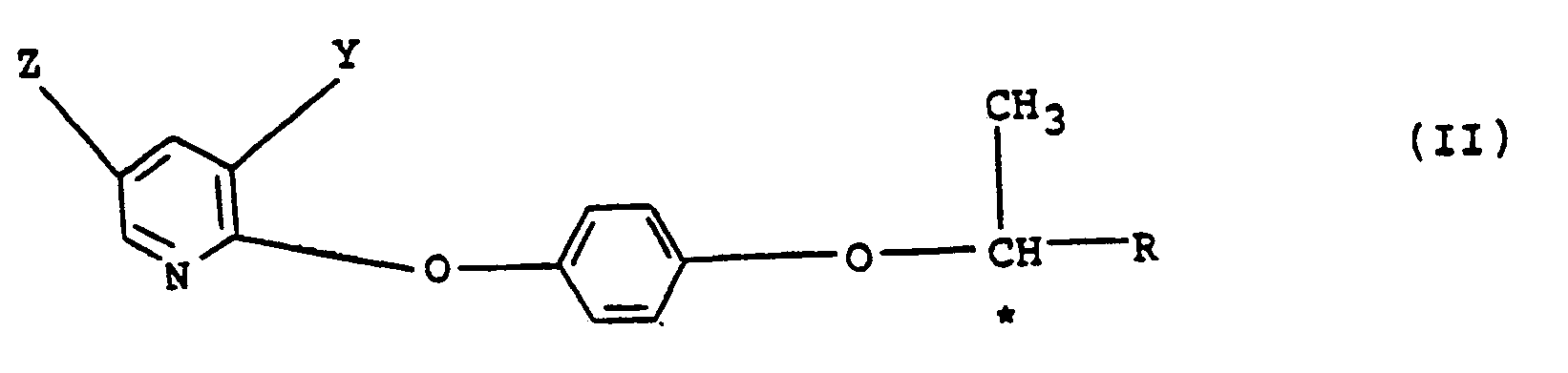
- the present invention provides a process for the stereospecific inversion of the [S] enantiomer of an a-aryloxypropionic acid of formula I: wherein E is OR 1 or R 1 is an unsubstituted or substituted aryl or heterocyclic ring system and R 2 is hydrogen or methyl, U and V each independently represent hydrogen or halogen and R is a carboxyl group, or an enzymic and herbicidal equivalent thereof, which process comprises contacting said [S] enantiomer with a microorganism having a stereospecific inverting enzyme system, or with an extract of the microorganism containing said enzyme system, to convert the [S] enantiomer to the corresponding [R] enantiomer.
- a-Aryloxypropionic acids to which the present process may be applied are disclosed e.g. in European patent applications publication Nos. 0001473, 0000483, 0003114, 0023785, 0060607, 0029319, 0063866, 0024931, 0002800, 0075840 and Belgian patent no. 876077, the disclosures of which applications are incorporated herein by reference.
- Z is trifluoromethyl and Y is hydrogen, chlorine or fluorine.
- one of B and D is halogen e.g. chlorine or fluorine and the other hydrogen
- J is hydrogen and either U and V are both hydrogen or one is halogen e.g. chlorine or fluorine, preferably in the 2-position, and the other is hydrogen.
- B is hydrogen and D (6-position) is halogen
- D is hydrogen and B (7-position) is halogen.
- one of P and Q is preferably halogen e.g. chlorine, particularly Q (7- position) and n is preferably 1.
- one of P and Q' is preferably halogen e.g. chlorine, particularly Q (6- position) when T is -0- an P (5-position) when T is
- a and C are preferably both halogen e.g. chlorine or A is halogen e.g. bromine and C is nitro or A is trifluoromethyl and C is hydrogen or halogen e.g. chlorine.
- A is preferably trifluoromethyl.
- one of P and Q is preferably halogen e.g. chlorine, particularly Q (5- position) when T is -0- and P (6-position) when T is
- preferred R 1 groups have up to 20 e.g. 3 to 10 carbon atoms and 0 to 6 e.g. 0 to 3 heteroatoms such as O, N or S.
- examples are: optionally substituted phenyl, pyridyl, quinazolinyl, quinolinyl, benztriazinyl(-N-oxide), benzthiazolyl and benzoxazolyl, in particular those R 1 groups in formulae II to IX above.
- U and V as halogen are preferably chlorine or fluorine.
- the [S] enantiomer While it is possible to carry out the process of the invention using an [S] enantiomer in the substantial absence of the [R] enantiomer, the [S] enantiomer will normally be provided as part of the racemate of the particular a-aryloxypropionic acid or equivalent compound. As the enzyme system is stereoselective for the [S] enantiomer and the [R] enantiomer is not significantly altered by it, the resulting mixture is enriched in respect of the active [R] enantiomer. Thus, the resulting product formed from the racemate will certainly contain at least 50% of the [R] enantiomer and will normally contain at least 75%, preferably at least 90% up to, in theory, 100% of the [R] enantiomer.
- the inversion is performed in the presence of the stereospecific inverting enzyme system which may, if desired, be completely or partially extracted from the micro-organism in which it occurs (i.e. in pure or crude form) and may optionally be immobilised.
- the enzyme is present together with at least some of the cellular components of the micro-organism to obviate the need for special separation steps and enzyme purification and/or enzyme immobilisation procedures.
- the enzyme must be provided in an active and stable form in which the reaction will proceed and, when present in association with the cells, these may in theory be live or dead and be intact, detergent-treated, autolysed or immobilised cells. If desired the detergent-treated autolysed or immobilised cells may be homogenised.
- Particular methods of immobilising microbial cells include: binding to water-insoluble ion exchangers, via ionic bonds; cross-linking of the cells with a bifunctional reagent e.g. glutaraldehyde; entrapping into a natural or synthetic polymer matrix where they are physically restrained, e.g. using polyacrylamide, collagen, cellulose triacetate, agar, alginate such as calcium alginate, or polystyrene; binding to membrane reactors; liquid membrane encapsulation; polyelectrolyte flocculation; heat treatment and irradiation.
- a bifunctional reagent e.g. glutaraldehyde
- entrapping into a natural or synthetic polymer matrix where they are physically restrained e.g. using polyacrylamide, collagen, cellulose triacetate, agar, alginate such as calcium alginate, or polystyrene
- binding to membrane reactors liquid membrane encapsulation
- an enzyme system to cover the enzyme or enzymes needed for the reaction or reactions which achieve inversion and the possibility of other substances present in the intact micro-organism e.g. cofactors or coenzymes such as NADH or metal ions being required for efficient operation of the enzyme.
- esters are the methyl, n-butyl and ethoxyethyl esters of the acids of formula II when one of Z and Y is a halogenomethyl group and the propargyl ester of the acids of formula II when Z and Y are both chlorine; the ethyl or n-propyl ester of the acids of formulae III and IV; the isopropyl ester of the acid of formula V; the methyl and ethyl esters of the acids of formula VI, VII and VIII and the methyl, ethyl and butyl esters of the acids of formula IX.
- compounds of formula II to IX with slight changes in substitution, particularly in the rings, where these substituents do not alter substantially the enzyme recognition and the herbicidal activity or function of the compound.
- the inversion reaction occurring in the process of this invention has been deduced from observations made in soil from many parts of the world. Many different soil micro-organisms may therefore potentially possess the ability to carry out the inversion.
- bacteria especially the Actinomycetales and related organisms in particular the Rhodococci, though it is also possible to use fungi.
- NCIMB National Collections of Industrial and Marine Bacteria
- strain NCIB 11880 The general characteristics of the strain NCIB 11880 are:
- This micro-organism NCIB 11880 per se forms a further subject of the present invention.
- compositions with a solid or liquid diluent or as a culture in a culture medium e.g. containing a source of assimilable carbon, a source of nitrogen and, if desired, vitamins and inorganic salts and/or substantially free from other micro-organisms.
- a culture medium e.g. containing a source of assimilable carbon, a source of nitrogen and, if desired, vitamins and inorganic salts and/or substantially free from other micro-organisms.
- microbiological characteristics of this strain place it in the genus Rhodococcus sp. according to a preliminary study carried out by the NCIMB. Irrespective of its strict name, the micro-organism is adequately identified by the properties given here and the details of the deposit made at the NCIMB.
- Rhodococcus rhodochrous ATCC 13808
- a Rhodococcus sp. NCIB 11276
- Botrytis cinerea ATCC 28387
- Arthrobacter simplex NCIB 8929
- Arthrobacter roseoparaffinus ATCC 15584
- Bacillus subtilis ATCC 15841
- Brevibacterium butanicum ATCC 21196
- Brevibacterium healii ATCC 15527
- Brevibacterium ketoglutamicum ATCC 21004
- Brevibacterium paraffinoliticum NCIB 11160
- Corynebacterium fujiokense ATCC 21496
- Mycobacterium petroleophilum ATCC 21497
- Mycobacterium smegmatis ATCC 19420
- Nocardiopsis asteroides ATCC 21943
- Rhodococcus rhodochrous NCIB 11273
- the exact method of contacting the [S] enantiomer (usually in a mixture with the R enantiomer) with the microorganism or extracted enzyme system may be chosen for convenience. Clearly the contact must be of sufficient duration for the transformation (inversion) to occur.
- the contact is with immobilised whole cells, these are packed into a column and the [S] enantiomer passed through the column either in a batchwise or preferably, a continuous or semi-continuous process with the inverted [R] enantiomer being recovered at the bottom of the column.
- the column dimensions, rate of flow, substrate concentration, solvent and conditions of temperature and pH can be selected to give optimum yield of the [R] enantiomer.
- the [S] enantiomer may also be separated in a column process or alternatively may be added to the culture and the product separated batchwise from the culture after a suitable period.
- the temperature employed will be in the range 20° to 45°C, preferably 28° to 37°C, especially about 32°C, while the pH will generally be 5 to 9, preferably 6 to 7.5, especially 6.8 to 7.2.
- the [R] enantiomers of formulae to IX produced by the process of this invention are active herbicides and are particularly useful in post-emergence control of graminaceous weeds in broad-leafed crops.
- Such a further process step may for example be a salification or esterification where the compound has undergone inversion in the form of its acid.
- the acids of formulae II to IX are preferably esterified to produce the preferred esters indicated hereinbefore.
- esterification are alkylation of 2[4(5-trifluoromethylpyridyl-2-oxy)phenoxy]propionic acid and 2[4(3-chloro-5-trifluoromethylpyridyl-2- oxy)phenoxy]propionic acid, in particular to make the n-butyl ester of the former and the methyl, propyl or ethoxyethyl ester of the latter.
- the direct or indirect products of the present inversion process are capable of inhibiting the growth of unwanted graminaceous plants when applied in a herbicidally effective amount, and, in particular, can inhibit the growth of graminaceous weeds among dicotyledonous crop plants if applied to the area of a crop in an amount sufficient to inhibit the growth of the weeds but insufficient to damage the crop substantially.
- the rate at which the compounds are usually applied in inhibiting the growth of weeds will depend upon factors such as the identity of the particular graminaceous weeds and broad-leafed crop, but in general 0.025 to 2.5 kg per hectare is suitable, with 0.1 to 1 kg per hectare being preferred.
- the direct or indirect products are usually applied in herbicidal compositions, comprising the products as active ingredient together with a suitable solid or liquid diluent and optionally a further herbicidal compound or compounds, either having a similar spectrum of activity or a complementary activity to that of the first active compound.
- a pure liquid culture of NCIB 11880 was grown aerobically in the dark in dextrose-peptone broth medium at 28°C using an orbital shaker at 200 rpm. After 2 days, RS 2[4(5-trifluoromethylpyridyl-2-oxy)-phenoxy]propionic acid (100 pg) was inoculated into the culture and after a further 3 days the product was stereoselectively analysed by high performance liquid chromatography (HPLC) using a method based on that of Y Tapuhi et a/ in J. Chromatography 205 325 ⁇ 337.
- HPLC high performance liquid chromatography
- Cells of NCIB 11880 were immobilised in a calcium alginate gel matrix and tested, as in Example 1, for their ability to invert [S]-2[4(5-trifluoromethylpyridyl-2-oxylphenoxy] propionic acid.
- the activities of the freshly prepared immobilised cells (-5% wet cells in calcium alginate) and a suspension of cells in CaC1 2 solution were compared to that of a viable culture containing (initially) the same quantity of microbial biomass.
- the systems all showed activity and exhibited pseudo first order kinetics (t, values for the immobilised, suspended and cultured cells were approximately 8, 6 and 4 hours respectively).
- Example 1 was repeated using as substrate RS 2[4(3-chloro-5-trifluoromethylpyridyl-2-oxy)phenoxy]-propionic acid. The analgous inversion of the [S]-enantiomer was observed and the rate and extent of the reaction were similar.
- a 50 pg/ml solution (A) of RS 2[4(5-trifluoromethylpyridyl-2-oxy)phenoxy]propionic acid in dextrose-peptone broth was prepared and a plate culture of Rhodococcus rhodochrous (ATCC 13808) was grown for 2 days in dextrose-peptone broth at 37°C without shaking. 2 ml of the solution (A) was transferred to a sterile test base and inoculated with the microorganism culture via a sterile loop which was then further incubated at 37°C for 7 days.
- Example 4 The procedure of Example 4 was repeated but using the following microorganisms to give the indicated percentage [R] enantiomer in the products. (The reaction temperature was, however, 28°C rather than 37°C except in the case of the asterisked microorganisms).
- Example 4 The procedure of Example 4 was repeated using the substrates and microorganisms indicated below to give the indicated percentage [R] enantiomer in the products.
Landscapes
- Chemical & Material Sciences (AREA)
- Organic Chemistry (AREA)
- Life Sciences & Earth Sciences (AREA)
- Engineering & Computer Science (AREA)
- Zoology (AREA)
- Wood Science & Technology (AREA)
- Health & Medical Sciences (AREA)
- General Engineering & Computer Science (AREA)
- General Chemical & Material Sciences (AREA)
- Chemical Kinetics & Catalysis (AREA)
- Biotechnology (AREA)
- Biochemistry (AREA)
- Bioinformatics & Cheminformatics (AREA)
- Microbiology (AREA)
- General Health & Medical Sciences (AREA)
- Genetics & Genomics (AREA)
- Proteomics, Peptides & Aminoacids (AREA)
- Analytical Chemistry (AREA)
- Preparation Of Compounds By Using Micro-Organisms (AREA)
- Agricultural Chemicals And Associated Chemicals (AREA)
Claims (14)



Applications Claiming Priority (4)
| Application Number | Priority Date | Filing Date | Title |
|---|---|---|---|
| GB8320222 | 1983-07-27 | ||
| GB838320222A GB8320222D0 (en) | 1983-07-27 | 1983-07-27 | Process ii |
| GB8329086 | 1983-11-01 | ||
| GB838329086A GB8329086D0 (en) | 1983-11-01 | 1983-11-01 | Process iv |
Publications (3)
| Publication Number | Publication Date |
|---|---|
| EP0133034A2 EP0133034A2 (fr) | 1985-02-13 |
| EP0133034A3 EP0133034A3 (en) | 1987-04-15 |
| EP0133034B1 true EP0133034B1 (fr) | 1990-04-18 |
Family
ID=26286695
Family Applications (2)
| Application Number | Title | Priority Date | Filing Date |
|---|---|---|---|
| EP84305113A Expired - Lifetime EP0133033B1 (fr) | 1983-07-27 | 1984-07-27 | Procédé de production d'acides aryloxypropioniques optiquement actifs et dérivés de ceux-ci |
| EP84305114A Expired - Lifetime EP0133034B1 (fr) | 1983-07-27 | 1984-07-27 | Procédé de production d'acides aryloxypropioniques optiquement actifs et dérivés de ceux-ci, utilisés comme herbicides |
Family Applications Before (1)
| Application Number | Title | Priority Date | Filing Date |
|---|---|---|---|
| EP84305113A Expired - Lifetime EP0133033B1 (fr) | 1983-07-27 | 1984-07-27 | Procédé de production d'acides aryloxypropioniques optiquement actifs et dérivés de ceux-ci |
Country Status (5)
| Country | Link |
|---|---|
| US (2) | US4568641A (fr) |
| EP (2) | EP0133033B1 (fr) |
| AU (2) | AU587366B2 (fr) |
| CA (2) | CA1215924A (fr) |
| DE (2) | DE3485198D1 (fr) |
Cited By (1)
| Publication number | Priority date | Publication date | Assignee | Title |
|---|---|---|---|---|
| WO2015131019A1 (fr) * | 2014-02-28 | 2015-09-03 | The Texas A&M University System | Compositions et méthodes d'inhibition de mycobactéries |
Families Citing this family (22)
| Publication number | Priority date | Publication date | Assignee | Title |
|---|---|---|---|---|
| CA1215924A (fr) * | 1983-07-27 | 1986-12-30 | David W. Bewick | Preparation d'acides aryloxypropioniques optiquement actifs et de leurs derives, utiles comme herbicides |
| NL8403093A (nl) * | 1984-10-11 | 1986-05-01 | Stamicarbon | Werkwijze voor de enzymatische hydrolyse van d-alfa-aminozuuramiden. |
| IT1201408B (it) * | 1985-03-22 | 1989-02-02 | Montedison Spa | Processo per la preparazione biotecnologica di acidi alfa-arilalcanoici otticamente attivi |
| DE3532026A1 (de) * | 1985-09-09 | 1987-03-19 | Hoechst Ag | Verfahren zur herstellung optisch aktiver (alpha)-phenoxypropionsaeure und deren derivate |
| GB8600245D0 (en) * | 1986-01-07 | 1986-02-12 | Shell Int Research | Preparation of 2-arylpropionic acids |
| CH679396A5 (fr) * | 1986-06-12 | 1992-02-14 | Ciba Geigy Ag | |
| US4800162A (en) * | 1987-04-01 | 1989-01-24 | Sepracor, Inc. | Method for resolution of steroisomers in multiphase and extractive membrane reactors |
| GB8715574D0 (en) * | 1987-07-02 | 1987-08-12 | Shell Int Research | 2-aryloxypropionic acids |
| JP2691986B2 (ja) * | 1987-08-28 | 1997-12-17 | チッソ株式会社 | ピリジン骨格を有する光学活性化合物の製造法 |
| GB8728064D0 (en) * | 1987-12-01 | 1988-01-06 | Shell Int Research | Process for preparation of substituted phenoxy propanoic acids |
| DE68926521T2 (de) * | 1988-04-21 | 1996-09-26 | Gist Brocades Nv | Verfahren zur Herstellung von optisch aktiver 2-Arylpropionsäure |
| DE3910024A1 (de) * | 1989-03-28 | 1990-10-11 | Basf Ag | Verfahren zur fermentativen herstellung von 2-(4-hydroxipenoxi-)propionsaeure |
| US5147791A (en) * | 1989-04-06 | 1992-09-15 | University Of New Mexico | Enzyme catalyzed synthesis of polyesters |
| DE69432576T2 (de) * | 1993-02-15 | 2004-03-18 | Daicel Chemical Industries, Ltd., Sakai | Verfahren zur Herstellung von optischaktiven Epoxiden |
| US6201151B1 (en) * | 1998-12-17 | 2001-03-13 | National Science Council Of Republic Of China | Processes for preparing optically active (S)-α-aryl propionic acid or ester therof |
| US6365399B1 (en) | 1999-08-09 | 2002-04-02 | Sumitomo Chemical Company, Limited | Process for producing carboxylic acid isomer using Nocardia diaphanozonaria or Saccharopolyspora hirsuta |
| DE10260456A1 (de) * | 2002-12-18 | 2004-07-08 | Ufz-Umweltforschungszentrum Leipzig-Halle Gmbh | Mutanten des Bakterienstammes Delftia acidovorans MC1 und deren Verwendung zur Produktion von hochreinen R-Enantiomeren von 2-Phenoxypropionsäure-Derivaten |
| US7258226B2 (en) * | 2003-10-14 | 2007-08-21 | The Boc Group, Inc. | Self-stacking spiral conveyor with modular drive system |
| EP2052607A1 (fr) | 2007-10-24 | 2009-04-29 | Bayer CropScience AG | Combinaison d'herbicide |
| DE102008037622A1 (de) * | 2008-08-14 | 2010-02-25 | Bayer Cropscience Ag | Herbizid-Kombination mit Dimethoxytriazinyl-substituierten Difluormethansulfonylaniliden |
| CN102986724A (zh) * | 2012-11-26 | 2013-03-27 | 洪仁作 | 一种林业除草剂 |
| CN103329906A (zh) * | 2013-06-07 | 2013-10-02 | 安徽嘉联生物科技有限公司 | 一种用于防除花生田杂草的除草剂 |
Family Cites Families (7)
| Publication number | Priority date | Publication date | Assignee | Title |
|---|---|---|---|---|
| CH628009A5 (de) * | 1977-07-26 | 1982-02-15 | Hoffmann La Roche | Verfahren zur herstellung von optisch aktiven alpha-hydroxycarbonsaeuren. |
| CH650493A5 (en) * | 1977-12-24 | 1985-07-31 | Hoechst Ag | D-(+)-alpha-phenoxypropionic acid derivatives |
| NZ199342A (en) * | 1981-01-12 | 1985-08-16 | Ici Australia Ltd | Quinoxaline derivatives and herbicides |
| JPS57186495A (en) * | 1981-05-14 | 1982-11-16 | Ube Ind Ltd | Preparation of l-alpha-methylphenylalanine |
| JPS58126792A (ja) * | 1982-01-25 | 1983-07-28 | Kaken Pharmaceut Co Ltd | 微生物による光学活性物質の製法 |
| US4461835A (en) * | 1982-07-02 | 1984-07-24 | Wisconsin Alumni Research Foundation | Process for preparing optically-active isoprenoid intermediates |
| CA1215924A (fr) * | 1983-07-27 | 1986-12-30 | David W. Bewick | Preparation d'acides aryloxypropioniques optiquement actifs et de leurs derives, utiles comme herbicides |
-
1984
- 1984-07-26 CA CA000459750A patent/CA1215924A/fr not_active Expired
- 1984-07-26 CA CA000459749A patent/CA1230569A/fr not_active Expired
- 1984-07-26 AU AU31185/84A patent/AU587366B2/en not_active Ceased
- 1984-07-26 AU AU31186/84A patent/AU587961B2/en not_active Ceased
- 1984-07-26 US US06/634,492 patent/US4568641A/en not_active Expired - Fee Related
- 1984-07-26 US US06/634,491 patent/US4565782A/en not_active Expired - Fee Related
- 1984-07-27 DE DE8484305113T patent/DE3485198D1/de not_active Expired - Lifetime
- 1984-07-27 EP EP84305113A patent/EP0133033B1/fr not_active Expired - Lifetime
- 1984-07-27 EP EP84305114A patent/EP0133034B1/fr not_active Expired - Lifetime
- 1984-07-27 DE DE8484305114T patent/DE3481997D1/de not_active Expired - Lifetime
Cited By (2)
| Publication number | Priority date | Publication date | Assignee | Title |
|---|---|---|---|---|
| WO2015131019A1 (fr) * | 2014-02-28 | 2015-09-03 | The Texas A&M University System | Compositions et méthodes d'inhibition de mycobactéries |
| US10300071B2 (en) | 2014-02-28 | 2019-05-28 | The Texas A&M University System | Compositions and methods for inhibition of mycobacteria |
Also Published As
| Publication number | Publication date |
|---|---|
| AU587961B2 (en) | 1989-09-07 |
| DE3485198D1 (de) | 1991-11-28 |
| EP0133034A2 (fr) | 1985-02-13 |
| DE3481997D1 (de) | 1990-05-23 |
| AU587366B2 (en) | 1989-08-17 |
| CA1230569A (fr) | 1987-12-22 |
| CA1215924A (fr) | 1986-12-30 |
| EP0133033A3 (en) | 1987-04-15 |
| AU3118684A (en) | 1985-01-31 |
| EP0133034A3 (en) | 1987-04-15 |
| US4568641A (en) | 1986-02-04 |
| US4565782A (en) | 1986-01-21 |
| EP0133033B1 (fr) | 1991-10-23 |
| EP0133033A2 (fr) | 1985-02-13 |
| AU3118584A (en) | 1985-01-31 |
Similar Documents
| Publication | Publication Date | Title |
|---|---|---|
| EP0133034B1 (fr) | Procédé de production d'acides aryloxypropioniques optiquement actifs et dérivés de ceux-ci, utilisés comme herbicides | |
| JP2623345B2 (ja) | 光学活性なα―置換有機酸の製造方法 | |
| WO1986007386A1 (fr) | Procede de preparation de composes organiques optiquement actifs | |
| IE61983B1 (en) | Microbial esterase and process for the preparation of 2-arylpropionic acids | |
| CA2103932A1 (fr) | Reduction stereoselective de cetones | |
| US4497957A (en) | Process for preparing optically active tryptophans | |
| US4758518A (en) | D-2-haloalkanoic acid halidohydrolase | |
| EP0264457A1 (fr) | Procede pour preparer des acides cyclopropanecarboxyliques optiquement actifs | |
| EP0417785B1 (fr) | Procédé de préparation d'esters de l'acide 3-phénylglycidique optiquement actifs | |
| WO1992001062A1 (fr) | Procede destine a la production d'enatiomeres d'acides 2-aryle-alcanoïque | |
| US5180671A (en) | Method for producing optically active cyclopropane carboxylic acid | |
| EP0299559B1 (fr) | Procédé de préparation d'acides 2-aroyloxypropioniques | |
| US6165777A (en) | Process for the resolution of cis 1,2-indane diols using Pseudomonas putida | |
| CZ281198A3 (cs) | Způsob výroby N-chráněných derivátů D-prolinu | |
| EP0751224B1 (fr) | Procede de fabrication de (r)-2amino-1-phenylethanol ou de ses derives halogenes, procede de fabrication de phenylserine a activite optique ou de ses derives halogenes et nouveau compose de 3-(3-chlorophenyl)serine | |
| Ujimaru et al. | l-Tryptophan production by Achromobacter liquidum | |
| JPS6043389A (ja) | 光学活性のあるアリ−ルオキシプロピオン酸及びこれの誘導体の製造法 | |
| Sambale et al. | Microbial hydrolysis of amino acid carbamates | |
| JP2639651B2 (ja) | 光学活性カルボン酸及びその対掌体エステルの製造法 | |
| GB2218985A (en) | Producing optically active 2-aryloxypropionic acids | |
| JPH02240045A (ja) | 光学活性な4―ヒドロキシ―2―シクロペンテノン類の分離法 | |
| JP2002142793A (ja) | 光学活性アミン類の製造方法 | |
| JPH05192190A (ja) | 光学活性なカルボン酸誘導体の製造方法 | |
| JPS61257196A (ja) | 2−オキソ−オキサゾリジン−4−カルボン酸のラセミ化法 |
Legal Events
| Date | Code | Title | Description |
|---|---|---|---|
| PUAI | Public reference made under article 153(3) epc to a published international application that has entered the european phase |
Free format text: ORIGINAL CODE: 0009012 |
|
| AK | Designated contracting states |
Designated state(s): BE CH DE FR GB IT LI NL SE |
|
| PUAL | Search report despatched |
Free format text: ORIGINAL CODE: 0009013 |
|
| AK | Designated contracting states |
Kind code of ref document: A3 Designated state(s): BE CH DE FR GB IT LI NL SE |
|
| 17P | Request for examination filed |
Effective date: 19870917 |
|
| 17Q | First examination report despatched |
Effective date: 19890209 |
|
| GRAA | (expected) grant |
Free format text: ORIGINAL CODE: 0009210 |
|
| AK | Designated contracting states |
Kind code of ref document: B1 Designated state(s): BE CH DE FR GB IT LI NL SE |
|
| PG25 | Lapsed in a contracting state [announced via postgrant information from national office to epo] |
Ref country code: SE Effective date: 19900418 |
|
| ITF | It: translation for a ep patent filed | ||
| REF | Corresponds to: |
Ref document number: 3481997 Country of ref document: DE Date of ref document: 19900523 |
|
| ET | Fr: translation filed | ||
| PLBE | No opposition filed within time limit |
Free format text: ORIGINAL CODE: 0009261 |
|
| STAA | Information on the status of an ep patent application or granted ep patent |
Free format text: STATUS: NO OPPOSITION FILED WITHIN TIME LIMIT |
|
| 26N | No opposition filed | ||
| PGFP | Annual fee paid to national office [announced via postgrant information from national office to epo] |
Ref country code: DE Payment date: 19920617 Year of fee payment: 9 Ref country code: CH Payment date: 19920617 Year of fee payment: 9 |
|
| PGFP | Annual fee paid to national office [announced via postgrant information from national office to epo] |
Ref country code: BE Payment date: 19920623 Year of fee payment: 9 |
|
| PGFP | Annual fee paid to national office [announced via postgrant information from national office to epo] |
Ref country code: GB Payment date: 19920626 Year of fee payment: 9 |
|
| PGFP | Annual fee paid to national office [announced via postgrant information from national office to epo] |
Ref country code: FR Payment date: 19920728 Year of fee payment: 9 |
|
| ITTA | It: last paid annual fee | ||
| PGFP | Annual fee paid to national office [announced via postgrant information from national office to epo] |
Ref country code: NL Payment date: 19920731 Year of fee payment: 9 |
|
| PG25 | Lapsed in a contracting state [announced via postgrant information from national office to epo] |
Ref country code: GB Effective date: 19930727 |
|
| PG25 | Lapsed in a contracting state [announced via postgrant information from national office to epo] |
Ref country code: LI Effective date: 19930731 Ref country code: CH Effective date: 19930731 Ref country code: BE Effective date: 19930731 |
|
| REG | Reference to a national code |
Ref country code: GB Ref legal event code: 732E |
|
| BERE | Be: lapsed |
Owner name: IMPERIAL CHEMICAL INDUSTRIES P.L.C. Effective date: 19930731 |
|
| PG25 | Lapsed in a contracting state [announced via postgrant information from national office to epo] |
Ref country code: NL Effective date: 19940201 |
|
| NLV4 | Nl: lapsed or anulled due to non-payment of the annual fee | ||
| GBPC | Gb: european patent ceased through non-payment of renewal fee |
Effective date: 19930727 |
|
| PG25 | Lapsed in a contracting state [announced via postgrant information from national office to epo] |
Ref country code: FR Effective date: 19940331 |
|
| REG | Reference to a national code |
Ref country code: CH Ref legal event code: PL |
|
| PG25 | Lapsed in a contracting state [announced via postgrant information from national office to epo] |
Ref country code: DE Effective date: 19940401 |
|
| REG | Reference to a national code |
Ref country code: FR Ref legal event code: ST |