EP0135689A1 - Procédé et dispositif d'isolation par imprégnation d'un bobinage, et vernis sans solvant stabilisé utilisable dans ce procédé et ce dispositif - Google Patents
Procédé et dispositif d'isolation par imprégnation d'un bobinage, et vernis sans solvant stabilisé utilisable dans ce procédé et ce dispositif Download PDFInfo
- Publication number
- EP0135689A1 EP0135689A1 EP84108044A EP84108044A EP0135689A1 EP 0135689 A1 EP0135689 A1 EP 0135689A1 EP 84108044 A EP84108044 A EP 84108044A EP 84108044 A EP84108044 A EP 84108044A EP 0135689 A1 EP0135689 A1 EP 0135689A1
- Authority
- EP
- European Patent Office
- Prior art keywords
- varnish
- organic
- ribbon
- benzyl
- isocyanate
- Prior art date
- Legal status (The legal status is an assumption and is not a legal conclusion. Google has not performed a legal analysis and makes no representation as to the accuracy of the status listed.)
- Granted
Links
Classifications
-
- C—CHEMISTRY; METALLURGY
- C08—ORGANIC MACROMOLECULAR COMPOUNDS; THEIR PREPARATION OR CHEMICAL WORKING-UP; COMPOSITIONS BASED THEREON
- C08G—MACROMOLECULAR COMPOUNDS OBTAINED OTHERWISE THAN BY REACTIONS ONLY INVOLVING UNSATURATED CARBON-TO-CARBON BONDS
- C08G18/00—Polymeric products of isocyanates or isothiocyanates
- C08G18/003—Polymeric products of isocyanates or isothiocyanates with epoxy compounds having no active hydrogen
-
- H—ELECTRICITY
- H01—ELECTRIC ELEMENTS
- H01B—CABLES; CONDUCTORS; INSULATORS; SELECTION OF MATERIALS FOR THEIR CONDUCTIVE, INSULATING OR DIELECTRIC PROPERTIES
- H01B3/00—Insulators or insulating bodies characterised by the insulating materials; Selection of materials for their insulating or dielectric properties
- H01B3/18—Insulators or insulating bodies characterised by the insulating materials; Selection of materials for their insulating or dielectric properties mainly consisting of organic substances
- H01B3/30—Insulators or insulating bodies characterised by the insulating materials; Selection of materials for their insulating or dielectric properties mainly consisting of organic substances plastics; resins; waxes
-
- H—ELECTRICITY
- H01—ELECTRIC ELEMENTS
- H01B—CABLES; CONDUCTORS; INSULATORS; SELECTION OF MATERIALS FOR THEIR CONDUCTIVE, INSULATING OR DIELECTRIC PROPERTIES
- H01B3/00—Insulators or insulating bodies characterised by the insulating materials; Selection of materials for their insulating or dielectric properties
- H01B3/18—Insulators or insulating bodies characterised by the insulating materials; Selection of materials for their insulating or dielectric properties mainly consisting of organic substances
- H01B3/30—Insulators or insulating bodies characterised by the insulating materials; Selection of materials for their insulating or dielectric properties mainly consisting of organic substances plastics; resins; waxes
- H01B3/40—Insulators or insulating bodies characterised by the insulating materials; Selection of materials for their insulating or dielectric properties mainly consisting of organic substances plastics; resins; waxes epoxy resins
-
- Y—GENERAL TAGGING OF NEW TECHNOLOGICAL DEVELOPMENTS; GENERAL TAGGING OF CROSS-SECTIONAL TECHNOLOGIES SPANNING OVER SEVERAL SECTIONS OF THE IPC; TECHNICAL SUBJECTS COVERED BY FORMER USPC CROSS-REFERENCE ART COLLECTIONS [XRACs] AND DIGESTS
- Y10—TECHNICAL SUBJECTS COVERED BY FORMER USPC
- Y10T—TECHNICAL SUBJECTS COVERED BY FORMER US CLASSIFICATION
- Y10T428/00—Stock material or miscellaneous articles
- Y10T428/25—Web or sheet containing structurally defined element or component and including a second component containing structurally defined particles
- Y10T428/251—Mica
-
- Y—GENERAL TAGGING OF NEW TECHNOLOGICAL DEVELOPMENTS; GENERAL TAGGING OF CROSS-SECTIONAL TECHNOLOGIES SPANNING OVER SEVERAL SECTIONS OF THE IPC; TECHNICAL SUBJECTS COVERED BY FORMER USPC CROSS-REFERENCE ART COLLECTIONS [XRACs] AND DIGESTS
- Y10—TECHNICAL SUBJECTS COVERED BY FORMER USPC
- Y10T—TECHNICAL SUBJECTS COVERED BY FORMER US CLASSIFICATION
- Y10T428/00—Stock material or miscellaneous articles
- Y10T428/31504—Composite [nonstructural laminate]
- Y10T428/31547—Of polyisocyanurate
-
- Y—GENERAL TAGGING OF NEW TECHNOLOGICAL DEVELOPMENTS; GENERAL TAGGING OF CROSS-SECTIONAL TECHNOLOGIES SPANNING OVER SEVERAL SECTIONS OF THE IPC; TECHNICAL SUBJECTS COVERED BY FORMER USPC CROSS-REFERENCE ART COLLECTIONS [XRACs] AND DIGESTS
- Y10—TECHNICAL SUBJECTS COVERED BY FORMER USPC
- Y10T—TECHNICAL SUBJECTS COVERED BY FORMER US CLASSIFICATION
- Y10T442/00—Fabric [woven, knitted, or nonwoven textile or cloth, etc.]
- Y10T442/30—Woven fabric [i.e., woven strand or strip material]
- Y10T442/3927—Including a paper or wood pulp layer
- Y10T442/3935—Mica paper layer
Definitions
- the present invention relates to a method of insulating by impregnating an electric coil using resins with isocyanurate and oxazolidone cycles, in which a ribbon of glass fabric and porous mica paper loaded with a quaternary ammonium salt catalyzing the condensation of isocyanate and epoxy derivatives in isocyanurate and oxazolidone rings, the ribbon is impregnated with a varnish comprising an isocyanate derivative and a liquid epoxy resin, then the impregnated ribbon is subjected to a polymerization heat treatment some nail polish. It further extends to an insulation device obtained by this process, and to a solvent-free varnish usable in this process and this device.
- the quaternary ammonium salts containing a long-chain alkyl radical are very soluble in the impregnation resin of the ribbon, so that they easily migrate from the ribbon into the impregnation bath and that they produce an increase in viscosity premature varnish during the impregnation operation, which is carried out by successive alternating vacuum operations, then under pressure, which results in a more difficult and imperfect impregnation.
- solvent-free varnishes based on isocyanate and epoxy derivatives exhibit a gradual increase in viscosity at storage, which reduces their possible shelf life in barrels and tanks.
- the object of the invention is therefore to provide a method making it possible to avoid any premature increase in the viscosity of the impregnating resin of the ribbon, and thus ensuring a relatively easy and very homogeneous impregnation, as well as a device obtained by this method. . It also aims to allow the conservation of varnishes based on isocyanate and epoxy derivatives for long periods of storage before their use.
- the process according to the invention is characterized in that a catalyst benzyl trialkylammonium halide containing an alkyl chain containing at most 3 carbon atoms is used as the quaternary ammonium catalyst salt.
- the invention also extends to a solvent-free varnish based on isocyanate derivatives and on liquid epoxy resins stabilized against the increase in viscosity during storage, characterized in that it contains from 0.02 to 1% by weight, and preferably from 0.05 to 0.3% by weight, reported where the total mass of the varnish, of an inhibitor consisting of a mineral or organic acid or an organic anhydride, or else an organic compound capturing electrons 1'r.
- the inhibitor consists of a compound from the group formed by phosphoric acid, maleic anhydride, acetic anhydride, phthalic anhydride, hydroquinone, benzoquinone and azobisisobutyrolactone.
- the isocyanates can be used alone or in mixtures.
- Benzyltrimethylammonium chloride as catalyst lies in its total insolubility in the impregnation varnish up to a temperature of 100 ° C.
- Benzyl triethylammonium chloride can also be used advantageously, but it has a slight solubility in the impregnation varnish at around 60 ° C.
- the insulation device by impregnation of an electric coil according to the invention comprising a ribbon of glass fabric and porous mica paper loaded with a quaternary ammonium salt catalyzing the condensation of isocyanate and epoxy derivatives in isocyanurate cycles and oxazolidones, impregnated with a varnish formed from an isocyanate derivative and a liquid epoxy resin, hardened by heat treatment mique in the presence of quaternary ammonium salt, is characterized in that the quaternary ammonium salt is an alkyl chain benzyl trialkylammonium halide containing at most 3 carbon atoms.
- a so-called "porous" ribbon is impregnated formed from mica paper and a glass cloth bonded with an epoxy resin to the mica paper, containing 1 g / m 2 of benzyltrimethylammonium chloride, with a varnish composed of:
- This varnish exhibits only a slight variation in viscosity after storage for 100 days at room temperature, while we observe for the same varnish not containing benzoquinone, a doubling of the viscosity in less than 20 days.
- This varnish can be used to impregnate a porous tape formed of mica paper and a glass cloth, glued by an epoxy resin on the mica paper, containing 1 g / m of benzyltrimethylammonium chloride, instead of varnishes stabilized by an organic anhydride from Examples 1 to 8.
- This varnish does not show any change in viscosity after 100 days of storage at room temperature, while the same varnish without benzoquinone observed a doubling of viscosity in 40 days.
- This varnish can be used like that of Example 9.
- This varnish can be used like those of Examples 9 and 10.
- the tank is then returned to atmospheric pressure, then brought to a pressure of 6 bars for at least one hour.
- the vacuum-pressurization cycle is carried out 3 times in succession, then ends with venting at the end of the 3rd pressurization phase.
- the notch must be embedded in the varnish.
- the resin is then polymerized by placing the notch containing the impregnated bar in an oven where it is brought to the temperature of 130 ° C. in 1 hour 30 minutes. After a plateau of 2 hours at 130 ° C., the temperature is brought to 150 ° C, where a 4h stage takes place.
- the treatment ends with a 15h post-baking at 200 ° C.
Landscapes
- Chemical & Material Sciences (AREA)
- Spectroscopy & Molecular Physics (AREA)
- Physics & Mathematics (AREA)
- Polymers & Plastics (AREA)
- Chemical Kinetics & Catalysis (AREA)
- Medicinal Chemistry (AREA)
- Health & Medical Sciences (AREA)
- Organic Chemistry (AREA)
- Manufacture Of Motors, Generators (AREA)
- Insulating Bodies (AREA)
- Organic Insulating Materials (AREA)
- Insulation, Fastening Of Motor, Generator Windings (AREA)
- Reinforced Plastic Materials (AREA)
Abstract
Description
- La présente invention concerne un procédé d'isolation par imprégnation d'un bobinage électrique à l'aide de résines à cycles isocyanurates et oxazolidones, dans lèquel on enroule autour des conducteurs un ruban de tissu de verre et de papier de mica poreux chargé d'un sel d'ammonium quaternaire catalysant la condensation de dérivés isocyanate et époxy en cycles isocyanurates et oxazolidones, on imprégne le ruban d'un vernis comprenant un dérivé isocyanate et une résine époxy liquide, puis on soumet le ruban imprégné à un traitement thermique de polymérisation du vernis. Elle s'étend en outre à un dispositif d'isolation obtenu par ce procédé, et à un vernis sans solvant utilisable dans ce procédé et ce dispositif.
- On a déjà proposé dans les documents FR-A- 2207952, 2242419 et 2427673, de fabriquer un isolant de bobinage électrique par condensation d'un dérivé isocyanate et d'un dérivé époxy en présence d'un catalyseur favorisant la formation de cycles isocyanurates et oxazolidones, ce catalyseur pouvant être constitué par un sel d'ammonium quaternaire contenant un radical alkyle à longue chaîne comportant au moins 8 atomes de carbone.
- Selon le document FR-A 2427673, on a également proposé d'incorporer un catalyseur de durcissement du groupe des imidazoles dans un ruban de mica sur support de verre, imprégné d'une résine de silicone, et séché, d'imprégner le ruban isolant obtenu à l'aide d'un vernis constitué par un mélange de dérivés isocyanate et époxy, puis de le durcir par chauffage. Toutefois les sels d'ammonium quaternaire contenant un radical alkyle à longue chaîne sont très solubles dans la résine d'imprégnation du ruban, de sorte qu'ils migrent facilement du ruban dans le bain d'imprégnation et qu'ils produisent une augmentation de viscosité prématurée du vernis au cours de l'opération d'imprégnation, qui s'effectue par opérations successives alternées de mise sous vide, puis sous pression, ce qui entraîne une imprégnation plus difficile et imparfaite. Par ailleurs, les vernis sans solvant à base de dérivés isocyanates et époxy présentent une augmentation progressive de viscosité au stockage, ce qui réduit leur durée de conservation possible en fûts et en cuve.
- L'invention a donc pour but de procurer un procédé permettant d'éviter toute augmentation prématurée de la viscosité de la résine d'imprégnation du ruban, et assurant ainsi une imprégnation relativement facile et bien homogène, ainsi qu'un dispositif obtenu par ce procédé. Elle a encore pour but de permettre la conservation des vernis à base de dérivés isocyanate et époxy pendant de longues durées de stockage avant leur utilisation.
- Le procédé selon l'invention est caractérisé en ce que l'on emploie comme sel d'ammonium quaternaire catalyseur un halogénure de benzyl-trialkylammonium à chaîne alkyle contenant au plus 3 atomes de carbone.
- Il répond en outre de préférence à au moins l'une des caractéristiques suivantes :
- - L'halogénure de benzyl-trialkylammonium est le chlorure de benzyl- triméthylammonium ou le chlorure de benzyl-triéthylammonium.
- - L'on incorpore l'halogénure de benzyltrialkylammonium à l'état solide au ruban de tissu de verre et de papier de mica poreux.
- - La proportion d'halogénure de benzyltrialkylammonium est de 0,2 à 5% en poids du vernis de l'isolation finale.
- - Le vernis est additionné d'un inhibiteur de condensation constitué par un acide minéral ou organique, un anhydride organique ou un composé organique capteur d'électrons π.
- - L'inhibiteur est l'anhydride maléique, l'anhydride phtalique ou l'anhydride acétique, l'hydroquinone, la benzoquinone ou l'azobisisobu- tyrolactone.
- - La quantité d'inhibiteur ajoutée au vernis est comprise entre 0,02 et 1% en poids, et de préférence entre 0,05 et 0,3% en poids.
- - Le vernis comprend 7 à 25 équivalents isocyanate pour un équivalent époxy.
- L'invention s'étend en outre à un vernis sans solvant à base de dérivés isocyanate et de résines époxydes liquides stabilisé contre l'accroissement de viscosité au stockage caractérisé en ce qu'il contient de 0,02 à 1% en poids, et de préférence de 0,05 à 0,3% en poids, rapportés où la masse totale du vernis, d'un inhibiteur constitué par un acide minéral ou organique ou un anhydride organique, ou bien un composé organique capteur d'électrons 1'r .
- De préférence l'inhibiteur est constitué par un composé du groupe formé par l'acide phosphorique, l'anhydride maléique, l'anhydride acétique, l'anhydride phtalique, l'hydroquinone, la benzoquinone et l'azobisisobutyrolactone.
- Comme résine époxydes, on peut utiliser :
- - les résines diglycidyléther, du bisphénol A, du bisphénol F liquides comportant peu de groupements hydroxyle libres, d'équivalent époxyde compris entre 170 et 300,
- - les résines époxydes novolaque d'équivalent époxyde 160 à 230 dérivées des novolaques du phénol, du crésol, des acides crésyliques, du bisphénol A,
- - les résines époxydes cycloaliphatiques liquides telles que celles commercialisées par la société Ciba-Geigy sous les désignations CY 192 ou CY 179.
- Comme dérivés disocyanates, on peut utiliser :
- - des diisocyanates tels que le 4,4 - diphénylméthane diisocyanate, les 2, 4 - et 2,6 - toluène diisocyanate, le 3,5 - diisocyanate de naphtalène, le 1,4 - diisocyanate de cyclohexane,
- - le triisocyanate de triphénylméthane, le tétraisocyanate de 3,3' - 4,4' diphénylméthane.
- Les isocyanates peuvent être utilisés seuls ou en mélanges.
- L'avantage de l'emploi de chlorure de benzyl-triméthylammonium comme catalyseur réside dans son insolubilité totale dans le vernis d'imprégnation jusqu'à une température de 100°C. Le chlorure de benzyl-triéthylammonium peut aussi être utilisé avantageusement, mais il présente une légère solubilité dans le vernis d'imprégnation vers 60°C.
- Le dispositif d'isolation par imprégnation d'un bobinage électrique selon l'invention, comprenant un ruban de tissu de verre et de papier de mica poreux chargé d'un sel d'ammonium quaternaire catalysant la condensation de dérivés isocyanates et époxy en cycles isocyanurates et oxazolidones, imprégné d'un vernis formé à partir d'un dérivé isocyanate et d'une résine époxy liquide, durcis par traitement thermique en présence de sel d'ammonium quaternaire, est caractérisé en ce que le sel d'ammonium quaternaire est un halogénure de benzyl-trialkylammonium à chaine alkyle contenant au plus 3 atomes de carbone.
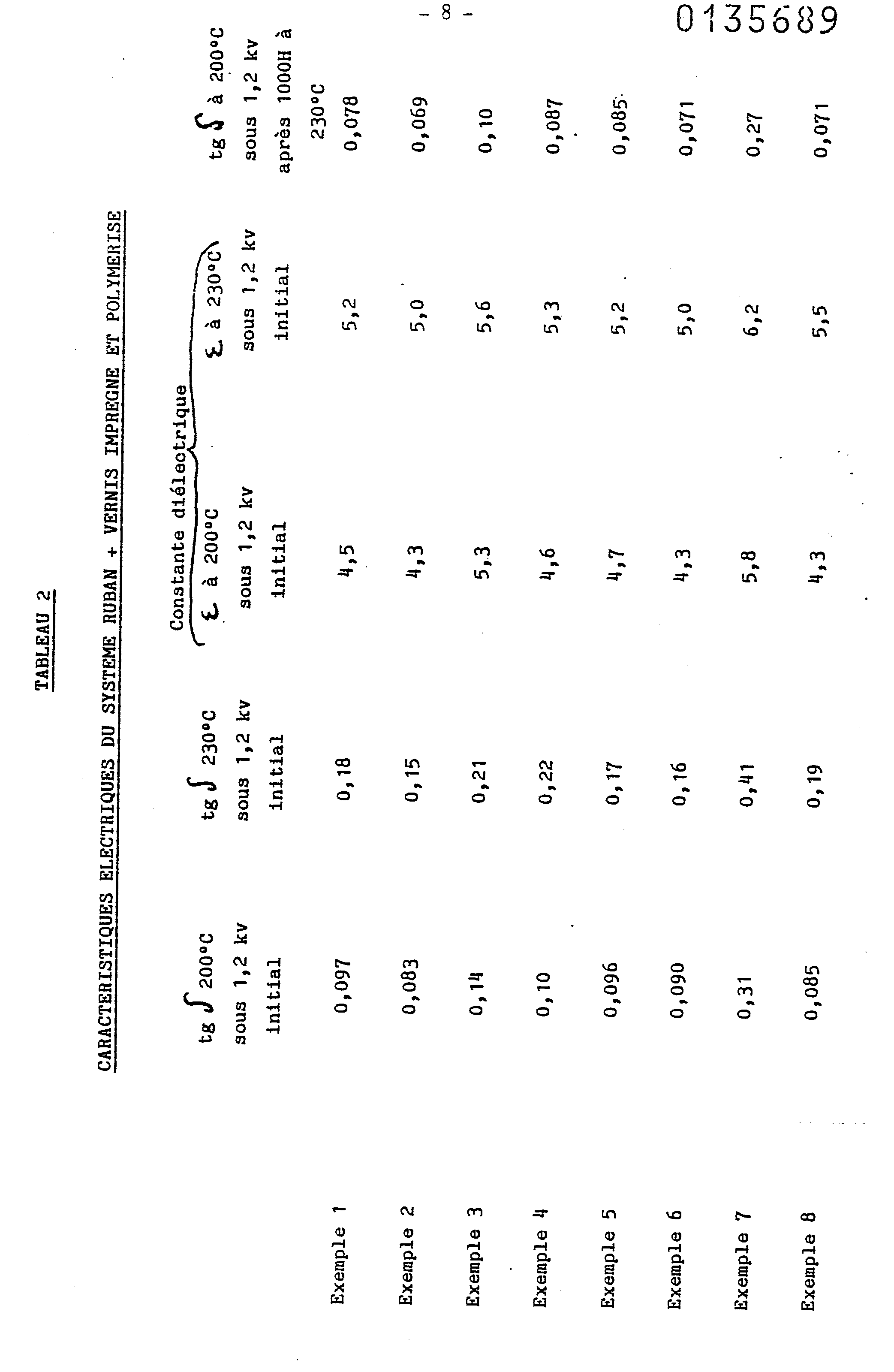
- Les exemples suivants décrivent des modes de mise en oeuvre de l'invention. Les caractéristiques physiques et mécaniques des résines d'imprégnation des exemples 1 à 8 ci-dessous, et les caractéristiques électriques des isolants après imprégnation et polymérisation, sont données respectivement dans les tableaux I et II qui les suivent. Les pourcentages sont indiqués en poids.
- On imprègne un ruban dit "poreux" formé de papier de mica et d'un tissu de verre collé par une résine époxyde sur le papier de mica, contenant 1g/m2 de chlorure de benzyl-triméthylammonium, avec un vernis composé de :

- On imprègne le même ruban que dans l'exemple 1 avec le vernis composé de :

- On imprèque le même ruban que dans l'exemple 1 avec le vernis composé de :

- On imprègne le même ruban que dans l'exemple 1 avec le vernis composé de :

- On imprègne le même ruban que dans l'exemple 1 avec le vernis composé de :

- On imprègne le même ruban que dans l'exemple 1 avec le vernis composé de :

- On imprégne le même ruban que dans l'exemple 1 avec le vernis composé de :

- On imprégne le même ruban que dans l'exemple 1 avec le vernis composé de :


- On prépare un vernis composé de :

- Ce vernis ne présente qu'une faible variation de viscosité après un stockage de 100 jours à température ambiante, alors qu'on observe pour le même vernis ne contenant pas de benzoquinone, un doublement de la viscosité en moins de 20 jours.
- Ce vernis peut être utilisé pour imprégner un ruban poreux formé de papier de mica et d'un tissu de verre, collé par une résine époxy sur le papier de mica, contenant 1g/m de chlorure de benzyltriméthylammonium, à la place des vernis stabilisés par un anhydride organique des exemples 1 à 8.
- On prépare un vernis composé de :

- Ce vernis ne présente pas d'évolution de viscosité après 100 jours de stockage à la température ambiante, alors qu'on observe pour le même vernis sans benzoquinone un doublement de viscosité en 40 jours.
- Ce vernis peut être utilisé comme celui de l'exemple 9.
- On prépare un vernis composé de :

- Il ne présente qu'une faible variation de viscosité après 100 jours à la température ambiante, alors qu'on observe pour le même vernis sans benzoquinone un doublement de viscosité en moins de 15 jours.
- Ce vernis peut être utilisé comme ceux des exemples 9 et 10.
- EXEMPLE 11 - cycle d'imprégnation et de polymérisation d'un ruban poreux imprégné par un vernis selon l'un des exemples 1 à 10.
- Un barreau de cuivre, de section droite 25 x 10 mm2, entouré de cinq couches à demi-recouvrement du ruban poreux chargé de catalyseur, emprisonné dans une encoche de section droite 27,8 x 12,8 mm2, est placé dans une cuve d'imprégnation où il est laissé dégazer 15 heures sous vide à la température ambiante.
- Puis, sans interrompre le vide, on introduit dans la cuve une quantité de vernis suffisante pour que l'encoche soit submergée dans le vernis, durant au moins une heure.
- La cuve est ensuite remise à la pression atmosphèrique, puis portée sous une pression de 6 bars pendant au moins une heure.
- Le cycle mise sous vide-mise en pression est effectué 3 fois de suite, puis s'achève par la mise à l'atmosphère à la fin de la 3è phase de mise sous pression.
- Durant toute la durée des cycles, l'encoche doit être noyée dans le vernis.
- On effectue alors la polymérisation de la résine en plaçant l'encoche contenant le barreau imprégné dans une étuve où elle est portée à la température de 130°C en 1h 30. Après un palier de 2h à 130°C, la température est portée à 150°C, où a lieu un palier de 4h.
- Le traitement s'achève par une post-cuisson de 15h à 200°C.
Claims (14)
Priority Applications (1)
| Application Number | Priority Date | Filing Date | Title |
|---|---|---|---|
| AT84108044T ATE28708T1 (de) | 1983-07-13 | 1984-07-10 | Verfahren und vorrichtung fuer die isolation duerch traenken von elektrischen wicklungen und ein loesungsmittelfreier lack zur verwendung in diesem verfahren und dieser vorrichtung. |
Applications Claiming Priority (2)
| Application Number | Priority Date | Filing Date | Title |
|---|---|---|---|
| FR8311723A FR2549277B1 (fr) | 1983-07-13 | 1983-07-13 | Procede d'isolation par impregnation d'un bobinage electrique, et vernis sans solvant stabilise utilisable dans ce procede |
| FR8311723 | 1983-07-13 |
Publications (2)
| Publication Number | Publication Date |
|---|---|
| EP0135689A1 true EP0135689A1 (fr) | 1985-04-03 |
| EP0135689B1 EP0135689B1 (fr) | 1987-07-29 |
Family
ID=9290826
Family Applications (1)
| Application Number | Title | Priority Date | Filing Date |
|---|---|---|---|
| EP84108044A Expired EP0135689B1 (fr) | 1983-07-13 | 1984-07-10 | Procédé et dispositif d'isolation par imprégnation d'un bobinage, et vernis sans solvant stabilisé utilisable dans ce procédé et ce dispositif |
Country Status (8)
| Country | Link |
|---|---|
| US (2) | US4680222A (fr) |
| EP (1) | EP0135689B1 (fr) |
| AT (1) | ATE28708T1 (fr) |
| CA (1) | CA1208425A (fr) |
| DE (1) | DE3465151D1 (fr) |
| ES (1) | ES8600559A1 (fr) |
| FR (1) | FR2549277B1 (fr) |
| PT (1) | PT78896B (fr) |
Cited By (2)
| Publication number | Priority date | Publication date | Assignee | Title |
|---|---|---|---|---|
| EP0342064A3 (en) * | 1988-05-13 | 1990-12-19 | Nippon Paint Co., Ltd. | A thermosetting resinous composition and preparation of heat resisting coating and molded product using said composition |
| US10689476B2 (en) | 2014-12-22 | 2020-06-23 | Henkel Ag & Co. Kgaa | Oxazolidinone- and isocyanurate-crosslinked matrix for fiber-reinforced material |
Families Citing this family (8)
| Publication number | Priority date | Publication date | Assignee | Title |
|---|---|---|---|---|
| FR2549277B1 (fr) * | 1983-07-13 | 1985-10-25 | Alsthom Atlantique | Procede d'isolation par impregnation d'un bobinage electrique, et vernis sans solvant stabilise utilisable dans ce procede |
| FR2616792B1 (fr) * | 1987-06-17 | 1991-10-04 | Alsthom | Materiau a structure mousse resistant a la chaleur, constitue a partir de polymeres d'oxazolidones et d'isocyanurates |
| FR2636636B1 (fr) * | 1988-09-16 | 1992-09-04 | Alsthom Gec | Melanges stables a temperature ambiante de resines reactives thermodurcissables, complexes catalyseurs latents de durcissement de ces melanges, leurs procedes de fabrication et resines thermodurcies obtenues a partir de ces melanges |
| US4855383A (en) * | 1988-09-23 | 1989-08-08 | Ashland Oil, Inc. | In situ quaternary ammonium catalyst formation for curing polymeric isocyanates |
| GB8912952D0 (en) * | 1989-06-06 | 1989-07-26 | Dow Rheinmuenster | Epoxy-terminated polyoxazolidones,process for the preparation thereof and electrical laminates made from the epoxy-terminated polyoxazolidones |
| JP2936795B2 (ja) * | 1991-05-09 | 1999-08-23 | 住友電装株式会社 | 電線接続部の防水加工方法 |
| US5670255A (en) * | 1995-01-23 | 1997-09-23 | Ppg Industries, Inc. | Antioxidant compositions for coating substrates, substrates coated with the same and methods for inhibiting the oxidation of such compositions applied to a substrate |
| DE102014226842A1 (de) | 2014-12-22 | 2016-06-23 | Henkel Ag & Co. Kgaa | Katalysator-Zusammensetzung zur Härtung von Epoxidgruppen-haltigen Harzen |
Citations (5)
| Publication number | Priority date | Publication date | Assignee | Title |
|---|---|---|---|---|
| US3020262A (en) * | 1957-12-19 | 1962-02-06 | Jefferson Chem Co Inc | Method for producing 2-oxazolidones from epoxides and isocyanates |
| US3313747A (en) * | 1964-10-29 | 1967-04-11 | Baker Chem Co J T | Polymers prepared from isocyanateoxazolidinones |
| US3334110A (en) * | 1965-08-16 | 1967-08-01 | Baker Chem Co J T | Method for preparing epoxyoxazolidinones |
| US3876618A (en) * | 1971-08-19 | 1975-04-08 | Dow Chemical Co | Oxazolidinone modified triglycidyl ether of trihydroxy triphenyl methane and derivatives thereof |
| JPS50160189A (fr) * | 1974-06-19 | 1975-12-25 |
Family Cites Families (16)
| Publication number | Priority date | Publication date | Assignee | Title |
|---|---|---|---|---|
| US4070416A (en) * | 1972-11-29 | 1978-01-24 | Hitachi, Ltd. | Novel thermosetting resin and a process for producing same |
| JPS5347277B2 (fr) * | 1974-09-30 | 1978-12-20 | ||
| JPS54157201A (en) * | 1978-06-02 | 1979-12-12 | Hitachi Ltd | Wire manufacturing method for electric machine |
| JPS5778424A (en) * | 1980-10-31 | 1982-05-17 | Hitachi Chem Co Ltd | Molding material |
| US4341689A (en) * | 1981-07-02 | 1982-07-27 | Desoto, Inc. | Two component polyurethane coating system having extended pot life and rapid cure |
| US4424316A (en) * | 1981-10-08 | 1984-01-03 | Stauffer Chemical Company | Compositions for forming poly(oxazolidone/urethane) thermosets and products therefrom |
| DE3233140A1 (de) * | 1982-09-07 | 1984-03-08 | Basf Farben + Fasern Ag, 2000 Hamburg | Selbstvernetzendes, hitzehaertbares bindemittel |
| US4486556A (en) * | 1982-09-30 | 1984-12-04 | Ford Motor Company | Thermosetting coating composition-III |
| US4504633A (en) * | 1983-06-01 | 1985-03-12 | Stauffer Chemical Company | Modified poly(oxazolidone/urethane) compositions |
| DE3323153A1 (de) * | 1983-06-27 | 1985-01-03 | Siemens AG, 1000 Berlin und 8000 München | Hitzehaertbare reaktionsharzmischungen |
| DE3323122A1 (de) * | 1983-06-27 | 1985-05-23 | Siemens AG, 1000 Berlin und 8000 München | Verfahren zur herstellung von reaktionsharzformstoffen |
| FR2549277B1 (fr) * | 1983-07-13 | 1985-10-25 | Alsthom Atlantique | Procede d'isolation par impregnation d'un bobinage electrique, et vernis sans solvant stabilise utilisable dans ce procede |
| US4542165A (en) * | 1983-09-08 | 1985-09-17 | Sanyo Chemical Industries, Ltd. | Polyurethane based on epoxy-containing polymer polyol and process for making the same |
| US4487908A (en) * | 1984-02-13 | 1984-12-11 | Texaco Inc. | Reaction injection molded elastomers containing anhydrides |
| US4513133A (en) * | 1984-02-13 | 1985-04-23 | Texaco Inc. | Reaction injection molded elastomers containing low molecular weight organic acids |
| US4698408A (en) * | 1986-07-21 | 1987-10-06 | Ashland Oil, Inc. | Sag resistant two-component urethane adhesives with improved thermal stability |
-
1983
- 1983-07-13 FR FR8311723A patent/FR2549277B1/fr not_active Expired
-
1984
- 1984-07-10 EP EP84108044A patent/EP0135689B1/fr not_active Expired
- 1984-07-10 DE DE8484108044T patent/DE3465151D1/de not_active Expired
- 1984-07-10 AT AT84108044T patent/ATE28708T1/de not_active IP Right Cessation
- 1984-07-11 CA CA000458666A patent/CA1208425A/fr not_active Expired
- 1984-07-12 PT PT78896A patent/PT78896B/fr not_active IP Right Cessation
- 1984-07-13 US US06/630,598 patent/US4680222A/en not_active Expired - Fee Related
- 1984-07-13 ES ES534309A patent/ES8600559A1/es not_active Expired
-
1986
- 1986-08-14 US US06/896,622 patent/US4757122A/en not_active Expired - Fee Related
Patent Citations (5)
| Publication number | Priority date | Publication date | Assignee | Title |
|---|---|---|---|---|
| US3020262A (en) * | 1957-12-19 | 1962-02-06 | Jefferson Chem Co Inc | Method for producing 2-oxazolidones from epoxides and isocyanates |
| US3313747A (en) * | 1964-10-29 | 1967-04-11 | Baker Chem Co J T | Polymers prepared from isocyanateoxazolidinones |
| US3334110A (en) * | 1965-08-16 | 1967-08-01 | Baker Chem Co J T | Method for preparing epoxyoxazolidinones |
| US3876618A (en) * | 1971-08-19 | 1975-04-08 | Dow Chemical Co | Oxazolidinone modified triglycidyl ether of trihydroxy triphenyl methane and derivatives thereof |
| JPS50160189A (fr) * | 1974-06-19 | 1975-12-25 |
Non-Patent Citations (1)
| Title |
|---|
| CHEMICAL ABSTRACTS, vol. 85, no. 2, 12 July 1976, Columbus, Ohio, US; abstract no. 6351S, page 24; * |
Cited By (2)
| Publication number | Priority date | Publication date | Assignee | Title |
|---|---|---|---|---|
| EP0342064A3 (en) * | 1988-05-13 | 1990-12-19 | Nippon Paint Co., Ltd. | A thermosetting resinous composition and preparation of heat resisting coating and molded product using said composition |
| US10689476B2 (en) | 2014-12-22 | 2020-06-23 | Henkel Ag & Co. Kgaa | Oxazolidinone- and isocyanurate-crosslinked matrix for fiber-reinforced material |
Also Published As
| Publication number | Publication date |
|---|---|
| ES534309A0 (es) | 1985-10-01 |
| US4757122A (en) | 1988-07-12 |
| ATE28708T1 (de) | 1987-08-15 |
| PT78896B (fr) | 1986-09-10 |
| ES8600559A1 (es) | 1985-10-01 |
| CA1208425A (fr) | 1986-07-29 |
| DE3465151D1 (en) | 1987-09-03 |
| US4680222A (en) | 1987-07-14 |
| FR2549277B1 (fr) | 1985-10-25 |
| EP0135689B1 (fr) | 1987-07-29 |
| FR2549277A1 (fr) | 1985-01-18 |
| PT78896A (fr) | 1984-08-01 |
Similar Documents
| Publication | Publication Date | Title |
|---|---|---|
| EP0135689B1 (fr) | Procédé et dispositif d'isolation par imprégnation d'un bobinage, et vernis sans solvant stabilisé utilisable dans ce procédé et ce dispositif | |
| CN102325817B (zh) | 环保可焊接的漆包线漆 | |
| EP0187105B1 (fr) | Procédé de préparation de polyisocyanates polyisocyanurates par cyclotrimérisation catalytique de polyisocyanates | |
| JPH04296316A (ja) | 耐熱性樹脂組成物、製品及び方法 | |
| JPS6035942A (ja) | 電気巻線の処理方法 | |
| JPS5836018B2 (ja) | 耐熱性樹脂の製造法 | |
| CN108586706B (zh) | 制备含有碳化二亚胺和/或脲酮亚胺类衍生物的改性异氰酸酯混合物的方法 | |
| EP0259233B1 (fr) | Procédé de préparation de polyisocyanate à groupement biuret | |
| US4307226A (en) | Soluble polyesterimide resins | |
| RU2481366C2 (ru) | Эмали для проводов с высокой адгезией к электрическим проводам | |
| DE2922065C2 (de) | Verfahren zur Herstellung elektrischer Wicklungen | |
| US4131693A (en) | Hardenable polyesterurethane composition for producing a directly tinnable wire | |
| JP2011510482A5 (fr) | ||
| JPS58208323A (ja) | ポリアミドイミド樹脂の製造法 | |
| US4740576A (en) | Preparation of polyamidoimide coatings having a long shelf life | |
| DE2721780C3 (de) | Thermisch härtbare polymerisierbare Harzmasse | |
| DE1962900C3 (de) | Polyamidimidester und Verfahren zu ihrer Herstellung | |
| JPH07108963B2 (ja) | 被覆支持体の製造方法 | |
| DE1067220B (fr) | ||
| JP4405809B2 (ja) | クレゾールフリーまたは低クレゾール電線用エナメル | |
| US4429072A (en) | Preparation of aqueous thermosetting electrical insulating varnishes, and use of the varnishes | |
| EP0133984B1 (fr) | Procédé d'isolation par imprégnation de conducteurs électriques | |
| CA1050188A (fr) | Compositions thermodurcissables | |
| DE2445302C2 (de) | Tränklacke für Elektroisolationszwecke | |
| US1047484A (en) | Method of forming phenolic condensation products. |
Legal Events
| Date | Code | Title | Description |
|---|---|---|---|
| PUAI | Public reference made under article 153(3) epc to a published international application that has entered the european phase |
Free format text: ORIGINAL CODE: 0009012 |
|
| AK | Designated contracting states |
Designated state(s): AT BE CH DE FR GB IT LI SE |
|
| 17P | Request for examination filed |
Effective date: 19850926 |
|
| RAP1 | Party data changed (applicant data changed or rights of an application transferred) |
Owner name: ALSTHOM |
|
| 17Q | First examination report despatched |
Effective date: 19860908 |
|
| GRAA | (expected) grant |
Free format text: ORIGINAL CODE: 0009210 |
|
| AK | Designated contracting states |
Kind code of ref document: B1 Designated state(s): AT BE CH DE FR GB IT LI SE |
|
| REF | Corresponds to: |
Ref document number: 28708 Country of ref document: AT Date of ref document: 19870815 Kind code of ref document: T |
|
| REF | Corresponds to: |
Ref document number: 3465151 Country of ref document: DE Date of ref document: 19870903 |
|
| ITF | It: translation for a ep patent filed | ||
| PLBE | No opposition filed within time limit |
Free format text: ORIGINAL CODE: 0009261 |
|
| STAA | Information on the status of an ep patent application or granted ep patent |
Free format text: STATUS: NO OPPOSITION FILED WITHIN TIME LIMIT |
|
| 26N | No opposition filed | ||
| PGFP | Annual fee paid to national office [announced via postgrant information from national office to epo] |
Ref country code: SE Payment date: 19900516 Year of fee payment: 7 |
|
| PGFP | Annual fee paid to national office [announced via postgrant information from national office to epo] |
Ref country code: CH Payment date: 19900523 Year of fee payment: 7 |
|
| PGFP | Annual fee paid to national office [announced via postgrant information from national office to epo] |
Ref country code: GB Payment date: 19900601 Year of fee payment: 7 |
|
| PGFP | Annual fee paid to national office [announced via postgrant information from national office to epo] |
Ref country code: BE Payment date: 19900613 Year of fee payment: 7 |
|
| PGFP | Annual fee paid to national office [announced via postgrant information from national office to epo] |
Ref country code: DE Payment date: 19900626 Year of fee payment: 7 |
|
| PGFP | Annual fee paid to national office [announced via postgrant information from national office to epo] |
Ref country code: AT Payment date: 19900716 Year of fee payment: 7 |
|
| ITTA | It: last paid annual fee | ||
| PG25 | Lapsed in a contracting state [announced via postgrant information from national office to epo] |
Ref country code: GB Effective date: 19910710 Ref country code: AT Effective date: 19910710 |
|
| PG25 | Lapsed in a contracting state [announced via postgrant information from national office to epo] |
Ref country code: SE Effective date: 19910711 |
|
| PG25 | Lapsed in a contracting state [announced via postgrant information from national office to epo] |
Ref country code: LI Effective date: 19910731 Ref country code: CH Effective date: 19910731 Ref country code: BE Effective date: 19910731 |
|
| BERE | Be: lapsed |
Owner name: ALSTHOM Effective date: 19910731 |
|
| GBPC | Gb: european patent ceased through non-payment of renewal fee | ||
| REG | Reference to a national code |
Ref country code: CH Ref legal event code: PL |
|
| PG25 | Lapsed in a contracting state [announced via postgrant information from national office to epo] |
Ref country code: DE Effective date: 19920401 |
|
| PGFP | Annual fee paid to national office [announced via postgrant information from national office to epo] |
Ref country code: FR Payment date: 19920527 Year of fee payment: 9 |
|
| PG25 | Lapsed in a contracting state [announced via postgrant information from national office to epo] |
Ref country code: FR Effective date: 19940331 |
|
| REG | Reference to a national code |
Ref country code: FR Ref legal event code: ST |
|
| EUG | Se: european patent has lapsed |
Ref document number: 84108044.3 Effective date: 19920210 |