EP0138721A2 - Nouveaux benzenesulfonyl-lactames, leur procédé de préparation et leur application comme substance active de compositions pharmaceutiques - Google Patents
Nouveaux benzenesulfonyl-lactames, leur procédé de préparation et leur application comme substance active de compositions pharmaceutiques Download PDFInfo
- Publication number
- EP0138721A2 EP0138721A2 EP84402099A EP84402099A EP0138721A2 EP 0138721 A2 EP0138721 A2 EP 0138721A2 EP 84402099 A EP84402099 A EP 84402099A EP 84402099 A EP84402099 A EP 84402099A EP 0138721 A2 EP0138721 A2 EP 0138721A2
- Authority
- EP
- European Patent Office
- Prior art keywords
- group
- carbon atoms
- hydrogen
- formula
- compounds
- Prior art date
- Legal status (The legal status is an assumption and is not a legal conclusion. Google has not performed a legal analysis and makes no representation as to the accuracy of the status listed.)
- Granted
Links
- 0 O=C1*CCC1 Chemical compound O=C1*CCC1 0.000 description 4
- SIVVBLSNZZQDNV-UHFFFAOYSA-N CC(CNC=O)O Chemical compound CC(CNC=O)O SIVVBLSNZZQDNV-UHFFFAOYSA-N 0.000 description 1
- SMZMCFVCOLIFEA-UHFFFAOYSA-N CC1C(C(F)(F)F)=CC(C(F)(F)F)=CC1S(=O)=O Chemical compound CC1C(C(F)(F)F)=CC(C(F)(F)F)=CC1S(=O)=O SMZMCFVCOLIFEA-UHFFFAOYSA-N 0.000 description 1
- FDZWQTGKDCVMJU-UHFFFAOYSA-N O=S(c1cccc(C(F)(F)F)c1)=O Chemical compound O=S(c1cccc(C(F)(F)F)c1)=O FDZWQTGKDCVMJU-UHFFFAOYSA-N 0.000 description 1
Classifications
-
- C—CHEMISTRY; METALLURGY
- C07—ORGANIC CHEMISTRY
- C07D—HETEROCYCLIC COMPOUNDS
- C07D207/00—Heterocyclic compounds containing five-membered rings not condensed with other rings, with one nitrogen atom as the only ring hetero atom
- C07D207/02—Heterocyclic compounds containing five-membered rings not condensed with other rings, with one nitrogen atom as the only ring hetero atom with only hydrogen or carbon atoms directly attached to the ring nitrogen atom
- C07D207/18—Heterocyclic compounds containing five-membered rings not condensed with other rings, with one nitrogen atom as the only ring hetero atom with only hydrogen or carbon atoms directly attached to the ring nitrogen atom having one double bond between ring members or between a ring member and a non-ring member
- C07D207/22—Heterocyclic compounds containing five-membered rings not condensed with other rings, with one nitrogen atom as the only ring hetero atom with only hydrogen or carbon atoms directly attached to the ring nitrogen atom having one double bond between ring members or between a ring member and a non-ring member with hetero atoms or with carbon atoms having three bonds to hetero atoms with at the most one bond to halogen, e.g. ester or nitrile radicals, directly attached to ring carbon atoms
- C07D207/24—Oxygen or sulfur atoms
- C07D207/26—2-Pyrrolidones
-
- C—CHEMISTRY; METALLURGY
- C07—ORGANIC CHEMISTRY
- C07D—HETEROCYCLIC COMPOUNDS
- C07D223/00—Heterocyclic compounds containing seven-membered rings having one nitrogen atom as the only ring hetero atom
- C07D223/02—Heterocyclic compounds containing seven-membered rings having one nitrogen atom as the only ring hetero atom not condensed with other rings
- C07D223/06—Heterocyclic compounds containing seven-membered rings having one nitrogen atom as the only ring hetero atom not condensed with other rings with hetero atoms or with carbon atoms having three bonds to hetero atoms with at the most one bond to halogen, e.g. ester or nitrile radicals, directly attached to ring carbon atoms
- C07D223/08—Oxygen atoms
- C07D223/10—Oxygen atoms attached in position 2
-
- A—HUMAN NECESSITIES
- A61—MEDICAL OR VETERINARY SCIENCE; HYGIENE
- A61P—SPECIFIC THERAPEUTIC ACTIVITY OF CHEMICAL COMPOUNDS OR MEDICINAL PREPARATIONS
- A61P25/00—Drugs for disorders of the nervous system
-
- C—CHEMISTRY; METALLURGY
- C07—ORGANIC CHEMISTRY
- C07D—HETEROCYCLIC COMPOUNDS
- C07D207/00—Heterocyclic compounds containing five-membered rings not condensed with other rings, with one nitrogen atom as the only ring hetero atom
- C07D207/46—Heterocyclic compounds containing five-membered rings not condensed with other rings, with one nitrogen atom as the only ring hetero atom with hetero atoms directly attached to the ring nitrogen atom
- C07D207/48—Sulfur atoms
-
- C—CHEMISTRY; METALLURGY
- C07—ORGANIC CHEMISTRY
- C07D—HETEROCYCLIC COMPOUNDS
- C07D211/00—Heterocyclic compounds containing hydrogenated pyridine rings, not condensed with other rings
- C07D211/92—Heterocyclic compounds containing hydrogenated pyridine rings, not condensed with other rings with a hetero atom directly attached to the ring nitrogen atom
- C07D211/96—Sulfur atom
Definitions
- the invention relates to new drugs which have activity on the central nervous system, in particular psychotropic with behavior modification and which contain, as active principle, chemical compounds whose basic structure is of the benzenesulfonyl-lactam type, as well as their salts obtained with physiologically acceptable acids.
- composition containing, in association with a pharmaceutically acceptable vehicle, at least one of the chemical compounds as defined below will be called hereinafter "medicament”.
- the invention also relates to the new compounds which constitute the active substance of the new drugs.
- the invention also relates to a process for the preparation of the above chemical compounds.
- This group will subsequently be designated by G1.
- a preferred group of medicaments according to the invention consists of those whose active substance is a compound of formula (I), in which n is 1 and corresponding to the following formula (II):
- Another preferred group of medicaments according to the invention consists of those whose active substance is a compound of formula (I) in which n is 2 and corresponding to the following formula (III):
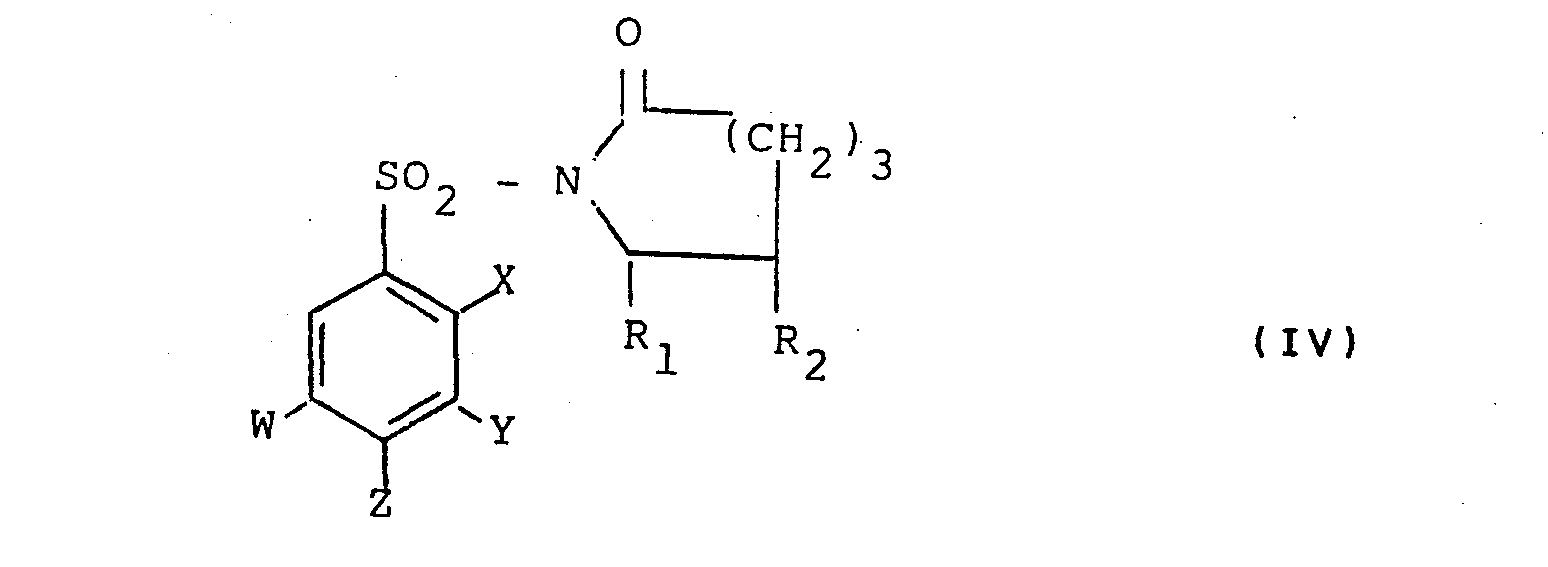
- Another group of preferred drugs according to the invention consists of those whose active substance is a compound of formula (I), in which n is 3 and corresponding to the following general formula (IV): This group will subsequently be designated by G4.
- Another preferred group of medicaments according to the invention consists of those whose active substance is a compound of formula (I), in which R 1 represents H or CH 3 .
- Another group of preferred drugs according to the invention consists of those whose active substance is a compound of formula (I), in which R represents H, OH or OCOCH 3 .
- Another group of preferred drugs according to the invention consists of those whose active substance is a compound of formula (I), in which Y represents CF 3 , X represents H, and corresponding to the following formula (VII): and wherein Z represents H or Cl and W represents H or CF 3 .
- a preferred group of medicaments according to the invention consists of those whose active substance is a compound in which Z represents H and W represents CF 3 and corresponding to the following formula (VIII):
- This group will subsequently be designated by G8.
- Another preferred group of medicaments according to the invention consists of those whose active substance is a compound in which Z represents Cl and W represents H and corresponding to the following formula (IX):
- This group will subsequently be designated by G9.
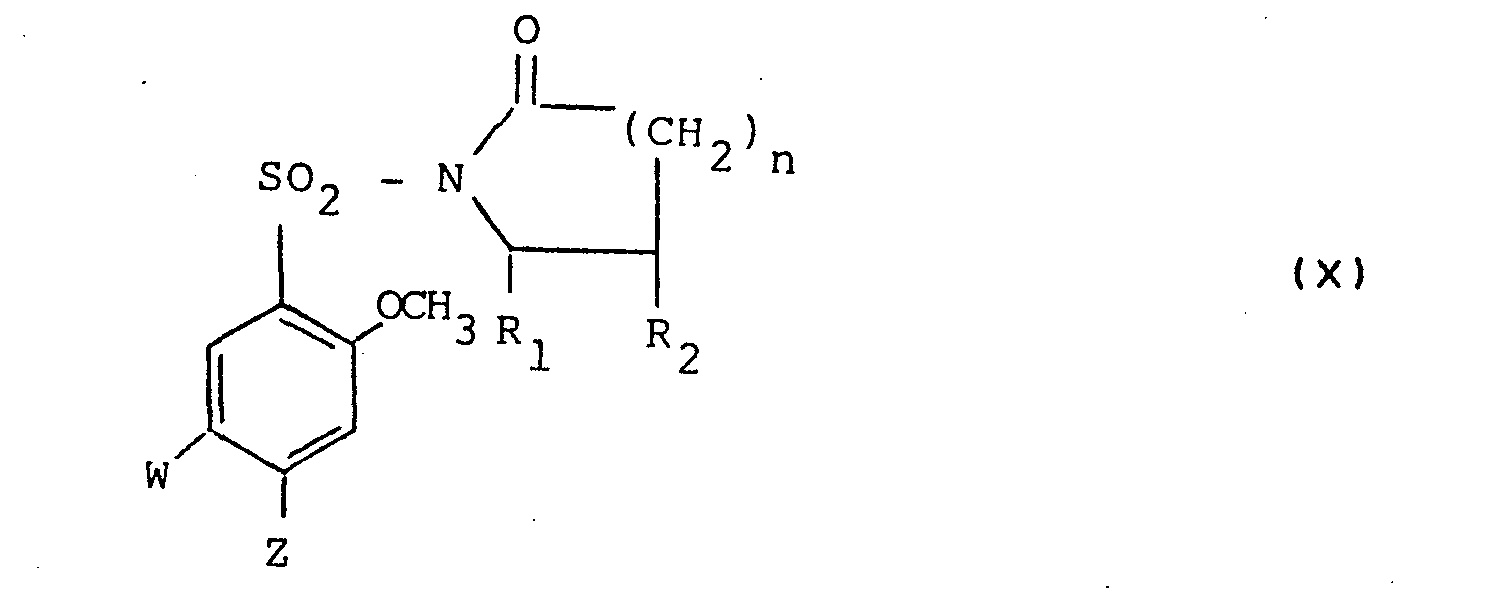
- Another group of preferred drugs according to the invention consists of those in which the active substance is a compound of formula (I), in which X represents OCH 3 , Y represents H and corresponding to the following formula (X): and wherein Z represents H or OCH 3 and W represents H , Cl or OCH 3 .
- a group of preferred medicaments according to the invention consists of those in which the active substance is a compound in which Z represents H and W represents Cl and corresponding to the following formula (XI):
- This group will subsequently be designated by G11.
- a group of preferred medicaments according to the invention consists of those whose active substance is a compound in which Z represents OCH 3 and W represents H and corresponding to the following formula (XII):
- Another preferred group of medicaments according to the invention consists of those whose active substance is a compound in which Z represents OCH 3 and W represents OCH 3 and corresponding to the following formula (XIII):
- This group will subsequently be designated by G13.
- Another group of preferred drugs according to the invention consists of those in which the active substance is a compound in which Z represents OCH 3 and W represents Cl and corresponding to the following formula (XIV):
- This group will subsequently be designated by G14.
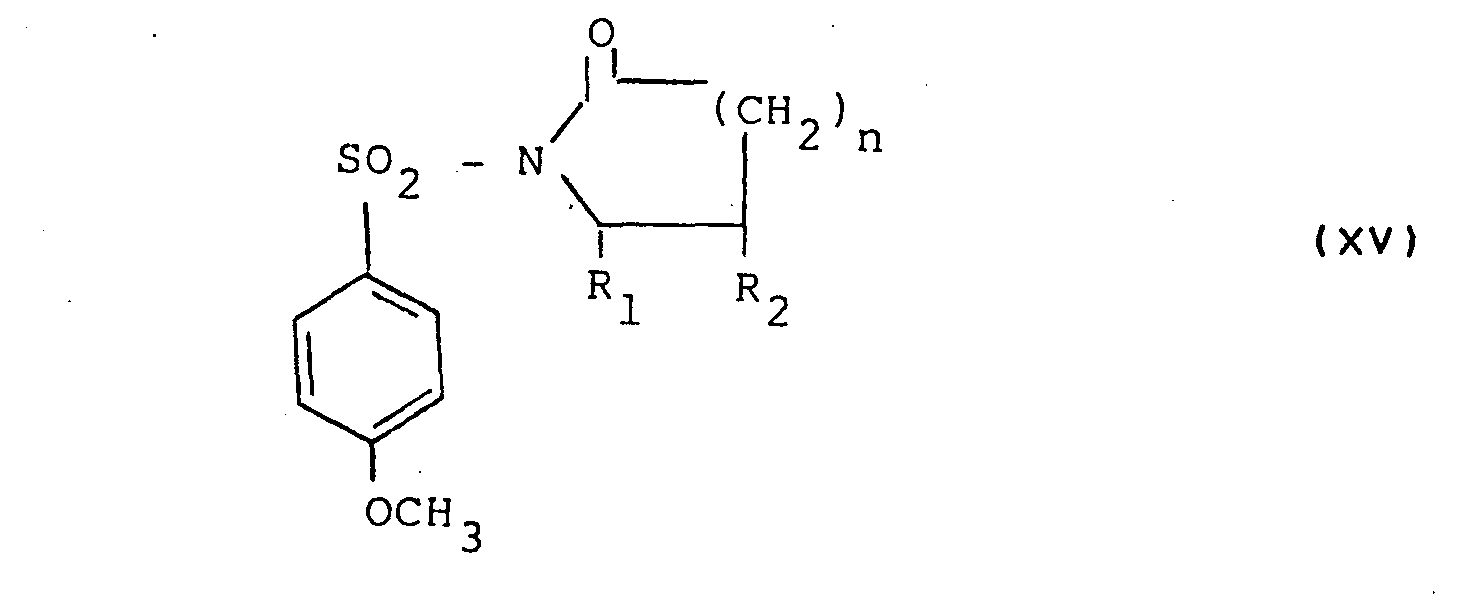
- Another preferred group of medicaments according to the invention consists of those whose active substance is a compound of formula (I), in which X represents H, Y represents H, Z represents OCH 3 and W represents H, and corresponding to the following formula (XV): This group will subsequently be designated by G15.
- Another group of preferred drugs according to the invention consists of those whose active substance is a compound of formula (I), in which Y represents NO 2 and corresponding to the following formula (XVI):
- a preferred group of drugs according to the invention consists of those of formula:
- Preferred classes of compounds according to the invention consist of the compounds belonging to groups G1 to G9 defined above, with regard to medicaments, and in which when n is 1, Y or W represents CF 3 and when n is 2 or 3, or X or Z represents OR 1 or Y or W represents CF 3 or N0 2 .
- Another preferred class of compounds according to the invention consists of the compounds of formula (X) above indicated, in which n is 2 or 3, Z represents H or OCH 3 and W represents H, Clou OCH 3 .
- Another preferred class of compounds according to the invention consists of the compounds of formulas (XI), (XII), (XIII), (XIV), (XV) or (XVI) above represented and in which n is 2 or 3.
- a group of preferred compounds consists of those of formulas:
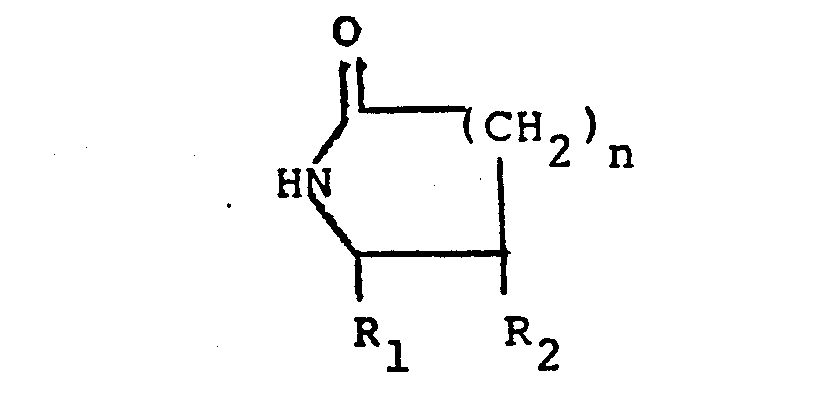
- the compounds of formula (I) can be obtained by cyclization of the benzenesulfonamidoacid of formula (XVII): in which X, Y, Z, W, n, R and R 2 have the meanings indicated above.
- the cyclization of benzenesulfonamides can be done by using a cyclizing agent, in an acid medium, and by heating.
- a cyclizing agent P 2 0 5 and as an acid H 3 PO 4 .
- the compounds according to the invention capable of being prepared according to this method A are those in which n is 1, R represents hydrogen, and X, Y, Z and W are all different from an alkoxy group.
- the product is then recrystallized from the usual suitable solvents.
- the yield is 60% to 90%.
- cyclization of benzenesulfonamidoacids of formula (XVII) can also be advantageously done by using trifluoroacetic anhydride as a cyclizing agent, in the presence of sodium trifluoroacetate and by heating.
- This method B has the advantage of being able to be used for the preparation of all the compounds of formula (I), and of providing a good yield.
- Method B is preferably used when R represents OH or OCOCH 3 .
- the crystals are drained, then recrystallized from the appropriate organic solvents.
- the yield is from 65 X to 90 X.
- benzenesulfonamido acids used are prepared as indicated in the patent applications FR Nos. 81 11858 and 81 11859.
- These compounds can be prepared by condensing a sulfohalide, in particular a sulfochloride of formula (XVIII): on an amino acid of formula (XX): according to methods such as those described in patent applications FR No. 81 11858 and 81 11859.
- the compounds of formula (I) according to the invention can also be prepared by condensation of the sulfohalides, in particular sulfochlorides, of formula (XVIII): in which X, Y, Z and W have the meanings indicated above on the compounds of formula (XIX): in which R 1 , R and n have the meanings indicated above.
- This reaction is preferably carried out in the presence of a strong base, to extract the proton from the compound (XIX), such as sodium hydride, in a solvent such as xylene and then under the effect of heating, the condensation has location.
- a strong base such as sodium hydride
- Method C This method will be referred to below as Method C.
- the yield is from 10% to 50%.
- the sulfochlorides used for the implementation of method C are those described in the literature as well as in patents and patent applications FR No. 2,313,918, 2,338,929, 2,504,528, 2,504,527.
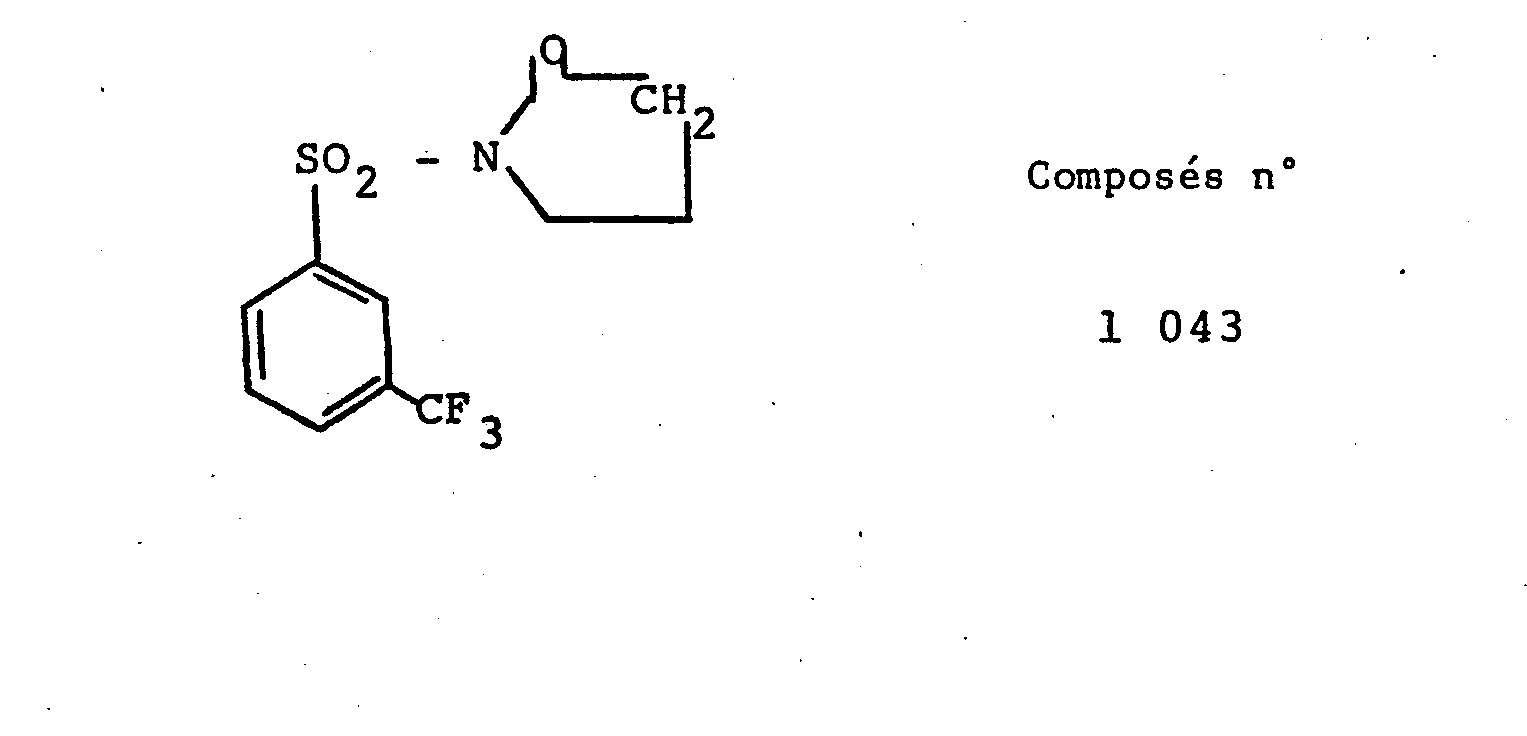
- the products which were prepared according to method 8 are the following: n ° 1 043, 1 289, 1 277, 1 276, 1 355, 1 351, 1 416, 1 419, 1 417, 1 418, 1 415, 1 120, 1,287, 1,288, 1,124, 1,285, 1,286, 1,309, 1,332, 1,310, 1,281, 1,282, 1,442, 1,441, 1,039.
- the products which have been prepared according to method C are as follows: No. 1,043, 1,289, 1,277, 1,276, 1,355, 1,351, 1,416, 1,120, 1,287, 1,288, 1,124, 1 285, 1,286, 1,309, 1,332, 1,310, 1,281, 1,282, 1,442, 1,441.
- centesimal analysis of the products obtained complies with usual standards ( ⁇ 0.3%).
- the compounds according to the invention have remarkable pharmacological properties.
- the compounds according to the invention have psychotropic properties with behavior modification.
- the compounds according to the invention are advantageously introduced as active substance, in particular in the treatment of memory disorders, of amnesia, in the case of physical and intellectual efforts linked to periods of overwork, in the treatment of disorders of the behavior and adaptation.
- the compounds according to the invention are distinguished by the fact that they act on memory and attention, increase mental activity and balance emotional behavior.
- the compounds according to the invention are for this purpose packaged with traditional excipients and adjuvants, in particular those used for the preparation of tablets, powders, capsules, drinkable ampoules, drinkable solutions, injectable solutions.
- the administration of the drugs containing the compounds according to the invention is preferably carried out orally, and the doses of compounds administered are from 50 to 3000 mg / day, preferably from 200 to 2000 mg / day, for example from 100 to 1000 mg / day, in one or more times.
- An example of an advantageous pharmaceutical composition consists of a capsule or a tablet corresponding to an active substance intake unit of 25 to 200 mg, preferably 100 mg, with appropriate excipients.
- Another example of an advantageous pharmaceutical composition consists of an oral solution, compatible with dosage units of 25 to 200 mg of active substance.
- the compounds according to the invention are devoid of toxicity.
- the LD 50 value obtained with compounds no. 1,039, 1,043, 1,276, 1,288, administered intraperitoneally in mice is greater than 1 g / kg, which shows that at doses administration, the compounds of the invention are not toxic.
- a device consisting of a bipartite cage, formed by an illuminated compartment and a dark compartment, separated by a partition pierced with a passage.
- the dark sector floor is formed by an electrifiable grid.
- mice undergo the initiation session one by one: each mouse is placed in the lit compartment: its spontaneous latency to enter the dark compartment is measured (spontaneously preferred); as soon as she entered, she received an electric shock.
- the products are administered by the IP route at 50 mg / kg in 2% gum arabic, 20 minutes before (protocol A) the initiation session.
- the placebo is made up of 2 / gum arabic.
- mice show that their exploratory capacity is increased in the two sectors, which results in an increase in the entry latency in the dark sector and an increase in the time spent in the dark sector.
- the doses are 50 and 100 mg / kg intraperitoneally.
Landscapes
- Chemical & Material Sciences (AREA)
- Organic Chemistry (AREA)
- Health & Medical Sciences (AREA)
- Engineering & Computer Science (AREA)
- Bioinformatics & Cheminformatics (AREA)
- Biomedical Technology (AREA)
- Neurology (AREA)
- Neurosurgery (AREA)
- Chemical Kinetics & Catalysis (AREA)
- General Chemical & Material Sciences (AREA)
- Medicinal Chemistry (AREA)
- Nuclear Medicine, Radiotherapy & Molecular Imaging (AREA)
- Pharmacology & Pharmacy (AREA)
- Life Sciences & Earth Sciences (AREA)
- Animal Behavior & Ethology (AREA)
- General Health & Medical Sciences (AREA)
- Public Health (AREA)
- Veterinary Medicine (AREA)
- Pharmaceuticals Containing Other Organic And Inorganic Compounds (AREA)
- Organic Low-Molecular-Weight Compounds And Preparation Thereof (AREA)
- Pyrrole Compounds (AREA)
Abstract

- X peut représenter un hydrogène,
- Y peut représenter le groupe CF3,
- Z peut représenter le chlore,
- W peut représenter l'hydrogène
- n vaut 1, 2 ou 3,
- R, peut représenter un hydrogène,
- R2 peut représenter le groupe OH, sous réserve que X ou Z représente un groupe alcoxy de 1 à 4 atomes de carbone ou que Y représente le groupe CF3 ou NO2.
Description
- L'invention est relative à de nouveaux médicaments qui présentent une activité sur le système nerveux central, notamment psychotrope avec modification du comportement et qui contiennent, à titre de principe actif, des composés chimiques dont la structure de base est du type benzènesulfonyl-lactame, ainsi que leurs sels obtenus avec des acides physiologiquement acceptables.
- On appellera ci-après "médicament" toute composition pharmaceutique contenant en association avec un véhicule pharmaceutiquement acceptable l'un au moins des composés chimiques tels que définis ci-après.
- L'invention est également relative aux composés nouveaux qui constituent la substance active des nouveaux médicaments.
- L'invention est aussi relative à un procédé de préparation des susdits composés chimiques.
- Des benzènesulfonyl-lactames de formule :

- Ces composés sont présentés comme étant des agents conservateurs de fruits.
- Les médicaments selon l'invention sont caractérisés en ce qu'ils contiennent comme substance active l'un au moins des composés répondant à la formule générale (I) suivante :

- - X représente un hydrogène, un groupe alcoxy de 1 à 4 atomes de carbone ;
- - Y représente un hydrogène, un groupe CF3, NO2;
- - Z représente un hydrogène, un halogène, un groupe alcoxy de 1 à 4 atomes de carbone, un groupe N0 ;
- - W représente un hydrogène, un halogène, un groupe CF3, N02, un groupe alcoxy de 1 à 4 atomes de carbone ;
- - n vaut 1, 2 ou 3 ;
- - R1 représente un hydrogène, un groupe alcoyle de 1 à 6 atomes de carbone ;
- - R2 représente un hydrogène, le groupe OH, un groupe OR dans lequel R représente un groupe alcoyle de 1 à 4 atomes de carbone ou un groupe acyle de 1 à 6 atomes de carbone ;
- sous réserve que X ou Z représente un groupe alcoxy de 1 à atomes de carbone ou que Y ou W représente le groupe CF3 ou NO2.
- Ce groupe sera dans la suite désigné par G1.
- Un groupe préféré de médicaments selon l'invention est constitué par ceux dont la substance active est un composé de formule (I) :

- - X représente un hydrogène, un groupe alcoxy de 1 à 4 atomes de carbone ;
- - Y représente un hydrogène, un groupe CF3, N0 ;
- - Z représente un hydrogène, un halogène, un groupe alcoxy de 1 à 4 atomes de carbone, un groupe NO2 ;
- - W représente un hydrogène, un halogène, un groupe CF3, N02, un groupe alcoxy de 1 à 4 atomes de carbone ;
- - n vaut 1, 2 ou 3 ;
- - R1 représente un hydrogène, un groupe alcoyle de 1 à 6 atomes de carbone ;
- - R2 représente un hydrogène, le groupe OH, un groupe OR dans lequel R représente un groupe alcoyle de 1 à 4 atomes de carbone ou un groupe acyle de 1 à 6 atomes de carbone ;
- sous réserve que :
- - lorsque n vaut 1, Y ou W représente le groupe CF3 et
- - lorsque n vaut 2 ou 3, X ou Z représente un groupe alcoxy de 1 à 4 atomes de carbone ou bien Y ou W représente le groupe CF3 ou NO2.
- sous réserve que :
- Ce groupe sera dans la suite désigné par Glbis.
- Un groupe préféré de médicaments selon l'invention est constitué par ceux dont la substance active est un composé de formule (I), dans laquelle n vaut 1 et répondant à la formule suivante (II) :

- Ce groupe sera dans la suite désigné par G2.
- Un autre groupe préféré de médicaments selon l'invention est constitué par ceux dont la substance active est un composé de formule (I) dans laquelle n vaut 2 et répondant à la formule suivante (III) :

- Ce groupe sera dans la suite désigné par G3.
- Un autre groupe de médicaments préférés selon l'invention est constitué par ceux dont la substance active est un composé de formule (I), dans laquelle n vaut 3 et répondant à la formule générale suivante (IV) :
- Un autre groupe préféré de médicaments selon l'invention est constitué par ceux dont la substance active est un composé de formule (I), dans laquelle R1 représente H ou CH3.
- Ce groupe sera dans la suite désigné par G5.
- Un autre groupe de médicaments préférés selon l'invention est constitué par ceux dont la substance active est un composé de formule (I), dans laquelle R représente H, OH ou OCOCH3.
- Ce groupe sera dans la suite désigné par G6.
- Un autre groupe de médicaments préférés selon l'invention est constitué par ceux dont la substance active est un composé de formule (I), dans laquelle Y représente CF3, X représente H, et répondant à la formule suivante (VII) :

- Ce groupe sera dans la suite désigné par G7.
- Parmi le groupe G7, un groupe préféré de médicaments selon l'invention est constitué par ceux dont la substance active est un composé dans lequel Z représente H et W représente CF3 et répondant à la formule (VIII) suivante :

- Ce groupe sera dans la suite désigné par G8.
- Parmi le groupe G7, un autre groupe préféré de médicaments selon l'invention est constitué par ceux dont la substance active est un composé dans lequel Z représente Cl et W représente H et répondant à la formule (IX) suivante :

- Ce groupe sera dans la suite désigné par G9.
- Un autre groupe de médicaments préférés selon l'invention est constitué par ceux dont la substance active est un composé de formule (I), dans laquelle X représente OCH3, Y représente H et répondant à la formule (X) suivante :
- Ce groupe sera dans la suite désigné par G10.
- Parmi le groupe G10, un groupe de médicaments préférés selon l'invention est constitué par ceux dont la substance active est un composé dans lequel Z représente H et W représente Cl et répondant à la formule (XI) suivante :

- Ce groupe sera dans la suite désigné par G11.
- Parmi le groupe G10, un groupe de médicaments préférés selon l'invention est constitué par ceux dont la substance active est un composé dans lequel Z représente OCH3 et W représente H et répondant à la formule (XII) suivante :

- Ce groupe sera dans la suite désigné par G12.
- Parmi le groupe G10, un autre groupe préféré de médicaments selon l'invention est constitué par ceux dont la substance active est un composé dans lequel Z représente OCH3 et W représente OCH3 et répondant à la formule (XIII) suivante :

- Ce groupe sera dans la suite désigné par G13.
- Parmi le groupe G10, un autre groupe de médicaments préférés selon l'invention est constitué par ceux dont la substance active est un composé dans lequel Z représente OCH3 et W représente Cl et répondant à la formule (XIV) suivante :

- Ce groupe sera dans la suite désigné par G14.
- Un autre groupe préféré de médicaments selon l'invention est constitué par ceux dont la substance active est un composé de formule (I), dans laquelle X représente H, Y représente H, Z représente OCH3 et W représente H, et répondant à la formule (XV) suivante :
- Un autre groupe de médicaments préférés selon l'invention est constitué par ceux dont la substance active est un composé de formule (I), dans laquelle Y représente N02 et répondant à la formule (XVI) suivante :

- Ce groupe sera dans la suite désigné par G16.
- Un groupe préféré de médicaments selon l'invention est constitué par ceux de formule :


- Les composés entrant dans les médicaments selon l'invention et qui sont nouveaux répondent à la formule générale (I) :

- - X représente un hydrogène, un groupe alcoxy de 1 à 4 atomes de carbone ;
- - Y représente un hydrogène, un groupe CF3, N0 ;
- - Z représente un hydrogène, un halogène, un groupe alcoxy de 1 à 4 atomes de carbone, un groupe N02 ;
- - W représente un hydrogène, un halogène, un groupe CF , NO2, un groupe alcoxy de 1 à 4 atomes de carbone ;
- - n vaut 1, 2 ou 3 ;
- - R1 représente un hydrogène, un groupe alcoyle de 1 à 6 atomes de carbone ;
- - R 2 représente un hydrogène, le groupe OH, un groupe OR dans lequel R représente un groupe alcoyle de 1 à 4 atomes de carbone ou un groupe acyle de 1 à 6 atomes de carbone ;
- sous réserve que :
- - lorsque n vaut 1, Y ou W représente le groupe CF3 ; et
- - lorsque n vaut 2 ou 3, X ou Z représente un groupe alcoxy de 1 à 4 atomes de carbone ou bien Y ou W représente le groupe CF3 ou NO2.
- sous réserve que :
- Les produits industriels nouveaux selon l'invention qui viennent d'ëtre définis, correspondent au groupe G1bis de médicaments ci-dessus définis.
- Des classes préférées de composés selon l'invention sont constituées par les composés appartenant aux groupes G1 à G9 définis ci-dessus, à propos des médicaments, et dans lesquels lorsque n vaut 1, Y ou W représente CF3 et lorsque n vaut 2 ou 3, ou bien X ou Z représente OR1 ou bien Y ou W représente CF3 ou N02.
- Une autre classe préférée de composés selon l'invention est constituée par les composés de formule (X) ci-dessus indiquée, dans laquelle n vaut 2 ou 3, Z représente H ou OCH3 et W représente H, Clou OCH3.
- Une autre classe préférée de composés selon l'invention est constituée par les composés de formules (XI), (XII), (XIII), (XIV), (XV) ou (XVI) ci-dessus représentées et dans lesquelles n vaut 2 ou 3.
- Un groupe de composés préférés est constitué par ceux de formules :
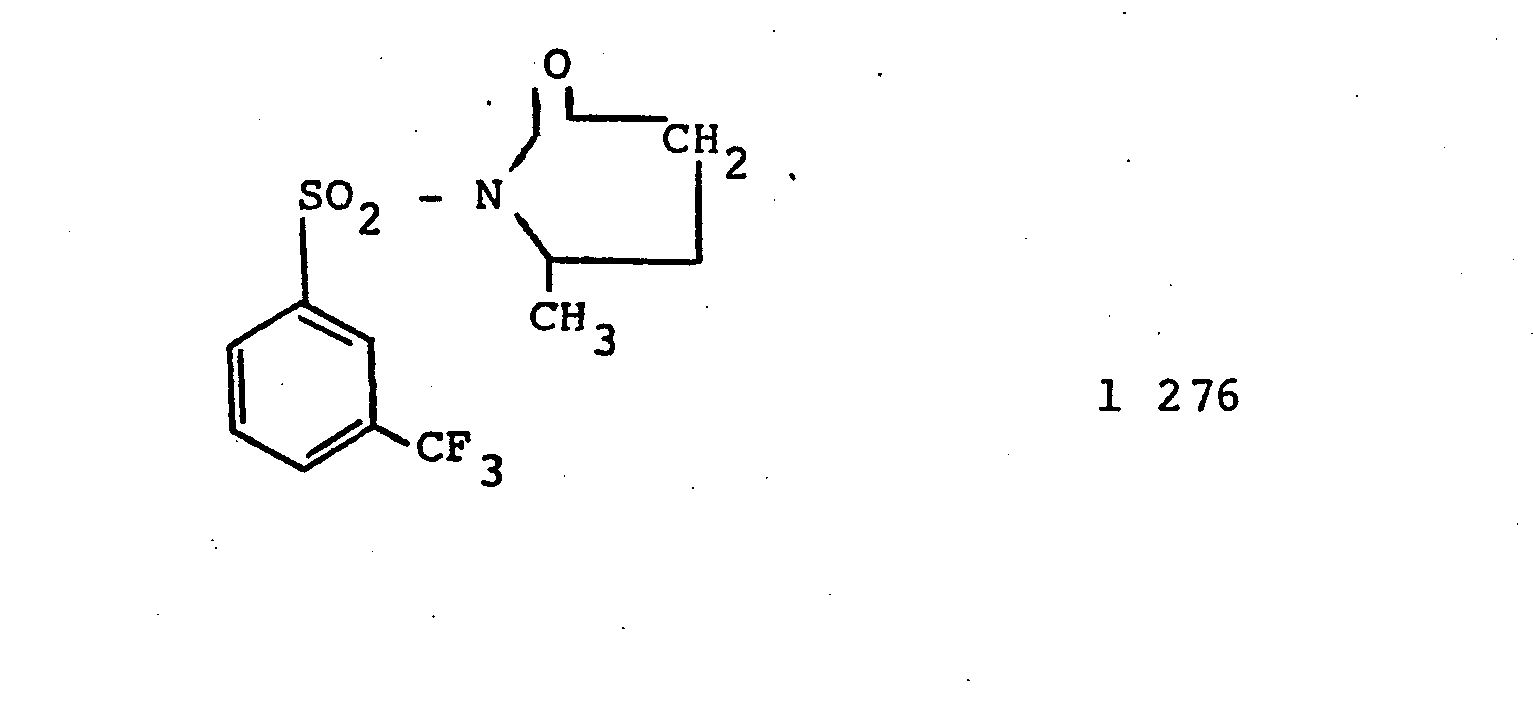


- Les composés de formule (I) peuvent être obtenus par cyclisation du benzènesulfonamidoacide de formule (XVII) :

- La cyclisation des benzènesulfonamides peut se faire en utilisant un agent de cyclisation, en milieu acide, et en chauffant. On peut par exemple utiliser comme agent cyclisant P205 et comme acide H3PO4.
- Ce mode d'obtention des composés de formule (I) sera désigné par Méthode A.
- Les composés selon l'invention susceptibles d'être préparés selon cette méthode A sont ceux dans lesquels n vaut 1, R représente l'hydrogène, et X, Y, Z et W sont tous différents d'un groupe alcoxy.
- On donne ci-après un exemple général de mise en oeuvre de la méthode A pour obtenir les composés de formule (I).

- A 10 ml d'acide orthophosphorique à 85 % sont ajoutés, avec précaution, 20 g d'anhydride phosphorique puis 0,01 mole de dérivé benzènesulfonamido-acide. Le mélange réactionnel est porté de 30 minutes à 3 heures à une température comprise entre 40 et 90°C, selon les produits, puis versé sur de la glace pilée. Les cristaux sont essorés, lavés abondamment à l'eau puis par une solution de bicarbonate de sodium N.
- Le produit est alors recristallisé dans les solvants usuels appropriés.
- Le rendement est de 60 % à 90 %.
- La cyclisation des benzènesulfonamidoacides de formule (XVII) peut également se faire avantageusement en ayant recours à de l'anhydride trifluoroacétique comme agent cyclisant, en présence de trifluoroacétate de sodium et en chauffant.
- Ce mode d'obtention des composés de formule (I) sera désigné par la suite par Méthode B.
- Cette méthode B présente l'avantage de pouvoir être utilisée pour la préparation de tous les composés de formule (I), et de fournir un bon rendement.
- On utilise de préférence la méthode B lorsque R représente OH ou OCOCH3.
- On donne ci-après un exemple général de mise en oeuvre de la méthode B pour obtenir les composés de formule (I).

- On porte au reflux sous agitation pendant 2 à 24 heures, 0,01 mole de dérivé benzènesulfonamidoacide et 0,5 g de trifluoroacétate de sodium anhydre dans 20 ml d'anhydride trifluoroacétique. Après évaporation du milieu réactionnel sous vide, le résidu est repris dans 20 ml de méthanol anhydre puis porté 30 minutes au reflux. La solution méthanolique est évaporée à sec, le résidu est repris par 10 ml d'eau.
- Les cristaux sont essorés, puis recristallisés dans les solvants organiques appropriés.
- Le rendement est de 65 X à 90 X.
- Les benzènesulfonamidoacides utilisés sont préparés comme il est indiqué dans les demandes de brevet FR n° 81 11858 et 81 11859.
- En ce qui concerne les benzènesulfonamidoacides dans lesquels R représente OH et n, R1, X, Y, Z, W ont les significations indiquées ci-dessus, ils sont nouveaux.
- Ces nouveaux benzènesulfonamidoacides répondent à la formule (XVIIa) suivante :

- Ces composés peuvent être préparés en condensant un sulfohalogénure, notamment un sulfochlorure de formule (XVIII) :


- On donne ci-après, à titre d'exemple, la préparation du composé de formule :

- A 3,57 g (0,030 mole) d'acide dl amino-4-hydroxy-3 butyrique dans 60 ml de soude N, on ajoute goutte à goutte sous agitation vigoureuse une solution de 9,4 g (0,030 mole) de chlorure de ditrifluorométhyle-3,5 benzènesulfonyle dans 60 ml d'éther éthylique.
- Après 4 heures d'agitation, la phase organique est éliminée. La phase aqueuse est alors amenée à pH 3 par de l'acide chlorhydrique 2N. Le précipité formé est essoré, lavé à l'eau jusqu'à disparition d'ions chlorure, puis séché.
- F = 160°C Rdt = 58 X p. m. = 395,29 Analyse théorique pour C12H11F6NO5S
- Calculée : C 36,4 H 2,8 N 3,6
- Trouvée : C 36,3 H 3,1 N 3,8
- Ont été également préparés par ce procédé les composés de formule :

- Les composés de formule (I) selon l'invention peuvent être également préparés par condensation des sulfohalogénures, notamment sulfochlorures, de formule (XVIII) :


- Cette réaction est de préférence effectuée en présence d'une base forte, pour arracher le proton du composé (XIX), tel que l'hydrure de sodium, dans un solvant tel que le xylène puis sous l'effet du chauffage, la condensation a lieu.
- Cette méthode sera désignée ci-après par Méthode C.
- Les composés selon l'invention susceptibles d'être préparés par cette méthode sont ceux dans lesquels R2 représente l'hydrogène. On donne ci-après un exemple général de mise en oeuvre de la méthode C.

- A 0,01 mole d'hydrure de sodium dans 50 ml de xylène anhydre, on ajoute goutte à goutte 0,01 mole de dérivé lactame, sous agitation. On porte le milieu réactionnel pendant 2 heures à 80°C. Après refroidissement, on ajoute goutte à goutte 0,01 mole du sulfochlorure approprié et on porte le milieu réactionnel à 110°C pendant 2 à 8 heures.
- Après élimination du solvant par distillation sous vide, le résidu est repris dans l'eau. Le précipité est essoré, lavé à l'eau, puis recristallisé dans les solvants usuels.
- Le rendement est de 10 % à 50 %.
- Les sulfochlorures utilisés pour la mise en oeuvre de la méthode C sont ceux décrits dans la littérature ainsi que dans les brevets et demandes de brevet FR n° 2 313 918, 2 338 929, 2 504 528, 2 504 527.
- Les produits qui ont été préparés selon la méthode A sont les suivants : n 1 043, 1 289, 1 277, 1 276, 1 355, 1 351, 1 416, 1 039.
- Les produits qui ont été préparés selon la méthode 8 sont les suivants : n° 1 043, 1 289, 1 277, 1 276, 1 355, 1 351, 1 416, 1 419, 1 417, 1 418, 1 415, 1 120, 1 287, 1 288, 1 124, 1 285, 1 286, 1 309, 1 332, 1 310, 1 281, 1 282, 1 442, 1 441, 1 039.
- Les produits qui ont été préparés selon la méthode C sont les suivants : n° 1 043, 1 289, 1 277, 1 276, 1 355, 1 351, 1 416, 1 120, 1 287, 1 288, 1 124, 1 285, 1 286, 1 309, 1 332, 1 310, 1 281, 1 282, 1 442, 1 441.
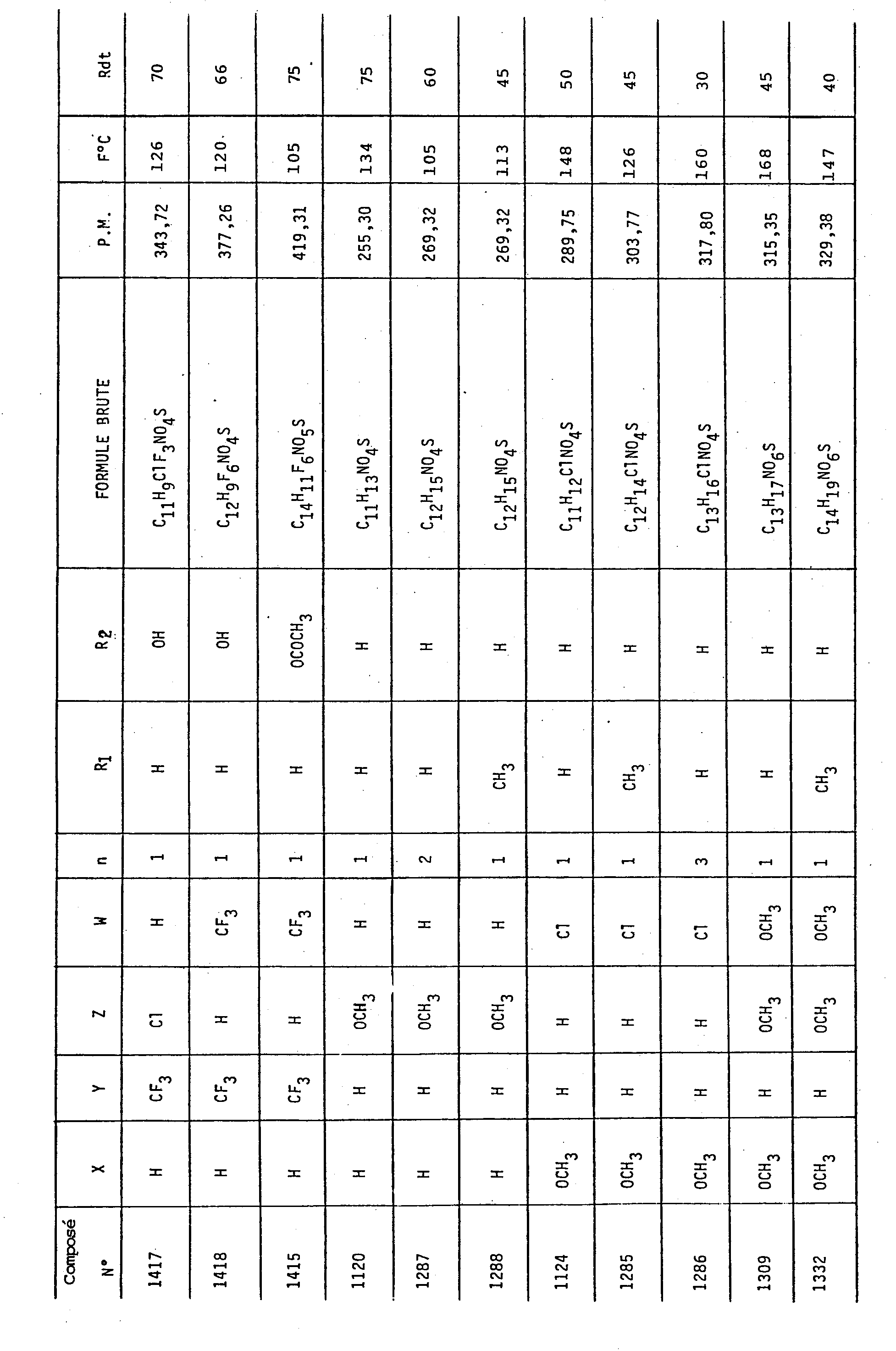
- Le tableau ci-après rassemble les composés préparés selon les méthodes A, B et C et indique pour chacun d'eux la formule, le point de fusion et le rendement.
- L'analyse centésimale des produits obtenus est conforme aux normes habituelles (± 0,3 %).


- Les composés selon l'invention présentent de remarquables propriétés pharmacologiques.
- Les composés selon l'invention présentent des propriétés psychotropes avec modification du comportement.
- Ces propriétés pharmacologiques ont été étudiées en prenant comme substance de référence l'aniracetam.
- Les composés selon l'invention sont avantageusement introduits comme substance active, notamment dans le traitement des troubles de la mémoire, de l'amnésie, dans le cas d'efforts physiques et intellectuels liés à des périodes de surmenage, dans le traitement des troubles du comportement et de l'adaptation.
- Les composés selon l'invention se distinguent par le fait qu'ils agissent sur la mémoire et l'attention, augmentent l'activité mentale et équilibrent le comportement émotionnel.
- Les composés selon l'invention sont à cet effet conditionnés avec les excipients et adjuvants traditionnels, notamment ceux utilisés pour la préparation des comprimés, poudres, gélules, ampoules buvables, solutions buvables, solutés injectables.
- L'administration des médicaments contenant les composés selon l'invention est effectuée de préférence par voie orale, et les doses de composés administrés sont comprises de 50 à 3 000 mg/jour, de préférence de 200 à 2 000 mg/jour, par exemple de 100 à 1 000 mg/jour, en une ou plusieurs fois.
- Un exemple de composition pharmaceutique avantageuse est constitué par une gélule ou un comprimé correspondant à une unité de prise en substance active de 25 à 200 mg, de préférence 100 mg, avec des excipients appropriés.
- Un autre exemple de composition pharmaceutique avantageuse est constitué par une solution buvable, compatible avec des unités de prise de 25 à 200 mg de substance active.
- Les composés selon l'invention sont dépourvus de toxicité.
- En effet, la valeur de la DL50 obtenue avec les composés n° 1 039, 1 043, 1 276, 1 288, administrés par voie intrapéritonéale chez la souris, est supérieure à 1 g/kg, ce qui montre qu'aux doses d'administration, les composés de l'invention ne sont pas toxiques.
- On a recours à un dispositif constitué d'une cage bipartite, formée d'un compartiment éclairé et d'un compartiment sombre, séparés par une cloison percée d'un passage. Le plancher du secteur sombre est formé par une grille électrifiable.
- Après familiarisation avec le dispositif. des souris albinos subissent une à une la séance d'initiation : chaque souris est déposée dans le compartiment éclairé : on mesure sa latence spontanée à entrer dans le compartiment sombre (préféré spontanément) ; dès qu'elle est entrée, elle y reçoit un choc électrique.
- Après 10 minutes (protocole A), l'animal est replacé dans le compartiment clair.
- L'effet est apprécié par l'augmentation de la latence à entrer dans le compartiment sombre, ou le temps passé dans ce même secteur et l'étude de son comportement dans chaque secteur.
- Les produits sont administrés par voie IP à 50 mg/kg dans de la gomme arabique à 2 %, 20 minutes avant (protocole A) la séance d'initiation.
- Le placébo est constitué par de la gomme arabique à 2 /.
- Les résultats relatifs au protocole A sont donnés dans le tableau 2.

- L'étude du comportement des souris montre que leur capacité exploratoire est augmentée dans les deux secteurs, ce qui se traduit par une augmentation de la latence d'entrée dans le secteur sombre et une augmentation du temps passé dans le secteur sombre.
- Il s'agit d'un test préconisé par JANSSEN et col. ("Psychopharmacologia", 1960, 1, p. 389-392) amélioré pour la mesure de l'activité motrice par un appareil automatisé par DELBENE et col. ("Psychologia", 1970, 18, p. 227-230).
- Ce test a été adapté par G. NARCISSE et col. (travaux non publiés).
- Les doses sont de 50 et 100 mg/kg par voie intrapéritonéale.
- Ce test effectué avec le composé n° 1 039 montre que ce composé présente des propriétés psychotropes. Ce test, réalisé dans les mêmes conditions avec les composés de l'invention n 1 043, 1 276, 1 277, 1 281, 1 288, 1 309, 1 417, 1 418 et 1 419, montre que ces composés présentent également une activité psychotrope.
Claims (21)




Applications Claiming Priority (2)
| Application Number | Priority Date | Filing Date | Title |
|---|---|---|---|
| FR8316554 | 1983-10-18 | ||
| FR8316554A FR2553409B1 (fr) | 1983-10-18 | 1983-10-18 | Nouveaux benzenesulfonyl-lactames, leur procede de preparation et leur application comme substance active de compositions pharmaceutiques |
Publications (3)
| Publication Number | Publication Date |
|---|---|
| EP0138721A2 true EP0138721A2 (fr) | 1985-04-24 |
| EP0138721A3 EP0138721A3 (fr) | 1985-06-19 |
| EP0138721B1 EP0138721B1 (fr) | 1989-04-26 |
Family
ID=9293254
Family Applications (1)
| Application Number | Title | Priority Date | Filing Date |
|---|---|---|---|
| EP84402099A Expired EP0138721B1 (fr) | 1983-10-18 | 1984-10-18 | Nouveaux benzenesulfonyl-lactames, leur procédé de préparation et leur application comme substance active de compositions pharmaceutiques |
Country Status (16)
| Country | Link |
|---|---|
| US (1) | US4585769A (fr) |
| EP (1) | EP0138721B1 (fr) |
| JP (1) | JPS60104062A (fr) |
| KR (1) | KR850003394A (fr) |
| AT (1) | AT381489B (fr) |
| AU (1) | AU583255B2 (fr) |
| CA (1) | CA1245218A (fr) |
| DE (1) | DE3477924D1 (fr) |
| DK (1) | DK494684A (fr) |
| ES (1) | ES8506621A1 (fr) |
| FR (1) | FR2553409B1 (fr) |
| GR (1) | GR80597B (fr) |
| IL (1) | IL73222A (fr) |
| NZ (1) | NZ209907A (fr) |
| PT (1) | PT79360B (fr) |
| ZA (1) | ZA848140B (fr) |
Cited By (14)
| Publication number | Priority date | Publication date | Assignee | Title |
|---|---|---|---|---|
| EP0270293A1 (fr) * | 1986-12-03 | 1988-06-08 | Merck & Co. Inc. | Nitro-3 benzènesulfonamides substitués utiles comme auxiliaires du traitement par des rayons |
| EP0229566A3 (en) * | 1985-12-30 | 1988-07-27 | Roussel-Uclaf | 1-benzene sulfonyl 2-oxo-5-alkoxy pyrrolidines, process for their preparation, their use as medicine and compositions containing them |
| EP0239500A3 (en) * | 1986-03-28 | 1988-07-27 | Roussel-Uclaf | 1-styrene-sulfonyl-2-oxo-5-hydroxy-pyrrolidine derivatives, their intermediates, process for their preparation, compositions containing them and their use as medicines |
| EP0298818A1 (fr) * | 1987-06-29 | 1989-01-11 | Roussel-Uclaf | Dérivés de la 1-benzène-sulfonyl 2-oxo 5-alkylthio pyrrolidine, leur procédé et intermédiaires de préparation, leur application comme médicaments et les compositions les renfermant |
| EP0294295A3 (en) * | 1987-06-05 | 1989-01-18 | Roussel-Uclaf | 1-arylsulfonyl 2-oxo 5-alkoxy pyrrolidine derivatives, process for their preparation, compositions containing them and their uses as medicines |
| US4833156A (en) * | 1987-02-28 | 1989-05-23 | Kirin Beer Kabushiki Kaisha | Treating amnesia with a pyrrolidone derivative |
| EP0300850A3 (en) * | 1987-06-24 | 1989-08-16 | Roussel-Uclaf | 1-arylsulfonyl-1,5-dihydro 2h-pyrrol-2-one derivatives, intermediates and process for their preparation, their use as medicines and compositions containing them |
| US4882350A (en) * | 1987-06-25 | 1989-11-21 | Roussel Uclaf | Derivatives of 1-benzyl-2-oxo-5-alkoxy-pyrrolidine, and medicament compositions containing them |
| EP0335758A3 (fr) * | 1988-02-26 | 1990-01-10 | Roussel-Uclaf | Dérivés de la 1-arylsulfonyl 2-pyrrolidinone, leur procédé de préparation, leur application comme médicaments et les compositions les renfermant |
| US4948804A (en) * | 1987-06-26 | 1990-08-14 | Roussel Uclaf | Derivatives of 1-benzoyl 2-oxo 5-alkoxy pyrrolidine, their preparation, their use as medicaments and the compositions containing them |
| EP0401093A1 (fr) * | 1989-05-31 | 1990-12-05 | Adir Et Compagnie | Nouveaux dérivés de la pyrrolidone, leur procédé de preparation et les compositions pharmaceutiques les renfermant |
| US5037822A (en) * | 1989-02-23 | 1991-08-06 | Roussel-Uclaf | 1-arylsulphonyl-2-pyrrolidinethione or 1-arylsulphonyl-2-piperidinethione derivatives, process for the preparation thereof their application as medicinal products and compositions containing them |
| EP0384843A3 (fr) * | 1989-02-22 | 1992-04-22 | Roussel-Uclaf | Dérivés de la 1-arylsulfonyl 2-pipéridinone, leur procédé et les intermédiaires de préparation, leur application comme médicaments et les compositions les renfermant |
| EP0490765A3 (en) * | 1990-12-13 | 1993-02-24 | Roussel-Uclaf | 1-arylsulfonyl-2-pyrrolidone-derivatives, process for their preparation, new in termediates, use for medicaments and drugs containing them |
Family Cites Families (4)
| Publication number | Priority date | Publication date | Assignee | Title |
|---|---|---|---|---|
| US3453289A (en) * | 1966-01-21 | 1969-07-01 | American Home Prod | P-substituted-phenylsulfonyl pyrrolidine derivatives |
| US4080342A (en) * | 1976-12-06 | 1978-03-21 | Monsanto Company | N-(α-alkylbenzylthio)succinimide |
| CA1135705A (fr) * | 1978-07-20 | 1982-11-16 | Jens-Uwe Bliesener | Obtention de n-arylsulfonylpyrroles et agents therapeutiques derives |
| FR2504528A1 (fr) * | 1981-04-23 | 1982-10-29 | Choay Sa | Dialcoxy (2,4) benzenesulfonamides n-substitues |
-
1983
- 1983-10-18 FR FR8316554A patent/FR2553409B1/fr not_active Expired
-
1984
- 1984-10-10 IL IL73222A patent/IL73222A/xx unknown
- 1984-10-11 GR GR80597A patent/GR80597B/el unknown
- 1984-10-15 PT PT79360A patent/PT79360B/fr unknown
- 1984-10-16 DK DK494684A patent/DK494684A/da not_active Application Discontinuation
- 1984-10-16 CA CA000465562A patent/CA1245218A/fr not_active Expired
- 1984-10-16 ES ES536780A patent/ES8506621A1/es not_active Expired
- 1984-10-17 JP JP59218161A patent/JPS60104062A/ja active Pending
- 1984-10-17 NZ NZ209907A patent/NZ209907A/xx unknown
- 1984-10-18 EP EP84402099A patent/EP0138721B1/fr not_active Expired
- 1984-10-18 ZA ZA848140A patent/ZA848140B/xx unknown
- 1984-10-18 AT AT0332584A patent/AT381489B/de not_active IP Right Cessation
- 1984-10-18 AU AU34471/84A patent/AU583255B2/en not_active Ceased
- 1984-10-18 DE DE8484402099T patent/DE3477924D1/de not_active Expired
- 1984-10-18 KR KR1019840006477A patent/KR850003394A/ko not_active Withdrawn
- 1984-10-18 US US06/662,187 patent/US4585769A/en not_active Expired - Fee Related
Cited By (23)
| Publication number | Priority date | Publication date | Assignee | Title |
|---|---|---|---|---|
| EP0229566A3 (en) * | 1985-12-30 | 1988-07-27 | Roussel-Uclaf | 1-benzene sulfonyl 2-oxo-5-alkoxy pyrrolidines, process for their preparation, their use as medicine and compositions containing them |
| US4829079A (en) * | 1985-12-30 | 1989-05-09 | Roussel Uclaf | 1-benzenesulphonyl-2-oxo-5-alkoxypyrrolidines and medical methods of use thereof |
| EP0239500A3 (en) * | 1986-03-28 | 1988-07-27 | Roussel-Uclaf | 1-styrene-sulfonyl-2-oxo-5-hydroxy-pyrrolidine derivatives, their intermediates, process for their preparation, compositions containing them and their use as medicines |
| US4810722A (en) * | 1986-03-28 | 1989-03-07 | Roussel Uclaf | 1-styrenesulphonyl-2-oxo-5-hydroxy pyrrolidines and their use for memory restoration after electoshock treatment |
| US4845284A (en) * | 1986-12-03 | 1989-07-04 | Merck & Co., Inc. | Substituted 3-nitrobenzenesulfonamides useful as adjuncts in radiation therapy |
| EP0270293A1 (fr) * | 1986-12-03 | 1988-06-08 | Merck & Co. Inc. | Nitro-3 benzènesulfonamides substitués utiles comme auxiliaires du traitement par des rayons |
| US4833156A (en) * | 1987-02-28 | 1989-05-23 | Kirin Beer Kabushiki Kaisha | Treating amnesia with a pyrrolidone derivative |
| US4885306A (en) * | 1987-06-05 | 1989-12-05 | Roussel Uclaf | Derivatives of 1-arylsulphonyl-2-oxo-5-alkoxy-pyrrolidine and medical compositions containing them |
| EP0294295A3 (en) * | 1987-06-05 | 1989-01-18 | Roussel-Uclaf | 1-arylsulfonyl 2-oxo 5-alkoxy pyrrolidine derivatives, process for their preparation, compositions containing them and their uses as medicines |
| US4885307A (en) * | 1987-06-24 | 1989-12-05 | Roussel Uclaf | Derivatives of 1-arylsulphonyl-1,5-dihydro-2H-pyrrol-2-one, and compositions containing them |
| EP0300850A3 (en) * | 1987-06-24 | 1989-08-16 | Roussel-Uclaf | 1-arylsulfonyl-1,5-dihydro 2h-pyrrol-2-one derivatives, intermediates and process for their preparation, their use as medicines and compositions containing them |
| US4882350A (en) * | 1987-06-25 | 1989-11-21 | Roussel Uclaf | Derivatives of 1-benzyl-2-oxo-5-alkoxy-pyrrolidine, and medicament compositions containing them |
| US4948804A (en) * | 1987-06-26 | 1990-08-14 | Roussel Uclaf | Derivatives of 1-benzoyl 2-oxo 5-alkoxy pyrrolidine, their preparation, their use as medicaments and the compositions containing them |
| EP0298818A1 (fr) * | 1987-06-29 | 1989-01-11 | Roussel-Uclaf | Dérivés de la 1-benzène-sulfonyl 2-oxo 5-alkylthio pyrrolidine, leur procédé et intermédiaires de préparation, leur application comme médicaments et les compositions les renfermant |
| US4897414A (en) * | 1987-06-29 | 1990-01-30 | Roussel Ucaf | Derivatives of 1-benzensulphonyl-2-oxo-5-alkylthio pyrrolidine, and compositions containing them |
| EP0335758A3 (fr) * | 1988-02-26 | 1990-01-10 | Roussel-Uclaf | Dérivés de la 1-arylsulfonyl 2-pyrrolidinone, leur procédé de préparation, leur application comme médicaments et les compositions les renfermant |
| EP0384843A3 (fr) * | 1989-02-22 | 1992-04-22 | Roussel-Uclaf | Dérivés de la 1-arylsulfonyl 2-pipéridinone, leur procédé et les intermédiaires de préparation, leur application comme médicaments et les compositions les renfermant |
| US5037822A (en) * | 1989-02-23 | 1991-08-06 | Roussel-Uclaf | 1-arylsulphonyl-2-pyrrolidinethione or 1-arylsulphonyl-2-piperidinethione derivatives, process for the preparation thereof their application as medicinal products and compositions containing them |
| EP0384844A3 (fr) * | 1989-02-23 | 1991-11-21 | Roussel-Uclaf | Nouveaux dérivés de la 1-arylsulfonyl pyrrollidin-2-thione ou de la 1-aryl-sulfonyl pipéridin-2-thione, leur procédé de préparation, leur application comme médicaments et les compositions les renfermant |
| EP0401093A1 (fr) * | 1989-05-31 | 1990-12-05 | Adir Et Compagnie | Nouveaux dérivés de la pyrrolidone, leur procédé de preparation et les compositions pharmaceutiques les renfermant |
| FR2647785A1 (fr) * | 1989-05-31 | 1990-12-07 | Adir | Nouveaux derives de la pyrrolidone, leur procede de preparation et les compositions pharmaceutiques les renfermant |
| EP0490765A3 (en) * | 1990-12-13 | 1993-02-24 | Roussel-Uclaf | 1-arylsulfonyl-2-pyrrolidone-derivatives, process for their preparation, new in termediates, use for medicaments and drugs containing them |
| US5204341A (en) * | 1990-12-13 | 1993-04-20 | Roussel Uclaf | 1-arylsulphonyl-2-pyrrolidone derivatives, their preparation process and the new intermediates obtained, their use as medicaments and the pharmaceutical compositions containing them |
Also Published As
| Publication number | Publication date |
|---|---|
| EP0138721B1 (fr) | 1989-04-26 |
| FR2553409B1 (fr) | 1986-04-18 |
| EP0138721A3 (fr) | 1985-06-19 |
| CA1245218A (fr) | 1988-11-22 |
| KR850003394A (ko) | 1985-06-17 |
| IL73222A (en) | 1988-07-31 |
| AT381489B (de) | 1986-10-27 |
| ATA332584A (de) | 1986-03-15 |
| ES536780A0 (es) | 1985-08-01 |
| PT79360B (fr) | 1986-09-08 |
| JPS60104062A (ja) | 1985-06-08 |
| PT79360A (fr) | 1984-11-01 |
| ZA848140B (en) | 1985-06-26 |
| US4585769A (en) | 1986-04-29 |
| DE3477924D1 (en) | 1989-06-01 |
| FR2553409A1 (fr) | 1985-04-19 |
| NZ209907A (en) | 1988-09-29 |
| DK494684D0 (da) | 1984-10-16 |
| ES8506621A1 (es) | 1985-08-01 |
| GR80597B (en) | 1985-01-03 |
| IL73222A0 (en) | 1985-01-31 |
| AU3447184A (en) | 1985-04-26 |
| AU583255B2 (en) | 1989-04-27 |
| DK494684A (da) | 1985-04-19 |
Similar Documents
| Publication | Publication Date | Title |
|---|---|---|
| EP0138721B1 (fr) | Nouveaux benzenesulfonyl-lactames, leur procédé de préparation et leur application comme substance active de compositions pharmaceutiques | |
| EP0370901A1 (fr) | Nouveaux dérivés du chromanne actifs sur le système nerveux central, leur procédé de préparation et les compositions pharmaceutiques en contenant | |
| EP0003383A2 (fr) | Dérivés de 4-amino-3-sulfonamido-pyridine | |
| EP0005689B1 (fr) | Nouveaux acides lactame-N-acétiques et leurs amides, leurs procédés de préparation et compositions thérapeutiques | |
| EP0110781A1 (fr) | (Amino-2 éthyl)-6 benzoxazolinones substituées, leur préparation et une composition pharmaceutique les contenant | |
| FR2696740A1 (fr) | Dérivés prodrogués de la diméthylbiguanide et applications comme médicaments. | |
| MC1982A1 (fr) | Procede de preparation de derives de la didesoxycitidine | |
| EP0117771B1 (fr) | Imino-2 pyrrolidines, leur procédé de préparation et leurs applications en thérapeutique | |
| EP0239436B1 (fr) | Nouveau dérivé tricyclique dénommé acide (chloro-3 méthyl-6 dioxo-5,5 dihydro-6, 11 dibenzo (c,f) thiazépine (1,2) yl-11 amino) -5 pentanoique, son procédé de préparation et les compositions pharmaceutiques qui le contiennent | |
| EP0556872A1 (fr) | Utilisation de dérivés du diméthyl-2,2 chromène dans le traitement de l'asthme | |
| CA1095047A (fr) | Procede de preparation de nouveaux derives du 1,4- benzodioxane | |
| EP0173597B1 (fr) | Nouveaux éther-oxydes dérivés de cyclopropylphénols | |
| EP0259206B1 (fr) | Dérivés de la dihydro-1,4 pyridine leurs procédés de préparation et les compositions pharmaceutiques qui les contiennent | |
| EP0301936B1 (fr) | Dérivés de pipéridine, leur préparation et leur application en thérapeutique | |
| FR2480286A1 (fr) | Nouveaux derives de theophyllinylmethyldioxolane, leurs procedes de preparation et leur application en therapeutique | |
| EP0000452B1 (fr) | Dérivés d'oxadiazole-1,2,4, leur préparation et leur application en thérapeutique. | |
| FR2547822A1 (fr) | Acylpiperazinoquinazolines substituees utiles comme medicaments et procede pour leur preparation | |
| EP0138684B1 (fr) | 2-(N-pyrrolidino)-3-isobutoxy-N-phenyl substitué N-benzyl propylamines, leur préparation et leur application pharmaceutique | |
| EP0079411B1 (fr) | Dérivés d'indoloquinolizine, leur procédé de préparation et leur application en thérapeutique | |
| EP0406502B1 (fr) | Procédé de préparation de la (-) [[(amino-2 éthoxy)-2 éthoxy]méthyl]-2 (dichloro-2,3 phényl)-4 éthoxycarbonyl-3 méthoxycarbonyl-5 méthyl-6 dihydro-1,4 pyridine, et intermédiaire pour sa préparation | |
| EP0035925A1 (fr) | Nouveaux dérivés de la chloro-3 quinoléine, procédés pour leur préparation, et médicaments les contenant | |
| EP0170549A1 (fr) | Dérivés de tétrahydro-4,5,6,7 furo ou 1H-pyrrolo[2,3-c]pyridine, leur préparation et leur application en therapeutique | |
| EP0233804A1 (fr) | Monoaryl-5 as triazinones-3 substituées en position 2, leur procédé de préparation et leur application en tant que medicaments | |
| EP0082040A1 (fr) | Dérivés de diaza-3,7a cyclohepta(j,k)fluorènes, leur préparation et leur application en thérapeutique | |
| EP0043811A1 (fr) | Nouvelles indolonaphtyridines et leur utilisation en tant que médicaments |
Legal Events
| Date | Code | Title | Description |
|---|---|---|---|
| PUAI | Public reference made under article 153(3) epc to a published international application that has entered the european phase |
Free format text: ORIGINAL CODE: 0009012 |
|
| PUAL | Search report despatched |
Free format text: ORIGINAL CODE: 0009013 |
|
| AK | Designated contracting states |
Designated state(s): BE CH DE FR GB IT LI LU NL SE |
|
| AK | Designated contracting states |
Designated state(s): BE CH DE FR GB IT LI LU NL SE |
|
| RTI1 | Title (correction) | ||
| 17P | Request for examination filed |
Effective date: 19851205 |
|
| 17Q | First examination report despatched |
Effective date: 19861223 |
|
| GRAA | (expected) grant |
Free format text: ORIGINAL CODE: 0009210 |
|
| AK | Designated contracting states |
Kind code of ref document: B1 Designated state(s): BE CH DE FR GB IT LI LU NL SE |
|
| GBT | Gb: translation of ep patent filed (gb section 77(6)(a)/1977) | ||
| REF | Corresponds to: |
Ref document number: 3477924 Country of ref document: DE Date of ref document: 19890601 |
|
| ITF | It: translation for a ep patent filed | ||
| PGFP | Annual fee paid to national office [announced via postgrant information from national office to epo] |
Ref country code: LU Payment date: 19891011 Year of fee payment: 6 |
|
| PG25 | Lapsed in a contracting state [announced via postgrant information from national office to epo] |
Ref country code: GB Effective date: 19891018 |
|
| PG25 | Lapsed in a contracting state [announced via postgrant information from national office to epo] |
Ref country code: SE Effective date: 19891019 |
|
| PG25 | Lapsed in a contracting state [announced via postgrant information from national office to epo] |
Ref country code: LU Free format text: LAPSE BECAUSE OF NON-PAYMENT OF DUE FEES Effective date: 19891031 Ref country code: LI Effective date: 19891031 Ref country code: CH Effective date: 19891031 Ref country code: BE Effective date: 19891031 |
|
| PLBE | No opposition filed within time limit |
Free format text: ORIGINAL CODE: 0009261 |
|
| STAA | Information on the status of an ep patent application or granted ep patent |
Free format text: STATUS: NO OPPOSITION FILED WITHIN TIME LIMIT |
|
| 26N | No opposition filed | ||
| BERE | Be: lapsed |
Owner name: DROPIC SOC. CIVILE DE GESTION DE DROIT DE PROPRIE Effective date: 19891031 |
|
| PG25 | Lapsed in a contracting state [announced via postgrant information from national office to epo] |
Ref country code: NL Effective date: 19900501 |
|
| GBPC | Gb: european patent ceased through non-payment of renewal fee | ||
| NLV4 | Nl: lapsed or anulled due to non-payment of the annual fee | ||
| PG25 | Lapsed in a contracting state [announced via postgrant information from national office to epo] |
Ref country code: FR Effective date: 19900629 |
|
| REG | Reference to a national code |
Ref country code: CH Ref legal event code: PL |
|
| PG25 | Lapsed in a contracting state [announced via postgrant information from national office to epo] |
Ref country code: DE Effective date: 19900703 |
|
| REG | Reference to a national code |
Ref country code: FR Ref legal event code: ST |
|
| EUG | Se: european patent has lapsed |
Ref document number: 84402099.0 Effective date: 19900706 |