EP0138769A2 - Diurethandiharnstoffe und deren Verwendung - Google Patents
Diurethandiharnstoffe und deren Verwendung Download PDFInfo
- Publication number
- EP0138769A2 EP0138769A2 EP84810490A EP84810490A EP0138769A2 EP 0138769 A2 EP0138769 A2 EP 0138769A2 EP 84810490 A EP84810490 A EP 84810490A EP 84810490 A EP84810490 A EP 84810490A EP 0138769 A2 EP0138769 A2 EP 0138769A2
- Authority
- EP
- European Patent Office
- Prior art keywords
- formula
- diurethane
- parts
- diisocyanate
- diureas
- Prior art date
- Legal status (The legal status is an assumption and is not a legal conclusion. Google has not performed a legal analysis and makes no representation as to the accuracy of the status listed.)
- Granted
Links
Classifications
-
- C—CHEMISTRY; METALLURGY
- C07—ORGANIC CHEMISTRY
- C07D—HETEROCYCLIC COMPOUNDS
- C07D295/00—Heterocyclic compounds containing polymethylene-imine rings with at least five ring members, 3-azabicyclo [3.2.2] nonane, piperazine, morpholine or thiomorpholine rings, having only hydrogen atoms directly attached to the ring carbon atoms
- C07D295/16—Heterocyclic compounds containing polymethylene-imine rings with at least five ring members, 3-azabicyclo [3.2.2] nonane, piperazine, morpholine or thiomorpholine rings, having only hydrogen atoms directly attached to the ring carbon atoms acylated on ring nitrogen atoms
- C07D295/20—Heterocyclic compounds containing polymethylene-imine rings with at least five ring members, 3-azabicyclo [3.2.2] nonane, piperazine, morpholine or thiomorpholine rings, having only hydrogen atoms directly attached to the ring carbon atoms acylated on ring nitrogen atoms by radicals derived from carbonic acid, or sulfur or nitrogen analogues thereof
- C07D295/215—Radicals derived from nitrogen analogues of carbonic acid
-
- C—CHEMISTRY; METALLURGY
- C07—ORGANIC CHEMISTRY
- C07C—ACYCLIC OR CARBOCYCLIC COMPOUNDS
- C07C275/00—Derivatives of urea, i.e. compounds containing any of the groups, the nitrogen atoms not being part of nitro or nitroso groups
- C07C275/04—Derivatives of urea, i.e. compounds containing any of the groups, the nitrogen atoms not being part of nitro or nitroso groups having nitrogen atoms of urea groups bound to acyclic carbon atoms
- C07C275/06—Derivatives of urea, i.e. compounds containing any of the groups, the nitrogen atoms not being part of nitro or nitroso groups having nitrogen atoms of urea groups bound to acyclic carbon atoms of an acyclic and saturated carbon skeleton
- C07C275/14—Derivatives of urea, i.e. compounds containing any of the groups, the nitrogen atoms not being part of nitro or nitroso groups having nitrogen atoms of urea groups bound to acyclic carbon atoms of an acyclic and saturated carbon skeleton being further substituted by nitrogen atoms not being part of nitro or nitroso groups
-
- C—CHEMISTRY; METALLURGY
- C07—ORGANIC CHEMISTRY
- C07C—ACYCLIC OR CARBOCYCLIC COMPOUNDS
- C07C275/00—Derivatives of urea, i.e. compounds containing any of the groups, the nitrogen atoms not being part of nitro or nitroso groups
- C07C275/04—Derivatives of urea, i.e. compounds containing any of the groups, the nitrogen atoms not being part of nitro or nitroso groups having nitrogen atoms of urea groups bound to acyclic carbon atoms
- C07C275/18—Derivatives of urea, i.e. compounds containing any of the groups, the nitrogen atoms not being part of nitro or nitroso groups having nitrogen atoms of urea groups bound to acyclic carbon atoms of a saturated carbon skeleton containing rings
-
- C—CHEMISTRY; METALLURGY
- C07—ORGANIC CHEMISTRY
- C07C—ACYCLIC OR CARBOCYCLIC COMPOUNDS
- C07C275/00—Derivatives of urea, i.e. compounds containing any of the groups, the nitrogen atoms not being part of nitro or nitroso groups
- C07C275/28—Derivatives of urea, i.e. compounds containing any of the groups, the nitrogen atoms not being part of nitro or nitroso groups having nitrogen atoms of urea groups bound to carbon atoms of six-membered aromatic rings of a carbon skeleton
- C07C275/40—Derivatives of urea, i.e. compounds containing any of the groups, the nitrogen atoms not being part of nitro or nitroso groups having nitrogen atoms of urea groups bound to carbon atoms of six-membered aromatic rings of a carbon skeleton being further substituted by nitrogen atoms not being part of nitro or nitroso groups
-
- C—CHEMISTRY; METALLURGY
- C08—ORGANIC MACROMOLECULAR COMPOUNDS; THEIR PREPARATION OR CHEMICAL WORKING-UP; COMPOSITIONS BASED THEREON
- C08G—MACROMOLECULAR COMPOUNDS OBTAINED OTHERWISE THAN BY REACTIONS ONLY INVOLVING UNSATURATED CARBON-TO-CARBON BONDS
- C08G18/00—Polymeric products of isocyanates or isothiocyanates
- C08G18/06—Polymeric products of isocyanates or isothiocyanates with compounds having active hydrogen
- C08G18/28—Polymeric products of isocyanates or isothiocyanates with compounds having active hydrogen characterised by the compounds used containing active hydrogen
- C08G18/40—High-molecular-weight compounds
- C08G18/58—Epoxy resins
-
- C—CHEMISTRY; METALLURGY
- C08—ORGANIC MACROMOLECULAR COMPOUNDS; THEIR PREPARATION OR CHEMICAL WORKING-UP; COMPOSITIONS BASED THEREON
- C08G—MACROMOLECULAR COMPOUNDS OBTAINED OTHERWISE THAN BY REACTIONS ONLY INVOLVING UNSATURATED CARBON-TO-CARBON BONDS
- C08G18/00—Polymeric products of isocyanates or isothiocyanates
- C08G18/06—Polymeric products of isocyanates or isothiocyanates with compounds having active hydrogen
- C08G18/70—Polymeric products of isocyanates or isothiocyanates with compounds having active hydrogen characterised by the isocyanates or isothiocyanates used
- C08G18/72—Polyisocyanates or polyisothiocyanates
- C08G18/80—Masked polyisocyanates
- C08G18/8061—Masked polyisocyanates masked with compounds having only one group containing active hydrogen
- C08G18/807—Masked polyisocyanates masked with compounds having only one group containing active hydrogen with nitrogen containing compounds
- C08G18/808—Monoamines
-
- C—CHEMISTRY; METALLURGY
- C08—ORGANIC MACROMOLECULAR COMPOUNDS; THEIR PREPARATION OR CHEMICAL WORKING-UP; COMPOSITIONS BASED THEREON
- C08G—MACROMOLECULAR COMPOUNDS OBTAINED OTHERWISE THAN BY REACTIONS ONLY INVOLVING UNSATURATED CARBON-TO-CARBON BONDS
- C08G59/00—Polycondensates containing more than one epoxy group per molecule; Macromolecules obtained by polymerising compounds containing more than one epoxy group per molecule using curing agents or catalysts which react with the epoxy groups
- C08G59/18—Macromolecules obtained by polymerising compounds containing more than one epoxy group per molecule using curing agents or catalysts which react with the epoxy groups ; e.g. general methods of curing
- C08G59/40—Macromolecules obtained by polymerising compounds containing more than one epoxy group per molecule using curing agents or catalysts which react with the epoxy groups ; e.g. general methods of curing characterised by the curing agents used
- C08G59/4007—Curing agents not provided for by the groups C08G59/42 - C08G59/66
- C08G59/4014—Nitrogen containing compounds
-
- C—CHEMISTRY; METALLURGY
- C08—ORGANIC MACROMOLECULAR COMPOUNDS; THEIR PREPARATION OR CHEMICAL WORKING-UP; COMPOSITIONS BASED THEREON
- C08G—MACROMOLECULAR COMPOUNDS OBTAINED OTHERWISE THAN BY REACTIONS ONLY INVOLVING UNSATURATED CARBON-TO-CARBON BONDS
- C08G59/00—Polycondensates containing more than one epoxy group per molecule; Macromolecules obtained by polymerising compounds containing more than one epoxy group per molecule using curing agents or catalysts which react with the epoxy groups
- C08G59/18—Macromolecules obtained by polymerising compounds containing more than one epoxy group per molecule using curing agents or catalysts which react with the epoxy groups ; e.g. general methods of curing
- C08G59/68—Macromolecules obtained by polymerising compounds containing more than one epoxy group per molecule using curing agents or catalysts which react with the epoxy groups ; e.g. general methods of curing characterised by the catalysts used
- C08G59/686—Macromolecules obtained by polymerising compounds containing more than one epoxy group per molecule using curing agents or catalysts which react with the epoxy groups ; e.g. general methods of curing characterised by the catalysts used containing nitrogen
-
- C—CHEMISTRY; METALLURGY
- C07—ORGANIC CHEMISTRY
- C07C—ACYCLIC OR CARBOCYCLIC COMPOUNDS
- C07C2601/00—Systems containing only non-condensed rings
- C07C2601/12—Systems containing only non-condensed rings with a six-membered ring
- C07C2601/14—The ring being saturated
-
- C—CHEMISTRY; METALLURGY
- C08—ORGANIC MACROMOLECULAR COMPOUNDS; THEIR PREPARATION OR CHEMICAL WORKING-UP; COMPOSITIONS BASED THEREON
- C08G—MACROMOLECULAR COMPOUNDS OBTAINED OTHERWISE THAN BY REACTIONS ONLY INVOLVING UNSATURATED CARBON-TO-CARBON BONDS
- C08G2150/00—Compositions for coatings
- C08G2150/20—Compositions for powder coatings
-
- C—CHEMISTRY; METALLURGY
- C08—ORGANIC MACROMOLECULAR COMPOUNDS; THEIR PREPARATION OR CHEMICAL WORKING-UP; COMPOSITIONS BASED THEREON
- C08G—MACROMOLECULAR COMPOUNDS OBTAINED OTHERWISE THAN BY REACTIONS ONLY INVOLVING UNSATURATED CARBON-TO-CARBON BONDS
- C08G2190/00—Compositions for sealing or packing joints
Definitions
- the present invention relates to new diurethane diureas, their use in curable epoxy resin mixtures and the products obtained from these mixtures by curing.
- the object of the invention is to provide epoxy resin curing agents which have a high latency and cure rapidly at elevated temperature. It has been found that certain diurethane diurea compounds largely meet these conditions and can be used both as curing agents and as curing accelerators.
- the radicals R derived from diisocyanates can be aliphatic, cycloaliphatic, aromatic or araliphatic radicals.
- the aliphatic radicals R can be straight-chain or branched.
- the aromatic and cycloaliphatic radicals R may optionally contain substituents which are unreactive with epoxy resins, such as, for example, halogen atoms, -NO 2 , C 1 -C 4 -alkyl, preferably methyl, or Cl-C4-alkoxy.
- Diisocyanates containing a radical R are, for example, ethylene diisocyanate, tetramethylene-1,4-diisocyanate, hexamethylene-1,6-diisocyanate, dodecane-1, 12-diisocyanate, isomer mixtures of 2,2,4- and 2,4,4-trimethylhexamethylene diisocyanate, Cyclobutane-1,3-diisocyanate, cyclohexane-1,3- and -1,4-diisocyanate, as well as any mixtures of these isomers, hexahydrotoluylene-2,4- and -2,6-diisocyanate, perhydro-2,4'- or -4,4'-diphenylmethane diisocyanate, 3-isocyanatomethyl-3,5,5-trimethylcyclohexyl isocyanate ("isophorone diisocyanate”), arylene diisocyanates, the may optional
- Aromatic diisocyanates such as 2,4- and 2,6-tolylene diisocyanate and any mixtures of these isomers, diphenylmethane-4,4'-diisocyanate and m- and p-phenylene diisocyanate are preferred.
- the radicals R 'derived from diols can be aliphatic, cycloaliphatic and / or araliphatic radicals with OH groups bonded to nonaromatic carbon atoms.
- the aliphatic radicals can be straight-chain or branched and can be interrupted by one or more sulfur or oxygen atoms, preferably oxygen atoms.
- Diols containing a radical R ' are, for example, glycols, such as ethylene glycol, propylene glycol, butane-1,4-diol, neopentyl glycol, hexane-1,6-diol, thiodiethylene glycol, the ether alcohols, such as di- or triethylene glycol, di- or tripropylene glycol higher poly (oxyethylene) - and poly (oxypropylene) glycols, oxyethylated or oxypropylated bisphenols or hydantoins, as are obtained in a known manner by addition of ethylene oxide or propylene oxide onto these compounds, perhydrobisphenols, such as bis- (4-hydroxycyclohexyl) methane and 2,2-bis (4-hydroxycyclohexyl) propane, 1,1-bis (hydroxymethyl) -3-cyclohexane, cyclohexane-1,3-diol and -1,4-di
- the compounds of the formula I according to the invention can be prepared by firstly using a diisocyanate of the formula II with a diol of formula III in a molar ratio of 2: 1 to a diisocyanatodiurethane of the formula IV reacted and then in a second stage the diisocyanatodiurethane with a secondary amine of formula V wherein R, R 'and R "have the same meaning as in formula I, in a molar ratio of 1: 2 to a diurethane diurea of the formula I:
- the secondary amines of the formula V are dimethylamine, diethylamine, methylethylamine, piperidine, morpholine and pyrrolidine. Highly volatile or gaseous secondary amines, e.g. Dimethylamine are expediently used in excess.
- the reaction of the diisocyanate of the formula II with a diol of the formula III can be carried out using conventional techniques for the production of urethanes.
- the reaction can be carried out at room temperature or at an elevated temperature and work in the presence or absence of organic solvents or catalysts.
- Suitable solvents are, for example, toluene or dioxane
- suitable catalysts are, for example, tertiary amines.
- the curable mixture generally contains 5-25 . preferably 10 to 20 parts by weight (b) per 100 parts by weight of epoxy resin (a).
- the epoxy resin (a) used is preferably one having at least two glycidyl or ⁇ -methylglycidyl groups bonded directly to an oxygen, nitrogen or sulfur atom or atoms.
- examples of such resins are the polyglycidyl and poly ( ⁇ -methylglycidyl) esters which can be obtained by reacting a compound containing two or more carboxylic acid groups per molecule with epichlorohydrin, glycerol dichlorohydrin or ⁇ -methylepichlorohydrin in the presence of alkali.
- Such polyglycidyl esters can be derived from aliphatic polycarboxylic acids, e.g.
- polyglycidyl and poly ( ⁇ -methylglycidyl) ether which are produced by reacting a compound containing at least two free alcoholic and / or phenolic hydroxyl groups per molecule with the corresponding epichlorohydrin under alkaline conditions, or in the presence of an acidic catalyst with the following Alkali treatment are available.
- ethers can be obtained from acyclic alcohols, such as ethylene glycol, diethylene glycol and higher poly (oxyethylene) glycols, propane-1,2-diol and poly (oxypropylene) glycols, propane-l, 3-diol, butane 1,4-diol, poly (oxytetramethylene) glycols, Pentane-1,5-diol, hexane-1,6-diol, hexane-2,4,6-triol, glycerin, 1,1,1-trimethylolpropane, pentaerythritol, sorbitol and polyepichlorohydrins, from cycloaliphatic alcohols, such as resorcite, quinite , Bis (4-hydroxycyclohexyl) methane, 2,2-bis (4-hydroxycyclohexyl) propane and 1,1-bis (hydroxymethyl) -3-cyclohexene, and from alcohols with aromatic nuclei,
- They can also be obtained from mononuclear phenols, such as resorcinol and hydroquinone, and multinuclear phenols, such as bis- (4-hydroxyphenyl) methane, 4,4'-dihydroxydiphenyl, bis- (4-hydroxyphenyl) sulfone, 1,1,2, 2-tetrakis (4-hydroxyphenyl) ethane, 2,2-bis (4-hydroxyphenyl) propane and 2,2-bis (3,5-dibromo-4-hydroxyphenyl) propane, and from aldehydes, such as formaldehyde, acetaldehyde, chloral and furfurol with phenols, such as phenol itself and phenol ring-substituted by chlorine atoms or alkyl groups each having up to 9 carbon atoms, such as 4-chlorophenol, 2-methylphenol and 4-tert-butylphenol.
- mononuclear phenols such as resorcinol and hydroquinone
- Poly (N-glycidyl) compounds include, for example, those which, by dehydrochlorination of the reaction products of epichlorohydrin with amines containing at least two amino hydrogen atoms, such as aniline, n-butylamine, bis (4-aminophenyl) methane, m-xylylenediamine and bis- (4-methylaminophenyl) methane, triglycidyl isocyanurate and N, N'-diglycidyl derivatives of cyclic alkylene ureas, such as ethylene urea and 1,3-propylene urea, and hydantoins ) such as 5,5-dimethylhydantoin.
- amines containing at least two amino hydrogen atoms such as aniline, n-butylamine, bis (4-aminophenyl) methane, m-xylylenediamine and bis- (4-methylaminophenyl) methane,
- Poly (S-glycidyl) compounds are, for example, the di-S-glycidyl derivatives of dithiols, such as ethane-1,2-dithiol and bis (4-mercapto-methylphenyl) ether.
- Epoxy resins in which the glycidyl groups are bonded to heteroatoms of various types are also suitable, for example for example the N, N, 0-triglycidyl derivative of 4-aminophenol, the glycidyl ether / glycidyl ester of salicylic acid, N-glycidyl-N '- (2-glycidyl-oxypropyl) -5,5-dimethylhydantoin and 2-glycidyloxy-1,3- bis- (5,5-dimethyl-l-glycidylhydantoin-3-yl) propane.
- N, N, 0-triglycidyl derivative of 4-aminophenol the glycidyl ether / glycidyl ester of salicylic acid
- cycloaliphatic epoxy resins in which the epoxy group is part of the aliphatic ring system such as, for example, bis (2,3-epoxycyclopentyl) ether, 2,3-epoxycyclopentylglycidyl ether and 1,2-bis, are also suitable for the heat-curable mixtures according to the invention. (2,3-epoxycyclopentyloxy) ethane.
- a mixture of epoxy resins can be used.
- Preferred epoxy resins are polyglycidyl ethers, polyglycidyl esters and poly (N-glycidyl) derivatives of aromatic amines.
- Particularly preferred resins are the polyglycidyl ethers of 2,2-bis (4-hydroxyphenyl) propane, bis (4-hydroxyphenyl) methane or one of formaldehyde and phenol or by a chlorine atom or an alkyl having 1 to 4 carbon atoms ring-substituted phenol formed novolak with a 1,2-epoxide content of at least 0.5 equivalent per kilogram, bis (4- (diglycidylamino) phenyl) methane and p- (diglycidylamino) phenyl glycidyl ether.
- diurethane diureas of the formula I according to the invention are also valuable accelerators in the hot curing of epoxy resins with hot curing agents, preferably dicyandiamide, cyanoacetyl compounds and polycarboxylic acid anhydrides.
- the invention thus further relates to heat-curable mixtures which additionally (c) contain a large amount by weight, based on the amount by weight of diurethane diurea (b), of dicyandiamide, a cyanoacetyl compound of the formula VI
- R '" is a radical derived from an n-valent alcohol or n-valent amine with a partial molecular weight of ⁇ 2000 and n is a number from 1 to 4, or contain a polycarboxylic anhydride.
- cyanoacetyl compounds of the formula VI and their use as curing agents for epoxy resins are known from US Pat. No. 4,283,520, and, as stated there, the cyanoacetyl compounds are used in curable epoxy resin mixtures in amounts such that there are 3 to 4 epoxy groups per cyanoacetyl group.
- Dicyandiamide and the polycarboxylic anhydrides are used in the usual amounts of hardener.
- the diurethane diurea compounds (b) are generally used in amounts of 0.1 to 10 parts by weight, preferably 1 to 5 parts by weight, per 100 parts by weight of epoxy resin.
- Suitable cyanoacetyl compounds of the formula VI are, for example, neopentylglycol-bis-cyanoacetic acid ester, cyanoacetic acid-N-isobutylamide, ethylene glycol-bis-cyanoacetic acid ester, 1,4-cyclohexanedimethanolbis-cyanoacetic acid ester and cyanoacetic acid N- (N'-dimethylaminopropylamide).
- polycarboxylic anhydrides are preferably used the usual suitable for curing epoxy resins, aliphatic, cycloaliphatic or aromatic polycarboxylic anhydrides such as phthalic anhydride, tetrahydrophthalic anhydride, hexahydrophthalic anhydride, dodecyl succinic anhydride, and endomethylene Hexachlorendomethylentetrahydrophthalcic Acidanhydrid and their mixtures, maleic anhydride, Bernsteinklaklaan hydride, pyromellitic anhydride, benzophenone-3,3 ', 4,4'-tetracarboxylic acid dianhydride, polysebacic anhydride, polyazelaic anhydride and also isophthalic, terephthalic, citric or mellitic anhydride.
- aliphatic, cycloaliphatic or aromatic polycarboxylic anhydrides such as phthalic anhydride, tetrahydrophthalic anhydride,
- the curable mixtures according to the invention may also contain plasticizers, such as dibutyl phthalate, dioctyl phthalate or tricresyl phosphate, or additives, such as extenders, fillers, reinforcing agents, colorants, flow agents and mold release agents.
- plasticizers such as dibutyl phthalate, dioctyl phthalate or tricresyl phosphate
- additives such as extenders, fillers, reinforcing agents, colorants, flow agents and mold release agents.
- Suitable extenders, fillers and reinforcing agents are for example asbestos, asphalt, bitumen, glass fibers, textile fibers, carbon or boron fibers, mica, clay, gypsum, titanium dioxide, chalk, quartz powder, cellulose, kaolin, ground dolomite, wollastonite, silica with a large specific surface (available under the trade name "Aerosil”), alumina modified with long-chain amines (available under the trade name "Bentone”), powdered polyvinyl chloride, polyolefin or aminoplast, metal powder, such as aluminum or iron powder. Flame retardants such as antimony trioxide can also be added to the curable mixtures.
- curable compositions according to the invention can be used as laminating, impregnating and casting resins, powder coatings, molding compositions, putties and sealing compositions, embedding and insulating compositions for electrical engineering, but in particular as adhesives and primers for adhesives.
- compositions according to the invention are preferably cured by heating them to a temperature in the range from 100 ° C. to 180 ° C., in particular 100 ° to 140 ° C. Usually 30 to 120 minutes of heating are sufficient for curing.
- toluene-2,4-diisocyanate 348 parts by weight of toluene-2,4-diisocyanate are diluted with 400 parts of toluene, heated to 80 ° C. and 90 parts of 1,4-butanediol are added. vigorous stirring. The toluene is then distilled off in vacuo, 350 parts of dioxane are added and 200 parts of gaseous dimethylamine are passed in at 22-25 ° C. Excess dimethylamine and dioxane are then removed on a rotary evaporator at 140 ° C. and 19.9 mbar. 519.6 parts (98.3% of theory) of a pale yellow solid resin with a glass transition temperature (T G ) of 73.5 ° C. are obtained.
- T G glass transition temperature
- N, N, N ', N'-tetraglycidyl-4,4'-diaminodiphenylmethane with an epoxy equivalent weight of 133 (epoxy resin II) and the diurethane diurea prepared in Example 5 are mixed in the mixing ratios given in the table below and then hardened.
- the curing conditions (hours (h) / ° C) and the properties of the molding materials obtained are also listed in the table.
Landscapes
- Chemical & Material Sciences (AREA)
- Organic Chemistry (AREA)
- Health & Medical Sciences (AREA)
- Chemical Kinetics & Catalysis (AREA)
- Medicinal Chemistry (AREA)
- Polymers & Plastics (AREA)
- Epoxy Resins (AREA)
- Polyurethanes Or Polyureas (AREA)
- Organic Low-Molecular-Weight Compounds And Preparation Thereof (AREA)
Abstract
Description
- Vorliegende Erfindung betrifft neue Diurethandiharnstoffe, deren Verwendung in härtbaren Epoxidharzmischungen und die aus diesen Mischungen durch Härtung erhaltenen Produkte.
- Aus dem US-Patent 3,386,956 ist es bekannt, bestimmte Mono-, Di- und Polyharnstoffe als Härtungsmittel für Epoxidharze einzusetzen. Diese vorbekannten härtbaren Epoxidharzmischungen sind bei Raumtemperatur im allgemeinen lagerstabil, lassen aber bei der Aushärtung hinsichtlich Reaktivität noch zu wünschen übrig.
- Aufgabe der Erfindung ist die Bereitstellung von Epoxidharzhärtungsmitteln, die eine hohe Latenz aufweisen und bei erhöhter Temperatur rasch aushärten. Es wurde gefunden, dass gewisse Diurethandiharnstoffverbindungen diese Bedingungen weitgehend erfüllen und sowohl als Härtungsmittel als auch als Härtungsbeschleuniger eingesetzt werden können.
- Gegenstand vorliegender Erfindung sind somit Diurethandiharnstoffe der Formel I

- R je einen von einem Diisocyanat abgeleiteten Rest mit höchstens 20 C-Atomen bedeutet,
- R' einen von einem Diol abgeleiteten Rest mit einem Molekulargewicht von höchstens 1500 bedeutet und die Reste
- R" je für Methyl, Aethyl oder beide am gleichen N-Atom gebundene Reste R" zusammen mit dem N-Atom für den Piperidino-, Morpholino- oder Pyrrolidinorest stehen.
- Vorzugsweise bedeuten in der Formel I
- R je einen Rest eines aromatischen Diisocyanats,
- R' einen Rest eines aliphatischen Diols oder eines Polyalkylenglykols und
- R" je Methyl oder Aethyl.
- Besonders interessant sind solche Diurethandiharnstoffe der Formel I, worin
- R je für Phenylen oder Methylphenylen,
- R' für Hexamethylen oder den Rest eines Polyäthylen- oder Polypropylenglykols mit einem Molekulargewicht von höchstens 500 und
- R" je für Methyl stehen.
- Die von Diisocyanaten abgeleitete Reste R können aliphatische, cycloaliphatische, aromatische oder araliphatische Reste sein. Die aliphatischen Reste R können geradkettig oder verzweigt sein. Die aromatischen und cycloaliphatischen Reste R können gegebenenfalls gegenüber Epoxidharzenunreaktive Substituenten, wie beispielsweise Halogenatome, -NO2, C1-C4-Alkyl, vorzugsweise Methyl,oder Cl-C4 Alkoxy, enthalten.
- Einen Rest R enthaltende Diisocyanate sind beispielsweise Aethylendiisocyanat, Tetramethylen-1,4-diisocyanat, Hexamethylen-1,6-diisocyanat, Dodecan-l,12-diisocyanat, Isomerengemische von 2,2,4- und 2,4,4-Trimethylhexamethylendiisocyanat, Cyclobutan-1,3-diisocyanat, Cyclohexan-1,3- und -1,4-diisocyanat, sowie beliebige Gemische dieser Isomeren, Hexahydrotoluylen-2,4- und -2,6-diisocyanat, Perhydro-2,4'- oder -4,4'-diphenylmethan-diisocyanat, 3-Isocyanatomethyl-3,5,5-trimethyl- cyclohexylisocyanat ("Isophorondiisocyanat"), Arylendiisocyanate, die gegebenenfalls mit C1-C4-Alkyl substituiert sein können, wie m- und p-Phenylendiisocyanat, Naphthylendiisocyanate, Diphenylmethan-4,4'-diisocyanat, Methylphenylendiisocyanat, wie 2,4- und 2,6-Methylphenylendiisocyanat und ihre Gemische, Diisopropylbenzoldiisocyanate, Aralkyldiisocyanate, wie 1-(Isocyanatophenyl)äthylisocyanat oder m- und p-Xylylendiisocyanat, sowie auch durch verschiedene Gruppen, wie beispielsweise durch CI-C4-Alkoxy-, Phenoxy, (wobei das Phenyl mit C1-C4-Alkyl substituiert sein kann), NO2- oder durch Cl-substituierte Polyisocyanate der oben aufgezählten Typen. Bevorzugt sind die aromatischen Diisocyanate, wie beispielsweise 2,4- und 2,6-Toluylendiisocyanat sowie beliebige Gemische dieser Isomeren, Diphenylmethan-4,4'-diisocyanat und m- und p-Phenylendiisocyanat.
- Die von Diolen abgeleiteten Reste R' können aliphatische, cycloaliphatische und/oder araliphatische Reste mit an nichtaromatische C-Atome gebundenen OH-Gruppen sein. Die aliphatischen Reste können geradkettig oder verzweigt sowie durch ein oder mehrere Schwefel- oder Sauerstoffatome, vorzugsweise Sauerstoffatome,unterbrochen sein. Einen Rest R' enthaltende Diole sind beispielsweise Glykole, wie Aethylenglykol, Propylenglykol, Butan-1,4-diol, Neopentylglykol, Hexan-1,6-diol, Thiodiäthylenglykol, die Aetheralkohole, wie Di- oder Triäthylenglykol, Di- oder Tripropylenglykol, die höheren Poly(oxyäthylen)- und Poly-(oxypropylen)glykole, oxyäthylierte oder oxypropylierte Bisphenole oder Hydantoine, wie sie in bekannter Weise durch Anlagerung von Aethylenoxid oder Propylenoxid an diese Verbindungen erhalten werden, Perhydrobisphenole, wie Bis-(4-hydroxycyclohexyl)-methan und 2,2-Bis-(4-hydroxycyclohexyl)-propan, 1,1-Bis-(hydroxymethyl)-3-cyclohexan, Cyclohexan-1,3-diol und -1,4-diol.
- Die erfindungsgemässen Verbindungen der Formel I können hergestellt werden, indem man in erster Stufe ein Diisocyanat der Formel II




- Bei den sekundären Aminen der Formel V handelt es sich definitionsgemäss um Dimethylamin, Diäthylamin, Methyläthylamin, Piperidin,Morpholin und Pyrrolidin. Leicht flüchtige oder gasförmige sekundäre Amine, wie z.B. Dimethylamin, werden zweckmässig im Ueberschuss eingesetzt.
- Die Umsetzung des Diisocyanats der Formel II mit einem Diol der Formel III kann nach üblichen Techniken der Herstellung von Urethanen erfolgen. Man kann die Umsetzung bei Raumtemperatur oder bei erhöhter Temperatur vornehmen und dabei in Gegenwart oder Abwesenheit von organischen Lösungsmitteln oder Katalysatoren arbeiten. Geeignete Lösungsmittel sind beispielsweise Toluol oder Dioxan,und als Katalysatoren eignen sich beispielsweise tert.Amine.
- Wie eingangs erwähnt stellen die erfindungsgemässen Diurethandiharnstoffe wertvolle Härtungsmittel und Härtungsbeschleuniger in härtbaren Epoxidharzmischungen dar. Die Diurethandiharnstoffe weisen mit Epoxidharzen eine gute Verträglichkeit auf und können mit diesen leicht verarbeitet werden. Gegenstand der Erfindung sind somit auch heisshärtbare Mischungen, die dadurch gekennzeichnet sind, dass sie
- (a) ein Epoxidharz und
- (b) eine wirksame Menge eines Diurethandiharnstoffes der Formel I
- Enthalten die erfindungsgemässen Epoxidharzmischungen die Diurethandiharnstoffe der Formel I in einer zur Härtung ausreichenden Menge, d.h. als Härtungsmittel, so liegen im härtbaren Gemisch im allgemeinen 5-25. vorzugsweise 10 bis 20, Gewichtsteile (b) pro 100 Gewichtsteile Epoxidharz (a) vor.
- In den erfindungsgemässen Mischungen setzt man als Epoxidharz (a) vorzugsweise solche mit mindestens zwei direkt an ein Sauerstoff-, Stickstoff- oder Schwefelatom bzw. -atome gebundenen Glycidyl- oder ß-Methylglycidylgruppen ein. Als Beispiele solcher Harze seien die Polyglycidyl- und Poly-(ß-methylglycidyl)-ester genannt, die man durch Umsetzung einer zwei oder mehr Carbonsäuregruppen pro Molekül enthaltenden Verbindung mit Epichlorhydrin, Glycerindichlorhydrin oder ß-Methylepichlorhydrin in Gegenwart von Alkali erhalten kann. Solche Polyglycidylester können sich von aliphatischen Polycarbonsäuren, z.B. Oxalsäure, Bernsteinsäure, Glutarsäure, Adipinsäure, Pimelinsäure, Korksäure, Azelainsäure, Sebacinsäure oder dimerisierter oder trimerisierter Linolsäure, von cycloaliphatischen Polycarbonsäuren, wie Tetrahydrophthalsäure, 4-Methyltetrahydrophthalsäure, Hexahydrophthalsäure und 4-Methylhexahydrophthalsäure,sowie von aromatischen Polycarbonsäuren,wie Phthalsäure, Isophthalsäure und Terephthalsäure, ableiten.
- Weitere Beispiele sind Polyglycidyl- und Poly-(ß-methylglycidyl)-äther, die durch Umsetzung einer mindestens zwei freie alkoholische und/oder phenolische Hydroxylgruppen pro Molekül enthaltenden Verbindung mit dem entsprechenden Epichlorhydrin unter alkalischen Bedingungen, oder auch in Gegenwart eines sauren Katalysators mit nachfolgender Alkalibehandlung, erhältlich sind. Diese Aether lassen sich aus acyclischen Alkoholen,wie Aethylenglykol, Diäthylenglykol und höheren Poly-(oxy- äthylen)-glykolen, Propan-1,2-diol und Poly-(oxypropylen)-glykolen, Propan-l,3-diol, Butan-1,4-diol, Poly-(oxytetramethylen)-glykolen, Pentan-1,5-diol, Hexan-1,6-diol, Hexan-2,4,6-triol, Glycerin, 1,1,1-Trimethylolpropan, Pentaerythrit, Sorbit und Polyepichlorhydrinen, aus cycloaliphatischen Alkoholen,wie Resorcit, Chinit, Bis-(4-hydroxy- cyclohexyl)-methan, 2,2-Bis-(4-hydroxycyclohexyl)-propan und 1,1-Bis-(hydroxymethyl)-3-cyclohexen, und aus Alkoholen mit aromatischen Kernen,wie N,N-Bis-(2-hydroxyäthyl)-anilin und p,p'-Bis-(2-hydroxy- äthylamino)-diphenylmethan,herstellen. Man kann sie ferner aus einkernigen Phenolen, wie Resorcin und Hydrochinon, und mehrkernigen Phenolen wie Bis-(4-hydroxyphenyl)-methan, 4,4'-Dihydroxydiphenyl, Bis-(4-hydroxyphenyl)-sulfon, 1,1,2,2-Tetrakis-(4-hydroxyphenyl)-äthan, 2,2-Bis-(4-hydroxyphenyl)-propan und 2,2-Bis-(3,5-dibrom-4-hydroxyphenyl)-propan,sowie aus Aldehyden,wie Formaldehyd, Acetaldehyd, Chloral und Furfurol mit Phenolen,wie Phenol selbst und durch Chloratome oder Alkylgruppen mit jeweils bis zu 9 Kohlenstoffatomen ringsubstituiertem Phenol,wie 4-Chlorphenol, 2-Methylphenol und 4-tert.-Butylphenol,gebildeten Novolaken herstellen.
- Poly-(N-glycidyl)-verbindungen umfassen beispielsweise solche, die durch Dehydrochlorierung der Umsetzungsprodukte von Epichlorhydrin mit mindestens zwei Aminowasserstoffatome enthaltenden Aminen, wie Anilin, n-Butylamin, Bis-(4-aminophenyl)-methan, m-Xylylendiamin und Bis-(4-methylaminophenyl)-methan,erhalten werden, Triglycidylisocyanurat sowie N,N'-Diglycidylderivate von cyclischen Alkylenharn- stoffen,wie Aethylenharnstoff und 1,3-Propylenharnstoff, und Hydantoinen)wie 5,5-Dimethylhydantoin.
- Poly-(S-glycidyl)-verbindungen sind zum Beispiel die Di-S-glycidylderivate von Dithiolen,wie Aethan-1,2-dithiol und Bis-(4-mercapto- methylphenyl)-äther.
- Ferner sind beispielsweise auch Epoxidharze geeignet, in welchen die Glycidylgruppen an Heteroatome verschiedener Art gebunden sind, beispielsweise das N,N,0-Triglycidylderivat des 4-Aminophenols, der Glycidyläther/Glycidylester der Salicylsäure, N-Glycidyl-N'-(2-glycidyl- oxypropyl)-5,5-dimethylhydantoin und 2-Glycidyloxy-1,3-bis-(5,5-dimethyl-l-glycidylhydantoin-3-yl)-propan.
- Für die erfindungsgemässen heisshärtbaren Mischungen kommen auch die cycloaliphatischen Epoxidharze, worin die Epoxygruppe Teil des aliphatischen Ringsystemsist, in Betracht, wie beispielsweise Bis-(2,3-epoxycyclopentyl)-äther, 2,3-Epoxycyclopentyl-glycidyläther und 1,2-Bis-(2,3-epoxycyclopentyloxy)-äthan.
- Gewünschtenfalls kann ein Gemisch aus Epoxidharzen verwendet werden.
- Bevorzugte Epoxidharze sind Polyglycidyläther, Polyglycidylester und Poly-(N-glycidyl)-derivate aromatischer Amine. Speziell bevorzugte Harze sind die Polyglycidyläther von 2,2-Bis-(4-hydroxyphenyl)-propan, Bis-(4-hydroxyphenyl)-methan oder einem aus Formaldehyd und Phenol oder durch ein Chloratom oder ein Alkyl mit 1 bis 4 C-Atomen ringsubstituiertem Phenol gebildeten Novolak mit einem 1,2-Epoxidgehalt von mindestens 0,5 Aequivalenten pro Kilogramm, Bis-(4-(diglycidylamino)-phenyl)-methan und p-(Diglycidylamino)-phenyl-glycidyläther.
- Es wurde ferner gefunden, dass die erfindungsgemässen Diurethandiharnstoffe der Formel I auch wertvolle Beschleuniger bei der Heisshärtung von Epoxidharzen mit Heisshärtungsmitteln, vorzugsweise Dicyandiamid, Cyanacetylverbindungen und Polycarbonsäureanhydriden, darstellen.
- Weiterer Gegenstand sind somit erfindungsgemässe heisshärtbare Mischungen, die zusätzlich (c) eine grosse Gewichtsmenge, bezogen auf die Gewichtsmenge des Diurethandiharnstoffes (b), des Dicyandiamides, einer Cyanacetylverbindung der Formel VI
-

- Die Cyanacetylverbindungen der Formel VI und deren Verwendung als Härtungsmittel für Epoxidharze sind aus dem US-Patent 4,283,520 bekannt, und wie dort angegeben verwendet man die Cyanacetylverbindungen in härtbaren Epoxidharzmischungen in solchen Mengen, dass auf eine Cyanacetylgruppe 3 bis 4 Epoxidgruppen kommen. Dicyandiamid und die Polycarbonsäureanhydride verwendet man in den üblichen Härtermengen.
- In den erfindungsgemässen, die Komponente (b) als Beschleuniger enthaltenden härtbaren Epoxidharzmischungen werden die Diurethandiharnstoffverbindungen (b) im allgemeinen in Mengen von 0,1 bis 10 Gewichtsteilen, vorzugsweise 1 bis 5 Gewichtsteilen, pro 100 Gewichtsteile Epoxidharz eingesetzt.
- Geeignete Cyanacetylverbindungen.der Formel VI sind beispielsweise Neopentylglycol-bis-cyanessigsäureester, Cyanessigsäure-N-isobutylamid, Aethylenglykol-bis-cyanessigsäureester, 1,4-Cyclohexandimethanolbis-cyanessigsäureester und Cyanessigsäure-N-(N'-dimethylaminopropyl- amid).
- Als Polycarbonsäureanhydride verwendet man vorzugsweise die üblichen zum Härten von Epoxidharzen geeigneten aliphatischen, cycloaliphatischen oder aromatischen Polycarbonsäureanhydride, wie beispielsweise Phthalsäureanhydrid, Tetrahydrophthalsäureanhydrid, Hexahydrophthalsäureanhydrid, Dodecylbernsteinsäureanhydrid, Hexachlorendomethylentetrahydrophthalsäureanhydrid und Endomethylentetrahydrophthalsäureanhydrid und ihre Mischungen, Maleinsäureanhydrid, Bernsteinsäureanhydrid, Pyromellitsäureanhydrid, Benzophenon-3,3',4,4'-tetracarbonsäuredianhydrid, Polysebazinsäureanhydrid, Polyazelainsäureanhydrid sowie auch Isophthalsäure-, Terephthalsäure-, Zitronensäure- oder Mellitsäureanhydrid.
- Die erfindungsgemässen härtbaren Mischungen können ferner noch Plastifizierungsmittel, wie Dibutylphthalat, Dioctylphthalat oder Trikresylphosphat, oder Additive enthalten, wie Streckmittel, Füllstoffe, Verstärkungsmittel, Färbemittel, Fliessmittel und Formtrennmittel. Geeignete Streckmittel, Füllstoffe und Verstärkungsmittel sind beispielsweise Asbest, Asphalt, Bitumen, Glasfasern, Textilfasern, Kohlenstoff- oder Borfasern, Glimmer, Tonerde, Gips, Titandioxid, Kreide, Quarzmehl, Cellulose, Kaolin, gemahlener Dolomit, Wollastonit, Kieselerde mit grosser spezifischer Oberfläche (erhältlich unter dem Handelsnamen "Aerosil"), mit langkettigen Aminen modifizierte-Tonerde (erhältlich unter dem Handelsnamen "Bentone"), gepulvertes Polyvinylchlorid, Polyolefin oder Aminoplaste, Metallpulver, wie Aluminium oder Eisenpulver. Flammschutzmittel, wie Antimontrioxid, können ebenfalls den härtbaren Mischungen zugegeben werden.
- Die erfindungsgemässen härtbaren Massen lassen sich als Laminier-, Tränk- und Giessharze, Pulverbeschichtungen, Formmassen, Kitte und Dichtungsmassen, Einbettungs- und Isoliermassen für die Elektrotechnik, aber insbesondere als Klebstoffe und Grundierung für Klebstoffe verwenden.
- Die erfindungsgemässen Massen werden vorzugsweise dadurch gehärtet, dass man sie auf eine Temperatur im Bereich 100°C bis 180°C, insbesondere 100° bis 140°C, erhitzt. Ueblicherweise genügen 30 bis 120 Minuten Erhitzen zur Aushärtung.
- Die nachfolgenden Beispiele erläutern die Erfindung. Teile sind dabei Gewichtsteile.
-

- Analyse ber. für gefunden: C26H36N6O6 % C: 59,08 59,4 % H: 6,86 7,1 % N: 15,91 15,6
-

- Ausbeute : 533 Teile (98 % der Theorie) TG : 75,5°C Analyse : ber. für gefunden: C26H36N6O7 % C: 57,34 57,4 % H: 6,66 7,0 % N: 15,43 15,5
-

- Verfahren wie im Beispiel 1. Ausbeute : 536 Teile (95.7 % der Theorie) TG : 81°C
- Analyse : ber. für gefunden: C26H36N6O6S % C: 55,69 55,5 % H: 6,47 6,6 % N: 14,98 14,7 % S: 5,71 5,7
-
-

-

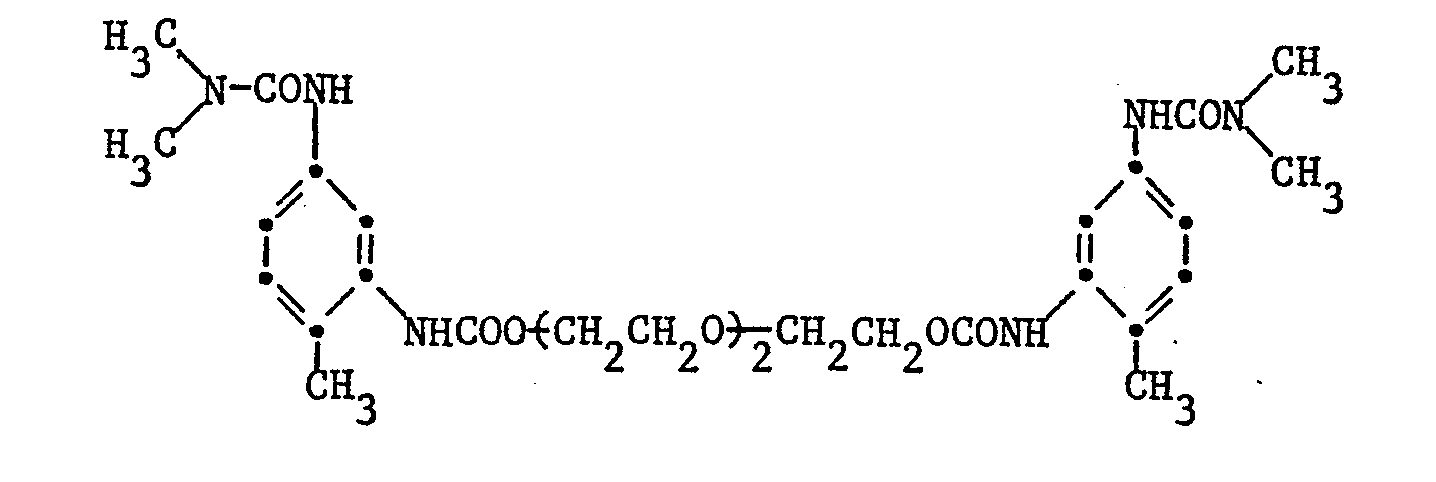
- Verfahren wie Beispiel 1. Man erhält 410 Teile einer teilkristallinen, wachsartigen Substanz (96,4 % der Theorie) mit einem Stickstoffgehalt von 10,2 (ber. 9,87) %.
-

-

- Analyse: ber. für gefunden: C45H82N6O8 % C 66,63 67,15 % H 9,36 9,18 % N 9,52 9,26
-

-

- Verfahren wie im Beispiel 8.
- Ausbeute: 502 Teile eines gelben, zähflüssigen Harzes entsprechend 97,3 % der Theorie,
- Analyse : gefunden % C 57,12 % H 8,58 % N 5,26.
-
- A) Härtung eines Epoxidharzes mit Diurethandiharnstoffen. Je 85 Teile eines Epoxidharzes auf Basis von Bisphenol A mit einem Epoxidgehalt von 5,1-5,5 Val/kg und einer Viskosität von 9000-13000 mPa·s (Epoxidharz I) werden mit je 15 Teilen der in Beispielen 1 bis 5 hergestellten Diurethandiharnstoffe gemischt. Die Gelierzeiten dieser Mischungen und die Eigenschaften der aus diesen Mischungen durch Härtung (2 Stunden bei 100°C und 8 Stunden bei 140°C) erhaltenen Formstoffe sind in nachfolgender Tabelle angegeben.

- B) Beschleunigung der Dicyandiamidhärtung eines Epoxyharzes.


- C) Beschleunigung der Cyanacetylhärtung eines Epoxyharzes.


- D) Beschleunigung der Anhydridhärtung eines Epoxyharzes.
- B) Beschleunigung der Dicyandiamidhärtung eines Epoxyharzes.
- Man mischt 8,0 Teile Epoxidharz I mit 5,51 Teilen cis-Hexahydrophthalsäureanhydrid. Diese Mischung hat eine Gelierzeit von 674 Minuten bei 120°C.
- Setzt man einer solchen Mischung je 0,27 Teile (2 %) der Diürethandiharnstoffe gemäss Beispielen 1-10 zu, erhält man folgende Ergebnisse:
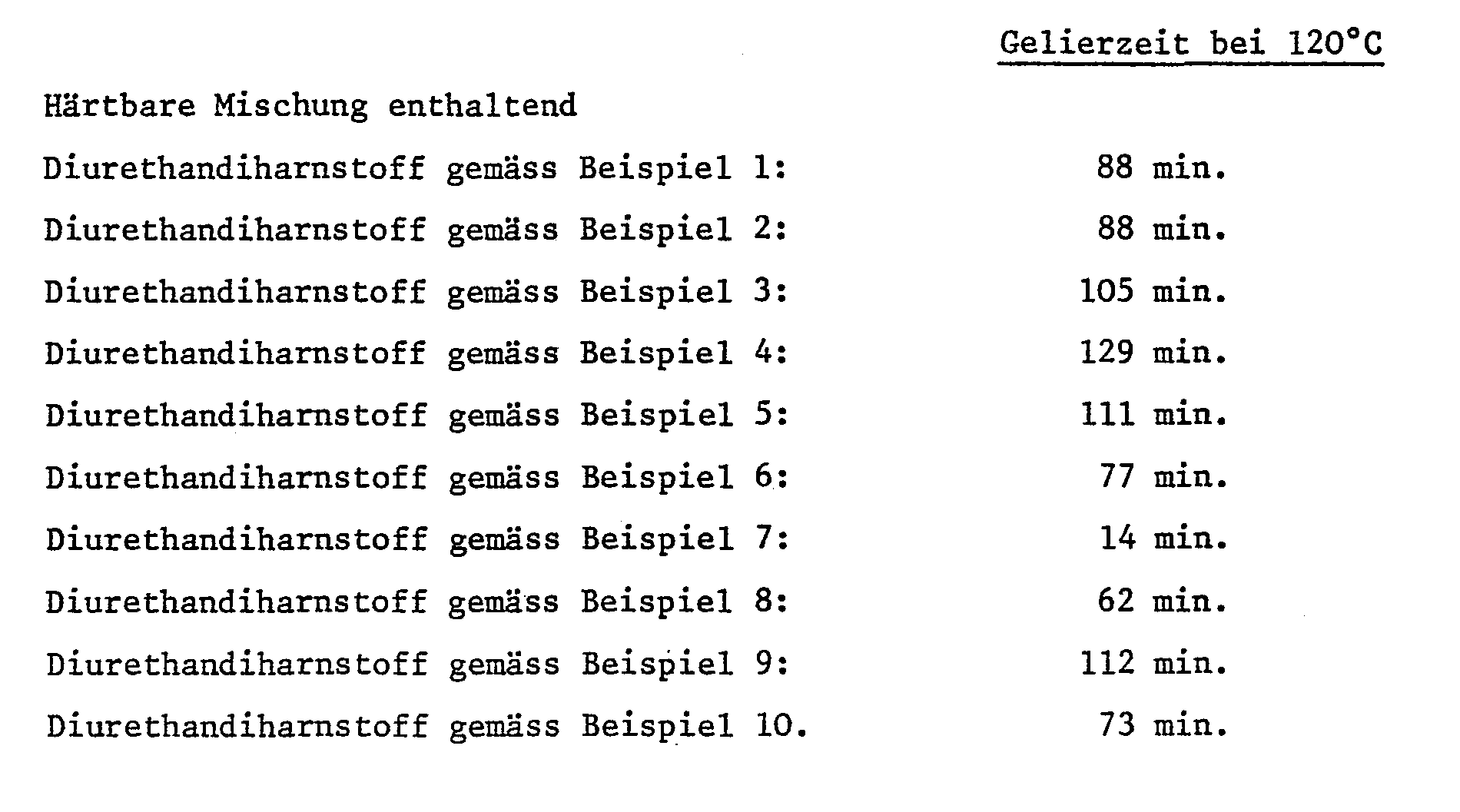
- Die Lagerbeständigkeit der mit den Diurethandiharnstoffen gemäss Beispielenl-10 katalysierten härtbaren Gemische wird nur wenig vermindert.
- E) Härtung von N,N,N',N'-Tetraglycidyl-4,4'-diaminodiphenylmethan. N,N,N',N'-Tetraglycidyl-4,4'-diaminodiphenylmethan mit einem Epoxidäquivalentgewicht von 133 (Epoxidharz II) und der in Beispiel 5 hergestellte Diurethandiharnstoff werden in den in der folgenden Tabelle angegebenen Mischungsverhältnissen gemischt und anschliessend gehärtet. Die Härtungsbedingungen (Stunden (h)/°C) und die Eigenschaften der erhaltenen Formstoffe sind ebenfalls in der Tabelle aufgeführt.

Claims (9)



Applications Claiming Priority (2)
| Application Number | Priority Date | Filing Date | Title |
|---|---|---|---|
| CH560583 | 1983-10-14 | ||
| CH5605/83 | 1983-10-14 |
Publications (3)
| Publication Number | Publication Date |
|---|---|
| EP0138769A2 true EP0138769A2 (de) | 1985-04-24 |
| EP0138769A3 EP0138769A3 (en) | 1986-04-02 |
| EP0138769B1 EP0138769B1 (de) | 1988-06-01 |
Family
ID=4296405
Family Applications (1)
| Application Number | Title | Priority Date | Filing Date |
|---|---|---|---|
| EP84810490A Expired EP0138769B1 (de) | 1983-10-14 | 1984-10-08 | Diurethandiharnstoffe und deren Verwendung |
Country Status (4)
| Country | Link |
|---|---|
| EP (1) | EP0138769B1 (de) |
| JP (1) | JPS60104055A (de) |
| CA (1) | CA1229600A (de) |
| DE (1) | DE3471652D1 (de) |
Cited By (6)
| Publication number | Priority date | Publication date | Assignee | Title |
|---|---|---|---|---|
| EP0319473A3 (en) * | 1987-12-02 | 1990-12-19 | Ciba-Geigy Ag | Heat-curable reactive systems |
| EP0520627A3 (en) * | 1991-06-27 | 1993-07-21 | Minnesota Mining And Manufacturing Company | Polyisocyanates partially blocked by amines and selfcuring resinous adducts derived therefrom |
| EP0603131A1 (de) * | 1992-12-18 | 1994-06-22 | Ciba-Geigy Ag | Aromatische Harnstoffverbindung als Härtungsbeschleuniger für eine Mischung aus Epoxiharz und Dicyandiamid |
| WO2000014058A1 (en) | 1998-09-04 | 2000-03-16 | Asahi Kasei Kabushiki Kaisha | Novel color-developing compound and recording material |
| WO2003102044A3 (en) * | 2002-05-31 | 2004-03-25 | Ppg Ind Ohio Inc | Low-cure powder coatings and methods for using the same |
| US7635662B2 (en) | 1998-09-04 | 2009-12-22 | Chemipro Kasei Kaisha, Ltd. | Compound for color-producing composition, and recording material |
Families Citing this family (2)
| Publication number | Priority date | Publication date | Assignee | Title |
|---|---|---|---|---|
| JP6095766B2 (ja) * | 2013-02-26 | 2017-03-15 | 富士フイルム株式会社 | セルロースアシレートフィルム、新規化合物、偏光板および液晶表示装置 |
| CN105384951B (zh) | 2014-09-03 | 2020-09-18 | 富士胶片株式会社 | 聚合物膜、偏振片及液晶显示装置 |
Family Cites Families (1)
| Publication number | Priority date | Publication date | Assignee | Title |
|---|---|---|---|---|
| GB1535730A (en) * | 1975-04-30 | 1978-12-13 | Shell Int Research | Carbamates and their use as antioxidants |
-
1984
- 1984-10-08 EP EP84810490A patent/EP0138769B1/de not_active Expired
- 1984-10-08 DE DE8484810490T patent/DE3471652D1/de not_active Expired
- 1984-10-12 CA CA000465247A patent/CA1229600A/en not_active Expired
- 1984-10-15 JP JP59216025A patent/JPS60104055A/ja active Pending
Cited By (8)
| Publication number | Priority date | Publication date | Assignee | Title |
|---|---|---|---|---|
| EP0319473A3 (en) * | 1987-12-02 | 1990-12-19 | Ciba-Geigy Ag | Heat-curable reactive systems |
| EP0520627A3 (en) * | 1991-06-27 | 1993-07-21 | Minnesota Mining And Manufacturing Company | Polyisocyanates partially blocked by amines and selfcuring resinous adducts derived therefrom |
| EP0603131A1 (de) * | 1992-12-18 | 1994-06-22 | Ciba-Geigy Ag | Aromatische Harnstoffverbindung als Härtungsbeschleuniger für eine Mischung aus Epoxiharz und Dicyandiamid |
| WO2000014058A1 (en) | 1998-09-04 | 2000-03-16 | Asahi Kasei Kabushiki Kaisha | Novel color-developing compound and recording material |
| US7635662B2 (en) | 1998-09-04 | 2009-12-22 | Chemipro Kasei Kaisha, Ltd. | Compound for color-producing composition, and recording material |
| US7807738B2 (en) | 1998-09-04 | 2010-10-05 | Chemipro Kasei Kaisha, Ltd. | Compound for color-producing composition, and recording material |
| WO2003102044A3 (en) * | 2002-05-31 | 2004-03-25 | Ppg Ind Ohio Inc | Low-cure powder coatings and methods for using the same |
| AU2003228921B2 (en) * | 2002-05-31 | 2006-10-05 | Ppg Industries Ohio Inc. | Low-cure powder coatings and methods for using the same |
Also Published As
| Publication number | Publication date |
|---|---|
| JPS60104055A (ja) | 1985-06-08 |
| EP0138769B1 (de) | 1988-06-01 |
| DE3471652D1 (en) | 1988-07-07 |
| CA1229600A (en) | 1987-11-24 |
| EP0138769A3 (en) | 1986-04-02 |
Similar Documents
| Publication | Publication Date | Title |
|---|---|---|
| EP0253770B1 (de) | Neue Oxazolidine | |
| DE69318369T2 (de) | Polythiol-Epoxidharz-Mischung mit längerer Verarbeitungszeit | |
| EP0338985B1 (de) | Modifizierte Epoxidharze | |
| EP0017623B1 (de) | Dimethylaminoderivate enthaltende härtbare Gemische | |
| EP0108712B1 (de) | Heisshärtbare Epoxidharzmischungen | |
| CH646428A5 (de) | Aldimin- und oxazolidingruppen aufweisende verbindungen, verfahren zu deren herstellung und deren verwendung als haerter fuer polyisocyanate. | |
| EP1114076A1 (de) | Beschleuniger für härtbare systeme | |
| EP0307666A1 (de) | Phenol-terminierte Polyurethane oder Polyharnstoffe und Epoxidharze enthaltend diese Verbindungen | |
| EP0232225A2 (de) | Epoxidharz-Zusammensetzung | |
| DE60123385T2 (de) | Epoxidharzzusammensetzung | |
| EP0075533B1 (de) | Heisshärtbare Epoxidharzmassen | |
| EP0138769B1 (de) | Diurethandiharnstoffe und deren Verwendung | |
| DE2346404A1 (de) | Verfahren, um oberflaechen miteinander zu verbinden | |
| DE10355510A1 (de) | Härterkomponente und härtbare Harzzusammensetzung, die die Härterkomponente enthält | |
| EP0019906B1 (de) | Unter dem Einfluss von Luftfeuchtigkeit ausgehärtet werdendes Gemisch und ein Verfahren zur Herstellung von Polyisocyanat-Polyadditionsprodukten oder vernetzten Polyepoxiden | |
| US4562241A (en) | Diurethane diureas and the use thereof | |
| EP0723982A2 (de) | Härtbares Epoxidharzgemisch | |
| EP0358603B1 (de) | Mit Blockpolymeren und Polyurethanen bzw. Polyharnstoffen modifizierte Epoxidharze. | |
| EP0187121B1 (de) | Heisshärtbare Epoxidharz-Zusammensetzungen | |
| EP0603131A1 (de) | Aromatische Harnstoffverbindung als Härtungsbeschleuniger für eine Mischung aus Epoxiharz und Dicyandiamid | |
| US5034495A (en) | Novel hardening agents | |
| EP0079857B1 (de) | Verfahren zur Erhöhung der Viskosität von Epoxidharz enthaltenden Mischungen | |
| EP0066546B1 (de) | Ester als Verdünnungsmittel sowie Härtungsbeschleuniger enthaltende Epoxidharzmassen | |
| US4352913A (en) | Dimethylamino derivatives and their use | |
| DE3224079A1 (de) | Aus silaminen und organischen saeuren oder phenolen bestehende mischungen als haertungsmittel fuer epoxidharze |
Legal Events
| Date | Code | Title | Description |
|---|---|---|---|
| PUAI | Public reference made under article 153(3) epc to a published international application that has entered the european phase |
Free format text: ORIGINAL CODE: 0009012 |
|
| 17P | Request for examination filed |
Effective date: 19841010 |
|
| AK | Designated contracting states |
Designated state(s): CH DE FR GB IT LI |
|
| RTI1 | Title (correction) | ||
| PUAL | Search report despatched |
Free format text: ORIGINAL CODE: 0009013 |
|
| AK | Designated contracting states |
Kind code of ref document: A3 Designated state(s): CH DE FR GB IT LI |
|
| 17Q | First examination report despatched |
Effective date: 19861217 |
|
| GRAA | (expected) grant |
Free format text: ORIGINAL CODE: 0009210 |
|
| AK | Designated contracting states |
Kind code of ref document: B1 Designated state(s): CH DE FR GB IT LI |
|
| REF | Corresponds to: |
Ref document number: 3471652 Country of ref document: DE Date of ref document: 19880707 |
|
| ITF | It: translation for a ep patent filed | ||
| GBT | Gb: translation of ep patent filed (gb section 77(6)(a)/1977) | ||
| ET | Fr: translation filed | ||
| PLBE | No opposition filed within time limit |
Free format text: ORIGINAL CODE: 0009261 |
|
| STAA | Information on the status of an ep patent application or granted ep patent |
Free format text: STATUS: NO OPPOSITION FILED WITHIN TIME LIMIT |
|
| 26N | No opposition filed | ||
| PGFP | Annual fee paid to national office [announced via postgrant information from national office to epo] |
Ref country code: FR Payment date: 19890828 Year of fee payment: 6 |
|
| PGFP | Annual fee paid to national office [announced via postgrant information from national office to epo] |
Ref country code: DE Payment date: 19890913 Year of fee payment: 6 |
|
| PGFP | Annual fee paid to national office [announced via postgrant information from national office to epo] |
Ref country code: GB Payment date: 19890930 Year of fee payment: 6 |
|
| PG25 | Lapsed in a contracting state [announced via postgrant information from national office to epo] |
Ref country code: LI Effective date: 19891031 Ref country code: CH Effective date: 19891031 |
|
| REG | Reference to a national code |
Ref country code: CH Ref legal event code: PL |
|
| PG25 | Lapsed in a contracting state [announced via postgrant information from national office to epo] |
Ref country code: GB Effective date: 19901008 |
|
| GBPC | Gb: european patent ceased through non-payment of renewal fee | ||
| PG25 | Lapsed in a contracting state [announced via postgrant information from national office to epo] |
Ref country code: FR Effective date: 19910628 |
|
| PG25 | Lapsed in a contracting state [announced via postgrant information from national office to epo] |
Ref country code: DE Effective date: 19910702 |
|
| REG | Reference to a national code |
Ref country code: FR Ref legal event code: ST |