EP0603131A1 - Aromatische Harnstoffverbindung als Härtungsbeschleuniger für eine Mischung aus Epoxiharz und Dicyandiamid - Google Patents
Aromatische Harnstoffverbindung als Härtungsbeschleuniger für eine Mischung aus Epoxiharz und Dicyandiamid Download PDFInfo
- Publication number
- EP0603131A1 EP0603131A1 EP93810861A EP93810861A EP0603131A1 EP 0603131 A1 EP0603131 A1 EP 0603131A1 EP 93810861 A EP93810861 A EP 93810861A EP 93810861 A EP93810861 A EP 93810861A EP 0603131 A1 EP0603131 A1 EP 0603131A1
- Authority
- EP
- European Patent Office
- Prior art keywords
- formula
- alkyl
- dicyandiamide
- independently
- radicals
- Prior art date
- Legal status (The legal status is an assumption and is not a legal conclusion. Google has not performed a legal analysis and makes no representation as to the accuracy of the status listed.)
- Withdrawn
Links
- 239000000203 mixture Substances 0.000 title claims abstract description 83
- 229920000647 polyepoxide Polymers 0.000 title claims abstract description 32
- 239000003822 epoxy resin Substances 0.000 title claims abstract description 29
- QGBSISYHAICWAH-UHFFFAOYSA-N dicyandiamide Chemical compound NC(N)=NC#N QGBSISYHAICWAH-UHFFFAOYSA-N 0.000 title claims abstract description 21
- -1 Aromatic urea compound Chemical class 0.000 title claims description 9
- 239000004202 carbamide Substances 0.000 title description 2
- 150000001875 compounds Chemical class 0.000 claims abstract description 22
- 125000000217 alkyl group Chemical group 0.000 claims abstract description 14
- 238000000034 method Methods 0.000 claims abstract description 12
- 229910052739 hydrogen Inorganic materials 0.000 claims abstract description 11
- 125000003118 aryl group Chemical group 0.000 claims abstract description 10
- 125000004178 (C1-C4) alkyl group Chemical group 0.000 claims abstract description 6
- 125000000753 cycloalkyl group Chemical group 0.000 claims abstract description 6
- 125000005843 halogen group Chemical group 0.000 claims abstract description 5
- 239000001257 hydrogen Substances 0.000 claims abstract description 5
- UFHFLCQGNIYNRP-UHFFFAOYSA-N Hydrogen Chemical compound [H][H] UFHFLCQGNIYNRP-UHFFFAOYSA-N 0.000 claims abstract description 4
- 125000000229 (C1-C4)alkoxy group Chemical group 0.000 claims abstract 3
- 239000005056 polyisocyanate Substances 0.000 claims description 21
- 229920001228 polyisocyanate Polymers 0.000 claims description 21
- 238000001723 curing Methods 0.000 claims description 17
- 125000004432 carbon atom Chemical group C* 0.000 claims description 10
- 238000013007 heat curing Methods 0.000 claims description 8
- 239000002904 solvent Substances 0.000 claims description 7
- 125000004435 hydrogen atom Chemical group [H]* 0.000 claims description 6
- 125000001997 phenyl group Chemical group [H]C1=C([H])C([H])=C(*)C([H])=C1[H] 0.000 claims description 5
- 238000002360 preparation method Methods 0.000 claims description 5
- 150000001412 amines Chemical class 0.000 claims description 4
- 125000002496 methyl group Chemical group [H]C([H])([H])* 0.000 claims description 4
- 238000010438 heat treatment Methods 0.000 claims description 3
- CKDWPUIZGOQOOM-UHFFFAOYSA-N Carbamyl chloride Chemical class NC(Cl)=O CKDWPUIZGOQOOM-UHFFFAOYSA-N 0.000 claims description 2
- 230000009257 reactivity Effects 0.000 abstract description 7
- 238000003860 storage Methods 0.000 abstract description 3
- 230000000694 effects Effects 0.000 abstract description 2
- 238000009998 heat setting Methods 0.000 abstract 1
- 150000003254 radicals Chemical class 0.000 description 16
- LNEPOXFFQSENCJ-UHFFFAOYSA-N haloperidol Chemical compound C1CC(O)(C=2C=CC(Cl)=CC=2)CCN1CCCC(=O)C1=CC=C(F)C=C1 LNEPOXFFQSENCJ-UHFFFAOYSA-N 0.000 description 12
- JXCGFZXSOMJFOA-UHFFFAOYSA-N chlorotoluron Chemical compound CN(C)C(=O)NC1=CC=C(C)C(Cl)=C1 JXCGFZXSOMJFOA-UHFFFAOYSA-N 0.000 description 11
- IAZDPXIOMUYVGZ-WFGJKAKNSA-N Dimethyl sulfoxide Chemical compound [2H]C([2H])([2H])S(=O)C([2H])([2H])[2H] IAZDPXIOMUYVGZ-WFGJKAKNSA-N 0.000 description 10
- 239000000047 product Substances 0.000 description 10
- 239000005494 Chlorotoluron Substances 0.000 description 9
- XEKOWRVHYACXOJ-UHFFFAOYSA-N Ethyl acetate Chemical compound CCOC(C)=O XEKOWRVHYACXOJ-UHFFFAOYSA-N 0.000 description 9
- OKKJLVBELUTLKV-UHFFFAOYSA-N Methanol Chemical compound OC OKKJLVBELUTLKV-UHFFFAOYSA-N 0.000 description 9
- 238000004519 manufacturing process Methods 0.000 description 9
- 229910052757 nitrogen Inorganic materials 0.000 description 8
- 238000006243 chemical reaction Methods 0.000 description 7
- 229920005989 resin Polymers 0.000 description 7
- 239000011347 resin Substances 0.000 description 7
- LCFVJGUPQDGYKZ-UHFFFAOYSA-N Bisphenol A diglycidyl ether Chemical compound C=1C=C(OCC2OC2)C=CC=1C(C)(C)C(C=C1)=CC=C1OCC1CO1 LCFVJGUPQDGYKZ-UHFFFAOYSA-N 0.000 description 6
- YXFVVABEGXRONW-UHFFFAOYSA-N Toluene Chemical compound CC1=CC=CC=C1 YXFVVABEGXRONW-UHFFFAOYSA-N 0.000 description 6
- IQPQWNKOIGAROB-UHFFFAOYSA-N isocyanate group Chemical group [N-]=C=O IQPQWNKOIGAROB-UHFFFAOYSA-N 0.000 description 6
- 238000005160 1H NMR spectroscopy Methods 0.000 description 5
- IISBACLAFKSPIT-UHFFFAOYSA-N bisphenol A Chemical compound C=1C=C(O)C=CC=1C(C)(C)C1=CC=C(O)C=C1 IISBACLAFKSPIT-UHFFFAOYSA-N 0.000 description 5
- UPMLOUAZCHDJJD-UHFFFAOYSA-N 4,4'-Diphenylmethane Diisocyanate Chemical compound C1=CC(N=C=O)=CC=C1CC1=CC=C(N=C=O)C=C1 UPMLOUAZCHDJJD-UHFFFAOYSA-N 0.000 description 4
- IJGRMHOSHXDMSA-UHFFFAOYSA-N Atomic nitrogen Chemical compound N#N IJGRMHOSHXDMSA-UHFFFAOYSA-N 0.000 description 4
- ROSDSFDQCJNGOL-UHFFFAOYSA-N Dimethylamine Chemical compound CNC ROSDSFDQCJNGOL-UHFFFAOYSA-N 0.000 description 4
- 239000000853 adhesive Substances 0.000 description 4
- 230000001070 adhesive effect Effects 0.000 description 4
- PXKLMJQFEQBVLD-UHFFFAOYSA-N bisphenol F Chemical compound C1=CC(O)=CC=C1CC1=CC=C(O)C=C1 PXKLMJQFEQBVLD-UHFFFAOYSA-N 0.000 description 4
- GYZLOYUZLJXAJU-UHFFFAOYSA-N diglycidyl ether Chemical class C1OC1COCC1CO1 GYZLOYUZLJXAJU-UHFFFAOYSA-N 0.000 description 4
- 125000003055 glycidyl group Chemical group C(C1CO1)* 0.000 description 4
- RRAMGCGOFNQTLD-UHFFFAOYSA-N hexamethylene diisocyanate Chemical compound O=C=NCCCCCCN=C=O RRAMGCGOFNQTLD-UHFFFAOYSA-N 0.000 description 4
- 239000012948 isocyanate Substances 0.000 description 4
- 150000002513 isocyanates Chemical class 0.000 description 4
- NIMLQBUJDJZYEJ-UHFFFAOYSA-N isophorone diisocyanate Chemical compound CC1(C)CC(N=C=O)CC(C)(CN=C=O)C1 NIMLQBUJDJZYEJ-UHFFFAOYSA-N 0.000 description 4
- 150000003217 pyrazoles Chemical class 0.000 description 4
- ALQLPWJFHRMHIU-UHFFFAOYSA-N 1,4-diisocyanatobenzene Chemical compound O=C=NC1=CC=C(N=C=O)C=C1 ALQLPWJFHRMHIU-UHFFFAOYSA-N 0.000 description 3
- 239000004593 Epoxy Substances 0.000 description 3
- LYCAIKOWRPUZTN-UHFFFAOYSA-N Ethylene glycol Chemical compound OCCO LYCAIKOWRPUZTN-UHFFFAOYSA-N 0.000 description 3
- 239000005057 Hexamethylene diisocyanate Substances 0.000 description 3
- VYPSYNLAJGMNEJ-UHFFFAOYSA-N Silicium dioxide Chemical compound O=[Si]=O VYPSYNLAJGMNEJ-UHFFFAOYSA-N 0.000 description 3
- MTHSVFCYNBDYFN-UHFFFAOYSA-N diethylene glycol Chemical compound OCCOCCO MTHSVFCYNBDYFN-UHFFFAOYSA-N 0.000 description 3
- 238000000921 elemental analysis Methods 0.000 description 3
- 238000010992 reflux Methods 0.000 description 3
- PXEYZLNBINDGGW-UHFFFAOYSA-N 1,3-dimethyl-1-[4-[methyl(methylcarbamoyl)amino]phenyl]urea Chemical compound CNC(=O)N(C)C1=CC=C(N(C)C(=O)NC)C=C1 PXEYZLNBINDGGW-UHFFFAOYSA-N 0.000 description 2
- CBCKQZAAMUWICA-UHFFFAOYSA-N 1,4-phenylenediamine Chemical compound NC1=CC=C(N)C=C1 CBCKQZAAMUWICA-UHFFFAOYSA-N 0.000 description 2
- VZXPHDGHQXLXJC-UHFFFAOYSA-N 1,6-diisocyanato-5,6-dimethylheptane Chemical compound O=C=NC(C)(C)C(C)CCCCN=C=O VZXPHDGHQXLXJC-UHFFFAOYSA-N 0.000 description 2
- SHKUUQIDMUMQQK-UHFFFAOYSA-N 2-[4-(oxiran-2-ylmethoxy)butoxymethyl]oxirane Chemical compound C1OC1COCCCCOCC1CO1 SHKUUQIDMUMQQK-UHFFFAOYSA-N 0.000 description 2
- QZWKEPYTBWZJJA-UHFFFAOYSA-N 3,3'-Dimethoxybenzidine-4,4'-diisocyanate Chemical compound C1=C(N=C=O)C(OC)=CC(C=2C=C(OC)C(N=C=O)=CC=2)=C1 QZWKEPYTBWZJJA-UHFFFAOYSA-N 0.000 description 2
- 244000226021 Anacardium occidentale Species 0.000 description 2
- UGFAIRIUMAVXCW-UHFFFAOYSA-N Carbon monoxide Chemical compound [O+]#[C-] UGFAIRIUMAVXCW-UHFFFAOYSA-N 0.000 description 2
- RWSOTUBLDIXVET-UHFFFAOYSA-N Dihydrogen sulfide Chemical compound S RWSOTUBLDIXVET-UHFFFAOYSA-N 0.000 description 2
- LFQSCWFLJHTTHZ-UHFFFAOYSA-N Ethanol Chemical compound CCO LFQSCWFLJHTTHZ-UHFFFAOYSA-N 0.000 description 2
- PEDCQBHIVMGVHV-UHFFFAOYSA-N Glycerine Chemical compound OCC(O)CO PEDCQBHIVMGVHV-UHFFFAOYSA-N 0.000 description 2
- OAKJQQAXSVQMHS-UHFFFAOYSA-N Hydrazine Chemical compound NN OAKJQQAXSVQMHS-UHFFFAOYSA-N 0.000 description 2
- VEXZGXHMUGYJMC-UHFFFAOYSA-N Hydrochloric acid Chemical compound Cl VEXZGXHMUGYJMC-UHFFFAOYSA-N 0.000 description 2
- 239000005058 Isophorone diisocyanate Substances 0.000 description 2
- RRHGJUQNOFWUDK-UHFFFAOYSA-N Isoprene Chemical compound CC(=C)C=C RRHGJUQNOFWUDK-UHFFFAOYSA-N 0.000 description 2
- DNIAPMSPPWPWGF-UHFFFAOYSA-N Propylene glycol Chemical compound CC(O)CO DNIAPMSPPWPWGF-UHFFFAOYSA-N 0.000 description 2
- JUJWROOIHBZHMG-UHFFFAOYSA-N Pyridine Chemical compound C1=CC=NC=C1 JUJWROOIHBZHMG-UHFFFAOYSA-N 0.000 description 2
- NINIDFKCEFEMDL-UHFFFAOYSA-N Sulfur Chemical compound [S] NINIDFKCEFEMDL-UHFFFAOYSA-N 0.000 description 2
- KKEYFWRCBNTPAC-UHFFFAOYSA-N Terephthalic acid Chemical compound OC(=O)C1=CC=C(C(O)=O)C=C1 KKEYFWRCBNTPAC-UHFFFAOYSA-N 0.000 description 2
- WNLRTRBMVRJNCN-UHFFFAOYSA-N adipic acid Chemical compound OC(=O)CCCCC(O)=O WNLRTRBMVRJNCN-UHFFFAOYSA-N 0.000 description 2
- 125000001931 aliphatic group Chemical group 0.000 description 2
- 125000003545 alkoxy group Chemical group 0.000 description 2
- WERYXYBDKMZEQL-UHFFFAOYSA-N butane-1,4-diol Chemical compound OCCCCO WERYXYBDKMZEQL-UHFFFAOYSA-N 0.000 description 2
- 229910002091 carbon monoxide Inorganic materials 0.000 description 2
- 235000020226 cashew nut Nutrition 0.000 description 2
- 239000003795 chemical substances by application Substances 0.000 description 2
- 239000002131 composite material Substances 0.000 description 2
- 150000004985 diamines Chemical class 0.000 description 2
- JXCHMDATRWUOAP-UHFFFAOYSA-N diisocyanatomethylbenzene Chemical compound O=C=NC(N=C=O)C1=CC=CC=C1 JXCHMDATRWUOAP-UHFFFAOYSA-N 0.000 description 2
- 150000002118 epoxides Chemical class 0.000 description 2
- 238000000265 homogenisation Methods 0.000 description 2
- 229910000037 hydrogen sulfide Inorganic materials 0.000 description 2
- 125000002887 hydroxy group Chemical group [H]O* 0.000 description 2
- 150000002460 imidazoles Chemical class 0.000 description 2
- 239000004615 ingredient Substances 0.000 description 2
- QQVIHTHCMHWDBS-UHFFFAOYSA-N isophthalic acid Chemical compound OC(=O)C1=CC=CC(C(O)=O)=C1 QQVIHTHCMHWDBS-UHFFFAOYSA-N 0.000 description 2
- 238000002844 melting Methods 0.000 description 2
- 230000008018 melting Effects 0.000 description 2
- 239000002923 metal particle Substances 0.000 description 2
- 238000000465 moulding Methods 0.000 description 2
- BDJRBEYXGGNYIS-UHFFFAOYSA-N nonanedioic acid Chemical compound OC(=O)CCCCCCCC(O)=O BDJRBEYXGGNYIS-UHFFFAOYSA-N 0.000 description 2
- 239000003921 oil Substances 0.000 description 2
- 150000002989 phenols Chemical class 0.000 description 2
- XNGIFLGASWRNHJ-UHFFFAOYSA-N phthalic acid Chemical compound OC(=O)C1=CC=CC=C1C(O)=O XNGIFLGASWRNHJ-UHFFFAOYSA-N 0.000 description 2
- 239000004014 plasticizer Substances 0.000 description 2
- YPFDHNVEDLHUCE-UHFFFAOYSA-N propane-1,3-diol Chemical compound OCCCO YPFDHNVEDLHUCE-UHFFFAOYSA-N 0.000 description 2
- 239000000376 reactant Substances 0.000 description 2
- 239000011541 reaction mixture Substances 0.000 description 2
- GHMLBKRAJCXXBS-UHFFFAOYSA-N resorcinol Chemical compound OC1=CC=CC(O)=C1 GHMLBKRAJCXXBS-UHFFFAOYSA-N 0.000 description 2
- CXMXRPHRNRROMY-UHFFFAOYSA-N sebacic acid Chemical compound OC(=O)CCCCCCCCC(O)=O CXMXRPHRNRROMY-UHFFFAOYSA-N 0.000 description 2
- 229910052717 sulfur Inorganic materials 0.000 description 2
- 239000011593 sulfur Substances 0.000 description 2
- 239000000725 suspension Substances 0.000 description 2
- DVKJHBMWWAPEIU-UHFFFAOYSA-N toluene 2,4-diisocyanate Chemical compound CC1=CC=C(N=C=O)C=C1N=C=O DVKJHBMWWAPEIU-UHFFFAOYSA-N 0.000 description 2
- RUELTTOHQODFPA-UHFFFAOYSA-N toluene 2,6-diisocyanate Chemical compound CC1=C(N=C=O)C=CC=C1N=C=O RUELTTOHQODFPA-UHFFFAOYSA-N 0.000 description 2
- ARCGXLSVLAOJQL-UHFFFAOYSA-N trimellitic acid Chemical compound OC(=O)C1=CC=C(C(O)=O)C(C(O)=O)=C1 ARCGXLSVLAOJQL-UHFFFAOYSA-N 0.000 description 2
- 238000005406 washing Methods 0.000 description 2
- OUPZKGBUJRBPGC-UHFFFAOYSA-N 1,3,5-tris(oxiran-2-ylmethyl)-1,3,5-triazinane-2,4,6-trione Chemical compound O=C1N(CC2OC2)C(=O)N(CC2OC2)C(=O)N1CC1CO1 OUPZKGBUJRBPGC-UHFFFAOYSA-N 0.000 description 1
- RYHBNJHYFVUHQT-UHFFFAOYSA-N 1,4-Dioxane Chemical compound C1COCCO1 RYHBNJHYFVUHQT-UHFFFAOYSA-N 0.000 description 1
- SBJCUZQNHOLYMD-UHFFFAOYSA-N 1,5-Naphthalene diisocyanate Chemical compound C1=CC=C2C(N=C=O)=CC=CC2=C1N=C=O SBJCUZQNHOLYMD-UHFFFAOYSA-N 0.000 description 1
- SDRZFSPCVYEJTP-UHFFFAOYSA-N 1-ethenylcyclohexene Chemical compound C=CC1=CCCCC1 SDRZFSPCVYEJTP-UHFFFAOYSA-N 0.000 description 1
- PAUHLEIGHAUFAK-UHFFFAOYSA-N 1-isocyanato-1-[(1-isocyanatocyclohexyl)methyl]cyclohexane Chemical compound C1CCCCC1(N=C=O)CC1(N=C=O)CCCCC1 PAUHLEIGHAUFAK-UHFFFAOYSA-N 0.000 description 1
- HECLRDQVFMWTQS-RGOKHQFPSA-N 1755-01-7 Chemical compound C1[C@H]2[C@@H]3CC=C[C@@H]3[C@@H]1C=C2 HECLRDQVFMWTQS-RGOKHQFPSA-N 0.000 description 1
- HDPBBNNDDQOWPJ-UHFFFAOYSA-N 4-[1,2,2-tris(4-hydroxyphenyl)ethyl]phenol Chemical compound C1=CC(O)=CC=C1C(C=1C=CC(O)=CC=1)C(C=1C=CC(O)=CC=1)C1=CC=C(O)C=C1 HDPBBNNDDQOWPJ-UHFFFAOYSA-N 0.000 description 1
- CDBAMNGURPMUTG-UHFFFAOYSA-N 4-[2-(4-hydroxycyclohexyl)propan-2-yl]cyclohexan-1-ol Chemical compound C1CC(O)CCC1C(C)(C)C1CCC(O)CC1 CDBAMNGURPMUTG-UHFFFAOYSA-N 0.000 description 1
- 239000004215 Carbon black (E152) Substances 0.000 description 1
- ZAMOUSCENKQFHK-UHFFFAOYSA-N Chlorine atom Chemical compound [Cl] ZAMOUSCENKQFHK-UHFFFAOYSA-N 0.000 description 1
- NZNMSOFKMUBTKW-UHFFFAOYSA-N Cyclohexanecarboxylic acid Natural products OC(=O)C1CCCCC1 NZNMSOFKMUBTKW-UHFFFAOYSA-N 0.000 description 1
- ZFIVKAOQEXOYFY-UHFFFAOYSA-N Diepoxybutane Chemical compound C1OC1C1OC1 ZFIVKAOQEXOYFY-UHFFFAOYSA-N 0.000 description 1
- YIIMEMSDCNDGTB-UHFFFAOYSA-N Dimethylcarbamoyl chloride Chemical compound CN(C)C(Cl)=O YIIMEMSDCNDGTB-UHFFFAOYSA-N 0.000 description 1
- 239000004606 Fillers/Extenders Substances 0.000 description 1
- OYHQOLUKZRVURQ-HZJYTTRNSA-N Linoleic acid Chemical class CCCCC\C=C/C\C=C/CCCCCCCC(O)=O OYHQOLUKZRVURQ-HZJYTTRNSA-N 0.000 description 1
- OMRDSWJXRLDPBB-UHFFFAOYSA-N N=C=O.N=C=O.C1CCCCC1 Chemical compound N=C=O.N=C=O.C1CCCCC1 OMRDSWJXRLDPBB-UHFFFAOYSA-N 0.000 description 1
- 229920000459 Nitrile rubber Polymers 0.000 description 1
- 229920000538 Poly[(phenyl isocyanate)-co-formaldehyde] Polymers 0.000 description 1
- 239000005062 Polybutadiene Substances 0.000 description 1
- 239000002202 Polyethylene glycol Substances 0.000 description 1
- 239000004146 Propane-1,2-diol Substances 0.000 description 1
- 229910000831 Steel Inorganic materials 0.000 description 1
- KDYFGRWQOYBRFD-UHFFFAOYSA-N Succinic acid Natural products OC(=O)CCC(O)=O KDYFGRWQOYBRFD-UHFFFAOYSA-N 0.000 description 1
- ZJCCRDAZUWHFQH-UHFFFAOYSA-N Trimethylolpropane Chemical compound CCC(CO)(CO)CO ZJCCRDAZUWHFQH-UHFFFAOYSA-N 0.000 description 1
- YIMQCDZDWXUDCA-UHFFFAOYSA-N [4-(hydroxymethyl)cyclohexyl]methanol Chemical compound OCC1CCC(CO)CC1 YIMQCDZDWXUDCA-UHFFFAOYSA-N 0.000 description 1
- UKLDJPRMSDWDSL-UHFFFAOYSA-L [dibutyl(dodecanoyloxy)stannyl] dodecanoate Chemical compound CCCCCCCCCCCC(=O)O[Sn](CCCC)(CCCC)OC(=O)CCCCCCCCCCC UKLDJPRMSDWDSL-UHFFFAOYSA-L 0.000 description 1
- 238000010521 absorption reaction Methods 0.000 description 1
- 230000001133 acceleration Effects 0.000 description 1
- 239000002253 acid Substances 0.000 description 1
- 150000007513 acids Chemical class 0.000 description 1
- 239000002318 adhesion promoter Substances 0.000 description 1
- 238000004026 adhesive bonding Methods 0.000 description 1
- 239000001361 adipic acid Substances 0.000 description 1
- 235000011037 adipic acid Nutrition 0.000 description 1
- 125000004414 alkyl thio group Chemical group 0.000 description 1
- 239000003963 antioxidant agent Substances 0.000 description 1
- 150000001491 aromatic compounds Chemical class 0.000 description 1
- 125000003710 aryl alkyl group Chemical group 0.000 description 1
- 125000005002 aryl methyl group Chemical group 0.000 description 1
- 150000005840 aryl radicals Chemical class 0.000 description 1
- 125000001797 benzyl group Chemical group [H]C1=C([H])C([H])=C(C([H])=C1[H])C([H])([H])* 0.000 description 1
- 230000015572 biosynthetic process Effects 0.000 description 1
- OHJMTUPIZMNBFR-UHFFFAOYSA-N biuret Chemical class NC(=O)NC(N)=O OHJMTUPIZMNBFR-UHFFFAOYSA-N 0.000 description 1
- 230000000903 blocking effect Effects 0.000 description 1
- 125000001246 bromo group Chemical group Br* 0.000 description 1
- NTXGQCSETZTARF-UHFFFAOYSA-N buta-1,3-diene;prop-2-enenitrile Chemical compound C=CC=C.C=CC#N NTXGQCSETZTARF-UHFFFAOYSA-N 0.000 description 1
- KDYFGRWQOYBRFD-NUQCWPJISA-N butanedioic acid Chemical compound O[14C](=O)CC[14C](O)=O KDYFGRWQOYBRFD-NUQCWPJISA-N 0.000 description 1
- HTRXGEPDTFSKLI-UHFFFAOYSA-N butanoic acid;ethyl acetate Chemical compound CCCC(O)=O.CCOC(C)=O HTRXGEPDTFSKLI-UHFFFAOYSA-N 0.000 description 1
- 150000001735 carboxylic acids Chemical class 0.000 description 1
- 238000005266 casting Methods 0.000 description 1
- 239000003054 catalyst Substances 0.000 description 1
- 239000007795 chemical reaction product Substances 0.000 description 1
- 239000000460 chlorine Substances 0.000 description 1
- 229910052801 chlorine Inorganic materials 0.000 description 1
- 239000011248 coating agent Substances 0.000 description 1
- 239000008199 coating composition Substances 0.000 description 1
- 238000000576 coating method Methods 0.000 description 1
- 238000007796 conventional method Methods 0.000 description 1
- 238000001816 cooling Methods 0.000 description 1
- 229920001577 copolymer Polymers 0.000 description 1
- 238000004132 cross linking Methods 0.000 description 1
- VZFUCHSFHOYXIS-UHFFFAOYSA-N cycloheptane carboxylic acid Natural products OC(=O)C1CCCCCC1 VZFUCHSFHOYXIS-UHFFFAOYSA-N 0.000 description 1
- QSAWQNUELGIYBC-UHFFFAOYSA-N cyclohexane-1,2-dicarboxylic acid Chemical compound OC(=O)C1CCCCC1C(O)=O QSAWQNUELGIYBC-UHFFFAOYSA-N 0.000 description 1
- ZWAJLVLEBYIOTI-UHFFFAOYSA-N cyclohexene oxide Chemical compound C1CCCC2OC21 ZWAJLVLEBYIOTI-UHFFFAOYSA-N 0.000 description 1
- 125000000113 cyclohexyl group Chemical group [H]C1([H])C([H])([H])C([H])([H])C([H])(*)C([H])([H])C1([H])[H] 0.000 description 1
- 125000004210 cyclohexylmethyl group Chemical group [H]C([H])(*)C1([H])C([H])([H])C([H])([H])C([H])([H])C([H])([H])C1([H])[H] 0.000 description 1
- 125000001511 cyclopentyl group Chemical group [H]C1([H])C([H])([H])C([H])([H])C([H])(*)C1([H])[H] 0.000 description 1
- 239000012975 dibutyltin dilaurate Substances 0.000 description 1
- 235000014113 dietary fatty acids Nutrition 0.000 description 1
- 125000005594 diketone group Chemical group 0.000 description 1
- 150000002009 diols Chemical class 0.000 description 1
- 239000000975 dye Substances 0.000 description 1
- 150000002170 ethers Chemical class 0.000 description 1
- 239000000194 fatty acid Substances 0.000 description 1
- 229930195729 fatty acid Natural products 0.000 description 1
- 150000004665 fatty acids Chemical class 0.000 description 1
- 239000000945 filler Substances 0.000 description 1
- 238000001914 filtration Methods 0.000 description 1
- 238000009472 formulation Methods 0.000 description 1
- 239000000417 fungicide Substances 0.000 description 1
- 235000011187 glycerol Nutrition 0.000 description 1
- 125000004051 hexyl group Chemical group [H]C([H])([H])C([H])([H])C([H])([H])C([H])([H])C([H])([H])C([H])([H])* 0.000 description 1
- 229930195733 hydrocarbon Natural products 0.000 description 1
- 150000002430 hydrocarbons Chemical class 0.000 description 1
- YAMHXTCMCPHKLN-UHFFFAOYSA-N imidazolidin-2-one Chemical compound O=C1NCCN1 YAMHXTCMCPHKLN-UHFFFAOYSA-N 0.000 description 1
- 238000007654 immersion Methods 0.000 description 1
- 238000005470 impregnation Methods 0.000 description 1
- 150000002473 indoazoles Chemical class 0.000 description 1
- 230000006698 induction Effects 0.000 description 1
- 239000011261 inert gas Substances 0.000 description 1
- 239000012442 inert solvent Substances 0.000 description 1
- 229940079865 intestinal antiinfectives imidazole derivative Drugs 0.000 description 1
- 125000000959 isobutyl group Chemical group [H]C([H])([H])C([H])(C([H])([H])[H])C([H])([H])* 0.000 description 1
- ZFSLODLOARCGLH-UHFFFAOYSA-N isocyanuric acid Chemical compound OC1=NC(O)=NC(O)=N1 ZFSLODLOARCGLH-UHFFFAOYSA-N 0.000 description 1
- 238000002955 isolation Methods 0.000 description 1
- 125000001449 isopropyl group Chemical group [H]C([H])([H])C([H])(*)C([H])([H])[H] 0.000 description 1
- 239000004922 lacquer Substances 0.000 description 1
- 238000010030 laminating Methods 0.000 description 1
- 239000007788 liquid Substances 0.000 description 1
- 239000000463 material Substances 0.000 description 1
- 239000011159 matrix material Substances 0.000 description 1
- 238000010907 mechanical stirring Methods 0.000 description 1
- 125000000956 methoxy group Chemical group [H]C([H])([H])O* 0.000 description 1
- 239000003607 modifier Substances 0.000 description 1
- 125000004108 n-butyl group Chemical group [H]C([H])([H])C([H])([H])C([H])([H])C([H])([H])* 0.000 description 1
- OLAPPGSPBNVTRF-UHFFFAOYSA-N naphthalene-1,4,5,8-tetracarboxylic acid Chemical compound C1=CC(C(O)=O)=C2C(C(=O)O)=CC=C(C(O)=O)C2=C1C(O)=O OLAPPGSPBNVTRF-UHFFFAOYSA-N 0.000 description 1
- 229920003986 novolac Polymers 0.000 description 1
- 239000011368 organic material Substances 0.000 description 1
- 239000003960 organic solvent Substances 0.000 description 1
- 150000002923 oximes Chemical class 0.000 description 1
- 239000002245 particle Substances 0.000 description 1
- 125000001147 pentyl group Chemical group C(CCCC)* 0.000 description 1
- 239000000049 pigment Substances 0.000 description 1
- 229920001515 polyalkylene glycol Polymers 0.000 description 1
- 229920002857 polybutadiene Polymers 0.000 description 1
- 229920001223 polyethylene glycol Polymers 0.000 description 1
- 239000004848 polyfunctional curative Substances 0.000 description 1
- 229920005862 polyol Polymers 0.000 description 1
- 150000003077 polyols Chemical class 0.000 description 1
- 150000008442 polyphenolic compounds Chemical class 0.000 description 1
- 235000013824 polyphenols Nutrition 0.000 description 1
- 229920001451 polypropylene glycol Polymers 0.000 description 1
- 239000000843 powder Substances 0.000 description 1
- 229960004063 propylene glycol Drugs 0.000 description 1
- 235000013772 propylene glycol Nutrition 0.000 description 1
- UMJSCPRVCHMLSP-UHFFFAOYSA-N pyridine Natural products COC1=CC=CN=C1 UMJSCPRVCHMLSP-UHFFFAOYSA-N 0.000 description 1
- 239000012744 reinforcing agent Substances 0.000 description 1
- 125000002914 sec-butyl group Chemical group [H]C([H])([H])C([H])([H])C([H])(*)C([H])([H])[H] 0.000 description 1
- 238000007493 shaping process Methods 0.000 description 1
- 239000000377 silicon dioxide Substances 0.000 description 1
- 235000012239 silicon dioxide Nutrition 0.000 description 1
- 239000010959 steel Substances 0.000 description 1
- 125000001424 substituent group Chemical group 0.000 description 1
- 238000006467 substitution reaction Methods 0.000 description 1
- 150000005846 sugar alcohols Polymers 0.000 description 1
- 238000006277 sulfonation reaction Methods 0.000 description 1
- 125000000999 tert-butyl group Chemical group [H]C([H])([H])C(*)(C([H])([H])[H])C([H])([H])[H] 0.000 description 1
- 229920001187 thermosetting polymer Polymers 0.000 description 1
- XLYOFNOQVPJJNP-UHFFFAOYSA-N water Substances O XLYOFNOQVPJJNP-UHFFFAOYSA-N 0.000 description 1
Classifications
-
- C—CHEMISTRY; METALLURGY
- C08—ORGANIC MACROMOLECULAR COMPOUNDS; THEIR PREPARATION OR CHEMICAL WORKING-UP; COMPOSITIONS BASED THEREON
- C08G—MACROMOLECULAR COMPOUNDS OBTAINED OTHERWISE THAN BY REACTIONS ONLY INVOLVING UNSATURATED CARBON-TO-CARBON BONDS
- C08G59/00—Polycondensates containing more than one epoxy group per molecule; Macromolecules obtained by polymerising compounds containing more than one epoxy group per molecule using curing agents or catalysts which react with the epoxy groups
- C08G59/18—Macromolecules obtained by polymerising compounds containing more than one epoxy group per molecule using curing agents or catalysts which react with the epoxy groups ; e.g. general methods of curing
- C08G59/68—Macromolecules obtained by polymerising compounds containing more than one epoxy group per molecule using curing agents or catalysts which react with the epoxy groups ; e.g. general methods of curing characterised by the catalysts used
- C08G59/686—Macromolecules obtained by polymerising compounds containing more than one epoxy group per molecule using curing agents or catalysts which react with the epoxy groups ; e.g. general methods of curing characterised by the catalysts used containing nitrogen
-
- C—CHEMISTRY; METALLURGY
- C07—ORGANIC CHEMISTRY
- C07C—ACYCLIC OR CARBOCYCLIC COMPOUNDS
- C07C273/00—Preparation of urea or its derivatives, i.e. compounds containing any of the groups, the nitrogen atoms not being part of nitro or nitroso groups
- C07C273/18—Preparation of urea or its derivatives, i.e. compounds containing any of the groups, the nitrogen atoms not being part of nitro or nitroso groups of substituted ureas
- C07C273/1809—Preparation of urea or its derivatives, i.e. compounds containing any of the groups, the nitrogen atoms not being part of nitro or nitroso groups of substituted ureas with formation of the N-C(O)-N moiety
- C07C273/1818—Preparation of urea or its derivatives, i.e. compounds containing any of the groups, the nitrogen atoms not being part of nitro or nitroso groups of substituted ureas with formation of the N-C(O)-N moiety from -N=C=O and XNR'R"
- C07C273/1827—X being H
-
- C—CHEMISTRY; METALLURGY
- C08—ORGANIC MACROMOLECULAR COMPOUNDS; THEIR PREPARATION OR CHEMICAL WORKING-UP; COMPOSITIONS BASED THEREON
- C08G—MACROMOLECULAR COMPOUNDS OBTAINED OTHERWISE THAN BY REACTIONS ONLY INVOLVING UNSATURATED CARBON-TO-CARBON BONDS
- C08G59/00—Polycondensates containing more than one epoxy group per molecule; Macromolecules obtained by polymerising compounds containing more than one epoxy group per molecule using curing agents or catalysts which react with the epoxy groups
- C08G59/18—Macromolecules obtained by polymerising compounds containing more than one epoxy group per molecule using curing agents or catalysts which react with the epoxy groups ; e.g. general methods of curing
- C08G59/40—Macromolecules obtained by polymerising compounds containing more than one epoxy group per molecule using curing agents or catalysts which react with the epoxy groups ; e.g. general methods of curing characterised by the curing agents used
- C08G59/4007—Curing agents not provided for by the groups C08G59/42 - C08G59/66
- C08G59/4014—Nitrogen containing compounds
- C08G59/4021—Ureas; Thioureas; Guanidines; Dicyandiamides
Definitions
- the present invention relates to the use of compounds of the formula 1 given below as a curing accelerator for heat-curing compositions comprising at least one epoxy resin and dicyandiamide, corresponding heat-curing compositions and two expedient processes for the preparation of compounds of the formula 1.
- Dicyandiamide is a well-known and widely used hardener for epoxy resins (Henry Lee, Kris Neville "Handbook of Epoxy Resins", McGraw-Hill Book Company, New York, 1967, pp. 10-16). This is because it is only very slightly reactive at room temperature or moderately elevated temperatures of up to about 40 ° C. and thus enables compositions of epoxy resins and dicyandiamide to be handled and / or stored for a long time at these temperatures without partial hardening of the processability of the compositions, for example on account of increased viscosity, difficult or even impossible.
- dicyandiamide also requires relatively high temperatures for curing, at least above 145 ° C, especially when, e.g. often the case in adhesive applications, rapid curing is required.
- chlorotoluron can significantly increase the reactivity of epoxy / dicyandiamide compositions.
- the gelling time of chlorotoluron-accelerated epoxy resin / dicyandiamide mixtures at 160 ° C is only a few minutes, while without the hardening accelerator at the same temperature, it takes about half an hour to an hour for a corresponding composition to gel.
- chlorotoluron and other comparably good accelerators have the disadvantage that they also increase the reactivity of the reaction mixtures at room temperature and moderately elevated temperature so drastically that the storage life of these Can no longer satisfy compositions.
- a compound of the formula 1 as a curing accelerator for a heat-curing composition
- a heat-curing composition comprising at least one epoxy resin and dicyandiamide
- the radicals R1 and R3 are each independently an alkyl, cycloalkyl or aryl group
- the radicals R2 and R4 are each independently an alkyl or aryl group or the radical R1 together with the radical R2 and / or the radical R3 together with the radical R4 each a 1,4-tetramethylene or a 1,5-pentamethylene group
- the radicals R5, R6, R7 and R8 independently of one another each have a hydrogen or halogen atom or a C1-C4-alkyl or C1-C4 -Alkoxy group.
- the radicals R1 to R4 in formula 1 are preferably alkyl groups having 1 to 6 carbon atoms, which can be straight-chain or branched, for.
- B methyl, ethyl propyl, iso-propyl, n-butyl, sec-butyl, tert-butyl, iso-butyl or straight-chain or correspondingly branched pentyl or hexyl groups.
- cycloalkyl In the meaning cycloalkyl they represent in particular cyclopentyl or cyclohexyl groups and in the meaning aryl in particular phenyl groups, or radicals which are derived from the cycloalkyl and phenyl groups mentioned by the substitution of one or more, for.
- the compounds of formula 1 are at least partially known and can, for. B. in a manner known per se by simultaneous reaction of a diamine of the formula with an amine of the formula HNR1R2 and an amine of the formula HNR3R4 can be obtained in the presence of carbon monoxide and sulfur in an autoclave.
- the radicals R1 to R8 in the aforementioned formulas have the same meaning as in Formula 1.
- the amounts of the reactants are not critical, but the reactants should generally be at least in the stoichiometric amounts. This method is described in detail in US-A-2,993,044 using a variety of examples.
- a diisocyanate compound of the formula wherein R5, R6, R7 and R8 have the same meaning, as already stated above, each with at least approximately stoichiometric amounts of the amines HNR1R2 and HNR3R4, wherein the radicals R1 to R4 also have the meaning already mentioned above, in one suitable solvents inert to isocyanates, e.g. B. in ethyl acetate, dioxane or a suitable hydrocarbon, under anhydrous conditions and with heating around and isolates the product of formula 1. For isolation you can z. B. remove the solvent.
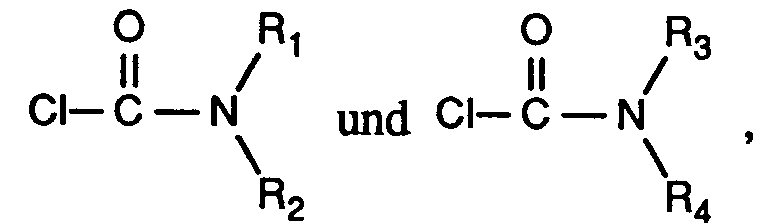
- the second process is based on a diamine of the formula from that with at least about stoichiometric amounts of the carbamoyl chlorides of the formulas is reacted in a suitable solvent.
- the product of Formula 1 is then isolated. The reaction is generally slightly exothermic.
- Another object of the invention are heat-curing compositions containing at least one epoxy resin, dicyandiamide and a curing accelerator, which are characterized in that a compound of formula 1 in the abovementioned meaning is used as the curing accelerator.
- compositions according to the invention show a reactivity at elevated temperature similar to compositions based on chlorotoluron as a curing accelerator, but at the same time have an unexpectedly greatly increased stability at room temperature compared to the compositions mentioned, which is comparable to the stability of corresponding compositions without Hardening accelerator.
- compositions based on those curing accelerators of formula 1 in which the radicals R1, R2, R3 and R4 in formula 1 each independently represent an alkyl group having 1 to 3 carbon atoms or phenyl, and compositions based on the compounds of formula 1 , in which the radicals R5, R6, R7 and R8 all represent hydrogen atoms.
- compositions according to the invention with the compound of the formula 1 in which the radicals R1, R2, R3 and R4 are all methyl and the radicals R5, R6, R7 and R8 are all hydrogen atoms.
- the di- and polyepoxides can be aliphatic, cycloaliphatic or aromatic compounds.
- examples of such compounds are the glycidyl ethers and ⁇ -methylglycidyl ethers of aliphatic or cycloaliphatic diols or polyols, for example those of ethylene glycol, propane-1,2-diol, propane-1,3-diol, butane-1,4-diol, diethylene glycol, Polyethylene glycol, polypropylene glycol, glycerin, trimethylolpropane or 1,4-dimethylolcyclohexane or 2,2-bis (4-hydroxycyclohexyl) propane, the glycidyl ethers of di- and polyphenols, for example resorcinol, 4,4'-dihydroxydiphenylmethane, 4,4 '-Di
- N-glycidyl compounds e.g. the diglycidyl compounds of ethylene urea, 1,3-propylene urea or 5-dimethylhydantoin or of 4,4'-methylene-5,5'-tetramethyldihydantoin, or those such as triglycidyl isocyanurate.
- glycidyl compounds with technical importance are the glycidyl esters of carboxylic acids, especially di- and polycarboxylic acids.
- examples include the glycidyl esters of succinic acid, adipic acid, azelaic acid, sebacic acid, phthalic acid, terephthalic acid, tetra- and hexahydrophthalic acid, isophthalic acid or trimellitic acid, or of dimerized fatty acids.
- polyepoxides other than glycidyl compounds are the diepoxides of vinylcyclohexene and dicyclopentadiene, 3- (3 ', 4'-epoxicyclohexyl) -8,9-epoxy-2,4-dioxaspiro [5.5] undecane, the 3,4'-epoxy cyclohexyl methyl ester of 3,4 epoxy cyclohexane carboxylic acid, butadiene diepoxide or isoprene diepoxide, epoxidized linoleic acid derivatives or epoxidized polybutadiene.
- Preferred epoxy resins are optionally advanced diglycidyl ethers of dihydric phenols or dihydric aliphatic alcohols with 2 to 4 carbon atoms, in particular the optionally advanced diglycidyl ethers of 2,2-bis (4-hydroxyphenyl) propane and bis (4-hydroxyphenyl) methane or a mixture from these epoxy resins.
- compositions based on a resin component consisting only of epoxy resins represent an important embodiment of the invention, in addition to the epoxy resins, polyisocyanates may also be present in the curable compositions.
- polyisocyanates capable of crosslinking are suitable as polyisocyanates, e.g. B. hexamethylene diisocyanate (HDI), trimethylhexamethylene diisocyanate (TMDI), cyclohexane diisocyanate (CHDI), isophorone diisocyanate (3,5,5-trimethyl-1-isocyanato-3-isocyanatomethylcyclohexane; IPDI), methylene dicyclohexyl isocyanate (HMDI), p-phenylene diisocyanate (PPI) Diisocyanatotoluene (TDI), e.g. B.
- HDI hexamethylene diisocyanate
- TMDI trimethylhexamethylene diisocyanate
- CHDI cyclohexane diisocyanate
- IPDI isophorone diisocyanate
- HMDI methylene dicyclohexyl isocyanate
- 2,4-diisocyanatotoluene, 2,6-diisocyanatotoluene and technical mixtures of both isomers naphthylene diisocyanate (NDI), especially 1,5-naphthylene diisocyanate, dianisidine diisocyanate (DADI), methylene diphenyl diisocyanate (MDI), especially the 4,4'-isomer , but also technical mixtures of different isomers, for example the 4,4'- and 2,4'-isomers, or polymethylene polyphenyl isocyanates (PAPI).
- NDI naphthylene diisocyanate
- DADI 1,5-naphthylene diisocyanate
- DADI dianisidine diisocyanate
- MDI methylene diphenyl diisocyanate
- PAPI polymethylene polyphenyl isocyanates
- polyisocyanates which are obtainable by reacting polyisocyanates with themselves via isocyanate groups, such as uretdiones or carbodiimide compounds which are formed by the reaction of two isocyanate groups, or isocyanurate or biuret compounds which are formed by the reaction of three isocyanate groups.
- polyisocyanate prepolymers which have on average more than one isocyanate group per molecule and are obtained by prereaction of a molar excess, for example one of the above-mentioned polyisocyanates, with an organic material which has at least two active hydrogen atoms per molecule, e.g. B. in the form of hydroxyl groups as in polyalkylene glycols.
- Isocyanates such as those mentioned are generally available and in a wide variety commercially available.
- Preferred polyisocyanates are methylene diphenyl diisocyanate (MDI), isophorone diisocyanate (IPDI), hexamethylene diisocyanate, diisocyanatotoluene (TDI), e.g. B. 2,4-diisocyanatotoluene, 2,6 diisocyanatotoluene and technical mixtures of both isomers, and prepolymers of the isocyanates mentioned with polyalcohols and reaction products which can be obtained by reacting the polyisocyanates with themselves via isocyanate groups.
- MDI methylene diphenyl diisocyanate
- IPDI isophorone diisocyanate
- TDI diisocyanatototoluene
- B. 2,4-diisocyanatotoluene, 2,6 diisocyanatotoluene and technical mixtures of both isomers and prepolymers of the isocyanates mentioned
- the free isocyanate groups of the polyisocyanates can also be blocked in a conventional manner, e.g. B. with phenols, oximes, caprolactams, imidazoles, pyrazoles or indazoles. Pyrazole-blocked polyisocyanates are preferred because they release isocyanate and start to harden even at relatively low temperatures, from about 80 ° C.
- Pyrazole-blocked polyisocyanates and their preparation are described in US-A-4,976,837 and EP-A-0 500 495. It can be carried out by quantitative reaction of suitable pyrazoles with the polyisocyanates under an inert gas. The procedure is preferably carried out at elevated temperature and in a suitable inert solvent (for example toluene), if appropriate in the presence of a catalyst (for example dibutyltin dilaurate). Cooling may be required due to the exothermic reaction of both compounds.
- a suitable inert solvent for example toluene
- a catalyst for example dibutyltin dilaurate
- the pyrazoles used for blocking preferably have the formula wherein R1, R2 and R3 independently of one another hydrogen, hydroxyl, alkyl, in particular with one to five carbon atoms, alkyloxy, in particular with one to five carbon atoms, alkylthio, in particular with up to five carbon atoms, methyl and methoxy being particularly preferred ; Aryl with up to ten ring carbon atoms, especially phenyl, where the aryl radicals may in turn have substituents, e.g. B.
- C1-C4 alkyl or C1-C4 alkyloxy substituents or arylalkyl, in particular aryl- (C1-C4) alkyl, very particularly arylmethyl, in particular benzyl.
- Pyrazoles of this type are commercially available or can be prepared using conventional methods, e.g. B. by implementing suitably chosen i, i + 2 diketones, e.g. B. a 1,3-diketone, with hydrazine with or without solvent (z. B. Toluene) can be obtained.
- the epoxy resin preferably makes up at least 50, more preferably at least 70 percent by weight of the total resin component.
- compositions mentioned appropriately contain the compound of formula 1 in an amount of 0.1 to 10 percent by weight, based on the total amount of epoxy resin and dicyandiamide and any polyisocyanate present.
- Dicyandiamide is generally present in amounts of 2 to 20 percent by weight and epoxy resin or epoxy resin / polyisocyanate mixture in amounts of 80 to 98 percent by weight, in each case based on the total amount of dicyandiamide, epoxy resin and any blocked or unblocked polyisocyanate present.
- the following preferred composition which contains dicyandiamide in an amount of about 10 percent by weight and 1,4-bis (N, N'-dimethylureido) benzene in an amount of about 5 percent by weight based on the total Epoxy resins, dicyandiamide and 1,4-bis (N, N'-dimethylureido) benzene.
- compositions according to the invention may also contain other conventional ingredients in the usual amounts, such as.
- viscosity regulators extenders, fillers, reinforcing agents, metal particles, pigments, dyes, organic solvents, plasticizers, adhesion promoters, fungicides, antioxidants, leveling agents, thinners, for. B. reactive thinner and the like.
- the curable mixtures according to the invention can be used quite generally for the production of hardened products and can be used in a formulation adapted to the particular field of application, for example as coating compositions, lacquers, molding compositions, immersion resins, casting resins, impregnating resins, laminating resins or matrix resins.
- compositions according to the invention are particularly suitable as 1- or 2-component adhesives, e.g. B. for gluing IC's.
- An area of application especially for the compositions based on Mixtures of epoxy resins and polyisocyanates is the production of hardened products with reacted modifiers, such as plasticizers or flexibilizers.
- the polyisocyanate component is the modifying agent for the epoxy resin component (I nterpenetrating P olymer N etworks).
- compositions according to the invention as a coating agent, for the production of prepregs and in particular as a heat-curing, preferably one-component adhesive.
- the mixtures according to the invention can be cured rapidly at relatively low temperatures. In general, temperatures in the range from 20 to 200 ° C., preferably from 60 to 180 ° C., in particular 80 to 120 ° C., are used for curing.
- the hardening can take place in any form by adding heat. It can also be carried out, for example, with the aid of microwaves or by induction heating, the compositions of course being electrically conductive particles, for. B. must contain metal particles. Hardening usually takes place with simultaneous shaping to form bodies, impregnations, coatings or bonds.
- compositions according to the invention are that they can be cured at a speed which is sufficient for practical use even at particularly low temperatures in the range below 140 ° C., in particular between 120 and 140 ° C.
- the gelling times of compositions according to the invention are generally below 30 minutes even at these temperatures.
- This mixture has the properties given in table 1 (mixture A).
- the properties of an otherwise identical mixture are also shown in the table, but instead of the curing accelerator according to the invention contains the same amount of chlorotoluron as accelerator (mixture B), and the properties of a corresponding mixture without any addition of accelerator (mixture C).
- a comparison of the data given for mixtures A and B clearly shows the greatly increased stability of the composition according to the invention (mixture A) compared to a composition with chlorotoluron (mixture B), although both compositions are approximately equally reactive at elevated temperature and consequently at these Gell temperatures and harden at practically the same speed.
- a comparison of the values for the mixtures A and C furthermore shows that the stability of the accelerated thermosetting composition A according to the invention is even comparable to an unaccelerated, but otherwise identical composition (mixture C).
- composition D according to the invention is clearly evident.
Landscapes
- Chemical & Material Sciences (AREA)
- Organic Chemistry (AREA)
- Health & Medical Sciences (AREA)
- Chemical Kinetics & Catalysis (AREA)
- Medicinal Chemistry (AREA)
- Polymers & Plastics (AREA)
- Epoxy Resins (AREA)
- Organic Low-Molecular-Weight Compounds And Preparation Thereof (AREA)
Abstract
Beschrieben wird die Verwendung einer Verbindung der Formel 1 <IMAGE> worin R1 und R3 unabhängig voneinander jeweils eine Alkyl-, Cycloalkyl- oder Arylgruppe, R2 und R4 unabhängig voneinander jeweils eine Alkyl- oder Arylgruppe oder R1 mit R2 und/oder R3 mit R4 jeweils eine 1,4-Tetramethylen- oder eine 1,5-Pentamethylengruppe und schliesslich R5, R6, R7 und R8 unabhängig voneinander jeweils ein Wasserstoff- oder Halogenatom oder eine C1-C4-Alkyl- oder C1-C4-Alkoxygruppe bedeuten, als Härtungsbeschleuniger für eine heisshärtende Zusammensetzung enthaltend mindestens ein Epoxidharz und Dicyandiamid, entsprechende Zusammensetzungen sowie zwei vorteilhafte Verfahren zur Herstellung von Verbindungen der Formel 1. Die Beschleuniger der Formel 1 haben den Vorteil, dass sie zwar die Reaktivität der Zusammensetzungen bei erhöhter Temperatur in vergleichbarem Masse wie gute Beschleuniger des Standes der Technik erhöhen, die Lagerstabilität der Zusammensetzungen bei Raumtemperatur aber nicht nachteilig beeinflussen.
Description
- Die vorliegende Erfindung betrifft die Verwendung von Verbindungen der weiter unten angegebenen Formel 1 als Härtungsbeschleuniger für heisshärtende Zusammensetzungen enthaltend mindestens ein Epoxidharz und Dicyandiamid, entsprechende heisshärtende Zusammensetzungen sowie zwei zweckmässige Verfahren zur Herstellung von Verbindungen der Formel 1.
- Dicyandiamid ist ein bekannter und häufig eingesetzter Härter für Epoxidharze (Henry Lee, Kris Neville "Handbook of Epoxy Resins", McGraw-Hill Book Company, New York, 1967, S. 10-16). Es ist nämlich bei Raumtemperatur oder mässig erhöhten Temperaturen bis etwa 40 °C nur sehr wenig reaktiv und ermöglicht so eine lange Handhabung und/oder Lagerung von Zusammensetzungen aus Epoxidharzen und Dicyandiamid bei diesen Temperaturen, ohne dass eine teilweise Härtung die Verarbeitbarkeit der Zusammensetzungen, beispielsweise aufgrund erhöhter Viskosität, erschwert oder gar unmöglich macht. Allerdings erfordert Dicyandiamid auch relativ hohe Temperaturen für die Härtung, zumindest oberhalb von 145 °C, insbesondere wenn, wie z.B. bei Klebstoffanwendungen oftmals der Fall, eine schnelle Härtung erforderlich ist.
- Um die Reaktivität derartiger Zusammensetzungen zu steigern, werden daher üblicherweise Härtungsbeschleuniger zugesetzt. Als besonders gute Härtungsbeschleuniger sind Imidazolderivate und insbesondere N'-(3-Chloro-4-methylphenyl)-N,N-dimethylharnstoff (Chlortoluron) bekannt. Chlortoluron vermag die Reaktivität von Epoxidharz/Dicyandiamidzusammensetzungen ganz beträchtlich anzuheben. So liegt die Gelierzeit von chlortoluronbeschleunigten Epoxidharz/Dicyandiamidgemischen bei 160 °C nur bei einigen wenigen Minuten, während ohne den Härtungsbeschleuniger bei gleicher Temperatur bis zur Gelierung einer entsprechenden Zusammensetzung etwa eine halbe bis eine Stunde vergehen. Chlortoluron und andere vergleichbar gute Beschleuniger haben aber den Nachteil, dass sie die Reaktivität der Reaktionsgemische bei Raumtemperatur und mässig erhöhter Temperatur ebenfalls so drastisch erhöhen, dass die Lagerfähigkeit dieser Zusammensetzungen nicht mehr befriedigen kann.
- Es bestand daher die Aufgabe, einen Härtungsbeschleuniger für heisshärtende Zusammensetzungen auf Basis von Epoxidharzen und Dicyandiamid anzugeben, der zwar bei erhöhter Temperatur vergleichbare Härtungsgeschwindigkeiten wie Chlortoluron ermöglicht, der jedoch bei Raumtemperatur oder mässig erhöhter Temperatur nur geringe Reaktivität zeigt, so dass sich bei diesen Temperaturen die Verarbeitbarkeit der Zusammensetzungen auch während einer längeren Standzeit oder Lagerung nicht oder nur unwesentlich verändert.
- Überraschend hat sich nunmehr gezeigt, dass diese Aufgabe durch die Verwendung einer Verbindung der Formel 1 als Härtungsbeschleuniger für eine heisshärtende Zusammensetzung enthaltend mindestens ein Epoxidharz und Dicyandiamid gelöst werden kann

wobei in Formel 1 die Reste R₁ und R₃ unabhängig voneinander jeweils eine Alkyl-, Cycloalkyl- oder Arylgruppe, die Reste R₂ und R₄ unabhängig voneinander jeweils eine Alkyl- oder Arylgruppe oder der Rest R₁ zusammen mit dem Rest R₂ und/oder der Rest R₃ zusammen mit dem Rest R₄ jeweils eine 1,4-Tetramethylen- oder eine 1,5-Pentamethylengruppe und schliesslich die Reste R₅, R₆, R₇ und R₈ unabhängig voneinander jeweils ein Wasserstoff- oder Halogenatom oder eine C₁-C₄-Alkyl- oder C₁-C₄-Alkoxygruppe bedeuten. - In der Bedeutung von Alkyl stellen die Reste R₁ bis R₄ in Formel 1 bevorzugt Alkylgruppen mit 1 bis 6 Kohlenstoffatomen dar, die geradkettig oder verzweigt sein können, z. B. Methyl-, Ethyl- Propyl-, iso-Propyl, n-Butyl-, sec-Butyl-, tert-Butyl-, iso-Butyl- oder geradkettige oder entsprechend verzweigte Pentyl- oder Hexylgruppen dar. In der Bedeutung Cycloalkyl stellen sie insbesondere Cyclopentyl- oder Cyclohexylgruppen und in der Bedeutung Aryl insbesondere Phenylgruppen dar, oder Reste, die sich von den genannten Cycloalkyl und von Phenylgruppen durch die Substitution eines oder mehrerer, z. B. zweier oder dreier Wasserstoffatome durch Halogenatome, insbesondere Chlor- oder Bromatome, oder durch geradkettige oder verzweigte Alkylguppen mit 1, 2, 3 oder vier Kohlenstoffatomen oder durch diesen Alkylgruppen entsprechende Alkoxygruppen ableiten.
- Die Verbindungen der Formel 1 sind zumindest teilweise bekannt und können z. B. in an sich ebenfalls bekannter Weise durch gleichzeitige Umsetzung eines Diamins der Formel

mit einem Amin der Formel HNR₁R₂ sowie einem Amin der Formel HNR₃R₄ in Gegenwart von Kohlenmonoxid und Schwefel im Autoklaven erhalten werden. Den Resten R₁ bis R₈ kommt in den vorgenannten Formeln die gleiche Bedeutung wie in Formel 1 zu. Die Mengen der Reaktanten sind nicht kritisch, die Reaktanten sollten aber im allgemeinen zumindest in den stöchiometrischen Mengen vorliegen. Dieses Verfahren ist an Hand einer Vielzahl von Beispielen im einzelnen in der US-A-2,993,044 beschrieben. - Weiterhin haben sich zwei neue Einstufenverfahren für die Herstellung von Verbindungen der Formel 1 als gangbar erwiesen. Diese bilden ebenfalls einen Gegenstand der vorliegenden Erfindung. Beide Verfahren machen den Einsatz eines Druckautoklaven unnötig und führen nicht zur Bildung von Schwefelwasserstoff wie das oben beschriebene vorbekannte Herstellungsverfähren, so dass eine Schwefelwasserstoffabsorption unnötig ist.
- Beim ersten dieser Einstufenverfahren setzt man eine Diisocyanatverbindung der Formel

worin R₅, R₆, R₇ und R₈ die gleiche Bedeutung haben, wie oben schon angegeben, mit jeweils zumindest etwa stöchiometrischen Mengen der Amine HNR₁R₂ und HNR₃R₄, worin die Reste R₁ bis R₄ ebenfalls die oben schon genannte Bedeutung haben, in einem geeigneten gegenüber Isocyanaten inerten Lösungsmittel, z. B. in Essigester, Dioxan oder einem geeigneten Kohlenwasserstoff, unter wasserfreien Bedingungen und unter Erwärmung um und isoliert das Produkt der Formel 1. Zur Isolation kann man z. B. das Lösungsmittel abziehen. Manche der Verbindungen der Formel 1 sind jedoch so schwer in den genannten Lösungsmitteln löslich, dass sie allein durch Filtration in hervorragender Ausbeute isoliert werden können. Dies trifft insbesondere für die Verbindungen der Formel 1 zu, in denen die Reste R₁ bis R₄ alle einen, vorzugsweise den gleichen Alkylrest mit 1 bis 3 Kohlenstoffatomen darstellen. Das geschilderte Verfahren führt im allgemeinen zu annähernd hundertprozentigen Ausbeuten an gewünschtem Produkt und liefert dieses in grosser Reinheit. - Das zweite Verfahren geht wie das oben beschriebene Autoklavenverfahren von einem Diamin der Formel

aus, das mit zumindest etwa stöchiometrischen Mengen der Carbamoylchloride der Formeln
in einem geeigneten Lösungsmittel umgesetzt wird. Danach wird das Produkt von Formel 1 isoliert. Die Reaktion verläuft im allgemeinen schwach exotherm. - Einen weiteren Gegenstand der Erfindung bilden heisshärtende Zusammensetzungen enthaltend mindestens ein Epoxidharz, Dicyandiamid und einen Härtungsbeschleuniger, die dadurch gekennzeichnet sind, dass als Härtungsbeschleuniger eine Verbindung der Formel 1 in der vorgenannten Bedeutung eingesetzt wird.
- Die erfindungsgemässen Zusammensetzungen zeigen bei erhöhter Temperatur eine ähnliche Reaktivität wie Zusammensetzungen auf Basis von Chlortoluron als Härtungsbeschleuniger, weisen jedoch gleichzeitig eine unerwartet stark gesteigerte Stabilität bei Raumtemperatur im Vergleich zu den genannten Zusammensetzungen auf, die vergleichbar ist mit der Stabilität entsprechender Zusammensetzungen ohne Härtungsbeschleuniger.
- Besonders bevorzugt sind die Zusammensetzungen auf Basis derjenigen Härtungsbeschleuniger von Formel 1, bei denen die Reste R₁, R₂, R₃ und R₄ in Formel 1 unabhängig voneinander jeweils eine Alkylgruppe mit 1 bis 3 Kohlenstoffatomen oder Phenyl bedeuten, sowie Zusammensetzungen auf Basis der Verbindungen von Formel 1, bei denen die Reste R₅, R₆, R₇ und R₈ alle Wasserstoffatome darstellen.
- Am meisten bevorzugt sind schliesslich erfindungsgemässe Zusammensetzungen mit der Verbindung der Formel 1, bei der die Reste R₁, R₂, R₃ und R₄ alle Methyl und die Reste R₅, R₆, R₇ und R₈ alle Wasserstoffatome bedeuten.
- Alle gebräuchlichen Di- und Polyepoxide sowie Epoxidharzpräpolymere sind als Epoxidharze für die Erfindung geeignet. Die Di- und Polyepoxide können aliphatische, cycloaliphatische oder aromatische Verbindungen sein. Beispiele für solche Verbindungen sind die Glycidylether und β-Methylglycidylether aliphatischer oder cycloaliphatischer Diole oder Polyole, zum Beispiel solche des Ethylenglykols, Propan-1,2-diols, Propan-1,3-diols, Butan-1,4-diols, Diethylenglykols, Polyethylenglykols, Polypropylenglykols, Glycerins, Trimethylolpropans oder 1,4-Dimethylolcyclohexans oder des 2,2-Bis-(4-hydroxycyclohexyl)-propans, die Glycidylether von Di- und Polyphenolen, beispielsweise Resorcin, 4,4'-Dihydroxydiphenylmethan, 4,4'-Dihydroxydiphenyl-2,2-propan, Novolake und 1,1,2,2-Tetrakis-(4-hydroxyphenyl)-ethan. Weitere Beispiele sind N-Glycidylverbindungen, z.B. die Diglycidylverbindungen des Ethylenharnstoffs, 1,3-Propylenharnstoffs oder 5-Dimethylhydantoins oder des 4,4'-Methylen-5,5'-tetramethyldihydantoins, oder solche wie Triglycidylisocyanurat.
- Weitere Glycidylverbindungen mit technischer Bedeutung sind die Glycidylester von Carbonsäuren, insbesondere Di- und Polycarbonsäuren. Beispiele dafür sind die Glycidylester der Bernsteinsäure, Adipinsäure, Azelainsäure, Sebacinsäure, Phthalsäure, Terephthalsäure, Tetra- und Hexahydrophthalsäure, Isophthalsäure oder Trimellitsäure, oder von dimerisierten Fettsäuren.
- Beispiele für von Glycidylverbindungen verschiedene Polyepoxide sind die Diepoxide des Vinylcyclohexens und Dicyclopentadiens, 3-(3',4'-Epoxicyclohexyl)-8,9-epoxy-2,4-dioxaspiro[5.5]undecan, der 3,4'-Epoxicyclohexylmethylester der 3,4-Epoxicyclohexancarbonsäure, Butadiendiepoxid oder Isoprendiepoxid, epoxidierte Linolsäurederivate oder epoxidiertes Polybutadien.
- Bevorzugte Epoxidharze sind gegebenenfalls vorverlängerte Diglycidylether zweiwertiger Phenole oder zweiwertiger aliphatischer Alkohole mit 2 bis 4 Kohlenstoffatomen, insbesondere die gegebenenfalls vorverlängerten Diglycidylether des 2,2-Bis-(4-hydroxyphenyl)-propans und Bis-(4-hydroxyphenyl)-methans oder ein Gemisch aus diesen Epoxidharzen.
- Obwohl gerade Zusammensetzungen auf Basis einer Harzkomponente nur aus Epoxidharzen eine wichtige Ausführungsform der Erfindung darstellen, können neben den Epoxidharzen auch noch Polyisocyanate in den härtbaren Zusammensetzungen enthalten sein.
- Als Polyisocyanate sind hierbei alle zur Vernetzung fähigen Polyisocyanate geeignet, z. B. Hexamethylendiisocyanat (HDI), Trimethylhexamethylendiisocyanat (TMDI), Cyclohexandiisocyanat (CHDI), Isophorondiisocyanat (3,5,5-Trimethyl-1-isocyanato-3-isocyanatomethylcyclohexan; IPDI), Methylendicyclohexylisocyanat (HMDI), p-Phenylendiisocyanat (PPDI), Diisocyanatotoluol (TDI), z. B. 2,4-Diisocyanatotoluol, 2,6-Diisocyanatotoluol und technische Gemische von beiden Isomeren, Naphthylendiisocyanat (NDI), insbesondere 1,5-Naphthylendiisocyanat, Dianisidindiisocyanat (DADI), Methylendiphenyldiisocyanat (MDI), insbesondere das 4,4'-Isomere, aber auch technische Gemische verschiedener Isomere, beispielsweise der 4,4'- und 2,4'-Isomeren, oder Polymethylenpolyphenylisocyanate (PAPI). Ebenfalls gut geeignet sind auch Polyisocyanate, die durch Umsetzung von Polyisocyanaten mit sich selbst über Isocyanatgruppen erhältlich sind, wie Uretdione oder Carbodiimidverbindungen, die durch Reaktion zweier Isocyanatgruppen entstehen, oder wie Isocyanurat- oder Biuretverbindungen, die durch Reaktion dreier Isocyanatgruppen entstehen. Für die Erfindung geeignet sind auch Polyisocyanatpräpolymere, die durchschnittlich mehr als eine Isocyanatgruppe pro Molekül aufweisen und durch Vorreaktion eines molaren Überschusses beispielsweise eines der oben genannten Polyisocyanate mit einem organischen Material erhalten werden, das mindestens zwei aktive Wasserstoffatome pro Molekül aufweist, z. B. in Form von Hydroxylgruppen wie bei Polyalkylenglykolen. Isocyanate wie die genannten sind allgemein verfügbar und in grosser Vielfalt kommerziell erhältlich.
- Bevorzugt werden als Polyisocyanate Methylendiphenyldiisocyanat (MDI), Isophorondiisocyanat (IPDI), Hexamethylendiisocyanat, Diisocyanatotoluol (TDI), z. B. 2,4-Diisocyanatotoluol, 2,6 Diisocyanatotoluol und technische Gemische von beiden Isomeren, und Präpolymere der genannten Isocyanate mit Polyalkoholen sowie Umsetzungsprodukte, die durch Umsetzung der Polyisocyanate mit sich selbst über Isocyanatgruppen erhältlich sind.
- Die freien Isocyanatgruppen der Polyisocyanate können auch in üblicher Weise blockiert sein, z. B. mit Phenolen, Oximen, Caprolactamen, Imidazolen, Pyrazolen oder Indazolen. Pyrazolblockierte Polyisocyanate sind bevorzugt, weil sie bereits bei relativ niedrigen Temperaturen, ab etwa 80°C, wieder Isocyanat freisetzen und zu härten beginnen.
- Pyrazolblockierte Polyisocyanate und deren Herstellung sind in der US-A-4,976,837 und der EP-A-0 500 495 beschrieben. Sie kann durch quantitative Umsetzung geeigneter Pyrazole mit den Polyisocyanaten unter Inertgas erfolgen. Vorzugsweise arbeitet man dabei bei erhöhter Temperatur und in einem geeigneten inerten Lösungsmittel (z. B. Toluol), gegebenenfalls in Gegenwart eines Katalysators (z. B. Dibutylzinndilaurat). Infolge der exothermen Reaktion beider Verbindungen kann eine Kühlung erforderlich sein. Die zur Blockierung verwendeten Pyrazole haben bevorzugt die Formel

wobei R₁, R₂ und R₃ unabhängig voneinander Wasserstoff, Hydroxyl, Alkyl, insbesondere mit einem bis zu fünf Kohlenstoffatomen, Alkyloxy, insbesondere mit einem bis zu fünf Kohlenstoffatomen, Alkylthio, insbesondere mit einem bis zu fünf Kohlenstoffatomen, wobei wiederum Methyl und Methoxy besonders bevorzugt sind; Aryl mit bis zu zehn Ringkohlenstoffatomen, insbesondere Phenyl, wobei die Arylreste gegebenfalls ihrerseits Substituenten haben können, z. B. C₁-C₄-Alkyl- oder C₁-C₄-Alkyloxysubstituenten; oder Arylalkyl, insbesondere Aryl-(C₁-C₄)Alkyl, ganz besonders Arylmethyl, insbesondere Benzyl bedeuten. Pyrazole dieser Art sind im Handel oder können gemäss üblicher Methoden, z. B. durch Umsetzung passend gewählter i,i+2-Diketone, z. B. eines 1,3-Diketons, mit Hydrazin mit oder ohne Lösungsmittel (z. B. Toluol) erhalten werden. - Werden Gemische aus Epoxidharzen und Polyisocyanaten eingesetzt, so macht das Epoxidharz bevorzugt mindestens 50, noch besser mindestens 70 Gewichtsprozent der gesamten Harzkomponente aus.
- Die genannten Zusammensetzungen enthalten die Verbindung der Formel 1 zweckmässigerweise in einer Menge von 0,1 bis 10 Gewichtsprozent, bezogen auf die Gesamtmenge aus Epoxidharz sowie Dicyandiamid und gegebenenfalls vorhandenem Polyisocyanat. Dicyandiamid liegt im allgemeinen in Mengen von 2 - 20 Gewichtsprozent und Epoxidharz oder Epoxidharz/Polyisocyanatgemisch in Mengen von 80 - 98 Gewichtsprozent vor, jeweils bezogen auf die Gesamtmenge aus Dicyandiamid, Epoxidharz und gegebenenfalls vorhandenem blockierten oder nicht blockierten Polyisocyanat. Als ein Beispiel mag die folgende bevorzugte Zusammensetzung dienen, die Dicyandiamid in einer Menge von etwa 10 Gewichtsprozent und 1,4-Bis-(N,N'-dimethylureido)-benzol in einer Menge von etwa 5 Gewichtsprozent enthält, bezogen auf die Gesamtmenge aus Epoxidharzen, Dicyandiamid und 1 ,4-Bis-(N,N'-dimethylureido)-benzol.
- Neben den genannten Bestandteilen können die erfindungsgemässen Zusammensetzungen noch weitere übliche Bestandteile in den üblichen Mengen enthalten, wie z. B. Viskositätsregler, Streckmittel, Füllstoffe, Verstärkungsmittel, Metallpartikel, Pigmente, Farbstoffe, organische Lösungsmittel, Weichmacher, Haftvermittler, Fungizide, Antioxidantien, Verlaufsmittel, Verdünner, z. B. Reaktivverdünner und dergleichen mehr.
- Die erfindungsgemässen härtbaren Gemische lassen sich ganz allgemein zur Herstellung von gehärteten Produkten einsetzen, und können in einer dem jeweils speziellen Anwendungsgebiet angepassten Formulierung beispielsweise als Beschichtungsmassen, Lacke, Pressmassen, Tauchharze, Giessharze, Imprägnierharze, Laminierharze oder Matrixharze eingesetzt werden.
- Sie eignen sich z. B. zur Herstellung von Prepregs, Verbund- oder Compositematerialien, zur Herstellung von Formkörpern jeglicher Art oder zum Umhüllen von elektrischen oder elektronischen Bauteilen. Besonders gut geeignet sind die erfindungsgemässen Zusammensetzungen als 1- oder 2-Komponenten-Klebstoffe, z. B. zum Aufkleben von IC's. Ein Anwendungsgebiet speziell für die Zusammensetzungen auf Basis von Mischungen aus Epoxidharzen und Polyisocyanaten ist die Herstellung gehärteter Produkte mit einreagierten Modifizierungsmitteln, wie Weichmachern oder Flexibilisatoren, wobei z. B. die Polyisocyanatkomponente das Modifizierungsmittel für die Epoxidharzkomponente darstellt (Interpenetrating Polymer Networks).
- Besonders bevorzugt sind Anwendungen, bei denen es auf die Erreichung einer hohen Haftfähigkeit von gehärtetem erfindungsgemässen Material ankommt, d. h. die Verwendung der erfindungsgemässen Zusammensetzungen als Beschichtungsmittel, zur Herstellung von Prepregs und insbesondere als heisshärtender, bevorzugt einkomponentiger Klebstoff.
- Die erfindungsgemässen Gemische können bei relativ niedrigen Temperaturen rasch ausgehärtet werden. Im allgemeinen wendet man zur Aushärtung Temperaturen im Bereich von 20 bis 200°C, vorzugsweise von 60 bis 180°C, insbesondere 80 bis 120°C, an. Die Härtung kann dabei durch Zuführ von Wärme in jeglicher Form erfolgen. Sie kann beispielsweise auch mit Hilfe von Mikrowellen oder durch Induktionserwärmung durchgeführt werden, wobei für letzteres die Zusammensetzungen selbstverständlich elektrisch leitende Partikel, z. B. Metallpartikel, enthalten müssen. Die Aushärtung erfolgt in der Regel unter gleichzeitiger Formgebung zu Formkörpern, Imprägnierungen, Beschichtungen oder Verklebungen.
- Ein besonderer Vorteil der erfindungsgemässen Zusammensetzungen liegt jedoch darin, dass sie schon bei besonders niedrigen Temperaturen im Bereich unter 140 °C, insbesondere zwischen 120 und 140 °C, mit für die Praxis ausreichender Geschwindigkeit ausgehärtet werden können. Die Gelierzeiten erfindungsgemässer Zusammensetzungen liegen nämlich im allgemeinen auch bei diesen Temperaturen unter 30 Minuten.
- Herstellung von

- In einem 2-Liter-Rundkolben mit Rückflusskühler, Stickstoffein- und -auslass werden 112,09 g (0,7 Mol) 1,4-Phenylendiisocyanat (Ex Akzo Chem. Co.; heute z. B. bei Aldrich oder Fluka erhältlich) und 1,6 Liter Essigsäureethylester (Essigester) unter Rückfluss erhitzt. Nun werden 63,1 g (1,4 Mol) Dimethylamin eingeleitet. Man lässt auf Raumtemperatur abkühlen und filtriert die weisse Suspension durch eine G4-Nutsche. Nach Waschen mit Essigester wird das Produkt 14 Stunden lang bei 110 °C im Hochvakuum getrocknet. Man erhält 174 g (99,3 % der Theorie) des gewünschten Produkts.
Schmelzpunkt: >300 °C.Elementaranalyse: ber. C 57,58% H 7,25% N 22,38% gef. C 57,50% H 7,24% N 22,03% - IR (KBr):
- ν(C=O) bei 1640 cm⁻¹; keine -NCO-Bande (ν ∼ 2280 cm⁻¹) sichtbar.
- ¹H-NMR (DMSO-d₆):
- 2,90 ppm, s, 12H; 7,27 ppm, s, 4H; 8,06 ppm, s, 2H.
- Herstellung von

- In einem 1,5-Liter-Sulfierkolben mit Rückflusskühler, Stickstoffein- und -auslass, Thermometer und Tropftrichter wird eine Lösung von 64,88 g (0,6 Mol) 1,4-Phenylendiamin in 600 Milliliter Pyridin vorgelegt und tropfenweise 141,95 g (1,32 Mol) Dimethylcarbamoylchlorid zugegeben. Es findet eine exotherme Reaktion statt. Man lässt 12 Stunden bei 100 °C reagieren, kühlt danach ab und giesst das Reaktionsgemisch auf eine Mischung aus Eis und 1N Salzsäure. Es wird durch eine G4-Nutsche filtriert, mit Wasser, danach mit Ethanol und Essigester gewaschen und 14 Stunden lang bei 50 °C im Hochvakuum getrocknet. Man erhält 116,8 g (77,8 % der Theorie) des gewünschten Produkts in Form eines violetten Pulvers.
Schmelzpunkt: >300 °C.Elementaranalyse: ber. C 57,58% H 7,25% N 22,38% gef. C 57,56% H 7,23% N 22,53%
¹H-NMR (DMSO-d₆): 2,90 ppm, s, 12H; 7,28 ppm, s, 4H; 8,10 ppm, s, 2H. - Herstellung von

analog zur US-A-2,993,044. - In einem 6,3-Liter-Stahlautoklaven mit mechanischer Rührung (Ankerrührer) werden 136,08 g (1,26 Mol) 1,4-Phenylendiamin, 161,28 g (5,04 Mol) Schwefel und 315 Milliliter Methanol vorgelegt. Danach werden 340,2 g (7,56 Mol) Dimethylamin zugepresst, gefolgt von Kohlenmonoxid, bis ein Druck von 22 bar im Autoklaven herrscht. Die Temperatur steigt dabei von anfänglich 18 °C auf 36 °C an. Innerhalb von 75 Minuten fällt der Druck auf 10 bar. Man erhitzt auf 100 °C und belässt 2 Stunden bei dieser Temperatur (Druck 10 bar). Danach wird auf Raumtemperatur abgekühlt, der Autoklav mit Methanol ausgewaschen, die erhaltene schwarze Suspension eine Stunde lang auf 60 °C erhitzt und heiss filtriert. Der Rückstand wird mit heissem Methanol gewaschen, bis die Waschflüssigkeit farblos abläuft, und 14 Stunden lang bei 110 °C im Hochvakuum getrocknet. Man erhält 296 g (94 % der Theorie) des gewünschten Produkts.
Elementaranalyse: ber. C 57,58% H 7,25% N 22,38% gef. C 57,42% H 7,28% N 22,38% - IR (KBr):
- ν(C=O) bei 1640 cm⁻¹
- ¹H-NMR (DMSO-d₆):
- 2,99 ppm, s, 12H; 7,44 ppm, s, 4H; 8,23 ppm, s, 2H.
- Die Produkte der Beispiele 1,2 und 3 haben alle den gleichen Beschleunigungseffekt und das gleiche Latenzverhalten in den hierin beschriebenen Zusammensetzungen.
- Eine Mischung aus jeweils 20 g Epoxidharz auf Basis von Bisphenol A (Epoxidäquivalent 185 - 190 g(Äqu; Viskosität(bei 25 °C nach DIN 53015): 10000 - 12000 mPa·s; Araldit®GY-250); 2 g Dicyandiamid und 1 g Beschleuniger aus Beispiel 1 wird zur Homogenisierung zweimal über den Dreiwalzenstuhl gelassen. Diese Mischung hat die in Tabelle 1 angegebenen Eigenschaften (Gemisch A). Zum Vergleich sind in der Tabelle auch die Eigenschaften einer sonst identischen Mischung, die jedoch anstatt des erfindungsgemässen Härtungsbeschleunigers die gleiche Menge Chlortoluron als Beschleuniger enthält, (Gemisch B), sowie die Eigenschaften einer entsprechenden Mischung ohne jeglichen Beschleunigerzusatz (Gemisch C) aufgeführt.

- Bei einem Vergleich der für die Gemische A und B angegebenen Daten erkennt man deutlich die stark gestiegene Stabilität der erfindungsgemässen Zusammensetzung (Gemisch A) gegenüber einer Zusammensetzung mit Chlortoluron (Gemisch B), obwohl beide Zusammensetzungen bei erhöhter Temperatur annähernd gleich reaktiv sind und demzufolge bei diesen Temperaturen praktisch gleich schnell gelieren und auch härten. Ein Vergleich der Werte für die Gemische A und C lässt weiterhin erkennen, dass die Stabilität der erfindungsgemäss beschleunigten heisshärtenden Zusammensetzung A sogar vergleichbar ist mit einer unbeschleunigten, sonst aber identischen Zusammensetzung (Gemisch C).
- Die folgende Klebstoff-Mischung (Gemisch D) wird zweimal zur Homogenisierung über den Dreiwalzenstuhl gelassen:
- 9,52 g
- Bisphenol-A-diglycidylether
- 2,36 g
- 1,4-Butandiol-diglycidylether
- 0,34 g
- roher ungereinigter Bisphenol-A-diglycidylether (5,2 - 5,4 Äquivalente Epoxid/Kilogramm)
- 6,00 g
- Addukt aus Bisphenol-A-diglycidylether/carboxylterminiertem Butadien-Acrylonitril-Copolymer/Cashew nut shell oil (3,0 - 3,5 Äquivalente Epoxid/Kilogramm)
- 0,70 g
- Dicyandiamid
- 0,60 g
- Siliziumdioxid
- 0,48 g
- eines Beschleunigers gemäss den Beispielen 1 - 3
- In Tabelle 2 sind wichtige Eigenschaften beider Mischungen gegenübergestellt.

- Wieder tritt das gestiegene Stabilitäts-/Reaktivitätsverhältnis der erfindungsgemässen Zusammensetzung D deutlich zu Tage.
Zum Vergleich wird eine identische Mischung, die jedoch die identische Menge Chlortoluron als Beschleuniger enthält, in der gleichen Weise homogenisiert (Gemisch E).
Claims (9)
- Verwendung einer Verbindung der Formel 1

R₁ und R₃ unabhängig voneinander jeweils eine Alkyl-, Cycloalkyl- oderArylgruppe,
R₂ und R₄ unabhängig voneinander jeweils eine Alkyl- oder Arylgruppe oder
R₁ mit R₂ und/oder R₃ mit R₄ jeweils eine 1,4-Tetramethylen- oder eine 1,5-Pentamethylengruppe und schliesslich
R₅, R₆, R₇ und R₈ unabhängig voneinander jeweils ein Wasserstoff- oder Halogenatom oder eine C₁-C₄-Alkyl- oder C₁-C₄-Alkoxygruppe bedeuten,
als Härtungsbeschleuniger für eine heisshärtende Zusammensetzung enthaltend mindestens ein Epoxidharz und Dicyandiamid. - Heisshärtende Zusammensetzung enthaltend mindestens ein Epoxidharz, Dicyandiamid und einen Härtungsbeschleuniger, dadurch gekennzeichnet, dass als Härtungsbeschleuniger eine Verbindung der Formel 1 eingesetzt wird:

R₁ und R₃ unabhängig voneinander jeweils eine Alkyl-, Cycloalkyl- oder Arylgruppe,
R₂ und R₄ unabhängig voneinander jeweils eine Alkyl- oder Arylgruppe oder
R₁ mit R₂ und/oder R3 mit R₄ jeweils eine 1,4-Tetramethylen- oder eine 1,5-Pentamethylengruppe und schliesslich
R₅, R₆, R₇ und R₈ unabhängig voneinander jeweils ein Wasserstoff- oder Halogenatom oder eine C₁-C₄-Alkyl oder C₁-C₄-Alkoxygruppe bedeuten. - Zusammensetzung nach Anspruch 2, dadurch gekennzeichnet, dass R₁, R₂, R₃ und R₄ in Formel 1 unabhängig voneinander eine Alkylgruppe mit 1 bis 3 Kohlenstoffatomen oder Phenyl bedeuten.
- Zusammensetzung nach einem der Ansprüche 2 oder 3, dadurch gekennzeichnet, dass die Reste R₅, R₆, R₇ und R₈ in Formel 1 alle Wasserstoffatome darstellen.
- Zusammensetzung nach Anspruch 4, dadurch gekennzeichnet, dass R₁, R₂, R₃ und R₄ in Formel 1 alle Methyl bedeuten.
- Zusammensetzung nach einem der Ansprüche 2 bis 5, dadurch gekennzeichnet, dass sie zusätzlich ein Polyisocyanat enthält.
- Zusammensetzung nach einem der Ansprüche 2 bis 6, dadurch gekennzeichnet, dass sie die Verbindung der Formel 1 in einer Menge von 0,1 bis 10 Gewichtsprozent enthält, bezogen auf die Gesamtmenge aus Epoxidharz sowie Dicyandiamid und gegebenenfalls vorhandenem Polyisocyanat.
- Verfahren zur Herstellung von Verbindungen der Formel 1 gemäss Anspruch 1, wobei man eine Diisocyanatverbindung der Formel

- Verfahren zur Herstellung von Verbindungen der Formel 1 gemäss Anspruch 1, wobei man eine Diaminoverbindung der Formel

Applications Claiming Priority (2)
| Application Number | Priority Date | Filing Date | Title |
|---|---|---|---|
| CH3893/92 | 1992-12-18 | ||
| CH389392 | 1992-12-18 |
Publications (1)
| Publication Number | Publication Date |
|---|---|
| EP0603131A1 true EP0603131A1 (de) | 1994-06-22 |
Family
ID=4265770
Family Applications (1)
| Application Number | Title | Priority Date | Filing Date |
|---|---|---|---|
| EP93810861A Withdrawn EP0603131A1 (de) | 1992-12-18 | 1993-12-09 | Aromatische Harnstoffverbindung als Härtungsbeschleuniger für eine Mischung aus Epoxiharz und Dicyandiamid |
Country Status (3)
| Country | Link |
|---|---|
| EP (1) | EP0603131A1 (de) |
| JP (1) | JPH06220169A (de) |
| CA (1) | CA2111601A1 (de) |
Cited By (7)
| Publication number | Priority date | Publication date | Assignee | Title |
|---|---|---|---|---|
| US6231959B1 (en) | 1995-02-27 | 2001-05-15 | Matsushita Electric Works, Ltd. | Prepreg of epoxy resin, hardener, and organodialkyurea promotor |
| EP1279688A1 (de) * | 2001-07-13 | 2003-01-29 | Toray Composites (America), Inc. | Schnellhärtendes kohlenstofffaserverstärktes Epoxydharz |
| EP2128182A1 (de) * | 2008-05-28 | 2009-12-02 | Sika Technology AG | Hitzehärtende Epoxidharzzusammensetzung enthaltend einen Beschleuniger mit Heteroatomen |
| US8076395B2 (en) | 2009-09-11 | 2011-12-13 | Air Products And Chemicals, Inc. | Low temperature curable epoxy compositions containing urea curatives |
| DE102011118501A1 (de) | 2011-11-15 | 2013-05-16 | Alzchem Ag | Alkyl- oder Dialkyl-Semicarbazone als Härter für Epoxidharze |
| DE102011118760A1 (de) | 2011-11-15 | 2013-05-16 | Alzchem Ag | Verwendung von N,N'(-Dimethyl)-Uronen sowie Verfahren zur Härtung von Epoxidharz-Zusammensetzungen |
| US9403976B2 (en) | 2010-05-18 | 2016-08-02 | Alzchem Ag | Semicarbazones as accelerators for curing epoxy resins |
Families Citing this family (4)
| Publication number | Priority date | Publication date | Assignee | Title |
|---|---|---|---|---|
| JP2983154B2 (ja) * | 1995-03-29 | 1999-11-29 | 株式会社椿本チエイン | 工具保持装置 |
| CA2163946C (en) * | 1995-11-28 | 1997-10-14 | Integrated Production Services Ltd. | Dizzy dognut anchoring system |
| US11661484B2 (en) * | 2017-05-24 | 2023-05-30 | Toray Industries, Inc. | Epoxy resin composition for fiber-reinforced composite materials, and fiber-reinforced composite material |
| EP3630883A4 (de) * | 2017-05-25 | 2020-12-09 | Henkel IP & Holding GmbH | Härtbare zusammensetzungen |
Citations (5)
| Publication number | Priority date | Publication date | Assignee | Title |
|---|---|---|---|---|
| US3386956A (en) * | 1966-01-14 | 1968-06-04 | American Cyanamid Co | Low temperature curable epoxy resin adhesive compositions with long storage stability |
| EP0108712A1 (de) * | 1982-10-12 | 1984-05-16 | Ciba-Geigy Ag | Heisshärtbare Epoxidharzmischungen |
| EP0138769A2 (de) * | 1983-10-14 | 1985-04-24 | Ciba-Geigy Ag | Diurethandiharnstoffe und deren Verwendung |
| EP0344468A1 (de) * | 1988-05-28 | 1989-12-06 | Witco GmbH | Imidazolyl-Harnstoffverbindungen und deren Verwendung als Härtungsbeschleuniger in Epoxidharzzusammensetzungen zur Herstellung von Formkörpern |
| EP0429395A2 (de) * | 1989-11-21 | 1991-05-29 | Ciba-Geigy Ag | Härtbare Epoxidharz-Stoffgemische enthaltend einen latenten Härter, ein Amin und ein Thiol |
-
1993
- 1993-12-09 EP EP93810861A patent/EP0603131A1/de not_active Withdrawn
- 1993-12-16 CA CA 2111601 patent/CA2111601A1/en not_active Abandoned
- 1993-12-20 JP JP34481993A patent/JPH06220169A/ja active Pending
Patent Citations (5)
| Publication number | Priority date | Publication date | Assignee | Title |
|---|---|---|---|---|
| US3386956A (en) * | 1966-01-14 | 1968-06-04 | American Cyanamid Co | Low temperature curable epoxy resin adhesive compositions with long storage stability |
| EP0108712A1 (de) * | 1982-10-12 | 1984-05-16 | Ciba-Geigy Ag | Heisshärtbare Epoxidharzmischungen |
| EP0138769A2 (de) * | 1983-10-14 | 1985-04-24 | Ciba-Geigy Ag | Diurethandiharnstoffe und deren Verwendung |
| EP0344468A1 (de) * | 1988-05-28 | 1989-12-06 | Witco GmbH | Imidazolyl-Harnstoffverbindungen und deren Verwendung als Härtungsbeschleuniger in Epoxidharzzusammensetzungen zur Herstellung von Formkörpern |
| EP0429395A2 (de) * | 1989-11-21 | 1991-05-29 | Ciba-Geigy Ag | Härtbare Epoxidharz-Stoffgemische enthaltend einen latenten Härter, ein Amin und ein Thiol |
Non-Patent Citations (1)
| Title |
|---|
| P. J. PEARCE ET AL.: "Aging and performance of structural film adhesives.", JOURNAL OF APPLIED POLYMER SCIENCE, vol. 47, no. 8, 20 February 1993 (1993-02-20), NEW YORK US, pages 1401 - 1409, XP000451127, DOI: doi:10.1002/app.1993.070470811 * |
Cited By (15)
| Publication number | Priority date | Publication date | Assignee | Title |
|---|---|---|---|---|
| US6231959B1 (en) | 1995-02-27 | 2001-05-15 | Matsushita Electric Works, Ltd. | Prepreg of epoxy resin, hardener, and organodialkyurea promotor |
| EP1279688A1 (de) * | 2001-07-13 | 2003-01-29 | Toray Composites (America), Inc. | Schnellhärtendes kohlenstofffaserverstärktes Epoxydharz |
| US7005185B2 (en) * | 2001-07-13 | 2006-02-28 | Toray Composites (America), Inc. | Quick cure carbon fiber reinforced epoxy resin |
| US8608899B2 (en) | 2008-05-28 | 2013-12-17 | Sika Technology Ag | Heat-curing epoxy resin composition comprising an accelerator having heteroatoms |
| EP2128182A1 (de) * | 2008-05-28 | 2009-12-02 | Sika Technology AG | Hitzehärtende Epoxidharzzusammensetzung enthaltend einen Beschleuniger mit Heteroatomen |
| WO2009150059A1 (de) * | 2008-05-28 | 2009-12-17 | Sika Technology Ag | Hitzehärtende epoxidharzzusammensetzung enthaltend einen beschleuniger mit heteroatomen |
| CN102037050B (zh) * | 2008-05-28 | 2014-01-22 | Sika技术股份公司 | 包含具有杂原子的促进剂的热固化性环氧树脂组合物 |
| US8076395B2 (en) | 2009-09-11 | 2011-12-13 | Air Products And Chemicals, Inc. | Low temperature curable epoxy compositions containing urea curatives |
| US9403976B2 (en) | 2010-05-18 | 2016-08-02 | Alzchem Ag | Semicarbazones as accelerators for curing epoxy resins |
| DE102011118501A1 (de) | 2011-11-15 | 2013-05-16 | Alzchem Ag | Alkyl- oder Dialkyl-Semicarbazone als Härter für Epoxidharze |
| WO2013072356A1 (de) | 2011-11-15 | 2013-05-23 | Alzchem Ag | Verwendung von n,n'-(dimethyl)-uronen sowie verfahren zur härtung von epoxidharz-zusammensetzungen |
| WO2013072354A2 (de) | 2011-11-15 | 2013-05-23 | Alzchem Ag | Alkyl- oder dialkyl-semicarbazone als härter für epoxidharze |
| DE102011118760A1 (de) | 2011-11-15 | 2013-05-16 | Alzchem Ag | Verwendung von N,N'(-Dimethyl)-Uronen sowie Verfahren zur Härtung von Epoxidharz-Zusammensetzungen |
| US9499684B2 (en) | 2011-11-15 | 2016-11-22 | Alzchem Ag | Alkyl or dialkyl-semicarbazone as a hardener for epoxy resin |
| US9663609B2 (en) | 2011-11-15 | 2017-05-30 | Alzchem Ag | Use of N,N′-(dimethyl) urones and method for curing epoxy resin compositions |
Also Published As
| Publication number | Publication date |
|---|---|
| JPH06220169A (ja) | 1994-08-09 |
| CA2111601A1 (en) | 1994-06-19 |
Similar Documents
| Publication | Publication Date | Title |
|---|---|---|
| EP0050284B1 (de) | Neue Lackpolyisocyanate, ein Verfahren zu ihrer Herstellung, sowie ihre Verwendung als Isocyanatkomponente in hitzehärtbaren Zweikomponenten-Polyurethanlacken | |
| EP0306451B1 (de) | Oligomere Cyanoguanidine | |
| EP0576393B1 (de) | Härtbare Zusammensetzungen auf Basis von Epoxidharzen oder Gemischen von Epoxidharzen und Polyisocyanaten enthaltend Trisimidazolyltriazine | |
| EP0010589A1 (de) | Verfahren zur Herstellung von Isocyanuratgruppen aufweisenden Polyisocyanaten und ihre Verwendung als Isocyanatkomponente in Polyurethanlacken | |
| DE2901479A1 (de) | Neue isocyanato-isocyanurate, ein verfahren zu ihrer herstellung, sowie ihre verwendung als isocyanatkomponente in polyurethan-lacken | |
| EP0500495A2 (de) | Warmhärtende Zusammensetzung | |
| EP0178398B1 (de) | Lagerstabile Polyurethanharz-Pulverlacke | |
| EP0744423A1 (de) | Neue blockierte Polyisocyanate sowie ein Verfahren zu ihrer Herstellung | |
| DE2440953B2 (de) | Verfahren zur herstellung von polyaddukten mit wiederkehrenden oxazolidon- und isocyanurateinheiten | |
| EP0019906B1 (de) | Unter dem Einfluss von Luftfeuchtigkeit ausgehärtet werdendes Gemisch und ein Verfahren zur Herstellung von Polyisocyanat-Polyadditionsprodukten oder vernetzten Polyepoxiden | |
| EP0108712A1 (de) | Heisshärtbare Epoxidharzmischungen | |
| DE2156942A1 (de) | Neue, zweikernige'N-heterocyclische N,N-Diglycidylverbindungen, Verfahren zu ihrer Herstellung und ihrer Anwendung | |
| JPH06220169A (ja) | 安定性および反応性の間に良好な比率を有する、エポキシ樹脂、ジシアンジアミドおよび硬化促進剤をベースとした熱硬化性組成物 | |
| DE2018043A1 (de) | Neue Diisocyanate, Verfahren zu ihrer Herstellung und Anwendung | |
| DE19549029A1 (de) | Cyclische Amidin- sowie Uretdiongruppen enthaltende Verbindungen, ein Verfahren zu ihrer Herstellung sowie deren Verwendung | |
| EP0002662B1 (de) | Verfahren zur Herstellung von (Thio)Hydantoinen | |
| EP0298336A1 (de) | Aromatische Polyisocyanate, Verfahren zu ihrer Herstellung sowie ihre Verwendung als Klebstoffkomponente | |
| DE1079833B (de) | Verwendung von latenten Haertungsmitteln fuer Epoxyharze | |
| EP0018948B1 (de) | N-substituierte Asparaginsäurederivate, Verfahren zu ihrer Herstellung, ihre Verwendung und mit ihrer Hilfe hergestellte Epoxidharze | |
| EP0402579A2 (de) | Härtungsmittel für Epoxidverbindungen | |
| DE4026363A1 (de) | 1-(n'-cyanoguanyl)-derivate von n-haltigen fuenfringheterozyklen | |
| EP0392299B1 (de) | Verfahren zur Herstellung von organischen Aminen, Polyamingemische und ihre Verwendung als Härter für Kunststoffvorläufer | |
| EP0022059B1 (de) | N-substituierte Asparaginsäureester, ihre Herstellung und Verwendung | |
| DE2141698A1 (de) | Sterisch gehinderte sekundäre Diamine als Härter für Polyurethane | |
| DE2156881A1 (de) | Neue Epoxy-isocyanate, Verfahren zu ihrer Herstellung und ihrer Anwendung |
Legal Events
| Date | Code | Title | Description |
|---|---|---|---|
| PUAI | Public reference made under article 153(3) epc to a published international application that has entered the european phase |
Free format text: ORIGINAL CODE: 0009012 |
|
| AK | Designated contracting states |
Kind code of ref document: A1 Designated state(s): CH DE ES FR GB IT LI NL SE |
|
| STAA | Information on the status of an ep patent application or granted ep patent |
Free format text: STATUS: THE APPLICATION IS DEEMED TO BE WITHDRAWN |
|
| 18D | Application deemed to be withdrawn |
Effective date: 19941223 |