EP0140130A2 - Verfahren und Vorrichtung zur Herstellung einer Halbleiterschicht - Google Patents
Verfahren und Vorrichtung zur Herstellung einer Halbleiterschicht Download PDFInfo
- Publication number
- EP0140130A2 EP0140130A2 EP84111152A EP84111152A EP0140130A2 EP 0140130 A2 EP0140130 A2 EP 0140130A2 EP 84111152 A EP84111152 A EP 84111152A EP 84111152 A EP84111152 A EP 84111152A EP 0140130 A2 EP0140130 A2 EP 0140130A2
- Authority
- EP
- European Patent Office
- Prior art keywords
- electrode
- electrodes
- semiconductor layer
- substrate
- semiconductor
- Prior art date
- Legal status (The legal status is an assumption and is not a legal conclusion. Google has not performed a legal analysis and makes no representation as to the accuracy of the status listed.)
- Granted
Links
Images


Classifications
-
- H—ELECTRICITY
- H01—ELECTRIC ELEMENTS
- H01J—ELECTRIC DISCHARGE TUBES OR DISCHARGE LAMPS
- H01J37/00—Discharge tubes with provision for introducing objects or material to be exposed to the discharge, e.g. for the purpose of examination or processing thereof
- H01J37/32—Gas-filled discharge tubes
- H01J37/32009—Arrangements for generation of plasma specially adapted for examination or treatment of objects, e.g. plasma sources
- H01J37/32082—Radio frequency generated discharge
-
- C—CHEMISTRY; METALLURGY
- C23—COATING METALLIC MATERIAL; COATING MATERIAL WITH METALLIC MATERIAL; CHEMICAL SURFACE TREATMENT; DIFFUSION TREATMENT OF METALLIC MATERIAL; COATING BY VACUUM EVAPORATION, BY SPUTTERING, BY ION IMPLANTATION OR BY CHEMICAL VAPOUR DEPOSITION, IN GENERAL; INHIBITING CORROSION OF METALLIC MATERIAL OR INCRUSTATION IN GENERAL
- C23C—COATING METALLIC MATERIAL; COATING MATERIAL WITH METALLIC MATERIAL; SURFACE TREATMENT OF METALLIC MATERIAL BY DIFFUSION INTO THE SURFACE, BY CHEMICAL CONVERSION OR SUBSTITUTION; COATING BY VACUUM EVAPORATION, BY SPUTTERING, BY ION IMPLANTATION OR BY CHEMICAL VAPOUR DEPOSITION, IN GENERAL
- C23C16/00—Chemical coating by decomposition of gaseous compounds, without leaving reaction products of surface material in the coating, i.e. chemical vapour deposition [CVD] processes
- C23C16/44—Chemical coating by decomposition of gaseous compounds, without leaving reaction products of surface material in the coating, i.e. chemical vapour deposition [CVD] processes characterised by the method of coating
- C23C16/50—Chemical coating by decomposition of gaseous compounds, without leaving reaction products of surface material in the coating, i.e. chemical vapour deposition [CVD] processes characterised by the method of coating using electric discharges
- C23C16/517—Chemical coating by decomposition of gaseous compounds, without leaving reaction products of surface material in the coating, i.e. chemical vapour deposition [CVD] processes characterised by the method of coating using electric discharges using a combination of discharges covered by two or more of groups C23C16/503 - C23C16/515
-
- H—ELECTRICITY
- H01—ELECTRIC ELEMENTS
- H01J—ELECTRIC DISCHARGE TUBES OR DISCHARGE LAMPS
- H01J37/00—Discharge tubes with provision for introducing objects or material to be exposed to the discharge, e.g. for the purpose of examination or processing thereof
- H01J37/32—Gas-filled discharge tubes
- H01J37/32431—Constructional details of the reactor
- H01J37/32623—Mechanical discharge control means
-
- H—ELECTRICITY
- H01—ELECTRIC ELEMENTS
- H01J—ELECTRIC DISCHARGE TUBES OR DISCHARGE LAMPS
- H01J37/00—Discharge tubes with provision for introducing objects or material to be exposed to the discharge, e.g. for the purpose of examination or processing thereof
- H01J37/32—Gas-filled discharge tubes
- H01J37/32431—Constructional details of the reactor
- H01J37/3266—Magnetic control means
-
- H—ELECTRICITY
- H10—SEMICONDUCTOR DEVICES; ELECTRIC SOLID-STATE DEVICES NOT OTHERWISE PROVIDED FOR
- H10P—GENERIC PROCESSES OR APPARATUS FOR THE MANUFACTURE OR TREATMENT OF DEVICES COVERED BY CLASS H10
- H10P14/00—Formation of materials, e.g. in the shape of layers or pillars
- H10P14/20—Formation of materials, e.g. in the shape of layers or pillars of semiconductor materials
- H10P14/24—Formation of materials, e.g. in the shape of layers or pillars of semiconductor materials using chemical vapour deposition [CVD]
-
- H—ELECTRICITY
- H10—SEMICONDUCTOR DEVICES; ELECTRIC SOLID-STATE DEVICES NOT OTHERWISE PROVIDED FOR
- H10P—GENERIC PROCESSES OR APPARATUS FOR THE MANUFACTURE OR TREATMENT OF DEVICES COVERED BY CLASS H10
- H10P14/00—Formation of materials, e.g. in the shape of layers or pillars
- H10P14/20—Formation of materials, e.g. in the shape of layers or pillars of semiconductor materials
- H10P14/29—Formation of materials, e.g. in the shape of layers or pillars of semiconductor materials characterised by the substrates
- H10P14/2901—Materials
- H10P14/2922—Materials being non-crystalline insulating materials, e.g. glass or polymers
-
- H—ELECTRICITY
- H10—SEMICONDUCTOR DEVICES; ELECTRIC SOLID-STATE DEVICES NOT OTHERWISE PROVIDED FOR
- H10P—GENERIC PROCESSES OR APPARATUS FOR THE MANUFACTURE OR TREATMENT OF DEVICES COVERED BY CLASS H10
- H10P14/00—Formation of materials, e.g. in the shape of layers or pillars
- H10P14/20—Formation of materials, e.g. in the shape of layers or pillars of semiconductor materials
- H10P14/29—Formation of materials, e.g. in the shape of layers or pillars of semiconductor materials characterised by the substrates
- H10P14/2901—Materials
- H10P14/2923—Materials being conductive materials, e.g. metallic silicides
-
- H—ELECTRICITY
- H10—SEMICONDUCTOR DEVICES; ELECTRIC SOLID-STATE DEVICES NOT OTHERWISE PROVIDED FOR
- H10P—GENERIC PROCESSES OR APPARATUS FOR THE MANUFACTURE OR TREATMENT OF DEVICES COVERED BY CLASS H10
- H10P14/00—Formation of materials, e.g. in the shape of layers or pillars
- H10P14/20—Formation of materials, e.g. in the shape of layers or pillars of semiconductor materials
- H10P14/34—Deposited materials, e.g. layers
- H10P14/3402—Deposited materials, e.g. layers characterised by the chemical composition
- H10P14/3404—Deposited materials, e.g. layers characterised by the chemical composition being Group IVA materials
- H10P14/3411—Silicon, silicon germanium or germanium
-
- H—ELECTRICITY
- H10—SEMICONDUCTOR DEVICES; ELECTRIC SOLID-STATE DEVICES NOT OTHERWISE PROVIDED FOR
- H10P—GENERIC PROCESSES OR APPARATUS FOR THE MANUFACTURE OR TREATMENT OF DEVICES COVERED BY CLASS H10
- H10P14/00—Formation of materials, e.g. in the shape of layers or pillars
- H10P14/20—Formation of materials, e.g. in the shape of layers or pillars of semiconductor materials
- H10P14/34—Deposited materials, e.g. layers
- H10P14/3438—Doping during depositing
- H10P14/3441—Conductivity type
- H10P14/3442—N-type
-
- H—ELECTRICITY
- H10—SEMICONDUCTOR DEVICES; ELECTRIC SOLID-STATE DEVICES NOT OTHERWISE PROVIDED FOR
- H10P—GENERIC PROCESSES OR APPARATUS FOR THE MANUFACTURE OR TREATMENT OF DEVICES COVERED BY CLASS H10
- H10P14/00—Formation of materials, e.g. in the shape of layers or pillars
- H10P14/20—Formation of materials, e.g. in the shape of layers or pillars of semiconductor materials
- H10P14/34—Deposited materials, e.g. layers
- H10P14/3438—Doping during depositing
- H10P14/3441—Conductivity type
- H10P14/3444—P-type
-
- H—ELECTRICITY
- H01—ELECTRIC ELEMENTS
- H01J—ELECTRIC DISCHARGE TUBES OR DISCHARGE LAMPS
- H01J2237/00—Discharge tubes exposing object to beam, e.g. for analysis treatment, etching, imaging
- H01J2237/32—Processing objects by plasma generation
- H01J2237/33—Processing objects by plasma generation characterised by the type of processing
- H01J2237/332—Coating
Definitions
- the present invention relates to an improved process for producing a semiconductor layer.
- a semiconductor layer has hitherto been prepared with a high frequency glow discharger comprising, as shown in Fig. 9, an RF electrode 1 and a ground electrode 2 opposed thereto, by placing a substrate 3 on the ground electrode 2, generating a glow discharge between the electrodes while passing a gas containing the constituents of the semiconductor therebetween, decomposing the semiconductor constituents in the gas by glow discharge, and depositing them on the substrate.
- the electrodes are accomodated in a reaction chamber 21 and the RF electrode 1 is partially enclosed with an electrically shielded plate 20.
- the semiconductor layer produced on the RF electrode side is insufficient in electrical and electronical properties such as a photoelectric conductivity and a doping characteristic, and cannot be put to practical use.
- An object of the present invention is to provide an improved process for preparing a practicable semiconductor layer which is satisfactory in electrical and electronical properties such as a photoelectric conductivity and a doping characteristic on a substrate placed on the RF electrode, at the same time as a semiconductor layer is formed on a substrate placed on the ground electrode.
- an improved process for preparing a semiconductor layer including the steps of positioning opposed electrodes, passing a gas containing constituents of the semiconductor between the electrodes and applying a high frequency voltage across the electrodes, the improvement which comprises controlling a DC potential difference between the electrodes at a voltage of not more than 10 V.
- a high frequency glow discharger having an electrode section shown in Fig. 1.
- a substrate 3 placed on a ground electrode 2
- a substrate 4 is placed on an RF electrode 1.
- the electrodes in vertical derection. Semiconductor layers are formed on the substrates by high frequency glow discharge while passing a gas containing the constituents of the semiconductor between said electrodes.
- the process of the invention using electrodes shown in Fig. 1 provides twice the film area produced by the conventional process. If said potential difference exceeds + 10 V, the localized density of state excessively increases due to electronic or ionic damage, so that the semiconductor layer depositing on the substrate 4 on the RF electrode 1 is decreased in photoelectric conductivity and is lowered in doping efficiency. Thus, the semiconductor layer on the RF electrode side is insufficient in electrical and electronical properties and cannot be practically used.
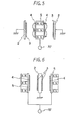
- FIG. 2 Another embodiment of an electrode section used in the present invention is shown in Fig. 2.
- an RF electrode 1 is positioned in the middle and ground electrodes 2 are positioned on opposite sides in parallel relation to the RF electrode.
- the use of the electrodes shown in Fig. 1 or Fig. 9 requires a shield to prevent electric discharge between the back side of the RF electrode 1 and chamber. Provision of such shield, however, leads to a drawback that the RF discharge becomes unstable.
- the electrodes shown in Fig. 2 there is not necessary to use a shield and a stabilized glow discharge can be obtained. Therefore, even if the substrates 4 are not mounted on the RF electrode 1, twice the film area produced by the conventional process shown in Fig. 9 can be obtained. Further, if the substrates 4 are mounted on the RF electrode 1, four times the film area produced by the conventional process can be obtained.
- the apparatus shown in Fig. 2 the effect that any shield is not necessary can be attained even if the potential difference between the electrodes exceeds + 10 V. Therefore, the apparatus may be operated without mounting substrates on one or both surfaces of the RF electrode.
- a ground electrode 2 is positioned in the middle and RF electrodes 1 are provided on opposite sides thereof. According to the apparatus shown in Fig. 3, as in case of Fig. 2, 2 to 4 times the film area produced by the conventional process can be obtained.
- an apparatus which provides on the back surface of the RF electrode 5 with magnets.
- the magnets are arranged parallel with their N and S poles alternating with each other so as to produce a right-angled magnetic field with respect to the RF electric field.
- the growth rate of semiconductor layer on the substrate 4 placed on the RF electrode 5 is increased. If the DC potential difference is within 10 V, the distribution difference of film thickness of the semiconductor layer thus formed is extremely reduced, and a satisfactory semiconductor is obtained.
- Fig. 5 shows an electrode section in which magnets are disposed within an RF electrode 5 in the electrode arrangement of Fig. 2 to produce a magnetic field
- Fig. 6 shows an electrode section in which magnets are disposed on the back surfaces of RF electrodes 5 in the electrode arrangement of Fig. 3 to produce a magnetic field.
- the ground electrode may also be provided with magnets.
- the magnet may be a permanent magnet or an electromagnet, and the intensity of horizontally magnetic field is preferably 50 to 600 gausses on the surface of the substrate.
- the distance between the neighbor electrodes used in the present invention is 15 to 80 mm, preferably 20 to 60 mm. If the electrode distance is less than 15 mm, electronic or ionic damage due to plasma increases and the film quality degrades, while if the electrode distance exceeds 80 mm, not only does the film growth rate lowers but also the substrate locates out of the gas decomposition region, which makes the film quality degrade.
- the gas which contains the constituents of the semiconductor used in the invention is not particularly limited, but is a gas mixture comprising a gaseous compound containing elements such as Si, C, N, Ge and Sn.
- the gaseous compounds are, for instance, SiH 4 , SiF 4 , GeH 4 , GeF 4' S i 2 H 6 , SnH 4 , NH 4 , a hydrocarbon such as CH 4 or C 2 H . , and the like.
- the gas mixture is used in a composition so as to form a desired semiconductor layer.
- the gas may be diluted with an inart gas such as H 2 , He, Ar or N 2 .
- the gas mixture is flowed so that a pressure inside the discharger is generally 0.01 to 5 Torr, preferably 0.1 to 2 Torr.
- the deposition pressure semiconductor layer producing pressure
- the electrode area'ratio and RF power generally 0.001 to 0.5 W/cm 2 , preferably 0.01 to 0.3 W/cm 2
- the electrode potential difference has a predetermined value, or variable value by changing DC vias, and thus, the gas pressure is not limited to the above-mentioned range.
- the substrate used in the present invention is preferably a substrate made of an electric insulator which allows radio frequency waves to pass therethough, such as ceramics, a glass or a polymer film.
- a substrate made of metal such as SUS, Ni, Fe or chromium may also be used when such substrate is electrically shielded or adhered to the electrode.
- the substrate is heated generally at 25° to 800°C, and, in case of the production of an amorphous semiconductor layer, at 25° to 400°C.
- Heating method is not particularly limited, and may be employed a usual heating method.
- a wave having a frequency in the order of not less than KHz, preferably not less than MHz, are desirable from a standpoint that ions are not moved by the electromagnetic wave.
- Application of a DC voltage to the RF electrode is performed preferably by the use of a floating power source.
- a semiconductor layer thus formed has a laminar construction. According to the embodiment, a semiconductor having desired characteristics can be optionally produced.
- an amorphous or crystalline semiconductor can be produced.
- the semiconductor can be used as a solar cell, TFT (thin film transistor), CCD (charge coupled device), and the like.
- Fig. 7 shows a manner of movement of the substrates 3, 4 supported on an insulation support 6 between the electrodes 2, 5 desposed in the arrangement shown in Fig. 5. After the substrates are mounted on the electrodes 2, 5, semiconductor layers are formed by the glow discharge method.
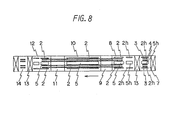
- Fig. 8 shows an apparatus for mass-production of a pin type solar cell according to the process of the invention.
- the substrates 3, 4 are mounted on sheathed heaters 2h, 5h in a charging chamber 7, and are heated under vacuum.
- the heated substrates are transferred through a gate valve 13, in a manner of batch system, at a high speed into a p chamber 8, where a p layer is deposited on each substrate for the pin type solar cell.
- p type semiconductor layers are deposited on the substrates over the electrodes 2, 5 by the process of the present invention.
- the substrates are led through slits into a differential exhaust chamber 9.
- the gas which leaks from the p chamber 8 or an i chamber 10 is exhausted at the chamber 9.
- the substrates are led into the i chamber 10 where an i layer is formed, and there, i type semiconductor layers are deposited on the p layers formed on the substrates while the substrates are continuously moved.
- the substrates are led through a differential exhaust chamber 11 into an n chamber 12 where an n layer is formed.
- the pin type semiconductors thus obtained are transferred through a gate valve 13 into a take-out chamber 14. After regulating the pressure in the chamber 14 to atmospheric pressure, the semiconductors are taken out of the chamber 14.
- the pressures in the chambers are set preferably so that i chamber > p chamber > n chamber > differential exhaust chambers to prevent the gases from mixing with each other.
- the pressures in the differential exhaust chambers 9, 11 are not more than 1/2, preferably not more than 1/5 of the lowest pressure in the p chamber 8, the i chamber 10 or the n chamber 12. Since the semiconductor layers are formed while moving the substrates as described above, the semiconductor layers thus obtained have uniform thickness and distribution of quality.
- the solar cells obtained were used to examine the V-I characteristic by a solar simulator of AM1 100 mW/cm 2 .
- the conversion efficiencies of the solar cells obtained from the RF electrode side were about 7 %, and those of the solar cells obtained from the ground electrodes were about 7.5 %.
Landscapes
- Chemical & Material Sciences (AREA)
- Engineering & Computer Science (AREA)
- Physics & Mathematics (AREA)
- Plasma & Fusion (AREA)
- Analytical Chemistry (AREA)
- Materials Engineering (AREA)
- Chemical Kinetics & Catalysis (AREA)
- Mechanical Engineering (AREA)
- Metallurgy (AREA)
- Organic Chemistry (AREA)
- General Chemical & Material Sciences (AREA)
- Photovoltaic Devices (AREA)
- Formation Of Insulating Films (AREA)
- Crystals, And After-Treatments Of Crystals (AREA)
Priority Applications (1)
| Application Number | Priority Date | Filing Date | Title |
|---|---|---|---|
| AT84111152T ATE69910T1 (de) | 1983-09-21 | 1984-09-19 | Verfahren und vorrichtung zur herstellung einer halbleiterschicht. |
Applications Claiming Priority (2)
| Application Number | Priority Date | Filing Date | Title |
|---|---|---|---|
| JP174759/83 | 1983-09-21 | ||
| JP58174759A JPS6066422A (ja) | 1983-09-21 | 1983-09-21 | 半導体製造法 |
Publications (3)
| Publication Number | Publication Date |
|---|---|
| EP0140130A2 true EP0140130A2 (de) | 1985-05-08 |
| EP0140130A3 EP0140130A3 (en) | 1987-05-13 |
| EP0140130B1 EP0140130B1 (de) | 1991-11-27 |
Family
ID=15984177
Family Applications (1)
| Application Number | Title | Priority Date | Filing Date |
|---|---|---|---|
| EP84111152A Expired - Lifetime EP0140130B1 (de) | 1983-09-21 | 1984-09-19 | Verfahren und Vorrichtung zur Herstellung einer Halbleiterschicht |
Country Status (6)
| Country | Link |
|---|---|
| US (1) | US4869976A (de) |
| EP (1) | EP0140130B1 (de) |
| JP (1) | JPS6066422A (de) |
| AT (1) | ATE69910T1 (de) |
| CA (1) | CA1227288A (de) |
| DE (1) | DE3485300D1 (de) |
Cited By (2)
| Publication number | Priority date | Publication date | Assignee | Title |
|---|---|---|---|---|
| GB2225344A (en) * | 1988-11-25 | 1990-05-30 | Eniricerche Spa | Process for plasma-deposition of multiple layers of amorphous material, having a variable composition |
| EP0428161A3 (en) * | 1989-11-15 | 1991-07-31 | Kokusai Electric Co., Ltd. | Dry process system |
Families Citing this family (3)
| Publication number | Priority date | Publication date | Assignee | Title |
|---|---|---|---|---|
| US5316639A (en) * | 1989-06-05 | 1994-05-31 | Sachiko Okazaki | Dielectric material used for an ozone generator and a method of forming a film to the dielectric material |
| JPH07245332A (ja) * | 1994-03-04 | 1995-09-19 | Hitachi Ltd | 半導体製造装置および半導体装置の製造方法ならびに半導体装置 |
| US5970907A (en) * | 1997-01-27 | 1999-10-26 | Canon Kabushiki Kaisha | Plasma processing apparatus |
Family Cites Families (7)
| Publication number | Priority date | Publication date | Assignee | Title |
|---|---|---|---|---|
| DE2941559C2 (de) * | 1979-10-13 | 1983-03-03 | Messerschmitt-Bölkow-Blohm GmbH, 8000 München | Verfahren zum Abscheiden von Silizium auf einem Substrat |
| US4333814A (en) * | 1979-12-26 | 1982-06-08 | Western Electric Company, Inc. | Methods and apparatus for improving an RF excited reactive gas plasma |
| US4361595A (en) * | 1981-01-28 | 1982-11-30 | Rca Corporation | Method for preparing an abrasive lapping disc |
| JPS57153436A (en) * | 1981-03-17 | 1982-09-22 | Fujitsu Ltd | Semiconductor device |
| DE3280026D1 (en) * | 1981-05-29 | 1989-12-21 | Kanegafuchi Chemical Ind | Process for preparing amorphous silicon semiconductor |
| US4466380A (en) * | 1983-01-10 | 1984-08-21 | Xerox Corporation | Plasma deposition apparatus for photoconductive drums |
| US4481230A (en) * | 1983-10-27 | 1984-11-06 | Rca Corporation | Method of depositing a semiconductor layer from a glow discharge |
-
1983
- 1983-09-21 JP JP58174759A patent/JPS6066422A/ja active Pending
-
1984
- 1984-09-19 DE DE8484111152T patent/DE3485300D1/de not_active Expired - Lifetime
- 1984-09-19 EP EP84111152A patent/EP0140130B1/de not_active Expired - Lifetime
- 1984-09-19 AT AT84111152T patent/ATE69910T1/de not_active IP Right Cessation
- 1984-09-19 CA CA000463624A patent/CA1227288A/en not_active Expired
- 1984-09-21 US US06/653,007 patent/US4869976A/en not_active Expired - Lifetime
Cited By (3)
| Publication number | Priority date | Publication date | Assignee | Title |
|---|---|---|---|---|
| GB2225344A (en) * | 1988-11-25 | 1990-05-30 | Eniricerche Spa | Process for plasma-deposition of multiple layers of amorphous material, having a variable composition |
| GB2225344B (en) * | 1988-11-25 | 1993-01-27 | Eniricerche Spa | Process for plasma-deposition of multiple layers of amorphous material |
| EP0428161A3 (en) * | 1989-11-15 | 1991-07-31 | Kokusai Electric Co., Ltd. | Dry process system |
Also Published As
| Publication number | Publication date |
|---|---|
| EP0140130A3 (en) | 1987-05-13 |
| US4869976A (en) | 1989-09-26 |
| DE3485300D1 (de) | 1992-01-09 |
| ATE69910T1 (de) | 1991-12-15 |
| EP0140130B1 (de) | 1991-11-27 |
| CA1227288A (en) | 1987-09-22 |
| JPS6066422A (ja) | 1985-04-16 |
Similar Documents
| Publication | Publication Date | Title |
|---|---|---|
| US4615298A (en) | Method of making non-crystalline semiconductor layer | |
| US4173661A (en) | Method for depositing thin layers of materials by decomposing a gas to yield a plasma | |
| US5470784A (en) | Method of forming semiconducting materials and barriers using a multiple chamber arrangement | |
| EP0155178B1 (de) | Überzugsfilm, Verfahren und Vorrichtung zur Herstellung dieses Filmes | |
| JP3119693B2 (ja) | 半導体基板の製造方法及びその装置 | |
| KR900001234B1 (ko) | 글로우 방전 분해에 의해 기재 상에 필름을 퇴적시키기 위한 장치 및 그 방법 | |
| US4933203A (en) | Process for depositing amorphous hydrogenated silicon in a plasma chamber | |
| US4869976A (en) | Process for preparing semiconductor layer | |
| GB2148947A (en) | Method of depositing an amorphous semiconductor layer from a glow discharge | |
| EP1122336A2 (de) | Vorrichtung und Verfahren zum Abscheiden eines Films mittels Plasma-CVD | |
| US6926934B2 (en) | Method and apparatus for deposited film | |
| US4533450A (en) | Control of the hydrogen bonding in reactively sputtered amorphous silicon | |
| JPH07502625A (ja) | パッシェン曲線における最小点圧力より低い圧力を利用したマイクロ波エネルギによる堆積方法 | |
| EP0674335B1 (de) | Plasmabearbeitungsverfahren und Plasmabearbeitungsgerät | |
| EP0172916B1 (de) | Filmbildungsverfahren | |
| JP2723548B2 (ja) | 炭素含有シリコン微結晶薄膜の形成法 | |
| Ganguly | Reversing the Temperature Gradient in a PECVD Deposition Chamber to Alter the Radicals Generated in the Plasma | |
| JPH03146673A (ja) | 薄膜堆積法及び薄膜堆積装置 | |
| JP2573970B2 (ja) | 半導体薄膜製造装置 | |
| JPS59229878A (ja) | 新規なアモルフアス半導体素子及びその製造方法、並びにそれを製造するための装置 | |
| JPS63274125A (ja) | 高周波印加電極体構造 | |
| JP2728874B2 (ja) | 半導体装置の製法 | |
| JPH02246111A (ja) | プラズマ処理装置 | |
| JPS58125821A (ja) | 半導体製造装置 | |
| JPS6153784A (ja) | 光起電力素子の製造方法 |
Legal Events
| Date | Code | Title | Description |
|---|---|---|---|
| PUAI | Public reference made under article 153(3) epc to a published international application that has entered the european phase |
Free format text: ORIGINAL CODE: 0009012 |
|
| AK | Designated contracting states |
Designated state(s): AT BE CH DE FR GB IT LI NL SE |
|
| PUAL | Search report despatched |
Free format text: ORIGINAL CODE: 0009013 |
|
| AK | Designated contracting states |
Kind code of ref document: A3 Designated state(s): AT BE CH DE FR GB IT LI NL SE |
|
| 17P | Request for examination filed |
Effective date: 19871104 |
|
| 17Q | First examination report despatched |
Effective date: 19890113 |
|
| GRAA | (expected) grant |
Free format text: ORIGINAL CODE: 0009210 |
|
| AK | Designated contracting states |
Kind code of ref document: B1 Designated state(s): AT BE CH DE FR GB IT LI NL SE |
|
| REF | Corresponds to: |
Ref document number: 69910 Country of ref document: AT Date of ref document: 19911215 Kind code of ref document: T |
|
| REF | Corresponds to: |
Ref document number: 3485300 Country of ref document: DE Date of ref document: 19920109 |
|
| ITF | It: translation for a ep patent filed | ||
| ET | Fr: translation filed | ||
| PLBE | No opposition filed within time limit |
Free format text: ORIGINAL CODE: 0009261 |
|
| STAA | Information on the status of an ep patent application or granted ep patent |
Free format text: STATUS: NO OPPOSITION FILED WITHIN TIME LIMIT |
|
| 26N | No opposition filed | ||
| EAL | Se: european patent in force in sweden |
Ref document number: 84111152.9 |
|
| PGFP | Annual fee paid to national office [announced via postgrant information from national office to epo] |
Ref country code: GB Payment date: 19950911 Year of fee payment: 12 Ref country code: FR Payment date: 19950911 Year of fee payment: 12 |
|
| PGFP | Annual fee paid to national office [announced via postgrant information from national office to epo] |
Ref country code: AT Payment date: 19950914 Year of fee payment: 12 |
|
| PGFP | Annual fee paid to national office [announced via postgrant information from national office to epo] |
Ref country code: SE Payment date: 19950918 Year of fee payment: 12 |
|
| PGFP | Annual fee paid to national office [announced via postgrant information from national office to epo] |
Ref country code: NL Payment date: 19950922 Year of fee payment: 12 |
|
| PGFP | Annual fee paid to national office [announced via postgrant information from national office to epo] |
Ref country code: CH Payment date: 19951020 Year of fee payment: 12 |
|
| PGFP | Annual fee paid to national office [announced via postgrant information from national office to epo] |
Ref country code: BE Payment date: 19951031 Year of fee payment: 12 |
|
| PG25 | Lapsed in a contracting state [announced via postgrant information from national office to epo] |
Ref country code: GB Effective date: 19960919 Ref country code: AT Effective date: 19960919 |
|
| PG25 | Lapsed in a contracting state [announced via postgrant information from national office to epo] |
Ref country code: SE Effective date: 19960920 |
|
| PG25 | Lapsed in a contracting state [announced via postgrant information from national office to epo] |
Ref country code: LI Effective date: 19960930 Ref country code: FR Effective date: 19960930 Ref country code: CH Effective date: 19960930 Ref country code: BE Effective date: 19960930 |
|
| BERE | Be: lapsed |
Owner name: KANEGAFUCHI KAGAKU KOGYO K.K. Effective date: 19960930 |
|
| PG25 | Lapsed in a contracting state [announced via postgrant information from national office to epo] |
Ref country code: NL Effective date: 19970401 |
|
| GBPC | Gb: european patent ceased through non-payment of renewal fee |
Effective date: 19960919 |
|
| REG | Reference to a national code |
Ref country code: CH Ref legal event code: PL |
|
| NLV4 | Nl: lapsed or anulled due to non-payment of the annual fee |
Effective date: 19970401 |
|
| EUG | Se: european patent has lapsed |
Ref document number: 84111152.9 |
|
| REG | Reference to a national code |
Ref country code: FR Ref legal event code: ST |
|
| REG | Reference to a national code |
Ref country code: FR Ref legal event code: ST |
|
| PGFP | Annual fee paid to national office [announced via postgrant information from national office to epo] |
Ref country code: DE Payment date: 20031002 Year of fee payment: 20 |