EP0144836A2 - Adressenübergangsimpulsschaltung - Google Patents
Adressenübergangsimpulsschaltung Download PDFInfo
- Publication number
- EP0144836A2 EP0144836A2 EP84113845A EP84113845A EP0144836A2 EP 0144836 A2 EP0144836 A2 EP 0144836A2 EP 84113845 A EP84113845 A EP 84113845A EP 84113845 A EP84113845 A EP 84113845A EP 0144836 A2 EP0144836 A2 EP 0144836A2
- Authority
- EP
- European Patent Office
- Prior art keywords
- common node
- output
- signal
- logic state
- coupled
- Prior art date
- Legal status (The legal status is an assumption and is not a legal conclusion. Google has not performed a legal analysis and makes no representation as to the accuracy of the status listed.)
- Ceased
Links
- 230000007704 transition Effects 0.000 title claims abstract description 53
- 230000004044 response Effects 0.000 claims abstract description 20
- 230000003111 delayed effect Effects 0.000 claims abstract description 15
- 230000002401 inhibitory effect Effects 0.000 claims description 5
- 238000000034 method Methods 0.000 claims description 3
- 238000012360 testing method Methods 0.000 description 13
- 239000000872 buffer Substances 0.000 description 11
- 102100035029 Ataxin-1 Human genes 0.000 description 9
- 101000873082 Homo sapiens Ataxin-1 Proteins 0.000 description 9
- 230000015654 memory Effects 0.000 description 7
- 102100021302 Ataxin-2 Human genes 0.000 description 6
- 101000895114 Homo sapiens Ataxin-2 Proteins 0.000 description 6
- 238000010586 diagram Methods 0.000 description 5
- 230000000694 effects Effects 0.000 description 4
- 238000013461 design Methods 0.000 description 3
- 238000013459 approach Methods 0.000 description 2
- 238000001514 detection method Methods 0.000 description 2
- 230000005669 field effect Effects 0.000 description 2
- 230000015556 catabolic process Effects 0.000 description 1
- 230000000295 complement effect Effects 0.000 description 1
- 238000006731 degradation reaction Methods 0.000 description 1
- 230000001934 delay Effects 0.000 description 1
- 230000001419 dependent effect Effects 0.000 description 1
- 238000012545 processing Methods 0.000 description 1
- 230000003068 static effect Effects 0.000 description 1
- 230000002459 sustained effect Effects 0.000 description 1
Images
Classifications
-
- G—PHYSICS
- G11—INFORMATION STORAGE
- G11C—STATIC STORES
- G11C8/00—Arrangements for selecting an address in a digital store
- G11C8/18—Address timing or clocking circuits; Address control signal generation or management, e.g. for row address strobe [RAS] or column address strobe [CAS] signals
-
- G—PHYSICS
- G11—INFORMATION STORAGE
- G11C—STATIC STORES
- G11C11/00—Digital stores characterised by the use of particular electric or magnetic storage elements; Storage elements therefor
- G11C11/21—Digital stores characterised by the use of particular electric or magnetic storage elements; Storage elements therefor using electric elements
- G11C11/34—Digital stores characterised by the use of particular electric or magnetic storage elements; Storage elements therefor using electric elements using semiconductor devices
- G11C11/40—Digital stores characterised by the use of particular electric or magnetic storage elements; Storage elements therefor using electric elements using semiconductor devices using transistors
-
- G—PHYSICS
- G11—INFORMATION STORAGE
- G11C—STATIC STORES
- G11C8/00—Arrangements for selecting an address in a digital store
-
- G—PHYSICS
- G11—INFORMATION STORAGE
- G11C—STATIC STORES
- G11C2207/00—Indexing scheme relating to arrangements for writing information into, or reading information out from, a digital store
- G11C2207/06—Sense amplifier related aspects
- G11C2207/061—Sense amplifier enabled by a address transition detection related control signal
Definitions
- the subject invention relates to pulse generators and more particularly, to pulse generators responsive to address transition in a memory circuit.
- Address transition detection has been found to be useful in improving the speed-power product for memories, particularly static random access memories (SRAMs).
- SRAMs static random access memories
- One of the pr.imary uses of address transition detection is to equalize the voltage on pairs of bit lines just prior to sensing data.
- An equalization pulse is generated in response to detecting an address transition. While the equalization pulse must be of sufficient duration to equalize the bit lines, it is desirable for the equalization pulse to be as short in duration as possible to minimize access time. Accordingly, for a given memory there is an optimum pulse width for the equalization pulse. Consequently it is desirable to be able to set the pulse width for a predetermined duration which is not dependent upon how many address signals change state.
- One technique for achieving consistent pulse width is to have a transition detector for each address signal. Each transition detector generates a transition pulse when its respective address signal switches logic states.
- a multi-input NOR gate receives the transition pulses. The NOR gate discharges a capacitive node which is subsequently charged at a consistent rate when there are no more transition pulses present. The charging occurs through a load of a predetermined resistance to establish a known RC time constant.
- a detector such as a conventional buffer or inverter, is used to detect when the node reaches a certain voltage. When the node is initially discharged the equalization pulse is generated. the equalization pulse is terminated when the node reaches the threshold voltage of the detector.
- the pulse width begins when the first transition pulse occurs and terminates when the node reaches the threshold of the detector.
- the pulse width is longer than necessary when there are several transition signals which occur close together but not simultaneously.
- the equalization pulse occurs when the first transition pulse occurs but the RC delay does not take effect until the last transition pulse to occur terminates.
- the time delay has several processing variables.
- the resistance and capacitance variables are expected.
- Another variable is the threshold voltage of the detector.
- the equalization pulse is terminated when the node is charged to the . threshold voltage of the detector. Because the voltage is intentionally made to rise slowly, process variations in threshold voltage must also be taken into account to ensure having at least the minimum required pulse width to achieve bit line equalization.
- An object of the subject invention is to provide an improved address transition pulse circuit.
- Another object of the invention is to provide an address transition pulse circuit with improved pulse width stability.
- Yet another object of the invention is to provide an address transition pulse circuit with reduced current drain.
- a delay circuit provides a delayed signal for actively terminating the pulse after a predetermined time period.
- An inhibit circuit is used to prevent the delayed signal from attempting to actively terminate the pulse when there has been another address transition, thereby saving power.
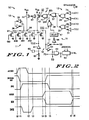
- FIG. 1 Shown in FIG. 1 is an address change initiated clock circuit 10 comprised generally of a transition NOR circuit 11, a transition NOR logic circuit 12, a latch 13, a charging circuit 14, a delay circuit 15, a decoder/driver logic circuit 16, and an inverter 17.
- NOR circuit 11 is comprised of a transistor 21, a transistor 22, a transistor 23, a transistor 24, and a transistor 25.
- NOR logic circuit 12 is comprised of an inverter 31, an inverter 32, an inverter 33, an inverter 34, a NAND gate 35, a NAND gate 36, and a NOR gate 37.
- Latch 13 is comprised of an inverter 38 and an inverter 39.
- Charging circuit 14 comprises a NAND gate 41, a P channel transistor 42, an inverter 43, and a transistor 44.
- Delay circuit 15 is comprised of an inverter 46, a capacitive time delay 47, and a NOR gate 48.
- Decoder/driver logic circuit 16 is comprised of a buffer 51, and AND gate 52, and a decoder/driver 53.
- transistors 21-25 and 44 are N channel, enhancement-mode, insulated gate field effect transistors with a threshold voltage of 0.8 to 1.1 volts.
- Transistor 42 is a P channel, enhancement-mode, insulated gate field effect transistor with a threshold voltage of -0.8 to -1.1 volts.
- Logic gates and inverters 31-39, 41 and 43, 46 and 48, 51-52, and 61 are all CMOS.
- Transistors 21-25 each have a drain connected to a node 56, and a source connected to ground.
- Transistor 21 has a gate for receiving an inverted chip select delayed signal CSD.
- Transistor 22 has a gate for receiving an address transition signal ATX0.
- Transistor 23 has a gate for receiving an address transition signal ATX1.
- transistor 24 has a gate for receiving an address transition signal ATX2.
- Transistor 25 has a gate for receiving a test signal TEST.
- Inverter 31 has an input for receiving signal TEST, and an output.
- Inverter 32 has an input for receiving signal ATX2, and an output.
- Inverter 33 has an input for receiving signal ATX1, and an output.
- Inverter 34 has an input for receiving signal ATXO, and an output.
- NAND gate 35 has a first input connected to the output of inverter 31, and a second input connected to the output of inverter 32, and an output.
- NAND gate 36 has a first input connected to the output of inverter 34, and a second input connected to the output of inverter 33, and an output.
- NOR gate 37 has a first input connected to the output of NAND gate 35, a second input connected to the output of NAND gate 36, and an output.
- Inverter 38 has an input connected'to node 56, and an output.
- Inverter 39 has an input connected to the output of inverter 38, and an output connected to node 56.
- Inverter 17 has an input connected to node 56, and an output for providing equalization signal EQ.
- Inverter 46 has an input connected to the output of inverter 17, and an output.
- Delay 47 has an input connected to the output of inverter 46, and an output.
- NOR gate 48 has a first input connected to the output of delay 47, a second input for receiving signal CS D , and an output.
- NAND gate 41 has a first input connected to the output of NOR gate 37, a second input connected to the output of NOR gate 48, and an output.
- Transistor 42 has a gate connected to the output of NAND gate 41, a drain connected to node 56, a source connected to a positive power supply terminal V DD for receiving, for example, 5 volts.
- Inverter 43 has an input connected to the output of NAND gate 41, and -an-output.
- Transistor 44 has a gate connected to the output of inverter 43, a drain connected to V DD , and
- Buffer 51 has an-input connected to node 56, and an output.
- AND gate 52 has a first input connected to the output of amplifier 51, a second input for receiving a pre-decoded signal PD, and an output.
- Decoder/driver 53 has a'first signal input connected to the output of AND gate 52, a bus input for receiving an address, and an output for providing a signal WL to a word line (not shown).
- Signals ATXO-ATX2 are signals which switch from a logic low to a logic high for a short duration, for example 6 nanoseconds, in response to a transition of a corresponding address signal.
- Typical address signals A0, A1, and A2 of a memory could correspond to signals ATXO, ATX1, and ATX2, respectively.
- Additional address signals could also have corresponding address transition signals for generating an equalization pulse.
- Transition NOR circuit 11 and transition NOR logic 12 could both be expanded to have more inputs to accommodate additional address transition signals.
- circuit 10 provides signal EQ for the purpose of equalizing and/or precharging bit lines (not shown).
- Latch 13 sustains the logic level which is present at node 56.
- Inverters 38 and 39 of latch 13 have a relatively small gain so that node 56 can be switched from one state to another. Assuming as an initial condition that node 56 is being sustained by latch 13 at a logic high at or near 5 volts, signal EQ will be provided by inverter 17 at a logic low.
- Inverter 46 and delay 47 provide a standard reset signal SRE at a logic high to NOR gate 48 which causes NOR gate 48 to provide a logic low to NAND gate 41.
- NAND gate 41 With NAND gate 41 receiving a logic low, NAND gate 41 provides a complementary reset signal RE at a logic high to P channel transistor 42 and inverter 43. Inverter 43 provides a logic low to N channel transistor 44. Consequently, transistors 42 and 44 are both off. When signal RE is a logic high, both transistors 42 and 44 are turned off. Conversely, when signal RE is a logic low, both transistors 42 and 44 are conducting.
- NOR circuit 12 provides an inhibit signal INH to NAND gate 41 at a logic high while signals ATXO-ATX2 and TEST are a logic low. When one of the signals ATXO-ATX2 switches to a logic high, signal INH will switch to-a logic low a small time duration, for example 3 nanoseconds, later.
- Inverters 31-34 is a first stage
- NAND gates 35 and 36 form a second stage
- NOR gate 37 forms a third stage.
- signal INH switches to a logic low
- NAND gate 41 is forced to provide signal RE at a logic high, ensuring that transistors 42 and 44 are turned off.
- NOR circuit 12 is for inhibiting transistors 42 and 44 in response to receiving one or more of signals ATXO - ATX2.
- the output of buffer 51 is also a logic high so that AND gate 52 provides an output of the same logic state as that of signal PD. If signal PD is a logic high, then decoder/driver 53 will respond to the address. If the address selects decoder/driver 53, then signal WL will be a logic high for enabling the word line to which it corresponds.
- Signal EQ is coupled to other AND gates-(not shown) which receive other predecoded signals (not shown).
- the output of AND gate 52 is coupled to other decoder/drivers (not shown). The effect is that when signal EQ is a logic high, a word line is selected based on the address signals received. When signal EQ is a logic low, all word lines are deselected. All word lines are thus deselected during equalization which is when signal EQ is high and signal EQ is low.
- signals EQ at a logic high for about a 12 nanosecond duration one or more of signals ATXO-ATX2 switches to a logic high.
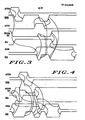
- FIG. 2 is a timing diagram which shows signal ATXO switching to a logic high beginning at a time to. Node 56 then switches to a logic low causing inverter 17 to begin to switch signal EQ to a logic high at time t 1 . It is assumed that signal EQ had been at a logic low sufficiently long that delay 47, receiving a logic high from inverter 46, was providing a logic high output.
- ATXO switching to a logic high causes signal INH to switch to a logic low at the predetermined delay time following the rise of signal ATXO.
- Signal INH has no effect because signal SRE at a logic low is already causing NAND gate 41 to provide signal RE at a logic high.
- Signal INH remains at a logic low for essentially the same time duration that signal ATXO remains at a logic high.
- node 56 remains at a logic low due to latch 13.
- Signal INH is switched back to a logic high by time t 3 .
- delay 47 provides a logic low to NOR gate 48 which in turn causes signal SRE to begin switching to a logic high at time t 4 .
- NAND gate 41 switches to a logic low, turning on transistors 42 and 44, causing node 56 to begin switching to a logic high at a time t 5 .
- signal EQ switches from a logic high to a logic low by a time t 6 .
- signal SRE switches from a logic high to a logic low by a time t 7 .
- Signal SRE.switching to a logic low causes signal RE to switch to a logic high by a time t 8 .
- the signals of FIG. 2 will remain at the same logic state until another address transition occurs.
- FIG. 2 shows the situation in which only one address signal changes state, in particular, the address signal which causes signal ATX0 to switch.
- FIG. 2 also reflects the situation in which other address transition signals, for example signals ATX1 and ATX2, occur at nearly the same time as signal ATXO.
- the duration of the equalization pulse, signal EQ at a logic high is determined by the delay of delay 47.
- FIG. 3 Another situation, shown in FIG. 3, which can occur is when an address transition occurs just before delay 47 causes signal SRE to switch to a logic high.
- Signal EQ switches to a logic high in the same way as was described for FIG. 2.
- Signal ATXO switches to a logic high which causes node 56 to switch to a logic low, which in turn causes signal EQ to switch to a logic high.
- signal ATX1 begins switching to a logic high. Because node 56 is already at a logic low, node 56 is unaffected by signal ATX1 switching to a logic high.
- Signal SRE switches to a logic high causing signal RE to switch to a logic low.
- Signal RE at a logic low tends to drive node 56 to a logic high.
- Node 56 does not actually reach a sufficiently high voltage for inverter 17 to recognize it as a logic high. Consequently, signal EQ remains at a logic high. This is the desirable result.
- Signal EQ has already been high for sufficiently long to equalize the bit lines but it is desirable for the bit lines to remain equalized until the address is no longer in transition.
- That the voltage level at node 56 is recognized as a logic low is achieved by ratioing the gains of transistors 22-24 versus transistors 42 and 44 to ensure that a predetermined voltage, for example, 2 volts will not be exceeded while also adjusting the threshold of inverter 17 to ensure that the predetermined voltage will be recognized as a logic low.
- An undesirable effect at this point is that there is a current drain.
- Signal INH switches to a logic low after the delay time from signal ATX1 switching to a logic high, causing signal RE to switch to a logic high which then turns off transistors 42 and 44. Consequently the current drain is for a very short time duration.
- FIG. 4 Another situation, shown in FIG. 4, which is of concern is when an address transition occurs after the signal EQ has switched to a logic low but before signal RE has switched to a logic high.
- the first transition shown in FIG. 4 is signal SRE switching to a logic high.
- the sequence begins the same as that beginning at time t 4 of FIG. 2.
- Signal SRE switches to a logic high as determined by the time delay 47 for the purpose of terminating the equalization pulse, switching signal EQ to a logic low.
- Signal SRE switching to a logic high causes signal RE to switch to a logic low, which in turn causes node 56 to switch to a logic high, which in turn causes signal EQ to switch to a logic low.
- FIG. 4 Another situation, shown in FIG. 4, which is of concern is when an address transition occurs after the signal EQ has switched to a logic low but before signal RE has switched to a logic high.
- the first transition shown in FIG. 4 is signal SRE switching to a logic high.
- the sequence begins the same as that beginning
- Signal INH switching to a logic low causes signal RE to switch to a logic high to turn off transistors 42 and 44, and thereby quickly terminating the current drain.
- Signal INH switching back to a logic high causes signal RE to switch to a logic low because signal SRE is still a logic high. Consequently node 56 switches to a logic high, causing signal EQ to switch to a logic low.
- Signal SRE may subsequently switch to a logic low, which will cause signal RE to switch to a logic high but will not cause any change to node 56 and therefore not affect signal EQ.
- signal EQ is at a logic high for a shorter time than that for the situation of FIG. 2, the shorter duration is sufficient to fulfill the purpose of generating an equalization pulse.
- the shorter duration equalization pulse occurs only in this case of FIG. 4 where the address transition occurs before signal SRE has switched to a logic-low following signal EQ switching to a logic low. Consequently the shorter equalization pulse will occur only a few nanoseconds after the termination of the previous equalization pulse. This is acceptable because the bit lines were already equalized due to the previous address transition. During this time word lines may or may-not get selected. If the word line did get selected, the bit line would separate only very little in voltage, causing little or no degradation in performance.
- Signal EQ can be generated in response to an external test signal received on a pad 60.
- Pad 60 is connected to an input of a buffer 61, and a first terminal of a resistor 62.
- a second terminal of resistor 62 is connected to ground.
- Buffer 61 has an output which provides signal TEST. If no signal is present on pad 60, the input of buffer 61 is held to ground which causes buffer 61 to provide signal TEST at a logic low. With signal TEST at a logic low, transistor 25 is turned off and inverter 31 does not affect NOR circuit 12.
- the purpose of generating signal TEST is primarily to allow for experimentation before design is finalized.
- the actual pulse width of signal EQ obtained after a first design effort may differ from that desired.
- a slight design or modelling error can result in a pulse width so narrow as to be insufficient for equalizing the bit lines, or worse, result in no pulse at all. This can happen if, for example, the time delay of delay 47 is too short, in which case signal TEST can be used to obtain an equalization pulse of the desired duration.
- Pad 60 is made conveniently available for application of signals. Pad 60 can be, for example, substantially the same as a conventional bonding pad which is convenient for applying signals for experimentation purposes.
- signal CSD When the chip is deselected signal CSD is a logic high, causing transistor 21 to turn on which pulls node 56 to a logic low which in turn causes signal EQ to be a. logic high. Consequently when the chip is deselected, the bit lines are equalized. Signal CSD at a logic high causes signal SRE to be at a logic low which ensures that transistors 42 and 44 are turned off. This prevents the current drain from transistors 42 and 44 through transistor 21.
- signal CSD When the chip is selected, signal CSD is delayed from switching to a logic low. This delay is adjusted to match with the delay through the address buffers. The first stage of these address buffers are powered up and down by a signal CS (not shown) which is internally generated. By delaying and creating signal CSD, it is assumed that the associated equalization circuitry will not initiate a spurious pulse because of the forced state of address buffers imposed by signal CS in the deselected mode.
Landscapes
- Engineering & Computer Science (AREA)
- Microelectronics & Electronic Packaging (AREA)
- Computer Hardware Design (AREA)
- Static Random-Access Memory (AREA)
Applications Claiming Priority (2)
| Application Number | Priority Date | Filing Date | Title |
|---|---|---|---|
| US06/556,759 US4614883A (en) | 1983-12-01 | 1983-12-01 | Address transition pulse circuit |
| US556759 | 1983-12-01 |
Publications (2)
| Publication Number | Publication Date |
|---|---|
| EP0144836A2 true EP0144836A2 (de) | 1985-06-19 |
| EP0144836A3 EP0144836A3 (de) | 1988-03-09 |
Family
ID=24222752
Family Applications (1)
| Application Number | Title | Priority Date | Filing Date |
|---|---|---|---|
| EP84113845A Ceased EP0144836A3 (de) | 1983-12-01 | 1984-11-15 | Adressenübergangsimpulsschaltung |
Country Status (4)
| Country | Link |
|---|---|
| US (1) | US4614883A (de) |
| EP (1) | EP0144836A3 (de) |
| JP (1) | JPS60133591A (de) |
| KR (1) | KR850004854A (de) |
Cited By (1)
| Publication number | Priority date | Publication date | Assignee | Title |
|---|---|---|---|---|
| EP0222833A4 (en) * | 1985-07-01 | 1990-10-24 | Motorola, Inc. | Chip select speed-up circuit for a memory |
Families Citing this family (17)
| Publication number | Priority date | Publication date | Assignee | Title |
|---|---|---|---|---|
| US4710648A (en) * | 1984-05-09 | 1987-12-01 | Hitachi, Ltd. | Semiconductor including signal processor and transient detector for low temperature operation |
| JPS6154098A (ja) * | 1984-08-23 | 1986-03-18 | Fujitsu Ltd | パルス発生回路 |
| JPS61196498A (ja) * | 1985-02-26 | 1986-08-30 | Mitsubishi Electric Corp | 半導体記憶装置 |
| JPS62173692A (ja) * | 1986-01-28 | 1987-07-30 | Fujitsu Ltd | 半導体集積回路 |
| US4692635A (en) * | 1986-06-26 | 1987-09-08 | National Semiconductor Corp. | Self-timed logic level transition detector |
| US4724340A (en) * | 1986-11-21 | 1988-02-09 | Motorola, Inc. | Output circuit in which induced switching noise is reduced by presetting pairs of output lines to opposite logic states |
| JPH01286089A (ja) * | 1988-05-13 | 1989-11-17 | Nec Corp | 信号変化検出回路 |
| JPH0218789A (ja) * | 1988-07-06 | 1990-01-23 | Mitsubishi Electric Corp | 半導体記憶装置 |
| US5719812A (en) * | 1988-11-16 | 1998-02-17 | Fujitsu Limited | Semiconductor memory including bit line reset circuitry and a pulse generator having output delay time dependent on type of transition in an input signal |
| JPH0814995B2 (ja) * | 1989-01-27 | 1996-02-14 | 株式会社東芝 | 半導体メモリ |
| US5430881A (en) * | 1990-12-28 | 1995-07-04 | Dia Semicon Systems Incorporated | Supervisory control method and power saving control unit for computer system |
| JP2689768B2 (ja) * | 1991-07-08 | 1997-12-10 | 日本電気株式会社 | 半導体集積回路装置 |
| US5301165A (en) * | 1992-10-28 | 1994-04-05 | International Business Machines Corporation | Chip select speedup circuit for a memory |
| US5488319A (en) * | 1994-08-18 | 1996-01-30 | International Business Machines Corporation | Latch interface for self-reset logic |
| KR100189745B1 (ko) * | 1995-08-25 | 1999-06-01 | 구본준 | 메모리장치의 이퀄라이제이션 펄스 발생기 |
| US5737270A (en) * | 1996-07-15 | 1998-04-07 | International Business Machines Corporation | Precharged wordline decoder with locally-controlled clock |
| US7782093B2 (en) * | 2007-05-23 | 2010-08-24 | Infineon Technologies Ag | Integrated circuit and method of detecting a signal edge transition |
Family Cites Families (7)
| Publication number | Priority date | Publication date | Assignee | Title |
|---|---|---|---|---|
| US4150310A (en) * | 1978-01-23 | 1979-04-17 | Sangamo Weston, Inc. | Track and hold circuit |
| AU530415B2 (en) * | 1978-06-02 | 1983-07-14 | International Standard Electric Corp. | Integrated circuits |
| GB2070372B (en) * | 1980-01-31 | 1983-09-28 | Tokyo Shibaura Electric Co | Semiconductor memory device |
| US4365174A (en) * | 1980-07-31 | 1982-12-21 | Rca Corporation | Pulse counter type circuit for power-up indication |
| US4398102A (en) * | 1981-02-06 | 1983-08-09 | Rca Corporation | Gated parallel decoder |
| US4442481A (en) * | 1982-04-07 | 1984-04-10 | Honeywell Inc. | Low power decoder circuit |
| US4471240A (en) * | 1982-08-19 | 1984-09-11 | Motorola, Inc. | Power-saving decoder for memories |
-
1983
- 1983-12-01 US US06/556,759 patent/US4614883A/en not_active Expired - Fee Related
-
1984
- 1984-11-15 EP EP84113845A patent/EP0144836A3/de not_active Ceased
- 1984-11-28 JP JP59251449A patent/JPS60133591A/ja active Pending
- 1984-11-29 KR KR1019840007510A patent/KR850004854A/ko not_active Withdrawn
Cited By (1)
| Publication number | Priority date | Publication date | Assignee | Title |
|---|---|---|---|---|
| EP0222833A4 (en) * | 1985-07-01 | 1990-10-24 | Motorola, Inc. | Chip select speed-up circuit for a memory |
Also Published As
| Publication number | Publication date |
|---|---|
| EP0144836A3 (de) | 1988-03-09 |
| JPS60133591A (ja) | 1985-07-16 |
| KR850004854A (ko) | 1985-07-27 |
| US4614883A (en) | 1986-09-30 |
Similar Documents
| Publication | Publication Date | Title |
|---|---|---|
| US4614883A (en) | Address transition pulse circuit | |
| JP4824952B2 (ja) | メモリ装置のパワーノイズを防止する直列ウェークアップ回路 | |
| US5455802A (en) | Dual dynamic sense amplifiers for a memory array | |
| EP0547891B1 (de) | Ausgangstreiberschaltung mit Vorladung | |
| EP0960421B1 (de) | Ladungs- und vorladungsbitleitungsstruktur eines sram-speichers | |
| US4549101A (en) | Circuit for generating test equalization pulse | |
| US6791897B2 (en) | Word line driving circuit | |
| EP0301588A2 (de) | Halbleiterspeicheranordnung | |
| US5870346A (en) | VLSI memory circuit | |
| JP5498928B2 (ja) | 電圧調整回路 | |
| JP2675277B2 (ja) | メモリ・アレイ・セル読み出し回路 | |
| US5070482A (en) | Static random access memory | |
| US4751680A (en) | Bit line equalization in a memory | |
| US4712197A (en) | High speed equalization in a memory | |
| JP3449752B2 (ja) | 低スイッチングノイズ出力バッファ | |
| US5672989A (en) | Nonvolatile semiconductor integrated circuit having an address transition detector | |
| US4689771A (en) | Memory with improved write mode to read mode transition | |
| US6674308B2 (en) | Low power wired OR | |
| US4706218A (en) | Memory input buffer with hysteresis | |
| US6757852B1 (en) | Self resetting high speed redundancy circuit and method thereof | |
| JP2565649B2 (ja) | メモリ回路 | |
| JPH0616358B2 (ja) | 高速書込みメモリ | |
| US5239237A (en) | Control circuit having outputs with differing rise and fall times | |
| US8320201B2 (en) | Method of reading memory cell | |
| JPH05274884A (ja) | 集積回路 |
Legal Events
| Date | Code | Title | Description |
|---|---|---|---|
| PUAI | Public reference made under article 153(3) epc to a published international application that has entered the european phase |
Free format text: ORIGINAL CODE: 0009012 |
|
| AK | Designated contracting states |
Designated state(s): DE FR GB IT NL |
|
| PUAL | Search report despatched |
Free format text: ORIGINAL CODE: 0009013 |
|
| AK | Designated contracting states |
Kind code of ref document: A3 Designated state(s): DE FR GB IT NL |
|
| 17P | Request for examination filed |
Effective date: 19880801 |
|
| 17Q | First examination report despatched |
Effective date: 19891201 |
|
| STAA | Information on the status of an ep patent application or granted ep patent |
Free format text: STATUS: THE APPLICATION HAS BEEN REFUSED |
|
| 18R | Application refused |
Effective date: 19910203 |
|
| RIN1 | Information on inventor provided before grant (corrected) |
Inventor name: SOOD, LAL C. Inventor name: DE JESUS, ARMANDO L. Inventor name: GOLAB, JAMES S. |