EP0163316B1 - Complexes de platine intercalatifs pour le traitement du cancer - Google Patents
Complexes de platine intercalatifs pour le traitement du cancer Download PDFInfo
- Publication number
- EP0163316B1 EP0163316B1 EP85106723A EP85106723A EP0163316B1 EP 0163316 B1 EP0163316 B1 EP 0163316B1 EP 85106723 A EP85106723 A EP 85106723A EP 85106723 A EP85106723 A EP 85106723A EP 0163316 B1 EP0163316 B1 EP 0163316B1
- Authority
- EP
- European Patent Office
- Prior art keywords
- compound
- group
- platinum
- intercalative
- drug
- Prior art date
- Legal status (The legal status is an assumption and is not a legal conclusion. Google has not performed a legal analysis and makes no representation as to the accuracy of the status listed.)
- Expired - Lifetime
Links
- 206010028980 Neoplasm Diseases 0.000 title description 8
- 201000011510 cancer Diseases 0.000 title description 5
- 150000001875 compounds Chemical class 0.000 claims description 32
- BASFCYQUMIYNBI-UHFFFAOYSA-N platinum Chemical compound [Pt] BASFCYQUMIYNBI-UHFFFAOYSA-N 0.000 claims description 24
- 229940079593 drug Drugs 0.000 claims description 22
- 239000003814 drug Substances 0.000 claims description 22
- DZBUGLKDJFMEHC-UHFFFAOYSA-N acridine Chemical compound C1=CC=CC2=CC3=CC=CC=C3N=C21 DZBUGLKDJFMEHC-UHFFFAOYSA-N 0.000 claims description 17
- DPKHZNPWBDQZCN-UHFFFAOYSA-N acridine orange free base Chemical compound C1=CC(N(C)C)=CC2=NC3=CC(N(C)C)=CC=C3C=C21 DPKHZNPWBDQZCN-UHFFFAOYSA-N 0.000 claims description 14
- 239000002246 antineoplastic agent Substances 0.000 claims description 12
- 229910052697 platinum Inorganic materials 0.000 claims description 12
- 238000006243 chemical reaction Methods 0.000 claims description 9
- -1 diamine compound Chemical class 0.000 claims description 9
- CTSPAMFJBXKSOY-UHFFFAOYSA-N ellipticine Chemical compound N1=CC=C2C(C)=C(NC=3C4=CC=CC=3)C4=C(C)C2=C1 CTSPAMFJBXKSOY-UHFFFAOYSA-N 0.000 claims description 8
- 125000000217 alkyl group Chemical group 0.000 claims description 7
- 125000002887 hydroxy group Chemical group [H]O* 0.000 claims description 6
- 238000000034 method Methods 0.000 claims description 5
- ZIXGXMMUKPLXBB-UHFFFAOYSA-N Guatambuinine Natural products N1C2=CC=CC=C2C2=C1C(C)=C1C=CN=C(C)C1=C2 ZIXGXMMUKPLXBB-UHFFFAOYSA-N 0.000 claims description 4
- SUYXJDLXGFPMCQ-INIZCTEOSA-N SJ000287331 Natural products CC1=c2cnccc2=C(C)C2=Nc3ccccc3[C@H]12 SUYXJDLXGFPMCQ-INIZCTEOSA-N 0.000 claims description 4
- STQGQHZAVUOBTE-VGBVRHCVSA-N daunorubicin Chemical compound O([C@H]1C[C@@](O)(CC=2C(O)=C3C(=O)C=4C=CC=C(C=4C(=O)C3=C(O)C=21)OC)C(C)=O)[C@H]1C[C@H](N)[C@H](O)[C@H](C)O1 STQGQHZAVUOBTE-VGBVRHCVSA-N 0.000 claims description 4
- ZMMJGEGLRURXTF-UHFFFAOYSA-N ethidium bromide Chemical compound [Br-].C12=CC(N)=CC=C2C2=CC=C(N)C=C2[N+](CC)=C1C1=CC=CC=C1 ZMMJGEGLRURXTF-UHFFFAOYSA-N 0.000 claims description 4
- 229960005542 ethidium bromide Drugs 0.000 claims description 4
- XMBWDFGMSWQBCA-UHFFFAOYSA-N hydrogen iodide Chemical compound I XMBWDFGMSWQBCA-UHFFFAOYSA-N 0.000 claims description 4
- 150000005053 phenanthridines Chemical class 0.000 claims description 4
- 229920000768 polyamine Polymers 0.000 claims description 4
- VEXZGXHMUGYJMC-UHFFFAOYSA-M Chloride anion Chemical compound [Cl-] VEXZGXHMUGYJMC-UHFFFAOYSA-M 0.000 claims description 3
- BUDQDWGNQVEFAC-UHFFFAOYSA-N Dihydropyran Chemical compound C1COC=CC1 BUDQDWGNQVEFAC-UHFFFAOYSA-N 0.000 claims description 3
- PIICEJLVQHRZGT-UHFFFAOYSA-N Ethylenediamine Chemical compound NCCN PIICEJLVQHRZGT-UHFFFAOYSA-N 0.000 claims description 3
- 239000004721 Polyphenylene oxide Substances 0.000 claims description 3
- 229910052739 hydrogen Inorganic materials 0.000 claims description 3
- 229920000728 polyester Polymers 0.000 claims description 3
- 229920000570 polyether Polymers 0.000 claims description 3
- PUCLDGXQJWAWHS-UHFFFAOYSA-N 6-chloro-2-methoxyacridine Chemical compound C1=C(Cl)C=CC2=CC3=CC(OC)=CC=C3N=C21 PUCLDGXQJWAWHS-UHFFFAOYSA-N 0.000 claims description 2
- ZHPLCGQZGMTUID-UHFFFAOYSA-N 6-iodohexan-1-ol Chemical compound OCCCCCCI ZHPLCGQZGMTUID-UHFFFAOYSA-N 0.000 claims description 2
- STQGQHZAVUOBTE-UHFFFAOYSA-N 7-Cyan-hept-2t-en-4,6-diinsaeure Natural products C1=2C(O)=C3C(=O)C=4C(OC)=CC=CC=4C(=O)C3=C(O)C=2CC(O)(C(C)=O)CC1OC1CC(N)C(O)C(C)O1 STQGQHZAVUOBTE-UHFFFAOYSA-N 0.000 claims description 2
- XJGFWWJLMVZSIG-UHFFFAOYSA-N 9-aminoacridine Chemical compound C1=CC=C2C(N)=C(C=CC=C3)C3=NC2=C1 XJGFWWJLMVZSIG-UHFFFAOYSA-N 0.000 claims description 2
- WEAHRLBPCANXCN-UHFFFAOYSA-N Daunomycin Natural products CCC1(O)CC(OC2CC(N)C(O)C(C)O2)c3cc4C(=O)c5c(OC)cccc5C(=O)c4c(O)c3C1 WEAHRLBPCANXCN-UHFFFAOYSA-N 0.000 claims description 2
- 239000005977 Ethylene Substances 0.000 claims description 2
- 229960001441 aminoacridine Drugs 0.000 claims description 2
- 238000004519 manufacturing process Methods 0.000 claims description 2
- 239000008194 pharmaceutical composition Substances 0.000 claims description 2
- 230000009257 reactivity Effects 0.000 claims description 2
- UFHFLCQGNIYNRP-UHFFFAOYSA-N Hydrogen Chemical compound [H][H] UFHFLCQGNIYNRP-UHFFFAOYSA-N 0.000 claims 1
- 239000002671 adjuvant Substances 0.000 claims 1
- 125000001246 bromo group Chemical group Br* 0.000 claims 1
- 239000003937 drug carrier Substances 0.000 claims 1
- 125000000816 ethylene group Chemical group [H]C([H])([*:1])C([H])([H])[*:2] 0.000 claims 1
- 239000001257 hydrogen Substances 0.000 claims 1
- 230000001681 protective effect Effects 0.000 claims 1
- RNJPWBVOCUGBGY-UHFFFAOYSA-J tetraiodoplatinum Chemical compound [I-].[I-].[I-].[I-].[Pt+4] RNJPWBVOCUGBGY-UHFFFAOYSA-J 0.000 claims 1
- ZMXDDKWLCZADIW-UHFFFAOYSA-N N,N-Dimethylformamide Chemical compound CN(C)C=O ZMXDDKWLCZADIW-UHFFFAOYSA-N 0.000 description 21
- LFQSCWFLJHTTHZ-UHFFFAOYSA-N Ethanol Chemical compound CCO LFQSCWFLJHTTHZ-UHFFFAOYSA-N 0.000 description 18
- 229910001868 water Inorganic materials 0.000 description 14
- OKKJLVBELUTLKV-UHFFFAOYSA-N Methanol Chemical compound OC OKKJLVBELUTLKV-UHFFFAOYSA-N 0.000 description 12
- 239000007787 solid Substances 0.000 description 12
- 238000002390 rotary evaporation Methods 0.000 description 11
- 241000699670 Mus sp. Species 0.000 description 10
- DQLATGHUWYMOKM-UHFFFAOYSA-L cisplatin Chemical compound N[Pt](N)(Cl)Cl DQLATGHUWYMOKM-UHFFFAOYSA-L 0.000 description 9
- 229940041181 antineoplastic drug Drugs 0.000 description 8
- 229960004316 cisplatin Drugs 0.000 description 7
- 239000002904 solvent Substances 0.000 description 7
- CSCPPACGZOOCGX-UHFFFAOYSA-N Acetone Chemical compound CC(C)=O CSCPPACGZOOCGX-UHFFFAOYSA-N 0.000 description 6
- 230000000694 effects Effects 0.000 description 6
- 239000000203 mixture Substances 0.000 description 6
- 150000003058 platinum compounds Chemical class 0.000 description 6
- 210000004881 tumor cell Anatomy 0.000 description 6
- 238000001035 drying Methods 0.000 description 5
- 239000003446 ligand Substances 0.000 description 5
- 229910000030 sodium bicarbonate Inorganic materials 0.000 description 5
- XLYOFNOQVPJJNP-UHFFFAOYSA-N water Substances O XLYOFNOQVPJJNP-UHFFFAOYSA-N 0.000 description 5
- JNTPTNNCGDAGEJ-UHFFFAOYSA-N 6-chlorohexan-1-ol Chemical compound OCCCCCCCl JNTPTNNCGDAGEJ-UHFFFAOYSA-N 0.000 description 4
- UIIMBOGNXHQVGW-UHFFFAOYSA-M Sodium bicarbonate Chemical compound [Na+].OC([O-])=O UIIMBOGNXHQVGW-UHFFFAOYSA-M 0.000 description 4
- 230000000259 anti-tumor effect Effects 0.000 description 4
- 229940045985 antineoplastic platinum compound Drugs 0.000 description 4
- 230000015572 biosynthetic process Effects 0.000 description 4
- 239000000047 product Substances 0.000 description 4
- 238000003786 synthesis reaction Methods 0.000 description 4
- RTZKZFJDLAIYFH-UHFFFAOYSA-N Diethyl ether Chemical compound CCOCC RTZKZFJDLAIYFH-UHFFFAOYSA-N 0.000 description 3
- CTQNGGLPUBDAKN-UHFFFAOYSA-N O-Xylene Chemical compound CC1=CC=CC=C1C CTQNGGLPUBDAKN-UHFFFAOYSA-N 0.000 description 3
- GDTBXPJZTBHREO-UHFFFAOYSA-N bromine Substances BrBr GDTBXPJZTBHREO-UHFFFAOYSA-N 0.000 description 3
- 229910052794 bromium Inorganic materials 0.000 description 3
- 229910052757 nitrogen Inorganic materials 0.000 description 3
- 239000002244 precipitate Substances 0.000 description 3
- 238000001953 recrystallisation Methods 0.000 description 3
- SQGYOTSLMSWVJD-UHFFFAOYSA-N silver(1+) nitrate Chemical compound [Ag+].[O-]N(=O)=O SQGYOTSLMSWVJD-UHFFFAOYSA-N 0.000 description 3
- 238000000967 suction filtration Methods 0.000 description 3
- 239000008096 xylene Substances 0.000 description 3
- MCSXGCZMEPXKIW-UHFFFAOYSA-N 3-hydroxy-4-[(4-methyl-2-nitrophenyl)diazenyl]-N-(3-nitrophenyl)naphthalene-2-carboxamide Chemical compound Cc1ccc(N=Nc2c(O)c(cc3ccccc23)C(=O)Nc2cccc(c2)[N+]([O-])=O)c(c1)[N+]([O-])=O MCSXGCZMEPXKIW-UHFFFAOYSA-N 0.000 description 2
- IJGRMHOSHXDMSA-UHFFFAOYSA-N Atomic nitrogen Chemical compound N#N IJGRMHOSHXDMSA-UHFFFAOYSA-N 0.000 description 2
- 108010006654 Bleomycin Proteins 0.000 description 2
- YMWUJEATGCHHMB-UHFFFAOYSA-N Dichloromethane Chemical compound ClCCl YMWUJEATGCHHMB-UHFFFAOYSA-N 0.000 description 2
- AOJJSUZBOXZQNB-TZSSRYMLSA-N Doxorubicin Chemical compound O([C@H]1C[C@@](O)(CC=2C(O)=C3C(=O)C=4C=CC=C(C=4C(=O)C3=C(O)C=21)OC)C(=O)CO)[C@H]1C[C@H](N)[C@H](O)[C@H](C)O1 AOJJSUZBOXZQNB-TZSSRYMLSA-N 0.000 description 2
- VEXZGXHMUGYJMC-UHFFFAOYSA-N Hydrochloric acid Chemical compound Cl VEXZGXHMUGYJMC-UHFFFAOYSA-N 0.000 description 2
- CPELXLSAUQHCOX-UHFFFAOYSA-N Hydrogen bromide Chemical compound Br CPELXLSAUQHCOX-UHFFFAOYSA-N 0.000 description 2
- KFZMGEQAYNKOFK-UHFFFAOYSA-N Isopropanol Chemical compound CC(C)O KFZMGEQAYNKOFK-UHFFFAOYSA-N 0.000 description 2
- FAPWRFPIFSIZLT-UHFFFAOYSA-M Sodium chloride Chemical compound [Na+].[Cl-] FAPWRFPIFSIZLT-UHFFFAOYSA-M 0.000 description 2
- JXLYSJRDGCGARV-WWYNWVTFSA-N Vinblastine Natural products O=C(O[C@H]1[C@](O)(C(=O)OC)[C@@H]2N(C)c3c(cc(c(OC)c3)[C@]3(C(=O)OC)c4[nH]c5c(c4CCN4C[C@](O)(CC)C[C@H](C3)C4)cccc5)[C@@]32[C@H]2[C@@]1(CC)C=CCN2CC3)C JXLYSJRDGCGARV-WWYNWVTFSA-N 0.000 description 2
- 230000002411 adverse Effects 0.000 description 2
- 229960001561 bleomycin Drugs 0.000 description 2
- OYVAGSVQBOHSSS-UAPAGMARSA-O bleomycin A2 Chemical compound N([C@H](C(=O)N[C@H](C)[C@@H](O)[C@H](C)C(=O)N[C@@H]([C@H](O)C)C(=O)NCCC=1SC=C(N=1)C=1SC=C(N=1)C(=O)NCCC[S+](C)C)[C@@H](O[C@H]1[C@H]([C@@H](O)[C@H](O)[C@H](CO)O1)O[C@@H]1[C@H]([C@@H](OC(N)=O)[C@H](O)[C@@H](CO)O1)O)C=1N=CNC=1)C(=O)C1=NC([C@H](CC(N)=O)NC[C@H](N)C(N)=O)=NC(N)=C1C OYVAGSVQBOHSSS-UAPAGMARSA-O 0.000 description 2
- 239000013078 crystal Substances 0.000 description 2
- 229960000975 daunorubicin Drugs 0.000 description 2
- 125000003916 ethylene diamine group Chemical group 0.000 description 2
- 239000012458 free base Substances 0.000 description 2
- 239000000138 intercalating agent Substances 0.000 description 2
- 239000000463 material Substances 0.000 description 2
- 125000004433 nitrogen atom Chemical group N* 0.000 description 2
- 150000003057 platinum Chemical class 0.000 description 2
- 239000011541 reaction mixture Substances 0.000 description 2
- 229960003048 vinblastine Drugs 0.000 description 2
- JXLYSJRDGCGARV-XQKSVPLYSA-N vincaleukoblastine Chemical compound C([C@@H](C[C@]1(C(=O)OC)C=2C(=CC3=C([C@]45[C@H]([C@@]([C@H](OC(C)=O)[C@]6(CC)C=CCN([C@H]56)CC4)(O)C(=O)OC)N3C)C=2)OC)C[C@@](C2)(O)CC)N2CCC2=C1NC1=CC=CC=C21 JXLYSJRDGCGARV-XQKSVPLYSA-N 0.000 description 2
- 238000005406 washing Methods 0.000 description 2
- 238000005160 1H NMR spectroscopy Methods 0.000 description 1
- BMYNFMYTOJXKLE-UHFFFAOYSA-N 3-azaniumyl-2-hydroxypropanoate Chemical compound NCC(O)C(O)=O BMYNFMYTOJXKLE-UHFFFAOYSA-N 0.000 description 1
- CPELXLSAUQHCOX-UHFFFAOYSA-M Bromide Chemical compound [Br-] CPELXLSAUQHCOX-UHFFFAOYSA-M 0.000 description 1
- WKBOTKDWSSQWDR-UHFFFAOYSA-N Bromine atom Chemical compound [Br] WKBOTKDWSSQWDR-UHFFFAOYSA-N 0.000 description 1
- 229910020427 K2PtCl4 Inorganic materials 0.000 description 1
- 206010027480 Metastatic malignant melanoma Diseases 0.000 description 1
- 239000007832 Na2SO4 Substances 0.000 description 1
- 101100272976 Panax ginseng CYP716A53v2 gene Proteins 0.000 description 1
- WDVSHHCDHLJJJR-UHFFFAOYSA-N Proflavine Chemical compound C1=CC(N)=CC2=NC3=CC(N)=CC=C3C=C21 WDVSHHCDHLJJJR-UHFFFAOYSA-N 0.000 description 1
- PMZURENOXWZQFD-UHFFFAOYSA-L Sodium Sulfate Chemical compound [Na+].[Na+].[O-]S([O-])(=O)=O PMZURENOXWZQFD-UHFFFAOYSA-L 0.000 description 1
- 239000002253 acid Substances 0.000 description 1
- 150000001251 acridines Chemical class 0.000 description 1
- 229940009456 adriamycin Drugs 0.000 description 1
- 150000001298 alcohols Chemical class 0.000 description 1
- 125000003277 amino group Chemical group 0.000 description 1
- 125000004429 atom Chemical group 0.000 description 1
- 239000002585 base Substances 0.000 description 1
- OYVAGSVQBOHSSS-WXFSZRTFSA-O bleomycin Chemical compound N([C@H](C(=O)N[C@H](C)[C@@H](O)[C@H](C)C(=O)N[C@@H]([C@H](O)C)C(=O)NCCC=1SC=C(N=1)C=1SC=C(N=1)C(=O)NCCC[S+](C)C)[C@@H](OC1C(C(O)C(O)C(CO)O1)OC1C(C(OC(N)=O)C(O)C(CO)O1)O)C=1NC=NC=1)C(=O)C1=NC([C@H](CC(N)=O)NC[C@H](N)C(N)=O)=NC(N)=C1C OYVAGSVQBOHSSS-WXFSZRTFSA-O 0.000 description 1
- 150000001649 bromium compounds Chemical group 0.000 description 1
- 230000015556 catabolic process Effects 0.000 description 1
- 239000003054 catalyst Substances 0.000 description 1
- 210000004027 cell Anatomy 0.000 description 1
- 238000004113 cell culture Methods 0.000 description 1
- 230000010261 cell growth Effects 0.000 description 1
- 230000001413 cellular effect Effects 0.000 description 1
- 239000013522 chelant Substances 0.000 description 1
- 239000003795 chemical substances by application Substances 0.000 description 1
- 150000001805 chlorine compounds Chemical group 0.000 description 1
- 230000001186 cumulative effect Effects 0.000 description 1
- 229940127089 cytotoxic agent Drugs 0.000 description 1
- 230000003247 decreasing effect Effects 0.000 description 1
- 238000006731 degradation reaction Methods 0.000 description 1
- 238000010511 deprotection reaction Methods 0.000 description 1
- 238000001914 filtration Methods 0.000 description 1
- 239000011888 foil Substances 0.000 description 1
- 239000007789 gas Substances 0.000 description 1
- 239000011521 glass Substances 0.000 description 1
- 230000012010 growth Effects 0.000 description 1
- 238000010438 heat treatment Methods 0.000 description 1
- BHEPBYXIRTUNPN-UHFFFAOYSA-N hydridophosphorus(.) (triplet) Chemical compound [PH] BHEPBYXIRTUNPN-UHFFFAOYSA-N 0.000 description 1
- 150000004694 iodide salts Chemical class 0.000 description 1
- 125000005647 linker group Chemical group 0.000 description 1
- 239000007788 liquid Substances 0.000 description 1
- 208000021039 metastatic melanoma Diseases 0.000 description 1
- 239000002808 molecular sieve Substances 0.000 description 1
- 239000002773 nucleotide Substances 0.000 description 1
- 125000003729 nucleotide group Chemical group 0.000 description 1
- CLSUSRZJUQMOHH-UHFFFAOYSA-L platinum dichloride Chemical compound Cl[Pt]Cl CLSUSRZJUQMOHH-UHFFFAOYSA-L 0.000 description 1
- 125000002924 primary amino group Chemical group [H]N([H])* 0.000 description 1
- 229960000286 proflavine Drugs 0.000 description 1
- 125000006239 protecting group Chemical group 0.000 description 1
- 238000000746 purification Methods 0.000 description 1
- ZDYVRSLAEXCVBX-UHFFFAOYSA-N pyridinium p-toluenesulfonate Chemical compound C1=CC=[NH+]C=C1.CC1=CC=C(S([O-])(=O)=O)C=C1 ZDYVRSLAEXCVBX-UHFFFAOYSA-N 0.000 description 1
- 238000005956 quaternization reaction Methods 0.000 description 1
- 229910001961 silver nitrate Inorganic materials 0.000 description 1
- URGAHOPLAPQHLN-UHFFFAOYSA-N sodium aluminosilicate Chemical compound [Na+].[Al+3].[O-][Si]([O-])=O.[O-][Si]([O-])=O URGAHOPLAPQHLN-UHFFFAOYSA-N 0.000 description 1
- 239000011780 sodium chloride Substances 0.000 description 1
- 229910052938 sodium sulfate Inorganic materials 0.000 description 1
- 238000001228 spectrum Methods 0.000 description 1
- 239000007858 starting material Substances 0.000 description 1
- 238000003756 stirring Methods 0.000 description 1
- 239000000725 suspension Substances 0.000 description 1
- 230000001225 therapeutic effect Effects 0.000 description 1
- 231100000331 toxic Toxicity 0.000 description 1
- 230000002588 toxic effect Effects 0.000 description 1
- 231100000419 toxicity Toxicity 0.000 description 1
- 230000001988 toxicity Effects 0.000 description 1
- 231100000820 toxicity test Toxicity 0.000 description 1
- 238000005292 vacuum distillation Methods 0.000 description 1
- 230000035899 viability Effects 0.000 description 1
Classifications
-
- C—CHEMISTRY; METALLURGY
- C07—ORGANIC CHEMISTRY
- C07F—ACYCLIC, CARBOCYCLIC OR HETEROCYCLIC COMPOUNDS CONTAINING ELEMENTS OTHER THAN CARBON, HYDROGEN, HALOGEN, OXYGEN, NITROGEN, SULFUR, SELENIUM OR TELLURIUM
- C07F15/00—Compounds containing elements of Groups 8, 9, 10 or 18 of the Periodic Table
- C07F15/0006—Compounds containing elements of Groups 8, 9, 10 or 18 of the Periodic Table compounds of the platinum group
- C07F15/0086—Platinum compounds
- C07F15/0093—Platinum compounds without a metal-carbon linkage
-
- A—HUMAN NECESSITIES
- A61—MEDICAL OR VETERINARY SCIENCE; HYGIENE
- A61K—PREPARATIONS FOR MEDICAL, DENTAL OR TOILETRY PURPOSES
- A61K31/00—Medicinal preparations containing organic active ingredients
- A61K31/28—Compounds containing heavy metals
-
- A—HUMAN NECESSITIES
- A61—MEDICAL OR VETERINARY SCIENCE; HYGIENE
- A61P—SPECIFIC THERAPEUTIC ACTIVITY OF CHEMICAL COMPOUNDS OR MEDICINAL PREPARATIONS
- A61P35/00—Antineoplastic agents
Definitions
- This invention relates to novel platinum-intercalative compounds processes for their production and pharmaceutical compositions containing said compounds for the treatment of cancer.
- platinum compounds useful as antitumor agents. These available platinum antitumor compounds are quite effective against a variety of tumors. However, they have limited solubility in water, which renders their administration to human patients difficult. In addition, it is common to encounter tumor cell lines which are resistant to these therapeutic platinum compounds, such as cis-diaminedichloroplatinum(li) (cisplatin).
- antitumor platinum compounds are disclosed, for example, in U.S. Patents 4,053,587; 4,115,418; 4,140,707; 4,177,263; 4,258,051; 4,339,437 and 4,419,351.
- intercalative drugs such as vinblastine and bleomycine are effective antitumor drugs.
- Intercalative compounds are those which insert themselves between the base pairs of the DNA double helix and may interact to specific sites of the nucleotides forming the DNA. By binding in this manner, the intercalative drug is believed to prevent the cellular reproduction of DNA and thereby to inhibit or prevent further growth of the tumor.
- This invention provides novel anticancer drugs comprising a DNA intercalative drug chemically linked to a platinum anticancer drug in order to form a single molecule which can be administered to a patient.
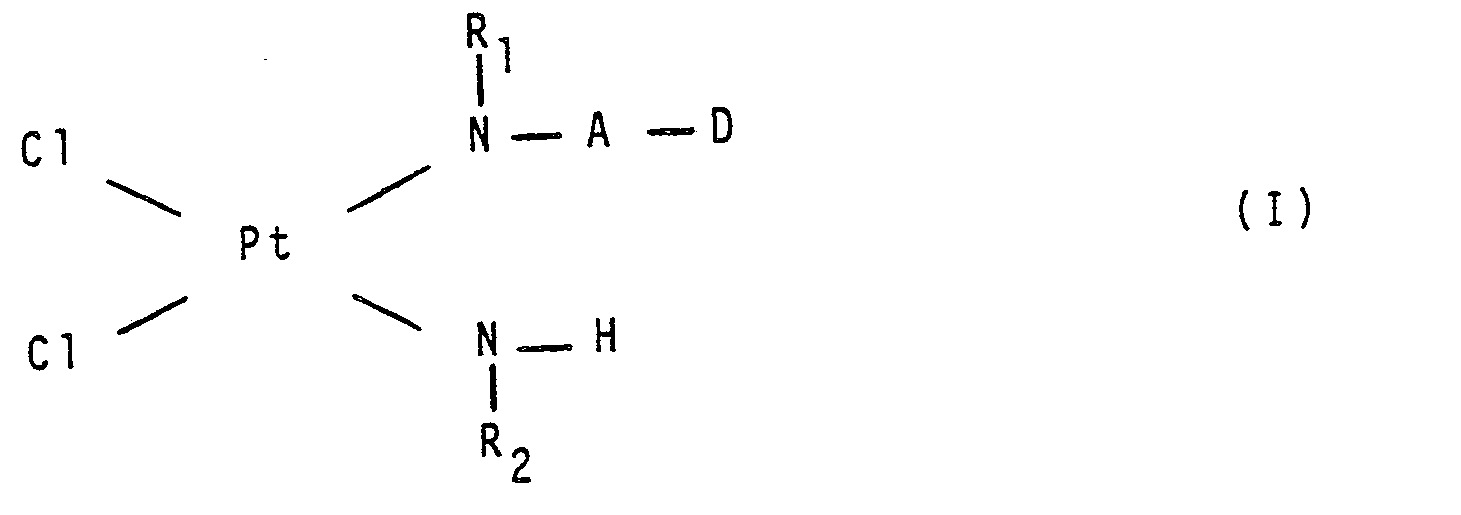
- the compounds according to the invention have the following formula I: in which
- R 1 and R 2 are groups per se known for the corresponding antitumor agents and where the A-D group above is replaced by H, including H and an optionally substituted ethylene bridge being formed by R 1 and R 2 together,
- A is an alkyl chain, a polyamine chain, polyether chain, or polyester chain,
- D is an acridine or phenanthridine derivative or adriamycine, daunomycine, ellipticine or ethidium bromide.
- the compounds of this invention are more highly water-soluble than the counterpart unmodified platinum drug, and that they are toxic toward tumor cells which are resistant to the unmodified platinum antitumor drug when administered alone.
- the intercalative drug and the platinum anticancer drug are joined together by a molecular bridge which does not adversely affect the activity of either the intercalative drug or the platinum drug against tumor cells.
- Preferred molecular bridges are an alkyl chain, polyamine chain, polyether chain or the like, which can be of variable length and composition.
- the compounds of this invention are formed from a platinum compound of the following formula III in which Z is CI and/or I and R i , R 2 have the above meaning.
- the amino group is utilized to bind the linking molecular bridge (A) between the intercalative compound and the platinum compound.
- suitable platinum compounds include dichloro- ethylenediamineplatinum(ll), cis-diaminedichloroplatinum(II), 1,2-diaminocyclohexanedichloroplatinum(ll) or the like.
- Intercalative drugs are an acridine or phenanthridine derivative or adriamycine, daunomycine, ellipticine or ethidium bromide, which have a linking group to which the linking molecular bridge (A) can be attached, e.g. a ring nitrogen atom.
- suitable drugs include acridine orange, 2-methoxy-6-chloro acridine, 9-amino acridine, proflavin or other acridines, adriamycin, daunomycin, ellipticine, ethidium bromide, and related phenanthridines.
- the compounds of this invention are prepared in a manner which does not adversely affect the intercalative activity of the intercalative drug or the antitumor activity of the platinum drug.
- the compounds of this invention are prepared by the reaction of an intercalative drug which has a linkable group or atom as an amino or hydroxy group or a ring nitrogen atom with one reactive group of a bridging group of the following formula II in which
- X and Y are reactive groups or protected reactive groups of different reactivity and
- A is molecular bridge as an alkyl chain, a polyamine chain or a polyester chain and reacting the other reactive group - if necessary after removing the protective group - with the platinum drug and if Z in formula III is iodide, converting it into chloride in known manner.
- the starting materials acridine orange hydrochloride and 6-chloro-1-hydroxyhexane, are reacted under conditions to protect the hydroxyl group of the 6-chloro-1-hydroxyhexane with dihydropyran.
- the chloride group is then substituted with iodide, using the Finklestein-Halide exchange reaction, which is carried out with Nal/NaHC0 3 /acetone.
- the iodo compound thereby produced then is condensed with the free base form of acridine orange in a suitable solvent such as hot xylene, thereby to cause the quater- nization of the ring nitrogen.
- This reaction yields acridine orange with an alkyl side chain containing a protected hydroxyl group at the end of the chain.
- the deprotection of the hydroxyl functionality is effected in dilute acid, such as dilute HCI in ethanol.
- the hydroxyl group is substituted with bromide utilizing 48% hydrobromic acid to produce the alkylated acridine orange with a reactive bromide at the end of alkyl chain.
- the bromine is easily substituted by ethylenediamine in a suitable solvent, such as methanol, thereby to produce an alkylated acridine orange with an ethylenediamine group at the end of the alkyl chain.
- This compound then is reacted with Ptl4- in a suitable solvent, such as dimethylformamide and water, thereby to effect attachment of the platinum ion to the ethylenediamine chelate.
- a suitable solvent such as dimethylformamide and water
- the two iodides are substituted with chloride by using a stoichiometric amount of silver nitrate followed by treatment with HCI to produce the compound of Formula I.
- the compound of Formula I is useful as an antitumor drug and has several advantages over crisplatin. For example, its aqueous solubility is 20 mg/ml, which is far superior to that of cisplatin, 3 mg/ml. In addition, the compound of Formula I also has a much greater ability to unwind DNA that other platinum antitumor drugs, due to the high intercalative affinity of the acridine orange moiety for DNA. Both the acridine orange and the platinum moieties are biologically active compounds. Having the two in one molecule enhances the effects of both. It has been found that the compound of Formula I not only is active against normal tumor cells, but it is active against cisplatin-resistant tumor cells. In addition, it has been found that the compound of Formula I is a photoactive DNA degradation agent.
- Suitable dosages for utilizing the drugs of this invention comprise between about 25 mg/kg body mass and about 2,5 mg/kg.
- the compound of Formula I can be utilized at a dosage of between about 2,5 mg/kg and about 15 mg/kg.
- the bromine compound (VII) was dried thoroughly in a vacuum desiccator before the reaction. All glassware was oven dried before use. 2,80 g of VII (5,5 mmol) was suspended in 200 ml of dry distilled MeOH. The reaction vessel was flushed with N 2 and then 7,36 ml of dry distilled ethylenediamine. (110 mmol) was added by syringe. The reaction was stirred at 70°C under a constant pressure of N2. After the first hour all of VII had completely dissolved. The reaction was stirred 61/2 hours total and then most of the MeOH was removed by rotary evaporation. 40 ml of DMF was added and removed at 55°C by rotary evaporation using a vacuum pump.
- a pH 10 solution of 0,5 g (0,848 mmol) of VIII was prepared initially in 10 ml of D.I. H 2 0. This was concentrated by rotary evaporation after adding 5 ml of DMF. A white solid was removed and a final 15 ml solution of 2:1 DMF:H 2 0 was prepared.
- 0,5 g (1.21 mmol) of K 2 PtCI 4 was dissolved in 5 ml of D.l. H 2 O.
- 1,61 g of KI (9,68 mmol) was dissolved in 5 ml of D.I. H 2 0.
- the KI solution was added dropwise to the K 2 PtCl 4 solution over 15 minutes, after which the solution was heated at 50°C for 15 minutes.
- Varying concentrations of the compound of Formula I i.e., 2,5, 5,0,10,0, 20,0 and 40,0 mg/kg were each administered to two mice to determine the effect of the compound on the viability of the mice. At 2,5 and 5,0 mg/kg, the mice remained alive. At 10,0 mg/kg, the mice lost weight after 14 days. After 20 and 40 mg/ kg, the mice died.
- mice were implanted with the L1210 cell line interperitonally and thereafter some of the mice were administered with doses of the compounds of formula I ranging from 6,7 to 20 mg/kg. The optimal dose is 15 mg/kg giving a %ILS of 51% versus control mice implanted with L1210 but not treated with the drug. Results are shown in detail in Table II. %ILS values for cisplatin (cisDDP) are also shown in Table II for comparison.
- mice implanted with a tumor cell line resistant cis-DDP using doses ranging from 6,7 to 15 mg/kg showed mild activity. These results are shown in Table III.
Landscapes
- Health & Medical Sciences (AREA)
- Chemical & Material Sciences (AREA)
- Organic Chemistry (AREA)
- Animal Behavior & Ethology (AREA)
- Medicinal Chemistry (AREA)
- Pharmacology & Pharmacy (AREA)
- Life Sciences & Earth Sciences (AREA)
- General Health & Medical Sciences (AREA)
- Public Health (AREA)
- Veterinary Medicine (AREA)
- Epidemiology (AREA)
- Nuclear Medicine, Radiotherapy & Molecular Imaging (AREA)
- General Chemical & Material Sciences (AREA)
- Chemical Kinetics & Catalysis (AREA)
- Pharmaceuticals Containing Other Organic And Inorganic Compounds (AREA)
Claims (8)


Applications Claiming Priority (2)
| Application Number | Priority Date | Filing Date | Title |
|---|---|---|---|
| US06/616,362 US4843161A (en) | 1984-06-01 | 1984-06-01 | Platinum-intercalative complexes for the treatment of cancer |
| US616362 | 1984-06-01 |
Publications (2)
| Publication Number | Publication Date |
|---|---|
| EP0163316A1 EP0163316A1 (fr) | 1985-12-04 |
| EP0163316B1 true EP0163316B1 (fr) | 1990-05-16 |
Family
ID=24469109
Family Applications (1)
| Application Number | Title | Priority Date | Filing Date |
|---|---|---|---|
| EP85106723A Expired - Lifetime EP0163316B1 (fr) | 1984-06-01 | 1985-05-31 | Complexes de platine intercalatifs pour le traitement du cancer |
Country Status (5)
| Country | Link |
|---|---|
| US (1) | US4843161A (fr) |
| EP (1) | EP0163316B1 (fr) |
| JP (1) | JPH0725678B2 (fr) |
| CA (1) | CA1273935A (fr) |
| DE (1) | DE3577709D1 (fr) |
Families Citing this family (11)
| Publication number | Priority date | Publication date | Assignee | Title |
|---|---|---|---|---|
| DE59905863D1 (de) | 1998-08-25 | 2003-07-10 | Deutsches Krebsforsch | Arzneimittel enthaltend platinkomplexverbindungen sowie deren verwendung |
| JP4776843B2 (ja) | 1999-10-01 | 2011-09-21 | イムノゲン インコーポレーティッド | 免疫複合体及び化学療法剤を用いる癌治療用組成物及び方法 |
| US6825330B2 (en) | 2001-03-02 | 2004-11-30 | Stratagene California | Compositions and methods using platinum compounds for nucleic acid labeling |
| US7138520B2 (en) * | 2003-01-13 | 2006-11-21 | Massachusetts Institute Of Technology | Coordination complexes having tethered therapeutic agents and/or targeting moieties, and methods of making and using the same |
| US9265747B2 (en) | 2008-08-26 | 2016-02-23 | Massachusetts Institute Of Technology | Platinum (IV) complexes for use in dual mode pharmaceutical therapy |
| CA2741683C (fr) | 2008-10-24 | 2016-03-22 | Wake Forest University | Composes anticancereux a base de platine et d'acridine et procedes pour les utiliser |
| CA2839552A1 (fr) | 2011-06-21 | 2012-12-27 | Massachusetts Institute Of Technology | Compositions et procedes de traitement du cancer |
| US8729286B2 (en) | 2012-05-10 | 2014-05-20 | Massachusetts Institute Of Technology | Platinum compounds as treatment for cancers, and related methods, kits, and compositions |
| EP2743273A1 (fr) | 2012-12-12 | 2014-06-18 | Umicore AG & Co. KG | Procédé de fabrication de préparations contenant de l'eau à base de complexes de platinoïdes |
| WO2014160216A2 (fr) | 2013-03-13 | 2014-10-02 | Massachusetts Institute Of Technology | Agents anticancéreux à double ciblage |
| WO2014165782A2 (fr) | 2013-04-05 | 2014-10-09 | Massachusetts Institute Of Technology | Compositions, méthodes et nécessaires impliquant des composés platine associés à un ligand comportant une fraction de ciblage |
Citations (2)
| Publication number | Priority date | Publication date | Assignee | Title |
|---|---|---|---|---|
| US4053587A (en) * | 1973-04-13 | 1977-10-11 | Research Corporation | Method of treating viral infections |
| US4140707A (en) * | 1972-06-08 | 1979-02-20 | Research Corporation | Malonato platinum anti-tumor compounds |
Family Cites Families (2)
| Publication number | Priority date | Publication date | Assignee | Title |
|---|---|---|---|---|
| DE3046927A1 (de) * | 1980-12-11 | 1982-07-15 | Josef Dipl.-Chem.Dr.rer.nat. 1000 Berlin Klosa | 8-dialkylaminoalkylaether-coffein-platin-komplexe , verfahren zu ihrer herstellung und sie enthaltende arzneimittel |
| EP0169645A1 (fr) * | 1984-06-27 | 1986-01-29 | Johnson Matthey Public Limited Company | Composés de coordination du platine |
-
1984
- 1984-06-01 US US06/616,362 patent/US4843161A/en not_active Expired - Fee Related
-
1985
- 1985-05-31 DE DE8585106723T patent/DE3577709D1/de not_active Expired - Lifetime
- 1985-05-31 CA CA000482918A patent/CA1273935A/fr not_active Expired - Lifetime
- 1985-05-31 JP JP60118689A patent/JPH0725678B2/ja not_active Expired - Lifetime
- 1985-05-31 EP EP85106723A patent/EP0163316B1/fr not_active Expired - Lifetime
Patent Citations (3)
| Publication number | Priority date | Publication date | Assignee | Title |
|---|---|---|---|---|
| US4140707A (en) * | 1972-06-08 | 1979-02-20 | Research Corporation | Malonato platinum anti-tumor compounds |
| US4140707B1 (fr) * | 1972-06-08 | 1989-12-19 | ||
| US4053587A (en) * | 1973-04-13 | 1977-10-11 | Research Corporation | Method of treating viral infections |
Also Published As
| Publication number | Publication date |
|---|---|
| JPH0725678B2 (ja) | 1995-03-22 |
| EP0163316A1 (fr) | 1985-12-04 |
| CA1273935A (fr) | 1990-09-11 |
| US4843161A (en) | 1989-06-27 |
| DE3577709D1 (de) | 1990-06-21 |
| JPS6140265A (ja) | 1986-02-26 |
Similar Documents
| Publication | Publication Date | Title |
|---|---|---|
| EP0219936B1 (fr) | Complexes de platine | |
| JPH0244838B2 (fr) | ||
| RU2130941C1 (ru) | Трехъядерные катионные комплексы платины, проявляющие противоопухолевую активность, способ их получения и фармацевтические композиции, содержащие эти комплексы | |
| RU2140422C1 (ru) | Трехплатиновые комплексы pt(ii), способ их получения | |
| US4843161A (en) | Platinum-intercalative complexes for the treatment of cancer | |
| CA2370692C (fr) | Derive antitumoral du complexe (diamine)platine de l'acide dicarboxylique double, procede de preparation, composition pharmaceutique les contenant et application de ce derive | |
| EP0111388A2 (fr) | Composés du platine ou du palladium à propriétés thérapeutiques et leur préparation | |
| US5665343A (en) | Polymeric platinum complex, preparation thereof, and anticancer agent comprising thereof | |
| KR100246722B1 (ko) | 경구용 백금 착화합물 항암제 및 그 제조방법 | |
| US6011166A (en) | Trinuclear cationic platinum complexes having antitumor activity and pharmaceutial compositions containing them | |
| EP0176005B1 (fr) | Complexes de platine | |
| EP0310260A2 (fr) | Complexes de platine et leur usage comme agent anti-tumeur | |
| EP0290169A2 (fr) | Complexes de diamine platine avec des ligands phosphonocarboxylates ou phosphonocarboxylate substitués comme agents anti-tumeurs | |
| JPS61249993A (ja) | 新規有機白金錯体及びその製法 | |
| JPH0247998B2 (ja) | Hatsukinsakutai | |
| JPH02212497A (ja) | 新規白金錯体及びその製法 | |
| JPS6230792A (ja) | 新規白金錯体 | |
| JPH0523276B2 (fr) | ||
| EP0343772A2 (fr) | Procédé pour la préparation d'un complexe de platine vert | |
| MXPA96004390A (es) | Complejos de platino cationico trinucleares conactividad antitumoral y composicionesfarmaceuticas que los contienen | |
| EP0215393A2 (fr) | Complexes de platine(II) 1,1-cyclobutane-dicarboxylate, leur procédé de préparation et compositions pharmaceutiques les contenant | |
| JPS6344591A (ja) | 白金グリ−ン錯体の製造法 | |
| JPH0469393A (ja) | 新規白金錯体およびそれを有効成分とする腫瘍治療剤 | |
| JPH01163190A (ja) | 新規白金(2)錯体および悪性腫瘍治療剤 | |
| JP2012502970A (ja) | 抗腫瘍活性を有する白金錯体 |
Legal Events
| Date | Code | Title | Description |
|---|---|---|---|
| PUAI | Public reference made under article 153(3) epc to a published international application that has entered the european phase |
Free format text: ORIGINAL CODE: 0009012 |
|
| AK | Designated contracting states |
Designated state(s): DE FR GB IT |
|
| 17P | Request for examination filed |
Effective date: 19860603 |
|
| 17Q | First examination report despatched |
Effective date: 19870922 |
|
| GRAA | (expected) grant |
Free format text: ORIGINAL CODE: 0009210 |
|
| AK | Designated contracting states |
Kind code of ref document: B1 Designated state(s): DE FR GB IT |
|
| ITTA | It: last paid annual fee | ||
| REF | Corresponds to: |
Ref document number: 3577709 Country of ref document: DE Date of ref document: 19900621 |
|
| ET | Fr: translation filed | ||
| ITF | It: translation for a ep patent filed | ||
| PLBE | No opposition filed within time limit |
Free format text: ORIGINAL CODE: 0009261 |
|
| STAA | Information on the status of an ep patent application or granted ep patent |
Free format text: STATUS: NO OPPOSITION FILED WITHIN TIME LIMIT |
|
| 26N | No opposition filed | ||
| PGFP | Annual fee paid to national office [announced via postgrant information from national office to epo] |
Ref country code: FR Payment date: 19920408 Year of fee payment: 8 |
|
| PGFP | Annual fee paid to national office [announced via postgrant information from national office to epo] |
Ref country code: DE Payment date: 19920410 Year of fee payment: 8 |
|
| PGFP | Annual fee paid to national office [announced via postgrant information from national office to epo] |
Ref country code: GB Payment date: 19920429 Year of fee payment: 8 |
|
| PG25 | Lapsed in a contracting state [announced via postgrant information from national office to epo] |
Ref country code: GB Effective date: 19930531 |
|
| GBPC | Gb: european patent ceased through non-payment of renewal fee |
Effective date: 19930531 |
|
| PG25 | Lapsed in a contracting state [announced via postgrant information from national office to epo] |
Ref country code: FR Effective date: 19940131 |
|
| PG25 | Lapsed in a contracting state [announced via postgrant information from national office to epo] |
Ref country code: DE Effective date: 19940201 |
|
| REG | Reference to a national code |
Ref country code: FR Ref legal event code: ST |