EP0165030A2 - Système pour épreuves en couleurs comportant une couche antihalo - Google Patents
Système pour épreuves en couleurs comportant une couche antihalo Download PDFInfo
- Publication number
- EP0165030A2 EP0165030A2 EP85304064A EP85304064A EP0165030A2 EP 0165030 A2 EP0165030 A2 EP 0165030A2 EP 85304064 A EP85304064 A EP 85304064A EP 85304064 A EP85304064 A EP 85304064A EP 0165030 A2 EP0165030 A2 EP 0165030A2
- Authority
- EP
- European Patent Office
- Prior art keywords
- layer
- sheet
- colour
- presensitised
- antihalation
- Prior art date
- Legal status (The legal status is an assumption and is not a legal conclusion. Google has not performed a legal analysis and makes no representation as to the accuracy of the status listed.)
- Granted
Links
- 239000000975 dye Substances 0.000 claims abstract description 126
- 230000005855 radiation Effects 0.000 claims abstract description 32
- 239000000463 material Substances 0.000 claims abstract description 30
- 239000010410 layer Substances 0.000 claims description 235
- 239000011230 binding agent Substances 0.000 claims description 57
- 238000009500 colour coating Methods 0.000 claims description 50
- 125000000664 diazo group Chemical group [N-]=[N+]=[*] 0.000 claims description 48
- 239000002904 solvent Substances 0.000 claims description 48
- 230000003287 optical effect Effects 0.000 claims description 42
- 229920005989 resin Polymers 0.000 claims description 34
- 239000011347 resin Substances 0.000 claims description 34
- 239000000758 substrate Substances 0.000 claims description 26
- 239000000203 mixture Substances 0.000 claims description 24
- 230000004888 barrier function Effects 0.000 claims description 23
- 238000000034 method Methods 0.000 claims description 19
- 239000000049 pigment Substances 0.000 claims description 16
- 239000012454 non-polar solvent Substances 0.000 claims description 14
- 239000002798 polar solvent Substances 0.000 claims description 14
- 239000012790 adhesive layer Substances 0.000 claims description 13
- 238000000926 separation method Methods 0.000 claims description 13
- 150000001875 compounds Chemical class 0.000 claims description 11
- 238000011161 development Methods 0.000 claims description 11
- 239000000549 coloured material Substances 0.000 claims description 9
- AJDUTMFFZHIJEM-UHFFFAOYSA-N n-(9,10-dioxoanthracen-1-yl)-4-[4-[[4-[4-[(9,10-dioxoanthracen-1-yl)carbamoyl]phenyl]phenyl]diazenyl]phenyl]benzamide Chemical compound O=C1C2=CC=CC=C2C(=O)C2=C1C=CC=C2NC(=O)C(C=C1)=CC=C1C(C=C1)=CC=C1N=NC(C=C1)=CC=C1C(C=C1)=CC=C1C(=O)NC1=CC=CC2=C1C(=O)C1=CC=CC=C1C2=O AJDUTMFFZHIJEM-UHFFFAOYSA-N 0.000 claims description 9
- 229920000642 polymer Polymers 0.000 claims description 9
- 239000001043 yellow dye Substances 0.000 claims description 9
- 230000005540 biological transmission Effects 0.000 claims description 7
- 238000010348 incorporation Methods 0.000 claims description 5
- 239000002356 single layer Substances 0.000 claims description 4
- 239000007795 chemical reaction product Substances 0.000 claims description 3
- 229920005596 polymer binder Polymers 0.000 claims description 3
- 239000002491 polymer binding agent Substances 0.000 claims description 3
- 230000015572 biosynthetic process Effects 0.000 claims description 2
- 239000011247 coating layer Substances 0.000 claims description 2
- 230000002209 hydrophobic effect Effects 0.000 claims description 2
- 238000012545 processing Methods 0.000 abstract description 8
- 238000000576 coating method Methods 0.000 description 48
- 239000011248 coating agent Substances 0.000 description 35
- 239000000243 solution Substances 0.000 description 35
- 229920002451 polyvinyl alcohol Polymers 0.000 description 32
- 238000010276 construction Methods 0.000 description 16
- 238000003384 imaging method Methods 0.000 description 15
- 230000000694 effects Effects 0.000 description 11
- -1 poly(vinyl alcohol) Polymers 0.000 description 10
- 230000009467 reduction Effects 0.000 description 10
- HEMHJVSKTPXQMS-UHFFFAOYSA-M Sodium hydroxide Chemical compound [OH-].[Na+] HEMHJVSKTPXQMS-UHFFFAOYSA-M 0.000 description 9
- 239000000853 adhesive Substances 0.000 description 9
- 230000001070 adhesive effect Effects 0.000 description 9
- 230000008569 process Effects 0.000 description 9
- 238000004519 manufacturing process Methods 0.000 description 8
- 230000003595 spectral effect Effects 0.000 description 8
- 239000003086 colorant Substances 0.000 description 7
- 230000006872 improvement Effects 0.000 description 7
- 238000003475 lamination Methods 0.000 description 7
- 238000005259 measurement Methods 0.000 description 7
- 238000001228 spectrum Methods 0.000 description 7
- 230000001629 suppression Effects 0.000 description 7
- YXFVVABEGXRONW-UHFFFAOYSA-N Toluene Chemical compound CC1=CC=CC=C1 YXFVVABEGXRONW-UHFFFAOYSA-N 0.000 description 6
- VLKZOEOYAKHREP-UHFFFAOYSA-N n-Hexane Chemical compound CCCCCC VLKZOEOYAKHREP-UHFFFAOYSA-N 0.000 description 6
- XLYOFNOQVPJJNP-UHFFFAOYSA-N water Substances O XLYOFNOQVPJJNP-UHFFFAOYSA-N 0.000 description 6
- ZWEHNKRNPOVVGH-UHFFFAOYSA-N 2-Butanone Chemical compound CCC(C)=O ZWEHNKRNPOVVGH-UHFFFAOYSA-N 0.000 description 5
- 238000010521 absorption reaction Methods 0.000 description 5
- 230000008859 change Effects 0.000 description 5
- 239000002131 composite material Substances 0.000 description 5
- 230000001419 dependent effect Effects 0.000 description 5
- 238000009472 formulation Methods 0.000 description 5
- 229920000728 polyester Polymers 0.000 description 5
- 230000033458 reproduction Effects 0.000 description 5
- IMNFDUFMRHMDMM-UHFFFAOYSA-N N-Heptane Chemical compound CCCCCCC IMNFDUFMRHMDMM-UHFFFAOYSA-N 0.000 description 4
- OFBQJSOFQDEBGM-UHFFFAOYSA-N Pentane Chemical compound CCCCC OFBQJSOFQDEBGM-UHFFFAOYSA-N 0.000 description 4
- 238000011156 evaluation Methods 0.000 description 4
- 229920000139 polyethylene terephthalate Polymers 0.000 description 4
- 239000005020 polyethylene terephthalate Substances 0.000 description 4
- 238000002360 preparation method Methods 0.000 description 4
- UHOVQNZJYSORNB-UHFFFAOYSA-N Benzene Chemical compound C1=CC=CC=C1 UHOVQNZJYSORNB-UHFFFAOYSA-N 0.000 description 3
- 239000011358 absorbing material Substances 0.000 description 3
- 239000012670 alkaline solution Substances 0.000 description 3
- 230000008901 benefit Effects 0.000 description 3
- 239000012153 distilled water Substances 0.000 description 3
- 229910052739 hydrogen Inorganic materials 0.000 description 3
- 239000001257 hydrogen Substances 0.000 description 3
- 238000005065 mining Methods 0.000 description 3
- 229920001568 phenolic resin Polymers 0.000 description 3
- 239000005011 phenolic resin Substances 0.000 description 3
- 229920000647 polyepoxide Polymers 0.000 description 3
- 230000001681 protective effect Effects 0.000 description 3
- 239000007787 solid Substances 0.000 description 3
- KXGFMDJXCMQABM-UHFFFAOYSA-N 2-methoxy-6-methylphenol Chemical compound [CH]OC1=CC=CC([CH])=C1O KXGFMDJXCMQABM-UHFFFAOYSA-N 0.000 description 2
- KAKZBPTYRLMSJV-UHFFFAOYSA-N Butadiene Chemical compound C=CC=C KAKZBPTYRLMSJV-UHFFFAOYSA-N 0.000 description 2
- LFQSCWFLJHTTHZ-UHFFFAOYSA-N Ethanol Chemical compound CCO LFQSCWFLJHTTHZ-UHFFFAOYSA-N 0.000 description 2
- PPBRXRYQALVLMV-UHFFFAOYSA-N Styrene Chemical compound C=CC1=CC=CC=C1 PPBRXRYQALVLMV-UHFFFAOYSA-N 0.000 description 2
- GWEVSGVZZGPLCZ-UHFFFAOYSA-N Titan oxide Chemical compound O=[Ti]=O GWEVSGVZZGPLCZ-UHFFFAOYSA-N 0.000 description 2
- 125000003545 alkoxy group Chemical group 0.000 description 2
- 125000000217 alkyl group Chemical group 0.000 description 2
- CQEYYJKEWSMYFG-UHFFFAOYSA-N butyl acrylate Chemical compound CCCCOC(=O)C=C CQEYYJKEWSMYFG-UHFFFAOYSA-N 0.000 description 2
- 125000004432 carbon atom Chemical group C* 0.000 description 2
- 239000003795 chemical substances by application Substances 0.000 description 2
- 239000008199 coating composition Substances 0.000 description 2
- 230000000295 complement effect Effects 0.000 description 2
- 239000000470 constituent Substances 0.000 description 2
- 229920001577 copolymer Polymers 0.000 description 2
- 238000001035 drying Methods 0.000 description 2
- 239000003822 epoxy resin Substances 0.000 description 2
- 229930195733 hydrocarbon Natural products 0.000 description 2
- 150000002430 hydrocarbons Chemical class 0.000 description 2
- 125000004435 hydrogen atom Chemical group [H]* 0.000 description 2
- 238000010030 laminating Methods 0.000 description 2
- 239000007788 liquid Substances 0.000 description 2
- 238000001459 lithography Methods 0.000 description 2
- TVMXDCGIABBOFY-UHFFFAOYSA-N octane Chemical compound CCCCCCCC TVMXDCGIABBOFY-UHFFFAOYSA-N 0.000 description 2
- 229920002037 poly(vinyl butyral) polymer Polymers 0.000 description 2
- 239000002952 polymeric resin Substances 0.000 description 2
- 239000000843 powder Substances 0.000 description 2
- 239000000047 product Substances 0.000 description 2
- 239000011241 protective layer Substances 0.000 description 2
- 230000035945 sensitivity Effects 0.000 description 2
- 239000000126 substance Substances 0.000 description 2
- 229920003002 synthetic resin Polymers 0.000 description 2
- 238000001429 visible spectrum Methods 0.000 description 2
- UOCLXMDMGBRAIB-UHFFFAOYSA-N 1,1,1-trichloroethane Chemical compound CC(Cl)(Cl)Cl UOCLXMDMGBRAIB-UHFFFAOYSA-N 0.000 description 1
- WOAHJDHKFWSLKE-UHFFFAOYSA-N 1,2-benzoquinone Chemical compound O=C1C=CC=CC1=O WOAHJDHKFWSLKE-UHFFFAOYSA-N 0.000 description 1
- MEZZCSHVIGVWFI-UHFFFAOYSA-N 2,2'-Dihydroxy-4-methoxybenzophenone Chemical compound OC1=CC(OC)=CC=C1C(=O)C1=CC=CC=C1O MEZZCSHVIGVWFI-UHFFFAOYSA-N 0.000 description 1
- XNWFRZJHXBZDAG-UHFFFAOYSA-N 2-METHOXYETHANOL Chemical compound COCCO XNWFRZJHXBZDAG-UHFFFAOYSA-N 0.000 description 1
- SVONRAPFKPVNKG-UHFFFAOYSA-N 2-ethoxyethyl acetate Chemical compound CCOCCOC(C)=O SVONRAPFKPVNKG-UHFFFAOYSA-N 0.000 description 1
- 239000004925 Acrylic resin Substances 0.000 description 1
- 229920000178 Acrylic resin Polymers 0.000 description 1
- DKPFZGUDAPQIHT-UHFFFAOYSA-N Butyl acetate Natural products CCCCOC(C)=O DKPFZGUDAPQIHT-UHFFFAOYSA-N 0.000 description 1
- 235000014276 Diplazium esculentum Nutrition 0.000 description 1
- 244000108321 Diplazium esculentum Species 0.000 description 1
- 239000004593 Epoxy Substances 0.000 description 1
- 108010010803 Gelatin Proteins 0.000 description 1
- UFHFLCQGNIYNRP-UHFFFAOYSA-N Hydrogen Chemical compound [H][H] UFHFLCQGNIYNRP-UHFFFAOYSA-N 0.000 description 1
- 241001082241 Lythrum hyssopifolia Species 0.000 description 1
- NTIZESTWPVYFNL-UHFFFAOYSA-N Methyl isobutyl ketone Chemical compound CC(C)CC(C)=O NTIZESTWPVYFNL-UHFFFAOYSA-N 0.000 description 1
- UIHCLUNTQKBZGK-UHFFFAOYSA-N Methyl isobutyl ketone Natural products CCC(C)C(C)=O UIHCLUNTQKBZGK-UHFFFAOYSA-N 0.000 description 1
- VVQNEPGJFQJSBK-UHFFFAOYSA-N Methyl methacrylate Chemical compound COC(=O)C(C)=C VVQNEPGJFQJSBK-UHFFFAOYSA-N 0.000 description 1
- 239000004820 Pressure-sensitive adhesive Substances 0.000 description 1
- RTAQQCXQSZGOHL-UHFFFAOYSA-N Titanium Chemical compound [Ti] RTAQQCXQSZGOHL-UHFFFAOYSA-N 0.000 description 1
- 238000005299 abrasion Methods 0.000 description 1
- 238000002835 absorbance Methods 0.000 description 1
- 239000006096 absorbing agent Substances 0.000 description 1
- 229920006397 acrylic thermoplastic Polymers 0.000 description 1
- 239000000654 additive Substances 0.000 description 1
- 150000001298 alcohols Chemical class 0.000 description 1
- 150000001338 aliphatic hydrocarbons Chemical class 0.000 description 1
- 238000013459 approach Methods 0.000 description 1
- 239000003125 aqueous solvent Substances 0.000 description 1
- 150000004945 aromatic hydrocarbons Chemical class 0.000 description 1
- 125000003118 aryl group Chemical group 0.000 description 1
- RWCCWEUUXYIKHB-UHFFFAOYSA-N benzophenone Chemical compound C=1C=CC=CC=1C(=O)C1=CC=CC=C1 RWCCWEUUXYIKHB-UHFFFAOYSA-N 0.000 description 1
- 239000012965 benzophenone Substances 0.000 description 1
- 238000004061 bleaching Methods 0.000 description 1
- MTAZNLWOLGHBHU-UHFFFAOYSA-N butadiene-styrene rubber Chemical compound C=CC=C.C=CC1=CC=CC=C1 MTAZNLWOLGHBHU-UHFFFAOYSA-N 0.000 description 1
- 125000003917 carbamoyl group Chemical group [H]N([H])C(*)=O 0.000 description 1
- 238000011109 contamination Methods 0.000 description 1
- 238000012937 correction Methods 0.000 description 1
- 239000003431 cross linking reagent Substances 0.000 description 1
- 238000001739 density measurement Methods 0.000 description 1
- 230000001627 detrimental effect Effects 0.000 description 1
- 150000002148 esters Chemical class 0.000 description 1
- 150000002170 ethers Chemical class 0.000 description 1
- 125000001495 ethyl group Chemical group [H]C([H])([H])C([H])([H])* 0.000 description 1
- 238000001914 filtration Methods 0.000 description 1
- 229920000159 gelatin Polymers 0.000 description 1
- 239000008273 gelatin Substances 0.000 description 1
- 235000019322 gelatine Nutrition 0.000 description 1
- 235000011852 gelatine desserts Nutrition 0.000 description 1
- 239000004519 grease Substances 0.000 description 1
- 150000008282 halocarbons Chemical class 0.000 description 1
- FUZZWVXGSFPDMH-UHFFFAOYSA-N hexanoic acid Chemical compound CCCCCC(O)=O FUZZWVXGSFPDMH-UHFFFAOYSA-N 0.000 description 1
- 125000002887 hydroxy group Chemical group [H]O* 0.000 description 1
- 230000003993 interaction Effects 0.000 description 1
- 239000011872 intimate mixture Substances 0.000 description 1
- 150000002576 ketones Chemical class 0.000 description 1
- 239000004816 latex Substances 0.000 description 1
- 229920000126 latex Polymers 0.000 description 1
- 238000012423 maintenance Methods 0.000 description 1
- 229910001507 metal halide Inorganic materials 0.000 description 1
- 150000005309 metal halides Chemical class 0.000 description 1
- 238000003801 milling Methods 0.000 description 1
- 229920003986 novolac Polymers 0.000 description 1
- 125000001997 phenyl group Chemical group [H]C1=C([H])C([H])=C(*)C([H])=C1[H] 0.000 description 1
- 230000000704 physical effect Effects 0.000 description 1
- 239000004014 plasticizer Substances 0.000 description 1
- 229920003229 poly(methyl methacrylate) Polymers 0.000 description 1
- 229920002239 polyacrylonitrile Polymers 0.000 description 1
- 150000004291 polyenes Chemical class 0.000 description 1
- 229920006267 polyester film Polymers 0.000 description 1
- 229920001228 polyisocyanate Polymers 0.000 description 1
- 239000005056 polyisocyanate Substances 0.000 description 1
- 229920005749 polyurethane resin Polymers 0.000 description 1
- 238000009877 rendering Methods 0.000 description 1
- 230000004044 response Effects 0.000 description 1
- 238000005096 rolling process Methods 0.000 description 1
- 229920006395 saturated elastomer Polymers 0.000 description 1
- 231100000489 sensitizer Toxicity 0.000 description 1
- 229910052709 silver Inorganic materials 0.000 description 1
- 239000004332 silver Substances 0.000 description 1
- 241000894007 species Species 0.000 description 1
- 238000003756 stirring Methods 0.000 description 1
- 229920003048 styrene butadiene rubber Polymers 0.000 description 1
- BDHFUVZGWQCTTF-UHFFFAOYSA-N sulfonic acid Chemical group OS(=O)=O BDHFUVZGWQCTTF-UHFFFAOYSA-N 0.000 description 1
- 239000004094 surface-active agent Substances 0.000 description 1
- 229920001897 terpolymer Polymers 0.000 description 1
- ISXSCDLOGDJUNJ-UHFFFAOYSA-N tert-butyl prop-2-enoate Chemical compound CC(C)(C)OC(=O)C=C ISXSCDLOGDJUNJ-UHFFFAOYSA-N 0.000 description 1
- 238000012360 testing method Methods 0.000 description 1
- 229920001169 thermoplastic Polymers 0.000 description 1
- 229920005992 thermoplastic resin Polymers 0.000 description 1
- 239000004416 thermosoftening plastic Substances 0.000 description 1
- 239000010936 titanium Substances 0.000 description 1
- 229910052719 titanium Inorganic materials 0.000 description 1
- 239000004408 titanium dioxide Substances 0.000 description 1
- 239000003232 water-soluble binding agent Substances 0.000 description 1
Images


Classifications
-
- G—PHYSICS
- G03—PHOTOGRAPHY; CINEMATOGRAPHY; ANALOGOUS TECHNIQUES USING WAVES OTHER THAN OPTICAL WAVES; ELECTROGRAPHY; HOLOGRAPHY
- G03F—PHOTOMECHANICAL PRODUCTION OF TEXTURED OR PATTERNED SURFACES, e.g. FOR PRINTING, FOR PROCESSING OF SEMICONDUCTOR DEVICES; MATERIALS THEREFOR; ORIGINALS THEREFOR; APPARATUS SPECIALLY ADAPTED THEREFOR
- G03F3/00—Colour separation; Correction of tonal value
- G03F3/10—Checking the colour or tonal value of separation negatives or positives
Definitions
- This invention relates to colour proofing systems and in particular to proofing sheets incorporating independent antihalation layers for use therein.
- the halftone process In printing pictorial matter, whether by lithography, letterpress or gravure, the halftone process is used, wherein the actual printing image is composed of thousands of minute dots per square inch of a single colour ink of varied dot size or ink density. What the naked eye sees as shading in half-tone prints is actually a controlled variation in size of dots relative to the unprinted areas between the dots or a controlled variation in the ink density of the dots.
- the dots are printed in black ink only.
- Full colour reproductions are necessarily printed in each of three colours, cyan, magenta and yellow (known as "three colour process"), or in these same colours with the addition of black (“four colour process"). For each colour a separate printing plate is made.
- the original colour picture or photograph is "separated" photographically or by laser scanner, with the use of filters, masks, etc., into a set of three or four half-tone negatives or positive transparencies, each representing one of the colours, and containing, dot for dot, the amount of that colour which must be printed in order for composite three or four printed colours to produce the desired total colour print.
- the proofing sheets consist of a carrier sheet provided with a release surface, which may either be a smooth surface of the carrier itself, or a surface coating thereon. Overlying the surface and in intimate clinging engagement therewith, but not adhesively bonded thereto, is a colour coating formed, for example, of a pigmented organophilic water-insoluble solvent-softenable resinous polymer. Coated over and in contact with the colour-coating is a light-sensitive diazo resin layer.
- the colour coating and light-sensitive layer are intimately associated and adherently bonded together (and in certain constructions can actually be combined to a single layer).
- the light-sensitive layer is rendered insoluble on exposure.
- a solution which softens and/or partially dissolves the colour coating is thereafter used to remove the unexposed areas.
- a continuous solvent-resistant resinous protective film or layer to the exposed surface of which is applied a very thin layer of adhesive, e.g. pressure-sensitive adhesive.
- adhesive e.g. pressure-sensitive adhesive.
- the outer pressure-sensitive surface of the adhesive can be protected from contamination by dirt or grease, and from adhering to an adjacent sheet in a pile by a protective release liner.
- the protective liner is first stripped from the adhesive surface and the entire structure is laminated, for example, by rolling, onto a substrate, e.g. white paper. Thereafter, the carrier sheet is stripped from the structure, the bond to the paper and the adhesion between the several layers being greater than the non-adhesive clinging engagement between the carrier sheet and the colour coating. Following the removal of the carrier, the remaining structure, now bonded to the substrate, is exposed to light through the appropriate colour-separation negative corresponding to the colour of the coating. In the light struck areas, the light passes through the colour coating (which is transparent thereto) and exposes and insolubilises the light-sensitive material. A firm bond between the light-reacted material and the under-and over-lapping coatings occurs. The non-exposed areas remain light-sensitive.
- a substrate e.g. white paper.
- the carrier sheet is stripped from the structure, the bond to the paper and the adhesion between the several layers being greater than the non-adhesive clinging engagement
- the sheet is processed with processing solvent selected with respect to the particular material of which the layer is composed (and which contains a solvent for the unexposed diazo) to develop the image, e.g. aqueous alcohol.
- processing solvent selected with respect to the particular material of which the layer is composed (and which contains a solvent for the unexposed diazo) to develop the image, e.g. aqueous alcohol.
- the colour coating and the sensitiser in the non-light struck areas are removed, leaving the colour image in areas anchored to the underlying layer by the light-reacted diazo in exposure areas.
- the protective layer serves as a barrier which protects the substrate (and adhesive) from solutions used during the processing.
- United States Patent Specification No. 4 260 673 discloses a positive pre-press proofing system which is commercially available from Minnesota Mining and Manufacturing Company under the trade mark Matchprint.
- These colour proofing sheets consist of a carrier sheet having a smooth release surface; a colour coating of a diazo oxide and a pigmented resin compound in clinging engagement with but not adhesively bonded to said release surface of said carrier sheet; a binder layer comprising a mixture or reaction product of a resin and a diazo oxide bonded to the surface of said colour coating; said binder layer being free of colour pigment; and said colour coating and said binder layer being solubilisable in a solvent developing medium upon exposure to actinic radiation but not solubilisable in the developing medium prior to exposure to actinic radiation; and a clear barrier layer firmly attached to said binder layer, said barrier layer being insoluble in said solvent development medium.
- the barrier layer of a first presensitised sheet of the aforementioned construction is bonded to a substrate and the carrier sheet removed.
- the substrate with the presensitised proofing sheet bonded thereto is then exposed to actinic radiation through a colour separation positive corresponding to the pigment of the colour coating.
- the exposed diazo oxide and resin mixture in the binder layer and the colour coating is rendered soluble to a solvent developing medium to create a latent image.
- the latent image may then be developed with a solvent developing medium, e.g. an aqueous alkaline medium, preferably sodium hydroxide solution, whereby the exposed diazo oxide and resin mixture in the binder layer and associated colour coating is removed leaving the unexposed diazo oxide and resin.
- a solvent developing medium e.g. an aqueous alkaline medium, preferably sodium hydroxide solution
- the exposed diazo oxide and resin mixture in the binder layer and associated colour coating is removed leaving the unexposed diazo oxide and resin.
- the aforementioned process is repeated in sequence and in register so that the composite proof contains coloured layers representing the magenta, cyan, yellow and black contributions of the original subject matter.
- a modified positive-acting pre-press proofing system is disclosed in European Patent Specification No. 0115899A. This proofing system may be utilised in a similar manner to that disclosed in United States Patent Specification No. 4 260 673 but the photosensitive proofing sheets normally comprise three layers and do not require the presence of a barrier layer.
- the positive-acting colour proofing sheet comprises a strippable carrier layer optionally having a release coating on one face thereof upon which is coated a first layer of a base-soluble organic polymeric binder layer having a diazo oxide compound or diazo oxide pendant group on the polymer binder present as at least 15 percent by weight of the binder and sufficient colourant to provide a transmission optical density of at least 1.0, and a thermal adhesive second layer comprising a thermally softenable polymeric adhesive layer, the first layer having at least a substantially polar solvent system with less than 20 percent by volume of all solvents of a non-polar solvent, and the second layer having at least a substantially non-polar solvent system with less than 20 percent by volume of all solvents of a polar solvent.
- the photosensitive layer comprises a base soluble organic polymeric resin binder having an o-quinone diazide or other positive-activing diazo oxide mixed with, dissolved in, or pendant to the binder.
- the layer also contains colourant such as a pigment or dye.
- the diazo oxide must be soluble or otherwise present in amounts of at least 15% by weight in the organic polymeric resin binder.
- Preferred polymers for this layer are phenolic resins including both resols and novolaks.
- Base soluble acrylic resins are also useful.
- the solvent system used during the coating of the photosensitive layer (and the other layers) can have a dramatic effect. Polar solvents, or at least substantially polar solvent mixtures should be used in the coating of this layer.
- polar solvents examples include ketones (methyl ethyl ketone, methyl isobutyl ketone, etc.), alcohols or ethers (glycol monomethyl ether, ethoxy ethyl acetate), halogenated hydrocarbons (trichloroethane, etc.), esters (ethyl or butyl acetate), and mixtures of those polar solvents, together or with small amounts (less than 20% by volume, preferably less than 10% by volume) of non-polar solvents such as intermediate length hydrocarbons (pentane, hexane, heptane, octane, etc.). These mixtures of small amounts of non-polar solvents and polar solvents constitute the substantially polar solvent mixtures referred to above.
- the base-soluble organic polymeric binder i.e. soluble or reasily dispersible in aqueous alkaline solution of pH 13
- the base-soluble organic polymeric binder is preferably a phenolic resin.
- Other polymeric materials such as Butvar resin to disperse to hold the colourant
- Epoxy resin may also be mixed or dissolved with the binder to adjust physical properties.
- crosslinked epoxy or polyurethane resin may be added as may polyisocyanates (or other epoxy resin crosslinking agents) and monoisocyanates to react with the phenolic resin or other polymer constituents.
- the thermal adhesive layer comprises an organic polymeric, thermoplastic binder which is not developed (dissolved or softened so as to be readily removed by hand-rubbing with a developer pad) in an aqueous, alkaline solution of pH 13.
- Any thermoplastic resin softenable at a temperature of less than 200 o C, preferably at less than 175 0 C and most preferably at a temperature less than 160°C (with a preferred range between 100 and 160°C) is useful as the binder component of this layer if it is not soluble in an aqueous alkaline developer.
- Preferred polymers are not tacky at 20 0 C and include, for example, polyenes (styrene, butadiene, acrylonitrile polymers, copolymers and terpolymers), acrylics (e.g. methylmethacrylate, n-butyl acrylate, copolymers thereof, etc.), etc. These polymers are coated out in a solvent which is not completely miscible (and preferably immiscible) in the coating of the photosensitive layer and is preferably a non-polar solvent or at least substantially non-polar solvent. Solvents such as non-polar aromatic hydrocarbons (toluene, benzene and the like), and aliphatic hydrocarbons (e.g.
- non-polar solvents used in coating the photosensitive layer with substantially polar solvent mixtures
- the non-polar solvents used in the coating of the thermal adhesive layer may be different from the non-polar solvent in the photosensitive layer.
- substantially non-polar solvents as the term is used herein allows for less than 20% by volume of a compatible polar solvent and preferably less than 10%.
- United States Patent Specification No. 3 649 268 discloses an alternative colour proofing system which is commercially available from E.I. du Pont de Nemours and Company under the trade name Cromalin Positive Proofing material.
- an element having a removable support and a photohardenable layer is laminated to a suitable receptor, imagewise exposed through a positive transparency of the original through the support to actinic radiation which selectively raises the stick temperature of those areas receiving the radiation.
- the support is stripped from the layer and the outer surface of the layer treated (e.g. dusted) with a colourant material which adheres only to the underexposed areas of the layer to read out the image.
- a multicolour image can be obtained.
- the process for preparing a positive overlay as described is a dry process, in which liquids need not be used.
- the photoadherent layer which is the sole photosensitive layer of the element, is one whose adhesive relationship between the cover sheet and the contiguous layer is altered by exposure to actinic radiation, so that after exposure the exposed areas of the photoadherent layer adhere more strongly to the cover sheet than to the contiguous layer and are removed with the cover sheet while the unexposed areas of the photoadherent layer adhere more strongly to the tacky contiguous layer than to the cover sheet.
- the photoadherent layer does not contain colourant and the contiguous layer is receptive to colour toner which is applied after peeling apart the element.
- ultraviolet absorbers e.g. 2,2'-dihydroxy-4-methoxy-benzophenone, however, of necessity, tend to tint the photohardenable material being protected.
- United States Patent Specification No. 3 854 950 discloses a photosensitive element suitable for use in the Cromalin system which comprises a support, and at least one photohardenable layer comprising an intimate mixture of: (a) a photohardenable material, (b) a photoinitiator activatable by actinic radiation which is substantially in the near-UV wavelength spectral region (i.e. about 325 to 425 nm), and (c) a sufficient amount of an ultraviolet radiation absorbing material to reduce the actinic ultraviolet radiation transmitted by the photohardenable layer by more than about 50 percent, the photohardenable layer visually transmitting or reflecting virtually white light.
- the UV absorbing material must not tint the composition, and if the composition is discoloured due to other components, the ultraviolet radiation absorbing material must brighten the composition so as to render it clear and colourless, whereby the composition will visually transmit or reflect virtually white light.
- the Dupont Positive Cromalin materials are generally exposed through a Kokomo filter to cut off emissions above about 425 nm otherwise the exposure time for the photosensitive material becomes so short that it is difficult to control the exposure conditions. Whilst the Kokomo filter absorbs in the near-visible spectrum it does not behave as an antihalation system as it is not in optical contact with the photosensitive element.
- the commercially available colour proofing systems employing the lamination techniques described above tend to be sensitive to actinic radiation towards the ultraviolet and in particular within the general wavelength band 325 to 450 nm. These materials are normally exposed to a "photopolymer” source primarily emitting from 320 to 390 nm but also in the visible region of the spectrum up to 450 nm. Other exposure sources which may be employed include “diazo” sources which emit primarily from 385 to 435 nm and also has an emission at about 560 nm and combination photopolymer-diazo sources having primary emissions within the range 325 to 380 nm and also at about 425 nm.
- Dyes suppressing halation need to be matched to the light source and the absorbance of the photosensitive layer. It is desirable to provide presensitised sheets for colour proofing which achieve halation suppression in the ultra violet and near visible spectrum.
- the antihalation dyes used in the colour proofing systems of the prior art impart a residual stain or tint to the colour proofing sheet and/or do not achieve antihalation suppression throughout the wavelength band 325 to 450 nm. Furthermore, the selection of suitable antihalation dyes has been severely restricted in order to avoid imparting undesirable residual colour to the colour proofing sheets.
- the present invention describes constructions of presensitised sheets for use in colour proofing systems incorporating antihalation layers which may readily be completely removed from the colour proofing sheet during processing.
- a presensitised sheet for colour proofing comprising a removable carrier sheet bearing on one major surface thereof one or more layers constituting a light-sensitive medium sensitive to radiation within the wavelength band 325 to 700 nm, preferably 325 to 450 nm which medium is photohardenable, photoadherent, photoinsolubilisable, or photosolubilisable, the light-sensitive medium optionally containing a colourant or being intimately associated with a layer of coloured material, the presensitised sheet additionally comprising an antihalation effective amount of one or more antihalation dyes absorbing radiation within the wavelength band 325 to 700 nm, preferably 325 to 450 nm characterised in that the antihalation dye is readily removable and is present:
- the invention provides presensitised sheets for colour proofing containing halation suppression compounds which are readily removable from the light sensitive imaging media without leaving any residual stain and accordingly the antihalation dyes may be selected from a wide range of compounds regardless of their colour and may only be complementary to that area of the spectrum for which protection is required.
- the removable antihalation system in accordance with the invention may be used with a wide variety of colour proofing systems of the type in which the colour proofing sheet is laminated against a receptor.
- the colour proofing sheet may be exposed through the carrier sheet or the carrier sheet removed prior to exposure, the positioning of the removable antihalation layer be selected accordingly.
- the systems may be positive or negative acting and examples of suitable colour proofing systems are fully described in United States Patent Specification Nos. 3 649 268, 3 671 236, 3 854 950 and 4 260 673.
- Photosensitive elements incorporating removable dyes are known and disclosed in British Patent Specification No. 1 385 241.
- the photosensitive elements disclosed are used for the preparation of photomasks and comprise a photosensitive layer containing a photohardenable material and a layer containing a solvent-soluble binder and a dye or pigment opaque to ultraviolet radiation. After imagewise exposure the element is developed to remove unhardened areas of the photosensitive layer together with the underlying areas of the UV dye-containing layer. Thus, the mask is formed by the UV dye.
- the antihalation dye used in the invention may be present:
- the presensitised sheet contains the colourant, e.g. dye or pigment, required in the final image.
- the colourant e.g. dye or pigment
- the colourant is present in the photosensitive medium or the photosensitive medium is initimately associated with a layer of coloured material.
- the presensitised sheets do not contain the colourant which is required in the final image; the colourant being applied to the sheet during processing after imagewise exposure.
- antihalation layers used in such systems not containing a colourant must be physically removed from the photosensitive medium when the carrier sheet is stripped.
- Preferred constructions in accordance with the invention are based upon the colour proofing systems commercially available under the trade names Negative Matchprint and Matchprint Positive. These systems are described in United States Patent Specification Nos. 3 671 236, 4 260 673 and United States Serial No. 455,315.
- the carrier sheet is often removed prior to exposure and accordingly the antihalation layer used in the invention is positioned between the carrier sheet and the light sensitive medium and is not stripped from the light sensitive medium when the carrier sheet is removed.
- the antihalation layer contains one or more water-soluble dyes in a water-soluble binder, e.g. poly(vinyl alcohol), poly(vinyl-pyrrolidone) or gelatin thereby allowing the antihalation layer to be removed during the development step in the Matchprint process.
- An exemplary construction for use in the negative Matchprint system comprises a carrier sheet having a smooth release surface, an antihalation layer comprising an antihalation effective amount of a dye absorbing within the wavelength band 325 to 450 nm and a binder removable in a solvent developing medium, said antihalation layer being in intimate clinging engagement with but not adhesively bonded to said release surface, a continuous colour coating of pigmented organophilic hydrophobic water-insoluble resinous polymer, which polymer is softenable and/or partially dissolvable in a solvent developing medium, a light sensitive diazo resin soluble in said solvent developing medium directly associated with said colour coating, said direct association being at least one of the following:
- These sheets may be used to obtain a full colour proof on a single substrate by a method comprising:
- An exemplary construction for use in the 4 layer Matchprint Positive system comprises:
- These sheets may be used to obtain a full colour proof on a single substrate by a method comprising:
- An exemplary construction for use in a three layer Matchprint Positive system comprises;
- the antihalation layer of the invention may also be used in presensitised colour proofing sheets employing a photohardenable layer.
- photohardenable refers to the type of photosensitive system disclosed in United States Patent Specification No. 3 649 268 which upon exposure to actinic radiation hardens thereby raising the stick temperature of the exposed areas.
- the image may be formed by treating with pigment powder which adheres only to-the under-exposed areas. A full disclosure of such systems is provided in United States Patent Specification No. 3 649 268 to which reference is made.
- the removable antihalation layer of the invention may also be used in "peel-apart" systems of the type disclosed in United States Patent Specification Nos. 4 247 619, 4 489 153 and 4 489 154.
- Presensitised sheets for use in such a system utilise a photoadherent layer which either contain a colourant or require a toning step after imagewise exposure and stripping the cover from the support.
- one or two antihalation dyes are present in order to provide halation suppression throughout the wavelength band 350 to 450 nm.
- two dyes a yellow dye suppressing visible halation and absorbing wavelengths throughout the range 400 to 450 nm and a ultraviolet absorbing dye suppressing ultraviolet induced halation and absorbing primarily throughout the wavelength range 350 to 400 nm.
- the ultraviolet absorbing dye may be coloured or colourless.
- the invention is applicable however to any actinic radiation including laser emission, in the range 325 to 700 nm with a matching antihalation absorption obtained by selection of one or more dyes matching also to sensitivity peaks of the photosensitive layer.
- the antihalation layers used in the invention generally have a thickness in the range 0.1 to 200 ⁇ m and include sufficient antihalation dye such that the layer has a transmissive optical density in the range 0.01 to 2.0, preferably 0.1 to 1.3, more preferably 0.25 to 0.8 with respect to the intended imaging radiation.
- the weight ratio of dye(s) to binder in the layer may vary widely but in general dye will be present in an amount of from 0.1 to 20% by weight and the binder will be present in an amount of from 80 to 99.9% by weight assuming no other substances are present.
- Additives such as surfactants and plasticizers may be included in the layer if necessary but these will not amount in total to more than 10% by weight of the layer.
- Those antihalation layers used in the invention which are not removed upon stripping the carrier must be removable upon contact with a suitable solvent, preferably the liquid developer.
- a suitable solvent preferably the liquid developer.
- the binder and/or the antihalation dye is soluble in the solvent, more preferably an aqueous solvent, e.g. aqueous alkaline solution, aqueous alcohol, although it may be sufficient for the binder to be softenable or dispersible in the solvent.
- a softenable binder refers to a binder which when coated as a 25 ⁇ m film and immersed in solvent, preferably water, for 5 minutes at 25 0 C, will lose its structural integrity and break apart into pieces smaller than 5 mm upon rapid stirring or mild abrasion with a printing plate scrub pad.
- the removable antihalation layer in accordance with the invention may be used in conjunction with other antihalation systems.
- a presensitised sheet for colour proofing in accordance with the invention including a removable yellow antihalation dye may be used in conjunction with a colourless ultraviolet absorbing halation dye which remains in the final colour proof after processing.
- the colourless ultraviolet absorbing dye may be present in a layer positioned:
- antihalation layers in accordance with the invention provides significant improvements compared with systems not including halation suppression compounds.
- the following advantages may be obtained:
- Preferred single layer antihalation systems in accordance with the invention incorporating two removable dyes providing halation suppression throughout the range 350 to 450 nm have revealed the following properties:
- Dyes for use in the invention may be selected from a wide range of known dyes.
- the dyes are water-soluble if included in a solubilisable layer.
- Suitable ultraviolet absorbing dyes include those referred to in the prior art cited herein.
- Other ultraviolet absorbing dyes include those of the general formula: in wnicn:
- the removable antihalation layer comprising a poly(vinyl alcohol) binder will be laid down first on a carrier sheet, e.g. polyester, followed by subsequent layers giving the final Matchprint construction ready for lamination to the receptor.
- a carrier sheet e.g. polyester
- Such a construction is illustrated in Example 3.
- a much simpler approach for initial evaluation of removable antihalation layers is to topcoat the laminated, unexposed Matchprint receptor bearing the light sensitive medium after stripping of the carrier sheet, with an additional layer comprising the antihalation dye(s) and PVA binder.
- This method permits extremely fast and facile changes in the PVA binder layer structure but ensures consistent structure/coatings of the other layers.
- a reduction in the effectiveness of the antihalation layer might be expected but as seen in the following Examples 1 and 2 the system affords marked improvement in image quality.
- the PVA solution was used to prepare coating formulations by dissolving the antihalation dyes therein.
- the dye was dissolved in distilled water and added to a more concentrated PVA solution, e.g. 20% solids, to give, after addition of water dye solution, a final concentration of 10% PVA solid.
- a 3M MR527 Positive Proofing Laminator commercially available from Minnesota Mining and Manufacturing Company was used for laminating the colour sheet to the base. Lamination typically occurs at speed of 81 cm per minute.
- the Matchprint Positive proofing films were laminated to high quality substrates, e.g. Matchprint Positive base.
- the bases are generally smooth, photographic grade, titanium dioxode coated papers or transparent, dimensionally stable film such as a polyester film [poly(ethylene terephthalate)].
- Base for negative-acting Matchprint films is typically a titanium dioxide containing film or photographic quality paper.
- a Parker Graphics Ltd. PL5000 U.V. vacuum- frame imaging system using a metal halide (photopolymer) imaging source, allowed various exposure levels to be studied.
- 3M MR-427 Positive Proofing Processor processes exposed Matchprint Positive sheets in four stages: pre-soak, develop, wash and dry.
- Example 2 it was desired that a thicker composite be made in order to more closely reflect the use in full-colour constructions.
- cyan (or other) Matchprint composite containing the antihalation dye had been imaged as above a further Matchprint Positive layer was laminated.
- the polyester carrier sheet was removed and the composite given an overall exposure.
- the entire, newly applied PVA and photosolubilisable layers were removed by development as above, leaving the adhesive layer upon the originally exposed layer. This lamination - total exposure - development cycle was then repeated twice further.
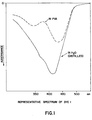
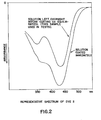
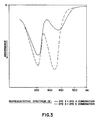
- FIGS 1 to 4 of the accompanying drawings are representative spectra of the dyes and dye combinations used in the above antihalation coating compositions. Unless otherwise indicated the spectra were obtained by measurement of the dry PVA layers.
- Dye 1 in solution covers the whole region, i.e. 340 to 480 nm but splits into two peaks when coated in a dry PVA layer.
- the spectra in Figures 2 and 3 are pH sensitive.
- Dyes 1 and 2 are variations on the same structure. They differ in position of the sulphonic acid functions and have different counter-ions. Their use as antihalation materials is hampered by their pH sensitivity and subsequent change of spectral characteristics. Dye 2 has been used as an antihalation material in silver halide systems.
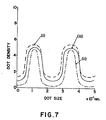
- Figure 5 of the accompanying drawings shows a theoretical plot of density versus dot area likely to be observed for two idealised Matchprint samples (high and low density batches). Superimposed on this are the observed curves. The observed density is higher than the ideal density due to optical gain effects. The observed effects are larger on high density material. It should be noted that variation in D max can change optical gain by 1 to 2%. This study has been carried out on Matchprint Positive sheets having a higher than normal maximum density, the general range being 1.2 to 1.45. Optical gain values are therefore near the extreme which one would expect to obtain.
- Table 3 reports the optical gain at various dot areas for antihalation coatings over a Matchprint positive cyan layer at different exposure levels. Optical gain profiles similar to that shown in Figure 6 may be plotted from the figures provided.
- the two-dye system comprising the combination of Dye 2 and Dye 4 of formulation (iv) is better than Dye 2 alone.
- the shift in spectral absorption ( Figure 3) produces a large "window" at 390 nm, negating some of the expected reduction in optical gain.
- Photopolymer bulbs have a strong emission at 390 nm. It should be noted that the threshold for imaging has increased.
- Comparison of coatings of formulations (v) and (vi) similarly show little change in optical gain reduction for the combination of Dyes 3 and 5. Again, the main difference is exposure time. The high density coating is slower. Optical gain can be controlled between approximately 22% and 15% for a 45% dot.
- the coating of formula (vii) shows the optical gain response for Dye 6 plus Dye 5 at higher exposure values. No optical "window” is apparent in the Dye 6/Dye 5 coating. Optical gain can be reduced to approximately 13 to 14% for a 45% dot. In all the systems it should be noted that a maximum occurs at 55%. Consideration of coatings of formulation (vii) to (x) shows again little effect on optical gain with increasing dye density. Exposure times increase. Optical gain is similar to Dye 6/Dye 5 coatings even although a small "window" is present in the Dye 7/Dye 5 coating ( Figure 4). The optical gain minimum is approximately 12 to 13%. There is a suggestion therefore, of a practical limit in optical gain reduction.
- the Dye 7/Dye 5 system is the preferred system, both in reduction of optical gain and ease of access to materials.
- the sharply absorbing peaks allow low density coatings to be utilised with a subsequent reduction in dye quantities required.
- Example 1 10% PVA solution (30 g) as in Example 1 incorporating Dye 5 (30 mg) was coated using a No.4 K-bar (36 Lt wet) onto a prelaminated cyan Matchprint Positive layer. Immediate drying of this coating with heat from a hot air drier gave a uniformly dyed PVA topcoat.
- Laminations were carried out on standard Matchprint Positive Base and upon this base bearing an antihalation layer comprising a colourless ultraviolet absorbing dye.
- the ultraviolet absorbing layer was obtained by coating a the Matchprint base using a No. 4 K-bar with a solution of ultraviolet Dye 8 (90 mg) in butan-2-one (10 ml) with Butvar B76 (500 mg) as binder. The coated sample was dried in an oven at 90 0 C for one minute.
- a dot is formed and developed as an image and a further layer then laminated, imaged and developed, the dot appears to increase in size due to the additional layer above it. This increase is partly dependent upon the dot profile. The sharper the dot the less the increase.
- each of the optical gain values shows the best dot gain obtained for standard Matchprint sample, as compared to the dot gain for a Matchprint system containing one or more antihalation layers.
- the Matchprint sample with yellow dye (Dye 5) overcoat at 0.3 reflectance optical density plus U.V. underlayer compared with a standard Matchprint sample shows a substantial improvement in the reduction of dot gain by allowing increased exposures to be made.
- standard Matchprint retains highlight dots, e.g. 4% dots, only up to exposure 6 on the UGRA scale, further increases in exposure up to exposure 8 on the UGRA scale are possible with the antihalation system.
- the dots obtained using the antihalation system are much sharper than those obtained from the standard Matchprint material.
- the apparent dye density between the dots is much less in the antihalation coated system. Even when the antihalation coated system has had approximately 4 times the exposure time (400 units versus 100 units) in the light frame during imaging it does not lose highlight dots by undercutting/halation. What does happen is the removal of dye density between the dots both physically and optically.
- This release-layer solution was coated onto a 0.002 inch (0.05 mm) polyethylene terephthalate film support at a dry coating weight of 70 to 80 mg/ft 2 (750 to 860 mg/m 2 ). The coating was dried at 120 to 200°F (49 to 93 0 C) over three minutes, then overcoated with a cyan, photosensitive layer, suitable for 3M Matchprint Positive proofing sheets.
- This layer was prepared as follows:
- This solution was coated onto the above dye release-layer and dried at 120 to 190°F (49 to 88°C) over 2 minutes, so that a transmitted optical density of 1.1 (red filter on Gretag densitometer) was obtained.
- Coating A an adhesive solution consisting of 0.85 g Pliolite S-5-A styrene-butadiene copolymer (commercially available from Goodyear) and 9.15 g toluene, was coated directly on top of the colour layer and dried at 190°F (88°C) for 2 minutes, to a coating weight of 500 mg/ft 2 (5400 mg/m 2 ).
- This product is referred to hereafter as Coating A.
- Exposures were carried out using a 5 KW Diazo Bulb at a distance from 30 inches from the positive transparency (UGRA scale) and imaging film. Development was performed subsequently with 3M Positive Proofing Developer (aqueous sodium hydroxide) to form the colour image. Exposures are listed in units (approximately 9 units are equivalent to 1 second). All samples are in the third down position, having two layers of Matchprint Positive adhesive on Schoeller Paper Base underneath the imaging material. After exposure and development, a fourth adhesive layer was laminated over all resultant images to simulate dot gains which would actually occur in a four-colour Matchprint Positive proof.
- 3M Positive Proofing Developer aqueous sodium hydroxide
- the 40% dots can be sharpened to a dot gain level of 19% while still retaining 3% highlights in the case of material containing the yellow antihalo dye. From the previous table, when material without the antihalo dye was exposed at 70 units, the 40% dots showed a dot gain of 26% while 3% dots were still present. However, when exposure was increased to 90 units, little sharpening of the midtones (40% dot, etc.) was seen although highlight dots smaller than 10% disappeared. This demonstrates that, while cyan Coating A can have its 40% dot sharpened from 27 to 19% gain without major loss in highlight dot rendition, it is not possible to sharpen cyan Coating B's 40% dot below a 26% gain without substantial highlight loss.
- a cyan Negative Matchprint construction was prepared as in Example 1 of United States Patent Specification No. 3 671 236 except that a thermally activatable poly-N-butyl acrylate was employed. This was applied as a latex solution at a dry coating weight of approximately 1.7 g/m 2 , similar to the weight of the barrier layer.
- the exposure source was a 5 Kw diazo bulb position 10 cm from the imageable material.
- the following table compares the dot gain and exposure latitude of standard cyan Matchprint Negative/Thermal proofs in proof position to a sample of cyan Matchprint Negative/Thermal containing 8 percent by weight yellow dye No. 14 in the PVA layer.
- the dot gain is unaffected and the exposure latitude shows a 62% improvement by inclusion of a yellow dye and the PVA layer.
- This Example utilises a colour proofing system sold under the trade name Cromalin Positive Proofing material which is commercially available from DuPont de Nemours. This colour proofing system is the subject of United States Patent Specification Nos. 3 649 268 and 3 854 950.
- the Cromalin presensitised sheet was laminated in an automatic processor onto the standard support commercially available under the trade name Kromekote.
- the support contains an optical brightener as an antihalation suppressant.
- a sample of the laminated structure was coated over the polyester cover sheet with the following formulation to provide an antihalation layer having an optical density by transmission of 0.5: Structure of yellow dye:
Landscapes
- Physics & Mathematics (AREA)
- General Physics & Mathematics (AREA)
- Photosensitive Polymer And Photoresist Processing (AREA)
- Materials For Photolithography (AREA)
Applications Claiming Priority (2)
| Application Number | Priority Date | Filing Date | Title |
|---|---|---|---|
| GB848414867A GB8414867D0 (en) | 1984-06-11 | 1984-06-11 | Pre-press proofing system |
| GB8414867 | 1984-06-11 |
Publications (3)
| Publication Number | Publication Date |
|---|---|
| EP0165030A2 true EP0165030A2 (fr) | 1985-12-18 |
| EP0165030A3 EP0165030A3 (en) | 1987-07-15 |
| EP0165030B1 EP0165030B1 (fr) | 1991-07-31 |
Family
ID=10562254
Family Applications (1)
| Application Number | Title | Priority Date | Filing Date |
|---|---|---|---|
| EP85304064A Expired - Lifetime EP0165030B1 (fr) | 1984-06-11 | 1985-06-07 | Système pour épreuves en couleurs comportant une couche antihalo |
Country Status (10)
| Country | Link |
|---|---|
| US (1) | US4950577A (fr) |
| EP (1) | EP0165030B1 (fr) |
| JP (1) | JPS6120024A (fr) |
| AU (1) | AU579157B2 (fr) |
| BR (1) | BR8502754A (fr) |
| CA (1) | CA1277862C (fr) |
| DE (1) | DE3583635D1 (fr) |
| GB (1) | GB8414867D0 (fr) |
| MX (1) | MX163214B (fr) |
| ZA (1) | ZA853651B (fr) |
Cited By (1)
| Publication number | Priority date | Publication date | Assignee | Title |
|---|---|---|---|---|
| EP0790529A3 (fr) * | 1996-02-14 | 1998-08-26 | Imation Corp. | Elément pour épreuves en couleurs contenant un colorant antihalo nouveaux |
Families Citing this family (17)
| Publication number | Priority date | Publication date | Assignee | Title |
|---|---|---|---|---|
| JPH063543B2 (ja) * | 1985-05-24 | 1994-01-12 | 日本合成ゴム株式会社 | 集積回路製造用感紫外線ポシ型レジスト |
| JP2614847B2 (ja) * | 1986-06-16 | 1997-05-28 | 東京応化工業 株式会社 | ポジ型感光性組成物 |
| JPS6433544A (en) * | 1987-07-29 | 1989-02-03 | Fujitsu Ltd | Pattern forming method |
| JPH01282543A (ja) * | 1988-05-09 | 1989-11-14 | Fuji Photo Film Co Ltd | 画像形成材料 |
| JPH0782234B2 (ja) * | 1988-05-09 | 1995-09-06 | 富士写真フイルム株式会社 | 画像形成材料 |
| JPH0782235B2 (ja) * | 1988-05-09 | 1995-09-06 | 富士写真フイルム株式会社 | 画像形成材料 |
| US5348833A (en) * | 1990-03-05 | 1994-09-20 | Hoechst Aktiengesellschaft | Colored positive-working quinone diazide photosensitive recording material for the production of a color test image utilizing adhesive layer containing alkali-insoluble organic polymer and alkali-soluble polyester |
| CA2063296A1 (fr) * | 1991-03-20 | 1992-09-21 | David William Swatton | Support d'impression photosensible |
| CA2066895A1 (fr) * | 1991-06-17 | 1992-12-18 | Thomas P. Klun | Systeme d'imagerie a developpement aqueux |
| JP2829555B2 (ja) * | 1992-08-20 | 1998-11-25 | 三菱電機株式会社 | 微細レジストパターンの形成方法 |
| DE4419597A1 (de) | 1994-06-03 | 1995-12-07 | Du Pont Deutschland | Ein- und mehrfarbige Farbprüfbilder von Vorlagen mit hoher Auflösung sowie Verfahren und Mittel für deren Herstellung |
| DE10022786B4 (de) * | 1999-05-12 | 2008-04-10 | Kodak Graphic Communications Gmbh | Auf der Druckmaschine entwickelbare Druckplatte |
| JP3973465B2 (ja) * | 2002-03-19 | 2007-09-12 | リョービ株式会社 | カラーマッチング方法 |
| US8557877B2 (en) | 2009-06-10 | 2013-10-15 | Honeywell International Inc. | Anti-reflective coatings for optically transparent substrates |
| US8864898B2 (en) | 2011-05-31 | 2014-10-21 | Honeywell International Inc. | Coating formulations for optical elements |
| WO2016167892A1 (fr) | 2015-04-13 | 2016-10-20 | Honeywell International Inc. | Formulations de polysiloxane et revêtements pour applications optoélectroniques |
| CN108221476A (zh) * | 2017-02-27 | 2018-06-29 | 上海紫江喷铝环保材料有限公司 | 一种彩晕珠光镭射转移压纹纸及其制造方法 |
Family Cites Families (30)
| Publication number | Priority date | Publication date | Assignee | Title |
|---|---|---|---|---|
| FR742949A (fr) * | 1931-09-22 | 1933-03-18 | ||
| FR933955A (fr) * | 1945-09-26 | 1948-05-07 | Gen Aniline & Film Corp | Matériel d'impression photo-sensible |
| US2871119A (en) * | 1955-02-21 | 1959-01-27 | Dietzgen Co Eugene | Diazotype reproduction material and method |
| BE579138A (fr) * | 1958-07-10 | |||
| US3264103A (en) * | 1962-06-27 | 1966-08-02 | Du Pont | Photopolymerizable relief printing plates developed by dry thermal transfer |
| US3313626A (en) * | 1962-08-01 | 1967-04-11 | Russeli H Whitney | Process of making a lithographic printing plate |
| US3466172A (en) * | 1967-01-13 | 1969-09-09 | Ibm | Method of using photographic vesicular and diazo films having diazo antihalation layers |
| JPS49441B1 (fr) * | 1968-08-14 | 1974-01-08 | ||
| US3671236A (en) * | 1968-03-18 | 1972-06-20 | Minnesota Mining & Mfg | Presensitized color-proofing sheet |
| BE772251A (fr) * | 1970-09-07 | Kalle Ag | Composes photopolymerisables | |
| CA993709A (en) * | 1971-01-21 | 1976-07-27 | Leo Roos | Composite, mask-forming photohardenable elements |
| US3879204A (en) * | 1971-02-02 | 1975-04-22 | Du Pont | Two-layer photopolymerizable gravure resist film |
| JPS498182A (fr) * | 1972-05-10 | 1974-01-24 | ||
| BE788560A (fr) * | 1972-06-09 | 1973-03-08 | Du Pont | Protection contre le halo dans la formation d'images dans des photopolymeres en couches multiples |
| US4304839A (en) * | 1975-06-03 | 1981-12-08 | E. I. Du Pont De Nemours And Company | Positive working multilayer photosensitive tonable element |
| US4356251A (en) * | 1975-06-03 | 1982-10-26 | E. I. Du Pont De Nemours And Company | Multilayer photosensitive element with solvent-soluble layer |
| US4053313A (en) * | 1975-06-03 | 1977-10-11 | E. I. Du Pont De Nemours And Company | Process for image reproduction using multilayer photosensitive solvent processable elements |
| JPS5229302A (en) * | 1975-08-28 | 1977-03-05 | Fuji Photo Film Co Ltd | Photoosensitive printing plate |
| LU75749A1 (fr) * | 1976-09-08 | 1978-04-27 | ||
| US4260673A (en) * | 1979-09-05 | 1981-04-07 | Minnesota Mining And Manufacturing Company | Single sheet color proofing system |
| US4268667A (en) * | 1980-04-21 | 1981-05-19 | E. I. Du Pont De Nemours And Company | Derivatives of aryl ketones based on 9,10-dihydro-9,10-ethanoanthracene and p-dialkyl-aminoaryl aldehydes as visible sensitizers for photopolymerizable compositions |
| US4472494A (en) * | 1980-09-15 | 1984-09-18 | Napp Systems (Usa), Inc. | Bilayer photosensitive imaging article |
| US4426437A (en) * | 1981-06-29 | 1984-01-17 | Minnesota Mining And Manufacturing Company | Imageable material with radiation absorbing microstructured layers overcoated with photoresist layer |
| US4377632A (en) * | 1981-12-24 | 1983-03-22 | Polaroid Corporation | Diffusion transfer film units with application of processing composition between dye developer layer and silver halide emulsion layer |
| US4409316A (en) * | 1982-02-26 | 1983-10-11 | Minnesota Mining And Manufacturing Company | Resistively heatable photothermographic element with strippable layer |
| JPS58220139A (ja) * | 1982-06-17 | 1983-12-21 | Oji Yuka Gouseishi Kk | 感光紙 |
| US4427757A (en) * | 1982-08-27 | 1984-01-24 | Minnesota Mining And Manufacturing Company | Tannable imaging element |
| JPS59226346A (ja) * | 1983-06-07 | 1984-12-19 | Fuotopori Ouka Kk | プリント回路の製造方法 |
| US4489154A (en) * | 1983-12-22 | 1984-12-18 | E. I. Du Pont De Nemours And Company | Process for preparing a surprint proof |
| US4520093A (en) * | 1984-01-30 | 1985-05-28 | E. I. Du Pont De Nemours And Company | Photosensitive composition and method for forming a neutral black image |
-
1984
- 1984-06-11 GB GB848414867A patent/GB8414867D0/en active Pending
-
1985
- 1985-05-14 ZA ZA853651A patent/ZA853651B/xx unknown
- 1985-05-23 US US06/737,810 patent/US4950577A/en not_active Expired - Fee Related
- 1985-05-24 AU AU42848/85A patent/AU579157B2/en not_active Ceased
- 1985-06-06 CA CA000483291A patent/CA1277862C/fr not_active Expired - Lifetime
- 1985-06-07 EP EP85304064A patent/EP0165030B1/fr not_active Expired - Lifetime
- 1985-06-07 DE DE8585304064T patent/DE3583635D1/de not_active Expired - Lifetime
- 1985-06-10 JP JP60125948A patent/JPS6120024A/ja active Pending
- 1985-06-10 BR BR8502754A patent/BR8502754A/pt not_active IP Right Cessation
- 1985-06-11 MX MX205612A patent/MX163214B/es unknown
Cited By (1)
| Publication number | Priority date | Publication date | Assignee | Title |
|---|---|---|---|---|
| EP0790529A3 (fr) * | 1996-02-14 | 1998-08-26 | Imation Corp. | Elément pour épreuves en couleurs contenant un colorant antihalo nouveaux |
Also Published As
| Publication number | Publication date |
|---|---|
| JPS6120024A (ja) | 1986-01-28 |
| BR8502754A (pt) | 1986-02-18 |
| DE3583635D1 (de) | 1991-09-05 |
| MX163214B (es) | 1992-03-10 |
| AU579157B2 (en) | 1988-11-17 |
| ZA853651B (en) | 1986-12-30 |
| EP0165030A3 (en) | 1987-07-15 |
| EP0165030B1 (fr) | 1991-07-31 |
| CA1277862C (fr) | 1990-12-18 |
| GB8414867D0 (en) | 1984-07-18 |
| US4950577A (en) | 1990-08-21 |
| AU4284885A (en) | 1985-12-19 |
Similar Documents
| Publication | Publication Date | Title |
|---|---|---|
| EP0165030B1 (fr) | Système pour épreuves en couleurs comportant une couche antihalo | |
| EP0035028B1 (fr) | Systeme de couleur d'epreuves a oxyde diazo sur une seule feuille | |
| US3671236A (en) | Presensitized color-proofing sheet | |
| US4666817A (en) | Presensitized diazo color-proofing sheet with particular sized pigments | |
| CA1259848A (fr) | Methode d'imagerie multicolore | |
| EP0277038B1 (fr) | Procédé pour obtenir des images en couleurs par transfert | |
| EP0339860B1 (fr) | Système pour tirage d'épreuves à faible gain de point | |
| CA1253024A (fr) | Systeme de visualisation, positif, laminable | |
| CA1079565A (fr) | Elements photopolymerisables attaquables a l'acide et methode de reproduction d'images | |
| JPH06214381A (ja) | 剥離プルーフィングシステム | |
| EP0420675B1 (fr) | Système pour tirage d'épreuves à faible gain de point | |
| US5240810A (en) | Pre-press proofing method | |
| US5756257A (en) | Color proofing article incorporating novel antihalation dye | |
| US5565301A (en) | Process for forming a colored image | |
| CA2016751A1 (fr) | Methode de tirage d'epreuves avant impression | |
| US4369239A (en) | Process for preparation of photopolymerized dot-etchable masks using staging solution | |
| US6083608A (en) | Monochrome and polychrome color proofs with low optical dot growth and a process and means for their preparation | |
| JPH07168352A (ja) | 乾式カラープルーフプロセスに用いるドナー要素およびカラープルーフの製造方法 | |
| JPH08262718A (ja) | ポジとして働く感光性成分 | |
| JPH05158226A (ja) | 画像形成方法 |
Legal Events
| Date | Code | Title | Description |
|---|---|---|---|
| PUAI | Public reference made under article 153(3) epc to a published international application that has entered the european phase |
Free format text: ORIGINAL CODE: 0009012 |
|
| AK | Designated contracting states |
Designated state(s): BE CH DE FR GB IT LI NL SE |
|
| PUAL | Search report despatched |
Free format text: ORIGINAL CODE: 0009013 |
|
| AK | Designated contracting states |
Kind code of ref document: A3 Designated state(s): BE CH DE FR GB IT LI NL SE |
|
| 17P | Request for examination filed |
Effective date: 19870930 |
|
| 17Q | First examination report despatched |
Effective date: 19890619 |
|
| ITF | It: translation for a ep patent filed | ||
| GRAA | (expected) grant |
Free format text: ORIGINAL CODE: 0009210 |
|
| AK | Designated contracting states |
Kind code of ref document: B1 Designated state(s): BE CH DE FR GB IT LI NL SE |
|
| REF | Corresponds to: |
Ref document number: 3583635 Country of ref document: DE Date of ref document: 19910905 |
|
| ET | Fr: translation filed | ||
| PLBE | No opposition filed within time limit |
Free format text: ORIGINAL CODE: 0009261 |
|
| STAA | Information on the status of an ep patent application or granted ep patent |
Free format text: STATUS: NO OPPOSITION FILED WITHIN TIME LIMIT |
|
| 26N | No opposition filed | ||
| EAL | Se: european patent in force in sweden |
Ref document number: 85304064.0 |
|
| PGFP | Annual fee paid to national office [announced via postgrant information from national office to epo] |
Ref country code: SE Payment date: 19950511 Year of fee payment: 11 Ref country code: CH Payment date: 19950511 Year of fee payment: 11 |
|
| PGFP | Annual fee paid to national office [announced via postgrant information from national office to epo] |
Ref country code: NL Payment date: 19950522 Year of fee payment: 11 |
|
| PGFP | Annual fee paid to national office [announced via postgrant information from national office to epo] |
Ref country code: BE Payment date: 19950529 Year of fee payment: 11 |
|
| PG25 | Lapsed in a contracting state [announced via postgrant information from national office to epo] |
Ref country code: SE Effective date: 19960608 |
|
| PG25 | Lapsed in a contracting state [announced via postgrant information from national office to epo] |
Ref country code: LI Effective date: 19960630 Ref country code: CH Effective date: 19960630 Ref country code: BE Effective date: 19960630 |
|
| BERE | Be: lapsed |
Owner name: MINNESOTA MINING AND MFG CY Effective date: 19960630 |
|
| PG25 | Lapsed in a contracting state [announced via postgrant information from national office to epo] |
Ref country code: NL Effective date: 19970101 |
|
| REG | Reference to a national code |
Ref country code: CH Ref legal event code: PL |
|
| EUG | Se: european patent has lapsed |
Ref document number: 85304064.0 |
|
| NLV4 | Nl: lapsed or anulled due to non-payment of the annual fee |
Effective date: 19970101 |
|
| PGFP | Annual fee paid to national office [announced via postgrant information from national office to epo] |
Ref country code: GB Payment date: 19970506 Year of fee payment: 13 |
|
| PGFP | Annual fee paid to national office [announced via postgrant information from national office to epo] |
Ref country code: FR Payment date: 19970610 Year of fee payment: 13 |
|
| PGFP | Annual fee paid to national office [announced via postgrant information from national office to epo] |
Ref country code: DE Payment date: 19970627 Year of fee payment: 13 |
|
| PG25 | Lapsed in a contracting state [announced via postgrant information from national office to epo] |
Ref country code: GB Free format text: LAPSE BECAUSE OF NON-PAYMENT OF DUE FEES Effective date: 19980607 |
|
| GBPC | Gb: european patent ceased through non-payment of renewal fee |
Effective date: 19980607 |
|
| PG25 | Lapsed in a contracting state [announced via postgrant information from national office to epo] |
Ref country code: FR Free format text: LAPSE BECAUSE OF NON-PAYMENT OF DUE FEES Effective date: 19990226 |
|
| PG25 | Lapsed in a contracting state [announced via postgrant information from national office to epo] |
Ref country code: DE Free format text: LAPSE BECAUSE OF NON-PAYMENT OF DUE FEES Effective date: 19990401 |
|
| REG | Reference to a national code |
Ref country code: FR Ref legal event code: ST |