EP0165904B1 - Composés substitués bicycliques - Google Patents
Composés substitués bicycliques Download PDFInfo
- Publication number
- EP0165904B1 EP0165904B1 EP85810279A EP85810279A EP0165904B1 EP 0165904 B1 EP0165904 B1 EP 0165904B1 EP 85810279 A EP85810279 A EP 85810279A EP 85810279 A EP85810279 A EP 85810279A EP 0165904 B1 EP0165904 B1 EP 0165904B1
- Authority
- EP
- European Patent Office
- Prior art keywords
- formula
- compound
- alkyl
- carboxy
- lower alkyl
- Prior art date
- Legal status (The legal status is an assumption and is not a legal conclusion. Google has not performed a legal analysis and makes no representation as to the accuracy of the status listed.)
- Expired - Lifetime
Links
- 150000001875 compounds Chemical class 0.000 title claims abstract description 310
- 150000003839 salts Chemical class 0.000 claims abstract description 92
- 229910052739 hydrogen Inorganic materials 0.000 claims abstract description 71
- 239000001257 hydrogen Substances 0.000 claims abstract description 71
- 239000000203 mixture Substances 0.000 claims abstract description 65
- 229910052736 halogen Inorganic materials 0.000 claims abstract description 54
- 150000002367 halogens Chemical group 0.000 claims abstract description 53
- 150000002431 hydrogen Chemical group 0.000 claims abstract description 48
- 125000004093 cyano group Chemical group *C#N 0.000 claims abstract description 30
- 125000002887 hydroxy group Chemical group [H]O* 0.000 claims abstract description 30
- 125000002861 (C1-C4) alkanoyl group Chemical group 0.000 claims abstract description 11
- 125000000449 nitro group Chemical group [O-][N+](*)=O 0.000 claims abstract description 9
- 125000004178 (C1-C4) alkyl group Chemical group 0.000 claims abstract 7
- -1 phenylsulfonyloxy Chemical group 0.000 claims description 164
- 125000000217 alkyl group Chemical group 0.000 claims description 108
- 238000000034 method Methods 0.000 claims description 75
- 125000004432 carbon atom Chemical group C* 0.000 claims description 59
- 125000003178 carboxy group Chemical group [H]OC(*)=O 0.000 claims description 42
- 125000004414 alkyl thio group Chemical group 0.000 claims description 35
- 125000004453 alkoxycarbonyl group Chemical group 0.000 claims description 34
- 125000001424 substituent group Chemical group 0.000 claims description 34
- 125000003545 alkoxy group Chemical group 0.000 claims description 31
- 239000002253 acid Substances 0.000 claims description 28
- 125000003282 alkyl amino group Chemical group 0.000 claims description 28
- UFHFLCQGNIYNRP-UHFFFAOYSA-N Hydrogen Chemical compound [H][H] UFHFLCQGNIYNRP-UHFFFAOYSA-N 0.000 claims description 25
- 125000005115 alkyl carbamoyl group Chemical group 0.000 claims description 24
- 239000007858 starting material Substances 0.000 claims description 24
- 125000003917 carbamoyl group Chemical group [H]N([H])C(*)=O 0.000 claims description 21
- 229910052799 carbon Inorganic materials 0.000 claims description 21
- 125000004423 acyloxy group Chemical group 0.000 claims description 20
- 125000002924 primary amino group Chemical group [H]N([H])* 0.000 claims description 20
- 229910052740 iodine Inorganic materials 0.000 claims description 19
- 125000002485 formyl group Chemical group [H]C(*)=O 0.000 claims description 17
- CLPFFLWZZBQMAO-UHFFFAOYSA-N 4-(5,6,7,8-tetrahydroimidazo[1,5-a]pyridin-5-yl)benzonitrile Chemical compound C1=CC(C#N)=CC=C1C1N2C=NC=C2CCC1 CLPFFLWZZBQMAO-UHFFFAOYSA-N 0.000 claims description 16
- 239000003054 catalyst Substances 0.000 claims description 15
- 238000004519 manufacturing process Methods 0.000 claims description 13
- 239000000825 pharmaceutical preparation Substances 0.000 claims description 13
- 230000002829 reductive effect Effects 0.000 claims description 13
- 230000002378 acidificating effect Effects 0.000 claims description 11
- 229920006395 saturated elastomer Polymers 0.000 claims description 11
- 125000001997 phenyl group Chemical group [H]C1=C([H])C([H])=C(*)C([H])=C1[H] 0.000 claims description 10
- 125000004005 formimidoyl group Chemical group [H]\N=C(/[H])* 0.000 claims description 9
- 125000005153 alkyl sulfamoyl group Chemical group 0.000 claims description 8
- VILAVOFMIJHSJA-UHFFFAOYSA-N dicarbon monoxide Chemical compound [C]=C=O VILAVOFMIJHSJA-UHFFFAOYSA-N 0.000 claims description 8
- 125000004029 hydroxymethyl group Chemical group [H]OC([H])([H])* 0.000 claims description 8
- RAXXELZNTBOGNW-UHFFFAOYSA-N imidazole Natural products C1=CNC=N1 RAXXELZNTBOGNW-UHFFFAOYSA-N 0.000 claims description 8
- 125000003356 phenylsulfanyl group Chemical group [*]SC1=C([H])C([H])=C([H])C([H])=C1[H] 0.000 claims description 8
- 125000001797 benzyl group Chemical group [H]C1=C([H])C([H])=C(C([H])=C1[H])C([H])([H])* 0.000 claims description 7
- 125000000020 sulfo group Chemical group O=S(=O)([*])O[H] 0.000 claims description 7
- 125000003396 thiol group Chemical class [H]S* 0.000 claims description 7
- HBAQYPYDRFILMT-UHFFFAOYSA-N 8-[3-(1-cyclopropylpyrazol-4-yl)-1H-pyrazolo[4,3-d]pyrimidin-5-yl]-3-methyl-3,8-diazabicyclo[3.2.1]octan-2-one Chemical class C1(CC1)N1N=CC(=C1)C1=NNC2=C1N=C(N=C2)N1C2C(N(CC1CC2)C)=O HBAQYPYDRFILMT-UHFFFAOYSA-N 0.000 claims description 6
- 125000003236 benzoyl group Chemical group [H]C1=C([H])C([H])=C(C([H])=C1[H])C(*)=O 0.000 claims description 6
- 238000005984 hydrogenation reaction Methods 0.000 claims description 6
- 125000005237 alkyleneamino group Chemical group 0.000 claims description 5
- 125000002057 carboxymethyl group Chemical group [H]OC(=O)C([H])([H])[*] 0.000 claims description 5
- 230000000911 decarboxylating effect Effects 0.000 claims description 5
- 230000003287 optical effect Effects 0.000 claims description 5
- 125000005042 acyloxymethyl group Chemical group 0.000 claims description 4
- 125000004849 alkoxymethyl group Chemical group 0.000 claims description 4
- 125000005138 alkoxysulfonyl group Chemical group 0.000 claims description 4
- 125000005907 alkyl ester group Chemical group 0.000 claims description 4
- 125000004644 alkyl sulfinyl group Chemical group 0.000 claims description 4
- 239000003937 drug carrier Substances 0.000 claims description 4
- VKTGFDSNAZLZBO-UHFFFAOYSA-N 4-(7,8-dihydroimidazo[1,5-a]pyridin-5-yl)benzonitrile Chemical compound C1=CC(C#N)=CC=C1C1=CCCC2=CN=CN12 VKTGFDSNAZLZBO-UHFFFAOYSA-N 0.000 claims description 3
- ZRBDYBQIBBZJBE-UHFFFAOYSA-N 4-imidazo[1,5-a]pyridin-5-ylbenzonitrile Chemical compound C1=CC(C#N)=CC=C1C1=CC=CC2=CN=CN12 ZRBDYBQIBBZJBE-UHFFFAOYSA-N 0.000 claims description 3
- CETYHXLCJBBAHU-UHFFFAOYSA-N 5-(4-bromophenyl)-5,6,7,8-tetrahydroimidazo[1,5-a]pyridine Chemical compound C1=CC(Br)=CC=C1C1N2C=NC=C2CCC1 CETYHXLCJBBAHU-UHFFFAOYSA-N 0.000 claims description 3
- 125000004390 alkyl sulfonyl group Chemical group 0.000 claims description 3
- 125000005278 alkyl sulfonyloxy group Chemical group 0.000 claims description 3
- 125000004397 aminosulfonyl group Chemical group NS(=O)(=O)* 0.000 claims description 3
- 125000001153 fluoro group Chemical group F* 0.000 claims description 3
- 125000004970 halomethyl group Chemical group 0.000 claims description 3
- 238000002156 mixing Methods 0.000 claims description 3
- 125000005079 alkoxycarbonylmethyl group Chemical group 0.000 claims description 2
- XYOVOXDWRFGKEX-UHFFFAOYSA-N azepine Chemical compound N1C=CC=CC=C1 XYOVOXDWRFGKEX-UHFFFAOYSA-N 0.000 claims description 2
- FSLPUIQRTFZEMT-UHFFFAOYSA-N ethyl 2-[5-(4-cyanophenyl)-5,6,7,8-tetrahydroimidazo[1,5-a]pyridin-6-yl]acetate Chemical compound CCOC(=O)CC1CCC2=CN=CN2C1C1=CC=C(C#N)C=C1 FSLPUIQRTFZEMT-UHFFFAOYSA-N 0.000 claims description 2
- SYSQUGFVNFXIIT-UHFFFAOYSA-N n-[4-(1,3-benzoxazol-2-yl)phenyl]-4-nitrobenzenesulfonamide Chemical class C1=CC([N+](=O)[O-])=CC=C1S(=O)(=O)NC1=CC=C(C=2OC3=CC=CC=C3N=2)C=C1 SYSQUGFVNFXIIT-UHFFFAOYSA-N 0.000 claims description 2
- LMBFAGIMSUYTBN-MPZNNTNKSA-N teixobactin Chemical compound C([C@H](C(=O)N[C@@H]([C@@H](C)CC)C(=O)N[C@@H](CO)C(=O)N[C@H](CCC(N)=O)C(=O)N[C@H]([C@@H](C)CC)C(=O)N[C@@H]([C@@H](C)CC)C(=O)N[C@@H](CO)C(=O)N[C@H]1C(N[C@@H](C)C(=O)N[C@@H](C[C@@H]2NC(=N)NC2)C(=O)N[C@H](C(=O)O[C@H]1C)[C@@H](C)CC)=O)NC)C1=CC=CC=C1 LMBFAGIMSUYTBN-MPZNNTNKSA-N 0.000 claims description 2
- 125000001589 carboacyl group Chemical group 0.000 claims 5
- 125000000229 (C1-C4)alkoxy group Chemical group 0.000 claims 3
- 125000004435 hydrogen atom Chemical group [H]* 0.000 claims 3
- RTASTUXZQNDOKL-UHFFFAOYSA-N 2-[5-(4-cyanophenyl)-5,6,7,8-tetrahydroimidazo[1,5-a]pyridin-6-yl]acetic acid Chemical compound OC(=O)CC1CCC2=CN=CN2C1C1=CC=C(C#N)C=C1 RTASTUXZQNDOKL-UHFFFAOYSA-N 0.000 claims 1
- COQBJENDMHZDCW-UHFFFAOYSA-N 4-(5,6,7,8-tetrahydroimidazo[1,5-a]pyridin-7-yl)benzonitrile Chemical compound C1=CC(C#N)=CC=C1C1CC2=CN=CN2CC1 COQBJENDMHZDCW-UHFFFAOYSA-N 0.000 claims 1
- LDNOSCYYVICQJD-UHFFFAOYSA-N 4-(5-benzyl-7,8-dihydro-6h-imidazo[1,5-a]pyridin-5-yl)benzonitrile Chemical compound C1=CC(C#N)=CC=C1C1(CC=2C=CC=CC=2)N2C=NC=C2CCC1 LDNOSCYYVICQJD-UHFFFAOYSA-N 0.000 claims 1
- 150000002460 imidazoles Chemical class 0.000 claims 1
- 238000002360 preparation method Methods 0.000 abstract description 20
- 102000014654 Aromatase Human genes 0.000 abstract description 7
- 108010078554 Aromatase Proteins 0.000 abstract description 7
- 230000000694 effects Effects 0.000 abstract description 3
- 239000003112 inhibitor Substances 0.000 abstract 1
- 239000008194 pharmaceutical composition Substances 0.000 abstract 1
- PXQLVRUNWNTZOS-UHFFFAOYSA-N sulfanyl Chemical class [SH] PXQLVRUNWNTZOS-UHFFFAOYSA-N 0.000 abstract 1
- YMWUJEATGCHHMB-UHFFFAOYSA-N Dichloromethane Chemical compound ClCCl YMWUJEATGCHHMB-UHFFFAOYSA-N 0.000 description 147
- 239000000243 solution Substances 0.000 description 119
- XEKOWRVHYACXOJ-UHFFFAOYSA-N Ethyl acetate Chemical compound CCOC(C)=O XEKOWRVHYACXOJ-UHFFFAOYSA-N 0.000 description 93
- VEXZGXHMUGYJMC-UHFFFAOYSA-N Hydrochloric acid Chemical compound Cl VEXZGXHMUGYJMC-UHFFFAOYSA-N 0.000 description 58
- IJGRMHOSHXDMSA-UHFFFAOYSA-N Atomic nitrogen Chemical compound N#N IJGRMHOSHXDMSA-UHFFFAOYSA-N 0.000 description 54
- WYURNTSHIVDZCO-UHFFFAOYSA-N Tetrahydrofuran Chemical compound C1CCOC1 WYURNTSHIVDZCO-UHFFFAOYSA-N 0.000 description 52
- 238000006243 chemical reaction Methods 0.000 description 52
- 239000011541 reaction mixture Substances 0.000 description 46
- XLYOFNOQVPJJNP-UHFFFAOYSA-N water Substances O XLYOFNOQVPJJNP-UHFFFAOYSA-N 0.000 description 46
- RTZKZFJDLAIYFH-UHFFFAOYSA-N Diethyl ether Chemical compound CCOCC RTZKZFJDLAIYFH-UHFFFAOYSA-N 0.000 description 45
- OKKJLVBELUTLKV-UHFFFAOYSA-N Methanol Chemical compound OC OKKJLVBELUTLKV-UHFFFAOYSA-N 0.000 description 45
- PMZURENOXWZQFD-UHFFFAOYSA-L Sodium Sulfate Chemical compound [Na+].[Na+].[O-]S([O-])(=O)=O PMZURENOXWZQFD-UHFFFAOYSA-L 0.000 description 40
- ZMANZCXQSJIPKH-UHFFFAOYSA-N Triethylamine Chemical compound CCN(CC)CC ZMANZCXQSJIPKH-UHFFFAOYSA-N 0.000 description 39
- 229910052938 sodium sulfate Inorganic materials 0.000 description 39
- 235000011152 sodium sulphate Nutrition 0.000 description 39
- LFQSCWFLJHTTHZ-UHFFFAOYSA-N Ethanol Chemical compound CCO LFQSCWFLJHTTHZ-UHFFFAOYSA-N 0.000 description 37
- CSCPPACGZOOCGX-UHFFFAOYSA-N Acetone Chemical compound CC(C)=O CSCPPACGZOOCGX-UHFFFAOYSA-N 0.000 description 33
- HEMHJVSKTPXQMS-UHFFFAOYSA-M sodium hydroxide Inorganic materials [OH-].[Na+] HEMHJVSKTPXQMS-UHFFFAOYSA-M 0.000 description 31
- YXFVVABEGXRONW-UHFFFAOYSA-N Toluene Chemical compound CC1=CC=CC=C1 YXFVVABEGXRONW-UHFFFAOYSA-N 0.000 description 30
- 239000012074 organic phase Substances 0.000 description 30
- 229910052757 nitrogen Inorganic materials 0.000 description 29
- ZMXDDKWLCZADIW-UHFFFAOYSA-N N,N-Dimethylformamide Chemical compound CN(C)C=O ZMXDDKWLCZADIW-UHFFFAOYSA-N 0.000 description 27
- 239000003921 oil Substances 0.000 description 27
- 235000019198 oils Nutrition 0.000 description 27
- JUJWROOIHBZHMG-UHFFFAOYSA-N Pyridine Chemical compound C1=CC=NC=C1 JUJWROOIHBZHMG-UHFFFAOYSA-N 0.000 description 26
- 239000002585 base Substances 0.000 description 26
- YLQBMQCUIZJEEH-UHFFFAOYSA-N tetrahydrofuran Natural products C=1C=COC=1 YLQBMQCUIZJEEH-UHFFFAOYSA-N 0.000 description 26
- VYPSYNLAJGMNEJ-UHFFFAOYSA-N Silicium dioxide Chemical compound O=[Si]=O VYPSYNLAJGMNEJ-UHFFFAOYSA-N 0.000 description 25
- 239000002904 solvent Substances 0.000 description 24
- FYSNRJHAOHDILO-UHFFFAOYSA-N thionyl chloride Chemical compound ClS(Cl)=O FYSNRJHAOHDILO-UHFFFAOYSA-N 0.000 description 24
- KDLHZDBZIXYQEI-UHFFFAOYSA-N Palladium Chemical compound [Pd] KDLHZDBZIXYQEI-UHFFFAOYSA-N 0.000 description 22
- WEVYAHXRMPXWCK-UHFFFAOYSA-N Acetonitrile Chemical compound CC#N WEVYAHXRMPXWCK-UHFFFAOYSA-N 0.000 description 21
- 239000007787 solid Substances 0.000 description 21
- 239000000741 silica gel Substances 0.000 description 20
- 229910002027 silica gel Inorganic materials 0.000 description 20
- 238000010992 reflux Methods 0.000 description 19
- HEDRZPFGACZZDS-UHFFFAOYSA-N Chloroform Chemical compound ClC(Cl)Cl HEDRZPFGACZZDS-UHFFFAOYSA-N 0.000 description 16
- MZRVEZGGRBJDDB-UHFFFAOYSA-N N-Butyllithium Chemical compound [Li]CCCC MZRVEZGGRBJDDB-UHFFFAOYSA-N 0.000 description 16
- UIIMBOGNXHQVGW-UHFFFAOYSA-M Sodium bicarbonate Chemical class [Na+].OC([O-])=O UIIMBOGNXHQVGW-UHFFFAOYSA-M 0.000 description 16
- 125000002252 acyl group Chemical group 0.000 description 16
- 239000008346 aqueous phase Substances 0.000 description 16
- UAOMVDZJSHZZME-UHFFFAOYSA-N diisopropylamine Chemical compound CC(C)NC(C)C UAOMVDZJSHZZME-UHFFFAOYSA-N 0.000 description 16
- 239000000284 extract Substances 0.000 description 16
- XHXFXVLFKHQFAL-UHFFFAOYSA-N phosphoryl trichloride Chemical compound ClP(Cl)(Cl)=O XHXFXVLFKHQFAL-UHFFFAOYSA-N 0.000 description 16
- QGZKDVFQNNGYKY-UHFFFAOYSA-N Ammonia Chemical compound N QGZKDVFQNNGYKY-UHFFFAOYSA-N 0.000 description 15
- IAZDPXIOMUYVGZ-UHFFFAOYSA-N Dimethylsulphoxide Chemical compound CS(C)=O IAZDPXIOMUYVGZ-UHFFFAOYSA-N 0.000 description 14
- CTSLXHKWHWQRSH-UHFFFAOYSA-N oxalyl chloride Chemical compound ClC(=O)C(Cl)=O CTSLXHKWHWQRSH-UHFFFAOYSA-N 0.000 description 14
- 239000003795 chemical substances by application Substances 0.000 description 13
- NLXLAEXVIDQMFP-UHFFFAOYSA-N Ammonia chloride Chemical class [NH4+].[Cl-] NLXLAEXVIDQMFP-UHFFFAOYSA-N 0.000 description 12
- IXCSERBJSXMMFS-UHFFFAOYSA-N hydrogen chloride Substances Cl.Cl IXCSERBJSXMMFS-UHFFFAOYSA-N 0.000 description 12
- 229910000041 hydrogen chloride Inorganic materials 0.000 description 12
- ZCSHNCUQKCANBX-UHFFFAOYSA-N lithium diisopropylamide Chemical compound [Li+].CC(C)[N-]C(C)C ZCSHNCUQKCANBX-UHFFFAOYSA-N 0.000 description 12
- VLKZOEOYAKHREP-UHFFFAOYSA-N n-Hexane Chemical compound CCCCCC VLKZOEOYAKHREP-UHFFFAOYSA-N 0.000 description 12
- 125000006239 protecting group Chemical group 0.000 description 12
- 239000004480 active ingredient Substances 0.000 description 11
- 238000001704 evaporation Methods 0.000 description 11
- 230000008020 evaporation Effects 0.000 description 11
- 150000003254 radicals Chemical class 0.000 description 11
- UMJSCPRVCHMLSP-UHFFFAOYSA-N pyridine Natural products COC1=CC=CN=C1 UMJSCPRVCHMLSP-UHFFFAOYSA-N 0.000 description 10
- WKBOTKDWSSQWDR-UHFFFAOYSA-N Bromine atom Chemical compound [Br] WKBOTKDWSSQWDR-UHFFFAOYSA-N 0.000 description 9
- 229910052783 alkali metal Inorganic materials 0.000 description 9
- 150000008064 anhydrides Chemical class 0.000 description 9
- GDTBXPJZTBHREO-UHFFFAOYSA-N bromine Substances BrBr GDTBXPJZTBHREO-UHFFFAOYSA-N 0.000 description 9
- 229910052794 bromium Inorganic materials 0.000 description 9
- 239000002775 capsule Substances 0.000 description 9
- 239000000460 chlorine Substances 0.000 description 9
- 229940011871 estrogen Drugs 0.000 description 9
- 239000000262 estrogen Substances 0.000 description 9
- QTBSBXVTEAMEQO-UHFFFAOYSA-N Acetic acid Chemical compound CC(O)=O QTBSBXVTEAMEQO-UHFFFAOYSA-N 0.000 description 8
- ZAMOUSCENKQFHK-UHFFFAOYSA-N Chlorine atom Chemical compound [Cl] ZAMOUSCENKQFHK-UHFFFAOYSA-N 0.000 description 8
- DGAQECJNVWCQMB-PUAWFVPOSA-M Ilexoside XXIX Chemical compound C[C@@H]1CC[C@@]2(CC[C@@]3(C(=CC[C@H]4[C@]3(CC[C@@H]5[C@@]4(CC[C@@H](C5(C)C)OS(=O)(=O)[O-])C)C)[C@@H]2[C@]1(C)O)C)C(=O)O[C@H]6[C@@H]([C@H]([C@@H]([C@H](O6)CO)O)O)O.[Na+] DGAQECJNVWCQMB-PUAWFVPOSA-M 0.000 description 8
- NBIIXXVUZAFLBC-UHFFFAOYSA-N Phosphoric acid Chemical compound OP(O)(O)=O NBIIXXVUZAFLBC-UHFFFAOYSA-N 0.000 description 8
- 229910052801 chlorine Inorganic materials 0.000 description 8
- 238000001914 filtration Methods 0.000 description 8
- 229910052749 magnesium Inorganic materials 0.000 description 8
- BDAGIHXWWSANSR-UHFFFAOYSA-N methanoic acid Natural products OC=O BDAGIHXWWSANSR-UHFFFAOYSA-N 0.000 description 8
- 238000007363 ring formation reaction Methods 0.000 description 8
- VHUUQVKOLVNVRT-UHFFFAOYSA-N Ammonium hydroxide Chemical compound [NH4+].[OH-] VHUUQVKOLVNVRT-UHFFFAOYSA-N 0.000 description 7
- 229920002472 Starch Polymers 0.000 description 7
- QAOWNCQODCNURD-UHFFFAOYSA-N Sulfuric acid Chemical compound OS(O)(=O)=O QAOWNCQODCNURD-UHFFFAOYSA-N 0.000 description 7
- 239000011777 magnesium Substances 0.000 description 7
- HQKMJHAJHXVSDF-UHFFFAOYSA-L magnesium stearate Substances [Mg+2].CCCCCCCCCCCCCCCCCC([O-])=O.CCCCCCCCCCCCCCCCCC([O-])=O HQKMJHAJHXVSDF-UHFFFAOYSA-L 0.000 description 7
- 235000019698 starch Nutrition 0.000 description 7
- WFDIJRYMOXRFFG-UHFFFAOYSA-N Acetic anhydride Chemical compound CC(=O)OC(C)=O WFDIJRYMOXRFFG-UHFFFAOYSA-N 0.000 description 6
- UHOVQNZJYSORNB-UHFFFAOYSA-N Benzene Chemical compound C1=CC=CC=C1 UHOVQNZJYSORNB-UHFFFAOYSA-N 0.000 description 6
- VZCYOOQTPOCHFL-OWOJBTEDSA-N Fumaric acid Chemical compound OC(=O)\C=C\C(O)=O VZCYOOQTPOCHFL-OWOJBTEDSA-N 0.000 description 6
- KFZMGEQAYNKOFK-UHFFFAOYSA-N Isopropanol Chemical compound CC(C)O KFZMGEQAYNKOFK-UHFFFAOYSA-N 0.000 description 6
- GUBGYTABKSRVRQ-QKKXKWKRSA-N Lactose Natural products OC[C@H]1O[C@@H](O[C@H]2[C@H](O)[C@@H](O)C(O)O[C@@H]2CO)[C@H](O)[C@@H](O)[C@H]1O GUBGYTABKSRVRQ-QKKXKWKRSA-N 0.000 description 6
- FYYHWMGAXLPEAU-UHFFFAOYSA-N Magnesium Chemical compound [Mg] FYYHWMGAXLPEAU-UHFFFAOYSA-N 0.000 description 6
- SJRJJKPEHAURKC-UHFFFAOYSA-N N-Methylmorpholine Chemical compound CN1CCOCC1 SJRJJKPEHAURKC-UHFFFAOYSA-N 0.000 description 6
- KFSLWBXXFJQRDL-UHFFFAOYSA-N Peracetic acid Chemical compound CC(=O)OO KFSLWBXXFJQRDL-UHFFFAOYSA-N 0.000 description 6
- SMWDFEZZVXVKRB-UHFFFAOYSA-N Quinoline Chemical compound N1=CC=CC2=CC=CC=C21 SMWDFEZZVXVKRB-UHFFFAOYSA-N 0.000 description 6
- 238000009835 boiling Methods 0.000 description 6
- 229910052500 inorganic mineral Inorganic materials 0.000 description 6
- PNDPGZBMCMUPRI-UHFFFAOYSA-N iodine Chemical compound II PNDPGZBMCMUPRI-UHFFFAOYSA-N 0.000 description 6
- 125000002496 methyl group Chemical group [H]C([H])([H])* 0.000 description 6
- 235000010755 mineral Nutrition 0.000 description 6
- 239000011707 mineral Substances 0.000 description 6
- 239000012071 phase Substances 0.000 description 6
- BASFCYQUMIYNBI-UHFFFAOYSA-N platinum Substances [Pt] BASFCYQUMIYNBI-UHFFFAOYSA-N 0.000 description 6
- 229920001223 polyethylene glycol Polymers 0.000 description 6
- 239000011734 sodium Substances 0.000 description 6
- 229910052708 sodium Inorganic materials 0.000 description 6
- 229910000030 sodium bicarbonate Inorganic materials 0.000 description 6
- 235000017557 sodium bicarbonate Nutrition 0.000 description 6
- 239000000725 suspension Substances 0.000 description 6
- 239000003826 tablet Substances 0.000 description 6
- 0 C*(C=CNC)=C Chemical compound C*(C=CNC)=C 0.000 description 5
- 241000282414 Homo sapiens Species 0.000 description 5
- ZLMJMSJWJFRBEC-UHFFFAOYSA-N Potassium Chemical compound [K] ZLMJMSJWJFRBEC-UHFFFAOYSA-N 0.000 description 5
- 150000007513 acids Chemical class 0.000 description 5
- 150000003973 alkyl amines Chemical class 0.000 description 5
- 150000001412 amines Chemical class 0.000 description 5
- 239000012298 atmosphere Substances 0.000 description 5
- 238000001816 cooling Methods 0.000 description 5
- 230000001419 dependent effect Effects 0.000 description 5
- 229940043279 diisopropylamine Drugs 0.000 description 5
- 125000001495 ethyl group Chemical group [H]C([H])([H])C([H])([H])* 0.000 description 5
- 238000001727 in vivo Methods 0.000 description 5
- 230000005764 inhibitory process Effects 0.000 description 5
- NNFCIKHAZHQZJG-UHFFFAOYSA-N potassium cyanide Chemical compound [K+].N#[C-] NNFCIKHAZHQZJG-UHFFFAOYSA-N 0.000 description 5
- LPNYRYFBWFDTMA-UHFFFAOYSA-N potassium tert-butoxide Chemical compound [K+].CC(C)(C)[O-] LPNYRYFBWFDTMA-UHFFFAOYSA-N 0.000 description 5
- 239000008107 starch Substances 0.000 description 5
- 239000000126 substance Substances 0.000 description 5
- 125000000026 trimethylsilyl group Chemical group [H]C([H])([H])[Si]([*])(C([H])([H])[H])C([H])([H])[H] 0.000 description 5
- YLOUDHXZAFVYCU-UHFFFAOYSA-N 3-(1-tritylimidazol-4-yl)propanal Chemical compound C1=NC(CCC=O)=CN1C(C=1C=CC=CC=1)(C=1C=CC=CC=1)C1=CC=CC=C1 YLOUDHXZAFVYCU-UHFFFAOYSA-N 0.000 description 4
- OSWFIVFLDKOXQC-UHFFFAOYSA-N 4-(3-methoxyphenyl)aniline Chemical compound COC1=CC=CC(C=2C=CC(N)=CC=2)=C1 OSWFIVFLDKOXQC-UHFFFAOYSA-N 0.000 description 4
- YYROPELSRYBVMQ-UHFFFAOYSA-N 4-toluenesulfonyl chloride Chemical compound CC1=CC=C(S(Cl)(=O)=O)C=C1 YYROPELSRYBVMQ-UHFFFAOYSA-N 0.000 description 4
- XKRFYHLGVUSROY-UHFFFAOYSA-N Argon Chemical compound [Ar] XKRFYHLGVUSROY-UHFFFAOYSA-N 0.000 description 4
- LSNNMFCWUKXFEE-UHFFFAOYSA-M Bisulfite Chemical compound OS([O-])=O LSNNMFCWUKXFEE-UHFFFAOYSA-M 0.000 description 4
- 208000026310 Breast neoplasm Diseases 0.000 description 4
- XFXPMWWXUTWYJX-UHFFFAOYSA-N Cyanide Chemical compound N#[C-] XFXPMWWXUTWYJX-UHFFFAOYSA-N 0.000 description 4
- 108010010803 Gelatin Proteins 0.000 description 4
- CSNNHWWHGAXBCP-UHFFFAOYSA-L Magnesium sulfate Chemical compound [Mg+2].[O-][S+2]([O-])([O-])[O-] CSNNHWWHGAXBCP-UHFFFAOYSA-L 0.000 description 4
- 206010028980 Neoplasm Diseases 0.000 description 4
- KEAYESYHFKHZAL-UHFFFAOYSA-N Sodium Chemical compound [Na] KEAYESYHFKHZAL-UHFFFAOYSA-N 0.000 description 4
- 125000002777 acetyl group Chemical group [H]C([H])([H])C(*)=O 0.000 description 4
- 125000001931 aliphatic group Chemical group 0.000 description 4
- 150000001340 alkali metals Chemical class 0.000 description 4
- 125000005103 alkyl silyl group Chemical group 0.000 description 4
- 229910000147 aluminium phosphate Inorganic materials 0.000 description 4
- 150000001408 amides Chemical class 0.000 description 4
- 229910021529 ammonia Inorganic materials 0.000 description 4
- 235000011114 ammonium hydroxide Nutrition 0.000 description 4
- 239000003886 aromatase inhibitor Substances 0.000 description 4
- 229940046844 aromatase inhibitors Drugs 0.000 description 4
- SIPUZPBQZHNSDW-UHFFFAOYSA-N bis(2-methylpropyl)aluminum Chemical compound CC(C)C[Al]CC(C)C SIPUZPBQZHNSDW-UHFFFAOYSA-N 0.000 description 4
- 150000001732 carboxylic acid derivatives Chemical class 0.000 description 4
- 238000004587 chromatography analysis Methods 0.000 description 4
- DOBRDRYODQBAMW-UHFFFAOYSA-N copper(i) cyanide Chemical compound [Cu+].N#[C-] DOBRDRYODQBAMW-UHFFFAOYSA-N 0.000 description 4
- 201000010099 disease Diseases 0.000 description 4
- 208000037265 diseases, disorders, signs and symptoms Diseases 0.000 description 4
- 239000008298 dragée Substances 0.000 description 4
- 239000003480 eluent Substances 0.000 description 4
- 150000002148 esters Chemical class 0.000 description 4
- CBBNWSFYMXZPOX-UHFFFAOYSA-N ethyl 4-imidazo[1,5-a]pyridin-5-ylbenzoate Chemical compound C1=CC(C(=O)OCC)=CC=C1C1=CC=CC2=CN=CN12 CBBNWSFYMXZPOX-UHFFFAOYSA-N 0.000 description 4
- 235000019253 formic acid Nutrition 0.000 description 4
- 239000008273 gelatin Substances 0.000 description 4
- 229920000159 gelatin Polymers 0.000 description 4
- 229940014259 gelatin Drugs 0.000 description 4
- 235000019322 gelatine Nutrition 0.000 description 4
- 235000011852 gelatine desserts Nutrition 0.000 description 4
- 230000002401 inhibitory effect Effects 0.000 description 4
- 239000007788 liquid Substances 0.000 description 4
- 235000019359 magnesium stearate Nutrition 0.000 description 4
- KWYUFKZDYYNOTN-UHFFFAOYSA-M potassium hydroxide Inorganic materials [OH-].[K+] KWYUFKZDYYNOTN-UHFFFAOYSA-M 0.000 description 4
- AOJFQRQNPXYVLM-UHFFFAOYSA-N pyridine hydrochloride Substances [Cl-].C1=CC=[NH+]C=C1 AOJFQRQNPXYVLM-UHFFFAOYSA-N 0.000 description 4
- 239000012312 sodium hydride Substances 0.000 description 4
- 229910000104 sodium hydride Inorganic materials 0.000 description 4
- 150000003512 tertiary amines Chemical class 0.000 description 4
- VZGDMQKNWNREIO-UHFFFAOYSA-N tetrachloromethane Chemical compound ClC(Cl)(Cl)Cl VZGDMQKNWNREIO-UHFFFAOYSA-N 0.000 description 4
- VZCYOOQTPOCHFL-UHFFFAOYSA-N trans-butenedioic acid Natural products OC(=O)C=CC(O)=O VZCYOOQTPOCHFL-UHFFFAOYSA-N 0.000 description 4
- LENLQGBLVGGAMF-UHFFFAOYSA-N tributyl([1,2,4]triazolo[1,5-a]pyridin-6-yl)stannane Chemical compound C1=C([Sn](CCCC)(CCCC)CCCC)C=CC2=NC=NN21 LENLQGBLVGGAMF-UHFFFAOYSA-N 0.000 description 4
- GETQZCLCWQTVFV-UHFFFAOYSA-N trimethylamine Chemical compound CN(C)C GETQZCLCWQTVFV-UHFFFAOYSA-N 0.000 description 4
- CSKRQLBRNHXFOY-UHFFFAOYSA-N (4-imidazo[1,5-a]pyridin-5-ylphenyl)methanol Chemical compound C1=CC(CO)=CC=C1C1=CC=CC2=CN=CN12 CSKRQLBRNHXFOY-UHFFFAOYSA-N 0.000 description 3
- SDTMFDGELKWGFT-UHFFFAOYSA-N 2-methylpropan-2-olate Chemical compound CC(C)(C)[O-] SDTMFDGELKWGFT-UHFFFAOYSA-N 0.000 description 3
- ACOYOVQVLSTOMH-UHFFFAOYSA-N 4-[[5-(3-hydroxypropyl)imidazol-1-yl]methyl]benzonitrile Chemical compound OCCCC1=CN=CN1CC1=CC=C(C#N)C=C1 ACOYOVQVLSTOMH-UHFFFAOYSA-N 0.000 description 3
- UBSPPJXJSOOGNV-UHFFFAOYSA-N 4-imidazo[1,5-a]pyridin-5-ylbenzoic acid Chemical compound C1=CC(C(=O)O)=CC=C1C1=CC=CC2=CN=CN12 UBSPPJXJSOOGNV-UHFFFAOYSA-N 0.000 description 3
- 206010006187 Breast cancer Diseases 0.000 description 3
- FBPFZTCFMRRESA-FSIIMWSLSA-N D-Glucitol Natural products OC[C@H](O)[C@H](O)[C@@H](O)[C@H](O)CO FBPFZTCFMRRESA-FSIIMWSLSA-N 0.000 description 3
- FBPFZTCFMRRESA-JGWLITMVSA-N D-glucitol Chemical compound OC[C@H](O)[C@@H](O)[C@H](O)[C@H](O)CO FBPFZTCFMRRESA-JGWLITMVSA-N 0.000 description 3
- 241000282412 Homo Species 0.000 description 3
- 241000124008 Mammalia Species 0.000 description 3
- MUBZPKHOEPUJKR-UHFFFAOYSA-N Oxalic acid Chemical compound OC(=O)C(O)=O MUBZPKHOEPUJKR-UHFFFAOYSA-N 0.000 description 3
- 239000002202 Polyethylene glycol Substances 0.000 description 3
- 239000012346 acetyl chloride Substances 0.000 description 3
- 150000003863 ammonium salts Chemical class 0.000 description 3
- 150000001735 carboxylic acids Chemical class 0.000 description 3
- 239000003153 chemical reaction reagent Substances 0.000 description 3
- IJOOHPMOJXWVHK-UHFFFAOYSA-N chlorotrimethylsilane Chemical compound C[Si](C)(C)Cl IJOOHPMOJXWVHK-UHFFFAOYSA-N 0.000 description 3
- 238000000576 coating method Methods 0.000 description 3
- 230000032050 esterification Effects 0.000 description 3
- 238000005886 esterification reaction Methods 0.000 description 3
- FCJMWLSMTIKQCX-UHFFFAOYSA-N ethyl 5-(1-tritylimidazol-4-yl)pentanoate Chemical compound C1=NC(CCCCC(=O)OCC)=CN1C(C=1C=CC=CC=1)(C=1C=CC=CC=1)C1=CC=CC=C1 FCJMWLSMTIKQCX-UHFFFAOYSA-N 0.000 description 3
- 239000000706 filtrate Substances 0.000 description 3
- 239000006260 foam Substances 0.000 description 3
- 239000007789 gas Substances 0.000 description 3
- 239000008187 granular material Substances 0.000 description 3
- 229940093915 gynecological organic acid Drugs 0.000 description 3
- 230000002140 halogenating effect Effects 0.000 description 3
- 229930195733 hydrocarbon Natural products 0.000 description 3
- 150000002430 hydrocarbons Chemical class 0.000 description 3
- 238000000338 in vitro Methods 0.000 description 3
- 239000011261 inert gas Substances 0.000 description 3
- 239000000543 intermediate Substances 0.000 description 3
- 125000001449 isopropyl group Chemical group [H]C([H])([H])C([H])(*)C([H])([H])[H] 0.000 description 3
- 150000002576 ketones Chemical class 0.000 description 3
- 239000000463 material Substances 0.000 description 3
- BDFNWFFOKFZVTO-UHFFFAOYSA-N n,n-dimethyl-4-(3-trimethylsilyloxypropyl)imidazole-1-carboxamide Chemical compound CN(C)C(=O)N1C=NC(CCCO[Si](C)(C)C)=C1 BDFNWFFOKFZVTO-UHFFFAOYSA-N 0.000 description 3
- 125000004108 n-butyl group Chemical group [H]C([H])([H])C([H])([H])C([H])([H])C([H])([H])* 0.000 description 3
- 125000004123 n-propyl group Chemical group [H]C([H])([H])C([H])([H])C([H])([H])* 0.000 description 3
- 150000002825 nitriles Chemical class 0.000 description 3
- 150000007524 organic acids Chemical class 0.000 description 3
- 235000005985 organic acids Nutrition 0.000 description 3
- 239000003960 organic solvent Substances 0.000 description 3
- UHZYTMXLRWXGPK-UHFFFAOYSA-N phosphorus pentachloride Chemical compound ClP(Cl)(Cl)(Cl)Cl UHZYTMXLRWXGPK-UHFFFAOYSA-N 0.000 description 3
- 229910052697 platinum Inorganic materials 0.000 description 3
- 239000011591 potassium Substances 0.000 description 3
- 229910052700 potassium Inorganic materials 0.000 description 3
- 238000001953 recrystallisation Methods 0.000 description 3
- 239000000600 sorbitol Substances 0.000 description 3
- 239000003381 stabilizer Substances 0.000 description 3
- 238000003756 stirring Methods 0.000 description 3
- 239000000454 talc Substances 0.000 description 3
- 229910052623 talc Inorganic materials 0.000 description 3
- 235000012222 talc Nutrition 0.000 description 3
- 125000000999 tert-butyl group Chemical group [H]C([H])([H])C(*)(C([H])([H])[H])C([H])([H])[H] 0.000 description 3
- JOXIMZWYDAKGHI-UHFFFAOYSA-N toluene-4-sulfonic acid Chemical compound CC1=CC=C(S(O)(=O)=O)C=C1 JOXIMZWYDAKGHI-UHFFFAOYSA-N 0.000 description 3
- 150000003626 triacylglycerols Chemical class 0.000 description 3
- WSLDOOZREJYCGB-UHFFFAOYSA-N 1,2-Dichloroethane Chemical compound ClCCCl WSLDOOZREJYCGB-UHFFFAOYSA-N 0.000 description 2
- RYHBNJHYFVUHQT-UHFFFAOYSA-N 1,4-Dioxane Chemical compound C1COCCO1 RYHBNJHYFVUHQT-UHFFFAOYSA-N 0.000 description 2
- UMPJKSKKFXLLDO-UHFFFAOYSA-N 1-[(4-bromophenyl)methyl]-5-(3-chloropropyl)imidazole Chemical compound ClCCCC1=CN=CN1CC1=CC=C(Br)C=C1 UMPJKSKKFXLLDO-UHFFFAOYSA-N 0.000 description 2
- UYCUMNRCCJNSBR-UHFFFAOYSA-N 2-ethoxy-2-oxoacetic acid;hydrochloride Chemical compound Cl.CCOC(=O)C(O)=O UYCUMNRCCJNSBR-UHFFFAOYSA-N 0.000 description 2
- KWPQTFXULUUCGD-UHFFFAOYSA-N 3,4,5,7,8,9,10,10a-octahydropyrido[1,2-a][1,4]diazepine Chemical compound C1CCN=CC2CCCCN21 KWPQTFXULUUCGD-UHFFFAOYSA-N 0.000 description 2
- HNOJMJNDVRPLSW-UHFFFAOYSA-N 3-[3-[(4-bromophenyl)methyl]imidazol-4-yl]propan-1-ol Chemical compound OCCCC1=CN=CN1CC1=CC=C(Br)C=C1 HNOJMJNDVRPLSW-UHFFFAOYSA-N 0.000 description 2
- KYQIGJHNPGLWKU-UHFFFAOYSA-N 4-(1-trimethylsilylimidazol-4-yl)butanal Chemical compound C[Si](C)(C)N1C=NC(CCCC=O)=C1 KYQIGJHNPGLWKU-UHFFFAOYSA-N 0.000 description 2
- MCZMEBFOEKKHJG-UHFFFAOYSA-N 4-(5,6,7,8-tetrahydroimidazo[1,5-a]pyridin-5-yl)aniline Chemical compound C1=CC(N)=CC=C1C1N2C=NC=C2CCC1 MCZMEBFOEKKHJG-UHFFFAOYSA-N 0.000 description 2
- RWCWFQNNYZXFIT-UHFFFAOYSA-N 4-(5,6,7,8-tetrahydroimidazo[1,5-a]pyridin-5-yl)benzaldehyde Chemical compound C1=CC(C=O)=CC=C1C1N2C=NC=C2CCC1 RWCWFQNNYZXFIT-UHFFFAOYSA-N 0.000 description 2
- PDWHXGHLLWRDJT-UHFFFAOYSA-N 4-(5,6,7,8-tetrahydroimidazo[1,5-a]pyridin-5-yl)benzamide Chemical compound C1=CC(C(=O)N)=CC=C1C1N2C=NC=C2CCC1 PDWHXGHLLWRDJT-UHFFFAOYSA-N 0.000 description 2
- KLIYHHIBTVVFPB-UHFFFAOYSA-N 4-(5,6,7,8-tetrahydroimidazo[1,5-a]pyridin-5-yl)benzoic acid Chemical compound C1=CC(C(=O)O)=CC=C1C1N2C=NC=C2CCC1 KLIYHHIBTVVFPB-UHFFFAOYSA-N 0.000 description 2
- ZVZKQUVPVSHUPY-UHFFFAOYSA-N 4-[1-chloro-4-(1h-imidazol-5-yl)butyl]benzonitrile Chemical compound C=1C=C(C#N)C=CC=1C(Cl)CCCC1=CNC=N1 ZVZKQUVPVSHUPY-UHFFFAOYSA-N 0.000 description 2
- IEPNOWVPPXEAHF-UHFFFAOYSA-N 4-[[5-(3-chloropropyl)imidazol-1-yl]methyl]benzonitrile Chemical compound ClCCCC1=CN=CN1CC1=CC=C(C#N)C=C1 IEPNOWVPPXEAHF-UHFFFAOYSA-N 0.000 description 2
- FZMGMDLGMVXWCF-UHFFFAOYSA-N 4-bromo-n-tert-butylbenzamide Chemical compound CC(C)(C)NC(=O)C1=CC=C(Br)C=C1 FZMGMDLGMVXWCF-UHFFFAOYSA-N 0.000 description 2
- GUBGYTABKSRVRQ-XLOQQCSPSA-N Alpha-Lactose Chemical compound O[C@@H]1[C@@H](O)[C@@H](O)[C@@H](CO)O[C@H]1O[C@@H]1[C@@H](CO)O[C@H](O)[C@H](O)[C@H]1O GUBGYTABKSRVRQ-XLOQQCSPSA-N 0.000 description 2
- CIWBSHSKHKDKBQ-JLAZNSOCSA-N Ascorbic acid Chemical compound OC[C@H](O)[C@H]1OC(=O)C(O)=C1O CIWBSHSKHKDKBQ-JLAZNSOCSA-N 0.000 description 2
- ROSDSFDQCJNGOL-UHFFFAOYSA-N Dimethylamine Chemical compound CNC ROSDSFDQCJNGOL-UHFFFAOYSA-N 0.000 description 2
- UKCVAQGKEOJTSR-UHFFFAOYSA-N Fadrozole hydrochloride Chemical compound Cl.C1=CC(C#N)=CC=C1C1N2C=NC=C2CCC1 UKCVAQGKEOJTSR-UHFFFAOYSA-N 0.000 description 2
- PXGOKWXKJXAPGV-UHFFFAOYSA-N Fluorine Chemical compound FF PXGOKWXKJXAPGV-UHFFFAOYSA-N 0.000 description 2
- ZHNUHDYFZUAESO-UHFFFAOYSA-N Formamide Chemical compound NC=O ZHNUHDYFZUAESO-UHFFFAOYSA-N 0.000 description 2
- PEDCQBHIVMGVHV-UHFFFAOYSA-N Glycerine Chemical compound OCC(O)CO PEDCQBHIVMGVHV-UHFFFAOYSA-N 0.000 description 2
- AEMRFAOFKBGASW-UHFFFAOYSA-N Glycolic acid Chemical compound OCC(O)=O AEMRFAOFKBGASW-UHFFFAOYSA-N 0.000 description 2
- CPELXLSAUQHCOX-UHFFFAOYSA-N Hydrogen bromide Chemical compound Br CPELXLSAUQHCOX-UHFFFAOYSA-N 0.000 description 2
- 239000002841 Lewis acid Substances 0.000 description 2
- TWRXJAOTZQYOKJ-UHFFFAOYSA-L Magnesium chloride Chemical compound [Mg+2].[Cl-].[Cl-] TWRXJAOTZQYOKJ-UHFFFAOYSA-L 0.000 description 2
- 241001465754 Metazoa Species 0.000 description 2
- 239000012359 Methanesulfonyl chloride Substances 0.000 description 2
- JLTDJTHDQAWBAV-UHFFFAOYSA-N N,N-dimethylaniline Chemical compound CN(C)C1=CC=CC=C1 JLTDJTHDQAWBAV-UHFFFAOYSA-N 0.000 description 2
- SECXISVLQFMRJM-UHFFFAOYSA-N N-Methylpyrrolidone Chemical compound CN1CCCC1=O SECXISVLQFMRJM-UHFFFAOYSA-N 0.000 description 2
- PCLIMKBDDGJMGD-UHFFFAOYSA-N N-bromosuccinimide Chemical compound BrN1C(=O)CCC1=O PCLIMKBDDGJMGD-UHFFFAOYSA-N 0.000 description 2
- 150000001204 N-oxides Chemical class 0.000 description 2
- 241000700159 Rattus Species 0.000 description 2
- WQDUMFSSJAZKTM-UHFFFAOYSA-N Sodium methoxide Chemical compound [Na+].[O-]C WQDUMFSSJAZKTM-UHFFFAOYSA-N 0.000 description 2
- GWEVSGVZZGPLCZ-UHFFFAOYSA-N Titan oxide Chemical compound O=[Ti]=O GWEVSGVZZGPLCZ-UHFFFAOYSA-N 0.000 description 2
- HNWGYDJRCZATGH-UHFFFAOYSA-N [4-(5,6,7,8-tetrahydroimidazo[1,5-a]pyridin-5-yl)phenyl]methanol Chemical compound C1=CC(CO)=CC=C1C1N2C=NC=C2CCC1 HNWGYDJRCZATGH-UHFFFAOYSA-N 0.000 description 2
- 239000006096 absorbing agent Substances 0.000 description 2
- WETWJCDKMRHUPV-UHFFFAOYSA-N acetyl chloride Chemical compound CC(Cl)=O WETWJCDKMRHUPV-UHFFFAOYSA-N 0.000 description 2
- 239000008186 active pharmaceutical agent Substances 0.000 description 2
- 229910000102 alkali metal hydride Inorganic materials 0.000 description 2
- 150000008046 alkali metal hydrides Chemical class 0.000 description 2
- 150000008044 alkali metal hydroxides Chemical class 0.000 description 2
- 229910052784 alkaline earth metal Inorganic materials 0.000 description 2
- 229910001860 alkaline earth metal hydroxide Inorganic materials 0.000 description 2
- 150000001350 alkyl halides Chemical class 0.000 description 2
- 229960005471 androstenedione Drugs 0.000 description 2
- 229910052786 argon Inorganic materials 0.000 description 2
- CSKNSYBAZOQPLR-UHFFFAOYSA-N benzenesulfonyl chloride Chemical compound ClS(=O)(=O)C1=CC=CC=C1 CSKNSYBAZOQPLR-UHFFFAOYSA-N 0.000 description 2
- 239000011230 binding agent Substances 0.000 description 2
- 230000015572 biosynthetic process Effects 0.000 description 2
- 230000000903 blocking effect Effects 0.000 description 2
- QARVLSVVCXYDNA-UHFFFAOYSA-N bromobenzene Chemical compound BrC1=CC=CC=C1 QARVLSVVCXYDNA-UHFFFAOYSA-N 0.000 description 2
- AXCZMVOFGPJBDE-UHFFFAOYSA-L calcium dihydroxide Chemical compound [OH-].[OH-].[Ca+2] AXCZMVOFGPJBDE-UHFFFAOYSA-L 0.000 description 2
- 239000000920 calcium hydroxide Substances 0.000 description 2
- 229910001861 calcium hydroxide Inorganic materials 0.000 description 2
- 239000001506 calcium phosphate Substances 0.000 description 2
- 239000000969 carrier Substances 0.000 description 2
- 239000001913 cellulose Substances 0.000 description 2
- 229920002678 cellulose Polymers 0.000 description 2
- 239000007795 chemical reaction product Substances 0.000 description 2
- MVPPADPHJFYWMZ-UHFFFAOYSA-N chlorobenzene Chemical compound ClC1=CC=CC=C1 MVPPADPHJFYWMZ-UHFFFAOYSA-N 0.000 description 2
- HVYWMOMLDIMFJA-DPAQBDIFSA-N cholesterol Chemical group C1C=C2C[C@@H](O)CC[C@]2(C)[C@@H]2[C@@H]1[C@@H]1CC[C@H]([C@H](C)CCCC(C)C)[C@@]1(C)CC2 HVYWMOMLDIMFJA-DPAQBDIFSA-N 0.000 description 2
- 238000006114 decarboxylation reaction Methods 0.000 description 2
- 238000000354 decomposition reaction Methods 0.000 description 2
- 230000018044 dehydration Effects 0.000 description 2
- 238000006297 dehydration reaction Methods 0.000 description 2
- 125000005117 dialkylcarbamoyl group Chemical group 0.000 description 2
- 239000012954 diazonium Substances 0.000 description 2
- 150000001989 diazonium salts Chemical class 0.000 description 2
- 150000001991 dicarboxylic acids Chemical class 0.000 description 2
- SBZXBUIDTXKZTM-UHFFFAOYSA-N diglyme Chemical compound COCCOCCOC SBZXBUIDTXKZTM-UHFFFAOYSA-N 0.000 description 2
- WQOXQRCZOLPYPM-UHFFFAOYSA-N dimethyl disulfide Chemical compound CSSC WQOXQRCZOLPYPM-UHFFFAOYSA-N 0.000 description 2
- VAYGXNSJCAHWJZ-UHFFFAOYSA-N dimethyl sulfate Chemical compound COS(=O)(=O)OC VAYGXNSJCAHWJZ-UHFFFAOYSA-N 0.000 description 2
- XBDQKXXYIPTUBI-UHFFFAOYSA-N dimethylselenoniopropionate Natural products CCC(O)=O XBDQKXXYIPTUBI-UHFFFAOYSA-N 0.000 description 2
- YWEUIGNSBFLMFL-UHFFFAOYSA-N diphosphonate Chemical compound O=P(=O)OP(=O)=O YWEUIGNSBFLMFL-UHFFFAOYSA-N 0.000 description 2
- 239000003814 drug Substances 0.000 description 2
- 125000001301 ethoxy group Chemical group [H]C([H])([H])C([H])([H])O* 0.000 description 2
- LQCSQWQXNLFGKK-UHFFFAOYSA-N ethyl 4-(5,6,7,8-tetrahydroimidazo[1,5-a]pyridin-5-yl)benzoate Chemical compound C1=CC(C(=O)OCC)=CC=C1C1N2C=NC=C2CCC1 LQCSQWQXNLFGKK-UHFFFAOYSA-N 0.000 description 2
- WERJSLJYUGFUPH-UHFFFAOYSA-N ethyl 4-[6-(aminomethyl)pyridin-2-yl]benzoate Chemical compound C1=CC(C(=O)OCC)=CC=C1C1=CC=CC(CN)=N1 WERJSLJYUGFUPH-UHFFFAOYSA-N 0.000 description 2
- BOYYUMQANAFKKS-UHFFFAOYSA-N ethyl 4-pyridin-4-ylbenzoate Chemical compound C1=CC(C(=O)OCC)=CC=C1C1=CC=NC=C1 BOYYUMQANAFKKS-UHFFFAOYSA-N 0.000 description 2
- ULWZFARVNDRDOV-UHFFFAOYSA-N ethyl 5-(1-tritylimidazol-4-yl)pent-2-enoate Chemical compound C1=NC(CCC=CC(=O)OCC)=CN1C(C=1C=CC=CC=1)(C=1C=CC=CC=1)C1=CC=CC=C1 ULWZFARVNDRDOV-UHFFFAOYSA-N 0.000 description 2
- VKHPHIXSIAFWOO-UHFFFAOYSA-N ethyl 5-(4-cyanophenyl)-5,6,7,8-tetrahydroimidazo[1,5-a]pyridine-3-carboxylate Chemical compound N12C(C(=O)OCC)=NC=C2CCCC1C1=CC=C(C#N)C=C1 VKHPHIXSIAFWOO-UHFFFAOYSA-N 0.000 description 2
- SKYBAQYYKNVPLH-UHFFFAOYSA-N ethyl 5-(4-cyanophenyl)imidazo[1,5-a]pyridine-3-carboxylate Chemical compound N12C(C(=O)OCC)=NC=C2C=CC=C1C1=CC=C(C#N)C=C1 SKYBAQYYKNVPLH-UHFFFAOYSA-N 0.000 description 2
- AQTWVFRBGSURIE-UHFFFAOYSA-N ethyl 5-[3-[(4-cyanophenyl)methyl]imidazol-4-yl]pent-2-enoate Chemical compound CCOC(=O)C=CCCC1=CN=CN1CC1=CC=C(C#N)C=C1 AQTWVFRBGSURIE-UHFFFAOYSA-N 0.000 description 2
- 239000010685 fatty oil Substances 0.000 description 2
- 239000000945 filler Substances 0.000 description 2
- 229910052731 fluorine Inorganic materials 0.000 description 2
- 239000011737 fluorine Substances 0.000 description 2
- 238000001640 fractional crystallisation Methods 0.000 description 2
- 239000012458 free base Substances 0.000 description 2
- 239000001530 fumaric acid Substances 0.000 description 2
- 125000000524 functional group Chemical group 0.000 description 2
- 210000004051 gastric juice Anatomy 0.000 description 2
- JMANVNJQNLATNU-UHFFFAOYSA-N glycolonitrile Natural products N#CC#N JMANVNJQNLATNU-UHFFFAOYSA-N 0.000 description 2
- 150000008282 halocarbons Chemical class 0.000 description 2
- 238000005658 halogenation reaction Methods 0.000 description 2
- 125000000336 imidazol-5-yl group Chemical group [H]N1C([H])=NC([H])=C1[*] 0.000 description 2
- 238000011065 in-situ storage Methods 0.000 description 2
- 239000007924 injection Substances 0.000 description 2
- 238000002347 injection Methods 0.000 description 2
- JVTAAEKCZFNVCJ-UHFFFAOYSA-N lactic acid Chemical compound CC(O)C(O)=O JVTAAEKCZFNVCJ-UHFFFAOYSA-N 0.000 description 2
- 239000008101 lactose Substances 0.000 description 2
- 150000007517 lewis acids Chemical class 0.000 description 2
- 239000000314 lubricant Substances 0.000 description 2
- 229910052943 magnesium sulfate Inorganic materials 0.000 description 2
- 235000019341 magnesium sulphate Nutrition 0.000 description 2
- BJEPYKJPYRNKOW-UHFFFAOYSA-N malic acid Chemical compound OC(=O)C(O)CC(O)=O BJEPYKJPYRNKOW-UHFFFAOYSA-N 0.000 description 2
- NUJOXMJBOLGQSY-UHFFFAOYSA-N manganese dioxide Chemical compound O=[Mn]=O NUJOXMJBOLGQSY-UHFFFAOYSA-N 0.000 description 2
- 125000005905 mesyloxy group Chemical group 0.000 description 2
- QARBMVPHQWIHKH-UHFFFAOYSA-N methanesulfonyl chloride Chemical compound CS(Cl)(=O)=O QARBMVPHQWIHKH-UHFFFAOYSA-N 0.000 description 2
- 125000000956 methoxy group Chemical group [H]C([H])([H])O* 0.000 description 2
- FSUWVSSCCGVYLS-UHFFFAOYSA-N methyl 3-(1-tritylimidazol-4-yl)propanoate Chemical compound C1=NC(CCC(=O)OC)=CN1C(C=1C=CC=CC=1)(C=1C=CC=CC=1)C1=CC=CC=C1 FSUWVSSCCGVYLS-UHFFFAOYSA-N 0.000 description 2
- 150000007522 mineralic acids Chemical class 0.000 description 2
- OYULJCZITOVUNH-UHFFFAOYSA-N n-tert-butyl-4-[1-chloro-3-(1-tritylimidazol-4-yl)propyl]benzamide Chemical compound C1=CC(C(=O)NC(C)(C)C)=CC=C1C(Cl)CCC1=CN(C(C=2C=CC=CC=2)(C=2C=CC=CC=2)C=2C=CC=CC=2)C=N1 OYULJCZITOVUNH-UHFFFAOYSA-N 0.000 description 2
- NTHXSCUZFOJZBL-UHFFFAOYSA-N n-tert-butyl-4-[1-hydroxy-3-(1-tritylimidazol-4-yl)propyl]benzamide Chemical compound C1=CC(C(=O)NC(C)(C)C)=CC=C1C(O)CCC1=CN(C(C=2C=CC=CC=2)(C=2C=CC=CC=2)C=2C=CC=CC=2)C=N1 NTHXSCUZFOJZBL-UHFFFAOYSA-N 0.000 description 2
- FBICIADFFYPFSM-UHFFFAOYSA-N n-tert-butyl-4-[1-hydroxy-4-(1-trimethylsilylimidazol-4-yl)butyl]benzamide Chemical compound C1=CC(C(=O)NC(C)(C)C)=CC=C1C(O)CCCC1=CN([Si](C)(C)C)C=N1 FBICIADFFYPFSM-UHFFFAOYSA-N 0.000 description 2
- PHHKMTVZAKTCIA-UHFFFAOYSA-N n-tert-butyl-4-imidazo[1,5-a]pyridin-5-ylbenzamide Chemical compound C1=CC(C(=O)NC(C)(C)C)=CC=C1C1=CC=CC2=CN=CN12 PHHKMTVZAKTCIA-UHFFFAOYSA-N 0.000 description 2
- 239000012299 nitrogen atmosphere Substances 0.000 description 2
- 239000004533 oil dispersion Substances 0.000 description 2
- 239000007800 oxidant agent Substances 0.000 description 2
- 239000012188 paraffin wax Substances 0.000 description 2
- 238000007911 parenteral administration Methods 0.000 description 2
- 230000000144 pharmacologic effect Effects 0.000 description 2
- DLYUQMMRRRQYAE-UHFFFAOYSA-N phosphorus pentoxide Inorganic materials O1P(O2)(=O)OP3(=O)OP1(=O)OP2(=O)O3 DLYUQMMRRRQYAE-UHFFFAOYSA-N 0.000 description 2
- BWHMMNNQKKPAPP-UHFFFAOYSA-L potassium carbonate Chemical compound [K+].[K+].[O-]C([O-])=O BWHMMNNQKKPAPP-UHFFFAOYSA-L 0.000 description 2
- BDAWXSQJJCIFIK-UHFFFAOYSA-N potassium methoxide Chemical compound [K+].[O-]C BDAWXSQJJCIFIK-UHFFFAOYSA-N 0.000 description 2
- 125000001501 propionyl group Chemical group O=C([*])C([H])([H])C([H])([H])[H] 0.000 description 2
- 125000002914 sec-butyl group Chemical group [H]C([H])([H])C([H])([H])C([H])(*)C([H])([H])[H] 0.000 description 2
- 238000000926 separation method Methods 0.000 description 2
- BEOOHQFXGBMRKU-UHFFFAOYSA-N sodium cyanoborohydride Chemical compound [Na+].[B-]C#N BEOOHQFXGBMRKU-UHFFFAOYSA-N 0.000 description 2
- LPXPTNMVRIOKMN-UHFFFAOYSA-M sodium nitrite Chemical compound [Na+].[O-]N=O LPXPTNMVRIOKMN-UHFFFAOYSA-M 0.000 description 2
- GEHJYWRUCIMESM-UHFFFAOYSA-L sodium sulfite Chemical compound [Na+].[Na+].[O-]S([O-])=O GEHJYWRUCIMESM-UHFFFAOYSA-L 0.000 description 2
- 230000003637 steroidlike Effects 0.000 description 2
- AKEJUJNQAAGONA-UHFFFAOYSA-N sulfur trioxide Chemical compound O=S(=O)=O AKEJUJNQAAGONA-UHFFFAOYSA-N 0.000 description 2
- 239000000829 suppository Substances 0.000 description 2
- 239000002511 suppository base Substances 0.000 description 2
- 238000003786 synthesis reaction Methods 0.000 description 2
- QORWJWZARLRLPR-UHFFFAOYSA-H tricalcium bis(phosphate) Chemical class [Ca+2].[Ca+2].[Ca+2].[O-]P([O-])([O-])=O.[O-]P([O-])([O-])=O QORWJWZARLRLPR-UHFFFAOYSA-H 0.000 description 2
- GGUBFICZYGKNTD-UHFFFAOYSA-N triethyl phosphonoacetate Chemical compound CCOC(=O)CP(=O)(OCC)OCC GGUBFICZYGKNTD-UHFFFAOYSA-N 0.000 description 2
- ILWRPSCZWQJDMK-UHFFFAOYSA-N triethylazanium;chloride Chemical compound Cl.CCN(CC)CC ILWRPSCZWQJDMK-UHFFFAOYSA-N 0.000 description 2
- SNICXCGAKADSCV-JTQLQIEISA-N (-)-Nicotine Chemical compound CN1CCC[C@H]1C1=CC=CN=C1 SNICXCGAKADSCV-JTQLQIEISA-N 0.000 description 1
- PQRPEMGDVZAXLT-WLHGVMLRSA-N (e)-but-2-enedioic acid;4-(5,6,7,8-tetrahydroimidazo[1,5-a]pyridin-7-yl)benzamide Chemical compound OC(=O)\C=C\C(O)=O.C1=CC(C(=O)N)=CC=C1C1CC2=CN=CN2CC1 PQRPEMGDVZAXLT-WLHGVMLRSA-N 0.000 description 1
- KMJZZOUSHSRQSL-UHFFFAOYSA-N 1,2,3,5-tetrahydroimidazo[1,5-a]pyridine Chemical compound C1=CCN2CNCC2=C1 KMJZZOUSHSRQSL-UHFFFAOYSA-N 0.000 description 1
- BDNKZNFMNDZQMI-UHFFFAOYSA-N 1,3-diisopropylcarbodiimide Chemical compound CC(C)N=C=NC(C)C BDNKZNFMNDZQMI-UHFFFAOYSA-N 0.000 description 1
- SGUVLZREKBPKCE-UHFFFAOYSA-N 1,5-diazabicyclo[4.3.0]-non-5-ene Chemical compound C1CCN=C2CCCN21 SGUVLZREKBPKCE-UHFFFAOYSA-N 0.000 description 1
- YLRBJYMANQKEAW-UHFFFAOYSA-N 1-bromo-4-(bromomethyl)benzene Chemical compound BrCC1=CC=C(Br)C=C1 YLRBJYMANQKEAW-UHFFFAOYSA-N 0.000 description 1
- IXPNQXFRVYWDDI-UHFFFAOYSA-N 1-methyl-2,4-dioxo-1,3-diazinane-5-carboximidamide Chemical compound CN1CC(C(N)=N)C(=O)NC1=O IXPNQXFRVYWDDI-UHFFFAOYSA-N 0.000 description 1
- JDIIGWSSTNUWGK-UHFFFAOYSA-N 1h-imidazol-3-ium;chloride Chemical compound [Cl-].[NH2+]1C=CN=C1 JDIIGWSSTNUWGK-UHFFFAOYSA-N 0.000 description 1
- FZKCAHQKNJXICB-UHFFFAOYSA-N 2,1-benzoxazole Chemical compound C1=CC=CC2=CON=C21 FZKCAHQKNJXICB-UHFFFAOYSA-N 0.000 description 1
- UTQNKKSJPHTPBS-UHFFFAOYSA-N 2,2,2-trichloroethanone Chemical group ClC(Cl)(Cl)[C]=O UTQNKKSJPHTPBS-UHFFFAOYSA-N 0.000 description 1
- YQTCQNIPQMJNTI-UHFFFAOYSA-N 2,2-dimethylpropan-1-one Chemical group CC(C)(C)[C]=O YQTCQNIPQMJNTI-UHFFFAOYSA-N 0.000 description 1
- BKXYKAXDHNKDBR-UHFFFAOYSA-N 2-(5,6,7,8-tetrahydroimidazo[1,5-a]pyridin-5-yl)benzonitrile Chemical compound N#CC1=CC=CC=C1C1N2C=NC=C2CCC1 BKXYKAXDHNKDBR-UHFFFAOYSA-N 0.000 description 1
- HZAXFHJVJLSVMW-UHFFFAOYSA-N 2-Aminoethan-1-ol Chemical compound NCCO HZAXFHJVJLSVMW-UHFFFAOYSA-N 0.000 description 1
- WAIXJWDCXNUPTM-UHFFFAOYSA-N 2-[5-(4-cyanophenyl)-5,6,7,8-tetrahydroimidazo[1,5-a]pyridin-6-yl]acetic acid;hydrochloride Chemical compound Cl.OC(=O)CC1CCC2=CN=CN2C1C1=CC=C(C#N)C=C1 WAIXJWDCXNUPTM-UHFFFAOYSA-N 0.000 description 1
- 125000000143 2-carboxyethyl group Chemical group [H]OC(=O)C([H])([H])C([H])([H])* 0.000 description 1
- DHRJXMIYDKSLDE-UHFFFAOYSA-N 2-imidazo[1,5-a]pyridin-5-ylbenzonitrile Chemical compound N#CC1=CC=CC=C1C1=CC=CC2=CN=CN12 DHRJXMIYDKSLDE-UHFFFAOYSA-N 0.000 description 1
- DKFVEDKCRIZEEM-UHFFFAOYSA-N 3-(1h-imidazol-5-yl)propan-1-ol Chemical compound OCCCC1=CNC=N1 DKFVEDKCRIZEEM-UHFFFAOYSA-N 0.000 description 1
- OFRIWPLWRGFVSB-UHFFFAOYSA-N 3-imidazo[1,5-a]pyridin-5-ylbenzonitrile Chemical compound N#CC1=CC=CC(C=2N3C=NC=C3C=CC=2)=C1 OFRIWPLWRGFVSB-UHFFFAOYSA-N 0.000 description 1
- IHSMTAHISORELK-UHFFFAOYSA-N 4-(1-tritylimidazol-4-yl)butanoic acid Chemical compound C1=NC(CCCC(=O)O)=CN1C(C=1C=CC=CC=1)(C=1C=CC=CC=1)C1=CC=CC=C1 IHSMTAHISORELK-UHFFFAOYSA-N 0.000 description 1
- PQTZWBHQZBFYLL-UHFFFAOYSA-N 4-(5,6,7,8-tetrahydroimidazo[1,5-a]pyridin-6-yl)benzonitrile Chemical compound C1=CC(C#N)=CC=C1C1CN2C=NC=C2CC1 PQTZWBHQZBFYLL-UHFFFAOYSA-N 0.000 description 1
- VCFBXSZKEYFIFT-UHFFFAOYSA-N 4-(5,6,7,8-tetrahydroimidazo[1,5-a]pyridin-7-yl)benzonitrile;hydrochloride Chemical compound Cl.C1=CC(C#N)=CC=C1C1CC2=CN=CN2CC1 VCFBXSZKEYFIFT-UHFFFAOYSA-N 0.000 description 1
- HFUWJQPYFVAPKZ-UHFFFAOYSA-N 4-(5,6,7,8-tetrahydroimidazo[1,5-a]pyridin-8-yl)benzonitrile Chemical compound C1=CC(C#N)=CC=C1C1C2=CN=CN2CCC1 HFUWJQPYFVAPKZ-UHFFFAOYSA-N 0.000 description 1
- YDFXTJZYMXCUNJ-UHFFFAOYSA-N 4-(5-benzyl-7,8-dihydro-6h-imidazo[1,5-a]pyridin-5-yl)benzonitrile;hydrochloride Chemical compound Cl.C1=CC(C#N)=CC=C1C1(CC=2C=CC=CC=2)N2C=NC=C2CCC1 YDFXTJZYMXCUNJ-UHFFFAOYSA-N 0.000 description 1
- VDCYHQUEXIIKJG-UHFFFAOYSA-N 4-(5-methylsulfanyl-7,8-dihydro-6h-imidazo[1,5-a]pyridin-5-yl)benzonitrile;hydrochloride Chemical compound Cl.C1CCC2=CN=CN2C1(SC)C1=CC=C(C#N)C=C1 VDCYHQUEXIIKJG-UHFFFAOYSA-N 0.000 description 1
- UMLFTCYAQPPZER-UHFFFAOYSA-N 4-(bromomethyl)benzonitrile Chemical compound BrCC1=CC=C(C#N)C=C1 UMLFTCYAQPPZER-UHFFFAOYSA-N 0.000 description 1
- LZKXARLVBUVJIR-UHFFFAOYSA-N 4-[4-(1h-imidazol-5-yl)butanoyl]benzonitrile Chemical compound C=1C=C(C#N)C=CC=1C(=O)CCCC1=CNC=N1 LZKXARLVBUVJIR-UHFFFAOYSA-N 0.000 description 1
- NDMFBPVNQREYLZ-UHFFFAOYSA-N 4-[6-(aminomethyl)pyridin-2-yl]benzonitrile Chemical compound NCC1=CC=CC(C=2C=CC(=CC=2)C#N)=N1 NDMFBPVNQREYLZ-UHFFFAOYSA-N 0.000 description 1
- HVBSAKJJOYLTQU-UHFFFAOYSA-N 4-aminobenzenesulfonic acid Chemical compound NC1=CC=C(S(O)(=O)=O)C=C1 HVBSAKJJOYLTQU-UHFFFAOYSA-N 0.000 description 1
- 125000004800 4-bromophenyl group Chemical group [H]C1=C([H])C(*)=C([H])C([H])=C1Br 0.000 description 1
- 125000004801 4-cyanophenyl group Chemical group [H]C1=C([H])C(C#N)=C([H])C([H])=C1* 0.000 description 1
- 125000005274 4-hydroxybenzoic acid group Chemical group 0.000 description 1
- MQHXPIGQRZNXAD-UHFFFAOYSA-N 4-imidazo[1,5-a]pyridin-5-ylbenzaldehyde Chemical compound C1=CC(C=O)=CC=C1C1=CC=CC2=CN=CN12 MQHXPIGQRZNXAD-UHFFFAOYSA-N 0.000 description 1
- JVORFZLMRBKKDI-UHFFFAOYSA-N 4-imidazo[1,5-a]pyridin-5-ylbenzamide Chemical compound C1=CC(C(=O)N)=CC=C1C1=CC=CC2=CN=CN12 JVORFZLMRBKKDI-UHFFFAOYSA-N 0.000 description 1
- OUDMRBUWUNKCGH-UHFFFAOYSA-N 4-imidazo[1,5-a]pyridin-5-ylbenzonitrile;hydrochloride Chemical compound Cl.C1=CC(C#N)=CC=C1C1=CC=CC2=CN=CN12 OUDMRBUWUNKCGH-UHFFFAOYSA-N 0.000 description 1
- HOHYJKICUCYRCV-UHFFFAOYSA-N 5-(4-methylphenyl)-5,6,7,8-tetrahydroimidazo[1,5-a]pyridine;hydrochloride Chemical compound Cl.C1=CC(C)=CC=C1C1N2C=NC=C2CCC1 HOHYJKICUCYRCV-UHFFFAOYSA-N 0.000 description 1
- AMTVPXODMPYFPU-UHFFFAOYSA-N 5-methylimidazo[1,5-a]pyridine Chemical compound CC1=CC=CC2=CN=CN12 AMTVPXODMPYFPU-UHFFFAOYSA-N 0.000 description 1
- ARSRBNBHOADGJU-UHFFFAOYSA-N 7,12-dimethyltetraphene Chemical compound C1=CC2=CC=CC=C2C2=C1C(C)=C(C=CC=C1)C1=C2C ARSRBNBHOADGJU-UHFFFAOYSA-N 0.000 description 1
- 229920001817 Agar Polymers 0.000 description 1
- 239000004475 Arginine Substances 0.000 description 1
- 241000416162 Astragalus gummifer Species 0.000 description 1
- COVZYZSDYWQREU-UHFFFAOYSA-N Busulfan Chemical compound CS(=O)(=O)OCCCCOS(C)(=O)=O COVZYZSDYWQREU-UHFFFAOYSA-N 0.000 description 1
- 241000282472 Canis lupus familiaris Species 0.000 description 1
- 241000700198 Cavia Species 0.000 description 1
- 241000282693 Cercopithecidae Species 0.000 description 1
- 102000011022 Chorionic Gonadotropin Human genes 0.000 description 1
- 108010062540 Chorionic Gonadotropin Proteins 0.000 description 1
- 235000005979 Citrus limon Nutrition 0.000 description 1
- 244000131522 Citrus pyriformis Species 0.000 description 1
- FOSCDBCOYQJHPN-UHFFFAOYSA-M Cl[Mg] Chemical compound Cl[Mg] FOSCDBCOYQJHPN-UHFFFAOYSA-M 0.000 description 1
- RYGMFSIKBFXOCR-UHFFFAOYSA-N Copper Chemical compound [Cu] RYGMFSIKBFXOCR-UHFFFAOYSA-N 0.000 description 1
- 229920000858 Cyclodextrin Polymers 0.000 description 1
- FBPFZTCFMRRESA-KVTDHHQDSA-N D-Mannitol Chemical compound OC[C@@H](O)[C@@H](O)[C@H](O)[C@H](O)CO FBPFZTCFMRRESA-KVTDHHQDSA-N 0.000 description 1
- VFZRZRDOXPRTSC-UHFFFAOYSA-N DMBA Natural products COC1=CC(OC)=CC(C=O)=C1 VFZRZRDOXPRTSC-UHFFFAOYSA-N 0.000 description 1
- 229920002307 Dextran Polymers 0.000 description 1
- XBPCUCUWBYBCDP-UHFFFAOYSA-N Dicyclohexylamine Chemical compound C1CCCCC1NC1CCCCC1 XBPCUCUWBYBCDP-UHFFFAOYSA-N 0.000 description 1
- QOSSAOTZNIDXMA-UHFFFAOYSA-N Dicylcohexylcarbodiimide Chemical compound C1CCCCC1N=C=NC1CCCCC1 QOSSAOTZNIDXMA-UHFFFAOYSA-N 0.000 description 1
- YIIMEMSDCNDGTB-UHFFFAOYSA-N Dimethylcarbamoyl chloride Chemical compound CN(C)C(Cl)=O YIIMEMSDCNDGTB-UHFFFAOYSA-N 0.000 description 1
- LVGKNOAMLMIIKO-UHFFFAOYSA-N Elaidinsaeure-aethylester Natural products CCCCCCCCC=CCCCCCCCC(=O)OCC LVGKNOAMLMIIKO-UHFFFAOYSA-N 0.000 description 1
- 102000004190 Enzymes Human genes 0.000 description 1
- 108090000790 Enzymes Proteins 0.000 description 1
- 239000001116 FEMA 4028 Substances 0.000 description 1
- 241000282326 Felis catus Species 0.000 description 1
- 102000006771 Gonadotropins Human genes 0.000 description 1
- 108010086677 Gonadotropins Proteins 0.000 description 1
- AVXURJPOCDRRFD-UHFFFAOYSA-N Hydroxylamine Chemical compound ON AVXURJPOCDRRFD-UHFFFAOYSA-N 0.000 description 1
- 206010020880 Hypertrophy Diseases 0.000 description 1
- 238000012404 In vitro experiment Methods 0.000 description 1
- KDXKERNSBIXSRK-UHFFFAOYSA-N Lysine Natural products NCCCCC(N)C(O)=O KDXKERNSBIXSRK-UHFFFAOYSA-N 0.000 description 1
- 239000004472 Lysine Substances 0.000 description 1
- 229930195725 Mannitol Natural products 0.000 description 1
- YNAVUWVOSKDBBP-UHFFFAOYSA-N Morpholine Natural products C1COCCN1 YNAVUWVOSKDBBP-UHFFFAOYSA-N 0.000 description 1
- 241000699670 Mus sp. Species 0.000 description 1
- KWYHDKDOAIKMQN-UHFFFAOYSA-N N,N,N',N'-tetramethylethylenediamine Chemical compound CN(C)CCN(C)C KWYHDKDOAIKMQN-UHFFFAOYSA-N 0.000 description 1
- JGFZNNIVVJXRND-UHFFFAOYSA-N N,N-Diisopropylethylamine (DIPEA) Chemical compound CCN(C(C)C)C(C)C JGFZNNIVVJXRND-UHFFFAOYSA-N 0.000 description 1
- FXHOOIRPVKKKFG-UHFFFAOYSA-N N,N-Dimethylacetamide Chemical compound CN(C)C(C)=O FXHOOIRPVKKKFG-UHFFFAOYSA-N 0.000 description 1
- LIWAQLJGPBVORC-UHFFFAOYSA-N N-ethyl-N-methylamine Natural products CCNC LIWAQLJGPBVORC-UHFFFAOYSA-N 0.000 description 1
- HTLZVHNRZJPSMI-UHFFFAOYSA-N N-ethylpiperidine Chemical compound CCN1CCCCC1 HTLZVHNRZJPSMI-UHFFFAOYSA-N 0.000 description 1
- 240000007594 Oryza sativa Species 0.000 description 1
- 235000007164 Oryza sativa Nutrition 0.000 description 1
- 239000005662 Paraffin oil Substances 0.000 description 1
- YGYAWVDWMABLBF-UHFFFAOYSA-N Phosgene Chemical compound ClC(Cl)=O YGYAWVDWMABLBF-UHFFFAOYSA-N 0.000 description 1
- 229920000388 Polyphosphate Polymers 0.000 description 1
- 239000007868 Raney catalyst Substances 0.000 description 1
- 229910000564 Raney nickel Inorganic materials 0.000 description 1
- NPXOKRUENSOPAO-UHFFFAOYSA-N Raney nickel Chemical compound [Al].[Ni] NPXOKRUENSOPAO-UHFFFAOYSA-N 0.000 description 1
- 238000000297 Sandmeyer reaction Methods 0.000 description 1
- UIIMBOGNXHQVGW-DEQYMQKBSA-M Sodium bicarbonate-14C Chemical compound [Na+].O[14C]([O-])=O UIIMBOGNXHQVGW-DEQYMQKBSA-M 0.000 description 1
- 235000021355 Stearic acid Nutrition 0.000 description 1
- KDYFGRWQOYBRFD-UHFFFAOYSA-N Succinic acid Natural products OC(=O)CCC(O)=O KDYFGRWQOYBRFD-UHFFFAOYSA-N 0.000 description 1
- CZMRCDWAGMRECN-UGDNZRGBSA-N Sucrose Chemical compound O[C@H]1[C@H](O)[C@@H](CO)O[C@@]1(CO)O[C@@H]1[C@H](O)[C@@H](O)[C@H](O)[C@@H](CO)O1 CZMRCDWAGMRECN-UGDNZRGBSA-N 0.000 description 1
- 229930006000 Sucrose Natural products 0.000 description 1
- FEWJPZIEWOKRBE-UHFFFAOYSA-N Tartaric Acid Chemical compound [H+].[H+].[O-]C(=O)C(O)C(O)C([O-])=O FEWJPZIEWOKRBE-UHFFFAOYSA-N 0.000 description 1
- 108010069102 Thromboxane-A synthase Proteins 0.000 description 1
- 229920001615 Tragacanth Polymers 0.000 description 1
- DRUIESSIVFYOMK-UHFFFAOYSA-N Trichloroacetonitrile Chemical compound ClC(Cl)(Cl)C#N DRUIESSIVFYOMK-UHFFFAOYSA-N 0.000 description 1
- GSEJCLTVZPLZKY-UHFFFAOYSA-N Triethanolamine Chemical compound OCCN(CCO)CCO GSEJCLTVZPLZKY-UHFFFAOYSA-N 0.000 description 1
- 235000021307 Triticum Nutrition 0.000 description 1
- 244000098338 Triticum aestivum Species 0.000 description 1
- 240000008042 Zea mays Species 0.000 description 1
- 235000005824 Zea mays ssp. parviglumis Nutrition 0.000 description 1
- 235000002017 Zea mays subsp mays Nutrition 0.000 description 1
- AZFNGPAYDKGCRB-XCPIVNJJSA-M [(1s,2s)-2-amino-1,2-diphenylethyl]-(4-methylphenyl)sulfonylazanide;chlororuthenium(1+);1-methyl-4-propan-2-ylbenzene Chemical compound [Ru+]Cl.CC(C)C1=CC=C(C)C=C1.C1=CC(C)=CC=C1S(=O)(=O)[N-][C@@H](C=1C=CC=CC=1)[C@@H](N)C1=CC=CC=C1 AZFNGPAYDKGCRB-XCPIVNJJSA-M 0.000 description 1
- CYSAMXITKBXZOP-UHFFFAOYSA-N [(2,2,2-trifluoroacetyl)amino] 2,2,2-trifluoroacetate Chemical compound FC(F)(F)C(=O)NOC(=O)C(F)(F)F CYSAMXITKBXZOP-UHFFFAOYSA-N 0.000 description 1
- SMEGJBVQLJJKKX-HOTMZDKISA-N [(2R,3S,4S,5R,6R)-5-acetyloxy-3,4,6-trihydroxyoxan-2-yl]methyl acetate Chemical compound CC(=O)OC[C@@H]1[C@H]([C@@H]([C@H]([C@@H](O1)O)OC(=O)C)O)O SMEGJBVQLJJKKX-HOTMZDKISA-N 0.000 description 1
- DMMIOUPGMYBGNW-UHFFFAOYSA-N [Mg].ClC#N Chemical compound [Mg].ClC#N DMMIOUPGMYBGNW-UHFFFAOYSA-N 0.000 description 1
- QGZNMXOKPQPNMY-UHFFFAOYSA-N [Mg].[Cl] Chemical compound [Mg].[Cl] QGZNMXOKPQPNMY-UHFFFAOYSA-N 0.000 description 1
- GOPYZMJAIPBUGX-UHFFFAOYSA-N [O-2].[O-2].[Mn+4] Chemical class [O-2].[O-2].[Mn+4] GOPYZMJAIPBUGX-UHFFFAOYSA-N 0.000 description 1
- 230000005856 abnormality Effects 0.000 description 1
- 235000010489 acacia gum Nutrition 0.000 description 1
- 239000001785 acacia senegal l. willd gum Substances 0.000 description 1
- 125000000738 acetamido group Chemical group [H]C([H])([H])C(=O)N([H])[*] 0.000 description 1
- DPXJVFZANSGRMM-UHFFFAOYSA-N acetic acid;2,3,4,5,6-pentahydroxyhexanal;sodium Chemical compound [Na].CC(O)=O.OCC(O)C(O)C(O)C(O)C=O DPXJVFZANSGRMM-UHFFFAOYSA-N 0.000 description 1
- ORWKVZNEPHTCQE-UHFFFAOYSA-N acetic formic anhydride Chemical compound CC(=O)OC=O ORWKVZNEPHTCQE-UHFFFAOYSA-N 0.000 description 1
- 229940081735 acetylcellulose Drugs 0.000 description 1
- 150000008065 acid anhydrides Chemical class 0.000 description 1
- 239000003377 acid catalyst Substances 0.000 description 1
- 230000001919 adrenal effect Effects 0.000 description 1
- 239000008272 agar Substances 0.000 description 1
- 235000010419 agar Nutrition 0.000 description 1
- 150000001298 alcohols Chemical class 0.000 description 1
- 235000010443 alginic acid Nutrition 0.000 description 1
- 239000000783 alginic acid Substances 0.000 description 1
- 229920000615 alginic acid Polymers 0.000 description 1
- 229960001126 alginic acid Drugs 0.000 description 1
- 150000004781 alginic acids Chemical class 0.000 description 1
- 150000001335 aliphatic alkanes Chemical class 0.000 description 1
- 229910000272 alkali metal oxide Inorganic materials 0.000 description 1
- 125000005236 alkanoylamino group Chemical group 0.000 description 1
- 150000004703 alkoxides Chemical class 0.000 description 1
- 125000005194 alkoxycarbonyloxy group Chemical group 0.000 description 1
- 125000005210 alkyl ammonium group Chemical group 0.000 description 1
- VSCWAEJMTAWNJL-UHFFFAOYSA-K aluminium trichloride Chemical compound Cl[Al](Cl)Cl VSCWAEJMTAWNJL-UHFFFAOYSA-K 0.000 description 1
- 150000001413 amino acids Chemical class 0.000 description 1
- 229960003437 aminoglutethimide Drugs 0.000 description 1
- ROBVIMPUHSLWNV-UHFFFAOYSA-N aminoglutethimide Chemical compound C=1C=C(N)C=CC=1C1(CC)CCC(=O)NC1=O ROBVIMPUHSLWNV-UHFFFAOYSA-N 0.000 description 1
- 235000019270 ammonium chloride Nutrition 0.000 description 1
- 239000003098 androgen Substances 0.000 description 1
- 229940030486 androgens Drugs 0.000 description 1
- AEMFNILZOJDQLW-QAGGRKNESA-N androst-4-ene-3,17-dione Chemical compound O=C1CC[C@]2(C)[C@H]3CC[C@](C)(C(CC4)=O)[C@@H]4[C@@H]3CCC2=C1 AEMFNILZOJDQLW-QAGGRKNESA-N 0.000 description 1
- AEMFNILZOJDQLW-UHFFFAOYSA-N androstenedione Natural products O=C1CCC2(C)C3CCC(C)(C(CC4)=O)C4C3CCC2=C1 AEMFNILZOJDQLW-UHFFFAOYSA-N 0.000 description 1
- HOPRXXXSABQWAV-UHFFFAOYSA-N anhydrous collidine Natural products CC1=CC=NC(C)=C1C HOPRXXXSABQWAV-UHFFFAOYSA-N 0.000 description 1
- 238000005349 anion exchange Methods 0.000 description 1
- 230000000259 anti-tumor effect Effects 0.000 description 1
- 239000006286 aqueous extract Substances 0.000 description 1
- ODKSFYDXXFIFQN-UHFFFAOYSA-N arginine Natural products OC(=O)C(N)CCCNC(N)=N ODKSFYDXXFIFQN-UHFFFAOYSA-N 0.000 description 1
- 150000001491 aromatic compounds Chemical class 0.000 description 1
- 238000005899 aromatization reaction Methods 0.000 description 1
- 235000010323 ascorbic acid Nutrition 0.000 description 1
- 229960005070 ascorbic acid Drugs 0.000 description 1
- 239000011668 ascorbic acid Substances 0.000 description 1
- JUHORIMYRDESRB-UHFFFAOYSA-N benzathine Chemical compound C=1C=CC=CC=1CNCCNCC1=CC=CC=C1 JUHORIMYRDESRB-UHFFFAOYSA-N 0.000 description 1
- WPYMKLBDIGXBTP-UHFFFAOYSA-N benzoic acid group Chemical group C(C1=CC=CC=C1)(=O)O WPYMKLBDIGXBTP-UHFFFAOYSA-N 0.000 description 1
- AGEZXYOZHKGVCM-UHFFFAOYSA-N benzyl bromide Chemical compound BrCC1=CC=CC=C1 AGEZXYOZHKGVCM-UHFFFAOYSA-N 0.000 description 1
- 150000003939 benzylamines Chemical class 0.000 description 1
- WHGYBXFWUBPSRW-FOUAGVGXSA-N beta-cyclodextrin Chemical compound OC[C@H]([C@H]([C@@H]([C@H]1O)O)O[C@H]2O[C@@H]([C@@H](O[C@H]3O[C@H](CO)[C@H]([C@@H]([C@H]3O)O)O[C@H]3O[C@H](CO)[C@H]([C@@H]([C@H]3O)O)O[C@H]3O[C@H](CO)[C@H]([C@@H]([C@H]3O)O)O[C@H]3O[C@H](CO)[C@H]([C@@H]([C@H]3O)O)O3)[C@H](O)[C@H]2O)CO)O[C@@H]1O[C@H]1[C@H](O)[C@@H](O)[C@@H]3O[C@@H]1CO WHGYBXFWUBPSRW-FOUAGVGXSA-N 0.000 description 1
- 235000011175 beta-cyclodextrine Nutrition 0.000 description 1
- 229960004853 betadex Drugs 0.000 description 1
- 230000037396 body weight Effects 0.000 description 1
- 230000008195 breast development Effects 0.000 description 1
- KDYFGRWQOYBRFD-NUQCWPJISA-N butanedioic acid Chemical compound O[14C](=O)CC[14C](O)=O KDYFGRWQOYBRFD-NUQCWPJISA-N 0.000 description 1
- FUFJGUQYACFECW-UHFFFAOYSA-L calcium hydrogenphosphate Chemical compound [Ca+2].OP([O-])([O-])=O FUFJGUQYACFECW-UHFFFAOYSA-L 0.000 description 1
- 235000011010 calcium phosphates Nutrition 0.000 description 1
- 159000000007 calcium salts Chemical class 0.000 description 1
- CJZGTCYPCWQAJB-UHFFFAOYSA-L calcium stearate Chemical compound [Ca+2].CCCCCCCCCCCCCCCCCC([O-])=O.CCCCCCCCCCCCCCCCCC([O-])=O CJZGTCYPCWQAJB-UHFFFAOYSA-L 0.000 description 1
- 235000013539 calcium stearate Nutrition 0.000 description 1
- 239000008116 calcium stearate Substances 0.000 description 1
- 150000001718 carbodiimides Chemical class 0.000 description 1
- 150000003857 carboxamides Chemical class 0.000 description 1
- 239000001768 carboxy methyl cellulose Substances 0.000 description 1
- 239000012876 carrier material Substances 0.000 description 1
- 230000003197 catalytic effect Effects 0.000 description 1
- 229920002301 cellulose acetate Polymers 0.000 description 1
- 238000001311 chemical methods and process Methods 0.000 description 1
- WRJWRGBVPUUDLA-UHFFFAOYSA-N chlorosulfonyl isocyanate Chemical compound ClS(=O)(=O)N=C=O WRJWRGBVPUUDLA-UHFFFAOYSA-N 0.000 description 1
- 235000012000 cholesterol Nutrition 0.000 description 1
- 238000003776 cleavage reaction Methods 0.000 description 1
- 239000011248 coating agent Substances 0.000 description 1
- UTBIMNXEDGNJFE-UHFFFAOYSA-N collidine Natural products CC1=CC=C(C)C(C)=N1 UTBIMNXEDGNJFE-UHFFFAOYSA-N 0.000 description 1
- 239000003086 colorant Substances 0.000 description 1
- 238000009833 condensation Methods 0.000 description 1
- 230000005494 condensation Effects 0.000 description 1
- 235000005822 corn Nutrition 0.000 description 1
- 239000013078 crystal Substances 0.000 description 1
- 238000002425 crystallisation Methods 0.000 description 1
- 230000008025 crystallization Effects 0.000 description 1
- ATDGTVJJHBUTRL-UHFFFAOYSA-N cyanogen bromide Chemical compound BrC#N ATDGTVJJHBUTRL-UHFFFAOYSA-N 0.000 description 1
- QPJDMGCKMHUXFD-UHFFFAOYSA-N cyanogen chloride Chemical compound ClC#N QPJDMGCKMHUXFD-UHFFFAOYSA-N 0.000 description 1
- 150000004292 cyclic ethers Chemical class 0.000 description 1
- HCAJEUSONLESMK-UHFFFAOYSA-N cyclohexylsulfamic acid Chemical compound OS(=O)(=O)NC1CCCCC1 HCAJEUSONLESMK-UHFFFAOYSA-N 0.000 description 1
- 239000012024 dehydrating agents Substances 0.000 description 1
- 238000011161 development Methods 0.000 description 1
- 230000018109 developmental process Effects 0.000 description 1
- 235000019700 dicalcium phosphate Nutrition 0.000 description 1
- 235000014113 dietary fatty acids Nutrition 0.000 description 1
- ZBCBWPMODOFKDW-UHFFFAOYSA-N diethanolamine Chemical compound OCCNCCO ZBCBWPMODOFKDW-UHFFFAOYSA-N 0.000 description 1
- HPNMFZURTQLUMO-UHFFFAOYSA-N diethylamine Chemical compound CCNCC HPNMFZURTQLUMO-UHFFFAOYSA-N 0.000 description 1
- 125000001664 diethylamino group Chemical group [H]C([H])([H])C([H])([H])N(*)C([H])([H])C([H])([H])[H] 0.000 description 1
- BGRWYRAHAFMIBJ-UHFFFAOYSA-N diisopropylcarbodiimide Natural products CC(C)NC(=O)NC(C)C BGRWYRAHAFMIBJ-UHFFFAOYSA-N 0.000 description 1
- 239000003085 diluting agent Substances 0.000 description 1
- 239000007884 disintegrant Substances 0.000 description 1
- 239000002552 dosage form Substances 0.000 description 1
- 238000001035 drying Methods 0.000 description 1
- 239000000839 emulsion Substances 0.000 description 1
- 230000002124 endocrine Effects 0.000 description 1
- 125000004185 ester group Chemical group 0.000 description 1
- 229960003399 estrone Drugs 0.000 description 1
- 150000002170 ethers Chemical class 0.000 description 1
- 125000003754 ethoxycarbonyl group Chemical group C(=O)(OCC)* 0.000 description 1
- GLWNTTQAEJPPMS-UHFFFAOYSA-N ethyl 2-(4-cyanophenyl)-2-[5-(3-hydroxypropyl)imidazol-1-yl]acetate Chemical compound C1=NC=C(CCCO)N1C(C(=O)OCC)C1=CC=C(C#N)C=C1 GLWNTTQAEJPPMS-UHFFFAOYSA-N 0.000 description 1
- DFEWKWBIPMKGFG-UHFFFAOYSA-N ethyl 2-(4-cyanophenyl)acetate Chemical compound CCOC(=O)CC1=CC=C(C#N)C=C1 DFEWKWBIPMKGFG-UHFFFAOYSA-N 0.000 description 1
- RCRGQJJPZZDVLL-UHFFFAOYSA-N ethyl 2-[5-(3-chloropropyl)imidazol-1-yl]-2-(4-cyanophenyl)acetate;hydrochloride Chemical compound Cl.C1=NC=C(CCCCl)N1C(C(=O)OCC)C1=CC=C(C#N)C=C1 RCRGQJJPZZDVLL-UHFFFAOYSA-N 0.000 description 1
- BUHNDUAOFAZQNU-UHFFFAOYSA-N ethyl 2-[5-(4-cyanophenyl)-5,6,7,8-tetrahydroimidazo[1,5-a]pyridin-6-yl]acetate;hydrochloride Chemical compound Cl.CCOC(=O)CC1CCC2=CN=CN2C1C1=CC=C(C#N)C=C1 BUHNDUAOFAZQNU-UHFFFAOYSA-N 0.000 description 1
- ONLALSUKFZIEHF-UHFFFAOYSA-N ethyl 3-(1-tritylimidazol-4-yl)propanoate Chemical compound C1=NC(CCC(=O)OCC)=CN1C(C=1C=CC=CC=1)(C=1C=CC=CC=1)C1=CC=CC=C1 ONLALSUKFZIEHF-UHFFFAOYSA-N 0.000 description 1
- NWHMYVOPXGENMI-UHFFFAOYSA-N ethyl 4-(1-oxidopyridin-1-ium-2-yl)benzoate Chemical compound C1=CC(C(=O)OCC)=CC=C1C1=CC=CC=[N+]1[O-] NWHMYVOPXGENMI-UHFFFAOYSA-N 0.000 description 1
- IXYJLACULHVSFE-UHFFFAOYSA-N ethyl 4-(1h-imidazol-5-yl)butanoate Chemical compound CCOC(=O)CCCC1=CNC=N1 IXYJLACULHVSFE-UHFFFAOYSA-N 0.000 description 1
- AWZFWCYKSQWHBU-UHFFFAOYSA-N ethyl 4-(6-cyanopyridin-2-yl)benzoate Chemical compound C1=CC(C(=O)OCC)=CC=C1C1=CC=CC(C#N)=N1 AWZFWCYKSQWHBU-UHFFFAOYSA-N 0.000 description 1
- QKYILQOKUXDPHM-UHFFFAOYSA-N ethyl 4-[6-(formamidomethyl)pyridin-2-yl]benzoate Chemical compound C1=CC(C(=O)OCC)=CC=C1C1=CC=CC(CNC=O)=N1 QKYILQOKUXDPHM-UHFFFAOYSA-N 0.000 description 1
- NNSDTRFALMDPPW-UHFFFAOYSA-N ethyl 4-pyridin-2-ylbenzoate Chemical compound C1=CC(C(=O)OCC)=CC=C1C1=CC=CC=N1 NNSDTRFALMDPPW-UHFFFAOYSA-N 0.000 description 1
- VFUWQVZUDNUXMO-UHFFFAOYSA-N ethyl 5-(4-cyanophenyl)-7,8-dihydro-6h-imidazo[1,5-a]pyridine-5-carboxylate Chemical compound C1CCC2=CN=CN2C1(C(=O)OCC)C1=CC=C(C#N)C=C1 VFUWQVZUDNUXMO-UHFFFAOYSA-N 0.000 description 1
- RIFGWPKJUGCATF-UHFFFAOYSA-N ethyl chloroformate Chemical compound CCOC(Cl)=O RIFGWPKJUGCATF-UHFFFAOYSA-N 0.000 description 1
- LVGKNOAMLMIIKO-QXMHVHEDSA-N ethyl oleate Chemical compound CCCCCCCC\C=C/CCCCCCCC(=O)OCC LVGKNOAMLMIIKO-QXMHVHEDSA-N 0.000 description 1
- 229940093471 ethyl oleate Drugs 0.000 description 1
- 125000006125 ethylsulfonyl group Chemical group 0.000 description 1
- 125000004705 ethylthio group Chemical group C(C)S* 0.000 description 1
- 238000002474 experimental method Methods 0.000 description 1
- 238000000605 extraction Methods 0.000 description 1
- 239000000194 fatty acid Substances 0.000 description 1
- 229930195729 fatty acid Natural products 0.000 description 1
- 238000011049 filling Methods 0.000 description 1
- 239000012467 final product Substances 0.000 description 1
- VGGRCVDNFAQIKO-UHFFFAOYSA-N formic anhydride Chemical compound O=COC=O VGGRCVDNFAQIKO-UHFFFAOYSA-N 0.000 description 1
- 239000007903 gelatin capsule Substances 0.000 description 1
- 235000011187 glycerol Nutrition 0.000 description 1
- 239000002622 gonadotropin Substances 0.000 description 1
- 201000000079 gynecomastia Diseases 0.000 description 1
- 125000004997 halocarbonyl group Chemical group 0.000 description 1
- 125000005067 haloformyl group Chemical group 0.000 description 1
- 230000026030 halogenation Effects 0.000 description 1
- 125000000623 heterocyclic group Chemical group 0.000 description 1
- GNOIPBMMFNIUFM-UHFFFAOYSA-N hexamethylphosphoric triamide Chemical compound CN(C)P(=O)(N(C)C)N(C)C GNOIPBMMFNIUFM-UHFFFAOYSA-N 0.000 description 1
- 230000003054 hormonal effect Effects 0.000 description 1
- 229940084986 human chorionic gonadotropin Drugs 0.000 description 1
- 150000004677 hydrates Chemical class 0.000 description 1
- 150000003840 hydrochlorides Chemical class 0.000 description 1
- 229910000042 hydrogen bromide Inorganic materials 0.000 description 1
- 229940031704 hydroxypropyl methylcellulose phthalate Drugs 0.000 description 1
- 229920003132 hydroxypropyl methylcellulose phthalate Polymers 0.000 description 1
- 239000005457 ice water Substances 0.000 description 1
- JMANUKZDKDKBJP-UHFFFAOYSA-N imidazo[1,5-a]pyridine Chemical class C1=CC=CC2=CN=CN21 JMANUKZDKDKBJP-UHFFFAOYSA-N 0.000 description 1
- 239000012442 inert solvent Substances 0.000 description 1
- 238000001802 infusion Methods 0.000 description 1
- 239000003978 infusion fluid Substances 0.000 description 1
- 150000007529 inorganic bases Chemical class 0.000 description 1
- 230000002452 interceptive effect Effects 0.000 description 1
- 239000013067 intermediate product Substances 0.000 description 1
- 239000007927 intramuscular injection Substances 0.000 description 1
- 238000010255 intramuscular injection Methods 0.000 description 1
- 238000001990 intravenous administration Methods 0.000 description 1
- 125000000959 isobutyl group Chemical group [H]C([H])([H])C([H])(C([H])([H])[H])C([H])([H])* 0.000 description 1
- 125000004491 isohexyl group Chemical group C(CCC(C)C)* 0.000 description 1
- 238000002955 isolation Methods 0.000 description 1
- 125000001972 isopentyl group Chemical group [H]C([H])([H])C([H])(C([H])([H])[H])C([H])([H])C([H])([H])* 0.000 description 1
- 238000002372 labelling Methods 0.000 description 1
- 239000004922 lacquer Substances 0.000 description 1
- 239000004310 lactic acid Substances 0.000 description 1
- 235000014655 lactic acid Nutrition 0.000 description 1
- 230000000670 limiting effect Effects 0.000 description 1
- 238000012792 lyophilization process Methods 0.000 description 1
- 229910001629 magnesium chloride Inorganic materials 0.000 description 1
- 239000000594 mannitol Substances 0.000 description 1
- 235000010355 mannitol Nutrition 0.000 description 1
- 229940126601 medicinal product Drugs 0.000 description 1
- 239000000155 melt Substances 0.000 description 1
- 230000002503 metabolic effect Effects 0.000 description 1
- 229910052751 metal Inorganic materials 0.000 description 1
- 239000002184 metal Substances 0.000 description 1
- 125000001160 methoxycarbonyl group Chemical group [H]C([H])([H])OC(*)=O 0.000 description 1
- YFEPBWKUBQUBKL-UHFFFAOYSA-N methyl 3-(1h-imidazol-5-yl)propanoate Chemical compound COC(=O)CCC1=CN=CN1 YFEPBWKUBQUBKL-UHFFFAOYSA-N 0.000 description 1
- 229920000609 methyl cellulose Polymers 0.000 description 1
- 239000012022 methylating agents Substances 0.000 description 1
- 235000010981 methylcellulose Nutrition 0.000 description 1
- 239000001923 methylcellulose Substances 0.000 description 1
- 229960002900 methylcellulose Drugs 0.000 description 1
- 125000006216 methylsulfinyl group Chemical group [H]C([H])([H])S(*)=O 0.000 description 1
- 125000004170 methylsulfonyl group Chemical group [H]C([H])([H])S(*)(=O)=O 0.000 description 1
- 244000005700 microbiome Species 0.000 description 1
- 210000001589 microsome Anatomy 0.000 description 1
- 230000004048 modification Effects 0.000 description 1
- 238000012986 modification Methods 0.000 description 1
- PFVYSURSVXECJA-UHFFFAOYSA-N n,6-dimethylpyridin-2-amine Chemical compound CNC1=CC=CC(C)=N1 PFVYSURSVXECJA-UHFFFAOYSA-N 0.000 description 1
- MGWYLLDHLQLFAI-UHFFFAOYSA-N n,n-dimethylformamide;sulfurochloridic acid Chemical compound CN(C)C=O.OS(Cl)(=O)=O MGWYLLDHLQLFAI-UHFFFAOYSA-N 0.000 description 1
- 125000003136 n-heptyl group Chemical group [H]C([H])([H])C([H])([H])C([H])([H])C([H])([H])C([H])([H])C([H])([H])C([H])([H])* 0.000 description 1
- 125000001280 n-hexyl group Chemical group C(CCCCC)* 0.000 description 1
- 125000000740 n-pentyl group Chemical group [H]C([H])([H])C([H])([H])C([H])([H])C([H])([H])C([H])([H])* 0.000 description 1
- SGMJHQRZYDJRLO-UHFFFAOYSA-N n-tert-butyl-4-[4-(1-tritylimidazol-4-yl)butanoyl]benzamide Chemical compound C1=CC(C(=O)NC(C)(C)C)=CC=C1C(=O)CCCC1=CN(C(C=2C=CC=CC=2)(C=2C=CC=CC=2)C=2C=CC=CC=2)C=N1 SGMJHQRZYDJRLO-UHFFFAOYSA-N 0.000 description 1
- PSZYNBSKGUBXEH-UHFFFAOYSA-N naphthalene-1-sulfonic acid Chemical compound C1=CC=C2C(S(=O)(=O)O)=CC=CC2=C1 PSZYNBSKGUBXEH-UHFFFAOYSA-N 0.000 description 1
- 125000001971 neopentyl group Chemical group [H]C([*])([H])C(C([H])([H])[H])(C([H])([H])[H])C([H])([H])[H] 0.000 description 1
- 229960002715 nicotine Drugs 0.000 description 1
- SNICXCGAKADSCV-UHFFFAOYSA-N nicotine Natural products CN1CCCC1C1=CC=CN=C1 SNICXCGAKADSCV-UHFFFAOYSA-N 0.000 description 1
- 231100000252 nontoxic Toxicity 0.000 description 1
- 230000003000 nontoxic effect Effects 0.000 description 1
- QIQXTHQIDYTFRH-UHFFFAOYSA-N octadecanoic acid Chemical compound CCCCCCCCCCCCCCCCCC(O)=O QIQXTHQIDYTFRH-UHFFFAOYSA-N 0.000 description 1
- OQCDKBAXFALNLD-UHFFFAOYSA-N octadecanoic acid Natural products CCCCCCCC(C)CCCCCCCCC(O)=O OQCDKBAXFALNLD-UHFFFAOYSA-N 0.000 description 1
- 239000008183 oral pharmaceutical preparation Substances 0.000 description 1
- 210000000056 organ Anatomy 0.000 description 1
- 239000003791 organic solvent mixture Substances 0.000 description 1
- 150000002902 organometallic compounds Chemical class 0.000 description 1
- 125000002524 organometallic group Chemical group 0.000 description 1
- 230000002611 ovarian Effects 0.000 description 1
- 235000006408 oxalic acid Nutrition 0.000 description 1
- 230000003647 oxidation Effects 0.000 description 1
- 238000007254 oxidation reaction Methods 0.000 description 1
- 125000006505 p-cyanobenzyl group Chemical group [H]C1=C([H])C(=C([H])C([H])=C1C#N)C([H])([H])* 0.000 description 1
- 229910052763 palladium Inorganic materials 0.000 description 1
- 239000003208 petroleum Substances 0.000 description 1
- 239000000546 pharmaceutical excipient Substances 0.000 description 1
- WLJVXDMOQOGPHL-UHFFFAOYSA-N phenylacetic acid Chemical compound OC(=O)CC1=CC=CC=C1 WLJVXDMOQOGPHL-UHFFFAOYSA-N 0.000 description 1
- XNGIFLGASWRNHJ-UHFFFAOYSA-L phthalate(2-) Chemical compound [O-]C(=O)C1=CC=CC=C1C([O-])=O XNGIFLGASWRNHJ-UHFFFAOYSA-L 0.000 description 1
- OXNIZHLAWKMVMX-UHFFFAOYSA-N picric acid Chemical class OC1=C([N+]([O-])=O)C=C([N+]([O-])=O)C=C1[N+]([O-])=O OXNIZHLAWKMVMX-UHFFFAOYSA-N 0.000 description 1
- 239000000049 pigment Substances 0.000 description 1
- 230000003169 placental effect Effects 0.000 description 1
- 239000004014 plasticizer Substances 0.000 description 1
- 229920000768 polyamine Polymers 0.000 description 1
- 239000001205 polyphosphate Substances 0.000 description 1
- 235000011176 polyphosphates Nutrition 0.000 description 1
- 229920000137 polyphosphoric acid Polymers 0.000 description 1
- 235000013855 polyvinylpyrrolidone Nutrition 0.000 description 1
- 239000001267 polyvinylpyrrolidone Substances 0.000 description 1
- 229920000036 polyvinylpyrrolidone Polymers 0.000 description 1
- 230000002980 postoperative effect Effects 0.000 description 1
- 229910000027 potassium carbonate Inorganic materials 0.000 description 1
- 239000004304 potassium nitrite Substances 0.000 description 1
- 235000010289 potassium nitrite Nutrition 0.000 description 1
- 229920001592 potato starch Polymers 0.000 description 1
- 229940116317 potato starch Drugs 0.000 description 1
- 239000000843 powder Substances 0.000 description 1
- MFDFERRIHVXMIY-UHFFFAOYSA-N procaine Chemical compound CCN(CC)CCOC(=O)C1=CC=C(N)C=C1 MFDFERRIHVXMIY-UHFFFAOYSA-N 0.000 description 1
- 238000012545 processing Methods 0.000 description 1
- 239000000047 product Substances 0.000 description 1
- 235000019260 propionic acid Nutrition 0.000 description 1
- 238000000746 purification Methods 0.000 description 1
- MZKUGCOENXBMFR-UHFFFAOYSA-N pyridin-1-ium;phosphate Chemical compound [O-]P([O-])([O-])=O.C1=CC=[NH+]C=C1.C1=CC=[NH+]C=C1.C1=CC=[NH+]C=C1 MZKUGCOENXBMFR-UHFFFAOYSA-N 0.000 description 1
- NRTYMEPCRDJMPZ-UHFFFAOYSA-N pyridine;2,2,2-trifluoroacetic acid Chemical compound C1=CC=NC=C1.OC(=O)C(F)(F)F NRTYMEPCRDJMPZ-UHFFFAOYSA-N 0.000 description 1
- 150000003222 pyridines Chemical class 0.000 description 1
- 150000003242 quaternary ammonium salts Chemical class 0.000 description 1
- IUVKMZGDUIUOCP-BTNSXGMBSA-N quinbolone Chemical compound O([C@H]1CC[C@H]2[C@H]3[C@@H]([C@]4(C=CC(=O)C=C4CC3)C)CC[C@@]21C)C1=CCCC1 IUVKMZGDUIUOCP-BTNSXGMBSA-N 0.000 description 1
- 230000035484 reaction time Effects 0.000 description 1
- 238000006722 reduction reaction Methods 0.000 description 1
- 238000006268 reductive amination reaction Methods 0.000 description 1
- 230000001105 regulatory effect Effects 0.000 description 1
- 235000009566 rice Nutrition 0.000 description 1
- 229940100486 rice starch Drugs 0.000 description 1
- JZWFDVDETGFGFC-UHFFFAOYSA-N salacetamide Chemical group CC(=O)NC(=O)C1=CC=CC=C1O JZWFDVDETGFGFC-UHFFFAOYSA-N 0.000 description 1
- 230000007017 scission Effects 0.000 description 1
- 150000003335 secondary amines Chemical class 0.000 description 1
- 210000002966 serum Anatomy 0.000 description 1
- 239000008159 sesame oil Substances 0.000 description 1
- 235000011803 sesame oil Nutrition 0.000 description 1
- RMAQACBXLXPBSY-UHFFFAOYSA-N silicic acid Chemical compound O[Si](O)(O)O RMAQACBXLXPBSY-UHFFFAOYSA-N 0.000 description 1
- 235000012239 silicon dioxide Nutrition 0.000 description 1
- 125000003808 silyl group Chemical group [H][Si]([H])([H])[*] 0.000 description 1
- 239000002002 slurry Substances 0.000 description 1
- 235000010413 sodium alginate Nutrition 0.000 description 1
- 239000000661 sodium alginate Substances 0.000 description 1
- 229940005550 sodium alginate Drugs 0.000 description 1
- 235000019812 sodium carboxymethyl cellulose Nutrition 0.000 description 1
- 229920001027 sodium carboxymethylcellulose Polymers 0.000 description 1
- 235000002639 sodium chloride Nutrition 0.000 description 1
- 235000010288 sodium nitrite Nutrition 0.000 description 1
- 235000010265 sodium sulphite Nutrition 0.000 description 1
- 239000007901 soft capsule Substances 0.000 description 1
- 239000011877 solvent mixture Substances 0.000 description 1
- 238000013223 sprague-dawley female rat Methods 0.000 description 1
- 239000008117 stearic acid Substances 0.000 description 1
- 150000003431 steroids Chemical class 0.000 description 1
- 239000007929 subcutaneous injection Substances 0.000 description 1
- 238000010254 subcutaneous injection Methods 0.000 description 1
- 239000005720 sucrose Substances 0.000 description 1
- 150000003460 sulfonic acids Chemical class 0.000 description 1
- GFYHSKONPJXCDE-UHFFFAOYSA-N sym-collidine Natural products CC1=CN=C(C)C(C)=C1 GFYHSKONPJXCDE-UHFFFAOYSA-N 0.000 description 1
- 229940095064 tartrate Drugs 0.000 description 1
- 125000004213 tert-butoxy group Chemical group [H]C([H])([H])C(O*)(C([H])([H])[H])C([H])([H])[H] 0.000 description 1
- YBRBMKDOPFTVDT-UHFFFAOYSA-N tert-butylamine Chemical compound CC(C)(C)N YBRBMKDOPFTVDT-UHFFFAOYSA-N 0.000 description 1
- 239000004408 titanium dioxide Substances 0.000 description 1
- 235000010487 tragacanth Nutrition 0.000 description 1
- 239000000196 tragacanth Substances 0.000 description 1
- 229940116362 tragacanth Drugs 0.000 description 1
- 229940078499 tricalcium phosphate Drugs 0.000 description 1
- 235000019731 tricalcium phosphate Nutrition 0.000 description 1
- 229910000391 tricalcium phosphate Inorganic materials 0.000 description 1
- 125000004044 trifluoroacetyl group Chemical group FC(C(=O)*)(F)F 0.000 description 1
- JBWKIWSBJXDJDT-UHFFFAOYSA-N triphenylmethyl chloride Chemical compound C=1C=CC=CC=1C(C=1C=CC=CC=1)(Cl)C1=CC=CC=C1 JBWKIWSBJXDJDT-UHFFFAOYSA-N 0.000 description 1
- 125000002221 trityl group Chemical group [H]C1=C([H])C([H])=C([H])C([H])=C1C([*])(C1=C(C(=C(C(=C1[H])[H])[H])[H])[H])C1=C([H])C([H])=C([H])C([H])=C1[H] 0.000 description 1
- 239000003981 vehicle Substances 0.000 description 1
- 239000000052 vinegar Substances 0.000 description 1
- 235000021419 vinegar Nutrition 0.000 description 1
- 229940100445 wheat starch Drugs 0.000 description 1
Classifications
-
- C—CHEMISTRY; METALLURGY
- C07—ORGANIC CHEMISTRY
- C07D—HETEROCYCLIC COMPOUNDS
- C07D487/00—Heterocyclic compounds containing nitrogen atoms as the only ring hetero atoms in the condensed system, not provided for by groups C07D451/00 - C07D477/00
-
- C—CHEMISTRY; METALLURGY
- C07—ORGANIC CHEMISTRY
- C07D—HETEROCYCLIC COMPOUNDS
- C07D213/00—Heterocyclic compounds containing six-membered rings, not condensed with other rings, with one nitrogen atom as the only ring hetero atom and three or more double bonds between ring members or between ring members and non-ring members
- C07D213/02—Heterocyclic compounds containing six-membered rings, not condensed with other rings, with one nitrogen atom as the only ring hetero atom and three or more double bonds between ring members or between ring members and non-ring members having three double bonds between ring members or between ring members and non-ring members
- C07D213/04—Heterocyclic compounds containing six-membered rings, not condensed with other rings, with one nitrogen atom as the only ring hetero atom and three or more double bonds between ring members or between ring members and non-ring members having three double bonds between ring members or between ring members and non-ring members having no bond between the ring nitrogen atom and a non-ring member or having only hydrogen or carbon atoms directly attached to the ring nitrogen atom
- C07D213/60—Heterocyclic compounds containing six-membered rings, not condensed with other rings, with one nitrogen atom as the only ring hetero atom and three or more double bonds between ring members or between ring members and non-ring members having three double bonds between ring members or between ring members and non-ring members having no bond between the ring nitrogen atom and a non-ring member or having only hydrogen or carbon atoms directly attached to the ring nitrogen atom with hetero atoms or with carbon atoms having three bonds to hetero atoms with at the most one bond to halogen, e.g. ester or nitrile radicals, directly attached to ring carbon atoms
- C07D213/78—Carbon atoms having three bonds to hetero atoms, with at the most one bond to halogen, e.g. ester or nitrile radicals
- C07D213/84—Nitriles
-
- A—HUMAN NECESSITIES
- A61—MEDICAL OR VETERINARY SCIENCE; HYGIENE
- A61P—SPECIFIC THERAPEUTIC ACTIVITY OF CHEMICAL COMPOUNDS OR MEDICINAL PREPARATIONS
- A61P35/00—Antineoplastic agents
-
- A—HUMAN NECESSITIES
- A61—MEDICAL OR VETERINARY SCIENCE; HYGIENE
- A61P—SPECIFIC THERAPEUTIC ACTIVITY OF CHEMICAL COMPOUNDS OR MEDICINAL PREPARATIONS
- A61P43/00—Drugs for specific purposes, not provided for in groups A61P1/00-A61P41/00
-
- A—HUMAN NECESSITIES
- A61—MEDICAL OR VETERINARY SCIENCE; HYGIENE
- A61P—SPECIFIC THERAPEUTIC ACTIVITY OF CHEMICAL COMPOUNDS OR MEDICINAL PREPARATIONS
- A61P5/00—Drugs for disorders of the endocrine system
- A61P5/24—Drugs for disorders of the endocrine system of the sex hormones
- A61P5/30—Oestrogens
-
- A—HUMAN NECESSITIES
- A61—MEDICAL OR VETERINARY SCIENCE; HYGIENE
- A61P—SPECIFIC THERAPEUTIC ACTIVITY OF CHEMICAL COMPOUNDS OR MEDICINAL PREPARATIONS
- A61P9/00—Drugs for disorders of the cardiovascular system
- A61P9/12—Antihypertensives
-
- C—CHEMISTRY; METALLURGY
- C07—ORGANIC CHEMISTRY
- C07D—HETEROCYCLIC COMPOUNDS
- C07D213/00—Heterocyclic compounds containing six-membered rings, not condensed with other rings, with one nitrogen atom as the only ring hetero atom and three or more double bonds between ring members or between ring members and non-ring members
- C07D213/02—Heterocyclic compounds containing six-membered rings, not condensed with other rings, with one nitrogen atom as the only ring hetero atom and three or more double bonds between ring members or between ring members and non-ring members having three double bonds between ring members or between ring members and non-ring members
- C07D213/04—Heterocyclic compounds containing six-membered rings, not condensed with other rings, with one nitrogen atom as the only ring hetero atom and three or more double bonds between ring members or between ring members and non-ring members having three double bonds between ring members or between ring members and non-ring members having no bond between the ring nitrogen atom and a non-ring member or having only hydrogen or carbon atoms directly attached to the ring nitrogen atom
- C07D213/24—Heterocyclic compounds containing six-membered rings, not condensed with other rings, with one nitrogen atom as the only ring hetero atom and three or more double bonds between ring members or between ring members and non-ring members having three double bonds between ring members or between ring members and non-ring members having no bond between the ring nitrogen atom and a non-ring member or having only hydrogen or carbon atoms directly attached to the ring nitrogen atom with substituted hydrocarbon radicals attached to ring carbon atoms
- C07D213/54—Radicals substituted by carbon atoms having three bonds to hetero atoms with at the most one bond to halogen, e.g. ester or nitrile radicals
- C07D213/55—Acids; Esters
-
- C—CHEMISTRY; METALLURGY
- C07—ORGANIC CHEMISTRY
- C07D—HETEROCYCLIC COMPOUNDS
- C07D233/00—Heterocyclic compounds containing 1,3-diazole or hydrogenated 1,3-diazole rings, not condensed with other rings
- C07D233/54—Heterocyclic compounds containing 1,3-diazole or hydrogenated 1,3-diazole rings, not condensed with other rings having two double bonds between ring members or between ring members and non-ring members
- C07D233/64—Heterocyclic compounds containing 1,3-diazole or hydrogenated 1,3-diazole rings, not condensed with other rings having two double bonds between ring members or between ring members and non-ring members with substituted hydrocarbon radicals attached to ring carbon atoms, e.g. histidine
-
- C—CHEMISTRY; METALLURGY
- C07—ORGANIC CHEMISTRY
- C07D—HETEROCYCLIC COMPOUNDS
- C07D471/00—Heterocyclic compounds containing nitrogen atoms as the only ring hetero atoms in the condensed system, at least one ring being a six-membered ring with one nitrogen atom, not provided for by groups C07D451/00 - C07D463/00
- C07D471/02—Heterocyclic compounds containing nitrogen atoms as the only ring hetero atoms in the condensed system, at least one ring being a six-membered ring with one nitrogen atom, not provided for by groups C07D451/00 - C07D463/00 in which the condensed system contains two hetero rings
- C07D471/04—Ortho-condensed systems
-
- C—CHEMISTRY; METALLURGY
- C07—ORGANIC CHEMISTRY
- C07D—HETEROCYCLIC COMPOUNDS
- C07D487/00—Heterocyclic compounds containing nitrogen atoms as the only ring hetero atoms in the condensed system, not provided for by groups C07D451/00 - C07D477/00
- C07D487/02—Heterocyclic compounds containing nitrogen atoms as the only ring hetero atoms in the condensed system, not provided for by groups C07D451/00 - C07D477/00 in which the condensed system contains two hetero rings
- C07D487/04—Ortho-condensed systems
-
- C—CHEMISTRY; METALLURGY
- C07—ORGANIC CHEMISTRY
- C07F—ACYCLIC, CARBOCYCLIC OR HETEROCYCLIC COMPOUNDS CONTAINING ELEMENTS OTHER THAN CARBON, HYDROGEN, HALOGEN, OXYGEN, NITROGEN, SULFUR, SELENIUM OR TELLURIUM
- C07F7/00—Compounds containing elements of Groups 4 or 14 of the Periodic Table
- C07F7/02—Silicon compounds
- C07F7/08—Compounds having one or more C—Si linkages
- C07F7/10—Compounds having one or more C—Si linkages containing nitrogen having a Si-N linkage
-
- C—CHEMISTRY; METALLURGY
- C07—ORGANIC CHEMISTRY
- C07F—ACYCLIC, CARBOCYCLIC OR HETEROCYCLIC COMPOUNDS CONTAINING ELEMENTS OTHER THAN CARBON, HYDROGEN, HALOGEN, OXYGEN, NITROGEN, SULFUR, SELENIUM OR TELLURIUM
- C07F7/00—Compounds containing elements of Groups 4 or 14 of the Periodic Table
- C07F7/02—Silicon compounds
- C07F7/08—Compounds having one or more C—Si linkages
- C07F7/18—Compounds having one or more C—Si linkages as well as one or more C—O—Si linkages
- C07F7/1804—Compounds having Si-O-C linkages
Definitions
- the invention relates to the use of substituted imidazo [1,5-a] pyridine derivatives of the formula I.
- R 1 is hydrogen, lower alkyl; Lower alkyl which is substituted by hydroxy, lower alkoxy, lower alkanoyloxy, lower alkanoyl, amino, lower alkylamino, di-lower alkylamino, halogen, sulfo, carboxy, lower alkoxycarbonyl, carbamoyl or cyano; Nitro, halogen, hydroxy, lower alkoxy, lower alkanoyloxy, phenylsulfonyloxy, lower alkylsulfonyloxy, mercapto, lower alkylthio, lower alkylsulfinyl, lower alylsulfonyl, lower alkanoylthio, amino, lower alkylamino, di-lower alkylamino, lower alkyleneamino, N-morpholino-position, N-thi-optionally
- the invention further relates to pharmaceutical preparations which contain such compounds, new compounds of this type, processes for the preparation of the latter, pharmaceutical preparations containing the latter and the use of the latter as active pharmaceutical ingredients or for the preparation of pharmaceutical preparations.
- Organic radicals which are designated by the term “lower” usually contain up to and with 7, preferably up to and with 4, carbon atoms.
- the compounds of the formula I * and certain 7,8-dihydro derivatives of the formula I contain at least one asymmetric carbon atom. They can occur as R or S enantiomers and as enantiomeric mixtures thereof, for example as a racemate.
- the present invention encompasses all these forms, including all further isomers, and mixtures of at least 2 isomers, for example mixtures of diastereomers or mixtures of enantiomers, which may be present if one or more further asymmetric centers are present in the molecule.
- Lower alkyl is e.g. n-propyl, isopropyl, n-butyl, isobutyl, sec-butyl or tert-butyl, furthermore n-pentyl, isopentyl, neopentyl, n-hexyl, isohexyl or n-heptyl, but preferably ethyl and in particular methyl.
- Halogen is e.g. Bromine or iodine, preferably fluorine and especially chlorine.
- aza-lower alkylene amino radical the aza nitrogen atom is optionally e.g. by optionally e.g. substituted by lower alkyl.
- oxa-, thia- or aza-niederal kylenamino are N-morpholino, N-thiomorpholino or N-piperazino optionally substituted in the 4-position by lower alkyl.
- Tri-lower alkylammonio includes e.g. quaternary ammonium salts which are derived from di-lower alkylamino groups and which contain lower alkyl as quaternary substituents. Tri-lower alkylammonio. is e.g. Trimethylammonio.
- the ammonium salts correspond to the salts defined below, in particular the salts which are stated as pharmaceutically usable, non-toxic acid addition salts, and above all the salts which are formed with hydrohalic acids, sulfuric acid or phosphoric acid.
- Sulfo stands for an -SO 3 H group.
- C i -alkanoyl corresponds to formyl.
- Lower alkoxy is preferably methoxy or ethoxy, further e.g. n-propoxy, isopropoxy, n-butoxy, isobutoxy or tert-butoxy.
- Lower alkanoyloxy is e.g. Formyloxy, acetoxy, propionyloxy or pivaloyloxy.
- Lower alkanoyl is, for example, formyl, acetyl, propionyl or pivaloyl.
- Halogen-C 2 -C 7 alkanoyl is preferably trifluoroacetyl.
- Lower alkanoylamino is preferably acetylamino or propionylamino, but can also be formylamino, for example.
- Lower alkoxycarbonyl is preferably methoxycarbonyl or ethoxycarbonyl.
- Lower alkoxycarbonyloxy is e.g. Methoxycarbonyloxy or ethoxycarbonyloxy.
- Lower alkylamino means e.g. Methylamino, ethylamino, n-propylamino or isopropylamino.
- Lower alkylamino is e.g. Dimethylamino, ethylmethylamino or diethylamino.
- Lower alkylene amino contains e.g. 2 to 7, preferably 4 to 6, ring carbon atoms and is e.g. N-pyrrolidino or N-piperidino.
- Lower alkylthio is e.g. Methylthio, ethylthio, n-propylthio or isopropylthio, while lower alkylsulfinyl e.g. Means methylsulfinyl and lower alkylsulfonyl e.g. represents methylsulfonyl or ethylsulfonyl.
- Lower alkanoylthio is preferably formylthio or acetylthio.
- Lower alkoxysulfonyl is e.g. Methoxysulfonyl or ethoxysulfonyl.
- Lower alkyl sulfamoyl is e.g. N-methyl or N-ethylsulfamoyl, while di-lower alkylsulfamoyl e.g. Dimethyl- or Diethylsulfamoyl means.
- Lower alkyl carbamoyl is e.g. N-methylcarbamoyl or N-ethylcarbamoyl, while di-lower alkylcarbamoyl e.g. Dimethyl- or Diethylcarbamoyl means.
- the compounds according to the invention form acid addition salts. These are preferably prepared with those inorganic or organic acids which give pharmaceutically usable acid addition salts. Such acids are e.g. strong mineral acids such as hydrochloric acid, sulfuric acid or phosphoric acid, or organic acids, especially aliphatic or aromatic carboxylic or sulfonic acids, e.g.
- Formic acid vinegar, propionic acid, succinic acid, glycolic acid, lactic acid, hydroxysuccinic acid, wine, lemon, maleic, fumaric, hydroxymaleinic, pyruvic, phenylacetic, benzoic, 4-aminobenzoic, Anthranil, 4-hydroxybenzoic, salicyl, 4-aminosalicyl, pamoe, glucone, nicotine, methanesulfonic, ethanesulfonic, halobenzenesulfonic, p-toluenesulfonic, naphthalenesulfonic, sulfanilic or cyclohexylsulfamic acid; or other acidic organic substances, e.g. Ascorbic acid. Salts may also e.g. with amino acids such as arginine or lysine.
- Compounds of the invention which contain acidic groups for example a free carboxy or sulfo group, in particular form metal or ammonium salts, such as alkali metal or alkaline earth metal salts, for example sodium, Potassium, magnesium or calcium salts, also ammonium salts derived from ammonia or suitable organic amines.
- metal or ammonium salts such as alkali metal or alkaline earth metal salts, for example sodium, Potassium, magnesium or calcium salts, also ammonium salts derived from ammonia or suitable organic amines.
- Aliphatic, cycloaliphatic, cycloaliphatic-aliphatic or araliphatic primary, secondary or tertiary mono-, di- or polyamines such as lower alkylamines, for example di- or triethylamine, hydroxy-lower alkylamines, for example 2-hydroxyethylamine, bis- (2- hydroxyethyl) amine or tris (2-hydroxyethyl) amine, basic aliphatic esters or carboxylic acids, for example 2-diethylaminoethyl 4-aminobenzoate, lower alkylene amines, for example 1-ethylpiperidine, cycloalkylamines, for example dicyclohexylamine, benzylamines, for example N, N'- Dibenzylethylenediamine; also heterocyclic bases, for example of the pyridine type, for example pyridine, collidine or quinoline.
- lower alkylamines for example di- or trieth
- the compounds of the invention have valuable pharmacological properties, for example they inhibit aromatase in mammals including humans.
- these compounds inhibit the metabolic conversion of androgens to estrogens. Therefore, compounds of formula I and 1 * are useful, for example, in the treatment of gynecomastia, ie male breast development, by inhibiting the aromatization of the steroids in such males.
- compounds of formula I and I * are useful, for example, in the treatment of diseases which are estrogen-dependent, including estrogen-dependent breast cancer, particularly in postmenopausal females, by inhibiting estrogen synthesis.
- IC 50 values for aromatase inhibition for example in vitro, can be obtained from enzyme kinetic studies which relate to the inhibition of the conversion of 4- ' 4 C-androstenedione to 4-' 4 C-oestrone in human placental microsomes.
- the ICso values of the compounds of this invention are between about 10 6 and about 10- 9 mol / I.
- aromatase inhibition can be demonstrated, for example, by suppressing the ovarian estrogen content of female rats, which are first injected with mare serum gonadotropin and 2 days later with human chorionic gonadotropin, treated po with the compound of the invention on the following day and 1 hour later with androstenedione.
- the minimum effective dose of the compounds according to the invention is between approximately 0.01 and approximately 10 mg / kg or less.
- the antitumor effect in particular in the case of estrogen-dependent tumors, can be demonstrated in vivo, for example, in DMBA-induced breast tumors in female Sprague-Dawley rats.
- the use of compounds according to the invention brings about an almost complete regression of the tumors and further suppresses the occurrence of new tumors at daily doses of approximately 1 to approximately 20 mg / kg po or less.
- the compounds according to the invention which act as effective aromatase inhibitors in vitro and in vivo, lack an inhibitory effect on the cleavage of the cholesterol side chain in vivo since they do not induce adrenal hypertrophy, which can be shown by endocrine organ examinations.
- the compounds according to the invention can be used as medicaments, e.g. in the form of pharmaceutical preparations, e.g. for the treatment of hormonal diseases such as estrogen-dependent tumors, especially breast cancer, and abnormalities, e.g. Gynecology, including warm-blooded animals, including humans.
- hormonal diseases such as estrogen-dependent tumors, especially breast cancer
- abnormalities e.g. Gynecology, including warm-blooded animals, including humans.
- the new compounds are also valuable intermediates for the preparation of other pharmaceutically active compounds.
- the invention relates to the above-mentioned use of compounds of the formula I in which R 1 is lower alkyl; Lower alkyl which is substituted by hydroxy, amino, di-lower alkylamino, 1-5 fluorine atoms, carboxy, lower alkoxycarbonyl, carbamoyl or cyano; Nitro, halogen, hydroxy, lower alkoxy, amino, lower alkylamino, di-lower alkylamino, sulfo, sulfamoyl, formyl, iminomethyl; Iminomethyl which is substituted on the nitrogen by hydroxy, lower alkoxy, lower alkanoyloxy, lower alkyl or phenyl; Is carboxy, lower alkoxycarbonyl, carbamoyl, lower alkylcarbamoyl, di-lower alkylcarbamoyl or cyan; and R 2 represents hydrogen, lower alkyl, lower alkoxy or halogen; or of compounds of the formula 1
- the invention relates primarily to the use of compounds of the formula I given above, in which R 1 is lower alkyl, hydroxy-lower alkyl, halogen, amino, formyl, carboxy, lower alkoxycarbonyl, carbamoyl, N-lower alkylcarbamoyl or cyano; and R 2 is hydrogen; or of compounds of the formula 1 * , in which n is 1, 2 or 3; R 1 is as defined above under formula I and R 2 is hydrogen, lower alkylthio, lower alkoxycarbonyl, phenyl-lower alkyl, carboxy-lower alkyl or lower alkoxycarbonyl-lower alkyl; wherein in a compound of formula I * the two substituents C 6 H 4 -R, and R 2 can be attached to each of the saturated carbon atoms of the saturated ring, either both on the same carbon atom or both on different carbon atoms; Stereoisomers, mixtures of these stereoisomers or pharmaceutically acceptable salts thereof.
- the invention further relates to pharmaceuticals which are a compound of the formula I in which R 1 is halogen, hydroxy, mercapto or lower alkyl which is substituted by lower alkoxy, lower alkanoyloxy or halogen; and R2 represents hydrogen, lower alkyl, lower alkoxy or halogen; or a compound of the formula I * , in which n is 2, R 1 is as defined above under formula I and R 2 is hydrogen, lower alkyl, phenyl-lower alkyl, carboxy-lower alkyl, lower alkoxycarbonyl-lower alkyl, halogen, lower alkoxy, lower alkylthio, phenyl- lower alkylthio, phenylthio, carboxy, lower alkoxycarbonyl or lower alkanoyl; in a compound of the formula I * the two substituents C 6 H 4 -R 1 and R 2 can be attached to each of the saturated carbon atoms of the saturated ring, either both on the same carbon
- the invention further relates to compounds of formula I, wherein R 1 is hydrogen, lower alkyl; C 2 -C 7 alkyl which is substituted by hydroxy, lower alkoxy, halogen or lower alkanoyloxy; Lower alkyl which is substituted by lower alkanoyl, amino, lower alkylamino, di-lower alkylamino, sulfo, lower alkoxycarbonyl, carbamoyl or cyano; Nitro, lower alkoxy, lower alkanoyloxy, phenylsulfonyloxy, lower alkylsulfonyloxy, lower alkylthio, lower alkylsulfinyl, lower alkylsulfonyl, lower alkanoylthio, amino, lower alkylamino, di-lower alkylamino, lower alkylene amino, N-morpholino, N-thiomorpholino, optionally substituted in 4-position, by-sulfonated, by-substitute
- the invention particularly relates to compounds of the formula I in which R 1 is lower alkyl, hydroxy-C 2 -C 7 alkyl; Lower alkyl by amino, di-lower alkylamino, 2 to 5 fluorine atoms, lower alkoxycarbonyl, carbamoyl or cyan is substituted; Nitro, lower alkoxy, amino, lower alkylamino, di-lower alkylamino, sulfo, sulfamoyl, iminomethyl or iminomethyl, which is substituted on the nitrogen by hydroxy, lower alkoxy, lower alkanoyloxy, lower alkyl or phenyl, and R 2 represents hydrogen, lower alkyl, lower alkoxy or halogen; and compounds of the formula I * in which n is 1, 2 or 3; R, as defined above under formula I or R 1 can additionally denote hydroxymethyl, carboxy-lower alkyl, halogen, hydroxy, formyl, carboxy, lower alkoxycarbonyl, carb
- the invention particularly relates to compounds of the formula I * , in which n is 1, 2 or 3; R 1 is lower alkyl, amino, lower alkylamino or di-lower alkylamino or R 1 can additionally mean hydroxymethyl, halogen, formyl, carboxy, lower alkoxycarbonyl, carbamoyl, lower alkylcarbamoyl, di-lower alkylcarbamoyl or cyano if n is 1 or 3 or if n is 2 and R 2 Phenyl-lower alkyl, carboxy-lower alkyl, lower alkoxycarbonyl-lower alkyl, lower alkylthio, carboxy or lower alkoxycarbonyl; and R 2 represents hydrogen, lower alkyl, phenyl-lower alkyl, carboxy-lower alkyl, lower alkoxycarbonyl-lower alkyl, lower alkylthio, carboxy or lower alkoxycarbonyl; where the two substituents C 6
- R 1 is cyano, nitro or C 1 -C 4 alkyl, the 7,8-dihydro derivatives thereof and the 5,6,7,8-tetrahydro derivatives thereof having the formula Ib wherein R 1 is as defined above under formula la and R 2 is hydrogen, C 1 -C 4 -alkyl, benzyl, halogen, C 1 -C 4 -alkoxy, Ci-C 4 -alkylthio, benzylthio, 2-phenylethylthio, diphenylmethylthio, Phenylthio, C 1 -C 4 alkanoyloxy, C 1 -C 4 alkanoylthio, carboxy-C 1 -C 4 alkyl, C 1 -C 4 alkoxycarbonyl-C 1 -C 4 alkyl or Ci-C 4 .- Alkanoyl means stereoisomers, mixtures of these stereoisomers and salts
- the 5,6,7,8-tetrahydro derivatives of the formula Ib have a chiral carbon atom in the 5-position.
- the 5R and 5S enantiomers as well as the 5 (R, S) racemates fall within the scope of the present invention.
- Halogen R 2 is, for example, fluorine or bromine, or preferably chlorine.
- C 1 -C 4 alkoxy is, for example, methoxy or ethoxy
- C, -C 4 alkylthio is, for example, methyl or ethylthio.
- Carboxy-C 1 -C 4 alkyl R 2 is, for example, carboxymethyl or 2-carboxyethyl.
- C 1 -C 4 alkoxycarbonyl-C 1 -C 4 alkyl R 2 is, for example, methoxy- or ethoxycarbonylmethyl.
- C 1 -C 4 alkanoyl R 2 is, for example, formyl, acetyl or propionyl.
- the invention relates in particular to the compounds of the formula Ia in which R 1 is cyano, the 7,8-dihydro derivatives thereof, and the 5,6,7,8-tetrahydro derivatives thereof with the formula b, in which R 1 is cyano and R 2 is hydrogen , C 1 -C 4 alkyl, C 1 -C 4 alkoxy, C 1 -C 4 alkylthio, benzylthio, 2-phenylethylthio, diphenylmethylthio, phenylthio or C 1 -C 4 alkanoyl and pharmaceutically acceptable acid addition salts of compounds of Formula la and ib.
- the invention relates primarily to the compounds of the formula Ic wherein R 2 'is hydrogen, C 1 -C 4 alkyl, C 1 -C 4 alkoxy, C 1 -C 4 alkylthio, benzylthio, 2-phenylethylthio, diphenylmethylthio, phenylthio or C 1 -C 4 alkanoyl, and pharmaceutically acceptable acid addition salts thereof.
- the invention further relates to compounds of the formula Ia in which R 1 is hydrogen, p-toluenesulfonyloxy, benzenesulfonyloxy, methylsulfonyloxy, sulfo, amino, carbamoyl, C 1 -C 4 -alkylcarbamoyl or hydroxyiminomethyl; and the 5,6,7,8-tetrahydro compounds of the formula Ib, in which R 1 is as defined above under formula Ia or is halogen and R 2 is hydrogen, C 1 -C 4 -alkyl, benzyl, halogen, C 1 -C 4 -alkoxy, C 1 -C 4 -alkanoyloxy, C 1 -C 4 -alkylthio, benzylthio, 2-phenylethylthio, diphenylmethylthio, phenylthio, C 1 -C 4 -alkanoylthio, carboxy-C 1
- R 1 is hydrogen, p-toluenesulfonyloxy, benzenesulfonyloxy, methylsulfonyloxy, sulfo, amino or hydroxyiminomethyl
- R 2 is hydrogen
- R 1 is hydrogen, halogen, p-toluenesulfonyloxy, benzenesulfonyloxy, methylsulfonyloxy, sulfo, amino, carboxy, carbamoyl, C 1 -C 4 alkylcarbamoyl, formyl or hydroxyiminomethyl
- R 2 is C 1 -C 4 alkyl, benzyl, Halogen, C 1 -C 4 alkoxy, Ci-C 4
- those compounds of the invention are preferred in which the substituent C 6 H 4 -Ri is linked in the 5- or 7-position of the bicyclic ring system, and the compounds in which C 6 H 4 -Ri in the 5 Position is attached.
- the substituent R 1 is preferably in the para or meta position, in particular in the para position, of the phenyl tied around.
- the number n in a compound of the formula I * is preferably 1, 2 or 3, in particular 1 or 2, and especially 2.
- the aromatic compounds for example those with the formula I or la, are compared to the corresponding 7, 8-dihydro derivatives preferred.
- Most preferred are the compounds with a fully hydrogenated ring, for example of the formula I * or Ib.
- a Lewis acid such as polyphosphoric acid, phosphorus oxychloride or polyphosphate ester.
- Any base that rapidly absorbs protons can be used as the base, e.g. an amine, such as a tertiary amine, e.g. a tri-lower alkylamine such as trimethylamine or triethylamine, a cyclic tertiary amine, e.g. N-methylmorpholine, a bicyclic amidine, such as a diazabicycloalkene, e.g.
- DBU 1,5-diazabicyclo [4.3.0] non-5-ene or 1,5-diazabicyclo [5.4.0] undec-5-ene (DBU), or e.g. a pyridine type base such as pyridine.
- Inorganic bases e.g. an alkali metal hydroxide or an alkaline earth metal hydroxide, e.g. Sodium, potassium or calcium hydroxide.
- Preferred bases are alcoholates, e.g. an alkali metal alcoholate such as sodium or potassium methylate, ethylate or tert-butoxide.
- the cyclization according to processes a) and b) is generally carried out in inert organic solvents, such as suitable alcohols, for example methanol, ethanol or isopropanol, ketones, for example acetone, ethers, for example dioxane or tetrahydrofuran, nitriles, for example acetonitrile, hydrocarbons, for example Benzene or toluene, halogenated hydrocarbons, for example methylene chloride, chloroform or carbon tetrachloride, esters, for example ethyl acetate, or amides, for example dimethylformamide or dimethylacetamide, and the like.
- the reaction temperature is between room temperature and the boiling point of the reaction mixture, preferably between 60 0 C and the boiling temperature of the reaction mixture.
- the cyclization is preferably carried out under an inert gas atmosphere, in particular a nitrogen atmosphere.
- a Ri 'in a compound of formula IV, IVa, VII or VIIIb which can be converted to cyan is e.g. Hydrogen, esterified hydroxy, e.g. Halogen, such as chlorine, bromine or iodine, or a sulfonyloxy group, e.g. p-toluenesulfonyloxy, benzenesulfonyloxy or mesyloxy, sulfo, amino, carboxy, carboxy in the form of a functional derivative, e.g. Carbamoyl, lower alkylcarbamoyl such as tert-butylcarbamoyl, or haloformyl, e.g. Chlorine or
- a functional derivative e.g. Hydroxyiminomethyl
- a halogen magnesium group e.g. Iodine, bromine or chlorine magnesium.
- a diazonium salt is formed, for example by reaction of the amino compound with an alkali metal nitrite, preferably potassium nitrite.
- an alkali metal nitrite preferably potassium nitrite.
- the diazonium salt can be reacted in situ, for example with copper (I) cyanide or a cyanide complex with labile cyano groups, preferably potassium cuproammonium cyanide, or with catalytic amounts of freshly precipitated copper powder in the presence of an alkali metal cyanide, for example sodium or potassium cyanide. Details of this reaction are given, for example, in Houben-Weyl, Methods of Organic Chemistry, Thieme Stuttgart 1952, Vol. VIII.
- a carboxy group Ri 'can for example, by reaction with chlorosulfonyl isocyanate according to the method of R. Graf, Angew. Chem. 80, 183 (1968) can be converted to cyan.
- the preferred solvent is dimethylformamide; in this reaction, CO 2 evolves and the chlorosulfonic acid-dimethylformamide addition salt is precipitated.
- R 1 ' for example chloro- or bromoformyl
- ammonia or a primary or secondary amine such as methyl or dimethylamine.
- the amide thus obtained is converted to a nitrile of the formula I, Ia, I * or Ib, optionally in situ, using one of the above-mentioned dehydrating agents, for example phosphorus pentachloride in the case of unsubstituted amides or phosphorus oxychloride in the case of mono- or di-lower alkylamides.
- a suitable base is e.g. an amine, such as a tertiary amine such as a tri-lower alkylamine, e.g. Trimethylamine, triethylamine or ethyldiisopropylamine, or an N-N-di-lower alkylaniline, e.g. N, N-dimethylaniline, or a cyclic tertiary amine, e.g. N-lower alkyl morpholine, e.g. N-methylmorpholine, or e.g. a pyridine type base such as pyridine or quinoline.
- a amine such as a tertiary amine such as a tri-lower alkylamine, e.g. Trimethylamine, triethylamine or ethyldiisopropylamine, or an N-N-di-lower alkylaniline, e.g. N, N-dimethyl
- the conversion of a formyl group to cyan is e.g. by converting the formyl group into a reactive functional derivative, e.g. Hydroxyiminomethyl, and dehydration of this group to cyanone performed.
- Suitable dehydrating agents are the above-mentioned inorganic dehydrating agents, e.g. Phosphorus pentachloride, or preferably anhydrides of organic acids, e.g. the anhydrides of lower alkane carboxylic acids, e.g. Acetic anhydride.
- the conversion of formyl to hydroxyiminomethyl is e.g. by reaction with an acid addition salt of hydroxylamine, preferably with the hydrochloride.
- a compound of the formula IV, IVa, VII or VIIIb, in which R 1 'is formyl, can be converted directly to a compound of the formula I, la, I * or Ib by, for example, combining it with O, N-bis (trifluoroacetyl ) -hydroxylamine in the presence of a base, for example pyridine, according to the method of DT Mowry, Chem. Rev. 42, 251 (1948).
- the "Grignard" compound, in which Ri 'denotes halogen magnesium, is prepared in a known manner, for example by reacting a compound of the formula IV, IVa, VII or VIIIb in which Ri' is halogen, for example chlorine, bromine or iodine, with magnesium , for example in dry ether.
- the conversion of a compound of the formula IV, IVa, VII or VIIIb into a compound of the formula I, Ia, I * or Ib is preferably carried out in an inert, in particular anhydrous, solvent or solvent mixture, for example a carboxamide, for example a formamide, such as dimethylformamide, a halogenated hydrocarbon, for example methylene chloride, carbon tetrachloride or chlorobenzene, a ketone, for example acetone, a cyclic ether, for example tetrahydrofuran, an ester, for example ethyl acetate, or a nitrile, for example acetonitrile, or in mixtures thereof, optionally in The presence of an alcohol, for example methanol or ethanol, or water, if appropriate at a reduced or elevated temperature, for example in a temperature range from approximately -40 ° C. to + 100 ° C., preferably between room temperature and the boiling point of the reaction mixture and,
- an alcohol
- a leaving group X 1 preferably denotes esterified hydroxy, for example lower alkanoyloxy, such as acetoxy, mesyloxy, benzenesulfonyloxy or toluenesulfonyloxy, or in particular halogen, for example chlorine or bromine.
- a suitable base is, for example, an alkali metal or alkaline earth metal hydroxide, for example sodium, potassium or calcium hydroxide, a bicyclic amidine, for example 1,5-diazabicyclo [5.4.0] undec-5-ene, preferably an alcoholate, for example sodium or potassium methylate , ethylate or tert-butoxide, an alkali metal amide, for example lithium diisopropylamide, or an alkali metal hydride, for example sodium hydride.
- an alkali metal or alkaline earth metal hydroxide for example sodium, potassium or calcium hydroxide
- a bicyclic amidine for example 1,5-diazabicyclo [5.4.0] undec-5-ene
- an alcoholate for example sodium or potassium methylate
- an alkali metal amide for example lithium diisopropylamide
- an alkali metal hydride for example sodium hydride.
- R 2 is free or functionally modified carboxy or acyl
- the reaction is significantly facilitated and weaker bases, for example tertiary amines, such as tri-lower alkyl amines, for example triethylamine, can be used.
- the cyclization is carried out in an aprotic organic solvent, e.g. an ether such as diethyl ether, dioxane or tetrahydrofuran, or a ketone, e.g. Acetone, an amide, e.g. Dimethylformamide or Hexamethylphosphorklaretriamid, or carried out in mixtures of these solvents, optionally also in a mixture of the solvents mentioned with an alkane, e.g. n-hexane or petroleum ether.
- the reaction temperature is between approximately -50 ° and + 50 ° C, preferably between -10 ° and room temperature.
- the reaction is carried out under an inert gas atmosphere, e.g. Argon or nitrogen.
- the leaving group X 2 is preferably defined like a leaving group X 1 in process d).
- the cyclization is preferably carried out using a base, such as a tertiary amine as defined above, eg triethylamine, or even without using a base.
- NH protecting groups (or blocking groups) Ro are preferably tri-lower alkylsilyl, for example trimethylsilyl, lower alkanoyl, for example acetyl, dialkylcarbamoyl, for example dimethylcarbamoyl, or triphenylmethyl.
- the non-reductive reaction is preferably carried out in the presence of an acid catalyst, e.g. p-toluenesulfonic acid.
- the reductive amination reaction is e.g. carried out with hydrogen in the presence of an ordinary hydrogenation catalyst, e.g. Raney nickel, platinum or palladium-on-carbon, or with a hydrogen-providing agent, e.g. Sodium cyanoborohydride.
- Method h The decarboxylation can be carried out using conventional decarboxylating agents, e.g. with acids such as hydrochloric acid, preferably at elevated temperature.
- decarboxylating agents e.g. with acids such as hydrochloric acid, preferably at elevated temperature.
- a compound of the formula I or Ia, or a 7,8-dihydro derivative thereof can be converted to the further hydrogenated derivatives of the formula I * , for example the corresponding 5,6,7,8-tetrahydro derivatives of the formula Ib, by reduction, for example with hydrogen in the presence of a hydrogenation catalyst, such as platinum or palladium, under acidic conditions, for example in mineral acid, such as hydrochloric acid, or with palladium-on-carbon at atmospheric pressure in an inert solvent, for example ethanol or ethyl acetate.
- a hydrogenation catalyst such as platinum or palladium
- compounds of the formula I * or Ib in which R 2 is carboxy can be decarboxylated to obtain other compounds of the formula I * or Ib in which R 2 is hydrogen using conventional decarboxylation methods, for example those described above for process h) described.
- the carboxy substituent R 2 is preferably bonded to the same carbon atom as the substituent C 6 H 4 -Ri.
- a compound of the formula I * in which the 5-position is monosubstituted by the substituent C 6 H 4 -Ri for example a compound of the formula Ib or Ic in which R 2 is hydrogen, can additionally be substituted on this carbon atom by a group R 2 are reacted under basic conditions with a reactive derivative of R 2 , for example a lower alkyl halide, an aryl-lower alkyl halide or a lower alkyl disulfide.
- Suitable bases are, for example, alkali metal alkoxides, for example potassium tert-butoxide, alkali metal amides, for example lithium diisopropylamide, or alkali metal hydrides, for example sodium hydride.
- dehydrating agents or water-absorbing agents are, for example, carbodiimides, especially dicyclohexylcarbodiimide, furthermore diisopropylcarbodiimide, or ketenimides, for example diphenyl-Np-tolylketenimine.
- These reagents are preferably used in the presence of acidic catalysts such as phosphoric acid, pyridinium trifluoroacetate or pyridinium phosphate.
- Sulfur trioxide can also be used as a dehydrating or water absorbing agent; it is usually used in the form of a complex, for example with pyridine.
- a base is then added, preferably a base mentioned above under process c), for example triethylamine.
- the compounds of the formulas IV and IVa are preferably prepared analogously to process a) mentioned above.
- reaction with a reactive functional derivative of a sulfonic or carboxylic acid for example a mixed anhydride with a mineral acid, for example mesyl chloride, benzenesulfonyl chloride or p-toluenesulfonyl chloride, or acetyl chloride, is carried out according to known esterification methods.
- a reactive functional derivative of a sulfonic or carboxylic acid for example a mixed anhydride with a mineral acid, for example mesyl chloride, benzenesulfonyl chloride or p-toluenesulfonyl chloride, or acetyl chloride
- Mineral acid e.g. Mesyl chloride, benzenesulfonyl chloride or p-toluenesulfonyl chloride, or acetyl chloride, is carried out according to known esterification processes.
- the compounds of the formula VII or VIIIb are preferably prepared analogously to processes d) and e), and also g) and h).
- the hydrogenation is preferably carried out in the presence of a catalyst, e.g. Platinum or palladium-on-carbon, further in the presence of a mineral acid, e.g. Hydrochloric acid.
- a catalyst e.g. Platinum or palladium-on-carbon
- a mineral acid e.g. Hydrochloric acid.
- R 2 is preferably lower alkyl and in particular hydrogen and the radical C 6 H 4 -R, which is bonded to the same carbon atom as the group X 2 , are known or, if new, can be prepared in a manner known per se, for example by using a compound of the formula XIX or XIXa wherein n and R 2 are as defined above under formula I * or Ib, and R 2 is preferably lower alkyl and in particular hydrogen, where in the formula XIX the group R 2 can, as indicated, be attached to any carbon atom including the carbonyl carbon, and in which Ro preferably means a conventional NH protecting group as defined above, for example tri-lower alkylsilyl, for example trimethylsilyl, in a reaction with an organometallic compound of the formula XX wherein R 1 is as defined above under formula I or la.
- Compounds of the formula XV and XVa can be prepared, for example, by using a compound of the formula XXI or XXla first reacted with an oxidizing agent, for example peracetic acid, to give the corresponding N-oxide, then treated the N-oxide with a methylating agent, for example dimethyl sulfate, substituted the 6-position with a cyanide ion, for example using potassium cyanide, and the N- Oxide converted back to the pyridine derivative.
- an oxidizing agent for example peracetic acid
- the starting compounds for process h) which contain a carboxy group in the 3- or 1-position of the bicyclic ring system can e.g. can be obtained by reacting a compound of formula VIII or VIIIa or a compound analogous to these, which contains an additional carboxy group in the a-position, with e.g. Oxalic acid lower alkyl ester halide, e.g. Ethyl oxalate chloride, or with formic acid or a derivative thereof, e.g. Formic acid acetic anhydride, reacted and then e.g. closes the ring with a Lewis acid, such as phosphorus oxychloride.
- a Lewis acid such as phosphorus oxychloride.
- any of the intermediates mentioned contain interfering reactive groups, for example carboxy, hydroxyl, amino, sulfo or mercapto groups, they can preferably be temporarily protected at each stage by easily removable protective groups.
- the choice of protective group for a particular reaction depends on various factors, for example the type of functional group to be protected, the structure and stability of the molecule on which the functional group is located, and the reaction conditions. Protecting groups which meet these conditions, their introduction and removal are known and described per se, for example in JFW McOmie, "Protective Groups in Organic Chemistry", Plenum Press, London, New York 1973.
- carboxy and sulfo groups can be used, for example, as esters are protected, for example as unsubstituted or substituted lower alkyl esters, such as methyl or benzyl esters, it being possible to easily split off such ester groups again under mild conditions, in particular alkaline conditions.
- Amino and hydroxy protecting groups which are gentle Conditions that can be split off again are, for example, acyl radicals, for example lower alkanoyl optionally substituted by halogen, for example formyl or trichloroacetyl, or organic silyl groups, for example tri-lower alkylsilyl, for example trimethylsilyl.
- Salts of the compounds according to the invention can be prepared in a manner known per se. So you can e.g. be prepared in accordance with the methods described in the examples. Acid addition salts are obtained in a conventional manner, e.g. by treating the free compound with an acid or an appropriate anion exchange reagent. Salts can be converted to the free compounds in a conventional manner, e.g. by adding an acid addition salt with a suitable base, e.g. an alcoholate such as potassium tert-butoxide.
- a suitable base e.g. an alcoholate such as potassium tert-butoxide.
- compounds according to the invention which contain acidic groups e.g. Carboxy, can be converted into salts in a manner known per se by treating them with a base, e.g.
- an alkali metal hydroxide or alkoxide an alkali metal or alkaline earth metal salt, e.g. Sodium bicarbonate, ammonia or a suitable organic amine.
- Free compounds can be obtained by treating such salts with an acid.
- the new compounds can be in the form of one of the possible isomers or as isomer mixtures. So you can e.g. depending on the presence and number of chiral carbon atoms as optical isomers, i.e. Antipodes, or as mixtures of optical isomers, e.g. Racemates, or as diastereomer mixtures.
- Diasteromeric mixtures obtained can be separated in a manner known per se due to the physicochemical differences in their components, e.g. by chromatography and / or fractional crystallization.
- Racemates obtained can be further separated into the optical antipodes in a manner known per se, e.g. by chromatography using an optically active stationary base, by recrystallization from an optically active solvent, by means of microorganisms or e.g. by reaction of an acidic intermediate or end product with an optically active base which forms a salt with the racemic acid and separation of the salts thus obtained, e.g. due to their different solubility, in the diastereomers, from which the antipodes can be released by the action of suitable agents.
- Basic racemic end products can be separated into the antipodes in the same way, e.g. by separation of diastereomeric salts thereof, e.g. by fractional crystallization of the d- or I-tartrate.
- the above-mentioned reactions are carried out according to methods known per se, in the presence or absence of diluents, preferably in those which are inert to and dissolve the reagents, catalysts, condensation agents or other agents mentioned above, and / or an inert atmosphere, with cooling , at room temperature or elevated temperature, e.g. in a temperature range from -20 ° to + 200 ° C, preferably at the boiling point of the solvent used, at normal or elevated pressure.
- diluents preferably in those which are inert to and dissolve the reagents, catalysts, condensation agents or other agents mentioned above, and / or an inert atmosphere
- cooling at room temperature or elevated temperature, e.g. in a temperature range from -20 ° to + 200 ° C, preferably at the boiling point of the solvent used, at normal or elevated pressure.
- the preferred solvents, catalysts and reaction conditions are disclosed in the accompanying examples.
- the compounds, including their salts, can also be obtained in the form of their hydrates, or their crystals can e.g. include the solvent used for crystallization.
- the invention also relates to modifications of the present process, according to which an intermediate obtained at any stage of the process is used as the starting material and the remaining process steps are carried out or the process is terminated at any stage, or according to which a starting material is formed under the reaction conditions, or wherein one or several of the starting materials are used in the form of a salt or an optically pure antipode.
- those starting materials are preferably used which lead to the compounds described above as being particularly valuable.
- the invention also relates to new starting materials and processes for their production.
- the invention further relates to pharmaceutical preparations for enteral or parenteral administration.
- These preparations contain a therapeutically effective amount of a compound according to the invention, alone or in combination with one or more pharmaceutically acceptable carrier materials.
- Solid or liquid inorganic or organic substances are used as carrier materials.
- Suitable dosage unit forms, especially for oral administration, e.g. Dragees, tablets or capsules preferably contain approximately 5-100 mg, in particular approximately 10 to 50 mg of a compound according to the invention or a pharmaceutically usable salt thereof together with pharmaceutically usable excipients.
- the daily doses of the compounds according to the invention in mammals, depending on the type, and also in humans, depending on the age, individual condition and the mode of administration, are between approximately 0.1 to 100 mg / kg, preferably between approximately 0.5 to 50 mg / kg, body weight.
- parenterally e.g. intramuscular or subcutaneous injections or intravenous infusions
- the doses within the specified range are generally lower than for enteral, e.g. oral or rectal, administration.
- the compounds according to the invention are administered orally or rectally, preferably in unit dosage forms such as tablets, dragées, capsules or suppositories, parenterally in particular in the form of injectable solutions, emulsions or suspensions, or infusion solutions.
- Suitable carriers are in particular fillers such as sugar, e.g. Lactose, sucrose, mannitol or sorbitol, cellulose preparations and / or calcium phosphates, e.g. Tricalcium phosphate or calcium hydrogen phosphate, further binders such as starch paste using e.g. of corn, wheat, rice or potato starch, gelatin, tragacanth, methyl cellulose and / or, if desired, disintegrants such as the above-mentioned starches, also carboxymethyl starch, cross-linked polyvinylpyrrolidone, agar, alginic acid or a salt thereof, such as sodium alginate.
- fillers such as sugar, e.g. Lactose, sucrose, mannitol or sorbitol, cellulose preparations and / or calcium phosphates, e.g. Tricalcium phosphate or calcium hydrogen phosphate, further binders such as starch paste using e.g.
- Dragee kernels can be provided with suitable, possibly gastric juice-resistant coatings, whereby one of the things Concentrated sugar solutions, which may contain arabic gum, talc, polyvinylpyrrolidinone, polyethylene glycol and / or titanium dioxide, or lacquer solutions in suitable organic solvents or solvent mixtures, or, for the production of gastric juice-resistant coatings, solutions of suitable cellulose preparations, such as acetyl cellulose phthalate or hydroxypropylmethyl cellulose phthalate. Colorants or pigments, e.g. for identification or for labeling different doses of active ingredient.
- Concentrated sugar solutions which may contain arabic gum, talc, polyvinylpyrrolidinone, polyethylene glycol and / or titanium dioxide, or lacquer solutions in suitable organic solvents or solvent mixtures, or, for the production of gastric juice-resistant coatings, solutions of suitable cellulose preparations, such as acetyl cellulose phthalate or hydroxypropylmethyl cellulose phthalate.
- capsules made of gelatin as well as soft, closed capsules made of gelatin and a plasticizer, such as glycerin or sorbitol.
- the capsules can contain the active ingredient in the form of granules, e.g. in a mixture with fillers such as lactose, binders such as starches and / or lubricants such as talc or magnesium stearate, and optionally stabilizers.
- the active ingredient is preferably dissolved or suspended in suitable liquids, such as fatty oils, paraffin oil or liquid polyethylene glycols, with stabilizers also being able to be added.
- suppositories consist of a combination of the active ingredient with a suppository base.
- Suitable suppository bases are e.g. natural or synthetic triglycerides, paraffin hydrocarbons, polyethylene glycols or higher alkanols.
- Gelatin rectal capsules can also be used, which contain a combination of the active ingredient with a base material; the basic dimensions are e.g. liquid triglycerides, polyethylene glycols or paraffin hydrocarbons in question.
- suspensions of the active ingredient are primarily suitable, such as corresponding oily injection suspensions or solutions, using suitable lipophilic solvents or vehicles, such as fatty oils, e.g. Sesame oil, or synthetic fatty acid esters, e.g. Ethyl oleate, or triglycerides used, or aqueous injection suspensions or solutions containing viscosity increasing substances, e.g. Contain sodium carboxymethyl cellulose, sorbitol and / or dextran, and optionally stabilizers.
- suitable lipophilic solvents or vehicles such as fatty oils, e.g. Sesame oil, or synthetic fatty acid esters, e.g. Ethyl oleate, or triglycerides used, or aqueous injection suspensions or solutions containing viscosity increasing substances, e.g. Contain sodium carboxymethyl cellulose, sorbitol and / or dextran, and optionally stabilizers.
- compositions of the present invention can be used in a manner known per se, e.g. by means of conventional mixing, granulating, coating, confectioning, solution or lyophilization processes.
- pharmaceutical preparations for oral use can be obtained by combining the active ingredient with solid carriers, optionally granulating a mixture obtained, and processing the mixture or granules, if desired or necessary, into tablets or dragee cores after adding suitable auxiliaries .
- Example 1 5- (p-cyanophenyl) -5,6,7,8-tetrahydroimidazo [1, 5-a) pyridine hydrochloride.
- a solution of 8.1 g of 5- (3-chloropropyl) -1- (p-cyanophenylmethyl) -1 H-imidazole in 50 ml of tetrahydrofuran cooled to 0 are added 7.0 g of potassium tert-butoxide as a solid in several portions given. The mixture is stirred at room temperature for 2 h, neutralized with 10% acetic acid and partitioned between methylene chloride and water.
- Example 2 5- (p-cyanophenyl) -5,6,7,8-tetrahydroimidazo [1,5-a] pyridine hydrochloride.
- a solution of 2.0 g of 4- [4-chloro-4- (p-cyanophenyl) -n-butyl] -1H-imidazole in 50 ml of chloroform is refluxed for 4 hours under nitrogen, cooled and evaporated, the Receives title link.
- Example 3 5- (p-cyanophenyl) imidazo [1,5-a] pyridine.
- a solution of 0.1 g of 5- (p-tert-butylaminocarbonylphenyl) imidazo [1,5-a] pyridine in 3 ml of toluene is treated with 40 ⁇ l of phosphorus oxychloride for 5 hours at 90 °.
- the solvent is evaporated off and the residue is dissolved in 30 ml of chloroform at 0 °. Ice-cold ammonia solution is added and the organic phase is separated off, dried over sodium sulfate and evaporated.
- the residue is chromatographed on silica gel using ethyl acetate, giving the title compound of mp. 117-118 °; the corresponding hydrochloride melts at 255-257 °.
- Example 4 5- (p-ethoxycarbonylphenyl) imidazo [1,5-a] pyridine.
- a solution of 9.8 g of 2- (p-ethoxycar- nylphenyl) -6-formylaminomethylpyridin and 11.15 g phosphorus oxychloride in 26 ml of toluene is heated for 15 h at 90 the 0th The solvent is evaporated and the residue is taken up in 50 ml of methylene chloride, cooled to 0 ° and made basic with an excess of ice-cold, saturated ammonia solution. The organic phase is separated off, dried and evaporated. The remaining solid is poured over 100 g of silica gel with ethyl acetate as the eluent, the title compound of mp 118-119 ° being obtained after recrystallization.
- Example 5 5- (p-carboxyphenyl) imidazo [1,5-a] pyridine.
- a solution of 1.18 g of 5- (p-ethoxycarbonylphenyl) imidazo [1,5-a] pyridine in 10 ml of ethanol and 14 ml of 1N sodium hydroxide solution is boiled under reflux for 3 h, cooled and evaporated.
- the residue is partitioned between water and ethyl acetate.
- the aqueous phase is separated off and adjusted to pH 5.
- the solid is filtered off, washed with water and dried to give the title compound, mp. 308-310 0 (dec).
- Example 6 5- (p-tert-Butylaminocarbonylphenyl) imidazo [1, 5-a] pyridine.
- 30 ⁇ l of N, N-dimethylformamide are added to a slurry of 0.4 g of 5- (p-carboxyphenyl) imidazo [1,5-a] pyridine in 40 ml of methylene chloride under nitrogen at room temperature, followed by 0.16 ml of oxalyl chloride.
- the reaction mixture is stirred until the evolution of gas has ended; then 0.46 ml of tert-butylamine is added dropwise.
- stirring stops and 10 ml of saturated sodium bicarbonate solution are added.
- the organic phase is separated off, dried over sodium sulfate and evaporated to give the title compound of mp. 128-131.
- Example 7 5- (p-cyanophenyl) -5,6,7,8-tetrahydroimidazo [1,5-a] pyridine hydrochloride.
- a solution of 1.13 g of 5- (p-carbamoylphenyl) -5,6,7,8-tetrahydroimidazo [1,5-a] pyridine and 1.0 ml of phosphorus oxychloride in 30 ml of chloroform is refluxed for 15 hours and cooled and evaporated after adding toluene.
- the oil obtained is dissolved in 30 ml of methylene chloride, cooled to 0 and with 30 ml of an ice-cold 50% Ammonia solution added.
- Example 8 5- (p-ethoxycarbonylphenyl) -5-6,7,8-tetrahydroimidazo [1, 5-a] pyridine hydrochloride.
- a solution of 2.0 g of 5- (p-ethoxycarbonylphenyl) imidazo [1,5-a] pyridine in 120 ml of anhydrous ethanol containing 30 ml of concentrated hydrochloric acid is added with 1.0 g of 10% palladium-on-carbon a hydrogen pressure of 2.76 bar and a temperature of 60 ° for 4 h.
- the catalyst is filtered off and the solvent is evaporated off, giving a solid which is recrystallized from isopropanol and ether and corresponds to the title compound of mp. 164-166 °.
- Example 9 5- (p-carboxyphenyl) -5,6,7,8-tetrahydroimidazo [1, 5-a] pyridine.
- a solution of 0.66 g of 5- (p-ethoxycarbonylphenyl) -5,6,7,8-tetrahydroimidazo [1,5-a] pyridine in 8.0 ml of ethanol and 8.0 ml of 1N sodium hydroxide solution is refluxed for 3 hours cooked, cooled and evaporated. The residue is partitioned between water and ethyl acetate. The aqueous phase is adjusted to pH 5 with concentrated sulfuric acid, the solid is filtered off and dried in air. It corresponds to the title compound, mp 309-310 ° (decomposition).
- Example 10 5- (p-Carbamoylphenyl) -5,6,7,8-tetrahydroimidazo [1, 5-a] pyridine.
- a solution of 5.42 g of 5- (p-carboxyphenyl) -5,6,7,8-tetrahydroimide azo [1,5-a] pyridine in 75 ml of thionyl chloride is refluxed for 30 min, cooled and after the addition of toluene evaporated. The residue is dissolved in methylene chloride, cooled to 0 ° and treated with ammonia gas until the solution is saturated.
- reaction mixture is stirred for 10 min under an ammonia atmosphere and the solid formed is collected by filtration, the title compound of mp 181-183 ° being obtained. If these are treated with a molar equivalent of fumaric acid, dissolved in ethanol, the corresponding fumarate of mp. 164-166 ° (decomposition) is obtained.
- Example 11 5- (p-tolyl) -5,6,7,8-tetrahydroimidazo [1,5-a] pyridine hydrochloride.
- a solution of 0.36 g of 5- (p-hydroxymethylphenyl) imidazo [1,5-a] pyridine in 25 ml of ethanol and 6.4 ml of concentrated hydrochloric acid is mixed with 0.15 g of 10% palladium-on-carbon at a hydrogen pressure of 2.76 bar and a temperature of 60 0 4 h hydrogenated.
- the reaction mixture is filtered and evaporated and the residue is partitioned between methylene chloride and a sodium hydrogen carbonate solution.
- Example 12 5- (p-hydroxymethylphenyl) imidazo [1,5-a] pyridine.
- 1 g of 5- (p-ethoxycarbonylphenyl) imidazo- [1,5-a] pyridine is dissolved in 26 ml of methylene chloride at -78 under nitrogen, after which 6.6 ml of diisobutylaluminum hydride in toluene (11.4 mmol) are added dropwise. After stirring for 1 h, 1.5 ml of methanol are added, the cooling bath is removed and 15 ml of water are added. The salts are filtered off, the organic phase is dried over sodium sulfate and evaporated to give the title compound, mp. 137-138 °.
- Example 13 5- (p-cyanophenyl) -7,8-dihydroimidazo [1,5-a] pyridine.
- a solution of 0.24 g of 1- (p-cyanophenytmethyl) -5- (2-formylethyl) -1H-imidazole in 10 ml of anhydrous ethanol is boiled together with 20 mg of potassium tert-butoxide under nitrogen under reflux for 2 h and cooled and evaporated to give the title compound.
- Example 14 5- (p-cyanophenyl) -5,6,7,8-tetrahydroimidazo [1,5-a] pyridine.
- a solution of 1.6 g of 5- (p-cyanophenyl) -7,8-dihydroimidazo [1,5-a] pyridine in 50 ml of ethyl acetate is at atmospheric Pressure hydrogenated with 0.2 g of 5% palladium-on-carbon until the theoretical amount of hydrogen is absorbed.
- the catalyst is filtered off and the solvent is evaporated off, giving the title compound of mp. 117-118 °.
- Example 15 5- (p-cyanophenyl) -5,6,7,8-tetrahydroimidazo [1,5-a] pyridine.
- a solution of 54 mg of 5- (p-cyanophenyl) imidazo [1,5-a] pyridine hydrochloride in 5.0 ml of methanol is hydrogenated at room temperature and atmospheric pressure for 30 minutes with 0.1 g of 10% palladium-on-carbon .
- the catalyst is filtered off and 0.21 ml of 1N sodium hydroxide solution are added.
- the filtrate is evaporated, taken up in 10 ml of methylene chloride and filtered through Celite®. After evaporation, an oil is obtained which is chromatographed on silica gel with ethyl acetate to give the title compound of mp 117-118.
- Example 16 5- (p-cyanophenyl) -5,6,7,8-tetrahydroimidazo [1, 5-a] pyridine.
- a mixture of 85 mg 5- (p-bromophenyl) -5,6,7,8-tetrahydroimidazo [1,5-a] pyridine and 74 mg copper (I) cyanide in 1 ml N, N-dimethylformamide is 11 under nitrogen h heated to 120.
- the reaction mixture is cooled, diluted with 10 ml of water and extracted with ethyl acetate.
- the organic extracts are dried over sodium sulfate and evaporated.
- the oil obtained is chromatographed on silica gel using ethyl acetate, and the title compound of mp 117-118 ° is obtained.
- Example 17 5- (p-bromophenyl) -5,6,7,8-tetrahydroimidazo [1-5-a] pyridine.
- a lithium diisopropylamide solution prepared at 0 from 0.12 ml diisopropylamine and 0.33 ml n-butyllithium (2.5 M) in 2 ml tetrahydrofuran under nitrogen, becomes a solution of 0.13 ml N, N, N ' , N'-Tetramethyl-ethylenediamine and 0.124 g of 1- (p-bromobenzyl) -5- (3-chloropropyl) -1H-imidazole in 2 ml of tetrahydrofuran at -78 °.
- reaction mixture is stirred for 3.5 h, the reaction is stopped at -78 ° by adding saturated ammonium chloride solution and the mixture is extracted with methylene chloride (3x10 ml). The organic extracts are dried over sodium sulfate and evaporated to give the title compound, which is purified by conversion into the corresponding hydrochloride, mp. 216 °.
- Example 18 5- (p-cyanophenyl) -5,6,7,8-tetrahydroimidazo [1,5-a] pyridine.
- a solution of 2.01 g of 5- (p-formylphenyl) -5,6,7,8-tetrahydroimidazo [1,5-a] pyridine and 0.96 g of hydrochloric acid in 30 ml of benzene is kept at room temperature by external cooling. while 0.8 ml of concentrated sulfuric acid is added dropwise. The reaction mixture is stirred for 2 h and then neutralized. The organic phase is separated off, dried over sodium sulfate and evaporated to give an oil which is chromatographed on silica gel using ethyl acetate. In this way, the title compound is obtained; M.p. 117-118 °.
- Example 19 5- (p-hydroxymethylphenyl) -5,6,7,8-tetrahydroimidazo [1, 5-a] pyridine.
- a solution of 0.40 g of 5- (p-ethoxycarbonylphenyl) -5,6,7,8-tetrahydroimidazo [1,5-a] pyridine in 20 ml of methylene chloride is cooled to -70 ° under nitrogen and 4.0 ml 1.53 M diisobutylaluminum hydride solution in toluene are added dropwise.
- the reaction mixture is allowed to warm to room temperature, the reaction is stopped by adding 3.2 ml of methanol and 15 ml of water and filtered through Celite®.
- the phases are separated, the organic phase is dried over sodium sulfate and evaporated to give the title compound of mp 142-145.
- Example 20 5- (p-formylphenyl) -5,6,7,8-tetrahydroimidazo [1,5-a] pyridine.
- a solution of 0.16 ml of dimethyl sulfoxide in 16 ml of methylene chloride is cooled to -70 under nitrogen and 0.17 g of oxalyl chloride is added dropwise.
- the reaction mixture is stirred for 30 min, then 0.24 g of 5- (p-hydroxymethylphenyl) -5,6,7,8-tetrahydroimidazo [1,5-a] pyridine, dissolved in 4 ml of methylene chloride, is slowly added.
- reaction mixture is stirred at -70 for 2 h, then 0.8 ml of triethylamine are added dropwise to white se added, and the reaction mixture is allowed to warm slowly to room temperature.
- the mixture is diluted with 20 ml of methylene chloride, washed with water, dried over sodium sulfate and evaporated to give the title compound which is purified by conversion to the corresponding fumarate; Mp 131 °.
- Example 21 5- (p-cyanophenyl) -5-methylthio-5,6,7,8-tetrahydroimidazo [1,5-a] pyridine hydrochloride.
- a solution of lithium diisopropylamide is prepared from 0.6 ml of n-butyllithium (2.5 M) and 0.15 g of diisopropylamine in 5 ml of dry tetrahydrofuran at 0 ° under nitrogen. It is added to 0.29 g of 5- (p-cyanophenyl) -5,6,7,8-tetrahydroimidazo [1,5-a] pyridine in 10 ml of tetrahydrofuran at -78 °.
- reaction mixture is stirred for 30 minutes, then 0.14 g of dimethyl disulfide is added dropwise. After 30 minutes, the cooling is interrupted, the reaction mixture is allowed to warm to room temperature and the reaction is stopped by adding 10 ml of saturated ammonium chloride solution.
- the phases are separated and the organic phase is washed with cold 1N hydrochloric acid.
- the aqueous phase is neutralized and extracted with ethyl acetate.
- the organic extracts are dried over sodium sulfate and evaporated to an oil which is chromatographed on silica gel with 5% isopropanol in ethyl acetate. The oil obtained is dissolved in acetone and treated with 0.1 ml of 4N ethereal hydrogen chloride, the title compound of mp 204-205 being obtained.
- Example 22 5- (p-Cyanphenyl) -5-ethoxycarbonyl-5,6,7,8-tetrahydroimidazo [1,5-a] pyridine.
- the title compound is obtained by reaction of 5- (p-cyanophenyl) -5,6,7,8-tetrahydroimidazo [1,5-a] pyridine with ethyl chloroformate.
- Example 23 5- (p-cyanophenyl) -5,6,7,8-tetrahydroimidazo [1,5-a] pyridine.
- a solution of 1.65 g of 5- (p-cyanophenyl) -5-ethoxycarbonyl-5,6,7,8-tetrahydroimidazo [1,5-a] pyridine in 10 ml of methanol containing 0.2 g of sodium hydroxide is added Stirred for 3 h at room temperature, after which 5 ml of 1 N hydrochloric acid are added.
- the reaction mixture is boiled under reflux for 1 h, cooled and evaporated.
- the residue is partitioned between water and ethyl acetate.
- the organic phase is separated, dried over sodium sulfate and evaporated to give the title compound; M.p. 117-118 ⁇ .
- Example 24 5- (p-cyanophenyl) -5,6,7,8-tetrahydroimidazo [1,5-a] pyridine.
- a solution of 2.13 g of 5- (p-aminophenyl) -5,6,7,8-tetrahydroimidazo [1,5-a] pyridine in 4 ml of concentrated hydrochloric acid and 10 ml of water is cooled in an ice bath, followed by a solution of 0.78 g of sodium nitrite in 2 ml of water is slowly added. This mixture is added via a dropping funnel to an ice-cooled solution of 3.0 g of copper (I) cyanide in 10 ml of water, the temperature being kept between 30 and 40.
- reaction mixture is heated on the steam bath for 1 h, cooled and brought to pH 9.
- organic extracts are dried over sodium sulfate and evaporated and the residue is chromatographed on silica gel with ethyl acetate to give the title compound.
- Example 25 5 (p-aminophenyl) -5,6,7,8-tetrahydroimidazo [1, 5-a] pyridine.
- a solution of 2.42 g of 5- (p-carboxyphenyl) -5,6,7,8-tetrahydroimidazo [1,5-a] pyridine in 100 ml of ethylene dichloride is treated with 6 ml of concentrated sulfuric acid.
- the reaction mixture is heated to 40 °, then 6 ml of hydrochloric acid (2 M in ethylene dichloride) are added dropwise. When the evolution of gas has ended, the reaction mixture is evaporated.
- the residue is dissolved in water and adjusted to pH 10.
- the aqueous phase is extracted with methylene chloride (3x30 ml).
- the organic extracts are dried over potassium carbonate and evaporated to give the title compound.
- Example 26 10,000 tablets are produced, each containing 10 mg of the active ingredient:
- All powdery components are sieved through a sieve with a mesh size of 0.6 mm. Then the active ingredient, milk sugar, magnesium stearate and half the starch are mixed in a suitable mixer. The other half of the starch is suspended in 65 ml of water and the suspension is added to the boiling solution of the polyethylene glycol in 260 ml of water. The paste formed is added to the powders and optionally granulated with the addition of more water. The granules are dried overnight at 35, passed through a sieve with a mesh size of 1.2 mm and pressed into tablets which have a broken groove.
- Example 27 1,000 capsules are produced, each containing 20 mg of active ingredient:
- All powdery components are sieved through a sieve with a mesh size of 0.6 mm.
- the active ingredient is then mixed in a suitable mixer first with magnesium stearate and then with the milk sugar and starch until homogeneous.
- Hard gelatin capsules No. 2 are filled with 310 mg each of the mixture obtained using a capsule filling machine.
- tablets and capsules are produced which contain about 10 to 100 mg of other compounds according to the invention, e.g. of any other compound described in the examples.
- Example 28 A solution of 0.52 g of 5- (p-hydroxymethylphenyl) imidazo [1,5-a] pyridine in 10 ml of methylene chloride is boiled under reflux with 5.2 g of activated manganese dioxide for 24 hours. A further 5.2 g of manganese dioxide are added and the reaction mixture is boiled again for 6 h, then filtered off. After evaporation of the solvent, 5- (p-formylphenyl) imidazo [1,5-a] pyridine, mp. 144-146 °.
- Example 29 A solution of 0.18 g of 5 (p-carboxyphenyl) imidazo [1,5-a] pyridine hydrochloride in 5 ml of thionyl chloride is boiled under reflux for 30 min and evaporated to dryness. The oil obtained is taken up in 10 ml of methylene chloride and passed into the solution at 0 ° ammonia gas for 1 h. The solution is washed with water and dried over sodium sulfate. After evaporation, 5- (p-carbamoylphenyl) imidazo [1,5-a] pyridine, mp 228-230 (dec.) Is obtained.
- Example 30 A solution of 3.13 g of 4- [3- (4-tert-butylaminocarbonylphenyl) -3-chloroprop-1-yl] -1-tritylimidazole in 150 ml of acetonitrile is boiled under reflux for 15 h, cooled and treated with 150 ml of methanol. The reaction mixture is boiled for a further 15 h, then evaporated to dryness. The residue is partitioned between ether and water. The ethereal phase is separated off and washed with 1N HCl (2x15 ml). The combined aqueous extracts are adjusted to pH 8 and extracted with methylene chloride.
- Example 31 A solution of 1.25 g of 5H-5- (4-tert-butylaminocarbonylphenyl) -6,7-dihydropyrrolo [1,2-c] imidazole in 10 ml of thionyl chloride is boiled under reflux for 1 h, cooled and evaporated . The residue is taken up in 10 ml of chloroform at 0 ° and 10 ml of ice-cold aqueous ammonia solution are slowly added. The aqueous phase is separated off, extracted with chloroform (3 ⁇ 20 ml) and the combined organic extracts are dried over sodium sulfate.
- Example 32 A solution of 1.29 g of 5H-5- (4-tert-butylaminocarbonylphenyl) -6,7,8,9-tetrahydroimidazo [1,5a] azepine in 10 ml of thionyl chloride is boiled under reflux for 1 h and cooled and evaporated. The residue is partitioned between methylene chloride and an ice-cold sodium hydrogen carbonate solution. The aqueous phase is separated off and extracted with methylene chloride (3 ⁇ 15 ml). The combined organic phases are dried over sodium sulfate and evaporated. The oil obtained is chromatographed with 5% methanol in methylene chloride over 26 g of silica gel.
- the product is treated with 1 molar equivalent of fumaric acid, dissolved in ethanol, and 5H-5- (4-cyanophenyl) -6,7,8,9-tetrahydroimidazo [1,5-a] azepine fumarate, mp 153-155 °.
- Example 35 A solution of 0.80 mmol lithium diisopropylamide, prepared from 0.12 ml diisopropylamine and 0.32 ml 2.5 M n-butyllithium in 6 ml tetrahydrofuran at 0 0 , slowly becomes a solution of 0.17 g 5 - (4-Cyanphenyl) -5,6,7,8-tetrahydroimidazo [1,5-a] pyridine in 2 ml of tetrahydrofuran at -78 °. After 0.5 h, 0.1 ml of benzyl bromide are added dropwise.
- reaction mixture is stirred for a further hour, then the reaction is stopped by adding 5 ml of water, the mixture is acidified with 1N hydrochloric acid and diluted with 20 ml of ether, whereupon the phases are separated.
- the organic extracts are dried over sodium sulfate. After filtration and evaporation, a foam is obtained which is treated with 1 molar equivalent of ethereal hydrogen chloride and 5-benzyl-5- (4-cyanophenyl) -5,6,7,8-tetrahydroimidazo [1,5-a] pyridine hydrochloride , M.p. 249-251.
- Example 36 7- (p-cyanophenyl) -5,6,7,8-tetrahydroimidazo [1,5-a] pyridine hydrochloride, mp. 253-254 °, is converted from 4- (p-ethoxycarbonylphenyl) pyridine in an analogous manner Prepared as described in Examples 4, 8-10 and 7.
- Example 37 7- (p-carbamoylphenyl) -5,6,7,8-tetrahydroimidazo [1,5-a] pyridine fumarate, mp. 193-195 °, is converted from 4- (p-ethoxycarbonylphenyl) pyridine in an analogous manner Made as described in Examples 4 and 8-10.
- Example 38 A solution of 1.65 g of 5- (p-cyanophenyl) -3-ethoxycarbonyl-5,6,7,8-tetrahydroimidazo [1,5-a] pyridine in 10 ml of methanol containing 0.2 g of sodium hydroxide contains, is stirred for 3 h at room temperature. The solution is heated to boiling and 5 ml of 1N hydrochloric acid are added. After 1 h the reaction mixture is cooled and evaporated. The residue is partitioned between water and ethyl acetate.
- Example 40 Racemic 5- (p-cyanophenyl) -5-6,7,8-tetrahydroimidazo [1,5-a] pyridine hydrochloride is in 20 mg portions on a 4.6x250 mm column containing ⁇ -cyclodextrin -bound silica gel is loaded. chromatographed using a 7: 3 water: methanol mixture as eluent at a dropping rate of 0.8 ml / min.
Landscapes
- Chemical & Material Sciences (AREA)
- Organic Chemistry (AREA)
- Health & Medical Sciences (AREA)
- General Health & Medical Sciences (AREA)
- Veterinary Medicine (AREA)
- General Chemical & Material Sciences (AREA)
- Medicinal Chemistry (AREA)
- Nuclear Medicine, Radiotherapy & Molecular Imaging (AREA)
- Chemical Kinetics & Catalysis (AREA)
- Pharmacology & Pharmacy (AREA)
- Life Sciences & Earth Sciences (AREA)
- Animal Behavior & Ethology (AREA)
- Public Health (AREA)
- Engineering & Computer Science (AREA)
- Bioinformatics & Cheminformatics (AREA)
- Cardiology (AREA)
- Heart & Thoracic Surgery (AREA)
- Diabetes (AREA)
- Endocrinology (AREA)
- Pharmaceuticals Containing Other Organic And Inorganic Compounds (AREA)
- Nitrogen Condensed Heterocyclic Rings (AREA)
- Organic Low-Molecular-Weight Compounds And Preparation Thereof (AREA)
- Plural Heterocyclic Compounds (AREA)
- Pyridine Compounds (AREA)
Claims (56)

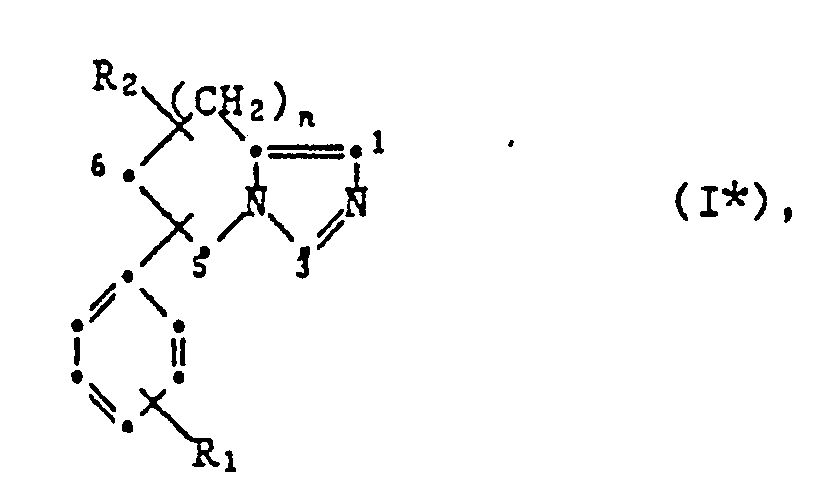


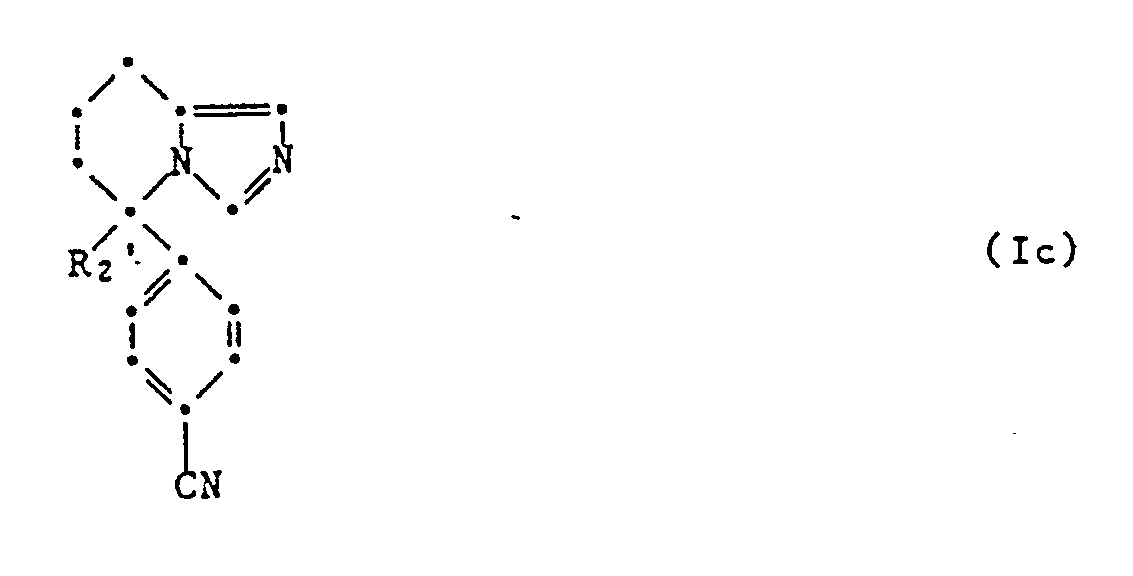
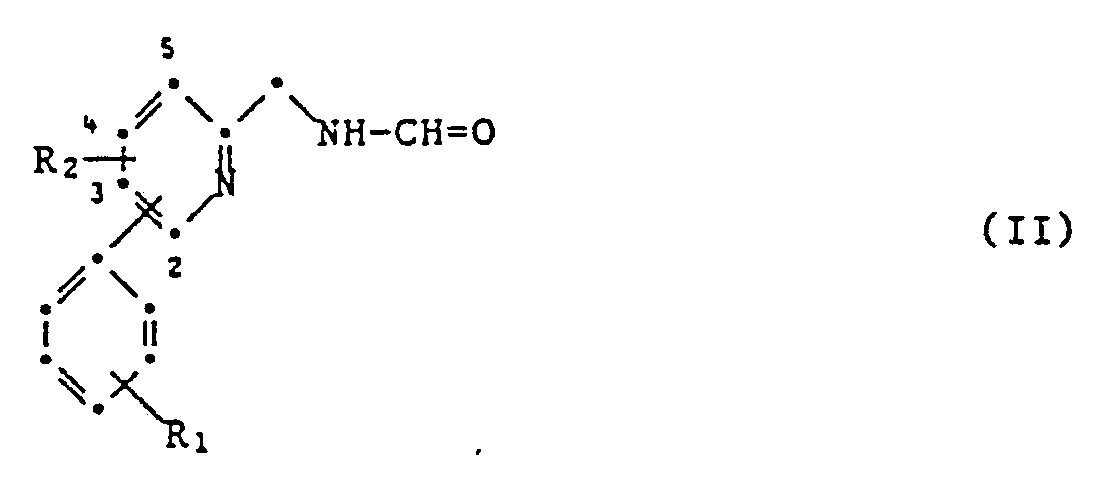

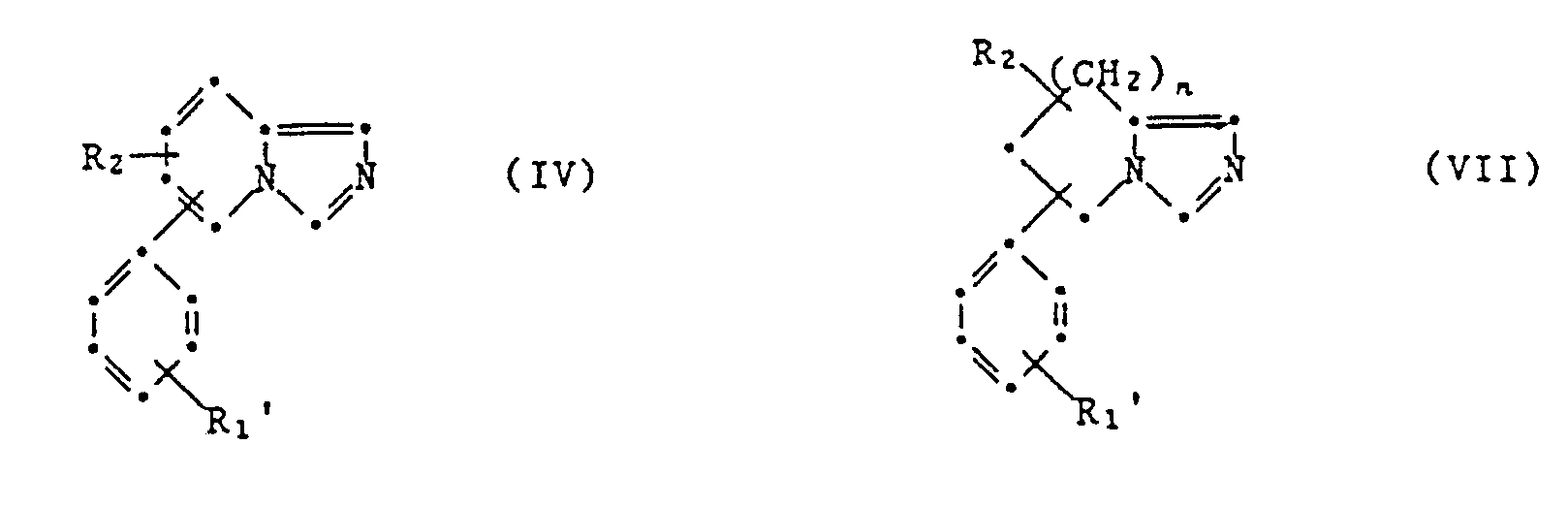


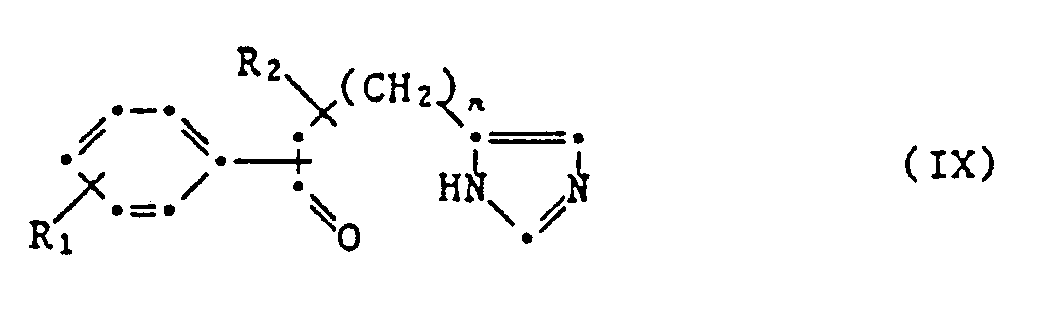


Priority Applications (1)
| Application Number | Priority Date | Filing Date | Title |
|---|---|---|---|
| AT85810279T ATE62415T1 (de) | 1984-06-20 | 1985-06-17 | Substituierte bicyclische verbindungen. |
Applications Claiming Priority (2)
| Application Number | Priority Date | Filing Date | Title |
|---|---|---|---|
| US622421 | 1984-06-20 | ||
| US06/622,421 US4617307A (en) | 1984-06-20 | 1984-06-20 | Substituted imidazo[1,5-A]pyridine derivatives as aromatase inhibitors |
Publications (3)
| Publication Number | Publication Date |
|---|---|
| EP0165904A2 EP0165904A2 (fr) | 1985-12-27 |
| EP0165904A3 EP0165904A3 (en) | 1987-09-09 |
| EP0165904B1 true EP0165904B1 (fr) | 1991-04-10 |
Family
ID=24494112
Family Applications (1)
| Application Number | Title | Priority Date | Filing Date |
|---|---|---|---|
| EP85810279A Expired - Lifetime EP0165904B1 (fr) | 1984-06-20 | 1985-06-17 | Composés substitués bicycliques |
Country Status (31)
| Country | Link |
|---|---|
| US (1) | US4617307A (fr) |
| EP (1) | EP0165904B1 (fr) |
| JP (1) | JPS6112688A (fr) |
| KR (1) | KR900008566B1 (fr) |
| AT (1) | ATE62415T1 (fr) |
| AU (1) | AU589565B2 (fr) |
| BG (7) | BG60262B2 (fr) |
| CA (1) | CA1276633C (fr) |
| CS (1) | CS268672B2 (fr) |
| CY (1) | CY1750A (fr) |
| DD (1) | DD237510A5 (fr) |
| DE (1) | DE3582452D1 (fr) |
| DK (1) | DK170302B1 (fr) |
| DZ (1) | DZ799A1 (fr) |
| ES (6) | ES8702406A1 (fr) |
| FI (1) | FI80694C (fr) |
| GR (1) | GR851487B (fr) |
| HK (1) | HK23494A (fr) |
| HU (1) | HU202529B (fr) |
| IE (1) | IE58070B1 (fr) |
| IL (1) | IL75546A (fr) |
| MA (1) | MA20459A1 (fr) |
| MX (1) | MX9203369A (fr) |
| NO (1) | NO162467C (fr) |
| NZ (1) | NZ212483A (fr) |
| PH (1) | PH23390A (fr) |
| PL (6) | PL145104B1 (fr) |
| PT (1) | PT80661B (fr) |
| RO (1) | RO92583A (fr) |
| SU (6) | SU1433413A3 (fr) |
| ZA (1) | ZA854615B (fr) |
Families Citing this family (66)
| Publication number | Priority date | Publication date | Assignee | Title |
|---|---|---|---|---|
| US5428160A (en) * | 1982-12-21 | 1995-06-27 | Ciba-Geigy Corporation | Substituted imidazo[5-a]pyridine derviatives and other substituted bicyclic derivatives |
| US4889861A (en) * | 1982-12-21 | 1989-12-26 | Ciba-Geigy Corp. | Substituted imidazo[1,5-a]pyridine derivatives and other substituted bicyclic derivatives and their use as aromatase inhibitors |
| US4728645A (en) * | 1982-12-21 | 1988-03-01 | Ciba-Geigy Corporation | Substituted imidazo[1,5-A]pyridine derivatives and other substituted bicyclic derivatives, useful as aromatase inhibitors |
| GB8510541D0 (en) * | 1985-04-25 | 1985-05-30 | Wyeth John & Brother Ltd | Heterocyclic compounds |
| US5171858A (en) * | 1985-06-05 | 1992-12-15 | Schering A.G. | Preparation of certain 5,6-dihydro-8-phenyl-imidazo[1,5-a]pyridines |
| US4937250A (en) * | 1988-03-07 | 1990-06-26 | Ciba-Geigy Corporation | Alpha-heterocycle substituted tolunitriles |
| US4749713A (en) * | 1986-03-07 | 1988-06-07 | Ciba-Geigy Corporation | Alpha-heterocycle substituted tolunitriles |
| US4978672A (en) * | 1986-03-07 | 1990-12-18 | Ciba-Geigy Corporation | Alpha-heterocyclc substituted tolunitriles |
| IL83163A (en) * | 1986-07-18 | 1991-06-10 | Erba Carlo Spa | Cycloalkyl-substituted 4-pyridyl derivatives,their preparation and pharmaceutical compositions containing them |
| GB8820730D0 (en) * | 1988-09-02 | 1988-10-05 | Erba Carlo Spa | Substituted 5 6 7 8-tetrahydroimidazo/1.5-a/pyridines & process for their preparation |
| US5057521A (en) * | 1988-10-26 | 1991-10-15 | Ciba-Geigy Corporation | Use of bicyclic imidazole compounds for the treatment of hyperaldosteronism |
| CA2026792A1 (fr) * | 1989-11-01 | 1991-05-02 | Michael N. Greco | Derives de substitution (6,7-dihydro-5h-pyrrolo[1,2-c]imidazol-5-yl) et (5,6,7,8-tetrahydro-imidazo[1,5-a]pyridin-5-yl) du 1h-benzotriazole |
| US5066656A (en) * | 1989-11-01 | 1991-11-19 | Janssen Pharmaceutica N.V. | Pharmacologically active (6,7-dihydro-5H-pyrrolo[1,2-c]imidazol-5-yl)- and (5,6,7,8-tetrahydroimidazo[1,5-a]pyridin-5-yl) substituted 1H-benzotriazole derivatives |
| MTP1076B (en) * | 1990-01-12 | 1991-09-30 | Ciba Geigy Ag | Hemihydrate |
| US5162337A (en) * | 1990-10-05 | 1992-11-10 | Merck & Co., Inc. | Animal growth promotion |
| CA2066369A1 (fr) * | 1991-04-19 | 1992-10-20 | Alex Elbrecht | Methode de regulation des caracteristiques chez les poissons |
| CH683151A5 (de) * | 1991-04-24 | 1994-01-31 | Ciba Geigy Ag | Antikonzeption bei weiblichen Primaten ohne Beeinflussung des menstruellen Zyklus. |
| JPH05176659A (ja) * | 1991-04-26 | 1993-07-20 | Merck & Co Inc | 家禽における雌性表現型を転換するために抗ミュラー管ホルモンを単独またはアロマターゼ阻害剤と組合せて使用する方法 |
| AU2356195A (en) * | 1994-04-14 | 1995-11-10 | Sepracor, Inc. | Treating estrogen-dependent diseases with (-)-fadrozole |
| EP0684235A1 (fr) * | 1994-05-27 | 1995-11-29 | Mochida Pharmaceutical Co., Ltd. | Dérivés d'azolylméthyl-phényle présentant une activé inhibitant l'aromatase |
| DE4432106A1 (de) * | 1994-09-09 | 1996-03-14 | Hoechst Ag | Mit Heterocyclen-N-Oxid-substituierte Benzoylguanidine, Verfahren zu ihrer Herstellung, ihre Verwendung als Medikament oder Diagnostikum, sie enthaltendes Medikament sowie Zwischenprodukte zu ihrer Herstellung |
| US6858598B1 (en) | 1998-12-23 | 2005-02-22 | G. D. Searle & Co. | Method of using a matrix metalloproteinase inhibitor and one or more antineoplastic agents as a combination therapy in the treatment of neoplasia |
| US6833373B1 (en) | 1998-12-23 | 2004-12-21 | G.D. Searle & Co. | Method of using an integrin antagonist and one or more antineoplastic agents as a combination therapy in the treatment of neoplasia |
| US8168616B1 (en) | 2000-11-17 | 2012-05-01 | Novartis Ag | Combination comprising a renin inhibitor and an angiotensin receptor inhibitor for hypertension |
| DE60309887T2 (de) * | 2002-07-30 | 2007-05-16 | Novartis Ag | Kombination von einem aromatasehemmer mit einem bisphosphonat |
| ES2270143T3 (es) * | 2002-08-07 | 2007-04-01 | Novartis Ag | Compuestos organicos como agentes para el tratamiento de condiciones mediadas por aldosterona. |
| ES2305520T3 (es) * | 2002-11-18 | 2008-11-01 | Novartis Ag | Derivados de imidazo(1,5a)piridina y metodos para tratar enfermedades mediadas por aldosterona. |
| WO2005007627A1 (fr) * | 2003-07-18 | 2005-01-27 | Nihon Nohyaku Co., Ltd. | Derive de phenylpyridine, produit intermediaire correspondant, et herbicide contenant ledit derive de phenylpyridine en tant qu'ingredient actif |
| GB0327839D0 (en) | 2003-12-01 | 2003-12-31 | Novartis Ag | Organic compounds |
| RU2426532C2 (ru) | 2004-03-17 | 2011-08-20 | Новартис Аг | Применение органических соединений |
| AR049126A1 (es) * | 2004-05-28 | 2006-06-28 | Speedel Experimenta Ag | Derivados de 5, 6, 7, 8 - tetrahidroimidazo[1,5a]piridina con actividad inhibitoria de la aldosterona sintasa, composiciones farmaceuticas que los contienen y su uso en la preparacion de medicamentos para el tratamiento del hiperaldosterismo y del sindrome de cushing. |
| US7612088B2 (en) * | 2004-05-28 | 2009-11-03 | Speedel Experimenta Ag | Heterocyclic compounds and their use as aldosterone synthase inhibitors |
| GT200600381A (es) | 2005-08-25 | 2007-03-28 | Compuestos organicos | |
| EP1842543A1 (fr) | 2006-04-05 | 2007-10-10 | Speedel Pharma AG | Composition pharmaceutique comprennant un inhibiteur de l'aldosteron synthase et un antagoniste de recepteur mineralcorticoide |
| WO2007139992A2 (fr) * | 2006-05-26 | 2007-12-06 | Novartis Ag | ALDOSTÉRONE SYNTHASE ET/OU INHIBITEURS DE LA 11β-HYDROXYLASE |
| CA2657258A1 (fr) | 2006-07-20 | 2008-01-24 | Novartis Ag | Composes organiques |
| WO2008027284A1 (fr) * | 2006-08-25 | 2008-03-06 | Novartis Ag | Dérivés d'imidazole fusionnés destinés à traiter les troubles médiés par l'aldostérone synthase et/ou par 11-beta-hydroxylase et/ou aromatase |
| EP2120938A4 (fr) * | 2006-12-20 | 2010-12-08 | Merck Sharp & Dohme | Analogues de l'imidazopyridine en tant que modulateurs du récepteur de cb2, utilisables pour le traitement de la douleur et des maladies respiratoires et non respiratoires |
| PL2207775T3 (pl) | 2007-11-05 | 2012-08-31 | Novartis Ag | Pochodne 4-benzyloamino-1-karboksyacylo-piperydyny jako inhibitory CETP użyteczne do leczenia chorób, takich jak hiperlipidemia lub stwardnienie tętnic |
| AU2008333272B2 (en) | 2007-12-03 | 2012-03-29 | Novartis Ag | 1,2-disubstituted-4-benzylamino-pyrrolidine derivatives as CETP inhibitors useful for the treatment of diseases such as hyperli pidemia or arteriosclerosis |
| EP2095819A1 (fr) * | 2008-02-28 | 2009-09-02 | Maastricht University | Dérivés de N-benzyle imidazole et leur utilisation comme inhibiteurs de l'aldosterone synthase |
| PL2435409T3 (pl) | 2009-05-28 | 2015-01-30 | Novartis Ag | Podstawione pochodne aminopropionowe jako inhibitory neprylizyny |
| CA2763565A1 (fr) | 2009-05-28 | 2010-12-02 | Novartis Ag | Derives aminobutyriques substitues en tant qu'inhibiteurs de neprilysine |
| JO2967B1 (en) | 2009-11-20 | 2016-03-15 | نوفارتس ايه جي | Acetic acid derivatives of carbamoyl methyl amino are substituted as new NEP inhibitors |
| US8877815B2 (en) | 2010-11-16 | 2014-11-04 | Novartis Ag | Substituted carbamoylcycloalkyl acetic acid derivatives as NEP |
| US8673974B2 (en) | 2010-11-16 | 2014-03-18 | Novartis Ag | Substituted amino bisphenyl pentanoic acid derivatives as NEP inhibitors |
| AR086665A1 (es) | 2011-06-14 | 2014-01-15 | Lilly Co Eli | Inhibidor de aldosterona sintasa y composiciones farmaceuticas |
| CN103648495A (zh) | 2011-07-08 | 2014-03-19 | 诺华股份有限公司 | 在高甘油三酯对象中治疗动脉粥样硬化的方法 |
| AU2013209952B2 (en) * | 2012-01-17 | 2016-09-01 | Recordati Ag | New forms and salts of a dihydropyrrolo(1,2-c)imidazolyl aldosterone synthase or aromatase inhibitor |
| UY35144A (es) | 2012-11-20 | 2014-06-30 | Novartis Ag | Miméticos lineales sintéticos de apelina para el tratamiento de insuficiencia cardiaca |
| SG11201506018PA (en) | 2013-02-14 | 2015-08-28 | Novartis Ag | Substituted bisphenyl butanoic phosphonic acid derivatives as nep (neutral endopeptidase) inhibitors |
| EP3024845A1 (fr) | 2013-07-25 | 2016-06-01 | Novartis AG | Polypeptides cycliques pour le traitement de l'insuffisance cardiaque |
| WO2015013169A2 (fr) | 2013-07-25 | 2015-01-29 | Novartis Ag | Bioconjugués de polypeptides d'apeline synthétiques |
| SG11201704758XA (en) | 2015-01-23 | 2017-08-30 | Novartis Ag | Synthetic apelin fatty acid conjugates with improved half-life |
| KR102559242B1 (ko) * | 2015-01-29 | 2023-07-25 | 리코다티 아게 | 축합된 이미다졸로 유도체의 제조 방법 |
| GB201511790D0 (en) | 2015-07-06 | 2015-08-19 | Iomet Pharma Ltd | Pharmaceutical compound |
| JP2016074729A (ja) * | 2015-12-31 | 2016-05-12 | 国立大学法人 千葉大学 | イミダゾリウム塩及びそれを用いた不斉合成触媒並びにイミダゾリウム塩の製造方法 |
| JOP20190086A1 (ar) | 2016-10-21 | 2019-04-18 | Novartis Ag | مشتقات نافثيريدينون جديدة واستخدامها في معالجة عدم انتظام ضربات القلب |
| WO2018078049A1 (fr) | 2016-10-27 | 2018-05-03 | Damian Pharma Ag | Inhibiteur de l'aldostérone synthase |
| SG11201903803UA (en) * | 2016-10-27 | 2019-05-30 | Damian Pharma Ag | Aldosterone synthase inhibitor |
| UY38072A (es) | 2018-02-07 | 2019-10-01 | Novartis Ag | Compuestos derivados de éster butanoico sustituido con bisfenilo como inhibidores de nep, composiciones y combinaciones de los mismos |
| WO2019211394A1 (fr) | 2018-05-03 | 2019-11-07 | Damian Pharma Ag | R-fadrozole destiné à être utilisé dans le traitement de l'aldostéronisme |
| UY38485A (es) | 2018-11-27 | 2020-06-30 | Novartis Ag | Compuestos tetrámeros cíclicos como inhibidores de proproteína convertasa subtilisina/kexina tipo 9 (pcsk9), método de tratamiento, uso y su preparación |
| JP7657151B2 (ja) | 2018-11-27 | 2025-04-04 | ノバルティス アーゲー | 代謝性障害の処置のためのプロタンパク質コンバターゼスブチリシン/ケキシン9型(pcsk9)阻害剤としての環状ペプチド |
| WO2020110008A1 (fr) | 2018-11-27 | 2020-06-04 | Novartis Ag | Composés pentamères cycliques servant d'inhibiteurs de proprotéine convertase subtilisine/kexine de type 9 (pcsk9) pour le traitement d'un trouble métabolique |
| WO2023084449A1 (fr) | 2021-11-12 | 2023-05-19 | Novartis Ag | Dérivés diaminocyclopentylpyridines pour le traitement d'une maladie ou d'un trouble |
Family Cites Families (8)
| Publication number | Priority date | Publication date | Assignee | Title |
|---|---|---|---|---|
| JPS5124517B1 (fr) * | 1971-03-15 | 1976-07-24 | ||
| FR2449689A1 (fr) * | 1979-02-20 | 1980-09-19 | Logeais Labor Jacques | Nouveaux derives condenses de pyrrolidine ou de piperidine, leur procede de preparation et leurs applications en therapeutique |
| CA1250844A (fr) * | 1981-06-22 | 1989-03-07 | Neville Ford | Derives de substitution de ¬1,5-a|pyridines; methode de preparation; compositions pharmaceutiques renfermant ces derives et leur utilisation comme medicaments |
| US4444775A (en) * | 1981-06-22 | 1984-04-24 | Ciba-Geigy Corporation | Substituted imidazo[1,5-A]pyridines |
| US4361567A (en) * | 1981-10-05 | 1982-11-30 | Schering Corporation | Treatment of peptic ulcer disease |
| US4409226A (en) * | 1981-10-05 | 1983-10-11 | Schering Corporation | Imidazo[1,5-a]pyridines |
| US4588732A (en) * | 1982-12-21 | 1986-05-13 | Ciba-Geigy Corporation | Certain imidazo(1,5-a)pyridine derivatives and their use as thromboxane synthetase inhibitors |
| US4470986A (en) * | 1982-12-21 | 1984-09-11 | Ciba-Geigy Corporation | Certain imidazo (1,5-A) pyridine aliphatic carboxylic acid derivatives and their use as selective thromboxane inhibitors |
-
1984
- 1984-06-20 US US06/622,421 patent/US4617307A/en not_active Expired - Lifetime
-
1985
- 1985-06-17 DE DE8585810279T patent/DE3582452D1/de not_active Expired - Lifetime
- 1985-06-17 AT AT85810279T patent/ATE62415T1/de not_active IP Right Cessation
- 1985-06-17 FI FI852399A patent/FI80694C/fi not_active IP Right Cessation
- 1985-06-17 EP EP85810279A patent/EP0165904B1/fr not_active Expired - Lifetime
- 1985-06-18 DZ DZ850130A patent/DZ799A1/fr active
- 1985-06-18 CS CS854449A patent/CS268672B2/cs not_active IP Right Cessation
- 1985-06-18 CA CA000484263A patent/CA1276633C/fr not_active Expired - Lifetime
- 1985-06-18 IL IL75546A patent/IL75546A/xx not_active IP Right Cessation
- 1985-06-18 GR GR851487A patent/GR851487B/el unknown
- 1985-06-19 IE IE152085A patent/IE58070B1/en not_active IP Right Cessation
- 1985-06-19 BG BG70749A patent/BG60262B2/xx unknown
- 1985-06-19 DK DK277685A patent/DK170302B1/da not_active IP Right Cessation
- 1985-06-19 NO NO852474A patent/NO162467C/no unknown
- 1985-06-19 NZ NZ212483A patent/NZ212483A/xx unknown
- 1985-06-19 PH PH32427A patent/PH23390A/en unknown
- 1985-06-19 HU HU852417A patent/HU202529B/hu unknown
- 1985-06-19 ES ES544344A patent/ES8702406A1/es not_active Expired
- 1985-06-19 KR KR1019850004323A patent/KR900008566B1/ko not_active Expired
- 1985-06-19 RO RO85119210A patent/RO92583A/fr unknown
- 1985-06-19 ZA ZA854615A patent/ZA854615B/xx unknown
- 1985-06-19 AU AU43857/85A patent/AU589565B2/en not_active Expired
- 1985-06-19 SU SU853917403A patent/SU1433413A3/ru active
- 1985-06-19 PT PT80661A patent/PT80661B/pt unknown
- 1985-06-19 MA MA20686A patent/MA20459A1/fr unknown
- 1985-06-20 PL PL1985259306A patent/PL145104B1/pl unknown
- 1985-06-20 JP JP60133167A patent/JPS6112688A/ja active Granted
- 1985-06-20 PL PL1985259304A patent/PL145348B1/pl unknown
- 1985-06-20 PL PL1985254099A patent/PL145087B1/pl unknown
- 1985-06-20 PL PL1985259303A patent/PL145103B1/pl unknown
- 1985-06-20 DD DD85277587A patent/DD237510A5/de not_active IP Right Cessation
- 1985-06-20 PL PL1985259307A patent/PL145105B1/pl unknown
- 1985-06-20 PL PL1985259305A patent/PL145814B1/pl unknown
-
1986
- 1986-05-30 ES ES555538A patent/ES8802048A1/es not_active Expired
- 1986-05-30 ES ES555539A patent/ES8802155A1/es not_active Expired
- 1986-05-30 ES ES555541A patent/ES8800681A1/es not_active Expired
- 1986-05-30 ES ES555540A patent/ES8801262A1/es not_active Expired
- 1986-05-30 ES ES555542A patent/ES8802049A1/es not_active Expired
- 1986-07-02 SU SU864027755A patent/SU1436879A3/ru active
- 1986-07-02 SU SU864027756A patent/SU1482530A3/ru active
- 1986-07-02 SU SU864027754A patent/SU1436878A3/ru active
- 1986-07-02 SU SU864027758A patent/SU1443802A3/ru active
- 1986-07-02 SU SU864027757A patent/SU1436880A3/ru active
-
1992
- 1992-06-25 MX MX9203369A patent/MX9203369A/es unknown
- 1992-10-22 BG BG097010A patent/BG60306B2/bg unknown
- 1992-10-22 BG BG097012A patent/BG60352B2/bg unknown
- 1992-10-22 BG BG097013A patent/BG60353B2/bg unknown
- 1992-10-22 BG BG097011A patent/BG60307B2/xx unknown
- 1992-10-22 BG BG097009A patent/BG60305B2/bg unknown
-
1993
- 1993-11-11 BG BG098213A patent/BG60402B2/bg unknown
-
1994
- 1994-03-17 HK HK234/94A patent/HK23494A/xx not_active IP Right Cessation
- 1994-06-03 CY CY175094A patent/CY1750A/xx unknown
Non-Patent Citations (3)
| Title |
|---|
| Brodie et al , Endocrinology, vol.104, pp 118-121,(1979) * |
| Camacho et al., JAMA, vol. 202, pp 114-120 (1967) * |
| Foster et al., Journal Med. Chem., vol. 26, pp. 50-54 (1983) * |
Also Published As
Similar Documents
| Publication | Publication Date | Title |
|---|---|---|
| EP0165904A2 (fr) | Composés substitués bicycliques | |
| EP0059391B1 (fr) | Imidazodiazépines, procédé pour leur préparation et compositions pharmaceutiques les contenant | |
| EP0705831B1 (fr) | Dérivés de cycloalkano-indoles et -azaindoles | |
| EP0150040B1 (fr) | Dérivés de imidazobenzodiazépine | |
| EP0778271A2 (fr) | Composés benzo-hétérocycliques à substituant aminoalkyle | |
| EP0059386A2 (fr) | Imidazodiazépines, produits intermédiaires et procédé pour leur préparation ainsi que médicaments les contenant | |
| JP3158103B2 (ja) | 神経伝達物質放出増強剤としての新規な環式アミド類 | |
| DE4242675A1 (de) | Neue Hydroxyiminoalkylindolcarbonsäure-Derivate, ihre Herstellung und Verwendung | |
| EP0271795A2 (fr) | Dérivés de l'octahydro-10-oxo-6H-pyridazo[1,2-a][112]diazépine, intermédiaires et procédé pour leur préparation ainsi que médicament les contenant | |
| EP0100906B1 (fr) | Dérivés tri- et tétracycliques des acides imidazo(1,5-a)(1,4)benzodiazépine carboxyliques | |
| EP0058341A1 (fr) | Dérivés de l'azépine, leur préparation et médicaments les contenant | |
| EP0673369A1 (fr) | Benzazepinones substituees | |
| CH646696A5 (de) | Dibenzazepine, ihre herstellung und verwendung. | |
| EP0298921B1 (fr) | 1,2-Benzisoxazoles et 1,2-benzisothiazoles | |
| DD208153A5 (de) | Verfahren zur herstellung von benzodiazepinderivaten | |
| DE68905363T2 (de) | Heterotetracyclische laktamderivate, verfahren zu ihrer herstellung und pharmazeutische zubereitungen, die sie enthalten. | |
| EP0285837A1 (fr) | Dérivés d'imidazodiazépine | |
| DE2736652C2 (fr) | ||
| EP0001585B1 (fr) | Dérivés de pipérazino-pyrrolobenzodiazépine, leurs procédés de préparation et compositions pharmaceutiques les contenant | |
| DE2346466A1 (de) | Neue pyrazolopyridobenzodiazepinone mit ihren salzen | |
| DE3854343T2 (de) | Neuroschützende Cyclooctanmittel. | |
| EP0273168A1 (fr) | Dérivés de triazaspirodécanylméthylindolone | |
| DD220307A5 (de) | Verfahren zur herstellung von polycyclische carbonsaeureverbindungen | |
| EP0357043A2 (fr) | Dérivés d'imidazodiazépine | |
| EP0081461A2 (fr) | Imidazobenzodiazépines, procédé pour leur préparation, préparations pharmaceutiques contenant ces composés et leur utilisation thérapeutique |
Legal Events
| Date | Code | Title | Description |
|---|---|---|---|
| PUAI | Public reference made under article 153(3) epc to a published international application that has entered the european phase |
Free format text: ORIGINAL CODE: 0009012 |
|
| 17P | Request for examination filed |
Effective date: 19850619 |
|
| AK | Designated contracting states |
Designated state(s): AT BE CH DE FR GB IT LI LU NL SE |
|
| PUAL | Search report despatched |
Free format text: ORIGINAL CODE: 0009013 |
|
| AK | Designated contracting states |
Kind code of ref document: A3 Designated state(s): AT BE CH DE FR GB IT LI LU NL SE |
|
| 17Q | First examination report despatched |
Effective date: 19891117 |
|
| GRAA | (expected) grant |
Free format text: ORIGINAL CODE: 0009210 |
|
| AK | Designated contracting states |
Kind code of ref document: B1 Designated state(s): AT BE CH DE FR GB IT LI LU NL SE |
|
| REF | Corresponds to: |
Ref document number: 62415 Country of ref document: AT Date of ref document: 19910415 Kind code of ref document: T |
|
| REF | Corresponds to: |
Ref document number: 3582452 Country of ref document: DE Date of ref document: 19910516 |
|
| GBT | Gb: translation of ep patent filed (gb section 77(6)(a)/1977) | ||
| ITF | It: translation for a ep patent filed | ||
| ET | Fr: translation filed | ||
| PLBE | No opposition filed within time limit |
Free format text: ORIGINAL CODE: 0009261 |
|
| STAA | Information on the status of an ep patent application or granted ep patent |
Free format text: STATUS: NO OPPOSITION FILED WITHIN TIME LIMIT |
|
| 26N | No opposition filed | ||
| EPTA | Lu: last paid annual fee | ||
| EAL | Se: european patent in force in sweden |
Ref document number: 85810279.1 |
|
| REG | Reference to a national code |
Ref country code: CH Ref legal event code: PFA Free format text: CIBA-GEIGY AG TRANSFER- NOVARTIS AG |
|
| REG | Reference to a national code |
Ref country code: GB Ref legal event code: 732E |
|
| NLS | Nl: assignments of ep-patents |
Owner name: NOVARTIS AG |
|
| REG | Reference to a national code |
Ref country code: FR Ref legal event code: TP |
|
| REG | Reference to a national code |
Ref country code: GB Ref legal event code: IF02 |
|
| PGFP | Annual fee paid to national office [announced via postgrant information from national office to epo] |
Ref country code: FR Payment date: 20040507 Year of fee payment: 20 |
|
| PGFP | Annual fee paid to national office [announced via postgrant information from national office to epo] |
Ref country code: NL Payment date: 20040511 Year of fee payment: 20 Ref country code: BE Payment date: 20040511 Year of fee payment: 20 Ref country code: AT Payment date: 20040511 Year of fee payment: 20 |
|
| PGFP | Annual fee paid to national office [announced via postgrant information from national office to epo] |
Ref country code: SE Payment date: 20040518 Year of fee payment: 20 Ref country code: DE Payment date: 20040518 Year of fee payment: 20 Ref country code: CH Payment date: 20040518 Year of fee payment: 20 |
|
| PGFP | Annual fee paid to national office [announced via postgrant information from national office to epo] |
Ref country code: GB Payment date: 20040520 Year of fee payment: 20 |
|
| PGFP | Annual fee paid to national office [announced via postgrant information from national office to epo] |
Ref country code: LU Payment date: 20040521 Year of fee payment: 20 |
|
| PG25 | Lapsed in a contracting state [announced via postgrant information from national office to epo] |
Ref country code: GB Free format text: LAPSE BECAUSE OF EXPIRATION OF PROTECTION Effective date: 20050616 |
|
| PG25 | Lapsed in a contracting state [announced via postgrant information from national office to epo] |
Ref country code: NL Free format text: LAPSE BECAUSE OF EXPIRATION OF PROTECTION Effective date: 20050617 |
|
| BE20 | Be: patent expired |
Owner name: *NOVARTIS A.G. Effective date: 20050617 |
|
| REG | Reference to a national code |
Ref country code: GB Ref legal event code: PE20 |
|
| REG | Reference to a national code |
Ref country code: CH Ref legal event code: PL |
|
| NLV7 | Nl: ceased due to reaching the maximum lifetime of a patent |
Effective date: 20050617 |
|
| EUG | Se: european patent has lapsed | ||
| BE20 | Be: patent expired |
Owner name: *NOVARTIS A.G. Effective date: 20050617 |