EP0171288A2 - Verfahren zur magnetischen Aufzeichnung - Google Patents
Verfahren zur magnetischen Aufzeichnung Download PDFInfo
- Publication number
- EP0171288A2 EP0171288A2 EP85305614A EP85305614A EP0171288A2 EP 0171288 A2 EP0171288 A2 EP 0171288A2 EP 85305614 A EP85305614 A EP 85305614A EP 85305614 A EP85305614 A EP 85305614A EP 0171288 A2 EP0171288 A2 EP 0171288A2
- Authority
- EP
- European Patent Office
- Prior art keywords
- signal
- recording
- track
- recorded
- dropout
- Prior art date
- Legal status (The legal status is an assumption and is not a legal conclusion. Google has not performed a legal analysis and makes no representation as to the accuracy of the status listed.)
- Withdrawn
Links
Images


Classifications
-
- G—PHYSICS
- G11—INFORMATION STORAGE
- G11B—INFORMATION STORAGE BASED ON RELATIVE MOVEMENT BETWEEN RECORD CARRIER AND TRANSDUCER
- G11B20/00—Signal processing not specific to the method of recording or reproducing; Circuits therefor
- G11B20/10—Digital recording or reproducing
- G11B20/18—Error detection or correction; Testing, e.g. of drop-outs
- G11B20/1883—Methods for assignment of alternate areas for defective areas
-
- G—PHYSICS
- G11—INFORMATION STORAGE
- G11B—INFORMATION STORAGE BASED ON RELATIVE MOVEMENT BETWEEN RECORD CARRIER AND TRANSDUCER
- G11B20/00—Signal processing not specific to the method of recording or reproducing; Circuits therefor
- G11B20/02—Analogue recording or reproducing
- G11B20/06—Angle-modulation recording or reproducing
-
- G—PHYSICS
- G11—INFORMATION STORAGE
- G11B—INFORMATION STORAGE BASED ON RELATIVE MOVEMENT BETWEEN RECORD CARRIER AND TRANSDUCER
- G11B5/00—Recording by magnetisation or demagnetisation of a record carrier; Reproducing by magnetic means; Record carriers therefor
- G11B5/012—Recording on, or reproducing or erasing from, magnetic disks
-
- G—PHYSICS
- G11—INFORMATION STORAGE
- G11B—INFORMATION STORAGE BASED ON RELATIVE MOVEMENT BETWEEN RECORD CARRIER AND TRANSDUCER
- G11B5/00—Recording by magnetisation or demagnetisation of a record carrier; Reproducing by magnetic means; Record carriers therefor
- G11B5/02—Recording, reproducing, or erasing methods; Read, write or erase circuits therefor
-
- H—ELECTRICITY
- H04—ELECTRIC COMMUNICATION TECHNIQUE
- H04N—PICTORIAL COMMUNICATION, e.g. TELEVISION
- H04N1/00—Scanning, transmission or reproduction of documents or the like, e.g. facsimile transmission; Details thereof
- H04N1/21—Intermediate information storage
- H04N1/2104—Intermediate information storage for one or a few pictures
- H04N1/2112—Intermediate information storage for one or a few pictures using still video cameras
-
- H—ELECTRICITY
- H04—ELECTRIC COMMUNICATION TECHNIQUE
- H04N—PICTORIAL COMMUNICATION, e.g. TELEVISION
- H04N9/00—Details of colour television systems
- H04N9/79—Processing of colour television signals in connection with recording
- H04N9/87—Regeneration of colour television signals
- H04N9/88—Signal drop-out compensation
-
- G—PHYSICS
- G11—INFORMATION STORAGE
- G11B—INFORMATION STORAGE BASED ON RELATIVE MOVEMENT BETWEEN RECORD CARRIER AND TRANSDUCER
- G11B2220/00—Record carriers by type
- G11B2220/20—Disc-shaped record carriers
-
- H—ELECTRICITY
- H04—ELECTRIC COMMUNICATION TECHNIQUE
- H04N—PICTORIAL COMMUNICATION, e.g. TELEVISION
- H04N2101/00—Still video cameras
Definitions
- This invention relates to a method of magnetic recording, and more particularly to improvements made in the recording method so as to exclude dropout from a reproduced output.
- This magnetic disk carema comprises an integral combination of an image pick-up device such as a solid-state image pick-up element or an image pick-up tube and a magnetic disk type recording device.
- an optical image of an object 2 is picked up in the form of a still picture by an image pick-up unit 3 through a lens 1, and, after a raster scan type picture signal generated from the image pick-up unit 3 is subjected to signal processing including frequency modulation in a signal processing circuit 6, an output signal of the signal processing circuit 6 is applied through a recording amplifier 7 to a recording magnetic head 5 to be recorded on a circular track on a rotating magnetic disk 4.
- the magnetic disk 4 is rotated by a drive unit 8, and a position of the magnetic head 5 on the magnetic disk 4 is determined by a head positionning unit 9.
- a system for reproducing such a magnetically recorded still picture comprises an integral combination of a magnetic disk type reproducing device and picture display unit such as a television set or a hard copy dispensing unit such as a printer. More precisely, as shown in Fig.6, a predetermined track on a rotating magnetic disk 4 is repeately scanned by a reproducing magnetic head 10, and, after an output signal of the magnetic head 10 is applied through a reproducing amplifier 14 to a signal processing circuit 15 to be subject to signal processing including demodulation, an output signal of t-he signal processing circuit 15 is applied to, for example, a television set 11 to display a visible picture or a soft copy on its display screen. Alternatively, the output signal of the signal processing circuit. 15 is applied to a printer 12 to be printed out on a recording sheet 13 to provide a hard copy.
- the magnetic disk 4 is rotated by a drive unit 16, and a position of the magnetic head 10 on the disk 4 is determined by a head positionning unit 17.
- occurrence of such dropout is mainly attributable to various defects inherent to a magnetic recording medium, for example, an uneven surface or surface roughness of a supporting base, scars present on the surface of a magnetic material layer and attachment of dust to the surface of the magnetic material layer. Therefore, once dropout has occurred on a track, the dropout would not disappear in most cases even when the still picture signal is recorded again on the same track.
- Japanese patent Application Lay-Open Print No.51-82516(1976) discloses an idea according to which "when a certain still picture signal is recorded on a certain track, the recorded signal is immediately reproduced, and, if dropout is detected in the reproduced output, the still picture signal recorded immediately before is recorded again on the next adjacent track.” Also, this Lay-Open Print discloses an idea according to which "an address number for the purpose of track search is not recorded on the track from which dropout has been detected.” Thus, in the playback mode, a track including dropout is automatically skipped so that dropout-free normal pictures only can be successinely reproduced.
- the proposed recording method is effectively applicable to the case where many franes of photographic pictures recorded on a conventional silver-halide photographic film or printed on sensitized papers are re-recorded on a magnetic recording medium in a desired order so that the magnetic recording medium replaces on a photographic album.
- a merchant now engaging in the D.P.E(developing, printing and enlarging) business will expect that a business of making an album of pictures using a magnetic recording medium will appear in future.
- arranging many frames of photographic pictures in the order specified by the user is required, in addition to the guarantee of the good picture quality. Therefore, the aforementioned method of magnetic recording dealing with the problem of occurrence of dropout is quite useful.
- a method of magnetic recording an FM recording signal on a magnetic recording medium so that, for the purpose of tracking, a signal having a predetermined frequency is extracted from the output of a reproducing magnetic head, and said reproducing magnetic head can be brought to a position where the amplitude of said signal of predetermined frequency becomes substantially maximum
- said method comprising the steps of recording an FM recording signal on a track of said magnetic recording medium, reproducing said recorded signal immediately to detect the presence or absence of dropout in said track, recording a signal having a frequency other than said predetermined frequency on the same track in a relation superposed on said recorded signal when the result of detection proves that said reproduced signal from said track includes dropout, and recording the same recording signal on another track again.
- a signal having a frequency other than a predetermined frequency is recorded on the same track in a relation superposed on the recorded picture signal.
- This predetermined frequency is such that the so-called climbing servo action is carried out so that the amplitude of the reproduced signal becomes substantially maximum.
- the tracking signal cannot be derived from the track in the playback mode, and the existence of that track is ignored.
- the still picture signal having the same contents is then recorded on another track which may be the next adjacent track.
- the magnetic head is accurately positioned on the latter track, so that reproduction of the still picture of good quality can be attained without being adversely affected by the presence of the track on which the dropout has occurred.
- a frequency component (a predetermined frequency component corresponding to the sync tip level or pedestal level) is necessarily included in the recorded still picture signal regardless of the picture pattern. Therefore, when the predetermined frequency component is extracted from the output of the reproducing magnetic head, this signal can be used as a tracking signal.
- the reproducing magnetic head can be accurately positioned on the desired track.
- Fig. 1 is a block diagram showing the structure of a recording system magnetically recording still pictures according to a preferred embodiment of the method of the present invention
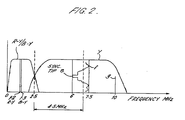
- Fig.2 is a spectrum diagram showing one form of frequency modulation of a color video signal in the present invention
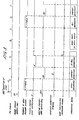
- Fig.3 is a time chart illustrating the operation of the magnetic recording system shown in Fig.1
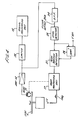
- Fig.4 is a block diagram showing the structure of a reproducing system associated with the recording system shown in Fig.l.
- the magnetic recording system shown in Fig.1 is of the type in which color still picture signals are recorded on circular tracks of a magnetic disk 4 at a rate of one field/one track. Further, two color difference signals R-Y and B-Y are recorded according to the so-called color-difference line sequential FM method in which the two color difference signals R-Y and B-Y are used for frequency modulation of a color subcarrier and alternately recorded at a time internal of 1H, where H is one horizontal scanning period.
- the recording system includes an image pick up unit 3, a magnetic disk 4, a recording magnetic head 5, a signal processing circuit 6, a recording amplifier 7, a disk drive motor 8, a head positionning unit 9, a timing circuit 18 generating a shutter signal 18a, a read command signal 18b, two switch control signals 18c, 18d and a head positionning command signal 18e, an overwriting signal oscillator 19, a PG unit 20 generating one pulse of a PG signal 20a per 360°-rotation of the magnetic disk 4 for detecting the rotation phase of the magnetic disk 4, an image pickup switch SW1, a recording signal change-over switch SW2, a record/playback change-over switch SW3, a reproducing amplifier 21, an envelope detector 22, and a dropout detector 23 generating a dropout detection signal 23a when dropout is detected.
- an image pickup switch SW1 a recording signal change-over switch SW2, a record/playback change-over switch SW3, a reproducing amplifier 21, an envelope detector 22, and a dropout detector 23 generating a dropout detection signal 23
- the shutter signal 18a is generated from the timing circuit 18 to be applied to the image pickup unit 3.
- the image pickup unit 3 makes its image pickup operation.
- a first read command signal 18b is generated from the timing circuit 18 with a predetermined delay time after the appearance of the PG signal 20a from the PG unit 20.
- the switch control signal 18c controls the recording signal change-over switch SW2 in such a manner that the switch SW2 is normally in contact with a contact c but is changed over to make contact with a contact d as soon as dropout is detected.
- the switch control signal 18d controls the record/playback change-over switch SN3 in such a manner that the switch makes contact with a contact REC during recording of a still picture signal, makes contact with a contact PB for the purpose of dropout detection as soon as the recording is completed, and makes contact with the contact REC again as soon as the reproduction for dropout detection is completed.
- the shutter signal 18a is applied from the timing circuit 18 to the image pickup unit 3, and an image corresponding to one filed is picked up.
- a synchronizing signal S In response to the application of the read command signal 18b to the image pickup unit 3 from the timing circuit 18, a synchronizing signal S, a luminance signal Y and two color difference signals R-Y and B-Y corresponding to one filed of the picked-up image are applied from the image pickup unit 3 to the signal processing circuit 6.
- the composite signal is applied to a frequency modulator 6b in which the signal modulates the frequency of a carrier so that the resultant signal has a frequency deviation of, for example, 1.5 MHz as shown in Fig.2.
- the sync tip level e and the white peak f are set at 6 MHz and 7.5 MHz respectively.
- One of the color difference signals R-Y and B-Y for example, the color difference signal R-Y is applied to a frequency modulator 6c in which the signal modulates the frequency of a subcarrier so that the resultant signal has a center frequency of, for example, 1.2 MHz and a frequency deviation of, for example, 0.7 MHz as shown in Fig.2.
- the other color difference signal B-Y is applied to a frequency modulator 6d in which the signal modulates the frequency of a subcarrier so that the resultant signal has a center frequency of, for example, 1.3 MHz and a frequency deviation of, for example, 0.5 MHz as shown in Fig.2.
- the two FM color difference signals are alternately selected by a line sequential switch 6e at a time interval of 1H and are frequency-multiplexed with the FM luminance signal in a composer 6f.
- the line sequential switch 6e includes two contacts a and b which are alternately changed over at a time interval of 1H by a square waveform signal having a frequency of, for example, 1/2 fH(fH: the horizontal scanning frequency) and a duty factor of 50% produced by a timing circuit 6g on the basis of the synchronizing signal S.
- the processed output signal 6h of the composer 6f that is, the color still picture signal is applied through the contact c of the recording signal change-over switch SW2 to the recording amplifier 7 to be subject to current amplification.
- the current-amplified signal is applied through the contact REC of the record/playback change-over switch SW3 to the magnetic head 5 to be recorded on a predetermined track of the magnetic disk 4.
- the contact c of the recording signal change-over switch SW2 is selected by the switch control signal 18c applied from the timing circuit 18, and the contact REC of the record/playback change-over switch SW3 is selected by the switch control signal 18d applied from the timing circuit 18, as shown in Fig.3.
- the change-over switch SW3 is immediately changed over to make contact now with the contact PB, and the signal of one filed recorded on the track is reproduced for the purpose of detection of dropout, if any. That is, the reproduced signal is applied through the reproducing amplifier 21 to the envelope detector 22 to be subject to envelope detection, and the output of the envelope detector 22 is applied to the dropout detector 23.
- the dropout detector 23 checks the level of the applied envelope detection signal during the period of one filed in the playback mode and detects the presence or absence of dropout depending on whether or not a level lower than a predetermined level continues for more than a predetermined period of time.
- the dropout detector 23 decides that dropout has occurred.
- the method for detection and decision of occurrence of dropout is in no way limited to that described above.
- the change-over switch SW3 may be changed over to make contact with the contact PB for a predetermined period of time, the reproduced signal may be applied to a monitor for visually deciding the presence or absence of dropout. In such a case, the envelope detector 22 and dropout detector 23 shown Fig.1 are unnecessary.
- the oscillation frequency of the oscillator 19 may be any one other than a predetermined frequency used for tracking, for example, any one other than that corresponding to the sync tip level(for example, 6 MHz) or that corresponding to the pedestal level (for example, 6.5 Mz).
- the oscillation frequency may be any one which is higher or lower than the specific frequencies described above. The essential requirement is merely such that the recorded level of these frequencies used for the envelope detection for the purpose of tracking is greatly lowered. In the present embodiment, satisfactory results can be obtained when the oscillation frequency of the oscillator 19 is 10MHz as shown at g in Fig.2.
- the head positionning command signal 18e is applied from the timing circuit 18 to the head positionning unit 9 to feed the magnetic head 5 toward the next adjacent track.
- the change-over switch SW2 is changed over to make contact with the contact c.
- the read command signal 18b is generated again, and the color still picture signal which is the same as that recorded on the previous track is recorded on the new track again.
- the change-over switch SW3 is changed over to make contact with the contact PB, and the presence or absence of dropout is checked -again. The recording of the specific image picked up by the image pickup unit 3 is completed when no dropout is detected.
- the reproducing system includes a magnetic disk 4, a reproducing magnetic head 10, a reproducing amplifier 14, a signal processing circuit 15, a drive motor 16, a head positioning unit 17, a band-pass filter 24, a level detector 25, a comparator 26, a peak position detector 27, a limiter 28, and a head feed switch SW4.
- the magnetic disk 4 shown in Fig.4 is that used for recording in the recording system shown in Fig.1.
- the head positionning unit 17 is controlled by a control system composed of the band-pass filter 24, level detector 25, comparator 26 and peak position detector 27.
- the arrangement is such that, when the head feed switch SW4 is turned on to actuate the head positionning unit 17, the magnetic head 10 is brought to a position at which the level of a predetermined frequency, for example, the frequency corresponding to the sync tip level (for example, 6 MHz) or the frequency corresponding to the pedestal level(for example, 6.5 MHz) is higher than a predetermined value and becomes substantially maximum.
- the band-pass filter 24 is a narrow-band filter whose center frequency is equal to the predetermined frequency described above and which extracts the signal of the predetermined frequency from the signal reproduced from the magnetic disk 4.
- the level of the output 24a of the band-pass filter 24 is detected in the level detector 25 by means of, for example, envelope detection, and the peak position detector 27 actuates the head positionning unit 17 until the detected level becomes maximum.
- the comparator 26 detects the situation and prevents the peak position detector 27 from making mal-operation due to, for example, noise.
- the oscillator output signal having the frequency of, for example, 10 MHz has been overwritten on the recorded signal, and the level of the reproduced signal of the predetermined frequency is nearly zero.
- the magnetic head 10 passes over this track without being positioned thereon, and the track which is free from dropout and having a still picture signal recorded thereon is only reproduced.
- the foregoing description has specifically referred to magnetic recording air a picture signal by way of example.
- the present invention is not limited to recording of such a specific signal.
- the foregoing description has specifically referred to the tracking control on the basis of the frequency corresponding to the sync tip level'or pedestal level of the composite signal of the luminance signal and the synchronizing signal in the picture signal.
- the frequency is in no way limited to such a specific level, and the frequency band of, for example, the chroma signal may be employed for tracking.
- a still picture signal recorded on a track of a magnetic disk is immediately reproduced for detecting the presence or absence of dropout, and, if the presence of dropout is detected, the same still picture signal is recorded on the next adjacent track again. Therefore, signal reproduction can be carried out without being adversely affected by the track including the dropout.
- a signal indicative of the address number is not used, but a signal having a frequency other than the frequency used for the tracking control is recorded, on a track having detected dropout, in superposition on the still picture signal recorded already, so that such a track may not be reproduced. Therefore, the circuit structure of the recording system can be simplified.
Landscapes
- Engineering & Computer Science (AREA)
- Signal Processing (AREA)
- Multimedia (AREA)
- Television Signal Processing For Recording (AREA)
- Adjustment Of The Magnetic Head Position Track Following On Tapes (AREA)
Applications Claiming Priority (2)
| Application Number | Priority Date | Filing Date | Title |
|---|---|---|---|
| JP59165575A JPS6145687A (ja) | 1984-08-09 | 1984-08-09 | 磁気記録方法 |
| JP165575/84 | 1984-08-09 |
Publications (2)
| Publication Number | Publication Date |
|---|---|
| EP0171288A2 true EP0171288A2 (de) | 1986-02-12 |
| EP0171288A3 EP0171288A3 (de) | 1987-09-09 |
Family
ID=15814958
Family Applications (1)
| Application Number | Title | Priority Date | Filing Date |
|---|---|---|---|
| EP85305614A Withdrawn EP0171288A3 (de) | 1984-08-09 | 1985-08-07 | Verfahren zur magnetischen Aufzeichnung |
Country Status (3)
| Country | Link |
|---|---|
| US (1) | US4719522A (de) |
| EP (1) | EP0171288A3 (de) |
| JP (1) | JPS6145687A (de) |
Cited By (2)
| Publication number | Priority date | Publication date | Assignee | Title |
|---|---|---|---|---|
| FR2636483A1 (fr) * | 1988-09-13 | 1990-03-16 | Asahi Optical Co Ltd | Dispositif permettant de distinguer avec precision entre des modes de reproduction de signaux video enregistres |
| EP0256380B1 (de) * | 1986-08-04 | 1992-05-06 | Fuji Photo Film Co., Ltd. | Gerät zur magnetischen Aufzeichnung |
Families Citing this family (6)
| Publication number | Priority date | Publication date | Assignee | Title |
|---|---|---|---|---|
| DE3415956A1 (de) * | 1984-04-28 | 1985-10-31 | Robert Bosch Gmbh, 7000 Stuttgart | Verfahren zur speicherung frequenzmodulierter signale und schaltungsanordnung hierfuer |
| US4812922A (en) * | 1986-05-16 | 1989-03-14 | Fuji Photo Film Co., Ltd. | Still video signal playback apparatus with still video recording function |
| JPH0759066B2 (ja) * | 1986-08-04 | 1995-06-21 | 富士写真フイルム株式会社 | 電子スチルカメラ |
| JPH02137595A (ja) * | 1988-11-18 | 1990-05-25 | Sony Corp | ドロップアウトの検出回路 |
| US5239422A (en) * | 1989-04-28 | 1993-08-24 | Pioneer Electronic Corporation | Rotary head type digital magnetic recording-reproducing apparatus |
| ES2531135T3 (es) * | 2006-09-21 | 2015-03-11 | Basf Enzymes Llc | Fitasas, ácidos nucleicos que las codifican y métodos para su producción y uso |
Family Cites Families (10)
| Publication number | Priority date | Publication date | Assignee | Title |
|---|---|---|---|---|
| US3264623A (en) * | 1960-05-03 | 1966-08-02 | Potter Instrument Co Inc | High density dual track redundant recording system |
| US3721773A (en) * | 1970-10-09 | 1973-03-20 | Ampex | Magnetic head transducer assembly for redundantly recording data on and reproducing data from dual-tracks of a magnetic recording medium |
| US3761903A (en) * | 1971-11-15 | 1973-09-25 | Kybe Corp | Redundant offset recording |
| US3869713A (en) * | 1972-11-29 | 1975-03-04 | Vas Ltd | Single field video recording system and method |
| NL190252B (nl) * | 1977-07-14 | 1993-07-16 | Indep Broadcasting Authority | Digitale opneem- en weergeefinrichting. |
| US4145758A (en) * | 1977-10-25 | 1979-03-20 | Drexler Technology Corporation | Error checking method and apparatus for digital data in optical recording systems |
| GB2040539B (en) * | 1978-12-27 | 1983-01-26 | Hitachi Ltd | Optical information recording apparatus |
| JPS58121112A (ja) * | 1982-01-13 | 1983-07-19 | Sony Corp | 情報信号記録装置 |
| JPH0728401B2 (ja) * | 1982-04-27 | 1995-03-29 | 株式会社ニコン | 静止画像記録装置 |
| US4494155A (en) * | 1982-11-08 | 1985-01-15 | Eastman Kodak Company | Adaptive redundance in data recording |
-
1984
- 1984-08-09 JP JP59165575A patent/JPS6145687A/ja active Pending
-
1985
- 1985-08-05 US US06/762,614 patent/US4719522A/en not_active Expired - Fee Related
- 1985-08-07 EP EP85305614A patent/EP0171288A3/de not_active Withdrawn
Cited By (3)
| Publication number | Priority date | Publication date | Assignee | Title |
|---|---|---|---|---|
| EP0256380B1 (de) * | 1986-08-04 | 1992-05-06 | Fuji Photo Film Co., Ltd. | Gerät zur magnetischen Aufzeichnung |
| FR2636483A1 (fr) * | 1988-09-13 | 1990-03-16 | Asahi Optical Co Ltd | Dispositif permettant de distinguer avec precision entre des modes de reproduction de signaux video enregistres |
| US5523855A (en) * | 1988-09-13 | 1996-06-04 | Asahi Kogaku Kogyo Kabushiki Kaisha | Discriminating device for automatically discriminating between recorded video signal reproduction modes |
Also Published As
| Publication number | Publication date |
|---|---|
| US4719522A (en) | 1988-01-12 |
| EP0171288A3 (de) | 1987-09-09 |
| JPS6145687A (ja) | 1986-03-05 |
Similar Documents
| Publication | Publication Date | Title |
|---|---|---|
| EP0147729B1 (de) | Elektronische Stehbildkamera zum Aufbereiten von auf einer Platte aufgenommenen Bildern | |
| US4719522A (en) | Method of magnetic recording | |
| EP0405491A2 (de) | Gerät zur Aufzeichnung und Wiedergabe eines digitalen Standbildsignals | |
| KR940006730B1 (ko) | 자기기록재생장치 | |
| JPH06189337A (ja) | 静止画像信号記録再生装置 | |
| US6173108B1 (en) | Image signal recording apparatus | |
| US4729040A (en) | Tracking apparatus for playing back rotary magnetic recording medium | |
| GB2074413A (en) | Photography apparatus for television picture | |
| JPH0646797B2 (ja) | スチルビデオレコ−ダ | |
| US5761370A (en) | Dual-deck videocassette recorder | |
| JPH0722403B2 (ja) | 映像信号記録媒体複製装置 | |
| JP3029194B2 (ja) | 記録再生装置 | |
| JPS59154885A (ja) | 磁気デイスクとその記録再生方式 | |
| JPH05274785A (ja) | ディスクドライブ装置 | |
| JPH0519872B2 (de) | ||
| JPS62270063A (ja) | 静止画像録画装置 | |
| JPS62270074A (ja) | 消去可能な静止画像録画装置 | |
| JPH06189246A (ja) | 画像信号記録再生システム | |
| JPH0514475B2 (de) | ||
| JPS62276978A (ja) | フレ−ム記録可能な静止画像記録装置 | |
| JPH04137880A (ja) | 再生装置 | |
| JPH0514473B2 (de) | ||
| JPH0738831A (ja) | ビデオプリントアウトシステム | |
| JPS63306502A (ja) | 画像再生装置 | |
| JPH0454782A (ja) | 画像信号記録再生システム |
Legal Events
| Date | Code | Title | Description |
|---|---|---|---|
| PUAI | Public reference made under article 153(3) epc to a published international application that has entered the european phase |
Free format text: ORIGINAL CODE: 0009012 |
|
| AK | Designated contracting states |
Designated state(s): DE GB NL |
|
| PUAL | Search report despatched |
Free format text: ORIGINAL CODE: 0009013 |
|
| AK | Designated contracting states |
Kind code of ref document: A3 Designated state(s): DE GB NL |
|
| 17P | Request for examination filed |
Effective date: 19880307 |
|
| STAA | Information on the status of an ep patent application or granted ep patent |
Free format text: STATUS: THE APPLICATION IS DEEMED TO BE WITHDRAWN |
|
| 18D | Application deemed to be withdrawn |
Effective date: 19900301 |
|
| RIN1 | Information on inventor provided before grant (corrected) |
Inventor name: YASUHITO, KOBAYASHIC/O FUJI PHOTO Inventor name: CHIKUNI KAWAKAMIC/O FUJI PHOTO Inventor name: KIYOTAKA, KANEKOC/O FUJI PHOTO |