EP0175925A2 - Appareil et méthode pour la séparation optimale d'un échantillon inconnu par chromatographie liquide - Google Patents
Appareil et méthode pour la séparation optimale d'un échantillon inconnu par chromatographie liquide Download PDFInfo
- Publication number
- EP0175925A2 EP0175925A2 EP85110513A EP85110513A EP0175925A2 EP 0175925 A2 EP0175925 A2 EP 0175925A2 EP 85110513 A EP85110513 A EP 85110513A EP 85110513 A EP85110513 A EP 85110513A EP 0175925 A2 EP0175925 A2 EP 0175925A2
- Authority
- EP
- European Patent Office
- Prior art keywords
- resolution
- chromatogram
- peaks
- experiment
- length
- Prior art date
- Legal status (The legal status is an assumption and is not a legal conclusion. Google has not performed a legal analysis and makes no representation as to the accuracy of the status listed.)
- Granted
Links
- 238000000034 method Methods 0.000 title claims abstract description 24
- 238000004811 liquid chromatography Methods 0.000 title claims abstract description 8
- 238000000926 separation method Methods 0.000 title claims description 23
- 238000002474 experimental method Methods 0.000 claims abstract description 94
- 239000002904 solvent Substances 0.000 claims abstract description 44
- 239000007788 liquid Substances 0.000 claims abstract description 15
- 239000000203 mixture Substances 0.000 claims description 15
- 239000003086 colorant Substances 0.000 claims description 5
- 239000011877 solvent mixture Substances 0.000 claims description 5
- 238000011067 equilibration Methods 0.000 claims description 3
- 239000000523 sample Substances 0.000 description 26
- 238000005259 measurement Methods 0.000 description 19
- 239000000470 constituent Substances 0.000 description 11
- 239000000243 solution Substances 0.000 description 9
- 230000008569 process Effects 0.000 description 6
- 229910003460 diamond Inorganic materials 0.000 description 5
- 239000010432 diamond Substances 0.000 description 5
- 229940079593 drug Drugs 0.000 description 5
- 239000003814 drug Substances 0.000 description 5
- 239000008280 blood Substances 0.000 description 3
- 210000004369 blood Anatomy 0.000 description 3
- 238000004458 analytical method Methods 0.000 description 2
- 230000006870 function Effects 0.000 description 2
- 238000012986 modification Methods 0.000 description 2
- 230000004048 modification Effects 0.000 description 2
- OKKJLVBELUTLKV-UHFFFAOYSA-N Methanol Chemical compound OC OKKJLVBELUTLKV-UHFFFAOYSA-N 0.000 description 1
- 230000001154 acute effect Effects 0.000 description 1
- 238000013459 approach Methods 0.000 description 1
- 230000008859 change Effects 0.000 description 1
- 238000004587 chromatography analysis Methods 0.000 description 1
- 238000004891 communication Methods 0.000 description 1
- 230000000694 effects Effects 0.000 description 1
- 238000010828 elution Methods 0.000 description 1
- 238000011156 evaluation Methods 0.000 description 1
- 238000002347 injection Methods 0.000 description 1
- 239000007924 injection Substances 0.000 description 1
- 238000003780 insertion Methods 0.000 description 1
- 230000037431 insertion Effects 0.000 description 1
- 238000011835 investigation Methods 0.000 description 1
- 238000000691 measurement method Methods 0.000 description 1
- 238000012545 processing Methods 0.000 description 1
- 238000011160 research Methods 0.000 description 1
- 238000012552 review Methods 0.000 description 1
- 239000012488 sample solution Substances 0.000 description 1
- 230000006641 stabilisation Effects 0.000 description 1
- 238000011105 stabilization Methods 0.000 description 1
- 229940126585 therapeutic drug Drugs 0.000 description 1
- 230000000007 visual effect Effects 0.000 description 1
- XLYOFNOQVPJJNP-UHFFFAOYSA-N water Substances O XLYOFNOQVPJJNP-UHFFFAOYSA-N 0.000 description 1
Images


Classifications
-
- G—PHYSICS
- G01—MEASURING; TESTING
- G01N—INVESTIGATING OR ANALYSING MATERIALS BY DETERMINING THEIR CHEMICAL OR PHYSICAL PROPERTIES
- G01N30/00—Investigating or analysing materials by separation into components using adsorption, absorption or similar phenomena or using ion-exchange, e.g. chromatography or field flow fractionation
- G01N30/02—Column chromatography
- G01N30/26—Conditioning of the fluid carrier; Flow patterns
- G01N30/28—Control of physical parameters of the fluid carrier
- G01N30/34—Control of physical parameters of the fluid carrier of fluid composition, e.g. gradient
-
- G—PHYSICS
- G01—MEASURING; TESTING
- G01N—INVESTIGATING OR ANALYSING MATERIALS BY DETERMINING THEIR CHEMICAL OR PHYSICAL PROPERTIES
- G01N30/00—Investigating or analysing materials by separation into components using adsorption, absorption or similar phenomena or using ion-exchange, e.g. chromatography or field flow fractionation
- G01N30/02—Column chromatography
- G01N30/86—Signal analysis
- G01N30/8624—Detection of slopes or peaks; baseline correction
- G01N30/8631—Peaks
-
- G—PHYSICS
- G01—MEASURING; TESTING
- G01N—INVESTIGATING OR ANALYSING MATERIALS BY DETERMINING THEIR CHEMICAL OR PHYSICAL PROPERTIES
- G01N30/00—Investigating or analysing materials by separation into components using adsorption, absorption or similar phenomena or using ion-exchange, e.g. chromatography or field flow fractionation
- G01N30/02—Column chromatography
- G01N30/86—Signal analysis
- G01N30/8658—Optimising operation parameters
- G01N30/8662—Expert systems; optimising a large number of parameters
-
- G—PHYSICS
- G01—MEASURING; TESTING
- G01N—INVESTIGATING OR ANALYSING MATERIALS BY DETERMINING THEIR CHEMICAL OR PHYSICAL PROPERTIES
- G01N30/00—Investigating or analysing materials by separation into components using adsorption, absorption or similar phenomena or using ion-exchange, e.g. chromatography or field flow fractionation
- G01N30/02—Column chromatography
- G01N30/86—Signal analysis
- G01N30/8665—Signal analysis for calibrating the measuring apparatus
Definitions
- This invention relates broadly to the field of chromatographic analysis and particularly to a liquid chromatograph and a method for operating a liquid chromatograph so as to quickly choose from among many chromatograms those which are most meaningful for subsequent analysis.
- chromatographs have been used to separate and measure the concentration of the constituents of complex mixtures.
- liquid chromatography an unknown sample is injected into a column having a liquid therein consisting of one or more liquid solvents.
- a detector at the base of the column detects the presence of the constitutents as they appear or elute from the bottom of the column.
- a plot of the detector output as a function of time, known as a chromatogram, is used by the chromatographer in his analysis of the unknown sample.
- the concentration of a given medication in the blood stream of a patient may be desired to know the concentration of a given medication in the blood stream of a patient.
- a known volume of blood would be entered into a chromatographic column and the constituent parts including the drug fraction would then separate out and be detected.
- the chromatogram would indicate the concentration of each component.
- the therapeutic drug level of the medication can be determined. From that, the percentage of medication in the blood can be calculated.
- the above-mentioned and other objectives of the invention are accomplished with a liquid chromatograph system of the present invention.
- the system includes an electrically controlled pump which controls the constituent mix for a plurality of liquid solvents used in the liquid chromatograph column.
- Sample injection means is provided to insert a known volume of sample solution into the column and a detector is used to detect the unknown sample constituents as they are separated out of the column. The detector creates a chromatogram which is stored for subsequent review. Thereafter, the column solvent mix is changed according to a predefined schedule of experiments and then the same unknown sample is automatically put into the column. A predetermined number of experiments are performed with different solvent mixes in the column and a sample of the unknown is put into the column at the start of each experiment.
- the chromatogram for that experiment is analyzed. A rating is given to each chromatogram depending on the peak resolution thereof and if necessary, prior results are updated.
- the peak resolution ratings are plotted on a color graphical screen. The color at a given point tells the chromatographer the degree of resolution of the sample for the solvent proportions represented at that point in the display.
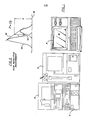
- Fig. 1 illustrates the system components of the present invention.
- the system includes an auto sampler 10 which comprises a Perkin-Elmer ISS-100 or the like for removing samples from vials containing an unknown solution.
- This sampler is capable of taking samples from one of a plurality of sample vials and making the sample available for insertion into a chromatographic column.
- the column itself is located before the detector module 12 which in the preferred configuration comprises a Perkin-Elmer Model LC-95 or the like.
- the auto sampler 10 provides a sample of the solution to be tested to the column and detector.
- the system in addition includes a microprocessor controlled pump 14 which, in the preferred embodiment, comprises a Perkin-Elmer Series 4 pump assembly which includes a column oven.
- the microprocessor controlled pump 14 is operative to precisely control the solvent mix which is in the column used for separating the components of the sample introduced thereto.
- the system of Fig. 1 additionally includes a computer module 16 which, in the preferred embodiment, comprises a Perkin-Elmer Model 7500 Professional Computer or the like.
- the computer module 16 is coupled by a data interface (not shown) to the auto sampler 10, the detector module 12, and the microprocessor control pump 14.
- this interface comprises a Perkin-Elmer Model 316 data interface which merely serves as a communication adaptor between the computer module 16 and the detector located in the pump 14 assembly.
- the computer module 16 by reason of the programs entered therein, is operative to supervise the activities of the auto sampler 10, the detector module 12, and the microprocessor control pump 14. Indeed, it is through the supervision provided by the computer module 16 that the operator is able to control the system elements to perform a desired set of experiments upon the unknown samples in the sample tray of the auto sampler 10.
- the screen 18 of the computer module 16 provides a means for displaying the results of experiments performed on the samples in the auto sampler 10. The screen 18 also serves as a means to display the system status.
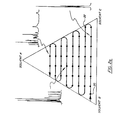
- Fig. 2 illustrates a typical triangular display showing the results of many experiments using the apparatus of Fig. 1.
- This display typically would appear on the screen 18 of the computer 16 and is readily usable by the chromatographer, in a manner later explained, to select the best chromatograms for the unknown sample which was tested by the apparatus of Fig. 1.
- the best chromatograms have a high degree of peak resolution and, therefore, these chromatograms are more useful to the chromatographer in determining the constituents of the sample being tested.
- Fig. 2 also serves to illustrate the complexity of the problem faced by chromatographers today when using liquid chromatographs having column solutions with multiple components.
- chromatographers have in the past been forced to make a plurality of experiments on a given sample in order to subsequently evaluate the chromatograms produced thereby to determine which, if any, were useful to the chromatographer in determining the constituents of the sample.
- the difficulty of selecting the best chromatogram increases with the increase of the number of experiments performed on the sample. Indeed, the inventors themselves have had difficulty in deciding which chromatograms are useful in environments where as few as about 20 experiments have been performed. Where a larger number of experiments have been performed, this problem becomes more acute.
- the apparatus according to the present invention is operative to produce a display on the screen 18 such as illustrated in Fig. 2.
- This display is highly useful to chromatographers as it defines areas having chromatograms in which all components are completely resolved and, accordingly, these chromatograms are of the greatest use to the chromatographer.
- the display illustrated in Fig. 2 is capable of providing this aid to the chromatographer by reason of the fact that the shaded areas within the triangular shaped area on the screen are of different colors. The colors in turn are related to a quality value which is indicated in the key located to the left of the triangular area.
- those areas on the screen within the triangular area which are red have a peak resolution ranging between 0.9 and 1.0 although other ranges may be arbitrarily selected. Accordingly, chromatograms produced by experiments having solvent mixes occurring within the red areas provide the greatest resolution and, accordingly, are most useful to the chromatographer.
- the pattern shown within the triangular shaped area of Fig. 2 was developed by the apparatus illustrated in Fig. 1 by performing a plurality of experiments on a given sample wherein the solvent in the column consisted of water, MEOH, and THF.
- the chromatogram produced for the sample for each solvent mix within the column was individually numerically analyzed to determine its resolution. Then, in accordance with the resolution key of Fig. 2, the area within the triangular shaped area of Fig. 2 corresponding to that particular solvent mix was colored in accordance with the resolution therefor as defined in the resolution key. Accordingly, the chromatographer can very easily select the chromatograms from amongst literally hundreds of chromatograms which will provide high resolution between the peaks of the chromatogram for the sample being tested. In the example selected, the chromatographer need only select chromatograms for experiments having solvent mixes in areas which are red within the triangular shaped area of Fig. 2.
- Fig. 2 has been developed through the execution of many hundreds of experiments which, even though high speed liquid chromatography techniques are utilized, does take a great deal of time.
- a plurality of experiments may be conducted in a manner such as is illustrated in Fig. 2A.
- an experiment might be conducted at a solvent mix illustrated at the dot 20 which might have, for example, a column solvent comprised of 10% oi solvent A, 80% solvent B and 10% solvent C.
- a plurality of experiments will be conducted wherein the percentage of solvent A remained at 10% while the percentage of solvents B and C are changed, for example, by approximately 10 % .
- the apparatus of the present invention operates in a manner to minimize the equilibration (stabilization) time between experiments.
- the apparatus must then determine which experiment to perform first. It has been found that the equilibration time is minimized when the experiment sequence is established so that the experiment with strongest solvent mixtures are done first followed by experiments with progressively weaker solvent mixtures.
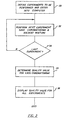
- a flow chart is shown which illustrates the manner in which the apparatus in accordance with Fig. 1 operates in order to achieve the objectives of the present invention.
- the first step of the process according to the present invention is performed by the chromatographer who defines the boundaries and the step increment for a plurality of experiments to be conducted and the definition of these conditions is entered into the computer 16. Once the boundaries and step increment for the experiments have been defined, then the computer 16 takes over control of the apparatus illustrated in Fig. 1 and directs the microprocessor controlled pump 14 to equilibrate the column with the solvent mix desired for the first experiment.
- the auto sampler 10 is instructed to withdraw a sample and insert it into the column and the detector 12 is instructed to detect the elution of the various components for the sample injected into the column.
- the output of the detector module 12 comprises a chromatogram zhich is then stored in the memory of the computer 16 along with the solvent mixture data for that chromatogram. This portion of the operation of the apparatus of Fig. 1 is illustrated by the description within the rectangular block 32 for the flow chart of Fig. 3.
- the computer 16 inquires as to whether all experiments have been completed. This inquiry is illustrated by the diamond shaped box 34 of Fig. 3. In the event that the last experiment has not been performed, the computer 16 directs the auto sampler 10, the detector module 12 and the microprocessor control pump 14 to perform the next experiment in accordance with the new solvent mix as previously defined by the chromatographer.
- the manner in which the quality value for each chromatogram is determined is illustrated in the flow chart of Fig. 4.
- the flow chart illustrates in rectangular box 40 that the first step to be performed is to determine the peak separation measurement on all adjacent peaks for the chromatogram produced during an experiment.
- the peak separation measurement comprises a number ranging from 0 at a minimum to a maximum of 1.
- the peak separation measurement is completed, then the number of peaks for that chromatogram is counted as illustrated in rectangular area 44. Once this is done, the results of the most recent peak counting operation is compared with those of all previous operations. In the event, as illustrated by the diamond shaped area 46, the number of counted peaks in the most recently analyzed chromatogram exceeds the number of peaks in any previously examined chromatogram, then the peak separation measurement for all previous chromatograms is set to 0 as illustrated in rectangular box 48 because at least 1 pair of peaks has 0 resolution.
- step 44 If the number of counted peaks in step 44 is less than the highest number of previous peaks for a given chromatogram, then the decision process illustrated in diamond shaped area 50 causes the peak separation measurement for the most recent experiment to be set to 0 as illustrated by the rectangular area 52. In the event that the decision illustrated by triangular block 50 results in a no answer, however, no change is necessary to the peak separation measurement and the process needs, thereafter, only determine whether all chromatograms have been investigated. This function is accomplished in the diamond shaped area 52. In the event that the processing of data for all experiments is not complete, the process returns to performing the peak separation measurement on all adjacent peaks for the next experiment as illustrated by rectangular box 40. The process described above continues until the peak separation measurement has been done for all experiments. When this occurs, the exit from the diamond shaped area 52 occurs and the remaining step is to display the quality values for all experiments as found in box 40 of Fig. 3.
- the quality values for given areas of the triangular area in Fig. 3 are established for experiments having peak separation measurements ranging for the values illustrated in the resolution key.
- the chromatographer need only know the color of the area giving the best resolution available to thereby select chromatograms which will be most useful for his investigation.
- the peak separation measurement utilized in accordance with the present invention has a value which ranges from 0 to a maximum of 1.
- the peak separation measurement is performed in a manner illustrated in Fig. 5.
- the chromatogram trace 60 for two adjacent peaks is analyzed in the computer 16 and the bottom of the valley between the two adjacent peaks 62 is located.
- a line 64 is drawn which connects the apices of the two peaks of the chromatogram trace 60 so that the line 64 is connected to portions of the trace 60 at each peak.
- the perpendicular distance f between the valley point 62 and the line 64 is determined.
- the distance between the intersection point of the perpendicular line f with the line 64 above the baseline 66 (g) is also determined.
- the peak separation measurement P is thereafter calculated by the formula P - f/g.
- this method of determining peak separation measurement will produce numbers ranging between a value of 0 and 1.
- any other peak separation measurement approach might also be utilized in conjunction with the present invention.
- Other peak separation measurement techniques are not as useful if the number produced thereby does not range between 0 and 1 or any other finite range as it is more difficult with such a measurement scheme to determine which chromatogram amongst a plurality of chromatograms is best.
- Attached hereto as an appendix is the object language program usable by the computer 16 of the preferred embodiment to control the other preferred components so that they all work cooperatively to perform the above described operations.
Landscapes
- Physics & Mathematics (AREA)
- Health & Medical Sciences (AREA)
- Life Sciences & Earth Sciences (AREA)
- Chemical & Material Sciences (AREA)
- Analytical Chemistry (AREA)
- Biochemistry (AREA)
- General Health & Medical Sciences (AREA)
- General Physics & Mathematics (AREA)
- Immunology (AREA)
- Pathology (AREA)
- Treatment Of Liquids With Adsorbents In General (AREA)
- Organic Low-Molecular-Weight Compounds And Preparation Thereof (AREA)
Applications Claiming Priority (2)
| Application Number | Priority Date | Filing Date | Title |
|---|---|---|---|
| US653256 | 1984-09-24 | ||
| US06/653,256 US4579663A (en) | 1984-09-24 | 1984-09-24 | Apparatus and method for optimizing separation of an unknown sample by liquid chromatography |
Publications (3)
| Publication Number | Publication Date |
|---|---|
| EP0175925A2 true EP0175925A2 (fr) | 1986-04-02 |
| EP0175925A3 EP0175925A3 (en) | 1988-12-21 |
| EP0175925B1 EP0175925B1 (fr) | 1992-09-30 |
Family
ID=24620111
Family Applications (1)
| Application Number | Title | Priority Date | Filing Date |
|---|---|---|---|
| EP85110513A Expired EP0175925B1 (fr) | 1984-09-24 | 1985-08-21 | Appareil et méthode pour la séparation optimale d'un échantillon inconnu par chromatographie liquide |
Country Status (5)
| Country | Link |
|---|---|
| US (1) | US4579663A (fr) |
| EP (1) | EP0175925B1 (fr) |
| JP (1) | JPH0797109B2 (fr) |
| CA (1) | CA1245073A (fr) |
| DE (1) | DE3586705T2 (fr) |
Cited By (2)
| Publication number | Priority date | Publication date | Assignee | Title |
|---|---|---|---|---|
| EP0295966A3 (en) * | 1987-06-19 | 1989-08-16 | Applied Biosystems, Inc. | Determination of peptide sequences |
| EP0393776A3 (fr) * | 1989-04-20 | 1991-10-09 | Philips Electronics Uk Limited | Chromatographie en phase liquide |
Families Citing this family (31)
| Publication number | Priority date | Publication date | Assignee | Title |
|---|---|---|---|---|
| US4802981A (en) * | 1987-11-04 | 1989-02-07 | Oros Systems Limited | Automatic chromatography apparatus |
| US4824446A (en) * | 1988-05-23 | 1989-04-25 | Applied Automation, Inc. | Gas chromatography simulation |
| EP0359320A3 (fr) * | 1988-09-14 | 1991-10-23 | Philips Electronics Uk Limited | Chromatographe |
| US5209853A (en) * | 1989-04-20 | 1993-05-11 | U.S. Philips Corporation | Liquid chromatography |
| EP0403680B1 (fr) * | 1989-06-23 | 1994-03-09 | Hewlett-Packard GmbH | Dispositif et méthode pour optimiser la séparation d'un échantillon en chromatographie liquide |
| US5203992A (en) * | 1989-06-23 | 1993-04-20 | Hewlett-Packard Company | Apparatus for optimizing the liquid chromatographic separation of a sample |
| US4969993A (en) * | 1989-08-31 | 1990-11-13 | The Perkin-Elmer Corporation | Chromatographic instrument with command sequencing |
| JP2800509B2 (ja) * | 1990-11-30 | 1998-09-21 | 株式会社日立製作所 | 液体クロマトグラフ装置 |
| EP0533909B1 (fr) * | 1991-03-28 | 1997-01-08 | Perseptive Biosystems, Inc. | Identification rapide de produits dans une phase fluide de chromatographie par soustraction |
| JPH06138115A (ja) * | 1991-04-25 | 1994-05-20 | Shimadzu Corp | 試料成分分取装置 |
| USD354013S (en) | 1992-10-21 | 1995-01-03 | Hitachi, Ltd. | Liquid chromatograph analyzer |
| US5316630A (en) * | 1993-03-30 | 1994-05-31 | Dionex Corporation | Methods for chromatography analysis |
| US5670054A (en) * | 1996-04-04 | 1997-09-23 | Warner Lambert Company | Method and system for identification, purification, and quantitation of reaction components |
| US5938931A (en) * | 1996-10-31 | 1999-08-17 | Hitachi, Ltd. | Method for processing liquid chromatographic data |
| US5958246A (en) * | 1997-05-16 | 1999-09-28 | The Perkin-Elmer Corporation | Standardization of chromatographic systems |
| US6342160B2 (en) * | 1998-01-09 | 2002-01-29 | Christopher J. Welch | Method for screening chromatographic adsorbents |
| US6413431B1 (en) * | 1999-08-10 | 2002-07-02 | Scynexis Chemistry & Automation, Inc. | HPLC method for purifying organic compounds |
| JP4886933B2 (ja) * | 2001-01-12 | 2012-02-29 | カウンセル オブ サイエンティフィック アンド インダストリアル リサーチ | クロマトグラフフィンガープリントならびに単一の医薬および処方物の標準化のための新規な方法 |
| JP3423707B1 (ja) * | 2002-02-15 | 2003-07-07 | 山善株式会社 | 液体クロマトグラフの制御装置、液体クロマトグラフィの実行方法及び液体クロマトグラフの制御プログラム |
| AU2003273737A1 (en) * | 2002-09-19 | 2004-04-19 | Merck Patent Gmbh | Method for discovering suitable chromatographic conditions for separating biological molecules |
| US20050247625A1 (en) * | 2004-05-05 | 2005-11-10 | Jianbo Liu | Determining conditions for chromatography |
| US7686959B2 (en) * | 2004-05-05 | 2010-03-30 | Biotage Ab | Control system and method for flash separation |
| DE112005001959A5 (de) * | 2004-06-11 | 2008-06-26 | Imre Molnar | Verfahren und Vorrichtung zur automatischen Modellentwicklung von chromatographischen, elektrochromatographischen und elektrophoretischen Methoden |
| JP6331485B2 (ja) * | 2014-03-04 | 2018-05-30 | 株式会社島津製作所 | 液体クロマトグラフ及び液体クロマトグラフ分析方法 |
| JP6760367B2 (ja) * | 2016-05-30 | 2020-09-23 | 株式会社島津製作所 | クロマトグラフ装置 |
| US20200348274A1 (en) * | 2017-10-28 | 2020-11-05 | Purdue Research Foundation | Methods for designing an efficient preparative chromatographic separation process |
| WO2019099948A1 (fr) * | 2017-11-17 | 2019-05-23 | Bio-Rad Laboratories, Inc. | Conseiller intelligent pour évaluation de test sanguin |
| EP3742159A1 (fr) * | 2019-05-24 | 2020-11-25 | Sartorius Stedim Biotech GmbH | Procédé de chromatographie, procédé de détermination de l'influence de l'interdépendance d'au moins deux paramètres dans un procédé de chromatographie et procédé d'obtention d'au moins un paramètre de procédé de chromatographie |
| EP3742160B1 (fr) | 2019-05-24 | 2023-08-09 | Sartorius Stedim Biotech GmbH | Procédé de chromatographie, procédé de détermination de la concentration d'au moins un composé dans un procédé de chromatographie et procédé d'obtention d'au moins un paramètre de procédé de chromatographie |
| JP7314859B2 (ja) * | 2020-04-30 | 2023-07-26 | 株式会社島津製作所 | 分析支援装置、分析支援方法および分析支援プログラム |
| JP2025516317A (ja) * | 2022-05-05 | 2025-05-27 | グローバル・ライフ・サイエンシズ・ソリューションズ・ジャーマニー・ゲーエムベーハー | クロマトグラフィ分離のための方法およびデバイス |
Family Cites Families (5)
| Publication number | Priority date | Publication date | Assignee | Title |
|---|---|---|---|---|
| US3997298A (en) * | 1975-02-27 | 1976-12-14 | Cornell Research Foundation, Inc. | Liquid chromatography-mass spectrometry system and method |
| US4066879A (en) * | 1976-06-21 | 1978-01-03 | Milton Roy Company | Means and method for controlling eluent gradient in liquid chromatography |
| US4364263A (en) * | 1980-09-15 | 1982-12-21 | Burroughs Wellcome Co. | High pressure liquid chromatographic system |
| US4468331A (en) * | 1982-09-13 | 1984-08-28 | E. I. Du Pont De Nemours And Company | Method and system for liquid choromatography separations |
| US4478713A (en) * | 1983-09-23 | 1984-10-23 | Pharmuka Laboratoires | Automatic installation for liquid chromatography |
-
1984
- 1984-09-24 US US06/653,256 patent/US4579663A/en not_active Expired - Lifetime
-
1985
- 1985-08-16 CA CA000488911A patent/CA1245073A/fr not_active Expired
- 1985-08-21 DE DE8585110513T patent/DE3586705T2/de not_active Expired - Fee Related
- 1985-08-21 EP EP85110513A patent/EP0175925B1/fr not_active Expired
- 1985-09-24 JP JP60208987A patent/JPH0797109B2/ja not_active Expired - Lifetime
Cited By (2)
| Publication number | Priority date | Publication date | Assignee | Title |
|---|---|---|---|---|
| EP0295966A3 (en) * | 1987-06-19 | 1989-08-16 | Applied Biosystems, Inc. | Determination of peptide sequences |
| EP0393776A3 (fr) * | 1989-04-20 | 1991-10-09 | Philips Electronics Uk Limited | Chromatographie en phase liquide |
Also Published As
| Publication number | Publication date |
|---|---|
| JPH0797109B2 (ja) | 1995-10-18 |
| US4579663A (en) | 1986-04-01 |
| DE3586705D1 (de) | 1992-11-05 |
| DE3586705T2 (de) | 1993-03-11 |
| JPS61180138A (ja) | 1986-08-12 |
| EP0175925A3 (en) | 1988-12-21 |
| EP0175925B1 (fr) | 1992-09-30 |
| CA1245073A (fr) | 1988-11-22 |
Similar Documents
| Publication | Publication Date | Title |
|---|---|---|
| US4579663A (en) | Apparatus and method for optimizing separation of an unknown sample by liquid chromatography | |
| US5203992A (en) | Apparatus for optimizing the liquid chromatographic separation of a sample | |
| US4969993A (en) | Chromatographic instrument with command sequencing | |
| US5039409A (en) | Chromatography apparatus | |
| JP5347932B2 (ja) | クロマトグラフ質量分析装置 | |
| EP0403680B1 (fr) | Dispositif et méthode pour optimiser la séparation d'un échantillon en chromatographie liquide | |
| EP1995593A1 (fr) | Spectroscope de masse-chromatographe | |
| US9792416B2 (en) | Peak correlation and clustering in fluidic sample separation | |
| US20190369069A1 (en) | Chromatograph-Mass Spectrometry System and Measurement Condition Display Method | |
| US5209853A (en) | Liquid chromatography | |
| EP0393776B1 (fr) | Chromatographie en phase liquide | |
| CN115524441B (zh) | 色谱法用数据处理系统 | |
| JPH1172489A (ja) | 液体クロマトグラフ | |
| KR19980024502A (ko) | 크로마토그래프용 데이터 처리장치 | |
| JP5315025B2 (ja) | スペクトル解析および表示 | |
| WO2020100182A1 (fr) | Dispositif de chromatographie | |
| JPH11326304A (ja) | クロマトグラフ用データ処理装置 | |
| JP3798158B2 (ja) | 液体クロマトグラフ装置 | |
| CN116660394A (zh) | 制备液相色谱装置及制备条件决定支援方法 | |
| US6765200B2 (en) | Mass spectrometry and mass spetrometer using the same | |
| JP4461919B2 (ja) | クロマトグラフ質量分析測定方法及び装置 | |
| EP1189056B1 (fr) | Appareil et méthode pour sélectionner une bande d'électrophorèse | |
| JP3220996B2 (ja) | クロマトグラフ/質量分析装置 | |
| JP2025014813A (ja) | クロマトグラフ装置 | |
| CN114460215A (zh) | 波形处理辅助装置以及波形处理辅助方法 |
Legal Events
| Date | Code | Title | Description |
|---|---|---|---|
| PUAI | Public reference made under article 153(3) epc to a published international application that has entered the european phase |
Free format text: ORIGINAL CODE: 0009012 |
|
| AK | Designated contracting states |
Kind code of ref document: A2 Designated state(s): CH DE FR GB LI NL |
|
| PUAL | Search report despatched |
Free format text: ORIGINAL CODE: 0009013 |
|
| AK | Designated contracting states |
Kind code of ref document: A3 Designated state(s): CH DE FR GB LI NL |
|
| 17P | Request for examination filed |
Effective date: 19890317 |
|
| 17Q | First examination report despatched |
Effective date: 19900612 |
|
| GRAA | (expected) grant |
Free format text: ORIGINAL CODE: 0009210 |
|
| AK | Designated contracting states |
Kind code of ref document: B1 Designated state(s): CH DE FR GB LI NL |
|
| REF | Corresponds to: |
Ref document number: 3586705 Country of ref document: DE Date of ref document: 19921105 |
|
| ET | Fr: translation filed | ||
| PLBE | No opposition filed within time limit |
Free format text: ORIGINAL CODE: 0009261 |
|
| STAA | Information on the status of an ep patent application or granted ep patent |
Free format text: STATUS: NO OPPOSITION FILED WITHIN TIME LIMIT |
|
| 26N | No opposition filed | ||
| REG | Reference to a national code |
Ref country code: GB Ref legal event code: 732E |
|
| PGFP | Annual fee paid to national office [announced via postgrant information from national office to epo] |
Ref country code: FR Payment date: 20000801 Year of fee payment: 16 |
|
| PGFP | Annual fee paid to national office [announced via postgrant information from national office to epo] |
Ref country code: DE Payment date: 20000802 Year of fee payment: 16 |
|
| PGFP | Annual fee paid to national office [announced via postgrant information from national office to epo] |
Ref country code: GB Payment date: 20000803 Year of fee payment: 16 Ref country code: CH Payment date: 20000803 Year of fee payment: 16 |
|
| PGFP | Annual fee paid to national office [announced via postgrant information from national office to epo] |
Ref country code: NL Payment date: 20000808 Year of fee payment: 16 |
|
| PG25 | Lapsed in a contracting state [announced via postgrant information from national office to epo] |
Ref country code: GB Free format text: LAPSE BECAUSE OF NON-PAYMENT OF DUE FEES Effective date: 20010821 |
|
| PG25 | Lapsed in a contracting state [announced via postgrant information from national office to epo] |
Ref country code: LI Free format text: LAPSE BECAUSE OF NON-PAYMENT OF DUE FEES Effective date: 20010831 Ref country code: CH Free format text: LAPSE BECAUSE OF NON-PAYMENT OF DUE FEES Effective date: 20010831 |
|
| PG25 | Lapsed in a contracting state [announced via postgrant information from national office to epo] |
Ref country code: NL Free format text: LAPSE BECAUSE OF NON-PAYMENT OF DUE FEES Effective date: 20020301 |
|
| GBPC | Gb: european patent ceased through non-payment of renewal fee |
Effective date: 20010821 |
|
| REG | Reference to a national code |
Ref country code: CH Ref legal event code: PL |
|
| PG25 | Lapsed in a contracting state [announced via postgrant information from national office to epo] |
Ref country code: FR Free format text: LAPSE BECAUSE OF NON-PAYMENT OF DUE FEES Effective date: 20020430 |
|
| NLV4 | Nl: lapsed or anulled due to non-payment of the annual fee |
Effective date: 20020301 |
|
| PG25 | Lapsed in a contracting state [announced via postgrant information from national office to epo] |
Ref country code: DE Free format text: LAPSE BECAUSE OF NON-PAYMENT OF DUE FEES Effective date: 20020501 |
|
| REG | Reference to a national code |
Ref country code: FR Ref legal event code: ST |