EP0176845A2 - Fotografisches Aufzeichnungsmaterial - Google Patents
Fotografisches Aufzeichnungsmaterial Download PDFInfo
- Publication number
- EP0176845A2 EP0176845A2 EP85111669A EP85111669A EP0176845A2 EP 0176845 A2 EP0176845 A2 EP 0176845A2 EP 85111669 A EP85111669 A EP 85111669A EP 85111669 A EP85111669 A EP 85111669A EP 0176845 A2 EP0176845 A2 EP 0176845A2
- Authority
- EP
- European Patent Office
- Prior art keywords
- alkyl
- color
- couplers
- oder
- coupler
- Prior art date
- Legal status (The legal status is an assumption and is not a legal conclusion. Google has not performed a legal analysis and makes no representation as to the accuracy of the status listed.)
- Granted
Links
- 239000000463 material Substances 0.000 title claims description 18
- -1 Aroxy Chemical group 0.000 claims abstract description 42
- 150000001875 compounds Chemical class 0.000 claims abstract description 28
- 125000000217 alkyl group Chemical group 0.000 claims abstract description 19
- 125000003545 alkoxy group Chemical group 0.000 claims abstract description 11
- 125000004442 acylamino group Chemical group 0.000 claims abstract description 8
- 150000002367 halogens Chemical class 0.000 claims abstract description 8
- 125000001424 substituent group Chemical group 0.000 claims abstract description 8
- 229910052736 halogen Inorganic materials 0.000 claims abstract description 7
- 125000003118 aryl group Chemical group 0.000 claims abstract description 6
- 239000002243 precursor Substances 0.000 claims abstract description 6
- 125000003710 aryl alkyl group Chemical group 0.000 claims abstract description 5
- 125000001769 aryl amino group Chemical group 0.000 claims abstract description 5
- 239000000839 emulsion Substances 0.000 claims description 24
- 229910052709 silver Inorganic materials 0.000 claims description 24
- 239000004332 silver Substances 0.000 claims description 24
- 238000011161 development Methods 0.000 claims description 14
- 125000002887 hydroxy group Chemical group [H]O* 0.000 claims description 10
- 125000004453 alkoxycarbonyl group Chemical group 0.000 claims description 4
- 229910052739 hydrogen Inorganic materials 0.000 claims description 4
- 239000001257 hydrogen Substances 0.000 claims description 4
- 239000011230 binding agent Substances 0.000 claims description 3
- 125000003917 carbamoyl group Chemical group [H]N([H])C(*)=O 0.000 claims description 3
- 125000004390 alkyl sulfonyl group Chemical group 0.000 claims description 2
- 125000004397 aminosulfonyl group Chemical group NS(=O)(=O)* 0.000 claims description 2
- 125000004435 hydrogen atom Chemical group [H]* 0.000 claims 2
- 239000000975 dye Substances 0.000 abstract description 20
- 125000003282 alkyl amino group Chemical group 0.000 abstract description 4
- 239000010410 layer Substances 0.000 description 36
- 229920000159 gelatin Polymers 0.000 description 17
- 235000019322 gelatine Nutrition 0.000 description 17
- PAYRUJLWNCNPSJ-UHFFFAOYSA-N Aniline Chemical compound NC1=CC=CC=C1 PAYRUJLWNCNPSJ-UHFFFAOYSA-N 0.000 description 14
- 108010010803 Gelatin Proteins 0.000 description 12
- 239000008273 gelatin Substances 0.000 description 12
- 235000011852 gelatine desserts Nutrition 0.000 description 12
- 239000000243 solution Substances 0.000 description 10
- WEVYAHXRMPXWCK-UHFFFAOYSA-N Acetonitrile Chemical compound CC#N WEVYAHXRMPXWCK-UHFFFAOYSA-N 0.000 description 9
- 239000000047 product Substances 0.000 description 9
- XLYOFNOQVPJJNP-UHFFFAOYSA-N water Chemical compound O XLYOFNOQVPJJNP-UHFFFAOYSA-N 0.000 description 9
- DOIRQSBPFJWKBE-UHFFFAOYSA-N dibutyl phthalate Chemical compound CCCCOC(=O)C1=CC=CC=C1C(=O)OCCCC DOIRQSBPFJWKBE-UHFFFAOYSA-N 0.000 description 8
- 230000003647 oxidation Effects 0.000 description 7
- 238000007254 oxidation reaction Methods 0.000 description 7
- 239000004611 light stabiliser Substances 0.000 description 6
- 150000005208 1,4-dihydroxybenzenes Chemical class 0.000 description 5
- CSCPPACGZOOCGX-UHFFFAOYSA-N Acetone Chemical compound CC(C)=O CSCPPACGZOOCGX-UHFFFAOYSA-N 0.000 description 5
- 239000001828 Gelatine Substances 0.000 description 5
- YSMRWXYRXBRSND-UHFFFAOYSA-N TOTP Chemical compound CC1=CC=CC=C1OP(=O)(OC=1C(=CC=CC=1)C)OC1=CC=CC=C1C YSMRWXYRXBRSND-UHFFFAOYSA-N 0.000 description 5
- 230000002209 hydrophobic effect Effects 0.000 description 5
- 238000000034 method Methods 0.000 description 5
- SQGYOTSLMSWVJD-UHFFFAOYSA-N silver(1+) nitrate Chemical compound [Ag+].[O-]N(=O)=O SQGYOTSLMSWVJD-UHFFFAOYSA-N 0.000 description 5
- WVDDGKGOMKODPV-UHFFFAOYSA-N Benzyl alcohol Chemical compound OCC1=CC=CC=C1 WVDDGKGOMKODPV-UHFFFAOYSA-N 0.000 description 4
- VEXZGXHMUGYJMC-UHFFFAOYSA-N Hydrochloric acid Chemical compound Cl VEXZGXHMUGYJMC-UHFFFAOYSA-N 0.000 description 4
- 239000006096 absorbing agent Substances 0.000 description 4
- 238000005266 casting Methods 0.000 description 4
- 239000001047 purple dye Substances 0.000 description 4
- 239000002904 solvent Substances 0.000 description 4
- ZWEHNKRNPOVVGH-UHFFFAOYSA-N 2-Butanone Chemical compound CCC(C)=O ZWEHNKRNPOVVGH-UHFFFAOYSA-N 0.000 description 3
- KCXVZYZYPLLWCC-UHFFFAOYSA-N EDTA Chemical compound OC(=O)CN(CC(O)=O)CCN(CC(O)=O)CC(O)=O KCXVZYZYPLLWCC-UHFFFAOYSA-N 0.000 description 3
- XEKOWRVHYACXOJ-UHFFFAOYSA-N Ethyl acetate Chemical compound CCOC(C)=O XEKOWRVHYACXOJ-UHFFFAOYSA-N 0.000 description 3
- LYCAIKOWRPUZTN-UHFFFAOYSA-N Ethylene glycol Chemical compound OCCO LYCAIKOWRPUZTN-UHFFFAOYSA-N 0.000 description 3
- UFHFLCQGNIYNRP-UHFFFAOYSA-N Hydrogen Chemical group [H][H] UFHFLCQGNIYNRP-UHFFFAOYSA-N 0.000 description 3
- ZMXDDKWLCZADIW-UHFFFAOYSA-N N,N-Dimethylformamide Chemical compound CN(C)C=O ZMXDDKWLCZADIW-UHFFFAOYSA-N 0.000 description 3
- ZMANZCXQSJIPKH-UHFFFAOYSA-N Triethylamine Chemical compound CCN(CC)CC ZMANZCXQSJIPKH-UHFFFAOYSA-N 0.000 description 3
- 125000004432 carbon atom Chemical group C* 0.000 description 3
- 239000003795 chemical substances by application Substances 0.000 description 3
- 230000008878 coupling Effects 0.000 description 3
- 238000010168 coupling process Methods 0.000 description 3
- 238000005859 coupling reaction Methods 0.000 description 3
- 230000000694 effects Effects 0.000 description 3
- 238000004519 manufacturing process Methods 0.000 description 3
- 239000000203 mixture Substances 0.000 description 3
- JEXVQSWXXUJEMA-UHFFFAOYSA-N pyrazol-3-one Chemical compound O=C1C=CN=N1 JEXVQSWXXUJEMA-UHFFFAOYSA-N 0.000 description 3
- 230000006641 stabilisation Effects 0.000 description 3
- 238000011105 stabilization Methods 0.000 description 3
- 239000000126 substance Substances 0.000 description 3
- KJCVRFUGPWSIIH-UHFFFAOYSA-N 1-naphthol Chemical compound C1=CC=C2C(O)=CC=CC2=C1 KJCVRFUGPWSIIH-UHFFFAOYSA-N 0.000 description 2
- PMWJOLLLHRDHNP-UHFFFAOYSA-N 2,3-dioctylbenzene-1,4-diol Chemical compound CCCCCCCCC1=C(O)C=CC(O)=C1CCCCCCCC PMWJOLLLHRDHNP-UHFFFAOYSA-N 0.000 description 2
- 229920002284 Cellulose triacetate Polymers 0.000 description 2
- 229940126062 Compound A Drugs 0.000 description 2
- NLDMNSXOCDLTTB-UHFFFAOYSA-N Heterophylliin A Natural products O1C2COC(=O)C3=CC(O)=C(O)C(O)=C3C3=C(O)C(O)=C(O)C=C3C(=O)OC2C(OC(=O)C=2C=C(O)C(O)=C(O)C=2)C(O)C1OC(=O)C1=CC(O)=C(O)C(O)=C1 NLDMNSXOCDLTTB-UHFFFAOYSA-N 0.000 description 2
- QIGBRXMKCJKVMJ-UHFFFAOYSA-N Hydroquinone Chemical compound OC1=CC=C(O)C=C1 QIGBRXMKCJKVMJ-UHFFFAOYSA-N 0.000 description 2
- XEEYBQQBJWHFJM-UHFFFAOYSA-N Iron Chemical compound [Fe] XEEYBQQBJWHFJM-UHFFFAOYSA-N 0.000 description 2
- FXHOOIRPVKKKFG-UHFFFAOYSA-N N,N-Dimethylacetamide Chemical compound CN(C)C(C)=O FXHOOIRPVKKKFG-UHFFFAOYSA-N 0.000 description 2
- JLTDJTHDQAWBAV-UHFFFAOYSA-N N,N-dimethylaniline Chemical compound CN(C)C1=CC=CC=C1 JLTDJTHDQAWBAV-UHFFFAOYSA-N 0.000 description 2
- BQCADISMDOOEFD-UHFFFAOYSA-N Silver Chemical compound [Ag] BQCADISMDOOEFD-UHFFFAOYSA-N 0.000 description 2
- NNLVGZFZQQXQNW-ADJNRHBOSA-N [(2r,3r,4s,5r,6s)-4,5-diacetyloxy-3-[(2s,3r,4s,5r,6r)-3,4,5-triacetyloxy-6-(acetyloxymethyl)oxan-2-yl]oxy-6-[(2r,3r,4s,5r,6s)-4,5,6-triacetyloxy-2-(acetyloxymethyl)oxan-3-yl]oxyoxan-2-yl]methyl acetate Chemical compound O([C@@H]1O[C@@H]([C@H]([C@H](OC(C)=O)[C@H]1OC(C)=O)O[C@H]1[C@@H]([C@@H](OC(C)=O)[C@H](OC(C)=O)[C@@H](COC(C)=O)O1)OC(C)=O)COC(=O)C)[C@@H]1[C@@H](COC(C)=O)O[C@@H](OC(C)=O)[C@H](OC(C)=O)[C@H]1OC(C)=O NNLVGZFZQQXQNW-ADJNRHBOSA-N 0.000 description 2
- 239000002253 acid Substances 0.000 description 2
- 125000002252 acyl group Chemical group 0.000 description 2
- 239000012790 adhesive layer Substances 0.000 description 2
- 125000001931 aliphatic group Chemical group 0.000 description 2
- 230000000903 blocking effect Effects 0.000 description 2
- 238000009835 boiling Methods 0.000 description 2
- 238000009792 diffusion process Methods 0.000 description 2
- 238000001035 drying Methods 0.000 description 2
- 238000005562 fading Methods 0.000 description 2
- 239000003112 inhibitor Substances 0.000 description 2
- ISWSIDIOOBJBQZ-UHFFFAOYSA-N phenol group Chemical group C1(=CC=CC=C1)O ISWSIDIOOBJBQZ-UHFFFAOYSA-N 0.000 description 2
- 150000002989 phenols Chemical class 0.000 description 2
- 238000002360 preparation method Methods 0.000 description 2
- 125000002924 primary amino group Chemical group [H]N([H])* 0.000 description 2
- 238000012545 processing Methods 0.000 description 2
- 230000001681 protective effect Effects 0.000 description 2
- 150000003254 radicals Chemical class 0.000 description 2
- 230000035945 sensitivity Effects 0.000 description 2
- 239000011734 sodium Substances 0.000 description 2
- 230000003595 spectral effect Effects 0.000 description 2
- 230000000087 stabilizing effect Effects 0.000 description 2
- 150000003460 sulfonic acids Chemical class 0.000 description 2
- ZRHUHDUEXWHZMA-UHFFFAOYSA-N 1,4-dihydropyrazol-5-one Chemical compound O=C1CC=NN1 ZRHUHDUEXWHZMA-UHFFFAOYSA-N 0.000 description 1
- OXLXSOPFNVKUMU-UHFFFAOYSA-N 1,4-dioctoxy-1,4-dioxobutane-2-sulfonic acid Chemical compound CCCCCCCCOC(=O)CC(S(O)(=O)=O)C(=O)OCCCCCCCC OXLXSOPFNVKUMU-UHFFFAOYSA-N 0.000 description 1
- CBCKQZAAMUWICA-UHFFFAOYSA-N 1,4-phenylenediamine Chemical compound NC1=CC=C(N)C=C1 CBCKQZAAMUWICA-UHFFFAOYSA-N 0.000 description 1
- JVSFQJZRHXAUGT-UHFFFAOYSA-N 2,2-dimethylpropanoyl chloride Chemical compound CC(C)(C)C(Cl)=O JVSFQJZRHXAUGT-UHFFFAOYSA-N 0.000 description 1
- JNYKOGUXPNAUIB-UHFFFAOYSA-N 2,3-dihydro-1-benzofuran-5-ol Chemical class OC1=CC=C2OCCC2=C1 JNYKOGUXPNAUIB-UHFFFAOYSA-N 0.000 description 1
- VOZKAJLKRJDJLL-UHFFFAOYSA-N 2,4-diaminotoluene Chemical compound CC1=CC=C(N)C=C1N VOZKAJLKRJDJLL-UHFFFAOYSA-N 0.000 description 1
- QTLHLXYADXCVCF-UHFFFAOYSA-N 2-(4-amino-n-ethyl-3-methylanilino)ethanol Chemical compound OCCN(CC)C1=CC=C(N)C(C)=C1 QTLHLXYADXCVCF-UHFFFAOYSA-N 0.000 description 1
- BESJCRMQEYZHPM-UHFFFAOYSA-N 2-amino-4-(2,4,4-trimethylpentan-2-yl)phenol Chemical compound CC(C)(C)CC(C)(C)C1=CC=C(O)C(N)=C1 BESJCRMQEYZHPM-UHFFFAOYSA-N 0.000 description 1
- ZMXYNJXDULEQCK-UHFFFAOYSA-N 2-amino-p-cresol Chemical compound CC1=CC=C(O)C(N)=C1 ZMXYNJXDULEQCK-UHFFFAOYSA-N 0.000 description 1
- CDAWCLOXVUBKRW-UHFFFAOYSA-N 2-aminophenol Chemical class NC1=CC=CC=C1O CDAWCLOXVUBKRW-UHFFFAOYSA-N 0.000 description 1
- XRZDIHADHZSFBB-UHFFFAOYSA-N 3-oxo-n,3-diphenylpropanamide Chemical class C=1C=CC=CC=1NC(=O)CC(=O)C1=CC=CC=C1 XRZDIHADHZSFBB-UHFFFAOYSA-N 0.000 description 1
- ZNBNBTIDJSKEAM-UHFFFAOYSA-N 4-[7-hydroxy-2-[5-[5-[6-hydroxy-6-(hydroxymethyl)-3,5-dimethyloxan-2-yl]-3-methyloxolan-2-yl]-5-methyloxolan-2-yl]-2,8-dimethyl-1,10-dioxaspiro[4.5]decan-9-yl]-2-methyl-3-propanoyloxypentanoic acid Chemical compound C1C(O)C(C)C(C(C)C(OC(=O)CC)C(C)C(O)=O)OC11OC(C)(C2OC(C)(CC2)C2C(CC(O2)C2C(CC(C)C(O)(CO)O2)C)C)CC1 ZNBNBTIDJSKEAM-UHFFFAOYSA-N 0.000 description 1
- XBTWVJKPQPQTDW-UHFFFAOYSA-N 4-n,4-n-diethyl-2-methylbenzene-1,4-diamine Chemical compound CCN(CC)C1=CC=C(N)C(C)=C1 XBTWVJKPQPQTDW-UHFFFAOYSA-N 0.000 description 1
- QNGVNLMMEQUVQK-UHFFFAOYSA-N 4-n,4-n-diethylbenzene-1,4-diamine Chemical compound CCN(CC)C1=CC=C(N)C=C1 QNGVNLMMEQUVQK-UHFFFAOYSA-N 0.000 description 1
- 241001479434 Agfa Species 0.000 description 1
- 101710134784 Agnoprotein Proteins 0.000 description 1
- NLXLAEXVIDQMFP-UHFFFAOYSA-N Ammonium chloride Substances [NH4+].[Cl-] NLXLAEXVIDQMFP-UHFFFAOYSA-N 0.000 description 1
- VHUUQVKOLVNVRT-UHFFFAOYSA-N Ammonium hydroxide Chemical compound [NH4+].[OH-] VHUUQVKOLVNVRT-UHFFFAOYSA-N 0.000 description 1
- WKBOTKDWSSQWDR-UHFFFAOYSA-N Bromine atom Chemical compound [Br] WKBOTKDWSSQWDR-UHFFFAOYSA-N 0.000 description 1
- ZAMOUSCENKQFHK-UHFFFAOYSA-N Chlorine atom Chemical compound [Cl] ZAMOUSCENKQFHK-UHFFFAOYSA-N 0.000 description 1
- QXNVGIXVLWOKEQ-UHFFFAOYSA-N Disodium Chemical class [Na][Na] QXNVGIXVLWOKEQ-UHFFFAOYSA-N 0.000 description 1
- DGAQECJNVWCQMB-PUAWFVPOSA-M Ilexoside XXIX Chemical compound C[C@@H]1CC[C@@]2(CC[C@@]3(C(=CC[C@H]4[C@]3(CC[C@@H]5[C@@]4(CC[C@@H](C5(C)C)OS(=O)(=O)[O-])C)C)[C@@H]2[C@]1(C)O)C)C(=O)O[C@H]6[C@@H]([C@H]([C@@H]([C@H](O6)CO)O)O)O.[Na+] DGAQECJNVWCQMB-PUAWFVPOSA-M 0.000 description 1
- BZORFPDSXLZWJF-UHFFFAOYSA-N N,N-dimethyl-1,4-phenylenediamine Chemical compound CN(C)C1=CC=C(N)C=C1 BZORFPDSXLZWJF-UHFFFAOYSA-N 0.000 description 1
- SECXISVLQFMRJM-UHFFFAOYSA-N N-Methylpyrrolidone Chemical compound CN1CCCC1=O SECXISVLQFMRJM-UHFFFAOYSA-N 0.000 description 1
- 239000004698 Polyethylene Substances 0.000 description 1
- 125000002777 acetyl group Chemical group [H]C([H])([H])C(*)=O 0.000 description 1
- 230000009471 action Effects 0.000 description 1
- 230000010933 acylation Effects 0.000 description 1
- 238000005917 acylation reaction Methods 0.000 description 1
- 239000000654 additive Substances 0.000 description 1
- 150000001298 alcohols Chemical class 0.000 description 1
- 239000003513 alkali Substances 0.000 description 1
- 235000011114 ammonium hydroxide Nutrition 0.000 description 1
- XYXNTHIYBIDHGM-UHFFFAOYSA-N ammonium thiosulfate Chemical compound [NH4+].[NH4+].[O-]S([O-])(=O)=S XYXNTHIYBIDHGM-UHFFFAOYSA-N 0.000 description 1
- HSMPSHPWCOOUJH-UHFFFAOYSA-N anilinyl Chemical compound [NH]C1=CC=CC=C1 HSMPSHPWCOOUJH-UHFFFAOYSA-N 0.000 description 1
- 239000000010 aprotic solvent Substances 0.000 description 1
- 239000007864 aqueous solution Substances 0.000 description 1
- 150000001491 aromatic compounds Chemical class 0.000 description 1
- QVGXLLKOCUKJST-UHFFFAOYSA-N atomic oxygen Chemical compound [O] QVGXLLKOCUKJST-UHFFFAOYSA-N 0.000 description 1
- 239000002585 base Substances 0.000 description 1
- WZTQWXKHLAJTRC-UHFFFAOYSA-N benzyl 2-amino-6,7-dihydro-4h-[1,3]thiazolo[5,4-c]pyridine-5-carboxylate Chemical compound C1C=2SC(N)=NC=2CCN1C(=O)OCC1=CC=CC=C1 WZTQWXKHLAJTRC-UHFFFAOYSA-N 0.000 description 1
- 235000019445 benzyl alcohol Nutrition 0.000 description 1
- 125000001797 benzyl group Chemical group [H]C1=C([H])C([H])=C(C([H])=C1[H])C([H])([H])* 0.000 description 1
- 239000007844 bleaching agent Substances 0.000 description 1
- GDTBXPJZTBHREO-UHFFFAOYSA-N bromine Substances BrBr GDTBXPJZTBHREO-UHFFFAOYSA-N 0.000 description 1
- 229910052794 bromium Inorganic materials 0.000 description 1
- 238000006243 chemical reaction Methods 0.000 description 1
- 239000003638 chemical reducing agent Substances 0.000 description 1
- 229910052801 chlorine Inorganic materials 0.000 description 1
- 239000000460 chlorine Substances 0.000 description 1
- GZCJJOLJSBCUNR-UHFFFAOYSA-N chroman-6-ol Chemical class O1CCCC2=CC(O)=CC=C21 GZCJJOLJSBCUNR-UHFFFAOYSA-N 0.000 description 1
- 239000003086 colorant Substances 0.000 description 1
- 238000004040 coloring Methods 0.000 description 1
- 230000000295 complement effect Effects 0.000 description 1
- 230000007812 deficiency Effects 0.000 description 1
- 238000013461 design Methods 0.000 description 1
- 239000006185 dispersion Substances 0.000 description 1
- GVGUFUZHNYFZLC-UHFFFAOYSA-N dodecyl benzenesulfonate;sodium Chemical compound [Na].CCCCCCCCCCCCOS(=O)(=O)C1=CC=CC=C1 GVGUFUZHNYFZLC-UHFFFAOYSA-N 0.000 description 1
- 230000001804 emulsifying effect Effects 0.000 description 1
- 230000007613 environmental effect Effects 0.000 description 1
- 125000001495 ethyl group Chemical group [H]C([H])([H])C([H])([H])* 0.000 description 1
- 238000011156 evaluation Methods 0.000 description 1
- LNTHITQWFMADLM-UHFFFAOYSA-N gallic acid Chemical class OC(=O)C1=CC(O)=C(O)C(O)=C1 LNTHITQWFMADLM-UHFFFAOYSA-N 0.000 description 1
- GNOIPBMMFNIUFM-UHFFFAOYSA-N hexamethylphosphoric triamide Chemical compound CN(C)P(=O)(N(C)C)N(C)C GNOIPBMMFNIUFM-UHFFFAOYSA-N 0.000 description 1
- 150000002431 hydrogen Chemical class 0.000 description 1
- NXPHCVPFHOVZBC-UHFFFAOYSA-N hydroxylamine;sulfuric acid Chemical compound ON.OS(O)(=O)=O NXPHCVPFHOVZBC-UHFFFAOYSA-N 0.000 description 1
- 229910000378 hydroxylammonium sulfate Inorganic materials 0.000 description 1
- 239000005457 ice water Substances 0.000 description 1
- 238000010348 incorporation Methods 0.000 description 1
- PEHSSTUGJUBZBI-UHFFFAOYSA-N indan-5-ol Chemical class OC1=CC=C2CCCC2=C1 PEHSSTUGJUBZBI-UHFFFAOYSA-N 0.000 description 1
- LOCAIGRSOJUCTB-UHFFFAOYSA-N indazol-3-one Chemical compound C1=CC=C2C(=O)N=NC2=C1 LOCAIGRSOJUCTB-UHFFFAOYSA-N 0.000 description 1
- 229910052742 iron Inorganic materials 0.000 description 1
- 125000002496 methyl group Chemical group [H]C([H])([H])* 0.000 description 1
- NPKFETRYYSUTEC-UHFFFAOYSA-N n-[2-(4-amino-n-ethyl-3-methylanilino)ethyl]methanesulfonamide Chemical compound CS(=O)(=O)NCCN(CC)C1=CC=C(N)C(C)=C1 NPKFETRYYSUTEC-UHFFFAOYSA-N 0.000 description 1
- 125000000449 nitro group Chemical group [O-][N+](*)=O 0.000 description 1
- 239000003960 organic solvent Substances 0.000 description 1
- 239000007800 oxidant agent Substances 0.000 description 1
- 229910052760 oxygen Inorganic materials 0.000 description 1
- 239000001301 oxygen Substances 0.000 description 1
- 150000004989 p-phenylenediamines Chemical class 0.000 description 1
- 125000000951 phenoxy group Chemical group [H]C1=C([H])C([H])=C(O*)C([H])=C1[H] 0.000 description 1
- 125000001997 phenyl group Chemical group [H]C1=C([H])C([H])=C(*)C([H])=C1[H] 0.000 description 1
- 229920000573 polyethylene Polymers 0.000 description 1
- 239000002244 precipitate Substances 0.000 description 1
- 230000008569 process Effects 0.000 description 1
- 239000011241 protective layer Substances 0.000 description 1
- 239000003586 protic polar solvent Substances 0.000 description 1
- 150000003232 pyrogallols Chemical class 0.000 description 1
- 125000001308 pyruvoyl group Chemical group O=C([*])C(=O)C([H])([H])[H] 0.000 description 1
- 230000009257 reactivity Effects 0.000 description 1
- 230000009467 reduction Effects 0.000 description 1
- 238000011160 research Methods 0.000 description 1
- 230000000630 rising effect Effects 0.000 description 1
- 239000004576 sand Substances 0.000 description 1
- 239000002002 slurry Substances 0.000 description 1
- 229910052708 sodium Inorganic materials 0.000 description 1
- 229940080264 sodium dodecylbenzenesulfonate Drugs 0.000 description 1
- GEHJYWRUCIMESM-UHFFFAOYSA-L sodium sulfite Chemical compound [Na+].[Na+].[O-]S([O-])=O GEHJYWRUCIMESM-UHFFFAOYSA-L 0.000 description 1
- 239000003381 stabilizer Substances 0.000 description 1
- 238000003756 stirring Methods 0.000 description 1
- 238000006277 sulfonation reaction Methods 0.000 description 1
- 239000000979 synthetic dye Substances 0.000 description 1
- 125000000999 tert-butyl group Chemical group [H]C([H])([H])C(*)(C([H])([H])[H])C([H])([H])[H] 0.000 description 1
- 238000002604 ultrasonography Methods 0.000 description 1
- 239000001043 yellow dye Substances 0.000 description 1
- 238000004383 yellowing Methods 0.000 description 1
Classifications
-
- G—PHYSICS
- G03—PHOTOGRAPHY; CINEMATOGRAPHY; ANALOGOUS TECHNIQUES USING WAVES OTHER THAN OPTICAL WAVES; ELECTROGRAPHY; HOLOGRAPHY
- G03C—PHOTOSENSITIVE MATERIALS FOR PHOTOGRAPHIC PURPOSES; PHOTOGRAPHIC PROCESSES, e.g. CINE, X-RAY, COLOUR, STEREO-PHOTOGRAPHIC PROCESSES; AUXILIARY PROCESSES IN PHOTOGRAPHY
- G03C7/00—Multicolour photographic processes or agents therefor; Regeneration of such processing agents; Photosensitive materials for multicolour processes
- G03C7/30—Colour processes using colour-coupling substances; Materials therefor; Preparing or processing such materials
- G03C7/392—Additives
- G03C7/39208—Organic compounds
- G03C7/39212—Carbocyclic
- G03C7/39216—Carbocyclic with OH groups
Definitions
- the invention relates to a photographic recording material with at least one silver halide emulsion layer, which contains novel light stabilizers for the image dyes produced during chromogenic development, in particular for yellow or pupil-colored azomethine dyes.
- color photographic images by chromogenic development, i.e. by developing imagewise exposed silver halide emulsion layers in the presence of suitable color couplers by means of suitable color-forming developer substances - so-called color developers - the oxidation product of the developer substances which is produced in accordance with the silver image reacting with the color coupler to form a dye image.
- color developers i.e. by developing imagewise exposed silver halide emulsion layers in the presence of suitable color couplers by means of suitable color-forming developer substances - so-called color developers - the oxidation product of the developer substances which is produced in accordance with the silver image reacting with the color coupler to form a dye image.
- Aromatic compounds containing primary amino groups in particular those of the p-phenylenediamine type, are usually used as color developers.
- Suitable light-stabilizing agents are essentially phenolic compounds, in particular derivatives of hydroquinone, which are either added to the couplers or linked to the coupler molecules in the form of substituents (DE-B-1 547 803, DE-A-26 17 826, DE-A -29 52 511, JP-N 53 070 822, JP-N 54 070 830, JP-N 54 073 032).
- the invention is based on the object of specifying novel light stabilizers for photographic recording materials, in particular those which are suitable for improving the light stability of the yellow image dyes produced from yellow couplers.
- group G is either a hydroxyl group or an alkali-labile precursor group of a hydroxyl group.
- An alkali-labile precursor group of a hydroxyl group means a group which undergoes a conversion under the conditions of alkaline development and thereby forms a hydroxyl group.
- Typical examples of this are "acylated hydroxyl groups" which are hydrolyzed by alkali during development, the blocking acyl group being split off.
- Blocking acyl groups are derived, for example, from aliphatic or aromatic carboxylic or sulfonic acids; Examples include acetyl, dichloroacetyl, alkoxycarbonyl, pyruvoyl.
- the radical which cannot be split off under the conditions of chromogenic development and is represented by X can be, for example, an alkyl, alkoxycarbonyl, carbamoyl, acylamino, sulamoyl, alkylsulfonyl or arylsulfonyl radical.
- Particularly suitable are those residues which not only do not cleave under the conditions of chromogenic development, that is to say at pH values between 9 and 12, but which also do not give the light-stabilizing compound oxidizability under these conditions (for example as a result of subsequent products from development).
- alkyl radicals mentioned can be straight-chain or branched and contain up to 18 carbon atoms or more; Examples are methyl, ethyl, t-butyl, 1,1,3,3-tetramethylbutyl, n-dodecyl or n-tridecyl. Such alkyl radicals can also be found in the alkoxycarbonyl, Carbamoyl, acylamino, sulfamoyl and alkylsulfonyl radicals may be included.
- the alkyl radicals represented by R 1 , R 2 or Z can be straight-chain or branched and can contain up to 20 C atoms and optionally further substituents.
- substituents are, for example, phenoxy groups, which in turn can be further substituted by alkyl, alkoxy, hydroxyl or halogen.
- An aralkyl radical represented by R 2 is, for example, benzyl; an aryl group represented by R 2 is, for example, phenyl.
- An alkoxy or alkylamino radical represented by R 3 can contain a straight-chain or branched, optionally substituted alkyl radical having up to 20 carbon atoms.
- An arylamino radical represented by R 3 is, for example, an anilino radical which may contain further substituents, such as halogen, nitro or alkyl.
- a halogen substituent represented by Z is, for example, chlorine or bromine.
- An acylamino group represented by Z is derived from aliphatic or aromatic carboxylic or sulfonic acids.
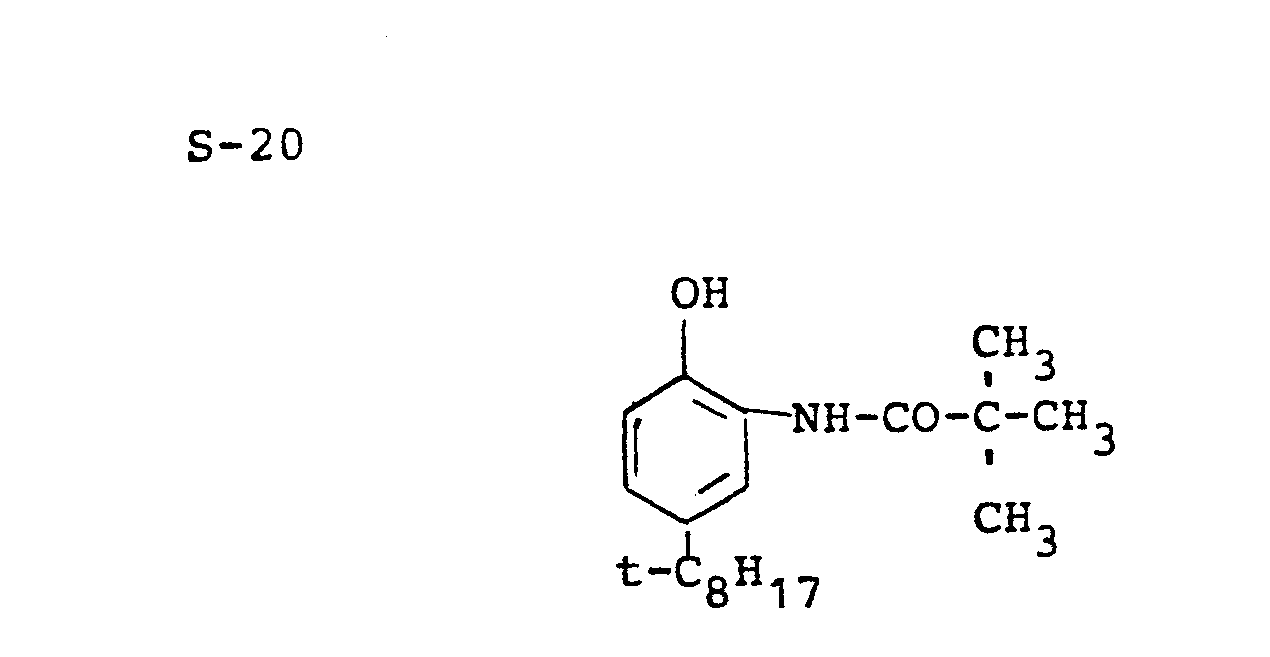
- the group t-CSH17 in the compounds S-20 to S-23 is an alkyl radical of the following structure
- the compounds of formula I to be used according to the invention can be prepared by known methods, e.g. B. by acylation or sulfonation of the corresponding o-aminophenols, in dipolar aprotic solvents such as dimethylformamide, dimethylacetamide, hexamethylphosphoric acid triamide, N-methylpyrolidone or the like or in dipolar solvents such as acetone, methyl ethyl ketone, acetonitrile or in protic solvents such as alcohols with base addition.
- dipolar aprotic solvents such as dimethylformamide, dimethylacetamide, hexamethylphosphoric acid triamide, N-methylpyrolidone or the like
- dipolar solvents such as acetone, methyl ethyl ketone, acetonitrile
- protic solvents such as alcohols with base addition.
- the color photographic recording materials according to the invention are preferably multilayer materials which have a plurality of silver halide emulsion layers or emulsion layer units with different spectral sensitivity.
- Emulsion layer units are understood to mean laminates of 2 or more silver halide emulsion layers of the same spectral sensitivity.
- Each of the light-sensitive silver halide emulsion layers or emulsion layer units mentioned is assigned a color coupler which can react with color developer oxidation products to form a non-diffusing dye.
- the color couplers are expediently non-diffusing and accommodated in the light-sensitive layer itself or in close proximity to it.
- the color couplers assigned to the two or more partial layers of an emulsion layer unit do not necessarily have to be identical. They are only intended to give the same color in color development, usually a color that is complementary to the color of the light to which the photosensitive silver halide emulsion layers are sensitive.
- the red-sensitive silver halide emulsion layers are consequently each assigned at least one non-diffusing color coupler for producing the blue-green partial color image, generally a coupler of the phenol or ⁇ -naphthol type.
- a coupler of the phenol or ⁇ -naphthol type particularly cyan couplers as described in US-A-2,474,293, US-A-2,367,531, US-A-2,895,826, US-A-3,772,002, EP-AO 028 099, EP -AO 112 514.
- the green-sensitive silver halide emulsion layers each contain at least one non-diffusing color coupler for producing the purple partial color image, color couplers of the 5-pyrazolone or indazolone type usually being used. Particularly noteworthy are, for example, purple couplers such as these are described in US-A-2 600 788, US-A-4 383 027, DE-A-1 547 803, DE-A-1 810 464, DE-A-2 408 665, DE-A-3 226 163 .
- the blue-sensitive silver halide emulsion layers each contain at least one non-diffusing color coupler for producing the yellow partial color image, usually a color coupler with an open-chain ketomethylene grouping.
- a color coupler with an open-chain ketomethylene grouping are particularly noteworthy.
- yellow couplers as described in US-A-3 408 194, DE-A-2 329 587, DE-A-2 456 976.
- Color couplers of these types are known in large numbers and are described in a large number of patents. Examples include the publications “Color Coupler” by W. Pelz, "Messages from the research laboratories of Agfa, Leverkusen / Kunststoff", Volume III (1961) p. 111 and K. Venkataraman in “The Chemistry of Synthetic Dyes", Vol. 4, 341 to 387, Academic Press (1971).
- the color couplers can be either conventional 4-equivalent couplers or 2-equivalent couplers, in which a smaller amount of silver halide is required to produce the color.
- 2-equivalent couplers are derived from the 4-equivalent couplers in that they contain a substituent in the coupling point which is split off during the coupling.
- the 2-equivalent couplers which can be used according to the present invention include both those which are practical are colorless as well as those that have an intense intrinsic color that disappears when the color is coupled or is replaced by the color of the image dye produced.
- the latter couplers can also be present in the light-sensitive silver halide emulsion layers and serve there as mask couplers to compensate for the undesired secondary densities of the image dyes.
- the 2-equivalent couplers include the known DIR couplers, which are couplers that contain a detachable residue in the coupling point, which is released as a diffusible development inhibitor or precursor of a development inhibitor when reacted with color developer oxidation products.
- color coupler mixtures can be used to set a desired color or reactivity.
- water-soluble couplers can be used in combination with hydrophobic water-insoluble couplers.
- the same methods that are also used for the incorporation of the compounds according to the invention are suitable for incorporating the couplers into the layers of the color photographic recording material.
- one advantageously uses one of the known emulsifying processes for incorporating hydrophobic color couplers, in which, for example, the color coupler is optionally dissolved in an organic solvent in the presence of a high-boiling coupler solvent or oil former and then in a gelatin solution is dispersed.
- high-boiling coupler solvents are dibutyl phthalate and tricresyl phosphate.
- Other coupler solvents are described, for example, in US-A-2,322,927, US-A-3,689,271, US-A-3,764,336 and US-A-3,765,897.
- aqueous dispersions of the hydrophobic couplers it is also possible to prepare aqueous dispersions of the hydrophobic couplers and to add them to the respective casting solutions.
- aqueous slurries of the couplers are finely ground, for example by intensive stirring with the addition of sharp-edged sand and / or by using ultrasound.
- the compounds according to the invention are preferably used together with yellow couplers; however, effects are also achieved when used in combination with magenta couplers or with cyan couplers.
- they can be dissolved in an oil former together with the respective color couplers and added to the respective casting solution in the form of such a common solution.
- they can also be added to the casting solution in the form of a separate solution in an oil former.
- Advantageous results can be achieved if from 5 to 200% by weight, preferably 20 to 100% by weight, of the compound according to the invention, each based on the amount of the color coupler used, are used.
- Compound I and the assigned color coupler are preferably in the same layer. However, it is also possible to introduce them into adjacent layers.
- the color photographic recording material can additionally contain other known stabilizing agents, for example UV absorbers and agents which prevent or delay the fading of the dyes, in particular when exposed to light, heat or moisture.
- stabilizing agents for example UV absorbers and agents which prevent or delay the fading of the dyes, in particular when exposed to light, heat or moisture.
- UV absorbers for example, phenol derivatives, hydroquinone derivatives, p-alkoxyphenol derivatives, pyrogallol derivatives, gallic acid derivatives, 5-hydroxycoumaran derivatives, 6-hydroxychromane derivatives and 5-hydroxyindane derivatives have been described as being suitable for this purpose.
- the compounds according to the invention are preferably used in combination with yellow couplers.
- yellow couplers are in particular hydrophobic yellow couplers with good solubility in hydrophobic or hydrophilic oil formers.
- the yellow couplers are preferably derived from ⁇ -pivaloyl or OC, benzoyl acetanilides. Examples of such yellow couplers are listed below.
- the intermediate layers arranged between the light-sensitive silver halide emulsion layers, the binder of which preferably consists of gelatin, may contain compounds which are capable of reacting with color developer oxidation products and which thus prevent undesired diffusion of the color developer oxidation products.
- examples of such compounds are non-diffusing reducing agents, e.g. Hydroquinone derivatives which, when reacted with the color developer oxidation products, do not give any dye remaining in the layers, or color couplers which give a soluble dye which is washed out of the layers during color photographic processing.
- the recording materials according to the invention can be developed with the usual color developer compounds, in particular those of the p-phenylenediamine series with a primary amino group, for example 4-amino-N, N-dimethylaniline, 4-amino-N, N-diethylaniline, 4-amino-3-methyl -N, N-diethylaniline, 4-amino-3-methyl-N-methyl-N- (B- methylsulfonamidoethyl) aniline, 4-amino-N-ethyl-N- (B-hydroxyethyl) aniline, 4-amino-3-methyl-N-ethyl-N- (B-hydroxyethyl) aniline, 4-amino-3 -methyl-N-ethyl-N- (ß-methoxyethyl) aniline, 4-amino-3-methyl-N-ethyl-N- (ß-methylsulfonamidoethyl) aniline, 4-amino-
- Color photographic materials were prepared as follows.
- the emulsify produced under a is mixed with a silver halide emulsion which contains 8.2 g of silver in the form of silver halide, 9.2 g of gelatin and 0.04 g of sodium dodecylbenzenesulfonate.
- the total volume is adjusted to 350 ml with water.
- the casting solution prepared in this way is poured onto a layer of cellulose triacetate.
- the material After drying, the material is exposed behind a step wedge and color developed as usual.
- the processed samples are then covered with a UV protective film and irradiated in a Xenotest device to determine the light fastness (40% relative humidity; 25 ° C; 100,000 lx.h.).
- the UV protective film was made as follows. A layer of 1.5 g of gelatin, 0.65 g of compound A (UV absorber) of the following formula was placed on a transparent cellulose triacetate film provided with an adhesive layer
- Developer A contains 2-amino-5- (N-ethyl-N-methanesulfonamidoethylamino) toluene as a color developer.
- Developer B contains 2-amino-5- (N-ethyl-N-hydroxyethylamino) toluene as a color developer. The results (percentage decrease in color density) are shown in Table 1.
- Example 2 The procedure was as in Example 1.
- the following compounds were also tested, which were known as light-stabilizing agents for the purple dyes produced from pyrazolone couplers.
- Compound S-3 also has some stabilizing effect on the lightfastness of the magenta and cyan dyes. Naturally, this effect is comparatively small with the already more stable cyan dyes.
- Curing is carried out by covering with a 10% strength aqueous solution of an instant hardening agent.
- Recording material 1 is obtained.
- Recording material 2 is also prepared in a corresponding manner, with the only difference that layer 1 additionally contains 0.22 compound S-3.
- the yellow color parts obtained were measured and the levels of the densities 0.8 and 1.0 were marked.
- the wedges were then run in a Xenotest device with a light quantity of 15. 10 6 lx.h irradiated. The marked steps were then measured again. The results are shown in the table.
Landscapes
- Physics & Mathematics (AREA)
- Spectroscopy & Molecular Physics (AREA)
- General Physics & Mathematics (AREA)
- Silver Salt Photography Or Processing Solution Therefor (AREA)
- Organic Low-Molecular-Weight Compounds And Preparation Thereof (AREA)
Abstract

- G -OH oder eine alkalilabile Vorläufergruppe
- X einen nicht abspaltbaren Substituenten
- Y -O-Alkyl, -SO2-NR1-R2, -CO-NR1-R2 -NR'-CO-R 3, -NR'-S02-R3
- R' H oder Alkyl
- R2 Alkyl, Aralkyl oder Aryl
- R3 Alkoxy, Aroxy, Alkylamino, Arylamino oder R2
- Z H, Alkyl, Alkoxy, Halogen oder Acylamino
- n 1 oder 2.
Description
- Die Erfindung betrifft ein fotografisches Aufzeichnungsmaterial mit mindestens einer Silberhalogenidemulsionsschicht, das neuartige Lichtschutzmittel für die bei der chromogenen Entwicklung erzeugten Bildfarbstoffe, insbesondere für gelbe oder pupurfarbene Azomethinfarbstoffe enthält.
- Es ist bekannt, farbige fotografische Bilder durch chromogene Entwicklung herzustellen, d.h. dadurch, daß man bildmäßig belichtete Silberhalogenidemulsionsschichten in Gegenwart geeigneter Farbkuppler mittels geeigneter farbbildender Entwicklersubstanzen - sogenannter Farbentwickler - entwickelt, wobei das in übereinstimmung mit dem Silberbild entstehende Oxidationsprodukt der Entwicklersubstanzen mit dem Farbkuppler unter Bildung eines Farbstoffbildes reagiert. Als Farbentwickler werden gewöhnlich aromatische, primäre Aminogruppen enthaltende Verbindungen, insbesondere solche vom p-Phenylendiamintyp, verwendet.
- Es ist auch bekannt, daß die durch chromogene Entwicklung erzeugten Bildfarbstoffe in unterschiedlichem Ausmaß unter dem Einfluß der Umweltbedingungen gewisse Veränderungen erleiden. Besonders auffällig ist dies, was die Einwirkung von Licht betrifft. Bekanntlich bleichen hierbei die aus Pyrazolonkupplern erzeugten Purpurfarbstoffe besonders stark aus, während sich die aus phenolischen Kupplern erzeugte Blaugrünfarbstoffe in dieser Hinsicht als besonders wenig anfällig erwiesen.
- Es hat nicht an Versuchen gefehlt diesem Mangel durch besondere Maßnahmen abzuhelfen. Namentlich im Fall der Purpurkuppler ist es gelungen durch lichtstabilisierende Zusätze oder besondere Ausgestaltung der Kuppler zu verbesserter Lichtbeständigkeit zu gelangen. Als lichtstabilisierende Mittel eignen sich im wesentlichen phenolische Verbindungen, insbesondere Derivate des Hydrochinons, die entweder den Kupplern beigemischt oder in Form von Substituenten mit den Kupplermolekülen verknüpft werden (DE-B-1 547 803, DE-A-26 17 826, DE-A-29 52 511, JP-N 53 070 822, JP-N 54 070 830, JP-N 54 073 032).
- Nachdem es auf diese Weise gelungen ist die Lichtbeständigkeit der aus Pyrazolonkupplern erzeugten Purpurfarbstoffe zu verbessern und an diejenigen der Blaugrünfarbstoffe anzunähern, wurde es in zunehmendem Maße wichtig auch die Stabilität der gelben Azomethinfarbstoffe zu verbessern, so daß die längere Einwirkung von Licht auf Farbfotos mit anfänglich ausgeglichenen Farben nicht ein ungleichmäßiges Ausbleichen der Farbstoffe bewirkt, was das Auftreten eines Farbstiches zur Folge hätte. Die zur Verbesserung der Lichtbeständigkeit der Purpurfarbstoffe vorgeschlagenen Mittel sind für die Stabilisierung der Gelbfarbstoffe nur bedingt geeignet und darüber hinaus vielfach mit anderen Nachteilen behaftet, die sie für einen prakttischen Einsatz wenig geeignet erscheinen lassen. Als Hydrochinone bzw. Hydrochinonderivate sind sie leicht oxidierbar und geben häufig Anlaß zu einer unerwünschten Anfärbung (Vergilbung) der Bildweißen. Bei längerer Lagerung werden sie häufig durch die Einwirkung von Luftsauerstoff oder anderer Oxidationsmittel oxidiert und verlieren hierdurch ihre Wirksamkeit.
- Der Erfindung liegt die Aufgabe zugrunde, für fotografische Aufzeichnungsmaterialien neuartige Lichtschutzmittel anzugeben, insbesondere solche, die für die Verbesserung der Lichtstabilität der aus Gelbkupplern erzeugten gelben Bildfarbstoffe geeignet sind.
- Gegenstand der Erfindung ist ein farbfotografisches Aufzeichungsmaterial mit mindestens einer Silberhalogenidemulsionsschicht und einem dieser zugeordneten Farbkuppler, dadurch gekennzeichnet, daß es in einer Silberhalogenidemulsionsschicht oder in einer hierzu benachbarten nicht lichtempfindlichen Bindemittelschicht eine Kombination aus einem Farbkuppler und einer Verbindung der allgemeinen Formel (I)

- G eine Hydroxygruppe oder eine alkalilabile Vorläufergruppe einer Hydroxylgruppe
- X einen Substituenten, der unter den Bedingungen der chromogenen Entwicklung nicht abgespalten wird;
- Y einen Rest einer der folgenden Formeln:
- -O-Alkyl
- -SO2-NR1-R2
- -CO-NR1-R2
- -NR1-CO-R3
- -NR1-SO2-R3
- (R1 = Wasserstoff oder Alkyl
- R2 = Alkyl, Aralkyl oder Aryl,
- R3 = Alkoxy, Aroxy, Alkylamino, Arylamino oder ein Rest wie angegeben für R2);
- Z Wasserstoff, Alkyl, Alkoxy, Halogen oder Acylamino;
- n 1 oder 2.
- Bei der Gruppe G handelt es sich wie bereits erwähnt entweder um eine Hydroxylgruppe oder um eine alkalilabile Vorläufergruppe einer Hydroxylgruppe. Mit einer alkalilabilen Vorläufergruppe einer Hydroxylgruppe ist eine Gruppe gemeint, die unter den Bedingungen der alkalischen Entwicklung eine Umwandlung erleidet und hierbei eine Hydroxylgruppe bildet. Typische Beispiele hierfür sind "acylierte Hydroxylgruppen" die bei der Entwicklung durch Alkali hydrolysiert werden, wobei die blockierende Acylgruppe abgespalten wird. Blockierende Acylgruppen leiten sich beispielsweise ab von aliphatischen oder aromatischen Carbon- oder Sulfonsäuren; Beispiele hierfür sind Acetyl, Dichloracetyl, Alkoxycarbonyl, Pyruvoyl.
- Bei dem durch X dargestellten unter den Bedingungen der chromogenen Entwicklung nicht abspaltbaren Rest kann es sich beispielsweise um einen Alkyl-, Alkoxycarbonyl-, Carbamoyl-, Acylamino-, Sulamoyl-, Alkylsulfonyl- oder Arylsulfonylrest handeln. Besonders geeignet sind solche Reste, die unter den Bedingungen der chromogenen Entwicklung d.h. bei pH-Werten zwischen 9 und 12 nicht nur nicht abgespalten werden, sondern die auch der lichtstabilisierenden Verbindung unter diesen Bedingungen keine Oxidierbarkeit (z.B. durch Folgeprodukte der Entwicklung) verleihen. Die genannten Alkylreste können geradkettig oder verzweigt sein und bis zu 18 C-Atomen oder mehr enthalten; Beispiele sind Methyl, Ethyl, t-Butyl, 1,1,3,3-Tetramethylbutyl, n-Dodecyl oder n-Tridecyl. Solche Alkylreste können auch in den genannten Alkoxycarbonyl-, Carbamoyl-, Acylamino-, Sulfamoyl- und Alkylsulfonylresten enthalten sein.
- Die durch R1, R2 oder Z dargestellten Alkylreste können geradkettig oder verzweigt sein und bis zu 20 C-Atome sowie gegebenenfalls weitere Substituenten enthalten. Solche Substituenten sind beispielsweise Phenoxygruppen, die ihrerseits durch Alkyl, Alkoxy, Hydroxyl oder Halogen weiter substituiert sein können.
- Ein durch R2 dargestellter Aralkylrest ist beispielsweise Benzyl; ein durch R2 dargestellter Arylrest ist beispielsweise Phenyl.
- Ein durch R3 dargestellter Alkoxy- oder Alkylaminorest kann einen geradkettigen oder verzweigten, gegebenenfalls substituierten Alkylrest mit bis zu 20 C-Atomen beinhalten. Ein durch R3 dargestellter Arylaminorest ist beispielsweise ein Anilinorest, der weitere Substituenten, wie Halogen, Nitro oder Alkyl enthalten kann.
- Ein durch Z dargestellter Halogensubstituent ist beispielsweise Chlor oder Brom. Eine durch Z dargestellte Acylaminogruppe leitet sich ab von aliphatischen oder aromatischen Carbon- oder Sulfonsäuren.
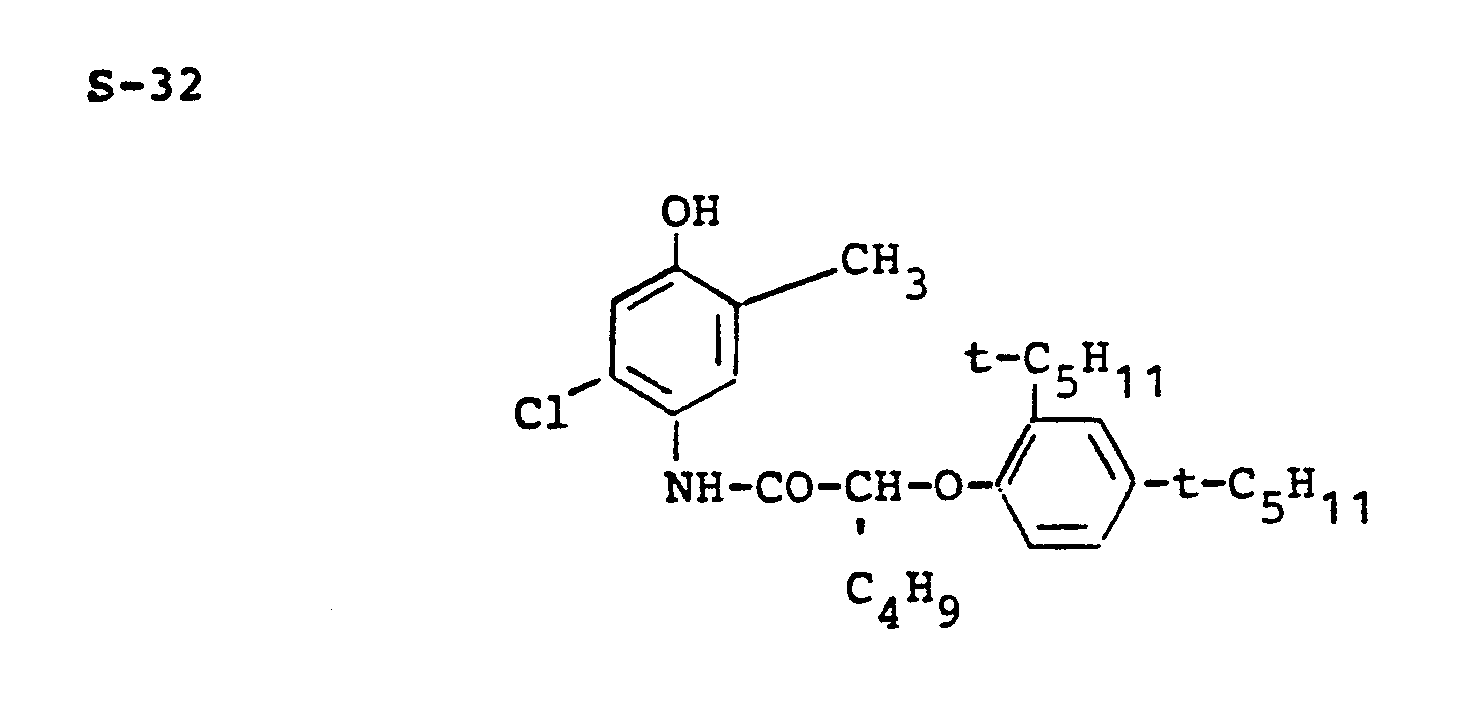
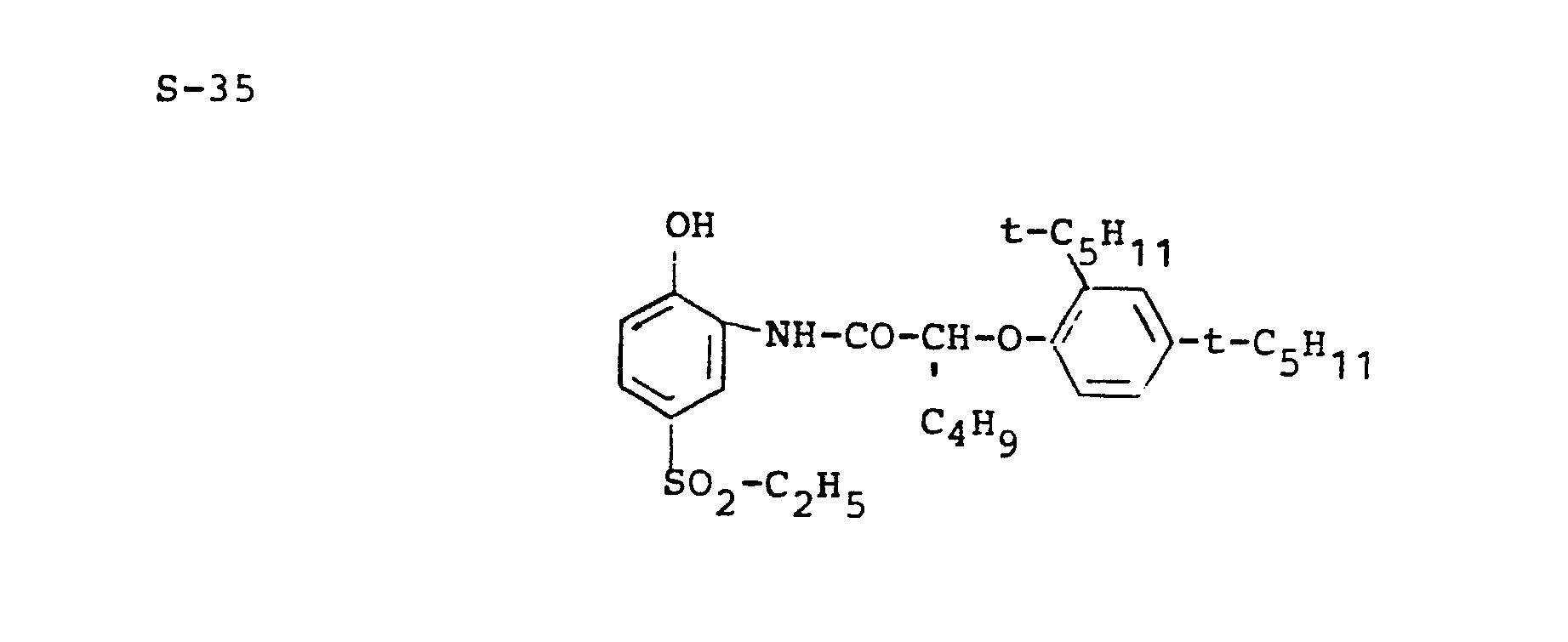
- Beispiele für lichtstabilisierende Verbindungen der vorliegenden Erfindung sind im folgenden aufgeführt.
-








-

- 7,3 g 2-Amino-4-methylphenol werden in 80 ml Aceton und 9,0 ml N,N-Dimethylanilin gelöst. Bei O - 5°C gibt man dazu langsam 24 g α-2,4-Diamylphenoxicapronsäurechlo- rid. Man rührt noch 1 Stunde nach, wobei die Temperatur langsam bis 20°C steigt und rührt dann auf eine Mischung Eis, Wasser und Salzsäure aus. Man saugt ab, trocknet und kristallisiert den Rückstand aus Acetonitril um. Man erhält 22 g reine Substanz.
- 76 % Ausbeute
- Fp: 160°C
- 11 g 2-Amino-4-tert-octylphenol werden in 50 ml Dimethylacetamid mit 13 ml Triethylamin gelöst. Man versetzt bei Raumtemperatur mit 5,6 g Pivaloylchlorid. Nach 1 Stunde wird auf 200 ml Eiswasser mit 10 ml konzentrierter Salzsäure ausgerührt. Der Niederschlag wird abgesaugt, mit Wasser gewaschen und nach Trocknen aus Acetonitril umkristallisiert.
- 9 g Ausbeute
- Fp: 184-85°C
- Bei den erfindungsgemäßen farbfotografischen Aufzeichnungsmaterialien, in denen die Verbindungen der vorliegenden Erfindung mit Vorteil eingesetzt werden können, handelt es sich bevorzugt um mehrschichtige Materialien, die mehrere Silberhalogenidemulsionsschichten oder Emulsionsschichteneinheiten mit unterschiedlicher Spektralempfindlichkeit aufweisen. Als Emulsionsschichteneinheiten werden dabei Laminate von 2 oder mehr Silberhalogenidemulsionsschichten gleicher Spektralempfindlichkeit verstanden.
- Jeder der genannten lichtempfindlichen Silberhalogenidemulsionsschichten bzw. Emulsionsschichteneinheiten ist ein Farbkuppler zugeordnet, der mit Farbentwickleroxidationsprodukten unter Bildung eines nichtdiffundierenden Farbstoffes zu reagieren vermag. Zweckmäßigerweise sind die Farbkuppler nichtdiffundierend und in der lichtempfindlichen Schicht selbst oder in enger Nachbarschaft hierzu untergebracht. Die den zwei oder mehr Teilschichten einer Emulsionsschichteneinheit zugeordneten Farbkuppler brauchen nicht notwendigerweise identisch zu sein. Sie sollen lediglich bei der Farbentwicklung die gleiche Farbe ergeben, normalerweise eine Farbe, die komplementär ist zu der Farbe des Lichtes, gegen das die lichtempfindlichen Silberhalogenidemulsionsschichten empfindlich sind.
- Den rotempfindlichen Silberhalogenidemulsionsschichten ist folglich mindestens je ein nichtdiffundierender Farbkuppler zur Erzeugung des blaugrünen Teilfarbenbildes zugeordnet, in der Regel ein Kuppler vom Phenol- oder α-Naphtoltyp. Besonders hervorzuheben sind beispielsweise Blaugrünkuppler, wie sie beschrieben sind in US-A-2 474 293, US-A-2 367 531, US-A-2 895 826, US-A-3 772 002, EP-A-O 028 099, EP-A-O 112 514.
- Die grünempfindlichen Silberhalogenidemulsionsschichten enthalten mindestens je einen nichtdiffundierenden Farbkuppler zur Erzeugung des purpurnen Teilfarbenbildes, wobei überlicherweise Farbkuppler vom Typ des 5-Pyrazolons oder des Indazolons Verwendung finden. Besonders hervorzuheben sind beispielsweise Purpurkuppler, wie sie beschrieben sind in US-A-2 600 788, US-A-4 383 027, DE-A-1 547 803, DE-A-1 810 464, DE-A-2 408 665, DE-A-3 226 163.
- Die blauempfindlichen Silberhalogenidemulsionschichten schließlich enthalten mindestens je einen nichtdiffundierenden Farbkuppler zur Erzeugung des gelben Teilfarbenbildes, in der Regel einen Farbkuppler mit einer offenkettigen Ketomethylengruppierung. Besonders hervorzugeheben sind beispielsweise Gelbkuppler, wie sie beschrieben sind in US-A-3 408 194, DE-A-2 329 587, DE-A-2 456 976.
- Farbkuppler dieser Arten sind in großer Zahl bekannt und in einer Vielzahl von Patentschriften beschrieben. Beispielhaft sei hier ferner auch auf die Veröffentlichungen "Farbkuppler" von W. Pelz, "Mitteilungen aus den Forschungslaboratorien der Agfa, Leverkusen/München", Band III (1961) S. 111 und K. Venkataraman in "The Chemistry of Synthetic Dyes", Vol. 4, 341 bis 387, Academic Press (1971), verwiesen.
- Bei den Farbkupplern kann es sich sowohl um übliche 4-Aquivalentkuppler handeln als auch um 2-Aquivalentkuppler, bei denen zur Farberzeugung eine geringere Menge Silberhalogenid erforderlich ist. 2-Aquivalentkuppler leiten sich bekanntlich von den 4-Aquivalentkupplern dadurch ab, daß sie in der Kupplungsstelle einen Substituenten enthalten, der bei der Kupplung abgespalten wird. Zu den gemäß der vorliegenden Erfindung verwendbaren 2-Aquivalentkupplern sind sowohl solche zu rechnen, die praktisch farblos sind als auch solche, die eine intensive Eigenfarbe aufweisen, die bei der Farbkupplung verschwindet bzw. durch die Farbe des erzeugten Bildfarbstoffes ersetzt wird. Letztere Kuppler können ebenfalls gemäß der Erfindung zusätzlich in den lichtempfindlichen Silberhalogenidemulsionsschichten vorhanden sein und dort als Maskenkuppler zur Kompensierung der unerwünschten Nebendichten der Bildfarbstoffe dienen. Zu den 2-Äquivalentkupplern sind weiter die bekannten DIR-Kuppler zu rechnen, bei denen es sich um Kuppler handelt, die in der Kupplungsstelle einen abspalbaren Rest enthalten, der bei Reaktion mit Farbentwickleroxidationsprodukten als diffusionsfähiger Entwicklungsinhibitor oder Vorläufer eines Entwicklungsinhibitors in Freiheit gesetzt wird.
- Bei Bedarf können Farbkupplermischungen verwendet werden, um einen gewünschten Farbton oder ein gewünschte Reaktivität einzustellen. Beispielsweise können wasserlösliche Kuppler in Kombination mit hydrophoben wasserunlöslichen Kupplern verwendet werden.
- Für die Einarbeitung der Kuppler in die Schichten des farbfotografischen Aufzeichungsmaterials kommen die gleichen Methoden in Betracht, die auch für die Einarbeitung der erfindungsgemäßen Verbindungen verwendet werden. So verwendet man für die Einverleibung hydrophober Farbkuppler zweckmäßigerweise eins der bekannten Emulgierverfahren, bei dem beispielsweise der Farbkuppler gegebenenfalls in Gegenwart eines hochsiedenden Kupplerlösungsmittels oder ölbildners in einem organischen Lösungsmittel gelöst und dann in einer Gelatinelösung dispergiert wird. Beispiele für hochsiedende Kupplerlösungsmittel sind Dibutylphthalat und Trikresylphosphat. Weitere Kupplerlösungsmittel sind beispielsweise beschrieben in den US-A-2 322 927, US-A-3 689 271, US-A-3 764 336 und US-A-3 765 897.
- weiterhin ist es möglich, wäßrige Dispersionen der hydrophoben Kuppler herzustellen und den jeweiligen Gießlösungen zuzusetzen. Hierzu werden wäßrige Aufschlämmungen der Kuppler beispielsweise durch intensives Rühren unter Zusatz von scharfkantigem Sand und/oder durch Anwendung von Ultraschall fein vermahlen. In diesem Zusammenhang sei auch auf die DE-A- 2 609 741 verwiesen.
- Die erfindungsgemäßen Verbindungen werden bevorzugt gemeinsam mit Gelbkupplern eingesetzt; jedoch werden Wirkungen auch erzielt, wenn sie mit Purpurkupplern oder mit Blaugrünkupplern kombiniert angewendet werden. Zu diesem Zweck können sie gemeinsam mit den jeweiligen Farbkupplern in einem ölbildner gelöst und in Form einer solchen gemeinsamen Lösung der jeweiligen Gießlösung zugesetzt werden. Sie können aber auch der Gießlösung in Form einer separaten Lösung in einem ölbildner zugesetzt werden. Vorteilhafte Ergebnisse lassen sich erzielen, wenn von der erfindungsgemäßen Verbindung 5 bis 200 Gew.-%, bevorzugt 20 bis 100 Gew.-%, jeweils bezogen auf die Menge des eingesetzen Farbkupplers, verwendet werden.
- Verbindung I und der zugeordnete Farbkuppler befinden sich vorzugsweise in der gleichen Schicht. Es ist aber auch möglich, sie in benachbarte Schichten einzubringen.
- Zur Stabilisierung der aus den Farbkupplern erzeugten Bildfarbstoffe kann das farbfotografische Aufzeichungsmaterial zusätzlich weitere bekannte Stabilisierungsmittel enthalten, beispielsweise UV-Absorber und Mittel, die das Ausbleichen der Farbstoffe, insbesondere unter der Einwwirkung von Licht, Wärme oder Feuchtigkeit verhindern oder verzögern. Als geeignet für diesen Zweck sind beispielsweise beschrieben worden Phenolderivate, Hydrochinonderivate, p-Alkoxyphenolderivate, Pyrogallolderivate, Gallussäurederivate, 5-Hydroxycumaranderivate, 6-Hydroxychromanderivate und 5-Hydroxyindanderivate.
- Wie bereits erwähnt werden die erfindungsgemäßen Verbindungen bevorzugt in Kombination mit Gelbkupplern verwendet. Hierbei handelt es sich insbesondere um hydrophobe Gelbkuppler mit einer guten Löslichkeit in hydrophoben oder hydrophilen ölbildnern. Die Gelbkupper leiten sich bevorzugt von α-Pivaloyl oder OC,-Benzoyl- acetaniliden ab. Beispiele für derartige Gelbkuppler sind im folgenden aufgeführt.


- In den zwischen den lichtempfindlichen Silberhalogenidemulsionsschichten angeordneten Zwischenschichten, deren Bindemittel vorzugsweise aus Gelatine besteht, können Verbindungen enthalten sein, die mit Farbentwickleroxidationsprodukten zu reagieren vermögen, und die somit eine unerwünschte Diffusion der Farbentwickleroxidationsprodukte verhindern. Beispiele für derartige Verbindungen sind etwa nichtdiffundierende Reduktionsmittel, z.B. Hydrochinonderivate, die bei Reaktion mit den Farbentwickleroxidationsprodukten keinen in den Schichten verbleibenden Farbstoff ergeben, oder aber Farbkuppler, die einen löslichen Farbstoff ergeben, der während der farbfotografischen Verarbeitung aus den Schichten ausgewaschen wird. Weitere geeignete Verbindungen zur Unterdrückung der unerwünschten Diffusion von Farbentwickleroxidationsprodukten sind beispielsweise beschrieben in der Monographie "Stabilization of Photographic Silver Halide Emulsions" von E.J. Birr, The Focal Press, lst Edition 1974, Seiten 116 bis 122.
- Bezüglich weiterer geeigneter Zusätze zu den erfindungsgemäßen farbfotografischen Aufzeichnungsmaterialien oder zu einer ihrer Schichten sei verwiesen auf den Artikel in der Zeitschrift "Product Licensing Index", Band 92, Dezember 1971, Seiten 107 bis 110.
- Die erfindungsgemßen Aufzeichnungsmaterialien können mit den üblichen Farbenwicklerverbindungen entwickelt werden, insbesondere solchen der p-Phenylendiaminreihe mit einer primären Aminogruppe, z.B. 4-Amino-N,N-dimethylanilin, 4-Amino-N,N-diethylanilin, 4-Amino-3-methyl-N,N-diethylanilin, 4-Amino-3-methyl-N-methyl-N-(B-methylsulfonamidoethyl)-anilin, 4-Amino-N-ethyl-N-(B-hydroxyethyl)-anilin, 4-Amino-3-methyl-N-ethyl-N-(B-hydroxyethyl)-anilin, 4-Amino-3-methyl-N-ethyl-N-(ß- methoxyethyl)-anilin, 4-Amino-3-methyl-N-ethyl-N-(ß- methylsulfonamidoethyl)-anilin, 4-Amino-N-butyl-N-(ω-sulfobutyl)-anilin, 4-Amino-3-methyl-N-isopropyl-N-(ω-sulfobutyl)-anilin.
- Weitere geeignete Farbentwickler sind beispielsweise beschrieben in J. Amer. Chem. Soc., 73, 3200-3125 (1951).
- Farbfotografische Aufzeichnungsmaterialien wurden wie folgt hergestellt.
- 8 mmol Farbkuppler werden in der gleichen Gewichtsmenge Dibutylphthalat und der dreifachen Gewichtsmenge Ethylacetat in Gegenwart von 0,15 g Sulfobernsteinsäuredioctylester bei einer Temperatur von 50 bis 75 °C gelöst. Der Lösung wird gegebenenfalls außerdem die zu testende lichtstabilisierende Verbindung in der aus der Tabelle ersichtlichen Menge zugesetzt. Die Lösung wird anschließend in 150 g 7,5 %ige wäßrige, ca. 40 °C warme Gelatinelösung eingerührt und darin dispergiert.
- Das unter a hergestellte Emulgat wird mit einer Silberhalogenidemulsion vermischt, die 8,2 g Silber in Form von Silberhalogenid, 9,2 g Gelatine und 0,04 g Natrium-dodecylbenzolsulfonat enthält. Das Gesamtvolumen wird mit Wasser auf 350 ml eingestellt. Die so hergestellte Gießlösung wird auf einen Schichtträger aus Cellulosetriacetat vergossen.
- Nach dem Trocknen wird das Material hinter einem Stufenkeil belichtet und wie üblich farbentwickelt.
- Die verarbeiteten Proben werden anschließend, abgedeckt mit einer UV-Schutzfolie, in einem Xenotestgerät zur Ermittlung der Lichtechtheit bestrahlt (40 % relative Feuchte; 25°C; 100 000 lx.h.). Die UV-Schutzfolie war wie folgt hergestellt worden. Auf eine mit einer Haftschicht versehenen transparenten Cellulosetriazetatfolie wurde eine Schicht aus 1,5 g Gelatine, 0,65 g Verbindung A(UV-Absorber) der folgenden Formel
-

- Enwickler A enthält 2-Amino-5-(N-ethyl-N-methansulfon- amidoethylamino)-toluol als Farbentwicklersubstanz. Entwickler B enthält 2-Amino-5-(N-ethyl-N-hydroxyethyl- amino)-toluol als Farbentwicklersubstanz. Die Ergebnisse (prozentuale Abnahme der Farbdichte) sind in Tabelle 1 dargestellt.


- Es wurde verfahren wie in Beispiel 1. Zum Vergleich wurden die folgenden Verbindungen mitgestestet, die als lichtstabilisierende Mittel für die aus Pyrazolonkupplern erzeugten Purpurfarbstoffe bekannt waren.


- Als Kuppler wurde die Verbindung Y-4 verwendet. Die mit Entwickler A erhaltenen Ergebnisse sind aus folgender Tabelle 2 ersichtlich.

- Stabilisierung von Purpur- und Blaugrünfarbstoffen.
- Es wurde verfahren wie in Beispiel 1. Die folgenden Farbkuppler wurden verwendet. M-1
-


- Es ist aus Tabelle 3 ersichtlich, daß die Verbindung S-3 auch eine gewisse stabilisierende Wirkung auf die Lichtbeständigkeit der Purpur- und Blaugrünfarbstoffe hat. Naturgemäß ist diese Wirkung bei den an sich schon stabileren Blaugrünfarbstoffen vergleichsweise gering.
- Auf ein mit einer Haftschicht versehenes polyethylenbeschichtetes Papier wurden die folgenden Schichten nacheinander aufgetragen (die angegebenen Mengen beziehen sich auf 1m2).
- 1. Eine blauempfindliche gelbkupplerhaltige Silberhalogenidemulsionsschicht aus 0,55 g AgNO3 mit 0,72 g Verbindung Y-4, 0,22 g Trikresylphosphat und 1,7 g Gelatine.
- 2. Eine Zwischenschicht mit 1,2 g Gelatine, 0,07 Dioctylhydrochinon und 0,04 g Trikresylphosphat.
- 3. Eine grünsensibilisierte purpurkupplerhaltige Silberhalogenidemulsionsschicht aus 0,5 g AgN03 mit 0,45 g Verbindung M-2 (Purpurkuppler),

- 4. Eine UV-Schutzschicht mit 1,5 g Gelatine, 0,65 g Verbindung A (UV-Absorber), 0,07 Dioctylhydrochinon und 0,36 g Trikresylphosphat.
- 5. Eine rotsensibilisierte blaugrünkupplerhaltige Silberhalogenidemulsionsschicht aus 0,4 g AgN03 mit 0,35 g Verbindung C-3 Blaugrünkuppler,

- 6. Eine Deckschicht mit 1,2 g Gelatine.
- Gehärtet wird durch Überschichten mit einer 10 %igen wäßrigen Lösung eines Soforthärtungsmittels.
- Man erhält das Aufzeichnungsmaterial 1. In entsprechender Weise wird auch das Aufzeichnungsmaterial 2 hergestellt mit dem einzigen Unterschied, daß die Schicht 1 zusätzlich 0,22 Verbindung S-3 enthielt.
- Die beiden Materialien 1 (Stand der Technik) und 2(erfindungsgemäß) wurden hinter einem Stufenkeil mit blauem Licht belichtet und wie folgt entwickelt (Badtemperatur 33°C):
- 1. Farbentwicklung - 3,5 min
- 15 ml Benzylalkohol
- 15 ml Ethylenglykol
- 3 g Hydroxylaminsulfat
- 4,5 g 3-Methyl-4-amino-N-ethyl-N-(B-methansulfon- amidoethyl)-anilinsulfat
- 32 g K2 C0 3
- 2 g K 2 S0 3
- 0,6 g KBr
- 1 g Dinatriumsalz der 1-Hydroxyethylidin-1,1- disulfonsäure
- auf 1000 ml auffüllen mit Wasser; pH 10,2.
- 2. Bleichfixierbad - 1,5 min
- 35 ml Ammoniaklösung (28 %ig)
- 30 g EDTA
- 15 g Na2SO3
- 100 g Ammoniumthiosulfat
- 60 g Natrium-(EDTA)-eisen-III-komplex
- auf 1000 ml auffüllen mit Wasser; pH 7.
- 3. Wässern - 3 min.
- Die erhaltenen gelben Farbteile wurden ausgemessen und die Stufen der Dichten 0,8 und 1,0 wurden markiert. Die Keile wurden anschließend in einem Xenotestgerät mit einer Lichtmenge von 15 . 106 lx.h bestrahlt. Danach wurden die markierten Stufen erneut gemessen. Die Ergebnisse sind in Tabelle aufgeführt.

- Durch den erfindungsgemäßen Zusatz ergibt sich somit eine ca. 40 %ige Verminderung der Farbdichteverluste.
Claims (1)


Applications Claiming Priority (2)
| Application Number | Priority Date | Filing Date | Title |
|---|---|---|---|
| DE19843435443 DE3435443A1 (de) | 1984-09-27 | 1984-09-27 | Fotografisches aufzeichnungsmaterial |
| DE3435443 | 1984-09-27 |
Publications (3)
| Publication Number | Publication Date |
|---|---|
| EP0176845A2 true EP0176845A2 (de) | 1986-04-09 |
| EP0176845A3 EP0176845A3 (en) | 1988-09-21 |
| EP0176845B1 EP0176845B1 (de) | 1991-02-06 |
Family
ID=6246485
Family Applications (1)
| Application Number | Title | Priority Date | Filing Date |
|---|---|---|---|
| EP85111669A Expired - Lifetime EP0176845B1 (de) | 1984-09-27 | 1985-09-16 | Fotografisches Aufzeichnungsmaterial |
Country Status (4)
| Country | Link |
|---|---|
| US (1) | US4656125A (de) |
| EP (1) | EP0176845B1 (de) |
| JP (1) | JPH0713737B2 (de) |
| DE (2) | DE3435443A1 (de) |
Cited By (2)
| Publication number | Priority date | Publication date | Assignee | Title |
|---|---|---|---|---|
| WO1991018323A1 (en) * | 1990-05-16 | 1991-11-28 | Kodak Limited | Photographic material comprising a magenta dye image forming coupler combination |
| EP0563638A1 (de) * | 1992-03-23 | 1993-10-06 | Agfa-Gevaert AG | Fotografisches Aufzeichnungsmaterial |
Families Citing this family (82)
| Publication number | Priority date | Publication date | Assignee | Title |
|---|---|---|---|---|
| US4745049A (en) * | 1986-04-11 | 1988-05-17 | Konishiroku Photo Industry Co., Ltd. | Silver halide photographic light-sensitive material |
| DE3918547A1 (de) * | 1989-06-07 | 1990-12-13 | Agfa Gevaert Ag | Farbfotografisches silberhalogenidmaterial |
| JPH04340960A (ja) * | 1991-05-17 | 1992-11-27 | Fuji Photo Film Co Ltd | ハロゲン化銀カラー写真感光材料 |
| US5491052A (en) * | 1992-03-13 | 1996-02-13 | Eastman Kodak Company | Yellow layer for color photographic elements |
| JP2717489B2 (ja) * | 1992-12-04 | 1998-02-18 | 富士写真フイルム株式会社 | ハロゲン化銀カラー写真感光材料 |
| JP2003094817A (ja) | 2001-09-21 | 2003-04-03 | Fuji Photo Film Co Ltd | 感熱記録材料 |
| US20070052783A1 (en) | 2003-09-29 | 2007-03-08 | Toshiki Taguchi | Ink for inkjet printing ink set for inkjet printing inkjet recording material and producing method for inkjet recording material and inkjet recording method |
| EP1571181A3 (de) | 2004-02-24 | 2008-08-13 | FUJIFILM Corporation | Anorganische feine Teilchen enthaltende Dispersion, Verfahren zu ihrer Herstellung, und Bildaufzeichnungsmaterial |
| JP4250121B2 (ja) | 2004-07-02 | 2009-04-08 | 富士フイルム株式会社 | インクジェット記録用媒体 |
| US20060204732A1 (en) | 2005-03-08 | 2006-09-14 | Fuji Photo Film Co., Ltd. | Ink composition, inkjet recording method, printed material, method of producing planographic printing plate, and planographic printing plate |
| JP4662822B2 (ja) | 2005-07-19 | 2011-03-30 | 富士フイルム株式会社 | 光硬化型インクジェット記録装置 |
| US20070049651A1 (en) | 2005-08-23 | 2007-03-01 | Fuji Photo Film Co., Ltd. | Curable composition, ink composition, inkjet recording method, printed material, method of producing planographic printing plate, planographic printing plate, and oxcetane compound |
| JP4677306B2 (ja) | 2005-08-23 | 2011-04-27 | 富士フイルム株式会社 | 活性エネルギー硬化型インクジェット記録装置 |
| JP4757574B2 (ja) | 2005-09-07 | 2011-08-24 | 富士フイルム株式会社 | インク組成物、インクジェット記録方法、印刷物、平版印刷版の製造方法、及び、平版印刷版 |
| EP2103639A1 (de) | 2005-11-04 | 2009-09-23 | Fujifilm Corporation | Härtbare polyzyklische Epoxidzusammensetzung, Tinte und Tintenstrahldruckverfahren damit |
| EP1829684B1 (de) | 2006-03-03 | 2011-01-26 | FUJIFILM Corporation | Härtbare Zusammensetzung, Tintenzusammensetzung, Tintenstrahlaufzeichnungsverfahren und Flachdruckplatte |
| JP4719606B2 (ja) | 2006-03-30 | 2011-07-06 | 富士フイルム株式会社 | インクジェットヘッド記録装置 |
| JP5276264B2 (ja) | 2006-07-03 | 2013-08-28 | 富士フイルム株式会社 | インク組成物、インクジェット記録方法、印刷物、及び、平版印刷版の製造方法 |
| US8038283B2 (en) | 2007-01-18 | 2011-10-18 | Fujifilm Corporation | Ink-jet recording apparatus |
| JP2008189776A (ja) | 2007-02-02 | 2008-08-21 | Fujifilm Corp | 活性放射線硬化型重合性組成物、インク組成物、インクジェット記録方法、印刷物、平版印刷版の作製方法、及び平版印刷版 |
| JP5227521B2 (ja) | 2007-02-26 | 2013-07-03 | 富士フイルム株式会社 | インク組成物、インクジェット記録方法、印刷物、及び、インクセット |
| JP2008208266A (ja) | 2007-02-27 | 2008-09-11 | Fujifilm Corp | インク組成物、インクジェット記録方法、印刷物、平版印刷版の製造方法、および平版印刷版 |
| JP5224699B2 (ja) | 2007-03-01 | 2013-07-03 | 富士フイルム株式会社 | インク組成物、インクジェット記録方法、印刷物、平版印刷版の製造方法、及び平版印刷版 |
| EP1970196A3 (de) | 2007-03-13 | 2010-01-27 | FUJIFILM Corporation | Hydrophiles Element und Herstellungsverfahren dafür |
| JP2008238711A (ja) | 2007-03-28 | 2008-10-09 | Fujifilm Corp | 親水性部材及び下塗り組成物 |
| JP2008246793A (ja) | 2007-03-29 | 2008-10-16 | Fujifilm Corp | 活性エネルギー線硬化型インクジェット記録装置 |
| JP5159141B2 (ja) | 2007-03-30 | 2013-03-06 | 富士フイルム株式会社 | インク組成物、インクジェット記録方法、印刷物、平版印刷版の作製方法及び平版印刷版 |
| JP5337394B2 (ja) | 2007-05-15 | 2013-11-06 | 富士フイルム株式会社 | 親水性コーティング組成物及びこれを用いた親水性部材 |
| JP2009034942A (ja) | 2007-08-03 | 2009-02-19 | Fujifilm Corp | インクジェット記録用媒体 |
| JP2009256568A (ja) | 2007-08-17 | 2009-11-05 | Fujifilm Corp | 親水性膜形成用組成物、スプレー用組成物およびこれを用いた親水性部材 |
| JP5469837B2 (ja) | 2007-09-12 | 2014-04-16 | 富士フイルム株式会社 | 親水性組成物 |
| JP2009090641A (ja) | 2007-09-20 | 2009-04-30 | Fujifilm Corp | 防曇性カバー、及び該防曇性カバーを用いたメーター用カバー |
| JP2009256564A (ja) | 2007-09-26 | 2009-11-05 | Fujifilm Corp | 親水性膜形成用組成物および親水性部材 |
| US8076393B2 (en) | 2007-09-26 | 2011-12-13 | Fujifilm Corporation | Ink composition, inkjet recording method, and printed material |
| JP5111039B2 (ja) | 2007-09-27 | 2012-12-26 | 富士フイルム株式会社 | 重合性化合物、重合開始剤、および染料を含有する光硬化性組成物 |
| JP5236238B2 (ja) | 2007-09-28 | 2013-07-17 | 富士フイルム株式会社 | インクジェット記録用ホワイトインク組成物 |
| JP5227560B2 (ja) | 2007-09-28 | 2013-07-03 | 富士フイルム株式会社 | インク組成物、インクジェット記録方法、印刷物、及び、成形印刷物の製造方法 |
| JP2009090489A (ja) | 2007-10-04 | 2009-04-30 | Fujifilm Corp | 画像形成方法及び画像形成装置 |
| JP2009107319A (ja) | 2007-11-01 | 2009-05-21 | Fujifilm Corp | インクジェット記録材料 |
| US8240838B2 (en) | 2007-11-29 | 2012-08-14 | Fujifilm Corporation | Ink composition for inkjet recording, inkjet recording method, and printed material |
| JP2009256571A (ja) | 2008-01-25 | 2009-11-05 | Fujifilm Corp | 防かび作用を有する親水性組成物及び親水性部材 |
| JP5124496B2 (ja) | 2008-02-01 | 2013-01-23 | 富士フイルム株式会社 | 親水性部材 |
| JP5591473B2 (ja) | 2008-02-05 | 2014-09-17 | 富士フイルム株式会社 | インク組成物、インクジェット記録方法、及び印刷物 |
| JP5383225B2 (ja) | 2008-02-06 | 2014-01-08 | 富士フイルム株式会社 | インク組成物、インクジェット記録方法、および印刷物 |
| JP5254632B2 (ja) | 2008-02-07 | 2013-08-07 | 富士フイルム株式会社 | インク組成物、インクジェット記録方法、印刷物、及び、成形印刷物 |
| US20090214797A1 (en) | 2008-02-25 | 2009-08-27 | Fujifilm Corporation | Inkjet ink composition, and inkjet recording method and printed material employing same |
| JP5427382B2 (ja) | 2008-03-25 | 2014-02-26 | 富士フイルム株式会社 | 親水性部材、フィン材、アルミニウム製フィン材、熱交換器およびエアコン |
| JP4914862B2 (ja) | 2008-03-26 | 2012-04-11 | 富士フイルム株式会社 | インクジェット記録方法、及び、インクジェット記録装置 |
| JP2009270062A (ja) | 2008-05-09 | 2009-11-19 | Fujifilm Corp | 紫外線吸収剤組成物 |
| JP2010030196A (ja) | 2008-07-30 | 2010-02-12 | Fujifilm Corp | インクジェット記録方法 |
| JP2010030223A (ja) | 2008-07-30 | 2010-02-12 | Fujifilm Corp | インクジェット記録方法、インクジェット記録装置、及び、印刷物 |
| JP2010030197A (ja) | 2008-07-30 | 2010-02-12 | Fujifilm Corp | インクジェット記録方法 |
| JP5383133B2 (ja) | 2008-09-19 | 2014-01-08 | 富士フイルム株式会社 | インク組成物、インクジェット記録方法及び印刷物成形体の製造方法 |
| JP2010077228A (ja) | 2008-09-25 | 2010-04-08 | Fujifilm Corp | インク組成物、インクジェット記録方法、及び、印刷物 |
| EP2169018B1 (de) | 2008-09-26 | 2012-01-18 | Fujifilm Corporation | Tintenzusammensetzung und Tintenaufzeichnungsverfahren |
| JP5461809B2 (ja) | 2008-09-29 | 2014-04-02 | 富士フイルム株式会社 | インク組成物、及び、インクジェット記録方法 |
| JP5344892B2 (ja) | 2008-11-27 | 2013-11-20 | 富士フイルム株式会社 | インクジェット用インク組成物、及びインクジェット記録方法 |
| JP5241564B2 (ja) | 2009-02-27 | 2013-07-17 | 富士フイルム株式会社 | 活性放射線硬化型インクジェット記録用インク組成物、インクジェット記録方法、および印刷物 |
| JP5225156B2 (ja) | 2009-02-27 | 2013-07-03 | 富士フイルム株式会社 | 活性放射線硬化型インクジェット記録用インク組成物、インクジェット記録方法及び印刷物 |
| JP2010202756A (ja) | 2009-03-03 | 2010-09-16 | Fujifilm Corp | 活性エネルギー線硬化型インク組成物、インクジェット記録方法、及び印刷物 |
| JP2010209183A (ja) | 2009-03-09 | 2010-09-24 | Fujifilm Corp | インク組成物及びインクジェット記録方法 |
| JP5349095B2 (ja) | 2009-03-17 | 2013-11-20 | 富士フイルム株式会社 | インク組成物、及び、インクジェット記録方法 |
| JP5349097B2 (ja) | 2009-03-19 | 2013-11-20 | 富士フイルム株式会社 | インク組成物、インクジェット記録方法、印刷物、及び、成形印刷物の製造方法 |
| JP2010229349A (ja) | 2009-03-27 | 2010-10-14 | Fujifilm Corp | 活性エネルギー線硬化型組成物、活性エネルギー線硬化型インク組成物インク組成物及びインクジェット記録方法 |
| JP5405174B2 (ja) | 2009-03-30 | 2014-02-05 | 富士フイルム株式会社 | インク組成物 |
| JP5383289B2 (ja) | 2009-03-31 | 2014-01-08 | 富士フイルム株式会社 | インク組成物、インクジェット用であるインク組成物、インクジェット記録方法、およびインクジェット法による印刷物 |
| JP5579533B2 (ja) | 2009-08-27 | 2014-08-27 | 富士フイルム株式会社 | 新規なオキセタン化合物、活性エネルギー線硬化型組成物、活性エネルギー線硬化型インク組成物、及びインクジェット記録方法 |
| JP5572026B2 (ja) | 2009-09-18 | 2014-08-13 | 富士フイルム株式会社 | インク組成物、及び、インクジェット記録方法 |
| JP2011068783A (ja) | 2009-09-25 | 2011-04-07 | Fujifilm Corp | インク組成物、及び、インクジェット記録方法 |
| JP5489616B2 (ja) | 2009-09-28 | 2014-05-14 | 富士フイルム株式会社 | インク組成物及び印刷物成型体の製造方法 |
| JP5554114B2 (ja) | 2010-03-29 | 2014-07-23 | 富士フイルム株式会社 | 活性放射線硬化型インクジェット用インク組成物、印刷物、印刷物の製造方法、印刷物成形体、及び印刷物成形体の製造方法 |
| US8573765B2 (en) | 2010-03-31 | 2013-11-05 | Fujifilm Corporation | Active radiation curable ink composition, ink composition for inkjet recording, printed matter, and method of producing molded article of printed matter |
| JP5606817B2 (ja) | 2010-07-27 | 2014-10-15 | 富士フイルム株式会社 | 活性放射線硬化型インクジェット用インク組成物、印刷物、印刷物成形体、及び印刷物の製造方法 |
| EP3124557B1 (de) | 2011-02-28 | 2018-08-22 | Fujifilm Corporation | Tintenzusammensetzung und bildformungsverfahren |
| JP2012201874A (ja) | 2011-03-28 | 2012-10-22 | Fujifilm Corp | インク組成物、及び画像形成方法 |
| JP5756071B2 (ja) | 2011-09-29 | 2015-07-29 | 富士フイルム株式会社 | インクジェットインク組成物、及びインクジェット記録方法 |
| JP5980702B2 (ja) | 2013-03-07 | 2016-08-31 | 富士フイルム株式会社 | インクジェットインク組成物、インクジェット記録方法、及び、成型印刷物の製造方法 |
| JP5939644B2 (ja) | 2013-08-30 | 2016-06-22 | 富士フイルム株式会社 | 画像形成方法、インモールド成型品の製造方法、及び、インクセット |
| JP6117072B2 (ja) | 2013-09-30 | 2017-04-19 | 富士フイルム株式会社 | 顔料分散組成物、インクジェット記録方法、及び化合物の製造方法 |
| JP6169545B2 (ja) | 2014-09-09 | 2017-07-26 | 富士フイルム株式会社 | 重合性組成物、インクジェット記録用インク組成物、インクジェット記録方法、及び記録物 |
| JP6086888B2 (ja) | 2014-09-26 | 2017-03-01 | 富士フイルム株式会社 | インクジェット記録用インク組成物、インクジェット記録方法、及び記録物 |
| JP6169548B2 (ja) | 2014-09-26 | 2017-07-26 | 富士フイルム株式会社 | 重合性組成物、インクジェット記録用インク組成物、インクジェット記録方法、及び記録物 |
Family Cites Families (9)
| Publication number | Priority date | Publication date | Assignee | Title |
|---|---|---|---|---|
| US3519429A (en) * | 1966-05-16 | 1970-07-07 | Eastman Kodak Co | Silver halide emulsions containing a stabilizer pyrazolone coupler |
| JPS5227534B1 (de) * | 1970-09-21 | 1977-07-21 | ||
| JPS52147433A (en) * | 1976-06-02 | 1977-12-07 | Fuji Photo Film Co Ltd | Color photographic light sensitive material |
| JPS52150630A (en) * | 1976-06-09 | 1977-12-14 | Mitsubishi Paper Mills Ltd | Color photographic material containing stabilizer |
| JPS5724941A (en) * | 1980-07-22 | 1982-02-09 | Fuji Photo Film Co Ltd | Color photographic sensitive material |
| JPS59192246A (ja) * | 1983-04-15 | 1984-10-31 | Fuji Photo Film Co Ltd | カラ−写真感光材料 |
| JPS59192247A (ja) * | 1983-04-15 | 1984-10-31 | Fuji Photo Film Co Ltd | カラ−写真感光材料 |
| JPS60108847A (ja) * | 1983-11-18 | 1985-06-14 | Konishiroku Photo Ind Co Ltd | ハロゲン化銀カラ−写真感光材料 |
| JPS60118836A (ja) * | 1983-11-30 | 1985-06-26 | Konishiroku Photo Ind Co Ltd | ハロゲン化銀写真感光材料 |
-
1984
- 1984-09-27 DE DE19843435443 patent/DE3435443A1/de not_active Withdrawn
-
1985
- 1985-09-16 US US06/776,677 patent/US4656125A/en not_active Expired - Lifetime
- 1985-09-16 EP EP85111669A patent/EP0176845B1/de not_active Expired - Lifetime
- 1985-09-16 DE DE8585111669T patent/DE3581686D1/de not_active Expired - Fee Related
- 1985-09-27 JP JP60214378A patent/JPH0713737B2/ja not_active Expired - Lifetime
Cited By (4)
| Publication number | Priority date | Publication date | Assignee | Title |
|---|---|---|---|---|
| WO1991018323A1 (en) * | 1990-05-16 | 1991-11-28 | Kodak Limited | Photographic material comprising a magenta dye image forming coupler combination |
| US5552266A (en) * | 1990-05-16 | 1996-09-03 | Eastman Kodak Company | Photographic material comprising a magenta dye image forming coupler combination |
| EP0563638A1 (de) * | 1992-03-23 | 1993-10-06 | Agfa-Gevaert AG | Fotografisches Aufzeichnungsmaterial |
| US5340709A (en) * | 1992-03-23 | 1994-08-23 | Agfa-Gevaert Ag | Photographic recording material |
Also Published As
| Publication number | Publication date |
|---|---|
| EP0176845A3 (en) | 1988-09-21 |
| DE3435443A1 (de) | 1986-04-03 |
| US4656125A (en) | 1987-04-07 |
| JPH0713737B2 (ja) | 1995-02-15 |
| JPS6186750A (ja) | 1986-05-02 |
| EP0176845B1 (de) | 1991-02-06 |
| DE3581686D1 (de) | 1991-03-14 |
Similar Documents
| Publication | Publication Date | Title |
|---|---|---|
| EP0176845B1 (de) | Fotografisches Aufzeichnungsmaterial | |
| DE3789277T2 (de) | Lichtempfindliches photographisches Silberhalogenidmaterial, das einen gelben Kuppler enthält. | |
| DE2329587C2 (de) | Farbphotographisches Aufzeichnungsmaterial | |
| EP0169458B1 (de) | Farbfotografisches Aufzeichnungsmaterial mit einem Gelb-DIR-Kuppler | |
| DE2841166C2 (de) | Farbphotographische Silberhalogenidemulsion und deren Verwendung zur Erzeugung von Farbbildern | |
| DE2934769A1 (de) | Lichtempfindliches photographisches silberhalogenidmaterial und verfahren zur erzeugung von farbbildern | |
| DE2706117C2 (de) | ||
| DE3135938C2 (de) | Photographisches Aufzeichnungsmaterial | |
| DE3633364C3 (de) | Farbfotografisches Aufzeichnungsmaterial mit einem Farbkuppler vom Pyrazoloazol-Typ | |
| DE3021207A1 (de) | Lichtempfindliches (farb)photographisches aufzeichnungsmaterial | |
| EP0213490B1 (de) | Farbfotografisches Aufzeichnungsmaterial | |
| DE2635492A1 (de) | Photographischer farbkuppler | |
| DE2754281A1 (de) | Photographisches, lichtempfindliches silberhalogenid-material | |
| EP0415056B1 (de) | Farbfotografisches Aufzeichnungsmaterial mit einem Kuppler, der eine fotografisch wirksame Verbindung freisetzt | |
| DE3026391C2 (de) | ||
| DE3624544C2 (de) | Farbfotografisches Aufzeichnungsmaterial mit einem Farbkuppler vom Pyrazoloazol-Typ | |
| DE3622007C2 (de) | Farbfotografisches Aufzeichnungsmaterial mit 2-Äquivalentpurpurkupplern | |
| DE2705974C2 (de) | ||
| DE3626219A1 (de) | Farbfotografisches aufzeichnungsmaterial mit einem gelb-dir-kuppler | |
| DE3625616A1 (de) | Farbfotografisches aufzeichnungsmaterial mit 2-aequivalentpurpurkupplern | |
| DE3878368T2 (de) | Photographisches eintragungsmaterial mit einer ein purpurrotes farbbild bildenden kupplerverbindung. | |
| DE2843954A1 (de) | Lichtempfindliches frabphotographisches element | |
| DE2454301A1 (de) | Lichtempfindliches farbphotographisches material | |
| DE3541858A1 (de) | Farbfotografisches farbkupplerhaltiges aufzeichnungsmaterial | |
| EP0217255B1 (de) | Farbfotografisches Aufzeichnungsmaterial mit leicht dispergierbaren Farbkupplern |
Legal Events
| Date | Code | Title | Description |
|---|---|---|---|
| PUAI | Public reference made under article 153(3) epc to a published international application that has entered the european phase |
Free format text: ORIGINAL CODE: 0009012 |
|
| 17P | Request for examination filed |
Effective date: 19850916 |
|
| AK | Designated contracting states |
Kind code of ref document: A2 Designated state(s): BE DE FR GB |
|
| RAP1 | Party data changed (applicant data changed or rights of an application transferred) |
Owner name: AGFA-GEVAERT AG |
|
| PUAL | Search report despatched |
Free format text: ORIGINAL CODE: 0009013 |
|
| AK | Designated contracting states |
Kind code of ref document: A3 Designated state(s): BE DE FR GB |
|
| 17Q | First examination report despatched |
Effective date: 19890616 |
|
| GRAA | (expected) grant |
Free format text: ORIGINAL CODE: 0009210 |
|
| AK | Designated contracting states |
Kind code of ref document: B1 Designated state(s): BE DE FR GB |
|
| REF | Corresponds to: |
Ref document number: 3581686 Country of ref document: DE Date of ref document: 19910314 |
|
| ET | Fr: translation filed | ||
| GBT | Gb: translation of ep patent filed (gb section 77(6)(a)/1977) | ||
| PLBE | No opposition filed within time limit |
Free format text: ORIGINAL CODE: 0009261 |
|
| STAA | Information on the status of an ep patent application or granted ep patent |
Free format text: STATUS: NO OPPOSITION FILED WITHIN TIME LIMIT |
|
| 26N | No opposition filed | ||
| PGFP | Annual fee paid to national office [announced via postgrant information from national office to epo] |
Ref country code: BE Payment date: 19960911 Year of fee payment: 12 |
|
| PG25 | Lapsed in a contracting state [announced via postgrant information from national office to epo] |
Ref country code: BE Free format text: LAPSE BECAUSE OF NON-PAYMENT OF DUE FEES Effective date: 19970930 |
|
| BERE | Be: lapsed |
Owner name: AGFA-GEVAERT A.G. Effective date: 19970930 |
|
| PGFP | Annual fee paid to national office [announced via postgrant information from national office to epo] |
Ref country code: FR Payment date: 19990825 Year of fee payment: 15 |
|
| PGFP | Annual fee paid to national office [announced via postgrant information from national office to epo] |
Ref country code: DE Payment date: 19990830 Year of fee payment: 15 |
|
| PGFP | Annual fee paid to national office [announced via postgrant information from national office to epo] |
Ref country code: GB Payment date: 19990910 Year of fee payment: 15 |
|
| PG25 | Lapsed in a contracting state [announced via postgrant information from national office to epo] |
Ref country code: GB Free format text: LAPSE BECAUSE OF NON-PAYMENT OF DUE FEES Effective date: 20000916 |
|
| GBPC | Gb: european patent ceased through non-payment of renewal fee |
Effective date: 20000916 |
|
| PG25 | Lapsed in a contracting state [announced via postgrant information from national office to epo] |
Ref country code: FR Free format text: LAPSE BECAUSE OF NON-PAYMENT OF DUE FEES Effective date: 20010531 |
|
| PG25 | Lapsed in a contracting state [announced via postgrant information from national office to epo] |
Ref country code: DE Free format text: LAPSE BECAUSE OF NON-PAYMENT OF DUE FEES Effective date: 20010601 |
|
| REG | Reference to a national code |
Ref country code: FR Ref legal event code: ST |