EP0182271B1 - Dérivés dibromo Nb-quaternaires d'ajmaline, isoajmaline, sandwicine et isosandwicine et compositions pharmaceutiques contenant ces dérivés, produits intermédiaires et procédé pour leur préparation - Google Patents
Dérivés dibromo Nb-quaternaires d'ajmaline, isoajmaline, sandwicine et isosandwicine et compositions pharmaceutiques contenant ces dérivés, produits intermédiaires et procédé pour leur préparation Download PDFInfo
- Publication number
- EP0182271B1 EP0182271B1 EP85114405A EP85114405A EP0182271B1 EP 0182271 B1 EP0182271 B1 EP 0182271B1 EP 85114405 A EP85114405 A EP 85114405A EP 85114405 A EP85114405 A EP 85114405A EP 0182271 B1 EP0182271 B1 EP 0182271B1
- Authority
- EP
- European Patent Office
- Prior art keywords
- compounds
- general formula
- carbon atoms
- group
- quaternary
- Prior art date
- Legal status (The legal status is an assumption and is not a legal conclusion. Google has not performed a legal analysis and makes no representation as to the accuracy of the status listed.)
- Expired - Lifetime
Links
- 0 CC(C=CC1N(C)C2C3C4C(C56)C(C7)NC(*)C(*)C4C3)=CC1C25C67O Chemical compound CC(C=CC1N(C)C2C3C4C(C56)C(C7)NC(*)C(*)C4C3)=CC1C25C67O 0.000 description 2
- SFMAURAXADHOHC-UHFFFAOYSA-N CC(C(CC1C2N(C)C3C=CC(C)=CC3C2(C23)C2(C2)N)C1C3C2N1)C1O Chemical compound CC(C(CC1C2N(C)C3C=CC(C)=CC3C2(C23)C2(C2)N)C1C3C2N1)C1O SFMAURAXADHOHC-UHFFFAOYSA-N 0.000 description 1
Classifications
-
- C—CHEMISTRY; METALLURGY
- C07—ORGANIC CHEMISTRY
- C07D—HETEROCYCLIC COMPOUNDS
- C07D471/00—Heterocyclic compounds containing nitrogen atoms as the only ring hetero atoms in the condensed system, at least one ring being a six-membered ring with one nitrogen atom, not provided for by groups C07D451/00 - C07D463/00
- C07D471/22—Heterocyclic compounds containing nitrogen atoms as the only ring hetero atoms in the condensed system, at least one ring being a six-membered ring with one nitrogen atom, not provided for by groups C07D451/00 - C07D463/00 in which the condensed systems contains four or more hetero rings
-
- A—HUMAN NECESSITIES
- A61—MEDICAL OR VETERINARY SCIENCE; HYGIENE
- A61P—SPECIFIC THERAPEUTIC ACTIVITY OF CHEMICAL COMPOUNDS OR MEDICINAL PREPARATIONS
- A61P7/00—Drugs for disorders of the blood or the extracellular fluid
- A61P7/02—Antithrombotic agents; Anticoagulants; Platelet aggregation inhibitors
-
- A—HUMAN NECESSITIES
- A61—MEDICAL OR VETERINARY SCIENCE; HYGIENE
- A61P—SPECIFIC THERAPEUTIC ACTIVITY OF CHEMICAL COMPOUNDS OR MEDICINAL PREPARATIONS
- A61P9/00—Drugs for disorders of the cardiovascular system
Definitions
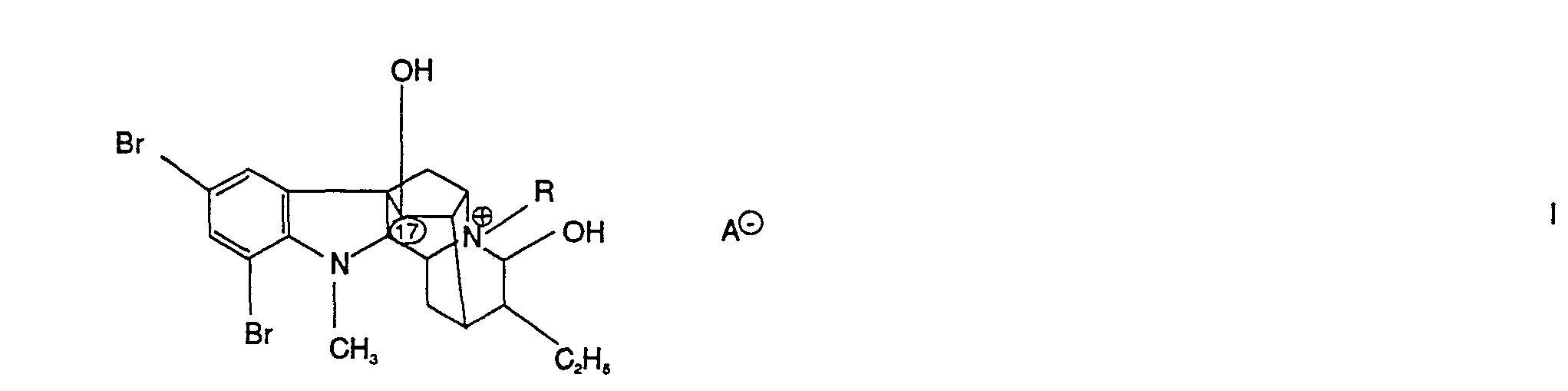
- the present invention has for its object new Nb-quaternary brominated derivatives of Ajmalin.
- the new Nb-quaternary dibrominated derivatives of ajmalin, isoajmalin, sandwicin and isosandwicin have valuable pharmacological properties and show cardiac arrhythmic, in particular antiarrhythmic effects as well as, in addition, antiplatelet and antithrombotic effects and are characterized by a favorable therapeutic profile with good therapeutic profile long-term effects and low toxicity. Because of these effects, the new compounds are suitable as medicaments, in particular for the treatment of cardiac arrhythmias and for the prophylaxis and treatment of platelet aggregations and thromboses.
- A- is the anion of a physiologically acceptable inorganic or organic acid. If in the Nb quaternary compounds of the formula IR denotes an alkyl group, this can be straight-chain or branched and can contain 1-6, preferably 2-5, carbon atoms and is preferably unsubstituted.
- An alkenyl group R preferably represents the allyl group. If R represents a phenylalkyl group, its alkylene chain contains 2 or 3 carbon atoms. The phenyl ring is preferably unsubstituted. If the phenyl ring is substituted by lower alkoxy, this can contain 1 to 3 carbon atoms and is preferably methoxy.
- Lower alkyl radicals R 1 and R 2 contained in group a have 1-3, in particular 2, carbon atoms.
- Examples of heterocyclic rings formed from the radical R 2 and the nitrogen atom to which it is bonded together with the radical R 1 or the nitrogen C adjacent to the alkylene chain Z are pyrrolidine, piperidine, azepine, morpholine or N-methyl 2-pyrrolidine.
- a ⁇ is the anion of a physiologically acceptable inorganic or organic acid.
- inorganic acids such.
- organic acids are such.
- the Nb-quaternary compounds of the formula I or mixtures thereof can be used as pharmacological active ingredients.
- N b quaternary dibromoajmaline and / or dibromoisoajmaline derivatives in which R represents an alkyl group with preferably 2-5, in particular 2 or 3, carbon atoms or a group a, in which Z has the meaning given above and R 1 and R 2 each Alkyl having 1-3, preferably 1 or 2 carbon atoms, or together with the nitrogen to which they are attached, represent one of the abovementioned 5- to 6-membered heterocycles, or R 1 is lower alkyl, preferably methyl, and R 2 together with the nitrogen and the adjacent C of the alkylene chain Z represents one of the aforementioned heterocycles.
- Nb quaternary dibromosandwicin and / or dibromisosandwicin derivatives those are particularly suitable in which R is alkyl having 2-5, preferably 2 or 3, C atoms or is a group, preferably a group a, in which Z is the above has the meaning given, and R i and R 2 each represent alkyl having 1-3, preferably 1 or 2 carbon atoms, or R 2 and the nitrogen atom to which it is bonded, together with R 1 or with the C adjacent to the N of the alkylene chain Z one Heterocycle forms.
- Suitable aminolytically removable radicals in the compounds of formula 111 are, in particular, halogens such as chlorine, bromine or iodine, and also organic sulfonic acid residues, in particular residues of lower alkanesulfonic acids such as, for. B. methanesulfonic acid or ethanesulfonic acid or aromatic sulfonic acids, especially benzenesulfonic acids, which may optionally be substituted in the benzene ring by lower alkyl or halogen, for. B.
- benzenesulfonic acid toluenesulfonic acids or bromobenzenesulfonic acids.
- compounds of the formula III which contain a basic nitrogen-containing radical, chlorine, otherwise preferably bromine, is preferred as the aminolytically removable group.
- the starting materials can be used in equimolar amounts, but it may be advantageous to use the compound of the formula III in excess.
- the reaction is expediently carried out in an organic solvent which is inert to the reactants.
- suitable solvents are aromatic hydrocarbons such as benzene or toluene, cyclic ethers such as dioxane, halogenated hydrocarbons such as chloroform, lower alcohols such as. B.
- reaction is carried out, for example, at temperatures between 0 and 150.degree. C., preferably 20-100.degree. C., the most favorable temperature range depending on the type of reactants used and the solvent used, e.g. B. the lower the temperature, the more polar the solvent used.
- the reactions of the compounds of the formula 11 with epoxy compounds of the formula IV can be carried out by methods which are customary per se for the addition of epoxides to amines.
- the starting materials can be used in equimolar amounts or there may be an excess of the epoxide of the formula IV.
- the reaction is expediently carried out in a protic organic solvent which is inert to the reactants, for example a lower alcohol.
- the reaction advantageously takes place at elevated temperature, for example at temperatures between 50 and 100 ° C., preferably at the boiling point of the solvent.
- the ring-open aldehyde bases of the formula Va obtained can be converted into the Nb-quaternary compounds of the formula I without prior purification by treatment with acid.
- an isomerization at the center C 20 can occur. This isomerization can occur both when using sterically pure dibromoajmalin or dibromosandwicin derivatives or sterically pure dibromoisoajmaline or. Dibromisosandwicin derivatives of the formula II and also when using isomer mixtures of the compounds of the formula 11 occur and lead to a shift in the isomer ratio in the corresponding N b -quaternary end product of the formula I or the ring-open aldehyde base compared to the starting product.
- the ratio of isomers in the reaction product can be determined by the type of radical R introduced, but can also be influenced by the reaction conditions and can vary depending on the reaction temperature, the solvent used or whether pure n or pure iso compounds or mixtures of isomers are used as starting compounds of the formula 11. Even when the open-ring aldehyde bases are converted into corresponding N b quaternary compounds of the formula I, the isomer ratio can change further.
- Nb-quaternary compounds of the formula I or their isomer mixtures resulting from the above-mentioned reactions can be isolated and purified from the reaction product in a manner known per se, for example by chromatographic purification and / or fractional crystallization or recrystallization.
- the anion A can be exchanged for another anion.
- the N b quaternary compounds of the formula I obtained by treatment with alkalis in the corresponding ring-open aldehyde bases of the formula V in which R has the above meaning, converted and converted into an N b quaternary compound of the formula by reaction with an acid HA, in which A has the desired meaning.
- the conversion of the N b -quaternary compounds of the formula I into the corresponding ring-open aldehyde bases of the formula V can be carried out in a manner known per se by the compounds of the formula I using aqueous solutions of inorganic bases, for example aqueous, preferably about 10% sodium hydroxide solution or aqueous sodium bicarbonate or sodium carbonate solutions are treated. It is advantageous to work in the presence of an inert water-immiscible organic solvent in which the aldehyde base is sufficiently soluble, such as, for. B. halogenated hydrocarbons, such as dichloromethane, ethyl acetate or diethyl ether.
- the quaternary salt can be dissolved or suspended in water, the mixture made alkaline with ice cooling and extracted with a suitable solvent.
- suitable solvent is determined by the solubility of the aldehyde base.
- sparingly soluble aldehyde bases in particular sandwicin or isosandwicinaldehyde bases
- it may on the other hand be expedient to use the solvents e.g. B. halogenated hydrocarbons to improve the solvency a polarity-increasing addition of lower alcohols, for. B. methanol.
- the organic phase is separated off and the crude aldehyde bases contained therein can be reacted with the acid HA to give Nb-quaternary compounds of the formula I without further purification.
- the crude aldehyde base can first be isolated by evaporation of the solvent and then converted into the desired compound of the formula I by treatment with an acid HA.
- the organic phase can be evaporated, the remaining aldehyde base dissolved in an inert solvent and a solution of the calculated amount of acid in an inert solvent is slowly added with stirring.
- Suitable solvents are e.g. B. diethyl ether, ethyl acetate, acetone, methylene chloride and lower alcohols such as methanol, ethanol or isopropanol.
- the organic phase can be used directly for salt formation.
- a solution of the acid HA can be introduced and a solution of the aldehyde base can be added.
- the solution for precipitating the salt can slowly with stirring in a non-polar solvent such as. B. ethyl acetate or diethyl ether.
- the new N b quaternary dibromo compounds of the formula I are distinguished by interesting pharmacological properties. In particular, they show cardiac rhythmic as well as antithrombotic effects. The new compounds are characterized by good oral effectiveness, long duration and breadth.
- the antiarrhythmic and antiplatelet effects of the compounds can be demonstrated in standard pharmacological test methods.
- Male rats with a body weight of 320-400 g are identified by i.p. Application of 1.25 g / kg urethane anesthetized. The animals are placed on their backs and their electrocardiogram is measured every 30 seconds during the experiment.
- An i.v. Aconftin infusion was administered at a rate of 5 ⁇ g / kg / min aconitine and an infusion volume of 0.1 ml / min.
- the animals are given the test substances p.o. three hours before the start of the aconitine infusion. administered in an amount of 2 ml / kg body weight 2% tylose solution.
- a control group is given only the tylose solution. The duration of the infusion until the occurrence of the various cardiac arrhythmias is determined.
- PRP / K is obtained by centrifuging anticoagulant rabbit blood in a known manner.
- control values for the photometric determination of the inhibition of aggregation the optical density of the untreated PRP / K (0% aggregation) and PRP / K, in which it was platelet aggregation produced by treatment of 10- 6 mol / l ADP (-100% aggregation), measured.
- the Nb-quaternary compounds of the formula I are suitable as medicaments for humans and larger mammals for the treatment of cardiac arrhythmias.
- the compounds are also suitable as medicaments for the prophylaxis and treatment of thromboses. Because of this combination of cardiac rhythmic activity on the one hand and antithrombotic activity on the other hand, the compounds of formula I are particularly suitable for the prophylactic and therapeutic treatment of patients with cardiac arrhythmia who are also suffering from thrombosis or are at risk of thrombosis, for example for the treatment of heart attack patients or for the aftertreatment of heart attack patients .
- the doses to be used can differ individually and naturally vary depending on the type of condition to be treated, the stage of treatment (e.g. initial dose or dose for long-term treatment), the substance used and the form of administration. e.g. B. parenteral formulations will generally contain less active ingredient than oral preparations. In general, however, daily doses of 0.1-10, in particular 0.5-5 mg / kg are suitable for application to humans and larger mammals.
- the Nb-quaternary compounds of the formula I or their genes, together with customary pharmaceutical auxiliaries and / or excipients can be present as a remedy in solid or liquid pharmaceutical preparations.
- solid preparations are orally administrable preparations such as tablets, capsules, powders, granules or dragees, or also suppositories.
- Solid preparations can be pharmaceutically customary inorganic and / or organic carriers, such as. B. talc, milk sugar or starch in addition to other pharmaceutically customary auxiliaries, such as lubricants such as magnesium stearate or tablet disintegrants.
- Liquid preparations such as solutions, suspensions or emulsions can contain the usual diluents such as water, oils or paraffins and / or suspending agents such as polyoxyethylene glycol and the like. Additional auxiliaries can also be added, such as. B. preservatives, stabilizers, flavor corrections and the like.
- solid oral dosage forms can also release the active ingredient, delaying substances such as. B. polyvinyl acetates, acrylate or methacrylate copolymers, higher fatty alcohols and other waxy substances.
- the active ingredients can be mixed and formulated with the pharmaceutical auxiliaries and / or carriers in a manner known per se.
- the active ingredients can be mixed with the auxiliaries and / or excipients, for example, in a customary manner and granulated wet or dry.
- a directly tablettable powder can optionally also be obtained by simple mixing.
- the granules or powder can be filled directly into capsules or pressed into tablet cores in the usual way. If desired, these can be dragged in a known manner.
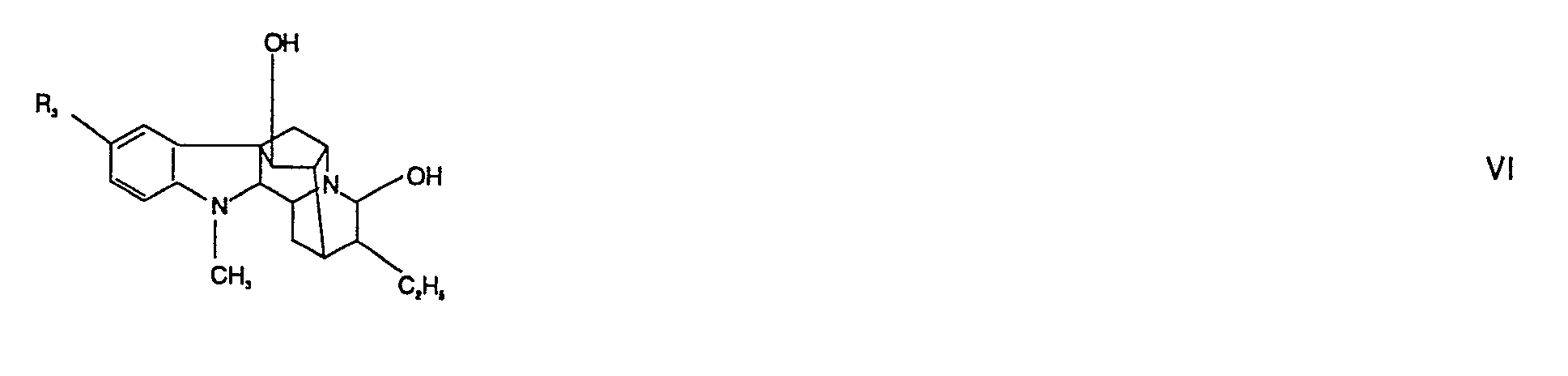
- dibromo compounds of formula 11 have not yet been described in the literature and are also the subject of the present invention. They represent valuable intermediates for the preparation of the N b -quaternary compounds of the formula I according to the invention. In addition, they, in particular dibromoajmaline and isoajmaline, themselves also have cardioactive and antiplatelet properties.
- dibromo compounds of formula 11 by bromination of the corresponding compounds of formula VI. where R 3 is bromine or hydrogen.
- the bromination of the compounds of formula VI is carried out in a manner known per se by reaction with a suitable bromination agent in a solvent which is inert under the reaction conditions. Elemental bromine is particularly suitable as the brominating agent. Examples of other brominating agents are N-bromosuccinimide, copper (II) bromide or bromine chloride.
- Suitable solvents are solvents which are sufficiently polar to keep the starting products and the salts formed from monobrominated intermediates in solution, so that the reaction takes place in a homogeneous liquid phase. Examples of suitable solvents are lower alcohols such as methanol, halogenated hydrocarbons such as methylene chloride or chloroform, cyclic ethers such as dioxane or mixtures thereof.
- the brominating agent preferably bromine
- the reaction temperature can be between -10 ° C and room temperature, preferably between about -5 and about + 5 ° C.
- Dibromoajmalin and dibromosandwicin can be isomerized to the corresponding iso compounds in a manner known per se.
- the isomerization can e.g. B. by the method described in DOS 29 41 531 under alkaline conditions by treatment with an alcoholic alkali metal hydroxide solution.
- the ratio of n-form to iso-form in the end products obtained is determined in a manner known per se by NMR spectroscopy.
- N b -n-propyl-10,12-dibromoajmalinium chloride N b -n-propyl-10,12-dibromoajmalinium chloride.
- the aldehyde base is released again from the salt obtained by treatment with dilute aqueous sodium carbonate solution, dissolved in acetone and the solution is again added dropwise to a solution of 3.5 g of L (+) - tartaric acid in 100 ml of acetone, the title compound precipitating .
- 9.3 g of N b - (2-hydroxy-3- (1-pH peridinyl) propyl] -10,12-dibromoajmalinium dihydrogen tartrate with a melting point of 125 ° C. are obtained.
- 10,12-Dribromisoajmalin hydrobromide can also be obtained by bromination of isoajmalin according to the method described in Example 1A, by dissolving 25 g of isoajmalin in 1 l of methanol with the addition of methylene chloride and the solution with stirring and ice cooling with a solution of 8. 4 ml of bromine are added to 50 ml of methanol. After working up the reaction mixture, 42 g of 10,12-dibromoisoajmaline hydrobromide, melting point 215-218 ° C., are obtained.
- the base is released from 65 g of 10,12-dibromoisoajmaline hydrobromide by the method described in Example 1B. 48.1 g of 10,12-dibromoisoajmaline are obtained, melting point 186 ° C.
- 10,12-dibromoisoajmaline can be obtained from by isomerization of 10,12-dibromoajmaline.
- 2 g of 10,12-dibromoajmaline and 1.4 g of potassium hydroxide are dissolved in 20 ml of methanol and the solution is heated under reflux for 6 hours. The reaction mixture is then concentrated somewhat, diluted with water and extracted with methylene chloride. The methylene chloride phase is separated off, dried and evaporated to dryness. The remaining residue is crystallized from methanol.
- 1.3 g of 10,12-dibromoisoajmaline, melting point 186 ° C., are obtained.
- N b -n-propyl-10,12-dibromisoajmalinium iodide 11.7 g are added to a mixture of 100 ml of 10% aqueous sodium carbonate solution and 250 ml of ethyl acetate and the reaction mixture is stirred vigorously.
- the organic phase which contains the aldehyde base corresponding to the title compound is then separated off aqueous phase extracted several times with ethyl acetate, and the combined organic phases dried over sodium sulfate and concentrated to a volume of about 300 ml.
- N- (3-chloropropyl) morpholine hydrochloride are mixed with 20 ml of 10% aqueous sodium carbonate solution and 50 ml of diethyl ether to release the base.
- the ethereal phase is separated off, dried over sodium sulfate, concentrated to a volume of about 20 ml under slightly reduced pressure and added dropwise to a solution of 15 g of 10,12-dibromoajmaline in 300 ml of ethanol.
- the reaction mixture is refluxed for 20 hours and then evaporated. The residue is taken up in isopropanol.
- the solution obtained is concentrated until the title compound begins to crystallize and then left to stand at 5 ° C. for 12 hours to complete the precipitation.
- Nb-methyl-10,12-dibromosandwicinium hydrogen tartrate Nb-methyl-10,12-dibromosandwicinium hydrogen tartrate.
- N b -methyl-10,12-dibromosandwicinium iodide are first converted into the corresponding aldehyde base by treatment with a mixture of 10% aqueous sodium carbonate solution and ethyl acetate, and the resulting solution of the aldehyde base is obtained by treatment with a mixture of 10% aqueous sodium carbonate solution and ethyl acetate while stirring with a solution of an equimolar amount of L - (+) - tartaric acid in acetone.
- the title compound fails and is filtered off.
- the compounds of the formula I listed in the following table can also be prepared by the processes described in Examples 1-12 above.
- the compounds are identified by specifying the structure type (Aj - Ajmalin, Isoaj - Isoajmalin, Sa - Sandwicin, Isosa - Isosandwicin) and, if applicable, the mixing ratio between two epimers.
- the active ingredient is mixed with lactose and starch, the resulting mixture is moistened with a 15% aqueous solution of the gelatin and granulated.
- the moist mass is passed through a 1.6 mm sieve, dried on trays at 35 ° C. and then passed through a 1.0 mm sieve.
- Aerosil® 200 and the powdered hydrogenated castor oil are pressed from the mixture tablets of 105 mg weight, so that each tablet contains 15 mg of active ingredient.
- the active ingredient is thoroughly mixed with lactose, microcrystalline cellulose and magnesium stearate. This powder mixture is automatically filled into size 4 hard gelatin capsules so that each capsule contains 15 mg of active ingredient.
Landscapes
- Health & Medical Sciences (AREA)
- Organic Chemistry (AREA)
- Chemical & Material Sciences (AREA)
- Bioinformatics & Cheminformatics (AREA)
- Pharmacology & Pharmacy (AREA)
- Veterinary Medicine (AREA)
- Chemical Kinetics & Catalysis (AREA)
- General Chemical & Material Sciences (AREA)
- Medicinal Chemistry (AREA)
- Engineering & Computer Science (AREA)
- Nuclear Medicine, Radiotherapy & Molecular Imaging (AREA)
- Public Health (AREA)
- Animal Behavior & Ethology (AREA)
- Life Sciences & Earth Sciences (AREA)
- General Health & Medical Sciences (AREA)
- Hematology (AREA)
- Diabetes (AREA)
- Cardiology (AREA)
- Heart & Thoracic Surgery (AREA)
- Pharmaceuticals Containing Other Organic And Inorganic Compounds (AREA)
- Nitrogen Condensed Heterocyclic Rings (AREA)
Claims (11)


A- signifie l'anion d'un acide minéral ou organique physiologiquement compatible.





Applications Claiming Priority (2)
| Application Number | Priority Date | Filing Date | Title |
|---|---|---|---|
| DE19843442452 DE3442452A1 (de) | 1984-11-22 | 1984-11-22 | Neue n(pfeil abwaerts)b(pfeil abwaerts)-quartaere dibromderivate von ajmalin, isoajmalin, sandwicin und isosandwicin sowie diese derivate enthaltende pharmazeutische zubereitungen und zwischenprodukte und verfahren zu ihrer herstellung |
| DE3442452 | 1984-11-22 |
Publications (3)
| Publication Number | Publication Date |
|---|---|
| EP0182271A2 EP0182271A2 (fr) | 1986-05-28 |
| EP0182271A3 EP0182271A3 (en) | 1987-03-25 |
| EP0182271B1 true EP0182271B1 (fr) | 1990-01-17 |
Family
ID=6250796
Family Applications (1)
| Application Number | Title | Priority Date | Filing Date |
|---|---|---|---|
| EP85114405A Expired - Lifetime EP0182271B1 (fr) | 1984-11-22 | 1985-11-13 | Dérivés dibromo Nb-quaternaires d'ajmaline, isoajmaline, sandwicine et isosandwicine et compositions pharmaceutiques contenant ces dérivés, produits intermédiaires et procédé pour leur préparation |
Country Status (3)
| Country | Link |
|---|---|
| EP (1) | EP0182271B1 (fr) |
| JP (1) | JPS61204187A (fr) |
| DE (2) | DE3442452A1 (fr) |
Families Citing this family (1)
| Publication number | Priority date | Publication date | Assignee | Title |
|---|---|---|---|---|
| JPS62252891A (ja) * | 1986-04-25 | 1987-11-04 | Sumitomo Heavy Ind Ltd | 向流式浮動プレ−ト型熱交換器 |
Family Cites Families (2)
| Publication number | Priority date | Publication date | Assignee | Title |
|---|---|---|---|---|
| DE2941529A1 (de) * | 1979-10-13 | 1981-04-23 | Kali-Chemie Pharma Gmbh, 3000 Hannover | N(pfeil abwaerts)b(pfeil abwaerts) -quartaere derivate von ajmalin und isoajmalin, verfahren und zwischenprodukte zur herstellung der derivate, die derivate enthaltende arzneimittel und die verwendung der derivate |
| DE2941530A1 (de) * | 1979-10-13 | 1981-04-23 | Kali-Chemie Pharma Gmbh, 3000 Hannover | N (pfeil abwaerts)b(pfeil hoch) -quartaere derivate von sandwicin und isosandwicin, verfahren und zwischenprodukte zur herstellung der derivate, die derivate enthaltende arzneimittel und die verwendung der derivate |
-
1984
- 1984-11-22 DE DE19843442452 patent/DE3442452A1/de not_active Withdrawn
-
1985
- 1985-11-13 EP EP85114405A patent/EP0182271B1/fr not_active Expired - Lifetime
- 1985-11-13 DE DE8585114405T patent/DE3575430D1/de not_active Expired - Lifetime
- 1985-11-22 JP JP60261632A patent/JPS61204187A/ja active Pending
Also Published As
| Publication number | Publication date |
|---|---|
| DE3442452A1 (de) | 1986-05-22 |
| EP0182271A3 (en) | 1987-03-25 |
| EP0182271A2 (fr) | 1986-05-28 |
| DE3575430D1 (de) | 1990-02-22 |
| JPS61204187A (ja) | 1986-09-10 |
Similar Documents
| Publication | Publication Date | Title |
|---|---|---|
| DD246995A5 (de) | Verfahren zur herstellung von neuen schwefelhaltigen 5-substituierten benzimidazol-derivaten | |
| CH642629A5 (de) | Am stickstoffatom substituierte moranolin-derivate. | |
| EP0418716A1 (fr) | Esters aminoalcohol d'acide thienylcarboxyliques leurs produits quaternaires, leur préparation et l'utilisation de ces composés | |
| DE3435745C2 (de) | 2-[3-[4-(3-Phenyl)-1-piperazinyl]propyl]-2,4-dihydro-3H-1,2,4-triazol-3-on Verbindungen, Verfahren zu deren Herstellung und diese Verbindungen enthaltende pharmazeutische Mittel | |
| DE69208551T2 (de) | Benzo(a)fluorenverbindungen | |
| DD202715A5 (de) | Verfahren zur herstellung von substituierten derivaten des pyridazin | |
| DE2305092C2 (fr) | ||
| EP0174464B1 (fr) | Benzyl-phtalazinones substitués | |
| EP0189370A2 (fr) | Spiro-dioxolanes, -dithiolanes et -oxothiolanes | |
| EP0074014B1 (fr) | 2-(2'-hydroxy-3'-(1,1-diméthylpropylamino)-propoxy)-bêta-propiophénone, ses sels d'addition, procédé de sa préparation et médicament | |
| DE2429290A1 (de) | Tricyclische kondensierte imidazolderivate und verfahren zu ihrer herstellung | |
| DE4117750A1 (de) | Neue 2-amino-5-cyano-1,4-dihydropyridine, verfahren zu ihrer herstellung und ihre verwendung in arzneimitteln | |
| EP0298921B1 (fr) | 1,2-Benzisoxazoles et 1,2-benzisothiazoles | |
| DE2406065A1 (de) | Neue isoindolinderivate, ihre herstellung und die zusammensetzungen, die sie enthalten | |
| CH617197A5 (fr) | ||
| EP0461574A2 (fr) | Médicaments contenant des 3,7-diazabicyclo(3,3,1)nonanes | |
| DE1695812B2 (de) | Dibenzo [cfl -1,2-thiazepin-derivate, Verfahren zu ihrer Herstellung und sie enthaltende pharmazeutische Zubereitung | |
| EP0182271A2 (fr) | Dérivés dibromo Nb-quaternaires d'ajmaline, isoajmaline, sandwicine et isosandwicine et compositions pharmaceutiques contenant ces dérivés, produits intermédiaires et procédé pour leur préparation | |
| DE69707080T2 (de) | Pyrrolidinonderivate und ihre Verwendung als antipsychotische Arzneimittel | |
| DE3146867C2 (fr) | ||
| EP0392233B1 (fr) | 1,2,3,4,-Oxatriazolium-5-olates substitués, procédé pour leur préparation et leur utilisation | |
| EP0014996B1 (fr) | Spiro-amidines hétérocycliques, leurs stéréoisomères et isomères optiques, procédés pour leur préparation et médicaments les contenant | |
| CH619237A5 (fr) | ||
| DE2656678C2 (de) | 4-Amino-trans-decahydrochinolin-Derivate und Verfahren zu deren Herstellung und diese enthaltende pharmazeutische Zusammensetzungen | |
| EP0110298A1 (fr) | Dérivés d'acridanone |
Legal Events
| Date | Code | Title | Description |
|---|---|---|---|
| PUAI | Public reference made under article 153(3) epc to a published international application that has entered the european phase |
Free format text: ORIGINAL CODE: 0009012 |
|
| AK | Designated contracting states |
Kind code of ref document: A2 Designated state(s): BE CH DE FR GB IT LI NL |
|
| PUAL | Search report despatched |
Free format text: ORIGINAL CODE: 0009013 |
|
| AK | Designated contracting states |
Kind code of ref document: A3 Designated state(s): BE CH DE FR GB IT LI NL |
|
| 17P | Request for examination filed |
Effective date: 19870619 |
|
| 17Q | First examination report despatched |
Effective date: 19890301 |
|
| ITF | It: translation for a ep patent filed | ||
| GRAA | (expected) grant |
Free format text: ORIGINAL CODE: 0009210 |
|
| AK | Designated contracting states |
Kind code of ref document: B1 Designated state(s): BE CH DE FR GB IT LI NL |
|
| REF | Corresponds to: |
Ref document number: 3575430 Country of ref document: DE Date of ref document: 19900222 |
|
| ET | Fr: translation filed | ||
| GBT | Gb: translation of ep patent filed (gb section 77(6)(a)/1977) | ||
| PLBE | No opposition filed within time limit |
Free format text: ORIGINAL CODE: 0009261 |
|
| 26N | No opposition filed | ||
| PGFP | Annual fee paid to national office [announced via postgrant information from national office to epo] |
Ref country code: FR Payment date: 19911028 Year of fee payment: 7 Ref country code: CH Payment date: 19911028 Year of fee payment: 7 |
|
| PGFP | Annual fee paid to national office [announced via postgrant information from national office to epo] |
Ref country code: GB Payment date: 19911101 Year of fee payment: 7 |
|
| PGFP | Annual fee paid to national office [announced via postgrant information from national office to epo] |
Ref country code: BE Payment date: 19911113 Year of fee payment: 7 |
|
| ITTA | It: last paid annual fee | ||
| PGFP | Annual fee paid to national office [announced via postgrant information from national office to epo] |
Ref country code: NL Payment date: 19911130 Year of fee payment: 7 |
|
| PGFP | Annual fee paid to national office [announced via postgrant information from national office to epo] |
Ref country code: DE Payment date: 19911227 Year of fee payment: 7 |
|
| PG25 | Lapsed in a contracting state [announced via postgrant information from national office to epo] |
Ref country code: GB Effective date: 19921113 |
|
| PG25 | Lapsed in a contracting state [announced via postgrant information from national office to epo] |
Ref country code: LI Effective date: 19921130 Ref country code: CH Effective date: 19921130 Ref country code: BE Effective date: 19921130 |
|
| BERE | Be: lapsed |
Owner name: KALI-CHEMIE PHARMA G.M.B.H. Effective date: 19921130 |
|
| PG25 | Lapsed in a contracting state [announced via postgrant information from national office to epo] |
Ref country code: NL Effective date: 19930601 |
|
| GBPC | Gb: european patent ceased through non-payment of renewal fee |
Effective date: 19921113 |
|
| NLV4 | Nl: lapsed or anulled due to non-payment of the annual fee | ||
| PG25 | Lapsed in a contracting state [announced via postgrant information from national office to epo] |
Ref country code: FR Effective date: 19930730 |
|
| REG | Reference to a national code |
Ref country code: CH Ref legal event code: PL |
|
| PG25 | Lapsed in a contracting state [announced via postgrant information from national office to epo] |
Ref country code: DE Effective date: 19930803 |
|
| REG | Reference to a national code |
Ref country code: FR Ref legal event code: ST |