EP0186192A2 - Steuerschalter für die Motorfernsteuerung eines Rückspiegels in einem Fahrzeug - Google Patents
Steuerschalter für die Motorfernsteuerung eines Rückspiegels in einem Fahrzeug Download PDFInfo
- Publication number
- EP0186192A2 EP0186192A2 EP85116543A EP85116543A EP0186192A2 EP 0186192 A2 EP0186192 A2 EP 0186192A2 EP 85116543 A EP85116543 A EP 85116543A EP 85116543 A EP85116543 A EP 85116543A EP 0186192 A2 EP0186192 A2 EP 0186192A2
- Authority
- EP
- European Patent Office
- Prior art keywords
- contact
- contacts
- operating
- motors
- control switch
- Prior art date
- Legal status (The legal status is an assumption and is not a legal conclusion. Google has not performed a legal analysis and makes no representation as to the accuracy of the status listed.)
- Granted
Links
Images



Classifications
-
- B—PERFORMING OPERATIONS; TRANSPORTING
- B60—VEHICLES IN GENERAL
- B60R—VEHICLES, VEHICLE FITTINGS, OR VEHICLE PARTS, NOT OTHERWISE PROVIDED FOR
- B60R16/00—Electric or fluid circuits specially adapted for vehicles and not otherwise provided for; Arrangement of elements of electric or fluid circuits specially adapted for vehicles and not otherwise provided for
- B60R16/005—Electro-mechanical devices, e.g. switched
-
- H—ELECTRICITY
- H01—ELECTRIC ELEMENTS
- H01H—ELECTRIC SWITCHES; RELAYS; SELECTORS; EMERGENCY PROTECTIVE DEVICES
- H01H25/00—Switches with compound movement of handle or other operating part
- H01H25/04—Operating part movable angularly in more than one plane, e.g. joystick
- H01H25/041—Operating part movable angularly in more than one plane, e.g. joystick having a generally flat operating member depressible at different locations to operate different controls
-
- H—ELECTRICITY
- H01—ELECTRIC ELEMENTS
- H01H—ELECTRIC SWITCHES; RELAYS; SELECTORS; EMERGENCY PROTECTIVE DEVICES
- H01H25/00—Switches with compound movement of handle or other operating part
- H01H25/04—Operating part movable angularly in more than one plane, e.g. joystick
- H01H2025/048—Operating part movable angularly in more than one plane, e.g. joystick having a separate central push, slide or tumbler button which is not integral with the operating part that surrounds it
-
- H—ELECTRICITY
- H01—ELECTRIC ELEMENTS
- H01H—ELECTRIC SWITCHES; RELAYS; SELECTORS; EMERGENCY PROTECTIVE DEVICES
- H01H2300/00—Orthogonal indexing scheme relating to electric switches, relays, selectors or emergency protective devices covered by H01H
- H01H2300/012—Application rear view mirror
Definitions
- the present invention relates to a control switch for tilting the surface of a mirror in a motor driven remote control mirror device under a remote control to a position for obtaining an adequate rear visual field in a vehicle.
- a motor driven remote control mirror device in a vehicle, the surfaces of a pair of mirrors arranged at the right and left sides of an automotive body are constructed to be rotatably revolved around horizontal and vertical axes at a pivot fixedly secured in a mirror housing as a center.
- the surfaces of the mirrors are tilted by being selectively driven under a remote control by two motors disposed in the mirror housing, and a regulator having a control switch for tilting the surface of the desired mirror toward the desired direction is disposed in a driver's cab.
- a conventional such a regulator was disclosed, for example, in Japanese unexamined Utility Model Publication No. 58-40451.
- the mirror disposed at the left side is rotated around a horizontal or vertical axis by normally or reversely rotating respective motors.
- the mirror disposed at the right side is rotated similarly at the surface around a horizontal or vertical axis by respective motors.
- a control switch disposed in a driver's cab has a changeover switch for selecting any of mirrors disposed at the right and left sides, and a tilting direction selecting switch provided with a push plate having four direction indicators for indicating any tilting direction around a horizontal axis, i.e., upward or downward direction, or around a vertical axis, i.e., rightward or leftward direction of the selected mirror.
- the specific motor is normally or reversely rotated by a control circuit which includes these switches.
- the tilting direction selecting switch in the control circuit is a switching mechanism composed of a plurality of contacts.
- the changeover switch Since the changeover switch must have an independent toggle switch disposed in a control switch body, switch with a solenoid and have a plurality of diodes for preventing a current from reversely flowing in the control circuit, the entire regulator has a drawback from the points of power consumption and a voltage drop across the diodes and another disadvantage from the point of cost of uneconomy.
- control switch having a control circuit including no elements such as diodes and solenoid and capable of tilting a specific mirror in a predetermined direction merely by a substantially mechanical switching mechanism.
- Another object of the present invention is to provide a control switch having a reduced thickness in which a changeover switch for tilting any of two right and left side mirrors is formed on the same printed board as an operation switch for indicating the elevational and lateral directions of the mirrors.
- Still another object of the present invention is to provide a control switch having a packing for preventing dust or water from entering on a printed board disposed with various contacts of changeover switch and operation switch.
- FIG. 1 the external appearance of a control switch 10 according to the present invention is entirely illustrated.
- Reference numeral 12 designates a casing of a switch body formed in a box shape.
- a printed board 14 mounted with a plurality of stationary contact groups of a control circuit for selectively rotating a plurality of motors A 1 , A 2' B 1 , B 2 as will be described is mounted on the bottom of the casing 12.
- An elevationally, i.e., upwardly and downwardly movable push plate 16 is disposed at the position opposed to the board 14 in the casing 12.
- Four tilting direction indicators 18 provided corresponding to four tilting directions, i.e., upward and downward, and rightward and leftward directions are formed on the outer surface of the push plate 16.
- the control switch 10 is disposed between the plurality of motors A 1 , A 2' B 1' B 2' and a DC power source 40, i.e., a battery as a drive source for the motors, and constructed to tilt at the surface of the mirror in a predetermined direction when the direction indicator of arbitrary direction is pressed by a driver's finger.
- a DC power source 40 i.e., a battery as a drive source for the motors
- Fig. 2 shows a control circuit of the control switch 10 of the invention.
- the printed board 14 is formed substantially in a rectangular shape, and a first stationary contact 20 and first stationary contact pair 22, 23 corresponding to the contact 20 are disposed at the positions along one side of the board on the board.
- the contact 22 of the first contact pair is always connected to the negative polarity of the DC power source 40, and the contact 23 is connected similarly to the positive polarity.
- a second stationary contact 24 and second stationary contact pair 26, 27 corresponding to the contact 24 as well as a third stationary contact 28 and third stationary contact pair 29, 30 corresponding to the contact 28 are respectively arranged at positions along one side underneath the board 14.
- the contacts 26, 27 of the second contact pair are respectively connected to the negative and positive polarities of the power source 40.
- the contacts 29, 30 of the third contact pair are respectively connected to the negative and positive polarities of the power source 40.
- the stationary contacts and the corresponding contact pairs respectively construct stationary contact groups.
- bridge members formed of an elastic material having electric conductivity are respectively disposed corresponding to the stationary contact groups.
- the first bridge member 50 bridges between the first contact 20 and the first contact pair 22, 23, and slidable contacts 50a, 50b are provided at both ends of the bridge member.
- One contact 50a is always slid in contact with the first contact 20, and the other contact 50b is always contacted with one contact 22 of the first contact pair 22, 23, and disposed to contact with the other contact 23 when the first member 50 is elastically deformed (Fig. 6).
- second and third bridge members 52, 54 are disposed between the second contact 24 and the second contact pair 26, 27, and between the third contact 28 and the third contact pair 29, 30, and slidable contacts 52a, 52b and 54a, 54b are respectively provided at both ends of the bridge members.
- the bridge members preferably have auxiliary leaf springs inside to supplement the elasticity. Further, the second and third members 52 and 54 respectively have approx.
- half of the member 50 are disposed substantially on the same rectilinear line, and arranged to ordinarily form a substantially square shape with the one contact 50a of the first bridge member 50 contacted with the first contact 20, the other contact 50b of 22 of the first contact pair 22, 23, the other contact 50b of the first bridge member 50 at the position contacted with the contact 22 of the first contact pair 22, 23, one contact 52b of the second bridge member 52,at the position contacted with the contact 26 of the second contact pair 26, 27, and one contact 54b of the third bridge member 54 at the position contacted with the contact 29 of the third contact pair 29, 30.
- Operating members 60, 62 and 64 for elastically deforming these bridge members 50, 52 and 54, respectively are provided integrally on the back surface of the push plate 16. As shown in Fig.
- a box-shaped member 70 formed to extend in a slender shape in a direction along one side corresponding to the first bridge member 50 is disposed at the opposite side of the push plate 16 to the surface of the push plate 16 arranged with the tilting direction indicator 18.
- a first operating member 60 which is composed of a pair of legs 61 and 61 respectively having tapered surfaces 61a and 61b at both end walls is disposed inside the member 70.
- the legs 61 and 61 are disposed at their ends near an opening 72 formed partly through the first contact 20 and an opening 74 formed partly through one contact 22 of the first contact pair.
- the surfaces 61a and 61b are partly contacted with the outer peripheral surfaces near the ends of the first member 50.
- another box-shaped member 71 is formed to extend in a slender shape in a direction along one side opposed to the one side of the opening of the push plate 16, i.e., corresponding to the second and third members 52 and 54.
- a partition wall 73 is formed substantially at the center of the member 71, and two compartments divided by the wall 73 form spaces for containing the second and third members 52 and 54, respectively.
- a leg 63 having a tapered surface 63a is formed on one end wall inside the member 71, and a tapered surface 73b is formed on one side of the wall 73.
- a leg 65 having a tapered surface 65a is formed on the other end wall inside the member 71, and a tapered surface 73a is formed on the other end of the wall 73.
- a leg is formed of the tapered surfaces 73b and 73a, and the wall 73.
- a second operating member 62 is formed of the leg 63, and the tapered surface 73b of the wall 73, and a third operating member 64 is formed of the leg 65 and the tapered surface 73a of the wall 73.
- the leg 63 is disposed at the end near an opening 26a formed through part of the contact 26 of the second contact pair as shown in Fig.
- the leg 65 is formed at the end near the opening 29a formed through part of the contact 29 of the third contact pair, and the central wall 72 is further disposed near the opening 25 formed between the second contact 24 adjacent thereto and the third stationary contact 28.
- the tapered surface 63a is contacted with the outer periphery near the one end of the second member 52
- the tapered surface 73b is contacted with the outer periphery near the other end of the second member 52
- the tapered surface 73a is contacted with the outer periphery near one end of the third member 54
- the tapered surface 65a is contacted with the outer periphery near the other end of the third member 56, and the legs are lifted.
- first, second and third operating members 60, 62 and 64 are formed integrally with the push plate 16, the tapered surfaces 61a, 61b, 63a, 73b and 73a, 65a are respectively contacted with the outer periphery near the both ends of the first, second and third members 50, 52 and 54, and the surface of the push plate 16 arranged with the four tilting direction indicators 18 is held substantially at the position parallel with the board 14. This state is held by engaging the projection projected on the side wall of the push plate 16 with the inner wall of the opening end of the casing 12.
- the indicators 18 are formed along the four sides of the push plate 16, and disposed corresponding to the tilting direction of the tiltable mirror.
- the tilting directions of the mirror around the horizontal axis i.e., the upward and downward directions are respectively indicated by U and D
- the tilting directions around the vertical axis i.e., the rightward and leftward directions are respectively indicated by R and L.
- a U indication unit of the tilting direction indicator 18 is provided at the position corresponding to the first member 50, a D indication unit is provided at the position corresponding to the second and third members 52, 54 disposed on a rectilinear line, a L indication unit is provided at the position corresponding to a rectilinear line for coupling one end of the first member 50 with that of the second member 52, and a R indication unit is provided at the position corresponding to a rectilinear line for coupling the other end of the first member 50 with that of the third member 54.
- These corresponding relationships are respectively designated by reference characters U, D, L and R in Fig. 2.
- the push plate 16 When the U indication unit is first pressed, the push plate 16 itself moves at one side formed with the U indication unit toward the direction of the printed board slightly from the horizontal state. This state is shown in Fig. 8. An arrow with a solid line designates the pressing direction. At this time, the legs 61, 61 of the first member 60 are together introduced at the ends into the openings 72, 74 formed at the printed board 14, and the tapered surfaces 61a, 61b elastically deform the first member 50 while contacting the outer periphery of the first member 50.
- the contact 50a disposed at one end of the first member 50 is slid on the first contact 20 in the state contacted with the first contact 20, and the contact 50b disposed at the other end is slid to contact with the contact 23 of the first contact pair 22, 23.
- the first contact 20 is electrically connected to the positive polarity of the DC power source 40.
- the contact 52a disposed at one end of the second member 52 is slid in the state contacted with the second contact 24, and the contact 52b slid to contact with the contact 27 of the second contact pair 26, 27.
- the third member 54 is similarly slid in the state that the contact 54a is contacted with the third contact 28, and the contact 54b moves to contact the contact 30 of the third contact pair 29, 30.
- the contacts 24, 28 are substantially simultaneously electrically contacted to the positive polarity of the power source 40.
- the second and third members 52, 54 are substantially simultaneously returned by the returning force to the original state, and the second and third contacts 24, 28 are electrically connected to the negative polarity of the power source 40.
- the leg 61 disposed at the first contact 20 side is introduced at the end into the opening 72 and the leg 63 of the second contact pair side is introduced at the end into the opening 26a, with the result that the tapered surface 61a of the first member 60 elastically deforms the first member 50, the contact 50a of the first member 50 slides in the same manner as when the U indication unit is pressed, the tapered surface 63a of the second member 62 elastically deforms the second member 52, and the contact 52b of the second member 52 slides to contact with the contact 27 of the second contact pair 26, 27.
- the first contact 20 holds the state electrically connected to the negative polarity of the power source 40, and the second contact 24 is electrically connected with the positive polarity.
- This state corresponds to that the plate 16 is pressed in the direction of the arrow with the broken line at the left side in Fig. 7, and to that the plate 16 is pressed in the direction of the arrow with the broken line at the left side in Fig. 9.
- the leg 61 disposed at the first contact pair side is introduced at the end into the opening 74, and the leg 65 of the third contact side is simultaneously introduced at the end into the opening 29a, with the result to elastically deform the first member 50, the contact 50b of the first member 50 slides to contact with the contact 23 of the first contact pair 22, 23, the tapered surface 65a of the third member 64 elastically deforms the third member 54, and the contact 54b of the third member 54 is slide to contact with the contact 30 of the third contact pair 29, 30.
- the first and third contacts 20, 28 are substantially simultaneously electrically connected with the positive polarity of the power source 40. This state corresponds to the case that the plate 16 is pressed in the direction of the arrow with the broken line at the right side in Fig. 7 and pressed in the direction of the arrow with the solid line at the right side in Fig. 9.
- the opening 80 of a square shape is formed substantially at the center of the printed board 14, and three sets of stationary contact pairs 90, 91;, 92, 93;, 94, 95 are respectively disposed at the both side positions of the opening 80.
- the contact pair 90, 91 are formed in a slender rectangular shape, and disposed substantially in parallel with each other.
- the contact 90 is electrically connected with the first contact 20, and the contact 91 is electrically connected with the second contact 24.
- the contacts 92, 93 and 94, 95 are disposed at the opposite positions to the contact pair 90, 91 at both sides of the opening 80, formed in a rectangular shape of approx. 1/2 of the contact pair 90, 91, and spaced from each other.
- the contacts 90, 94, 92 are disposed on one rectilinear line, and the contacts 91, 95, 94 are disposed on the rectilinear line parallel with the rectilinear line of the opening.
- the contacts 92, 93 are electrically connected with terminals of the motors A 1 , A 2 for tilting the mirror 96 mounted on the automotive body at the left side of the vehicle, the contact 94, 95 are electrically connected with one terminal of the motors B1, B 2 for tilting the mirror 97 mounted on the automotive body at the right side of the vehicle. Further, the other terminals of the motors A 1 , A 2 and B 1 , B 2 are commonly electrically connected with the third contact 28.
- the contacts 90, 91 are selectively electrically connected with the contact pairs 92, 93 and 94, 95 through fourth and fifth bridge members 100 and 102.
- the fourth and fifth members 100, 102 are formed of an electrically conductive elastic material, and simultaneously slide in the state that the both ends are contacted with the contacts of the stationary contact pair. More particularly, the fourth and fifth members 100, 102 are held at a slider 110 in the state disposed substantially in parallel with each other as shown in Fig. 3. Two slender partitions (one of which is shown in Figs. 10 and 11) for individually containing the bridge members 100, 102 disposed in parallel are formed at the slider 110.
- Projections 120, 121 are so formed as to be engaged with recesses 100a and 102a formed at the centers of the fourth and fifth members 110, 102 at the center of the partitions , respectively.
- a rectangular opening 124 is formed substantially at the center of the slider 110, and two tapered walls 126 inclined from the opposed opening ends downwardly are formed as shown enlargedly in Fig. 9.
- the printed board 14 is supported by a holder 130, and a pair of vertical ribs 131 are aligned in parallel at the center of the holder 130.
- the ribs 131 are inserted into the opening 80 formed at the center of the board 14, and projected to the side formed with the stationary contact groups of the board 14.
- a distance between the pair of ribs 131 is selected slightly larger than the width of the slider 110, and the slider 110 is disposed therebetween.
- Reference numeral 140 designates a selection switch body for moving the slider 110, which is rotatably mounted on the pair of ribs 131.
- Small projections 141 are extended toward the ribs 131 at both sides of the switch body 140, openings 132 for receiving the projections 141 are formed at the ribs 131, and the switch body 140 is formed to rotate in the direction for substantially moving the slider 110 at the opening 132 of the rib 131 as a center.
- the switch body 140 is composed of a leg 142 extending in the direction of the holder 130 through the opening 124 formed at the slider 110 and the opening 80 of the printed board 14, and an operating knob 144 projected outside of the casing 12 through the rectangular opening 17 formed substantially at the center of the plate 16, and the leg 142 is rotated in the direction of an arrow y or x by moving the knob 144 in the direction of the arrow x or y as shown in Fig. 11.
- a small compressed coiled spring 146 and a small ball 148 are arranged in the leg 142, and the ball 148 is partly held in the state slightly projected from the end of the leg 142 toward the outside.
- a groove corresponding to the moving direction of the slider 110 is formed at the end of the leg 142, and engaged, as shown in Fig. 10, with the central portion of a guide passage 150 of the holder 130.
- the state shown in Figs. 10 and 11 is a neutral position, and the ball 148 is held at its position in the state slightly pressed into the leg 142 against the elastic tension 8f the coiled spring 146.
- the fourth and fifth bridge members 100 and 102 are contacted at their one ends with the contacts 90 and 91, respectively at the neutral position, but disposed at the other ends between the contact pair 92, 93 and the contact pair 94, 95 on the printed board.
- a member 160 for preventing a foreign material such as dust or water from entering is disposed on the printed board 14, on which the contact group are formed and the plurality of bridge members are arranged, as shown in Figs. 5 and 10. Since the foreign material is mainly introduced externally into the casing 12 through the opening 17 provided at the center of the push plate 16 for exposing the operating knob 144, the packing 160 is disposed between the plate 16 and the printed board 14.
- the packing 160 is formed integrally of a portion 161 which is closely contacted with the periphery of the opening 17 on the back surface of the plate 16 and with the tapered portion 145 of the switch body 140, and portions 162 and 163 which is closely contacted with the outer periphery of the member 70 formed on the back surface of the plate 16, and formed of a material such as, for example, a soft and elastic material like rubber.
- a packing 160 is necessary to be formed in the state so as not to disturb the movements of the operating knob 144 when the knob 144 is rotated. Further, it is also necessary to provide a slight gap between the packing 160 and the inner wall of the casing 12 so as not to disturb the movement of the plate 16 when the plate 16 is pressed to move.
- Such a packing 160 can prevent an improper conduction between the stationary contacts and the slidable contacts disposed at both ends of the bridge members due to the dust introduced into the casing and adhered to the vicinity of the stationary contacts and improve the reliability of switching the contacts.
- the knob 144 for operating the selection switch is pressed in the direction of the arrow x as shown in Fig. 11.
- the contacts 90, 91 are respectively contacted with the contacts 92, 93.
- the contacts 90, 91 are respectively contacted with the first and second contacts 20, 24, the one terminals of the motors A 1 , A 2 are connected to the negative polarity of the power source 40.
- the third contact 28 is always contacted with the common terminal of the motors A 1 , A 2 , B 1' B 2' the remaining terminals of the motors A 1 , A 2 are connected with the negative polarity of the power source 40.
- the all terminals of the motors A 1 , A 2 are connected with the negative polarity of the power source 40, i.e., held with the ground potential in this state.
- any one of the U, D, L_and R indication units of the indicators 18 on the surface of the plate 16 is pressed by a finger, any of the motors A 1 , A 2 can be rotated normally or reversely.
- the corresponding first operating member 60 acts on the first member 50 to elastically deform it, and the first contact 20 is connected with the contact 23 connected with the positive polarity of the power source 40. Therefore, as shown in Fig. 12, the contact 90 connected with one terminal of the motor A l is held at the positive potential, the contact 91 connected with one terminal of the motor A 1 is held at the negative potential, and the third contact 28 connected commonly with the other terminals of the motors A 1 , A 2 are held at the negative potential. As a result, a current flowed from the contact 90 to the contact 28 is flowed to the motor A 1 to normally rotate the motor A 1 , and the mirror 96 is tilted upward. Since the two terminals of the motor A 2 are held at the negative potential, the motor A 2 does not operate.
- the corresponding second and third operating members 62, 64 act on the second and third bridge members 52, 54 to elastically deform the second and third bridge members 52, 54.
- the second and third contacts 24, 28 are together connected with the contacts 27, 30 connected with the positive polarity of the power source 40. Therefore, since the contact 92 connected with one terminal of the motor A 1 is held at the negative potential, the contact 93 connected with one terminal of the motor A 2 is held at the positive potential and the contact 28 is also held at the positive potential, a current flowed from the third contact 28 to the contact 92 is consequently flowed to the motor A 1 to reversely rotate the motor A 1 , thereby tilting the mirror 96 downward. Since the two terminals of the motor A 2 are held at the same positive potential, the motor A 2 does not operate.
- the corresponding second operating member 62 is merely acted to elastically deform the second bridge member 52, and the second contact 24 is held at the positive potential.
- the first member 50 is elastically deformed, but only the contact 50a is slid, but the contact 50b is not slid.
- the contact 92 remains at the negative potential.
- the first and third operating members 60, 64 respectively elastically deform the first and third bridge members 50, 54.
- the contact 92 is held at the positive potential
- the contact 93 is held at the negative potential
- the third contact 28 is held at the positive potential
- a current flowed from the third contact 28 to the contact 93 is consequently flowed to the motor A 2 to reversely rotate the motor A 2 , thereby tilting the mirror 96 rightward. Since the two terminals of the motor A 1 is held at the positive potential, the motor A 1 does not operate.
- the knob 144 for operating the selection switch is pressed in the direction of the arrow y as shown in Fig. 11 to connect the contacts 90, 91 with the contacts 94, 95, respectively, and the abovementioned operation may be similarly performed.
- the control switch of the present invention can tilt the predetermined mirror while pressing any one of the four indication units U, D, L and R of the push plate 16, but when the knob 144 is held at the neutral position as shown in Fig. 11, the motor does not operate even if the indicator 18 is erroneously contacted.
- the first contact 20 to be connected to one terminals of the motors A 1 , B 2 for tilting the mirrors 96, 97 around a horizontal axis and the first contact pair 22, 23 disposed corresponding to the contact 20 are arranged corresponding to the U indication unit of the plate 16
- the third contact 28 to be connected to the remaining terminals of the motors A 1 , A 2' B 1 , B 2 and the third contact pair 29, 30 disposed corresponding to the contact 28 are arranged corresponding to the D indication unit of the plate 16.
- they may be arranged as shown in Figs. 13 to 15.
- fourth to sixth stationary contact pairs 90, 91;, 92, 93; and 94, 95 of a changeover switch are omitted.
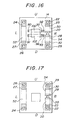
- a stationary contact array shown in Fig. 16 provides another possibility.
- a first stationary contact 20 and first stationary contact pair 22, 23 corresponding to the contact 20, and a third stationary contact 28 and third stationary contact pair 29, 30 corresponding to the contact 28 are arranged along one side corresponding to the R indication unit, and a second stationary contact 24 and second stationary contact pair 26, 27 corresponding to the contact 24 are arranged along the other one side corresponding to the L indication unit.
- First and third bridge members 50, 54 are formed in approx. 1/2 size of the second bridge member 52, and these bridge members are disposed to substantially perpendicularly cross the direction for sliding the fourth and fifth bridge members 100, 102 of a changeover switch.
- the array shown in Figs. 17 to 19 may be possible. In Figs. 17 to 19,-elements of the changeover switch are omitted.
- control switch of the present invention can form a control circuit for controlling the elevational and lateral tilts of the mirrors only by a purely mechanical contact structure, it is understood that elements such as a plurality of solenoids and diodes are not required.
- the embodiments of the present invention described in detail as above are for clarifying the technical contents of the invention, and the present invention is not limited to the particular embodiments. Various other changes and modifications may be made within the spirit and scope of the present invention.
Landscapes
- Engineering & Computer Science (AREA)
- Mechanical Engineering (AREA)
- Switches With Compound Operations (AREA)
Applications Claiming Priority (6)
| Application Number | Priority Date | Filing Date | Title |
|---|---|---|---|
| JP271942/84 | 1984-12-25 | ||
| JP27194184A JPS61151924A (ja) | 1984-12-25 | 1984-12-25 | リモ−トコントロ−ルミラ−用スイツチ |
| JP271941/84 | 1984-12-25 | ||
| JP27194284A JPS61151925A (ja) | 1984-12-25 | 1984-12-25 | リモ−トコントロ−ルミラ−用スイツチ |
| JP232085U JPS61119231U (de) | 1985-01-14 | 1985-01-14 | |
| JP2320/85U | 1985-01-14 |
Publications (3)
| Publication Number | Publication Date |
|---|---|
| EP0186192A2 true EP0186192A2 (de) | 1986-07-02 |
| EP0186192A3 EP0186192A3 (en) | 1989-03-01 |
| EP0186192B1 EP0186192B1 (de) | 1993-05-19 |
Family
ID=27275297
Family Applications (1)
| Application Number | Title | Priority Date | Filing Date |
|---|---|---|---|
| EP85116543A Expired - Lifetime EP0186192B1 (de) | 1984-12-25 | 1985-12-24 | Steuerschalter für die Motorfernsteuerung eines Rückspiegels in einem Fahrzeug |
Country Status (3)
| Country | Link |
|---|---|
| US (1) | US4698464A (de) |
| EP (1) | EP0186192B1 (de) |
| DE (1) | DE3587352T2 (de) |
Cited By (4)
| Publication number | Priority date | Publication date | Assignee | Title |
|---|---|---|---|---|
| DE3721267A1 (de) * | 1987-06-27 | 1989-01-05 | Daimler Benz Ag | Steuereinheit zur handsteuerung von reversierbaren elektrischen verstelleinrichtungen |
| WO1990010558A1 (en) * | 1989-03-07 | 1990-09-20 | Roltra-Morse S.P.A. | A manually controlled key device |
| EP0483353A4 (de) * | 1987-05-29 | 1990-10-18 | Ichikoh Industries Ltd | Schaltanordnung. |
| WO2015035975A1 (de) * | 2013-09-16 | 2015-03-19 | Kiekert Ag | Elektrokomponententräger mit wechselschalter |
Families Citing this family (20)
| Publication number | Priority date | Publication date | Assignee | Title |
|---|---|---|---|---|
| US4816662A (en) * | 1986-08-07 | 1989-03-28 | Ichikoh Industries Limited | Remote control switch for posture adjustment of automotive mirrors |
| US5084598A (en) * | 1987-10-21 | 1992-01-28 | Omron Corporation | Electric switch for a power tool |
| US4866221A (en) * | 1988-06-06 | 1989-09-12 | Eaton Corporation | Remote power mirror switch assembly |
| EP0400633B1 (de) * | 1989-05-30 | 1995-09-06 | Ichikoh Industries Limited | Fernsteuerungsschalter für die Lageeinstellung von Kraftfahrzeugspiegeln |
| US5041703A (en) * | 1990-07-26 | 1991-08-20 | Indak Manufacturing Corp. | Mirror control switch for automotive vehicles |
| US5111011A (en) * | 1990-07-26 | 1992-05-05 | Indak Manufacturing Corp. | Mirror control slide switch for automotive vehicles |
| US5107085A (en) * | 1990-07-26 | 1992-04-21 | Indak Manufacturing Corp. | Clustered push button switches having sheet metal conductors formed with contact tabs |
| US5412165A (en) * | 1993-11-19 | 1995-05-02 | Eaton Corporation | Multiple switch assembly with detented rocker actuator |
| US5861823A (en) * | 1997-04-01 | 1999-01-19 | Granite Communications Incorporated | Data entry device having multifunction keys |
| AU9775798A (en) * | 1998-01-15 | 1999-08-02 | Granite Communications, Inc. | Data entry device having multifunction keys |
| JP2000151772A (ja) * | 1998-11-12 | 2000-05-30 | Matsushita Electric Ind Co Ltd | 携帯端末装置 |
| DE19906531A1 (de) * | 1999-02-17 | 2000-08-31 | Volkswagen Ag | Multifunktionsschalter zur Beaufschlagung der Außenrückspiegel |
| EP1182677A1 (de) * | 2000-08-23 | 2002-02-27 | Thomson Licensing S.A. | Schalter für die Handbetätigung von mehreren Schaltelementen |
| DE10051895B4 (de) * | 2000-10-19 | 2005-12-15 | Mekra Lang Gmbh & Co. Kg | Elektronischer Spiegelschalter und Aussenspiegel mit einem solchen Spiegelschalter |
| DE20105791U1 (de) | 2001-04-03 | 2002-08-14 | MEKRA Lang GmbH & Co. KG, 90765 Fürth | Spiegelanordnung für Kraftfahrzeuge |
| DE10118015A1 (de) * | 2001-04-10 | 2002-10-24 | Cimosys Ag Goldingen | Elektromotorischer Möbelantrieb zum Verstellen von Teilen eines Möbels relativ zueinander |
| DE20106977U1 (de) | 2001-04-23 | 2002-08-29 | Mekra Lang Gmbh & Co Kg | Warneinrichtung in Kraftfahrzeugen |
| US20050061639A1 (en) * | 2003-09-22 | 2005-03-24 | Stringwell Roderick W. | Switch stabilizer |
| KR100878902B1 (ko) * | 2007-10-01 | 2009-01-15 | 주식회사 코리아하이텍 | 자동차용 도어스위치 |
| CN108367712B (zh) * | 2015-12-14 | 2022-04-29 | 金泰克斯公司 | 具有光学开关的双模态机构 |
Family Cites Families (8)
| Publication number | Priority date | Publication date | Assignee | Title |
|---|---|---|---|---|
| US3363069A (en) * | 1965-09-07 | 1968-01-09 | Theodore J. Twietmeyer | Decoder switch for coded electric circuits |
| JPS5670936U (de) * | 1979-11-05 | 1981-06-11 | ||
| US4428649A (en) * | 1981-06-26 | 1984-01-31 | Cherry Electrical Products Corporation | Power mirror control switch |
| JPS5840451A (ja) * | 1981-09-03 | 1983-03-09 | 株式会社日阪製作所 | ヒ−トポンプ式ボイラ |
| WO1983001537A1 (fr) * | 1981-10-16 | 1983-04-28 | Murakami Kaimeido Kk | Dispositif commutateur |
| JPS5859131U (ja) * | 1981-10-16 | 1983-04-21 | 株式会社 村上開明堂 | スイッチ装置 |
| US4499342A (en) * | 1982-03-04 | 1985-02-12 | Murakami Kaimeido Co., Ltd. | Multi-position electric switch |
| US4590338A (en) * | 1983-06-20 | 1986-05-20 | Kabushiki Kaisha Tokai Rika Denki Seisakusho | Switch for adjustably tilting mirror members of outer members |
-
1985
- 1985-12-24 EP EP85116543A patent/EP0186192B1/de not_active Expired - Lifetime
- 1985-12-24 DE DE8585116543T patent/DE3587352T2/de not_active Expired - Fee Related
- 1985-12-26 US US06/813,682 patent/US4698464A/en not_active Expired - Fee Related
Cited By (5)
| Publication number | Priority date | Publication date | Assignee | Title |
|---|---|---|---|---|
| EP0483353A4 (de) * | 1987-05-29 | 1990-10-18 | Ichikoh Industries Ltd | Schaltanordnung. |
| DE3721267A1 (de) * | 1987-06-27 | 1989-01-05 | Daimler Benz Ag | Steuereinheit zur handsteuerung von reversierbaren elektrischen verstelleinrichtungen |
| US4894650A (en) * | 1987-06-27 | 1990-01-16 | Daimler-Benz Ag | Control unit for manually controlling reversible electromechanical adjusting devices |
| WO1990010558A1 (en) * | 1989-03-07 | 1990-09-20 | Roltra-Morse S.P.A. | A manually controlled key device |
| WO2015035975A1 (de) * | 2013-09-16 | 2015-03-19 | Kiekert Ag | Elektrokomponententräger mit wechselschalter |
Also Published As
| Publication number | Publication date |
|---|---|
| EP0186192A3 (en) | 1989-03-01 |
| US4698464A (en) | 1987-10-06 |
| EP0186192B1 (de) | 1993-05-19 |
| DE3587352D1 (de) | 1993-06-24 |
| DE3587352T2 (de) | 1993-08-26 |
Similar Documents
| Publication | Publication Date | Title |
|---|---|---|
| US4698464A (en) | Control switch for motor driven remote control mirror in vehicle | |
| US6903293B2 (en) | Switch device having good sense of operational touch even when sliding operating knob or rocking operating knob is attached thereto | |
| KR100477775B1 (ko) | 다방향 스위치장치 | |
| EP0226705B1 (de) | Schalter für Fernsteuerung eines motorgesteuerten Kraftfahrzeugspiegels | |
| JP3228107B2 (ja) | スイッチ装置 | |
| EP0966012B1 (de) | Sesselschalter | |
| EP0269153B1 (de) | Elektrischer Schalter mit mehreren Stellungen | |
| WO1988009558A1 (fr) | Dispositif de commutation | |
| US4121068A (en) | Polarity reversing electrical switch | |
| JPH0317334B2 (de) | ||
| JPS596447B2 (ja) | スイツチ用接点構造 | |
| JPH0253893B2 (de) | ||
| JPH0253894B2 (de) | ||
| JPS62150613A (ja) | 自動車用電動リモコンミラ−のコントロ−ルスイツチ | |
| JP2000188041A (ja) | 4方向スイッチ装置 | |
| JPH0955146A (ja) | スイッチ装置 | |
| JPH07326262A (ja) | 4方向スイッチ装置 | |
| JPH08167342A (ja) | スイッチユニット | |
| JPS5925075Y2 (ja) | 四方向スイツチ | |
| JPH087708A (ja) | 4方向スイッチ装置 | |
| JPS601477Y2 (ja) | 多方向スイツチ | |
| JPH08287788A (ja) | 4方向スイッチ装置 | |
| JPH0544987Y2 (de) | ||
| JPH05325724A (ja) | 接点切換表示機能付ピアノスイッチ | |
| JPH087707A (ja) | 4方向スイッチ装置 |
Legal Events
| Date | Code | Title | Description |
|---|---|---|---|
| PUAI | Public reference made under article 153(3) epc to a published international application that has entered the european phase |
Free format text: ORIGINAL CODE: 0009012 |
|
| AK | Designated contracting states |
Kind code of ref document: A2 Designated state(s): DE FR GB |
|
| PUAL | Search report despatched |
Free format text: ORIGINAL CODE: 0009013 |
|
| AK | Designated contracting states |
Kind code of ref document: A3 Designated state(s): DE FR GB |
|
| 17P | Request for examination filed |
Effective date: 19890727 |
|
| 17Q | First examination report despatched |
Effective date: 19900726 |
|
| GRAA | (expected) grant |
Free format text: ORIGINAL CODE: 0009210 |
|
| AK | Designated contracting states |
Kind code of ref document: B1 Designated state(s): DE FR GB |
|
| ET | Fr: translation filed | ||
| REF | Corresponds to: |
Ref document number: 3587352 Country of ref document: DE Date of ref document: 19930624 |
|
| PLBE | No opposition filed within time limit |
Free format text: ORIGINAL CODE: 0009261 |
|
| STAA | Information on the status of an ep patent application or granted ep patent |
Free format text: STATUS: NO OPPOSITION FILED WITHIN TIME LIMIT |
|
| 26N | No opposition filed | ||
| PGFP | Annual fee paid to national office [announced via postgrant information from national office to epo] |
Ref country code: GB Payment date: 19941118 Year of fee payment: 10 |
|
| PGFP | Annual fee paid to national office [announced via postgrant information from national office to epo] |
Ref country code: FR Payment date: 19941208 Year of fee payment: 10 |
|
| PGFP | Annual fee paid to national office [announced via postgrant information from national office to epo] |
Ref country code: DE Payment date: 19950131 Year of fee payment: 10 |
|
| PG25 | Lapsed in a contracting state [announced via postgrant information from national office to epo] |
Ref country code: GB Effective date: 19951224 |
|
| GBPC | Gb: european patent ceased through non-payment of renewal fee |
Effective date: 19951224 |
|
| PG25 | Lapsed in a contracting state [announced via postgrant information from national office to epo] |
Ref country code: FR Effective date: 19960830 |
|
| PG25 | Lapsed in a contracting state [announced via postgrant information from national office to epo] |
Ref country code: DE Effective date: 19960903 |
|
| REG | Reference to a national code |
Ref country code: FR Ref legal event code: ST |