EP0189098B1 - Hydroxyde de magnésium, procédé pour sa production et composition de résine le contenant - Google Patents
Hydroxyde de magnésium, procédé pour sa production et composition de résine le contenant Download PDFInfo
- Publication number
- EP0189098B1 EP0189098B1 EP86100428A EP86100428A EP0189098B1 EP 0189098 B1 EP0189098 B1 EP 0189098B1 EP 86100428 A EP86100428 A EP 86100428A EP 86100428 A EP86100428 A EP 86100428A EP 0189098 B1 EP0189098 B1 EP 0189098B1
- Authority
- EP
- European Patent Office
- Prior art keywords
- magnesium hydroxide
- magnesium
- weight
- particles
- curable compound
- Prior art date
- Legal status (The legal status is an assumption and is not a legal conclusion. Google has not performed a legal analysis and makes no representation as to the accuracy of the status listed.)
- Expired
Links
Images


Classifications
-
- C—CHEMISTRY; METALLURGY
- C01—INORGANIC CHEMISTRY
- C01F—COMPOUNDS OF THE METALS BERYLLIUM, MAGNESIUM, ALUMINIUM, CALCIUM, STRONTIUM, BARIUM, RADIUM, THORIUM, OR OF THE RARE-EARTH METALS
- C01F5/00—Compounds of magnesium
- C01F5/14—Magnesium hydroxide
- C01F5/20—Magnesium hydroxide by precipitation from solutions of magnesium salts with ammonia
-
- B—PERFORMING OPERATIONS; TRANSPORTING
- B82—NANOTECHNOLOGY
- B82Y—SPECIFIC USES OR APPLICATIONS OF NANOSTRUCTURES; MEASUREMENT OR ANALYSIS OF NANOSTRUCTURES; MANUFACTURE OR TREATMENT OF NANOSTRUCTURES
- B82Y30/00—Nanotechnology for materials or surface science, e.g. nanocomposites
-
- C—CHEMISTRY; METALLURGY
- C08—ORGANIC MACROMOLECULAR COMPOUNDS; THEIR PREPARATION OR CHEMICAL WORKING-UP; COMPOSITIONS BASED THEREON
- C08K—Use of inorganic or non-macromolecular organic substances as compounding ingredients
- C08K3/00—Use of inorganic substances as compounding ingredients
- C08K3/18—Oxygen-containing compounds, e.g. metal carbonyls
- C08K3/20—Oxides; Hydroxides
- C08K3/22—Oxides; Hydroxides of metals
-
- C—CHEMISTRY; METALLURGY
- C08—ORGANIC MACROMOLECULAR COMPOUNDS; THEIR PREPARATION OR CHEMICAL WORKING-UP; COMPOSITIONS BASED THEREON
- C08K—Use of inorganic or non-macromolecular organic substances as compounding ingredients
- C08K7/00—Use of ingredients characterised by shape
- C08K7/16—Solid spheres
- C08K7/18—Solid spheres inorganic
-
- C—CHEMISTRY; METALLURGY
- C01—INORGANIC CHEMISTRY
- C01P—INDEXING SCHEME RELATING TO STRUCTURAL AND PHYSICAL ASPECTS OF SOLID INORGANIC COMPOUNDS
- C01P2004/00—Particle morphology
- C01P2004/30—Particle morphology extending in three dimensions
-
- C—CHEMISTRY; METALLURGY
- C01—INORGANIC CHEMISTRY
- C01P—INDEXING SCHEME RELATING TO STRUCTURAL AND PHYSICAL ASPECTS OF SOLID INORGANIC COMPOUNDS
- C01P2004/00—Particle morphology
- C01P2004/60—Particles characterised by their size
- C01P2004/61—Micrometer sized, i.e. from 1-100 micrometer
-
- C—CHEMISTRY; METALLURGY
- C01—INORGANIC CHEMISTRY
- C01P—INDEXING SCHEME RELATING TO STRUCTURAL AND PHYSICAL ASPECTS OF SOLID INORGANIC COMPOUNDS
- C01P2004/00—Particle morphology
- C01P2004/60—Particles characterised by their size
- C01P2004/64—Nanometer sized, i.e. from 1-100 nanometer
-
- C—CHEMISTRY; METALLURGY
- C01—INORGANIC CHEMISTRY
- C01P—INDEXING SCHEME RELATING TO STRUCTURAL AND PHYSICAL ASPECTS OF SOLID INORGANIC COMPOUNDS
- C01P2006/00—Physical properties of inorganic compounds
- C01P2006/10—Solid density
-
- C—CHEMISTRY; METALLURGY
- C01—INORGANIC CHEMISTRY
- C01P—INDEXING SCHEME RELATING TO STRUCTURAL AND PHYSICAL ASPECTS OF SOLID INORGANIC COMPOUNDS
- C01P2006/00—Physical properties of inorganic compounds
- C01P2006/12—Surface area
-
- C—CHEMISTRY; METALLURGY
- C01—INORGANIC CHEMISTRY
- C01P—INDEXING SCHEME RELATING TO STRUCTURAL AND PHYSICAL ASPECTS OF SOLID INORGANIC COMPOUNDS
- C01P2006/00—Physical properties of inorganic compounds
- C01P2006/14—Pore volume
-
- C—CHEMISTRY; METALLURGY
- C01—INORGANIC CHEMISTRY
- C01P—INDEXING SCHEME RELATING TO STRUCTURAL AND PHYSICAL ASPECTS OF SOLID INORGANIC COMPOUNDS
- C01P2006/00—Physical properties of inorganic compounds
- C01P2006/19—Oil-absorption capacity, e.g. DBP values
Definitions
- the present invention relates to magnesium hydroxide, a process for its production and a resin composition containing it. More particularly, it relates to highly dense magnesium hydroxide particles having a large particle size and good roundness, and to their application to a resin composition.
- magnesium hydroxide was prepared usually by decarbonizing sea water, followed by the reaction with calcium hydroxide, sodium hydroxide or ammonia to obtain magnesium hydroxide precipitates, which were separated as a product (i.e. so-called sea water magnesium hydroxide).
- sea water magnesium hydroxide had a large porosity and poor roundness, and the particle strength was so small that it could be readily crushed even by fingers into fine particles.
- magnesium hydroxide particles are all primary particles, and accordingly in most cases, their average particles size is not higher than 1 ⁇ m.
- the conventional magnesium hydroxide was either highly porous particles (i.e. not dense) or primary particles having small particle sizes although such primary particles had fairly high density.
- magnesium hydroxide has been used as a thickner.
- SMC sheet molding compound
- BMC bulk molding compound
- a usual curable composition is prepared by dispersing into a curable compound suitable additives such as talc, calcium carbonate or other inorganic fillers, a curing agent, a reinforcing agent, a stabilizer, a pigment, etc., as the case requires.
- suitable additives such as talc, calcium carbonate or other inorganic fillers, a curing agent, a reinforcing agent, a stabilizer, a pigment, etc., as the case requires.
- Such a composition is formed into a shaped article by potting, injection molding or heat press molding.
- magnesium hydroxide releases water when heated. Therefore, it is conceivable to use it as an inorganic filler for a flame retardant.
- the conventional magnesium hydroxide reacts with the ester bond to increase the viscosity, whereby it is difficult to incorporate a substantial amount of such magnesium hydroxide.
- magnesium hydroxide having high density, good roundness and large particle size, which has not been known before, a process for the production of such magnesium hydroxide, and a resin composition which is capable of being molded without excessive thickening even when magnesium hydroxide is incorporated in a high proportion.
- the present invention provides magnesium hydroxide of a substantially spherical particle form having an average particle size of from 5 to 500 ⁇ m and a specific surface area of from 25 to 1 m2/g, as measured by BET-method, which is a secondary particle formed by aggregation of a number of primary particles.
- the present invention provides also a process for producing said magnesium hydroxide, which comprises reacting an aqueous solution containing a water-soluble magnesium salt, with ammonia while controlling the load for crystallization of magnesium hydroxide at a level of not higher than 500 kg/m3.hr and the magnesium hydroxide slurry concentration in the crystallization apparatus at a level of from 1 to 60% by weight.
- present invention provides a resin composition prepared by blending a curable compound having an ester bond and/or a carboxylic acid group and containing an unsaturated bond, or a mixture containing such a curable compound, with from 5 to 85% by weight, based on the curable compound, of magnesium hydroxide as defined hereinabove, followed by curing, or a resin composition comprising (a) from 15 to 50% by weight of a curable compound having an ester bond and/or a carboxylic acid group and containing an unsaturated bond, or a mixture containing such a curable compound, (b) from 50 to 84% by weight of a mixture of aluminum hydroxide and magnesium hydroxide as defined hereinabove, the amount of the aluminum hydroxide being not higher than 20% by weight, and (c) from 1 to 35% by weight of at least one additive selected from the group consisting of asbestos, glass powder, calcium carbonate, calcium silicate, kaolin, talc, clay, glass fiber, carbon fiber, metal fiber, potassium titanate fiber,
- the magnesium hydroxide of the present invention is a secondary particle formed by aggregation of a number of primary particles.
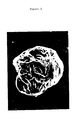
- Figure 1 is an electron microscopic photograph with 5000 magnifications showing the particle structure of a secondary particle having an average particle size of 17.3 ⁇ m as an embodiment of magnesium hydroxide of the present invention.
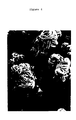
- Figure 2 is an electron microscopic photograph with 5000 magnifications showing the particle structure of a secondary particle having an average particle size of 13.6 ⁇ m as another embodiment of magnesium hydroxide of the present invention.
- Figure 3 is an electron microscopic photograph with 2000 magnifications showing the cross-sectional particle structure of a secondary particle having an average particle size of 35 ⁇ m as a still further embodiment of magnesium hydroxide of the present invention.
- Figure 4 is an electron microscopic photograph with 5000 magnifications showing the particle structure of a secondary particle having an average particle size of 30 ⁇ m as magnesium hydroxide of the present invention obtained in Example 1.
- the magnesium hydroxide of the present invention is a substantially spherical particle having a large size as shown in Figures 1 and 2.
- the average particle size is usually from 5 to 500 ⁇ m, preferably from 10 to 350 ⁇ m.
- the magnesium hydroxide of the present invention is a secondary particle formed by aggregation of a number of primary flake particles which are observed like strings on the surface of the secondary particle in Figure 1 or 2. These primary flake particles are firmly bonded to one another and can not be disintegrated into the primary particles even when subjected to mechanical treatment. Further, as shown in Figure 3, the primary particles are oriented substantially radially outwardly from the center of the secondary particle. The primary particles are densely arranged and firmly intertwined or bonded to one another as mentioned above. Accordingly, void spaces among the primary particles in the secondary particle are very small.
- the specific surface area (as measured by BET method) is very small at a level of from 25 to 1 m2/g, preferably from 20 to 1 m2/g, as compared with from 30 to 100 m2/g of conventional sea water magnesium hydroxide.
- the magnesium hydroxide particle of the present invention has a packing apparent specific gravity of at least 0.8, preferably at least 0.9, which is substantially larger than the packing apparent specific gravity of about 0.6 of conventional sea water magnesium hydroxide.
- the packing apparent specific gravity means an apparent specific gravity of the particles which are densely packed. Specifically, it is the value measured by "Powder Tester” manufactured by Hosokawa Micron K.K.
- the primary particles constituting the magnesium hydroxide of the present invention are flakes.
- the thickness of the flakes is within a range of from 100 to 5000 ⁇ , although it depends upon the size of the secondary particle.
- the primary flake particles gradually grow in the direction of the plain of each flake with slight growth in the thickness direction in correspondence with the growth of the secondary particle.
- Each primary flake particle is composed of a single crystal or polycrystals. Crystallographically, the strain of the primary particles in the ⁇ 101> direction is not higher than 4 x 10 ⁇ 3. The measurement of the strain in the ⁇ 101> direction is conducted by the method disclosed in Japanese Unexamined Patent Publication No. 115799/1977.
- the magnesium hydroxide of the present invention has good flowability and thus has a small angle of repose.
- the magnesium hydroxide of the present invention has good light transmission properties since primary flake particles are arranged substantially radially therein.
- the magnesium hydroxide secondary particle of the present invention is highly dense, and the pores in the particle are very small, and the pore volume is likewise very small.
- the total pore volume of pores having pore sizes of at most 0.5 ⁇ m in the secondary particle is not larger than 0.1 cc/g, preferably not higher than 0.07 cc/g, which is very small as compared with from 0.3 to 0.4 cc/g in the case of conventional sea water magnesium hydroxide.
- the magnesium hydroxide of the present invention has a small oil absorption, and thus is suitable as a filler for resins.
- the oil absorption is not higher than 70 ml/100 g, preferably not higher than 60 ml/100 g, as measured by the method of JIS K5101.
- the magnesium hydroxide of the present invention is highly dense large particles having good roundness, high strength and good flowability, and it is suitable for use as a filler for various resins, and is particularly useful for the production of so-called artificial marble by incorporating it to an ester-type resin.
- magnesium hydroxide of the present invention is useful as a starting material for the production of magnesium oxide having good water resistance (i.e. minimum hydration properties) by calcination.
- the magnesium hydroxide of the present invention is prepared by reacting a water soluble magnesium salt such as magnesium chloride, magnesium nitrate or magnesium sulfate, with ammonia under certain specific conditions.
- a water soluble magnesium salt such as magnesium chloride, magnesium nitrate or magnesium sulfate
- ammonia under certain specific conditions.
- magnesium chloride is most preferred.
- the type of the crystallization apparatus for the production of magnesium hydroxide by the reaction of an aqueous magnesium chloride solution with ammonia there is no particular restriction as to the type of the crystallization apparatus for the production of magnesium hydroxide by the reaction of an aqueous magnesium chloride solution with ammonia.
- the reaction solution is a slurry of an aqueous magnesium chloride solution containing magnesium hydroxide solid.
- the load for crystallization of magnesium hydroxide in the crystallization apparatus is from 5 to 500 kg/m3.hr, preferably from 30 to 120 kg/m3.hr.
- the load for crystallization means an amount (kg) of magnesium hydroxide solid crystallized in one hour per 1 m3 of the magnesium chloride slurry containing the magnesium hydroxide solid in the crystallization apparatus.
- the amount of the solid corresponds to the increase in the weight of the solid content in the slurry.
- the reason for employing such specific crystallization conditions is as follows.
- slurry concentration in the crystallization apparatus is less than 1% by weight, resulting magnesium hydroxide is likely to precipitate as fresh magnesium hydroxide having a fine particle size (for instance, an average particle size of less than 1 ⁇ m) instead of precipitating on the magnesium hydroxide solid already present in the slurry.
- the slurry concentration exceeds 60% by weight, the slurry viscosity tends to be too high to conduct uniform dispersion of ammonia supplied to the crystallization apparatus, whereby the particle size distribution of the resulting magnesium hydroxide will be wide.
- the load for crystallization exceeds 500 kg/m3.hr, the precipitated particles tend to be fine particles of less than 5 ⁇ m. Therefore, the upper limit for the crystallization load is necessary. On the other hand, there is no particular restriction as to the lower limit for the crystallization load. However, if the load is less than 5 kg/m3.hr, it is necessary to use a large apparatus. Therefore, the load for crystallization is preferably at least 5 kg/m3.hr.
- the slurry concentration in the crystallization apparatus may be maintained at a level of from 1 to 60% by weight by controlling the ratio of the amount of the clarified solution containing no solid content to the amount of the slurry containing the solid content withdrawn from the crystallization apparatus.
- the clarified solution and the slurry may be withdrawn directly in a predetermined ratio from the apparatus.
- the solid is separated from the slurry, or a slurry having a high concentration of the solid component is obtained by a solid-liquid separator, and one or both of the solid or the concentrated slurry and the clarified solution from the solid-liquid separator, are returned to the crystallization apparatus by controlling the amount of the feedback.
- Such specific methods can be employed as industrial methods.
- the concentration of magnesium chloride supplied to the crystallization apparatus is preferably from 2 to 30% by weight.
- the reaction temperature is preferably from 20 to 80 o C.
- ammonium chloride is produced as a by-product and recovered together with a small amount of unreacted magnesium chloride.
- the mother liquor separated from magnesium hydroxide and containing these substances may be subjected to a conventional ammonium chloride distillation method with use of slaked lime and/or quick lime, whereby ammonium chloride is recovered as ammonia and can be reused, and calcium chloride produced as a by-product during the ammonium chloride distillation, may be used for the production of the starting material magnesium chloride by reacting it with sea water magnesium hydroxide.
- magnesium hydroxide In order to delay the reaction of magnesium hydroxide with the ester bond or the terminal carboxylic acid group of a curable compound, it is important that magnesium hydroxide itself is made as inactive as possible.
- the present inventors have made extensive study on this point, and as a result have found that it is possible to control the thickening effect of magnesium hydroxide to a practically trouble-free range when magnesium hydroxide having a substantially spherical form and having an average particle size of from 5 to 500 ⁇ m is used.
- the magnesium hydroxide of the present invention has a substantially spherical particle form and has an average particle size of from 5 to 500 ⁇ m and a specific surface area of from 25 to 1 m2/g as measured by BET method.
- the object of the present invention may be accomplished more effectively when the average particle size is preferably at least 10 ⁇ m (specific surface area: at most 7m2/g).
- the reason why the thickening effect can be suppressed by the use of the magnesium hydroxide of the present invention is not completely understood.
- the small specific surface area of the magnesium hydroxide particles may be one of the main factors for the effectiveness.
- the present inventors have further studied means for adequately accomplishing the object of the present invention, and have found also that when the magnesium hydroxide of the present invention is used in combination with a certain type of a surface treating agent, the object and the effects of the present invention can be remarkably improved.
- the manner for the combination it is preferred to cover the magnesium hydroxide with the surface treating agent.
- the surface treating agent may be blended to the resin component.
- Suitable as such a surface treating agent is a saturated or unsaturated fatty acid, a metal salt of a fatty acid, an ester of a fatty acid, a fatty acid ether, a surfactant, a silane coupling agent, a titanate coupling agent, or the like.
- the surface treating agent is used in an amount of from 0.1 to 5% by weight, preferably from 0.3 to 3% by weight, relative to the magnesium hydroxide.
- a drying method, a semi-drying method or a wet method may be employed as a method for covering the surface of the magnesium hydroxide with the surface treating agent.
- a titanate-type coupling agent is dissolved in a fluorine-type solvent, and the solution is mixed and dispersed with magnesium hydroxide by a high speed agitator such as a Henschell mixer, followed by the removal of the solvent.
- the curable compound having an ester group and/or a carboxylic acid group and containing an unsaturated bond in the present invention is a curable compound comprising a monomer or oligomer containing an addition polymerizable unsaturated group (i.e. an ⁇ , ⁇ -unsaturated group) and curable by the addition polymerization, or a mixture of such monomers or oligomers, and which creates the above-mentioned thickening problem when reacted with the conventional magnesium hydroxide.
- an addition polymerizable unsaturated group i.e. an ⁇ , ⁇ -unsaturated group
- Such a curable compound may be a mixture with other monomers or oligomers copolymerizable therewith, or may contain oligomers or polymers having no unsaturated group, such as a thermoplastic polymer as a low shrinking agent or cured thermosetting polymer as a filler.
- the unsaturated polyester resin is, in many cases, a mixture of an unsaturated polyester oligomer (i.e. an oligomer having an ester bond and, in some cases, a carboxylic acid group) and a monomer containing no ester bond or carboxylic acid group, such as styrene.
- Such a curable compound or a mixture thereof is preferably liquid at normal temperature.
- the curable compound includes (a) an unsaturated polyester oligomer, (b) acrylic acid or methacrylic acid, or an oligomer thereof with another addition polymerizable monomer, (c) an acrylic acid ester or a methacrylic acid ester, or an oligomer thereof or an oligomer thereof with another addition polymerizable compound, (d) an ester of an oligomer having a hydroxyl group with an unsaturated carboxylic acid such as acrylic acid or methacrylic acid, (e) a reaction product of a compound or an oligomer having a reactive functional group such as an epoxy group or an isocyanate group with an unsaturated ester such as an acrylic acid ester or a methacrylic acid ester having a functional group such as a hydroxyl group reactive with said reactive group, (f) an ester of allyl alcohol such as diallylphthalate and (g) an unsaturated polyester oligomer, (b) acrylic acid or methacrylic acid, or an oli
- the above (a) includes an unsaturated polyester oligomer having an unsaturated polycarboxylic acid residue such as a maleic acid residue, a fumaric acid residue or an itaconic acid residue and a saturated polyhydric alcohol residue such as an ethylene glycol residue, a 1,4-butanediol residue or a glycerol residue, and in some cases further containing a saturated polycarboxylic acid residue or an unsaturated polyhydric alcohol residue.
- the above (b) includes a mixture or oligomer of acrylic acid or methacrylic acid with another monomer such as an acrylic acid ester, a methacrylic acid ester or styrene.
- the above (c) includes butyl acrylate, methyl methacrylate, 2-hydroxyethyl acrylate, ethyleneglycol dimethacrylate, trimethylolpropane triacrylate and other acrylic acid or methacrylic acid esters, oligomers including homopolymers and copolymers of such acrylic acid or methacrylic acid esters, and oligomers of such acrylic acid or methacrylic acid esters with other monomers.
- the above (d) includes esters of hydroxyl group-containing oligomers such as a polyester polyol, a polyether polyol or a hydroxyl group-containing polybutadiene, with acrylic acid or methacrylic acid.
- the above (e) includes a polyepoxy compound (an epoxy resin) such as bisphenol A-diglycidyl ether or its oligomer, and a reaction product (a so-called vinyl ester or acryl urethane) of an isocyanate group-containing compound or its prepolymer such as a polyisocyanate compound or a terminal isocyanate group polyurethane prepolymer, with a hydroxy group-containing acrylic acid or methacrylic acid ester such as 2-hydroxyethyl acrylate, a 2-hydroxyethyl methacrylate or glycerol diacrylate.
- a polyepoxy compound an epoxy resin
- a reaction product a so-called vinyl ester or acryl urethane
- an isocyanate group-containing compound or its prepolymer such as a polyisocyanate compound or a terminal isocyanate group polyurethane prepolymer
- a hydroxy group-containing acrylic acid or methacrylic acid ester such as 2-
- a particularly preferred curable compound or a mixture thereof is a curable resin which is liquid at normal temperature such as an unsaturated polyester resin as a mixture of an unsaturated polyester oligomer with styrene, a vinyl ester resin as a mixture of vinyl ester with styrene, methyl methacrylate or its oligomer (i.e. methyl methacrylate syrup).
- curable resins are preferably curable by heating in the presence of a curing agent such as a peroxide or an azo compound. However, it may be cured at room temperature.
- the curing agent may optionally be selected depending upon the type of the resin used and the curing conditions.
- the magnesium hydroxide is used as a flame retarding filler or a bulking filler for resins.
- the magnesium hydroxide is used in an amount of from 50 to 85% by weight when it is used alone, or may be in an amount of less than 50% by weight when it is used in combination with other flame retarding fillers.
- the magnesium hydroxide is used alone or in combination with other inorganic fillers in an amount of from 5 to 80% by weight although the amount may vary depending upon the particular purpose.
- the magnesium hydroxide is used in combination with the following inorganic fillers.
- the composition preferably comprises from 50 to 84% by weight of magnesium hydroxide and from 1 to 35% by weight of an inorganic filler.
- the magnesium hydroxide component may be replaced by aluminum hydroxide within a limit of not exceeding 20% by weight. If aluminum hydroxide exceeds 20% by weight, the resulting shaped article tends to have distinctly poor heat resistance.
- the magnesium hydroxide and the inorganic filler are preferably preliminarily adequately subjected to surface treatment so that the insulation can be maintained for a long period of time.
- the inorganic filler to be used in combination with the magnesium hydroxide for the composition of the present invention, there may be mentioned asbestos, glass powder, calcium carbonate, calcium silicate, alumina, kaolin, talc, other clay mineral powder, glass fiber, carbon fiber, metal fiber, potassium titanate fiber, mica, crystalline or non-crystalline quartz powder, "silus" balloons, glass balloons and glass beads.
- the inorganic filler includes an inorganic hydroxide such as aluminum hydroxide or calcium hydroxide, a flame retarding assistant agent such as antimony oxide or a phosphorus compound, an organic halogen flame retardant and various stabilizers and pigments.
- the type and the amount of such an inorganic filler may suitably be selected depending upon the particular purpose.
- composition of the present invention is obtained by uniformly mixing the above-mentioned curable compound, magnesium hydroxide and, if necessary, other additives as mentioned above.
- the mixing method itself may be optionally selected. For instance, a kneader, a multipurpose mixer, a dissolver (tradename: Disper), etc. may be used.
- the magnesium hydroxide-filled unsaturated polyester resin composition is useful as a flame retarded building material having a high heat resistance or as a flame retarded insulation materials for electric or electronic parts by injection molding or heat press molding.
- the composition prepared by incorporating the magnesium hydroxide to methyl methacrylate syrup or resin is useful as a decorative sheet around kitchen or as a decorative sheet for show windows in view of the excellent outer appearance of the molded product and excellent flame retardancy and smoke retardancy.
- the magnesium hydroxide thus obtained was observed by an electron microscope with 5000 magnifications. As shown in Figure 4, a number of primary flake particles are aggregated in various directions, and the flakes are oriented substantially radially outwardly from the center. The thickness of each flake was from 200 to 1000 ⁇ . It was a substantially spherical particle having an average particle size of 30 ⁇ m.
- the strain in the ⁇ 101> direction of the primary flake particles was 1.8 x 10 ⁇ 3.
- the specific surface area was 3 m2/g as measured by BET method using nitrogen gas, and the specific gravity of the particles was 2.27 as measured by the method of JIS Z8807.
- the packing apparent specific gravity of this secondary particle was 1.4, the angle of repose was 37 o , and the oil absorption was 35 ml/100 g as measured in accordance with JIS K5101.
- the total pore volume of pores having sizes of at most 0.5 ⁇ m in the secondary particle was 0.03 cc/g.
- Magnesium hydroxide was obtained in the same manner as in Example 1 except that an aqueous solution containing 12.7% by weight of magnesium chloride obtained from bittern was supplied at a rate of 55 kg/hr., ammonia was supplied at a rate of 5.8 Nm3/hr, the load for crystallization was 105 kg/m3.hr and the magnesium hydroxide slurry concentration was 30% by weight.
- the magnesium hydroxide thus obtained was a particle having an average particle size of 300 ⁇ m and having a structure as shown in Figures 1 and 2.
- each primary flake particle was from about 300 to about 1500 ⁇ , and the strain in the ⁇ 101> direction was 1.0 x 10 ⁇ 3.
- Other properties measured in the same manner as in Example 1 were as follows:
- Magnesium hydroxide of the present invention was obtained in the same manner as in Example 2 except that the load for crystallization was changed to 350 kg/m3.hr and the slurry concentration was changed to 45% by weight.
- Magnesium hydroxide was prepared in accordance with Example 1 of Japanese Unexamined Patent Publication No. 115799/1977.
- Magnesium hydroxide was crystallized in the same manner as in Example 2 except that the load for crystallization was changed to 600 kg/m3.hr and the slurry concentration was changed to 0.5% by weight.
- the properties of the magnesium hydroxide thus obtained were as follows.
- Ammonia gas was blown into an aqueous magnesium chloride slurry containing 10% by weight of magnesium hydroxide to crystallize magnesium hydroxide at a load of crystallization of 100 kg/m3.hr.
- the average particle size of the magnesium hydroxide particles was 20 ⁇ m (specific surface area: 4m2/g; test sample A).
- Magnesium hydroxide having an average particle size of 35 ⁇ m was crystallized in the same manner as above except for a slight modification of the crystallization conditions, and the crystals were pulverized by an air jet mill to obtain irregularly shaped magnesium hydroxide having an average particle size of 10 ⁇ m (test sampel B).
- test sample C Commercially available hexagonal plate-like magnesium hydroxide having an average particle size of 0.8 ⁇ m was prepared (test sample C).
- an unsaturated polyester resin (#2042AP, manufactured by Japan Upica Co., Ltd.) was blended with 250 g of each of test samples A, B and C, respectively, to obtain three different types of compositions.
- Each composition was stirred in a small size dissolver-type stirrer for 20 minutes, whereby the kneading state was observed and the viscosity was measured immediately after the kneading and 24 hours later by a B-model rotary viscometer.
- Example 2 In the same manner as in Example 4, various spherical magnesium hydroxide particles having particle sizes of from 1 to 100 ⁇ m were prepared by modifying the conditions for crystallization, and the thickening properties of the compositions were tested in the same manner as in Example 4. The results are shown in Table 2.
- Example 4 To spherical magnesium hydroxide particles having an average particle size of 20 ⁇ m obtained in the same manner as in Example 4, the surface treating agents as shown in Table 3 were applied 2% by a semi-drying method, and then the thickening properties against the unsaturated polyester resin were tested in the same manner as in Example 4. The results are shown in Table 3 together with the results of Example 4.
- Example 4 60% by weight of the magnesium hydroxide obtained in Example 4, 20% by weight of methyl methacrylate syrup (#MC-1003, manufactured by Mitsui Toatsu) and 20% by weight of methyl methacrylate monomer were mixed, and stirred for 20 minutes in a small size disper-type stirrer, whereupon the kneading state was observed, and the viscosity was measured immediately after the kneading and 3 hours later by a B-model rotary viscometer. The results are shown in Table 4.
- Example 12 50% by weight of the magnesium hydroxide obtained in Example 12, 10% by weight of glass powder (manufactured by Ferro Enamel Ltd.), 20% by weight of methyl methacrylate syrup (#MC-1003, manufactured by Mitsui Toastu) and 20% by weight of methyl methacrylate monomer were mixed, kneaded and evaluated. The results are shown in Table 4. Table 4 Kneading state Viscosity immediately after kneading (poise) Viscosity after 3 hours (poise) Example 14 Good 3350 9700 Example 15 Good 2100 3940 Example 16 Good 1650 3420
Landscapes
- Chemical & Material Sciences (AREA)
- Organic Chemistry (AREA)
- Engineering & Computer Science (AREA)
- Nanotechnology (AREA)
- Health & Medical Sciences (AREA)
- Polymers & Plastics (AREA)
- Medicinal Chemistry (AREA)
- Chemical Kinetics & Catalysis (AREA)
- Composite Materials (AREA)
- General Physics & Mathematics (AREA)
- Materials Engineering (AREA)
- Crystallography & Structural Chemistry (AREA)
- Life Sciences & Earth Sciences (AREA)
- Condensed Matter Physics & Semiconductors (AREA)
- Inorganic Chemistry (AREA)
- Geology (AREA)
- Physics & Mathematics (AREA)
- Compounds Of Alkaline-Earth Elements, Aluminum Or Rare-Earth Metals (AREA)
- Compositions Of Macromolecular Compounds (AREA)
Claims (14)
- Hydroxyde de magnésium sous forme de particules sensiblement sphériques ayant une dimension moyenne de particule de 5 à 500 µm et une surface spécifique de 25 à 1 m²/g, telle que mesurée par la méthode BET, qui sont des particules secondaire formée par l'agrégation d'un nombre de particules primaires.
- Hydroxyde de magnésium selon la revendication 1, dans lequel le taux de déformation des particules primaires dans la direction <101> n'est pas supérieur à 4 x 10⁻³.
- Hydroxyde de magnésium selon la revendication 2, dans lequel les particules secondaires ont une densité apparente de tassement d'au moins 0,8.
- Hydroxyde de magnésium selon la revendication 1, dans lequel les particules primaires sont des particules en flocons ayant une épaisseur de 10 à 500 nm (100 à 5000 Å).
- Hydroxyde de magnésium selon la revendication 1, dans lequel la particule secondaire présente une absorption d'huile non supérieure à 70 ml/100 g.
- Hydroxyde de magnésium selon la revendication 4, dans lequel les particules primaires en flocons sont orientées sensiblement radialement vers l'extérieur à partir du centre de la particule secondaire.
- Hydroxyde de magnésium selon la revendication 1, dans lequel le volume total des pores ayant des dimensions de particule d'au plus 0,5 µm dans la particule secondaire n'est pas supérieur à 0,1 cm³/g.
- Procédé de fabrication d'hydroxyde de magnésium selon la revendication 1, qui comprend la réaction avec de l'ammoniac d'une solution aqueuse contenant un sel de magnésium soluble dans l'eau, tout en contrôlant la charge pour la cristallisation de l'hydroxyde de magnésium pour qu'elle se situe à un niveau non supérieur à 500 kg/m³.h, et la concentration de la bouillie d'hydroxyde de magnésium dans l'appareil de cristallisation, pour qu'elle se situe à un niveau de 1 à 60% en poids.
- Procédé selon la revendication 8, dans lequel le sel de magnésium soluble dans l'eau est choisi dans le groupe constitué par le chlorure de magnésium, le nitrate de magnésium et le sulfate de magnésium.
- Composition de résine préparée par mélange d'un composé durcissable ayant une liaison ester et/ou un groupe acide carboxylique et contenant une liaison insaturée, ou un mélange contenant un tel composé durcissable, avec de 5 à 85% en poids, sur la base du composé durcissable, d'hydroxyde de magnésium selon la revendication 1, en faisant suivre par un durcissement.
- Composition de résine selon la revendication 10, dans laquelle les particules d'hydroxyde de magnésium sont formées par agrégation d'un nombre de particules primaires.
- Composition de résine selon la revendication 10, dans laquelle les particules d'hydroxyde de magnésium ont été soumises à un traitement de surface.
- Composition de résine selon la revendication 10, dans laquelle le composé durcissable est un monomère ou un oligomère, capable de former une résine de polyester insaturé, une résine acrylique eu une résine méthacrylique, ou un mélange de celles-ci.
- Composition de résine comprenant :(a) de 15 à 50% en poids d'un composé durcissable ayant une liaison ester et/ou un groupe acide carboxylique et contenant une liaison insaturée, ou un mélange contenant un tel composé durcissable ;(b) de 50 à 84% en poids d'un mélange d'hydroxyde d'aluminium et d'hydroxyde de magnésium selon la revendication 1, la quantité d'hydroxyde d'aluminium n'étant pas supérieure à 20% en poids, et(c) de 1 à 35% en poids d'au moins un additif choisi dans le groupe constitué par l'amiante, la poudre de verre, le carbonate de calcium, le silicate de calcium, le kaolin, le talc, l'argile, les fibres de verre, les fibres de carbone, les fibres métalliques, les fibres de titanate de potassium, le mica, la poudre de quartz cristalline ou non cristalline, les ballons vitreux réalisés à partir de dépôt de retombée de ponce, ou de dépôt de cendres volcaniques, les ballons de verre, les perles de verre et l'alumine.
Applications Claiming Priority (4)
| Application Number | Priority Date | Filing Date | Title |
|---|---|---|---|
| JP6707/85 | 1985-01-19 | ||
| JP670785A JPS61168522A (ja) | 1985-01-19 | 1985-01-19 | 水酸化マグネシウム及びその製法 |
| JP6708/85 | 1985-01-19 | ||
| JP670885 | 1985-01-19 |
Publications (3)
| Publication Number | Publication Date |
|---|---|
| EP0189098A2 EP0189098A2 (fr) | 1986-07-30 |
| EP0189098A3 EP0189098A3 (en) | 1989-10-11 |
| EP0189098B1 true EP0189098B1 (fr) | 1992-05-06 |
Family
ID=26340899
Family Applications (1)
| Application Number | Title | Priority Date | Filing Date |
|---|---|---|---|
| EP86100428A Expired EP0189098B1 (fr) | 1985-01-19 | 1986-01-14 | Hydroxyde de magnésium, procédé pour sa production et composition de résine le contenant |
Country Status (4)
| Country | Link |
|---|---|
| US (1) | US4698379A (fr) |
| EP (1) | EP0189098B1 (fr) |
| CA (1) | CA1241180A (fr) |
| DE (1) | DE3685121D1 (fr) |
Families Citing this family (45)
| Publication number | Priority date | Publication date | Assignee | Title |
|---|---|---|---|---|
| US4931481A (en) * | 1986-09-27 | 1990-06-05 | Bayer Aktiengesellschaft | Process for the production of foams based on aromatic isocyanates using MG(OH)2 and the foams produced thereby |
| DE3632915A1 (de) * | 1986-09-27 | 1988-03-31 | Bayer Ag | Verwendung von mg(oh)(pfeil abwaerts)2(pfeil abwaerts) bei der herstellung von schaumstoffen auf basis von aromatischen isocyanaten |
| US4826899A (en) * | 1987-06-15 | 1989-05-02 | E. I. Du Pont De Nemours And Company | Low smoke generating, high char forming, flame resistant thermoplastic multi-block copolyesters |
| JPH02111625A (ja) * | 1988-10-20 | 1990-04-24 | Kyowa Chem Ind Co Ltd | 高活性高分散性水酸化マグネシウムおよびその製造方法 |
| JPH02141418A (ja) * | 1988-11-21 | 1990-05-30 | Kyowa Chem Ind Co Ltd | 高分散性酸化マグネシウムおよびその製造方法 |
| GB8909730D0 (en) * | 1989-04-27 | 1989-06-14 | Ici Plc | Inorganic particles |
| US5244941A (en) * | 1989-11-02 | 1993-09-14 | Ralph Wilson Plastics Company | Artificial stone compositions, process of producing the same, and apparatus employed in the production thereof |
| EP0543843B1 (fr) * | 1990-08-18 | 1994-06-08 | Chemson Polymer-Additive Gesellschaft M.B.H. | Procede de production d'hydroxydes metalliques ayant une superficie specifique reduite |
| US5474602A (en) * | 1990-09-26 | 1995-12-12 | Alcan International Limited | Treatment of magnesium hydroxide and its use as plastics filler |
| IE921328A1 (en) * | 1992-04-23 | 1993-11-03 | Defped Ltd | Particulate magnesium hydroxide |
| US5211746A (en) * | 1992-06-22 | 1993-05-18 | Union Carbide Chemicals & Plastics Technology Corporation | Flame retardant compositions |
| US5262467A (en) * | 1992-11-12 | 1993-11-16 | Union Carbide Chemicals & Plastics Technology Corporation | Flame retardant compositions |
| SK279866B6 (sk) * | 1993-05-26 | 1999-04-13 | Duslo | Hydroxid horečnatý a spôsob jeho prípravy |
| IL112385A (en) * | 1994-01-21 | 1998-08-16 | Flamemag International Gie | Process for preparing magnesium hydroxide for extinguishing flames |
| AUPM985294A0 (en) * | 1994-12-02 | 1995-01-05 | Flamemag International Gie | Magnesium process |
| IL117216A (en) * | 1995-02-23 | 2003-10-31 | Martinswerk Gmbh | Surface-modified filler composition |
| JP3638738B2 (ja) † | 1995-12-19 | 2005-04-13 | 協和化学工業株式会社 | ポリオレフィンまたはその共重合体よりなる耐熱劣化性樹脂組成物および成形品 |
| US6025424A (en) * | 1995-12-19 | 2000-02-15 | Kyowa Chemical Industry Co Ltd | Heat deterioration resistant flame retardant, resin composition and molded articles |
| WO1998033743A1 (fr) * | 1997-01-31 | 1998-08-06 | Solutia Inc. | Hydratation d'oxyde de metal alcalino-terreux pour produire un hydroxyde de metal alcalino-terreux |
| US6214313B1 (en) | 1999-04-13 | 2001-04-10 | Dravo Lime, Inc. | High-purity magnesium hydroxide and process for its production |
| US6414059B1 (en) * | 1999-08-27 | 2002-07-02 | Riken Technos Corporation | Fire-retardant resin composition and molded part using the same |
| JP4412879B2 (ja) * | 2002-03-11 | 2010-02-10 | メルク株式会社 | 体質顔料およびその製造方法 |
| DE10348473A1 (de) * | 2003-10-14 | 2005-05-19 | Tesa Ag | Gefüllte weiche Wickelfolie enthaltend Magnesiumhydroxid mit kugeliger Struktur |
| JPWO2005100467A1 (ja) * | 2004-04-12 | 2008-03-06 | 日清紡績株式会社 | 樹脂組成物 |
| WO2004101677A1 (fr) * | 2004-04-21 | 2004-11-25 | Achilles Corporation | Articles formant feuille resineux mous et stables a la chaleur, et compositions associees |
| KR100705289B1 (ko) * | 2004-12-16 | 2007-04-10 | 엘지전자 주식회사 | 플라즈마 디스플레이 패널의 보호막 형성방법 및 그 조성물 |
| US7686986B2 (en) * | 2006-01-05 | 2010-03-30 | Headwaters Technology Innovation, Llc | Magnesium hydroxide nanoparticles, methods of making same and compositions incorporating same |
| US20070219081A1 (en) * | 2006-03-15 | 2007-09-20 | Council Of Scientific & Industrial Research | Process for the preparation of magnesia (MgO) |
| US7771682B2 (en) * | 2006-01-31 | 2010-08-10 | Council Of Scientific And Industrial Research | Process for the preparation of magnesia (MgO) from crude Mg (OH)2 |
| WO2007117840A2 (fr) * | 2006-03-31 | 2007-10-18 | Albemarle Corporation | Hydroxyde de magnésium comprenant des performances améliorées de mélange et de viscosité |
| EP2001800A2 (fr) * | 2006-03-31 | 2008-12-17 | Albermarle Corporation | Hydroxyde de magnésium à performances de compoundage et de viscosité améliorées |
| DE102008031360A1 (de) * | 2008-07-04 | 2010-01-14 | K+S Ag | Verfahren zum Herstellen von aushärtbaren Massen, enthaltend grob- und/oder nanoskalige, gecoatete, desagglomerierte und bevorzugt funktionalisierte Magnesiumhydroxidpartikel, sowie von ausgehärteten thermoplastischen oder duroplastischen Polymeren bzw. Kompositen, enthaltend desagglomerierte und homogen verteilte Magnesiumhydroxidfüllstoffpartikel |
| JP2010111718A (ja) * | 2008-11-04 | 2010-05-20 | Autonetworks Technologies Ltd | 難燃剤、難燃性組成物および絶縁電線 |
| JP5604789B2 (ja) * | 2009-01-29 | 2014-10-15 | 株式会社オートネットワーク技術研究所 | 難燃剤、難燃性樹脂組成物及び絶縁電線 |
| JP5588660B2 (ja) * | 2009-11-24 | 2014-09-10 | 矢崎総業株式会社 | 難燃性樹脂組成物 |
| JP5628063B2 (ja) * | 2010-03-26 | 2014-11-19 | 富士フイルム株式会社 | 難燃剤用金属水酸化物微粒子の製造方法 |
| JP5773695B2 (ja) * | 2011-03-23 | 2015-09-02 | タテホ化学工業株式会社 | 球状の水酸化マグネシウム粒子、及び球状の酸化マグネシウム粒子、並びにそれらの製造方法 |
| DE102012219479B4 (de) * | 2012-10-24 | 2016-12-15 | Hilti Aktiengesellschaft | Reaktionsharz-Zusammensetzung und deren Verwendung |
| JP5992846B2 (ja) * | 2013-02-13 | 2016-09-14 | タテホ化学工業株式会社 | 高い比表面積を有する棒状の水酸化マグネシウム粒子、及び棒状の酸化マグネシウム粒子、並びにそれらの製造方法 |
| JP2016094490A (ja) * | 2013-02-19 | 2016-05-26 | 神島化学工業株式会社 | 難燃剤、難燃性組成物及び成形体 |
| US9580337B2 (en) * | 2013-12-24 | 2017-02-28 | Lehigh University | Pressurized forward osmosis process and system |
| US9895649B2 (en) * | 2014-04-08 | 2018-02-20 | Premier Magnesia, Llc | High solids magnesium hydroxide sea water slurries |
| EP3830845B1 (fr) * | 2018-07-31 | 2025-09-10 | CommScope Technologies LLC | Câble de communication |
| CN110498662B (zh) * | 2019-09-28 | 2022-01-14 | 金华市银弧壁炉制造有限公司 | 一种高仿大理石材雕刻壁炉架的生产工艺 |
| CN115279856A (zh) * | 2020-03-13 | 2022-11-01 | 美国特种电子材料有限责任公司 | 包含氢氧化镁的热界面材料 |
Family Cites Families (11)
| Publication number | Priority date | Publication date | Assignee | Title |
|---|---|---|---|---|
| US1348933A (en) * | 1919-09-03 | 1920-08-10 | Clinton E Dolbear | Purifying magnesium compounds |
| GB403860A (en) * | 1932-05-24 | 1934-01-04 | American Zinc Lead & Smelting | Improved processes for making magnesium hydroxide |
| US1986509A (en) * | 1932-05-24 | 1935-01-01 | American Zinc Lead & Smelting | Process for making magnesium hydroxide |
| GB693108A (en) * | 1949-10-14 | 1953-06-24 | Wintershall Ag | Process for the production of easily filterable magnesia and ammonium-magnesium-double salt |
| GB939467A (en) * | 1960-10-12 | 1963-10-16 | Negev Phosphates Ltd | Production of magnesium hydroxide |
| US3366451A (en) * | 1967-01-04 | 1968-01-30 | Dow Chemical Co | Production of magnesium hydroxide |
| AT337654B (de) * | 1975-01-31 | 1977-07-11 | Veitscher Magnesitwerke Ag | Verfahren zur herstellung von granuliertem magnesiumhydroxyd |
| GB1514081A (en) * | 1975-05-30 | 1978-06-14 | Kyowa Chem Ind Co Ltd | Particulate magnesium hydroxide |
| SU967954A1 (ru) * | 1980-03-12 | 1982-10-23 | Предприятие П/Я В-8046 | Способ получени окиси магни |
| JPS59210963A (ja) * | 1983-05-17 | 1984-11-29 | Mitsui Petrochem Ind Ltd | ポリ―1―ブテン樹脂組成物 |
| JP3317848B2 (ja) * | 1996-06-14 | 2002-08-26 | アルプス電気株式会社 | 車両用空調制御スイッチ |
-
1986
- 1986-01-14 EP EP86100428A patent/EP0189098B1/fr not_active Expired
- 1986-01-14 DE DE8686100428T patent/DE3685121D1/de not_active Expired - Lifetime
- 1986-01-16 US US06/819,409 patent/US4698379A/en not_active Expired - Fee Related
- 1986-01-17 CA CA000499805A patent/CA1241180A/fr not_active Expired
Also Published As
| Publication number | Publication date |
|---|---|
| US4698379A (en) | 1987-10-06 |
| DE3685121D1 (de) | 1992-06-11 |
| EP0189098A2 (fr) | 1986-07-30 |
| CA1241180A (fr) | 1988-08-30 |
| EP0189098A3 (en) | 1989-10-11 |
Similar Documents
| Publication | Publication Date | Title |
|---|---|---|
| US4698379A (en) | Magnesium hydroxide, process for its production and resin composition containing it | |
| EP0406662B1 (fr) | Procédé de fabrication de carbonate de calcium de la forme cristalline de l'aragonite et de morphologie aciculaire | |
| US4505887A (en) | Fibrous magnesium oxide and process for production thereof | |
| EP0370728B1 (fr) | Oxyde de magnésium très dispersable et procédé de production | |
| EP3487830B1 (fr) | Utilisation des géopolymères modifiés pour réduire la conductivité thermique des mousses en polymères aromatiques vinyliques | |
| KR100200082B1 (ko) | 합성금속 수산화물 및 이를 함유하는 물 | |
| US4386169A (en) | Polymer matrices reinforced with calcium carbonate particulates | |
| US4927618A (en) | Process for the preparation of large surface area, finely divided precipitated calcium carbonate and filled polymeric compositions of matter containing said calcium carbonate | |
| WO1993022237A1 (fr) | Procede de production d'hydrotalcite synthetique | |
| EP0794925B1 (fr) | Procédé de production d'hydroxide de magnesium | |
| US4233366A (en) | Silane coated silicate minerals and method for preparing same | |
| GB2317167A (en) | Preparing calcium carbonate particles of uniform size | |
| US5102465A (en) | Filler for polyester molding compound and method | |
| DE2431004B2 (de) | Feuerhemmende, wärmehärtbare Harzmasse | |
| SK279432B6 (sk) | Spôsob výroby hydroxidu hlinitého al(oh)3 so zaobl | |
| JP3107926B2 (ja) | 難燃剤および難燃性樹脂組成物 | |
| JPS6411571B2 (fr) | ||
| US4980395A (en) | Process for the preparation of large surface area, finely divided precipitated calcium carbonate and filled polymeric compositions of matter containing said calcium carbonate | |
| US4310358A (en) | Composition for forming inorganic hardened products and process for producing inorganic hardened products using the same | |
| JP3700964B2 (ja) | アルミノシリケート系充填材 | |
| JP2826973B2 (ja) | 複合金属水酸化物 | |
| JP2659508B2 (ja) | 添加剤含有水酸化マグネシウムの製造方法及びそれを利用した添加剤含有酸化マグネシウムの製造方法 | |
| WO1999028050A1 (fr) | Traitement des particules des carbonates de metaux alcalino-terreux | |
| JP3154535B2 (ja) | 複合金属水酸化物およびその使用 | |
| JPH06305854A (ja) | 軽量ケイ酸カルシウム成形体 |
Legal Events
| Date | Code | Title | Description |
|---|---|---|---|
| PUAI | Public reference made under article 153(3) epc to a published international application that has entered the european phase |
Free format text: ORIGINAL CODE: 0009012 |
|
| AK | Designated contracting states |
Kind code of ref document: A2 Designated state(s): DE FR GB |
|
| PUAL | Search report despatched |
Free format text: ORIGINAL CODE: 0009013 |
|
| AK | Designated contracting states |
Kind code of ref document: A3 Designated state(s): DE FR GB |
|
| 17P | Request for examination filed |
Effective date: 19900122 |
|
| 17Q | First examination report despatched |
Effective date: 19901205 |
|
| GRAA | (expected) grant |
Free format text: ORIGINAL CODE: 0009210 |
|
| AK | Designated contracting states |
Kind code of ref document: B1 Designated state(s): DE FR GB |
|
| REF | Corresponds to: |
Ref document number: 3685121 Country of ref document: DE Date of ref document: 19920611 |
|
| ET | Fr: translation filed | ||
| PLBE | No opposition filed within time limit |
Free format text: ORIGINAL CODE: 0009261 |
|
| STAA | Information on the status of an ep patent application or granted ep patent |
Free format text: STATUS: NO OPPOSITION FILED WITHIN TIME LIMIT |
|
| 26N | No opposition filed | ||
| PGFP | Annual fee paid to national office [announced via postgrant information from national office to epo] |
Ref country code: GB Payment date: 19940105 Year of fee payment: 9 |
|
| PGFP | Annual fee paid to national office [announced via postgrant information from national office to epo] |
Ref country code: FR Payment date: 19940111 Year of fee payment: 9 |
|
| PGFP | Annual fee paid to national office [announced via postgrant information from national office to epo] |
Ref country code: DE Payment date: 19940325 Year of fee payment: 9 |
|
| PG25 | Lapsed in a contracting state [announced via postgrant information from national office to epo] |
Ref country code: GB Effective date: 19950114 |
|
| GBPC | Gb: european patent ceased through non-payment of renewal fee |
Effective date: 19950114 |
|
| PG25 | Lapsed in a contracting state [announced via postgrant information from national office to epo] |
Ref country code: FR Effective date: 19950929 |
|
| PG25 | Lapsed in a contracting state [announced via postgrant information from national office to epo] |
Ref country code: DE Effective date: 19951003 |
|
| REG | Reference to a national code |
Ref country code: FR Ref legal event code: ST |